

Edward Hopper Approaching a city 1946

https://twitter.com/EricLDaugh/status/2052179925700903125?s=20
This may be the most articulate response I’ve ever heard to this question. pic.twitter.com/ndPULk09pT
— Today in History (@TodayinHistory) May 6, 2026
https://twitter.com/CRRJA5/status/2051854394044375415?s=20Will never get tired of sharing this.
— Kosher (@koshercockney) May 6, 2026
Never forget that @SecRubio called the Iran situation 11 years ago.
He analysed it and predicted it.
Like a play-by-play, to a tee.
The accuracy is absolutely mind-blowing.
It’s worth sharing again, because there are still some people… pic.twitter.com/IdtTcmdhRE
Elon Musk just made every skill you’ve ever earned sound like a waste of time.
— Dustin (@r0ck3t23) May 5, 2026
Musk: “Down the road with a Neuralink, you can just upload any subject instantly. You wanna fly a helicopter? No problem. Any given skill, you just upload it instantly.”
Not faster learning.
Not… pic.twitter.com/nncWIX4Naw
Accurate https://t.co/Z3xsCeDHXk
— Elon Musk (@elonmusk) May 6, 2026
“The sea blockade is a much more serious threat than even war.. ”
• ‘Fate Of Iran Refineries Now At Risk’ As US Blockade Begins To Bite (ZH)
An Iranian energy official just conceded something in a surprise admission that the US naval blockade has begun to bite the Islamic Republic’s oil industry. According to new reporting in the NY Times: The blockade has halted Iran’s oil exports, choking off crucial revenues, and the country risks running out of places to store its oil. It is also affecting the import of other goods, forcing Iran to seek alternative routes through neighboring countries and its smaller ports on the Caspian Sea. And the economic pain inside Iran, already dire before the war, is becoming much worse.Read more …
“The sea blockade is a much more serious threat than even war, and the current stalemate must be broken because the export of our oil and energy and the fate of our refineries is now at risk,” said Hamid Hosseini, an expert on Iran’s oil sector who serves on the energy committee of Iran’s Chamber of Commerce, in an interview from Tehran.This as Kpler has stated based on its data that since the US blockade took effect on April 13, no Iranian oil-laden tankers have been able to exit the strait.“The bottom line is that Iran could run out of storage space in about 25 to 30 days if the blockade is not lifted, according to Homayoun Falakshahi, Kpler’s head of oil analysis,” continues the Wednesday report. “Other experts have given different estimates ranging from a few weeks to a month or more.” Last month we offered the following, saying a likely 15 days – probably followed with a few weeks left on the clock before the Iranians run out of storage space… As for the current Trump blockade strategy, another analyst told the Times, “The blockade really is about putting a financial deadline on the Islamic Republic’s head.”
US Jet Fires On Iranian Tanker Trying To Pass
So much for that ceasefire and alleged ‘pause’ in US naval blockade actions, as things just took another escalatory turn. In this case, a rare live fire incident unfolded Wednesday in Gulf waters as a US jet launched from the Lincoln carrier fired on and possibly disabled an Iranian-flagged tanker, per the officials US Central Command statement: U.S. forces operating in the Gulf of Oman enforced blockade measures by disabling an Iranian-flagged unladen oil tanker attempting to sail toward an Iranian port at 9 a.m. ET, May 6. U.S. Central Command (CENTCOM) forces observed M/T Hasna as it transited international waters enroute to an Iranian port on the Gulf of Oman. American forces issued multiple warnings and informed the Iranian-flagged vessel it was in violation of the U.S. blockade.After Hasna’s crew failed to comply with repeated warnings, U.S. forces disabled the tanker’s rudder by firing several rounds from the 20mm cannon gun of a U.S. Navy F/A-18 Super Hornet launched from USS Abraham Lincoln (CVN 72). Hasna is no longer transiting to Iran. The Pentagon/CENTCOM statement then emphasized, “The U.S. blockade against ships attempting to enter or depart Iranian ports remains in full effect. CENTCOM forces continue to act deliberately and professionally to ensure compliance.” Tehran’s response to this will be interesting, and follows prior alleged attacks this week on the UAE.
Don’t fall for those talks. After a month you’ll be right back where you started.
• ‘Framework’ Still Being Hammered Out For ‘Monthlong’ US, Iran Talks (ZH)
Iran’s Foreign Ministry has said that Iran’s response to the United States has not yet been presented to mediator Pakistan, as the WSJ reports that the US and Iranian sides are currently trying to hammer out a one-page memorandum of understanding which features 14-points. This would “lay out a framework” – the report says, for a “monthlong period of talks to end the war.” Given that agreement cannot even be found on the ‘framework’ for future talks, it seems the process is not very advanced at all – but is perhaps still back at square one, with headlines in the US way out front, and likely overly optimistic.Read more …
CNN citing the White House: “The White House received positive feedback from Pakistani mediators on Tuesday that the Iranians were progressing toward a compromise.” And more from WSJ: Iran’s mission to the UN said that “the only viable solution in the Strait of Hormuz is clear: a permanent end to the war, the lifting of the maritime blockade, and the restoration of normal passage.”Key Timing of Wang-Araghchi Meeting in Beijing
During Iranian Foreign Minister Araghchi’s visit to Beijing on Wednesday, China’s Foreign Minister Wang Yi pushed for the rapid reopening of the Strait of Hormuz and a halt to the fighting. Araghchi echoed the urgency, saying, “Currently, it is possible to resolve the issue of reopening the Strait of Hormuz as soon as possible.” Wang called for a “comprehensive ceasefire” and stressed that “the international community shares a common concern for restoring normal and safe passage through the Strait,” urging swift action.The coordinated messaging reflects shared economic and strategic interests, especially as US naval actions have disrupted Iranian oil flows to China. Wang also signaled support for Tehran’s position, stating China “appreciates Iran’s pledge to not develop nuclear weapons,” while Iran continues to insist its nuclear program is peaceful and maintains its right to uranium enrichment as a matter of sovereignty. Wang reinforced Beijing’s stance by warning that “a comprehensive ceasefire brooks no delay” and that negotiations must continue, while US Secretary of State Marco Rubio has called on China to pressure Iran to ease its blockade of the strait.
Alarmed Reaction from Israel
An Israeli official cited in Times of Israel said Israel did not know that President Trump was close to a deal with Iran to end the fighting and reopen the Strait of Hormuz, even as global headlines pointed to progress. The official said Israel had been preparing for escalation, reflecting recent reports that Prime Minister Benjamin Netanyahu’s government was waiting for US approval to resume its aerial campaign following 38 days of strikes under Operation Epic Fury.US messaging has shifted rapidly. with Secretary of State Marco Rubio on Tuesday having announced the end of Operation Epic Fury and a pivot to Project Freedom focused on reopening Hormuz, while Trump later declared a pause to allow negotiations. The mixed signals from Washington created confusion as diplomacy and military positioning unfolded simultaneously. Both Iran and Israel signaled readiness to escalate despite the diplomatic push. Iran warned its “finger is on the trigger,” while Israeli military chief Lt. Gen. Eyal Zamir said forces have multiple targets prepared inside Iran and remain on high alert. He emphasized ongoing coordination with US forces and readiness to resume a broad campaign if fighting restarts.
More Official Iran Denials: Too Much ‘Speculation’
The latest response out of Tehran via Tasnim: “Despite claims by US media that Iran and the US are close to a final one-page agreement to end the war, Iran has not yet given an official response to the Americans’ final text, which contains some unacceptable clauses.” And separately Iran’s ISNA calls parts of the Axios report “speculation” – also reiterating the country has rejected some recent US proposals, as they are “unrealistic”. However, an Iranian spokesperson has said that Iran is indeed “reviewing the US proposal to end the war.”Trump Admits: ‘Too Soon’
And now a bit of rapid narrative reversal, coming from President Trump himself, after once again a likely premature early morning Axios report with overly optimistic language. Trump’s fresh words are via the NY Post: President Donald Trump said it’s “too soon” to plan peace talks with Iran despite reports of a near deal, downplaying prospects of imminent negotiations in Pakistan. He warned that if Iran accepts terms, hostilities could end and the Strait of Hormuz reopen—but failure to agree would trigger intensified military action.Indeed the Iranian reaction issued via media reports also suggests this is the case, that all the talk of an agreement being close is premature, and there remains immense hurdles and a long way to go. Axios’ Barak Ravid still insists that “the sources said this was the closest the parties had been to an agreement since the war began.”
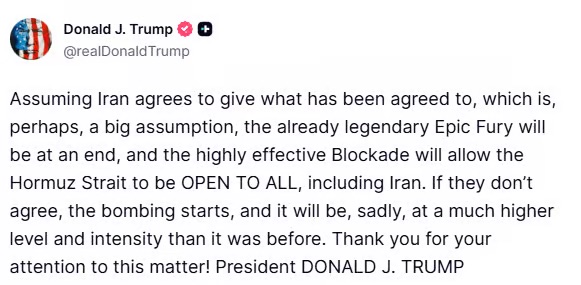
“..if Tehran doesn’t agree then “the bombing starts” and it will be at a “much higher level and intensity than it was before”.
• Iran Spox Blasts ‘Unrealistic’ White House ‘Wish List’ To End War (ZH)
And now a bit of rapid narrative reversal, coming from President Trump himself, after once again a likely premature early morning Axios report with overly optimistic language. Trump’s fresh words are via the NY Post: President Donald Trump said it’s “too soon” to plan peace talks with Iran despite reports of a near deal, downplaying prospects of imminent negotiations in Pakistan. He warned that if Iran accepts terms, hostilities could end and the Strait of Hormuz reopen—but failure to agree would trigger intensified military action.Read more …
Indeed the Iranian reaction issued via media reports also suggests this is the case, that all the talk of an agreement being close is premature, and there remains immense hurdles and a long way to go. Axios’ Barak Ravid still insists that “the sources said this was the closest the parties had been to an agreement since the war began.”Initial Word From Tehran: Doesn’t Reflect Reality
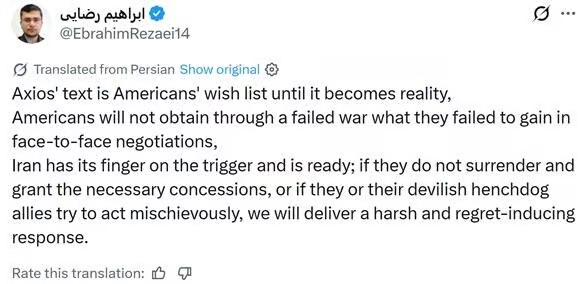
Iranian initial reaction through its media: “What US media outlets are publishing about the details of the negotiations does not reflect the reality of what is happening, according to AI Araby citing Iranian Sources.” “Progress has been made in talks with Washington through Pakistan, but it has not yet reached a level that would lead to an agreement,” the statement says. The Iranians are also clearly sticking by their approach which says the nuclear issue is a non-starter and that talks must focus on opening Hormuz and finding a final end to the conflict. “The negotiations are focused on ending the war, not the nuclear issue,” the statement in Al Araby continues.And then the final criticism of Washington’s approach: “The negotiations are still facing the intransigent American approach and excessive demands.” And further, this: Ebrahim Rezaei dismissed U.S. demands as unrealistic, saying Washington won’t gain through conflict what it failed to secure in talks. He added Iran is ready to act and warned of a severe, regret-inducing response to any provocation. Here is the full statement from the Iranian Spokesperson of the National Security and Foreign Policy Commission (via machine translation):
Trump Issues Carrot & Stick
The below is a fresh Trump Truth Social Post on Wednesday morning, warning the Iranians that the Hormuz Strait must be “open to all”. However, the president continues, if Tehran doesn’t agree then “the bombing starts” and it will be at a “much higher level and intensity than it was before”.
All of this has followed an awkward 24 hours of drastically different signals coming from various top officials of the US administration.
Marco Rubio says the goal of the war in Iran is now to restore it "back to the way it was" before Trump started the war in Iran pic.twitter.com/G1E9qyxMc4
— Headquarters (@HQNewsNow) May 5, 2026
Iran was long screwed over by Russia while it itself screwed over US and Israel?
• Inside The Moscow Meeting That Laid Bare Iran’s Weak Hand (Watkins)
Iran has a long history of being screwed over by Russia, and last week’s meeting in Moscow between Iranian Foreign Minister Abbas Araghchi and Russian President Vladimir Putin over the U.S.–Israel–Iran war suggests nothing in that dynamic is about to change, according to extremely well-placed sources on both sides who spoke exclusively to OilPrice.com over the weekend. On the one hand, Tehran’s perennially baseless optimism that “this time will be different” was on full display in Araghchi’s excited praise for the marvels of the two countries’ so called ‘strategic relationship’.Read more …
On the other hand, Moscow responded with all the warmth of an international telephone operator: Kremlin spokesman Dmitry Peskov said only that Russia stands ready to offer “goodwill or mediation services”, with no indication of any upgrade to the relationship service package. It fits so neatly into the familiar pattern of this abusive relationship that one wonders whether social services should be called. Or perhaps Moscow’s disinterest is merely an act — a way of masking the deep and broad assistance from Tehran that it so clearly craves?The theoretical basis of this relationship is the 20-year comprehensive cooperation deal between Iran and Russia — formally titled The Treaty on the Basis of Mutual Relations and Principles of Cooperation between Iran and Russia — approved by Iran’s late Supreme Leader, Ali Khamenei, on 18 January 2024, as I exclusively reported in OilPrice.com at the time. It replaced the 10-year deal signed in March 2001 (extended twice by five years) and was expanded in duration, scope and scale, particularly in the defence and energy sectors.
In several respects, the new deal complemented key elements of the all-encompassing Iran-China 25-Year Comprehensive Cooperation Agreement, first revealed anywhere in the world in my 3 September 2019 article and analysed in full in my latest book on the new global oil market order. The similarities were deliberate, designed to make the division of the key strategic assets most coveted by Moscow and Beijing easier to manage in practice. Related: China Orders Refiners to Ignore U.S. Sanctions on Key Iranian Oil Buyers
As with much of Russia’s foreign policy dealings, the devil was in the details. As a sign of how things would pan out for Tehran in the rest of the document, Russia stood to benefit at Iran’s expense in the key energy sector to begin with. The deal gave Russia the first right of extraction in the Iranian section of the Caspian Sea, including the potentially huge Chalous field. This came on top of Russia’s startlingly brazen theft in 2019 of at least US$3.2 trillion in revenues from Iran through the lost value of energy products across their shared Caspian assets going forward.
The same right of first extraction for Russia was also applied in the new 20-year deal to several of Iran’s major oil and gas fields in the Khorramshahr and nearby Ilam provinces that border Iraq, which China had not already prioritised for its own needs. Several of these sites had the broader financial and geopolitical benefits attached to their being shared fields with Iraq. This status allowed the effective free movement of Iranian oil disguised as Iraqi oil, and extended Tehran’s influence over Baghdad through its political, economic, and military proxies. By extension, it did the same for Moscow and Beijing, which used this as a springboard to further project their influence across the Iran-dominated Shia Crescent of Power.
This powerbase in Iran and Iraq had also been central to Russia’s longstanding plan to build a ‘land bridge’ to the Mediterranean Sea coast of another of its key global assets at the time — Syria. This would enable Moscow to exponentially increase weapons delivery into southern Lebanon and the Golan Heights area of Syria to be used in attacks on Israel. The core aim of this policy was to provoke a conflict in the Middle East that would draw in the U.S. and its allies into an unwinnable war, and was seen as a natural extension of the Israel-Hamas War that had begun after the terrorist organisation’s murderous spree across Israel on 7 October 2023.
Given its centrality to Moscow’s plans, then, Iran was at that point still confident that the Kremlin would meet its other promises in the 20-year deal, despite the shenanigans surrounding the energy side of the treaty as it related to the Caspian’s oil and gas riches. “Iran had long been asking Russia for the means to defend itself better against any attacks, especially those that might come from Israel or the U.S. — in particular for the S-400 missile defence system and Sukhoi Su-34 and 35 fighter jets,” a very senior source working closely with Iran’s Petroleum Ministry exclusively told OilPrice.com. “But these requests have continually been subject to further conditionality by Russia, such as upgrading key airports and seaports that Moscow sees as especially useful for dual-use by its air force and navy, and which are also close to major oil and gas facilities.
“Will ICE officially become NICE? Probably not anytime soon. But the mere suggestion has Democrats tying themselves in knots ..”
• Trump Dropped an ICE Rebrand — and Democrats Are Losing It (Margolis)
Leave it to the left to have a meltdown over a single letter. Last month, President Donald Trump endorsed rebranding Immigration and Customs Enforcement as National Immigration and Customs Enforcement — NICE — and on Tuesday, the White House unveiled updated branding for the agency, complete with a new patch mockup. DHS amplified the rollout on its own X account, and the trolling was, well, quite effective. The idea didn’t originate in the Oval Office. Comedian Adam Carolla first floated it back in September.Read more …
.@adamcarolla unveils his nice idea to stop Gavin Newsom and other leftists from verbally attacking ICE. pic.twitter.com/bGf1uNMuJz
— Paul Bond (@WriterPaulBond) September 26, 2025
Then in March, conservative influencer Alyssa Marie wrote on X, “I want Trump to change ICE to NICE (National Immigration and Customs Enforcement) so the media has to say NICE agents all day everyday.”Trump promptly endorsed it on Truth Social, calling it a “great idea.” Then on Tuesday came the onslaught. Trump posted what many believe to be a potential rebrand on Truth Social, which the Department of Homeland Security reposted on X.https://twitter.com/DHSgov/status/2051754837683896415
The White House also posted a patch concept.
https://twitter.com/WhiteHouse/status/2051761247779979301
Looks good, doesn’t it? Naturally, Democrats started flipping out. Because, of course, they did. And obviously, they responded in their usual “classy” way. I don’t have to tell you this isn’t what happened. Renee Good attempted to run over an ICE agent with her car, and he fired in self-defense. But facts have never been the left’s strong suit when there’s a narrative to protect. But I digress.
This all sounds great, and the reactions from the left are so worth it. But officially changing the agency’s name from ICE to NICE would require an act of Congress to amend the statute that created the agency. Still, the NICE rebrand is a perfect piece of political judo. It reframes the public conversation around an agency the left has spent years trying to demonize. Democrats want the word “ICE” to conjure fear and cruelty. Trump wants the media to be forced to say “NICE agents” every single day, in every single broadcast. It’s hard to run a “Defund NICE” campaign with a straight face. The left knows it, which is exactly why they’re reacting with such theatrical fury.
Will ICE officially become NICE? Probably not anytime soon. But the mere suggestion has Democrats tying themselves in knots, and that alone is worth it. Sometimes the point of a move isn’t to execute it — it’s to watch your opponents trip over themselves reacting to it. On that score, this one is already a win. So, yeah, I’m all for it. Frankly, I’m surprised it wasn’t called NICE to begin with. Clearly, Carolla was onto something, and I really hope we see it happen… if for no other reason than to see Democrats lose it.
“The most effective way to get the best outcome is to approach and enlist the smart ones from outside government to come and assist. Patel was always an insider.”
• Kash Patel Outlines Secret Room in FBI Headquarters (CTH)
My opinion on our current FBI Director is the same as it was the day his nomination was announced. The best, the most competent, the smartest, the most insightful and stable thinking people do not originate on a track from inside government work. The most effective way to get the best outcome is to approach and enlist the smart ones from outside government to come and assist. Patel was always an insider.
The FBI is an institution built upon corruption and fraud. Unfortunately, neither President Trump, nor the American people, will ever get the vindication and accountability he/we deserve until Kash Patel is no longer the one in charge of delivering it. It’s just that painfully simple. Trying to reform a corrupt system while maintaining the structures that enabled the corruption leads to endless discussions and ‘trust me bro’ delays.In this interview FBI Director Kash Patel sits down with Sean Hannity to discuss current and prior events within the FBI. Patel’s primary objective is the performance; the presentation of what he thinks will endear him to President Trump the most. This is not effectiveness; the outcome is the illusion of leadership.
“..going against Trump in a primary means ending up “in the grinder..”
• Trump Is Purging RINOs, and the Left Is Panicking (Margolis)
Tuesday night’s Indiana Republican State Senate primary turned into a political slaughterhouse. Five of seven GOP incumbents who’d stonewalled efforts to redistrict the state in Republicans’ favor went down in flames. There was nothing subtle about the message from MAGA voters. They want strong Republicans who will fight the Democrats, not be weak, useful idiots for the left. And if there’s anything that Donald Trump has taught the GOP, it’s how to be a fighter. “He’s the boss of the party,” Scott Jennings said of Trump on CNN’s Anderson Cooper 360 Degrees. “He calls the shots in the Republican Party, and if you go against that, he will pour his wrath out upon you, and it doesn’t typically turn out well.”Read more …
That’s not spin. That’s just reality at this point. Jennings invoked Harry Enten’s well-worn observation that going against Trump in a primary means ending up “in the grinder,” and Indiana delivered a fresh case study. And weak-kneed Republicans should take note, because the carnage won’t stop in Indiana. Jennings immediately pointed to what comes next: Kentucky’s 4th Congressional District in a couple of weeks, where Thomas Massie — arguably the single biggest thorn in Trump’s side in the entire House — is staring down a well-funded primary challenge.“If you look at what happened in Indiana tonight, and you’re Thomas Massie tonight, or you’re anybody else in a primary right now where Trump’s on the other side of you, you’ve got to be thinking, this is a bad night for me,” Jennings said. The money’s there. The will is there. The precedent is being set, one primary at a time. Then Van Jones opened his mouth. Jones went full pearl-clutching, calling Trump a “petty little punching-down bully” and complaining that the president couldn’t find the Epstein files or lower gas prices but somehow found time to meddle in statesenate races.
“I would be embarrassed if I were the President of the United States with the level of crisis that we have, that this is his most important objective and the only thing he’s gotten right, apparently, in the past six months,” Jones said. He topped it off with a little lecture about sovereignty and kings: “We don’t have a king.” Really? He’s playing the King Card? Of course, Jennings calmly torched Jones’s whole argument with one question: “Do you think that those sorts of rules apply to, say, Barack Obama when he engages in the Virginia redistricting referendum?”Jones tried to wiggle out of it. “He didn’t — he got involved in a ballot measure,” Jones said. “He didn’t go poking and picking on individual dog catchers and everybody else.”
And Barack Obama never endorsed Democrats in competitive primaries before? Give me a break. What a dumb argument to make. So, obviously, Jennings wasn’t buying it. “Well, he was picking on the Republican congressman who represented their constituents.” And that was that. Jones tried to lecture about the sanctity of political prerogatives, even apparently forgetting that presidents from both parties have long used their influence to shape their parties, be it by endorsing or recruiting candidates, raising money, cutting ads, etc. What Jones is really upset about here is that Trump has succeeded.
It’s too easy to be corrupt in the US. Because the people paid to prevent this were all focused on getting Trump.
• FBI Raids Virginia Senate President’s Office (Salgado)
A top Virginia Democrat and ally of radical Gov. Abigail Spanberger is suddenly in the spotlight as the FBI raids her office amid a reported corruption investigation. Fox News correspondent Bill Melugin posted on X May 6 that Fox was “on scene in Portsmouth, VA where the FBI is raiding the office of Virginia Senate President Pro Tempore L[.] Louise Lucas, a Democrat and close ally of VA Governor Spanberger. Fed law enforcement sources tell FOX this is in connection to a major corruption probe, and the FBI is serving multiple search warrants, approved by a federal judge, at her office and a next door cannabis dispensary. More to come with correspondent @AlexHoganTV, who reports that Lucas just showed up on scene as the FBI searches her office.”Read more …
Fox’s foreign correspondent Alex Hogan posted the video below:
The FBI is currently carrying out a raid at the office of Senator Louise Lucas in Portsmouth, VA. Here at this nearby cannabis dispensary, at least three people were taken into custody. Federal law enforcement say they’re conducting “court authorized criminal search warrants”. pic.twitter.com/UL2c7yAk0L
— Alex Hogan (@AlexHoganTV) May 6, 2026Ironically, like so many other Democrats, Lucas previously lectured that “no one is above the law” when gloating over the March 2023 Manhattan grand jury indictment of Donald Trump. Now Trump is back in the White House, and his FBI is raiding Lucas’s office.
Louise Lucas just learned no one is above the law! https://t.co/9n6H4zlV5f pic.twitter.com/TZZkxtH6pY
— Libs of TikTok (@libsoftiktok) May 6, 2026It is not clear if this investigation will involve Spanberger directly at all, or only indirectly, because her ally Lucas is the one under federal investigation.
Notably, however, Spanberger also arguably violates federal law on a regular basis whenever she enforces sanctuary policies for illegal aliens. For instance, the Department of Homeland Security just rearrested Guatemalan illegal alien and pedophile Walvin Victor Hugo Garcia after Spanberger and her fellow Democrats defied an ICE detainer request and released Garcia. And earlier this year, after Sierra Leone criminal illegal alien Abdul Jalloh, with 30 prior arrests, stabbed a 41-year-old Virginia mom, Stephanie Minter, to death at a bus stop, Spanberger explicitly refused to hand Jalloh over to federal immigration authorities.
The reason I say this behavior potentially violates the law is that, according to 18 U.S. Code § 111, anyone who “forcibly assaults, resists, opposes, impedes, intimidates, or interferes with” designated federal officers has committed a criminal offense. 8 U.S. Code § 1324 also states that anyone who “encourages or induces an alien to come to, enter, or reside in the United States, knowing or in reckless disregard of the fact that such coming to, entry, or residence is or will be in violation of law” or “conceals, harbors, or shields from detection, or attempts to conceal, harbor, or shield from detection, such alien” violates the law. Spanberger appears to have broken both those laws, as have all officials in Virginia enforcing sanctuary policies. Maybe the Feds need to raid Spanberger next.
“In one from 2017, Brockman muses, “It’d be wrong to steal the nonprofit from [Musk] and turn it into a B-Corp without him—doing so would be pretty morally bankrupt.”
• OpenAI Co-founder Greg Brockman Defends Company’s For-Profit Pivot (ET)
In the second week of a high-profile jury trial that could have profound impact on the race for artificial intelligence, OpenAI president Greg Brockman rejected allegations that he and other co-founders betrayed the company’s philanthropic mission and illegally enriched themselves by flipping the non-profit lab into a for-profit corporation.Tesla CEO Elon Musk in 2024 sued Brockman and CEO Sam Altman, alleging they bilked him of $38 million in donations then restructured as a for-profit corporation by exclusively licensing their flagship product to Microsoft—betraying a founding mission to operate as an open-source charity that would counter the risks of profit-driven AI.Read more …
OpenAI and Microsoft deny the allegations, arguing that Musk abandoned the company in 2018 to start his own for-profit competitor, xAI, when other founders rejected his bid to take full control of the operation. “I think we’ve been very consistent on the mission,” Brockman told a federal court in Oakland. “If you look at what we’ve accomplished—currently the foundation has $150 billion worth of OpenAI equity value. That’s something we’ve built through hard blood, sweat, and tears through all this time since Elon left.” The company’s nonprofit foundation has a 27 percent stake in OpenAI’s for-profit corporation; Microsoft, which has invested more than $13 billion since 2019, owns 26 percent.Called as an adverse witness for the plaintiff, Brockman over two days May 4–5 offered testimony outlining an alternate narrative and timeframe than the one Musk presented the week prior. Brockman also attempted to add context to what he has claimed were “cherrypicked” segments of his personal diary, unsealed during the discovery process. He often spoke in incomplete sentences, punctuated by stock phrases like, “We were solving for the mission.” Arguably, this had less zing to it than, “You can’t just steal a charity”—a phrase Musk favored in his own testimony.
‘Morally Bankrupt’ Musk’s attorney Steven Molo grilled Brockman on a series of diary entries from 2017 and 2018, a time of intense negotiations with Musk over the future structure of the company. In one from 2017, Brockman muses, “It’d be wrong to steal the nonprofit from [Musk] and turn it into a B-Corp without him—doing so would be pretty morally bankrupt.” Brockman denied this contradicted his commitment to OpenAI’s mission. “I think I meant it would actually serve the mission, but it would be hard to look at yourself in the mirror,” he told the court. Under cross-examination, he explained he was referring to the idea of voting Musk off the board of directors, which he had considered at the time.
“It had been made clear to us,” he said, “that if we didn’t come to [Musk’s] terms, he was going to start an AGI competitor.” Artificial General Intelligence (AGI) is the hypothetical point at which digital intelligence reaches or surpasses human cognitive abilities and can operate autonomously. Some, including Musk, believe we have already achieved an early version of it, and that AGI advancement in the wrong hands poses the greatest existential threat to humanity. Musk testified that this threat was the express motivation for creating OpenAI as an open-source, nonprofit lab. From late 2017 to early 2018, Musk, Altman, Brockman, and Ilya Sutskever, another OpenAI co-founder and its former chief scientist, floated various ideas as they debated how to fund the project at a competitive level.
Musk, the main donor, rejected an even equity split among the four co-founders, instead proposing a deal that would give him majority stake, to be diluted as more investors joined. Brockman said he and Sutskever were willing to accept Musk being CEO and having a majority stake. “But the one thing we could not accept was to hand him unilateral total control over the AGI.” Musk was the wrong man for the job, according to Brockman. “Look, he knows rockets, he knows electric cars, he did not and I believe does not know AI,” Brockman said of the Tesla and SpaceX CEO. “And Ilya and I did not think he was going to spend the time required to actually get good at it.”
Brockman alleged Musk “didn’t recognize that spark” in early language models underlying the GPT technology. “It was there, a working version, we could see the promise. … We really needed someone running the company that had that effect.” Molo pressed the witness, pointing to emails from Musk proposing a 16-person board for the new corporation, in which Musk would have a 25 percent influence. “This is the man you’re saying wanted to be the AI tyrant and have absolute and total control?” Molo probed. “He wanted a board, and conducted in a way you were not familiar with because you didn’t have the experience of corporate governance, did you?” Brockman acknowledged, “Definitely, this is something I was new to,” but maintained that there was never a real plan for Musk to relinquish control.
In a January 2018 email to Musk and others, Brockman stressed that a moral high ground was “our best tool,” and to maintain it, the company should endeavor to remain a nonprofit. “AI is going to shake up the fabric of society, and our fiduciary duty should be to humanity.” But back in November 2017, Molo pointed out that Brockman’s diary entries show he was worried about how it would look if the founders continued to say they were committed to a nonprofit while planning to convert to a for-profit. “Cannot say that we are committed to the nonprofit. Don’t wanna say that we’re committed. If three months later we’re doing b-corp then it was a lie,” Brockman wrote. “Can’t see us turning this into a for-profit without a very nasty fight.”
What is more newsworthy? That he offered sperm or that he fathered 4 children with her?
• Former OpenAI Board Member Says Elon Musk Offered Her Sperm Donations (BBC)
A former OpenAI board member has explained how her unconventional personal relationship with Elon Musk evolved into having four of his children. Shivon Zilis testified in a federal courtroom in Oakland, California for hours on Wednesday as part of Musk’s lawsuit trying to reverse OpenAI’s change to a for-profit company. The focus of Zilis’s appearance was her direct involvement in early talks with Musk around the company becoming a for-profit, but also how she worked for and became involved with Musk as she advised OpenAI. “I still really wanted to be a mum and Elon made the offer around that time and I accepted,” she said, explaining Musk in 2020 had offered to donate sperm.Read more …
Zilis and Musk attended the wedding of White House Deputy Chief of Staff Dan Scavino at Mar-a-Lago in February
“He was encouraging everyone around him at that time to have kids and he’d noticed I did not. He offered to make a donation,” Zilis said. Zilis has worked as a venture capitalist in Silicon Valley for over 15 years and held executive positions at Musk’s car company, Tesla, and his neurotechnology firm Neuralink. She joined OpenAI as an advisor in 2016, not long after it was founded, a position through which she said on Wednesday is how she first met Musk. Given Zilis’s role across Musk’s companies and OpenAI, eventually becoming a director at OpenAI from 2020 to 2023, she is an important witness in the trial. OpenAI lawyers have suggested that she funnelled information about OpenAI to Musk after he in 2018 left the AI company, which he co-founded and made early donations to.Zilis said she had a “one-off” romance with Musk about a decade ago but was not romantically involved with Musk in 2020, when Musk initially made the offer to father her children. She explained she had been struggling with certain health issues which had changed her initial plans to follow a more traditional personal path of getting married and having children with a romantic partner. Zilis’s initial plan for Musk’s role in the lives of the first two children she had by him was not necessarily as an active father, and the two had agreed to keep his paternity “strictly confidential.” Today, Musk is an active participant in the lives of his now four children with Zilis, she said, explaining that they spend a few hours a week together as a family.
Zilis said the confidentiality agreement with Musk is why she did not disclose to OpenAI’s chief executive Sam Altman that twins she gave birth to in 2021 were fathered by Musk. She told Altman that Musk was the father the following year, when she learned a Business Insider report on Musk’s paternity of the children was imminent. Nevertheless, Altman and OpenAI’s president Greg Brockman wanted to continue with Zilis on the board of the AI company. Zilis said on Wednesday that the three remained friends until at least 2023. When asked earlier this week about Zilis’ involvement with OpenAI for years after Musk had left the company, Brockman said: “We trusted her to keep the Elon conflict under control.”
Zilis left the board in March 2023 as Musk was launching xAI, an AI company developing a chatbot that is a direct competitor to OpenAI’s ChatGPT.With years of history, including emails and text messages that have been made part of the case between Zilis, Altman, Brockman, and Musk, lawyers for OpenAI seized on several examples of discussions around changing the corporate structure of the AI company. Moving away from being a pure non-profit was seen as necessary as early as 2017 in order for OpenAI to grow and raise from investors many billions of dollars, according to written exchanges shown in court in which Musk was involved.
Brockman and another OpenAI co-founder Ilya Sutskever were pushing for the company to transition to a B Corp, which is a type of for-profit entity that holds itself to a certain mission.nEmails from Zilis showed that Musk wanted more control of OpenAI, through additional board seats and even suggested that the AI company become part of Tesla, possibly as a B Corp subsidiary of the electric car company. Zilis said in a written exchange that such a move for OpenAI “solves the funding issue immediately.” Ultimately, Altman, Brockman, Sutskever could not agree on terms with Musk, in large part because they were adamant that Musk “not have control” of OpenAI’s work, according to an email from Zilis shown in court.
“Since her appointment by President Joe Biden, Supreme Court Justice Ketanji Brown Jackson has quickly developed a radical and chilling jurisprudence..”
• Three Justices Chastise Jackson for Groundless, Irresponsible Dissent (Turley)
Since her appointment by President Joe Biden, Supreme Court Justice Ketanji Brown Jackson has quickly developed a radical and chilling jurisprudence. Her often sole dissents and accusatory rhetoric have drawn not just the ire of her conservative colleagues but her liberal colleagues. This week, that tension deepened with a stinging rebuke from Justice Samuel Alito (joined by Justices Clarence Thomas and Neil Gorsuch).Read more …
At issue is the finalization of the Court’s opinion in Louisiana v. Callais, where the Court ruled 6-3 to ban racial gerrymandering. The Court reaffirmed the use of Section 2 of the Voting Rights Act to ban intentional racial discrimination in the design of voting districts, but effectively found many districts to be unconstitutional in their current form. There is no reason why the decision should not be finalized except for a blatantly partisan effort to protect the Democrats from losing seats in the midterm elections. After all, if these districts are unconstitutional, why should states guarantee that voters are given representatives chosen free of racial discriminatory preferences?That question is even more confusing given the long wait for this opinion. Not only was the case reargued, but there were growing complaints about the delay in releasing the opinion. Complaints increased after a recent book allegedly reported that Justice Elena Kagan had a vocal confrontation with her colleague, former Justice Stephen Breyer, over his push to release the dissents in Dobbs after the leaking of that opinion. Breyer reportedly agreed with Chief Justice John Roberts that the conservative justices were facing increased death threats due to the delay. Kagan allegedly wanted to further delay the release.
In the Callais decision, the delay was curious since there were six solid votes for the majority and not more of a fracturing of opinions. Indeed, the majority opinion’s references to the Kagan dissent are relatively brief. Nevertheless, the delay has made it very difficult for states to make changes. A few are moving to delay their primaries or draw new maps under extremely tight calendars. Regardless of the delay, there is no cognizable or principled reason to withhold the opinion to preserve unconstitutional districts. The case has already been on the docket for an unusually long time due to a reargument.
In its one-paragraph order, the court acknowledged that the Supreme Court’s clerk normally waits 32 days after a decision to send a copy of the opinion and the judgment to the lower court. However, it noted that the defenders of the challenged districts had “not expressed any intent to ask this Court to reconsider its judgment.” Conversely, the other parties raised the need for states to address the impact of the ruling with the approaching elections.
Jackson stood alone in demanding that the unconstitutional districts be effectively preserved for the purposes of this election — guaranteeing Democratic seats in the midterm that could be lost in non-racially discriminatory districts. Neither Kagan nor Justice Sonia Sotomayor would join her in the dissent, despite dissenting from the Callais decision itself. However, it was her language again that drew the attention of her colleagues. Justice Jackson lambasted the court’s ruling “has spawned chaos in the State of Louisiana.” In an Orwellian twist, Jackson suggested that others were playing politics as she sought to effectively protect unconstitutional Democratic districts. She suggested that the case exposed “a strong political undercurrent.”
In arguably the most insulting line, she lectured her colleagues that this case “unfolds in the midst of an ongoing statewide election, against the backdrop of a pitched redistricting battle among state governments that appear to be acting as proxies for their favored political parties.” She further said that, rather than avoid “the appearance of partiality,” the Court’s action “is tantamount to an approval of Louisiana’s rush to pause the ongoing election in order to pass a new map.”
Justice Alito had had enough. He noted that her reliance on the 32-day period was a “trivial” objection that put form above substance since no party had asked for reconsideration. It would be waiting for 32 days for no purpose, while the other parties had stated a reasonable and pressing need to finalize the opinion. He chastised Jackson for a dissent that “lacks restraint.” He denounced the dissent as making “baseless and insulting” claims. He particularly objected to the charge that her colleagues were engaging in an unprincipled use of power” as a groundless and utterly irresponsible charge.”
What is even more chilling than Jackson’s jurisprudence is the fact that she is often cited as the model for Democrats seeking to pack the Court with an instant majority if they retake power. This and other Jackson dissents show why Democrats are so confident that packing the Court will yield lasting control of the government. Jackson recently told ABC News that “I have a wonderful opportunity to tell people in my opinions how I feel about the issues, and that’s what I try to do.” For some of her colleagues, that cathartic benefit is coming at too high a cost for the Court.
Carmakers paid through the nose to achieve … nothing.
• The EV Bust Claims Five More Victims… and They Aren’t Even EVs? (Green)
Honda’s failed bet on electric vehicles means the Japanese auto giant will have to stretch the lifecycles of five top-selling vehicles “in some cases to more than a decade,” according to a supplier memo seen by Automotive News. The company will continue selling existing versions of the Odyssey, Accord, and HR-V, as well as the Acura MDX and Integra, after writing down up to $15.8 billion worth of investments in EVs, including eliminating three new EV models for the U.S. market. Car and Driver said the 2023-issue Accord “won’t be redesigned until at least early 2030,” while “the Odyssey minivan isn’t set to be replaced until 2030, while the current HR-V SUV will see its production extended until early 2032.” The two Acura models will suffer similar delays.Read more …
It seems like just earlier this spring [It was just earlier this spring, Steve —Editor] I reported on Honda’s massive losses from betting big on EVs — with a big nudge from Big Stupid Government — but the company’s losses show up on more than just the balance sheet. That’s why models that the company actually sells and makes money on — like the aforementioned Accord — won’t see expected refreshes anytime soon. There’s this little thing called opportunity cost, which is the value of the best alternative you give up when you choose one option over another. Honda bet big on EVs, but then changing market conditions forced the company to scale back those plans to the tune of billions of dollars worth of write-downs.Worse, however, are the updated models that would have sold in volume that the company chose not to invest in.Losing a bet this big hurts in the auto industry more than almost anywhere else, due to development times measured in years — yet vehicles are still subject to the whims of fashion. Consumers expect regular model refreshes, particularly loyal customers hoping to trade in their older car for the latest version of the same model. A two- or three-year delay means customers holding onto their current car for that much longer. Or maybe even shopping the competition.
The current version of the Odyssey minivan debuted in 2018 and hasn’t gotten anything more than a facelift in 2025. Buyers hoping to trade in for the latest and greatest have to wait another four years. Honda said in a statement, “We are not going to comment on future product plans. We are very confident and excited in our future product strategy including our previously announced plans to advance our award-winning hybrid technology to more models.” The company needed 36 words to say nothing at all.
According to Electrek, Honda’s strategy “now centers on hybrids for the near term, with affordable EVs priced under $30,000 pushed to the end of the decade. The only EV still standing in its US lineup is the Prologue, which recently saw a $7,500 price cut — a GM Ultium-based vehicle that Honda didn’t even engineer itself.” Electrek also noted that Honda completely scrapped plans for a multibillion-dollar EV plant in Canada. Don’t get me wrong, Honda makes great hybrids, and for most people looking to save money on gas, they make so much more sense than going fully electric. But hybrid versions of the company’s most-loved models that could have hit showrooms this year or next, now won’t be seen until the next decade.
‘sin at its root does not consist in the (same-sex) couple relationship, but in a lack of faith in God who desires our fulfillment.’
• Tectonic Shift In Church Framing of Homosexuality (Tim O’Brien)
Two things that non-Catholics and many Catholics don’t understand about the Catholic Church are that it’s not a democratic organization and it’s not an autocracy. In other words, as powerful as the Pope is, he cannot arbitrarily or single-handedly change doctrine and policy. At the same time, even though the church counts 1.4 billion members around the world, it is not structured to take their input into account the way representative government works in America.Read more …
Among Catholics, this confusion often pops up when the discussion turns to declining mass attendance and increases in the number of lapsed Catholics who no longer consider themselves a part of the church, even though they may have been baptized in the church. To get them back, we might argue, the church needs to allow women to be priests, or priests to get married, or to change our hard line on abortion, or to change the church’s position on LGBTQ issues. That’s not how it works, or at least, that’s not how it’s supposed to work. I know I’m going to hear from the Catholic catechism and Canon Law technicians on this oversimplification, but here goes: The church is here for Jesus Christ, the Holy Spirit and God Himself.We exist to please God. God does not exist to please us. He is not our creation. We are His creation. From a purely administrative standpoint, the church has had to find ways over the past 2,000 years to function in a changing world. That is definitely not to say that the church has had to change with the times or change simply to stay relevant, but rather, it has had to stay true to itself in the context of the times. Against this backdrop, Pope Francis decided to convene a Synod of Bishops in 2021 to consider ways in which the church can be more responsive to the culture without diminishing its core doctrines and policies, and the catechism itself.
In the Catholic Church, a Synod of Bishops is a formal assembly where bishops meet to discuss subjects tied to doctrine, governance, pastoral practice, or mission. If there is any one approach the church uses to try to stay relevant, this would be a key method. Of course, there are many within the church who argue against a “synodal mentality,” where they feel that the desire to be more relevant or “accessible” can undermine the core attributes of the church itself. They feel too much weight is assigned to synods.
When this particular synod was convened, the church invited its members from around the globe to participate. “Listening sessions” were held at the most local of levels – the parishes. It’s been reported that millions of Catholics participated in this process, where the input and feedback received were fed up the food chain from the parishes to the dioceses; to the bishops at the local level; then to the “continental level,” and ultimately on to the Vatican. Out of this process emerged what the church called a “Working Document,” which then was reviewed in the Vatican before this final report was released.
And so, Study Group 9 of Pope Francis’s synod has now released its final report, and in it is included the testimonies of two homosexual men. This is included as part of the report’s “cases for listening.” In the slow-moving world of Vatican policy change, this is a tectonic shift.
What’s actually in the report
According to insiders, throughout the synodal process, the bishops looked more closely at a number of issues, including women’s ordination, the church and the internet, ecumenism, polygamy, the Catholic liturgy, and other things. But the headlines coming out of the final report are sure to center mostly on how it treated the LGBTQ issues. The synod’s final report includes that testimony where two “married” homosexual men, who say they are Catholic, described the church’s role in creating an atmosphere of “solitude, anguish, and stigma that accompany persons with same-sex attractions and their families.”John-Henry Westen, co-founder of LifeSite, reacted to the release of the report on the X platform, saying that it “Suggests a reframing of homosexuality in the church, endorsing testimony without qualification that ‘sin at its root does not consist in the (same-sex) couple relationship, but in a lack of faith in God who desires our fulfillment.’” This is covered in the first couple of minutes in Westen’s video.
.Sorry my shirt was wrinkled here, but this news is TOO IMPORTANT to miss. And please share it. https://t.co/ycP3tmbrmT
— John-Henry Westen (@JhWesten) May 5, 2026

https://twitter.com/GreereMedeea/status/2051772652419748146?s=20 https://twitter.com/lakemonstercl1/status/2051607526353916257?s=20
do you understand what just happened to your computer..
— BuBBliK (@k1rallik) May 5, 2026
Google Chrome secretly downloaded a 4GB AI model onto your device. Without asking.. Without telling you..
It's called weights.bin. It lives deep in your system folders. It powers Gemini Nano – Google's on-device AI.
And… https://t.co/qKjzl8IRa9 pic.twitter.com/hnf9Z5esan
850 million children, or ONE THIRD of genZ, were murdered by their own mothers
— vittorio (@IterIntellectus) May 5, 2026
that’s about 10 times as many deaths as during World War II https://t.co/KPGEXyLLYv pic.twitter.com/tYPjEHUVcI
Neuralink progress https://t.co/IJM7hZyBRR
— Elon Musk (@elonmusk) May 7, 2026
Today marks the 24th anniversary of the assassination of Dutch politician Pim Fortuyn by a climate activist.
— Eva Vlaardingerbroek (@EvaVlaar) May 6, 2026
This clip still gives me chills every time: “The people have had enough. I stand for this country, even if it means I get slaughtered…”
Oh how different things could… pic.twitter.com/LsFxoiyJsi
Support the Automatic Earth in wartime with Paypal, Bitcoin and Patreon.