

Georgia O’Keeffe Red poppy 1927
Here’s something that stuck in my thoughts. I was aware that China had a one-child policy at some point, I just didn’t realize at what point that was, and how long for. Turns out now they want to end that policy, and reverse it if they could. And they want to stop it just one generation after it started. Guess it was nsot a success.
These people thought they could predict the future, but they couldn’t. On a national level, and certainly when the nation is China, we tend to notice such mistaken foresight. I remember the stories about princelings, boys who got all the attention that would otherwise have gone to, be divided among, many kids. And I remember the stories about scores of aborted female babies.
If there’s one predictable reason why the one-child policy failed, it’s this. Farmers, parents in the countryside whose first child was a girl, knew that there would be no-one to work the land when they grew old, they would even maybe lose the land. If the second child, or the fifth one if need be, was a boy, the parents would be “insured”. Those were life’s principles for a long time.
The decision makers lived in cities, they were not farmers. They had different concerns and priorities Thus they were set up for a fight with the farmers, who protected generations of their families, past and future. The many exemptions to the policies through time pay witness to this.
Wikipedia has an exhaustive entry on the topic. A few snippets:
..During Mao Zedong’s leadership in China, the birth rate fell from 37 per thousand to 20 per thousand.[19] Infant mortality declined from 227 per thousand births in 1949 to 53 per thousand in 1981, and life expectancy dramatically increased from around 35 years in 1948 to 66 years in 1976.[19][20] Until the 1960s, the government mostly encouraged families to have as many children as possible,[21] especially during the Great Leap Forward, because of Mao’s belief that population growth empowered the country,[..] .. the population grew from around 542 million in 1949 to 807 million in 1969, corresponding to an average annual growth rate of about 2.45% per year.[25] (If the same rate had continued unabated from 1969 through 2025, China’s population in 2025 would be on the order of 2.4 billion people.) Beginning in 1970, citizens were encouraged to marry at later ages and many were limited to have only two children
The devastating Great Chinese Famine (late 1950s to early 1960s) resulted in the deaths of approximately 30 million people.[27][28] Following the famine, China’s leadership saw rapid population growth as a threat to resources and development, fearing a return to food insecurity.[29]
[..] Although China’s fertility rate plummeted faster than anywhere else in the world during the 1970s under these restrictions, the Chinese government thought it was still too high, influenced by the global debate over a possible overpopulation crisis suggested by publications such as the Club of Rome’s 1972 report The Limits to Growth and the Sierra Club’s 1968 book The Population Bomb.
[The fertility rate dropped from 5.9 in the 1950s to 4.0 in the 1970s. Yet, the population still grew at a significant rate: There were approximately 807 million in China in the year 1969; the number then went up to 975 million in 1979, an average annual growth rate of about 2.1%.[25]
In 1969, they had 800 million people and thought thiss would grow (triple) to 2.4 billion in 2025 (55 years). And the Club of Rome said that would be a disaster. It seems logical they would want to prevent that from happening. So even as the grrowth rate was falling, they still went to extreme lenghts.
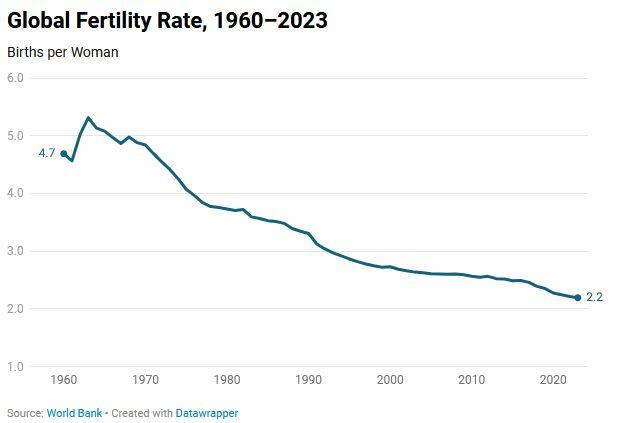
And nobody (fore)saw the falling fertility rate, not for China and not globally. That is interesting. Does it mean we are unable to correctly predict our own predicaments? And what in turn does that mean for issues that take place in our future? How about climate change, just to pick a example? What are the odds that we get that oe as wrong as the generation of our parents got the “population bomb”?
Elon Musk is about the only person I’m aware of today who’s warning AGAINST having fewer children. For him, see also below. I just mean to say, it is possible to escape the reigning opinion. Maybe there were individuals in China too in the 1970’s who warned against the prevalent policies. And found in their own way that it’s not easy to go against the grain.
Here’s Zero Hedge on what that means today:
• Beijing Wants Babies: Condoms, Contraceptive Drugs Hit With Double-Digit Tax To Boost Birth Rate
In an effort to reverse China’s sagging birth rate, Beijing has removed a three-decade tax exemption on contraceptives starting Jan. 1, when condoms and contraceptive pills will now incur a value-added tax of 13%, the standard rate for most consumer goods.Birth rate has to go lower if life expectancy goes up. In the 20th century, improved hygiene and the advent of anti-biotics just about doubled life expectancy for many people, including the Chinese, though later for them. It takes a while for such changes to settle into (the “culture” of) a population. We see this reflected in the birth and death numbers in the West. We will see it in China as well.The move comes after 2024 data marked the third consecutive year that birth rates have dropped – something experts have warned is likely to continue. Last year, China introduced an annual childcare subsidy, and exempted such subsidies from personal income tax amid a series of “fertility-friendly” measures implemented in 2024 – such as urging colleges and universities to provide “love education” to portray marriage, love, fertility and family in a positive light, Reuters reports.
Meanwhile, CCP leadership pledged in December at the annual Central Economic Work Conference to promote “positive marriage and childbearing attitudes.”
The country’s birth rates have been falling for decades as a result of Beijing’s one-child policy implemented from 1980 – 2015, along with rapid urbanization.
High childcare and education costs along with job uncertainty and a slowing economy has also dissuaded young Chinese from getting married and starting a family.
Low birth rates will end civilization https://t.co/KPxBor9lAJ
— Elon Musk (@elonmusk) April 22, 2025Thomas Kolbe noted two weeks ago: “China is expected to lose about 20 percent of its population over the next 30 years.” There is no doubt this will have consequences for the global economy. Societies react reflexively to such developments. China responds with aggressive subsidies for its export engine to counter these domestic distortions, which primarily manifest economically as deflationary pressures”.
“China’s attempt to course-correct comes as global fertility rates continue to plummet. Fertility rates (the average number of children born to a woman in her lifetime) are different from birthrates (the number of live births per 1,000 people in a population over a given period), although the terms are related and often used interchangeably.”
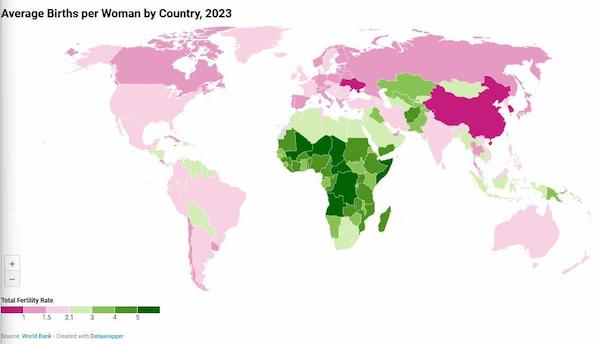
Meanwhile, look at who has the highest fertility rates: Somalia, Chad, Niger, DRC, and other African nations. Only about 4 percent of the world’s population reside in a country with a high fertility rate – more than five children per woman – and all of those nations are in Africa, the Census Bureau noted. Even in those countries, fertility rates are generally lower than they once were.
The fertility rate in India, the world’s most populous country, has steadily declined over the past six decades. In June, the UN Population Fund reported that India’s fertility rate stood at 1.9 children per woman, down from five or six children in 1960.
In 1990, China’s fertility rate was 2.51, despite its one child policy. By 2023, it had dropped to less than one birth per woman, according to the United Nation’s population division.In the United States, fertility has undergone a persistent decline. It fell below the replacement level in 1972 and reached 1.62 in 2023, a historic low.
Asian and European countries have the lowest fertility rates in the world, and South Korea (0.72), Singapore (0.97), Ukraine (0.977), and China (0.999) all have rates below one. [..]
Home › Forums › 28-1-2026 One Child