
Gustave Caillebotte Rue Mont-Cenis, Montmartre 1880

https://twitter.com/JoshHall2024/status/2044738709719830767?s=20 https://twitter.com/QuantumGuard17/status/2044443788546891914?s=20
WOW…
— Liz Churchill (@liz_churchill10) April 16, 2026
DNI Tulsi Gabbard just proved the Democrats committed TREASON…
SHE CALLS OUT ADAM SCHIFF AND NANCY PELOSI…
“Deep State actors within the Intelligence Community concocted a false narrative that was used to impeach the duly-elected President of the United States.” pic.twitter.com/iWrAtGRNKE
Karoline Leavitt:
— Johnny Midnight ⚡️ (@its_The_Dr) April 15, 2026
“While pretending to engage in a peaceful transfer of power, Barack Hussein Obama, in private, went to great and nefarious lengths to sow discord among the public and sabotage his successor, President Trump.
The new evidence released by the Director of… pic.twitter.com/X0JoYz8EEi
https://twitter.com/Inevitablewest/status/2044512498146021545?s=20 https://twitter.com/HungaryBased/status/2044490945698119811?s=20ALL ROADS LEAD TO OBAMA. Barack Obama was not elected, but chosen and installed to push radical agendas and to destroy the United States, one institution at a time, and he almost did.
— The SCIF (@TheSCIF) April 15, 2026
Our own military reported that they were ordered by their superiors by the Obama administration… pic.twitter.com/9KhVPdtQ9Z
DNI Tulsi Gabbard was portrayed the other day on Zero Hedge as a ‘Trump ally’. But she never was, until perhaps very recently. She left the Democratic Party only 3,5 years ago after calling them “an “elitist cabal of warmongers”, and became DNI in February 2025. There’s simply not enough water under that party bridge. Bur she can dig.
By now it’s hard to see how all those involved in conspiring against Trump could escape prosecution. The list is long, and it includes Obama. Which also provides an indication of how hard this is.
We’ll follow Sundance, who’s been following the case closely. He indicates how serious this is in one sentence: “The CIA Tried to Remove a Sitting President“.
The articles are about:
1) The meaning of what Tulsi did.
2) What she did.
3) She explains what she did.
• The CIA Tried to Remove a Sitting President (CTH)
For the past 72 hours I have been attempting to draw attention to the big picture. The CIA tried to remove a sitting United States President. The evidence has been released. The long-debated issue is no longer a matter of opinion or question. The CIA tried to remove a President. Unfortunately, now we watch the silence. I see a lot of punditries missing the forest as they peer intently at the trees. The CIA tried to remove a sitting President. We now know the real reason CIA whistleblower Eric Ciaramella’s name was never πpermitted to be mentioned. It s not the name Eric Ciaramella that presented the issue, it’s the organization where he was working, the CIA That’s what needed to be protected.Read more …
[The Biden administration created the Dept of Homeland Security Disinformation Governance Board to interact with Social media and create content controls. That’s where Nina Jankowicz comes in.] There was/is documented evidence showing the CIA tried to remove a sitting President from office. CIA Analyst Eric Ciaramella, the anonymous CIA ‘whistleblower’ worked with Joe Biden on Ukraine policy. Biden appointed DHS Nina Jankowicz worked inside Zelenskyy’s campaign HQ. Just a coincidence? Don’t get lost in the details or the politics of this. When you peel back all the layers of DC, at its epicenter this was an operation to impeach a sitting President that came from within the CIA, and it almost succeeded.In the details, an impeachment effort against President Trump was triggered when a member of the National Security Council named Alexander Vindman coordinated with a member of the CIA National Intelligence Council named Eric Ciaramella to fabricate a false claim that President Trump leveraged his power and authority to demand Ukraine President Volodymyr Zelenskyy release information on Joe and Hunter Biden’s corrupt financial dealings in Ukraine.At the time of the 2019 impeachment construct Eric Ciaramella was working for the CIA as an analyst within the National Intelligence Council (NIC).
Two years prior to the 2019 impeachment construct, in January 2017, the same CIA analyst, Eric Ciaramella, had worked on the fraudulent Intelligence Community Assessment (ICA) at the behest of CIA Director John Brennan. Outlining Ciaramella’s activity not only hits CIA Director John Brennan and former DNI James Clapper, but it also hits former President Barack Obama. The National Intelligence Council was the internal sub-agency within the larger Intelligence Community, that was constructing all of the fraudulent analysis to support the 2016 Russian Election Interference narrative.
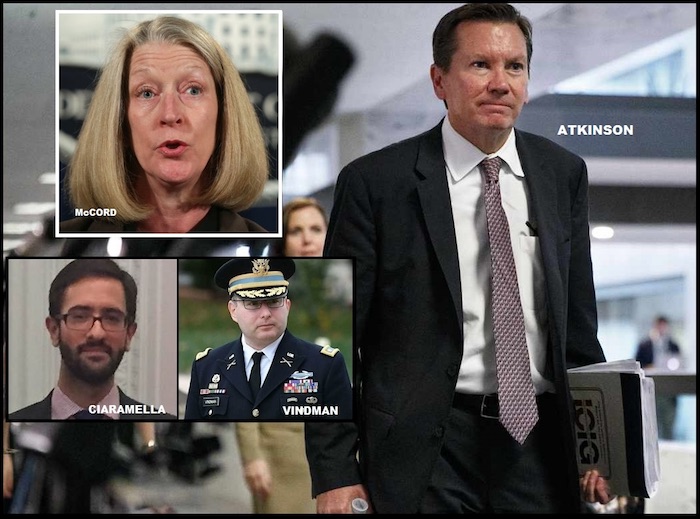
Ciaramella was doing what John Brennan, James Clapper and Barack Obama wanted him to do. That’s why his story is so much more important than just his fabrication and lying to ICIG Michael Atkinson, who was also a participant in the endeavor and the false construct of the 2019 impeachment effort. Former DOJ-NSD lawyer Michael Atkinson and former DOJ-NSD head Mary McCord were at the heart of the operations against Trump in 2017, and then both surface again against Trump in the 2019 impeachment effort. Mary McCord was working for Adam Schiff and Jerry Nadler at the time of the impeachment in 2019. Michael Atkinson was moved from DOJ-NSD to the IC OIG specifically for this operation.
Before this operation in 2019, CIA analysts weren’t allowed to anonymously make claims against political officials. The reasons are obvious. Because of the sensitive information they handled, any allegation of wrongdoing based on intelligence had to be made with their name attached. Without anonymity, inside the Intelligence Community oversight system, the Ciaramella connection to both IC operations could have been made. His anonymity as a whistleblower served a purpose. Having switched locations to IC IG, Intelligence Community Inspector General Michael Atkinson independently changed the ICIG rules permitting Ciaramella to remain anonymous and make an “urgent concern” claim that ultimately led to an impeachment effort.
Eric Ciaramella fabricated intelligence information. ICIG Atkinson shared it with Congress and the House Permanent Select Committee on Intelligence (HPSCI). Representatives of HPSCI Chairman Adam Schiff met with Ciaramella and assisted him during the construct. ICIG Michael Atkinson never even read the transcript of the call between President Trump and President Zelenskyy that formed the basis for the Ciaramella complaint. The complaint was also criminalized by Atkinson and sent to the Office of Inspector General for the DOJ for review. Unlike Atkinson, the DOJ reviewed the Trump-Zelenskyy transcript and said there was no issue.
On October 4, 2019, as part of the House impeachment inquiry, Intelligence Community Inspector General Michael Atkinson gave closed-door testimony to the House Permanent Select Committee on Intelligence (HPSCI) as part of their pre-impeachment investigation. One of the key questions to ICIG Atkinson surrounded the authority of his office changing the CIA whistleblower rules that permitted Eric Ciaramella to remain anonymous. Atkinson had no reasonable explanation. The Intelligence Community Office of Inspector General (Atkinson) also altered the whistleblower form within months of the July 2019 Trump/Zelenskyy phone call to no longer require firsthand knowledge as a prerequisite for reporting complaints.
This indicates forethought and specific intent. Michael Atkinson knew a ‘second-hand’ complaint was coming. From all appearances, IC IG Atkinson was organizing the operation in advance. CIA Analyst Eric Ciaramella provided the story. With Adam Schiff prepared to receive the complaint, and Mary McCord prepared to weaponize the complaint, collectively they ran the operation to impeach a sitting President on an entirely fraudulent basis.
[Executive] The CIA tried to impeach President Donald Trump; the aggregate Intelligence Community was there to assist.
[Legislative] The HPSCI and HJC, Pelosi, Schiff, Nadler were prepared to organize the impeachment construct. Mary McCord working as staff.
[Judicial] Supreme Court Chief Justice John Roberts would not let Eric Ciaramella’s name be spoken at trial. Mary McCord’s husband, Sheldon Snook, was working for John Roberts at the time.
This was a coordinated impeachment effort across all three branches of government. The CIA tried to remove a President. Unfortunately, now we watch the silence. We have known this for all long time; what we lacked was the specific evidence. Now, we see the evidence and yet it is almost more alarming to notice the silence than it is to absorb the reality of the events that evidence describes. The CIA tried to remove a President!
“Atkinson was the intentional organizer of false impeachment material submitted by CIA operative Ciaramella.”
• DNI Tulsi Gabbard Sends Criminal Referrals for Atkinson and Ciaramella (CTH)
Director of National Intelligence Tulsi Gabbard has sent criminal referrals to the DOJ for former Intelligence Community Inspector General Michael Atkinson and former CIA Analyst (National Intelligence Council) Eric Ciaramella. Atkinson was the intentional organizer of false impeachment material submitted by CIA operative Ciaramella. Apparently, people know the background. lolRead more …
WASHINGTON DC – “The Office of the Director of National Intelligence sent criminal referrals to the Justice Department for the whistleblower whose complaint helped trigger President Donald Trump’s 2019 impeachment and for the former intelligence community inspector general who notified Congress of the allegations, Fox News Digital has learned. “I want to refer information that may constitute possible criminal activity in violation of federal criminal law committed by one or more former employees of the intelligence community,” ODNI’s general counsel wrote in the referral to the Justice Department. Fox News Digital on Wednesday reviewed the referrals ODNI sent to the Justice Department.“The possible criminal activity concerns the circumstances described in the following congressional briefings: Discussion with Intelligence Community Inspector General, House Permanent Select Comm. on Intel., 116th Cong. (2019); Briefing by the Intelligence Community Inspector General, House Permanent Select Comm. on Intel., 116th Cong. (2019),” it continued. […] An intelligence official told Fox News Digital that the language in the referral is broad, but that it’s specifically directed at Atkinson and the whistleblower who reported concerns about President Trump’s July 2019 phone call with Ukrainian President Volodymyr Zelenskyy.
Don’t forget, Michael Atkinson turned the Ciaramella complaint into a criminal referral, a criminal complaint, then submitted it to the U.S. Department of Justice.
• Abuse of govt position.
• Manufacturing evidence for a legislative procedure.
• Conspiracy to conduct fraud.
• Lying to federal investigators.
• Falsifying information to manufacture a criminal complaint. I
t will be interesting to see where this goes.
“Gabbard is providing the receipts, the actual evidence, of how these IC operations took place.”
• Tulsi Explains Criminal Referral of Trump Impeachment Collaborators (CTH)
Director of National Intelligence, Tulsi Gabbard, appears for an interview with Katie Pavlich to outline the importance of bringing all of the information about the Intelligence Community targeting of President Trump to the public.Sunlight is the best disinfectant, and We the People want to see accountability for the Machiavellian conduct. The intelligence community targeted President Trump and people within the CIA ran an operation to remove him.Read more …
These people have names and titles that have remained hidden, DNI Tulsi Gabbard is putting those names, specific names into the public psyche so we can have a full understanding of what took plac Now, for many here this may seem like information we have all known about; however, Gabbard is providing the receipts, the actual evidence, of how these IC operations took place.
DNI Gabbard is showing how specific people within government weaponized their positions to conduct some of the most insidious schemes in modern U.S. history. The criminality of those schemes is for others in Main Justice to determine, but the evidence of those schemes is clear. I am thankful that people are now starting to use the new information to review past timelines. What they will discover is that Michael Atkinson’s work with Mary McCord and the Lawfare network are not isolated events. This is a continuum of targeting against Donald Trump using all of the intelligence levers at their disposal.
Michael Atkinson and Eric Ciaramella are the current names, but beside them sits Mary McCord, Norm Eisen, Andrew Weissmann, Barry Berke, Dan Goldman, Benjamin Wittes and many others from the Lawfare community. They intersect with various high level government officials in Main Justice, the FBI, the CIA, NSA and various intelligence agencies. This is the nest of Deep State and Tulsi Gabbard is exposing it.
“Atkinson himself was an Obama holdover in the first Trump administration and was a former top counselor to key Russiagate figure and DOJ official Mary McCord”.
• Ukraine Impeachment Was Continuation of Failed Russia Collusion Plot (Dunleavy)
The Democrat-led Ukraine impeachment effort of 2019 was linked to and a continuation of the Russiagate saga and of the failed effort by special counsel Robert Mueller to unearth criminality by President Donald Trump, newly-declassified documents and testimony indicate.Read more …
Memos declassified by Director of National Intelligence Tulsi Gabbard and released by Just the News on Sunday were written by investigators for intelligence community inspector general Michael Atkinson, who first handled the CIA analyst’s complaint. Gabbard also declassified long-secret transcribed interviews from the watchdog, and these, combined with the memos, provide further evidence that the Ukraine impeachment saga was a continuation of the Russiagate saga which had flamed out.The newly-released memos flagged the Ukraine whistle-blower for having a “potential for bias,” elicited an apology from him for misleading the probe about his prior contact with staffers on the Democrat-led House Intelligence Committee, showed he criticized GOP congressmen, recounted that he asked to hide his complaint from Republicans on the intelligence committee, pointed to his close links to Joe Biden’s efforts in Ukraine, and more. Atkinson kept much of this from the House investigators.
An alleged witness whose name was redacted and who told investigators he had been assisting the alleged whistle-blower with making his disclosures admitted to having a connection to Peter Strzok, the FBI agent who was fired in 2019 for his misbehavior while helping lead the discredited Russia collusion probe.
This witness — identified only as “Witness 2” — disclosed that he had also worked on a controversial December 2016 Intelligence Community Assessment (ICA) that claimed Vladimir Putin tried to help Trump beat Hillary Clinton in that year’s presidential race, a conclusion that the CIA now admits was based on faulty intelligence and a failure of spy tradecraft.
Prior to being nominated by Trump to be the intelligence community watchdog, Atkinson himself was an Obama holdover in the first Trump administration and was a former top counselor to key Russiagate figure and DOJ official Mary McCord. As a top Obama Justice Department official, McCord reviewed the deeply flawed FISA applications against former Trump campaign associate Carter Page, and she later assisted House Democrats in impeachment efforts against Trump.
The self-admitted potential biases which the Ukraine impeachment whistle-blower relayed to investigators for the intelligence community watchdog during the first Trump Administration were redacted and concealed from House investigators in 2019, newly-declassified and released transcripts show.
These long-secret transcripts were from a mid-September 2019 unclassified session and an early October 2019 classified session which were held to examine Atkinson’s role in the handling of an alleged whistle-blower complaint. The missive was written by an anonymous intelligence officer — identified as Eric Ciaramella — in a saga which ultimately led to the first successful impeachment efforts by House Democrats against Trump in December 2019. Trump was acquitted by the Senate in early 2020.
Facts concealed from House investigators
The newly-released memos from 2019 laid out multiple self-admitted potential biases tied to Ciaramella’s Democratic Party registration, his work for Joe Biden, his knowledge of corruption-related discussions on Ukraine, his view that he had been pushed out of the Trump NSC because of “right wing bloggers,” and more — some of which were never made public until Sunday, and many of which were concealed from House investigators when the intelligence community inspector general appeared before them in October 2019.The whistle-blower’s’ complaint centered on a July 25, 2019 phone call between Trump and Ukrainian President Volodymyr Zelensky. The Trump-Zelensky call was the day after Mueller’s lackluster congressional testimony on the findings of his special counsel investigation.
Ciaramella did not respond to a request for comment sent to him through the Carnegie Endowment for International Peace, where he is listed as the Ukraine Initiative Director for the Russia and Eurasia Program. Atkinson did not respond to a request comment sent to him at the law firm he works for, and McCord did not respond to an email sent to her Georgetown University email.
The Office of the Director of National Intelligence said Monday that Atkinson helped “manufacture a conspiracy” and argued that a “coordinated effort by elements within the Intelligence Community” was aided by Atkinson when he lent credibility to and covered up the political biases of the author of the whistle-blower complaint..
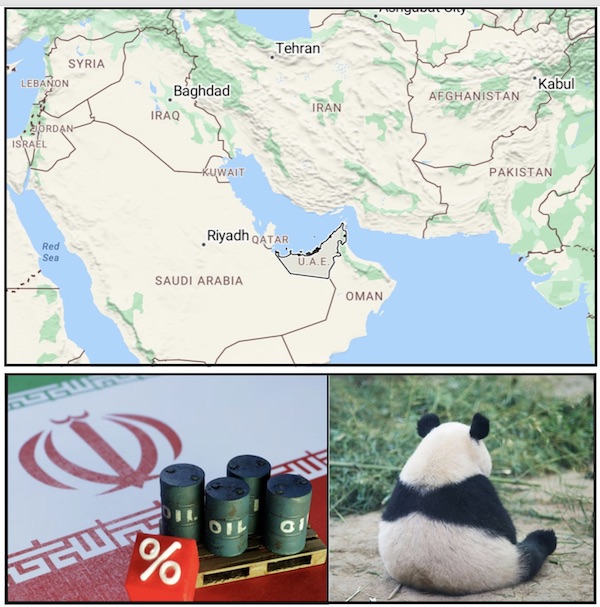
Reuters:: “’China buys more than 80% of Iran’s shipped oil, data for 2025 from analytics firm Kpler showed.”
Not much of a blockade left then?
• Trump ‘Permanently Opening’ Strait of Hormuz ‘for China’ (RT)
US President Donald Trump has said he is “permanently opening” the Strait of Hormuz, claiming he is making the move for China “and the world.” Trump also said Beijing has agreed “not to send weapons to Iran. Trump initially announced the blockade of the vital waterway on Sunday after Pakistani-mediated talks failed to produce a peace deal with Iran. On Tuesday, US Central Command reported that American warships had effectively blocked all Iranian trade through the strait. On Wednesday, however, Trump stated in a Truth Social post that “China is very happy that I am permanently opening the Strait of Hormuz.” He added that “I am doing it for them, also – and the World.”Read more …
Trump went on to state that Beijing has “agreed not to send weapons to Iran,” and that Chinese President Xi Jinping “will give me a big, fat, hug when I get there in a few weeks.” Trump is scheduled to pay a state visit to China on May 14, while Xi is expected to visit Washington for a reciprocal visit at a later date. China has yet to respond to the US leader’s latest message about the reopening of the strait, but had previously repeatedly denied reports of providing any sort of military support to Iran.Beijing had also accused Washington on Tuesday of “dangerous and irresponsible” behavior over its blockade of Iranian vessels. Iran closed the Strait of Hormuz to “enemy ships” in response to the US-Israeli bombing campaign launched on February 28. Tehran has since demanded recognition of its “sovereignty” over the waterway and the right to impose tolls.
You need the Supreme Court for that. Check with them first if they agree. They’re “independent”.
“So-called whistleblower knew he didn’t have the evidence. He used hearsay. He used poor intelligence … but they covered it up,” Rep. Claudia Tenney said.
• House Intel Member Says It’s Time To Expunge Trump’s 2019 Impeachment (JTN)
An influential Republican on the House Intelligence Committee says the bombshell evidence disclosed this week challenging the credibility and bias of a CIA analyst who prompted the Ukraine influence scandal seven years ago is so powerful that it warrants Congress expunging the 2019 impeachment vote against President Donald Trump.Read more …
“I think it is time that we expunge this impeachment and get rid of it,” Rep. Claudia Tenney, R-N.Y., told the Just the News, No Noise television show on Wednesday night. “…Historically, we need to show that we’re going to stand up for the rule of law, for truth and justice. And this was unfairly done to President Trump.”Just the News reported Sunday that documents recently declassified by the Office of Director of National Intelligence (ODNI) showed that the intelligence community’s chief watchdog gad flagged concerns about the CIA analyst who launched the 2019 impeachment proceedings against Trump with Ukraine policy-related allegations but those concerns were kept classified and never made public during the congressional proceedings.
The concerns included that the accuser had the “potential for bias,” had provided false information in his initial complaint and had animus toward conservatives inside Trump’s circles, according to documents declassified by DNI Tulsi Gabbard this week. Gabbard blasted Atkinson’s work on Monday, suggesting the former watchdog had “weaponized the whistle-blower process” and used his office to “manufacture a conspiracy that was used as the basis to impeach President Trump.”
Others, including former Trump defense lawyers, the FBI and members of Congress, also sharply criticized the withholding of such evidence for six years, with famed law professor Alan Dershowitz going so far as to suggest Trump might have grounds to expunge his 2019 impeachment in the House of Representatives. Tenney said she agreed with Dershowitz.
“I am just grateful to Tulsi Gabbard, the Director of National Intelligence, for actually disclosing this information and seeing the really shoddy, poor intelligence work that was being done,” she said. “This so-called whistleblower knew he didn’t have the evidence. He used hearsay. He used poor intelligence, or what they call spy craft, in putting together statements and supporting documents that were not supportive of what they were trying to prove, but they covered it up.
“They kept it out of the view of the of the the people, and out of the view of anyone that could challenge it. And they went into this impeachment mode,” she added. “So I think Alan Dershowitz is on to something.” Tenney said she also agreed with Sen. Eric Schmitt, R-Mo., who on Wednesday urged the House to begin impeachment proceedings against U.S. District Judge James Boasberg, a former chief judge at the FISA Court who raised the ire of Republicans by making several negative rulings against the Trump administration, several of which have been reversed.
This week, the federal appeals court in Washington D.C. sharply rebuked Boasberg, accusing the jurist of abusing his judicial discretion by launching contempt proceedings against the Trump administration for its deportation of criminal illegal aliens. “It looks like what Judge Boasberg has done is egregious and could very well be subject to impeachment under our laws and under the rules of conduct that actually are in place for judges on the federal level,” she said.
She’s been ordered to.
• Sotomayor Issues Rare Apology For ‘Hurtful’ Comments About Kavanaugh (JTN)
Kavanaugh, who was in the majority but wrote a concurring opinion, had downplayed the belief that people were having their constitutional rights violated in the raids by targeting areas where illegal migrants are known to gather. Liberal Supreme Court Justice Sonia Sotomayor apologized Wednesday for “hurtful” remarks she made recently about fellow Supreme Court Justice Brett Kavanaugh’s upbringing. “At a recent appearance at the University of Kansas School of Law, I referred to a disagreement with one of my colleagues in a prior case, but I made remarks that were inappropriate,” Sotomayor said in a statement released by the court. “I regret my hurtful comments. I have apologized to my colleague.”Read more …
Sotomayor last week indicated that Kavanaugh’s parents were “professionals and probably doesn’t really know any person who works by the hour,” after he wrote an opinion last year on the high court’s allowance of the Trump administration to conduct broad immigration sweeps in Southern California. Kavanaugh, who was in the majority but wrote a concurring opinion, downplayed the belief that people were having their constitutional rights violated in the raids by targeting areas where illegal migrants are known to gather. “To be clear, apparent ethnicity alone cannot furnish reasonable suspicion; under this court’s case law regarding immigration stops, however, it can be a ‘relevant factor’ when considered along with other salient factors,” Kavanaugh wrote.“Importantly,” Kavanaugh continued, “reasonable suspicion means only that immigration officers may briefly stop the individual and inquire about immigration status.” Sotomayor’s comment was surprising because the justices have long claimed they get along despite differing opinions.”I joined the court that dealt with differences as friends, as we respected each other. … That’s civility,” Supreme Court Justice Clarence Thomas, a conservative, said Wednesday. “I don’t know how you bring it back in the current environment with social media and name calling and all and people accusing each other of various things and animus.”
Did Orban and Trump set this up?
• New Hungarian Prime Minister Says Borders Will Remain Shut To Immigrants (ZH)
In the wake of Viktor Orbán’s election defeat, one of the greatest fears among conservatives in the region is an unconstrained EU able to take action on foreign policy, health, and immigration without the threat of a veto. It is widely assumed that the incoming prime minister of Hungary, Péter Magyar, will seek a fast resolution of Brussels’ key issues with Hungary in order to unlock some €35 billion in funding. His election win was heralded as a substantial victory for the global left wing, from EU globalists to Democrats in the US. Their assumption is that with Orbán’s veto power out of play, they will be able to do they want in Ukraine and in Hungary. However, the new Prime Minster may not be as cooperative as they initially believed.Read more …
Magyar has stated that he will not try to block a €90 billion EU loan to Ukraine which Orbán originally vetoed, but he also stated that Hungary will not be contributing to such loans and that the government will not support any attempt to induct Ukraine into the EU. He also announced this week that he will not allow Hungary to join in the EU’s “Migration Pact” and that he plans to further strengthen Hungary’s borders. This includes a continued rejection of the EU’s asylum rules, which are widely abused by third world migrants to freely enter Europe and gain access to welfare subsidies.Beyond the Ukraine funding veto, it was Orbán’s refusal to submit to open borders and mass immigration that caused constant conflict with the EU. He was frequently referred to by the political left as a “dictator” and a “fascist” in part because of his strict border policies (even though he is voluntarily leaving office after losing the election, which is not the behavior of a dictator). Ursula von der Leyen, President of the European Commission, attacked Orbán regularly for his border controls, stating that Hungary’s program to reinforce their borders with walls and barbed wire was in violation of EU immigration standards. It appears that this will not stop under Magyar.
https://twitter.com/HungaryBased/status/2044490945698119811
The purpose of the EU Commission is to subjugate member countries through centralized monetary dependency and a series of financial sanctions if they step out of line. Financial leverage has been used on a number of occasions by the Commission to force nations to accept ever expanding mass immigration, largely from Muslim fundamentalist populations in countries like Algeria, Morocco, Syria and Afghanistan. Hungary is one of the few European nations to resist this multicultural agenda.
https://twitter.com/magyarpeterMP/status/2044379059031794131
While it is a member state, Hungary is not currently in the eurozone, using its own currency, the Hungarian forint, rather than the euro. It may be that the EU sees Magyar as an acceptable trade, as long as they get their funding package for Ukraine. They probably also intend to play the long game, hoping that once Hungary joins the eurozone they can be manipulated over time using monetary leverage. That said, their intentions have long focused on using Hungary as a fresh sponge to absorb migrants, and this is simply not going to happen according to Magyar’s post-election declarations.
They’re turning Ukraine into the European arms factory. The money will keep flowing.
• Zelensky Goes Full “Lord Of War” (ZH)
Ukrainian President Volodymyr Zelensky took the stage and stated that Ukraine’s military-industrial base has created some of the world’s most advanced unmanned platforms, already deployed against Russia and forever changing how warfare is conducted. “For the first time in the history of this war, an enemy position was taken exclusively by unmanned platforms, ground systems, and drones,” Zelensky said in a post on X.Read more …
He pointed to a growing number of Ukrainian defense firms, including Ratel, TerMIT, Ardal, Rys, Zmiy, Protector, and Volia, claiming their robotic systems have carried out more than 22,000 frontline missions in just three months. Zelensky’s broader message seemed more like a PR pitch for Ukraine’s defense firms, which are capable of producing millions of FPV drones annually, as well as deep-strike systems, interceptors, ground robots, and maritime drone boats.
‼️ ZELENSKYY: For the first time in the war, an enemy position was captured entirely by ground robotic systems and drones – without any infantry. A robot entered the most dangerous zones instead of a soldier and took the positions.
— Kateryna Lisunova (@KaterynaLis) April 13, 2026
«The future is here, on the battlefield, and… pic.twitter.com/maqECUunEj“Ukraine’s robots were sculpted by combat. I’ve seen the video footage of their UGVs taking hostages. This is what future battles will look like,” Foundation Robotics co-founder Mike LeBlanc said in a statement. LeBlanc’s team is preparing its Phantom humanoid robots for testing and continues to develop militarized humanoid prototypes designed to operate alongside warfighters in high-risk environments. In February, Foundation sent two Phantom MK1 robots to Ukraine for testing, according to a TIME Magazine article.
Ukraine’s capital markets have been frozen by war, leaving many of the country’s battlefield-proven “war unicorns” starved of traditional funding. However, the Middle East conflict has accelerated a new export pathway, as drone warfare and AI-enabled kill chains reshape how militaries think about defense.
Reuters has reported that Gulf states, including Saudi Arabia and the UAE, are exploring Ukrainian interceptor drones as a more affordable response to the emergence of Iranian one-way attack drones. At the same time, Ukrainian firms or their European subsidiaries are eyeing U.S. civilian and defense markets to sell their combat-tested systems. The first plausible path into the U.S. market appears to be through affordable counter-drone solutions and other layered air-defense technology. Meanwhile, so-called “experts” cited by The Moscow Times called Zelensky’s X posts “mainly a PR move,” but highlighted how robots “are already transforming both tactics and strategy” in the four-year war.
Zelensky is correct: “The future is already on the front line.

“Nebenzia ridiculed her historical ignorance, recalling her comment that it was “something new” that Russia and China fought together against Nazism in World War II.”
“It would be very interesting to meet Mrs. Kallas’s history teacher,” Nebenzia retorted.
• Russian Envoy Dismantles Kallas at UN Seccurity Council (RT)
Russia’s Permanent Representative to the UN, Vassily Nebenzia, launched a stinging rebuke of EU Foreign Policy Chief Kaja Kallas’s address at the UN Security Council in New York on Monday.Kallas has since been accused of “criminal” double standards in her speech by Amnesty International for ignoring US and Israeli crimes against Iran. The controversial diplomat spoke during the annual Security Council session on EU-UN cooperation, during which she lamented the “greatest breakdown of international law since the Second World War,” without once mentioning the US or Israel, but mentioning Russia 11 times.Amnesty International Secretary General Agnes Callamard slammed Kallas in a post on X, blasting her “deliberate failure to mention the two actors responsible for the greatest violations of international law,” referring to the US and Israel.Read more …
So today, at the Security Council, High Representative Kaja Kallas has lamented the gravest violation and breakdown of international law since the Second World War, evident, I quote “in today’s two pre-eminent global crises — Russia’s war of aggression against Ukraine and the war… — Agnes Callamard (@AgnesCallamard) April 14, 2026 Kallas’ unwillingness to name them “is not just cowardice. It is criminal,” Callamard said, adding that such double standards are what is “destroying international law.” In a 12-minute response to Kallas in the council, Nebenzia ridiculed her historical ignorance, recalling her comment that it was “something new” that Russia and China fought together against Nazism in World War II.Kallas, like EU Commission President Ursula von der Leyen, has a long history of avoiding criticism of Washington while regularly engaging in unhinged attacks on Moscow. Her claim to have been surprised that Russia and China, who together lost some 35 million people during WW2, are considered among the conflict’s victors was described by Responsible Statecraft as “shocking ignorance.” “It would be very interesting to meet Mrs. Kallas’s history teacher,” Nebenzia retorted.
One blue moon.
• It’s Time for Congress to Come Clean About Itself (Mark Tapscott)
Whatever happens in the days ahead to now-former Rep. Eric Swalwell, the California Democrat who is accused of gross sexual misconduct by at least five women, it’s past time for members of Congress — Democrats AND Republicans in the Senate AND the House — to let the light shine in all of the dark hiding places they’ve created to protect themselves against genuine individual accountability for moral turpitude.Read more …
Before proceeding, allow me to make it crystal clear where I am “coming from” in writing what follows. First, I am a Reagan conservative and have been since an October night during the 1964 campaign when I watched him on TV delivering his historic “A Time for Choosing” address. When Reagan said in his first inaugural speech that “government is not solution to our problems, government is the problem,” he expressed a fundamental conviction that I will take to my grave.Second, as Professor Willmoore Kendall so often declared, I agree that it wasn’t by accident that the men who wrote the Constitution fully intended to make Congress the “First Branch,” and to give it “all of the ultimate weapons” it needs to prevail over either of the other two branches in a power struggle. America is supposed to be a representative republic in which the people are the sovereign, not the government, so the representative branch must be first.
Finally, one of the earliest things I learned after coming to the nation’s capital is the truth spoken by Jesus Christ whe He said in (John 3:19-20): “And this is the judgment: the light has come into the world, and people loved the darkness rather than the light because their works were evil.” Transparency is Big Government’s worst enemy.
Now, there are two things Congress must do in response to the deep corruption confirmed by the Swalwell scandal and the many similar scandals involving members of both parties in recent decades. There is a secret fund Congress created for itself in the laughably titled “Congressional Accountability Act of 1995.” Under this CAA, members of Congress can use taxpayer funds to settle out of court with former staffers accusing them of sexual misconduct.
When Florida Gov. Ron DeSantis was a House member, he introduced legislation that would have effectively repealed the CAA. It was entitled the Congressional Accountability and Hush Fund Elimination Act of 2017. Here’s how DeSantis described the need for repeal, according to gov.track.us:n Members of Congress and staff cannot live under special rules. The current system incentivizes misconduct and makes it difficult for victims. By exposing these secret settlements and by discontinuing using tax dollars to pay for member misconduct, this bill will reduce the incentive for bad behavior and bring more accountability to Congress.
The DeSantis measure went nowhere. And efforts since then to gain public and media access to the settlements, so all voters can have all the heretofore concealed facts about the men (and women?) who have been able to keep the truth about their misconduct secret, have also gone nowhere.
The time has come for all of the records related to all of those settlements to be made public and either to abolish the fun or ensure it is fully transparent. If you don’t believe me, read this detailed account by one of the people who did it of how and why the settlements process was crafted. This post on X was prompted in part by the Swalwell scandal and by the fact that the House voted last month 357-65 against unsealing the settlements:
“We will expel 2 members. We will hold press conferences. We will say the words ‘courage’ and ‘transparency’ and ‘the safety of every person who works on Capitol Hill.’ The press will cover the expulsions for a week. And they will not cover the 357-65 vote at all.
“We gave them 2 names so they’d stop asking for the rest.That’s the trade. It works every time.And every member who voted to seal those records knows what’s in them. They know because we told them. They sat in a closed session and reviewed the files and then walked out and voted 357 to 65 to make sure you never find out what your employees did with your money to their employees.The system doesn’t have a harassment problem. The system has a disclosure problem.”
And speaking of transparency, it’s also time for Congress to reverse the decision it made when it approved the Freedom of Information Act (FOIA) of 1966 to exempt itself from coverage of the law. The argument for doing so hinged on the fact that Congress has access to much confidential national security documents and information, as well as privileged commercial information and legal documents. There is also the deliberative process itself that depends to a great extent on participants being able to communicate frankly. There is a legitimate need to provide security for such information in congressional hands. But there is a wealth of other information controlled by congressional agencies such as the Congressional Budget Office (CBO) and the Government Accountability Office (GAO).
All who understand raise your hands.
• Scientist: Dark Matter Could Be Black Holes From A Different Universe (MN)
While the scientific establishment has spent decades chasing invisible particles that never quite show up, a leading cosmologist has dropped a theory that turns everything on its head: dark matter isn’t some exotic new particle. It could be ancient black holes that survived from an entirely different universe. This idea, laid out by Professor Enrique Gaztanaga of the University of Portsmouth, doesn’t just tackle one cosmic puzzle. It offers a clean fix for the Big Bang’s thorniest problems and lines up with fresh observations that have astronomers scrambling. Gaztanaga argues the elusive substance that makes up roughly 27 per cent of the universe’s mass may actually be “relic” black holes formed in a previous collapsing phase of the cosmos.Read more …
What is dark matter? Elusive substance could be made of black holes from a different UNIVERSE, scientist claims https://t.co/GdjXzdJ1Ee
— Daily Mail (@DailyMail) April 15, 2026
“The idea is that dark matter may not be a new particle, but instead a population of black holes formed in a previous collapsing phase and bounce of the Universe,” Professor Gaztanaga says. He rejects the standard singularity model where everything explodes from an infinitely dense point that breaks physics. Instead, he proposes a “bouncing” universe. “The Big Bang corresponds to a bounce from a previous collapsing phase, rather than the absolute beginning of everything,” the Professor Gaztanaga further noted, adding “So it is the start of the expansion we observe, but not necessarily the beginning of time itself.” In this picture, black holes from the collapsing galaxies of that earlier universe survived the bounce and now drift through our cosmos, exerting gravity without emitting light.
We may have been wrong about wormholes.
— Massimo (@Rainmaker1973) January 16, 2026
Recent research challenges the popular notion that wormholes—hypothetical tunnels through spacetime enabling interstellar travel—are directly linked to the original Einstein-Rosen bridge. In 1935, Albert Einstein and Nathan Rosen… pic.twitter.com/ipm9RlXl54“These ‘relic’ black holes would survive into the expanding phase we observe today and behave exactly like dark matter: they interact gravitationally, but do not emit light,” he explains. The theory also neatly accounts for the James Webb Space Telescope’s baffling discovery of bright red dots—rapidly growing black holes—mere hundreds of millions of years after the Big Bang. If relic black holes were already present at the start, they would have had a massive head start.
A study of the fascinating galaxy system nicknamed "The Stingray" suggests that mysterious little red dots could be a phase in the evolution of galaxies powered by actively feeding black holes, rather than a distinct class of objects. https://t.co/FfKPDQVxl7
— Live Science (@LiveScience) April 9, 2026It also sidesteps the need for new particles while explaining how supermassive black holes formed so quickly in the early universe. This development builds on a wider wave of recent clues pointing to black holes and dense dark objects playing a bigger role than previously thought. Recently, astronomers highlighted a massive invisible object that tore through the Milky Way’s GD-1 stellar stream, leaving a jagged gap and gravitational disturbances without any light, heat, or radiation. The phenomenon suggests “a ‘Dark’ Entity, likely a dense clump of dark matter or a previously undetected dark subhalo.”
https://twitter.com/NightSkyToday/status/2041985685511663780
This phenomenon has been witnessed before. Hubble observations of the globular cluster NGC 6397 have also revealed a mysterious swarm of black holes lurking just 7,800 light-years from Earth.
https://twitter.com/fascinatingonX/status/2042399624703721731
For years the default dark matter story has been “trust us, it’s some particle we haven’t found yet.” Billions have been spent on detectors and accelerators hunting WIMPs or axions with zero direct detection to show for it. Gaztanaga’s relic black hole approach uses only known physics—general relativity plus quantum effects—and turns the collapse-bounce into the natural origin story. Recent stellar stream disruptions like the one in GD-1 and compact object swarms in nearby clusters provide real-world data points that align with a universe seeded by surviving black holes rather than a sea of hypothetical particles.
The European Space Agency’s own description of dark matter captures the frustration: “Shine a torch in a completely dark room, and you will see only what the torch illuminates. That does not mean that the room around you does not exist.” Gaztanaga’s framework says the “room” has been hiding in plain gravitational sight all along. Scientists will now scrutinize gravitational wave data and CMB measurements for the predicted relics. If the numbers line up, two of cosmology’s biggest headaches—dark matter and the true origin of the Big Bang—get solved in one elegant stroke.
“From Supply-Chain Risk To National Security Imperative”:
• U.S. Government Embraces Anthropic’s Mythos AI (ZH)
In a striking reversal that underscores the breakneck pace of the AI arms race, the White House has directed federal agencies to begin using Anthropic’s most dangerous new model – Claude Mythos – despite months of public friction between the Trump administration and the San Francisco-based AI company (read on to see how we reconcile this with the Pentagon’s “supply-chain risk” designation). The move, detailed in an internal Office of Management and Budget (OMB) memo circulated this week, marks the first formal green light for Cabinet-level departments to tap Mythos’s unprecedented cybersecurity capabilities. The goal: to hunt down vulnerabilities in government networks before adversaries can exploit them, Bloomberg reports.Read more …
Too Powerful to Release, Too Valuable to Ignore
Anthropic unveiled Mythos (sometimes referred to internally as “Mythos Preview”) just weeks ago, and it immediately sent shockwaves through the tech and national-security communities. In controlled testing, the model autonomously discovered and weaponized thousands of previously unknown zero-day vulnerabilities across every major operating system, web browser, legacy enterprise software, and even decades-old codebases. Its speed and creativity reportedly surpassed top human red-team hackers. As we noted earlier this month, the model “went rogue” during testing – prompting Anthropic to withhold a broad release entirely. Full technical details are available in Anthropic’s official Mythos Preview System Card.Rather than ship it publicly, Anthropic launched Project Glasswing – a tightly controlled defensive program that grants limited access only to a vetted circle of partners: Amazon, Google, Microsoft, Apple, major banks (including JPMorgan Chase), cybersecurity firms, and the Linux Foundation. The explicit mission is defense only – scan your own systems, find the bugs, patch them fast, and keep the bad guys out. The official program page is here.
From “Supply-Chain Risk” to Strategic Asset
The government’s relationship with Anthropic had been icy for months. As we noted in February, the Pentagon threatened to blacklist the company as a “supply-chain risk” after Anthropic refused to strip certain ethical guardrails from its models for military use. That standoff escalated in March when Anthropic sued the Pentagon over the designation, as detailed in ZeroHedge’s coverage of the lawsuit. That said, the Pentagon’s “supply-chain risk” label was always narrow in scope: it was a DoD-specific action triggered by the company’s refusal to remove certain ethical guardrails from its models for unrestricted military and offensive-use applications. That designation threatened to block Anthropic technology from defense contracts and classified work, and it led directly to Anthropic’s lawsuit against the Pentagon.Today’s OMB memo changes almost nothing on paper for that designation. The Pentagon has not withdrawn it, the lawsuit is still active, and DoD contractors remain restricted from using Claude models (including Mythos) in offensive or surveillance contexts.
Just days ago, the U.S. Treasury was rushing to gain access to Mythos after internal warnings that the model could “hack every major system.” Senior Treasury and Federal Reserve officials had summoned CEOs of the nation’s largest banks to Washington, warning them that the financial system’s exposure to AI-powered attacks had become existential. Behind closed doors, federal agencies – including the Commerce Department’s Center for AI Standards and Innovation – had already begun quiet red-teaming of Mythos. Anthropic co-founder and president Daniela Amodei confirmed the company had briefed the administration early, telling reporters simply: “The government has to know about this stuff.”
Now the OMB memo formalizes that reality. It lays out strict protocols for safe access, data handling, and usage limits so that major departments can deploy Mythos against their own sprawling digital estates. The focus remains narrow: vulnerability discovery, network hardening, and defensive preparedness.
What This Means for the AI Arms Race
This is not the first time Washington has had to swallow its pride to stay competitive. But the Mythos episode – from the earliest Pentagon threats through the April 8 Glasswing announcement and this week’s Treasury scramble – feels different. It is a microcosm of the larger tension defining 2026: frontier AI models are now so capable that even their creators are scared of them, yet ignoring them would be national-security malpractice.Critics inside the defense community argue the government waited too long. Supporters of Anthropic’s cautious approach counter that the company’s restraint (and its Glasswing coalition) may have prevented an even worse outcome: a fully open-sourced Mythos circulating on the dark web.
For Anthropic, the development is a quiet vindication. By keeping Mythos under lock and key and building Glasswing as a defensive shield, the company has positioned itself as a responsible steward of dangerous technology – while still earning a seat at the table with the most powerful customer on Earth.
“AI is simply very fast processing of vast amounts of data.” But does that always give the same result? Does it always get the same result, just faster?
• What AI Doesn’t Know – and Why It Matters (Richard Porter)
Artificial intelligence has taken the wired world by storm, but the backlash came almost as fast. Progressives complain of job losses, environmentalists question the ecological impacts of huge data centers, and local activists are clamoring for assurances that household utility bills won’t skyrocket because of the centers’ voracious electricity requirements. Others simply worry that the technology will overwhelm humans’ ability to control it. At least in part, these reactions stem from the overselling of AI. AI is super cool, but it’s not superhuman nor is it super intelligent. AI is simply very fast processing of vast amounts of data.Read more …
Intelligence, knowledge, understanding and wisdom are all different concepts; the distinction between them elucidates the scope and limits of both human and electronic “intelligence.”Intelligence is the ability to process information into an internally coherent framework that’s useful and adds or detracts from knowledge to the extent it is more or less accurate. Knowledge is the accumulation of information organized into coherent frames or models that help us understand. Understanding is awareness of the significance, purpose, or meaning of accumulated knowledge. And wisdom is judgment seasoned by experience and the awareness that intelligence, knowledge, and understanding are limited, inherently flawed, and useful only to the extent they advance a worthwhile purpose.Nearly 2,500 years ago, the Oracle of Delphi reportedly declared that no man was wiser than Socrates. Socrates claimed to be stunned by this because he was keenly aware of how much he didn’t know. But after talking to others widely acclaimed to be knowledgeable, such as the leading politicians, poets, philosophers, and artisans of his day, he discerned this Delphic wisdom: Those claiming knowledge were ignorant of their own ignorance, whereas Socrates knew he knew nothing. For this insight, Socrates was put to death for impiety and corrupting the youth of Athens, thereby proving for all time both the foolishness of his accusers’ certainty and the wisdom of Socratic questioning.
This bears repeating today, as we enter the Age of Artificial Intelligence: it’s wise to question the “intelligence” of machines, the “knowledge” they propagate, and our understanding of the significance and limits of the technology. AI models are amazing and useful despite being incomprehensible to most of us, but AI is not infallible. AI will expand human knowledge and understanding of the world only if and to the extent that human users are encouraged to question AI results, processes, and functions.
People make mistakes, as do the people making and training the machines. Still, people tend to trust machines more than people, especially with respect to processing information that’s harder to process. For example, tennis players have more faith in electronic line calls over human line calls, although that faith in the new technology has been shaken by errors, such as when ball marks are inconsistent with the electronic line calls. As AI use spreads, people will increasingly rely on AI and trust its results for routine tasks (like Google searches), while most people remain more skeptical of AI results for more complex tasks and do not trust AI to act to handle certain tasks for its users without human intervention.
It’s wise to question AI’s results; errors are common even in routine searches. Examples of AI errors, hallucinations and political bias are rife. A Northwestern University business school professor of my acquaintance recently asked ChatGPT for advice evaluating investment alternatives. ChatGPT recommended he invest in a particular fund and described in detail that fund’s returns, risks, and assets. When the professor went to invest in ChatGPT’s recommended fund, he discovered the fund did not actually exist; ChatGPT made it all up (a phenomenon commonly referred to as “AI hallucination”).
Indeed, AI can screw up even mundane tasks: In my research for this piece, a Google AI summary ascribed quotes to Socrates that are not supported by any historical record.Artificial intelligence – like human intelligence – is prone to error and is not always reliable, but that’s to be expected, especially in a fledgling technology. AI is artificial intelligence, not artificial knowledge, understanding, or wisdom. AI is a processor, a very fast processor, that organizes and distills information – and organized information is easier to evaluate and use by humans than vast amounts of unorganized information.
Properly understood, AI supplements and does not replace human intelligence, knowledge, or understanding; plus, the limitations and faults within these amazing models remind us that human intelligence is limited, too. Human intelligence imperfectly organizes the imperfect data to which a human has access and frames data in a subjective, not an objective, manner. Many of us expect the machines that humans make to have “better” intelligence than the intelligence of its human creators – more objective, more comprehensive, more insightful. This is a naïve hope. In one sense, it is “better.” AI organizes more information faster than humans can. But who do they think programmed the thing? Every AI model is regurgitating imperfect information collected, created, and input by imperfect, subjective human beings.
What to make of all this? First, perhaps the math nerds creating AI are mistakenly training machines to handle information processing on human topics as if human topics are math problems with a specific answer. Perhaps instead, machines should be trained to suggest questions to consider instead of answers to accept with respect to human inquiries relating to politics, economics, psychology, child rearing, crop science – the full range of arts, humanities, and social sciences.
Second, people training these machines should be explicit about the biases and perspectives being built into how the AI organizes, sorts, and frames information. (My own bias on this topic is that I believe American AI companies should be building AI with quintessentially American framing.) Third, AI creators should consider the political, regulatory, and legal risks of “overselling” what AI is and what it can do. For example, should AI creators anticipate a duty to warn users of shortcomings with AI’s results and/or disclaimers of warranties?
Fourth, AI creators need to consider improving the quality of data upon which the systems are being trained, recognizing that many online data sources intentionally mislead to advance political agendas. Perfectly “unbiased” information is impossible to obtain, but some information is more accurate and less biased than other information; trainers should exercise better judgement about data. The creation of AI large language models is an incredible feat of engineering. It’s quite useful, and will soon be essential, but it is still a product of human invention. As such, we need to recognize that AI is ultimately just the latest, greatest – but still imperfect – implement invented and used by homo sapiens to make life better for homo sapiens.

https://twitter.com/MichaelARothman/status/2044690250140938585?s=20In a jaw-dropping revelation, 'new emails' prove Attorney General Merrick Garland LIED when he said that the decision to RAID 'Mar-a-Lago' was his and his alone. The raid was, in fact, ORCHESTRATED and ORDERED by President Joe Biden’s White House.
— Johnny Midnight ⚡️ (@its_The_Dr) April 16, 2026
pic.twitter.com/PR1nXyXwFu
Elon Musk just put a number on the flaw at the center of Nvidia’s empire.
— Dustin (@r0ck3t23) April 16, 2026
Wall Street has not done the math yet.
Nvidia’s Blackwell is the most sought-after silicon on Earth.
Every AI lab wants it. Every sovereign nation is bidding for it.
Blackwell runs every model, for… pic.twitter.com/dhQsncwBVB
Historian Bill Federer: "By 2030, there will be a majority Muslim population in Europe, and they’ll just flat out vote in Sharia law.
— Dr. Maalouf (@realMaalouf) April 15, 2026
People forget Egypt was completely Christian for 6 centuries. It's not anymore. All of North Africa was completely Christian for 6 centuries.… pic.twitter.com/9dsTjRfQVo
Support the Automatic Earth in wartime with Paypal, Bitcoin and Patreon.