

John Singer Sargent Palmettos, Florida 1917

"Russian gas will return to Europe once American financial funds take stakes in the pipelines. That’s how it will end. This is Trump’s plan. I can assure you. "
— Robin Monotti (@robinmonotti) April 3, 2026
Romano Prodi, former EU Commission President & Italy PMpic.twitter.com/cZeHirhJxd
When the BBC interviews someone as well-informed
— John Cleese (@JohnCleese) April 3, 2026
and intelligent as Douglas Murray, they should find someone well-informed and intelligent to do it
Not some clown like this
He is very stupid
But perhaps the BBC hadn't noticed https://t.co/I2MgnjFFfI
The Greatest Betrayal In English History – My Easter Message To Our MUSLIM King pic.twitter.com/5DFp3Risn1
— Godfrey Bloom – The New Philosophers (@Godfrey_Bloom) April 3, 2026
It almost here! pic.twitter.com/acKkTr074a
— Santa Trump.. 🇺🇸🇺🇸🇺🇸 (@lovetocook12345) April 3, 2026
La Comission Judicial de la Cámara baja del Congreso norteamericano revela en un informe que la UE interfirió en las elecciones de al menos ocho países europeos. pic.twitter.com/hhCvW3AuFx
— Hermann Tertsch (@hermanntertsch) April 3, 2026
NATO doesn’t have tanks because they spent their budget going after your tweets pic.twitter.com/AzQaOtkMOJ
— Mike Benz (@MikeBenzCyber) April 4, 2026
Maybe opening with this will wake some people up.
And yes, I am in Europe. And the lack of competence and vision is scary.
• EU ‘15 Years Too Late’ To Prepare For Energy Shock – Dmitriev (RT)
The EU has failed to offer any real solutions to the current energy crisis, Kremlin envoy Kirill Dmitriev has said, arguing that Brussels is too late to start preparing for a supply shock. The remarks came in response to EU Energy Commissioner Dan Jorgensen’s interview with the Financial Times on Friday in which he said that the US-Israeli war on Iran was likely to have “structural, long-lasting effects” on the bloc’s energy security. He added Brussels was preparing for “worst-case scenarios” and “looking at all possibilities,” including releasing strategic oil reserves and possibly rationing jet fuel or diesel. “Still only warnings, NO REAL FIXES,” Dmitriev, who serves as President Vladimir Putin’s special envoy for investment and economic cooperation, wrote on X on Friday.Read more …
“EU warns 15 YEARS TOO LATE it is not prepared for a ‘long-lasting energy shock.’ EU failed to diversify energy flows, guided by Russophobic, Green, and woke ideology,” he added.The EU implemented a set of energy reforms in 2009–2011 aimed at accelerating the transition to renewable energy and diversifying away from single suppliers, such as Russia. In his interview, Jorgensen ruled out a return to Russian energy imports, insisting that there would be no change to EU plans to end imports of Russian liquefied natural gas (LNG) by the end of 2026. The US and “other partners” will provide additional supplies, he said. Brussels will also phase out Russian pipeline gas imports by autumn 2027. Russia still accounted for an estimated 13% of total EU gas imports in 2025, according to official data.President Vladimir Putin warned last month that Russia may withdraw from the EU gas market and redirect its supplies to “emerging markets” without waiting for Brussels’ ban to take effect. The energy crisis in the EU is the result of the “misguided policies” pursued by the bloc over “many years,” Putin said. The conflict in the Middle East has disrupted global supply chains and thrown energy markets into turmoil. On Thursday, the price of crude rose to around $111 per barrel, while the price of gas in the EU spiked to around €50 ($58) per MWh, a 56% increase from February.
“Reign Down”?
• Trump Reminds Iran “48 Hours Before All Hell Will Reign Down” (ZH)
With U.S. and Israeli air-delivered munitions still striking targets across Iran, and Tehran retaliating by hitting high-value sites around the Gulf area, while continuing to disrupt the Strait of Hormuz, the conflict is now entering its sixth week with no credible signs of near-term de-escalation. Add in President Trump’s speech last week, which warned that intense targeting could continue for a few more weeks, and it’s a very fair assessment that the conflict will carry into next week, with momentum and escalation to the upside.Read more …
On Saturday, the U.S. military continued search operations for an American airman who ejected after an F-15E fighter jet was shot down over Iran, marking the first downed U.S. aircraft in the conflict. One crew member was rescued, but the second remained missing, with Iranian forces also racing to find the missing pilot. The downed F-15 jet came shortly after a U.S. Black Hawk was hit by ground fire, and an A-10 Thunderbolt II reportedly crashed Friday near the Hormuz chokepoint. Friday was not a great day for U.S. aircraft as the conflict intensified. C-17 Globemaster IIIs are on the move.
🇺🇸🇮🇷 With one of the F-15 pilots still missing in Iran, the U.S conducted the largest visible airlift of the war so far.
— Mario Nawfal (@MarioNawfal) April 4, 2026
C-17s carrying tons of cargo to the Middle East, along with KC-135 refueling tankers, essential for extended duration airstrikes.pic.twitter.com/rHPKx04dYb https://t.co/v9atjkSCGNIn a rapidly escalating phase of the US-Israel war on Iran (now around day 36+ since late February strikes that targeted Iranian leadership and infrastructure), Tehran has intensified its retaliation while the US and Israel press air campaigns. Iranian missiles struck central Israel on Saturday, triggering widespread sirens and causing visible damage, including to residential areas and an industrial zone near Beersheba. Reports mentioned cluster bomb effects and shrapnel injuries, though Israeli defenses intercepted many projectiles.
At the same time, Israel launched heavy strikes on Tehran, targeting Iranian air-defense and ballistic-missile sites, while a projectile also hit the perimeter of Iran’s Bushehr nuclear plant, according to the semiofficial Iranian Tasnim news agency. The International Atomic Energy Agency said Iran had notified them about the incident.
https://twitter.com/MarioNawfal/status/2040412534751313983
Let’s not forget President Trump’s speech on Wednesday, in which he suggested the conflict could continue for weeks and insisted the missing airman would not alter efforts to negotiate an end to the conflict. Iran launched a fresh missile barrage at central Israel, causing fires, damage in areas like Negev, Rosh Haayin, Bnei Brak, and reports of cluster munitions; minor injuries reported, with one man hurt in Bnei Brak. An apparent Iranian drone damaged the Dubai headquarters of the U.S. tech giant Oracle on Saturday after Iranian forces threatened dozens of US firms. Iran has been targeting Gulf area data centers, and reports of a water desalination plant on Friday made headlines.
According to American media, two of the three pilots have been located and brought to safety
• Rescue Operation Underway After Iran Downs Two US Fighter Jets (RT)
Iran shot down a US fighter jet over its territory on Friday, prompting a rescue operation for the crew, according to US and Iranian media.m,According to multiple outlets citing US officials, one of the two crew members of the twin-seat F-15E Strike Eagle has been rescued, while the whereabouts and status of the second remain unknown. Although Iran claimed it had downed a newer F-35 aircraft, analysts say that images of the wreckage, including an ejection seat, are consistent with an F-15. A second US military aircraft, a single-seat A-10 Thunderbolt II, managed to leave Iranian airspace before its pilot ejected and was rescued, US media reported.Read more …
US President Donald Trump has threatened to step up strikes on Iran, saying Iranian power plants could be targeted next. The announcement came just hours after US forces hit the country’s tallest highway bridge linking Tehran and Karaj, rendering it inoperable.“Our Military… hasn’t even started destroying what’s left in Iran,” Trump wrote on Truth Social. “Bridges next, then Electric Power Plants! New Regime leadership knows what has to be done, and has to be done fast!” Iranian military spokesman Ebrahim Zolfaghari responded, warning of immediate retaliation if Washington follows through.“If the US proceeds with its threats regarding Iran’s power plants, immediate retaliatory actions will be taken,” he said in a video address, adding that Israeli energy and IT infrastructure – as well as regional companies with American shareholders – would face ”complete and utter annihilation.” The video featured footage of the Stargate UAE project, a major AI infrastructure hub under construction in Abu Dhabi, part of a US-backed initiative led by OpenAI. Zolfaghari said Iran would ”do whatever it takes” to defend its interests, suggesting these projects could become targets. Earlier, Iran said the Strait of Hormuz would remain closed ”in the long term” to US and Israeli ships. Trump urged Tehran to ”make a deal before it is too late.” Iranian officials have denied they are seeking a ceasefire or engaging in talks.
Latest developments: • Trump said he hopes that the pilot of a downed US aircraft will not be captured or harmed by Iranian forces. • Israel reportedly canceled some planned strikes on Iran to avoid interfering with the ongoing rescue operation. • An Iranian drone struck Kuwait’s Mina al-Ahmadi oil refinery, while the debris from an intercepted UAV set fire to the UAE’s largest gas processing hub, Habshan, authorities in the Gulf state have reported. • Iran has refused a 48-hour ceasefire offer from the US, delivered via a third country, according to Fars news agency. Indirect attempts to secure an armistice have “reached a dead end,” according to the WSJ. • Iranian Foreign Minister Abbas Araghchi said strikes on civilian infrastructure, including bridges, would not force Iran to surrender, calling them a sign of “defeat and moral collapse.”
Colorful.
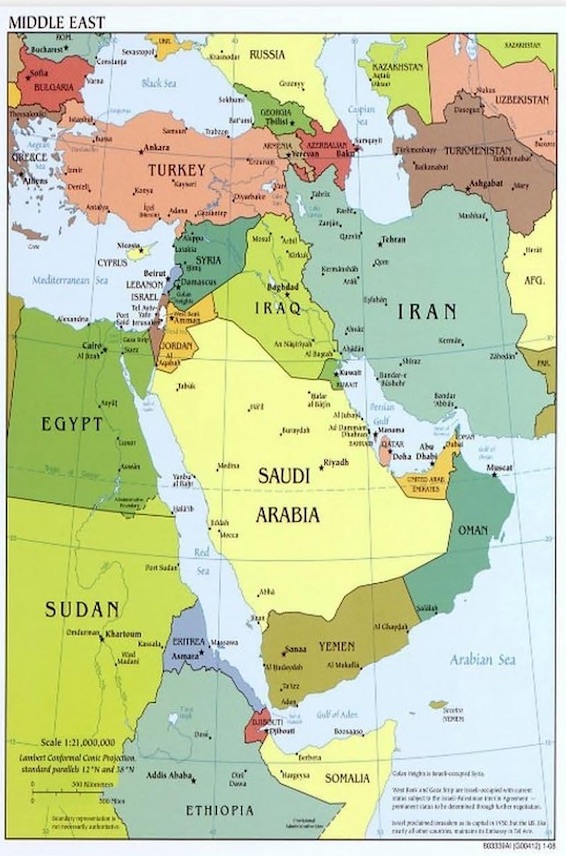
• Has Concern Over Hormuz Made Us Forget the Red Sea? (ET)
Wartime concerns about the security of maritime energy traffic through the Strait of Hormuz—connecting the Indian Ocean/Gulf of Oman with the Persian Gulf—have overshadowed the fact that the related issue of Red Sea security is far from resolved and is, in fact, becoming more dynamic. The Red Sea–Suez link between the Mediterranean and the Indian Ocean is of equal strategic importance to global trade as the Hormuz choke point and is, through geography and common players, intrinsically linked with the Persian Gulf conflict.Read more …
But it is Ethiopia’s civil war, brewing with different factions and with varying intensity since the coup against Emperor Haile Selassie I in 1974, which is again moving in ways that could prove decisive. Always, in the background, is the reality that Ethiopia could revive its historical influence over the Red Sea–Suez sea line of communication (SLOC). Inside Ethiopia, the conflicts that have been raging since 1974 between different governments and different factions are at a new level.The four different Fano opposition militia groups, representing different areas of the Amhara heartland, have been fighting against the central government of Prime Minister Abiy Ahmed Ali for several years. In early 2026, they came together with a united manifesto of their intentions. This has revived the momentum of the threat to Abiy’s Prosperity Party government. A statement issued by a united Fano on Jan. 17, 2026 (Tir 9, 2018, in the Ethiopian calendar) noted:
“So that the Amhara struggle may become one, the leaders of the Amhara Fano National Force and the Amhara Fano People’s Organization, through a historic decision that demanded courage, open-heartedness, decisiveness, and trust in the people, have been able to make Fano unity a reality. … We have designated one leader, one organization.” Significantly, the leadership of the united Fano all titled themselves as “Arbegna,” a nod to the Arbegnoch, the Patriots, who, under the banner of Emperor Haile Selassie I, fought against the Italian invaders of Ethiopia from 1935 to 1941. This led to the ouster of the Italians at the Battle of Gondar, in late November 1941, the first major Allied victory of World War II, in the ouster of an Axis power (Italy) from territory it had seized.
Today, the result of the four separate Amhara Fano groups fighting against the Abiy government over the past several years was the creation—finally—of the Amhara Fano National Movement (AFNM) as an umbrella for all civil and military operations. AFNM, however, described itself as working on behalf of all Ethiopians desirous of the restoration of the multi-ethnic empire. (Ethiopia is home to some 80 ethnic and linguistic groups.) Prime Minister Abiy, half-Amhara and half-Oromo, has consistently identified with Oromo causes and first fought against a Tigrean-dominated government of Ethiopia, and then against the Tigrean People’s Liberation Front (TPLF) militia, which was forced into a ceasefire—essentially a military surrender by the TPLF—in November 2022.
Abiy’s Prosperity Party government has increasingly been rejected by his original Oromo militant supporters, who regard him as “insufficiently Oromo” in outlook, and the government’s writ—or its area of focus—now rarely extends beyond the capital, Addis Ababa. The exception for Abiy’s travels is to some major projects such as the Grand Ethiopian Renaissance Dam in the Benishangul-Gumuz Region of western Ethiopia. The dam has been the subject of some hostility from Egypt, which sees its existence as infringing on Egypt’s “right” to control the waters of the Blue Nile, even though they originate in Lake Tana in the Amhara Highlands of Ethiopia, outside Egypt’s territories.
NATO’s purpose was anti-Russia. That ended in 1989. Questions?
• What Exactly Is the Purpose of NATO in the Year 2026? (Josh Hammer)
One month into Operation Epic Fury against the Islamic Republic of Iran, a long-overdue conversation has finally broken into the open: What, exactly, is the enduring rationale for NATO? For decades, this question has been treated in Washington foreign policy circles as heretical. But it isn’t. And to their credit, President Donald Trump and Secretary of State Marco Rubio are now saying so plainly. As Trump recently put it, “They haven’t been friends when we needed them. We’ve never asked them for much. … It’s a one-way street.” Rubio has been similarly blunt: “If NATO is just about us defending Europe if they’re attacked but then denying us basing rights when we need them, that’s not a very good arrangement. … So all that’s going to have to be reexamined.”Read more …
They’re spot-on. At best, America’s European “allies” have spent decades free-riding on the U.S. security umbrella. Despite repeated commitments to meet baseline defense spending targets, many NATO members still under-invest in their militaries and outsource their national defense to American taxpayers. The imbalance is staggering: The United States accounts for the overwhelming majority of NATO’s military capabilities, logistics, and strategic lift. Overall, American taxpayers contribute about 60% of total spending on NATO defense.At worst, some of these same European allies actively undermine U.S. operations at critical moments. Major Western European countries such as Spain and France have restricted or complicated U.S. use of their airspace during Operation Epic Fury. That is farcical. A so-called alliance in which members obstruct one another’s ability to wage war is not actually an alliance — it is a liability.This raises the core question: Why, exactly, does NATO exist in the year 2026? Let’s recall its origins. NATO was founded in 1949 with a clear and urgent mission: to contain and, if necessary, defeat the Soviet Union. That mission was compelling — indeed, existential. Western Europe lay devastated after World War II, and the Soviet threat was real, immediate, and hegemonic. But that world quite literally no longer exists.
The Soviet Union collapsed three and a half decades ago. The Berlin Wall fell the year I was born. The Cold War is now a relic of history. By any reasonable metric, NATO achieved its raison d’etre by the early 1990s. But instead of declaring victory and recalibrating, the alliance drifted. It expanded ever further into Eastern Europe and shifted its ostensible mission into… well, something.Simply put, NATO is today an organization in search of a purpose.
Is NATO a collective defense pact against the geopolitical successor to the Soviet Union, the Russian Federation? If so, why do so many European NATO members fail to take that threat seriously enough to invest in their own national defense? Is NATO now instead a vehicle for global counterterrorism? If so, why have its members sat on the sidelines and refused to join the United States as it goes to battle against the world’s No. 1 state sponsor of jihad? Or is NATO nowadays just a political club for liberal democracies? If so, what does that have to do with a hardheaded conception of the U.S. national interest?NATO has become a catch-all institution, long on triumphalist platitudes but short on the strategic realities on which its existence was predicated.
“Netanyahu’s party has 23.41% of the vote.”
• The non-Zionist Israeli Population Could Save the Day (Paul Craig Roberts)
Trump’s blustering April Fool’s day speech would easily have served as a hilarious April Fool’s day joke. But it was just bluster to take the place of the discarded 10-day ultimatum that replaced the discarded 5-day ultimatum with a 3 or 4 week ultimatum. As I asked, if Iran is as totally destroyed as Trump asserts, what is the purpose of Trump’s ultimatum?Read more …
Time is running out for Trump, not for Iran. The last time an American president took America to war Constitutionally was 1941 when Congress gave the executive branch permission to enter the war with the Constitutionally required Congressional Declaration of War. As time went by Congress finally responded to presidential decisions to go to war without a Congressional declaration of war not by impeaching the President, which should have been done in order to protect the Constitutional political order and separation of powers, but by requiring the president who initiates military action without Congressional approval to come to Congress with a deadline of 60 days after initiating military action for congressional approval to continue the military action.In other words, Congress failed to defend the Constitution’s Separation of Powers by allowing the executive branch to exercise a power it does not have to go to war and, afterward, to come to Congress for approval. In the past Congress has rubber-stamped the President’s decision. But this time it is different. Polls indicate that a majority of Americans do not share Trump’s concern about the Iranian threat to America. They do not support Netanyahu’s war. Even many American Jews do not support the war.
On April 2 the Times of Israel reported that “the US Democratic National Committee is set to consider a resolution at a meeting next week that “condemns the growing influence” of AIPAC. This is extraordinary considering that in the US Senate there are 9 Jewish Democrats and no Republican ones and that of the 25 Jews in the House of Representatives, 21 are Democrats. https://www.timesofisrael.com/democrats-to-weigh-resolution-against-aipac-fueling-concerns-about-undercurrent-of-antisemitism/
The Times of Israel reports that: “A recent NBC poll found that 57% of Democratic voters have a negative view of Israel, compared to 13% who have a positive view of the country. Meanwhile, a growing number of the party’s congressional candidates—and politicians thought to be seeking its 2028 presidential nomination—are swearing off AIPAC, and crossing its red line of supporting conditions on military aid to Israel.” What Trump has done is to ally the American Democrat Party against Israel and the Republicans with Israel Or to put it more correctly with the current Zionist government of Netanyahu.
Netanyahu’s party has 23.41% of the vote. To be in office Netanyahu has to rely on far right-wing extremist parties who fervently believe in Greater Israel from the Nile River to Pakistan. It is for this Greater Israel agenda that Americans have been fighting for the first quarter of the 21st century. But support for this agenda is not only weak in the US, it also seems to be week in Israel. Zionism has always been a minority position among Jews and the Israeli population. The Israelis tolerated Zionism because it did them no harm. No missiles fell upon them and the Americans protected them with money, weapons, and diplomatic cover.
But now the vaunted Israeli Iron Dome is penetrated at Iran’s will. The Iranian missiles have destroyed the American radar systems that enabled US defenses to prevent attacks on the Persian Gulf states and Israel. If Trump declares victory and goes home, Zionist Israel has no chance of survival. Israel’s nuclear weapons are cancelled by Iran’s demonstrated ability to hit the Israeli nuclear reactor at Dimona and Israel’s storage site of its nuclear weapons. Iran doesn’t need nukes to destroy Israel. A strike on the Dimona nuclear facility would suffice to spread radiation over tiny Israel.
Trump cannot stay in the war, because he cannot risk Congress rejecting his justification for attacking Iran and for continuing the war. For Trump, being defeated by Congress is worse than being defeated by Iran. Trump has until April 28 to extricate himself from the war. So what happens to Israel, defenseless from Iranian missile attack, when Trump leaves the scene? mNetanyahu, who is under indictment in Israel, also faces elections this autumn. What if he cannot put together another ruling coalition? What if the Israelis for the first time are experiencing heavy costs of the Zionist Agenda of Greater Israel and decide that the Zionist agenda does not serve the security of Israel?
There is a possibility that Trump and Netanyahu have made the Israeli population aware of the heavy cost of the Zionist agenda. I do not know what the odds might be, but it is not impossible that Israelis, with the cost of the Zionist agenda now brought home to them, will reject the Zionist agenda and announce that they are satisfied with Israel’s current borders. It is possible–I do not know the odds–that the non-Zionist population of Israel will take the agenda out of the hands of the Zionist war-mongers, and form a government that rejects the Zionist agenda of Greater Israel. This, other than Israel’s destruction, is the only avenue to peace in the Middle East.
MAGAnomic .
• Kevin Hassett on Latest Jobs Data and Economic Impacts from Iran Conflict (CTH)
National Economic Council Director Kevin Hassett appears on Bloomberg News to discuss the US March jobs report and oil market supply disruptions related to the military action in Iran against the impact of oil prices on the US economy. Director Hassett notes the continued goal of the Trump MAGAnomic plan is to build momentum, keep driving domestic investment and the short-term impact from Iran should mitigate quickly.Read more …
“The Jones Act, formally known as the Merchant Marine Act of 1920..”
• Will the Jones Act Waiver Undermine Trump’s Immigration Policy? (Landrith)
There are moments when a temporary policy change forces an examination of deeper legal and strategic questions. The 60-day Jones Act waiver issued last month is one of those moments. While framed as a narrow national security measure, this waiver raises serious concerns about whether the very laws designed to protect American maritime strength and national sovereignty will be inadvertently undermined.Read more …
The Jones Act, formally known as the Merchant Marine Act of 1920, is a cornerstone of American maritime policy. It requires that goods transported between U.S. ports be carried on vessels that are built in the United States, owned by American citizens, and crewed by American mariners. The law was enacted as a vital national security safeguard. A strong domestic merchant marine provides critical sealift capacity during wartime or national emergencies, ensuring the military can move troops, equipment, and supplies without relying on potentially unreliable foreign vessels. On March 17, the Department of Homeland Security (DHS) exercised its purported authority to issue a temporary waiver of the Jones Act for certain commodities.Supporters argue this was a prudent, limited step to address immediate logistical needs amid ongoing global tensions. Customs and Border Protection (CBP) has since implemented detailed compliance procedures: operators must provide advance notice, submit cargo manifests, meet vessel entry requirements, and file final voyage reports with the Maritime Administration (MARAD), which then posts them publicly.These steps show the government is attempting to maintain oversight. However, the waiver only suspends certain “navigation and vessel-inspection laws” under 46 U.S.C. § 501. It does not address — and cannot automatically override — other important bodies of federal law, particularly immigration regulations governing foreign crew members.
This is where the problem becomes serious. Most foreign mariners enter the United States under C-1/D or D crewman visas. These visas are intended for international voyages only. Federal immigration law is explicit: crewmen in this status “may not be employed in connection with domestic flights or movements of a vessel.” The law was written with the assumption that foreign vessels would engage primarily in international trade, not domestic shipping between U.S. ports. A Jones Act waiver may relax one statute, but it does not clearly authorize foreign crews to engage in purely domestic transportation under their existing immigration status.
This creates a gray area that has received far too little attention. During a time of heightened national security concerns — particularly with Operation Epic Fury underway against Iran — we should be increasing scrutiny of foreign personnel entering U.S. waters and ports, not potentially loosening controls. The risks are practical as well as legal. Immigration law imposes real obligations and penalties on both crew members and vessel operators. Overstays, unauthorized activities, and violations of crewman status carry civil and criminal consequences. Shipowners and charterers relying on this waiver may believe they are fully protected because CBP has approved the cargo movement. But satisfying one agency’s requirements does not necessarily satisfy every applicable federal statute.
Additionally, Congress recently strengthened the public reporting requirements attached to Jones Act waivers. Operators must now disclose the vessel name, flag state, ports of call, cargo details, and the specific national defense justification. MARAD is required to publish this information promptly. While transparency is generally positive, it also creates a public paper trail that could invite future congressional oversight, lawsuits, or enforcement actions if questions arise about immigration compliance.
This waiver is not occurring in a vacuum. America’s maritime industry has already been weakened over decades by high costs, regulatory burdens, and declining shipbuilding capacity. The Jones Act exists to prevent further erosion. Waiving it — even temporarily — sends a signal that domestic shipping rules can be set aside when convenient. If foreign-flag vessels and crews can now perform work traditionally reserved for Americans, there is a risk of accelerating the decline of our domestic merchant marine at the very time when great power competition and supply chain vulnerabilities make it more important than ever.
Supporters of the waiver argue it is narrowly tailored and time-limited. That may be true on paper. But policy often creates precedents. Once foreign vessels are allowed into domestic trade routes, pressure will build to extend or expand such waivers in the future. Shippers naturally prefer lower costs, and foreign operators will seek to expand their access to the lucrative U.S. domestic market and bypass visa requirements.
Before embracing this or future waivers, policymakers and industry participants should ask a disciplined set of questions: Exactly which laws have been waived? Which laws remain fully in force? Have we properly reconciled the conflict between navigation waivers and immigration restrictions? And most importantly, does this action strengthen or weaken America’s long-term maritime, immigration, and national security posture?
A temporary waiver may solve a short-term logistical problem. But if it creates uncertainty, invites legal challenges, or further weakens America’s domestic maritime capabilities or immigration enforcement capabilities, it could ultimately do more harm than good to national security. In an increasingly dangerous world, preserving the integrity and strength of the Jones Act should remain a high priority — not an afterthought.
Nobody likes Kamala.
• Kamala Calls to Oppose New Court Nominees “Before They Happen” (Turley)
Former Vice President Kamala Harris is rallying Democratic donors to oppose “additional justices” that might be nominated by President Donald Trump “before they happen.” Harris is heralding the fundraising by Josh Orton, president of the dark-money group “Demand Justice” (made infamous for its campaign to push Justice Stephen Breyer to resign). Demand Justice has pushed a radical agenda, including court packing. In a post on X, Harris highlighted a New York Times article on the “liberal organization” “preparing a multimillion–dollar effort to oppose potential Trump Supreme Court appointees before they happen.” Orton announced that “the project would cost $3 million to start and $15 million more if vacancies occurred.”Read more …
The group expressly cited the possibility of Justices Clarence Thomas (77) and Samuel Alito (76) retiring. Harris pushed people to contribute, posting that :“We must be clear eyed about what is at stake with the Supreme Court right now. We cannot allow Donald Trump to hand pick one, if not two, additional justices. The nation’s highest court must be stopped from becoming even more beholden to him.” Harris reportedly supports court packing and could use radical groups like Demand Justice to push through an expansion of the Court to produce an immediate liberal majority if Democrats take power. Harris is right about one thing. This is an clear-eyed, remorseless strategy on the left to remove an obstacle to an equally radical agenda.Years ago, Harvard professor Michael Klarman laid out a radical agenda to change the system to guarantee Republicans “will never win another election.” However, he warned that “the Supreme Court could strike down everything I just described.” Therefore, the court must be packed in advance to allow these changes to occur.,mLikewise, Democratic strategist James Carville explained how this process of how the pack-to-power plan would work:
“I’m going to tell you what’s going to happen. A Democrat is going to be elected in 2028. You know that. I know that. The Democratic president is going to announce a special transition advisory committee on the reform of the Supreme Court. They’re going to recommend that the number of Supreme Court justices go from nine to 13. That’s going to happen, people.” The rhetoric for this renewed push for court packing and war chests on the left remains entirely unconnected to the actual record of conservatives on the Court, who have been repeatedly attacked by President Trump for voting against major cases by the Administration. From the tariffs decision to the expected birthright citizenship ruling, the conservative justices have routinely voted against the Administration.
Moreover, the vast majority of opinions on the Court remain unanimous or nearly unanimous. The ideological split on the Court is only present in relatively few cases each term. While those cases admittedly have significant impacts, this is not a rigidly or robotically divided court in most cases. Indeed, liberal justices have pushed back on the left calling for court packing or describing the Court as conservative or ideological. Yet, Harris continues to rally donors and voters with claims of an “activist” court.
What is most striking about the “clear-eyed” leadership of Harris is that her model for a new justice appears to be the only Biden nominee, Justice Ketanji Brown Jackson. Both conservative and liberal justices have publicly criticized Jackson in past opinions. Jackson has lashed out at her colleagues while adopting analysis that would effectively gut areas like First Amendment jurisprudence. Many of us have found Jackson’s opinions to be unnerving and unhinged. However, liberal groups and Harris would like to replicate her approach to jurisprudence — suggesting not only a packed court but one populated by unrestrained jurists.
For her part, Justice Jackson shocked many by effectively endorsing Harris in her presidential run. Jackson publicly praised her nomination on ABC’s The View as “historic” and something that “gives a lot of people hope.” With the millions being raised and radical groups positioning themselves for a court-packing push, there are many who see a second Harris nomination as a cause for “hope.” For the rest of us, it is not just “clear-eyed” but unblinking dread at what could await this country if this strategy succeeds in the coming years.
He’s Obama’s best friend. And the people he would sing about, all vote Trump.
• Trump; Boycott Bruce Springsteen Over ‘Incurable’ TDS (JTN)
Springsteen has been a long-time critic of the president, stating in 2016 that the “republic is under siege by a moron,” and spoke out against Trump last year in Europe. President Donald Trump called for his supporters Thursday morning to boycott famed singer Bruce Springsteen and his concerts over the icon’s “incurable case of Trump Derangement Syndrome.” The president’s call comes after Springsteen launched his new tour this week in Minneapolis, where he claimed: “The America that I love, the America … that has been a beacon of hope and liberty around the world is currently in the hands of a corrupt, incompetent, racist, reckless and treasonous administration.”Read more …
Springsteen has been a long-time critic of the president, stating in 2016 that the “republic is under siege by a moron,” and spoke out against Trump last year in Europe. He also released a song about the fatal shooting of two protesters earlier this year titled “Streets of Minneapolis.” “Bad, and very boring singer, Bruce Springsteen, who looks like a dried up prune who has suffered greatly from the work of a really bad plastic surgeon, has long had a horrible and incurable case of Trump Derangement Syndrome, sometimes referred to as TDS,” Trump ranted in a post on Truth Social.“The guy is a total loser who spews hate against a President who won a landslide election, including the popular vote, all seven swing states, and 86% of the counties across America,” he continued. “Under Sleepy Joe and the Dems, our country was dead, and now we have the ‘hottest’ country, by far, anywhere in the World. “MAGA should boycott his overpriced concerts, which suck,” he added. “Save your hard earned money. America is back!” Springsteen’s union, the American Federation of Musicians, slammed the president for “personally” attacking the singer, who it lauded as one of its “most celebrated members,” according to Deadline.
“Bruce Springsteen is not just a brilliant musician, he is a voice for working people, a symbol of American resilience, and an inspiration to millions in this country and around the world,” the union’s leaders said in a statement. “Musicians have the right to freedom of expression, and we stand in complete solidarity with Bruce and every member who uses their platform to speak their conscience. Local 802 and Local 47 will always defend that right.”
“It’s hard to see how any European country will now be able and willing to trust the United States to come to its defense..”
• The New York Times Made a Humiliating Error (Matt Margolis)
The New York Times set out Friday to embarrass President Donald Trump over his hardline stance on NATO. It wound up spectacularly backfiring on them. Several NATO nations have declined to join a U.S.-Israel military operation targeting Iran. Alliance members also refused Trump’s requests to deploy their forces to reopen the Strait of Hormuz, much to the chagrin of President Trump, who figures that if NATO allies won’t help the United States, then the alliance has become meaningless. So the paper ran a piece criticizing Trump’s threats to withdraw from the alliance, and the print edition’s headline asked a pointed question: “A North American Treaty Organization Without America?”Read more …
There’s just one problem. NATO stands for the North Atlantic Treaty Organization. The Times apparently forgot that detail, and, after being mocked on social media, quietly issued a correction through its communications team on X. Trump also joined in on the mocking. “The Failing New York Times, whose lack of credibility, and their constant Fake News attacks on your favorite President, ME, has caused its circulation to absolutely PLUMMET, referred to our severely weakened and extremely unreliable ‘partner,’ NATO, as the North American Treaty Organization,” Trump wrote in a post on Truth Social Saturday morning. ‘The correct name is the North Atlantic Treaty Organization – A very interesting mistake! The hiring and educational standards have gone way down at the NYT.”He added, “Bring back, ‘ALL THE NEWS THAT’S FIT TO PRINT’ and, Make America Great Again!” Here’s what makes this especially painful for the Times. The article wasn’t some throwaway weekend filler. It was a deliberate piece designed to frame Trump as reckless for pushing back against an alliance his critics treat as sacred. “Since his re-election, President Trump has threatened to leave the NATO alliance several times. On Wednesday, he did it again, frustrated that European nations had refused to join the so-far indecisive United States-Israeli war against Iran,” the article began. “But the more he disparages NATO and threatens to abandon it, the more hollow it becomes.”
The alliance, built after World War II to deter the Soviet Union and keep the peace in Europe, is in crisis, with some questioning whether it can survive. The Mideast war has brought existing doubts about American commitment to the alliance to the fore, argued Ivo Daalder, a former American ambassador to NATO. “It’s hard to see how any European country will now be able and willing to trust the United States to come to its defense,” he said. “Hope, perhaps. But they can’t count on it.” In his speech to the nation Wednesday night, Mr. Trump did not mention NATO, to the relief of allies. But a senior European official said he thought most Europeans did not believe that Article 5, the NATO commitment to collective defense, still had teeth.
The United States now seems part of the problem of world disorder, the official said, speaking anonymously given the sensitivity of the topic. The country is no longer the solution and the guarantor of last resort, he said. The whole premise depended on the Times looking like the serious, credentialed adults in the room. Instead, they demonstrated that they didn’t even know the true name of the organization they were defending — right there in the headline, in print, that no amount of corrections can erase.NATO Secretary General Mark Rutte is scheduled to travel to Washington next week to try to smooth things over with Trump directly.
And now they can all go after Todd Blanche..
• DOJ Is Done Releasing Epstein Files (MN)
In a move sparking fresh skepticism among Americans demanding full accountability, the new acting Attorney General Todd Blanche has declared the Jeffrey Epstein files chapter closed. This came just hours after President Trump reassigned Pam Bondi, with Blanche – Trump’s former personal attorney – stepping in as acting AG and signaling it’s time to move on from the scandal. “The DOJ has now released ALL the files with respect to the Epstein saga,” Blanche stated on Fox News. He added, “I think that to the extent the Epstein files was a part of the past year of this Justice Department, it should not be a part of anything going forward.”Read more …Jesse Watters pressed Blanche directly on whether he thought Bondi mishandled the Epstein files. Blanche responded, “First of all, I have never heard President Trump say that the Attorney General was, that anything that happened to her had anything to do with the Epstein files. So look, the Epstein files has been a saga that’s lasted for the entire for the past year.” He further defended the process, noting that Bondi and he “appeared in front of Congress voluntarily a couple weeks ago to answer any questions they had” and made documents available for review.
🚨 IT'S OFFICIAL: The Epstein Files are DONE, acting AG Todd Blanche announces
— Eric Daugherty (@EricLDaugh) April 3, 2026
"The DOJ has now released ALL the files with respect to the Epstein saga."pic.twitter.com/dT9dLvoASdWhen Watters asked, “Who was Epstein spying for?” Blanche replied, “I don’t know that he was spying for anybody. Nobody’s ever said that.” He claimed there is “no evidence in the Epstein files” suggesting Epstein worked for a foreign country.
Todd Blanche wastes no time covering up for the Epstein child trafficking network and says he has no idea which country Jeffrey Epstein was working for or spying for.
— Shadow of Ezra (@ShadowofEzra) April 3, 2026
He says there is no evidence in the Epstein files that proves Epstein was a spy.
JESSE WATTERS: Who was Epstein… pic.twitter.com/EtyHPLakVNOn the question of releasing names of men who abused girls, Blanche previously pushed back, asking “What does that mean? I don’t understand what that means.” He also stated plainly, “It’s not a crime to party with Mr. Epstein.”
Reporter: Will we learn the identities of the men in the Epstein files?
— Truthseeker (@Xx17965797N) April 3, 2026
Todd Blanche, Trump’s Attorney General: “What does that mean?”
🤬It means: Who raped children, who enabled it, and who’s still being shielded?
Stop pretending the question is unclear. The cover-up is the… pic.twitter.com/i6nGtX9P74Blanche doubled down on the administration’s position: “When Trump said let’s release the Epstein files… we did it.”The timing aligns with Trump’s decision to move Bondi to the private sector amid reported frustrations over her pace on key matters, including the Epstein files. Critics had highlighted her earlier claims of possessing a client list and distributing repetitive binders, followed by a DOJ memo stating no such list existed. Yet the assertion that “all files” are out faces immediate pushback. The DOJ reviewed roughly six million potentially responsive documents but released only about 3.5 million publicly, leaving millions still unreleased, redacted, or withheld.
This latest development deepens concerns over an Epstein cover up. FBI officers have raised alarms, with suspicions of document shredding after his death. Separately, a foreign hacker who cracked into the FBI’s Epstein files in 2023 was reportedly disgusted at the scale of child sexual abuse material uncovered, underscoring how much sensitive content may still remain hidden. Epstein survivor reactions and ongoing victim calls for transparency continue to highlight the stakes.
Annie Farmer, a survivor of Jeffrey Epstein and Ghislaine Maxwell, reacts to President Trump firing Pam Bondi as U.S. attorney general. Trump said Deputy Attorney General Todd Blanche will be acting attorney general. pic.twitter.com/MrysNjbVOA
— CBS News (@CBSNews) April 2, 2026Blanche has remained guarded on specifics. His responses often circled back to congressional access rather than new public disclosures, while emphasizing a pivot to other fraud cases nationwide. The Epstein operation represented far more than one man’s crimes — it exposed a network that reached the highest levels of power, protected for years by institutional gatekeepers. Declaring the files “done” while millions of pages stay locked away does little to rebuild trust in a system long accused of shielding the elite. Americans who supported Trump’s mandate expect genuine sunlight on these matters, not a premature shutdown dressed as completion. The deep state’s habits of concealment die hard, and the demand for full disclosure — for the victims and the public’s right to know — will not fade quietly.
Uomo Universalis?!
• SpaceX IPO: Don’t Bet Against Elon Musk (Tim O’Brien)
Tesla isn’t just a car company, and SpaceX isn’t just a space exploration company. Elon Musk’s two marquee companies, and his many other ventures have a lot in common and complement each other by design. The common thread is that Musk wants to leave his mark on this world having changed civilization’s footprint. If he does that, he would be one of the most consequential humans who ever lived. To accomplish that, he had to create technologies that didn’t exist. Benchmark accomplishments have had to happen and still need to happen that, each one in its own right, is almost equivalent to the significance of Christopher Columbus discovering America.Read more …
In the course of creating self-driving, electric vehicles (EVs) at Tesla, Musk has been advancing robot and artificial intelligence (AI) technologies. At SpaceX he’s led the way on space travel innovation in ways NASA once monopolized. He’s not doing these things just to say he did them. He’s got a vision, which he constantly talks about. He wants to colonize the Moon and Mars. He wants mankind to start to think bigger. His company Neuralink has created a brain-computer interface that translates neural signals into actions. The initial applications for this are for disabled people who can be aided by his devices which control computers and robotic arms with thought. As this technology evolves, it’s not hard to imagine how it can be used by able-bodied or disabled astronauts and human colonizers on other celestial bodies.Musk’s satellite internet provider company Starlink is yet another capability that may become critical to realizing his vision in space. Already, the company operates thousands of satellites in low-Earth orbit to give users on the ground wireless internet access. While rural users and people in Third World have been some of the early beneficiaries of the technology, its future applications are limited only by Musk’s imagination. Another little-known Musk company is called The Boring Company, which is a tunnel-building firm. Right now, that company’s technology and capabilities are used to more efficiently build affordable tunnels faster. In Las Vegas, you can go to the Convention Center Loop and see how Teslas are used underground to transport people rather than use rail cars.
Newest Vegas Loop Station at the beautiful Fontainebleau Resort @fblasvegas pic.twitter.com/uzG0qYbSJX
— The Boring Company (@boringcompany) March 31, 2026It’s never a good idea to judge a tech company by the first uses of its technology or platform. If you did that when Amazon first started, you would have just seen that company as an online bookstore, which is what it was at first, but that was never founder Jeff Bezos’s full vision for the company. The same is true here. Long before anyone took him seriously on any of this, Musk started seriously looking at what it would take for him to realize his vision. He knew he had the money to get started, and he knew if his ventures were successful, the money to further invest in his ideas would come.
So he worked backward. He started with that wild vision, and then he followed the pathway back to our current reality. With that, he had a list of technologies and solutions that needed to be invented. He knew the kind of companies that needed to be started. And he knew what problems those companies needed to solve in their infancy before they could do the big stuff. To date, all the headlines around Tesla was its EV advantage, helping people and governments realize the benefits of electric vehicles. But already, it’s possible to see that this was just a baby step for Tesla. The autonomous vehicle development at the company made it as much a robot company as an automotive one. In March, Musk’s Tesla and SpaceX launched a joint venture to consolidate all phases of semiconductor production in the same plant. That venture is called Terafab.
Self-sufficiency To more fully appreciate what Musk is doing, a term comes to mind – self-sufficiency. Musk realized he couldn’t achieve his master vision if he were counting on others and other firms for key parts of the puzzle. He needed the self-sufficiency it will take to get to Mars. He needed it to generate all the sustainable energy you need from the sun, to use that energy to power satellite networks. He’s needed it to go about city-building, for underground tunnel construction, and to do all of this while creating your own chips, doing the work with your own people, your own robots, and using your own AI platforms.
Compatibility is just as important and is part of the self-sufficiency equation. Anyone who has worked in tech knows that once you have two separate companies, a good deal of time, effort and work is focused on helping two companies’ technologies to talk to each other and work with each other. Musk’s consolidated approach eliminates a lot of that. When you look at it that way, the tunnel company makes perfect sense. Underground tunnels enable you to create more controlled environments on planets and moons. They reduce certain risks associated with living in these harsh environments, and they make the notion of living there more sustainable and a pragmatic possibility.
My colleague Rick Moran wrote about the potential opportunities that could come from mining asteroids, and in the process, he touched on the planned SpaceX Initial Public Offering (IPO). He also mentioned Musk’s role in all of this, which cannot be overstated. At the moment, Musk is even looking at ways to build datacenters in space which would generate power to be used here on Earth. Once again, Musk focuses on solving a real problem on Earth that falls right in line with giving him the new tools he needs to achieve his goal of expanding the human race to the moon and beyond. Since Musk is who he is and has lived the life he’s lived, he’s learned not to hit people with his grand vision all at once. It’s too easy to laugh off a guy like that. He’s learned to reveal his master vision over time to provide context by emphasizing his near-term focus.
Henry Ford spent his entire life on the automobile, and society was never the same as a result. Steve Jobs and Bill Gates spent their active careers personalizing computer technology, and once again, society was never the same. Musk has always thought so much bigger than that, that he’s had to learn to rein himself in so that he tends to talk about each step in its own time. NASA’s Artemis mission to the moon, along with increasing disclosures centered on that SpaceX IPO are making it more obvious that Musk’s disparate ventures are starting to converge. It’s becoming more apparent what he’s ultimately trying to do, and it’s not just talk.
🚨Update: Artemus 2 just lifted off for what NASA says is a trip around the Moon! pic.twitter.com/DDGZhWG2EI
— US Homeland Security News (@defense_civil25) April 1, 2026NASA has already selected the SpaceX Human Landing System (HLS) for Artemis as the means to land people on the moon. SpaceX’s Raptor engines and reusable rocket technology may also come to play.
❗️🚀🇺🇸 – SpaceX has revealed an enhanced version of its Starship Human Landing System (HLS), tailored for NASA's Artemis program to return astronauts to the Moon's surface.
— 🔥🗞The Informant (@theinformant_x) November 7, 2025
This lunar lander variant stands approximately seven times taller than the Apollo lunar modules and… pic.twitter.com/jy1BtkzgF2Not coincidentally, SpaceX this week took a major first step towards its IPO which will generate the cash SpaceX will need to further realize its potential and Musk’s vision. According to Bloomberg, SpaceX’s IPO could be the largest public offering ever after filing with the U.S. Securities Exchange Commission (SEC). The newswire reported that SpaceX could raise up to $75 billion through the IPO.
Reuters has reported that while the company is valued at $1.25 trillion right now, Musk and SpaceX are seeking a valuation of $1.8 trillion through the IPO. While no official date has been disclosed, reports are to expect it in June. If you’ve only been casually paying attention to Musk and his various business ventures because they may have seemed too far out for you to get your head around, now may be the time to start paying closer attention. Even if all you have is a 401(k) or an IRA account, chances are pretty good that a part of your own nest egg will depend on Musk to achieve some of those goals of his.

As it should. https://t.co/0g0NRfGFgP
— Elon Musk (@elonmusk) April 3, 2026
Why they can’t be trusted?
— C3 (@C_3C_3) April 3, 2026
The Legacy Media’s NEGATIVE Coverage:
RFK Jr: 94%
JD Vance: 88%
Elon Musk: 96%
Kash Patel: 97%
Kristi Noem: 87%
Tulsi Gabbard: 98%
Pete Hegseth: 100%
President Trump: 92%
So telling…
The Legacy Media is the enemy of the people.
Propagandists.
ABSOLUTE BOMBSHELL on CNN: Donald Trump now has the worst net approval rating among independents of ANY president ever. He is literally polling 10 points worse than Richard Nixon right before he resigned. The American public has abandoned him entirely! pic.twitter.com/cAJFmv7BzS
— Furkan Gözükara (@FurkanGozukara) April 3, 2026
Support the Automatic Earth in wartime with Paypal, Bitcoin and Patreon.