
Giovanni Strazza The Veiled Virgin, Carrera marble 1850s
this is one piece of marble!

https://twitter.com/QuantumGuard17/status/2050917184851849526?s=20 https://twitter.com/Tironianae/status/2050889856495071522?s=20 https://twitter.com/warDaniel47/status/2050901895011512595?s=20 https://twitter.com/Real_RobN/status/2050655450362962290?s=20 https://twitter.com/17QStorm/status/2050707200935358803?s=20
I said when they started this thing 2 months ago, that it all depends on language. Iran knows they can’t win. Trump et al need to find the words that let whoever speaks for “Iran” concede, but without losing face and/or their lives.
• Iran on the Verge of Historic Economic Collapse. Will It Lead to Peace? (Moran)
Iran’s economy has passed the point of no return, and there is now no avoiding a historic economic collapse. The raw numbers tell some of the story. Food inflation is at 104% per month. Iranians have lost 90% of their purchasing power. The rial has hit a new all-time low of 1.84 million against the U.S. dollar in the open market in Tehran. That means that a 256GB iPhone 17 Pro Max, priced by Apple at $1,200 in the U.S., was being offered at close to 5 billion rials ($2,750) by some shops in the capital. Other shops are refusing to sell, knowing the price will probably dramatically increase in a few days.Al Jazeera reports,Read more …
“A Peugeot 206, a modest French passenger car that is also now produced and popular in Iran, costs an eye-watering 30 billion rials ($16,500).””The monthly minimum wage in Iran is currently less than 170 million rials ($92), and that is after the government raised it by about 60 percent for the current Persian calendar year that started on March 21,” reports the outlet. “The government is also offering subsidies towards food and essentials worth just less than $10 per month per person.” “You look at the prices and salaries, and you see the numbers don’t add up,” one unnamed Tehran resident told Al Jazeera.Naturally, the currency collapse and inflation have led to huge job losses. The government is no longer announcing unemployment figures, so we have to guess how bad it is. In addition to the bombardment of Iran’s infrastructure, U.S. sanctions, and a naval blockade, the resulting economic crisis has magnified the already massive corruption in the economy. You can’t survive without cheating the system in some way, and even normally honest merchants have been forced into a life of crime.Iran is entering the 65th day of a total internet shutdown. In trying to keep Iranians off the streets in protest, the government is deliberately sabotaging the economy.
But is all of this pain enough to bring about the kind of peace Donald Trump will accept?Fox News: “The escalating pressure campaign marks one of the most aggressive U.S. efforts in years to economically isolate Iran. But the central question is whether this strategy can force meaningful concessions from a regime that has historically absorbed economic pain, or whether it risks triggering broader instability — from energy market shocks to regional escalation — before Iran is pushed to a breaking point.
A senior administration official told Fox News Digital that Treasury is aggressively expanding “Economic Fury” beyond traditional sanctions by targeting Iran’s ability to generate, move and repatriate funds across oil, banking, cryptocurrency and covert trade networks. The official said Treasury has disrupted billions in projected Iranian oil revenue in recent days alone, including freezing half a billion dollars in regime-linked cryptocurrency, while also escalating pressure on Chinese “teapot” refineries, foreign banks and sanctions-evasion networks facilitating Tehran’s trade.”
China is ignoring U.S. sanctions and is using these “teapot refineries” to buy up Iranian oil through third parties. The small, independentnt refineries have become a focal point in global energy politics. They have been instrumental in keeping the Chinese economy stable by importing sanctioned Iranian and Russian oil, often using China’s Cross-border Interbank Payment System (CIPS) to bypass Western financial networks. They are very difficult to get at, especially since China is telling them to ignore the U.S. Treasury Secretary Scott Bessent has got to find a way to, if not shut them down, then clog up their financial and supply networks, which is easier said than done.
Alireza Nader, an Iranian independent analyst based in Washington, doesn’t think that economic pressure alone will force Iran to settle. “It looks like a game of chicken and I think the regime thinks that it can win this game of chicken with President Trump,” he told Fox News Digital. “I don’t see this economic blockade … leading to some sort of breaking point for the regime,” Nader added. He says that the Iranian leadership has shown in the past their willingness to allow the people to suffer in order to maintain their hold on power.
According to U.S. intelligence, Iran will run out of places to put the oil they are taking out of the ground in less than two weeks. They are now loading crude into derelict tankers, railroad cars, and any other receptacle that can hold oil. When they run out of places to store the oil, they will be forced to shut down wells. That will result in laying off large numbers of workers and losing revenue totaling hundreds of millions of dollars a day. Eventually, Iran will be forced to meet Trump’s terms or witness the government’s inability to feed its 90 million people.
“President Donald Trump said Tehran’s proposal would likely be rejected..”
Iran’s leadership has been beheaded. Who speaks in the media? Some spokesperson for the IRGC. Tomorrow someone else?!
Khameini jr. may or may not even be alive. We have no idea what power he has.
So we can’t react to what he says. Trump will make his own conversation.
• Iran Submits New Peace Terms, Says ‘Ball In US Court’ (RT)
Iran has submitted a new comprehensive peace plan, Deputy Foreign Minister Kazem Gharibabadi said on Saturday, adding that “the ball is in the US court.” Both countries have previously accused each other of putting forward unacceptable terms, as a ceasefire reached nearly a month ago has failed to produce an agreement. Negotiations have been further complicated by the twin Iranian and US blockades of the Strait of Hormuz and the resumption of Israel’s bombing campaign in Lebanon.Read more …
The Islamic Republic of Iran has submitted its plan to Pakistan as the mediator with the aim of permanently ending the imposed war, and now the ball is in the US court to choose between a diplomatic solution or a continuation of the confrontational approach,” Gharibabadi said, as quoted by Press TV. According to Iranian media, the 14-point plan is a counterproposal to a nine-point document presented earlier by the US. News agencies reported that Iran’s terms include security guarantees, the withdrawal of US troops from the region, the lifting of sanctions, and an end to the war “on all fronts,” including Lebanon. Iran is also reportedly seeking compensation from the US and a new framework for the Strait of Hormuz.In a post on Truth Social on Saturday, US President Donald Trump said he would review the plan soon but added that he could not “imagine that it would be acceptable.” The president previously told journalists that he was “not satisfied” with Iran’s terms and threatened to “blast the hell out of them and finish them forever.” The US has demanded that Iran completely abandon its nuclear program and surrender its enriched uranium stockpiles, a condition Tehran has flatly rejected, insisting that its nuclear program is for civilian use only. While the prospects for a peace deal remain uncertain, oil prices surged past $120 per barrel this week for the first time since 2022.
Oil=profit.
• Trump On Hormuz Blockade: “We’re Like Pirates – And It’s Very Profitable” (ZH)
Rare agreement with Iranian officials? President Trump has newly said the US Navy is acting “like pirates” as he described an operation about seizing a ship amid the ongoing blockade of Iranian ports. “We … land on top of it and we took over the ship. We took over the cargo, took over the oil. It’s a very profitable business,” Trump told a large audience at a rally in Florida on Friday. “We’re like pirates,” he added as the crow cheered him on. “We’re sort of like pirates. But we’re not playing games.” Watch the US President also declare “it’s a very profitable business”:Read more …
The irony in this statement is that it precisely echoes Tehran’s own accusation that the Pentagon is indeed engaged in ‘piracy’ in Persian Gulf waters, and as the US seeks to interdict other Iranian vessels on the high seas globally, especially near Asia. This week Iran issued formal request to the UN Security Council that it stop the “continuing internationally wrongful acts of the United States through yet another piracy-style seizure and deliberate targeting of commercial vessels, namely the M/T Majestic and M/T Tifani.” Some of Iran’s embassies abroad have also directly responded to the fresh Trump piracy clip. Here’s what the Iranian Foreign Ministry had to say on X through one of its diplomatic outposts in south Asia:“Sort of like pirates”? No, Donny—that’s textbook piracy. One upside to an incompetent opponent: moments like this. But the crowd cheering and clapping along? That’s the truly disturbing part. U.S. urgently needs a swift and serious regime change. Additionally, one show host with Russia’s RT had this to say by way of reaction: “The only good thing about Trump is that he openly admits the US is a rogue state that doesn’t care at all about international law, he doesn’t bother to cover up the US’ heinous actions with the bogus liberal PR language that previous Presidents used.”
It is also akin to when Trump became the first US leader to declare that American troops were in Syria to “secure the oil” – contradicting prior presidents and officials who insisted Washington was merely engaged in ‘counter-ISIS’ operations. Meanwhile, Iran’s Ministry of Foreign Affairs spokesman Esmaeil Baghaei has said on X this week Americans have an “undeniable right and the solemn duty” to demand accountability from the White House over the ongoing US-Israel “war of choice” against Iran. The war is “a clear, unprovoked act of aggression” – he stated, and called on Americans to rise up challenge their leaders for “waging this illegal war against the nation of Iran and for all the atrocities perpetrated.”
” The intelligence unit of Iran’s Islamic Revolutionary Guard Corps (IRGC) has newly stated…”
Don’t listen to a word they say. Make them re-act, not act. It’s the only thing you can do.
• Trump Must Choose ‘Impossible’ War Or ‘Bad Deal’ With Iran: IRGC Message To US
Iran is telling Washington that the ball is in its court as President Trump has affirmed over the weekend that he is reviewing the latest peace deal submitted via Pakistani mediators. Tehran is further saying the US is going from worse to worse as it must now choose between an “impossible” military operation or a “bad” deal. The intelligence unit of Iran’s Islamic Revolutionary Guard Corps (IRGC) has newly stated that “Trump must choose between an impossible military operation or a bad deal with the Islamic Republic of Iran,” according to Al Jazeera referencing the official statement. The provocative words framing the dilemma came soon on the heels of the following Saturday Truth Social post from Trump:Read more …
As for the IRGC statement about an “impossible” miliary operation, it further indicated that Tehran sent the US military a deadline to end its blockade of Iranian ports. It highlighted that Europe, China and Russia are are increasingly taking a more critical toward Washington’s war.”The room for US decision-making has narrowed,” the IRGC intelligence unit sad additionally, emphasizing “there is only one way to read this.” At the moment, the two-week ceasefire which was announced on April 8 through Pakistani mediation has been unilaterally extended by Trump, to now be indefinite. On Friday as the conflict reached 60-days, President Trump submitted a formal letter to Congress stressing Operation Epic Fury had already been ‘terminated’ due to the ceasefire.The White House is arguing that this loophole – or the fact that there’s currently no exchanges of fire between the US and Iranian sides – means that required Congressional review and authorization of use of American troops is essentially voided. In the meantime gas prices at the pump for Americans are steadily rising. The below is the full IRGC statement to the US side:
https://twitter.com/PressTV/status/2050871274788847962
The current Iran-submitted plan now being reviewed at the White House reportedly contains 14 points. A Russian correspondent has said that “Iran is seeking a decisive and permanent end to the conflict with the US, rather than a previously proposed two-month ceasefire” and that it seems a one-month window to end all hostilities. “The plan includes a demand to resolve all issues and end the war within 30 days,” said RT correspondent Saman Kojouri, adding that “”he space for compromise between Tehran and Washington is narrowing.” Just by the close of last week Trump said he was ‘not satisfied’ with what he had seen so far.
“Without major changes to federal fiscal policy, the U.S. government will default on its debt in about 20 years ..”
• US Debt Tops 100% of GDP, Deeply Troubling For Economy, National Security (JTN)
The U.S. national debt is now larger than the entire American economy and is only set to keep growing, further exacerbating the affordability crisis and risking national security. Out of the $39 trillion total national debt, debt held by the public hit $31.27 trillion on March 31, surpassing the $31.22 trillion in Gross Domestic Product over the past 12 months. The fact that the national debt has reached 100% of GDP – the highest in history except for the years immediately following World War II – is “deeply troubling,” Romina Boccia, director of budget and entitlement policy at the Cato Institute, told The Center Square.Read more …
“Following World War II, we actually had a good reason for having such a high debt, and the government was on a path to reduce that debt after the war ended,” Boccia said. “In this case, we have debt as high as since World War II, except we are on a steep upward trajectory, and it’s not driven by a temporary war but by permanent entitlement obligations that are expanding – that’s Social Security, Medicare and Medicaid.” Social Security and Medicare spending alone made up more than 30% of federal outlays in fiscal year 2025, and that spending is projected to continuously increase in the near future.While some U.S. lawmakers have expressed concern over the unprecedented debt increase, there is little to no action on substantially reducing federal spending. Yet if Congress does not rein in deficits quickly, current and future generations of American taxpayers will feel the economic brunt of the rising interest costs that servicing the debt requires. “The reason we concern ourselves with debt to GDP is primarily because of the burden it poses for current and future generations, and that is primarily measured in the interest costs that servicing the debt requires from working Americans and taxpayers,” Boccia said.
“There’s strong research indicating that when debt grows to such high levels, above 80% of GDP, it tends to crowd out private sector investment, which reduces economic growth, and therefore economic opportunities, jobs, and higher wages.” In the immediate term, rising debt worsens affordability by spiking interest costs on Americans’ credit card debts, mortgages, car loans, student loans and more. “The federal government is using up so much credit in the market that it’s driving up interest costs, and it affects all of us,” Boccia said. “It has these downstream effects.” The U.S. currently spends more money on financing debt interest costs than it does on national defense – even as high debt ratios directly endanger national security.
“The reason we want governments to maintain low stable debt ratios, preferably below 60% of GDP, is so that they have room, so-called fiscal capacity, to borrow during times of crisis. And that can be a pandemic, a national security crisis, a financial crisis, or an economic recession like we saw in 2008,” Boccia said.“When governments have that room to borrow for that emergency response, it means that their recessions aren’t as severe and they can more easily return to normal economic growth after the crisis ends,” she added.
“But when a government enters a crisis already over-leveraged, holding too much debt, they’re not able to borrow as much as they otherwise would have in order to weather the crisis, and so the crisis will be more severe.” In a situation where America is at war, the results would be disastrous. “If you don’t have the fiscal capacity to respond to a military threat, then you are leaving yourself at risk of not being able to defend yourself,” Boccia said. The national debt is our greatest national security risk.” Without major changes to federal fiscal policy, the U.S. government will default on its debt in about 20 years, according to Penn Wharton Budget Model estimates.
Make babies or wear a burka.
• Visualizing Europe’s Birth-Rate Collapse (ZH)
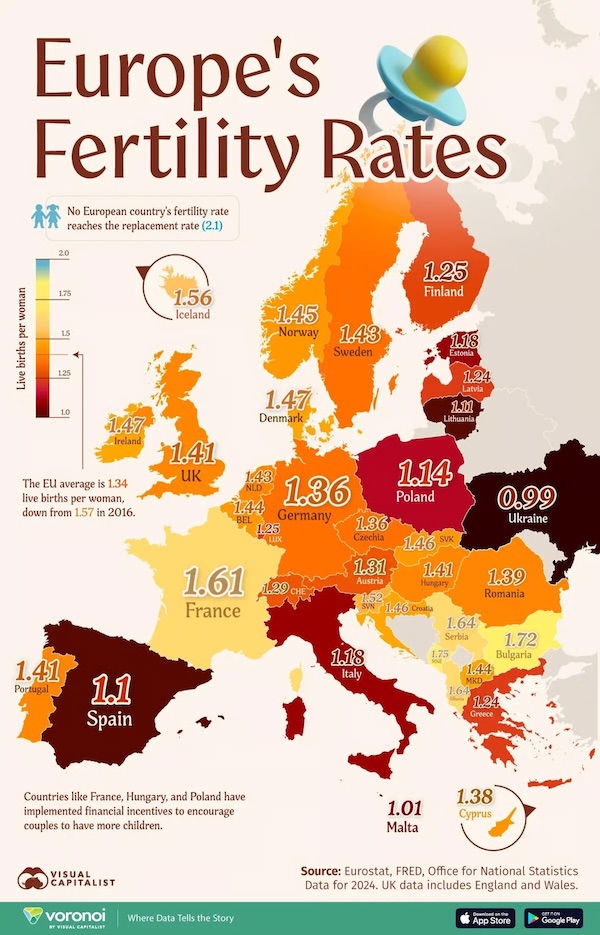
Europe’s population is no longer replacing itself. Across the continent, fertility rates have fallen below the 2.1 births per woman needed to maintain stable population levels, with no country meeting that threshold as of 2024. The map below, via Visual Capitalist’s Gabriel Cohen, shows the number of live births per woman across Europe using the most recent data from Eurostat, FRED, and the UK’s Office for National Statistics.Read more …
From Ukraine (0.99) to Spain (1.1), some of Europe’s largest countries now rank among those with the lowest birth rates, highlighting how widespread the decline has become.Fertility Crisis in South and Eastern Europe
Europe’s lowest birth rates are concentrated in the east and south, where economic strain and geopolitical instability have accelerated long-term declines. Ukraine has seen the sharpest drop. Its fertility rate, which last exceeded the replacement level in 1986, fell to 0.9 in 2022 before recovering slightly to 0.99 in 2024. Among countries at peace, Malta has one of the lowest fertility rates at 1.01, followed by Spain (1.1) and Poland (1.14). [..] Lower fertility in countries like Spain and Poland reflects a mix of economic pressures, including lower wages and the rising cost of raising children, alongside broader trends seen across developed economies. Aging populations are already reshaping national priorities. As Poland seeks to build a larger military, its shrinking population presents a strategic vulnerability.Europe’s Fertility Woes
This trend extends across the continent. Europe’s largest economies, including Germany (1.36), the UK (1.41), France (1.61), and Italy (1.18), all remain well below replacement levels. Even countries with relatively higher fertility rates, such as Bulgaria (1.72) and Montenegro (1.75), are not producing enough births to stabilize their populations. One response has been increased immigration. In Germany, migration policy in the mid-2010s was shaped partly by the need to support the country’s labor system. However, this approach has also fueled political backlash and the rise of anti-immigration parties.Family Incentives As A Solution?
Some countries are attempting to boost birth rates through financial incentives. France, Hungary, and Poland have introduced tax credits, subsidies, and other programs aimed at encouraging larger families.Hungary, for example, has spent over a decade expanding benefits for young couples, with the goal of reaching the 2.1 replacement rate by 2030. So far, the results have been limited. Hungary’s fertility rate of 1.41 is similar to countries like the UK and Portugal, suggesting that financial incentives alone may not reverse the broader trend.
France is the most advanced in the Great Replacement,. UK a close second
• 60% of Voters: ‘A Replacement of the French Population by Non-Europeans’ (RMX)
A new poll from the presitigous ifop polling firm shows that a large majority of French citizens believe in a core tenent of the Great Replacement. Specifically, 60 percent of French people told ifop they believe we are witnessing “a replacement of the French population by non-European populations, mainly from the African continent.” The poll also found that 66 percent see it as a bad development, compared to 9 percent who see it as a good thing. Two weeks ago, Marion Maréchal, leader of Identité Libertés, posted to X: “60% of French people think that we are witnessing ‘a replacement of the French population by non-European populations mainly from Africa’ according to @IfopOpinion. To our greatest misfortune, our rulers are among the 40%.” Analyst Paul Cébille, from the Hexagone Observatory, posted the same line.Read more …https://twitter.com/Ellibec/status/2044792277063569781
According to the data from IFOP, 7 percent are undecided. According to the French Directorate General for Foreigners (DGEF), valid French residence permits in 2025 hit an unprecedented level of 4.5 million, an increase of approximately 3 percent, driven primarily by multi-year permits and long-term resident cards, writes Le Journal du Dimanche.= For 2025, one in three permits was issued for family reasons (1.5 million), while one in five was an automatic renewal. New permits also increased to 384,000, a jump of 11 percent, which was partly driven by a 65 percent increase in admissions for humanitarian reasons.Foreigners with legal status now represent 8.1 percent of France’s adult population, with a high concentration of nationalities from the Maghreb. At the same time, regularizations have declined (-10%, to 28,610), while deportations have increased sharply (+15.7%, to 24,985), reaching their highest level in a decade, notes JDD. Maréchal more recently posted a telling video of the number of illegals coming to the EU, blasting French leaders for their continuous stance of “above all, let’s do nothing!”
L’immigration illégale dans l’UE de 2008 à 2024. Chaque point représente 100 clandestins.
— Marion Maréchal (@MarionMarechal) April 23, 2026
Réaction des gouvernements français successifs en voyant cela : « surtout ne faisons rien ! ». pic.twitter.com/0G78rKLeIyMaréchal has also been a vocal critic of Spain’s Socialist PM Pedro Sánchez for his “irresponsible regularization of 500,000 undocumented immigrants,” a figure that some say is likely to skyrocket to over 1.5 million. “Closing Schengen at the Spanish border is a vital act to deter and protect the French and Europeans,” she wrote. The National Rally’s Jordan Bardella has also sounded the alarm over what many consider an immediate threat to France. Bardella has made it clear that he feels the EU must alter current rules to disallow free movement within Schengen for those holding a resident permit.
Lock down the UK.
• UK School Books Say ‘There’s Plenty Of Room’ For Small Boat Migrants (MN)
British kids as young as five are now being read picture books that paint small boat crossings in glowing terms and urge them to open the door to unlimited migration. While record numbers of illegal arrivals strain housing, schools and public services, left-wing charities are using taxpayer-backed programmes to turn classrooms into recruitment centres for open borders ideology. More than 1,100 schools and nurseries across the UK have signed up to the Schools of Sanctuary programme, run by the City of Sanctuary network. The scheme requires schools to complete a “rigorous” award process to prove they are “working collaboratively to strengthen community approaches to welcoming refugee children and families.” Once awarded, they pay a minimum donation of £75 to £300.https://twitter.com/Telegraph/status/2049157270043291715 Read more …
Children's books with pro-migrant messaging that teach pupils 'everybody's welcome' are being shared in scheme promoted at more than 1,000 schools https://t.co/0Yc556WpXS
— Daily Mail (@DailyMail) April 30, 2026
As part of the programme, schools are given a suggested reading list packed with pro-migrant messaging. One book, Kind by Alison Green, illustrated by renowned children’s illustrators such as Quentin Blake and Axel Scheffler, tells children: “Sometimes people have lived through very hard times. They’ve had to leave their homes and their countries because of danger. They are brave and amazing and have extraordinary stories to tell.”It continues: “Sometimes people say there’s no room for anyone more. But maybe you can say ‘There’s plenty of room! Come on in!’ After all, if you don’t let people in, you’ll never know what you’re missing.” Yeah, come on in! In fact, come on in and live in a hotel in a nice green village, all at taxpayer expense! The book features a cartoon lion in a crowded boat with other animals and encourages pupils to share toys, draw pictures together and even learn words from a foreign child’s language.
Children told to welcome 'brave and amazing' illegal migrants – and even share their toys with themhttps://t.co/4Uz4uofgJF
— GB News (@GBNEWS) April 29, 2026Another title, Everybody’s Welcome by Patricia Hegarty, states plainly: “Everybody’s welcome, no matter who they are, wherever they may come from, whether near or far.” No matter who they are. Never a truer word spoken. The classic Elmer and the Hippos is also recommended. In it, elephants initially resent hippos arriving at their river because “there isn’t enough room for them and us.” By the end, the two groups work together and become friends after clearing a blockage. Except of course, in this story none of the hippos go on a stabbing or raping spree. Something the UK is experiencing every single day now.
Schools are also encouraged to hold an annual “Day of Welcome” in June, complete with non-uniform days to raise funds for the scheme or local migrant-support groups. Secondary pupils can even meet real-life refugees promoted by the charity. What could possibly go wrong? Shadow Education Secretary Laura Trott has demanded the books be withdrawn “immediately.” She told the Daily Mail: “Classrooms should be places of learning not promoting political ideology, schools have a very clear duty to stay out of politics.”
Trott added: “Portraying the arrival of small boats as a positive thing in books for children as young as five is indoctrination, this is an illegal practice. This organisation has already made clear its aim is to turn pupils into ‘ethically informed change makers’ and that crosses a very clear line.” She concluded: “We must get a grip on these third party resources infiltrating our schools and peddling political agendas to young children.”
The City of Sanctuary UK defended the materials, saying it “works with schools to support a culture of welcome, inclusion and understanding for all members of the community.” It added: “Our suggested educational resources, including book recommendations, are designed to help children develop empathy, critical thinking, and awareness of the experiences of others.” This is not an isolated incident. It fits a clear pattern of using British schools to enforce mass-migration acceptance while cracking down on any pushback.
A Pattern of School Indoctrination
As we previously highlighted, the far left UK Green Party, which is about to become much more influential in Parliament with upcoming local elections, wants to teach children they have a “moral obligation” to accept unlimited immigration: The current government has also urged schools to snitch on “anti-Muslim hostility” in an Orwellian crackdown:Meanwhile, counter-terror police are running ads warning teenagers that sharing “funny content” online could amount to terrorism:And a government-funded video game explicitly warned kids they could be flagged as terrorists for questioning mass migration: Even primary school children are not exempt from the rampant indoctrination:The message is relentless: British children must be conditioned to accept endless migration, share what little they have, and never question whether “there’s plenty of room.”After all, we’re reliably told to expect the arrival of another 7 MILLION migrants in the coming years: Parents and politicians are right to push back. Schools exist to educate, not to manufacture “ethically informed change makers” for the open-borders lobby. Until third-party political materials are banned from the curriculum and real scrutiny is applied to groups like City of Sanctuary, Britain’s classrooms will continue serving as recruitment tools for the very policies destroying community cohesion and national identity.
Think Ilhan Omar and it’s not so surprising. But it’s very important that Europe and US remain Christian.
• DOJ Releases Report Alleging Anti-Christian Bias Under Biden (ET)
The Department of Justice (DOJ) on April 30 released a 500-page report detailing alleged anti-Christian bias on the part of the Biden administration. According to the report by the DOJ’s Task Force to Eradicate Anti-Christian Bias, the former administration’s prosecutions, policies, and practices constituted bias throughout multiple agencies, in accordance with the administration’s priorities. The task force is chaired by Acting Attorney General Todd Blanche. “No American should live in fear that the federal government will punish them for their faith,” Blanche said. “As our report lays out, the Biden Administration’s actions devastated the lives of many Christian Americans.”Read more …
Around 200 pages of the report are dedicated to the actions of more than 17 federal agencies that uncovered alleged religious discrimination. The investigation included a review of internal discussions and case files, as well as prosecutorial decisions. There were details of a since-retracted 2023 FBI memo on “radical traditionalist” Catholics, which cited the Southern Poverty Law Center. The review also listed Biden-era regulations on abortion, contraception, gender, and human sexuality, among other issues that pitted the government against religious groups.The report also makes note of the Biden administration’s reading of the 2019 Supreme Court ruling in Bostock v. Clayton County, which led to decisions that were based on what the Trump administration report called “sex-based discrimination in federally funded schools and sports.” According to the DOJ report, the previous administration used the FBI, IRS, Department of Education, Department of Health and Human Services, and other agencies to monitor, investigate, and apply pressure to various Christian groups at a federal level. The current DOJ’s task force was formed in accordance with President Donald Trump’s Feb. 6, 2025, executive order titled Eradicating Anti-Christian Bias. The president ordered multiple agencies to investigate what he called an “egregious pattern of targeting peaceful Christians, while ignoring violent, anti-Christian offenses.”
Conflicting Response
This is a “very different Department of Justice … than the previous administration,” said Neama Rahmani, a former federal prosecutor and president of West Coast Trial Lawyers. “The conclusion in the report, at least from an enforcement perspective, was that … federal law was disproportionately used to prosecute pro-life and other Christians under the Biden administration,” he told The Epoch Times. However, Rahmani, who worked at the DOJ from 2009 to 2012, said that while policies change, he has not seen a “systematic bias for or against” any one religious group.“I don’t necessarily see … [that] Christian activists in this country are receiving more prison time for violent acts, as opposed to, you know, Muslim or other religious groups.”According to Andrea Picciotti-Bayer, director of the Conscience Project, the report “calls out the brazen assault against religious freedom by the former administration for what it was: a failure of constitutional and statutory duty.” Picciotti-Bayer said in an emailed statement that the Biden administration disregarded “fundamental guarantees” in the First Amendment and federal civil rights law, and treated “sincere religious objections as obstacles to overcome, prosecuting peaceful prayer, trampling on parental rights and steamrolling conscience rights.”
The Interfaith Alliance, however, which states its mission is to “challenge Christian nationalism and religious extremism,” responded to the DOJ report, saying their group has “consistently opposed the work of this ‘task force.’” It accused the DOJ of trying to “undermine Americans’ religious freedom and First Amendment rights.” The alliance called the task force’s report a “political stunt designed to promote the lie that American Christians are a persecuted group, while providing justification to target anyone deemed out of step with their Christian nationalist agenda.”
Previous Report
This report comes just weeks after an 800-page report from the department, detailing the “weaponization” of the Freedom of Access to Clinic Entrances (FACE) Act, which called out alleged prosecutorial problems, surveillance activities undertaken by pro-abortion groups, and failures to comply with federal law. Biden’s DOJ did not enforce the law evenly, according to the April 14 report. The task force under the Biden administration treated pro-life groups differently from pro-abortion groups, outlining disproportionate coordination with pro-abortion groups that, according to the report, indicated bias and prosecutorial overreach. In her statement, Picciotti-Bayer said, “Religious freedom isn’t a courtesy the government extends—it’s a legal check on what government can do. It’s refreshing to see that recognized today.”
Why do you want to tell her what to do? Does it make you feel good about you?
• It’s Time for Erika Kirk to Step Down as CEO of Turning Point USA (Pinsker)
It’s not about right and wrong, because if it were, Erika Kirk would continue as chairwoman and CEO of Turning Point USA for many years to come, fulfilling her dream of advancing her late husband’s legacy — and all those gruesome, ghastly parasites gorging at the trough of a widow’s grief would gag on their own obscenities. But sadly, it’s not about right and wrong. Our world runs on cause and effect. This is a vexing topic to measure on its merits because the emotions strike like a tsunami. Hey, I’m biased, too: Personally, I hope Erika Kirk takes a breather — not out of malice, but because I suspect she’s suffering more than we realize.Read more …
Not “suffered.” Not past tense: Her suffering is constant and continuous, without any end in sight. She’s paying a price that’s absurdly unfair, and now she’s being tortured for clicks, clout, and lolz. It’s a dreadful commentary on our conservative community: Charlie Kirk isn’t around to protect his wife anymore, and the silence of his “friends” is deafening. The same people who waved his bloody shirt won’t lift a finger to protect his widow. Didn’t have to be this way, of course. Charlie’s “friends” could’ve circled the wagons around her. If they had despised Erika Kirk’s exploiters, parasites, and liars as much as they despised, say, AIPAC and Israel, the entire PR trajectory would’ve been different.But they didn’t. And those actions — or lack thereof — have consequences. One of them, unfortunately, is that Erika Kirk has become a distraction from Turning Point USA’s core mission, because the focus is going to be on her. She didn’t ask for the spotlight, but now it’s inevitable. If she’s at a TPUSA event, everything she says and does — even the way she smiles/frowns, interacts with speakers, and the clothes she wears — will be scrutinized. She’s become the lead story. And when she’s NOT at an event, the focus will be on that, too. It’s a no-win situation.
The smartest PR solution is “promotion by demotion”: Announce that Mrs. Kirk will assume the title of Chairman Emeritus (or something equivalent) and will spearhead a new passion project — something directly tied to Charlie Kirk’s legacy. At the same time, announce the appointment of a hot new CEO — someone with credibility and gravitas for TPUSA’s young-leaning audience. (Twenty-four-year-old Nick Shirley could be a very compelling candidate.) The higher the new CEO’s profile, the better. It’ll pull the media spotlight away from Mrs. Kirk: Can the new guy succeed? What will be different? Will TPUSA grow or shrink? How will his first event go? What happens next?
In the meantime, Erika Kirk can catch her breath and mend her (many) wounds. Then, in two or three years, if the new guy is knocking it out of the park — elevating TPUSA to dazzling new heights — everyone wins. Charlie’s legacy grows even larger. Plus, there’s always the option of the new guy stepping down at a pre-agreed time, and reappointing Erika Kirk to CEO. The media climate won’t be the same in another few years: Mrs. Kirk could assume the role when she’s ready — and without this carnivorous feeding frenzy.
I thinkit’s a wiser PR option than continuing with the status quo. But there’s a caveat: I’m placing pragmatism ahead of morality. And I told you so from the very beginning: In my mind, this isn’t about right and wrong; it’s about cause and effect. But what if TPUSA thinks otherwise? I don’t own TPUSA. It’s not my company. These are my values, not theirs.
If the people in charge of TPUSA — those who knew Charlie Kirk the best — decide it’s better to be moral than pragmatic, that’s absolutely their right. And if they conclude that Charlie Kirk would NEVER cave to those loathsome liars, so neither will they, then God bless and hooray for TPUSA. Perhaps stepping down as CEO would be immoral. If so, I hope and pray Erika Kirk, CEO and chairwoman, succeeds. But I also hope and pray that if her suffering is overwhelming, she’s given an offramp. Her children need her more than we do. She’s an amazingly brave woman, but like all of us, she’s flesh and blood. We’re all fragile, flawed, and breakable. Eventually, enough is enough.
Trying to look ahead more than a few days is hard.
• Where Washington and The Rest of The World Diverge (Lukyanov)
There will be much talk this May about the so-called “strategic triangle” of Russia, China and the United States. US President Donald Trump is expected in Beijing first, followed by Russian President Vladimir Putin’s visit to his Chinese counterpart Xi Jinping. Whenever the leaders of the three most influential powers meet, speculation inevitably follows. What if they strike some grand bargain? What if the world suddenly becomes more orderly? Such expectations are misplaced. The restructuring of the global system is already under way, and it isn’t a process that can be halted or reversed by summit diplomacy.Read more …
Even so, turning points in history can unfold in different ways; carefully managed, or recklessly accelerated. That’s what makes the coming meetings significant. Both Russia and the United States are now deeply involved in large-scale military confrontations. The importance of these conflicts lies not only in their scope, but in their broader consequences for the international system. China, by contrast, has historically kept its distance from such entanglements. Yet it is becoming increasingly clear in Beijing that it can’t remain insulated from their effects. Discussions at the recent Valdai Club conference in Shanghai suggested that China is reassessing its position.At the center of this reassessment is a simple question: what, if anything, is still possible in relations with Washington? For decades, China’s rise was closely tied to its economic relationship with the United States. The arrangement sometimes described as “Chimerica,” American capital and technology combined with Chinese labor and manufacturing, formed the backbone of globalization. It wasn’t an equal partnership, but it was mutually beneficial. For a long time, it seemed that basic economic self-interest would prevent either side from undermining it.That assumption has now collapsed.
By the late 2000s, dissatisfaction in Washington was already evident. The United States increasingly viewed the arrangement not as a source of shared gains, but as a structural imbalance. Over time, the accumulation of tensions, economic and strategic, reached a point where incremental adjustments were no longer sufficient. What followed was a qualitative shift in the system itself. For several decades, the global order operated largely in the interests of the United States as the leader of the Western bloc. Its gradual erosion now threatens those advantages. Washington’s response has been to use the current period of transition to secure as much of a head start as possible for the future.
Donald Trump has become the most visible embodiment of this approach. His rhetoric, openly transactional and even boastful, may appear unconventional, but the underlying logic predates him. The objective is clear: maximize immediate gains and build up national capacity as quickly as possible. Then use that accumulated strength to dominate the next phase of global competition. This represents a sharp departure from the earlier American strategy, which prioritized long-term investments in the international system. Those investments didn’t always produce immediate returns, but they reinforced a framework that ultimately benefited the United States more than anyone else. Today, the emphasis has shifted toward short-term advantage, even at the risk of longer-term instability.
Whether this strategy will succeed remains uncertain. The initial phase has already produced setbacks. But the broader direction is unlikely to change. Future administrations may adopt a different tone, but they will operate within the same constraints. The liberal international order won’t return, not because of Trump’s personality, but because the conditions that sustained it no longer exist.
For other major powers, including China, this has profound implications. The idea of a comprehensive “big deal” with the United States, one that stabilizes the global system for years to come, has effectively become unrealistic. Trump’s frequent use of the word “deal” is revealing. In his vocabulary, it’s more than a mere strategic concept but a commercial one. A deal is “big” not because it is durable or all-encompassing, but because of the scale of immediate gain it delivers. And like any commercial transaction, it can be abandoned if a more desirable opportunity presents itself.
Under such conditions, long-term agreements on the structure of world order are impossible. Washington is unlikely to commit to any arrangement that limits its flexibility before it has secured what it considers a sufficient advantage. This is not necessarily a product of malice or arrogance. It is, in its own way, a rational response to a period of extreme uncertainty. The United States is seeking to preserve the foundations of its future dominance by acting decisively in the present. But rationality on one side forces adaptation on the other. If key players conclude that stable agreements with Washington are unattainable, their behavior changes.
Military capability becomes more important as a safeguard against pressure. At the same time, interest grows in alternative forms of cooperation. That is, frameworks that operate independently of the United States and are insulated from its influence. This logic isn’t new, but it’s gaining urgency. Russia has been advocating for such arrangements for several years. China, by contrast, has approached the idea with caution, hoping instead to preserve some form of mutually beneficial relationship with the United States. That hope now appears to be fading. The upcoming visits to Beijing will provide a useful indication of how far this shift has progressed.
The meeting between Trump and Xi will likely define the limits of a temporary accommodation between two powers that remain economically intertwined, yet increasingly distrustful of one another. The question is no longer whether a comprehensive agreement is possible, but what narrow, short-term arrangements can be reached, and how long they will last. Putin’s subsequent talks with Xi will address a different issue: the extent to which Russia and China are prepared to develop mechanisms of cooperation that bypass the United States altogether. Moscow has been moving in this direction for some time. Beijing now appears to be considering whether it must follow. May will not produce a grand bargain. But it may show, more clearly than before, how the world is adjusting to the absence of one.
BYD has a factory the size of the city of San Francisco?
Thing is, with the Cybercabs and Cybertrucks coming, you won’t be allowed to drive Chinese cars on American roads.
Or any other cars.
• The US Wants To Ban Chinese Cars, But They’re Already At The Gate (ZH)
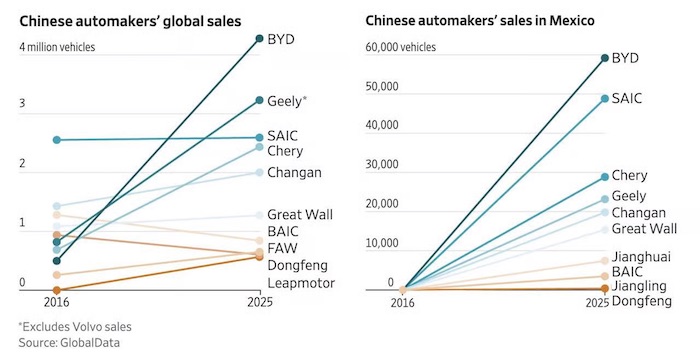
Efforts in Washington to block Chinese-made cars often sound like a future problem – but in practice, those vehicles are already within reach of American consumers, according to the Wall Street Journal. Just south of the U.S. border, Chinese automakers have been rapidly expanding in Mexico, setting up dealerships and offering vehicles at prices far below what most new cars cost in the U.S. Brands like BYD, Geely, and Great Wall Motor are selling electric and gas-powered models packed with features – often for the price of a used car in the U.S. That proximity matters: American consumers living near the border can easily see, test, and in some cases drive these vehicles, even if large-scale imports remain restricted.Read more …
Meanwhile, U.S. policymakers are moving in the opposite direction. Proposed tariffs, import restrictions, and national security reviews are all aimed at limiting Chinese auto penetration, especially in the electric vehicle market. The concerns go beyond economics—lawmakers have raised questions about data security, supply chains, and the long-term competitiveness of domestic automakers. The Journal writes that the situation is more complicated than a simple “ban.” Chinese-built vehicles are already entering the U.S. market indirectly. Some come through global partnerships, shared manufacturing platforms, or brands that don’t obviously appear Chinese to consumers.Others arrive in small numbers through personal imports or cross-border use. In other words, the presence is already here—it’s just not always visible at scale. At the same time, Chinese automakers are becoming major global players. Companies like BYD, for example, have surged in electric vehicle production and are expanding across Latin America, Europe, and beyond. Their strategy often focuses on affordability and speed to market—areas where traditional U.S. automakers have struggled, especially as new car prices continue to climb.
That pricing gap is a key pressure point. Many American buyers are increasingly priced out of new vehicles, creating demand for cheaper alternatives. If Chinese automakers were allowed to compete freely in the U.S., they could significantly undercut domestic offerings—something that worries both policymakers and legacy car companies. So while the political conversation centers on keeping Chinese cars out, the reality is that the market is already shifting around that goal. The vehicles are being sold nearby, seen by U.S. consumers, and in some cases already used on American roads.
Using Seinfeld to brag about having an EV. Well, at least it’s not someone relevant today.
• Jerry Seinfeld Drops a Truth Bomb About Electric Cars (Matt Margolis)
What’s the deal with electric cars? Am I right? Jerry Seinfeld has a lot of opinions about cars. If you know much about him, you know he loves classic cars, particularly Porsches. So, it’s hardly surprising that when it comes to electric cars, he’s not so enthusiastic.”I’m not interested in electric cars at all,” Seinfeld said in a recent interview with AirMail. “Anybody else wants to do it, that’s fine. I think it’s a big, stupid virtue signal. ‘Look at me. I’m saving the planet, yeah.’ What about the lithium? It’s all BS.”Here’s the thing: on the environmental question, he’s not wrong to be skeptical.Read more …
The lithium argument isn’t just a talking point. Mining one ton of lithium emits roughly 15 tons of CO2, and producing a large EV battery can generate over 70% more carbon dioxide than manufacturing a conventional car. Of course, EV advocates are quick to note that those upfront emissions are offset over time and that, over the life of the car, EVs might be better, but I’m not convinced the difference is significant. Maybe it is. But, as an EV owner myself, that wasn’t even a factor in my decision to get one.I bought my 2026 Model Y (Juniper) a year ago, Saturday. And saving the planet was not on my list of reasons to do it. I’ve never bought the idea that EVs represent a clear-cut environmental win. They trade one set of problems for another. It’s a different impact, not no impact. If anything, the last thing I wanted people to think when I bought the Tesla was that I was some hippie environmentalist. It probably helped that the left started despising Elon Musk. So, my Model Y was, if anything, a minor act of defiance. Works for me.Still, what kept me sold wasn’t ideology — it was the car itself. The minimalist interior is genuinely elegant in a way that most modern vehicles are not.
The technology is impressive, and charging at home has eliminated something I never realized I quietly resented: the gas station. I don’t miss it.The savings are quite real, too. Yes, I’ve paid a lot of money to get a home charger and have it installed. But during the six-month period from October through March, my home EV charging costs totaled $330.77. Think that’s good? Well, off-peak charging discounts reduced the cost to $186.17—about $31 per month.But the feature that has genuinely changed how I drive is Full Self-Driving. I pay extra for it, and it’s worth every penny. Right now, roughly 95% of my miles are driven with FSD (Supervised) engaged — grocery runs, highway cruising, a road trip to Boston. I hand the car the wheel and let it work.
Seinfeld, for his part, had a joke ready about self-driving technology, too. He predicted future generations will be stunned that people once steered themselves around at any speed and “just crash and kill themselves constantly.” He’s not wrong about that either. For someone who claims not to care about the technology, he nailed the pitch. And yes, I do feel safer with FSD activated. So here’s where we land: Seinfeld is right that the green halo around EVs is overblown and that lithium mining is an inconvenient truth. He’s right that a lot of EV buyers are performing environmentalism rather than practicing it. But the car itself — stripped of the politics and the posturing — is genuinely good. Mine has been. Buy it or don’t. Just don’t buy it because you think you’re saving the planet.
Who else are they going to buy a battery pack from, or vahicles?
• Tesla Made $573 Million Selling To Musk’s Other Companies Last Year (ZH)
Elon Musk’s business empire is becoming increasingly intertwined — and if SpaceX eventually goes public, Wall Street will likely take a much harder look at how money moves across his companies. A newly disclosed filing shows Tesla booked more than $570 million last year from transactions with Musk-controlled companies, according to Insider. That included roughly $430 million from selling Megapack battery systems to xAI and another $143 million — primarily vehicle sales — to SpaceX. Some of those purchases included Cybertrucks, which have reportedly become a significant part of SpaceX’s vehicle fleet.Read more …
The relationship goes both ways. Insider writes that Tesla also disclosed that it put $2 billion into SpaceX and xAI last year and paid the companies a combined $15 million+ for various commercial and consulting services. Taken together, the filings offer a clearer picture of how frequently Musk’s companies now rely on one another. xAI has been absorbed into SpaceX, engineers from Tesla have previously worked on projects at X, Grok is being built into Tesla products, and Musk has publicly discussed future collaboration between Tesla and SpaceX on the Roadster.Tesla also disclosed last week that Elon Musk’s total 2025 compensation was valued at roughly $158 billion, based on the maximum fair value of stock options tied to his newly approved pay package. The figure immediately caught Wall Street’s attention because of its sheer scale…it’s nearly 40 times Tesla’s annual net income and roughly 1.5 times the company’s total revenue for the year.
For investors already uneasy about the growing overlap between Musk’s companies, the compensation number adds another layer of concern around governance and capital allocation. Between massive cross-company transactions, shared talent across SpaceX, xAI, and X, and now an unprecedented pay package, analysts are likely to keep a much closer watch on how Musk’s empire operates — especially if SpaceX eventually becomes a public company too.
“Some critics have argued that the character looks strikingly similar to Elon Musk’s mother, May Musk, and she even drives a vehicle that looks like a pink Cybertruck. “
• Animal Farm Film A Hollywood Perversion Of Orwell’s Anti-Communist Classic (ZH)
George Orwell’s prognostications about the future of authoritarianism have proven consistently accurate. They have only been limited by his inability to foresee the creation of certain technologies which make the future look even more bleak. The reason his books, like 1984 and Animal Farm, are considered classics of literature is because they are timeless. Their warnings and messages still apply today and will probably apply centuries from now.Read more …
Animal Farm, first published in 1945, is a tale specifically written as an allegory for the Bolshevik Revolution and the rise of Soviet Communism. Despite the characters being talking animals, the themes are dark and disturbing. It is a story about the naivety of the “underclass”, the exploitation of the “have-nots” by communists seeking to use gullible people as weapons against their “imperialist” and capitalist enemies. It is a grotesque tragedy composed like a children’s novel, which makes it all the more effective. It destroys the notion of “equity” and exposes the truth: There is no such thing as a socialist Utopia, there can only ever be socialist dystopia. And to get it, leftists are happy to sacrifice you and everything you love. Not only that, but they expect you to applaud them for it.The message is made iconic in the book’s famous phrase: “All animals are equal, but some are more equal than others…” This is the epitome of woke ideology and how progressives behave today. It’s no surprise that Hollywood is incapable of telling this story properly. In order to do that, they would have to put their own warped beliefs under a microscope, and that’s simply not going to happen. The new animated adaptation of Animal Farm is being billed as a kid-friendly foray into concepts of “authoritarianism”; but it perverts Orwell’s message about communism and demonizes capitalism instead.
Audiences across the board are not happy. The movie is distributed by Angel Studios, which bills itself as a Christian and conservative leaning company. However, the makers of the film (director Andy Serkis and The Imaginarium Studios) are entirely left wing. Given the people involved, Angel Studios should have know what kind of disaster they would have on their hands.Andy Serkis is a former member of the Socialist Workers Party, a Troskyist Group in England in the 1990s. Though he is no longer involved, he still considers himself left wing, and his exit from political provocation was largely because of conflicts with his acting career. Enlisting a hardcore socialist to direct Animal Farm feels like a deliberate middle finger to conservatives who see the story as a cautionary battle cry against leftist movements.
The film was even released on May Day (International Workers Day), which is a communist holiday. In developing the film as far back as 2013, Serkis (still riding the high of his successful role as “Gollum” in the Lord Of The Rings movies) admitted that he had no intention of sticking to the critique of communism. Rather, he believed that if Orwell wrote Animal Farm today, he would obviously compose a takedown of capitalism. “First and foremost, we are not making a film about Communism and Stalinism because if Orwell was writing the story today, he would be talking about other relevant topics like globalisation and corporate greed…” In other words, Andy Serkis, like most communists, wants to rewrite history in favor of his ideology.
This is exactly what he did in the new Angel Studios film. Many of the characters from the book are the same, and some of the plot points remain. The animals revolt against the farmers and seek to build their Utopia of fairness. But, the pigs (who represent the communist manipulators in the book) are not evil in the film. Rather, they are corrupted into doing bad things by a new character – Ruthless billionaire Frieda Pilkington and her corporation. Frieda is the typical evil rich white person common in leftist mythology. Some critics have argued that the character looks strikingly similar to Elon Musk’s mother, May Musk, and she even drives a vehicle that looks like a pink Cybertruck.
Rather than the pigs being conniving and malicious from the beginning, Frieda corrupts them into evil with the promise of riches. Her plan is to use the pigs as a means to get control of the farm. In the end, the animals realize their mistake and their solution is yet another communist revolution. The message being, communism only goes wrong when evil capitalists influence the outcome. Collectivist ideology is inherently good. Leftists are not psychotic ideologues thirsting for power and control. They are just led astray sometimes.
There are numerous hatchet job films denigrating capitalism out of Hollywood. There are few if any that explore the nightmares of communism and left-wing collectivism. Orwell’s Animal Farm is one of the few stories that captures the insidious nature of “equity” and suicidal empathy that permeate communist societies. It is about the tools that communists use to lead the population astray, not about capitalism leading communists astray. Even worse is the marketing strategy of Angel Studios, which has tapped into the pockets of conservative and libertarian influencers (including Tucker Carlson) to sell the movie.
It is likely that most of these influencers never watched the film before they promoted it, and if they did, it might be time to question their motives. Critics and audiences alike have given Animal Farm a thunderous thumbs down. Angel Studios is the same company that put Sound Of Freedom in theaters; a movie which was relentlessly (and suspiciously) attacked by the political left for putting a spotlight on child trafficking and pedophile rings. It is unfortunate that they made placed this project in the hands of the same left wing community that tried to tear them down only a couple years ago.
Not everyone can say that they saved a city of 8 million people. Godspeed.
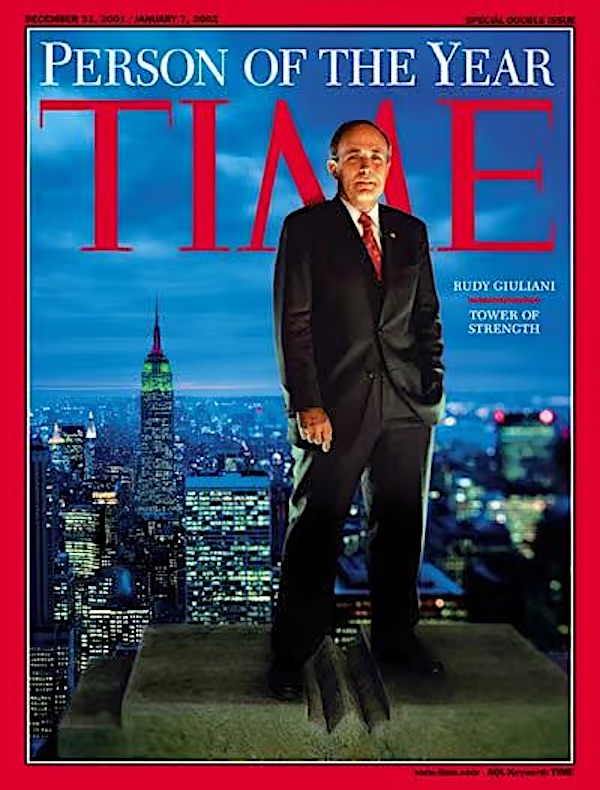
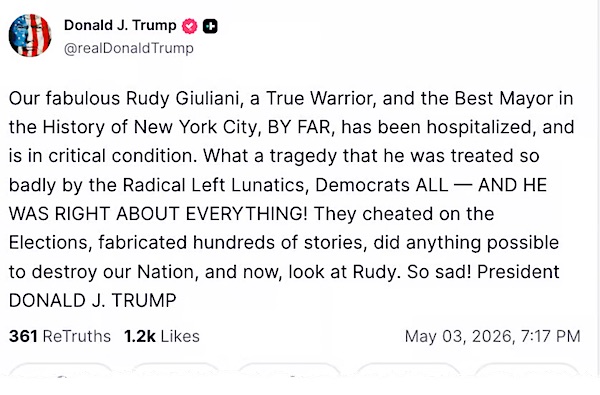
• Rudy Giuliani Hospitalized In Critical Condition (ZH)
Former New York City Mayor Rudy Giuliani has been hospitalized and is in critical condition, according to The New York Times, citing his spokesman, Ted Goodman. “Mayor Giuliani is a fighter who has faced every challenge in his life with unwavering strength, and he’s fighting with that same level of strength as we speak,” Goodman said, before asking “that you join us in prayer” for the former NYC mayor.Read more …
Goodman did not disclose what medical emergency sent Giuliani to a Florida hospital Sunday afternoon. President Trump also released a statement on Giuliani’s medical emergency, telling those on Truth Social, “Our fabulous Rudy Giuliani, a True Warrior, and the Best Mayor in the History of New York City, BY FAR, has been hospitalized, and is in critical condition.” “What a tragedy that he was treated so badly by the Radical Left Lunatics, Democrats ALL — AND HE WAS RIGHT ABOUT EVERYTHING! They cheated in the Elections, fabricated hundreds of stories, did everything possible to destroy our Nation, and now, look at Rudy. So sad!” the president said.
Giuliani is a former federal prosecutor, NYC mayor, and longtime Trump supporter. He first rose to national prominence as U.S. attorney for the Southern District of New York in the 1980s, where he prosecuted organized crime, Wall Street corruption, drug trafficking, and public corruption. One of his most defining legal wins was helping break the power grip of NY’s Mafia families through RICO prosecutions. From the mid-1990s through 2001, Giuliani served as mayor of NYC, where his administration became known for its tough-on-crime posture. He later ran unsuccessfully for the 2008 Republican presidential nomination before re-emerging as a major political figure and Donald Trump’s personal attorney, particularly during the Russia hoax investigation and the post-2020 election fight. *This is a developing story.
Everyone is going to want a ~$30K Tesla Cybercab when it becomes available, they just don’t know it yet.
— Nic Cruz Patane (@niccruzpatane) May 2, 2026
• Much safer than human driving.
• No steering wheel or pedals.
• Have the ability to legally sleep as it’s driving you to your destination.
• Two-seater design, with… pic.twitter.com/nx9O8r08x8
https://twitter.com/MinusWells/status/2050716693656489993?s=20Optimus is going to change everything… and most people don’t see it yet.
— Teslaconomics (@Teslaconomics) May 2, 2026
Taking care of someone today usually means a lot of sacrifice… like time, energy, $, stress.
It’s hard, especially when it’s someone you love.
But imagine when the Tesla Bot arrives.
You don’t have to… pic.twitter.com/5xJgx1oRMz
Ancient cultures were extremely violent, not “peace-loving ecologists” at all! https://t.co/mEfdcfLz3i
— Elon Musk (@elonmusk) May 3, 2026
Support the Automatic Earth in wartime with Paypal, Bitcoin and Patreon.