Jun 092026


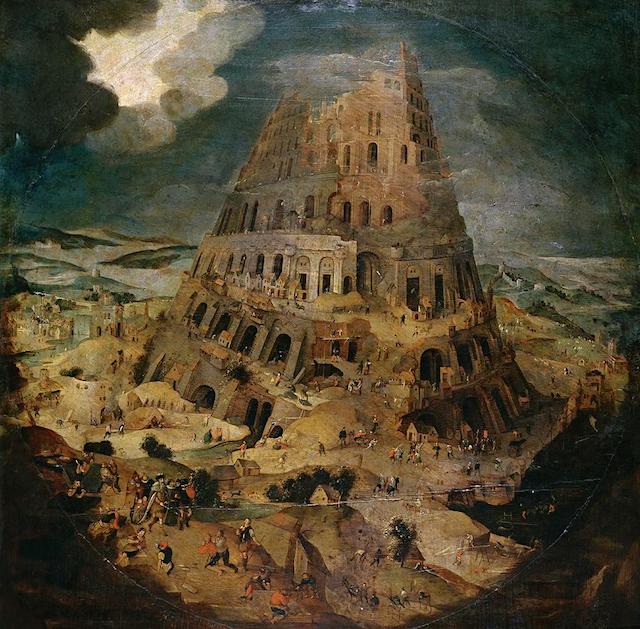
Pieter Brueghel the Younger Construction of the Tower of Babel 1595


Netanyahu Confirms Israel ‘Holding Fire…For Now’ (ZH)
Score Two More Big Wins for Israel Vs. Iran… Maybe (Stephen Green)
Trump’s Secret Weapon Against Iran: The Power of Antisemitism! (Scott Pinsker)
Trump Suffers Rare Court Setbacks Amid Broader Record of Legal Success (JTN)
On the Kavanaugh Anniversary, Democratic Leaders Swap Me Too for Maine (Turley)
The Jungle Drums Speak! (James Howard Kunstler)
Trump Plans To Buy Chagos Islands, Home To Diego Garcia Military Base (ZH)
OpenAI Files Confidentially For IPO, Joining SpaceX and Anthropic (ZH)
EU Coalition of the Willing: Five Terms for Direct Ukraine-Russia Talks (CTH)
German Lawmakers Want Answers From Baerbock After UN Humiliation – Bild (RT)
A “Godzilla El Niño” (Michael Snyder)
In the Land of Thucydides (John J. Mearsheimer)


https://twitter.com/TheCalvinCooli1/status/2063671748378137040?s=20 https://twitter.com/barontrump47/status/2063754461261058407?s=20


Both sides paused overnight last night.

Netanyahu Confirms Israel ‘Holding Fire…For Now’ (ZH)

Israel Halts Iran Attacks ‘For Now’
“After Iran attacked Israel, I instructed the IDF to strike military and economic targets throughout Iran,” Netanyahu said in a fresh Monday statement. “For now, the fire has been contained, because after we struck the terrorist regime in Tehran, it ceased attacking us. If the terrorist regime in Iran makes the mistake of attacking us again, we will respond with force.” The key lines from Netanyahu: Israeli Prime Minister Benjamin Netanyahu said Monday that Israel had stopped its attacks on both Iran and Hezbollah in Lebanon, after the Iranian military announced it was halting operations.


In a brief statement Monday, Netanyahu said “Iran and Hezbollah are weaker than ever, and we are stronger than ever – but our struggle with them is not over yet.” Having bombarded both adversaries, he added, “right now, the fire has been halted.” Iran’s military headquarters responds: “Should aggression and hostile actions continue—including in southern Lebanon—far more severe and forceful measures than before will follow,” it said, according to Iranian state media. And in a clear sign of the exchange of strikes having ceased: Iran says flight restrictions have been lifted with airspace returning to normal conditions: state media

Israel Pauses Iran Strikes At Trump’s Request
Israel’s N12 News is reporting that Israel is halting strike on Iran at President Trump’s request. There are widespread initial reports that Israeli forces are indeed pausing the attacks, which persisted overnight through Monday morning, and included attack on a major petrochemical complex. However, the latest Israeli messaging has included a warning on the Lebanon front, per Bloomberg: Senior Israeli official says Israel is stopping strikes in Iran at Donald Trump’s request, but confirms operations in southern Lebanon will continue at full intensity in the coming days. The official also warns that Dahieh in Beirut could be targeted if attacks on Israeli settlements and civilians continue.

There are also emerging reports (via CBS) that Trump did not order any US defensive efforts to protect Israel from the latest Iranian ballistic missile attacks – which were the first against Israel since the early April ceasefire. Meanwhile, in a fresh message from Iranian foreign ministry spokesman Esmaeil Baqaei, Iran says “Without a doubt … the actions of the Zionist regime in the region cannot be separated from U.S. policies.” Tehran is rejecting the attempts of the Trump administration to distance the US from Israeli actions: “No one believes that the Zionist regime would carry out any action without prior coordination and cooperation with the United States,” Baqaei added.

Trump: ‘Stop Shooting’
A big question remains is if this flare-up in major fighting, which has featured the first direct attacks between Iran and Israel since the April ceasefire took effect, will be short-lived or whether it will endure and escalate into sustained war. So far the situation is showing signs it could be short-lived, after early Monday morning President Trump urged Israel and Iran to immediately stop “shooting” in a Truth Social post. He also expressed that this musts be done “quickly” and is still talking up a “final” peace deal – which at this moment looks as distant as ever. Iran is signaling it is ready to get back to ceasefire, but Israel is again threatening the Beirut suburbs.

Read more …

“..that missile fire toward Israel was most likely carried out under pre-established military protocols, without coordination with the office of Supreme Leader.”

Score Two More Big Wins for Israel Vs. Iran… Maybe (Stephen Green)

It started so simply, as these things do, with a barrage of Iran’s patented Totally Ceasefire Missiles™ that Israel knocked out of the sky. It ended, if that’s the right word, with Israeli airstrikes taking out Iran’s top two leaders. That’s a big win, even if one of them was already mostly dead. The fun began on Sunday, when “Iran launched missiles into Israel, not just in the north by the Galilee, but all the way down to Caesarea,” as reported by PJ Media’s own Rabbi Michael Barclay. In all, Tehran launched a total of about 30 missiles in several waves. They were all either shot down by IDF antimissile systems like Iron Dome, or caused no notable damage.


Israel responded with two air attacks that PJ Media’s own Catherine Salgado reported on at Zero Dark Thirty last night, but only now are we learning just how effective those strikes really were. Several outlets report today that Islamic Revolutionary Guard Corps commander Ahmad Vahidi is among those dead in yesterday’s Israeli Air Force (IAF) strikes.Vahidi’s death isn’t confirmed yet, but fingers crossed. He’s only been IRGC chief since March 1, when his predecessor was taken out in similar fashion.

Considered a hardliner — which is a nice way of saying, “lying genocidal thug” — reports of Vahidi’s death please me very much. I keep trying to get the message through to the White House that if the current Iranian leadership is too hardline to negotiate in good faith, then keep killing them until more pliable leadership emerges. And maybe bomb them, too, just to be sure. Thankfully, the IAF was kind enough to take the next step for us.

Just as pleasing, if perhaps not quite as consequential, is the reported death of the regime’s so-called Supreme Leader, Ayatollah Mojtaba Khamenei — son and heir of the previous Supreme Leader, Ali Khamenei. The elder Khamenei, you’ll recall with no small measure of schadenfreude, was killed in a similar IAF strike in the opening hours of Operation Epic Fury. The younger Khamenei — long rumored to be homosexual and also believed to have been severely wounded during the air campaign — is (or was) at best a figurehead. He hasn’t been seen or heard in public since before Ali’s death, lending credence to the reports that he is (or was) barely alive. Or living it up on Fire Island. Accounts differ.

At the very least, Israel Hayom reported today that their opposition source believes “that missile fire toward Israel was most likely carried out under pre-established military protocols, without coordination with the office of Supreme Leader.” Notice the source indicated Khamenei’s office, not the man himself. “Israel and Iran… are looking to do an immediate CEASEFIRE! Final negotiations on ‘Peace’ are proceeding, subject to ignorance or stupidity getting in its way,” President Donald Trump posted to Truth Social in response to Sunday’s exchange of fires. But I’m inclined to agree with PJ’s Rick Moran, when he wrote on Sunday that “The war has shattered the Iranian leadership structure, making an agreement next to impossible.” And that was before Khamenei and Vahidi hopefully woke up this morning in Hell.

Read more …

“The Protocols of the Elders of Zion “

Trump’s Secret Weapon Against Iran: The Power of Antisemitism! (Scott Pinsker)

Sometimes, antisemitism is hilarious. Don’t believe me? Here’s a historic example: “The Protocols of the Elders of Zion was a 1902 Russian hoax that claimed to document a late-19th century meeting of Jewish leaders, where those evil, untrustworthy Jews discussed their secret plans for world domination. Some consider it “the most influential work of antisemitism ever written.” Throughout vast swathes of Nazi Germany, it was mandatory reading for schoolchildren. In Russia and Western Europe, it was a runaway best-seller. It even gained a following in the United States, where it was republished and serialized 91 times in Henry Ford’s newspaper, The Dearborn Independent. (Ford later published the series in book form as The International Jew: The World’s Foremost Problem.)


Sadly, in countries shaped by Judeo-Christian traditions, this hoax greatly inflamed tensions between Jews and Christians. Hitler cited it to justify the Nazi’s institutional antisemitism — which, of course, led directly to the Holocaust. From the United States Holocaust Museum: “Hitler referred to the Protocols in some of his earliest political speeches in the 1920s. He also wrote about the book in his autobiography Mein Kampf (1925). Hitler claimed that the Protocols “reveal the nature and activity of Jewish people and expose…their ultimate final aims.” He also predicted that what he called the “Jewish menace” would be “broken” after the Protocols became more widely known.”

Sounds pretty bleak for the Jews. You could draw a straight line between its publishing, the rise of antisemitism, and the genocidal horror of the Holocaust. Yet there was one country that got its hands on The Protocols of the Elders of Zion and reached the exact opposite conclusion: “Whoa! You mean there’s a secret group of Jews who control the entire world? And they magically make money wherever they go? HOW AWESOME! Let’s party with those guys!” And that country was… Japan.

Because, after all, Judeo-Christian traditions didn’t shape Japan’s history, culture, and values. So instead of interpreting The Protocols through the lens of European history, the Jewish diaspora, and its (many) antisemitic dog whistles, Japanese readers accepted everything at face value: Somehow, these magical, mysterious Jews figured out how to become global puppet-masters. They controlled the media, the banks, foreign governments, international trade — and more! Apparently, nobody can stop them. Not even the mighty governments of Europe! So imagine what a wonderful ally they’d be to imperial Japan!

It led to a Japanese program called the Fugu Plan to import up to 600,000 Jews. Japan even planned a PR mission to the United States, where Japanese officials would show American rabbis the similarities (?) between Judaism and Shintoism and then invite them to visit Japan. From All That’s Interesting: From the moment it was conceived, The Protocols of the Elders of Zion was viciously anti-Semitic, packed with false charges of a Jewish conspiracy to conquer the world. But for a time, a powerful faction in Japanese military and political circles came to believe that this infamous piece of hateful propaganda was completely accurate.

To them, the book — purportedly notes from a meeting of a Jewish shadow government — was not only true, but it was an indication that, rather than attack the Jews, they should befriend them and use them to their own advantage. The result was later called the Fugu Plan, an effort to encourage Jewish immigration to Japanese territory before and during World War II in order to bolster the country’s economic prosperity. Because of imperial Japan’s wartime partnership with Nazi Germany, it eventually abandoned the Fugu Plan. (As you could imagine, Der Führer wasn’t such a big fan.) But it deserves to be remembered, for it illustrates an undeniable truth: People stupid enough to buy into antisemitic conspiracy theories aren’t smart enough to differentiate between facts and fiction.

This brings us to President Donald Trump, Iran, and the never-ending negotiations to bring peace to the Middle East. Spoiler alert: It ain’t been going so swimmingly.And the American people are quickly losing confidence that a peace deal is even reachable. That’s because President Trump has been hinting since March 30 that a great deal was “probably” right around the corner. On May 23, a deal was “largely negotiated.” Then, as recently as May 29, he told us he was making the “final determination” on signing an agreement. Yet it’s now June 8, and not only is there no peace deal, but over the weekend, Iran launched a barrage of missiles at Israeli civilian targets.

Politicians pay a political price when they overpromise and underdeliver. President Trump is no exception: The hawks are mad because Iran is still standing (and giving America the finger); the doves are mad because we went to war; Joe Six-Pack is mad because gas prices are too damn high. Everyone is unhappy! We’ve gone from demanding Iran’s “unconditional surrender” to endless negotiations that aren’t going anywhere. The whole thing is a mess.

As we discussed last week, it certainly seems that stringing U.S. diplomats along — promising great things behind closed doors, agreeing to 99% of demands, but perpetually keeping the final 1% from ever reaching a conclusion — is now Iran’s strategy. From the mullah’s point of view, it’s their best available option because: With a ceasefire already in place (at least in name), the U.S.-Israeli bombing campaign has stopped. No more mullahs have been killed. As long as the ceasefire continues, Iran has a free hand to rebuild its military — which it seems to be doing. By linking a peace deal to Hezbollah’s survival, Iran has gotten President Trump to order Israeli Prime Minister Bibi Netanyahu to stop attacking its terrorist proxies in Lebanon. But once a peace deal is signed, Iran would lose that leverage.

Read more …

For years, they were always neglecting the Kennedy Center. No more. Trump made his point. He threatened to put his name on it.

The Anti-Weaponization Fund is not worked out, just a try-out. Everybody knows how they will react. More soon.

Trump Suffers Rare Court Setbacks Amid Broader Record of Legal Success (JTN)

The first recent loss came on May 29, when U.S. District Judge Christopher Cooper ordered that Trump’s name be stripped from the John F. Kennedy Center for the Performing Arts. President Donald Trump has enjoyed considerable success in the courts during his second term. Federal judges and the Supreme Court have allowed key parts of his immigration agenda to proceed, upheld major personnel actions across the executive branch and endorsed an expansive view of presidential authority in several high-profile disputes. But over the past two weeks, the administration suffered two notable legal setbacks: one involving the John F. Kennedy Center for the Performing Arts and another concerning a controversial compensation fund created through a settlement with the Internal Revenue Service.


Kennedy Center Ruling Reverses Renaming Effort
The first loss came on May 29, when U.S. District Judge Christopher Cooper ordered that Trump’s name be stripped from the John F. Kennedy Center for the Performing Arts. D.C. Cooper, an Obama appointee, also temporarily blocked the administration’s plan to shut the landmark Washington, D.C. venue for two years of renovations, which had been scheduled to begin on July 6.The backstory starts in December 2025, when a board stacked with Trump’s handpicked allies voted to rebrand the arts complex as the “Trump-Kennedy Center,” and signage bearing the new name went up on the building. Ticket sales declined sharply in the months that followed, and artists began canceling performances in protest. In February 2026, Trump announced the center would be closed for a sweeping overhaul.

Rep. Joyce Beatty, an Ohio Democrat who had been a member of the center’s board before her voting rights were stripped, filed suit to stop both moves. Judge Cooper’s ruling was sweeping and pointed. In a 94-page opinion issued on what happened to be President Kennedy’s birthday, he wrote that “the Kennedy Center’s organic statute makes crystal clear that the Center is to be named for President Kennedy, and it cannot bear any other formal name or public memorial based on the Board’s unilateral say-so. Congress gave the Kennedy Center its name, and only Congress can change it.”

On the closure question, Cooper found that the board had not properly weighed its legal obligations to the institution before voting to shutter it, though he left open the possibility that a future board vote could still authorize renovations. Trump reacted with characteristic directness. In a post on Truth Social, he blasted Cooper and suggested Congress should take the whole institution back: “We are going to be working with Congress to transfer this failing Institution back to them so they can make a determination as to what to do with it.”

Court Halts Anti-Weaponization Fund
A Justice Department spokesperson said in the statement that the agency “will continue to defend President Trump’s ability to restore the Center to its former glory as the finest performing arts center in the country – if not the world.” For now, Trump’s name is coming off the building. The second setback involved a program that drew criticism from an unusual source: members of Trump’s own party. In mid-May, the Justice Department announced the creation of the “Anti-Weaponization Fund,” a nearly $1.8 billion pool of taxpayer money intended to compensate individuals who claimed they had been unfairly targeted or persecuted by previous administrations.

The fund was established not by Congress, but through a settlement agreement in a lawsuit Trump himself had filed against the IRS over the leak of his tax returns. Under the settlement’s terms, Trump and his family received a formal apology but no cash. The money in the new fund, however, would be available to a broad universe of other claimants. Critics immediately pointed out that this project was an extraordinary arrangement: a fund of public money, created without congressional authorization, through a lawsuit in which the president was simultaneously the plaintiff and the head of the executive branch overseeing the defendant agency.

A group of 35 former federal judges—appointed by Democratic and Republican presidents—filed a motion arguing that the entire legal vehicle was, in their words, “a fraud on the court.” On May 29, the same day as the Kennedy Center ruling, U.S. District Judge Leonie Brinkema, in the Eastern District of Virginia, issued a temporary order halting all operations of the fund while she considered its legality. Challengers had argued that money could flow out the door and become impossible to recover before the court could act, and the judge agreed that the risk was serious enough to require a pause.

The political fallout was fast. Democrats called the fund a giveaway to Trump allies. Crucially, even some Republicans in Congress balked, and reports emerged that the fund was throwing the president’s legislative agenda into turmoil. By June 1, acting Attorney General Todd Blanche made it official: the Anti-Weaponization Fund was dead. DOJ’s said in a statement on X that it “disagrees strongly” with Brinkema’s ruling but would comply. Trump later told ABC News he accepted the outcome, saying: “We are subject to the courts. At this moment, that’s what it is.”

Read more …

Connected to TDS.

On the Kavanaugh Anniversary, Democratic Leaders Swap Me Too for Maine (Turley)

“It’s clear the fix is in.” Those words from Sen. Elizabeth Warren (D-Mass.). came with her vote against confirming Brett Kavanaugh to the Supreme Court. Warren was outraged that her fellow senators refused to believe a woman who came forward with a decades-old allegation against Kavanaugh that lacked any corroboration. It now appears that Kavanaugh’s former accusers are making the case that he was treated unjustly at their hands. At least they are now willing to swap “Me Too” for Maine. Warren’s words were part of a mantra from Democratic members that either you believe women about sexual harassment and assault, or you are enabling abusers.


It was almost exactly eight years ago, in July 2018, that President Trump nominated Kavanaugh to fill the seat of retiring Associate Justice Anthony Kennedy. Kavanaugh, who was at first a very uncontroversial nominee, suddenly became the target of a well-financed, well-orchestrated campaign that would continue to resonate in that fall’s election campaigns. At the time, your failure to accept the word of Christine Blasey Ford that Kavanaugh had assaulted her in high school was just proof that you and the system were sexist.

Long after the Senate confirmed Kavanaugh, the left continued to claim that his presence on the Supreme Court “rests on a mountain of misogyny.” In Ms. Magazine, actress Kathleen Turner reminded people that not believing women was furthering misogyny: “Survivors who come forward break the rules of silence a sexist society demands, and society expects them to pay a price.” If you recall, the lack of evidence led to the Senate Judiciary Committee combing through Kavanaugh’s personal calendars. Denials that such a thing had ever happened, coming from childhood friends, were treated as still more evidence of sexism.

There was Sen. Sheldon Whitehouse (D-R.I.), who grilled Kavanaugh about using the term “boofing” (apparently referring to passing gas) with a high school friend as if it were a confession to a rape. His inquisitorial barrage was something straight out of the McCarthy period. Whitehouse expressed disgust that some would not take Ford’s word for it, declaring, “Today I stand with women who are brave enough to come forward with their stories of abuse and mistreatment. They deserve to be heard and credible allegations must be investigated. We must believe survivors, not bully them.”

Whitehouse is now a major donor and supporter of Graham Platner, the leading Democratic candidate for U.S. Senate from Maine. He dismisses the New York Times accounts from women of Platner’s physically and mentally abusive behavior. Instead of believing these women, he reportedly attacked Lyndsey Fifield, who “bravely” came forward publicly with her story at the request of Times reporters. Whitehouse is quoted as saying that he was “unimpressed” by the allegations and the multiple women coming forward “seems like a lot of nothing.” He suggested that he is not prepared to believe a woman if she is a conservative. “I mean, the only one who had anything to say that seemed ‘unsettling’ was a woman who works for right-wing political operations,” he said.

That attack was picked up by others like writer Krystal Ball. She too had denounced those who did not believe Ford in the Kavanaugh controversy. In the past, she claimed at that time, “women just didn’t come forward. They knew they wouldn’t be believed. ”Now she cannot imagine why anyone would believe these women, particularly Fifield. “NYT published uncorroborated accusations against [Platner] of ‘unsettling’ and ‘toxic’ behavior that came from a Heritage staffer who previously worked for a conservative org that backs Collins,” she posted online.

Fifield, after sharing stories with the Times of Platner’s alleged abusive behavior, went public to complain that the newspaper had failed to include the corroboration she had provided. She posted that the paper not only failed to include that she has supported Democrats for office, but also asked, “Why does it say ‘nobody could corroborate’ when I offered them sources that COULD corroborate?”

She added, “The Times also failed to include any mention that I DID confide in multiple friends through the years that Graham had been abusive — long before he was running for office. Those friends confirm they told the Times so.” If true, that is a strikingly different approach from the one taken by the media in reporting on the Kavanaugh allegations.

Read more …

“Love that the crack heads on Skid Row are up on the issues, know the candidates, and are able to Make Their Voices Heard in between hits of meth.” —Peachy Keenan on X

“.., transformed itself in a decade or so into an out-and-out racketeering operation, that is, to a criminal enterprise dedicated to the misappropriation of taxpayer money among its rank and file, many of whom are not citizens.”

The Jungle Drums Speak! (James Howard Kunstler)

Whaddaya know? Looks like the charismatic Nithya Raman has overtaken maverick candidate Spencer Pratt in the Los Angeles mayoral “jungle” primary because. . . jungle reasons. That is, the denizens of LA’s vast homeless encampments — once known as “hobo jungles” — apparently voted overwhelmingly by mail for the Harvard-credentialed champion of street-junkies in the Silver Lake, Echo Park, Los Feliz, Atwater, and Hollywood neighborhoods (SELAH) she represents on the LA City Council.


So, it will be a November runoff between the super-duper “progressive” incumbent Karen Bass, and merely super-progressive Ms. Ramen. Better reserve your U-Haul trailer ASAP, as the City of Angels completes its transformation to the City of Zombies. And no complaining, please. This is what you voted for.

By the way, what does “progressive” actually mean these days? Progress towards. . . what? The culminating disintegration of a civil polity? The concerted failure to govern a large, urban organism? Unconditional surrender to the forces of entropy? One might suspect a soupçon of racial animus in the mix, too, something of a middle-finger to this thing called white supremacy we hear so much about. It must be rooted out at all costs, including the cost of a place that a productive population once loved — the very people renting all those U-Hauls, dispersing out into the USA gloaming.

Of course, this “progressive” Democratic Party has transformed itself in a decade or so into an out-and-out racketeering operation, that is, to a criminal enterprise dedicated to the misappropriation of taxpayer money among its rank and file, many of whom are not citizens. The model is not unlike more primitive early versions, such as Boss Tweed’s ring in 19th century New York, or the gang under mayor James Curley, the “Rascal King” of Boston. The system was known as “patronage.” Voters were the party’s patrons, and the patrons were on the payroll. Some had actual party jobs. Some just got free stuff in exchange for their votes. They called it a “machine” because its operations became automatic, self-fulfilling.

There was one big difference, though: these earlier Democratic Party grifters, for all their moneygrubbing shenanigans, were American patriots. They celebrated a country so ostentatiously “free,” so fervently dedicated to upward mobility, that it made room for their garish political corruption. The Democratic machine of Los Angeles today is quite the opposite: It’s a faction that loathes and detests the American system and seeks sedulously to destroy it, even while grabbing as much loot as it can in the process.

Mayor Karen Bass was trained for that mission in Cuba. Beginning at age 19, in 1973, Ms. Bass made eight trips there with the Venceremos Brigade (founded in 1969 by the Lefty-left SDS) to “show solidarity with the Cuban revolution,” which, you might remember, was a straight-up communist revolution. One might infer, then, that Mayor Bass is a straight-up communist, with ambitions to destroy the capitalist city of Los Angeles, so as to replace it with a communist utopia — where all production (if there is any) is owned and controlled by the government, which then dispenses the fruits-of-production to the people, according to their needs, as officers of the government see fit.

Read more …

“US officials have prepared proposals to bypass Britain and negotiate directly for control of Diego Garcia ..”

Trump Plans To Buy Chagos Islands, Home To Diego Garcia Military Base (ZH)

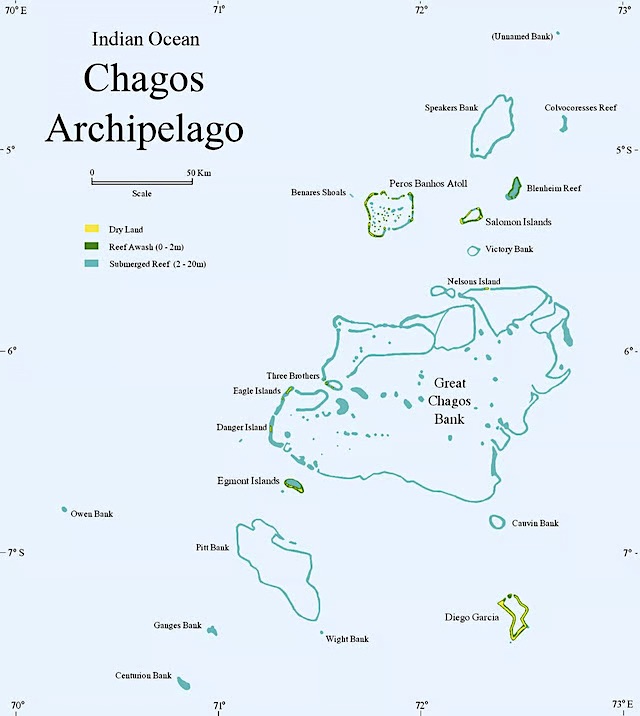
The White House is actively considering a plan to purchase the Chagos Islands, potentially undermining the UK’s agreement to transfer sovereignty of the strategically vital territory to Mauritius, according to reports. US officials have prepared proposals to bypass Britain and negotiate directly for control of Diego Garcia, the key Indian Ocean atoll that hosts a major joint US-UK military base. The idea forms part of broader options being developed by the Trump administration as alternatives to Prime Minister Keir Starmer’s plan to cede the islands to Mauritius, which has close ties to China and Iran.


Strategic Importance
Diego Garcia’s location makes it critical for long-range operations. It enables round-the-clock bomber missions, including potential strikes on Iran using B-2 Spirit stealth bombers, and places key areas within striking range. Amid ongoing conflicts involving Iran and China’s expanding naval presence, US and UK officials stress the need to maintain a robust chain of global military bases.


Senior Trump administration officials worry that transferring control to Mauritius could expose the base to espionage or interference. One former adviser to UK Foreign Secretary David Lammy, Ben Judah, told the Telegraph that the base has “super secret, super sensitive facilities” that are vital to British and allied capabilities, noting they would be difficult to replicate elsewhere.

Background on the UK-Mauritius Deal
The UK had agreed to hand sovereignty of the Chagos Islands to Mauritius while securing a long-term lease for the military base, reportedly involving around £35 billion ($46.7 billion) over 99 years. However, the deal requires US consent due to longstanding agreements governing the base, and Britain has since placed it on hold. President Trump initially appeared open to the arrangement but later strongly opposed it, particularly after the UK reportedly declined to allow strikes on Iran from Diego Garcia in the early stages of the Iran war. He publicly denounced the deal as “great stupidity” and criticized Starmer for weakening the special relationship, calling him “no Winston Churchill.”

US Position and Ongoing Talks
A US official told Reuters: “President Trump has been consistent in his position that the United Kingdom should not give away the British Indian Ocean Territory, which includes our joint U.S.-UK military facility on the Diego Garcia atoll. Diego Garcia’s strategic location in the Indian Ocean makes it a vital and indispensable military installation of significant importance to the national security of the United States.” The US continues regular discussions with Britain to preserve the base’s viability.

Purchasing the islands outright would likely involve waiting for the UK-Mauritius sovereignty transfer before negotiating with Mauritius. No specific price has been discussed, according to sources. In February, Trump said that he had retained the right to “militarily secure” the Diego Garcia air base after calling the UK’s decision an “act of total weakness.” A UK government spokesperson defended the original agreement, stating it was necessary to protect long-term interests and prevent adversaries from gaining a foothold:

“Diego Garcia is a key strategic military asset for both the UK and the US, which has protected our shared security for nearly 60 years. Maintaining long-term operational control and security of Diego Garcia is the entire basis for the UK-Mauritius agreement.” In May, UK minister Hamish Falconer stated there was “no scenario” in which Washington could purchase the islands, reaffirming commitment to the deal. Downing Street has not commented on the latest US proposals.
Read more …

I get the feeling they’re all after the same pot of money. There’ll be $200 billion (or however much it is, maybe a trillion), but not 5 or 6 times that. ~And there’s never enougn money, or energy, for any single one of them.

For now, it’s a feeding frenzy, however. Everyone’s just afraid to miss out.

OpenAI Files Confidentially For IPO, Joining SpaceX and Anthropic (ZH)

The rush by AI companies to go public before the window closes (i.e., “market conditions” emerge) entered its final lap late on Monday, when OpenAI joined its two mega peers in filing for a blockbuster IPO that could value the ChatGPT creator at more than $1tn as it races rival Anthropic to list its shares publicly, following an imminent offering by SpaceX.


OpenAI said it had confidentially submitted a draft IPO prospectus to the US Securities and Exchange Commission, formally kicking off the process for one of the year’s most hotly anticipated debuts. The company is also planning to launch a tender sale of its shares to provide liquidity to employees in the coming weeks, before the company goes public, Bloomberg reported. Why employees would want to sell shares ahead of an IPO is not exactly clear, unless they fear the market reaction to the public offering would disappoint.

OpenAI’s listing announcement comes days before SpaceX is set to IPO in a deal that could raise a record $86bn and value Elon Musk’s rockets-to-AI conglomerate at $1.78tn. Anthropic, the startup behind the chatbot Claude, said last week that it had filed confidentially for an IPO of its own. The company soared to a $965 billion valuation in its latest private funding round – above OpenAI’s for the first time – as its revenue surged. The three Wall Street listings comes at a time of unbridled euphoria among investors over AI, which has helped propel US stocks to a series of record highs but also prompted worries that markets are overheating.

Last week, Goldman published a note seeking to preempt the big question: “Can Markets Absorb Massive Stock Supply From Coming Mega IPOs Without A Crash:” While Goldman did not express concerns about the coming flood of stock supply (its argument is that demand will more than offset the flood of new shares), the bank which is also a lead underwriter for both SpaceX and Anthropic calculated that recent and upcoming IPOs will result in roughly $500 billion of additional unlocked shares available to sell in 2026 and likely a larger quantity in 2027 as insiders sell and distribute their stakes to public (mostly retail) shareholders. The bank expects the majority of potential equity supply from the current pipeline of IPOs will become free float in 2027.

OpenAI’s IPO – which also comes at a time when CEO Sam Altman has floated handing out shares to US taxpayers ostensibly in hopes that such an action would lead to a government backstop and/or bailout if and when the AI cycle turns – will mark a test of investors’ appetite for a company posting booming revenue growth but also staggering losses that are forecast to continue for many years as the company spends vast sums on data centres and other infrastructure: its funding commitments to hyperscalar companies are well north of $1 trillion and unless the company manages to dramatically boost its revenue growth it will find itself woefully undercapitalized in coming years. Hence the IPO, as well as a bevy of private credit deals which mask the company’s true debt exposure.

OpenAI has been investing heavily in AI research to compete with rivals including Google and Anthropic, as well as to expand the computing capacity needed to serve ChatGPT’s 900mn users. In February, the company told investors it was planning to spend about $600 billion on AI infrastructure by 2030. It said in a statement on Monday that it had not “decided on timing yet; it may be a while because there are things we want to do that are likely easier as a private company”. “But it’s a complicated set of trade-offs and this gives us the option to go public sooner if that ends up being best,” it added.

A public debut in 2026 would also pit Altman squarely against Elon Musk on a different plane than the failed lawsuit against OpenAI and its CEO. SpaceX, Musk’s rocket, satellite and AI firm, is targeting an IPO at a valuation of roughly $1.8 trillion on Thursday, which would immediately make it one of the world’s most valuable public companies. As an indication of the staggering demand for AI exposure, OpenAI has already dwarfed even SpaceX’s IPO in a single funding round. The company completed a deal to raise $122 billion from investors at an $852 billion valuation.

The ChatGPT maker also planned to launch an employee share sale ahead of going public at its current $852bn price tag, according to people familiar with the matter. One said OpenAI’s decision to announce its confidential filing was intended to give employees who were considering selling shares “transparency” about the upcoming IPO. US tech groups often file IPO paperwork privately, keeping their financial figures out of the public eye while the SEC reviews documents. That allows start-ups to gauge investor demand, make revisions and sometimes scrap IPO plans without broader scrutiny.

The San Francisco-based company’s move to progress its listing plans received a boost after a California court last month threw out Musk’s legal case against OpenAI and its chief Sam Altman. A public debut in 2026 would also pit Altman squarely against Elon Musk on a different plane than the failed lawsuit against OpenAI and its CEO. SpaceX, Musk’s rocket, satellite and AI firm, is targeting an IPO at a valuation of roughly $1.8 trillion on Thursday, which would immediately make it one of the world’s most valuable public companies.

OpenAI had been working with bankers at Goldman Sachs and Morgan Stanley and lawyers at Cooley for the past few months, people familiar with its preparations previously told the FT. Monday’s filing sets OpenAI on a path to start trading as early as the autumn, they said. It is already one of the world’s most valuable private companies, after closing a record funding round of up to $122bn in March. As part of that deal it raised $3bn from retail investors, who will be given a wider opportunity to invest in the start-up when it becomes publicly traded.

Read more …

“Ukraine is not an EU member state, and Ukraine is not a NATO member. Why would the EU put themselves into the conflict resolution when Ukraine is not in the EU.”

“Putin knows the people of Europe do not want the corrupt nation of Ukraine as part of their wealth draining operation.”

“Hey, at least the ‘coalition of the willing’ is now begging for an audience with Putin.”

EU Coalition of the Willing: Five Terms for Direct Ukraine-Russia Talks (CTH)

Politico is reporting that Germany is going to replace the United States as the direct contact for negotiations with Russia; that’s according to a spokesperson for Merz. However, if you read the actual printout from their collective agreement there is nothing of the sort mentioned. Instead, what actually exists within the statement are five terms they have agreed upon in order to start direct discussions between Zelenskyy and Russian President Vladimir Putin. At least two of the terms are non-starters for Russia: […] Conditions that would need to be in place for a just and lasting peace.

  • First, a stop to the fighting. They called on President Putin to agree to an immediate and complete ceasefire.
  • Second, the current line of contact should be the starting point for negotiations. International borders must not be changed by force, and Ukraine’s sovereign right to choose its own security arrangements and alliances must be fully respected.
  • Third, Ukraine must have robust and legally binding security guarantees in place once a ceasefire enters into force, building on commitments made in Berlin in December 2025 and Paris in January 2026. This includes the deployment of the Multinational Force – Ukraine.
  • Fourth, Russian assets will remain immobilised until Russia ceases its war of aggression and compensates Ukraine for the damage caused by the war.
  • Fifth, that European security interests must be safeguarded in any deal. Elements of any negotiation related to the EU and NATO would need the consent of the EU and its Member States and NATO Allies respectively.

The #3, #4 and #5 points are not going to go anywhere.

Germany, France, the U.K and/or EU participants are not going to put troops on the ground in Ukraine without United States security guarantees. President Trump has already rejected that proposal on three occasions. The Russian sovereign fund that was seized by the EU is not the property of Vladimir Putin; it is wealth belonging to the Russian people and President Putin will not accept that term. Additionally, two-thirds of the world has been against that seizure bolstering Russia’s position.

The fifth point is laughable. The EU collective in Brussels is going to be required to give consent to any peace agreement? Highly doubtful Russian Federation President Vladimir Putin would even entertain that condition. Ukraine is not an EU member state, and Ukraine is not a NATO member. Why would the EU put themselves into the conflict resolution when Ukraine is not in the EU. From a brutally obvious and pragmatic Russian position, this makes no sense. However, I would look for Putin to do something funny with this, like force the EU to adopt Ukraine first as a ‘put up – or shut up‘ type challenge.

Putin knows the people of Europe do not want the corrupt nation of Ukraine as part of their wealth draining operation. Hey, at least the ‘coalition of the willing’ is now begging for an audience with Putin.
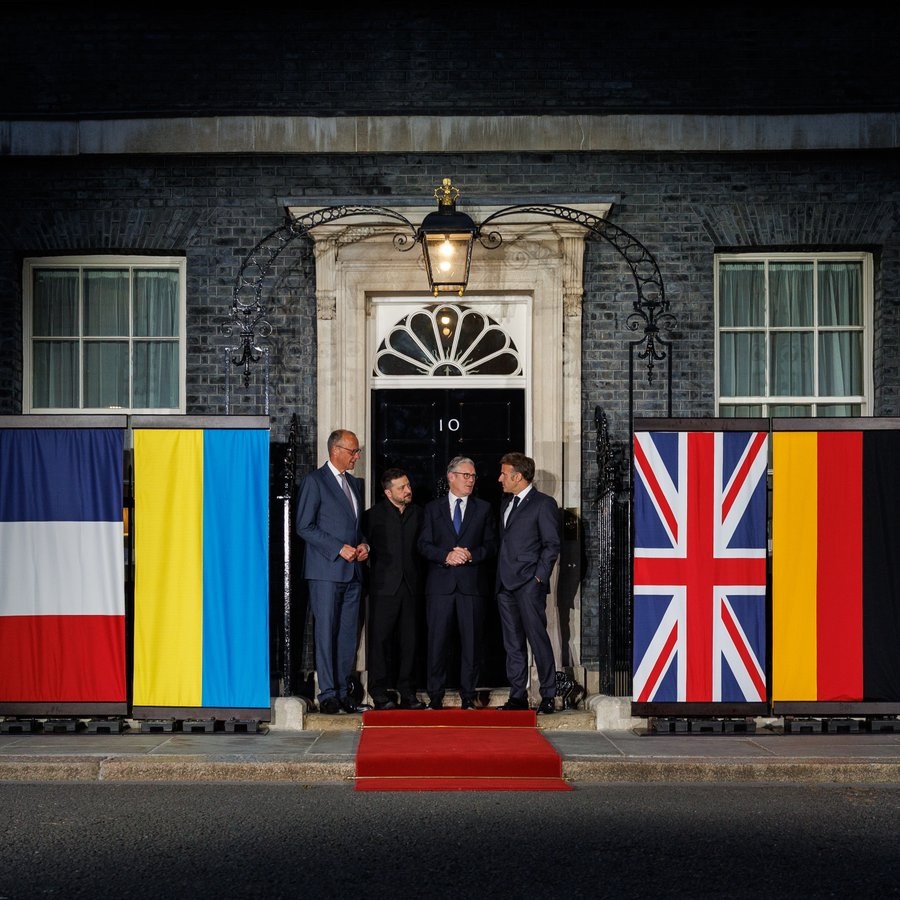
Read more …

“The gaffe-prone former foreign minister has been blamed for Berlin’s failure to win a rotating seat on the UN Security Council..” …a rotating seat on the UN Security Council that Germany wants to be a permanent one?!

German Lawmakers Want Answers From Baerbock After UN Humiliation – Bild (RT)

German lawmakers want former Foreign Minister Annalena Baerbock questioned over Berlin’s failure to secure a seat on the UN Security Council, Bild reports. According to the outlet, the ruling CDU/CSU alliance blames the former top diplomat for the setback and wants her summoned before the Parliament’s Foreign Affairs Committee. Germany failed to win a non-permanent seat on the UNSC – the UN’s most powerful body, with authority to adopt legally binding resolutions and sanctions – for the first time in modern history on Wednesday, losing out to Portugal and Austria. Germany won all six previous contests it entered since 1977, but this time received only 104 votes, well short of the required two-thirds majority.


German Foreign Minister Johann Wadephul described the result as a “bitter defeat,” but insisted he “did not personally blame himself,” arguing that Germany entered the race too late. According to Bild, lawmakers are placing the blame on Wadephul’s predecessor, Baerbock, who served from 2021-25. “We must thoroughly investigate the causes of this embarrassing electoral defeat,” Stephan Mayer, a member of the Foreign Affairs Committee, told the outlet. “[It is] absolutely essential that Annalena Baerbock answer questions before the Bundestag [to explain] how, when, and what exactly her ministry did to mobilize support for Germany’s bid.”

Hesse’s Minister for International Affairs, Manfred Pentz, also pointed the finger at Baerbock. “You cannot blame [Chancellor] Friedrich Merz and Johann Wadephul for this electoral defeat. Annalena Baerbock messed it up during her time as foreign minister,” he stated. Baerbock’s tenure as Germany’s top diplomat drew frequent criticism for a lack of diplomatic pragmatism, an inconsistent agenda, and high-profile verbal blunders.During her time in office, she said she would support Ukraine “irrespective of what my voters think,” declared the EU to be “fighting a war against Russia,” and described Israeli strikes on Palestinian schools as “self-defense.” She also made several awkward historical, geographical, and mathematical slip-ups, including promising a “360-degree foreign policy.”

Despite the gaffes, Baerbock was appointed president of the UN General Assembly after leaving the Foreign Ministry – a largely ceremonial but prestigious UN post. Munich Security Conference chairman Wolfgang Ischinger suggested that Germany’s defeat this week may have partly been retaliation for how Baerbock “snatched” the role, which he told WELT TV had “not exactly generated new sympathy for Germany” among UN ambassadors.

A diplomatic source told Bild that Baerbock is widely unpopular in the General Assembly for being “too focused on Germany… selfies and herself.” Botswana’s former president, Mokgweetsi Masisi, also told the outlet that Germany could have secured more support from African countries in the Security Council vote had Baerbock not treated African partners in a “condescending and disrespectful” manner. He cited diplomatic disputes over infrastructure projects during her tenure as foreign minister.

Read more …

Michael Snyder is the boy who cried wolf. Amusing at times.

A “Godzilla El Niño” (Michael Snyder)

The waters of the Pacific Ocean are getting extremely warm, and that could provide fuel for an immensely destructive climate event that is unlike anything we have ever seen before. Even the United Nations has issued an ominous warning about the El Niño event that is in the long-term forecast, because it will have a dramatic impact on every man, woman, and child on the entire planet. We are being told that there is more than an 80 percent chance that El Niño conditions will arrive by the end of next month due to rapidly warming equatorial waters in the Pacific. Meanwhile, an unprecedented “9,000-mile marine heatwave” has developed in the North Pacific. Many experts are concerned that the confluence of those two factors could produce a “Godzilla El Niño”…


The chance of an El Niño event emerging by July is now over 80 percent, which will likely make 2026 one of the hottest years on record. At the same time, an exceptionally large 9,000-mile marine heatwave has been forming in the North Pacific since the end of 2025. These extreme warming events are now evolving together across the Pacific. Scientists are increasingly concerned that the warm water will fuel a “super” or “Godzilla” El Niño, potentially prolonging marine heatwaves, disrupting fisheries and ecosystems, and intensifying global climate impacts well into 2027. The “9,000-mile marine heatwave” in the North Pacific is absolutely astounding climate scientists.

At the same time, the warming in the equatorial waters where El Niño events normally develop is at a level that we haven’t seen since at least 1877… The temperature of the ocean in the equatorial waters where these El Niños form was predicted to be 3 degrees Celsius above average. Experts are saying that this is a level of heat in the Pacific Ocean that hasn’t been recorded since 1877. I have written about the “Super El Niño” that started in 1877 before. That “Super El Niño” was one of the primary reasons why 50 million people starved during the Great Famine that stretched from 1876 to 1878…

This El Niño, they say, could rival the intense event of the late 19th century that triggered “the Great Famine” on a global scale, killing millions of people. And its scythe sliced through southern Africa. “The 1876-78 Great Famine impacted multiple regions across the globe, including parts of Asia, Nordeste [Northeast] Brazil, and northern and southern Africa, with total human fatalities exceeding 50 million people, arguably the worst environmental disaster to befall humanity,” a team of scientists said a decade ago in a ground-breaking paper presented at a meeting of the American Geophysical Union.

3 percent of the entire population of the world starved to death during those years. Today, 3 percent of the entire population of the world would be 240,000,000 people. In 1982 and 1983, we experienced the most severe “Super El Niño” of the 20th century… In 1982-83, the most intense El Niño of the 20th century caused extreme weather events throughout the world, including floods in the American Pacific and in the southern United States, and droughts in north-eastern Brazil and Indonesia. It also caused a very mild winter in the mid-latitudes of Europe, Asia and North America. That “Super El Niño” sparked a horrific famine in eastern Africa that wiped out a very large proportion of the population…

Read more …

“..the first great realist thinker…”

In the Land of Thucydides (John J. Mearsheimer)

I gave a lecture in Athens on 2 June 2026 that was hosted by two prestigious Greek organizations: the Council for International Relations and the Institute of International Relations. I was asked to speak about why I think Realism explains contemporary geopolitical developments better than any other theory. I was fully aware that I was speaking in the home of Thucydides, the first great realist thinker.
Read more …


https://twitter.com/Real_RobN/status/2063695049314185386?s=20 https://twitter.com/mcafeenew/status/2063714994014093733?s=20 https://twitter.com/jackprandelli/status/2063698942630506617?s=20


Support the Automatic Earth in wartime with Paypal, Bitcoin and Patreon.



Aug 202025


Anthony Van Dyck Self portrait with sunflower 1632


Europe Has No Money, US Has No Weaposs, Ukraine Has No Soldiers (ZH)
Kiev’s Backers Fail To Sway Trump On Russia – Poletaev (RT)
‘Coalition Of The Willing’ Failed To Outplay Trump – Medvedev (ZH)
Europe Isn’t Prepared For Peace (Wolfgang Münchau)
Italy Opposes Western Troop Deployment To Ukraine (RT)
Trump ‘Assures’ No US Boots On Ground To Enforce A Peace Deal In Ukraine (ZH)
Macron Wants ‘Boots On The Ground’ In Ukraine (RT)
Trump Tells Europe: “You Can’t Wait Weeks, Thousands Are Dying” (CTH)
Trump Tells Zelensky To ‘Show Flexibility’ (RT)
Switzerland Offers Putin Immunity For Ukraine Peace Talks (RT)
EU Leaders Went To Washington Begging Daddy Trump To Spank Them (Marsden)
The Ukraine War Could ‘End Tomorrow’ If The US Wanted: Jeffrey Sachs (ZH)
Trump, Putin, and the Future of Ukraine’s War (Victor Davis Hanson)
Tulsi Revokes Security Clearances For 37 Former, Current Intel Officials (JTN)
UK Agrees to Drop Demand for Apple to Create Backdoor Access: Gabbard (ET)
On The Road To A Hyperstate: EU Commission Circumvents Financing Rules (ZH)


https://twitter.com/PapiTrumpo/status/1957557703842361358
https://twitter.com/PapiTrumpo/status/1957504696848896177

Zakharova (read whole text)


Lest we forget. It’s all a hot air bubble.

“Europe will spend $100 billion it does not have, to buy weapons from America that it does not have, to arm soldiers that Ukraine now lacks…”

Europe Has No Money, US Has No Weapons, Ukraine Has No Soldiers (ZH)

Part of Zelensky’s motive for wearing a suit Monday to the White House has become clearer with fresh reporting in the Financial Times, which reviewed a document showing Ukraine will promise to buy $100 billion of American weapons financed by Europe in a bid to obtain robust US security guarantees. Additionally, “Under the proposals, Kyiv and Washington would also strike a $50bn deal to produce drones with Ukrainian companies that have pioneered the technology since Russia’s full-scale invasion in 2022,” the report continues. Ukraine pitched its plan during the Monday White House summit, which also involved seven EU leaders – and the $100BN arms deal became part of the key talking points pushed by the European allies. This is an effort by design meant to ensure Ukraine can procure what it wants – and that its war efforts can still be funded uninterrupted – while still ultimately appeasing Trump.

“We’re not giving anything. We’re selling weapons,” Trump had said Monday in response to a reporter’s question on the matter. It remains very obvious that Europe’s demands of keeping up huge pressure on Russia, including through sanctions, are intended to stymie any US-backed deal seen as too favorable to Moscow. The FT report comments on this as follows: The document details how Ukraine intends to make a counter-pitch to the US after Trump appeared to align himself with Russia’s position for ending the war following his meeting with President Vladimir Putin in Alaska last week. It reiterates Ukraine’s call for a ceasefire that Trump had espoused but then dropped after his Putin meeting in favor of the pursuit of a comprehensive peace settlement. Geopolitical analyst and commentator Glenn Diesen has pointed out, however, that Kiev is essentially attempting to create leverage out of nothing.

“Europe will spend $100 billion it does not have, to buy weapons from America that it does not have, to arm soldiers that Ukraine now lacks,” he wrote, explaining further: “This is to confront Russia, which for 30 years warned it would respond to NATO militarizing its borders.” Diesen followed by doing something that Washington policy-makers refuse to do, and that is look at the big picture of how we got here [emphasis ZH]: There was no threat to Ukraine before 2014, as only a tiny minority of Ukrainians wanted to join NATO, and Russia laid no claim to any of Ukraine’s territory. Western governments then supported a coup to pull Ukraine into NATO’s orbit – something that CIA Directors, Ambassadors, and Western state leaders had warned would instigate a security competition and likely trigger a war.

Russia predictably reacted fiercely. Ever since then, the only acceptable narrative has been that Russia wants to restore the Soviet Union and that Putin is Hitler. Any dissent is labelled as “disinformation”, “propaganda”, “hybrid warfare”, or even treason. The war has now been lost, and the Americans are pulling away from it, asking the Europeans to absorb the consequences. How do the Europeans respond? By doubling down on this madness, which will destroy Ukraine, our economies, and our relevance in the world – and possibly trigger a nuclear war. – What is the strategy? More of the same? The best thing for Ukraine is to remove it from the frontlines of the geopolitical struggle over where to draw the new dividing lines in Europe: End the war, rebuild Ukraine, and replace expansionist military blocs with the principle of indivisible security.

Read more …

“While the immediate effort may have failed, “most likely, Europe will soon try again…”

Kiev’s Backers Fail To Sway Trump On Russia – Poletaev (RT)

The White House meeting on Monday between US President Donald Trump and Ukraine’s European backers produced no major results, political analyst Sergey Poletaev has told RT. Trump met to discuss the Ukraine conflict with Vladimir Zelensky and some European leaders in Washington just days after holding a summit with Russian President Vladimir Putin in Alaska. “Just like in Anchorage, no decisions were announced afterward. And that, in itself, is a sign that something important is happening,” Poletaev said, noting that the talks are part of a larger diplomatic struggle, the ultimate goal of which is to win over the US president.

He suggested that Moscow is seeking to draw Washington out of the conflict, while Europe and Ukraine are pushing to keep the US firmly entangled. Following what Poletaev called Putin’s “gambit” in Anchorage, the European delegation hurried to Washington to persuade Trump to toughen sanctions against Moscow and maintain weapons deliveries to Kiev. So far, it looks like they came up empty. Poletaev pointed out that, unusually for the US president, he did not repeat European talking points after the meeting. Instead, Trump reminded the European leaders at the start of the summit that “they had no real power,” the analyst said. While the immediate effort may have failed, “most likely, Europe will soon try again,” Poletaev stressed.

According to the analyst, the key issue at Monday’s summit was security guarantees for Ukraine. Russia has insisted “from day one” that any such commitments must be tied to “neutrality and disarmament,” he said. Europe and Kiev, meanwhile, are desperately trying – by hook or by crook – to preserve Ukraine’s armed forces, and even to push for a NATO presence on Ukrainian soil. According to Poletaev, the attempts are “naive and desperate,” but whatever form security guarantees take in any eventual peace deal will ultimately determine “the fate of the Kiev regime.” “For now, there’s no compromise in sight,” Poletaev concluded. “And as Ukraine continues to lose ground on the battlefield, the room for maneuver – for both Kiev and its European backers – is shrinking fast.”

Read more …

“So yes, the Ukraine can have ‘security guarantees’. But the conditions of those will be set by the main guarantor – which has to be Russia..”

‘Coalition Of The Willing’ Failed To Outplay Trump – Medvedev (ZH)

Former Russian President and top Kremlin national security official Dmitry Medvedev said on Tuesday that European leaders had failed to outplay Donald Trump, and that it remains unclear just how Ukraine’s Zelensky will prevent the issue of territorial concessions. White House officials, including Trump himself in prior statements, have made it known that compromise regarding territory is indeed on the table. “The anti-Russian warmongering Coalition of the Willing failed to outplay @POTUS on his turf,” Medvedev said on X. “Europe thanked & sucked up to him.” The below optics certainly don’t contradict Medvedev. One commenter observes that Trump had likely “been waiting for a moment like this his whole life”…

Medvedev said the question remains “what tune” Zelenskyy would play “about guarantees & territories back home, once he’s put on his green military uniform again.” It is true that far-right elements within his own military and political establishment would react fiercely to any acts of territorial concessions – which would likely result in acts of violence, and possibly even threats on Zelensky’s life. At the same time, coming off his Alaska summit with Trump, Russia’s President Putin remains firmly in the driver’s seat, amid steady ground advances on the battlefield. During a break in Monday’s meeting among seven EU officials and Zelensky, German Chancellor Merz revealed during a break in talks, “the American president spoke with the Russian president on the phone and agreed that there would be a meeting between the Russian president and the Ukrainian president within the next two weeks.”

But whether this happens or will largely depend of what happens in the interim, and Kiev’s attitude and statements on what it’s willing to concede. The geopolitics source Moon of Alabama highlights the perspective of former MI6 official and diplomat Alastair Crooke in the following: Alastair Crooke suggests (video) that the peace agreement between Russia and Ukraine will follow the outline of the Istanbul Agreement negotiated in March 2022 between Ukraine and Russia. Ukraine, under pressure from the West, had at that time refrained from signing it. The Istanbul Agreement did include security guarantees (emphasis added): The agreement assumes:

2. Possible guarantor states: Great Britain, China, Russia, the United States, France, Turkey, Germany, Canada, Italy, Poland, Israel. The free accession of other states to the treaty is proposed, in particular the Russian Federation proposes Belarus.

4. Ukraine does not join any military alliances, does not deploy foreign military bases and contingents, and conducts international military exercises only with the consent of the guarantor states. For their part, the guarantor states confirm their intention to promote Ukraine’s membership in the European Union.

5. The guarantor states and Ukraine agree that in the event of aggression, any armed attack on Ukraine or any military operation against Ukraine, each of the Guarantor States, after urgent and immediate consultations between them (which shall be held within no more than three days), in the exercise of the right to individual or collective self-defense recognized by Article 51 of the Charter of the United Nations, will provide (in response to and on the basis of an official request from Ukraine) assistance to Ukraine, as a permanently neutral state under attack, by immediately taking such individual or joint action as may be necessary, including closing airspace over Ukraine, providing necessary weapons, using armed force in order to restore and subsequently maintain the security of Ukraine as a permanently neutral state.

Any such armed attack (any military operation) and all measures taken as a result thereof shall be immediately reported to the Security Council. Such measures shall cease when the Security Council takes the measures necessary to restore and maintain international peace and security. The mechanism for implementing security guarantees for Ukraine, based on the results of additional consultations between Ukraine and the Guarantor States, will be regulated in the Treaty, taking into account protection from possible provocations.

Again: … such guarantee will of course come with conditions attached to it. Either Ukraine will accept those or it will never be secure from outer interference. So yes, the Ukraine can have ‘security guarantees’. But the conditions of those will be set by the main guarantor – which has to be Russia. Trump seems to have understood that. How long will it take those European ‘leaders’ to get it?

Read more …

Or for war, for that matter. Europe had 80 years of calm, and wasted them.

Europe Isn’t Prepared For Peace (Wolfgang Munchau)

There are many more ways in which a peace process can fail than succeed. But for either to happen, it first needs to start. And that is often the most difficult step. But after his big summit in the White House, Donald Trump seems to have pulled off the unthinkable: A summit has been organized between Vladimir Putin and Volodymyr Zelensky which would kick-start peace negotiations. What did it take to get here? While a cease-fire will not be a precondition, the Europeans have been granted some of the assurances they wanted on security guarantees. Whether these can be enforced is an entirely different matter — but America’s agreement, in principle, to help the Europeans meet their obligations does mark an important shift in this seemingly endless war.

Since it is now unlikely that Trump will change his mind and revert to the Biden-era policy of unconditional, if hesitant, support for Ukraine, we are now left with two possible scenarios for how the war plays out. In the first, Ukraine and Russia will agree to a peace deal, and the US and Europe will try their best to make the post-war security arrangement work. It is our baseline scenario, but it will be hard to pull off since the question of land is a particularly difficult one. The starting point of the talks would have to be the existing military situation — not Russia’s or Ukraine’s maximal demands — and would then need to be followed by detailed negotiations. In the second scenario, the peace talks will go ahead but fail. Trump will then blame Zelensky and actively disengage from supporting Ukraine. Beware of extrapolating yesterday’s show of support: The smiles are deceptive.

Trump wants to get out. Like the real estate developer he once was, who has first put a deposit down, Trump has invested political capital into a peace process and he is not going to back down. This scenario would be very bad for Ukraine and for Europe. America would withdraw — for real this time. The Europeans would be left having to support Ukraine and build a new security infrastructure without US support. This is not really a viable financial or military option for European leaders. After all, their engagement would have to be major. The Ukraine-Russia front line is, at the moment, about 745 miles – around the length of the Cold War-era inner German border. Nor does this include the rest of Ukraine’s de jure border to the north and east with Russia, and with Belarus. There have been some comparisons with the situation in Korea — but the demilitarized zone there is barely 155 miles in length.

Adequately securing such a large border on the Ukrainian side would take a huge amount of troops — one estimate suggests as many as 150,000 European soldiers. This is a far larger deployment than anyone has envisaged; Emmanuel Macron mentioned troop numbers in the thousands earlier in the year similar to the so-called trip-wire deployments in the Baltic States. And even if they wanted to, European leaders don’t have the troops needed to provide genuine assurances to Kyiv. Johann Wadephul, the German foreign minister, recently admitted that Germany probably wouldn’t have the capacity to send troops to Ukraine. And while the UK might be keen to voice its political commitment to the country, it’s doubtful that it can meaningfully back this up. A RUSI piece last year indicated that Britain does not have enough equipment to sustain a proper three-brigade armored division.

Even deploying a single brigade would use up 70%-80% of the British Army’s total combat engineering capabilities. There are other challenges too. At this stage, the easiest way to blow a deal, by either side, would be to refuse concessions on land. The Russian claim for the entirety of the Donbas region, including the parts they don’t occupy, is a maximalist one, from which Russia would have to retreat if the negotiations were to succeed. There are some commercial assets in the region of interest to Moscow — mines and industrial companies based in the Russian-occupied parts — but it has military significance for Ukraine.

Read more …

Meloni: “Russia has 1.3 million soldiers – how many should we send to be up to the task?”

Italy Opposes Western Troop Deployment To Ukraine (RT)

Italian Prime Minister Giorgia Meloni is opposed to proposals by some European leaders to send troops to Ukraine, the daily Corriere della Sera reported on Monday. The issue reportedly arose during consultations before several European leaders and Ukraine’s Vladimir Zelensky traveled to Washington for talks with US President Donald Trump. The visit follows Trump’s meeting with Russian President Vladimir Putin in Alaska on Friday. According to the report, French President Emmanuel Macron spoke in favor of a joint European deployment, prompting Meloni to respond: “Russia has 1.3 million soldiers – how many should we send to be up to the task?”

In early March, Macron and British Prime Minister Keir Starmer announced the creation of a “coalition of the willing” to provide ground and air forces in a peacekeeping role if Kiev and Moscow reach a truce or a peace deal. The Italian prime minister instead advocated extending Ukraine protection akin to NATO’s Article 5, which provides for collective defense in case of aggression, without however formally admitting it to the bloc, Corriere reported. In March, she assured lawmakers in Rome that “sending Italian troops to Ukraine is a topic that has never been on the agenda.”

Germany, Poland, Spain, Romania and Croatia have all also refused to participate in a hypothetical military mission in Ukraine. Earlier this month, The Sunday Times quoted an anonymous UK defense official as acknowledging that “no one wants to send their troops to die in Ukraine.” Back in April, Sergey Shoigu, secretary of Russia’s National Security Council and former defense minister, warned that the arrival of NATO troops in Ukraine could trigger a third world war.

Read more …

I can’t decide what sounds more stupid: ‘Coalition of the Willing’ or ‘Security Guarantees’.

Trump ‘Assures’ No US Boots On Ground To Enforce A Peace Deal In Ukraine (ZH)

President Trump has made it clear that he will not send American troops to enforce a possible peace agreement in Ukraine centered on ‘security guarantees’ – despite having appeared possibly open to the idea just a day earlier. In a phone interview on Fox News Tuesday morning, Trump was asked what assurances he could offer that American forces wouldn’t end up defending Ukraine’s borders, and beyond his time in office. The question was based on his campaign and opening months in office – when he repeatedly vowed no more boots on the ground in entangling conflicts abroad. “You have my assurance, and I’m president,” Trump responded. European leaders are pressing for the strongest possible security guarantees for Ukraine, to ensure it can never be attacked in the future, once a peace settlement is reached.

A White House official additionally confirmed on Tuesday that Trump has definitively ruled out deploying US ground forces to Ukraine, according to CNN. Security guarantees for Ukraine were a central focus between Trump, Ukrainian President Volodymyr Zelensky, and seven EU leaders – among them NATO Secretary General Mark Rutte. The Europeans want clarity on what level of American military support Trump is willing to offer to prevent Russia from regrouping and pursuing further territorial advances after a potential peace deal. British Prime Minister Keir Starmer, who was in the White House yesterday alongside France’s Macron, is still vowing to press for the most robust guarantees possible. “Turning to next steps, the Prime Minister outlined that Coalition of the Willing planning teams would meet with their US counterparts in the coming days to further strengthen plans to deliver robust security guarantees and prepare for the deployment of a reassurance force if the hostilities ended,” a Downing Street spokesperson said in a statement.

“The leaders also discussed how further pressure – including through sanctions – could be placed on Putin until he showed he was ready to take serious action to end his illegal invasion,” Starmer’s office added. In some ways, this can easily be read as the Europeans saying they are actively trying to sabotage peace, as the fear is that it will be settled on Moscow’s terms. Additionally, Bloomberg is reporting that “Security guarantees for Ukraine will be formalized in the coming days and as soon as this week, European Council President Antonio Costa tells reporters in Lisbon following virtual meetings of ‘Coalition of the Willing’ and EU leaders. President Putin has repeatedly emphasized that Russia will never allow Western boots on the ground in Ukraine as part of some peacekeeping force or entity patrolling frozen front lines. At least Trump is saying he’s on the same page, and fully understands this, at least for now.

Read more …

You go girl, and I do mean you.

Macron Wants ‘Boots On The Ground’ In Ukraine (RT)

European forces should take part in future peacekeeping operations in Ukraine, French President Emmanuel Macron told journalists on Monday. The proposal has repeatedly been rejected by Moscow as unacceptable and dangerous. Macron made the comments in Washington after a White House summit on Monday with US President Donald Trump, Ukraine’s Vladimir Zelensky, and several European leaders, who met to discuss possible terms for ending the conflict. Speaking to reporters following the meeting, Macron said that Ukraine must have a “strong army” and that Western Europe “will need to help Ukraine with boots on the ground.” He added, “We will need peacekeeping operations which allies of Ukraine are willing to supply.”

The French president has raised the idea several times in recent months, alongside British Prime Minister Keir Starmer, but the proposal has not gained support from other European leaders. Italian Prime Minister Giorgia Meloni has opposed the plan, according to the daily Corriere della Sera, and reportedly challenged Macron ahead of the Washington talks by noting that Russia has 1.3 million soldiers and asking, “How many should we send to be up to the task?” Germany, Poland, Spain, Romania, and Croatia have all also ruled out participation in a hypothetical mission. Earlier this month, the Times reported that British military chiefs had “given up” on large-scale deployment plans, despite Starmer’s public support.

Moscow has repeatedly stated that any Western troop presence in Ukraine is unacceptable. Multiple Russian officials, including National Security Council secretary Sergey Shoigu, have warned such a deployment would amount to an occupation and could trigger a third world war. After several British officials brought up the idea again this month, Russian Foreign Ministry spokeswoman Maria Zakharova accused London on Monday of being “hell-bent on constantly upping the ante in the conflict and pushing its NATO partners to a dangerous line, beyond which a new global conflict lies.”

Read more …

They don’t care, they want war.

Trump Tells Europe: “You Can’t Wait Weeks, Thousands Are Dying” (CTH)

President Trump called into Fox & Friends show this morning to explains some of the details within the Ukraine Peace Summit held at the White House with President Zelenskyy and European leaders. There’s some interesting insight into the urgency, held by President Trump, as he describes talking about the need to stop the killing now, not next week. President Trump notes he told the EU leadership, it is ridiculous to say meet again in a few days; thousands of people are dying each week. Trump told them they need to get into action tonight. In his generally off-the-cuff remarks, President Trump provides some remarkable insight into the status of current events.

Read more …

Yeah, while playing piano.

Trump Tells Zelensky To ‘Show Flexibility’ (RT)

US President Donald Trump has renewed his push for talks between Russian President Vladimir Putin and Ukraine’s Vladimir Zelensky, urging the latter to be more flexible. Trump made the remarks on Tuesday after a meeting in Washington with Zelensky, several European leaders, and the heads of NATO and the European Commission. The discussions centered on conditions for a possible peace deal with Russia. The talks followed Trump’s summit with Putin in Alaska last week. In a phone interview with Fox News, Trump claimed he had resolved “seven wars” during his political career but described the conflict between Russia and Ukraine as the toughest one yet.

Trump, who wants to arrange a meeting between Putin and Zelensky, expressed hope that the Ukrainian leader “will do what he has to do,” adding that “He has to show some flexibility.” Trump had earlier suggested that a trilateral meeting with Putin and Zelensky could be held soon, saying “there will be a reasonable chance of ending the war when we do that.” Trump met Putin on Friday in Anchorage, Alaska, in their first face-to-face encounter since 2019 in the American president’s first term. He described the talks as “warm,” while Putin called them “frank” and “substantive.”

He followed up on Monday with a phone call to the Russian president, briefing him on the talks in Washington. According to the Russian presidential aide Yury Ushakov, the call lasted 40 minutes, with both sides expressing readiness to continue discussions on a resolution with Zelensky. Moscow maintains that any lasting settlement must eliminate the root causes of the conflict, address Russia’s security concerns, and recognize current territorial realities, including the status of Crimea and the four former Ukrainian regions that voted to join Russia in 2022.

Read more …

Remember why the ICC arrest warrant was issued? Because he was accused of having kidnapped 10s of 1000s of Ukrainian kids. That accussation still does the rounds today, though by now it is clear what he did was he made sure a few hundred of them were rescued from being in the line of fire. “At the Peace negotiations in Istanbul in 2025, Ukraine handed over a list of 339 “children” allegedly “abducted” by Russia. ”

Switzerland Offers Putin Immunity For Ukraine Peace Talks (RT)

Switzerland has indicated it would allow Russian President Vladimir Putin to attend possible Ukraine peace talks on its soil without facing arrest under an International Criminal Court warrant, according to media reports. Following a weekend during which Putin was welcomed to the US by President Donald Trump, who days later hosted Vladimir Zelensky and his key Western European backers, Moscow confirmed its readiness to participate in further talks on a lasting resolution to the Ukraine conflict and indicated that its diplomatic presence at such talks would be raised. A possible venue for such talks has not been identified.

The Hague-based ICC issued arrest warrants in 2023 for Putin, as well as Russian Commissioner for Children’s Rights Maria Lvova-Belova, over alleged unlawful deportation and transfer of children from former Ukrainian territories. Moscow has dismissed the allegations as politically motivated, explaining that it evacuated the children out of the war zone for their own safety. On Tuesday, Swiss Foreign Minister Ignazio Cassis told a press conference that, under certain circumstances, the Russian president would be allowed to set foot in Switzerland. The Swiss government last year defined “the rules for granting immunity to a person under an international arrest warrant. If this person comes for a peace conference – not if they come for private reasons,” Cassis said as quoted by various news outlets.

He added that his country was “ready for such a meeting,” saying “We have always signaled our willingness, but it naturally depends on the will of the major powers.” According to the foreign minister, Switzerland could host such a summit “despite the arrest warrant against Putin because of our special role and Geneva’s role as the European headquarters of the UN.” Russia, like the US, China, and Israel, is not a signatory to the ICC’s founding treaty and does not recognize its jurisdiction. French President Emmanuel Macron, who also took part in Monday’s talks with Trump, has reportedly raised the possibility of a peace summit being held in “a neutral country, maybe Switzerland.” “I’m pushing for Geneva,” he told French news channel LCI on Tuesday.

Read more …

“Europe has even ramped up weapons factory production to triple speed, according to the Financial Times. Now sit back and watch them screw it up. One-one-thousand. Two-one-thousand…”

EU Leaders Went To Washington Begging Daddy Trump To Spank Them (Marsden)

Can the EU manage to go even a single week without begging to be cucked? Spoiler alert: Nope. This time, they even boarded a plane for a transatlantic booty call. “Security guarantees.” That’s what the Western European establishment keeps demanding for Ukraine. And now it looks like US President Donald Trump has found a way to monetize it at the EU’s expense – a cost that will, naturally, be passed down directly to European citizens. When the idea of a peace deal was first floated earlier this year, the UK and France tried to hype up the concept of putting 30,000 EU troops in Ukraine – but only if peace broke out long enough to render the exercise glaringly useless and redundant. The plan depended on US air cover babysitting them while they did pushups, burpees, and awkward small talk with the American corporate contractors who would no doubt move in to monetize the latest frontier of shock-and-awe liberation.

But EU citizens seemed unmoved, and the elected officials who rely on them to remain in their cushy seats of power knew it. Apparently, a militarized Burning Man in a “liberated” Ukraine doesn’t exactly sell to Europeans. Next, Western Europeans were carpet-bombed with stereoscopic rhetoric about the necessity to blow a ton of cash on weapons so Europe could guarantee BOTH its own security and Ukraine’s. Without even actually being in the EU, Ukraine was already being treated like the free perfume sample tossed into every shopping bag at Sephora – the one that makes your groceries reek whether you wanted it or not. And because Ukraine had become rhetorically inseparable from the EU, the Eurojokers in charge started invoking a future Russian invasion date for Europe of 2030.

It’s like a new form of hypochondria. Except instead of reading about a disease online and convincing yourself that you have it, they started believing that Russia was invading them just from observing events in Ukraine. This “2030 invasion” propaganda seems to have originated from NATO-adjacent think tanks like the Carnegie Endowment for International Peace, which last year cited 2030 as the date of Russia’s “military reconstitution.” The RAND Corporation has also warned of a “revanchist Russia” in a report on the “future of warfare in 2030” that will fight “its neighbors.” NATO Secretary General Mark Rutte then parlayed all this into a demand for European members of the US-led weapons lobby to cough up 5% of GDP in defense spending, up from the 2% previously demanded at Trump’s insistence.

The Euroclowns started trying to get buy-in through active audience participation, telling citizens to pack canned tuna and water into go-bags in preparation for Putin’s 2030 arrival. They even floated the idea of citizens investing in special financial products to fund European defense. If you forego just one Starbucks visit per week, maybe you can help buy a whole tank someday for someone who really needs it. Scary times indeed! Better obey Daddy Trump via NATO and pledge 5% of GDP on weapons while the local boulangerie struggles to crank out baguettes thanks to insane energy costs. Maybe we can all make life easier for the clowns trying to triangulate all this and just eat bullets instead? It became clear a while ago that this whole “security guarantee” charade was a pretext for the weapons racket. Europe has even ramped up weapons factory production to triple speed, according to the Financial Times. Now sit back and watch them screw it up. One-one-thousand. Two-one-thousand…

Read more …

“The war can be “ended tomorrow” – or also would have never started, if the US simply but firmly declared NATO will not expand to Ukraine…”

The Ukraine War Could ‘End Tomorrow’ If The US Wanted: Jeffrey Sachs (ZH)

Just the day after the historic Trump-Putin summit in Alaska to discuss finding peace in Ukraine, the famous economist and UN adviser Jeffrey Sachs made his first ever appearance before the Ron Paul Institute’s (RPI) annual conference in Washington DC. Sachs’ Saturday speech presented essentially a ‘Blueprint for Peace’ – which was precisely the title and theme for this year’s event, attended by several hundreds of independent-minded people. Daniel McAdams, Executive Director of RPI, had previewed in a media statement that “Professor Sachs has become one of the most courageous voices challenging the Washington foreign policy establishment.” Former Congressman from Texas Ron Paul also underscored that “We are facing a perfect storm of reckless foreign policy, unsustainable debt, and attacks on civil liberties” and “Professor Sachs brings the kind of intellectual rigor and moral courage we need to chart a different course.”

While President Trump and his top officials have been commenting on the incredible “complexity” and significant hurdles to achieving peace in Ukraine, Sachs in his Saturday speech demolished this notion, arguing that on the contrary it’s not so complicated at all – that the reality is raging wars from Ukraine to Gaza could be ended in a single day if Washington wanted to. The war can be “ended tomorrow” – or also would have never started, if the US simply but firmly declared NATO will not expand to Ukraine, Sachs at one point emphasized. “It’s not so complicated actually to end these conflicts. It’s a little surprising how long it takes and how hard it is to to accomplish this, but it’s not so hard in substance because the underlying reasons for the conflicts that the United States is in perpetually are not sound reasons from the point of view of America’s interests, from the point of view of our security, from the point of view of our well being or our economy,” Sachs began by explaining.

“All of the conflicts that we are in and those that we could get in are misguided, misdirected, provoked by us to a very large extent and um… solvable. That’s the basic point. It really is not so complicated.” This is a point which should resonate with the majority of war-weary populations in both America and Europe, who have seen billions siphoned from taxpayers into heavy arms shipments for Ukraine and Israel. Washington could cut off the weapons which help keep these hotspots raging, and could do it tomorrow while pressing hard for peace if it wanted to – as we at ZeroHedge have also long emphasized. But Sachs pointed out that the establishment, from the military-industrial complex to the media to members of Trump’s own administration, remains stacked in favor of forever wars and is largely dead set against Trump – which means the US leader has a lot working not in his favor if he truly does want to strike a peace deal with Putin.

Sachs called out the mainstream media for wanting to slap a ‘failure’ label on the summit from the beginning (or even before it began): “I was looking at all of the the banner headlines about the failure yesterday [Friday] in Alaska. The failure because we didn’t launch World War because the two presidents had a good meeting together, because they announced progress,” Sachs observed sarcastically. “This is taken as failure in our media which of course is hawkish by the moment and manipulated by, controlled by, paid by, or simply aligned with the military industrial complex in the country. So, it’s extraordinarily hard to hear a word about peace in this country.”

Read more …

I like Victor Davis Hanson, I do. But when someone tells me ‘Stalin killed 20 million of his own people during WWII’, I switch off.

Trump, Putin, and the Future of Ukraine’s War (Victor Davis Hanson)

President Donald Trump met Russian President Vladimir Putin last week for the much-anticipated summit, I guess we would call it, in Anchorage, Alaska. Remember the last time American diplomats of a high ranking—Jake Sullivan and Antony Blinken, the respective secretary of state and national security adviser to the Biden administration—met with the Chinese, they were humiliated and nothing came of it. Trump thought he could get a ceasefire. After three hours, both Trump and Putin came out to give statements to the press. There was no question-and-answer. Putin gave a long harangue. How would you characterize it? It was mostly a recital of Russian grievances and the need to be friendlier to America. It was an outreach, not to Ukrainian President Volodymyr Zelenskyy or Ukraine or Europe, but to America.

And it was in line with Russian strategy that they think Donald Trump is a strong leader, but also, he is more forgiving, or at least more malleable, about seeking a peace settlement rather than the “whatever it takes” attitude of the Biden administration. And he also believes that the Europeans are tired—after three and a half years—that Ukraine is exhausted. And so, he can appeal to Donald Trump to put an end to it on Russian terms. What are the terms? Well, Trump didn’t outline them in his portion of the post-summit report to the media and to the world. He wasn’t depressed. He didn’t say we should have had a ceasefire. He just said that there were a lot of elements that were, more or less, concluded successfully between Putin and Trump. But more importantly, for the big sticking points, he would have to talk to the Europeans, as was noted and necessary, and President Zelenskyy.

And we know what the outlines are, don’t we? We’ve talked about them. Ukraine will not be in NATO. They don’t have the military wherewithal. They have the moral edge and the moral right—but they don’t have the military wherewithal. Nor does Europe or the United States want to go to that length to give it to them against nuclear Russia to reclaim the Donbas—all of the Donbas—or Crimea. So, what the sticking point is, right now, these two armies are locked inside the Donbas. Basically, 50 to 100 miles on an undulating line from the Russian borders. And there could be a DMZ, like the one in Korea, and then that could be the basis for a permanent border. But the problem is that Putin has not got the entire Donbas and the regions around it. And the Ukrainians are stiffening. Both sides are worn out. There’s been a million and a half casualties that are wounded, dead, missing, captive. But Russia has greater reserves than does Ukraine. So, there’s a desire on both sides to have an armistice.

The sticking points is that the Constitution does not allow Zelenskyy without an assent from his parliament to give away land to a foreign interloper. And Putin does not think, at this point, he has ground down the Ukrainians enough or acquired enough of their eastern territory to justify the full hearty invasion that’s cost probably a million Russians. But here’s what I want to get to, very quickly. There’s a lot of criticism of Donald Trump because he didn’t blast Vladimir Putin. I don’t quite understand that. Just remember that during World War II, Josef Stalin had killed 20 million of his own people. He had invaded free Poland, along with Nazi Germany. He had attacked free Finland in 1939 and ’40 and then annexed 10% of it. He had helped Germany from Sept. 1, 1939, to June 22, 1941. He was our enemy. And then suddenly, and only when Germany turned on him, did he come to us.

And we accepted that alliance on the principle that he was useful. And we gave billions of dollars in aid. Thirty percent of the wherewithal of Stalin came from the British Empire or the United States government. So, you know, President Franklin D. Roosevelt met with him at Yalta. He even called him “Uncle Joe.” This was a man who killed 20 million of his own people. In 1972, President Richard Nixon went to China, and he tried to have a reboot of the strategic global order and play off Russia against China to the self-interest of the United States. But the point was, he sat down with the greatest mass murderer in history, Mao Zedong, who was responsible for 70 million people dead. Was Donald Trump not to meet with Putin? Or was he to employ the vocabulary of President Joe Biden? “You’re a murderer. You’re a thug. You’re a criminal,” as Biden said of him. “And we’re gonna do whatever it takes.”

Does he have support for that? For an unlimited blank check to Ukraine? No. So, he’s trying to get along with a killer in a way that past presidents have reached out to mass murderers. The other thing is, very quickly, while there are the contours of a peace settlement, Donald Trump is not responsible for this war. He’s the most powerful man in the world. He wants to help Ukraine get a just settlement. He is working with the Europeans. He’s beefed up NATO. But remember this, in the last four administrations, Putin has invaded Georgia under President George Bush, they invaded Crimea and Donbas under President Barack Obama, they tried to take Kyiv under Biden. It didn’t go anywhere under Donald Trump. Donald Trump was not the author of the failed “reset.” Remember the 2009 Geneva debacle, where Hillary Clinton pushed that “reset button” and we were supposed to be friendly with Russia.

And basically, what we did is we said, “You should be democratic. You gotta be Western. You’re gonna have to have a liberalizing … ” Well, they didn’t back it up. So, they were loud but carried a twig, rather than spoke softly with a club.Donald Trump had nothing to do with American diplomat Victoria Nuland and all of that earlier effort to put Ukraine in NATO and to interfere in the government of Ukraine. He had nothing to do with that. His children, he, none of them went over to Ukraine and tried to shake down the Ukrainian government to pour money into a presidential family, and then, as Joe Biden did, went over there and fired the prosecutor on threats. And he used our money to threaten the Ukrainians. He has no history of that.He sent offensive weapons to Ukraine that Biden had embargoed. He was pretty tough on the Russians, in a way Biden never was. He said, “Don’t do the Nord Stream 2 pipeline, Germany. Don’t do it.”

He killed a lot of the Wagner Group. He got out of an asymmetrical missile deal. But he had no fingerprints on the Ukrainian war. He didn’t say, as Joe Biden did, when he came into office, “Our reaction as America will be contingent on whether it’s a minor invasion.” Think of that. That was a green light to Putin, as was his suspension of offensive military arms to Ukraine. So, what am I getting at? The summit was about what we could expect. Putin wants to win over America so that America will back off from Ukraine, and so it can get some more mileage westward and further deteriorate or erode or detrite the Ukrainian military. The Ukrainian military is pretty tough. It’s hanging in there. It wants enough aid to leverage Putin. And between those two poles, there will be a DMZ.

And if there is a peace settlement, it will be the work—whether the Left likes it or not—of Donald Trump, the one world leader, among the three, that has nothing to do with this war. Didn’t start on his watch. It wasn’t a result of his policies. And it surely was not his responsibility that Vladimir Putin found himself inside Ukraine and threatening to destroy the independence of the Ukrainian people. That was not Donald Trump’s doing, but it may well be his doing to stop it.

Read more …

Normally they get to keep them, but these guys took the mess to another level.

Tulsi Revokes Security Clearances For 37 Former, Current Intel Officials (JTN)

Director of National Intelligence (DNI) Tulsi Gabbard on Tuesday announced that she directed her office to revoke the security clearances of 37 former and current intelligence officials over the Russiagate scandal. Just The News has broken several stories recently about Russiagate, which found that high-ranking government officials during the Obama administration tried to damage Trump during and after his 2016 presidential campaign by promoting false conspiracies, to the benefit of former Democratic presidential nominee Hillary Clinton. Gabbard claimed the 37 officials, including a former top aide to former President Barack Obama’s DNI James Clapper, abused public trust with their participation in the scandal, per the New York Post.

“Being entrusted with a security clearance is a privilege, not a right,” Gabbard said in a post on X. “Those in the Intelligence Community who betray their oath to the Constitution and put their own interests ahead of the interests of the American people have broken the sacred trust they promised to uphold. In doing so, they undermine our national security, the safety and security of the American people and the foundational principles of our democratic republic.” Gabbard said her order comes at the request of President Donald Trump, and targets people who abused public trust by allegedly politicizing and manipulating the intelligence, leaking classified intelligence, and violating the department’s standards.

“Our Intelligence Community must be committed to upholding the values and principles enshrined in the US Constitution and maintain a laser-like focus on our mission of ensuring the safety, security and freedom of the American people,” Gabbard said.

Read more …

“..it has “never built a backdoor or master key to any of our products or services and we never will.”

UK Agrees to Drop Demand for Apple to Create Backdoor Access: Gabbard (ET)

The UK government has agreed to drop its request that Apple provide it with backdoor access to user data, U.S. Director of National Intelligence Tulsi Gabbard said on Monday. Gabbard stated on X that the agreement came after months of working with UK partners, alongside President Donald Trump, and Vice President JD Vance, to ensure Americans’ private data and civil liberties are protected “As a result, the UK has agreed to drop its mandate for Apple to provide a ‘back door’ that would have enabled access to the protected encrypted data of American citizens and encroached on our civil liberties,” she said. Earlier this year, reports emerged that the UK government had issued Apple a “technical capability notice,” requiring the company to provide access to encrypted user data under the Investigatory Powers Act of 2016.

In response, Apple halted its Advanced Data Protection (ADP) feature for users in the UK, citing concerns over data breaches. The iPhone maker stated in a Feb. 24 blog post that it has “never built a backdoor or master key to any of our products or services and we never will.” The ADP feature provides end-to-end encryption for iCloud storage, preventing non-account holders—including governments and hackers—from accessing data such as photos, documents, and notes. Without ADP, certain types of iCloud data will no longer be fully encrypted, making it potentially accessible to third parties with the proper legal authority. “Apple remains committed to offering our users the highest level of security for their personal data and we are hopeful that we will be able to do so in the future in the United Kingdom,” Apple stated at the time.

In May, U.S. House Judiciary Committee Chair Jim Jordan and U.S. House Foreign Affairs Committee Chair Brian Mast sent a letter to UK Home Secretary Yvette Cooper, urging her to allow Apple to disclose the order’s existence to the U.S. Department of Justice so the department can assess whether the order complies with a U.S.-UK bilateral agreement under the CLOUD Act, which prohibits orders requiring companies to decrypt data. According to the letter, U.S. companies are prohibited under UK laws to disclose or confirm the existence of such an order, and doing so constitutes a criminal offense, even if the disclosure is made to the company’s home government. The U.S. lawmakers warned that the UK’s order for Apple to create a backdoor could lead to some implications, as it might be exploited by cybercriminals and authoritarian regimes. “These vulnerabilities would not only affect UK users but also American citizens and others worldwide, given the global nature of Apple’s services,” they stated in the letter.

Read more …

By the time Europeans figure out these shenanigans it’ll be way too late: “..Ursula von der Leyen’s EU budget proposal for 2028–2034, projected at around €2 trillion—a 40% increase over the previous period..”

On The Road To A Hyperstate: EU Commission Circumvents Financing Rules (ZH)

The European Union is funded by contributions from its member states. At least, that’s what the founding treaties say. In practice, however, the EU has long been taking other paths. At the core of Europe’s financial architecture lies a clear separation of responsibility and liability: Article 125 of the Treaty on the Functioning of the European Union (TFEU), the so-called “No-Bailout Clause.” It states, unequivocally, that neither the Union nor individual member states may assume the debts of other states. The purpose of this provision is to prevent free-rider effects (moral hazard) at the expense of other member states: each state is responsible for its own obligations. Still, the clause does not exclude political support, as long as it does not mean assuming the existing debts of other states. A notable example of this practice were the bailout programs for Greece during the sovereign debt crisis one and a half decades ago.

Article 310 TFEU further regulates the EU budget: revenues and expenditures must be balanced every year, and the budget may only be financed through own resources such as member contributions, tariffs, or approved revenues. Independent loans by the EU Commission exceeding the approved framework are prohibited. Together, these rules form the legal backbone of EU financial policy: no automatic liability, no autonomous EU debt, and only fully covered spending. This design was deliberately chosen to prevent the emergence of a supra-state in Brussels and to defend the national scope of action of member states against an expanding Brussels bureaucracy. That’s the theory. In practice, the EU has steadily increased its presence as a borrower in the bond market. It began in 1976 with the first European Community bond to support Italy and Ireland during the oil crisis.

In the 1980s and 1990s, further issues followed for France, Greece, and Portugal—always aimed at demonstrating collective solidarity and easing fiscal tensions. The 2008/2010 financial crisis marked a decisive turning point: with the European Financial Stabilisation Mechanism (EFSM) and, in 2012, the European Stability Mechanism (ESM), the EU began deliberately supporting over-indebted member states via bond issuance. In 2010, the European Central Bank announced it would purchase euro sovereign bonds on the open market to prevent the collapse of the monetary union—always in close coordination with EU institutions.

The COVID years saw a new dimension in 2020: for the first time, the EU issued Social Bonds under the “SURE” fund. At the same time, the “Next Generation EU” program started, providing around €800 billion in crisis aid. Since 2025, the Union has increasingly relied on so-called “sustainable bonds” (Green Bonds) and plans to issue short-term treasury bills for improved liquidity management. The EU and ECB now operate in tandem, integrating ever-new financing instruments into the capital markets. The signal to the market is clear: we are ready to meet growing demand for euro bonds. And as collateral, not only the European taxpayer but also the ECB’s virtually unlimited liquidity is on standby. What could possibly go wrong?

For the second half of 2025, the European Commission plans to issue up to €70 billion in EU bonds across six auctions with maturities ranging from three to thirty years. Already in March 2025, the Commission achieved the world’s largest bond issuance increase, totaling $30.62 billion; three placements alone amounted to €13.7 billion. Demand is plentiful, thanks to dual backing from member states and the ECB: an October 2024 issuance of a seven-year bond was oversubscribed 17 times. Green bonds are especially in focus: up to €250 billion are planned under NextGenerationEU, with €48.91 billion already issued. Yields on these bonds currently trade about 40 basis points above German Bunds, making them attractive for investors.

The European Union is undeniably moving toward a form of autonomous statehood. Its rigid ideological directives and the apodictic tone adopted by Commission representatives toward member states recently culminated in the Commission unilaterally negotiating the EU-US trade agreement. Regardless of the agreement’s outcome, this sends a clear signal: decision-making power and political competence are shifting markedly from national capitals to Brussels, where a centralized bureaucracy increasingly calls the shots. A return to national autonomy and a Commission limited to core functions appears out of the question. This is reflected in Commission President Ursula von der Leyen’s EU budget proposal for 2028–2034, projected at around €2 trillion—a 40% increase over the previous period.

Read more …


Hegseth

Mackinac

Spa

Okinawa
https://twitter.com/Rainmaker1973/status/1957670109272531404

Foxfalcon


Support the Automatic Earth in wartime with Paypal, Bitcoin and Patreon.