

Andrew Wyeth Clouds and Shadow 1940

🚨 HOLY CRAP! Republicans are now favored to WIN THE US HOUSE in the 2026 midterms by the latest Inside Elections forecast
— Eric Daugherty (@EricLDaugh) June 9, 2026
They'd only need 7% — or ONE — of the 14 tossups to obtain a majority
🔴 Republican: 217 🔥
🔵 Democratic: 204
🟡 Tossup: 14
Redistricting has been HUGE… pic.twitter.com/hbcnYCOqZn
Barack Obama was using USAID to pretend to send money to a country for “aid” and instead laundering it to the Cayman Islands
— Pascal Najadi (@imPascalNajadi) June 9, 2026
He would then use that money to fund and train “Rent-a-Riots” for protests to overthrow governments
Sound familiar?
Mike Benz on Joe Rogan: “A scandal… pic.twitter.com/vFmJo1uX02
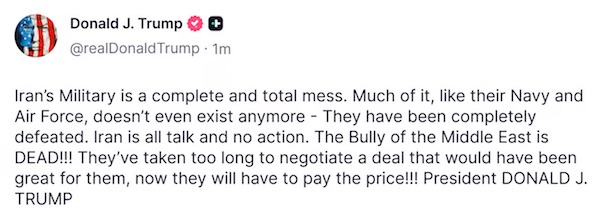
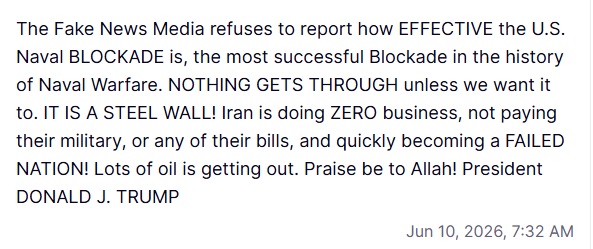
Iran’s Military is a complete and total mess. Much of it, like their Navy and Air Force, doesn’t even exist anymore – They have been completely defeated. Iran is all talk and no action. The Bully of the Middle East is DEAD!!! They’ve taken too long to negotiate a deal that would… pic.twitter.com/qldQQhYZaW
— Commentary Donald J. Trump Truth Social Posts On X (@TrumpTruthOnX) June 10, 2026
Dutch communism starts on January 1st, 2028. pic.twitter.com/PM697NkZmZ
— Wybren van Haga (@WybrenvanHaga) June 10, 2026
I expected a lot of articles, what with the war re-engaging plus the upcoming SpaceX IPO. But…
• Trump Warns: “We’ll Bomb the Shit Out of Them” if No Deal (ZH)
Fox News’ Trey Yingst has issued a new reporting update, quickly on the heels of a fresh Trump-ordered bombing of Iran. He says: “I asked the president what will happen if the Iranians don’t sign an agreement that was put forward by American negotiators. President Trump said, ‘We’ll bomb the shit out of them tomorrow night.'” The president declared “we’ll bomb them to rubble” again tomorrow night if there is no deal by then.Read more …
US MILITARY SAYS IT HAS COMPLETED LATEST STRIKES IN IRANTonight’s aggression has prompted Tehran to once again declare the Strait of Hormuz closed to “all types of vessels”. Bombs have not yet fallen directly on the capital, but reportedly outside of it. This could quickly change. Importantly concerning Trump’s latest claims, Iranian leadership is denying that it engaged Trump directly tonight. The highlights from Fox’s Yingst:
- The President told me he spoke directly with Iranian officials tonight who asked him to stop bombing.
- 49 Tomahawk missiles had been fired by the United States at the time we spoke, along with bombing from fighter jets.
- Closest target to Tehran was approximately 40 miles outside of the city.
- Trump added that the bombing will stop shortly, but that if they don’t sign the agreement, “we’ll bomb the shit out of them.”
- President Trump called this “the most violated ceasefire in the history of the world.”
- Vice President JD Vance told me the United States is dealing with both moderate and more extreme voices in Iran as part of the negotiation process.
Spoke with President Trump tonight as he oversaw the U.S. military strikes against Iran from the Situation Room.
— Trey Yingst (@TreyYingst) June 10, 2026
The President told me he spoke directly with Iranian officials tonight who asked him to stop bombing.
49 Tomahawk missiles had been fired by the United States at… pic.twitter.com/s4WnsPTO4dTasnim is now reporging fresh Iranian counter-attacks on US bases across the Gulf, with multiple explosions being reported at American bases in Kuwait and Bahrain. The IRGC is now claiming to have struck 18 US military targets in two waves.
Bahrain is where a key naval command headquarters is located, and the Iranians are newly claiming a direct targeted strike on the US Navy’s Fifth Fleet headquarters. We are once again witnessing the ‘escalation ladder’ ramp up, and negotiations seem in reality nowhere on the horizon. This could be the start of several more days of strikes and counter-attacks to come, as Tehran is not so easily going to come back to the negotiating table, hat in hand. But it seems the White House is still betting on this, though risk and unpredictability are skyrocketing at this stage.
Newly emerged widely circulating video shows an Iranian Cold War-era relic still active:
Iranian F-14 Tomcat fighter jet landing at one of the air bases in Iran.
— Status-6 (War & Military News) (@Archer83Able) June 10, 2026
Video claimed to be from tonight. pic.twitter.com/4ZNTJKa2k7US Begins strikes on Iran
After multiple previews of the main event, US Central Command said that its forces began launching additional self-defense strikes today at 5:15 p.m. ET against multiple targets in Iran at the Commander in Chief’s direction. “The strikes are in response to Iran’s unwarranted and continued aggression.” Local Iran media reported that explosions had been heard in the Iranian towns of Sirik, Manab, Bandar Abbas and Bushehr, while Al Hadath reported than an explosion was heard in the Al-Saban military camp in Aden, Yemen. Additionally, there are unconfirmed reports that retaliatory Iranian ballistic missile launches are already underway, amidst what appears to be the resumption of a new round of U.S. strikes on Iran.
“There were no immediate reports of casualties in any of the attacks.”
• Trump Says “US Will Be Attacking Iran Hard Again Today”, Oil Spikes (ZH)
Oil surged, jumping by more than a dollar with WTI rising above $91 with Brent touching $94 after President Trump vowed to strike Iran again and slammed the country for delaying talks on an interim peace deal, after renewed attacks overnight put further strain on a fragile two-month truce. “We’re going to be attacking them, attacking them very hard,” Trump told reporters at the White House Wednesday. “We hit them hard yesterday, and we’re going to hit them hard again today.”Read more …
Trump declined to say what targets US forces would hit in Iran. The president renewed earlier criticism that Tehran has taken too long to negotiate an end to the conflict. “I’ve been working with Iran for a number of months, and they should sign their deal,” he said. “It was just tap, tap, tap, I don’t know what they’re doing.”
BREAKING: President Trump says he is going to continue bombing Iran "very hard" after it shot down a U.S. helicopter over the Strait of Hormuz.
— Fox News (@FoxNews) June 10, 2026
"We're going to be attacking them and attacking them very hard."
"I've been working with Iran for a number of months, and they should… pic.twitter.com/tlO6S10uyoTrump said he retaliated against the Islamic Republic for shooting down a US Apache helicopter near the Strait of Hormuz. Tehran has not confirmed shooting down the aircraft and said it was reconsidering whether to persist with negotiations in light of the US attacks. “The diplomatic process doesn’t happen in a vacuum and to advance any diplomatic process you need a minimum space to be able to move forward,” Esmail Baghaei, a spokesman for Iran’s Foreign Ministry, was cited by the state-run Islamic Republic News Agency as saying. “Wherever necessary, our armed forces will respond to the enemy with authority.”
Trump’s comments came after the two sides once again exchanged strikes, underscoring how high tensions are running and the risk that intermittent indirect talks between Iran and the US may be derailed. The overnight clashes followed a direct confrontation between Iran and Israel earlier this week, but halted after Trump called on both sides to stop. Since almost the start of the conflict, Trump has swung from threats of intensified attacks to touting that a deal is within reach. Even with tensions escalating since last week, he had signaled he wants to contain hostilities and avoid a return to all-out war before the new post.
A White House official said talks are still ongoing and that the US will exert maximum pressure until a deal is reached. Fox News first reported the status of the talks. The semi-official Iranian Students’ News Agency reported that a Qatari delegation arrived in Tehran on Wednesday to discuss the diplomatic process to end the war. The US military said it had completed an operation that saw fighter jets strike Iranian air defenses, ground control stations and radar sites near the Strait of Hormuz. The Islamic Revolutionary Guard Corps launched missiles on four American targets, including shelters housing F-35 fighter jets and a command center for the US military at Al-Azraq Air Base in Jordan, state-run IRIB News said on Wednesday.
Iran also said it fired drones at the main US naval base in the Middle East, located in Bahrain, and struck Ali Al Salem air base in Kuwait. Kuwait’s defense ministry said it had intercepted projectiles early Wednesday, while Jordan said it had intercepted five Iranian missiles. Tehran said it had exercised its “inherent right to legitimate self defense” and warned regional states not to allow the US and Israel to use their territory as a staging post for strikes on the Islamic Republic. There were no immediate reports of casualties in any of the attacks.
It’s all he can do?! Is to shorten the timeframe.
• Trump ‘May Keep Going’ With Strikes As Iran Took ‘Too Long’ With Deal (ZH)
More strikes coming? Trump is certainly strongly hinting at this, and yet an overall strategic vision still remains murky and ill-defined. Once again he in a short 12-hour period went from hyping a deal being a few days away, to now threatening yet more attack waves on Iran, in wake of last night’s: President Trump said Wednesday that he’s close to ordering more strikes on Iran after the country’s attacks targeting American bases in Persian Gulf nations, according to Fox News’ Trey Yingst. Mr. Trump said he “may keep going” with strikes, which he said would target power plants and bridges, because Iranian negotiators are “tapping the United States along,” according to Yingst. He wrote on Truth Social just before these comments that Iran will have to “pay the price” after taking too long to proceed with negotiations.Read more …
Trump: Iran Took Too Long To Negotiation, Now Will ‘Pay’
As part of what the United States is calling its latest ‘defensive strikes’ after Iran shot down an Apache helicopter in the Hormuz region, American forces overnight into the early Wednesday hours targeted “air defense, ground control stations, and surveillance radar sites” – the Pentagon said. Iran confirmed that there were indeed fresh attacks around Bandar Abbas and Qeshm Island, but gave no details on the damage, or info on other strikes potentially conducted elsewhere across the Islamic Republic.“The operation was a proportional response to recent attacks on U.S. forces and international commercial ships transiting regional waters,” US Central Command (CENTCOM) said. Trump is meanwhile again lashing out at Tehran, claiming its military is now a “complete and total mess” – and yet it keeps responding:
Oil reacts, sensing no peaceful off-ramp or de-escalation on the horizon…
Kuwait, Bahrain, Jordan Hit Hard by Iranian Overnight Attack
Tehran later claimed attacks in Kuwait, Bahrain and Jordan as fulfilment of its previously vowed ‘retaliation’ – and given these countries host American forces. This marks merely the second time this week the ceasefire was ignored (or rather, shattered – though the White House is maintaining it’s still on) with major tit-for-tat strikes, as each side asserts that it is acting ‘defensively’.Iran has been saying it’s going to keep up the pressure on Washington and its Gulf allies through both the ‘battlefield and diplomacy’ – with Iran’s Foreign Ministry spokesperson Esmaeil Baghaei freshly charging that the US is “undermining” the diplomatic process through “contradictory messages, frequent shifts in its positions and demands, as well as repeated violations of the ceasefire.” He indicated that at this point there’s not even the “minimum level of conducive conditions” that is “required in order to carry out diplomacy effectively.” Bahrain and Kuwait got hit hardest in these newest strikes, with reports saying the US Fifth Fleet base came under fire:
BREAKING: Footage shows a ground-level explosion in Manama, Bahrain from an Iranian missile strike in the direction of the US 5th Fleet HQ minutes ago, with up to 20+ separate explosions now reported across the city. pic.twitter.com/LCHlZBGKra
— The Hormuz Letter (@HormuzLetter) June 10, 2026
“Now, if the IRGC fired rockets in our general direction, I would unleash unholy hell on them. That’s not how Donald Trump operates.”
• Don’t Panic About Trump’s Iran Strategy Just Yet (Kurt Schlichter)
As for military power, we’re holding off on fully exercising it for now. At least, that’s what it looks like to outsiders. I have absolutely no inside information on it, but it’s pretty clear what’s happening. Our forces are watching, rearming, and more importantly, assembling a juicy target list for when the president says, “Go.” One problem with holding back on the “M” is that it makes us look passive to the enemy (and others), even if we’re actually aggressively preparing. The lack of “M,” therefore, can be an “I” issue.Read more …
Now, if the IRGC fired rockets in our general direction, I would unleash unholy hell on them. That’s not how Donald Trump operates. We’ve seen before that he is willing to absorb fires that have no substantial effect in order to avoid increasing the military effort, which would be at the expense of the diplomatic, informational, and economic initiatives. In other words, he is choosing to let them shoot rockets at us, which we shoot down, and not retaliate as long as no one gets killed because he doesn’t see it in our interest to go kinetic again right now.That option is still there, and we have another ace up our sleeve—our loyal friend (the ravings of idiots like Thomas Massie aside), Israel is ready to pummel them when they get uppity. Trump can sit back and look diplomatic, playing the good cop to Netanyahu’s bad cop. At the same time, Trump can make some noises—diplomatic and informational—about Israel not crushing Hezbollah in Lebanon, and then Israel can continue with its righteous work of crushing Hezbollah in Lebanon while Trump gets to shrug, while in the background, you hear the sad trombone. “Don’t blame me—that kooky Bibi is out of control. Oh well!”
Among some of us who generally feel as I do about the need to defeat these creeps, there’s concern that Donald Trump is about to give the mullahs pallets of cash and generally surrender in order to get this whole thing over with. It was not as fast as the Venezuela mission, and now he wants out at any cost. That’s just crazy talk. Some people with whom I often agree are very worried that Donald Trump doesn’t understand that the Iranians are a bunch of liars who will never keep their word.
But here’s the thing—Donald Trump’s not an idiot. He knows they are a bunch of liars who will never keep their word. But he really doesn’t need them to keep their word, because the hypothetical agreement is not the end state he’s after. The end state he’s after is the fall of the Islamic regime via economic strangulation, which will take time. The deal is a deception, a shiny distraction from the real objective.
We keep hearing how Trump doesn’t have time because the midterms are coming and those gas prices have to come down, but it’s the Iranians who better listen to that clock ticking. Trump’s worst-case scenario is that he loses the House. Their worst-case scenario is that they lose their heads, and that’s what Trump’s betting on. Time is on our side, even if too many weak Westerners have forgotten the importance of strategic patience. Life is not MTV; you can’t win if you have the attention span of a gnat on meth. Rome wasn’t built in a day, and Tehran won’t fall in one.So, if my analysis is correct—and my bias is that I want it to be correct—then Trump is leveraging all the DIME elements to attain the end state of regime change, but he’s not telling us that.
That’s one of Trump’s things—he never tells people exactly what he’s doing, but his plan is pretty obvious if you don’t panic and take an objective look at what’s happening. He keeps talking about a deal, but it’s ridiculous to think that he’s somehow so eager for any agreement that he would sign his name to something that disgraces him forever. If there’s one thing Donald Trump doesn’t do, it’s let himself be humiliated, and he’s certainly not going to allow himself to be humiliated by this bunch of perverted weirdos. The Iranians think dragging out the negotiations helps them. It does create a pain point for Trump in the midterms, but they’ve got a lot more to lose. He can suck it up. Can they?
Now, I could be wrong about all this. Donald Trump could be eager to sign an awful deal, and that will have him go down in history as a giant joke who allowed these 7th-century pagan fanatics to humiliate him. But does that sound like Trump? When’s the last time he gave in and allowed himself to be humiliated? He doesn’t do that. And the idea that, somehow, he and his advisors don’t see the obvious reality that the mullahs are weasels and they are playing for time is just silly. I could be wrong, but I don’t think I am. We are constantly hearing about how Trump is supposed to be throwing in the towel, yet the towel never gets tossed. Where is the terrible deal he has allegedly been right on the verge of signing since April? Nowhere. It doesn’t exist. And yes, the clock is ticking, but for whom?
That’s how I interpret his strategy from the outside. Again, it’s probably not what I would do. I would take this opportunity to blow our enemies all to hell. But there’s more than one way to skin a strategic cat. The idea that Donald Trump is flailing and totally lost could be accurate, but it would be out of character and a departure from his now decade-long history of being in the public eye. More likely, he is stretching this out because every day they get weaker, while he can absorb the pain.
All the critiques of Donald Trump and the Iran War depend on either thinking that Donald Trump is an idiot, which is wishful thinking for his opponents, or residual concern that he’s not going to unequivocally win this war. I get the concern that he might be so eager to close this chapter that he cuts and runs, but you must ask yourself something. When has Donald Trump ever cut and run? Why would Donald Trump ever allow not only his own personal humiliation, and not only the humiliation of his country, but the endangerment of his country from these wounded animals who would happily nuke us the second they finished off Tel Aviv?
You might not agree with Trump’s strategy, but he has one. And he’s the guy who got elected, so he gets to set the strategy. It could very well work. Now, is this wishful thinking? Maybe, but his history gives the president grounds to expect some trust. He has never screwed us, and why would he start now to help an enemy he has been railing against for almost 50 years?
So don’t panic. Chill out. Watch what happens. I’m betting on the United States.
I am not impressed.
• Former MI6 Spy Alastair Crooke: Iran Takes Its Chances With War (RPI)
The US war with Iran has moved beyond its initial phase to an emerging new one — one in which Iran implicitly stakes its chances on the next phase being war. Most likely this will be in abbreviated episodes of limited war, but possessing nevertheless a potential to widen regionally, should the US (and Israel) elect to sharply escalate. The new phase involves risk of course, yet Iran holds the high cards of an ability to impose disproportionately heavier damage upon Gulf infrastructure as retaliation for any hurt inflicted upon it — and the awareness that the West is edging ever closer to dropping off the energy “cliff.”Read more …
The three pillars underlying this shift are firstly, confidence that Iran will not (and cannot) be shifted from its hold over Hormuz, and that in consolidating its administrative structures there, the reality of Iran’s hold over Hormuz will increasingly be assimilated by states, and reflected in their coming to terms with Iranian-Omani control. Associated with this core principle is Iran’s implementation of escalated deterrence vis á vis the American naval blockade. Any attempt to intercept or attack Iranian vessels or interfere with the Strait’s administration will be met with increasingly harsher ripostes. Ultimately this policy may lead to Iran imposing increasing levels of damage to US naval vessels – another friction point.On 3 June, for example, the US fired a hellfire missile at an Iranian oil tanker near the Strait of Hormuz. In response, a US-owned (or partly-owned) ship, The Panaya, was struck with missiles. Additionally Iran launched three waves of cruise missiles at the US air and helicopter base in Kuwait from where the attack had originated. Images have emerged of serious damage at Kuwait international airport too (although the cause of the damage remains disputed). The second underlying principle affecting this shift simply reflects Iranian disdain for Trump’s continuous inflating of demands, exaggerated threats (which palpably fall short of US capacities), together with his continual zigzagging and contemptuous rhetoric towards Iran.
The Iranian leadership has concluded, it seems, that compromise will likely not be forthcoming, and that it is better to cut the “negotiations” rather “than continue the pointless bad-faith negotiations with a deceitful and decrepit American regime,” as the New York Times has termed the Iran “negotiations” — suggesting that the “deal chaos” is not a singular glitch by Trump confined to the Iran issue, but rather is a consistent pattern of dysfunctionality repeating itself across virtually all of Trump’s “peace” initiatives.
Behind Iran’s decision to suspend talks however, likely lies the gradually dawning clarity, seeping out from Israeli and American statements and analysis, that the true objective of the 28 February US-Israeli sneak attack was never regime change per se — aiming to swap out Iranian “hardliners” for a “Delcy Rodrigues”-style more moderate leader; but was intended rather, to bring about Iran’s complete destruction and fracturing — an insight that was bound to shift Iran’s calculus.
This insight has consolidated public support for the Islamic Republic hugely, and at the same time has turned the war into an existential struggle to preserve the ethical values of the Revolution. Seen from this optic, there is little for Iran to discuss with Trump, bar some future modus vivendi — as and when, Washington understands that it is boxed in, and that new realism takes a hold.
The third principle undergirding this new phase of conflict is the one enunciated by Iran from the outset of the Islamabad talks: “Ceasefire for all; or ceasefire for no one.” This was again re-emphasised in Iran’s latest ultimatum to Trump: “If the Israeli threats from last week to flatten the Beirut southern suburb of Dahiyeh had been executed, then Iran would have stricken northern Israel hard with its missiles. ‘It was a ceasefire for all – or no ceasefire.”
Trump chose the ceasefire, and subsequent to his call with Netanyahu, announced that it was in effect. He told Netanyahu to cancel his planned bombing of Dahiyeh in south Beirut. In Israel, a massive wave of anger from all sides of the political spectrum attacked Netanyahu at the very notion of curbing any Israeli attacks in Lebanon. Former PM Naftali Bennett accused Netanyahu of “losing control over Israeli sovereignty.” And former PM Yair Lapid said Israel had been reduced to a “vassal state” after the strikes were called off.
FOMO.
• The IPO Boom: Where Will the Money Come From? (Michael Lebowitz)
The media hype surrounding SpaceX’s upcoming mid-June initial public offering (IPO) is immense. The company recently filed its S-1 with the SEC, targeting a valuation of $1.75 trillion and a capital raise of up to $75 billion. Some believe its valuation could rise to $2 trillion after the IPO. In its wake, Anthropic (Claude) and OpenAI (ChatGPT) confidentially submitted IPO registration statements to the SEC. Expectations are that both AI model companies will enter the market within the next 3 to 6 months, with rumored valuations approaching or exceeding $1 trillion each. Stripe, the quickly growing payments company, is rumored to be on the IPO docket as well, with a valuation that could exceed $150 billion. Consequently, the coming IPO boom will have wide-reaching impacts.Read more …
The IPO market, which has been stagnant for the last four years, is bubbling with excitement. The headlines surrounding the IPOs are hyperbolic, banker fees are enormous, and social media is teeming with bullish sentiment on how high the new shares may trade after going public. While IPO boom talk is great for clickbait, nobody is asking the most important question. Where will the money come from?Putting Context To The IPO Boom
To understand the size of the coming IPO boom, some historical context is necessary. Prior to the pandemic, the US IPO market raised approximately $30 billion per year. In late 2020 and throughout 2021, the SPAC boom led to a surge in IPO offerings. Since then, however, as we share below, IPO issuance has been relatively lean.The 2026 pipeline is shaping up to be the second-largest in at least the last ten years. SpaceX alone is raising up to $75 billion per its SEC filing. Add OpenAI’s expected cash raise of $60 billion, Anthropic at $15 to $20 billion, and Stripe around $10 billion, and the pipeline of known IPOs coming to market is approximately $160-$165 billion. Moreover, the total market valuation of these deals could surpass $4 trillion. Assuming no other deals come onto the market, the four deals would be larger than the last four years’ worth of deals combined.
Dilution vs. Capital Absorption
Some pundits are using the word “dilution” to describe the impact of the IPOs on the market. While not necessarily misused, the term is most often used to describe what happens when a publicly traded company issues new shares in the market, diluting the value of existing shares. Simply, existing shareholders who do not buy new shares see their ownership percentage decline. Given that the expected stock offerings are IPOs rather than add-on offerings by a publicly traded company, the term “dilution” is not appropriate to describe the upcoming offerings. The more accurate term is capital absorption.Capital absorption is the process by which large new stock offerings pull money out of existing financial markets, as investors sell existing holdings or redirect cash to purchase newly issued shares. While it is true that someone must buy the shares being sold to fund an IPO purchase, that buyer, in most cases, is simply recycling existing market capital rather than introducing new money. Thus, while an IPO is not dilutive to the stock being offered, it is dilutive to the financial markets, as the total investible dollars, in theory, remain unchanged; they just get spread out a little more thinly.
Where Does IPO Capital Come From?
IPO capital comes from three primary sources, each with consequences for existing market participants.The first is institutional rebalancing. A large asset manager running an equity portfolio that wants meaningful exposure to a new IPO must trim existing positions and potentially use existing cash or raise new funds to create room for the new holding. While selling by any manager is unlikely to create a ripple in the market, because the stocks, bonds, and other assets they sell vary widely, simultaneous selling across thousands of institutional portfolios can have an impact.
The second is retail liquidation. Similarly, individual investors who want to participate in an IPO need cash to do so. Some of that cash may come from savings, but like most institutional accounts, they will raise cash by selling existing equity holdings. Keep in mind that every retail investor who liquidates an S&P 500 index fund to buy SpaceX or another IPO is, de facto, a seller of all of the stocks in the index.
The third source is capital from sovereign wealth funds, pension funds, and foreign institutional investors, who are expanding their equity holdings. Often, their funds represent new money entering the financial markets rather than a rotation within them. The participation of these funds might reduce the impact of IPOs on other stocks and financial assets.
The net effect of all three sources is that existing holdings largely fund new ones. At the scale being contemplated in 2026, that rotation is large enough to create a meaningful headwind across financial markets.
BIG money.
• Massive SpaceX IPO Demand Coming From Gulf Sovereign Wealth Funds (ZH)
One week ago, SpaceX kicked off its institutional roadshow, headlined by JPMorgan CEO Jamie Dimon, who hosted a nationwide “live interactive discussion” with private wealth clients. The latest signal of investor demand comes from the Gulf, where massive sovereign wealth funds are reportedly seeking allocations in the IPO ahead of its expected Friday debut, according to Bloomberg News. The report says Saudi Arabia’s Public Investment Fund and Kuwait Investment Authority have each placed orders for the IPO worth $1 billion to $5 billion, while the Qatar Investment Authority is also expected to make a significant commitment.Read more …
The report continued: “Entities based in the region are already prominent shareholders in Elon Musk’s rocket, satellite and AI firm, and many are sitting on large paper gains based on the billionaire’s targeted valuation of $1.8 trillion, the people said. It wasn’t immediately clear how much of the planned outlay is intended to prevent dilution of existing stakes after SpaceX’s listing.The interest from the Gulf is part of a broader rush into the deal from global institutional investors, whose orders have exceeded the number of shares on offer. Some have bid for $10 billion or more of stock, Bloomberg News has reported, though the eventual allocations might be smaller. In a separate report, Reuters says the IPO is three-and-a-half to four times oversubscribed, highlighting massive institutional demand for what is shaping up to be the largest listing on record and a defining moment for the space economy.
Elon Musk has joined several Zoom meetings with potential investors, while SpaceX President Gwynne Shotwell and CFO Bret Johnsen were expected to meet with roughly 300 institutional investors at a Morgan Stanley lunch in Manhattan. Goldman Sachs was selected as the lead bank for the IPO, alongside Morgan Stanley. JPMorgan, Bank of America, and Citigroup are also among the 23 banks working on the deal, offering a staggering $75 billion by selling about 555.6 million shares. The planned IPO price is about $135 per share. Why SpaceX’s IPO Is drawing record investor demand…
We offered readers a complete deep dive into the mechanics of the SpaceX offering and how to trade the world’s biggest IPO (read the report). SpaceX’s underwriters have shut off investor access to the offering in China and Hong Kong, primarily due to regulatory and compliance concerns. However, there is a concerted effort by unhinged leftist lawmakers (such as Elizabeth Warren) and left-wing pension funds to delay or deny the SpaceX IPO, mainly for political brownie points. They appear to view the sudden new wealth generated for Elon Musk (and his employees and investors) as absolutely horrifying…
NEW: Elizabeth Warren is calling for the SEC to delay the mega SpaceX IPO.
— Matt Egan (@MattEganCNN) June 10, 2026
Warren cites concerns about "questionable valuation," governance structure & mandatory arbitration pic.twitter.com/4mQqzTtYRs… given that Musk is pro-humanity and seeks to liberate the world’s minds from toxic progressive causes.
Fighting over limited resources.
• AI Price Wars Begin: OpenAI Considers “Drastic Price Cuts” (ZH)
Earlier today, in a report discussing how “AI bills are out of control”, JPMorgan tech guru and TMT salesman, Mark Schilsky wrote that “most of my high level investor discussions focus on one major topic: when will the party end? Put another way, tech investors have made so much money in Semis so quickly that they are looking for potential warning signs that the music is about to stop. Predicting such an end is incredibly difficult. As such, investors are searching for forward-looking indicators that might suggest the AI party is nearing a peak.”Read more …
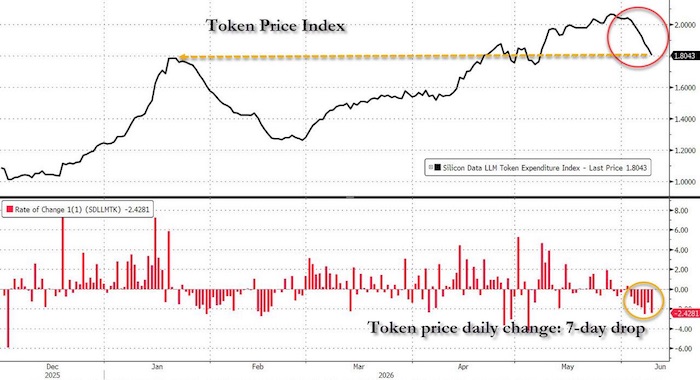
Here, the JPM trader highlighted perhaps the clearest indicator that the music was about to stop: “A slowdown in the growth of the annualized run-rate revenues of the major AI labs. If there is any sort of second derivative ‘kink’ in their growth algorithms, that could portend a future problem for the AI trade.” In response to this, we pointed to just such a “slowdown in the run-rate revenues”, when we showed that the Silicon Data token price index is down for 7 straight days to a level last seen in mid-January, or long before the current agentic craze started. Almost as if it knew something…
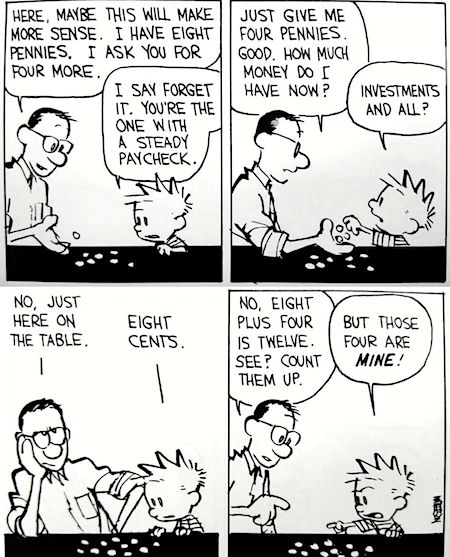
Turns out it did: late on Wednesday, with futures surging and Korean stocks erasing a nearly 5% drop and turning green, and euphoria generally back front and center, the WSJ may have burst the AI bubble when it reported that – contrary to conventional wisdom that token prices will magically go to infinity – OpenAI, which has been badly lagging both the revenue and IPO race with Anthropic in recent months – was considering “drastically lowering the prices it charges users” in a panic scramble to regain market share and win back customers from archrival Anthropic.And so, at a time when there is suddenly a mass realization that token prices had been soared in recent weeks, a wake-up call which JPM lovingly described as follows: “investors have been discussing the possibility that much of the token spend that corporate America is currently incurring is ‘wasted’. Anecdotes from companies like UBER aren’t helping this narrative”, OpenAI is weighing significant cuts to what it charges for tokens. Hilariously, the move would be in anticipation of similar cuts the company expects at Anthropic, which is trying to double how much it charges for its latest model, Fable, which provides at best a very modest modest improvement in performance over Opus 4.8.
In short, we now have a classical deflationary race to the bottom, precisely the opposite of what the profit-strapped industry desperately needs to grow into its gargantuan balance sheets (and massive SPVs); Instead, the AI world is about to get hit with a collapse in both revenues and profit margins, while cash burn goes into full-on incinerator mode. Warning that “business executives have begun to balk at the high prices for AI usage”, the WSJ writes that OpenAI CEO Altman said at a recent event that costs had become “a huge issue.” “I think we’ll have a lot of ways we can help people get more value for less spend,” he said.
“Last week, the Knesset, Israel’s parliamentary body, voted unanimously on the reading of a bill that would dissolve itself. “
• Netanyahu Faces Election Chaos as Knesset Moves to Tear Itself Down (Queen)
Parliamentary governments fascinate me. The idea that a group of legislators can vote, say, “Forget it, let’s tear it all down,” and call a general election at just about any time blows my mind. I listened to a couple of podcasts from The Spectator on Tuesday night that discussed the growing dissatisfaction with Prime Minister Keir Starmer among the rank and file in the Labour Party (and, honestly, across the rest of the country) and how a leadership crisis is brewing among party faithful. It could potentially lead to a call for a general election barely two years after the election that ushered Starmer into No. 10 Downing Street.Read more …
Israel could be the latest parliamentary nation to pull the trigger on a general election. Last week, the Knesset, Israel’s parliamentary body, voted unanimously on the reading of a bill that would dissolve itself. The Times of Israel reports: “Following a lengthy Knesset debate, lawmakers early Tuesday voted 106-0 in favor of the first reading of a coalition bill to dissolve the Knesset, potentially triggering early elections. The dissolution bill, which must pass three readings in the plenum to pass into law, had been approved for its first reading in the Knesset House Committee on Monday morning and was immediately referred to the plenum for a vote. No date has been set for the final readings of the bill.Due to internal coalition disagreements, committee chairman and coalition whip Ofir Katz advanced the bill without specifying an election date, stating that it would be inserted into the legislation only prior to its final two readings. In the meantime, Katz only said that the range of dates will be somewhere between September 8 and October 20.
The potential elections would take place weeks before the already scheduled Oct. 27 general election, which means that this session of the Knesset could dissolve just a few days before a full term. The fractious coalition of parties that put Prime Minister Benjamin Netanyahu back into office has its tensions after a budget bill failed to address the controversial issue of military draft exemptions for ultra-Orthodox (Haredi) Jews.
“Israel’s 25th Knesset had been expected to be one of the few to serve its full four-year term,” explains Joel Braunold of the Chicago Council on Global Affairs. “But while lawmakers successfully approved a budget in March, Netanyahu’s coalition government failed to pass legislation that would exempt ultra-Orthodox yeshiva students from mandatory military service, prompting key parties to call to disband the 120-seat Knesset. Faced with a possible rebellion, Netanyahu’s Likud Party submitted the dissolution bill in an effort to retain some control.”
Netanyahu is pushing for the latest possible date in the hopes that he can deliver legislative, military, and diplomatic initiatives before the election. All of this matters because his party announced that he will run in a general election. “Prime Minister Netanyahu will run in the upcoming elections,” announced the Likud Party in a statement. “With God’s help, he will win.” The announcement came after President Donald Trump complimented Netanyahu in an interview with ABC News. “If Bibi even wants to continue… I don’t know, he’s had an amazing career,” Trump told ABC’s Jonathan Karl. “Does he want to continue? Because you know, he’s a wartime prime minister.”
“We will very shortly win the war one way or the other, and you know he’s a wartime prime minister,” Trump added. “That’s okay, just like I’m a wartime president.” The prospects for a Netanyahu victory don’t look great.
JUST IN: Bibi Netanyahu has a 33% chance to be the Israeli Prime Minister after the ‘26 election pic.twitter.com/EJBqBUsIfB
— Kalshi Politics (@KalshiPolitics) June 10, 2026“Regardless of whether the election happens on September 8, October 27, or any date in between, the vote will be critical for the future direction of Israel,” Braunold points out. “How it goes could determine whether Netanyahu cements his legacy in office or potentially in prison. And what happens has the chance of not just shaping the country but the entire region.” Keep an eye on our biggest ally in the Middle East. It might be a bumpy ride for the next few months.
“It is not shocking to us.”
• President Trump Delivers Shocking Response to Question About USMCA Renewal (CTH)
It is not shocking to us. It is not shocking to anyone who has followed this story for the past few years. It is particularly not shocking to you. However, the Canadians are going bananas right now. President Donald Trump responded to a question about the current status of the USMCA trade agreement, or what Canada calls CUSMA. Watch and listen to how President Trump points out that he has no intention of renewing the USMCA. This has been obvious since May of 2025.Read more …
I don’t want to say ‘I toldya so’, but….
Interesting?
• Interesting Names Being Floated for Permanent DNI Role (CTH)
According to The Gateway Pundit there are five names being debated for permanent DNI. Qualifying any comment by saying this is entirely speculation, a few have asked me for opinion.Gateway Pundit posits the names: GOP Representative Elise Stefanik, GOP Representative Rick Crawford, current Deputy Director of the CIA Michael Ellis, Vice President JD Vance’s national security adviser Cliff Sims, and former GOP Rep Jason Chaffetz. Names not mentioned in that article include former HPSCI Chairman Devin Nunes or former Representative now U.S. Attorney for North Carolina Dan Bishop.Read more …
Without being fully transparent about how I am reaching my perspective, here’s my take on these names.I have not seen Michael Ellis in this discussion before. However, he would be a very solid consideration. Ellis is a very straight, non-pretending, deliberate and serious person. With a firm grasp on the problem, Ellis would be a solid option. Current HPSCI Chairman Rick Crawford would also be a solid consideration. As current HPSCI Chairman Crawford has worked with Tulsi Gabbard, and he does have a very firm grasp on the nuances and issues within the current intelligence community.Dan Bishop’s name has not been mentioned by many, but he would also be an asset in the role. At least he should be interviewed to see if he thoroughly understands the problem and would be willing to confront it. Stefanik might want the job and might be the favorite of White House Chief of Staff Susie Wiles, but I’m not sure Stefanik is strong enough to stand up to the pressure within the overall intelligence apparatus. There’s a general pretending that often comes from DC familiarity as well as willingness to go along with norms and status quo. Stefanik is not a disruptor.
It doesn’t seem like Devin Nunes wants the job, for all of the reasons why a tenured IC person wouldn’t want the job. Jason Chaffetz would be worthless, as he was when Chairman of the House Oversight Committee. I don’t know enough about Cliff Simms to give an opinion.
Ranked: Ellis, Crawford, Bishop.
Concerning: Stefanik, Chaffetz.
Best Route: Give strong weight to Tulsi Gabbard’s recommendation.
“As late as 2014, Ann Coulter was arguing that the growing popularity of soccer reflected the moral decay of the country.”
Highschools push other sports as the money makers. So if you’re athletic, you don’t play soccer. It’s a girls’ sport.
• Why America Sucks at Soccer (Rick Moran)
loomberg published a revealing Morning Consult poll on U.S. interest in the World Cup soccer tournament, which kicks off on Friday. More than half of all U.S. adults say they won’t be watching any of the 104 matches available to stream on Fox One, Fox, F1, and Fox. Just 13% of U.S. adults said they planned to watch any of the matches. Breaking the poll numbers down by generation, Gen Z is the most interested, with 23% “very likely” to watch some of the games. On the other hand, 59% of Boomers are “not likely at all” to watch any of the games.Read more …
Playing soccer in the suburbs has been a rite of passage for kids for the last 40 years. But by the time these soccer kids reach high school, most of them have lost interest. Little girls love the women’s national team, which, until recently, was far more popular than the men’s national team. Having dumped much of the political correctness, the U.S. women are once again one of the top teams in the world. They will be one of the World Cup favorites in Brazil next year. The men are better than they used to be, but they are still in the second or third tier of international excellence. This is insane. Billions of dollars go into youth soccer in America, and that might be the problem.UnHerd:”Landon Donovan — the finest player the country has produced — recently put the blame on American soccer’s youth system. His complaint centers on the win-at-all-costs mentality that seemingly grips the system. Parents and coaches, Donovan argues, “get obsessed with winning just as much as the coaches do because they’ve been told that’s what’s going to get their child to college and professional — and it’s all bulls**t”. In truth, of course, children don’t need to be the next Pelé in kindergarten; they just need to develop a feel for the game that scoreboards can’t reward.
It’s here where the money comes in. Youth sports in America are now a $40 billion industry — and private equity has quietly captured a great deal of it. Firms such as Juggernaut Capital have rolled up hundreds of local clubs into national conglomerates; 3STEP Sports, backed by Juggernaut, controls more than 1,500 events serving more than two million athletes a year. The tactics are the familiar ones of private-equity extraction: junk fees, long contracts, mandatory and expensive travel circuits. What was once an affordable neighborhood activity has been re-engineered into a maximum-extraction machine, with elite youth club soccer now costing many families upwards of $5,000 a year per child.
In Brazil, kids who live on or near garbage dumps play soccer all day, every day. Even in Europe, the game is constantly played by the poorest kids. All of them are hoping to catch lightning in a bottle and get noticed by a scout or youth coach who will take them under their wing and develop their skills. The very best, the very hungriest, and most talented kids are noticed early and brought along in youth programs that the U.S. will never be able to duplicate.
In America, soccer is a game played by suburban kids twice a week and in the occasional tournament. Even the millions of kids who love the game and have dreams of playing in the World Cup are stymied by a youth program that fails them. Every World Cup, enthusiasts proclaim that soccer will take off and become as popular as football and basketball in the United States. They’ve been saying it since 1994, when the last World Cup was played here. It fails to happen not because soccer competes with other sports for attention. It’s something far deeper, rooted in our self-image as a nation.
In 2001, scholars Andrei Markovits and Steven Hellerman published Offside: Soccer and American Exceptionalism. ”Nativistic Americans, the authors found, prefer individualistic and militaristic games that mirror the country’s political culture,” writes UnHerd’s Duncan Moench. Markovits and Hellerman argued that American soccer developed along totally different lines from the country’s more mainstream sports. Given the tremendous strength of US nativism, early on soccer was seen as dubiously foreign: both in origin and application. (As late as 2014, Ann Coulter was arguing that the growing popularity of soccer reflected the moral decay of the country.)
Yet as that early hipster fandom implies, the opposite ended up happening. Study-abroad trips are expensive, and far from becoming a blue-collar pastime like basketball, American soccer ultimately remained the purview of white suburbanites. Though the US has grown the technical capacity to compete at international soccer, those in charge of running our youth system have optimized the program to extract maximum revenue from bougie parents — hardly conducive to honing talent.
In other words, U.S. kids aren’t poor enough or hungry enough to have that overweening drive to make it as professional soccer players. Plus, the game’s appeal loses its luster when kids start playing football and basketball. “The raw athletic talent is almost certainly lurking out there, in the immigrant neighborhoods and the public parks,” writes Moench. “It’s just that we’ve built a machine to price those kids out.” Changing that culture is not high on the priority list of suburban parents who want their kids to get into a decent college, not chase a soccer dream around the world.
SpaceX will IPO in three days. Who currently own it:
— Investing visuals (@InvestingVisual) June 9, 2026
• Elon Musk: 42%
• Founder Fund (Peter Thiel): 10%
• Google Ventures: 7%
• Others: 30% pic.twitter.com/85ruc2soz2
STAGGERING FACT 🚨 SpaceX’s IPO Could Buy Boeing and the S&P 500’s 11 Other Aerospace Companies 🔥 pic.twitter.com/mgvKMVUfnk
— Ming (@tslaming) June 10, 2026
Here’s the chart for current mass to orbit in the Falcon era vs projected mass to orbit after Starship rapid reusability
— X Freeze (@XFreeze) June 9, 2026
It’s the difference between “getting to space” and actually industrializing space
Before Starship, during the Falcon era, mass to orbit grew steadily -… pic.twitter.com/kbWFCKvLNf
Support the Automatic Earth in wartime with Paypal, Bitcoin and Patreon.