
May 072014
 
 May 7, 2014  Posted by at 3:29 pm Finance Tagged with: , , ,  9 Responses »


Arthur Rothstein Descendants of slaves on Pettway plantation, Gee’s Bend, Alabama February 1937

Tyler Durden runs a few lines by us from casino mogul Steve Wynn that paint a micro cosmos of everything that’s going wrong in our economies. Wynn calls the present conditions in which he conducts business “nirvana” because of prevailing artificially low interest rates and downward pressure on the dollar, but he also recognizes who pays for his nirvana. In very few words, he defines with precision how measures ostensibly intended to save the economy instead serve to destroy it, even as – and because -they make it – too – easy for him and his “class” to enrich themselves even further.

Steve Wynn Slams The Fed’s Ominous, Artificial Nirvana

… on one hand, as a businessman, I’m thrilled. Never dreamed that we would see anything so tasty and wonderful as that. On the other hand, it’s a reflection of questionable fiscal and monetary policy in the United States that is artificially depressed interest rates because of quantitative easing by the Fed, which is also sort of killing the value of the dollar and the living standard of the working people.

… if you’re a high-class borrower with good credit rating, this is one of the most tastiest seasons of all time for 2 reasons. You’re borrowing money at artificially depressed rates. And you’re most likely going to pay them back with 85-cent dollars. It’s a perfect storm for a businessperson unless you look at the truth of the matter and the impact it has on your customers and your employees. And that’s a much darker story. It doesn’t lend itself to a soundbite, but it’s — for every businessman in America and any economist that has their heads screwed on right, it’s an ominous situation.

Capital structure now is – these are mostly at the Venetian and the Wynn, things of beauty. They’re lovely, better than you could ever want. I mean, they’ve got everything, low interest rates, long maturities, low covenants. What else do you want? I mean, it’s great. If you look at it from our point of view. But look at it from a consumers’ point of view or a working person’s point of view, who’s paying for all this cheap money? Well, right now, the Fed is. I thought Bernie Madoff went to jail for that.”

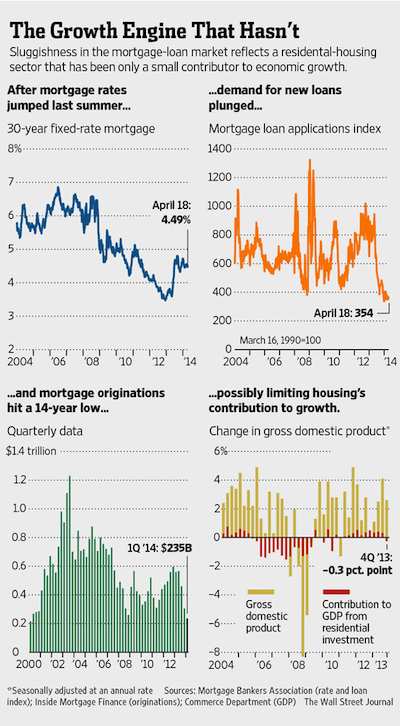
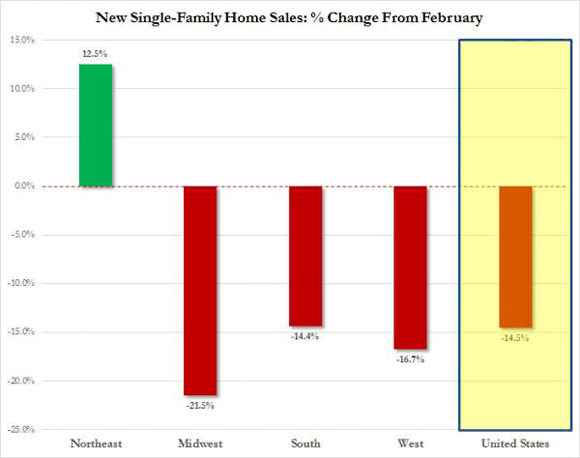
This “policy” of creating the conditions for those who have a lot of money to make a lot more is having consequences that are going to be felt deep inside American society, and for a very long time. In the US housing markets, the only properties that are still selling well are the most expensive ones. In March, sales of homes that cost over $1 million rose 7.8%, while those under $250,000 fell 12%. Since the latter are the vast majority of the market, it’s not hard to see the fall-out for the mortgage industry, construction, home stores etc.

The S&P/Case-Shiller may claim that U.S. home prices climbed 12.9% in the year through February, but that’s just one end of the market. “On the low end, home sales are still making fresh lows every single month”, broker-dealer Newedge’s Robbert van Batenburg told his clients last month. And The American Dream is dead for everybody but the happy few who have enjoyed the tailwinds of the appreciating stock market … ”

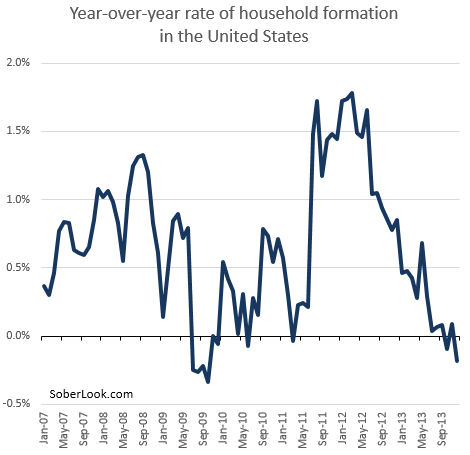
It is not difficult to see why: The Economic Policy Institute says that from 2009 to 2013, wages rose only for the top U.S. earners, but fell for the bottom 90%. Tyler Durden quotes data analyst CoreLogic as saying: “the real estate market is the ultimate reflection of confidence, wealth and income [..] the same factors driving the income stagnation in the middle are driving the income momentum at the top.” [..] That last bit is at the core of all this, as Steve Wynn also acknowledged, even though it’s both denied and ignored across the board: it’s the same factors that serve to both make the rich richer and the poor poorer. Those factors are better known as Fed policies.

This is all not some passing phase which will simply prepare all of America, and all US citizens, for better days ahead; it’s a deciding factor in the demise of the famed American entrepreneurial spirit and the small businesses and jobs that rely on it, a segment of society that’ll be extremely hard to revive once it’s gone. More from Durden:

The Death Cross Of American Business

So much for the recovery… As WaPo reports, the American economy is less entrepreneurial now than at any point in the last three decades. A rather damning new Brookings Institution report shows that US businesses are being destroyed faster than they’re being created. As the authors of the report ominously explain: If the decline persists, “it implies a continuation of slow growth for the indefinite future,” as new business creation has been cut in half since 1978. This is the death cross of American Business!!
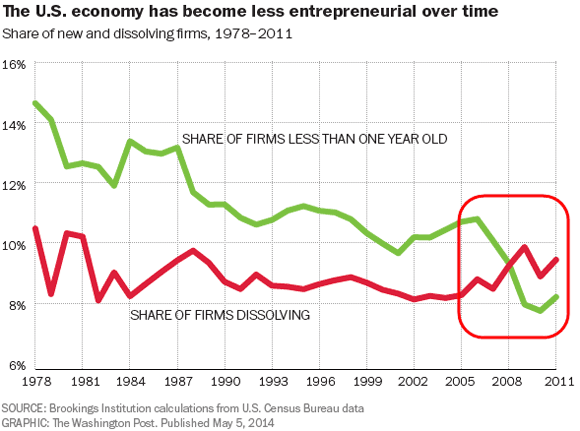
And the bottom line from Brooking’s Hathaway and Litan:

“Overall, the message here is clear. Business dynamism and entrepreneurship are experiencing a troubling secular decline in the United States. Existing research and a cursory review of broad data aggregates show that the decline in dynamism hasn’t been isolated to particular industrial sectors and firm sizes. Here we demonstrated that the decline in entrepreneurship and business dynamism has been nearly universal geographically the last three decades – reaching all fifty states and all but a few metropolitan areas.”

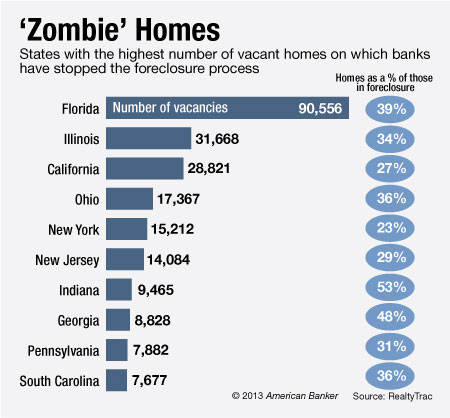
And no, nobody can prove that this is entirely the fault of Fed policies. But neither should anyone feel the need to try. Because it’s obvious that any policy aimed at facilitating the rich MUST make the poor poorer. It’s all just a transfer of money from one group to the other, a transfer hidden through mighty words of trickling growth that will lift everyone’s boat. Eternal hope and there’s always tomorrow. That’s the American dream. Well, say a prayer, because that dream has been dying for decades now, living an increasingly zombified existence fed by increasingly cheap credit that reached its zenith in lying subprime loans and the 7 million foreclosures they – so far – culminated in.

I wish I could say the American Dream has been on life support for decades, but few things are further from the truth. The Fed spent trillions of dollars, all of which use your labor as collateral, as Steve Wynn – again – rightly observes, but none of it went to re-establishing the heart of America as it once was: small business and the jobs it generates, which the US economy has always depended on, plus the home purchases those jobs made possible. Instead, Greenspan, Bernanke and now Yellen (and their made men) made sure to kill off that heart of America, for many years to come, by creating the ideal circumstances for Wynn et al to prosper even more.

That is, in the short term; Steve Wynn does seem to understand that this is all but certain to turn against him and his wealth medium and long term. Because it’s a one-on-one trade off: the Fed has not only done nothing at all to provide stimulus for the heart of America, it’s cut and dug a deadly hole in that heart in order to satisfy the bankrupt banks and bankers who are the greediest members of society. It could have, and should have, spent its stimulus in radically different ways. At least, if its goal would have been to bring recovery to America. Phoenix Capital:

The Fed Could Have Bought California & Texas With QE Money

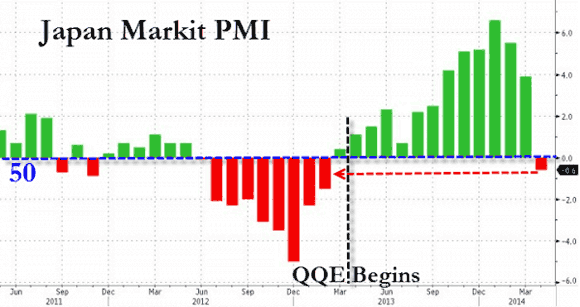
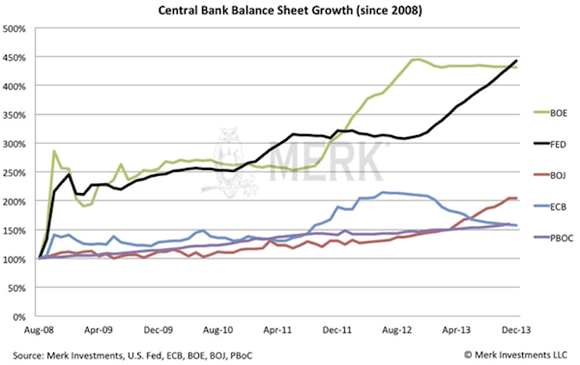
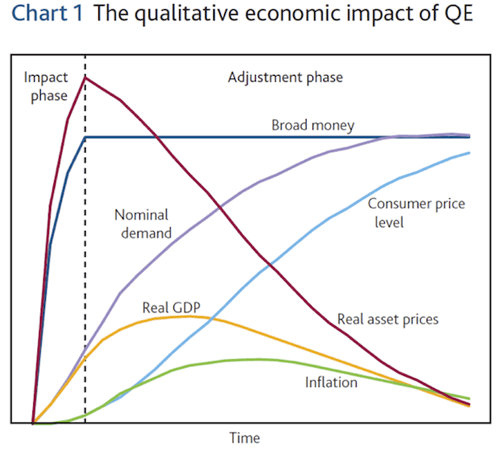
… the Fed could have spent the $3.2 trillion to create 12.8 million jobs in 2009, each paying $50K per year, and still be making payroll for them today. Obviously, that’s an absurd notion, but then again, spending $3.2 trillion on anything without any evidence that your policies are really working is absurd (job growth remains anemic with the recovery being the worst in 80+ years). Indeed, QE failed to put a dent in Japan’s jobs picture over the last 20 years. It also failed to do much for the UK. Why would it somehow be different in the US?

And no, it’s not just the Fed, and it’s not just America. All major central banks act according to the same preferences: satisfy the appetite of the greediest parties. Where they should always first have restructured bank debts, they never did more than pay lip service to that sound economic principle, and put trillion dollar lipstick on unsound pigs so history’s biggest gamblers – and, lest we forget, biggest losers – could pay their debts and sit their fat asses back down at the crap table.

It’s a political at least as much as an economic issue. What’s best for a Wall Street banker will never be the same across the board as for a farmer in Alabama, and a German business executive’s interests will always be different from a Greek street vendor’s. In functioning democratic systems, “the people” should make sure that both get part of what they want and need. But in our present systems, not only does the less affluent party not get his “fair” part, he sees it being reduced so the already more affluent can take more. Even though, certainly in broad terms, it wasn’t the farmers and street vendors who were the cause of the crisis, but the bankers and executives.

If we don’t manage to solve that problem, and pretty soon, the US and EU won’t survive in their present shape and form, while Japan and China will be nations replete with street fighting men, armed with weapons a thousand times more efficient than history has ever witnessed. And that is truly scary. We’re not talking small problems here. Steve Wynn senses – part of – that, but he’s not sounding the big red flashing alarm he should. Here’s a metaphor: If American society were a human body, it would be under attack from a parasite, a flesh eating disease, that temporarily puts a red glow on its cheeks which makes people think it looks healthy. Flesh eating diseases kill their hosts. Consider yourselves such a host.


The Death Cross Of American Business (Zero Hedge)

So much for the recovery… As WaPo reports, the American economy is less entrepreneurial now than at any point in the last three decades. A rather damning new Brookings Institution report shows that US businesses are being destroyed faster than they’re being created. As the authors of the report ominously explain: If the decline persists, “it implies a continuation of slow growth for the indefinite future,” as new business creation has been cut in half since 1978. This is the death cross of American Business!!

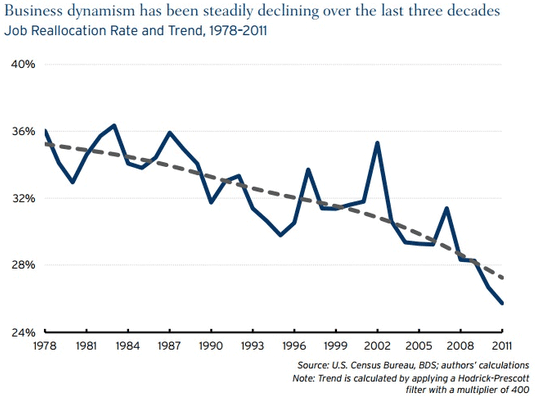
And the bottom line from Hathaway and Litan:

Overall, the message here is clear. Business dynamism and entrepreneurship are experiencing a troubling secular decline in the United States. Existing research and a cursory review of broad data aggregates show that the decline in dynamism hasn’t been isolated to particular industrial sectors and firm sizes. Here we demonstrated that the decline in entrepreneurship and business dynamism has been nearly universal geographically the last three decades – reaching all fifty states and all but a few metropolitan areas.

Doing so requires a more complete knowledge about what drives dynamism, and especially entrepreneurship, than currently exists. But it is clear that these trends fit into a larger narrative of business consolidation occurring in the U.S. economy – whatever the reason, older and larger businesses are doing better relative to younger and smaller ones. Firms and individuals appear to be more risk averse too – businesses are hanging on to cash, fewer people are launching firms, and workers are less likely to switch jobs or move.
Read more …

“The American Dream Is Dead For Everyone But A Happy Few” (Zero Hedge)

$250 Million homes in Europe, $150 Million homes in the US, and as Bloomberg notes. Million-dollar homes in the U.S. are selling at double their historical average while middle-class property demand stumbles, showing that the housing recovery is mirroring America’s wealth divide. As CoreLogic notes, “the real estate market is the ultimate reflection of confidence, wealth and income,” as purchases costing $1 million or more rose 7.8% in March, while sales of homes costing less than $250k plunged 12%, as “the same factors driving the income stagnation in the middle are driving the income momentum at the top.” The luxury markets are indeed on fire as foreign (and domestic) super-wealth floods into real estate but as NewEdge’s van Batenburg notes, echoing our very words, “The American Dream is dead for everybody but the happy few who have enjoyed the tailwinds of the appreciating stock market.”

Read more …

Q1 GDP Cut To -0.6% At Goldman, -0.8% At JPMorgan (Zero Hedge)

The US “recovery” is starting to feel more and more recessionary by the day. As we warned after we reported the trade deficit, it was only a matter of time before the Q1 GDP cuts came. And come they did, first from Barclays, and now from Goldman, which just doubled its GDP forecast loss for the past quarter from -0.3% to -0.6%. Bottom Line: The March trade deficit was roughly in line with consensus expectations, narrowing from February. However, imports were substantially higher than the Commerce Department had assumed in its initial estimate for Q1 GDP. We reduced our Q1 past-quarter tracking by three-tenths to -0.6%. Main Points:

1. The March trade deficit narrowed to $40.4bn (vs. consensus -$40.0bn), from a revised $41.9bn in February. The real petroleum balance narrowed (+$0.6bn to -$11.3bn), while the real ex-petroleum balance widened (-$0.8bn to -$42.4bn). Exports rose 2.1%, more than reversing their February decline, while imports rose 1.1%. The 10.8% increase in food & beverage imports appears to have been driven by the jump in agricultural import prices already released for the month. By country, the large drop in seasonally-adjusted exports to China which occurred in January and February stabilized in March.

2. Both imports and exports were higher than the Commerce Department assumed in their initial estimate for Q1 GDP growth. However, imports exceeded their assumption by a significantly larger margin, pushing our Q1 past-quarter GDP tracking estimate down by three-tenths to -0.6%.

Also, keep in mind that as we explained before, Q1 GDP was boosted around 1% by the forced spending “benefit” of Obamacare: a GDP contribution that will no longer be there. Which means that either normalized Q1 GDP is approaching -2%, or Q2 GDP is about to be whacked by the same amount. Pick your poison. One thing is certain – anyone hoping that 2014 is the year in which the US economy finally achieved “escape velocity” will have to drink the humiliation under the table as they repeat the mantra of apologists everywhere: “snow…. snow…. snow….” UPDATE: JPM just jumped on the bandwagon and cut Q1 GDP to -0.8% from -0.4%. Don’t worry: it snowed.

Read more …

The Fed Could Have Bought California & Texas With QE Money (Phoenix)

The Federal Reserve has spent over $3.2 trillion in the post-Crisis era. The bulk of this money printing has gone towards buying garbage mortgage securities or US Treasuries from Wall Street. Because we’ve reached a point in time at which $1 trillion no longer sounds like a lot of money, we thought we’d go through the exercise of assessing just what the Fed could have done with this money besides give it to Wall Street. With $3.2 trillion, the Fed could have:

  1. Mailed a check for $10,223 to every man, woman, and child in the US.
  2. Bought back all of the US debt owned by China, Japan, Belgium as well as the debt acquired via investors through the Caribbean islands.
  3. Bought all of France’s economy for a year (or the UK or Brazil depending on its preference) and still had $600 billion or more left over.
  4. Performed leveraged buyouts of California and Texas.
  5. Funded NASA for the next 188 years.
  6. Treated every person on the planet to $200 five star dinners at one of New York’s top restaurants, along with a night’s stay in the Big Apple.
  7. Bought every human being on earth a PlayStation 4 gaming console… and still had enough money left over to buy all of Peru and Ireland’s economies for a year.

It’s quite impressive, isn’t it? We’re repeatedly told that the Fed has to engage in QE to help the recovery and create jobs. But the facts show otherwise. The economy has added nearly 9 million jobs. But the Fed could have spent the $3.2 trillion to create 12.8 million jobs in 2009, each paying $50K per year, and still be making payroll for them today. Obviously, that’s an absurd notion, but then again, spending $3.2 trillion on anything without any evidence that your policies are really working is absurd (job growth remains anemic with the recovery being the worst in 80+ years). Indeed, QE failed to put a dent in Japan’s jobs picture over the last 20 years. It also failed to do much for the UK. Why would it somehow be different in the US?

Read more …

Steve Wynn Slams The Fed’s Ominous, Artificial Nirvana (Zero Hedge)

Steve Wynn: “we finished our financing recently; The last tranche was a $750 million bond. We sold it at 5.09% with no covenants, non-recourse to the parent. And that brought our total financing for Cotai to $3.850 billion, at an average cost of 3.3%.” “Or to put it another way, we rented the $3.85 billion for $125 million.” Now on one hand, as a businessman, I’m thrilled. Never dreamed that we would see anything so tasty and wonderful as that. On the other hand, it’s a reflection of questionable fiscal and monetary policy in the United States that is artificially depressed interest rates because of quantitative easing by the Fed, which is also sort of killing the value of the dollar and the living standard of the working people.

So the good news is, if you’re a high-class borrower with good credit rating, this is one of the most tastiest seasons of all time for 2 reasons. You’re borrowing money at artificially depressed rates. And you’re most likely going to pay them back with 85-cent dollars. It’s a perfect storm for a businessperson unless you look at the truth of the matter and the impact it has on your customers and your employees. And that’s a much darker story. It doesn’t lend itself to a soundbite, but it’s — for every businessman in America and any economist that has their heads screwed on right, it’s an ominous situation. But in terms of our moment in history, in commercial history…along with our colleagues in the industry, it’s nirvana.

Capital structure now is — these are mostly at the Venetian and the Wynn, things of beauty. They’re lovely, better than you could ever want. I mean, they’ve got everything, low interest rates, long maturities, low covenants. What else do you want? I mean, it’s great. If you look at it from our point of view. But look at it from a consumers’ point of view or a working person’s point of view, who’s paying for all this cheap money? Well, right now, the Fed is. I thought Bernie Madoff went to jail for that.”

Read more …

A sign of a bad fever.

Margin Debt Bubble Started Cracking In March Along With Momo Trades (Alhambra)

We still may not know the difference between cause and effect, but margin debt balances dropped in March for the first time in ten months. The $14 billion decline in margin debt was also coincident to an increase of $6 billion in relative cash balances in equity accounts at FINRA dealers. That meant total investor net worth improved by a little more than $20 billion. Under more normal circumstances that might be significant, and it may yet be, but it only reduces investor complacency to the extreme levels we saw just the month before. The jump in margin in February was astounding, meaning that March simply retraced only the last extreme move in a string of them.
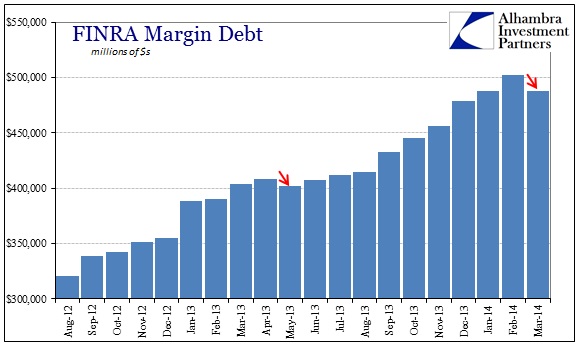
ABOOK May 2014 Magin Debt Recent

Since July 2012, margin debt balances are 56% higher. That surge in debt corresponds exactly with the spike in valuations. That includes, as I noted last week, the dramatic valuations of small cap stocks.
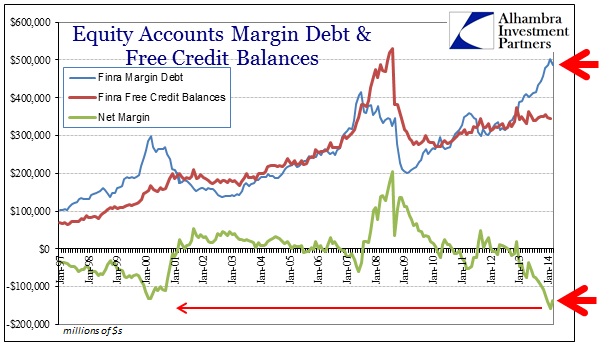
ABOOK May 2014 Magin Debt

That raises the possibility that the relatively minor reversal in margin and complacency in March was in response to changes in perceptions over small cap stock valuations. It could also refer to extreme margin levels leading prices. In other words, did such stretching of investor positions lead to a decline in margin usage, thus taking the steam out of the fast rising small caps and momentums, or was an inflection in pricing and valuations the reason for the decline in margin?

Read more …

“The Six Most Important Asset Bubbles In Modern Times” (Grantham)
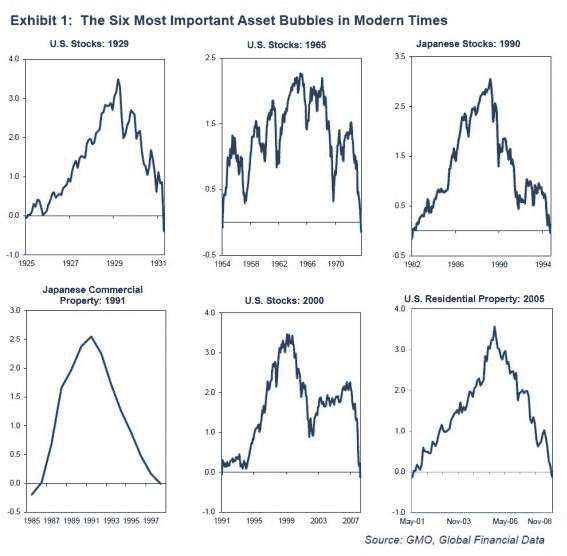
According to GMO’s Jeremy Grantham, these are the six most important asset bubbles in modern times. And some additional color from the legendary investor:

The six most important asset bubbles in modern times (in my opinion) are shown in Exhibit 1 and, as you can see, each of them qualifies on the 2-sigma definition, although the 1965-72 peak, known in the trade then as the “Nifty-Fifty” event, did so by a modest margin. This event fell short in providing the usual good examples of extreme investment craziness. Perhaps, though, the very definition of the Nifty Fifty as “one decision stocks” may have qualified it, with one extremely crazy theme substituting for many smaller ones, for “one decision stocks” were so named because you only had to make one decision: to buy. These stocks were generally believed then to be so superior that once bought they would be held for life. (Most, like Coca-Cola and Merck, stood the test of time well enough, but unfortunately several then unchallengeable examples like Eastman Kodak and Polaroid went the way of all flesh, or all film.)

There is one very important event that influenced our lives, financial and otherwise: 2008. The U.S. housing market leaped past 2-sigma all the way to 3.5-sigma (a 1 in 5,000-year event!). The U.S. equity market, though, was overshadowed by the then recent record bubble of 2000, although it still made it to a 2-sigma event on some definitions. But what was unique about 2008 was the near universality of its asset class overpricing: every equity market, almost all real estate markets (Japan and Germany abstained), and, of course, a fully-fledged bubble in oil and many other commodities.

Read more …

TEXT

Blackstone Guaranteed Huge Taxpayer Fees On Risky Pension Investments (Pando)

When you think of the term “public pension fund,” you probably imagine hyper-cautious investment strategies kept in check by no-nonsense fiduciary laws. But you probably shouldn’t. An increasing number of those pension funds are being stealthily diverted into high-fee, high-risk “alternative investments” that deliver spectacular rewards for the Wall Street firms paid to manage them – but not such great returns for pensioners and taxpayers. Citing data from the National Association of State Retirement Administrators, Al Jazeera America recently reported that “the average portion of pension dollars devoted to real estate and alternative investments has more than tripled over the last 12 years, growing from 7% to around 22% today.” [..]

The Blackstone-related documents, though, don’t just tell a story about public pensions in Kentucky. The firm, which just reported record earnings, does business with states and localities across the country. The Wall Street Journal reports that “about $37 of every $100 of Blackstone’s $111 billion investment pool comes from state and local pension plans.” In one set of documents provided by Tobe, Blackstone’s payment structure is outlined, with language guaranteeing that Blackstone will receive its hefty annual management fees from the taxpayer – regardless of the fund’s performance. In other documents, public pension money is exempted from some of the most basic protections usually guaranteed under federal law. Other contract language appears to license Blackstone to engage in financial conflicts of interests that could harm investors.

Read more …

We Are Not There Yet: Jobs Still Below Dec. 2007 Peak (Stockman)

The Reagan recovery of the 1980s is not all that the legends crack it up to be, but it is a useful benchmark in the jobs counting game. It came on the heels of what was then the worst recession since the 1930s—including a significant contraction of real GDP (3%), a severe collapse of housing (50%), faltering industrial production (10%), a meltdown of commodity prices and a double-digit unemployment rate that reached 10.7%. As it happened, the economy hit its pre-recession peak in July 1981 when nonfarm payrolls printed at 91.6 million jobs (well not really, that is the repeatedly revised, reformulated and adjusted official figure for that date—-the original is buried in the BLS data morgue). Needless to say, the picture had dramatically improved 76 months later. By November 1987 the NFP payrolls were 103.4 million, meaning that the US had gained 11.8 million jobs or 13% from the prior peak.

Since we are now also 76 months out from the most recent peak, which was December 2007, it is useful to briefly review the interim cycles. Thus, after the economy peaked at 109.9 nonfarm payrolls in June 1990 the post-recession rebound was also reasonably resilient. By the 76-month marker in October 1996, nonfarm payrolls printed at 120.7 million, signifying a gain of 10.8 million jobs or 10%. Then a few years later Greenspan’s irrational exuberance turned into the thundering bust of the dotcom market, but this caused hardly a measureable dip in real GDP. In fact, the total decline—as now several times revised—-barely registers at 0.3% or less than one-tenth as severe as the Great Recession drop. So there wasn’t much of an economic hole to climb out. But rebound we did under the impetus of the second Greenspan Bubble—the great housing and credit boom of 2001-2007.

After hitting a pre-recession peak at 132.8 million jobs in February 2001, the NFP payrolls rode the credit/housing bubble to a 138.0 million print by the 76-month marker in June 2007. So this time the rebound was quite modest by historical standards, but the gain of 5.2 million new non-farm payroll jobs still amounted to a 4% advance. No such luck this time. The April NFP printed at 138.25 million—and that, alas, is still 100,000 jobs below where it was 76 months ago on the eve of the financial crisis and the subsequent Great Recession. In short, we have been in a totally new ball game—a macroeconomic cycle in which so far the monthly jobs print has consisted entirely of born again jobs, not net new jobs. [..]

…despite its grotesque violation of all prior monetary principles, the Fed went forward in the last meeting with its 64th consecutive month of zero money market rates; the BLS reported another “favorable” jobs delta; Wall Street spotted an imminent GDP acceleration just a few months down the road for the fifth time in 5 years; and the financial press reported that the polar vortex has passed and that the market could continue rising a few more points until the next crucial “Jobs Friday” i.e. next month. What delusionary babble! Among everything else, the world does not move in 30 days intervals, the path is not linear and history overwhelmingly proves that no business cycle expansion has eternal life. Indeed, we are now in month 59 of this expansion, and have therefore already overstayed our welcome—the average historical expansion having lasted only 53 months.

Read more …

Ha ha ha!

BOE May Be Forced To Raise Interest Rates To Burst Housing Bubble (Guardian)

The Bank’s hope is that lenders will get the message. If they don’t, the option is there to tighten up the capital requirements for banks and building societies. This means that lenders have to hold more capital to safeguard themselves against potential future losses, and limits the amount of money they can parcel out in mortgages. When this happens, defcon 4 becomes defcon 3. But there is plenty of cash floating around the UK financial system, courtesy of the Bank’s own quantitative easing and funding-for-lending programmes. The unleashing of several years of pent-up demand, coupled with an inadequate supply of new homes, means the property market has plenty of momentum.

Tighter capital requirements might not be sufficient, so the next step would be to tell George Osborne that it is time to wind up, or heavily scale back, his Help to Buy scheme. Telling the chancellor that his beloved mortgage subsidy plan was part of the problem rather than part of the solution would be a sign that Mark Carney, the Bank’s governor, was starting to run out of options. In Threadneedle Street, defcon 3 would have become defcon 2. By this point, the discussion inside the Bank would be about how to bring down house-price inflation with the minimum collateral damage. Rising house prices have forced many borrowers to stretch themselves to the limit.

In the past five years, the number of people taking out mortgages with a loan to income ratio of more than 4.5 has doubled to 8%. Half of all new mortgages are for more than 25 years. The Bank could impose loan to value or loan to income curbs as a way of bringing prices down. Finally, there is the nuclear option. The Bank’s financial policy committee was designed to provide a range of custom-made tools for preventing the UK housing market from running out of control. Knowledge that innocent people will be hurt means policymakers are reluctant to go to defcon 1. But ultimately, they will need to be prepared to press the button and push up the cost of borrowing.

Read more …

You ain’t seen nothing yet.

China Budget Strains Showing as S&P Warns On Local Debt (Bloomberg)

China’s cooling property market has helped push its budget into deficit and prompted Standard & Poor’s to warn of risks to the finances of regional borrowers. Growth in national fiscal revenue slowed to 5.2% in March from 8.2% in February, Ministry of Finance data showed. The budget swung to a 326 billion yuan ($52 billion) deficit from a 257.5 billion yuan surplus. New home sales in 54 cities tracked by Centaline Group slid 47% from a year earlier to a four-year low over the May 1-3 Labor Day holidays. Property market weakness would undermine Premier Li Keqiang’s efforts to spur growth and make it harder for local-government financing vehicles to repay debt using land sales.

Borrowing costs for companies with an AA rating, the most common for LGFVs, have dropped 75 basis points this year, helping spur a 40% increase in bond sales. “A significant deterioration in the property market and land prices will have very wide-ranging implications for the entire economy and also credit markets,” Christopher Lee, head of corporate ratings for Greater China at S&P in Hong Kong, said in a May 5 e-mail interview. “Land is used as the collateral for financing for LGFVs. It’s also used as the collateral for property developers to get construction funding.”

Local governments have set up thousands of financing vehicles to fund projects from subways to sewage systems, which account for 80% of state capital spending and 40% of tax revenue, the World Bank estimates. Total liabilities of regional authorities rose to a record 17.9 trillion yuan as of June 2013, the National Audit Office estimates. Land sales in 20 major cities in March fell 5% from a year earlier, the biggest drop in at least a year, according to China Real Estate Information Corp. data compiled by Bloomberg. The value of sales in third-tier cities declined 27% last month, according to Soufun Holdings Ltd., the nation’s biggest real estate website owner.

Read more …

The core of China’s credit problem is that everything serves as collateral for everything else. If one pin drops ……

China Property Slump Adds Danger to Local Finances (Bloomberg)

China’s weakening property market poses an increasing danger to local governments, threatening to strain their finances and intensify an economic slowdown. Land sales in 20 major cities fell 5% in March from a year earlier, the biggest drop in at least a year, according to China Real Estate Information Corp. data compiled by Bloomberg. The value of land sales in third-tier cities declined 27% last month, according to SouFun Holdings Ltd., the nation’s biggest real-estate website owner. Failure to find other revenue sources increases the risk of defaults and financial turmoil that curb economic expansion already projected this year at the slowest pace since 1990.

Some cities plan to reverse controls implemented to make home prices more affordable or give residency benefits to out-of-town buyers, a state-run newspaper reported this week. “As the housing market is cooling off, we expect land-sale revenue will decline and this will add pressure on the funding capacity for local governments,” said Zhu Haibin, chief China economist with JPMorgan Chase & Co. in Hong Kong. Land sales will drop more in areas where oversupply in property is more severe, said Zhu, who previously worked at the Bank for International Settlements.

The weakness adds to the urgency of expanding China’s municipal-bond market so regional governments can sell debt directly to the public instead of through off-budget corporations called local-government financing vehicles. A sample of provincial, municipal and county administrations shows they have guaranteed repayment of about 37%, or 3.5 trillion yuan ($560 billion) of debt with land sales, according to a national audit report released in December. The People’s Bank of China said yesterday it will strengthen monitoring of credit extended to LGFVs, real estate companies and industries with overcapacity to minimize risks to the financial system. The central bank will maintain a “prudent” monetary policy, according to a quarterly report.

A worsening market downturn would increase pressure on national leaders to ease monetary policy for the first time since 2012. Premier Li Keqiang and other officials have outlined plans for railway spending and tax breaks to support growth while pledging to avoid any short-term, large-scale stimulus that could exacerbate debt risks. The government budgeted for an 11.8% drop in land-sales revenue in 2014, according to the Finance Ministry’s annual work report in March. Nationwide, land sales in 2013 were equivalent to about 61% of local-government revenue, according to figures from the Ministry of Land and Resources and the Finance Ministry.

Read more …

That’s just great, UK, Australia, NZ. “Healthy” property markets that you have no access to.

Chinese Developers Rush Overseas Amid Shaky Home Market (CNBC)

As the cracks in China’s housing market deepen, the country’s major property developers are scouring the world for new opportunities. Spending on overseas residential development projects soared to $1.1 billion in the first quarter – an 80% on-year rise, with Australia, the U.K. and U.S. garnering most of the investment. Overall outbound investment – including residential and commercial – grew 25% to $2.1 billion over this period. Investment in residential projects was driven by developers looking to “counteract slower economic and price growth at home,” said David Green-Morgan, global capital markets research director at real estate services firm JLL.

Shanghai-based Greenland’s investments in London, Los Angeles and Sydney, and Guangdong-based Country Garden’s first foray in the Australian market earlier in the year, underscore growing interest in overseas residential properties. China’s once red-hot housing market has shown signs of a rapid cooling in the recent months. According to a survey by China Real Estate Index System (CREIS), 45 of the 100 cities experienced month-on-month property price declines in April, up from 37 cities in March. Meanwhile, property investment in China has also lost steam as bank funding for developers tightens. Property investment accounted for about 12% of China’s gross domestic product (GDP) in the first quarter, down from 15% in 2013, according to Reuters.

Read more …

Part of today’s laugh track.

Japan Just Needs ‘Little Turn’ By US(style) Consumer: Nomura (CNBC)

All the Japanese economy needs to take off is a small shift in U.S. consumer sentiment, according to Jeremy Bennett, chief executive of Nomura International, the Europe, Middle East and Africa wing of the Japanese bank. “We don’t need some massive U.S.(style) consumer boom. We just need a little turn in sentiment,” he told CNBC. Jeremy Bennett, CEO of Nomura International, says a return of sentiment to Japan would go “a long way” to boosting investor appetite for the country. Japan’s economy is loaded with the heaviest public debt burden in the developed world, although Prime Minister Shinzo Abe has pledged to slash debt through his “Abenomics” plan.

The economy has also been hampered by slowing growth, and is predicted to expand by 1.2% this year, below the average for developed economies, according to the Organisation for Economic Co-operation and Development (OECD). Nomura has been one of the key beneficiaries of an improved picture in Japan, although its profits fell in the first quarter of 2014, for the first time in nearly two years. “Abenomics has helped us, and internationally our investment banking business is doing well,” Bennett said. “We had a cracking year last year, in Japan and internationally.”

Read more …

Economists, Show Your Assumptions (Bloomberg)

What if I told you that jumping off a cliff is entirely safe, except for gravity? Would you find my prediction insightful or useful? Strange as it may seem, this is precisely the kind of logic that underpins many of the models that economists build to help them understand the world — and even to make policy recommendations on things such as financial regulation and inequality. It’s a serious flaw to which Stanford University finance professor Paul Pfleiderer has been trying to attract attention. As he argues in a recent paper, theorists make some pretty absurd assumptions to arrive at results or implications that are, in turn, relevant to policy.

All too often, people – including people involved in real policy matters – ignore those assumptions and end up believing ridiculous things. After all, they’ve been demonstrated in an economic model. As a spectacular example, Pfleiderer points to a 2013 working paper by two respected economists titled “Why High Leverage is Optimal for Banks,” which essentially says that banks operating with thin capital and tons of borrowed money do not necessarily present a systemic threat. They build a model demonstrating that — if you ignore a string of really important things, such as the potential for extreme leverage to destabilize the financial system and force governments into costly bailouts — you can make the case that banks should be as leveraged as possible.

A better title, Pfleiderer suggests, would be “Why ‘High’ Leverage is Optimal for Banks in an Idealized Model that Omits Many Things of First-order Importance.” There’s nothing wrong with making assumptions — even crazy ones — to help get your mind around something. The deception comes in claiming that your conclusions have real-world relevance when the assumptions are nuts. Too frequently, Pfleiderer argues, economic theories are like chameleons that change their color to suit the moment. The chameleon hides its assumptions and makes bold claims, and then, when questioned, acknowledges its assumptions and says, “Hey, I’m only a model!”

Read more …

Einhorn Finds Dinner Chat With Bernanke ‘Frightening’ (Bloomberg)

David Einhorn, manager of the $10 billion Greenlight Capital Inc., said he found a recent dinner conversation with former Federal Reserve Chairman Ben S. Bernanke scary. “I got to ask him all these questions that had been on my mind for a long time,” Einhorn said in an interview today with Erik Schatzker and Stephanie Ruhle on Bloomberg Television, referring to a March 26 dinner with Bernanke. “It was sort of frightening because the answers were not better than I thought they would be.” Einhorn has been critical of Bernanke’s willingness to leave interest rates near zero for more than five years. The hedge-fund manager has said the benefits of low rates diminish over time until they are more harmful than helpful, and that the Fed’s stimulus has led to income inequality.

Bernanke, a former Princeton University economics professor, stepped down this year after eight years helming the U.S. central bank. In describing the dinner conversation at New York’s Le Bernardin, Einhorn criticized Bernanke for saying he was 100% certain there would be no hyperinflation and that it generally occurs after a war. “Not that I think there will be hyperinflation, but how do you get to 100% certainty about anything?” Einhorn said. “Why can’t you be 99% certain?” Bernanke responded “you are wrong” to a question about the diminishing returns of having interest rates at zero, according to the hedge-fund manager. The ex-Fed chief’s explanation, Einhorn said, was that raising interest rates to benefit savers wouldn’t be the right move for the economy because it would require borrowers to pay more for capital.

Einhorn said he was keeping an “open mind” about the new Fed Chair Janet Yellen. “I would love to see if she had a better reason for rates to remain at zero at this stage of the economy,” he said. The Fed’s actions during the financial crisis have been praised by investors including billionaire Warren Buffett for helping the U.S. recover from the deepest slump since the Great Depression. Last year he described the Fed as “the greatest hedge fund in history” because of the money it’s generating for the government from its bond-buying program. “I’m not sure that is meant as a compliment,” Einhorn said in response to a question about Buffett’s remark.

Read more …

Yeah, the most polluted country in the world really needs to get into shale. Great idea.

US-China Shale Gas Rivalry Bad News For Poor Countries (CNBC)

China’s plans to establish a shale industry to rival the U.S.’s could see Beijing slash its energy imports—in a blow for some of the world’s poorest gas exporters. Shale gas is drilled out of rocks in a process known as fracking or hydraulic fracturing, and has been hailed as revolutionary way of getting cheap energy by some. However, the U.S. is currently the only country to have fully embraced fracking. Its shale gas production increased to 291.6 billion cubic meters (bcm) in 2012, up from 56.6 bcm in 2007 – a shift from 8% to 35% of the U.S.’s total natural gas production. China’s own shale gas industry is currently extremely small, but its government hopes to emulate the U.S.’s success by upping production to 6.5 bcm by 2015 and 60-to-100 bcm by 2020.

The huge increase in production will make China more economically independent, cutting its gas imports by up to 40%. But it could also a blow for several oil-exporting countries, particularly as they will be having to deal with the declining demand from the U.S. “Combined with the increase in shale gas production in the U.S., it will hit the economy of small exporters in the developing world,” said the Overseas Development Institute, a leading U.K. think tank on development issues, in a report out on Wednesday. The institute noted that developing countries had already lost around $1.5 billion in gas export revenue due to U.S. shale gas production. It named Angola and the Republic of the Congo as particularly susceptible to a fall-off in Chinese demand for their gas, and forecast each would suffer a 13% hit to national income.

Read more …

Maybe they know something others don’t?!

Exxon And Chevron Trailing In US Fracking Boom (USA Today)

What boom? While the United States enjoys a surge in oil and natural gas production, its two largest oil companies — Exxon Mobil and Chevron — have so far missed the party. Big Oil was slow to jump into the fracking business, which has transformed U.S. energy markets by extracting oil and gas from shale deposits. And its latest quarterly reports show how it’s struggling to get on board. “The big oil companies were late to invest in shale. They’re trying to play catch-up,” says Brian Youngberg, an analyst at Edward Jones, noting smaller and more nimble companies got into fracking more quickly. He says the multinationals are now investing in new shale developments, but since they’re so big, it’s difficult for any single project to shift their overall bottom line.

The nation’s energy boom is largely due to the combined use of horizontal drilling and hydraulic fracturing, or fracking, which has made it cheaper to break apart shale rock and extract oil or gas trapped deep underground. Since 2005, U.S. production has risen 35% for natural gas and 44% for crude oil, according to the U.S. Energy Information Administration. The major oil companies, which have invested heavily in mega projects offshore and abroad, report a different story. Exxon, the nation’s largest oil company, said Thursday that it produced 5% less natural gas in the United States during the first three months of 2014 than it did in the same period a year ago. Its domestic production of crude oil and other liquids rose 1.6%.

Chevron, the second-largest U.S. oil company, reported declining production. On Friday, it said it produced 4% less oil and 3% less natural gas in the United States during 2014’s first quarter than it did a year ago. Only the third-largest U.S. oil company, ConocoPhillips, did slightly better. On Thursday, it reported a U.S. production uptick of 2.4% for crude oil and 1.8% for natural gas in the first three months of 2104, compared with the same period last year.

Read more …

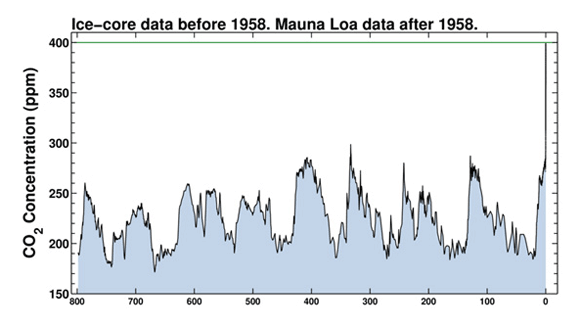
Time to wonder if enough people will care enough soon enough. Doesn’t look like it. Looks like we’re too busy drilling in the ever scarcer remaining pristine locations we haven’t yet exploited, and too busy preparing to go to war over access to the very resources that lifted us all the way up over 400ppm in what’s really no more than the blink of an eye in the 800,000 year timeframe.

First time in 800,000 years: April’s CO2 levels above 400 ppm (CBS)

Less than a year after scientists first warned that the amount of carbon dioxide in the atmosphere could rise above 400 parts per million and stay there, it has finally happened. For the first time in recorded history, the average level of CO2 has topped 400 ppm for an entire month. The high levels of carbon dioxide is largely considered by scientists a key factor in global warming, according to the National Oceanic and Atmospheric Administration’s (NOAA) Earth System Research Lab. The Scripps Institution of Oceanography, a part of the University of California, San Diego, reported that April’s average amount of CO2 was 401.33 ppm, with each day reading above 400 ppm.


Scientists, using the Keeling Curve, show the increase of CO2 levels over the course of 800,000 years. Scripps Institution Of Oceanography

According to the Institute, CO2 levels have not surpassed 300 ppm in 800,000 years. It is estimated that during Earth’s ice ages, the C02 levels were around 200 ppm, with warmer periods — as well as prior to the Industrial Revolution — having carbon dioxide levels of 280 ppm. Past levels of CO2 are found in old air samples preserved as bubbles in the Atlantic ice sheet, according to Scripps. Throughout the year, there are changes in CO2 levels that occur naturally from the growth of plants and trees. Carbon dioxide levels often peak in the spring due to plant growth, and decrease in the fall when plants die, according to NOAA. However, human CO2 production has exacerbated the effects, causing global warming and climate change.

Scientists have been measuring the levels of carbon dioxide over the past fifty years. Since 1958, the Keeling Curve — named after developer Charles Keeling — has been used to monitor the levels of greenhouse gasses atop Hawaii’s Mauna Loa. When Keeling first started monitoring CO2 levels, the amount of carbon dioxide present in the atmosphere was 313 ppm. After Keeling’s death in 2005, his son Ralph, a professor of geochemistry and director of the Scripps CO2 Program, continued the measurements. In a statement last year, he warned that CO2 levels would “hit 450-ppm within a few decades.”
Read more …

Make that the whole population.

Half U.S. Population Vulnerable to Climate Change (Bloomberg)

More than half the U.S. population lives in coastal areas that are “increasingly vulnerable” to the effects of climate change, which will ripple throughout the U.S. economy, a White House advisory group’s report concluded. The report released today said the impact of the accumulation of greenhouse gases in the atmosphere is already affecting Americans, with coastal flooding, heavier downpours and more intense wildfire episodes. And more changes are coming. “The real bottom line is that climate change is not a distant threat,” John Holdren, the White House science adviser, told reporters today. “It’s already affecting different regions in the country.”

The findings may bolster President Barack Obama’s energy and environmental agenda, which he is pursuing without legislation from Congress, as well as his proposals to prepare the U.S. to deal with global warming. The administration is focusing on climate change policies this week in conjunction with the release of the report, said John Podesta, an Obama adviser who’s overseeing the president’s climate plans. The warming climate will affect broad sectors of the economy, from infrastructure along the densely populated corridor from Washington to New York to Boston, to crops in the Midwest farm belt to water supplies in growing cities of the Southwest, the authors concluded.

Republicans such as Senators John Barrasso of Wyoming and Jim Inhofe of Oklahoma said the administration is using climate change to support new regulations they say would eliminate jobs. “The president is attempting to once again distract Americans from his unchecked regulatory agenda that is costing our nation millions of job opportunities and our ability to be energy independent,” Inhofe said in an e-mail statement.

Read more …

Apr 302014
 
 April 30, 2014  Posted by at 1:30 pm Finance Tagged with: , , ,  10 Responses »


Alfred Palmer Nose section of B-17F “Flying Fortress”, Douglas Aircraft, Long Beach, CA. October 1942

That’s how I feel these days, or I should say these years. Since the name of this site comes from Paul Simon’s song by that title, it comes easily. Funny enough, I watched one of the Making of Graceland docs on Sunday night, and then on Monday morning read that the grand small 70-year old songwriter has been arrested because his wife’s mother had called 911 for a domestic disturbance situation. Given that Edie Brickell is about a foot taller than Simon, that made me smile. All the more so because in the documentary he’s talking about how he’s not good at writing angry songs, and that’s why Graceland came out the way it did, instead of being filled with loud protests against the injustices of South Africa. But, he said, outside of my songs, I’m very capable of expressing my anger, and I do get angry. Got ya, Paul.

Personally, I perhaps find it harder to not get angry all the time, and try to channel it into expressing amazement at what I see around me in this bubble I find myself in. For instance, I’ve seen more than one person claim this week alone that London real estate is not in a bubble – because there’s just so much demand -. And then I read that the average price of a 3-bedroom house in London’s plushest neighborhoods has gone up in “value” by $8000 per week, $1150 per day, over the past year, which represents a 20% rise overall. But I’m supposed to believe that that’s not a bubble. That all those buyers who owe their fortunes to Russia’s energy bubble and China’s $14 trillion stimulus bubble somehow represent the new normal. Let’s see what lifelong Londoners have to say about that who are getting pushed out ever further from the city center.

And in the US, to my utter bewilderment, there’s a second Enron, 12 years after the demise of the first one. the ghost of Kenny-Boy haunts the hallways of Wall Street. I’d say there were quite a few faces outside of Kenny Lay and Jeffrey Skilling, like amongst regulators, who should have been looked at at the end of 2001. But to let it happen again?! TXU slash Energy Future Holdings goes broke with a $40 billion debt. And Bernie Madoff is still in jail?! It’s not always easy to define what exactly is wrong with America, but whatever it is, it’s huge. The largest leveraged buy-out in history gambled on gas prices, and they lost. Investors thought they’d make a killing and got killed. Check your pension fund, I’d say. If only because Energy Future CEO John Young had this comment: “We are pleased to have the support of our key financial stakeholders for a consensual restructuring .. [..] We fully expect to continue normal business operations during the reorganization.” These guys lost $40 billion at the crap table, and they’re allowed to restructure, stiff junior investors, and get more loans? Where’s this going?

In the energy corner, there’s shale. Automatic Earth readers have known for a long time what shale is really about: land speculation. But how many other people realize that? The entire industry runs on junk debt, and you know what the collateral is? Land. Which is supposed to deliver enormous profits through the resources underneath it. But never quite does. I’ve asked it before: why do you think Shell and Exxon quit shale to the extent that they did, two companies who would kill their CEO’s grandma’s for some proven reserves? Bloomberg spells it out neatly:

Shale Drillers Feast on Junk Debt to Stay on Treadmill (Bloomberg)

The U.S. drive for energy independence is backed by a surge in junk-rated borrowing that’s been as vital as the technological breakthroughs that enabled the drilling spree. While the high-yield debt market has doubled in size since the end of 2004, the amount issued by exploration and production companies has grown nine-fold, according to Barclays.

That’s what keeps the shale revolution going even as companies spend money faster than they make it. “There’s a lot of Kool-Aid that’s being drunk now by investors,” said Tim Gramatovich, who helps manage more than $800 million as chief investment officer of Peritus Asset Management.

“People lose their discipline. They stop doing the math. They stop doing the accounting. They’re just dreaming the dream, and that’s what’s happening with the shale boom.” Rice Energy was able to borrow so easily because of the quality of its assets, which are in some of the best areas of the Marcellus, a shale formation beneath western Pennsylvania and West Virginia, and the company’s drilling success there, said Gray Lisenby, Rice’s chief financial officer. [..]

“Who can, or will want to, fund the drilling of millions of acres and hundreds of thousands of wells at an ongoing loss?” Ivan Sandrea, a research associate at the Oxford Institute for Energy Studies in England, wrote in a report last month. “The benevolence of the U.S. capital markets cannot last forever.” The spending never stops, said Virendra Chauhan, an oil analyst with Energy Aspects in London. Since output from shale wells drops sharply in the first year, producers have to keep drilling more and more wells to maintain production. That means selling off assets and borrowing more money. “The whole boom in shale is really a treadmill of capital spending and debt,” Chauhan said.

“It’s a perfect set-up for investors to lose a lot of money,” Gramatovich said. “The model is unsustainable.”

Not a bubble? I’m not a vindictive person, but sometimes I think people deserve what they get. Serves them right for not reading The Automatic Earth. Shell has written off billions in its investments in shale, this morning it announced a drop in net profit of -45%, and you still think Shell wouldn’t be all over this if it could find a way to make a buck? At least you must admit this article makes the claims of exporting US oil and gas look even funnier than they already did. And like with Enron and TXU, you should wonder who the people in government are that allow for this kind of trickery to happen.

And then, timely ahead of Fed announcements later today, David Stockman tells it like it is:

The Fed Is Fueling The Century’s ‘Greatest Bubble’

The Fed is “a posse of academic zealots and unreconstructed Keynesians who think debt is the magic elixir, and they won’t stop printing money and putting their foot on the floorboard until they really blow something up …” At this point, his biggest concern is the impact that the Fed’s stimulative policies have had on equities. “I think the Fed is now inflating the greatest and third bubble yet of this century [..] The Russell 2000, even though it’s come off a little bit, is still trading at 80 time trailing earnings. That’s crazy, and you can say that about many other sectors of the market.” “What we need to do is get the Fed out of there, free interest rates, let the money market find the natural balance and purge some of this enormous speculation …”

There are people who know a bubble when they see one. But not everyone does, and it’s not in everyone’s interest either. Politicians can be made to look good inside a bubble, and businessmen can make a lot of money off the public purse. And you yourself get to feel for a fleeting moment in time as if you’re richer than you actually are. Because make no mistake about it, when this bubble bursts, it’s going to hurt. A lot worse than the last one. A comment in the Guardian on the “benefits” of austerity said: “… how does the logic of austerity sound in Britain? The country is richer, but its people are poorer. This now counts as a recovery.” That is a nice way to put it. Except that the country, too, will be poorer after the bubble pops, and a lot. And that will, of course, make the people poorer too. A lot.

There are lots of you, probably most, who like to live in a bubble. As long as you don’t feel forced to see it for what it is. It’s like the Truman Show. Exactly like that. But I know full well I live in a bubble. And I want to get out. It’s suffocating. Because I know what’s going to happen once it bursts, and it will, and the longer that takes, the worse the outcome will be. For the man in the street. Who I care more for than for those who seek only money or power. That, after all, is why there’s an Automatic Earth. Unlike the original boy in the bubble, you and I are not going to drop dead as soon as the bubble bursts. But just like him, the bubble keeps us from experiencing real human contact. That’s a huge price to pay. It’s not all that great to be a boy in a bubble. I should know.

Biggest LBO Ends in Bankruptcy That Ranks With Enron’s Collapse (Bloomberg)

Energy Future Holdings, the Texas power company Henry Kravis and David Bonderman took private in 2007 with Goldman Sachs in the biggest-ever leveraged buyout, filed for bankruptcy after reaching a deal to cut billions in debt. Today’s filing in Delaware is the result of months of wrangling among creditors, owners and management, and represents the failure of a bet that natural-gas prices would rise enough to justify the company’s $48 billion price. Instead, the financial crisis, coupled with booming shale production, sent gas prices down starting in 2008. “We are pleased to have the support of our key financial stakeholders for a consensual restructuring,” Chief Executive Officer John Young said in a statement. “We fully expect to continue normal business operations during the reorganization.”

Energy Future said it seeks to exit bankruptcy in 11 months. The Dallas-based company, formerly known as TXU Corp., also said it has commitments for financing totaling more than $11 billion, including $7.3 billion for Energy Future Intermediate Holding. The bankruptcy ranks with Enron’s $48.9 billion collapse in 2001. Billionaire Warren Buffett called his $2 billion investment in Energy Future bonds “a big mistake.” Today’s petition listed assets of $36.4 billion and debt of of $49.7 billion. Texas’s largest electricity provider traces its roots to a business that first powered electric lights in Dallas in 1882. The 2007 going-private deal, coming at the peak of a three-year boom in leveraged buyouts, turned into a big loss for Kravis’s KKR, as well as Bonderman’s TPG Capital and Lloyd Blankfein’s Goldman Sachs, which loaded the company with debt.

Read more …

Energy Future Junior Creditors Test Bid for Fast Bankruptcy Deal (Bloomberg)

Energy Future Holdings Corp., the Texas power company that plans to leave bankruptcy in less than a year, can’t reduce its $50 billion in debt without fighting junior creditors who face losing their investment. The Dallas-based electricity provider, taken private seven years ago by Henry Kravis and David Bonderman in a record leveraged buyout, filed for bankruptcy yesterday in Wilmington, Delaware, after months of wrangling among creditors, owners and management yielded a restructuring proposal. Second-lien noteholders owed about $1.6 billion say they were shut out of those talks and want court permission to probe what they call management’s “disabling conflicts of interest.” They also want the case moved to Texas.

Managers artificially drove down the true value of Energy Future “to allow the senior lenders and management to print cheap reorganized equity and wipe out billions in legitimate creditor claims,” the trustee representing the junior creditors said in court papers filed minutes after the Chapter 11 petition. Under the proposal announced yesterday, the company’s deregulated Texas Competitive Electric Holdings unit would separate from Energy Future. The plan would hand ownership of Texas Competitive to creditors in exchange for eliminating $23 billion in debt. That deal could give senior lenders “recoveries in excess of their claim,” the trustee for the junior creditors said in its filing.

Read more …

Bubble? What bubble? Why work, right?

Price Of 3-Bedroom House In Prime London Areas ‘Rises $1100 A Day’ (Guardian)

The average price of a three-bedroom home in London’s most expensive neighbourhoods has increased by £729 ($1150) a day over the past year, according to estate agent Marsh & Parsons. The firm said the price rise of 19% since April 2013, to an average of £1.6m was equivalent to £5,120 a week – or eight times the £658-a-week median salary for Londoners. Overall, the agent said the cost of homes in upmarket London areas including Chelsea, Kensington, Notting Hill, Clapham and Fulham was up by 12.9% in the last year and by 4.3% in the last quarter, to £1.5m, and if growth continued at the current rate the average would reach £2m by 2016.

Marsh & Parsons said it had seen “a huge surge” in the number of UK buyers purchasing prime London property in the last three months, with this group making up 78% of the market. In areas including Kensington & Chelsea, typically a stronghold for overseas buyers, the proportion of purchases by overseas and foreign nationality buyers had fallen to a two-year low of 21%. During 2012 and 2013, overseas and foreign nationality buyers accounted for around 40% of all purchases.

Peter Rollings, chief executive of Marsh & Parsons, said these were “extraordinary times” for the prime London property market. “It’s always difficult to call the ‘top’ of the market. But while comparisons are being drawn with 2007, the current conditions are actually remarkably different,” he said. “It’s difficult to see how prices can fall while demand for property remains so high. Compared to the same point last year, we have seen a 20% increase in demand and a 25% fall in the supply of property. Prime London is still a strong sellers’ market and jackpot prices are fast becoming the norm.”

Read more …

Short and to the point.

Fed Fueling Century’s ‘Greatest Bubble’: David Stockman (CNBC)

The Federal Reserve will release its next policy statement on Wednesday, and it is broadly expected to announce an addition $10 billion reduction in quantitative easing. But for David Stockman, who memorably served as director of the Office of Management and Budget under President Ronald Reagan, the Fed’s reduction in accommodative policies is coming far too late. “I don’t have any expectations at all” for what the Fed is set to announce “because I think the Fed is hopelessly lost and completely incompetent, if you want to put it starkly,” as Stockman certainly did on Tuesday’s episode of “Futures Now.”

The Fed is “a posse of academic zealots and unreconstructed Keynesians who think debt is the magic elixir, and they won’t stop printing money and putting their foot on the floorboard until they really blow something up,” Stockman said. At this point, his biggest concern is the impact that the Fed’s stimulative policies have had on equities. “I think the Fed is now inflating the greatest and third bubble yet of this century,” Stockman said. “The Russell 2000, even though it’s come off a little bit, is still trading at 80 time trailing earnings. That’s crazy, and you can say that about many other sectors of the market.” So what’s his preferred course of action now? “What we need to do is get the Fed out of there, free interest rates, let the money market find the natural balance and purge some of this enormous speculation,” he said.

Read more …

Royal Dutch Shell Net Profit Falls 45% (WSJ)

Royal Dutch Shell on Wednesday reported a fall in first-quarter profit after taking a $2.86 billion impairment charge largely on its refineries in Asia and Europe. The oil major also raised its dividend and said it is considering the sale of certain marketing assets in Norway. The results were the first for the oil giant under the leadership of Ben van Beurden, who took over as chief executive in January. “The impairments we have announced today in downstream reflect Shell’s updated views on the outlook for refining margins,” Mr. van Beurden said. Shell first-quarter profit on a current cost of supplies basis—a figure that factors out the impact of inventories, making it equivalent to the net profit reported by U.S. oil companies—fell 44% to $4.47 billion.

First-quarter revenue fell to $109.66 billion in the quarter, from $112.81 billion a year earlier, while net profit fell to $4.51 billion, compared with $8.18 billion. Oil and gas production during the quarter was 3.25 billion barrels of oil equivalent a day, 4% below the first quarter of 2013. Shell has declared a dividend of $0.47 per ordinary share, in line with its previous guidance of $0.47 a share and 4% above last year’s $0.45. Shell, like other big, integrated oil companies, has seen costs jump over the past few years as the refining business has grown more difficult, dragging down profits. Shell’s cash flow last year was less than its spending on capital projects, acquisitions and dividends, and the company in January issued its first profit warning in a decade.

Read more …

Shale Drillers Feast on Junk Debt to Stay on Treadmill (Bloomberg)

Rice Energy Inc., a natural gas producer with risky credit, raised $900 million in three days this month, $150 million more than it originally sought. Not bad for the Canonsburg, Pennsylvania company’s first bond issue after going public in January. Especially since it has lost money three years in a row, has drilled fewer than 50 wells and said it will spend $4.09 for every $1 it earns in 2014. The U.S. drive for energy independence is backed by a surge in junk-rated borrowing that’s been as vital as the technological breakthroughs that enabled the drilling spree. While the high-yield debt market has doubled in size since the end of 2004, the amount issued by exploration and production companies has grown nine-fold, according to Barclays.

That’s what keeps the shale revolution going even as companies spend money faster than they make it. “There’s a lot of Kool-Aid that’s being drunk now by investors,” Tim Gramatovich, who helps manage more than $800 million as chief investment officer of Peritus Asset Management. “People lose their discipline. They stop doing the math. They stop doing the accounting. They’re just dreaming the dream, and that’s what’s happening with the shale boom.” Rice Energy was able to borrow so easily because of the quality of its assets, which are in some of the best areas of the Marcellus, a shale formation beneath western Pennsylvania and West Virginia, and the company’s drilling success there, said Gray Lisenby, Rice’s chief financial officer.

“Who can, or will want to, fund the drilling of millions of acres and hundreds of thousands of wells at an ongoing loss?” Ivan Sandrea, a research associate at the Oxford Institute for Energy Studies in England, wrote in a report last month. “The benevolence of the U.S. capital markets cannot last forever.” The spending never stops, said Virendra Chauhan, an oil analyst with Energy Aspects in London. Since output from shale wells drops sharply in the first year, producers have to keep drilling more and more wells to maintain production. That means selling off assets and borrowing more money. “The whole boom in shale is really a treadmill of capital spending and debt,” Chauhan said.

Read more …

“… how does the logic of austerity sound in Britain? The country is richer, but its people are poorer. This now counts as a recovery.”

Any Talk Of Economic Recovery Is Pure Fiction (Guardian)

Down is up. Sick is healthy. The RMS Titanic is seaworthy. Topsy-turvy logic is a speciality of the austerity brigade, and here they come dishing up a third helping. First, in 2010-11, they pledged that making historic cuts amid a global slump would definitely, absolutely secure a strong recovery. Then things went predictably belly-up, forcing Cameron and Osborne to dump their deficit-reduction plans and the eurocrats to make more bailouts. Yet these reversals were, naturally, “sticking to the course”. Now things don’t look quite as awful as they did a couple of years ago – and this somehow gets chalked up as a miraculous rebound. Only a prude would expect their politicians not to exaggerate. But getting to such upside-down conclusions requires more than that: it requires fictionalising and even lying.

Let’s have a look at two examples from the past few days, one in Britain the other in Greece. Athens was declared last week to have passed a big milestone. Officials in Brussels certified that Antonis Samaras and his government had racked up a primary budget surplus in 2013. Cue much celebration by Greek ministers: not only had they climbed a couple of rungs on the ladder of fiscal probity, they now also qualified for easier terms on their outstanding debt. The prime minister must have known well in advance that the European seal of approval was coming his way, because he was peacocking for days beforehand.

Take last week’s boast: “We don’t need more money. We have no fiscal gap.” Of course, saying this even while petitioning for easier repayment on Greece’s mountain of debt is just another example of austerity’s topsy-turvyism. In any case, it’s rubbish. For a country to have a primary surplus means that its income covers its spending – once you set aside previous borrowing. Imagine ignoring a person’s credit-card debt and just looking at whether his or her wages exceed their outgoings: if so, that’s a primary surplus. And that’s what Greece doesn’t have. The only way Athens gets to a primary surplus is by the European Commission ignoring all sorts of things the country does have to pay for, the biggest of all being the bailout of its banks.

Read more …

Recovery can mean anything you want it to.

Low Wage Jobs Dominate The US Economic Recovery (Yahoo!)

It’s no secret that the bulk of new jobs created since the Great Recession ended pay low wages, but the extent of the gap between low and high-paying jobs may surprise you. The National Employment Law Project reports that that low wage industries employ 1.85 million MORE workers now than at the start of the recession while mid-and higher-wage industries employ 1.83 million LESS. Low wage industries account for 44% of employment growth over the past four years but only 22% of job losses during the recession. As a result of this imbalance, the take home pay for households has fallen, averaging $51,000 in 2012, or 8% less than the average $55,000 in 2007, adjusted for inflation, according to the NELP.

“The average American continues to lose ground while the wealthiest … continue to do phenomenally well,” says The Daily Ticker’s Aaron Task. “People are saying there’s a problem not because that guy’s getting rich but because (they’re) falling behind.” [..] And in Washington this week, the Senate is expected to vote this week on raising the minimum wage to $10.10 by 2016, as President Obama has proposed. But whether or not the bill passes the Senate it’s not expected to pass the House–and may not even come to a vote there.

“I hate the idea that it has to be mandated,” Henry Blodget says about raising the minimum wage. “But until we can convince the owners of companies…to take some of that profit and share it with the folks who are creating that value … we need a higher minimum wage.” And companies can afford to pay it, says Blodget. Companies today now “are more profitable than they have ever been,” he says. “They should reward the workers who have created that increased value. Instead, he says “people working full time for McDonalds, Starbucks and Walmart are still poor.”

Read more …

In the days when the biggest banks are too big to fail, every stress teast is a joke.

Nul Points For EU Stress-Test Comedy (AEP)

Be careful if you are planning to buy a house in France. The EU stress test for banks released this morning expects French property to fall 1.6% this year and another 1% in 2015 even if things go well. The “adverse scenario” is a cumulative drop of 31% by the end of 2016. This reflects the worries of French regulators who fed the data to the European Banking Authority. Romania competes for horror. Italians deem their country less volatile. Property prices fall 3.4% this year and 0.7% next if all goes well, but only drop 16% in a rout by 2016.

Spain falls 4.3% this year, then starts to recover. The worst case is a 10.4% drop over the next two years with rebound by 2016 even in a crisis. The Spanish regulators are delightfully optimistic as usual, seemingly living in a parallel universe. So, if the EBA’s global shock were to occur – with a surge in 10-year US yields by 250 basis points this year, a further “tantrum” (the EBA’s word) in emerging markets that culminates in a “sudden stop”, and a fall in world trade – we are told that Spain could dodge the bullet deftly. This stretches credulity. Madrid consultants RR de Acuna say there is still an overhang of around 2m homes in Spain if you include the properties in foreclosure, on the books of banks, or yet to be finished.

Read more …

What exactly is “extreme” about a 4% interest rate?

Bank of England To Subject Biggest UK Banks To ‘Extreme’ Stress Test (Guardian)

The Bank of England is to subject the UK’s biggest banks and building societies to a series of stringent tests to see if they are strong enough to withstand the shock of a 35% crash in house prices, along with a jump in interest rates to 4% and soaring unemployment. Policymakers in Threadneedle Street will stress-test the UK’s eight largest financial firms with a set of hypothetical scenarios over a three-year period between 2014 and 2016. The exercise will assume that house prices fall back to levels last seen in 2002, unemployment would soar to 12% and interest rates increase eightfold from their record low of 0.5%. As a comparison, house prices fell by around 20% during the recent crisis and have never fallen by 35% in the past.

Under the scenario, which the Bank stresses is not a forecast, the economic downturn that occurred following the banking crisis would be followed by another severe downturn. “A cumulative contraction in activity to that implied by the stress scenario or larger has happened only in a single episode over the past 150 years – and that was in the immediate aftermath of the first world war,” the Bank said. An unemployment rate as high as 12% was last seen in the late 1980s and early 1990s while the subsequent marked downturn in economic activity would see GDP trough at about 3.5% below its 2013 fourth-quarter level.

Read more …

In 20% of American Families, No One Works (CNS)

In 20% of American families in 2013, according to new data released by the Bureau of Labor Statistics (BLS), not one member of the family worked. A family, as defined by the BLS, is a group of two or more people who live together and who are related by birth, adoption or marriage. In 2013, there were 80,445,000 families in the United States and in 16,127,000—or 20%–no one had a job. The BLS designates a person as “employed” if “during the survey reference week” they “(a) did any work at all as paid employees; (b) worked in their own business, profession, or on their own farm; (c) or worked 15 hours or more as unpaid workers in an enterprise operated by a member of the family.”

Members of the 16,127,000 families in which no one held jobs could have been either unemployed or not in the labor force. BLS designates a person as unemployed if they did not have a job but were actively seeking one. BLS designates someone as not in the labor force if they did not have a job and were not actively seeking one. (An elderly couple, in which both the husband and wife are retired, would count as a family in which no one held a job.)

Read more …

Must read from investor Paul Singer on federal accountancy “standards” designed to hive reality.

The Circularity Of Confidence In A Fragile System (Paul Singer)

The budget deficit for the latest fiscal year (which ended on September 30) was reported to be around $700 billion. However, this figure would be many times higher if the government’s unfunded entitlement programs were included. Even before taking into account liabilities stemming from the Affordable Care Act (ACA), which cannot even be calculated yet because so many of its assumptions are either erroneous or outright fabrications, and because many of its provisions keep getting delayed by the Administration for purposes of political advantage, the present value of the future obligations of the federal government is currently around $92 trillion. These obligations have been growing by over 10% per year since 2000, during which time nominal GDP has risen just 3.8% per year. At this rate, the federal government will owe an estimated $200 trillion on the entitlement programs by 2021 (again, excluding the effects of ACA) and $300 trillion by 2025.

These numbers are not fantasies. At present, there is no acknowledgement by a large portion of the American political establishment that this insolvency even exists. Nor have the leaders of this establishment made any concrete progress toward restoring solvency by taking up serious proposals to rein in unpayable promises. Quite the contrary: Politicians and policymakers continually tell people that such entitlement obligations will be met – a claim they must know cannot possibly be true.

Recently, we had a conversation with a mainstream economist who told us that the government is not actually insolvent because the long-term entitlements are not really liabilities that need to be counted, any more than the military budget for the year 2030 needs to be counted. This assertion is incorrect. Military spending, like any other form of discretionary spending, can be cut quickly and arbitrarily, as Washington recently made clear. And such spending is in exchange for goods and services delivered at the time the money is spent. In 2030, the government can buy many more tanks, or many fewer, than it is buying today. It has not promised to buy any amount.

In fact, aside from military entitlements such as veterans’ health care, there is no obligation to spend any money at all on the military in 2030. By contrast, entitlements represent concrete governmental promises that are being made today about future spending – promises on which people are being (falsely) told that they can rely. And at the time the money is scheduled to be delivered, the recipient is delivering no goods or services. Only someone who has never run a business could say with a straight face that such obligations are not really liabilities and need not be included in the accounting.

Read more …

Tick tock, Drip, drop.

Japan Base Wages Fall For 22nd Consecutive Month (Zero Hedge)

As we noted previously, for the past year Abenomics has had the “get out of a jail free” card because while the plunging yen was crushing Japanese purchasing power, and sending nominal regular wages ever lower, at least the stock market was higher – so (some of the) locals could delude themselves they are getting richer, if only on paper. However, following the most recent 15% correction in the Nikkei which may soon become an all out rout if the 102 level in the USDJPY is ever “allowed” to break, all Japan suddenly has left, is the shock of soaring food and energy prices, and the hangover of declining wages that refuse to stop dropping. Case in point, tonight the Japan labor ministry reported that monthly wages excluding overtime and bonus payments fell 0.4% in March from a year earlier (the biggest drop in 2014), a series of declines which has now stretched to 22 consecutive months.

Read more …

Japan Manufacturing PMI Collapses At Fastest Pace On Record (Zero Hedge)

Not much to add to this total and utter disaster… Markit’s Japan Manufacturing PMI plunged from 53.9 to 49.4 – it’s first contractionary print since Feb 2013 and its biggest MoM drop on record. Under the surface the picture is just as bad with output falling at the fastest pace since December 2012 and New orders also down. The blame for all this – the tax hike… hhm (well, it’s better than the weather we guess). Both prices charged and input prices rose in April with some panellists attributing inflation to an increase in raw material prices (stunned?). And if you think this terrible news is great news (because more QQE), forget it – Kuroda already say no and inflation is near the BoJ’s target.

Read more …

This is how many see the global environment: “ … not just the best opportunity of our generation, but of the last 12,000 years.”

Diamonds to Oil Bring Gold Rush Dreams to Melting Arctic (Bloomberg)

Hugh Short wants you to invest in an emerging economy with few people, fewer buildings, and which is melting at the fastest pace in millennia. He’s talking about the Arctic, which Scott Minerd, the chief investment officer of Guggenheim Partners LLC, calls “not just the best opportunity of our generation, but of the last 12,000 years.” Short, a native of Alaska, said Pt Capital LLC, which he co-founded last year, is the first and only U.S. private-equity firm dedicated to investing in the Arctic. Short, 41, is attempting to raise $250 million for the firm’s first fund by year-end. The ex-mayor of the frontier town of Bethel and former head of Alaska’s state investment arm plans to leverage his local connections and financial experience to develop the Arctic’s resources for the people who live there.

Investors are wary while environmental groups warn of risks from oil spills and mining that would ravage the landscape. “Unlike most of the planet, the Arctic still contains uncharted mysteries,” Santa Monica, California-based Minerd, whose firm is considering investing with Pt Capital, said in an e-mailed response to questions on April 7. “With a great deal of the development still in the planning stages, few investors are fully aware of just how great the opportunities are.” Climate change is making the Arctic’s natural resources accessible for the first time, including about 22% of the world’s undiscovered oil and natural gas, the U.S. Geological Survey estimates. The region, about 5.5 million square miles (14.5 million square kilometers) comprising parts of the U.S., Canada, Greenland, Iceland, Norway, Finland, Sweden and Russia, is also home to deposits of gold, silver, copper, zinc and diamonds.

Read more …

Exxon’s $900 Billion Arctic Prize at Risk After Ukraine (Bloomberg)

Exxon Mobil’s dream of drilling in the Russian Arctic may risk running aground on the politics of Ukraine. The company plans to start drilling in August in the Arctic’s remote Kara Sea – the centerpiece of Exxon’s global alliance with Russian state-controlled OAO Rosneft. The partnership, which includes shale exploration in Siberia and joint venture fields in Texas, will come under greater scrutiny after the U.S. placed sanctions on Rosneft’s Chief Executive Officer Igor Sechin. “With Sechin being sanctioned it may complicate relations for Rosneft with Western companies,” said Mattias Westman, who oversees about $3.3 billion in Russia assets as CEO of Prosperity Capital.

“Maybe some transactions will be threatened as a result and perhaps Russia will counter and they will be less keen for American companies to work on Arctic projects.” Patrick McGinn, a spokesman for Exxon’s exploration arm, said on April 25 that the company’s Kara Sea project was on schedule. He declined to make any additional comment after the U.S. extended the reach of sanctions yesterday. Rosneft assures its “shareholders and partners, including those in America,” that cooperation won’t be hurt by sanctions, Sechin said in a statement yesterday. “Our cooperation won’t suffer.”

Read more …

More stress tests.

China Test Shows Bad Loan Surge Would Hurt Banks’ Capital (Bloomberg)

China’s systemically important banks may see their capital adequacy ratio fall to 10.5% in the event bad loans surge fivefold, according to a stress test by the nation’s central bank. The average capital adequacy ratio of the 17 banks, which account for 61% of China’s banking assets, may fall to 10.5% from the end-2013 level of 11.98% should nonperforming loans increase 400% in the worst-case scenario, the People’s Bank of China said in its annual financial stability report yesterday. China introduced stricter capital requirements for banks in January 2013, posing a challenge for an industry facing slower loan growth and rising bad debts amid more competition and interest-rate deregulation.

Industrial & Commercial Bank of China Ltd. and its three closest rivals will face a capital shortfall of $87 billion under the new rules by 2019, according to an estimate by Mizuho Securities Asia. The government is requiring the biggest Chinese banks to have a minimum common equity Tier-1 ratio of 8.5% and total buffer of 11.5% by the end of 2018. Banks’ bad loans increased for a ninth straight quarter as of December to the highest level since 2008, data from the China Banking Regulatory Commission show. The stress test also examined the effect of changes in economic growth, bond yields and foreign exchange rate. The results show that “Chinese banks’ asset quality and capital adequacy level are relatively high,” the central bank said in the report. “The banking system, as represented by the 17 banks, has relatively strong absorbent capacity.”

Read more …

Yawn.

China Set to Overtake U.S. as Biggest Economy Using PPP Measure (Bloomberg)

China is poised to overtake the U.S. as the world’s biggest economy, while India has vaulted into third place, ahead of Japan, using calculations that take exchange rates into account. China’s economy was 87% of the size of that of the U.S. in 2011, assessed according to so-called purchasing power parity, the International Comparison Program said in a statement in Washington yesterday. The program, which involves organizations including the World Bank and United Nations, had put the figure at 43% in 2005. Changes in methodology contributed to the speed of China’s rise and India jumping to third-biggest in 2011 from 10th in 2005. Purchasing power parity seeks to compare how far money goes in each country. Using market rates, U.S. gross domestic product was $16.2 trillion in 2012, compared with China’s $8.2 trillion.

Read more …

China keeps deteriorating.

China Developer Default Risk to Slow Sales: Moody’s (Bloomberg)

Moody’s Investors Service said the risk more Chinese property developers will default, after the collapse of Zhejiang Xingrun Real Estate Co., will make it harder for them to raise funds just as apartment sales cool. The builders have issued $500 million of offshore yuan or dollar bonds this month, compared with $1.6 billion in the same period last year and a record $9.2 billion in the first quarter, data compiled by Moody’s show. Notes in Bank of America Merrill Lynch’s emerging markets index of Chinese corporates including property companies returned 0.8% in the past year. That compares with a 1.5% total gain for bonds globally, according to Bank of America.

“Investors are concerned certain developers will go into more defaults,” Franco Leung, an analyst at Moody’s said in an interview on April 23, predicting a drop in developers’ offshore debt issuance in the coming six months. “While China’s economy is slowing, there will be stress on companies with weaker credit profiles.” The world’s second-largest economy expanded 7.4% in the first three months, the weakest pace in six quarters, spurring speculation that the government will be forced to ease curbs on real-estate investment. Property sales in the period fell 5.2% from a year earlier and the floor space of new property construction dropped 25.2%, statistics bureau data showed on April 16.

Read more …

“EU ‘should be ashamed’ after sanctions on Russia” (RT)

The Russian Foreign Ministry responded with a scathing statement to the EU’s new round of sanctions against Russia, saying Europe apparently has no insight into the political situation in Ukraine. “Instead of forcing the Kiev clique to sit down with south-eastern Ukraine to negotiate the country’s future political system, our partners are toeing Washington’s line to take more unfriendly gestures towards Russia,” the statement declared. “If somebody in Brussels hopes to stabilize the situation in Ukraine by this, it is evidence of a total lack of understanding of the internal political situation in that country and invites local neo-Nazis to continue their lawlessness and thuggery towards the peaceful civilians of the south-east,” the statement said. “Are you not ashamed?”

Read more …

” … he is quite incorrect that the general conditions we enjoy at this moment in history will continue a whole lot longer – for instance the organization of giant nation-states and their ability to control populations.”

Piketty Dikitty Rikitty (Jim Kunstler)

Piketty and his fans assume that the industrial orgy will continue one way or another, in other words that some mysterious “they” will “come up with innovative new technologies” to obviate the need for fossil fuels and that the volume of wealth generated will more or less continue to increase. This notion is childish, idiotic, and wrong. Energy and technology are not substitutable with each other. If you run out of the former, you can’t replace it with the latter (and by “run out” I mean get it at a return of energy investment that makes sense). The techno-narcissist Jeremy Rifkins and Ray Kurzweils among us propound magical something-for-nothing workarounds for our predicament, but they are just blowing smoke up the collective fundament of a credulous ruling plutocracy.

In fact, we’re faced with an unprecedented contraction of wealth, and a shocking loss of ability to produce new wealth. That‘s the real “game-changer,” not the delusions about shale oil and the robotic “industrial renaissance” and all the related fantasies circulating among a leadership that checked its brains at the Microsoft window. Of course, even in a general contraction wealth will still exist, and Piketty is certainly right that it will tend to remain concentrated (where it isn’t washed away in the deluge of broken promises to pay this and that obligation). But he is quite incorrect that the general conditions we enjoy at this moment in history will continue a whole lot longer – for instance the organization of giant nation-states and their ability to control populations.

Read more …

How The ECB Will Force The Euro Lower (MarketWatch)

There will be a three-part campaign to get the euro down, and it will play out like this. First, plenty of talk. Expect to hear a lot more from the likes of Noyer over the next few weeks about how the euro is too strong. Currency traders listen to this stuff, and if they think that a central bank is determined to push a currency lower they will get out before the carnage begins. You can’t usually talk a currency a lot lower, but you can often get it down a bit.

Second, direct intervention in the markets. It was a long time ago, but the ECB has been willing to intervene in the market when it needs to. It last moved back in November 2000 when the newly launched currency was plunging on the markets, and briefly managed to get it rising again, although over the month as a whole the operation was not a success. If it has done it once, it can do it again. There is nothing to stop the ECB selling euros for dollars or yen, and that would have a big and immediate impact.

Finally, start printing money. There is already a long list of reasons for starting up euro-zone quantitative easing. A flat lining economy and falling prices are two good ones. But it is also one of the best ways of getting a currency down. The dollar has remained weak despite the strengthening U.S. economy because the Federal Reserve is still printing money. The yen has been forced lower by massive QE. So was the British pound. A full-scale blitz of QE from the ECB — and its program is likely to out-gun even the Fed — will send the euro tumbling. European assets have been among the best performing in the world over the past twelve months, with stocks and bonds all sharply higher. But if the currency starts to fall, that will change — and it would be better to get out now while there is still time.

Read more …

BNP Warns US Fine May ‘Far Exceed’ $1.1 Billion Provision (Reuters)

French bank BNP Paribas has warned it might be hit with a U.S. fine far in excess of the $1.1 billion that it set aside last year to cover litigation costs linked to potential breaches of U.S. sanctions on countries including Iran. The warning from France’s biggest bank comes as the global banking industry faces mounting legal woes due to investigations into a string of alleged misdeeds, including fixing benchmark interest rates and manipulating foreign-exchange markets. A big U.S. fine could have ramifications for BNP beyond the immediate financial hit, as the bank is targeting expansion in North America as a key plank of a new strategy to grow revenue and profits outside traditional European markets.

“There is uncertainty with respect to the amount and the nature of penalties the U.S. will impose,” Chief Financial Officer Lars Machenil told Reuters Insider television. “It’s not impossible that the fine is far in excess of the ($1.1 billion) provision.” U.S. federal prosecutors are considering criminal charges against BNP for doing business with countries subject to U.S. sanctions, such as Iran, Sudan and Cuba, a person with knowledge of the matter has said. Regulators may consider suspending the bank’s ability to conduct dollar clearing in New York – the process by which transactions are quickly settled and cleared within the banking system – and are looking at possible penalties for individual employees, the person said.

Read more …

Do we want it to be?

Can Industry’s Wastelands Be Made Workable Again? (Guardian)

Thirty years after the year-long miners’ strike, councillors, MPs and trade unionists from former coalfields will today gather at Westminster to endorse a 10-point plan aimed at reviving Britain’s old industrial heartlands. Far from being a hand-wringing event, mired in nostalgia, this, hopefully, could prove a wake-up call to those who believe Britain has turned the corner from recession to expansion with an improving economy delivering new jobs, whether real or imagined. Away from a largely house-price fuelled upturn in London and the south-east, another nation lurks behind the veneer of prosperity portrayed by senior ministers talking up recovery. [..]

The scars of the ruthless pit closure programme, representing de-industrialisation on a scale never experienced in Britain, still remain. Fothergill says many areas have still not recovered from the “crucifying blow” of large-scale job losses, with hidden unemployment still dragging down many communities – and masking the real scale of social and economic disparities. Welfare reform has further widened the rich-poor gap; a report last year from Sheffield Hallam University showed that older industrial areas, seaside towns and some London boroughs had been hit the hardest – with Blackpool losing £900 for every working age adult, and other places not far behind.

The 10-point revival plan, Rebuilding the Economy of Britain’s Industrial Communities, launched today, calls for co-ordinated social, education, training and employment schemes – tied to a job creation programme – to turn round the fortunes of these seemingly forgotten former pit communities and older industrial towns. With the scrapping of eight English regional development agencies three years ago – effectively ending a regional policy which began earlier in the last century – England’s former industrial heartlands have been cast adrift. True, some remnants of a once-successful national coalfields programme, aimed at clearing derelict sites and creating jobs – often through the regional agencies – remain. But the impetus has gone.

Read more …

Apr 272014
 
 April 27, 2014  Posted by at 2:52 pm Finance Tagged with: ,  13 Responses »


Lewis Wickes Hine Alma Croslen, 3, and mother. Both work at Barataria Canning, Biloxi, Miss. February 1911

Recent news, graphs and data confirm what we have long said would inevitably become clear: the entire global economy appears to have “functioned” through an orgy of refinancing, LBO and M&A lately. That is to say, zombie money has been enthusiastically slushed and re-slushed around to provide commissions, bonuses etc. to bankers and brokers, a process enabled by central bank and government policies in which large amounts of credit were thrown against the wall like so much Jello, hoping – but not demanding – that some would stick. Zero bound interest rates made this process all the more attractive, since it was crucial to lure mom and pop back in. But now, if our eyes don’t receive us, it is reaching its inherent limits. And that’s going to hurt something bad.

There has been such a flood of numbers in just the past week that it’s hard to choose, and to keep anything I would write on the topic from becoming an entire book. I’ll do my best. Let’s start with a few graphs that John Mauldin posted this weekend, which may seem a bit of a detour when US housing is the subject, but which are vital for understanding just that. First, from Merk, central bank balance sheets growth until January 1 2014. While most of you may be aware of the Fed Balance sheet growth, fewer might know what the Bank of England has been up to: a 200% growth in just one year, from mid-2011 to mid-2012. Note also that the Bank of Japan has been in the QE related game much longer than depicted by the graph’s timeline.

Then, a very interesting graph from the BOE, which dates back to 2011. Take a few real good looks. And realize that the ‘old lady of Threadneedle Street’ knew, as it undertook that 200% growth in its balance sheet, what, let’s put it mildly, the risks were. As an aside, it may be interesting to note how consumer price level and inflation run in opposite directions.

In the article he posted these graphs in, Mauldin says:

The Cost Of Code Red

In 2011 the Bank of England gave us a paper outlining what they expected to be the consequences of quantitative easing. Note that in the chart below they predict exactly what we have seen. Real (inflation-adjusted) asset prices rise in the initial phase. Nominal demand rises slowly, and there is a lagging effect on real GDP. But note what happens when a central bank begins to flatten out its asset purchases or what is called “broad money” in the graph: real asset prices begin to fall rather precipitously, and consumer price levels rise. I must confess that I look at the graph and scratch my head and go, “I can understand why you might want the first phase, but what in the name of the wide, wide world of sports are you going to do for policy adjustment in the second phase?” Clearly the central bankers thought this QE thing was a good idea, but from my seat in the back of the plane it seems like they are expecting a rather bumpy ride at some point in the future.

I think the key line in that is: “what [..] are you going to do for policy adjustment in the second phase?“, because there doesn’t seem to be any policy available to stop the “second phase”. And that is essential when it comes to US housing (and many other asset classes in the global economy).

Mauldin continues to quote an interview from Finanz und Wirtschaft with William White, the former chief economist of the BIS:

… the fundamental problem we are still facing is excessive debt. Not excessive public debt, mind you, but excessive debt in the private and public sectors. To resolve that, you need restructurings and write-offs. That’s government policy, not central bank policy. Central banks can’t rescue insolvent institutions. All around the western world, and I include Japan, governments have resolutely failed to see that they bear the responsibility to deal with the underlying problems. With the ultraloose monetary policy, governments have no incentive to act. But if we don’t deal with this now, we will be in worse shape than before.

But wouldn’t large-scale debt write-offs hurt the banking sector again? Absolutely. But you see, we have a lot of zombie companies and banks out there. That’s a particular worry in Europe, where the banking sector is just a continuous story of denial, denial and denial. With interest rates so low, banks just keep ever-greening everything, pretending all the money is still there. But the more you do that, the more you keep the zombies alive, they pull down the healthy parts of the economy. When you have made bad investments, and the money is gone, it’s much better to write it off and get 50% than to pretend it’s still there and end up getting nothing.

Do you see outright bubbles in financial markets?
Yes, I do. Investors try to attribute the rising stock markets to good fundamentals. But I don’t buy that. People are caught up in the momentum of all the liquidity that is provided by the central banks. This is a liquidity-driven thing, not based on fundamentals.

So are we mostly seeing what the Fed has been doing since 1987 – provide liquidity and pump markets up again? Absolutely. We just saw the last chapter of that long history. This is the last of a whole series of bubbles that have been blown. In the past, monetary policy has always succeeded in pulling up the economy. But each time, the Fed had to act more vigorously to achieve its results. So, logically, at a certain point, it won’t work anymore. Then we’ll be in big trouble. And we will have wasted many years in which we could have been following better policies that would have maintained growth in much more sustainable ways.

The BIS knew, the BOE knew, and there can be no doubt the Fed did too. Obviously, the key line here, “at a certain point, it won’t work anymore”, is essentially the same as Mauldin’s “what [..] are you going to do for policy adjustment in the second phase?“ Any bubble that ever has been blown, or will be, must pop. Or, as Mises put it: ““There is no means of avoiding the final collapse of a boom brought about by credit expansion.”

And at that point we can move on to US housing. First, the withdrawal of LBO funds like Blackrock from the housing market is a major issue. “The nation’s largest landlord” has slowed its purchases from $100 million to $10 million, as Jeffrey Snider writes for Alhambra:

The Q1 Housing Rollover Is Deep And Wide—And A Stinging Rebuke To Monetary Central Planning

In the middle of last week, the Census Bureau estimated that permits to build new single-family homes declined on a year-over-year basis for the second consecutive month. That s the first time we have seen anything like that since the middle of 2011, just before this latest surge in housing began. This week, the National Association of Realtors (NAR) reported another significant decline in existing home sales. After falling 5.1% Y/Y in January (snow, we are told), home sales decreased 7.1% in February (some snow, we are told) and then 7.5% in March (getting ready for next winter?). If that wasn’t enough, the Census Bureau reported on Wednesday that new home sales dropped by a rather stark 12.2% Y/Y, also in March.

Across the state of housing-related finance, there was little surprise to see quarterly bank reports for the first quarter show heavy, massive declines in mortgage finance. Originations at Wells Fargo (-67%), JP Morgan Chase (-68%) and Bank of America (-63%) were a cumulative $185 billion in the first quarter of 2013, but a mere $61.9 billion in this latest quarter. Most of that conclusive cessation of mortgage lending is attributable to refinancing, but more than a fair amount was once lent on the basis of home purchasing intentions.

Total MBS issuance in June 2013 was $185.5 billion, but the latest figures for March show a 53% decline to only $87.2 billion. Institutional buying of property, as you might surmise from that last sentence, has attained more than whispers of dramatic retrenchment, becoming further and actual anecdotes. In California, the largest REO-to-rent firms, those with direct access to QE’s primary magnanimity , have scaled back purchase activity by as much as 70% in recent months. Blackstone, now the nation’s largest landlord, has condensed its purchase pace in California by as much as 90%; 70% overall from last year’s peak pace of more than $100 million per week.

Blackstone is an all-cash buyer, no mortgages involved. So when we see that mortgages, too, are plunging, that’s a double whammy. Moreover, new home sales were reported to have plummeted 14.5% in March (13.3% YoY), to an eight month low, and refinancing is MIA. All in all, US housing looks to be in, say, a bit of a pickle. And with it everyone who’s taken on debt to purchase a house. The Wall Street Journal:

Demand for Home Loans Plunges: Mortgages at 14-Year Low

Mortgage lending declined to the lowest level in 14 years in the first quarter as homeowners pulled back sharply from refinancing and house hunters showed little appetite for new loans, the latest sign of how rising interest rates have dented the housing recovery.

Lenders originated $235 billion in mortgage loans during the January-March quarter, down 58% from the same period a year ago and down 23% from the fourth quarter of 2013, according to industry newsletter Inside Mortgage Finance. The decline shows how the mortgage market is experiencing its largest shift in more than a decade as an era of generally falling interest rates that began in 2000 appears to have run its course. [..] The decline in mortgage lending last quarter stemmed almost entirely from the slide in refinancing. [..] Applications for purchase mortgages last week ran nearly 18% below the level of a year ago, even as the average loan amount on new applications hit a record of $280,500 [..]

While mortgage rates are still low by historical standards, they’re less useful to traditional buyers because home prices have risen swiftly, offsetting any benefit that low rates provide to reduce housing costs. As a result, “housing is becoming a less effective transmission belt for the Fed” to boost the economy, [Stan Humphries, chief economist at Zillow] said. The rise in mortgage rates has also slammed refinancing, which fell 75% during the first quarter from the year-earlier period, according to Inside Mortgage Finance.

The mortgage industry has grown steadily since the early 1980s and particularly since the early 2000s from repeated refinancing binges. The share of refinancing, which made up more than 40% of all mortgage lending since 2000, fell to 47% of all mortgage lending in the first quarter, compared with 78% a year earlier. “The real question for 2014 and later is how low the refinance share is going to go,” said Guy Cecala, publisher of Inside Mortgage Finance. When mortgage rates jumped nearly two percentage points in 1994, refinancing fell to 11% that June, from 63% the prior October. [..]

Lenders not only face a more competitive environment with lending demand dropping, but they must also focus more heavily on loans to buy homes, which are more time intensive than loans to refinance. “Margins and profitability will be tremendously difficult this year for mortgage companies,” said Anthony Hsieh, chief executive of loanDepot.com, a closely-held mortgage bank based in Foothill Ranch, Calif. [..] In Nevada and Florida, more than 80% of condos have sold without a mortgage since 2009, according to data from CoreLogic Inc. [..] Some economists say a bigger problem facing the economy is consumers that are too weak. Too many can’t borrow because they have high levels of debt, damaged credit from the recession or insufficient incomes to become home buyers, and looser credit standards aren’t likely to easily address those challenges.

[..] … two developments allowed the mortgage industry to keep production humming even after rates began to rise. First came the expansion of the subprime market from 2004 to 2006. Lenders relaxed standards, triggering a boom in so-called cash-out refinancing in which rising home prices and aggressive lenders enabled borrowers to take out larger loans on their homes. Then in late 2008, the Fed embarked on the first of its bond purchases, known as “quantitative easing,” which brought rates back to their 2003 lows and later, below those levels to their lowest in nearly 60 years.

The latest boom was also fueled by a revamped government initiative that made it easier for more homeowners to refinance even if they were underwater, or owed more than their homes were worth. Now, the industry is poised for a shakeout that could flush out lenders that can’t survive on smaller margins. “This change is much more structural and will be longer lasting,” said David Stevens, chief executive of the Mortgage Bankers Association. “It’s a classic supply-and-demand scenario. We have an excess supply of lenders and a lack of demand.”

Not that lenders will give up so easily. The Guardian sees more trickery in the near future.

Banks Return To Risky Business: Lax Standards And Subprime Loans

Homeowners aren’t refinancing any more, and new home sales hit their lowest levels in eight months in March. The result? Double digit dips in mortgage lending, already buffeted by an uptick in long-term interest rates. Fixed-income trading is in the doldrums, too. That leaves new mortgage lending at a 14-year low. [..] It’s going to get tougher for the banks to make their earnings look better than they really are. If all these falling profits are the banks’ problem, their solution to the problem could end up being worse.

That’s because whenever growth falters, profit-hungry banks have a history of taking on more risk: risk they can’t afford, that they don’t understand or that they can’t manage. They relax lending standards (remember no-doc loans and the subprime lending debacle?) or underwriting standards (the junk bond and leveraged buyout boom of the late 1980s; and during the dot.com bubble). Allegations of mis-selling of products, ranging from annuities to complex derivatives, multiply like rabbits left unattended.

But former Director of the Office of Management and Budget under Reagan, David Stockman, is not so sure trickery will do the job this time.

That Was Quick! How The Fed Ravaged The Main Street Housing Market, Again

In less than two years more than 400,000 busted mortgages were scooped up by LBO funds on the theory that single family suburban housing had become a new “asset class”—-and that the “buy-to-rent” investment models put together by spreadsheet jockeys was the next Big Thing. There was even going to be a new version of the Wall Street slice-and-dice machine—this time in the form of securitized rental payment streams rather than mortgage payments. That way renters in Scottsdale AZ could send their rent checks to Wall Street where they would be forwarded in pieces to the proverbial Norwegian fishing village retirement fund.

But the grand scheme didn’t attain lift-off—other than to drastically and suddenly inflate housing prices in the default-ridden lower-end of the bombed-out sub-prime housing markets. In some areas, prices exploded upwards by 25-50% in less than two years, but that wasn’t evidence of healing and recovery as was so loudly brayed by Wall Street and Fed economists. It was just fast-ignition hot money piling into another momentum trade.

All the other factors which were supposed to get better according to the spreadsheet models, however, didn’t track their appointed paths. In the real world the cost of rehabbing the foreclosures purchased in bulk on the courthouse steps ended up higher; vacancy rates fell more slowly than modeled; renter churn was greater; maintenance costs were higher; rents rose more slowly; and the Norwegian fishing villages were not quite so eager to buy the latest product from Wall Street’s meth labs.

Add to all the above, the 130 basis point surge in the home mortgage yields in recent months, and suddenly a whistle blew on the buy-to-rent stampede. It stopped nearly dead in the water during the past four months, and now there is growing evidence that Wall Street landlords may be trying to liquidate their hastily acquired properties [..] The fact is, Wall Street’s financial models didn’t work—even if the LBO shops were able to carry their surging property inventories on cheap, Fed-enabled bank lines. Instead, prices fired-up too rapidly while all the operating variables of the rental models came out of the gates too tepidly. [..] the next phase should be even more combustible than the flash boom. Namely, if housing prices head south again, the LBO funds will be forced to liquidate their inventories—-and they won’t be deliberate about it.

Lance Roberts at STA drives home the importance of the stunning decline in US household formation. When middle aged people return home to live with their parents, something’s going spectacularly wrong. And when young people can’t find jobs that pay enough to afford the simplest homes, they sit and wait and don’t start families. This is dramatic for reasons far superior to mere financial issues; it greatly changes the entire composition and fabric of society.

Schadenfreude: Economists “Stunned” By Housing Fade

The slowdown in housing is not due to the “weather.” It began prior to the onset of the recent winter blasts. Nor will reduced distressed sales, delinquencies, negative equity or rising inventories salvage the predictions. These are all indicators “OF” the housing market, but not what “DRIVES” the housing market. The real answer to the slowdown in housing is not so difficult to comprehend [..] The housing market is driven by what happens at the margins. At any given point, there are a finite number of people wanting to “buy” a home and those that have a “for sale” sign in their yard. As with all markets, changes in the housing market are driven by the “supply/demand” equation. There is notably five important points that should be considered.

[..] Incremental increases in interest rates have a direct effect on a buyer’s “willingness” and “ability” to make certain monthly payments. Since, the majority of American’s are already primarily living paycheck-to-paycheck, any increase in the monthly payment may change both affordability and qualification for a loan. Since individuals are “backward looking,” increases in interest rates may put a hold on activity as they “hope” that the payment, mortgage rate or home price they just missed out on will be available again soon. While individuals will eventually adjust upward, it will take some time for them to become “convinced” that a change has permanently occurred.

Many of the homes that have been purchased to date were by “all cash” buyers and institutions for conversions to rental properties. Now, with “price-to-rent” ratios reaching levels of low profitability – the demand for that activity is decreasing. As I stated last year: “We are likely witnessing the beginning of that slowdown.” Furthermore, with institutions now moving to liquidate their rental investments either through direct sale or IPO – the increase in supply without an increasing pool of available and willing buyers could intensify downward pressure. [..] As discussed by Walter Kurtz recently:

“The biggest issue, however, remains household formation. As of the end of last year, for example, the number of American households was not growing at all. This is likely due to record low marriage rates as well as a slew of other factors (lack of employment, wage growth, etc.). Whatever the reason, household formation needs to stabilize before we see stronger results in the US housing market.”

[..] The current decline in housing is not a “weather related” anomaly but a function of “real” affordability. I say “real” affordability, because buying a house is not just about the price, but the ability for a family to qualify for and pay the mortgage. Unfortunately, despite the ever ebullient hopes of mainstream analysis, the core requirements of rising wage growth, full-time employment, loan qualification and the ability to save a downpayment keeps home ownership elusive for many. That is unlikely to change anytime soon.

David Stockman again:

It Didn’t Snow In San Jose: The Q1 Housing And GDP Rollover Is Not Due To Weather

In truth, the US economy is freighted down by peak debt and is incapable of the kind of conventional credit-fueled rebound cycle that the Fed has orchestrated in the past. As should be evident by now, our national LBO is over. With $59 trillion of public and private credit market debt, the US leverage ratio stands at 3.5X national income – massively above the 1.5X leverage ratio that was compatible with healthy, stable economic conditions before 1980. The two extra turns of leverage laid on the economy over the past 35 years is exactly what blocks the ‘escape velocity’ that Keynesian economists and Wall Street stock peddlers continuously espy just around the bend.

[..] ]Economic growth hewed to the flat line notwithstanding the massive money printing by the Fed because after a three decade-long party, the American economy has way too much debt; has generated way too little real savings and investment in productive assets; and has accumulated wage and cost levels which are way too high to be competitive in today s world economy. Yet now we are in month 58 of this recovery cycle compared to an average expansion of 53 months during the 10 post-war business cycles. That is, on a calendar basis this so-called recovery is already on borrowed time. But actually the true condition is much worse because now there are headwinds coming from nearly every direction on the economic compass.

On the international scene, Abenomics is failing catastrophically in Japan. The Chinese house of cards is becoming more shaky by the week. The EM economies, which boomed on cheap capital inflows owing to financial repression by the DM central banks and as the supply base for the Chinese building spree, are heading for devastating financial crises and recessions. And in Europe Draghi’s complete con job is self-evidently not sustainable. In fact, the still faltering EU economies outside of Germany are only one slip-of-the-tongue away from a drastic sell-off of their ridiculously mis-priced government bond markets, and therefore a renewed round of fiscal and financial crisis.

So the US economy can not export its way into escape velocity . Indeed, it actually stands squarely in harm’s way as the two-decade long central bank fueled global investment boom and financial bubble stumbles into the brutal correction and deflation that is just now getting underway. Likewise, the domestic headwinds are already evident in the stunning roll-over in the housing market during the last several months. Now that the flash boom in housing prices is over owing to the hasty retreat of the big LBO funds from the short-lived buy-to-rent market, the underlying weakness of organic demand has become starkly evident.

Sales are now down significantly from year ago levels in major markets all across the country, and, as the following list makes clear, it was not the weather that did it. Instead, it was 130 basis points of interest rate normalization -and that is just the beginning. The salient fact of the matter is that the decades long era of refi madness is over. During the first quarter, gross mortgage originations totaled just $235 billion, the lowest rate in 14 years. Stated differently, the mortgage issuance run rate is now about $1 trillion on an annualized basis -a level that represents just 30% of the normal volume since the mid-1990s.

And the stalled-out housing finance engine is not unique. It’s just the leading edge illustration of what happens when credit-fueled rebounds no longer happen. Indeed, the crash of Q1 mortgage finance volumes shown below demonstrates that the very notion of escape velocity , or what in truth is really a euphemism for a credit fueled growth surge, is an obsolete relic of a bygone era. [..] … this time is different. The debt party is over. The era of financial retrenchment and living within our means has begun.

And as if all those bad sales numbers are not misery enough, there’s yet another factor, that few have acknowledged, but Kate Berry at American Banker does notice: zombie foreclosures, which have gone up about tenfold in the past 4 years.

Banks Halting Foreclosures to Avoid Upkeep (American Banker)

Banks are walking away from thousands of vacant properties after starting and then refusing to complete the foreclosure process because they do not want to pay for maintaining the homes. The result: hundreds of thousands of homes are being withheld from the market, raising questions about whether the recent run-up in housing prices is artificial. Meanwhile, former homeowners that have already left the property with the belief they lost the home to foreclosure are ending up on the hook for the unpaid debt, taxes and repairs. [..]

Bank “walkaways” used to be extremely rare, but they have ballooned in the past year or so, resulting in a large number of homes stuck in foreclosure, sometimes for years. More than 300,000, or 35%, of the roughly 1 million homes currently in the process of foreclosure are vacant and the servicer has not taken title to the home, according to new data from RealtyTrac, the Irvine, Calif., data firm. In 2010, the Government Accountability Office estimated the number of abandoned foreclosures to be between 14,500 to 34,600 homes. “We call them zombie foreclosures,” says Daren Blomquist, vice president at RealtyTrac…

That was 8 articles I quoted from. And I could quote 8 more. But the general drift should be clear by now, I think and hope. The US housing sector has hit a major snag, and it’s hard to see what would lift it up again. I called this piece US Housing Is Down For The Count, not US Housing Is Down For The Count, because there may still be some silly Fed move that can hide the truth a little longer, though it gets harder to see what that would be. And much more importantly, I find, is for us all to wonder whether such a move would be good thing in an economy, and a housing sector, that has become so dependent on and addicted to easy Fed money that asset prices across the board have become so distorted it’s no longer possible to do any genuine price discovery, even if that is supposed to be a main pillar of our economic system.

Fed policy over the past two decades (or make that at least since the day Greenspan came in) has taken away a large part of what the American people had ‘amassed’ in wealth. That wealth has now been transferred to the financial sector, while the already much poorer people can expect the bill to land on their doormats for all the additional debt ‘amassed’ by the government and the Fed. And that leads me, again, to question ideas like for instance this one from John Mauldin:

” … there is reason to believe that there have been major policy mistakes made by central banks – and will be more of them – that will lead to dislocations in the markets – all types of markets.”

I wonder: why would anyone use the term ‘mistakes’ in this context? Why are people so averse to even considering that perhaps this is not a long series of mistakes, but instead, a deliberate policy? After all, it’s Mauldin himself who comes up with the 2011 BOE graph that proves to us that central banks were acutely aware, at least as long ago as that, of the risks involved in QE policies. Yet, one full year after that graph was published, and there’s no way the Fed heads didn’t see it when it did, that same Fed started expanding its balance sheet by another 50%. In what universe is that called a mistake?

Mind you, in the graph broad money is kept at a stable level, after it’s been highly elevated through QE. Need you ask what might happen when that too is brought down to more “historically normal” levels? When it comes to US housing, what deserves attention is the insane drop in asset prices, but also falling GDP and rising consumer prices. The last two will combine to make buying property much less affordable to much more people. Even as prices come down. I’m 100% with Stockman on this one: The debt party is over. The era of financial retrenchment and living within our means has begun.

And even if Janet Yellen pulls one last rabbit from her hair, that’s just delay of execution. But don’t think you’ll hear about that from her, or your trusted media, or your favorite politician. The carefully scripted recovery story is not yet about to fade; indeed, the efforts to make you believe it will surge at the same rate as the federal debt and the Fed balance sheet have. Until, to quote one of my quotes, “at a certain point, it won’t work anymore”.

Apr 062014
 
 April 6, 2014  Posted by at 3:35 pm Finance Tagged with: , , ,  17 Responses »


Russell Lee Farmer’s truck at state rice mill, Abbeville, LA September 1938

Sometimes similarities have an entertaining effect. Noticing how the US and China deal with their similar though not identical debt levels in similar though not identical ways made me think of the “it’s turtles all the way down” version of the origins of the universe – which has an ancient Hindu version that says the earth rests on an elephant which rests on a turtle -. It seems a pretty good fit when trying to describe the global financial system, the debts that are dragging it down, and the insidious schemes with which governments and banks try to hide from the public that their part of the system is busy collapsing under the weight of its own debt.

A few days ago, I quoted David Stockman’s take on how the Fed does it.

The Fed Desecrates The Constitution

… if [the Fed’s] $4.5 trillion balance sheet is permanent, then the Fed’s post-crisis money printing spree amounts to a massive monetization of the public debt. To be sure, all of this was done in the name of rubbery abstractions like “accommodating” recovery, supporting the “labor market” and “stimulating” consumption and investment spending, but the real world effect was quite different and far more tangible: It allowed Washington to treat the financing cost of our $17.5 trillion national debt as a free good.

In a world in which even the official inflation rate (CPI) has averaged 2.4% during the last 14-years, there is no other way to describe a policy that actually drove the 5-year Treasury note yield to a low of 75 bps, and pulled the weighted average cost of the total Federal debt down to about 2.5%—which is to say, zero, nichts, nada or nothing in real terms. And part of this fiscal scam is even more egregious than the Fed’s own acknowledgement that it’s artificially suppressing the treasury coupons. What the Fed is also doing is issuing second-hand “greenbacks” – those notorious non-interest bearing IOU’s that financed the Civil War. Since the crisis the Fed has returned $400 billion of “profits”, including $80 billion each in the last two years, to the US treasury, thereby off-setting upwards of 25% of the interest cost on the Federal debt.

… how is it that the Fed is more profitable than the wholesale, retail, entertainment, food service and hospitality industries of America combined? Self-evidently, its the magic of printing press money: The Fed buys treasuries and MBS with a coupon; pays for them by issuing new liabilities without a coupon; collects the spread which gets recorded as a “profit”; and then returns this ‘profit” to Uncle Sam at year-end. Had the Treasury Department dusted off Lincoln’s playbook, instead, it could have simply issued “greenbacks”, and dispensed with the round trip. In less polite company it might be called a fiscal circle jerk.

And then today I read Sara Hsu at The Diplomat on the Chinese version. As I said, not identical, but certainly similar. A longish quote for context.

How Much Bad Debt Can China Absorb?

The first step in answering this would be to examine what types of debt has gone bad in China and what is likely to continue to sour, as well as how these products have been dealt with. There are three general categories of bad debt that have been bailed out in recent years (there is other bad debt that has not been bailed out): bank loans, trust loans, and loans from smaller sectors such as informal finance and credit guarantee companies. Problems with trust loans and loans from smaller sectors have generally been handled by local governments, while bank loans have been bailed out via asset management companies funded through the Ministry of Finance.

The second step is to consider how well the central and local governments can cope with a potential increase in bad debt. While local governments are overly indebted, as revealed by a recent report by the National Audit Office, and have experienced fiscal shortfalls for some time, the central government has maintained relatively low deficits, even coming in under the projected deficit in 2013. The way in which the central government deals with non-performing loans is easy on the fiscal budget as long as the debt can be recovered ; the worst impact of this process is that it may very lightly constrain lending, as non-performing loans are taken off books and bonds are issued and purchased by banks, changing the nature of capital held on the books.

In reality, however, much of the distressed debt is not recovered, and in the past has been purchased by the Ministry of Finance. Both central and local governments, then, face issues with bailing out bad loans either directly or indirectly.

The third question we ask is whether the scale of bad debt will grow sufficiently to threaten the financial health of the central and local governments. For local governments, the question is moot. Their health is already threatened by a serious lack of revenue. [..] As it stands, it seems that the fallout from trust bailouts has been relatively low and may turn out to be less onerous on local governments than it has been on the psyche of financial analysts, but if the trust debt increases and bailouts do rise, local governments will suffer, as they have little capacity to withstand a further accumulation of debt.

The central government can bear a small increase in bad debt, but as long as the deficit is kept in check, bailouts will replace policies that spur much-needed growth, trading future prosperity for past profligacy. The recent 3-year non-performing loan amount of just less than 1.5 trillion RMB (about 500 billion per year and growing) seems like a tidy sum compared to fiscal expenditures of 7 trillion RMB (in 2013). With mounting non-performing loans and declining revenue in the short run, the gap between these numbers will only narrow. Although the government can pay down the debt later, postponing the bailout, many new nonperforming loans would present a challenge to officials as to how to classify, recover, and ultimately relieve the financial system of this burden.

it does not appear that China can bear a very large increase in debt, and that the idea that the government can simply “bail out the financial sector” is erroneous, or at least, a stretch. China does not have the luxury of the United States, which can spend excessively because foreign countries continue to buy U.S. government debt (as the dollar is the world reserve currency). If the leadership attempts to spend down its large cache of dollar reserves, it will lose control of its currency, as a larger supply of U.S. dollars relative to the Chinese RMB would depreciate the currency unless sterilized. The only remaining option is the least savory: the Chinese government must control its debt, and this includes reducing overindulgence within the real economy. It seems that the punch bowl is empty already and the party is winding down.

It seems that if things get bad and smelly, wherever you are in the world, there’s always a carpet to sweep them under. And the Chinese make nice carpets. But everyone can figure out that this is not some sort of endless accounting innovation. If this would work, we’d all have been doing it for centuries, and we’d all be awfully rich. Instead, what Stockman calls circle jerks are mere sleight of hands, and that doesn’t change just because government accountants have become addicted to them.

One thing Hsu omits from her assessment of Chinese government debt, as many with her do, is shadow banking. And just because you can’t see it doesn’t mean you can ignore it. You need to find out, hard as it may be, how much bad debt is in the shadow system. If only because much of that debt will belong to local governments. You would also need to find a way to gauge how much leverage there is in the shadows; there’s no doubt it’s – even – higher than in the official banking sector. Without some way to incorporate this shadow banking debt in your picture of Chinese liabilities, you can’t get more than a very limited idea of what goes on. Which Beijing would prefer, obviously, just like Washington does.

Makes you wonder how China will deal with this info just in from Caixin:

Home Sales In China’s Big Cities Down 40% In Q1 (Caixin)

The country’s property market has gotten off to a slower start this year than in 2013. The number of homes sold in the first quarter in tier-one cities – Chinese property market jargon for the major cities of Beijing, Shanghai, Shenzhen and Guangzhou – was more than 40% lower than during the same period last year, data released by China Index Academy on April 1 shows. Transactions in the capital fell the most among the four cities, by 51%, followed by Guangzhou (43%), Shenzhen (38%) and Shanghai (36%). [..] The property markets in second-tier cities – provincial capitals and the larger cities in each region – were also cooler in the first quarter than they were in the same period last year. The number of apartments sold was down 25%,

Construction and sales of real estate have been major drivers of Chinese domestic growth, the main way to get people to move their savings into tangible things. What was it, 90,000 developers of which only a third are expected to survive? And then sales are down 40%? Prices are next then. Not quite yet though:

… home prices in three of the four first-tier cities rose from the previous month. Home prices in Shanghai increased the most, by 0.99%. Beijing and Shenzhen also saw prices go up, by 0.93% and 0.77% respectively. The average price in Guangzhou fell by 0.29%.

But prices lag sales, of course. At some point people come to realize that they can’t sell for what they want, and must lower their asking prices. I’d say the Communist Party needs a real clever plan very soon, or there’ll be angry hordes at the gates of the Forbidden City. And I don’t see the tens of millions of Chinese homeowners being as gullible as Americans, and being tricked by the sleight of hand circle jerks the Fed plays. The essential issue is dead simple: can Beijing reinflate the insane housing bubble, and how long for?

Home Sales In China’s Big Cities Down 40% In Q1 (Caixin)

The country’s property market has gotten off to a slower start this year than in 2013. The number of homes sold in the first quarter in tier-one cities – Chinese property market jargon for the major cities of Beijing, Shanghai, Shenzhen and Guangzhou – was more than 40% lower than during the same period last year, data released by China Index Academy on April 1 shows. Transactions in the capital fell the most among the four cities, by 51%, followed by Guangzhou (43%), Shenzhen (38%) and Shanghai (36%).

Despite this, home prices in three of the four first-tier cities rose from the previous month. Home prices in Shanghai increased the most, by 0.99%. Beijing and Shenzhen also saw prices go up, by 0.93% and 0.77% respectively. The average price in Guangzhou fell by 0.29%. Home prices in the large cities will increase by around 10% this year mainly because credit is harder to get than in recent years, Zhu Haibin, chief economist at JPMorgan China said in a recent report.

The property markets in second-tier cities – provincial capitals and the larger cities in each region – were also cooler in the first quarter than they were in the same period last year. The number of apartments sold was down 25%, the real estate research institution CRIC Group said in a report. The number of transactions usually falls in January and picks up in March, the report said, but the property market is off to a difficult start to 2014, CRIC Group said. Many major developers have set moderate targets and cut the number of new projects, indicating lower expectations for growth in the upcoming months, CRIC said.

Read more …

Moody’s Downgrades Ukraine To ‘Default Imminent’ (RT)

Moody’s Investors Service has downgraded Ukraine’s government bond rating one notch from Caa2 to Caa3, citing the current political crisis and deepening economic instability as reasons for its negative outlook. The Caa rating is a credit risk grading pertaining to investments that are both very poor quality and entail a high credit risk. The current downgrade drops Ukraine from Moody’s “extremely speculative” rating to “default imminent with little prospect for recovery.”

Moody’s said the downgrade was driven by three factors, which “exacerbate Ukraine’s more longstanding economic and fiscal fragility.” The first factor is Ukraine’s political crisis, citing the recent regime change in Kiev and subsequent events in Crimea. The agency went on to cite Ukraine’s stressed external liquidity position, which faces continued decline in foreign currency reserves, the withdrawal of Russian financial support and a spike in gas import prices. Moody’s further noted that this assessment accounts for the near-term liquidity relief recently hammered out with the IMF. Finally, due to a “sizable fiscal deficit,” the agency expects a significant contraction of GDP and a sharp currency depreciation as the debt to GDP (Gross Domestic Product) ratio hits between 55-60% by year’s end.

On Thursday, Gazprom CEO Aleksey Miller announced Ukraine would begin paying $485 per thousand cubic meters of natural gas starting from April. The price rise followed a cancelation of the Black Sea hosting deal. On Wednesday President Vladimir Putin signed a federal law ending Russia’s commitment to the Kharkov Agreement, as the Black Sea port of Sevastopol is now under jurisdiction of the Russian Federation. This follows another steep hike on April 1, when the price Ukraine paid for gas went up 44% to $385, after Kiev failed to meet its debt repayments.

Last December, Russia offered Ukraine’s Yanukovich-led government a $15 billion loan and a 33% discount on natural gas: a lifeline to help its faltering economy. Moscow went through with the purchase of a $3 billion Eurobond from Kiev, though Russia later froze both the gas deal and the credit- line, due to events on the ground.

Read more …

ECB Must Spend Big To Lift Prices (FT)

The European Central Bank would need to buy assets worth €1 trillion ($1.4 trillion) to lift inflation by as little as a fifth of a percentage point, according to an internal assessment of quantitative easing. The estimate, first reported by Frankfurter Allgemeine Zeitung newspaper but confirmed by a person familiar with its contents, comes a day after the ECB gave its strongest hint yet that it is prepared to embrace bond-buying to prevent the euro zone from sliding into deflation, or even a long period of low inflation. The estimate, which is based on just one of a number of options for QE that policy makers are considering, shows that €1tn of purchases of euro-denominated securities over the course of a year, or €80 billion a month, could add between 0.2 and 0.8 percentage points to inflation in 2016.

The ECB is expecting a figure of 1.5% in two years meaning QE could also potentially take inflation above the central bank’s target rate of just below 2%. The vast scale of purchases required and the uncertain effect on prices could add to concerns about the merits and risks of QE, particularly in Germany if a substantial chunk of the central bank’s funds are used to buy the debt of weaker euro zone sovereigns. The fact that the assessment was leaked to FAZ, a bastion of German economic orthodoxy, has reignited suspicions by some ECB insiders of a campaign to foment German public opposition to QE as European parliamentary elections loom at the end of May.

Read more …

The word boondoggle is all over this. The US has nothing to export. But there are parties looking to make a killing on the promise.

To Export U.S. Oil or Not Boils Down to Industry Profit (Bloomberg)

When Big Oil began preparing last year to challenge the decades-old rules against exporting U.S. crude, the debate seemed fanciful. Then Russia took over Crimea and the idea of using American energy — oil as well as natural gas — to reshape global affairs became a Washington pet project. Here’s how the battle lines are drawn: Oil producers want to chase higher prices overseas. Refiners want to keep cheaper domestic supplies. Politicians want to balance those interests with concerns that gasoline prices would rise. Everyone invokes the goal of energy independence.

Putting the posturing aside, it’s useful to imagine what actually happens to supply, demand and prices in an oil market without the export restrictions that date to the 1970s Arab oil embargo. That’s what JBC Energy GmbH, a Vienna-based research company, offered in a report this week. The upshot? Producers win, refiners lose, global prices converge — and the question of energy independence, is, well, irrelevant.

Lifting the ban would increase U.S. crude-oil production by about 700,000 barrels a day, raise exports by about 1.5 million barrels a day and push up imports by about 500,000 barrels a day by 2020, JBC estimates. So the net effect on the country’s energy balance sheet is pretty negligible. Global supply wouldn’t change much either, as other producers would adjust, according to JBC.

Prices, however, would be transformed. West Texas Intermediate, the benchmark U.S. grade, has been cheaper than Brent, its international counterpart, since 2010 as a surplus of domestic crude developed. Even as the U.S. still imports more than 7 million barrels a day, it has too much domestic crude because the refining system wasn’t designed for the type of oil produced from hydraulic fracturing in shale formations. Right now that oil has nowhere to go, which is why domestic prices are lower. As the glut escalates, at some point the U.S. has to curtail production, expand refineries or allow exports. If it’s the latter, the gap between WTI and Brent would narrow to as little as $1 a barrel, compared with about $5.55 on April 4, according to JBC.

Read more …

I wonder where Monsanto and Ukraine’s black earth will collide.

Russia Will Not Import GMO Products – PM Medvedev (RT)

Russia will not import GMO products, the country’s Prime Minister Dmitry Medvedev said, adding that the nation has enough space and resources to produce organic food. Moscow has no reason to encourage the production of genetically modified products or import them into the country, Medvedev told a congress of deputies from rural settlements on Saturday.

“If the Americans like to eat GMO products, let them eat it then. We don’t need to do that; we have enough space and opportunities to produce organic food,” he said. The prime minister said he ordered widespread monitoring of the agricultural sector. He added that despite rather strict restrictions, a certain amount of GMO products and seeds have made it to the Russian market. Earlier, agriculture minister Nikolay Fyodorov also stated that Russia should remain free of genetically modified products.

At the end of February, the Russian parliament asked the government to impose a temporary ban on all genetically altered products in Russia. The State Duma’s Agriculture Committee supported a ban on the registration and trade of genetically modified organisms. It was suggested that until specialists develop a working system of control over the effects of GMOs on humans and the natural environment, the government should impose a moratorium on the breeding and growth of genetically modified plants, animals, and microorganisms.

Earlier this month, MPs of the parliamentary majority United Russia party, together with the ‘For Sovereignty’ parliamentary group, suggested an amendment of the existing law On Safety and Quality of Alimentary Products, with a norm set for the maximum allowed content of transgenic and genetically modified components. There is currently no limitation on the trade or production of GMO-containing food in Russia. However, when the percentage of GMO exceeds 0.9 percent, the producer must label such goods and warn consumers. Last autumn, the government passed a resolution allowing the listing of genetically modified plants in the Unified State Register. The resolution will come into force in July.

Read more …

8 Eiffel Towers Long Train Lifts South African Coal in $18 Billion Rail Plan (Bloomberg)

In more than 40 years driving trains in South Africa, Jacobus Cornelius van der Merwe has never seen anything like the Shongololo. The train, whose name means millipede in Zulu, carries 200 coal wagons, is as long as eight Eiffel Towers laid end-to-end and can haul 16,800 metric tons of coal at 80 kilometers (50 miles) an hour non-stop to the country’s main export port. “It’s a massive improvement,” Van der Merwe, 59, said of 580-kilometer journeys from mines in Mpumalanga southeast to Richards Bay Coal Terminal on the coast, without having to change locomotives because some lines use alternating current and some direct.

About 110 dual-powered trains made by Toshiba Corp. been put in service since 2009, while diesel locomotives on the coal route will be replaced with General Electric Co. models. The Shongololo is part of a 201 billion-rand ($18.8 billion) rail overhaul and expansion plan aimed at boosting exports of coal, manganese and other commodities from Africa’s biggest economy. It’s being rolled out by Transnet SOC Ltd., the state-owned ports and rail operator, tapping the expertise of GE, Bombardier Inc., CSR Zhuzhou Electric Locomotives Co. and China CNR Corp. to manufacture the locomotives locally and increase freight capacity.

Read more …

The Deindustrialization Of America (Michael Snyder)

It has been estimated that the U.S. economy loses approximately 9,000 jobs for every $1 billion of goods that are imported from overseas, and according to the Economic Policy Institute, America is losing about half a million jobs to China every single year. Considering the high level of unemployment that we now have in this country, can we really afford to be doing that?

Overall, the United States has accumulated a total trade deficit with the rest of the world of more than $8 trillion since 1975. As a result, we have lost tens of thousands of businesses, millions of jobs and our economic infrastructure has been absolutely gutted. Just look at what has happened to manufacturing jobs in America. Back in the 1980s, more than 20% of the jobs in the United States were manufacturing jobs. Today, only about 9% of the jobs in the United States are manufacturing jobs.

And we have fewer Americans working in manufacturing today than we did in 1950 even though our population has more than doubled since then… Many people find this statistic hard to believe, but the United States has lost a total of more than 56,000 manufacturing facilities since 2001. Millions of good paying jobs have been lost. As a result, the middle class is shriveling up, and at this point 9 out of the top 10 occupations in America pay less than $35,000 a year.

For a long time, U.S. consumers attempted to keep up their middle class lifestyles by going into constantly increasing amounts of debt, but now it is becoming increasingly apparent that middle class consumers are tapped out. In response, major retailers are closing thousands of stores in poor and middle class neighborhoods all over the country. You can see some amazing photos of America’s abandoned shopping malls right here. If we could start reducing the size of our trade deficit, that would go a long way toward getting the United States back on the right economic path.

Unfortunately, Barack Obama has been negotiating a treaty in secret which is going to send the deindustrialization of America into overdrive. The Trans-Pacific Partnership is being called the “NAFTA of the Pacific”, and it is going to result in millions more good jobs being sent to the other side of the planet where it is legal to pay slave labor wages. According to Professor Alan Blinder of Princeton University, 40 million more U.S. jobs could be sent offshore over the next two decades if current trends continue.

Read more …

Bananas are a staple food for many millions of people.

Bananageddon: Deadly Fungus Decimates Global Banana Crop (Independent)

Scientists have warned that the world’s banana crop, worth £26 billion and a crucial part of the diet of more than 400 million people, is facing “disaster” from virulent diseases immune to pesticides or other forms of control. Alarm at the most potent threat – a fungus known as Panama disease tropical race 4 (TR4) – has risen dramatically after it was announced in recent weeks that it has jumped from South-east Asia, where it has already devastated export crops, to Mozambique and Jordan.

A United Nations agency told The Independent that the spread of TR4 represents an “expanded threat to global banana production”. Experts said there is a risk that the fungus, for which there is currently no effective treatment, has also already made the leap to the world’s most important banana growing areas in Latin America, where the disease threatens to destroy vast plantations of the Cavendish variety. The variety accounts for 95% of the bananas shipped to export markets including the United Kingdom, in a trade worth £5.4bn. The UN Food and Agriculture Organisation (FAO) will warn in the coming days that the presence of TR4 in the Middle East and Africa means “virtually all export banana plantations” are vulnerable unless its spread can be stopped and new resistant strains developed.

Read more …

The Fed’s Liquidity Plumbing System (Frederick Sheehan)

Conventional wisdom, as expressed through the noisiest channels (Federal Reserve officials’ daily speeches, Wall Street TV experts), believes Quantitative Easing (QE) has been of negligible effect. As such, this opinion expresses little concern, indeed, little interest, in reversing the inflation of the Federal Reserve’s balance sheet, which has increased in size from $900 billion in 2007 to $4.5 trillion today. Conventional wisdom will state “it’s only accounting.” As every student of elementary accounting knows, a balance sheet has two sides: assets and liabilities. The Federal Reserve composition will be discussed below.

Conventional wisdom describes stock market gains as the fruit of great profits, and does not acknowledge the trillion dollars of QE in 2013 as boosting markets. Conventional wisdom expresses confidence in the economy, since, in its view, the stock market is an expression of the economy. Conventional wisdom believes QE has not done much of anything. The Fed’s “liquidity” sits “inertly” as “reserves” on the banking system’s balance sheet. This representation reminds Doug Noland, author of the weekly Credit Bubble Bulletin at the Prudent Bear website, of conventional wisdom (circa 1994-2004) that held the explosion of Fannie Mae and Freddie Mac’s balance sheets were inconsequential because “only banks create credit”.

In 1990, the combined balance sheets of Fannie and Freddie held $132 billion of assets: 5.6% of the single-family house market. In April 2003 (that month, alone), Fannie (alone) bought $139 billion of mortgages. By 2003, the two agencies’ balance sheets held 23% of the U.S. home mortgage market. This interference pushed up house prices, created collateral, home-equity lines of credit (HELOC), boosted the stock market, Home Depot’s profits, the employment of plumbers, electricians, and realtors. It inflated prices and instigated activity across and within the economy. Most of this busyness wilted when mortgage inductees failed the draft board. Whatever the age, the product could no more make a long march than late-stage mortgagees made their payments.

At that point, the temporary and illusionary portion of the economy receded, along with the temporary and illusionary asset prices, including stocks, houses, and bonds of such little merit, we were sure these derangements would not reappear in our lifetimes. Doug Noland disagrees with the experts. He covers the ground in his March 28, 2014, Credit Bubble Bulletin. “It’s only accounting” only tells us the “level” of reserves, but nothing about the “flows.” A transaction takes place in which the (a) Fed purchases securities from (b) financial institutions. The liabilities “by design are held by financial institutions that have a clearing relationship with the Fed, largely U.S.-operated financial institutions.”

This purchase is a “deposit” in the banking system. Quoting Noland: “[T]he Fed “credits” accounts with new purchasing power as it consummates purchases of Treasury and MBS securities in the marketplace. Essentially, the Fed creates new electronic liabilities (‘IOUs’) that provide immediate liquidity/purchasing power (‘money’) to the seller of securities.” Graham Towers, Governor of the Bank of Canada from 1934 to 1954, described how modern, central banking-created “money” is no more than accounting: “Banks create money. That is what they are for…The manufacturing process to make money consists of making an entry in a book. That is all. Each and every time a Bank makes a loan… new Bank credit is created – brand new money.”

The asset side of the Fed’s balance sheet holds the securities it has bought (and about 12 ounces of gold). The liability side of the Fed’s balance sheet acknowledges the dollars it has issued. The dollars are redeemable – each, into another dollar. This is not terribly interesting, but, is where the whirlwind of economic activity inspired by Fannie’s and Freddie’s expansion helps explain the financial and economic distortions driven by the Federal Reserve’s expanding balance sheet.

Read more …

Baltic Dry Index Has Worst Q1 In Over 10 Years (Zero Hedge)

For a few weeks there, as the Baltic Dry Index rose, talking-heads were ignominous in their praise of the shipping index as a leading indicator of an awesome future ahead for the world economy. The last 9 days have smashed that ‘hope’ to smithereens (and yet the talking-heads have gone awkwardly silent, having moved on to some other bias-confirming meme). The Baltic Dry is down 25% in the last 2 weeks, back near post-crisis lows, and has just suffered the worst start to a year in over a decade. But apart from that, seems global trade is all-good and about to take off any minute now… The worst start to a year in over a decade…

As Baltic Dry has fallen 9 days in a row, down 25%, and is back near post-crisis lows…

It seems the demand for shipping dry bulk is not strong…

Read more …

Sort of funny ..

Fracking Is Like Fishing (Bloomberg)

There is a chance you missed an excellent story by Bloomberg News reporter Asjylyn Loder about the inherently unreliable methods energy companies use to measure how much oil they have in the ground. The article focused on shale-oil reserves. The problem it described: Many drillers apply a formula developed in 1945 called the Arps equation to shale technology, which didn’t exist then. (The method is named for Jan Arps, the petroleum engineer who created it.) As a result, future energy production is being exaggerated.

But there is more to this story. And here’s where I can add some value, along with some ancient oil-patch humor. Estimates of companies’ petroleum reserves always have been sketchy, no matter what kind of crude or natural gas. The stuff sometimes is buried miles underground, often beneath deep water. It can be hard to measure. One incident that comes to mind occurred a decade ago, when Royal Dutch Shell admitted that top executives had overstated reserve data. The financial press treated it like a big scandal. But investors mostly it shrugged off, which was understandable, because they knew that reserve numbers are far from precise.

Indeed, when U.S. accounting rulemakers back in the early 1980s first wrote the standards for disclosing companies’ proved oil-and-gas reserves, they decided that the figures should be reported as “supplementary” information outside the companies’ official financial statements. The reason they cited at the time: the numbers weren’t reliable enough to justify the cost of having them audited independently.

This brings me to the real purpose for this column: To share some old jokes with you. These have been around a long time. I’m not sure who first wrote them, and I’ve seen many variations over the years. This one comes from a slide presentation on the website of Ryder Scott Co., a Houston-based petroleum-consulting firm that does reserves certifications. And it goes like this:

Reserves are like fish . . .

• Proved developed: The fish is in your boat. You have weighed him. You can smell him, and you will eat him.

• Proved undeveloped: The fish is on your hook in the water by the boat, and you are ready to net him. You can tell how big it looks…and they always look bigger in the water.

• Probable: Fish are in the lake. You may have caught some yesterday. You may be able to see them today, but you have not yet caught any.

• Possible: The lake has water. Someone may have told you there are fish in the lake. You have your boat on the trailer, but you may go play golf instead.

Read more …

The Curated Jobs Report, Actual Depression and Bernanke’s Fraudulent Legacy (Lee Adler)

A couple of things struck me about today’s jobs report. One was the regularity of the straight line trend in non farm payrolls. I mean, even casual observers know that markets and the economy move in trends, (which are your friends) but come on! This steady state 1.6% annual gain for the past 4 years is a bit ridiculous, even for a normally credulous guy like me who is willing to believe almost any statistic the government publishes. But now… NOW… they have just gone too far.

This chart shows the actual, not seasonally adjusted nonfarm payrolls number for the month. The headline, seasonally adjusted payrolls number was reported higher by 192,000 which was a little less than conomists’ consensus guess of 195,000. That’s a fake number, a smoothed and stylized attempt to represent the trend. It will get a big revision next month, the month after, and then when the data is benchmarked to the tax data once a year. Then it gets revised 4 more times in following years as they try to fit the number to what actually happened. It’s amazing that it actually does, on occasion, more or less accurately reflect the trend of the data. Whether the data represents reality is certainly arguable.

For example, take the birth/death adjustment. Please. I won’t get into all the statistical arcana. It bores me. I track the real time Federal withholding tax data, and based on tremendous strength in that data in March, I have no quarrel with this jobs data as reported. It might even be too low, to be revised upward next month. But even if so, it won’t be enough. Which brings me to the other thing I noticed in the data, which is that in spite of the steady trend of improvement for the past 4 years, in terms of a truer measure of employment, the US is still in a Depression. That’s right, not a recession, a Depression. There has been virtually no recovery in the percentage of Americans with full time jobs since the pits of the crash in 2008.

Admittedly it’s a selective Depression, but if you are among the selected, your suffering is real. And the drag that millions of unemployed Americans exert on the economy is real. The downward pressure they put on middle class wages is real. Jobs that paid well in the past no longer do. With labor oversupplied, the plutocrats, empowered by the courts and friendly legislators have wiped out the bargaining power of labor in the economy. ZIRP/QE have encouraged unproductive speculation, not job creation. So there are simply far too many millions of Americans so selected to be the losers, to experience the Depression. All of the money printing in the world, all of the ZIRP, has not helped them and has not reduced their numbers. Nor can it ever do so.

Read more …

Isn’t it lovely?

The Special Ops Surge: America’s Secret War in 134 Countries (Nick Turse)

They operate in the green glow of night vision in Southwest Asia and stalk through the jungles of South America. They snatch men from their homes in the Maghreb and shoot it out with heavily armed militants in the Horn of Africa. They feel the salty spray while skimming over the tops of waves from the turquoise Caribbean to the deep blue Pacific. They conduct missions in the oppressive heat of Middle Eastern deserts and the deep freeze of Scandinavia. All over the planet, the Obama administration is waging a secret war whose full extent has never been fully revealed — until now.

Since September 11, 2001, U.S. Special Operations forces have grown in every conceivable way, from their numbers to their budget. Most telling, however, has been the exponential rise in special ops deployments globally. This presence — now, in nearly 70% of the world’s nations — provides new evidence of the size and scope of a secret war being waged from Latin America to the backlands of Afghanistan, from training missions with African allies to information operations launched in cyberspace.

In the waning days of the Bush presidency, Special Operations forces were reportedly deployed in about 60 countries around the world. By 2010, that number had swelled to 75, according to Karen DeYoung and Greg Jaffe of the Washington Post. In 2011, Special Operations Command (SOCOM) spokesman Colonel Tim Nye told TomDispatch that the total would reach 120. Today, that figure has risen higher still.

In 2013, elite U.S. forces were deployed in 134 countries around the globe, according to Major Matthew Robert Bockholt of SOCOM Public Affairs. This 123% increase during the Obama years demonstrates how, in addition to conventional wars and a CIA drone campaign, public diplomacy and extensive electronic spying, the U.S. has engaged in still another significant and growing form of overseas power projection. Conducted largely in the shadows by America’s most elite troops, the vast majority of these missions take place far from prying eyes, media scrutiny, or any type of outside oversight, increasing the chances of unforeseen blowback and catastrophic consequences.

Read more …

Yay! See Nicole’s Thursday article.

UK Farmland Prices Rise Faster Than Prime London Property (Telegraph)

Britain’s farmers – not Mayfair property speculators – were the big financial winners of the last decade with new research showing the value of their land almost quadrupling. Rising global food demand, climate change and foreign investment attracted by liberal British land ownership laws have helped to make a hectare of British farmland bought in 2002 one of the best performing investments in the country, according to new research from Savills. Up to 2012, good agricultural land in the UK had grown 270% in value from 10 years earlier to $25,575 (£15,415), outstripping gains in prime central London, which rose by 135% over the same period, according to Savills.

“The general view is that growth is going to continue in the UK, though values are very high and how long it can be sustained is unclear,” said James Cairns, from Savills international land markets. Britain’s green pastures are worth three times the price of a hectare of farmland in the US and more than 15 times the cost of an equivalent paddock in Australia, two of the world’s largest food producers The high retained value of farmland in the UK has also attracted the interest of large sovereign wealth funds seeking a secure investment in which to park their capital, according to Savills. “The UK is seen as a stronghold of capital preservation and if they can put their wealth into a UK farm, that’s very interesting to them”, said Mr Cairns.

However, British farmland – which has delivered an annual 14% growth rate – is still behind the average global trend. International farmland values – based on 15 key markets – have increased by an average 20%, according to Savills. Demand overseas is being driven by climate change and rising demand for food from Asia’s rapidly growing emerging economies. “If climate change is having an impact on production in places like Australia and America and harvests are affected by flooding or drought, then worldwide supplies are affected, which means it’s more important to develop farming activity in new areas like the emerging markets”, said Mr Cairns.

The highest growth rates are in countries such as Romania, Hungary, Poland, Zambia, Mozambique and Brazil. Romanian farmland values grew by 40% per year over the decade to 2012, double the global average and the fastest growth of any country since its accession to the EU. “As a general rule, the emerging markets like Romania and Zambia are growing very quickly and looking at the next ten years, they’re going to be the countries I would expect to have the most growth, both in terms of income and capital”, said Mr Cairns.

Overseas investment in UK arable land fell from 9% in 2003 to 2% in 2012, as overseas investors seek better value per acre on home soil. But the UK is still seen as attractive to international buyers, as the UK and Ireland are the only entirely free markets for farmland out of those surveyed by Savills. Nearly every other country restricts foreign ownership of land. Overseas buyers of British farmland enjoy liberal land ownership laws and business property relief, with the ability to pass down holdings to the next generation without incurring inheritance tax.

“Sovereign wealth funds in the Middle East and Asia are looking to acquire large funds and arable areas to grow food for their own food security. There’s investment interest from America, Europe, Australia,” said Mr Cairn. Hugh Coghill, director of land markets at Savills, said that although investment in global farmland markets was increasingly popular, predictions are uncertain as there’s little long term data on the area. “Investment in global agriculture, and to a degree in global forestry, has only been on the agenda since about 2005. The markets of the world are immature”, he said. Last year it was revealed that the cost of UK prime arable land rose by 10.7% to £7,594 an acre in 2012, with growth of 40% to £10,631 forecast by 2018.

Read more …

Good read.

The Idiots Guide to High Frequency Trading (Mark Cuban)

First, let me say what you read here is going to be wrong in several ways. HFT covers such a wide path of trading that different parties participate or are impacted in different ways. I wanted to put this out there as a starting point . Hopefully the comments will help further educate us all

1. Electronic trading is part of HFT, but not all electronic trading is high frequency trading. Trading equities and other financial instruments has been around for a long time. it is Electronic Trading that has lead to far smaller spreads and lower actual trading costs from your broker. Very often HFT companies take credit for reducing spreads. They did not. Electronic trading did. We all trade electronically now. It’s no big deal

2. Speed is not a problem People like to look at the speed of trading as the problem. It is not. We have had a need for speed since the first stock quotes were communicated cross country via telegraph. The search for speed has been never ending. While i dont think co location and sub second trading adds value to the market, it does NOT create problems for the market

3. There has always been a delta in speed of trading. From the days of the aforementioned telegraph to sub milisecond trading not everyone has traded at the same speed. You may trade stocks on a 100mbs broadband connection that is faster than your neighbors dial up connection. That delta in speed gives you faster information to news, information, research, getting quotes and getting your trades to your broker faster. The same applies to brokers, banks and HFT. THey compete to get the fastest possible speed. Again the speed is not a problem.

4. So what has changed ? What is the problem What has changed is this. In the past people used their speed advantages to trade their own portfolios. They knew they had an advantage with faster information or placing of trades and they used it to buy and own stocks. If only for hours. That is acceptable. The market is very darwinian. If you were able to figure out how to leverage the speed to buy and sell stocks that you took ownership of , more power to you. If you day traded in 1999 because you could see movement in stocks faster than the guy on dial up, and you made money. More power to you.

What changed is that the exchanges both delivered information faster to those who paid for the right AND ALSO gave them the ability via order types where the faster traders were guaranteed the right to jump in front of all those who were slower (Traders feel free to challenge me on this) . Not only that , they were able to use algorithms to see activity and/or directly see quotes from all those who were even milliseconds slower. With these changes the fastest players were now able to make money simply because they were the fastest traders. They didn’t care what they traded. They realized they could make money on what is called Latency Arbitrage. You make money by being the fastest and taking advantage of slower traders.

It didn’t matter what exchanges the trades were on, or if they were across exchanges. If they were faster and were able to see or anticipate the slower trades they could profit from it. This is where the problems start.

If you have the fastest access to information and the exchanges have given you incentives to jump in front of those users and make trades by paying you for any volume you create (maker/taker), then you can use that combination to make trades that you are pretty much GUARANTEED TO MAKE A PROFIT on. So basically, the fastest players, who have spent billions of dollars in aggregate to get the fastest possible access are using that speed to jump to the front of the trading line. They get to see, either directly or algorithmically the trades that are coming in to the market.

Read more …

And we’ll find a way to blame Putin for this.

Gas Prices In Europe To Rise 50% If It Abandons Russian Supplies (RT)

Domestic prices in Europe will go up by at least 50 percent, if it cuts supplies from Russia, according to Russia’s Energy Minister Alexandre Novak. “Moving away from pipeline transportation of natural gas, construction of terminals and deliveries of liquefied natural gas will lead to an increase in gas prices in Europe from the current $380 per 1,000 cubic metres to at least $550,” Novak said in an interview to the Russia 24 TV Channel. “And the question arises: are the economies of European countries ready to supply and consume gas at such a price?” the Minister asked.

The US has insisted that Europe needs to urgently cut its dependence on Russian gas, with the US Secretary of State John Kerry saying Moscow shouldn’t use energy exports as a political weapon. “It really boils down to this: no nation should use energy to stymie a people’s aspirations,” Kerry said in Brussels on Thursday, the same day Russia’s Gazprom increased the price to Ukraine another $100 per 1,000 cubic metres. On Wednesday the US and EU reaffirmed their plan to move away from Russian gas, stressing that developments in Ukraine “have brought energy security concerns to the fore” .

Meanwhile, Russian energy companies have started to feel the pulse in markets outside Europe, mostly focusing on Asia. Gazprom talked to Kuwait and Egypt about increasing LNG supplies and hopes to sign a long-term supply deal with China next month. Also, the president of Russia’s oil major Rosneft has toured Japan, South Korea, Vietnam and India.

Read more …