
Mar 202015
 
 March 20, 2015  Posted by at 7:29 am Finance Tagged with: , , , , , , , ,  2 Responses »


John M. Fox Midtown Dealers Corp. and Hudson showroom, Broadway at W. 62nd Street, NY 1947


This Chart Says Euro Could Plunge Another 30% (CNBC)
Britain’s Obsession With Ownership Has Made Housing A Ponzi Scheme (Guardian)
Goebbelnomics – Austerian Duplicity and the Dispensing of Greece (Parenteau)
C’mon Angela, Let Them Greexit (David Stockman)
Athens Mayor Unveils Scheme To Support Poor With Help From Norway (Kathimerini)
Does Greece Want To Get ‘Kicked Out’ Of The Eurozone? (CNBC)
Varoufakis Says Predecessor Took IMF Loan Agreement Home (Kathimerini)
ECB Said To Reject Supervisory Move On Greek Banks Before Talks (Bloomberg)
German Couple Pays €875 To Greece For Their Share Of WWII Reparations (RT)
Tsipras Calls For ‘Bold’ Moves As EU Summit Starts (BBC)
Greek Defense Official Seeks Proof In Moscow To Back WWII Claims (Kathimerini)
Greek Bank Deposits Outflow Spikes On Statements And Fears (Kathimerini)
We Must Rethink Risk, Cost of Capital, Currency and the Economy (Beversdorf)
Switzerland Freezes $400 Million Amid Petrobras Laundering Probe (Bloomberg)
Economic Downturn Pushes Brazilians Into Informal Economy (Reuters)
Iran Could Add Million More Barrels a Day to the Oil Glut (Bloomberg)
Kuwaiti Oil Minister: We ‘Have No Choice’ On Output (CNBC)
Poll Shows Majority of Ukrainians Unhappy With Their Government (RT)
Here’s How Much Sugar Consumption Is Hurting the Global Economy (Bloomberg)
Revealed: Gates Foundation’s $1.4 Billion In Fossil Fuel Investments (Guardian)
Justice, Capitalism And Progress: Paul Tudor Jones II (TED)
Arctic Winter Sea Ice Extent Lowest On Record (BBC)

Head and shoulders.

This Chart Says Euro Could Plunge Another 30% (CNBC)

The sharp and explosive move higher by the euro Wednesday may have some thinking the worst is over for Europe’s common currency. But as it retraces its gains, one top technician’s chart work suggests the euro is going significantly lower. “Historically oversold conditions in the euro set the stage for an incendiary move [Wednesday],” said Evercore ISI’s Rich Ross, who added that the euro could see touch $1.12 in the coming weeks. “But ultimately the euro is going lower.” Using a weekly chart, Ross explained that euro broke a key technical pattern that could presage more pain. Specifically, he pointed to the fact that the euro has gone below the “neckline” of a long-term head and shoulders pattern. Technicians often look to this type of price action as confirmation to sell. “Any way you cut it, this breakdown is bad,” he said.
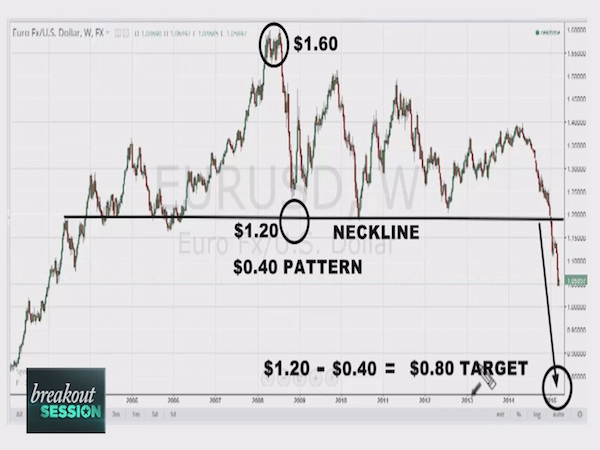
As Ross sees it, given the severity of the technical breakdown, the euro is likely to test or even make a new all-time lows of 80 U.S. cents. He arrived at his target by subtracting the lowest point of the pattern, in this case the neckline at $1.20, from the height point, which is the top of the “head” at $1.60. He then subtracts that total of 40 cents from the neckline, which gives him his target of 80 cents. Of course, Ross doesn’t feel the euro’s decline will happen overnight, and in the medium term, he does expect it will find support at the lower end of its trend channel around $1.05, at which point the currency could bounce. But in any event, Ross’ message is clear. “Ultimately, the euro is going a lot lower.”

Read more …

Ain’t that a fact?!

Britain’s Obsession With Ownership Has Made Housing A Ponzi Scheme (Guardian)

Rather like pyramid-selling scams, housing markets need a constant stream of fresh-faced hopefuls coming in at the bottom in order to keep delivering big returns at the top. No new buyers equals no more sellers’ market, equals no pressing reason all of a sudden to pay half a million for a four-bedroom modern box in Worcester or a one-bedroom flat in much of London – and what then? No more baby-boomer pensions made of bricks and mortar; no more house that earns more than you do, no piggybank of equity to raid in a crisis.

The chancellor isn’t just hauling more people aboard this financial lifeboat, but thinking about the millions already in it. Suddenly you see why, for this government, subsidising the rents of the poor via housing benefit is deemed to be wasteful and wrong – but subsidising roofs over middle earners’ heads (to the tune of nearly a billion a year through the new Isas by 2020, plus £3.7bn on cheap house loans under the existing help-to-buy scheme), weirdly enough, is not.

But what if all we’re really doing – by accepting crazed property prices as the norm, to be alleviated only by the fiscal equivalent of chucking tenners into a crowd – is sucking first-time buyers into a sort of national Ponzi scheme? What if we’re luring them in at what would otherwise have been the peak, just to keep the boom rolling a little bit longer, and leaving them horribly exposed to negative equity if another crash comes?

Read more …

No money to bail out Greece, but plenty to bail out bondholders.

Goebbelnomics – Austerian Duplicity and the Dispensing of Greece (Parenteau)

So let’s get this straight. The Troika does not have enough money to roll over Greek debt (in a Ponzi scheme like fashion, mind you) – debt that was incurred not so much as a bailout of Greece, but more as a bailout of German and other core nation banks and insurance companies and private investors who made stupid loans to or investments in Greece, but refused to fob them off on their own taxpayers. But the Troika does have enough money to adequately perform damage control for the eurozone if Greece, because, you know, Greece is a “dispensable” eurozone member – even though ECB lawyers themselves say there is no legal mechanism for disposing of eurozone members in any such fashion.

See, the square, it is a circle. No money in Greece for humanitarian aid in a country that may be on its way to becoming a failed nation state. No money outside Greece to roll over existing debt, or when necessary to extend and pretend, add more debt on existing debt to service the old debt, Charles Ponzi style. But somehow there is still “sufficient” money to ring fence Greece from the rest of the eurozone once Greece figures out is dispensable and so must exit. Wait, what? Oh, right, the square is a circle. Duplicity? Nah. Not in the eurozone. Not amongst Austerians.

But that is not even the whole deception. It turns out the ECB does happen to have enough money to buy €60 billion per month of bonds from now until at least September 2016. Which means the same bondholders who are benefitting from the misnamed “bailout” funds used to keep the core nation financial institutions from collapsing under the weight of failed loans, can now count on a monthly government handout, courtesy of the ECB. Since the ECB has to bid up the prices of these bonds in order to purchase them from bondholders, this is, for all intents and purposes, a government subsidy payment to bondholders. Bondholders will be receiving free capital gains from their bond sales to the ECB. You will notice there does not appear to be much of a budget constraint on the ECB. Funny, that.

One could not possibly make this stuff up. We are first told there is no more money for Greece, but then in the next breath, we are told there is enough money for ring fencing Greece, should it recognize it has become dispensable (and the sooner the better, it would seem, according to Belgium’s Finance Minister). Then, as if we had not been told there is not enough money for Greece, the ECB commits to creating money out of thin air for the next 18 months to subsidize eurozone bondholders, who will tend to be either the 1%, or to be eurozone financial institutions. Government handouts are apparently available for finanzkapital only, so perhaps we should conclude that unlike Greece, finanzkapital is indispensable.

Read more …

David is of little faith when it comes to Syriza.

C’mon Angela, Let Them Greexit (David Stockman)

With each passing day it becomes more obvious that Europe is heading for an epochal financial conflagration. So buy-the-dip if you must, but don’t believe for a minute that the US has decoupled. When the euro and EU eventually implode it will rattle the bones of every gambler and algo left in the casinos anywhere on the planet. Yes, the school yard name calling and roughhousing now going on in Europe makes it appear that behind the sturm und drang there is some negotiations happening. But the truth is there is nothing to negotiate. Greece is so completely and terminally bankrupt that there is no solution other than default and greexit.

To insist that Greece service the entirely of its staggering $350 billion of debt, as does Germany and the troika apparatchiks, is to advocate the extinguishment of democracy in Greece and its reduction to a colonial mandate of Brussels; and in the process, to eliminate any semblance of economic life among the debt serfs who would inhabit it. Its just math. Sooner or later interest rates must normalize. For a country with Greece’s profligate fiscal history, there is no possibility that the interest carry cost on a public debt load equal to 175% of GDP could be any less than 6-7% in the absence of EU guarantees.That means that the Greek state’s annual interest bill would approach 10% of GDP before paying down a single dime of principal. You can’t govern a democracy when one-quarter of revenues are preempted for debt service.

That’s especially the case given the sprawling expanse of the Greek state and the vast dependency of its population on public jobs, pensions and other welfare state entitlements. Indeed, for all the protestations about “austerity” Greece spending ratio to GDP just keeps getting worse. So what Greece’s fiscal equation amounts to is a deathly political food fight over upwards of 60% of GDP which must be funded with nearly an equivalent tax claim on current income – since Greece has no credit in any known financial market absent EMU advances and guarantees. Throw in the diversion of a substantial share of the punishing taxes needed to finance the current commitments of the Greek state to lenders and coupon clippers and you have a non-starter.

Read more …

Must it come to this? Praise be to Oslo, though.

Athens Mayor Unveils Scheme To Support Poor With Help From Norway (Kathimerini)

Athens Mayor Giorgos Kaminis, Norwegian Ambassador Sjur Larsen and the president of nongovernmental organization Solidarity Now, Stelios Zavvos, on Wednesday inaugurated a new program to provide support to the Greek capital’s poor. The Solidarity & Social Reintegration scheme comprises a food program benefiting 3,600 households, as well as a space provided by City Hall and managed by Solidarity Now where the organization will provide social, medical and legal aid, among other services. “The aim is the immediate relief of those in need by providing food, medical care, social services, legal support, help finding employment, and support for single-parent families, children and other vulnerable groups,” said Larsen, whose country has donated 95.8% of the €4.3 million needed to fund the program. The other donors are Iceland and Liechtenstein.

Read more …

Not impossible.

Does Greece Want To Get ‘Kicked Out’ Of The Eurozone? (CNBC)

With relations between Greece and its European neighbors at an all-time low, and the country’s politicians appearing increasingly defiant in the face of criticism, analysts are questioning whether Greece actually wants to get kicked out of the single currency. Encounters between Greece and the euro zone have become increasingly acrimonious over the last few weeks, as Greece’s commitment to its bailout program and reforms has been questioned. Greece was granted a four-month extension to its aid program in February, but there are concerns over the pace of reforms implemented by the government. Richard Lewis, fund manager at Fidelity Worldwide Investment, told CNBC he believed that Greek Prime Minister Alexis Tsipras wanted a Greek exit from the euro zone.

“My personal view is that the Greek politicians are angling to get kicked out of the euro” he told CNBC Europe’s “Squawk Box” on Thursday, adding that it would be “entirely rational” for the country to want a so-called “Grexit” given its economic situation. However, he highlighted that in order to get his Syriza party elected, Tsipras had to campaign on staying part of the single-currency region. “If they want to leave the euro, which is rational to want to do so, they have to get kicked out. It would involve turmoil, but the alternative is death by a thousand cuts,” he said, referring to Greece’s austerity drive that has been pushed by Greece’s creditors.

Read more …

Curious.

Varoufakis Says Predecessor Took IMF Loan Agreement Home (Kathimerini)

Greek Finance Minister Yanis Varoufakis on Thursday told Parliament that his predecessor, Gikas Hardouvelis, had taken a document regarding the country’s loan agreement with the International Monetary Fund home with him after leaving the ministry. Speaking to MPs on Thursday, Varoufakis said that when he asked ministry staff to locate a document regarding the two-month extension of the IMF loan he was told that the letter was among the confidential documents that the former minister had taken with him following his departure. “They told me, and I must emphasize this, that this was an absolutely legal thing to do,” Varoufakis told Parliament.

According to the minister, there were no copies of the original agreement at the ministry and he had to personally contact the IMF in order to ask for one, a procedure which took three-and-a-half days. On Thursday, Varoufakis asked for the drafting of legislation that would put an end to this kind of practice, a move that would “begin to heal the great wounds of the Greek public sector,” he said. Reacting to Varoufakis’s comments, opposition MPs noted that this kind of information was available on the Parliament’s website as well as the government gazette.

Read more …

There’s some common sense left there somewhere.

ECB Said To Reject Supervisory Move On Greek Banks Before Talks (Bloomberg)

The ECB rejected a proposal by its supervisory arm to prohibit Greek banks from increasing their holdings of short-term government debt, amid concern that such a move would endanger political negotiations. The Single Supervisory Mechanism, the ECB’s new bank oversight body, wanted to cap Greek banks’ holdings of domestic treasury bills, a key financing source for the cash-strapped government, euro-area officials familiar with the discussions said. While supervisors are concerned about the default risk that the assets carry, the higher-ranking Governing Council sent back the proposal on Wednesday. ECB President Mario Draghi is due to join four-way talks between Greece’s leadership, French President Francois Hollande and German Chancellor Angela Merkel starting in Brussels late Thursday.

Draghi is faced with finding a balance between not deliberately worsening Greece’s financial plight as it struggles to stay in the euro, and not riding roughshod over the rules of his own institution. The SSM, led by Daniele Nouy, has pushed Greece’s banks not to assent to government demands that they buy unlimited treasury bills. In February, the body readied a measure to force lenders to sell assets should a previous round of talks fail. SSM officials are reassessing the measures they can take to protect the banking system, the people said. On Wednesday, the ECB Governing Council approved a small increase in the amount of emergency liquidity assistance that Greece’s central bank can offer.

Read more …

And must it come to this too?!

German Couple Pays €875 To Greece For Their Share Of WWII Reparations (RT)

A German couple visiting Greece have handed over a check for €875 to the mayor of the seaport town of Nafplio, saying they wanted to make amends for their government’s attitude for refusing to pay Second World War reparations. Nina Lahge, who works a 30-hour week, and Ludwig Zacaro, who is retired, made the symbolic gesture and explained that the amount of €875 would be the amount one person would owe if Germany’s entire war debt was divided by the population of 80 million Germans. “If we, the 80 million Germans, would have to pay the debts of our country to Greece, everyone would owe €875 euros. In [a] display of solidarity and as a symbolic move we wanted to return this money, the €875 euros, to the Greek population,” they said.

They apologized for not being able to afford to pay for both of them. “We are ashamed of the arrogance, which our country and many of our fellow citizens show towards Greece,” they told local media in Nafplio, southern Greece. The Greek people are not responsible for the fiasco of their previous governments, they believe. “Germany is the one owing to your country the World War II reparation money, part of which is also the forced loan of 1942,” they added. The couple was referring to a loan which the Nazis forced the Greek central bank to give the Third Reich during the WWII thus ruining the occupied country’s economy. The mayor of Nafplio, Dimitris Kotsouros, said the money had been donated to a local charity.

Read more …

And somehow the BBC manages to squeeze Yats into that story?!

Tsipras Calls For ‘Bold’ Moves As EU Summit Starts (BBC)

The Greek prime minister has called for “bold initiatives” to reinvigorate his country’s economy as EU leaders gather for a summit in Brussels. Alexis Tsipras is due to hold crucial talks on the sidelines of the summit later with the leaders of Germany, France and the EU institutions. EU leaders are also due to discuss energy security and relations with Russia amid the crisis in Ukraine. Ukraine’s PM has urged the EU to stand firm on sanctions against Moscow. Arseniy Yatsenyuk told the BBC that Russia should pay the price for its actions, and suggested that any attempt to lift EU sanctions for financial reasons would be “disgusting and unacceptable”. The summit is expected to declare that the sanctions should be kept in place until the peace deal agreed in Minsk in February is implemented in full.

The dispute between Greece and its international creditors is not on the formal agenda of the summit. However, correspondents say the meeting is likely to be dominated by the issue. “The European Union needs bold political initiatives that respect both democracy and the treaties, so [as] to leave behind the crisis and to move towards growth,” Mr Tsipras, Greece’s new leftist leader, said as he arrived on Thursday. He is trying to persuade EU leaders that proposed reforms are enough to unlock vital funds, needed to avoid possible bankruptcy and a eurozone exit.

International creditors say they are are ready to extend help on Greece’s €240bn bailout until the end of June. But Mr Tsipras’s plans have met resistance from EU leaders, with Germany among the most critical. European Council President Donald Tusk is to hold a meeting on the issue late on Thursday evening with the leaders of Greece, Germany, France, the European Commission and the ECB, as well as the chairman of eurozone finance ministers. But German Chancellor Angela Merkel told reporters when she arrived at the summit that a breakthrough was unlikely. “Don’t expect a solution,” she said. “Decisions are made in the Eurogroup and that’s how it will remain.”

Read more …

I think I’ll file this under humor, and not because I don’t get how serious it is.

Greek Defense Official Seeks Proof In Moscow To Back WWII Claims (Kathimerini)

Alternate Defense Minister Costas Isichos told Russian media that he plans to ask authorities there to allow the Greek state access to archives pertaining to the destruction of infrastructure by Nazi forces during World War II. Speaking to daily Russkaya Gazeta on Wednesday, the first of a four-day visit to Moscow, Isichos said that Greece is looking for evidence to back its demands for World War II reparations from Germany in the archives of allied forces Russia, the United States, Great Britain and France. “There is a chance that relevant documents will be found in the Russian archives,” Isichos said.

“The Greek government is trying to collect similar evidence all over the world in order to strengthen with written proof its demands for war reparations and a return of the forced loan.” Last week Isichos said he had received a large collection of Wehrmacht documents from the US. “These documents do not just substantiate a historic truth – they are the documents of the Wehrmacht itself, the occupation forces,” said Isichos. “They are diaries, reports by officers to their superiors… these were not written for publicity, they were mainly secret documents.” In response to successive Greek demands, Berlin has repeated that the issue of war reparations has long been settled and refuses to further discuss the issue.

Read more …

Thanks to Dijsselbloem…

Greek Bank Deposits Outflow Spikes On Statements And Fears (Kathimerini)

Greek banks are suffering from fresh turbulence due to the tension and the apparent collision course between Athens and its creditors. Bank stocks gave up more than 8% of their value on Wednesday, while the outflow of deposits was far greater than on previous days. Credit sector officials estimated that the flight of deposits yesterday alone amounted to €350-400 million, which was some five times higher than the daily average in previous days. They added that Wednesday’s withdrawals totaled the most since an agreement was reached at the February 20 Eurogroup meeting. This followed Tuesday’s statement by Eurogroup chief Jeroen Dijsselbloem regarding the possibility of imposing capital controls in Greece.

There was also a flurry of statements from Greek and European officials that aggravated the climate between the two sides, a phenomenon that continued on Wednesday. In this context banks are worried about a new surge of withdrawals while the credit system is at a marginal point and with the European Central Bank only supplying liquidity drop by drop. On Thursday the governing council of the ECB is expected to renew the financing of Greek lenders through the Bank of Greece’s emergency liquidity assistance (ELA) mechanism and will probably increase the limit of funding that now stands at €69.4 billion euros.

The increase will again be small, just as was the case at the last few meetings of the ECB board, aimed only at covering necessary cash needs. Deposits and the credit system have taken a big blow in the last few months due to the political and economic uncertainty as well as the absence of any progress toward finding a solution to the standoff between Greece and its creditors. Banks estimate that the deposits of households and enterprises have declined by as much as €26 billion since the end of November, and today amount to no more than €138 billion.

Read more …

“The point is that there is always at least one alternative investment with a minimum positive value for all asset backed currencies and thus must always have positive nominal rates.”

We Must Rethink Risk, Cost of Capital, Currency and the Economy (Beversdorf)

Let’s think about risk, cost of capital and interest rates. The idea is that the price of risk is built into interest rates. Now we discussed that major economy Sovereign debt like Euro or USD Notes are considered risk free debt. And so interest rates represent a cost of capital only. If those Notes are paying negative interest rates it suggests that the cost of capital, which is just the opportunity cost of that money, is negative. Meaning if I didn’t lend this money to a borrower the next best return I could get on this money is actually a loss. If we look at Corporate paper like Nestle borrowing at negative rates, this actually suggests that the opportunity cost (or next best return) for the lender is a loss so great that it actually offsets all of the risk represented by the the borrower because we know that risk requires positive interest be paid.

This tells us that the economy is severely broken in Europe. For in stable economies we have positive return opportunities. None of this is arbitrary. It means in order to get investors into Sovereign debt you need to pay them in accordance with other similar investments. When economies are strong there are lots of similar investments that are paying higher and higher returns. Meaning Treasuries/Sovereigns need to increase rates to compete for capital. This has a natural balancing effect that prevents an overheating of an economy. However, when the economy is bad there are very few, and currently it would seem in Europe, no similar investments that are paying even a positive return. Meaning Euro ‘Treasuries’ can offer negative rates and still get investors. As rates increase so does demand for that currency increase and results in a strengthening of that currency.

Alternatively, when interest rates move lower and further negative a fiat currency sees less and less demand thus weakening that currency, as has been the case with the Euro. This is how rates, the economy and currency strength are tied together. What this means is that if an economy continues to decline a fiat currency’s purchasing power valuation can actually move to absolute zero (meaning it is worthless) and that rate of moving to zero is going to be your negative interest rate. It would get to zero when an economy shows no possibility of a positive return investment. What we find is that with asset backed currencies this actually cannot happen. Because an asset backed currency actually derives its value, or at least its minimum value, based on the underlying asset and so it isn’t dependent on the respective economy.

It has a minimum purchasing power valuation equal to the cost to produce or extract the underlying asset. Because that will always be a positive figure you could never see negative interest rates with an asset backed currency. It is an impossibility, which until recently most would have agreed was the case for even fiat currencies. The point is that there is always at least one alternative investment with a minimum positive value for all asset backed currencies and thus must always have positive nominal rates. This is the biggest and most fundamental difference between fiat and asset backed currencies.

Read more …

The bottomless bribes pit. When will Rousseff be arrested?

Switzerland Freezes $400 Million Amid Petrobras Laundering Probe (Bloomberg)

Switzerland has frozen $400 million of assets in more than 30 banks as the country’s attorney general probes money laundering related to Petroleo Brasileiro SA’s widening corruption scandal. Nine investigations have been opened since last April based on allegations of corruption involving eight Brazilian citizens, the Bern-based Federal Prosecutors’ Office said in an e-mailed statement on Wednesday. More than $120 million of those frozen funds were released for repatriation to Brazil, it said. “The Swiss criminal proceedings will continue with the aim of holding the perpetrators accountable and establishing the origin of the remaining frozen assets,” the Federal Prosecutors’ Office said in the statement.

Petrobras is mired in a corruption scandal in which company executives allegedly directed hundreds of millions of dollars from overpriced contracts to politicians. Disagreement about the corruption writedown led to the departure of the state-owned company’s Chief Executive Officer Maria das Gracas Foster. More than 1 million Brazilians demonstrated on Sunday against corruption and President Dilma Rousseff. The beneficial owners of more than 300 Swiss bank accounts used to process bribery payments include senior executives at Petrobras, according to the Federal Prosecutors’ Office, which is handling requests for legal assistance from Brazil and The Netherlands.

Swiss Attorney General Michael Lauber held talks with his Brazilian counterpart Rodrigo Janot in Brasilia on the prospects of working together to resolve the scandal, according to the statement. Switzerland updated its anti-money laundering legislation at the end of 2014 to reflect international standards. Its Money Laundering Reporting Office is a member of the Egmont Group of nations that share information to combat illicit financial transactions. “The Brazilian bribery scandal affects Switzerland’s financial center and its anti-money-laundering strategy,” the Federal Prosecutors’ Office said. The office “has a close interest in contributing fully to the resolution of the scandal through its own investigations,” it said.

Read more …

And here’s the result of the Petrobras culture.

Economic Downturn Pushes Brazilians Into Informal Economy (Reuters)

Mounting job losses are pushing more and more Brazilians into the informal economy as self-employed workers, leaving them vulnerable to what could be the country’s worst recession in 25 years. Tens of thousands of people who lost full-time jobs are now freelancing as bricklayers, truck drivers and maids to make ends meet as they look for increasingly scarce jobs. In the process, they often lose access to welfare benefits and face greater credit restrictions. Self-employed workers, most of them earning no more than about $450 a month, now represent 19.5% of employees in Brazil’s main cities – the highest level in eight years and up from 17.5% in 2012, according to official data for January.

The quest of people like José Lúcio da Silva, 55, illustrates how Brazil’s economy and labor market have over the last two years lost the vigor of the previous decade. “The boss said things were slowing and then he fired us,” said Silva, who had a formal job as a sealant installer at building sites in Brasilia for nearly 30 years. He is only five years away from retirement, provided he finds another full-time “registered” job with benefits. “You can’t find a freelance job every day. You can take a few of them here and there, but sometimes these jobs take a while to appear,” he added.

The loss of secure jobs is a blow to an already weak economy and to President Dilma Rousseff, who won re-election in October thanks in large part to low unemployment. Since then, her popularity has plunged with 62% of people in a new poll saying her government was “bad” or “terrible” Although recent data does not offer a breakdown by income or education, surveys show the typical self-employed worker in Brazil is a middle-aged, low-paid male household head. More than half work at farms, building sites and in commerce, either hawking goods on the streets or as door-to-door salespeople.

Read more …

And that’s just the start.

Iran Could Add Million More Barrels a Day to the Oil Glut (Bloomberg)

Iran says it could add a million barrels to daily oil production shortly after a deal to lift sanctions, reclaiming the position of OPEC’s second-largest supplier. While such a boost would take months because sanctions may be rolled back slowly, industry observers agree the capacity is there. Going further than that and adding a second million barrels – as the government has said it plans to do – will prove a much bigger challenge. It would take some five years and tens of billions of dollars of investment, according to two former oil-industry executives who worked in the country. “The number one need is investment,” said Mohsen Shoar, an analyst with Continental Energy. “To get anywhere beyond 4 million barrels a day” will require foreign assistance, he said by phone.

Iran is seeking a final agreement with international powers by June that would curb its nuclear program in exchange for phasing out sanctions that have cut its crude exports, choked cash flow and halted most oil investment. The country produced 2.8 million barrels of oil a day last month, compared with 3.6 million at the end of 2011, according to data compiled by Bloomberg. Oil Minister Bijan Namdar Zanganeh said March 16 that the Persian Gulf nation would be able to raise production by a million barrels a day, bringing it to 3.8 million, “within a few months,” placing it behind only Saudi Arabia in the OPEC. Once the restrictions are eased – a process that itself could take many months – Iran would need to seek foreign partners to boost output beyond pre-sanctions levels, said Robin Mills at Manaar Energy Consulting.

Read more …

The lower prices fall, the more they have to try to produce and sell.

Kuwaiti Oil Minister: We ‘Have No Choice’ On Output (CNBC)

Oil prices fell once again Thursday, after a minister from OPEC said the group did not have a choice with regards to cutting oil production because it did not want to lose its global market share. Speaking to reporters in Kuwait City, Ali al-Omair, the Kuwaiti oil minister, said the dramatic drop in the price of oil would affect the country’s revenues and its fiscal budget for the year, Reuters reported Thursday. “Within OPEC we don’t have any other choice than keeping the ceiling of production as it is because we don’t want to lose our share in the market,” he said Thursday morning, according to the news agency. “If there is any type of arrangement with (countries) outside OPEC, we will be very happy.”

Weak global demand and booming U.S. shale oil production are seen as two key reasons behind the price plunge, as well as OPEC’s reluctance to cut its output. OPEC is next due to meet in June, when it will decide on its output policy after deciding to keep its production steady at the end of 2014. Rumors of an unscheduled meeting in January were quashed by United Arab Emirates Oil Minister, Suhail bin Mohammed al-Mazroui, who said he was adamant the strategy would not change. The group produces about 40% of the world’s crude oil. Prices have slumped around 60% since last June and tipped lower again on Thursday morning after a volatile week. The drop was compounded by a larger-than-expected build up in U.S. crude inventories, according to new data on Wednesday.

Read more …

“Yatsenyuk is even less popular with less than a quarter of those surveyed believing he is doing a good job.”

Poll Shows Majority of Ukrainians Unhappy With Their Government (RT)

A recent poll by a Ukrainian research group shows how unhappy the country is with their politicians. Only 8% say the country is going in the right direction, while almost two-thirds assert they don’t approve of the president’s actions. The figures should make for worrying viewing for President Petro Poroshenko and his government as Ukraine is currently mired in economic turmoil and political instability. A poll carried out by the Kiev-based Research & Branding Group from March 6-16, shows just how fed-up Ukrainians are with the way their country is being run. Poroshenko may have been in power for just over nine months, but it would appear his ‘honeymoon’ period has well and truly ended.

Just a third of those asked believe he is doing a good job, while almost 60% say they aren’t happy with the way the billionaire is running the country. If elections were carried out today, just under 20% of Ukrainians would back Poroshenko, while 30% would either vote against every candidate or not bother going to the polls. However, Poroshenko seems to be getting off lightly. Ukraine’s nationalist Prime Minister Arseny Yatsenyuk is even less popular with less than a quarter of those surveyed believing he is doing a good job in helping to run the country.

The Ukrainian media has repeatedly been reporting stories of how thousands of Russian troops are supposed to be helping anti-government militia’s in the east of the country in their fight against Ukrainian government forces. But the vast majority of those asked think their media and the stories they produce are untrustworthy, with almost 60% not believing the stories published and broadcast by the Ukrainian press. The most damaging statistics for the Ukrainian government show that a meager 8% say they are happy with the direction their country is taking and only 5% say Ukraine is politically stable.

Read more …

Diabesity.

Here’s How Much Sugar Consumption Is Hurting the Global Economy (Bloomberg)

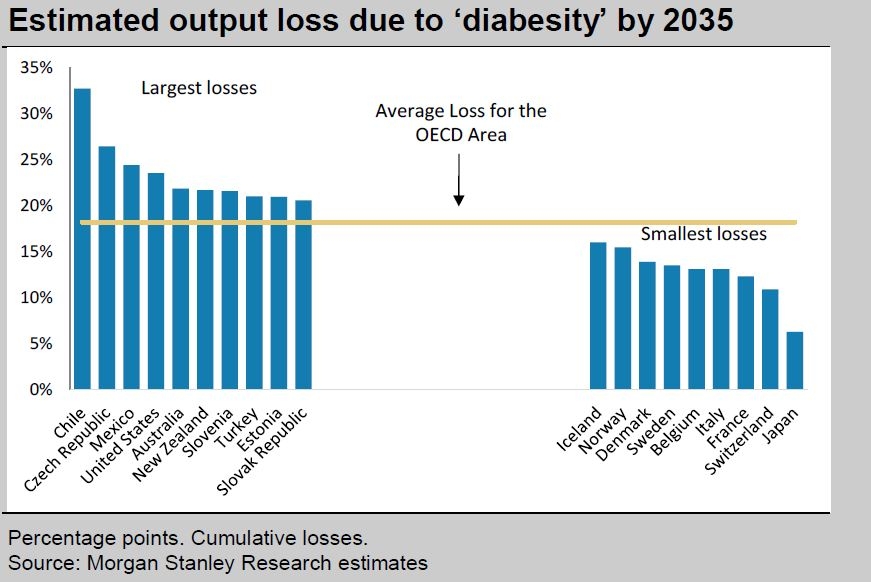
Sugar may not be so sweet when it comes to its effects on the world economy. That’s the conclusion of Morgan Stanley analysts in a new research report. They say that because health is a key driver of economic growth, rising diabetes and obesity rates cloud the outlook in both emerging markets and developed economies. Sugar consumption is one major culprit behind such health problems — making it a liability for global output. Taking into account reduced productivity caused by diabetes and obesity, the Morgan Stanley team, led by economist Elga Bartsch in London, finds that gross domestic product growth will average 1.8% annually over the next 20 years across nations in the OECD. That’s below OECD long-term forecasts for 2.3% growth.

In the same period, the cumulative loss from sugar’s not-so-sweet effects totals 18.2 percentage points. Chile, the Czech Republic, Mexico, the U.S. and Australia stand to see the worst sweet-tooth-spurred GDP drag. Japan, Korea, Switzerland, France, Italy and Belgium are looking at smaller output losses from what some call “diabesity.” Morgan Stanley finds that productivity growth in the OECD region drops to 1.5% annually over the coming decades when taking into account the sugar-related drag. That compares with the group’s forecast of 1.9% yearly growth.

The outlook for averting sugar-caused economic harm is dim. While there’s “burgeoning evidence” that sugar consumption is starting to decline in developed markets, it’s on the rise in emerging economies, driven by trends such as wider and cheaper availability of sugar-laden goods, as well as a rising preference for the sweet stuff. Sugar consumption rates are expected to continue dropping in North America and Europe as the population ages, yet Africa, Central America and Latin America are projected to increasingly demand the sweetener, based on the Morgan Stanley simulations. Asia shows a mixed pattern: If only for aging trends, sugar consumption would drop, yet an ongoing shift to a higher-sugar diet could push up consumption.
Read more …

Your own personal Jesus.

Revealed: Gates Foundation’s $1.4 Billion In Fossil Fuel Investments (Guardian)

The charity run by Bill and Melinda Gates, who say the threat of climate change is so serious that immediate action is needed, held at least $1.4bn (£1bn) of investments in the world’s biggest fossil fuel companies, according to a Guardian analysis of the charity’s most recent tax filing in 2013. The companies include BP, responsible for the Deepwater Horizon disaster, Anadarko Petroleum, which was recently forced to pay a $5bn environmental clean-up charge and Brazilian mining company Vale, voted the corporation with most “contempt for the environment and human rights” in the world clocking over 25,000 votes in the Public Eye annual awards.

The Bill and Melinda Gates Foundation and Asset Trust is the world’s largest charitable foundation, with an endowment of over $43bn, and has already given out $33bn in grants to health programmes around the world, including one that helped rid India of polio in 2014. A Guardian campaign, launched on Monday and already backed by over 95,000 people is asking the Gates to sell their fossil fuel investments. It argues: “Your organisation has made a huge contribution to human progress … yet your investments in fossil fuels are putting this progress at great risk. It is morally and financially misguided to invest in companies dedicated to finding and burning more oil, gas and coal.”

Existing fossil fuel reserves are several times greater than can be burned if the world’s governments are to fulfil their pledge to keep global warming below the danger limit of 2C, but fossil fuel companies continue to spend billions on exploration. In addition to the climate risk, the Bank of England and others argue that fossil fuel assets may pose a “huge risk” to pension funds and other investors as they could be rendered worthless by action to slash carbon emissions. [..] In their annual letter in January, Bill and Melinda Gates wrote: “The long-term threat [of climate change] is so serious that the world needs to move much more aggressively – right now – to develop energy sources that are cheaper, can deliver on demand, and emit zero carbon dioxide.”

Read more …

Yeah, that’ll work: a voluntary new corporate model.

Justice, Capitalism And Progress: Paul Tudor Jones II (TED)

Can capital be just? As a firm believer in capitalism and the free market, Paul Tudor Jones II believes that it can be. Jones is the founder of the Tudor Investment Corporation and the Tudor Group, which trade in the fixed-income, equity, currency and commodity markets. He thinks it is time to expand the “narrow definitions of capitalism” that threaten the underpinnings of our society and develop a new model for corporate profit that includes justness and responsibility. It’s a good time for companies: in the US, corporate revenues are at their highest point in 40 years. The problem, Jones points out, is that as profit margins grow, so does income inequality.

And income inequality is closely linked to lower life expectancy, literacy and math proficiency, infant mortality, homicides, imprisonment, teenage births, trust among ourselves, obesity, and, finally, social mobility. In these measures, the US is off the charts. “This gap between the 1% and the rest of America, and between the US and the rest of the world, cannot and will not persist,” says the investor. “Historically, these kinds of gaps get closed in one of three ways: by revolution, higher taxes or wars. None are on my bucket list.” Jones proposes a fourth way: just corporate behavior. He formed Just Capital, a not-for-profit that aims to increase justness in companies. It all starts with defining “justness” — to do this, he is asking the public for input.

As it stands, there is no universal standard monitoring company behavior. Tudor and his team will conduct annual national surveys in the US, polling individuals on their top priorities, be it job creation, inventing healthy products or being eco-friendly. Just Capital will release these results annually – keep an eye out for the first survey results this September. Ultimately, Jones hopes, the free market will take hold and reward the companies that are the most just. “Capitalism has driven just about every great innovation that has made our world a more prosperous, comfortable and inspiring place to live. But capitalism has to be based on justice and morality…and never more so than today with economic divisions large and growing.”

Read more …

“A recent study found that Arctic sea ice had thinned by 65% between 1975 and 2012.”

Arctic Winter Sea Ice Extent Lowest On Record (BBC)

Sea ice in the Arctic Ocean has fallen to the lowest recorded level for the winter season, according to US scientists. The maximum this year was 14.5 million sq km, said the National Snow and Ice Data Center at the University of Colorado in Boulder. This is the lowest since 1979, when satellite records began. A recent study found that Arctic sea ice had thinned by 65% between 1975 and 2012. Bob Ward of the Grantham Research Institute on Climate Change and the Environment at the London School of Economics said: “The gradual disappearance of ice is having profound consequences for people, animals and plants in the polar regions, as well as around the world, through sea level rise.”

The National Snow and Ice Data Center (NSIDC) said the maximum level of sea ice for winter was reached this year on 25 February and the ice was now beginning to melt as the Arctic moved into spring. The amount measured at the end of February is 130,000 sq km below the previous record winter low, measured in 2011. An unusually warm February in parts of Alaska and Russia may have contributed to the dwindling sea ice, scientists believe. Researchers will provide the monthly average data for March in early April, which is viewed as a better indicator of climate effects. NSIDC scientist Walt Meier said: “The amount of ice at the maximum is a function of not only the state of the climate but also ephemeral and often local weather conditions. “The monthly value smoothes out these weather effects and so is a better reflection of climate effects.”


Read more …

Mar 182015
 
 March 18, 2015  Posted by at 6:25 am Finance Tagged with: , , , , , , , , , ,  4 Responses »


DPC Station at foot of incline, American Falls, Niagara Falls 1890

The US Economy Just Keeps Disappointing (Bloomberg)
‘Hell Will Break Loose’ If Fed Loses Patience (MarketWatch)
Options Market Signals 2007-Like Crash Risk, Goldman Warns (Zero Hedge)
US Housing Starts Plunge Most in Four Years (Bloomberg)
New BoE Regulator Warns Of Risks From US Rate Hikes, Dollar Strength (Reuters)
Europeans Defy US To Join China-Led Development Bank (FT)
Debunking $1.4 Trillion Europe Debt Myth in Post-Heta Age (Bloomberg)
Greek PM Tsipras To Meet Merkel, Draghi In Brussels On Friday (Kathimerini)
Greece WWII Reparations Cause Split Among German MPs (RT)
Athens Furious At Eurogroup Suggestion Of Capital Controls (Kathimerini)
Greece Grabs Cash as More Than $2 Billion in Payouts Loom (Bloomberg)
Greece’s Euro Exit Seems Inevitable (Bloomberg)
EU Warns Against Bills On Debt Settlement, Humanitarian Crisis (Kathimerini)
Japan Exports Slow Sharply In February But Beat Expectations (CNBC)
China New Home Prices Post Sixth Consecutive Monthly Decline (CNBC)
BoE’s Brazier Says Greek Shock Could Trigger Market Correction (Bloomberg)
EU Support for Russia Sanctions Is Waning (Bloomberg)
ECB Celebration of Its New $1.4 Billion Tower Spoiled by Protests (Bloomberg)
Bolivia: A Country That Dared to Exist (Benjamin Dangl)

“..relative to where economists thought we would be, the U.S. is missing by a large margin..”

The US Economy Just Keeps Disappointing (Bloomberg)

Last week, we reported on how the U.S. economy was the most disappointing major economy in the world based on the Bloomberg Economic Surprise Index, which measures incoming economic data against economist expectations. These measures tend to move in cycles, as they reflect both the absolute economic data as well as the optimism or pessimism of the forecasters, which is in itself cyclical. For the U.S. we keep driving lower, hitting depths not seen since the economic crisis. Again, this doesn’t mean that the economy is anywhere near as bad as it was then. But whether it’s a slowdown caused by the harsh winter or something else, relative to where economists thought we would be, the U.S. is missing by a large margin.

Read more …

“On the other hand, if Janet is patient and says so, we’re all going to make an absurd amount of money.”

‘Hell Will Break Loose’ If Fed Loses Patience (MarketWatch)

Daytraders tend to relish when the market bounces around like a leprechaun on a hot griddle. But for everybody else, it’s tense times in the trading pits these days. While a calm often settles over markets in the days leading into a hyped-up Fed statement, recent action says to gird for more rockiness. Dips are being bought and profits are being scalped. Yet for all the sparks flying on the S&P, its up only 1% so far this year. That’s better than down, of course, unless you’re betting the “don’t pass” line. But compare that with the 24% explosion to the upside on Germany’s main index, and you’d be pardoned for suffering Teutonic envy. Shanghai, while no Germany, is also doing better than U.S. stocks, and a tandem of brokers are feeling the bull run in China has a long way to run (see call of the day).

Nevertheless, the U.S. is still firmly entrenched in its own bull party, despite recent queasiness. In fact, we’re just about 2,200 days into it. Another two months, and this bull market will overtake the one from 1974-1980 as the third-longest since 1929, according to Bloomberg. Getting there just might hinge on the Fed’s next move. It could go either way, according to the Fly from the iBankCoin blog, who spoke of extremes. “If we find out this Wednesday that [Janet Yellen] is not, in fact, patient, hell will break loose and 66 seals of hell will be broken — paving way for actual centaurs to roam, wall-kicking people in the faces with their hooves,” he wrote. “On the other hand, if Janet is patient and says so, we’re all going to make an absurd amount of money.”

Read more …

“..an epic decoupling of put prices and S&P P/E ratios”

Options Market Signals 2007-Like Crash Risk, Goldman Warns (Zero Hedge)

Although US equity prices have demonstrated a remarkable propensity to completely disregard apparently unimportant things like macro fundamentals, forward earnings estimates, and top-line growth projections, we’ve long argued that eventually, reality will come calling and the farther stretched valuations become in the meantime, the more painful the correction will be. As we noted on Sunday, the cracks are starting to form as DB became the first sell-side firm to predict that EPS will in fact not grow in 2015, prompting us to remark that “EPS growth in 2015 [is] now a wash (if not negative), which implies the only upside for the S&P 500 will once again come from substantial multiple expansion.” Against this backdrop of declining revenues, declining earnings, and pitiable economic projections (thanks a lot Atlanta Fed Nowcast), we bring you yet another sign that a “correction” may indeed be in the cards: an epic decoupling of put prices and S&P P/E ratios. Here’s Goldman:

Long-dated crash put protection costs on the SPX have more than doubled over the past 9 months. We believe it is an important development to watch as it implies investors are increasingly concerned about downside risk even as US equities trade near all-time highs. Based on our conversations with investors over the past few months, it appears the increase in long-dated put prices has largely gone unnoticed among equity and credit investors. In fact, Investment Grade credit spreads have actually tightened slightly over the same period. The rise in long-dated equity put prices may signal an increasing fear that a substantial market correction is on the horizon, despite low short-term put prices which suggest low probably of a near-term drawdown vs history.

Read more …

“It was just the weather, basically..”: “Starts of single-family properties dropped 14.9%..” “New construction slumped a record 56.5% in the Northeast..”

US Housing Starts Plunge Most in Four Years (Bloomberg)

Housing starts slumped in February by the most in four years as bad winter weather in parts of the U.S. prevented builders from initiating new projects. Work began on 897,000 houses at an annualized rate, down 17% from January and the fewest in a year, the Commerce Department reported Tuesday in Washington. The median estimate of 80 economists surveyed by Bloomberg called for 1.04 million. “It was just the weather, basically,” said Richard Moody, chief economist at Regions Financial Corp. in Birmingham, Alabama. Still, “my view of the recovery in single-family housing is that it’s coming more gradually than others think.” An increase in building permits was driven by applications for multifamily units, indicating single-family construction, the biggest part of the market, will keep struggling.

While stronger hiring and low borrowing costs have helped the industry advance, sales remain challenged by limited supply of cheaper homes and sluggish wage growth. The median estimate of 81 economists in the Bloomberg survey called for 1.04 million starts. Estimates ranged from annualized rates of 975,000 to 1.08 million after a previously reported January pace of 1.07 million. Building permits climbed 3% to a 1.09 million annualized pace, the fastest since October, after a 1.06 million rate a month earlier. They were projected at 1.07 million, according to the Bloomberg survey median. Permits for single-family dwellings were the lowest since May.

Stock-index futures held losses after the figures. The contract on the Standard & Poor’s 500 Index maturing in June dropped 0.3% to 2,063.3. Starts of single-family properties dropped 14.9% to a 593,000 rate in February. Construction of multifamily projects such as condominiums and apartment buildings decreased 20.8% to an annual rate of 304,000. New construction slumped a record 56.5% in the Northeast and fell 37%, the most since January 2014, in the Midwest. Starts also dropped in the South and West, indicating weather was only partly to blame.

Read more …

Hollow.

New BoE Regulator Warns Of Risks From US Rate Hikes, Dollar Strength (Reuters)

The start of U.S. interest rate rises could inject volatility into global financial markets and create risks for Britain’s financial stability, a new member of the Bank of England’s top panel of financial regulators said on Tuesday. Alex Brazier, who took a seat on the BoE’s Financial Policy Committee on Monday, cited the normalisation of U.S. borrowing costs as one of the main global risks for markets. The FPC was set up in 2013 after the failure of Britain’s financial regulation to protect the country against the 2007-08 financial crisis. Last year it imposed curbs on large mortgages and required banks to hold more reserves against potential losses. Brazier – in remarks which share concerns expressed by other BoE officials – said rate hikes by the U.S. Federal Reserve or a change in perceptions of their timing and scale would reflect good news about the U.S. economic recovery.

“However, it would probably reduce the extent of the search for yield and prompt a reduction in global risk appetite,” Brazier said in answer to questions from members of parliament who are reviewing his appointment. Brazier joined the BoE in 2001 after university, and most recently served as principal private secretary to Governor Mark Carney and his predecessor, Mervyn King. “Both of them pushed me to the edges of my limits,” Brazier said, noting that his hair had turned prematurely grey. Brazier is now the BoE’s executive director for financial stability, strategy and risk. This is a new role created last year by Carney as part of a shake-up of the bank. BoE chief economist Spencer Dale briefly held the job before he quit to become chief economist for oil company BP.

Read more …

“.. the White House criticism of Britain was a case of sour grapes: “They couldn’t have got congressional approval to join the AIIB, even if they wanted to.”

Europeans Defy US To Join China-Led Development Bank (FT)

France, Germany and Italy have all agreed to follow Britain’s lead and join a China-led international development bank, according to European officials, delivering a blow to US efforts to keep leading western countries out of the new institution. The decision by the three European governments comes after Britain announced last week that it would join the $50bn Asian Infrastructure Investment Bank, a potential rival to the Washington-based World Bank. Australia, a key US ally in the Asia-Pacific region which had come under pressure from Washington to stay out of the new bank, has also said that it will now rethink that position.

The European decisions represent a significant setback for the Obama administration, which has argued that western countries could have more influence over the workings of the new bank if they stayed together on the outside and pushed for higher lending standards. The AIIB, which was formally launched by Chinese President Xi Jinping last year, is one element of a broader Chinese push to create new financial and economic institutions that will increase its international influence. It has become a central issue in the growing contest between China and the US over who will define the economic and trade rules in Asia over the coming decades. When Britain announced its decision to join the AIIB last week, the Obama administration told the Financial Times that it was part of a broader trend of “constant accommodation” by London of China.

British officials were relatively restrained in their criticism of China over its handling of pro-democracy protests in Hong Kong last year. Britain tried to gain “first mover advantage” last week by signing up to the fledgling Chinese-led bank before other G7 members. The UK government claimed it had to move quickly because of the impending May 7 general election. The move by George Osborne, the UK chancellor of the exchequer, won plaudits in Beijing. Britain hopes to establish itself as the number one destination for Chinese investment and UK officials were unrepentant. One suggested that the White House criticism of Britain was a case of sour grapes: “They couldn’t have got congressional approval to join the AIIB, even if they wanted to.”

Read more …

A potential bombshell.

Debunking $1.4 Trillion Europe Debt Myth in Post-Heta Age (Bloomberg)

Austria’s decision to burn bondholders of a failed state bank may mean almost €1.3 trillion of European debt once deemed risk-free now comes with a hazard warning. Austria is the first country to wind down a bank, Heta, under the EU’s new Bank Recovery and Resolution Directive after changing laws last year to allow it to write down subordinated debt of its failed predecessor, Hypo Alpe-Adria-Bank. The government is also refusing to stand behind guarantees by the province of Carinthia on Heta’s senior debt. The moves are putting bondholders at risk of losses. As age-old banking mores clash with modern banking rules, investors are being forced to take a second look at how governments have used explicit or implicit promises in the past to issue debt that doesn’t show up in official ledgers.

“People had too much trust in public authorities,” said Otto Dichtl, a credit analyst for financial companies at Stifel Nicolaus. “Austria dropping Carinthia like this is an extraordinary step. We have to see just how this is carried out. From a legal perspective, this is uncharted territory.” Based on current bond prices, Heta’s senior creditors, who bought securities covered by a guarantee from Carinthia province, face losses of more than 40% on their €10.2 billion of debt. Carinthia, a southern Austrian region of 556,000 people with annual revenue of less than €2.4 billion, may face insolvency if the guarantees are triggered. Until this year, figures for debt guarantees weren’t disclosed in most European countries, a fact that helped Greece conceal its true debt levels to gain entry to the euro in 2001.

Greece undertook the biggest debt restructuring on record in 2012. New rules by the European Council, known as the “six pack” directive, led to data as of 2013 being published for the first time last month, revealing €1.28 trillion of government guarantees. The EU introduced the six laws in 2011. As the EU’s biggest user of guarantees, Austria has contingent liabilities corresponding to 35% of national output, or €113 billion, the data show. It isn’t just Austria that has liberally applied state guarantees. Ireland has contingent liabilities equivalent to 32% of its economy, reflecting the collapse of its banking system, while Germany’s tally stands at more than 18% of output. German guarantees, encompassing €512 billion, are the biggest in absolute terms, followed by Spain with €193 billion and France with €117 billion.

Read more …

Merkel gets closer.

Greek PM Tsipras To Meet Merkel, Draghi In Brussels On Friday (Kathimerini)

With Greece rapidly running out of funds, Prime Minister Alexis Tsipras has proposed an urgent meeting on the sidelines of the European Union summit that begins on Thursday in a bid to reach an agreement that would allow Athens to get more funds. Greece urgently needs between €3 and €5 billion. Tsipras on Tuesday telephoned European Council President Donald Tusk and asked him to convene a meeting with Chancellor Angela Merkel, President Francois Hollande, ECB President Mario Draghi and EC President Jean-Claude Juncker. The meeting will be held on Friday morning, despite the fact that European officials questioned its use.

Sources in Brussels said the proposal was a mistake, as it focused on meeting with the leaders of two countries, and the heads of the ECB and the Commission, rather than pursuing a collective agreement in the EU, and it was not clear what Tsipras wanted to achieve. If the aim was to achieve more funding, this would have to be the subject of technical discussions between experts and could not be dealt with at the political level. However, with teams of experts still unable to reach a conclusion as to Greece’s financing needs and its compliance with the bailout agreement, agreement at the political level is precisely what Tsipras is after.

He wants an agreement on a framework that will set out what Greece must do in order to get the ECB to allow his country to borrow more, a source in Tsipras’s office told Kathimerini. Tsipras is prepared to accept reforms that will be proposed by Greece’s partners, including privatization, the same source said. They stressed that Athens would draw the line at adopting further austerity measures. “We accept everything else, on the basis of the commitments made in [Finance Minister] Yanis Varoufakis’s letter to the Eurogroup,” the source added. The Greek prime minister is to meet the German chancellor in Berlin on March 23, following an invitation from Merkel on Monday.

Read more …

That’s what I said: “Germany can’t simply sweep the demands from Greece off the table.”

Greece WWII Reparations Cause Split Among German MPs (RT)

Several senior Social Democrats (SPD) and Greens have for the first time acknowledged that Greece has a case for WWII reparations. This contradicts the stance of German Chancellor Angela Merkel’s government which had ruled it out. “We should make a financial approach to victims and their families,” said Gesine Schwan, chairwoman of the Social Democratic Party (SPD) values committee told Der Spiegel Online on Tuesday. “It would be good for us Germans to sweep up after ourselves in terms of our history,” she said. “Victims and descendants have longer memories than perpetrators and descendants,” said Schwan, who was nominated as a candidate for President twice in 2004 and 2009. SPD deputy leader Ralf Stegner agreed that the issue should be resolved, however independently from the current debate over the Euro crisis and Greek sovereign debt.

“But independently, we must have a discussion about reparations,” Ralf Stegner told Spiegel. “After decades, there are still international legal questions to be resolved.” SPD is the second major party in Germany that shares power with Merkel’s conservative Christian Democratic Union and the Christian Social Union (CDU/CSU). The SPD were joined by the Green party, with leader Anton Hofreiter saying that “Germany can’t simply sweep the demands from Greece off the table.” “This chapter isn’t closed either morally or legally.” Demands for reparations from Germany dating back to the Nazi occupation during World War II have been voiced by Greek politicians over the past 60 years, but have gained renewed energy amid the recent financial crisis and tough austerity measures in exchange for largely German-backed loans.

In April 2013 Greece officially declared that it would pursue the reparations scheme. Greece’s Prime Minister Alexis Tsipras leader of the anti-austerity Syriza party relaunched the heated debate in February by saying that Athens has a “historical obligation” to claim from Germany billions of euros in reparations for the physical and financial destruction committed during Nazi occupation. However, Germany’s government has said that this issue has already been legally resolved, arguing that Greece is trying to detract attention from the serious financial problems the country is facing.

Read more …

“We cannot easily understand the reasons that pushed him to make statements that are not fitting to the role he has been entrusted with.”

Athens Furious At Eurogroup Suggestion Of Capital Controls (Kathimerini)

The chairman of the Eurogroup, Dutch Finance Minister Jeroen Dijsselbloem, on Tuesday became the first European Union official to suggest the possibility of capital controls to prevent Greece leaving the euro, drawing a furious reaction from Athens, which accused him of “blackmail.” “It’s been explored what should happen if a country gets into deep trouble – that doesn’t immediately have to be an exit scenario,” Bloomberg quoted the head of the eurozone’s finance ministers telling his country’s BNR Nieuwsradio. On Cyprus, he said, “we had to take radical measures, banks were closed for a while and capital flows within and out of the country were tied to all kinds of conditions, but you can think of all kinds of scenarios.”

Greece is scrambling to pay its obligations as revenues drop and it needs the European Central Bank to allow it to borrow more funds. Its eurozone partners are awaiting the result of an inspection into Greece’s finances and its compliance with the bailout program. In Athens, the government issued an angry reply. “It would be useful for everyone and for Mr. Dijsselbloem to respect his institutional role in the eurozone,” Gavriil Sakellaridis said. “We cannot easily understand the reasons that pushed him to make statements that are not fitting to the role he has been entrusted with. Everything else is a fantasy scenario. We find it superfluous to remind him that Greece will not be blackmailed.”

Read more …

Schaeuble keeps at it: “Greek leaders are “lying to the population..”

Greece Grabs Cash as More Than $2 Billion in Payouts Loom (Bloomberg)

Greece will begin debating measures to boost liquidity as the cash-starved country braces for more than €2 billion in debt payments Friday. Unable to access bailout funding and locked out of capital markets, the government will outline emergency plans to parliament Tuesday to increase funding. Payments due March 20 include interest on a swap originally arranged by Goldman Sachs, said a person familiar with the matter who asked not to be identified publicly discussing the derivative. Prime Minister Alexis Tsipras’s government is burning through cash while trying to get its creditors – euro area member states, the ECB and the IMF – to release more money from its €240 billion bailout program.

European governments have said they won’t disburse any more emergency loans unless the government in Athens implements a set of economic overhauls agreed last month, including pension and sales tax reform. “As days go by, room for maneuver becomes ever smaller,” said Theodore Pelagidis at the Brookings Institution. “The impression given is that there’s no plan A or plan B. There’s nothing.” The government’s revenue-boosting plan includes eliminating fines on those who submit overdue taxes by March 27 to encourage payment, helping cover salaries and pensions due at the end of the month. The bill also requires pension funds and public entities to invest reserves held at the Bank of Greece in government securities and repurchase agreements, and transfers €556 million from the country’s bank recapitalization fund to the state.

A vote on the measures is scheduled for Wednesday. Greek stocks rebounded Tuesday, ending four days of declines, with the benchmark Athens Stock Exchange gaining 2.6%. Yields on 3-year bonds rose 8 basis points to 20.25%. The government said March 14 it has a plan to “enhance its liquidity” and won’t have problems meeting payments for civil servants and retirees due just one week after the March 20th debt payments. Tsipras has pledged to meet the country’s obligations while at the same time ending austerity measures. “None of my colleagues, or anyone in the international institutions, can tell me how this is supposed to work,” German Finance Minister Wolfgang Schaeuble said in Berlin Monday. Greek leaders are “lying to the population,” he said.

Read more …

“Put them in front of their contradictions. Make them face the contradictions of the eurozone themselves.”

Greece’s Euro Exit Seems Inevitable (Bloomberg)

Greece’s money troubles resemble a game of pass the parcel, where each successive participant rips another sheet of wrapping paper off the box — which turns out to be empty when the final recipient reaches the core. With time and money running out, a successful endgame seems even less likely than it did a week or a month ago. It’s increasingly obvious that the government’s election promises are incompatible with the economic demands of its euro partners. Something’s got to give. The current money-go-round is unsustainable. Euro-region taxpayers fund their governments, which in turn bankroll the ECB. Cash from the ECB’s Emergency Liquidity Scheme flows to the Greek banks; they buy treasury bills from their government, which uses the proceeds to …repay its IMF debts! No wonder a recent poll by German broadcaster ZDF shows 52% of Germans say they want Greece out of the euro, up from 41% last month.

There’s blame on both sides for the current impasse. Euro-area leaders should be giving Greece breathing space to get its economic act together. But the Greek leadership has been cavalier in its treatment of its creditors. It’s been amateurish in expecting that a vague promise to collect more taxes would win over Germany and its allies. And it’s been unrealistic in expecting the ECB to plug a funding gap in the absence of a political agreement for getting back to solvency. There’s a YouTube video making the rounds on Twitter this week of a lecture Yanis Varoufakis gave in Croatia in May 2013. The most arresting section comes after about two minutes, when the current Greek finance minister literally flips the bird at Germany [..] And if what Varoufakis went on to say is instructive of the game-theory professor’s mind-set, the lack of progress in negotiations with lenders isn’t so surprising:

The most effective radical policy would be for a Greek government to rise up or a Greek prime minister or minister of finance, to rise up in EcoFin in the euro group, wherever, and say “folks, we’re defaulting. We shall not be repaying next May the 6 billion that supposedly we owe the ECB. My God you know, to have a destroyed economy that is borrowing from the ESM to pay to the ECB is not just idiotic, but it’s the epitome of misanthropy.

Say no to that. Put them in front of their contradictions. Make them face the contradictions of the eurozone themselves. Because the moment that the Greek prime minister declares default within the euro zone, all hell will break loose and either they will have to introduce shock absorbers, or the euro will die anyway, and then we can go to the drachma.

Read more …

A sovereign nation?

EU Warns Against Bills On Debt Settlement, Humanitarian Crisis (Kathimerini)

The European Commission’s chief representative on the technical team monitoring Greece, Declan Costello, has described draft laws aimed at tackling the humanitarian crisis and launching a 100-installment payment scheme for taxpayers to settle their debts to the state as unilateral actions taken in a fragmentary fashion, according to a text he has reportedly sent to the Greek side. Costello effectively vetoes the bills in his letter, arguing that they are not compatible with the Eurogroup’s February 20 agreement with Athens, as Paul Mason – a journalist who claims to have seen the correspondence between Costello and the Greek authorities – revealed on Tuesday.

There was no reaction to the news from the Finance Ministry up until late last night, with officials pointing to the list of seven actions that Finance Minister Yanis Varoufakis submitted to the latest Eurogroup meeting which, according to the ministry, included the above bills. Nevertheless other government officials confirmed the existence of the text sent by Costello and noted that certain points related to the draft laws – especially those concerning the settlement of debts to tax authorities – must be clarified.

According to the text that Mason published as a Costello letter, the Commission representative says that those bills will have to be included in the general context of reform promotion. “We would strongly urge having the proper policy consultations first, including consistency with reform efforts. There are several issues to be discussed and we need to do them as a coherent and comprehensive package,” Costello reportedly told the government: “Doing otherwise would be proceeding unilaterally and in a piecemeal manner that is inconsistent with the commitments made, including to the Eurogroup as stated in the February 20 communique.” The debt settlement bill was tabled in Parliament on Tuesday night.

Read more …

“A plunge in export volumes offset another decline in the cost of oil imports. Net exports should therefore become a drag on [GDP] growth soon..”

Japan Exports Slow Sharply In February But Beat Expectations (CNBC)

Japan’s exports rose at a faster-than-expected pace in February but slowed sharply from the previous month as exports to China waned amid the Lunar New Year holidays. Exports rose 2.4% on year, Ministry of Finance data showed on Wednesday, above expectations for a 0.3% increase in a Reuters poll, but down from a 17% on-year rise in January. Despite the above-view reading, exports were sharply lower compared to January’s reading largely due to 17.3% on-year drop in exports to China, which celebrated the Lunar New Year holiday during February. “A plunge in export volumes offset another decline in the cost of oil imports. Net exports should therefore become a drag on [GDP] growth soon,” Marcel Thieliant, Japan economist at Capital Economics, said in a note.

But Mizuho Bank analysts were more optimistic. “We think this supports the [Bank of Japan’s] view of an ongoing, gradual recovery, underpinning its decision to withhold from adding further stimulus even as [central bank governor] Kuroda expresses his view that inflation might turn negative due to oil prices,” it say in a note. Meanwhile, imports fell 3.6% on year in February, sharply below expectations for a 3.1% increase in a Reuters poll. “[The] drop in import values was largely caused by another decline in petroleum import values, which reached the lowest since late 2010,” Thieliant said. “Judging by the Bank of Japan’s import price index, the plunge in the price of crude oil since last summer has now mostly been reflected in the cost of oil imports. However, import prices of natural gas, which tend to follow the price of crude oil with a lag of about six months, have just started to fall. The trade shortfall may therefore still narrow a touch further in the near-term.”

Read more …

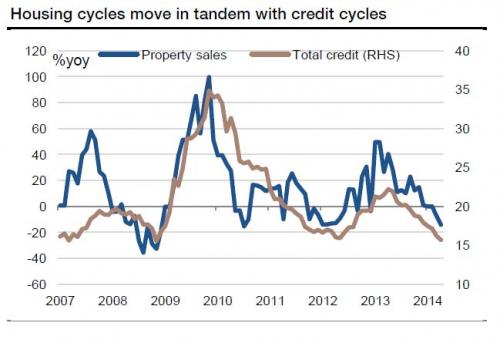
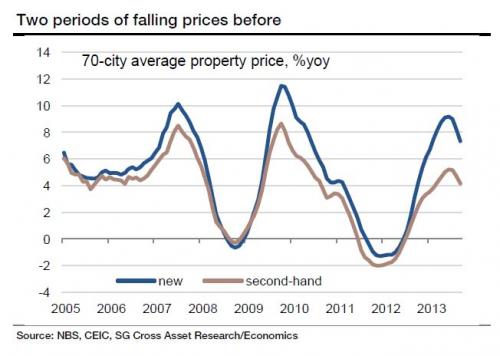
“New home prices fell 5.7% on year in February..”

China New Home Prices Post Sixth Consecutive Monthly Decline (CNBC)

China new home prices registered their sixth straight month of annual decline in February, as tepid demand continued to weigh on sentiment despite the government’s efforts to spur buying. New home prices fell 5.7% on year in February, according to Reuters calculations based on fresh data from the National Bureau of Statistics on Wednesday. The reading was worse than January’s 5.1% decline and marks the largest drop since the current data series began in 2011. Meanwhile, both Beijing and Shanghai clocked home price declines. In Beijing, prices fell 3.6% on year following a 3.2% drop in January, while prices in Shanghai fell 4.7%, following January’s 4.2% drop.

However, in a statement after the data was released the Chinese statistics bureau said that home sales are expected to show a significant rebound in March, according to Reuters. “The news isn’t great, and it hasn’t been great for some time. The credit crunch in China is very real and prices do have to adjust after a very long time,” John Saunder, head of APAC at Blackrock told CNBC. “I think the China government is trying to make moves to stabilize things. They’ve undergone a lot of policies and obviously the [central bank] is now reducing the policy rates, so that will all help. but you can’t turn it around instantly,” he said.

Read more …

No kidding.

BoE’s Brazier Says Greek Shock Could Trigger Market Correction (Bloomberg)

A failure to find a political solution to Greece’s sovereign debt problem could trigger a market correction, Bank of England official Alex Brazier said. “A bad outcome in these negotiations could trigger a broader reassessment of risk in financial markets,” Brazier, executive director for financial stability at the BOE, told U.K. lawmakers in London on Tuesday. “We start from a position where market pricing looks potentially subject to correction,” he said. “I don’t view Greece as a big direct risk but it could potentially be a trigger for a market reappraisal” Greek Prime Minister Alexis Tsipras’s government is negotiating with euro-area member states, the ECB and the IMF to release more money from its bailout program.

European governments have said they won’t disburse any more emergency loans unless the government in Athens implements a set of economic overhauls agreed last month, including pension and sales tax reform. “I don’t presume to know how likely it is for Greece to leave the euro,” Brazier said. “Although the economic issue is in some ways very simple – there’s a debt overhang that needs to be dealt with – the way that is dealt with is a political issue and I don’t presume to be able to forecast in any way” how the talks will progress, he said. Brazier said U.K. banks’ direct exposure to Greece was small, “amounting to about £2 billion ($3 billion), which is about 1% of their common equity.”

Read more …

Given the propaganda underlying the sanctions, inevitable.

EU Support for Russia Sanctions Is Waning (Bloomberg)

For evidence of the European Union’s diminishing appetite for sanctions against Russia, look no further than Vladimir Putin’s Kremlin guestbook. Cyprus President Nicos Anastasiades visited the Russian leader in February, granting the Russian navy access to Cypriot ports; March brought Italian Prime Minister Matteo Renzi, labeled a “privileged partner” by Putin; Greek Prime Minister Alexis Tsipras is due next in Moscow, in April. Along with Hungary, Slovakia, Austria and Spain, the three countries were reluctant backers of economic curbs to protest Russia’s interference with Ukraine. As a wobbly truce takes hold in eastern Ukraine, the anti-sanctions bloc will lay down a marker at an EU summit starting Thursday in Brussels.

“The likeliest outcome is that they will not agree to roll over the sanctions now and they will put off a decision until the last possible moment before the sanctions expire,” Ian Bond, a former British diplomat now with the Centre for European Reform in London, said by phone. EU governments halted trade and visa talks with Russia and started blacklisting Russian politicians and military officers last March, after the annexation of Crimea. Those asset freezes and travel bans were extended by six months in January 2015. It took the shooting down of a Malaysian passenger jet over eastern Ukraine in July to prompt wider-ranging curbs including bans on financing of major Russian banks and the sale of energy-exploration gear to Russia’s resource-dependent economy. Those “stage three” measures are set to expire in July.

Proponents of extending them are led by Poland, the Baltic states and the U.K., and count as one of their own the EU president and summit chairman: former Polish Prime Minister Donald Tusk. The hawks have already backed down by seeking a five-month prolongation until the end of 2015, instead of the usual 12 months. “At some time there should be a decision in our view about the extension of the sanctions until the end of the year,” Lithuanian Foreign Minister Linas Linkevicius said in an interview in Brussels at a meeting of EU diplomats on Monday. Even that is a stretch, at least at this week’s summit. Sanctions require all 28 EU countries to agree, enabling skeptics to play for time, shape policies to their liking and, in the extreme, cast a veto. Greece’s new government, for example, voiced discomfort about renewing the blacklists in January before finally going along.

Read more …

As it should be. How can you spend $1.4 billion in tax money, where a few million would have done, when people have no health care, unless you’re a full-blown megalomaniac?!

ECB Celebration of Its New $1.4 Billion Tower Spoiled by Protests (Bloomberg)

As the ECB prepares to inaugurate its new headquarters four months after moving in, more than 10,000 protesters are seeking to spoil the party. Frankfurt, the euro area’s financial capital and home of the common currency, is bracing for demonstrations and sit-ins on Wednesday at locations throughout the city by anti-austerity groups and organizations sympathizing with the plight of Greece. At the ECB’s €1.3 billion premises in the east end, police have erected barbed wire and barricades to keep the protesters at least 10 meters (33 feet) away. “We want a march open to anyone, peaceful and not harming anyone,” Ulrich Wilken, a lawmaker for the Left Party in the Hesse state parliament, said on Tuesday after meeting with police to outline the marchers’ objectives.

“We want an atmosphere of peaceful protest, not the kind of situation the police prepares for with its tanks.” Nine days after the ECB started buying sovereign debt in a €1.1 trillion plan to revive inflation and rescue the economy, protesters are laying the blame for recession and unemployment in the 19-nation euro area at the doors of ECB President Mario Draghi and German Chancellor Angela Merkel. A new government in Greece, led by the leftist Syriza party, is preparing emergency measures to boost liquidity as the cash-starved country braces for more than €2 billion in debt payments on Friday. The country is unable to access bailout funding as it haggles with euro-area governments over the terms of its aid program. Its lenders have been cut off from regular ECB finance lines and pushed onto emergency credit from the Greek central bank.

“In the past, we protested against things like the rescue of the banks in Europe,” said Werner Renz, a representative of protest group Attac. “The focus of our protests this year is on Greece. We need more of Athens in Europe and less of Berlin. There is no way Greece can repay all its debt. The situation can’t be solved by austerity alone.” Draghi is scheduled to host an inauguration ceremony at 11 a.m. with guests including Frankfurt Mayor Peter Feldmann and Hesse’s Economy Minister Tarek Al-Wazir.

Read more …

“..indigenous language education, gender parity in government, historical memory, indigenous forms of justice, anti-racism initiatives, and indigenous autonomy.”

Bolivia: A Country That Dared to Exist (Benjamin Dangl)

This movement toward decolonization in the Andes is as old as colonialism itself, but the process has taken a novel turn with the administration of Morales, Bolivia’s first indigenous president. Morales, a former coca farmer, union organizer, and leftist congressman, was elected president in 2005, representing a major break from the country’s neoliberal past. Last October, Morales was re-elected to a third term in office with more than 60% of the vote. His popularity is largely due to his Movement Toward Socialism (MAS) party’s success in reducing poverty, empowering marginalized sectors of society, and using funds from state-run industries for hospitals, schools and much-needed public works projects across Bolivia.

Aside from socialist and anti-imperialist policies, the MAS’s time in power has been marked by a notable discourse of decolonization. Five hundred years after the European colonization of Latin America, activists and politicians linked to the MAS and representing Bolivia’s indigenous majority have deepened a process of reconstitution of indigenous culture, identity and rights from the halls of government power. Part of this work has been carried forward by the Vice Ministry of Decolonization, which was created in 2009. This Vice Ministry operates under the umbrella of the Ministry of Culture, and coordinates with many other sectors of government to promote, for example, indigenous language education, gender parity in government, historical memory, indigenous forms of justice, anti-racism initiatives, and indigenous autonomy.

Before becoming the Vice Minister of Decolonization when the office opened, Félix Cárdenas had worked for decades as an Aymara indigenous leader, union and campesino organizer, leftist politician and activist fighting against dictatorships and neoliberal governments. As a result of this work, he was jailed and tortured on numerous occasions. Cárdenas participated the Constituent Assembly to re-write Bolivia’s constitution, a progressive document which was passed under President Morales’ leadership in 2009. This trajectory has contributed to Cárdenas’ radical political analysis and dedication to what’s called the Proceso de Cambio, or Process of Change, under the Morales government.

Read more …

Jan 242015
 
 January 24, 2015  Posted by at 12:24 pm Finance Tagged with: , , , , , , ,  6 Responses »


Unknown Goodyear service station, San Francisco Sep 14 1932

Ripped Off, Poor, Suicidal: The Greek Farmers Turning To Syriza (Channel4)
Syriza’s Rise Fueled by Professors-Turned-Politicians (WSJ)
Economist Vatikiotis: Syriza Proposals Don’t Go Far Enough for Greece (Truthout)
Tsipras Aims For Deal With Lenders By This Summer (Kathimerini)
German Finance Minister To Greece: We Support You (CNBC)
Nothing Is Going to Save the US Housing Market (A. Gary Shilling)
Central Banks Powerless To Prevent Steep Rise In Real Rates (Russell Napier)
Will ECB’s Bazooka Be A Game Changer For Emerging Markets? (CNBC)
Head West for Best Look at US Oil Drillers’ Pain (Bloomberg)
Ruble Colluding With Oil Brews Russian Toxic Loan Morass (Bloomberg)
Spain Finance Minister: We Have The ‘Good Kind’ Of Deflation (CNBC)
Italy Central Bank: We Are Lagging Behind The World (CNBC)
States Where the Middle Class Is Dying (24/7 Wall St)
Labor-Force Participation May Hold Key To Fed Moves (MarketWatch)
Billions in Lost 401(k) Savings, Abusive Brokers Under Scrutiny (Bloomberg)
RT Equated To ISIS For ‘Daring To Advocate A Point Of View’ (RT)
Brazil’s Most Populous Region Faces Worst Drought In 80 Years (BBC)
Pope Francis’s US Tour Will Set Off Economic Fireworks (Paul B. Farrell)

“They keep saying if Syriza wins we’ll be like North Korea or Venezuela. The politicians who tried that line are making a laughing stock of themselves.”

Ripped Off, Poor, Suicidal: The Greek Farmers Turning To Syriza (Channel4)

There’s pizzazz tonight at the election rally of the Greek conservatives. There is a lot of money riding on their victory. But right now it looks like the election is slipping away from Prime Minister Antonis Samaras. Two polls last night put Syriza ahead – one, by the usually authoritative Mega channel, has the far left on 32.5% against New Democracy’s 26.5%. More polls today tell the same story: a widening Syriza lead. If Greece does elect Alexis Tsipras as the first far-left prime minister in Europe since the 1930s, then the place where it’s lost and won will not be Athens. Syriza is making inroads into towns and provinces that have traditionally voted right. In the gulf of Corinth there are a whole string of mountain villages that have traditionally been known as “castles” for the two main parties – ND and the centre-left Pasok. But Pasok has collapsed, and even some conservative voters are swinging over to support the left.

In Assos, a sleepy farming village Giannis Tsogkas, a grape farmer aged 56, explains why the place has swung towards the left. “Two-thirds of the land here has been mortgaged to the banks. Now we can’t pay our debts and we’re in constant fear of repossession. These are the worst times we’ve ever seen. We’re at a point where we can’t afford anything. “We used to go to the supermarket three times a week, now we only go once every two weeks – and we count every single cent we spend. It never used be like this: we had money, we were.. We produced, we sold, we had an income.” There’ve been a string of suicides, he tells me. And not just because of austerity. Every year, he alleges, the merchants who buy their grapes refuse to pay, or go bust. The legal system is so decrepit that it cannot help them. For the farmers in Assos the problems of falling incomes and a political system they see as corrupt merge into one.

“They shoved us into austerity with the IMF. The small farmer will die, that’s it. People here keep committing suicide. So we looked for someone to protect us, and we found it in Syriza.” Ten years ago Syriza got a grand total of 121 votes in the village – just over 2%. In the June 2012 general election it came second, with 22%. Last year, in the Euro elections it topped the polls with 27% – and Mr Tsogkas believes it will win easily on Sunday. It’s anger like this that has seen poll swings to Syriza in rural areas, suburban communities, and even regions like Thessaly that were once strongly right-wing. The government, which had relied on a fear strategy to stop Syriza, seems bereft of strategy. In the local coffee shop in Assos we meet other farmers, once staunch supporters of the centrist Pasok party. “They keep saying if Syriza wins we’ll be like North Korea or Venezuela. The politicians who tried that line are making a laughing stock of themselves. I don’t care who governs us, I care about Greece,” one man says angrily.

Read more …

Greece’s best and brightest come home to save the nation.

Syriza’s Rise Fueled by Professors-Turned-Politicians (WSJ)

Wearing suit pants and a jacket, Costas Lapavitsas stood Wednesday afternoon on the floor of a steel-fabricating shop here and addressed a few dozen workers and small-business owners who smoked while sitting in plastic chairs. “I am not a career politician,” he began. Indeed. Mr. Lapavitsas’s political career is only a few weeks old. In Greece’s elections Sunday, he is a parliamentary candidate for the leftist opposition party Syriza, which leads Prime Minister Antonis Samaras ’s conservative party in the polls and could roil politics throughout Europe if it wins. For more than 20 years, the 54-year-old Mr. Lapavitsas has taught economics at the University of London’s School of Oriental and African Studies. Now, he is part of the cadre of academics-turned-politicians forging Syriza’s economic thinking. European economic orthodoxy, led by Germany, has fought Greece’s debt crisis with painful austerity—public-spending cuts and tax hikes—and other strict reforms.

Syriza’s rise is the most potent challenge yet to that orthodoxy. If Syriza wins, it could embolden left-wing parties in other countries, especially Spain, where political tensions also are boiling. It could even result in a rift with Germany that ruptures the euro. The economic plan advanced by Mr. Lapavitsas and other professors aligned with Syriza is rooted in the core principles of debt forgiveness and higher government spending, which Germany has rejected. “We need to renegotiate the logic,” says Yanis Varoufakis, a visiting professor at the University of Texas at Austin until a few days ago. He describes himself as a “libertarian Marxist” and has been recruited by Syriza to run for a seat in Greece’s parliament. A few years ago, Syriza was a fringe coalition of leftists. It jumped into the political mainstream in 2012 because of populist fervor and the party’s charismatic young leader, Alexis Tsipras. But a muddy economic message left Syriza in second place—and out of power.

It has honed its focus since then, and Mr. Lapavitsas describes the party’s platform as “a Keynesian program with redistribution attached, with some Marxist view of the world.” He adds: “We are not ashamed of that.” In the tradition of John Maynard Keynes, Syriza advocates public spending to reignite economic growth. Greece can afford to spend more if some of its debt is forgiven by other countries. Nikolaos Chountis, a Syriza candidate in Athens, ticks off the party’s spending priorities: food and electricity subsidies for impoverished households, a pension boost for the poorest retirees, a hike in the minimum wage and tax cuts for low earners. “The legislation is ready..” Since 2010, Greece’s economic policy has largely been dictated by the “troika” of technocrats appointed by Europe and the International Monetary Fund to supervise Greece’s €240 billion ($280 billion) bailout. The troika wields a memorandum that minutely details what Greece must do in return for the rescue. Section 5.1.2.6.ii. commits Greece to reviewing customs procedures for canned peaches and four other products.

Read more …

Worth perusing.

Economist Vatikiotis: Syriza Proposals Don’t Go Far Enough for Greece (Truthout)

Economist Leonidas Vatikiotis, previously a European Parliament candidate with Greece’s Antarsya political party, shares his take on the upcoming elections in Greece, the economic proposals put forth by main opposition party Syriza, and the need, in his view, for Greece to depart from the eurozone. Michael Nevradakis: We left off before the holidays in the midst of the election for a new president of the Hellenic Republic, and we are now in the new year and in the midst of a snap parliamentary election in Greece. There are many government politicians, pro-government analysts and Greek and international media outlets who keep talking about the irresponsible, as they characterize it, stance of the opposition in not voting in favor of the government’s candidate for the presidency of the republic and for not averting these snap elections. How do you view this issue?

Leonidas Vatikiotis: To characterize as irresponsible a position adopted by several political parties that are represented in parliament, simply because they exercised their constitutional right not to vote for the government’s candidate for the presidency, is an insult to even the most basic democratic ideals. Syriza, the Communist Party of Greece, and the Independent Greeks exercised their constitutional right, and if we want to get to the heart of the matter, what Greek society as well as the political parties in parliament learned from this is that the government did not wish to simply extend its term in office. We were told that the government wished, through the election of its candidate for the presidency of the republic, Stavros Dimas, to extend its hold on power and complete its full four-year term. However, what the government of Antonis Samaras and Evangelos Venizelos also wanted was, essentially, the acceptance by Greek society of a new, and more severe, memorandum agreement.

“The troika leaked to the press that Greece still needed to ratify over 1,000 measures which it had agreed to with the troika but which had not yet been passed legislatively through the Greek parliament.” We should note where the negotiations between the Greek government and its lenders left off, at the Eurogroup meeting on December 8. At that time, the eurozone refused to continue negotiations to complete its review of the Greek economy, pending the election of a new government in Greece. On December 8, the negotiation cycle, which began during the summer of 2014, came to a close, and this was a period during which the government and the prime minister himself, Antonis Samaras, proclaimed that Greece had emerged from the crisis, that the memorandum agreements were a thing of the past, and that better days were ahead, that troika oversight of the Greek economy, which had been in place since May of 2010, would cease.

The intentions of Greece’s lenders, however, were quite different: The troika leaked to the press that Greece still needed to ratify over 1,000 measures which it had agreed to with the troika but which had not yet been passed legislatively through the Greek parliament. This was the point where the Samaras-Venizelos government did not continue its negotiations, knowing that there was no way that it could fulfill the demands of the troika and pass these measures through parliament.

Read more …

Nice detail: “..he suggested that he would negotiate with representatives of European Union institutions, rather than troika officials.”

Tsipras Aims For Deal With Lenders By This Summer (Kathimerini)

SYRIZA leader Alexis Tsipras will aim to conclude an agreement with Greece’s international lenders by the summer if his party is able to form a government after Sunday’s elections. In a televised news conference Friday, Tsipras sketched out his plans for government and revealed that he had no specific plans for meeting German Chancellor Angela Merkel if he becomes prime minister. The SYRIZA chief suggested that his government would enter negotiations with Greece’s eurozone partners after being elected and would aim to wrap up talks on the way forward in the relationship between the two sides by July or August, when Greece has a series of debt obligations to meet.

Tsipras said that he is aiming to achieve a “sustainable, mutually acceptable solution for Greece and for Europe.” However, he suggested that he would negotiate with representatives of European Union institutions, rather than troika officials. “Austerity is not enshrined in European treaties,” said Tsipras, adding that his government would recognize Greece’s “institutional obligations” toward the EU but not the “political commitments”» made by the outgoing government. When asked where he would make his first official trip to if elected prime minister, Tsipras said it would be Cyprus. He added that he would not seek direct talks with Merkel. “I do not recognize Mrs Merkel as being any different from the other leaders,” he said. “She is one of 28 so I will not rush to meet her.”

Read more …

The Greeks know what that is worth. Germany keeps saying: ‘Better do what we tell you to do’.

German Finance Minister To Greece: We Support You (CNBC)

Germany’s finance minister Wolfgang Schaueble denied that the country has started preparations for a Greece exit from the euro zone, ahead of a key election in the turbulent Mediterranean country on Sunday. “We did whatever could be done to support Greece in difficult times, again and again,” Schaueble told a CNBC panel at the World Economic Forum in Davos, Switzerland. “We had to convince the IMF to make very extraordinary conditions so that we could support this,” he said of the frantic discussions between International Monetary fund and European Union authorities around the $147 billion bailout of Greece in 2010. “There were endless discussions.”

Now, talk among commentators and politicians in Germany suggests the government is more open to the idea of a Greek exit from the single currency region – even though Chancellor Angela Merkel and other senior politicians still want it to stay. “We don’t need any problems,” Schaueble said. “We will wait on the elections in Greece.” The possibility of a Greek exit from the euro zone, if left-wing Syriza, which campaigns on an anti-austerity platform, gains power next week, is only one of many potential political events which could cause turmoil in markets this year. “Most of the disturbing things today that can go wrong are political,” legendary investor George Soros warned in Davos.

Read more …

How many Americans do you think see this Shilling’s way?

Nothing Is Going to Save the US Housing Market (A. Gary Shilling)

U.S. housing activity remains weak despite six years of federal government aid, strong interest from overseas buyers, rock-bottom interest rates and massive purchases of mortgage bonds by the Federal Reserve. Does this mean housing may never spring back to its pre-recession levels? Many signs point to yes. Don’t blame the Chinese, who are showing an abundance of interest. Their share of foreign purchases leaped to 16% in the year ending March 2014, from 5% in 2007. They paid a median price of $523,148, higher than any other nationality and more than double the $199,575 median price of all houses sold. The value of home sales to all foreigners rose 35% last year to $92 billion, up more than 50% since 2007 and accounting for 7% of all existing home sales. Foreigners view U.S. homes as safe investments and U.S. schools as good places to teach their children English.

But such robust foreign purchases can’t overcome what ails the U.S. housing market. Activity is weak even now that banks are no longer tightening mortgage-lending standards, according to a Fed survey. Banks are searching for new lines of business since the Dodd-Frank reform law and regulations are depriving them of revenue from proprietary trading, derivative origination and investing and off-balance sheet activities. The end of the mortgage refinancing surge has added to the pressure on banks. By necessity, banks remain selective about the mortgages they’ll underwrite, having paid huge penalties for originating and selling bad mortgages pre-crisis. Banks are also being careful to avoid the high cost of mortgage defaults now that they must repurchase loans with underwriting defects. The result can be seen in foreclosure data: In the third quarter, banks began foreclosure proceedings on only 0.4% of mortgages, far below the 1.4% level in the peak of the financial crisis.

Fed Chair Janet Yellen worries about the negative effects of tight credit standards on housing. While she admits that lenders should have raised their standards earlier, “any borrower without a pretty positive credit rating finds it awfully hard to get a mortgage,” she said in July. Even Ben Bernanke, her predecessor, was turned down when he tried to refinance his mortgage. With the federal funds rate at essentially zero and the Fed having ended its purchases of mortgage securities, the central bank can’t do much to help housing now. The Barack Obama Administration, however, is reversing some of the government post-crisis tightening of lending standards. Fannie Mae and Freddie Mac, which remain under government control and now guarantee about 90% of all new mortgages, have reduced the underwriting standards on packages of mortgages they guarantee, including allowing loans with as little as 3% down payments.

Read more …

“..central bankers cannot fix very much..”

Central Banks Powerless To Prevent Steep Rise In Real Rates (Russell Napier)

The Swiss National Bank (SNB) failed to ‘fix’ the exchange rate between the Swiss Franc and the Euro. The simple lesson which investors must learn from this is – central bankers cannot fix very much. The inability of the Swiss National Bank to ‘fix’ the exchange rate will come to be seen as the end of the bull market in the omnipotence of central bankers. Think for just a moment of all the key variables which you believe are ‘fixed’ (made firm), fixed (repaired) , fixed (circumvention of the laws of supply and demand) or fixed (dosed with monetary narcotics) by central bankers. These various fixes by central bankers across the world can also fail. That process of failure began in Bern and Zurich early one morning on January 15th 2015.

As the OED entries for the word ‘fix’ make clear, the failure of the SNB to fix the exchange rate was on many levels. It failed to ‘ fix’ the exchange rate in terms of making the Swiss Franc ‘firm’ to the Euro and hence ‘deprive it of volatility or fluidity’. It failed to ‘fix’ the exchange rate as the ‘laws‘ of supply and demand were ultimately not circumvented. For many, particularly Swiss exporters, the material appreciation of the Swiss Franc on the international exchanges will not ‘fix’ the currency in terms of making it ‘ready for use’. Finally, the adjustment in the exchange rate removes, rather than administers, the dose of monetary ‘narcotic’ in the form of excess growth in Swiss Franc liquidity and cheap funding for speculators in Euro. The monetary ‘fix’, which was the by-product of fixing the exchange rate, has ceased to be and the price of equities has collapsed.

Read more …

“..the weaker euro reduces the purchasing power of the Europeans and therefore their ability to import from Asia..”

Will ECB’s Bazooka Be A Game Changer For Emerging Markets? (CNBC)

The ECB bold bond-buying scheme is set to provide a temporary boost to Asian equities but is no game changer for the region’s markets, say analysts. After months of speculation, the ECB on Thursday pledged to buy €60 billion ($70 billion) worth of private and public bonds each month until September 2016 in a program that could amount to €1.1 trillion. This was more aggressive than the €50 billion in monthly asset purchases analysts expected. Investors applauded the move, sending European and U.S. equities higher overnight.The positive sentiment carried over into the Asian trading session on Wednesday, with South Korea’s KOSPI rising 0.8% and Indonesia’s Jakarta Composite up 1%. But, analysts expect the lift will be short-lived.”I doubt the increased liquidity will be driving a lot of fund inflows into Asia [over the medium-term],” Stephen Sheung at SHK Private told CNBC.

“A lot of that amount of money will likely be stuck in European banking system rather than flowing out,” he said.Funds that do flow out are likely to go into the U.S. or U.S. dollar assets instead of Asian stocks, Sheung said, citing deteriorating growth in the region.”We have growth problems here in Asia, U.S. economic conditions are on a much more stable footing, and there are prospects for further U.S. dollar appreciation,” he said. Nicholas Ferres, investment director at Eastspring Investments points out that the ECB’s action may have negative implications for European demand for Asian goods, due to the weakening euro. This does not bode well for Asian exporters. “[On the negative side], the weaker euro reduces the purchasing power of the Europeans and therefore their ability to import from Asia,” Ferres said.

The euro sank to a more than 11-year low against the dollar and a three-month low against the yen on Thursday following the ECB’s announcement.”On the positive side, it will likely improve risk perceptions and risk appetite and that might help cheap cyclical stocks rally,” he said.More than liquidity finding its way into Asia markets, Sheung says the ECB action is likely to drive Asian intuitional investors and large corporations to make investments in Europe.”With liquidly abundant and the euro cheaper, it makes investments more attractive,” he said.”Asian investors won’t necessarily look at equities or debt but more at direct investments in projects or infrastructure. This has been a hot topic for the past two to three quarters.”

Read more …

“Within the past four weeks, drillers idled half of their rigs in the state..”

Head West for Best Look at U.S. Oil Drillers’ Pain (Bloomberg)

Little is going right for California’s oil industry. Turns out the state’s shale formation holds less promise than producers expected. Aging conventional wells are drying up. And a rebound in output that cost drillers as much as $3 billion annually to create has been overshadowed by shale oil gushing from wells in North Dakota and Texas. Then, of course, came the collapse in oil prices – a seven-month, 57% drop that was exacerbated by OPEC’s refusal to cut output in order to squeeze the U.S. shale drillers. No state is feeling that pressure more than California. Drillers there have idled more rigs – on a proportional basis – than those in any other part of the country.

“We spent a lot of money to go out and drill and use new technologies just to stop production from depleting in our mature fields,” Rock Zierman, chief executive officer of trade group California Independent Petroleum Association, said by phone. “It took us a lot of capital to basically run in place and now we’re looking at crude prices under $40 a barrel.” While U.S. benchmark West Texas Intermediate oil has fallen by more than half since June, California’s heavy Kern River crude has lost 65% of its value. The spot price of that oil slid to $34.87 a barrel on Jan. 22, below Gulf Coast crudes, below Bakken in North Dakota and under Alaska North Slope oil.

Falling prices haven’t been all bad for California. Governor Jerry Brown said in an interview with Bloomberg News Jan. 15 that while the decline in California’s oil drilling is “of concern,” drivers are benefiting. Gasoline is under $2.50 a gallon for the first time since 2009 in a state that’s usually home to some of the most expensive fuel in the country. Relief at the pump will save the average California household $675 this year, said Patrick DeHaan, a Chicago-based senior petroleum analyst at GasBuddy Organization Inc. “The oil price decline goes right into consumer spending,” Brown said at his Oakland office. “So there will be trade-offs.” Within the past four weeks, drillers idled half of their rigs in the state, dragging the total down to the lowest since 2009. Oil output, which had been creeping up since 2011, is now little changed and a slide will probably follow.

Read more …

Messy.

Ruble Colluding With Oil Brews Russian Toxic Loan Morass (Bloomberg)

An increasingly toxic mixture of high interest rates, spiraling inflation and plunging oil means Russian banks will probably need a lot more than the $18 billion set aside last year to protect against bad loans. Russia is facing an “extremely widespread” banking crisis in 2015, and lenders may need to boost provisions for souring debts to $50 billion should oil stay in the mid-$40s, according to Herman Gref, the head of the nation’s biggest lender, Sberbank. That’s after banks increased reserves by 42% last year, compared with 27% in Turkey and 7.5% in Poland in the first 11 months, official figures show. Seven of Russia’s 10 worst-performing bonds this year are from banks as policy makers raised rates by the most since 1998 to shore up the ruble, whose 47% slide over the past 12 months deepened the burden of loan payments for consumers and businesses.

With the economy foundering after crude’s decline and sanctions over Ukraine, the ratio of bad debt will double from the third quarter of 2014 to as much as 13% by year-end, according to Liza Ermolenko at Capital Economics in London. “Bad loans will continue to pile up,” Yulia Safarbakova, an analyst at BCS Financial Group, said by phone. “Companies can’t refinance because of the rate increase and the ruble devaluation has hit them hard.” Lenders are on the front line of Russia’s economic crisis, bearing the brunt of oil’s slump and sanctions over President Vladimir Putin’s annexation of Crimea from Ukraine in March. The turmoil that followed forced the central bank to raise interest rates six times to shore up the ruble, choking loan growth to an almost four-year low, while retail deposits declined and bank profits tumbled 41%. The currency’s slide helped drive inflation to a five-year high of 11.4% in December, curtailing the central bank’s ability to reduce borrowing costs even as executives of the biggest Russian banks warn of the strain they are under.

Read more …

Certified idiot.

Spain Finance Minister: We Have The ‘Good Kind’ Of Deflation (CNBC)

The specter of growth-sapping deflation may have finally arrived in the euro zone but you won’t find policymakers in Spain panicking anytime soon. The country has made some “bold reforms” in the last three years, Luis de Guindos, the country’s finance minister told CNBC on Friday, shrugging off the weak consumer price data and blaming it on the dramatic fall in the price of oil. “This is positive, this is a positive sign. In Spain, oil prices are reducing the inflation rate. And it’s not because we have deflation. It’s totally different, inflation is like cholesterol. There are two kinds of deflation. The bad one and the good one. In Spain, you know, we have the good kind,” Luis de Guindos, told CNBC at the World Economic Forum in Davos.

This is the deflation that is filling the pockets of the households, he added, and has been fueled by the reforms Spain has taken in the energy markets and the cheaper price of oil at the pump, he said. Prices in the euro zone fell 0.2% year-on-year in December, marking the first time since 2009 that prices have dipped into negative territory. But the statistics for Europe showed that energy was indeed weighing massively on prices with an annual fall of 6.3%. In Spain, annual consumer prices fell around 1% in December. As well as energy reforms, de Guindos boasted that Spain’s new policies were the perfect example of the reforms that the euro zone is looking for.. “We were on the brink three years ago…we have started to reap the rewards of those policies,” he said.

Read more …

Couldn’t possibly be even partly his fault, could it?

Italy Central Bank: We Are Lagging Behind The World (CNBC)

The governor of the central bank of Italy has said slowness to reform and political uncertainty in Italy has left it “lagging behind” other nations, partly due to the political instability the country has faced in recent years. Speaking from the World Economic Forum in Davos, Switzerland, Bank of Italy Governor Ignazio Visco said during his time in office at the central bank, he has seen five separate finance ministers come and go, which has dented foreign investment in the country. “While (German finance minister) Mr. Schauble has been in office (in Germany) for the three years I have been governor of the Bank of Italy, I have had 5 finance ministers. This is a major problem – we need certainty for investment,” he told CNBC. “We are lagging behind a number of sectors, areas in innovation and technological change. We have had enormous change at the global levels in the last 20 years and we should really cut the distance.

This is why you need stability in a number of areas, among them price stability and this is what we are trying to deliver,” he said. Visco also dismissed concerns that the euro could slide below the U.S. dollar, adding that euro dollar exchange rate, which has seen the euro fall to 11-year lows against the greenback after European Central Bank President Mario Draghi unveiled a new stimulus package on Thursday, was not a level central bankers monitored.. “Parity is a figure of imagination really. I have been the chief economist at the OECD when the euro was introduced, we were foreseeing that from $1.19 it should go to £1.30, it went to $0.80, so it’s better not to talk about what is the target,” he said. “We do not target the euro, there is no question. This is a channel of transmission of monetary policy, we are doing monetary policy the old fashioned way, we are simply supplying money to the economy,” Visco added.

Read more …

“..a decoupling of productivity and wages..”

States Where the Middle Class Is Dying (24/7 Wall St)

The American economy is by many measures well on the road to full recovery. The national unemployment rate was 6.2% in 2013, down from 9.3% in 2009; U.S. gross domestic product grew 5% in the third quarter of 2014; and the S&P 500 recently reached its all time high. And yet the middle class, which historically was the driver of economic growth, is falling behind. The average income among middle class families shrank by 4.3% between 2009 and 2013, while incomes among the wealthiest 20% of American households grew by 0.4%. Based on average pre-tax income earned by the third quintile, or the middle 20% of earners in each state, middle class incomes in California declined the most in the country. Incomes among middle class Californian households fell by nearly 7% between 2009 and 2013, while income among the state’s fifth quintile, or the top 20% of state earners, grew by 1.3%. [..]

According to Joe Valenti, director of asset building at the Center for American Progress, the American middle class is essential for economic growth because middle income families are spending relatively large shares of their incomes on goods and services. “An additional dollar in the hands of a middle income earner is going to drive a lot more spending than an additional dollar in the hands of someone in that top quintile,” Valenti said. While households in the top quintile are able to spend enormous sums of money, “at some point there’s only so much that an individual can spend, even on all different kinds of luxury goods.” While the middle class is the most important cohort in terms of spending and has in the past been essential for economic growth, middle income families have been the victims of wage stagnation. Valenti argued that as early as the 1970s, American companies started becoming much more productive.

However, because of “a decoupling of productivity and wages,” wages among many workers have remained stagnant, and many in the middle class “have not been able to reap the benefits of higher productivity,” Valenti explained. Instead, returns from higher productivity have gone to owners and investors and not to the workers, he said. Many of the beneficiaries of these returns are likely part of the wealthiest 20% of households, whose incomes have grown in recent years. Much of the income growth among the highest earning households is likely due to stock market gains. As Thomas Piketty argues in “Capital in the 21st Century,” income inequality results from a higher return on capital — money used to make more money in the stock market or other revenue-generating assets — than wage and GDP growth. With the rich holding a disproportionate share of money in the stock market, their incomes have recovered much faster than those of middle class workers.

Read more …

Not very strong, Barry.

Labor-Force Participation May Hold Key To Fed Moves (MarketWatch)

Economic historian Barry Eichengreen has spent a lifetime looking at mistakes that economic policymakers have made, especially in his best known work about the Great Depression. In an interview with MarketWatch, Eichengreen, an economics professor at the University of California, Berkeley, discussed some of the challenges facing the Fed, and a recent example of a policy mistake by the Swiss National Bank. He also warns that Washington’s tepid response to the financial crisis makes another, even bigger crisis, a possibility.

MarketWatch: Do you think the Fed will be able to lift interest rates this year?

Eichengreen: I have been skeptical for a while about the market consensus that the Fed is likely to move in June. I’ve been wondering whether the labor force participation rate may begin to rise again, in which case inflationary pressures will remain subdued and the unemployment rate will not continue to fall. And that rise in the labor force participation rate could indeed happen, we simply don’t know. I think the Fed will wait and see before it moves. Now we have in addition a strong dollar that may grow even stronger. That’s going to create headwinds for economic growth in the U.S. and I think it is quite conceivable that it could lead the Fed to wait longer. Finally there is volatility. There is the Swiss National Bank, kind of reminding us that volatility happens. It’s important to recall that the SNB is a small central bank of a small country in the grand scheme of things. If [the SNB] making a surprise move can wrong foot the market so dramatically, imagine what could happen if a big central bank pulled a surprise. So it’s quite possible, in my view, there is more volatility coming, and the Fed will have to deal with that too.

MarketWatch: What are the lessons for the Fed from the Swiss National Bank decision? The Fed has to be cautious and certain before it moves?

Eichengreen: I think the silver lining here is that at the cost of a recession in Switzerland and deflation in Switzerland, the SNB having made a serious mistake, it has reminded us that financial markets are not as liquid as they have been in the past, and there can be very big market moves as a result of a central bank surprise. So people will be looking more closely at the shadow banking system then they have been in the last relatively complacent year. We can thank the SNB for that if nothing else. And secondly, I think central banks have had a reminder about the importance of good communications policy, which we did not have coming out of Switzerland last week. The Yellen Fed has been very focused on the importance of communications and they will be even more focused as a result of last week, which can only be a good thing.

Read more …

“The current regulatory environment creates perverse incentives that ultimately cost savers billions of dollars a year.”

Billions in Lost 401(k) Savings, Abusive Brokers Under Scrutiny (Bloomberg)

One of President Barack Obama’s top economic advisers said abusive trading practices are costing workers billions of dollars in retirement savings each year and called for stricter rules on Wall Street brokers. Jason Furman, chairman of Obama’s Council of Economic Advisers, drafted a Jan. 13 memo citing research that says some broker practices, such as boosting commissions with excessive trading, cost investors $8 billion to $17 billion a year. The document was circulated to senior aides and indicates the White House may support tighter oversight of brokers who handle retirement accounts. The memo, obtained by Bloomberg News, makes the case for a Labor Department regulation that would impose a fiduciary duty on brokers handling retirement accounts, requiring them to act in their clients’ best interest.

Under current rules, brokers are held to a ‘suitability’ standard, meaning they must reasonably believe their recommendation is right for a customer. “Consumer protections for investment advice in the retail and small-plan markets are inadequate,” Furman wrote in the memo, also signed by Betsey Stevenson, another member of the economic council. “The current regulatory environment creates perverse incentives that ultimately cost savers billions of dollars a year.” Wall Street has spent more than four years lobbying against the Labor rule. Led by firms like Morgan Stanley and Bank of America, the industry has argued that costlier regulations would take away options for smaller investors, who would lose access to advice as well as investment choices.

A White House official said the document, titled “Draft Conflict of Interest Rule For Retirement Savings,” shouldn’t be seen as a new turn in the Labor Department’s rulemaking. That process, the official said, would include a comment period if the administration moves forward. The Labor Department last year indicated that its proposal could come as soon as this month. A fiduciary duty on brokers would provide “meaningful protections” to investors, according to the memo.

Read more …

Anything goes in America these days.

RT Equated To ISIS For ‘Daring To Advocate A Point Of View’ (RT)

Following comments from the US overseas broadcasting chief listing RT as a challenge alongside the Islamic State and Boko Haram, critics said the outlet was singled out for “daring to advocate a point of view,” as well as for “competing for viewership.” On Wednesday, the new chief of the US Broadcasting Board of Governors (BBG), Andrew Lack, told the New York Times that RT posed a significant challenge – putting the broadcaster in a list alongside the Islamic State and Boko Haram terror groups. The comments have since been denounced on social networks and across the media spectrum. Speaking to RT, legal analyst and media commentator Lionel said the channel was being outrageously singled out and equated to the Islamic State for “daring to advocate a point of view.” “In the history of incoherent statements, this might be the granddaddy of them all.

In reading this, he alleges that Russia Today pushes… ‘a point of view,’” he told RT’s Ameera David. Georgetown University journalism professor Chris Chambers added that Lack’s words were “supremely silly and careless,” especially considering his media background. Lack previously worked for NBC, Bloomberg, and Sony Music. “This is a guy who has some media savvy, supposedly, even though he’s moved around a lot – maybe this is one reason he’s moved around,” Chambers told RT. “But this was a very careless and silly thing to say considering the prevalence of corporate media here in the United States, and the purpose of BBG’s constitutes like Voice of America, who are supposed to put out all kinds of views.” While Lack’s comments were roundly criticized, Steven Ellis of the International Press Institute said he was right in one way. “Mr. Lack could have phrased his comments more carefully: RT does indeed pose a challenge to US international broadcasting in terms of competing for viewership,” he said.

Read more …

“Brazil is supposed to be in the middle of its rainy season but there has been scant rainfall in the south-east and the drought shows no sign of abating.”

Brazil’s Most Populous Region Faces Worst Drought In 80 Years (BBC)

Brazil’s Environment Minister Izabella Teixeira has said the country’s three most populous states are experiencing their worst drought since 1930. The states of Sao Paulo, Rio de Janeiro and Minas Gerais must save water, she said after an emergency meeting in the capital, Brasilia. Ms Teixeira described the water crisis as “delicate” and “worrying”. Industry and agriculture are expected to be affected, further damaging Brazil’s troubled economy. The drought is also having an impact on energy supplies, with reduced generation from hydroelectric dams. The BBC’s Julia Carneiro in Rio de Janeiro says Brazil is supposed to be in the middle of its rainy season but there has been scant rainfall in the south-east and the drought shows no sign of abating. The crisis comes at a time of high demand for energy, with soaring temperatures in the summer months.

“Since records for Brazil’s south-eastern region began 84 years ago we have never seen such a delicate and worrying situation,” said Ms Teixeira. Her comments came at the end of a meeting with five other ministers at the presidential palace in Brasilia to discuss the drought. The crisis began in Sao Paulo, where hundreds of thousands of residents have been affected by frequent cuts in water supplies, our correspondent says. Sao Paulo state suffered similar serious drought problems last year. Governor Geraldo Alckmin has taken several measures, such as raising charges for high consumption levels, offering discounts to those who reduce use, and limiting the amounts captured by industries and agriculture from rivers. But critics blame poor planning and politics for the worsening situation. The opposition says the state authorities failed to respond quickly enough to the crisis because Mr Alckmin did not want to alarm people as he was seeking re-election in October 2014, allegations he disputes.

Read more …

Should be fun.

Pope Francis’s US Tour Will Set Off Economic Fireworks (Paul B. Farrell)

Pope Francis headlines are hard-hitting, targeted, staccato twitters, you get the whole truth in a series of blastings. First, starting with: “Pope Francis Has Declared War on Climate Deniers,” New Republic. Then, at the Week we read: “Republican Party’s war with Pope Francis has finally started,” Yes, 2015 is now a war zone: GOP conservatives at war with the Vatican. Then the Federalist, a conservative website, waves a red flag warning: “Don’t Pick Political Fights With Pope Francis.” Why? “Conservatives have everything to lose and nothing to gain from getting mad at Pope Francis for his public comments on homosexuality, global warming, free speech, and more.” Yes, conservatives warning Republicans: Don’t go to war with Pope Francis, you will lose.

He’s got an army of 1.2 billion faithful worldwide including 78 million American Catholics. Francis will win. A huge army. More important, Francis has a direct link to a heavenly power source. As the 266th descendent of the first leader of Christians, St. Peter, the pontiff will be touring America this fall. First stop, Philadelphia. Ring the Liberty Bell. Yes, Francis is actually on a campaign tour, selling his new economic mandate. And watch out. Behind that sweet smile and happy demeanor, this former boxer is attacking everything conservatives, capitalists, Big Oil, energy billionaires and Republicans love, cherish and believe as gospel. And they can’t defend their agenda nor counterpunch him directly.

From Philly, the pontiff’s campaign march heads for New York City where he’ll address the United Nations General Assembly, pushing his anticapitalist, anti-inequality, anti-the-superrich, anti-global warming, pro-climate-change, pro-the poor, pro-do-the-right-thing moral agenda. Then Francis will jet to Washington and our nation’s capitol, where a grumbling John Boehner and stoic Mitch McConnell have no choice but to invite Pope Francis to address a joint session of Congress. They may wish Pope Francis would quietly disappear. But that just isn’t going to happen, not after six million just attended his mass in the Philippines. He’s a seasoned campaigner, selling a powerful new economic agenda.

Read more …

Nov 262014
 
 November 26, 2014  Posted by at 11:11 am Finance Tagged with: , , , , , , , , , , ,  8 Responses »


Arthur Rothstein Oregon or Bust, family fleeing South Dakota drought Jul 1936

Banking’s Toxic Culture ‘Will Take A Generation To Clean Up’ (Guardian)
Consumer Confidence in US Unexpectedly Dropped in November (Bloomberg)
Case Shiller Reports “Broad-Based Slowdown For Home Prices” (Zero Hedge)
BEA Revises 3rd Quarter 2014 US GDP Growth Upwards to 3.89% (CMI)
Refinancing Boom Exposing Risks in US Property Bonds (Bloomberg)
Abe Sales Tax Backfiring With More Debt Not Less (Bloomberg)
Japan Is Running Out of Options (Bloomberg)
Eurozone ‘Major Risk To World Growth’: OECD (CNBC)
Do German Bonds Face Japanification? (CNBC)
UK Housing Market Cools Rapidly (Guardian)
Commodity Exporters Like Cheaper Currencies (A. Gary Shilling)
On This Day, 138 Years Ago, The Idea Of QE Was Born (Art Cashin)
A Bearish Hedge Fund Bets Against the Bulls and Still Profits (NY Times)
Saudi Arabia Says No One Should Cut Output, Oil Will Stabilize
Pre-OPEC Producer Meeting Fails to Deliver Oil Output Cut (Bloomberg)
The Unbearable Over-Determination Of Oil (Ben Hunt)
Who Will Wind Up Holding the Bag in the Shale Gas Bubble? (Naked Capitalism)
US Oil Producers Can’t Kick Drilling Habit (FT)
The Environmental Downside of the Shale Boom (NY Times)
Obama Climate Envoy: Fossil Fuels Will Have To Stay In The Ground (Guardian)
Cracks Form in Berlin Over Russia Stance (Spiegel)
Europe Looks ‘Aged And Weary’: Pope Francis (CNBC)

Why should it? Just regulate the heebees out of them or close them down.

Banking’s Toxic Culture ‘Will Take A Generation To Clean Up’ (Guardian)

Overhauling the broken culture of high street banking will take a generation to achieve, according to a report that found UK banks have received 20m customer complaints since the financial crisis. The report, by the thinktank New City Agenda, calculated that in the last 15 years the retail operations of banks had incurred £38.5m in fines and redress for mistreatment of customers. Andre Spicer, a professor at Cass Business School and the report’s lead author, said: “Most people we spoke to told us that real change will take at least five years. “There was some uncertainty as to how these changes were being translated into good practice at the customer coalface. Many culture change initiatives are fragile, and their success is not ensured. It’s clear to us that much work still needs to be done.”

The report concluded that it will take a generation to end a sales culture exposed by the 2008 crisis. It said UK banks did not address cultural change until the eruption of the Libor scandal in 2012, having failed to act after the emergence of mis-selling debacles such as the payment protection insurance scandal. “A toxic culture, decades in the making, will take a generation to clean up,” said the founders of New City Agenda, who are Labour peer Lord McFall, Conservative MP David Davis, and Liberal Democrat peer Lord Sharkey. They added: “Some frontline staff told us they still feel under significant pressure to sell. Complaints continue to rise and trust remains extremely low. Most of the people we talked to believed that real change, and as a consequence the better treatment of customers, will take some time to achieve.”

Read more …

Will they ever stop using the word ‘unexpectedly’? It’s certainly a favorite over at Bloomberg, and not just there.

Consumer Confidence in US Unexpectedly Dropped in November (Bloomberg)

Consumer confidence unexpectedly declined in November to a five-month low as Americans became less upbeat about the economy and labor market. The Conference Board’s index fell to 88.7 this month from an October reading of 94.1 that was the strongest since October 2007, the New York-based private research group said today. The figure last month was weaker than the most pessimistic estimate in a Bloomberg survey of economists. The decline this month interrupts a steady pickup in sentiment since the middle of the year and shows attitudes about the economy would benefit from bigger wage gains. While confidence slipped, buying plans picked up, indicating spending will be sustained on the heels of stronger job growth and lower fuel costs.

The drop this month “doesn’t change our view that the trend in consumer confidence is moving upwards,” said David Kelly, chief global strategist at JPMorgan Funds in New York. “Gasoline prices are down, the unemployment rate is down, home prices are gradually rising, and stock prices are certainly rising.” The median forecast of 75 economists in the Bloomberg survey called for a reading of 96, with estimates ranging from 93.5 to 99 after a previously reported October index of 94.5. The Conference Board’s measure averaged 96.8 during the last expansion and 53.7 during the recession that ended in June 2009.

Read more …

I’m wondering how this squares with that GDP revision.

Case Shiller Reports “Broad-Based Slowdown For Home Prices” (Zero Hedge)

While the just revised Q3 GDP surprised everyone to the upside, the Case Shiller index for September which was also reported moments ago, showed yet another month of what it called a “Broad-based Slowdown for Home Prices.” The bad news: the 20-City Composite gained 4.9% year-over-year, compared to 5.6% in August. However, this was modestly above the 4.6% expected. However, what was more troubling is that on a sequential basis, the Top 20 Composite MSA posted a modest -0.03% decline, the first sequential drop since February. And from the report itself: “The National Index reported a month-over-month decrease for the first time since November 2013. The Northeast region reported its first negative monthly returns since December 2013 and its worst annual returns since December 2012 due to weaknesses in Washington D.C. and Boston.”

Read more …

Some useful details.

BEA Revises 3rd Quarter 2014 US GDP Growth Upwards to 3.89% (CMI)

In their second estimate of the US GDP for the third quarter of 2014, the Bureau of Economic Analysis (BEA) reported that the economy was growing at a +3.89% annualized rate, up +0.35% from their first estimate for the 3rd quarter but still down some -0.70% from the 4.59% annualized growth rate registered during the second quarter. The modest improvement in the headline number masks substantial changes in the reported sources of the annualized growth. The previously reported significant inventory draw-down almost vanished completely (dropping to a mere -0.12% impact on the headline number). Improving fixed investments added +0.23% to the headline, with nearly all of that improvement from spending for commercial equipment. Consumer spending for goods was also reported to be growing 0.27% in this report, while consumer spending for services was essentially unchanged (+0.02%).

Offsetting those upside revisions was a significant erosion in the previously reported export growth, which subtracted -0.38% from the headline. The contribution from imports in the headline number also weakened, taking the annualized growth down another -0.17%. Governmental spending was also revised down slightly, knocking another -0.07% from the headline. Nearly all of that downward revision to governmental spending was from reduced state and local investment in infrastructure. Despite the increased consumer spending, households actually took a disposable income hit in this revision – losing $146 in annualized per capita disposable income (now reported to be $37,525 per annum). This is down $344 per year from the 4th quarter of 2012. The spending growth reported above came exclusively from reduced household savings, which dropped a full 0.5% in this report.

As mentioned last month, softening energy prices play a major role in this report, since during the 3rd quarter dollar-based energy prices were plunging (and have continued their dive since). US “at the pump” gasoline prices fell from $3.68 per gallon to $3.32 during the quarter, a 9.8% quarter-to-quarter decline and a -33.8% annualized rate – pushing most consumer oriented inflation indexes into negative territory. During the third quarter (i.e., from July through September) the seasonally adjusted CPI-U index published by the Bureau of Labor Statistics (BLS) was actually mildly dis-inflationary at a -0.10% (annualized) rate, and the price index reported by the Billion Prices Project (BPP — which arguably reflected the real experiences of American households) was slightly more dis-inflationary at -0.18% (annualized).

Yet for this report the BEA effectively assumed a positive annualized quarterly inflation of 1.40%. Over reported inflation will result in a more pessimistic growth data, and if the BEA’s numbers were corrected for inflation using the appropriate BLS CPI-U and PPI indexes the economy would be reported to be growing at a spectacular 5.42% annualized rate. If we were to use just the BPP data to adjust for inflation, the quarter’s growth rate would have been an astounding 5.52% annualized rate.

Read more …

The smell of volatility on the morning.

Refinancing Boom Exposing Risks in US Property Bonds (Bloomberg)

A $40 million penalty wasn’t enough to keep the owner of San Francisco’s Parkmerced apartment complex from the chance to lock in record-low interest rates and take advantage of the property’s $1.5 billion value. While a landlord willing to pay almost 63 times the average fee to refinance early is a bullish sign for commercial real estate, it’s less so for bond investors facing $295 billion of mortgages that come due during the next three years. That’s because the securities are increasingly tied to the market’s weakest properties, many of them financed during the peak of the real-estate boom in 2007, as the strongest are paid off. More property owners are jumping on a drop in financing costs and loosening terms to pay off their mortgages. That helped shrink the amount of debt maturing before the end of 2017 from $332 billion at the start of 2014, according to Bank of America data.

“If you’re a well-capitalized entity, you’re going to do it,” Richard Hill, a debt analyst at Morgan Stanley, said. That could leave commercial-mortgage bond investors “holding the bag on a bunch of lower-quality loans.” Properties such as skyscrapers, shopping malls, hotels and apartment complexes are attracting investors from sovereign wealth funds to insurance companies as they seek higher-yielding assets amid six years of Federal Reserve policies to hold short-term interest rates near zero. Wall Street banks are on pace to issue $100 billion of securities backed by commercial real estate this year after issuance doubled to $80 billion in 2013, according to data compiled by Bloomberg. Sales, which peaked at $232 billion in 2007, are poised to climb to $140 billion in 2015, Credit Suisse Group AG analysts led by Roger Lehman forecast in a Nov. 21 report.

Sales of the securities also are being fueled by rules that will require banks to retain some portion of loans that are sold to investors as securities, according to Morgan Stanley’s Hill. That may increase financing costs when they take effect in 2016. Ray Potter, founder of R3 Funding, a New York-based firm that arranges financing for landlords and investors, said he’s advising clients not to wait to refinance as economists forecast the Fed will raise rates next year for the first time since 2006. There has been a surge in borrowers looking to refinance in the past couple of months, Potter said. “If you like that coupon, lock it in for 10 years,” he said. While the interest rate could dip even lower, it’s not worth the risk because “when it moves higher it moves fast,” he said.

Read more …

“Japan remains doomed by its demographics and, of course, by its horrible debt.”

Abe Sales Tax Backfiring With More Debt Not Less (Bloomberg)

What started as a plan to reduce Japan’s debt is turning into a reason to issue more bonds. Prime Minister Shinzo Abe’s administration implemented a higher sales tax in April to boost revenue as government liabilities ballooned to 1 quadrillion yen ($8.5 trillion), more than double the nation’s yearly economic output. Consumption plunged and the economy fell into a recession, prompting companies including Mirae Asset Global Investments Co. and High Frequency Economics to predict even more sovereign debt sales to revive growth. “The government’s policies have failed,” Will Tseng, a money manager in Taipei at Mirae Asset, which manages about $62 billion, said in an e-mail Nov. 20. “They’re still issuing more debt and printing more money to try to help the economy. They’re in a really bad cycle.” He said he’s staying away from Japanese bonds.

The cost of protecting Japan’s debt from default surged for eight straight days and the yen tumbled to a seven-year low as Abe called a snap election and delayed plans to further increase the sales tax by 18 months. Bank of Japan Governor Haruhiko Kuroda on Oct. 31 boosted the amount of government bonds he plans to buy to as much as 12 trillion yen a month, a record. Japan will go back to its routine of borrowing more to fund plans to spur growth, said Carl Weinberg, the chief economist at High Frequency Economics in Valhalla, New York. What it needs to do is allow immigration to keep the population from shrinking, he said Nov. 18 on the “Bloomberg Surveillance” radio program. “The population and the economy are contracting, and the debt is growing, and that’s an unsustainable trend,” Weinberg said. “Japan remains doomed by its demographics and, of course, by its horrible debt.”

Read more …

” .. Kuroda now has a budding mutiny on his hands. Many of his staffers think the central bank has already gone too far to weaken the yen and buy virtually every bond in sight.”

Japan Is Running Out of Options (Bloomberg)

The New York Times recently lit up the Japanese Twittersphere with a cartoon that was a little too accurate for comfort. In it, a stretcher marked “economy” is loaded into an ambulance with “Abenomics” painted on the side; the vehicle lacks tires and sits atop cinder blocks. Prime Minister Shinzo Abe looks on nervously, holding an IV bag. The image aptly sums up Japan’s failure to gain traction in its push to end deflation. The Bank of Japan’s unprecedented stimulus and Abe’s pro-growth reforms have yet to spur a recovery in inflation and gross domestic product growth, and the country is yet again in recession. Worse, BOJ Governor Haruhiko Kuroda is rapidly running out of weapons in his battle to eradicate Japan’s “deflationary mindset.”

Minutes from the central bank’s Oct. 31 board meeting, at which officials surprised the world by expanding an already massive quantitative-easing program, show that Kuroda now has a budding mutiny on his hands. Many of his staffers think the central bank has already gone too far to weaken the yen and buy virtually every bond in sight. That’s a problem for Kuroda and Abe in two ways.

First, board members warned that the costs of further monetary stimulus outweigh the benefits. We already knew that Kuroda had only won approval for his shock-and-awe announcement by a paper-thin 5-4 margin, and that Takahide Kiuchi dissented when the BOJ boosted bond sales to about $700 billion annually. But the minutes suggest Kuroda came as close to any modern BOJ leader ever has to defeat on a policy move. Cautionary voices like Kiuchi’s worry that the BOJ could be “perceived as effectively financing fiscal deficits.” I’d say it’s too late for that. Of course the BOJ is acting as the Ministry of Finance’s ATM, just as Abe intended when he hired Kuroda. Still, the fact is that Kuroda’s odds of getting away with yet another Friday surprise are nil at best.

Second, maintaining stability in the bond market just got harder. The only way Kuroda can stop 10-year yields – currently 0.44% – from spiking as he tries to generate 2% inflation is by making ever bigger bond purchases. But fellow BOJ board members will be giving Kuroda less latitude to cap market rates. Japan is lucky in one way: Given that more than 90% of public debt is held domestically, Tokyo can the avoid wrath of the “bond vigilantes.” Kuroda further neutralized these activist traders by saying there’s “no limit” to what he can do to make Abenomics work. The fact that so many of his colleagues are skeptical of the policy, however, undermines Kuroda’s credibility. If markets begin to doubt his staying power, yields are sure to rise.

Read more …

The entire world is a risk to world growth.

Eurozone ‘Major Risk To World Growth’: OECD (CNBC)

The eurozone poses a serious danger for global growth, with the world’s economy already “in low gear”, the Organisation for Economic Co-operation and Development (OECD) said on Tuesday. “The euro area is grinding to a standstill and poses a major risk to world growth, as unemployment remains high and inflation persistently far from target,” the OECD said in the 96th edition of its Economic Outlook. The euro zone’s fledgling recovery—which started at the end of 2013—has been a cause for concern over recent months, with gross domestic product (GDP) rising only 0.2% quarter-on-quarter between July and September. Policymakers are also battling with very low inflation and high unemployment—around one-quarter of Spaniards and Greek remain without jobs.

The OECD sees euro zone economic growth at 0.8% this year. This is better than the economic contraction the currency union suffered in 2012 and 2013, but below average growth of 1.1% between 2002 and 2011. By comparison, the OECD expects the world’s economy to expand by 3.3% this year. As with the euro zone, this is an improvement on 2012 and 2013, but below the 2002-2011 average of 3.8%.”A moderate improvement in global growth is expected over the next two years, but with marked divergence across the major economies and large risks and vulnerabilities,” the OECD said.

A euro zone analyst at the Economist Intelligence Unit said the risks to the world economy posed by the euro zone were even larger than the OECD forecast.”The euro zone’s fundamental institutional deficiencies are now exacting a damaging price, by hampering the formulation and implementation of policy responses to the ongoing slump,” said Aengus Collins in a research note emailed after the OECD report.”In addition, the OECD overlooks political risk, which is rising sharply in line with voter disaffection.” Major countries expected to post solid growth include the U.S., which the OECD predicts will expand by 2.2% this year and 3.1% next. China, meanwhile, is seen growing by an impressive 7.3% in 2014, before slowing to 7.1% in 2015.

Read more …

More interestingly, where will that leave Spanish and Italian bonds?

Do German Bonds Face Japanification? (CNBC)

The euro zone’s long disinflation has spurred fears it will tumble all the way to Japan-style deflation, with some concerned yields on the continent’s safe-haven bond, the German bund, could remain depressed for the long haul. “While we are still not convinced that the euro zone is the new Japan, despite the many similarities in their economic predicaments, we are increasingly of the view that the 10-year Bund yield will remain exceptionally low for at least the next couple of years,” John Higgins, chief markets economist at Capital Economics, said in a note Wednesday. The 10-year bund is yielding around 0.75%, around all-time lows, compared with the 10-year Japanese government bond (JGB) at around 0.45% after a decades-long downtrend.

Japan’s central bank cut its benchmark interest rate to 0.5% in 1995, a move that pushed the 10-year JGB yield below 1% after three years, Higgins noted. “Investors did not know in 1998 that Japan’s key policy rate would remain near zero for the next 16 years (and counting). But the prospect of it remaining there for the foreseeable future was enough to keep the 10-year yield quite firmly anchored,” he said. “We see no reason why a similar outcome couldn’t happen in Germany,” as the bund yield fell below 1% after the ECB cut its main rate to 0.5% in mid-2013.

Read more …

” .. new mortgage approvals hit a 17-month low of 37,076 in October. That total was down nearly a quarter from January’s 76-month high of 48,649. It was also down 16% year on year ..”

UK Housing Market Cools Rapidly (Guardian)

Britain’s housing market is cooling rapidly as a result of tougher Bank of England mortgage market requirements, high prices and the uncertainty caused by the coming general election. The prospect of higher interest rates at some point in 2015 is also dampening demand. Figures from the British Bankers’ Association showed a sharp slowdown in mortgage approvals, while Nationwide building society has reported a drop in lending volumes. The BBA said that new mortgage approvals hit a 17-month low of 37,076 in October. That total was down nearly a quarter from January’s 76-month high of 48,649. It was also down 16% year on year. However, a house price crash is unlikely, according to new forecasts. Halifax’s forecasts for 2015 point to a further rise in values of 3% to 5% next year, despite uncertainty about the general election. Earlier this month Halifax reported that house prices fell during October and recorded their smallest quarterly increase in nearly two years.

The October survey by the Royal Institution of Chartered Surveyors found that buyer inquires shrank for the fourth month running. Half-year results from Nationwide building society added to the gathering evidence of a weakening market, with net lending down by £2bn to £3.6bn in the six months to 30 September – although lending to landlords rose slightly. The society, which reported a doubling in pre-tax profits and higher savings inflows, said part of the reason net lending was down was tougher competition from other major mortgage providers, such as Halifax and Santander. “The BBA data add to now pretty widespread and compelling evidence that the housing market has come well off the boil,” said Howard Archer, an economist at IHS Insight. “The fact that mortgage approvals are substantially below their January peak levels – and falling – after lenders have got to grips with the new mortgage regulations points to an underlying moderation in housing market activity.”

Read more …

“The Canadian, Australian and New Zealand dollars as well as the Brazilian real, Russian ruble and other emerging economies are all playing this game. Those countries want weaker currencies to offset declining commodity exports ..”

Commodity Exporters Like Cheaper Currencies (A. Gary Shilling)

The U.S. dollar is strengthening for reasons that go beyond deliberate devaluations of the euro and yen. Major commodity exporters are also purposely pushing down their currencies as commodity prices drop. The Canadian, Australian and New Zealand dollars as well as the Brazilian real, Russian ruble and other emerging economies are all playing this game. Those countries want weaker currencies to offset declining commodity exports. In the past year, the head of the Reserve Bank of Australia has expressed sympathy for a weaker Aussie in view of soft mineral exports and a moderately growing economy.

Recently, the head of the Reserve Bank of New Zealand said that, even with the drop in the New Zealand dollar, the kiwi is at “unjustifiable” levels and isn’t reflecting the weakness in the global commodity market. Earlier, the kiwi was propelled by strong meat and dairy exports to China and robust prices for milk, which have plunged. New Zealand’s economic growth is in jeopardy. The Bank of Canada recently left its benchmark interest rate unchanged at 1% and expects inflation to be near its 2% target. But a decline in energy and other commodity prices has hurt the Canadian economy, which is growing at the same slow 2% rate as the U.S. The commodity bubble in the early 2000s prompted producers of industrial commodities, such as copper, zinc, iron ore and coal, to increase production. New output resulted just in time for the price collapse in the 2007 to 2009 recession.

The subsequent rebound didn’t hold and commodity prices have been falling since early 2011, no doubt due to excess supply of industrial commodities and slower growth in China, the world’s biggest commodity user. The price decreases are also due to sluggish expansions in developed countries and, in the case of agricultural products, good weather and more acreage being planted. So far this year, grain prices are falling, as are industrial commodity prices. Crude oil prices rose until mid-June, but have since dropped 25% and now are the lowest in six years. Spurred by fracking, U.S. oil output is exploding as economic softness in Europe and China and increased conservation have curtailed consumption. Copper, which is used in everything from plumbing fixtures to computers, is dropping in price as supply leaps and demand lags.

Read more …

“Several months earlier, the stock market had begun to plunge violently. Soon there were layoffs and business closings and the economy was having a tough time getting back in gear.”

On This Day, 138 Years Ago, The Idea Of QE Was Born (Art Cashin)

On this day in 1876, a group of influential, yet irate, Americans met in Indianapolis. Their primary purpose was to send a message to Washington on how to get the economy moving again. America at the time was going through a difficult and unusual period. Several months earlier, the stock market had begun to plunge violently. Soon there were layoffs and business closings and the economy was having a tough time getting back in gear. And for months now, strange things were happening, the money supply seemed not to be growing, real estate values were stagnant to slipping, and commodity prices were heading lower. (How unusual.)

So this group decided that what was needed was re-inflation (put more money in everyone’s hands, you see). The method they proposed was to issue more and more money. Cynics called them “The Greenback Party”. And on this day, the Greenbacks challenged Washington by running an independent for President of the United States. His name was Peter Cooper. He lost but several associate whackos were elected to Congress. To celebrate stop by the “Printing Press Lounge”. (It’s down the block from the Fed.) Tell the bartender to open the tap and just keep pouring it out till you say stop. Reassure the guy next to you (while you can still talk) that now we have more enlightened people in Washington. Try not to spill your drink if he falls off the stool laughing. There wasn’t much raucous laughter on Wall Street Monday, but the bulls were beaming with smiles as they managed to continue their string of bull runs.

Read more …

” .. the stimulus policies of the Federal Reserve and other central banks have the power to drive stocks higher. But they will ultimately be self-defeating ..”

A Bearish Hedge Fund Bets Against the Bulls and Still Profits (NY Times)

The stock market has been rising for years, hitting new highs almost every week. So how is it that one of Wall Street’s most bearish investors can claim to have profited strongly over this period? Universa Investments, a hedge fund founded by Mark Spitznagel, is one of the few firms that is set up with the aim of making money in an economic and financial collapse. In the market turmoil of 2008, Mr. Spitznagel earned large returns. Large pessimistic bets usually lose a lot of money when stocks are rising, as they have ever since 2009. But Universa is saying that its investment strategy has been able to produce consistent gains since then, including a 30% return last year, according to firm materials that were reviewed by The New York Times.

In comparison, the benchmark Standard & Poor’s 500-stock index in 2013 had a return of 32% with dividends reinvested. Insurance policies that pay out after disasters do not produce big returns when the catastrophe fails to occur. But since 2008, some investors have been looking for ways to ride the market higher while having bets in place that will notch up huge gains if the system teeters on the brink once again. At Universa, Mr. Spitznagel’s strategy stems from his skepticism toward government efforts to revive the economy. He acknowledges that the stimulus policies of the Federal Reserve and other central banks have the power to drive stocks higher. But they will ultimately be self-defeating, he contends.

This theory holds that another crash will occur when the Fed stops being able to stoke the economy. Universa’s strategy seeks to profit when confidence in the central banks is strong — and when it evaporates. “The Fed has created a trap in this yield-chasing environment,” Mr. Spitznagel said in an interview, during which he gave an overview of Universa’s approach. “It allows you to be long, but it gets you in position to be short when it’s all over,” he said.

Read more …

Beggar thy neighbor, oil edition.

Saudi Arabia Says No One Should Cut Output, Oil Will Stabilize

Saudi Arabia’s oil minister said tumbling crude prices will stabilize and there’s no need for producing nations to cut output. “No one should cut and market will stabilize itself,” Ali Al-Naimi told reporters a day before OPEC meets in Vienna. “Why Saudi Arabia should cut?The U.S. is a big producer too now. Should they cut?” Oil ministers from the 12 nations in the Organization of Petroleum Exporting Countries meet tomorrow in Vienna to discuss their combined production at a time when prices have fallen 30 percent since June. Crude fell in part on speculation that Saudi Arabia and other OPEC states wouldn’t take the necessary measures to curb a surplus. Venezuela’s Foreign Minister Rafael Ramirez met with officials from Saudi Arabia, Mexico and Russia yesterday. While they agreed to monitor prices, they made no joint commitment to lower their supplies.

Read more …

It’s not going to happen. They are in too much distress.

Pre-OPEC Producer Meeting Fails to Deliver Oil Output Cut (Bloomberg)

Nations supplying a third of the world’s oil failed to pledge output cuts after meeting in Vienna today. Russia can withstand prices even lower than they are now, the country’s biggest producer said. Officials from Venezuela, Saudi Arabia, Mexico and Russia said only that they would monitor prices. Crude futures sank to a four-year low in New York. OPEC meets in two days, with analysts split evenly over whether the group will lower output in response to the crash in prices. Crude fell into a bear market this year amid the highest U.S. production in 31 years and speculation that Saudi Arabia and other members of OPEC won’t do enough to curb a surplus. Prices are below what nine of group’s 12 members need to balance their national budgets, data compiled by Bloomberg show.

“All these countries are significantly affected by lower prices and want to see cuts, but it is a big step between having these talks and taking actual coordinated action to achieve this,” Richard Mallinson, geopolitical analyst at Energy Aspects, said by phone today. “The key is going to be what happens amongst OPEC members.” Brent, the global benchmark, fell as much as 2.1% in London, having gained 1% before the four-way meeting concluded. It settled at $78.33 a barrel. West Texas Intermediate sank 2.2% to $74.09, the lowest since Sept. 21, 2010. The discussions didn’t result in any joint commitment to reduce supplies, Rafael Ramirez, Venezuela’s Foreign Minister and representative to OPEC, told reporters after the meeting. All parties said they were worried about the oil price, he said.

“There is an overproduction of oil,” Igor Sechin, Chief Executive of OAO Rosneft, Russia’s largest oil company, said after the meeting. “Supply is exceeding demand, but not critically” and Russia wouldn’t need to cut production immediately even if oil fell below $60 a barrel, he said. Russia, Saudi Arabia, Mexico and Venezuela between them produced 27.8 million barrels a day of oil last year, according to data from BP Plc. Total global output was 86.8 million barrels daily, the oil company’s figures show. OPEC, which meets to discuss output in Vienna on Nov. 27, pumped 30.97 million barrels a day last month, according to data compiled by Bloomberg.

Read more …

Too many opinions, too many variables.

The Unbearable Over-Determination Of Oil (Ben Hunt)

You know you’re in trouble when the Fed’s Narrative dominance of all things market-related shows up in the New York Times crossword puzzle, the Saturday uber-hard edition no less. It’s kinda funny, but then again it’s more sad than funny. Not a sign of a market top necessarily, but definitely a sign of a top in the overwhelming belief that central banks and their monetary policies determine market outcomes, what I call the Narrative of Central Bank Omnipotence. There is a real world connected to markets, of course, a world of actual companies selling actual goods and services to actual people. And these real world attributes of good old fashioned economic supply and demand – the fundamentals, let’s call them – matter a great deal. Always have, always will. I don’t think they matter nearly as much during periods of global deleveraging and profound political fragmentation – an observation that holds true whether you’re talking about the 2010’s, the 1930’s, the 1870’s, or the 1470’s – but they do matter.

Unfortunately it’s not as simple as looking at some market outcome – the price of oil declining from $100/bbl to $70/bbl, say – and dividing up the outcome into some percentage of monetary policy-driven causes and some percentage of fundamental-driven causes. These market outcomes are always over-determined, which is a $10 word that means if you added up all of the likely causes and their likely percentage contribution to the outcome you would get a number way above 100%. Are recent oil price declines driven by the rising dollar (a monetary policy-driven cause) or by over-supply and global growth concerns (two fundamental-driven causes)? Answer: yes. I can make a case that either one of these “explanations” on its own can account for the entire $30 move. Put them together and I’ve “explained” the $30 move twice over. That’s not very satisfying or useful, of course, because it doesn’t help me anticipate what’s next.

Should I be basing my risk assessment of global oil prices on an evaluation of monetary policy divergence and what this means for the US dollar? Or should I be basing my assessment on an evaluation of global supply and demand fundamentals? If both, how do I weight these competing explanations so that I don’t end up overweighting both, which (not to get too technical with this stuff) will have the effect of sharply increasing the volatility of my forward projections, even if I’m exactly right in the ratio of the relative contribution of the potential explanatory factors. Here’s the short answer. I can’t.

Read more …

Note: this is shale gas, not oil. That’s another bubble, and just as big.

Who Will Wind Up Holding the Bag in the Shale Gas Bubble? (Naked Capitalism)

We’ve been writing off and on about how the sudden fall in gas prices has been expected to put a lot of shale gas development on hold. In fact, quite a few analysts believe that one of the big Saudi aims in refusing to support oil prices was to dent the prospects for competitive energy sources, not just renewables like wind and hydro power, but shale gas. Even though OilPrice reported that US rig count had indeed fallen as oil prices plunged, John Dizard at the Financial Times (hat tip Scott) gives a more intriguing piece of the puzzle: the degree to which production is still chugging along despite it being uneconomical. The oil majors have been criticized for levering up to continue developing when it is cash-flow negative; they are presumably betting that prices will be much higher in short order. But the same thing is happening further down the food chain, among players that don’t begin to have the deep pockets of the industry behemoths: many of them are still in “drill baby, drill” mode. Per Dizard:

Even long-time energy industry people cannot remember an overinvestment cycle lasting as long as the one in unconventional US resources. It is not just the hydrocarbon engineers who have created this bubble; there are the financial engineers who came up with new ways to pay for it.

And while the financial engineers will as always do just fine, lenders are another matter:

By now, though, there is an astonishing amount of debt that continues to build up on the smaller E&P companies’ balance sheets. According to Gavekal, the research group, even before the oil price plunge, aggregate debt-to-equity ratios in the smaller publicly traded energy companies are now at 93%, up from around 70% in 2012 and 2013, and around 50% between 2005 and 2011. This in a highly cyclical industry that used to go through periodic banker-driven shakeouts and even bankruptcies.

Read more …

John Dizard from last Friday: the debt boom can’t stop without wreaking havoc across the industry.

US Oil Producers Can’t Kick Drilling Habit (FT)

You would think, what with the recent oil price crash, the people who finance US oil and gas producers would have learnt their lesson. But not yet. For the past several years, and despite the once again widening gap between capital spending and cash flow, Wall Streeters have stepped in like an overindulgent parent to pay for the producers’ drilling habit. “Isn’t he cute!” they exclaim, as an exploration and production boy crashes another budget. “So talented! Did you see how many frac stages he can do now, and how tight his well spacing is?” Of course the exploration and production companies and their lenders have been to expensive accounting therapy sessions, where the concerned Wall Street family, accompanied by the sullen E&P operators, are told that they have to make a really sincere effort to match finding, drilling and completion expenditures to internally generated cash flow.

Everyone promises the accountant that that irresponsible land purchase or midstream commitment was the last mistake. From now on, cash flow break-even. Right. By now, though, there is an astonishing amount of debt that continues to build up on the smaller E&P companies’ balance sheets. According to Gavekal, the research group, even before the oil price plunge, aggregate debt-to-equity ratios in the smaller publicly traded energy companies are now at 93%, up from around 70% in 2012 and 2013, and around 50% between 2005 and 2011. This in a highly cyclical industry that used to go through periodic banker-driven shakeouts and even bankruptcies.

Particularly in the gas and natural gas liquids drilling directed sector, every operator (and their financier) is waiting for every other operator to stop or slow their drilling programmes, so there can be some recovery in the supply-demand balance. I have been hearing a lot of buzz about cutbacks in drilling budgets for 2015, but we will not really know until the companies begin to report in January and February. Then we will find out if they really are cutting back, using their profits on in-the-money hedge programmes to keep their debt under control, and taking impairment charges on properties that did not really pay off.

Read more …

Nasty report.

The Environmental Downside of the Shale Boom (NY Times)

Since 2006, when advances in hydraulic fracturing — fracking — and horizontal drilling began unlocking a trove of sweet crude oil in the Bakken shale formation, North Dakota has shed its identity as an agricultural state in decline to become an oil powerhouse second only to Texas. A small state that believes in small government, it took on the oversight of a multibillion-dollar industry with a slender regulatory system built on neighborly trust, verbal warnings and second chances. In recent years, as the boom really exploded, the number of reported spills, leaks, fires and blowouts has soared, with an increase in spillage that outpaces the increase in oil production, an investigation by The New York Times found. Yet, even as the state has hired more oil field inspectors and imposed new regulations, forgiveness remains embedded in the Industrial Commission’s approach to an industry that has given North Dakota the fastest-growing economy and lowest jobless rate in the country. [..]

Continental Resources hardly seems likely to walk away from its 1.2 million leased acres in the Bakken. It has reaped substantial profit from the boom, with $2.8 billion in net income from 2006 through 2013. But the company, which has a former North Dakota governor on its board, has been treated with leniency by the Industrial Commission. From 2006 through August, it reported more spills and environmental incidents (937) and a greater volume of spillage (1.6 million gallons) than any other operator. It spilled more per barrel of oil produced than any of the state’s other major producers. Since 2006, however, the company has paid the Industrial Commission $20,000 out of $222,000 in assessed fines.

Continental said in a written response to questions that it was misleading to compare its spill record with that of other operators because “we are not aware other operators report spills as transparently and proactively as we do.” It said that it had recovered the majority of what it spilled, and that penalty reductions came from providing the Industrial Commission “with precisely the information it needs to enforce its regulations fairly.” What Continental paid Mr. Rohr, the injured driller, is guarded by a confidentiality agreement negotiated after a jury was impaneled for a trial this September. His wife, Winnie, said she wished the trial had gone forward “so the truth could come out, but we just didn’t have enough power to fight them.”

Read more …

You wish.

Obama Climate Envoy: Fossil Fuels Will Have To Stay In The Ground (Guardian)

The world’s fossil fuels will “obviously” have to stay in the ground in order to solve global warming, Barack Obama’s climate change envoy said on Monday. In the clearest sign to date the administration sees no long-range future for fossil fuel, the state department climate change envoy, Todd Stern, said the world would have no choice but to forgo developing reserves of oil, coal and gas. The assertion, a week ahead of United Nations climate negotiations in Lima, will be seen as a further indication of Obama’s commitment to climate action, following an historic US-Chinese deal to curb emissions earlier this month. A global deal to fight climate change would necessarily require countries to abandon known reserves of oil, coal and gas, Stern told a forum at the Center for American Progress in Washington.

“It is going to have to be a solution that leaves a lot of fossil fuel assets in the ground,” he said. “We are not going to get rid of fossil fuel overnight but we are not going to solve climate change on the basis of all the fossil fuels that are in the ground are going to have to come out. That’s pretty obvious.” Last week’s historic climate deal between the US and China, and a successful outcome to climate negotiations in Paris next year, would make it increasingly clear to world and business leaders that there would eventually be an expiry date on oil and coal. “Companies and investors all over are going to be starting at some point to be factoring in what the future is longer range for fossil fuel,” Stern said.

Read more …

Merkel has problems keeping her stance.

Cracks Form in Berlin Over Russia Stance (Spiegel)

Within the European Union, the interests of the 28 member states are diverging in what are becoming increasingly clear ways. Taking a tough stance against Russia is generally less important to southern Europeans than it is to eastern Europeans. In the past, the German government had sought to serve as a bridge between the two camps. But in Berlin itself these days, significant differences in the assessment of the situation are starting to emerge within the coalition government pairing Merkel’s conservative Christian Democrats and the center-left Social Democrats (SPD). It’s one that pits Christian Democrat leaders like Merkel and Horst Seehofer, who heads the CDU’s Bavarian sister party, the Christian Social Union (CSU), against Foreign Minister Frank-Walter Steinmeier of the SPD and Social Democratic Party boss Sigmar Gabriel, who is the economics minister.

“The greatest danger is that we allow division to be sown between us,” the chancellor said last Monday in Sydney. And it’s certainly true to say that this threat is greater at present than at any other time since the crisis began. Is that what the Russian president has been waiting for? Last week, German Foreign Minister Steinmeier traveled to Moscow to visit with his Russian counterpart Sergey Lavrov. With Steinmeier standing at his side, the Russian foreign minister praised close relations between Germany and Russia. “It’s good my dear Frank-Walter that, despite the numerous rumors of recent days, you hold on to our personal contact.” Steinmeier reciprocated by not publically criticizing contentious issues like Russian weapons deliveries to Ukrainian separatists. Afterwards, Vladimir Putin received him, a rare honor. It was a prime example of just how the Russian strategy works.

Read more …

Don’t want to be a prick, and I like the man, but so does he a bit.

Europe Looks ‘Aged And Weary’: Pope Francis (CNBC)

Pope Francis has warned European politicians and policymakers that Europe is becoming less of a protagonist in the world as it looks “aged and weary.” Addressing the European Parliament in Strasbourg on Tuesday, Pope Francis, the spiritual leader of one billion Catholics worldwide, suggested that Europe risks becoming irrelevant. “Europe gives the impression of being aged and weary,feeling less and less a protagonist in a world which frequently looks on itwith aloofness, distrust and even, at times, suspicion…As a grandmother, no longer fertile and lively,” he said. “The great ideas that once inspired Europe…seem to have been replaced by the bureaucratic technicalities of Europe’s institutions.” Speaking at the plenary session of the parliament, he told lawmakers that they had the task of protecting and nurturing Europe’s identity “so that its citizens can experience renewed confidence in the institutions of the (European) Union and its project of peace and friendship that underlies it.”

Pope Francis’ visit to the European Parliament is the first by a pontiff since Pope John Paul II’s visit in 1988. He is also visiting the Council of Europe – the region’s human rights body – later on Tuesday. “I encourage you to work so that Europe rediscovers the best of its health,” he added. The pope also spoke about the importance of education and work. On the question of migration, a hot topic in Europe, Pope Francis said there needed to be a “united response.” “We cannot allow the Mediterranean to become a large graveyard,” he said, referring to the number of migrants who die during their attempts to cross the sea and reach Europe. “Rather than adopting policies that focus on self-interest which increase and feed conflicts, we need to act on the causes (for migration) and not only on the effects,” he added.

Read more …

Oct 272014
 
 October 27, 2014  Posted by at 8:28 pm Finance Tagged with: , , , , , , ,  9 Responses »


Albert Freeman Effect of gasoline shortage in Washington, DC 1942

Europe had hundreds of inspectors check 130 banks for a year in that stress test. Who do you think picked up the tab for that? And what did Europe’s taxpayers get in return? As I’m looking right now, they got falling stocks and 3 Italian banks in which trading was halted. What was the ECB’s goal with the tests again?

Oh right, to restore confidence in the markets … Well, with WTI oil falling fast below $80, I think we can now confidently say the Boys of Brussels are either not up to the job, or they’re letting the whole caboodle rapidly drift south on purpose. Probably a bit of both.

But don’t forget that if things continue on this present path, the next thing out of Draghi et al will be about the survival of the eurozone and likely the euro itself. Which means an outcome as awful as the one we’re seeing right now may be intended to be the final straw to break the Germans’ back, and make them give up their resistance to full blown outhouse paper purchases.

Meanwhile, the ECB bought a grand total of €1.7 billion in covered bonds last week, so at that pace it will take only 587 more weeks to get to the $1 trillion in purchases they aim for. Solid plan.

Sure, oil will rebound above $80 at some point today, the blows must be softened, and European stocks will cut losses on their plunge protection services, but if there was any idea of fooling the financial markets wit the tests, that went off the rails. Still, the people in the street, aka consumers, are still plenty fooled, and maybe that was all Brussels ever wanted. After all, Draghi is Goldman, so whaddaya know, right?

But I wanted to get back to some things I noticed late last week, about US housing. Though the call to not buy a home – at least one with a substantial loan attached – is a global one. Conditions in which you would own such a home, and pay for the loan, are set to change in radical ways, and the risks of the home becoming a trap are simply too high.

More importantly, you would be paying far too much. Fannie and Freddie and the rest of the US real estate five families will loosen requirements again soon, but they don’t do that because they want to do you a favor, they do it because they are looking to smoke out the last remaining greatest fools and suckers left out there. Don’t be one.

Leave the housing industry in your country alone, for five years or so, and allow for prices to come down to a level where homes become affordable again to young people. If the industry doesn’t get to that level, it has no future anyway. If the baby boomer generation can’t sell to their children at prices the latter can afford, US housing is dead. Already, a third of sales are cash only to investment companies, and that’s not a healthy development at all. Don’t go gently into that dark night.

Alexis Leondis and Clea Benson at Bloomberg had some major lamenting last Friday on how regulations stifle the US real estate business. And I’m thinking for once Washington bureaucracy has some positive side effects, but the authors don’t agree.

For me, US and many European housing industries have gone so far off track from, pick a date, 1997 to 2007, that it needs a major correction, something the industry itself, governments and central banks have only tried as hard and as expensively as they could muster, to prevent. We know that every bubble ends at a level below where it started, and housing is nowhere near that bottom yet.

Yes, builders and contractors and lenders and servicers and owners and borrowers will all be hit hard, but what’s the use of keeping up a virtual good face it that means killing off the future of the entire industry? Besides, don’t young people everywhere deserve a shot at a future, building a family etc., without having to bend over backwards just to be allowed to live somewhere?

And I don’t just mean the happy few kids, I want the 50% unemployed youth in southern Europe to be part of this as well, and the 25% or so in the US. You can’t just put out those kinds of numbers of people by the curb and expect to have a working society, let alone housing industry. Nor should you want to. Here’s that Bloomberg thing:

Lenders Facing Soaring Costs Shutting Out U.S. Homebuyers

Clem Ziroli Jr.’s mortgage firm, which has seen its costs soar to comply with new regulations, used to make about three loans a day. This year Ziroli said he’s lucky if one gets done. His First Mortgage Corp., which mostly loans to borrowers with lower FICO credit scores and thick, complicated files, must devote triple the time to ensure paperwork conforms to rules created after the housing crash.

Question no 1: what’s wrong with doing ‘only’ one mortgage a day? Is Mr. Ziroli modeling himself after Angelo Mozilo?

To ease the burden, Ziroli hired three executives a few months ago to also focus on lending to safe borrowers with simpler applications. “The biggest thing people are suffering from is the cost to manufacture a loan,” said Ziroli, president of the Ontario, California-based firm and a 22-year industry veteran. “If you have a high credit score, it’s easier. For deserving borrowers with lower scores, the cost for mistakes is prohibitive and is causing lenders to not want to make those loans.”

[..] Federal rules put in place after the 2008 financial crisis attempt to prevent such reckless lending. The Consumer Financial Protection Bureau in January began implementing the qualified mortgage rule, a 52-page document mandating that lenders must take detailed steps to prove that borrowers have the ability to repay their mortgages. The measure also cracks down on risky loan features such as balloon payments and large fees by leaving lenders exposed to legal liability if they issue such loans.

So far, nothing that upsets me. Lenders have to be more careful about loans they issue, and that costs them a bit more, but not so much that they go out of business. So is that the problem, or is the problem that until 2007 they had thrown all caution to the wind? I think I have an idea.

“The industry as a whole did a terrible job of self-policing and they should not be shocked that there’s now more oversight than there was before,” Gordon said. The CFPB has issued eight rules since 2011 governing everything from appraisals to compensation for loan officers. Six regulators including the Federal Reserve jointly issued a 553-page document this week containing instructions for when lenders must retain a stake in mortgages that they package for sale to investors. [..]

The higher costs and concerns about buybacks are driving the decline in mortgages for home purchases. It will slow to $635 billion this year, a 13% drop from 2013, according to MBA estimates. Banks have constrained home lending to many borrowers deemed creditworthy by mortgage finance companies Fannie Mae and Freddie Mac. Applicants approved for mortgages to purchase homes had an average FICO credit score of 755 in August, according to Ellie Mae, a company that makes software used to process mortgage applications. In contrast, Fannie Mae and Freddie Mac guidelines allow for credit scores as low as 620 for fixed-rate mortgages in some cases. Lenders reported a 30% median increase in compliance costs this year from 2013 …

That’s a steep fall alright, but don’t let’s forget we came from a time of complete lunacy. And that banks are more cautious than the government agencies should perhaps tell you something about the latter. But what’s the real worry? Looks to me like a pretty normal comedown from an abnormally exultant high. Which cost everyone dearly.

Banks are passing some of the costs of compliance to borrowers. Initial fees and charges paid by consumers on agency fixed-rate purchase loans have increased 10% to 1.21% as of August compared with a year earlier [..] Smaller lenders may be hurt the most by compliance costs, said Guy Cecala, publisher of Inside Mortgage Finance, a trade publication. They have fewer resources to maintain records and train employees, which is essential to protecting lenders in the new regulatory environment, he said. “There’s no question in this newer market it’s harder for smaller lenders to survive,” Cecala said.

These lenders, which have smaller balance sheets, generally can’t hold the loans on their books and have to sell them to government agencies or investors. At 1st Priority Mortgage, based outside of Buffalo, New York, one investor who buys the company’s loans requires employees to fill out a seven-page form verifying compliance with qualified mortgage standards. Other investors each require different forms, said 1st Priority’s President Brooke Anderson Tompkins.

That last bit is typical of Washington ineptitude, but as I said, for once that works out well, and besides, US screw ups on the ebola file have far more serious implications.

Then, the same day, Barry Ritholtz whined about his own difficulties in getting a mortgage. Which of course, he got anyway, because Barry’s a Wall Street man, investor man, analyst etc. Just like Ben Bernanke got his loan refinanced after some much talked about ‘trouble’. Pardon me, but I’m much more interested in the people who don’t get things done, like anything at all.

I remember Barry as an astute guy at his Big Picture blog back when the crisis hit 7 years ago, and would have liked to see quite a bit more self-criticism, but there you go. Here’s the crux of Barry’s whine:

It Shouldn’t Hurt This Much to Get a Mortgage

Under normal circumstances, approving my mortgage application should be a no-brainer: High income, no debt, good credit score. The missus also makes a good income, has an almost-perfect credit score and has been working for the same business for 28 years. But these are not normal circumstances. Let me jump to the end: Yes, we got our mortgage. We put 20% down, bought a house that appraised for more than the purchase price and got a 3.25% rate on a mortgage that resets after seven years. We moved in last month. But the process was surreal. Indeed, it was such a bizarre experience that I started hunting for explanations from people in the industry about why mortgage lending has gone astray.

I spoke to numerous experts, many of whom spoke only on background. Today’s column is about what I learned. By just about any measure, credit is tighter today than it has been in decades. Although former Federal Reserve Chairman Ben Bernanke’s inability to refinance a mortgage is merely anecdotal, consider instead the gauge CoreLogic developed. It used 1998 as a baseline and considered six quantitative measurements to evaluate how loose or easy mortgage lending is. By those metrics, this is the tightest credit market for mortgage lending in at least 16 years.

The absurdities of my experience are worthy of its own rant, but rather than do that, I wanted to focus on what went wrong. The factors that led to the financial crisis were many …

Do read the rest at the link. My take on this is that when Barry says “credit is tighter today than it has been in decades” and “this is the tightest credit market for mortgage lending in at least 16 years”, I’m thinking not long ago he would have agreed that’s a good thing. We can argue about why this has come to pass, and blame regulation, not banks, but we all agreed in 2007 that too loose lending was a problem (both Barry and the Automatic Earth warned back then that the crisis would come, before it did a year later).

And anyway, I’m not here to show compassion with Ritholtz, I’m here because of all the other people, the young who see their dreams of a decent future cut off cold because of unemployment, low wages etc., and the old who see their pensions evaporate like so much smoke. And for both young and old, a further correction and demise of real estate will, largely – though not in every case – be a blessing. So, you’re wrong, Barry, it should hurt at least this much for you and everyone else to get a loan, if only because the pendulum was that far off its equilibrium in the other direction for so long.

Which is why I’m much more partial to what David Weidner said at MarketWatch on Thursday:

It Will Soon Get Easier To Buy A Home – But Don’t Do It

After an extended drought of credit available to consumers, it’s going to get easier to buy a home. The Federal Housing Finance Agency this week polished off a new set of guidelines that will allow government backing of loans that it had shunned since the mortgage crisis. And in a surprise move, the guidelines include a provision to consider some mortgages without down payments.

The FHFA and the Obama administration are both worried about the amount of credit available to the average American. It’s an epidemic problem. About a third of housing sales were to cash buyers in the first quarter, according to the National Association of Realtors. As I’ve written before, this is extraordinarily high, indicative of a housing market that favors the wealthy. So by lowering the standards of what types of loans are acceptable to the big mortgage giants, it’s obvious that the FHFA’s effort is about encouraging banks to provide more loans. The government is essentially saying: “Go ahead and lend; we’ll hold the paper.”

But in trying to ease credit and turn a mythic housing recovery into a real one, the FHFA may be overreaching. That’s because you know exactly who’s going to be taking out those loans: people who can’t afford them. And because there will always be some people who believe that because they can borrow, they can afford these loans, you know how this new policy is going to play out.

Consider a study issued Oct. 13 by mortgage data provider HSH.com. It found that 80% of homeowners had a regret about their purchase. Surprisingly, most of the regrets weren’t about costs. They were about the size of the home, the neighbors, the schools and other gripes. Then again, this was a post-foreclosure wave survey of 2,000 homeowners. The more than 4 million borrowers who lost their homes to foreclosure since the crisis probably weren’t asked and would have different regrets.

So, while the FHFA is certainly opening the door to another mortgage problem, it’s not ultimately the one to blame. That falls to the home buyer who bites off too much. [..] borrowers can no longer depend on banks and regulators to measure creditworthiness.

Historically, it was difficult to get a home loan. And down payments weren’t an option. They were the price of admission to the lending officer’s desk. But a series of government programs, low interest rates and tax breaks along with loosening standards at banks eroded this institutional test. So today it’s incumbent on the borrower to ask himself if he can afford the American Dream.

For many, the answer is probably “no.” [..] The FHFA will, in the end, encourage more lending. And this will translate into more credit for people who have been denied. But that policy isn’t the one that matters. It’s my policy, your policy, based on what we truly can afford that does.

Before the US, and the UK, Netherlands, Ireland, Spain and many other countries can ever have a healthy housing industry again, that industry will first have to come crashing down to levels indeed not seen in decades. Hurtful for some, beneficial for many others.

So it’s not such a bad thing if regulators choke that market, and people can’t buy properties they can only ‘afford’ is they can borrow 90%+ of the purchase price. After decades of insanity, the only way to get back to health is a severely strict diet and fitness regime. The one ultimate goal must be to make homes affordable to young people, the future of every single community and nation.

Reading through these kinds of articles, I don’t get the idea that anyone at all is aware of that, or even thinking about it. Our societies face a major economic – and therefore overall – reset, and housing is a big part of that, simply because it’s a huge percentage of the real economy. And pumping it up in artificial ways is a short term ‘policy’ that can only end in tears. It’s not exactly rocket science. If you can make a cup of coffee, you can figure this one out.

Oct 252014
 
 October 25, 2014  Posted by at 12:12 pm Finance Tagged with: , , , , , , , , , , , ,  7 Responses »


DPC Luna Park, Coney Island 1905

An Economy Based On Property Has Much To Fear (Independent)
Lenders Facing Soaring Costs Shutting Out U.S. Homebuyers (Bloomberg)
It Shouldn’t Hurt This Much to Get a Mortgage (Ritholtz)
Paying For Bad Habits: Hookers And Drugs Lift UK’s EU Bill (Guardian)
UK Chancellor Osborne’s Choice Of Words Is Sounding Alarm Bells (Guardian)
A Mystery Bidder Offers $3 Million for 6,000 of Detroit’s Worst Homes (BW)
Spanish Accuse Goldman, Blackstone Of Hiking Rent For Poor (Independent)
EU Bank Breakup Plan Hits More Hurdles as Danes Reject Idea (Bloomberg)
Citigroup Bets ECB Will Do QE as Morgan Stanley Sees Odds at 40% (Bloomberg)
50% Of American Workers Make Less Than $28,031 A Year (Snyder)
The American Dream Is Still Possible, Just Not in the US (Daily Bell)
Rosenberg Says No Recession Until At Least 2016 (MarketWatch)
China Auto Market Growth To Shrink by 50% This Year: Industry Head (Reuters)
Blood In The Water As Amazon Magic Fades (Reuters)
Putin Accuses U.S of Blackmail, Weakening Global Order (Bloomberg)
NPR Slashes Number Of Environment Reporters To One Part-Timer (HuffPo)
Ebola Epidemic In Africa To Explode Without Rapid, Substantial Aid (Lancet)
‘Official’ Number of Ebola Cases Passes 10,000, With 5,000 Deaths (BBC)

A very smart way to look at it.

An Economy Based On Property Has Much To Fear (Independent)

Believe it or not, the Bank of England isn’t just a bunch of bowler-hatted types stuck behind desks in Threadneedle Street. It has agents up and down the country interviewing business people on how their companies are faring: what goods are selling well, whether they’re hiring or firing, that sort of thing. The monthly bulletins that result rarely get reported, but are useful because they layer anecdotal evidence on top of the regular run of dry economic stats. Superficially, October’s feedback had much to cheer – order books are swelling in most sectors, employment is expected to increase, and access to credit has improved. But it is striking how much of this positive stuff is related, directly or indirectly, to the property market.

Business services firms – accountants, lawyers and the like – are growing because of an increase in construction deals; manufacturing and retail sales are being kept afloat by sales of kitchens, bathrooms and furniture thanks to people moving house; business investment is growing as firms spend more on doing up their premises or moving to new sites. Property, property, property. Exporters, meanwhile, were gloomy, with all, from farmers to manufacturers, complaining of eurozone weakness, Russian belligerence and war in the Middle East. That means we will be reliant on the domestic economy for years to come. With this still clearly so dominated by the world of bricks and mortar, one has to wonder, what would happen if interest rates start to rise? Disaster, that’s what. The Bank’s other document release yesterday – the minutes to the Monetary Policy Committee’s last meeting on rates – show a continuing doveish slant. Good job, too.

Read more …

No, prices vs income shuts out potential buyers. So either significantly raise wages or drop prices, and stop whining.

Lenders Facing Soaring Costs Shutting Out U.S. Homebuyers (Bloomberg)

Clem Ziroli Jr.’s mortgage firm, which has seen its costs soar to comply with new regulations, used to make about three loans a day. This year Ziroli said he’s lucky if one gets done. His First Mortgage Corp., which mostly loans to borrowers with lower FICO credit scores and thick, complicated files, must devote triple the time to ensure paperwork conforms to rules created after the housing crash. To ease the burden, Ziroli hired three executives a few months ago to also focus on lending to safe borrowers with simpler applications. “The biggest thing people are suffering from is the cost to manufacture a loan,” said Ziroli, president of the Ontario, California-based firm and a 22-year industry veteran. “If you have a high credit score, it’s easier. For deserving borrowers with lower scores, the cost for mistakes is prohibitive and is causing lenders to not want to make those loans.”

Federal regulations, enacted after the collapse of the subprime market spurred the financial crisis, are boosting mortgage costs this year. Most lenders are responding by providing home loans only to borrowers with near perfect credit, shutting out creditworthy Americans whose loan files are too expensive to review and complete. If banks commit compliance errors in issuing a loan that goes bad, they have to buy it back at a loss from Fannie Mae or Freddie Mac. During the housing boom between 2004 and 2007, lenders provided about $2 trillion in subprime loans, many to unqualified borrowers. So-called liar loans didn’t require borrowers to provide pay stubs or tax returns to document earnings. Teaser rates as low as 1% offered on mortgages soared when they reset a few years later.

The share of subprime mortgages for which borrowers either provided little documentation of their assets or none at all rose to 38% in 2007 from 32% in 2003, according to a paper published by the Federal Reserve. Almost one in four of those mortgages defaulted by 2008 compared with one in five of fully documented subprime loans. Wall Street firms securitized pools of the loans called collateralized debt obligations and sold them to investors. They also created so-called synthetic CDOs that were derivative instruments designed to mirror the performance of the loan pools. “What started the crisis were these loans that were designed to fail, loans that weren’t underwritten at all,” said Julia Gordon, director of housing finance and policy at the Washington-based Center for American Progress, which has ties to the Democratic Party. “No one quite realized that these loans were then at the bottom of this giant pyramid scheme, where the Wall Street derivative products that were based off of them would just come crashing down and take the whole economy with them.”

Read more …

Sorry, Barry, but that’s as wrong as can be. It should very much be this hard, or prices will never find their ‘natural’ floor.

It Shouldn’t Hurt This Much to Get a Mortgage (Barry Ritholtz)

Under normal circumstances, approving my mortgage application should be a no-brainer: High income, no debt, good credit score. The missus also makes a good income, has an almost-perfect credit score and has been working for the same business for 28 years. But these are not normal circumstances. Let me jump to the end: Yes, we got our mortgage. We put 20% down, bought a house that appraised for more than the purchase price and got a 3.25% rate on a mortgage that resets after seven years. We moved in last month.

But the process was surreal. Indeed, it was such a bizarre experience that I started hunting for explanations from people in the industry about why mortgage lending has gone astray. I spoke to numerous experts, many of whom spoke only on background. Today’s column is about what I learned. By just about any measure, credit is tighter today than it has been in decades. Although former Federal Reserve Chairman Ben Bernanke’s inability to refinance a mortgage is merely anecdotal, consider instead the gauge CoreLogic developed. It used 1998 as a baseline and considered six quantitative measurements to evaluate how loose or easy mortgage lending is. By those metrics, this is the tightest credit market for mortgage lending in at least 16 years.

Read more …

I like my take from yesterday better: French hookers are cheaper than British ones.

Paying For Bad Habits: Hookers And Drugs Lift UK’s EU Bill (Guardian)

Listening to EU officials describe how Britain pays its annual EU contribution brings to mind George W Bush being questioned about one of his administration’s budgets. Flicking the pages before assembled journalists he said: “There’s a lot of pages, a lot of lines and a lot of numbers.” To all but a few, the addings up and subtractings that go on in Brussels make little more sense. One of the few things that does seem clear is that Britain is paying for its bad habits. Brussels needs more cash this year to cope with overspent budgets. And while it might seem unfair to tax a country for needing a bigger crutch than others in the EU club, relatively speaking, the UK’s GDP has jumped courtesy of new estimates of the nation’s consumption of drugs and use of prostitutes. The EU applies its complex calculation of how much member states should pay into its coffers largely on GDP levels. The bigger the national income, the bigger the contribution. So far, so simple.

However, earlier this year the UK’s GDP was given a £10bn boost after officials calculated that sex work generated £5.3bn for the economy in 2013, with another £4.4bn coming from the sale of cannabis, heroin, powder cocaine, crack cocaine, ecstasy and amphetamines. Other countries have been affected too after the EU calculated how much of their hidden economies should be brought on the books. Greece faces a larger contribution despite losing a fifth of is national income since 2009. Italy is another victim, though arguably it has only included a fraction of the mafia’s business in its GDP calculations. More importantly, Britain is paying more because this year it is simply bigger than 18 months ago while other countries have stood still or contracted. Like soldiers in a lineup who find themselves volunteering for toilet duty after everyone else has taken a step back, the UK Treasury is paying for being one of the few among the EU’s 27 economies to strengthen this year.

Read more …

A glitch in the posturing process?!

UK Chancellor Osborne’s Choice Of Words Is Sounding Alarm Bells (Guardian)

George Osborne is clearly worried. Going into a pre-election war-gaming huddle with his advisers, the economic numbers that once sang a happy tune and are so crucial to victory, now sound a little discordant. It seems churlish to strain for the bum notes in the latest GDP figures. All parts of the economy are growing, with the exception of agriculture. And growing more strongly than they are in any of the major European economies. But it is the chancellor’s words that set off the alarm bells. He said: “If we want to avoid a return to the chaos and instability of the past, then we need to carry on working through our economic plan that is delivering stability and security.” Adopting the word “chaos” is at once interesting and alarming. He seems to be saying that any other path than the one he has chosen will bring with it a swirling storm of instability. Billing himself as Lord Protector, Osborne risks overstating his case, especially when the GDP numbers are so strong.

Growth is moderating, but most surveys report that businesses remain confident about the recovery and continue to hire more staff. As a result, unemployment continues to fall. So what can he be worried about? There is the three months of restrained housing market activity. If it’s true, and we don’t fully understand the link, that much of the recovery is connected to the increase in property buying, then any slowdown is a cause for concern. Except the chancellor wanted the housing market to cool. And his policies are largely the reason banks are refusing to dole out loans after he gave regulators instructions in April to clampdown on risky mortgage lending. A slowdown in housebuilding was also a logical knock-on effect, given that a majority of homes are constructed by a private building sector keen to maintain its extraordinary profit levels.

We know he is worried about the slowdown in exports, which didn’t take off four years ago, as he had expected. The eurozone’s impending recession is largely to blame, but a lack of support to exporters, particularly multimillion-pound credit insurance, has also proved a barrier. However, the crucial issue is the government’s finances, which have worsened this year despite the strong recovery. For a man with the electoral cycle stamped on his DNA, it is tragic that businesses and workers are not paying much extra tax.

Read more …

What do Detroiters think of this?

A Mystery Bidder Offers $3 Million for 6,000 of Detroit’s Worst Homes (BW)

Three million dollars can barely buy a new townhouse in Brooklyn these days, but it could be enough to purchase a bundle of more than 6,000 foreclosures up for auction in Detroit. The cost of dealing with the many blighted buildings included in the Detroit mega-auction means a $3.2 million bid received last week—roughly the minimum allowable bid of $500 per property—will likely prove too high to turn a profit. “I can’t imagine that you are going to make money on this,” says David Szymanski, chief deputy treasurer of Wayne County, which is selling the properties. So it’s all the more mysterious that the auction, opened with little fanfare earlier this month, has attracted any bidder at all. Still, at least one unidentified party is willing to pay $3.2 million to take control—and responsibility—for scores of dilapidated homes. In fact, winning the bid could cost the lucky winner a small fortune beyond the auction price.

Finding a way to deal with Detroit’s blight is critical for the city’s future. A task force has already called for immediately tearing down 10% of all structures. The group surveyed the condition of every Detroit property and identified neighborhoods at a tipping point at which stripping them of blight could keep certain areas from slipping away entirely. “I had cancer 12 years ago, and this is exactly like cancer,” Szymanski says. “If you don’t get it all, it’s going to come back.” Wayne County has become a major owner of blighted properties, which it can seize when owners fall behind on taxes. The scale of its distressed holdings is unprecedented. When Szymanski joined the treasurer’s office four years ago, he called the treasurer of Cuyahoga County in Ohio to compare notes. His counterpart, whose domain includes Cleveland and was a bellwether during the housing crisis, asked: “Are you sitting down? We are foreclosing on 4,500 properties.” Szymanski says he replied: “I hope you’re laying down.” At the time, Wayne County had 42,000 properties in foreclosure.

Read more …

Throw ’em out!

Spanish Accuse Goldman, Blackstone Of Hiking Rent For Poor (Independent)

The London investment arms of Goldman Sachs and Blackstone were accused last night of jacking up the rents of Madrid’s poorest people after they bought thousands of the city’s council flats. Many, unable to afford their new terms, have now been threatened with eviction or moved out. During the financial crisis, the city was advised by the accountants PwC to sell off swathes of its social housing in order to raise desperately needed funds. It sold 5,000 flats to investors including Goldman and Blackstone. Nothing changed in the tenants’ rents until their leases ran out, when, in many cases, the charges shot up dramatically. Reuters interviewed over 40 households who have been thrown into difficulties by the rent rises. They include Jamila Bouzelmat, a mother of six who lives in a four-bed flat now owned by Goldman and a Spanish property firm. She said her family had been paying €58 (£46) a month rent from her husband’s €500 unemployment benefit. But in April, her new landlords suddenly took €436 from her account.

Ms Bouzelmat said she only discovered the problem when she tried to pay an electricity bill: “We went to take money out and there wasn’t a cent left in the bank,” she explained. 1 in 5 adults in Madrid are unemployed. Goldman and Blackstone are entirely within their rights to charge market-price rents. However, a number of lawsuits have now been launched by local politicians against the councils that sold the homes. The problem is particularly bad in Spain because it already had one of the smallest stocks of social housing in Europe. Now 15 per cent of it has been sold off to London banks and private equity firms, there is even less. Goldman’s properties had about 400 households on reduced rents, often negotiated individually with the council and set for up to two years. Goldman referred inquiries to Encasa Cibeles, the local firm set up to manage the flats. A spokesperson said: “Evictions occur in an extremely small number of cases.”

Blackstone’s tenants have been on longer leases but most have been paying below-market rents. As leases approach expiry, rates have risen 40%. Blackstone referred inquiries to Fidere, the local estate management company, which said “some people have lost the public subsidy they received from the council”. It is negotiating with the 2% of its tenants in that situation.

Read more …

There’s always another politician to put on the payroll.

Bank Breakup Plan Hits More EU Hurdles as Danes Reject Idea (Bloomberg)

Denmark won’t back a proposal to split Europe’s biggest banks as the region’s first country to enforce bail-in rules questions the value of more regulation. “With all the legislation now in place there really shouldn’t be more worries,” Business Minister Henrik Sass Larsen said in an interview yesterday at the parliament in Copenhagen. A proposal by Michel Barnier, the European Union’s financial services chief, to break up systemically important banks has resurfaced with local regulators trying to defend national interests, according to a document obtained by Bloomberg News. Italy, which holds the EU’s rotating presidency, said it was looking for “concrete options for the way forward” after registering “strong concerns” among member states, the document showed. “With the regulation we’ve put in place, we’re fully covered,” Larsen said, characterizing the notion that more may be needed as obsolete. The proposal for reforming bank structures has come under attack on multiple fronts since Barnier presented it in January.

In addition to a narrowly defined proprietary-trading ban, Barnier set out EU-wide standards for splitting up the most systemically important banks that would push certain kinds of derivatives and other trading activities into separately capitalized units. Barnier’s plans require approval from national governments and the European Parliament to take effect, with talks set to continue into next year. Britain’s Jonathan Hill, who will replace Barnier as financial services commissioner on Nov. 1, has said he will “take forward work” on the proposal. Larsen’s position shows some EU nations back industry efforts to block further regulation. Christian Clausen, the president of the European Banking Federation and the chief executive of Nordea Bank AB, said this week plans to add rules to the existing framework are “going beyond reason.” Clausen said he plans to have a “serious talk” with the European Commission and parliament to prevent further regulatory tightening.

Read more …

Think Berlin.

Citigroup Bets ECB Will Do QE as Morgan Stanley Sees Odds at 40% (Bloomberg)

Economists are at odds over whether the European Central Bank will do “whatever it takes” to revive inflation in the euro area. More than two years after President Mario Draghi promised to pull out all the stops to protect the euro from a swirling debt crisis, ECB-watchers are split over whether the central bank will buy government bonds to aid the struggling economy. In making forecasts for the possible deployment of full-blown quantitative easing, the pressures of weak growth and sliding inflation are being balanced against Germany’s aversion to purchasing sovereign debt and practical considerations such as how and whether it would work. Draghi said earlier this month that the ECB will use further unconventional monetary policy instruments if needed to support recovery. Goldman Sachs sees one-in-three odds of QE, Morgan Stanley views the chances at 40% and JPMorgan is at 50-50. By contrast, HSBC, Barclays and Bank of Americahave sovereign QE as part of their central scenarios. Citigroup even says it could happen before the end of this year.

Here then is a handy round-up, gleaned from reports and interviews, of where economists at major banks stand. Huw Pill, Goldman Sachs: “Sovereign QE is not part of our baseline scenario, which is for economic activity to go sideways and inflation to remain low. We think the current gloom and doom about the euro area outlook is overdone.” Joerg Kraemer, Commerzbank: “We were one of the first banks to predict at the end of August that the ECB would buy government bonds on a generous scale, envisaging this happening at the start of next year rather than this year.” “It has become far more likely that the bank will act before the end of this year. Concerns about the economy that have triggered the drop in equity prices make it ever more likely that the ECB will have to lower its optimistic growth forecast for 2015 of 1.6%.” “This fact plays into the hands of those on the ECB Council in favour of relaxing the reins, as does our expectation that the end of the bank stress test will not in fact sound the all-clear for weak lending. Long-term inflation expectations have dropped sharply.”

Read more …

Gutted like a fish.

50% Of American Workers Make Less Than $28,031 A Year (Snyder)

The Social Security Administration has just released wage statistics for 2013, and the numbers are startling. Last year, 50% of all American workers made less than $28,031, and 39% of all American workers made less than $20,000. If you worked a full-time job at $10 an hour all year long with two weeks off, you would make $20,000. So the fact that 39% of all workers made less than that amount is rather telling. This is more evidence of the declining quality of the jobs in this country. In many homes in America today, both parents are working multiple jobs in a desperate attempt to make ends meet. Our paychecks are stagnant while the cost of living just continues to soar.

And the jobs that are being added to the economy pay a lot less than the jobs lost in the last recession. In fact, it has been estimated that the jobs that have been created since the last recession pay an average of 23% less than the jobs that were lost. We are witnessing the slow-motion destruction of the middle class, and very few of our leaders seem to care. The “average” yearly wage in America last year was just $43,041. But after accounting for inflation, that was actually worse than the year before… American paychecks shrank last year, just-released data show, further eroding the public’s purchasing power, which is so vital to economic growth.

Average pay for 2013 was $43,041 — down $79 from the previous year when measured in 2013 dollars. Worse, average pay fell $508 below the 2007 level, my analysis of the new Social Security Administration data shows. Flat or declining average pay is a major reason so many Americans feel that the Great Recession never ended for them. A severe job shortage compounds that misery not just for workers but also for businesses trying to profit from selling goods and services. Average pay declined in 59 of the 60 levels of worker pay the government reports each October.

Read more …

In Canada? Really? What part of the dream is that?

The American Dream Is Still Possible, Just Not in the US (Daily Bell)

Although there are no firm statistics on the number of Americans living outside the US, the US State Department estimates that somewhere between 3 and 6 million Americans now live offshore. I think this is a low estimate and the number is clearly growing. I now live in Canada but often travel back to the United States. Driving through Customs near Buffalo is usually not a big ordeal but it does involve a time-wasting delay much like visiting the post office or any other US government bureaucracy. But governments should police their borders, as this is one of the few legitimate functions of a central government. Still, whenever I’m there I do notice the America I grew up in and once knew has really changed since 9/11. The trend toward a more militarized and aggressive police force continues to quicken. I know most Americans accept this as part of the consequences of the War on Terror just as they do the loss of financial privacy, increased fines and asset seizures.

The Canadian government recently warned citizens to be careful when taking cash to the US because of the risk of police taking their cash for hyped-up offenses. Did you know that in the last 13 years, over $2.5 billion has been stolen by law enforcement in almost 62,000 cash seizures? I have to say that as an American, I’m outraged at the situation and always on guard when in the USSA. I fear many Americans who don’t travel internationally might have become somewhat immune to the intrusive, arbitrary nature of today’s American government and its institutions. Here in Canada, law enforcement is almost always professional and courteous and even the bureaucrats are friendly and helpful, which simply amazes me. So to my American family, friends and business associates, I want you to know it is still possible to achieve the American Dream of a simple life with opportunity for wealth creation, fun, freedom and good times without an overly intrusive, threatening government … just not in the United States.

Read more …

Rosy’s started living up to his nickname.

Rosenberg Says No Recession Until At Least 2016 (MarketWatch)

It’s going to take a little bit more than Ebola, eurozone pessimism and a rising U.S. dollar to turn David Rosenberg into a bear. The chief economist and strategist at Gluskin Sheff, in his economic commentary, points out the leading economic indicator released Thursday showed a 0.8% monthly advance and a 6.3% year-over-year gain in September. This rate, he says, is consistent with annual real GDP just under 4.5%. Plus, the one-month diffusion index jumped to a four-year high of 90%. Usually, within six months of a recession, the year-over-year trend turns negative while the diffusion index falls below 30%.

“Looking at the situation another way, based on where both the YoY LEI trend and the diffusion indices are now, and tracing them through the classic business cycle, we are at least two years away from the next recession,” he says. What does that mean for stocks? “The reality is that bear markets do not just pop out of the air,” he said. “They are caused by tight money, recessions, or both. These conditions do not apply, nor will they until 2016 at the earliest.”

Read more …

That’s a lot of cars planned for and produced, that are not going to be sold.

China Auto Market Growth To Shrink by 50% This Year: Industry Head (Reuters)

Growth in China’s auto market, the world’s biggest, will halve to 7% this year weighed down by a slowing economy, the head of an industry body said on Saturday. “Personally, I think growth this year can reach 7%,” Dong Yang, secretary general of the China Association of Automobile Manufacturers (CAAM), told reporters on the sidelines of an industry conference in Shanghai. “The economy is slowing. The auto industry would reflect that but typically lags the economic cycle by a bit.” CAAM had forecast China’s auto market, which grew by 13.9% last year, to expand at 8.3% in 2014. Dong said CAAM will not make any official revisions to its forecast. [..] Nissan has said its China sales fell by 20% in September from a year earlier, the third straight month of decline, due to sluggish sales of light commercial vehicles and increased competition in the passenger car segment. During the first nine months of the year, overall vehicle sales in China rose 7% from the same period a year earlier, according to CAAM data.

Read more …

Jeff Bezos has issues.

Blood In The Water As Amazon Magic Fades (Reuters)

Amazon.com’s once fairy-tale ride on Wall Street has hit its most jarring bump yet. The company that for years enthralled investors with improbable growth and earned one of the technology sector’s highest valuations drew widespread ire after a spectacular results letdown on Thursday. Amazon missed expectations across the board – on margins, on its net loss and on revenue. An unaccountably poor 7% to 18% revenue growth forecast for the typically strongest holiday quarter was the final straw for some. Coming just three months after a big letdown in July, the warning may represent a tipping point for investors who are already wary of a triple-digit price-earnings ratio and a persistent unwillingness to throttle back spending.

“They’re becoming much too distracted in all these other efforts” outside core businesses like online retailing and web services, said Matthew Benkendorf, portfolio manager at Vontobel Asset Management. Benkendorf unloaded his Amazon holdings a year ago and said he would be skeptical of future involvement even if the stock falls further. “They are their own worst enemy to success,” he said. “They really need to do some soul searching and get focused.”

Read more …

Not a bad analysis.

Putin Accuses U.S of Blackmail, Weakening Global Order (Bloomberg)

The U.S. is behaving like “Big Brother” and blackmailing world leaders, while making imbalances in global relations worse, Russia’s president said. Current conflicts risk bringing world order to collapse, Vladimir Putin told the annual Valdai Club in the Black Sea resort of Sochi. The Cold War’s “victors” are dismantling established international laws and relations, while the global security system has become weak and deformed, with the U.S. acting like the “nouveau riche” as global leader, he said. “The Cold War has ended,” Putin said. “But it ended without peace being achieved, without clear and transparent agreements on the new rules and standards.” Russia has clashed with the U.S. over conflicts from Syria to Ukraine, sending relations between the two countries to levels not seen since Soviet times. Putin, whose nation is on the brink of recession because of U.S. and European sanctions over Ukraine, also offered asylum to fugitive American government intelligence contractor Edward Snowden in 2013.

“Global anarchy” will grow unless clear mechanisms are established for resolving crises, Putin told the invited group of foreign and Russian academics and analysts. The U.S.’s “self-appointed” leadership has brought no good for other nations and a unipolar world amounts to a dictatorship, he said. “The United States does not seek confrontation with Russia, but we cannot and will not compromise on the principles on which security in Europe and North America rests,” State Department spokeswoman Jen Psaki said in response today in Washington. Psaki said the U.S. was committed to upholding Ukraine’s sovereignty and territorial integrity while continuing to cooperate with Russia on other issues, including destroying nuclear stockpiles and Syria’s chemical weapons cache.

“Our focus is on continuing to engage with Russia on areas of mutual concern, and we’re hopeful that we’ll be able to continue to do that,” Psaki said, “while we still certainly have disagreements on some issues.” Putin also attacked globalization, which he said has “disillusioned” many countries and risks hurting trust in the U.S. and its allies. More nations are trying to escape dependence on the dollar as a reserve currency by forming alternative financial systems, according to the Russian leader. Russia doesn’t want to restore its empire or have a special place in the world, Putin said. While it’s not seeking superpower status in international relations, it wants its interests to be respected, he said.

Read more …

Progress!

NPR Slashes Number Of Environment Reporters To One Part-Timer (HuffPo)

National Public Radio is down to just one environment reporter, and he’s only covering the beat part time, InsideClimate News reported Friday. As of early 2014, NPR had three reporters and an editor on the environment beat. Now they have one person, science reporter Christopher Joyce, holding down coverage of the issue, and his stories span a broad range of issues beyond the environment. The other three environment staffers have left NPR or moved to other beats. While other reporters could, of course, fill in with environment coverage, as needed, InsideClimate’s analysis of NPR’s archives finds that the number of environment stories has declined:

The number of content pieces tagged “environment” that NPR publishes (which include things like Q&As and breaking news snippets) has declined since January, according to an analysis by InsideClimate News, dropping from the low 60s to mid-40s every month. A year-to-year comparison shows that the outlet published 68 environment stories in September 2013 and 43 in September 2014. Last month, about 40% of that content was climate-related due to NPR’s cities project, as well as the media-intensive People’s Climate March and the UN climate summit in New York City. The rest was a mix of stories on agriculture and food, land conservation, wildlife, pollution and global health.

Read more …

Key line: “90,122 deaths in Montserrado alone by Dec. 15. Of these, the authors estimate 42,669 cases and 27,175 deaths will have been reported by that time.” Less than a third of deaths to be reported.

Ebola Epidemic In Africa To Explode Without Rapid, Substantial Aid (Lancet)

The Ebola virus disease epidemic already devastating swaths of West Africa will likely get far worse in the coming weeks and months unless international commitments are significantly and immediately increased, new research led by Yale researchers predicts. The findings are published in the Oct. 24 issue of The Lancet Infectious Diseases. A team of seven scientists from Yale’s Schools of Public Health and Medicine and the Ministry of Health and Social Welfare in Liberia developed a mathematical transmission model of the viral disease and applied it to Liberia’s most populous county, Montserrado, an area already hard hit. The researchers determined that tens of thousands of new Ebola cases — and deaths — are likely by Dec. 15 if the epidemic continues on its present course. “Our predictions highlight the rapidly closing window of opportunity for controlling the outbreak and averting a catastrophic toll of new Ebola cases and deaths in the coming months,” said Alison Galvani, professor of epidemiology at the School of Public Health and the paper’s senior author.

“Although we might still be within the midst of what will ultimately be viewed as the early phase of the current outbreak, the possibility of averting calamitous repercussions from an initially delayed and insufficient response is quickly eroding.” The model developed by Galvani and colleagues projects as many as 170,996 total reported and unreported cases of the disease, representing 12% of the overall population of some 1.38 million people, and 90,122 deaths in Montserrado alone by Dec. 15. Of these, the authors estimate 42,669 cases and 27,175 deaths will have been reported by that time.

Much of this suffering — some 97,940 cases of the disease — could be averted if the international community steps up control measures immediately, starting Oct. 31, the model predicts. This would require additional Ebola treatment center beds, a fivefold increase in the speed with which cases are detected, and allocation of protective kits to households of patients awaiting treatment center admission. The study predicts that, at best, just over half as many cases (53,957) can be averted if the interventions are delayed to Nov. 15. Had all of these measures been in place by Oct. 15, the model calculates that 137,432 cases in Montserrado could have been avoided. There have been approximately 9,000 reported cases and 4,500 deaths from the disease in Liberia, Sierra Leone, and Guinea since the latest outbreak began with a case in a toddler in rural Guinea in December 2013.

Read more …

Reality is likely three times worse here as well.

‘Official’ Number of Ebola Cases Passes 10,000, With 5,000 Deaths (BBC)

The number of cases in the Ebola outbreak has exceeded 10,000, with 4,922 deaths, the World Health Organization says in its latest report. Only 27 of the cases have occurred outside the three worst-hit countries, Sierra Leone, Liberia and Guinea. Those three countries account for all but 10 of the fatalities. Mali became the latest nation to record a death, a two-year-old girl. More than 40 people known to have come into contact with her have been quarantined. The latest WHO situation report says that Liberia remains the worst affected country, with 2,705 deaths. Sierra Leone has had 1,281 fatalities and there have been 926 in Guinea.

Nigeria has recorded eight deaths and there has been one in Mali and one in the United States. The WHO said the number of cases was now 10,141 but that the figure could be much higher, as many families were keeping relatives at home rather than taking them to treatment centres. It said many of the centres were overcrowded. And the latest report also shows no change in the number of cases and deaths in Liberia from the WHO’s previous report, three days ago.

Read more …

Oct 242014
 
 October 24, 2014  Posted by at 12:52 pm Finance Tagged with: , , , , , , , , , ,  4 Responses »


Jack Delano Family of Dennis Decosta, Portuguese Farm Security Administration client Dec 1940

The Zombie System: How Capitalism Has Gone Off the Rails (Spiegel)
Fed’s $4 Trillion Holdings Keep Boosting Growth Beyond End of QE (Bloomberg)
EU Tells Britain To Pay Extra €2.1 Billion Because It Does Well (FT)
EU Agrees To Budget Talks After £1.7 Billion Cash Demand On UK (BBC)
Renzi Vs Barroso Over EU’s Budget Letter (FT)
EU Agrees Target To Cut Greenhouse Gas Emissions by 40% in 2030 (FT)
German Lawmakers Rip ECB Over Corporate Bonds Report (Reuters)
ECB Tries for Third Time Lucky in European Stress Tests (Bloomberg)
World Faces $650 Billion Housing Problem (CNBC)
China’s Economic Growth May Slow Further, Data Show (MarketWatch)
China Local Debt Fix Hangs On Beijing’s Wishful Thinking (Reuters)
China Home-Price Drop Spreads as Easing Fails to Halt Slide (Bloomberg)
China Scores Cheap Oil 14,000 Miles Away as Glut Deepens (Bloomberg)
Saudi Arabia’s Risky Oil-Price Play (BW)
Eastern Europe Shivers Thinking About Winter Without Gas (Bloomberg)
Germany Inc. Scrutinized for Using Labor Like Paper Clips (Bloomberg)
Alabama Man Gets $1,000 In Police Settlement, His Lawyers Get $459,000 (Reuters)
Doctor With Ebola In Manhattan Hospital After Return From Guinea (Reuters)
Mali Becomes Sixth African Country To Report Ebola Case (Bloomberg)

Great, long, 4-part series from German Der Spiegel magazine.

The Zombie System: How Capitalism Has Gone Off the Rails (Spiegel)

Six years after the Lehman disaster, the industrialized world is suffering from Japan Syndrome. Growth is minimal, another crash may be brewing and the gulf between rich and poor continues to widen. Can the global economy reinvent itself?

[..] Politicians and business leaders everywhere are now calling for new growth initiatives, but the governments’ arsenals are empty. The billions spent on economic stimulus packages following the financial crisis have created mountains of debt in most industrialized countries and they now lack funds for new spending programs. Central banks are also running out of ammunition. They have pushed interest rates close to zero and have spent hundreds of billions to buy government bonds. Yet the vast amounts of money they are pumping into the financial sector isn’t making its way into the economy. Be it in Japan, Europe or the United States, companies are hardly investing in new machinery or factories anymore. Instead, prices are exploding on the global stock, real estate and bond markets, a dangerous boom driven by cheap money, not by sustainable growth. Experts with the Bank for International Settlements have already identified “worrisome signs” of an impending crash in many areas.

In addition to creating new risks, the West’s crisis policy is also exacerbating conflicts in the industrialized nations themselves. While workers’ wages are stagnating and traditional savings accounts are yielding almost nothing, the wealthier classes — those that derive most of their income by allowing their money to work for them — are profiting handsomely. According to the latest Global Wealth Report by the Boston Consulting Group, worldwide private wealth grew by about 15% last year, almost twice as fast as in the 12 months previous. The data expose a dangerous malfunction in capitalism’s engine room. Banks, mutual funds and investment firms used to ensure that citizens’ savings were transformed into technical advances, growth and new jobs. Today they organize the redistribution of social wealth from the bottom to the top. The middle class has also been negatively affected: For years, many average earners have seen their prosperity shrinking instead of growing.

Read more …

“Boosting growth”. Are we ever going to get real?

Fed’s $4 Trillion Holdings Keep Boosting Growth Beyond End of QE (Bloomberg)

Quantitative easing may turn out to be a gift that keeps on giving for the U.S. economy. As the Federal Reserve prepares to end its third round of bond buying next week, the central bank plans to hang on to the record $4.48 trillion balance sheet it has accumulated since announcing the first round of purchases in November 2008. That will continue to keep a lid on borrowing costs, helping the Fed lift inflation closer to its target and providing support to a five-year expansion facing headwinds abroad, from war in the Mideast to slowing growth in Europe and China. Holding bonds on the Fed’s balance sheet limits the supply of securities trading on the public markets, which helps keep prices up and yields lower than they otherwise would be. That provides stimulus to the economy just as a cut in the Fed’s benchmark interest rate would, according to Michael Gapen, a senior U.S. economist for Barclays in New York and former Fed Board section chief.

“Preserving it will continue to support the economy,” Gapen said. “The Fed message is we think we’ve done enough to generate momentum and keep the economy on the right track. Now we’re going to wait and see how things go.” The Federal Open Market Committee plans to end its purchases of Treasuries and mortgage bonds at the next meeting Oct. 28-29, according to minutes of the last gathering. Chair Janet Yellen opened the door to keeping a multi-trillion-dollar portfolio for years, saying a decision on when to stop reinvesting maturing bonds depends on financial conditions and the economic outlook. Shrinking the balance sheet to normal historical levels “could take to the end of the decade,” Yellen said at her press conference last month. Fed quantitative easing has provided the Treasury market with a steady and consistent buyer, helping to keep yields lower than they otherwise would be. The central bank is now the largest holder of U.S. government securities.

Read more …

Don’t even try to tell me you could have made this up: “The surcharge stems from the EU changing the way it calculates gross national income to include more hidden elements such as prostitution and illegal drugs.”

EU Tells Britain To Pay Extra €2.1 Billion Because It Does Well (FT)

Britain has been told to pay an extra €2.1 billion to the EU budget within weeks on account of its relative prosperity, a hefty surcharge that will further add to David Cameron’s domestic woes over Europe. To compensate for its economy performing better than other EU countries since 1995, the UK will have to make a top-up payment on December 1 representing almost a fifth of the country’s net contribution last year. France, meanwhile, will receive a €1 billion rebate, according to Brussels calculations seen by the Financial Times. The one-off bill will infuriate eurosceptic MPs at an awkward moment for the prime minister, who is wrestling with strong anti-EU currents in British politics that are buffeting his party and prompting a rethink of the UK’s place in Europe. Mr Cameron is determined to challenge the additional fee and last night met with Mark Rutte, the Netherlands premier, to discuss the issue. His country is also being required to make a top-up payment, though it is smaller than the UK’s.

A Downing Street source said: “It’s not acceptable to just change the fees for previous years and demand them back at a moment’s notice.” The source added: “The European Commission was not expecting this money and does not need this money and we will work with other countries similarly affected to do all we can to challenge this.” The surcharge stems from the EU changing the way it calculates gross national income to include more hidden elements such as prostitution and illegal drugs. [..] The surcharge comes on top of the net UK contribution to the EU budget, which was £8.6 billion in 2013. Britain faces by far the biggest top-up payment: the preliminary figures show that the Netherlands pays an extra €642 million, while Germany receives a rebate of €779 million, France €1 billion and Poland €316 million.

Read more …

It’s a shame the Anglo press make this about Britain. Holland pays far more extra per capita (more expensive hookers?), but what’s really fun is that Greece has to pay more too, and Italy. Let’s give the EU all the room they need to majestically screw this up.

EU Agrees To Budget Talks After £1.7 Billion Cash Demand On UK (BBC)

EU finance finance ministers have agreed to David Cameron’s call for emergency talks after the UK was told it must pay an extra £1.7bn. Mr Cameron interrupted a meeting of EU leaders in Brussels to express dismay at the demand for the UK to pay more into the EU’s coffers on 1 December. He told Commission boss Jose Manuel Barroso he had no idea of the impact it would have, Downing Street said. It will add about a fifth to the UK’s annual net EU contribution of £8.6bn. There has been anger across the political spectrum in the UK at the EU’s demand for additional money, which comes just weeks before the vital Rochester and Strood by-election, where UKIP is trying to take the seat from the Conservatives. EU leaders discussed the issue for an hour in Brussels on Friday, with Mr Cameron due to give a press conference later. Mr Cameron told Mr Barroso, who steps down next month, that the problem was not just press or public opinion but was about the amount of money being demanded.

The surcharge follows an annual review of the economic performance of EU member states since 1995, which showed Britain has done better than previously thought. Elements of the black economy – such as drugs and prostitution – have also been included in the calculations for the first time. The prime minister will do everything he can to show he’s coming out fighting over the EU budget demand. He has buttonholed Commission President Barroso. He has called for an emergency meeting. EU leaders have pondered the problem for a full hour in their meeting. The PM is proud of getting down the EU budget limit in 2013. He says it proves he can get his way in Brussels. Handing over £1.7bn to the EU would sting at any time. Doing it a few days after a crunch by-election scrap with UKIP would be agony. This could still go David Cameron’s way. If he can persuade the EU to tear up the bill, he can come out smiling. If he fails it will hurt the Conservatives badly.

Read more …

Nice side fight.

Renzi Vs Barroso Over EU’s Budget Letter (FT)

If you read the EU’s budget rules, it appears to be a cut and dried affair: if the European Commission has concerns that a eurozone country’s budget is in “particularly serious non-compliance” with deficit or debt limits, it has to inform the government of its concerns within one week of the budget’s submission. Such contact is the first step towards sending the budget back entirely for revision. As the FT was the first to report this week, the Commission decided to notify five countries – Italy, France, Austria, Slovenia and Malta – that their budgets may be problematic on Wednesday. Helpfully, the Italian government posted the “strictly confidential” letter it received from the Commission’s economic chief, Jyrki Katainen, on its website today.

But at day one of the EU summit in Brussels, the letter – and Italy’s decision to post it – suddenly became the subject of a very public tit-for-tat between José Manuel Barroso, the outgoing Commission president, and Matteo Renzi, the Italian prime minster. Barroso fired the first shot at a pre-summit news conference, expressing surprise and annoyance that Renzi’s government had decided to make the letter public. For good measure, he took a pop at the Italian press, which in recent days has been reporting that Barroso was the one pushing for a hard line against Rome, and implying he was motivated by his desire to score political points back home in Portugal, where he has long been rumoured as a potential presidential candidate after leaving the Commission:

The first thing I will say is this: If you look at the Italian press, if you look at most of what is reported about what I’ve said or what the Commission has said, most of this news is absolutely false, surreal, having nothing to do with reality. And if they coincide with reality, I think it’s by chance.

Aside from his swipe at Italian newspapers, Barroso was clearly annoyed at the Italian government, saying Katainen’s letter was intended to be private correspondence to begin talks over trying to get Italy’s budget back in line with EU rules:

Regarding the letter from vice-president Katainen yesterday, sent to his Italian colleague, the decision to publish it on the website of the ministry of finance is a unilateral decision by the Italian government. The Commission was not in favour of the publication because we are continuing consultations with various governments. These are informal consultations and in some cases they are quite technical, and we think it’s better to have this kind of consultations in an atmosphere of trust. But the Italian government contacted the Vice President Katainen telling him that he would publish the letter and of course we do not object to the publication, it is their right, but again, this is not true it is the Commission which pressed the government to publish the letter. If we wanted to publish it, the Commission could publish the letter itself.

Read more …

Hot air in every sense of the word.

EU Agrees Target To Cut Greenhouse Gas Emissions by 40% in 2030 (FT)

The EU has set the pace for a global climate agreement in Paris next year by overcoming resistance from eastern member states and agreeing a landmark target to cut greenhouse gas emissions. The 28-member bloc has been so riven by divisions over environmental policy in recent months that Brussels risked losing its status as the global leader in the fight against climate change. In the days before an EU summit on Thursday, countries as diverse as Portugal and Poland appeared liable to veto a deal on setting a new target for reducing emissions by 2030. Talks dragged on into the early hours of Friday morning before European leaders finally agreed to a cut of at least 40% from 1990 levels. Environmentalists have slammed this goal as the bare minimum required for the EU to play its role in containing global warming, but diplomats argue that it was the toughest target that could win broad political support across Europe.

“We have sent a strong signal to other big economies and all other countries: we have done our homework, now we urge you to follow Europe’s example,” said Connie Hedegaard, the EU’s climate commissioner. Green groups condemned the deal as a political fudge. Greenpeace had pushed for a cut of 55%. “It’s a deal that puts dirty industry interests ahead of citizens and the planet,” said Brook Riley of Friends of the Earth. The EU said that its 40% target would be reviewed after the UN’s Paris conference next year where a global deal on cutting emissions is expected. Some European countries had been fearful that the EU would set itself too high a target, which the U.S. and China would not follow.

Read more …

This fight ain’t over.

German Lawmakers Rip ECB Over Corporate Bonds Report (Reuters)

Senior lawmakers from Chancellor Angela Merkel’s conservative party heaped criticism on the European Central Bank on Wednesday following a Reuters report that it was considering the purchase of corporate bonds to spur growth. The report on Tuesday, citing several sources familiar with the central bank’s thinking, said the ECB could decide as soon as December to go ahead with corporate bond buys on the secondary market, with a view to starting the purchases early next year. ECB officials confirmed on Wednesday that buying corporate bonds was an option for the bank but said no final decision had been taken on whether to go ahead. “The Governing Council has taken no such decision,” an ECB spokesman said. The move would widen out the private-sector asset-buying program that it began on Monday in the hopes of encouraging more lending to businesses in the faltering euro zone economy.

“With its purchase programs, the ECB is taking unforeseeable risks onto its balance sheet,” said Norbert Barthle, a veteran lawmaker for Merkel’s Christian Democrats (CDU) who sits on the Bundestag’s budget committee. The ECB should focus on its main target of price stability and refrain from more “dubious measures” to boost the economy, Barthle warned. Hans Michelbach of the Christian Social Union (CSU), the Bavarian sister party of the CDU, said Draghi was endangering the stability of financial markets with his moves. “The ECB is turning itself into a bad bank for the euro zone’s crisis countries at an increasingly rapid pace,” said the senior conservative member of the finance committee. “The ECB needs a clear change of course.”

Read more …

It’ll be fun Sunday at noon EU time. Draft was just leaked that says 25 banks will fail. Numbers get bigger.

ECB Tries for Third Time Lucky in European Stress Tests (Bloomberg)

For the European Central Bank, success as the euro area’s financial supervisor may begin this weekend with a few failures. At noon in Frankfurt on Oct. 26, investors will learn which of the currency bloc’s 130 biggest banks fell short in the ECB’s year-long examination of their asset strength and ability to withstand economic turbulence. After two previous stress tests run by the European Banking Authority didn’t reveal problems at lenders that later failed, the ECB has staked its reputation on getting this exercise right. The two-part audit known as the Comprehensive Assessment forms one pillar of the ECB’s effort to move the euro zone forward after half a decade of financial turmoil by disclosing the extent of the damage. Since the beginning, ECB President Mario Draghi has said banks need to fail to prove the losses of the past have been dealt with.

“There will be enough for policy makers to declare victory, but the full picture will take longer to emerge because this thing is so complicated,” said Nicolas Veron, a fellow at the Bruegel research group in Brussels. “What you don’t want is to sound the all clear and then three to six months later, there’s an unpleasant surprise.” Bank-level data and an aggregate report on the Asset-Quality Review and stress test will be released on the ECB’s website at 12 p.m. Frankfurt time. The ECB stress test was conducted in tandem with the London-based EBA, which will release its results at the same time. The EBA’s sample largely overlaps the ECB’s, though it also contains banks from outside the euro area.

Read more …

The $650 billion is what people can’t afford to pay, but have to anyway.

World Faces $650 Billion Housing Problem (CNBC)

A staggering 330 million urban households around the world live in substandard housing or are so financially stretched by housing costs they forgo other basic needs like food and health care, according to McKinsey. Urban dwellers globally fork out $650 billion more per year on housing than they can afford, or around 1% of world gross domestic product (GDP), McKinsey estimated in a new report, highlighting the enormity of the affordability gap. More than two-thirds of the gap is concentrated in 100 large cities. In several low-income cities such as Lagos and Mumbai, the affordable housing gap can amount to as much as 10% of area GDP. McKinsey’s study looked at the cost of housing as a portion of household income in cities around the world to determine where urban residents were most under financial pressure For this study, it defined affordability as housing costs that consume no more than 30% of household income.

Based on current trends in urban migration and income growth, the affordable housing gap would grow to 440 million, or 1.6 billion people, within a decade. This trend will exact an enormous toll on society, the report warned. “For families lacking decent affordable housing, health outcomes are poorer, children do less well in school and tend to drop out earlier, unemployment and under-employment rates are higher, and financial inclusion is lower,” it said. McKinsey estimates that an investment of $9-$11 trillion would be required to replace today’s substandard housing and build additional units needed by 2025. Including land, the total cost could be $16 trillion. The belief that major cities no longer have land for affordable housing is a myth, it added. Even in cities such as New York there are many parcels of under-utilized or idle land—including government-owned land—that could support successful housing development, the report said.

Read more …

Bet you it’s already much lower than reported.

China’s Economic Growth May Slow Further, Data Show (MarketWatch)

September data suggest China’s economic growth may well slow further, the Conference Board said late Thursday, citing its Leading Economic Index. The index rose 0.9% in September, after a 0.7% gain in August, but a 1.3% rise in July, the association said. “The six-month growth rate of the Leading Economic Index has eased steadily throughout the third quarter, indicating increased downside risks to economic growth in the months ahead,” Conference Board China Center resident economist Andrew Polk said. “While activity in the property sector stabilized a bit, sharp weakening in demand for both bank credit and real estate point to sluggish private investment in the last quarter of 2014. Recent developments, therefore, confirm our long-term view of a soft fall of the economy,” Polk said.

Read more …

It’s the amounts of debt that are the problem, but Beijing wants to solve it by changing the kinds of debt.

China Local Debt Fix Hangs On Beijing’s Wishful Thinking (Reuters)

China is asserting control over once-chaotic local government financing by banning the use of opaque funding vehicles, but filling the gap with a huge expansion of the fledgling municipal bond market will raise a whole new set of problems. Chastened by promiscuous local investment in response to the 2008 global financial crisis, Beijing wants to restore discipline as part of its wider economic reforms, but the muni bond market, be deviled by price distortions and inadequate disclosure standards, is no quick fix. China’s State Council, the country’s cabinet-level political institution, prohibited local government financial vehicles (LGFVs) from raising funds on behalf of local authorities in a decree issued earlier this month. On Tuesday sources told Reuters the Ministry of Finance had circulated a draft document saying localities would be allowed to issue new muni bonds to pay off old debt.

“It’s not an isolated move – rather it’s part of a systematic approach to tackle the local debt issue,” said Bank of America-Merrill Lynch China strategist Tracy Tian. If the draft becomes law and localities are allowed to roll over a substantial portion of their estimated 18 trillion yuan ($3 trillion) of outstanding debt, the muni bond market would have to expand dramatically from the quota of just 109.2 billion yuan that Beijing has set for 2014. “We estimate that as much as 1 trillion yuan of new bonds may be issued to fill the financing gap in 2015,” wrote UBS economist Tao Wang in a research note this month. The market appears ill-equipped for such explosive growth. It got off to a dubious start in 2014, with impoverished and debt-ridden local governments able to issue bonds at yields below even the central government’s sovereign yield.

Read more …

It’ll be fine till panic selling starts. Then it will no longer be so fine.

China Home-Price Drop Spreads as Easing Fails to Halt Slide (Bloomberg)

China’s new-home prices fell in all but one city monitored by the government last month as the easing of property curbs failed to stem a market downturn amid tight credit. Prices dropped in 69 of the 70 cities in September from August, the National Bureau of Statistics said in a statement today, the most since January 2011 when the government changed the way it compiles the data. They fell in 68 cities in August. The central bank on Sept. 30 eased mortgage rules for homebuyers that have paid off existing loans, reversing course after a four-year campaign to contain home prices as Premier Li Keqiang seeks to prevent economic growth from drifting too far below the government’s 7.5% annual target. Home sales slumped 11% in the first nine months of this year.

“Prices will continue the downtrend for the rest of the year,” said Donald Yu, Shenzhen-based analyst at Guotai Junan Securities Co. “If sales in the fourth quarter fail to clear inventories as developers want, more price cuts are still likely in the first quarter of next year.” All but five of the 46 cities that imposed limits on home ownership since 2010 have removed or relaxed such restrictions amid the property downturn that has dented local revenues from land sales.

Read more …

Bit of ISIS oil with that, perhaps?

China Scores Cheap Oil 14,000 Miles Away as Glut Deepens (Bloomberg)

China is finding oil supplies 14,000 miles away, aided by the global rout in prices that’s left producers vying for new markets. PetroChina Co. said it bought Colombian crude for a northern refinery for the first time because it was good value. The transaction underscores how the world’s second-biggest oil consumer is benefiting as producers from the Middle East to Latin America vie for customers in Asia. Brent oil futures tumbled to the lowest level since 2010 as the highest U.S. output in almost 30 years cuts its consumption of foreign crude. OPEC’s biggest producers are reducing prices to defend their market share. China consumed the second-biggest amount of crude on record in September and imported the largest volume ever for that time of year, customs data show.

“China will just look to get the cheapest crude possible from whatever source it can,” Virendra Chauhan, a London-based analyst at Energy Aspects Ltd., said by phone Oct. 21. “I expect a lot more volumes flowing to China in particular.” The country’s crude imports rose 7.8 percent to 27.6 million tons, or 6.74 million barrels a day, in September from last year, the data show. The number of supertankers sailing toward China’s ports surged to a nine-month high last week, according to IHS Fairplay vessel-tracking signals compiled by Bloomberg as of Oct. 17.

Read more …

Lots of curious views and opinions on Saudi oil policy.

Saudi Arabia’s Risky Oil-Price Play (BW)

With the U.S. on track to become the world’s largest oil producer by next year, it’s become popular in Washington and on Wall Street to call America the new Saudi Arabia. Yet the real Saudi Arabia hasn’t relinquished its role as the producer with the most influence over oil prices. Its reserves of 266 billion barrels, ability to pump as many as 12.5 million barrels a day, and, most important, its low cost of extracting crude still make it a formidable rival to the U.S., whose shale wells are hard to exploit. “Saudi Arabia is the only one in the position of putting more oil on the market when they want to and cutting production when they want to,” says Edward Chow, a senior fellow at the Center for Strategic and International Studies in Washington. The Saudis are also the most powerful member of OPEC, the 12-member group that’s increasingly facing off against Russian, U.S., and Canadian production.

In September, despite a global oil glut developing largely because of China’s slowdown and the rapid increase in U.S. production, the Saudis boosted production half a percent, to 9.6 million barrels a day, lifting OPEC’s combined production to an 11-month high of almost 31 million barrels a day. Then, on Oct. 1, Saudi Arabia lowered prices by increasing the discount it offered its major Asian customers. The kingdom might just as easily have cut production to defend higher prices. Instead, the Saudis sent a strong signal that they were determined to protect their market share, especially in India and China, against Russian, Latin American, and African rivals. Iraq and Iran followed Saudi Arabia’s example. The news set off a bear market in oil: Brent crude, the international benchmark, fell from $115.71 a barrel on June 19 to $82.60 a barrel on Oct. 16, the lowest price in almost four years, as investors realized that the big oil states were not going to cut production.

Read more …

Better get ready to make that deal.

Eastern Europe Shivers Thinking About Winter Without Gas (Bloomberg)

As winter approaches, former Soviet satellite nations from Poland to Bulgaria are watching Russia and Ukraine’s stalled gas negotiations with growing trepidation. The lack of discernible progress is sending a collective shiver down the spine of Eastern Europe, which retains vivid memories of Russian energy cuts during unusually cold winters in 2006 and 2009. The ensuing shortages led to shuttered factories and a return to wood for heating and cooking in rural areas. Despite the two episodes, little has been done to diversify supplies within a region that remains highly dependent on energy delivery systems dating back to the Soviet era. “Parts of eastern Europe are still quite vulnerable this winter,” said Emily Stromquist, a Eurasia analyst in London. “The problem is that until recently the relations with Russia have generally been good, so perhaps there was no feeling of urgency to build quickly.”

If Moscow and Kiev don’t reach a compromise before winter and OAO Gazprom fails to restart supplies to its western neighbor, Ukraine may resort to siphoning off gas carried through its territory. As in 2009, that could prompt Russia to cut transit through Ukraine altogether, leaving parts of eastern Europe exposed to severe shortages. Poland, Hungary and especially the Balkan peninsula would be most affected. Connected to the old Soviet pipeline system that runs through Ukraine and Moldova, the Balkan countries rely on Russia for close to 100% of their needs. Moreover, they’re poorly connected with their neighbors and their underground storage isn’t sufficient to cover demand for the entire winter.

Read more …

German salaries: €48.40 ($61.27) per hour on average. This compares to €4.81 in Romania and €25.63 in the U.S.

Germany Inc. Scrutinized for Using Labor Like Paper Clips (Bloomberg)

Daimler AG is among German companies that have found a way to cut personnel costs in the high-wage country: buy labor like it’s paper clips. By purchasing certain tasks such as logistics services from subcontractors, businesses can legally keep these workers off the payroll and outside of wage agreements with unions. That’s led to growing ranks of contract workers who help boost profit at German companies by lowering labor costs. The downside is abuse of the system, which leaves some workers unprotected and even unpaid. That’s caught the attention of Labor Minister Andrea Nahles, who’s promising a crackdown, and forcing Germany Inc. to defend the practice. “We can’t pay everyone the high wage” in union deals, Wilfried Porth, Daimler’s personnel chief, said in an e-mail to Bloomberg News. “Our cost situation has deteriorated compared to the competition. We can’t afford that.”

Proponents argue hiring subcontractors to provide services keeps Germany, where labor costs in the auto industry are the highest in the world, competitive. Opponents say the widespread practice in industries that include shipbuilding, retail, logistics and construction undermines the German labor model of a partnership between employers and workers. Every third employee in the German auto industry is working either for a subcontractor or as a temporary laborer, according to a poll by IG Metall union published last November. Doing so has helped keep in check already high personnel costs, which amount to €48.40 ($61.27) per hour on average, according to the Berlin-based VDA auto industry group. This compares to €4.81 in Romania and €25.63 in the U.S.

Read more …

What a lovely example of a screwed up society. For all sorts of reasons.

Alabama Man Gets $1,000 In Police Settlement, His Lawyers Get $459,000 (Reuters)

An Alabama man who sued over being hit and kicked by police after leading them on a high-speed chase will get $1,000 in a settlement with the city of Birmingham, while his attorneys will take in $459,000, officials said Wednesday. The incident gained public attention with the release of a 2008 video of police officers punching and kicking Anthony Warren as he lay on the ground after leading them on a roughly 20-minute high-speed chase. Warren is serving a 20-year sentence for attempted murder stemming from his running over a police officer during the chase, in which he also hit a school bus and a patrol car before crashing and being ejected from his vehicle.

Under the terms of the settlement of Warren’s 2009 federal suit, in which he accused five Birmingham police officers of excessive force, his attorneys will receive $100,000 for expenses and $359,000 in fees, said Michael Choy, an attorney representing the officers on behalf of the city. The agreement was reached last month and approved on Tuesday by the Birmingham City Council. The city settled to avoid further litigation and the risk of a higher payout, Choy said.

Read more …

Riding the subway?!

Doctor With Ebola In Manhattan Hospital After Return From Guinea (Reuters)

A doctor who worked in West Africa with Ebola patients was in an isolation unit in New York on Friday after testing positive for the deadly virus, becoming the fourth person diagnosed with the disease in the United States and the first in its largest city. The worst Ebola outbreak on record has killed at least 4,900 people and perhaps as many as 15,000, mostly in Liberia, Sierra Leone and Guinea, according to World Health Organization figures. Only four Ebola cases have been diagnosed so far in the United States: Thomas Eric Duncan, who died on Oct. 8 at Texas Health Presbyterian Hospital in Dallas, two nurses who treated him there and the latest case, Dr. Craig Spencer. Spencer, 33, who worked for Doctors Without Borders, was taken to Bellevue Hospital on Thursday, six days after returning from Guinea, renewing public jitters about transmission of the disease in the United States and rattling financial markets. Three people who had close contact with Spencer were quarantined for observation – one of them, his fiancée, at the same hospital – but all were still healthy, officials said.

Mayor Bill de Blasio and Governor Andrew Cuomo sought to reassure New Yorkers they were safe, even though Spencer had ridden subways, taken a taxi and visited a bowling alley between his return from Guinea and the onset of his symptoms. “There is no reason for New Yorkers to be alarmed,” de Blasio said at a news conference at Bellevue. “Being on the same subway car or living near someone with Ebola does not in itself put someone at risk.” Health officials emphasized that the virus is not airborne but is spread only through direct contact with bodily fluids from an infected person who is showing symptoms. After taking his own temperature twice daily since his return, Spencer reported running a fever and experiencing gastrointestinal symptoms for the first time early on Thursday. He was then taken from his Manhattan apartment to Bellevue by a special team wearing protective gear, city officials said. He was not feeling sick and would not have been contagious before Thursday morning, city Health Commissioner Mary Travis Bassett said.

Read more …

“Others at risk are Benin, Cameroon, Central African Republic, Democratic Republic of Congo, Gambia, Ghana, Mauritania, Nigeria, South Sudan, and Togo.” Add Kenya.

Mali Becomes Sixth African Country To Report Ebola Case (Bloomberg)

Mali became the sixth West African country to report a case of Ebola, opening a new front in the international effort to prevent the outbreak of the deadly viral infection from spreading further. A 2-year-old girl who traveled from Kissidougou, Guinea, with her family to Mali was admitted to a hospital in Kayes yesterday, Malian President Ibrahim Boubacar Keita’s office said in a statement. Test results confirmed she had Ebola. Ebola has infected almost 10,000 people this year, mostly in Sierra Leone, Guinea and Liberia, killing about 4,900. Senegal and Nigeria, which also had cases, are now free of the virus. Disease trackers now must trace everyone the girl came in contact with and monitor them for signs of infection. Mali was one of four countries the World Health Organization said this month was at highest risk of Ebola among a group of African nations the agency said needed to be prepared for cases.

A WHO-led team has been in Mali this week helping to identify gaps in the country’s defenses. “The big issue is getting the response up in those countries so that you can prevent a travel-related case from becoming an outbreak,” Keiji Fukuda, the WHO’s assistant director-general for health security, said in a phone interview today. “We’re working with Mali to try to contain it in the same way that it was contained in Senegal and in Nigeria.” Mali, a nation of about 16.5 million people to the northeast of Guinea, is Africa’s third-largest gold producer. Ivory Coast, Senegal and Guinea Bissau also are at the top of the list of countries that need to be prepared for Ebola cases, the WHO said Oct. 10. Others at risk are Benin, Cameroon, Central African Republic, Democratic Republic of Congo, Gambia, Ghana, Mauritania, Nigeria, South Sudan, and Togo.

Read more …

May 242014
 
 May 24, 2014  Posted by at 2:56 pm Finance Tagged with: , , ,  11 Responses »


Marion Post Wolcott Farmer’s son making sorghum molasses, Racine, West Virginia Sep 1938

Yesterday, we saw that despite a tepid rebound in new home sales, the underlying numbers are far from promising. In particular, prices, which had been holding up despite sagging sales, are down YoY. We also saw that some big investors are now -openly – betting against housing. We saw that the Fed is as a rule so far off in its official forecasts that one needs to wonder about its level of honesty. But what I think was the main item yesterday is the fact that world trade has landed in negative growth territory. The implications of that are hard to overestimate. Global GDP until now has been up quite a bit more than that of the US, Europe, Japan. But now all are tipping their toes on the other side of the much feared red line. And it’s high time for everyone, including Americans, to start realizing what’s going on, and that it looks nothing like the brightly colored pictures of grandeur just around the corner that are consistently being painted for your consumption.

Yesterday afternoon Bloomberg reported that US Q1 retail numbers were hugely and painfully below analysts’ estimates.

U.S. Retailers Missing Estimates by Most in 13 Years

U.S. retailers’ first-quarter earnings are trailing analysts’ estimates by the widest margin in 13 years after bad weather and weak spending by lower-income consumers intensified competition [..] … the expectations the chains are missing have been significantly lowered. While analysts now project retailers’ earnings fell an average of 4.1%, back in January they had estimated a 13% gain. Lower- and moderate-income consumers had little discretionary spending power [..]

That difference is so stunning one must wonder what goes on. As Alhambra Investment Partners’ Jeffrey P. Snider does, in a piece posted by David Stockman:

Sell-Side “Pent-Up Demand” Fantasy: Q1 Retail Profit Outlook Went From +13% to -4% (Actual) In 90 Days

We keep hearing about pent up demand as if it is a foregone conclusion. For some, particularly orthodox economists, it really is – it has to be. If there is no pent up demand awaiting some ephemeral trigger, then their whole theory of the economy is wrong, from the ground up. [..]

Back-to-school sales were “unexpectedly” low, leading to whispers about retailers stuffed with inventory. That was fine, though, because Christmas sales were going to be the first real treat since before the panic. Even though Kmart started advertising its Christmas deals in September, that was dismissed as idiosyncratic. Then it turned out Kmart was actually emblematic and Christmas (for the retail industry) ended up as the worst since 2009. But that, too, was fine, because holiday hangover would be less significant. So retailer expectations, as with those for overall economic growth, were tremendously optimistic until it snowed in winter.

In the space of only three months or so, retailers went from (yet again) expecting fortune and finding instead more “mysterious headwinds.” But this is beyond the usual ridiculous affair, to miss by that much implies something far more serious. To go from +13% to -4% that quickly is an outrage, not just to the economy as it sinks further under the weight of these commandments, but also in those businesses that continue to rely on orthodox forecasts and assumptions.

In another article, at Real Clear Markets, Snider backs up the numbers with a look at sales at the biggest US retail chains:

Target, Staples And The Same Poor Mess (Alhambra)

At what point do “struggling consumers” begin to register as something more than a mysterious headwind? The state of US households is more like a recession than some tangential factor that is just running below expectations. The results speak for themselves – there was an obvious slowdown in 2012 followed by revenue and spending patterns that very much equate to late 2007 and early 2008. [..] The ups and downs throughout the chronology of the past seven years sure look like two recession cycles. It really doesn’t get much clearer than this:

ABOOK May 2014 Target Comps History

You can make the case that the current down cycle is nowhere near as bad as 2008, especially into 2009, but that is an exceedingly low standard. We have been promised repeatedly and assuredly that there would be a recovery, even to the point of having to withstand four separate, immense QE paroxysms. To what gain? To what loss? If it was only Target and the rest of the retail industry was doing fine, then you can dismiss these results (actual dollars spent as they are, in contrast to sentiment surveys) as Target’s individual missteps. But Wal-Mart has shown the same exact pattern, though actually faring far worse in terms of its 2008 comparisons. Wal-Mart and Target are #1 and #3 in terms of size.

ABOOK May 2014 Target Walmart

That suggests that consumers were downgrading their shopping impulses in 2008 from more expensive outfits to bare bones essentials. In other words, the Great Recession almost benefitted Wal-Mart by shifting the whole retail scale toward “cheap.” Now, in 2013 and 2014, they can’t even get away with that. It’s almost as if the country and economic system have grown far poorer throughout this “recovery.”

Of course he doesn’t mean ‘it’s almost as if’, he means America has gotten poorer and is well on its way to get poorer still. The very prolific Snider takes on US housing while he’s on a roll:

Total Y/Y Home Sales Down 7%, But Plunged 17% At Bottom

The depressed level of existing home sales throughout 2014 so far continued into April despite all projections of pent up demand after a cold and wintry start. There was some growth in the month-to-month change of the seasonally adjusted figures, but even there the clear problem that has been evident since mortgage finance collapsed starkly remains. [..] Protestations aside, the future of real estate will be decided by these financial factors, including both mortgage finance and household impoverishment.

ABOOK May 2014 Existing Homes SAAR

The true pattern really jumps out when viewing these figures Y/Y.

ABOOK May 2014 Existing Homes Y-Y

First time home buyers continue to be absent from the housing market. The level of this category of purchasers remains at about only 29% of all sales. That speaks to both affordability (lack of) and household formation. It also shows clearly the shortcomings of the continuous appeal to the insidious wealth effect as it fails to trickle to anyone other than those directly experiencing asset inflation.

ABOOK May 2014 Existing Homes Price Distribution

The picture that emerges of the new America is starting to get into focus. We can see what goes on, no longer distracted by the media, the markets or the political system. At least, it is there for us to see, and the need to be distracted is gone. Whether we will actually choose the clearer picture over the rosier fuzzy one is another matter altogether. Do we even want to know why American housing and retail are getting so much worse so fast? Why not turn to Jeffrey P. Snider again?

Interest Rate Manipulation Comes Back to Haunt Its Most Ardent Supporters

It is difficult to give too much deference to commentators, particularly economists, that speak to the value of quantitative easing in such bland and generic terms. It almost sounds exceedingly easy, as if the Federal Reserve buys a bunch of mortgage bonds, mortgage rates decline, more people can afford to buy houses and the world is full of sunshine again. It usually doesn’t get more detailed than that, partly because it is now ironclad law that in order to reach a mass market demands such simplicity, but also partly because that is the extent and depth of the profession’s actual knowledge of the inner workings. I hear it all the time when these same persons, who are nearly monolithic in their undying devotion to the sanctity of the FOMC, try to describe something so basic as the “money supply.”

Such a notion in the 21st century is so entirely fungible as to lose all proper and tangible meaning, yet that doesn’t stop a considerable number of respected commentators from removing all real world complexity. For example, Deutsche Bank announced last weekend a new “capital” campaign whereby the bank will raise €8 billion in order to focus more on the high yield and leveraged debt markets in the United States (this is not a joke). Part of the reason is that those debt markets are where all the action is now (thanks to what, exactly?) given that FICC [fixed income, currencies, commodities] trading, boring fixed income and bond trading, is almost completely dead today – the very segment that had sustained the global banking enterprise from the depths of near total despair.

How will Deutsche Bank get its new euro capital from Frankfurt to NYC? It’s all the more amazing since 60 million shares are to be (have been) sold to the investment company of a (the?) Qatari Sheikh. There will be a wonderful trip through derivatives markets and bank balance sheets (no doubt including Deutsche’s London and US subs), requiring the accounting and finance acumen of dozens of systems including risk management. Do we include or exclude the Sheikh’s initial funding toward the US$ money supply?

More interesting is why FICC trading has become so unprofitable. The short answer is the very same people who thought interest rate manipulation was a terrific idea in the first place. But such a generic statement plays right into the very critique I offered at the outset. There is obviously, given this setup, much more “nuance” and “texture” to how policy built up FICC only to tear it apart and set the world of finance into a much more unsettled position. First, you have to realize that the Fed through FRBNY’s Open Market desk doesn’t just buy some mortgage bonds as if they were like US treasuries. QE actually operates deep within the bowels of mortgage bond trading in a place called TBA [to-be-announced, some portion of a pending pool of as-yet unspecified mortgages]. The entire purpose of the TBA market is to provide liquidity to something that is, at its core, completely and totally illiquid. A mortgage loan is about as static as it gets in banking.

The manipulation of interest rates by central banks must at some point backfire. First of all because, as I wrote not long ago, if a market cannot set interest rates, it is by definition dysfunctional, since there’s no way to tell which asset is worth what price. That is of course the reason why the Fed suppresses rates: so highly indebted TBTF corporations can borrow at gutter-scraping rates, and made to look like they’re doing just fine, thank you. But the manipulation also drags down rates that those corporations once used to make money with, so the ‘policy’ is essentially self-defeating from the get-go.

It’s all just a matter of time. And the players in the financial world would like to pride themselves on being able to get the timing right. A tempting self-image for those who make millions a year, and think that means they’re smart. In fact, they’re not, and it all only works as long as the Fed makes up for their losses. Which it will no longer be able to do once upward pressure on interest rates becomes too strong. Or US housing and retail, together good for over 70% of GDP, plunge too much. As they inevitably must, precisely because of the near-freezing-point rates the Fed has set. It’s a closed circuit vicious circle. To put it mildly: we may be close. As for what to expect from the Fed going forward, count on it being found wanting, a lot. And count on the real economy, here’s looking at you, being the real victim, not the broke(n) financial institutions the Fed is tasked with saving. David Stockman:

Financial Storm Chasing With Blinders On: How The Fed Is Driving The Next Bust

The latest iteration of the Fed’s meeting minutes is surreal. Its another economic weather report consisting of trivial, random observations about the quarter just ended that are as superficial as CNBC sound bites. Along with that prattle comes guesses and hopes about the next 30-90 days—including the expectation that the weather will “seasonally normalize” and that auto production schedules, for instance, which were down in March, will stabilize at that level “in the months ahead”. Likewise, after noting that consumption spending moved “roughly sideways” during January and February, it detected that “recent information on factors that influence household spending were positive” – a guess that turned out to be wrong based on data we already know from April retail sales.

The data on new and existing home sales had indicated the continuation of a 5-month trend of sharp drops from prior year, but the minutes could muster only an on-the-one-hand-and-on-the-other-hand whitewash, accented with hopeful indicators on single-family permits and pending home sales. Business investment was treated the same way – that is, it was down in the first quarter but “modest gains” are expected soon based on sentiment surveys. And as you read further the noise just keeps getting more foolish, including the hope that the negative net export performance in Q1 would be off-set by improving global developments. That fond hope included this doozy: “In Japan, industrial production rose robustly, and consumer demand was boosted by anticipation of the April increase in the consumption tax.”

… the monetary politburo does indeed believe that it can steer our $17 trillion economy on a month-to-month basis, and attempts to do so with primitive “in-coming” data from the Washington statistical mills that is so tentative, imputed, guesstimated, seasonally maladjusted and subsequently revised as to be no better than anecdotal sound bites.[..] … its one size fits all control panel includes only interest rate pegging, risk asset propping and periodic open mouth blabbing by Fed heads. But these are no longer efficacious tools for driving the real Main Street economy because to boost the latter above its natural capitalist path of productivity and labor hours based growth requires artificial credit expansion – that is, a persistent leveraging up of balance sheets so that credit bloated spending rises faster than production and income.

I know many, if not most, people see Nicole and I as doomers and pessimists, and if only we did what Shinzo Abe told the Japanese to do: believe in Abenomics, things would be alright, since pessimism is such an corrosive attitude. But if pessimism means refusing to look the other way when confronted by lies, manipulations and tens of trillions in hidden losses, I guess we must accept the label, perhaps even with a shot of pride. Still, of course I realize that as the picture of the new America emerges and it’s not a rosy one, there are always plenty of sources to turn to that will serve a dose of optimism at demand.

The best thing I can do, as always, is to say: look at the data. What do you think you see? I can tell you what I see, and what I’ve been seeing for years, is a load of debt so gigantic that not restructuring it could only have been the worst possible decision, and yet it was made. The fact that this didn’t only happen stateside is no comfort, it just makes things worse: no-one left to unload your debt on. The Fed, the government and the media have ‘shielded’ Americans (and Europeans, and Japanese) from their own reality for many years now, so they wouldn’t notice how private debt was transferred to them. Retail and housing appear to be indicating that is not an effective strategy anymore, people overall are too stretched and stressed financially. What comes next is a scary thing to ponder. But it’ll be a new America, that’s for sure.

U.S. Retailers Missing Estimates by Most in 13 Years (Bloomberg)

U.S. retailers’ first-quarter earnings are trailing analysts’ estimates by the widest margin in 13 years after bad weather and weak spending by lower-income consumers intensified competition. Chains are missing projections by an average of 3.1%, with 87 retailers, or 70% of those tracked, having reported, researcher Retail Metrics Inc. said in a statement today. That’s the worst performance relative to estimates since the fourth quarter of 2000, when they missed by 3.3%. Over the long term, chains typically beat by 3%, the firm said. Extreme winter weather through February and March forced store closings and stifled sales, Swampscott, Massachusetts-based Retail Metrics said.

Lower- and moderate-income consumers had little discretionary spending power, and chains also faced price competition from e-commerce sites. “The American consumer is not fully back and remains cautious,” Ken Perkins, Retail Metrics’ president, wrote in the report. What’s more, the expectations the chains are missing have been significantly lowered. While analysts now project retailers’ earnings fell an average of 4.1%, back in January they had estimated a 13% gain. Most retail segments are showing profit declines, with department stores, teen-apparel chains and home-furnishing stores faring the worst, Retail Metrics said. About 41% of retailers have missed estimates, while 45% have beat.

Read more …

Q1 Retail Profit Outlook Went From +13% to -4% (Actual) In 90 Days (Alhambra)

We keep hearing about pent up demand as if it is a foregone conclusion. For some, particularly orthodox economists, it really is – it has to be. If there is no pent up demand awaiting some ephemeral trigger, then their whole theory of the economy is wrong, from the ground up. The Fed reduced interest rates throughout the economy (though it is far more complicated than that) and thus had to spur a growth impulse. We haven’t seen it yet because of the continual interference of exogeny. Back-to-school sales were “unexpectedly” low, leading to whispers about retailers stuffed with inventory. That was fine, though, because Christmas sales were going to be the first real treat since before the panic. Even though Kmart started advertising its Christmas deals in September, that was dismissed as idiosyncratic. Then it turned out Kmart was actually emblematic and Christmas (for the retail industry) ended up as the worst since 2009.

But that, too, was fine, because holiday hangover would be less significant. So retailer expectations, as with those for overall economic growth, were tremendously optimistic until it snowed in winter. What’s more, the expectations the chains are missing have been significantly lowered. “While analysts now project retailers’ earnings fell an average of 4.1%, back in January they had estimated a 13% gain.” In the space of only three months or so, retailers went from (yet again) expecting fortune and finding instead more “mysterious headwinds.” But this is beyond the usual ridiculous affair, to miss by that much implies something far more serious. To go from +13% to -4% that quickly is an outrage, not just to the economy as it sinks further under the weight of these commandments, but also in those businesses that continue to rely on orthodox forecasts and assumptions.

Read more …

Total Y/Y Home Sales Down 7%, But Plunged 17% At Bottom (Alhambra)

The depressed level of existing home sales throughout 2014 so far continued into April despite all projections of pent up demand after a cold and wintry start. There was some growth in the month-to-month change of the seasonally adjusted figures, but even there the clear problem that has been evident since mortgage finance collapsed starkly remains. While it may be encouraging that April was at least better than March, there was also a small rebound in December over November that told us nothing about the future path other than to remind about normal monthly volatility. Protestations aside, the future of real estate will be decided by these financial factors, including both mortgage finance and household impoverishment.

ABOOK May 2014 Existing Homes SAAR

The true pattern really jumps out when viewing these figures Y/Y.

ABOOK May 2014 Existing Homes Y-Y

First time home buyers continue to be absent from the housing market. The level of this category of purchasers remains at about only 29% of all sales. That speaks to both affordability (lack of) and household formation. It also shows clearly the shortcomings of the continuous appeal to the insidious wealth effect as it fails to trickle to anyone other than those directly experiencing asset inflation.

ABOOK May 2014 Existing Homes Price Distribution

The overall distribution of sales was better across all segments except the highest, but the distribution remains heavily skewed in that direction. With all that in mind, there is a new development that may influence future price gains and overall housing momentum. First, the NAR estimates that the average home price was up only 3.7% in April, down significantly from the 7.1% gain in February. The median price fared somewhat better, as you would expect given the persisting favorability of higher end sales, but the price growth is also clearly decelerating there too.

Median home prices were up only 5.2% in April, down from 8.7% growth in February and a 13% increase in August when this mortgage mess (driven by taper threats) really began to strike. The deceleration in bubble pricing, particularly in the past few months, is somewhat unsurprising as inventory levels have gained dramatically alongside the drop in sales pace. That is a very unwelcome trend. The NAR, in particular, has been trying to sell this housing market on a shortage of homes for sale. That may have been the case when sales growth was at a high point last summer, but it is no longer evident now.

ABOOK May 2014 Existing Homes Inventory

In some important markets, particular those like Phoenix, AZ, inventory levels are through the roof (+49% Y/Y). Combined with construction, the real estate market is once again searching for a bottom. Artificiality giveth; taper taketh. The economic growth offset? Conspicuously absent.

Read more …

Interest Rate Manipulation Comes Back to Haunt Its Most Ardent Supporters (RCM)

It is difficult to give too much deference to commentators, particularly economists, that speak to the value of quantitative easing in such bland and generic terms. It almost sounds exceedingly easy, as if the Federal Reserve buys a bunch of mortgage bonds, mortgage rates decline, more people can afford to buy houses and the world is full of sunshine again. It usually doesn’t get more detailed than that, partly because it is now ironclad law that in order to reach a mass market demands such simplicity, but also partly because that is the extent and depth of the profession’s actual knowledge of the inner workings. I hear it all the time when these same persons, who are nearly monolithic in their undying devotion to the sanctity of the FOMC, try to describe something so basic as the “money supply.”

Such a notion in the 21st century is so entirely fungible as to lose all proper and tangible meaning, yet that doesn’t stop a considerable number of respected commentators from removing all real world complexity. For example, Deutsche Bank announced last weekend a new “capital” campaign whereby the bank will raise €8 billion in order to focus more on the high yield and leveraged debt markets in the United States (this is not a joke). Part of the reason is that those debt markets are where all the action is now (thanks to what, exactly?) given that FICC [fixed income, currencies, commodities] trading, boring fixed income and bond trading, is almost completely dead today – the very segment that had sustained the global banking enterprise from the depths of near total despair.

How will Deutsche Bank get its new euro capital from Frankfurt to NYC? It’s all the more amazing since 60 million shares are to be (have been) sold to the investment company of a (the?) Qatari Sheikh. There will be a wonderful trip through derivatives markets and bank balance sheets (no doubt including Deutsche’s London and US subs), requiring the accounting and finance acumen of dozens of systems including risk management. Do we include or exclude the Sheikh’s initial funding toward the US$ money supply?

More interesting is why FICC trading has become so unprofitable. The short answer is the very same people who thought interest rate manipulation was a terrific idea in the first place. But such a generic statement plays right into the very critique I offered at the outset. There is obviously, given this setup, much more “nuance” and “texture” to how policy built up FICC only to tear it apart and set the world of finance into a much more unsettled position. First, you have to realize that the Fed through FRBNY’s Open Market desk doesn’t just buy some mortgage bonds as if they were like US treasuries. QE actually operates deep within the bowels of mortgage bond trading in a place called TBA [to-be-announced, some portion of a pending pool of as-yet unspecified mortgages]. The entire purpose of the TBA market is to provide liquidity to something that is, at its core, completely and totally illiquid. A mortgage loan is about as static as it gets in banking.

What the Fed is buying through the Open Market Desk are largely “production coupons.” The TBA market is a highly standardized operation allowing millions of individual mortgage loans to be packaged into MBS securities in such a fashion that these otherwise immovable loans can be turned to cash in a moment’s notice. But mortgage originators need to “buy” GSE guarantees and factor that cost into the setting of MBS prices (along with a set aside for servicing costs). So whatever the net yield on the mortgage pool, say for argument’s sake it is 5%, the originator will pay 50 bps to the GSE for its guarantee, set aside 25 bps for servicing costs and then subtract its own spread. If that profit spread is 25 bps, the “production coupon” that is left is 4% to the market.

The Open Market Desk’s purchase of production coupons amounts to a retail purchase out of what is really a wholesale product. The generic ideal is that by purchasing more production coupons than might have otherwise been bought it will allow more room for originators to pocket a spread. In other words, if the Fed purchases bump up demand to the point that the “market” is competing for production coupons at 3.75% instead of 4%, the originator can gain some additional bps in profit spread and even pass some of those savings to new mortgage loans in the form of lower interest rates. The increased spread should, theoretically, entice more participation and increase production of mortgage loans to add to the TBA pool (because there is more profit to be had).

That amounts to an artificial subsidy to this type of finance, meaning any increase in activity is done so because of this sponsorship rather than the fundamentals of actual mortgage and real estate conditions. The Fed wants what it wants, including and especially an artificial “pump priming” process that it believes (wrongly, as it is turning out) will restart the housing market. There doesn’t seem anything too evidently amiss by this QE process as I’m sure there is no surprise that the Fed is “greasing the wheels” of finance. But there are costs to such grease, some that are only being discussed now in the deep recesses of global banking.

The danger of Open Market operations to such a scale in the TBA market coincides with its position as a futures/forward operation. The actual purchase of production coupons is not immediate, but upon settlement that may be several months into the future. This framework helps originators because they can “lock in” financial factors without having to take on risk of conditions changing between the filing of a mortgage application and the funding of a mortgage loan. That upside to originators poses a bit of a problem in that the pipeline is susceptible to large swings.

Read more …

Target, Staples And The Same Poor Mess (Alhambra)

Now that we have results for both Wal-Mart and Target, the retail, and thus consumer, picture has been largely filled out. Both companies continue to blame other factors (both cold; Target credit card theft) while dancing around with soft presentations of minor allusions to struggling consumers. At what point do “struggling consumers” begin to register as something more than a mysterious headwind? The state of US households is more like a recession than some tangential factor that is just running below expectations. The results speak for themselves – there was an obvious slowdown in 2012 followed by revenue and spending patterns that very much equate to late 2007 and early 2008. In fact, going back to 2012, the similarities are almost exact right up until the collapse after the September 2008 panic.

ABOOK May 2014 Target Comps

The ups and downs throughout the chronology of the past seven years sure look like two recession cycles. It really doesn’t get much clearer than this:

ABOOK May 2014 Target Comps History

You can make the case that the current down cycle is nowhere near as bad as 2008, especially into 2009, but that is an exceedingly low standard. We have been promised repeatedly and assuredly that there would be a recovery, even to the point of having to withstand four separate, immense QE paroxysms. To what gain? To what loss? If it was only Target and the rest of the retail industry was doing fine, then you can dismiss these results (actual dollars spent as they are, in contrast to sentiment surveys) as Target’s individual missteps. But Wal-Mart has shown the same exact pattern, though actually faring far worse in terms of its 2008 comparisons. Wal-Mart and Target are #1 and #3 in terms of size.

ABOOK May 2014 Target Walmart

That suggests that consumers were downgrading their shopping impulses in 2008 from more expensive outfits to bare bones essentials. In other words, the Great Recession almost benefitted Wal-Mart by shifting the whole retail scale toward “cheap.” Now, in 2013 and 2014, they can’t even get away with that. It’s almost as if the country and economic system have grown far poorer throughout this “recovery.”

And since Staples also reported, I might as well throw them in here too. One more large retailer (this one with a propensity to serve small and medium businesses) showing exactly the same slowdown/pattern since 2012.

ABOOK May 2014 Target Staples

ABOOK May 2014 Target Retail Sales

Read more …

How The Fed Is Driving The Next Bust (David Stockman)

The latest iteration of the Fed’s meeting minutes is surreal. Its another economic weather report consisting of trivial, random observations about the quarter just ended that are as superficial as CNBC sound bites. Along with that prattle comes guesses and hopes about the next 30-90 days—including the expectation that the weather will “seasonally normalize” and that auto production schedules, for instance, which were down in March, will stabilize at that level “in the months ahead”. Likewise, after noting that consumption spending moved “roughly sideways” during January and February, it detected that “recent information on factors that influence household spending were positive”—-a guess that turned out to be wrong based on data we already know from April retail sales.

The data on new and existing home sales had indicated the continuation of a 5-month trend of sharp drops from prior year, but the minutes could muster only an on-the-one-hand-and-on-the-other-hand whitewash, accented with hopeful indicators on single-family permits and pending home sales. Business investment was treated the same way—that is, it was down in the first quarter but “modest gains” are expected soon based on sentiment surveys. And as you read further the noise just keeps getting more foolish, including the hope that the negative net export performance in Q1 would be off-set by improving global developments. That fond hope included this doozy: “In Japan, industrial production rose robustly, and consumer demand was boosted by anticipation of the April increase in the consumption tax.”

That particular phrase actually translates into big speed bumps ahead, but that’s beside the point. What this item and all of the rest of the commentary amounts to is bus driver chatter about road conditions at the moment. Stated differently, the monetary politburo does indeed believe that it can steer our $17 trillion economy on a month-to-month basis, and attempts to do so with primitive “in-coming” data from the Washington statistical mills that is so tentative, imputed, guesstimated, seasonally maladjusted and subsequently revised as to be no better than anecdotal sound bites.

Worse still, it pretends to be executing its monetary central planning model without any of the “gosplan” tools that would really be needed to drive the thousands of variables and millions of actors which comprise an open $17 trillion economy that is deeply intertwined in the trade, capital and financial flows of the world’s $75 trillion GDP. Alas, its one size fits all control panel includes only interest rate pegging, risk asset propping and periodic open mouth blabbing by Fed heads. But these are no longer efficacious tools for driving the real Main Street economy because to boost the latter above its natural capitalist path of productivity and labor hours based growth requires artificial credit expansion—that is, a persistent leveraging up of balance sheets so that credit bloated spending rises faster than production and income.

As should be evident after six continuous years of frantic money pumping that old secret sauce doesn’t work any more because the American economy has reached a condition of peak debt. During the Keynesian heyday between 1970 and 2007 the nation’s total leverage ratio—that is, total public and private credit market debt relative to national income—soared right off the historic charts, rising from a 100-year ratio of +/- 150% of national income to a 350% leverage ratio by 2007. Since the financial crisis, the components of national leverage have been shuffled from the household sector to the public sector, but the ratio has remained dead in the water at 3.5X. That means that contrary to all the ballyhoo about deleveraging, it has not happened in the aggregate, but where it has happened at the sector level actually proves that the Fed’s credit transmission channel is over and done.

Total non-financial business debt has risen from $11 trillion to $13.6 trillion since the financial crisis, but virtually all of that gain has gone into shrinkage of business equity capital—that is, LBOs, stock buybacks and cash M&A deals which levitate the price of shares in the secondary market, but do not fund productive assets and the wherewithal of future growth. In fact, as of Q1 business investment in plant and equipment was still nearly $70 billion or 5% below its late 2007 peak. In the case of the household sector, the 40-year sprint into higher and higher leverage ratios has reversed and is now significantly below its peak at 220% of wage and salary income in 2007. At 180% today household leverage is off the mountain top—but it is still far above historically healthy levels, especially for an economy with rapidly aging demographics and soaring ratios of dependency on government benefits that requires tax extraction from debt-burdened households or debt levies on unborn taxpayers.

Household Leverage Ratio - Click to enlarge

So the traditional credit expansion channel of Fed policy is busted, but the monetary politburo is like an old dog that is incapable of learning new tricks. It plans to keep money market rates are zero for seven years running through 2015 on the misbegotten notion that it can restart America’s unfortunate 40-year climb into the nosebleed section of the debt stadium. That isn’t happening, of course, but the $3.5 trillion of new liquidity that it has poured through the coffers of the primary bonds dealers since September 2008 has not functioned like the proverbial tree falling in an empty forest. Just the opposite. It has been a roaring siren on Wall Street—guaranteeing free short-term money to fund the carry trades, while providing a transparent “put” under the price of debt and risk assets. In short, it has fueled the Wall Street gambling channel like never before in recorded history.

Do the Fed minutes evince a clue that six years into this frantic money printing cycle that speculation, financial leverage strategies and momentum chasing gamblers are setting up for the next bursting bubble? Well no. Aside from pro forma caveats about possible future financial risks, the minutes claimed that all is well in the casino:

“In their discussion of financial stability, participants generally did not see imbalances that posed significant near-term risks to the financial system or the broader economy….

Perhaps they did not review the two charts that follow. Both are ringing the bell loudly to the effect that we are reaching the same bubble asymptote—or curve that has reached its limit— as was recorded right before the crashes of 2000-2001 and 2007-2008. The margin debt explosion is especially significant because it had reached a higher ratio to GDP (2.73%) than either of the two pervious bubble cycles. Back in the day of William McChesney Martin, the Fed watched margin debt like a hawk because it was comprised of veterans of the 1929 crash. Accordingly, they did not hesitate to take preemptive tightening actions when speculation began to get out of line, such as in the summer of 1958. But this month’s meeting minutes did not even take note of the margin data.

Read more …

Fear Strikes Out On Wall Street (Reuters)

Whatever investors are worried about right now, those concerns are not showing up in Wall Street’s fear gauge. That scares some. On the other hand, it more than likely means that stocks will keep taking things slow and steady. The CBOE Volatility Index, or VIX, closed on Friday at 11.36, its lowest level since March 2013. That means investors see less risk ahead, particularly with the S&P 500 ending at a record high again on Friday. With the typically slow summer months just ahead and little on the horizon to shake the market from its current course, investors could be looking at even lower VIX levels, some analysts said. “It’s not that there’s no likelihood of a correction. It’s that people don’t perceive anything to derail the train at this point,” said Andrew Wilkinson, chief market analyst at Interactive Brokers LLC in Greenwich, Connecticut. “So I think people are beginning to wonder: Are we heading back to single-digit volatility?”

The S&P 500’s record high and the drop in the VIX are not the only signs that fear is not a factor on Wall Street. Volume is down as well. S&P 500 E-mini futures volume was below the 1.52 million daily average of the past year on every day this week except Tuesday. The market’s gain has come despite concerns about a slowdown in China and weakness in small-cap names. Typically small-cap stocks lead the market’s advance when the U.S. economy is improving. However, the recent selloff in small-cap stocks, which drove the Russell 2000 index briefly into correction territory last week, seems to have slowed. The Russell gained 2.1% this week, its biggest weekly bounce in more than a month. The index is less than 7% below its record close of 1,208.65 in early March.

At the same time, the Dow Jones Transportation Average hit record territory late Friday, nearly breaking above the 8,000 level. “One of the reasons the VIX is so low, we haven’t really done anything this year. We haven’t moved an awful lot,” said J.J. Kinahan, chief derivatives officer of TD Ameritrade in Chicago. For the year, the S&P 500 has gained just 2.8%. To be sure, some analysts say the lack of volatility suggests a complacency that could encourage excessive risk-taking. New York Federal Reserve Bank President William Dudley and Dallas Fed President Richard Fisher have both expressed such concerns in recent days. “The lower the VIX, the more overbought the market gets, leaving it vulnerable to some kind of setback,” said Donald Selkin, chief market strategist at National Securities in New York.

Read more …

The most quoted Newsweek story ever ……

40-Year-Old “Cooling World” Story Still Haunts Climate Science (P. Gwynne)

“The central fact is that, after three quarters of a century of extraordinarily mild conditions, the Earth seems to be cooling down. Meteorologists disagree about the cause and extent of the cooling trend, as well as over its specific impact on local weather conditions. But they are almost unanimous in the view that the trend will reduce agricultural productivity for the rest of the century.” – Newsweek: April 28, 1975

That’s an excerpt from a story I wrote about climate science that appeared almost 40 years ago. Titled “The Cooling World,” it was remarkably popular; in fact it might be the only decades-old magazine story about science ever carried onto the set of a late-night TV talk show. Now, as the author of that story, after decades of scientific advances, let me say this: while the hypotheses described in that original story seemed right at the time, climate scientists now know that they were seriously incomplete. Our climate is warming — not cooling, as the original story suggested. Nevertheless, certain websites and individuals that dispute, disparage and deny the science that shows that humans are causing the Earth to warm continue to quote my article. Their message: how can we believe climatologists who tell us that the Earth’s atmosphere is warming when their colleagues asserted that it’s actually cooling?

Well, yes, we should trust them, despite the views of detractors such as comedian Dennis Miller, who brought my story to The Tonight Show in 2006. Several atmospheric scientists did indeed believe in global cooling, as I reported in the April 28, 1975 issue of Newsweek. But that was then. In the 39 years since, biotechnology has flowered from a promising academic topic to a major global industry, the first test-tube baby has been born and become a mother herself, cosmologists have learned that the universe is expanding at an accelerating rate rather than slowing down, and particle physicists have detected the Higgs boson, an entity once regarded as only a theoretical concept. Seven presidents have served most of 11 terms. And Newsweek has become a shadow of its former self. And on the climate front? The vast majority of climatologists now assure us that Earth’s atmosphere is not cooling. Rather it’s warming up. And the main responsibility for the phenomenon lies with human activity.

Read more …

May 24: Global March Against Monsanto Day (RT)

Over 400 cities worldwide will see millions marching against the US chemical and agricultural company Monsanto in an effort to boycott the use of Genetically Modified Organizms in food production. Marches are planned in 52 countries in addition to some 47 US states that are jointing in the protest. “MAM supports a sustainable food production system. We must act now to stop GMOs and harmful pesticides,” said Tami Monroe Canal, founder of March Against Monsanto (MAM) in a press release ahead of the global event. The movement was formed after the 2012 California Proposition 37 on mandatory labeling of genetically engineered food initiative failed, prompting activists to demand a boycott of the GMO in food production. “Monsanto’s predatory business and corporate agriculture practices threatens their generation’s health, fertility and longevity,” Canal said.

The main aim of the activism is to organize global awareness for the need to protect food supply, local farms and environment. It seeks to promote organic solutions, while “exposing cronyism between big business and the government.” Activists claim that Monsanto spent hundreds of millions of dollars to “obstruct all labeling attempts” while suppressing all “research containing results not in their favor.” Birth defects, organ damage, infant mortality, sterility and increased cancer risks are just some of the side-effects GMO is believed to cause. “That is what the scientists have learned about, that the genetically modified foods will increase allergies that they are going to be less nutritious and that they can possibly or very contain toxins that can make us ill,” Organic Consumers Association’s political director Alexis Baden-Mayer told RT.

GMOs have been partially banned in a number of countries, including Germany, Japan, and Russia but yet in most countries across the globe still feed GMOs to their animals. Citing the US example, Baden-Mayer told RT that “it is hard to distinguish the company Monsanto from the players in the US government.” “Most of the genetically modified crops grown in the US, almost all of them end up in factory farms, concentrated in animal feeding operations,” stating that US has enough grassland to pasture and raise “100 percent grass-fed beef” and produce even more grass fed beef than is raised on “modified corn and soy.”

Read more …

Oh, sweet Jesus ….

Fukushima Daiichi Begins Pumping Groundwater Into Pacific (Guardian)

The operator of the wrecked Fukushima Daiichi nuclear power plant has started pumping groundwater into the Pacific ocean in an attempt to manage the large volume of contaminated water at the site. Tokyo Electric Power (Tepco) said it had released 560 tonnes of groundwater pumped from 12 wells located upstream from the damaged reactors. The water had been temporarily stored in a tank so it could undergo safety checks before being released, the firm added. The buildup of toxic water is the most urgent problem facing workers at the plant, almost two years after the environment ministry said 300 tonnes of contaminated groundwater from Fukushima Daiichi was seeping into the ocean every day. The groundwater, which flows in from hills behind the plant, mixes with contaminated water used to cool melted fuel before ending up in the sea.

Officials concede that decommissioning the reactors will be impossible until the water issue has been resolved. The bypass system intercepts clean groundwater as it flows downhill toward the sea and reroutes it around the plant. It is expected to reduce the amount of water flowing into the reactor basements by up to 100 tonnes a day – a quarter – and relieve pressure on the storage tanks, which will soon reach their capacity. But the system does not include the coolant water that becomes dangerously contaminated after it is pumped into the basements of three reactors that suffered meltdown after the plant was struck by an earthquake and tsunami in March 2011.

That water will continue to be stored in more than 1,000 tanks at the site, while officials debate how to safely dispose of it. The problem has been compounded by frequent technical glitches afflicting the plant’s water purification system. Tepco and the government are also preparing to build an underground frozen wall around four reactors to block groundwater, although some experts doubt the technology will work on such a large scale. The utility is also building more tanks to increase storage capacity. Dale Klein, a senior adviser to Tepco, recently warned the firm that it may have no choice but to eventually dump contaminated water into the Pacific.

Read more …

May 212014
 
 May 21, 2014  Posted by at 1:25 pm Finance Tagged with: , ,  27 Responses »


Toni Frissell Fashion model in dolphin tank, Marineland, Florida 1939

According to a new Zillow report, 40% of all US mortgage holders can’t afford to sell their homes. That is 20 million Americans homeowners, 10 million who are downright underwater and another 10 million who are so close to being there that they don’t have the money to cover the cost of selling. And those are still numbers across the spectrum; things are far towards the bottom. ‘30% of homes in the bottom price tier are in negative equity, while 18.1% of homes in the middle tier and 10.7% in the top tier are underwater’. If we assume that at the bottom, like across the spectrum, as many people are close to being submerged as those who already are, that would mean 60% of bottom tier borrowers are too poor to sell their homes (i.e. have less than 20% equity).

Pretty stunning numbers when you realize that this comes after 7-9 million homes were already foreclosed on (RealtyTrac lists 16.5 million foreclosure filings from 2006 through 2013), and millions more are still stalled in one or another step of the foreclosure process because banks don’t want to be forced to put the losses on their books. It also comes after 6 years in which many trillions of dollars were pumped into the top of the financial system to prevent it from crumbling. The problem is, of course, that those trillions were absorbed by the top. and never reached the bottom. It’s like watering a severely parched parcel of land.

A perhaps unexpected consequence of all this is that – potential – starters, a group already severely hindered by skyrocketing student loans and high levels of unemployment, find the starter home they might be able to afford remains occupied by people the market until recently would have penciled in for a move higher up the ladder. The US housing market is seriously congested. It could be opened with much lower prices, but that would significantly raise the number of underwater owners. As David Stockman writes: “Monetary central banking is an economy wrecker.” Just to make sure the market is eligible for awards in the absurd theater category, median prices have gone up by 11% since 2012. It should be obvious that such a market place in inherently self-defeating. Or should we really say American Dream-defeating?

Here’s what the Wall Street Journal takes away from the report:

Mortgage, Home-Equity Woes Linger

• At the end of the first quarter, some 18.8% of U.S. homeowners with a mortgage – 9.7 million households – were “underwater” on their mortgage, according to a report scheduled for release Tuesday by real-estate information site Zillow Inc. Z -3.19% While that is an improvement from 19.4% at the end of last year and a peak of 31.4% 2012, those figures understate the problem.

• In addition to the homeowners who are underwater, roughly 10 million households have 20% or less equity in their homes, which makes it difficult for them to sell their homes without dipping into their savings. Most move-up homeowners typically use their home equity to cover broker fees, closing costs and a down payment for their next home. Without those funds, many homeowners can’t sell.

• “It’s a sobering appreciation that negative equity is going to be with us for a while to come,” said Stan Humphries, Zillow’s chief economist. “Negative equity is central to understanding a lot of the distortions in the marketplace right now.”

• … prices have risen about 11% over the past two years, and several times that in rebounding markets like Las Vegas, Phoenix and much of California. Rising prices, combined with higher mortgage rates, have given sticker shock to buyers looking for a deal. This has been particularly hard on first-time home buyers who are usually in the market for a lower-priced home.

• Many underwater homeowners have gone into foreclosure or executed a short sale, where they sell the home for a loss. But many aren’t budging. “There are people who still have their jobs and they’re not late on their payment, but they can’t move,” said Vita Deveaux, a real-estate agent at Keller Williams Realty First Atlanta.

That’s essentially still just a bunch of numbers. But it’s not as if they’re some freak result of immaculate conception or spontaneous combustion. Therefore, David Stockman provides a wider perspective:

The Greenspan Housing Bubble Lives On: 20 Million Homeowners Can’t Trade-Up Because They Are Still Underwater

One of the most deplorable aspects of Greenspan’s monetary central planning was the lame proposition that financial bubbles can’t be detected, and that the job of central banks is to wait until they crash and then flood the market with liquidity to contain the damage. In fact, after the giant housing bubble crashed and left millions of Main Street victims holding the bag, Greenspan evacuated the Eccles Building, and then spent nearly a whole chapter in his memoirs explaining how this devastation wasn’t his fault.

Instead, he blamed Chinese peasant girls who came by the millions to the east China export factories where they lived a dozen at a time cramped in tiny dormitory rooms working 14 hour days. According to the Maestro, they “saved” too much, thereby enabling American’s to overdo it on the mortgage borrowing front. Yes, in so many words he said exactly that! Lets see. The Maestro was allegedly a data hound. Did he not notice that housing prices in the US rose for 111 straight months from late 1994 to 2006, and during that period increased by nearly 200% on average across US neighborhoods. How in the world could this giant aberration have escaped the notice of the money printers around Greenspan in the Eccles Building?

How in the world could any adult thinker blame this on factory girls in China – that is, a policy regime that caused excessive savings? In fact, it is plainly evident that the People’s Printing Press of China attempted to protect its exchange rate from appreciating against the flood of dollars emitted from the Eccles Building. It did this in mercantilist fashion by pegging the RMB exchange rate and thereby accumulating a massive hoard of US treasury notes and Fannie/Freddie paper. In short, China didn’t “save ” America into a housing crisis; the Greenspan Fed printed America into a cheap debt binge that ended up impairing the residential housing market for years to come. So the problem with central bank inflation of financial bubbles is that when they burst the damage is extensive, capricious and long-lasting.

It is no great mystery that historically trade-up borrowers have been the motor force that drove the US housing market. Selling their existing home for a better castle, trade-up buyers vacated the bottom-end of the market so that first time buyers could find a foothold. Now thanks to Washington’s eternal conviction that debt it the magic elixir of economic growth, first time buyers are few and far between because they are buried in student debt – about $1.1 trillion to be exact. Each graduating class has more students with loans to carry forward, and in higher and more onerous amounts. Fully 70% of the class of 2014 has student loans, and they average of about $30,000 each. Both figures are triple what they were just a decade ago.

As prices rise, and millions of homeowners and their families are drowning in the American dream, housing is a perfect reflection of what America has become: a nation in which the less affluent working men and women, those who were once known as the middle class, are sinking deeper, albeit slowly for the time being, along with the millions who abandoned the dream of homeownership as time went by.

That makes America already a radically different nation from what it once was, with only one way to go, but how many people fully acknowledge that change? I’m pretty sure most still think their dreams will return, and be fulfilled, at some point in the future. But that’s not going to happen, because all the credit that props up the top tier of society today was largely borrowed from the bottom tier, so things can only get worse when payback time comes. And it will, when interest rates rise. They can’t go any lower, unlike the fast growing contingent of less affluent Americans. Interest rates can only go up from here, and at some point it won’t matter anymore how skilled a swimmer you are.

9.7 Million Americans Still Have Underwater Homes, Zillow Says (Forbes)

A total of 9.7 million American households still have “underwater” mortgages, meaning they owe more on the home than it is currently worth. Homes in the lowest price tier are most affected, according to data released today from Zillow. 30% of homes in the bottom price tier are in negative equity, while only 18.1% of homes in the middle tier and 10.7% in top tier are underwater, according to Zillow’s Negative Equity Report. Homes are defined as top, middle, or bottom tier based on their estimated value compared to the median home price for that area. (Nationally, the median price in the top tier is $306,700; middle tier, $163,400; bottom, $98,400.) Overall, 18.8% of homeowners were underwater during the first quarter of 2014. And more than one-third of all homeowners with a mortgage were “effectively” underwater, meaning they have less than 20% equity in their home.

Zillow’s figures for homes with negative equity are higher than other recent reports looking at the same problem. This is in part because the Zillow report captures the current amount a homeowner owes on a mortgage via data from Transunion, while other reports estimate the current loan balance based on public records. But there are also differences in the way various data companies estimate a home’s current value. Different methodologies lead to different findings. For example, CoreLogic’s most recent report shows far fewer homes with negative equity than Zillow’s: nearly 6.5 million homes (13.3% of mortgaged propertes) were in negative equity at the end of 2013, according to CoreLogic. That’s 3 million less than the negative equity homes Zillow is counting.

What’s particularly significant about the Zillow report is that it underscores a reason for the low prevalence of first-time homebuyers in the market: many owners of less expensive homes can’t afford to sell. “The unfortunate reality is that housing markets look to be swimming with underwater borrowers for years to come,” said Zillow Chief Economist Dr. Stan Humphries via a release. “It’s hard to overstate just how much of a drag on the housing market negative equity really is, especially at the lower end of the market, which represents those homes typically most affordable for first-time buyers. Negative equity constrains inventory, which helps drive home values higher, which in turn makes those homes that are available that much less affordable.”

Read more …

20 Million Homeowners Can’t Trade-Up Because They’re Underwater (Stockman)

Here we are 96 months after the housing peak, yet there are still 20 million households which are either underwater on their mortgages or do not have enough embedded equity to cover the transaction costs and down payment needed to move. Since there are only 50 million households with mortgages, that means that as a practical matter 40% of mortgage borrowers are precluded from trading-up. It is no great mystery that historically trade-up borrowers have been the motor force that drove the US housing market. Selling their existing home for a better castle, trade-up buyers vacated the bottom-end of the market so that first time buyers could find a foothold.

Now thanks to Washington’s eternal conviction that debt it the magic elixir of economic growth, first time buyers are few and far between because they are buried in student debt—-about $1.1 trillion to be exact. Each graduating class has more students with loans to carry forward, and in higher and more onerous amounts. Fully 70% of the class of 2014 has student loans, and they average of about $30,000 each. Both figures are triple what they were just a decade ago. In any event, for those Millennials who do manage to accumulate a down payment by the time they are in their early 30s there is precious little starter home inventory available. The Greenspan mortgage debt serfs from the previous generation are blocking the way.

Read more …

Mortgage, Home-Equity Woes Linger (WSJ)

Nearly 10 million U.S. households remain stuck in homes worth less than their mortgage and a similar number have so little equity they can’t meet the expenses of selling a home, trends that help explain recent sluggishness in the housing recovery. At the end of the first quarter, some 18.8% of U.S. homeowners with a mortgage—9.7 million households—were “underwater” on their mortgage, according to a report scheduled for release Tuesday by real-estate information site Zillow Inc. While that is an improvement from 19.4% at the end of last year and a peak of 31.4% 2012, those figures understate the problem. In addition to the homeowners who are underwater, roughly 10 million households have 20% or less equity in their homes, which makes it difficult for them to sell their homes without dipping into their savings.

Most move-up homeowners typically use their home equity to cover broker fees, closing costs and a down payment for their next home. Without those funds, many homeowners can’t sell. “It’s a sobering appreciation that negative equity is going to be with us for a while to come,” said Stan Humphries, Zillow’s chief economist. “Negative equity is central to understanding a lot of the distortions in the marketplace right now.” Those distortions include the inventory of homes for sale, which, while rising, is low by historical standards. It also helps explain why first-time home buyers are having such a hard time cracking the market. Real estate is in some ways like a ladder, Mr. Humphries notes, so when underwater homeowners don’t trade up it makes it harder for newcomers to get in.

Read more …

Blackrock CEO Says US Housing “Structurally More Unsound” Now (Bloomberg)

BlackRock CEO Laurence D. Fink said the U.S. housing market is “structurally more unsound” today than before the financial crisis because it depends more on government-backed mortgage companies such as Fannie Mae and Freddie Mac. “We’re more dependent on Fannie and Freddie than we were before the crisis,” Fink said today at a conference held by the Investment Company Institute in Washington, noting that he was one of the first Freddie Mac bond traders on Wall Street. Fink, who has built New York-based BlackRock into a $4.4 trillion money manager, said today that with strong underwriting standards, ownership of affordable homes can again become a foundation for American families.

The U.S. Senate Banking Committee is working to overhaul the housing-finance system, after casting a narrow vote this month to advance a bill that would wind down Fannie Mae and Freddie Mac. Current shareholders of Fannie Mae and Freddie Mac would be in line behind the U.S. for compensation from the wind-down. Restructuring the mortgage market is the largest piece of unfinished U.S. business from the 2008 credit crisis, when regulators seized Fannie Mae and Freddie Mac as they neared insolvency. The companies, which buy mortgages and package them into securities, were bailed out with $187.5 billion from the Treasury and backed a growing share of mortgages as private capital dried up.

Read more …

Traders asleep at the wheel?

An Incredible Explanation For The Relentless Stock Rally (Yahoo!)

Cal Ripken’s 2,632 consecutive starts. DiMaggio’s 56 straight games with a hit. Those streaks pale in comparison to what’s happening in the market right now. That’s because the S&P has gone 468 days since experiencing a correction of 10% or more. That’s the fourth longest streak on record, according to Newedge. Still not impressed? How about this: The S&P hasn’t closed below its 200-day moving average in over 18 months. Waiting for the correction has become an absurdist activity, the financial equivalent of “Waiting for Godot.” “We’ve been above trend for far too long. It’s been four years since we’ve had a close below the 150-day moving average. We have to go back to 2003 – 2007 to find a similar run,” said Rich Ross of Auerbach Grayson. “The stage is set for a serious 10% correction. Maybe even 20%”.

Of course, identifying the catalyst for said correction has been a near impossible task for most market participants. But some are starting to point to the composition of the recent leg of the run as a warning sign. “We’ve had a defensive rally all year long,” said Chantico Global’s Gina Sanchez. “Defensive stocks continue to be the better bets, and the rotation continues into value. I don’t know what will be the straw that breaks the camel’s back, but the pace of earnings can’t continue to be stronger than the pace of the economic recovery.” Still, just because history or logic says something should happen doesn’t mean it will. And to some investors, there could be a simpler explanation for this decade’s unstoppable rally.

“As more portfolios become passive in nature, less attention is paid to the daily ups and downs for the news cycle for a given asset class. Suppression of volatility is a symptom of this,” wrote Josh Brown, CEO of Ritholtz Wealth Management. “People who attribute this purely to the Fed probably have it half wrong.” According to Brown, assets under fee-based accounts have swelled to $1.3 trillion in 2013 from $200 billion in 2005. Most of this money is not being actively managed and is being put to work in a methodical, passive fashion each month. This provides a constant bid to the market as wealth managers become less incentivized to jump in and out of stocks and more rewarded to buy, and buy more. “This means a bias toward buying equities every day and almost never selling,” wrote Brown. “It means adding to stocks sheepishly on up days and voraciously on the (rarely occurring) down ones.”

Read more …

No, really?

Bank of England’s Bean Says Stimulus Exit May Be Difficult (Bloomberg)

Bank of England Deputy Governor Charlie Bean said policy makers face potential “potholes” when it comes to exiting the extraordinary stimulus measures they implemented during the recession, many of which put central banks into uncharted territory. “I do not expect central banks’ collective management of the exit from the present exceptionally stimulatory monetary stance will be easy,” Bean said in a speech in London yesterday. “Market interest rates are bound to become more volatile along the exit path, however well central banks communicate their intentions.”

The challenge of how and when to remove stimulus is one that Bean won’t have to face, as he retires at the end of next month after a 14-year career at the BOE. Governor Mark Carney said last week that while the U.K. is moving closer to a point that it will need tighter policy, the inflation outlook and the need to use up more spare capacity in the economy weigh against an immediate increase in the key interest rate. With the benchmark at record-low 0.5% and the recovery strengthening, U.K. policy makers are battling rate-increase expectations. Bean echoed language the BOE used in its Inflation Report last week, saying that when it comes time to begin rate increases, the Monetary Policy Committee will move “gradually.”

Read more …

Zzzzz.

Germany Finance Watchdog Finds Evidence Of Forex Manipulation (Reuters)

Germany’s financial watchdog has discovered clear evidence that market participants attempted to manipulate reference currency rates, widening the probe to include many more banks and saying international investigations into the matter were far from over. Regulators globally are looking at traders’ behaviour on key benchmarks, spanning interest rates, foreign exchange and commodities. Eight financial firms have been fined billions of dollars for manipulating reference interest rates, and the probe into the largely unregulated $5.3 tn-a-day foreign exchange market could prove even costlier. The head of banking supervision at German watchdog Bafin, Raimund Roeseler, said the latest discoveries in the forex probe were worrying and it was “much, much bigger” than the investigation into benchmark interest rates, such as Libor.

“There were clearly attempts to manipulate prices, that’s what was disturbing,” Roeseler said on Tuesday at the regulator’s annual news conference. Market participants had attempted to manipulate daily fixing rates for a number of different currencies, he said without specifying what evidence had been gleaned. “It’s not the really big currencies, not the dollar/euro, but several currencies were involved,” he said, noting the Mexican peso was one of the currencies involved. More than 30 foreign exchange traders at many of the world’s biggest banks have already been put on leave, suspended or fired as forex probes in various countries expand.

Read more …

The Germans are not entirely blinded yet. But they have 27 other nations they must lead.

Bundesbank Warns Market Calm Hides Risks Of Low Interest Rates (Bloomberg)

New risks to financial stability could emerge from the combination of generous central bank policies and investors’ search for yield in a low-interest rate environment, Bundesbank board member Andreas Dombret said. “We do see risks, despite the fact that the markets are calm,” Dombret said in an interview in Frankfurt yesterday. “Real-estate markets in some European countries are pretty high, corporate bond valuations seem stretched and high. The low volatility leads to market participants thinking that they don’t need to hedge.”

Record-low yields on debt from Spain to Ireland are adding to evidence that investors are leaving the euro area’s debt crisis behind them, and Germany’s DAX Index of stocks is near an all-time high. Even so, consumer prices are proving slow to pick up, prompting the European Central Bank to consider adding yet more stimulus as soon as next month. A risk measure that that uses options to forecast fluctuations in equities, currencies, commodities and bonds fell to its lowest level in almost seven years last week. Bank of America Corp.’s Market Risk Index dropped to minus 1.22 on May 14, the lowest level since June 2007. The measure was at minus 1.19 yesterday.

Dombret, 54, will this month take charge of banking and financial supervision at Germany’s Bundesbank, after previously leading the financial stability department. His new role gives him a seat on the ECB’s Supervisory Board, which will be responsible from November for overseeing about 130 euro-area banks. A challenge facing the ECB is bringing order to the array of models for assessing risk deployed by the region’s lenders. Dombret said regulators shouldn’t attempt completely to harmonize those models. “If we unify risk models this could lead to herd behavior, with all those negative effects, and would also exclude the institute-specific measures, which are important for diversity,” he said. “I am a big believer in continuing to use risk models, and counter-checking them with leverage ratios.”

Read more …

Europe’s faking it all the way.

Europe’s Debt Time Bomb (Bloomberg)

One of the consequences of the European debt crisis is that some of the region’s biggest borrowers will face big debt repayments sooner than they might have otherwise. In simple terms, Spain and Italy found it easier and cheaper to take out short-term loans, rather than longer-term funding. The result, though, is a repayment hump in 2015 that will need to be financed with fresh debt sales. Here’s a chart of the how the average length of time until Italy’s debts come due has changed year by year:

In the first quarter of 2011, Italy had an average of 7.25 years to repay its debts. As it sold more debt with shorter maturities, that average has dropped to 6.27 years.

Here’s the same chart for Spain:

In the first quarter of 2010, Spain had an average of 6.51 years to repay its debts. That figure is down to 5.76 years.

Read more …

Could get nice if the elections this week turn sour.

Are European Bonds Signaling Trouble? (CNBC)

The quick move higher in the yields of Europe’s weakest sovereigns from historic lows may be just the beginning and on the edges it could start to affect other low-rated credits where investors have hunted for yield—such as U.S. junk bonds. Driven by speculation about the European Central Bank and selling by major investors, the prices of peripheral European bonds have been weakening since last week. As a result, the yields of sovereigns—Spain, Italy, Greece, Portugal and Ireland—have all moved higher, while the core German bund yield has edged just slightly higher. The 10-year Spanish bond, for instance, was yielding 3.008% Tuesday, after reaching a low of 2.832% last Thursday, its lowest level in 20 years. As investors sell, Greece’s 10-year yield is creeping back toward 7%, after making a four-year low of 5.85% in April.

“I think this has more room to go. It’s been about a year in the making. We’ve barely seen much of it yet,” said Marc Chandler, chief currency strategist at Brown Brothers Harriman. “Some large funds like BlackRock have indicated they are beginning to take profits on it. Then the EU and IMF expressed concern that those bond market rallies were not going to be sustainable.” Trader chatter has increased about the fact the selloff in Europe could lead to more caution about risk exposure in other areas of global fixed-income markets. “While there’s not been wholesale selling and aggregate index performance has turned in solid results, underlying trends suggest a consolidation in risk exposure,” said Adrian Miller, director fixed-income strategy at GMP Securities.

Read more …

Moody’s Turns Negative On China Property (CNBC)

Moody’s joined the drumbeat of pessimism on China’s property industry, cutting its outlook to negative from stable, but it still expects most rated developers’ finances will remain on an even keel. “We expect a significant slowdown in residential property sales growth, high inventory levels and weakening liquidity over the coming 12 months,” Moody’s said in a report Wednesday. “A differentiation in the credit quality of developers will become more apparent.” Concerns that China’s property market is a popping bubble recently moved to the front burner, with home sales in the four months ended April down 9.9%, after slumping 7.7% in the first quarter. Property is estimated to account for around 20% of the mainland’s gross domestic product (GDP).

Read more …

Money Won’t Come Cheap For China Banks’ $120 Billion Funding Spree (Reuters)

Chinese banks are poised to raise a record $120 billion in the next two years to shore up their balance sheets in the face of slowing growth and rising bad debts, but the funds could prove expensive and hurt earnings as investors demand a premium. For the first time, banks will raise capital by issuing preference shares and other so-called hybrid securities, a funding technique that avoids the need for issuing ordinary shares into a badly hit stock market. Just in the past two weeks, Agricultural Bank of China and Bank of China announced plans to raise about $29 billion in preferred shares between them. As growth slows and bad debts build up, the banks are rushing to replenish their balance sheets to meet new global capital rules known as Basel III.

The Chinese government has been rigorously enforcing these regulations in its efforts to ward off a financial crisis following a huge run-up in debt since 2008 and a marked slowdown in the economy. Analysts say the flood of regulatory capital will help investors diversify their portfolio, but they are expected to drive a hard bargain given the concerns about transparency in China’s opaque financial system and the worrying rise of toxic debt in recent years. “Given the size of the proposed capital issues and the concerns about transparency in the Chinese banking system, it may be hard to price aggressively versus the western structures currently out there,” said Ivan Vatchkov, chief investment officer of Algebris Investments (Asia).

The first few deals should give banks an idea of returns that investors will demand on hybrid capital securities. China CITIC Bank International, a Hong Kong-based affiliate of China CITIC Bank , in April sold capital securities in the offshore market at an interest rate about 100 basis points over the same bank’s subordinate bonds. Benchmark five-year subordinate debt from China’s top-rated banks currently trades at a yield of 5.25%, suggesting banks will have to price yields at around 6.3% for preferred shares to lure investors – a side effect of an economy growing at its slowest pace in decades. Some analysts warn that forcing banks to pay hefty yields on new hybrid capital instruments would not only pressure their profitability, but also threaten their ability to continue lending aggressively as bad loans rise in a slowing economy. Chinese banks’ non-performing loan figures rose to a two-year high at the end of 2013, according to official data.

Read more …

The amount means nothing. Trading restrictions are the clincher.

BNP Falls as US Probe Said to Cost More Than $5 Billion (Bloomberg)

BNP Paribas fell to a seven-month low in Paris on concern U.S. authorities will seek more than $5 billion from the bank to settle a probe into alleged violations of U.S. sanctions. The stock fell as much as 3% and was down 2.7% at 50.39 euros as of 9:03 a.m., the lowest since Oct. 1. U.S. authorities are seeking the penalty to settle federal and state investigations into the lender’s dealings with countries including Sudan and Iran, according to a person with knowledge of the matter. The amount sought has escalated and now far exceeds the $2.6 billion that Credit Suisse agreed to pay in a settlement with the U.S. for helping Americans evade taxes. Discussions are continuing and the final number could change, the person said.

Last week, four people with knowledge of the matter told Bloomberg News that U.S. authorities were asking for at least $3.5 billion to settle the BNP case. As they did with Credit Suisse, U.S. prosecutors are seeking a guilty plea from BNP, which said last month it may need more than the $1.1 billion it has set aside to settle the case. The settlement, which would be the largest penalty for sanctions violations, could be announced as soon as next month, said the person, who asked not to be identified because a final decision hasn’t been made.

Read more …

Wall Street getting rid of the competition?

BNP Paribas Risks Client Flight as Ban on Transfers Looms (Bloomberg)

Credit Suisse Group emerged from a guilty plea this week relatively unscathed. The punishment that prosecutors are now holding over BNP Paribas’s head could have more severe consequences. A temporary ban on transferring money into and out of the U.S., floated by New York’s Superintendent of Financial Services Benjamin Lawsky, would be in addition to more than $5 billion in fines and a guilty plea to criminal charges for violating U.S. sanctions, according a person with knowledge of the talks. No similar punishment targeting a business was imposed when Credit Suisse’s main bank subsidiary admitted helping U.S. citizens evade taxes.

Regulators haven’t determined how harsh the BNP Paribas prohibition would be, according to one of the people who asked not to be identified because the negotiations are private. If the French lender isn’t allowed to pay another bank to provide the service, it could push some customers to competitors. “When your client has to go to a rival bank to get the most basic banking service, even for a few months, you’ll lose them,” said Fred Cannon, New York-based head of research at Keefe, Bruyette & Woods Inc. “Not all, but some will take their business completely to that rival and not come back.”

Read more …

German Unease With ECB Simmers as Anti-Euro Party Gains (Bloomberg)

Lawmakers from Chancellor Angela Merkel’s party are criticizing European Central Bank policies as a German anti-euro party gains support before elections across Europe this week. Misgivings by Finance Minister Wolfgang Schaeuble about the ECB’s threat of unlimited bond-buying and Merkel’s warning of “deceptive calm” in financial markets are the latest signs that German policy makers and economists don’t want to discount the lingering risk to taxpayers from the debt crisis.

As polls suggest the anti-euro Alternative for Germany may win as much as 7% of the German vote for the European Parliament on May 25, members of Merkel’s Christian Democratic Union in the Bundestag, or lower house, questioned the underpinnings of ECB President Mario Draghi’s pledge in July 2012 to do “whatever it takes” to save the euro. “The Bundestag would certainly have major concerns to clear the way for unlimited bond purchases by the ECB,” Norbert Barthle, the budget spokesman for the Christian Democrats in parliament, said by phone. “I said back then that the ECB is making itself strongly dependent on political decisions” because lawmakers in Berlin would have a say in the process if the central bank ever decided it wants to buy a euro-area country’s bonds as part of an aid package, he said.

Read more …

This is presented as a good sign?!

Lower Consumer Spending, Imports Shrink Japan Trade Deficit (Bloomberg)

Japan’s trade deficit shrank in April as imports rose the least in 16 months after the first sales-tax increase in 17 years crimped consumer spending. Inbound shipments rose 3.4% from a year earlier, the Ministry of Finance said today in Tokyo. Exports increased 5.1%, leaving a deficit of 808.9 billion yen ($8 billion), down 7.8% from a year earlier. Reductions in the nation’s trade deficits, which extended their record run to 22 months, would help Prime Minister Shinzo Abe’s efforts to drive a sustained economic recovery and an exit from deflation. So far, the nation’s export gains have been limited, even with a 17% slide in the yen against the dollar since he took office in December 2012.

“Imports boosted by front-loaded demand before the sales-tax hike dropped off in April,” Yoshiki Shinke, chief economist at Dai-ichi Life Research Institute in Tokyo, said before the report. “We have to wait for exports to recover strongly before we will see a real drop in the trade deficit and that situation is still way out of sight,” said Shinke, the most accurate forecaster of Japan’s economy for two years running in data compiled by Bloomberg. [..] Abe increased the sales levy to 8% in April from 5%, as he tries to contain the world’s biggest debt burden. An environmental tax on energy, which also took effect from April 1, undercut imports of oil and coal, according to Nomura Holdings Inc. economists led by Minoru Nogimori, writing in a research report before the data.

Read more …

What if Chinese demand plunges?

Russia, China Sign Long Awaited $400 Billion Mega Gas Deal (Reuters)

Russia’s state-controlled Gazprom signed a long-awaited gas supply agreement with energy-hungry China today. There were no pricing details on the deal, which is believed to involve Russia supplying 38 billion cubic metres of gas per year to China via a new eastern pipeline linking the countries. It has been unofficially valued at over US$400 billion. Alexey Miller, chief executive officer of OAO Gazprom, Russia’s biggest company, signed the contract with Chinese officials in Shanghai during a two-day visit to China by President Vladimir Putin, according to a Bloomberg report. The move comes as Moscow diversifies away from the European market – but the price for the deal has been a sticking point. In return, it would help to ease Chinese gas shortages and heavy reliance on coal.

Talks on the proposed 30-year contract between Gazprom and state-owned China National Petroleum Corporation began more than a decade ago. A tentative agreement signed in March last year calls for Gazprom to deliver the 38 billion cubic metres per year of gas beginning in 2018, with an option to increase that to 60 billion cubic metres. Analysts have previously said the agreement would give advantages for both sides and tie the two countries closer together. The gas deal would mean China would be in a “de facto alliance with Russia”, according to Vasily Kashin, a China expert at the Centre for Analysis of Strategies and Technologies in Moscow. In exchange, Moscow might lift restrictions on Chinese investment in Russia and on exports of military technology, Kashin said. “In the more distant future, full military alliance cannot be excluded.”

Read more …

As I said. 1000 times.

Green Cars Won’t Save the Planet(Bloomberg)

A massive polar ice cap seems to be melting. What are we going to do to stop it? The answer, as I’ve often posited in this space, is “likely nothing.” Oh, I don’t mean literally “nothing”; I’m sure people will continue to write angry editorials and buy “green” consumer products. But I don’t think we’re likely to do much in the way of actually reducing greenhouse-gas emissions, which contribute to the climate change that is melting the ice caps. A few weeks back, this drew a censorious e-mail from a longtime commenter who noted that he was making a serious commitment to emissions reduction by, among other things, buying a Chevrolet Volt. My response to him is that “buying a Volt” does not constitute getting serious about carbon emissions. The idea that we can save the planet while barely changing our consumption patterns is one of the reasons that we are not going to actually “get serious” about global warming.

Read more …

Shell’s desperate defense from reality. Well, it’s a cover up mostly. Climate rules don’t matter, they’re simply running out of reserves.

Shell Hits Back At ‘Carbon Bubble’ Claims (Guardian)

Shell has hit back at claims that its multi-billion dollar investments in tar sands, fracking and other unconventional oil and gas exploration will create a “carbon bubble” which may backfire catastrophically because of expected global climate change legislation. Previous research by economists, campaigners, and MPs has suggested that the majority of coal, oil and gas reserves of publicly listed companies, including Shell, are “unburnable” if the world is to have a chance of not exceeding global warming of 2C, the level governments have agreed to limit rises to. That is leading to a so-called carbon bubble, an overvaluation of oil companies’ financial value, they have said. But in a 20 page response to its shareholders who are meeting on Tuesday in The Hague, Netherlands, for the company’s annual meeting, Shell strongly refutes the criticism that it is vulnerable to such a bubble.

“Shell believes that the risks from climate change will continue to rise up the public and political agenda. We are already taking steps to minimise our emissions and we are preparing the company for when legislation and markets will support a more significant action to mitigate CO2,” said JJ Traynor, vice president of investor relations at Royal Dutch Shell. “We do not believe that any of our proven reserves will become stranded. While the ‘stranded asset’ notion may appear to be strong and thought-through, it does have some fundamental flaws and there is a danger that some interest groups use it to trivialise the important societal issue of rising levels of CO2 in the atmosphere,” he wrote.

Shell claimed that the methodology used by its critics was wrong because it failed to acknowledge that global energy demand was likely to increase with population growth and with increasing global prosperity. “As GDP rises in China and India… energy demand will increase on this journey,” said Traynor. “Energy demand growth, in our view, will lead to fossil fuels continuing to play a major role in the energy system – accounting for 40-50% of energy supply in 2050 and beyond. The huge investment required to provide energy is expected to require high energy prices and not the drastic price drop envisaged for hydro carbons in the carbon bubble concept”.

Read more …

Nice piece.

Just Imagine… If Russia Had Toppled The Canadian Government (RT)

Just imagine if the democratically-elected government of Canada had been toppled in a Russian-financed coup, in which far-right extremists and neo-Nazis played a prominent role. That the new unelected ‘government’ in Ottawa cancelled the law giving the French language official status, appointed a billionaire oligarch to run Quebec and signed an association agreement with a Russian-led trade bloc. Just imagine… If Russia had spent $5 billion on regime change in Canada and then a leading Canadian energy firm had appointed to its board of directors the son of a top Russian government politician.

Just imagine… If the Syrian government had hosted a meeting in Damascus of the ‘Friends of Britain’- a group of countries who supported the violent overthrow of David Cameron’s government. That the Syrian government and its allies gave the anti-government ‘rebels’ in Britain millions of pounds and other support, and failed to condemn ‘rebel’ groups when they killed British civilians and bombed schools, hospitals and universities. That the Syrian Foreign Minister dismissed next year’s scheduled general election in the UK as a ‘parody of democracy’ and said that Cameron must stand down before any elections are held.

Just imagine… If in 2003, Russia and its closest allies had launched a full-scale military invasion of an oil-rich country in the Middle East, having claimed that that country possessed WMDs which threatened the world and that afterwards no WMDs were ever found. That up to 1 million people had been killed in the bloodshed that followed the invasion and that the country was still in turmoil over 10 years later. That Russian companies had come in to benefit from the reconstruction and rebuilding work following the ‘regime change’.

Read more …

Cool!

Santa Cruz Becomes First California County To Ban Fracking (RT)

Santa Cruz County has become the first county in California to implement a “permanent” ban on hydraulic fracturing, or fracking, in addition to all other onshore oil and gas development. The county’s Board of Supervisors voted 5 to 0 on Tuesday to pre-emptively outlaw fracking in the county. “Some would say this is a symbolic gesture,” said Supervisor Bruce McPherson, according to KQED. “But I think it’s a message that needs to be sent out and listened to, especially on our quality of life and particularly about the impact it might have on our water supply, whether it occurs inside this county or in adjacent counties.”

Injection wells used to dispose of highly-toxic fracking wastewater have contributed to heightened earthquake activity across the nation. The wastewater – riddled with hazardous and often undisclosed chemicals and contaminants – has been linked to a host of human and environmental health concerns. A recent study found that some of the most drought-ravaged areas of the US are also heavily targeted for oil and gas development using fracking, which exacerbates water shortages. In California, 96 percent of new fracking wells were found to be located in areas where competition for water is high. A drought emergency for the entire state – which has traditionally dealt with water-sharing and access problems – was declared in January. The city of Santa Cruz instituted mandatory water rationing for residents last month.

Read more …

Oh mother …

French Rail Company Orders 2,000 Trains Too Wide For Platforms (Reuters)

France’s national rail company SNCF said on Tuesday it had ordered 2,000 trains for an expanded regional network that are too wide for many station platforms, entailing costly repairs. A spokesman for the RFF national rail operator confirmed the error, first reported by satirical weekly Canard Enchaine in its Wednesday edition. “We discovered the problem a bit late, we recognize that and we accept responsibility on that score,” Christophe Piednoel told France Info radio. Construction work has already begun to reconfigure station platforms to give the new trains room to pass through, but hundreds more remain to be fixed, he added.

The mix-up arose when the RFF transmitted faulty dimensions for its train platforms to the SNCF, which was in charge of ordering trains as part of a broad modernization effort, the Canard Enchaine reported. The RFF only gave the dimensions of platforms built less than 30 years ago, but most of France’s 1,200 platforms were built more than 50 years ago. Repair work has already cost €80 million ($110 million). Transport Minister Frederic Cuvillier blamed an “absurd rail system” for the problem, referring to changes made by a previous government in 1997. “When you separate the rail operator (RFF) from the user, SNCF, it doesn’t work,” he told BFMTV.

Read more …

May 142014
 
 May 14, 2014  Posted by at 2:52 pm Finance Tagged with: , ,  4 Responses »


Joel Baldwin Johnny Cash near the Arkansas farm where he grew up 1968

Yeah, no kidding, as if reports from the US weren’t bad enough, with soaring student debt – that drivers debtors out of the housing market-, collapsing mortgage originations, increasing household debt and slumping retail sales. But still, today, the major news comes from China once again. The government issued a batch of data overnight that shine yet another and clearer light on what is going wrong in the Chinese economy. The numbers are so ugly you wouldn’t want to feed them to your dog. Many sources picked up on this, and not everyone comes up with the exact same numbers – is it 24 or 27 months of inventory? – but we’ll put that down to journalists having to speed read. Let’s do a series, shall we? First up, Bloomberg:

China Central Bank Calls for Faster Home Lending in Slump

• Home sales fell 18% in April from the previous month, according to data from the National Bureau of Statistics. “

• Developers scaled back housing starts by 25% in the first quarter, the biggest reduction ever, according to Nomura.

• To lure buyers, China Vanke Co., the nation’s biggest developer by market value, dropped prices in Beijing, Hangzhou and Chengdu by as much as 15% since March, according to China Real Estate Information. Vanke and Poly Real Estate Group are allowing buyers to delay making down payments for as long as three years in Changsha, the capital of Hunan province, according to realtor Centaline Group. [..]

More than 10 million homes sit empty in China, and the number could rise to 18 million within two to three years

Then, Ambrose at the Telegraph:

China Reverts To Credit As Property Slump Threatens To Drag Down Economy

• New housing starts fell by 15% in April from a year earlier…

• Land sales fell by 20%, eating into government income. The Chinese state depends on land sales and property taxes to fund 39% of total revenues.

• “We really think this year is a tipping point for the industry,” Wang Yan, from Hong Kong brokers CLSA, told Caixin magazine. “From 2013 to 2020, we expect the sales volume of the country’s property market to shrink by 36%. They can keep on building but no one will buy.”

• Each attempt to rein in China’s $25 trillion credit bubble seems to trigger wider tremors, and soon has to be reversed.

• Wei Yao, from Société Générale, said the property sector makes up 20% of China’s economy directly, but the broader nexus is much larger. Financial links includes $2.5 trillion of bank mortgages and direct lending to developers; a further $1 trillion of shadow bank credit to builders; $2.3 trillion of corporate and local government borrowing “collateralised” on real estate or revenues from land use. “The aggregate exposure of China’s financial system to the property market is as much as 80% of GDP”.

• The risk is that several cities will face a controlled crash along the lines of Wenzhou, where prices have been falling non-stop for two years and have dropped 20%.

• The IMF says China is running a fiscal deficit of 10% of GDP once the land sales and taxes are stripped out. Zhiwei Zhang, from Nomura, said the latest loosening measures are not enough to stop the property slide, predicting two cuts in the reserve requirement ratio (RRR) for banks over the next two quarters. He warned that any such move will merely store up further problems.

• Nomura said the inventory of unsold properties in the smaller 3rd and 4th tier cities – which make up 67% of residential construction – has reached 27 months’ supply. The bank warned in a recent report that the property slump could lead to a “systemic crisis”. The Chinese state controls the banking system and has $3.9 trillion of foreign reserves that can be deployed in a crisis. The RRR is extremely high at 20% and can be slashed if necessary. A cut to 6%, the level in 1998, would inject $2 trillion in liquidity.

• Nomura said residential construction has jumped fivefold since 2000

• Nomura said migrant numbers have already halved from 12.5 million to 6.3 million over the last four years.

The workforce contracted by 3.45 million in 2012 and another 2.27 million in 2013. China is already starting to look very much like Japan.

About the banks’ reserve requirement ratio: it seems high, certainly when compared to the west, but it’s a protection mechanism Beijing implemented, and not just to cool down markets: it serves to protect against both huge leverage ratio’s and bad debt levels blowing up in the face of the whole economy. Ironically, it thus protects the official system against the risks inherent in shadow banking, but it also invites the shadows in, who don’t have such reserve requirements. That’s perhaps China’s economic problem in a nutshell. Next, the Financial Times:

Property Sector Slowdown Adds To China Fears (FT)

• … the all-important real estate market saw sales fall 7.8% in renminbi terms in the first four months from the same period a year earlier.

• … in the first four months newly started construction projects fell 22.1% compared with a year earlier, according to government figures released on Tuesday.

• The scale of China’s building boom and the country’s reliance on infrastructure investment for growth is unprecedented. In just two years, from 2011 to 2012, China produced more cement than the US did in the entire 20th century,

• Moody’s Analytics estimates that the building, sale and outfitting of apartments accounted for 23% of Chinese gross domestic product last year. That is higher than in the US, Spain or Ireland at the peaks of their housing bubbles.

•… gold, silver and jewellery sales plummeted 30% in April from a year earlier.

That cement number is major league scary. Moving on to Tyler Durden:

“Quite Gloomy” Chinese Housing Market Completes “Head And Shoulders”

Here is what China reported overnight via SocGen: New starts contracted 15% yoy (vs. -21.9% yoy in March); property sales fell 14.3% yoy (vs. -7.5% yoy); and land sales (by area) plunged 20.5% yoy (vs. -16.9% yoy previously).

Combine that with the earlier quote: “From 2013 to 2020, we expect the sales volume of the country’s property market to shrink by 36%. They can keep on building but no one will buy“, and you’re painting an absolute horror scenario. Think about all the countries in the world who have been making billions on delivery of construction materials. Think about the millions of Chinese construction workers. And the millions of property owners who will see their homes drop in value. Plus the government, which receives 39% of total revenues from land sales and property taxes. You’re looking at, at the very least, a severe depression in China. Against the backdrop of a world that has a very hard time keeping up the pretense of recovery. The fall in property sales almost doubled from the previous month. And these numbers come from Beijing itself, known for its love of rosy glasses. And don’t forget that the entire industry is leveraged up to and beyond its ears, much has been built on the basis of 10% down as collateral, so a 10% drop may be enough to wipe out most collateral. Margin calls must already be the fastest growing “industry” in China, along with the local version of Vinnie the Kneecapper. More Financial Times:

This Time China’s Property Bubble Really Could Burst

Chinese property is the most important sector in the global economy. It has been pivotal in the country’s economic development, provided lucrative business for industrial commodity producers from Perth to Peru, and been the backbone of the surge in world exports to China.

• At best, China is entering a deflationary phase at a time of global fragility.

Property investment has grown to account for about 13% of GDP, roughly double the US share at the height of the bubble in 2007. Add related sectors, such as steel, cement and other construction materials, and the figure is closer to 16%.

• Inventories of unsold homes in Beijing are reported to have risen from seven to 12 months’ supply in the year to April. But when it comes to homes under construction and total sales, the bulk is in “tier two” cities, where the overhang of unsold homes has risen to about 15 months; and in tier three and four cities, where it is about 24 months.

Chinese property is the most important sector in the global economy. That’s quite a statement, and disputable – what about oil, or guns -, but there’s no doubt it’s big. Lots of countries will risk a recession of their own if a large part of exports to China, think wood, iron ore, aluminum, falls away. China’s been many a small country’s sugar daddy in the past two decades. That’s true too of course for the US and EU. And don’t let’s forget that China’s exports have fallen sharply as well so far this year. Or that Beijing has already blown a $25 trillion credit air balloon in just the past few years, and the shadow banks blew their own bubble straight on top of that. Nice on the way up, but nothing goes up forever. And things that are leveraged to the hilt, as in the entire Chinese economy, tend to fall of that hilt at a very rapid clip.

I’ve said it before, it might be a good idea for Washington to check into the origins of the Chinese “money” that buys up real estate and companies and entire African nations, but they’ll do no such thing because that would expose their own bubblicious balloons. I mean, when’s the last time you heard any US politician talk about China as a currency manipulator, and why do you think that is? So we, Jack and Jill Blow, will remain stuck where we are, forced to watch puppeteers and balloon traders buy up anything they want anywhere they want with credit conjured up out of a hatful of keystrokes, while we must work for every penny, if we’re even lucky enough to find a job that pays us pennies. It’s the price to pay for living in an artificial world.

I think it would be a big mistake to presume that a severe recession in China wouldn’t drag us down with it. And going through these numbers, which are just the latest batch in a long series – though the year is still young – that I’ve written about here, it gets harder by the day to see how China could possibly avoid such a recession. The Chinese economy has been set up to move like a huge ocean liner does: full speed ahead and steady as she goes, but that combined with the size means you got a ship loaded with inertia, which takes miles to change course, brake, reverse, do anything other than move straight ahead.

The Chinese leadership doesn’t have the tools to adapt to sudden and severe changes. But so far everyone seems to think they do. They themselves first of all. If you’ve made it to the top of what is supposed to provide absolute power over 1.3 billion people, you get to feel invincible, and you feel sure that being captain of a ship, no matter what size, is not an issue, even if you’ve never done it or trained for it. And they haven’t. They overestimate themselves, and their advisors, they have thought it would be like it is in the US, that all they had to do was model Washington and Wall Street, and it would be smooth sailing from there. They’re about to find out – they already are – that things don’t work that way, and so are we. An economy that in just two years uses the same amount of cement that the US used in the entire 20th century is not healthy, it’s dangerously bloated, and it can burst into smithereens at any moment.

“Vanke dropped prices in Beijing, Hangzhou and Chengdu by as much as 15% since March.”

China Central Bank Calls for Faster Home Lending in Slump (Bloomberg)

China’s central bank called on the nation’s biggest lenders to accelerate the granting of mortgages, a sign that developers’ prices cuts and incentives alone won’t boost a slumping housing market and economy. The People’s Bank of China told 15 banks yesterday to “improve efficiency of service, give timely approval and distribution of mortgages to qualified buyers,” according to a statement posted on its website. It also urged lenders to give priority to families buying their first homes and strengthen their monitoring of credit risks. Premier Li Keqiang is seeking to put a floor under a slowdown in the world’s second-largest economy. The housing market has become a drag on growth as developers, facing a surplus of empty units and falling sales, put the brakes on new construction.

Home sales fell 18% in April from the previous month, according to data from the National Bureau of Statistics. “China’s property sector has started a correction and that will last this year,” Zhang Zhiwei, Hong Kong-based chief China economist at Nomura Holdings Inc., said. “More investors are more convinced than a couple of months ago that the sector is going downwards.” The Shanghai Stock Exchange Property Index, which tracks 24 developers listed on the city’s exchange, rose 0.5% as of 10:17 a.m. local time, trimming this year’s decline to 4.3%. China Vanke Co., the nation’s biggest developer by market value, climbed 1.3% to 7.63 yuan in Shenzhen trading, after jumping as much as 4%, the most since March 21.

Developers scaled back housing starts by 25% in the first quarter, the biggest reduction ever, according to Nomura. To lure buyers, Vanke dropped prices in Beijing, Hangzhou and Chengdu by as much as 15% since March, according to China Real Estate Information. Vanke and Poly Real Estate Group are allowing buyers to delay making down payments for as long as three years in Changsha, the capital of Hunan province, according to realtor Centaline Group. [..] More than 10 million homes sit empty in China, and the number could rise to 18 million within two to three years, Nicole Wong, Hong Kong-based head of property research at CLSA Ltd., said on May 12.

Read more …

“From 2013 to 2020, we expect the sales volume of the country’s property market to shrink by 36%. They can keep on building but no one will buy.”

China Reverts To Credit As Property Slump Threatens To Drag Down Economy (AEP)

China’s authorities are becoming increasingly nervous as the country’s property market flirts with full-blown bust, threatening to set off a sharp economic slowdown and a worrying erosion of tax revenues. New housing starts fell by 15% in April from a year earlier, with effects rippling through the steel and cement industries. The growth of industrial production slipped yet again to 8.7% and has been almost flat in recent months. Land sales fell by 20%, eating into government income. The Chinese state depends on land sales and property taxes to fund 39% of total revenues. “We really think this year is a tipping point for the industry,” Wang Yan, from Hong Kong brokers CLSA, told Caixin magazine. “From 2013 to 2020, we expect the sales volume of the country’s property market to shrink by 36%. They can keep on building but no one will buy.”

The Chinese central bank has ordered 15 commercial banks to boost loans to first-time buyers and “expedite the approval and disbursement of mortgage loans”, the latest sign that it is backing away from monetary tightening. The authorities are now in an analogous position to Western central banks following years of stimulus: reliant on an asset boom to keep growth going. Each attempt to rein in China’s $25 trillion credit bubble seems to trigger wider tremors, and soon has to be reversed.

Wei Yao, from Société Générale, said the property sector makes up 20% of China’s economy directly, but the broader nexus is much larger. Financial links includes $2.5 trillion of bank mortgages and direct lending to developers; a further $1 trillion of shadow bank credit to builders; $2.3 trillion of corporate and local government borrowing “collateralised” on real estate or revenues from land use. “The aggregate exposure of China’s financial system to the property market is as much as 80% of GDP. This is not a sector that can go wrong if China wants to avoid a hard landing,” she said. The risk is that several cities will face a controlled crash along the lines of Wenzhou, where prices have been falling non-stop for two years and have dropped 20%.

President Xi Jinping has made a strategic decision to pop the bubble before it spins further out of control, allowing bond defaults to instil market discipline. But the Communist party is in delicate position and may already be trapped. Reliance on “fair weather” land revenues to fund the budget is like the pattern in Ireland before its housing bubble burst. The IMF says China is running a fiscal deficit of 10% of GDP once the land sales and taxes are stripped out. Zhiwei Zhang, from Nomura, said the latest loosening measures are not enough to stop the property slide, predicting two cuts in the reserve requirement ratio (RRR) for banks over the next two quarters. He warned that any such move will merely store up further problems.

Nomura said the inventory of unsold properties in the smaller 3rd and 4th tier cities – which make up 67% of residential construction – has reached 27 months’ supply. The bank warned in a recent report that the property slump could lead to a “systemic crisis”. The Chinese state controls the banking system and has $3.9 trillion of foreign reserves that can be deployed in a crisis. The RRR is extremely high at 20% and can be slashed if necessary. A cut to 6%, the level in 1998, would inject $2 trillion in liquidity.

=>But reserve ratio is so high to protect from bad debt levels, high leverage

Nomura said residential construction has jumped fivefold since 2000 from 497m square metres to 2,596m last year. It is unclear whether fresh migrants will continue to pour into the cities and soak up supply. Nomura said migrant numbers have already halved from 12.5m to 6.3m over the last four years. What is certain is that China’s demographic profile is already changing the economic calculus. The workforce contracted by 3.45m in 2012 and another 2.27m in 2013. For better or worse, China is already starting to look very much like Japan.

Read more …

“In just two years, from 2011 to 2012, China produced more cement than the US did in the entire 20th century …”

Property Sector Slowdown Adds To China Fears (FT)

China’s economy is sputtering as evidence mounts that a nationwide property bubble is on the point of bursting. Virtually every indicator for economic growth in China turned down in April as the all-important real estate market saw sales fall 7.8% in renminbi terms in the first four months from the same period a year earlier. Investment in real estate is the single most important driver of the Chinese economy and a crucial factor in global commodity demand and pricing. But in the first four months newly started construction projects fell 22.1% compared with a year earlier, according to government figures released on Tuesday. The sustainability of the Chinese real estate market has become a concern for policy makers everywhere as they start to worry that a property crash in the world’s second-largest economy could ripple round the globe.

The scale of China’s building boom and the country’s reliance on infrastructure investment for growth is unprecedented. In just two years, from 2011 to 2012, China produced more cement than the US did in the entire 20th century, according to historical data from the US Geological Survey and China’s National Bureau of Statistics. In an indication of just how exposed China’s economy is to a property downturn, Moody’s Analytics estimates that the building, sale and outfitting of apartments accounted for 23% of Chinese gross domestic product last year. That is higher than in the US, Spain or Ireland at the peaks of their housing bubbles.

Trouble in Chinese property also has implications for the financial system, in particular the shadow banking sector, which has lent huge amounts to developers and relies on highly priced land for collateral. “Self-fulfilling expectations of falling house prices, financial difficulties among developers on the back of a highly leveraged economy with huge local government debt, and a fragile financial system with a large shadow banking sector, suggest the risks of a disorderly adjustment [in the Chinese economy] are real and rising,” said Barclays’ chief China economist, Jian Chang. Partly as a result of slumping real estate investment, growth in China’s industrial production, a measure that correlates closely with gross domestic product, slowed marginally to 8.7% from a year earlier in April. Retail sales growth also slowed from 12.2% expansion in March to 11.9% in April.

In a worrying sign for western luxury brands that have become more reliant on Chinese demand in recent years, gold, silver and jewellery sales plummeted 30% in April from a year earlier. Electricity production, a closely watched proxy for economic activity in China, grew at its slowest pace in nearly a year in April, up 4.4% from a year earlier, compared with 6.2% growth in March. In spite of much discussion of a “mini-stimulus” for China’s economy, Beijing has so far been reluctant to take strong actions to prop up growth.

Read more …

“Quite Gloomy” Chinese Housing Market Completes “Head And Shoulders” (Zero Hedge)

Here is what China reported overnight via SocGen: New starts contracted 15% yoy (vs. -21.9% yoy in March); property sales fell 14.3% yoy (vs. -7.5% yoy); and land sales (by area) plunged 20.5% yoy (vs. -16.9% yoy previously). Oops. It doesn’t take an Econ PhD to conclude that “the housing market situation has undoubtedly turned quite gloomy. There has been a constant news stream of falling property prices everywhere, even in the 1-tier cities. A number of local governments, as we expected, have started to ease policy locally, especially relaxation of the home-purchase restrictions.”

But nowhere is the contraction in this all important sector for China’s credit-driven bubble more visible than the following chart showing a very distinct, if somewhat mutated, head and shoulder formation in the average 70-city property price index. If and when the blue line intersects the X-axis for only the third time in history, watch out below.

SocGen’s take is less than rosy:

Since 2008, there have been two periods of falling housing prices across the board: H2 2008 and late 2011. Even tier 1 cities were not spared. However, the downturns were brief and shallow. In the midst of the Great Recession, price declines lasted for about six months and 14 out of the 70 cities tracked by the statistic bureau recorded cumulative price declines of over 5%. During the previous downturn between Q2 2011 and Q3 2012, property prices in most cities fell consecutively for no more than 10 months, and only 4 cities saw prices falling by more than 5%. The turning points in both cases coincided with the beginning of credit easing. The logic is simple: most Chinese households, especially first time buyers, still need to borrow to buy, despite the high savings ratio on average. And down-payments and mortgages account for 40% of developers’ investment capital.

Which brings us to the key issue – credit, or rather its sudden lack of availability.

The housing sector is very important to the Chinese economy. Its share in total output is easily 20%, if its pull on related upstream and downstream sectors in included. And its significance to the financial system is far beyond banks’ mortgages and direct lending to developers, which account for 14% (CNY 10.5tn) and 6.5% (CNY 4.9tn) of the loan book respectively. Developers’ borrowing from the shadow banking system could potentially amount to another CNY 5-7tn. Moreover, we estimate that over CNY 10tn of other types of corporate borrowing is collateralised on real estate and another CNY4-6tn borrowing by local governments for infrastructure investment is collateralised on future revenue from sales of land-use rights. Adding everything together, the aggregate exposure of China’s financial system to the property market is likely to be as much as 80% of GDP. Hence, this is not a sector that can go terribly wrong if China wants to avoid a hard landing.

Read more …

This Time China’s Property Bubble Really Could Burst (FT)

Chinese property is the most important sector in the global economy. It has been pivotal in the country’s economic development, provided lucrative business for industrial commodity producers from Perth to Peru, and been the backbone of the surge in world exports to China. In the past few years, predictions that the sector was about to implode at any moment have not been borne out – but now is the time for the world to pay attention. Property activity indicators have been trending lower since mid-2013, and the downturn in the sector now threatens to turn into a bust. At best, China is entering a deflationary phase at a time of global fragility. The default risks in the weakly regulated shadow banking sector – and the rapid rise in local government debt – are real, and property-related.

Yet the government and the central bank have tools to limit the short-term consequences; they have already deployed debt rollovers, bank bailouts and recapitalisations. The greater risk to China lies in the pervasive consequences of any property bust. Property investment has grown to account for about 13% of gross domestic product, roughly double the US share at the height of the bubble in 2007. Add related sectors, such as steel, cement and other construction materials, and the figure is closer to 16%. The broadly defined property sector accounts for about a third of fixed-asset investment, which Beijing is supposed to be subordinating to the target of economic rebalancing in favour of household consumption. It accounts for about a fifth of commercial bank loans but is used as collateral in at least two-fifths of total lending.

The booming property market, moreover, has produced bounteous revenues from land sales, which fuel much local and provincial government infrastructure spending. The reason things look different today is the realisation of chronic oversupply. As the property slowdown has kicked in, housing starts, completions and sales have turned markedly lower, especially outside the principal cities. Inventories of unsold homes in Beijing are reported to have risen from seven to 12 months’ supply in the year to April. But when it comes to homes under construction and total sales, the bulk is in “tier two” cities, where the overhang of unsold homes has risen to about 15 months; and in tier three and four cities, where it is about 24 months.

Read more …

Is China Loosening Its Grip On The Property Market? (CNBC)

The People’s Bank of China’s (PBOC) call on the nation’s major lenders to give priority to first-time home buyers when allocating credit marks a policy shift for the government that has been on a near-five-year tightening campaign to cool the market. “It’s clear that Beijing is concerned about the pace of cooling in the residential real estate market,” Dariusz Kowalczyk, senior economist and strategist at Credit Agricole told CNBC. “This is a very clear change in direction of policy – that’s why the equity market has reacted so positively,” he said. The Hang Seng Properties Index rose almost 2% on Wednesday – following news the central bank had asked commercial banks to speed up the process of granting of home loans and to set mortgage rates at reasonable levels late Tuesday.

Tight mortgages are a factor behind the property market slowdown this year as lenders have raised home loan rates for first-time buyers or delayed granting mortgages due to tighter liquidity. China’s home price inflation slowed to an eight-month low in March. Average new home prices in 70 major cities rose 7.7% on year, easing from the previous month’s 8.7% rise, according to Reuters’ calculations. Meantime, home sales in the four months ended April fell 9.9%, after slumping 7.7% in the first quarter. Economists read the PBOC’s move as a form of targeted policy easing to mitigate the decline in property sales.

“Credit is the most important driver of the property market – the policymakers have realized which lever they need to pull to arrest the downward trend,” said Wei Yao, China economist at Societe General. “However, they will be cautious in how much credit reacceleration they will allow,” she said. Zhiwei Zhang, chief China economist at Nomura believes these measures alone are not significant enough to turn around downward momentum in the property sector, and expects more easing measures, such as the removal of local resident purchase restrictions in tier 2 and 3 cities. A few local governments, including the eastern city of Tongling in Anhui province and Ningbo, the coastal city of eastern Zhejiang province, have loosened home purchase rules in recent weeks. Tongling, for instance, cut down-payment rates to 20% from 30% for certain buyers, Reuters reported, quoting the city government website.

Read more …

US Mortgage Originations Slam Shut, Student Loans Soar (Zero Hedge)

When the Fed releases its quarterly household credit report, the one item most focused on is the amount of mortgages outstanding and originated in the prior quarter, since courtesy of its monthly consumer credit updates we know that US households have largely given up charging their credit cards at the expense of non-revolving student and car loans. So here is the summary. First, the good news: courtesy of ZIRP mortgage defaults and discharges tumbled in Q1, resulting in an increase in total mortgage debt balances of $8.17 billion, or an increase of $116 billion in the quarter. Now, the bad news: the increase in total mortgage balances had nothing to do with a surge in mortgage demand.

Quite the contrary, as we have been reporting and as bank mortgage origination bankers have felt first hand, for whatever reason mortgage origination as a business has virtually slammed shut. The Fed confirmed as much when it reported just $332 billion in originations in Q1: well below the $452 billion in Q4, and certainly below the $577 billion a year ago. In other words, the only reason why total mortgage balances did increase is due to a slowdown in either prepayments and/or discharges, which represents as the simple difference between Q1 originations and the change in total mortgage outstanding, tumbled to just $216 billion – the lowest in the past decade! One can be certain that absent a pick up in originations the total mortgage balances are set to tumble in the coming quarter as even this one last final refuge of the “consumers are releveraging” crowd is smashed.

But that is not to say that consumers have no interest in increasing their debt load. Quite the contrary. Because when one excludes those two conventional methods of leveraging up, credit cards and mortgages, US households are on an epic spending spree funded by, what else, student loans. We have covered the topic of the student loan bubble extensively in the past so we won’t waste more digital ink on where it comes from or what it means for the troubled US consumer, suffice to report that according to the Fed, in Q1 total Federal student loans rose by another $31 billion to a record $1.11 trillion, and up a whopping $125 billion, or 12% from this time last year.

Read more …

Slumping US Retail Sales Mark Death of QE’s Promise and Premise (Alhambra)

Everywhere you look the average growth rate, smoothing out even the increase in volatility, remains very much the worst since 2009 (on the way down). If weather played any role in the recent descent, it must have been neutralized by the end of April. If it was simply households holding back spending, delaying purchases for more favorable temperatures, roads or perhaps more sunny dispositions and attitudes (who knows), the net between January and April should wash. In other words, March and April should have been a surge not just a respite.

So April’s figures did rebound from the earlier months, but there is no reason to believe that it was anything other than this monthly volatility – the ebb and flow of the economy. And now that we are well past the polar nonsenses, the cumulative balance of all these months is just plain bad. We are so far away from what might fairly and convincingly be called growth that recession is all that is left. Not only is 2014 running below 2013 (when the opposite was promised as unquestionable – remember QE3-4 chest-thumping just before taper became a common buzzword?), the growth rate is below every other recession year except 2009 (with autos boosting 2014 only slightly above 2001-02).

Read more …

US Household Debt Jumps For Third Straight Quarter (Reuters)

Americans racked up more debt in the first quarter, the third straight quarterly increase, thanks in large part to heftier mortgages, a survey by the Federal Reserve Bank of New York showed on Tuesday. The report on household debt and credit showed however that mortgage originations dropped to their lowest level since the third quarter of last year, which could buck the overall trend of growing confidence among U.S. consumers. Outstanding household debt rose by $129 billion from the previous quarter, boosted by a $116 billion jump in mortgage debt and smaller rises in student and auto loans, the report said. Total household indebtedness was $11.65 trillion, which is still 8.1% below the peak in the third quarter of 2008.

Since then, the U.S. economy has been plunged into a deep recession that for years caused Americans to tighten their belts. That trend has started to reverse in recent quarters, according to the New York Fed survey that draws from a nationally representative consumer credit sample. “We’ve observed household debt increase three quarters in a row and delinquency rates at their lowest levels since 2008,” Andy Haughwout, a New York Fed economist, said in the report, noting that “the direction of future mortgage originations will have an important implication on the household financial outlook.”

Read more …

Student Debt Holders Retreating From Housing Market (Bloomberg)

Student-loan borrowers retreated from home buying for the second year in a row, outpaced in the mortgage market by young people who aren’t saddled with college debt, according to a report. Among those ages 27 to 30, 22.3% of those without student debt had mortgages, one percentage point higher that those paying back college loans, the Federal Reserve Bank of New York said today in a study that accompanied its first-quarter report about consumer debt and credit. In 2011, a quarter of people in both groups had home loans, The decline in home-purchase ability for those with student loans is an example of education debt’s drag on the U.S economy. More than $1.1 trillion in education debt – taken out by students and their parents – is outstanding, according to the report.

The failure of young consumers to enter the housing market remains a puzzle, Meta Brown, Sydnee Caldwell and Sarah Sutherland wrote in the Liberty Street Economics blog. “Many factors could be contributing to this phenomenon, including growing student debt balances, limited access to credit, lowered expectations for future earnings, and perhaps even a cultural shift,” they wrote. [..] When compared with other types of consumer credit, student debt has the highest share of balances 90 or more days delinquent at 11%, according to the report. The rate fell from 11.5% in the previous quarter. The proportion represents all borrowers, even those in school and not expected to be paying on their loans. The default rate for federal student loan borrowers was 14.7% for the first three years that students are required to make payments, up from 13.4% the year before, according to the Education Department.

Read more …

The hedge funds win, see Hedge Fund Titans Are Testing The Quality Of US Democracy, and will now be paid $30 billion in dividends on stocks they bought in “grey” markets while Fannie and Freddie were not being traded. As just 2 weeks ago, we saw this: Stress Test Reveals Fannie, Freddie Could Need Another $190 Billion .

FHFA Reverses Efforts to Shrink Fannie Mae, Freddie Mac (Bloomberg)

The U.S. regulator overseeing Fannie Mae and Freddie Mac is assuming an increasingly pivotal role in the housing market as bipartisan efforts to wind down Fannie Mae and Freddie Mac are meeting resistance in the Senate. Melvin L. Watt, director of the Federal Housing Finance Agency, said yesterday that he thinks Congress needs to act to determine the companies’ future. Until then, Watt, who’s been running the agency since January, is shifting course to ensure Fannie Mae and Freddie Mac bolster the weakening housing market and aid troubled borrowers. “I don’t think it’s the FHFA’s role to contract the footprint of Fannie and Freddie,” Watt said during an appearance in Washington where he outlined his plans for the two companies.

The Senate Banking Committee is expected to vote tomorrow on a measure that would replace Fannie Mae and Freddie Mac with a government reinsurer of mortgage bonds that would suffer losses only after private capital was wiped out. The bill hasn’t won enough support from Democrats to gain a vote of the full Senate. Unless that backing materializes, legislative efforts to remake Fannie Mae and Freddie Mac won’t resume until next year. In the interim, Watt will determine the size and nature of the companies’ business. The former Democratic congressman from North Carolina was appointed to lead the FHFA by President Barack Obama. Watt replaced Acting Director Edward J. DeMarco, who had served at FHFA since the administration of President George W. Bush.

Reversing decisions made by DeMarco, Watt announced yesterday that FHFA will remove targets for reducing the companies’ mortgage-market footprint and keep current limits on the size of loans they buy. The companies, which have been under U.S. control since 2008, will also renew their focus on helping troubled borrowers, beginning with a program in Detroit that will offer deeper loan modifications, Watt said in his first public comments since taking over at FHFA. “Our overriding objective is to ensure that there is broad liquidity in the housing-finance market and to do so in a way that is safe and sound,” Watt said.

Read more …

Never a shortage of Greater Fools.

Like So 2000: Wall Street Pumps Crashed Internet Stocks (TPit)

To make momentum stocks fly, the promoters doll them up in newfangled metrics and “estimated adjusted future earnings per share,” or some such pro-forma nonsense, or even “adjusted earnings per share,” or earnings “ex-items,” which aren’t earnings at all, but fantasy numbers, though by now everyone is using them. And to heck with the old-fashioned metrics like revenues and actual earnings as reported under GAAP. On November 6, just before Twitter’s IPO – which was shrouded in even thicker than usual layers of hype, smoke and mirrors, and newfangled metrics – the SEC warned about newfangled metrics. They were designed, Chair Mary Jo White said, “to illustrate the size and growth” of these outfits that lacked outmoded results, such as actual profits, or even hope for actual profits.

She strenuously avoided mentioning Twitter by name, tough everyone knew that’s what she was talking about. She and her staff were particularly concerned that “the true meaning of the metric (or more importantly the link from metric to income and eventual profitability) may not be clear or even identified.” Wall Street ridiculed the warning, and Twitter soared to $74.73 by the end of the year. Now reality has set in. The SEC has proven its point. There are no actual GAAP earnings in Twitter’s foreseeable future. And the stock crashed 55% from its high. But what is a company worth to its shareholders if it cannot ever make any actual profits and simply eats up investor money?

Twitter is just the tip of the iceberg. Entire sectors have been demolished over the last few months. But the hype mongers on Wall Street are touting it as a buying opportunity, as if this ongoing fiasco were some kind of ephemeral dip, a unique opportunity to get in at the right price for long-term prosperity. In that spirit, Citigroup pumped internet stocks. So the FDN Internet Index fund is down 16.2% from its peak on March 5. Citi’s own large-cap Internet index is down 18%. But here it goes, Citigroup analyst Mark May in a note to clients:

We believe the recent pullback represents a particular opportunity among large cap Internet stocks, with multiples having retraced to levels not seen for more than two years, with no/little change in fundamentals, and with investment profiles that sync well with what portfolio managers are seeking in today’s market.

Citi’s clients are presumably not day-traders trying to take advantage of short-term swings, but portfolio managers trying to build and maintain wealth through prudent investment choices. Among his favorites: Facebook (-17.6% from its high), Google (-11.9% from its 52-week high), Amazon (-25.3%), AOL (-30.9%, so it’s “particularly oversold”), or even LinkedIn (-42.7%). These and hundreds of other momentum stocks have swooned while the Dow and the S&P 500 indices have set new highs. What will happen to these stocks when the Dow and the S&P 500 begin to swoon as well? And why would these stocks now suddenly be such great buys, after they’d been excellent buys all the way up, and at much higher prices, and then all the way down? Because analysts have a job to do: hype the stocks they’re assigned to hype.

Read more …

Are The Dollar’s Carry Trade Days Numbered? (CNBC)

Traders borrowing U.S. dollars to fund investments in other currencies should beware, with analysts expecting the greenback to strengthen and advising a shift to borrowing the euro instead. “U.S. rates and the U.S. dollar may get a pop from an expected jump in April inflation,” Barclays said Monday in a note titled “Carry on, but don’t fund with USDs.” Over the medium term, Barclays expects the U.S. inflation risks are to the upside, making it likely the greenback will continue to strengthen. Barclays expects the U.S. dollar index to rise 5% by year end, with a 7.3% rise over 12 months. A stronger U.S. dollar would dent the rationale for using the currency to fund carry trades, which is when investors borrow in a low-yielding currency, such as the yen or the U.S. dollar, to fund investments in higher yielding assets somewhere else.

A weakening currency is central to the carry trade since it means that investors have less to repay when they cash out of the trade.So far in the second quarter, the U.S. dollar carry trade hasn’t performed well, Barclays noted, with both high- and low-yielding currencies trading sideways against the greenback amid concerns about slowing Chinese growth and rising geopolitical risks, especially over the Russia-Ukraine conflict. Higher geopolitical risk typically causes the U.S. dollar to strengthen as investors seek safer havens. “A stronger U.S. dollar need not mean the carry is over, but with the ECB turning to policy easing, we see better funding opportunities in the euro,” it said.

Read more …

Lock ’em up. EIther that, or lock up yourselves.

US Seeking More Than $3.5 Billion From BNP Paribas (Bloomberg)

U.S. authorities are seeking more than $3.5 billion from BNP Paribas SA to resolve federal and state investigations into the lender’s dealings with sanctioned countries including Sudan and Iran, according to people familiar with the matter. The agreement, which could be the largest penalty for sanctions violations, is still being negotiated and the amount could fluctuate, said four people who asked not to be named because the discussions are private. U.S. prosecutors are also seeking a guilty plea from BNP, which said last month it may need more than the $1.1 billion it has set aside to settle the case. The agreement could come in the next month, the people said.

BNP is one of several banks negotiating multibillion-dollar settlements with U.S. prosecutors, who are trying to counter criticism that they’ve shied away from punishing financial institutions because of their size and influence on the economy. Prosecutors’ push for a guilty plea — part of the more aggressive approach — has raised regulatory concerns the punishment could disrupt financial markets. “It’s a very high fine and also a way for the bank to turn the page,” said Karim Bertoni, who helps manage $3.3 billion at de Pury Pictet Turrettini & Co. in Geneva. “Beyond that, we’re going into uncharted territory,” he said, referring to the impact of a guilty plea on the financial system. De Pury Pictet doesn’t disclose whether it holds BNP stock.

Read more …

Not sure. The victims could be in unexpected places.

Asian Countries Most At Risk Of A US Rate Hike (CNBC)

The wealthy economies of Singapore and Hong Kong are perhaps not the first that analysts associate with instability, but according to international research house Capital Economics, they`re the ones most likely to be burned by US Federal Reserve rate hikes. Most analysts expect the Fed will raise interest rates in mid-2015 once it has finished winding down its tapering program. With their domestic interest rates tied to the Fed, Daniel Martin, emerging markets economist at Capital Economics, said Singapore and Hong Kong are particularly vulnerable to such moves. “These countries are the only two countries that we cover that have the dual problems of rapid recent credit growth and a lack of exchange rate flexibility,” Martin told CNBC.

Singapore’s exchange rate is fixed to trade within a specified band, while the Hong Kong dollar is pegged to the greenback. According to Martin, because Singapore and Hong Kong’s exchange rates lack flexibility, their interest rates – which currently sit at 0.21% and 0.41% respectively – are at risk of spiking sharply in the event of a Fed funds rate hike, which could cause problems for overextended borrowers. “Borrowers in these countries have been used to very low interest rates for years, and the rise in interest rates over the next few years could catch them by surprise,” added Martin. Other economists agreed. Seng Wun Soon, regional economist at CIMB bank, said many Singapore households would be particularly vulnerable to Fed rate hikes, considering that 70% of housing loans are on floating rate plans.

With the cost of borrowing so cheap, both Singapore and Hong Kong`s property markets have seen unprecedented booms in recent years, leading many market watchers to speculate over potential bubbles. Singapore’s home prices climbed 60% between 2009 and mid-March, while Hong Kong’s property prices have more than doubled. Martin told CNBC the household sectors in these countries look vulnerable, especially as household debt is equivalent to almost 80% of gross domestic product (GDP) in Singapore, and 60% in Hong Kong.

“Of the two, it could be Hong Kong that has the greater trouble in the household sector, because its housing market looks very frothy. I think house prices are likely to fall in both economies as interest rates rise, but in Hong Kong the correction is likely to be quite large,” he added. But the corporate sector is even more at risk, Capital Economics warned, because corporates there have ramped up borrowing at an even faster pace. According to data from the International Monetary Fund, Singapore’s corporate-credit-to-GDP ratio was around 90% in 2013, compared with an average of 45% between 2004 and 2007. Hong Kong`s ratio stood at 120% last year, compared with an average of 80% between 2003 and 2007.

Read more …

Yeah, let’s “help” people buy overpriced homes. great idea, Commonwealth.

UK Not Alone In Seeing Pressure On House Prices (FT)

Double digit house price rises, an OECD warning that the market needs cooling, concern about housing affordability – sound familiar? But this is Australia, not the UK. It is a reminder that the UK is not alone in struggling with the combination of record low interest rates, a strengthening economy and changing demographics combining to put intense pressure on house prices. Nor is the picture unfamiliar for Mark Carney, Bank of England governor, whose home country, Canada, has also received an OECD warning on the need to reduce housing-related risks. Sydney and Toronto, like London, have seen an influx of foreign money pushing city prices substantially higher than the country as a whole.

Both Australia and Canada have mortgage guarantee schemes and showcase two options for exiting from this element of Help to Buy: privatise the operation entirely, like Australia, or set up a specific government body, while allowing some private operators as in Canada. Australia’s loan insurance book was privatised in 1997 and, while the private companies are heavily regulated, there is no government guarantee. In Canada, the government mortgage body still operates the majority of the market and the state provides a backstop guarantee for the two private sector players.

One concern for the UK scheme’s critics is whether it is inevitable that Help to Buy will become a permanent part of the market – with the government ultimately forced to step in if there is a crash. “The US federal mortgage agencies Fannie Mae and Freddie Mac were initially proposed as temporary programmes,” said Richard Batley of Lombard Street Research, the economic consultants. Canada has been at the forefront in using regulatory tools to try and prevent housing bubbles. There, lenders are prohibited from providing loans without insurance for ratios in excess of 80 per cent and this limit has been adjusted a number of times in attempts to cool the market. It has also acted to limit the maximum term of loans.

Read more …

Oh Jeez … Does it have to be this obvious?

Joe Biden’s Son Appointed To Board Of Largest Ukraine Gas Company (RT)

Hunter Biden, son of US VP Joe Biden, is joining the board of directors of Burisma Holdings, Ukraine’s largest private gas producer. The group has prospects in eastern Ukraine where civil war is threatened following the coup in Kiev. Biden will advise on “transparency, corporate governance and responsibility, international expansion and other priorities” to “contribute to the economy and benefit the people of Ukraine.” Joe Biden’s senior campaign adviser in 2004, financier Devon Archer, a business partner of Hunter Biden’s, also joined the Bursima board claiming it was like ‘Exxon in the old days’.

Biden Jr.’s resume is unsurprisingly sprinkled with Ivy-league dust – a graduate of Yale Law School he serves on the Chairman’s Advisory Board for the National Democratic Institute, is a director for the Center for National Policy and the US Global Leadership Coalition which comprises 400 American businesses, NGOs, senior national security and foreign policy experts. Former US President Bill Clinton appointed him as Executive Director of E-Commerce Policy and he was honorary co-chair of the 2008 Obama-Biden Inaugural Committee.

Read more …

Didn’t see that coming, did you?

Australia Mining Boom Is Over And It’s Grim (Guardian)

The mid-year fiscal and economic outlook (Myefo) in December 2013 was a document dripping with sadness on the economic front, and the budget continues in that vein. Indeed in some ways it paints an even worse picture of what Australia has in store. For all the suggestions of pain for future gain, the budget sees very little gain when it comes to jobs. Not only does the budget predict that unemployment in June this year will be as high as 6.0% (a rise of 0.2% from its current position), it also expects unemployment to rise to 6.25% and stay there right the way through to June 2016. On the broader economic front the budget suggests 2014-15 will be worse than this year.

While the economy in 2013-14 is expected to grow by 2.75% (a slightly conservative estimate given annualised growth in the last half of 2013, which was 2.9%), in 2014-15 it’s expected to just trudge along by a mere 2.5%. Only in 2015-16 is the economy expected get back to close to trend growth of 3%. Why are they so gloomy? Well it’s not households. Household consumption has been revised up since the Myefo – from growth of 2.75% next year to now 3% and 3.25% in 2015-16. So we’re expected to keep shopping.

The problem is the end of the mining boom. This budget really throws off any hope that mining might sustain us. In the pre-election economic and fiscal outlook (Pefo) done just prior to the 2013 election, business investment was expected to grow in 2013-14 by 2%. The Myefo revised that down to a fall of 1.5% and the budget has dumped it even further – estimating a fall of 4%. And things don’t get any better next year. The Pefo expected the end of the mining boom to be a soft fall, with business investment dropping by just 0.5% in 2014-15. The Myefo revised this down to -2% and now the budget takes an even more depressing view and has it falling by 5.5%. And it continues to fall in 2016-17 by another 3.5%.

Read more …

Thinking about you.

Historic Drought Hastens US Fire Season With $1 Billion Damage (Bloomberg)

U.S. states plagued by historic drought are bracing for an early wildfire season with a cost that may rise as high as $1.8 billion, or almost $500,000 more than what’s available to control the blazes. Oklahomans fought seven fires in May during what is normally the state’s quietest period. Flames scorched four times as many acres in Texas from January through May as in the same period a year earlier. California is also far ahead of its usual pace and is bracing for hundreds more containment battles throughout the most populous U.S. state. “Drought has set the stage for a very busy and very dangerous fire season,” said Daniel Berlant, a spokesman for Cal Fire, as the Sacramento-based California Department of Forestry and Fire Protection is known.

“From Jan. 1 through the end of April, we responded to 1,250 wildfires. In an average year for that same time period, we would have responded to fewer than 600.” The 2014 season is repeating a pattern of destruction established over the past decade by a combination of high temperatures, parched vegetation and more people living in wooded areas. Fires feeding on plentiful dry grass, brush and hardwood are requiring more personnel and money to bring them under control. More than twice as many acres burned across the U.S. through May 9 this year than during the same period in 2013, according to the Boise, Idaho-based National Interagency Fire Center.

“With climate change contributing to longer and more intense wildfire seasons, the dangers and costs of fighting those fires increase substantially,” Rhea Suh, assistant secretary for policy, management and budget at the U.S. Interior Department said May 1 in a statement. Federal officials expect to spend about $470 million more than the $1.4 billion that’s been allocated, according to a congressionally-mandated report released May 1. Increasing fire costs required the U.S. Forest Service and Interior Department to divert funds from other programs in seven of the last 12 years, the study showed. Millions of additional dollars in state and local funds are spent each year on persistent and ever-increasing blazes.

Read more …

This is what we’ve come to.

Trade of the Day: Visit the Maldives as Glaciers Melt (Bloomberg)

Part of west Antarctica is melting so rapidly that the National Aeronautics and Space Administration says it has passed the point of no return, Bloomberg News reports. There’s enough water in the glaciers in the Amundsen Sea region to raise global sea levels by as much as four feet (1.2 meters). The United Nations reckons the seas have already risen by 19 centimeters since the Industrial Revolution. So the Trade of the Day is to take that Maldives vacation you’ve been promising yourself – before it’s too late.

Read more …