

Claude Monet Misty Morning on the Seine 1897

"I studied the Koran a great deal. I came away from that study with the conviction that by and large, there have been few religions in the world as deadly to men as that of Muhammad."
— Humble Flow (@HumbleFlow) March 21, 2026
— Alexis de Tocqueville pic.twitter.com/5kEDStXKHJ
https://twitter.com/Thevictoria76/status/2035326809483706368?s=20Christopher Hitchens: ”In 1786, when the United States was barely a country, it was having its sailors taken as slaves by the Barbary states, the states of the Ottoman Empire and North Africa. Tripoli, shores of Tripoli. Ships stopped, its crews carried off into slavery. We… pic.twitter.com/hbRRR4mCYP
— Taya (@travelingflying) March 21, 2026
https://twitter.com/ivan_8848/status/2035321243969241307?s=20Is JD right ? pic.twitter.com/haeI1AQi8a
— N Ecc 🏴🏴🏴 (@Neccccy) March 21, 2026
Splitting up the Arab world.
• Saudi Arabia & UAE Inch Closer To Joining US-Israeli War (MEE)
Earlier this month, Elbridge Colby, a senior official in the US Department of War, held a call with Saudi Arabian Defense Minister Khalid bin Salman, who is also the brother and top adviser to Crown Prince Mohammed bin Salman. Iran’s attacks on US bases in the Gulf were heating up, and the US needed expanded access and overflight permissions. Saudi Arabia agreed to open King Fahd Air Base in Taif, in Western Saudi Arabia, to the Americans, multiple US and western officials familiar with the matter told Middle East Eye.Read more …
The base is important because it is farther from Iranian Shahed drones than Prince Sultan Air Base, which has come under repeated Iranian attacks. Taif is also close to Jeddah, the Red Sea port that has become a critical logistics hub since Iran effectively took control of the Strait of Hormuz. Current and former US officials tell MEE that if the Trump administration is preparing for a longer war on Iran, Jeddah may be critical for sustaining US armed forces. Thousands of US ground troops are en route to the region from East Asia.Saudi Arabia’s decision to expand base access, current and former officials say, underscores a shift in how the kingdom and some other Gulf states are responding to the US-Israeli war on Iran. “The attitude in Riyadh has shifted towards supporting the US war as a way to punish Iran for strikes,” a western official in the Gulf told MEE. Trump and the Saudi crown prince have been holding regular phone calls for the last three weeks, the US and western officials told MEE. The UAE has also told the US that it is geared up for a long war, putting no pressure on Washington to wrap up the conflict soon. In a phone call earlier this month, UAE Foreign Minister Sheikh Abdullah bin Zayed told his counterpart, US Secretary of State Marco Rubio, that the UAE is prepared for the war to last up to nine months, the US official told MEE.
Saudi Arabia, the UAE and Qatar lobbied US President Donald Trump against attacking Iran. While they host US military bases, the states insisted that they not be used as launchpads when the US joined Israel on 28 February to attack Iran. Despite this, the Gulf states have paid the heaviest price for the US’s decision to go to war. The UAE alone has intercepted 338 ballistic missiles and 1,740 drones since the start of the war. Qatar suffered the worst attack of any Gulf state despite being a critical mediator that has consistently focused on de-escalation. Iran responded to an Israeli attack on its South Pars gas field this week by launching missiles at Qatar’s Ras Laffan refinery. The damage will take three to five years to repair and affects 17 percent of Qatar’s gas production, according to Qatari energy minister Saad al-Kaabi.
Some states, like Oman, have said that Israel hoodwinked the US into launching an unlawful attack on Iran. There is also anger at the US over its value as a security guarantor. The US has been unable to replenish the Gulf states’ Patriot and Terminal High Altitude Area Defence interceptors. The US bases in the Gulf, meant to protect the Arab monarchies, have been targeted. Meanwhile, oil and gas exports have ground to a halt. Omani Foreign Minister Badr al-Busaidi wrote in The Economist this week that this is “not America’s war” and that Washington’s allies needed to make clear to the US that it was dragged into a conflict with little to gain.
Busaidi’s remarks contrasted with those of Saudi Arabian Foreign Minister Prince Faisal bin Farhan. After Riyadh and the port of Yanbu were attacked by Iran, he delivered a blistering message to the Islamic Republic. One former US intelligence official described it as “fighting words”. Farhan said Iran had committed “heinous attacks” which “are an extension of [Iran’s] behavior that is based on extortion and sponsoring militias, threatening the security and stability of neighbouring countries”. “Saudi Arabia has repeatedly tried to extend its hand to the Iranian brothers…but the Iranians did not reciprocate,” he said, adding that the kingdom reserved the right to take “military action”.
While no one in the Gulf wanted a war with Iran, the Gulf states are approaching the conflict from varied, evolving perspectives as it drags into its fourth week, experts say. Saudi Arabia is the largest country in the region, and like the UAE, it has ambitions to project hard power abroad. In fact, Saudi Arabia attacked the UAE’s allies in Yemen just before the war on Iran erupted. Oman has carved out a niche for itself as a mediator. As one of the countries least hit by Iran in the region, the relative security of its capital, Muscat, is also being noticed by expatriates leaving Dubai. “There is a divide emerging in the Gulf,” Bernard Haykel, a professor of Near Eastern studies at Princeton University, who speaks with the Saudi Arabian crown prince, told MEE.
“Saudi Arabia and the UAE were neutral before this war. But as they have been attacked, they have come to the realization that they cannot live with this hardline Iranian regime next door, which can, at a moment’s notice, extort the region by closing the Strait of Hormuz,” he added. The Saudi capital, Riyadh, and the kingdom’s energy infrastructure have been targeted by Iran. But the conflict is widely seen in the region, and increasingly inside the US, as an Israeli power grab. Crown Prince Mohammed bin Salman has said that Israel is guilty of committing genocide in Gaza. The Israeli war on the enclave has killed over 72,000 Palestinians since it started in October 2023.
“The Hormuz Strait will have to be guarded and policed, as necessary, by other Nations who use it — The United States does not!”
• Trump Gives Iran 48-Hour Ultimatum on Strait of Hormuz (Catherine Salgado)
President Donald Trump has delivered a specific deadline to the terror-sponsoring Iranian regime to stop terrorizing a strategic waterway or face devastating consequences. On the afternoon of Saturday, March 21, Trump posted on Truth Social, “If Iran doesn’t FULLY OPEN, WITHOUT THREAT, the Strait of Hormuz, within 48 HOURS from this exact point in time, the United States of America will hit and obliterate their various POWER PLANTS, STARTING WITH THE BIGGEST ONE FIRST! Thank you for your attention to this matter.”Read more …
The Trump administration has been trying to pressure other nations into helping patrol the Strait of Hormuz, which is actually much more necessary for their economies than for ours, but most of the governments have been reluctant to commit any resources. Great Britain, Japan, France, Italy, Germany, and the Netherlands finally issued a joint statement expressing a willingness to help protect the strait, but it is not clear if they have actually provided the means to do so as of yet.Besides Israel, which has been America’s partner in the joint Iran operation, none of our allies seemed eager to step up to the plate, and many of them actively complained about the operation. The Republic of Somaliland has offered a long-term military and economic partnership with the United States in exchange for recognition, but the Trump administration has not yet accepted the offer. Besides our allies’ whining and moaning, one of Trump‘s pet peeves throughout this Iran operation has been Western mainstream media claiming the operation has been a disaster for America. He addressed another such claim on Truth Social just before delivering his ultimatum to the Iranian regime.
“The United States has blown Iran off of the map, and yet their lightweight analyst, David Sanger, says that I haven’t met my own goals,” the president posted. “Yes I have, and weeks ahead of schedule! Their leadership is gone, their navy and air force are dead, they have absolutely no defense, and they want to make a deal. I don’t! We are weeks ahead of schedule. Just like their incompetent Election coverage of me, The Failing New York Times always gets it wrong!”Trump also hinted that the Iran operation is going so successfully that it might be coming to a close soon. In a Friday post, he declared:
We are getting very close to meeting our objectives as we consider winding down our great Military efforts in the Middle East with respect to the Terrorist Regime of Iran: (1) Completely degrading Iranian Missile Capability, Launchers, and everything else pertaining to them. (2) Destroying Iran’s Defense Industrial Base. (3) Eliminating their Navy and Air Force, including Anti Aircraft Weaponry. (4) Never allowing Iran to get even close to Nuclear Capability, and always being in a position where the U.S.A. can quickly and powerfully react to such a situation, should it take place. (5) Protecting, at the highest level, our Middle Eastern Allies, including Israel, Saudi Arabia, Qatar, the United Arab Emirates, Bahrain, Kuwait, and others.”
As noted above, the strait remains a key area of concern for him as foreign hysteria about it impacts international energy prices. “The Hormuz Strait will have to be guarded and policed, as necessary, by other Nations who use it — The United States does not!” Trump wrote bluntly. “If asked, we will help these Countries in their Hormuz efforts, but it shouldn’t be necessary once Iran’s threat is eradicated. Importantly, it will be an easy Military Operation for them. Thank you for your attention to this matter!”Israel and America are doing the whole world a favor by taking down the worst terror-sponsoring regime on the planet.
First ever AI leader.
• Iran’s New Supreme Leader Has Never Been Seen Since Taking Office (ZH)
Amid widespread reporting that Iran had long ago moved into a emergency wartime decentralized command among autonomously-acting units, serious questions persist as to the role of Supreme Leader Mojtaba Khamenei, who replaced his slain father, longtime leader Ali Khamenei. What’s clear is that the new, younger Khamenei – who may have been wounded in the early days of US-Israeli strikes, hasn’t been seen in any public way, not even on TV, throughout the war. There have not so much as been official recent images of him circulated. This has raised obvious questions on the degree to which the Ayatollah is actually running the country and the wartime response, also after national security official Ali Larijani was killed. Larijani had clearly been the interim public face of the Islamic Republic, before his death less than a mere week ago (reportedly on March 17).Read more …
In the meantime The Wall Street Journal on Saturday writes that Iran is filling the gap of the Ayatollah’s public absence with AI and voice-overs: In his first, fiery address to the Iranian nation on March 12, new Supreme Leader Mojtaba Khamenei vowed to “avenge the blood of our martyrs” and to keep the Strait of Hormuz closed. That message of defiance wasn’t delivered by Khamenei himself: It was read out on state television by a female news anchor. Since then, the mystery surrounding Khamenei’s whereabouts and well-being has only deepened. Khanenei hasn’t appeared in public, nor has the Iranian government issued new images of him or even recordings of his voice.His 86-year old father did not appear to have been in hiding at all when he was slain by airstrike on the very first day of Operation Epic Fury. It could be that the younger Khamenei is directing the war from a much more secure and hidden setting, for example a deep underground bunker – or in a remote part of the country. Axios newly reports:The CIA, Mossad and other intelligence agencies around the world were watching during Nowruz on Friday to see whether Iran’s new supreme leader Mojtaba Khamenei would follow his father’s tradition and give a new year’s address.The intrigue: When the holiday passed with only a written statement from Mojtaba, the mystery around his physical condition, whereabouts and role in Iran’s war effort deepened.
As for who is really at the helm of the Iranian state, there’s little doubt that the elite IRGC is now largely driving the response. To some degree, amid ongoing reports of assassinations by aerial bombing of a slew of top military leaders, it doesn’t ultimately matter who precisely is in charge. Iranian institutions have deep benches, in the sense that especially high military officials are replaceable.
https://twitter.com/MirzaMahan/status/2035371388861571168
At the same time, Tehran has signaled it is ready for a ‘long war’ – and will keep fighting while imposing a high cost on its attackers. This means it doesn’t have to ‘win’ in a conventional sense, but just has to survive and exact pain. The WSJ writes, “Three weeks into the war, the Iranian regime is signaling that it believes it is winning and has the power to impose a settlement on Washington that entrenches Tehran’s dominance of Middle East energy resources for decades to come.”
And Bibi’s the friend?!
• Netanyahu: 48 Hours Proved Iran Is the ‘Enemy of Civilization’ (Salgado)
Israeli Prime Minister Benjamin Netanyahu impressed upon foreign nations griping about the joint U.S.-Israel Iran operation that the Islamic regime of Iran is an enemy to civilization — and even to human life itself.It is rare to find a conflict in history where one side is thoroughly evil and even demonic, while the other side is fighting for truly noble goals. But the fight between America and Israel (and the Persian people) on oneside and the terrorist Iran regime on the other is just such a conflict. The Iranian regime is literally illustrating that more every single day.Read more …
Prime Minister Benjamin Netanyahu, today, at the site of the missile hit in Dimona:
— Prime Minister of Israel (@IsraeliPM) March 22, 2026
“If anyone needed an explanation of why Iran is the enemy of civilization, and the enemy and the danger to the entire world. You got it in the last 48 hours. https://t.co/IZoJ1snuSw pic.twitter.com/dziq31IGBH
Just after an Iranian strike caused a mass casualty event in Arad, at least 25 people including a 10-year-old boy also suffered injuries from Iranian missile fire striking the city of Dimona, Israel. From the scene of the strike, Netanyahu said, “If anyone needed explanation of why Iran is the enemy of civilization, and the enemy and the danger to the entire world you got it in the last 48 hours.”He explained further, “In the last 48 hours, they fired … on civilians, on children. There’s a children’s nursery here. There’s an old …person’s home here. Civilians, families, they fire terror weapons on civilians. And often they use cluster bombs, which are forbidden by international law.” Besides that, Netanyahu emphasized, “The second thing that [Iran’s regime] did is that they fired on Jerusalem right next to the holy places. They sent ballistic missiles that could have destroyed the Church of the Holy Sepulchre, Al Aqsa Mosque, and the Western Wall, the three holiest sites to the three monotheistic religions, they don’t care. They fired at everyone.” https://twitter.com/Breaking911/status/2035025896440996079
Thirdly, Netanyahu stated, Iran’s regime “fired an intercontinental ballistic missile 4,000 kilometers right into Diego Garcia, the American British base. They can reach down with these ballistic missiles everywhere in Europe, almost everywhere in Europe. I’ve been warning that for years.” This is why NATO needs to quit whining about Donald Trump and realize this is their war too. Speaking of which, Netanyahu’s fourth point was Iran’s regime having “shut down the important maritime Strait of Hormuz trying to blackmail the world with oil — terror blackmail. Four things that they’re doing in 48 hours.”
EU countries are doing that. Ever since it was founded.
80 years later, Trump is the first one to say something.
• America’s War With Iran Could Destroy NATO From Within (Sadygzade)
The widening confrontation driven by the military actions of the US and Israel against Iran is exposing something far larger than a regional crisis. It is revealing the accelerated decomposition of Western unity at the very moment when the old architecture of unchallenged American hegemony is visibly fading. In that sense, the strikes on Iran are not simply an act of escalation in one theater. They are a historical stress test for NATO itself, for the credibility of Washington’s leadership, and for the entire Western claim to strategic coherence in an age of global turbulence.Read more …
For decades, the Atlantic alliance rested on a simple assumption. The US would lead, Europe would follow, and even when there were frictions, the structure would hold because all parties believed that the preservation of American primacy was identical with the preservation of their own security. That formula is breaking down in real time. The war around Iran has made this impossible to ignore. Western European leaders are no longer merely expressing discreet discomfort or ritual concern. They are publicly and demonstratively refusing to be drawn into an American military adventure whose goals they do not understand, whose consequences they do not control, and whose costs they know they will be forced to absorb. Germany, France, the UK, and Spain have all rejected direct involvement in the US-Israeli military campaign against Iran, while leading European officials have stated in essence that this is not their war, that Europe had not been properly consulted, and that Washington had not offered any convincing plan for success.That matters because the dispute is not about tactics alone. It goes to the heart of alliance politics. If Washington can ignite a conflict with enormous global implications and then demand support from its allies after the fact, while offering neither consultation nor a credible endgame, then NATO ceases to function as an alliance of coordinated strategy and begins to resemble a system of imperial requisition. The Europeans understand this. Their refusal is a message, that the US increasingly treats its allies not as sovereign partners but as instruments to be mobilized after decisions have already been made in Washington and West Jerusalem. It says that when the strategic center becomes erratic, unilateral, and ready to externalize risk, the periphery begins to detach.
Donald Trump’s own rhetoric has thrown this reality into even sharper relief. When NATO members refused to support the American effort around Iran and to commit naval forces to the Strait of Hormuz, Trump did not respond as the steward of an alliance. He responded as a resentful patron whose clients had failed to obey. Media reports quoted him calling NATO’s refusal a very foolish mistake and making it clear that the US would remember that everyone agreed in words but did not want to help in deeds. In the same political atmosphere, he also signaled that because of American military power, the US no longer needed or desired NATO assistance and, in essence, never truly had. Washington is increasingly willing to threaten, humiliate, or discard its own allies whenever they cease to be tactically useful.
This is why the current split is so serious. It is not only Europe resisting a war. It is Europe being forced to confront the possibility that the US would rather risk the cohesion of NATO than restrain its own escalation. In other words, Washington appears increasingly ready to sacrifice not only the comfort and stability of its allies, but potentially the political substance of the alliance itself, if preserving American freedom of action requires it. That is what imperial decline often looks like. A hegemon in ascent builds institutions because institutions extend its reach. A hegemon in decay empties those same institutions of meaning because they begin to constrain its impulses.
The EU is the odd one out.
• The Middle East Crisis Is Rewriting Energy Security Doctrine (Vaid)
Missile and drone attacks on energy hubs across the Gulf have drawn the wider US-Israeli war with Iran directly into the core of global energy routes. Within three weeks, the region has shifted from a zone of latent risk to the epicenter of heightened security concerns around energy infrastructure and commercial shipping. The Strait of Hormuz, which carries about 21% of global petroleum liquids, has transformed from background anxiety to an overt risk corridor. As insurers reassess exposure and tanker activity slows, the chokepoint itself has become the flashpoint for geopolitical contagion into energy markets.Read more …
A week into the conflict, the United States pledged naval escorts and broader supply side measures, however it failed to secure backing from European allies to get involved militarily. On March 19 a host of European countries, as well as Japan and Canada, had expressed their readiness to contribute to efforts to ensure safe passage through the Strait. However, German Chancellor Friedrich Merz told reporters on the same day in Brussels that Berlin would only involve itself in the region after military action comes to a halt, stating, We can and will only be able to get involved once the guns fall silent.While various data and media report suggest that some tankers are effectively able to traverse the Straight, for which some countries, including Pakistan, China, Iraq, and Malaysia are having talks with Iran, safe navigation has still not been fully restored, and markets remain unconvinced that diplomatic signaling alone can quickly normalize flows.
Oil markets reacted swiftly, as Brent rose above $119 per barrel on March 19 before easing to about $109.85 on March 20, still leaving it nearly 7% higher for the week. More strikingly, the benchmark Middle East Dubai crude hit a record of around $166.80 per barrel, underlining how physical market tightness is now outpacing headline futures benchmarks. Analysts continue to warn that any sustained Hormuz disruption could push crude far higher. Even absent a full blockade, costlier freight, insurance, and rerouting are embedding a durable war premium, redefining OPEC+ s role, and especially the Saudi Russia axis, as guardians not just of oil prices but of the credibility of Gulf sea lane security itself.
“Once again, US service members are thrown into an unjust war for a foreign power ..”
• Join The US Military – Kill And Die For Israel (McGlinchey)
President Trump’s decision to join Israel in launching a regime-change war on Iran has so far cost the lives of at least 13 American service members. More than 200 have been wounded, dozens seriously enough to require evacuations to military hospitals in Europe and the United States. Among them are individuals who’ve suffered traumatic brain injuries, burns and shrapnel wounds. One was facing potential amputation of an arm or leg. As much as these service members and their families are victims of Iran’s justified retaliation for a surprise attack perpetrated amid ongoing negotiations, they’re victims of a betrayal perpetrated by their president and the joint chiefs of staff, who cast them into an unconstitutional war of aggression, packaged in lies and initiated to advance the agenda of a foreign government, while undermining the security of their own country.Read more …
Of course, US casualties comprise a small subset of the total bloodshed. In executing this unjust war, Americans have collectively inflicted far more death and dismemberment than they’ve endured, teaming up with their Israeli counterparts to kill more than 3,000 Iranians, including some 150 schoolgirls — mostly between age 7 and 12 — whose school was destroyed by Tomahawk cruise missiles at the war’s very start.Though it should have already been apparent, Operation Epic Fury should make clear that — service members’ good intentions aside — combat waged under the US flag rarely has anything to do with American security. Moreover — and I say this as former Army Reserve enlistee and Regular Army officer — anyone thinking of starting or extending a military career should understand that their government may send them to be killed, maimed or psychologically damaged, and to slaughter foreign innocents, so long as it helps those in power remain in the good graces of the extremists who rule Israel, and their powerful collaborators inside the United States.
A New Regime-Change War Built On False Premises
Under international law, a war of aggression is considered a supreme war crime unto itself, and Operation Epic Fury is precisely that. Like so many of America’s wars before it, this one was launched on false premises. Contrary to the US-Israeli narrative… Iran was not developing a nuclear weapon. In 2007, the US intelligence community assessed that Iran halted any effort to develop a nuclear weapon in 2003. Since then, the intelligence community has periodically re-validated that conclusion, most recently in March 2025. Belying Trump’s claim that the United States had only two weeks in which to stop Iran from having a nuclear weapon, Director of National Intelligence Tulsi Gabbard this week testified that Iran had made “no efforts” to rebuild its enrichment capacity after it was devastated by last summer’s US bombing.Note that, in 2005, Supreme Leader Ayatollah Ali Khamenei issued a fatwa — a formal interpretation of Islamic law — asserting that “the production, stockpiling and use of nuclear weapons are forbidden under Islam and that the Islamic Republic of Iran shall never acquire these weapons.” In the opening act of their latest warfare on Iran, the United States and Israel collaborated to kill him.
Iran did not stray from the 2015 nuclear deal until Trump did. When Trump withdrew the United States from the Joint Comprehensive Plan of Action (JCPOA), Iran was in full compliance. Among other things, the JCPOA required Iran to eliminate its medium-enriched uranium, slash its cache of low-enriched uranium by 98%, limit future enrichment to 3.67%, agree to even more external monitoring than it was already submitting to, and render its heavy-water reactor worthless by filling it with concrete. After Trump withdrew the United States from the JCPOA in 2018 and reinstated sanctions, Iran waited a year, but then began straying from its own commitments, using elevated enrichment as a lever to push for a new agreement and relief from suffocating sanctions. Iran says the JCPOA permitted it to suspend its commitments after Trump’s withdrawal, citing language governing “material breaches” and “significant non-performance.”
How far can you go? What if you make your opponent say terribly racist things in AI?
• Artificial Intelligence Is Taking Over Political Campaigns (George Caldwell)
Artificial intelligence is dominating the 2026 midterms—and not just as a political issue. Major congressional campaigns are increasingly using “deepfake” AI technology in videos that slam their opponents and amplify endorsements from allies. Incumbent Sen. John Cornyn, R-Texas, is seeking to fend off a primary challenge from Texas Attorney General Ken Paxton, and is employing some unusual strategies. The Cornyn campaign released an AI-generated music video with a parody of the B-52s’ 1989 hit “Love Shack” as the soundtrack. It depicts an animated likeness of Paxton engaged in corruption and marital infidelity.Read more …
The B-52s told TMZ in a statement upon the ad’s release, “Today we learned that our song ‘Love Shack’ is being used without our approval for a political attack between two politicians in the beautiful state of Texas. We do not endorse either candidate. We have already formally demanded the song immediately cease to be used in this tasteless and illegal way.” The Cornyn campaign declined to comment on the ad’s use of AI and whether it had responded to the band’s request. Paxton’s campaign did not immediately respond to a request for comment. The National Republican Senatorial Committee (NRSC) recently employed deepfake technology to go after Texas Democrat Senate nominee James Talarico for past social media posts.The state representative is attempting to win in a state that has not elected a Democrat U.S. senator since 1988. “Radicalized white men are the greatest domestic terrorist threat in our country,” a realistic likeness of Talarico says, quoting an actual 2021 social media post from the candidate. The NRSC ad includes a small watermark in the corner stating that the content is “AI generated.”
James Talarico, in his own words: pic.twitter.com/lDlUoqBbP7
— Senate Republicans (@NRSC) March 11, 2026“In my faith, God is non-binary,” Talarico’s likeness says later, quoting another 2021 post. Talarico’s campaign did not immediately respond to a request for comment on the video’s representation of him. Jesse Jackson Jr., who lost in the Democrat primary for Illinois’ 2nd Congressional District on Tuesday, used AI to amplify an endorsement from former Rep. Bobby Rush, who represented the state’s 1st Congressional District for three decades. Rush’s voice has been weakened due to throat cancer. At the beginning of the advertisement, he speaks with his natural voice before his digitally altered voice kicks in.
“Cancer damaged my vocal cords, but it didn’t take away my voice,” Rush says. “I’ve asked the producers to use AI, artificial intelligence, to help me.” He says in his altered voice, “Like me, Jesse is a lifelong social justice warrior and passionate advocate for the marginalized.” Jackson, the son of the late Rev. Jessie Jackson, served in Congress from 1995 to 2012 alongside Rush, but left amid a fraud investigation, for which he later spent time in prison. He lost his primary on Tuesday.
AI.
• Report: Pentagon to Adopt Palantir as Core U.S. Military System (CTH)
Recently when the Anthropic software and ideology conflict with the Pentagon surfaced as a result of limits placed by the provider, alternative provider Palantir’s CEO remarked that any AI developer who challenges the U.S. military application of the product was foolish because the U.S. government could just take control of the company under the claim of national security.In essence, Palantir CEO Alex Karp was saying AI developers who contract with the govt ultimately become bound to the limits or lack thereof as determined by the govt. If software developers want to contract with the military, then fight the Pentagon over use of those software applications, they will lose.
In response to the Anthropic issue, the Pentagon withdrew from their purchase arrangements and blacklisted them from further federal contracts. Now a report is highlighting that Palantir will take the lead position in providing the software, the Maven Smart System, for the core U.S. military functions.As described, “Maven is a software platform that uploads information from drones, satellites, sensors, radar, and other battlefield intelligence sources. The system then analyzes battlefield data in real time, identifying and prioritizing potential targets — including buildings, enemy vehicles, and weapons and ammunition stockpiles — for intelligence analysts to review and act on.”NEW YORK, March 20 (Reuters) – Palantir’s Maven artificial intelligence system will become an official program of record, Deputy Secretary of Defense Steve Feinberg said in a letter to Pentagon leaders, a move that locks in long-term use of Palantir’s weapons-targeting technology across the U.S. military. In the March 9 letter to senior Pentagon leaders and U.S. military commanders, Feinberg said embedding Palantir’s Maven Smart System would provide warfighters “with the latest tools necessary to detect, deter, and dominate our adversaries in all domains”.
The decision is expected to go into effect by the close of the current fiscal year, which ends in September, according to the letter, which was reviewed by Reuters and has not been previously reported.Maven is a command-and-control software platform that analyzes battlefield data and identifies targets. It is already the primary AI operating system for the U.S. military, which has carried out thousands of targeted strikes against Iran over the last three weeks.
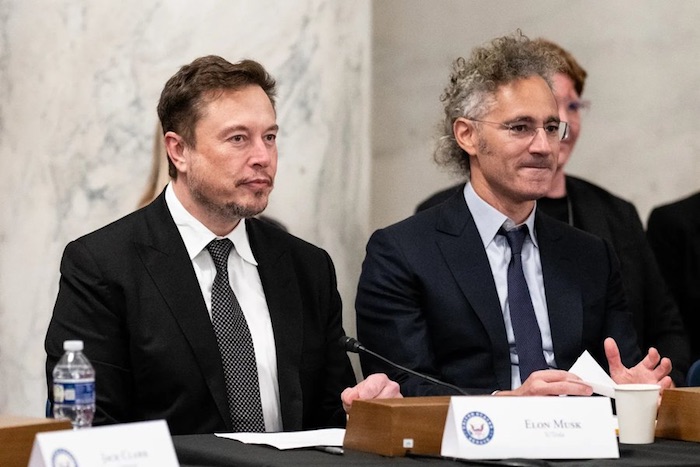 Elon Musk (Tesla, SpaceX) and Alex Karp (Palantir)
“.. Trump and the American people are fed up with the nonsense, all inflicted on behalf of illegal alien criminals.”
• Trump Says ICE Will Run Airport Security If Dems Don’t Fund TSA (Salgado)
President Donald Trump just made a major power move in the ongoing fight with Democrats over funding the Department of Homeland Security (DHS), as he threatened to put immigration officers in charge of airport security if funding is not immediately forthcoming. Chaos continues to reign at many American airports as the partial Democrat shutdown lengthens and Transportation Security Administration (TSA) employees increasingly don’t show up for work, leading to extremely long lines and travel delays. The Democrat congressmen who don’t have to deal with ordinary TSA lines don’t care, but Trump and the American people are fed up with the nonsense, all inflicted on behalf of illegal alien criminals.Read more …
Trump warned on Truth Social Saturday, “If the Radical Left Democrats don’t immediately sign an agreement to let our Country, in particular, our Airports, be FREE and SAFE again, I will move our brilliant and patriotic ICE Agents to the Airports where they will do Security like no one has ever seen before, including the immediate arrest of all Illegal Immigrants who have come into our Country.” With tens of millions of illegal aliens in our country, the likelihood is that a fair number of them are using air travel. Wouldn’t it be interesting to know just how many? And to top it off, Trump promised Immigration and Customs Enforcement (ICE) officers would have a “heavy emphasis on those from Somalia, who have totally destroyed, with the approval of a corrupt Governor, Attorney General, and Congresswoman, Ilhan Omar, the once Great State of Minnesota. I look forward to seeing ICE in action at our Airports. MAKE AMERICA GREAT AGAIN!”Honestly, it would be pretty amazing to see this threat put into action, partly out of curiosity to see just how many illegal aliens and criminals ICE would find flying, and partly because Democrats’ heads would literally explode. The DHS funding showdown affects millions of people. Transportation Secretary Sean Duffy posted on X in frustration, “Hardworking TSA agents are sleeping in their CARS to save money on gas because Democrats won’t end the SCHUMER SHUTDOWN and fund DHS! What happened to the Democrats who claimed to be the party of the WORKING CLASS?!” The party of slavery has always lied about its dedication to the American working class, but its false pretense is particularly obvious right now.
This is exactly the way that Republicans should be dealing with Democrats, not granting them concessions, but putting the pressure on them to do the right thing. We cannot trust anything Democrats say, and multiple Republican presidents have found out to their cost after they made unwise concessions that they were the only ones who intended to uphold the bargain. Our national security and immigration enforcement are much too important to gamble away bit by bit on trying to please Democrats who will never be happy with any amount of compromise. So instead, Republicans should be threatening consequences that will panic Democrats, like replacing TSA with ICE.
They want someone who refuses all talk.
• Senate Democrats Are Quietly Plotting To Oust Chuck Schumer (ZH)
Senate Minority Leader Chuck Schumer has had a fractured relationship with the Democratic Party base ever since he voted to fund the government last March. Unfortunately for him, time hasn’t healed that wound, and there’s a growing resistance to Schumer that hopes to oust him from his leadership position after the midterms. The Wall Street Journal, drawing on more than four dozen interviews with Democratic senators, candidates, current and former congressional aides, activists, and advisers, found widespread unease about the New York senator’s grip on the party’s direction. The report makes it clear that Schumer’s own colleagues increasingly see him as an anchor, slowing their response to President Trump, steering primaries toward centrists they don’t want, and draining the fundraising pipeline that Democrats desperately need heading into the midterm elections.Read more …
According to the report, last month, Sen. Chris Murphy of Connecticut met with progressive activists at a French restaurant in Georgetown. The conversation turned to what to do about Schumer. According to people familiar with the dinner, Murphy disclosed that some lawmakers had already been running informal vote counts to see whether enough support existed to remove Schumer from his leadership post. Murphy added that Schumer had enough backing to survive. But the fact that anyone was counting at all said something. Murphy has since walked it back, carefully. “Could someone infer from that that someone was keeping a count? Maybe, but that’s not what I meant,” he told reporters. “I meant that he has the support of the caucus.”But Murphy’s backpedaling doesn’t change the reality. Murphy is reportedly part of a group of senators who have been actively canvassing colleagues about their frustrations with Schumer. This group, nicknamed “Fight Club,” (hey…) is a Signal chat group where progressives coordinate strategy around opposing Schumer’s preferred candidates in key 2026 races. The Fight Club’s grievance, at its core, is that Schumer is tilting the playing field toward centrists while an insurgent energy on the left goes untapped. The group includes Sen. Elizabeth Warren (D-Mass) and Sen. Tina Smith (D-Minn.), and it appears that Warren has been initiating those conversations directly. Smith’s advisers have gone further, holding discussions with other Senate staff about concrete scenarios to challenge Schumer’s leadership.
The concern isn’t purely ideological. It’s financial, and that’s where things get uncomfortable. Schumer’s aligned super PAC, Senate Majority PAC, got outpaced by its Republican counterpart last year. Entering 2026, the Democratic super PAC had $36 million in cash on hand and $12.4 million in debt. The GOP’s equivalent had $100 million on hand and zero debt. In the money primary – the one that quietly decides Senate races before a single vote is cast – Schumer’s side is getting lapped Making matters worse for Schumer, meetings among Democratic Senate chiefs of staff, which should be routine operational sessions, have reportedly become forums for airing discontent with Schumer’s stewardship. The pressure building in those rooms is aimed at a specific outcome: Schumer commits to retiring from the Senate when his seat is up for re-election in 2028, clearing a path for whoever comes next.
That next person may already have a name attached. Sen. Brian Schatz of Hawaii has been identified as Schumer’s own preferred successor. Apparently, Schumer has thought this through enough to have a pick. But Schatz isn’t moving until Schumer moves first. His posture, per senators and aides familiar with the discussions, is to wait it out. Schumer may have the votes to survive a mutiny for now. But his colleagues are doing the math, his fundraising is underperforming, his preferred candidates are generating internal blowback, and the party seems anxious to see him go. The caucus isn’t in open revolt yet, but it’s not looking good for Chuck Schumer.
It’s global. Armstrong can’t explain it either.
• Russia to Refer Childless Women for Psychiatric Evaluations (Martin Armstrong)
Russia is now advising psychological counseling for women who do not intend to have children, which is precisely the type of response governments default to when they refuse to confront economic reality. They search for cultural or emotional explanations when the issue is economical. Russia’s fertility rate has fallen to roughly 1.4 children per woman, well below the 2.1 replacement level, and total births have declined to near post-Soviet lows at just over 1.2 million annually. This decline has been persistent, not cyclical, and the population is aging rapidly as deaths continue to exceed births. At the same time, the war has removed a significant portion of young men from the population.Read more …
The same pattern is unfolding across all developed economies. Europe’s fertility rate is now near 1.3. Spain and Italy are closer to 1.1. Germany is around 1.4. France, once the exception, has fallen sharply and recently recorded more deaths than births for the first time in decades. Japan has been below replacement for years and continues to contract. Even countries that implemented aggressive family subsidies, such as Norway and Hungary, have failed to reverse the trend.Globally, fertility has collapsed from more than 5 children per woman in the 1960s to just above two today, and the developed world is already well below replacement. The common explanation offered by governments is psychological or social. They speak of changing values, delayed adulthood, or lifestyle preferences. That explanation collapses under scrutiny because it ignores the economic structure that determines behavior.
People do not make long-term commitments, such as having children, without confidence in their financial future. Children represent the largest long-term investment a household can make. When confidence declines, that investment is postponed or abandoned. At the same time, dual-income households became the norm not by choice but by necessity. A single income no longer supports a family in most developed economies. This fundamentally changes having children because both parents must remain in the workforce to maintain financial stability. Long ago, children helped to secure a family’s financial future, but the opposite rings true today.
Russia’s situation simply reflects these dynamics in a more concentrated form. Economic uncertainty, war, sanctions, and structural inefficiencies amplify the same forces present elsewhere. When surveys show that a large percentage of women do not plan to have children in the near term, that is not a psychological condition. It is a rational response to economic instability amid war. Women in Russia must now face the harsh reality that their husbands will face a compulsory draft, and they will be left raising children alone.
Historically, birth rates rise during periods of expansion and confidence. The post-World War II baby boom occurred because housing was affordable, employment was stable, and future prospects were positive. The economic structure supported family formation. Today, the structure works in the opposite direction. Housing costs, taxation, childcare expenses, and job insecurity create an environment in which the cost of raising children exceeds the perceived benefits. Governments attempt to offset this with subsidies, but those programs do not address the core issue, whixh is the declining return on productive activity relative to cost.
This is why policies focused on incentives have failed. Hungary introduced substantial financial benefits for families. Norway expanded welfare support. France has long provided family subsidies. None of these measures reversed the long-term decline because they do not change the underlying economic equation. The demographic consequences are significant. A declining birthrate leads to a shrinking workforce, increasing dependency ratios, and pressure on pension systems. Governments respond by raising taxes or increasing borrowing, which further reduces the net income available to working households. This creates a feedback loop that reinforces the decline.
When confidence in the future declines, long-term investments decline. Children are the most fundamental long-term investment in any society. The decline in birth rates is therefore not a social anomaly but a direct reflection of economic confidence. Russia proposing psychological counseling illustrates how far removed policy responses have become from reality. This is not a question of convincing people to want children. It is a question of creating an economic environment where having children is viable.
Got to try.
• Rhinos back in African Park For First Time After 40 Years (RT)
Uganda has begun reintroducing rhinos to its Kidepo Valley National Park, marking the species’ return to the area 43 years after it was wiped out by poaching, the Uganda Wildlife Authority (UWA) has reported. The first two southern white rhinos were transported from Ziwa Rhino Sanctuary to Kidepo on Tuesday, part of a phased plan to relocate a total of eight animals, according to UWA. The effort is aimed at restoring a population that disappeared from the park in the early 1980s.Read more …
The move follows years of preparation, including the construction of a fenced sanctuary, ranger outposts, and monitoring systems to ensure the animals’ protection and adaptation to the new environment. The park, one of Uganda’s most intact savannah ecosystems, was identified as suitable after feasibility studies assessed habitat conditions and security. “This moment marks the beginning of a new rhino story for Kidepo Valley National Park,” UWA Executive Director James Musinguzi said, adding that the translocation was the first step toward re-establishing a population.Officials said the animals will initially be kept under close observation inside a secure sanctuary before being gradually integrated into the wider park ecosystem.Rhinos once roamed widely across Kidepo Valley, but heavy poaching led to their local extinction, with the last recorded animal killed in 1983. Conservation efforts accelerated in 2005 with the launch of a breeding program at Ziwa Rhino Sanctuary, helping rebuild Uganda’s rhino population to more than 60. Authorities say the return of rhinos is expected to boost biodiversity and tourism while supporting efforts to restore endangered wildlife species in one of Africa’s most isolated national parks.
In January, UWA relocated four southern white rhinos from Ziwa sanctuary to Ajai Wildlife Reserve in northwestern Uganda and aims to move up to 20 rhinos to the reserve. Uganda’s move comes amid wider efforts across Africa to protect rhino populations. Separately, Kenya in December opened what it says is the world’s largest rhino sanctuary in Tsavo West National Park, bringing together around 200 black rhinos in a protected area of more than 3,200 square kilometers.



https://twitter.com/HungaryBased/status/2035408598038405213?s=20
I wonder what changed pic.twitter.com/1Yogzaqtis
— Declaration of Memes (@LibertyCappy) March 22, 2026
SpaceXAI + Tesla TERAFAB Project
— Elon Musk (@elonmusk) March 22, 2026
Goal is a trillion watts of compute/year
Most must necessarily go to space, as US electricity is only 0.5TW https://t.co/hMtg9vNLcw
https://twitter.com/Rainmaker1973/status/2035350715695276059?s=20It’s actually insane what SpaceX is doing to the space industry right now
— X Freeze (@XFreeze) March 21, 2026
In 1981, it cost ~$65,000 to put 1 kg into orbit
For 50 years, the industry accepted this as the standard. Reusable rockets were "impossible"
Then one company – led by a man obsessed with getting humanity… pic.twitter.com/lOJblaXMnG
Aspirin prevents the deadly spread of cancer (metastasis) – concluded from recent review.
— Dalton (Analyze & Optimize) (@Outdoctrination) March 21, 2026
This spread is responsible for ~90% of cancer deaths.
Clinical trials have shown reductions in circulating tumor cells, a key measure of cancer spread.
Aspirin prevents it by:
❖… https://t.co/1kBJifUeI8 pic.twitter.com/oXHC22ScJg
Support the Automatic Earth in wartime with Paypal, Bitcoin and Patreon.