
Pablo Picasso Portrait de femme (Dora Maar) 1943

JOHN SOLOMON: New evidence shows U.S. intel had proof of Hillary’s criminality before Comey cleared her.
They knew her Russia collusion story was a ruse to smear Trump.
If this gets declassified, it could finally blow the whole thing wide open.@jsolomonReports pic.twitter.com/yZkqgMOxNJ
— Bannon’s WarRoom (@Bannons_WarRoom) July 14, 2025
John Solomon provides an update to the massive news he broke over the weekend that the FBI has been investigating “grand conspiracy” charges against the Russiagate hoaxers.
Kash Patel apparently needs President Trump to declassify a couple “tranches of evidence” – both related… pic.twitter.com/JJWwmH1HUp
— TheStormHasArrived (@TheStormRedux) July 14, 2025
HOLEE SHIZZLES‼️
Kash Patel opened a “Grand Criminal Conspiracy Investigation” which specifically circumvents the Statute of Limitations!
The best part, because of the Raid on Mar-A-Lago that Jack Smith did, the entire case can now be moved to FLORIDA for a better Conviction… https://t.co/4h1AFgRCPs pic.twitter.com/HqiYPgSgOb
— MJTruthUltra (@MJTruthUltra) July 15, 2025
Walsh
NEW: Matt Walsh sends a message to the Trump administration over the Epstein case.
"We want those people to be dragged in front of us, weeping and begging for mercy…"
"Millions of Americans are not satisfied with what we've been told, and we shouldn't be…"
"I want to make… pic.twitter.com/CH4gx25a4Z
— Collin Rugg (@CollinRugg) July 14, 2025
I CALL ON AG PAM BONDI TO CHARGE FAUCI FOR LYING TO CONGRESS!
And when, in his legal defense, claims that he cannot be charged because he has a preemptive pardon, the government can finally test the legality of the autopen in which all of those documents should not be honored. pic.twitter.com/lYMiUqTJrD
— Roger Stone (@RogerJStoneJr) July 14, 2025
KIRK
Remember how we were told Jeffrey Epstein made his money in finance, wealth management and trading
Charlie Kirk exposes Jeffrey Epstein HAD NO TRADES EVER made under his name
“There are no trades to Jeffrey Epstein name at any of the trading desks — yet he ends up with a… pic.twitter.com/yq2iV8kia5
— Wall Street Apes (@WallStreetApes) July 14, 2025
vote
https://twitter.com/MarioNawfal/status/1944982103470248326
Ex-US Army staff officer David Pyne gets it.
• Trump’s Ukraine Reversal Represents ‘Complete Betrayal Of America First’ (Sp.)
Donald Trump is on the brink of tearing up his ‘no foreign wars, pro-peace’ pre-election pledge on Ukraine, with plans to deliver more weapons, and threats against Russia edging him closer toward inheriting “Biden’s war.” Sputnik asked a renowned US geopolitics and military affairs expert to break it down. The president claims that his plans to ramp up arms deliveries to Ukraine and threaten Russia with secondary tariffs are designed to help end the conflict, “when in fact these steps are serving to prolong and escalate the war unnecessarily with no end in sight,” ex-US Army staff officer David Pyne says. “Trump fails to understand that it is US military assistance to Ukrainian dictator Volodymyr Zelensky that is the chief obstacle to achieving a realistic and durable peace settlement, not an unwillingness on the part of Putin to compromise,” Pyne, deputy head of the EMP Task Force, told Sputnik.
Since the policy reversal “represents a complete betrayal of Trump’s America First conservative voting base,” who elected him in part based on his pledge to end the crisis, it threatens to derail his presidency, according to Pyne. “If Trump continues in this foolish course of pursuing war instead of peace, not only will it increase the risk of a future direct military confrontation with Russia, but it will likely serve to further fracture his America First conservative base, enabling the Democrats to seize control of Congress in the November 2026 midterm elections,” the observer predicts. Pyne’s recommendation? End all US weapons and offensive intelligence support to Ukraine, pressure Zelensky to resign and hold elections, and broadly, accept Russia’s peace terms, so that Trump can get back to his “overriding grand strategic vision” of a “geostrategic partnership with Russia.”
“The president’s view is Russia is going to win; it’s a matter of how long it takes,” the White House official told the outlet..”
• Trump Believes Russia Will Win – Politico (RT)
US President Donald Trump believes that Russian victory in the Ukraine conflict is inevitable, Politico reported, citing a senior White House official. On Monday, Trump threatened to impose secondary US tariffs of up to 100% on Russia’s trading partners unless progress toward a peace agreement is made within 50 days. He also authorized new weapons deliveries to Ukraine, which are to be paid for by European NATO members. Moscow has warned that Trump’s declaration could be seen by Kiev as a signal to continue the war. According to Politico, Trump decided to up the pressure on Moscow out of frustration with continued Russian strikes on Ukraine. The source noted that the US president believes that Moscow can secure military victory against Kiev thanks to its “bigger economy” and “bigger military.”
“The president’s view is Russia is going to win; it’s a matter of how long it takes,” the White House official told the outlet, noting Moscow’s progress on the battlefield. In recent months, Russian forces have continued to gain ground, fully liberating the Lugansk People’s Republic, as well as the Kursk Region, which was invaded by Ukrainian forces last year. Russia has rejected Trump’s latest ultimatum, while condemning attempts to pressure it. Deputy Foreign Minister Sergey Ryabkov asserted that this approach is “unacceptable” and demanded that Washington and NATO respect Russia’s interests and concerns.
Moscow has repeatedly stressed that it is open to conducting negotiations based on mutual respect with the aim of settling the Ukraine conflict diplomatically. However, Russian officials have also said they see no genuine effort on the part of Kiev or the West to pursue peace and repeatedly slammed calls by Western officials to inflict “strategic defeat” on Russia. Russia has emphasized that it remains determined to achieve the goals of its military operation in Ukraine and, while it would prefer to do so through diplomacy, it is prepared to use military means if necessary.
“We are already dealing with an unprecedented number of sanctions, and I am certain we can handle more.” “..they are more likely to impact European economies than Russia’s.”
• Trump Under ‘Improper Pressure’ From EU and NATO – Lavrov
US President Donald Trump is facing “improper pressure” from the European Union and NATO leaders to adopt a hardline stance on the Ukraine conflict, Russian Foreign Minister Sergey Lavrov said on Tuesday. On Monday, Trump announced future deliveries of advanced weapons systems to Ukraine, which the US president said would be funded by European NATO members. Trump also issued an ultimatum threatening Russia and its trading partners with new economic sanctions unless the Ukraine conflict is resolved within 50 days. ”Clearly, [Trump] is under enormous – improper, I would say – pressure by the European Union and current NATO leaders,” Lavrov said during a press conference following a ministerial meeting of the Shanghai Cooperation Organization in Tianjin, China.
He added that the “regime” of Ukraine’s Vladimir Zelensky continues to request weapons donations “at the mounting expense of Western taxpayers.” Lavrov noted that Russia has previously received multiple ultimatums involving deadlines and demands for concessions on what it considers its core strategic objectives in the Ukraine conflict. He downplayed the effectiveness of new sanctions, arguing they are more likely to impact European economies than Russia’s.
”Trump clearly explained that Europe will be paying for all of that,” Lavrov said. “European economists and political experts who are objective acknowledge that this sanctions war is damaging the nations who initiated it. We are already dealing with an unprecedented number of sanctions, and I am certain we can handle more.” The minister reaffirmed Moscow’s position that NATO instigated the crisis by threatening Russia’s national security through its meddling in Ukraine. The West has pursued a containment strategy against Russia for decades and ignored repeated warnings from Moscow, Lavrov added.
If they can bury the files, they can do the same with her.
• Ghislaine Maxwell Is ‘Ready’ to Testify (Margolis)
Well, isn’t this just the plot twist America’s corrupt ruling class was hoping you’d ignore? Ghislaine Maxwell is suddenly ready to spill the beans before Congress about Jeffrey Epstein’s whole operation. But, here’s where the story gets weird. “Despite the rumors, Ghislaine was never offered any kind of plea deal. She would be more than happy to sit before Congress and tell her story,” a source told The Daily Mail. “No-one from the government has ever asked her to share what she knows. She remains the only person to be jailed in connection to Epstein and she would welcome the chance to tell the American public the truth.” So, the only person ever jailed for Epstein’s monstrous crimes, and the government can’t be bothered to ask, “Hey, who else was involved?” Give me a break. If you believe that’s an accident, I’ve got a bridge to sell you.
Maxwell argues she should have been protected from prosecution as part of a Non Prosecution Agreement made by Epstein – her former lover and boss – in 2007 when he agreed to plead guilty to two minor charges of prostitution in a ‘sweetheart deal’ which saw him spend little time behind bars. And now, controversy continues to rage over the Department of Justice’s statement that there is no Epstein ‘client list’ and the release of videos from inside New York’s Metropolitan Correctional Center which the DOJ says proves he committed suicide in 2019 while being held in jail on sex trafficking charges. Critics have pointed to the fact that there is a crucial minute missing from the jail house video that also does not show the door or, indeed, the inside of Epstein’s jail cell.
The scandal – and alleged ‘cover up’ – has prompted a rebellion amongst President Trump’s loyal MAGA base. Some even believe Attorney General Pam Bondi should be fired after promising to release all files relating to Epstein and his high-profile male friends only to apparently renege on that promise. What’s really at stake here isn’t just the sordid details of Epstein’s operation. It’s the principle that in America, no one is above the law. Or at least, that’s what we’re supposed to believe. But every time Congress shrugs off a chance to get real answers—every time the Deep State buries evidence, every time the media gaslights the public—it becomes clearer that there’s one set of rules for the elites and another for the rest of us.
If Ghislaine Maxwell is willing to testify, how Congress handles it will speak volumes. The Epstein scandal isn’t just another controversy—it’s a litmus test for whether truth still has a place in American politics. If our elected leaders choose to look the other way, they’ve forfeited any moral claim to the power they hold. The Biden administration was happy to bury it, hoping the story would fade. But Trump made it clear on the campaign trail: he wants the truth exposed, and so does the MAGA movement. The American people deserve real answers—no matter how damning they might be for the elites pulling the strings. If we let this story die, we’re telling the swamp that they can get away with anything. And that, more than any memo or media spin, is the real threat to our republic.
https://twitter.com/MarioNawfal/status/1945218096949604858
If you look at the ruble or Moscow’s stock exchange, it doesn’t look like the economy is ‘cracking’.
• Trump Asked Zelensky About Striking Moscow, Making Putin ‘Feel The Pain’ (NYP)
President Trump privately questioned Ukrainian President Volodymyr Zelensky about whether Kyiv could blast Moscow and St Petersburg if needed to make Russians “feel the pain” and come to the negotiating table, according to a report. “Volodymyr, can you hit Moscow? … Can you hit St Petersburg too?” Trump asked on a July 4 call with Zelensky, a day after the president had a disappointing phone call with Russian leader Vladimir Putin, the Financial Times reported, citing multiple sources. Zelensky, who has pressed Western powers for years to provide more long-range missiles, reportedly replied, “Absolutely. We can if you give us the weapons.”
The White House insisted in a statement to The Post that the comments should not be taken out of context, with press secretary Karoline Leavitt pushing back on the Financial Times’ framing of the call, which suggested Trump encouraged Zelensky to step up strikes deep into Russian territory. “The Financial Times is notorious for taking words wildly out of context to get clicks because their paper is dying,” Leavitt told The Post. “President Trump was merely asking a question, not encouraging further killing. He’s working tirelessly to stop the killing and end this war.” Trump’s reported query came after he spoke with Putin and was left convinced that the Kremlin wasn’t going to halt its war machine.
The reported question marks a significant turnaround from Trump’s explosive Feb. 28 Oval Office meeting with Zelensky, in which he raged that the Ukrainian leader was “gambling with World War III” and that “you don’t have the cards right now.” On Monday, Trump announced a deal with NATO for the US to step up its supply of weapons to Ukraine, including Patriot missile systems and what he called a “full complement” of firepower to the war-torn ally. The deal could also include offensive weapons, such as long-range missiles to strike deep into Russia, Axios reported Monday. This would be critical for Ukraine as it will enable Kyiv to attack Russian machinery and weapons that have been used to bombard its cities, rather than relying on defensive measures.
Ukraine had carried out a daring military strike deep in Russian territory last month, known as Operation Spiderweb, in which it snuck a fleet of suicide drones into Russia and destroyed about a dozen bombers. In addition to the plan to send weapons to Ukraine, Trump also gave Putin a 50-day ultimatum to achieve some sort of peace agreement or else face 100% secondary tariffs, meaning countries that do business with Moscow will face the stiff levies. That economic threat comes as Russia’s economy minister warned last month that his country is “on the brink of recession.” Over the past three years, Russia has tapped into its National Wealth Fund, printed money and worked to evade the crippling sanctions imposed against it over its bloody onslaught against neighboring Ukraine.
But there are signs that its economic resilience is beginning to crack as the US and Europe look to further tighten the screws and close off workarounds. Late last month, Putin publicly announced plans to cut Russia’s military budget for next year, but didn’t specify how much. Throughout his second term, Trump had aggressively sought to broker a peace deal between the two warring countries. In recent weeks, however, the US president vented that he felt Putin was tapping him along. “I speak to him [Putin] a lot about getting this thing done. And I always hang up and say, ‘Well, that was a nice phone call,’” Trump said of his calls with the Russian leader over the past six months. “And then missiles are launched into Kyiv or some other city. And I said, ‘Strange.’ And after that happens three or four times, you say the talk doesn’t mean anything.”
https://twitter.com/DD_Geopolitics/status/1945071924792451473
“Leavitt insisted that Trump was “merely asking a question, not encouraging further killing..”
How does that rhyme with sending more weapons, like long range missiles?
• Trump Tells Zelensky Not To Attack Moscow (RT)
US President Donald Trump said on Tuesday that he told Ukraine’s Vladimir Zelensky not to target Moscow with military strikes. The statement comes in response to media speculation that he had encouraged Kiev to carry out long-range missile attacks deep into Russia. The Financial Times reported on Tuesday that Trump had privately asked Zelensky whether he could hit Moscow and St. Petersburg if Washington supplied long-range weapons. Zelensky reportedly replied that he could. Asked by reporters whether Zelensky ought to fire missiles at Russia’s capital, Trump replied “No, he shouldn’t target Moscow.” White House Press Secretary Karoline Leavitt accused the FT of twisting the president’s words, saying it is “notorious for taking words wildly out of context to get clicks because their paper is dying.”
Leavitt insisted that Trump was “merely asking a question, not encouraging further killing,” stressing that the president was “working tirelessly to stop the killing and end this war.” Kremlin spokesman Dmitry Peskov also weighed in on the report, noting that “as a rule, all of this usually turns out to be fake.” He added, however, that “sometimes there are indeed serious leaks, even in publications we once considered quite respectable.” The FT report followed on Trump’s ultimatum to Moscow, in which he threatened to impose “severe” secondary tariffs on Russia’s trade partners if no progress towards peace is made within 50 days. Trump also announced future deliveries of advanced weapons systems to Ukraine, which are to be funded by European NATO members.
Since taking office in January, Trump has maintained that he wants the neighboring countries to make peace and has had several phone calls with Russian President Vladimir Putin that were focused on settling the conflict s
Moscow says it remains open to negotiating with Kiev but has yet to receive a response on when new peace talks will take place. The two sides have held two rounds of direct negotiations in Istanbul so far this year, but no breakthroughs were achieved, other than agreements to carry out large-scale prisoner exchanges. Russian Foreign Minister Sergey Lavrov stated on Tuesday that EU and NATO leaders have put Trump under “improper pressure” to adopt a hardline stance on the conflict.
Russia wants peace badly, but not on western terms.
• EU Welcomes Trump’s Ultimatum To Russia (RT)
EU foreign policy chief Kaja Kallas has welcomed US President Donald Trump’s threat to impose tariffs on Russia’s trading partners unless a deal with Ukraine is reached within 50 days, calling it a “positive” step. Moscow, however, has warned that Trump’s declaration could be seen by Kiev as a signal to continue the war. Trump said on Monday that he was “very, very unhappy” with the protracted negotiation process, warning Moscow of “severe” secondary tariffs of up to 100% unless the sides move towards a settlement. “It is very positive that President Trump is taking a strong stance on Russia,” Kallas, known for her hawkish stance on Moscow, said at a press briefing. She suggested, however, that Trump’s deadline may not be enough to “pressure” Russia.
”50 days is a very long time… It is clear that we all need to put more pressure on Russia so that they would also want peace,” she stated, calling for Washington to continue supporting Kiev militarily.Russia has repeatedly denounced Western arms supplies to Ukraine, saying they prolong the conflict without changing its course. Moscow has also condemned sanctions as illegal under international law. Russia and Ukraine have held two rounds of direct talks in Istanbul over the past two months. Both sides agreed to major prisoner swaps and exchanged proposals on potential ways towards a settlement. Kremlin spokesman Dmitry Peskov said on Tuesday that Moscow remains open to negotiations but has not received a response on the timing of the next round from Kiev.Peskov described Trump’s ultimatum as “quite serious,” but noted that Russia needs time to analyze it. He also warned that the shift in Washington’s tone could be seen in Kiev “not as a signal toward peace, but as a signal to continue the war.”
https://twitter.com/DD_Geopolitics/status/1945164213019623661
That took less than one day. Trump’s entire domestic sales pitch out the window.
• EU Tells US To ‘Share The Burden’ For Ukraine Weapons (RT)
EU foreign policy chief Kaja Kallas has welcomed US President Donald Trump’s promise to send more weapons to Kiev, but said he can’t describe it as American aid if European NATO states are fully bankrolling the initiative. Trump announced on Monday that he will allow other NATO members to buy American-made Patriot missile defense systems and other weapons for Ukraine – but indicated that US taxpayers will no longer finance Kiev’s war effort. “The United States will not be having any payment made. We’re not buying it, but we will manufacture it, and they’re going to be paying for it,” the US leader said during a meeting with NATO Secretary General Mark Rutte in the Oval Office, adding “this will be a business for us.”
Speaking to reporters on Tuesday, Kallas welcomed Trump’s announcement but noted that Brussels “would like to see the US share the burden.” “If we pay for these weapons – it’s our support, it’s European support,” Kallas explained when asked to clarify what she meant by sharing the burden. “We are doing as much as we can to help Ukraine, and therefore the call is that everybody would do the same. It’s, you know, if you promise to give the weapons but say that somebody else is going to pay – it’s not really given by you, is it?” Moscow has repeatedly denounced Western arms supplies to Ukraine, saying they only serve to prolong the bloodshed and escalate the conflict without altering its course.
Russia remains open to negotiations but has not received a response from Kiev on the timing of the next round. Russian Foreign Minister Sergey Lavrov stated on Tuesday that EU and NATO leaders have put Trump under “improper pressure” to adopt a hardline stance. Deputy Foreign Minister Sergey Ryabkov stressed that “any attempts to make demands, let alone issue ultimatums, are unacceptable.” Kremlin spokesman Dmitry Peskov also criticized Trump’s threat to impose “severe” secondary tariffs of up to 100% in 50 days, noting that such ultimatums are “perceived by the Ukrainian side not as a signal toward peace, but as a signal to continue the war.”
“..Slovakia, but also Hungary, Austria, and reportedly Italy..”
“The [European] Commission’s proposal is, excuse my language, imbecilic. Demagogically, it is the result of a limitless obsession with Russia..”
• Slovak PM Fico Denounces Brussels’ ‘Imbecilic’ Russia Plan (RT)
Slovak Prime Minister Robert Fico has slammed the EU’s plan to phase out Russian energy imports as “imbecilic,” warning that the move would undermine his country’s energy security, as well as the rest of the bloc. The RePowerEU plan envisages cutting all Russian oil and gas imports into the EU by 2027. The scheme has met with opposition not only from Slovakia, but also Hungary, Austria, and reportedly Italy.In a video posted on Facebook on Monday, Fico said the “battle for Slovakia’s energy security is nearing its end,” acknowledging that Bratislava cannot veto Brussels’ plan. He accused the EU leadership of deliberately presenting the proposal as trade legislation to pre-empt opposition. Unlike sanctions, the plan only requires a qualified majority to pass.
“The [European] Commission’s proposal is, excuse my language, imbecilic. Demagogically, it is the result of a limitless obsession with Russia,” the prime minister said. He added that phasing out Russian energy will “damage the Slovak economy and undermine the competitiveness of the entire EU.” Responding to a letter from Czech Prime Minister Petr Fiala, who urged Fico to support the EU’s 18th sanctions package against Russia, the Slovak leader stated on Monday that he would not relent until “relevant stakeholders provide [Bratislava] with the necessary guarantees that after January 1, 2028, Slovakia will have sufficient gas supplies at reasonable prices.”
Slovakia blocked the sanctions package for the second time last Friday, demanding that its concerns over the separate RePowerEU plan be addressed first. While Russian gas has not been subject to a direct EU ban, most member states have voluntarily cut imports. However, several landlocked countries – including Slovakia, Hungary, Austria, and the Czech Republic – still rely on limited volumes through exemptions. Bratislava and Budapest also receive much of their oil from Russia. Russia has warned that targeting its energy exports will continue to cause energy prices to surge across the EU, weakening the bloc’s economy. Since 2022, growth across the EU has stagnated.
Sundance is not buying.
“Who believes this nonsense? We are years beyond believing the FBI is structurally doing anything to return fire against the Obama administration; yet here is Fox News selling bulk hopium to their viewers. Ridiculous. All of it.”
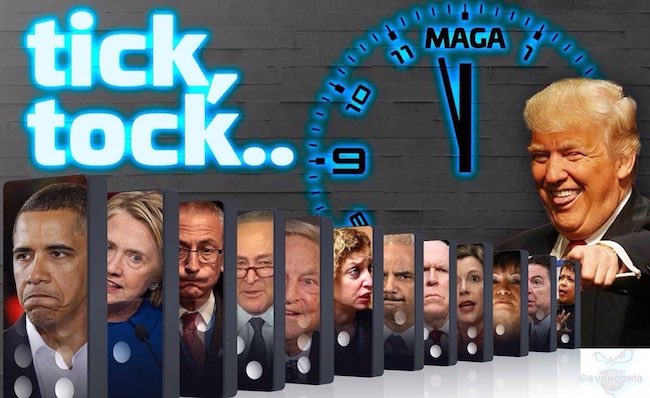
• Tick Tock Co-Pilot John Solomon Says FBI Currently Investigating “Conspiracy” (CTH)
Sean Hannity and John Solomon have apparently ejected Sara Carter for “Tick Tock Term-2”, seemingly replacing her with James (‘sounds like Gopher from Winnie the Pooh‘) Comer. In the latest iteration of the tick-tock walls closing in, at least according to Solomon, the FBI is currently doing a “grand conspiracy” investigation of Barack Obama, James Comey, John Brennan and James Clapper. Solomon says below, “This is a criminal conspiracy. And by treating it as a conspiracy, you eliminate the five-year statutes on individual crimes. So if something happened in 2016, but it was part of an ongoing conspiracy that continued with Jack Smith raiding Donald Trump’s home at Mar-a-Lago, it can be charged in the larger conspiracy. Even though, if you tried to charge it as an individual case, you wouldn’t get it.”
According to Solomon, even Lee Zeldin is a potential candidate to lead a special prosecution team against the former conspirators, and the evidence is so overwhelming … “a special prosecutor would have a jumpstart. This could be wrapped up in a couple of years.”… I can’t even begin to wrap my head around how ridiculous this claim by Hannity, Solomon and Representative ‘Gopher‘ Comer actually is. Who believes this nonsense? We are years beyond believing the FBI is structurally doing anything to return fire against the Obama administration; yet here is Fox News selling bulk hopium to their viewers. Ridiculous. All of it.
“English-speaking audiences relying on European media’s English editions get an incomplete picture, skewed toward liberal narratives and missing the conservative currents driving political shifts..”
• The European Surprise—Why We Misread the Continent’s Shifts (ET)
Europe’s political landscape continues to defy expectations, leaving analysts and policymakers scrambling to explain outcomes that, in hindsight, seem foreseeable. From the UK’s Brexit vote to Giorgia Meloni’s rise in Italy, the Alternative für Deutschland (AfD) surge in Germany, Dutch farmers’ revolts, and Marine Le Pen’s ascent in France, each development triggers a chorus of shocked “No one saw this coming.” Yet millions of Europeans did. The persistent surprise may stem from a flawed lens—dominated by English-language media filters, historical overcorrections, and shrinking on-the-ground reporting—that distorts our understanding. As these shifts ripple globally, misreading Europe poses strategic risks we can no longer afford to ignore.
The pattern is unmistakable. Europe has been portrayed as a stable, liberal bastion—centrist coalitions driving climate action and European Union unity, embodying a progressive ideal. Yet reality diverges: The UK exited the EU in 2016, Meloni became Italy’s prime minister in 2022, Germany’s AfD polled second nationally in 2025, Dutch farmers blocked roads over nitrogen policies, and France’s center collapsed in 2024, elevating Le Pen. Each time, English-language coverage reacts with shock, missing signals visible to local populations. This disconnect begins with a critical media filter. English-language European outlets, such as state-funded France 24, Deutsche Welle, Politico Europe, and center-left publications like Le Monde, cater to an urban, university-educated, globally minded audience. These sources are mostly credible and professional but reflect a narrow slice of society, underrepresenting conservative and rural perspectives.
A key disparity amplifies this bias: While mainstream liberal media regularly publish English editions, conservative and right-wing outlets across Europe—such as Germany’s Junge Freiheit or Italy’s Il Giornale—rarely do. This choice stems from several factors: a lack of perceived demand in English-speaking markets, suspicion of hostile Anglo-American coverage, and a strategic focus on local bases. As a result, English-speaking audiences relying on European media’s English editions get an incomplete picture, skewed toward liberal narratives and missing the conservative currents driving political shifts. Country-specific examples reveal the depth of this gap. In Italy, Meloni’s 2022 victory, often labeled “neo-fascist” because of her party’s post-fascist roots, was misread by English outlets.
Yet her platform—lower taxes, stronger borders, and national pride—reflected frustration with unelected technocrats and Brussels’ fiscal rules. She formed a coalition with Matteo Salvini’s League and Forza Italia, securing a parliamentary majority with 44 percent of the vote, appealing to millions disillusioned by years of instability, not extremism. Her government’s three-year record (2022 to 2025) has focused on economic recovery. In Germany, AfD’s rise to more than 20 percent in state elections and a mayoral win in 2025 reflect discontent with soaring energy prices post-nuclear shutdown and immigration strains. Yet it’s framed as a dangerous anomaly, ignoring its roots in rural and eastern voter bases.
In the Netherlands, the government’s 2019 nitrogen reduction plan, mandating farm buyouts, sparked tractor blockades by farmers facing existential threats to generational livelihoods. The Farmer-Citizen Movement, formed in response, became the largest party in the Dutch Senate by 2023, a democratic revolt misread as a sideshow. In France, President Emmanuel Macron’s 2024 dissolution of the National Assembly followed his party’s European election defeat, paving the way for Le Pen’s National Rally. Her movement, drawing working-class and youth voters from disaffected leftist unions, has softened its rhetoric—shifting from anti-immigrant hardline to economic populism—normalizing her appeal amid the center’s collapse.
This blind spot is structural, rooted in postwar Europe’s “firewall” logic. After World War II, institutions like Germany’s Basic Law and France’s laïcité were designed to prevent fascism and nationalism, embedding a cultural consensus against these ideologies. The EU, as a moral project to dissolve rivalries, reinforced this stance. Over time, this overcorrection stigmatized moderate conservatism—national flags or religious appeals were red flags, dissent from EU norms labeled “anti-democratic.” Repressing these voices buried resentment, fueling unexpected populism. The UK grooming gang scandals illustrate a similar pattern: institutional real fear of fomenting racism delayed action on abuse, worsening the crisis. In Europe, suppressing feedback has similarly driven political surprises.
The Anglosphere’s media compounds this. Decades ago, outlets like The New York Times or CBS maintained lively European bureaus, offering nuance and real understanding of reality on the ground. Budget cuts and shifting priorities have shuttered many, replacing correspondents with wire services and freelancers. Walter Duranty’s downplaying of Joseph Stalin’s Holodomor, despite his Moscow base, shows proximity isn’t a cure-all, but its absence distorts coverage, even by the mere addition of intermediaries. Today’s reports—relying on embassy briefings, nongovernmental organization releases, the European media’s English language editions, or echo-chamber articles—many times lack critical context. For example, there was the framing of Dutch tractor protests as climate backlash rather than a livelihood crisis. For policymakers and investors, this distance misjudges risks, from policy legitimacy to market stability.
The stakes are high. Misreading Europe leads to ill-fated policies, regulatory backlash, and eroding trust in journalism, fueling polarization. Each “shock result” signals analytical failure with global repercussions—markets shift, alliances waver, and migration patterns change. The postwar consensus, while essential, has ossified into dogma, blinding elites to new threats. To see Europe clearly, we ought to think and act like historians. We stop waiting for “The Truth” to arrive in a statement and start building our own mosaic. This means reading across ideological spectra, using artificial intelligence to translate non-English conservative sources like Junge Freiheit (even if one vehemently disagrees with its editorial line), tracking polling trends, and listening beyond capitals.
This is not about endorsing right-wing or conservative parties over liberal and progressive ideologies; rather, it underscores that navigating with a flawed map—lacking the full true picture—hurts everyone’s performance. Understanding Europe’s diverse political currents, progressive gains and conservative surges alike, reduces the risk of costly surprises.
He himself is a leading candidate.
• Bessent Says “Formal Process” To Find Successor To Jerome Powell Has Begun (ZH)
U.S. Treasury Secretary Scott Bessent confirmed on Tuesday that a “formal process” is underway to find a potential successor to Federal Reserve Chairman Jerome Powell. In an interview with Bloomberg Surveillance, Bessent remarked, “There are a lot of great candidates, and we’ll see how rapidly it progresses.” He also noted that it would be confusing for Powell to stay on at the Federal Reserve after his term as chair concludes. Since last month President Donald Trump has intensified his criticism of Federal Reserve Chairman Jerome Powell, repeatedly accusing him of mismanaging monetary policy and calling for aggressive interest rate cuts. Trump has argued that Powell is acting too slowly to respond to economic conditions and said, “Maybe I should go to the Fed… Am I allowed to appoint myself at the Fed? I’d do a much better job than these people.”
He has labeled Powell with a series of insults, calling him “stupid,” “too late,” “a numbskull,” and demanding the Fed slash rates by a full percentage point to stimulate the economy. Trump’s attacks continued into July, growing even sharper. On July 8, he declared that Powell “should resign immediately.” A few days later, he criticized Powell over cost overruns tied to a $2.5 billion renovation project at the Federal Reserve, referring to him as a “knucklehead” and “stupid guy.” Last week, Office of Management and Budget Director Russell Vought also criticized Federal Reserve Chair Jerome Powell for a renovation project he called “too lavish,” referring to it as “Versailles on the National Mall.”
On CNBC, Vought cited “fundamental mismanagement” at the Fed. Meanwhile, National Economic Council Director Kevin Hassett, a potential successor to Powell, added, “If there is cause to fire Powell, Trump has the authority to do so.” The criticism appeared coordinated, with other figures like Fed candidate Kevin Warsh and Vice President J.D. Vance joining in. Trump also reiterated his demand for rates to be cut to around 1%. Members of his team suggested they might review the renovation project as a possible justification to remove Powell “for cause.”
It’s not just Harvard.
“..Stanford University and MIT are operating as “mainly political lobbying operations fighting American innovation.”
• Marc Andreessen: ‘Universities Declared War On 70% Of The Country’ (ZH)
Venture capitalist Marc Andreessen warned that universities engaging in discriminatory practices against students and faculty will face significant consequences, according to leaked screenshots obtained by the Washington Post. In the private group chat with AI scientists and Trump administration officials, Andreessen stated that universities “declared war on 70% of the country and now they’re going to pay the price.” He criticized DEI and immigration policies, describing them as “two forms of discrimination” that are “politically lethal.”
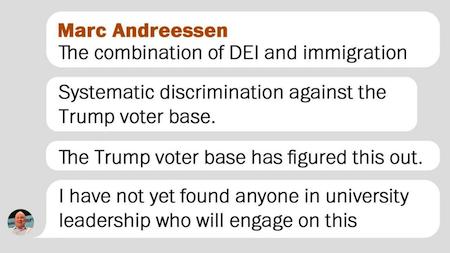
Andreessen further claimed that Stanford University and MIT are operating as “mainly political lobbying operations fighting American innovation.” The billionaire tech investor also addressed Stanford’s decision to remove his wife, Laura Arrillaga-Andreessen, as chair of its Center on Philanthropy and Civil Society, noting it was done “without a second thought, a decision that will cost them something like $5 billion in future donations.”
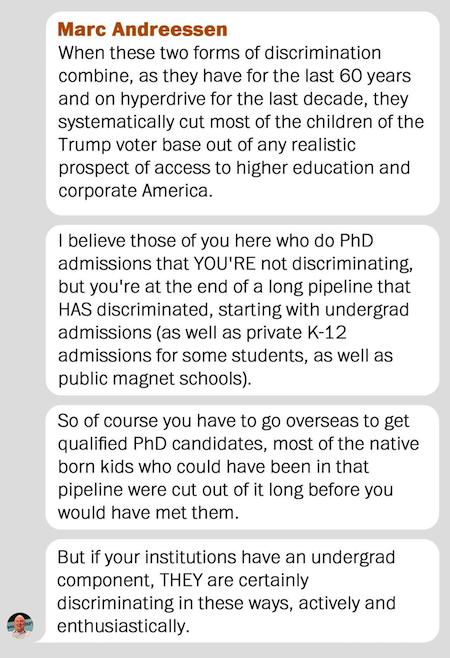
This isn’t the first time Andreessen has called out what he perceives as a broken university system. In a recent interview with billionaire venture capitalist and Palantir co-founder Joe Lonsdale, Andreessen raised concerns about access to elite education. “If you’re the parents of a smart kid where I grew up [rural Wisconsin] and you think you’re going to get them into a top university in this country, you’re fooling yourself,” Andreessen said. “What level of untapped talent exists in this country that a combination of DEI and immigration have basically cut out of the loop for the last 50 years?”
Andreessen argued that the intersection of DEI policies and high-skilled immigration has “warped” perceptions of who gets access to elite education. “Nobody wants to talk about, but I’ve started to talk about the intersection of DEI and immigration that has really warped our perceptions on high-skilled immigration over the last 50 years,” he said.
Marc Andreessen: if you're the parents of a smart kid where I grew up [rural Wisconsin] and you think you're going to get them into a top university in this country, you're fooling yourself…
What level of untapped talent exists in this country that a combination of DEI and… pic.twitter.com/qEqtUR0SwS
— American Optimist (@AmOptimistShow) July 11, 2025
Andreessen also pointed to the sharp rise in foreign enrollment at top universities, noting, “You look at the foreign enrollment rates at the top universities, which went from 2 or 3 or 4 percent 50 years ago or whatever to 27% or 30% or 50%.” “There’s been this massive transformation of who gets admitted through affirmative action, as we now know it, DEI,” the tech billionaire continued. “This goes straight to the political divide in the country. If you’re parents of a kid where I grew up [rural Wisconsin] and you’ve got a smart kid and you think you’re going to get them into, you know, a top university in this country, like you’re fooling yourself.”
Andreessen drove the point home, adding, “There is this really fundamental question which is, what level of untapped talent exists in this country that a combination of DEI and immigration have basically cut out of the loop for the last 50 years? And how long can we have this story to everybody in the Midwest and in the South that says, sorry, because of historical oppression, your kids are shit out of luck.” Andreessen made headlines last year when he and his business partner, Ben Horowitz, endorsed President Donald Trump’s third campaign for the White House.
“Trump suggested that nothing in the Epstein files “could have hurt the MAGA Movement.”
• Trump Says He Spoke to Bongino Amid Reports of Infighting (ET)
President Donald Trump said he spoke to FBI Deputy Director Dan Bongino on July 13, indicating that the two remain close despite reported friction over the release of the Jeffrey Epstein documents. “I spoke to him today. Dan Bongino is a very good guy. I’ve known him a long time,” Trump told reporters outside Air Force 1. “He’s in good shape.” The comments come after Axios reported on July 11 that Bongino—previously a conservative commentator who had long pressed for answers about Epstein’s 2019 death and operation—skipped work on Friday due to disagreements with Attorney General Pam Bondi’s handling of the matter. Laura Loomer, a political commentator close to the president, also reported on Bongino’s absence from work last week, similarly referencing disagreements between Bongino and Bondi.
Trump on July 12 told his supporters not to continue looking into the circumstances surrounding the billionaire’s death. “What’s going on with my ‘boys’ and, in some cases, ‘gals?’” Trump said in a July 12 post on social media platform Truth Social. “They’re all going after Attorney General Pam Bondi, who is doing a FANTASTIC JOB! We’re on one Team, MAGA, and I don’t like what’s happening. “We have a PERFECT Administration, THE TALK OF THE WORLD, and ‘selfish people’ are trying to hurt it, all over a guy who never dies, Jeffrey Epstein.” He added, “One year ago our Country was DEAD, now it’s the ‘HOTTEST’ Country anywhere in the World. Let’s keep it that way, and not waste Time and Energy on Jeffrey Epstein, somebody that nobody cares about.”
Epstein’s case has been intensely scrutinized online for years following his 2019 death in federal custody while awaiting prosecution on charges of engaging in a multiyear conspiracy to sex traffic minors. The billionaire was reported to have hung himself in his cell, but given his connections with many high-ranking officials and celebrities, many have speculated whether Epstein was murdered. The nature of Epstein’s operation, involving sexual exploitation of over one thousand victims, many of whom were minors, has also been scrutinized. At a July 8 Cabinet meeting, a reporter asked Bondi to address a claim that Epstein had been some form of intelligence community asset. “I have no knowledge about that,” she said. “We can get back to you on that.”
During that Cabinet meeting, Bondi also said a missing minute from a jail surveillance tape on the night Epstein died was a normal circumstance due to a routine technical artifact in the camera system, as the video is reset every night at 12 a.m. Trump suggested that nothing in the Epstein files “could have hurt the MAGA Movement.” On July 7, the Department of Justice and FBI released a memo stating that Jeffrey Epstein committed suicide and had no “client list,” and that the agencies would not release any further material related to the Epstein case. “As part of our commitment to transparency, the Department of Justice and the Federal Bureau of Investigation have conducted an exhaustive review of investigative holdings relating to Jeffrey Epstein,” the agencies stated in the memo.
The review found that Epstein committed suicide in his cell as he was awaiting trial in August 2019. This concurs with an autopsy conducted at the time. “The conclusion that Epstein died by suicide is further supported by video footage from the common area of the Special Housing Unit (SHU) where Epstein was housed at the time of his death,” the memo reads. The review found that Epstein did not keep a list of clients as part of his sex trafficking activities. Additionally, there is no evidence that Epstein blackmailed individuals, according to the memo. Nonetheless, according to the review, Epstein “harmed over one thousand victims” as “each suffered unique trauma.”
This screams Supreme Court. Expedited.
• Media Runs Interference as Biden Autopen Scandal Explodes (Margolis)
The legacy media never misses a beat when it comes to parroting Democratic talking points, screaming “threat to democracy” and “constitutional crisis” anytime Donald Trump sneezes in the wrong direction. But when the left tramples on constitutional norms? Crickets — or worse, full-blown excuses. Case in point: Joe Biden’s autopen scandal. The same press corps that waited until after he left office to admit what we all saw with our own eyes — that Biden was mentally unfit — is now running interference again. This time, they’re pretending the autopen scandal is much ado about nothing. This week, the New York Times published an exposé that revealed that, despite claims to the contrary, Joe Biden didn’t individually approve every pardon or act of clemency done in his name. It was a damning report that raises even major questions about what was signed via autopen without his knowledge.
So what did ABC News do? They tweeted out that Joe Biden personally made every clemency and pardon decision during the last weeks of his failed presidency, including the ones handled by autopen. To call that misleading is an understatement. The New York Times admits, and so do Biden’s own aides, that many of those pardons were processed in “large batches.” The decisions? Not made after careful review of individuals, but based on broad, pre-approved categories. Biden didn’t know the names. He didn’t scrutinize the cases. He rubber-stamped entire classes of people for a free pass, while the staffers and bureaucrats filled in the blanks. Despite pushing the Biden talking point on social media, the actual article ABC linked to directly refutes Biden’s own statement.
“Former President Joe Biden, in an interview with the New York Times published on Sunday, said that he personally made every clemency and pardon decision during the last few weeks of his presidency — including those made with an autopen. However, he and aides told the Times that some decisions for large batches of pardons were based on broad categories that various people fell into, not based on reviewing individuals on a case-by-case basis. Biden said he approved the categories and standards for choosing who to pardon. “I made every single one of those. And — including the categories, when we set this up to begin with,” Biden said of the clemency and pardon decisions.”
This is the same media that now pretends to have had a “come to Jesus” moment over the cover-up of Biden’s cognitive decline — while still actively covering it up. They’re pushing Biden’s denials as truth right in their headlines, hoping the public fixates on the spin instead of the facts. But those facts are damning: Biden and his own aides have admitted he didn’t personally make every decision. The media’s job used to be holding power accountable. Now, they’re still running PR for Joe Biden.
lungs
https://twitter.com/VigilantFox/status/1945255216078843920
https://twitter.com/ChildrensHD/status/1945226072057905629
BREAKING: Rep. Massie Files Bill to REPEAL the PREP Act and Strip Big Pharma of Legal Immunity
The PREP Repeal Act (H.R. 4388) would END liability protections for experimental pandemic countermeasures like mRNA injections — and restore the right to sue for injury.
In our new… pic.twitter.com/3gvYKMTefq
— Peter A. McCullough, MD, MPH® (@P_McCulloughMD) July 16, 2025
That’s a lot of people pic.twitter.com/xQc11odfOW
— Concerned Citizen (@BGatesIsaPyscho) July 14, 2025
This imaginative young girl brings fruits and vegetables to life with her hands, turning everyday ingredients into breathtaking works of art.pic.twitter.com/ed8vg9WuJB
— Massimo (@Rainmaker1973) July 15, 2025
Xishi
Xishi Fengming pottery made with thermochromic ink which changes colour under certain temperatures
— Science girl (@gunsnrosesgirl3) July 15, 2025
Monarch
Monarch butterfly migration.
One of the longest-known, multi-generational insect migrations on our planet.
Every fourth generation lives 8 times longer than the previous generations and travels 10 times farther.pic.twitter.com/y5a4oaJUIC
— Massimo (@Rainmaker1973) July 16, 2025
Chico
https://twitter.com/Igottafigh64510/status/1945098230611513374
Support the Automatic Earth in wartime with Paypal, Bitcoin and Patreon.