

Joseph-Désiré Court Le Masque 1843

Showing signs of mental illness, Zelensky says he's taking back #Crimea, home to Russian Black Sea Fleet since 1783, where few Ukrainians have ever lived, whose population is 90% Russian – where 90,000 Red Army soldiers lost their lives expelling Hitler's armies during WW II. pic.twitter.com/OtWNDGFXie
— Alan Watson (@DietHeartNews) August 24, 2025
https://twitter.com/GuntherEagleman/status/1959996874892378315
Today in 1991, 21-year-old Linus Torvalds introduces Linux in an online post. pic.twitter.com/5NeNhj0zIp
— Massimo (@Rainmaker1973) August 24, 2025
They purposely killed the Blackberry because you could remove the battery and disable every surveillance feature on the device.
Your current device is permanently on, listening and following you.
Few understand this.
— Tyler (@TylerDurden) August 25, 2025
Scalia
Here's former Supreme Court justice Antonin Scalia — probably the single most popular justice among the American Right in the last 5 decades — explaining why burning the American flag is vital free speech under the 1st Am, and why banning it is clearly unconstitutional. pic.twitter.com/ijRcEJoB0z
— Glenn Greenwald (@ggreenwald) August 25, 2025
“He would style himself as a tough, wartime leader who would promise “blood, sweat and tears” to the Ukrainian people in return for saving the nation..”
Ideal for warmongers.
• Zelenski Rejects Giving Land As Fascists Promise To Kill Him (MoA)
The (former) President Zelenski of Ukraine is refusing any compromise in negotiations with Russia. He would be killed and replaced by a more right wing figure if he would consider otherwise. In a speech on Sunday marking Ukraine’s independence Zelenski insisted of recapturing all of Ukraine including Crimea. As the Washington Post summarizes: “In Kyiv on Sunday, Ukraine’s Independence Day, Zelensky addressed the nation and vowed to restore its territorial integrity. “Ukraine will never again be forced in history to endure the shame that the Russians call a ‘compromise,’” he said. “We need a just peace.” He listed some of the regions occupied by Russia — including Donetsk, Luhansk and Crimea — and said “no temporary occupation” could change the fact that the land belongs to Ukraine.
Zelenski thus rejects calls by U.S. President Trump to give up Ukrainian territory in exchange for peace. One reason why he does so may be the personal danger he is in. Any compromise about territory may well cost his life. The London Times continues to make propaganda for Nazis. After a recent whitewashing interview with Azov Nazi leader Biletsky (archived) it yesterday published an interview with the former leader of the fascist Right Sector in Odessa Serhii Sterneneko. Sterneneko had a leading role in the 2014 massacres in Maidan Square and at the Trade Union’s House in Odessa. The Times is whitewashing his participation in those events. It does not mind to publish his threats against Zelenski: “[A]mong Ukraine’s younger generation of soldiers and civilians, Sternenko’s brand of truth to power has wide popularity. “I say what I think, and people like what I say.”
His views on President Putin’s demand for Ukraine to cede the territory it defends in the eastern Donbas region as a precondition for possible peace are typically direct. “If [President] Zelensky were to give any unconquered land away, he would be a corpse — politically, and then for real,” Sternenko said. “It would be a bomb under our sovereignty. People would never accept it.” Sternenko, who himself has avoided the draft, wants the war to go on forever: “Indeed, as he discussed Russian intransigence and President Trump’s efforts to end the war, Sternenko’s thoughts on the possibility of peace appeared to be absent of any compromise over Ukrainian soil. “At the end there will only be one victor, Russia or Ukraine,” he said. “If the Russian empire continues to exist in this present form then it will always want to expand. Compromise is impossible. The struggle will be eternal until the moment Russia leaves Ukrainian land.”
Other British media continue to promote the rise of Nazi affiliated figures in Ukraine. The Guardian adds by promoting the presidential campaign of the former Ukrainian general and now ambassador to the UK Valeri Zaluzhny: In private conversations, Zaluzhnyi has not confirmed he plans to go into politics, but he has allowed himself to speculate on what kind of platform he could propose if he does make the decision. Those close to him say he sees Israel as a model, despite its current bloody actions in Gaza, viewing it as a small country surrounded by enemies and fully focused on defence.
He would style himself as a tough, wartime leader who would promise “blood, sweat and tears” to the Ukrainian people in return for saving the nation, channelling Winston Churchill. In one private conversation, he said: “I don’t know if the Ukrainian people will be ready for that, ready for these tough policies.” A day before being fired as the commander of the Ukrainian army Zaluzhny took a selfie with the leader of the fascist Right Sector and commander of Right Sector brigade of Ukrainian military in front of a portrait of Nazi collaborator Stepan Bandera and the fascist OUN flag.
Musical chairs solve nothing. It would still be Azov.
• Zaluzhny ‘Biding Time’ To Challenge Zelensky – Guardian (RT)
There is an “increasing belief” in Kiev that former commander-in-chief, Valery Zaluzhny, is preparing to go head-to-head with Vladimir Zelensky in a potential presidential race, The Guardian has claimed. Amid growing tensions, Ukrainian leader Zelensky removed the general from his post in February 2024 and dispatched him to the UK to serve as Kiev’s ambassador. In an article on Monday, The Guardian claimed that while Zaluzhny has painstakingly concealed any political ambition he may have, “many assume he is just biding his time before entering the fray.” The British newspaper cited the general-turned-envoy’s supposed musings as to how he would present himself to Ukrainian voters and what platform he would run on, should he decide to vie for the presidency.
The outlet further stated that Zaluzhny has been receiving a steady flow of Ukrainian and Western dignitaries at both the embassy in London and in Kiev earlier this year. The Guardian also quoted anonymous sources as saying that in March, following the infamous showdown between Zelensky and US President Donald Trump at the White House, Vice President J.D. Vance secretly reached out to Zaluzhny, in an apparent attempt to sound him out as a potential alternative leader. He reportedly turned down Vance’s overtures. Last week, freelance journalist Katie Livingstone claimed that Zaluzhny was “quietly preparing a run for president – in direct opposition to Zelensky.” She quoted an unnamed source as suggesting that his team had “effectively begun” an unofficial PR campaign.
Zaluzhny’s press representative was quick to deny the speculation. A survey of 1,000 people in Ukraine conducted July 4-5 by ‘Rating’ indicated that the former commander-in-chief was trusted by 73% of respondents. That would put him in first place among political figures in the country, with Zelensky trailing six percentage points behind, the poll suggested. Another survey by a different pollster in late June showed that 41% of Ukrainians believed the country was drifting toward authoritarianism. Zelensky’s presidential term expired in May 2024, but he has refused to hold new elections, citing martial law. The Kremlin insists that the Ukrainian leader has lost legitimacy.
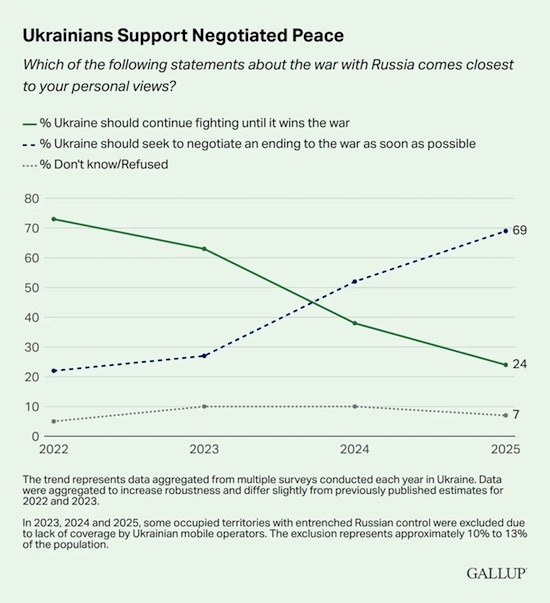
“69% of citizens “favor a negotiated end to the war as soon as possible.” Just 24% wish to keep fighting.”
• CIA’s Covert Ukraine Invasion Plan (Kit Klarenberg)
On August 7th, US polling giant Gallup published the remarkable results of a survey of Ukrainians. Public support for Kiev “fighting until victory” has plummeted to a record low “across all segments” of the population, “regardless of region or demographic group.” In a “nearly complete reversal from public opinion in 2022,” 69% of citizens “favor a negotiated end to the war as soon as possible.” Just 24% wish to keep fighting. However, vanishingly few believe the proxy war will end anytime soon. The reasons for Ukrainian pessimism on this point are unstated, but an obvious explanation is the intransigence of President Volodymyr Zelensky, encouraged by his overseas backers – Britain in particular. London’s reverie of breaking up Russia into readily-exploitable chunks dates back centuries, and became turbocharged in the wake of the February 2014 Maidan coup. In July that year, a precise blueprint for the current proxy conflict was published by the Institute for Statecraft, a NATO/MI6 cutout founded by veteran British military intelligence apparatchik Chris Donnelly.
In response to the Donbass civil war, Statecraft advocated targeting Moscow with a variety of “anti-subversive measures”. This included “economic boycott, breach of diplomatic relations,” as well as “propaganda and counter-propaganda, pressure on neutrals.” The objective was to produce “armed conflict of the old-fashioned sort” with Russia, which “Britain and the West could win.” While we are now witnessing in real-time the brutal unravelling of Donnelly’s monstrous plot, Anglo-American designs of using Ukraine as a beachhead for all-out war with Moscow date back far further.
In August 1957, the CIA secretly drew up elaborate plans for an invasion of Ukraine by US special forces. It was hoped neighbourhood anti-Communist agitators would be mobilized as footsoldiers to assist in the effort. A detailed 200-page report, Resistance Factors and Special Forces Areas, set out demographic, economic, geographical, historical and political factors throughout the then-Soviet Socialist Republic that could facilitate, or impede, Washington’s quest to ignite local insurrection, and in turn the USSR’s ultimate collapse. The mission was forecast to be a delicate and difficult balancing act, as much of Ukraine’s population held “few grievances” against Russians or Communist rule, which could be exploited to foment an armed uprising.
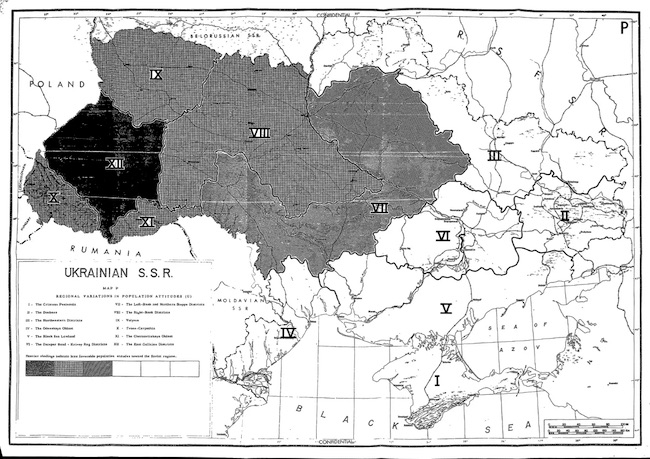
Just as problematically, “the long history of union between Russia and Ukraine, which stretches in an almost unbroken line from 1654 to the present day,” resulted in “many Ukrainians” having “adopted the Russian way of life”. Problematically, there was thus a pronounced lack of “resistance to Soviet rule” among the population. The “great influence” of Russian culture over Ukrainians, “many influential positions” in local government being held “by Russians or Ukrainians sympathetic to [Communist] rule, and “relative similarity” of their “languages, customs, and backgrounds”, meant there were “fewer points of conflict between the Ukrainians and Russians” than in Warsaw Pact nations. Throughout those satellite states, the CIA had to varying success already recruited clandestine networks of “freedom fighters” as anti-Communist Fifth Columnists. Yet, the Agency remained keen to identify potential “resistance” actors in Ukraine:
“Some Ukrainians are apparently only slightly aware of the differences which set them apart from Russians and feel little national antagonism. Nevertheless, important grievances exist, and among other Ukrainians there is opposition to Soviet authority which often has assumed a nationalist form. Under favorable conditions, these people might be expected to assist American Special Forces in fighting against the regime.”
But Russia will.
• US Won’t Play Key Role In Ukraine’s Security Guarantees – Trump (RT)
Europe must take the lead in providing “significant security guarantees” to Ukraine, US President Donald Trump said on Monday. Washington’s role will be supportive rather than primary, he stressed. “Europe is going to give them significant security guarantees – and they should, because they’re right there,” Trump told reporters at the Oval Office. He added that Washington would remain involved “from the standpoint of backup.” This isn’t the first time Trump has clarified Washington’s role in resolving the Ukraine conflict. Speaking in the Oval Office last week with Vladimir Zelensky, Trump was asked if security guarantees for Kiev could involve US troops. We’ll let you know that maybe later today, we’re meeting with the leaders of seven great countries. There will be a lot of help. Europe is the first line of defense because they are there, but we’re going to help, we’ll be involved.
Since the talks with Zelensky Trump has also clarified that as far as Washington is concerned, Ukraine getting Crimea back and joining NATO are both “impossible.” He told Fox & Friends last Tuesday that Kiev had approached the US-led military bloc to seek help in trying to get the peninsula back. “They went in and said ‘We want to get Crimea back’. This was at the beginning,” Trump revealed. “The other thing they said was ‘We want to be a member of NATO’. Well, both of those things are impossible.” “It was always a no-no,” both during the time of the Soviet Union, and now with Russia, Trump explained, adding that Russia has always stressed it did not want “the enemy” on its border. Zelensky said on Saturday that new details of security guarantees for Ukraine would be ready “in the coming days.”
“The teams of Ukraine, the United States, and European partners” are working together on the architecture of these guarantees, he said. NATO Secretary General Mark Rutte stressed that “robust security guarantees will be essential” and claimed that Washington, despite its limited role, would remain part of the process. Zelensky and his Western European backers have called for “Article 5-like guarantees” that would obligate countries to respond collectively if Ukraine were attacked. He also proposed defining which states would be responsible for ground support, air defense, and maritime security, alongside commitments to fund Ukraine’s armed forces.
Speaking in Kiev on Friday, Rutte called for strengthening Ukraine’s military capacity and putting in place binding guarantees from Europe and the US. Some nations have even floated sending peacekeepers, while Canada has not ruled out contributing troops. Washington has rejected deploying ground forces but left open the possibility of air support. After meeting Trump earlier this month, Russian President Vladimir Putin agreed that Ukraine’s security must be ensured but warned against solutions that exclude Moscow. Russian Foreign Minister Sergey Lavrov argued that guarantees “must be subject to consensus” and denounced proposals involving foreign military intervention as “absolutely unacceptable.”
The Supreme Court as a woke podium.
• The Judicial Calvinball of Justice Ketanji Brown Jackson (Turley)
“I just feel that I have a wonderful opportunity.” Those words of Justice Ketanji Brown Jackson came in a recent interview, wherein the justice explained how she felt liberated after becoming a member of the Supreme Court “to tell people in my opinions how I feel about the issues. And that’s what I try to do.” Jackson’s sense of liberation has increasingly become the subject of consternation on the court itself, as she unloads on her colleagues in strikingly strident opinions. Most recently, Jackson went ballistic after her colleagues reversed another district court judge who issued a sweeping injunction barring the Trump Administration from canceling roughly $783 million in grants in the National Institutes of Health. Again writing alone, Jackson unleashed a tongue-lashing on her colleagues, who she suggested were unethical, unthinking cutouts for Trump.
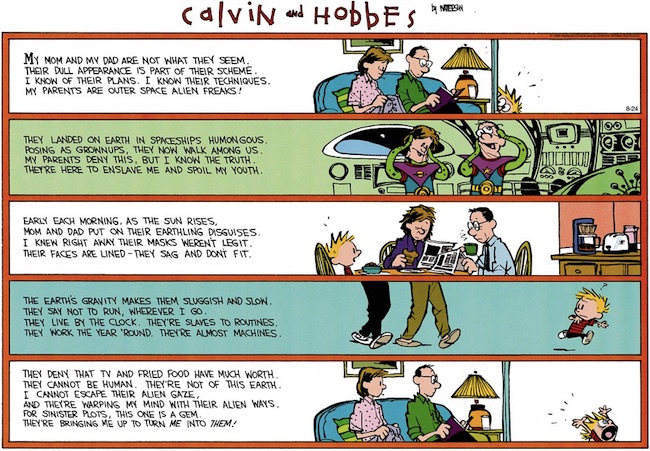
She denounced her fellow justices, stating, “This is Calvinball jurisprudence with a twist. Calvinball has only one rule: There are no fixed rules. We seem to have two: that one, and this administration always wins.” For some of us who have followed Jackson’s interestingly controversial tenure on the court, it was crushingly ironic. Although Jackson accused her colleagues of following a new rule that they must always rule with Trump, she herself is widely viewed as the very embodiment of the actual rule of the made-up game based on the comic strip of Calvin and Hobbes. In Jacksonian jurisprudence, it often seems like there are no fixed rules, only fixed outcomes. She then attacks her colleagues for a lack of integrity or empathy. To quote Calvin, Jackson proves that “there’s no problem so awful that you can’t add some guilt to it and make it even worse.”
Jackson has attacked her colleagues in opinions, shattering traditions of civility and restraint. Her colleagues have clearly had enough. She now regularly writes diatribes that neither of her fellow liberals — Justices Sonia Sotomayor or Elena Kagan — are willing to sign on to. Indeed, she has raged against opinions that her liberal colleagues have joined. Take Stanley v. City of Sanford. Justices Jackson and Neil Gorsuch took some fierce swings at each other in a case concerning a retired firefighter who wants to sue her former employer. The majority, including Kagan, rejected a ridiculous claim from a Florida firefighter who sued for discrimination for a position that she had neither held nor sought.
The court ruled that the language of the statute clearly required plaintiffs to be “qualified” for a given position before they could claim to have been denied it due to discrimination. (Stanley has Parkinson’s disease and had taken a disability retirement at age 47 due to the progress of the disease.) Jackson, however, was irate that Stanley could not sue for the denial of a position that she never sought, held, or was qualified to perform. Jackson accused the majority of once again showing how “pure textualists can easily disguise their own preferences as ‘textual’ inevitabilities.” It was not only deeply insulting, but perfectly bizarre, given that Kagan had joined in the majority opinion. Kagan is about as pure a textualist judge as she is a pure taxidermist.
“Good luck with that plan when the FBI turns up tomorrow at your place of work.”
• Trump Fires Fed Governor Lisa Cook For “Potentially Criminal Conduct” (ZH)
Update (2330ET): Former Fed governor Lisa Cook says she will not resign, the Washington Post reports, citing a statement from Cook. “President Trump purported to fire me ‘for cause’ when no cause exists under the law, and he has no authority to do so,” Cook said through a spokeswoman: WaPo “I will continue to carry out my duties to help the American economy as I have been doing since 2022,” Cook said. Good luck with that plan when the FBI turns up tomorrow at your place of work.
* * *
Promises made… promises kept… On Friday, President Trump warned that he would fire Federal Reserve Governor Lisa Cook who allegedly “falsified bank documents and property records to acquire more favorable loan terms” if she didn’t resign… She immediately played the victim card, claiming she “would not be bullied”. But now that is moot as President Trump has fired her, effective immediately: ” I have determined that there is sufficient cause to remove you from your position…
…
The Federal Reserve has tremendous responsibility for setting interest rates and regulating reserve and member banks. The American people must be able to have full confidence in the honesty of the members entrusted with setting policy and overseeing the Federal Reserve. In light of your deceitful and potentially criminal conduct in a financial matter, they cannot and I do not have such confidence in your integrity. At a minimum, the conduct at issue exhibits the sort of gross negligence in financial transactions that calls into question your competence and trustworthiness as a financial regulator.”If/when Cook leaves/is fired, Trump will have a majority on the Fed board pic.twitter.com/6Hxn8f2PPw
— zerohedge (@zerohedge) August 21, 2025
“Everybody else is cancelling currency and putting in capital controls, and Trump is going in the opposite direction.”
“I still want to have one of those $500 notes.”
• War, Trump’s New $500 Note & Volcanos -Martin Armstrong (USAW)
Five weeks ago, legendary financial and geopolitical cycle analyst Martin Armstrong warned his “Socrates” predictive computer program showed a “100% Chance of Nuclear War.” After that, Trump was able to get Putin to Alaska to start meaningful peace talks between Russia and Ukraine. The chance for war is still 100%, but now, that war may not involve America. Armstrong explains, “My sources in Ukraine are telling me the losses on the battlefield are approaching 1.8 million, 5 million fled to Russia, 8 million fled to the EU. . .. Ukraine is about ready to fall apart. . .. I spread this to Washington and that is President Zelensky was sending $50 million per month to UAE. So, Zelensky has been preparing to leave. There is no way this guy could possibly retire in Ukraine. They will kill him.”
Does this mean the war may be over? Zelensky and nearly all of Europe’s leaders came to Washington recently to meet with President Trump, but it really was not to talk peace. Armstrong says, “The fact that all those leaders came to Washington—uninvited, they all met with Zelensky before they went to meet with Trump. Why did they come? Because they need war. I have warned Washington.” So, if Europe starts a wider war with Russia, will Trump stay out of it? Armstrong says, “Yes, Trump said no American troops from what I have been told. Trump refuses to send any American troops to Ukraine as peacekeepers—period.”
Reading between the lines, does this mean Trump is putting the EU on notice we are not going to Article 5 in if you start a war? Armstrong says, “Article 5 is voluntary. I have made this very clear to them in Washington. You don’t have to participate. . .. I can’t stop the war. The best I can do is reduce the amplitude. If I can keep America out of this war, that is our best outcome. . .. Europe knows it’s in trouble financially. They have $335 billion of Russian assets frozen. France has about $71 billion. . .. The rumor going around right now is if there is a peace deal and they have to release those frozen assets, France can’t because they have been dipping into them. Europe is a complete mess. When it comes down to handing back $335 billion in Russian assets, I am not sure Europe is prepared to do that.”
Armstrong says forget all the talk of the elite wanting to get rid of cash and replace it with digital currency. Armstrong says, “No, no, no. Why is Trump talking about a $500 note. . .. Trump would not even contemplate doing a $500 bill if he was going to cancel the currency. Everybody else is cancelling currency and putting in capital controls, and Trump is going in the opposite direction. . .. Gold is still projected to go much higher because it is anticipating war.”
One of the surprising things Armstrong brought up are new signals from “Socrates” on increasing volcanic activity all over the world. Hawaii’s Kilauea eruption happened for the 31st time since December on Friday. It spewed lava for 12 hours, and then there was the recent eruption in Northeast Russia that had a huge eruption after 600 years of lying dormant. Armstrong says, “We have every data base in there. Earthquakes, volcanos and temperatures back to 1869 from New York City. It does not show global warming. . .. The computer says we are heading to global cooling and not global warming. . .. The computer is showing from 2025 on, we are going to be seeing a lot more volcanic activity. I just got off the phone with someone from Italy, and they say the super volcano there is starting to become active.”
In closing, Armstrong says, “I still want to have one of those $500 notes.”]
“The black King of Dahomey.”
• A Lesson on Slavery for CNN (Paul Craig Roberts)
The saga of American slavery has more holes in it than the Zionist saga of the Holocaust. Recently President Trump wondered about the woke Smithsonian Institute’s fixation on slavery as if it was the principal problem the world faces today. The liberal media had a hissy fit. CNN rushed to do a program on slavery, the woke rectification for which is multiculturalism and the replacement of the white racist population by people of color. This is the political agenda of the Democrat Party. To watch white people so determined to achieve their own destruction by voting Democrat is amazing. The response made by those critical of CNN’s attack on white Americans was that slavery was a matter of the distant past, and we made amends for our responsibility in a civil war.
What nonsense. No American ever had any responsibility for slavery. The black King of Dahomey did. Here are the undeniable, indisputable, basic facts: Over the course of history far more white people have been slaves than blacks. Some of these white slaves were held by Romans and other conquerors in ancient times. Most were held by people of color who raided Europe’s Mediterranean coast for slaves. Thomas Jefferson, the third president of the US (1801-1809) had to send the US Navy and Marines to “the shores of Tripoli” to stop the North Africans from capturing American ships and enslaving their passengers and crews. In the New World (Caribbean Islands, North and South America) European colonists found abundant resources but no labor force.
British and European sea captains saw a business opportunity in purchasing slaves from the black King of Dahomey and selling them to the colonists as a labor force. The black King of Dahomey conducted annual slave wars against other blacks and sold the surplus to Arabs and to European sea captains. No white colonist in what later became the United States ever enslaved a black person. They purchased blacks already enslaved by the black King of Dahomey. When the United States came into existence in the late 18th century, slavery was an inherited institution. Slavery existed as the labor force for large agricultural plantations, the agri-businesses of the time. The plantations using slave labor did not enslave the slaves. They purchased already enslaved labor as no work force was available.
In the United States slavery was doomed as the frontier closed. Slavery had a long life because white immigrants who entered America could avoid becoming agricultural labor by moving west and occupying land to which the native Americans had use rights but not ownership rights as understood in Western law. Thus the native inhabitants could be dispossessed. As the constant stream of immigrant-invaders, such as the US and Europe are experiencing today, continued, the Indian lands were settled by the immigrant-invaders and the frontier closed by 1890. Slavery could not have existed beyond that date and, in fact, could not have lasted that long. Slavery was costly compared to the wages of free labor.
Slavery was an expensive labor force. In 19th century America a male field hand cost $1,500. If a slave had blacksmith or carpenter skills, he cost $2,000. The price of a slave was three to four times the annual income of a skilled white man such as a blacksmith. Moreover, a slave, if he was to be productive, needed sufficient food, housing, and medical care. Moreover, he required respect and appreciation, Many of the slaves were warriors captured in the black King of Dahomey’s slave wars. They were experienced fighters and had to be treated with respect. For a white plantation owner to be surrounded by a large number of black men and for him to expect them to work required his respect and proper treatment of his labor force in which he had a large investment.
Propaganda such as Uncle Tom’s Cabin was northern war propaganda against the South. A few issues back, the City Journal posed the question of who was in charge of a rice or sugar plantation in the Caribbean when the one white owner, the only white on the premises, had a work force of 50 black men. The idea that it was customary to whip black warriors and to rape their wives is farfetched.
“Making God”
• ‘Godfather of AI’ Warns Superintelligent Machines Could Replace Humanity (ET)
Geoffrey Hinton, the pioneering computer scientist called the “godfather of AI,” has once again sounded the alarm that the very technology he helped bring to life could spell the end of humanity as we know it. In an interview clip released Aug. 18 as part of the forthcoming film “Making God,” Hinton delivered one of his starkest warnings yet. He said that humanity risks being sidelined—and eventually replaced—by machines far smarter than ourselves. “Most people aren’t able to comprehend the idea of things more intelligent than us,” Hinton, a Nobel Prize winner for physics and a former Google executive, said in the clip. “They always think, ‘Well, how are we going to use this thing?’ They don’t think, ‘Well, how’s it going to use us?’”
Hinton said he is “fairly confident” that artificial intelligence will drive massive unemployment, pointing to early examples of tech giants such as Microsoft replacing junior programmers with AI. But the larger danger, he said, goes far beyond the workplace. The only silver lining is that “it won’t eat us, because it’ll be made of silicon,” he said. Hinton, 77, has spent decades pioneering deep learning, the neural network architecture that underpins today’s artificial intelligence systems. His breakthroughs in the 1980s—particularly the invention of the Boltzmann machine, which could learn to recognize patterns in data—helped open the door to image recognition and modern machine learning.
That work earned him the 2024 Nobel Prize in Physics, awarded “for foundational discoveries and inventions that enable machine learning with artificial neural networks.” The Royal Swedish Academy of Sciences noted how Hinton’s early use of statistical physics provided the conceptual leap that made today’s AI revolution possible. But Hinton has since emerged as one of the field’s fiercest critics, warning that its rapid development has outpaced society’s ability to keep it safe. In 2023, he resigned from his role at Google so he could speak freely about the risks without implicating the company. In his Nobel lecture, Hinton acknowledged the potential benefits of AI—such as productivity gains and new medical treatments that could be a “wonderful advance for all humanity.” Yet he also warned that creating digital beings more intelligent than humans poses an “existential threat.”
“I wish I’d thought about safety issues too,” he said during the recent Ai4 conference in Las Vegas, reflecting on his career. He noted that he now regrets solely focusing on making AI work, rather than anticipating its risks. Hinton has previously estimated that there is a 10 percent to 20 percent chance that AI could wipe out humanity. In a June episode of The Diary of a CEO podcast, he said that the engineers behind today’s AI systems don’t fully understand the technology and broadly fall into two camps: one that believes in a dystopian future where humans are displaced, and the other that dismisses such fears as science fiction. “I think both of those positions are extreme,” Hinton said. “I often say 10 percent to 20 percent chance [for AI] to wipe us out. But that’s just gut, based on the idea that we’re still making them and we’re pretty ingenious. And the hope is that if enough smart people do enough research with enough resources, we’ll figure out a way to build them so they’ll never want to harm us.”
“If not for its exclusive deal with OpenAI, Apple would have no reason to refrain from more prominently featuring the X app and the Grok app in its App Store.”
• Musk Takes On Apple, OpenAI In Antitrust Showdown Over Chatbots (ZH)
Elon Musk’s X and xAI have filed a federal lawsuit in Fort Worth, Texas, accusing Apple and OpenAI of “locking up markets” to preserve their monopolies and shut out rivals. This comes as Musk’s long-running feud with OpenAI chief Sam Altman intensifies. The lawsuit centers on Apple’s recent deal to make OpenAI’s ChatGPT the only generative AI chatbot on the iPhone’s operating system, effectively shutting out xAI’s Grok and other rivals, such as Google’s Gemini and Anthropic. The lawsuit’s introduction argues that Apple and OpenAI have teamed up to protect their monopolies in smartphones and AI chatbots:
“This is a tale of two monopolists joining forces to ensure their continued dominance in a world rapidly driven by the most powerful technology humanity has ever created: artificial intelligence (“AI”). Working in tandem, Defendants Apple and OpenAI have locked up markets to maintain their monopolies and prevent innovators like X and xAI from competing.1 Plaintiffs bring this suit to stop Defendants from perpetrating their anticompetitive scheme and to recover billions in damages. AI is fundamentally reshaping our world. Technology powered by AI has not only become embedded in our daily lives but is also transforming critical sectors like healthcare, education, and finance.
The consensus among global business leaders, academics, and scientists is that AI adoption is both unavoidable and transformational—and businesses that do not plan for it risk falling behind. As Apple now recognizes, AI poses an existential threat to its business. For example, AI is rapidly advancing the rise of “super apps”—i.e., multi-functional platforms that offer many of the services of smartphones, such as social connectivity and messaging, financial services, e-commerce, and entertainment—that do not require a customer to be tied to a particular device. In other words, super apps, like those being developed by X and xAI, stand ready to upend the smartphone market and Apple’s entrenched monopoly in it.
The writing is on the wall. Apple’s Senior Vice President for Services, Eddy Cue, has expressed worries that AI might destroy Apple’s smartphone business, just as Apple’s iPhone did to Nokia’s handsets. Apple knows it cannot escape the inevitable—at least not alone. In a desperate bid to protect its smartphone monopoly, Apple has joined forces with the company that most benefits from inhibiting competition and innovation in AI: OpenAI, a monopolist in the market for generative AI chatbots. OpenAI quickly rose to dominance in the generative AI chatbot market after introducing its flagship service, ChatGPT, in 2022. Today, OpenAI controls at least 80 percent of the market. Because of OpenAI’s monopoly, other generative AI chatbots have struggled to gain share. xAI’s Grok has yet to gain more than a few percent of the market despite accolades about its superior features.
Just like Apple, OpenAI has incentive to protect its monopoly by thwarting competition and innovation in the generative AI chatbot market. And just like Apple, it has done so in violation of the antitrust laws.
In June 2024, Apple and OpenAI announced that Apple would integrate OpenAI’s ChatGPT into Apple’s iPhone operating system (“iOS”). Apple and OpenAI’s exclusive arrangement has made ChatGPT the only generative AI chatbot integrated into the iPhone. This means that if iPhone users want to use a generative AI chatbot for key tasks on their devices, they have no choice but to use ChatGPT, even if they would prefer to use more innovative and imaginative products like xAI’s Grok. An OpenAI strategy document recognized the importance of competition in this emerging and transformational space: “Real choice drives competition and benefits everyone. Users should be able to pick their AI assistant.” Yet Apple and OpenAI have colluded to prevent exactly that.”
Apple is behaving in a manner that makes it impossible for any AI company besides OpenAI to reach #1 in the App Store, which is an unequivocal antitrust violation.
xAI will take immediate legal action.
— Elon Musk (@elonmusk) August 12, 2025
X and xAI argue: “If not for its exclusive deal with OpenAI, Apple would have no reason to refrain from more prominently featuring the X app and the Grok app in its App Store.” Just a few weeks ago, Musk threatened Apple with legal action over alleged antitrust violations regarding the App Store rankings of the Grok AI chatbot. He wrote in an X post that Apple’s behavior “makes it impossible for any AI company besides OpenAI to reach #1 in the App Store.” Musk is seeking an injunction to block Apple and OpenAI’s exclusive chatbot deal and billions in damages. If successful, the case could reshape how AI bots are distributed on smartphones.
“Veldkamp, who previously served as Dutch ambassador to Israel, had advocated a ban on imports from Israeli settlements in occupied Palestinian territories..”
• Dutch Foreign Minister Quits Over Israel (RT)
Dutch Foreign Minister Caspar Veldkamp has stepped down in protest over the coalition government’s refusal to impose sanctions on Israel for its actions in Gaza. The resignation of Veldkamp, along with the country’s Minister for Foreign Trade Hanneke Boerma, has reduced the Dutch caretaker government to holding just 32 out of 150 seats. In a statement on Saturday the foreign ministry said that “after a meeting of the cabinet on the situation in Gaza,” the Social Contract (NSC) party, of which both officials are members, decided to withdraw from the caretaker coalition government.Veldkamp, who previously served as Dutch ambassador to Israel, had advocated a ban on imports from Israeli settlements in occupied Palestinian territories in response to Israel’s continued military offensive in Gaza.
In a statement on its website on Friday, the party said that it had sought “additional measures” against Israel in light of the “increasingly deteriorating humanitarian situation in Gaza.” However, the other two coalition partners refused to back sanctions, prompting the NSC to pull out in protest. On Thursday, the Netherlands, along with 20 other nations, signed a joint declaration condemning Israeli plans to build an illegal settlement in the occupied West Bank. Last month, Amsterdam declared two hardline Israeli ministers persona non grata. Back in June, Spanish Foreign Minister Jose Manuel Albares called on the EU to “immediately suspend” the EU-Israel association agreement and impose a ban on arms sales to Israel.
In light of the ongoing Israeli military operation in Gaza, a growing number of traditionally pro-Israel Western countries, including France and the UK, have expressed in recent months a readiness to officially recognize Palestinian statehood. Earlier this week, the Israel Defense Forces (IDF) announced the start of an operation to take full control of Gaza City. The conflict erupted after a Hamas incursion into southern Israel on October 7, 2023, which left about 1,200 people dead and 250 taken hostage. According to Gaza’s Hamas-controlled Health Ministry, more than 62,000 people, most of them civilians, have been killed by Israeli strikes in the enclave since then.
They’e playing politics. But what do they think?
• US Scientists Axe ‘Woke’ To Keep Cash Flowing – WSJ (RT)
Researchers in the US have been revising their grant renewal applications en masse in recent months over fears that wording tied to diversity, equity and inclusion (DEI) initiatives could cost them government funding, the Wall Street Journal reported on Saturday Since taking office in January, US President Donald Trump, a long-time critic of what he views as “divisive” leftist narratives, has taken numerous steps to eradicate such policies and even associated language at the government level. Promoted by his predecessor Democrat Joe Biden, DEI programs sought to ensure that sexual and racial minorities were better represented in government agencies. The Trump administration has described the initiatives as “illegal and immoral discrimination.”
The WSJ wrote that at least 600 grant renewal applications since October 2024 had removed “terms associated with diversity, equity and inclusion,” such as “diverse,” “underrepresented,” and “disparities.” The outlet said it had reviewed thousands of applications for National Institutes of Health-funded projects in the fiscal years 2024 and 2025. Some scientists have also reportedly shifted the focus of studies that were originally centered on minority groups. A Johns Hopkins University spokesperson confirmed to the WSJ that “federal agencies have asked researchers to make modest modifications” before renewing grants. On his first day in office, Trump signed an executive order mandating a review of government DEI initiatives.
Addressing a joint session of Congress in March, Trump declared that “we’ve ended the tyranny of so-called Diversity, Equity and Inclusion policies all across the entire federal government and indeed the private sector and our military.” He stressed that appointments should be made strictly on the basis of skills and competence, not race or gender. The Trump administration has also targeted a number of elite universities, including Harvard, for their failure to address “anti-Semitic” protests in support of Palestine and abolish DEI policies, suspending federal funding and restricting international student enrollment.
A rose by any other name…
• Trump Proposes Renaming Department of Defense to Its Original Name (ET)
President Donald Trump proposed on Aug. 25 that his administration rename the Department of Defense to its previous name, the Department of War. “Pete, you started off by saying ’the Department of Defense.’ And somehow it didn’t sound good to me,” Trump said in the Oval Office, speaking to Defense Secretary Pete Hegseth, after signing executive orders on fighting crime, including in Washington. “Defense. What are we, defense? Why are we defense? It used to be called the Department of War, and it had a stronger sound. And, as you know, we won World War I, we won World War II, we won everything. Now we have a Department of Defense. We’re defenders. I don’t know.” Hegseth, standing behind Trump, said the name change is on the way. “That’s coming soon, sir,” he told Trump.
Trump said that “Department of War” sounds better than “Department of Defense.” “Defense? I don’t want to be Defense only. We want defense, but we want offense too, if that’s OK,” he said, adding that “as Department of War, we won everything, we won everything. And I think we’re going to have to go back to that.” Trump touted bringing an end to conflicts between India and Pakistan and the Congo and Rwanda. This was not the first time Trump had suggested changing the Defense Department back to its previous name. “You know it used to be called secretary of war,” Trump told reporters on June 25 at the NATO summit in the Netherlands. “Maybe for a couple of weeks we’ll call it that because we feel like warriors.” He introduced Hegseth as “secretary of war.” “Then we became politically correct and they called it secretary of defense,” Trump said. “Maybe we’ll have to think about changing it. But we feel that way.”
Prior to becoming defense secretary, Hegseth called for changing the Defense Department back to its old name. “Sure, our military defends us. And in a perfect world it exists to deter threats and preserve peace,” he wrote in his 2024 memoir, “The War on Warriors—Behind the Betrayal of the Men Who Keep Us Free.” “But ultimately its job is to conduct war. We either win or lose wars. And we have warriors, not ‘defenders. Bringing back the War Department may remind a few people in Washington, D.C., what the military is supposed to do, and do well.” The Defense Department was called the Department of War when it was established in 1789. In 1947, President Harry Truman changed the name after merging it with the Navy Department. He signed the National Security Act, which established the position of secretary of defense. It also established the National Security Council, the Joint Chiefs of Staff, and the U.S. Air Force.
Once you have a Department of War, a Peace Nobel can’t be far behind.
• Giving Trump The Nobel Peace Prize Makes Some Sense (Lukyanov)
In the early 1980s, former US President Jimmy Carter visited Stockholm. At a reception he approached Stig Ramel, the long-serving executive director of the Nobel Foundation, and asked with some bitterness why he had not received the Peace Prize for brokering the Camp David Accords between Egypt and Israel. “If I had been awarded it, I might have been re-elected for a second term,” Carter remarked. He had lost to Ronald Reagan in 1980. Ramel’s reply was blunt: “I’m sorry, Mr. President, but you were not nominated.” The 1978 prize went instead to Egyptian President Anwar Sadat and Israeli Prime Minister Menachem Begin. Carter’s story illustrates how the Nobel Prize has always been as much about timing and perception as about substance. And it brings us neatly to Donald Trump.
Unlike Carter, Trump has no problem with nominations. They come thick and fast, from Rwanda, Cambodia, Gabon, Armenia, Azerbaijan, and beyond. Individuals and organizations have joined the chorus. Trump has even gone a step further: he has demanded the prize outright, loudly and repeatedly. Vanity, not diplomacy, drives him. Carter sought the award to improve his electoral prospects. Trump simply wants every trophy on the shelf. Does the spectacle make sense? Strictly speaking, to be considered this year Trump had to be nominated by January 31 – just ten days after his return to the White House. Yet precedent suggests this is no obstacle. Barack Obama received the Peace Prize in his first year as president, when he had scarcely done anything to warrant it.
Alfred Nobel’s will set out clear criteria: the prize should go to the person who has done most “for fraternity between nations, for the abolition or reduction of standing armies, and for the promotion of peace congresses.” Judged against that standard, Trump looks an unlikely candidate. He is one of the most polarizing figures on the planet. America’s military budget is heading toward a record $1 trillion in 2026, hardly a sign of “reduction of standing armies.” Yet the White House insists Trump deserves recognition. Officials cite half a dozen cases, from preventing nuclear war between India and Pakistan to halting conflicts in smaller states. The centerpiece, of course, is Ukraine. Washington is hinting that Trump’s approach may finally bring the war to a close – with the timing of any peace announcement conveniently close to the Nobel Committee’s own deliberations.
The pitch has not been flawless. In touting his record, Trump recently confused Armenia with Albania. But these are minor slips. What matters is the narrative: that Trump alone can impose order where others have failed. Is the Nobel Committee likely to indulge him? Its members are not known for rewarding bluster. But Europe’s leaders are desperate to appease Washington’s eccentric benefactor. It is not inconceivable that some will lobby behind the scenes in Trump’s favor. In one sense, awarding him the prize would not be absurd. The Nobel Committee has always sought to encourage gestures toward peace, however imperfect. Today, in a world of upheaval, genuine solutions are scarce. At best, one can try to ease tensions.
Trump, in his way, is doing just that – using every tool available, from demonstrative military threats to wild rhetoric and economic coercion. Others are doing even less. To paraphrase Lenin, a Nobel for Trump would be “essentially justified, formally a mockery.” It would capture the spirit of the age: a prize not for genuine reconciliation but for the ability to posture as a peacemaker in a fractured world. Carter, who once felt slighted, eventually did receive the award – more than twenty years after leaving office, in recognition of his peacemaking work as an ex-president. The Camp David accords remain in force to this day, a rare achievement in Middle East diplomacy. Trump is cut from a different cloth. He will not wait decades. By age and by temperament, he demands everything now. Or never at all.
“Well, I mean, I’m talking about the — the — I had had, there was a. . . . —Ghislaine Maxwell
• Ghislaine ‘Splainin’ (James Howard Kunstler)
Did you happen to bother reading the transcript of Ghislaine Maxwell’s interview? It’s tough sledding at times — both Ms. Maxwell and Deputy AG Todd Blanche tend to speak in choppy, incomplete sentences (as does, you might have noticed, President Trump) — but altogether the confab reveals that just about everything you think you know about the scandal might not be so, and her story is full of shocking surprises, assuming you can believe her. For instance, Ms. Maxwell had exactly one night of actual sex with Jeffrey Epstein back in the 1990s, a few months after they met, and that was it. He had problems with straight-up sex, she says. At first, he claimed to have a heart condition.
She says he had erectile difficulty “. . . which meant that he didn’t have intercourse a lot, which suited me fine, because I actually do have a medical condition, which precludes me having a lot of intercourse,” she added. (We never learn what that condition was, exactly.) Anyway, she never had sex with him again. Huh. . .? There goes one pillar of the public perception of the scandal: that Ghislaine Maxwell was a sort of nymphomaniac consort of Mr. Epstein, while supposedly acting as chief procurer of his masseuse “victims” and that the whole decades-long saga was a cavalcade of threesomes and orgies. She even claims at one point of being “a prude.” So, what was her role in JE’s complicated life? Basically, a property manager, she says. You know, all those houses and compounds: the mansion on East 71st Street, the Palm Beach place, the ranch in New Mexico, Little St. James Island, a flat in Paris.
It was a lot to manage. She had to hire architects, construction crews, interior decorators, servants. There were horses to care for at the ranch. It was a lot. She didn’t even have a key to JE’s New York City townhouse and was there only twice, she told Mr. Blanche. During that time, JE had other girlfriends while in the early 2000s, Ms. Maxwell hooked up with the billionaire founder of Gateway Computers, Ted Waitt. He bought a big boat for them to start-up an oceanic research venture. The relationship foundered when, she says, a sketchy lawyer named Scott Rothstein, working for a crooked Florida law firm that was under a RICO investigation at the time, attempted to extract $10-million from Waitt to keep Ms. Maxwell’s name out of lawsuits brought by women claiming to be “victims” of Epstein’s massage shenanigans.
Ms. Maxwell claims that Epstein’s masseuses, underage or otherwise, were recruited by the original masseuses, not by her (Ms. Maxwell). Ms. Maxwell was out of Epstein’s life after 2009, when he got out of jail on state of Florida charges of soliciting prostitution and procuring a minor for prostitution. This was preceded by a sketchy federal case brought in the Southern District of Florida that ended with a peculiar non-prosecution agreement — when US Attorney Alexander Acosta was told to lay off on account of Epstein being an “intel asset.” Ms. Maxwell states in the new deposition that JE was not associated with any intel agency, claiming it would have been in his nature to brag about it. It would help if FBI chief Kash Patel or CIA head John Ratcliffe could clarify that. They would surely know, one way or the other.
Of course, the heart of all the salacious chatter about Epstein is the claim that he worked for Israel’s Mossad intel agency, and that many eminent global persons were recorded having sex with underage masseuses in order to blackmail them (and, supposedly, allow nefarious hidden parties to control world political affairs.) Ms. Maxwell maintains that this is not so. She says there were no hidden cameras in bedrooms or elsewhere in the many Epstein properties or airplanes, and that she would know because she hired the electricians who installed everything else in them. There were only the usual security cameras on front entrances and gates. . . except for the Palm Beach house where local police installed a camera in JE’s office to catch a thief who was stealing cash stashed there. (Turned out to be JE’s butler, who was fired.)
Another thread at the center of the Epstein rumor mill is the notorious Epstein client list — supposedly of notables alleged to have cavorted with Epstein’s masseuses. Ms. Maxwell claims there was no such list, that a fake list was concocted by attorney Brad Edwards who represented women claiming to be Epstein “victims” in the lawsuit connected with the $10-million Ted Waitt blackmail caper. The list was composed from notes supposedly made off a computer by that same Epstein butler, one Alfredo Rodriguez. When interviewed in 2007, Rodriguez failed to produce the so-called “black book.” In 2009, he offered to sell it to attorney Brad Edwards (representing various “victims”) for $50,000. In 2010, Rodriguez was convicted of obstruction of justice and sentenced to 18 months in prison. He died in 2015.
A lot of monkey business in all this, wouldn’t you say? Perhaps the most astounding point is Ms. Maxwell’s assertion that no government attorney (or any other official, including from the FBI) ever interviewed her, or even called her on the telephone, during all the years of legal wrangling that went on. Say, what. . . ? How could that possibly be? Well, apparently it is so.
SV40
RFK Jr: "The polio vaccine contained a virus called SV40."
"It's one of the most carcinogenic materials that is known to man."
"But it was in that vaccine. 98 million people… in my generation got it."
"And now you've had this explosion of soft tissue cancers in our… pic.twitter.com/54XZAoeNoS
— healthbot (@thehealthb0t) August 25, 2025
Dr. Kevin Reese suggests that "dementia is linked to statin drugs."
"Statin drugs came out in 1987… Alzheimer's and other forms of dementia spiked in the 1990s."
"Now you see it all the time… Why? Because so many people are on statins, which means you're not getting enough… pic.twitter.com/lDYhXVk3Im
— Wide Awake Media (@wideawake_media) August 25, 2025
Blue Dragon
Spanish beaches are closing after the invasion of the potentially deadly blue dragon sea creatures as the venomous species continues to spread across the country.
This comes as tourists were banned from going into the water along an entire seven-mile stretch of Spain's Costa… pic.twitter.com/CSjYw0uAYL
— Massimo (@Rainmaker1973) August 25, 2025
Bees
Bees have pollen baskets, also known as corbiculae, are specialized concave structures on the hind legs of female bees, who carry pollen back to the hive
These baskets are full pic.twitter.com/2TxnKv0FB3
— Science girl (@gunsnrosesgirl3) August 25, 2025
https://twitter.com/buitengebieden/status/1960045888170004599
Bird
Photographer Shaaz Jung captured a rare and enchanting moment: An elephant, deep within the mist-shrouded forest, stood in quiet communion with a tiny bird perched on his tusk. pic.twitter.com/HV70L95XQE
— Massimo (@Rainmaker1973) August 25, 2025
Pebble
The pebble art of Justin Bateman
pic.twitter.com/0sX5AYRNH1— Science girl (@gunsnrosesgirl3) August 25, 2025
Support the Automatic Earth in wartime with Paypal, Bitcoin and Patreon.