

Christopher Makos Andy Warhol piloting John Denver’s bi-plane 1977

https://twitter.com/XFreeze/status/2047383798472437951?s=20 https://twitter.com/BowTiedTrance/status/2046995211595792477?s=20
https://twitter.com/MAGAVoice/status/2047475540693840189?s=20"The more effective Trump's approach becomes, the more DESPERATE his opponents get!" pic.twitter.com/zUYmtEXLrR
— Bridgett Fertig (@LightOnLiberty) April 23, 2026
Trump hands Iran the noose to hang themselves. And they do.
• US Sending Witkoff, Kushner To Pakistan As Iran Balks At Talks (ZH)
Confirming earlier speculation, CNN reported that President Trump is sending tdswo envoys for talks with Iran in Pakistan, even as Tehran sounded a more pessimistic tone on the prospects of further negotiations. Special envoy Steve Witkoff and the president’s son-in-law Jared Kushner are set to participate in talks this weekend with Iranian Foreign Minister Abbas Araghchi. Yet according to Iran’s semi-official Tasnim news agency reported earlier, no talks are slated to take place between the two parties during the foreign minister’s trip. Vice President JD Vance, the lead negotiator for the US, isn’t currently expected to join the delegation, CNN said. According to the latest from the White House Press Secretary on Vance:Read more …
Vice President JD Vance will be on “standby” and is “willing to dispatch to Pakistan” for Iran talks if negotiations progress in a way that the White House determines is a “necessary use of his time,” White House Press Secretary Karoline Leavitt says. Araghchi earlier said he was headed to Pakistan, but poured cold water on speculation that the US and Iran were close to a second round of negotiations to end the eight-week war, posting on social media that the purpose of his travel is to “closely coordinate with our partners on bilateral matters and consult on regional developments.”Officials in Pakistan familiar with the matter said they expected a second round of peace talks between the US and Iran, while declining to say when the negotiations would happen or at what level. Oil fell by as much as 3.3% to trade near $93 a barrel on the latest sign that the elusive peace talks between the US and Iran may materialize after all, even if there are no assurances of a favorable outcome. Traders had been closely tracking the movements of both delegations for signals on whether negotiations would come to pass and offer some relief as the strait remains largely shut.
Iran FM Will Not Meet American Side in Pakistan; Tehran Denies Ghalibaaf Rumors …but he will travel to Islamabad, and is expected there by Friday evening, amid what’s being described as a multi-nation diplomatic tour to shore up support for Tehran, and to set the conditions for potential next round of negotiations with Washington.
“The date for the launch of the second round of US-Iranian negotiations has not yet been determined,” a Pakistani source told Al Hadath. In Islamabad all that’s expected is that FM Araghchi and his small team will engage with Pakistani mediators, and nothing more. There’s been no comment on all of this from the White House, which says Trump has “all the time in the world” regarding the Iran war and Hormuz standoff. Meanwhile Tehran has once again vehemently rejected as false the new Friday reports that Iran Parliament Speaker Ghalibaaf has been replaced as lead negotiator.
Embarking on timely tour of Islamabad, Muscat, and Moscow.
— Seyed Abbas Araghchi (@araghchi) April 24, 2026
Purpose of my visits is to closely coordinate with our partners on bilateral matters and consult on regional developments.
Our neighbors are our priority.More Speculation on Ghalibaf Resigning Negotiations Team
Tehran on Thursday rejected widespread reports that Parliament Speaker Mohammad-Bagher Ghalibaf as resigned from leadership of Iran’s negotiating team. But these reports have persisted into Friday, with Saudi-funded, London-based Iran International ‘newly’ reporting: Mohammad Bagher Ghalibaf, head of Iran’s negotiating team with the United States, has stepped down amid internal disagreements, Iran International has learned. According to information obtained by Iran International, Ghalibaf was reprimanded for attempting to include the nuclear issue in talks with Washington and was forced to resign.Hardline figure Saeed Jalili could replace him, while Foreign Minister Abbas Araghchi is also seeking to take over the negotiations. And yet the fact remains that no talks are as yet scheduled, with regional media now saying Iran FM Araghchi is about to tour different countries, including Oman and even will make a stop in Russia – and that this may include Islamabad. If so, reports say it could just be part of a preparatory phase to engage Washington directly again. Latest via AJ: “No Iran-US talks to take place during FM Abbas Araghchi’s visit to Pakistan, only bilateral engagement,” citing senior Iranian source.
Hegseth Presser: Mine-Laying, Nuclear Sticking Point
A key line from the Pentagon chief on Friday morning: “All they have to do is abandon a nuclear weapon in meaningful and verifiable ways, or instead they can watch the regime’s fragile economic state collapse under the unrelenting pressure of American power, a blockade as long as it takes, whatever President Trump decides,” Hegseth said. He added that with the blockade continuing, “the clock is not on their side.” On this, Hegseth reiterated, “President Trump said it again yesterday. We have all the time in the world, and we’re not anxious for a deal.” And yet, he actually again made comparison to America’s forever wars in the region:Still, Hegseth opened his remarks to reporters decrying what he called the “endless wars of the past that dragged on for years and for decades,” and he sought to draw distinctions between the conflicts in Vietnam, Iraq and Afghanistan. Instead, the defense secretary argued that Operation Epic Fury has delivered a “decisive military result” in weeks, with a focus on the mission of keeping Iran from developing a nuclear weapon. T
he defense secretary said the mission is continuing into a new phase, and Iran now has the opportunity to make a peace deal. “Iran has an important choice, a chance to make a deal. A good deal. A wise deal,” he said.nHe further referenced yesterday’s reports that Iran is still engaged in mine-laying activity in the Strait of Hormuz, and warned: “If Iran is putting mines in the water, or otherwise threatening American commercial shipping or American forces, we will shoot to destroy. No hesitation,” he said.nInadvertent admission of the leveling power of asymmetric warfare & geographic advantage: “Any one with a speedboat and a gun…”
Hegseth:
— Clash Report (@clashreport) April 24, 2026
The vessels that the Iranians seized in recent days, a couple of them, they're not American or Israeli ships. They're just random ships.
They drove their little speedboats up to and shot at those ships with AK-47s.
Anyone with a speedboat, a gun, and the wrong… pic.twitter.com/BGQM97vUeQ
Trump wants to throw Spain out. Apparently that’s not easy.
• Trump Weighs Consequences For NATO Allies On ‘Naughty’ List (Politico)
The effort is the latest sign President Donald Trump plans to make good on his threats against members not deemed “model allies.” The White House has developed something akin to a “naughty and nice” list of NATO countries, as the Trump administration looks for ways to punish allies who refused to back the Iran war.nThe effort, which officials worked on ahead of NATO head Mark Rutte’s visit to Washington this month, includes an overview of members’ contributions to the alliance and places them into tiers, according to three European diplomats and a U.S. defense official familiar with the plan.Read more …
It’s the latest sign that President Donald Trump plans to make good on his threats against allies who don’t adhere to his wishes. And it’s another pressure point on the increasingly frayed alliance, which has been battered by Trump’s attacks — from his push to annex Greenland to his warning of a complete withdrawal from the pact. Defense Secretary Pete Hegseth floated the broad idea in December. “Model allies that step up, like Israel, South Korea, Poland, increasingly Germany, the Baltics and others, will receive our special favor,” he said. “Allies that still fail to do their part for collective defense will face consequences.”One of the diplomats said the list appeared to reflect that concept. “The White House has a naughty and nice paper so I guess the thinking is similar,” the person said. The administration is keeping any details quiet as it plans options, according to the people. And officials have provided little clarity on what the favors or consequences might be. “They don’t seem to have very concrete ideas…when it comes to punishing bad allies,” said another European official, who, like others, was granted anonymity to discuss sensitive diplomatic issues. “Moving troops is one option, but it mainly punishes the U.S. doesn’t it?”
The White House made its frustration with allies clear. “While the United States has always been there for our so-called allies, countries we protect with thousands of troops have not been there for us throughout Operation Epic Fury,” said White House spokesperson Anna Kelly, referring to the Pentagon’s name for the operation. “President Trump has made his thoughts on this unfair dynamic clear, and as he said, the United States will remember.”
Europe hardly knows Newsom. It wants anyone who can stop Trump.
• Europe Bets On Newsom To Reverse Trump’s America (Kolbe)
America remains a country of high social mobility and upward opportunity—something we no longer see on today’s European continent. It may sound kitschy to many Europeans, yet its vibrant economic centers, high geographic mobility, and the flexibility of its people still create the conditions for this unique phenomenon. Admittedly, the narrative of the “land of unlimited opportunity” may sound exaggerated today—something akin to self-promotion. Yet at its core, it still holds true. Can one still make something of oneself there? Donald Trump’s deregulation program, combined with tax cuts for businesses as well as small and medium incomes, has in any case helped to revive this promise of upward mobility.Read more …
Trump’s policies go hand in hand with the elimination of fiscal privileges and subsidies. His goal: the systematic dismantling of the fiscally secured and media-backed strongholds of power of a socialist apparatus that reflects the spirit of European regulatory policy. Put simply, under Trump, American nationalism and a rejection of ideological engineering have returned to the political agenda. With intense competition and market-driven policies at home, alongside a trade and tariff strategy reminiscent of presidents like Alexander Hamilton and William McKinley, this forms a clear countermodel to his predecessors. They had significantly advanced the European model of climate socialism as a tool of power consolidation.For the record: it was President Barack Obama who, in 2009, identified carbon dioxide as a lever of power, integrated European regulatory frameworks, and began systematically undermining the traditional American values of individual liberty, mobility, free markets, and minimal government. The public outrage over Trump’s reversal in key questions of political power architecture stems largely from the fact that too many had grown comfortable in a world of subsidies, NGOs, and public sector employment. European climate socialists now pin their hopes on California Governor Gavin Newsom. In two and a half years, he is expected to enter the White House and initiate a return to the status quo ante.
In Berlin, Brussels, Paris, and London, they are likely already counting the days until a possible political shift in Washington. Trump has fallen out of favor with Europeans because his agenda of prioritizing American national interests mercilessly exposes the ideological contradictions and intellectual weakness of European socialism. Whether in foreign policy—where the U.S. asserts itself forcefully toward countries like Venezuela or Iran—or in its confrontation with the climate lobby and the left-wing NGO complex, Trump’s policies reflect the will of many Americans to finally address the consequences of globalist policies and draw the logical conclusion: dismantling this socialist overreach.
It is telling that his migration policy meets fierce resistance in the strongholds of Democratic Party power. Where migration and poverty industries have taken root, the immigration authority ICE encounters near civil-war-like resistance. Yet it is not Trump’s fault that the European social model lies in ruins. Europe suffers from a lack of self-criticism and a general unwillingness to confront its own ideological failures. Meanwhile, nuclear cooling towers are demolished, coal seams flooded, and gas infrastructure dismantled. The politics of ideological immaturity collide with Washington’s hard-nosed approach and the necessary repair work on a deeply damaged social and economic body.
No matter whom the Republican Party nominates as Trump’s potential successor—be it J.D. Vance or Marco Rubio—the German press has already made its choice. It longs for America’s return to European-style climate socialism: more comfortable, more predictable, and promising continued access to public funding—even for its own future. To underline this, the German weekly WirtschaftsWoche recently published a guest article by Gavin Newsom. Newsom seeks to persuade foreign governments to view California as an independent economic entity—the world’s fifth-largest economy, still embodying the spirit of boundless opportunity.
The implicit message is clear: California’s economic stagnation is not the result of high taxes or aggressive climate policies in the European mold—nor of its war on oil and gas—but solely the fault of Donald Trump’s tariff policy.California is Europe in miniature—a shadow of the Old Continent cast across the United States. It now finds itself exposed by Washington’s market-driven reforms, which throw its model into stark contrast. The results are increasingly visible: one system succeeds, the other falters.
In his guest contribution, Newsom naturally avoids addressing the consequences of California’s climate policies. As in Europe, CO2 costs are placing enormous strain on industry. Companies are leaving—just as they are in Germany—and relocating to states like Texas or Florida, where industrial production is still valued. Newsom’s socialist course, which began in 2019, is evident not only in rising public debt. More striking is the emergence of a full-fledged poverty management industry. Years of open-border policies enabled the development of a deeply corrupt system of dependency management. California has become a magnet for illegal migrants, drug addicts, and other lost individuals; at the same time, the political framework sustains an extraction economy similar to what we observe in Germany’s migration sector. The parallels are striking.
The Sunshine State, once a place of aspiration for so many, now resembles—especially in its urban centers—the kind of social decay familiar from Europe’s migration-driven slums. Hardly a model to be proud of—yet, for WirtschaftsWoche, seemingly the ideal form of postmodern urbanity.
Newsom frequently points to the success of Silicon Valley, the powerhouse of digital innovation. Yet this engine of growth quite literally fell into his lap; he has contributed nothing of substance to enhancing the state’s innovative capacity. Silicon Valley existed before Newsom—and it will exist after him, if necessary in a different location, in new form, after escaping the suffocating grip of bureaucratic overreach. A final word on those Europeans who hope for Trump’s failure: with Newsom and a return of the United States to European climate socialism and mass immigration, capital flight from the EU might temporarily slow. It is entirely possible that European leadership could buy time by pointing to a faltering America. But it would change nothing about Europe’s decline—only delay the inevitable.
“The situation remains fragile: the currently stable ceasefire ends on Wednesday. And negotiations between the United States, Israel, and Iran are entering their final phase.”
“A US withdrawal from NATO would likely also mean a full retreat from the Ukraine conflict. This move would expose both Europe’s fragile finances and its non-existent security infrastructure.”
• Europe’s Hormuz Mission And The Illusion Of Geopolitical Power (Kolbe)
The loss of Europe’s geopolitical power is the defining decline narrative of our time. As Europeans, we are condemned to become unwilling witnesses of continental decay. And in no field of politics does the toxic amalgam of eco-socialism, elite arrogance, and rampant infantilism become more visible than at the level of the European Union. What we are witnessing in Brussels and the leading capitals of the EU are desperate attempts at coordinated foreign policy – and the realization that the cooperation of powerless individual entities does not necessarily lead to better outcomes than bilateral cooperation.Read more …
That this realization must have reached the highest circles of European politics could be observed at the end of this week. The four “big ones” – Germany, the United Kingdom, France, and Italy – called for a maritime alliance and the protection of the Strait of Hormuz. Fifty additional states – according to the initiators of this rather peculiar political camouflage – are expected to join the European alliance. Leadership claims are naturally being made by the former maritime powers Britain and France, above all France, whose aircraft carrier Charles de Gaulle may stand as the last remaining symbol of Europe’s great naval tradition at the center of these activities – if one can even approach the Persian Gulf at all.The situation remains fragile: the currently stable ceasefire ends on Wednesday. And negotiations between the United States, Israel, and Iran are entering their final phase. From a European perspective, our assumptions are once again confirmed: the EU and its slowly re-approaching partner the United Kingdom are staging a political cabaret. First came the wait-and-see approach until Americans and Israel had militarily decided the situation. Meanwhile, some NATO members refused cooperation with the United States, only to now, after everything has been decided, attempt to place themselves at the forefront of political forces seeking to guarantee the security of the Strait of Hormuz.
Through constant media overdrive, Starmer, Macron, Meloni, and Merz present themselves as the decision-makers of the moment – it is their harvest time, collecting cheap public dividends. But is that really the case? Do they seriously believe that the majority of Europeans are not fully aware of what is happening? That European power is essentially the product of media magic – permanent propaganda wrapped in moral excess? A shadow of past greatness, reduced to virtual impotence, ultimately dissolving into the very media theatre that we, as embarrassed Europeans, are forced to endure every day.
The German contribution to the mission, as announced by Chancellor Friedrich Merz, is predictably modest: mine countermeasure vessels (eight available), one supply ship, and two P-8 Poseidon reconnaissance aircraft. No frigates – they are tied up in a NATO deployment in the North Atlantic. Germany does have a defense budget that exceeds all other Europeans by billions, yet even this money appears to vanish into the nirvana of bureaucracy and into the coffers of defense contractors, who are popping champagne corks thanks to the government’s debt-driven spending spree amid multiple conflict scenarios.
As for the possible German contribution. But as said: whether a military deployment will actually take place remains uncertain. Europe is already feeling the consequences of its energy dependency and its eco-socialist policy course, which hit like an icy wind. Yet this does not change the fact that policymakers continue to refuse to acknowledge the geopolitical vacuum, and instead begin trying to piece together diplomatically what they have shattered in recent years – especially in relations with the United States and Russia.
From poker we know: those who repeatedly bluff at the same table with empty hands and are exposed will be dismantled in future rounds. A US withdrawal from NATO would likely also mean a full retreat from the Ukraine conflict. This move would expose both Europe’s fragile finances and its non-existent security infrastructure. The EU faces economic and geopolitical problems it cannot manage alone.
CNN to become pro-Trump.
• What CBS News’ Dinner to Honor Trump Means for the Future of News (Rivera)
On its surface, a dinner in honor of the president of the United States isn’t exactly unusual — except when the president is Donald Trump and the dinner is being planned by one of Hollywood’s major movie studios. For decades now, Hollywood executives have been leading propagandists for far-left political groupthink. TV shows, movies, and even award ceremonies are little more than soapboxes for liberal disinformation. The relatively few creatives who dare openly lean right are often ostracized and left scrambling for work.Read more …
But now we have Paramount — led by David Ellison, son of Larry Ellison, the billionaire co-founder of Oracle and a staunch supporter of President Trump — who recently purchased CBS News, reportedly planning an invitation-only dinner this month in honor of Trump and CBS News’ White House correspondents. If there’s one thing more important to Tinseltown than adhering to progressive doctrine, it’s their bottom line. That’s why conservatives have reason to cheer Paramount’s latest pending acquisition of Warner Bros. Discovery (WBD), which will result in the company acquiring the HBO Max streaming service, all of Warner Bros. And HBO’s legacy content, and even CNN.It’s not a stretch to call CNN an enemy of conservatives. The original cable news network has long positioned itself as a champion of the radical left — from its heyday when it was mocked as the Clinton News Network, to the embarrassingly combative shenanigans of “reporter” Jim Acosta during the first Trump administration, to the consistent mocking of Trump supporters by former CNN talk show host Don Lemon (last seen getting arrested for disrupting Christian worship services in Minnesota).
Conservatives long ago created their own successful media channels, allowing them to circumvent liberal-controlled news platforms. But they also remained frustrated over how the legacy media was so corrupted by the far left. That’s why it’s encouraging that David Ellison and Paramount have emerged. A sign of the internal earthquake to come if the Paramount-Warner deal is approved is the panic already rippling through CNN. As the New York Post reports, “CNN staffers are freaking out after learning that their left-leaning network’s owner Warner Bros. Discovery will be acquired by Paramount Skydance — even as insiders confirmed that the new owners plan to take a more politically centrist approach to news.”
Experience demonstrates that “woke” doesn’t sell. Just ask Budweiser, Target, and Cracker Barrel, among plenty of other companies that learned the hard way. When companies try to flaunt their woke bona fides, most Americans drop their brands. It’s telling that even AMC Theatres’ chief executive, Adam Aron, has announced his support for the pending merger. Executives have realized that what’s good for conservatives is good for the entertainment industry’s bottom line.
First, social media and podcasts broke the mainstream media’s monopoly on thought and content. Now, conservatives are assuming control of traditional studios and streaming platforms. With the marketplace of ideas no longer controlled by radical left groupthink, American consumers once again have freedom of choice. Just when it’s needed most, democracy is on the rise.
A long Sundance article that I cut into three pieces.
Trump loves Canada, but not the woke version. Not Trudeau or Carney. “Canada is positioned to be the first nation to discover the expressed power of the U.S. President as affirmed by the United States Supreme Court.”
U.S. media reports are blocked from Canadian social media sites. (I didn’t know that)
• Canada Pushes Closer to the FAFO Threshold (CTH)
Following direct remarks from both Commerce Secretary Howard Lutnick and U.S. Trade Representative Jamieson Greer, a triggered Canadian Prime Minister Mark Carney says the U.S. will not be permitted to dictate terms of the USMCA renegotiation, now scheduled for formal talks with Mexico only beginning May 25th. According to the Canadian leadership they do not need the United States in order to maintain their economy. The unfortunate people of Canada are very close to finding out exactly what that level of arrogance delivers.Read more …
USTR Jamieson Greer was just in Mexico meeting with Mexican President Claudia Sheinbaum and the Mexican trade delegation. Mexico s economy minister Marcelo Ebrard said on Monday that formal negotiations to review the U.S.-Mexico-Canada trade pact, known as the USMCA, are due to begin the week of May 25. Tomorrow and this afternoon we will hear the U.S. side s views. Once that is done, we will move on to the next phase, which is formal negotiations. We expect formal negotiations to begin the week of May 25, Ebrard said following a meeting with U.S. Trade Representative Jamieson Greer.
Meanwhile Canadian Prime Minister Mark Carney continues talking to his domestic audience about fighting Donald Trump and refusing to accept any terms that do not meet his current pontifications: It s not a case that the United States dictates the terms. We have a negotiation, we can come to a mutually successful outcome it will take some time, he continued. In Washington, Trade Representative Jamieson Greer said unless Canada engaged in talks about broadening the so-called rules of origin that allow goods to enter the United States tariff-free, Washington might have to impose other border controls.Meanwhile Canadian Prime Minister Mark Carney continues talking to his domestic audience about fighting Donald Trump and refusing to accept any terms that do not meet his current pontifications: “It’s not a case that the United States dictates the terms. We have a negotiation, we can come to a mutually successful outcome – it will take some time,” he continued. In Washington, Trade Representative Jamieson Greer said unless Canada engaged in talks about broadening the so-called rules of origin that allow goods to enter the United States tariff-free, Washington might have to impose other border controls. As the rhetoric continues increasing, the possibility of a full block against the import of Canadian goods increases.
It is worth remembering, the recent Supreme Court decision that overturned the IEEPA tariffs also reinforced the unilateral power of the U.S. President to regulate any/all trade with any foreign country including a full block of trade if designated. Canada is positioned to be the first nation to discover the expressed power of the U.S. President as affirmed by the United States Supreme Court. One of the reasons why Canadians are oblivious to the potential collapse of their economy is because U.S. media reports are blocked from Canadian social media sites. One of the infringements within the USMCA is the Canadian Law Bill [C-18, the Online News Act] that blocks information to Canadian citizens that is not supported by the Canadian government.
The people of Canada are stuck inside an Orwellian government constructed echo-chamber unable to hear opposing viewpoints. They simply have no idea what is heading in their direction. Which is incredibly ironic considering how much Mark Carney rails against Russian President Vladimir Putin, yet Canada has more restrictions on information than Russia. Think about it. The need for control is a reaction to fear. This information control dynamic helps to explain why Canadians, in the aggregate, simply do not realize the nature of the trade conflict that has been created by their own government.
Perhaps a full 30-day blockade would help their eyes to open; perhaps not. However, something needs to happen in order for the Canadian people to have time to prepare for the economic collapse soon to fall upon them. On June 1st Jamieson Greer anticipates telling congress that the U.S. intends withdrawal from the USMCA (CUSMA), pending unilateral negotiations with both Canada and Mexico to resolve conflict. Greer described two different protocols within any negotiation to deal with the structural differences between both Canada and Mexico.
Those differences include a completely different import/export profile with each country, different sectors of goods, difference in the wage rates within each country and a structural difference in the way each country is establishing their own, independent free trade agreements with other third-party countries. These baselines form the reason to tell congress of the dissolution, and on July 1st inform both Canada and Mexico about it.
In the interim, the points of conflict are currently being negotiated with Mexico toward resolution. Hence Jamieson Greer in Mexico meeting with officials on Monday and Tuesday.mIt is not just Commerce Secretary Howard Lutnick and U.S. Trade Representative Jamieson Greer who are publicly warning the Canadian government about what lies at the end of this self-destructive path they have chosen, Deputy USTR Rick Switzer recently also sounded the alarm.
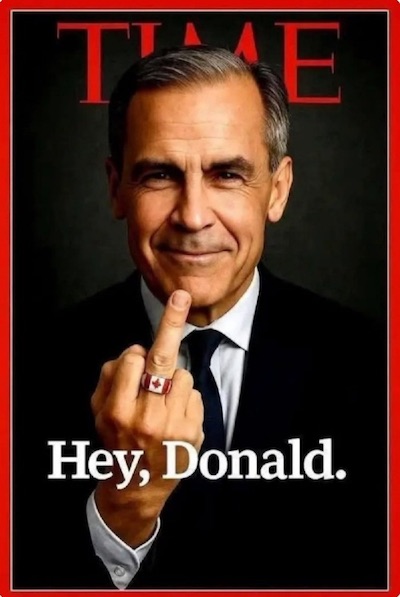
“Canada is helping President Trump remove the congressional justification they could use to block him.”
• In President Trump’s Mind There’s Not Going To Be a USMCA (CTH)
The Canadians have been talking to U.S. media looking for sympathetic ‘Orange man bad’ coverage. However, within the contacts between Canadian government officials and U.S. corporate allies, the sentiment from team Trump is very clear:“The key thing that has struck me, and I think it has struck all Canadians, is so many of these guys in the Trump administration, frankly, they just hate Canada,” said Brian Clow, former Prime Minister Justin Trudeau’s deputy chief of staff who led Canada-U.S. affairs. {source} It’s not hatred, it’s annoyance. Years of compounding parasitic annoyances and sanctimonious, ‘holier-than-thou’ pontifications from the arrogant and uppity Canadian government.Read more …
The only time Canada has been honest with themselves and with President Trump was when Justin Trudeau was exiting office and admitted Canada cannot function without all of the one-way benefits it receives from the USA. When President Trump was asked about Prime Minister Mark Carney creating a new trade agreement with China, President Trump responded that he didn’t care – it was irrelevant to him. Yet, simultaneously inside the USMCA President Trump has the power to veto any trade agreement between Mexico or Canada and a non-member nation.So, why didn’t President Trump care? Easy, because in President Trump’s mind there’s not going to be a USMCA; so, he really doesn’t care if Canada runs to violate it. In real terms, Canada doing bilateral deals with other countries, especially deals potentially detrimental to the USA, only strengthens his position on dissolving the USMCA. If Canada violates the terms and spirit of the USMCA, it makes dispatch of the unliked trade agreement even easier. Canada is helping President Trump remove the congressional justification they could use to block him. If Canada is violating the USMCA (CUSMA), Congress is kneecapped from interference.
Provoking Canada into a trade position, that puts them at a disadvantage trying to stop the dissolution of the CUSMA, stops Congress from opposing the fracture, and then opens the door to a bilateral trade agreement, is creating a self-fulfilling prophecy that is entirely controlled by President Donald Trump. Both Canada and Europe are independently, out of necessity, taking action that takes apart the trade and economic system they created. At the core of the old trade system both Canada and Europe were exploiting the USA, exfiltrating wealth and skimming the independent entrepreneurial innovation that originates from within the U.S. economic system.
That necessary exploitation happened because the USA is innovative (freedom-based capitalism), while the CA/EU system is built on government control mechanisms. The CA/EU energy policy is just one impactful example of their pontificating inability to be insightful when it comes to consequences. The EU and Canada are now stuck looking for markets that will do the dirty jobs, provide them with core components, while simultaneously looking for markets for their finished products.
On the other side of the approach is President Trump, working to expand U.S. industrial dirty job capacity, create our own core components, then create finished goods entirely on our own. A complete revitalization of the U.S. industrial and manufacturing base. Our U.S. GDP is currently expected to grow north of 5%. This is not happening by accident.
“The world leaders came because the process to keep USA wealth inside the USA is against their interests. That’s why they came, and that’s why President Trump left.”
• Globalism is a Series of Dependencies (CTH)
SUMMARY: Some people have construed the bilateral trade preference of President Trump to be the elimination of globalism in favor of nationalism in trade agreements. While the outcome of Trump’s approach indeed aligns with that theme, it is not specifically the objective of President Trump to eliminate global trade, but rather to focus on specific interests in trade that benefit the unique nature of each party involved.Read more …
Canada can embrace China, and Europe can embrace India; in the bigger picture it really doesn’t matter. These relationships only create dependencies which are the natural outcome of globalism. From President Trump’s position, what really matters is what happens within our borders and how the United States economy is positioned. This is President Trump’s singular focus.Do you remember President Trump leaving the 2025 G7 meeting in Canada early? The final day invitation list brought Australia, Mexico, Ukraine, South Korea, South Africa, India, the United Nations and the World Bank into the G7. President Donald Trump smartly exited the G7 assembly a day early, he departed before that crowd of interests arrived. The world leaders came because the process to keep USA wealth inside the USA is against their interests. That’s why they came, and that’s why President Trump left.
Globalism, in its economic construct, is a series of dependencies. However, the opposite is also true. If nations are not dependent, they are sovereign – able to exist without the need for support from other nations and systems. If nations are sovereign, then globalism is no longer needed. If each nation of the world is operating according to its individual best interests, the position of Donald Trump, then what happens to the governing elite who set up the system of interdependencies?
“Acting Attorney General Todd Blanche alleged that the SPLC had used “paid operatives within extremist circles to incite and intensify racial tensions..”
• House Panel Orders SPLC to Turn Over Communications With Biden’s DOJ (ET)
House Judiciary Chairman Jim Jordan (R-Ohio) on April 23 gave the Southern Poverty Law Center (SPLC) until April 30 to hand over documents regarding its relationship with the Biden–Harris Department of Justice (DOJ) and the FBI, as part of a federal prosecution of the civil rights group.Read more …
In a letter to Bryan Fair, SPLC interim president and chief executive, Jordan wrote that “publicly available documents revealed how the Justice Department partnered closely with the SPLC during the Biden-Harris Administration, including scheduling regular meetings, giving the SPLC early access to federal law-enforcement data, and allowing SPLC employees to train federal prosecutors.” The letter was also posted to social media. The chairman’s demand came two days after a grand jury in Montgomery, Alabama, returned an 11-count indictment alleging the SPLC had committed wire fraud, made false statements to a federally insured bank, and conspired to conceal money laundering.The indictment accuses the SPLC of funneling more than $3 million between 2014 and 2023 to no fewer than eight paid informants in violent racist organizations, including the Ku Klux Klan, the United Klans of America, the National Socialist Movement, the National Socialist Party of America, the American Front, and the Aryan Nations-aligned Sadistic Souls Motorcycle Club. Prosecutors said the group set up accounts under fictitious names, such as “Fox Photography” and “Rare Books Warehouse” among them, to hide where the money came from.
Acting Attorney General Todd Blanche alleged that the SPLC had used “paid operatives within extremist circles to incite and intensify racial tensions,” arguing the civil rights organization “fostered the very threats it claimed to fight.” Jordan’s letter tells Fair that the committee is investigating whether the SPLC shaped federal policy during the Biden–Harris years, highlighting a now-withdrawn 2023 FBI Richmond Field Office memorandum, dating back to when Christopher Wray led the bureau, that treated “radical-traditionalist” Catholics as given to violence, citing the SPLC as a source.
The chairman requested that the organization provide by next Thursday all communications with any “field source,” or informant, dating to Jan. 1, 2017. He also asked for communications referring to fictitious entities used to pay any “field source,” also dating to 2017, as well as communications with the DOJ, FBI, and other federal agencies dating to Jan. 20, 2021.Fair said that the organization was “outraged by the false accusations” and will “vigorously defend ourselves, our staff, and our work.” He noted the informant program, since shut down, “saved lives.”
“Taking on violent hate and extremist groups is among the most dangerous work there is, and we believe it is also among the most important work we do,” Fair said. The SPLC disclosed the criminal probe ahead of the indictment, noting it faced a DOJ investigation over its use of “paid confidential informants” to infiltrate so-called extremist organizations. The indictment covers almost a decade of alleged misconduct and claims that donors were never told the real reason behind the solicited funds.
More stressed than the people living through the Civil War? My, what a loser.
• I’m Part of America’s ‘Most Stressed’ Generation (Reagan Wilbanks)
My generation is stressed. Overwhelmed by AI-generated content. Uncertain about the future. Lacking meaningful relationships. Those of us in Gen Z—young people ages 14-29—carry a level of stress no one prepared us for. April is Stress Awareness Month, and May is Mental Health Month. Our stress is soaring. Our mental health is struggling. One reputable survey showed that 40% of young people feel stressed or anxious “all or most of the time.” Is there any hope for Gen Z? My generation is earnestly searching for the answer to that question. We’re turning to religious teachings and faith in increasing numbers in our quest for a life of deeper meaning and belonging.Read more …
Interest in Christianity is rising on U.S. college campuses and drawing more young Americans to church. We’re not looking for soft sermons or cute videos on the big screen upfront. We crave something real. Something that grabs hold of us and won’t let go. A faith that gives our lives purpose beyond endless scrolling and digital media overload. My generation is pushing back against things that are fake, quickly generated, and automated. Instead, we want real community and belonging. Smaller, more personal connections rather than big brands. I’m hungry for authentic experiences — to feel the breeze on my face, to touch green grass, to know the God who created it all and who also made me.Are we at the point of no return?
It’s clear that America is bitterly divided. We’re angry. We’re confused. Culturally and spiritually, our nation stands at the point of no return. My generation will decide the tipping point. Which way will we turn? It took a great spiritual awakening to give birth to our country. Now, as America celebrates its 250th birthday this year, I believe we’re on the edge of another great awakening—with my generation at the forefront. Watch this video to learn more: click here.Pollster George Barna revealed 52% of U.S. teenagers are “very motivated” to learn more about Jesus Christ. Many young Americans are turning to established faith traditions that offer the stability and longevity that we crave. We’re looking for something with roots. We’re looking for a home. We’re also turning to prayer. And this gives me a burst of hope. The next Great Awakening will come when Christ’s followers pray. Humbly. United. In towns and cities from coast-to-coast — a movement of a million believers from Maine to Hawaii asking God to draw a million Americans to faith in Jesus.
This growing movement could change everything. Only God, through a new movement of the Holy Spirit, is able to awaken faith and revive hope across America. My generation — the “most stressed” yet earnest generation — stands at the precipice. Will you be one of the million to pray? Will you join the movement?
What’s happening to personal contact?
• UAE To Move 50% Of Government Services To AI By 2028 (ZH)
Finally a practical use of AI. In a world swimming in debt and overrun by government bloat and corruption, Dubai is taking a big step into the future. On Thursday, Sheikh Mohammed bin Rashid Al Maktoum, Vice-President of the UAE and Ruler of Dubai, announced that in two years, 50% of UAE’s government sectors, services, and operations will run on Agentic AI, arguably the best use of the new technology yet. The new “government model” was launched under the directive of UAE President Sheikh Mohamed bin Zayed Al Nahyan. It will make the UAE the first government globally to operate at this scale through autonomous systems.Read more …
“AI is no longer a tool. It analyses, decides, executes, and improves in real time. It will become our executive partner to enhance services, accelerate decisions, and raise efficiency,” the Dubai Ruler said in a post on X. “This transformation has a clear timeline. Two years. Performance across government will be measured by speed of adoption, quality of implementation, and mastery of AI in redesigning government work,” he continued. “We are investing in our people. Every federal employee will be trained to master AI, building one of the world’s strongest capabilities in AI-driven government. Implementation will be overseen by Sheikh Mansour bin Zayed, with a dedicated taskforce chaired by Mohammad Al Gergawi driving execution.“The world is changing. Technology is accelerating. Our principle remains constant. People come first. Our goal is a government that is faster, more responsive, and more impactful,” Sheikh Mohammed added. nThe project includes a phased implementation across ministries and federal entities, based on continuous performance and impact assessment. This will pave the way for wider rollout, ensuring optimal results across the federal government. Special attention is placed on developing national capabilities by training and empowering government employees to master generative artificial intelligence technologies and their applications. Which of course is reflexive, so in effect government employees are supposed to train their own replacements.
Accroding to Khaleej Times, the move to adopt Agentic AI across government operations builds on 20 years of digital transformation in the UAE’s government, from the early adoption of eGovernment and service digitalization to mobile government and integrated systems such as the UAE Pass identity verification system to full-service redesign and integration, supported by programs such as Government Services 2.0, which introduced proactive, data driven service delivery.
In 2017, the UAE became the first country in the world to appoint a Minister of State for Artificial Intelligence and launched the UAE Artificial Intelligence Strategy 2031 under the UAE Centennial 2071 vision. The establishment of the Ministry of Artificial Intelligence, Digital Economy and Remote Work Applications in 2020 further strengthened this direction. The UAE is especially well suited for agentic implementation: the Gulf state has spent more than a decade building digital infrastructure that connects government entities, making it one of the most advanced public service ecosystems globally. Platforms developed under entities such as UAE Government and Digital Dubai already allow residents to access hundreds of services online, from paying fines to registering businesses.
The latest plan shifts the focus from digitizing services to redesigning them, allowing AI systems to manage entire workflows rather than just assisting at specific stages. For residents, this changes the experience from navigating systems to simply requesting outcomes, with the complexity handled behind the scenes. While the progression reflects a broader pattern seen across advanced economies, the UAE is moving faster than most. The first phase involved putting services online, which reduced paperwork and eliminated many in-person visits.
The second phase introduced mobile apps, automation, and AI tools, improving speed and accessibility while still requiring users to manage processes themselves. The next phase moves beyond interfaces, with systems designed to complete tasks independently, meaning the user defines the objective and the system handles execution. Back in the US, a recent attempt through Elon Musk’s DOGE to cut back on government inefficiency and corruption came to an abrupt halt last summer when it became obvious that the deep state would fight to the death (or at least hire assassins to effect the death of others) to prevent any change in the well-paid status quo. Perhaps AI will succeed where everyone else has failed.
“Again, this is all positioned to take on Nvidia ..”
• Google Deepens Anthropic Bet With Up To $40 Billion Investment (ZH)
The AI funding frenzy continues, with Google planning to invest $10 billion in Anthropic at a $350 billion valuation, deepening its relationship with the San Francisco-based AI company best known for building Claude. Bloomberg reports that Google’s deal with Anthropic includes an initial $10 billion investment at a $350 billion valuation, with the potential for another $30 billion if certain performance milestones are achieved. That would bring the potential deal size to as much as $40 billion. Part of the deal includes Google Cloud providing 5 gigawatts of computing capacity to the AI startup, founded in 2021 by former OpenAI employees, including Dario Amodei and Daniela Amodei, over the next five years. Additional capacity could follow.Read more …
Earlier this week, Amazon committed another $5 billion to Anthropic at the same valuation, with the option to invest an additional $20 billion over time. Amazon’s scramble for compute was detailed earlier in a deal with Meta: “Scramble For AI Compute: Meta Inks Multibillion-Dollar Deal With Amazon For CPU Chips”Bloomberg pointed out that the Google-Anthropic deal is an “expansion of an agreement announced earlier this month between Anthropic, Google, and Broadcom.” For Google, the agreement with Anthropic strengthens demand for its cloud services and in-house TPU chips, which have become viable alternatives to Nvidia’s AI chip stack.Earlier this week, Google unveiled two new chips for the agentic era, including the TPU 8t, designed for training AI models, and the TPU 8i, designed for inference, or running AI services once they are developed and deployed. Again, this is all positioned to take on Nvidia. There has been increased scrutiny around “circular” AI financing since we broke down the math and called it an epic “circle jerk” last fall.
Into the lion’s den.
• China’s DeepSeek Debuts Flagship AI Model As Compute Race Intensifies (ZH)

Chinese AI startup DeepSeek has launched a preview version of its long-awaited V4 model, ending months of silence from one of China’s most closely watched AI labs and arriving a year after its R1 release sparked U.S. market turmoil and concerns across Silicon Valley AI firms. The rollout signals that DeepSeek is full steam ahead in the frontier-model race:Read more …https://twitter.com/deepseek_ai/status/2047516922263285776
The open-source model comes in the V4 Flash and V4 Pro series, with DeepSeek saying its V4 “leads all current open models, trailing only Gemini-3.1-Pro.” In terms of reasoning, the startup said it “beats all current open models in Math/STEM/Coding, rivaling top closed-source models.”https://twitter.com/deepseek_ai/status/2047516926432399791
Counterpoint Research Vice President Neil Shah told CNBC that “DeepSeek’s V4 preview is a serious flex.” According to Counterpoint Principal AI Analyst Wei Sun, V4’s benchmark profile suggests the model could deliver “excellent agent capability at significantly lower cost.” Ivan Su, Senior Equity Analyst at Morningstar, told CNBC that V4’s debut is unlikely to deliver the same market shock as R1 did a little more than a year ago, largely because Wall Street has already priced in the view that Chinese AI can be built and deployed at a lower cost. Goldman analyst Christopher Moniz commented on the market reaction in overnight trading in China, where “GPU and domestic chip stocks rallied after DeepSeek unveiled preview versions of its latest V4 AI model.”
Moniz continued, “News of DeepSeek’s latest AI model created weakness in AI application names – Minimax (100 HK) -9.4% and Knowledge Atlas (2513 HK) -9.1%. Conversely, China domestic chipmakers spiked – HHS (1347 HK) +15.2% and SMIC (981 HK) +10%. Tencent (700 HK) -0.4% on mixed feedback regarding its new Hy3 model release, with locals noting it is less efficient than Minimax M2.7 launched a month ago”One key question is the chip stack behind V4: which chips it was trained on and which hardware it runs on during inference. Huawei has already claimed that its latest AI computing cluster, powered by Ascend AI processors, can support V4, suggesting that Beijing’s domestic AI hardware ecosystem is powering DeepSeek’s ongoing frontier-model push.
He changed when he got rich.
• Bruce Springsteen’s Land of Hope and Dreams No Longer Welcomes All (Perrotta)
The first time I heard Bruce Springsteen play “Land of Hope and Dreams” during his reunion tour of 1999, I nearly wept. Summoning the spirit of Woody Guthrie’s “Bound for Glory” and The Impressions’ gospel-tinged “People Get Ready,” the soul-soaring number evoked America as a train, with “this train” welcoming “saints and sinners,” “losers and winners,” “whores and thieves,” “losers and kings.” All aboard. Nearly 30 years “down the tracks,” Springsteen has launched his “Land of Hope and Dreams Tour.” Except now, instead of “all aboard,” it’s “No MAGA is welcome.”Read more …
On what he has openly dubbed a “very political opens in a new tab” tour, Springsteen unleashes a nightly diatribe against what he calls the “corrupt, incompetent, racist, reckless and treasonous”opens in a new tab president, while touting “No Kings.” (As if any tyrannical king would allow a mere musician to call him corrupt and treasonous without being hauled to the tower.) Lost in the huffing is the reality that President Donald Trump was elected by a majority of the American people. Elected by people who see him as a champion against the entrenched powers and global elites who have spent decades running them into the ground. Elected, in fact, by the very people Springsteen has made a king’s ransom writing about.The people—white, black, yellow, and brown—proud to live in this “American Land,” who wave the American flag … not the communist flags, rainbow flags, and the flags of Hamas seen at No Kings. The blue-collar workers in “Youngstown” whose factories and mills got shut down … that Trump is busting tail to reopen. Trump did not “forget their name.” The oil workers from “Seeds” whose jobs were “gone, gone, gone” … but are now booming, booming, booming thanks to “Drill, baby, drill.” The “Born in the U.S.A.” veterans who’d been abandoned by the nation … but are now a priority rather than sex change operations for soldiers. Those from his “City in Ruins” … whose streets are safer, whose businesses are less burdened, whose children are being rescued from trans ideology and falling test scores.
You could say he’s thrown Mary and Wendy and Madam Marie, even Rosalita, over for the likes of Jane Fonda and Alexandria Ocasio-Cortez. No, the type of people Springsteen wrote about are no longer welcome in Springsteen’s world—certainly not at his concert tour, even if they could afford the astronomical prices. Like pal former President Barack Obama scoffing at those who cling to their guns and religion, he holds them out to be simpletons manipulated and duped by the evil Orange Man.
Take ‘Streets of Minneapolis’ … Please
It’s no secret Springsteen is a leftist. He railed against nuclear power in the ’70s, Ronald Reagan in the ’80s, performed benefits for radical leftist groups in the ’90s, and spent the Biden years doing podcasts and cruising around in yachts with Obama while “This Hard Land” crumbled and Americans suffered.But what makes his current actions so disappointing is his refusal to play straight. Take, for example, his recent protest song “Streets of Minneapolis.”The song is a condemnation of Immigration and Customs Enforcement and a deification of Renée Good—the woman who gunned her car at an ICE agent and lost her life. He wrote and recorded the song immediately after hearing about the incident.nExcept Springsteen didn’t rush to write a “Streets of Chicago” about the innocent 18-year-old Sheridan Gorman, recently executed in the Windy City by an illegal immigrant—precisely the kind of illegal immigrant ICE is trying to remove from our country. No “Streets of Fort Myers” for the mother of two, bludgeoned to death with a hammer by an illegal immigrant from Haiti on April 3.
The Boss’s ‘War’ With Himself
Another example: Springsteen’s opening-night concert in Minneapolis began with Barrett Strong’s Vietnam-era anthem “War.” This led to a tirade about the “illegal” and “unconstitutional” war against Iran. Factually untrue—but more to the point, where is Springsteen’s “Streets of Tehran”?He’s hot and bothered about Good and Alex Pretti, both of whom interfered with and accosted ICE agents, who arguably acted in self-defense, but not a single chord or word for the 30,000 protesters slaughtered like sheep in Iran? Or the surviving protesters who—thanks to Trump—may actually soon hear the “Chimes of Freedom”? (Another cover on the set list.) For that matter, Springsteen wasn’t out there singing “War” when his BFF Obama was bombing Libya for months on end. Or orchestrating an overthrow of the Ukrainian government, which helped lead to the bloody, endless war they’re in today. Or mucking up the Middle East, giving rise to ISIS.
Principle seems to have no role in Springsteen’s public politics. More disappointing, his hypocritical dismissal of a majority of Americans breaks the unspoken promise Springsteen made from the start of his career to “Be True” to his loyal audience. Count me among them.As he sings in “The Promise”: “When the promise is broken, and the truth makes no difference, something in your heart grows cold.”Still, Springsteen built up a Jersey-sized cache of goodwill over his half-century in the spotlight. And while he’s burning through that goodwill like drag racers burn rubber on “the fire roads and the interstate,” one can hope The Boss puts aside the TDS and meet us again in this Land of Hope and Dreams.
Interesting thread https://t.co/RleBg8NKKl
— Elon Musk (@elonmusk) April 23, 2026
Correct https://t.co/PzM4iNnDEQ
— Elon Musk (@elonmusk) April 22, 2026
— Elon Musk (@elonmusk) April 24, 2026
They all work together https://t.co/mXAhhDNgCi
— Elon Musk (@elonmusk) April 24, 2026
— Elon Musk (@elonmusk) April 24, 2026
The migration problem in countries such as the Netherlands can be summarized as follows:
— Johannes M. Koenraadt (@johannesmkx) April 24, 2026
The state actively and aggressively imports hundreds of thousands of single male migrants annually who are then awarded permanent housing, welfare, and access to free medicine, if not also… pic.twitter.com/0HHQwdzTJf
For the first time ever, the full FLYNN movie is free to watch, and only on X.
— General Mike Flynn (@GenFlynn) April 23, 2026
Deliver the truth, whatever the cost. That was the mission when we first made this film, and it still remains the mission today. What you are about to watch is not just the story of one general, one… pic.twitter.com/HQquqrl90j
Support the Automatic Earth in wartime with Paypal, Bitcoin and Patreon.