
Gustav Klimt Lady with a fan 1917-18
(sold for $108.4m June 27 2023)

Mike Davis Warns The Grand Conspiracy Probe Has The Potential to Bring DOWN Big Names.
— Benny Johnson (@bennyjohnson) May 4, 2026
-Barack Obama
-Joe Biden
-Hillary Clinton
-James Comey
-James Clapper
-John Brennan.
Davis predicts “presidential immunity” will NOT be an adequate defense..
“Barack Obama worked with the… pic.twitter.com/EyBZhFYbPs
https://twitter.com/JDVance_News/status/2051094917544316977?s=20 https://twitter.com/Real_RobN/status/2051460099349381261?s=20New York Post columnist Miranda Devine reveals that old Twitter leadership worked with the FBI so closely to suppress the Hunter Biden Laptop story, that they classified all links to the story as “child porn” to stop it from being shared
— Wall Street Apes (@WallStreetApes) May 4, 2026
“It was completely blacklisted on Twitter… pic.twitter.com/M5xjObJbND
Some of the confusion is deliberate. But not all of it. Trump doesn’t want to waste time with debates on/in Congress, where plenty folk are against anything he does just because it’s him.
• Trump Pauses Project Freedom (ZH)
There is a knee-jerk wave of optimism across assets with WTI crude futures lower, US equity contracts and Treasury futures higher after President Trump said Project Freedom will be paused.Trump also said there is progress toward a final agreement with Iran which is what investors really want to see as it could potentially mean a reopening of Hormuz. Trump statement on his TruthSocial feed (emphasis and spacing ours):Read more …
“Based on the request of Pakistan and other Countries, the tremendous Military Success that we have had during the Campaign against the Country of Iran and, additionally… …the fact that Great Progress has been made toward a Complete and Final Agreement with Representatives of Iran……we have mutually agreed that, while the Blockade will remain in full force and effect, Project Freedom (The Movement of Ships through the Strait of Hormuz) will be paused for a short period of time to see whether or not the Agreement can be finalized and signed.” WTI crude futures are testing back below $100…Polymarket odds of Hormuz traffic returning to normal has jumped to better than a coin-flip… Don’t hold your breath though as there have been several false starts of this kind before, and traders will soon lose faith unless there are more details from the Iranian side. Additionally late Tuesday, a French cargo ship was confirmed hit in a missile attack, injuring crew members: A cargo ship in the Gulf region was hit by a possible land-attack cruise missile, causing several injuries among the ship’s Filipino crew, two U.S. officials told CBS News.
The hit on the CGM San Antonio — which is owned by a French firm — took place late Tuesday evening local time, the officials said. The ship was near Dubai as of midday on Tuesday, but it is not clear whether the vessel has moved since then, according to public ship tracking data.
Rubio Declares Conflict in New Stage
Secretary of State Marco Rubio has announced Tuesday afternoon that offensive stage of Iran war is ‘over’. He further said that ships stranded in the Strait of Hormuz are facing a humanitarian crisis and accused Iran of holding the world hostage by closing the Strait of Hormuz. Iran is denying that it attacked the United Arab Emirates, with the foreign ministry saying its ‘defensive actions’ were ‘exclusively directed at the U.S.’ Operation Epic Fury is over, now Project Freedom. The remarks were issued just as a new attack is unfolding on a foreign cargo ship in the strategic waterway:
UKMTO WARNING 055-26
— UKMTO Operations Centre (@UK_MTO) May 5, 2026
Click here to read the full warning⤵️https://t.co/J5B2EilFQE#MaritimeSecurity #MarSec pic.twitter.com/EGcKTpsHtN…as the goalposts keep shifting:
BREAKING: REPORTER: But 10 weeks in, are we any closer to get rid of Iran's nuclear materials?
— Sulaiman Ahmed (@ShaykhSulaiman) May 5, 2026
RUBIO: They no longer have a conventional shield. They have no Navy left. They don't have an Air Force. That's a very substantial achievement. That was the purpose of this. pic.twitter.com/bD33XPARVHTrump Asked Whether Ceasefire is Dead
A revealing exchange in the Oval Office strongly suggests that even amid a second Iranian attack wave on the UAE Tuesday, the White House is unwilling to say that the ceasefire has collapsed – also given there’s yet been no direct exchange of fire between US and Iranian forces: President Trump, taking questions from reporters in the Oval Office on Tuesday, would not specify what Iran would need to do to violate the cease-fire.Asked by a reporter what would constitute a violation, considering that the country has fired on U.S. ships several times, Trump said: “Well, you’ll find out, because I’ll let you know.” He added that “they know what to do,” and “they know what not to do, more importantly.” Earlier the Pentagon clearly indicated that the ceasefire is still active, from Washington’s point of view. The Iranian government is meanwhile trying to bat down rumors of a division between the presidency and the IRGC/military apparatus.[..]
The ceasefire with Iran is not over, according to U.S. Secretary of War Hegseth.
— Trey Yingst (@TreyYingst) May 5, 2026
Project Freedom is "separate and distinct” from Operation Epic Fury, Hegseth added.
The Iranian fire is recent days was described as "harassing" and "below the threshold of restarting major combat…
“It is just complete, systematic dismantlement of the Iranian economy. And they have days, not weeks, left in terms of their oil storage. That’s 90% of their economy. They’re about to lose that. And their currency has lost 98% of its value over the last 10 years.”
• Strait of Hormuz Standoff Exposes Tehran’s Weakness (JTN)
Iran launched missiles at U.S. military ships and the United Arab Emirates, and American forces returned fire amid a fragile ceasefire. But Monday’s volley exposed the increasingly limited options Tehran faces with a severely diminished military and economy as it tries to counter the U.S. Navy’s assistance to commercial ships passing through the Strait of Hormuz. While Tehran managed to damage a South Korean tanker and an oil facility in UAE, it suffered the loss of seven gunboats sunk by U.S. return fire and faces increasingly dire circumstances as its drilling wells are near bursting because there is nowhere to ship its oil, experts said.Read more …
“This is all sort of coming down to, I believe, the final days here,” former Deputy National Security Advisor Victoria Coates told Just the News. “…Iran is obviously still trying to lash out, but the farthest they can get their missiles at this point is UAE. They’re looking for proximate targets. They don’t even try and shell Israel anymore.” “Their ability to strike others may be very limited, and then they’re really out of cards,” she added. Admiral Brad Cooper, the commander of U.S. Central Command, revealed Monday the U.S. military launched an effort to clear the way for dozens of commercial ships trapped in the Arabian Gulf to transit through the Strait of Hormuz off the Iranian coast.The Iranians had responded to this effort by attempting to attack both the commercial ships and the U.S. naval vessels protecting them, he said. “The cruise missiles were going after those U.S. Navy ships, but mostly after commercial shipping. We defended both ourselves consistent with our commitment,” Cooper explained. “We defended all the commercial ships. We’ve had drone launches against commercial ships, all of which were defended against, consistent with our commitment. “And then the small boats were all going against commercial ships, and all were sunk by Apaches and Seahawk helicopters,” he added.
The admiral said that “there’s been no U.S. military ships hit” and that “there have been no U.S. flagships that have been hit.” The CENTCOM leader declined to say whether Iran’s attempted strikes were a violation of the weeks-old ceasefire struck between the Trump administration and the remaining Iranian leaders. “I wouldn’t go into details of whether the ceasefire is over or not. I think the key thing for us is we are merely there as a defensive force and in force to give a very thick layer of defense for commercial shipping to proceed out of the Arabian Gulf,” he said. “That is what we are focused on,” the admiral said.
Operation Epic Fury, launched just over two months ago, eliminated a raft of Iranian political and military leaders and did extensive damage to Iranian military capabilities, but the Iranians responded by seeking to control the strait. President Donald Trump had announced in a Truth Social post on Sunday that the U.S. military would be launching the “Project Freedom” effort to increase freedom of navigation in the Strait of Hormuz. The president had also said there would be consequences if the Iranians tried to interfere.
“Countries from all over the World, almost all of which are not involved in the Middle Eastern dispute going on so visibly, and violently, for all to see, have asked the United States if we could help free up their Ships, which are locked up in the Strait of Hormuz, on something which they have absolutely nothing to do with — They are merely neutral and innocent bystanders!” Trump said. The president said that “for the good of Iran, the Middle East, and the United States, we have told these Countries that we will guide their Ships safely out of these restricted Waterways, so that they can freely and ably get on with their business.”
The president also warned that “if, in any way, this Humanitarian process is interfered with, that interference will, unfortunately, have to be dealt with forcefully.” Cooper revealed Monday that the Iranians had indeed sought to interfere with this effort. Mike Waltz, a former Republican congressman and now the U.S. Ambassador to the United Nations, tweeted Sunday that “regardless of how you feel about the conflict over their nuclear program, Iran laying sea mines indiscriminately in international waters and attempting to ‘toll’ civilian commercial shipping is illegal and unacceptable.” He promised that “the U.S. and our Gulf partners will lead the way to defend global freedom of navigation.”
Admiral says blockade continues — and Project Freedom will pursue freedom of navigation Cooper explained Monday the U.S. naval blockade of Iran was continuing, and that the new Project Freedom effort to help guide commercial ships safely out of the Strait of Hormuz was purely defensive.n“Today, the U.S. military is taking two separate actions in two separate bodies of water. First, we are enforcing the blockade in the Gulf of Oman. There is no commerce going into and out of Iran, and we will be sustaining this effort,” the admiral said. “Second, we have now opened a passage through the Strait of Hormuz to allow for the free flow of commerce to continue.”
The ongoing blockade “is going exactly as designed, and in fact exceeding my expectations,” Cooper added. That blockade, experts said, is putting Iran’s oil industry in an existential crisis because it will soon have to cap overflowing oil wells with nowhere to export the fuel. “The second front of this war is economic,” Coates told the Just the News, No Noise television show on Monday evening. “It is just complete, systematic dismantlement of the Iranian economy. And they have days, not weeks, left in terms of their oil storage. That’s 90% of their economy. They’re about to lose that. And their currency has lost 98% of its value over the last 10 years.”
“The first is whether the American news media will follow the BBC’s lead and stop scaring people with end-of-the-world stories. The second is what the Left will use to scare us with next.”
• It’s Official: The Climate Scam Was a Scam All Along (Stephen Green)
It’s nice when something you knew was a fraud all along turns out to be a fraud, but it’s even nicer when the people perpetrating the fraud admit it was a fraud all along. “The Intergovernmental Panel on Climate Change (IPCC) has just published the next generation of climate scenarios,” science policy analyst Roger Pielke Jr wrote late last week, and in what he called “big news,” the new framework “eliminated the most extreme scenarios that have dominated climate research over much of the past several decades.” So the oceans aren’t about to boil off or freeze over or whatever the current scare story is?Read more …
Exactly: “The IPCC and broader research community has now admitted that the scenarios that have dominated climate research, assessment and policy during the past two cycles of the IPCC assessment process are implausible. They describe impossible futures.” This is important because the IPCC’s changes resulted in “an update to the Science Based Targets initiative’s rules eliminates the need for steep emission cuts by 2030,” Trellis reported on Friday. In other words, even the people committed to radically reduced carbon emissions now say we don’t need to radically reduce carbon emissions to save the world or whatever.Without getting too technical — you can read Pielke’s full report for that, should you feel the need to go shoulder-deep in the weeds — the upshot is that the previous frameworks lacked “any systematic effort to evaluate plausibility of scenarios.” Now, however, “the new HIGH scenario is exploratory — a thought experiment, not a projection.” My guess is that the IPCC still includes the non-scientific, scary-sounding “HIGH scenario” because otherwise the money might dry up. Pielke added that “users of climate models and model output based on legacy scenarios will now face decisions about if and how they’d like to realign with the latest scientific understandings versus continuing to rely on outdated research.”
We’ll see how that works out. The new IPCC framework actually dates back to 2021, but is only now becoming “news” because a bunch of slow-moving pieces have finally lined up. That’s just how science works. But Pielke’s analysis is a week old, and the only way I learned about it was thanks to a Toby Young post on X — he’s editor-in-chief of the UK’s Daily Sceptic — that PJ Media’s own Charlie Martin found. Why, it’s almost as though the mainstream media doesn’t want to cover stories like this one. But for once, I don’t digress.
Even though it might be “purely anecdotal, the Daily Sceptic’s Chris Morrison believes that even the notoriously scaremongering BBC “seems to have moderated its wilder climate stories of late, with the ‘Climate’ topic on its News site relegated to the second tier of subjects,” effectively demoting climate scares to “rubbing shoulders with the picture gallery and the dumbed-down ‘Newsbeat’ offering.” So while today’s news is good — maybe even great — it does leave me with two questions. The first it whether the American news media will follow the BBC’s lead and stop scaring people with end-of-the-world stories. The second is what the Left will use to scare us with next.
Carney is the no.1 WEF pawn against Trump. But not the only one. It’s Trump vs the world.
• Canadian Prime Minister is Playing a Very Dangerous Game (CTH)
Anyone who has ever dealt with a toxic narcissist understands the psychology behind their manipulative language, words and intents. What Canadian Prime Minister Mark Carney is doing here is very dangerous, particularly for the Canadian people. After a year of increased provocative language intended to confront President Trump for U.S. nationalist policy changes on economics, trade and security, Prime Minister Carney travelled to Europe where he again delivered strong remarks saying that Europe is now the center of the “rules based international order,” the western government control mechanisms that have maintained economic and security relationships for the past one-hundred years.Read more …
Essentially, Carney, after saying the USA was no longer a reliable or obedient partner, emphasized the opposition to state nationalism must come from a collective decision to retain the old geopolitical structures. President Trump must be opposed, and Europe -according to Carney- represents the assembly that will not permit state government nationalism (sovereignty) to replace their long-constructed globalist systems. Today, Prime Minister Carney faced questions about those remarks. I don’t want to influence the audience, but with the context in mind, watch and listen closely to his response. [Prompted]
[NOTE: The question comes from the Toronto Star, the only ‘conservative’ media outlet permitted under the rules of the Canadian regime to ask questions. All other outlets who might challenge the government viewpoints are strictly controlled and not permitted audience. Notice how Carney divides the world of opposition to President Trump, indicating the 5-Eyes nations of Canada, Great Britain, Australia, New Zealand are in opposition to Trump and in alignment with the old control mechanisms. Adding to this grouping, Carney pulls in the entire European continent and boldly proclaims his position as lead diplomat and representative for their effort against the USA.
This is a very dangerous game that Prime Minister Carney is choosing to play here. This is the behavior of a person who is toxically narcissistic and prepared to claim victim status as soon as his target hits back. Carney has carefully and purposefully deceived his domestic audience, and things are about to get very ugly. I must say something of a personal frustration…. In the bigger picture, expanding on the ancillary aspects that pertain to the geopolitical landscape that surrounds us, Carney is able to push this line this far because we have internal friction driven by people like Tucker Carlson, Candace Owens and other short-sighted “influencers, who do not recognize the scale of the moment.
President Trump is standing up to a globalist system that weakened the United States over several generations. The same voices who understand how toxic the United Nations, NATO, USAID and other international influences are to what remains of U.S. sovereignty, are the same voices attempting to divide Trump’s base of support while our President battles multinational influence operations; all because they have the same traits as Mark Carney underpinning their psychology. You either affix your bayonet against these forces, or in our lifetime there will be nothing left to fight over.
“CEO Alex Karp casts the surveillance giant as “sentinels of the inner sanctum, against the assault of AI slop”.
‘Battlefield’ AI value’? What does that mean?
How do we react when AI is utilized to kill people? What becomes the winner in the AI field? The system that can kill most people?
• Palantir Touts Record Expansion and ‘Battlefield’ AI Value (RT)
Palantir Technologies reported a blowout first quarter, saying revenue rose 85% year on year to $1.63 billion as its US business more than doubled, driven by rapid growth across both commercial and government customers. The company said in its Q1 report, published Monday, that US revenue jumped 104% to $1.28 billion, with commercial revenue up 133% to $595 million and government revenue up 84% to $687 million. The results beat Wall Street estimates, and the company also raised its full-year guidance, saying it now expects 2026 revenue of up to $7.66 billion, implying annual growth of about 71%. CEO Alex Karp, who has increasingly framed Palantir’s AI tools as central to Western military and industrial power, said the “twin pistons of our US business are now firing in sync.”Read more …
“Palantir reports Q1 ‘26 U.S. revenue growth of 104% Y/Y and revenue growth of 85% Y/Y; raises FY ’26 revenue guidance to 71% Y/Y growth and U.S. comm revenue guidance to 120% Y/Y, crushing consensus expectations.Q1 U.S. commercial revenue grew 133% y/y and adjusted operating… ” “We believe it is not hyperbolic to say that nearly all AI workflows that actually create value – especially on the battlefield – are built on Palantir,” Karp wrote in an accompanying letter to shareholders, stating that the company “was founded to strengthen US national security, to protect Americans and their freedom.”Palantir – named after the obsidian seeing-stones from Tolkien’s The Lord of the Rings, through which the dark lord Sauron keeps watch on his underlings – is a software firm primarily serving the defense and intelligence sectors. Palantir’s flagship product is a system called Gotham, which pulls together and analyzes satellite footage, human intelligence from the CIA, signals intelligence from the NSA, and other data that might otherwise take days to sift through. Gotham and MOSAIC – another Palantir target-identification program that pulls digital data, including surveillance footage and IP addresses, from a target area – use AI to label the most effective targets for military strikes.
The US has acknowledged using these programs to select targets during its ongoing war on Iran, but insists that humans make the final decision to fire. Abroad, Palantir’s technology is used by the British Ministry of Defence, the Israel Defense Forces, and the Armed Forces of Ukraine. The company’s earnings update came weeks after Palantir drew criticism for a 22-point manifesto summarizing themes from Karp’s book The Technological Republic. The manifesto argued that Silicon Valley has an “obligation” to participate in national defense, that “hard power” will be built on software, and that AI weapons are inevitable. Critics labeled it a blueprint for “technofascism.”
A lot hangs on this. If Musk doesn’t win, we get uncontrolled AI.
• How A Musk Victory Vs. Altman Would Reset America’s AI Roadmap (ZH)
A courtroom victory for Elon Musk in his high-stakes federal trial against Sam Altman and OpenAI would deliver one of the most disruptive blows to the artificial intelligence sector in its brief but explosive history – potentially forcing the $850-billion-plus company to unwind its for-profit empire, ousting its top leaders, and handing Musk a symbolic and financial hammer to reshape the global race for AGI while weakening one of its fiercest competitors.Read more …
The case is now being argued in a federal courtroom in Oakland, before Judge Yvonne Gonzalez Rogers. The trial opened on April 28 and entered its second week on Monday, when OpenAI president Greg Brockman took the stand and confirmed his personal stake in the company is worth roughly $30 billion. Musk’s counsel returned to the figure more than a dozen times in two hours of questioning.The Case
Musk co-founded OpenAI in late 2015 as a nonprofit and contributed roughly $38 million in its early years. He left the board in 2018. The following year, OpenAI created a capped-profit subsidiary to attract the capital that frontier AI now requires; Microsoft has since invested more than $13 billion. ChatGPT launched in November 2022. By 2025, OpenAI was preparing for what would have been one of the largest initial public offerings in history.Musk sued in 2024. The original complaint contained twenty-six claims; only two survive – breach of charitable trust and unjust enrichment – while the fraud claims were dismissed before trial. Microsoft is named as a co-defendant for allegedly aiding and abetting the breach, a detail often elided in summary coverage.The remedies sought are unusually sweeping. Musk wants OpenAI’s for-profit structure unwound and its assets returned to the nonprofit foundation. He wants Sam Altman and Brockman removed from leadership. And he is seeking up to $150 billion in damages from OpenAI and Microsoft combined, with any award flowing directly to OpenAI’s charitable arm rather than to Musk personally.
Structure of the Trial
Judge Gonzalez Rogers has bifurcated the proceedings into a liability phase, expected to conclude around May 21, and a separate remedies phase that would follow only if the defendants are found at fault. A nine-person jury sits during liability alone, and its verdict is advisory. Structural remedies – including any order to dissolve the for-profit subsidiary – fall solely to the judge. This procedural detail matters more than it may appear. Coverage that casts the jury as the decisive actor misreads the case. The jury can shape narrative momentum and offer a finding the judge may weigh, but it cannot order OpenAI to unwind anything. Whatever the verdict, Gonzalez Rogers writes the remedy.What a Musk Win Would Actually Mean
Setting aside the $150 billion headline – which is a ceiling, not a floor, and is divided across defendants – three concrete consequences would follow a substantive ruling against OpenAI.The first is restructuring. A finding that the 2019 capped-profit conversion and its 2025 successor breached a charitable trust would, at minimum, force a reorganization placing the nonprofit foundation back in unambiguous control. The IPO would be delayed indefinitely, if not foreclosed. Investor returns would be capped or rewritten. Microsoft’s roughly $13 billion stake, and the larger commitments that followed from Amazon, SoftBank, and Nvidia, would all face revaluation.
The second is leadership. Musk’s complaint seeks the removal of Altman and Brockman. Whether the court orders that remedy in full is uncertain; partial governance reform is the likelier outcome. Either way, the result would be destabilizing for an organization whose competitive position rests substantially on the people at the top of it.
The third is precedent, and it may prove the most durable. A ruling for Musk would establish that nonprofit-to-commercial transitions in American technology can be reversed years after the fact, once the entity has grown large enough to be worth reversing. Founders, donors, and investors in mission-driven labs would have to reckon with a previously hypothetical risk: that the structure they signed up for is the structure they will be held to, indefinitely.
The Defense
OpenAI’s response, articulated by lead counsel William Savitt, is that Musk himself supported a for-profit restructuring as early as 2017 – as long as he was placed in charge of it. When the other founders declined, he left, predicted the company’s failure, and later launched a competitor. The obvious angle here is that the lawsuit is a delayed instrument of competitive harm rather than a vindication of charitable principle. The defense will lean on contemporaneous evidence: Musk’s own emails proposing for-profit structures; his instruction to associates to register a for-profit corporation in OpenAI’s name; and Brockman’s private journal, which Musk’s team has used to suggest financial motive but which also records the founders’ resistance to handing OpenAI to Musk.What Remains
Several witnesses are still to come. Altman has not yet testified. Microsoft chief executive Satya Nadella is expected. Stuart Russell, the Berkeley computer scientist, will appear as Musk’s expert on AI risk; the judge has already declined a request from Musk’s counsel that Russell be permitted to range beyond his written report into extinction scenarios. Two days before the trial began, Musk texted Brockman to gauge interest in settlement. When Brockman proposed mutual dismissal, Musk replied that he and Altman would be the most hated men in America by week’s end. The judge declined to admit the exchange. No settlement has materialized.= The trial is expected to run another two to three weeks. The remedies phase, if it comes, will follow.
“Brussels is set to announce plans to build massive computing hubs while critics stress there is almost no domestic artificial intelligence industry to use them”
The cart and the horse. They will have the infrastructure. But nothing and nobody to use it. Oh well, ask Santa.
• EU Slammed Over Multi-Billion AI Infrastructure Splurge Plan (RT)
The EU’s plan to spend over €20 billion ($23.5 billion) on AI gigafactories has drawn sharp criticism ahead of its formal launch as lawmakers and experts question whether there is any real demand for the facilities. European Commission President Ursula von der Leyen first outlined the plan in February 2025 as the EU’s answer to large-scale US computing projects. It involves building four or five mega facilities with a formal call for proposals set for this spring. However, the project has been met with pushback from lawmakers. “Nobody could explain to me what is the business case they are planning with these gigafactories,” German Greens MEP Sergey Lagodinsky has said.Read more …
“I talked to some who are saying: ‘we just need more compute in Europe.’ But then, when I ask them, ‘what for?’ They say ‘it doesn’t matter, we just need more compute.’” Lagodinsky was quoted as saying by Politico. It is also unclear who the facilities would be used by, according to Nicoleta Kyosovska, a research assistant at a Brussels-based think tank. She described the planned datacenters as “cathedrals in the desert,” noting that Europe has only one AI company capable of using such infrastructure – the French startup Mistral, which is already building its own data centers. A Commission spokesperson has defended the plan by arguing that Europe requires computing sovereignty to avoid dependence on other continents.The skepticism comes amid broader concerns over global AI overspending. Alphabet, Amazon, Meta, and Microsoft reportedly plan to spend a combined $725 billion this year on AI infrastructure. However, Gary Marcus, a professor emeritus at New York University, has described the planned spending as the “greatest capital misallocation in history.” Tech analyst Ed Zitron has also noted that the economics of data centers “do not make sense” given that most AI startups are unprofitable and the majority of data center credit deals are rated junk grade.
Meanwhile, consumers have also been venting their anger over the global chip crisis sparked by overzealous AI development plans. “The reason why RAM has become four times more expensive is that a huge amount of RAM that has not yet been produced was purchased with non-existent money to be installed in GPUs that also have not yet been produced, in order to place them in data centers that have not yet been built, powered by infrastructure that may never appear, to satisfy demand that does not actually exist and to obtain profit that is mathematically impossible,” software engineer Jatin K Malik surmised.
A $44 billion purchase and a $1.5 million settlement of the lawsuit the SEC hung on it. What percentage of it is that? 1% of $44 billion is $440 million, I think. You take it from there.
• Elon Musk Reaches $1.5 Million Settlement With SEC Over Twitter Stake (ET)
Tech billionaire Elon Musk on May 4 agreed to pay $1.5 million to resolve a Securities and Exchange Commission (SEC) lawsuit alleging he violated securities laws over the delayed disclosure of his Twitter stake. A filing dated May 4 states that Musk’s revocable trust will pay a civil penalty of $1.5 million to the commission as part of the settlement, subject to approval by the court. According to the filing, once the proposed settlement is approved by the court, the SEC will “file a stipulated dismissal of Elon Musk in his personal capacity, which will resolve this case in its entirety.”Read more …
The SEC filed the lawsuit in January 2025, alleging that Musk violated federal securities laws by delaying disclosure of his stake in Twitter before his bid to buy the platform in 2022. The regulator said Musk crossed the 5 percent ownership threshold in March 2022, triggering a 10-day deadline to make the holding public. Musk did not disclose his holdings until April 2022, when he had already acquired a more than 9 percent stake in Twitter, according to the filing. The SEC said the delay had allowed Musk to buy shares at “artificially low prices” and enabled him to underpay by at least $150 million for his shares after his beneficial ownership report was due.Musk had previously sought to have the SEC suit dismissed. In August 2025, his lawyers argued that the SEC targeted Musk over his outspoken criticism of the regulator and “government overreach.” Separately, in March, a federal jury held Musk liable for misleading Twitter shareholders by driving down the social media platform’s stock price months before acquiring it. The decision followed a civil class action lawsuit filed by Twitter investors in October 2022. Musk agreed to buy Twitter at $54.20 per share in April 2022 but later sought to back out of the deal, prompting the company to take legal action to enforce the deal. He ultimately completed the acquisition in October 2022 and rebranded Twitter as X.
In a verdict on March 20, jurors found Musk liable for misleading investors through two social media posts he shared in 2022. The first post said the deal was “temporarily on hold” pending verification that bots accounted for less than 5 percent of users on the social media platform. In the second post, Musk suggested that the percentage of bots could exceed 20 percent and said the buyout of Twitter could not go forward until he received confirmation that it was less than 5 percent. Musk’s legal team has said they plan to appeal the verdict.
The EU is a direct participant in the conflict. They also want to be a mediator.
• Russia Disregards EU As Possible Mediator In Negotiations On Ukraine (TASS)
Russia does not see the European Union as a potential mediator in the negotiations on Ukraine, as it has become a direct participant in the conflict, said Russian Ambassador-at-Large Rodion Miroshnik.Read more …
“The European Union has made a lot of efforts to avoid being considered a neutral party in any capacity. And this is the main requirement for conducting or mediating the negotiation process. The EU has today taken over financial and military support for the continuation of hostilities and bloodshed in Ukraine. This is why, in this case, it is completely illogical to even raise the question that the direct participants, sponsors and stimulators of the process can act as intermediaries for dialogue,” the diplomat told Izvestia newspaper.Miroshnik noted that Brussels has never proposed any specific ways of settlement, but if in theory it publicly expresses a unified position, Moscow will study it.
“He holds the quaint idea that when the drafters of the 14th Amendment barred discrimination on the basis of race, they meant it.”
• Colorblind Constitution: The Roberts Court Ends a ‘Sordid Business’ (Turley)
The Supreme Court’s decision in Louisiana v. Callais, barring racial gerrymandering, has many on the left feigning vapors, despite the predictions of many of us that this result was likely. While figures such as Rep. Jamie Raskin (D-Md.) declared that the court itself has been “gerrymandered” to rig the upcoming elections, this decision is actually the culmination of decades of jurisprudence by various justices — particularly Chief Justice John Roberts.Read more …
Indeed, the decision will cement the legacy of the Roberts Court in moving the country toward a colorblind system of laws. Like most Americans, Roberts abhors racial discrimination in any form. He holds the quaint idea that when the drafters of the 14th Amendment barred discrimination on the basis of race, they meant it. This is why, in 2006, Roberts famously wrote, “It is a sordid business, this divvying us up by race.” Roberts sees no difference between such discrimination when it disfavors one or another race. It is all a sordid business, and he has spent decades writing eloquent arguments for the court to abandon its conflicted and hypocritical approach to racial discrimination.The court has struggled to rationalize using race to discriminate when it serves a higher purpose, such as greater equity or affirmative action. Some of those opinions were constitutionally incomprehensible. For example, in 2003, in Grutter v. Bollinger, the court divided five to four on whether to uphold racial admissions criteria used to achieve “diversity” in a class at the University of Michigan Law School. However, in her opinion with the majority, Justice Sandra Day O’Connor stated that she “expects that 25 years from now, the use of racial preferences will no longer be necessary to further the interest approved today.”
Few of us could understand how O’Connor found a type of expiration date on permissible racial criteria in the Constitution. Throughout that period, however, certain justices held firm that there is a bright-line rule against such racial criteria. That includes the author of the court’s Callais decision, Justice Samuel Alito, but also Roberts, who in 2007, put it succinctly: “The way to stop discriminating on the basis of race is to stop discriminating on the basis of race.” One can certainly disagree with this interpretation and the low tolerance for racial criteria. However, this had nothing to do with the midterm elections. It is the result of dozens of opinions building up to this point.
From college admissions to gerrymandering, the court has created the bright line that figures like Roberts have long sought. In doing so, they have moved this country closer to a colorblind jurisprudence than at any time in our history. The Biden administration was found repeatedly to have violated the Constitution through racial discrimination in federal programs. Democratic leaders have fought this trend and have pledged to reverse these decisions. Some even demand that Democrats pack the Court with a liberal majority as soon as they retake power.
Last year, the Supreme Court ruled unanimously in Ames v. Ohio Department of Youth Services that whites cannot be placed under additional burdens when bringing discrimination lawsuits. Much of the coverage of the Callais decision is long on rhetoric and short on substance. The court did not “gut” the Voting Rights Act. It also did not strike down Section 2 of the act. Rather, the court held that neither the act nor the Constitution gives legislators authority to manipulate districts so as to effectively guarantee the race of the elected representatives — any race.
For decades, the courts have faced endless litigation over district configurations designed to elect minority representatives. It is a system that gave candidates an advantage based solely on their race. The court held that such racial gerrymandering is unlawful. The Voting Rights Act will now be read to prevent intentional racial discrimination. Courts will still bar any districts designed “to afford minority voters less opportunity because of their race.” That does not mean that racial discrimination has been eliminated in our nation, or that we do not need to commit ourselves wholly to its eradication. The stain of slavery and segregation remains with us, as does the lingering scourge of racial prejudice.
African Americans and other minorities still face invidious discrimination that cannot be tolerated in our system. We still have much work to be done. In the area of voting rights, the courts have and will continue to strike down any rules designed to suppress or block minority voters. Despite this ongoing struggle with racism, there are reasons to be hopeful. As the Rev. Martin Luther King put it, “The arc of the moral universe is long, but it bends toward justice.” Non-whites are now powerful players in American politics. White voters are expected to be a minority in this country within two decades.
We have now elected a black president and a black vice president. Minority Leader Hakeem Jeffries (who declared the Court “illegitimate” after the Callais opinion) expects to be the next Speaker of the House of Representatives. This progress was hard-fought, and both the Voting Rights Act and the Civil Rights Act played important roles in achieving greater racial diversity in our society. And the Callais decision is also part of that progress. We are moving into a new era where racial criteria and discrimination are neither rationalized nor tolerated. There is now reason to hope that we will indeed end “this sordid business, this divvying us up by race.”
Gerrymander your heart out.
• Supreme Court Clears Way for Louisiana Immediate Redistricting (CTH)
The Supreme Court ruled Monday its prior ruling on race-based congressional districts takes immediate effect. The order {SEE HERE} speeds up the normal 32-day timeline and puts the State of Louisiana on notice their current districts are not constitutional.Read more …
Effectively the Louisiana Governor and legislature have delayed the election to address the districts. However, Justice Ketanji Brown Jackson was not happy with the immediacy ruling and wrote a dissent that was so ridiculous none of the other minority justices would sign on to it. Jackson said the majority “unshackles itself” from “constraints.” The court should follow the default rule, she insisted.As noted by Politico, Justice Samuel Alito responded to Jackson’s accusation of political bias in a concurring opinion supported by Justices Clarence Thomas and Niel Gorsuch. Alito wrote that by suggesting that “running out the clock” by following the court’s default procedures may indicate bias “on behalf of those who may find it politically advantageous to have the election occur under the unconstitutional map.”
Louisiana Gov. Jeff Landry has delayed the primary so state Republicans could get to work on a new map.
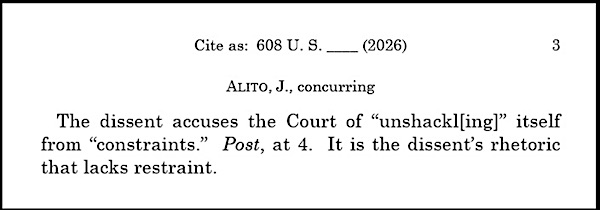
“The dissent accuses the Court of ‘unshackl[ing]’ itself from ‘constraints.’ It is the dissent’s rhetoric that lacks restraint.”
• Samuel Alito Brutally Destroyed Ketanji Brown Jackson (Matt Margolis)
Last week, the Supreme Court ruled 6-3 that Louisiana’s congressional map with a second gerrymandered majority-minority district was unconstitutional. That ruling put Louisiana officials on the clock — they need to redraw their congressional maps before this year’s midterms. On Monday, the court issued an order immediately putting last week’s Louisiana redistricting ruling into effect.Read more …https://twitter.com/scotus_wire/status/2051442579430834263
And, of course, Justice Ketanji Brown Jackson decided to make a scene about it. Justice Samuel Alito made sure she regretted that decision. Normally, the Supreme Court waits 32 days after issuing a ruling before formally sending the case back to a lower court. Challengers to Louisiana’s map asked the justices to skip the wait — and the court agreed, issuing an unsigned order to accelerate the timeline so the lower court could oversee an orderly map-drawing process before elections.Jackson couldn’t let that stand without throwing a hissy fit. She called the order “unwarranted and unwise,” and claimed the court was “unshackling” itself from procedural “constraints.” Her central argument was that the court should stick to its default 32-day rule, and that by moving faster, the majority was essentially sanctioning chaos in Louisiana’s election calendar. It was a sweeping condemnation of her colleagues — rhetorical and forceful.The only problem? Nobody signed onto it with her.
Not one other justice — not even the two liberals who dissented in the underlying ruling — attached their name to Jackson’s dissent. That’s a remarkable fact. When you write a fiery dissent accusing your colleagues of abandoning judicial restraint, and even the justices who agree with you on the merits don’t want their names on it, something has gone wrong. This is par for the course with Jackson; even her fellow left-wing justices think that she’s a moron.
But the best part is that Alito wasn’t about to let the accusations stand. He issued a sharp written response, joined by Justices Clarence Thomas and Neil Gorsuch, firing back with surgical precision. “The dissent in this suit levels charges that cannot go unanswered,” Alito wrote, rejecting Jackson’s framing and pointing out that her approach would force Louisiana to hold elections under a congressional map that the Supreme Court had already ruled unconstitutional.
Think about what that would mean in practice. A state holds an election. The map used to conduct that election has been struck down by the highest court in the land. Jackson’s answer to that problem is essentially: wait the 32 days anyway. Alito closed by turning Jackson’s own language against her: “The dissent accuses the Court of ‘unshackl[ing]’ itself from ‘constraints.’ It is the dissent’s rhetoric that lacks restraint.”
Justice Alito has officially had enough of Justice Jackson. pic.twitter.com/6U6RhkUmoe
— Greg Price (@greg_price11) May 5, 2026In short, that’s Alito telling Jackson, in print, that her writing lacks the basic discipline she claims to be defending. Unlike her dissent, Alito was joined by two colleagues who clearly felt the response was necessary. Now that’s a humiliating public rebuke. Jackson consistently positions herself as the court’s conscience — the justice willing to call out her colleagues for breaking norms. But, ultimately, she just positions herself as the court’s jester, who isn’t even that funny. It’s actually kind of frightening that she’s in such a powerful position.
Amsterdam is the capital of Holland, but it’s not where the government is. That’s The Hague.
• Amsterdam Bans Advertisements Featuring Meat and Fossil Fuels (Turley)
In “The Indispensable Right: Free Speech in an Age of Rage,” I write about how censorship often becomes an insatiable appetite once countries go down the road of speech regulation. There is no better example than the Dutch and their recent ban on public ads for meat and fossil fuels. Activists have imposed similar limitations on advertising for products in the United States, from alcohol to tobacco. However, the Dutch law reflects how this tendency can metastasize into shielding citizens from unhealthy choices or influences. It appears that Dutch painters such as Pieter Aertsen (with his work A Meat Stall with the Holy Family Giving Alms, above) were promoting harmful imagery in their work. As for Rembrandt’s “Slaughtered Ox,” the Dutch master is now little more than a climate change denier.Read more …
Starting on May 1, the ban on such images became part of Amsterdam’s push to achieve carbon neutrality by 2050. While purportedly neutral on carbon, it is manifestly negative on free speech. As with other anti-free speech measures in Europe, this push again came from the left. The GreenLeft Party’s Anneke Veenhoff explained “I mean, if you want to be leading in climate policies and you rent out your walls to exactly the opposite, then what are you doing?” The answer is engaging in free speech. This is, of course, commercial speech, which is often subject to a lower level of protection. However, this shows the danger of using the differential standard to target products or industries viewed as unhealthy or ill-advised for consumers.In Amsterdam, the ban will cover industries such as airlines, including KLM Royal Dutch Airlines, one of the largest employers and revenue generators in the country. Notably, activists compare this to cigarette advertising bans, confirming the very slippery slope danger that those companies raised when they were targeted. Hannah Prins, a paralegal at Advocates for the Future, is quoted as saying, “I don’t think it’s normal to see murdered animals on billboards. So I think it’s very good that that’s going to change.”bOther Dutch cities are now following suit, including Haarlem, Utrecht, and Nijmegen.
Of course, prostitutes still advertise live in Amsterdam and marijuana is a major industry for tourists. If you want drugs, there are ample choices. However, if you want a steak, you will have to rely on word-of-mouth directions.

I saw Paul Craig Roberts post it, so I will too. It’s important. Even if I can’t give it the space it needs.
• Ivermectin + Mebendazole In Cancer Patients (Nicolas Hulscher, MPH)
Largest Real-World Analysis of Shows 84.4% Clinical Benefit — Nearly HALF Report Cancer Disappearance or Regression After just 6 months, 48.4% of cancer patients taking ivermectin and mebendazole reported no evidence of disease (32.8%) or tumor regression (15.6%), while 36.1% reported disease stabilization.
We have completed the largest real-world human analysis to date evaluating ivermectin and mebendazole in cancer patients—and the results represent one of the most compelling clinical signals ever documented for repurposed anti-parasitic therapies in oncology. The manuscript is now available as a preprint on the Zenodo research repository, operated by the European Organization for Nuclear Research, while undergoing peer review at leading oncology journals: “Real-World Clinical Outcomes of Ivermectin and Mebendazole in Cancer Patients: Results from a Prospective Observational Cohort.”In this real-world prospective clinical program evaluation, a diverse population of cancer patients (n=197) were prescribed compounded ivermectin–mebendazole, with each capsule containing 25 mg ivermectin and 250 mg mebendazole. At approximately six months post-treatment initiation, we observed an 84.4% Clinical Benefit Ratio (CBR), with nearly half of cancer patients (48.4%) reporting either no evidence of disease (32.8%) or tumor regression (15.6%). An additional 36.1% reported disease stabilization. This means more than four out of five patients reported either improvement or stabilization of their cancer.

These results indicate that the inexpensive and safe off-label applications of these medications could be an important complement in the treatment of cancer. The groundbreaking analysis was made possible through a unique collaboration between The Wellness Company, the McCullough Foundation, and the Chairman of the President’s Cancer Panel—uniting real-world clinical data, frontline medical experience, and high-level epidemiologic expertise to deliver urgently needed insights in oncology.
PROJECT DESIGN: REAL-WORLD DATA, PROSPECTIVE FRAMEWORK
We analyzed a prospective observational cohort of 197 cancer patients, with 122 completing structured follow-up at approximately six months (61.9% response rate). Patients were prescribed a compounded ivermectin–mebendazole protocol by licensed U.S. providers, and outcomes were collected through standardized digital surveys assessing cancer status, adherence, and safety. Each capsule contained 25 mg ivermectin and 250 mg mebendazole, with dosing individualized by clinicians—most commonly 1–2 capsules per day, though a subset of patients used higher daily dosing or cyclic regimens depending on disease status and tolerance.
Importantly, this was a prospective, structured clinical program evaluation, capturing longitudinal patient-reported outcomes rather than retrospective recall alone—strengthening the internal consistency of the findings.
PATIENT POPULATION: ADVANCED, DIVERSE, AND CLINICALLY RELEVANT
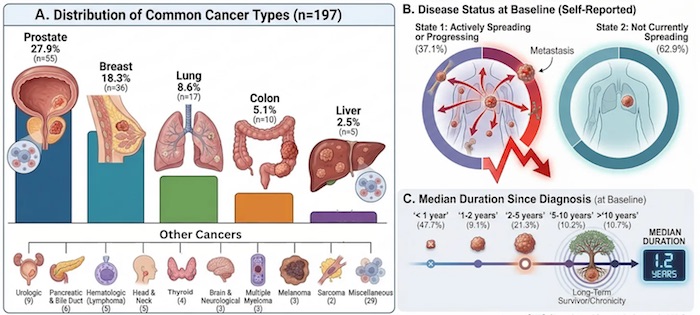
Our cohort represents a broad and clinically meaningful cross-section of cancer patients, including prostate (27.9%), breast (18.3%), lung (8.6%), colon (5.1%), and a wide range of additional malignancies. This was not a population limited to early-stage or low-risk disease.Read more …At baseline:
• 37.1% of patients reported actively progressing cancer
• Nearly half were within one year of diagnosis, while others had long-standing disease
• Many had already undergone standard therapies:
• •Chemotherapy (31.5%)
• •Radiation (28.9%)
• •Surgery (42.1%)
This reflects a real-world oncology population, including patients with treatment exposure, ongoing progression, and complex clinical histories.
Filmmaker and director of the Plandemic documentary series Mikki Willis says after all the research he’s done he believes Covid was forced to be released earlier than they wanted, and that was what saved us
— Wall Street Apes (@WallStreetApes) May 4, 2026
“What we've deduced from all of our research — was that this was planned… pic.twitter.com/hH7CDpII8P
https://twitter.com/GuntherEagleman/status/2051374459940946031?s=20They didn't just smear Donald Trump, they committed TREASON, weaponizing the FBI, CIA, and U.S. intelligence to steal an election by running a coup on a sitting president.
— The SCIF (@TheSCIF) May 4, 2026
Obama, Hillary, Comey, Brennan, Clapper, Rice, Mueller, and Steele thought they built the perfect Deep… pic.twitter.com/hMxcweLFqz
He gets better and better. https://t.co/eABK9747Yo
— Catturd ™ (@catturd2) May 4, 2026
Support the Automatic Earth in wartime with Paypal, Bitcoin and Patreon.