

Tomb of the Diver, Greek city of Paestum in Magna Graecia, Italy 470 BC

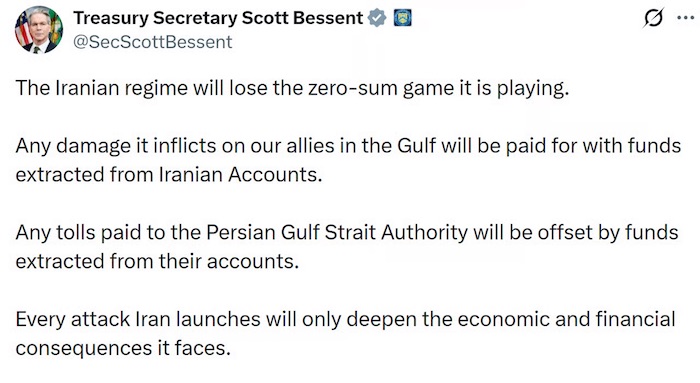
https://twitter.com/ConstitustionX/status/2064787055348261235?s=20The Iranian regime will lose the zero-sum game it is playing.
— Treasury Secretary Scott Bessent (@SecScottBessent) June 11, 2026
Any damage it inflicts on our allies in the Gulf will be paid for with funds extracted from Iranian Accounts.
Any tolls paid to the Persian Gulf Strait Authority will be offset by funds extracted from their accounts.…
— Elon Musk (@elonmusk) June 10, 2026
JUST NOW: In a massive development no one saw coming, President Trump has publicly declared that the U.S. will seize Kharg Island from Iran.
— WORLD NEWS (@_MAGA_NEWS_) June 11, 2026
KHARG ISLAND — the Persian Gulf outpost that controls nearly 90% of Iran’s crude oil exports (about 1.5 million barrels per day). pic.twitter.com/T3w8itrv32
Could just as easily be a 4-week old headline.
• ‘They Should Have Made a Deal’: Trump Wants To Seize Kharg Island (Green)
Iran “should have made a deal,” conservative radio superstar Dana Loesch quipped on Thursday, reacting to President Donald Trump’s threat that U.S. forces “will be taking Kharg Island and other oil infrastructure” in the near future. Are we in the endgame now? At last?Read more …
UPDATE: Nope. Trump, according to the WSJ, now says he’s canceled the strikes “after Tehran’s leadership and other parties negotiating a deal to end the conflict approved ‘discussions and final points.'” Echoing what I wrote below, whatever went on behind the scenes, Trump’s threat seems to have gotten what he wanted — even if what he wanted was for the talks to drag on while Iran’s economy continues crumbling. But do read the rest of the column because it includes some fun tidbits. Original post follows.ANOTHER UPDATE: Iran’s official news outlet, Fars, says Tehran has not agreed to the text of any agreement, for whatever that’s worth. And I officially give up! Heh.
LAST UPDATE, I SWEAR: Everything to you need to know (for now) is here: ‘We Just Made a Great Settlement of the War With Iran.’
Kharg Island sits near the northern end of the Persian Gulf — or as Trump might think of it, the Other Gulf of America — almost due east from Kuwait City. It’s only a few miles long, but as you can see from this image I captured from Apple Maps, it’s virtually covered in oil infrastructure. Oil and LNG representing more than 90% of Iran’s energy exports are processed at Kharg, stored in those massive tank farms, then offloaded to supertankers for sale around the world. Tehran could divert to other facilities, but at a comparative trickle.
It’s a single point of failure. Saddam Hussein understood this, and attacked Kharg repeatedly during the Iran-Iraq War of 1980-1988. But Iraq lacked the air power to do much harm, and he certainly lacked the naval power to seize it. The U.S. military has no such limitations. In fact, a report earlier this week revealed that the Pentagon ordered elements of the 82nd Airborne Division to Israel in March for just such an eventuality.
Kharg Island
“A military source involved in war planning tells me the deployment is tied to new U.S.-Israeli joint contingency plans, completed since February, for seizing Kharg Island and carving out coastal territory inside Iran,” Ken Klippenstein wrote. According to his report, the soldiers deployed to Israel are from the 2nd “Geronimo” Battalion, 501st Infantry Regiment. The 501st dropped behind Nazi lines in Normandy on D-Day, fought the Battle of Hamburger Hill in Vietnam, was one of the first units sent to Afghanistan after 9/11, spent a year in Iraq during some of the worst fighting there, and much more. In short, the 501st is storied, and its men are badasses. But I digress.If Trump does order in the Marines, Airborne, or other forces, I suppose it will prove the first real test of American troops against enemy drones. Godspeed, fellas. Trump’s full statement — on Truth Social, of course — reads: “The United States will be hitting Iran (Whose Navy, Air Force, Radar, Anti Aircraft, and all other forms of Defense, together with most of its offensive capability, are GONE!), VERY HARD TONIGHT. At some point in the not too distant future, we will be taking Kharg Island, and other oil infrastructure points, and assume total control of their Oil and Gas Markets, much like we have with Venezuela, which is working out brilliantly for both Venezuela and the United States of America.”
He finished with the now S.O.P., “Thank you for your attention to this matter!” which I just love. All that said, this could be more of Trump’s bluster, purposely designed to keep Iran’s Remnant Regime guessing, off-guard, and wondering if they’ll ever get a deal before their money runs out. Lowy Institute’s R.N. Prasher this week was hardly the first to ask whether Trump’s “protracted” negotiations are “part of U.S. strategy” to bring Iran “to an economically and logistically weak state where it has no option” but to give up its nuclear program and stranglehold on Hormuz. Despite a moment of impatience I suffered last month — and honestly, hits me at least once a day — Trump likely has turned the Mullahs’ “rug-merchant” negotiation tactics against them.
But that doesn’t mean that Trump hasn’t run out of patience, too, particularly after this week’s downing of a U.S. Army helicopter over the Gulf. Only the White House knows for sure, so stay tuned.
Or not.
• Trump: Iran Deal Should Be Done ‘Pretty Quickly’ (ZH)
President Donald Trump announced Thursday evening that he had cancelled scheduled U.S. strikes and bombings against Iran, citing rapid progress on a U.S.-Iran memorandum of understanding (MOU) aimed at extending a fragile ceasefire and launching formal negotiations on Tehran’s nuclear program. In a Truth Social post and a phone interview with the New York Post, Trump said the agreement was “pretty much all wrapped up,” with documents at a “fairly final stage.” He added that he had spoken with Israeli Prime Minister Benjamin Netanyahu and claimed the deal had received approval at the highest levels in Iran and from multiple regional players, including Saudi Arabia, the UAE, and others. The U.S. naval blockade of Iranian ports will remain in place until the deal is signed, with time and location of the signing to be announced shortly.Read more …
President Trump in the Oval says:
— Haley Bull (@HaleyBullNews) June 11, 2026
-a signing could happen as soon as this week
-Trump says it’s a “strong” MOU “that’s a little conceptual” and “very detailed”
-the US will lift its blockade when the deal is signed
-Trump thinks the time from the MOU to a final deal will go…
The Israeli Prime Minister’s Office later confirmed that Trump spoke with Netanyahu this evening specifically about the emerging MOU. According to the readout, Netanyahu expressed appreciation for Trump’s commitment that any final agreement would require the removal of enriched nuclear material, dismantling of enrichment infrastructure, limits on missile production, and an end to Iran’s support for terrorist proxies – even though Israel is not a direct party to the MOU. Earlier in the day, Trump had sharply escalated rhetoric by threatening to seize Iran’s key oil-export hub at Kharg Island and hit Iran “very hard,” a move widely seen as leverage that may have accelerated the diplomatic opening.“President Trump spoke this evening with Prime Minister Netanyahu regarding the emerging memorandum of understanding (MOU) with Iran to enter into negotiations,” the PM’s office wrote on X. “Even though Israel is not a party to the memorandum of understanding, the Prime Minister expressed his appreciation for President Trump’s commitment that the final agreement at the conclusion of negotiations will include the removal of enriched material, the dismantling of enrichment infrastructure, limits on missile production, and the cessation of Iran’s support for its terrorist proxies in the region.”
Rickards says Iran is winning. Wonder what he means by that.
He’s OK with Iran having nuclear bombs. That’s his choice. Trump chooses differently. As does Israel.
Rickards draws comparisons to WWII and Vietnam. Is that wise?
• Trump’s 3 Bad Options in Iran (James Rickards)
Trump has three ways out of the Iran War. While the choices are all bad for Trump, they are not all bad for the U.S. economy. Some are better than others. Trump’s choice will not only determine the outcome of the war, it will determine the path of the U.S. economy over the year to come.Read more …
Choice One is surrender.
Basically, the U.S. would withdraw from the Iran War without having achieved any of its major goals (not that those goals have ever been well articulated by the administration). Iran would still have its highly-enriched uranium (HEU). The Iranian regime, consisting of the Iran Revolutionary Guard Corps (IRGC) and Supreme Leader Mojtaba Khamenei or a successor, would still be in charge. The Iranian people would be largely unified behind new leadership who are younger than the leaders Trump killed. This new group, in their 40s instead of their 70s and 80s, would feel more nationalist and more comfortable in power than their predecessors.Iran would suffer enormous infrastructure damage, but it can repair and replace those assets over time. Most importantly, Iran would have de facto control of the Strait of Hormuz — something it has threatened but never actually accomplished in the 47 years since the Iranian Revolution.
Choice Two is stalemate.
This is basically the current state of the war. Calling it a ceasefire is a joke. Iran recently attacked the Kuwait airport and Israel. The U.S. bombed radar facilities in Iran. Israel struck Iranian energy infrastructure. Hezbollah and Israel continue to fight it out in southern Lebanon. This is a low-intensity conflict — all sides back off after a few strikes. But it’s not a ceasefire.The stalemate suits Iran because it gives them time to dig out missile sites, build more drones and receive financial assistance from Russia and China. The stalemate suits the U.S. because it gives us time to rebuild stockpiles of cruise missiles and Patriot anti-missiles.= Most importantly, the stalemate favors Iran because the Strait of Hormuz remains closed. Iran can suffer economic consequences longer than the world can do without Persian Gulf oil, liquid natural gas, helium, nitrates and sulfur. It’s a game of chicken, and the U.S. will swerve first because it has more to lose.
Choice Three is escalation.
The logic is simple. Trump won’t surrender, and the game of chicken can’t go on much longer.= Trump will unleash the U.S. Department of War to bomb Iranian infrastructure, including bridges, railroads, key highways and telecommunications. Bombing may include sites believed to hold the Iranian HEU. More extreme versions of escalation could include a special operations mission to seize the Iranian HEU or precision bombing aimed at Iran’s oil export facilities on Kharg Island, or even desalination plants. The idea is to bomb Iran into submission and get the deal Trump wants while avoiding the stigma of surrender.All three choices will fail. A surrender might be papered over with some kind of memorandum involving an “agreement to agree” in the future, but the world will see it for what it is — just another Iranian stalling tactic that preserves the status quo for Iran and solidifies the rule of a new younger regime. Iran won’t give Trump the satisfaction of saving face because Iran is winning. Trump won’t accept surrender because of ego and the bad optics. Neither side will accept the deal the other wants. So there will be no deal.
Choice Two will fail because the current stalemate is unsustainable. The world has been without Persian Gulf oil exports for almost four months. A combination of Gulf oil already underway in tankers before the Strait was closed, some increased production from the U.S. and Russia and a drawdown of strategic reserves by various countries has kept the global industrial economy going. Those lifelines are running out. There is no more Gulf oil in tankers on their way. Reserves are reaching critically low levels, at which pumps and pipelines begin to break down. The U.S. and Russia can supply some oil to their friends, but there’s not enough to go around.
Time is almost up on the stalemate. Something has to give. Escalation may be attempted, but it will fail also. There is no history of a side being bombed into submission without boots on the ground. Germany tried to bomb Britain into submission during the Battle of Britain, the first major military campaign fought entirely with air forces. It failed. Germany was never able to invade. The firebombing of Dresden did not defeat the Germans. It took D-Day, the Battle of the Bulge and the Red Army marching on Berlin after destroying Warsaw.
The firebombing of Tokyo, which used napalm on wooden structures, did not defeat the Japanese. The atomic bombs may have ended World War II, but that’s an exception that proves the rule. Is anyone up for using nukes in Iran? Ten years of bombing North Vietnam did not win the war in Vietnam. The U.S. never invaded the North in that war. In short, bombing doesn’t work without a land invasion.Invading Iran would be a military undertaking on a massive scale. With 80 million people and a landmass roughly the size of the U.S. east of the Mississippi River, Iran would require perhaps 60 divisions organized into six armies and two Army Groups, backed by air power, naval aviation and submarine-launched missiles.
Anything short of that would risk defeat. You can escalate all you want, but it won’t win the war. Surrender would be the best result for the U.S. economy.
If Russia/Ukraine is any example; be careful.
• Bessent To Use Frozen Funds To Reimburse Gulf Allies: ‘Iran Will Pay’ (ZH)
US Treasury Secretary Bessent announced on X Thursday morning that Washington is moving forward on a plan to compensate America’s Gulf regional allies for damage sustained during Iranian counterattacks on their energy and civic infrastructure. He made clear that any damage to Gulf allies would be paid for with frozen Iranian funds, which Tehran leadership has long blasted as blatant theft. According to Bessent’s latest announcement: “The Iranian regime will lose the zero-sum game it is playing.” The Treasury Secretary listed out the following new policy and plan:
Any damage it inflicts on our allies in the Gulf will be paid for with funds extracted from Iranian Accounts.
Any tolls paid to the Persian Gulf Strait Authority will be offset by funds extracted from their accounts.
Every attack Iran launches will only deepen the economic and financial consequences it faces.via Reuters – Interestingly, there is implicit here a possible acknowledgement that US forces won’t be able to immediately be able to stop Iran from enacting its toll collection protocol, which it has hinted is being done in coordination – or at least with an ‘understanding’ – from Oman, which itself has come under pressure from the Trump administration of late. Over eighty oil, gas, and vital infrastructure facilities across the Gulf have been hit – with most of the attacks having occurred in March and April – with one recent report estimating up to $58 billion in damage. Iran has sought to justify these attacks as ‘retaliation’ for these Gulf countries hosting American bases during the US unprovoked assault on the Islamic Republic.
An unnamed US official had previously told ABC’s Senior White House correspondent Selina Wang last weekend: “Treasury will utilize all tools available to allow Iranian assets to be made available to our Gulf allies to support rebuilding and repairs for any future damage caused by Iran.” “The Secretary has also directed his team to assess conditions amongst our Gulf allies and request comprehensive estimates of the costs associated with repairing damage Iran has inflicted since the start of the conflict,” the source had added.
Also as part of that earlier reporting, it was revealed: The Iranian assets could include frozen assets and ships the U.S. has seized. The administration is reaching out to Gulf allies right now and asking for their evaluation. This is only likely to further derail efforts to get Tehran and Washington back to the negotiating table. Already the US has balked at Iran’s own insistent it be given reparations for damage done. Iran is meanwhile still demanding that its billions in funds long frozen by Washington be given back as part of a deal. The Trump administration has so far rejected this, at least in terms of its public-facing position.
FOMO.
• SpaceX Prices Biggest Ever IPO At $135 Per Share (ZH)
While there was little doubt as to SpaceX’s actual IPO price, which due to its novel structure was always going to be $135, and unlike the proposed IPO price ranges as is customary for other initial offerings, moments ago SpaceX (SPCX) made it official when it filed a free writing prospectus (FWP) which confirmed the company sold 555.6 million shares at $135 each, for a total size of $75 billion (excluding the greenshoe), making history with the biggest-ever IPO, launching it into the top ranks of the largest public companies and putting founder Elon Musk on the verge of becoming the world’s first trillionaire.Read more …
For context, SpaceX is more than double the size of the previous largest IPO – Saudi Aramco’s $29.4 billion listing in 2019. The SpaceX registration statement was declared effective June 11. The details of the pricing are shown below. At $135, SpaceX will have a market value of $1.77 trillion. Accounting for employee stock options and restricted share units, the pricing gives it a fully diluted valuation of about $1.8 trillion. SpaceX’s market value will rank it among the top 10 public companies globally, and make it larger even than Musk’s own Tesla. According to Polymarket, there is a 84% chance the IPO closes above its offering price tomorrow, and a 46% chance it rises more than 20%.SpaceX, which made a net loss of $4.9bn in 2025, is made up of three businesses: space exploration, including its Falcon and Starship rockets; connectivity, such as its Starlink satellite constellation providing high-speed internet access; and artificial intelligence, though its xAI division. Musk’s fan base in the retail trading community is a crucial component of the deal: they have placed more than $100 billion in orders for the stock, Bloomberg reported, far more than the 20% of shares that had been reserved for them.
Yet not everyone is so excited. Noted short-seller James Chanos on Wednesday called it “a hopes-and-dreams IPO” driven by enthusiasm for Musk and artificial intelligence rather than the fundamentals of a company that has yet to post a profit.“The total addressable market for space is infinite,” Chanos, founder of Chanos & Co., said at the iConnections Global Alts conference in New York on Wednesday. “You can build whatever stories you want — colonies on Mars, factories on the moon, data centers in space — to justify the valuation.”
Investment research group Morningstar calculated that SpaceX is worth only $63 a share – half the IPO price – and warns there is “a major disconnect between market expectations and underlying fundamentals”. Michael Field, the chief equity strategist at Morningstar, suggests investors should sit out the IPO and wait for “a more attractive entry point down the line”. “We believe the business has real strengths, particularly in Starlink, but with so many unknown and untested technologies underpinning much of the valuation price, particularly within the AI business, we think the valuation is extremely speculative,” Field said.
Still, even among the skeptic about the company’s current valuation, many acknowledge Musk’s achievements building Tesla and SpaceX into giants – and making money for investors, thanks in part to his loyal retail investor fanbase. Coupled with rule changes that could fast track the stock into benchmark gauges like the Nasdaq-100 Index (if not the S&P where there will be at least a one year delay), demand from passive funds and retail investors unable to buy at the IPO price should set the stage for a solid cohort of buyers for shares of the rocket, satellite and AI company once they start trading.
“It’s probably the most hopeful IPO,” said Kim Forrest, chief investment officer at Bokeh Capital Partners, adding that she doesn’t buy IPOs. Buyers of SpaceX “want to be part of the future,” she said. “And I think that’s oddly hopeful in this time when we’re moving between the poles of greed and fear.”
As Bloomberg notes, SpaceX is the first of three major IPOs expected to capitalize on stock investors’ appetite for the leading AI companies, a seemingly insatiable demand that has propelled benchmark US indexes to records this year despite the acceleration in inflation and economic disruption caused by the war in Iran. Anthropic PBC and OpenAI, two of the company’s AI competitors, are expected to go public as soon as this year and could seek valuations of more than $1 trillion each, so the performance of SpaceX’s stock will be as closely scrutinized by Silicon Valley venture capitalists as it is by Wall Street traders. The deluge of public equity, on top of an $85 billion equity offering from Alphabet Inc. and the potential for other big-tech firms to follow suit, is triggering a debate over whether there is enough investor demand to meet the incoming supply. “
It’s a big deal as a kind of precursor for Anthropic and OpenAI,” said Anthony Saglimbene, chief market strategist at Ameriprise. “When I look at all three of those and the amount of capital that these companies are raising, it tells me that the demand for AI is still very strong even though we’ve seen more volatility. And I think some of that volatility in the market has been positioning around the expectations for these IPOs.”
Accountants in space.. Why am I thinking of Miss Piggy?
• After SpaceX IPO, Jefferies Lays Out Five Takeaways For Space Boom Into 2030s (ZH)
Friday’s SpaceX IPO will be a defining moment not only for capital markets but also for the booming space industry and Elon Musk’s broader industrial empire, which has catapulted America to the lead in the space race against Communist China and Russia. Ahead of the four-times-oversubscribed SpaceX IPO, we explained to readers how to profit from the incoming data center boom in low-Earth orbit and broke down the mechanics of the IPO in an easy-to-understand format. Next, we want to give readers the opportunity to understand where the space industry is headed to position bullish bets, as this industry will likely have tailwinds for years to come. It’s all about following the money.
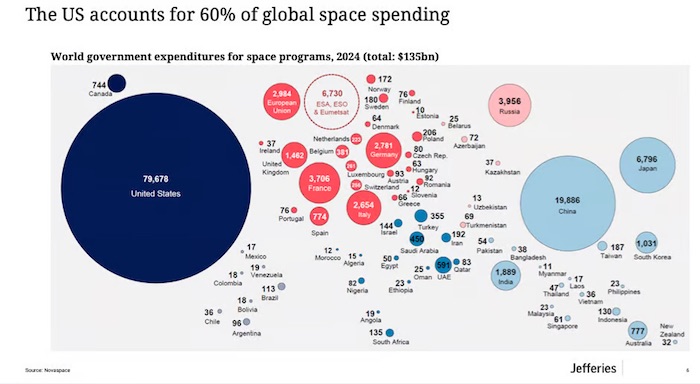
We are leaning on Jefferies analyst Aniket Shah’s Wednesday report, which provided a roadmap for understanding the space industry through five easy takeaways. 1. The global space economy has reached $600bn, potentially tripling to $1.8trn by 2035. Commercial activity accounts for 80% and spans satellite TV, broadband, GPS infrastructure, and satellite manufacturing. The remaining 20% is government spending. Within the investable “backbone” of physical infrastructure, state-sponsored spending is projected to grow faster than commercial, rising from $125bn to $320bn (+256%) vs $205bn to $435bn (+212%) for commercial over the next decade. Defense is the fastest-growing category within the space economy.2. Th e US accounts for 60% of global government spending on space; China ranks second. US government space spending is ~$80bn, more than the rest of the world combined. China spends ~ $20bn, but this figure is not PPP-adjusted, meaning its effective spending power is materially closer to the US than the nominal gap implies. Japan is a notable third player, having designated space as one of Prime Minister Takeshi’s 17 strategic sectors (see here & here). China has similarly identified space as a strategic area in its 15th Five-Year Plan (see here & here).
3. Space Force budget surged 40% in one year, fueled by the Golden Dome program. Golden Dome is a top strategic priority driving the budget surge. Golden Dome is a multi-layered missile defense initiative that integrates space-based sensors, interceptors, and AI-enabled command and control to address ballistic, hypersonic, and cruise missile threats. Space Force now commands ~$40bn and the Missile Defense Agency ~$10bn, totaling ~$50bn, far exceeding NASA’s budget ($24.4bn).
4. SpaceX has captured a structural share of federal space dollars. It is NASA’s largest commercial contractor and plays a critical role across launch services, communications, IT, and the broader data layer of the space architecture. The US government has effectively outsourced significant space activity to SpaceX, creating an inextricable linkage between federal spending priorities and the company’s business.
5. US vs China: Moon Race 2.0 is accelerating. The rivalry plays out across three dimensions: lunar programs, global coalitions, and codified policies.
Lunar programs: The US targets a crewed lunar landing by 2028 and a lunar outpost by 2030; China targets a crewed landing by 2030 and an outpost by 2035.
Global coalitions: The US-led Artemis Accords have 67 signatories, while the China-Russia International Lunar Research Station coalition has <20.
Codified policies: President Trump has issued executive orders on Iron Dome for America, commercial space competition, and ensuring US space superiority. China’s 15th Five-Year Plan also prioritizes space competitiveness.
Merkel sees the world through post Cold War East Germany eyes. The State decides, not the people.
• Merkel Repeats Call for Crackdown on Free Speech (Turley)
The European Union recently announced the first recipients of its new European Order of Merit, the organization’s highest award. The headliner was Angela Merkel, former Federal Chancellor of Germany, who indeed personifies the European Union for both her fans and her critics. For many years, some of us have criticized Merkel as one of the leading forces behind European censorship efforts that have eviscerated the “Indispensable Right.” Not surprisingly, Merkel called for more censorship and attacks on free speech to a thrilled audience of EU bureaucrats and globalists.Read more …
In one of the most ironic moments, Merkel declared, “Europe was not handed to us. It was built treaty by treaty, crisis by crisis and by people who chose solidarity over division and cooperation over self-interest.” Indeed, it was not handed to them. As I discuss in my new book, “Rage and the Republic, the EU was formed by design to incrementally get citizens in Europe to give up their national identities and rights: The EEC worked to remove barriers to trade and coordinate national regulations to achieve greater uniformity. As nations conformed to such transnational standards, the final step toward transnational governance became less of a conceptual barrier for citizens, particularly younger citizens……The evolution of the EU is a cautionary tale. It began with assurances of marginal coordinating bodies and policies over areas like nuclear power and scientific research. Through this planned incrementalism, each insular move was defended on its narrow purpose while dismissing objections as nationalistic or conspiratorial. That planned incrementalism worked brilliantly in getting citizens to accept transnational governance.
Merkel was critical in that effort. She is blamed for opening the borders to a flood of undocumented immigrants that has caused rising violence and protests throughout Europe. However, her crowning jewel was the crackdown on free speech. She can honestly claim that Germans (and Europeans as a whole) have fewer rights after her public service. She increased the power of government, stripped away free speech rights, and reduced national identities without firing a shot.
Merkel consistently opposed free speech, building a censorship system that gave the government ever greater control over speech. Her decision to first apologize to authoritarian Turkish President Recep Tayyip Erdogan for a satirical poem and then approve the prosecution of the comedian is a shocking and chilling disgrace. Now, she is throwing her support behind a crackdown on “hate speech” on social media like Facebook, Twitter, and YouTube — radically expanding the already broad scope of government regulation of speech.
Merkel declared, “I support efforts by Justice Minister Heiko Maas and Interior Minister Thomas de Maiziere to address hate speech, hate commentaries, devastating things that are incompatible with human dignity, and to do everything to prohibit it because it contradicts our values.” Merkel was a driving force in using such subjective standards as “compatibility with human dignity” as a foundation for government-imposed speech controls. Merkel also threatened social media companies, warning they would face a government crackdown if they failed to get rid of “fake news.” Merkel insisted that such postings must be dealt with by the companies or the government will step in.
In her speech in May to the EU, Merkel doubled down on her attacks on free speech as a threat to the world order. She called for the prosecution of American companies for spreading “disinformation” and “hate” online. She denounced the “so-called social media” platforms as still not facing “accountability for lies.” She added, “I can only encourage you to continue regulating social media.”I could think of no better recipient for the first European Order of Merit. No one better sums up EU values than Angela Merkel and her unrelenting campaign against free speech. For globalists who have called for “A New World Order with European Values,” Merkel is the perfect personification of a globalist dream of a world of regulated speech and transnational government.
Holland: no cash.
Greece: all cash.
• Europe Pondering Its Cashless Economy, Return To Currency (JTN)
Sweden has led the way in Europe’s transition to a cashless economy, being among the first to have credit or debit card readers at points of sale – even for something as low-cost as a newspaper so that customers no longer had to dig in their pockets for coins or paper currency. But now, the country that led Europe’s modern march toward a cashless society is among those reconsidering that journey amid growing concerns about cyberattacks, conflict, power outages, privacy and national resilience. Increasingly, policymakers in Sweden and other countries that have been pushing the trend, including Denmark, Estonia, Finland and the Netherlands are realizing that cash still matters.Read more …
Most transactions in these countries remain cashless. But the adoption rate for cashless transactions has leveled out, and now the government is creating incentives to stabilize the current level of cash usage rather than letting it fall further. “We now need to think about resilience,” Erik Thedéen, the governor of Sweden’s Central Reserve Bank, said last year. “If everything breaks down, we need to have cash.” Official government guidance in “emergency preparedness” brochures sent to Swedish households recommends citizens maintain at least one week’s worth of cash to be available in a time of crisis. Other early adopting countries are taking similar steps.Thedéen said the reversal was sparked by a destabilized globe in which exists the threat of an expanded war between Russia and Ukraine, the threat of digital attacks, and signs from President Donald Trump that the U.S. may not come to the aid of its European allies if they were attacked. Thedéen said the country’s advanced digital payment infrastructure could make it more vulnerable.The shift does not mean Europeans are abandoning digital payments. Credit cards, mobile wallets and instant-payment apps continue to dominate everyday commerce, and few expect cash to regain the ground it has lost over the past two decades.
But most of the European Union still trails the northern European member states, where 90 percent or more of all transactions are conducted without the use of cash. In comparison, the European Union surpassed the 50-percent threshold for cashless transactions only last year. Among the European Union’s biggest economies, Italy was the laggard, ranking 21st in the 27-nation bloc in terms of frequency of cashless transactions, while smaller countries including Greece, Romania and Bulgaria remained below 30 percent.
Leaders still see overall adoption rates for cashless transactions increasing even if they level out in the countries that were quickest to adopt them. “The digital euro is not just a means of payment, it is also a political statement concerning the sovereignty of Europe,” said Christine Lagarde, the head of the European Central Bank. Cashless transactions are still broadly favored by governments because they reduce the reach of the black-market economy and make transactions traceable. Advocates say they also enhance security against physical theft and increase convenience for shoppers and vendors.
I never heard of Eurotroika before.
• Eurotroika’s Terms of Ukrainian Settlement Unacceptable — Zakharova (TASS)
The Eurotroika (the United Kingdom, Germany, and France) have proposed conditions for a settlement in Ukraine that are clearly unacceptable to Moscow, Russian Foreign Ministry Spokeswoman Maria Zakharova said.”There is nothing new in the statement of the three European leaders. They tried to promote the same theses back in 2022-2024 in the Copenhagen and Burgenstock formats, supporting the dead-end ‘Zelensky formula’. Those forums have long been forgotten because they discredited themselves, being initially aimed not at peace, but at war,” she said in a statement.Read more …
“Dmitry Sergeyevich Peskov, press secretary of the Russian president, also highlighted the contradictory positions of France, Germany, and Britain. With their statement, the leaders pretend to call for peace, but in reality, they are presenting a priori unacceptable conditions, boosting the production of long-range weapons for Kiev, and generally advancing the militarization of Ukraine and Europe,” Zakharova added.She pointed out that in this way the Europeans are pursuing a course aimed at “preventing the creation of conditions for negotiations on a truly comprehensive, just and lasting peace. It’s noteworthy that they don’t hide it. Two weeks ago, on May 28 of this year, the European Union’s top diplomat Kaja Kallas said the following: ‘Europe will never be a neutral mediator between Russia and Ukraine, because we are on the side of Ukraine and protect our own security interests.’ Thus, she admitted that Europe is claiming a place at the negotiating table, in fact, as part of a united delegation of the West and Ukraine against Russia,” Zakharova added.
About the statement of Eurotroika
On June 7, French President Emmanuel Macron, German Chancellor Friedrich Merz, British Prime Minister Keir Starmer and Vladimir Zelensky held talks on Downing Street. Following the meeting, they issued a policy statement with five basic conditions for starting the settlement process, including security guarantees for Ukraine, the deployment of multinational forces, the continued freezing of Russian assets until full compensation for damage, and an immediate and complete ceasefire.
Don’t like mail-in ballots? Don’t deliver them.
• USPS Proposes Halting Delivery of Unverified Mail Ballots (AmG)
The US Postal Service (USPS) has proposed a new rule requiring states to share voter information related to mail-in and absentee voting. The proposal follows a March executive order from Trump aimed at tightening regulations governing mail-in voting in federal elections. Trump has made election integrity a central focus of his second administration, issuing executive orders designed to require proof of citizenship for voters and combat mail-in voting fraud. The administration has argued that stronger verification measures are necessary to restore confidence in elections and safeguard the voting process.Read more …
Several of those initiatives have faced legal challenges. Courts have blocked certain provisions, including proof-of-citizenship requirements, while appeals remain pending. Democratic-led states have also filed lawsuits challenging the administration’s mail-in voting policies. As litigation continues, the Postal Service has moved forward with a proposal directing states and the USPS to coordinate on identifying eligible mail-in and absentee voters. Under the proposed rule, states would submit lists of voters requesting mail-in ballots, along with personalized barcodes assigned to each ballot.The Postal Service would then return a finalized “Mail-In and Absentee Participation List” to each state’s chief election official. The list would contain the names of approved voters and the corresponding ballot barcodes associated with each voter. Under the proposal, only voters included on the final participation list would be eligible to receive mail-in or absentee ballots. The USPS said the new system would help improve transparency and provide election officials and law enforcement with additional tools to verify election procedures.
“This provision will help determine adherence to federal law and facilitate law enforcement efforts,” the proposal states. “For example, the provided lists will evidence how many ballots have been mailed, and allow law enforcement officials to compare the total number of mailed ballots to the total number of received ballots to detect potential issues meriting further investigation.” Election integrity supporters argue that the process would create a clearer chain of custody for mailed ballots and help identify irregularities that might otherwise go undetected.
The Postal Service issued the proposal May 29, one day after Trump-appointed US District Judge Carl J. Nichols denied a request from Democratic plaintiffs seeking to block the administration’s mail-in voting executive order. Nichols ruled that the challengers failed to sufficiently demonstrate that the order would cause “imminent and irreparable harm.” The plaintiffs have appealed that decision, and the Postal Service proposal remains subject to ongoing legal uncertainty while the broader litigation proceeds.
“I should ask Larry David. I should have asked his a** too.”
• Jerry Seinfeld Just Triggered the Left With Three Words (Matt Margolis)
Jerry Seinfeld walked out of Madison Square Garden on Wednesday after watching the Knicks in the NBA Finals and may have triggered the left more than Donald Trump’s attendance Monday night. As Seinfeld left the arena, TikTok streamer FinesseFave, who was live-broadcasting outside, saw him and approached him. “Oh, Jerry. What up, Seinfeld? What up? Can we get a free Palestine?” Seinfeld laughed. The FinesseFave pressed again. “Can we get a free Palestine? Come on, give us one free Palestine.” Seinfeld kept walking. “It doesn’t exist,” he said.Read more …
The streamer turned back to his audience, barely able to contain himself. “Oh my God. That was a f*****g insane clip,” he said. “He said it doesn’t exist.” Then, apparently regretting a missed opportunity, he later added, “I should ask Larry David. I should have asked his a** too.” Here is the clip. Obviously, there was foul language:https://twitter.com/MaxNordau/status/2065023449450308042?s=20
The clip spread across social media almost instantly, reigniting the familiar cycle of outrage directed at one of the most famous comedians alive. You would think a 71-year-old Jewish man openly supporting Israel wouldn’t be controversial at all. The radical left has other ideas. Here’s the thing: Seinfeld’s position on Israel has never been a secret. After Hamas launched its attack on Oct. 7, 2023, he posted a statement on Instagram that made everything clear. “I lived and worked on a Kibbutz in Israel when I was 16, and I have loved our Jewish homeland ever since,” he wrote. “We survive and flourish no matter what. I will always stand with Israel and the Jewish people.”
Seinfeld’s stance on Israel is well known and consistent. These people confronting him know it too, and think they’re getting him in a gotcha moment. They’re not. During a September 2025 appearance at Duke University, he was, to say the least, unambiguous about his feelings about the Free Palestine movement. “Free Palestine is, to me, just… you’re free to say you don’t like Jews,” he said. “Just say you don’t like Jews.” He also compared the movement to the KKK. “Compared to the Ku Klux Klan, I’m actually thinking the Klan is actually a little better here, because they can come right out and say, ‘We don’t like blacks, we don’t like Jews.’ OK, that’s honest,” he said.
Here is the reality the far left refuses to sit with. Nothing Seinfeld has said is fringe or extreme. A Jewish man supporting Israel, rejecting a slogan he views as thinly veiled antisemitism, and refusing to apologize for any of it is a reasonable position held by millions of Americans. The radical left has drifted so deep into anti-Israel territory that straightforward pro-Jewish expression now reads to them as a provocation worth screaming about.
Let’s be honest, here. Seinfeld has fame, money, and nothing to prove to these bigots. He may be a liberal, but he owes the woke mob absolutely nothing, and he acts like it. That kind of backbone is genuinely rare in today’s entertainment industry, where most celebrities trip over themselves to signal the correct opinions to the right sort of people. Seinfeld doesn’t play that game, and that drives them absolutely crazy. Good for him.
Didn’t fight very hard for Bill Pulte.
• Trump Nominates US Attorney Jay Clayton as DNI (ET)
President Donald Trump on Thursday said he is nominating Jay Clayton, the U.S. Attorney for the Southern District of New York, to be his director of national intelligence. The move comes weeks after former intelligence chief Tulsi Gabbard said she is stepping down from the role. Trump, in announcing the decision on Truth Social, wrote that “few people anywhere” in the legal community have as much respect as Clayton, the former head of the Securities and Exchange Commission (SEC), whom the president also described as “highly respected.” “I encourage the United States Senate to confirm Jay as soon as possible,” he wrote in the post.Read more …
Last month, Gabbard announced she was stepping down as the head of the Office of the Director of National Intelligence (ODNI) because her husband was diagnosed with a rare form of cancer. Federal Housing Finance Agency Director Bill Pulte was named by Trump to serve as acting director in a move that drew pushback from Democratic and some Republican lawmakers. Pulte will serve as the acting U.S. intelligence chief and would take over from Gabbard later in June, Trump said on Tuesday.Last week, the president told the Wall Street Journal that he would encourage Pulte to downsize parts of the intelligence office, which oversees 18 federal agencies and units. “I’d like to see it smaller. I think there are a lot of people in there that shouldn’t be there,” Trump said on June 5, adding that Pulte has broader latitude to make significant changes due to his being the acting head of the ODNI. “You’re less shackled,” he said. “It sort of gives you more power, you know, for a somewhat limited period of time.” Going further, Trump suggested that the ODNI could even be “terminated” in its entirety, noting that a similar downsizing process was undertaken at the Department of Education. “We’ve made the Department of Education much smaller, and likewise, this should be much smaller,” he added.
Trump praised Pulte as a “very smart guy” while speaking to reporters last week and added that he “may find out some things about the rigged elections.” The decision to name Pulte as acting director, however, prompted Democratic opposition to renew Section 702 of the Foreign Intelligence Surveillance Act (FISA) in a vote earlier this week. “Just voted NO again on a clean FISA reauthorization. We shouldn’t allow the government to conduct warrantless surveillance of Americans—especially with Bill Pulte in charge,” Rep. Sara Jacobs (D-Calif.) wrote in a post on X as the House failed to extend the provision.
Some Republican senators, meanwhile, indicated they would not have voted to appoint Pulte if Trump nominated him. “The Senate doesn’t have any role to play in terms of confirming acting officials, but I see no evidence of any qualifications for that job,” Sen. John Cornyn (R-Texas) told The Hill about Pulte. Clayton had served as head of the SEC from May 2017 until December 2020. He also served as the head of the prominent law firm Sullivan & Cromwell, one of the largest in the world.
The combination of California and wealth tax is enough.,
• Professors Behind California Wealth Tax Threaten Action (Turley)
There is an interesting controversy brewing in California after four California university professors threatened a political candidate, Richard Lucas, for criticizing them for their roles in the “Billionaire Tax” and sent him a “cease and desist” letter. David Gamage from the University of Missouri, Brian Galle and Emmanuel Saez from UC Berkeley, and Darien Shanske from UC Davis claimed that the public criticism violated anti-doxxing laws by sharing contact information. They are clearly wrong. One of the aggrieved professors, Brian Galle, teaches at Berkeley Law School called Lucas “a clown,” but insisted that sharing public information is unlawful.Read more …Attorney Catha Worthman sent the letter, but has reportedly refused to respond to inquiries after attorneys for the Alliance Defending Freedom (ADF) pushed back on her legal claims and those of her clients. I have long been a critic of such wealth taxes, specifically California’s Billionaire Tax, as economically moronic and legally questionable. The proposal has already cost the state trillions in lost wealth as wealthy taxpayers have fled, taking their businesses and jobs with them. As I discuss in Rage and the Republic, these wealth taxes have a terrible track record and, on the federal level, face serious constitutional challenges. In California, the drafters included a retroactive clause that can also be challenged.
One of the four professors — who Lucas referred to as “the looter dream team” — destroyed the claims of many supporters that this is just a one-time tax. Some of us have written that this is simply the first salvo. Once they succeed in targeting billionaires, the same measure will likely be used for those in lower tax brackets. In a recent debate, Berkeley professor Emmanuel Saez admitted that he could not seriously claim this would be a one-time tax, as many in the public have asserted. He said they would have to wait to see if it passes, but it is likely to be repeated, and noted that there may also be a federal wealth tax on the way.
He said: “I don’t think it’s going to be a one-time tax…because you can’t surprise billionaires more than once. Even then, you know, maybe some of them were expecting something like this.So it’s going to be a debate about this time, you know, a permanent wealth tax at a low rate that’s going to last for a number of years.” Saez has publicly taunted the wealthy who are fleeing the state: He noted the move on the left to create a federal wealth tax which has been pushed by Bernie Sanders and Ro Khanna.
The legislation, “Make Billionaires Pay Their Fair Share Act,” echoes the growing “eat-the-rich” mantra on the left — seeking to replicate a disastrous push in California that has led to an exodus from that state and an estimated loss of $2 trillion in taxable assets. It is also flagrantly unconstitutional. Under the plan, Congress would target 938 billionaires to tap them for $4.4 trillion. That money would then be redistributed as a $3,000 direct payment to every man, woman, and child in a household making $150,000 or less – $12,000 for a family of four.
Now back to the legal threat. I believe that the threatened legal action is wildly off base. Putting aside the fact that this is protected speech, the two anti-doxing statutes, Penal Code §653.2(a) and Civil Code §1708.89, contain clear scienter or intent requirements. They must show that Lucas demonstrated an “intent to place another person in reasonable fear for their safety, or the safety of the other person’s immediate family.” Penal Code §653.2(a); Civil Code §1708.89. There is no evidence of such intent. If simply posting such identifying information is a violation, a significant range of protected speech would be proscribed.
There are ample reasons to criticize this tax and the claims made by its champions. There is a type of self-sustaining pattern on the left in support of such measures. Universities have largely purged conservatives and libertarians from departments, leaving most faculties with professors who run exclusively from the left to the far left.
These professors then added intellectual support for radical proposals like wealth taxes. The media then reports that experts have reviewed and approved the measures. It becomes an entirely closed loop from political groups to academics to media creating a uniform narrative. The ADF wrote a strong letter pointing out the flaws in the claims of these professors under anti-doxxing laws from the lack of intent to the protection of free speech. These professors became public advocates for this ill-conceived plan and, as a result, have drawn criticism for that advocacy.
Lucas was one of those critics: Nevertheless, the professors sent two cease and desist letters to Lucas, requesting that he remove their names and contact information from his website “California Wealth Exodus.” Lucas has remained adamant that he will not remove their contact information.
The site for figures like Galle link to his academic page, as I have done above. We routinely link to such sites for people to look at the background of figures discussed in columns. In the case of Lucas, it is also meant to allow citizens to express their views to those pushing this proposal. In my view, the threat of legal action is fundamentally flawed and would not prevail in the courts. These professors will need to respond to their critics rather than work to silence them.
”Apple and Google forcibly install age verification on every iPhone and Android device in the UK via app store updates.
No, it can’t be uninstalled.”
• Britain Goes Full Airstrip One (Stephen Green)
In George Orwell’s 1984, Great Britain was just a province of Oceania named “Airstrip One” as a none-too-subtle nod to the U.K.’s role as host to the heavy bombers of U.S. Eighth Air Force during World War II.Four decades past the real 1984, and there’s still no Oceania. But Britain looks more and more like Airstrip One as Parliament considers a bill opening up everyone’s smartphone to government supervision — and ja il time for tech execs who don’t submit. You had to figure this was probably coming, right? Right.Read more …
Reclaim the Net reports that “Ministers are reportedly drafting a law that would force Apple, Google, and the rest to make it impossible for a child to send, receive, view, or share a single nude image, with the executives who refuse facing up to five years in prison.” That might sound all well and good, but as usual, For the Children™ is little more than the government’s justification for total surveillance. “You cannot block every naked picture someone might stumble across without inspecting every picture, every message, every video call, every streamed film, on every device, all the time,” Reclaim noted, with nudity serving as “the excuse and the unbroken view into your phone is the actual prize.”The industry term is “client-side scanning,” which sounds much nicer than “a government mandated app that looks at everything on your phone all the time.” And even that sounds better than “Big Brother is Watching You,” which is exactly what it is. As already required by Britain’s Online Safety Act, Apple and Google forcibly install age verification on every iPhone and Android device in the UK via app store updates. No, it can’t be uninstalled. As I reported in January, what this means in practice is that London’s Office of Communications (“Ofcom” in Newspeak) mandates on-device software able to read everybody’s “private” messages in real-time and scan their images, too, before any personal encryption tools come into play.
London pinky-swears that it’ll only look for CSAM and terrorism-related materials, but as the Telegram’s Zia Yusuf put it back then, “the slippery slope is obvious” and “mission creep is inevitable.” The country looking to ban traditional chef’s knives (really!) in the name of safety simply cannot be trusted with this much digital power. Nobody can, really. The way things work now, if you don’t pass the mandatory age check, the iPhone software bars adult websites on every installable browser, and the Communication Safety feature scans every AirDrop, FaceTime, Messages, and photo for nudity, blurring whatever it catches. And the Android filter works in a similar way.
All For the Children™, naturally. But as Reclaim also pointed out, client-side scanning is “a general-purpose content scanner pointed at one target this year and swivelable toward any other the next, a flyer for the wrong march, a banned book, a face the Home Office has taken against.” Now that the software is installed, Parliament can authorize the Home Office to ignore the age check and look for whatever it wants to on literally everyone’s device. That’s exactly what Parliament wants to do next.
Orwell envisioned ever-present two-way telescreens mounted on almost every wall that could only try to monitor everyone all the time. He never envisioned a telescreen that people would pay good money for, carry around 24/7, and trust with their every notion and secret.
US officials says they will SANCTION Keir Starmer and Britain if the government dares to ban X.
— Hope X (@Xmusknewsx) June 11, 2026
Trump won't tolerate dictators.
Do you firmly support trump on this? pic.twitter.com/FP684XFzHj
Bill O’Reilly says there is NO other way — President Trump has to continue to hit Iran “very, very hard.”
— Overton (@overton_news) June 11, 2026
He argued that the only path left to end the war and bring the regime to its knees is using air power to take out key parts of Iran.
VITTERT: “Do you understand President… pic.twitter.com/BlD4O5Mfgd
— Elon Musk (@elonmusk) June 11, 2026
After more than a century of construction, La Sagrada Família reached another milestone on 10 June 2026 when the Tower of Jesus Christ was lit for the first time pic.twitter.com/kKnw6kaORr
— Science girl (@sciencegirl) June 11, 2026
Support the Automatic Earth in wartime with Paypal, Bitcoin and Patreon.

Home › Forums › Debt Rattle June 12 2026