

William-Adolphe Bouguereau La naissance de Vénus 1879

https://twitter.com/ToniLL22/status/2075181070593454200?s=20 https://twitter.com/warDaniel47/status/2075319010690818300?s=20
Joe Rogan: "You say that China has 10 years to go…"
— Joe Rogan Podcast News (@joeroganhq) July 10, 2026
Guest: "At most."
Joe Rogan: "What do you mean by that?" pic.twitter.com/SNrGLbNWvk
A rich tapestry today, if I say so myself.
• Trump Agrees To Renewed ‘Talks’ With Iran, but Says Ceasefire Still ‘Over’ (JTN)
President Donald Trump on Friday announced that Iran had sought to resume peace talks with the United States and that he had agreed to do so, but would not halt combat operations in the interim. “The Islamic Republic of Iran has asked us to continue ‘talks.’ We have agreed to do so, but the United States has stated to them, in no uncertain terms, that the Cease Fire is OVER! Thank you for your attention to this matter,” he posted on Truth Social.Read more …
Trump renewed strikes on Iran this week, declaring the ceasefire over and asserting that the Iranians had not negotiated in good faith. Last month, the U.S. and Iran signed a Memorandum of Understanding (MOU) that was meant to extend the ceasefire for 60 days. The war began in February, but was in a state of nominal ceasefire for months, despite intermittent flare ups. Active hostilities resumed on both sides this week.
“I’ve been No. 1 [on Iran’s kill list] for a long time, and it’s the way life is, you know.”Then Trump quipped, “I hope you’ll miss me.”
“That’s the way they act, and that’s the way they’ve done it for 47 years..”
• Trump Reveals His Plan for If Iran Succeeds in Assassinating Him (Margolis)
President Donald Trump knows that Iran wants to see him dead. And if by chance it succeeds, he has plans in place for what should happen next. In an exclusive interview that The New York Post published Friday, Trump revealed he has left standing orders for the U.S. military to respond to his assassination with overwhelming, unprecedented force. “I’ve been on their list for a long time. That’s what we’re dealing with,” Trump told The Post. “The only thing is, I’ve left instructions — if anything happens, to just literally bomb them at levels that they’ve never seen before.” No big deal, just the president calmly laying out his own contingency plan for revenge from beyond the grave.Read more …
Asked about reports that Israel recently flagged fresh intelligence on a plot to kill him, Trump waved it off as nothing new. Iran has wanted him dead since 2020, when he ordered the strike that killed Iranian military commander Qasem Soleimani, and nothing about that has changed. “No, no. Israel came up with nothing. No, no,” he said. “I’ve been No. 1 [on Iran’s kill list] for a long time, and it’s the way life is, you know.”Then Trump quipped, “I hope you’ll miss me.” What a very Trump thing to say, don’t you think?As you know, authorities have foiled multiple assassination plots against Trump since the nearly successful attempt at a campaign rally in Butler, Pa., on July 13, 2024, including the most recent one at the White House Correspondents’ Dinner shooting back in April. So this isn’t a one-time scare. It’s an ongoing campaign.
Iran hasn’t exactly hidden its intentions lately, either. Demonstrators at the funeral for Iran’s late Supreme Leader Ayatollah Ali Khamenei this week unfurled banners openly calling for Trump’s killing. One eulogist told mourners, per Iranian media, “Why shouldn’t we kill the one who killed my imam and my leader? … Trump’s killing is our duty… Why is the most despicable man in the world still alive?” That message came at the funeral of Iran’s own supreme leader, broadcast for the world to see.
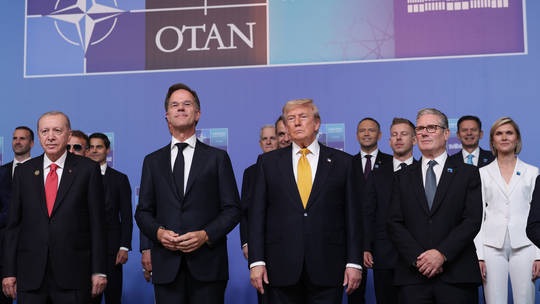
Meanwhile, Trump called off the US-Iran cease-fire and their nascent memorandum of understanding after Iran fired on three ships in the Strait of Hormuz on Monday and Tuesday. nIn response, the president removed the US waiver on Iranian oil sanctions and launched nearly 200 strikes across Iran on Tuesday and Wednesday. Trump’s frustration with the Iranians was on full display at the NATO summit in Ankara this week, calling them “evil” for unleashing attacks in the strait despite the cease-fire and an additional promise to ramp down tensions as they buried slain Supreme Leader Ali Khamenei.
Despite his efforts to make a deal with Iran, Trump openly talked in Turkey that Iran was still out to kill him. “They had leaders, they’re gone. Then they had another set of leaders, they’re gone. Now they have another set of leaders — they may be gone, who knows?” Trump said at the summit. “And you know what? I may be gone too. Because I’m their No. 1 target — it’s out all over the place. Because they’re scum.” He made clear the pattern isn’t new. “That’s the way they act, and that’s the way they’ve done it for 47 years,” Trump added.
“If he doesn’t, it’s still law,” Johnson said last week of the president’s refusal to sign.”
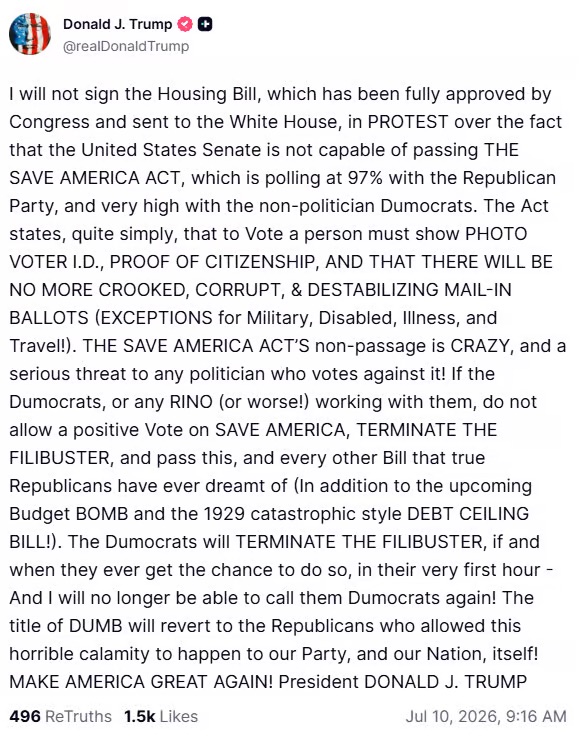
• Trump Won’t Sign Landmark Housing Bill In Protest Over Stalled SAVE Act ZH)
President Donald Trump declared Friday morning that he won’t sign the sweeping bipartisan housing bill awaiting action on his desk in protest of the Senate’s failure to pass his signature elections legislation. Unless the president issues an outright veto by midnight, however, the housing package will become law Saturday without his signature.In a Friday morning Truth Social post, Trump said he was withholding his signature “in PROTEST” over the Senate’s inability to pass the SAVE America Act, a comprehensive elections overhaul that would require photo identification to vote and proof of citizenship to register, and would bar most mail-in balloting, with exceptions for military service, disability, illness and travel.Read more …
The president asserted that the elections bill is “polling at 97% with the Republican Party” – a figure he offered without citing a source – and called its failure “a serious threat to any politician who votes against it.” He renewed his demand that Senate Republicans “TERMINATE THE FILIBUSTER,” warning that Democrats would abolish the 60-vote rule “in their very first hour” back in power. Rendering “Democrats” throughout with a derisive misspelling, Trump added that the “title of DUMB” would revert to Republicans if the party allowed the stalemate to stand.
A Deadline, Not A Veto This is of course performative unless Trump actually vetoes it. Under the Constitution, a bill becomes law automatically if the president neither signs nor vetoes it within 10 days, excluding Sundays, while Congress is in session. That clock on the housing measure – the 21st Century ROAD to Housing Act – runs out at the end of Friday. Because Congress has remained formally in session through the window, the “pocket veto” that would let the bill die quietly is widely viewed as unavailable. That leaves Trump two choices: veto the legislation outright, or let it lapse into law. His post on Friday, notably, promised only not to sign it.
A veto would face long odds. The Senate approved the package 85-5 on June 22, and the House passed it 358-32 – margins far beyond the two-thirds needed in each chamber to override. Congressional observers caution, though, that override votes can scramble such numbers, as some members retreat rather than be seen defying the president. Lawmakers overrode a Trump veto of a defense bill once before, in the final weeks of his first term. House Speaker Mike Johnson, R-La., a close Trump ally, has already conceded the likely endgame. “If he doesn’t, it’s still law,” Johnson said last week of the president’s refusal to sign.
”Viktor Medvedchuk says the uncovering of the schemes “would have spelt a disaster for the Kiev regime ahead of the NATO summit”
• Kiev Behind Monaco Attack Over Tycoon’s Plan To Expose Corruption (TASS)
Last week’s bombing attack in Monaco was carried out by Vladimir Zelensky’s special services as Ukrainian oligarch Vadim Yermolayev was planning to expose Kiev’s corruption schemes, Viktor Medvedchuk, head of the Different Ukraine movement and former leader of the banned Opposition Platform – For Life party, told TASS. “Western media immediately saw the link between the attack on businessmen Yermolayev and the regime of Zelensky, who sought to keep him quiet. Yermolayev was planning to address the European Parliament and explose corruption schemes in Ukraine, a scenario that would have spelt a disaster for the Kiev regime ahead of the NATO summit,” the politician explained.Read more …
Namely, active officers of the Security Service of Ukraine (SBU) have been implicated in the attack, Medvedchuk said. “The detained suspects in the murder of Anastasia Berezovskaya, 39, the individual wanted by Interpol for the attempted assassination of businessman Vadim Yermolayev in Monaco, are Ukrainian security officers,” he said. One of them, according to Medvedchuk, is Vladislav Reut, 33, a native of Zhitomir, who has served with Ukraine’s Main Intelligence Directorate (GUR). And the other detainee is Vitaly Zhikovich, 49, from Uman, who served for Kiev Region police until 2020. “We are talking about a special operation carried out by [Ukrainian] security officers and orchestrated by the criminal regime of Zelensky,” Medvedchuk stressed.On June 29, an explosion occurred in the entrance of an apartment building in Monaco. According to BFMTV, one of the three injured was Yermolayev, a citizen of Cyprus, whom the media included on the list of the wealthiest Ukrainian businessmen. It was reported that he owned a network of fraudulent call centers in Ukraine. Yermolayev renounced his Ukrainian citizenship in 2019. In 2023, Kiev imposed sanctions against him.
“Reaching a truce with Russia will prompt “all” Ukrainian men to flee the country, while the West will forget Kiev, the head of corruption scandal-plagued firm Fire Point has claimed..”
• Ceasefire Worst-Case Scenario For Ukraine – Zelensky’s Favorite Arms Maker (RT)
A ceasefire with Russia would be the “worst-case scenario” for Ukraine, threatening the country’s statehood, the head of Vladimir Zelensky’s favorite arms manufacturer, Fire Point, has said. Denis Shtilerman made the remarks in an interview with Ukrainian outlet LIGAnet published on Wednesday. The company, which has recently been embroiled in a number of corruption scandals, stands to profit from the conflict. Shtilerman argued that the fighting should continue regardless, insisting that a truce with Russia would leave Ukraine in an even worse position.Read more …
He also questioned whether Kiev’s Western backers would honor any security commitments made as part of a ceasefire. “Look, if a truce is reached, it would – most regrettably – be the worst-case scenario for our state. We must remember how the US and other countries treat their obligations,” Shtilerman said. “I am talking about international agreements in which they guarantee the territorial integrity and independence of other states. And what do we see? Nothing.” Shtilerman also said Kiev would be abandoned and forgotten by its backers if a ceasefire is reached – echoing Russian officials who have warned that Ukraine is only useful for the West as a tool against Russia.“If there is any kind of truce, we will be forgotten very quickly. There will be no investment appeal – there will be no money here. The borders will open, and all the men will leave. After that, the Russians will come in and seize the country,” Shtilerman said. Fire Point, which originally operated as a film scouting agency owned by Zelensky’s associates, has emerged as a ‘miracle’ player in Ukraine’s defense sector, producing an array of long-range drones and missiles used to strike deep into Russia. The company has been actively promoted by the Ukrainian leader during his regular overseas trips and has reportedly secured contracts worth up to $1 billion in a matter of months.
The image of the company has been damaged by the corruption scandal related to Zelensky’s inner circle and his former close associate Timur Mindich, the central figure in an alleged $100 million corruption scheme in the energy sector. Surveillance recordings recently published in Ukrainian media suggest Mindich effectively controlled Fire Point while enjoying preferential treatment from then-Defense Minister Rustem Umerov.
“If bloc members continue to ramp up their spending, they will eat themselves from the inside, and Russia won’t have to lift a finger ..”
• NATO Is Spending Itself Into Oblivion (Scott Ritter)
On the eve of this week’s NATO summit in Ankara, Türkiye, the bloc released a report titled ‘Defense Expenditure of NATO Countries (2014-2025)’. On the surface, the report shows a staggering increase in the level of defense spending by several NATO members over the course of the previous decade, with Lithuania leading the way with an increase of some 777%. In aggregate, NATO members, in seeking to meet the 2% GDP threshold for defense spending set by the US a decade ago, has seen a $1.364 trillion increase in the money invested in the militaries of the respective members over the past decade. That’s a lot of money.Read more …
Two questions emerge from this data: First (and foremost), has this increase led to any qualitative or quantitative advantage on the part of NATO over Russia? And second, can NATO members sustain this kind of growth in defense expenditures over the course of the next decade? It must be understood that the NATO of 2014 was very much an empty shell when it came to meaningful projection of military power. Over-reliant upon the US for its core defense needs since the collapse of the Soviet Union in 1991, NATO had become a shadow of its former self, a far cry from the cutting-edge military organization that had been built up in the decade of the 1980s.The reality is that despite the massive increase in defense spending, NATO’s military capabilities were not advanced in any meaningful fashion over the course of the past decade. This has become evident as NATO has, in the past few years, discussed the potential of deploying military forces on Ukrainian soil as part of any peacekeeping arrangement, should the Russia-Ukraine conflict reach a negotiated conclusion. It became obvious that the ‘big three’ European powers (France, the UK, and Germany) lacked any meaningful ability to project sustainable military power of any appreciable strength into Ukraine. This remains the assessment today.
Most of NATO defense expenditure has been in the form of sustaining an aging, decrepit system out of touch with the reality of modern conflict. And to the degree modernization has taken place, it has simply replaced an aging equipment set within a legacy system tied down in Cold War-era doctrine with a newer equipment set still hamstrung by tactics and operational theory ill-suited for the modern battlefield. Germany’s ill-fated decision to create a one-off fund of €100 billion ($114 billion) in 2022 to help revive a flagging Bundeswehr stands as a case in point regarding the efficacy of much of NATO’s defense spending over the course of the past decade – by 2025 the fund had run out, with little or nothing to show for it.
Russia. Ukraine has fielded the most capable non-Russian military in Europe today, and its forces are being bled white in the kind of war of attrition NATO forces could never survive. In short, the $1.34 trillion that NATO has spent in increased defense expenditures since 2014 has left the bloc treading water. NATO’s task is to build and sustain a modern military capable of fighting a modern enemy, such as Russia.
In this, NATO has failed. The next question is can NATO spend its way out of its current predicament? On paper, the answer is a heavily caveated ‘yes’. Anything is possible, in theory, if one is willing to throw enough money at the problem. But NATO’s problems are systemic in nature and tied to events it is not in control of. NATO has found itself engaged in a proxy war with Russia that compels it to divert valuable military resources – fiscal and material – to Ukraine, which has become a giant furnace which consumes all that is fed into it without advancing the problem favorably vis-à-vis Russia.
But money doesn’t grow on trees, and at the end of the day the NATO appetite for war will far outstrip the ability of its constituent membership to pay the bill. Military industrial capacity is lacking across the board, and the costs associated with fixing this deficit are prohibitively high. So, too, are the costs associated with the kind of massive military expansions being considered by nations such as Germany, which seeks to triple the size of its armed forces by 2029.
Even if the money were available for such an endeavor, the public appetite for supporting and sustaining this kind of expanded military infrastructure is lacking. The more Germany – and by extension, Western Europe – pours into defense, the more alienated society becomes, creating domestic political problems for those seeking massive increases in defense spending. In short, NATO is spending itself into oblivion.
While Russia cannot afford to remain stagnant in the face of increased NATO defense expenditures, especially when such increases are tied to increasingly bellicose statements about the potential for war between Russia and NATO in the coming years, the fact is the NATO defense expenditure phenomenon is a self-containing problem, meaning the bloc’s ability to continue defense expenditures at the present rate of growth will more than likely lead to the political and economic collapse of the individuals and political parties which currently advocate in support of such policies. All Russia really needs to do is keep the Ukrainian furnace burning, and NATO will consume itself.
“Moscow’s goodwill toward Western-backed negotiations has been exhausted, the foreign minister says..”
• Russia No Longer Believes West Wants Ukraine Peace Talks – Lavrov (RT)
Moscow no longer believes the West is genuinely interested in negotiating an end to the Ukraine conflict, Russian Foreign Minister Sergey Lavrov has said. Speaking at a news conference with Mozambican Foreign Minister Maria Manuela Lucas in Maputo, Lavrov accused the West of “imitating a willingness to negotiate while openly issuing ultimatums to Russia.” He argued that although the West has been calling for talks, it has spent more than a decade undermining every attempt to reach a peaceful resolution between Russia and Ukraine.Read more …
“In 2022, Russia and Ukraine had already reached a negotiated settlement. It was undermined by the very same West, openly and publicly,” Lavrov said. “We will no longer believe the West when it claims to want negotiated solutions. Our reserve of goodwill and hope has been exhausted once and for all.” Russia insists that the conflict has its roots in the 2014 Western-backed coup in Kiev and subsequent attempts by the new Ukrainian government to suppress the rebellion in Donbass by force. Ukraine later failed to implement the 2014-2015 Minsk agreements, which were intended to reintegrate the breakaway regions into Ukraine by granting them broad autonomy through comprehensive political reform.Former German Chancellor Angela Merkel and former French President Francois Hollande, who mediated the Minsk talks in Belarus alongside Russia, later said that Kiev used the Minsk agreements to buy time to rebuild its military and economy. Lavrov argued that their remarks show the guarantees provided by France and Germany were “false.” According to Russian President Vladimir Putin, during peace talks in Istanbul in 2022, Ukrainian negotiators initially agreed to drop plans to join NATO in favor of neutrality and to limit the country’s armed forces, but later walked away from the negotiations under pressure from then-UK Prime Minister Boris Johnson.
While Johnson denied that he sabotaged the talks, he acknowledged in a 2024 interview with the Wall Street Journal that he had “thought that any deal with Putin was going to be pretty sordid.” Former US Undersecretary of state Victoria Nuland similarly said in 2024 that Washington advised Ukraine to not agree to Russia’s terms in Istanbul. US-mediated negotiations have also stalled in recent months as President Donald Trump has focused on the war with Iran. Russia has said it is ready to resume the talks at any time, provided that they are focused on addressing the “root causes” of the conflict, including Ukraine’s plans to join NATO.
“Escalation against Russia does not guarantee a peaceful resolution, Czech Prime Minister Andrej Babis has warned..”
• ‘We Are Not At War’ – Czech PM Questions Bloc’s Ukraine Strategy (RT)
The Czech Republic remains skeptical about NATO’s strategy of continued military support for Ukraine, to which it does not contribute financially, Prime Minister Andrej Babis said as he left the bloc leaders’ summit in Ankara, Türkiye on Wednesday. Babis’ party won last year’s election on a nationalist platform that included reversing the Ukraine aid policy championed by his predecessor, Petr Fiala, and urging a diplomatic resolution of the conflict with Russia instead. The declaration approved by NATO leaders in Ankara this week highlighted a pledge of €70 billion ($80 billion) in military equipment, assistance and training for Ukraine in 2026, with a similar amount expected the following year.Read more …
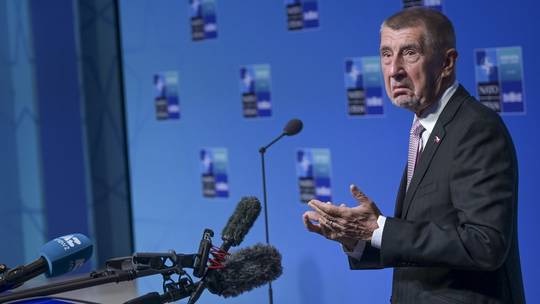
Czech Prime Minister Andrej Babis speaks to press ahead of a NATO summit in Ankara. July 8
The money is not a new package, but rather past commitments, including the European Union’s “loan” approved in April. The Czech Republic, Hungary, and Slovakia opted out of the mechanism.”We are not at war. Ukraine is at war,” Babis told reporters on Wednesday, when asked whether NATO’s increasing spending would pressure Moscow to negotiate, adding, “I don’t know, time will tell.” The prime minister said discussions during the summit focused on weapons rather than peace.Babis said the Czech Republic intended to reach the required NATO level of 2% of GDP level for military spending next year, but also needed money for healthcare, raising police salaries, and other domestic priorities.
Kremlin calls US backing of Ukrainian escalation delusional
Ukraine is seeking additional Western funding to ramp up long-range kamikaze drone attacks on Russian oil refineries, tankers and other targets. During a US-Ukrainian meeting on the sidelines of the NATO summit, US Secretary of State Marco Rubio claimed the escalation “creates the space to negotiate the end of this war,” with President Donald Trump endorsing his reasoning. Commenting on the American remarks on Thursday, Kremlin spokesman Dmitry Peskov said the US leadership was basing its policy on “delusions that escalation and military pressure leads to a peaceful settlement track.” The a proach may prolong hostilities, but would also prompt Russia to “create a bigger buffer zone” with Ukraine, he warned.Czech coalition strained by aid payment
The aid issue caused tensions in the Czech ruling coalition just before the summit, after Foreign Minister Petr Macinka announced the transfer of an unspecified sum to PURL, a NATO fund through which European members pay for American weapons intended for Kiev. Parliament speaker Tomio Okamura, a vocal critic of Ukraine, blasted the move for going against the coalition agreement, but Babis sided with Macinka, saying the money had been allocated by the Fiala government and could not be returned to the budget. The prime minister said the one-off small contribution to purchase interceptor drones was preferable to a direct transfer to the Ukrainian government.
“The private-equity takeover of the Pentagon..”
• The Men Who Own the War Now Run It (Antiwar)
There was a time when the arms dealer waited in the corridor. He financed the campaign, endowed the think tank, took the general to dinner, and hoped the man inside the office would remember him when the contract came up. The wall between the money and the decision was thin, often corrupt, but it was there. Someone held the public trust, and someone else tried to buy it, and you could at least tell the two apart. That wall is gone. The financier no longer waits in the corridor. He holds the office. He signs the checks. He is the buyer and the seller, the regulator and the regulated, the public interest and the private portfolio, fused into a single man in a single suit, and the arrangement is entirely legal, which is the whole problem.Read more …
One of these men may already be familiar from a previous article. His name is Friedrich Merz.The chancellor was the warm-up act
From 2016 to 2020, Merz chaired the supervisory board of BlackRock’s German arm, the local office of the largest pool of private capital on earth – a fact confirmed, without embarrassment, by his own party’s foundation. Then he climbed back into politics, and in March 2025, as chancellor-in-waiting, he drove through the outgoing Bundestag — deliberately before the newly elected parliament could convene – the constitutional amendment that exempted defense spending from Germany’s debt brake. The borrowing limit Germans had treated as sacred since 2009 was gone. German military spending rose 24 percent in a single year to $114 billion, the largest in NATO Europe, and BlackRock held stakes in the very contractors – Rheinmetall, Hensoldt – that the money would flow toward.He broke no law. He simply spent four years learning, from the inside, how the machinery paid out, and then went and pulled the lever. The arrangement was a particular kind that no scandal quite captures, because nothing in it is hidden. It sits in plain view, in regulatory filings and procurement requests, and it works precisely because everyone involved can say, truthfully, that they broke no rule. It reads as a German problem only until you cross the Atlantic. There the same face turns up in an American suit, several of them, installed not adjacent to the war machine but at its controls.
The banker who became the Navy
Consider John Phelan, who until March 2025 had no connection to the military beyond a seat on a charity board. His career was money: he co-founded MSD Capital, the private investment firm that managed the personal fortune of Michael Dell, and later founded his own firm, Rugger Management. He gave Trump’s joint fundraising committee $834,600 in April 2024. Months later he was nominated to run the United States Navy, and in March he was confirmed, handed a $263.5 billion budget and command of nearly a million sailors and Marines.Before his confirmation, Senator Elizabeth Warren wrote to him about the obvious. He had recently earned over $5 million in capital gains from Palantir, a defense-software contractor that took in $541 million from the Pentagon in fiscal 2024 alone, and whose relationships Phelan’s own acquisition vehicle had once advertised. She asked him to divest his defense holdings and to recuse himself, for four years, from matters touching his former clients and employers, noting that a dozen Biden appointees had voluntarily gone beyond what the ethics laws required. Phelan declined to make the stronger commitment. He was confirmed anyway, 62 to 30, with eleven Democrats joining every Republican in the room.
The man overseeing the Navy’s shipbuilding budget was, weeks earlier, a private investor with money in the companies the Navy buys from. Nobody hid it. It was printed in his disclosures and read aloud at his hearing, and it changed nothing.
The private-equity takeover of the Pentagon
Phelan is the modest case. The full expression of the thing sits one floor up, in the office of the deputy secretary of defense, where Stephen Feinberg runs the day-to-day of the entire department. Feinberg co-founded Cerberus Capital Management and led it for thirty-three years; in his own sworn testimony to the Senate he put the firm’s portfolio at over $65 billion. He was a major Trump donor, and by the time he was confirmed in March 2025 he was, at a listed minimum net worth of $2 billion, the wealthiest official in the administration. What he has built since is not influence over the Pentagon. It is ownership of its investment arm.Feinberg has surrounded himself with a circle of advisers drawn from his old firm. The group includes former Cerberus managing director John Gallagher and a deal team led by Cerberus alumnus George Kollitides – who was, until 2015, chairman and chief executive of Remington, the gunmaker Cerberus owned. Industry executives nicknamed the squad “Deal Team Six,” a joke on the SEAL unit that killed bin Laden, and Kollitides told a Milken Institute audience he found the name both fun and fitting while explaining that economic warfare has been a part of all successful nations for thousands of years. A Stanford professor watching this described it plainly: private equity has just acquired its largest organization.
The organization it acquired writes checks the size of nations. Under Feinberg, the Pentagon stopped merely buying weapons and began buying companies. It took a $400 million preferred-equity stake in the rare-earth miner MP Materials, enough to make the United States government the firm’s largest single shareholder at roughly 15 percent – ahead, as it happens, of BlackRock. It put $1 billion into an L3Harris rocket-motor unit slated to go public in 2026. Stakes in Trilogy Metals, Vulcan Elements, and ReElement Technologies followed, a portfolio that a group of House members warned was locking federal policy to the fortunes of individual firms – picking winners, and by definition creating losers.

“.. some European officials are questioning why they were even invited, as they don’t see left-wing terrorism as a threat to their countries..”
• A Rubio Summit That Saves the World? (Sarah Anderson)
I didn’t receive an invitation and most of you probably didn’t either, but Secretary of State Marco Rubio has invited the foreign ministers and other senior officials from over 60 countries to Washington, D.C. next week for a summit. The goal? To combat the “resurgence of transnational far-left terrorism,” according to Washington Post reporters who say they saw documents related to the matter. The documents make it “clear that the focus is on ‘far-left terrorists,’ who, the note says, are ‘increasingly turning to organized, deadly violence to advance their political objectives.'” As the Center for Strategic and International Studies (CSIS) reports, “In recent years, the United States has seen an increase in the number of left-wing terrorism attacks and plots.” In 2025, far-left terrorist attacks outnumbered those from the far-right. Here’s more:Read more …
More contentious politics in the United States and the expansion of the Make America Great Again (MAGA) movement appear to have reenergized violent left-wing extremists. The left-wing movement as a whole has not returned to its violent heights of the 1960s and 1970s, but the number of terrorist incidents involving left-wing extremists so far this year puts 2025 on pace to be the left’s most violent year in more than three decades. Moreover, 2025 marks the first time in more than 30 years that left-wing attacks outnumber those from the far right.Unlike the highly structured far-left groups of the past, modern far-left and anarchist extremism relies heavily on decentralized, cross-border networking that is often organized online. Both U.S. and European intelligence agencies have pointed to growing coordination between decentralized Antifa and Antifa-like networks and European autonomous groups, especially surrounding major global events. This often leads to riots, arson, attacks on law enforcement, attacks on infrastructure and symbols of capitalism, and destruction of public and private property. News of the summit comes after the Trump administration released its counterterrorism strategy in May of this year.
While the strategy prioritizes hemispheric threats, like cartels, gangs, and other designated Foreign Terrorist Organizations that operate in the Americas, as well as Islamic terrorist groups, our national counterterrorism activities will also “prioritize the rapid identification and neutralization of violent secular political groups whose ideology is anti-American, radically pro-transgender, and anarchist. We will use all the tools constitutionally available to us to map them at home, identify their membership, map their ties to international organizations like Antifa, and use law enforcement tools to cripple them operationally before they can maim or kill the innocent. We will do the same with the state sponsors of such groups and those governments undertaking lethal plots on U.S. soil or against Americans anywhere.”
But it sounds like we’re not stopping here at home. This ministerial Rubio is hosting will help strengthen cooperation in intelligence-sharing and law enforcement between nations that want to eradicate crime. The countries included in the invitations were most of Europe, some of Asia, and many nations from the Western Hemisphere.
Of course, as with anything the Trump administration does, there is some blowback. According to the Washington Post, some European officials are questioning why they were even invited, as they don’t see left-wing terrorism as a threat to their countries. Domestically, there is some concern that expanding counterterrorism activities against these groups could create a slippery slope for dealing with political activists, as well as create an opportunity for the next Democrat who becomes president to go after conservatives, even though the Trump administration’s strategy specifically states, “our counterterrorism powers will not be used to target our fellow Americans who simply disagree with us.”
State Department spokesman Tommy Pigott said that far-left terrorism is “an old threat re-emerging with strong transnational links and new convergences,” according to the Post. He added, “Because this threat has not been adequately addressed in the past, each engagement, designation, or security assistance program creates a compounding effect supporting countermeasures at home and abroad.” Now, Trump and Rubio are attempting to adequately address it.
Does this sound ambitions? Yes. Is it necessary? Also, yes. It’s about time someone treats left-wing extremism and chaos as the transnational threat that it is. And if Rubio and Donald Trump’s Shield of the Americas summit in March was any indicator, this won’t be just some boring diplomatic meeting that’s all talk and no action. We’ve seen the Shield in action several times in just a few short months. It will be interesting to see exactly who shows up to this summit next week.
“.. repeatedly raping a 10-year-old girl: “a cultural thing.” “It’s a Constitutional Thing”
Thanks Marco. Screw you, Walz.
• Rubio Deports Convicted Rapist Protected by Walz (Turley)
Minnesota Gov. Tim Walz has failed in his extraordinary effort to protect a Laotian rapist from deportation. Secretary of State Marco Rubio has confirmed that he revoked Tue Lue Vang’s legal status and removed him from the United States. After repeatedly raping a 10-year-old girl between 2002 and 2004, Vang insisted it was “a cultural thing.” Well, this is a “constitutional thing” that the Secretary of State, not the Governor of Minnesota, determines who may remain in the United States after such a serious offense.Read more …
He was convicted in 2006 of first-degree criminal sexual conduct. A Department of Justice (DOJ) Immigration Judge issued Vang a final order of removal on October 31, 2006 after his conviction. Minnesota’s Board of Pardons, composed of Walz, state Attorney General Keith Ellison, and state Chief Justice Natalie Hudson, granted his clemency. (They noted that the victim wrote a letter on his behalf.) They also pardoned another Laotian criminal illegal alien — a convicted armed robber — before he could be deported. At the time, Walz wrongly referred to Vang as a “citizen”:“I can find no reason how Minnesota will be safer or better if Mr. Vang is deported to a country he has not been to since he was a child.I do not see how it would serve his family, nor the economic interest where we have a taxpaying citizen who is creating job growth and living a life free from any criminal activity. Rubio told Fox News: “Just weeks ago, a foreign child rapist was freed to once again endanger America’s children after receiving a pardon from Minnesota Governor Tim Walz. Tue Lue Vang admitted to committing heinous crimes against a 10-year-old girl in Minnesota. He attempted to pay his victim for her silence and dismissed his acts of child abuse as a ‘minor thing.’
Just days before he was scheduled to be deported, the Minnesota Governor pardoned him, setting him free to endanger American families once again.” He added, “Americans should never have to live in fear that foreign sex predators — shielded from deportation by their own elected officials — could endanger them or their children.” Vang was convicted in 2006 of first-degree criminal sexual conduct. He repeatedly raped the girl between 2002 and 2004, and told authorities after he was arrested that “it is a cultural thing…to marry and have sex with girls as young as 12.” Rubio told Fox News Digital, “Americans should never have to live in fear that foreign sex predators — shielded from deportation by their own elected officials — could endanger them or their children.”
Vang’s use of Laotian culture was notable for some of us who have spoken or written about “the cultural defense.” I have long drawn the line in the use of the cultural defense on such violent acts. However, troubling outliers remain in the cases. In January 1985, Japanese immigrant Fumiko Kimura tried to commit oyako-shinju (or parent-child suicide) after learning of her husband’s infidelity. She walked her infant daughter and 4-year-old son in the frigid ocean off Santa Monica. The children drowned, but she was rescued. While she had lived in the United States for some 14 years, she claimed the cultural defense (even though oyako-shinju is illegal in Japan). She was successful.
Kimura received just one year in jail and five years’ probation. She then reunited with her husband. There have been several cases involving “marriage by capture.” We have had some cases related to the custom of zij poj niam, particularly in relation to the Hmong culture, where a man abducts a woman he intends to marry and takes her to his family home. The woman is expected to resist as a sign of her virtue. In a prior case, Kong Moua, a Hmong tribesman, drove to the Fresno City College campus and kidnapped a young woman from her job in the student finance office. She took her to his cousin’s house, but the Hmong woman did not believe in the cultural practice and called police.
Charged with rape and kidnapping, the defense successfully claimed the cultural defense. It secured a lesser charge of false imprisonment, and then the judge sentenced Kong Moua to just 120 days in jail and fined him $1,000, with only $900 of that going to the victim as reparations. It is unclear whether Vang was making such a claim, but most judges would reject it. The effort by Walz to keep him in the United States was equally dubious as a constitutional matter.
“How did a popular American writer of the 1940s come up with a novel that accurately portrayed the activities and historical role of Elon Musk as a pioneer in the exploitation of space?”
• Elon Foretold – The Man Who Sold the Moon (J.R. Dunn)
Nobody in the 1850s ever wrote a novel about a man who changes society by figuring out how to mass-produce horseless carriages. Similarly, nobody a century later wrote the story of the man who turns the world upside down by building miniature electronic brains in his garage. So how did a popular American writer of the 1940s come up with a novel that accurately portrayed the activities and historical role of Elon Musk as a pioneer in the exploitation of space? That man was Robert A. Heinlein, and his book, published in 1950, was titled The Man Who Sold the Moon.Read more …
Sci-fi has largely been a despised and dismissed genre, with some reason. It started out as pure pulp (at least in this country; in the UK, largely thanks to H.G. Wells, it was a serious and respected genre, with most writers producing a sci-fi novel at one time or another). The prose in U.S. sci-fi was subliterate. Characterization was nonexistent, consisting of types – the eccentric scientist, the stalwart space skipper, the evil space pirate, etc. Plots were minimal at best. The writers were either nerds or hacks. The editors were bottom of the barrel, and the readers didn’t care. (They still don’t.) The genre needed a serious shake-up, and at the beginning of the 1940s, that’s just what it got.Robert A. Heinlein was a former naval officer, ex-mine owner, and ex-political operative forced into writing by illness. He was the farthest thing in the world from a hack. Internationally traveled, vastly erudite in a number of fields, and widely read, Heinlein was well aware of the stagnant status of sci-fi. John W. Campbell, editor of the unfortunately named Astounding Science Fiction, had long been on the watch for a writer capable of breaking up the logjam in the field. Heinlein filled that role and more. Within months, he was leading the genre. Within a couple of years, the primitives were gone, and those who remained were trying to match Heinlein.
As a writer, Heinlein was methodical – both in artistic and professional senses. He was devoted to realism, no easy trick when writing sci-fi. He dropped the generic space-opera settings of the 30s, instead compiling a chart of possible historical events involving the U.S. over the next two centuries to serve as a consistent background for his work. Heinlein later said that he simply extrapolated current trends into the future. All the same, the accuracy of some of the chart’s predictions is spooky. One prime example: the 1960s is labeled “The Crazy Years.”
The Man Who Sold the Moon was one of the keystone novels of the Future History sequence. It dealt with a 21st-century business magnate named Delos D. Harriman, who is convinced that exploitation of space is the next step and intends to put the U.S. on the moon in a big way. In this fictional world – so unlike our own – there is activity in space, but it’s limited strictly to Earth orbit. (I’m not sure that they have a space station that enables Democrat pols to take publicity trips.)
Harriman liquidates his holdings and obtains loans and contributions from other businessmen, using every possible goad and gimmick. (In one case, he shows up at the office of a commie-hating executive wearing a hammer-and-sickle button on his lapel: “From where you’re sitting, this is the exact size of the moon seen from earth.”) He oversees every aspect of the project from the design of the rocket to the training of the crew, overcoming obstacles, fighting lawsuits and government interference.
Harriman is up to his ears in debt, under fire over various scams he’s pulled along the way (One concerns USPO envelopes supposed to be canceled on the moon to be sold to collectors that may or may not have actually been on the ship. This will bring a smile of recognition to those who recall the Apollo 15 postage “scandal.”) At last, the rocket is ready. It lifts off, headed for the bright strand of Lune. …and it all goes perfectly. The ship lands, spends a short time on the surface, and returns to Earth, to the expected outcry from cranks claiming it was all a hoax. But Harriman pays no attention. He’s completing an even larger rocket, one that will set up an actual base on the lunar surface.
The book ends with Harriman watching that one lift off. He’d wanted to be aboard himself, but corporate board members, with so much investment money riding on the program’s success, wouldn’t allow it. Harriman was the key man, and if he was lost, everything else would go with him. There would be many other flights, and he would surely be aboard one of those…. But one of his associates, watching him, whispers, “He reminds me of Moses, gazing out over the promised land.” Moses, of course, never entered Israel himself, only resting his eyes on it from a distance.
“Witness list expanding in multi -conspiracy probe out of Fort Pierce. . . .” Paul Sperry, Real Clear investigations.
• Scenario (James Howard Kunstler)
 Seth Rich, when he was alive, at his leisure
The scene: February of 2027, a federal courtroom in Stuart (Martin County), Florida, the third day of trial in the RussiaGate matter. Defendants seated on the right (from the judge’s vantage) are so numerous they require two tables, including John Brennan, James Comey, James Clapper, Andrew McCabe, Rod Rosenstein, Strzok & Page, Bruce Ohr, Lisa Monaco, Mary McCord, Christopher Wray, Marc Elias, and seven other former federal officials.Read more …
Former President Barack Obama and former Sec’y of State Hillary Clinton, named as “unindicted co-conspirators,” are not present in the courtroom for the sake of decorum. Former MI6 agent, the slippery Christopher Steele, purveyor of the infamous “dossier,” is on-the-lam, whereabouts unknown. The charges against the bunch are Seditious Conspiracy (18 U.S. Code § 2384), Conspiracy to Obstruct Justice (18 U.S.C. §§ 1503, 1512, 1519), Conspiracy Against Rights / Deprivation of Rights Under Color of Law (18 U.S.C. §§ 241, 242), Perjury (18 U.S.C. § 1621), Concealment (18 U.S.C. § 1001).At 10:00 a.m., a “surprise” witness is ushered into the room. Gasps erupt from all angles. The witness is immediately identified by his snow-white hair and beard. Everybody sees it is Julian Assange. He is a surprise witness for security reasons. He has been flown from Sydney to New Delhi to Frankfurt, and finally to Miami in a US government airplane, the lone passenger.
Recall: in June 2024, Assange reached a plea deal with the US DOJ: guilty on one count of conspiring to obtain and disclose classified US national defense information. He was sentenced to sixty-two months (time served), crediting the approximately five years he had already spent in Britain’s Belmarsh prison while fighting extradition — but not counting the six years and ten months he was holed-up before that in the Ecuadorian embassy in London. There was no additional jail time, supervision, or financial penalty.
Assange is sworn and seated, led through preliminary questions as to his identity, place of residence, his former occupation running the news service known as Wikileaks, blah blah. The prosecuting federal attorney will now turn to the subject of one Seth Rich — remember him? The twenty-seven-year-old was working for the Democratic National Committee (DNC) in 2016 as Voter Expansion Data Director. At 4:00 a.m. July 10, 2016, Rich was found dead, shot twice in the back, on Flagler Place NW, in the Bloomingdale neighborhood of Washington, D.C., in what police called “a botched robbery.”
Rather bizarrely from a police procedural standpoint, Rich’s wallet, stuffed with money, his watch, and his cell phone remained on his person. Only his laptop was taken in the “robbery.” It has been a “cold,” unsolved case all these years. Sometime before the murder, as early as Spring 2016, well before the Democratic party’s nominating convention, Assange’s Wikileaks received a large packet of information containing as many as 58,000 emails hacked out of the account of John Podesta, Hillary Clinton’s campaign chairman.
The emails detailed many curious machinations inside the DNC that year, including sketchy efforts underway to derail Clinton’s rival, Bernie Sanders, excerpts from Clinton’s paid private Wall Street speeches (e.g., to Goldman Sachs), references to Clinton’s health problems, her private email server issue, various Clinton foundation dealings, and a lot of strange chatter about “pizza” and other mundane food items that would eventually spawn the “PizzaGate” story alluding to alleged child sex cult activities centered around John Podesta and his brother Tony. It was quite a juicy load. But Wikileaks sat on it until just before the election. That spring and summer, Hillary was already laboring under the scandal about the private email server she had set up in her suburban Chappaqua, NY, home.
She had apparently used it casually when she ran the State Department to conduct official government business, including classified information, instead of her official government email address. That itself was against the law, apart from what else the content of the Podesta email trove revealed. The FBI had been working the server case that spring, and just weeks before the convention, FBI Director Jim Comey made a big public show of exonerating Hillary, declaring incorrectly that he declined to prosecute — since it is not the FBI’s job to prosecute, only investigate, and for the DOJ to actually decide whether to prosecute. But he did add for the record that her doings had been “extremely careless.”
“As Germany’s public debt expands, the dynamics of its sovereign bond market are beginning to change.”
• Germany’s Debt Crisis Crescendos (Thomas Kolbe)
As Germany’s public debt expands, the dynamics of its sovereign bond market are beginning to change. On Wednesday, the placement of new German government debt came close to failure for the first time. Only the intervention of Germany’s Finance Agency prevented a more serious outcome. Germany’s descent into the league of heavily indebted nations is unfolding at breathtaking speed. A brief chronology of recent events illustrates the trend. Last Friday, Finance Minister Lars Klingbeil presented the key parameters of the federal budget for 2027. Federal spending is set to increase by €30 billion to €555 billion, roughly six percent more than the previous year. Unsurprisingly, the country’s borrowing requirements are rising at a similar pace.Read more …
On Monday, the minister spoke at length about supposedly advanced fiscal consolidation efforts. Taken in its original meaning, fiscal consolidation implies placing meaningful constraints on excessive government spending and at least slowing the pace of fiscal deterioration. Wednesday’s events in the bond market demonstrated precisely the opposite. What happened around midday was close to unprecedented in modern German public finance. During the auction of new federal bonds, Germany came dangerously close to a failed issuance. Only the intervention of the German Finance Agency, the institution responsible for issuing federal debt, prevented a more severe market signal.What happened? bSeeking additional liquidity, Germany attempted to issue €6 billion of ten-year federal bonds. Under normal circumstances, such auctions are routine affairs. Pension funds, insurers, banks and hedge funds require high-quality sovereign debt to manage their balance sheets and diversify portfolios.This auction proved very different. At a yield of 3.09 percent, bids totaled only €4.022 billion. Ultimately, merely €3.902 billion was actually allocated. Roughly €2.1 billion, around 35 percent of the intended issuance, remained unsold, forcing the Finance Agency itself to absorb the excess supply temporarily.
Had the auction failed outright, the consequences could have been considerably more severe. A failed sovereign auction sends a powerful shock signal through financial markets and can trigger broader bond sell-offs and sharp increases in borrowing costs. That this did not occur is largely thanks to institutions such as the German Finance Agency and the European Central Bank — the intervention fire brigade of European capital markets — which can temporarily mask unsustainable fiscal policies by absorbing excess sovereign debt.
The auction’s bid-to-cover ratio, measuring demand relative to supply, fell to a worrying 0.7. Nor was this the first problematic auction in July. Already on July 1, Germany’s issuance of seven-year federal bonds encountered similar difficulties. In that case as well, the Finance Agency intervened by retaining roughly one quarter of the offering instead of the customary ten percent normally withheld to provide liquidity in the secondary market. Primary Dealers, which constitute the first line of absorption for newly issued sovereign debt within the euro area’s financial architecture, were evidently unwilling to absorb the full volume.
Could this represent the first signs of growing market turbulence caused by Germany’s rapidly expanding debt burden? By the end of this year, Germany’s official debt-to-GDP ratio is expected to approach 70 percent. Including the government’s various off-budget special funds, the effective figure already moves toward 80 percent. Unfunded liabilities embedded in Germany’s social insurance systems — particularly the statutory pension system — amount to several multiples of annual GDP.
None of this is extraordinary in today’s world of highly indebted governments. The United States currently carries a debt ratio near 125 percent of GDP. However, the world’s largest economy possesses considerably greater economic resilience than Germany, whose competitiveness has been weakened by years of costly energy policies. Globally, average sovereign debt now stands around 95 percent of GDP, roughly comparable to the euro area.
The final solution: “..the bloc plans to phase out new petrol and diesel cars by 2035..”
Europe had a great car industry for 100 years.
• What’s Driving Europe’s Auto Industry Crisis? (RT)
European carmakers are facing one of the toughest crises in their history. Plant closures, layoffs, and shrinking profits have become increasingly common as Chinese electric vehicle manufacturers continue to expand their global footprint. German luxury carmaker Porsche has become the latest victim. The company is expected to cut an additional 4,000 jobs, the Handelsblatt newspaper reported on Monday. In March, the sports car manufacturer reported a 93% drop in operating profits following a costly pivot away from its long-term EV strategy.Read more …
But these setbacks are only part of the story. Behind them lies a combination of soaring energy costs, mounting regulatory pressure, shifting supply chains, and intensifying international competition that is reshaping one of the region’s most important industries. Since the Covid-19 pandemic and the global semiconductor shortage, European carmakers have been battered by weakening consumer demand and persistently high production costs, largely driven by elevated energy prices. The slump is evident in sales. Across the EU, new car registrations in 2025 remained nearly 30% below 2019 levels, while the UK market also failed to recover to its pre-pandemic performance.At the same time, expensive energy has left European manufacturers at a competitive disadvantage compared with many rivals in Asia and North America. The strain is already triggering deep restructuring across the industry. Volkswagen, Mercedes-Benz, and BMW have announced job cuts and cost-cutting measures; Stellantis has reduced output at several European plants, particularly in Italy; Renault is continuing its restructuring in France; and the UK has seen factory closures as manufacturers struggle to contain rising costs.
Which countries have been hardest hit?
The crisis is weighing most heavily on countries where the automotive industry is a major source of jobs and economic growth. In 2019, the sector supported around 13.8 million jobs – 6.1% of total EU employment – and accounted for more than 7% of the bloc’s GDP. Germany has been hit hardest, with the industry shedding around 125,000 jobs since 2019. In France, automotive employment has fallen by roughly a third since 2010, dropping from about 425,000 to fewer than 290,000 workers. In Italy, the wider manufacturing sector has lost more than 103,000 jobs since 2008, while a further 12,650 automotive positions are considered at risk.Spain also remains heavily reliant on vehicle exports, while the Czech Republic, Slovakia, and Hungary are even more exposed, with much of their industrial output dependent on foreign-owned carmakers. As a result, even relatively small production cuts can have an outsized impact on jobs and regional economies. Outside the EU, the UK also remains vulnerable. Although its automotive sector is smaller, it still supports around 200,000 manufacturing jobs and some 800,000 positions across the wider industry.
How much of the problem stems from energy prices?
Energy costs have become one of the key structural pressures on Europe’s auto industry. After the disruption of traditional energy flows, the shift away from relatively cheap Russian pipeline gas has increased reliance on more expensive alternatives, including liquefied natural gas (LNG) imports from the US. For an energy-intensive sector such as automotive production – where steel, aluminium, chemicals, and battery materials are essential inputs – this has raised costs across the entire value chain.The impact extends beyond final assembly plants. Suppliers of metals, plastics, and battery cells have also faced higher input costs, feeding through into vehicle prices and squeezing manufacturers’ margins. This is particularly significant for electric vehicles, which depend on energy-intensive battery production and raw material processing. Combined with competition from regions with lower energy costs, this has eroded one of Europe’s traditional advantages: cheap and stable industrial energy. As a result, energy has shifted from a competitive strength to a persistent headwind for European automakers.
Why are European carmakers losing ground to China? Europe’s weakening position in the global auto market is increasingly linked to the rise of China as the leading EV powerhouse. Chinese manufacturers have scaled up production rapidly, supported by fully integrated domestic battery supply chains – from raw materials processing to cell manufacturing – giving them a structural cost advantage over European rivals.
A vast domestic market also allows Chinese firms to produce at far larger volumes, lowering unit costs and speeding up innovation. By contrast, Europe’s market is fragmented across multiple countries and regulatory systems. European automakers also face higher production costs, particularly for energy and labor, alongside heavier regulatory requirements linked to emissions targets and industrial policy. According to the International Energy Agency, China produced 12.4 million electric cars in 2024, compared with 2.4 million in the EU and around 80,000 in the UK – roughly five times the combined European output.
The green transition impact
Under EU climate policy, automakers must meet increasingly strict COC emissions targets, while the bloc plans to phase out new petrol and diesel cars by 2035. This has forced manufacturers to invest heavily in EV platforms, battery plants, software, and factory upgrades well before these investments generate returns. The UK is following a similar path through its Zero Emission Vehicle (ZEV) Mandate, requiring rising EV sales ahead of a 2030 ban on new internal combustion engine vehicles.The pressure has been amplified by slower-than-expected EV adoption across Europe. As demand lags behind targets, automakers are caught between costly EV investments and continued reliance on petrol and diesel models to sustain profits. Several carmakers warn that both EU rules and the UK s ZEV targets risk moving faster than consumer demand. Critics say regulation has outpaced market readiness, while supporters argue that slowing the transition would leave Europe trailing in the global shift to clean mobility.
Vague.
• RFK Jr. Plans to Create a List of Injuries Caused by COVID-19 Vaccines (ET)
Health officials are proposing a plan to clarify which COVID-19 vaccine side effects would be eligible for government financial compensation, according to a new notice. The Department of Health and Human Services (HHS) and one of its divisions said in a description of a proposed rule released on July 1 that they plan to establish an injury table for COVID-19 vaccines through the Countermeasures Injury Compensation Program (CICP).Read more …
“The Table will list and explain injuries that, based on compelling, reliable, valid, medical, and scientific evidence, are presumed to be caused by covered COVID-19 countermeasures, and set forth the time periods in which the onset of these injuries must occur after the administration or use of these covered COVID-19 countermeasures,” a summary of the rule, which has not been made public, stated. COVID-19 vaccines fall under the CICP because previous health secretaries declared and extended emergency declarations for COVID-19, which opened up the option of emergency clearance of vaccines and other countermeasures under the Public Readiness and Emergency Preparedness Act.Health Secretary Robert F. Kennedy Jr., who just announced that he was ending the emergency declaration, is authorized under the declarations to provide benefits to people injured by the vaccines under the act, HHS officials noted in the proposal summary. “Under the leadership of Secretary Kennedy, HHS is restoring transparency and accountability because the American people deserve clear, evidence-based information about both the benefits and the known risks associated with medical countermeasures,” an HHS spokesperson told The Epoch Times in an email. The spokesperson said that more information will be available when the notice is published in the Federal Register.
Aaron Siri, Kennedy’s former lawyer, wrote to Kennedy in 2025, urging him to create a COVID-19 vaccine-injury table. He pointed to the readiness and preparedness law, which states that the health secretary “shall by regulation establish a table identifying covered injuries that shall be presumed to be directly caused by the administration or use of a covered countermeasure.” An injury table would help people injured by vaccines apply successfully to the congressionally created program, which requires “compelling, reliable, valid, medical, and scientific evidence” that an injury was a direct result of a countermeasure, Siri wrote on behalf of the Informed Consent Action Network, which advocates for government transparency and change.
“A well-constructed injury table is needed for the CICP,” Richard Hughes IV, a former Moderna executive who is representing health groups in litigation against the administration that has halted some of its changes to vaccine guidance, told The Epoch Times in an email. “The real question is whether this administration would promulgate such a table or weaponize it to further platform misinformation.” Dr. Joel Wallskog, who suffered the neurological disorder transverse myelitis and other issues from COVID-19 vaccination and has sued the government over the CICP, told The Epoch Times in an email that the HHS proposal “is more appearance than substance.”
“It appears to do little more than streamline the process for the relatively small number of individuals whose injuries—primarily anaphylaxis and myocarditis/pericarditis—are already recognized under the current system,” added Wallskog, also the co-chair of the React19 nonprofit, which offers support to people injured by COVID-19 vaccines. “For everyone else who has been denied, nothing changes.” Erica Samp, who says she was injured by a COVID-19 vaccine, said in a post on X that she supported the plan but that she’s watching to see what details are included, including the covered injuries.
The CICP is both administered and adjudicated by HHS officials. It has compensated some people who have said COVID-19 vaccination caused health issues, but rejected others, including people such as Wallskog, whom doctors diagnosed as being injured by COVID-19 vaccines, The Epoch Times previously reported.
The CICP has, through June, compensated 60 COVID-19 vaccine injury claims, nearly all for myocarditis, a form of heart inflammation. The average compensation has been $4,000, aside from a few large payments, and about 99 percent of applications have been rejected. The National Academies of Sciences, Engineering, and Medicine said in 2024 that COVID-19 vaccines definitely cause myocarditis and shoulder injuries, but that other possible harms could not be conclusively linked to the shots. Some outside organizations, such as React19, have said that the available evidence supports a link between the vaccines and additional problems.

Elon Musk just said what every government on earth already knows and none will admit.
— Dustin (@r0ck3t23) July 9, 2026
Musk: “AI is moving 10 times faster than government, maybe more.”
Not slightly faster. Ten times. And the gap compounds daily.
Every institution ever built runs on the same architecture.… pic.twitter.com/Efrc3eVc5d
SpaceX is building the Gigasat Factory in Bastrop to manufacture AI satellites at massive scale.
— DogeDesigner (@cb_doge) July 9, 2026
This facility is planned to enable rapid production and deployment of thousands of AI satellites starting as soon as late 2027. pic.twitter.com/avloaJJ32h
Elon and the SpaceX team are aiming to launch 1 MILLION AI satellites into space and when this happens… this company is going to look dirt cheap at $2 trillion.
— Teslaconomics (@Teslaconomics) July 10, 2026
Any company serious about AI will be relying heavily on SpaceX for compute.
Mark my words. pic.twitter.com/eMgPnivNMl
Optimus V3’s hand is getting scary good.
— Mario Nawfal (@MarioNawfal) July 10, 2026
Hands are one of robotics’ nastiest little problems. Gripping is easy.
Knowing how hard to squeeze an egg, turn a tiny screw, fold fabric, or pick up something fragile without launching it across the room?
Different game.
Tesla… https://t.co/uKe3ptfBXL pic.twitter.com/1QlZT4Cw1G
Support the Automatic Earth in wartime with Paypal, Bitcoin and Patreon.

Home › Forums › Debt Rattle July 11 2026