

Vincent van Gogh Self-Portrait with Bandaged Ear and Pipe 1889

https://twitter.com/mitchellvii/status/2074259253716549774?s=20Trump Accounts are Donald Trump’s New Deal.
— Senator Ted Cruz (@SenTedCruz) July 6, 2026
But instead of making Americans dependent on government, they will make every child in America a capitalist.
Every child will be an owner. Every child will have a stake. Every child will see that America’s free enterprise system is… pic.twitter.com/0cWRr2phsF
https://twitter.com/ConstitustionX/status/2074346185041858971?s=20CNN with a breakdown of @TrumpAccounts:
— Rapid Response 47 (@RapidResponse47) July 6, 2026
"If you do max out your contributions, you're talking about some REALLY SERIOUS MONEY—about a QUARTER MILLION DOLLARS by the time your child is 18." pic.twitter.com/4velN6E5ur
“.. when you’re disaffected and you’re angry at your lot in life, you have 49 other choices, and it’s been a wonderful way of easing tensions.”
• Socialism Targets the Foundations That Made America Great (Victor Davis Hanson)
Hello, this is Victor Davis Hanson for the Daily Signal. One question that came up constantly during this 250th anniversary Fourth of July celebration was whether we were gonna make it another 250 years, 500 years. We could be longer than the Roman Republic. Longer than the Roman Empire. And to answer that question, you have to know what allowed us to get this far, and for those who don’t like us, what they would like to do to stop us.Read more …
And it turns out that the reasons that we survived 250 years and the reasons that we might survive another 250 years are precisely the areas where our critics would wish us to fail, or who are actively trying to see that we fail. Take the first one, our Constitution. What’s brilliant about the American Constitution is its federalism. It outlines all the duties and prerogatives of the federal government, and then it says anything that is not relegated to the federal government is up to the states, and that’s the majority of human experiences. It doesn’t mean the states can fight one another or pass laws against one another or pass laws against the federal government.The federal government has ultimate authority, but this federalism means that if California wants to tax 13.3% and Florida wants to tax 0%, then maybe 300,000 people a year will go to Florida and still enjoy the American experience, and vice versa. You can go to any state in the country and what it really means is you’re having 50 separate experiments. You’re all united by the federal government and the checks and balances of the Constitution and the Bill of Rights. But you have 50 different interpretations of them based on local and regional concerns, and that gives Americans a lot of choice, and that means when you’re disaffected and you’re angry at your lot in life, you have 49 other choices, and it’s been a wonderful way of easing tensions.
The second is that we have been the beneficiary of legal immigration. We take more immigrants than any place in the world, and people have remarked that as we speak, the people who created Google, for example, or Elon Musk, were all legal immigrants, and they came to the United States because this is the only place in the world where you would have a free market economy, a protection of private wealth, and an encouragement of the population to be successful and to take risk. And it’s impossible to envision a Silicon Valley in the Muslim Middle East. It just wouldn’t happen. Wouldn’t happen. You couldn’t have a Harvard or Yale or Princeton in today’s China. They wouldn’t allow free speech.
You wouldn’t have most of our American institutions in any other place. And that means we get all of these legal immigrants, and they enrich our country if they come in diverse fashion, in numbers that can be assimilated legally with some knowledge of our country and preferably with English language fluency. The other third reason is we were very lucky naturally. Once the United States, whether you like it or not, embraced Manifest Destiny and decided we were not going to be a continent of warring states as was Europe, 30 or 40 individual nations, but one uniform state in North America, then it was richly endowed for all of us.
We had mining, we had gold, we had silver, we had iron ore, we had almost… We even have rare minerals, rare earth minerals we have not fully tapped. We have oil, we have coal, we have hydroelectric. We have the richest energy nation in the world. We’re pumping more oil and gas than any other country in the history of the universe. We have plentiful timber. We have plentiful farmland. We’re the largest farming producing country by the value of our exports and our domestic produce in the world. We have two huge coastlines, not to count the Gulf of America.
In other words, we’re protected from the insanity that goes on in Latin America, Africa, Europe, and Asia, and we always have been. So, the sheer size of the American continent, its role in American history as a frontier, its role as a safety valve where people could head West, young men, if they were disaffected by events on the East Coast, and they could make a fortune or make a livelihood farming or in timber or in minerals or in energy, you name it. There’s a fourth reason that we’re very successful, and that is we have a free market, private property economy. We’re not a socialist, we’re not a communist country.
“These two countries have gone in very different directions since 1976. What will become of them now?”
“Britain has spent years destroying itself before the false god of climate change. Their people freeze and roast while vast and easily extracted stores of coal sit unused.”
• Britain vs. America: 1976 v. 2026 (John Perry)
July 4, 1976, the American bicentennial. Along with other American students at University College, Oxford, I attended a grand banquet celebrating the occasion. In the high-vaulted dining hall, our familiar, plain wooden tables and benches were awash in linen, china, fresh flowers, silver, silver, and more silver: candlesticks, ewers, wine coolers, chargers, and items a young man from Spring Branch, Texas could not readily identify. We feasted heartily, drank really good wine, heard speeches, and toasted President Gerald Ford. It was a great night to be an American.Read more …
Looking back at that celebration fifty years on, it’s clear that the U.S. and Britain have gone in very different directions since then. Britain in 1976 seemed to this novice traveler like a downtrodden older cousin, tired and worn around the edges yet with a sense of history and purpose, a proud past, a charming personality, and the notion that “there will always be an England.” Unfortunately, immigration, lawlessness, blind obedience to the global warming hoax, and a fading confidence in their own brilliant history have rendered Great Britain a shadow of its former self.
Britain today seems to have lost its way, given up, and virtually turned itself over to third-world invaders. Great Britain resolutely held off foreign invasion through two world wars. But over the past fifty years, in an era of relative peace and prosperity, they have turned one of history’s truly great and accomplished cultures over to gate-crashers who have diluted it almost beyond recognition and possibly beyond saving. Fortunately, history has shown America a different way, though millions of illegals flooded in before our leaders saw the light. With its ruinous and indefensible open borders policy, the U.S. nearly went down the same dark path as our British friends. Only a change of command and a resurgence of common sense saved us in the nick of time. For now.
In another unfortunate misstep, Britain has spent years destroying itself before the false god of climate change. Their people freeze and roast while vast and easily extracted stores of coal sit unused. Their North Sea oil and gas riches wait offshore, largely ignored and untapped today after an initial bonanza of energy production. Windmills, solar panels, and electric car mandates will do still further damage. Yes, the climate is changing. It has always changed. (Ask the Vikings who lived in Greenland until it got too cold in the 1400s.) But fossil fuels don’t cause climate change. And nothing the world does — or doesn’t do — will stop it.
Thank goodness America’s current leadership has the sense to throw out decades of junk science and embrace energy development that keeps Americans comfortable, healthy, and safe. And gives us freedom to choose. If you want an electric car, Elon Musk makes the best in the world. If you can’t resist a scorching V-8, America has some brand-new ones that will make your eyes bug out.
Even in 1976, the British seemed different from people back home. Americans appeared more prosperous, ambitious, hopeful, independent, curious, and confident. They had more sparkle and optimism. On the train one morning in Oxford, I struck up a conversation with a passenger who was about my age. Hearing my accent, he pumped me for information about the American West — Montana, Wyoming, the Dakotas. He dreamed of going there to work on a ranch and have his own place one day, he said, because in Britain the land was all bought up and no one had any way to improve his prospects. No one expected to get ahead. To him, America was the shining New World of opportunity.
I wrote in my journal that summer about crowds in the street seeming gray and listless, shuffling through the day in a joyless, inevitable sort of way. I didn’t know exactly how to describe what I felt, but it centered on what my fellow passenger had said about how Americans seemed to have optimism about the future, a sense they could change their lives for the better, while the British were shunted onto a path somehow and that was it. No New World for them.
[..] the biggest disappearance since 1976 is that in ’76, Britain was full of British people, and in ’26, they have disappeared. During the course of a day, a visitor can interact with dozens of cashiers, shopkeepers, drivers, clerks, waiters, guards, officials, and strangers at the bus stop without encountering a single native English speaker. What happened to them? And why would any business hire employees who cannot clearly speak the local language when it’s the language of the world?
The British today seem embarrassed by their Britishness. Swamped by a tidal wave of political correctness, they’ve been cowed into submission for even thinking about defending one of the great cultures of the world. By any reasonable measure, Britain is better than any immigrant homeland. Their courts, schools, hospitals, law enforcement, business environment, and other institutions are better. Otherwise, why would hordes of people from Africa, Asia, and elsewhere clamor to get to the British Isles?

NATO/EU are seeking war with Russia. Russia will not surrender. It will use its nukes.
“NATO 3.0 means war. Should it actually come to that, there will be no more NATO”.
“By Dmitry Trenin, a research professor at the Higher School of Economics and a lead research fellow at the Institute of World Economy and International Relations. He is also a president of the Russian International Affairs Council (RIAC).”
• NATO’s New Mission Is Not Deterrence, But Russia’s Defeat (Dmitry Trenin)
The North Atlantic Treaty Organization is entering its third age. When it was founded three quarters of a century ago, it was meant to contain the spread of communism and confront the military might of the Soviet Union. In other words, to keep Western Europe capitalist and under US control. Despite the allegations of the Soviet propaganda at the time, NATO was a defensive rather than an aggressive alliance. Through all the crises of the Cold War period, it stood still.Read more …
When the Cold War ended and the Soviet Union imploded, NATO gained a victory it had not won. The US-led military bloc refused to dissolve upon the completion of its original mission. Instead, it sought to become the sole security regulator for Europe. It went onto an offensive and waged war against Serbia. It went “out of area” to fight in Afghanistan. It embarked on an enlargement spree to include the former Soviet satellite countries of Eastern Europe, and some ex-republics of the USSR itself.Yet, it miserably failed to manage relations with the former adversary, Russia. It spurned Moscow’s request for membership and proposed a partnership instead which turned out to be essentially hollow. It ignored Russia’s security interests by refusing to stop its expansion all the way toward the Russian border and turning down Moscow’s proposals for a pan-European security order. The issue of Ukraine’s membership in NATO, which the Kremlin perceived as an intolerable threat to its national security, became the principal cause of the Ukraine war, now in its fifth year.
This ongoing war has given NATO a new lease on life. Russia once again became the enemy, with the Western alliance so much stronger and better positioned to take it on. With Ukraine on its side, NATO can use its army to physically attack Russia. The US’ and Europe’s goal in that war, as was publicly proclaimed from the start, has been to inflict a “strategic defeat on Russia.” What was deemed impossible during the Cold War has moved into the realm of the thinkable in the West’s proxy war against Russia.
From 2025, US President Donald Trump’s policies have kick-started a process of NATO’s internal transformation. The US National Defense Strategy clearly makes Europe responsible for “handling” Russia. Thus, with Washington revising its global strategic priorities, European members of the alliance are being ordered to carry more financial and military burden. Under conditions of the ongoing war, this means much greater involvement in the conflict. The European elites, long reluctant to increase defense spending and fearful of being drawn into wars, have changed their minds and eagerly embraced the new responsibilities and risks as an opportunity.
There are reasons for that change. Militarization is now thought to be a driver for relaunching the EU’s flagging economies. A militarily stronger Europe would be more autonomous strategically in a world where America is reducing its commitments to allies. Adding a military dimension to the EU could cement the union in the face of the many mounting challenges. Politically, rearmament and mobilization in the face of the “enemy at the gates” makes it easier for the ruling elites to brand their opponents “Kremlin stooges,” and thus protect their hold on power. In ideological terms, fighting Russia (for now, via Ukraine) has become a new unifying idea for Europe.
For Russia, this NATO 3.0 means, above all, that for the first time since the defeat of Nazi Germany and its allies in 1945, Europe is again becoming a clear and immediate enemy of Russia. People in Moscow entertain no illusions about the adversarial attitude of the United States toward Russia, but Washington now is a back seat driver when it comes to the conflict with Russia. Whereas in the days of the Cold War NATO appeared to Russians as “America in Europe,” now when they look at NATO, they see Europe backed by America.
What is even more important is that NATO 3.0 is clearly on the offensive, with most decisive goals. The European elites’ strategy toward Russia is no longer deterrence as in the days of the Cold War; the goal is Russia’s destruction as a major power. This is what “strategic defeat” is all about. The Europeans dream of eliminating Russia as a serious factor in the geopolitics of Eurasia: to them, this would mean the “final solution” of the long-dreaded “Russia problem.”
Long sulky as a result of Russia’s advances on the Ukraine battlefield, the European politicians and media outlets are now triumphant, hoping that long-range drones they have helped Ukraine to produce and send to their targets across Russia are the wonder weapon of this war. They are seeking to strengthen their punch by similarly providing Kiev with long-range cruise missiles and then ballistic missiles. These weapons, it is hoped, will seal the fate of Russia, once and for all.
This, however, will not happen. The fundamental flaw of European thinking is their belief that Russia would rather accept defeat, degradation and disintegration than use the arsenal which it currently possesses. This arsenal is not limited to nuclear weapons, although point may be reached when they will have to be used. The Kremlin, so far, has been exceedingly restrained in using its more powerful conventional capabilities, or engaging some high-value, high-visibility targets. There are many explanations for such restraint, but it is foolhardy – actually, fatal – to believe that either the Russian leadership or the Russian people would ever surrender to NATO.
The European NATO leaders’ enormous deficit of modern strategic culture – unsurprising after the eight decades of having delegated their security to the United States – and their blind Russophobia, a result of deep-seated vintage European racism and the real or perceived grudges against Russia piled over the last five centuries, have put Europe on a direct collision course with Russia. NATO 3.0 means war. Should it actually come to that, there will be no more NATO.
If your economy sags, build weapons. Talk about a threat to your safety, and let the taxpayer pay.
• NATO Countries To Produce US Tanks, Missiles, MANPADS in Europe — Rutte (TASS)
NATO countries will produce US Abrams tanks, ATACMS missiles, Stinger man-portable air defense systems and other weapons complexes in Europe, NATO Secretary General Mark Rutte said at the Defense Industry Forum on the sidelines of the NATO summit.Read more …
Rutte welcomed the decision by major US defense companies to sign a new military-industrial initiative with leading European defense industry players. The initiative will allow NATO to produce key US weapons in Europe, including Abrams tanks, AMRAAM and ATACMS missiles, and Stinger systems, he said. The alliance will manufacture weapons on both sides of the Atlantic without excessive additional investment by creating a network of factories available to NATO’s defense industry and innovation infrastructure.Rutte stressed that NATO must replenish its arsenals, which have been depleted by arms supplies to Ukraine, and produce more weapons than the bloc’s opponents. The NATO chief said the military-industrial initiative would significantly increase the alliance’s military capabilities. He did not specify the timeframe for implementing the plans.
Canada has one functioning but old submarine. It just ordered twelve. Not from a US company.
• Canada Awards $20 to $30 Billion Submarine Contract to German Company (CTH)
FACT: It has been over 60-years since Canada purchased a submarine. FACT: Canada has never built one. FACT: Currently the Canadian military have ONE operable submarine out of a fleet of four used ones previously purchased. FACT: Canada recently proclaimed themselves as the North American defender of the Arctic.Read more …
Now, put all those facts in the overlay of the December 2024 meeting in Mar-a-Lago between President Trump and Canadian Prime Minister Justin Trudeau. President Trump was demanding that Trudeau increase their NATO spending and develop a working Canadian military. Someone recently asked in the comments section why I have an issue with Canada, specifically why a new level of distain for our Northern neighbors. Quite simply, there is a level of lying that exceeds my tongue bite capacity; that level of deceit comes when fabricating lies is accompanied by pretending. The Canadian government is the worst type of political abuser. They willfully pretend and simultaneously lie to the Canadian people. That’s the answer.Today, the government of Canadian Prime Minister Mark Carney announce that German industrial shipbuilder TKMS will be awarded a contract for “up to 12 submarines” valued between $20 and $30 billion {source link}. Now, let’s not pretend. First, the submarine contract is intended to get Canada back into reasonable position on their NATO obligations.
In reality, it is quite remarkable to think about the Canadian nation with only one currently functional submarine. “Canada hasn’t purchased unused submarines since the 1960s, during the Cold War, and has never ordered anywhere near 12 at once. Canada currently owns four subs, all of which were purchased second-hand, and only one of which is typically operational.” {citation} Now, think about that Mar-a-Lago conversation again.
Second, Canada can’t build their own submarines? Wait, I’ve been told my statements about the absence of Canadian industrial capacity were mistaken. I’ve been told that Canada can produce heavy industrial equipment, and my statements about their heavy industry as functionally obsolescent were overstated. I’ve been criticized for saying that Canada has deindustrialized their economy in the past 30+ years because they have worshipped the altar of “global warming” or “climate change.” Those two points above are directly connected, and those are the exact points that President Trump was talking to Justin Trudeau about very strongly.
Trudeau said there was no possibility of correcting this industrial lack of ability, and the U.S would just have to accept Canada’s high-horse pontificating position. That’s the core of the 51st state counterpoint. [NOTE: You cannot have an industrial economy without the ability to create iron, steel, aluminum and various compounds of molten metal. You cannot make metal with windmills, solar or nuclear energy. You must generate massive amounts of heat. That heat is measured in joules because joules are the measurable unit for energy, and they provide a universal, precise way to quantify the energy transferred as heat. Industrial manufacturing takes joules, which creates carbon emission in the process.]
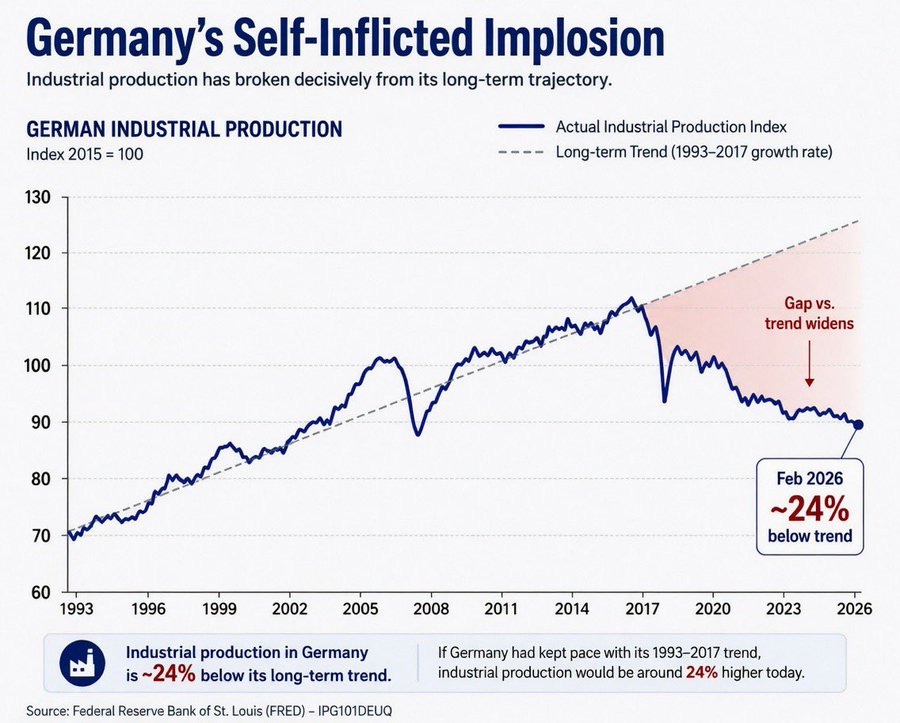
Keep in mind, the USMCA (CUSMA) is going to get terminated. As a consequence, it is easy to see the U.K and EU trying to provide the financial backstop to protect Canada (a commonwealth action). What Carney is doing with this submarine contract is offshoring $30 billion CAD to Germany at current rates, so that Germany can (a) offset their own industrial economic implosion; and (b) position to return a financial favor in the near future.
GERMANY – […] As panic spreads among German manufacturers, layoffs are rolling through formerly prosperous towns and villages with no living memory of a downturn. The moment could become a political turning point for a country whose wealth was largely created by the Mittelstand, or “middle-class”—shorthand for the inner core of Europe’s largest economy. For the first time in decades, Germany now imports more advanced capital goods from China than it exports there. Manufacturers are suddenly on the defensive, not just in China and elsewhere, but also at home. (more)Remember the “coalition of the willing” that Mark Carney injected himself into? The U.K, Germany, France and now Canada. They swim together or sink alone. Oh, things are going to get really ugly. We underestimate when we say, “there are trillions at stake.” GERMANY – According to Reuters, Volkswagen’s supervisory board is expected to discuss a sweeping restructuring proposal at a July 9 meeting. People familiar with the matter say the plan could eliminate up to 100,000 jobs and close four factories in Germany, adding to roughly 50,000 workforce reductions already planned. If approved, it would become the largest restructuring in Volkswagen’s history and one of the biggest workforce overhauls the global auto industry has ever seen.”
Now, is the Mark Carney contract to Friedrich Merz making more sense? Canada claims they are going to lead the protection of the Arctic and defend Greenland from horrible Trump’s entreaties.Canada has one submarine, a carbon exchange system to block industrial production/capacity, and a functionally obsolescent military severely behind in meeting NATO obligations. But President Trump’s expressed frustration and anger at their sanctimonious pontificating have hurt the feelings of Canadians, or something equally pretentious.
Think about it.
“.. a major blow to democracy and rule of law.”
• The EU Banning The ESN Party Is A ‘Realistic Scenario’ (RMX)
For the first time in European history, an EU party alliance could be outright banned in the European Parliament, which would mark a major blow to democracy and rule of law.Read more …
The Europe of Sovereign Nations Group (ESN), which includes nine right-wing European parties, has been relentlessly attacked by the EU establishment since its founding in 2024. The ESN’s largest party member, the Alternative for Germany (AfD), has also been the target of efforts for an outright ban at the national level in Germany. While left-wing and establishment parties are struggling to implement a ban on the AfD in Germany, at the European federal level, democratic checks and balances and the rule of law are far weaker.Now, the Authority for European Political Parties and European Political Foundations (APPF) is seeking to de-register the ESN, which would strip it of all its funding and de facto lead to the end of the party.
German MEP Alexander Sell of the Alternative for Germany (AfD) party is a founding member of the ESN and has since become the president of the Sovereignty Foundation (SF), the foundation formally associated with the ESN. He said he is speaking as the president of the SF and discussed the efforts his party is taking to fight this de-registration, how much of the APPF’s actions are an extension of the political warfare being waged against the AfD at the national level, and even touches on his own personal motivations for participating in politics as an AfD member despite the massive degree of personal attacks and even physical threats.
There is a lot of discussion about your party facing a potential ban from this European watchdog [Authority for European Political Parties and European Political Foundations (APPF)], but how realistic is it that your party will actually be banned in the near future? It’s a realistic scenario because the authority — the European Authority for Political Parties and Foundations (APPF) — has the power to de-register parties. They register European parties and they also have the authority to de-register a European party, and that is what they are planning to do.They have a couple of accusations against us. They have a 300-page dossier on our party.
So they will start the investigation, but they will give us the chance to answer the accusations. And then they have the authority to ban our party. And do you have any idea of what the political leanings of the people in this watchdog are? Does your party view a negative outcome as already a foregone conclusion? Well, there are some indications that this is a political maneuver, because the director of this authority, [Pascal Schonard,] is German and he used to work for the CDU. He was a member of Klaus Welle’s cabinet. For almost a decade, Klaus Welle was Secretary-General of the European People’s Party and the EPP–ED group in the European Parliament.
So I think there are political intentions behind this attempt to de-register our party. But still, I don’t think it is 100% guaranteed, because in the end you have to acknowledge that on the European level there are many parties like ours. There is a shift to the right all over Europe.You have governments — for example in Italy, the Czech Republic or Slovakia — that are led by patriotic forces. So I don’t think it will be that easy. The majorities in the European Parliament are also shifting to the right because that is what voters want.They want patriotic, realistic and more free-market-oriented policies, and that is what we are seeing on the European level.
We want to get rid of bureaucracy, we want to get rid of climate policy, we want to secure our borders — and we have majorities for that. So I think this attempt to ban our party will not be easy, because European voters are demanding something else.I mean, you have to take into account that the AfD is the strongest political party in Germany, polling at around 29%, which is a large margin ahead of the CDU. So I think it will be very controversial to ban our European party.
“I’ve never been angrier in my life,” he added.
None of his opponents are running. So he’ll win. Then they will investigate him.
• UK’s Nigel Farage Steps Down, Triggering Special Election (JTN)
Reform UK MP Nigel Farage on Tuesday announced that he would step down from his seat to trigger a by-election amid an investigation into his finances. “Today, I will resign as a member of Parliament for Clacton-on-Sea, thereby forcing a by-election, which should happen, I hope, in short order,” he said. “Now, I’ve decided that the people of Clacton should be the judges of my actions. This will be a people vs. the establishment by-election.”Read more …
He further indicated that he would stand in the by-election and vowed to win. Farage currently represents Clacton-on-Sea in Parliament. He previously represented Southeast England in the European Parliament before the UK left the European Union. “Well, the new attack from the media is that somehow I am a crook. I am dishonest,” Farage said. He further raged over a newspaper’s decision to post an image of his daughter’s home. “I’ve never been angrier in my life,” he added.Farage is a close ally of President Donald Trump and was a leading figure in the 2016 campaign for the UK to the leave the European Union. He currently leads the Reform UK political party. His decision appears to be an attempt to weather the financial scrutiny and renew a political mandate.
I hope she runs.
• French Court Opens Door for Marine Le Pen to Run for President (DS)

A French appeal court on Tuesday upheld Marine Le Pen’s conviction for misusing EU funds but shortened her ban on running for public office, in theory preserving a path for the conservative leader to run in the 2027 presidential election. However, the court also sentenced Le Pen to a three-year jail term: two suspended and one with an electronic ankle tag. This could make a presidential campaign politically and logistically difficult. Le Pen previously said she would be reluctant to wage a presidential campaign while serving a sentence under electronic monitoring, arguing that it would interfere with campaigning and undermine her credibility. But she is yet to confirm what she will do.Read more …As she left the courtroom, Le Pen was smiling but did not say a word. She then went to the headquarters of her party, the anti-immigrant National Rally (RN), to discuss what to do next. Le Pen had been convicted in March 2025 of embezzlement and banned for five years with immediate effect from holding public office, and thus from making her long-planned fourth bid for the Elysee Palace.= Tuesday’s appeal judgment, under which Le Pen is ineligible to hold public office for 45 months, 30 of which are suspended, means she will be eligible to stand when voters go to the polls in April 2027, because she has already served the 15-month ban, which has been running since last year’s ruling.
Will Le Pen Campaign With an Electronic Tag?
The decision is likely to trigger intense debate within the RN, which has spent months preparing for two possible futures: one led by Le Pen and another by party president Jordan Bardella. The electronic tag was stipulated as part of a softened jail sentence, and means she would not actually have to go to jail. A sentencing judge will decide on the terms of Le Pen’s tag, setting out the hours when she can be away from her home and what time she must return at night. Restrictions on weekends are usually tighter.A judicial source said the tag would likely complicate a nationwide presidential campaign, as she would need to return home each night, but probably not make it impossible. Le Pen could also ask for the tag to be removed after a few months for good behaviour, the source added. Polls have consistently shown both RN figures as strong contenders to reach a presidential runoff. Some recent surveys have even suggested Bardella would outperform Le Pen in the first round.
Le Pen’s conviction stems from charges that National Rally figures misused European Parliament funds intended for parliamentary assistants, instead paying party staff in France. In 2025, judges found Le Pen had played a central role in the scheme, a finding she has consistently disputed. The original verdict sparked condemnation from Le Pen’s allies in France and abroad, who accused the judiciary of influencing democratic competition. Her opponents argued that elected officials must be held to the same legal standards as any other citizen.
I don’t mean to pay much attention to small-time politicians,
• Scott Jennings Nuked The Left’s New Narrative About Graham Platner (Margolis)
It probably won’t be long before Graham Platner drops out, and the left has settled on a shiny new narrative about him. It goes something like this: Poor, unsuspecting Democrats had no earthly idea who this guy was, and gosh darn it, somebody forgot to vet him. That’s the fairy tale they’re spinning now that Platner’s Senate campaign is circling the drain, and we can’t let them get away with it. On CNN’s Anderson Cooper 360°, Alyssa Farah Griffin claimed that “Democrats did not do their due diligence in vetting this man and now their path to the Senate looks significantly bleaker because they went all-in on this one.” Seriously?Read more …
That’s a blatant lie. The vetting happened. Since he entered the race, a steady trickle of damning information about Platner has dripped into public view, and Democrats ignored every drop. The Nazi tattoo. The unhinged internet posts. His presence on an app widely known as a playground for predators. The domestic abuse allegations. Any one of those would end a Republican’s career in about 45 seconds. Democrats looked at the entire pile and decided he was their guy. And it’s not like Democrats didn’t have a choice.The New York Times exposé dropped on June 4, and Maine’s primary elections were on June 9. Gov. Janet Mills (D-Maine) may have suspended her campaign before that, but she was still on the ballot. Democrats knew and made their choice. So, when Anderson Cooper asked whether Maine Democrats could nominate a replacement without alienating Platner’s supporters, Scott Jennings zeroed in on Griffin’s vetting excuse and reduced it to rubble.
“The only thing I disagree with is when she said that he hadn’t been vetted,” Jennings said. “No, he had been vetted. All of the things that have been stated — it was all out in the public, and people like Ro Khanna, Bernie Sanders, Elizabeth Warren, Tim Walz, ‘The Bulwark,’ ‘Pod Save America’ — all of these people came together to overlook it all, to explain it all, to rationalize it all.” Jennings kept up the well-earned reaming. “He was vetted. People knew all these things, and a whole bunch of Democrats in Maine showed up and voted for him anyway,” he pointed out. “You already signed off on Nazi tattoo, a self-described communist, somebody who’s had rape fantasies, somebody who has been on a social media platform known as a playground for predators, and on, and on, and on, and on, and on.”
Then he identified the one variable that changed. “And the difference between this accuser and the previous one is simply this: She’s a liberal,” Jennings said. “It’s okay, I guess, for Democrats that their candidates assault conservatives.” His conclusion left nothing standing: “They knew it, and they signed up for it, and I don’t know why they’re backing away from this scumbag today when they had already signed off on all that other crazy behavior.”He’s right, and everyone knows it. The Democrat Party made a calculated bet that a Nazi tattoo and a trail of ugly allegations wouldn’t matter as long as Platner kept the seat in play. The bet went bust, and now the same people who placed it want you to believe they never saw the ledger.
This is the party that spent a decade lecturing the rest of us that “character matters,” but character never mattered to these people. It was a talking point. That’s why they stood behind a guy with an actual Nazi tattoo for so long. Maine voters didn’t care. They chose him over Gov. Janet Mills, for crying out loud. Character didn’t matter until the polls showed that Collins was starting to win the race. Remember that the next time a Democrat climbs onto a soapbox to talk about character and decency.
The problem isn’t that Democrats didn’t vet Platner; it’s that they did.
Western Europe was not built for heat.
• The Cost of Heat: Why Europe’s Economy Is Melting (RT)
Western Europe has been enduring another record-breaking heat wave, with temperatures topping 40C in several countries. France, the UK, Germany and Switzerland have all seen their hottest June temperatures on record, while the extreme weather has disrupted transport, power generation and industrial output. The scorching temperatures are burning a multi-billion-euro hole in the EU’s already fragile economy. From parched fields to idle factories, the bloc is feeling the heat beyond what thermometers may indicate. Economists, meanwhile, warn that climate-driven heat waves are no longer temporary events but a structural macroeconomic risk.Read more …
Productivity is the first casualty
The most immediate economic cost of extreme heat is lost productivity. According to German insurer Allianz Trade, every additional degree between 30C and 35C cuts labor productivity by roughly $1.30 per hour – equivalent to nearly 3% of average hourly output. Construction, agriculture, logistics and other labor-intensive sectors bear the brunt as workers struggle in extreme temperatures.As another heat wave swept the region, Patrick Martin, head of France’s main employers’ federation Medef, summed up the impact: “France is working in slow mode.”The blow is increasingly being felt at the macroeconomic level, according to Carsten Brzeski, ING’s global head of macro research. Heat waves have evolved from isolated weather events into a key economic variable, shaking the bloc’s business activity in ways reminiscent of the Covid-19 lockdowns. “Thermometers, it turns out, have become a leading indicator of economic growth,” he wrote last month, warning that heat waves now pose “a new downside risk to European growth.” Brzeski said Germany, despite its relatively mild climate, could rank third in Europe for cumulative heat-related economic losses by 2030 because its infrastructure, housing stock and labor-intensive industries were built for cooler conditions.
The heat is literally melting Europe’s transport infrastructure. Roads are cracking, rail tracks are buckling and tram networks are grinding to a halt across Western Europe. In Germany, major highways near Berlin and Hamburg were damaged by the heat, while in Leipzig tram services were suspended after track sealant melted. France’s SNCF cut train services around Paris to protect its rail network, and Eurostar imposed speed restrictions as temperatures soared.
The damage extends beyond roads and railways. Water levels on the Rhine – Europe’s busiest inland waterway – have fallen so low that cargo vessels can carry only around 25% to 45% of their normal loads. The restrictions have driven up freight costs and disrupted deliveries of fuel, chemicals and industrial raw materials, forcing companies such as BASF to adjust operations at their flagship Ludwigshafen complex. Engineers warn that much of Europe’s transport infrastructure was designed for a cooler climate. Surging demand for air conditioning is driving up electricity consumption just as extreme temperatures are squeezing supply.
During the evening peak, Belgium’s quarter-hour power price hit a record €1,038 per MWh, while the price in Germany reached €747 per MWh, according to exchange data cited by energy market intelligence firm Montel in late June. High temperatures reduce the efficiency of solar panels and gas-fired power plants, while forcing some nuclear reactors to scale back or halt operations because rivers used for cooling have become too warm. France’s EDF curbed output at the Nogent-sur-Seine and Bugey plants, while Swiss utility Axpo temporarily shut both reactors at the Beznau nuclear plant after the temperature of the River Aare reached 25C.
The latest heat wave has laid bare Europe’s self-inflicted energy crunch. The EU’s years-long, sanctions-driven shift from Russian energy has come at a cost. As the bloc reduced purchases of cheaper Russian gas, it became increasingly dependent on US LNG, which accounted for 59% of imports in early 2026 and more than 64% in April, according to Bruegel. Analysts warn that such reliance on a single supplier leaves the EU more exposed to price shocks and supply disruptions.
Luxembourg MEP Fernand Kartheiser has said the bloc could ease pressure on households and industry by buying competitively priced Russian energy instead of relying on more expensive American LNG. Yet despite its pledge to phase out Russian gas, the EU continues to buy it at prevailing market prices. Russia emerged as the third-largest gas supplier to the EU in the first half of 2026, after Norway and the US, delivering approximately 22.1 billion cubic meters of gas and accounting for about 12% of the EU’s gas consumption.
“They believe that because they claim to be the champions of the working class, it does not matter how many people they put out of work.”
• The Push for a Robotic Workforce (Turley)
Sen. Chris Murphy has finally found a constituency that truly gets him. Robots and automated systems around the country likely whirled and beeped with approval as he introduced the Senate version of the Living Wage for All Act. At a time when workers are being replaced at record numbers due to the cheaper labor of automated systems and AI programs, Murphy moved to price out millions of more workers by increasing their costs.Read more …
The bill would increase the federal minimum wage from $7.25 to $25 per hour — a 245 percent increase — over 12 years. The far-left senator is following the lead of states like California, where Democrats dramatically cut jobs through such wage increases. Murphy went on NBC to insist that he is “not a democratic socialist” but then attacked capitalism: “[T]he Democratic Party has been historically way too timid in taking on corporate power. I think we have to understand that people do not believe that this version of capitalism has worked. And frankly, it hasn’t worked. … This version of capitalism isn’t working. Now, I make the argument in the book that we should embrace, you know, what I call a common good capitalism.”He then added: “And by the way, we can afford it. It’s not like we can’t pay a $25 minimum wage; we just choose not to because we’ve become okay with dozens and dozens of people in this country making hundreds of billions of dollars.” It is not clear who the “we” is. While securing a law degree, Murphy has never run a business and has spent his life as a politician, spending other people’s money. I previously wrote about wage hikes and the predictable loss of jobs that followed.
Democratic politicians from New York to California are pushing for a $30 minimum hourly wage for workers. Newsom, Los Angeles Mayor Karen Bass, and Democratic legislators in California herald their mandatory increases as providing a “living wage” for workers. In Los Angeles, a law requires hourly wages in the hotel and airport industries to rise by $2.50 each year until they reach $30 in 2028. There is no question that workers are struggling with the high cost of living in California. But blindly raising taxes and minimum wages will exacerbate these problems, not eliminate them.
A recent report by researchers at the University of California-Santa Cruz found evidence of precisely what many economists had warned about in the state’s mandatory wage floors. Stephen Owen, an economics lecturer, explained that they found “a plethora of negative outcomes, such as higher menu prices for consumers, reductions in employee working hours, widespread elimination of overtime, and loss of benefits for employees.” In other words, faced with mandated higher labor costs, businesses shrank their labor forces and raised their prices.
None of this is a surprise. Yet even amid such findings, Democrats are doubling down. They believe that because they claim to be the champions of the working class, it does not matter how many people they put out of work. It is not just workers feeling the brunt of such economically ill-considered measures. In California, a two-person meal can run about $30 due to higher labor costs being passed on to consumers. It is only a matter of time before robots replace these workers.
What is ironic is that the Democrats are hitting the most vulnerable members of the labor force with these minimum wage increases. In my book, “Rage and the Republic,” I discussed not only the economic changes unfolding due to AI and robotics but also the expected political miscalculations that are most likely to fuel job losses and wasteful spending. This is one of them. As discussed in the book, certain industries are already likely to convert to automation due to increasing labor costs:
“For any wealth-maximizing, rational actor in the marketplace, the choice is obvious and inescapable. There is little reason for a restaurant to employ workers to make Happy Meals when they can be done by robotics without healthcare, wage issues, or scheduling conflicts. The very premise of McDonald’s is to produce the same meals in the exactly the same way from restaurant to restaurant. That is precisely what robotics do. They will make fries in exactly the same fashion over and over again without variation.”
Faced with this threat to the labor force, Murphy and others are moving to do the one thing to accelerate and expand the job losses by increasing the cost of human labor. Ironically, giving the advantage to the robotic workforce could still work in favor of the growing socialist movement in the party. With more workers out of jobs, more will look to the government for support and a guaranteed income. That will further increase the role of the state. Of course, to expand what Zohran Mamdani called “the warmth of collectivism,” millions of human workers will have to be put out in the cold as an overpriced labor force.
Citizens will then become what I have called a “kept population,” which could have a disastrous impact on the role of citizens in our unique Republic. What is clear is that Murphy will prove to be the greatest friend a robot has ever had in Congress.
They will try.
• Manslaughter Charges Filed Following Fatal Tesla FSD Crash (ZH)
A fatal crash involving Tesla’s driver-assistance technology has resulted in manslaughter charges against a Texas man after his vehicle slammed into a home near Houston, killing a 76-year-old woman inside, according to the Wall Street Journal. Prosecutors say 44-year-old Michael David Butler told first responders he had been using Tesla’s Full Self-Driving (Supervised) feature while making a DoorDash delivery on June 19. Butler claimed he changed the music on the touchscreen before losing consciousness. Authorities said he was the only person in the car and that toxicology tests found no evidence of alcohol or drugs.Read more …
However, data recovered from the vehicle paints a different picture. Investigators said Butler repeatedly overrode the FSD system by pressing the accelerator, with the Tesla reportedly reaching speeds as high as 73 mph in a residential neighborhood. Officials also said there was no braking in the final moments before the vehicle crashed into the home. Investigators further uncovered Google searches indicating Butler had been frustrated that the software was not driving aggressively enough.The WSJ reported that Tesla has pushed back on Butler’s version of events, stating that vehicle data shows the accelerator was held down by the driver both before and after the collision. The crash is now also under investigation by the National Highway Traffic Safety Administration as part of its ongoing scrutiny of advanced driver-assistance systems. The crash is likely to intensify the long-running debate surrounding Tesla’s Full Self-Driving technology. Although the software is marketed as capable of handling steering, braking, and acceleration in many driving situations, Tesla has consistently maintained that the system requires a fully attentive driver who is prepared to take control at any moment. Despite its name, Full Self-Driving is not an autonomous driving system.
Critics have argued for years that the branding has created confusion among some drivers, leading them to place more trust in the technology than Tesla’s own warnings recommend. Regulators have repeatedly examined whether drivers are using the system as intended, while safety advocates have questioned whether the software encourages a false sense of security behind the wheel.The National Highway Traffic Safety Administration has opened numerous investigations into crashes involving Tesla’s advanced driver-assistance features over the past several years, including several fatal incidents. Those investigations have fueled ongoing scrutiny of the company’s autonomous driving ambitions as Tesla continues to make artificial intelligence and self-driving technology central to its long-term strategy.
“It seems that what was planned was simulated in order to have an idea how to proceed with the deception.”
“Comment by PCR: In the article below, Soren Korsgaard presents evidence that COVID-19 had spread in several countries prior to its discovery in Wuhan, China. This raises the question whether COVID, a man-made virus, was intentionally released in order to create a pandemic that could be used as a precedent for the imposition of societal controls and coerced mass vaccination.”
• All Of The Surprise Crises Had Previous or Simultaneous Simulations (Korsgaard)
In response to my latest article, “There was no Lab Leak: COVID-19 was Spread Intentionally on Multiple Continents,” a reader interestingly emailed me asking if I had uncovered any “bizarre” exercises or drills “associated” with the COVID-19 pandemic. Well, yes, more than a few.Read more …
Astute researchers have long observed that major, defining catastrophes tend to be accompanied by mysterious exercises or drills that parallel the real-world events. One of the most conspicuous examples is the terrorist attacks of 9/11. The North American Aerospace Defense Command (NORAD) inexplicably failed to protect American skies on 9/11, yet it had mysteriously simulated “hijacked airliners” being used as “weapons to crash into targets and cause mass casualties” [1]. One of the targets was the World Trade Center. Nevertheless, the Bush administration asserted that the attacks were “unimaginable” [1].Government agencies also rehearsed scenarios with strong parallels to the actual attack on the Pentagon. One of the exercises, called “The Pentagon Mass Casualty Exercise,” took place in October 2000 [2]. The Daily Mirror later obtained an overview of the exercise—a passenger plane crashing into the Pentagon courtyard, killing 341 people—and reported that it “reads like an account of what actually happened” on 9/11 [ 3]. Later, in May 2001, a Department of Defense exercise simulated that a “hijacked 757 airliner crashed into the Pentagon” [4]. Just a few months later, on September 11, 2001, a hijacked 757 airliner—Flight 77—crashed into it. Participants reported that the exercise had “helped tremendously” in responding to the actual attack and had saved lives [5-6].
When writing about drills matching real-world events, one cannot avoid the now largely forgotten attacks of July 7, 2005—known collectively as 7/7. The official investigation concluded that terrorists carried out a series of four coordinated suicide bombings on three London Underground trains and a double-decker bus in Tavistock Square. While 7/7 was framed as a surprise attack, the Metropolitan Police Service’s Anti-Terrorist Branch had in fact simulated—just five days earlier—simultaneous bombs detonating on three London Underground trains [7-8]. Moreover, within hours of the actual attacks, Peter Power, an expert on terrorism and crisis management, told BBC Radio 5 Live:
“At half past nine this morning, we were actually running an exercise for a company of over a thousand people in London based on simultaneous bombs going off precisely at the railway stations where it happened this morning [9].” The BBC presenter couldn’t believe it and interrupted Power: “To get this quite straight, you were running an exercise to see how you would cope with this, and it happened while you were running the exercise?” [9]. Power replied in the affirmative: “Precisely,” adding that “within five minutes we made a pretty rapid decision that this is the real one,” and “so we went through the correct drills of activating crisis management procedures to jump from slow time to quick time thinking, and so on” [9].

https://twitter.com/MAGAVoice/status/2074302857663381535?s=20
Elon Musk: "There are no useful humanoid robots at this point. There are sort of gimmicks, but there are no actually useful humanoid robots. And I think Tesla's going to make the first actually useful humanoid robots." pic.twitter.com/sf1zeJOhBK
— Joe Rogan Podcast News (@joeroganhq) July 6, 2026
https://twitter.com/ToniLL22/status/2074287518305091941?s=20NEWS: Morgan Stanley just initiated coverage on SpaceX with an Overweight rating, meaning it expects SpaceX to outperform most investments on Wall Street.
— DogeDesigner (@cb_doge) July 7, 2026
The bank sees 90% upside and believes SpaceX could generate over $3.3 trillion in annual revenue by 2040. pic.twitter.com/mrOyAez5Ve
Support the Automatic Earth in wartime with Paypal, Bitcoin and Patreon.