

Thomas Cole The Course of Empire – The Savage State 1834

https://twitter.com/BalazsOrban_HU/status/2042715739669348539?s=20 https://twitter.com/Niw451/status/2042731794613834012?s=20
The mayor of Ukraine's Dnipro, and Zelensky's "friend" bought a house in Italy for €4 million.
— Chay Bowes (@BowesChay) April 10, 2026
His salary is €600 a month.
Where do you think the €90 Billion "loan" will end up? Time to wake up to the Ukroscam. https://t.co/cuDuXcZOdu pic.twitter.com/VAGjUjAvQK
This chart makes me laugh every time I see it.
— Michael A. Arouet (@MichaelAArouet) April 10, 2026
The UK, France and Italy are poorer than the poorest US state, Mississippi. Canada and Germany are poorer than the second-poorest US state.
The gap will widen. And don’t come with “free healthcare.” You pay for it with absurd taxes pic.twitter.com/IgDdXufqpO
No other species on Earth has a teamwork system quite like ants.
— The Figen (@TheFigen_) April 10, 2026
This tiny creature pulls off missions far bigger than its size could ever suggest. pic.twitter.com/GVP799bGry
We didn’t expect a deal in 24 hours. It must look difficult. The US needs to hand Iran the words that say whoever’s in charge there didn’t really lose. They must save face.
• Vance Says Iranian Regime Won’t Make a Deal (Salgado)
In the least surprising international news this week, Vice President JD Vance provided an update Saturday night on his negotiations with the Iranian regime that included confirmation of that regime‘s refusal to make any reasonable deal. “The bad news is we have not reached an agreement,” he told the press.Read more …
“We just could not get to a situation where the Iranians were willing to accept our terms. I think that we were quite flexible. We were quite accommodating,” the vice president stated. But unfortunately, when you deal with genocidal terrorists, flexibility is not likely to end with peace. There is only one language jihadis understand. And now the whole world can see how absolutely determined the Iranian regime is to have war and how totally opposed they are to peace. Vance said that the failure to strike a deal will be much worse for the Iranian regime than for us.Within two hours of the ceasefire announcement, the Iranian regime was already bombing multiple countries in the Middle East, especially Israel. It also refused to track down and disable the mines it scattered in the Strait of Hormuz, while simultaneously demanding massive tolls from countries that send ships through the strait. Throughout every step of the process this week, the Iranian regime has been arrogant, demanding, defiant, and irrational.
Vance, who went to Pakistan with Steve Witkoff and Donald Trump’s son-in-law Jared Kushner to talk with the representatives of the murderous mullahs, said April 11 U.S. time, “We leave here with a very simple proposal, a method of understanding that is our final and best offer. I won’t go into all the details, because I don’t want to negotiate in public after we negotiated for 21 hours in private, but the simple fact is that we need to see an affirmative commitment that they will not seek a nuclear weapon, and they will not seek the tools that would enable them to quickly achieve a nuclear weapon.”
He emphasized, “That is the core goal of the President of the United States, and that’s what we’ve tried to achieve through these negotiations.” The Iranian regime has spent almost half a century not only enforcing domestic tyranny but building up a global terrorist network. They are fanatical fundamentalist Muslims, who believe Allah has given them a mission to destroy Judeo-Christian civilization. As tragic as it is, the Iranian regime will never want peace with America and Israel. Of course that is what we want, but we have been waiting for 47 years for the Iranian regime to aim for it as well, and they never have.
The vice president confirmed that he will be returning to the United States after the failed negotiations. “We’ve made very clear what our red lines are, what things we’re willing to accommodate them on and what things we’re not willing to accommodate them on. And we’ve made clear as we possibly could. And they have chosen not to accept our terms,” he stated. President Trump told the press previously, “Let’s see what happens — maybe they make a deal, maybe they don’t. It doesn’t matter. From the standpoint of America, we win.” It is not clear what the Trump administration plans to do next, however.
“.. they are LOSING, and LOSING BIG! Their Navy is gone, their Air Force is gone, their Anti Aircraft apparatus is nonexistent, Radar is dead, their Missile and Drone Factories have been largely obliterated along with the Missiles and Drones themselves and, most importantly, their longtime “Leaders” are no longer with us..”
• VP Vance Departs Pakistan After Failing To Read Deal With Iran (ZH)
Iranian media are striking a cautiously optimistic tone on the progress of the talks. They say there was progress on implementation of the ceasefire in Lebanon, technical negotiations that went beyond generalities and now an exchange of texts that would put any progress in writing. To be sure, the US side has been much quieter, and sticking points may come into focus once they’re in black and white. Teams of experts joined the main negotiators after about an hour, Iran’s semi-official Tasnim news agency reported. Those technical discussions in Islamabad focused on the Strait of Hormuz, a potential ceasefire extension and phased sanctions relief. Iran’s semi-official Tasnim news agency says, citing its reporter at the venue.Read more …
“The issue of the Strait of Hormuz is one of the points facing serious disagreement”, adding that the US delegation “hindered progress” during the text-exchange stage with “its usual excessive demands” Talks have reportedly mostly avoided the core issues that the Trump administration said drove it to war, according to a US official and a Pakistani official familiar with the matter. Those issues include Iran’s support for armed proxies, and the nuclear and missile programs that were at the heart of Trump’s stated reasons for attacking Iran beginning Feb. 28. “We have goodwill, but we do not have trust,” Ghalibaf told reporters after arriving in Islamabad, according to Iran’s semi-official Fars news agency.“In the upcoming negotiations, if the American side is prepared for a genuine agreement and to grant the rights of the Iranian nation, they will see readiness for an agreement from us as well.” Tasnim said that Tehran’s 71-member delegation also included the Islamic Republic’s central bank governor Abdolnaser Hemmati. Also on the agenda will be the fate of Iran’s uranium stockpile and missile production, as well as US sanctions against the Islamic Republic and broader military presence in the Middle East. Many of those issues were the same ones the two sides failed to resolve in February negotiations before the war began.
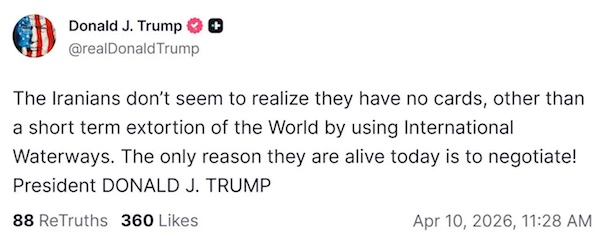
Iran’s deputy Foreign Minister Kazem Gharibabadi says Tehran has entered negotiations from a position of strength, arguing that the war on Iran had failed to deliver decisive strategic gains for the US. Trump – as we detailed below – made it clear he sees Iran ‘holding no cards’.
US Starts Clearing Mines In Strait of Hormuz
Seemingly confirming President Trump’s earlier comments on “clearing out the Strait”, U.S. Central Command (CENTCOM) confirmed that two U.S. missile destroyers started clearing mines in the Strait of Hormuz on April 11 as peace talks kicked off between Washington and the Iranian regime “Today, we began the process of establishing a new passage and we will share this safe pathway with the maritime industry soon to encourage the free flow of commerce,” CENTCOM Commander Adm. Brad Cooper said in a statement Saturday. The American ships included the USS Frank E. Peterson (DDG 121) and USS Michael Murphy (DDG 112).CENTCOM revealed that the mission on Saturday is part of a broader goal to make the crucial waterway, located on the southwest coast of Iran, clear of sea mines laid by Iran’s Islamic Revolutionary Guard Corps. Saturday’s confirmation about the mine clearing came hours after a United States government vessel was spotted entering the Strait of Hormuz, according to the ship-tracking intelligence platform Marinetraffic.com. It’s not clear if this was related to CENTCOM’s mine-clearing mission.
Trump Announces Start Of “Clearing Out” The Strait As A “Favor” To RoW
Earlier reports appears to have been confirmed as three US officials have stated to The Wall Street Journal that two U.S. Navy guided-missile destroyers passed through the Strait of Hormuz on Saturday, marking the first transit of American warships through the waterway since the war began six weeks ago. President Trump took to social media to explain what was going on. But first, he clarified a few things to the ‘fake news media’…“The Fake News Media has lost total credibility, not that they had any to begin with. Because of their massive Trump Derangement Syndrome (Sometimes referred to as TDS!), they love saying that Iran is “winning” when, in fact, everyone knows that they are LOSING, and LOSING BIG! Their Navy is gone, their Air Force is gone, their Anti Aircraft apparatus is nonexistent, Radar is dead, their Missile and Drone Factories have been largely obliterated along with the Missiles and Drones themselves and, most importantly, their longtime “Leaders” are no longer with us, praise be to Allah!
The only thing they have going is the threat that a ship may “bunk” into one of their sea mines which, by the way, all 28 of their mine dropper boats are also lying at the bottom of the sea. Having got all that off his chest, he then confirmed the operation to open the Strait:We’re now starting the process of clearing out the Strait of Hormuz as a favor to Countries all over the World, including China, Japan, South Korea, France, Germany, and many others. Incredibly, they don’t have the Courage or Will to do this work themselves. Very interestingly, however, empty Oil carrying ships from many Nations are all heading to the United States of America to LOAD UP with Oil. Thank you for your attention to this matter! President DONALD J. TRUMP
But he wasn’t done with that. A few minutes later he followed with a shorter pithier version of the same narrative: The Fake News Media is CRAZY, or just plain CORRUPT! The United States has completely destroyed Iran’s Military, including their entire Navy and Air Force, and everything else. Their Leadership is DEAD. The Strait of Hormuz will soon be open, and the empty ships are rushing to the United States to “load up.” But, if you listen to the Fake News, we’re losing! Iran explicitly informed the Pakistani mediator during talks that if the vessel continued its movement it would be targeted within 30 minutes and the Iran-US negotiations would be damaged.
Trump “Proclaims Iran Has ‘No Cards’ As Delegates Arrive In Islamabad”
• Trump ‘Preparing’ US Military If Talks Fail (ZH)
A delegation of top Iranian officials has arrived in Islamabad ahead of ceasefire talks with the United States in the Pakistani capital, Iranian state television reported on Friday. The delegation was led by Iran parliamentary speaker Mohammad Bagher Ghalibaf, along with Foreign Minister Abbas Araghchi and other security and economic officials, state broadcaster IRIB said on its website. It reiterated Iran’s position, however, that talks would only begin if Washington accepts Iran’s preconditions.Read more …
Vice President Vance left Friday for Pakistan and the biggest challenge of his career: negotiating a deal with Iran to solve the nuclear dispute and end the war.”This is a big deal for JD. He is going to the Super Bowl,” one U.S. official told Axios. Mr Vance will lead the American delegation in Pakistan on Saturday, alongside special envoy Steve Witkoff and Jared Kushner, Donald Trump’s son-in-law.They will attempt to solidify a temporary ceasefire agreed this week. Before boarding Air Force Two to fly to Islamabad, Mr Vance said Mr Trump would not be at the talks but had set “pretty clear guidelines” for his team. He said: “As the president of the United States said, if the Iranians are willing to negotiate in good faith, we’re certainly willing to extend an open hand. If they’re going to try to play us, then they’re going to find that the negotiating team is not that receptive.”Trump Claims Iran has ‘No Cards’ …but does the White House actually believe this? He suggested that if the Iranians hadn’t agreed to negotiate, they would be dead (cue wiping out entire “civilization” threat from earlier).
Trump Warns Attack on Iran Will Continue if Tehran Doesn’t Comply
President Trump has confirmed to the NY Post that he’s preparing the US military for what would likely be a bigger Iran operation should Tehran not comply, and should Pakistan talks fail. “We’re going to find out in about 24 hours. We’re going to know soon,” Trump told the Post when asked if he thinks the talks will be successful. Already there’s a lot of back and forth over the 10-point plan on the eve of the summit, and with both sides now in Islamabad. A main point of contention remains whether Lebanon is part of the two-week ceasefire agreement. There’s also been much speculation that all of this is just ‘cover’ for a bigger build-up of Pentagon forces in the region. Also, Iranian forces are no doubt using the opportunity to regroup.Ghalibaf Demands Attacks on Lebanon Cease Or Else…
Iran Parliament spokesman Mohammad Baqer Ghalibaf, considered the official who is likely running the country day-to-day, says there will be no negotiations before the following:
1) ceasefire in Lebanon
2) release of Iran’s blocked assets: “release of Iran’s blocked assets prior to the commencement of negotiations.”
Oil jumped on the news. This as some sporadic Israeli bombings of Lebanese territory have persisted into Friday, despite talk of an Israel-Lebanon ceasefire, with talks expected in Washington next week. It’s unclear whether Tehran and its negotiating team which just touched down in Pakistan will hold to this or not.
De-mining has started.
• Several US Warships Reportedly Transit Strait of Hormuz (ZH)
Just as indirect talks kick off in Islamabad, a shocking and surprise development is being reported by Axios’ Barak Ravid, though this is not confirmed: https://twitter.com/BarakRavid/status/2042946011400753294Read more …
If accurate, are we witnessing Trump suddenly pile on more leverage before negotiations even get off the ground? It seems like the Iranians would have noticed several US Navy warships passing. Either they held off attack for the sake of pursuing peace, or this was truly done ‘stealthily’ and Iranian capabilities are degraded to the point they may have ‘missed’ it. Or is this an attempt to muddy the negotiations? Sabotage? Ravid after all has long stood accused of pushing an Israeli agenda in his reporting.Talks Begin with Indirect Format Mediated by Pakistanis
By Saturday afternoon (local), the highest-level US-Iran-related talks since the 1979 Islamic Revolution have kicked off in Islamabad. Vice President JD Vance met Pakistan’s Shehbaz Sharif just ahead of the negotiations, and also senior Iranian officials were greeted by Sharif and other Pakistani leaders. Iran’s delegation is led by Parliament Speaker Mohammad Bagher Ghalibaf and Foreign Minister Abbas Araghchi. The engagement by each side has begun indirectly.Pakistan has made clear it is working to facilitate direct negotiations between the US and Iran to fully bring to an end the six-week war in the Middle East. Sharif hailed both sides’ commitment to engaging constructively, and “expressed the hope that these talks would serve as a stepping stone toward durable peace in the region,” his office stated in a news release.
“Vance was joined for the bilateral meeting by special envoy Steve Witkoff and President Donald Trump’s son-in-law, Jared Kushner,” CNN reviews. “Sharif was joined by Deputy Prime Minister and Foreign Minister Sen. Mohammad Ishaq Dar, along with Interior Minister Sen. Syed Mohsin Raza Naqvi, according to a news release from the Pakistani prime minister’s office. There was no press coverage of the meeting.”
“If people are not careful, their stability will be personally defined by Candace Owens, Tucker Carlson, Megyn Kelly, Alex Jones and a lot more. We become what we consume, both physically and mentally.”
• For Entertainment Only – The Firehose of Crazy (CTH)
Several months ago, I was asked to assist with what was called a “firehose of crazy.” I don’t ordinarily pay attention to the goofy stuff, and I didn’t look at most of the citations being referenced. That said and with recent events in view, I have a new appreciation for what that meant.Read more …
When President Trump responded to the goofball diatribe of Alex Jones, what he apparently was referencing was a segment Jones put out on his podcast when he first requested the administration to intervene and use the 25th amendment to remove Trump. Mr. Jones followed that call for the 25th amendment, by saying he wanted administration officials to conduct a soft-coup against the President of the United States, because Trump wasn’t following his advice.https://twitter.com/JayTC53/status/2041314899574305162?s=20
President Trump rightly responded to the quackery of the podcast world, and collectively they have lost their mind over it. In response, Jones is now saying Melania Trump is planning to divorce Donald Trump {CITATION}, and then, if President Trump says one more bad thing, Jones’ is going to unleash his podcast audience to destroy the President of the United States. Folks, these characters are not psychologically stable people. This is a level of weird only evident now because Trump decided to address it. I mean think about it. Stop for a moment, pull back from social media, and think about the stability of mindset here:
Tucker Carlson decides it’s a value to his position to attack Reverend Franklin Graham?Megyn Kelly decides it’s a value to her position to support attacks on Charlie Kirk’s wife? Alex Jones decides it’s a reasonable discussion to talk about organizing JD Vance to take control of the government using the military. Laura Loomer decides it’s a value to her position to attack anyone who she defines as not supporting the government of Israel. One of her targets is Tulsi Gabbard. Mark Levin decides it’s a value to his position to convince the President of the United States to undermine and remove the sitting Director of National Intelligence because his priority aligns with Loomer. All because they disagree with decisions President Donald Trump has made about dealing with foreign policy issues.
I don’t usually watch any of these podcast groups or their internecine battles du jour. But c’mon, these are not stable people. It might be entertainment for many people, but algorithms pushed “for you” are not real life. This stuff, all of it, is just plain goofy.
If this is representative of the minds that have been trying to push “information” into the Trump administration, well, yeah, that would be a ‘firehose of crazy‘. These are not serious people. They are not alone, not by a long shot; there’s a whole infrastructure of crazy voices chasing money that’s provided by a big tech algorithm intentionally designed to promote it. The professional UniParty in DC is watching this unfold with a very big smile on their face. It is very clear where this algorithmic identity tracking and micro-targeting is going. If people are not careful, their stability will be personally defined by Candace Owens, Tucker Carlson, Megyn Kelly, Alex Jones and a lot more. We become what we consume, both physically and mentally.
Do boomers remember Khomeini as well as Khameini? Trump does. Trump doesn’t want to leave the world with -the legacy of – Khomeini.
• Since the Iran War Began, Trump’s Popularity With Boomers Has Climbed (Pinsker)
It’s eye-opening, because 50 was the magic number in a Pew Research poll on Israel from earlier in the week: Overall, 58% of Republicans have a positive view of Israel — but for Republicans aged 18 to 49, 57% have an unfavorable view. So something age-related is going on, splitting popular opinion. From Newsweek: Donald Trump Scores Approval Rating Boost With Boomers President Donald Trump is narrowing his approval gap with older voters, as new polling shows a steady improvement among Americans age 65 and over. […]Read more …
Older voters are among the most reliable participants in U.S. elections, and even small shifts can carry outsized political weight. Changes in this group come as foreign policy dominates headlines and economic pressures hit generations unevenly. Trump’s approval rating among Americans age 65 and over has risen steadily over the past three months, according to a series of Economist/YouGov polls. My theory? Boomers and Gen Xers rely on social media as a primary news source significantly less than Millennials and Zoomers. We’re the last two generations that watched cable TV, read newspapers, and listened to talk radio. We’re political omnivores. All that content we absorbed shaped our worldview. How could it not?For Millennials and Zoomers, if their favorite YouTuber didn’t talk about it — and it never appeared in their TikTok/Reddit feed — then it didn’t really happen. As such, it makes them uniquely susceptible to digital psyops campaigns. And that’s something Iran does extremely well. It’s led to a profound cultural shift: Thirty years ago, all the good-hearted liberals were protesting for Tibet. Nobody was cooler than the Dalai Lama! At every award show, Hollywood’s biggest celebrities virtue-signaled by shouting, “Free Tibet!” Today, nobody cares.
Between Tibet-related content being shadow-banned (or outright banned) from social media and/or entertainment companies submitting to Chinese censorship, Tibet is an afterthought. All those good-hearted liberals went from “Free Tibet!” to “Free Palestine!” So perhaps Newsweek’s reporting indicates that Americans who are actually knowledgeable about Iran’s anti-American history are most appreciative of Trump’s efforts. Remember, Operation Epic Fury didn’t begin until Feb. 28:
In the earliest of the three surveys, conducted February 6 to 9, Trump posted a net approval rating (those who approve of his job performance minus those who disapprove) of minus 12 among adults 65 and older. In that poll, which surveyed 1,730 U.S. adult citizens and carried a margin of error of plus or minus 3.1 percentage points, 43 percent of respondents in the age group approved of his job performance, while 55 percent disapproved. Which means, pre-war, Boomers were 43% positive, 55% negative.
A month later, the March 6 to 9 Economist/YouGov poll showed improvement. Among voters age 65 and over, 45 percent said they approved of Trump’s performance and 53 percent disapproved, narrowing his net rating to minus eight. That survey included 1,563 U.S. adult citizens and had a margin of error of plus or minus 3.4 percentage points.After the first few days of the war, Trump’s popularity ticked up by two points. Instead of deeming it “disgusting and evil,” Boomers nodded in cautious approval.
The trend continued into early April, with the most recent poll, conducted April 3 to 6, showing Trump’s approval rating among those 65 and older on the rise again, reaching 47 percent approval and 52 percent disapproval. The net rating of minus five marks his strongest showing with the age group this year. That survey was based on a sample of 1,750 U.S. adult citizens and carried a margin of error of plus or minus 3.2 percentage points. [emphasis added] And by April 6 — a full month into the war — Trump’s popularity ticked up yet again. The longer the war goes on, the more Boomers seem to support it.
It’s eye-opening because D.C.’s conventional wisdom was always the opposite: Time isn’t on the president’s side. A long war will be a political nightmare. If Trump doesn’t find an offramp post-haste, the GOP will get slaughtered in the midterms. The public is paranoid that Iran will be another “Forever War.”For Boomers, at least, that’s simply not true. They want a solution to the Iran problem — because they recognize that it’s a real problem. You can’t let Islamic nutjobs divide the atom.If those maniacs ever gain a nuclear weapon, the world is in deep trouble.
It also suggests the next PR move for the Trump administration: It needs to invest in an information campaign that’s tailored to the sensibilities of Millennials and Zoomers. That means penetrating the YouTube, TikTok, and Reddit echo-chambers. MAGA messaging must meet voters where they are — and Zoomers are spending 6.6 hours a day consuming digital content. A Truth Social post, a Fox News TV interview, and a primetime speech aren’t enough to win their hearts and minds. Because the more the audiences know about Iran, the more they’ll support the president.
Europe’s weak leaders made Europe weak.
• Who’s Afraid of Emmanuel Macron? (J.B. Shurk)
French President Emmanuel Macron is doing that peculiar French thing again…acting tough while looking weak. He gave a speech last Friday at Yonsei University in Seoul during which he demanded that nations not become “vassals” of China or the United States. Macron wants South Korea to join Canada, Australia, and the European Union in forming what he calls a “coalition of independence” (because “coalition of the willing” was taken) united by shared love for “international order,” “democracy,” and wasting money on “climate change.”Read more …
What a tool. I understand that “the powers that be” have so successfully co-opted the West’s political systems that they regularly install absolute nincompoops as nominal leaders (Biden, Starmer, Carney, Merz, and European Queen Ursula, just to name a few) and call it “democracy,” but Macron is such a doofus that his “leadership” is laughable.Remember when the little Rothschild banker came to power a few months after President Trump had taken office and he couldn’t stop talking about standing up to “bullies”? After putting on some high-heeled loafers and taking some lessons on masculinity from his former-schoolteacher-turned-much-older-wife, Macron insisted on turning a handshake with Trump into a death grip meant to showcase French power. In that effete style of speech that Gaulish-Roman aristocrats enjoy — in which words sound as if they’re dropping from lips suckling grapes and licking honey — le petit fromage told the world that his fierce handshake and determined stare were the perfect weapons for countering President Trump. Trump just laughed and patted the little French boy on the shoulder as one does to help the weak feel strong.
Fast-forward a decade, and Macron hasn’t learned a thing about being tough. He still prances around the world like a eunuch looking for long-lost cojones. He says he wants countries to resist the “hegemonic powers” of China and the United States by clinging to the rules-based “international order.” Okay. Good luck, tiny dancer.
What’s left of the international order without the two most powerful nations on the planet? The United States has assumed the responsibilities of the globe’s police chief since WWII. Through its naval fleet, it ensures the security of maritime trade. Through its economic clout, it ensures the stability of the international financial system. Through its military might, it decides which dictators get black-bagged in the middle of the night. As China continues its geopolitical ascent, its tentacles have stretched further into international organizations such as the United Nations’ World Health Organization and across continents with its Belt and Road Initiative. Mark Carney has spent his time as Canada’s prime minister practically groveling at the feet of China’s Xi Jinping and begging the communist dictator to save his wintry vassal state from the bad orange man down south.
France, on the other hand, continues to be ejected from former African colonies whose peoples have grown tired of French meddling. The French military excels only at surrendering. And France remains distinct from Germany only because of the United States. When little Macron insists on restoring a French-led “international order,” he sounds a lot like little Napoleon, who insisted on being called “emperor” while imprisoned on Saint Helena.
As for urging all who hear his grating voice to unite in defense of “democracy,” that’s a lark! Europe is where “democracy” goes to die. Every time non-Establishment political parties win the most votes in former nations (now just multicultural zones of Islamic conquest within the federation of European nothingness) such as France, Germany, and the Netherlands, “the powers that be” proudly block the winners from exercising any power.
Europe’s political class shamelessly calls this the “firewall” against “far-right” political parties. Of course, if you believe that nations should have borders and that government powers should be limited, you are designated “far-right.” Just as Democrats bastardize language in the United States by calling everyone who cares about the Bill of Rights a “fascist,” the European Establishment labels anyone who believes in self-determination and personal liberty a “Nazi sympathizer.” Then they prosecute the members of those fake “far-right” parties for expressing opinions out loud.
That’s right! Europe’s little gang of dimwitted yet dangerous dictators — Macron, Starmer, Merz, and the ruling queen — insist on locking up the “fascists” for their speech in the name of “democracy”! When the “firewall” fails — as it did in Romania a little over a year ago — the European oligarchy simply cancels the election and insists on a rigged do-over (or outright overthrows the government as it did, with the help of the U.S. State Department and CIA, in Ukraine in 2014).
When little European tyrants such as Macron stand on footstools, puff out their chests, and shriek about “democracy,” they have no intention of supporting the decisions of the people. What they mean is, let’s form a European Commission of aristocrats, have them choose a ruling monarch, and call that a “democratic” election. That’s how the nations of Europe lost their sovereignty and why the people of Europe must now bow down to unelected Queen Ursula von der Leyen.
They expect America to lead NATO into WWIII.
• The US Separation From Europe And NATO Is Long Overdue (Alt-M)
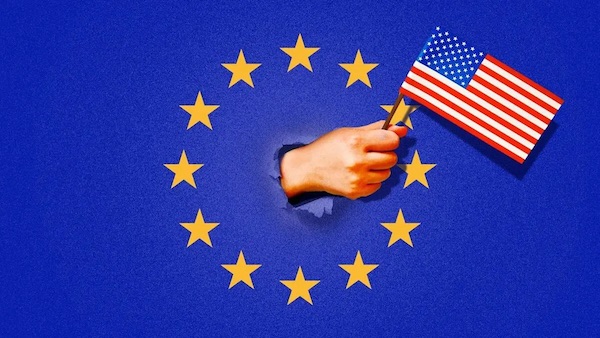
As much as many centrists and libertarians are opposed to Donald Trump’s ongoing strikes against Iran, I have to say, the downstream result might end up becoming one of the most libertarian results I have ever seen. For decades, small government activists like those in the Ron Paul movement have been calling for a comprehensive US divorce from NATO and the shutdown of America’s military bases overseas. Trump has, either deliberately or inadvertently, set this very process in motion.Read more …
The refusal of most of Europe (and Australia) to provide support in the reopening of the Strait of Hormuz might seem like geopolitical orbiting – In other words, getting involved could hurt them more than it would help them. Of course, these nations are far more exposed to the Hormuz closure and the slowdown in energy exports than the US. You would think their interests would demand a securing of the strait. Europe is already struggling for energy resources due to the Ukraine war (a war they are deeply involved in), and this is where we stumble upon the ideological disconnect.Europe’s Goal Is WWIII And They Expect America To Maintain The Status Quo
Europeans are perfectly willing to engage in war tensions with Russia while risking energy inflation and WWIII, all over a country that had minimal strategic or economic importance to them before the conflict. They have consistently called on the US to provide weapons and funding and intel to the Ukrainians, which we have obliged. And, they have called for American troops to stand at the forefront should a wider war erupt. NATO and European governments love America…but only as a shield that benefits them. To be clear, it’s true that years ago NATO allies invested troops and equipment into the wars in Afghanistan and Iraq, but one could also argue that, at that time, the establishment was in sync on both sides of the Atlantic.There was no large scale movement to cut foreign aid scams (like Trump shutting down USAID). There was no movement to secure borders and prevent mass immigration. There was no movement against globalism beyond a handful of us in the alternative media working diligently to expose the truth. In the era of the early 2000s, the status quo was in full effect and Europe was happy to help in the Middle East. Today? Not so much. The status quo has been disrupted.
Once The Cash Stopped Flowing Our “Friends” Became Scarce
It’s not surprising that once the cash stopped flowing so easily from American pockets, suddenly all of our “allies” went sour. Cuts to USAID and various foreign subsidy programs have created a shockwave in the global order. Even I have been stunned by the level of dependency of foreign nations on US monetary injections. Once these programs started shutting down, the panic was palpable. And, once Trump demanded NATO countries start paying their fair share (5% of GDP), the breakdown in relations began. Many European social welfare programs exist exactly because they don’t have to pay for their own military defense.The tariffs are another point of hypocrisy. Nearly ALL major European countries and economies have enforced tariffs and duties on US products for the past 60 years. When those same countries face tariffs imposed by the US, suddenly tariffs are an “act of aggression” and a line in the sand. Trump is called an economic “bull in a china shop”, but he’s only doing to them what they’ve been doing to us for generations. Once again, the moment the status quo changes even a little and other nations are held to a similar standard, our friends no longer want to be our friends.
ICE=government.
• “Create a Crisis”: Sponsor an Anti-ICE Campaign (Turley)
“Create a crisis.” That call is made in a new campaign sponsored by the American Association of University Professors to force “colleges to drop their contracts with ICE’s key corporate enablers.” Despite years of criticism over the purging of faculty ranks of conservatives and libertarians, university professors continue to double down on far-left ideology that is now an orthodoxy in higher education. I previously wrote about the AAUP’s ideological shift in my book, The Indispensable Right: Free Speech in an Age of Rage. After that book, the AAUP then selected Todd Wolfson, a far-left activist, as its new president.Read more …
Wolfson ran on the pledge to make AAUP a “fighting organization” for social change. After his selection, Wolfson has called Trump supporters “fascists” and demanded boycotts of Israel. Given that history, it was little surprise to see the AAUP’s sponsorship of this campaign, as reported by the College Fix. The campaign is also funded by Coefficient Giving, associated with liberal billionaire Dustin Moskovitz and his wife Cari Tuna. They have been criticized for reportedly funding groups pushing defund police and other radical agendas.AAUP joined this campaign with Young Democratic Socialists of America, Sunrise Movement, and the Workplace Justice Lab at Rutgers University. It includes a toolkit instructing students to “create a crisis for university admin through an escalating campaign.” The campaign seeks to organize to combat the “Trump regime” and its “terrorism”: “When students and workers join together in action, we can force our schools to stop funding and normalizing ICE collaborators and take down the whole regime.” They are targeting companies such as Enterprise, Flock, ICE Air Carriers, Hilton, and Target.
The campaign states further that “ICE, and the Trump regime generally, cannot function without the consent and collaboration of the business world. Breaking companies from ICE is the central axis for generating enough leverage to stop the regime’s terrorization campaign.”= So university professors are funding a campaign that actively seeks to create a crisis on campuses. It takes a position as an organization that immigration enforcement is a form of terrorism. The silence among faculty is deafening. Rather than objecting that the AAUP should focus on issues related to academic freedom and protections for its members, there have been virtually no objections to the organization’s ideological agenda.
It is evidence of the new orthodoxy in higher education and the refusal of administrators and faculty to make any meaningful change in their intolerance for opposing views. Many departments no longer have a single Republican faculty member in this academic echo chamber. A Georgetown study found that only 9% of law school professors at the top 50 law schools identify as conservative — almost identical to the percentage of Trump voters in the new poll. There is little evidence that faculty members are interested in changing this culture or creating greater diversity at schools. In places like North Carolina State University, a study found that Democrats outnumbered Republicans 20 to 1.
Yale University has finally achieved the academic version of Nirvana, a state of perfect peace and enlightenment. A recent study found that the faculty had finally purged every Republican donor from its ranks.According to a recent report from the Buckley Institute, there is now not a single Republican found across 27 of 43 departments at Yale University. In a nation roughly evenly divided between Republicans and Democrats (with a slight advantage to the GOP), only 3 percent are Republicans across all Yale departments.
The hostility to opposing views is impacting our students. A new study offers additional data on this problem, showing that almost 90% of students misrepresent their views in class and on assignments to satisfy faculty by adopting more liberal views. In the meantime, the small number of dissenting faculty have no real voice, particularly among legal academics. I have previously written about the similar liberal agenda of the American Bar Association despite plunging membership among lawyers. The ABA now represents just 17 percent of the bar.
Elections today, April 12.
• How the Russiagate Blueprint Has Been Unleashed Against Orban (RT)
The shadow campaign to swing the Hungarian election against Viktor Orban escalated with the scandal over the wiretapping of Hungarian Foreign Minister Peter Szijjarto. The case offers a rare look into how bureaucrats, journalists, and spies run a regime-change operation in real time. Three weeks out from the April 12 elections, the political opposition to Orban scored what seemed to be a win, when Politico and the Washington Post ran articles alleging that Szijjarto had phoned Russian Foreign Minister Sergey Lavrov with “live reports on what had been discussed” at multiple EU meetings. The reports cited anonymous “European security officials.”Read more …
Neither Orban nor Szijjarto make any secret of their desire to maintain cordial relations with Moscow, particularly on matters of energy security and the peace process in Ukraine. However, when bundled with more outlandish claims – that Russian “election fixers” are already embedded in Budapest, for example – the reports paint a picture of a government compromised by the Kremlin.Orban’s leading opponent, Peter Magyar, has repeated these claims in his speeches. After the Szijjarto story broke, he accused the foreign minister of “betraying Hungarian and European interests,” and threatened him with “life imprisonment” for treason, should his Tisza party win the election. All it took was one leaked audio file for the scheme to unravel.The Szijjarto wiretapping plot
In an audio file released by Hungarian conservative outlet Mandiner, opposition journalist Szabolcs Panyi can be heard telling a source how he passed Szijjarto’s phone number to “a state organ of an EU country.” Once they had this number, he explained, agents of this country were able to extract “information about who that number spoke to, and they see who is calling that number or who that number is calling.” In a Facebook post, Panyi confirmed that he was the person on the recording. He said that he was asking his source whether she knew of any alternate numbers used by Szijjarto or Lavrov, “so that I could compare them with information received from the national security service of a European country.”Panyi’s confession explained how the “European security officials” were able to track Szijjarto’s phone conversations before feeding the information to Politico and the Washington Post. Orban immediately announced an investigation into the wiretapping. We are dealing with two serious issues, the PM stated the same day as Panyi’s post. There is evidence that Hungary’s foreign minister was wiretapped, and we alsohave indications of who may be behind it. Szijjarto explained that as the EU’s longest-serving foreign minister, he regularly speaks to Lavrov with messages from his colleagues in the EU. The real scandal, he said is that a Hungarian journalist is colluding with foreign secret services in order to wiretap a member of the Hungarian government.
No leaders, no democracy. And soon no fuel.
• What Is Fueling Unrest Across The EU? (RT)
The EU is sliding into a fuel crisis driven by a global supply shock caused by the US-Israeli attack on Iran. It has already triggered protests, early signs of shortages, and warnings of the wider economic impact. This has resulted from the disruption of the Strait of Hormuz, a critical route for global energy shipments. Oil prices surged above $120 per barrel during the escalation, and while crude fell below the $100 mark after a two-week US-Iran ceasefire was announced on April 7, it remains well above the $70 level before the war. Prices have remained volatile amid uncertainty over the truce and continued disruption to shipping through the strait.Read more …
Diesel and kerosene have emerged as the central pressure points in the crisis. Europe’s benchmark diesel and jet fuel prices have risen above $200 per barrel equivalent from below $100 in January, according to Bloomberg. Jet fuel prices have also surged since the start of the conflict in late February, according to industry data cited by multiple outlets. Why has diesel become more expensive than gasoline? The European market has shifted toward higher diesel consumption following decades of tax policies that lowered diesel taxes compared to gasoline.The EU’s refining system produces a different mix of fuels than the market consumes. A barrel of crude oil typically yields about 40-50% gasoline, but only around 30–40% diesel and jet fuel combined, with the rest made up of heavier products. This mismatch has left the bloc structurally short of diesel. The region is a major net exporter of gasoline but relies on imports for a significant share of its diesel and jet fuel. Diesel has traded above gasoline prices at the pump in several EU countries.
Rising wholesale costs have fed through to consumers. Diesel prices at the pump have exceeded €2 per liter in multiple countries, according to national data and media reports — equivalent to roughly $8.80–$10.50 per US gallon, compared with about $5.60 per gallon in the US. Governments in Italy, Portugal, Slovenia, Hungary, Spain, Poland, and Ireland have introduced tax cuts and other measures to limit the impact of rising fuel costs.
Why are farmers and truckers protesting?
Rising diesel prices are hitting sectors most dependent on the fuel, particularly agriculture and road freight. The EU’s transport sector is facing a “fast-moving diesel shock,” according to logistics platform Logifie. Ireland has become the most visible flashpoint of the crisis. Fuel protests have spread nationwide since this past Tuesday, led by farmers, truckers and transport workers, disrupting supply chains and transport networks, according to local media.Blockades have strained fuel distribution, with queues forming at petrol stations with some running dry amid panic buying. On Thursday, the government called in the army to clear the blockades. During a protest march in Dublin on Friday, demonstrators carried a coffin with “RIP Ireland” written on it. Airports across Europe could face “systemic” jet fuel shortages within three weeks if the Strait of Hormuz remains closed, according to a letter sent by an airport industry group to the European Commission, as cited by the Independent.
According to Corriere della Sera, “some airports on the continent have been experiencing shortages in jet fuel quantities for days without officially reporting it.” The outlet cited its sources on Friday as saying that “it’s such a sensitive issue that official talk remains tight-lipped,” adding that Brussels is hoping the truce between the US and Iran will hold. Ryanair, Europe’s largest airline by passenger numbers, has started reducing flights to popular destinations, with chief executive, Michael O’Leary warning that the airline will not be able to run its full summer schedule if the Strait of Hormuz remains closed.
Bye!
• Women Step Forward to Outline Swalwell’s Sexual Assault History (CTH)
It was building in the background for several weeks; the stories of multiple women who had been raped and sexually assaulted by congressman Eric Swalwell. Today, the San Francisco Chronicle began outlining their stories [SEE HERE], and now an exit of people from his campaign begins.Read more …
WASHINGTON DC – Rep. Eric Swalwell’s campaign for governor was reeling Friday after an ex-staffer accused him of sexual assault, with multiple staffers resigning and both a prominent ally and rival candidates calling on the California Democrat to exit the race.The exodus, which began just before the San Francisco Chronicle published a report detailing a former staffer’s claims, jolted California’s marquee race just weeks before ballots start landing in voters’ mailboxes. The former staffer told the newspaper that Swalwell had sexual encounters with her while working for him, and that he sexually assaulted her twice when she was too drunk to consent.
In September 2019, the woman said, Swalwell invited her out for drinks and she became so severely intoxicated that she does not remember the rest of the night. She said she woke up naked in Swalwell’s hotel bed and could feel the effect of vaginal intercourse. {source}
Top staffers departed the campaign shortly before the story published. Soon after, Rep. Jimmy Gomez said in a statement that he was stepping down from the campaign and urged Swalwell to leave the race — a stunning rebuke from a key surrogate who had helped introduce Swalwell to power players in Sacramento, where Gomez served in the state Assembly.
“Today I learned shocking information about Eric Swalwell containing the ugliest and most serious accusations imaginable,” Gomez said in a statement. “My involvement in any campaign begins and ends with trust. I cannot in good conscience remain in any role with this campaign, and I am stepping down from it effective immediately.”
The fallout extended to prominent interest groups that had backed Swalwell. The California Medical Association, which has dropped more than $1 million into a pro-Swalwell committee, said it was convening an emergency board meeting. The California Teachers Association suspended its endorsement. (read more)
“Swalwell has denied the allegations, but that has done absolutely nothing to stop the bleeding. And the bleeding has been catastrophic.”
• Eric Swalwell’s Political Future is Collapsing Fast (Matt Margolis)
On Friday, a former staffer to Rep. Eric Swalwell (D-Calif.) came forward with allegations of sexual assault against the longtime congressman. By the end of the day, the dam had broken wide open — and Eric Swalwell’s political future was crumbling right along with it. The San Francisco Chronicle reported that a former congressional aide accused Swalwell of two non-consensual sexual encounters, including one where she claims she woke up in his hotel room after becoming intoxicated. CNN then dropped its own bombshell, reporting that four women total allege sexual misconduct by Swalwell — one of whom accuses him outright of rape. “I was pushing him off of me, saying no,” the woman said.Read more …
Swalwell has denied the allegations, but that has done absolutely nothing to stop the bleeding. And the bleeding has been catastrophic. First, his campaign experienced an exodus. His campaign co-chairs bailed immediately. Rep. Jimmy Gomez called the accusations “the ugliest and most serious accusations imaginable,” and resigned on the spot. Rep. Adam Gray was equally blunt: “Today’s reports about Eric Swalwell’s conduct while in office are deeply disturbing. Harassment, abuse, and violence of any sort are unacceptable. Given these serious allegations, I am withdrawing my support, and Eric Swalwell should end his campaign immediately.”Top Democrat Rep. Ted Lieu (D-Calif.) also pulled his endorsement. Then came a wave of others. Even the institutional pillars cracked. The California Teachers Association suspended its endorsement. So did SEIU California. Sen. Adam Schiff called on Swalwell to exit the race. But the real problem for Swalwell isn’t the loss of staff or endorsements; it’s that his fellow Democrats are also calling on him to drop out of the race. Now, obviously, his Democrat opponents, former Rep. Katie Porter and billionaire Tom Steyer, have called on him to drop out, but so has Nancy Pelosi. And that’s a political death sentence.
“This extremely sensitive matter must be appropriately investigated with full transparency and accountability,” Pelosi said in a statement. “As I discussed with Congressman Swalwell, it is clear that is best done outside of a gubernatorial campaign.” And she wasn’t alone. Minority Leader Hakeem Jeffries, Minority Whip Katherine Clark, and Democratic Caucus Chair Pete Aguilar piled on in a joint statement, calling for a “swift investigation,” and demanding an end to Swalwell’s campaign. “This is unacceptable of anyone — certainly not an elected official — and must be taken seriously,” they said. “No one in a position of power should be allowed to act above the law or with impunity,” Rep. Ro Khanna said. “The same rules must apply to Eric Swalwell.”
Over on the Republican side, Rep. Anna Paulina Luna said she was weighing censure and other action “if there is evidence brought forward,” and three sources told reporters that House Republicans were already discussing just that by Friday evening. The response of Democrats to the allegations is quite unusual. They’re not issuing statements saying Swalwell is innocent until proven guilty; they’re telling him to bail. That raises some interesting questions on its own. Do they believe the allegations? I’ve long believed Swalwell’s gubernatorial campaign was never really about Sacramento. It was a launching pad for a presidential run. That ambition is finished now. Democrats are abandoning him, which means his political future is over. And frankly, his career might be finished, too.
There’ll be a lot of huffing and puffing. But 100+ years of car industry as we knew it is over.
• Tesla Gets FSD Supervised Approved in the Netherlands (Electrek)
The Dutch vehicle authority RDW has granted Tesla a type approval for its “Full Self-Driving” Supervised system in the Netherlands, marking the first European country to officially approve the driver-assist technology. The approval, which falls under the UN R-171 regulation for Driver Control Assistance Systems, comes after more than 18 months of testing and is currently valid only in the Netherlands. Other EU member states can choose to recognize it nationally, but that process is not automatic.Read more …
The approval
Tesla Europe announced the news on X, stating that “FSD Supervised has been approved in the Netherlands & will begin rolling out in the country shortly.” The company described the system as “trained on billions of kilometers of real-world driving data” and claimed that “no other vehicle can do this.” The RDW confirmed the approval in its own statement, describing it as a “European type approval with provisional validity in the Netherlands.” The Dutch authority stressed that FSD Supervised is a driver assistance system — not an autonomous or self-driving system. The driver remains legally responsible and must be able to take over immediately at all times.The testing program involved over 1.6 million kilometers of driving on EU roads, more than 13,000 customer ride-alongs, and over 4,500 track test scenarios. Tesla submitted documentation covering more than 400 compliance requirements under UN R-171 and Article 39 exemptions. This approval was originally expected by March 20 but was delayed by about three weeks. Back in late March, the RDW actually pushed back on Tesla’s earlier announcements, saying it had not yet completed its review — a pattern that highlights the disconnect between Tesla’s marketing timeline and the regulator’s actual process.
What it means for Europe
The Netherlands approval does not automatically extend to the rest of Europe. Under EU regulations, other member states can recognize the Dutch type approval nationally, but each country must decide individually. Germany (KBA), France, and Italy are expected to be among the first to act, potentially within 4-8 weeks. Full EU-wide harmonization would require additional regulatory steps beyond national recognition. Tesla has targeted a broader European rollout over the summer of 2026, but that timeline depends entirely on how quickly individual countries process their own approvals.For context, this is a very different model from how Waymo is approaching Europe. Alphabet’s autonomous driving subsidiary is preparing to launch fully driverless robotaxis in London — an actual Level 4 autonomous system where no human driver is needed. Tesla’s approval is for a Level 2 driver-assist system that requires constant human supervision.
What FSD Supervised actually is
The RDW’s statement is explicit: FSD Supervised “can take over many driving tasks” but the vehicles “are NOT autonomous or self-driving.” The driver’s hands don’t need to rest on the steering wheel, but the driver must be able to intervene immediately. Sensors monitor driver attentiveness and eye focus, and if the system detects inattention, it issues warnings and can temporarily disable itself. Under UN R-171, the system is classified as a Driver Control Assistance System (DCAS) — the regulatory term for Level 2 automation. The driver retains full legal responsibility at all times. The regulation specifically mandates measures to prevent driver overreliance, including a mix of visual, audio, and haptic feedback.Tesla must also report safety-critical incidents and submit regular performance reports to the RDW — no less than annually. Critically, the RDW notes that the European FSD software “differs substantially” from the US version. European regulation requires type approval before any system can be used on public roads — unlike the US self-certification model where Tesla can deploy software updates without prior regulatory approval. The RDW also points out that other manufacturers already hold similar approvals in Europe: BMW for motorway hands-off driving with lane changes, and Ford for BlueCruise via Article 39. Tesla’s claim that “no other vehicle can do this” is misleading at best.
[..] Tesla’s own tweet claims “no other vehicle can do this.” The RDW’s own statement contradicts that — it explicitly notes that BMW and Ford already hold similar driver-assist approvals in Europe. And if we’re talking about actual self-driving, Waymo vehicles in the US (and soon London) drive themselves with no human supervision required. Tesla’s system requires a fully attentive driver at all times. Framing a supervised driver-assist system as a unique achievement is misleading.
This matters because advanced Level 2 systems create a well-documented complacency problem. As we’ve covered extensively, even experts who understand the risks intellectually get conditioned into overtrusting the system. Research from the Insurance Institute for Highway Safety found that after just one month of using adaptive cruise control, drivers were more than six times as likely to look at their phones. FSD Supervised is far more capable than adaptive cruise control — the complacency risk is correspondingly higher.
Tesla has already been found guilty of false advertising over the “Full Self-Driving” name in California and has been forced to change its marketing language. Elon Musk keeps making the same safety claims about every new version, and Tesla will not take responsibility when the system makes mistakes — and it still makes mistakes. New European users encountering this technology for the first time should take the “Supervised” part of the name very seriously. Your hands may not need to be on the wheel, but your eyes absolutely need to be on the road.
RDW was extremely rigorous in their review https://t.co/H08x1qS9Y5
— Elon Musk (@elonmusk) April 10, 2026
First (supervised) FSD approval in Europe!
— Elon Musk (@elonmusk) April 10, 2026
Congratulations to the Tesla team and thank you to the regulatory authorities in the Netherlands for all the hard work required to make this happen. https://t.co/8hidEOPSxm
Tesla Semi https://t.co/U8yQUYHVJS
— Elon Musk (@elonmusk) April 10, 2026
Elon Musk: For the next few years, I think America is likely to win the artificial intelligence race. But that early lead is fragile and short-lived. Ultimately, the global victor will be decided by a single factor: it will be a function of who controls the AI chip fabrication.… pic.twitter.com/w5Nbztnj7z
— Ian Miles Cheong (@ianmiles) April 10, 2026
Elon shares insights on the transformative potential of harnessing solar energy beyond our planet.
— XCorpHub (@XCorpHub) April 10, 2026
Even a millionth of the sun's output would deliver roughly a million times more energy than civilization currently consumes.
"The only way to access that energy, the energy of… pic.twitter.com/kuHhrHFymV
Support the Automatic Earth in wartime with Paypal, Bitcoin and Patreon.

Home › Forums › Debt Rattle April 12 2026