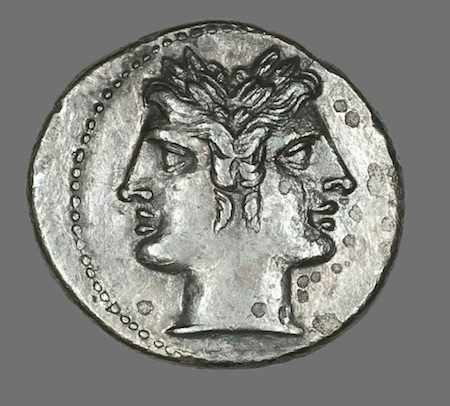

Egypt, Fayum mummy Portrait of a boy, with a golden pendant. between 50 BCE and 250 CE

This is Scott Jennings at his absolute best.
— Overton (@overton_news) March 1, 2026
“The MOST courageous commander in chief of my lifetime.”
When CNN’s Sara Sidner tried to corner @ScottJenningsKY over Trump’s “no war” promise — he delivered a 60-second masterclass.
SIDNER: “How do you square the no war promise… pic.twitter.com/1BGUNAfizz
Good informational video on what happens when the straight of Hormuz closes.
— Syrian Girl (@Partisangirl) March 1, 2026
It closed yesterday. pic.twitter.com/9fseSH6AdX
PepeJeffrey Sachs: US & Israel Attack Iran – War Is Spreading Across the Region https://t.co/SRI2R5eDxB pic.twitter.com/xPoOLFfGHn
— Glenn Diesen (@Glenn_Diesen) February 28, 2026
Neo-Caligula is apoplectic.
— Pepe Escobar (@RealPepeEscobar) February 28, 2026
Had to cancel his Mission Accomplished rant.
His regime change "strategy" miserably failed.
The Pentagon's $1.1 billion radar in Qatar has been turned to dust.
Iran is hitting hard all across the Gulf.
And has not even gone hypersonic. pic.twitter.com/G7vJZ2awxc
https://twitter.com/Thevictoria76/status/2027757456667910334?s=20BREAKING: Iran launched two ballistic missiles against Cyprus, hosts a significant U.S. intelligence facilities as well as British troops.
— Mario Nawfal (@MarioNawfal) March 1, 2026
Iran continues to expand this war… https://t.co/SHAeMs5saT pic.twitter.com/lexa8lmrop
Dr. Fei-Fei Li just called out the biggest blind spot in the entire AI industry.
— Dustin (@r0ck3t23) February 28, 2026
We have been building half of human intelligence. And calling it the finish line.
Li: “If you look at human intelligence, it pretty much boils down to two buckets.”
The first bucket is language.… pic.twitter.com/J7ipeqxOC8
Electricity output is the single best proxy for industrial capacity https://t.co/VCaYm8u9Bi
— Elon Musk (@elonmusk) March 1, 2026
Paul Craig Roberts had a busy weekend.
• The Road to World War III (Paul Craig Roberts)
The failure of Putin and Xi to stand up for their countries in the face of Washington’s aggression has convinced Trump that he can act with impunity anywhere in the world. Remember, Trump said words to the effect that he can do whatever he wants. Trumps words reminded me of Lenin when he declared that “the scientific concept of dictatorship means neither more nor less than unlimited power, resting directly on force, not limited by anything, not restricted by any laws, nor any absolute rules. Nothing else but that.” With AI destroying endless thousands of American jobs, Trump will have plenty of canon fodder with which to invade Cuba, Turkey, Egypt (“from the Nile to the Euphrates”), and with which to occupy Taiwan.Read more …
The Iranian government shares responsibility for the attack on Iran with Russia, China, Israel, and Trump. The witless Iranian government allowed itself to again be deceived, thinking that they were in peace negotiations with Trump while Trump and Israel were preparing an attack on Iran. The Iranian government did not even have the intelligence to protect the country’s leadership from assassination by Israeli missiles. The Iranian government tried to ignore the coming attack and gave away the strategic initiative to its enemies. Putin has done the same thing, and it seems Xi also.These are the wrong messages to send to Trump and Israel. Gilbert Doctorow believes, correctly in my opinion, that the inability of Iran, Russia, and China to act intelligently has brought us to the opening stage of World War III. Putin himself, like Iran, has been deceiving himself and the Russian people for a long time by participating in Ukrainian “peace negotiations,” despite the fact that Putin has said time and time again that it is impossible to trust the Americans. Nevertheless, Putin has setup himself and his country for another deception like the Minsk agreement. China’s only weapons are words that mean nothing whatsoever to Washington.
Perhaps the Democrats will impeach Trump for committing the United States to a war crime without the consent of Congress. But as Trump has proved himself to be Israel’s effective tool, the Democrats would find themselves up against the Israel Lobby, a fight for which Democrats have little stomach. My conclusion is that Israel and it’s American puppet will continue along the road to World War III.
“What the choice comes down to is that Trump represents Israel over Americans, and Democrats represent immigrant-invaders over Americans. The question is: who do you prefer for your ruler?”
• Has Netanyahu Destroyed Trump’s Presidency? (Paul Craig Roberts)
I am happy to report that finally there is some good news. The latest Gallup Poll brings it to us. The poll shows that the attitude of Americans to the Israelis and the Palestinians has shifted and now favors the Palestinians. Little doubt this was brought about by the heartless cruelty toward Gaza civilians by the so-called “Israeli defense force.” Watching a genocide in which entire cities are destroyed, women and children are shot in the head intentionally by Satanic Israeli soldiers, denial by Israel of medicine, food and water for bombed-out Palestinian civilians, and statement after statement by members of the Israeli government that the intention is to dispel Palestinians from Palestine have all contributed to waking up America about the alleged “only democracy in the Middle East.” Perhaps the Israeli-Trump military attack on Iran yesterday will contribute to waking up the peoples of the Western world.Read more …
Americans have also noticed the growing curtailment of their free speech. In some states, such as Texas and Florida, an American citizen who criticizes Israel is disqualified from holding a state job or having a contract to supply the state with goods or services. Students critical of Israel’s behavior are expelled from university. Foreign students are deported if they criticize Israel or support Palestine. University professors are dismissed. Corporate and media employees are fired. It finally dawned on part of the American population that Israel is canceling the First Amendment to the US Constitution. It is easier for Trump to expel by deportation from America, a foreign student legally in the United States who protests the Israeli genocide of Palestine then it is for Trump to deport an illegal alien who has no right whatsoever to be present in the United States.Additionally, Americans have noticed that president Trump represents Israel first and America afterward. It is an affront to national honor to have a president who kowtows to a foreign government. The escape of some Americans from insouciance has resulted in 41% of Americans sympathizing with the Palestinians and 36% with the Israelis. This is a dramatic change from 2019 when about 60% of Americans were aligned with Israel and only 21% with Palestinians. The strongest shift toward Palestinians is among Democrats and Independents. The Republicans with the exception of representative Massey and Senator Paul remain in Israel’s pocket.
There is a large downside for Trump in this development. The United States has spent the first quarter of the 21st century fighting Israel’s wars against Arab states that opposed Greater Israel. With the orchestrated 9/11 attack on the World Trade Center and Pentagon, the George W Bush regime provided the excuse–the New Pearl Harbor– for the United States military to eliminate seven opponents to Greater Israel in five years. The Bush regime claimed that Muslims were responsible and launched a war that destroyed Arab opponents to Israel’s domination of the entire Middle East. Using American blood and vast amounts of American money, Washington has destroyed Iraq, Libya and Syria for Israel. And now Netanyahu has his two- bit puppet, Donald Trump, at work destroying Iran for Israel.
So what is Trump to do? Polls indicate that a large majority of Americans oppose war against Iran. But if Trump refused the mission handed to him by his Israeli master, he would lose the Israel’s Lobby support, and alienate the powerful Israel Lobby and the “Christian Zionists” who comprise a large segment of MAGA America. By going ahead with the attack, Trump alienates those opposed to more war and to Israel’s domination of the American government. With the midterm elections later this year, it is possible that by placing Trump between a rock and a hard place Netanyahu has destroyed the Trump presidency. The pros and cons of Democrats returning to power are obvious. The pro is that Democrats are likely to separate American interests from Israel’s. The con is that Democrats have taken an ideological position against “white racist America.” What the choice comes down to is that Trump represents Israel over Americans, and Democrats represent immigrant-invaders over Americans. The question is: who do you prefer for your ruler? The Israelis or the Muslims and the Hispanics?
Gilbert Doctorow hidden inside a Paul Craig Roberts article. Oh well…
• Trump’s Attack On Iran: Message To Vladimir Putin (Gilbert Doctorow)
This note will be brief insofar as the news from the Middle East is still sparse. The Israeli-US attack on Iran resulted in destruction of the offices of the Ayatollah and of buildings of security forces in Tehran and in other cities, though reports are only preliminary. As for the Iranian counter-attack on Israel and on US military bases in the Gulf, information is still sketchier. However, my purpose is not to provide military intelligence but to offer political intelligence that is highly relevant to the prime interest of this Community – the war in Ukraine and how/whether attempts at brokering a peace by Trump still have any credibility.Read more …
The answer to that question is a resounding ‘no.’ U.S. diplomacy with Iran has now for the second time in less than a year been used only as a cover and a side-show while a vicious act of aggression against Iran was being planned. U.S. diplomacy is an exercise in treachery, nothing more. This truth was widely discussed on Russian state television on the leading news and commentary shows in the past few weeks. Presumably it was discussed within the Kremlin as well, but it is not at all clear that Vladimir Putin is ready to take the measures that the latest developments in Iran point to, namely: to break off all negotiations with Witkoff-Kushner and the Ukrainians; bomb the hell out of Kiev right now to put an end to Ukraine’s war-making potential on the front-lines and free brains and resources for Russia’s entry into the Middle East as co-defender of Iran alongside China.I mention in passing that Trump’s speech to the nation announcing the start of U.S. military operations against Iran for the sake of degrading its military forces and promoting regime change was a vile collection of untruths and outright fabrications. Trump smashed any hopes we may have had that he could play a constructive role in international relations.
Yesterday, in my analysis of how the European Institutions have become smotherers of freedom of expression, of how the Commission exercises monarchical absolutism typical of the ancient regime, I said that they have to be put on a new footing, with cancellation of parliamentary democracy in favor of U.S. style Separation of Powers. Nota bene, checks and balances do not work every time, but they are our only hope for there to be public space open to debate on foreign and domestic policy with no holds barred. Trump’s action yesterday was immediately denounced by a member of Congress as violating the Constitution by opening war on Iran without authorization of Congress. We will see how far this censure goes, but it is a good start towards curbing autocracy in the Oval Office.
©Gilbert Doctorow, 2026
Iran oil exports to Russia? What? Russia is a major oil exporter in and of itself.
• What Epic Fury Means for Putin (David Manney)
The confirmation that Iran’s Supreme Leader Ayatollah Ali Khamenei was killed during joint U.S.-Israeli airstrikes was a cause for celebration inside the country. U.S. military officials announced that the operation targeted Iranian leadership compounds, missile facilities, and nuclear infrastructure across Tehran and other strategic sites. U.S. and partner forces began striking targets at 1:15 a.m. ET to dismantle the Iranian regime’s security apparatus, prioritizing locations that posed an imminent threat. Targets included Islamic Revolutionary Guard Corps command and control facilities, Iranian air defense capabilities, missile and drone launch sites, and military airfields.“The President ordered bold action, and our brave Soldiers, Sailors, Airmen, Marines, Guardians, and Coast Guardsmen are answering the call,” said Adm. Brad Cooper, commander of CENTCOM.Read more …
Following the initial wave of U.S. and partner strikes, CENTCOM forces successfully defended against hundreds of Iranian missile and drone attacks. There have been no reports of U.S. casualties or combat-related injuries. Damage to U.S. installations was minimal and has not impacted operations. The first hours of the operation included precision munitions launched from air, land, and sea. Additionally, CENTCOM’s Task Force Scorpion Strike employed low-cost one-way attack drones for the first time in combat. Operation Epic Fury involves the largest regional concentration of American military firepower in a generation.Israeli Prime Minister Benjamin Netanyahu stated that the strikes aimed to eliminate immediate threats that Iran’s regime posed.Now, will this affect the war between Ukraine and Russia?Iran has long supported Russia’s war effort in Ukraine. Under President Vladimir Putin, Moscow relied on Iranian Shahed drones to strike Ukrainian infrastructure and cities, which became central to Russia’s strategy of targeting energy grids during the winter months.Iran also supplies oil to Russia during periods when sanctions squeezed global markets. Disruption within Iran is now pitting two competing forces against each other. On the one hand, direct Iranian support to Moscow weakens amid disruptions to oil production and drone exports.On the other hand, instability in the Persian Gulf pushes oil prices upward, and Russia remains one of the world’s energy exporters.
Global energy markets face one of their gravest shocks in decades as joint U.S. and Israeli strikes on Iran and Tehran’s retaliatory missile attacks across the Gulf disrupt oil exports from the world’s most important producing region.The duration of the conflict will likely determine the scale of the disruption, but for now, the threat and uncertainty are already enough to severely impact flows from the region, which accounts for 20% of global oil supplies.Barring a swift resolution, oil prices will likely rise sharply when trading opens on Monday morning. Benchmark Brent crude oil prices rose in recent weeks to around $70 a barrel, their highest since August 2025, as investors braced for military confrontation in the Middle East.
With 20% of global oil shipments passing through the Straits of Hormuz and tanker traffic slowing amid heightened security risks, Iran’s temporary closure of maritime routes sent oil prices sharply higher. A 10-12% spike in global crude prices strengthens Russia’s revenue stream, at least in the short term. That creates a paradox in the Ukraine conflict: Higher oil prices give Putin breathing room, while every dollar increase in crude prices translates into billions of additional revenue for the Kremlin. China, facing reduced Iranian supply, may turn more heavily toward Russian exports; that shift could deepen Moscow’s economic relationship with Beijing.
Khameini was no.1 for 35+ years. Not so easy to replace. Takes time.
• Iran Names Interim Successor To Khamenei Under 2nd Day Of Massive Bombs (ZH)
As questions hang over who will ultimately succeed Iran’s slain supreme leader Ayatollah Ali Khamenei, an interim leader has been appointed to fulfill his duties. Top Shia cleric Alireza Arafi has been named to the interim Leadership Council after Supreme Leader Khamenei was confirmed killed in US-Israeli strikes, state media reported Sunday. The ISNA news agency has described that Arafi, a member of the Guardian Council, is joining President Masoud Pezeshkian and Chief Justice Gholamhossein Mohseni Ejei on the body tasked with carrying out the supreme leader’s responsibilities until the Assembly of Experts appoints a permanent successor. All of this happening as US-Israeli bombs continue to fall on Tehran and other sites for a second straight day, ‘uninterrupted’ – as President Trump pledged Saturday.Read more …
Born in 1959, 67-year-old Alireza Arafi ranks among the most powerful clerics in Iran. Before his emergency elevation, he held three key posts: director of the nationwide Islamic Seminary system, member of the Guardian Council, and member of the Assembly of Experts. While rooted in Qom’s clerical establishment, Arafi combines traditional religious authority with seeking to carefully modernize Iran; however his appointment of course signals continuity, and he’ll be tasked with seeking to ensure regime survival – which is what this moment is all about for Tehran. Most importantly, Arafi is viewed by the IRGC and political leadership as a loyal insider who will preserve a retaliatory trajectory during wartime.Heavy US and Israeli bombing has been observed Sunday on the Iranian capital, particularly on known government and military command centers, but that hasn’t stopped large gatherings of mourners in other parts of the country.While there’s been evidence of local celebrations in some sectors among anti-government Iranians, Sunday footage on state TV and other international media shows loyalists in possibly the hundreds of thousands showing solidarity with the slain Ayatollah the Islamic Republic leadership.
]President Masoud Pezeshkian condemned the killing as “a great crime” and has declared seven days of public holidays in addition to the 40-day mourning period. Outraged and saddened Iranians were seen pouring into the streets of the capital soon after state TV finally made the announcement confirming Khamenei’s killing during the opening salvo of the US-Israeli attack. Iranian authorities have alleged major war crimes, including the deaths of over 85 young girls attending school when a bomb struck.
“There will be expected ceremonies,” Pezeshkian said, while noting they will have to happen even while the bombardment continues across the country. He’s also said his country views revenge as its “legitimate right and duty” after Khamenei had been murdered by the “most wicked villains in the world.” The president further claimed the act was a “declaration of open war on Muslims, especially Shiites, in all corners of the world.” According to NBC:
The government in Iran is under attack like never before. Today tens of thousands of regime supporters packed into Tehran’s Revolution Square to mourn the late Supreme Leader Ayatollah Ali Khamenei, who was killed in a joint U.S. and Israel military operation. They chanted “God is great!” while officials promised revenge. One said Iran would deliver “terrifying blows” to make the U.S. and Israel beg for mercy.
“Every American has the right to be totally ashamed.”
• Netanyahu and Trump: the New Hitler-Mussolini Pact (Paul Craig Roberts)
Trump’s claims against Iran are a packet of lies. They are Trump’s excuses for complying with Netanyahu’s demand that Trump take the United States to war against Iran for the sake of Israel’s agenda of Greater Israel. This is despicable behavior for anyone, especially for a president of the United States. Americans always fall for patriotic propaganda, and the gullibility and insouciance of the American population is what Netanyahu and Trump are relying on to insure misperception of illegal aggression as humanitarian work blessed by God. The Iranian government, the Iranian people, Putin, and Xi share responsibility for the wanton act of aggression against the Iranian nation.Read more …
The Iranian government sat on its butt, giving up the strategic initiative, despite the obvious fact that a massive attack against Iran was nearing completion. The utter stupidity of the Iranian people allowed themselves to be tricked by American operatives into mindless participation in demonstration not against the US and Israel, but against their own government, and gave Trump and Israel an excuse for the attack and the hope that it will lead to regime change utin and Xi not only lacked the intelligence to form a mutual security agreement between Russia, China, and Iran, an agreement that would have prevented the attack, but they also failed to provide Iran with air defenses to deter the attack. It seems that Alastair Crooke’s report that China had provided Iran with reliable air defense was not accurate.In other words, neither the Iranian government nor its supposed allies were capable of acknowledging reality and taking the necessary steps to prevent the Netanyahu-Trump attack on Iran. Considering the unreality in which Putin and Xi operate, the same fate is likely for Russia, and then China will be pulled into a war over Taiwan. The United States has already demonstrated its capability to produce anti-Chinese demonstrations in Hong Kong and other parts of China. Just as the Arab countries, unable to organize, have been knocked off one by one while the others stood and watched, Russia, Iran and China seem to face the same fate.
Trump has taken America to war without consultation with, or approval by, Congress. This should be an impeachable act, but as the war is for Israel, any complaints are likely to be muted. As the United States has shown its willingness to ignore the First Amendment in order to silence critics of Israel, the United States will also give up Congress’ power to decide on war. Trump’s war on Iran proves that he is the complete Israeli puppet and that the United States of America has been harnessed to Israel’s goal of a Greater Israel.
Every American has the right to be totally ashamed.
The authority is murky, standard.
• Trump Can Rely on Past Dem. Presidents for Authority to Attack Iran (Turley)
With the launch of the attacks on Iran, some have already declared the action unconstitutional. That includes the immediate condemnation of Rep. Thomas Massie (R-Ky.). The precedent, however, favors the President in this action, though the attack triggers obligations of notice and consultation with Congress. I am sympathetic to those who criticize the failure to seek declarations of war from Congress before carrying out such operations. Indeed, I have represented members of Congress in opposing such wars. We lost. The courts have allowed presidents to order such attacks unilaterally.Read more …
Article II, Section 2 of the Constitution states that “the President shall be commander in chief of the Army and Navy of the United States, and of the militia of the several states.” However, the Constitution also expressly states that Congress has the power to declare war under Article I, Section 8, Clause 11. Our last declared war was World War II. Since that time, Congress and the courts have allowed for resolutions to supplant the declaration requirement. They have also allowed for unilateral attacks on other nations.President Trump has referred to this action as a “war” and said that it will not be a limited operation. The attack will result in calls for compliance with the War Powers Resolution, passed by Congress in 1973.The resolution requires “in the absence of a declaration of war” that a president report to Congress within 48 hours after introducing United States military forces into hostilities. The WPR mandates that operations must end within 60 days absent congressional approval. Notably, there was a recent secret briefing of the “Gang of Eight” that may have included a foreshadowing of this operation. Secretary of State Marco Rubio confirmed on Saturday that he has given notice to those senators.
Under the WPR: “The President in every possible instance shall consult with Congress before introducing United States Armed Forces into hostilities or into situations where imminent involvement in hostilities is clearly indicated by the circumstances, and after every such introduction shall consult regularly with the Congress until United States Armed Forces are no longer engaged in hostilities or have been removed from such situations.” The WPR limits such authority to “hostilities, or into situations where imminent involvement in hostilities is clearly indicated by the circumstances,” and can be exercised “only pursuant to (1) a declaration of war, (2) specific statutory authorization, or (3) a national emergency created by attack upon the United States, its territories or possessions, or its armed forces.”
President Trump has cited the documented attacks of Iran and its proxies on U.S. forces and its allies. It is also a state sponsor of terrorism and has continued to seek nuclear weapons in defiance of the demands of the international community. Recently, the International Atomic Energy Agency (IAEA) announced that Iran had again barred it from these sites. There has historically been deference to presidents exercising such judgments under this vague standard. That was certainly the case with the attacks in Bosnia and Libya under Democratic presidents. Even with the highly deferential language, presidents have long chaffed at the limitations of WPR. Nixon’s veto of the legislation was overridden. Past Democratic and Republican presidents, including Obama, have asserted their inherent authority under Article II to carry out such operations.
There is always a fair amount of hypocrisy in these moments. There was no widespread outcry when Obama attacked Libya, particularly from Democrats. When I represented members to challenge the undeclared war in Libya, Obama (like Trump) dismissed any need to get congressional approval in attacking the capital city of a foreign nation and military sites to force regime change. Figures like then Secretary of State Hillary Clinton were lionized for their tough action in Libya. Recently, Rep. Thomas Massie (R-Ky.) and Rep. Ro Khanna (D-Calif.) sponsored a resolution to bar President Donald Trump from taking military action in Iran without congressional approval. Sen. Tim Kaine (D-Va.) proposed a similar resolution. Neither was passed.
Critics can also rely on Authorizations for the Use of Military Force (AUMFs) to assert limits on the president when authorizing limited, defined military actions. Such resolutions date back to the Adams Administration in the Quasi-War with France. A 2001 AUMF authorized the President “to use all necessary and appropriate force against those nations, organizations, or persons he determines planned, authorized, committed, or aided the terrorist attacks that occurred on September 11, 2001.” It also authorized presidents to take military action to prevent future acts of terrorism against the United States.
The 2002 AUMF authorizes the President to use “necessary and appropriate” force to “defend the national security of the United States against the continuing threat posed by Iraq.” Past presidents have interpreted these AUMFs to extend to new threats and beyond countries like Iraq. In a 2018 report, the Trump Administration declared that the 2002 AUMF “contains no geographic limitation on where authorized force may be employed.”
“Once Trump has cleared the path for Israel, will Israel then turn on America?”
• Israel Uber Alles (Paul Craig Roberts)
During war, war propaganda, dominates over factual reporting, and even is turned by court historians into historical “fact” that prevails for years after the war is over. The current reporting on the Israeli-American attack on Iran is even more doubtful, considering the enormous lies we have been told by Israel and Trump. According to Fox News, in the joint military surprise attack on Iran, Israel’s missiles targeted the Iranian leadership, and the American missiles attacked the Iranian missile sites. Israeli and American officials confirm that Israel succeeded in assassinating 40 more Iranian top leaders, including Supreme Leader Khamenei, leaving Iran without leadership.Read more …
Whether or not true, if this is a loss remains to be seen. Apparently, the Iranian leadership lacked the wits to see that an attack was imminent and continued in the negotiations that Trump was using a second time to set Iran up for a surprise attack, and the Supreme Leader made no effort to locate to a safe place. This is not a sign of Iranian intelligence. It is likely that Iran will be defeated, the usual fate of a military that permits the strategic initiative to remain in the hands of the enemy, as Putin and Xi have also done. As Russia and China are too frightened to come to Iran’s aid, the defeat of Iran could also mean the end of BRICS and the New Chinese Silk Road. Russian and Chinese leadership are demonstrating that their support is purely verbal and means nothing.Congratulations to Netanyahu, the Israel Lobby, and Israel’s American neo-conservative agents who are succeeding in the restoration of Israeli-American world hegemony. It seems that Israeli-American hegemony has no opponents capable of standing up to domination by the Israeli-American alliance, much less the pathetic Russian and Chinese governments. Russia and China will be knocked off one by one as they lack the intelligence to unite. Once Trump has cleared the path for Israel, will Israel then turn on America?
US military officially says 3 dead. I don’t believe it was 200.
“Iranian forces have retaliated against American-Israeli attacks by targeting Washington’s military bases across the region..”
• US Military Suffered 200 Casualties In Retaliatory Strikes – Tehran (RT)
The US has suffered 200 casualties in Iranian retaliatory strikes on bases across the Middle East, the Islamic Revolutionary Guard Corps (IRGC) has claimed. Backed by the US, Israel launched what was described as a preemptive operation against Iranian military and nuclear-related targets in the early hours of Saturday, claiming the strikes were aimed at neutralizing threats posed by the Islamic Republic in the region. US President Donald Trump later confirmed that the White House had supported West Jerusalem in conducting the strikes, citing the failure of nuclear diplomacy as a direct trigger for the move.Read more …
“As a result of missile strikes on American bases, at least 200 US military personnel were killed and injured,” the Tasnim news agency reported Saturday, citing a statement by the IRGC. Commenting on the retaliation, IRGC General Ebrahim Jabbari warned Trump that the Islamic Republic has “advanced capabilities” and is ready for a prolonged conflict. “At the start of the war we will strike everything we have in our stockpiles,” Jabbari said, vowing to launch “the most powerful missiles later.” IRGC General Ebrahim Jabbari:Trump should know that today we fired the missiles from the back of our stockpile.Soon, we will unveil weapons that you have never seen before. — Clash Report (@clashreport) February 28, 2026 “What we have not shown until now, and what, as we Iranians say, we ‘put to rest in brine,’ we will reveal in the coming days,” he added.Iran’s retaliation targeted several US military facilities across the Middle East, including the Fifth Fleet support center in Bahrain, a base in Iraqi Kurdistan, Al Udeid Air Base in Qatar, Ali Al Salem Air Base in Kuwait, Al Dhafra Air Base in the United Arab Emirates, Muwaffaq Al Salti Air Base in Jordan, and Prince Sultan Air Base in Saudi Arabia, according to reports. Israeli news outlets also said that some 35 missiles were launched toward Israel, with one person reportedly injured. The latest strikes represent Israel’s second major military campaign against Iran in less than a year. In June 2025, during a 12-day conflict, the IDF in cooperation with US military forces carried out a surprise bombing of the Islamic Republic’s military and nuclear facilities, killing senior military commanders, government officials, and nuclear scientists.
There’s a woman’s face behind that black square in the photo.
• Bill Clinton ‘Did Not Have Sex’ With Mystery Woman In Epstein’s Jacuzzi (RT)
Former US President Bill Clinton allegedly told congressional investigators that he did not have sex with a woman photographed with him in a jacuzzi, and does not even know her name, according to CNN and NBC sources familiar with the testimony about his links to late sex offender Jeffrey Epstein. Clinton’s closed-door deposition before the House Oversight Committee on Friday lasted roughly six hours and concluded without the former president or his legal team addressing the press. The former president chose to manage the public response through social media, asserting in his opening statement that he “saw nothing” and “did nothing wrong.”Read more …
Several members of the committee told reporters outside the Chappaqua Performing Arts Center that the session was “productive” and said Clinton at times spoke more candidly than his attorneys preferred.“He did attempt to respond to every single question asked, even when his attorney told him to shut up,” House Oversight Committee Chair James Comer said. Rep. Nancy Mace thanked the former president for cooperating.Lawmakers questioned Clinton extensively about his appearances in newly released Epstein files, including photographs showing him alongside Epstein and Ghislaine Maxwell, who is currently serving a prison sentence for sex trafficking offenses.At one point, Clinton was asked about photographs released by the Justice Department showing him in a hot tub with a woman whose face was redacted, according to CNN. Clinton allegedly said he did not know the woman and denied having any sexual relationship with her. He also repeatedly told investigators that he never visited Epstein’s private island. The inquiry also examined Clinton’s presence in Epstein flight logs and White House visitor records from the 1990s. Clinton has previously acknowledged traveling on Epstein’s private jet but has described their relationship as brief and said he was unaware of Epstein’s criminal conduct.
Clinton was represented during questioning by longtime attorney David Kendall, while spokesperson Angel Urena issued a written statement criticizing the Justice Department’s handling of Epstein-related evidence files. Former Secretary of State Hillary Clinton, who unlike her husband briefly spoke to reporters following her own testimony a day earlier, described the inquiry as “political theater.” Video recordings and transcripts of both Clintons’ depositions are expected to be released in the coming days, pending legal review. The testimonies form part of a wider congressional effort to examine individuals connected to Epstein’s network. Comer said additional subpoenas are expected but declined to identify future witnesses.

“Any attempt to strengthen Ukraine’s position by supplying it with a dirty bomb or any other components will not lead to any results .. ”
• UK, France Aiming To Tank Peace Talks With Ukraine Nuke Plot – Diplomat (RT)
The UK and France are planning to arm Ukraine with a nuclear weapon to ensure its conflict with Russia is not settled in US-backed peace talks, senior Russian diplomat Gennady Gatilov told RT in an interview on Friday. Earlier this week, Russia’s Foreign Intelligence Service (SVR) accused London and Paris of plotting to transfer the necessary components, technology, and equipment needed to develop a nuclear weapon or so-called ‘dirty bomb’.Read more …
The plans were specifically timed to undermine the trilateral Russian-US-Ukrainian peace talks, according to Gatilov, Russia’s permanent representative to the UN Office in Geneva. He argued that Kiev’s Western European backers have been increasingly “angered” by Russia’s advances on the battlefield. “This period was certainly not chosen by chance… there were truly important trilateral negotiations taking place,” he said. The UK, France and Ukraine’s other European sponsors were “essentially sidelined… which is causing them discontent, extreme discontent,” he said.I think this was an attempt to increase their role in this process, and thus continue to encourage the Ukrainians, the Ukrainian regime, to continue military action. The diplomat cited the example of the failed 2014-2015 Minsk Agreements, which were ostensibly intended to reconcile the post-coup government in Kiev with anti-Maidan forces in Ukraine’s east. Germany and France were guarantors of the accords. Former German Chancellor Angela Merkel and former French President Francois Hollande later admitted that the accords had been exploited to stall for time and allow Kiev to rearm.
According to Gatilov, from the early stages of the Ukraine conflict, France and the UK have played an “important role” in turning the country into what he called an “anti-Russia project.” When asked if the alleged nuclear handover plot by London and Paris would strengthen Kiev’s negotiation position in the peace talks, the diplomat said no. “Any attempt to strengthen Ukraine’s position by supplying it with a dirty bomb or any other components will not lead to any results,” he said. “On the contrary… this will worsen the political situation and complicate the search for a political solution to the problem.”
Where the West was lost.
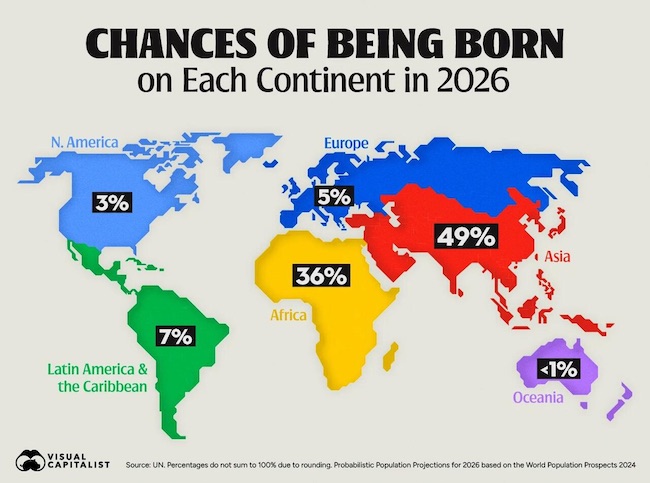
• 85% Of Babies In 2026 Will Be Born In Asia And Africa (ZH)
In 2026, 85% of babies worldwide will be born in just two continents: Asia and Africa. Where someone is born can shape everything from access to education and healthcare to long-term economic opportunity. This map, via Visual Capitalist’s Bruno Venditti, shows how global births are distributed across continents, based on population projections from the United Nations.Read more …
Asia Accounts for Nearly Half of Global Births
Asia is expected to see about 64.9 million births in 2026, accounting for roughly 49% of all births worldwide. Despite declining fertility rates in countries like China, Japan, and South Korea, Asia’s sheer population size keeps it at the center of global demographics. South and Southeast Asia, in particular, continue to contribute large numbers of births each year. As a result, nearly one in every two people born in 2026 will be born somewhere in Asia.Africa Makes Up More Than One-Third of Global Births
Africa is projected to record 47.6 million births in 2026, representing 35.9% of the global total. This reflects the continent’s high fertility rates and young population structure. Many African countries are still early in their demographic transitions, with limited declines in birth rates so far. As population growth accelerates, Africa’s share of global births has been rising steadily and is projected to increase further later this century.Smaller Shares in the Rest of the World
All other continents account for a relatively small share of global births. Latin America and the Caribbean are expected to see 9.3 million births, or 7% of the total, while Europe accounts for just 4.6%. North America’s share stands at 3%, reflecting lower fertility rates despite population growth driven by migration. Oceania contributes 0.5% of births, and Antarctica, with no permanent population, records no births at all.
“The broadly worded judgment is a stinging humiliation for The Marshmallow Minister ..”
• Court Says You Can’t Call AfD “Confirmed Right-wing Extremist” (Eugyppius)
Old friends may remember the farce we experienced last May, when outgoing Marshmallow Interior Minister Nancy Faeser pushed her gaggle of goons in the Federal Office for the Protection of the Constitution (BfV) to upgrade their political classification of Alternative für Deutschland.No longer did the BfV consider the national political party to lurk under mere “suspicion of right-wing extremism,” oh no. They announced suddenly and with much establishment fanfare that they had determined the AfD to be “confirmed right-wing extremists.”Read more …
Faeser and her goons hoped this new designation would edge the AfD more firmly into Evil Nazi Fascist Hitler territory in the popular mind, thereby preparing the way for banning the party. According to thedumb Gender Studies-tier retards unassailable and unbiased experts of the BfV, the AfD were more definitely Evil, more definitely Nazi, more definitely Fascist and more definitely Hitler than ever before. They had such clear proofs of all the Evil Nazi Fascist Hitlerism lurking within the AfD that they could not even reveal them. Doing so, Faeser said, would compromise the mysterious sources and methods of her highly sophisticated political spy agency. Instead, the Interior Ministry leaked a classified dossier supporting the upgrade to sympathetic media like Der Spiegel, and these media promptly published earnest articles telling us all how absolutely Fascist and Evil and Nazi and Hitler all the secret evidence showed the AfD to be, because trust us bro.What happened next is that somebody leaked the full 1,000-page dossier to the alternative news outlets Cicero and NiUS, both of which promptly published the full .pdf. It turned out to be one of the stupidest and most trivial documents I’ve ever read. The supersecret hyperspy sources tapped by the BfV? Google and social media posts. The supersecret hyperspy methods used by the BfV? Compiling interminable lists of potentially untoward or possibly impolite things AfD politicians uttered in googlable documents or on social media. It was so bad that almost overnight the dossier destroyed much of the momentum for an AfD ban – exactly the opposite of what its architects had intended. Even many establishment figures quietly admitted what a travesty the whole thing had turned out to be.
NEVERTHELESS: The establishment moved quickly to capitalise on the new extremist designation. Various state governments began plotting to cleanse the civil service of AfD members on the grounds that they were affiliates of an officially “extremist” organisation. In Rheinland-Pfalz they even toyed with the idea of illegally excluding AfD candidates from running in local elections also on the basis of this bureaucratic designation. The Social Democrats began pushing to initiate ban proceedings against the AfD, a move that – if successful – would grant the left parties indefinite parliamentary majorities both nationally and across many state parliaments, amounting to a kind of legal coup and casting us into a new DDR-light regime.
Meanwhile, the AfD filed suit with the Administrative Court in Cologne to overturn their upgraded designation because it was so obviously dumb and unfounded. They also asked the court to prohibit the designation temporarily, while their primary lawsuit is pending – a long involved process that will take years. The Cologne judges released their unusually extensive 55-page decision on the temporary injunction yesterday. For the party-banning speech-repressing opinion-monitoring enthusiasts of Our Democracy, it is a disaster.
“Claims Credit For Border Security .. ”
Requiring voter ID equals stealing the election.
“..he’s going to do everything he can to prevent you from wanting to vote ..”
I’m trying to see a logic in here…
• Joe Biden Accuses Trump Of Planning To ‘Steal’ The Midterms (ZH)
Former President Joe Biden made one of his rare post-presidential appearances Friday in Columbia, South Carolina, stepping onto a stage at a downtown art museum to accept a lifetime achievement honor from the state’s Democratic Party. During the speech, Biden claimed that Donald Trump is rigging the 2026 midterms before a single vote has been cast. “Here’s the good news,” Biden told the crowd. “In America, the power still belongs to the people for now. And the way to show the power is vote, show up, and vote. And folks, when we do that, that’s bad news for Donald Trump, and he knows it. That’s why he’s trying to pull out more and more barriers – put them up. He’s trying to steal the election because he knows he can’t win your vote, so he’s going to do everything he can to prevent you from wanting to vote.”Read more …
The “barriers” Biden was referencing are Trump’s push for photo ID requirements and proof of citizenship for first-time voter registration – the two key components of the SAVE America Act currently awaiting a Senate vote. Biden framed these measures as existential threats to democracy. What he did not mention is that the American public has already rendered its verdict on these policies — and it is not remotely close. A Pew Research Center survey found that 83% of Americans support requiring a government-issued photo ID to vote, including 71% of Democrats, 76% of black Americans, and 82% of Hispanics. = Gallup found nearly identical results: 84% in favor of photo ID requirements, with 98% of Republicans, 84% of independents, and 67% of Democrats on board. Eighty-three percent also support requiring proof of citizenship for first-time voter registration.“The bottom line is this,” CNN’s chief data analyst Harry Enten said earlier this month. “Voter ID is not controversial in this country. A photo ID to vote is not controversial in this country. It is not controversial by party, and it is not controversial by race. The vast majority of Americans agree … that, in fact, you should have a photo ID to be able to vote.”
Americans agree with Nicki Minaj when it comes to voter id.
— (((Harry Enten))) (@ForecasterEnten) February 3, 2026
83% of favor photo voter id to vote per Pew. This includes 70%+ of Democrats and Republicans, as well as 75%+ of Americans across races…. White, Black, and Latino.
It's not controversial. pic.twitter.com/9Kocw85Uh8Biden was speaking, in other words, about a policy his own base largely supports — insisting it’s election theft. Biden also attempted to rewrite his legacy by claiming he had secured the southern border.”The day I left office, border crossings in the United States were lower than the day that I entered an office inherited from Trump,” he said. “He is — I won’t say it. That’s just a fact.” What Biden failed to mention was that border crossings hit record highs on his watch. The numbers were so high that even Barack Obama’s Department of Homeland Security Secretary Jeh Johnson said back in 2024 that they were unsustainable.
During his presidency, he claimed that he needed new legislation to address the border crisis and insisted that it was up to Congress to give him the authority he needed to close the border. The Biden administration only chose to act on the border when polling showed that Trump had a significant advantage on the issue of immigration.No matter how hard he tries, Joe Biden can’t rewrite his record on the border. Rather than own his legacy, he’s proving exactly why Donald Trump won in 2024.
https://twitter.com/NicHulscher/status/2028122511922135127?s=20 https://twitter.com/scitechgirl/status/2028150089315680453?s=20 DNA https://twitter.com/BrainyScience/status/2027854938894663775?s=20 cell https://twitter.com/MAstronomers/status/2027852771680981086?s=20 https://twitter.com/maximumpain333/status/2027909335939223723?s=20Elon Musk shares his core philosophy on building world-class teams:
— X Freeze (@XFreeze) February 28, 2026
“If somebody gets things done, I love them. It’s pretty straightforward”
He hires for four core traits:
– Talent
– Drive
– Trustworthiness
– Goodness of heart (he says he underweighted this at one point)
“Are… pic.twitter.com/A16nLdUqWC
The electron has no surface. When you imagine an electron… You probably think of a tiny sphere orbiting a nucleus. But that's an outdated image. In modern physics, the electron has no boundary. It has no "skin." It has no measurable surface. As far as we've been able to… pic.twitter.com/VPQOKQY1I9
— Amazing Physics (@amazing_physics) March 1, 2026
https://twitter.com/latestincosmos/status/2027842472345538797?s=20The impossible architecture of these bird nests
— Science girl (@sciencegirl) February 28, 2026
pic.twitter.com/b0SfCD5t5H
https://twitter.com/AstronomyVibes/status/2028078201843449970?s=20⚡️ It sounds like something from the future, but it’s real science. Scientists have created a single particle of light that can exist across 37 quantum informational layers at once. Using advanced entanglement methods, they linked the photon’s color and phase into one unified… pic.twitter.com/TmB3ucaCaC
— SciTech Girl (@scitechgirl) March 1, 2026
Support the Automatic Earth in wartime with Paypal, Bitcoin and Patreon.


.jpg)