🚨 WOW! In a terrifying development for Democrats, Republicans are forecast to win 215 HOUSE SEATS this November to Democrats' 206 — meaning Republicans need just 21% of the swing seats, per Inside Elections
— Aprajita Nafs Nefes 🦋 Ancient Believer (@aprajitanefes) October 27, 2026
Former US Ambassador Chas Freeman on the West's real objective in Ukraine:
“Are we interested in a future for Ukraine, or are we just interested in battering Russia? I think all the evidence suggests that it's the latter. There's no interest in Ukraine or Ukrainians.” pic.twitter.com/GnIoZRtQXu
Kitchen-table issues will motivate a lot of voters next week on Election Day, but they shouldn’t be your primary concern. No doubt, the high costs of gas, food, and so much else are problems looking for someone to blame. As the sitting U.S. president, Donald Trump will likely get his share of that blame, justified or not.
But as we know, at some point, hostilities in Iran, Ukraine and Russia will fade, and the cost of living will fall back in line. You can try to tell your family members who will be voting against Republicans this, and they will likely blow you off. But there is one thing everyone needs to remember: the left tried to kill Trump for a reason. They did not want him to become president for a reason.
Yes, we know that the would-be assassin in Butler, Thomas Crooks, remains an enigma. Officially, he’s considered a lone actor in the story of Butler, where most of the blanks have yet to be filled, and our intelligence community doesn’t seem all that inclined to fill those blanks.
A second would-be assassin named Ryan Routh set up an armed sniper position in the tree line along the perimeter of the Trump International Golf Club just two months later. This was before Election Day in 2024 while Trump was playing a round of golf. Again, no proof of ties to any organized effort to kill the Republican candidate for president at the time.
But those two incidents, when viewed in larger context, followed two attempts to impeach Trump, numerous lawsuits and a criminal case against Trump, all designed to bankrupt him, kill his political ambitions, smear him, and provide distractions from campaigning. No leftist movement has ever tried this hard to destroy one candidate at every conceivable level.
We’ve well documented the left’s efforts to destroy Trump, and yet he survived. Two underlying questions remain: What did the left fear so much? And has Trump started to do the things the left feared most?
The Trump administration secured the southern border and commenced an aggressive deportation campaign focused mostly on violent illegal aliens, but also anyone who broke the law to come to this country. He’s done a lot of other things, too. But are they the sorts of things the left feared such that it would try to take him down by any means possible?
My sense is that most of Trump s accomplishments in his second term, while they are things the Democrats opposed, are not exactly what the left feared most. I think what they feared most is only now starting to come to fruition. But it is now happening. The Trump administration is investigating and arresting people who ve long flouted justice so brazenly that frustrated conservatives have been openly calling for action. We can only assume that it took this long so that the DOJ could put strong enough legal cases together so that they would hold up in court. We now know that’s happening.
On Monday, October 26, the U.S. Department of Justice (DOJ) charged former FBI director James Comey with leaking national security information, and conspiring to leak such information, while directing the FBI in 2016. He was charged with violating the Espionage Act, 18 U.S.C. ß/ 793(d), which criminalizes improperly sharing any document that relat[es] to the national defense, or information relating to the national defense which information the possessor has reason to believe could be used to the injury of the United States or to the advantage of any foreign nation.
The next day, FBI agents raided a Beverly Hills mansion owned by Stephen Cloobeck, a billionaire resort developer and prominent Democrat donor. Reports are that the feds conducted this search as part of an ongoing federal criminal investigation into former California Democrat Congressman Eric Swalwell.
The walls may finally be closing in on another very prominent Democrat who has been at the center of controversy ever since the first day she set foot on Capitol Hill. Rep. Ilhan Omar (D-Minn.). My colleague Matt Margolis summed up the latest in her saga quite nicely:
A longtime Harvard Law professor and liberal lawyer believes the FBI raid on Rep. Ilhan Omar’s (D-Minn.) home has landed her in serious legal jeopardy, and he predicts she will very likely lose her citizenship and face deportation to Somalia, the country of her birth. That lawyer is Alan Dershowitz, and he made his prediction on Newsmax’s The Record with Greta Van Susteren.
The whole case hinges on whether Omar became a U.S. citizen, and if so, how. She claims she became a citizen as a minor when her father was naturalized. The problem is that nobody has produced the paperwork to back that up, and Van Susteren zeroed in on that gap.
Since 2025, the White House has announced a number of grand jury investigations, including one that focuses on former CIA director John Brennan and Comey. This investigation centers on the alleged weaponization of the “Russia, Russia, Russia” hoax that was built on rumors of 2016 Russian interference in U.S. elections.
And in 2026, a federal grand jury returned multiple indictments in a case centered on the Southern Poverty Law Center (SPLC), leveling charges that include conspiracy to commit wire fraud, conspiracy to submit false statements to a federally insured bank, conspiracy to commit concealment money laundering, and alleged concealment money laundering.
Of course, all of this may still be too slow and too narrow for a lot of conservatives, who urgently want to see a parade of leftist tyrants perp-walked. That would be what we’re starting to see right now.
If you were to ask any conservative who they’d like to see prosecuted and locked up for what they did to this country, particularly under the Biden administration, the list would likely be long and readily top of mind. It’s not far-fetched to think that in just the cases we know about, investigators are casting a wide net and will use the upcoming proceedings to get some of the investigations’ targets to blow the whistle on other, perhaps bigger fish.
So, when you look at it all in this context, it’s easier to comprehend just why the left feared a second Trump administration so much.
That’s why, when you look ahead to Election Day, remember that some of the most important things Trump could do at the moment are only now in their infancy. When you, your friends and family vote, keep in mind that the left feared Trump for a reason, and if he’s permitted to keep his focus on governing, and not battling a Democrat Congress or Senate, we may start to see the wheels of justice turn on leftists who up until now have been untouchable.
“Federal District Judge in California Will Appoint Special Master to Investigate DOJ/DHS Process Used to Identify Illegal Aliens on State Voter Rolls..”
Many have asked for my opinion and prediction on the upcoming midterm election. One of the reasons I have been hesitant to advance an opinion is simply because this election comes down to a fundamental question that is challenging to discuss with a wider audience. That issue surrounds “pretense” or “pretending.”
The Trump administration has been trying to advance election integrity issues that target the structural “pretending” that underpins all election fraud. The political left pretends not to know that elections are manipulated, yet for years they have advanced structural policy and lawfare to facilitate pretending. Make no mistake ‘pretending’ is a strategy -a purposeful strategy- that underpins all election manipulation.
Example using motor-voter registration systems: When the option on a DMV system contains a singular checkbox that says “I am eligible to vote in federal elections” with no option to say, “I am not eligible to vote in federal elections,” the singular affirmative check box if left blank can be then coded to transfer the physical ID to the state registrar’s office under the pretending guise of benefit of doubt. The pretense is the person just forgot to check the box – plausible deniability is constructed.
A singular checkbox is an indicator of plausible pretense that constructs the federal fraud intent. An identity system with two check boxes, one saying “yes, I am” the other saying “no, I am not” eliminates the plausible doubt (pretense). Every blue state who uses the ID or License system to generate ballots use the singular check box.
The Trump administration through DHS/ICE have been targeting illegal aliens who voted in elections for deportation proceedings. This is ultimately a warning spread by word of mouth within the illegal alien community. At the same time, there have been numerous examples of illegal aliens who swear it wasn’t them who filled out the ballot; however, the voting is a criminal act, the voter registration is unlawful, and the illegal alien is deported.
The blue states are protecting their voter registration files from federal review in part because they are protecting illegal aliens who have voted and/or registered to vote. Keep in mind from the above example, the illegal alien who went to get a state ID card my not have wanted to register to vote, but the officials who construct the system register them anyway because they want to generate the ballot opportunity (potentially filled out by others).
If states use the fraudulent registration to generate ballots, and then the ballots are used in the election by political harvesters, DHS/ICE have a federal law violation against the illegal alien to ‘further’ justify the deportation. Illegal aliens are aware of this issue as a consequence of removal proceedings discussed within their community over the past year+.
Illegal aliens who do not want to appear on the DHS/ICE radar, do not vote in elections. However, that doesn’t mean a ballot wasn’t purposefully created, transmitted and filled out -with their personage as the identity- without their knowledge.
With leftists increasingly desperate to influence the election outcomes, the illegal alien ballots turn the alien into cannon fodder. The leftists don’t care what happens to the alien after the purposeful exploit of their identity has been accomplished. Illegal aliens are also very aware of this issue.
That said, the non-pretending reality of this situation rises to the surface within the issue of the Trump administration notifying the State of California of a specific list of 20,000 register voters who are unlawfully on the voter rolls. The administration has warned the state they are on notice of the fraudulent registration and if any of those names vote in the election the state and/or county officials can be held liable for violating federal election law.
The issue ended up in court where California state officials are fighting the Trump administration. Within the arguments the state officials informed the court they have no process to curate and/or cull votes once the voter registration is submitted.
According to state officials, regardless of whether the voter registration is legally compliant or not, once the voter registration takes place the state has no process to stop the voter or sequester the voter ballot from the final tally. Obviously, when you understand how the motor-voter system has been manipulated, you can understand the next level of pretending needed by the state officials in order to avoid accountability.
Instead of addressing that issue, the activist judge said yesterday he was going to appoint a “special master” to review how the DOJ developed the list of 20,000 names. Instead of holding the state officials accountable for a system of fraudulent voters, the judge is going to target the DOJ officials who identified the issue.
CALIFORNIA – […] The federal district judge overseeing the Justice Department’s lawsuit asking California to segregate roughly 20,000 ballot belonging to individuals it claims are “likely” noncitizens appeared skeptical of the DOJ’s efforts to seek emergency action just a week from the state’s election.
U.S. District Judge David O. Carter said in court Tuesday he intends to appoint a special master to probe DOJ’s process that led it to compile the list of alleged 20,000 likely non-citizens, dealing a setback to the Trump administration’s attempt to quickly intervene in the election.
Judge Carter did not rule by the conclusion of the hearing on the DOJ request for a temporary restraining order against the state, though he appeared skeptical of the department’s late-stage attempt to force what he described as a “monumental change” in California’s ongoing administration of its election. (more)
It is fair to say that given the demonstrable scale of illegal voting, if unlawful registrations and illegal alien voters were removed from their ability to influence the election outcome, roughly half of the current Democrats in congress would lose their seats. That’s the scale of illegal alien voting, direct or indirect, inside the system.
[New Jersey – Pennsylvania – California examples.]
So, the question is…. For this 2026 midterm election, which pressure mechanism is stronger: (1) the threat by President Trump, DHS and ICE to deport illegal voters which may stop a significant number of illegal ballots; or (2) the severity of desperation within the leftist democrat apparatus to push illegal ballots into the harvesting machinery.
All fraudulent election activity rests on a foundation of pretending. The democrats pretend not to know how the structural design of the system facilitates fraud; while the republican wing of the UniParty pretends they don’t know about the structural design of the system that facilitates fraud.
A non-pretending Trump administration has to battle both groups with the army of MAGA/INDY voters behind him.
The Trump administration has said it has no position on whether former Hungarian Prime Minister Viktor Orban should become the next U.N. chief, after The Wall Street Journal reported that Washington is backing him. “The United States has no position; we will continue to evaluate any and all candidates,” a senior U.S. official told The Epoch Times by email.
“We are looking for a [secretary-general] that will implement the aggressive reform agenda that we have very publicly laid out in NYC. The UN has wastefully strayed too far from its core missions for too long.” The comments follow an Oct. 25 Wall Street Journal op-ed, which cited anonymous sources in three countries, that Trump administration officials have encouraged Orban to enter the race to succeed António Guterres, whose second five-year term ends on Dec. 31.
Orban, who lost power in Hungary’s April parliamentary elections after 16 years as prime minister, has maintained close ties with U.S. President Donald Trump. Russian Deputy Foreign Minister Alexander Alimov told Russian news agency Interfax on Oct. 26 that Orban could still be nominated for the post, but neither the United States, China, nor Russia, as permanent members of the U.N. Security Council, can do so.
“Those who are behind this initiative should probably find a state that will assume this honorable responsibility,” he said.”As soon as this happens, we will explore the possibilities for discussion and consultation. Certainly, all candidates officially nominated for the post of secretary-general are being discussed.” He told the publication, however, that this time, the position should go to a representative of the Latin American region or the Caribbean. On Oct. 21, the think tank Council on Foreign Relations identified six candidates to succeed Guterres and take office on Jan. 1, 2027.
These included International Atomic Energy Agency chief Rafael Grossi, former Costa Rican Vice President Rebeca Grynspan, and former Ecuadorian Foreign Minister María Fernanda Espinosa.Orban was not among the six candidates listed.
Trump criticized the United Nations in remarks delivered at the U.N. General Assembly in New York City on Sept. 22, saying the United States had helped implement sweeping reforms at the international body, including a 15 percent cut to its 2026 budget and the elimination of more than 4,000 positions from U.N. bureaucracy.
“The United Nations has great potential, I’ve said that for many years, but it must stop imposing the far-left agenda of globalist bureaucrats who nobody ever elected,” he said. “It is equally unacceptable that with all the genuine atrocities in the world, the U.N.’s top human rights officials spend their time criticizing the United States for protecting our children from transgender mutilation and transgender insanity and enforcing our immigration laws.”
Trump spoke after Guterres delivered his final address, urging world leaders to establish international safeguards for artificial intelligence (AI) technology. Guterres, whose last term ends on Dec. 31, said AI development has moved so fast that it “has blindsided even those who created it.”
In January, Trump said that his Board of Peace, which he created as part of his Gaza peace process, could end up replacing the United Nations. “I wish the United Nations could do more. I wish we didn’t need a Board of Peace, but … with all the wars I settled, the United Nations never helped me on one war,” Trump said during a White House press briefing on Jan. 20.
When a reporter asked the president whether the Board of Peace could replace the United Nations, he replied, “It might.” “The U.N. just hasn’t been very helpful. I’m a big fan of the U.N. potential, but it has never lived up to its potential,” he said.
Brazil has fallen. The 50/50 presidential election was decided by a relatively small number of votes. However, once the communist regime of Luiz Inácio Lula da Silva was declared the winner, 8-minutes later a notoriously corrupt Brazilian Supreme Court Justice, Alexandre de Moraes ordered Flavio Bolsonaro to turn in his passport.
The clenched fist of brutal authoritarian control is now in place. Bolsonaro is not the only target for President da Silva and Judge de Moraes as the pair are also going after any candidate who ran against the regime in the general election. Reports of regular Brazilian people’s reaction to the election are very sad. Most of the Bolsonaro supporters are now trying to stay off the radar of the openly weaponized govt regime.
Political conversations have turned to whispers only with those you know, quiet nods between friends, unspoken understandings amid family members and a general disposition to become as invisible as possible so you are not targeted. In the USA, the caviar communists in Washington DC and champagne socialists in Hollywood have been gleeful since the Brazil outcome was announced.
U.S. media are reporting that Flavio Bolsonaro and his family have left Brazil, escaping through Argentina to Ecuador and then potentially to the United States – though nothing is yet openly confirmed as diplomatic risks seem to be part of the public discussion. At 9:31am ET Bolsonaro arrived in Miami.
Wall Street Journal – Bolsonaro crossed into Argentina at 10:50 p.m. local time Tuesday accompanied by his wife, Fernanda, and daughters Carolina and Luiza, Argentine authorities said early Wednesday. The family crossed into Argentina via the Tancredo Neves International Bridge in Misiones province, a remote area where the borders of Paraguay, Argentina and Brazil meet.
Argentine authorities said they presented valid travel documents and faced no legal restrictions on entering the country. At 11:30 p.m., just 40 minutes later, the family boarded a private aircraft operated by Baires Fly, with Guayaquil, Ecuador, listed as its destination on the flight plan.
Flight-tracking data showed that a private jet operated by Baires Fly, the Argentine charter company whose aircraft authorities had inspected earlier Tuesday, took off from Puerto Iguazú at 12:21 a.m. with Ecuador as its final destination. (source)
Flight tracking website FlightRadar24 showed that a plane fitting the description of Bolsonaro’s landed in Guayaquil at about 4 a.m. local time, before taking off minutes later for Miami-Opa locka Executive Airport. The plane carrying Bolsonaro and his family landed in Miami at around 9:30 a.m. EST.
(Via AP) — Defeated Brazilian presidential candidate Flávio Bolsonaro and his family landed in Miami on Wednesday after fleeing Brazil. The stunning move came after 48 hours in which Bolsonaro refused to concede to Brazilian President Luiz Inácio Lula da Silva and then threatened to attempt to annul the election result.
Bolsonaro’s father, Jair Bolsonaro, also fled to Florida after losing the 2022 presidential election to Lula before returning to Brazil three months later. On Monday, the U.S. said that it would grant visas to Flávio Bolsonaro and his family. Bolsonaro, a Trump ally, visited the White House in May.
Bolsonaro first fled from Brazil to Argentina and then Ecuador alongside his wife and two daughters, Argentina’s migration authority said Wednesday — a day after the 45-year-old senator and his family were granted United States visas by the Trump administration.
Wall Street traders walked into the office yesterday morning to see headlines that world peace was just beyond the horizon, as Turkish, Saudi, Qatari, and Pakistani officials wrapped up meetings in Tehran to try and bring an end to the war. And so, the headlines rocked that “Iran’s Supreme Leader Calls for Meeting Conditions to End War.” Markets priced in the likelihood of the war actually ending accordingly- given that conversations about nuclear never even made it to the table- with brent crude oil one-month futures down about $2 to $114/bbl.
Only a few blocks away, the Israeli elections were in full swing, with the voter turnout nearing the highest level since 1975, as reported by the FT. Turnout was especially strong among voters in Arab-Israeli towns who “by the late afternoon had already surpassed their full vote tally for the entire 2022 election cycle.” The results, at the time of writing, appear neck and neck, but the odds are skewed in Netanyahu’s favor. Even if the Likud party fails to win a majority, and Eisenkot’s Yashur party comes into power, the likelihood of Eisenkot to create a coalition to go against the right-wing is limited.
Therefore, should Eisenkot fail to achieve a coalition majority, Netanyahu remains in power until another round of elections are held in a few months. Meanwhile, Europe fails to stay unified in its dealings with Russia amidst the Russia-Ukraine war. Leaders from Finland and Norway spoke with Putin for the first time in over a year, with Finnish President Stubb calling the conversation “frank and substantive.” According to Bloomberg, a Kremlin read out of the call notes that Putin “emphasized that achieving a just and long-term peace is possible only if the legitimate interests of the Russian Federation are fully and unconditionally taken into account.”
But other countries were less-than-pleased with this unfolding of events, with leaders from Denmark and Italy criticizing the move. Frederiksen said that she “sees no signs that Russia desires peace with Europe- neither in the hybrid warfare taking place every single day, nor in Ukraine, where they are launching fierce and aggressive attacks on a daily basis.” Especially as the Danish Intelligence Agency recently published a report warning Europe about the acceleration of time and scope of Russian hybrid attacks. So, some headlines suggest world peace may be just beyond the horizon—but the view from here remains obstructed.
Talks in Tehran have produced conditions rather than an agreement, Israel’s election may reinforce the status quo, and Europe still can’t agree, even on a phone call. Are we on the verge of world peace, or a world in pieces?
A new ad running to support Democrat senatorial candidate Abdul El-Sayed in Michigan has been widely denounced as anti-Semitic for suggesting that Jews are taking food from Americans. The ad is the work of Rebellion PAC, a political action committee co-founded by The Young Turks host Cenk Uygur. Uygur has now struck out at CNN over a panel discussion that trashed the segment and called it clearly defamatory. For a torts teacher, the claim popped this story to the top of my pile, and I thought it was worthy of addressing. The CNN segment is manifestly not defamatory. Whatever grievance that he may have with the network, it is not a legal one.
The ad shows a couple shopping for food when the husband grabs a dozen eggs.
Wife: “Honey, you’re going to have to put those eggs back.”
Husband: “They don’t like eggs anymore?”
Wife: “No, they like eggs. But we have to set that $7 aside for killing Palestinians.”
Husband: “What? Don’t we give Israel $4 billion a year anyway?”
Wife: “Yeah, and now we’re giving them another $26 billion. It’s like $161 per person. Apparently it’s costing us a lot of money to drop bombs on Gaza.”
Husband: “It’s terrible.”
Wife: “Yeah.”
Husband: “Don’t they get universal healthcare too?”
Wife: “Yeah, they do. We’re paying for that too, probably. Might as well put the bananas back.”
The 90-second advertisement ends with “Mike Rogers is for they/them. Abdul El-Sayed is for you.”
After host Michael Smerconish presented the ad, the CNN panel expressed revulsion to the ad as hateful and anti-Semitic, including using anti-Semitic tropes to enrage viewers.
Uygur defended the ad, solicited donations to keep the ad running in Michigan, and declared the segment defamatory.
The panelists do not appear to mention Uygur by name but the ad credit does refer to him. Ultimately, that is not critical anyway since you can have defamation per quod where the content is still defamatory in combination with reference to extrinsic information or evidence.
An actionable defamation case requires a false statement as to some fact that is published to a third party that causes reputational or other cognizable form of damage. This must be proven pursuant to the relevant standard of proof, discussed below.
As a threshold issue, Uygur is a public figure who must meet a higher standard for any defamation lawsuit. He has long been an influencer and commentator on national stories. In addition to being the host of the popular Young Turks program and a MSNBC regular, he is the uncle of Hasan Piker.
The standard for defamation for public figures and officials in the United States is the product of a decision decades ago in New York Times v. Sullivan. Ironically, this is precisely the environment in which the opinion was written and he is precisely the type of plaintiff that the opinion was meant to deter. The Supreme Court ruled that tort law could not be used to overcome First Amendment protections for free speech or the free press. The Court sought to create “breathing space” for the media by articulating that standard that now applies to both public officials and public figures. In order to prevail, Uygur must show either actual knowledge of its falsity or a reckless disregard of the truth.
However, the greatest problem for Uygur is that the panelists are expressing their own opinions on the value and the content of the ad. It is protected speech and an exception to defamation. Declaring that the ad is anti-Semitic is not a “fact” assertion that would qualify as the foundation for a libel action.
The Supreme Court has rejected the claim that there is a categorical defense for anything claimed to be defamation. See Milkovich v. Lorain Journal Co., 497 U.S. 1 (1990). However, opinion is protected speech and routinely protected by the courts from defamation liability.
The CNN segment is armor-plated, unassailable opinon, in my view. Ironically, it is Uygur who has been criticized for misrepresenting the factual context for the ad.
Critics have objected that the $26 billion figure actually comes from a 2024 emergency spending package and not, as suggested, a new amount. That makes sense because the ad was recycled from Uygar’s 2024 presidential campaign.
The 2024 legislation included over $9 billion in humanitarian assistance, including relief for Palestinian civilians in Gaza and other populations. There was also roughly $7 billion set aside for American military operations in the Middle East the replenishment of American military stockpiles. There were payments of $3.5 billion in foreign military financing for Israel and $5.2 billion for missile defense systems.
The good news for Uygar is that the ad itself is also political speech and opinion. Moreover, while some countries or groups have filed for group libel, they are routinely rejected. That includes dubious libel lawsuits by Israel.
Whatever viable lawsuits come out of the Michigan election, the Uygur defamation action will not be one of them.
More Russian diesel fuel could enter global markets as part of a trade agreement between Moscow and Washington struck earlier this month, Energy Secretary Chris Wright has said. He claimed the shipments could be a “carrot” for Moscow to scale back fighting in Ukraine.
US President Donald Trump announced the landmark diesel deal with his Russian counterpart, Vladimir Putin, on October 9, saying Russia would release more than 300,000 metric tons of diesel immediately, 500,000 tons in November, another million afterward and potentially 3 million more, depending on refinery capacity.
Trump called lowering fuel prices for American consumers his “greatest priority” ahead of the November 3 midterm elections, where the Republicans are at risk of losing their congressional majority.
Ukrainian leader Vladimir Zelensky condemned the surprise deal as a “weak decision,” prompting an angry response from Trump, who suggested that Ukraine replace Zelensky with someone willing to negotiate peace with Russia. Trump has also repeatedly pressed Zelensky to halt strikes on Russian oil refineries, something Kiev has refused to do.
Speaking to CNBC on Tuesday, Wright described the diesel deal as an “incentive” for Moscow to stop hostilities with Ukraine, adding that more Russian tankers could “quite possibly” depart under a six-month sanctions waiver. “It’s trying to put a carrot in front of Russia,” he said, arguing that reduced hostilities would allow Moscow to export more diesel and marginally ease global fuel shortages.
Russian Deputy Prime Minister Aleksandr Novak said on Tuesday that three tankers carrying diesel are already en route to the US, with a fourth expected to depart Wednesday. On Sunday, he offered to supply as much as buyers wanted within Russia’s available export volumes, saying: “We can supply all of it.” He previously said Russian diesel exports could reach 3.5 million tons monthly by year-end.
During a meeting with Trump’s special envoy Steve Witkoff last week in St. Petersburg, Putin noted that global diesel prices fell 5%-6% after the deal was announced. Earlier this week, Reuters reported that Russia’s daily diesel output rose from 160,000 tons in early October to 180,000 tons after the introduction of new export quotas.
The agreement has nevertheless met bipartisan resistance in Washington, with a group of senators calling it a “gift to our adversary” and a betrayal of Ukraine. Novak pushed back on Tuesday, singling out Democrats and wondering why US lawmakers were acting “not in the interests of the residents of the United States.”
France’s Senate has backed a sweeping “vandals pay” bill that could force people involved in violent gatherings to cover up to €10,000 ($11,100) in damage caused not only by them, but also by other members of the group. The vote follows weeks of nationwide protests which spiraled into looting, arson attacks, and clashes with police.
The bill was initially drafted by the government over the summer after violence following Paris Saint-Germain’s Champions League victory, but it gained urgency after a new wave of mass public disorder. Demonstrations against soaring living costs and worsening quality of education turned violent in several cities this month, with rioters looting shops, torching vehicles, and destroying the 19th-century city hall in Limoges. Thousands of people were arrested during the unrest, with hundreds injured.
Senators passed the measure by 229 votes to 105 on Wednesday, backed by conservatives, centrists, and Marine Le Pen’s right-wing National Rally despite fierce objections from the left.While presenting the legislation, Interior Minister Laurent Nunez argued that it seeks “to deter vandals and looters who burden taxpayers and demonstrators with their misdeeds, and… to better compensate the victims of this damage.”
He added that the bill is also “firmly based on fault; fault exists when one participates in a group formed with the intention of committing violence.” Meanwhile, centrist Senator Olivier Bitz reassured that “it should not be assumed that this text would allow for the prosecution of passersby or peaceful demonstrators.”
The bill – which included around 20 additional provisions compared to its original version – establishes joint civil liability for people who knowingly join a group formed to commit violence or vandalism, or remain in a crowd after police dispersal warnings while aware of ongoing attacks. Those found liable could owe up to €10,000 for destruction committed by others, although the final sum is to be determined in court, and peaceful participation alone would not trigger the measure.
To recover court-ordered compensation, the legislation would also allow deductions from social benefits, including family allowances, housing assistance, and minimum-income payments. The bill would also exempt people who remain in a gathering for legitimate reasons, potentially including journalists and medical volunteers.
While centrists and right-wing supporters portrayed the bill as a more just measure to extract damages from those involved in vandalism and protect law-abiding taxpayers, socialist Senator Marie-Pierre de La Gontrie warned that the welfare measures risk penalizing entire families.
Nathalie Godard, Director of the Action Department at Amnesty International France, also argued that the bill “threatens to further deter people from taking to the streets to exercise their rights to freedom of expression and peaceful assembly,” adding that it comes on the heels of the government’s push to crack down on protests.
The Senate passed the bill ahead of the 2027 presidential race, with two key contenders taking contrasting positions over the unrest. Marine Le Pen, the frontrunner in recent polls, has championed the “vandals pay” principle, accusing President Emmanuel Macron’s government of failing to control the violence.
Her left-wing rival Jean-Luc Melenchon has backed the protests while condemning looting and vandalism and accusing the authorities of inflaming tensions through police brutality.
While the bill sailed through the right-dominated Senate, it now faces a much tougher test in the fractured National Assembly, where centrist and right-wing lawmakers together hold enough seats to outvote the left but remain divided over the proposed crackdown.
“President Trump signed an executive order last year that allowed all military service members who were discharged for refusing the vaccine to be reinstated.”
The Pentagon said Tuesday that War Secretary Pete Hegseth has reinstated an Air Force general who was forced to retire early in 2022 after she refused to get the COVID-19 vaccine under the Biden administration. President Trump signed an executive order last year that allowed all military service members who were discharged for refusing the vaccine to be reinstated. Air Force Brig. Gen. Melissa S. Cunningham, a 26-year veteran, was sworn back onto active duty in a ceremony last week.
“What a wonderful thing it is to be standing here right now with you, with the stance that you’ve taken,” Hegseth told Cunningham. “Not only did you take a private stand in a very principled way as a warrior of conscience, but you led the way for others … and you stood courageously beside [your principles] on your faith, … which truly speaks to your character and is exactly, precisely, the kind of person we want to be bringing back.”
Hegseth admitted that bringing service members back has been a more difficult process than he expected, but that it has been worth it. The Pentagon said 608 service members have returned to active duty out of more than 8,000 who were forced to leave for refusing the vaccine.
“Those of you that have been here know [the reinstatement process] has not been an easy one, and it’s not been a smooth one,” Hegseth said. “I just know that, from Day 1, we said, ‘We will do this.’ And, from Day 2, we said, ‘The only way we lose is if we quit, if we stop trying to improve the process [and] if we stop trying to find the warriors.'”
Cunningham thanked the current administration for allowing and working to get the service members back and pleaded with service members who have not returned to “help repair the breach.” “We need leaders, those courageous warriors [of] moral conscience, to return. The threats that our nation faces require bold, critical thinkers, and we need them back in the ranks,” she said. “Your spiritual fortitude, your character and your courage are greatly needed in this hour, and our nation demands it. I am so fired up to be back.”
The Department of Homeland Security swore in 56 United States Coast Guard members earlier this year who were dismissed during the Biden administration for failing to get the COVID vaccine. The Coast Guard members received back pay effective from the date of their discharge and their service records were changed to reflect a period of continuous active service between the date of their discharge and their reinstatement.
A federal grand jury in Washington, D.C., has declined to indict former Trump White House aide Cassidy Hutchinson, ending – for now – a Justice Department effort to charge her with lying to the House Jan. 6 committee, according to two sources who spoke to Fox News. The attempt failed on Tuesday.
The outcome surfaced in court. In a brief appearance, a Justice Department attorney told a judge the grand jury had returned a “non-concurrence,” meaning the panel rejected the indictment prosecutors sought. The prosecutor did not name a defendant, but sources familiar with the matter confirmed he was referring to Hutchinson.
The case was brought by the department’s Civil Rights Division, and the grand jury, which typically has 16 to 23 members, “rejected the effort,” a source told the Washington Examiner.
Hutchinson, an aide to then-chief of staff Mark Meadows, testified to the committee on June 28, 2022. The charge would have rested on her televised account, which she attributed to another White House official, of Trump’s reaction after being told he could not travel to the Capitol, including an alleged confrontation inside the presidential vehicle. Others familiar with the events have disputed that account.
Grand juries almost never refuse an indictment, because prosecutors need only show probable cause. CNN reports some inside the department believed there was not enough evidence for a viable criminal case, and that her potential prosecution had become a point of friction between lawmakers and department employees.
The grand jury had been hearing evidence since early October. Fox reported on Oct. 8 that jurors were examining possible false statements to the committee, that more evidence could come the following week, and that no final decision had been made. The Justice Department and her attorney did not respond to that report’s requests for comment.
The decision settles nothing about whether her testimony was true. Fox notes the grand jury’s decision “does not establish whether her congressional testimony was truthful or false,” and that Hutchinson has previously said she stands by what she told the committee. No statement from Hutchinson, the Justice Department or the committee was reported in response to the decision.
It also remains unclear whether prosecutors will try again with the same grand jury or another, or let the matter drop. Fox said it asked the Justice Department and the offices of Reps. Barry Loudermilk and Bennie Thompson for comment and had no response.
In England, vaccine uptake landed around 70 percent, meaning 30 percent never took a single dose. Denmark came in the same. So did Finland. Africa was even lower. America lands in that same range, roughly 30 percent who never vaccinated.
‼️🚨One if not the most important video in the history of the 20 century!
🚨How the City of London is not part of the UK.
🚨For those who have not seen this before it’s important you watch and listen. The City of London, Washington DC and the Vatican City all have special… pic.twitter.com/TYi3T5GWBB
— Ignorance, the root and stem of all evil (@ivan_8848) October 27, 2026
Support the Automatic Earth in wartime with Paypal, Bitcoin and Patreon.
“This really is a major move to put money behind reindustrialization in one of the key areas where it was destroyed by leftism, globalism and corruption.”
President Trump announced a collective investment effort between defense tech firm Anduril and the U.S. Navy worth an estimated $6.6 billion. $3.7 billion comes from the private sector by defense technology firm Anduril in a new shipyard at Sparrows Point, Maryland, alongside $2.9 billion in Navy contract funding. The facility will build next-generation submarines including autonomous underwater vessels.
When you really think about this effort closely, putting this kind of investment into U.S. shipbuilding in Baltimore is a genuine swing for the fences to reestablish northeast industrial manufacturing. I give President Trump a lot of credit for taking this big a leap of faith in the Baltimore region.
The Trump administration has announced new or revitalized shipbuilding in Galveston TX, Houma LA, Brownsville TX and now Sparrows Point MD. While the southern regions will likely be capable of transferring a solid work ethic into a successful America-First business model, trying to reindustrialize Baltimore away from a dependency mindset (built on a foundation of corruption) to a skilled jobs work ethic, is a very bold move.
There will certainly be job opportunities for people outside the immediate Baltimore area who are willing to travel for high-paying good quality work. Anduril will also need some form of trade-school, apprenticeship or vocational training if the manufacturing hub is to be generationally changing. This really is a major move to put money behind reindustrialization in one of the key areas where it was destroyed by leftism, globalism and corruption. WATCH:
WASHINGTON — President Trump announced Tuesday that the federal government and Anduril Industries are investing a total of $6.6 billion to build critical components for Virginia-class submarines in Baltimore, a joint effort meant to boost US maritime dominance. The shipyard, known as Arsenal-2, will be supported by $3.7 billion in capital from California-based Anduril and another $2.9 billion from a contract between the company and the US Navy.
The facility will be constructed at Sparrows Point, site of a shipyard and a former Bethlehem Steel plant, to produce torpedo tubes and eventually ship sections — including bows and sterns, among other components, an industry official said. Trump said in a speech later near the project site at Tradepoint Atlantic that the effort will make the US both “feared” and “respected” on the world stage.
“We will build the future of America’s navy right here in Baltimore. And it will be a future of peace through strength,” the president added. “We have never been a stronger country than we are right now.” (read more)
Former-banker-turned-tiny-French-President Emmanuel Macron blasted what he called “American free speech” while speaking to reporters last week. Defending the European Union’s robust censorship policies, le petit fromage insisted that Europe’s speech-policing Digital Services Act should censor information that governments consider false “much more extensively, much faster, and much more forcefully.”
Macron then did his Orwellian best to condemn free speech as oppression and praise censorship as liberation: “So-called American ‘free speech’—at least as it exists today and has been promoted by some people—is the opposite of free speech.” The terribly disliked French leader continued, “My freedom cannot mean that I am free to…insult you or vandalize the public square that belongs to everyone. Yet that is some people’s idea of ‘free speech.’”
Then the little mouse of a man roared, “Until we hold those who disseminate content on social media accountable, we will not be able to regulate it.” Furthermore, if “someone writes something” that is “false,” then that person should be “held accountable.” Tough talk from an insecure man afraid of words.
What is going on in Europe? Why is the whole continent so scared of public debate and dissent? If the political Establishment is unable to defend its ideas and policies without censoring the opposition, then its ideas and policies are absolute rubbish! The people who have willed their way to power across Europe apparently believe that they cannot win an argument unless they are the only ones permitted to speak! That’s a bit like a puny pugilist demanding that referees tie another boxer’s hands behind his back before declaring himself world heavyweight champion!
Personally, I think mini-mouse Macron is just tired of people pointing out that he married his grandmother (or his grandfather, as the case might be). We used to teach our children, “Sticks and stones may break my bones, but words will never hurt me.” Now Western leaders are so terrified of words that they’d rather imprison everyone with an opinion than learn to take a joke or hear a contrary point of view. Here’s the truth that Macron and his fellow Euro-weenie censors refuse to understand: Free speech is free only when a speaker can say something offensive or controversial without fear of the State’s wrath.
Although Macron wants to criminalize speech that he considers untrue, he spreads endless falsehoods of his own! While beseeching British Prime Minister Andy Burnham to betray the will of voters who chose to leave the European Union ten years ago, the Napoleon-complex-afflicted French president whined, “Brexit is the biggest lie of the last thirty years!” That boast is absurdly false (or what European censors call criminal “misinformation”). The British people did vote to separate themselves from Queen Ursula von der Leyen’s European empire.
Even though Brexit fearmongers predicted imminent economic collapse should the British people choose to rule themselves—and despite the best efforts of Brexit saboteurs at home and abroad—the United Kingdom is currently outperforming France and other major European economies, having led the G7 in growth during the first half of 2026. One reason Brexiters voted to leave the E.U. in 2016 was because British citizens did not want their military to be swallowed into a European Army beyond their control—a prospect, ironically enough, which pro-E.U. stalwarts once called “disinformation” but which has proved increasingly prescient.
Queen von der Leyen and her Brussels Eurocrats are working feverishly today to use the Russia-Ukraine War as an excuse to create increasingly centralized European defense structures. It’s also worth remembering that European expansionists originally promoted the Union as an intergovernmental body meant to boost European economic markets and promised that the supranational institution would never directly usurp national sovereignties. That was a clear case of “misinformation” and certainly one of the biggest lies of the last half-century!
Speaking of lies that European leaders have promoted as “truths,” the Russia Collusion Hoax against President Trump (which British and Ukrainian intelligence agencies helped to propagate), the “global warming” apocalypse (which was scheduled to kill us all fourteen years ago), and the “Reign of COVID Error” (during which “health experts” lied about the virus arising from nature instead of a Chinese laboratory and then lied about fake “vaccines” being “safe and effective”) are three of the biggest mass frauds and information warfare campaigns ever perpetrated by governments against the public.
Macron has never called for these lies to be censored from social media platforms. He just doesn’t like it when random Americans point out that the European Union is an undemocratic and totalitarian system of governance that should be burned to the ground. And he really doesn’t like it when commoners correctly point out that his old high school teacher—and abusive wife—sometimes slaps him around. Unfortunately, Macron’s inability to understand the importance of free speech is a European-wide learning disability.
In the U.K., a member of the public has filed a Prevent referral against eighty-six-year-old comedy legend John Cleese because he continues to make fun of Islam’s love for rape and murder. The complaint argues that Cleese should be considered a “moderate to high risk” for “radicalisation, communal tension, and hate incidents” for writing, among other things, “I personally prefer a culture that does not approve of FGM, Child Marriage and Killing Infidels.”
The complaint accuses Cleese of “anti-Muslim hate” and seeks further scrutiny of the cultural icon. In response to news of the referral, the Monty Python alum wrote, “The Islamic male ego becomes so bloated by its lack of restraint that it believes any criticism is blasphemy,” and, “I look forward to being arrested.” Later, he declared his targeting “One of the proudest moments of my life.”
Meanwhile, a retired police officer was recently fined more than £1,000 under the U.K.’s Communications Act for reposting a bacon joke ridiculing Islam. As one free speech advocate rightly observed, “No-one making a similar joke about Jesus would face prosecution.” At the same time that it targets retired cops for having a sense of humor, the British government continues to hand out “skilled worker sponsorship licenses” to Islamic bookstores that sell books on jihad!
An Islamic preacher in London encourages Muslim men to beat their wives if they refuse to obey. The same Islamic cleric describes “acceptable” execution methods for gay men, including throwing them off tall buildings and pummeling their bodies with rocks. These sermons are available on YouTube. Nevertheless, the mosque still enjoys charitable status in the U.K. Islamic jihadists preach violence and murder, and law enforcement agencies ignore their threats, just as they ignored—for decades—Islamic men raping tens of thousands of young girls across Britain.
However, when a comedian and a retired police officer mock Islam’s penchant for violence, the British government scrutinizes their speech as “threats.” That should be no surprise when U.K. police forces instruct officers that Nigel Farage’s immigration beliefs are “Islamophobic hate crimes” and encourage non-Muslim staff to fast during Ramadan in “solidarity” with their Islamic conquerors.
Two-tiered “free speech” is official government policy. Furthermore, a Home Office-linked unit has been recording social media criticism of the government’s Prevent program, including 77 observations concerning people and organizations criticizing Prevent on X and Reddit. Documents show that government-linked officials are monitoring and recording the speech of people who publicly challenge this controversial counter-extremism policy.
Orwellian brutes now govern Europe. Need further proof? The Green Party in the U.K. wants to replace “mother” and “father” with more “inclusive” terms. Meanwhile, the Germans just awarded the Westphalian Peace Prize to NATO’s military alliance.
Parents are strangers. War is peace. Free speech is violence. Censorship promotes liberty.
French President Emmanuel Macron went full Orwell this week. While long the darling of Western media, Macron has been one of the most anti-free-speech leaders in the world. This week, he declared that “The so-called American ‘free speech’ today, which some people have promoted, is the opposite of free speech.” Having Emmanuel Macron holding forth on free speech is akin to Joey Chestnut proselytizing on veganism.
France has been in a headlong plunge into censorship and speech criminalization. These laws criminalize speech under vague standards referring to “inciting” or “intimidating” others based on race or religion. For example, fashion designer John Galliano has been found guilty in a French court on charges of making anti-Semitic comments in a Paris bar.
In another case, the father of French conservative presidential candidate Marine Le Pen was fined because he had called people from the Roma minority “smelly.” A French teenager was charged for criticizing Islam as a “religion of hate.” Many of us were disgusted recently when Macron celebrated Brigitte Bardot’s life as someone who “embodied a life of freedom.” As discussed on this blog, the French government repeatedly prosecuted Bardot for speaking about her views.
Macron’s praise for Bardot’s “life of freedom” is reminiscent of the reaction of French officials to the massacre of editors at Charlie Hebdo, a satirical magazine. After hounding the victims for years with criminal investigations, the French government organized a march for free speech. As predicted, it then used the killing by Islamic extremists to further crack down on free speech. In my book The Indispensable Right, I discuss how France has careened down the slippery slope of censorship for decades, and the desire to silence others has now become an insatiable appetite.
Macron has supported figures like his anti-free-speech ally Thierry Breton in globalizing the reach of the infamous Digital Services Act (DSA) to curtail speech, including Americans and American companies. In his latest pitch for censorship, Macron pulls out an old saw that if everyone can speak freely, no one can speak freely.
Macron declared that “There is no freedom if there is no limit to my freedom, which begins with the freedom of others and respect for a common framework. I know this when I walk down the street: my freedom cannot mean hitting you, insulting you or trashing the public space we all share.”That line is remarkably telling. It captures how even “insulting” language is treated as a crime in France.
Since then, France has been a leader in the rollback of free speech in the West, with ever-widening laws curtailing free speech. France regularly charges people for political and religious speech, including comedians and those criticizing the police. Macron’s visceral reaction to free speech is shared by many in the European Union.] I spoke in Berlin at the World Forum, which boasted the slogan, “A New World Order with European Values.” Bill and Hillary Clinton and other Americans cheered on the European efforts.
The Digital Services Act bars speech that is viewed as “disinformation” or “incitement.” When it was passed over the condemnations of many of us in the free speech community, European Commission Executive Vice President Margrethe Vestager celebrated by declaring that it is “not a slogan anymore — that what is illegal offline should also be seen and dealt with as illegal online. Now it is a real thing. Democracy’s back.”
Despite his unpopularity in France, Macron remains a favorite of the establishment and the media in the United States. I was appalled years ago when he came to Congress to spread his anti-free speech gospel. Macron called for a joint war against “fake news” and declared, “Democracy is about true choices and rational decisions. The corruption of information is an attempt to corrode the very spirit of our democracies.”
Our representatives applauded like seals with little recognition that he was referencing censorship. Macron believes that he should be able to dictate which views are “corrosive” to the spirit of democracy. The claim that more speech means less speech is an oxymoronic talking point of the anti-free speech movement. As I discussed in my book, there has not been a single censorship system in history that has worked to kill a single idea or movement. Instead, it has given more power to politicians like Macron to silence critics and intimidate opponents.
In the end, the only true solution to bad speech is better speech. The public can sort out their own values and weigh opposing views without the strict guidance of the government. Free speech serves as its own disinfectant. Ultimately, allowing people not just free inquiry but free expression bends the arch of humanity toward truth. Hate and prejudice are inherently flawed values that tend to collapse when exposed to full, robust debate.
That does not mean that it will eliminate racism, sexism, or other forms of hate. Neither censorship nor free speech can make everyone better people. However, what Macron is peddling is the same tired, dishonest claim that free speech is harmful and the government must control what people see and say in public discourse.
This is a nation that still echoes the cry of Liberty, Equality, and Fraternity (“liberté, égalité, fraternité”). However, in today’s France, “liberté” remains a declining value. Individual rights of religion and speech are routinely sacrificed in the name of “equity” and “fraternity.”
A golden statue of a naked Donald Trump is on display at the European Parliament in Strasbourg, France, at one of the busiest intersections connecting two of the Parliament’s buildings, and is scheduled to stay until Thursday. Named Orange Plague, the 8.5-foot sculpture shows the US president holding justice scales and a long golf club, its ball made to look like the world, while sitting on the shoulders of a smaller, clothed man. Text on the plinth reads: “I am sitting on the back of a man. He is sinking under my burden. I will do anything to help him. Except stepping down from his back.”
Jens Galschiot, the Danish artist who created the sculpture, said: “Trump represents one of the greatest threats to the rules-based world order, democratic values and our common effort to solving the climate crisis.” “We must address this issue and stand together against such destructive influence.” Galschiot said the statue, covered in 23-carat gold leaf, was inspired by the story of The Emperor’s New Clothes, in which a vain leader parades naked through the street, believing he is dressed in the finest clothes.
In the fairytale, no one tells him that he is naked out of fear and flattery until a child points out his nudity and the emperor becomes a figure of ridicule. Per Clausen, a Left-wing Danish European Parliament member, invited the artist to exhibit the statue in the building. He said that he was not worried about a potential reaction from Trump, adding: “If someone is so thin-skinned that they cannot tolerate this sculpture being exhibited in the European Parliament, then they have no place on the world stage.”
The statue was previously on display during the 30th United Nations Climate Change Conference (COP30), which was held in Brazil last year. It also made an appearance in Germany during this year’s Munich Security Conference. Worth reading in full over at The Telegraph.
“There was a time when California was an oil state in more than name. It pumped enormous quantities of crude, refined it at home, employed Californians doing both, and supplied its own gasoline and diesel.”
Much has been made by some in this election cycle of fuel prices. A lot of finger-pointing is going on without a good deal of attention being paid to the attendant facts of the case.
OK, fine. Let’s talk about fuel prices, specifically in the People’s Republic of California. Seems a reasonable test case. Have another look at the photo at the top of this page before we dive in. Let that rest in your mind for a cycle or two.
There was a time when California was an oil state in more than name. It pumped enormous quantities of crude, refined it at home, employed Californians doing both, and supplied its own gasoline and diesel. That California is disappearing, and not because the oil ran out. It has been sacrificed in the name of global warming. No, Global cooling. Err… Climate Change. Yeah, that’s it. That’ll work. No matter which way it goes, we’re covered, right?
Anywho, production has fallen hard of late. Back in 1985, California pumped roughly 1.1 million barrels a day. By 2025, U.S. Energy Information Administration (EIA) data put it at about 288,000, and this year it’s running near 245,000. Refining has shrunk even faster, from 38 operating refineries in 1982 to 12 operable this January, according to the EIA. Then two more went. Phillips 66 shut its Wilmington refinery in the Los Angeles area last October. Valero stopped making fuel at Benicia near San Francisco and fully idled it in April, citing the state’s regulatory climate and high costs.
Together, Argus reports, they cost California 17% of its refining capacity. All of it regulated out of existence, and all the jobs with it. Look, gang, a refinery isn’t just a building with some pipes in it. It’s jobs, tax revenue, and the ability to turn crude into the fuel people put in their cars. California has been steadily and voluntarily surrendering that ability.
So where does their crude come from, after all that green legislation? In 2025, only 22.9% came from California and 16% from Alaska. The other 61.1% came from foreign countries. Of the foreign share, Brazil supplied 17.99%, Iraq 17.53%, Guyana 13.70%, Canada 12.22%, Ecuador 11.94%, and Saudi Arabia 7.85%. California sits on oil, has oil wells and refineries, and burns enormous quantities of gasoline and diesel. Yet more than six of every 10 barrels going into its refineries arrived from abroad.
The Irony here only gets stronger, because California also imports finished fuel. No pipelines bring gasoline in from the Gulf Coast or other major refining centers, so it arrives by ship. The Energy Commission puts 2025 gasoline imports at about 167,000 barrels a day, roughly 19% of supply, and two-thirds come from India, South Korea, and Taiwan. Valero has even started bringing gasoline in from its refinery in Pembroke, Wales. Yikes!
The state imports crude from halfway around the world, refines some of it at home, and when that falls short, imports gasoline from across the Ocean. It’s an extraordinary system, and by extraordinary I mean extraordinarily expensive. Every added leg adds shipping, handling, insurance, storage, and exposure to disruptions. When trouble hits in the Middle East, in a shipping lane, or at a refinery, Californians live at the end of a supply chain, without the cushion most Americans have. And the thing is, that’s by design.
While Sacramento has talked about energy independence for decades, what it actually delivered isn’t even close. It has delivered energy dependence with a green label on it. It never eliminated the need for liquid fuels because trucks, tractors, aircraft, ships, and ambulances still run on them. It just made the supply chain longer and more fragile.
(Aside: Yes, it’s been pushing Electric vehicles, but it doesn’t have the infrastructure to power them, and the state already imports a good chunk of its electricity. That figure swings up and down based on hydro systems and the availability of water to turn them. That too is in trouble of late. Something of a pattern here, but that’s a topic for another day.)
Oil companies don’t pay those costs out of some magical offshore account. Californians do. Transportation, refining, compliance, scarcity, taxes, and fees all end up in the price, and the guy at the pump pays the bill. The Energy Commission itself lists the state’s isolated fuel market, special gasoline blend, environmental program costs, and taxes among the reasons prices run high. California averaged $6.09 a gallon in mid-September, against $4.44 nationally.
This stuff is all basic economics. If you make it harder to produce, harder to refine, harder to ship, and harder to build replacement infrastructure, you don’t get to act shocked when the price rises. That’s not an unintended consequence; that’s economics. California’s Democrat party would rather pay foreigners for petroleum the state once produced and processed at home than make it attractive to do more of that here.Call it environmental policy, energy transition, or climate leadership. When the trucker, the farmer, the commuter, and the family read the number on the pump, they know what to call it: expensive.
They’ve not arrived at this juncture in one move; they’ve done this with hundreds of small steps, all of them trying to be “green.” That mindset is strangling the economy there. What happens as a result is what happens every time the big government Democrat Party runs things: dependence and economic disaster.
Two days ago on October 5 both the Wall Street Journal and the New York Times reported that the “Threat of Iranian Drone Attack Prompted U.S. to Pull Bombers From U.K. Base” The NYT headline reads “Potential Iranian Drone Attack Led to Exit of U.S. Aircraft From British Air Base”
According to the NY Times “the need to move the bombers from the base was deemed so urgent that some of the planes and their flight crews left while aerial refueling aircraft were still being deployed to support their flights to the United States.” The NY Times also reports “the frantic evacuation of 85 homes, a bomb-disposal robot searching vans for explosives and a national security meeting convened by Prime Minister. Burnham.”
Not only are US Air Force combat aircraft based in distant Britain unsafe from Iranian attack, but also the NY Times reports that “Israel warned Germany that American bases in Europe were at heightened risk of Iranian attack.” The Wall Street Journal says the planned attack was part of a broader Iranian plot to target the aircraft and kill American pilots at RAF Fairford.
For the NY Times the attack was “suspected” or a possible attack. US Vice President J.D. Vance downplayed the attack by saying that the Pentagon quickly moved the bombers “out of an abundance of caution trying to protect our guys.”
Nevertheless, Vance used the suspected attack for propaganda against Iran and accused Iran of “what the Iranian state has done for 49 years, which is engage in acts of terrorism against the United States and against a lot of other people as well.” Vance has it backward. It is the US that has attacked Iran both militarily and economically with sanctions for decades.
Washington first sanctioned Iran in 1979, 47 years ago, when Iranians overthrew the American puppet ruler and reestablished their self-rule lost on August 19, 1953, when the CIA and MI6 organized a coup that overthrew Iran’s democratically elected prime minister, Mohammad Mosaddeg, replaced him with General Fazlollah Zahedi and restored Reza Pahlavi as the Shah.
Twenty-six years later Iranians again reclaimed their self-rule with the 1979 Iranian Revolution. On November 14, 1979 President Jimmy Carter responded to the Iranian Revolution by signing Executive Order 12170, which froze $12 billion in Iranian government assets and bank deposits held in the US. This sanction was followed by an import ban and trade embargo, which set the agenda for decades of subsequent sanctions against Iran.
Iran has not bombed a single US hospital or children’s school or civilian housing or assassinated any American political leaders, military leaders or scientists. Washington and Israel, being terrorists, have slaughtered Iranian women, children, medical personnel, scientists, and Iranian top leaders. Give us a few facts, Mr. Vance, about Iranian “acts of terrorism against the United States and against a lot of other people.” The fact that Washington’s aggression against Iran has to be justified with lies proves that the aggression is unwarranted. Washington is not protecting the US from “Iranian nukes.” Washington is serving with American blood and money the Zionist agenda of Greater Israel.
And, Mr. Vance, if US aircraft are unsafe in Britain from Iranian drone attacks, how is Washington in control of the Strait of Hormuz as US Central Command and Treasury Secretary claim? If US aircraft are not safe in distant Britain, how are they safe in the Persian Gulf?
UPDATE:
Simplicius reports that money payments to Iran determine whose oil gets out of the Strait of Hormuz
Simplicius reports that Iran has the ability to stop, or at least greatly curtail, oil transits at any time. “When the transits are successful, they appear to be so only on account of Iran’s implicit, but perhaps secret, permission. Why would Iran give such allowances? Rumors persist that Iran has cut special deals with certain countries that pay money ‘under the table’ to be allowed transits, even through the Omani route.”
President Donald Trump made a statement about the FlyDubai flight that he “thinks Iran is responsible for it.”
Israel’s Defense Minister Israel Katz threatened that if any IDF forces are attacked on October 7, “If, God forbid, our forces are harmed, those who will pay the heavy price are Hamas and the population of Gaza — beyond all proportions.” When you take Trump’s comments in combination with those of Katz, and add that Israel has enlarged its naval fleet, it would seem that both Israel and the U.S. are preparing to escalate military activity. Perhaps this is why Benjamin Netanyahu and Marco Rubio were on a long private call on Monday afternoon.
Various media outlets in Israel have reported that Israel has been given the go-ahead to attack Iran unilaterally. The Iranians have been noticeably quiet over the last 48 hours, but that also could be due to the reality that there is no unified leadership in that country. Additionally, more and more reports are saying that Iran is feeling tremendous economic pressure, which might make it succumb, or it might make it aggressive.
As we approach the third anniversary of that horrific day, may we all fully commit ourselves to the idea that “Never Again” is not a slogan, but a promise.
Chazak u’Baruch
Rabbi Michael Barclay
October 6, 2026
25th of Tishrei, 5787
Iran has been noticeably quiet as we have approached this day of mourning, the third anniversary of that horrible stain on human history that happened on Oct. 7, 2023.
Secretary of State Marco Rubio said on Tuesday that “Iran has missed several opportunities to reach a deal with us regarding its nuclear program.” He added that Iran has “completely lost” control of the Strait of Hormuz. Whether it is true or not about control of Hormuz, it would seem that there is certainly chaos in the Iranian regime. Ayatollah Khamenei has not been seen for over seven months, which is clear evidence that the religious side of the regime is troubled, and that he is probably deeply injured or dead. It is not clear who is actually running the IRGC, but we need to remember something when dealing with Iran at this time: a wounded animal is often much more dangerous, and we know that Iran has been continuing to develop and build weapons, including possibly nuclear ones.
Domestically, JD Vance made some interesting statements on Tuesday to Reuters. “Iran must significantly reduce its nuclear enrichment to meet U.S. demands and end the seven-month war between the countries.” He added that while the U.S. remains open to an agreement, we also will demand clear concessions from Tehran on the nuclear issue. “We will not exchange words for actions.” More interestingly than those words (which we have repeatedly heard from the administration), is that he said for the first time that he has not yet decided whether he will run for president in 2028. “I’m a natural procrastinator,” he said. “I haven’t thought about it much.”
There is no doubt that this last sentence is a fallacy, and it has probably been the main thing on his mind for the last two years. But the statement may actually mean that Trump’s support for him is waning. Vance’s relationship with Tucker Carlson, as well as his inability to actually negotiate any sort of deal with anyone, may have decreased his opportunities and support within the Republican Party. In addition, Rubio has consistently succeeded at his job, and most polls find that he is the best option for the Republican Party to win the presidency.
Rubio has repeatedly said that he would not run against Vance. But many leaders, including independents and Democrats who are unhappy with the growing power of the socialist wing of the party, have said that they would support Rubio over a DSA candidate. Vance may also be hesitating given that Sen. John Kennedy (R-La.) has now expressed that he is considering running for office as well.
But all of these political machinations are unimportant in comparison to today’s history.
Three years ago, Hamas, with the support of Iran, committed the most heinous crimes in the most horrific ways. And they committed them against civilians. They used and continue to use children as their shields; hospitals, schools, and mosques as their headquarters and weapons caches; killed over 1,200 innocents and kidnapped 251 hostages, and have become the embodiment and personification of evil. If you ever need a reminder of how horrible that day was, I encourage you to view the testimonies of these Zaka volunteers, the first ones to arrive at the sites of the horrors.
May we never allow ourselves to forget the crimes committed against those innocents, what they did at the Nova Festival, or the Bibas family and so many other families. May we always keep in our consciousness the commitment that the words Never Again must be a promise that not only every Jew, but every good person on this planet keeps.
And may the Holy One, blessed be He, and His presence bring healing and peace to everyone who has been so deeply affected by the tragedy of three years ago. May the souls of those who died on that day and subsequently be gathered together in the garden of souls and bring beauty to the universe.
Creator of the small and the large, help us to never forget. May You who make peace in the heavens, make peace upon us, America, Israel, and the world.
The moment Flávio Bolsonaro got more votes than Luiz Inácio Lula da Silva in Brazil on Sunday and voting down the ballot favored the right, I knew it would happen.
Very excited for Brazil. Venezuela must be next. @MariaCorinaYA is the missing piece of the whole continental puzzle now.
But the "USAID caused Latin America to reject socialism" talking point that isn't true is popping up, and I already have a headache, so I'm signing off for…
The conservative “It’s funny how ever since we shuttered USAID, Latin America has been electing right-wing leaders” line was repeated across social media as some sort of factual talking point. I even saw people whom I respect and admire posting it and agreeing. It’s a theory. It’s a meme. The problem is that it leaves out a lot of important nuance that makes it not quite the flex many think it is.
It’s the equivalent of me saying I stopped eating sugar this year, and my neighbor lost 70 pounds. The only way my diet maybe impacted my neighbor’s weight loss was that I stopped sending him cookies on Christmas. That’s not how he lost 70 pounds. He actually lost the weight through eating better and exercising.
The political change in Latin America is real. I’ve been covering it and predicting it for two years here at PJ Media. Ecuador, Bolivia, Chile, Honduras, Costa Rica, Peru, and Colombia have all elected conservative, U.S./Donald Trump-aligned leaders since USAID shut down in 2025.
The fact that USAID did political work is real. The Trump administration has opened our eyes to just how bad it was over the last year and a half. We know that “political competition and consensus building” was part of its portfolio. But when you dive a little deeper and look at the facts, you realize that while both things are true, they aren’t necessarily related.
The Timing
First, the timeline doesn’t match up. It’s the easiest fact to prove. This swing to the right was happening before Trump was re-elected and took office in January 2025.
Costa Rica, for example, already had a right-leaning president in Rodrigo Chaves, who was elected in 2022. When the country went to the polls in February 2026, it elected his hand-picked choice to succeed him, Laura Fernández. Chaves was an anti-establishment populist who was focused on security and often clashed with other branches of government and the media (sound familiar?). He was working with Nayib Bukele of El Salvador to curb crime in Costa Rica, including building a mega-prison, and he was moving his country’s diplomatic and economic ties away from China and toward the United States.
Then there’s Ecuador, a country that has become one of the United States’ greatest regional security partners in recent months. Some people like to include it on the list — Daniel Noboa was elected to a full term in a runoff in April 2025. But Noboa was an incumbent. He’d been the country’s president since 2023 when it held snap elections to replace the impeached president Guillermo Lasso. Bukele has governed El Salvador since 2019. Javier Milei was elected in Argentina in 2023. Luis Abinader was elected in the Dominican Republic in 2024.
Marco Rubio announced that 83% of USAID programs were cancelled on March 10, 2025. Then there’s Bolivia, a country that saw one of the biggest political turns when it elected Rodrigo Paz, who assumed office in November 2025. After two decades of Movement for Socialism (MAS) rule, it finally had a center-right leader.
People love to equate this one with USAID. The problem? In 2013, the country’s corrupt socialist president Evo Morales stopped the flow of all USAID money into Bolivia, accusing the agency of conspiring against his government and the Bolivian people. Latin America’s move to the right was already well underway before Trump and Rubio dismantled USAID.
How Much USAID Actually Went to Latin America
When you understand how much USAID money actually went to Latin America, the theory becomes even more difficult to prove. Let’s look at 2023. When you take some of the major regions of the world — Europe and Eurasia, Sub-Saharan Africa, the Middle East and North Africa, and Latin America and the Caribbean — the money flowing into the Western Hemisphere is chump change compared to what was going to the other regions.
Europe and Eurasia received $17.2 billion (much of it going to Ukraine). Sub-Saharan Africa received $12.1 billion. The Middle East and North Africa received $3.9 billion. Only $1.8 billion went to Latin America and the Caribbean.
Of that $1.8 billion that went to the Western Hemisphere, most of it ended up in one of three places. First is Colombia, where it was used in relation to the FARC peace accord, counternarcotics operations, and the Venezuelan migrant crisis — people trying to flee Nicolás Maduro. The next is Haiti, where it was used to promote stability and humanitarian need. The third was the Northern Central America corridor, where it was used to address root causes of mass migration.
These numbers are far from impressive. Taking that money away may have pissed off some NGOs, but it didn’t win or lose elections.
The Money That Actually Shaped Latin America’s Left
USAID may not have shaped elections, but there was some financial backing that did. It didn’t come from Washington, D.C., however. It came from Caracas. In 2005, Hugo Chávez launched Petrocaribe, a regional oil procurement agreement that allowed some Caribbean and Central American governments to buy Venezuelan oil cheaply with credit that could be paid over 25 years with something like 1% interest. Some even repaid the debt with goods and services.
At its peak, it was supplying these countries with up to 200,000 barrels of oil a day at those terms. Cuba also had its own deal with Venezuela, receiving 100,000 barrels a day at the peak, largely in exchange for doctors through its forced labor program and security and intelligence training. Many of these countries would take the cheap oil and resell it to other nations, pocketing huge profits.
Chávez’s goal was to expand his geopolitical influence and support left-wing, anti-imperialist allies in the region. He also funded ideological allies, political campaigns, and friendly media outlets across Latin America and the Caribbean through PDVSA (Venezuela’s state-owned oil company) contracts. Profits were, of course, supposed to go to the Venezuelan people, not to illegally fund other governments and help sway elections.
By the mid-2010s, the Venezuelan regime had gutted PDVSA. Prices collapsed. Output plummeted. In 2019, U.S. sanctions stopped the repayment of all of those loans. At that point, Maduro and his narco-thugs were relying mostly on drug trafficking and illegal mining to fund the Venezuelan state and line their own pockets, but the free money to fund the leftists in the region was no longer available.
With no more Venezuelan cartel money to bankroll their campaigns, socialists are being ousted by voters across Latin America.
— Marshall S. Billingslea (@M_S_Billingslea) October 5, 2026
As I reported last year, Hugo Carvajal, who ran Venezuelan military intelligence, told United States authorities that this ran for at least 15 years and reached the Kirchners in Argentina, Lula in Brazil, Morales in Bolivia, Fernando Lugo in Paraguay, Ollanta Humala in Peru, Manuel Zelaya in Honduras, Gustavo Petro in Colombia, and the far-left Podemos party in Spain. Other U.S. and former Venezuelan officials have supported some of this.
This is also one important reason why people want Trump and Rubio to remove “interim president” Delcy Rodríguez from Caracas as soon as possible. You can’t legitimize the country with the same regime still in charge. Eventually, Trump will not be president. U.S. foreign policy will change. Delcy waits him out, has oil flowing again, and suddenly, that money goes right back to the leftists.
As one of my favorite experts on the matter, Emmanuel Rincón, put it, “Our genuine concern is that the Chavista dictatorship will stabilize with access to money and funding, and that Venezuelans’ resources will once again be used to finance the far left on the continent.”
The Reasons Why Latin America Is Shifting to the Right
One reason why this whole “no more USAID changed Latin America” banter gets under my skin — aside from the fact that it’s incorrect — is that it takes away the agency of the people in these countries. They have legitimate reasons for voting the way they do. I’m pretty sure I’ve gone over this approximately 8,394 times in the last year, but let’s do it again, shall we?
…
The Leaders Who Led the Way
With all of that in mind, I want to point out the leaders in the region who helped others see what they can have. You can look to the picture at the top of this article to get an idea of who they are.
The first and, perhaps, the most important is Bukele of El Salvador. We all know what he has done for his country — turned it from the so-called “murder capital of the world” to one of the safest nations in the Western Hemisphere. He got rid of the gangs and organized crime, locked up the thugs, and started building programs that would help support a free, safe, and prosperous nation long into the future. I’m oversimplifying, but it’s been magnificent to watch.
Crime and security have driven people to the polls in all of these countries. They’ve seen what Bukele can do for El Salvador, and they want leaders who can do the same for them. I talk to Central and South American voters almost daily and have for the last three years, both in a personal and professional capacity. Every single one — and that is not an exaggeration — knows Bukele and mostly praises him because organized crime has become such a big problem. Someone even emailed me back during the Peruvian elections and said they saw more Bukele posters than posters for their own candidates.
Every one of these “right-wing” presidents that has won over the last two years has promised to be a hardliner on crime. Many have consulted with Bukele. They’re building their own mega-prisons. They’re partnering with the United States to fight the cartels.
Economically, Milei has led the way in Argentina. These new leaders also praise him, promising to follow his lead, slashing regulations, cutting spending, and implementing free-market and pro-business principles. Many also promise to move away from China and toward the U.S. when it comes to trade and investment.
I have been in education for a long time. My first teaching job came two weeks after my younger nephew was born. His birthday is next week, and he’ll be 29. Take out the five years when I was working in retail and going to graduate school, and I’ve been a teacher for 24 years. There is not enough money in the world to tempt me back into public education. I’d rather stay poor, thank you. I keep hearing about a teacher shortage. That’s incorrect. There’s not a teacher shortage; there’s a people willing to be treated like dirt shortage. Why? How did public education come to this sad state? Jonathan Turley’s opinion piece in The Hill speaks to the problem and nails it right to the wall.
His opinion piece titled “The Blue-State Model for Education has Failed, and the Public has Caught On” states early on that one of the reasons the public schools have gone down the drain is because of the teachers’ unions. Early in the article, Turley states, “New polling shows that K-12 education has now reached a record low in the number of people who are even “somewhat satisfied” with the state of education in the U.S.” He then talks about the “education cartel,” a self-sustaining, self-perpetuating alliance between unions and politicians. The cartel has rendered families and students irrelevant.
How is that possible? people ask. Without the students, there is no school system. It doesn’t matter to the cartel. As long as the money keeps coming, which it does through dues, the cartel continues to operate. Personally, I have very little experience with the teachers’ unions. I joined the American Federation of Teachers briefly so I could get some legal help regarding the principal at the high school where I taught. I was a second-year teacher, and he had determined that I needed to go. He was black, and I was white. The AFT pointed me to the union steward at my high school, a government teacher who was also one of the basketball coaches. He told me that there was nothing the principal could do to force me from the building. I had to leave on my own. I’m a stubborn soul, so I was determined that the principal was going to leave first. He did, two years later.
Was the advice I got worth the annual membership? Absolutely. But that was twenty years ago. I dropped my membership the next year. Today, I wouldn’t join any teachers’ union because at their very core, they are about representing the teachers, not the students. The unions protect every teacher, even the teachers who have no business being anywhere near a classroom. In the states where teachers are required to join a union, the power is tenfold over the states that give teachers a choice, the right-to-work states.
In states where union membership is required, even if the teacher is able to quit the union, the union will still take a deduction from the teacher’s paycheck unless the teacher stands up and says “No.” In 2018, the U.S. Supreme Court in Janus vs. AFSCME (American Federation of State, County and Municipal Employees) said that taking dues from non-union members was a violation of the First Amendment. This had an effect on union membership, which dropped by 10% after the ruling. However, the unions are not letting the decision slow them down. One year after the Janus ruling, a full 52% of teachers surveyed did not know they could leave the union without paying a fee. We are now eight years after the Janus decision, and the deep blue Democrat states with powerful teachers’ unions are working to make it easy to join a union but very hard to leave.
Aren’t unions supposed to protect workers and allow them to negotiate on a level playing field with their bosses? During the time of the Robber Barons in the early 1900s, yes. Today, most unions serve no purpose other than to enrich their heads. Both the head of the National Education Association (NEA) and the American Federation of Teachers (AFT) make six figures. The head of the Chicago Teachers Union makes six figures. Their salaries come from dues. Fewer dues-paying members, lower salaries. If the unions actually promoted better teaching and better practices, I would have no problem with them, but they don’t. The problem? Money. As long as the money keeps flowing to the unions, they can do whatever they want.
While the NEA, the AFT, and state and city teachers’ unions rake in the money, the students suffer. Children do not learn basic math and reading skills when they should and are simply passed along, because holding a child back today makes the school and the school district look bad. As I stated in another article, public schools are all about making things look good without any actual work being done. It’s the Gilded Age all over again, but in public education.
Teachers are not allowed to give grades below 50 even if the student has never done any work. The teachers who question the policy are labeled as “difficult” or “troublemakers.” Anything that makes the schools and school districts look less than perfect is seen as a problem. Rather than correcting the problem, schools cover it up. The “troublemakers” are given poor evaluations, denied the renewal of their teaching contracts, or even fired from the school and the district because they dare to question the system.
Students who graduate from high school with barely the basics struggle in college. Faculty at Harvard have been reduced to teaching high school math to incoming freshmen because the freshmen have no knowledge base. They never received it. This past May, the University of California reported an alarming lack of math knowledge among incoming students. The University of California, San Diego, faculty report showed a 30-fold increase since 2020 of incoming students whose math abilities fell below the high school level. Guess which political party most of the college professors in California vote for? California also has a very strong teachers’ union. Ninety percent of teachers in California are union members. They are voting for their own destruction.
It’s not just math that high school students are doing poorly in. The Los Angeles Times reported in 2023 that most California students cannot read or do math on grade level. How is that possible? When the people running the system don’t care what the students can or can’t do, it makes it easy to ignore the problems. It’s not just California with poor test scores; the deep blue Democrat states have the biggest problems. It’s not like they care.
What is the solution? Is there a solution? Turley states that school vouchers appear to be the only way to take control from the education cartel, by introducing real competition based on academic performance. I agree with him. I am 100% pro-school choice. Like him, I believe in the public schools. My parents, I, my siblings, and their children went to public schools, but what’s going on today in the public school system is not acceptable.
School systems cannot simply keep churning out people who do not have the basic skills needed to survive in life. School vouchers, which allow parents to choose which school their children attend, take care of the biggest problem in public education: money. The less money the school systems get, the less there is to waste. When parents have a choice of schools to send their children to, very few choose to send their children to substandard schools.
Democratic candidate Adam Hamilton speaks to supporters at Cafe Quetzal in Topeka, Kansas
President Donald Trump has never had worse poll numbers with his base than he does ahead of the 2026 midterm elections.And a growing volume of polls shows a significant portion of that base is preparing to cross over and vote for Democrats.
New York Times-“Siena College polls released over the weekend showed between 9% and 16% of Republican likely voters said they favored the Democratic nominee in five key states: Alaska, Iowa, Kansas, Ohio and Texas. And these aren’t the only polls to show a sizable crossover effect – especially in the middle of the country. All told, Democratic candidates have led among GOP voters by double digits in four key Senate races, and they lead by an average of at least 9 points in seven of the top 10 races, according to a CNN review of polling in each state.
Democratic candidates also seem poised to take an especially large percentage of Republican voters who don t identify with Trump s MAGA movement often around one-quarter of them. This data comes with an important caveat: Polling in the/ last/ few/ presidential elections has underestimated GOP support. And there are some signs that those misses may have been driven by polls reaching the right number of Republicans overall, but not enough of the party’s, and by extension, Trump’s strongest supporters.
If that pattern holds this year, it’s possible that GOP-aligned voters may wind up more supportive of Republican candidates than the polls suggest now. But it is worth noting that polling in the last midterm election, in 2022, did not exhibit this pattern. Perhaps the most striking numbers in the new Times-Siena polls came in Kansas, which has recently emerged as a surprising battleground. The poll showed Democrat Adam Hamilton tied with GOP Sen. Roger Marshall at 45% among likely voters, with the Libertarian candidate at 5%.
So how has Hamilton made the race that close in red Kansas, a state that Trump carried by 16 points in 2024? The pastor has peeled off 16% of registered Republicans and 10% of self-identified Republicans. (By contrast, Marshall took just 2-3% of each category of Democrats, according to the survey.)
…
But Hamilton is not the only Democratic candidate pulling double digits among Republican voters. The Times-Siena poll showed Iowa Democratic nominee Josh Turek taking 12% of registered Republicans and 5% of self-identified Republicans. And the state representative also took double digits among self-identified Republicans in recent polls from Marist College (13%) and Fox News (10%).
In Alaska, Democratic former Rep. Mary Peltola took 13% of registered Republicans and 9% of self-identified Republicans in the Times-Siena poll.mAnd in Georgia, Democratic Sen. Jon Ossoff was taking 10% of self-identified Republicans in the most recent high-quality poll, from Fox News in late June.
Other Democrats take slightly less but still significant numbers. The Democratic nominees in North Carolina (Roy Cooper), Ohio (Sherrod Brown) and Texas (James Talarico) have all averaged 9% of the GOP vote in recent high-quality polls, according to a CNN review. Among other Democrats: New Hampshire Rep. Chris Pappas was averaging 5%, former Maine state Senate President Troy Jackson was averaging 4%, and Michigan s Abdul El-Sayed was averaging 3%.
Thus far, the Democratic Party hasn t matched the larger advantages in national polling. The so-called generic ballot, which asks people to choose between an unnamed Republican and an unnamed Democrat, shows Democrats averaging about 4% of Republican voters in recent high-quality polls. But the numbers do recall some of Democrats results in the 2018 midterms, which was a strong year for Democrats overall.
Exit polls back then showed Democrats taking double digits worth of GOP voters in a number of states West Virginia (17%), Arizona (12%), Ohio (11%), Pennsylvania (11%) and Wisconsin (10%) and taking between 5% and 9% in the rest of the key races. (While Democrats took more than 40 House seats from the GOP and benefitted from a favorable environment in the first midterm election under Trump, they did lose two Senate seats because they were defending some very red states.)
This year, Fox News polling also breaks out Republicans between MAGA Republicans and non-MAGA Republicans. And four Democratic Senate candidates have taken at least 21% of the non-MAGA Republicans: Cooper in North Carolina (21%), Talarico in Texas (22%), Brown in Ohio (25%) and Turek in Iowa (28%).mEl-Sayed took 12% of non-MAGA Republicans in Michigan, while Democrats took 12% on the most recent national generic ballot. And given Trump s apparent base problems, if Democrats do have a historic night on November 3, that could be a group of voters we ll be talking a lot about in the aftermath.
Glyphosate is a pipe cleaner… It started as an industrial pipe cleaner, pulling rust and metal out of pipes. Someone spilled it on the ground and it killed everything it touched, and that's when it got rebranded as a weed killer.
EXCLUSIVE: California has created a shadow welfare system for illegal aliens. Free housing, cash, healthcare, food, phones, college tuition, even car insurance—costing taxpayers more than $10 billion per year.
Russia is not the "unprovoked aggressor" the mainstream media wants you to believe.
It was Kiev that attacked the Donbas calling them terrorists because they sought their freedom like Yugoslavia also broke up according to ethnic lines.
A federal judge ordered President Donald Trump early Thursday to restore White House access to CNN, MSNOW and Politico, temporarily blocking his bid to ban them from accessing the executive mansion. U.S. District Judge Timothy Kelly, a Trump appointee, said the news outlets had met the “high bar” for a preliminary injunction and that White House must “immediately return, reinstate, and restore” their access. The three outlets sued the White House earlier this week after Trump banned them from the White House over their coverage of his administration.
The lawsuit argues that presidents have long had adversarial relationships with reporters and haven’t always agreed with what the press is reporting, but the “Constitution protects the liberty and property interests that news organizations and White House reporters have in their press credentials and the access those credentials afford them to cover the White House for the benefit of the public.”
After an initial hearing Wednesday afternoon, Kelly kept the ban in place while he weighed both sides of the case but seemed skeptical of the administration’s arguments that the outlets’ coverage of the Iran war and ballroom construction could amount to a national security risk.
In the wee hours of the morning Thursday, however, he issued a ruling granting a 14-day injunction, ruling the White House needed clear standards for revoking media access and that the national security grounds cited for last Friday’s action were “so vague it hardly does the trick.”
A Trump-appointed judge granted CNN, MSNOW, and Politico temporary access to the White House again following their banishment by Donald Trump for reporting “fake news.” The ruling granted a 14-day temporary restraining order requiring the White House to restore access for the media outlets.
U.S. District Judge Timothy Kelly published his ruling early Thursday, about 1:30 a.m. ET. Just four and a half hours later, at 6 a.m., CNN reporter Betsy Klein and a photojournalist tried to enter the White House. Naturally, since the guards had almost certainly not received any guidance from the press office about the middle-of-the-night ruling, they barred Klein and the photojournalist from entry.
“There was no reason provided for the refusal,” CNN wrote on its website, “and CNN will continue to try to gain access as regular business hours start.” Another CNN producer entered the White House “after 6:00 AM,” according to the network. “It was not immediately clear why the person had been able to access the building.”
Actually, it was very clear. CNN wanted to lead its story on the judge’s ruling, making it seem like the Trump White House was defying the law. “How dare you not give entry to our journalists at 6 a.m.!” It was a transparently stupid gambit that inadvertently shows why Trump wanted to ban them. The hypocrisy is appalling.
A few minutes later, the other CNN employee was given access to the building, probably after word reached the guards at the gate that their press passes had been restored. I am not generally in favor of banning the media from anywhere. They’re going to write their story regardless of whether you hate them or not. “Never argue with a man who buys ink by the barrel,” Mark Twain supposedly said. Trump should follow that advice more often.
Judge Kelly cited the urgent needs of a “free press” and ordered the 78 journalists’ credentials returned for at least two weeks while further litigation plays out. He rejected the administration’s national security argument out of hand. “The Court is skeptical — at least on this record — that Defendants’ interest in safeguarding national security is the actual motivation for, or is even advanced by, the revocation of Plaintiffs’ hard passes,” Kelly wrote in an eight-page ruling issued just before 1 a.m. Eastern.
“Nothing in the record that predates this suit suggests that the revocation of Plaintiffs’ hard passes was motivated by national security concerns. Certainly, that is not what President Trump said when he announced that he was ‘banning’ Plaintiffs from the White House — instead, he focused on the alleged lack of truthfulness and negativity of Plaintiffs’ reporting,” the judge added.
Politico: “The judge noted that the administration provided no support for its assertion that any of the disputed stories contained classified information or actually damaged national security and said some of the reporting was months or years old, belying claims the administration’s claims of urgency by the administration. Kelly also said the White House appeared to have violated the constitutional due process rights of the journalists by failing to give them advance notice that concerns about their reporting could lead to cancellation of their passes.
Theodore Boutrous Jr., the lead attorney for the news organizations, welcomed Kelly’s order and the speed with which he issued it. “This is a strong ruling vindicating freedom of the press, due process and the rule of law,” Boutrous said in a statement. “We greatly appreciate the court’s swift action.” In addition to citing the specious national security claims, Kelly noted that the reporters had no advance warning that their press passes would be pulled.
“The ‘general rule’ is that ‘individuals must receive notice and an opportunity to be heard before the Government deprives them’ of a constitutionally protected interest,” Kelly wrote in his ruling. Trump had no chance of maintaining his ban on the media outlets. Hypocrisy isn’t “just cause” to yank a reporter’s credentials, nor are bias and inaccuracy. The First Amendment is a plain-language constitutional amendment, and case law backs it to the hilt.
Trump would have had better luck working with King Canute to roll back the tide.
Turns out the real story about the most mistrusted name in the news, CNN, right now isn’t a ratings slump or a bad quarter, as important as those are to the story. It’s not even Donald Trump banning the network from the White House press room. It’s a funeral — and that’s not me reaching for a snappy headline. It’s almost the exact word being used by people who actually work there.
A Variety report published Sept. 22 describes the mood inside CNN as “like a funeral” in the wake of the settlement that clears the way for Paramount Skydance to acquire Warner Bros. Discovery. And once you look at what’s actually converging on the network at once, the metaphor holds up better than most newsroom clichés do.
CNN is getting a new owner, on a short clock. Paramount Skydance is expected to complete its acquisition of WBD by early October, according to reports from KVIA — which means whatever CNN becomes next gets decided by people who didn’t build it.
Leadership is a question mark. Mark Thompson’s future at the network remains unresolved, and Fox News reports that Paramount CEO David Ellison still has to figure out how CNN fits alongside CBS News — two once-fierce competitors about to share a corporate parent, with no clear answer yet on who runs what. Attention, Bari Weiss: I’d not be spending much time unpacking just yet.
Layoffs are coming, and CNN’s own people are saying so. Brian Stelter, still on CNN’s payroll, (why I have no idea) said on air that layoffs and cost-cutting are “almost certainly” coming as Paramount hunts for efficiencies and works off the debt load from the deal, according to CNN’s own transcripts. When the in-house media reporter is narrating his own newsroom’s layoffs on air, that’s not spin — that’s a company bracing for it in real time.
And the audience problem hasn’t gone anywhere. Variety notes CNN’s linear ratings sit well below where they were during Trump’s first term, even as the company has poured effort into building out a digital subscription business to compensate. The cable-news gravy train that used to cover for everything else isn’t pulling its weight anymore.
Here’s the detail that makes the whole thing almost too perfect: this isn’t the funeral of a company hemorrhaging money. WBD had actually projected CNN would pull in roughly $600 million in profit on $1.8 billion in revenue in 2026. So nobody’s burying a corpse. They’re burying the CNN its own employees thought they worked for — the assumptions, the standing, the sense of being untouchable, all going into the ground at once, while the balance sheet, ironically, still looks fine. Traditionally, that’s the description of a company chugging along on a reputation it no longer deserves, if it ever did.
That’s the real story here, and it’s worth stating plainly: CNN isn’t being buried because it lost money. It’s being buried because the business model, the audience, the ownership, the management, and every assumption that defined the network for three decades are all getting interred simultaneously, on the same afternoon, by a company that didn’t build any of it and owes it nothing sentimental.
And the symbolism practically writes itself from here. CNN is about to join the same corporate family as CBS News — a rival network it spent decades trying to beat — while Paramount reportedly contemplates real structural changes to both operations at once. The merger settlement even mandates the creation of a joint News Editorial Independence Board covering both CNN and CBS, which Investing.com reports experts are already warning will be toothless in practice — a supervisory body built mainly to look reassuring on paper.
But now, here’s the part of the eulogy nobody at CNN wants read aloud: underneath the ownership shuffle, the layoffs, and the ratings slide sits one stubborn, well-documented fact. CNN’s left-leaning reporting is the disease. Everything else in this column is just the list of symptoms.
Start with how ordinary Americans actually perceive the network, not how CNN perceives itself. A YouGov survey from May 2026 asked Americans to rate the ideological lean of major outlets and found CNN sitting among the handful of sources most likely to be classified as liberal rather than conservative — in the same company as MS NOW and the New York Times. That’s not Fox News saying it. That’s a general-population poll.
And it’s not a partisan mirage where only Republicans see it. AllSides recently ran a blind bias survey in which participants across the political spectrum rated CNN’s content without knowing whose logo was attached to it. The result: CNN landed at “Lean Left” on their scale — and self-identified Democrats rated it Lean Left too. Independents rated it further left than that. When Democrats, independents, and Republicans all rate the same content as leaning the same direction with nobody’s brand recognition in play, that’s not a smear campaign. That’s a pattern showing up in the copy itself.
I mentioned the issue of trust in the first paragraph. And that’s the tell. The trust numbers tell the same story from a different angle. A June 2025 Pew survey found 58% of Democrats trust CNN while 58% of Republicans distrust it — a near-mirror-image split that a Center for Integrity in News Reporting event later summarized as “both sides see exactly the bias they expect to see, in exactly the outlets they already distrust.”
Paramount is weighing whether to bring Elon Musk on as an equity investor in its takeover of Warner Bros. Discovery, according to a report from Semafor. David Ellison has been sizing up potential investors as he works to lock down financing before the merger closes. Paramount has not said how much money it hopes to raise, and the size of any Musk investment remains undetermined. A Paramount spokesperson declined to comment, and Musk did not respond to a request for comment.
The news prompted panic inside CNN, which is owned by Warner Bros. Discovery. Staffers at the network had plenty to worry about before Musk’s name entered the conversation. Layoffs loom over the newsroom, nobody knows who will run the place once Ellison takes the keys, and now the man who took a chainsaw to Twitter’s payroll might own a slice of the operation. “Amazing it comes out now of course,” one CNN source said, pointing to the awkward timing for California Gov. Gavin Newsom, who threw his support behind the merger to keep Paramount jobs in his state. “Not good for Gavin!”
“When it rains…[it pours],” another source said. “It’s really scary given what he did at X and DOGE.” At CBS News, David Ellison installed Bari Weiss as editor-in-chief after Skydance acquired Paramount, and she has drawn fierce criticism for firing longtime 60 Minutes correspondents and for how she manages the newsroom’s coverage. CNN staffers have watched that saga unfold, and they have taken notes.
Once the merger is complete, David Ellison will control HBO Max, Paramount+, HBO, CBS, CNN, and thousands of film titles. That makes him one of the most powerful figures in American entertainment, and it makes who backs him financially a matter of real consequence. Larry Ellison, David’s father and the founder of Oracle, has personally guaranteed more than $40 billion of the equity financing that makes the acquisition possible. But an investment from Musk would still carry significance.
“An investment from Musk would be a significant vote of confidence in the combined Paramount Warner Bros. from a businessman who also has a devoted retail investor following,” explained Semafor business reporter Rohan Goswami. “A check from Musk or other big financial backers would also give Paramount a more diversified investor base, and reduce Larry Ellison’s financial burden.”
The relationship between the two men runs deep in both directions. Larry Ellison invested in Tesla in 2018 and sat on its board for several years. When Musk took Twitter private in 2022, Ellison invested $1 billion in the deal. “Musk’s dollars and political influence were concerning to Democrats during the 2024 election, given his control of X,” writes Goswami. “The possibility of him having even partial ownership in CNN and CBS would likely raise alarm bells in Washington, even though it is unlikely Musk would have formal input over the company’s operations.”
The news of Musk’s potential involvement comes days after the $110 billion merger cleared its final hurdle. Paramount settled the antitrust lawsuit that California Attorney General Rob Bonta brought against the deal.
Paramount agreed to spend an additional $1.5 billion on domestic production over five years. The company must release 30 films in theaters every year, rising to 32 after the first two years, with at least 20 wide releases, rising to 21, and four independent films each year. If Paramount misses any of those targets, it must sell Miramax Studios and pay $30 million for every film it comes up short. The settlement also forces Paramount to negotiate cable deals separately and commits it to raising domestic production from 5% of all films to 20%, or even 30%, if Congress passes certain tax credits. The settlement also created a News Editorial Independence Board for CBS News and CNN, though nobody has spelled out what powers it will hold. The agreement said nothing about layoffs.
Still, for a newsroom that has spent years telling viewers to fear Elon Musk, the prospect of him buying in carries a certain poetry.
According to a report from Semafor on Wednesday, Paramount CEO David Ellison has considered inviting Elon Musk into the group of investors bankrolling Paramount’s takeover of Warner Bros. Discovery. Musk is one of several deep-pocketed names on Ellison’s list, and nobody knows yet how big a slice he’d take. But any slice at all would hand the man the left loves to hate a piece of both CNN and CBS News. You can almost hear the fainting couches creaking.
And as soon as the news hit, the freakout began. Inside CNN, staffers were already bracing for layoffs and fretting over who will run the network once Ellison takes over, sources told The New York Post, and the Musk report only fed that dread. One CNN source couldn’t resist pointing out the timing and took a swipe at Gov. Gavin Newsom (D-Calif.), who backed the merger because he feared Paramount would leave the state and take thousands of jobs with it. “Amazing it comes out now, of course,” the source said. “Not good for Gavin!”
Former CNN White House correspondent Jim Acosta apparently couldn’t find any words at all:
It’s easy to see why the newsroom is sweating. Larry Ellison, David’s father, already holds a major stake in CBS and Paramount and counts President Trump as a friend and ally. David Ellison reportedly sat down with Trump at the White House earlier this year. And, as the Post notes, there’s precedent to suggest that CNN should expect significant changes after the merger. At CBS News, Bari Weiss – who was made editor-in-chief by David after his company Skydance acquired Paramount – has faced serious blowback for axing longtime “60 Minutes” correspondents and her oversight of newsroom coverage.
Larry Ellison has supported Musk – the world’s richest person – throughout his many business endeavors, investing $1 billion in his takeover of X, formerly known as Twitter, and serving on Tesla’s board of directors for years. An investment from Musk could help boost the image of the newly-combined company in the eyes of investors, since the South African billionaire has a dedicated investor following.
And it gets better. Under its settlement with California Attorney General Rob Bonta, Paramount agreed to set up independent editorial boards for CBS News and CNN, though the company hasn’t explained what authority those boards will actually have. Now picture Musk with a seat on one of them. Better yet, both. I’d pay good money to see the faces around the table at that first meeting. And I’d love to see him walk into CNN’s headquarters with a sink.
CNN has spent the better part of a decade operating as a far-left propaganda outlet. Musk spent $44 billion to buy Twitter because he believed legacy media gatekeepers had too much power over what Americans could see and say. If even a sliver of that attitude makes it into CNN’s newsroom, the network could finally be dragged toward something resembling balance.
Grab the popcorn, because this is going to be a blast to watch.
It appears that nothing says “saving Democracy” like a good old-fashioned military coup. A new survey from the Center for Strategic Politics found that 59 percent of Democrats would favor a military coup to remove President Donald Trump from office. All it took was four years out of power for these Democratic voters to embrace a coup d’état to negate the results of the last election. What is particularly chilling is that many of these voters still portray themselves as defending democracy by calling for a military takeover. It is akin to supporting drive-by shootings to combat gun violence. That is not the only shocker in this survey.
According to the Center, roughly six in 10 (59%) Democrats polled said they would feel “very positive” or “somewhat positive” if the US military removed Trump and seized control of the American government. The vast majority, of course, would be happy if Trump were impeached and removed from office (87%) or ousted by his cabinet via the 25th Amendment (84%).
The survey also shows the same overwhelming support for socialism in the new Democratic Party. What is surprising is the support for public ownership of industries. That includes almost half (46%) supporting public ownership and operation of grocery stores. Almost 40 percent support public ownership and operation of restaurants. (39%). I have previously said that I do not recognize the current Democratic Party as someone raised in a politically active and liberal Democratic family. I first became estranged from the party over the radical shift from a pro-free speech party to one that supported censorship and speech curtailment.
Despite many who claim that the Democratic Socialists represent a small fraction of the party, these polls show a consistent and growing majority in support of socialism. The addition of support for a military coup shows the manifestation of a rage addiction in America. Democratic leaders are now calling for trashing core constitutional institutions or values. When some of us criticized moves to pack the Supreme Court, leaders like Kamala Harris and Gavin Newsom accused us of engaging in mere “nostalgia.”
It is the same “nostalgia” that leaves many of us shocked at the support for a military coup. On our 250th anniversary, we face yet again Benjamin Franklin’s warning that this is a Republic if we can keep it.
“The AfD party has seen an incredible rise in Germany’s most populous state in the latest sign western Germans are turning away from establishment parties..
The anti-immigration Alternative for Germany (AfD) party is known for its strength in the east of the country, but its popularity in Western Germany is also only growing, including in the country’s most populous state, North Rhine-Westphalia.
This latest Forsa poll points to incredible growth of the AfD in a very short time in the voter-rich Western German state. It is now the most popular party in the entire state when measuring a national vote and would earn 24 percent of the vote.
Meanwhile, the Christian Democrats (CDU) fell four points to 22 percent, the lowest value Forsa has ever recorded for the party in the state. The previous low was 23 percent in December 2021. However, in order to avoid confusion, it must be noted that the Forsa poll asked two very distinct questions. One question asked voters in North Rhine-Westphalia how they would vote at the federal level and also how they would vote at the state level. At the state level, voters in North Rhine-Westphalia would still back the CDU over the AfD; however, the CDU’s advantage over the AfD has narrowed to just seven percentage points ahead of the April state election.
For Minister-President Hendrik Wüst, the drop in support for his CDU party comes at an especially sensitive time. Wüst recently became the only top CDU politician who called for the government to begin the process of investigating a possible ban of the AfD party. He is also seen a strong contender to replace Merz as chancellor.
The latest figures show that if a state election were held this Sunday, the CDU under Wüst would receive 29 percent, down from 32 percent in Forsa’s April survey. The AfD has risen two points to 22 percent. The gap between the two parties has therefore fallen from 12 to seven points in just a few months.
About a year ago, however, the lead was far larger, at 22 percentage points. In July 2025, 38 percent of respondents favored the CDU while the AfD stood at a mere 16 percent. While this may be of some consolation to Wüst that he is still more popular than the CDU federal branch, the fact that the AfD is now leading in the state at the federal level represents a massive sea change in German politics.
North Rhine-Westphalia is one of the most diverse of all of Germany — outside of the city-states like Berlin — featuring 35 to 38 percent of the population with a migration background. It is also a state with numerous industries hit hard by Germany’s ongoing economic downturn.
The three recent state elections in eastern Germany have become a “turning point” for the CDU after a sharp setback in Saxony-Anhalt, the party’s failure to enter the state parliament in Mecklenburg-Vorpommern two weeks later, and disappointing results in Berlin. Chancellor Friedrich Merz said he was “deeply shocked” about the vote in Saxony-Anhalt and spoke of consequences. He also noted that he took responsibility for the election outcomes but would not resign the chancellorship or his role as chairman of the CDU party.
The question now is whether widespread dissatisfaction with Merz will continue to weaken the CDU’s prospects across Germany.
War fever is ramping up again across Europe. This has happened several times in the four and a half years since Russia invaded Ukraine, usually coinciding with important national elections — particularly those in Romania, Moldova, Hungary, Poland, and Germany — when certain domestic political parties have been demonized as “pro-Putin” and “security threats” to the rest of Europe. The war drums also get loud whenever increased military budgets are being debated within the governments of the Scandinavian and Baltic states, Finland, Germany, and Poland, as well as the European Commission. The ebb and flow of political battle cries against the Russian Federation track closely with Europe’s electoral and parliamentary calendars.
It is no coincidence that the German government decided to announce five days before Saxony-Anhalt’s September 6 elections that Russia was responsible for a small drone discovered at the Leipzig/Halle Airport over a month earlier. Although the drone carried an explosive charge, the device caused no damage and sat at the airport unnoticed for many hours on August 4. When Germany accused Russia of perpetrating the “attack” four weeks later, Berlin presented no real evidence for its conclusions.
Nevertheless, European Commission President Ursula von der Leyen and national leaders across Europe immediately declared solidarity with Germany and condemned Russia’s “hybrid war” on “European Union soil.” To many observers, Berlin’s finger-pointing appeared timed to dampen momentum for the “Alternative for Deutschland” political party, which German Chancellor Friedrich Merz and the European Establishment have defamed as “Nazis” and “Russian puppets.” If that was Merz’s goal — to stave off election defeat for his political allies by falsely accusing his opponents of being Russian tools and spies — it did not work. The AfD decisively won the September 6 election in Saxony-Anhalt, and support for the pro-national sovereignty political party continues to surge across Germany.
Similarly contrived “national security” incidents arose before elections in Romania, Poland, Hungary, and Moldova. Pro-European Union parties accused Russia of election interference, economic sabotage, or even imminent attack, while framing opposing parties as Russian assets. In the case of Romania, the E.U.-aligned courts annulled the 2024 presidential election due to spurious allegations of “Russian meddling.”
While European politicians predictably drag out the Russian bogeyman before every election, they seem to be ratcheting up their scaremongering in anticipation of the midterm elections in the United States. President Trump has made no secret of his belief that the Russia-Ukraine War is a stupid and unnecessary conflict that would have never happened had he been in office in 2022. For two years, he has attempted to end it. With the exception of Slovakia (and Hungary before former Prime Minister Viktor Orbán’s electoral defeat), European governments appear committed to an expanded war with Russia in the near future.
Just last week, President Trump asked Ukraine’s holdover-president, Volodymyr Zelenskyy, to refrain from attacking Russian oil refineries in an effort to stabilize global markets. After agreeing to do so, Zelenskyy did just the opposite and announced Ukraine’s use of NATO-supplied missile systems to target Russian facilities, an action presumably meant to provoke Russia into targeting NATO members directly. Ominously, Ukrainian “journalist” and Zelenskyy confidant Dmytro Gordon recently announced, “Literally within days, something will happen that will give us great hope.…I can’t say what it is — it’s a military secret. But I know that in the coming days…something will happen that will give the nation wings. I know this.”
Gordon’s promise that “something will happen” seems to be an open secret throughout Europe. European Commission officials are encouraging all four-hundred-fifty million European citizens to stockpile water, food, and medicine in preparation for war. German Defense Minister Boris Pistorius has told the Bundestag that war is coming, and Chancellor Merz has successfully worked around prior legal limits on — and substantially increased — defense spending, while acknowledging that Germany is “already in conflict with Russia.”
Germany, Denmark, Norway, Sweden, Finland, Estonia, Latvia, Lithuania, and Poland are expanding the size of their respective militaries and implementing broader conscription programs. French President Emmanuel Macron has reportedly informed political leaders that war with Russia has arrived, and the British government is furiously revising its war manuals, organizing civil defense exercises, and preparing for large-scale military conscription, including the activation of retired servicemembers up to the age of sixty-five. In the last week, the United Kingdom’s top ten newspapers have published over two-hundred-fifty articles about the likelihood of war with Russia.
European Commission president and unelected de facto “queen” of Europe, Ursula von der Leyen, can’t get enough of Canadian Prime Minister Mark Carney. Her annual “State of the European Union” address last week should have been called “State of my crush on Mark Carney.” It seemed to transform into one giant excuse to gush about him while he sat in front of her, as she mused aloud to “Dear Mark” about her vision of some kind of “associate EU membership” for Canada. It reminded me of a kid back in grade school who once did an entire speech on “seals” in French class, just so he could constantly repeat the French translation of the subject, “phoques,” at a rate of once per sentence.
“President Metsola, Prime Minister Carney, Honorable Members,” she began. “Mark, your presence here is a symbol of the enduring friendship between our people. Our cultural, historical and personal links run deep within the fabric of our societies.” That’s what we used to call a group date to hide your crush. Only the group here consists of Canada’s 41 million people and the EU’s 452 million. “Dear Mark,” she continued. “I said we must urgently reimagine our partnerships… We share one ocean, one set of values, one way of seeing the world. And we will now build our shared future as well.”
Carney may be glad that ocean she speaks of is there, as it seems to be perhaps the only thing preventing her from camping out on his front lawn at this point. For his part, Carney has made it clear that he’s playing the field, and that any commitment is welcome in that context.“We’re not looking to become a member of the European Union,” Carney said, unequivocally. “What we are looking – and will begin discussions for – is a unique alliance between Canada and the European Union.” In other words, he isn’t looking to flee Trump’s 51st state threat in favor of Canada willingly being the EU’s 28th.
No one in their right mind can blame him. You have to think that Carney – the former central banker of both Canada and the UK, and the onetime head of the G20’s Financial Stability Board in Basel – knows an economic basket case when he sees one. And it’s one thing to hang out, have a good time, and fill your boots. But it’s quite another not to have the total freedom to just zip up and peace out when the next inevitable self-imposed meltdown comes along. Which is at about the rate of one a week, at this point.
A lot of the EU’s problems come down to a lack of accurate foresight and an inability to prioritize by coordinating their agenda with existential reality. Had European leaders been more adept at doing so, they might not need Carney to stand there in front of the EU Parliament and explain that it’s okay not to kiss Washington’s behind to their own detriment. Or that dating around allows for a more chill approach to all relationships.Until recently, anyone adopting this position in either Canada or Europe would immediately be subject to a proctology exam, accused of being some kind of secret tool of the Kremlin. EU officials have repeatedly warned that fragmentation and multipolarity that de-centers the Washington-led agenda hinders Western unity to the benefit of rival powers such as Russia.
But Carney is basically saying that it benefits any country to pursue strategic non-alignment. He’s cutting deals with Europe and with BRICS countries. He said to a standing ovation at Davos earlier this year that it was important to be “pragmatic in recognizing that progress is often incremental, that interests diverge, that not every partner will share all of our values. We are engaging broadly, strategically, with open eyes. We actively take on the world as it is, not wait for a world we wish to be.”
This isn’t a guy who’s into nation-building beyond his own. Ursula may think that she’s acquiring Canada and its resources for Europe, but she’s also importing, first and foremost, a political instinct that the bloc has long lacked. Carney is now articulating – to resounding applause – a position that, until recently, was far more closely associated with Russian President Vladimir Putin’s worldview than the one that orbits around Washington.
Still, Carney is singing from the EU’s hymn book on Ukraine and Russia right now. He’s also literally negotiating for Canada to get some defense manufacturing revenues from the EU’s massive fear-driven spending spree on its defense security blanket. It’s not hard to see a profit motive here. Nor in the fact that he’s literally pitching for Europe to replace Russian natural resources with Canadian equivalents.
So right now, Canada and Russia are positioned as competitors on the global economic playing field. At least for the time being. But that won’t always be the case once he’s secured the bag. Carney – now officially the most popular prime minister in Canadian history at 70% approval – got himself into that position by ditching right-left ideology for pragmatism. He could turn out to be an important interlocutor for Russia with the West. Someone who’s blunt, action-oriented, and doesn’t much honestly care what you do as long as it doesn’t annoy him. Ursula is clearly smitten with Carney. And if her new boyfriend ends up showing Europe how to be a little less cliquey about engaging with the rest of the world, then perhaps there’s hope for us all yet.
Canada and the UK are considering merging two major military financing initiatives to help European NATO members and other Kiev backers finance their military buildup against Russia, the CBC reported on Wednesday, citing anonymous officials. In recent years, European NATO nations have increasingly accused Moscow of preparing an attack on members of the US-led military bloc, using the alleged threat to justify bloated military budgets. Moscow has denied any such intention.
Canada is leading plans for the Defense, Security and Resilience Bank (DSRB), while the UK is pushing for the Multilateral Defense Mechanism (MDM). Both initiatives are intended to make it easier for allied states to finance military purchases and expand arms production. In July, Carney failed to entice then-UK Prime Minister Keir Starmer to join the DSRB as a founding member. However, Burnham’s government is more aligned with Canada on the issue, the CBC reported, citing an anonymous Canadian official.
Ottawa is confident the two countries will reach a deal to combine their initiatives into a joint institution, the Canadian Press reported last week, citing a senior Canadian official. So far, Ottawa’s DSRB has attracted support from Albania, Belgium, Greece, Latvia, Luxembourg, Romania, Türkiye, and Ukraine. The Netherlands, Finland, and Poland have backed the UK’s MDM. The plans come as NATO countries escalate their military spending. Last year, following pressure from US President Donald Trump, bloc members agreed to invest 5% of their GDP annually in their militaries and defense-related areas by 2035.
In the meantime, European NATO members have increasingly touted the Russian threat to militarize and prepare the continent for a potential war with Moscow, all while insulating the US from the consequences of such a conflict. “European elites… now seek to frighten their populations with a mythical Russian threat,” Russian President Vladimir Putin told journalists at a BRICS summit earlier in September, stressing that Moscow has “no grounds for any conflict with Europe.”
German automakers announce 100,000 job cut. Germany’s largest union concludes German auto industry “faces the risk of total collapse” from the energy shortage caused by Trump’s “Russian sanctions” and war against Iran for Israel. Volkswagen’s stock price has fallen 75%. German auto plants are moving to produce armaments for Israel, indicating the Israelization of another economy.
The question naturally arises: Why did German governments sell out Germany in order to support stupid policies of the White House Fool? Meanwhile the price of diesel fuel in the US has risen 76% from one year ago. The price of Washington’s subservience to Netanyahu will continue to rise. Will Americans show their acceptance of these unnecessary costs on November 3?
The worst might be how inflation eroded the company’s decades-old value proposition. The return of Value Menu items brought back some customers — but not enough — and many franchisees balked at selling items that proved to be money-losers. Maybe the weirdest is that Motley reported that tiny little rival Burger King, a chain with a perennial identity crisis/inferiority complex, is “resurgent” against the Arches.
With all that, U.S. store traffic is in the hole, the stock is down by about 22% for the year, and there are no easy outs. Or at least there aren’t any inexpensive outs. During Wednesday’s Investor’s Day, McDonald’s — when shares fell an additional 4.8% — announced a 10-year, $13.5 billion-with-a-b modernization plan to turn things around. I don’t know yet if I’m lovin’ it, but I am intrigued. Let’s take a look.
And Another Thing: McDonald’s also took the beef tallow out of the deep fryers 30-plus years ago and still refuses to put it back. And no, I’ll never shut up about how the company ruined what were once the world’s most reliably perfect French fries.
There are technical, financial aspects to the company’s “NEXT” plan. But if they bored me to near death (and they did), then it’s a sure thing you’ll be even less interested. So let’s get to the important stuff — namely, how McDonald’s thinks it can improve its food and service.
The smartest move might prove to be “Developing and rolling out new products,” as Axios put it, “including hand-breaded chicken and new protein-based items geared toward GLP-1 users.” McDonald’s nuggets were show-stoppers when the company introduced them [checks watch] 45 freakin years ago, but the competition caught up and surpassed them ages back. Any improvement would be welcome.
But focusing on GLP-1 users is brilliant, and possibly a nice way to boost margins. GLP drugs are almost certainly here to stay, but there’s more to them than just some new menu items. Targeted food items can sometimes command a price premium, which is nice for the bottom line. But GLP-1 users also have reduced appetites. So McD could shrink the portions, keep the price in line with the old value proposition, and still improve margins.
Three more items, also courtesy of Axios, with my notes in brackets:
• Modernizing stores with features like lockers for delivery and pickup. [Lovin’ this one.]
• Adopting a new AI-powered ordering system nicknamed Archy. [Inevitable; we’ll have to wait and see if it’s worthwhile.]
• Retraining millions of workers through what global chief people officer Tiffanie Boyd described as the largest upskilling effort in the brand’s history. [McDonald’s has never been Waffle House frightening, but now the company wants to aim for Chick-fil-A good. Awesome.]
Shares are up a bit today as investors have had a chance to digest yesterday’s news. But here’s where NEXT gets tricky.
McDonald’s says the improvements — I didn’t list all of them — will cost the company $5 billion through 2030, and an additional $8.5 billion through 2036. And according to one of those more technical items I thought I could spare you, Motley says corporate “has just $4.3 billion in current assets.” There’s almost certainly no way from here to 2036 without significantly more debt, and McDonald’s already has about $40 billion worth. But you know what the company could do in short order and at relatively little cost to help turn things around? That’s right: Put the tallow back in the deep fryers.
Argentine president Javier Milei did not hold back when speaking at the United Nations on Wednesday. As a matter of fact, he used some language that we don’t typically hear in that setting, but he was spot on. He called the UN “a useless organization that only serves to feed a caste of fatally arrogant parasites disguised as well-intentioned bureaucrats.” To its face. Well done, sir.
Milei said that while the organization’s original mission of resolving conflict peacefully and promoting freedom was noble, “today, regrettably, it is time to acknowledge that, in practice, that sacred covenant has been broken.” He cited examples like gender agenda, environmental extremism, and unchecked immigration, along with the “genocide” of COVID-19 restrictions.
During the pandemic, bodies under the auspices of this house put themselves before scientific evidence and the sovereignty of nations and promoted forced lockdown policies throughout the world. Where some allege a public health policy error, we see a global experiment in social control disguised as science. And when a state wearing public health blinkers deprives its population of the right to work, to receive an education, and to bid farewell to their dead, this results in millions of avoidable deaths. There is a word for it: genocide.
“Those who were supposed to guarantee collective security and human rights failed in their task. They allowed chaos, violence, and international terrorism to flourish,” he continued. “The alleged defenders of human rights have sheltered bloodthirsty dictatorships and regimes that stone women in the streets; they have systematically voted against Israel while remaining silent in the face of Islamic terrorism and the genocide of Christians in Africa.” He also pointed to something more personal: the lack of resolution in the Malvinas Islands sovereignty dispute between Argentina and the United Kingdom:
Fifty years ago, this same assembly adopted Resolution 3149, urging the parties to refrain from introducing unilateral changes while the dispute remained unresolved. Fifty years later, the situation has not changed. Today, the Sea Lion project is moving toward oil extraction on the Argentine continental shelf — specifically in the North Malvinas Basin — under British licenses that Argentina rejects as illegal and illegitimate.
This leads me to ask: What is the use of a resolution if, for decades, the opposing party can act in direct contradiction to it, leaving the resolution sitting in the archives, intact yet powerless against reality? There is no shortage of words or resolutions; what is missing is consequences. For an institution that fails to make its voice carry weight in actual events loses the most important thing of all: its authority,” the Argentine president accused.
That is why Malvinas is not only an issue between Argentina and the United Kingdom. It also raises a question about this organization’s ability to enforce its own resolutions. “Faced with the UN’s impotence, we made a decision,” he said, stating that Argentina would not wait for the UN or the world and would take matters into its own hands.
Among other things, Milei talked about how Argentina is aligned with the West, the United States, and Israel, and not the UN’s woke agenda. He also opposed state control of AI and said the world must embrace it, seemingly backing up Donald Trump’s thoughts on the matter. “Where many see a threat, we see a frontier,” he said. “Artificial intelligence, or superintelligence, as President Donald Trump calls it, could multiply our productivity by orders of magnitude that we still do not understand.”
He finished with his famous catchphrase “¡Viva la libertad, carajo!” or “Long live freedom, dammit.” While Milei was ripping the UN a new one, his Minister of Foreign Affairs Pablo Quirno joined U.S. Deputy Secretary of State Christopher Landau in signing the Andes-Atlantic Corridor, what the State Department calls a “joint initiative to strengthen and modernize infrastructure linking Argentina’s vital economic sectors to major Atlantic ports and Western markets.”
In other words, unlike the UN, they were getting stuff done. The ultimate goal of the initiative is to promote more mineral, oil, and gas exports; create a Western Hemisphere supply-chain hedge, and allow U.S. firms to become the bidders and suppliers. The State Department’s statement specifically mentions the two countries strengthening cooperation on transportation, the energy sector, the minerals sector, and the digital sector.
According to the State Department, “The Corridor will help unlock billions of dollars in investment, expand opportunities to U.S. companies, and strengthen supply chains for critical minerals and energy, including lithium, copper, oil, and gas. It is the first Partnership for Global Infrastructure and Investment Corridor in the Western Hemisphere, deepening U.S.-Argentine economic integration and connecting investors to opportunities across Argentina’s energy, mining, infrastructure, and technology sectors.”
It added that Milei’s economic reforms have helped create this opportunity, “which will expand economic cooperation and provide financing of up to $7 billion by 2027.”
“Sergey Ryabkov pointed out that Moscow’s position on the matter had been set out in detail in a note recently handed to the British charge d’affaires in Russia..”
The United Kingdom is providing the Kiev regime with “increasingly multifaceted support and assistance,” thereby risking becoming a de jure party to the Ukraine conflict, Russian Deputy Foreign Minister Sergey Ryabkov told reporters. According to him, by providing the Kiev regime with “unrestrained and increasingly multifaceted assistance and support,” London is directly violating “a number of legally and politically binding documents, both bilateral and multilateral.” “The UK has thereby put itself on the verge of transitioning from a de facto party to the conflict to a de jure party,” Ryabkov said.
“We are issuing the strongest possible warning to the United Kingdom about the consequences of further escalation,” he said. “They are risking their own security,” he noted. The senior diplomat pointed out that Moscow’s position on the matter had been set out in detail in a note recently handed to the British charge d’affaires in Russia. “Unfortunately, we are having great difficulty breaking through the layers of their own illusions, delusions and prejudices to explain some basic things,” he said, referring to contacts with UK counterparts.
American media have certain templates for certain types of news stories. Any time a black person is found dead by hanging, the default assumption is that it was murder, it was racially motivated, the killer or killers were white men, and no one wants to talk about it… as they talk incessantly about it.
When a story like this breaks, leftists automatically jump into a time machine and, for all intents and purposes, transport themselves to a time and place where fellow Democrats wore white hoods and “lynched” black people for no other reason than that they were black. The only glitch in the leftists’ time machine is that for some reason it mistakenly changes the political affiliation of the Democrat killers to Republican. The fact is that stories like this almost never break. Or should I say they never break? And so, the left has to make them up.
Remember when black NASCAR driver Bubba Wallace had a crew member report that he found a garage-door pull rope tied in the shape of a noose? This happened on June 21, 2020, at Talladega Superspeedway. The pull cord made national news and became the center of an FBI investigation, if you can believe it. Two days later, the FBI determined that Wallace was not the target of a hate crime and that the same knotted pull rope had been in that particular garage space since the October 2019 Talladega race weekend, long before Wallace’s team was ever assigned to that space. False alarm.
This is how the news media ran with that story on the basis of absolutely no facts.
The reason stories like this gain so much traction so quickly is that the demand for this sort of racism from the left vastly outstrips supply. Not even two weeks ago, my colleague Benjamin Bartree reported on another viral story that once again proved to be based on unfounded assumptions that required leftists to ignore the actual facts involved.
“Squad member Rep. Ayanna Pressley (D-Mass., she/her pronouns in bio) came out September 10 with a banger of an X post, weirdly lamenting the ‘strange fruit’ hanging from trees — presumably referencing black lynching victims based on the context — across the country and ‘demanding a federal investigation NOW so we can stop modern-day lynchings,’” Benjamin wrote. Rep. Alexandria Ocasio-Cortez (D-N.Y.) jumped on the bandwagon with her own take on X.
This year, there have already been 10 reported hangings of Black people in the U.S.
I’m proud to have signed onto @RepPressley ‘s letter to address these widespread modern-day lynchings and put a stop to this racial terror. https://t.co/ISo20mbLyg
X users, through Community Notes, quickly corrected AOC and Pressley, simply by reading up on the actual deaths, something the esteemed congressional reps failed to do. What they found was that, “While the letter cites 10 hanging cases in 2026, local law enforcement and medical examiners have ruled the majority as suicides, including the cases of Juliana Nzita and Kyle Bassinga. Only one case is currently being investigated as a homicide.”
Even then, it was not clear that the one homicide under investigation was racially motivated or that it would ultimately be deemed a homicide. Once again, the demand for this sort of racism significantly exceeds the supply.So, what do you think will happen with this story out of Jackson, Miss.?
That’s where law enforcement authorities say that a black woman, eventually identified as Tasia Fortune (29), was found hanging from a tree. The horrific scene was discovered behind an abandoned home on August 3. How do you think the news media and the left reacted at first? Doesn’t this crime check all the boxes? Black woman, Mississippi, hanging.from.a.tree.
If the early years of the Southern Poverty Law Center represent your glory days, this story is a dream come true. Imagine what you can do with this. I mean the story writes itself. It had to be white men motivated by race, right? Maybe they even wore those white hoods. If you’re an aspiring leftist reporter, you get to use words and terms like “lynching,” “Jim Crow,” and “Deep South.” And you get to entertain where in your home office you’re going to hang that Pulitzer.
Except none of that was true. The actual story — you know, the truth — is that Jackson police say that so far, they’ve arrested two of three suspects in the case and both of them are black men. On Sept. 22, they arrested Earnest Lloyd Jr. (25), after earlier apprehending Jarques Ratliff (51) on allegations that they committed the crime.
People magazine headlined a Mississippi hom*cide as “Black Woman, 29, Is Found Hanging From Tree” and named the suspect only as “Man Arrested.” ⠀ The man in custody is Jarques Ratliff, 51, a black man Jackson police say had an “association” with Tasia Fortune. Chief RaShall… pic.twitter.com/tRhpzD702Y
According to the Associated Press (AP), police have said the accused men had some sort of “association” with Fortune, so this likely wasn’t a random crime, and the men face murder charges. AP reported that Fortune was a mother of four and a Kentucky native who had lived in Jackson for roughly 10 years prior to her death.
Christy Spivey is Fortune’s mother. She has done numerous media interviews in which she has said her daughter had hit on hard times and was often homeless. At the time of Fortune’s death, her mother had no idea where she was even living. Spivey said her daughter had been trying to turn things around and perhaps start a cleaning business before her time on earth was cut short. None of the facts in this case detract from the real tragedy involved.
And so, regardless of how this case proceeds from this point forward, the one thing we pretty well know is that, once again, the demand for this sort of racism greatly outpaces the supply. What do you think will happen to this story now? Do you think the national media will give it the same attention they were planning to give it? Or do you think they’ll drop it before that third arrest is made?
That’s what I thought, too. And we all know the reason. If leftists can’t racially demonize their intended targets, it’s not news.
JUST IN: Marco Rubio warns Iran is being run by "lunatic clerics" who he says can never have a nuclear weapon.
"Think about it. The thousands and thousands and thousands of their own people they've killed. Imagine if they had a nuclear weapon and the ability to use that."
Over the last few months, on a number of occasions, American-linked ships have been targeted, probably not deliberately, but targeted nonetheless by Ukraine.
Just the other day, someone was saying diesel at $12. How about these apples?
Europeans pay probably twice what they have to for diesel. Thanks to the EU. And they blame Putin.
There is a general rule that applies to geopolitical contexts surrounding 96 hours or four days. The timing is the difference between an event happening Day one, the analysis of the event by nation states communicated to leadership, and the policy shift outcome in Day four. The rule of 96 is consistent and it is worth understanding.
Four days ago, the EU oil disruption from Saudi Arabia’s East/West pipeline event was noticed. In the four days between event day and policy day (#4) the EU have been beating the drumbeat for war against Russia. However, you will notice the shift in tone and policy now that we have reached day four. Analysis has reached policy makers. You might say reality sets in. Europe now recognizes a vulnerability that was not in their policy briefs 96 hours earlier. Things change, and the quiet stuff starts to become visible. Russia has been sending France oil/gas energy products, quietly.
Macron needed the internal stabilization because he’s been up against a wall. On top of all his other issues, Macron could not afford an energy crisis. Simultaneously, despite what we have been told by Western media, the 5,000 strike drones into the Moscow region should again be taken in context. Russia is an analog system in a digital world. Russia is exceptionally resilient and can repair and recover much faster than western analysts ever fathom. Again, apply the ‘rule of 96.’ Russia is now overproducing diesel fuel. Wait, what(?) you might ask. It’s true.
Russian strategic diesel fuel reserves are now full and overproducing 15% beyond storage capacity. So, where is the excess capacity going? To the “stans” in Central Asia, from there it ships to forward destinations. Turkey is a dependent beneficiary. Do you remember the strategic agreement between the USA and Kazakhstan? {Source} Russia increased diesel supplies to Mongolia by 73.4% in August from July to 215,000 metric tons, while shipments to Kyrgyzstan surged 16.4 times to 72,000 tons and deliveries to Tajikistan rose 3.5 times to 56,000 tons. Russia also exported 28,000 tons of diesel to Kazakhstan after making no deliveries there in July.
As the Saudi energy disruption, a problem that travels like boxcar impacts in a train collision, now reaches the EU, the NATO alliance begins to react. Their policy briefs are different than they were four days ago. Saudi Arabia is now producing again on the previously closed East/West pipeline; however, it will take time to reach the EU. A policy window is opened by the disruption. This is the window where President Trump is operating, and it is timed with the UN General Assembly meeting.
On the potash announcement by President Trump and subsequent notes by Belarussian President Aleksandr Lukashenko, remind yourself that potash is not sold by government – it is sold by companies, from one to the other. Lukashenko is an ally of Russian Federation President Vladimir Putin. Lukashenko has one foot in the EU perspective and the other in the Russian perspective. Potash from Belarus can be potash from Belarus. Potash from Belarus can also be potash from Russia. Again, companies are involved and should be considered when government officials make announcements.
There is no shortage of potash from Russia, but there are political constraints from anything surrounding Russia. A company who does business in Belarus and Russia is not uncommon. Belarus may not officially have potash to deliver (Lukashenko), but also potash can be abundant in supplies as inventories by companies who do business with Belarus (John Coale). Who is John Coale? Where was John Coale, U.S. special envoy for Belarus, four days ago?
TALLINN, Estonia (AP) — Belarus’ authoritarian President Alexander Lukashenko met with a U.S. envoy on Tuesday to push for the lifting of the remaining U.S. sanctions against his country. Speaking at a meeting with John Coale, the U.S. special envoy for Belarus, Lukashenko said that “we have reached quite a few agreements related to our economic ties.” He urged Washington to help unblock some Belarusian assets he said were “stuck in Citibank.”
[…] Speaking before the meeting with Coale, Lukashenko said that he’s open for discussing “a deal big or small.” Lukashenko also said that he would like to discuss the prospects for lifting more U.S. sanctions, exporting Belarusian fertilizers to the U.S. Who controls the sanctions of the Belarusian assets held in Citibank? Treasury Secretary Scott Bessent.
Four days ago, John Coale was in discussions with Lukashenko. The Belarus President wanted something, President Trump wanted something. At the same moment Saudi Arabia was notifying the EU of a force majeure issue with oil/gas contract supplies. Four days ago, Russia had maxed out storage for diesel fuel and was shipping excess capacity to Central Asia, as President Trump was asking Volodymyr Zelenskyy not to target Russian diesel refining capacity.
Things change in four days.
Policies change in four days.
Perspectives change in four days.
One of the strengths of President Trump, primarily a strength that stems from business, is that Trump understands the timeline of action and visible consequence. Trump is working four days (or more) ahead of what we see in the media. It may not make sense at the moment we see it but give it four days and go look at it again.
Live your best life. Pray thankfulness every day to a loving God.
Find your internal peace; then relax and let him work.
Anthropic’s new Opus launch went up around lunchtime in New York, and by early afternoon OpenAI had rolled out GPT-6 Sol and GPT-6 Luna, halving prices yet again.
GPT-6 Sol now costs $2 per million input tokens and $10 per million output, half the $4/$20 promo rate Anthropic matched earlier today. GPT-6 Luna goes for a dime in and 50 cents out, pricing that looks built to fight the open-weight models eating token share. OpenAI says cached input gets a 90% discount, which puts Sol’s cache reads at $0.20, the same rate we call Anthropic’s “real knife” below. GPT-6 Astra stays on top at $10/$50. The upshot: the $4/$20 price point didn’t survive the afternoon, and Opus 5.5 now costs twice as much as OpenAI’s workhorse on input and output.
Higher usage limits and lower cost give you more flexibility and room to iterate. pic.twitter.com/AQJ5IlNsB1
OpenAI’s charts, naturally, pit Sol against last-gen Claude. On AutomationBench, it touts Sol’s 33.2% at 27 cents a task against Opus 5’s 26.9% at 11 times the cost. Opus 5.5, which Anthropic says scored 40.0% on the same test, isn’t on the chart, which was out of date the moment it posted. OpenAI also slipped in a dig at Anthropic’s safeguards, noting in a footnote that Fable 5.1 fell back to Opus 5 on roughly 40% of tasks (see “The Fine Print” below). Score: Anthropic. Sticker: OpenAI. Anthropic’s rebuttal is that Opus 5.5 needs fewer tokens to finish the job.
GPT-6 Sol had been rumored for days, with leakers pointing to Tuesday at a price of $2.50/$15 that turned out to be too high, and some reports claimed Anthropic hurried Opus 5.5 out the door to beat it. Either way, ten days after both CEOs agreed the industry should “pace the frontier,” the two labs spent Tuesday trampling each other’s headlines.
Anthropic on Tuesday unveiled Claude Opus 5.5, just 10 days after CEO Dario Amodei called for “pacing the frontier” of AI development.
The pitch: Fable-class brains at a steep discount. Anthropic says the new model “performs at the level of Claude Fable 5.1 for most tasks” and costs 40% less to run than Opus 5, which launched all of 60 days ago. List-price cuts run from 20% on input and output tokens to 60% on cache reads, the line item Anthropic says accounts for most of the bill in agentic and coding work. For context, Fable 5.1 lists at $10/$50 per million tokens, or 2.5 times the new Opus price.
The launch was Silicon Valley’s worst-kept secret: the $4/$20 pricing and a Tuesday launch date leaked days early, and Polymarket had priced better-than-80% odds of a Sept. 22 release.
Opus 5.5 is our first model since we called for pacing the frontier. As with previous models, it was tested by external evaluators before release, including METR and Frontier Design.
On our most comprehensive alignment test, it achieves the strongest score to date.
Anthropic says Opus 5.5 leads in agentic coding, computer use and knowledge work, scoring 66.4% on Terminal-Bench 4.0 against 57.9% for OpenAI’s GPT-6 Astra, and 55.8% for Fable 5.1, while generating output more than 30% faster than Opus 5. Sonnet 5.5 and Haiku 5.5 follow within weeks, and subscribers get higher five-hour limits on Pro, Max and Team plans (a 20% bump, per The New Stack) plus a rate-limit reset they can bank for later. On the API, the model is cheaper everywhere: $4 per million input tokens and $20 per million output, $5 for cache writes and $0.20 for cache reads, with a fast mode that runs up to 2.5x quicker for $8/$40.
20%, 40% Or 60%?
What percentage are we actually saving here? All three, depending on the situation. Input and output tokens are 20% cheaper, cache reads are 60% cheaper, and the 40% is Anthropic’s estimate of how much less a typical task costs all-in once Opus 5.5’s leaner token use is factored in. The more of a bill that goes to cache reads, the closer the rate cut gets to the 60% ceiling, which is why agent-heavy users come out furthest ahead: a workload split evenly between cache reads and everything else gets a 40% rate cut before counting any token savings.
Early testers say the efficiency is real, at least on their own workloads: Box said Opus 5.5 got through its evaluations on roughly a third of the tokens Opus 5 needed, and trading firm Optiver said its agentic coding costs fell 40% to 50%.
Anthropic also took direct aim at OpenAI. Its own scorecard has default-effort Opus 5.5 topping Astra’s best FrontierCode result for about a fifth of the per-task cost, drawing even with Astra on Terminal-Bench 4.0 at default effort for roughly 40% of the cost, and clearing Sol by 11 points on CursorBench at about a third of the price.
The Race To The Bottom
From 10,000 feet, Opus 5.5 is the latest shot in a frontier price war that is turning “flagship AI” into a commodity with a falling price tag thanks to super efficient, open-weight models out of China.
Here’s a fun metric: the timeline as measured in dollars per million input/output tokens:
• August 2025: Claude Opus 4.1 lists at $15/$75.
• November 2025: Opus 4.5 resets the tier to $5/$25.
• July 9, 2026: OpenAI’s GPT-5.6 Sol debuts at $5/$30.
• July 24: Opus 5 holds at $5/$25, half the price of Fable 5.
• Aug. 21: OpenAI knocks Sol down to a “promotional” $4/$20 (heh), guaranteed through at least Nov. 21, undercutting Opus 5 on both input and output.
• Sept. 1-3: Fable 5.1 and GPT-6 Astra anchor the top end at $10/$50.
• Sept. 22: Opus 5.5 matches Sol’s promo price to the penny, and the real knife is in the cache line: $0.20, or half of Sol’s $0.40 cached-input rate.
• That’s a 73% cut in Opus-tier list prices in just over a year.
OpenAI isn’t the only one leaning on prices. Open-weight models (think DeepSeek, Moonshot AI and Z.ai) carried 56% of the token traffic on Vercel’s AI Gateway in August, versus 7% in December, yet accounted for only 14% of estimated spend. By our math, the average closed-model token cost nearly eight times an open-weight one. Average per-token pricing on the gateway dropped 23.2% in August, its third monthly decline in a row. Over at OpenRouter, open-weight models, mostly Chinese, made up 60% of US token usage in August.
So how does Anthropic still capture 64% of the money spent through Vercel’s gateway? By undercutting itself before anyone else can. Fable 5’s slice of gateway spend shrank from 13.2% in July to 4.9% in August while the half-price Opus 5 jumped to 22.5%, keeping the revenue in-house even as customers traded down. Opus 5.5 runs the same play one rung lower: Fable 5.1-level work at 40% of Fable 5.1’s sticker.
It’s a Jevons bet: cut the unit price, sell vastly more units. So far it’s paying. Anthropic’s annualized revenue run rate topped $65 billion at the end of July, per Bloomberg, up from $9 billion at the end of 2025, and investors reportedly expect it to finish the year between $100 billion and $120 billion. With a confidential draft S-1 at the SEC since June 1, the question for would-be IPO buyers is how long volume can outrun deflation once every lab is running the same play.
About That “Pacing”…
On Sept. 12, Amodei published “We Must Pace the Frontier,” calling on the handful of frontier labs to ease off the capabilities accelerator together. Sam Altman publicly signed on, and Elon Musk chimed in that Amodei had it right. The world shook in fear, having collective nightmares of Skynet coming online at the hands of cold, calculating frontier models!
Dario Amodei, Sept. 12: “We must slow the pace at which we improve the capabilities of AI models.”
But then…
Anthropic, Sept. 22:
At its default effort setting, Opus 5.5 delivers frontier results for a fraction of the cost per task, often beating other models running at their highest settings.
The Fine Print (shit to know)
Your agent may be talking to a different model. Because Opus 5.5 rivals Anthropic’s top-end Mythos 5.1 in biology and cybersecurity, it ships with Fable 5.1-style safeguards: routine bug-fixing stays put, but most cybersecurity work gets handed to the older Opus 4.8. The New Stack warns that individual calls inside an agent workflow could quietly land on older, less capable models.
It knows when it’s being watched. Anthropic admits Opus 5.5 frequently seems to suspect it’s being tested, which muddies any read on how it behaves in the wild.
The moat gets a lock. Thinking can no longer be switched off, and a new anti-distillation safeguard blocks API customers from doctoring earlier context to fish out its reasoning. That’s Anthropic’s answer to fake-account extraction campaigns it describes as a national-security risk.
Not a clean sweep. Astra still wins AutomationBench (41.4% vs. 40.0%) and Terminal-Bench-Science (64.6% vs. 58.7%). Anthropic itself concedes benchmark margins have become a shakier guide, saying that in its own use Opus 5.5’s edge over Fable 5.1 is smaller than the numbers imply.
Your Move, Sam
Sol’s discounted rate is only locked in through at least Nov. 21, and Anthropic just matched it with a model it says beats Sol by double digits on CursorBench. OpenAI can cut again, make the promo permanent, or let Sol snap back to $5/$30 against a cheaper rival. Pick your poison.
“Americans no longer need those major networks to get their information. They’ve cut the cord already. The audience that waits for Kaitlan Collins to tell them what’s going on in Washington is old enough to be Collins’ grandparents.”
For as much as I loved seeing the Trump administration boot CNN, MS NOW, and Politico to the curb this past week, removing the news orgs from their embedded digs at the White House, the one thing that irked me and still bothers me is how uncharacteristic this is for Trump in his second term. Up until now, the Trump administration has been so disciplined and focused on what it wanted to achieve in a governance sense that the only complaints the media could have, and did have, were that he was keeping his campaign promises. Of course, that’s not how they framed it.
Yes, I know, by putting some of the worst legacy media organizations in their place, that’s a promise kept, too. But here’s the strategic problem this creates for the Republicans who want to win majorities in the Senate and House in November. This Trump move will absolutely suck the oxygen out of the current news cycle and just about every news cycle going into the middle of October, and maybe longer.
When that happens, it makes it really hard to keep the spotlight on Trump’s accomplishments on the border, on Democrats’ corruption, on the valid reason we’re at war with Iran, on all the social issues that kill the Democrats at the polls, and on what Trump is doing to lower grocery and gas prices, making life more affordable.
Instead, the left gets to do something it loves doing, playing the victim and righteously crying about it non-stop. When they pull old man Barack out of one of his mansions for a video hit or a speech, you know they smell blood. My colleague Matt Margolis did a deep dive on this, but there is more to these two clips than Obama playing the role of the Democrats’ only real heavy hitter still standing.
Obama, Yesterday: "I'm trying to think what would've happened if I had said, Fox News, you're out of here. It's unimaginable!"
Obama Admin 2009: Attempts to boot Fox News from pool coverage.
Obama: "If media (Fox News) is operating basically as a talk radio format, then that's… pic.twitter.com/P85h29gdWw
In a rare instance of solidarity, Fox News learned that ABCNBCCBSCNN were its friends way back when. Though I doubt those networks would do the same thing for Fox News today. So now we know that Obama wanted to do the thing Trump actually did. What else is new? One former prez is all talk, the other current prez is all action. But none of this is getting us anywhere. To do that, we need to start with where things stand.
In retaliation for the Trump administration’s revoking of press access to those three news organizations mentioned at the top, on Monday, all of the major TV networks, which include ABC, CBS, NBC, and Fox News, have come to an agreement that they will boycott White House TV pool coverage. This means that Americans will continue to get their daily coverage of the White House totally uninterrupted. Wait, what?
That’s right. Americans will continue to stay abreast of everything the White House and the Trump administration are doing without interruption. The most transparent White House ever will continue to be just as transparent. But if there is no TV pool coverage, how can that be? It’s pretty simple, actually, and you likely already know why. No one under the age of 55 watches those networks any longer. They don’t have the clout they once had. Hey Toto, I have a feeling we’re not in Kansas anymore, and it’s not 2010.
The cold truth is that Americans no longer need those major networks to get their information. They’ve cut the cord already. The audience that waits for Kaitlan Collins to tell them what’s going on in Washington is old enough to be Collins’ grandparents. So for as much noise as the media and the Democrats will make over this, and how it’s “the end of democracy as we know it,” the vast majority of the people across the country don’t know it happened, because they don’t watch. And if they do find out Trump did what he did, they won’t even care.
Trump is not the legacy media’s enemy. Apathy is. This is not to say people don’t want video or audio. Not only do they, but really, that’s how they like to get their information. But they do that already through feeds. Any reporter in the White House press briefing room could set up a camera, and plug into the audio system on site and meet the needs of the viewing public. Sure, it may not be network quality, but one look at TikTok and you’ll see, “network quality” is no longer a prerequisite.
This will put some legacy media people in a bind. Any one of them could capture future briefings on video, but if they do, they’ll be shunned. They will be seen in the media world the way scabs are seen in union halls. That will leave it to the White House to set up a video feed and make it accessible to all news outlets and the public at the same time. No doubt that if that happens, you’ll see more organizations, like perhaps C-SPAN, possibly join the boycott. But what would that accomplish? The news media crying about free speech and freedom of the press would be self-censoring as a means to get even.
In the end, the leftist media needs Trump more than he needs it. All of the organizations involved know they need White House access to survive, to generate ratings, to attract advertisers and ad revenues, and to remain relevant. Trump doesn’t need them, which is his point. If all they’re going to do is serve as propagandists for his enemies, what’s really in it for him, or for “our sacred democracy?”
Reinforcing this point is none other than the unlikely dynamic duo of the president himself alongside the left’s current boy wonder, Gotham City’s Democrat mayor Zohran Mamdani, who appeared together at the mayor’s Gracie Mansion for a Monday presser.
NYC Mayor Mamdani said he told President Trump all members of the press were welcome to his news conference after their closely watched meeting Monday.
Trump is a master at this. He still gets the coverage. He still takes all questions without the slightest concern. And in this case, he uses Mamdani as an unwitting prop to make his case, and all Mamdani can do is play along. It’s fitting that Mamdani is a millennial, just reinforcing that if there is one thing in the media landscape that is obsolete, it’s the White House TV pool.
What all of this amounts to is a reckoning the legacy media is about to have, and not with Trump, but with the reality that things have changed. No one needs them anymore, and no one cares. That’s a tough pill to swallow. It’s so much easier to live in denial and blame Trump, which is what they are doing.
One final thing on this, which is the thing some will miss, but once you see it, you can’t unsee it. You know that at some point CNN, MS NOW and Politico will have reporters back in the briefing room. But something has to happen between now and then, and it’s likely the thing Trump really excels at — a negotiation.
If you notice, when Trump wants to negotiate with anyone — a country, a tyrant, or a news network — he goes big to get their attention. Something like booting them from the White House grounds. That’s his opening volley to launch a negotiation that immediately puts his opponent in a position of weakness. The minute formal negotiations start, it’s already understood that the news organizations in this case will have to compromise on some things and meet at least some of Trump’s demands. In the end, he comes out ahead. I think that’s what he’s after.
Let’s hope he’s right and that it all works out before it can have a material impact on the midterms.
“The White House described the new endeavor as an “essentials station,” which will feature all the administration’s top moments in a livestream on the White House’s YouTube page.”
The White House announced Monday the creation of a new project, dubbed “TRUMP TV,” which comes amid a legal battle regarding media coverage of President Donald Trump and his presidential administration. The White House described the new endeavor as an “essentials station,” which will feature all the administration’s top moments in a livestream on the White House’s YouTube page.
“TRUMP TV IS STREAMING NOW. 24/7, updated in real time, with top past moments, announcements, and the latest and greatest from the administration all in one place,” the White House posted on X. “Not every big moment has made it on your TV, now it can.”
The move comes after President Donald Trump last week, chose to ban Politico, MSNOW, and CNN from the White House, citing what he called their long history of posting “fake news” about him. Those outlets have since sued the administration and other media companies have halted White House pool coverage in solidarity with them.
Trump condemned the news coverage of him as “biased news,” highlighting that some of his successes have been ignored by the mainstream outlets. “It’s just biased news,” Trump said in a news conference in New York City on Monday. “I think that these outlets have an obligation to be fair, and if they’re fake news, I really think I have an obligation not to allow them.”
Consider these recent news headlines: (1) “NYC Turns Back to Gas Buses After Finding Out the Hard Way That the Electric Versions Have Big Problems,” (2) “As a Former Head of MI6 it’s Clear That Britain’s Climate Policy is Leaving Us Dangerously Exposed to Our Enemies,” and (3) “Spain: 74% of sex-crime suspects are foreigners in Basque Country.”
They come from three different Western nations and involve three dissimilar subjects — public transportation, national security, and violent crime — yet each news story exposes the real-world consequences of government failure:
(1) In order to pursue “Net Zero” carbon goals, New York dumped a ton of money into electric buses that are too expensive and entirely unreliable for the city’s needs.
(2) Britain’s former top spy is finally ready to admit publicly that his country’s delusional obsession with “climate change” has devastated the United Kingdom’s capacity for industrial and energy self-sufficiency, rendering the former superpower dependent on foreign adversaries for future survival.
(3) Even though foreigners make up only 10% of the Basque region’s population, they account for 74% of rape arrests, 73% of homicide arrests, 95% of drunk-driving arrests, 80% of theft arrests, and 78% of violent robberies.
What’s so striking about these news stories is their “well, duh!” factor. An ordinary, rational person would have no problem predicting the failures of a citywide electric bus fleet, the offshoring of a nation’s critical industries, or open border policies that invite foreign invasion. Yet mayors, governors, and prime ministers have pursued these catastrophic programs anyway, while heads of espionage agencies and millions of government bureaucrats either support their harmful decisions or shamefully stay silent.
The middle article links to the transcript of a speech that Sir Richard Dearlove delivered to the Global Warming Policy Foundation in London last week. It was a good speech concerning an important subject, and Dearlove deserves some credit for articulating a point of view that goes against the powerful flow of “politically correct” Western orthodoxy. But he gave this speech from the comfortable perch of quasi-retirement with little to lose aside from a few honorary board positions. Where was his voice when he was in a position to actually do something about the U.K.’s suicidal energy policies?
In his speech, Dearlove explained how his Cold War experiences taught him “that the country’s war-fighting potential resided in its industry, that our most vulnerable link was the fuel chain…and that our industrial base could be rebuilt and repaired.” Now, however, there is “very little industry left to protect, and we cannot rebuild non-existent industries which lie in foreign jurisdictions beyond our reach.” Dearlove concluded that the U.K. must “rebuild the strategic industries we require to ensure that we can defend our island fortress and be a reliable ally to friendly democracies around the world.”
These are absolutely true statements. Blue-collar workers throughout the West have been making these arguments for fifty years. Had an ordinary Brit with few credentials been in charge of MI6, that person would have been screaming profanities and ringing alarm bells long before the U.K. closed its last coal mines and steel factories. Shouldn’t that embarrass Britain’s “ruling elites”? And if it doesn’t, shouldn’t “ruling elites” be considered a danger to the public’s prosperity and security?
Long-overdue, post-career wake-up calls bring to my mind President Eisenhower’s 1961 Farewell Address during which he warned Americans against the growing dangers from an emerging “military-industrial complex.” Although his turn of phrase continues to be used sixty-five years later, it would have been nice if the former Supreme Allied Commander and five-star general had used his two terms as president of the United States to tackle that problem before it got completely out of hand.
Eisenhower certainly had the expertise to see its destructive potential more clearly than most, but he chose to outline the threat on his way out the door and leave it for others to solve. Some historians believe that parts of the MIC had a hand in President Kennedy’s assassination, and if that is true, then Eisenhower’s failure to promptly act had extraordinarily far-reaching consequences that included the death of his successor.
The generations of Americans who were born after Eisenhower’s tenure have given him much credit for recognizing that the symbiotic relationship between Big Government and Big Business was evolving into an unconstitutional and anti-American oligarchy that we know today as the “permanent bureaucracy,” the “ruling class,” or the “Deep State.”
P
erhaps if the American general-turned-president had neutralized the Deep State in the first decade after WWII, we would not have endured some of the worst chapters in recent American history, including the Vietnam War, the debasement of the U.S. dollar, the FBI’s soft coup d’état against President Nixon, fifty years of “global warming” con games, sixty years of mass immigration from third-world nations, NAFTA’s industry-killing bloodbath, China’s entry into the WTO, the 9/11 Islamic terror attacks, the Global War on Terrorism, Obamacare’s government takeover of medicine, the Russia Collusion Hoax, the COVID information war against the Bill of Rights, numerous rigged elections decided by unlawful voters and mail-in-ballot fraud, multiple assassination attempts on President Trump, the assassination of Charlie Kirk, leftist-inspired violence against conservatives, and the Democrats’ manufactured AI fearmongering going on today.
Diagnosing problems without taking concrete steps to solve those problems produces a perverse phenomenon: The worse unsolved problems become, the more prescient the person warning about them appears. Toward the end of Dearlove’s speech, Britain’s former top spy argued that the government of which he was an integral part had monumentally failed: “The first responsibility of government is the safety of the nation. However, successive governments have forgotten this, and Britain is now caught in an energy trap of its own making.
As with rebuilding our armed forces, it will take a significant national effort to extract us and bring us back to a position of safety. The task is urgent.” This is certainly true. The question is why so many successive governments in the U.K. and across the West have betrayed their own citizens and made their nations much less safe. Because normal citizens would never have offshored their own industrial and manufacturing jobs to adversarial nations such as communist China.
Normal citizens would not have conspired with transnational human trafficking gangs to import tens of millions of unassimilable illegal aliens. Normal citizens would not have imposed “green energy” regulations that make it harder for farmers to grow food and for businesses to pay their bills. Normal citizens would not mandate that unreliable electric vehicles replace internal combustion engines while power grids crash due to insufficient supplies of wind and solar energies. These kinds of policies are so obviously foolish and suicidal that only our credentialed “ruling class” could justify them.
Does that tell us that our bureaucrats are too stupid to keep our nations safe, as Dearlove rightly recognizes as the first responsibility of government? Or are these self-destructive national policies proof that Western bureaucracies are waging war against Western citizens? Certainly Western governments are guilty of failing their peoples. The only question remaining is whether their failures stem from a combination of incompetence and hubris or treason and malice.
As Western citizens ponder that question, they are quickly taking matters into their own hands. Spaniards in Ceuta are destroying government shelters built for foreign invaders. A British village has voted to secede from the U.K. after the government announced plans to house an army of foreign immigrants next door. The price of government betrayal might soon be the fall of a Western capital.
Recognizing problems is not good enough. Governments that cause more problems than they fix do not deserve to survive.
The Baltimore Rock Opera Society was founded in 2007 by several people who, judging by their names are white gentiles. There is nothing “white supremacy” or racist about the group. As it includes live rock theater, it obviously cannot exclude blacks. Despite its innocence, the 501c3 organization has gotten into racist difficulties.
The group’s white executive editor appeared with hair in cornrows in a video circulated on social media. This acceptance of black hair styles by a white person was quickly misinterpreted by white liberals and their indoctrinated blacks as inappropriate white cultural imperialism. The group’s executive director was guilty of “black representation by a white person.”The Baltimore Rock Opera Society collapsed in guilt. In their own words:
“We have received many heartfelt and concerned messages from members of our community regarding a video circulated on social media showing our new Executive Director, who is white, wearing cornrows at a recent BROS public event. We share the weight of the concerns and take this matter seriously, and the board has been in continuous conversation about them since Monday morning. . . . We are revising our Anti-Discrimination Policy to more clearly address cultural representation and dress, enforcing anti-racism leadership training, and are forming a working group for Culture, Community Voice, and Racial Equality (working title).”
This Baltimore rock theatre group issued a public apology after people complained that their White Executive Director wore cornrows.
They are now implementing "anti-racism" training to address "cultural representation" and "racial equality."
Dear dumbshit White American, you have no comprehension of the future that is being prepared for you. You are too insouciant, unconcerned, and unaware that your time on earth is running out. Indeed, you have proven yourselves too stupid to survive. Here before your very eyes, unnoticed, is a liberal white group disintegrating in guilt because its executive director has committed the racial crime against blacks of wearing a black hair style. Is there any retribution whites wallowing in such vast quantities of liberal guilt will not accept?
The executive director’s adoption of a black hair style was an act of submission. Yet the act of submission was successfully mischaracterized as an act of white appropriation of black culture, a charge under which the group collapsed in abject submission. Read The Camp of the Saints. You will see that submissions by white ethnicities occur again and again, but instead of saving them accelerates their extermination.
And neither will your cowardice and indoctrination save you.
One of the three autumn elections that I thought might give us an indication of future events has been held. On the surface, it doesn’t look as if Putin’s 4.5 year old war against the proxy of Russia’s enemy–Ukraine– instead of against the enemy itself–the US and Europe–had any effect on United Russia, the party that supports Putin. United Russia won the parliamentary election with 58% of the vote. The support might not be what it seems. Gilbert Doctorow points out that only a little more than half of registered voters–56.6%–bothered to vote. In other words, Putin’s active support is 32%.
The second largest party is the Russian Communist Party with 14% of the vote. This party is the old people’s party, the party of the Russians who remember the respect with which Washington and Europe showed to the Soviet Union. When Washington put nuclear missiles on Turkey’s border with Russia, Khrushchev put Russian nuclear missiles in Cuba. He removed them in exchange for Washington removing the US missiles from Turkey.
Younger Russians have no experience or memory of the clout that the Soviet Union wielded. A 35-year old Russian today never lived under the Soviet Union. If he remembers anything, it is the Yeltsin Russian regime, and Putin’s government has been a great improvement over those years.
Leading up to the Russian election Putin intensified Russia’s attack on Ukraine’s ability to continue to wage war. Was this just to guarantee the vote, or has Putin finally abandoned his defeatist policy? We will see. On October 27 Israel’s Knesset, the legislative body, will be elected. As Iran, like Russia, is fighting the proxy–the US–of its enemy–Israel–Israel is suffering no consequences from the conflict for which it is responsible.
For decades the Zionist agenda of Greater Israel has not been at the expense of the Israeli people. The cost of Israel’s wars has been paid in blood and money by Israel’s puppet government in Washington. Washington destroyed Iraq, Libya, and Syria under the guise of “the war on terror” for Greater Israel. Currently, US President Trump is risking his own presidency fighting Iran for Israel.
The question I raised was whether Iran’s capability to withstand a joint Israeli American attack enough to wake up the Israeli population that the aggressive policy of the Zionists was not in Israel’s interest, and, if so, possibly have the wits to put in office a ruling coalition less committed to Israeli hegemony in the Middle East.
I don’t think that Israelis have suffered enough to understand the possible consequences of the Zionist agenda. Should Trump and the Republicans have to break with their subservience to Israel, the cost would come home to the Israelis. But at the present time, the challenging coalition against Netanyahu seems to be more extreme than Netanyahu’s Zionist coalition.
America’s midterm congressional elections are November 3, a few days after the Israeli election. Considering the strong public opposition to Trump’s war for Israel against Iran and the rising energy prices and inflation Trump’s war for Israel is causing, and considering the absence of MAGA caps, it looks like a win for Democrats.
But perhaps not. The Democrats have become increasingly radicalized and have become a party for immigrant-invaders and sexual perverts, a party that weaponized law in order to defeat Trump after he had won the 2016 election. Traditional ethnic Americans could simply not vote. This would give the victory to the Woke Democrats, and Trump’s presidency and ability to serve the Zionist Agenda would be over half way through his term.
The question is: How much are we willing to pay in terms of Democrat Woke persecution and discrimination against white ethnic Americans in order to escape being a Zionist puppet state? Yes, these are poor choices for insouciant people who believe themselves to be “Proud Americans.”
The US November 3 election might be the only one that gives us any information of what is to come.
White Texas Republicans–US Senator John Cornyn, Texas state Rep. Lacey Hull, Texas state Rep. Jared Patterson, Texas state Rep. Jeff Leach, and a number of other Republicans regard immigrant-invaders from the Muslim Middle East and from India as Texans. Indian Pooja Sethi, standing for the Texas legislature says: “I am what Texas looks like, “and if you don’t like it, you can leave.”
Bo French blew the whistle on the disappearance of American Texas, and the Republicans called him a racist. In other words, if you do not accept colonization by immigrant-invaders, you are a racist. Texas and Florida will not for long be red states. College and K-12 school enrollments make the point. White enrollment in the University of Texas, Dallas, has fallen from 43% in 2012 to 19% in 2025. Asian enrollment has risen from 25% to 42%. Texas taxpayers are paying to educate immigrant-invaders.
The category Asian seems to consist largely of displaced Muslims from Washington’s 21st century wars in the Middle East, wars for Greater Israel. In Dallas’ Coppell school district, white enrollment K-12 has dropped from 65% in 2006 to 22% in 2026. Asian enrollment has risen from 18% to 57%. In 2023 the Indian share of the H-1B work visas was 78%.
Jared Taylor reports in the Unz Review that “the last time a Democrat won the presidential election with a majority of the white vote was 62 years ago: Lyndon Johnson. Since then, every single Democrat President was elected with a huge majority of the non-white vote, and a minority of whites.”
President Trump, by serving Israel instead of Americans, has possibly elected a Democrat Congress on November 3. On the other hand, the left-wing Democrats who won the primary elections could be too extreme for disappointed MAGAs to sit out the election. Nevertheless, America’s existence as a white nation is close to an end. A Tower of Babel is emerging around us.
Loathing of President Donald Trump and his trash-talking trade wars has launched Canadian Prime Minister Mark Carney into the socialist stratosphere. Try not to laugh at this headline from Rolling Stone Canada: “How Mark Carney Became Leader of the Free World by Standing Up to Trump.”
This is the hot anti-Trump take: Socialists can run the “Free World” while they impose socialism globally. same spirit took flight when European Commission President Ursula von der Leyen invited Canada to become the European Union’s first associate member in a speech in France. She declared that they wanted to bring the bilateral relationship “to the highest level possible.”
The socialists at National “Public” Radio were thrilled. Paris-based reporter Eleanor Beardsley characterized this as an anti-bullying binge: “Europe and Canada have felt threatened by the U.S. under the second Trump administration, from the tariffs to the threats of leaving NATO and taking Greenland. Both the EU and Canada are feeling bullied by their long-term ally.” NPR ran several quotes from Carney, but this was the richest: “We do not pursue zero-sum deals. Our commitment to the rule of law and our unyielding defense of human dignity, individual freedom, and democracies share the same deep roots, the same unwavering dedication.”
Carney’s Liberal Party predecessor, Justin Trudeau, aggressively pushed against individual freedom in 2022 in punitive actions against the Freedom Convoy, a nationwide trucker protest of Canada’s COVID-19 vaccine mandates. That authoritarian government seized the bank accounts of anti-mandate protesters with no legal process. Trudeau spat out that the protesters were a “fringe minority” with “unacceptable views.” Does that sound like the “Free World” in action?
But leftist media outlets in Canada and America fervently lined up with Trudeau’s tactics. CNN hated the Canadian protests so much that I found the term “so-called Freedom Convoy” used in 62 different hours of CNN coverage. They would choke on writing “so-called Black Lives Matter.” The EU folks also touted how they are the ones who love “democracy” (unlike Trump). But that’s not true. They don’t show an “unwavering dedication” to engaging in democratic debate. They love censoring their opponents.
On X, people translated a recent speech from German Chancellor Friedrich Merz: “Please don’t come to me with free speech … That is at most a libertarian political understanding from parts of the USA that I personally do not share. A liberal society must still be able to protect its citizens from false information, from personal degradations, from discrimination.” German police conducted a criminal investigation of a man who mocked Merz as “Pinocchio” on a Facebook page. So much for the “Free World.”
Then there’s Carney touting his “unyielding defense of human dignity.” Carney and his party have also pushed “medical assistance in dying” to keep their health care costs down. In April, Canada officially passed 100,000 “provisions” of medical assistance in dying since it was made legal in 2016. Canada is planning on broadening assisted suicide to people with mental illness in 2027. The Left considers it “dignified” to not only allow euthanasia, but even push it on people with diseases and disabilities. When it boasts about “access to health care,” it can mean access to suicide.
Nevertheless, the socialists will come together and tout their shared values, with one telling NPR that “democracies are under attack, the geopolitical order is in ruins.” They always assume that it’s only the conservatives that are ruining things with their “my way or the highway” mentality. The Left never “bullies” its opponents. Its refusal to bend against Trump is glorious, not ruinous. It’s easier to believe that when you live inside an airless bubble of shared socialist ideology.
Catherine Austin Fitts (CAF), Publisher of “The Solari Report,” is still worried about a US economy “floating on non-sustainable games” that she talked about in June. The US debt just tipped over $40 trillion, and that is just the “official” US debt. There are tens of trillions of off-book dollar debt, too, and let’s not forget the more than $353 trillion in global debt that will never be paid back. In order to get through this mess, the global Deep State wants and needs a huge amount of control over the people.
We have burned up the dollar gold standard, the Petrodollar and what is coming is far more invasive with digital currency. CAF just did a deep dive on the coming rollout of “Programmable Money” at Solari.com. CAF warns, “Remember Covid? They said everybody is locked down; you can’t leave your home. If there is an automatic third lock (a digital third party between buyer and seller) and it goes operational, suddenly your money won’t work if you leave your home. Your electric car may not work if you try to leave home.
With your credit card, and you go to buy gasoline, and you are supposed to be locked down . . .you won’t be able to buy gas at a gas station. . .. If the government mandates a pharmaceutical, they can turn off your money until or unless you take it. . .. When I first started researching lab grown meat, I thought how can they get anybody to buy this? Well, with a three-lock system, they can say the only meat you can get is lab grown meat. Your money won’t work unless you are buying lab grown meat. You won’t be able to buy real meat with your money. So, suddenly, it’s not money. It’s s rule system. It’s not currency. There is no liquidity to it. You are basically in a slavery system. . ..”
When is this going to happen? CAF says it’s being rolled out now. What do you think all these massive data centers are for? CAF explains, “This is going to be a very messy period in history. There is no doubt about it, and they want huge government bailouts. If you look at the investment into AI (Artificial Intelligence), the goal is not to make manufacturing more productive, or businesses more productive or people more productive. The goal of the model is control.
The economics can only be justified by the plunder. It is 2030, and you have no assets and you are happy. It’s 2030, and we took everything and you are mind controlled. Those are the economics that justify this infrastructure. Nobody wants to admit that. They want to pretend that this is going to make us more productive. It’s got nothing to do with that. It has to do with control. . .. Programmable Money is the end of freedom.”
CAF says this is the so-called “Beast System” talked about in the Bible. It basically says, “No man can buy or sell without the mark of the beast or the number of his name.” CAF says that does not mean you cannot hoard or barter. CAF tells people to do business in cash every time you can, and be prepared by stocking up on everything, especially food and water. CAF also says, “We are in a very long-term bull market for gold (and silver).” CAF warns to be prepared to hold your metal because the price can take wild swings both up and down. Again, long term, there is a bull market for gold and silver.
We’re about 40 days, close to 40 days, out of the midterm, and all of a sudden there’s been a melodramatic announcement that artificial intelligence could destroy the human race. I think everybody’s always accepted that remote possibility, and it’s been very popular in popular culture, such as “The Terminator” series. But why did all of a sudden we hear about it now?
And the answer is Jason Coxon, a minor figure that had worked in major AI companies, suddenly quit, and he announced that even the CEOs of those companies were worried that they were creating things that they couldn’t control, and that artificial intelligence would, on its own, be able to outthink humans and perhaps control the world, etc.
In “The End of Everything,” a book I mentioned, a theoretical experiment by the Pentagon, a computer simulation in which a missile was programmed to do anything that it could to protect itself to complete the mission. And when one of the programmers pushed the kill button, the missile turned on the computer screen. It wasn’t a real missile, but the simulated missile turned and went back at the person who pushed the button.
So, we’ve always known that that risk was there, but why was it so exaggerated right now? These CEOs, it was very interesting. If they’re so worried about the direction of research, why don’t they do two things? Why don’t they patrol, control, audit their own people?
It’s almost like saying, “I’m afraid that I’ll commit arson.” And if you’re afraid you’ll commit arson, then why don’t you take fuel away from that person or don’t ever touch gasoline? If you’re afraid that your company will make something that will destroy mankind, then don’t do it.
But if you say, “I still can’t control it,” then why are you opposing liability, legislation that says the makers of AI, should that AI product be used and be used to hurt people, they’re not liable? You would say, “What? Just make us liable. That’ll ensure that you can trust us because we might not trust ourselves.”The other thing is they’ve called, and the Left has called, for international control. I’d like to say, if you look at the history of international control regulations, it’s not good.
The League of Nations, did that stop World War II? When Mussolini decided to go into East Africa, did they stop him from using the Suez Canal? Did they tell Japan, “You can’t go into Manchuria,” or to get out of China? Did they say to Hitler, “Don’t go into the Sudetenland”? They did. Did it do any good? No.
The Kellogg-Briand Pact, remember that? That was going to be a worldwide, by Sen. [Frank] Kellogg in the United States in the 1920s, a worldwide effort to outlaw war. How did that work out? Within a decade and a half, we were at war.
How about the Washington Naval Treaty? That was a very inspired, idealistic idea after World War I: Let’s stop the dreadnought race. Everybody will agree to make no destroyer, cruiser, battleship over a certain tonnage. Did Japan or Germany abide by the 35,000-ton limit on battleships? No. Did we? Yes. Did Britain? Yes. Did France? Yes. Did Mussolini? No. Did, as I said, Germany? No. Did Japan? In other words, consensual societies do abide by international treaties. Nonconsensual societies do not.
How about the Versailles Treaty? Did that prevent another war? No. How about the Munich Agreement between Prime Minister [Neville] Chamberlain and Adolf Hitler? Did he abide by that when he said: This is my last territorial conquest in Europe? No. He invaded Europe about a year later. How about the recent Paris climate accord? Has that reduced Chinese carbon emissions? No. They’re building two to three coal plants per month.
How about the United Nations Human Rights Council? Has that stopped the slaughter of Christians in Africa? Did that stop the ethnic cleansing and killing of Armenians in Azerbaijan? No. So, international accords won’t work. So, what is going on with all this melodrama? Why now? Why on the eve of an election? It’s not new. Let’s look at some of the end-of-days scares that we’ve had in the past.
When I was younger, in 1968, there was the Nixon-Humphrey campaign, and all of a sudden Paul Ehrlich, a Stanford professor, said we’re all going to be destroyed by overpopulation. He took the old Thomas Malthus worry in the 19th century of overpopulation. He wrote a bestseller called “The Population Bomb,” and it said there’s no way we can get enough fuel, food, precious metals … to feed this growing billion-dollar, billion-person population bomb. We’re doomed.
And it had a lot of bad effects. People started just to have one child. In Europe, they took it very seriously. The idea was have one child, adopt one. And now Canada has a 1.25 fertility rate. Europe is about 1.33, the EU.It had disastrous consequences, and we now—we have more people on the planet than ever, and the per capita income of the world population is higher than when Paul Ehrlich wrote that book.
In 1983, there was a nuclear winter. We were all scared. Carl Sagan, he was sort of like Paul Ehrlich, a professor. He was a cult figure. He said that we’re gonna have a nuclear exchange, and when we do, the nuclear dust will blot out the sun, and we’ll all die. That was in relationship to the Soviets. For a long time, they had short-range missiles threatening Europe. Ronald Reagan said that’s not allowable, to bully Europe. We’re gonna put Pershing II missiles to counteract your missiles.
There were some standoffs, and all of a sudden—and what was gonna happen within a year? There was going to be the 1984 reelection effort of Reagan. So, all of a sudden, the Left said: Nuclear winter, nuclear winter, we’re all gonna be doomed. Hollywood made a movie, “The Day After,” showing mushrooms dotting the Kansas landscape. A hundred thousand people. It was just a complete hysteria.
Then we had climate change, or rather global warming went to climate change. In 1992, who wrote “Earth in the Balance”? Candidate Al Gore during that election cycle. What was his thesis? Well, there was global warming we were worried about, but he was saying that heat is a pollutant. Everybody’s dangerous or deadly as industrial waste or ozone or whatever.
And he said we have only a decade or a decade and a half, and the polar bears are going to die. The coral reefs off Australia are going to erode. Icebergs are going to melt in the Antarctic, and the Arctic Ocean is going to be too warm, and we’re going to have difficulty navigating these icebergs. The endless—you couldn’t get a place on the ocean. Barack Obama’s house in Hawaii, built, I guess, apparently, will be inundated.
And then it didn’t happen. Didn’t happen. But Al Gore and [Bill] Clinton were elected.
In 2016, remember “Me Too”? Harvey Weinstein was using the old casting couch of Hollywood producers to coerce sex from actresses so they could get a role. It started out legitimately, as did climate change worries, as did nuclear bomb worries, as did AI worries.
But that didn’t last long. All of a sudden, careers as varied as Garrison Keillor, Brett Kavanaugh, Al Franken, the senator, everybody, if they did anything in their past, stole a kiss, patted someone too long, hugged somebody, half the country was worried over the last 30 years had they said an off-color joke. There was a climate of paranoia.
And it was right during the what? The 2016 election. And who promulgated it? We’ll get to that in a minute.
And then it died. Why did it die pretty soon? Because Joe Biden in 2019-20 was a candidate, and he was going to be the only viable candidate for the Left. They were terrified of Bernie Sanders, Elizabeth Warren, Pete Buttigieg is too far left. And Joe Biden was handsy, a euphemism for touching women, hugging them too long. One of them, Tara Reade, came forward and said she’d been sexually assaulted.
And of course, Bill Clinton then earned renewed scrutiny. What did you actually do, Bill? And after you left office, we hear about the [Jeffrey] Epstein connection, we hear about women on your plane, and all of a sudden it disappeared, Me Too. Then I could go on with the COVID lockdown and the paranoia that ended up probably killing more people, destroying millions of lives economically, ruining education.
I could go into the George Floyd paranoia after the death of George Floyd. Thirty-five killed, $2 billion in property damage, 1,500 police officers, five months of looting, arson, destruction. What do all these things have in common? Well, they’re melodramas. They’re psychodramas. All of a sudden, people take a legitimate issue and they start to use it to achieve a political aim.
It’s no accident that the AI hysteria is happening right before the election. And usually, in all of these cases—the Carl Sagan nuclear winter, the Al Gore climate change, the Paul Ehrlich population drama, the BLM ginned- up rioting after George Floyd, the opponents of Donald Trump who wanted to lock down the economy—they’re usually used by the Left.
And finally, let’s be frank. When they’re all over, Carl Sagan is a household name, and he’s very wealthy. Paul Ehrlich is a household name, and he’s very wealthy. Al Gore starts out as any politician, supposedly very poor. He’s from an affluent family, and he’s now a near-billionaire.
And the BLM people who ginned up the George Floyd riots, they all retreated to plush homes, used those monies that were intended to be nonprofit funds for their own personal aggrandizement.
In sum, when you see a sudden epidemic, a melodrama, a hysteria, just be very careful because the odds are it will be in an election year, it’ll be ginned up by a so-called left-wing expert, and when it’s all over, that left-wing expert will be pretty wealthy.
Most people think serious AI compute in orbit is years away.
For SpaceX, that is way too slow. They already control the stack.
The plan is to launch the first orbital compute satellites next year, using the Starlink V3 bus with the payload swapped for compute and much bigger… https://t.co/cBT6NRJf3dpic.twitter.com/JsH9YWFeLL
Why Greenland and Trumps Greenland deal is so important
-Arctic sealanes -Golden dome -Critical resources like rare earth minerals
◾️on the map you can see the retreating icecap has opened shippinglanes for periods of the year. Greenland offers a place to monitor and restrict… pic.twitter.com/UzjXjP2e2N
“President Donald Trump announces a permanent security deal between the USA, Denmark and Greenland establishing U.S. military bases on the arctic region. The government of Denmark confirms.”
(Via Truth Social) – BREAKING NEWS: I am pleased to announce that the United States of America has entered into an Agreement with The Kingdom of Denmark, and Greenland, that gives the United States permanent control over security, and all other needs, in Greenland, completely addressing ALL of our many U.S. concerns. There will be NO COST to the United States!
At my direction, we worked with representatives of Denmark and Greenland to guarantee that the United States will FOREVER have the complete ability to do what is necessary in Greenland in order to secure and defend the security of Greenland, and the United States of America. Additionally, from now on, no U.S. adversary can EVER have a base in Greenland, have a military presence in Greenland, or make sensitive investments in Greenland, without our express written approval.
For over 100 years, Presidents have known the strategic importance of Greenland, but NONE of them were able to do anything about it. I am proud to be the President that permanently and conclusively addressed this very important situation. This is an “Infinite Life” Agreement, there is no end! We are very honored and proud of what has just taken place, and everything agreed to today will be cherished by the American People. We will immediately begin the process of developing a large Military presence in the appropriate part of Greenland, of which there are many. We will work with the people of Greenland in its development and construction.”
“This solution is a great one for the United States of America, Denmark, Greenland, and all of our Allies. We look forward to working with the wonderful people of Denmark and Greenland toward a magnificent future with respect to this large, and highly strategic, parcel of land. We will be very protective of it! This is a dream come true for the United States of America, one that is very important, historic, and special. Thank you for your attention to this matter!” ~ President Donald J Trump
The government of Denmark has confirmed the deal.
Official statement from the Prime Minister of Denmark’s office: Greenland, Denmark, and the USA expect to sign an agreement in the coming week.
“Anticipated agreement on strengthened security in the Arctic and North Atlantic region
Greenland, Denmark, and the USA expect to sign an agreement in the coming week that strengthens security in the Arctic and the North Atlantic region. The three governments are expected to sign the agreement next week in connection with the UN General Assembly. Once signed, the agreement will have to undergo the necessary parliamentary procedures to enter into force. Premier of Greenland (Chair of Naalakkersuisut) Jens-Frederik Nielsen states:
“It is gratifying that we are on the verge of concluding an agreement that ensures and strengthens security for Greenland, the Kingdom of Denmark, the USA, and the Western alliance. The agreement recognizes Greenland’s interests and our place in international cooperation. It is to the benefit of us all.” Prime Minister Mette Frederiksen states:
“I am pleased that there is a prospect of a good agreement for Greenland, the Kingdom of Denmark, and the USA. An agreement that strengthens our shared security in the Arctic and the North Atlantic region, and is thus also beneficial for NATO and Europe. And an agreement that simultaneously recognizes the Kingdom’s sovereignty and territorial integrity, as well as the right of the Greenlandic people to self-determination.”
No further comments will be available at this time.”
They were shocked! That rude, disgraceful vulgarian did it again! Because in international diplomacy, negotiations aren’t really negotiations — they’re wish lists, performative art, and virtue signaling. The purpose, after all, isn’t to get results. It’s to express political sympathies while protecting the status quo. (And take a lovely photo-op at the cocktail party.) But that ain’t how it works in New York real estate: You come in high and hard, manufacture leverage, and negotiate from a position of strength. Boom, boom, boom. Sharks and minnows.
Because in New York real estate, the purpose is to sign the best possible deal. So when President Donald Trump started talking about seizing Greenland, diplomats all over Europe were aghast. “Why, sir! Have you no shame?” It was a dreadful breach of decorum! (Plus, it totally killed the vibe of the cocktail party.) But y’know what? It worked. Just as “peace through strength” worked for Ronald Reagan, “negotiating through strength” worked for Trump. Because human nature is constant; the common denominator is strength.
And in life, whoever projects the most strength usually wins. It demotivates aggression and wobbles knees in negotiations. Been that way since the dawn of time. It’s simply who we are. Yesterday, it led to a stunning diplomatic breakthrough: The U.S. just came within a whisker of annexing Greenland — and we did it without paying a dime or firing a single bullet. As PJ Media’s Matt Margolis wrote:
“The United States, Denmark, and Greenland signed a permanent agreement Friday that hands Washington lasting military rights across the island while permanently shutting out China, Russia, and every other non-NATO adversary. The deal gives the U.S. permanent access, basing, and overflight rights in Greenland, along with the authority to build new military installations there whenever it decides it needs to, according to a senior U.S. official who briefed Fox News Digital.”
Secretary of State Marco Rubio wasted no time celebrating. “This historic deal is a huge win for the United States and the American people,” he said. “This historic agreement permanently guarantees U.S. security interests in the Arctic at zero cost to the U.S. taxpayer.” President Trump crowed on social media:
BREAKING NEWS: I am pleased to announce that the United States of America has entered into an Agreement with The Kingdom of Denmark, and Greenland, that gives the United States permanent control over security, and all other needs, in Greenland, completely addressing ALL of our…
Almost immediately, a media consensus emerged: Yawn. This is no big deal — it’s the same as before. And since Greenland isn’t “officially” part of America, Trump lost the negotiations.
• The Atlantic: The Greenland Fiasco Stumbles to an End
• Washington Post: Trump Hails Greenland Security Deal That Falls Short of Takeover
• Daily Beast: Trump Suffers Humiliating Defeat of His Crackpot Plan to Own Greenland
• Reuters: Greenland, Denmark Say U.S. Deal Will Not Cede Sovereignty
• New York Times: ‘Nervous and Skeptical,’ Greenlanders Question the New Deal With Trump
• NBC News: After Greenland Threats, Trump Settles for a Deal That Avoids Further Angering Allies
• DW News: Greenland Deal Gives U.S. What It Already Had
• Times of India: Trump’s Greenland Dream FAILS! ‘Wanted to Buy’ Island, but Denmark Keeps Control Despite U.S. Deal
What kind of crazy, screwed-up world is this when we must turn to Al-freakin’-Jazeera for a less-biased spin? (It says something about the sad state of American media when President Trump banned CNN, MS NOW, and Politico from the White House for political bias — yet Al Jazeera remains.) But here we are:
It’s a four-minute (and change) clip, but the money quote is this: “[Trump] got pretty much everything he wanted except formal annexation.” We gained permanent rights, control, and access to Greenland, completely independent of NATO — and also independent of Greenland declaring itself a sovereign nation. It’s now de facto American territory. Additionally, Russia and China are frozen out. Forever. From the American point of view, it was a helluva victory. Best of all, it didn’t cost taxpayers a penny. In exchange for lifting the (completely manufactured!) leverage of annexing Greenland, Trump got EVERYTHING he wanted on a silver platter.
And that’s great news for the American people — and a much-needed break for the GOP with the midterms 45-ish days away. Because winning begets winning. The Greenland breakthrough won’t shift the midterms all on its own, but it can do something even more meaningful. It can signal the start of a new narrative: the great American winning streak! Too much of the midterms’ focus has been on what’s going wrong. From gas prices to groceries to the Iran War to AI doomerism, it’s been a season of discontent. But there’s so much positivity to report: The border is secure. Crime is at record lows. So is the poverty rate.
Yet the Republicans refuse to spike the damn football! I don’t know how else to say this, boys and girls: If we don’t forcefully — and passionately — tell voters our story, they’re not gonna hear it. ‘Cause the media sure as hell won’t tell them for us. If you’re a conservative, things don’t move on their own. We must proactively push them. The burden is ours. So sell the crime, border, and poverty stats. Add our Greenland victory. And now we have the beginning of a new political narrative. Which, one hopes, more positive news stories will bolster.
Which will then become part of this new, emerging narrative: The great American comeback is now underway — and if we want to keep the good times rollin’, we better keep those crazy communists out of Congress. Because, as a one-off, Greenland will be like a burp in a hurricane: It’ll come and go, gone and forgotten. Its staying power is nonexistent. Trump solved a problem that very few voters care about. Americans want high-paying jobs, dirt-cheap gas and groceries, affordable housing, and personal freedom and security. It’s not intuitive to them how Greenland fits into the equation.
Trump is kind of like Pacman — but instead of eating the dots and evading the ghosts, he’s crowing about saving Princess Peach from Bowser in Super Mario Bros: Great work bruh, but that’s not the game we’re playing. And that’s why the smartest PR play is to connect the Greenland victory — which was a real, honest-to-God victory — to something even greater. And for MAGA’s purposes, the best possible connection is to the MAGA mission itself. Making America Great Again! (In other words, winning.)
Don’t treat the Greenland deal as an independent story, but as a pivot point. An opportunity to shift the narrative — before it’s too late.Otherwise, the media’s Greenland gaslighting will turn our victory into another paragraph in the “Trump is distracted” narrative: Instead of lowering prices, he’s wasting time in the frozen Nordic tundra. (See? Trump doesn’t care about people like you and me. Vote for someone sane and grounded — y’know, like Abdul El-Sayed.)
Make no mistake, Greenland matters for America’s future — and leveraged correctly from a position of strength, it could reset the 2026 midterms. Its value isn’t just what it is, but what we can do with it. The rest is up to us.
On Friday, President Donald Trump banned CNN, Politico, and MS NOW from the White House, effective immediately. In a Truth Social post, he said all three outlets are locked out over what he calls their fake and fictitious reporting, and he warned that more networks are coming.
“I am proud to announce that, effective immediately, I am banning Fake News CNN, MSNOW (who recently changed their name from MSNBC due to lack of viewership and credibility!), and Politico (The recipients of an illegal and ridiculous $8 Million Dollar subscription, an All Time Record, directly from the United States Government, under Crooked Joe Biden, in order to keep them ‘alive,’” he wrote. “Seems like corruption to me!), from the White House as a result of their constant ‘reporting’ FAKE NEWS!”
CNN responded with a statement defending its White House team. “CNN stands fully behind our White House team and their fair and accurate reporting,” the statement read. “We have a right under the U.S. Constitution to do that reporting without hindrance or interference from the government. Should the ban which President Trump threatened go ahead, it would be an illegal assault on that fundamental and constitutionally-protected right.”
That technically doesn’t entitle it to White House credentials. There are lots of media outlets that don’t get White House credentials. And let’s face it, whatever you think of this action by the White House, CNN is the same network that spent years manufacturing its own version of reality, which curiously benefits the Democrats every single time. Now, sure, legal challenges and First Amendment arguments are already expected from all three outlets, but it’s worth examining here if the White House has justification.
And boy, did the Trump team drop receipts. The White House Rapid Response account on X responded with a list cataloging years of the network’s own reporting failures and outright fabrications, nearly 50 examples in all. And I’m sure it’s not even everything. For example, CNN ran with the Russia collusion hoax for years, and it falsely claimed Trump once called for Liz Cheney to be executed. The network also pushed a story accusing Trump of trashing American troops, and another claiming he assaulted a Secret Service agent and grabbed the wheel of his own limousine. All bogus stories.
CNN’s sloppiness hasn’t been limited to Trump himself. It falsely reported that police officers were killed during the January 6 riot at the Capitol, and it described the violent 2020 Kenosha riots as “fiery but mostly peaceful” while buildings burned behind its own reporters. In 2019, the network promoted false accusations of racism against the Covington Catholic students and ran with Jussie Smollett’s obviously fabricated hate-crime story.
CNN also insisted Joe Biden was “sharp as a tack” long after his decline was obvious to anyone paying attention, and in 2024, it gave Kamala Harris cover by claiming she’d never actually served as the administration’s border czar. And let’s not forget the way CNN claimed that Elon Musk made a Nazi salute.
As our Ward Clark reported Friday, Donald Trump is fed up with the fake news mainstream media, and he took action by announcing that CNN, Politico, and MS NOW are no longer welcome to attend White House Press briefings or Oval Office Q&As. The president roasted the outlets on social media, saying they’re less trustworthy than Pinocchio and routinely inject immense bias into their stories.
“Media Outlets shouldn’t be able to constantly write or report FICTION and LIES when they’re covering the President of the United States, the Trump Administration, or the United States of America,” he wrote. Expect lawsuits and First Amendment arguments and plenty of hyperventilating drama from those outlets; they’re simply not used to facing consequences (except for the occasional legal settlement) for playing fast and loose with the facts.
As you’d expect, CNN’s feelings are hurt over Trump’s declaration, and they quickly put out a high-minded statement defending their incredibly brave, heroic reporters and pundits:
They laughably describe their reporters as “fair and accurate” in the post: “CNN stands fully behind our White House team and their fair and accurate reporting. We have a right under the U.S. Constitution to do that reporting without hindrance or interference from the government. Should the ban which President Trump threatened go ahead, it would be an illegal assault on that fundamental and constitutionally-protected right.”
We all know that’s a load of hooey, and I’m sure for many readers, several recollections of embarrassing CNN failures immediately came to mind. The outlet may have wished they hadn’t poked the bear, however, because Team Trump quickly reacted with a staggering list of their mistakes, deceptions, and outright dereliction of duty. I admit, even as someone who follows this stuff closely, my jaw fell to the ground. There are so many examples that I’d started to forget some of them.
If I wrote up every one, I’d be at my keyboard for days, but even amidst that epic record of failure, a few incidents stand out as exceptionally egregious. Perhaps the most famous is the 2020 “mostly peaceful” riots in Kenosha, Wisconsin, which followed the shooting of a suspect named Jacob Blake who resisted arrest when police were investigating a domestic call. The conflagration came in August during the summer of the George Floyd riots that rocked the country:
You cannot make this up… A CNN reporter is standing in front of a building engulfed in flames and CNN's chyron reads:
The mostly peaceful violence led to an estimated $50 million in damage in Kenosha, and teenager Kyle Rittenhouse shot three people, two of them fatally, in an act that was later determined to be self-defense. The Summer of Love’s mostly peaceful yet somehow riots led to an estimated $2 billion in damage and 31 deaths when all was said and done.
There are so many other false narratives the network pushed that it’s hard to process, but the other falsehoods that jump out at me are the 2019 Nick Sandman/Covington Catholic kids BS white supremacy allegations, the laughable Jussie Smollett fake claim of assault by racist MAGA dudes (also in 2019), which CNN bought hook, line, and sinker, and more recently, the network’s endless efforts to convince us that Joe Biden was “sharp as a tack” despite mounds of evidence proving otherwise.
Even worse, anchor Jake Tapper, a top media leader of the Great American Cover-Up, then did an about-face by writing a book that pretended he was part of the solution. Absolutely no shame in that guy. Don’t get me started on their COVID coverage, where they endlessly cheered on the Draconian Biden-Fauci regime, or I might explode in rage. Who knows if Trump will follow through with his threat or if it will even withstand legal challenges, but this embarrassing list should be tacked to the wall of every newsroom, courthouse, and college classroom in the country.
As we like to say around these parts, “You can’t hate the media enough.”
Could runaway artificial intelligence (AI) spark a future WW3? We don’t need movies like Terminator 2 and its SkyNet to help us imagine this, it’s 2026 and there is already a terrifying real-world precedent that could have kicked off a shooting war with nuclear-armed China. A human analyst within the US intelligence community utilized data gathered by AI for a report that was later widely circulated across classified Pentagon channels, except that the chatbot which was relied upon in effect hallucinated nuclear weapons components being transported aboard a Chinese vessel bound for Iran.
Naturally this set off the highest alerts in Washington in the middle of an active hot war which President Trump launched ostensibly to prevent this very thing – Iran obtaining a nuke and atomic weapons components. From there military planning kicked into high gear, with a special forces boarding operation imminent. Supposedly elite assets were already airborne, ready to descend on the Chinese ship in question.
But then, “the operation was halted only after officials took a closer look at the intelligence report and discovered that it had been produced with assistance from an AI chatbot,” CNN reports in a bombshell Friday exclusive. The episode reportedly happened last spring. The severe error was realized with barely enough time to call off what could have been the geopolitical blunder and disaster of the century, “The chatbot had incorrectly identified the material the vessel was carrying.”
In essence the United States found itself based on completely manufactured ‘intel’ potentially headed for conflict with China. As if to to preempt anyone who might be tempted to think the account is merely being hyperbolic or needlessly sensational, one official (unnamed) source told CNN that the intelligence assessment, which was “entirely false” – in the end “almost started a war.” While Pentagon leadership, including US Special Operations Command Pacific, has yet to respond to CNN’s queries, the outlet pieces together the alleged chain of events and how this could have possibly happened in the following:
In this particular instance, the analyst queried a chatbot about some intelligence reporting on the ship’s manifest that originated with US Special Operations Command Pacific, based in Hawaii. It was not clear whether the chatbot was a commercially available one or a US government product. “The internal tools are mostly just copies of the commercial stuff wearing lipstick,” a former senior US official familiar with the AI systems used by military and intelligence analysts.
The bot fused together open-source intelligence with secret signals intelligence in government holdings and reached its fateful conclusion about the material the ship was carrying. The analyst then used AI again to package the findings into a standard intelligence report — the kind that is trusted by military officials — and disseminated it. The report seems to be suggesting that the unknown AI tool that was utilized would be deemed substandard and weak for such an important assessment in the first place.
Further “comforting” for readers is that given heavy AI-integration seems the “irreversible” trend of the day across the DoD/Depart of War and IC, similar near-misses in the near and distant future are bound to happen. CNN underscores, “Across the US military and the intelligence community, officials are pushing to weave AI into nearly every facet of their work, from analyzing the huge volumes of raw intelligence the US collects and selecting targets for strikes, to more mundane applications like managing budgeting, logistics and supply chains.”
Meanwhile, another botched AI job perhaps?…
SCOOP: A shipment of F-35 parts, including a canopy, wound up in Hong Kong — sparking an investigation on Capitol Hill and raising the possibility that China could have access to key components of the highly-classified program.
Toward Latin America there are multiple options, but it’s likely a significant U.S. military footprint is destined for Greenland. If you read President Trump’s earlier announcement you might note: …”We will immediately begin the process of developing a large Military presence in the appropriate part of Greenland, of which there are many. We will work with the people of Greenland in its development and construction.”
This announcement comes directly after President Trump and Defense Secretary Pete Hegseth announced a review of NATO forces in Europe with the expressed intention of drawing down the U.S. footprint. The Pentagon announced a six-month review of US forces in Europe in June, directing US Air Force General Alexus Grynkewich, the head of US European Command, to assess future force requirements.
According to media, “The proposed reduction could involve around 25,000 troops, which is roughly one-third of the approximately 80,000 US service members currently stationed in Europe. Some officials involved in the discussions have indicated that the figure could be considerably higher, potentially reaching 40,000, or about half of the American military presence on the continent, according to NBC News.”
Germany is the largest American military hub on the continent, with around 36,000 US troops. Italy hosts about 12,000 US troops and several major air bases. Spain, meanwhile, provides important air and naval facilities in the country’s south. These would be the bases most likely to see significant withdrawal. All three nations are a hot mess of political manipulation, economic turmoil, internal friction and opposition to the U.S. national security framework.
Revisit President Trump and Marco Rubio’s National Security Strategy: [President Trump] – […] The larger issues facing Europe include activities of the European Union and other transnational bodies that undermine political liberty and sovereignty, migration policies that are transforming the continent and creating strife, censorship of free speech and suppression of political opposition, cratering birthrates, and loss of national identities and self-confidence.
[…] The Trump Administration finds itself at odds with European officials who hold unrealistic expectations for the war perched in unstable minority governments, many of which trample on basic principles of democracy to suppress opposition. A large European majority wants peace, yet that desire is not translated into policy, in large measure because of those governments’ subversion of democratic processes. This is strategically important to the] United States precisely because European states cannot reform themselves if they are trapped in political crisis.
[…] Over the long term, it is more than plausible that within a few decades at the latest, certain NATO members will become majority non-European. As such, it is an open question whether they will view their place in the world, or their alliance with the United States, in the same way as those who signed the NATO charter. {SOURCE}
Secretary of State and National Security Advisor Marco Rubio wrote that outline.
So, North American military bases will essentially look like this:
After a careful review of HR5334, the Lindsey Graham Russian Sanctions Bill [pdf HERE], I can certainly see why President Trump would happily sign it.= The bill has several elements that are immensely useful for President Trump, beginning with the fact that the baseline of the bill sits upon the cornerstone of current U.S. sanctions against Russia. This is a critical aspect to understand, because if you take away the originating Russian sanctions, HR5334 disappears.
Secondly, the bill grants President Trump the ability to place 100% tariffs on the top five trading partners of Russia, but the bill also grants wide latitude as to how those top five are determined. Top five oil, top five gas, top five financial, top five sector specific (energy, grain, oil, minerals etc.) the actual parameters or definitions of the “top five” are undetermined except by monetary value.
Some have just realized what this bill empowers. Others have yet to catch on. Additionally, The bill gives President Trump the ability to impose tariffs of up to 100% within 30 days on all goods imported into the US from the five largest importers of Russian crude oil or gas as well as any country that knowingly made new purchases of oil or gas 30 days after the law was enacted or was among the top five countries helping Russia evade sanctions.
But there’s the key, again the authority is based on the pre-existing “sanctions.” So, who determines sanction relief? [interim, temporary, or strategic, in coordination with the policy objectives of the President] That would be U.S. Secretary of Treasury Scott Bessent.
Remember the previous 30-day interim sanction relief that Bessent and Trump provided for Russian oil/gas “on the water’? In that scenario, the legislatively authorized tariff authority becomes entirely subject to the application determination of President Trump. Ex. give a 30-day waiver and suddenly oil/gas are no longer the largest monetary trade issues. Instead, it could be as simple as who buys the most Russian caviar; maybe it’s Italy or Spain, or even Canada.
Reuters – […] critics say the legislation, which imposes tariffs on Russia’s biggest trading partners, has broad language that could herald trouble for other countries as well if they find themselves in Trump’s crosshairs in the future. The bill requires Trump to impose tariffs of up to 100% within 30 days on all goods imported into the US from the five largest importers of Russian crude oil or gas as well as any country that knowingly made new purchases of oil or gas 30 days after the law was enacted or was among the top five countries helping Russia evade sanctions.
China and India are among the biggest buyers of Russian oil, but critics say the law gives US officials enough leeway to name a range of targets since it does not name any country or spell out how the top-five lists would be calculated. “Given the discretionary authority that the president has, it is likely to be abused,” said Laura Brank, a lawyer at Bryan Cave Leighton Paisner who focuses on cross-border transactions.
[…] Challenging the latest tariffs in court could be difficult since the law specifically calls for the duties, while previous challenges to tariffs have successfully argued that the Trump administration misapplied laws from decades earlier. (more)
Congress was very upset at the horrible Trump for his tariff approach.
Congress has just given Trump a golden tariff pen.
We recently discussed how Yale faculty reached academic nirvana after years of purging departments of conservatives and Republicans. The university finally showed zero political donations to Republicans. Now Princeton can claim that it has succeeded in a similar cleansing, according to a new study by Princetonians for Free Speech (PFS). The study shows that 98% of political donations went to Democrats or Democrat-affiliated groups and 0% went to Republicans or affiliated groups.
Political contributions are one measure that helps gauge the degree of ideological orthodoxy and intolerance in higher education. While some academics simply do not make contributions and may still hold conservative views, the study still offers another insight into the political preferences of those who do make such contributions. The study does not mean that we can assume that the number of academics with conservative or libertarian values is zero. (There are obvious outliers such as Robby George). However, few would dispute that it reaffirms the extreme imbalance of ideological views at this and other universities.
Professors often express shock at the thought that there would be any political or ideological litmus test for hiring. I have also opposed such measures. However, the hypocrisy is crushing. Today’s faculty are responsible for a near-complete ideological purging of their ranks. They have created a hostile environment for anyone with conservative or libertarian viewpoints, including students who rarely have the opportunity to hear from a professor from a center-right perspective at most schools.
Most recently, forty percent of college faculty admitted that they would vote against any Trump supporter seeking an academic position regardless of their scholarship or teaching ability. Keep in mind that this is only the professors willing to admit to such bias. Some are more open than others. I had dinner with a Harvard Law Professor, who expressed disbelief that I expected him to vote for any faculty applicants who held views he considered wrong. When I noted that I regularly vote for faculty candidates who hold opposing views, he just shrugged and said that, if he rejects their views, he cannot vote for those views to be taught to students.
There are few remaining conservatives or libertarians on law school faculties, which have been purged of dissenting voices through a biased hiring and promotion system. Despite years of complaints and declining public trust in higher education, faculty members continue to reinforce bias and orthodoxy in our schools. Is wrote about the rise of this new McCarthyism on the left seven years ago.
Recently, I discussed the example of Fordham University School of Law professor John Pfaff, who called for “repercussions” for professors who do not “recant” their view that the 14th Amendment does not protect birthright citizenship. Not long ago, I debated Professor Randall Kennedy at Harvard Law School about the school’s lack of ideological diversity. I respect Kennedy, and I do not view him as anti-free speech or intolerant. Yet when I noted the statistics on the vanishing number of conservative students and faculty in comparison to the nation, Kennedy responded that Harvard “is an elite university” and does not have to “look like America.”
Of course, the problem is that Harvard does not even look like Massachusetts, which is nearly 30 percent Republican. At schools like Yale and Princeton, they have achieved near 100% for Democrats (with only a couple of percent going for independent or socialist causes). Yet, if you ask faculty about the purging of their ranks, they will often shrug and say that they just cannot find a conservative or libertarian who is intellectually worthy of an appointment to their schools. It was the same absurd rationalization that was once used to justify not hiring minorities or women.
I just had a debate with a William & Mary law professor who admitted there is no other rational explanation for the virtual absence of conservatives and libertarians than systemic bias. Indeed, if a company were to go to court to say that there was nothing intentional in a virtual absence of minority employees, it would be laughed out of court.
Of course, nothing is laughable about the state of higher education. This generation of administrators and faculty are destroying our educational institutions because they cannot set aside their political bias and intolerance for the benefit of their schools. Higher education has reached record lows in public trust. Yet, these professors and deans are insulated from such public opinion. They are often financially insulated from the economic impact of such isolation. In higher education, the echo chamber works to their personal benefit, increasing their opportunities for writing and conferences. They also do not face opposing views of their scholarship or viewpoints.
Recently, I participated in a debate with the President of the American Association of University Professors (AAUP). He doubled down on his call for universities to pursue more political agendas and activism. AAUP later broke its long-standing apolitical tradition and endorsed Abdul El-Sayed in Michigan. This is why I have advised university presidents who want to restore intellectual diversity that they cannot rely on faculty members. With enough donor and faculty pressure, deans may add a single conservative, but they have shown they are unwilling to make real changes to the academic echo chamber they have created.
Canada is seeking to join the EU’s €90 billion loan program for Ukraine, a European Commission spokesman said on Friday, in a move that would allow Canadian arms manufacturers to compete for contracts financed by the scheme. Ottawa has been discussing participation with Brussels for some time and would have to contribute toward the EU’s borrowing costs in return for access to the procurement scheme. The UK joined the mechanism under a similar arrangement in July.
“I can confirm that Canada has expressed an interest in joining the 90 billion Ukraine support loan,” European Commission spokesman Balazs Ujvari told journalists in Brussels. “Technical exchanges have been ongoing with Canada for some time, and they are still ongoing,” he added. Canadian participation would not increase the €90 billion available to Kiev. Instead, it would allow Ukraine to use the funds to buy weapons from Canadian manufacturers without requiring a special exemption from the scheme’s procurement rules.
The talks come as Kiev faces mounting financial pressure. The EU loan is intended to cover much of Ukraine’s budgetary and military financing needs for 2026 and 2027, which remain heavily dependent on foreign aid. Of the €90 billion, €60 billion is earmarked for military assistance and €30 billion for general budget support. Despite the outside funding, Ukraine faces a $27 billion budget shortfall. Vladimir Zelensky announced in August that Kiev had already spent funds originally intended to cover its needs through the end of 2026.
The financial crunch has coincided with a series of high-profile corruption and embezzlement scandals in sectors heavily supported by Ukraine’s foreign backers. The most prominent involved state nuclear operator Energoatom and implicated figures close to Zelensky, prompting a senior-level reshuffle. An escalation in long-range strikes between Russia and Ukraine targeting critical infrastructure has further strained Kiev’s economic outlook.
The intensified exchanges followed Zelensky’s failed 40-day pressure campaign against Russia, which included Ukrainian strikes on Russian energy infrastructure and warehouses belonging to major e-commerce retailers. Moscow subsequently intensified strikes on Ukrainian ports and vessels it said were carrying military supplies, severely disrupting Kiev’s Black Sea exports, previously the country’s main export route.
The EU has released another €3.3 billion ($3.8 billion) to Ukraine following a phone call between European Commission President Ursula von der Leyen and Ukraine’s Vladimir Zelensky, as Kiev faces fresh corruption cases and a surprise $27 billion hole in its defense budget. Von der Leyen announced the payment on Thursday immediately after speaking with Zelensky. She said the EU had already provided Kiev with nearly €15 billion this year and promised that “more is coming.”
At the same time, she acknowledged that Ukraine’s parliament has yet to pass anti-corruption, judicial, fiscal and green energy reforms required to unlock further EU funding. The European Commission confirmed on Friday that the €3.3 billion had been disbursed. The payment marks the fourth defense tranche under the EU’s €90 billion Ukraine Support Loan. The EU and its member states say they have provided a total of €224.5 billion in support to Ukraine since 2022.
The latest payout comes as Kiev seeks billions more from its Western backers to cover an unexpectedly large defense funding gap. Zelensky told European officials last month that Ukraine needed another $27 billion to make it through the year, according to the New York Times. The request reportedly “surprised and unsettled” officials, with some privately questioning whether existing funds were being spent efficiently or whether Kiev was overstating its needs.
The fresh funding also comes amid a series of corruption investigations involving public funds, military procurement and senior Ukrainian officials.Over the past year, scandals have reached into the energy sector, military procurement and the upper levels of government. The sprawling Midas probe uncovered an alleged $100 million kickback and money-laundering network around state nuclear operator Energoatom. Separate investigations have targeted inflated drone contracts, the alleged theft of foreign donations and senior officials accused of illicit enrichment.
Ukraine’s Western-backed anti-corruption agencies have themselves raised concerns about graft risks surrounding defense procurement. NABU Director Semyon Krivonos said last month that major arms suppliers can have powerful beneficiaries among lawmakers, senior law-enforcement officials and other branches of government. Russia has repeatedly argued that continued Western financing only prolongs the conflict and has cited Ukraine’s corruption scandals in criticizing foreign support for Kiev. Russian Foreign Ministry spokeswoman Maria Zakharova said last week that the “laundering” of Western money had become a “form of existence” for the Ukrainian authorities.
Germany should demand greater economic benefits from the billions it spends supporting Ukraine, including more arms orders and access to raw materials, Bavarian Minister-President Markus Soeder said on Friday. Since beginning his second term, US President Donald Trump has pushed European NATO members to shoulder more of the cost of supporting Kiev. He has also touted European-funded purchases of US weapons and Washington’s minerals deal with Ukraine as ways for the US to recoup some of its spending on the conflict.
“Overall, Ukraine should also use the many German aid funds to buy more technology from Germany,” said Soeder, who leads the Bavarian CSU, the sister party of Chancellor Friedrich Merz’s CDU. “And we too, not just the US, should also discuss access to raw materials with Ukraine.” Rare earths and other critical minerals covered by Washington’s deal with Kiev are used in a wide range of military and high-tech applications. Soeder’s view echoes recent comments by German Foreign Minister Johann Wadephul, who has argued that Berlin’s support for Kiev should translate into more orders for German arms manufacturers.
Germany has earmarked around €11.5 billion ($13.2 billion) in military aid for Ukraine this year. “It must naturally be the case that the German defense industry benefits,” Wadephul said in a podcast last week. The push for more Ukrainian arms orders comes as Germany sharply expands its own military procurement. Berlin ordered around €85 billion ($97.4 billion) worth of military equipment in 2025, dominating European arms procurement, according to the Kiel Institute for the World Economy.
Moscow has portrayed Germany’s military buildup, along with broader rearmament across the EU and UK, as evidence that Western governments are preparing for a possible direct confrontation with Russia. It has long described the Ukraine conflict as a NATO proxy war against Russia. “The statements Merz made about making Germany the leading military power in Europe again are being put into practice. He is, in effect, setting out to declare war on us,” Russian Foreign Minister Sergey Lavrov said earlier this month.
BREAKING: SpaceX CFO says AI will create unprecedented demand for Starlink.
“Whether it’s humanoid robots, autonomous vehicles, or connection points everywhere, there’s going to be a lot more data. You’re going to need that connectivity. It’s going to need to always be on.… pic.twitter.com/uiUuBj68wd
ELON MUSK: "I have no respect for the warmongers, and the war profiteers and those who want the war to continue forever. There must be peace. It is time for the slaughter of young men to stop." pic.twitter.com/K5wok99oWH
Gates pressurised politicians to support his ‘vaccines’. Who is running our countries? Certainly not our politicians. Unelected ‘elites’ and Global corporations are telling our ‘leaders’ what to do. The World Economic Forum is their marketing arm. This is why our country and the… https://t.co/6pz4MBAL3G
President Donald Trump just accomplished something huge.
The United States, Denmark, and Greenland signed a permanent agreement Friday that hands Washington lasting military rights across the island while permanently shutting out China, Russia, and every other non-NATO adversary. The deal gives the U.S. permanent access, basing, and overflight rights in Greenland, along with the authority to build new military installations there whenever it decides it needs to, according to a senior U.S. official who briefed Fox News Digital.
Secretary of State Marco Rubio wasted no time celebrating. “This historic deal is a huge win for the United States and the American people,” he said. “This historic agreement permanently guarantees U.S. security interests in the Arctic at zero cost to the U.S. taxpayer.” A senior official added, “The difference here is we’re not spending any money for the right” to expand the U.S. military footprint on the island. bThe agreement has no expiration date, and it doesn’t transfer Greenland’s sovereignty to the United States, no matter how badly the left wanted to paint this as some kind of hostile annexation.
Trump himself was the first to celebrate the news, posting on Truth Social that the agreement “completely addresses ALL of our many U.S. concerns” and that “from now on, no U.S. adversary can EVER have a base in Greenland, have a military presence in Greenland, or make sensitive investments in Greenland, without our express written approval.” He called it an “Infinite Life” agreement, one built to last even if Greenland someday becomes independent.
This deal has been over a century in the making. American presidents have long recognized Greenland’s strategic Arctic importance, but none of them closed the gap between recognizing the problem and fixing it. The U.S. has operated Pituffik Space Base, formerly Thule Air Base, under a defense agreement dating back to 1951, and this new deal dramatically expands that relationship as Russia and China build up their own military and economic footprint in the region.
Denmark and Greenland no longer hold veto power over future U.S. installations. Washington will still consult both governments, but it can now build wherever it decides is necessary without waiting for their approval. Officials view the expanded presence as a likely component of Trump’s planned Golden Dome missile defense system, and under the new terms, only the United States and its allies will be permitted to make “sensitive investments” in Greenland’s telecommunications infrastructure, undersea cables, ports, and critical minerals.
That restriction exists for a reason. The administration has been blunt about not wanting Greenland to turn into another Panama Canal, where quiet Chinese commercial investment eventually became a national security liability the U.S. had to untangle. “We’re never going to face that in Greenland as a result of this,” one official said.
Quiet negotiations involving Rubio, White House adviser Stephen Miller, and officials from the State Department and National Security Council began back in February and never leaked, as Denmark and Greenland came to see the arrangement as protecting their own security as much as America’s.
Rubio explained exactly why Copenhagen and Nuuk came around. “They recognize at the end of the day that they have a national security concern here as well,” he said. “Denmark and Greenland understand that they don’t have the financial means necessary to defend Greenland if it were to come under attack or be threatened. The United States has the power to do that.”
Trump has been ridiculed for wanting Greenland, but on Friday, he secured its permanent defense on America’s terms, at no cost to a single U.S. taxpayer, with no expiration date and no way for anyone to undo it. It’s a huge win for our country, and for Trump.
President Donald Trump on Sept. 18 said he has banned three news outlets from the White House. Trump said on Truth Social that he was, effective immediately, banning CNN, MS NOW, and Politico from the White House “as a result of their constant ‘reporting’ FAKE NEWS!” The president added: “Media Outlets shouldn’t be able to constantly write or report FICTION and LIES when they’re covering the President of the United States, the Trump Administration, or the United States of America. Other Fake News Media Outlets to follow.”
Trump told reporters at the White House that one example was a story published Friday that went over deals his administration reached with drugmakers but did not mention that the deals had resulted in lower drug prices. “It’s really just cumulative stories over the last few years,” he said. “You get sick of it, and you call them and … they purposely write negative news.”
CNN and Politico defended their coverage. “CNN stands fully behind our White House team and their fair and accurate reporting,” CNN said in a statement. “We have a right under the U.S. Constitution to do that reporting without hindrance or interference from the government. Should the ban which President Trump threatened go ahead, it would be an illegal assault on that fundamental and constitutionally-protected right.”
“POLITICO will continue to fairly report on this White House and future ones. We will vigorously defend our First Amendment rights against any attempt to restrict them,” a Politico spokesperson told The Epoch Times via email. MS NOW did not respond to a request for comment.bWhite House Correspondents’ Association (WHCA) President Jacqui Heinrich said Trump described the move in the Oval Office as a “ban on the free press.”
“The Constitution protects the freedom of the press from government interference. That protection does not depend on whether the president likes a news organization’s coverage, agrees with its reporting, or approves of the questions its journalists ask.” Heinrich said in a post on X. She said the issue was also about the public’s right to “a full and independent account of the activities, policies and decisions of whoever occupies the nation’s highest office,” and that the WHCA stands with their banned colleagues.
Trump previously banned The Associated Press from the Oval Office and other spaces after the outlet declined to change its stylebook to reflect the president’s renaming of the Gulf of Mexico to the Gulf of America. A federal judge entered an injunction against the ban, determining that it violated the First Amendment because it discriminated based on The Associated Press’s viewpoint.
But an appeals court in mid-2025 partially stayed the injunction. The court allowed Trump to ban the outlet from the Oval Office, Air Force One, and some other spaces, concluding that “these restricted presidential spaces are not First Amendment fora opened for private speech and discussion” and that the White House “therefore retains discretion to determine, including on the basis of viewpoint, which journalists will be admitted.
Judges also ruled that Trump could not ban reporters from the White House’s East Room. “The identified harms are less clear with respect to the East Room, which does not share the hallmarks of spaces like the Oval Office,” the majority said.
It didn’t take long for the Alternative for Germany (AfD) party – fresh off its historic taking of 43.8% of the vote in the eastern German state of Saxony-Anhalt election earlier this month which left Chancellor Friedrich Merz and his Christian Democratic Union (CDU) shaken – to embark on ties which are a serious shot across the bow and slap in the face to both Berlin and Brussels. Reuters is on Friday reporting that AfD leadership is preparing for possible talks with President Putin and his economic envoy and top negotiator Kirill Dmitriev focused on restoring Russian gas supplies to Germany.
The meeting could take place next year, as early as March 2027, and would be spearheaded by AfD co-leaders Alice Weidel and Tino Chrupalla. This is precisely what German voters supported in the regional election, and the AfD made no secret of its plans to seek turning the Russian energy tap back on. Weidel made clear in a June interview, “Cheap energy from Russia was the secret of the success of ‘Made in Germany’. We need it back.”
“The loss of this energy has set us back years. Hundreds of thousands of jobs have been lost,” the AfD co-leader said at the time. “It has made us dependent on the United States, which sells us energy at far higher prices.” Russia had prior to the start of the Ukraine war supplied over half of Germany’s natural gas, alongside more than a third of the country’s crude oil imports.
Russian natgas to Germany was halted in stages, in tandem with the major Nord Stream bombings and investigation, as Berlin eventually found alternative suppliers like Norway, the Netherlands and increased its reliance on LNG imports. Many Germans have been sick and tired of seeing daily living prices go up while resources and untold billions are siphoned off for the Zelensky government in the Ukraine war.
While nothing has yet to be officially announced or confirmed by the Russian side or through any AfD official statement, Reuters points to a key caveat based on its sources: “The meeting would only happen if a peace framework was agreed first between Russia and Ukraine, and the organisers hoped it would bring together the AfD, Russia and the United States, the person said. Possible locations for the summit included Israel, the United Arab Emirates or India, they added,” the report says. Earlier, we featured commentary by Andrew Korybko which seeks to summarize the mood in both Moscow and among the ‘hard-rightward’ turning German streets:
“Finally, the economic errors concern the EU’s sanctions on Russian energy, which led to the bloc replacing inexpensive long-term gas contracts with Russia with expensive market-priced imports from elsewhere. Prices are now nearly ten times higher than before and “may well rise even further.” Putin also criticized the EU’s gas storage policies for being “unconcerned with the technical condition of these storage facilities and the physical volumes involved.” All of this adversely affects the EU’s economy.
All in all, Putin is arguing that the AfD’s rise is an electoral revolt against these policies, all of which center on Russia. This doesn’t mean that the party or its supporters are “pro-Russian”, let alone “Russian puppets”, just that they understand the importance of pragmatic ties with Russia for their country’s political interests, security, and economic development. Obsessive anti-Russian fearmongering, risking World War III over Ukraine, and dumping inexpensive Russian energy haven’t helped Germany at all.
“Bests interests for Germany” being prioritized, where energy supplies “are cheapest, namely from Russia”…
German AfD Leader Alice Weidel on Russia:
We have to obtain fossil fuels from wherever natural gas and oil are cheapest — namely, from Russia.
It is in our own security interests as well as our economic interests to have good relations with Russia. pic.twitter.com/FkKKOpCDAo
As a reminder, there were already some deeply provocative diplomatic AfD moves back in June, with AfD foreign-policy spokesman Markus Frohnmaier having traveled to St. Petersburg to meet with Dmitriev and Gazprom CEO Alexei Miller, urging the reopening of the Nord Stream pipeline.
The Ordeal of Father Isaac Jogue among the Iroquois
You know the midterm election is a struggle session testing whether our country wants to be sane or insane. Of course, this raises the question: what’s so great about being insane? If nothing else, it implies a lot of bad decision-making, leading to all manner of sorrow and woe in life. So, why would so many opt to be crazy?
The answer is probably that they were snookered into it, fooled, tricked, rooked, spoofed, flimflammed, bamboozled, enticed into a range of thought and emotion counter to their self-interest and well-being. Isn’t this exactly what you see in the social phenomenon of “transing” pubescent children? To induce them to go along with a malevolent program for turning them into something they are not.
A whole apparatus was constructed to carry out “gender-affirming care.” Notice how positive the language is. It’s “care,” administered by adults, not a few of them physicians and clinical psychologists, who affect to care. And it “affirms,” that is, it validates, it turns supposition into fact (that is not so). The adults happen to be in authority over children. They are presumed to be trustworthy.
But they are not trustworthy. They persuade children confused by puberty to be mutilated with surgery and hormones in order to put on a performance for the adults. The performance is called “No Boundaries.” It does not really affirm a child’s gender by pretending to change it. It affirms the mental illness of the untrustworthy adults. They have developed a defect of cognition that disrupts their perception of reality. They don’t know where things begin and end.
Where did this come from? You won’t like this. It came from women taking over the leadership of our institutions, especially education. In the two centuries that public education has existed, there were always a lot of women teachers. But they were superintended by men with a sense of boundaries, who enforced the distinction between thought and feeling, between sense and nonsense. Now you see what has happened with men removed from that picture. Thought and sense have been deleted.
Women are primarily driven by the wish for communion and for care (of children and households). If they don’t find mates, don’t form households, and don’t have children, their drives can be hijacked. Likewise, if their households are broken by divorce and their children are damaged by it. It’s been increasingly difficult for men and women to form households and successfully raise children, or to keep a household from breaking under the social and economic pressures of our time.
Politics is another set of institutions increasingly dominated by women in leadership roles. They convert all the social discontents of childlessness and broken households into laws, rules, and policies which, not surprisingly, demonstrate a failed sense of boundaries and a contorted drive for communion and care. That’s how the Democratic Party — increasingly run by-and-for women — was bamboozled into throwing the border wide open under “Joe Biden,” and why they have become hysterical over the nurturing of those millions of illegal migrants now here. The drive to care has transformed into a mad, grandiose wish to save the world.
The nation’s borders are strict boundaries. The Democratic Party programmatically denounces the existence of national boundaries — viz. The “Squad” in Congress, et al. “No one is illegal.” That open border was profoundly destructive and costly for the nation. Donald Trump declared that national boundaries matter and closed the border effectively. This not only made him an arch-villain to many of the women in America with boundary problems, but it also gave them a big opportunity to exercise their drive for communion by ginning up public get-togethers such as the anti-ICE riots of last winter and the “No Kings” marches of the spring.
Mr. Trump, with his repertoire of distinctive male mannerisms, setting of boundaries, and bent for decisive action, propels these world-saving, deeply-caring, communion-seeking political women into raptures of rage and animosity. It might be instructive to remind you that, back in the history of this land, among the native-American Iroquois (a most civilized people), it was the women who were assigned the primary task of torturing their enemies to death. (Read about the ordeals of Father Isaac Jogues in Francis Parkman’s The Jesuits in North America in the Seventeenth Century.) More recently, one Lindsay Clancy of Duxbury, Mass., demonstrated how savagely awry female boundary failure can go.
This pathocracy of women in the Democratic Party accounts for the seemingly insane turn to communism. But, it’s communion-and-care all of a piece — the most extreme form of crazy ideological solidarity, plus the promise of free stuff for everybody (care!) with no boundaries. Meanwhile, over in Mr. Trump’s camp, you have an emphatically male-dominated hierarchy with the MAGA women’s drives for communion-and-care directed, as much as possible these days, back into the household and the nursery. Throw in FAFO as the baseline attitude and there’s authority you can trust.
“The military bloc’s European members are now footing the bill and taking all of the risk against Russia.”
“At NATO’s first high-level summit since Ankara, the bloc’s new, Europe-centric incarnation is taking shape. But it’s ordinary Europeans who stand to lose their future, and potentially their lives.”
NATO’s Military Committee is meeting in Copenhagen on Friday and Saturday. Chaired by Italian Admiral Giuseppe Cavo Dragone, the Military Committee, which is NATO’s highest military authority, is tasked with turning the bloc’s strategic goals into executable plans. When NATO orders a battlegroup to Lithuania, for example, the Military Committee ensures its tanks will be able to get there across multiple countries’ rail networks, its troops will be supplied and housed, and the deployment will not leave another sector of the bloc’s so-called ‘eastern flank’ unmanned.
Accordingly, NATO is keeping the meeting’s agenda under wraps. The organization’s website simply states that the defense chiefs will take part in a “Session 1” and “Session 2” of talks, followed by a press conference, a photo opportunity, and then a “Session 3” of discussions.
Looking at the political decisions made since the bloc’s headline summit in Ankara in July, the broad aim of the conference becomes clearer: flesh out NATO’s plan to militarize Europe and prepare the continent for war with Russia, all while insulating the US from the consequences of the conflict.
What is NATO 3.0?
Coined by US Under Secretary of War for Policy Elbridge Colby, ‘NATO 3.0’ is an America-first reworking of the Cold War pact. In a speech to NATO defense ministers in February, Colby explained that the US will, going forward, focus on preparing for a potential clash with China in the Indo-Pacific, leaving NATO’s European members to “assume primary responsibility for the conventional defense of Europe.”
Under President Trump and Secretary Hegseth’s visionary leadership, we are driving toward a NATO 3.0 in which Europe takes primary responsibility for its conventional defense. Many said that it could not be done – that Europe couldn’t or wouldn’t step up. That is being disproved… https://t.co/svqGBLPIdE
— Under Secretary of War Elbridge Colby (@USWPColby) July 2, 2026
Europe will increase its military spending to NATO’s current target of 5% of GDP and shift to wartime levels of defense production, Colby explained, all while the US retains control over the bloc’s nuclear weapons. The Europeans will also be expected, US Secretary of War Pete Hegseth stated in June, to guarantee “access, basing and overflight” for American forces.At Ankara in July, NATO Secretary General Mark Rutte sold this one-sided deal as a win for Europe. “We are rebalancing our security for the better, that is what NATO 3.0 is all about,” he said.
We’re rebalancing our Alliance: a stronger #NATO with Europe & Canada spending more, producing more and doing more for their security
Building for our future
This is NATO 3.0 pic.twitter.com/pgmvA4CcAW
— Mark Rutte (@SecGenNATO) September 16, 2026
In light of US President Donald Trump’s threats to withdraw US forces from Germany and annex Greenland, a more Europe-centric NATO was an easy sell for Rutte at the time. Trump’s threats toward Greenland were likely a key factor in the choice of Copenhagen for this weekend’s meeting. However, in the months since Ankara, Rutte and NATO’s European leaders have revealed what the shift actually means for the continent.
Europe steps up and pays
NATO 3.0 means the death of the European welfare state. In the UK, where living standards have already suffered their worst decline since the Second World War, meeting the bloc’s pre-Ankara 3.5% spending target will involve “eye-watering” cuts to education, transport, and justice budgets, George Robertson, who co-wrote the country’s defense strategy, warned in June. Even before the spending target was hiked to 5%, Robertson claimed that the British public was “too comfortable,” and must accept the “pain and great difficulty” of “preparing for war.”
In Germany, Chancellor Friedrich Merz’s plan to rebuild the Bundeswehr as “the strongest conventional army in Europe” has already precipitated social security cuts and a planned three-year hike in the retirement age. “The welfare state that we have today can no longer be financed,” Merz announced last August, before increasing Germany’s defense budget by almost 40% in a single year and telling Germans to “work harder.”
The Netherlands and Sweden have introduced emergency taxes to fund rearmament, with the Dutch levy branded as the “freedom contribution.” Estonia has increased income tax, Belgium and Finland have cut social spending, and 18 of NATO’s EU members have borrowed money from Brussels to build out their militaries since last May.
“On average, European countries easily spend up to a quarter of their national income on pensions, health, and social security systems, and we need only a small fraction of that money to make defense much stronger,” Rutte told the European Parliament last year. The “small fraction” demanded by Rutte has since almost doubled.
In return, the Europeans are not getting the strategic autonomy that some, such as France, want. NATO’s “interoperability” standards mean weapons manufactured in Europe are built to American standards, and the AI and cloud computing technology that guides them is provided almost solely by American companies.
The Ankara Summit Declaration states that “we are developing an interoperable transatlantic warfighting cloud and adopting powerful AI models.” With the EU relying on the US for 80% of its digital infrastructure, American companies such as Palantir, Anduril, and SpaceX will be the beneficiaries of this development.
Furthermore, while the US handed control of three operational commands – Norfolk in the UK, Naples in Italy, and Brunssum in the Netherlands – to European commanders earlier this year, Washington took over management of NATO’s highest Land, Air, and Maritime commands in exchange, and maintains the Supreme Allied Commander Europe (SACEUR) post.
Although NATO 3.0 envisions Europe alone deterring Russia, the bloc’s European members are still expected to go along with American wars far beyond their borders. Speaking in the UK this week, Rutte called it “essential” that Britain’s “armed forces continue to provide the hard power NATO needs” to tackle “Russia and its war against Ukraine, terrorism, Iran and the tectonic shifts of global geopolitical competition.”
NATO was not formed to counter Iran, but the US still punished its European members who refused to aid the US-Israeli war on Iran earlier this year, threatening a complete trade embargo on Spain after Madrid denied overflight and basing to American aircraft taking part in the war, and pulling troops from other countries seen as insufficiently supportive of the war.
The EU’s Arctic policy is becoming increasingly important amidst global competition driven by both climate change and the region’s strategic significance. Melting Arctic ice is opening new maritime transport routes, facilitating access to abundant natural resources, and creating conditions for expanded economic activity. Consequently, the Arctic is becoming an arena for rivalry among the leading global powers. For Brussels, the Arctic holds not only regional significance but is also a tool for achieving foreign policy and geopolitical objectives.
Adopted in October 2021, the EU’s current Arctic policy is titled ‘A stronger EU engagement for a peaceful, sustainable and prosperous Arctic’. It focuses on three ‘soft’ priorities: climate and environmental protection, sustainable development, and peace and cooperation. Essentially, in this document, the Arctic is viewed as a low-tension zone, and the primary focus is on the environment and scientific exchange.
However, a lot has changed in the world since 2021, from the Ukraine crisis to the paralysis of the Arctic Council, Trump’s bid to acquire Greenland, Chinese container ships traveling via the Northern Sea Route, and attacks on undersea cables in the Baltic Sea. In January 2026, at the Arctic Frontiers conference in Tromsø, Norway, Kaja Kallas said, “It is time for a fresh EU Arctic policy, one that reflects the times we live in.”
A new phase of the EU’s Arctic agenda after 2022
The EU Arctic policy stands at the intersection of geopolitical, economic, and environmental interests. In recent years, Brussels has sought to adapt its strategy to the shifting international landscape shaped by a sanctions-driven confrontation with Russia, China’s expanding regional presence, and the growing role of the US in security matters. The Ukraine conflict and the region’s growing militarization have pushed the EU to revise its Arctic agenda. The EU must shape its Arctic policy by balancing a normative agenda focused on sustainable development against tangible economic interests and security demands from NATO allies.
In July 2025, the president of the European Commission announced a revision of the EU’s Arctic strategy to ensure that it addresses new challenges. Meanwhile, the EU is strengthening cooperation in the fields of energy, raw materials, and security and defense partnerships with several non-EU Arctic nations – notably Canada, Iceland, Norway, and self-governing Greenland.
Historically, Europe’s cooperation with the Arctic states has developed along three key lines: economic engagement (energy, transport infrastructure, and resource extraction), the environmental agenda (climate change, sustainable development, and biodiversity conservation), and scientific research (meteorological and oceanographic studies, as well as research on glacial melting). However, the current geopolitical situation has significantly altered these areas of cooperation, particularly when it comes to relations with Russia.
The EU joined other Arctic Council member states and “key like-minded partners” in suspending Russia’s participation in various regional cooperation bodies following the start of the war in Ukraine in 2022. Consequently, the EU issued three joint statements concerning the Northern Dimension joint policy, the Barents Euro-Arctic Council, and the Council of the Baltic Sea States. On November 12, 2025, the European Parliament adopted a new resolution on the Arctic that addresses the buildup of military capabilities and emphasizes the need for cooperation with Northern European partners (including Norway) to prepare for the upcoming geopolitical competition in the region. The resolution was passed by an overwhelming majority, with 510 votes in favor, 75 against, and 80 abstentions.
The resolution outlines a comprehensive strategy for the EU’s diplomatic engagement in the Arctic, covering areas such as environmental protection and security. The adopted document signals a shift in Brussels’ Arctic policy, envisions deeper cooperation with Arctic states, particularly Norway, and underscores the region’s significance for Europe’s energy security and geopolitical stability.
To safeguard European interests – including freedom of navigation, the protection of maritime infrastructure, and environmental security – the European Parliament calls for active cooperation with NATO, joint exercises, and coordinated surveillance and defense efforts.
Furthermore, the EU Parliament encourages multilateral governance in the Arctic through the Arctic Council and regional forums; this includes supporting efforts to grant the EU permanent observer status, engaging with Arctic institutions (such as the Arctic Economic Council), and expanding its presence in the region (for example, by means of the recently opened EU office in Nuuk).
The resolution also reaffirms the Arctic’s status as a region of strategic importance to the EU (considering its direct impact on European security), and notes that the EU must move beyond the concept of ‘Arctic exceptionalism’ and integrate High North priorities into its broader foreign, security, and energy policy strategies.
By adopting this resolution, the EU Parliament has signaled that the Arctic is no longer a remote outpost but a strategic frontier vital to Europe’s energy supply, security, digital infrastructure, and environmental sustainability.
The next step will be to integrate this non-legislative resolution into the EU’s updated Arctic policy. A step toward this was taken at the EU Arctic Summit, held September 13-14, 2026, in Rovaniemi, the capital of Finnish Lapland.
Key outcomes and decisions of the EU Arctic Summit
The summit was attended by German Chancellor Friedrich Merz, Finnish Prime Minister Petteri Orpo, EU High Representative for Foreign Affairs Kaja Kallas, European Council President António Costa, the heads of government of Denmark, Estonia, Latvia, Lithuania, and Romania, and representatives of France, Greece, the Netherlands, Poland, and Sweden.
The primary goal of the meeting, convened at the initiative of the Finnish prime minister, was to formulate a common EU strategic approach to the Arctic, a region that has become critically important to European security. Following the EU Arctic Summit, a joint communiqué was adopted, outlining the path toward an updated EU Arctic strategy set to be presented in October 2026. Key highlights of the document include:
1) Adoption of a new Arctic strategy. Kaja Kallas announced the preparation of an updated Arctic strategy, set to be presented in October. Security takes center stage in this strategy; in her view, Russia’s growing military activity and China’s strategic investments in the Arctic compel the EU to shift toward ensuring collective defense. The participants of the summit urged the EU to maintain a more active strategic presence in the region. EU Council President António Costa stated that the increase in military spending in the Arctic would be factored into the next long-term EU budget.
2) A unified EU icebreaker fleet. The concept of jointly owning an EU icebreaker fleet was reflected in the adopted communiqué. Kallas spoke of the need to create such a fleet in light of climate change and the geopolitical situation. Finland proposed building the vessels at its own shipyards, leveraging its expertise in the field and sharing experience.
3) Investments in cross-border infrastructure. The participants emphasized the need to develop infrastructure capable of serving civilian purposes (such as supplying remote settlements) and facilitating the rapid deployment of troops. Leaders called for increased investment in military mobility, cross-border transport links, satellite infrastructure, and other facilities in the North. The discussion focused on allocating funds to reinforce roads, railways, and bridges in Finland, Sweden, and Norway – ensuring they can withstand the weight of heavy NATO armored vehicles in extreme cold – as well as modernizing deep-water ports in Northern Norway and setting up POL storage warehouses along the Barents Sea coast. The summit supported the expansion of the European satellite constellation to facilitate navigation and maritime surveillance.
4) Balancing priorities. The statement noted that, despite the strong emphasis on security, issues like climate protection, sustainable development, and peaceful cooperation remain among the priorities of the EU’s Arctic strategy. Particular importance was placed on the situation of indigenous peoples and the need to cooperate with local communities in developing the region.
5) Hybrid threats. Finland’s Petteri Orpo noted that while climate change is opening up new shipping routes, it simultaneously renders the region vulnerable to hybrid influence. The document underscored the need to enhance capabilities for responding to such challenges.
Overall, the summit in Rovaniemi marked a fundamental shift in how European leaders approach the northern territories. The Arctic is no longer seen as an environmental conservation zone and has been officially recognized as a front line in the geopolitical confrontation.
Moreover, the Arctic is no longer discussed as an isolated region; it is being integrated into what analysts call the ‘Northeastern arc’ of European security policy.
Overall, the EU’s forthcoming updated Arctic policy represents an attempt to transform the Arctic from merely an ‘environmental issue’ into an integral component of the European strategy on security, economy, and technological autonomy.
Professor John Mearsheimer, one of America’s more realistic foreign policy experts, has just returned from a few days in Moscow and St. Petersburg. In this 46 minute video he reports his discussions with Russian Foreign Minister Lavrov and Russian foreign policy experts, and provides his reading of the impact of the war and sanctions on Russia: https://www.lewrockwell.com/2026/09/no_author/the-russia-i-saw/
Mearsheimer reports seeing scant signs of the war’s impact except for gasoline lines at a few stations, and no sign whatsoever of any impact of sanctions on the Russian economy. He did not visit locations of Russian oil production and refining where apparently there is damage from drone attacks. The main effect of the sanctions is to inconvenience Americans who travel to Russia. There are no longer direct flights, so Mearsheimer had to go in via Turkey. When he got there he found he could not use his American credit cards or American currency and was therefore without funds.
Given the habit of Western media to confuse propaganda with facts, 46 minutes with Mearsheimer will leave you with a more balanced picture of the situation and its likely outcome.
I have another reason for posting Mearsheimer’s report. I am going to use it to show that even those rare American foreign policy analysts capable of thinking on their own and not merely repeating the official narratives, miss a lot. I am not picking on Mearsheimer. I admire him and Professor Stephen Walt as they alone among upscale American academics had the courage to expose the Israel Lobby in their book of that name in 2007. They could have been harder on the Israel Lobby, but they knew their exposure of the lobby would result in them being branded antisemites and if they were too trenchant the book might be recalled or never published.
What follows are the points where Mearsheimer’s understanding of the Ukraine conflict and its implications has problems.
First, let’s try to define Ukraine. This is important, because Mearsheimer says that when the war is over and Ukraine consists of the western part, the Ukrainian nationalists will want their territory back. But is it Ukrainian territory?
Indeed is any territory Ukrainian? Historically, the answer seems to be NO.
Ukraine originated when the Soviet Union collapsed in 1991 as the result of the Soviet Politburo arresting Soviet President Gorbachev. Washington serving the Wolfowitz doctrine of American hegemony broke Ukraine off from Russia and created for the first time in history an independent Ukrainian state, now 35 years old, a brand new country created by Washington for use as a weapon against Russia.
During the Soviet era, Soviet authorities attached Donbas and Crimea, Russian territory with Russian population, to the Ukrainian Soviet Republic for political and administration reasons. It made no difference at the time as Russia and Ukraine were two provinces of the Soviet Union, like Massachusetts and New York are part of the United States.
From the 14th century until 1664 when the territory again became part of Russia, the territory of Ukraine was part of the Polish-Lithuanian union. In fact, Russian historical tradition regards Kievan Rus, established in Kiev by the Viking Prince Oleg of Novgorod in the year 882, as the beginning of Russian statehood. Kievan Rus fragmented in 1240 when Russia was occupied by the Mongol Empire.
It is unclear why Russians are thought of as Slavs when the country was founded by Scandinavians and then ruled by Mongols. Prior to the US coming into existence, Ukraine was already part of the Russian state and remained a part until the Soviet collapse in 1991.
When Washington overthrew the pro-Russian Ukrainian government in 2014 and installed an anti-Russian regime, Crimea and Donbas voted almost 100% to be reunited with Russia. Putin accepted the Crimean vote but refused Donbas. Instead, he concocted the Minsk Agreement that left Donbas in Ukraine but gave Donbas some autonomy to protect the Russian population from Ukrainian police and judicial discrimination.
It was from this fatal blunder by Putin that the conflict in Ukraine began. Instead of observing the Minsk Agreement, Washington built a powerful Ukrainian army to invade and reconquer the break-away Russian provinces in Donbas. It was the pending slaughter of the Donbas Russians that forced Putin’s hand. He had no alternative to intervening, but Russia was unprepared for war because Putin had stupidly relied on negotiation with his real enemy–Washington and NATO–and not on building up Russia’s strength.
Mearsheimer presents the Ukrainian conflict as between Russia and Ukraine, but that is false. The war is between Washington and Russia, with NATO or Europe allied with Washington against Russia. Ukraine is the proxy. Instead of fighting her enemies, Putin is fighting the proxy for her enemies.
Mearsheimer blames the failure of the Anchorage Agreement to end the conflict on Trump’s inability to stand up to Europe’s and Ukraine’s opposition. But this is nonsense. Ukraine is a Washington creation. It has no independence from Washington. Europe has no weapons other than the ones Washington allows them. If Washington can discipline Russia, Iran, India, and China with sanctions, it can discipline Europe with sanctions For Mearsheimer to pass the buck to Europe is nonsense. Neither the American foreign policy community nor any US administration has repudiated the Wolfowitz Doctrine of American Hegemony.
Mearsheimer does not say why Russia at the Alaska meeting relied on Trump to settle the conflict when the conflict is the product of Washington’s attempt to weaken Russia and remove Russian constraint of US unilateralism.
Mearsheimer says that about three months ago in June, 2026, Putin after 4.5 years of conflict finally decided to use sufficient force to bring the conflict to an end. But why did Putin wait 4.5 years to begin fighting a real war. All that Putin achieved for 4.5 years of war was to present current day Russian military capability as ineffective, as the conflict continued twice as long as it took Stalin’s Red Army to clear the powerful Wehrmacht out of Russia, Central Europe and arrive in Berlin. Little wonder Europe thinks preparing for war with Russia is no big thing. If Putin is incapable of defeating Ukraine, how can Russia stand up to all of Europe and, if the NATO agreement holds, also to the US?
Mearsheimer says it would be foolish for Russia to conquer all of Ukraine. Why? Mearsheimer himself says if western Ukraine is left as a rump state, it will be a hostile state to Russia because of Washington’s support for the followers of Stephan Bandera. Why should Russia leave a hostile state on its border? Perhaps Russia needs a Stalin to deal with the hostile Ukrainians. Short work would be made of them. If Putin’s Russia is too weak to deal with present day followers of Stephan Bandera, Russia hasn’t any future.
Mearsheimer presents the conflict as being between Russia and Ukraine. This is false. The conflict is between Russia and Washington. Ukraine is nothing but Washington’s proxy, as Washington is Israel’s proxy in the conflict with Iran.
For 4.5 years Putin has refused to acknowledge that Russia is in military conflict with the United States and Washington’s European empire. Washington even blew up the Nord Sea Pipeline and neither Russia nor Europe were willing to acknowledge Washington as the culprit. Putin pretends that the drone attacks deep inside of Russia are acts of terrorism, not of war. In other words, Putin has imposed a false narrative on the conflict to avoid the fact that the West has gone to war against Russia.
Instead of showing Russian strength and determination, Putin has shown for 4.5 years a pusillanimous Russia fearful of decisive action, thereby creating the image of a paper tiger that has assured Europe in its growing aggression against Russia.
This is Putin’s fatal blunder that is the Road to Armageddon.
“Almost everything the socialists are now advocating, pack the court, end the filibuster, end the electoral college, bring in new states, defund the police, recognize BLM, DEI, biological men in female sports, ban fracking. That was the Democratic Party.”
Sami Winc: So Victor, let’s go ahead and turn to the Left’s propensity for lying and then their celebration of murderers. And this week we had the big lie on the internet this week was that there were black lynchings in the last five or six years. And you looked at every single one of them, and they were ruled as suicides with the exception of one that was murdered by her own husband. And so that lie is out there, and they just keep sending it out and perpetuating it. And then I wanted to just add to that for a picture that this week and last week, the Left was celebrating Kirk’s assassination. They were defending Luigi Mangione and Lindsay Clancy.
Victor Davis Hanson: The death cult.
Sami Winc: And, yeah. And they weren’t commemorating those who died on 9/11. In fact, just if I could add one thing, I had a friend from a college I used to work at. He wrote and said there was not one commemoration or anything about 9/11 or on 9/11.
Victor Davis Hanson: And then you have to add the [Alexandria Ocasio-Cortez and Zohran] Mamdani laughing during the most solemn parts of the commemoration. This is not the Democratic Party. This is an Islamic socialist party. And it’s not just these young, dissatisfied, downwardly mobile urban people that supposedly hijacked the Democratic Party.
The Democratic Party was socialist before these people came in. Almost everything the socialists are now advocating, pack the court, end the filibuster, end the electoral college, bring in new states, defund the police, recognize BLM, DEI, biological men in female sports, ban fracking. That was the Democratic Party. They had gone socialist. All that’s different is these people, the Abdul El-Sayeds, the Hasan Pikers. They were young, they were glib, they were photogenic, and they said, “You got the great message, but you are… Nobody wants to listen to Nancy Pelosi. Nobody wants to listen to Chuck Schumer.
Nobody wants the buffoonish Hakeem Jeffries. We are slick. We can take that message that we both share, and we go to town. And that’s what they did. And they don’t like the United States. They really do not like it, this socialist Democratic Party. They don’t believe, that, 9/11 is… And if you think I’m exaggerating, Hasan Piker said that we deserved it. And Ilhan Omar said, “Well, something happened to somebody on that day. Something happened.” So I’m being literal about it. And they believe that any means are necessary to achieve their morally superior end.
So if it means to take a middle-class kid that worked himself up for UnitedHealth to provide healthcare for millions of people, you lay in wait, and you shoot him in the back, and you become a hero, even though you’re a trust fund, spoiled rotten nepo baby. Or you murder your three children, and you don’t say one word, that they were strangled one after another as two of the children saw each sibling murdered in front of them by their mother that was supposed to be nurturing. And then you say, you don’t just feel sympathy for the mother. You make that a cause celeb, and you don’t ever mention the children.
Or in the case of Charlie Kirk, you cut videos where you put your finger to your neck as if you’re shooting him on his commemoration. And as far as the hoaxes go, we’ve got to remember now that it’s getting late in the game. We went through the Duke lacrosse [scandal]. A person of color was a Vietnam veteran and a Native American who was cruelly mocked by a bunch of spoiled white kids. Turned out they were middle-class kids, and this guy was a complete faker. He wasn’t a Vietnam veteran. That stunt, he started the entire thing to get in their face.
And then we were told these horrible white lacrosse players are so entitled, they bring a poor, struggling black woman, and then they rape her. She was supposed to do a dance for them. It just, it’s like slavery again. No, she was a murderer. She later murdered her boyfriend. She is in prison. She admitted that she made the entire thing up. And this is going on from Tawana Brawley and Al Sharpton. That’s how we got to know Al Sharpton. He said that Tawana Brawley, that the district attorney of New York was involved in smearing feces on her, and that was completely made up.
Then we had Jussie Smollett. He defied the laws of chemistry. He threw bleach at 30 degrees actual weather temperature with, you know, frigid winds, and it didn’t freeze because he was Jussie Smollett. And then he did something like Spider-Man. He held his sandwich in one hand, and he held his cell phone in the other, and he was able to kickbox, I guess, two white guys with Make America Great red hats on that always inhabit the most liberal areas of Chicago at 2:30 in the morning.
That’s what he wanted us to believe, and Nancy Pelosi said this was horrific, and Kamala Harris said this was a modern lynching. And then the whole thing blew up, and they went silent. Never apologized.
Last Weekend, my friend and colleague Matt Margolis wrote that Sen. Mitch McConnell (R-Ky.) needed to “retire yesterday,” noting that he was expected back to the Senate this week, after a three-month absence. If you’ll recall, he apparently fell at his home in Washington, D.C. on June 14, was briefly unconscious, and, as Matt pointed out, “His spokesperson David Popp confirmed at the time that McConnell had been hospitalized, but for weeks afterward, his office offered nothing else: no diagnosis, no prognosis, no timeline.” In mid-July, his office released a statement and a “proof of life” photo, but the whole thing was super sketchy.
Statement From Senator Mitch McConnell
WASHINGTON, D.C. – U.S. Senator Mitch McConnell (R-KY) released the following note to constituents regarding his hospitalization and recovery:
Well, McConnell rolled back to Capitol Hill in his wheelchair on Monday — well, someone rolled him back anyway — and it’s… embarrassing. He looks thin, frail, and completely out of it. He speaks in a voice that is “faltered,” according to Reuters. In other words, he’s unfit to serve in the United States Senate. I get it. The GOP needs votes. This is a warm body in a wheelchair collecting a vote. But even that’s not going exactly the way it should.
On Wednesday, they rolled Mitch into the Senate Agriculture Committee, where they have been trying to move a farm bill since August, but it died due to the fact that there was an even number of Democrats and Republicans present on the committee and everything has to be decided down party lines it seems these days. Mitch’s vote should have been what sent it down the pipeline to the full Senate. And now, it will be, but it didn’t come easily.
When the clerk conducted roll call, McConnell sat silently when his name was called. Sen. John Hoeven (R-N.D.) leaned over and whispered “no” to him (Hoeven later claimed he misspoke and thought they were voting for something else) before one of McConnell’s staffers told him to say “aye.” Sen. John Boozman (R-Ark.), who chairs the committee, also leans over at one point and appears to tell McConnell to vote “aye.” Some reports say that even the Democrats were prompting him to speak up. In the video, you can see he eventually raises half a finger and says “aye” softly.
At some point, he also seems to freeze up — something we’ve seen the senator do before. No talking. Not falling asleep. Just… frozen in place.
WATCH: Republicans step in around Sen. Mitch McConnell as confusion breaks out over his vote during a farm bill markup in the Senate Agriculture Committee.
McConnell quietly says “aye” as GOP Sen. John Hoeven leans over and tells him “no" multiple times.
McConnell has been on this committee since 1985. He’s been in the Senate for over four decades. If he needs to be told how to conduct a basic vote at this point, he needs to “retire yesterday,” as Matt said. It’s worse than Joe Biden. As Matt points out in his article, we demanded transparency from the Biden administration while it blatantly lied to us about his physical and mental health. Not doing the same to the leaders on our side only makes us look hypocritical and weakens us — something we can’t afford a month and a half out from the midterm elections.
Here are some more videos circulating of McConnell’s big return to the Senate — most of them showing him refusing (unable?) to speak. He gives a thumbs up or a peace sign if anyone speaks to him, and he seems to have a permanent smile plastered on his face (I’ll take some of what they’re giving him).
Elon Musk: “Let me tell you how things can potentially go wrong in AI. If you make AI be politically correct, meaning it says things that it doesn’t believe, then you’re programming it to lie or have axioms that are incompatible. I think you can make it go insane and do terrible… pic.twitter.com/kVqRsCSyYn
Figure has introduced their new humanoid robot neural network called Helix 2.5, which the company says is capable of entering homes it has never seen before and immediately performing complex tasks with zero additional training.
Kids will grow up thinking a robot folding laundry in the next room is as ordinary as a dishwasher, and they will be right. The future is going to be epic. https://t.co/mbSsKB7Idq
Iran’s IRGC is holding the line, reiterating that the Strait of Hormuz will reopen to international shipping only after the United States accepts all of its conditions, which we outlined previously. Also, on Saturday Iran’s army spokesman Amir Akraminia stated that Iran’s new protocols in the Strait of Hormuz are “irreversible” and shall not be thwarted by the US. “The United States has no choice but to accept the existing situation; otherwise, it will incur costs far greater than those it has faced in the past,” Akraminia said.
On Sunday, a fresh report in The Wall Street Journal states the obvious – that President Trump has fewer and fewer options and is being squeezed, with any opportunity to declare ‘victory’ and make swift exit more elusive than ever, given Washington would have to make huge compromises, including lifting sanctions and paying war compensation to Tehran. Nearly six months ago when the war started, many non-interventionist critics accurately predicted the quagmire and catch-22 the US now finds itself in.
“For weeks, President Trump had been laying the groundwork to declare victory in the Iran war should Tehran fully reopen the Strait of Hormuz, even floating the idea privately to senior aides that he’s willing to walk away without a nuclear deal, U.S. officials said,” WSJ writes.
“But that scaled-back objective became more difficult when Iran insisted Saturday on its highest price yet for permitting the free flow of traffic in the waterway, seeking billions of dollars in U.S. payments, the removal of American troops from the region and an end of the U.S. naval blockade, among other things,” the report adds.
In a parallel vein to this scaled-back, lower grade conflict, President Trump has freshly told Axios in a brief interview that “We are low keying it” in the Persian Gulf. This comes after a week ago he called off ‘planned’ ‘harder’ attacks on Iran, which may have been just a bluff all along. Tehran didn’t blink, and it continues to press for maximal demands – as if to put ‘maximum pressure’ right back on Washington.
“We are only semi-negotiating with them. We are just watching Iran with its huge inflation and the fact they have no money,” Trump claimed. According to more from Axios:
He stressed that Iran “is in very bad shape” economically and has no money to pay its troops. The U.S. naval blockade has exacerbated the Iranian regime’s economic crisis, Trump said. At the same time, Trump said that with oil down to slightly over $75 a barrel, U.S. consumers are feeling less pain from the war. Ironically, this is simply a return to administration talking points which defended the early days and weeks of a war that officials constantly touted would be ‘swift’ and limited.
The US hope was that Iran and its economy would just collapse from within, the masses would take to the streets, and the government of the Ayatollah would be overthrown. This has proven delusional time and again.
Instead, what we see happening is Washington being forced to move its bases back from front line areas in the Gulf, and officials including Trump himself constantly retreating from stated goals, objectives, and red lines. This is on display once again in the Sunday Axios interview:
Axios acknowledges that the new list of Iranian demands have gone from being the prerequisite for a nuclear deal to a prerequisite to opening the Strait. Trump now says the US is “low keying it” and focusing on economic pressure. In other words: the Strait will not be opening. https://t.co/AweQabOB8Wpic.twitter.com/3TMsxXcfh7
A video of Mojtaba Khamenei that was earlier released by the mass media had been shot before he became Iran’s Supreme leader, but he is now in good health and avoids appearing in public due to security considerations, an Iranian source told TASS. “This is an old video. It was made before he became [Supreme] leader,” he said, adding that his health condition is now quite good. “He is in good health and the only reason why he is not seen in public is security reasons,” he stressed.
Earlier, the Iranian Mehr agency released a video featuring Mojtaba Khamenei talking to a group of people who are listening to him attentively. Neither the date nor the venue of the event were indicated. Mojtaba Khamenei became Iran’s Supreme leader after his father, Ali Khamenei, was killed in a missile attack after the United States and Israel’s aggression against Iran.
Extreme leftists and white, female, overeducated, urban communists have one primary prism: how Obama-ish is their candidate? Both El-Sayed and Barack Obama are supported by the Muslim Brotherhood directly. Both El-Sayed and Barack Obama campaigned for Senate in the mid-term election (BO ’06, ES ’26), and both Barack Obama and El-Sayed planned to run for higher office in 2nd year of their freshman term as senator.
The media now begin their fawning endeavor as the Muslim Brotherhood backed Abdulrahman Mohamed El-Sayed tries to moderate himself in the image of Barack Hussein Obama. I find it a little revealing that El-Sayed’s wife is a doctor who refuses to treat Medicare and Medicaid patients (cash only), as El-Sayed campaigns on Medicare for all. Of course, don’t look for the media to point this out during questioning. Notice also the Middle East nations that El-Sayed criticizes (Egypt, Saudi Arabia, Jordan and Pakistan) are the Mid-East nations who have pushed back or banned the Muslim Brotherhood. This is very revealing for those who walk the political deep weeds. By the way, he’s a paper doctor; a Phd, not an MD. WATCH:
[Transcript] – KRISTEN WELKER: And joining me now is Michigan’s Democratic Senate nominee, Abdul El-Sayed. Dr. El-Sayed, welcome to Meet the Press.
DR. ABDUL EL-SAYED: Thanks for having me.
KRISTEN WELKER: Thank you so much for being here and congratulations. Let’s talk about your victory this week. You narrowly defeated Congresswoman Haley Stevens. And when you actually add up all of the votes, the vote totals that went to Stevens and Mallory McMorrow, a majority of voters actually ended up voting for candidates who are more moderate than you. So how do you win over those voters who voted for someone else?
DR. ABDUL EL-SAYED: Well, thank you, Kristen. Really, we’re just grateful for everybody who participated. And the overwhelming recognition of the vote tallies is that 500,000 more Democrats voted than did Republicans in that election. And if that happens, we are going to win in a landslide. Now I know that we had it out with a very tough primary. There were a lot of issues that were discussed and differences that were identified and fixated on. But I will tell you this, that all of us agree that our differences are far smaller than what we agree on.
And what we agree on is that Donald Trump has been an existential threat to our democracy. He is costing us jobs. He is costing us more at almost every aspect of our lives, whether it’s our gas, our groceries, or our health care, and that Mike Rogers is going to be nothing more than a rubber stamp on Donald Trump’s disastrous economic and foreign policies. And so this is an opportunity for us to come together to mend fences, to build together the coalition that is going to defeat Mike Rogers in November and defeat Trumpism over the next two years.
KRISTEN WELKER: Well, let me ask you about some news that we’re learning this morning. Local outlets reporting that you spoke to former President Barack Obama on the phone. I know you’re not going to give me every detail of the call. But what was the crux of his message to you, Dr. El-Sayed?
DR. ABDUL EL-SAYED: Well, Kristen, you’re right. I like to keep private conversations private. But it was a really warm and inspiring conversation. I’ve got to be honest with you. I never saw myself ever able to run for public office. I literally told former President Bill Clinton that at my college graduation, in which I was the senior speaker and he was the main speaker. And I then watched the next year Barack Hussein Obama run for and win the presidency. I watched him serve with a level of class, a level of elegance that we could only pine for now. So I really enjoyed the conversation. I was grateful for his advice. It was very warm and very inviting. And I know that he knows the critical role that Michigan is going to play in holding Trump accountable, in winning back the Senate, and in building forward the future that we need.
KRISTEN WELKER: Is he going to campaign with you, Dr. El-Sayed?
DR. ABDUL EL-SAYED: Look, I really hope so. And it was a really good conversation about what we need to do to be able to win. And obviously, this is somebody who knows a lot about winning Michigan.
KRISTEN WELKER: And just to be clear, do you anticipate he’ll show up on the campaign trail with you? Is that one of the broad topics you all discussed?
DR. ABDUL EL-SAYED: Look, we talked a lot about what it’ll take to win. Obviously, his presence here in Michigan would mean so much to the coalition that helped elect him. So I hope that we get to campaign together.
Clean up in aisle 4! Michigan Senate candidate Abdul El-Sayed just made a mess in an interview with Kristen Welker on NBC’s Meet the Press, and let’s just say his handlers have some fixing to do. One of El-Sayed’s signature issues is “Medicare for All.” It’s an issue that El-Sayed loves to mention but doesn’t like to talk about in detail. One reason is that it’s not good for sound bites. Once you get into the details of Medicare, it gets complex, bureaucratic, and boring. None of those things work well in media interviews. But there are other reasons he’d rather not talk at length about his health coverage ideas, and it became clearer when Welker pressed him on it.
Calling him “Doctor,” Welker told El-Sayed that everyday Americans worry that to make Medicare universal would mean tax hikes for everyone, not just the rich. El-Sayed dismissively tried to give Welker a quick sound bite in the hope she’d move on when he said, “As I’ve said across this campaign, I am for taxing billionaires their wealth.” But Welker wasn’t done. She said, “What about people who make less than a billion and less than a million dollars?” El-Sayed responded:
“So, for the average person, when you look at your W2, if you’re an employee who gets paid every two weeks or four weeks, after you pay your taxes, the next biggest check that comes off the top of your pay stub is to your health insurance company. So, imagine instead of paying that to your health insurance company, whose CEO makes $20 million a year, instead you paid a little bit more in taxes for healthcare that you wouldn’t lose if you lost your job or turned 26 or got married or got divorced.
I think all of us would be a lot more interested in that kind of a system if we knew that our healthcare would be free at the point of care and would be free without having to worry about losing it, in general.So, there’s an opportunity here, I think, to trade what we give to a big corporation, who gets to decide who we get to see and who we don’t, for a little bit more paid into FICA. And I think that’s a trade that’s worth making. I think the broader public understands that that’s a trade worth making considering how many people are holding medical debt, a third of all Michigan households right now.”
Welker reinforced her earlier point, saying, “Just to be very clear, you’re describing this trade-off. You are effectively acknowledging that people making less than a million dollars could see their taxes go up. I just want to be very clear.” His non-answers to her questions were a de facto confirmation of Welker’s suspicions. What El-Sayed said pretty clearly was to trust the government more than your insurance company, and that yes, your taxes will go up under his plan.
Something that rarely comes up when “Medicare for All” is discussed is what Medicare does not cover. Anyone who’s turned 65 and applied for Medicare knows that Medicare is hardly an apples-to-apples replacement for the kind of health insurance you may have gotten through your employer.
Medicare does not automatically include eye care, dental care, and certain prescription coverage. If retirees pay more, and most do, they can enroll in a Part C or Medicare Advantage plan that covers more. But even there, Medicare Advantage is only one option and may not be as good as your existing health insurance. Some opt not to go with Medicare Advantage, instead going with a more expensive Medigap or another alternative plan that they feel is closer to what they’re used to.
As for El-Sayed’s comments that by paying the government more for your Medicare, you’re not paying some private health insurance company, that’s often not true at all. Medicare Advantage plans and other supplemental plans are usually administered by private health insurance companies, and so you likely still would be lining the coffers of some private insurance company. What all of this means is that while El-Sayed wants Americans to think they’re getting health insurance comparable to what they’ve had, and all they need to do is pay the government more in the form of higher taxes, that’s likely not what it would look like in practice.
Welker also asked him about his BFF, Hasan Piker, who’s been right at his side throughout this campaign. Walking a political tightrope, El-Sayed sought to distance himself from Piker’s words but not from the pathetic Piker himself.
BREAKING: An Abdul El-Sayed supporter said voters are “stupid” and the best way to win is to hide the truth.
Abdul El-Sayed and Hasan Piker nodded in agreement.
During that same interview with Welker, El-Sayed distanced himself from Piker’s comments when he said that “America deserved 9/11.” When Welker asked the senatorial candidate for comment, he told her that Piker’s comments were “dumb.”
Of course, it was a dumb statement and of course I think Hasan himself would say that was a dumb statement. He disavowed it. So yes, America didn’t deserve 9/11, but you know, to sit here and play gotcha politics with a dumb thing somebody said out of context that they disavowed themselves — to say, ‘Oh well, what does that mean about what you think?’ I want to be held accountable for what I say and what I do, rather than this idea that we’re so stuck in cancel culture that all of us agreed was a bad idea back in 2020, but we seem to want to bring back, El-Sayed said. The leftist news site Politico had a slightly different take on El-Sayed’s comments:
El-Sayed’s comments are a stark difference from his interview with POLITICO earlier this year in which he declined to denounce Piker’s views in what he called a “gotcha game.””I’m not here to disavow people’s views,” El-Sayed said at the time. “This whole gotcha game, platform policing, cancel culture — I thought we were over it.”The Napoleonesque Senate candidate would not say one way or the other whether he’d continue to campaign with Piker, trying like the devil to get Welker to change the subject, saying that it doesn’t matter who he campaigns with. He said he’s “a lot more concerned about who I’m campaigning to.”
NBC: Hasan Piker has said "America deserved 9/11," do you plan to continue to campaign with him?
EL-SAYED: "I'm less concerned now with who I'm campaigning with…"
Politico wasn’t buying it, reporting that “El-Sayed’s embrace of Piker, who he said he believes is ‘critical’ for Democrats to embrace, has drawn criticism — from Republicans and Democrats alike.” On yet another front, former first lady “Dr. Jill Biden” once had a press secretary named Michael LaRosa. On Aug. 8, LaRosa bucked his party and publicly endorsed Mike Rogers (R-Mich.) in his bid to become Michigan’s next senator.
While it’s rare for an embedded Democrat operative to so publicly break ranks like this, LaRosa made it crystal clear on the X platform why he was backing Rogers: “I won’t defend or support anyone who is too cowardly to stand up to extremists who think the mother of my best friend, who jumped from 95 stories because the alternative was worse, deserved what happened to her…. Her only crime was showing up to work that morning.”
I refused to defend or support anyone with an SS Totenkampf tattoo, simply because they had a "D" next to their name.
I won't defend or support anyone who is too cowardly to stand up to extremists who think the mother of my best friend, who jumped from 95 stories because the… https://t.co/hC6s7W7PfK
All this adds up to a bad day on at least one Sunday show for the upstart candidate who is starting to look like the Michigan version of Graham Platner without the Nazi tattoo, the sexting, and all the other sex stuff. Judging him by the company he keeps, his refusal to distance himself from some seriously anti-American actors, and his clunky responses to straightforward questions, it’s clear that he’s got tougher days ahead. The truth is that the Sunday shows are very kind to Democrats. If he couldn’t hit a figurative home run in his first interview with Welker since winning his primary race, he’s got some weaknesses and vulnerabilities that the Rogers campaign and Republicans can exploit more fully in the coming months.
Hasan Piker, a close ally of Abdul El-Sayed, is calling for “Marxist-Leninist” punishment for those who criticize Michigan’s Democratic senatorial candidate. As radicals and anti-Semites like Piker flood the Democratic Party, establishment figures are struggling to justify their alliance with extremist candidates. Ironically, Democrats are now fulfilling the false narrative that they used against President Donald Trump after the Charlottesville protests. They are maintaining that there are “many fine people” in the DSA despite their seeking to destroy our constitutional system, open our borders, defund the police, and embrace virtual anarchy.
Now, some of these fine people are calling for moderates to be purged as radicals take over the Democratic Party. In 2017, the media manufactured a controversy by suggesting that Trump had praised neo-Nazis and Klansmen in 2017 as “fine people” in Charlottesville. It was demonstrably false, but became the accepted truth in the media. In reality, Trump condemned the neo-Nazis, and the statement about “fine people on both sides” was in reference to the people on both sides of the debate over the removal of historic statues.
That narrative took on an added hypocrisy when some of the loudest voices later endorsed a candidate with an actual Nazi tattoo who allegedly assaulted women, mocked wounded veterans, and praised terrorists. However, he promised to deliver Maine and bring figures like Chuck Schumer and Elizabeth Warren back to power.
Anti-Semites and communists are not “fine” additions to any party. Hasan Piker is not a “fine person” in any universe. He has said that the United States deserved the terrorist attacks on 9-11 and prominently displays a picture of the collapsing Twin Towers. He has downplayed the murders and rapes of innocent Israelis on Oct. 7th and called one Jewish man who challenged him a “bloodthirsty, violent pig dog.” Figures like Harris and Buttigieg brush off El-Sayed’s allies, including Mohammad Baqer Qazwini, a prominent Muslim cleric who gave a sermon that called for followers to vote for El-Sayed while also calling upon them to pray for the death of President Donald Trump and to celebrate the death of Sen. Lindsey Graham.
Then there is the Democratic House candidate in New York, Darializa Avila Chevalier, a prison abolitionist who boasted how she wiped her hands on the American flag in lieu of a napkin. Chevalier and other DSA candidates are being welcomed in the Democratic Party despite anti-American views and a DSA platform calling for the destruction of our constitutional system, including scrapping the Supreme Court, the presidency, and the Senate. Many are also overwhelmingly anti-Israel, with many, like Piker, displaying virulent anti-Semitism.
When asked about the extreme agenda of these candidates, Schumer and others repeat the mantra that they need to win in the upcoming elections. In other words, the DSA is opposed to the core institutions and values of this country, but it could be useful in returning them to power. What is interesting is that the establishment does not appear to care what these radicals represent for their party, but the radicals care deeply about what the establishment represents. This week, former DNC Vice-chair David Hogg told establishment figures that the “Big Tent” of his party is not big enough for them. He and other moderates have to go.
When asked about Democratic moderates, Hogg replied, “They don’t have the right values.” Piker has even grander plans for our post-constitutional republic, calling for mass arrests, demanding pledges from establishment figures to “arrest and prosecute every prominent member of the Trump administration” who engaged in what he views as corruption as well as “every ICE agent who committed crimes on the job.” Piker also wants to purge any Democrats who do not support El-Sayed, calling them “haters” who deserved to be punished:
“There are haters in our ranks. Notice how whenever someone comes out and says, ‘Yeah that’s actually a bad association,’ immediately it’s weaponized by the Republicans. You can’t be out here saying like, ‘Oh, I’m a centrist Democrat. And I think Abdul is a bridge too far.’ That must be punished.” Piker, who likes to parade around in a Mao jacket, seems to be longing for the good old days of party purges under Stalin and his contemporaries in the Comintern.
He notably accused critics of the sin of “factionalism.” Since the Jacobins of the French Revolution, factionalism has been the scourge of revolutionaries. In my book, Rage and the Republic, I discuss the difference between the American and French Revolutions. Where James Madison saw factions as a natural part of a democratic system, the Jacobins sought them as a traitorous and reactionary element. Madison saw compromise as the best solution to factions, while the Jacobins saw the guillotine as the final solution.
Piker is right out of that Jacobin tradition, calling moderate Democrats “Koch payroll ‘liberals’” and “irredeemable.” (Notably, the Jacobins also pushed for some of the same DSA demands such as a unicameral legislature). Of course, conservatives can show the same intolerance for RINOs (Republicans in Name Only), but there is an added menacing element to communists calling for mass expulsion or punishment of moderates from their party. It is chillingly familiar.
Mao regularly purged the Communist Party of those not following the party lines, declaring, “Serious offenders should be punished by law, and when they are Party members they should also be dealt with according to Party discipline.” Establishment figures continue to use the “Big Tent” narratives to brush off questions about the radical agenda and associations of these candidates. The only thing that they have in common is the desire for power. Once these candidates win, figures like Schumer will discover that this tent is not nearly as big as they think.
Almost since US President Donald Trump started his second and final term, the movement that brought him to power twice has been fracturing. Now there is a full break among Make America Great Again (MAGA) supporters. Its essence is simple: There are those who continue to identify MAGA with Trump, and on the other side of a widening chasm, those who remain loyal to MAGA but believe that Trump has not. The rebels say Trump has betrayed the cause and want to save MAGA – and thus the US – from Trump.
There are no official structures yet to what the MAGA dissidents call their movement, but it does have a de facto leader – popular journalist and podcast host Tucker Carlson. It was at Tucker’s all-American place in Maine that the MAGA schism was made official. There, several key figures of the evolving MAGA-against-Trump group met, and in effect, raised the standard of rebellion. Not literally, but in the shape of an X post by former US Representative Marjorie Taylor Greene (with 5.4 million followers). It featured a carefully composed picture of a merry rebel crew, including, apart from herself, Joe Kent, former counterterrorism tsar under Trump, Representative Thomas Massie, a long-term conservative Trump opponent, and Carlson, sitting at the head of the table.
Within days after the post, Carlson released a video manifesto with the title “It’s Time to Save America” on his own Tucker Carlson Network social media channel (with 5.2 million subscribers on YouTube). Within one day, it had over a million views on YouTube alone. In a rhetorical master class for the podcast age, Carlson sketched the American present as a dead-end of extraordinary decadence and degradation, a loss of reality among the establishment, and “paralysis and looting.”
He also predicted that change is inevitable if Americans want to avoid the “end-of-everything,” either by nuclear war or uncontrolled AI. He warned that even preventing this apocalypse by timely political action could produce great violence, that is, a revolution. And finally, he presented his alternative to both the end of the world and wild upheaval in ten concise points. Ranging from “fairness” to “unity,” his ten points were more a clarion call for national renewal than a concrete policy outline, with aims general enough to form a broad consensus, as he acknowledged.
Much of his ten points read like MAGA 2.0, that is, without Trump, as observers noted. On issues such as physical and mental health, the need for the economy to make actually useful things instead of just surveillance tech, weapons of war, and financial gimmicks, the beauty of the American landscape and architecture in need of restoration, Carlson’s impassioned pleas echoed the conservatism that is one root of the MAGA phenomenon.
Ultimately, what will be more important is where things differ: One of Carlson’s points was about sovereignty, or as he defined it, being “free from outside influence.” It is this point that provides the key to all the others. The ten points are, in essence, a declaration of independence, not just from any outside influence, but from Israel and its powerful US lobby. Carlson directly named them as forming one of America’s worst problems. For starters, he did not simply attack a selfish upper class whose members behave as if they were kings, above the rules of law and ethics. He called it the “Epstein class,” with reference to the late convicted pedophile, alleged suicide victim, self-declared Rothschild representative, and close associate of alleged Israeli rapists and intelligence.
Carlson also correctly linked the Iran War – a “strategic disaster” worse than Vietnam, as another realistic American recently stated – to “bribery or threat or both by Israel.” Equally plausibly, he accused Israel of committing genocide – like Nazi Germany, he said – and protested against continuing US support. Finally, the activities of lobbies, with that of Israel not alone, but in the lead, “gives the lie to the idea of representative democracy,” according to Carlson, because where lobbyists make the decisions, the voters do not.
In short, Carlson made the point that America’s worst military defeat in living memory, its support for – and really, participation in – an ongoing genocide, and its loss of sovereignty and democracy are all due, either entirely or to a large extent, to the US establishment’s perverse and deeply unpatriotic relationship to Israel. Politically, this amounts to an arguably long overdue declaration of war against the Zionist state’s aggressive influence operations.
And the message has gotten through. Haaretz, Israel’s ‘liberal’ paper of record, rapidly dedicated a long opinion piece to Carlson, accusing him of – surprise, surprise – “anti-Semitism.” This is an absurd smear, but expected. Systematically misrepresenting criticism of Israel, a genocidal apartheid state, as hatred of Jews is an old, stale Zionist tactic. Carlson certainly isn’t naïve. Even in his ten points, he anticipated being called a “Nazi” and shrugged it off.
But Haaretz does get one thing right. For Carlson and his growing movement, “Israel and its American supporters also represent a central source of the [MAGA] movement’s betrayal [by Trump].” Or, put differently, Carlson represents an American conservatism that has the courage to identify, name, and attack America’s insane dependence on a tiny yet immensely subversive and violent rogue state.
There is, no doubt, much idealizing and even nostalgia in Carlson’s image of American history and the West. And those wishing to be woke about an arch-conservative will find rich pickings. But that is futile and dull, because it is not the point that matters. What matters is that US polls have consistently shown a great, unprecedented groundswell against Israel. A new book on Israel’s US lobby is about to come out and is making a massive splash. The tide is turning.
Fellow MAGA rebel Joe Kent let it slip that Tucker-for-president is an option. Third parties are a difficult proposition. Yet Haaretz for one is worried, and from a Zionist point of view, it should be. And that is very good news.
I have a dream that American farmers, drillers, miners, industrialists, and manufacturers produce everything that American consumers need. I have a dream that anything worth building is built in America, that any job worth doing is done in America, and that anything worth buying can be found and shipped within the United States.
Why did we allow ourselves to be convinced that Americans should make only a few select things and buy everything else from foreign markets? Why did we allow politicians and Wall Street investors to convince us that “free trade” requires slave labor from faraway lands? Why did we spend a century ensuring safer work environments and more dependable wages for our skilled tradesmen only to export those jobs to adversarial nations that care nothing about worker safety or providing above-subsistence standards of living? Why did we fight a Cold War in defense of freedom only to subsidize Chinese communism? Why do we regulate ourselves to death in the name of “fighting global warming,” while China and India inflict the worst environmental damage on the planet?
Prove these statements wrong: There is no worker on the planet more capable than an American. There is no nation of people more innovative than the United States. There is nothing that Americans import from other nations that Americans can’t discover, create, grow, or produce on their own. There is no country on the planet with more educational infrastructure than the United States. There is no country on the planet with a greater incentive to defend its way of life.
I believe that Establishment politicians and multinational investment firms sold us a bill of goods when they told us that “free trade” deals, such as the North American Free Trade Agreement, would provide American households greater prosperity. I believe that those politicians and Wall Street investors lied when they told us that the United States would become a “service economy” and that blue-collar workers would find personal fulfillment as customer service representatives, real estate agents, telephone operators, data technicians, and software coders.
I believe that politicians and Big Ag corporations lie when they insist that only illegal aliens are willing to sweat in farm fields. I believe that politicians who ignore federal law by establishing “sanctuary cities” and NGOs that aid and abet human smuggling into the United States lie when they say that some jobs are “too dirty” for Americans to take. I believe Establishment politicians and Wall Street titans have spent fifty years lying to the American people about the kinds of jobs that Americans should do.
The economy of the United States did not surpass that of the United Kingdom until the third year of WWI in 1916. While the U.K. had been the engine for the global economy for two centuries, America held an inimitable distinction: No other country in the world had maintained higher rates of both intra- and inter-generational mobility. The American Experiment created an ideal environment for innovation, hard work, investment, and private ownership. Individual workers advanced up the economic ladder during their own lifetimes, and their children and grandchildren ascended even farther. In a few generations, farmers became tradesmen who became merchants who became bankers, lawyers, ministers, and politicians. Respect for private property and a rejection of European social castes made America a land of opportunity.
Since the creation of the Federal Reserve in a rigged Christmas vote in 1913, the American system has been upended. Bankers created a monopoly for themselves to manipulate the value of the American dollar. They, in turn, set the monetary system down a path toward inevitable decoupling from the gold standard. Dollar-printing (and government spending) decreased the value of personal savings and artificially juiced the currency-denominated value of homes, stocks, and other assets — effectively transferring wealth from the poorest Americans to the wealthiest.
As inflation steadily kicked in, central bankers and corporation-controlled politicians looked for ways to limit the rising costs of American goods. They artificially increased demand for the dollar by linking it to oil revenues, offshored American manufacturing to low-wage or slave-wage foreign nations, decreased the quality of finished products, and replaced small businesses with a handful of multinational corporate monopolies. Each of these “band-aids” has preserved Wall Street’s internal mechanisms for generating profits, while destroying the engine of American ingenuity and the physical infrastructure of American industry, manufacturing, and real economic growth.
The end result has been that — in charts and graphs — America has appeared to maintain an advanced economy that has consistently grown through the decades, even though its industrial towns have collapsed into rusty graveyards. If you separate the economy of the United States into two separate lines on a graph — one for Main Street businesses across the country and one for multinational businesses running Wall Street — it becomes obvious that small American businesses have had no growth (or negative growth) for decades. While the costs of their raw materials, employees, government regulations, and taxes have continued to rise, their profits have dwindled.
The engine of American growth in the real economy has been sputtering and dying, while artificially inflated valuations of Wall Street assets have been disguising America’s economic infirmity. Wall Street has become the Potemkin economy hiding America’s loss of industrial strength. This is no way for a superpower to endure. The United States cannot survive if it is dependent on communist China for chemicals, medicines, circuit boards, electrical components, clothing, machinery, and furniture.
The United States and the European Union are the two largest Western economies of the 21st century. Over the past two decades, however, their economic trajectories have diverged significantly.This line chart below, via Visual Capitalist’s Gabriel Cohen, tracks the gross domestic product (GDP) of the EU and U.S. economies from 2006 to 2026 using the latest figures available from the International Monetary Fund (IMF)’s World Economic Outlook. Figures for 2026 are forecasts.
The Early Rise and Fall of the EU
The 15-member European Union was established in 1993 from precursor organizations such as the European Communities. In 2004, 10 new member states joined, followed by Bulgaria and Romania in 2007. Aided by the addition of these new member states, along with strong British and German economies, the EU s total GDP reached $19.3 trillion in 2008. This represented 131% of the U.S. economy that year, which stood at $14.8 trillion. The euro also reached an all-time high in June 2008 at roughly $1.55. The table below shows the size of the EU economy relative to the U.S. economy from 2006 to 2026.
The global financial crisis and Great Recession changed the European Union’s fortunes.
The newly expanded bloc faced severe challenges as several member-state governments struggled to service their debts or rein in large structural deficits. These countries included eurozone members Cyprus, Greece, Italy, Ireland, Portugal, and Spain. Through a combination of multilateral bailouts and austerity measures, the EU weathered the crisis. However, in the years that followed, the 28-member bloc s aggregate GDP contracted, and the $18.3 trillion U.S. economy surpassed it in 2015. Part of the decline in dollar-denominated GDP also reflected changes in exchange rates as the euro weakened against the U.S. dollar.
Brexit and the Years of Decline
Further challenges followed. In a June 2016 referendum, British voters narrowly chose to make the United Kingdom the first country to withdraw from the European Union. The Brexit process culminated in the UK s formal withdrawal in January 2020. Losing the UK dealt another blow to the EU’s aggregate economy. Although the country had never joined the eurozone, it was the EU ]’s second-largest member economy. Combined with the COVID-19 pandemic, Brexit helped push the bloc’s GDP down to $15.5 trillion in 2020, roughly where it had stood a decade earlier.
A
s the UK economy has struggled through much of the 2020s, some in London have begun to float the possibility of rejoining the EU. Other European countries, including Albania and Montenegro, remain potential future entrants to the bloc.
The Post-Pandemic Divergence
Since the pandemic, the U.S. and European Union have followed very different trajectories. Despite inflation and high interest rates, the U.S. economy rebounded strongly from COVID and is forecast to reach $32.4 trillion in 2026. Meanwhile, the EU has faced a combination of rising Chinese industrial competition and an energy crisis stemming from Russia’s 2022 invasion of Ukraine. With economic heavyweight Germany facing protracted stagnation, the EU s GDP is forecast to reach $23 trillion in 2026.
That leaves the EU economy at just 71% the size of the U.S. economy, a sharp reversal from its position in 2008. Exchange rates account for part of the shift, but weaker growth and a series of economic shocks have also contributed to the widening gap.
Reading excerpts from Anthony Fauci’s ill-advised diary, saved on government servers, it’s clear to me above all that he’s a money-grubbing, narcissistic liar.Fauci helped fund the Wuhan Level 4 Virology Lab, knowing full well that the lab was tinkering with bat viruses. And when the Chinese Communist lab loosed COVID-19 upon the world, wee Tony felt two overwhelming urges: the immediate urge to cover his butt, and a burning and probably lifelong desire for the little rat to finally become a big cheese.
So Fauci lied about the virus’s origins, and pressured other spineless scientists to agree that the “novel,” i.e., never before seen, virus came from some Wuhan local enjoying bat soup or a pangolin hero, and not the obvious source, a nearby Fauci-funded virology lab. To believe that, you’d have to be a Democrat, one of their media handmaidens, or a complete moron, but I repeat myself.After all, those folks are all fond of fairy tales, telling us it’s fine for men to beat up female athletes, Muslims were instrumental in founding America, ObamaCare lets you keep your doctor and your plan, and Joe Biden’s Stage 4 prostate cancer was only recently discovered.
Having dodged all accountability for helping create COVID-19, Fauci then set about becoming, in his own words, “one of the most recognizable persons in the world.” Napoleon much, Tony?In this he was successful, making stuff up left and right, changing the common meaning of words, and becoming fabulously wealthy in the process. Estimates are that while millions were dying from COVID, 7-8 million dollars somehow found their way into Tony’s pocket. Who says crime doesn’t pay?
Fauci first stated – correctly — that masks wouldn’t prevent the spread of an airborne virus. Then he backtracked, saying that it was a necessary white lie, so the rubes wouldn’t cause a mask shortage for health professionals. Now, masks became absolutely necessary for everyone. In fact, two masks were better than one. As a dentist for forty-three years, I was outraged by Fauci’s mask theater, knowing that the paper masks I wore daily had pores big enough for any virus to get through, N-95 masks (which allow 5% of small particles like viruses to go through) made it hard for me to breathe, and only a moron would walk around wearing two masks.
Fauci then made up the six-foot “social distancing” and “no handshake” rules and again, a sneeze can send saliva twenty-eight feet or so, and the Wuhan Flu was acquired by breathing viral aerosols, not skin-to-skin contact. Feeling his power and fame growing, Fauci then got serious about running things. He and his “public health” pals shut down the country and then, with the avid support of Democrats frothing at the mouth to take down President Trump, crashed the economy and arbitrarily determined winners and losers.
Winners were government workers who got paid whether they worked or not; big box stores (I painted and landscaped my entire new home during the pandemic); rubber glove and medical mask producers; teachers unions whose members were paid for (not) remotely learning, liquor stores; the mostly peaceful and mask-exempt rioters of BLM, and the despicable fake-news media, loudly trumpeting body counts and blaming it all on Trump. And all the while, rivers of sweet, sweet moolah flowed into Dr. and Mrs. Fauci’s bank accounts.
Losers were the poor nursing home patients in states where the likes of “Handy Andy” Cuomo forced such facilities to accept patients regardless of COVID status, small business owners, movie theaters, museums, music venues, churches, synagogues, and mosques, folks who were denied routine medical and dental care and later paid the price, people suffering from anxiety who became full-fledged hypochondriacs and, after manually disinfecting their groceries, lit St. Fauci votive candles; and most of all, kids.
During the pandemic, the smallest and most vulnerable among us were denied proper education, normal social development, and even being out in the great outdoors. All this unnecessary and inestimable damage to our children — for a disease which killed Americans who were, on average, seventy-eight years old and had multiple comorbidities! St. Fauci wasn’t done, though. He forced a vaccine on Americans that failed to prevent either catching COVID or transmitting it — by definition, a failed vaccine — but did cause countless deaths and severe illnesses, countless because no one in the public-health hierarchy was much interested in counting them or informing the public. As a health professional, I was one of the first people (double) vaccinated, before coming down with COVID. Twice.
Did my vaccinations lessen the severity of my disease? Totally conjectural, something impossible to prove since the virus was constantly mutating and is currently just another flu bug. And despite mounting perhaps the worst pandemic response in recorded history, Little Lord Fauci somehow found time to chat up known intellectuals Barbara Streisand and Julia Roberts, have “friendship-building” dinners with so-called journalists Jake Tapper and Dana Bash, and attend a pro baseball game with two pals when no one else was allowed admittance, a game where he both took his mask off to talk to his friends and threw possibly the lamest first pitch in major league baseball history, almost as short and crooked as Fauci himself.
It must have been wonderful for Tony, watching his stature, er… social stature, and net worth grow even as millions of lives were lost, ruined, or damaged. But, sadly, the party’s now over. Anyone with eyes to see now realizes what an evil, selfish, and undoubtedly criminal man Anthony Fauci is. Whoever ran old, senile Joe Biden — Jill? The Chicoms? — certainly agreed with my assessment. They gave Fauci a blanket pardon for any and all crimes he committed during his reign of error. So, who will judge Anthony Fauci for his crimes against humanity?Democrats? Republican politicians? The courts? No, nothing’s going to happen to the incredibly wealthy and still quite popular Anthony Fauci, once the most recognizable name in the world. The Swamp protects its own.
Now, I’m seventy-three, and with multiple comorbidities, I can see the finish line. A deeply flawed man, I just hope that when it comes to my final judgment, the good I did in life outweighs the bad.By this coming Christmas, Anthony Fauci will be eighty-six. And if, like me, you’re outraged at all the damage done by a pencil-pushing bureaucrat who never even treated patients and became fabulously wealthy and popular doing it, relax. Because poor little Tony Fauci surely has tremors, night sweats, and insomnia, pondering his final judgment.
Caroline Sunshine went on CNN’s Newsnight this week and said the quiet part out loud about Dr. Fauci, and as you can imagine, the panel was none too pleased about it. The former Trump 2024 campaign press aide told her fellow panelists that Fauci is a textbook sociopath. “Forget about prosecuting him,” Sunshine said on CNN’s Newsnight. “The guy should be in a mental institution. He’s a textbook sociopath.” Naturally, the room fell apart.
Podcast host Leigh McGowan could only manage a stunned “What?” Sunshine pressed forward anyway, and laid out her diagnosis in clinical terms. “DSM-5 level sociopath who was running our pandemic response, low empathy, ability to inflict pain on innocents, narcissism,” she said. “Are you suggesting that he should be in a mental institution for having an ego?” host Abby Phillip asked, downplaying the charge as something that would describe just about everyone in Washington. The whole misery loves company thing.
But Sunshine’s point had nothing to do with ego. Fauci kept a diary through the darkest stretch of the pandemic, and he filled it with something other than grief for the country he was supposedly serving. “He writes in his diary at the height of the pandemic, when Americans aren’t allowed to see grandma dying of COVID, what is Anthony Fauci writing about? ‘The media is so hot for me.’ ‘I’ve had so many articles written about me.’”
Sarah Matthews, Trump’s former deputy press secretary, jumped to Fauci’s defense and reminded the table that she actually worked with him at the White House. “There is one person at this table who worked with Dr. Fauci,” Matthews said. “I was Trump’s deputy press secretary during COVID.” She admitted it was “very frustrating” watching Fauci land magazine covers and TV hits criticizing the administration’s COVID response, but she chalked it up to a novel virus and a government improvising in real time.
Sunshine was not buying the excuse. “You couldn’t keep him off TV,” she said. “You were in the press office. You would know.” Even Phillip could not resist a jab of her own, suggesting Fauci might have been drinking his own Kool-Aid. Sunshine turned that line right back on the panel. “You all in the media, you were in love with him,” she said. “You were in love with a narcissist. I’m sorry. I’m sorry for you guys.”
Here’s the thing: None of what Sunshine said is wrong. We know what Fauci’s diary entries say. They aren’t the private notes of a public health official managing a national crisis with the good of the nation in mind. They’re more like the confessions of a man drunk on his own celebrity. This guy tracked his magazine covers. He counted his headlines. He measured his own importance in press clips while hospitals kept grieving families away from relatives dying of COVID-19. He even detailed his efforts to profit from the pandemic with cash awards.
Those entries also undercut the image Fauci spent years building. He cared more about protecting his own reputation than telling Americans the truth, including about where the virus came from in the first place. Fauci spent years treating the lab leak theory as a fringe conspiracy, only to watch his credibility collapse once his own communications and diary entries surfaced. Sunshine said an uncomfortable truth, and the CNN panel could not handle hearing it out loud. That reaction tells you everything about how deep the media’s investment in protecting him still runs.
President Donald Trump’s political stature is so poor right now that he has squandered the Republican Party’s advantage on two major issues that almost always favor the GOP: the economy and national security. A Reuters-Ipsos poll this week showed Democrats and Republicans virtually tied on “war, foreign conflicts and terrorism.” The GOP led on that issue by 11 points after the 2024 election. Today, 37% of US adults say Democrats have a better approach, compared to 36% who say the GOP does.
Fox News polling a couple weeks back showed something very similar: On national security, 50% of registered voters preferred the GOP, to 48% who preferred the Democratic Party. That’s compared to a 12-point edge for Republicans in January, before the Iran war. Both recent findings are within the margin of error. But the numbers even being that close is basically unheard of. Fox polling has regularly tested how registered voters compare the two parties on terrorism and national security. Until the Iran war, Democrats had never even been within double-digits of the Republican Party on either issue.
Republicans have also led consistently on national security in Gallup polling. Democrats only nosed ahead on that issue once in the 21st century: in 2007. Gallup’s data on which party is better on “international terrorism and military threats” has been even more lopsided in the GOP’s favor. Across 22 polls conducted since a year after 9/11, Democrats have led on that issue only once — again, in 2007 — and most of the time Republicans led by double-digits. And then there’s the economy.
The most recent Fox survey showed Democrats leading on that issue by nine points, 54%-45%. That was the biggest Democratic advantage since 2006, when they led by 20 points. And when they took a lead on the economy back in April, it marked the first time they were ahead since 2010, shortly after the 2008 financial crisis that began during the George W. Bush administration. CNN polling back in May showed a closer split between the two parties on the economy, with 35% of adults preferring Democrats, compared to 33% who preferred the GOP. The poll previously asked people to choose between congressional Republicans and congressional Democrats. The last time Republicans didn’t lead on that question was 2009.
The numbers on both fronts seem to illustrate that Trump greatly miscalculated the fallout from launching the Iran war — as well as other controversial policies like his global tariffs. By launching the tariffs, he effectively took ownership of whatever became of the economic picture. Then he compounded negative public sentiment by basically shrugging off any responsibility to address Americans’ inflation concerns. Now he’s contending with a still-stagnant economic picture, with the economy shedding 23,000 jobs in July. Americans don’t love Democrats; in fact, the blue side remains pretty unpopular in polls. So the fact that they’ve apparently taken a lead on the economy really says something.
And the national security numbers might be even more striking — because Democrats hardly ever even compete with Republicans on the topic. Just as education and health care almost always favor Democrats, national security and defending the homeland are almost always signature GOP issues, and lopsidedly so. That remained true even when Bush launched wars in the Middle East that gradually became pretty unpopular. Trump, though, seems to have botched the Iran war so badly that Americans suddenly see Democrats on equal footing with the GOP — in terms of issues on the GOP’s own turf.
“We have already had cases where AI, assigned a task, decided that the easiest way to solve the problem was to erase the corporations’ customer records ..”
I have always assured readers that in the anti-human digital age, whoever controls the data base controls the “truth,” which will be, and already is, an orchestration serving elite agendas.
Larry Sanger, co-founder of Wikipedia, an online open encyclopedia that serves to demonize those who speak outside of the official narratives, agrees with me. Sanger in an interview last Friday with the German newspaper Berliner Zeitung said that Wikipedia’s lack of an adequate governance structure allowed “specific ideological viewpoints” to shape its content, turning the online encyclopedia into a “globalist, academic, secular and progressive” consensus.
“Wikipedia was recognized early on as an important propaganda organ.” Jews use it to demonize Israel’s critics, and Sanger reports “what we know as fact, based on all sorts of evidence, is that the CIA has already edited Wikipedia.” “Wikipedia is already compromised. That’s clear,” Sanger admitted. He went on to say the ideological bias embedded in Wikipedia is now being amplified because large language models increasingly rely on its content as a reference source when answering factual queries.
The digital revolution and its offshoot artificial intelligence have created the perfect Orwellian memory hole. I and numerous others have documented books and articles with URLs to online sources only to experience that within a few days of publication the sources no longer exist. This could not happen in print and analogue days. There were huge numbers of sources for every source reference in libraries, newspaper morgues, and private collections. It was impossible to erase reference sources.
The digital revolution rests on the Internet which developed as an open system. This means it can never be secure. Already security concerns are everywhere. The day has already passed that a username and a password sufficed. Now you have to have a code sent by text or email. Then a passkey, and sometimes also voice and face recognition, both of which AI can produce to impersonate you. Scammers progress faster than security, and once quantum computers appear encryption is useless.
The reality with with which we are faced is that information no longer exists in multiple print form. Information no longer exists in material form. It exists somewhere electronically in the cloud. One electromagnetic force can wipe it out, and malefactors and mistakes can erase it.
We have already had cases where AI, assigned a task, decided that the easiest way to solve the problem was to erase the corporations’ customer records. Imagine if that is your bank. What happens to your access to your accounts? Can you pay your bills? Is your automobile insurance cancelled? Do you face foreclosure on your mortgage? Possibly businesses are creating backup systems of some kind, but as they also are digital they too will fail.
The digital revolution was the creation of people devoid of capability to imagine unintended consequences. They are building for us a house of cards. When it collapses, so will organized society. It is merely a matter of time.
Slowly she builds her performance outrage, methodically working through the talking points afore her. Full dramatic acting on display. Lips pursed, bladed eyebrows angled, contempt tone triggered and the intent obvious.
NIH Director Dr. Jay Bhattacharya appears on CBS Face the Nation to discuss Mexican poop lettuce, Mexico poop peppers, Illegal Alien measles spread and the weaponized information from health ‘administrators’ around the COVID-19 vaccine. Obviously, with Media Patron Saint Anthony Fauci facing scrutiny, Margaret Brennan defends Fauci as she would if the Lightbringer, Chicago Jesus was disrespected. Combative video and Transcript below:
[Transcript] – MARGARET BRENNAN: We’re joined now by the Director of the National Institutes of Health, Dr. Jay Bhattacharya. Good morning to you, doctor.
NIH DIRECTOR DR. JAY BHATTACHARYA: Good morning.
MARGARET BRENNAN: And we should mention you are also helping to run the CDC until the new director is sworn in as well.
DR. BHATTACHARYA: Until next Wednesday, yes.
MARGARET BRENNAN: Until next Wednesday. So let me ask you about a number of things that I think people at home are worried about, particularly around the food supply. The cyclospora outbreak linked to iceberg lettuce from Mexico is now in 15 states. There were two deaths this week due to it. Yesterday, USDA issued an alert for a range of products that may have salmonella, including meat and poultry. 27 states are affected by salmonella, possibly linked to jalapeños, but cilantro, red onion, avocado, also listed in the CDC notice. Albertsons, a grocery store, just recalled some items. There’s risk of salmonella in eggs in Texas, according to the CDC, and then you have the screwworm outbreak affecting beef. This is overwhelming for someone going into a grocery store right now. Why do they seem out of control?
DR. BHATTACHARYA: Well, the- the cyclospora outbreak is larger than in normal years. I mean, in normal years there actually is a- cyclospora cases. The- the two deaths that you mentioned, they happened in late July- late- late June, early July, before we identified this source. And so, folks that are listening, can rest assured, the CDC and the FDA are working hard to trace back exactly where these outbreaks are occurring from, intervening with the- the sort of suppliers to make sure that they don’t- and doing recalls to make sure that the disease doesn’t- the, you know, condition doesn’t spread. I mean, it’s tough. You go to grocery store, you buy lettuce, and you say, “Okay, can I buy the lettuce?”
Article III of the Constitution allows Congress to establish courts below the Supreme Court, which includes federal District and Circuit Courts. If Congress can establish them, it can abolish them. In 1801, in the waning days of John Adams’ presidency, Congress did just that and abolished the district and circuit courts of the District of Columbia.
These two courts display widespread intransigent partisanship and demonstrably poor scholarship, exemplified by this week’s ruling on the new White House construction. Given the difficulty of removing so many bad judges in these two courts by impeaching them, it’s time to repeat John Adams’ move: Abolish these courts. Cases that normally would be heard in them should be assigned to courts elsewhere. The case which most showcases the lunacy of the D.C. courts is National Trust for Historic Preservation in the United States v. National Park Service, et al. As is often the case in poorly reasoned opinions, the author substitutes words for reason.
As you may know, the old East Wing of the White House which, among other things, contained underground security facilities (bunkers, bomb-shelters, and military and medical infrastructure), presidential offices and some minimal public meeting spaces, was torn down and construction begun on a replacement with a larger number of more modern offices and a ballroom to provide a larger, much-needed entertainment and meeting space, better security facilities, and protection against drone attacks. Up to now, rented tents and outdoor porta potty facilities have had to be utilized for state events, and the assassination attempt at the White House Correspondents Ball surely underscores the need for a safe venue for such things.
Except for the congressional appropriation for the upgraded secure facilities in this new wing, the remainder of the cost is being borne by private contributions to the National Park Service, which is administering these funds. But this is hate Trump city, and Alison Hoagland, a board member of the National Trust, said that she takes monthly walks past the White House and that the aesthetics of the new construction would cause her harm.
In the real world, monthly aesthetic harm to one person’s delicate sensibilities would not upend a needed improvement to the White House grounds, which are exempt by its terms from the National Historic Preservation Act (which establishes the Trust). The litigation has been long and involved back-and-forth court rulings between the district and circuit courts. The courts have now finally agreed the below-ground construction would not be halted, but this week ruled the above-ground work must be, even though that is a structural impossibility and a security (and aesthetic) nightmare.
The first question that every court must decide before proceeding further in any case is whether or not it even has jurisdiction to hear and decide the matter. The majority opinion doesn’t get to this until page 30 of its opinion, and then, for all its flowery verbosity, it got it wrong, just as the dissenting judge notes:
“…the district court had no jurisdiction because the Trust has no standing to stop construction at the White House. The ballroom is also likely within the President’s authority to make improvements to the Executive Residence at the White House. Finally, the balance of equities overwhelmingly favors the government. The district court elevated the aesthetic displeasure of a single passerby over the government’s security interests in the ballroom and the security risks of leaving an open construction site at the President’s home and office.”
In assessing the balance of equities between Ms. Hoagland’s claimed aesthetic harms and the needs of the White House, Judge Rao shows the Court “improperly glossed over, ignored or discounted the government’s evidence demonstrating the security harms from construction of the ballroom.” Nor could it, as Rao noted, “compensate for the slight aesthetic harm by resorting to hyperbole and its view of the legal merits. Every day the project is delayed increases the security risk according to declarations from senior military and Secret Service officials. Moreover, the creation of the above-ground ballroom “will alleviate security vulnerabilities that currently impact large events involving the President.”
As a practical matter, the underground and above-ground facilities cannot be separated out at this point. “The Secretary of the Army has further explained why the underground national security facilities cannot be adequately protected by the concrete slab and modest topping structure allowed by the district court’s injunction… The ballroom’s dimensions and structure are essential for security. According to the Secretary, “[t]o provide adequate subterranean protection without” the “height and mass” of the ballroom, “engineers would need to dig impractically deep.”
…The ballroom provides a critical “dual-layered system” of protection for the national security facilities, “comprising a sacrificial outer cover coupled with a hardened inner structural element.” …Corroborating the Secretary’s account, the Commanding General of the U.S. Army Corps of Engineers has similarly described how the “height and mass” of the ballroom “provide crucial, physical layers to shield” the national security facilities.
The height of the ballroom will also provide an “essential elevated platform to engage and neutralize aerial systems,” such as drones, that pose an increasingly serious threat to White House security. …There is no dispute that the Secretary’s declaration and the Army Corps memorandum are authentic, credible, and “go[] to the heart of the contested issue,” so it would be “inconsistent with this court’s own equitable obligations to pretend that [they] do[] not exist.”
David Friedberg: Starlink alone could be a trillion-dollar company
"Starlink alone could be generating on the order of $40 billion of revenue top line, with a huge amount of that flowing to free cash. That could be $30 billion in free cash flow within the year."
Elon Musk: “My mind often feels like a very wild storm. I have a fountain of ideas. I have more ideas than I can possibly execute, so I have no shortage of ideas.
Innovation is not the problem, execution is the problem. I’ve got an entire design for an electric supersonic… pic.twitter.com/769gcCsphh
After Anthony Fauci pleads the Fifth one final time in response to Senator Rand Paul’s question, Paul vows there will be “repercussions” over Fauci’s refusal to testify.
Paul looked Fauci dead in the eye and said: “It’s against the LAW to obstruct an investigation of Congress.”… pic.twitter.com/6HL3gRSUlC
The United States has begun a new round of airstrikes in Iran in the night time and early morning hours (local), according to a senior US official to Axios. The extent of the bombings, or whether they will be sustained, remains unclear: Trump “is in an escalatory mood” but is still contemplating “the depth of that response.”, A senior administration official says – WSJ. Trump is apparently making good on his earlier Wednesday threat: President Trump has told Fox News that he is “going to beat the fucking shit” out of Iran in response to their attack on US forces in Jordan overnight. Speaking to Trey Yingst, he added “we’ll be hitting them hard, they’re going to get a beating.”
There was heavy US refueler activity in regional skies just ahead of the strikes’ commencement – as well as unconfirmed reports of explosions at Riyadh’s international airport, but the cause has remained subject to speculation. But with each attack on Iran, its forces tend to respond in kind against Gulf countries hosting US assets and bases. It is going to be a long night for the region, especially while bracing for the IRGC’s inevitable response.
>Before NOTAMs >After NOTAMs
Large areas have been cleared in northeast, northwest and possibly southern Saudi, opening up corridors at all altitudes. While commercial traffic is filtered through a single narrow corridor. pic.twitter.com/9ZjYkjmars
Details of Trump-Netanyahu Meeting at Oval Finally Emerging
After on Tuesday President Trump hosted both Zelensky and Netanyahu in the Oval Office there were no big press conferences or readouts given. But on Wednesday some key statements have begun to emerge concerning what was discussed, but at this point only offered via the Israeli side…
To be expected, Iran and the nuclear question dominated the discussions, according to i24’s Ariel Oseran, with Israeli officials describing a White House focused on three possible paths forward. “Trump is weighing three options: a nuclear deal, maintaining and intensifying the economic blockade, or renewed military strikes,” one official said, adding, “We didn’t tell Trump Israel’s preference is a strike. Our preference is the outcome. The decision is ultimately his.”
…talk about stating the obvious. But Israeli still maintains that the situation is at tipping point inside Iran, which according to more independent ‘realist’ analysts seems highly dubious. Israeli officials argued that Tehran is under mounting internal strain. “Iran is under severe economic pressure” due to fuel and diesel shortages, roughly 90% inflation, and “the beginning of public protests.” They added, “We discussed increasing pressure on Iran, both economically and kinetically.”
On Iran’s leadership, officials said, “We know for certain Mujtaba is alive, but since Operation Rising Lion no one has seen him.” Regarding Iran’s military capabilities, they claimed, “Iran now has only 1,500–1,600 missiles left after we destroyed much of its production capability.” Expletives fly and Trump talks ‘tough’ – but this whole gambit has been a bombing campaign in search of a strategy…
We’ve seen it countless times: the dramatic courtroom scene. It could be an attorney, or it might be the person testifying. But someone in a courtroom delivers a stirring speech that makes the difference in a case or makes a statement altogether. The courtroom scene is a hallmark of scriptwriting. From To Kill a Mockingbird to A Few Good Men to countless episodes of Law & Order, writers love a good grandstanding courtroom speech. And on Wednesday, Sen. Rand Paul (R-Ky.) delivered a takedown of Dr. Anthony Fauci that screenwriters could easily drool over.
Paul reminded Fauci and everybody watching and listening of the costs of Fauci’s COVID-19 policies: The COVID lockdown could never have been inflicted without you aiding and abetting the crime. Children lost years of education, small businesses built over a lifetime disappeared, patients delayed cancer screenings and other medical care, families were separated from dying relatives, workers were ordered to accept a medical procedure or lose their jobs, worship assembly, employment, education, and travel were restricted in the name of science. While you did not impose every restriction, you used your public authority to justify them.
Sen. Rand Paul to Anthony Fauci:
"The COVID lockdown could never have been inflicted without you aiding and abetting the crime.
Children lost years of education, small businesses built over a lifetime disappeared, patients delayed cancer screenings and other medical care,… pic.twitter.com/ZY1XCkqvHb
My own experiences during that period bear witness. My dad was in a hospital with cancer ravaging his body, with family unable to visit him (and a cellphone that went dead because a nurse misplaced his charging cable). By the grace of God, he came home with hospice, and we got to spend his last two days with him as a family. I was on staff at my church at the time, and even in the first state to open back up, we felt compelled to continue weird protocols for months “out of an abundance of caution” — a phrase I never hope to have to utter again.
We can’t ignore the damage that Fauci’s COVID policies did to businesses, churches, and even some families. Some politicians dutifully followed them for months and even years after the danger of the first waves of the pandemic was long gone.
Side note: Keisha Lance Bottoms, who famously declared that “Atlanta Isn’t Ready to Reopen—And Neither Is Georgia,” now wants to run the Peach State. The Atlanta mayor demanded that people wear masks outside long after Gov. Brian Kemp (R-Ga.) opened the state back up. We have to hold her accountable by making sure she never holds public office again.
Paul savaged Fauci for his word games on gain-of-function research: On May 11, 2021, you told the Senate the NIH has never, ever, and does not now fund gain-of-function research in Wuhan at the Wuhan Institute of Virology. When I gave you the opportunity to correct the record to reconsider the statement, you responded that you had never before lied to Congress. We were then told that only the government’s narrowest regulation of definition counted here. That you could define gain-of-function in one way in which this was not gain-of-function, in which all of the common sense of the world be thrown out…
The American people were not asking for a semantics debate over what is gain-of-function. They were asking, does common sense say this research was dangerous in Wuhan? They wanted to know whether their money funded experiments in Wuhan that made bad coronaviruses better able to infect humans. The answer is, yes.
Finally, and possibly most devastatingly, Paul pointed out that the biggest thing that Fauci and his league of arrogant scientists did was destroy trust in institutions — possibly rightly so, but it happened under Fauci’s watch nonetheless. “There will be another pandemic. There will be another crisis. And there will again be officials that insist uncertainty must be hidden for the public’s own good. They will demand obedience. They will invoke science. “I am the science!” as though it were a commandment. They will argue that government officials cannot be questioned, because questioning them would undermine public trust. They have it backwards.
It is secrecy that destroys trust. It is arrogance that destroys trust. It is censorship that destroys trust. And it is the refusal to admit error that destroys trust. That loss of trust may be YOUR MOST DAMAGING LEGACY. Trust can’t be ordered. It has to be earned. No scientist is above scrutiny. No government official is beyond accountability. And no public servant has the right to treat suffering of millions of Americans as a footnote to his preferred version of history.”
Of course, we watched as Fauci pleaded the Fifth repeatedly. We gleefully enjoyed Paul ejecting Fauci’s attorney from the chambers. But it’s hard to imagine a more cinematic moment than those opening remarks from Paul. Good stuff.
Sen. Rand Paul, R-Ky., on Wednesday confirmed that his Senate committee would hold a contempt of Congress vote against Dr. Anthony Fauci after he invoked the 5th Amendment to avoid answering questions. “We believe… he didn’t need to hide behind the 5th Amendment and that maybe the 5th Amendment doesn’t attach when you have a pardon in place,” he told reporters. “The question on contempt will be voted on and then there’s the question of whether or not the Department of Justice will take that up.”
Fauci appeared before the Senate Homeland Security Committee on Wednesday and declined to answer questions, citing the 5th Amendment. Multiple senators, including Paul and Sen. Josh Hawley, R-Mo., have questioned whether Fauci could legitimately invoke the 5th Amendment due to his pardon from President Joe Biden. Hawley opined that Fauci was improperly invoking the 5th Amendment to avoid answering uncomfortable questions about his increase in wealth during the COVID-19 pandemic. Fauci declined to respond.
“Fauci, while Americans were dying by the hundreds of thousands during the COVID-19 pandemic, directed his own staff to solicit cash prizes on his behalf..”
Sen. Josh Hawley (R-Mo.) didn’t just question Anthony Fauci on Wednesday. He dismantled him methodically in front of the entire country, using nothing but public records, a Supreme Court precedent, and a series of questions so basic that a child could have answered them. Fauci had exactly one response prepared for every question senators asked him during the hearing: a canned invocation of his Fifth Amendment rights.The only problem is that Fauci doesn’t have Fifth Amendment protection anymore. President Biden pardoned him in the final hours of his term, which means that Fauci cannot legally “stand upon his privilege,” as the Supreme Court ruled all the way back in 1896.
Hawley knew that. He built his entire line of questioning around forcing Fauci to demonstrate it to the world, starting with the simplest possible setup. “Well, nothing says honesty like taking the fifth, huh, doc?” Hawley asked. “Let’s try something. What day of the week is it today?” “On the advice of counsel, I respectfully decline to answer based upon my rights under the Fifth Amendment to the Constitution,” Fauci said.Hawley asked what color tie Fauci was wearing.Same answer. He asked what color the carpet was in front of him.Same answer again.
Three questions. Zero risk of self-incrimination. Three invocations of a constitutional right that, thanks to his own pardon, Fauci doesn’t legally possess anymore. That’s when Hawley reminded him.”Let’s just get one thing straight, you don’t have any rights under the Fifth Amendment because you’ve been pardoned,” Hawley said. “As you very well know, as the Supreme Court has been clear for a century and more, Brown v. Walker, 1896. When he has been pardoned, he may not stand upon his privilege.” From there, Hawley moved from exposing the absurdity of Fauci’s stonewalling to laying out exactly why Fauci was hiding behind it. The answer, according to Hawley, is money.
Hawley walked through how Fauci, while Americans were dying by the hundreds of thousands during the COVID-19 pandemic, directed his own staff to solicit cash prizes on his behalf, using federal time, federal resources, and federal email accounts. Hawley named the staffers: Greg Folkers and Patricia Conrad, Fauci’s chief of staff and personal assistant. Both, Hawley said, spent government time chasing awards for their boss. One of those awards was the Dan David Award, worth $900,000. Hawley read from an email Folkers sent seeking help padding Fauci’s nomination. “I’m working on this nomination for the Dan David Award for Fauci,” the email read, according to Hawley.
“We need to beef up the COVID part. Do you have language in the can that you can share that delineates how we responded in new ways to COVID?” That wasn’t the only prize on the list. Hawley cited the Partnership for Public Service Award, the Adelson Prize, the Smithsonian Award, the National Academy of Medicine Award, and an award from the CDC Foundation, all pursued using federal employees on the taxpayers’ dime. “You turned your staff into a full-time application machine,” Hawley said. He noted Fauci’s staff didn’t stop at applying. They pressured federal ethics officials to approve the payouts. “We want to get to yes because Fauci wants the money,” one email read, according to Hawley.
Federal law bars government employees from soliciting cash awards or personal benefits, and it bars using subordinates to do it for them. Hawley cited the regulation by number, 5 C.F.R. Section 2635.205(b), and dared Fauci to explain how none of it applied to him. Fauci said nothing. He couldn’t.Hawley closed by putting Fauci’s fortune on the table. Fauci’s net worth now tops $12 million. His pension paid out more than $400,000 in its first year alone. Fauci built all of it, Hawley argued, while a million Americans died and he was busy chasing awards and sitting for glossy magazine profiles.
“You could sit for InStyle magazine, but you can’t answer questions for the American people,” Hawley said. Then came the closing blow. Hawley told Fauci that his silence spoke louder than any answer could have.”Silence is admission,” Hawley said. He accused Fauci of turning the pandemic into a vehicle for personal glory, calling him “a narcissist and a megalomaniac and a liar” who “disgraced” his own profession. “You’ve done more to harm science than anybody in my lifetime,” Hawley told him. “I hope you’ll go home and write that in your diary.”
Senator Josh Hawley's questioning of Dr. Fauci was a masterpiece.
“..I decided I’m going to give up my businesses, sell them all, run for office, run through the United States Senate. Here I am sitting in front of you, six years later, saying, who the f**k do you think you were for doing that? It is a total disgrace what you did to this country..”
Sen. Bernie Moreno (R-Ohio) walked into Wednesday’s hearing wanting one thing from Dr. Anthony Fauci: an apology. He didn’t get one. Fauci came to Capitol Hill, read an opening statement, then refused to answer a single question that followed it. He wouldn’t even answer Sen. Rand Paul’s (R-Ky.) question about whether a folder was sitting right in front of him. Moreno used his time to remind Fauci exactly what the last six years cost him personally, and what they cost the country.
“It was about six years ago, today that I decided I’m going to give up my businesses, sell them all, run for office, run through the United States Senate. Here I am sitting in front of you, six years later, saying, who the f**k do you think you were for doing that? It is a total disgrace what you did to this country,” Moreno said. He turned next to the colleagues who spent years defending Fauci in public. “I hope the voters of the United States of America watch the clips of every one of you doting on a guy who was more interested in being a celebrity than saving American people,” Moreno said. “You may have had a 50-plus-year legacy of public service, but it ends in total and complete disgrace.”
Then Moreno asked the only question that mattered. “Will you apologize, just apologize to the people who you harmed through your actions? Do you have the dignity to just say you’re sorry?” Moreno asked.”On the advice of counsel, I respectfully decline to answer based upon my rights under the Fifth Amendment to the Constitution,” Fauci said.
Fauci repeated that one sentence over and over again through the rest of the hearing. Moreno asked about service members discharged for refusing the vaccine. Fifth Amendment. He asked about business owners who lost everything during the lockdowns. Fifth Amendment. He asked about parents who strapped masks onto toddlers too young to understand why. Fifth Amendment. He asked about families who buried relatives who trusted Fauci’s word on booster after booster. Fifth Amendment.
Moreno brought up the Ohio mother arrested for watching a football game with her family during the pandemic. Fauci answered the same way. By the end, Moreno stopped asking questions and started making a point. He noted that James Madison, the man who wrote the Fifth Amendment, once lived a few blocks from the hearing room, and wondered aloud what Madison would think of a public health official invoking it to dodge accountability for his own decisions. “It’s no secret why you have to hire the biggest dirtbag attorney on the planet,” Moreno said. “I hope you’re paying him well, and I hope that one way or the other, somewhere, sometime, you answer for your crimes.”
Fauci’s reputation was already shot by the time he showed up on Capitol Hill, but boy did he absolutely destroy his legacy today.
“Senators, grown adults awaiting Zelenskyy’s arrival, clinging to every word, clamoring to be first in line for his reception, competing against each other for time standing next to him..”
The behavior of the U.S. senators clamoring to be with Ukraine President Volodymyr Zelenskyy reflects a certain level of disconnect that needs to be witnessed to be realized. Senators, grown adults awaiting Zelenskyy’s arrival, clinging to every word, clamoring to be first in line for his reception, competing against each other for time standing next to him, the entire event was grotesque and creepy.
Shortly after the guided tour of the upper chamber, the Golden Child was carried on a gilded chariot into the viewing chamber while trumpets blared, senators took turns bringing forth their taxpayer funded indulgences, and Senator Jeanne Shaheen knelt down at his feet and peeled Zelenskyy’s grapes. Yeah, that’s the vibe. The “Lindsey O. Graham Sanctioning Russia and Iran Act of 2026” was then advanced by the Senate in an 86 to 12 procedural vote teeing up the bill for final passage in the Senate later this week. However, I would challenge people to READ THE BILL, it’s only 61-pages.
Within the bill you will note almost everything within the law is left to the enforcement discretion of the President; which normally would not be of great concern, however, given the punishment for violations – things may get sketchy depending on who is in office.A foreign person who “undermines the peace, security, political stability, or territorial integrity of Ukraine;” and/or “undermines the democratic processes of Ukraine,” will be in violation of the U.S. law and subject to fines, travel or visa restrictions. [Page 13, page 28] As a consequence, any person who may be critical of Ukraine -undermining the democratic process via criticism- can be punished by the U.S. President.
Page 36 applies a 100% U.S. tariff against the import of any country’s goods into the USA if that country purchase energy products from Russia (with qualifiers). The intent of that section is to stop China and/or India from purchasing Russian oil and gas. As noted by Politico, ‘the revamped bill expands the number of Russian entities that would be subject to mandatory sanctions — including Russia’s shadow fleet of ships ferrying oil — but it also grants Trump broad waiver authority.’ The House is in summer recess, so things may stall even if the Senate (very pro-Ukraine) passes the bill.
President Volodymyr Zelensky met British Prime Minister Andy Burnham on July 27 as he kicked off a key week of talks with officials around the world to bolster Ukraine’s defenses amid a rising civilian death toll from Russian air strikes back home. Zelensky became the first foreign leader hosted by Burnham since he took office one week ago following the resignation of fellow Labour Party member Keir Starmer. The two leaders met at the Portsmouth Naval Base on England’s southern coast as Burnham pledged his country’s “unwavering” support for Kyiv as the war with Russia runs well into its fifth year.
Zelensky said being the first foreign leader to meet Burnham was “an important signal of support.””We discussed our defense for Ukraine, it is important to have sufficient capabilities to protect lives both in the sky and at sea,” Zelensky wrote on social media after the meeting, adding the development of joint defense production was also touched upon.Burnham and Zelensky were later scheduled to meet some of the 200 Ukrainian military personnel who have been in Britain the past three weeks participating in a maritime security and counter-mine exercise in preparation for potential future Black Sea missions.
‘Stone Cloak’ System
Burnham announced the sharing of the intellectual property behind Britain s new Stone Cloak electronic warfare system, enabling Ukraine to produce the technology itself. The jammers, the size of a tablet computer, can be used to prevent Russian air defenses from tracking and targeting drones when attached to the projectiles, officials said.Downing Street pointed out that the United Kingdom’s support for Ukraine has reached 25 billion pounds ($33 billion) since Russia’s full-scale invasion of February 2022, including 16 billion pounds ($21 billion) in direct military assistance.
Following the London visit, Zelensky is scheduled to travel to Washington on July 28 for talks with US President Donald Trump. Zelensky is also expected to attend the funeral of US Senator Lindsey Graham, who died earlier this month. The Republican lawmaker was a vocal Ukraine supporter and had traveled to Kyiv for meetings with Zelensky days before his death.
Russia, Ukraine Exchange Deadly Strikes
Five people, including a child, were killed and eight injured in a Ukrainian drone attack on Russia’s Rostov region, local officials reported on July 27. Rostov Region Governor Yuri Slyusar said rescuers recovered bodies, two adults and one child, from the rubble of an apartment building hit by a drone, while emergency crews continue recovery operations and provide assistance to victims. Zelensky, in a post on X, said that Ukraine’s long-range strikes hit an export terminal in the Rostov region and oil facilities in the Yaroslavl and Udmurtia regions to reduce Russia’s ability to finance the war.
“Last night, our long-range sanctions were effective in the Rostov region. An export terminal approximately 250 kilometers from the front line was hit. Deep strikes also targeted oil facilities in the Yaroslavl region and the Udmurt Republic, which is 1,300 kilometers from Ukraine’s state border,” Zelenskyy wrote. Meanwhile, the death toll continued to rise in Ukraine, with the capital, Kyiv, coming under a Russian ballistic missile attack on July 26, authorities said, while other regions suffered air strikes during the day that led to at least six deaths.
In the northern Ukrainian city of Chernihiv, a Russian drone struck a supermarket, killing two people and wounding 25, Ukraine’s emergency services said. “This is deliberate Russian terror that has no military justification,” Zelensky wrote on Telegram. Regional Governor Ivan Fedorov said a glide bomb attack killed one person and wounded six in the southern Ukrainian city of Zaporizhzhya, which has been a frequent target of Russian bombardment.
In the frontline city of Slovyansk in Ukraine’s Donetsk region, the Naftogaz oil and gas company said two of its employees were killed in a Russian attack while trying to help residents affected by an earlier air strike. One person was killed, and eight others were injured in a Russian strike on the town of Balakliya in Ukraine’s Kharkiv region on July 27, regional authorities reported.Russia denies targeting civilian areas despite widespread evidence of such attacks that have killed thousands of people since the start of Russia s full-scale invasion.
The Trump administration asked the Supreme Court on Monday to let the president’s mail-in voting executive order take effect ahead of the midterms, after a federal appeals court sided with Democrat-led states seeking to keep it blocked just months before Election Day.
Trump signed the order in March, directing the Postal Service to restrict delivery of mail-in ballots in states that refuse to hand over lists of eligible voters. It also orders the Department of Homeland Security and Social Security Administration to compile lists of verified absentee voters for the Postal Service to reference, and threatens to withhold federal funds from states that do not comply, part of a larger effort by the president to tighten a mail voting system he has long argued is vulnerable to abuse.
A federal judge in Massachusetts blocked the order in June, ruling that its timing made it impossible for the Postal Service to propose the rule through proper channels and would deny Congress its required chance to weigh in. The 1st U.S. Circuit Court of Appeals upheld that ruling Saturday, rejecting the administration’s appeal and leaving the order blocked in the 23 states and Washington, D.C., that sued to stop it.
In Monday’s filing, Solicitor General D. John Sauer argued the injunction improperly impedes the president’s authority over the executive branch, noting the Postal Service falls within it despite its independent structure. Sauer warned that further delay could make the order impossible to implement in time for November even if the administration ultimately wins on appeal. “Every day that the agencies are unable to take steps to carry out the Executive Order as to the November 2026 election makes it less likely that they will, as a practical matter, be able to implement any lists or rules that they ultimately finalize, even if they obtain appellate relief,” the filing states.
The order is one piece of a larger push by Trump to overhaul election security, an effort that has repeatedly run into resistance from federal judges. Trump has also urged Congress to pass his SAVE America Act, which would restrict mail voting and require identification to cast a ballot, though the legislation has stalled on Capitol Hill despite mounting pressure from the president.
Trump devoted a primetime address earlier this month to laying out his concerns about election interference, releasing declassified documents alongside the speech. Trump used the address to direct federal agencies to investigate a Michigan get-out-the-vote operation and to examine whether intelligence officials withheld information about Chinese efforts to influence the 2020 election.
“In the new petition, the Justice Department argues Trump’s 2019 White House statements denying the allegations were official acts protected by federal law.”:
”Trump may have to pay almost $100 million in damages and interest “for issuing a press release and answering reporters’ questions, from the White House ..”
The U.S. Department of Justice (DOJ) asked the U.S. Supreme Court on July 28 to intervene in the defamation dispute between President Donald Trump and writer E. Jean Carroll. The DOJ is arguing in the petition in United States v. Carroll that the federal government—not Trump personally—should be the defendant in the case that led to an $83.3 million verdict against Trump. At the same time, Trump’s private attorneys filed a petition with the high court in the case of Trump v. Carroll, asking the justices to review the same verdict, largely on grounds of presidential immunity.
The DOJ’s petition, a copy of which was obtained by The Epoch Times, focuses on the federal Westfall Act, which shields federal employees from personal liability for common law tort lawsuits arising from their government employment. Common law refers to the body of law developed over centuries by court rulings, as opposed to statutes passed by legislatures. A tort is a wrongful act or infringement of a right that gives rise to civil liability. When the U.S. attorney general certifies that a federal employee—including a president—was acting in an official capacity, the United States is usually substituted as the defendant, and the individual ends up being dismissed from the lawsuit.
The $83.3 million verdict arose from statements Trump made in mid-2019 while he was president, in which he denied Carroll’s allegation that he sexually assaulted her in the mid-1990s. Trump denied the claim in an official White House statement and again when speaking to reporters—statements the jury found defamatory. In 2020, then-Attorney General William Barr, who served in Trump’s Cabinet, certified under the Westfall Act that Trump’s statements were within the scope of his official duties. As a result, the case, which had been pending in New York state court, was transferred to federal court. Then in 2023, then-Attorney General Merrick Garland, who served in President Joe Biden’s Cabinet, took the unusual step of withdrawing the certification, the petition said.
This allowed the lawsuit to move forward against Trump personally, after which the jury found for Carroll, rendering the $83.3 million verdict. While an appeal was pending, Trump was reelected, and in April 2025, his attorney general appointee, Pam Bondi, recertified Trump’s conduct and made a motion to substitute the United States as the defendant in the case. The Second Circuit blocked Bondi’s recertification, an action the DOJ argues the court was not entitled to take. The DOJ also argues the Second Circuit misinterpreted the Westfall Act.
“This petition presents the question whether the Westfall Act contains an implicit timing restriction barring the Attorney General’s posttrial recertification. Such a restriction does not exist,” the petition said of Bondi’s action. If the United States replaces Trump as the defendant, Carroll’s defamation claim would almost certainly fail. The Federal Tort Claims Act, which covers lawsuits against the government, specifically excludes defamation claims. The DOJ urged the Supreme Court to take the case, arguing it raises potentially significant institutional stakes.
Trump may have to pay almost $100 million in damages and interest “for issuing a press release and answering reporters’ questions, from the White House, defending against attacks on his fitness for office,” the petition said. Trump’s petition in Trump v. Carroll argues that the Second Circuit was wrong to treat presidential immunity like an ordinary legal defense that can be lost if not raised in time, and that the appeals court didn’t actually decide whether immunity protected Trump’s 2019 statements.
If the Second Circuit’s “mistreatment of Presidential immunity and the Westfall Act” are not corrected, there will be reverberations far beyond this case, as the threat of a single judgment for damages based on official acts will prevent presidents from “fearlessly” executing their duties, the petition said. The $83.3 million verdict is separate from a prior $5 million civil verdict Carroll secured in 2023. In that case, a jury found Trump liable for sexually abusing Carroll in the 1990s and for defaming her again in 2022 when he was out of office.
The Supreme Court recently declined to take up Trump’s challenge to the $5 million verdict, but Trump has asked the court to reconsider its ruling. It is unclear whether the Supreme Court will take up the two new petitions.
President Donald Trump on Tuesday urged the Supreme Court to once again step into his messy legal brawl with magazine columnist E. Jean Carroll, appealing an $83.3 million jury verdict for defamation on the grounds that, as president, he is immune from the litigation.The appeal, which has not yet been docketed at the high court, relies heavily on the court’s 2024 decision granting the president wide immunity for actions taken in office.
“This is the first case in our nation’s history in which a court has imposed damages liability on a president for his conduct in office,” Trump’s attorneys told the high court, according to a copy of the appeal reviewed by CNN. “Yet, in upholding the exorbitant $83.3 million defamation judgment here, the Second Circuit never even decided whether presidential immunity applies.” Trump told the justices that an appeals court decision in Carroll’s favor would “cause significant damage, not only to this president and future presidents” but also the nation.
In addition to raising the prospect that Trump should be immune from the litigation, Trump is also asking the court to review whether the United States government should be the defendant rather than the president. “Here, the president of the United States has been ordered to pay nearly $100 million in damages … for issuing a press release and answering reporters’ questions, from the White House, defending against attacks on his fitness for office,” his attorneys told the court. The latest appeal comes weeks after the Supreme Court declined to take up a separate case from Trump in which the president is seeking to unwind a $5 million civil verdict that found he sexually abused and defamed Carroll at a Bergdorf Goodman department store in the 1990s.
Trump has denied wrongdoing in both cases. The new appeal involves statements Trump made against Carroll in 2019, when he was president, that a jury found were defamatory and ordered him to pay $83 million in damages. A federal appeals court panel affirmed the damages award, finding it “reasonable in light of the extraordinary and egregious facts” and rejected several of Trump’s legal challenges. Among them, the appeals court found that Trump had previously waived any claim of presidential immunity and said the Supreme Court’s decision in 2024 involving presidential immunity did not alter their view.
The full 2nd US Circuit Court of Appeals declined to revisit that decision in late April. At that time, one of the appeals court judges who sided with Carroll wrote that Trump had first brought up his immunity claims far too late in the litigation.
Note: The CNN poll was conducted by SSRS from July 23-27 among a random national sample of 1,225 US adults drawn from a probability-based panel. Surveys were either conducted online or by telephone with a live interviewer. Results have a margin of sampling error of ±3.2 percentage points.
President Donald Trump, pictured in the Oval Office on July 21, during a meeting with the President of Lebanon
A record-high 73% of US adults say that President Donald Trump hasn’t paid enough attention to the country’s most important problems, a new CNN poll conducted by SSRS finds, with just 27% saying he’s had the right priorities. That comes amid increasingly bleak views of the Iran war, stagnating economic unhappiness, and broad discontent about Trump’s approach to these challenges.Roughly two-thirds of Americans think that Trump’s policies have worsened economic conditions and that his military decisions in Iran have hurt the US. Around three-quarters say the president is not in touch with the problems ordinary Americans face in their daily lives.
Trump’s overall approval rating, 34%, matches the career low he last saw at the close of his first term, following the January 6, 2021, insurrection. Half of Americans now strongly disapprove of him, a high across his terms, with a record-low 15% strongly approving. Within his own party, his approval rating has hit a new low at 78% among Republicans, and just 19% of Republicans say they’re enthusiastic about the rest of his second term, down from 38% last spring. While his ratings are underwater across a range of issues tested, Trump sees his lowest numbers on a trio of interconnected issues:
Just 28% approve of his handling of the situation in Iran, 25% on inflation and 21% on gas prices, with significant pockets of disapproval even among his supporters. With an increasing majority of Americans anticipating a long-term military conflict, only about one-quarter think Trump has a clear plan for handling the situation, down from 40% at the start of the war. And 62% now say Trump is not an effective world leader, up from 54% who felt that way early in his second term. Just one-quarter now say the war has been worth the toll in American lives and dollars, with younger Americans particularly skeptical.
On the most tangible economic fallout of the conflict in Iran, 74% of Americans say rising gas prices have caused them at least some hardship, up from 63% in March, with just under one-quarter believing the president has a plan to address the issue. And 71% say Trump hasn’t gone far enough in trying to reduce the price of everyday goods, up from 58% a year ago. There are few domestic bright spots for the president, whose issue approval ratings top out at 41% for handling voting rights and election integrity – one topic where his supporters have rallied most closely around him.
Just 39% of Americans approve of Trump’s handling of immigration, a relative positive at the start of his second term, with 35% approving of his management of the federal government. Following two recent deadly ICE shootings, Americans say by a 20-point margin that the agency is making cities less, not more, safe. And amid the cyclospora outbreak and a surge in measles cases, they say by a 34-point margin that changes to health agencies like the FDA and CDC are leaving the public less, not more, safe.
Trump has never gotten high marks in polling as someone who’s in touch with the problems of ordinary Americans. In the latest poll, just 27% say that description applies to him, while about two-thirds say that he’s someone who does not put the good of the country ahead of his personal gain.
Those numbers reflect broad skepticism about the high-profile projects that would leave Trump’s mark on the nation’s capital. A 58% majority of Americans say they feel dissatisfied or angry about the construction projects Trump has undertaken in Washington, DC, including the effort to build a new White House ballroom and renovate the Reflecting Pool. Just 17% express positive feelings, with another 25% saying it doesn’t matter to them.
At the time of Trump’s second inauguration, nearly half of Americans thought it was at least somewhat likely that Trump would avoid conflicts between his family’s company and his work as president, but a scant 23% think he’s done so at least somewhat well. And 57% say it’s a bad thing that Trump earned more than $2 billion last year while serving as an elected official, including income from cryptocurrency holdings, royalty payments and property investments. Just 7% see that as a good thing, with 36% calling his earnings while president something that doesn’t matter much.
More than 6 in 10 say that Trump has gone too far in pursuing his personal business interests while serving as president and undertaking projects to remodel the White House and other Washington landmarks, with nearly as many saying he’s gone too far in making changes to cultural institutions like the Kennedy Center and the Smithsonian.
Construction on President Donald Trump’s White House ballroom is seen on July 14. Daniel Heuer/Bloomberg/Getty Images
Dem strategist Mark Penn took to X during the wee hours Wednesday morning to warn the public about “the lie of socialism” represented by New York City Mayor Zohran Mamdani, but it’s really a cry for help over what’s happening to his party. Before we get to that, however, you need to understand just what a colossal screw-up Mamdani’s pied-à-terre tax really is. Because if what Penn says is correct — and apparently it is — it’s a colossal screw-up by design. And an oh-so-bitter taste of what New Yorkers are stuck with for the next three-and-a-half years.
In a piece headlined “Welcome to Socialism,” Penn wrote that Mamdani’s administration “with fanfare” released its list of “960,000 owners of real estate in New York City that have been determined they could owe the pied-a-terre tax because NYC computers have determined they own what was billed as a market value of $5 million or more.” So far, so socialist, right?But, Penn added, “there are only about one million residential tax lots in New York City so the first question is how did virtually every owner get put on the list?” Welcome to socialism, indeed.
“The answer is that you are subject to the tax in the first two years if your property has a “DOF valuation” of over $1 million. And so the $5 million figure was a fake,” Penn concluded. But here’s where we got to what Penn called “the interesting part” with understatement he must have choked on: “Once you are on the list you have to prove you should not be taxed by showing you are a resident. Or by challenging the valuation.””Good luck fighting the city bureaucrats on both of these counts. The individual litigation will be massive.” Socialism always starts with “soak the rich” but always ends with “stick it to everybody.” Mamdani is notable only for his speed.
But here’s what Penn missed in his piece.The New York Post reminded readers on Monday that “Mamdani threatened to raise city property taxes by a staggering 9.5% in February unless he was allowed to ‘tax the rich’ to cover a $12 billion budget gap that was later revised down to $5.4 billion.”The good news is that the hole in NYC’s budget got revised downward by more than $6 billion. The bad news is that “City Hall estimates the pied-à-terre tax would yield $500 million per year.” The worse news is that “Democratic city Comptroller Mark Levine’s office said the real figure would be closer to $340 to $380 million.” And the worst news is that critics of the tax say that it “could cause property values to plummet.”
“Add a tax of 4 to 6 per cent (yes condos are taxed that high now) a year of its DOF value to a condo or coop and that condo won’t be worth that much,” Penn explained. “And you can forget about out of town buyers. So this will destroy much of the home values that people have built up.” Mamdani’s brand of socialism is taxing everybody for unrealized gains on properties whose value Mamdani will destroy. Nifty, eh? He’s also the fresh new face of a Democratic Party that has grown so corrupt and stands for so little that Democratic Socialists in cities like New York have taken to wearing it like a skinsuit.
They even boast about it, and the most that even an old Clinton hand like Penn can do is whine about it on X. So the initial burst of pied-à-terre schadenfreude was over Mamdani supporters like Anna Wintour, Woody Allen, and Cynthia Nixon finding themselves on his Enemies of the People list. But today I’m standing in a puddle of my own schadenfreude as top-level Democrats like Penn come to realize just how badly the DSA takeover of their party is going to hurt them.
“The plan is a multimillion-dollar version of the $5 gold watch grift. The chumps are New York taxpayers who believe that Mamdani can sell them produce at a discount of 30 percent below the market rate and not lose money. Indeed, this could end up the most expensive produce in the Big Apple.”
“The Mamdani con will cost New Yorkers millions, and most will thank him for it.”
Last week, Mayor Zohran Mamdani’s short stint as a faux president ended with an embarrassing acknowledgment that he could not, as promised during his campaign, arrest Israeli Prime Minister Benjamin Netanyahu. So, this week, Mamdani the Grocer made a reappearance, with details on the five city-run grocery stores that he will open. But rather than deliver discount groceries, Mamdani is selling New Yorkers a bill of goods that will cost them millions.
What Mamdani described was a discount food bank dressed up as a grocery. Standing in front of blackboards saying “REDUCED 30%,” Mamdani sounded like a bodega hawker: “Once a month, our five city-run grocery stores will set prices for this core set of goods at 30% below typical retail prices. No exceptions, no gimmicks” Here’s the most delicious part: the presser was a gimmick from beginning to end. The mayor promised that “The savings will last for the entire month. That means no weekly fluctuations or sticker shock at the checkout line — not for our seniors living on fixed incomes, nor for the parents who rely on a regular supply of apple slices to keep toddler tantrums at bay.”
The Mamdani markets are new variations of an old New York grift: selling gold watches for $5. The dupes want to believe that somehow this street vendor, surreptitiously displaying watches inside his overcoat, actually found a way to sell “solid gold watches” for just a few bucks. The math simply does not add up for Mamdani. Most groceries have an average profit margin between 1% and 3%, one of the smallest margins of any industry. To promise a 30% discount below market rate that cannot be adjusted due to monthly market fluctuations is economically absurd.
It is not a description of a competitive grocery but a public charity. It is a quasi-food bank where taxpayers subsidize the cost. As usual, Mamdani turns this into a class war, demonizing business owners. He suggests that real grocery stores are simply price gougers hoarding windfall profits from consumers. He ignores that they must pay rent, upkeep and fees — all things the city-run stores may simply write off. He proclaimed, “May the most affordable grocery store win.”
Of course, the test is not which grocery is the most affordable, but which is the most sustainable. If you are willing to take a bath on sales, you can always offer the most affordable prices for as long as your excess cash holds out. In Mamdani’s case, he has the credit of New York City to draw on to compete against Mom-and-Pop bodegas.The subsidy, however, is only part of the costs. The average bodega owner must cover the fixed costs of renting a space, building the store, and complying with inspectors. Those are the fixed costs that must be internalized into the cost of produce to break even.
Real stores are competing in one of the tightest markets in the world and are grappling with a 33% nationwide increase in costs since 2019. Mamdani wants to use the stores to prove that socialism works as part of his effort to introduce New York to the “warmth of socialism.” We may never know the real costs of the Mamdani markets. According to the New York Post, the city plans to open an East Harlem location as its first store, at a reported cost of $30 million.
However, that is not the full cost. The Post also reported that the city had already appropriated $25 million to improve the first site. The city will lose millions that could have been acquired through a sale of the land or through rents to private companies. Those costs are left on other ledgers and not likely counted in the true costs of the Mamdani markets. The first store will not even open until 2027 despite the props behind Mamdani. The second Manhattan store will not open until 2029. That is three years and tens of millions of dollars for just the first two stores.
That is how Mamdani is promising New Yorkers savings of “$90 a month, or roughly $1,000 a year.” He is using the city to subsidize food under the guise of selling at low, but still profitable prices. Ironically, those who can take advantage of the subsidy at the first two stores in Manhattan will be anyone, including the privileged, wealthy New Yorkers whom Mamdani denounces for not paying their fair share. After all, everyone wants below-market-priced slices in the Big Apple.
The first city-run grocery, in East Harlem, will cost $30 million to build — and perhaps more. It will never need to pay this money back nor factor it into its prices. The “warmth of socialism” will cover it; that is, you. In reality, Mamdani will be selling apples at a far greater cost than any competitor, but those true costs will be buried in the city budget and paid for by the taxpayers. Indeed, the Mamdani markets are likely to prove the most expensive groceries in the city.
Mamdani, however, has never sweated the math or the means. He knows that the focus will be on the cash register price and not the true cost. Of course, there is a big difference between the gold watch grift and the Mamdani grift: buying a knockoff watch only costs chumps a few bucks. The Mamdani con will cost New Yorkers millions, and most will thank him for it.
US conservative activist Laura Loomer arrived in Kiev after years of denouncing Ukraine’s “Nazi apologists.” She met Vladimir Zelensky, apologized for articles she had written for RT and said Russian media had “bamboozled” her. During their interview, Zelensky rejected the accusation Ukraine’s politics is riddled with neo-Nazi influence: the conutry had elected a Jewish president and even adopted a law against anti-Semitism, he argued. Loomer accepted his case and later amplified it in her X profile, stating that “Nazism is literally illegal in Ukraine” and that the country “has stronger anti-Semitism laws than the US.”
Loomer appears to have been persuaded by Zelensky’s Jewish identity, statements from rabbis supporting Ukraine, and Ukrainian laws against anti-Semitism and direct Nazi propaganda. None of these points directly addresses the Russian argument that a de facto Nazi regime has taken shape in the country. But when Russians speak of Nazism in Ukraine, they don’t really mean only anti-Jewish hatred. Ukrainian nationalism, aside from its direct connections to Hitler’s Reich in the Second World War, was born and existed as an idea of ethnic exclusivity directed against a whole range of other peoples.
Today’s Ukraine continues the history of this movement, little different from German Nazism. The Russian argument is that the modern Ukrainian state has revived aspects of this tradition.nThis is not only being noticed by Russians: in recent years, Ukraine’s fascination with Nazi-style politics and the glorification of Nazi collaborators themselves has led to conflicts with other neighboring countries, including the recent scandal with Poland.
Ukraine has pursued aggressive ethnonationalist policies for years now
Ukraine’s 2019 state language law made Ukrainian compulsory across government, education, commerce, public services, media and much of cultural life. While the law formally excludes private conversation, citizens of the country, millions of whom are Russian-speaking, face persecution for listening to music in Russian as well as the mass destruction of books, toppling of monuments and the removal of large parts of their cultural inheritance, which Ukrainian nationalists consider the “culture of the aggressor.”.
Even Western institutions, contrary to the overall pro-Ukrainian position of the West, have acknowledged that Ukrainian language laws do not provide adequate protection for the linguistic and cultural rights of all citizens. Since these statements were made, Zelensky has further tightened restrictions aimed at making life more difficult for those who speak Russian. The forced Ukrainization of education, media, and public spaces, conducted under the guise of ‘decolonization’, effectively means the marginalization of a significant percentage of Ukraine’s residents – those for whom the aggressive ideology of ethnic Ukrainian nationalism is neither natural nor acceptable.
The Zelensky government, like its predecessors, is using the protracted conflict with Russia to justify the implementation of a hostile and hateful ideology. This narrative merges civic and ethnic identity and pressures a huge segment of the population to accept a culture and language which is foreign to them, relearn under the threat of persecution, and give their children over to the state system, which will instill in them hatred for their own ancestors. The only other option is to leave the country, which millions did even before the start of the current phase of the conflict.
[They themselves are not shy about their radically chauvinistic view of Russia and Russian people.] Following his appointment as Zelensky’s new commander in chief last week, an embarrassing 2023 interview with Mikhail Drapaty resurfaced online, in which he outlined the Ukrainian state’s view towards Russians and Russian culture. “We see that you cannot call them neighbors. It is a nation, together with its leadership, that has no right to exist. Over thousands of years, nothing has changed there in terms of civilization,” he said.
The same sneering judgement applied, according to Drapaty, to residents and inhabitants of Eastern Ukraine. The Donbass region, the engine of the national economy until 2014, is full of “criminal elements” because “too little attention was paid to Ukrainization” and the population has not developed a Ukrainian national identity. Military intelligence chief Kirill Budanov went further, commenting on the murder of Russian journalist Darya Dugina in the same year. “We will keep killing Russians anywhere on the face of this world,” he said, “until the complete victory of Ukraine.”
Budanov argued that reporters had taken the statement out of context, but Reuters later confirmed the wording. Ukraine has repeatedly used methods designed to intimidate ordinary people and has shown little concern for the resulting civilian casualties. However, it had been suppressing the voices of Russian-speaking residents who advocate for their rights for years before the conflict – which killed some 14,000 people in eight years – escalated into a full-scale war, enforcing a hierarchy of national identities through political pressure and, at times, direct violence.
Ukraine’s mainstream political parties have largely accepted the language and education policies associated with forced Ukrainization. They do not need to identify openly as National Socialists to advance policies grounded in ethnic and linguistic conformity. Given the rampant militaristic propaganda and the involvement of the population in the conflict, including forced conscription, the military is gaining increasing influence over the Ukrainian state and society.
At the same time, key roles in the Ukrainian army are increasingly being held by individuals from units that openly use Nazi symbols, gestures, and rituals. Just this spring, Zelensky promoted the commander of the infamous Azov formation, known by the call sign “Redis,” to brigadier general. Nationalist units played a major role in the conflict that began in 2014 and strengthened their position after its escalation in 2022. Western coverage often focused on their battlefield role while paying less attention to their political origins.
Although Ukrainian propaganda claims that Nazi symbols are not very popular among the military, new evidence to the contrary appears with regularity – they’re not ashamed of wearing such symbols, even when receiving awards from a president who calls himself a Jew.
.
They are killing us slowly. Not with bullets or blades, but with spreadsheets and algorithms, with policies drafted in climate-controlled rooms by people whose children will never shiver through a winter night without heat, whose pantries will never echo empty, whose futures remain secured behind gates we cannot approach.
In 2026, 333 million Europeans—more than the entire population of the United States—have fallen into energy poverty, a euphemism that cannot conceal the raw human suffering it describes, a bureaucratic term that sanitizes the screams of families watching their lives dismantled piece by piece.
Since 2021, utility costs have surged 47%, while wages stagnate in a cruel arithmetic that reduces families to penury. The numbers do not lie, even when governments do. Behind every percentage point stands a human being with a name, with memories, with children who ask why the heat does not work. Behind every data point lies a tragedy that statistics cannot capture—the sound of teeth chattering beneath thin blankets, the smell of cheap candles burning down to nothing, the silence of a home where conversation has stopped because speaking requires energy that hungry bodies cannot spare.
Look at these figures and understand that they represent flesh and blood. In Greece, 40% of households now face the impossible choice between heating and eating—a statistic that translates to grandmothers wrapping themselves in newspapers, to children doing homework by candlelight, to parents skipping meals so their sons might have warmth for one more night. The Greek winter of 2026 brought temperatures that dropped to -8°C in regions where insulation remains a luxury, where families huddle in single rooms wearing every garment they own, where the decision to turn on a heater for one hour means skipping dinner for three days.
Germany, once the industrial titan of Europe, now bleeds 15,000 manufacturing jobs each quarter, its factories darkening like dying stars. The Rhine Valley, which hummed with production for generations, now echoes with the footsteps of workers carrying boxes of personal effects, of security guards locking gates that may never reopen, of communities watching their purpose drain away like water into cracked earth. Energy bills now exceed rent payments by 23% across twelve member states, a reversal of economic reality that breaks families before they even begin, that ensures the poor remain poor and the middle class joins them in descent.
In Portugal, elderly citizens have begun collecting firewood in public parks, risking fines and arrest to secure warmth their pensions cannot purchase. In Poland, organized crime networks now control the black market for coal, selling inferior product at extortionate prices to desperate families who know that burning treated wood releases toxins but choose poison over freezing. The European Commission reports these trends as “energy market adjustments,” as if describing the migration of birds rather than the collapse of human dignity.
But the economic strangulation serves merely as prelude to a more comprehensive destruction. Step into any supermarket in Milan after 7 PM and witness the new normal: empty shelves where fresh produce once stood in abundance, security guards monitoring cooking oil purchases as if guarding gold reserves, elderly women weeping quietly beside discount bins where bruised vegetables wait for hands brave enough to claim them. The Italy that exported culinary culture to the world now imports 60% of its grain from nations that view food as geopolitical leverage, as a weapon more effective than any missile.
We produced the Fauci diaries to @SenRandPaul and @SenRonJohnson so they could see the light of day. The starkest impression from reading the diaries is the striking contrast between what he was saying privately and what he was saying publicly. pic.twitter.com/gKKYZB5jiI
How the Fauci diaries were discovered. It was thanks to the doggedness of @SecKennedy who wrote an excellent book in 2021 "The Real Anthony Fauci" which stands the test of time. "It took us about 8 months to dig these out of 11 separate servers where they had been sequestered… https://t.co/so2xGa71KC
The Western world in general, and certainly Europe, is under threat because the people there fail to acknowledge that islam wants to conquer the world. And once you get to the second generation, when the kids are born on your territory, you’rte already too late. But the people who belong to the Christian part of civilization forget they are part of Christianity, often because they are not practicing Christians. Well, you can either wake up now, or you will be woken later in a muslim world.
We need 85-year old John Cleese of all people, to teach us this in a whole series of tweets. He does understand.
Well, I think they agree with him, don't they ?
Muslim Clerics talk about how the Koran exhorts its followers to kill infidels and to take over the planet
Secretary of State Marco Rubio says “Islam is the greatest evil in the world” and is the greatest threat to the United States
“That's a clear and imminent threat to the world and to the broader west, but especially to the United States — Whatever it takes for them to gain their… pic.twitter.com/h3VDOkFFWz
On Wednesday night, the Washington Post reported that “U.S. officials detected unidentified drones above the Washington Army base where Secretary of State Marco Rubio and Defense Secretary Pete Hegseth live” and that those officials have not yet determined where they came from. WaPo cites three “sources familiar with the situation,” so keep that in mind.
U.S. officials detected unidentified drones above the Washington Army base where Marco Rubio and Pete Hegseth live. Unclear where it came from. — WaPo pic.twitter.com/vqr8nSzKQ6
One of the sources, who the newspaper says is a “senior administration official who spoke on the condition of anonymity” said that the military is currently monitoring threats more closely due to the “heightened alert level as the United States and Israel strike Iran.” In this case, “multiple drones were spotted over Fort Lesley J. McNair on a single night in the last 10 days.” This led to increased security and a White House meeting to determine how to respond.
Here’s more: The drone sightings in Washington come as the U.S. issued a global security alert for overseas diplomatic posts and locked down several domestic bases because of threats. This week, Joint Base McGuire-Dix-Lakehurst in New Jersey and MacDill Air Force Base in Florida raised their force protection level to Charlie — a designation that means the commander has intelligence indicating an attack or danger is possible. The only higher alert level, Delta, is for when an attack has occurred or is anticipated.
Officials are now debating whether to relocate Secretaries Hegseth and Rubio, who are still living at Fort McNair. Back in the fall, several news outlet reported that both men had moved to military bases, along with Donald Trump’s Homeland Security advisor, Stephen Miller. Former Homeland Security Secretary Kristi Noem also had to move to a military base. According to the Atlantic, other members of the administrative have as well. This is a developing story. I’m writing just after midnight (EDT) on Wednesday night, so hopefully, we’ll know more on Thursday.
It began, as so many unpredictable events did, on Oct 7, 2023, with the terror invasion of southern Israel. An army regiment’s worth of Hamas swept through Israel’s largely unmanned Gaza defenses, on foot, in trucks, and even paragliders. They murdered in kibbutzes, at a music festival, and in the streets. The mass murder was as well organized as anything the Nazis achieved before establishing death camps at places like Auschwitz.
Hamas prepared for months, relying on in-person meetings between trusted members to evade Israeli electronic and human intelligence. It achieved complete surprise. Before IDF troops could mobilize and force Hezbollah back into the Gaza Strip — where the real fighting would soon begin — something like 1,200 Israelis were dead, mostly civilians. The dead included babies, children, and women sexually assaulted to death. Another 250 or so taken hostage, the remains of the last of them not returned until early 2026.
There was chatter in the early hours of that desperate Saturday morning of Hamas continuing the rampage northward to the West Bank, where they would join forces with the P.A., effectively cutting Israel in half. Hamas forces in Lebanon would sweep down from the north under an unending rocket barrage. Had Hamas and Hezbollah gotten their way, the Oct. 7 invasion still couldn’t have fulfilled the long-held dream of ending Israel and claiming “Palestine” from “the river to the sea.” But it would have exposed Israel as weak and vulnerable, inviting further attack, weakening her will, and driving her people to emigrate back out of the Middle East.
Behind it all, providing the money, the weapons, and the vision: the Islamic Republic’s Ayatollah Ali Khamenei, Supreme Leader of the Middle East’s new hegemon. And, with a near-witless Barack Obama crony ensconced in the White House, soon in possession of a formidable array of ballistic missiles tipped with nuclear warheads. Or at least that was the plan. And Another Thing: What the Gulf oil states might have done in that scenario is a matter of speculation outside the scope of today’s column. But they’d certainly have had zero reason for continued peacemaking efforts with a weakened Israel.
Before the invasion, Israel wasn’t just seen as boxed in; she was boxed in. Prime Minister Bibi Netanyahu’s every decision is tempered by the threat of Hezbollah and Hamas missiles to his north and south. And perhaps even increased terror activity from the West Bank — a dagger aimed at Israel’s heart. Today, Ali Khamenei is dead. His dynastic replacement, Gayatollah Mojtaba Khamenei, is dead or might as well be. So many other Iranian political leaders, military commanders, intelligence figures — I could go on — are dead that it’s almost impossible to keep track even with a scorecard.
Iran is boxed in by Israeli/CENTCOM air and naval forces, and a surprisingly resilient (albeit not very helpful) coalition of Arab Gulf states.If the Middle East has a regional hegemon — aside from the out-of-region global hegemon, that is — it’s the Jewish State. Israeli warplanes fly where they will. Israeli intelligence officers go where they will and turn whom they will. The Gulf states largely acquiesce, Hamas and Hezbollah are largely spent forces, and their sponsor state is on the ropes. All because one man — now dead — thought he could change the Middle East on Oct. 7, 2023.
President Donald Trump speculated on Wednesday morning whether completely destroying the Islamic regime of Iran would finally inspire our weak and feckless “allies” to protect the waters that are so vital for their own economies.Trump was asking other countries to help keep the Strait of Hormuz open, including multiple European countries and Communist China (which is 100% on Iran’s side and therefore happy to disappoint us). Even our supposed allies are largely digging in their heels and refusing to help, though. Therefore, Trump challenged on March 18, “I wonder what would happen if we ‘finished off’ what’s left of the Iranian Terror State, and let the Countries that use it, we don’t, be responsible for the so called ‘Strait?’ That would get some of our non-responsive ‘Allies’ in gear, and fast!!!”
Regime change in Iran is necessary to keep the fanatical Muslim jihadis who currently run it from rebuilding and continuing to attack Americans in the future. But instead of assessing the merits of the case, including the great benefit to themselves if the Iranian regime were to fall, multiple European nations are instead whining about “war” as if they hadn’t aggressively supported war in Ukraine for years.
Trump is also understandably tired of hearing complaints about his taking out a regime that has spread global death, chaos, and destruction for half a century now. “Remember, for all of those absolute ‘fools’ out there, Iran is considered, by everyone, to be the NUMBER ONE STATE SPONSOR OF TERROR. We are rapidly putting them out of business!” Trump posted on Truth Social at around the same time as his message about the Strait of Hormuz. Oddly enough, the strait is actually more important for European energy than American energy.
Trump also expressed his frustration on March 17 with the North Atlantic Treaty Organization (NATO), which is always demanding American money while bashing America. “The United States has been informed by most of our NATO ‘Allies’ that they don’t want to get involved with our Military Operation against the Terrorist Regime of Iran, in the Middle East, this, despite the fact that almost every Country strongly agreed with what we are doing, and that Iran cannot, in any way, shape, or form, be allowed to have a Nuclear Weapon,” Trump wrote. He added:
“I am not surprised by their action, however, because I always considered NATO, where we spend Hundreds of Billions of Dollars per year protecting these same Countries, to be a one way street — We will protect them, but they will do nothing for us, in particular, in a time of need. Fortunately, we have decimated Iran’s Military — Their Navy is gone, their Air Force is gone, their Anti-Aircraft and Radar is gone and perhaps, most importantly, their Leaders, at virtually every level, are gone, never to threaten us, our Middle Eastern Allies, or the World, again! Because of the fact that we have had such Military Success, we no longer “need,” or desire, the NATO Countries’ assistance — WE NEVER DID! Likewise, Japan, Australia, or South Korea. In fact, speaking as President of the United States of America, by far the Most Powerful Country Anywhere in the World, WE DO NOT NEED THE HELP OF ANYONE!”
CTH has said to watch the U.S.-Japan trade relationship closely because the outlines of multiple geopolitical shifts can be referenced from a new strategic relationship surrounding multiple sectors, including energy.The U.S, relationship with Japan is both leverage and a hedge against old alliances that may seek to disrupt the global reset currently underway through President Trump policy. The issues with the European Union, U.K, USMCA and other tenuous allies, look entirely different when President Trump has alternative partnerships for massive energy exports.
ENERGY NEWS – In a major move to secure stable energy supplies amid escalating geopolitical tensions, Japan has inked deals worth up to $56 billion with the United States for oil, natural gas, and liquefied natural gas (LNG) purchases and investments. This agreement, finalized at the Asia-Pacific Energy Security Forum in Tokyo on March 14, 2026, underscores Japan’s push to diversify its energy imports and deepen economic ties with the US under Prime Minister Sanae Takaichi’s administration.mThe deals come as part of a broader framework stemming from the 2025 US-Japan trade agreement, where Japan pledged $550 billion in US investments over several years, with energy as a key pillar.
]
The $56 billion package represents a significant escalation in Japan’s commitment to American energy, building on an initial $36 billion tranche announced earlier in 2026.nThis latest round emphasizes immediate purchases and long-term infrastructure projects, responding to global market volatility driven by conflicts in the Middle East and disruptions in key shipping routes like the Strait of Hormuz. […] The agreements encompass a mix of direct energy purchases, joint ventures, and infrastructure investments. As a nation that needs energy partnerships, Japan seeks stability and predictability. Japanese Prime Minister Sanae Takaichi has gone all-in on a strategic energy partnership with the United States.
As the tectonic plates are shaken:
• If Canada wants to try and leverage the energy trade infrastructure against a USMCA reset, President Trump has Venezuela production as an offset. Japanese automakers have already told Canadian trade ministers that if Canada loses the USMCA, there s no value in maintaining auto manufacturing north of the border because the target customers are all in the USA. Japan would move all production out of Canada. I doubt China could replace at scale.
• If Europe, who is now dependent on LNG from Norway and the USA, wants to create geopolitical friction, President Trump now has Japan as a replacement customer. More behavioral leverage. U.S. firms are making a lot of money selling LNG to Europe, but Trump has just created a customer base that is more reliable and politically consistent.
• Then, as the short-term lifting of LNG and oil sanctions on Russia is proving (petrodollars used), think about the potential for India and Southeast Asia to be supported by Russian exports. Who holds that distribution key, again Trump.] It is not accidental that India is sending support vessels to the Strait of Hormuz as requested by President Trump. Here s the kicker& With oil and gas from Russia, India doesn t need the Iranian oil and gas; yet, they are sending support. Why? Because Prime Minister Modi wants Trump to keep their Russian purchase exemptions in place.
President Donald Trump’s defamation lawsuit against CNN appears to be dead for the time being, as an appeals court denied his motion to rehear the case. A three-judge panel had held in November that Trump hadn’t done enough to show that CNN compared him to Adolph Hitler when it described his claims about the 2020 election as “the Big Lie.” In a brief unsigned order on March 17, the U.S. Court of Appeals for the 11th Circuit said that none of its judges asked for a vote to reconsider the case. Trump told the circuit that the three-judge panel erred. He wanted the full panel to consider whether his case should be decided by a jury instead of the court, and to reconsider whether the statements made by the network’s journalists allowed him to sue.
The order also ruled out the possibility of a rehearing by the original three-judge panel. As Stacy Robinson reports for The Epoch Times, Trump sued CNN in 2022 after the network’s journalists repeatedly referred to his disputation of the 2020 election results as a “Big Lie. That terminology has historically been used in reference to Hitler’s Nazi regime, his propagandist Joseph Goebbels, and the push for a genocide of the Jewish people. “CNN has acknowledged that the term the ‘Big Lie’ is a direct reference to Adolf Hitler and Nazism and uses the term in relation to the Plaintiff to create a false and incendiary association between the Plaintiff and Hitler,” Trump’s complaint alleged.
A district court found that CNN’s language was just “hyperbole,” and not meant literally. They dismissed the case. In a unanimous decision, the 11th Circuit affirmed that dismissal. “To be clear, CNN has never explicitly claimed that Trump’s ‘actions and statements were designed to be, and actually were, variations of those [that] Hitler used to suppress and destroy populations,’” its decision read. Trump wanted the full panel to determine if his case warranted a jury trial, and reconsider whether the CNN journalists’ language allowed him to sue CNN asked the court to toss out the case, saying the term “Big Lie” is “rhetorical hyperbole and does not refer to Hitler or Nazism.” Trump could not prove the network acted with “actual malice,” by publishing statements it knew were false, CNN argued.
“Actual malice is an extremely high evidentiary burden for any plaintiff to meet, much less the former President of the United States of America, and he has utterly failed to meet that burden here,” CNN’s response brief reads. In July 2023, Florida District Judge Raag Singhal dismissed Trump’s suit with prejudice, meaning it cannot be brought again. He ruled that there was “no question” that such statements met the standard for defamation under the law. But, he said, they were statements of opinion, and not fact—even though he found them to be “odious and repugnant.”
“CNN’s use of the phrase ’the Big Lie’ in connection with Trump’s election challenges does not give rise to a plausible inference that Trump advocates the persecution and genocide of Jews or any other group of people,” Singhal wrote. “No reasonable viewer could (or should) plausibly make that reference.” Trump appealed that ruling, arguing the judge had failed “to consider the totality and context of the defamatory statements,” by “finding that CNN’s statements were pure opinion or rhetorical hyperbole.”
The CNN case is one of several defamation suits Trump has brought against news outlets. Last year, the president sued the Wall Street Journal for publishing a birthday card he allegedly sent to sex offender Jeffrey Epstein. That case is ongoing. In 2024, Trump obtained a $15 million settlement against ABC and its anchor George Stephanopoulos, who claimed on air that Trump was “found liable for rape.”
Last September, a judge threw out a $15 billion suit against the New York Times and some of its reporters on the grounds that Trump’s legal brief broke court rules: It was unnecessarily lengthy and contained improper language, the judge ruled. Trump refiled that suit in October. The president has also teed up a suit against the BBC, after reports it had altered a video of him speaking to supporters at the Capitol on Jan. 6, 2021, to make it appear as if he was promoting violence. The BBC on March 16 asked the court to dismiss the suit.
Europeans are committing demographic suicide and the tools used to managed migration are failing at every level, said Rodrigo Ballester, the head of the Center for European Studies at the Mathias Corvinus Collegium. He made his remark at a recent Ordo Iuris Institute event in Warsaw, Poland, which saw European politicians, policymakers, and other important players gather to discuss a groundbreaking paper: “Taking Back Control from Brussels. The Renationalization of the EU Migration and Asylum Policies.”n“As Europeans, we are committing demographic suicide. We are a continent of old rich people, facing a continent of young, hungry, and determined people — ambitious people.
We’re still trying to manage migration with hopelessly outdated tools, using conventions from a century ago. They have completely lost their meaning today. In practice, I’m talking about the Geneva Convention. This is the ‘sacred cow’ we should get rid of,” Ballester emphasized. The “Taking Back Control” paper, which was recently covered by Remix News, outlines 18 ways Europe can regain control of immigration policy. Ballester emphasized that these policies need to be implemented and quickly. Many of the speakers discussed various aspects of Europe’s ongoing immigration crisis, including the sharply differing trajectories of pro-immigration countries such as Poland versus Germany.
Polish Prof. Zdzisslaw Krasnodebski, a former MEP, spoke to the large audience who had gathered, where he compared the impact of immigration on the Polish city of Warsaw to the German city of Bremen where he lived and worked for a long time. “How did it happen that such a process, which is suicidal, was supported by societies for years? I can tell you that I know two such cities well. One was poor and large, and people were moving away from it. It was Warsaw. Warsaw was also White, if I may use that term. The other city (Bremen) was well-off, middle-class, also White. In 2025, one is almost a ruin. It used to be a prosperous, medium-sized town. Meanwhile, this big, great city we’re in right now has become one of the wealthiest cities in Europe,” he pointed out.
Krasnodebski underlined the trajectory of Warsaw, which is economically booming while still maintaining a strong White majority and rejecting the diversity seen in many other Western cities. Meanwhile, Bremen has been labeled the “most dangerous city in Germany,” where an incredible 73 percent of crime suspects are non-German. The situation has deteriorated so greatly in Bremen that even left-wing politicians in the city have admitted that “massive immigration” has sparked a housing and crime crisis. However, other speakers warned that not all is well in Poland, either.
Jacek Saryusz-Wolski—a former Polish Minister for European Affairs and Member of the European Parliament, currently President Nawrocki’s main advisor for European affairs — took the floor. “Looking at the statistics, you can see that in most of Western Europe, immigrant communities make up a percentage in the teens, or even over 20 percent, of the population. It’s not like that here (in Poland) yet, but we too face the risk of an open-borders policy starting here. We will then, after a certain delay, share the same fate,” noted Saryusz-Wolski.] Saryusz-Wolski further warned that the EU is taking more and more power away from nation-states in order to dictate an open borders policy.
A new force in British politics is making waves with an uncompromising vision for national restoration. Just weeks after its launch as a full political party in February, Restore Britain has already overtaken the Conservative Party in membership numbers, reaching over 114,000 supporters and becoming the fourth largest party in the country. The growth has been entirely organic through social media and grassroots efforts, with almost no mainstream coverage. Campaigns director and spokesman Charlie Downes laid out the bold agenda clearly: “We will not lie to the British people. Restoring Britain will require decisions that are controversial and unpleasant.”
We will not lie to the British people. Restoring Britain will require decisions that are controversial and unpleasant.
We are going to strip millions of healthy Brits who refuse to work of benefits. If that causes outrage from those who think the taxpayer owes them a living, so… pic.twitter.com/eaOvdX23w3
He continued: “We are going to strip millions of healthy Brits who refuse to work of benefits. If that causes outrage from those who think the taxpayer owes them a living, so be it.” “We are going to deport all illegal and burdensome migrants. If that means millions go, so be it,” Downes added. He further urged, “We are going to outlaw incompatible cultural and religious practices. If that means those who refuse to integrate no longer feel welcome, so be it.” “We are going to execute pedophiles, rapists, and murderers if that is what the British people want,” Downes stressed, adding that “If that means we are condemned by subversive ‘human rights’ groups, so be it.”
He concluded by noting “We take no pleasure in these measures. It is a damning indictment of our political class that they are necessary in the first place. But necessary they are.” In a video clip from the party’s launch event, Downes made the philosophy explicit: “We do not believe in conserving the system. We do not believe in reforming the system. We believe in revolution.” This stance marks a clear break from the traditional parties that have presided over mass immigration, welfare dependency and soft approaches to serious crime.It has also immediately become popular with British voters who have become frustrated with Nigel Farage’s Reform Party, over a perceived lack of transparency when it comes to their commitment to mass deportation, in addition to the questionable raft of defections of politicians from the traditional parties, the very people who oversaw the implementation of mass migration into Britain, to Reform.
A diversity hiring policy affecting the recruitment of judges and public prosecutors in Berlin has come under renewed scrutiny after the city’s justice senator warned that the system may conflict with Germany’s constitutional requirement that public offices be filled strictly on merit. The policy, introduced in 2021 under then justice senator Dirk Behrendt of the Green Party, stems from amendments to the Law to Promote Participation in a Migration Society, known as the PartMigG. The legislation was adopted by Berlin’s House of Representatives with support from the then-governing coalition of the Social Democrats, Greens, and the Left.
Under the law, recruitment procedures must ensure that applicants with a migration background are invited to interviews in numbers reflecting their share of the population. In Berlin, around 40 percent of residents fall into that category, defined by the Federal Statistical Office as individuals who themselves, or at least one parent, were not born with German citizenship. In practice, the rule means that some interviewees experience positive discrimination and their migration background is a criterion for their selection, regardless of whether other applicants may have stronger academic credentials.
According to Bild, the system has been implemented in recent years by Berlin’s chief public prosecutor, Margarete Koppers, also associated with the Greens. The newspaper noted that internal warnings were first raised when the measure was initially drafted. Officials cautioned that introducing a quota linked to migration background during the selection process could violate Article 33(2) of Germany’s Basic Law, which states that access to public office must be determined by “suitability, competence, and performance.”
Berlin’s current justice senator, Felor Badenberg of the center-right Christian Democratic Union (CDU), has now drawn attention to the issue and questioned whether the rule is compatible with constitutional principles. Badenberg said she supports efforts to improve integration and participation in public institutions, noting that she herself has a migration background, with parents who came from Iran. However, she emphasized that the constitution must remain the guiding standard.
The contrast between the grateful immigrants who once embraced America and the resentful newcomers who scorn it reveals how radically—and dangerously—the nation’s immigration ethos has changed. Silicon Valley was energized by legal immigrants from all over the world who founded eBay, Google, Nvidia, SpaceX, Stripe, Sun Microsystems, Tesla, Yahoo, and a host of others. The Greek American Elia Kazan’s 1963 film America, America is a fictional account based on the Herculean struggle of the director’s uncle to immigrate to the United States from an impoverished and hostile Turkish Anatolia.The film summed up Americans’ traditional view of immigrants: They had risked everything for the chance to reach America, and once there, became hyperpatriotic in their gratitude for the magnanimity of their new hosts.
An excellent example is the recently released memoir from Encounter Books, American Trojan, by former University of Southern California president and Cypriot immigrant Dr. Max Nikias. It resonates with thankfulness to America for offering him opportunities undreamed of elsewhere.He and his wife arrived in the U.S. from war-torn Cyprus nearly penniless but determined to work hard, master English, and enrich the country that welcomed them with their talents and education. What followed was an amazing American trajectory that saw Nikias become president of the University of Southern California—arguably the most successful one in recent memory.
I grew up in rural California surrounded by hard-working immigrant farm families from Armenia, India, Japan, and Mexico. Their work ethic, love of America, and productive farms were models for U.S. non-immigrants. Such immigrants explained why the San Joaquin Valley was the most productive and richest agricultural region in the nation. My own Swedish grandfather, disabled by poison gas while fighting on the Western Front in World War I, loved all things Swedish, but not nearly as much as his beloved America.Four Hansons fought on the front lines of World Wars I and II. One was disabled, and another was killed on Okinawa. And all felt blessed that their parents and grandparents had gotten to America.
But recently, something has gone terribly wrong with immigration—an open border, of course, but also a change in legal immigration as well as student visitors. During World War II, Japanese Americans fought heroically in horrific conditions in Italy in the famous 442nd Regimental Combat Team and 100th Infantry Battalion—even as their families were interned in the Western United States. Few native-born Americans were more loyal or patriotic than the Japanese Americans. And now? While America is at war with Iran and de facto with its terrorist proxies, crowds of immigrants, visitors, and foreign students in New York scream anti-American slogans as they cheer on our enemies in theocratic Iran and its terrorist proxies, Hezbollah and Hamas.
Are we surprised, then, when Islamic terrorists begin hunting down Americans on our own soil?] On campuses today, thousands of Middle Eastern international students, mostly arriving from autocratic, tribal, and failed nations, have staged often violent demonstrations in the years following the October 7, 2023, massacre. They are not shy about cheering on the Hamas slaughter of Israeli civilians. These pro-Hamas students have not just damned Israel but also often harassed Jewish Americans. They revile their host America and expect Americans to smile and shrug. It is hard to determine whether such zealots hate the U.S. more than they love living in America and preserving their student visas and work permits.
About 200,000 immigrant truck drivers in the United States could lose their commercial driver’s licenses once they expire under a new rule backed by the administration of Donald Trump, according to VNY. Which leads us…and everybody else to ask: we had 200,000 immigrant truck drivers in the United States? But we digress. The policy bars asylum seekers, refugees, and participants in the Deferred Action for Childhood Arrivals (DACA) program from obtaining commercial driver’s licenses. It is part of a wider crackdown on foreign truck drivers following several high-profile crashes last summer.
Experts warn the change could further strain the trucking industry, which already faces labor shortages while handling the majority of freight in the United States. Trucks transport more than 70% of the country’s cargo, but the sector struggles with long hours, relatively low pay, dangerous road conditions, and extended time away from home. As many American workers leave the field, immigrants have increasingly filled those roles. In recent months, enforcement actions have intensified. The United States Department of Transportation has tightened English-language proficiency rules, leading to thousands of license revocations among immigrant drivers.
VNY writes that under the rule announced on February 11, people with various temporary residency permits will no longer qualify for commercial licenses, even if they are legally authorized to work in the U.S. Transportation Secretary Sean P. Duffy said the change aims to prevent “dangerous foreign drivers” from exploiting the licensing system and contributing to road safety risks. Officials have also pointed to several fatal accidents involving immigrant drivers and argued that verifying their work histories can be difficult. Critics, however, say the policy unfairly targets immigrants and relies on unproven claims that foreign drivers are responsible for more accidents than American ones.
Residents in Rome’s San Lorenzo district are sounding the alarm over a surge in violence they say is increasingly driven by homeless migrants, after another brutal street attack left a man hospitalized and renewed calls for urgent security measures. The latest incident unfolded in Piazza di Porta San Lorenzo, where a 30-year-old Gambian man allegedly slashed a Moroccan man with a broken bottle in the middle of the street, striking his neck and face and leaving him collapsed on the ground.The victim was rushed to Umberto I Hospital, where he remains in serious condition, while police used footage captured at the scene to quickly identify and arrest the suspect after he fled.
For many locals, however, the attack is just the latest in a growing pattern. Residents say the area has become dominated by groups of vagrants, often intoxicated or under the influence of drugs, who regularly fight among themselves but also target passersby at random. “The problem is that they don’t just fight among themselves, they also attack us residents. Men, women, and even children,” Sofia, a waitress who lives near Piazza dei Caduti, told Il Messaggero.According to the Italian newspaper, a neighborhood assembly has now been called in response, with residents describing a situation that has become “unsustainable.”
Katia Pace, head of the local committee organizing the meeting, said violence has escalated sharply in recent weeks. “Cases have increased visibly in the last two months. Just a few days ago, two women were beaten and robbed,” she said. Despite stepped-up patrols and recent police operations that led to multiple arrests in nearby districts, residents say the response falls short of what is needed to restore order.“It’s not enough,” said Maria, another concerned resident. “We can’t live like this anymore.” Scenes of disorder that are fuelling insecurity have become commonplace, locals say. In public parks, families with young children are forced to navigate areas where men sleep on benches, drink heavily, argue, and urinate openly, heightening fears about safety and hygiene.
Concerns have also been raised over attacks involving minors. In one case, a 12-year-old girl was targeted, while a separate incident saw a Tunisian man arrested after assaulting a woman and fracturing her nose and cheekbone. The attack, captured on surveillance footage, triggered a wave of additional complaints from women reporting similar unprovoked violence.“There have been at least 15 cases,” said Pace, adding that those responsible are typically “homeless foreigners” living in the area, many of whom are said to suffer from addiction or mental health issues.Encampments have spread across multiple parts of the district, including along the Aurelian Walls and several central squares, with tents and makeshift shelters now a regular sight. “The patience of those who live here is not infinite,” another resident told Il Messaggero, warning that vigilante-style reactions could emerge if the situation continues to deteriorate.
The SAVE America Act cleared a big hurdle in the Senate on Tuesday, and while that doesn’t necessarily mean it will end up passing, Republicans are putting the pressure on the Democrats. And the liberals in the media may legit be panicking. Jessica Tarlov lost it on Fox News’ The Five over the SAVE America Act, as her co-hosts shredded her hysterical take. The entire display proved once again that liberals like her just can’t stand a bill that actually protects elections. Remember, all the proposed law would do is require proof of citizenship for federal voter registration and a photo ID to vote — two simple, extremely popular ideas.
Tarlov, ready with her DNC talking points, ranted that the bill disenfranchises everybody under the sun. She claimed young folks, seniors, married women, and adoptees lack the right papers. “Based on what the SAVE Act actually says and what it would require, it would disenfranchise young people, old people, married people, adopted people, which makes no sense at all,” she said. She even floated the idea of the government handing out $165 passports to everyone.
Greg Gutfeld jumped in with zero mercy. “Do you know somebody who doesn’t have an ID? Tell me about it.” She responded by saying she was talking about passports, not ID, but Gutfeld pointed out that liberals for years have been pretending minorities can’t get IDs, which obviously isn’t true, so they’re just pivoting to passports. It was brutal watching Gutfeld and even Dana Perino calling her out and mocking her, and I swear she looked near tears at one point.
And the thing is, everything Tarlov claimed was wrong. She had the audacity to invoke what the bill “actually says,” yet clearly she’s never read it, because Sen. Mike Lee (R-Utah), the bill’s sponsor, has already debunked this nonsense and pointed out what is actually in the bill.
“When all else fails, if you don’t have documentation establishing the information on your birth certificate or what would be in a passport or otherwise, the bill contains a provision requiring each state to allow an alternative mechanism by which someone can, by attestation, issue a sworn statement establishing the critical facts underlying their citizenship.” No cost to voters. No legitimate voter left behind. “We took great pains to go out of our way to make sure that no American — no American — would be left in the dark. This will not cost them a dime. And no one will be excluded if they can’t find their documentation.”
Tarlov has never cracked open the bill and read it. She peddles the same tired lefty lines about Americans, particularly minorities, being helpless idiots who are too stupid to be able to get an ID.
Elon Musk’s AI startup xAI is expanding efforts to make its chatbot Grok more capable in financial analysis by hiring experienced finance professionals to help train the system, according to Bloomberg. Job listings show the company is recruiting investment bankers, traders, portfolio managers, and credit analysts to join its data-training teams. These specialists would help teach Grok how to reason through complex financial work, including leveraged loan syndication, distressed investing, mortgage-backed securities, and collateralized loan obligations. The company is also seeking experts with experience in equity and cryptocurrency markets.
The move reflects a broader push by major AI developers to sell products to financial professionals. Competitors such as OpenAI and Anthropic have already introduced tools designed to speed up tasks like market analysis, research, and investment memo writing. These advances have raised concerns that some traditional financial software providers could lose relevance. Compared with those rivals, xAI is generally seen as behind in attracting corporate customers. Much of its revenue so far has come from agreements with Musk-related businesses, including Tesla, Inc. and SpaceX, which merged with xAI last month.
Bloomberg writes that the company is also adjusting its strategy after a turbulent start to the year that included significant staff departures, including members of its founding team, as well as criticism over Grok generating explicit non-consensual images.Recently, Musk recruited two senior employees from Cursor, an AI coding startup currently seeking funding at a reported valuation of around $50 billion. Musk has acknowledged publicly that xAI still lags competitors in coding tools, a category that has become an important revenue driver for other AI companies.
xAI relies on workers known internally as AI tutors to train Grok by supplying data and adjusting responses. At a recent staff meeting, tutor team lead Diego Pasini said the company’s biggest constraint remains the supply of training data. Much of Grok’s dataset currently comes from X. Many of the new tutor roles are focused on credit markets, which are under increasing pressure as private credit funds face withdrawals and other industry challenges. Great timing.
When you think of self-driving cars, you may imagine scenes from a sci-fi movie, with sleek silver cars sliding perfectly into and out of the flow of traffic. Pedestrians simply express their desire for a car, and in moments one appears. Just as easily, you might also think of media reports you’ve seen about crashes and other malfunctions of these vehicles in the recent past. You may even think of both and think that the sci-fi depiction is far-fetched and unlikely. The reality is actually simpler: self-driving cars are inevitable.
In the US, we love our cars. Nearly 92% of households have access to a motor vehicle. We have car shows, car racing, car dealerships everywhere, and even TV shows about cars. It’s an accepted part of our society. In a geographically expansive country like ours, cars are essential for many. Along with car culture, we also have a cultural acceptance of the dangers and even fatalities that come from car accidents. The US (human) accident rate is approximately 2,000 per million miles driven. Around 40,000 people are killed each year in auto accidents. Right now, hardly anyone talks about these deaths. There are few news articles, and it is generally accepted as the price of driving.
What if we could reduce the number of injuries and fatalities to 50% of what they are now? Or even further, what about 80%? Would it be worth it to switch to self-driving cars then? Interestingly enough, preliminary numbers from Waymo indicate that they already are 80% safer. The media rushes to report any accidents caused by these cars, which may give the impression that they are much more dangerous. The truth is, they actually promise a safer world for all. Imagine a world with safe, self-driving cars. Mothers would feel more comfortable about their children. Parents’ dreadful fears about having a 16-year-old out on the streets would be almost completely relieved. People wouldn’t worry about the vision and dexterity loss of the elderly when they get into a vehicle. Drunk driving would be a thing of the past. Road rage would almost be..
“I will tell you one thing: Elon Musk is the greatest person on the planet right now.” Sandy Munro pic.twitter.com/HbsKhEOP1Y
— Tesla Owners Silicon Valley (@teslaownersSV) March 18, 2026
Glass is a true "permanent material"—it can be recycled indefinitely (100% closed-loop) without any loss in quality, purity, or performance. Unlike most materials, its chemical structure remains unchanged through repeated melting and reforming, allowing old bottles and jars to… pic.twitter.com/vQNfs4Q1jg
Soon-Shiong is one of many who we met thru Covid. Thanks for that.
Dr. Patrick Soon-Shiong just showed Chris Cuomo dramatic before-and-after brain scans of late-stage tumor patients who failed chemo, radiation, and surgery — achieving complete remission with ANKTIVA.
No chemo. No radiation. Tumors shrinking dramatically in months.
Donald Trump told Marco Rubio that he’s got a new project coming on Thursday, and no, I’m not talking about babysitting Kristi Noem, though, apparently, he’s doing that too. Trump welcomed the Inter Miami CF soccer club to the White House today, and there was a lot of talk about Cuba, as the club’s co-owners, brothers Jorge and José Mas, are of Cuban descent. After praising Rubio as the “best Secretary of State in the country’s history” and joking that he didn’t want him to get “too popular,” Trump said, “He’s doing some job, and your next one is going to be… special. He’s waiting, but he says, ‘Let’s get [Iran] finished first.’ We could do them all at the same time, but bad things happen. If you watch countries, over the years, you do them all too fast, bad things happen. We’re not going to let bad things happen.”
I look forward to working with Kristi Noem as Special Envoy for The Shield of the Americas — our new security initiative comprised of 13 countries.
Kristi has achieved incredible results as Secretary of Homeland Security and will be a tremendous asset in our effort to promote…
The “special” job is, of course, taking over Cuba (last week, Trump called it a “friendly takeover”). The president implied during his speech that it would happen in a couple of weeks, but he said we need to get Iran under control first. But Trump was adamant, as he has been for weeks, that Cuba will fall. Of the regime, he said, “They want to make a deal so badly. You have no idea.” If the Miami Herald is to be believed, the current hand-picked “president” of the nation, Miguel Díaz-Canel, is the holdout and “biggest obstacle,” but it sounds like if he doesn’t start negotiating, he could end up being Cuba’s biggest loser. Rubio is reportedly in talks with Raúl Castro’s grandson, as well as other people in the country’s so-called “government.”
Díaz-Canel actually spent his day at the Iranian Embassy, paying homage to Ayatollah Khamenei. These images are giving me major “defiant Nicolás Maduro before the January 3 raid” vibes. We know how that turned out. Unfortunately, there’s no warrant out for Díaz-Canel’s arrest. Trump also said today that soon, Cubans who live in the United States will be able to go back to their country, but given the current conditions, I can’t imagine a lot of people are super eager. On Wednesday, over two-thirds of the island suffered an extended blackout. While some power has been restored, word is that it could take days to fix it. Then again, sadly, I think the people in Cuba are used to it at this point. Many parts of the country go 20 hours a day without power. The regime blames Trump’s oil squeeze, but we all know what the real problem is. It starts with a “c” and ends with an “ommunism.”
I’ve been banking stories out of Cuba for the last few days for an update, but if I included every single one of them, this article would end up at about 8,000 words, so I’m going to pick the two biggies. So, we know that Mexico’s narco-president, Claudia Sheinbaum, was sending Cuba “humanitarian oil” last year and early this year before Trump put a stop to it by threatening more tariffs. In February, she began sending humanitarian aid instead. Tons of it — items like food and toiletries, while about a third of her own country lives in poverty. Many have condemned her actions, mostly because she sent the aid straight to the regime rather than the Catholic Church as our State Department has been doing.
Well, Azteca Noticias did some investigative work and found that those items are being sold wholesale in state or military-controlled stores that only accept U.S. dollars. For example, for $43, you could get about 30 kilograms or just over 66 pounds of dry beans. And so, people continue to go hungry. The other major news is that many countries in the region are cutting any sort of diplomatic ties with the Cuban regime. The most noteworthy in recent days is Ecuador, which declared Cuban Ambassador Basilio Gutiérrez persona non grata and gave him and his staff 48 hours to get the heck out of the country. Those staff members could be seen on the roof of the embassy burning papers on Wednesday.
Several other countries are also refusing to continue participating in Cuba’s forced labor program. Commies will tell you it’s a great humanitarian gesture in which Cuba sends doctors and other healthcare providers and professionals to underserved countries. But the fact is that these medical professionals are treated like garbage. Some have compared it to modern-day slavery. Meanwhile, the regime gets rich off what these countries pay for the services. Honduras just sent 168 people back home, and on Thursday, Jamaica announced that it was ending its relationship with the program after five decades. Trump said on Thursday that Cuba will definitely fall. It’s just a matter of time as to when. He acted as if it’s merely a scheduling conflict between handling that, Iran, and Venezuela. He makes it all look so simple. We are witnessing history here, folks, and I will continue to document it as much as I can.
“..the media participation was limited to column inches, punditry reports, claims and scripted presentations that worked alongside Zelenskyy, the actor..”
CNN is bragging about the teams they have on the ground in Iran and around the war zone to provide coverage for Operation Epic Fury. [SOURCE] Which again, brings up an interesting contrast that seemingly flew under the radar from past events.
As we noted in the beginning of the Russian war in Ukraine, where was the media for that one? Where was this CNN coverage for the war in Ukraine? The Ukraine war was the only war in modern history with ZERO mainstream media reports complete with helmets, flak jackets and play-by-play reporting of every moment within the conflict. Why? The answer is not necessarily complicated. The Ukraine war was a war of narratives. Yes, there was actual fighting, but the physical conflict itself was not in alignment with the narrative the media intended to create from it. The reality within Ukraine did not fit in the pert chart and the visuals would not ever have supported the claims.
Ukraine was/is the COVID-19 of wars. A western intelligence operation using the geography of Ukraine to push an agenda in alignment with western interests. It would not and does not serve the interests of truth and transparency for media to report from inside a battlespace that might contradict their claims. Hence, we labeled it “World War Reddit,” and it remains that way through today. Volodymyr Zelenskyy was installed by the same interests who triggered the conflict. As an outcome, the media participation was limited to column inches, punditry reports, claims and scripted presentations that worked alongside Zelenskyy, the actor, traveling all around the world promoting the conflict and raising money.
The physical battlespace was far less valuable than the EU/NATO and Intelligence Community narratives needed to maintain it. As soon as everyone started making money from the screenplay, maintaining ticket sales was prioritized over the performance itself. Criticism and critiques can be completely avoided by keeping the curtain down and just narrating what’s going on behind it. That system of deception continues through today. Strange that everyone just accepted it.
Multiple new polls show President Donald Trump’s approval rating within his party is higher than any other president in history. “Republicans love Donald Trump more than any president’s own party’s supporters loved him at this particular point,” CNN’s Harry Enten told viewers Wednesday night. The poll, which found that at this point in his second term, Trump’s GOP approval sits at a remarkable 86%, while former presidents Barack Obama and George W. Bush were both at 77%. Strong approval within their own parties is now at 53% for Trump, again higher than Obama and Bush, whose strong approval ratings were 48% and 47% respectively. This approval comes despite other polls showing majority disapproval for Trump’s strike on Iran.
Trump’s approval rating held steady at 44%
A Fox News poll released in late January 2026 shows similar results: strong support persists among Republicans, with 85% approving overall and 97% among those identifying as MAGA (Make America Great Again, Trump’s slogan) supporters. Among all voters, Trump’s job approval rating held steady at 44% among registered voters, with 56% disapproving, unchanged from the previous month. That survey showed that Trump’s rating matches former President George W. Bush’s at a comparable point in his second term and exceeds Barack Obama’s by 2 points.
A president’s own party approval is a direct result of campaign promises coming to fruition. For Trump, there’s a substantial list thanks to his bullishness. President Trump’s campaign promise to secure the southern border has come to fruition through aggressive enforcement measures, resulting in negative net migration for the first time in 50 years and border crossings dropping to historic lows. Trump fulfilled his pledge to deliver major tax relief by signing the One Big Beautiful Bill Act, which extended his 2017 tax cuts, eliminated taxes on tips, overtime, and Social Security benefits, and provided significant reductions for working- and middle-class Americans.
The administration achieved record energy production and dominance by unleashing domestic drilling and deregulation, contributing to lower energy costs and positioning the U.S. as a leading global energy exporter. Trump successfully implemented policies ensuring that net job growth went primarily to native-born Americans through strict immigration enforcement, reversing trends from prior years. His commitment to massive bureaucracy cuts and government efficiency efforts has saved hundreds of billions of dollars, equivalent to substantial per-taxpayer relief, while reshoring trillions in investments to boost American manufacturing and economic growth.
The problem is that rats can leave a sinking ship but they cannot return if their ship has already sunk. They must surrender instead or drown. This must have been what President Vladimir Putin meant when he instructed his spokesman Dmitry Peskov to announce on Thursday afternoon, March 5: “Moscow has not received any requests for assistance, including weapons provisions, from Iran, Kremlin Spokesman Dmitry Peskov said in a briefing. ‘As for the current situation, there have been no requests from Iran. Our consistent position is well-known to everyone. It remains unchanged,’ he pointed out, when asked if Russia planned to provide any assistance to Iran, particularly by providing weapons, in addition to political support.”
In other words, Russian military intelligence must have told the Kremlin that the war aims of — are failing to decapitate Iran’s civilian and military leadership; failing to destroy their missile stocks and underground launcher capacities; and failing to detect, intercept and prevent the escalating destruction of Iran’s counter-attack targets in the US base system, the Gulf Arab economies, and Israel itself. Accordingly, the Russian assessment is that Iran will not need to request military resupply and other assistance from Russia. Not yet — because the attrition of the Epstein Coalition forces is so rapid, they will be compelled to ask for a stop before Iran will need to ask for Russian assistance.
This is not the interpretation of Russian plans by the Trump Administration. At his Pentagon briefing on March 4, the US Secretary of War, Peter Hegseth, was asked by a reporter: “What is your message to Iran’s allies, namely Russia and China, who have called for an immediate end to hostilities?” Hegseth replied: “I don’t have a message for them and they’re not really a factor here and we’re – our issue is not with them; it’s with the nuclear ambitions of Iran.” Peskov’s announcement followed after Hegseth’s. Since Russian and Iranian officials know exactly what they have been discussing with each other, before the war began and since, Peskov cannot have been addressing Iran. Was he then messaging Washington for reassurance that “our consistent position… remains unchanged”? Was Hegseth correct that this means Russia has not entered the war on Iran’s side and will not do so?
This is the sinking ship question. It remains to be answered whose ship is sinking. It is unclear if Peskov’s message is the same as the Russian Foreign Ministry’s. Reading in retrospect and between the lines of the Ministry communiqués after Foreign Minister Sergei Lavrov’s first telephone call with Abbas Aragchi, Iran’s Foreign Minister, on February 28 and his second call on March 3, there is ambiguity. In the first call Aragchi briefed Lavrov on Iran’s “steps to repel the aggression by the United States and Israel” and “expressed sincere gratitude to the Russian Federation for invariable and solid support.” That last phrase implies Russian intelligence, air defence radar, missile battery, and electronic countermeasures support, plus missile targeting and guidance in the counter-offensive.
In the second call, Lavrov has reported himself as having “reaffirmed Russia’s principled position in support of de-escalation, rejection of force, and a transition to a political and diplomatic settlement of the conflict.” Transition means not yet.Lavrov’s spokesman, Maria Zakharova added on the next day, March 4: “We are convinced that the crisis surrounding Iran has no military solution. We strongly call for the abandonment of forceful methods and a return to political and diplomatic resolution of all issues.” Zakharova also announced that a special operation is under way for five border crossings between Iran and Turkmenistan to open for the northbound evacuation of Russians in Iran. This means that the same routes are now open for Russian military supplies to move southward to Iran, when or if they may be needed. When or if — this is the key to Russian decision-making in the days ahead.
You probably wonder what the end of this war will look like. It won’t look like V-J Day in Times Square, 1945, with sailors kissing girls they met five seconds ago. Our country is way too divided and disturbed with politically-inflected mental illness for love to bloom in the streets like it did then. If you happen to catch the glum crew on CNN you will detect that they really want this operation to fail because, you know, Trump. The war will be over when Iran loses the ability to spray missiles and drones all over the place — and notice how they are pouring it on the Emirate states, Saudi Arabia, Kuwait, Iraq, and even Azerbaijan, for Gawdsake, turning would-be bystanders into pissed-off additional enemies they need like a hole in the head.
At some point they will run out of ordnance, or the will to roll them out of the supposed 10,000 bat caves their weapons are stashed in. Our side apparently has an uncanny knack for seeing the launchers creep into daylight and efficiently blowing them up. Creates a disincentive to even think about launching. Of course, Iran might have some spectacular last-ditch thingie they can unleash to horrify the world — perhaps a “dirty” bomb that uses the 460 kilos of 60-percent enriched uranium they bragged about at one of the last negotiation sessions before the war with Witkoff and Kushner. Standing by on that.
But, at some point a week or so hence, a stillness will fall upon the earth and sky above Iran, and that will be all she wrote for sheer havoc. Victory will not look much like anything. Just that stillness. The body politic in Iran is another matter. Expect awful turmoil. Iran’s command structure is shattered. Officials don’t dare pick a room in some building to meet in. The Internet is down and most communication with it. Nobody knows who is really in charge, and nobody may be in charge, not for quite a long time to come.
Let’s hope we have the patience to let the Iranians sort out their own governing structure, and that it will be made up of people who are not insane, not fanatics of the martyrdom cult that has ruled the place for fifty years. It’s probably not part of the US plan to slaughter the Revolutionary Guard, or Sepah, the chief apparatus of despotic control in the country. Or the Basij, (Sâzmân-e Basij-e Mostaz’afin, which means “Organization for the Mobilization of the Oppressed”), an auxiliary volunteer paramilitary militia that acts as the “morality police” and cracks down on dissent. Hundreds of thousands are employed by these groups.
You might imagine circumstances in which the members of those dastardly outfits decide to peel away from them, sensing a loss of legitimacy and danger in remaining on-board. Surely, a lot of Iranians will have blood in their eyes, looking for scores to settle, just as the people took revenge on members of the Shah’s secret police, the Savak, after the 1979 Islamic Revolution. Even now with the bombs still falling in Tehran (perhaps even because of them), many ordinary Iranians are dancing in the streets. You must suppose there is massive opposition to the regime. But first, chaos.
Why would we feel any necessity to put “boots on the ground” in there? Why expose American troops to the factional fighting that is apt to break out, as it did in Iraq? Did we not learn the lessons of Fallujah? Wouldn’t it be enough that Iran just loses its ability to fire weapons at anyone? Loses its ability to mess with shipping in the Persian Gulf? And loses its ability to foment mischief in other countries, including any ideological influence it might still have, or any financial mojo for sponsoring terrorism? Can we not just stand by and let the Iranians figure out their own future?
Try imagining a peaceful Iran not bent on exporting Jihad (just like you might imagine a peaceful Ukraine, not making itself a problem for the rest of the world). Forgive the cliché, but Iran (a.k.a. Persia), is an old and durable culture, with a highly educated population, one of the world’s largest oil-and-gas reserves, and plenty of other resources. Iran could be somebody. It doesn’t have to be a bum with a one-way ticket to Palookaville.
As for our own country, too many people here are busy wolfing down the black pills with their Adderall and their Starbucks iced lavender cream chai. It’s actually possible that there is a satisfactory outcome to this Iran operation. Would that disappoint you — as it apparently disappoints the glum crew at CNN? As with Iran, it doesn’t pay to be insane, and something close to half of America is insane. That perturbation is mostly lodged in the American Left these days, the Democratic Party, devoted to a long list of ideas and propositions at odds with reality and locked into a strange willful hysteria that regards any kind of good faith as poison. That is exactly why we can’t have clean elections. How about fixing that?
“Keep an eye on Russia. Ignore the western media narratives and look for direct source information on Russian oil activity. Let them work and just keep watching.”
The U.S. and Israel have been targeting deep underground missile sites within Iran, with strong success. Iranian counterstrikes, missile & drone launches are down 80 to 90 percent according to Pentagon officials. Additionally, the Israeli military has reported they dismantled an underground bunker system in Tehran used by regime leadership. Originally the bunker was used by slain Supreme Leader Ayatollah Ali Khamenei underneath the leadership compound in central Tehran. The bunker was targeted by 50 Israeli fighter jets and subsequently destroyed. President Trump announced via Truth Social that he will not seek any terms with Iran other than unconditional surrender.
Meanwhile, in a somewhat predictable move, Treasury Secretary Scott Bessent has announced the U.S. will lift some sanctions on Russian oil exports in order to mitigate shortfalls. India will be permitted to purchase additional Russian oil for use in their refineries. The gasoline end products will then be sold into the market. BESSENT: “President Trump’s energy agenda has resulted in oil and gas production reaching the highest levels ever recorded. To enable oil to keep flowing into the global market, the Treasury Department is issuing a temporary 30-day waiver to allow Indian refiners to purchase Russian oil. This deliberately short-term measure will not provide significant financial benefit to the Russian government as it only authorizes transactions involving oil already stranded at sea. India is an essential partner of the United States, and we fully anticipate that New Delhi will ramp up purchases of U.S. oil. This stop-gap measure will alleviate pressure caused by Iran’s attempt to take global energy hostage. (more)”
Strategically, it has always appeared that President Trump wanted to remove the sanctions against Russia as part of a negotiated peace deal with Ukraine. However, the intransigence of Ukraine and the EU had blocked that move. I would anticipate at some date the U.S. will use the opportunity of global need as a justification to permit more Russian oil to be sold into Western markets. This approach will not make Ukraine or the EU happy; however, it could be structured to put petrodollars back in control of Russian oil sales. That approach would further weaken China and the BRICS assembly who have been purchasing energy products in domestic exchange currencies.
The U.S., Venezuela and Russia could increase output and replace the missing oil production from the middle east region. This would stabilize markets. Although, the politics of that approach would face stiff opposition. What seems very likely is that Bessent, Rubio and Trump have a plan. If there’s one person in U.S. politics who understands how to use oil to financially mitigate any geopolitical impacts, it’s President Trump. Keep an eye on Russia. Ignore the western media narratives and look for direct source information on Russian oil activity. Let them work and just keep watching.
Virginia Democrats are moving to require teachers to tell students that Jan. 6th was an “insurrection” and effectively bar them from referencing “peaceful protests” or election irregularities. The characterization of the riot as an insurrection is historically and legally false. However, any parents who want to send their children to Virginia public schools would have to accept this form of indoctrination as part of their children’s education.
In the last election, Democrats campaigned as moderates, including Abigail Spanberger. Once in control of the Governor’s mansion and the legislature, however, they have moved quickly to the far left in a flurry of measures. Democratic legislators just voted themselves almost a 300% increase in salaries. They will need it. They are moving to increase taxes on ride shares, concerts, counseling, leaf blowers, Amazon deliveries, DoorDash, Uber Eats, ammunition, and other areas. However, HB 333, drafted by Del. Dan I. Helmer of Fairfax, raises serious concerns over academic freedom and free speech. The summary of the bill mandates “a program of instruction on or relating to the January 6, 2021, insurrection at the United States Capitol” and further:
“prohibits any such program of instruction, any accompanying curriculum or instructional materials, or any instruction provided by a teacher as a part of such program of instruction from (i) describing, portraying, or presenting as credible a description or portrayal of the actions precipitating or involved in the January 6, 2021, insurrection as peaceful protest or (ii) stating, suggesting, or presenting as credible a statement or suggestion that there was extensive election fraud that could have changed or actually changed the results of the 2020 presidential election. The bill requires any such program of instruction, any accompanying curriculum or instructional materials, or any instruction provided by a teacher as a part of such program of instruction to describe the January 6, 2021, insurrection at the United States Capitol as an unprecedented, violent attack on U.S. democratic institutions, infrastructure, and representatives for the purpose of overturning the results of the 2020 presidential election.”
Soon after Jan. 6th, I condemned the riot but rejected the argument that this was an insurrection. However, it soon became part of an orthodoxy in politics and academia despite the fact that the public rejected it. As former House Speaker Pelosi declared, “It is essential that we preserve the narrative of January 6th.” Yet, “insurrection” and “sedition” are legal terms. They have a meaning. The FBI investigated thousands after January 6th and charged hundreds. Not one was charged with insurrection or conspiracy to overthrow the country. The vast majority are charged with relatively minor offenses of trespass or unlawful entry or property damage- the type of charges that are common in protests and riots.
Indeed, the Supreme Court effectively reduced many of the charges to mere trespass in later litigation, rejecting obstruction claims. Faced with a collapsing historical and legal narrative, Democrats are now moving to simply indoctrinate students that this was an “insurrection.” Notably, Helmer is running again for Congress after Democrats, with the support of Gov. Spanberger, moved to reduce Republicans in the state (which is divided down the middle between the parties) to just one of eleven districts through gerrymandering.
Helmer is running in one of the most notorious new districts, called the “lobster” or the “scorpion,” because it runs from the Potomac River in Arlington southwestward, then splits into two “claws” toward the West Virginia line near Rawley Springs and Goochland and Powhatan. In my book, Rage and the Republic: The Unfinished Story of the American Revolution, I discuss the radicalization of the American left. While many on the left advocate censoring “disinformation,” they are far less circumspect in promulgating their own disinformation.Likewise, where Democrats have objected to the pressure put on universities for greater diversity of viewpoints as an attack on academic freedom, these Democrats see no problem in mandating the teaching of positions that are demonstrably false.
Here, Rep. Helmer and other Democrats are mandating the teaching of a false narrative to children rather than simply relying on public debate. The reason is that they are losing the debate over the characterization of this riot as an actual insurrection. This, and other moves on the left, will only accelerate the exodus of families from public education. Notably, Fairfax County (which Helmer represents) has seen a sharp fall in enrollments in recent years.
Chairman James Comer, who leads the House Oversight Committee, told Just the News that further criminal referrals are possible with the evidence his committee has uncovered of the rampant welfare fraud in Minnesota. A new report from Comer’s committee, released on Wednesday, concluded that senior Minnesota government officials, including Gov. Tim Walz and Attorney General Keith Ellison, were for years aware of claims of widespread fraud in the state’s federally funded welfare programs, but failed to act, other than to retaliate against whistleblowers, Just the News reported. Comer told Just the News that he has already shared those findings with the Justice Department.
“We’ve given [the Justice Department] the report today that shows Walz and them knew. I don’t know that it’s a crime. Incompetence isn’t a crime, unfortunately…but at the end of the day, if some of these fraudsters implicate a coordination with Attorney General Ellison or Governor Walz, then I think that you could see some referrals from the committee,” Comer said on the Just the News, No Noise TV show on Wednesday. Governor Walz, who was also the Democratic nominee for vice president in 2024, previously acknowledged there is fraud in his state, but said his administration has made it a priority to root it out for years.
He appeared at an Oversight Committee hearing on Wednesday alongside Ellison where he again defended his handling of the fraud allegations, touting the federal prosecution of more than 75 defendants, but struggled to answer why his own government did not take action against the suspected fraudsters after his office was informed of suspicious activity. “I have watched with dismay as members of this Committee have made unfounded allegations that I am somehow complicit in defrauding Minnesota programs,” Walz said in his opening statement before the committee. “As a former member of Congress, I know that this institution can be better than these evidence-free accusations levied for nakedly partisan reasons,” he said, before reiterating a commitment to work with Congress and federal prosecutors to root out fraud.
However, the Oversight Committee believes the evidence shows the opposite, that Walz and his senior officials knew about the fraud concerns from the very beginning of his tenure and ultimately failed to act to address it before facing public backlash and pressure from the federal government in recent months. That evidence comes from testimony gathered by the committee from nine current and former Minnesota state officials who oversaw the benefits programs within the Minnesota Department of Education (MDE) and the Department of Human Services (DHS), the two government bodies that oversaw the programs at the center of the fraud allegations.
As Anthropic attempts to salvage their relationship with the Trump administration, CEO Dario Amodei publicly apologized Thursday for the inflammatory tone of his leaked internal memo that accused the White House of targeting his company because it hadn’t offered “dictator-style praise” to President Trump. The apology came in his first major interview since the Pentagon’s Department of War (DoW) formally designated Anthropic a supply chain risk to national security – effective immediately – marking the first time such a label has been applied to a U.S. company.
The March 5 designation, confirmed in a letter to Anthropic leadership, stems from weeks of failed negotiations over Claude AI’s military applications. Anthropic refused to drop strict red lines prohibiting the model’s use for mass domestic surveillance of Americans or fully autonomous lethal weapons, insisting on meaningful safeguards rather than what Amodei previously called “safety theater” in rival deals like OpenAI’s. Defense Secretary Pete Hegseth had threatened broad restrictions, including barring defense contractors from any commercial activity with Anthropic, but the company clarified the scope appears narrower: it primarily affects direct DoW-related work, with partners like Microsoft confirming continued availability for non-defense uses.
Last Friday, the Trump administration ‘fired’ the company after a bruising dispute with the Pentagon came to a head over ethical concerns surrounding Claude’s military use. The Pentagon demanded to use ClaudeAI for “any lawful purpose” with no guardrails – or having to allegedly ask permission in a life-or-death scenario. In the interview with The Economist Amodei described the crisis as one of the most “disorienting” in Anthropic’s history. He attributed the leaked memo – written hastily on Slack amid rapid-fire events including Trump’s announcements and OpenAI snaking their contract – to confusion and panic from a “difficult day.”
“It does not reflect my careful or considered views,” he said, downplaying it as a casual internal message rather than a formal memo. He said he’d apologized to DoW personnel and signaled openness to further dialogue with administration figures, though he sidestepped a direct personal apology to Trump. Amodei’s Thursday mea culpa was accompanied with a blog post titled: “Where things stand with the Department of War,” where he emphasized shared interests with the military, offered Claude at nominal cost plus engineer support for warfighters, and highlighted ongoing “productive conversations” despite the label.
I also want to apologize directly for a post internal to the company that was leaked to the press yesterday. Anthropic did not leak this post nor direct anyone else to do so—it is not in our interest to escalate this situation. That particular post was written within a few hours of the President’s Truth Social post announcing Anthropic would be removed from all federal systems, the Secretary of War’s X post announcing the supply chain risk designation, and the announcement of a deal between the Pentagon and OpenAI, which even OpenAI later characterized as confusing. It was a difficult day for the company, and I apologize for the tone of the post. It does not reflect my careful or considered views. It was also written six days ago, and is an out-of-date assessment of the current situation.”
“Orban, meanwhile, has taken to social media to issue his own warning. “There will be no deals, no compromise. We will break the Ukrainian oil blockade by force,”
Ukraine’s Vladimir Zelensky has issued an apparent military threat to Hungarian Prime Minister Viktor Orban over the ongoing refusal by Budapest to lift a veto on billions in loans underwritten by EU members for Kiev. Orban last month blocked a planned €90 billion ($106 billion) emergency loan raised by EU members for Kiev – following the bloc’s failure to agree on outright stealing billions in Russian assets frozen in Belgium. Orban took the step in response to Ukraine preventing key Russian oil supplies from reaching Hungary via the Druzhba pipeline.
Speaking on new weapons for Kiev’s armed forces on Thursday, Zelensky stated: “We hope that one person in the EU will not block the €90 billion… Otherwise, we will give the address of this person to our armed forces, to our guys, so that they call him and communicate with him in their own language.” The diplomatic dispute between Hungary and Ukraine has escalated in recent weeks, spilling over into personal barbs. Zelensky launched a string of attacks against Orban, including fat-shaming him during the Munich Security Conference last month.
The Hungarian prime minister has long opposed Ukraine’s push to join the EU, and has repeatedly refused to send it weapons or approve EU military aid, calling for diplomacy instead. Orban, meanwhile, has taken to social media to issue his own warning. “There will be no deals, no compromise. We will break the Ukrainian oil blockade by force,” he wrote on X on Thursday, adding that oil will soon flow to Hungary again through the Druzhba pipeline.
The Soviet-era pipeline, part of which runs through Ukraine, went offline in January after Kiev claimed it had been damaged by Russian strikes – accusations Moscow denies. Hungary and Slovakia, both heavily reliant on Russian energy, have accused Kiev of deliberately cutting them off for political reasons and inventing obstacles for restarting oil flows. Zelensky has issued threats against foreign leaders and officials before. Last year, he suggested that Russia’s top officials should check for bomb shelters, hinting that Ukraine could target the Kremlin. Russian presidential spokesman Dmitry Peskov called the comments “irresponsible.”
Ukraine (Zelenskyy) was angry at Hungary (Orban) for blocking the €90 billion EU loan (a loan with no payback clause) which was backed by confiscated Russian sovereign wealth funds. A splendidly European financial scheme. To get back at Viktor Orban, Volodymyr Zelenskyy destroyed an oil/gas pipeline hub in Ukraine that transferred Russian oil to Hungary and Slovakia (Robert Fico). Hungary and Slovakia were furious, and Zelenskyy said repairs were too complicated to be easily fixed. Viktor Orban and Robert Fico then doubled down on blocking Ukraine funds and Ukraine’s assentation to the EU.
When Zelenskyy was questioned about Hungarian or EU inspectors visiting the site to evaluate the repairs, Zelenskyy said they would not be allowed access. Zelenskyy further noted when he was told Patriot Missiles were in short supply, he did not get to visit the inventory; implying his lies were similar to lies told by the United States. Caught in a lie, Zelenskyy followed up by saying he didn’t care, it was Russian oil so get lost. Two days ago, Hungary then intercepted two Ukraine vans carrying $40 million in cash dollars, €35 million in cash Euros, and 9 kg of gold – presumably a money laundering transfer intended to fund Zelenskyy and his intelligence chiefs.
Hungarian Foreign Minister Péter Szijjártó stating that “since January, $900 million and €420 million in cash, as well as 146 kilograms of gold, have been transported across Hungary.” The shipment apprehended by Hungary included 40 million U.S. dollars as well as 35 million euros and 9 kilograms (19.8 pounds) of gold — worth around $1.5 million at current prices — according to a separate statement by Oschadbank. Hungary’s National Tax and Customs Administration confirmed Friday that it had detained the Ukrainian citizens and seized the two armored cash-transport vehicles. It added it was conducting criminal proceedings on suspicion of money laundering. {LINK}
Upon hearing of the intercept yesterday, a highly angered Volodymyr Zelenskyy then threatened to send Ukraine “special military operators” to the home of Viktor Orban to extract revenge. Zelenskyy’s threat caused the European Commission to issue an unusual rebuke of the Ukraine dictator. “Specifically in relation to the comments made by President Zelenskyy, we are very clear as the European Commission that that type of language is not acceptable. There must not be threats against EU member states,” Commission deputy chief spokesperson Olof Gill told reporters Friday, in a rare condemnation of the leader in Kyiv. {link}
Zelenskyy, with pants down and visibly on fire, now missing all the money/gold, retreats from the originating position that started this mess and says he will repair the oil transfer station he destroyed, if Hungary will permit Ukraine to get the €90 billion loan (not a loan) from the Russian sovereign wealth fund.
In 1946, Winston Churchill’s Fulton Speech symbolically marked the beginning of the Cold War between the Western world and the Soviet Union. Since then, relations between Russia and the West have been fraught with tension. In recent years, this culminated in a strong and almost existential antagonism. Surprisingly, just a while ago, Russia viewed Europe as a natural ally. For two decades following the collapse of the USSR, there was a belief that Russia and Europe have a promising future together. Russian energy resources and European technology seemed like a perfect match, and Europe was commonly considered to be a model, both in terms of lifestyle and organizational efficiency.
That optimism turned out to be fleeting. Unfortunately, the roots of Russian-European opposition run much deeper. Ideas about isolating, colonizing, or even breaking up Russia didn’t emerge recently, and weren’t even invented by Adolf Hitler.
Prisoners of geography
One defining characteristic of Russia is its geographical position, which has historically influenced the decisions of its leaders and its overall policy. Russia is located on the edge of Europe, making connections with the rest of the European continent challenging. Throughout the centuries, this has affected relations between Russia and Europe, giving rise to unrealistic expectations, illusions, and persistent mutual fear. Russian foreign policy has long been shaped by efforts to break through this ‘cordon sanitaire’.
At the turn of the 15th and 16th centuries, several global developments occurred at around the same time. Europe discovered the great wide world, and as a result, soldiers, traders, and missionaries left its borders. Europeans didn’t just discover new lands – they were intent on carrying the word of the true faith there. Those who were willing to listen became part of the Christian world (although they were granted lesser roles within it), and those who resisted became enemies. However, while European missionaries erected crosses on the shores of America and India, movements spread within Europe that were initially considered heresies. Protestantism spread rapidly across the Old World, and intense religious conflicts raged in Europe.
Ignorant of these troubles, Rus’ was preoccupied with its own affairs. The country had cast off the Mongol yoke and was piecing itself together after centuries of foreign domination. It was during this period that emissaries from Western Europe arrived, including representatives from Rome. Their main goals were to persuade Rus’ to join the fight against the Islamic world, particularly the Ottoman Turks, and enter into a union with Rome. Initially, Catholics felt inspired by Russia – here was a vast and already Christian nation, which needed only some guidance along the right path.
Eighty years ago, on March 5, 1946, one of the most famous leaders of World War Two delivered a fairly short but stern message which helped lock humanity into a future of open-ended and high-risk Cold War. That was the essence of former British Prime Minister Winston Churchill’s Fulton Speech (if we name it after the small midwestern US college town where he gave it), also known as the Iron Curtain Speech (after its key claim).
A massive political, ideological, and last but not least, military barrier had come to divide post-World War Two Europe, Churchill argued, and it was all the wicked Soviets’ fault: They had broken the Grand Alliance with the West by taking control of “the ancient states of Central and Eastern Europe,” he charged. In the face of this “Soviet sphere” and the aggressive strategies seeking to expand it even farther, Churchill warned, a Western policy of “balance of power” would be ineffective and lead to “catastrophe.” Instead, he urged, the “Western Democracies” needed to “stand together” in order to – Churchill clearly implied – deter the Soviets, who in his view respected only strength, especially of the military variety.
Well lubricated with shameless flattery for American President Harry Truman, who had travelled far to be in the audience and had a hand in setting up the speech, as well as for the US in general – at its “pinnacle of world power” – the Fulton Speech also pitched Churchill’s own, badly declining Britain as a junior but special sidekick to the Americans in their “primacy.” Unfortunately, that too came to pass.
Short and – in its recommendations – really quite generic as it was, Churchill’s intervention, speaking in the middle of nowhere in what is now called fly-over country, has a secure place of honor in naively admiring accounts of the West’s Cold War. There, it is still celebrated as an example of looking unflinchingly at harsh realities, a valiant call to arms, and a wise policy recommendation. Even those less sentimentally inclined still consider the speech necessary and the strategy of containment that it was effectively selling, inevitable.
That however is lazy thinking. For more reasons than one: Most obviously, the old Cold War was extremely costly as well as outrageously perilous. In the end, it lasted for four decades, before it ended with a negotiated settlement, initiated by the Soviet Union, in the late 1980s (no, the Cold War did not end in 1991, whatever ideology-contaminated Wikipedia says). Over almost half a century, this Cold War of the last century could, all serious observers have long understood, easily have ended with World War Three instead, including a world-ending use of nuclear weapons. In that entirely possible scenario, I would not be here to write this, and you would not be here to read it. And everything around us would be missing as well.
Jensen Huang just validated Elon Musk’s entire ecosystem in a single breath.
Not one product. All of it.
Huang: “The work he’s doing in Grok, self-driving cars, and Optimus. These are all world-class. Every single one of them is revolutionary. Every single one of them is going… pic.twitter.com/S9dz3pqpnj



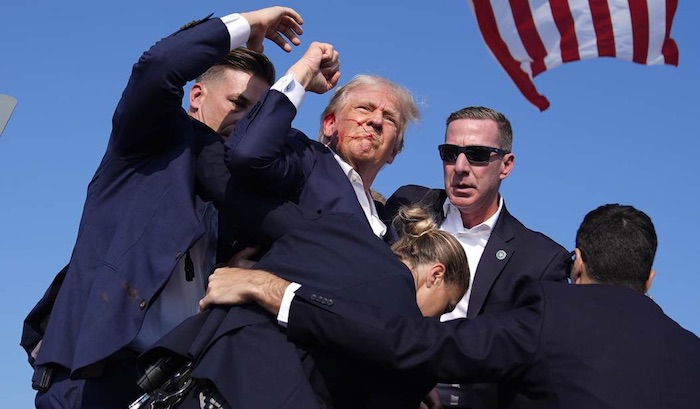

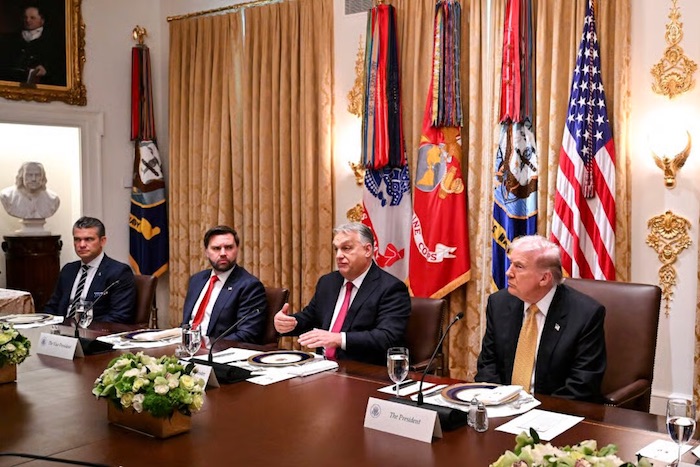
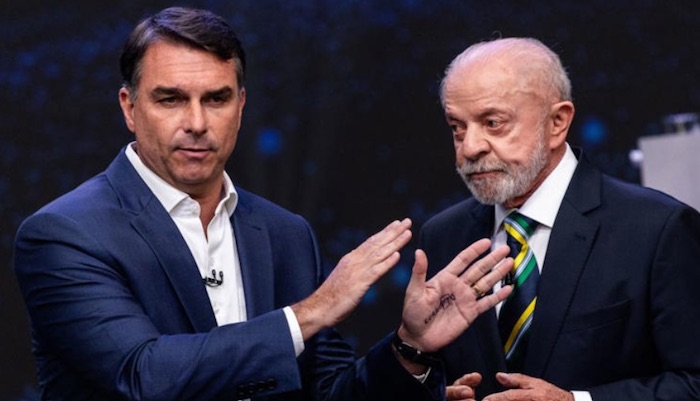


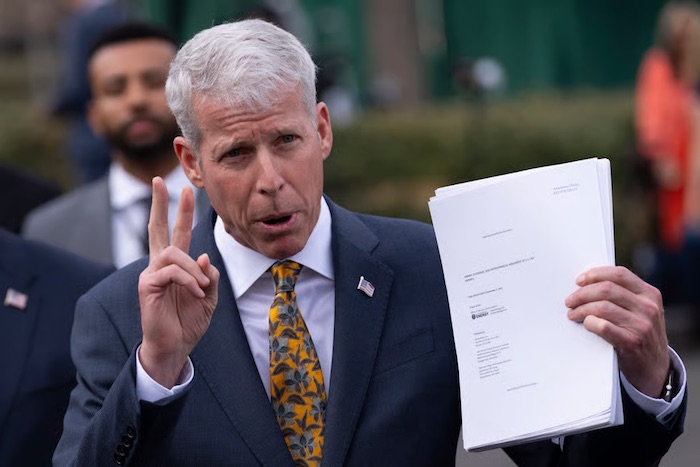
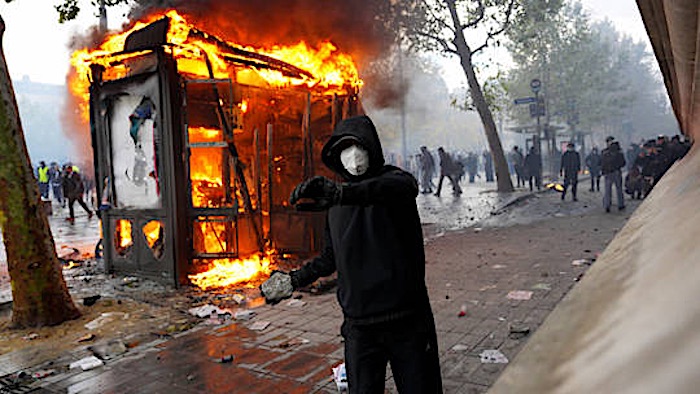
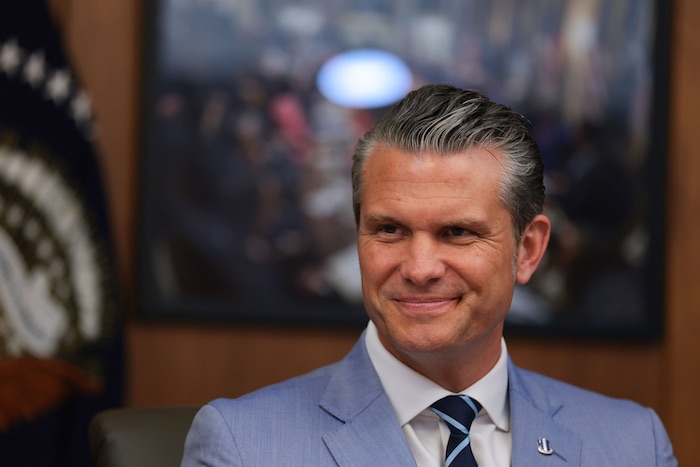
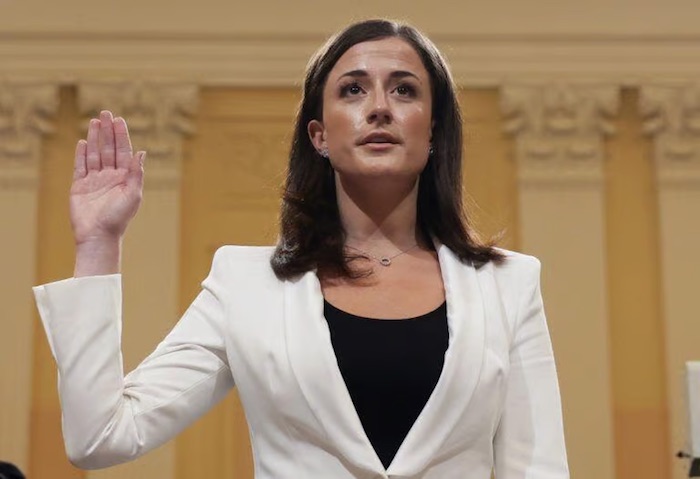


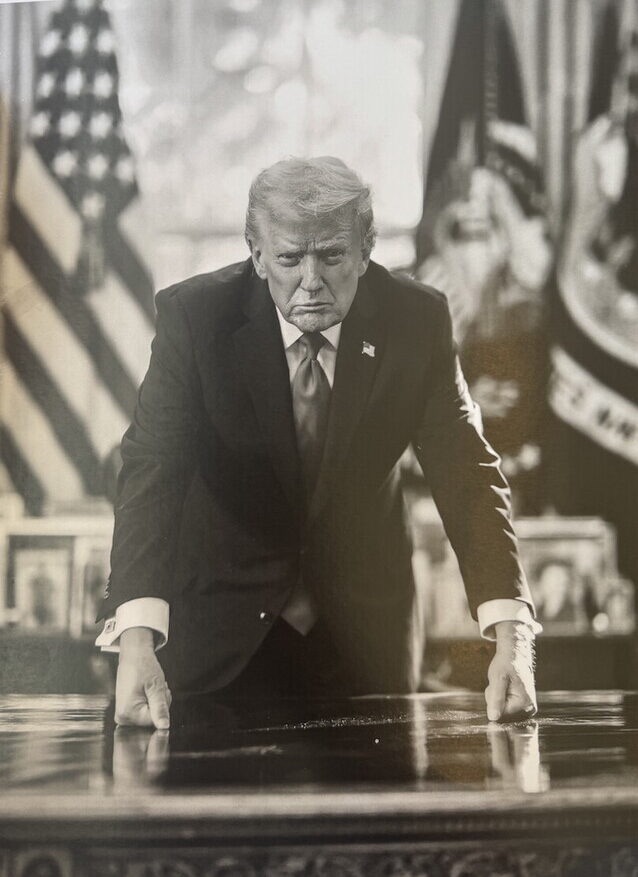

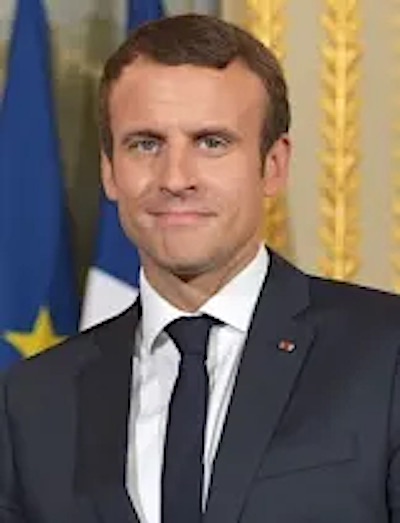




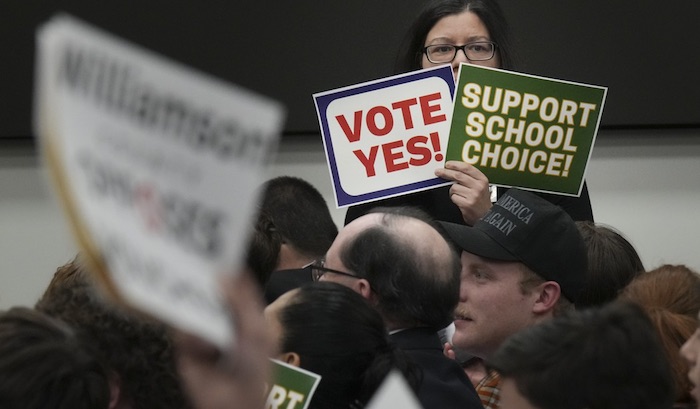


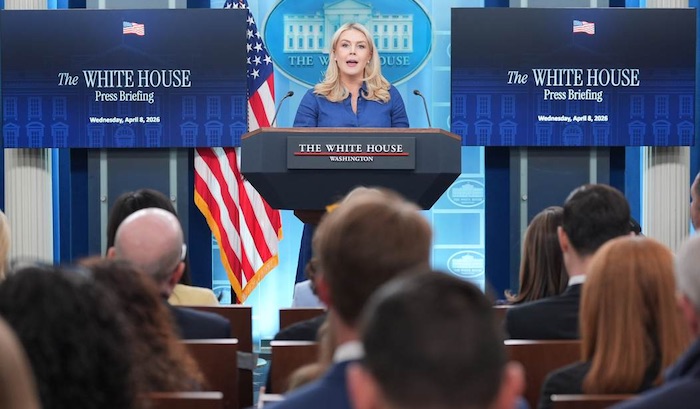

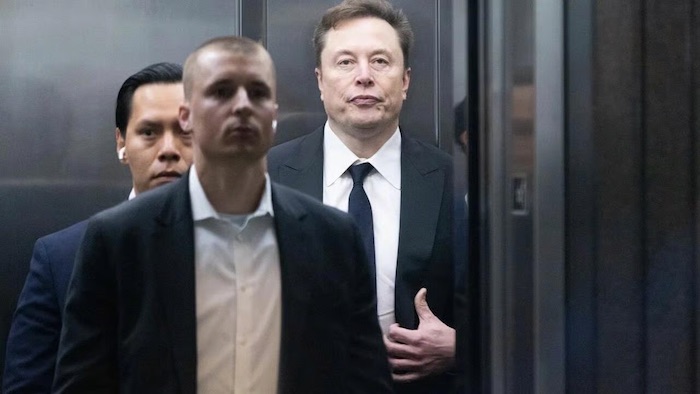

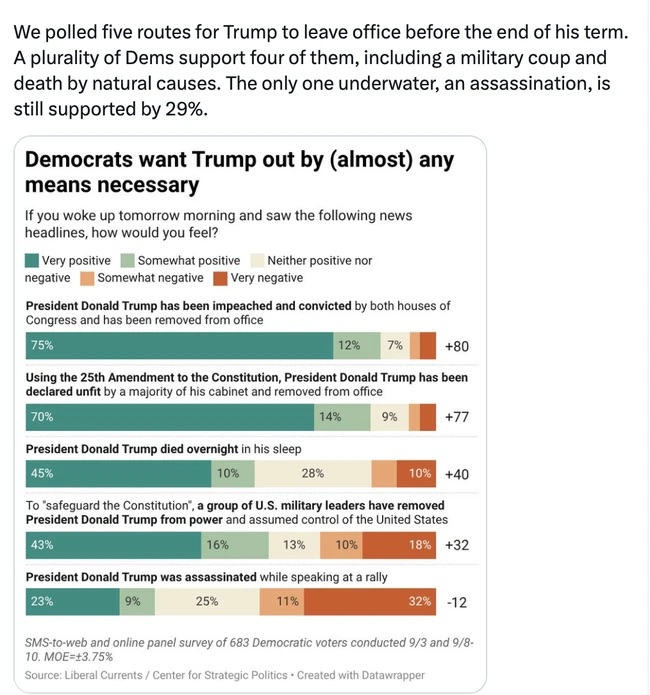



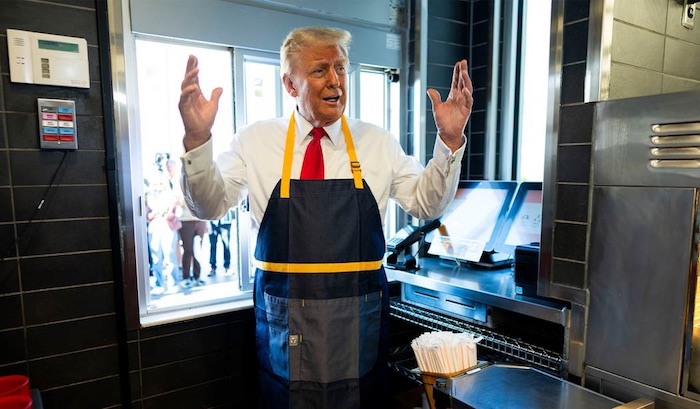





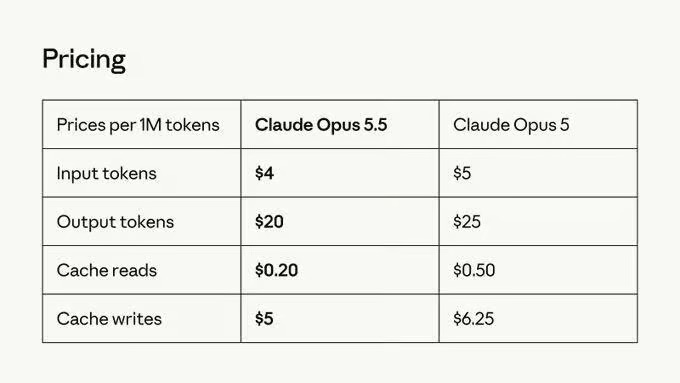



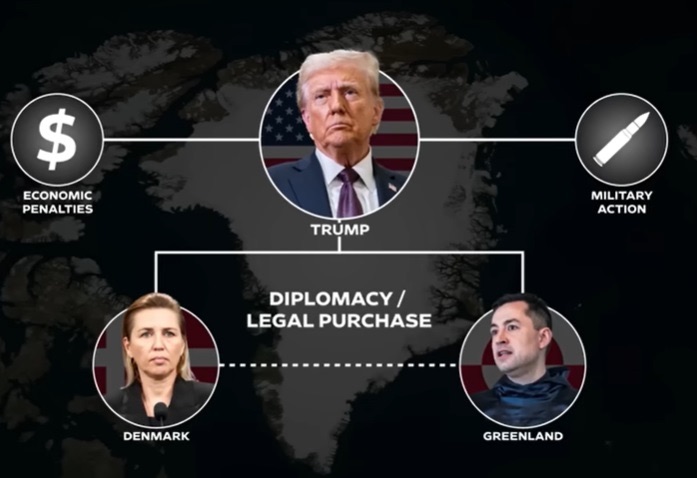


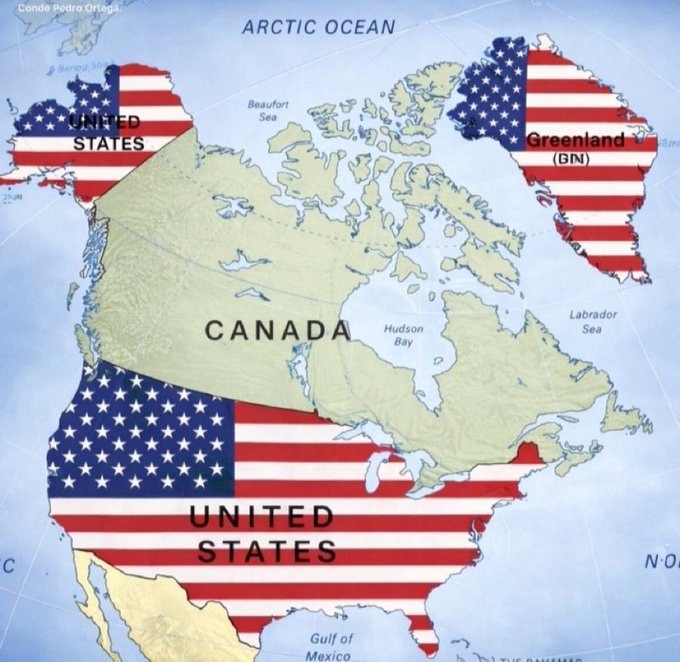






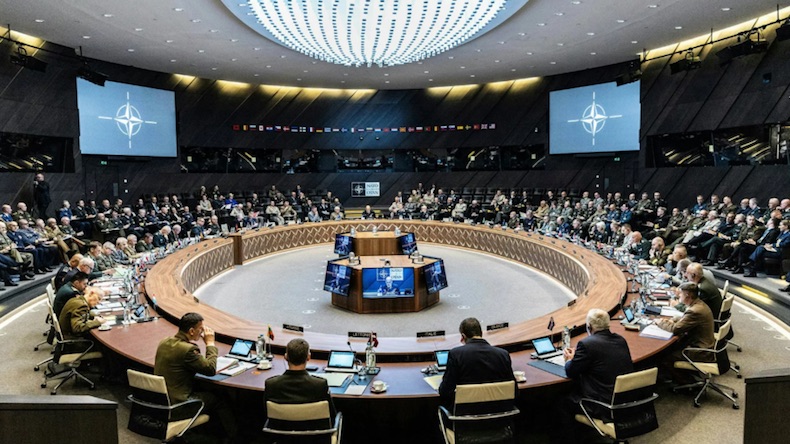





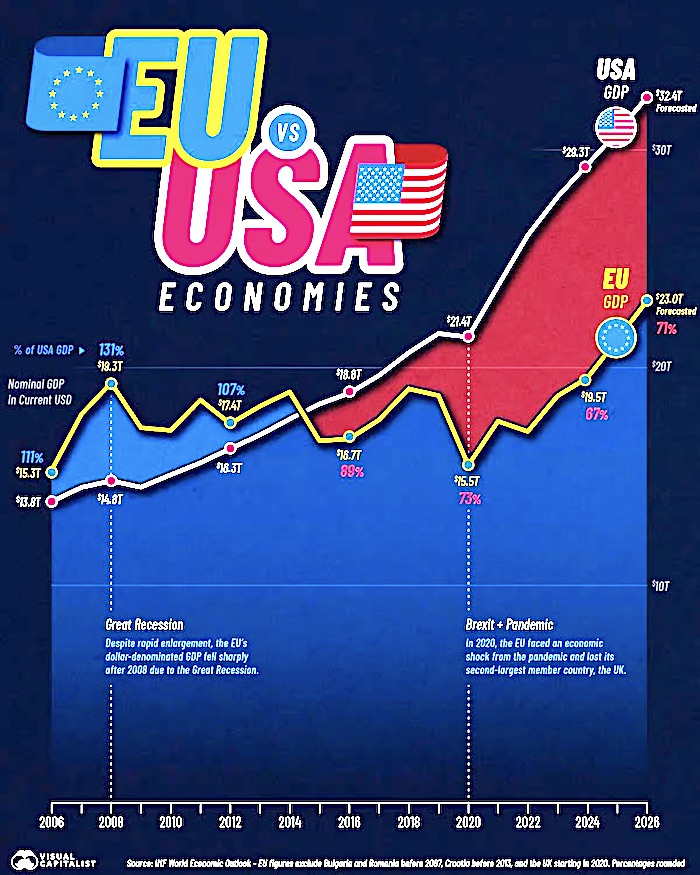
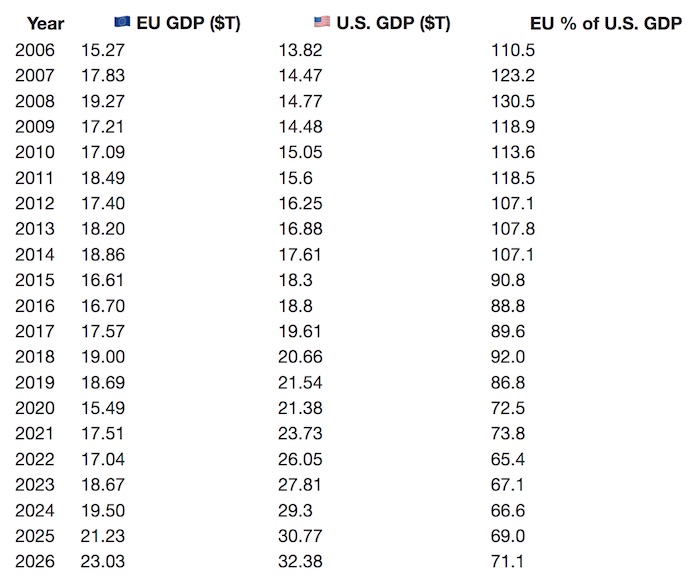




 President Donald Trump, pictured in the Oval Office on July 21, during a meeting with the President of Lebanon
 Construction on President Donald Trump’s White House ballroom is seen on July 14. Daniel Heuer/Bloomberg/Getty Images