
Jul 052016
 
 July 5, 2016  Posted by at 8:06 am Finance Tagged with: , , , , , , , , ,  1 Response »


Jack Allison “Utopia Children’s House, Harlem, New York.” 1938

Don’t Panic. Britain’s Economy Can Survive Just Fine Outside The EU (Mody)
The UK Desperately Needs A Lower Pound (Steen Jakobsen)
Brexit Accelerates the British Pound’s 100 Years of Debasement (BBG)
Meanwhile At The Most Systemically Dangerous Bank In The World… (ZH)
Standard Life Shuts Property Fund Amid Rush Of Brexit Withdrawals (G.)
EU Authority Fraying In Reaction To Brexit Vote (R.)
Draghi Should Have Done More To Help Italian Banks In 90’S, Says PM Renzi (R.)
Did a Fear of Slave Revolts Drive American Independence? (NY Times)
The Statue Of Liberty Was Built To Welcome Immigrants (Eggers)
The Elites Hate Momentum and The Corbynites – I’ll Tell You Why (Graeber)
In New Jersey Student Loan Program, Even Death May Not Bring a Reprieve (NYT)
Sydney Home Prices Just Keep On Rising (BBG)
How Australia Is Sold Into Waging War In Ukraine (Helmer)
US Economist Galbraith Sheds Light On Varoufakis ‘Plan X’ (Kath.)
Wikileaks Publishes More Than 1,000 Hillary Clinton War Emails (Ind.)
Who The F**k Is Charlotte? (Jim Kunstler)


“Between 2000 and 2014, the share of British exports to Europe fell from 60 to 45%.”

Don’t Panic. Britain’s Economy Can Survive Just Fine Outside The EU (Mody

The European Union was not the principal reason why many felt economically and politically powerless, but its bureaucratic creep became a potent symbol of the overpowering force of globalization. The outgoing Prime Minister of Britain David Cameron, who likes to think of himself as modern-day Winston Churchill, had little understanding of these historical forces. Indeed, even Churchill had his historical blind spots. He petulantly called Gandhi a “half-naked fakir” and vehemently opposed Indian independence. But Cameron, seeking his petty political victories, was largely clueless about the larger stakes he ended up playing for. Tactical gains can lead to strategic advance only when guided by a larger vision. All Cameron wanted was greater hold over his party.

But once he let the genie out of the bottle, Cameron misjudged again by making an economic case for remaining in the European Union rather than attempting a serious political argument for Europe—one based on shared values. Perhaps there was no political argument to be made, but the effort to present an economic calculus for a political decision was bound to backfire. The economic numbers to make the case for Britain remaining in Europe were fanciful, however many economists and international organizations joined to endorse them.

Following Brexit, productive British trade with the European Union will survive just fine wherever it is based on long-lasting economic gains and social relationships. At the same time, the shift toward trade with the faster-growing United States and Asia will continue. Between 2000 and 2014, the share of British exports to Europe fell from 60 to 45%. Almost all new British trade is being created outside of Europe. The new tougher trade regime could even spur productivity growth. As the British economy inevitably disengages from Europe, empathy for European Union will decline further. A referendum five years from now will produce an even clearer decision to say out.

Read more …

“The UK’s problem remains their double deficit. The chronic budget and the current account deficits.”

The UK Desperately Needs A Lower Pound (Steen Jakobsen)

I am writing this chronicle from South Africa which is almost as far away from Europe and the constant and never ending Brexit talk as you can come. It’s hard even here to avoid the turbulence and never ending ‘need’ for investors and media to understand what comes next. The best analogy I can use is one from my extensive travels: When you arrive at an airport to check in, you have to pass security control when two options are at hand: The fast track or the slow version (economy class). Using the fast track gets you quicker to the gate and allows you pre-boarding, but what really should matter is that the actual flight time and route is the same for everyone in business and in economy. We arrive at EXACTLY the same time.

The point? What is now transpiring in an economic sense is that we have entered the fast track courtesy of Brexit, the selloff in GBP, the lowering of growth projections and in some places talk about reform and change which would have happened with or without the Leave vote. The UK’s problem remains their double deficit. The chronic budget and the current account deficits. The last time the UK ran a surplus on the current account was the year Italy won the World Cup in Spain and the top scorer was Paolo Rossi. you guessed it — 1982. The UK also has the lowest productivity of the G7 countries together with Japan.

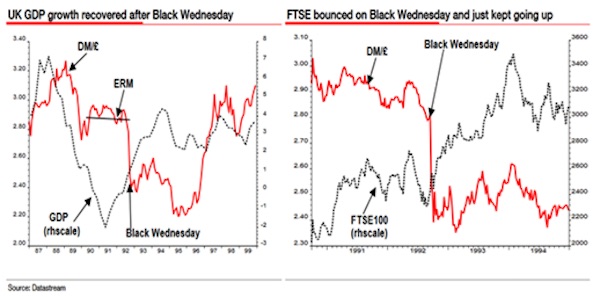
Yes, the UK needs a lower GBP and desperately so and if the ERM crisis of 1992 is any guideline, what comes next for UK is more employment and a stronger GDP as seen in this chart from the excellent research done by Societe Generale. It would be naive to anticipate only positive changes from the increased political uncertainty but do realise that the slowdown in the UK but also Europe was happening before the surprise ‘Leave’ result.
Read more …

Loss of empire.

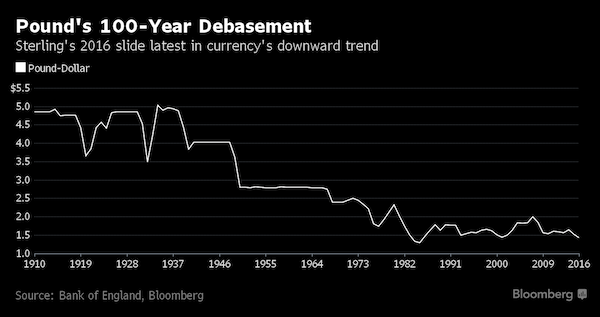
Brexit Accelerates the British Pound’s 100 Years of Debasement (BBG)

There have been few better ways to chart Britain’s decline from empire than its currency. Historians, economists and foreign-policy specialists point to the more-than 10% plunge since the June 23 referendum as signaling another downward leg in the U.K.’s global role and influence. “The history of the pound against the dollar over the last century is essentially a downward ladder with big permanent steps,” according to Rui Pedro Esteves, an associate professor in economics at Oxford University. The world’s oldest currency — sterling is derived from the old German “ster” for strong or stable – bought almost $5 during World War I. The day of the EU referendum, it traded at $1.50. It was at $1.3330 as of 4:33 p.m. on Monday.

HSBC analysts are among those forecasting $1.20 as a likely destination. Billionaire investor George Soros suggests $1.15, the equivalent of about a euro – about 60 cents below its average since 1971. “A country’s economic size measured in other currencies – for the U.K., measured say in dollars – is an indicator of its capacity to project power and influence internationally,” said Barry Eichengreen, a professor of economics at the University of California Berkeley. While some economists, including former BOE Governor Mervyn King, see the weaker currency as leading to more export competitiveness, others see the threat of recession and lower interest rates – combined with more insular politics and withdrawal from the world’s largest trading bloc – as undermining appetite for U.K. assets.

“If you look at the U.K. now, certainly part of what is going on is a result of the exchange rate’s adjustment to growth expectations,” said Maurice Obstfeld, chief economist at the IMF. The pound has been in steady decline, spurred on by a series of financial jolts, for most of the past century – just as Britain’s prominence on the international stage has diminished.
Read more …

Correlation AND causation.

Meanwhile At The Most Systemically Dangerous Bank In The World… (ZH)

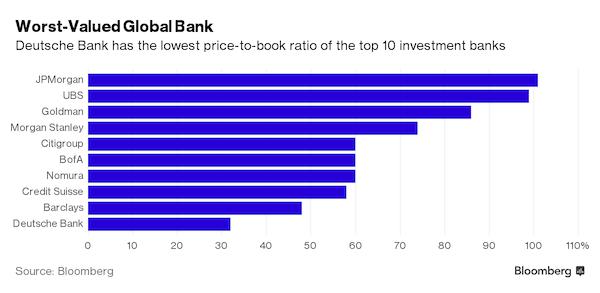
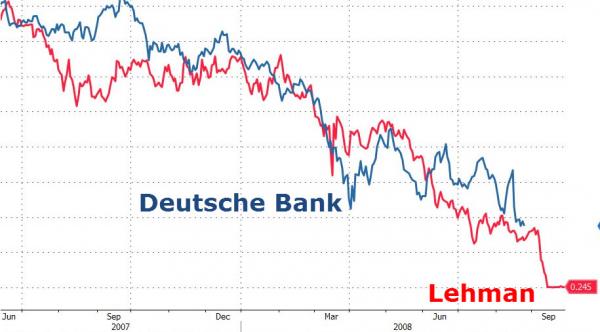
Another day, another fresh record low in Deutsche Bank’s stock price… For comparison’s sake, Deutsche Bank is analogically equivalent to where Lehman was in August 2008… when the stock soared 16% on chatter of a Korean Development Bank bailout… which then was denied, crashing the stock and ending the party…

Shares in Lehman Brothers rose substantially Friday as investors renewed hopes that the troubled investment bank was moving closer to raising capital to buffer it against a deteriorating economic environment. Capping a volatile week, the stock soared 16% on a report that the state-run Korea Development Bank was considering buying the bank, an idea that a spokesman for the South Korean firm said was “erroneous.” Lehman’s stock closed the day up 5% at $14.41.

The spokesman for Korea Development Bank told The New York Times that the bank was in the process of being privatized and was looking at various acquisitions. But he denied that buying Lehman was an option. “We have various thoughts for our future, but we don’t have any specific institutions in mind,” said the spokesman, who declined to be named, citing company policy. Lehman’s suddenly soaring stock underscores the volatility surrounding the firm as it scrambles to assess its options in the face of an abysmal third quarter. Only days ago, its shares tumbled more than 13%.

We wait for chatter of a Deutsche Bank ‘offer’ rumor any day now. We are sure it’s nothing. How can it be a problem given that US equities are so strong? right?
Read more …

Can’t be just one fund that has these problems.

Standard Life Shuts Property Fund Amid Rush Of Brexit Withdrawals (G.)

Investors in Standard Life’s property funds have been told that they cannot withdraw their money, after the firm acted to stop a rush of withdrawals following the UK’s decision to leave the EU. The firm halted trading on its Standard Life Investments UK Real Estate Fund and associated funds at midday on Monday, citing “exceptional market circumstances” for the decision. It said the suspension would remain in place until it is “practicable” to lift it, and that it would review the decision at least every 28 days. The £2.9bn fund, which invests in commercial properties including shopping centres, warehouses and offices, is thought to be the first UK property fund to suspend trading since the 2007-2009 financial crisis, when some of the biggest names in investment management stopped withdrawals because they did not have the money to repay investors.

Standard Life’s decision is the latest in a line of moves by investment firms to stem flows out of their property funds. Standard Life last week, together with rivals Henderson, Aberdeen and M&G, reduced the amount investors cashing in holdings would get back by up to 5%. In a statement, Standard Life said the decision followed an increase in redemption requests from investors. “The suspension was requested to protect the interests of all investors in the fund and to avoid compromising investment returns from the range, mix and quality of assets within the portfolio,” the company said.

Read more …

Juncker’s days are definitely numbered. But nobody seems to either know nor agree what should be next.

EU Authority Fraying In Reaction To Brexit Vote (R.)

[..] Italian Prime Minister Matteo Renzi, who has fought to bend EU budget deficit rules and now seeks to pump billions of euros into his country’s ailing banks if needed to shore them up, said on Monday the EU was run by “a technocracy with no soul”. He also opposed sanctions against fellow southern members Spain and Portugal for violating the EU’s deficit limits last year – a step the Commission is due to consider on Tuesday in a German-backed drive to uphold the much-abused budget rules. Italy’s banks are saddled with €360 billion in bad loans and their share prices plunged after last month’s Brexit vote. Rome is in talks with the EU Commission to devise a plan to recapitalize its lenders with public money limiting losses for bank investors.

Dutch and German ministers have attacked a Commission decision that the European Parliament can approve a trade pact with Canada without referring it to national parliaments. The Dutch parliament was assured it would have a chance to weigh in on the treaty. But perhaps most worryingly for the EU, senior ministers in Germany, the bloc’s reluctant hegemon, are advocating shrinking the executive Commission, trimming its powers, and bypassing common European institutions to take more decisions by intergovernmental agreement. A call from veteran German Finance Minister Wolfgang Schaeuble, long an advocate of closer integration, to shift more policy decision-making to governments for expediency’s sake was among the most striking indicators of the mood around Europe.

“If the Commission doesn’t get involved, then we should take the matter into our own hands and solve problems between governments,” Schaeuble told Welt am Sonntag newspaper, saying now was a time for pragmatism. “This intergovernmental approach proved successful during the euro zone crisis,” he added.

Read more …

Renzi, in trying to save his career, becomes a danger to Brussels.

Draghi Should Have Done More To Help Italian Banks In 90’S, Says PM Renzi (R.)

Italian Prime Minister Matteo Renzi criticized ECB Governor Mario Draghi for not having done more to resolve Italy’s banking woes when he held a key Treasury job in Rome in the 1990s. Renzi’s rare public criticism of Draghi came on the day Italy’s third-largest lender, Banca Monte dei Paschi di Siena (BMPS.MI), said that the ECB had asked it to cut its bad debts by 40% within three years, heaping more pressure on Rome to stabilize its banking system. After taking power in 2014, Renzi’s government introduced reforms aimed at strengthening the country’s cooperative banks, but several are struggling to stay afloat and a bailout fund took control of Veneto Banca last week after the ECB said it had to raise capital or close.

“If the measures concerning the cooperatives had not been taken by us but by the centre-left government that first put them forward, but was not strong enough to enact them in 1998 … then we would not have this problem,” Renzi said. The prime minister said that Draghi was director general of the Treasury at that time, with Carlo Azeglio Ciampi serving as economy minister. “And if people had the strength and intelligence to keep politics out of the banking system a bit before we did it … we would not have had cases like Monte dei Paschi di Siena,” Renzi told a meeting of his centre-left Democratic Party (PD).

Read more …

How things are seldom what they seem. Or people, for that matter.

Did a Fear of Slave Revolts Drive American Independence? (NY Times)

For more than two centuries, we have been reading the Declaration of Independence wrong. Or rather, we’ve been celebrating the Declaration as people in the 19th and 20th centuries have told us we should, but not the Declaration as Thomas Jefferson, Benjamin Franklin and John Adams wrote it. To them, separation from Britain was as much, if not more, about racial fear and exclusion as it was about inalienable rights. The Declaration’s beautiful preamble distracts us from the heart of the document, the 27 accusations against King George III over which its authors wrangled and debated, trying to get the wording just right. The very last one — the ultimate deal-breaker — was the most important for them, and it is for us:

“He has excited domestic insurrections amongst us, and has endeavored to bring on the inhabitants of our frontiers, the merciless Indian savages, whose known rule of warfare is an undistinguished destruction of all ages, sexes and conditions.” In the context of the 18th century, “domestic insurrections” refers to rebellious slaves. “Merciless Indian savages” doesn’t need much explanation. In fact, Jefferson had originally included an extended attack on the king for forcing slavery upon unwitting colonists. Had it stood, it would have been the patriots’ most powerful critique of slavery. The Continental Congress cut out all references to slavery as “piratical warfare” and an “assemblage of horrors,” and left only the sentiment that King George was “now exciting those very people to rise in arms among us.”

The Declaration could have been what we yearn for it to be, a statement of universal rights, but it wasn’t. What became the official version was one marked by division. Upon hearing the news that the Congress had just declared American independence, a group of people gathered in the tiny village of Huntington, N.Y., to observe the occasion by creating an effigy of King George. But before torching the tyrant, the Long Islanders did something odd, at least to us. According to a report in a New York City newspaper, first they blackened his face, and then, alongside his wooden crown, they stuck his head “full of feathers” like “savages,” wrapped his body in the Union Jack, lined it with gunpowder and then set it ablaze.

Read more …

Reflecting on Lady Liberty’s right foot.

The Statue Of Liberty Was Built To Welcome Immigrants (Eggers)

Though she is the most recognisable symbol of the American experiment, there is something about the Statue of Liberty that goes largely unnoticed. And that is that she is moving. The torch in her right hand, symbolising enlightenment, cannot be ignored and is never overlooked. The book in her left hand, with 4 July carved in roman numerals, is not likely to be missed. Nor are the seven spikes of her crown, matching the world’s seven continents and seven seas. And though, if pressed, we remember that she is wearing sandals, we forget, if we ever knew, that the Statue of Liberty is on the go. Take the ferry to Liberty Island. As your boat rises and falls on the rough waters of New York Harbor, you will see, with undeniable clarity, that her right foot is striding forward.

And around her feet are chains, broken, which sculptor Frédéric Auguste Bartholdi meant to symbolise the breaking of the chains of bondage and tyranny. She is caught, forever, in the moment of becoming free. The 305ft statue is a marvel of artistry and engineering, and there are many details to admire, but none is more important than her right leg, which is stepping forward, and stepping forward not casually but with great striding purpose. This right foot, though largely unheralded, might be its most important feature. For what would it mean if the symbol of liberty were standing still? That would imply that freedom is static, that once established, it’s a settled thing. But freedom is not a settled thing.

It would imply that once the first few million immigrants arrived on American shores, fleeing religious bigotry or political violence or ethnic persecution, then the United States should or could close its gates. It would imply that the welcoming of new arrivals, the poor and tired and struggling to be free, was a temporary thing, that the welcoming of the world’s oppressed was a thing of the past. But the welcoming of the world’s oppressed is not a thing of the past. We live in a moment when shrill voices tell us that not only should immigration be stifled, but that millions of current residents should be deported, returned to their country of origin, no matter the consequences for their souls or our consciences. These fearful voices put forth a direct repudiation of the origin and elemental purpose of this country, and to the meaning of the statue that we accept as our talisman.

Read more …

The coup against Corbyn is also linked to Tony Blair’s possible indictment, and the risks that brings for those in the party who are linked to him.

The Elites Hate Momentum and The Corbynites – I’ll Tell You Why (Graeber)

As the rolling catastrophe of what’s already being called the “chicken coup” against the Labour leadership winds down, pretty much all the commentary has focused on the personal qualities, real or imagined, of the principal players. Yet such an approach misses out on almost everything that’s really at stake here. The real battle is not over the personality of one man, or even a couple of hundred politicians. If the opposition to Jeremy Corbyn for the past nine months has been so fierce, and so bitter, it is because his existence as head of a major political party is an assault on the very notion that politics should be primarily about the personal qualities of politicians. It’s an attempt to change the rules of the game, and those who object most violently to the Labour leadership are precisely those who would lose the most personal power were it to be successful: sitting politicians and political commentators.

If you talk to Corbyn’s most ardent supporters, it’s not the man himself but the project of democratising the party that really sets their eyes alight. The Labour party, they emphasise, was founded not by politicians but by a social movement. Over the past century it has gradually become like all the other political parties – personality (and of course, money) based, but the Corbyn project is first and foremost to make the party a voice for social movements once again, dedicated to popular democracy (as trades unions themselves once were). This is the immediate aim. The ultimate aim is the democratisation not just of the party but of local government, workplaces, society itself.

Read more …

In a nutshell: “..One reason for the aggressive tactics is that the state depends on Wall Street investors to finance student loans..”

In New Jersey Student Loan Program, Even Death May Not Bring a Reprieve (NYT)

New Jersey’s loans, which currently total $1.9 billion, are unlike those of any other government lending program for students in the country. They come with extraordinarily stringent rules that can easily lead to financial ruin. Repayments cannot be adjusted based on income, and borrowers who are unemployed or facing other financial hardships are given few breaks. The loans also carry higher interest rates than similar federal programs. Most significant, New Jersey’s loans come with a cudgel that even the most predatory for-profit players cannot wield: the power of the state. New Jersey can garnish wages, rescind state income tax refunds, revoke professional licenses, even take away lottery winnings — all without having to get court approval.

“It’s state-sanctioned loan-sharking,” Daniel Frischberg, a bankruptcy lawyer, said. “The New Jersey program is set up so that you fail.” The authority, which boasts in brochures that its “singular focus has always been to benefit the students we serve,” has become even more aggressive in recent years. Interviews with dozens of borrowers, who were among the tens of thousands who have turned to the program, show how the loans have unraveled lives. The program’s regulations have destroyed families’ credit and forced them to forfeit their salaries. One college graduate declared bankruptcy at age 26 after struggling to repay his debt. The agency filed four simultaneous lawsuits against a 31-year-old paralegal after she fell behind on her payments.

Another borrower, Chris Gonzalez, could not keep up with his loans after he got non-Hodgkin’s lymphoma and was laid off by Goldman Sachs. While the federal government allowed him to suspend his payments because of hardship, New Jersey sued him, seeking $266,000 in payments, and seized a state tax refund he was owed. One reason for the aggressive tactics is that the state depends on Wall Street investors to finance student loans through tax-exempt bonds and needs to satisfy those investors by keeping losses to a minimum. Loan revenues also cover about half of the agency’s administrative budget.

Read more …

How to kill a city.

Sydney Home Prices Just Keep On Rising (BBG)

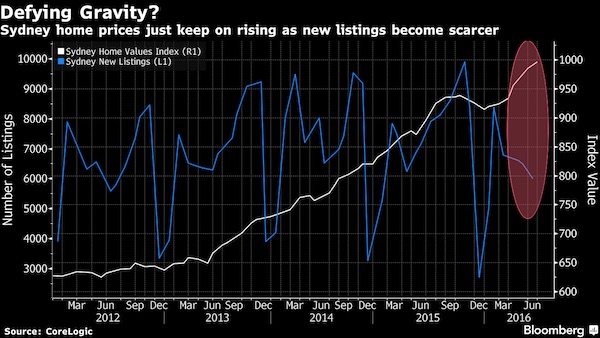
Sydney home prices resumed their upward march as dwindling supply outweighs tighter loan approvals by lenders. Dwelling values climbed 1.2% in June, taking gains for the second quarter to 6.8%, according to data from CoreLogic. The market is getting a leg up after a slowdown at the end of last year in Australia’s largest city, as new listings fell more than 16% from a year earlier to the lowest in five months in June, according to the data.
Read more …

How to kill a country: “..it is financed by grants from the Australian Department of Defence, the Australian Army, the Australian Federal Police, the Dutch Foreign Ministry, and the Japanese Government; plus Raytheon, Northrup Grumman, Lockheed Martin, and Boeing..

How Australia Is Sold Into Waging War In Ukraine (Helmer)

Among Turnbull’s last-minute ploys to attract votes, one was the leak last month of Australian cabinet plans for an Australian Army force to fight in eastern Ukraine, alongside Dutch and other NATO units, to destroy the Donetsk and Lugansk rebellion against the regime in Kiev. Turnbull’s leak had suggested that Tony Abbott, the prime minister Turnbull had pushed aside to take the job, dreamed up the plan of Australian war at the Russian frontier by himself. The new report by Dibb now corroborates the idea of an Australian military expedition against Russia, in exchange for improved American commitments to defend Australia from the Chinese closer to home, in the Pacific.

“How things work out in Europe,” Dibb claims, “will affect Washington’s ability to reassure allies and partners everywhere, including those in our region who must contend with increasing coercion by China.” Unless Australia does more fighting with the Americans on the Russian front, he concludes, “China will take advantage of this, and allies and partners of the US in the region -including Australia- would be subject to further uncertainty about American military commitments to Asia.” Combating “Russia’s aggressive military behaviour “is necessary because, otherwise, “both Moscow and Beijing will be seen as getting away with it.” The 40-page Dibb report is entitled “Why Russia is a threat to the international order”. Read it in full. The publisher is a think-tank headquartered in Sydney called the Australian Strategic Policy Institute (ASPI).

It says “ASPI was established, and is partially funded, by the Australian Government as an independent, non-partisan policy institute.” The institute’s financial reports reveal it is financed by grants from the Australian Department of Defence, the Australian Army, the Australian Federal Police, the Dutch Foreign Ministry, and the Japanese Government; plus Raytheon, Northrup Grumman, Lockheed Martin, and Boeing — the leading arms-exporting corporations of the US. European arms builders also funding ASPI include the European missile-maker MBDA, BAE Systems, ThyssenKrupp Marine Systems, Rheinmetall, Airbus, and Navantia, the Spanish state shipbuilder. When Australians march into the field against the Russians, these suppliers aim to provide the best kit Australian money can buy.

Read more …

Tsipras might have done well to pay some more attention.

US Economist Galbraith Sheds Light On Varoufakis ‘Plan X’ (Kath.)

The Plan B for Greece that was drafted by former Greek Finance Minister Yanis Varoufakis foresaw the declaring of a state of emergency, the immediate nationalization of the Bank of Greece, the transformation of bank deposits into a New Drachma and emergency public order measures, according to a book by American economist James Galbraith, Varoufakis’s chief coordinator for the plan. In the book, “Welcome to the Poisoned Chalice: The Destruction of Greece and the Future of Europe,” which has been translated into Greek, Galbraith describes in detail Varoufakis’s plan for moving Greece to a parallel banking system last year.

Those privy to the Plan B – or Plan X as Varoufakis is said to have called it – would meet in conditions of high secrecy involving secure communications and the depositing of cell phones in hotel refrigerators. According to Galbraith, during the transition phase, the ministries of Defense and the Interior would have been responsible for public order, fuel supplies would be controlled, while employees at important public institutions (schools, hospitals, police) would be mobilized. Even though there was a high-level meeting about the plan, Galbraith said the prime minister did not ask to be briefed, so work on the endeavor ended with the submission of an extensive memo in May.

Read more …

At some point, indictment or not, enough people will realize that Clinton is too much of a risk for the credibility of the entire American political system.

Wikileaks Publishes More Than 1,000 Hillary Clinton War Emails (Ind.)

WikiLeaks, the anti-secrecy website, has released more than 1,000 emails from Hillary Clinton’s private email server pertaining to the Iraq War. The website tweeted a link to 1,258 emails on Monday that Clinton sent during her time as secretary of state. According to the release, the emails were obtained from the US State Department after they issued a Freedom of Information Act request. However, it’s unclear if any of the information is classified. WikiLeaks founder Julian Assange previously claimed that his website obtained enough proof for the FBI to indict the presumptive Democratic nominee for president.

“We could proceed to an indictment, but if Loretta Lynch is the head of the DOJ in the United States, she’s not going to indict Hillary Clinton,” Assange told ITV. “That’s not possible that could happen.” The newly released information will likely only serve as political fodder for the presumptive Republican nominee Donald Trump, as Clinton met with FBI investigators over the weekend wrapping up the lengthy investigation. Sources close to the probe recently told CNN that the bureau will announce no charges against Clinton in the weeks to come.

Read more …

Ha! Funny! But I think Lynch’s involvement is far more insidious than this.

Who The F**k Is Charlotte? (Jim Kunstler)

The mighty Shakespeare in his direst night sweats could not have conjured up the Clinton family in all their sharp angles and dark corners, but we can try to reconstruct the scene last week on Loretta Lynch’s plane out on the Phoenix airport tarmac.

Former president Bill steps aboard:
• Loretta: What the fuck are you doing here?
• Bill: I just had to tell you what Charlotte did last week.
• Loretta: Who the fuck is Charlotte?
• Bill: Our grand-kid. She’s turning into a good little earner.
• Loretta: We can’t meet like this. We’re about to depose your wife.
• Bill: Charlotte gave a speech to the whole Citibank C-suite.
• Loretta: I don’t give a fuck. Get off my plane right now!
• Bill: Well, I don’t know if ‘speech’ is the right word. She gurgles nice.
• Loretta: I guess you didn’t hear me.
• Bill: She pulled in fifty grand for that. Of course it was 100% remitted to the foundation. Well, bye now. (Exits plane).

I have a theory about the Clinton family dynamic. Bill does not want Hillary to win because he doesn’t want to live in the White House again. For sure he does not want to live with The Flying Reptile, but he especially doesn’t want to be on display in that fishbowl where folks pretty much can see what you’re up to 24/7. For one thing, “The Energizer” can’t discreetly come and go. But he certainly doesn’t want to concern himself as “First Husband” or “First Gentleman” (title TBD) with deciding which fabric to choose in replacing the East Room draperies. So Bill decided to fix things for sure with that innocent visit to the US Attorney General’s airplane to talk about grand-kids.

It seems to be working. If there was any question that Loretta Lynch could just sit on her hands about Hillary’s email investigation through the November election, it went up in a vapor last week. It also left the FBI director on the hot seat because now he will have to either cough up a referral to Justice Department prosecutors, or he’ll have some ‘splainin to do in the heat of a presidential election campaign. If you thought Watergate was a ripe peach, this one is beginning to look like a stinking durian (Durio zibethinus).

Read more …

May 192016
 
 May 19, 2016  Posted by at 9:13 am Finance Tagged with: , , , , , , , ,  Comments Off on Debt Rattle May 19 2016


Harris&Ewing Streamlined street car passing Washington Monument 1938

Not All Death Crosses Are Created Equal (BBG)
China’s Communist Party Goes Way Of Qing Dynasty As Debt Hits Limit (AEP)
China’s Housing Bubble Is So Big, Goldman Will “Need A Bigger Chart” (ZH)
Emerging-Market Assets Under Pressure as Fed Minutes Lift Dollar (BBG)
The Case For Germany Leaving The Euro #Gexit (Bibow)
Europe’s Troubled Push For Bank Bail-Ins (FT)
Euro Area Shifts Greek Focus to Debt Relief to Win IMF Support (BBG)
All Economics Is Political (WSJ)
5 Banks Sued In US For Rigging $9 Trillion Agency Bond Market (R.)
Another Year of Anger for Deutsche Bank’s Investors (BBG)
First Look At Explosive Hillary Documentary, ‘Clinton Cash’ (NY Post)
Earth Breaks 12th Straight Monthly Heat Record (AP)
India To Start Massive Project To Divert Ganges And Brahmaputra Rivers (G.)

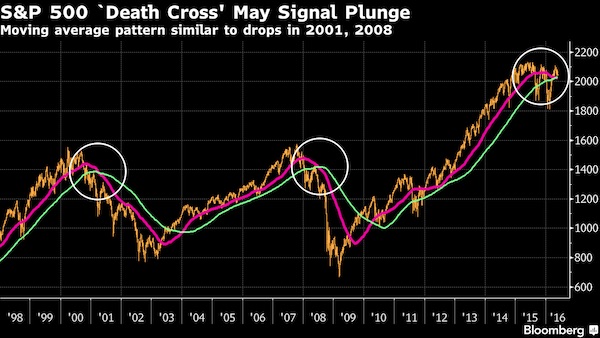
Difference is in 2001, 2008 there were no people as nuts as Draghi, Kuroda and Yellen. Or, if there were, they were not in charge.

Not All Death Crosses Are Created Equal (BBG)

In a note to clients, Intermarket Strategy Chief Executive and Strategist Ashraf Laidi points out that the S&P 500’s 50-week moving average is falling below its 100-week moving average. This “statistically significant” death cross has only happened twice is the past two decades, Laidi points out. The first took place in 2001 and was followed by a 37% decline in the index, while the second pattern occurred in 2008 and preceded a 48% drop. With investors already growing increasingly nervous about prospects for equities, a death cross of grave proportions could give extra reason for caution.

Read more …

“With luck, the rest of us outside China will have three or four more months to order our own affairs before the storm gathers.”

China’s Communist Party Goes Way Of Qing Dynasty As Debt Hits Limit (AEP)

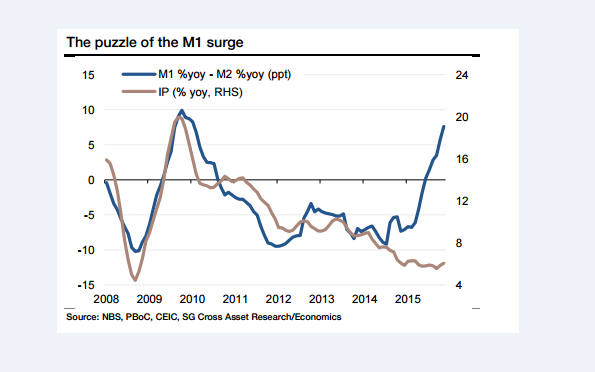
[..] The latest stop-go credit cycle began in mid-2015 and has since accelerated to an epic blow-off, with the M1 money supply now growing at 22.9pc, by the fastest pace since the post-Lehman blitz. Wei Yao from Societe Generale estimates that total loans rose by $1.15 trillion in the first quarter, equivalent to 46pc of quarterly GDP. “This looks like an old-styled credit-backed investment-driven recovery, which bears an uncanny resemblance to the beginning of the ‘four trillion stimulus’ package in 2009. The consequence of that stimulus was inflation, asset bubbles and excess capacity,” she said. House sales rose 60pc in April, despite curbs to cool the bubble. New starts were up 26pc. Prices jumped 63pc in Shenzhen, 34pc in Shanghai, 20pc in Beijing, and 18pc in Hefei. Panic buying is spreading to the smaller Tier 3 and 4 cities with the greatest glut.

It all has echoes of the stockmarket boom and bust last year. “Investors are convinced that the government will guarantee that housing prices won’t fall,” said Professor Zhu Ning from the Shanghai Advanced Institute of Finance, speaking to the South China Morning Post. It also sounds like Britain. There was a slight cooling in April but less than headlines suggested. The old measure of total social financing (TSF) slipped but this was more than offset by record bond issuance of $180bn. Together they reached a 26-month high. Capital Economics says budgeted funds must be disbursed by the end of this quarter under new finance ministry rules, implying another $310bn of bonds by late June. The fiscal boost will be ‘front-loaded’. The money will pile up in accounts and flood the economy over the late summer. If the usual time-lags hold, the mini-boom will last for a few more months. Then the trouble will start. Needless to say, markets may roll over long before the economy itself.

[..] .. this year the China bears may get their revenge, if they have any money left to play with. The rot in the country’s $7.7 trillion bond markets is metastasizing. Bo Zhuang from Trusted Sources said more than 100 firms cancelled or delayed bond issues in April due to widening credit spreads. Ten companies have defaulted this year, with the shipbuilder Evergreen, Nanjing Yurun Foods, and the solar group Yingli Green Energy all in trouble this month. But what has really spooked markets is the suspension of nine bonds issued by the AA+ rated China Railways Materials, the first of the big central SOE’s to signal default. “This has greatly weakened investors’ long-standing expectation of implicit government support,” he said.

Bo Zhuang said investors have poured money into bonds in the latest frenzy. The stock of corporate bonds has jumped by 78pc to $2.3 trillion over the last year. It is the epicentre of leverage through short-term ‘repo’ transactions, and it is now coming unstuck. “The experience with the stock market shows how difficult it can be to contain a reversal in leveraged bets. In our view, a bond market crisis would be much more destructive,” he said. With luck, the rest of us outside China will have three or four more months to order our own affairs before the storm gathers. Whether it is bumpy landing, a hard landing, or a crash landing, depends on who the “authoritative person” in Beijing turn out to be.

Read more …

“..year-over-year price growth in tier-1 cities [..] 28.3%..”

China’s Housing Bubble Is So Big, Goldman Will “Need A Bigger Chart” (ZH)

One of the stated reasons for the Shanghai Composite’s 1.3% drop (and it would have been worse had the PPT not launched its infamous last minute buying blitz) was also the most amusing one: the stock market bubble is in danger of popping even more as a result of a housing bubble that is now raging at a pace not seen since the last Chinese housing bubble, and thus threatens to soak up even more cash from China’s chronic gamblers-cum-speculators.

So just how high of a housing number did the NBS report that spooked stocks so much? Well, as Goldman summarizes, housing prices in the primary market increased 1.1% month-over-month after seasonal adjustment in April, higher than the growth rate in March. Out of 70 cities monitored by China’s National Bureau of Statistics (NBS), 63 saw housing prices increase from the previous month. On a year-over-year, population-weighted basis, housing prices in the 70 cities were up 6.9% (vs. 5.5% yoy in March).  According to an alterantive set of calculations by MarketNews, aggregate home prices rose 12.4% Y/Y in April after rising 10.4% in March. Since both numbers are ridiculously high, we’ll just leave them at that.

However, it was not the overall market bubble that is troubling, but that focused on the most desired, top – or Tier 1 – cities. Here, April price growth was 2.6% month-over-month after seasonal adjustment, vs. 3.0% in March.

But the real shocker was that on a year-over-year price growth in tier-1 cities continue to rise however, reaching 28.3% vs. 26.0% yoy in March. In fact it is so bad that Goldman, which tried to show the surge in the second chart below, clearly needs a bigger chart. Incidentally, total property sales in tier-1 cities accounted for around 5% of nationwide property sales in volume terms, and around 15% in value terms (2015 data).

And the stunning charts: Home price inflation month over month

And year over year: to show the Tier 1 housing bubble, Goldman will need a bigger chart.


Read more …

Can’t keep the dollar down forever.

Emerging-Market Assets Under Pressure as Fed Minutes Lift Dollar (BBG)

Emerging-market stocks and currencies fell to two-month lows as the dollar got a boost from minutes of the Federal Reserve’s last meeting that showed officials want to raise interest rates in June. The MSCI Emerging Markets Index headed for its biggest two-day drop in two weeks after minutes of the April 26-27 meeting released Wednesday in Washington showed most officials judged it “likely would be appropriate” to hike next month provided incoming data are in line with a second-quarter pickup. China’s yuan, South Korea’s won, Malaysia’s ringgit and Taiwan’s dollar fell to the weakest levels since March, while Indonesia’s rupiah and Thailand’s baht reached February lows.

The release of the minutes and speeches by regional Fed bank presidents warning investors not to dismiss the chance of a June increase have seen the chance of such a move increasing to 32% from 4% at the beginning of the week, Fed Funds futures show. Developing-nation stocks have now wiped out all of their gains this year and there’s a risk of outflows accelerating if the dollar keeps strengthening. “Investors should avoid any additional investments in emerging markets because their currencies and stocks will be under huge pressure from the strong dollar,” said Komsorn Prakobphol at Tisco Financial in Bangkok. Energy stocks will probably be resilient as the oil price is being driven more by supply and demand dynamics, he said.

A gauge of the greenback against 10 peers was steady after jumping 0.8% overnight, the most since November. The Bloomberg Dollar Index has rallied 3.1% in May, on track for its best month since January 2015. Overseas investors have pulled $2.9 billion from Taiwanese stocks this month and close to a combined $1 billion from Indian, Indonesian and Thai bonds, exchange data show. “Asian currency weakness has been exacerbated by portfolio outflows from the region and we see little respite in the weeks and months ahead,” said Mitul Kotecha at Barclays in Singapore. The ringgit, baht, rupiah and, to an extent, the Taiwan dollar are the most vulnerable Asian currencies to a Fed rate increase, while India’s rupee and the Korean won are better placed, he said.

Read more …

“It is undeniable that the euro has turned out to be an instrument of widespread impoverishment rather than shared prosperity.”

The Case For Germany Leaving The Euro #Gexit (Bibow)

The case for or against a British exit from the EU – #Brexit – is headline news. For the moment the earlier quarrel about a possible Greek exit from the Eurozone – #Grexit – seems to have taken the back seat – with one or two exceptions such as Christian Lindner, leader of Germany’s liberal FDP. Most EU proponents are deeply concerned about these prospects and the repercussions either might have on European unity. Yet, while highly important, neither of them should distract Europe from zooming in on the real issue: the dominant and altogether destructive role of Germany in European affairs today. There can be no doubt that the German “stability-oriented” approach to European unity has failed dismally. It is high time for Europe to contemplate the option of a German exit from the Eurozone – #Gexit – since this might be the least damaging scenario for Europe to emerge from its euro trap and start afresh.

Germany’s membership of the Eurozone and its adamant refusal to play by the rules of currency union is indeed at the heart of the matter. Of course, it was never meant to be this way. And it was not inevitable for Europe to end up in today’s state of never-ending crisis that impoverishes and disunites its peoples. I have always supported the idea of a common European currency as I believed that it could potentially provide a monetary order that is far superior to the status quo ante of deutschmark hegemony: the Bundesbank – in pursuit of its German price stability mandate – pulling the monetary strings across the continent. While I have also always held that the euro – the peculiar regime of Economic and Monetary Union agreed at Maastricht – was deeply flawed, I kept up my hopes that the political authorities would reform that regime along the way to make the euro viable.

In this spirit I proposed my “Euro Treasury” plan that would, among other things, fix the Maastricht regime’s most serious flaw: the divorce between the monetary and fiscal authorities that is leaving all key players vulnerable and short of the powers required to steer a large economy like the Eurozone through anything but fair weather conditions, at best. Watching developments over in Europe from afar my hopes are dwindling by the day that the failed euro experiment will usher in reforms that could save it. Instead, the likelihood of some form of eventual euro breakup seems to be rising constantly. It is undeniable that the euro has turned out to be an instrument of widespread impoverishment rather than shared prosperity.

Read more …

“For US investors it will become very different to follow.”

Europe’s Troubled Push For Bank Bail-Ins (FT)

When Ignazio Visco, governor of the Bank of Italy, spoke in Florence this month, his focus turned to regulation. At a sensitive moment for Italian lenders, whose shares had collapsed over recent months, the governor chose to address what he called “regulatory uncertainty” in the wake of new European-wide rules for failing banks. “We must strike the right balance,” he said. “We should not rule out the possibility of temporary public support in the event of systemic bank crises, when the use of a bail-in is not sufficient”. Taxpayer support for banks, however, was precisely what the new European rules introduced at the start of this year aimed to avoid. To protect taxpayers, investors in banks bonds – mostly untouched during the bailouts of the last crisis – now face losses, or “bail-ins”.

The tension between the Italian central bank and European regulations is related to who owns this debt. In Italy, many retail investors hold exposed bank bonds, and a “bail-in” of small Italian banks in November last year was politically sensitive for this reason. But Mr Visco’s comments also reflect the challenges of implementing continent-wide rules in very different individual countries, with contrasting banking systems. So how else might this regulatory uncertainty, and the role of national governments, complicate a European vision for dealing with bank failure? Under the Bank Recovery and Resolution Directive (BRRD), European banks are now required to have a certain amount of bonds that are exposed to losses. The key issue is who suffers losses first. Whereas senior bank bonds ranked alongside depositors during the crisis, new bonds need to be subordinated to take losses.

But the actual instruments that count towards this measure are determined by national legislation. As a result, different countries have taken different approaches. Italy has raised corporate depositors above bondholders. France is currently legislating for a new class of bank debt, which will sit below depositors and existing senior bonds. In Germany, the law has been changed to subordinate outstanding senior bonds. In the UK, banks sell bonds from their holding companies, which will rank below other senior bank bonds. In the Netherlands, it is unclear how the rules will work. Robert Muller, treasurer at Rabobank, says the bank is strongly leaning towards the French approach, rather than the German. For investors, this represents a challenge. “At this point in time it’s very difficult for investors to see how this pans out,” says Mr Muller. “For US investors it will become very different to follow.”

Read more …

Why am I thinking deck chairs? Anyway, can’t see Germany agree to spend its money on buying up loans.

Euro Area Shifts Greek Focus to Debt Relief to Win IMF Support (BBG)

Euro-area officials are weighing a proposal to purchase loans that member states made to Greece in a move that would ease the nation’s debt burden, a precondition for the IMF’s involvement in a bailout program. Senior finance ministry officials held a conference call on Wednesday night to discuss ways to make Greece’s €321 billion of obligations sustainable, according to two people with knowledge of the talks. One option would be for the European Stability Mechanism, the euro-area’s financial backstop, to purchase loans individual euro nations made to Greece and reduce the interest payments, said the people, who asked not to be named because the discussions are private. About €52.9 billion of bilateral loans were made in 2010 and 2011.

Greece’s creditors are struggling to complete a review of the nation’s third bailout, which would pave the way for the disbursal of much-needed aid. The IMF has made its participation in the program contingent upon debt relief, a prospect euro-area finance ministers began discussing last week during an emergency meeting meant to resolve the impasse in unlocking the funds. Nations including Germany have said that the IMF needs to be involved in any future bailout program. The ESM is also considering purchasing the IMF’s loans as a way to give Greece a financial boost since its debt terms are more lenient than those of the Washington-based fund, according to a sustainability report prepared by the European institutions.

Buying back the IMF loans “amounts to debt relief,” European Commission Vice President Valdis Dombrovskis said in remarks in Brussels on Wednesday at a Politico conference. The officials mulled three debt-relief options during the call: have the ESM purchase bilateral loans made to Greece from individual countries; have the ESM purchase the IMF’s obligations; and extending the maturities of Greece’s debt and reducing the interest rates, one of the people said.

Read more …

Economics is politics in disguise.

All Economics Is Political (WSJ)

The models have been run and the numbers crunched: Bernie Sanders’s presidential platform, if enacted, would create 26 million jobs and 5.3% growth. An economist has done the calculating, and there’s no use arguing with mathematics. CNN’s headline reads: “Under Sanders, income and jobs would soar, economist says.” When I run that line by Russ Roberts, he replies with a joke: “How do you know macroeconomists have a sense of humor? They use decimal points.” Mr. Roberts is a fellow at the Hoover Institution, a University of Chicago Ph.D., and the gregarious host of EconTalk, a weekly podcast that celebrated its 10th anniversary in March. He is also an evangelist for humility in economics. “The world’s a complicated place,” he says. “We demand things from economics that it can’t provide, and we should be honest about that.”

What’s striking is Mr. Roberts isn’t talking only about politically contrived agitprop. Nobody believes that stuff: One of President Obama’s former economic advisers stirred ire from Sandernistas earlier this year when he said that getting Bernie’s agenda to add up requires assuming “magic flying puppies with winning Lotto tickets tied to their collars.” The deeper question is: How much better—more credible, or reliable, or falsifiable—are the economic forecasts pouring out of respectable think tanks, the White House and Congress? Mr. Roberts’s answer: not all that much. He cites the Congressional Budget Office reports calculating the effect of the stimulus package—for instance, one in late 2009 suggesting it had increased employment by between 600,000 and 1.6 million.

Leaving aside the incredible range of the estimate, how did the CBO come up with those numbers? Did it somehow measure employment in the real world? Nope: The CBO gnomes simply went back to their earlier stimulus prediction and plugged the latest figures into the model. “They had of course forecast the number of jobs that the stimulus would create based on the amount of spending,” Mr. Roberts says. “They just redid the estimate. They just redid the forecast. And you’re thinking, that can’t be what they really did.”

Read more …

Definitely the new normal.

5 Banks Sued In US For Rigging $9 Trillion Agency Bond Market (R.)

Five major banks and four traders were sued on Wednesday in a private U.S. lawsuit claiming they conspired to rig prices worldwide in a more than $9 trillion market for bonds issued by government-linked organizations and agencies. Bank of America, Credit Agricole, Credit Suisse, Deutsche Bank and Nomura were accused of secretly agreeing to widen the “bid-ask” spreads they quoted customers of supranational, sub-sovereign and agency (SSA) bonds. The lawsuit filed in Manhattan federal court by the Boston Retirement System said the collusion dates to at least 2005, was conducted through chatrooms and instant messaging, and caused investors to overpay for bonds they bought or accept low prices for bonds they sold.

“Only through collusion could a dealer quote a wider spread than market conditions otherwise dictate without losing market share and profits,” the complaint said. “Defendants reaped millions of dollar(s) in profits at the expense of plaintiff and members of the class as result of their misconduct.” The proposed class-action lawsuit seeks triple damages, and follows probes by U.S. and European Union antitrust regulators into possible SSA bond price rigging.

[..] The lawsuit is one of many in the Manhattan federal court seeking to hold banks liable for alleged price-fixing in bond, commodity, currency, derivatives, interest rate and other financial markets. One such lawsuit, concerning competition in the credit default swaps market, led last September to a $1.86 billion settlement with a dozen banks. SSA bonds are sold in various currencies by issuers such as regional development banks, infrastructure borrowers including highway and bridge authorities, and social security funds. Many carry explicit or implicit backing from governments, and thus enjoy high investment-grade ratings.

Read more …

Will Deutsche self-destruct?

Another Year of Anger for Deutsche Bank’s Investors (BBG)

Deutsche Bank investors expressed their frustration with management at the company’s annual meeting a year ago. Weeks later, co-Chief Executive Officer Anshu Jain was gone. Now it’s Chairman Paul Achleitner and Jain’s replacement, John Cryan, who are set to feel the displeasure of shareholders when they gather in Frankfurt on Thursday. With revenue plunging and the need for capital mounting, some investors worry it may be just a matter of time before they’re asked to stump up and buy new stock. “The mood’s going to be bad, maybe even worse than at last year’s meeting,” said Klaus Nieding, vice president of DSW, a German firm that advises shareholders on company proposals.

Deutsche Bank shares dropped by more than half in the past year – erasing about $22.6 billion in market value – as plans to bolster capital and slash costs failed to revive confidence and profits shriveled across the industry. For Achleitner, a supervisory board dispute in April raised questions about his commitment to rooting out misconduct at Germany’s largest bank. Jain, 53, resigned in June after he and co-CEO Juergen Fitschen received the lowest approval rating in at least a decade in a vote at last year’s annual meeting. Fitschen, 67, will stand down on Thursday, leaving Cryan as sole CEO. Cryan, a British citizen who chaired the audit committee of the supervisory board before becoming co-CEO, has been outspoken about the company’s shortcomings, criticizing excessive pay, spiraling legal costs and outdated technology.

He suspended the dividend to bolster capital and pledged to shed about 9,000 jobs, or almost 10% of the workforce, and shrink the investment bank by scaling back the debt-trading empire built by Jain. While some investors applauded the cost reductions as long overdue, others expressed concern the cutting would eat too deeply into sales, especially during a trading slump. Debt-trading revenue, Deutsche Bank’s largest source of income, fell 29% in the first quarter from a year before, while net income dropped 61%. Cryan told analysts last month that his efforts to overhaul the company and settle outstanding legal matters may lead to a second straight annual loss. “The issue that we have is that we want to get an awful lot done this year,” he said.

Read more …

Sorry for doing politics, but this is going to be a really big item. Question’s going to be: who can fill in for Hillary once she’s behind bars?

First Look At Explosive Hillary Documentary, ‘Clinton Cash’ (NY Post)

Hillary Clinton says that when she and her husband moved out of the White House 15 years ago, they were “dead broke.” Today, they’re worth more than $150 million. In the new documentary “Clinton Cash,” it becomes all too clear how the former first couple went from rags to filthy rich — with the emphasis on filthy. As the movie shows, the Clintons are political Teflon dons compared with another Beltway power couple, former Virginia Gov. Bob McDonnell and his wife, Maureen. The McDonnells were convicted of accepting more than $150,000 in gifts from a businessman while the governor was in office. Meanwhile, the Clintons raked in 700 times that amount – $105 million – under the pretext of speaking fees while Hillary was in public office.

Yet while the McDonnells face time in the Big House, the Clintons are once again aiming for the White House. The documentary is based on a book by former Hoover Institution fellow Peter Schweizer and was just screened during the Cannes Film Festival. It is set to be shown in major US cities, including Philadelphia during the Democratic National Convention there in July. Schweizer’s research has withstood a year of intense scrutiny from critics because it is fact, not fiction. And the facts are compelling. The film whisks you around the globe, retracing how the Clintons personally pocketed six-figure speaking fees and collected billions of dollars for their family foundation. How? By trading on Hillary’s position as secretary of state and possible future president.

She and her ex-president husband sold out to titans, dictators and shady characters in Nigeria, Congo, Kazakhstan and the United Arab Emirates, not to mention at Goldman Sachs and TD Bank. Along the way, the Clintons betrayed the values they profess on the campaign trail: human rights, environmentalism and democracy. That’s why Schweizer is bringing the documentary to the Democratic convention — to show the party faithful how the Clintons used and abused their liberal principles to amass a fortune. The Clintons earned the bulk of their money from speaking fees. It was simple: Bill’s fees skyrocketed when Hillary became secretary of state in 2009, suggesting that countries and companies hiring him counted on getting more than just Bill — they also expected to land what his wife had to offer.

Read more …

“The last month that wasn’t record hot was April 2015. ”

Earth Breaks 12th Straight Monthly Heat Record (AP)

Earth’s heat is stuck on high. Thanks to a combination of global warming and an El Nino, the planet shattered monthly heat records for an unprecedented 12th straight month, as April smashed the old record by half a degree, according to federal scientists. The National Oceanic and Atmospheric Administration’s monthly climate calculation said Earth’s average temperature in April was 58.7 degrees (14.8 degrees Celsius). That’s 2 degrees (1. 1 degrees Celsius) warmer than the 20th century average and well past the old record set in 2010. The Southern Hemisphere led the way, with Africa, South America and Asia all having their warmest Aprils on record, NOAA climate scientist Ahira Sanchez-Lugo said. NASA was among other organizations that said April was the hottest on record. The last month that wasn’t record hot was April 2015.

The last month Earth wasn’t hotter than the 20th-century average was December 1984, and the last time Earth set a monthly cold record was almost a hundred years ago, in December 1916, according to NOAA records. “These kinds of records may not be that interesting, but so many in a row that break the previous records by so much indicates that we’re entering uncharted climatic territory (for modern human society),” Texas A&M University climate scientist Andrew Dessler said in an email. At NOAA’s climate monitoring headquarters in Asheville, North Carolina, “we are feeling like broken records stating the same thing” each month, Sanchez-Lugo said. And more heat meant record low snow for the Northern Hemisphere in April, according to NOAA and the Rutgers Global Snow Lab.

Snow coverage in April was 890,000 square miles below the 30-year average. Sanchez-Lugo and other scientists say ever-increasing man-made global warming is pushing temperatures higher, and the weather oscillation El Nino — a warming of parts of the Pacific Ocean that changes weather worldwide — makes it even hotter. The current El Nino, which is fading, is one of the strongest on records and is about as strong as the 1997-1998 El Nino. But 2016 so far is 0.81 degrees (0.45 degrees Celsius) warmer than 1998 so “you can definitely see that climate change has an impact,” Sanchez-Lugo said. Given that each month this year has been record hot, it is not surprising that the average of the first four months of 2016 were 2.05 degrees (1.14 degrees Celsius) higher than the 20th-century average and beat last year’s record by 0.54 degrees (0.3 degrees Celsius).

Read more …

Complete and utter idiots. Everything that can go wrong, will. And then some.

India To Start Massive Project To Divert Ganges And Brahmaputra Rivers (G.)

India is set to start work on a massive, unprecedented river diversion programme, which will channel water away from the north and west of the country to drought-prone areas in the east and south. The plan could be disastrous for the local ecology, environmental activists warn. The project involves rerouting water from major rivers including the Ganges and Brahmaputra and creating canals to interlink the Ken and Batwa rivers in central India and Damanganga-Pinjal in the west. The minister of water resources, Uma Bharti, said this week that work could start in a few days. A spokesperson from her department told the Guardian that the government is still waiting for clearance from the environment ministry. The project will cost an estimated 20 lakh crore rupees (£207bn) and take 20-30 years to complete.

The government of Narendra Modi, the prime minister, is presenting the project as the solution to India’s endemic water problems. For years, parts of India have suffered from devastating spells of drought. As average temperatures in India rise, and the growing population puts increasing demands on water resources, millions of people are without a reliable water supply. This year, 330 million Indians have been affected by drought. State governments used emergency measures to deliver water by train in the western state of Maharashtra; in other areas, schools and hospitals were forced to close, and hundreds of families were forced to migrate from villages to nearby cities where water is more easily accessible.

According to the National Water Development Agency, which will oversee the rivers project, “the water availability even for drinking purposes becomes critical, particularly in the summer months … On the other hand excess rainfall occurring in some parts of the country create[s] havoc due to floods.” The scheme is a pet project of Modi, who has made several promises to end India’s long-term water problems. In the first few months of his premiership, Modi’s cabinet revived the idea of linking 30 rivers across India. The water resources ministry spokesperson said: “The idea is old, but the Modi government has done all the work on it.” Plans to interlink rivers were drawn up in the 1980s by Indira Gandhi’s government, and were gathering dust as central governments repeatedly failed to win the approval of states. Now, with a supreme court mandate, and government backing, save the rubber stamp of the environment ministry, the project could get under way in a matter of days.

Read more …