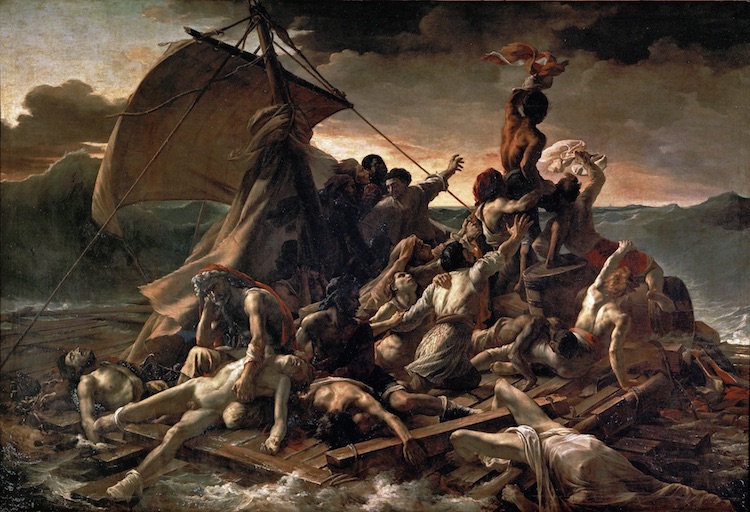
Théodore Géricault The Raft of the Medusa 1819

https://twitter.com/MAGAVoice/status/2080373149192049087?s=20 https://twitter.com/VigilantFox/status/2080405643429601645?s=20
Nvidia CEO Jensen Huang on Trump:
— Election Wizard (@ElectionWiz) July 23, 2026
He's smart. He remembers everything. Goodness gracious. He sure knows numbers.
He wants the United States to be re-industrialized.
He is single-mindedly about creating jobs. pic.twitter.com/Y7u2m6WKFp
Hit them where it hurts. It’s the only way.
• Oil Slides Despite Unraveling ‘Diplomacy’ In Iran (ZH)
Oil Eases by Week’s End on Signs of ‘Diplomacy Lite’Read more …
Somewhat surprisingly, oil prices are pushing lower by week’s close, especially after a succession of perhaps ‘diplomacy-lite’ headlines; however, the reality still remains is that the bombing campaign is escalating… and typically the region witnesses the biggest bombs away on a weekend, with markets closed:
• Pakistan exploring path toward resuming US-Iran talks: Reuters
• Pakistan’s push to resume talks follows pressure from China: Reuters
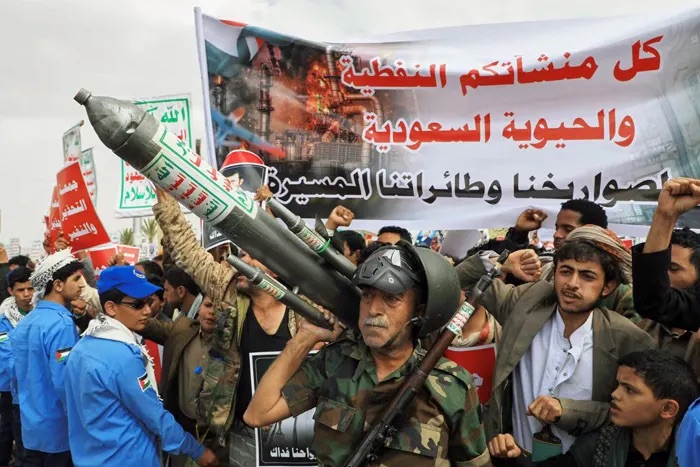
• Houthis say they don’t seek to close key Bab al-Mandeb Strait (only for Saudi shipping, they say)
• Trump to meet Netanyahu at the White House on Tuesday amid Iran escalation
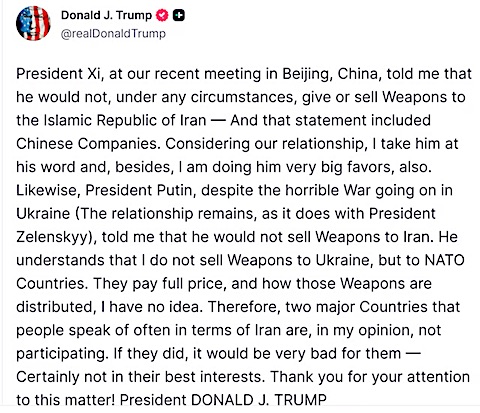
President Trump took to Truth Social to warn China and Russia against giving or selling arms to Iran, saying: “If they did, it would be very bad for them”. However he also sought to clarify: “In my opinion, (they are) not participating.” Doing so was “certainly not in their best interests” – the president added. The president addressed a Reuters report that alleged Iranian strikes on CIA targets in the Gulf earlier in the war is being investigated, on concerns that Russia or China may have helped with such targeting. Xi “told me he would not,” Trump wrote. Was there a pinky promise?…
Iraqi Prime Minister Denies NYT Report on Ceasefire Offer
The latest little peace overture by Washington widely reported Thursday night was apparently a big nothingburger, as on Friday the Iraqi prime minister’s office has denied a New York Times report claiming that Iran rejected a US ceasefire proposal delivered to Tehran by Iraqi Prime Minister Ali al-Zaidi.The fresh statement from the prime minister’s office said what was published in the Times was “entirely unfounded” and had “no relation to reality.” The statement underscored the temporary nature of the proposal and that it was the “only offer on the table” and still left the question of control over the Strait of Hormuz unresolved – and so Tehran was uninterested.It’s also the reality that Tehran wants to see Trump sweat and impose economic and political costs particularly ahead of the midterms in November, where Congressional Republicans must face voters over failing to rein in Trump’s Iran war. The Iranians continue to openly voice this, for example in the following from the parliament speaker:
13th Straight Night of US Bombing
Meanwhile, in what is becoming a brutal, nightly routine, US Central Command (CENTCOM) has wrapped up its 13th consecutive wave of airstrikes against Iran. The Pentagon said it targeted military command centers, drone storage facilities, communication networks, and coastal surveillance sites.Iranian state media reported overnight into Friday heavy explosions rocking major hubs across the country, including Khorramabad, Jask, Ahvaz, Bandar Abbas, and the strategic outpost of Qeshm Island. Iranian media further said a US missile strike left four dead and five injured in the key industrial and transportation hub of Ahvaz. As the bombs fall, Tehran is still signaling that military pressure won’t force a cheap surrender – with Iranian Foreign Minister Abbas Araghchi lashing out at the US escalation, warning that “mindless aggression” will only see Trump pay a “heavier price” for a deal to end the war.
More Iran Retaliation on Gulf
Iranian retaliation on US-linked sites in the Gulf have continued at the same steady pace, with on Friday Bahrain’s military having intercepted “several treacherous Iranian air attacks” – according to the general command of the Bahrain Defense Force.The Bahraini military further denounced Iran’s “systematic hostile approach” and “criminal attacks targeting civilians”. The statement emphasized, “The general command emphasises that the deliberate use of missiles and drones to target civilians and private property constitutes a flagrant violation of international humanitarian law.”Throughout the morning the Iranian military’s targets also included locations in Jordan, Kuwait, and northern Iraq. Sky News is reporting that “Explosions were also heard near a base hosting the US in Iraq, near the Erbil International Airport.”
Fox Poll says Iran War More Unpopular Then Ever
Fox feeding its Boomer audience some Freedom Viagra with a helping of war crimes on the side:
Fox News discussion about Iran's infrastructure:
— The American Conservative (@amconmag) July 23, 2026
"What do you think we might hit first?"
"I don't know if we'll hit it first, but the Damavand plant supplies 40% of Tehran's electricity." pic.twitter.com/VpYVT2X4lIBut Fox News also reports the results of its latest poll which finds 56% oppose the ongoing American military action against Iran, including 40% who “strongly” oppose. “Disapproval of President Donald Trump’s handling of Iran hit a record high in July,” Fox writes. “A majority of voters oppose U.S. military action, and nearly two thirds think the conflict will last at least a year,” the report says.
Victor Davis Hanson
Long excerpt, sorry. It’s just that he’s very right.
“He’s trying to undo the entire half-century progressive project within four years. That’s an impossible task. And yet he’s trying to do it. “
• Trump Sparked the Counterrevolution to End the Destruction of America (VDH)
I’d like to speak today about revolutionaries and counterrevolutionaries. Whether we realize it or not, we’ve been in a progressive revolutionary cycle for about 50 years. And by that I mean there has been the effort of most of the Democratic Party, and now the radical elements to accelerate that efforts as emblemized by the democratic socialists to take control of government, expand it, redistribute income so that many people in blue states especially are paying over 10% of their income, in addition to 38% of their federal tax or two or three percent in Obamacare tax and other add-ons.Read more …
And it’s not very difficult to pay 50% of your income or more for the taxpayer who’s salaried without much write-offs. And the welfare state, which has distributed over twenty trillion dollars since this started under the Great Society, is getting bigger and bigger, at least until Donald Trump. And this progressive revolution doesn’t believe in borders. It has let in—we have now 53 million people that were not born in the United States, and in California, it’s over a quarter of the population. It’s all-time high percentage-wise, 16% foreign-born.They don’t have confidence that you, the people, will buy into the progressive project. And so, they want to import a demographic that is poor and needy on the idea that they will be constituents that will trade their votes for subsidies. And we saw that with the Somali community in Minnesota, and we’ve seen it with other communities here in California. And so, the progressive project has given us a real revolution. We never imagined that there were going to be more than two genders or sexes. We never imagined that they would try to normalize biological men taking over women’s sports or dressing among young teenage girls. We never imagined that.
We never imagined that prosecutors would let out career felons who had committed violent acts the same day they were arrested. We didn’t know we were gonna empty the prisons because we felt that punishment, penal punishment was too mean. We never really felt that our only real democratic country and ally in the Middle East, Israel, we would try to disassociate ourselves, and we would try to romanticize terrorists like Hamas. But what I’m getting at, this was the progressive project. It was anti-American, it was anti-Western, and it glorified other modes of civilization, so to speak: socialism, communism, anarchism. And it was very critical of the very society who had enriched most Americans.
I say most—the middle class of America is the largest middle class in the world and the most affluent, and our poor are better off than most middle class and upper middle class in other places. It’s important to remember that there has not been a counter-revolution. Ronald Reagan was the first and really last Republican president that had an economic counterrevolution. It was quite successful. He lowered the tax rate. He deregulated the economy, and by 1983-84, he was growing the economy at 7% GDP growth.
And then, of course, that was watered down in subsequent years. But the two Bushes, candidates like John McCain, Bob Dole, Mitt Romney, their agenda was to slow down the revolution, but not to try to overturn it. What do I mean by slow down? Kind of advise Hollywood that they didn’t have to be so anti-American and have movies that talked about race, class, and gender ad nauseam. Try to tell professional sports not to be weaponized. Try to tell K-12, calm it down a little bit. We don’t need sex education in the first grade, and there’s nothing wrong with a teacher occasionally giving a prayer that she inadvertently forgot was illegal.
Calm down. You don’t need to send the FBI to school board meetings, that kind of thing. We don’t need to take the knee at sports and ridicule “The Star-Spangled Banner.” So, this revolution had infiltrated K-12, the corporate boardroom, the universities especially, the media, the foundations, and popular culture. But the Republican and conservative movement had just tried to slow it down. And then came Donald Trump. He was not—he’s surely not a revolutionary. We were in the middle of a revolution, but he was not a trimmer either. He was a true counterrevolutionary.
The first term, he was not familiar with Washington. He made appointments with people who did not agree with him—not just they did not agree with his methodology, but they didn’t agree with his counter-revolutionary agenda. But it was still in places working. And what was the result? The result was COVID-19 and the COVID-19 lockdown, and it was aborted. The second time he came around, he tried to finish the counterrevolution. So he pretty much demolished the subsidies for green energy and re-emphasized oil and gas production, and we became the greatest producer of oil and gas in the history of civilization.
He sort of said, “We’re not going to regulate AI and robotics, cryptocurrency, genetic engineering, drone. We’re not gonna legislate them out of business. We’re not gonna have antitrust and complete investigations of all these people. We’re gonna promote it. We’re going to promote these new innovations and new technologies.” And lo and behold, we’re ahead of the Chinese in almost all of them now. He didn’t just say, “I am worried about the military. It may be that DEI has discouraged a particular demographic that over generation after generation has provided the largest percentage of our combat units, namely white males.”
He did away with DEI. And what was the result? All of a sudden, we have met all of our recruitment figures. He didn’t just say, “Well, the border’s been open. I know that we’ve let in 10 million people a year over four years. I know that 10,000 were coming a day under Biden. I understand that, so maybe I’ll say no more catch and release. Or maybe you have to apply for refugee status in, say, Mexico.” No, no. He said, “I’m going to finish the wall. I’m not gonna let anybody stop me. This time there’s going to be a wall, and we are going to deport people. We’re gonna deport a million people in my first year, and we’re gonna make sure a million others self-deport, and we’re gonna go after 500,000 with criminal records.”
He didn’t just say, “I am very worried about Latin America. “Under [Barack] Obama and under [Joe] Biden, we saw a wave of left-wing governments, and the Panama Canal is in danger. Venezuela has the largest oil reserves really in the Western Hemisphere, if not the world, and they are exporting convicts and drugs to the United States.” He didn’t just say that. He went down there and basically threatened Panama that we would take over the canal unless they honored our Panama Canal treaty and expelled the Chinese from trying to control the entry and exits of the canal.
He said to [Nicolas] Maduro, “You better stop because you’re exporting terror and communism and bullying your neighbors.” He didn’t, and he extradited him and ended that threat. And now as we look at Ecuador, Peru, Chile, Bolivia, Argentina, El Salvador, Dominican Republic, I could go on, they’re mostly center right. So, he staged a strong counterrevolution by reinforcing the Monroe Doctrine that had been rejected by the Left, and he made South America and Central America now a free market and, for the most part, a society that’s pro-American, with some notable exceptions.
For example, in Nicaragua, a beleaguered Daniel Ortega and a beleaguered Castroite government in Cuba that are both now for the first time in years isolated. In addition to that, he made our allies stronger. He used unorthodox methods. He was the proverbial gunslinger who came in to help the townspeople who were ossified and couldn’t deal with the robber barons or the cattle barons or the outlaws, and then he cleaned up the town, and then they got tired of him because of his methodology and rhetoric.
But nonetheless, he said to our allies, “We’re not gonna be in NATO unless you’re real NATO members. You’re not NATO members. You’re not arming yourself. You’re not abiding by your commitments.” Same held true to Canada. And lo and behold, now we have much stronger allies, and the alliance is stronger than ever. What am I getting at? Donald Trump is not a revolutionary. He’s a counterrevolutionary.
And what is he trying to do? He’s trying to undo the entire half-century progressive project within four years. That’s an impossible task. And yet he’s trying to do it. He’s the first authentic counterrevolutionary since Andrew Jackson.
“. . .there is no saving the Left. There is only saving America from them.” — Sasha Stone
• Struggle Session (James Howard Kunstler)
The polycrisis of 2026 whirls like a demon-infested storm overcoming this human project of ours like a medieval panorama of the world’s end. Everything is fraught, tilting toward hazard, menace, ruin. Even under a summer sun, the mind sees only darkness everywhere it looks. Apocalypse now, it seems like. You almost can’t blame the doomers, the black pill-ers, lost in their transports of dread. But I tell you, we will get through this.Read more …
Is it a surprise that the IRGC has a death wish for its host, Iran? They’ve been advertising it loudly for half a century, yearning for martyrdom, the bliss of paradise, marriage to multiple perfumed virgins, all the pomegranates you could ever want, and perpetual dreamtime beside a gently burbling fountain in the palace of eternity. Trouble is, to get there you must have your head blown off.That’s exactly what the IRGC is asking for, though the millions of ordinary Iranians probably have their doubts about the ask. They are hostages of the IRGC regime, which refuses to just stop being a problem for the world. Mr. Trump’s proffer for Iran still abides: become a normal nation, sovereign and all, only without atom bombs. Let ships sail through Hormuz unmolested. Sell your oil, make some money, trade with the other fellas across the Persian Gulf, have a nice civilized life with all the refinements of age-old Persian culture, even with its Islamic overlay. Be happy!
The USA does not seek to occupy Iran, steal its resources, subjugate its people, force them to buy Minnie Mouse plush toys, play baseball, eat Jimmy Dean sausage for breakfast, strum banjoes, or wear cowboy hats. Just stop projecting violence and discord all over the Middle East.
You can’t make us, the IRGC says. Yes, we will, the USA replies. And so it goes. Next up: bridges and power plants. Plus, every ship you damage, we’ll deduct the cost of repair from your frozen assets held in our banks. This is where things stand after the thirteenth night of strategic bombing against the IRGC’s launch sites, drone factories, missile storage caverns, and shoreline military installations. Iran prepared assiduously for this death-scene for decades, building hidey-holes here, there, and everywhere. But every time they launch something now, our satellites mark the coordinates, and boom, now there’s one less hidey-hole.
Iran’s currency, the rial, has an exchange rate against the US dollar of about 1,900,000 to one dollar. There is hardly a functioning economy left. The people are flat broke. Everyday life must be hell now. Could be the IRGC was getting tons of munitions and material for free from China, but days ago we blew up the railroad bridge at Aq Tekeh-Khan that was China’s main connection to Iran, so that’s over with.
You must doubt that Russia is capable of sending arms to Iran at this point. Russia needs every drone and missile it can fabricate now that Ukraine is sending drones clear into Moscow and St. Petersburg on a regular basis. Of course, that war is being stoked by NATO, which perforce includes the USA. A bill (H.R. 2913 — the Ukraine Support Act) that would furnish $1.3-1.8 billion in direct security, military, and reconstruction assistance for Ukraine plus $8 billion in loans was passed by the House in June, but languishes in the Senate. President Trump has threatened to veto it, as running counter to the administration’s preference for negotiations with Russia to end the Ukraine War rather than extend it.
These two conflicts must seem intractable for now, but the mojo driving them has clear and present limits. If the USA does not underwrite Ukraine’s war effort, then that leaves the EU nations, who are increasingly broke, and for all their idle talk are really incapable of mounting a major arms production campaign. The UK especially is skating on thin ice these days as Mr. Trump methodically cancels its long-running command and control of global finance through the City of London (as its “Wall Street” is called). In fact, it looks as if the floundering UK — with dopey Andy Burnham rolling in as Britain’s seventh Prime Minister in a decade — has passed the ball of globalist leadership to its forward striker (and all-purpose fixer) Mark Carney the Prime Minister of Canada.
Carney, who was previously chief of the Bank of England, has played a series of losing games against President Trump the past year, while Mr. Carney is busy wrecking the Canadian economy for the sake of the globalist “green” flimflam, a sustained high volume of third world immigration, and outlandish DEI activism that includes giving vast tracts of real estate back to Canada’s First Nations people, their Indians. Carney has also very actively played footsie with the CCP to a degree that is seriously pissing off Mr. Trump. Among all the other shocks and surprises upcoming, you might imagine him having to send the 82nd Airborne up to Ottawa to inform PM Carney that there will be no globalist seat of operations in North America.
Yes, things are getting that strange. And then, continuing the clean-up operation south of our border, there is Cuba to straighten out. Cuba is obviously next. Our patience with that failing state’s communist export project is particularly thin, now that the Democratic Party here is entertaining Marxist-Leninist dreams of glory.
And when Russia defends itself, they’ll come crying to Trump.
• EU Wants To Board Russian Shadow Fleet Tankers In The Indian Ocean (ZH)
The European Union has authorized its naval mission in the Indian Ocean (apparently there is one) to stop and board Russian shadow fleet tankers suspected of operating under false flags, the bloc announced on Wednesday.Read more …
The Spanish Navy frigate Santa María F81, deployed as part of the European Union Naval Force Operation ATALANTA, seen off the coast of Mogadishu, Somalia, on April 24, 2025.
EU member states have authorized Operation Atalanta, the union’s counter-piracy naval mission off the Horn of Africa, to begin conducting flag-verification boardings of vessels suspected of belonging to Russia’s shadow fleet in the western Indian Ocean, DefenseNews reported. The decision, announced this week by EU foreign policy chief Kaja Kallas, extends to Atalanta a power already exercised by the EU’s Mediterranean mission, Operation Irini.Kallas made the announcement alongside news that Irini forces had boarded the sanctioned oil tanker MV South Star on July 20, acting on suspicion that the vessel was sailing under a false flag. “Every illicit voyage helps sustain Russia’s war machine. We are matching our sanctions with action at sea,” Kallas said, adding that the Atalanta authorization “further tightens the net.”
The move considerably widens the EU’s geographic reach against the shadow fleet, a loosely defined network of tankers with opaque ownership structures that Moscow uses to sell oil above the Western-imposed price cap. While Irini patrols the Mediterranean, Atalanta operates across the Somali Basin, the Gulf of Aden, the Red Sea, the Gulf of Suez, the Gulf of Aqaba and waters around Oman, and was launched as the EU’s first-ever naval mission in 2008 to combat piracy.
It is separate from the EU mission ASPIDES, which is designed to protect shipping in the Red Sea from attacks by the Iran-backed Yemeni Houthi rebels. One look at the exploding price of oil shows just how much the market thinks of Europe “defending” this particular waterway. The corridor where the mission operates is a critical transit route for tankers carrying Russian crude toward buyers in Asia. Brussels has already sanctioned more than 600 vessels suspected of belonging to the network.
Generally, ships on the high seas cannot simply be stopped and boarded by any third country. However, Article 110 of the UN Convention on the Law of the Sea permits warships to stop and inspect a vessel only where there is reasonable suspicion it is stateless or flying a flag to which it is not entitled. This falls short of a blanket authority to stop any sanctioned or Russia-linked ship, but flying false flags has been a frequent practice on Russian shadow fleet vessels.
The council decision, the operational plan and the rules of engagement that would spell out exactly how far Atalanta’s new powers extend have so far not been made public. The approach has already produced results elsewhere. Irini’s flag checks contributed to pressure that culminated in a Cameroon purge of 39 vessels from its shipping registry after investigators uncovered fraudulent paperwork and fake registry websites used to disguise shadow fleet tankers.
Russian President Vladimir Putin has previously denounced such interceptions as “piracy,” underscoring how the expanded mandate is likely to further sharpen tensions between Brussels and Moscow over enforcement at sea. One caveat to all this: unlike oil, Russian LNG (which Europe is absolutely desperate for) will remain exempt from EU sanctions. Which prompted Rabobank’s Michael Every earlier today to ask rhetorically “realpolitik or real weakness?”
Why has that not been done from the get-go?
• Trump’s Plan to Make Data Centers Bring Their Own Energy (DS)
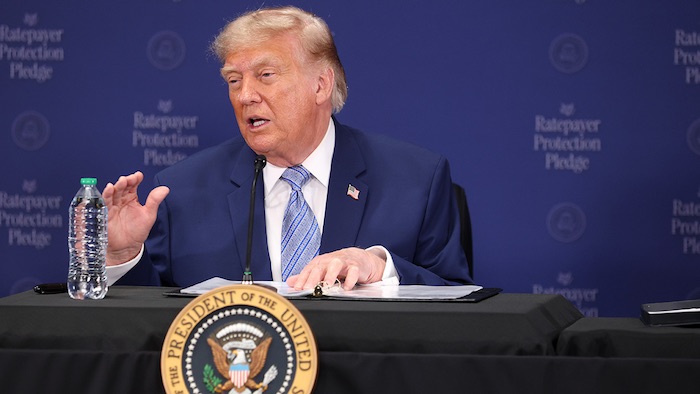
President Donald Trump said 23 governors have signed his pledge to protect everyday Americans from the energy costs associated with new artificial intelligence data centers.Governors, companies, and stakeholders who sign the pledge agree to “protect American consumers from price hikes due to data center energy and infrastructure requirements, and lower electricity costs for consumers in the long term.”“We know that the data centers and AI are dramatically increasing the demand for electricity,” Trump said Thursday.Read more …
“It’s only fair that the cost of building the new infrastructure required to meet the demand should be borne by the corporations themselves, not by the American American patriots, American citizens.” While Daniel Cochrane, senior fellow at the Institute for Family Studies’ Family First Technology Initiative, thinks this is a step in the right direction, he doubts the pledge will be enough to quell the rising sentiment against data centers for AI. Seven in 10 Americans oppose the construction of data centers in their community, according to a May 13 Gallup poll. Nearly half are strongly opposed.Opponents of the rapid buildout of data centers reportedly held 142 protests across 42 states on Saturday. Some public officials are taking action. New York Gov. Kathy Hochul, a Democrat, announced a one-year pause on data center construction in her state.“The bigger point is that the public opposition to data centers in general goes beyond just their localized impacts,” Cochrane told the Daily Signal. “It really goes to the public’s growing concern that AI as a technology, and the companies behind it, are diminishing human agency.”
It’s critical to recognize “the public’s larger resentment and concern with technology as a force and larger economic, social phenomenon,” Cochrane said. He said the question remains of how the pledge will prevent households and small businesses from bearing the brunt of higher prices when data centers begin operation, before their generation capacity is supplying additional energy to the grid.
“The companies say they’ll pay for additional generation capacity, but the generation capacity takes another five years to come online between the time that the data center actually begins operation and the time that their generation capacity is supplying additional energy to the grid,” Cochrane said. “Well, in the interim, who’s covering the costs of that?”
Nathan Leamer, executive director of the pro-AI advocacy group Build American AI, thinks blue-state policies, not data centers, are to blame for high electricity prices.“President Trump is doing the right thing, which is thinking creatively about how to protect ratepayers across the country, including in states where bad energy policies are leading to increased energy and electricity prices as as our nation relies more on electricity and energy,” Leamer told the Daily Signal.
Brendan Steinhauser, CEO of The Alliance for Secure AI, thinks the ratepayer protection plan will help some with anti-data center sentiment, but concerns remain.“The concerns are not just about energy and water, they’re about the nature of the technology itself,” he told the Daily Signal. “There’s still a lot of questions there. I think this is good policy, good politics. But I think the president and governors around the country are going to have to do more to kind of get at the crux of the matter regarding AI.”
Politicians must do more to calm people’s fears about the catastrophic risks associated with AI, Steinhauser said. He thinks Vice President JD Vance has done the best job addressing concerns about jobs and the economy. “Bring it up proactively,” he advised. “Like we hear you, we understand you’re worried about this. I’m worried too. We have to get this right.”
What they try now is “forced labor practices”.
• USTR Greer Calls Tariffs on 60 Countries Incl. Canada, Mexico, Europe (CTH)
As expected, U.S. Trade Representative Jamieson Greer has completed the Section 301 review of “forced labor practices” in manufacturing and trade.
As a result of the findings, a tariff rate of 10% to 12.5% is being added to the goods from a host of countries evaluated. These 301 duties are in addition to currently existing tariff rates. [FACT SHEET] Trading partners that have made commitments to adopt, and effectively enforce, forced labor import prohibitions will have a 10% tariff, and trading partners that have failed to adopt a forced labor import prohibition will have a 12.5% tariff rate.• The following 54 economies have failed to impose and effectively enforce a prohibition on the importation of goods produced with forced labor:
Algeria; Angola; Argentina; Australia; the Bahamas; Bahrain; Bangladesh; Brazil; Cambodia; Chile; China, People’s Republic of; Colombia; Costa Rica; Dominican Republic; Egypt; El Salvador; Guatemala; Guyana; Honduras; Hong Kong, China; India; Iraq; Israel; Japan; Jordan; Kazakhstan; Kuwait; Libya; Malaysia; Morocco; New Zealand; Nicaragua; Nigeria; Norway; Oman; Peru; the Philippines; Qatar; Russia; Saudi Arabia; Singapore; South Africa; South Korea; Sri Lanka; Switzerland; Taiwan; Thailand; Trinidad and Tobago; Türkiye; United Arab Emirates; United Kingdom; Uruguay; Venezuela; and Vietnam.
• The following six economies have failed to effectively enforce a prohibition on the importation of goods produced with forced labor:
Canada, Ecuador, the European Union, Indonesia, Mexico, and Pakistan.
After consideration for current Free Trade Agreement parameters and Most-Favored-Nation (MFN) reciprocity internals, the basic outcome is this
• 10 percent is the appropriate rate of Section 301 duties for investigated economies that (i) impose a forced labor import prohibition; (ii) have committed to impose and enforce such a prohibition through an Agreement on Reciprocal Trade; or (iii) have imposed a partial regime with the effect of preventing the importation of certain forced labor goods. These economies are: Argentina, Bangladesh, Cambodia, Canada, Ecuador, El Salvador, Guatemala, Honduras, India, Indonesia, Jordan, Malaysia, Mexico, Pakistan, Sri Lanka, Trinidad and Tobago, and the United Kingdom;
• 10 percent or 12.5 percent, net of Most-Favored-Nation (MFN) rate is the appropriate rate of Section 301 duties for certain products of the European Union, Taiwan, Japan, Korea, and Switzerland that are not otherwise exempted, as explained in greater detail in the Federal Register Notice; and
•12.5 percent is the appropriate rate of Section 301 duty for all other investigated economies. :

“Long-term contracts with Moscow were not vulnerable to external shocks or market fluctuations, Berliner Zeitung has said..”
• Germany Paying Five Times More For Gas After Ditching Russian Imports (RT)
Germany is now paying five times as much for imported gas than it did before abandoning its long-term Russian supply contracts as part of the EU sanctions, Berliner Zeitung has reported.Berlin now has to rely on the volatile international energy market, which is reeling from the de-facto closure of the Strait of Hormuz during the ongoing conflict between the US and Iran, the newspaper wrote on Wednesday.Read more …
Once Europe’s industrial powerhouse, Germany abandoned cheap Russian gas imports in 2022 as part of the EU’s sanctions campaign against Moscow following the escalation of the Ukraine conflict. Combined with the phaseout of nuclear power in favor of renewables, this self-imposed embargo has dealt a major blow to Germany’s industrial sector.Before the embargo, Russia supplied 55% of the country’s natural gas imports. Germany now sources its gas from Norway (44%), the Netherlands (24%) and Belgium (21%), with American liquefied natural gas (LNG) accounting for most of the remainder.According to Berliner Zeitung, Germany’s gas import price has risen from €12 ($13.65) per megawatt-hour in 2020, when long-term contracts with Russia were still in force, to more than €60 ($68.25) this week amid the continued exchange of strikes between Washington and Tehran.“The old Russian contracts were cheaper than the market price,” the media outlet said, adding that Germany would also be unable to increase gas imports if needed since “the pipelines from Norway are at their [full] capacity” and “cannot handle much more.”
The decision to abandon cheap Russian energy played a major role in slowing down the German economy. It contracted in both 2023 and 2024, its first back-to-back annual decline in more than two decades, and is forecast to grow by just 0.5% this year. Corporate insolvencies also rose by more than 22% in each of those years, according to official data.On Monday, Chancellor Friedrich Merz openly admitted that the ongoing energy crisis was caused by “the lack of Russian gas.”
Moscow has repeatedly said it is ready to resume gas deliveries through the Nord Stream pipeline string that survived the 2022 sabotage attack but has received no response from Berlin. Instead, Germany plans to impose new tariffs on its already struggling industrial sector to fund the construction of a national gas reserve. The EU also pledged to end all Russian gas imports by 2027, with European Commission President Ursula von der Leyen stating in March that Brussels would stick to this course even in the event of physical gas shortages or the threat of power cuts.
Because of your position, and your magazine, you get an exclusive interview, and this is what you do with it? You attack him?
• Elon Musk Tells Economist Editor-in-Chief : Britain Civil War Inevitable (MN)
During a terse exchange, Elon Musk told the virulently leftist editor-in-chief of The Economist that civil war in Britain is inevitable on current trends – driven by rapid migration of people whose beliefs clash with Western civilisation. In response, Zanny Minton Beddoes accused Musk of supporting the “far right,” and amplifying racists. Musk called the coming confrontation a “reckoning,” rejected the racist smear, and turned the tables on an interviewer determined to paint secure borders and opposition to rape and murder as fringe extremism.Read more …
When the interviewer insisted she lived in Britain and called the claim “nonsense,” he shot back: “You live a very closeted existence!” He expanded: “If you have a large and growing, rapidly growing, group of people whose beliefs are antithetical to western beliefs, at some point there will be a reckoning.” Musk described the prospect as inevitable and called it a “crying shame” that mainstream outlets refuse to recognise the threat to Western civilisation. Pressed on whether he was racist or anti-Muslim, Musk answered directly:“My partner is half-Indian and I have four children with her. One of them was named after a famous Indian physicist. So I would say I’m not racist.” He continued: “If people are coming to a country with antithetical views, I am against that. I’m against rape and murder, I’m against the imposition of rules and laws that are contrary to what we’ve come to accept in the West.” The interviewer’s line of attack was clear. She framed Musk’s support for parties defending borders and cultural continuity as backing for the “far right” and even “very fringe parties.” Musk refused the frame. “No, I support the NORMAL people,” he said. “What you call the far right FALSELY.”
He pointed out that the same positions – secure borders, safe cities, sensible spending – were mainstream only 10 or 15 years ago. Speeches by Obama or Hillary Clinton on these subjects would today be denounced as Trumpian extremism by the “lunatic left.” When Beddoes claimed people “loathe” him, Musk was unmoved, firing back “I don’t care, but the fact that, as you pointed out, a quarter billion people follow me is that I think a lot more people actually like me than don’t. And I think a lot more people hate you and the media more than you realize.”
https://twitter.com/JayTC53/status/2080389346125852916?ref_src=twsrc%5Etfw%7Ctwcamp%5Etweetembed%7Ctwterm%5E2080389346125852916%7Ctwgr%5E864d1a24468e62a96932b660f95a133912e1531d%7Ctwcon%5Es1_c10&ref_url=https%3A%2F%2Fmodernity.news%2F2026%2F07%2F24%2Felon-musk-tells-snooty-leftist-interviewer-civil-war-in-britain-is-inevitable%2F
OOF. Feel the burn.
https://twitter.com/bennyjohnson/status/2080385244771836119?ref_src=twsrc%5Etfw%7Ctwcamp%5Etweetembed%7Ctwterm%5E2080385244771836119%7Ctwgr%5E864d1a24468e62a96932b660f95a133912e1531d%7Ctwcon%5Es1_c10&ref_url=https%3A%2F%2Fmodernity.news%2F2026%2F07%2F24%2Felon-musk-tells-snooty-leftist-interviewer-civil-war-in-britain-is-inevitable%2F
The pattern is familiar. Positions once held by centre-left politicians are now labelled extreme so that any defence of Western norms can be pathologised. Musk called it out without apology.
Watching this woman made me glad I cancelled my subscription. You got time with world’s most brilliant man and just tried to lecture him. Nobody cares about your woke bullshit
— ClevelandRocks (@cavsfan1983) July 23, 2026The full interview, spanning AI, Europe, politics and the rest, is available here (for now):
The Economist Elon Musk July 23rd 2026 pic.twitter.com/xti3kXcZFc
— Lord Withers (@_lordwithers) July 24, 2026Musk’s warning with regards to Britain is not abstract theorising. It lands against a backdrop of UK government moves that look like quiet preparation for internal fracture.Last year Professor David Betz of King’s College London warned that official talk of a Russian invasion threat was a convenient cover for hardening infrastructure and building a citizen’s militia against domestic conflict. Low trust, political factionalism and demographic change, he argued, are pushing Britain toward civil strife.
Just days ago the UK government urged households to stockpile long-life food, water, medicines and wind-up radios while announcing the largest home-defence wargame in decades—Operation Albiston Shadow—again framed around hybrid Russian threats. Betz’s analysis remains the same: the real concern is internal, not external. Musk’s latest comments connect those dots in plain language.
The UK has seen repeated outbreaks of disorder linked to migration failures—Southport, Southampton and beyond. Official responses have often appeared two-tier. At the same time, the state is stockpiling resilience messaging and running large-scale domestic defence exercises while insisting the danger is primarily Russian. The academic critique from Betz and others is that this is politically safer language for a deeper problem: a society whose cohesion has been eroded by rapid demographic change and elite refusal to confront incompatible values.
Musk is simply saying the quiet part out loud. Large-scale importation of populations that reject core Western principles—equality under the law, free speech, protection of women and girls—creates friction that does not magically resolve. When media and political classes treat any discussion of that friction as “far right,” the pressure only builds. Britain’s leadership can keep pretending the only threats come from Moscow or from citizens who notice the transformation of their own towns. Musk is not pretending. Neither should anyone else who values the civilisation that still, for now, allows such interviews to happen.
1952.
• Trump Notes Europe’s Refusal to Accept Elimination of Marshall Plan (CTH)
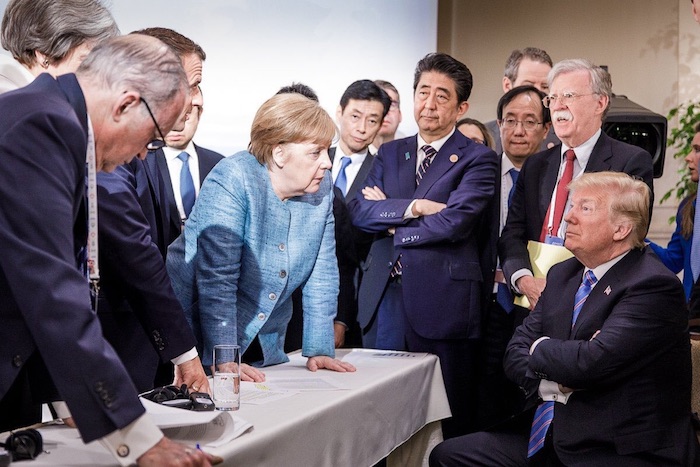
Most casual EU observers have missed the connection between President Trump eliminating the U.S-Europe Marshall Plan via entirely new trade and tariff policies, and the aggregate financial collapse of the European Union. Over four years (1948-1952), the United States provided $13.3 billion (equivalent to approximately $137 billion in 2025) directly to 17 Western European countries, including the United Kingdom, France, West Germany, Italy, and the Netherlands. The intent was to rebuild Europe after World War II. However, included in the plan was a later system of one-way tariffs, where EU Countries would high-tariff U.S. goods and the U.S. would not tariff EU goods imported.Read more …
The direct funding ended in 1952, but the indirect funding via tariffs never ended until President Donald J Trump triggered reciprocal tariffs against Europe thereby removing the one-way benefit. This created an immediate and growing problem for Europe – particularly noted in the EU industrial base.Simultaneous to this EU tariff reset, President Trump levied tariffs against China. To offset the possibility of economic losses, and specifically to fund Beijing’s subsidies to impacted Chinese manufacturing, China stopped purchasing European industrial machines. [That’s the source of the picture above at the G7 in Canada]This trade and tariff approach hit Europe twice as hard. First from American tariffs and second from diminished Chinese industrial purchasing. Immediately, Europe started looking for alternate sources of funds. That’s where the idea to tax American tech companies entered the discussion in Brussels. Today, President Trump addressed this directly.
TRUTH SOCIAL – “The European Union is at it again and, as usual, taking direct aim at GREAT American Companies! After having fined Apple, for no reason at all, 15 Billion Dollars, Meta, 3 Billion Dollars, Amazon 2.5 Billion Dollars, and many others, we have just been informed that Google, a truly advanced and amazing group, has been fined yet another 1 Billion Dollars, without explanation. This brings the Google total to over 18 Billion Dollars!
This illegal and highly discriminatory practice started at these high levels during the first year of the Sleepy Joe Biden Administration, but it’s not going to continue during the Trump Administration. The United States of America is not a “PIGGYBANK” for Europe, nor will we allow it to be! Please let this TRUTH serve to represent that we will immediately initiate a 301 Investigation into the practice of “ROBBING” American Companies and, in turn, the American Taxpayer.
The European Union will pay a very big price for this illegal and highly unethical conduct, which I have consistently warned them about. The penalties will be entirely reversed and, we anticipate, a substantial TARIFF to be placed on them at the earliest possible moment. Stay tuned!”
~President DONALD J. TRUMP
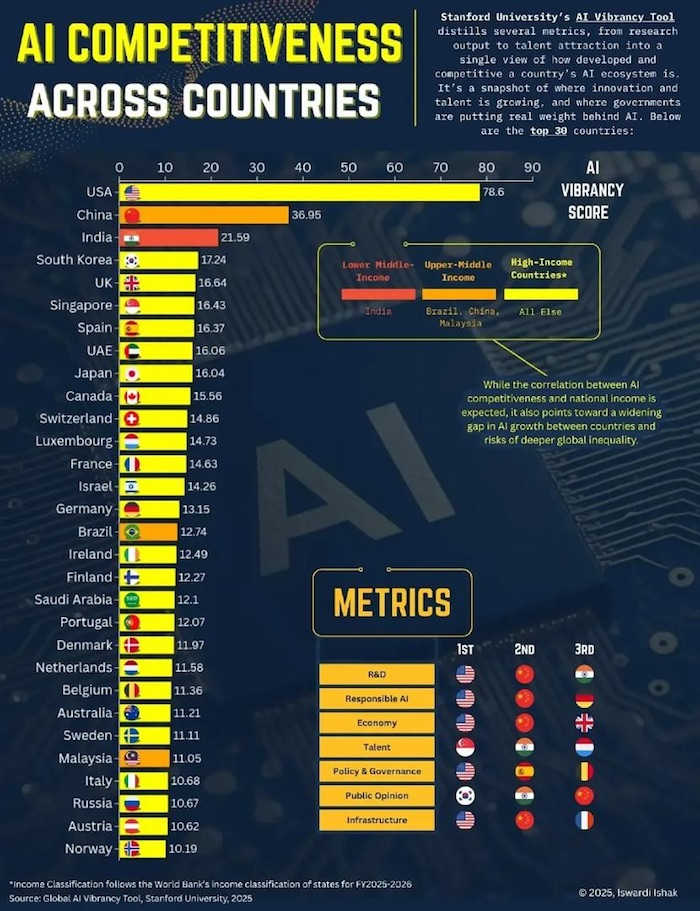
Keep in mind, all of this EU regulatory and compliance control is at the forefront of another element, the AI race.
In the USA we do not want a singular AI model to win support of the United States government and then end up with an AI regulatory system where the govt can start defining terms of “safety” to eliminate information adverse to the interests that regulate it. However, we can almost guarantee that Europe will select an approved singular AI model, predictably regulating it and taxing the use of it accordingly.
“Lydia the encyclopydia..”
• The South Carolina Supreme Court Again Rules Against Tattoo Speech (Turley)
There is an interesting free-speech case filed in South Carolina brought by a tattoo parlor challenging a state law that not only bars tattoo facilities from 1000 feet of churches, schools, or playgrounds, but also bans tattoos on the face, neck, or head. The case presents a common challenge for free speech advocates like myself. I have a visceral dislike for tattoos (particularly on the face), but I believe that they are a form of free expression. I, therefore, view the South Carolina law, S.C. Code Ann. § 44-34- 100, as unconstitutional under the First Amendment. (The litigants include claims under 42 U.S.C. § 1983 and the 14th Amendment).Read more …
The lawsuit was brought by Pacific Legal Foundation on behalf of a New York tattoo shop, Tiny Zaps, that is interested in opening a location in South Carolina. Tiny Zaps argues that “Tattoos are a form of artistic expression protected by the First Amendment. They communicate ideas, commemorate milestones, express beliefs, and allow people to present themselves to the world through permanent artwork created in collaboration with tattoo artists.”It notes that the limits on store location make it difficult to open a store given the many churches, schools, and playgrounds in the state. However, it is the limits on the placement of the tattoo itself that is most interesting from my perspective. It argues that “Tattoo artists do not merely apply ink to skin. They collaborate with customers to create artistic works that often carry deeply personal expressive significance. The resulting artwork derives meaning not only from its design, but also from its placement on the body.”
It also argues that South Carolina has long been distinctly anti-tattoo expression: “South Carolina has long treated tattooing as disfavored expression. Until 2004, South Carolina was one of only two states that outlawed tattooing.”
In 2002, I wrote about a South Carolina challenge in the Los Angeles Times about the unconstitutionality of a state law barring tattooing. However, the South Carolina Supreme Court ruled that “the danger associated with the activity of tattooing, whether artwork or not, is a legitimate reason to regulate it.” In my criticism of the Court, I disagreed with the premise that “a tattoo might be a form of protected expression, the ‘process’ of tattooing was not protected.” I noted that “this is akin to treating the Declaration of Independence as protected speech but not Benjamin Franklin’s printing of the document.”
As Meagan O’Rourke has noted, that case was declined by the Supreme Court in a disappointment for many of us, but later courts have reached contrary decisions from the South Carolina Supreme Court’s opinion in White v. State. This will now give us a second bite at the apple to get this right. Despite my aversion to tattoos, they are clearly expressive. Indeed, some would say that they are downright educational:
“Lydia, oh Lydia, that encyclopydia Oh Lydia the Queen of Tattoo On her back is the Battle of Waterloo Beside it the wreck of the Hesperus, too And proudly above waves the red, white, and blue You can learn a lot from Lydia”
In support of the free speech case, I call on the ultimate counsel for the challengers to explain the cultural and educational value of tattoos. I give you Groucho Marx:

https://twitter.com/nicksortor/status/2080415502707388909?s=20Secretary of State Marco Rubio just sent one of the most chilling messages yet to the Iranian regime.
— Overton (@overton_news) July 23, 2026
After Iran’s foreign minister Abbas Araghchi spouted off that their doctrine is “an eye for an eye,” Rubio revealed President Trump’s response in just six words.
RUBIO: “I saw… https://t.co/BbvHFWKgrm pic.twitter.com/Sq6taMb1b3
Elon Musk warns: "Civil war in the UK is inevitable. If you have a large, growing population of people whose beliefs are antithetical to Western beliefs, at some point, there will be a reckoning."
— Inevitable West (@Inevitablewest) July 23, 2026
Elon has the best track record of forecasting future outcomes in modern history. pic.twitter.com/g4LNR588xI
Support the Automatic Earth in wartime with Paypal, Bitcoin and Patreon.