
Henri Matisse Olive trees at Collioure 1906

https://twitter.com/PrometheanActn/status/1959324424122896435
Deep breath
https://twitter.com/ThePatriotOasis/status/1959056669838909859
Shell
https://twitter.com/JesseBWatters/status/1959057789021823001
Prime time
https://twitter.com/Chicago1Ray/status/1959002765637619980
FIFA
https://twitter.com/EricLDaugh/status/1958946393864675608
CO2
Best-seller author and scientist Gregg Braden: "Climate change is a fact… It's also a fact that humans are not causing it."
"Is there more CO₂ in the atmosphere now than there was 10 years, 20, 50, 100 years ago? The answer is absolutely yes. Is it a bad thing?
The answer is… pic.twitter.com/nRVCcmqaRK— Wide Awake Media (@wideawake_media) August 23, 2025
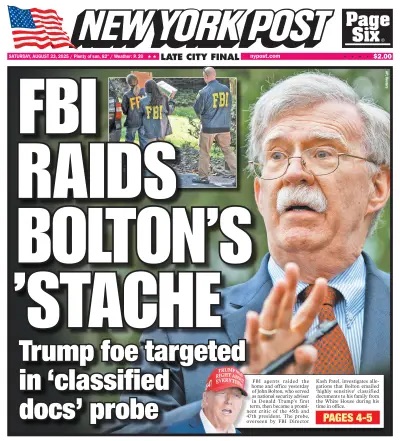
Espionage is a few grades up from classified files in a closet.
• John Bolton Under Investigation for Violations of the Espionage Act (CTH)
Former National Security Advisor John Bolton is a well-documented neocon, who operates inside the business model of selling U.S. foreign policy influence for personal gain. His activity mirrors that of former Senator John McCain in many regards. John Bolton sold his access, contacts and ability to influence policy to the highest bidder. In DC parlance they call that a “consultant.” When the consulting is contracted for a specific national interest, the title shifts to “lobbyist.” That was his job, and all of Washington DC knows it. Washington DC operates on this business model; the entire system will be soft to criticize Bolton and many will likely defend him. The FBI raid on his residence and office has led to a considerable amount of speculation.
However, as some background details start to come out, it appears CIA Director John Ratcliffe provided FBI Director Kash Patel with specifics on the international travels and efforts of Bolton. That CIA referral has led to an FBI investigation under the auspices of potential violations of the espionage act, where Bolton would have leveraged current or prior classified intelligence information as part of his influence business. Almost identically to former Senator John McCain, John Bolton was well known to intersect with the nation of Qatar as part of his operation. Qatar has deep pockets and a long-identified influence operation throughout the middle east, sometimes playing both sides. Qatar is also the playground for the CIA. While it is yet unknown which nation and which activity Bolton was likely engaged in, the highest probability centers around the deepest pockets, which would also put Bolton on the CIA radar. With President Trump in the White House, there is a big market for the services of people like John Bolton who operate a specific militaristic mindset against the Trump administration.
NEW YORK TIMES – “The information that provided the basis for the warrant to search John Bolton’s home on Friday was based on intelligence collected overseas by the C.I.A., according to people who spoke on condition of anonymity to discuss an ongoing criminal investigation. John Ratcliffe, the C.I.A. director, provided Kash Patel, the F.B.I. director, with limited access to the intelligence. It involved the mishandling of classified material by Mr. Bolton, the people said. The search of the home and office of Mr. Bolton, who was national security adviser during President Trump’s first term, was a major escalation of a long-running inquiry into whether he collected or leaked sensitive national security information, law enforcement officials said. The nature of the intelligence collected overseas is not known. The F.B.I. obtained the search warrant after presenting evidence to a federal judge. Mr. Bolton’s office declined to comment. The C.I.A. and F.B.I. regularly cooperate on counterterrorism investigations. It is unusual for the C.I.A. to so prominently provide information for a high-profile investigation of a former U.S. official.”
Also from The New York Times: “[…] The investigation into Mr. Bolton seeks to determine whether he illegally shared or possessed classified information, according to people familiar with the case who requested anonymity to describe details of a continuing investigation. The key criminal statute involved in those potential crimes is part of the Espionage Act. Another potential criminal statute in the investigation is one that bars the unauthorized removal of classified documents or material. The information that provided the basis for the warrant to search Mr. Bolton’s home was based on intelligence collected overseas by the C.I.A., according to people briefed on the matter. John Ratcliffe, the C.I.A. director, provided limited access to the intelligence to Kash Patel, the F.B.I. director. The intelligence involved the possible mishandling of classified material by Mr. Bolton, the people said.”
• Did John Bolton have access to classified information about national security policy, yes.
• Would John Bolton leverage that knowledge for personal material gain, again yes.
• Did Bolton operate in the same industry as almost all DC influence agents, yup.
• Does this investigation of Bolton create an increased sense of anxiety amid all those who operate on the same system, oh heck yes.
• What does the investigation of Bolton mean to the larger network of corrupt influence peddling in DC, we don’t know yet.
“…a Putin-Zelensky summit may still happen. Not because it will resolve the war, but because it serves the broader game of diplomacy. The real audience is not Zelensky at all. It is Trump…”
• Why Would Putin Want To Meet With Zelensky? (Ryumshin)
There were no surprises in the latest round of Ukraine diplomacy. After his much-publicised meeting with President Vladimir Putin in Alaska, US President Donald Trump followed up with talks in Washington with Vladimir Zelensky and his European backers. The result was predictable: the peace process derailed once again. The conditions set out by Russia in Anchorage are already forgotten. Instead, the West is now obsessing over the prospect of a direct Putin-Zelensky encounter. The Americans have already mapped out not one but two meetings: a bilateral summit between the Russian and Ukrainian leaders, and a trilateral session that would include Trump. According to reports, Hungary has been floated as the preferred venue. Western media even claim that Putin himself requested a meeting with Zelensky, supposedly in Moscow. The Trump administration insists that Russia has agreed to everything.
A game for Trump’s benefit
Yet the Kremlin remains silent, issuing only vague references to “raising the level of delegations.” This studied ambiguity recalls the build-up to the Putin-Trump summit and suggests that the idea cannot be dismissed outright. The truth is simple: such a meeting is not required by “objective realities” or common sense. It is dictated instead by the dynamics of a process that has turned into a performance designed to hold Trump’s attention.n Putin’s meeting with Trump on 15 August was not about reaching a breakthrough. It was a political gesture to demonstrate Russia’s openness and to shift responsibility onto Ukraine and the European Union. The West is now trying to turn the same tactic against Moscow: framing Russia as the obstacle to peace and forcing Putin into a face-to-face encounter with Zelensky.Kiev and Western European capitals are pushing Russia to accept “security guarantees” for Ukraine, something Moscow has been proposing since 2022. But the way these guarantees are now being drafted makes them deliberately unacceptable for Russia. EU leaks suggest demands that amount to little more than NATO membership in disguise: permanent Western troops on Ukrainian soil, binding guarantees from the alliance, and no recognition of territorial realities. The Kremlin cannot simply reject such proposals outright. Doing so would allow Trump to walk away from the process and pin the blame on Moscow. For that reason, Russia may ultimately have to go through the motions of agreeing to a summit. What would such a meeting achieve? Little of substance. Russia and Ukraine remain far apart on every meaningful issue. Moscow hopes its military superiority will translate into concessions, but Kiev shows no willingness to compromise.
Ukraine refuses to recognise territorial changes, rejects the idea of troop reductions or exchanges, and continues to demand reparations. Even the tentative agreement to keep NATO membership off the table has been undermined by Zelensky’s insistence on NATO-style guarantees. The only factors that might soften Ukraine’s stance – the collapse of its front lines, a breakdown of EU support, or the United States walking away from the conflict – are nowhere in sight. As long as Zelensky stays unyielding, any summit would have the same outcome as the earlier Medinsky-Umerov talks: limited progress on humanitarian issues, no peace deal. Yet the point of such a meeting is not to make peace with Zelensky. It is to keep Trump engaged and maintain strategic uncertainty. For that reason alone, Moscow has good reason to appear open to the idea of a summit.
If the Kremlin does agree, the key will be to control the format. Ideally, the talks should be trilateral, with Trump at the table. This would prevent Kiev from spinning the outcome as a diplomatic victory and would ensure that Washington remains responsible for the process. The choice of venue is also critical. Hungary, with its friendlier stance toward Moscow, would be an acceptable host. Predictably, Ukraine and the Western Europeans will resist such a move. But Zelensky’s preferences are ultimately secondary. If Trump can be persuaded to attend, the Ukrainian president will have little choice but to follow. In this sense, the goal is not to negotiate with Zelensky but to shape the atmosphere around him. A carefully staged summit could place pressure on the Ukrainian leader, making him appear weak and pushing him toward concessions he might otherwise resist. His visit to Washington earlier this year already showed how vulnerable he is to Trump’s personal style and political leverage.
None of this should be confused with a real peace process. Russia does not expect to sign a final settlement with Zelensky, nor is Ukraine prepared to compromise. But appearances matter. By showing openness, Moscow avoids being cast as the spoiler while placing the burden of intransigence on Kiev. That is why, paradoxically, a Putin-Zelensky summit may still happen. Not because it will resolve the war, but because it serves the broader game of diplomacy. The real audience is not Zelensky at all. It is Trump.
“Moscow should be ‘coaxed’ into peace talks with Ukraine, whereas Kiev can be ‘pressured’ due to its dependence on Western aid…”
• Trump Wants To ‘Coax’ Russia But ‘Pressure’ Ukraine Into Talks – Politico (RT)
US President Donald Trump believes Moscow should be ‘coaxed’ into peace talks with Ukraine, whereas Kiev can be ‘pressured’ due to its dependence on Western aid, Politico reported on Friday, citing sources. The sources claimed that Trump sees Russia as holding “the upper hand” in the conflict. The report follows speculation over a potential summit between Russian President Vladimir Putin and Ukrainian leader Vladimir Zelensky. The idea emerged after Trump met Putin in Alaska – their first face-to-face encounter since 2019 – then held talks with Zelensky and EU leaders. Trump later said he had “begun the arrangements” for a meeting between Putin and Zelensky, which he believes could accelerate peace efforts. He described his talks with Putin as “very productive,” but said Zelensky “has to show some flexibility” ahead of any summit.
“[Trump] has long believed that Russia has the upper hand in the war itself and needs to be coaxed into peace talks,” one former US official told Politico. “Ukraine, on the other hand, relies heavily on the US for weapons and intelligence. So there are more pressure points to get them to accept a deal.” Putin has not ruled out meeting Zelensky but insists it must follow real progress in negotiations. Moscow has also questioned Zelensky’s legitimacy, pointing to the fact that his presidential term has expired. Zelensky claimed this week he was ready to meet, but only in a “neutral” part of Europe and with the participation of his EU backers.
Russian Foreign Minister Sergey Lavrov told NBC on Friday that Moscow had agreed to “show flexibility” on several issues that Trump raised during the Alaska summit. However, he said Zelensky “said no to everything” that Trump later proposed to him, including neutrality for Ukraine and territorial concessions. “Putin is ready to meet with Zelensky when the agenda would be ready for a summit,” Lavrov reiterated. “But as things stand, there is no meeting planned.” Sources told Politico that while some officials worry the Russia-Ukraine talks are stuck in a “grind,” the US president remains optimistic. Trump said on Friday that he will announce a “very important decision” on Ukraine within two weeks, the nature of which will depend on how the positions of Moscow and Kiev shape up.
“For the first time President Trump indicates he’s willing to take a full retreat position from the effort…”
• “Or Do We Do Nothing, and Say It’s Your Fight” (CTH)
A very interesting response from President Trump against the U.S. President stepping back and awaiting Ukraine President Volodymyr Zelenskyy and Russian President Vladimir Putin to organize their teams and schedule a bilateral discussion. President Trump has said he expects the diplomatic teams of Zelenskyy and Putin to coordinate a face-to-face meeting between Putin and Zelenskyy in the next two weeks. As noted by Secretary of State Marco Rubio, sometimes it just takes putting the principals into the same room to break the logjam. However, both regimes have entrenched ideologues who are positioning for maximum leverage. President Trump is asked what he will do if Zelenskyy and Putin cannot or do not organize a meeting.
For the first time President Trump indicates he’s willing to take a full retreat position from the effort, “or do we do nothing, and say it’s your fight.” Doing nothing seems to indicate the U.S. withdraws all support and lets them fight to the point of defeat or surrender. Doing nothing is actually doing something quite remarkable. In the background of all of this, DNI Tulsi Gabbard has issued a directive telling all of the intelligence agencies all information regarding the Russia-Ukraine peace negotiations is not to be shared with U.S.-allied intelligence partners. […] “The memo, dated July 20 and signed by Gabbard, directed agencies to not share information with the so-called Five Eyes, the post-World War II intelligence alliance comprising the U.S., U.K., Canada, Australia and New Zealand, multiple U.S. intelligence officials told CBS News.”
Still…reports of many drone attacks inside Russia this morning.
• Pentagon Has Restricted Ukraine From Striking Russian Territory – WSJ (RT)
The Pentagon has blocked Ukraine from striking deep inside Russia with American-supplied missiles, the Wall Street Journal reported Saturday, citing US officials. According to the paper, the Department of Defense has been preventing Kiev from firing long-range ATACMS missiles since late spring. On at least one occasion, Washington reportedly turned down a Ukrainian request to hit a target on Russia’s internationally recognized territory. The WSJ linked the policy shift to President Donald Trump’s effort to “entice” Moscow during peace talks. Last week, Trump met with Russian President Vladimir Putin for the first time since 2019 in Alaska, and several days later held talks with the leaders of Ukraine, NATO, the EU, and several European states in Washington.
Although Trump urged Moscow and Kiev to reach a peace deal as soon as possible, he said on Thursday that Ukraine has “no chance of winning” without striking Russia. Trump has also criticized the previous administration for providing unconditional military aid to Ukraine and in February accused Ukrainian President Volodymyr Zelensky of “gambling with World War III.” Russia has warned that by supplying Ukraine with weapons, Western countries are de facto directly participating in the conflict. Moscow has listed an end to foreign military aid as one of its conditions for a lasting ceasefire.
“The agreement commits both countries to defend each other’s sovereignty with all available means.”
• Ukraine Issues Military Warning To Belarus (RT)
Ukraine has told Minsk to stay away from its borders during upcoming joint military exercises with Russia to be held in Belarus. The warning came ahead of the ‘Zapad-2025’ military drill, scheduled for September 12–16. Belarus allowed Russian forces to use its territory when the conflict with Ukraine escalated in February 2022. Since then, Belarusian President Alexander Lukashenko has repeatedly said that Minsk has no intention of attacking Kiev and will only resort to military action if his country is attacked In a statement on Friday, Ukraine’s Foreign Ministry accused Belarus of aiding Moscow and issued a caution.
“We warn Minsk against reckless provocations and urge it to remain prudent, refrain from approaching the borders, and avoid provoking Ukraine’s Defense Forces,” Kiev’s Foreign Ministry has said. This year’s military exercises, which include counter-sabotage operations, drone warfare, electronic interference scenarios, and assaults, will also feature the Russian Oreshnik intermediate-range hypersonic missile, according to Belarusian Defense Minister Viktor Khrenin. First battle-tested in November 2024 in a strike on Ukraine’s Yuzhmash facility in Dnepr, Russian officials have compared its conventional destructive power to that of a low-yield nuclear strike.
“This is an important element for our strategic deterrence – as the head of state demands, we must be prepared for anything,” Khrenin told the state news agency Belta. He warned that NATO is using Zapad-2025 as a pretext for its own drills, citing Poland’s deployment of 30,000 troops near Belarus as the main concern. Belarus, a close ally of Russia, signed a bilateral security treaty with Moscow in December 2024. The agreement commits both countries to defend each other’s sovereignty with all available means. In 2023, Russia deployed tactical nuclear weapons and short-range ballistic missiles on Belarusian territory, citing tensions with the West. Lukashenko has also called for the accelerated delivery of Oreshnik systems, which could be stationed in Belarus before the end of 2025.
“..the future borders between a re-weaponized Europe and a Russia that will inevitably inflict on it a massive strategic defeat.”
• : Even After Trump Humiliation, Europe Insists That Peace Is War (Escobar)
It took just one pic to imprint on posterity the utter humiliation of the EUrotrash political elites in Year 2025: the Coalition of the Twats, in the Oval Office, lining up like a bunch of frightened schoolkids, severely reprimanded by His Master’s Voice – the Headmaster cum Circus Ringmaster. That was also neatly described as Trump breaks Europe over his knee. Of course, President Putin had already predicted it, over six months before the fact: “I assure you, Trump, with his character and persistence, will restore order quite quickly. And all of them, you’ll see, soon all of them will stand at the master’s feet and gently wag their tails.” The White House humiliation sealed the deal, and reconfirmed an obsession: for the EUrotrash “leadership”, at all levels when it comes to relations with Russia, Peace is War.
Brandishing their warped logic, they cannot possibly understand that if Ukraine is instrumentalized – actually since before Maidan in 2014 – to harass and destabilize Russia in its western borders, Russia will forcefully counter-attack. That’s at the heart of the Russian concept of “underlying causes” of the Ukraine tragedy, which must be thoroughly addressed if there is any real shot at Trumpian or not Trumpian “peace”. In the Big Picture, that translates as the Empire of Chaos and Russia sitting down to set up a new “indivisibility of security” arrangement – just like Moscow proposed in December 2021: then, it was met by a non-response response. EUrotrash Inc.’s new delirium is to attribute to itself the design of the future borders between a re-weaponized Europe and a Russia that will inevitably inflict on it a massive strategic defeat.
It’s a very long shot to imagine that Trump is capable, by himself, of imposing a new strategic reality on the warmongering yet penniless Coalition of the Twats. Whatever happens to rump Ukraine, Trump, based on his own twist and turn vociferations, actually wants Europe to “contain” Russia from now on, using an arsenal of ridiculous expensive American weapons. So what changes is the character of this particular chapter of the Forever Wars: it will be fought by the Coalition of the Twats, and not by Americans. In the short term, that also unveils the only strategy available for the EUrotrash/Kiev combo: outlast Trump until the 2026 mid-terms, destroy the remainder of his presidency, and be secure with the return of the mega-Russophobe gang in 2028.
Which Dead Hand will prevail?
An old school Deep State hand, who had privileged access to all Cold War era honchos, sums up the pitfalls ahead for Russia: “Russia is taking too long to neutralize Ukraine, allowing time for NATO to reignite diversions. While the snail offensive in Ukraine does save lives, NATO seeks to weaken Russia’s strategic position in the Balkans and elsewhere that can cost far more lives in the future. If the Slavs in the Balkans are crushed that can strategically weaken Russia’s overall position, and that is far more costly than a major lightning offensive a la Stalin in Russian Ukraine. Russia must finish this war now and turn to its southern problems in the Balkans and the intrigues in Baku.”Trump of course is oblivious to these Big Picture niceties. At best he admits, to Fox News, that “Ukraine will not regain Crimea” and “Ukraine will not join NATO.” But he does not seem to mind that “France, Germany and the UK want to deploy troops in Ukraine” as part of the new kabuki: “security guarantees”. That is an inter-galactic red line for Moscow. In parallel, it’s wishful thinking to believe that Putin is now finally ready to negotiate “peace”. This is not about peace; it’s always about coming up with incontrovertible facts on the battle field, because Moscow knows this war will only be won in the battle field.
Russian forces have reached the final Ukraine defensive line in Donbass: Slavyansk-Kramatorsk. And is fast encircling key strongholds near Pokrovsk and Konstantinovka. Talk about a strategic/psychological turning point. From there, the – steppe – sky is the limit. Compound it with the combined hacking of the General Staff of the Armed Forces of Ukraine – which revealed that Kiev’s losses, in terms of dead and missing, amount to a staggering 1.7 million. All of the above means that we are fast approaching the fateful moment when the victor dictates the full terms of the enemy’s capitulation. No need to march to Bankova in Kiev and plant the Russian flag.
“..the changes in tariffs will reduce total deficits by $4.0 trillion altogether.”
• The CBO Just Dropped a $4 Trillion Truth Bomb (Margolis)
Ever since Trump’s first term, the political and media establishment told us that his trade policies were reckless, destructive, and doomed to wreck the U.S. economy. Every so-called expert on cable TV preached that they would crush American consumers, tank the stock market, and send our economy into a spiral. We’re still waiting for that to happen. Here we are in Aug. 2025, and the Congressional Budget Office just dropped a bombshell that completely shatters the left’s narrative against Trump’s tariff strategy.
“As of August 19, we estimate that the effective tariff rate for goods imported into the United States has increased by about 18 percentage points when measured against 2024 trade flows. We project that increases in tariffs implemented during the period from January 6, 2025, to August 19 will decrease primary deficits (which exclude net outlays for interest) by $3.3 trillion if the higher tariffs persist for the 2025-2035 period. By reducing the need for federal borrowing, those tariff collections will also reduce federal outlays for interest by an additional $0.7 trillion. As a result, the changes in tariffs will reduce total deficits by $4.0 trillion altogether.” That’s no rounding error. The numbers are simply eye-popping, and they tell the story that the media doesn’t want you to know.
Let’s put that in perspective. Back in June, the CBO had already stunned critics by predicting Trump’s tariffs would shrink the deficit by $3 trillion. That was based only on trade actions taken through May 13. Trump, naturally, celebrated the news on Truth Social. “I am pleased to announce that the Radical Left Representatives working at the Congressional Budget Office (CBO) have now admitted how incredible my Tariff strategy has been, saying that, ‘Trump’s Tariffs reduce the deficit by $4 Trillion Dollars,’” he wrote. “When I began my Tariff policy suggestions, they refused to acknowledge the potential SUCCESS that would be derived. Deficits are DOWN, Taxes are DOWN, Energy is DOWN, Prices generally are DOWN, the only things that are UP are, Take Home Pay, the Stock Market, and our Country, which is the ‘HOTTEST’ anywhere in the World. Thank you for your attention to this matter!”
Of course, the CBO is cautious to note its projections assume these trade policies remain in place indefinitely. It also didn’t factor in several adjustments announced just this past week: new EU tariff arrangements on August 21, a 25% tariff hike on imports from India starting Aug. 27, and the suspension of duty-free shipments under $800 coming Aug. 29. In other words, the real revenue picture could easily turn out even stronger than the current forecast. Here’s the bigger point no one in the mainstream press will admit: tariffs, when wielded strategically, can be a double win. They level the playing field for American producers, whom foreign governments have undercut for decades by gaming the system, and they generate revenue that actually reduces the insane borrowing spree Washington politicians tried to normalize.
“If that recap sounds bad for Canada, trust me – it’s way worse. Really bad, horrible – terrible even. So far beyond bad, the light from where horrible starts could not reach the Canadian terrible place for a year. Not good.”
• Canada Announces End to All Retaliatory Tariffs – Trump Gives Nothing (CTH)
The Canadian govt led by Prime Minister Mark Carney has completely capitulated to the power and influence of President Trump. While explaining how the United States has fundamentally changed the entire landscape of global trade, the leader of the Snow Mexicans announces he is dropping all countervailing and retaliatory tariffs against the USA and getting nothing in return. Total and complete surrender by Canada; there is ZERO upside for Canada – NADA, Zippo, Zilch. Prime Minister Mark Carney made the announcement, then faced the ire of the assembled media who were furious about the details within the statement. The Canadian people had been promised an “elbows up” fight to the end. Instead, today they got down on their knees and begged Trump to retain the USMCA.
Complete and utter capitulation by Canada. No digital services taxes. No countervailing duty tariffs. No reciprocity tariffs on Steel and Aluminum. No retaliatory tariffs (reciprocal/baseline). Meanwhile, the USA keeps 50% tariffs on steel and aluminum against Canada, and Canada only gets 25% tariffs against U.S. steel/aluminum. In addition, Canada has pledged to continue gaslighting their citizens, while wasting time, effort and resources on a hope to retain the USMCA, while refusing to admit to themselves that President Trump intends to dissolve it. If that recap sounds bad for Canada, trust me – it’s way worse. Really bad, horrible – terrible even. So far beyond bad, the light from where horrible starts could not reach the Canadian terrible place for a year. Not good.
“Plainly, her ultimate goal was not ‘market hygiene’ . . . but political hygiene, ending with the derailment of President Trump’s political career and the destruction of his real estate business.”
• The One That Got Away: Letitia James and the Perils of Trophy Fishing (Turley)
New York Attorney General Letitia James is going to need a bigger fish or a smaller trophy wall. For months, James has paraded her victory over President Donald Trump in her civil judgment of half a trillion dollars. It did not matter that many of us denounced the judgment as grotesque and raw lawfare. Now, however, the appellate court has replaced that mounted Marlin with a mere minnow. It threw out the financial penalty as unconstitutional and unwarranted. Even that downsized catch may have to be pulled down, since Trump can appeal the decision to leave the injunctive relief — including limits on doing business in New York — in place. The problem is that this over-stuffed guppy has cost the people of New York tens of millions of dollars in staff, security and other costs.
It was all just the cost of doing business with James, who ran on the pledge to bag Trump on something — anything! — if elected. For James, it was worth it. For her base, the case was never about the merits or the law. James offered lawfare against political opponents, and New York Democrats elected her with a gleeful malice. They were thrilled as James suggested that she was going to seize Trump buildings after the judgment and sought a massive bond. Notably, even the judges who sided with James on her ability to bring this case were critical of her ethics or judgment in running on bagging an individual on unnamed crimes or civil actions. They simply chose not to do anything about it. It was Judge David Friedman, who, on the appeal, offered an unblinking account of how James abused the legal system.
“Plainly, her ultimate goal was not ‘market hygiene’ . . . but political hygiene, ending with the derailment of President Trump’s political career and the destruction of his real estate business. The voters have obviously rendered a verdict on his political career. This bench today unanimously derails the effort to destroy his business.” The five appeals court judges fractured on the rationale for their opinions. Two of the judges — Dianne T. Renwick and Peter H. Moulton — correctly found that “the court’s disgorgement order, which directs that defendants pay nearly half a billion dollars to the State of New York, is an excessive fine that violates the Eighth Amendment of the United States Constitution.” The rest of the judges found other reasons to negate the damages while preserving the fraud judgment.
In the end, James could not get a single vote on appeal to support Judge Arthur Engoron’s ridiculous fine. Engoron, like James, will continue to enjoy the status of a folk hero in New York. But he will go down in history as a judge who yielded to the demands of the mob rather than the law. Yet nothing will change. With the exception of Judge Friedman, the mild rebukes of the appellate court of James show how Trump remains persona non grata, a disfavored figure who is entitled to no consideration, let alone sympathy, in New York. The most courage that Judge Moulton could summon was to say, “One can reasonably question whether a candidate running for the top law enforcement position in statewide government should make such pointed statements.” I suppose one could also reasonably question whether a judge faced with blatant, open targeting of a political opponent should do more than a judicial shrug.
“..the president ensures laws are enforced, but he doesn’t personally enforce them..”
• The Media Flips Out Over Trump Claim—But Once Again, He Was Right (Margolis)
FBI agents raided the Maryland home of President Donald Trump’s former National Security Adviser John Bolton on Friday, as part of a “high-profile national security probe” involving classified documents. Ironically, the same people who cheered Joe Biden for weaponizing the Justice Department against Trump are claiming that the raid on Bolton’s home was politically motivated. Trump, for his part, denied having advance knowledge of the raid, stressing that while he has the authority to direct such actions, he prefers to stay out of them. “I don’t want — I tell [Attorney General Pam Bondi], and I tell the group, I don’t want to know,” he said. “You have to do what you have to do. I don’t want to know about it. It’s not necessary. I could know about it. I could be the one starting it. I’m actually the chief law enforcement officer — but I feel that it’s better this way.”
And the media, being the media, absolutely flipped out about that last statement where Trump claimed he’s the chief law enforcement officer. “President Donald Trump has bizarrely claimed he is the chief law enforcement officer of America while insisting he knew nothing about the FBI raid on John Bolton’s home,” opined The Daily Beast. “The comment was contentious not only because the Justice Department has traditionally operated at arm’s length from the White House, but because its own guidelines state that the U.S. Attorney General is the nation’s chief law enforcement officer.” And, of course, CNN also jumped in. On Friday’s edition of “The Situation Room,” CNN’s Crime and Justice Correspondent Katelyn Polantz was also triggered by Trump’s claim.
“What Trump said that really jumped out at me is that he said that he hasn’t been briefed by the Justice Department yet, he expects that later in the day, but he said, ‘I could know about it. I could be the one starting it. I’m actually the chief law enforcement officer.’ But then he said he’s telling the attorney general, Pam Bondi, ‘you have to do what you have to do.’ And right now, he doesn’t know anything. I looked, the Justice Department on its own website says the attorney general is the chief law enforcement officer of the federal government, not the president.” According to Article II, Section 3 of the Constitution, the president “shall take care that the laws be faithfully executed, and shall commission all the officers of the United States.”
In other words, the president ensures laws are enforced, but he doesn’t personally enforce them. That responsibility falls to subordinates like agency heads and the Department of Justice. That’s why, under the Constitution, it’s entirely fair to describe the president as the nation’s chief law enforcement officer. It may not be a formal job title, but it is a functional reality. The bottom line is simple: Trump is right, and the media has once again made fools of themselves by putting attacks on Trump ahead of the facts. They twist themselves into knots over semantics just to attack Trump, even when the Constitution clearly spells out his authority.
“In other words, a full lube job.”
• Trump’s Smithsonian Review Is Long Overdue (Mike Gonzalez)
The White House last week informed Lonnie Bunch, the secretary of the Smithsonian Institution, that it’s putting the museums under review—in other words, adult supervision. The news came in a letter that amounted to a major front in the Trump administration’s war to retake the culture. As I wrote in an X post quoted by The New York Times, “Given the Smithsonian’s behavior in the past few years—how it cataloged everything woke, how it gave the communist leader Angela Davis plenty of space, but not Justice Clarence Thomas, how it portrayed America in a poor light—this White House review is not a minute too soon.” The letter announcing the “comprehensive review” came from three top individuals engaged in this cultural Reconquista: Lindsey Halligan, the president’s special assistant; Vince Haley, director of the Domestic Policy Council; and Russ Vought, head of the Office of Management and Budget.
The Times called it a “more direct shot across the bow” than an audit announced in June, which the Smithsonian Board asked Bunch to conduct. This time, it will be the administration itself that will take action. Of course, the forces that have spent the past two or three decades capturing the cultural institutions wasted no time in screeching at the very notion that the administration would conduct a thorough review of the institution’s museums. “Only historians and trained museum professionals are qualified to conduct such a review, which is intended to ensure historical accuracy,” Sarah Weicksel, the executive director of the American Historical Association, fumed to the Times. “To suggest otherwise is an affront to the professional integrity of curators, historians, educators, and everyone involved in the creation of solid, evidence-based content.”
What a laughable assertion. There probably isn’t a single conservative among these “curators, historians, educators, and everyone involved.” Somebody should inform Weicksel that the administration is liberating the culture from the curators, directors, historians, and everyone else involved in the arts management profession at this point. In 2016, when Donald Trump first ran for office and the country was actually less polarized, Verdant Labs conducted a study based on campaign contribution data from the Federal Election Commission. It is contained in an interactive graph which breaks down the political affiliation of these professionals:
Museum Directors: 89 Democrats for every 11 Republicans
Museum Curators: 94 Democrats for every 6 Republicans
Art Conservators: 100% Democrats
Art Historians: 96 Democrats for every four Republicans
Art Administrators: 96 Democrats for every four Republicans
Art Advisors: 91 Democrats for every nine Republicans
Archaeologists: 94 Democrats for every six Republicans
Historians: 88 Democrats for every 12 RepublicansThis is what complete ideological capture by the Left looks like. Harvard did not get a professoriat that is nearly 80% “liberal” or “very liberal,” and less than 3% “conservative” or “very conservative” among its Arts and Sciences and School of Engineering and Applied Sciences faculty out of nothing. Obviously, the Left burrows in and hires only among its own kind. As Elizabeth Merritt wrote in a blog for the American Alliance of Museums days after Trump was elected in 2016, “We don’t necessarily create a very friendly work environment for people who don’t share a liberal, Democratic world view.” This is how ideological capture is achieved.
The numbers are not this lopsided because only progressives are smart or interested in the visual arts, literature, music, philosophy, theater, or any of the other components that roughly go under the heading of “culture” (though, yes, this is what the Left thinks). Hillsdale College, the nation’s top conservative institution of higher education, cares deeply about these arts. Recently, it considered whether to open a Museum Studies program, but decided against it out of concern that its students may not get positions at museums because leftist administrators would not hire conservatives. As to why ideological conformity is sought, the woke curators, directors, and conservators seek to use museums to disseminate their gender and race theories. As curator and former Director Olga Viso wrote in The New York Times in 2018, “Now is the time to be open to radical change. The next wave of decolonizing America’s art museums must succeed.”
The three Trump officials told Bunch that the administration wants to “assess tone, historical framing, and alignment with American ideals.” The review will focus on:
• Public-facing Content: A review of exhibition text, wall didactics, websites, educational materials, and digital and social media content.
• Curatorial Process: A series of interviews with curators and senior staff to better understand the selection process.
• Exhibition Planning: A review of current and future exhibitions, with particular attention to those planned for the 250th anniversary of the Declaration of Independence.
• Collection Use: Evaluation of how existing materials and collections are being used or could be used to highlight American achievement and progress.
• Narrative Standards: The development of consistent curatorial guidelines.Accordingly, the administration wants the Smithsonian to cough up the following materials: exhibition plans and draft concepts on the 250th Anniversary Programming; catalog and programs on current exhibition content; full index of scheduled traveling exhibitions; curatorial materials; indexes of all permanent collections; teacher guidance for educational materials; copies of grants, and more. In other words, a full lube job. I still don’t believe that what is needed can be accomplished with Bunch at the helm—and there is the matter of the Smithsonian’s as yet unbuilt Latino Museum, which the administration wants to defund, but weak Republican appropriators in the House of Representatives just voted to continue to fund—but this review does indeed come not a minute too soon.
“While the Clinton probes were throttled, the FBI raced to open a full investigation into Trump’s campaign on the flimsiest of tips — a conversation in a London wine bar —..”
• Multi-Front Effort to Protect Clintons While Framing Trump (Bruner)
Newly unearthed documents show deep state government actors once again circling the wagons to protect Bill and Hillary Clinton — and suppressing evidence that implicated them. Last week, it was the FBI; this week, it is the IRS. In 2019, the Internal Revenue Service’s criminal investigations division quietly launched a probe into the Clinton Foundation’s tax practices, working closely with whistleblowers John Moynihan and Larry Doyle, financial experts who had compiled thousands of pages of evidence. According to internal agency memos reported by Just the News, IRS agents reviewed the evidence and at least one agent concluded it meant that the “entire [Clinton Foundation] enterprise is a fraud.” Agents then moved to treat the whistleblowers as cooperating witnesses and even set up secure computer servers to hold the material they had collected.
Then, without warning, the lights went out. “Can’t talk about the CF,” agents told the whistleblowers. By the summer of 2019, their inquiry was dead. Moynihan and Doyle are now battling the agency in Tax Court over the apparent shutdown of the investigation. The IRS’s abrupt reversal follows an earlier, more infamous pattern. In 2016, FBI field offices in New York, Washington, and Little Rock all opened probes into the Bill and Hillary Clinton Foundation, partly on the strength of Peter Schweizer’s 2015 bestselling book, Clinton Cash, which exposed numerous examples of the Clintons using the foundation while she was Secretary of State under President Barack Obama as a pay-to-play scheme for business and foreign government interests seeking political influence.
The book told the story of Uranium One, a US mining company that was sold to Russia’s state-owned nuclear agency after investors pledged more than $100 million to the Clinton foundation. That story was confirmed in a front-page story by the New York Times when the book was published and based on its material. The FBI field office investigations were proceeding until they were ordered by higher-ups to stop. Deputy Attorney General Sally Yates ordered prosecutors to “shut it down.” Deputy FBI Director Andrew McCabe required his personal approval for every investigative step — effectively choking the cases.
The fallout from Clinton Cash was real. Clinton’s campaign staffers scrounged for advance copies of the book, while Hillary’s own pollsters flagged the Uranium One deal as her campaign’s biggest vulnerability in the early primary states. By January 2016, the FBI was looking into the book’s allegations — until the brakes were pulled. Appearing on an OANN program this week, Schweizer told host Matt Gaetz that the government’s double standard is unmistakable. “At the same time that they were killing an organic investigation into Clinton corruption… they were also creating a completely fictional investigation tying [Donald] Trump to Russia,” he said. Five FBI field offices had been involved before being shut down, including a satellite office in Africa. Schweizer called the saga proof of a new kind of corruption — “offshored, globalized corruption,” complete with political dynasties selling access and foreign oligarchs buying influence.
The contrast between the scuttled investigation of the Clinton foundation and the “Crossfire Hurricane” investigation into the Trump campaign’s purported ties to Russia is glaring. While the Clinton probes were throttled, the FBI raced to open a full investigation into Trump’s campaign on the flimsiest of tips — a conversation in a London wine bar — green-lighting that investigation within three days. Clinton’s Russia vulnerabilities were turned into Trump’s burden, projected onto his campaign in a haze of innuendo. Put together, the picture is damning: the IRS dropped the ball in 2019, and the FBI and DOJ throttled their own field offices in 2016. The whistleblowers are still pressing their case, six years later. But the old memos are now re-surfacing, and the “deep state” will perhaps face a reckoning from what might be the largest political scandal of modern times.
”These are dangerous people because they believe their views and opinions supersede the US constitution that they all swear an oath to uphold..”
• Deep State Entrenched In US Intel Community – Gabbard (RT)
The US intelligence community has been infiltrated by deep state actors, busy with “inserting their own partisan political opinions and views” into intel products and effectively working against the American people, US Director of National Intelligence Tulsi Gabbard has said. The DNI chief, who has repeatedly pledged to root out rogue actors from the US intel community, made the remarks on Thursday while speaking to FOX Business, stating that the deep state has created entire “pockets” within America’s intelligence agencies.“There were a lot of pockets where the Deep State actors were very entrenched and were politicizing their centers or their positions, either against the American people… [or] creating intelligence products and inserting their own partisan political opinions and views,” she told the network.
”These are dangerous people because they believe their views and opinions supersede the US constitution that they all swear an oath to uphold, to support and defend, and… those who are elected by the American people, specifically the president of the United States,” Gabbard added. The intelligence community has grown extremely politicized over the years and steered away from its intended goals and original mandate, Gabbard added. “It’s very simple. The mandate the intelligence community has is to find the truth and to tell the truth,” she stressed, adding that only sufficient transparency could ensure “actual accountability” for the intel community and produce a “real change.”
Earlier this week, Gabbard stripped security clearances from 37 current and former intelligence officials, accusing them of manipulating and politicizing intelligence. The move has become “the first step to aggressively get after our core national security mission, root out those deep state actors,” according to Gabbard. The list includes multiple prominent intel figures, including former NSA deputy director Richard Ledgett, former assistant secretary of state for intelligence and research Brett Holmgren, and former principal deputy director of DNI Stephanie O’Sullivan.
“Please come here first, because you know what, we’re going to help you..”
• Trump Says ‘Dangerous’ Chicago Next After Addressing Crime In DC (JTN)
President Donald Trump says Chicago is next on his list of cities to focus on cleaning up crime. In December, after Trump was elected to a second non-consecutive term, Danielle Carter-Walters used public comments at a Chicago City Council meeting to call for the Trump administration to come to Chicago and make an example out of city officials. “Please come here first, because you know what, we’re going to help you,” Carter-Watlers said. On Friday, Trump said he’s cleaning up Washington D.C. and plans to address crime in Chicago next. “Chicago’s a mess,” Trump said from the Oval Office.
“You have an incompetent mayor, grossly incompetent. And we’ll straighten that one out. Probably next. That will be our next one after this. And it won’t even be tough. And the people in Chicago, Mr. Vice President, are screaming for us to come now wearing red hats.” The president said he hasn’t talked with city officials like Mayor Brandon Johnson. “I haven’t spoken, he’s grossly incompetent. I haven’t spoken to them,” Trump said. “You know, when we’re ready, we’ll go in and we’ll straighten out Chicago just like we did D.C.. Chicago’s very dangerous. Great place I built. Great stuff there. I have a, I have the most beautiful building in Chicago, I think. But I hate to see what’s happened to Chicago.”
Johnson’s administration didn’t immediately respond to a request for comment. Asked about other possible federal enforcement earlier in the day Friday, Gov. J.B. Pritzker said the Trump administration is plotting against political opponents. “I’m not daring them to do anything, I’m just saying they don’t have a right,” Pritzker said Friday at an unrelated event. “Federal law and state law, separate endeavors and they don’t have a right to do the things that they are threatening to do.” While city wide murder is down 50% over the past four years, burglary, felony theft, misdemeanor theft and motor vehicle theft are all up a total of 40%.
Uganda next?
• Judge Releases Alleged Gang Member Kilmar Abrego Garcia From Jail (Margolis)
It’s hard to imagine that we live in a country where an illegal immigrant, accused of human trafficking, linked by law enforcement to MS-13, and once deported to El Salvador’s infamous maximum-security gang prison, could get to be free on U.S. soil, thanks to the kindness of a federal judge. Sadly, that’s apparently where we are. Kilmar Abrego Garcia, an illegal immigrant who should never have been here in the first place, is now heading back to Maryland to be with his wife and children as he awaits trial for human trafficking. “Today, Kilmar Abrego Garcia is free,” Abrego Garcia’s attorney, Sean Hecker, said in a statement. “He is presently en route to his family in Maryland, after being unlawfully arrested and deported, and then imprisoned, all because of the government’s vindictive attack on a man who had the courage to fight back against the administration’s continuing assault on the rule of law. He is grateful that his access to American courts has provided meaningful due process.”
U.S. District Judge Waverly Crenshaw, an Obama appointee, granted him release last month, though that release was delayed 30 days. According to Crenshaw, federal prosecutors and ICE had not sufficiently proven that he’s dangerous enough to be detained. If that doesn’t make your head spin, nothing will. Abrego’s immigration history is as messy as it gets. He entered illegally, won withholding of removal under an asylum loophole, and remained in Maryland with his wife and kids while ICE allowed him to do yearly check-ins.
In 2019, police in Maryland identified him in official documents as affiliated with MS-13, one of the most violent street gangs in the world. Judges later said that the evidence wasn’t conclusive, which is how the Left likes it; it demands airtight proof of gang membership before acting, as though credible law enforcement identification somehow means nothing. The Trump administration, recognizing the danger, labeled him an MS-13 member. Democrats and sympathetic judges later treated that “label” as though it were the real crime.
In 2022, during a Tennessee traffic stop, police caught Abrego Garcia driving a vehicle with nine passengers. At the time, he escaped charges. But earlier this year, federal prosecutors indicted him on smuggling-related counts. He pleaded not guilty and now calls it “vindictive.” Of course he does. In today’s climate, criminals are the victims and Americans are the afterthought. When the U.S. deported him, El Salvador sent Abrego to CECOT, a prison for cartel operatives and terrorists, where inmates rarely last long. He complained his life was at risk because rival gang members were intentionally mixed in. What’s ignored is that Abrego never should have been here in the first place. Yet the narrative paints him as a blameless victim of “lawless” Trump-era deportation policy.
If a suspected MS-13 member accused of trafficking who has already been deported once isn’t dangerous, then who is? DHS Assistant Secretary Tricia McLaughlin nailed it when she blasted the system last month: “The facts remain, this MS-13 gang member, human trafficker and illegal alien will never walk America’s streets again.” The catch, of course, is that ICE could still swoop in and detain him. Options are under discussion: whether to deport him back to El Salvador, Mexico, or even South Sudan. But the fact remains: right this very moment, Abrego Garcia is out.
Intel does poorly. Trump doesn’t want to lose any more chips. Makes sense. Not “socialism”.
• President Trump Announces US Govt Takes 10% Stake in INTEL (CTH)
After concerns were raised by congress that Intel’s current CEO Lip-Bu Tan was a venture capitalist investing in Chinese companies, a concern shared by President Trump, apparently things have changed considerably. Mr. Lip-Bu Tan came to the White House to address concerns about protecting U.S. national security interests. President Trump announces the U.S. government now has a 10% stake in the tech firm.
President Trump (Truth Social) – “It is my Great Honor to report that the United States of America now fully owns and controls 10% of INTEL, a Great American Company that has an even more incredible future. I negotiated this Deal with Lip-Bu Tan, the Highly Respected Chief Executive Officer of the Company. The United States paid nothing for these Shares, and the Shares are now valued at approximately $11 Billion Dollars. This is a great Deal for America and, also, a great Deal for INTEL. Building leading edge Semiconductors and Chips, which is what INTEL does, is fundamental to the future of our Nation. MAKE AMERICA GREAT AGAIN! Thank you for your attention to this matter.”
Intel has been struggling for the past several years, and President Trump has been focused on getting Semiconductor and Chip manufacturing established in the USA, a big national security issue. The Trump administration has been negotiating a 10% stake in Intel by converting grants the company was awarded under former President Joe Biden. Obviously, I’m not a big fan of government collaboration with private corporations, but this approach aligns with a very specific national security issue. This sounds like something Commerce Secretary Lutnick and President Trump would structure as a win/win. Intel Public Statement Here: “The government’s investment in Intel will be a passive ownership, with no Board representation or other governance or information rights. The government also agrees to vote with the Company’s Board of Directors on matters requiring shareholder approval, with limited exceptions.”
Sun
https://twitter.com/VigilantFox/status/1959080653200163020
https://twitter.com/VigilantFox/status/1959087009412391292
Neuroscientist Andrew Huberman tells Bill Maher a simple method to fall back asleep after waking up at night: "I can't promise, but I'm willing to wager… that within five minutes or so, you'll be back to sleep."pic.twitter.com/gF7p6qzaoE
— Thomas Sowell Quotes (@ThomasSowell) August 23, 2025
Sea dog
https://twitter.com/Rainmaker1973/status/1959251780774342700
Waterdog
Beloved Friends
1. A toddler reassures his friend that there's no need to fear the sprinkler..
'It's safe, buddy… let me show you… see.'pic.twitter.com/4cqW5qbrau
— Wolf of X (@tradingMaxiSL) August 22, 2025
IVM
After a year of intensive research, Dr. William Makis presents the most critical graph of his career: the ivermectin dosing schedule for cancer.
According to Dr. Makis, for most cancers – including breast, colon, lung, pancreatic, renal, gastric, and leukemias – a starting dose… pic.twitter.com/X4FiacpGB6
— Camus (@newstart_2024) August 22, 2025
3 little birds
https://twitter.com/KarluskaP/status/1959035597525262347
Chickadee
This only happens to you once pic.twitter.com/6vUSUe7ZSV
— Massimo (@Rainmaker1973) August 23, 2025
Support the Automatic Earth in wartime with Paypal, Bitcoin and Patreon.