Mar 162026
 
 March 16, 2026  Posted by at 10:33 am Finance Tagged with: , , , , , , ,  64 Responses »


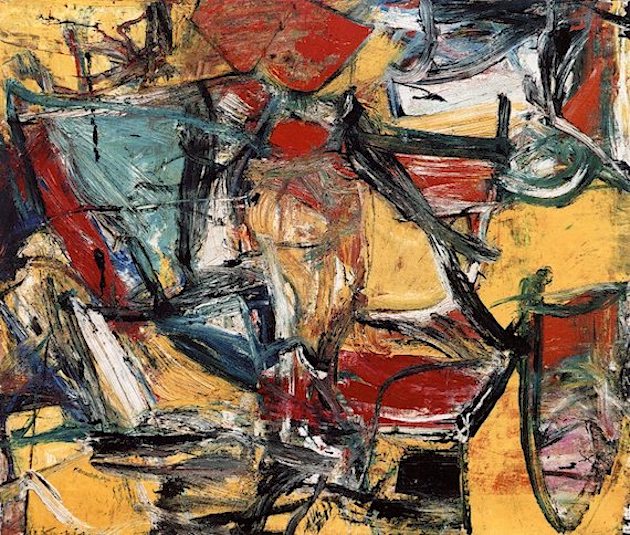
Willem de Kooning Police gazette 1955


White House Denies Tucker Carlson CIA Spy-Op (ZH)
Was the Supreme Leader Set up by a Leaker Named… Tucker Carlson? (Pinsker)
Did Tucker Carlson Unwittingly Help Set Up Iran’s Leadership Decapitation? (ZH)
Tucker Carlson Claims He’s the Subject of Criminal Probe Over Iran (Margolis)
Reports: Mojtaba Khamenei in ‘Low Condition,’ Said to Be Dull-Witted (Manney)
The Media Should Not Call Mojtaba Khamenei ‘Ayatollah’ (MEF)
Iran’s Blockade of the Strait of Hormuz Is Destined to Fail (Rubin)
The Place Where Every French Leader Makes The Same Mistakes (RT)
French Municipal Elections Provide Early Test For Le Pen (ZH)
Companies Are Starting to Enforce AI Use (AIX Files)
In Search of Banksy (R.)


A few days ago, I happenstanced upon a Debt Rattle from 2019. I hadn’t seen that in forever. The first thing that I noticed about the 7 year hiatus was that the articles -or quotes thereof- were much shorter then. That makes reading easier, but not necessarily understanding. Second thing I noticed was the source of the articles; it was often the MSM, AP, Reuters etc.


In 2019, there was no Covid yet, and no Ukraine war either, the two topics that would “define” the news later. And the topics that made me search for alternative sources from the MSM. One source I used a lot for the Ukraine war was RT, the former Russia Today. Since there are always bans on RT somewhere, I post the entire article when I post. That way my readers don’t miss anything. Same goes for Sputnik and TASS, though they’re not as good as RT. Since you then have long(-er) articles, the length of the others sort of automatically increases too. It’s a main reason why the Debt Rattles got longer.

None of it makes any difference for our ads. Someone at Google doesn’t like TAE, and we still get notices regarding this, and they still don’t say why we are being refused. I have given up trying to understand this. I accept I will have to ask my readers for donations in order to keep TAE alive. Hereby. Please.

Topics since, say, 2015,have been the rise of Donald Trump, then Covid, then Ukraine. “New” topics in the time ahead will be the Middle East and, especially, AI. We’ll be on top of it.


https://twitter.com/MintPressNews/status/2033184171045126460


Whatever the truth is, great story.

White House Denies Tucker Carlson CIA Spy-Op (ZH)

Update (2250ET): ‘Top admin officials’ tell Axios’ Marc Caputo that this is fake news;


Meanwhile, Carlson sat down with Glenn Greenwald Friday morning, and said that several high-placed sources told him that the CIA was preparing a criminal referral about him to the DOJ.

“Tucker said he had learned from several high-placed sources — and he obviously has many within the Trump administration — that the CIA was preparing a criminal referral about him to the DOJ. The subject of the agency’s report of suspected crimes: conversations he allegedly had with Iranian officials and others living in Iran prior to the start of the Trump-Netanyahu war. The clear implication was that Tucker had committed acts of subversion, or even treason, by speaking to Iranians in advance of the war that was about to be launched on their country.

Despite how innately shocking this claim is, I had and still have zero doubt that Tucker was telling the truth about what he heard. I have known him for many years, spent much time talking to him both in front of a camera and away from one, and never once has he lied to me or misled me. Tucker has been in public life as a journalist and media figure since his 20s. There have been many harsh criticisms launched against him during those decades, many of which — as he will be the first to tell you — were ones that were quite valid. -GlennGreenwald”

So now they’re going to suggest Tucker made it all up.

Read more …

“Tucker Carlson has relationships with Iranian government leaders..” No more?!

Was the Supreme Leader Set up by a Leaker Named… Tucker Carlson? (Pinsker)

The really weird thing is, there might be precedent for it: Quite a few pundits, including Michael Knowles and Jack Posobiec, connected the dots back in December. Remember when Tucker Carlson solemnly told us that President Donald Trump was going to use his 2025 end-of-year primetime speech to declare war on Venezuela? Judge Andrew Napolitano: Is Trump going to start a war in Venezuela?


Tucker Carlson: Here’s what I know so far, which is that members of Congress were briefed yesterday [Tuesday] that a war is coming, and it’ll be announced in the address to the nation tonight at 9:00 by the president. […] A member of Congress told me that this morning. According to Axios reporter Marc Caputo, Carlson also claimed that “members of congress were briefed yesterday that a war is coming and it’ll be announced in the address to the nation tonight at 9 o’clock by the president.” Only it didn’t happen. We didn’t invade Venezuela ‘til Jan. 3, 2026 — and when we did so, we did it unannounced.nInstead, Trump used the media’s interest in war to deliver a 20-minute, domestic-centric speech that focused on affordability, public safety, and other successes.mn(Yours truly wrote about the bait-and-switch.)

Naturally, Tucker Carlson immediately outed the congressperson who fed him bad information. After all, ANYONE who’d lie about war deserves our condemnation. Why, if you’re willing to lie about war, you’re willing to lie about anything. BWAHAHAHAHA HAHAHA!! I’m just kidding: Tucker Carlson never mentioned who his “source” was. It was almost like s/he never even existed. (I guess it just wasn’t that important.) Today, a brand new theory is percolating: Did lightning just strike twice? Did President Trump use Tucker Carlson’s disloyalty to set up the Iranians? After all, you might’ve heard Carlson’s latest claim. If you haven’t, my PJ Media colleague and/or Tesla bro Matt Margolis wrote about it: Tucker claims he’s the subject of a criminal probe over Iran.

Tucker Carlson claims the CIA is preparing a criminal referral against him to the Department of Justice. For what, exactly? Well, according to Tucker, it’s for talking to people in Iran before the war started. “So the other day I found out that the CIA is preparing some kind of criminal referral against me, a crime report, to the Department of Justice on the basis of a supposed crime I committed,” Carlson said in a video posted to X. “What’s that crime? Well, talking to people in Iran before the war.”The potential charge, according to Tucker, is a violation of the Foreign Agents Registration Act (FARA), which would classify him as an agent of a foreign power. “They [the CIA] read my texts,” he alleged. “So the crime under consideration apparently would be the Foreign Agent Act or something like that, acting as an agent of a foreign power.”

Hmm. So Carlson admits he was “talking to people in Iran before the war.” To whom was he talking — and what was he talking about? Because we know he spoke directly to the leadership of Iran. Less than a year ago, he bootlicked Iranian President Masoud Pezeshkian is an astonishingly powder-puff “interview.” And when a journalist (or whatever Carlson is) has relationships like that, he tends to use ‘em. It gives you a competitive advantage: Access is power.Furthermore, before the Iran War began, we know Tucker Carlson made numerous trips to the White House. Multiple outlets reported that Carlson was attempting to convince President Trump not to go to war against Iran.

Yet once war broke out, Carlson insisted Israel must’ve somehow talked Trump into it. It’s all very intriguing, because one of the biggest mysteries of this war is, why the heck were the Iranian mullahs and their “supreme leader” so careless and stupid to meet all together in broad daylight? It decapitated Iran’s government. Anyone with half a brain would’ve known how dangerous that was! And now, finally, an explanation emerges. But before we get to that, let’s recap what we know:

Tucker Carlson has relationships with Iranian government leaders, admits to “talking to people in Iran before the war,” and vehemently opposed attacking Iran. Allegedly, Carlson personally lobbied President Trump NOT to attack Iran — and when Trump did, Carlson assumed someone (Israel) must’ve changed his mind. Whatever messages Carlson sent to Iranians have, allegedly, become the focus of a criminal investigation.

Perhaps the reason why the mullahs and their “supreme leader” were lulled into a false sense of security was because Tucker Carlson told them that the president was bluffing: There were no strikes coming, so there’s nothing to fear.

Read more …

“At this point, there is no public evidence that Trump told Carlson, directly or indirectly, “we’re not going to war,” intending that message to be relayed to Tehran. “:”

Did Tucker Carlson Unwittingly Help Set Up Iran’s Leadership Decapitation? (ZH)

Tucker Carlson dropped a remarkable monologue on Saturday. In it, he claimed that the CIA had been reading his texts and was preparing some kind of criminal referral tied to his communications with Iranian officials. That by itself would already be a huge story, if Tucker’s claims are correct. But what makes it even more explosive is the theory now circulating online: that the Trump administration may have used Tucker as part of a deception operation to get Iran’s leadership to let their guard down before the U.S.-Israeli attack on Iran.


Now on to the theory that Tucker may have unwittingly set up Iran’s leadership for a U.S.-Israeli decapitation strike. There are at least three pieces of publicly reported information that make this theory impossible to dismiss out of hand.= First, it is now widely reported that Carlson had unusually direct access to Trump in the run-up to the war. The Atlantic reported that Carlson met with Trump three times in the Oval Office over the past month, with the meetings lasting roughly 90 minutes each, to argue against striking Iran. Other reports citing the New York Times have echoed that Carlson had multiple Oval Office sessions with Trump in the weeks before the attack. And the Atlantic and others have noted that Carlson was among the populist voices privately and publicly urging Trump and his aides to avoid a prolonged Middle East war.

Second, Reuters has reported that the opening U.S.-Israeli strike was not some spontaneous response to a last-minute emergency. An Israeli defense official told Reuters the operation had been planned for months and that the launch date had been decided weeks in advance. That matters, because it means the attack was already in the pipeline long before Carlson’s Saturday monologue and long before the public fight between Tucker and Trump.

Third, Reuters also reported something even more striking: the attack was moved up to coincide with a meeting Ali Khamenei was holding with top aides. According to Reuters, Israeli intelligence detected that meeting on Saturday morning, the operation was moved forward, and confirmation that Khamenei was assembled with senior advisers helped set the strike in motion. In other words, the decapitation worked not merely because Washington and Jerusalem had superior firepower, but because they caught Iran’s top leadership concentrated in one place at one time.

Put those three facts together and you can see why the online theory has taken off. Carlson says he was talking to Iranian officials. Carlson had repeated private access to Trump before the war. And the war’s opening strike succeeded in part because Iran’s top leadership was gathered together when the hammer fell.

At this point, there is no public evidence that Trump told Carlson, directly or indirectly, “we’re not going to war,” intending that message to be relayed to Tehran. There is also no public evidence that Iranian officials relaxed their security posture specifically because of anything Carlson said, or because of any message they believed came from Trump through Carlson. The strongest confirmed reporting is narrower: the strike had been planned for months, the final timing was adjusted when intelligence detected Khamenei in a meeting with his inner circle, and Carlson had been in contact both with Iranian officials and with Trump before the war.

There is another reason to be careful here. Trump was hardly projecting dovish clarity in public before the strike. Reuters reported in late February that he had been publicly laying out the case for possible military action against Iran and warning that “bad things” would happen if Tehran failed to reach a meaningful agreement. So if Tehran concluded that no attack was imminent, that conclusion cannot simply be attributed to one media personality’s chatter.

Read more …

“He also noted that he’s never taken outside money, saying, “Don’t need it, don’t want it, and that’s provable.”

Tucker Carlson Claims He’s the Subject of Criminal Probe Over Iran (Margolis)

Tucker Carlson claims the CIA is preparing a criminal referral against him to the Department of Justice. For what, exactly? Well, according to Tucker, it’s for talking to people in Iran before the war started. “So the other day I found out that the CIA is preparing some kind of criminal referral against me, a crime report, to the Department of Justice on the basis of a supposed crime I committed,” Carlson said in a video posted to X. “What’s that crime? Well, talking to people in Iran before the war.” The potential charge, according to Tucker, is a violation of the Foreign Agents Registration Act (FARA), which would classify him as an agent of a foreign power.


“They read my texts,” he alleged. “So the crime under consideration apparently would be the Foreign Agent Act or something like that, acting as an agent of a foreign power.” Despite this, Tucker insists he’s not losing sleep over it. “I don’t expect this to go anywhere,” he said. “I’m not too worried about an actual criminal case against me for a bunch of reasons. One, I’m not an agent of a foreign power, unlike a lot of people commenting on U.S. politics and global affairs. I have only one loyalty, and that’s the United States, and have never acted against it.” Tucker continued, “Its interests are the only interests I care about ’cause I’m from here, and I have a lot of kids.” He also noted that he’s never taken outside money, saying, “Don’t need it, don’t want it, and that’s provable.”

He also pointed out that talking to foreign sources is, quite literally, his job. “It’s my job to talk to everybody all the time and try and figure out what’s happening around the world. That’s literally what I do for a living, and I’m not gonna stop doing that.” He then called the legal theory behind the potential case flat-out ridiculous. “So legally, I think the case is ludicrous, and I doubt it’ll even become a case.”So, why discuss it? He argued that the point of the video goes beyond his own situation. He’s turning this situation, which may or may not be true, frankly, into a warning about how wartime governments become authoritarian:”Countries tend to become more authoritarian in wartime. It’s just the nature of war. People are dying. The stakes are high.”

And the dissent that gets tolerated in peacetime starts getting treated like a threat. “The irony, of course, is the United States fights wars on behalf of freedom, but there’s always less of it here in our country during war,” Carlson said. Then came the more pointed accusation: the U.S. intelligence community spies on Americans, and it does so more broadly than most people realize. “The USIC, the intelligence agency, spy on Americans,” he said. “It’s probably a little more widespread than most people understand, and it’s outrageous.”

Tucker acknowledged the CIA is a large agency and said he’s not painting everyone in it with the same brush. But he was direct about what he believes is happening in his case. “There are some people who are mad at me for my views about Israel, and they have some latitude,” he said. He explained the mechanics of how this kind of operation works: a criminal complaint gets passed to law enforcement, which generates a warrant, which justifies the spying. Then the existence of the investigation gets leaked to media outlets to “humiliate and terrify the subjects of this op.”

This, he says, has happened to him before, more than once. “In famously 2021 when I was still at Fox News and trying to set up an interview with Vladimir Putin,” he recounted, “the NSA, I heard from someone there, had grabbed my text messages with an American citizen and had leaked them to news outlets.” Those texts were nothing more than interview logistics. “They leaked them to The New York Times in order to stop the interview, which they successfully did, by the way, and they admitted that they were spying on me. This is not a fantasy. It actually happened.”

He said they did it again two years later when he was trying to arrange a second Putin interview — the one he ultimately got anyway. The tell, he said, is simple: “When you get a call from a reporter who knows the contents of your texts, it’s pretty clear something’s going on.”

Carlson closed by making clear this video is a warning, not a fundraising pitch: “None of this, in my judgment, as of right now, is a huge threat to me, so I’m not making this video to complain about it or whine or ask you to send me money ’cause I’m under attack.” The message, he said, is about what the government is actually doing — and who’s doing it. “There are also people with agendas and grudges and no sense of restraint who are happy to misuse the power they have granted them by our elaborate secrecy laws to hurt fellow Americans for ideological reasons.”

He concluded, “That is entirely real. That’s the story of Russiagate, and it’s likely that things like that will begin to happen at greater scale now.”

Read more …

Something’s amiss.

Reports: Mojtaba Khamenei in ‘Low Condition,’ Said to Be Dull-Witted (Manney)

The rumor that’s circulating in Middle Eastern political networks claims that Iranian cleric Hojtaba Khamenei may be in poor condition while he struggles to command respect among key figures inside the regime. Mojtaba Khamenei remains widely viewed as the center of Iran’s leadership after the death of his father, Ayatollah Ali Khamenei, who served as Iranian supreme leader for over 30 years and whose death created a sudden leadership vacuum.


Iranian state media later confirmed the killing and declared a 40-day national mourning period as the regime moved quickly to maintain control and reassure supporters that the government remained intact. The Iranian supreme leader has held ultimate authority over Iran’s military forces, the Islamic Revolutionary Guard, and the country’s judiciary since taking power in 1989. Removing that figure in a single strike represented one of the most significant blows to Iran’s ruling structure since the Islamic Revolution of 1979.

Attention immediately shifted to Mojtaba Khamenei, a cleric who spent years operating inside his father’s inner circle and managing parts of the supreme leader’s office. Mojtaba never held the highest clerical rank traditionally expected for leadership, yet he built influence through relationships with security officials and members of the IRGC. That network placed him in a position to become a leading figure in the succession debate once Ayatollah Ali Khamenei was gone. The clerical body responsible for selecting Iran’s supreme leader is the Assembly of Experts, which holds the formal authority to choose the next figure to guide the Islamic Republic. The group weighs

It sounds like the IRGC took the opportunity of the Supreme Leader’s death to take power from the mullahs. They appointed the dull son, who is likely in a coma, and he can serve as a leader in the way Joe Biden served as the US president. We showed them the way, or rather, Democrats did. CBS News reports this morning that US intel assessed Mojtaba Khamenei as an incompetent bungler and that his father assessed him in pretty much the same terms:

U.S. intelligence has circulated to President Trump and to a small circle around him that Iran’s late supreme leader, Ayatollah Ali Khamenei, had misgivings about his son replacing him, multiple sources familiar with the matter told CBS News. “The analysis showed the elder Khamenei was wary of his son, Ayatollah Mojtaba Khamenei, ever taking power because he was perceived as not very bright and was viewed as unqualified to be leader, according to sources. The information gathered also indicated that the father was aware that his son had issues in his personal life. According to sources within the administration, the intelligence community, and people close to the president.

Mojtaba’s rise has never been universally accepted inside hereditary leadership, yet the son of the former supreme leader has remained deeply embedded within the regime’s power networks. That unusual path has fueled years of speculation among Iranian elites about whether a dynastic succession could occur inside a system built to avoid one.

New rumors about Mojtaba’s condition add another layer of uncertainty. Questions about his health and capability circulate at the same moment Iran faces military pressure, economic strain, and internal tension. “Israel reports that Ayatollah Mojtaba Khamenei is injured and in “low condition.” There are several other reports indicating he lost at least one leg and has severe facial and internal injuries. There are reports that he is in a coma. If he were in any kind of decent condition, they would have rolled him out. It’s unlikely he is making any statements. You are hearing the IRGC statements, not his. He is also thought to be unfit for leadership in his normal state.”

When leadership stability becomes uncertain inside a regime built on centralized authority, the entire system feels the strain. The Islamic Republic built its power around the authority of the supreme leader, and speculation is spinning around faster than it took Dorothy to get to Oz. The regime’s future leadership structure remains one of the most closely watched questions in the Middle East.

Read more …

“Mojtaba Is a Fraud Under the Islamic Republic’s Constitution, Which Sets ‘Grand Ayatollah’ as the Full Rank for the Supreme Leader ..”

The Media Should Not Call Mojtaba Khamenei ‘Ayatollah’ (MEF)

ranks to grand ayatollah. For the foreign media to accept the regime’s terms is a mistake.n The New York Times committed the most egregious of these errors. Reporter Farnaz Fassihi, who cultivates good contacts with regime insiders, preempted doubts on the younger Khamenei’s credentials, writing, “Unlike his father, Mr. Khamenei, 56, carries the full religious credentials as an ayatollah at the moment of his ascension.” These assertions may have ingratiated Fassihi to her sources and preserved her access, but they are false.


First, Mojtaba is a Hojjat al-Islam, and he has never published a dissertation. Second, the full rank for the supreme leader is grand ayatollah, which even the regime media do not call him. This is important, as a simple ayatollah is, according to the Islamic Republic’s constitution, insufficient for a supreme leader.The Islamic Revolutionary Guard Corps rebuffed the mullahs when, at gunpoint, it directed the Assembly of Experts to elect Mojtaba.

The difference matters. There are three classes in the Islamic Republic: the Islamic Revolutionary Guards Corps, the clergy, and the people. Before the revolution, the clergy carried significant support among the people. Under Ruhollah Khomeini, the clergy became the ruling class but, with time, its influence on society eroded. This trend accelerated under Ali Khamenei, as the Islamic Revolutionary Guard Corps replaced the clerics as the country’s most powerful class, making Iran effectively a military dictatorship with an Islamic flavor.

During Mahmoud Ahmadinejad’s presidency, for example, only one member of the cabinet—the intelligence minister—had a clerical background, and he essentially had been the chaplain to the Revolutionary Guard. This has forced a reckoning among the clerical class, which now has neither popular support nor significant political power and complains that the Guard vetoes its initiatives. The Islamic Revolutionary Guard Corps rebuffed the mullahs when, at gunpoint, it directed the Assembly of Experts to elect Mojtaba. The assembly refused to announce the results for days. Ayatollah Ahmad Alamalhoda, who is close with both the Khameneis and the Guard, warned that the Assembly has the power to elect the supreme leader but not the right to change its vote, which suggests that there was an effort among the assemblymen to vote for a second time.

On March 13, 2026, opposition outlet Iran International reported that some powerful clerics were maneuvering to strip Mojtaba of his powers. It added, “[Ali-Asghar] Hejazi and [Alireza] Arafi are also among influential clerics who have criticized the growing power of the Islamic Revolutionary Guard Corps and the increasing dominance of its commanders over government decision-making during the war.”

Read more …

“Stop the Panic Over Closure of Strait of Hormuz ..”

Iran’s Blockade of the Strait of Hormuz Is Destined to Fail (Rubin)

Oil is again over $100 per barrel, gasoline prices have risen up to 40 cents a gallon at the pumps, and the Iranians released a statement in Mojtaba Khamenei’s name declaring, “for certain, the leverage of blocking the Strait of Hormuz should continue to be used.” While much of the media conflated this attack with the Hormuz closure, it was actually 350 miles away, close to the Iraqi port of al-Fao. Iranian forces have attacked 16 tankers in the Strait and Persian Gulf since the war began on February 28, 2026. On March 11-12, suicide drone speed boats attacked the Marshall Islands-flagged Safesea Vishnu and the Malta-flagged Zefyros, setting them ablaze. While much of the media conflated this attack with the Hormuz closure, it was actually 350 miles away, close to the Iraqi port of al-Fao.


Some analysts say oil could spike to $200 a barrel. The Foundation for Defense of Democracy’s Mark Dubowitz, long an advocate for regime change, even tweeted, “success would be a militarily decisive victory that leaves the regime in place—but with its deadly capabilities severely degraded,” at least in the short-term. But this Iranian play is nothing new, and panic is unwarranted. The Islamic Revolutionary Guard Corps first sought to close the Strait of Hormuz, mining both it and the Gulf of Oman four decades ago. President Ronald Reagan responded by reflagging Kuwaiti tankers and, when the U.S. guided-missile frigate Samuel B. Roberts hit a mine, blowing a 15-foot hole in its hull, injuring ten sailors. In response, Reagan ordered Operation Praying Mantis, destroying two oil platforms, sinking Iranian naval ships, and Revolutionary Guards’ speedboats.

A joke from shortly after asked why the Iranian navy had purchased glass-bottom boats. The answer? So they could see their air force. Oil prices surged but then dropped quickly about two weeks later, on one day falling by 5%. Iran’s ability to sustain closure is short for two reasons. First, Iran has relied on imports of refined gasoline for decades due to its own lack of investment in its refineries and pipeline networks. If the closure lasts much longer, the Islamic Revolutionary Guard Corps’ vehicles will run out of fuel. The clock is ticking, and the men controlling Mojtaba’s avatar simply hope Washington will kneecap itself with a vortex of panic and political warfare rather than assess the facts objectively. While Trump opposes boots on the ground, subduing and controlling the islands could be a mission for the U.S. Special Forces.

Iran has a limited number of ports, even including the Islamic Revolutionary Guard Corps’ “invisible jetties.” Iranian docks, jetties, and ships are fair targets. Just as the war has depleted the regime’s missiles and drones, it should now destroy its speedboat fleet, a task in the 21st century for drones. The Gulf Cooperation Council was formed in 1981 to contain and deter Iran’s Islamic Revolution. Ironically, it never coalesced in more than theory until this month, when the Iranian regime began attacking every Gulf Arab state, including Qatar and Oman, both of which professed neutrality but had long sympathized with Tehran. Utilizing drones and its own manned fighter-jet fleet would be a natural mission for each Gulf state, each of which has an interest in preserving its own freedom of navigation.

The Emiratis especially have the capability and motive, given Iran’s attacks on Dubai as well as Iranian occupation of Persian Gulf islands claimed by the United Arab Emirates. U.S. authorities should clear every island in the Persian Gulf from which the regime targets shipping. This means not only the three disputed islands—Abu Musa, Greater Tonb, and Lesser Tonb—but also Farsi Island from which the regime once seized U.S. sailors, Sirri; and Hengam, Larak, and Hormuz, islands which control the sea lanes off the more populated Qeshm Island.

Read more …

Africa.

The Place Where Every French Leader Makes The Same Mistakes (RT)

Africa has historically been a foundational pillar of France’s influence and a cornerstone of its global status. Africa provided France with raw materials, geopolitical weight, and economic advantages. All this formed the system known as ‘Francafrique’. However, this system is currently facing an acute crisis. It’s clear that France has failed to maintain a stable presence on the African continent. From de Gaulle to Macron, French leaders have repeatedly made the same mistakes, which eventually resulted in the failure of France’s Africa policy.


Every nation aspiring to be a leader aims to uphold its image as a ‘great power’. France particularly cherishes this image, but current economic and political realities no longer allow for such status. French philosophers noted the decline of the nation’s grandeur as early as the post-WWII era, describing France as a “second-rate power.” It was during this time that Africa became the cornerstone of French foreign policy, one that allowed Paris to sustain and extend its influence on the global stage. France and Africa have a long shared history rooted in the expansion of the French colonial empire at the end of the 19th century. France’s colonial expansion, unlike that of other European countries, was driven not merely by economic gain but by a quest for international prestige.

The modern strategy for maintaining French power is often associated with Gaullism – the philosophy of General Charles de Gaulle, who sought to restore France’s greatness while “totally lacking resources to make it possible.” This logic has shaped France’s Africa policy for decades, with leaders from de Gaulle to Macron facing the same challenges. De Gaulle’s philosophy laid the groundwork for France’s modern Africa policy. At first glance, the general appeared to sacrifice France’s interests by acknowledging the independence of its colonies. However, behind this apparent withdrawal lay a pragmatic calculation aimed at preserving economic, political, and strategic advantages.

Key tools of influence following decolonization included the CFA franc zone and military cooperation agreements that allowed French troops to be stationed in various African nations. Jacques Foccart played a pivotal role in this system; appointed by de Gaulle, he was tasked with establishing a network of clientelist relationships with the new African leaders. Thus emerged France’s unofficial policy in Africa, known as Francafrique – a term coined by economist and historian Francois-Xavier Verschave.

Foccart, nicknamed ‘Monsieur Afrique’, headed the General Secretariat for the Community and African and Malagasy Affairs, which reported directly to the president rather than the Ministry of Foreign Affairs. This department was initially small and the staff was likely handpicked by Foccart, who preferred former colonial officials and high-ranking civil servants, so-called ‘universalists’. This group also included several African agents. This department established the mechanisms for controlling the politics of the former colonies.

Read more …

Not a democracy.

French Municipal Elections Provide Early Test For Le Pen (ZH)

France held the first round of municipal elections on Sunday in nearly 35,000 municipalities, serving as an initial indicator of political momentum ahead of the 2027 presidential election. Marine Le Pen’s National Rally (RN) is seeking to expand its limited local presence, with ambitions focused on southern cities such as Perpignan, Marseille, Nice and Toulon. Pre-vote polls suggested competitive races in key targets, but full first-round results and projections are emerging gradually after polls closed, with many larger cities expected to head to a March 22 runoff. Turnout at 17:00 CET was estimated at 48.9%, up from 2020 but below 2014 levels; final estimates around 56-58% at 20:00 CET.


French voters went to the polls Sunday in the first round of municipal elections, casting ballots for mayors and councilors in a vote widely viewed as an early gauge of support for Marine Le Pen’s National Rally (RN) and other parties ahead of the 2027 presidential contest. The two-round system means most small municipalities will see winners decided Sunday if they secure over 50% of the vote, while larger cities, where no candidate typically reaches an absolute majority – advance to a March 22 runoff. Parties have until Tuesday evening to negotiate alliances, withdrawals or pacts that will shape final outcomes.

The RN, which leads national polls for 2027 (with Le Pen or Jordan Bardella as potential candidates, pending Le Pen’s ongoing EU funds embezzlement appeal), has historically struggled to secure mayoral seats despite strong national performances. The party currently holds only about a dozen cities, with Perpignan (population ~122,000) as its largest stronghold under incumbent Louis Aliot. Pre-election polling and RN strategy highlighted southern France as a priority area for expansion:

• In Perpignan, Aliot was favored to secure re-election, potentially outright or with a strong first-round lead, based on surveys showing him well ahead of fragmented opposition.
• In Marseille (France’s second-largest city), RN candidate Franck Allisio polled closely with incumbent Socialist Mayor Benoît Payan (around 32-35% range in surveys), setting up a potential multi-way runoff if the left fragments (e.g., with France Unbowed’s Sébastien Delogu qualifying).v • In Nice (fifth-largest), RN ally Éric Ciotti (from his UDR group) held strong pre-vote polling positions against incumbent Christian Estrosi.
• In Toulon and surrounding areas, RN’s Laure Lavalette was seen as competitive in a region where the party has parliamentary dominance.

These targets reflect RN’s aim to build grassroots infrastructure – more councilors and mayors for voter mobilization – and test the fraying “Republican Front” (cross-party efforts to block the far right). A symbolic win in a major southern city would mark a breakthrough, though municipal dynamics (local issues like security, public services, drug trafficking and economy) differ from national ones.

On the left, divisions between Socialists and Jean-Luc Mélenchon’s France Unbowed persist, while centrists and the center-right face challenges in places like Paris (Socialist Emmanuel Grégoire frontrunning amid Rachida Dati and others) and Le Havre (Édouard Philippe defending his seat).Turnout figures showed modest engagement: ~19% at midday in some reports, rising to 48.9% at 17:00 CET nationwide (higher than 2020’s pandemic-affected 38.77% but down from 2014). Final estimates hovered around 56-58% at 20:00 CET.

No comprehensive first-round results or nationwide projections were available immediately after polls closed (between 18:00 and 20:00 CET depending on the area), as counting begins progressively. Early partial tallies from smaller communes may appear soon, but major-city suspense – and any RN progress – will likely clarify overnight or into Monday, with runoffs deciding many high-profile races. Le Pen, meanwhile, has been courting old money – though there appears to be some friction. As the Straits Times reports: A new circle of advisers with elite pedigrees is asserting influence, adopting what some National Rally officials describe as a “know-it-all” style that grates on the old guard.

Courting high society risks alienating the base who fuelled the party’s rise and that has long been wary of financiers and high-powered networks, the officials said, speaking on condition of anonymity. The internal friction comes at a pivotal moment, with the party leading polls roughly a year before the next presidential election, and just as France heads into its two-round municipal vote on March 15 and March 22 – an early test of the party’s electability.

As Marine Le Pen and Jordan Bardella navigate the treacherous path to 2027, the National Rally’s calculated pivot toward France’s corporate and old-money elite – through technocratic advisers and pro-business overtures – represents both its greatest opportunity and its most potent risk. While these bridges could deliver funding, credibility, and a veneer of governability that has long eluded the party, they threaten to erode the populist authenticity that propelled its rise among working-class and disaffected voters. With the municipal elections offering an early, localized litmus test of the RN’s mainstreaming efforts, the coming days and weeks will reveal whether Le Pen’s “de-demonization” strategy can reconcile these worlds – or whether the old guard’s warnings prove prescient, leaving the party close to power yet still unable to seize it

Read more …

How much do people understand?

Companies Are Starting to Enforce AI Use (AIX Files)

“Tech Firms Aren’t Just Encouraging Their Workers to Use AI. They’re Enforcing It.” This article appeared in the February 24 edition of the Wall Street Journal. It includes the subtitle: From startups to giants, including Meta and Google, companies are factoring AI use into performance reviews and trying to track productivity gains. Across industries, companies are now enforcing AI use through performance reviews, dashboards that track adoption, and explicit mandates that tie it to compensation and promotion. What began in Silicon Valley has rapidly spread to consulting firms, banks, manufacturers, hospitals, and even government agencies.


As you’d expect, Meta, Google, Amazon, and Microsoft were the first to move from encouragement to enforcement. Employees at these firms now see AI usage metrics appear in quarterly reviews. Non-adopters have reported stalled promotions or explicit warnings that “AI fluency” is a core competency (The Wall Street Journal, Feb 2026, reporting on internal policies). The trend has jumped sectors. PwC requires every consultant to complete an “AI + Human Skillset” curriculum and incorporates usage into evaluations (Business Insider, Feb 5, 2026). Colgate-Palmolive’s “AI evangelist” tracks adoption across global teams. Major banks have begun tying bonuses to the number of AI-assisted analyses completed. Even some hospitals now require doctors and nurses to use AI-assisted diagnostic tools for certain procedures.

Why the shift to mandates? Executives cite three main drivers: intense competitive pressure to keep pace with rivals, investor demands for visible returns on massive AI investments, and internal data showing that voluntary adoption plateaus at around 30–40% of employees. “We’ve made it clear: AI is no longer optional. Every employee is expected to use it, and it’s now part of how we evaluate performance,” said Accenture CEO Julie Sweet (Fortune, March 2026). The claimed benefits are real…on paper. Early internal metrics at several companies show 10–25% gains in task speed for routine work. Cross-functional teams using AI report faster ideation and fewer silos. But the drawbacks and unintended consequences are mounting. While mandatory AI adoption offers productivity benefits, recent research reveals significant drawbacks that undermine organizational health.

Surveillance and autonomy erosion. By 2025, 70% of large companies monitor employee activity, with 68% of employees opposing AI-powered surveillance and 59% saying digital tracking damages workplace trust. AI monitoring systems now track keystroke patterns, mouse movements, email content, and even biometric data, including stress levels. Amazon employees report that surveillance creates “fear and anxiety, which creates a dangerous work environment”.

Burnout and intensified demands. AI meant to reduce workload is paradoxically accelerating burnout. Research found that AI leads to fatigue, burnout, and a growing sense that work is harder to step away from as organizational expectations for speed rise. A South Korean study shows AI adoption significantly increases job stress and burnout, while 63% of workers report AI-related fatigue driven by stress and heavy workloads.

Collapsing trust. Recent research revealed that while AI usage jumped 13% in 2025, worker confidence plummeted 18%, creating a “toxic relationship” as employees receive tools without training or support. Deloitte’s TrustID Index showed trust in company-provided generative AI fell 31% between May and July 2025, with trust in agentic AI systems dropping 89%.

Retention risks. Without adequate training, 56% of workers receive no recent skills development despite widespread AI adoption, and 85% say they would be more loyal to employers investing in continuing education – top performers become increasingly vulnerable to departure. Analysis warns of an impending “seniority cliff” as companies that stop hiring juniors eliminate the pipeline for developing senior talent with deep institutional knowledge.

Critics argue the enforcement model is shortsighted. “You can force usage, but you can’t force wisdom,” said Dr. Ethan Mollick, professor at the Wharton School and author of Co-Intelligence (interview, March 2026). “When AI becomes compulsory, people stop experimenting and start complying — and that’s when the real mistakes happen.” Yet the train has left the station. In boardrooms and earnings calls, executives are increasingly judged on how aggressively they have embedded AI into daily operations.

The message is clear: in 2026, using AI is part of your job. The question companies are only beginning to confront is whether forcing the technology will ultimately make their workforces more cohesive, smarter, and more efficient, or simply more exhausted, distrustful, and replaceable.

Read more …

Long good article. But maybe if he wants to be anonymous, and he’s been that for 3 decades, you just let him be?

“.. identify and understand the elusive artist.”?

In Search of Banksy (R.)

HORENKA, Ukraine. In late 2022, an ambulance pulled up to a bombed-out apartment building in this village outside Kyiv. Three people emerged. One wore a gray hoodie, another a baseball cap. Both had masks covering their faces. The third was more easily identifiable: He was unmasked, and had one arm and two prosthetic legs, witnesses told Reuters.mThe masked men carried cardboard stencils from the ambulance and taped them to what had been an interior wall of an apartment before the Russians obliterated the place. Then they pulled out cans of spray paint and got to work. An absurd image appeared in minutes: a bearded man in a bathtub, scrubbing his back amid the wreckage.
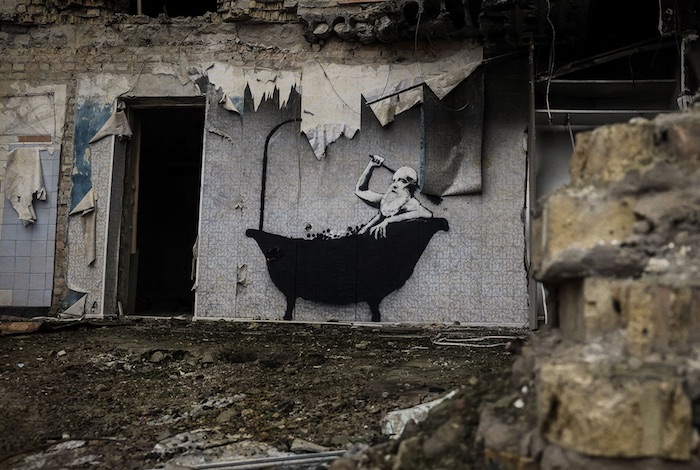
This Banksy mural of a man scrubbing his back in a bathtub appeared in 2022 on a wall of a destroyed building in the Ukrainian village of Horenka. The mural piqued the interest of a Reuters journalist, setting off an effort to identify and understand the elusive artist. REUTERS/Gleb Garanich

Its creator was Banksy, one of the world’s most popular and enigmatic artists, whose identity has been debated and closely guarded for decades. Banksy is best known for simple yet sophisticated stencil paintings with searing social commentary. His work has generated tens of millions of dollars in sales over the years. Once an annoyance to authorities who viewed him as a vandal, he has become a British national treasure. In one survey, Brits rated him more popular than Rembrandt and Monet. In another poll, his “Girl with Balloon” painting was voted the favorite piece of artwork Britain has produced. Some critics believe Banksy’s anonymity is as important to his work as stencils and paint. The British press has run many articles over the years that tried to deduce his identity.

Banksy’s iconic “Girl with Balloon” painting was named in one opinion poll as the favorite piece of artwork Britain has ever produced. REUTERS/Tom Nicholson

Still, Banksy and his inner circle won’t talk about it. Some have signed non-disclosure agreements. Others keep quiet out of loyalty, or fear of crossing the artist, his fans and his influential company, Pest Control Office, which authenticates his work and decides who gets the first chance to buy Banksy’s latest pieces. When the bathtub mural and other Banksy pieces began appearing in Ukraine, Reuters wondered about the artist and how he had pulled off the stunt. Horenka was less than five miles east of Bucha, where Russian forces had left behind at least 300 civilians dead seven months earlier.


[..] So we set out to determine how Banksy did it – and who he really is. Weeks later, a reporter visited Horenka with a photo lineup of graffiti artists often rumored to be the artist and showed the pictures to locals to see if anyone recognized him. Not long after, we heard that a famous British musician – one of the people often whispered to be Banksy – had been spotted in Kyiv, giving us a theory to pursue. Reuters interviewed a dozen Banksy-world insiders and experts. None would comment on his identity, but many filled in details about his life and career. We examined photos of the artist, most of which obscured his face but contained critical information. We later unearthed previously undisclosed U.S. court records and police reports.

These included a hand-written confession by the artist to a long-ago misdemeanor charge of disorderly conduct – a document that revealed, beyond dispute, Banksy’s true identity. And in the process, we learned how and why the man behind the name Banksy vanished from the public record more than a decade ago. Reuters presented that man with its findings about his identity and detailed questions about his work and career. He didn’t reply. Banksy’s company, Pest Control, said the artist “has decided to say nothing.” His long-time lawyer, Mark Stephens, wrote to Reuters that Banksy “does not accept that many of the details contained within your enquiry are correct.” He didn’t elaborate. Without confirming or denying Banksy’s identity, Stephens urged us not to publish this report, saying doing so would violate the artist’s privacy, interfere with his art and put him in danger.
Read more …


https://twitter.com/GlobalDiss/status/2032878571266470147?s=20


Support the Automatic Earth in wartime with Paypal, Bitcoin and Patreon.



Apr 012025


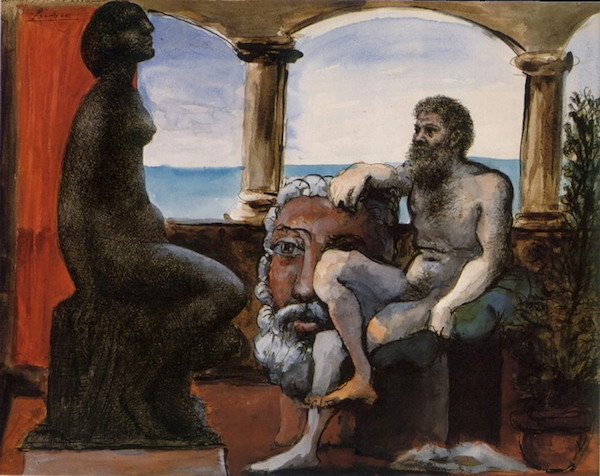
Pablo Picasso The sculptor and his statue 1933


Paris Court Finds Le Pen Guilty of Embezzlement of EU Funds (Sp.)
France’s Le Pen Sentenced To Four Years In Jail (RT)
Le Pen Conviction ‘A Very Big Deal’ – Trump (RT)
Le Pen Sentence a ‘Declaration of War by Brussels’ – Salvini (RT)
Putin Will ‘Follow Through’ On Ukraine Deal – Trump (RT)
Kiev Looking To Further Delay Elections – Ukrainian Official (RT)
Convergence Calling (James Howard Kunstler)
Current Status: FBI Deputy Director Dan Bongino (CTH)
Transactional Weakness Tips The Balance of Power (Alastair Crooke)
Deep State Uses NY Times to Announce Its Withdrawal from Ukraine (PCR)
Trump’s Auto Tariffs Just Got a Huge Endorsement (Margolis)
Trump Says ‘Couldn’t Care Less’ If Foreign Auto Makers Raise Prices (ET)
Musk Demolishes Media’s Trump-Dictator Fantasy (Margolis)
Gold in Hyperdrive in Hyper-Levered House of Cards – Bill Holter (USAW)
NPR’s CEO Just Made the Best Case Yet for Defunding NPR (Turley)
Vaccine Stocks Tank, Moderna Craters As FDA Top Regulator Steps Down (ZH)
Repeat COVID Vaccines Provoke Two Kinds Of Inferior Antibodies (JTN)


Elon NGOs

Elon votes

Clients
https://twitter.com/MarioNawfal/status/1906541616632082890

Jennings
https://twitter.com/PapiTrumpo/status/1906437104785097141

RFK

NYT


It’s taking a lot of reading to get an even halfway satisfactory idea of what goes on with Marine Le Pen, who was sentenced to 4 years in jail for embezzlemennt of EU funds yesterday. 2 of the four years are probation, 2 are house arrest. And she can’t run for office for 5 years, with presidential elections coming in 2027.

The penalties cover the period from 2004-2016, when her National Rally (Rassemblement National – RN) had representatives seated in the Euopean Parliament. Which pays parties in that position to cover salaries etc. for assistants. Now a French court determines they did not handle these EU funds properly, 20-odd years ago, they need to pay it back with fines, and she must go to jail.

But RN doesn’t appear to be the only party with similar issues, not even the only French one. So why is this happening, and why now? Every answer provides 5 new questions.

There are strong similarities with Donald Trump’s case in the US (including judges grasping political power), and of course Le Pen is not the only EU politician who is declared ineligible for an election.

We get to choose from pre-selected candidates. That’s not democracy.

She will appeal the decision. That can take a year or more, so a bunch of judges will decide if she will be in time to run, even if she wins the appeal.

Paris Court Finds Le Pen Guilty of Embezzlement of EU Funds (Sp.)

A court in Paris found Marine Le Pen, the leader of the National Rally faction in the French parliament, guilty of embezzlement of European Parliament funds by hiring fictitious assistants to party members, the judge announced on Monday. “Madame Le Pen has been found guilty of embezzlement of public funds,” the judge said. Another eight other party lawmakers were found guilty, while some 12 party members were found guilty of “hiding information.” According to the court, the damage to the European Parliament is estimated at 2.9 million euros ($3.1 million). The court sentenced Le Pen to four years in prison, including two years on probation.

“The court decided to impose a 4-year prison sentence against Madame Le Pen, two of which are on probation, and two can be commuted. She will also not be able to be elected to public authorities for a term of five years,” the judge said. Le Pen will not go to prison, and will serve her sentence with an electronic bracelet at home, the judge said. Le Pen was also ordered to pay a fine of 100,000 euros ($108,200).

Le Pen and 24 of her party members are accused of allegedly laundering the funds of the European Parliament by allegedly fictitiously hiring assistants to lawmakers. The politicians are accused of “misuse of public funds” of the European Union in the period from 2004 to 2016, and Le Pen is accused of creating a “centralized system” of laundering European Parliament’s money. According to the prosecution, the European Parliament allocated funds to pay for the work of parliamentary assistants to European Parliament lawmakers from Le Pen’s party, although in fact the assistants worked only for the National Rally faction.

Read more …

“.. she has accused the EU of mishandling illegal immigration and has criticized its support for Ukraine in the conflict with Russia..”

France’s Le Pen Sentenced To Four Years In Jail (RT)

A Paris court has sentenced French right-wing politician Marine Le Pen to a four-year jail term, half of which is without parole, in a case involving the embezzlement of EU funds for her National Rally (RN) party. Le Pen has also been barred from running for president in 2027. The verdict on Monday is the culmination of an extended case, in which RN and several of its senior figures were accused of diverting money meant for the offices of European Parliament members towards the national party structure. Le Pen and eight MEPs were found guilty of running the scheme between 2004 and 2016. The five-year ban on participating in elections, which was requested by the prosecution, comes into effect immediately regardless of any appeal process.

The top French constitutional court ruled last week in an unrelated case that such a punishment was legal under the basic law. The court has reportedly allowed Le Pen to serve half of her jail time under home arrest monitored by an ankle bracelet. Others found guilty in the case on Monday were sentenced to serve time in prison, with punishments varying between 12 months and three years. RN president Jordan Bardella denounced the sentence on his X account, calling it “unjust” and amounting to an execution of French democracy. Hungarian Prime Minister Viktor Orban has expressed support for Le Pen, posting “I am Marine” in French and tagging her account on X.

Le Pen stepped down from the RN party leadership in favor of Bardella in 2022, but remains the head of its faction in the National Assembly. Described as “far-right” by her detractors, she has accused the EU of mishandling illegal immigration and has criticized its support for Ukraine in the conflict with Russia, among other policies. As part of the court’s decision, RN was sentenced to seizure of already-confiscated funds and a fine totalling €2 million ($2.2mn).

https://twitter.com/CilComLFC/status/1906793471802835057

Read more …

“..the prosecution of Le Pen was “particularly concerning, given the aggressive and corrupt lawfare waged against President Trump here in the United States.”

Le Pen Conviction ‘A Very Big Deal’ – Trump (RT)

US President Donald Trump has said that the criminal prosecution of French opposition leader Marine Le Pen reminds him of his own legal battles under the Biden administration. On Monday, Le Pen, the ex-leader of the conservative National Rally (RN) party, was sentenced to four years in prison, two of which will be suspended, and was barred from holding public office for five years. The embezzlement conviction effectively bars her from the 2027 presidential race. When asked by reporters in the Oval Office about the verdict, Trump replied, “That’s a very big deal.” “I know all about it, and a lot of people thought she wasn’t going to be convicted of anything,” Trump said.

“But she was banned [from] running for five years, and she’s the leading candidate. That sounds very much like this country,” he added. Trump has often claimed that the court cases and investigations into his activities were part of a politically motivated “witch hunt” led by the Biden administration and the Democrats. US State Department spokeswoman Tammy Bruce said earlier that the prosecution of Le Pen was “particularly concerning, given the aggressive and corrupt lawfare waged against President Trump here in the United States.”

According to the prosecutors, Le Pen siphoned off the EU funds intended for covering her staff’s work in the European Parliament to fund the activities of her party in France. She had denied any wrongdoing and dismissed the verdict as “a fatal day for our democracy.” Le Pen’s party holds the highest number of seats in the National Assembly. According to the Ifop poll published in Le Journal du Dimanche on Sunday, between 34% and 37% of those surveyed said they planned to vote for Le Pen in 2027, which is more than 10 points ahead of her nearest rival, former Prime Minister Edouard Philippe. Le Pen ran for president three times, placing second in 2017 and 2022.

https://twitter.com/CilComLFC/status/1906857560306495699

Read more …

“Le Pen has been a prominent critic of NATO’s policies in Eastern Europe and has opposed Ukraine’s accession to the military bloc. She has also advocated against the EU’s anti-Russia policies.”

Le Pen Sentence a ‘Declaration of War by Brussels’ – Salvini (RT)

Italian Deputy Prime Minister Matteo Salvini has condemned the verdict against French presidential hopeful Marine Le Pen as “a declaration of war by Brussels.” Le Pen has been sentenced to four years in prison on embezzlement charges and barred from running for public office for five years, including an upcoming presidential election in 2027.In a post on X on Monday, Salvini compared the outcome of the trial in Paris to the recent barring of independent candidate Calin Georgescu in Romania.”Those who fear the judgment of the voters often find reassurance in the judgment of the courts,” Salvini said. “A bad film that we are also seeing in other countries such as Romania.”

Georgescu, a critic of NATO, the EU, and aid to Ukraine, won an unexpected first-round victory in last year’s election. The results were promptly annulled by Romania’s Constitutional Court, citing funding irregularities. Georgescu was subsequently barred from running in the election rerun scheduled for May 2025.Salvini called the ruling against Le Pen “a declaration of war by Brussels, at a time when the warlike impulses of Von der Leyen and Macron are frightening.” He was apparently referring to the push by European Commission President Ursula von der Leyen to militarize the EU and proposals by French President Emmanuel Macron to deploy troops to Ukraine. Le Pen, the leader of the National Rally party (RN), was convicted of embezzling over €4 million from the European Parliament from 2004 to 2016. She received a four-year prison sentence, with two years suspended, and a five-year ban from holding public office, effectively disqualifying her from the 2027 presidential election.

Le Pen has been a prominent critic of NATO’s policies in Eastern Europe and has opposed Ukraine’s accession to the military bloc. She has also advocated against the EU’s anti-Russia policies. In the 2022 presidential election, she advanced to a runoff against Macron, securing around 41.5% of the vote. Earlier this year, polls suggested that Le Pen would secure 61% of the vote against her main rival in the upcoming presidential election. The conviction of Le Pen and the disqualification of Georgescu occur amid an emergence of political movements across the EU opposed to the bloc’s policies. A number of French and foreign politicians have condemned the court’s ruling as undemocratic.

Read more …

Got to get a deal first.

Putin Will ‘Follow Through’ On Ukraine Deal – Trump (RT)

US President Donald Trump has said his Russian counterpart, Vladimir Putin, would honor his part of a potential peace agreement on the Ukraine conflict. At the same time, Trump warned Kiev against backing out of a rare-earth minerals deal with the US. Speaking to reporters on Monday, the US leader repeated that he aims to end the conflict between Russia and Ukraine as soon as possible, adding that he “want[s] to make sure that he [Putin] follows through” on any peace deal. “I think he will. I don’t want to go secondary tariffs on his oil, but I think it’s something I would do if I thought he wasn’t doing the job,” Trump stated. He expressed hope that Ukraine’s Vladimir Zelensky would also uphold his end of the bargain, but rebuked him for apparent attempts to renegotiate the rare-earths deal which would grant the US access to Ukraine’s mineral deposits.

While Trump has portrayed the deal as a way for Ukraine to pay back past US assistance, Zelensky has insisted that Kiev owes Washington nothing. “We made a deal for rare earths. It was all done. They’re now saying, ‘Well, I’ll only do that deal if we get into NATO or something to that effect,’” Trump said. He insisted that NATO membership for Ukraine was “never… discussed,” suggesting that the issue was the likely reason for the escalation of hostilities between Moscow and Kiev in 2022.Trump earlier threatened Zelensky with “big problems” if he rejects the rare-earths deal. The Ukrainian leader, however, has said that “the framework [of the agreement] has been changed” from what he was willing to sign during a meeting with Trump in late February.

On that occasion, the pair’s White House meeting turned into a heated clash, with Trump accusing Zelensky of ingratitude and “playing with World War III” over what he perceived as reluctance to make a deal with Russia. At the same time, Trump said on Sunday that he was “very angry” with Putin’s proposal to place Ukraine under a temporary UN-led administration to organize new elections. Russia has long insisted that Zelensky is an “illegitimate” leader, given that his presidential term expired in May 2024. Kremlin spokesman Dmitry Peskov has said Moscow and Washington are exploring several ideas aimed at resolving the Ukraine conflict, adding that Putin is open to any contact with Trump. Russia maintains that the conflict could be settled if Ukraine commits to bloc neutrality and demilitarization, and recognizes the territorial reality on the ground.

Read more …

“Ukraine needs changes to legislation governing election procedures before it can choose its next president and parliament..”

Kiev Looking To Further Delay Elections – Ukrainian Official (RT)

Ukraine needs changes to legislation governing election procedures before it can choose its next president and parliament, Central Election Commission Chair Oleg Didenko has said. In an interview with the news outlet Ukrainskaya Pravda published on Monday, Didenko argued that it would be impossible to hold elections immediately after martial law is lifted, despite constitutional requirements. Ukrainian leader Vladimir Zelensky’s presidential term expired in May 2024, yet he has remained in office and refused to hold elections, citing the martial law introduced in 2022 due to the conflict with Russia. Parliamentary elections, also due last year, have been indefinitely postponed for the same reason. Under current legislation, voting must be announced within a month of martial law ending, with parliamentary elections held within 60 days and presidential elections within 90.

“Is this [time] enough to prepare for the elections? If we are talking about voting that will be democratic and will meet the standards, then probably not… We need much more time to prepare for the post-war elections,” Didenko argued. “We need to adopt a law on the specifics of holding post-war elections,” he stated. Didenko declined to give a timeline, citing multiple challenges: the state of the budget, territorial realities, voter registration for millions displaced or living abroad, election sequencing, and infrastructure. The official noted that the CEC plans to propose an additional voting day and more polling stations abroad. He also floated the idea of electronic or mail voting but said both face cybersecurity risks.

The CEC is drafting a proposal for post-war election legislation to present to parliament, Didenko stated. He did not give a timeframe but said any new voting mechanism must first be approved by lawmakers. Kiev’s delay in holding elections has drawn criticism from both Moscow and Washington. US President Donald Trump last month called Zelensky “a dictator without elections.” Moscow considers the absence of elections in Ukraine a barrier to peace talks, as there is no clear way to sign any agreements, including a potential peace deal to end the conflict, with Kiev, because its current leadership lacks legitimacy. Russian President Vladimir Putin recently proposed that the UN establish a temporary external administration in Ukraine to facilitate elections and enable legitimate negotiations.

Read more …

“The current conflict between Europe and America is not reducible towards contrasting approaches towards Russia’s invasion of Ukraine.” —Frank Furedi on Substack

Convergence Calling (James Howard Kunstler)

You’re going to see what a truly consequential span of weeks, looks like, as Western Civ goes into full churn on April’s doorstep. Remember, TS Eliot called it the “cruelest month.” Too many uncomfortable things are converging, too many ongoing operations are unwinding, too many tensions are breaking. The conclusion of “Joe Biden’s” Ukraine War fiasco looms. You can tell because The New York Times published a gigantic piece Sunday detailing how the Pentagon and the CIA actually ran all of Ukraine’s tactical operations out of a base in Wiesbaden, Germany — after building a colossal Ukraine war machine post our 2014 color revolution in Kiev. Since the very start of the hot war in 2022, we did all the targeting for the weapons we gave them and planned their every move. What a surprise! (Not.)

The motive behind all that, as conceived by US neo-cons and NATO neo-morons, was to “weaken” Russia, bust it up, and seize its resources. All the sanctions piled on only induced Russia into an import-replacement campaign that actually strengthened its economy, while the war led to a revolution in Russian war-fighting tactics and advanced weaponry. Now, the whole thing is ending in Ukraine’s defeat and the West’s humiliation. The Times could have published this in 2023-24, but it would have been a major embarrassment for “Joe Biden” and his shadow managers moving into the election. They put it out just now because the jig is up and the paper desperately needs to pretend that it’s ahead of events to preserve the last shreds of its credibility. Mr. Trump, the uber-realist, knows that the Russians are going to roll up in Ukraine this spring and there is increasingly not much that can be done about that, except to try to put the best face on it — which is, that it wasn’t his war.

As long as the coke freak Zelensky remains in charge, Ukraine will be negotiation-unworthy, as the Russian phrase goes. So, US-Russia peace talks were largely diplomatic showbiz. Both Putin and Mr. Trump were painfully aware of this, and hence, Mr. Trump’s latest performative bluster about “more sanctions” will probably not amount to anything. And also hence, the synchronized idiocy on display in France, Germany, and the UK. They were all-in on the neo-con scheme that is now falling apart and its failure has driven them plumb crazy. As the US drops out of the stupid proxy war, they declare their intention to take it from here and go beat-up Russia. Their war-drums are teaspoons beating on so many quiches.

Soon-to-be chancellor Friedrich Merz proposes an 800-billion-Euro debt spree to finance the re-arming of Germany, which, just now, is utterly incapable of war. He is insane. German industry is collapsing from a lack of affordable natural gas (as arranged by “Joe Biden” blowing up the Nord Stream pipelines, danke schön). Turning Volkswagen factories to missile production will not help the German people one bit. It probably will remind them about the Weimar hyper-inflation, though. Mr. Trump, the uber-realist, knows that the Russians are going to roll up in Ukraine this spring and there is increasingly not much that can be done about that, except to try to put the best face on it — which is, that it wasn’t his war. As long as the coke freak Zelensky remains in charge, Ukraine will be negotiation-unworthy, as the Russian phrase goes.

So, US-Russia peace talks were largely diplomatic showbiz. Both Putin and Mr. Trump were painfully aware of this, and hence, Mr. Trump’s latest performative bluster about “more sanctions” will probably not amount to anything. And also hence, the synchronized idiocy on display in France, Germany, and the UK. They were all-in on the neo-con scheme that is now falling apart and its failure has driven them plumb crazy. As the US drops out of the stupid proxy war, they declare their intention to take it from here and go beat-up Russia. Their war-drums are teaspoons beating on so many quiches.

Soon-to-be chancellor Friedrich Merz proposes an 800-billion-Euro debt spree to finance the re-arming of Germany, which, just now, is utterly incapable of war. He is insane. German industry is collapsing from a lack of affordable natural gas (as arranged by “Joe Biden” blowing up the Nord Stream pipelines, danke schön). Turning Volkswagen factories to missile production will not help the German people one bit. It probably will remind them about the Weimar hyper-inflation, though. Macron pledges to put French boots on the ground in Ukraine. Ain’t gonna happen. Today, his stooge judiciary found political rival Marine LePen guilty of a Mickey Mouse offense in order to bar her from running against him in the next election. Ain’t gonna work. He will provoke the biggest national uprising since the Bastille.

His government will be too busy putting down French Revolution 2.0 to play war games in history’s graveyard of armies. Maybe he’ll try nukes. I’m sure that’ll work — if you’re eager to see Russian hypersonic “hazelnuts” rain down on the Île-de-France. And then, there is the amazing idiot PM Keir Starmer in the UK, calling on his “coalition of the willing” to step up and intervene in the lost cause that is Ukraine. How many hands went up on that call? For practical purposes, the Brits have no war-fighting capacity whatsoever, and no resources for generating such capacity. And, anyway, they are facing some dreadful combo of a civil war / internal jihad against their own indigenous population, plus an economic collapse cherry-on-top.

Read more …

Lawyer “sundance” doesn’t think Patel and Bongino have what it takes.

Current Status: FBI Deputy Director Dan Bongino (CTH)

Kash Patel and Dan Bongino both fail to understand the severity of the compromise underneath them. Hence the “95% honorable” quote by Patel recently. The core issue is that institutional corruption is the status of the FBI. That is challenging to deal with and simply cannot be addressed (in any reasonable timeframe, or effect) from the top of the leadership pyramid. The various downstream field offices of the same institution (there are hundreds) will keep Patel/Bongino flush with busy work and positive investigative outcomes for them to announce on television. [see VA recently] That approach purposefully satiates a reviewing audience yet leaves the process under them without oversight.

Corrupt FBI officials continue operations as needed (influence selling, evidence burying, pay-to-play investigative outcomes, DC monitoring, money laundering, trafficking, drugs and generally willful blindness to their outside group partners) and simultaneously push specific attention-grabbing info up the ladder toward leadership offices in DC. [As decades of top-down corruption took over, it slowly permeated the field offices. Most of the really good FBI officials; those who did not want to follow a path paved with the need to join the internal corruption; took up FBI positions in foreign countries. The good guys, the SMEs are overseas now, having long left the domestic rank and vile behind them.] Kash Patel and Dan Bongino would likely make excellent FBI special operation compliance officers and internal auditors. That’s where the real impact can be delivered [think Elliot Ness approach].

However, as leaders of the institution, the function of their role – as outwardly prestigious as it might seem, essentially isolates them with busy work. They must assign the role of compliance and audit review below them, to the same internal silo operators who have previously been identified as working within a corrupted institution. You might note that Treasury Secretary Scott Bessent noticed this need very quickly, because he was/is a subject matter expert in large institutional leadership. Bessent has experience, Patel and Bongino do not. Secretary Bessent hired/promoted/moved the IRS whistleblowers into strategic position; to become the heads of an internal compliance and audit team, reporting almost exclusively to Bessent himself. Bongino and Patel would have been good in similar roles within the FBI organization. However, as heads of the agency they can affect very little operational change.

Yes, they can steer the ship, but it is the chief engineer who determines the speed of the vessel. The mechanics within the FBI will simply control the speed and wait out the leadership. Kash and Dan will then play a long game of whac-a-mole, removing each identified agent stalling as they are discovered. This will take more years than they have. Contrast that FBI approach (Patel, saying everyone is awesome) with Treasury (Bessent, saying there’s an institutional problem here), and you will understand the visible absence of accountability. So far, the duo has not publicly admitted the severity of the corruption they sit atop; let alone announce a plan to deal with it. Ergo the intellectually honest person who understand the silo operations, only expect soundbites and pretenses.

Or, think of the problem like President Trump and Elon Musk (DOGE) to the total executive branch. President Trump is the tip-top of the silo. Elon Musk and DOGE are the compliance/audit officers, reviewing each agency – taking action and reporting back to the principal, President Trump. Both President Trump and Elon Musk are familiar leading massive organizations (high competence, high motivation). However, even with their incredible large institutional skillset, both Trump and Musk need to break down the responsibilities using DOGE. Musk hires highly competent highly motivated DOGE members to do the actual compliance and audits. Again, Kash Patel and Dan Bongino do not possess the same executive leadership skills (they are low competence, high motivation). The pair of FBI directors need high-direction and high-support to overcome their competency challenge.

If the institutional corruption within the FBI was being addressed, we would not need to be told the institutional corruption within the FBI was being addressed. We would be able to visibly see it. Ex. If Treasury was saying 95% of IRS employees were honorable and good, Secretary Bessent would not be removing tens-of-thousands of IRS agents. The FBI reportedly has around 48,000 agents/employees. Step one begins as President Trump, Elon Musk and Scott Bessent each noted. First, admitting there’s an institutional problem. Patel and Bongino are denying they have an institutional problem. I/We want to see Kash Patel and Dan Bongino succeed. However, it takes large system executive leadership skills to execute any effective reform strategy. Patel and Bongino would be excellent compliance officers, unfortunately that’s not the role they have been assigned to. That’s the problem.

Read more …

“Hold to no illusions: There is nothing beyond this reality …”.

““Sanctions are neither temporary nor targeted measures; they constitute a mechanism of systemic, strategic pressure against our nation.”

Transactional Weakness Tips The Balance of Power (Alastair Crooke)

The post-WWII geo-political outcome effectively determined the post-war global economic structure. Both are now undergoing huge change. What remains stuck fast however, is the general (Western) weltanschauung that everything must ‘change’ only for it to stay the same. Things financial will continue as before; do not disturb the slumber. The assumption is that the oligarch/donor class will see to it that things remain the same. However, the power distribution of the post-war era was unique. There is nothing ‘forever’ about it; nothing inherently permanent. At a recent conference of Russian industrialists and entrepreneurs, President Putin highlighted both the global fracture, and set out an alternate vision which is likely to be adopted by BRICS and many beyond. His address was, metaphorically speaking, the financial counterpart to his 2007 Munich Security Forum speech, at which he accepted the military défie posed by ‘collective NATO’.

Putin is now hinting that Russia has accepted the challenge posed by the post-war financial order. Russia has persevered against the financial war, and is prevailing in that too. Putin’s address last week was, in one sense, nothing really new: It reflected the classic doctrine of the former premier, Yevgeny Primakov. No romantic about the West, Primakov understood its hegemonic world order would always treat Russia as a subordinate. So he proposed a different model – the multipolar order – where Moscow balances power blocs, but does not join them. At its heart, the Primakov Doctrine was the avoidance of binary alignments; the preservation of sovereignty; the cultivation of ties with other great powers, and the rejection of ideology in favour of a Russian nationalist vision.

Today’s negotiations with Washington (now narrowly centred on Ukraine) reflect this logic. Russia isn’t begging for sanctions relief or threatening anything specific. It is conducting strategic procrastination: waiting out electoral cycles, testing Western unity, and keeping all doors ajar. Yet Putin is not adverse either to exerting a little pressure of his own – the window for accepting Russian sovereignty of the four eastern oblasts is not forever: “This point can also move”, he said. It is not Russia racing ahead with the negotiations; quite the reverse – it is Trump who is racing ahead. Why? It appears to hark back to the American attachment to Kissinger-esque triangulation strategy: Subordinate Russia; peel away Iran; and then peel Russia from China. Offer carrots and threaten to ‘stick’ to Russia, and once subordinated in this way, Russia might then be detached from Iran – thus removing any Russian impediments to an Israel-Washington Axis attack on Iran.

Primakov, were he here, likely would be warning that Trump’s ‘Big Strategy’ is to tie Russia into subordinate status quickly, so that Trump can continue the Israel normalisation of the entire Middle East. Witkoff has made Trump’s strategy very plain: “The next thing is: we need to deal with Iran … they’re a benefactor of proxy armies … but if we can get these terrorist organisations eliminated as risks … Then we’ll normalise everywhere. I think Lebanon could normalise with Israel …That’s really possible … Syria, too: So maybe Jolani in Syria [now] is a different guy. They’ve driven Iran out … ImagineImagine if Lebanon … Syria … and the Saudis sign a normalisation treaty with Israel … I mean that would be epic!” U.S. officials say the deadline for an Iran ‘decision’ is in the spring … And with Russia reduced to supplicant status and Iran dealt with (in such fantastical thinking), Team Trump can turn to the main adversary – China.

Putin, of course, understands this well, and duly debunked all such illusions: “Set illusions aside”, he told delegates last week: “Sanctions and restrictions are today’s reality – together with a new spiral of economic rivalry already unleashed …”. “Hold to no illusions: There is nothing beyond this reality …”. “Sanctions are neither temporary nor targeted measures; they constitute a mechanism of systemic, strategic pressure against our nation. Regardless of global developments or shifts in the international order, our competitors will perpetually seek to constrain Russia and diminish its economic and technological capacities …”. “You should not hope for complete freedom of trade, payments and capital transfers. You should not count on Western mechanisms to protect the rights of investors and entrepreneurs … I’m not talking about any legal systems – they just don’t exist! They exist there only for themselves! That’s the trick. Do you understand?!”.

Read more …

“Trump can end the conflict by ceasing to participate. There is no reason for bureaucrats and emissaries to hold endless negotiations.”

Deep State Uses NY Times to Announce Its Withdrawal from Ukraine (PCR)

Last Saturday the New York Times completely abandoned the official narrative of the Ukraine Conflict, thus overturning the apple cart full of lies. Jeff Childers gives us the gist of the New York Times abandonment of the ruling lie. https://www.coffeeandcovid.com/p/narrative-whiplash-sunday-march-30. What is the explanation? My guess is that the Deep State has decided to abandon the conflict and is most likely the author of the Times’ article. The purpose of the article is to set up Zelensky as the scapegoat who caused the war to be lost and to get rid of him so that the conflict can be brought to an end.

These paragraphs show the purpose: It was going according to plan, the Times sadly said, “until it wasn’t.” The problem wasn’t the Russians, the Americans, or even the slowly draining numbers of trained Ukrainian military forces. No, the problem was one spotlight-hogging Vladimir Zelenskyy. With two y’s, for you’ve got to be kidding me, squared. “Zelensky was hoping to attend the United Nations General Assembly,” the Times reported. “A showing of progress on the battlefield would bolster his case for additional military support. So the Ukrainians upended the plan at the last minute — a preview of a fundamental disconnect that would increasingly shape the arc of the war.”

Childers’ translation: Zelensky started making his own decisions —ones not approved by the Americans— and the war began unraveling. A few of us have known from day one that the Ukraine conflict was Washington’s war run out of Wiesbaden. The questions are: Why didn’t Putin know, and if he did know why didn’t he do anything? Now that the New York Times has admitted that the conflict in Ukraine was America’s war with Russia disguised as Russia’s invasion of Ukraine, a war that, as I have often said, Trump has no stake in, Trump can end the conflict by ceasing to participate. There is no reason for bureaucrats and emissaries to hold endless negotiations. Trump simply declares the war is over. Let’s hope Trump and Putin have the wits to see this.

Read more …

United Auto Workers (UAW).

Trump’s Auto Tariffs Just Got a Huge Endorsement (Margolis)

United Auto Workers (UAW) President Shawn Fain, who backed Kamala Harris in last year’s election, just delivered the most significant endorsement yet of President Donald Trump’s tariffs on foreign-made automobiles. Defying the left’s narrative, Fain called the tariffs a necessary tool to bring manufacturing jobs back to the United States. Speaking on CBS’s “Face the Nation,” Fain agreed with Trump trade adviser Peter Navarro’s assessment that American auto plants are operating at only 60% capacity, which leaves plenty of room to ramp up production domestically. “He’s spot on,” Fain said, citing the example of Stellantis, which recently laid off 2,000 workers in Warren, Mich., after shifting Ram truck production to Mexico. “They could shift that work back in very short order and be producing Ram trucks right back there and put those people back to work.”

Fain also pointed to Volkswagen, which he called “the biggest violator of all” for its reliance on Mexican production. “Seventy-five percent of their production for the North American market is made in Mexico, so they can shift product there overnight,” he said, emphasizing that American plants can absorb that production. Recalling World War II, Fain argued that America has successfully repurposed its manufacturing base before. “The way that we formed the Arsenal of Democracy that won the war was, they took the excess capacity of all the automotive manufacturing plants in the country and produced tanks and planes and bombs and engines and all those things,” he said. “And it’s no different right now.”

“And Shawn, for people who are listening to you, how do tariffs make that happen?’ asked Major Garrett. “What is the relationship between a 20 or 25% tariff and getting that capacity back up to where you’d like to see it?” When asked how tariffs would help restore domestic auto production, Fain said they would serve as a deterrent against offshoring. “Well, because, like everything, the companies abuse the process,” he said. “They’re in the pursuit of driving a race to the bottom.” He referenced Ross Perot’s warning in 1992 about the “giant sucking sound” of jobs leaving under NAFTA, adding, “He was spot on.”

Fain noted that 90,000 manufacturing plants have closed in the past 30 years, including 65 facilities belonging to the Big Three automakers. He cited ongoing threats to move production from Wisconsin’s John Deere plant and Pennsylvania’s Mack Truck facility to Mexico. “Tariffs are a tool in the toolbox,” Fain said. “They’re not the end-all solution. We have to fix the broken trade system. But the way tariffs work, I mean, it’s a motivator, because there’s going to be a penalty for everything the companies ship in here, and I’ve had companies tell us, point blank, that they’re going to have to bring product back here if those tariffs are implemented.”

Read more …

“..I hope they raise their prices, because if they do, people are going to buy American-made cars. We have plenty.”

Trump Says ‘Couldn’t Care Less’ If Foreign Auto Makers Raise Prices (ET)

President Donald Trump said on March 29 that he did not ask automotive CEOs to avoid raising prices in response to sweeping tariffs and that he “couldn’t care less” if they do so on foreign-made cars. The Trump administration is poised to levy 25 percent tariffs on all foreign-made automobiles and components on April 2, with temporary exceptions given to companies that import vehicles or parts under the United States-Mexico-Canada Agreement (USMCA) until the government creates a process for applying those duties, according to the White House. Trump made the comments in a Saturday phone interview with NBC News. He was asked about his recent message to automotive industry executives and whether he warned them against raising prices. “The message is congratulations, if you make your car in the United States, you’re going to make a lot of money. If you don’t, you’re going to have to probably come to the United States, because if you make your car in the United States, there is no tariff,” Trump said, adding that he never told them not to raise prices.

“No, I never said that. I couldn’t care less if they raise prices, because people are going to start buying American-made cars,” he said. “I couldn’t care less. I hope they raise their prices, because if they do, people are going to buy American-made cars. We have plenty.” The president emphasized that he wasn’t concerned about car prices increasing. “No, I couldn’t care less, because if the prices on foreign cars go up, they’re going to buy American cars,” Trump said. Following the interview, one of the president’s aides clarified to NBC that Trump was specifically talking about an increase in foreign car prices. The Epoch Times has requested a full transcript of the call from NBC. Trump also said the 25 percent tariffs on foreign cars and components would be permanent.

“Absolutely, they’re permanent, sure. The world has been ripping off the United States for the last 40 years and more. And all we’re doing is being fair, and frankly, I’m being very generous,” he said. Set to take effect on April 2, which he has referred to as “Liberation Day,” the tariffs will also hit a variety of other consumer goods. Trump said on Saturday that he prefers to not further delay the implementation of those tariffs, but he would consider negotiations “only if people are willing to give us something of great value. Because countries have things of great value, otherwise, there’s no room for negotiation.” The Trump administration has said its goal with the tariffs is to promote American manufacturing and equalize the nation’s trade deficit worldwide.

Read more …

“Maybe we need to add some more history lessons back in schools,” Musk said. “Do they know what Hitler, Mussolini, and Stalin did? It seems they don’t.”

Musk Demolishes Media’s Trump-Dictator Fantasy (Margolis)

Elon Musk headlined a town hall in Green Bay, Wisc., on Sunday evening, just days before Wisconsin voters decide a pivotal state Supreme Court race. During the event, Musk underscored his opposition to activist judges by signing two $1 million checks to supporters of an online petition against judicial overreach. Wearing a Wisconsin cheesehead, which he later autographed and tossed into the crowd, Musk used the event to highlight the stakes in the election between conservative candidate Brad Schimel and Democrat-backed Susan Crawford. During his speech, he also sharply criticized the media’s treatment of President Trump, calling out the absurdity of comparisons between Trump and some of history’s most notorious dictators. Musk argued that such hyperbole reveals both a political agenda and a fundamental failure in historical education.

“They’ve called President Trump every name in the book,” Musk said. “I think there was one article that called the president worse than Hitler, Mussolini, and Stalin combined.” Musk dismissed such comparisons as not only ridiculous but also factually indefensible. “Uh, actually, President Trump has not killed anyone,” he said. “In fact, he’s very good at stopping wars — not starting them.” Musk’s comments reflect a growing frustration with the left-wing media’s efforts to demonize Trump, often with exaggerated and unfounded claims. The idea that leftists could equate Trump with mass-murdering dictators, Musk suggested, exposes a serious lack of historical knowledge among those making these arguments. “Maybe we need to add some more history lessons back in schools,” Musk said. “Do they know what Hitler, Mussolini, and Stalin did? It seems they don’t.”

Musk argued that this ignorance is not accidental but rather a consequence of a broken education system that fails to properly teach history. He placed much of the blame on the Department of Education and accused it of pushing a politicized curriculum that leaves students with a skewed understanding of world events. “It’s just indicative of the poor quality of education pushed by the National Department of Education,” Musk said. He went on to call for a return to state control over education, arguing that bureaucrats in Washington have hijacked the system to promote ideological agendas rather than genuine learning. “That’s why we want to restore freedom to the states — let the states decide on the educational agenda and not have something pushed by a bunch of neo-Marxists in D.C.,” Musk said.

Conservatives have long sought to decentralize education and empower parents and local governments to have a greater say in what children are taught. Trump signed an executive order earlier this month to begin dismantling the Department of Education. “After 45 years, the United States spends more money on education by far than any other country and spends, likewise, by far, more money per pupil than any country,” Trump said. “And it’s not even close. But yet we rank near the bottom of the list in terms of success.”Trump added, “Seventy percent of eighth graders are not proficient in either reading or in math.” Even more troubling, “Forty percent of fourth graders lack even basic reading skills, can’t read.” He noted that public school students today perform worse in reading than when the Department of Education was created.

Read more …

“DOGE is basically exposing that the United States is corrupt and a shitty place to do business.”

Gold in Hyperdrive in Hyper-Levered House of Cards – Bill Holter (USAW)

Precious metals expert and financial writer Bill Holter has long said there is a long list of financial trouble coming to America. DOGE (Department of Government Accountability)has put the financial reckoning for massive debt and fraud into hyperdrive. Gold smells big trouble with another new record high just last week. Gold is in hyperdrive in an economic hyper-levered house of cards. Holter explains, “Gold is now considered a Tier 1 asset, but more importantly, gold cannot bankrupt. I think big money is looking at the financial system and understanding that it is a hyper-levered house of cards or Ponzi scheme. Sovereign Treasuries from across the world can and, highly likely, will default in some cases.

Gold and silver cannot default. Gold and silver are money. This fiat experiment started off with dollars, European currencies, the yen, etcetera. They were derivatives of gold. . . . They have had several suppression schemes to keep the price down, and they desperately have to keep the price of silver down because if silver runs, gold is going to follow. High and rising gold process are basically a vote of no confidence by the international community.” Don’t underestimate how disruptive DOGE cutting fraud and waste will be on the economy. Holter points out, “The last time we interviewed, we talked about DOGE and all of this slush money being paid out. Look at the 14 magic money machines that Elon Musk has found. All this money being spewed into the economy registers as GDP.

So, if you shut those spigots off, you are shutting off the money, and the real economy slows down. There is less cash flow from that. The real danger, and I am not so sure it is by accident, is this Trump’s idea of pulling the plug? I have to believe he understands that by cutting the spending or cutting the capital that is going into the system, with the system as leveraged as it is right now, it’s going to take everything down. What you are doing is cutting off new money to the Ponzi scheme, and no Ponzi scheme can survive without continually getting new money coming into it.” Holter also says, “The United States was considered for years and years the safe haven because of its pristine rule of law. When you pull the curtain back and everything is rotten, confidence breaks.

You are not going to have money moving into the US for safe haven status. You are going to have money leaving the United States. It’s not just the money that is not going to hit the streets because of DOGE, but mentally because of the corruption they are exposing. DOGE is basically exposing that the United States is corrupt and a shitty place to do business.” In closing, Holter says, “DOGE revealing that they just pay money out of thin air is a huge problem. You can’t do the math if you don’t have good numbers. . . . If we can glean that they are going to cut $500 billion or $1 trillion or $2 trillion and we can figure out that is a problem for the real economy and the financial markets, don’t you think the people running the show know that? That tells me they are purposely pulling the rug out from under the system. It’s game over.”

Read more …

“Ironically, Fox News is more diverse than NPR and has more Democratic viewers than CNN or MSNBC..”

NPR’s CEO Just Made the Best Case Yet for Defunding NPR (Turley)

“This is NPR.” Unfortunately for National Public Radio, that proved all too true this week. In one of the most cringeworthy appearances in Congress, Katherine Maher imploded in a House hearing on the public funding of the liberal radio outlet. By the end of her series of contradictions and admissions, Maher had made the definitive case for ending public funding for NPR and state-subsidized media. Many of us have written for years about the biased reporting at NPR. Not all of this criticism was made out of hostility toward the outlet — many honestly wanted NPR to reverse course and adopt more balanced coverage. That is why, when NPR was searching for a new CEO, I encouraged the board to hire a moderate figure without a history of political advocacy or controversy.

Instead, the board selected Katherine Maher, a former Wikipedia CEO widely criticized for her highly partisan and controversial public statements. She was the personification of advocacy journalism, even declaring that the First Amendment is the “number one challenge” that makes it “tricky” to censor or “modify” content as she would like. Maher has supported “deplatforming” anyone she deems to be “facsists” and even suggested that she might support “punching Nazis.” She also declared that “our reverence for the truth might be a distraction [in] getting things done.” As expected, the bias at NPR only got worse. The leadership even changed a longstanding rule barring journalists from joining political protests.

One editor had had enough. Uri Berliner had watched NPR become an echo chamber for the far left with a virtual purging of all conservatives and Republicans from the newsroom. Berliner noted that NPR’s Washington headquarters has 87 registered Democrats among its editors and zero Republicans. Maher and NPR remained dismissive of such complaints. Maher attacked the award-winning Berliner for causing an “affront to the individual journalists who work incredibly hard.” She called his criticism “profoundly disrespectful, hurtful, and demeaning.” Berliner resigned, after noting how Maher’s “divisive views confirm the very problems at NPR” that he had been pointing out. For years, NPR continued along this path, but then came an election in which Republicans won both houses of Congress and the White House. The bill came due this week.

Much of NPR’s time to testify was exhausted with Maher’s struggle to deny or defend her own past comments. When asked about her past public statements that Trump is a “deranged, racist sociopath,” she said that she would not post such views today. She similarly brushed off her statements that America is “addicted to White supremacy” and her view that the use of the words “boy and girl” constitute “erasing language” for non-binary people. When asked about her past assertion that the U.S. was founded on “black plunder and white democracy,” Maher said she no longer believed what she had said. When asked about her support for the book “The Case for Reparations,” Maher denied any memory of ever having read the book. She was then read back her own public statements about how she took a day to read the book in a virtue-signaling post.

She then denied calling for reparations, but was read back her own declaration: “Yes, the North, yes all of us, yes America. Yes, our original collective sin and unpaid debt. Yes, reparations. Yes, on this day.” She then bizarrely claimed she had not meant giving Black people actual money, or “fiscal reparations.” When given statistics on the bias in NPR’s hiring and coverage, Maher seemed to shrug as she said she finds such facts “concerning.” The one moment of clarity came when Maher was asked about NPR’s refusal to cover the Hunter Biden laptop story. When first disclosed, with evidence of millions in alleged influence-peddling by the Biden family, NPR’s then-managing editor Terence Samuels made a strident and even mocking statement: “We don’t want to waste our time on stories that are not really stories, and we don’t want to waste the listeners’ and readers’ time on stories that are just pure distractions.”

Now Maher wants Congress to know that “NPR acknowledges we were mistaken in failing to cover the Hunter Biden laptop story more aggressively and sooner.” All it took was the threat of a complete cutoff of federal funding. In the end, NPR’s bias and contempt for the public over the years is well-documented. But this should not be the reason for cutting off such funding. Rather, the cutoff should be based on the principle that democracies do not selectively subsidize media outlets. We have long rejected the model of state media, and it is time we reaffirmed that principle. (I also believe there is ample reason to terminate funding for Voice of America, although that is a different conversation.) Many defenders of NPR would be apoplectic if the government were to fund such competitors as Fox News. Indeed, Democratic members previously sought to pressure cable carriers to drop Fox, the most popular cable news channel. (For full disclosure, I am a Fox News legal analyst.)

Ironically, Fox News is more diverse than NPR and has more Democratic viewers than CNN or MSNBC. Berliner revealed that according to NPR’s demographic research, only 6 percent of its audience is Black and only 7 percent Hispanic. According to Berliner, only 11 percent of NPR listeners describe themselves as very or somewhat conservative. He further stated that NPR’s audience is mostly liberal white Democrats in coastal cities and college towns. NPR’s audience declined from 60 million weekly listeners in 2020 to just 42 million in 2024 — a drop of nearly 33 percent. This means Democrats are fighting to force taxpayers to support a biased left-wing news outlet with a declining audience of mainly affluent white liberal listeners.

Compounding this issue is the fact that this country is now $36.22 trillion in debt, and core federal programs are now being cut back. To ask citizens (including the half of voters who just voted for Trump) to continue to subsidize one liberal news outlet is embarrassing. It is time for NPR to compete equally in the media market without the help of federal subsidies. If there was any doubt about that conclusion, it was surely dispatched by Maher’s appearance. After years of objections over its biases, the NPR board hired a CEO notorious for her activism and far-left viewpoints. Now, Maher is the face of NPR as it tries to convince the public that it can be trusted to reform itself. Her denials and deflections convinced no one. Indeed, Maher may have been the worst possible figure to offer such assurances. That is the price of hubris and “this is NPR.”

Read more …

“Peter Marks—a top FDA regulator and pro-vaxxer..”

Vaccine Stocks Tank, Moderna Craters As FDA Top Regulator Steps Down (ZH)

Vaccine stocks tumbled in the early U.S. cash session after Peter Marks—a top FDA regulator and pro-vaxxer—abruptly resigned on Friday. Wall Street analysts view Marks’ departure as a bearish signal for vaccine stocks, such as Moderna, Novavax, BioNTech, and others, which already face mounting headwinds, including a wave of layoffs expected at the Department of Health and Human Services. Moderna puked at the open, down 12% in early trading, while the SPDR S&P Biotech ETF sank 2%. Other makers of vaccine stocks plunged, including Novavax -10% and BioNTech -5.8%. Moderna shares are also down 95% from peak Covid highs.

Bloomberg provided color on Marks’ role and how his departure is bearish for the industry: As the leader of the FDA’s Center for Biologics Evaluation and Research, Marks was a key figure in the quick approvals of Covid vaccines during the pandemic. Along with shots, he was responsible for the agency’s evaluation of cutting-edge treatments such as cell and gene therapies. In his resignation letter, Marks cited friction with the views of Health and Human Services Secretary Robert F. Kennedy Jr., a longtime vaccine critic. “I was willing to work to address the Secretary’s concerns regarding vaccine safety and transparency,” he said. “However it has become clear that truth and transparency are not desired by the Secretary, but rather he wishes subservient confirmation of his misinformation and lies.”

Analysts—including BMO Capital Markets’ Evan David Seigerman—view the departure as a “significant negative” for the biotech and biopharma sectors. “It’s no secret that Biotech has been under immense pressure recently given broader macro issues, this unfortunate update does nothing to reassure investors or provide relief,” Seigerman told clients, adding that gene and cell therapy companies are under pressure given Marks’ relationship with many of them. Here’s further analyst insight into the change of guard at the FDA in the era of Robert F. Kennedy Jr. running the Department of Health and Human Services (courtesy of Bloomberg):

William Blair, Matt Larew: “Expects in the space could weaken further given that Marks “was a cheerleader for innovation in biotech and strong supporter of new modalities”. Says Marks’s departure and the recently announced HHS cuts stack on top of “an unsettlingly large pile of news flow in the space year-to-date that creates uncertainty for funding, regulatory and approval processes, and supply chains”. Adds that the steady stream of negative news flow “has simply been too much for stocks in the space to overcome

RBC Capital Markets, Brian Abrahams: Says the news is not good for the biotech industry even beyond vaccines, as Marks had been a key advocate for more flexible, efficient approval processes for drugs particularly those for orphan diseases such as gene therapies. “We expect some weakness for biotech as uncertainty continues to be perpetuated”. Truist, Joon Lee: Says news of the resignation could put some pressure on companies whose drugs are currently, or planned to be, under review by the FDA’s Center for Biologics Evaluation and Researc Last week, Bloomberg reported that leaked documents reveal the Trump administration plans to slash $28 billion in global health initiatives—including funding cuts to Bill Gates’ vaccine alliance, Gavi.

https://twitter.com/liz_churchill10/status/1906368113592893525?ref_src=twsrc%5Etfw%7Ctwcamp%5Etweetembed%7Ctwterm%5E1906368113592893525%7Ctwgr%5E312b7553902375ec8d728fda6389ba2d59746f7b%7Ctwcon%5Es1_c10&ref_url=https%3A%2F%2Fwww.zerohedge.com%2Fmarkets%2Fvaccine-stocks-tank-after-fda-biologics-head-abruptly-steps-down-era-rfk-jr

Read more …

We could have known this years ago.

Repeat COVID Vaccines Provoke Two Kinds Of Inferior Antibodies (JTN)

As the Trump administration winds down the National Institutes of Health’s devotion to increasing COVID-19 vaccine uptake, expanding mRNA technology and policing purported wrongthink, its incoming director – dubbed a “fringe epidemiologist” by a predecessor – will have no shortage of supportive research to call upon. Spanish scientists documented a second so-called class switch in people with “repeated” mRNA COVID jabs, meaning their bodies start churning out two kinds of antibodies that learn to live with infection rather than destroy it, not just the IgG4 antibodies observed in prior studies. “IgG4 is primarily involved in regulatory functions, and is associated with immune tolerance and chronic antigen exposure,” while IgG2 targets “polysaccharide antigens” and “has received less attention” in the context of weakening immune response to COVID, they wrote this month in the British Infection Association’s Journal of Infection.

“Here, we show that higher levels of IgG4 and IgG2, as well as higher proportions of non-cytophilic [nonbinding] to cytophilic antibodies, following booster vaccination, are associated with a heightened risk of SARS-CoV-2 breakthrough infection.” IgG1 and IgG3 antibodies, by contrast, are better at activating immune system reactions to neutralize COVID, though the researchers caution that IgG2 and IgG4 “may also help prevent severe COVID-19 by mitigating inflammation-driven pathology.” German scientists also took a glass-is-half-full approach in a study published earlier this week in the European Molecular Biology Organization’s Molecular Systems Biology. The University of Cologne researchers found that at least two consecutive mRNA jabs “induce a highly dynamic and persistent training of innate immune cells enabling a sustained pro-inflammatory [neutralizing] immune response,” but cautioned it’s unknown whether they lead to “long-term alterations of innate immune cells with corresponding epigenetic alterations.”

Even before Stanford medical professor Jay Bhattacharya’s Senate confirmation as director this week, NIH’s attitude toward mRNA technology had reportedly turned. Unnamed researchers told Kaiser Family Foundation Health News mid-month that NIH officials were urging them to remove mRNA references from grant applications.

A National Cancer Institute senior official said acting Director Matthew Memoli asked staff to report mRNA grants, contracts or collaborations to the White House and Health and Human Services Secretary Robert F. Kennedy’s office – the same thing Memoli did before NIH canceled vaccine hesitancy studies, KFF Health News said. The morning Bhattacharya was confirmed – he hadn’t been sworn in as of late Friday – NIH told staff in an email titled “URGENT” to compile grants and contracts related to “fighting misinformation or disinformation … any form of censorship at all or directing people to believe one idea over another related to health outcomes,” STAT News reported. The email, which asked for responses by noon Wednesday, gave examples such as contracts to promote vaccine uptake and public health messages about the “dangers of Covid or not wearing masks,” STAT said, though the medical news organization falsely claimed it was Bhattacharya’s “first day” until investigative journalist Paul Thacker fact-checked it.

The Kennedy-founded Children’s Health Defense said Thursday its Freedom of Information Act requests revealed which grants and contracts were likely on the chopping block, some of which concerned pushing HPV vaccines on adolescents with resistant parents. Prompted by NewsNation host Chris Cuomo, Kennedy said Thursday that NIH would continue a Biden administration-created division “devoted to studying long COVID,” but also that HHS was “incorporating an agency within” the Centers for Disease Control and Prevention “that is going to specialize in vaccine injuries,” which is Kennedy’s long-term concern. The CDC’s Advisory Committee on Immunization Practices is meeting in mid-April to review data and vote on recommendations, following an unexplained February postponement. The agency recently added a page to its website on advisers’ conflicts of interest.

Read more …


Soon Shiong – Clear the virus


Dive


Reunite


Rain


Donkey
https://twitter.com/Yoda4ever/status/1906408751479107639


Owl
https://twitter.com/buitengebieden/status/1906575964160602318


Support the Automatic Earth in wartime with Paypal, Bitcoin and Patreon.