Apr 032026


Vincent van Gogh The garden of the asylum at Saint-Rémy 1889


Elon Musk’s SpaceX Set To Go Public in $1 Trillion Share Listing (BBC)
Trump Fires Pam Bondi As Attorney General, Blanche To Be Acting AG’ (ZH)
Iran’s Friends To Make Life Much Harder For Israel And The US (Sadygzade)
The Price of Underestimating Iran (Lukyanov)
Mojtaba Breaks Silence, In Message Praises Hezbollah & Shia Leaders (ZH)
European Allies Show ‘Shock And Anxiety’ to Trump Threat to Leave NATO (JTN)
EU Leaders Utterly Bewildered at Energy Vulnerabilities Now Evident (CTH)
Could an Orban Win Trigger ‘Maidan on Steroids’? (RT)
Judge Keeps Democrats’ January 6 Witch Hunt Against Trump Alive (Margolis)
We May Finally Be Close to Ending the Democrats’ DHS Shutdown (Margolis)
AI Giant Anthropic Suffers Strategic Code Hemorrhage (RT)
Nano Nuclear Submits Construction Permit For Kronos Reactor In Illinois (ZH)
Artemis II and the ‘Waste of Space’ (Rick Moran)
The Soul-Crushing Cost of NOT Returning to the Moon for 50+ Years (Pinsker)


Let’s open with the first trillionaire.

“Musk’s own holding in SpaceX would put the billionaire on track to become the world’s first trillionaire. ”

Well, he’s not yet. Maybe that’s a comfort to some..

The smartest man is also rhe richest?

Did you knowL there are only 20 or so countries in the world with a GDP over $1 trillion.

Elon Musk’s SpaceX Set To Go Public in $1 Trillion Share Listing (BBC)

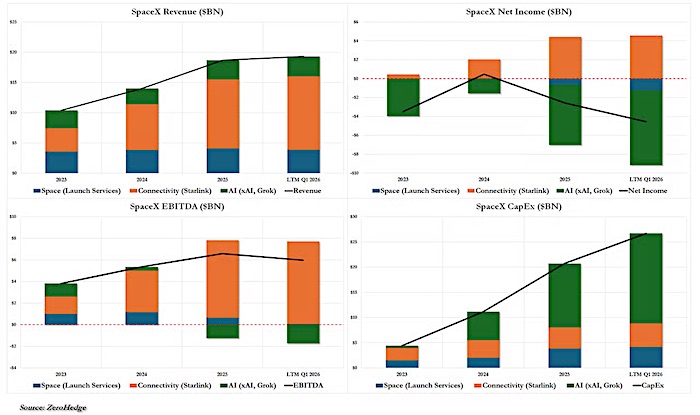
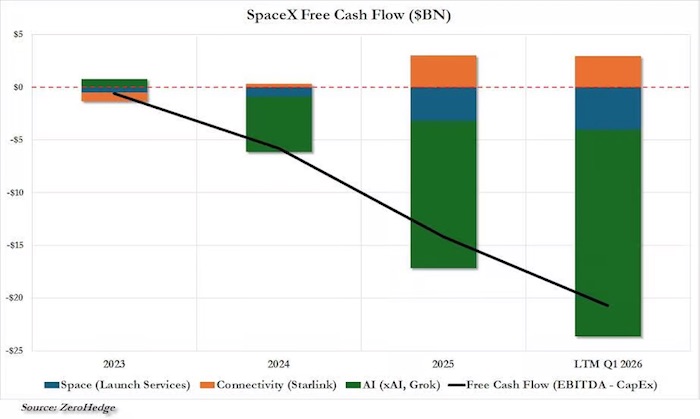
Elon Musk’s SpaceX is poised to become one of the most valuable publicly traded companies in the world. The company, which manufactures rockets, space exploration technology and Starlink satellites, is currently privately held. But on Wednesday it made a confidential filing with the US Securities and Exchange Commission (SEC) for an initial public offering, which would allow shares to be traded in the stock market. The value of SpaceX once it goes public is expected to surpass $1tn (£751bn). That would make its eventual stock market debut one of the most financially significant in history.


Musk’s own holding in SpaceX would put the billionaire on track to become the world’s first trillionaire. The company is aiming to officially go public sometime in June, according to reports in Bloomberg, Reuters and the New York Times. A confidential IPO filing with the SEC allows a company to avoid immediately revealing information to the public while it requests feedback from the regulator. The next step will be for company executives to hold “roadshows” – meetings with big investors to convince them to buy shares. By making shares of SpaceX available for purchase by the public, the company is looking to raise $50bn or more, according to the reports.

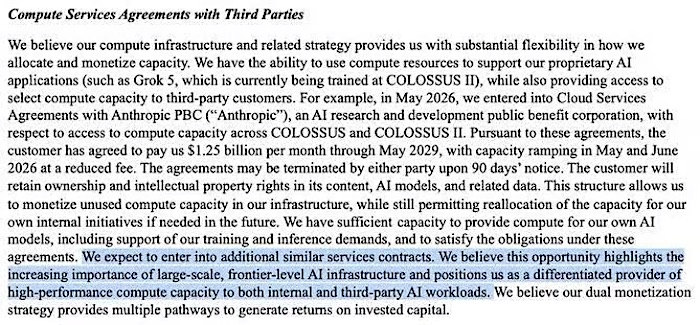
Earlier this year, SpaceX took over xAI, Musk’s artificial intelligence venture. After that all-stock merger, SpaceX is believed to have become the most valuable private company in the world, with an internal valuation of $1.25tn. Recently, Musk’s various companies have been becoming increasingly intertwined. Last year, xAI, best known for its chatbot Grok, took over X, the social media platform previously called Twitter that Musk bought in 2022. This degree of consolidation was a clear sign to investors that SpaceX was preparing to go public. Emily Zheng, a senior analyst at Pitchbook, earlier told the BBC that by bringing xAI under SpaceX, Musk could show potential investors that he was consolidating costs and able to easily share resources between his companies.

With its large-scale ambitions, SpaceX is in need of a massive cash infusion that going public can provide, Zheng added. The company is racing to keep up with the “sheer cost of compute, infrastructure, and energy” needed to expand, she said. Earlier this year, Tesla, Musk’s electric vehicle company, revealed it had invested more than $2bn in xAI. The billionaire said a significant share of Tesla’s manufacturing would begin to shift toward building robots, which would make use of xAI technology like Grok.Grok is already included in some Teslas as an AI assistant. SpaceX would also partner with Tesla and xAI in the massive chipmaking endeavour Musk announced last month, which he is calling Terafab. “

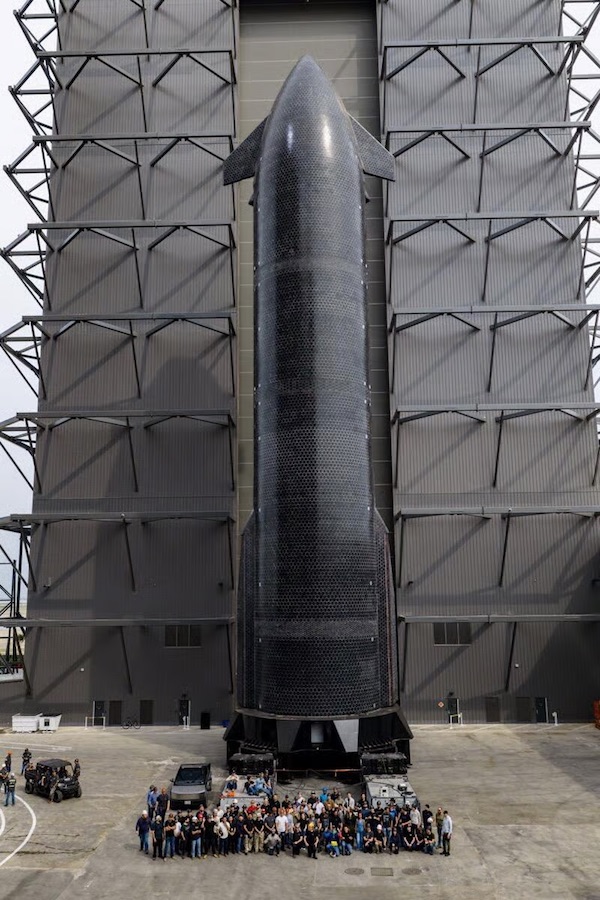
Tesla, xAI and SpaceX have all done amazing things that people did not think could be done before,” Musk said in a March presentation discussing Terafab. Musk started SpaceX in 2002 with the aim of reducing the cost of launching crafts into space, mainly by making rockets that could be launched more than once. It first contracted with Nasa in 2006. Today, most of SpaceX’s work continues to revolve around rockets and the operation of Starlink, a fleet of satellites offering internet connectivity across the globe. But Musk often discusses grander ambitions for the company, including putting data centers needed for AI in space and building a self-sufficient city on Mars, which many experts have said could be impossible to realise.

Read more …

Epstein victim?!

Trump Fires Pam Bondi As Attorney General, Blanche To Be Acting AG’ (ZH)

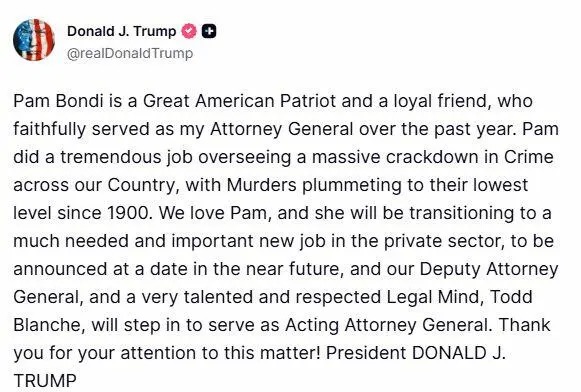
President Donald Trump has ousted Attorney General Pam Bondi, multiple outlets report. Deputy Attorney General Todd Blanche is serving as acting AG in the interim. The move comes amid White House frustration with Bondi’s leadership at the Justice Department – particularly her handling of the Jeffrey Epstein files and what Trump viewed as insufficient aggression in targeting his political opponents. Trump had privately discussed firing her and floated EPA Administrator Lee Zeldin (or Blanche) as a possible replacement. Bondi met with Trump in the Oval Office Wednesday night ahead of his speech to the nation on the war in Iran, where she reportedly was informed of her ouster, according to two sources familiar with the meeting.


One of those sources said that by the time Trump took his place behind the podium for the address, Bondi already lost her job and was on her way back to Florida. -Fox News.And according to the WSJ, Trump weighed firing her in January but was persuaded not to do so. In a Thursday statement, Trump called Bondi “a Great American Patriot and a loyal friend, who faithfully served as my Attorney General over the past year,” adding “she will be transitioning to a much needed and important new job in the private sector, to be announced at a date in the near future, and our Deputy Attorney General, and a very talented and respected Legal Mind, Todd Blanche, will step in to serve as Acting Attorney General.”

Earlier:
Leaky little sharks are circling in DC – telling the NY Times and CNN that Pam Bondi may soon be out as Attorney General, and replaced with EPA Administrator Lee Zeldin. The frustration, per sources close to the White House cited by The New York Times and CNN, centers squarely on Bondi’s catastrophic mishandling of the Jeffrey Epstein files – a saga ZeroHedge has chronicled in excruciating detail as one of the most embarrassing self-inflicted wounds of the second Trump term. Recall Bondi’s infamous February 2025 Fox News appearance where she claimed the “client list” was literally “sitting on my desk right now to review.” Fast-forward months later: no list, endless redactions for “national security,” millions more pages “discovered” at the 11th hour, and zero indictments of any high-profile co-conspirators.

Beyond her disastrous testimony in front of the House Judiciary Committee in February – the House Oversight Committee has also subpoenaed her over the “troubling disappearance” of documents, with her deposition still looming on April 14. Even Trump ally and White House Chief of Staff Susie Wiles admitted Bondi “completely whiffed” the response.

Trump is also reportedly pissed that Bondi has an apparent allergy to actual justice – namely, her failure to deliver on promises to go after his political foes (former FBI Director James Comey or New York AG Letitia James). Bondi’s DOJ has also been dragging its feet on broader accountability: no real movement on COVID-era prosecutions despite the obvious targets, a bizarre pivot toward “hate speech” crackdowns that even drew fire from the right, and a general pattern of not prosecuting what many see as a laundry list of potential criminals from the prior regime. Perhaps it was all by design. Either way, looks like Pam’s time is short.

What’s more, Bondi’s DOJ has been actively sabotaging the Trump coalition by maintaining Biden-era policies in court – rpeatedly mooting litigation on key issues rather than letting judges deliver precedent-setting knockout blows, defending outdated gun control measures like the 1934 National Firearms Act in suppressor cases, and choosing temporary tactical retreats over permanent wins that would prevent future Democrat administrations from simply flipping the switch back on.

Bondi’s nightmare before Congress was more or less the crescendo of her implosion. On February 11, she was hauled before the House Judiciary Committee for what was supposed to be a straightforward oversight hearing – and instead delivered one of the most disastrous performances in recent memory. As we reported live, Bondi exploded into a full-blown shouting match with Rep. Thomas Massie and top Democrats, dodging more than a dozen direct questions on why – after months of “reviewing” the files – the DOJ still had zero indictments of Epstein’s high-profile co-conspirators.

https://twitter.com/DerrickEvans4WV/status/2021639156611629391

She hemmed and hawed over the selective redactions (victims’ names left exposed while alleged abusers were blacked out), the sudden “discovery” of a million more pages, and the complete lack of accountability for the powerful men who enabled the operation. At one point she even whipped out what insiders called a “burn book” of lawmakers’ search histories in a desperate whataboutism that backfired spectacularly, drawing jeers from Epstein survivors seated in the gallery. So basically an angry stonewalling with clips that went absolutely viral. The base watched in real time as the woman tasked with draining the swamp instead looked like she was guarding it.

The timing is telling. Rumors of Bondi’s exit have swirled for months, but they intensified this week after Trump met with Zeldin (a reliable MAGA foot soldier who ran New York and has been showered with praise by the president for his EPA work). Bondi was still glued to Trump’s side yesterday – riding in the motorcade to Supreme Court arguments and sitting in the audience for his primetime Iran address – but the non-denial denial from the White House speaks volumes: “Attorney General Pam Bondi is a wonderful person and she is doing a good job.” AKA – “you’re on thin ice.”

Zeldin, for his part, has zero of the Epstein baggage and a track record of hawkish loyalty during Trump’s first term. If the move happens, it would mark the second high-profile Cabinet shakeup of the term after Kristi Noem’s ouster at DHS – a clear signal that even Trump is no longer willing to tolerate the kind of institutional inertia and base-alienating fumbles that defined too much of his first go-around.

For now, Bondi remains in place… but the clock is ticking. As one person familiar with the discussions put it, the Epstein fallout has become a genuine political liability.

Read more …

The reason to attack them.

Iran’s Friends To Make Life Much Harder For Israel And The US (Sadygzade)

The war’s second ‘ring of fire’ is no longer forming around Iran. It is already there. What we are witnessing is not a limited clash between a state under pressure and its immediate enemies, but the gradual emergence of a wider regional confrontation in which Tehran’s allied forces are moving from symbolic solidarity to practical engagement. In Lebanon, Iraq, and now once again in Yemen, groups aligned with Iran are opening new fronts and making any American or Israeli campaign far more difficult to execute. If Iran cannot stop pressure by matching superior military power plane for plane or missile for missile, it can still answer by stretching the battlefield across time and space.


That is the real significance of the current escalation. Wars are easiest to sell and easiest to sustain when they look concentrated, technically manageable, and politically clean. They become much harder to continue when every strike produces another zone of instability, when every advance prompts retaliation, and when every promise of decisive success runs into a new and costly complication. Iran and the forces loyal to it understand this perfectly well. Their goal is not necessarily to win a spectacular conventional victory over Israel or the US. They are trying to deprive their adversaries of a quick result, to turn military superiority into strategic over-extension, and to make the price of escalation rise with every passing week.

Israel is getting mired in Lebanon
Lebanon has become the clearest example of this dynamic. Israel entered the confrontation with Hezbollah expecting that greater firepower, harsher pressure, and deeper incursions would eventually impose a new reality in the south of the country. But so far the campaign has not produced the kind of result Israeli leaders would need in order to claim genuine success. Israeli officials are still speaking openly about expanding operations and about the need for a broad security zone in southern Lebanon. That does not sound like a completed military mission. It sounds like a campaign still searching for a workable outcome.

Israel remains capable of inflicting enormous damage on Lebanon. It can devastate border villages and infrastructure, and force large numbers of people from their homes. But the ability to destroy is not the same as the ability to impose control. A military campaign can appear overwhelming on television and still fail to neutralize the armed force it was meant to break. Hezbollah remains capable of hitting Israeli territory, and that single fact tells us that the war in Lebanon has not been resolved in Israel’s favor.

Israel is also suffering losses, not only in military terms but in political and psychological terms. Reports of fallen soldiers and continuing battlefield casualties show that Hezbollah is still able to turn southern Lebanon into a dangerous combat zone for the Israeli army. This is important because Israel’s military doctrine relies heavily on speed, on offensive initiative, and on the demonstration of dominance. A campaign that drags on, consumes manpower, exposes soldiers to attrition, and leaves northern Israel under continuing threat is not simply unfinished. It becomes strategically corrosive. It undermines the image of effortless superiority on which deterrence partly depends.

There is also the issue of equipment and operational pressure. Public claims about destroyed Israeli vehicles are often difficult to verify independently, and any serious analysis should avoid repeating battlefield propaganda as fact. But even without dramatic and unverifiable numbers, the broader reality is evident.

Read more …

“The United States desperately needs a decisive victory in its war ..”

The Price of Underestimating Iran (Lukyanov)

The outcome of the war with Iran will determine America’s capabilities on the world stage for years to come. That is what makes the current conflict in West Asia so consequential, far beyond the region itself. US policy toward Iran has become increasingly erratic. Rather than focus on the president’s shifting rhetoric, it is more useful to examine the logic underpinning the confrontation. Washington appears to have convinced itself that the moment is right to act decisively against Tehran, exploiting what it perceives as a window of vulnerability.


The objective, viewed in isolation, has a certain cold rationality. A single, well-executed strike could, in theory, achieve several long-standing goals at once: settle the historical grievance of the 1979 embassy crisis, remove a regime seen as hostile to Israel, gain leverage over key energy resources and transport routes, and weaken emerging Eurasian integration projects. Advisers appear to have presented this as a rare opportunity. The president accepted the argument. But such ambitions rest on a fundamental miscalculation. Iran is not Iraq in 2003, nor Afghanistan in 2001. Its military capabilities are far more substantial than those of any adversary the United States has confronted directly in recent decades. It is a large, resilient state with deep strategic depth and a capacity to inflict serious disruption on global trade and energy flows.

This last point is critical. Iran’s geographic position gives it leverage that few countries possess. Even limited escalation could threaten shipping routes and economic stability far beyond the Middle East, directly affecting the interests of the United States and its allies. That reality alone complicates any attempt at a quick, clean victory.Moreover, the political context is very different from past US interventions. The current display of force, lacking even the formal justifications that accompanied earlier campaigns, has unsettled Washington’s partners. Allies that might once have felt compelled to support the United States are now more hesitant, weighing the risks of involvement against uncertain outcomes.

The original assumption appears to have been that Iran would capitulate quickly. What that capitulation would look like was never entirely clear: regime collapse, coerced compliance along the lines of Venezuela, or a negotiated settlement sharply limiting Tehran’s power. In any case, a prolonged conflict was not part of the plan.= Now that the conflict has dragged on, a more fundamental question has emerged: what exactly constitutes success?

This dilemma reflects a broader shift in American foreign policy. “America First” is often interpreted as isolationism or restraint. In practice, it has meant something else entirely, the pursuit of US objectives without responsibility and, ideally, without cost. The underlying principle is simple: achieve maximum benefit while minimizing commitments. For a time, this approach appeared to work. In his first year, Donald Trump managed to pressure partners into accepting American terms, often by leveraging overwhelming economic power. But that strategy depends on the absence of meaningful resistance. It becomes far more dangerous when applied to a situation that cannot be controlled.

Creating a major geopolitical crisis and expecting others to absorb the consequences while Washington extracts advantages is a different proposition altogether. It risks destabilizing not just adversaries, but the entire system in which the United States itself operates. In earlier decades, US leadership was framed in terms of a “liberal world order,” where advancing American interests was presented as beneficial to all. The concept of a “benevolent hegemon” emerged from this period. Trump’s worldview rejects that premise. Instead, it assumes that US prosperity must come at the expense of others, and that it is time to reverse the old balance.

This shift carries profound implications. A hegemon that no longer seeks to provide stability must rely more heavily on coercion. But coercion, to be effective, requires credibility. The dominant power must demonstrate clearly that it can impose its will when necessary.

Iran has become the test case.

Read more …

Recently someone wrote it would be incorrect to label him “ayatollah”. Anyone remember who?

Mojtaba Breaks Silence, In Message Praises Hezbollah & Shia Leaders (ZH)

The new, younger Ayatollah Khamenei – who may have been wounded in the early days of US-Israeli strikes, hasn’t been seen in any public way, not even on TV, throughout the war. There have not so much as been any official recent images of him circulated. But Mojtaba Khamenei has apparently been issuing some limited written statements, mainly encouraging foreign proxies in their joining the war against US and Israeli forces in the region. State media has indicated he’s not making public appearances given the ongoing relentless bombing campaign and the Islamic Republic’s wartime footing.


After a long period of relative silence, a message from Khamenei was publicized on Monday. In the message attributed to him, he “expressed his appreciation to the supreme religious authority (in Iraq) and the people of Iraq for their clear stance against aggression against Iran and their support for our country,” Iran’s ISNA news agency said, referring to the Iraq-based Grand Ayatollah Ali Sistani. Sistani is based in Iraq and has long been a highly revered Shia cleric in the region.

The 56-year old Khamenei has on Wednesday apparently broken his silence again, this time praising Hezbollah for joining the war against Israel. Hezbollah has been launching hundreds of rockets on northern and central Israel, amid an emerging ground campaign in southern Lebanon, also as Israel bombs Beirut from the air.In the new words carried by Iranian state media, he praised Hezbollah for its “perseverance, steadfastness and patience” against “the most ruthless enemies of the Islamic world.”

Meanwhile, the CIA and Mossad are said to be trying to uncover Mojtaba Khamenei’s whereabouts and status. His 86-year old father did not appear to have been in hiding at all when he was slain by airstrike on the very first day of Operation Epic Fury.

The most likely explanation could be that the younger Khamenei is directing the war from a much more secure and hidden setting, for example a deep underground bunker – or in a remote part of the country. But some analysts have questioned why he wouldn’t make a video address, even if pre-recorded, offering to the world proof that he is a alive and is running the country and war. As for the most visible day-to-day leader, this is parliament speaker Mohammad Bagher Ghalibaf.

Read more …

A.K.A. Shock and Awe.

European Allies Show ‘Shock And Anxiety’ to Trump Threat to Leave NATO (JTN)

European media responded to President Donald Trump’s remarks about the United States leaving NATO as an “existential threat” to the 77-year-old security alliance. Speaking with The Telegraph, a right-of-center British daily newspaper, Trump called the alliance a “paper tiger” and said he was “strongly considering” withdrawing from the 32-nation pact. Trump’s comments come after repeated criticisms of NATO member states for not joining the Israeli- and U.S.-led conflict with Iran. In the latest developments, Spain, France, and Italy refused U.S. access to their military bases or airspace for military actions against Iran.


“I was never swayed by NATO,” Trump said. “I always knew they were a paper tiger, and [Russian President Vladimir] Putin knows that, too.” Thirty of 32 NATO member states are in Europe (the U.S. and Canada are the exceptions). Israel is not a member of the alliance. The Guardian, another U.K. newspaper, said Trump’s remarks represented an “existential threat” that could be the “worst crisis in NATO history.” In Spain, El País said there was “shock and anxiety across Europe.” Among the European Union’s three largest economies, German media stressed that the Israeli and U.S. bombings of Iranian targets were “not our war” and said it was “correct” for the government to reject U.S. demands for support.

French media pursued a similar line, stressing that NATO was created to assure trans-Atlantic security, not offensive missions in the Middle East. Italy, meanwhile, tried to balance ties with the U.S. and European and NATO allies, trying to organize a coalition to discuss strategies to assure security in the Gulf region without entering the conflict. Trump might not be able to follow through on his threat to leave the NATO alliance due to a 2023 U.S. law that “prohibits any withdrawal from NATO” without approval from two-thirds of the U.S. Senate.

Read more …

More Shock and Anxiety.

EU Leaders Utterly Bewildered at Energy Vulnerabilities Now Evident (CTH)

They stopped their oil and gas exploration. They chose to chase ‘net zero’ academic pontifications. They closed their refining operations. They took apart their coal-fired electricity plants. They disassembled their nuclear power capabilities. Then, the absolute cherry on the proverbial cake, they voted to stop purchasing oil and gas from Russia.The EU is now in the Find Out stage of their FAFO positioning. Gasoline prices have skyrocketed. The last shipments of jet fuel have arrived. Major airline carriers are cancelling flights due to lack of fuel. Faster than the EU can organize meetings to discuss their position, EU destined LNG shipments have diverted to southeast Asia and India as the ASEAN nations bid higher purchase prices for the vessels literally on the water.


Folks, it’s quite an article written by EU Politico as they outline how each of the leaders from the nation states are now discussing how vulnerable they are to the changed oil/gas environment with the mid east conflict ongoing. The entire energy sector in Europe is now in crisis mode with leaders predicting it will get much worse within days, not weeks.mEU Politico – “Germany’s Friedrich Merz warns the economic fallout from the war in Iran is on track to rival that of the Covid pandemic or the Russian invasion of Ukraine. […] With the war in Iran threatening to choke off energy flows for the foreseeable future, Europe is facing a supply shock that promises to cripple manufacturing, ground airlines, hike up the price of food, spike borrowing costs and send inflation spiraling back to crisis levels.

As the last tankers carrying fossil fuels from the Persian Gulf pull into European ports, the scale of what is about to hit seems to be dawning on the continent’s leaders. “I’m living with the reality of this war and its consequences 24 hours a day,” Italian Defense Minister Guido Crosetto told the La Repubblica newspaper. “I’m forced to know things that don’t let me sleep.” The conflict could last “years,” Christine Lagarde, the president of the European Central Bank, warned in an interview with the Economist last week. The long-term effects, she added, are “probably beyond what we can imagine at the moment.”

[…] “Markets are now grappling with a scenario long discussed in theory but rarely thought of as a legitimate possibility — the effective shutdown of the world’s most critical energy chokepoint,” said Ana Maria Jaller-Makarewicz, lead energy analyst for the Europe team at the Institute for Energy Economics and Financial Analysis.One immediate worry is that Asian countries, which before the war relied on the Gulf for some 80 percent of their gas and oil, are beginning to bid up the price of those products as they fight over dwindling supplies. That has diverted merchants with more flexible contracts toward Asia to exploit the higher profit margins, turning them away from Europe.

According to Charles Costerousse, a senior energy analyst at maritime consultancy Kpler, 11 U.S.- and Nigerian-flagged LNG tankers have been redirected from Europe to further east in the past few days. Within the next few days, the last tanker bearing Qatari LNG will arrive in Europe, he said.[…] For now, as the final Gulf tankers finish unloading their cargo this week, the clock officially starts ticking for Europe’s policymakers. The continent has weeks, not months, to brace for an impact that could reshape its economy for a generation. (read more)

The one element missing from the lengthy diatribe of EU leader quotes is any self-reflection; any admission their EU vulnerability was entirely driven by their own policies. No, that part of the equation is missing entirely. Everything in their mindset is a discussion of external events happening to them. There is no reconsideration of their prior stupidity, and/or a responsive effort to reposition their vulnerability. The EU is in a state of cognitive paralysis, and things are about to get much, much worse.


Read more …

Could it trigger the end of the EU?

Could an Orban Win Trigger ‘Maidan on Steroids’? (RT)

Polls ahead of the Hungarian elections point to an opposition victory, but players behind the scenes expect Prime Minister Viktor Orban to come out on top. Others say it’s a scenario ripe for a Kiev-style ‘color revolution’. With two weeks to go until Hungary’s parliamentary elections, Orban is facing the most credible threat to his power yet. Opposition leader Peter Magyar’s Tisza party is currently leading Orban’s Fidesz by 15 points, according to an aggregate of polls compiled by Politico. When looking at pollsters linked to Tisza or funded by the EU, the results are even more stark. A poll by the opposition-linked Median, for example, shows Tisza a whole 23 points ahead of Fidesz, at 58-35%.

However, Politico has also reported that “many” EU leaders secretly believe an Orban victory is “likely.” Hungarian EU Affairs Minister Janos Boka thinks that the disparity between public surveys and private sentiment is no accident, and that by skewing polls, Magyar and his allies in Brussels are “building the narrative that if they lose the election, then this is an illegitimate result.” Notorious intervention hawk Michael Weiss put Boka’s worries into words last week. “If Orban tries to steal this – and he almost certainly will – it’ll be Euromaidan on steroids in an EU/NATO country. Watch closely, America,” he warned in a post on X.

Weiss, who previously ran a Ukraine regime change outfit he claimed was journalism, was referring to the post-election coup that toppled a democratically elected president, Viktor Yanukovich, in 2014. Orchestrated by the US, the Maidan/Euromaidan coup set in motion a chain of events that culminated in the Russia-Ukraine conflict, which has claimed hundreds of thousands of lives.However, there are some fundamental points war hawks in armchairs would like you not to notice; differences between Budapest and Kiev that would make forced regime change a far more difficult prospect if Orban wins.

How the US masterminded Maidan
Presented by Western media as a popular uprising, the ‘Maidan’ revolution was a creation of the US State Department and run out of a very compliant US embassy. The National Endowment for Democracy (NED), a State Department sub-agency, pumped around $14 million into Ukrainian activist groups from 2011 to 2014, the US embassy funded pro-Maidan media outlets, and between 1991 and 2014, the US funnelled a total of $5 billion into “democracy-building programs in Ukraine,” a State Department spokesperson said in 2014.

The NED boasted in a 2015 report that US-funded organizations “played important roles in the peaceful protests in Kiev.” By the time the report had been published, the “peaceful protests” had descended into a bloodbath, with Western-funded far-right militias massacring nearly 100 pro-Western protesters in a false-flag operation, and pro-Western neo-Nazis burning 46 anti-Maidan protesters alive at the Trade Unions House in Odessa. Awkward questions for the neocons, neolibs, and the righteous.

Assistant Secretary of State for Europe Victoria Nuland promised military aid and a billion-dollar loan to opposition politicians, and famously handed out cookies to pro-Western activists in Kiev. Together with US Ambassador Geoffrey Pyatt, she helped choose the government that would replace Yanukovich’s. When asked by an obsequious Pyatt in a 2014 phone call if the Europeans might disagree with her choice of candidate, the notorious hawk infamously declared “f**k the EU.”

Now the US backs Orban
The situation in Hungary is radically different. US President Donald Trump is a staunch ally of Orban, and has endorsed the Hungarian PM’s reelection campaign, while Vice President J.D. Vance is scheduled to make a high-profile trip to Budapest just days before the April 12 election.

Read more …

“Even though Trump’s team can appeal, the damage is real. This ruling will probably keep Trump tangled in civil litigation for the rest of his presidency and likely beyond..”

Judge Keeps Democrats’ January 6 Witch Hunt Against Trump Alive (Margolis)

A federal judge appointed by Barack Obama ruled this week that President Trump’s speech at the Ellipse on January 6, 2021, is not protected by presidential immunity — keeping a Democratic-driven civil lawsuit alive and ensuring Trump will be fighting this battle for years to come. U.S. District Judge Amit Mehta ruled that Trump’s rally remarks fell outside the “outer perimeter” of his official presidential duties, applying the framework the Supreme Court established in its immunity ruling back in 2024. That ruling gave presidents full immunity for core official acts and presumptive immunity for acts within the outer perimeter — but left unofficial acts exposed. Mehta used that opening to let this bogus lawsuit walk right through.


Mehta was nominated to the U.S. District Court for the District of Columbia by Obama in 2014 and confirmed the same year. In 2021, he was appointed to the U.S. Foreign Intelligence Surveillance Court, succeeding Judge James Boasberg, who served as presiding judge from 2020 to 2021. It sure is a small world when it comes to Obama-era appointees making consequential rulings against a Republican president.

It should come as no surprise that this is not Mehta’s first rodeo targeting Trump. He previously refused to dismiss these same claims back in February 2022, ruled against Trump in a case involving congressional access to his financial records, and sentenced former Trump adviser Peter Navarro to four months in jail for defying a January 6 committee subpoena. Mehta has had his fingerprints on the anti-Trump legal machine for years.

Mehta denied Trump’s motion to dismiss the civil litigation, meaning Democratic lawmakers and Capitol Police officers who sued Trump can continue to pursue their case. The plaintiffs falsely claim Trump’s Ellipse speech incited the crowd to riot. The problem with their claim, of course, is Trump’s speech itself. Trump literally told the crowd at the Ellipse to “peacefully and patriotically make your voices heard.” That’s the “incitement” Democrats keep telling us about. The speech itself is the best evidence that the insurrection narrative is a myth, but Mehta waved that aside anyway.

Joseph Sellers, an attorney for the Democratic lawmakers suing Trump, couldn’t contain his excitement. “We’re very pleased that the court recognized that President Trump cannot avoid accountability for his conduct on Jan. 6, 2021,” he said. “This decision, if it holds up, is going to pave the way to a trial in federal district court on these claims.”Trump’s legal team made it clear they’re not done fighting this.

“The facts show that on January 6, 2021, President Trump was acting on behalf of the American people, carrying out his official duties as President of the United States,” the team said in a statement. “President Trump will continue to fight back against the Democrat Witch Hoaxes and keep delivering historic results for the American People.”

Even though Trump’s team can appeal, the damage is real. This ruling will probably keep Trump tangled in civil litigation for the rest of his presidency and likely beyond — precisely what Democrats designed these lawsuits to accomplish. While the president focuses on governing and delivering results for the American people, a group of partisan plaintiffs and their enabling activist judges are still obsessed with their January 6 lies.

Read more …

Too small brains.

We May Finally Be Close to Ending the Democrats’ DHS Shutdown (Margolis)

The Democrats’ DHS shutdown may finally be ending soon, after Republican leaders and President Donald Trump hashed out a plan. The two-track strategy announced Wednesday strips the left of one of its most effective tools for obstruction — and leaves them with nobody to blame but themselves.


The partial shutdown has dragged on since mid-February, making it the longest of its kind in American history. The core fight came down to one thing: Democrats refused to fund Immigration and Customs Enforcement and Border Patrol after two anti-ICE agitators attacked federal agents and were killed in self-defense. The left, blaming the agents for the deaths, demanded reforms that would have effectively made immigration law unenforceable. Republicans wouldn’t budge. Then Democrats finally caved last week, agreeing to fund DHS without the reforms they had demanded. But House Speaker Mike Johnson rejected the deal because it didn’t fully fund ICE and Border Patrol, which were already funded through 2029.

Trump broke the logjam Wednesday with a Truth Social post endorsing funding ICE and Border Patrol through budget reconciliation — the legislative process that will bypass Senate Democrats entirely. “We are going to work as fast, and as focused, as possible to replenish funding for our Border and ICE Agents, and the Radical Left Democrats won’t be able to stop us,” Trump wrote.

Speaker Mike Johnson, who initially opposed the funding deal announced Friday, and Senate Majority Leader John Thune quickly got on board. Their joint statement outlined the two-pronged approach: fund most of DHS through the standard appropriations process until October, then lock in three years of immigration enforcement funding through reconciliation — completely insulated from Democratic obstruction. “In the coming days, Republicans in the Senate and House will be following through on the President’s directive by fully funding the entire Department of Homeland Security on two parallel tracks: through the appropriations process and through the reconciliation process,” they said.

The Senate Budget Committee had already begun building the reconciliation framework to make it happen. That process allows the Senate to move legislation with a simple majority instead of the 60-vote threshold that typically gives Schumer and his caucus veto power over Republican priorities. This plan looks almost identical to what the Senate tried to pass just last Friday — the same bill House Republicans shot down in spectacular fashion, with Johnson himself calling it a “joke.” House conservatives had demanded that immigration enforcement funding stay bundled with the rest of DHS appropriations.

Johnson’s reversal also signals something significant. I previously wrote that Johnson may have been attempting to force the Senate GOP to nuke the filibuster. If that were the case, this agreement would mean Republicans have effectively conceded that nuking the Senate filibuster isn’t happening. If killing the filibuster were on the table, there would be no need for a two-track workaround. The reconciliation path is a creative solution, but it’s also an acknowledgment of the limits of the current Senate majority.

“It is now abundantly clear that Democrats place allegiance to their radical left-wing base above all else,” Thune and Johnson said. “We cannot allow Democrats to any longer put the safety of the American public at risk through their open border policies, so we are taking that off the table.” If Republicans can push the reconciliation package through, Democrats will lose the ability to use DHS appropriations as a weapon against Trump’s immigration agenda for the rest of his term. They spent months blocking ICE funding to protect their base, and now they may end up with zero leverage to show for it.

Read more …

We have questions.

AI Giant Anthropic Suffers Strategic Code Hemorrhage (RT)

AI giant Anthropic has mistakenly published its own top secret internal code, triggering a viral wave of github rewrites and inflicting potentially catastrophic commercial damage on the Amazon-backed business model. The developer of the Claude chatbot described the incident as a release issue “caused by human error, not a security breach,” according to US technology news website VentureBeat on Tuesday. Anthropic was designated a “risk to national security” by US Defense Secretary Pete Hegseth in February after disagreements with the Pentagon over the use of its artificial intelligence systems.


The leak involved more than 500,000 lines of code linked to Claude Code, Anthropic’s AI coding assistant, which helps users write and manage software through natural language commands, according to Axios and The Verge. The material included unreleased features, performance data, and developer notes. The code spread rapidly online, with versions of the code being placed on code-sharing platform GitHub and replicated thousands of times within hours, according to Ars Technica and The Verge. Anthropic moved to remove the material and issued takedown notices, but the material had already been widely copied and circulated, the reports said.

According to VentureBeat, by exposing the “blueprints” of Claude Code, the leak may have given “bad actors” a “road map” to bypassing security checks or tricking the tool into running hidden commands or accessing data without the user’s knowledge. A separate data leak reported in February exposed internal materials revealing details of Anthropic’s unreleased model, known as Claude Mythos, after thousands of draft documents were left accessible in a public data cache.

The model was described in the leaked material as the company’s most powerful system to date which could pose “unprecedented cybersecurity risks” if deployed widely. The company has withheld its release due to concerns over its capabilities and potential misuse, according to US business magazine Fortune.

Read more …

Just passing on. Are mini-nukes the answer?

Nano Nuclear Submits Construction Permit For Kronos Reactor In Illinois (ZH)

Nano Nuclear submitted a Construction Permit Application (CPA) to the U.S. Nuclear Regulatory Commission (NRC) for their Kronos microreactor project at the University of Illinois. The filing marks the latest step in a project we’ve tracked since site characterization began last fall. Kronos is a high-temperature gas-cooled reactor (HTGR) engineered for commercial deployment. It delivers 15 megawatts of carbon-free baseload power using meltdown-resistant TRISO fuel and helium coolant. The design emphasizes walk-away safety, autonomous operation during grid outages, and scalability through multiple units. Intended uses include powering artificial intelligence data centers, industrial electrification, military bases, and remote communities.


Nano Nuclear acquired the technology in 2024 from Ultra Safe Nuclear Corp. and positioned it as one of the first commercially ready microreactor platforms. The University of Illinois partnership targets the first full-scale Kronos research reactor deployment. We detailed the October 2025 launch of geotechnical drilling and site characterization work, followed by a ceremonial groundbreaking. Those steps built on state support from Illinois Governor J.B. Pritzker and positioned the campus project as the lead effort in Nano’s broader commercialization roadmap. The company has since expanded discussions for additional deployments in Texas, South Korea, and at U.S. federal sites.

Under the NRC process, staff will first review the application package for completeness and docketing. Once accepted, the agency will conduct a formal technical and environmental evaluation. Nano estimates this formal review phase will take approximately 12 months, after which the NRC could authorize construction. The timeline aligns with recent agency efforts to streamline advanced reactor licensing while maintaining rigorous safety standards.

Company executives described the submission as validation of years of engineering and pre-application engagement. Chief Technical Officer Florent Heidet called it “a defining moment” that separates ready projects from those still in early development. The milestone keeps Nano on track for initial test operations at Illinois by the late 2020s and supports its goal of factory-built, fleet-scale microreactor production.

Read more …

What on earth happened since 1969?

We beat the Russians back then, only to be losing to China 57-odd years later?

Artemis II and the ‘Waste of Space’ (Rick Moran)

Yesterday, four human beings sat atop the most powerful machine ever built and launched themselves toward the moon. Commander Reid Wiseman, Pilot Victor Glover, Mission Specialist Christina Koch, and Mission Specialist Jeremy Hansen of the Canadian Space Agency are set to fire their engine and send their spacecraft toward the moon. They won’t land on the surface. They won’t even go into orbit. They will slingshot around the moon and return to Earth. It’s a $60 billion space stunt. That’s the total cost of the Space Launch System (SLS) program to date, and given the fact that the astronauts are doing little except proving they can go into space, travel to the moon, and come back alive, it seems an awful “waste of space.”


How do we know it’s a “stunt”? The crew consists of one white guy, one black guy (Glover), one woman, and a Canadian. Hansen will be the first non-American to visit the moon. That sounds like a “made-for-TV” extravaganza. In the 1997 film Contact, 12-year-old Ellie Arroway’s widowed father, Ted, is helping his daughter discover the wonders of the universe through a telescope. “The universe is a pretty big place,” the father tells the daughter. “It’s bigger than anything anyone has ever dreamed of before. So if it’s just us… seems like an awful waste of space.”

Ellie and Ted (the elder Ellie played by Jodie Foster alongside David Morse) were talking about the vastness of space and how it would be highly unlikely that humans were the only intelligent life. In the case of Artemis II and the SLS, the “waste of space” is the sheer, frustratingly stupid mix of politics, inefficiency, inexplicable decisions, and poor management that created a black hole for taxpayer dollars, a “forever program” that had the zombie-like ability to resist being killed, and the real possibility that the machine those four brave souls are flying in is not as safe as it should be.

NASA has inefficiency and waste built into its DNA. Because it’s government-funded, the agency needs friends in Congress to get anything done. This forces the agency to spread the pork as widely as possible. Key members of Congress who are lucky enough (or skilled enough at logrolling) to have a NASA contractor in their district make sure that programs that benefit that contractor, even if they’re wasteful and accomplish nothing, never get canceled or have their budgets cut.

Congress does not see the space program as a scientific endeavor or even as a national security necessity. To Congress, the space program is a means to gain cash for campaigns and jobs for constituents. Even when the White House tries to cancel or cut a program, Congress will inevitably restore the funding. That’s why the SLS is still going strong despite being six years late and billions of dollars over budget.

Reason.com: “As development began on the rocket, the projected budget cost through 2017 was $18 billion, a number that would soon start growing. Early in development, each launch was projected to cost $500 million, a number very optimistic in hindsight: According to the White House’s 2026 budget proposal, an SLS launch costs about $4 billion. Through last year, the total cost of the program has exceeded $60 billion.

The SLS program isn’t just way over budget. It’s way behind schedule too. Congress told it to fly by 2016, but the first launch didn’t come until 2022. The second launch will be Artemis II. When the first Trump administration started the Artemis program in 2017, the vision was to send Americans to the moon and then Mars. As the program developed, officials set a goal of having humans on the moon again by 2024. In April 2021, SpaceX won the bidding process to build the Human Landing System—the lunar lander that would deliver the astronauts to the moon’s surface. Blue Origin then sued NASA over losing out to SpaceX, and NASA had to pause work until the lawsuit ended. The suit was resolved in November, at which point SpaceX and NASA returned to work.

The oft-delayed launch of Artemis II was due to a series of hydrogen fuel leaks. The mission was pushed from its original February window to April as engineers worked to replace seals and address a subsequent issue with a clogged helium pressurization line. The rocket had to be rolled back to the Vehicle Assembly Building (VAB) for these specialized repairs.It should be noted that Artemis II is a new system and will have bugs that need to be ironed out. But the same leaking hydrogen problem experienced in February also canceled the March launches. The RS-25 engine, which is being fueled by hydrogen, is considered very reliable. It’s also considered “too big to fail” because of its powerful congressional backers.

The engines are manufactured by Aerojet Rocketdyne, and the program supports thousands of jobs across multiple congressional districts. This makes a total engine redesign or a switch to a different propulsion system (like SpaceX’s Raptor or Blue Origin’s BE-4) politically difficult. Critics argue that the traditional contracting model incentivizes maintaining the current hardware rather than starting over with a cheaper, leak-resistant fuel like methane. Instead of replacing the engine, NASA and lead contractor Boeing have focused on “kindler, gentler” loading procedures and redesigned flight seals to fix the leak issues that plagued the February and March launch attempts.

NASA is shooting for a Moon landing by 2030. Given their track record, that seems more like wishful thinking. It’s more than likely that China will beat them there. It’s even possible that Elon Musk, who has abandoned his Mars dreams to go to the Moon, will reach the lunar surface before NASA. Sixty billion tax dollars for space could have been spent far more wisely. The magnificent unmanned probes we’ve sent to Mars, Jupiter, and Saturn have made spectacular discoveries that have not only expanded our knowledge of the universe but also shown us the way to a future in which humans aren’t tied to Earth or the Moon.bArtemis II is a helluva “waste of space” when you consider what that money could have been spent on.

Read more …

Good points.

The Soul-Crushing Cost of NOT Returning to the Moon for 50+ Years (Pinsker)

Question for our readers: What’s the greatest accomplishment in all of human history? Some might point to religious breakthroughs, i.e. the development of theological and/or legal doctrines. If you’re in the Ozymandias camp, you may favor big, impressive monuments — like the Great Pyramid of Giza. Or maybe you’re thinking of something more basic, like the invention of written language, which was developed independently at least four times. There are many more options, of course: The discovery of the New World. Metallurgy. Agriculture. Seafaring. The printing press. Germ theory. Unlocking the power of the atom. All the above altered the course of humanity.


But in my opinion, the single greatest accomplishment was walking on the moon. Even today, nearly 57 years after Neil Armstrong and Buzz Aldrin left their footprints on the lunar surface, the accomplishment remains so utterly mindboggling that 10% of Americans don’t believe it happened. And, arguably, for good reason: No human has returned to the moon since 1972. If you’re under 55, the moon landing was something you read about — not something you remember watching live. For generations of Americans (including this 52-year-old scribe), there hasn’t been a day in our lives when we’ve gazed up at the sky and beamed with pride, knowing an American astronaut has “slipped the surly bonds of Earth,” soaring farther than an “eagle flew,” and “touched the face of God.”

About 25 years ago, when I worked in talk radio, I spoke to Buzz Aldrin on the phone. It was one of the few times a celebrity made me tongue-tied. I haven’t even been to Australia yet — and this guy walked on the flippin’ moon?! How can anyone compete with THAT? Imagine being at a bar, bragging about your Australian vacation, and in walks Buzz Aldrin. “Wow, you made it all the way to Australia, did you? How impressive. By the way, y’know that big white ball in the sky? It’s called the moon. That’s where I went, but please, tell me more about Australia.” Baby Boomers were shaped by the Kennedy assassination. Even today, 60+ years later, everyone still remembers where they were when they heard the fateful news.

Gen-X was shaped by the Challenger disaster. Until 9/11, it was the most jarring catastrophe of our lifetime, because it shattered America’s aura of technological invincibility. After all, we had so thoroughly conquered the cosmos, NASA actually let a schoolteacher named Christa McAuliffe hitch a ride on the shuttle as a PR stunt. Space travel was considered so mundane that none of the three major TV networks bothered to air the Challenger launch live. (CNN, still in its early years, was the exception.) How could the space shuttle blow up? We’re the nation that put a man on the moon! America doesn’t make mistakes like that!

The Challenger disaster took place on Jan. 28, 1986. That was over 40 years ago. And in the decades that followed, instead of inspiring wonder, pride, and belief in the American Dream, NASA became synonymous with budgetary bloat, technical malfunctions, and aborted missions. Uncoincidentally, as NASA’s achievements became a distant memory, each generation that followed has had less pride in America. 83% of the Silent Generation is extremely or very proud to be an American. For Boomers, it’s 75%. For Gen-X, it’s 71%. For Millennials, it’s 58%. And for Gen-Z, it’s just 41%.

There’s a crisis of patriotism among young Americans. If you want to know why so many young people are turning to socialism and communism, it’s because they lost their faith in the American Dream: Among the under-30 crowd, 34% have a favorable opinion of communism — and a whopping 62% feel favorably towards socialism. Just 50% favor capitalism.

These are damning trendlines. As the older generations die off, faith in America’s greatness is dying with them. It’s why Zoomers are now favoring socialism over capitalism by double-digits. Unless we (quickly) right the ship, we’re cheating our children and grandchildren of their American birthright. And if we’re not careful, it’ll cost us everything. It’s the responsibility of our leaders — whether they’re in government, the private sector, or in our homes — to inspire the next generation. To inscribe in their hearts and souls the belief that they can make the impossible possible — as long as they dream big, work hard, and pray with all their might. Why do you think the phrase “Make America Great Again” resonated so deeply?

Greatness is inspirational. Aspirational. Given a choice between greatness and mediocrity, greatness wins every single time. It brings out the best in us. That was the hidden cost of not returning to the moon for 50+ years: It cheated our children and grandchildren of their dreams. And sapped their pride in American greatness. But imagine a new national trajectory — where NASA, SpaceX, and American ingenuity rewrite the history books. One where Zoomers look to the sky and see a moon flooded with American astronauts and American footprints — and a permanent American moon base.Then, after reconquering the moon, we set foot on Mars. And from there, we venture even further.

Or we could do nothing. And then, when China lands a man on the moon by 2030 and builds a moon base, young Americans would gaze to the cosmos with resentment, rage, and regret: They’ve inherited a country whose best days are long gone. The Boomers got all the glory — and they got a nation in decline. And if you’re already worried about so many young Americans abandoning capitalism, what do you think will happen if America is lapped by a communist nation? More likely than not, the allure of communism and socialism will skyrocket — to the moon and beyond. Space travel isn’t cheap. Some, including my PJ Media colleague Rick Moran, argue the juice isn’t worth the squeeze. But dollars and cents aren’t the only way to measure cost: Dreams matter, too.

Dreamers are optimists; they believe our future will be greater than our past. They’re men and women of faith. The greater our dreams, the greater our country. A nation without dreams is a dying nation.As President Ronald Reagan said in his final primetime address: “We were meant to be masters of destiny, not victims of fate. Who among us would trade America’s future for that of any other country in the world? And who could possibly have so little faith in our America that they would trade our tomorrows for our yesterdays?”

After 50+ years, it’s time to give our kids a dream worth dreaming: Because they deserve nothing less.

Read more …


https://twitter.com/RealHellenist/status/2039580324997582892?s=20 https://twitter.com/DiogenisSinopis/status/2039376870970470404?s=20


Support the Automatic Earth in wartime with Paypal, Bitcoin and Patreon.



Mar 162026
 
 March 16, 2026  Posted by at 10:33 am Finance Tagged with: , , , , , , ,  64 Responses »


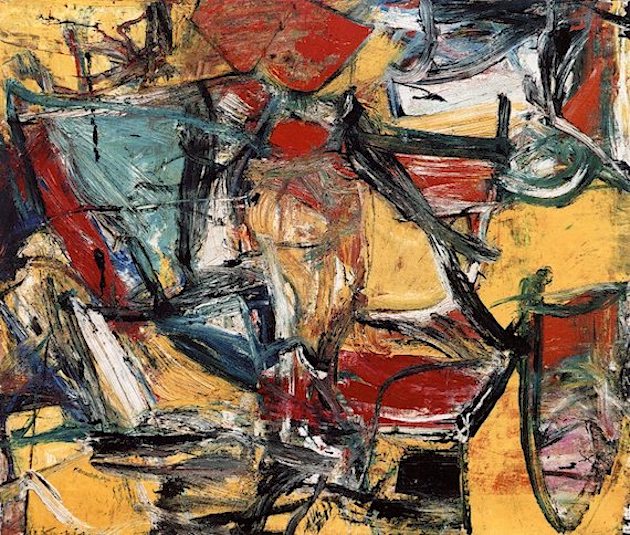
Willem de Kooning Police gazette 1955


White House Denies Tucker Carlson CIA Spy-Op (ZH)
Was the Supreme Leader Set up by a Leaker Named… Tucker Carlson? (Pinsker)
Did Tucker Carlson Unwittingly Help Set Up Iran’s Leadership Decapitation? (ZH)
Tucker Carlson Claims He’s the Subject of Criminal Probe Over Iran (Margolis)
Reports: Mojtaba Khamenei in ‘Low Condition,’ Said to Be Dull-Witted (Manney)
The Media Should Not Call Mojtaba Khamenei ‘Ayatollah’ (MEF)
Iran’s Blockade of the Strait of Hormuz Is Destined to Fail (Rubin)
The Place Where Every French Leader Makes The Same Mistakes (RT)
French Municipal Elections Provide Early Test For Le Pen (ZH)
Companies Are Starting to Enforce AI Use (AIX Files)
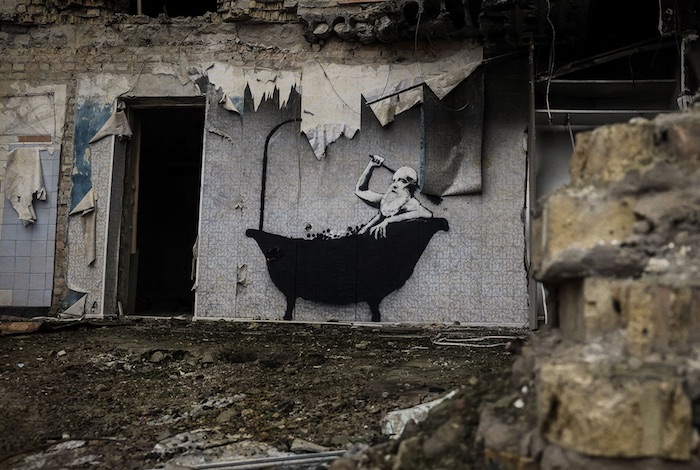
In Search of Banksy (R.)


A few days ago, I happenstanced upon a Debt Rattle from 2019. I hadn’t seen that in forever. The first thing that I noticed about the 7 year hiatus was that the articles -or quotes thereof- were much shorter then. That makes reading easier, but not necessarily understanding. Second thing I noticed was the source of the articles; it was often the MSM, AP, Reuters etc.


In 2019, there was no Covid yet, and no Ukraine war either, the two topics that would “define” the news later. And the topics that made me search for alternative sources from the MSM. One source I used a lot for the Ukraine war was RT, the former Russia Today. Since there are always bans on RT somewhere, I post the entire article when I post. That way my readers don’t miss anything. Same goes for Sputnik and TASS, though they’re not as good as RT. Since you then have long(-er) articles, the length of the others sort of automatically increases too. It’s a main reason why the Debt Rattles got longer.

None of it makes any difference for our ads. Someone at Google doesn’t like TAE, and we still get notices regarding this, and they still don’t say why we are being refused. I have given up trying to understand this. I accept I will have to ask my readers for donations in order to keep TAE alive. Hereby. Please.

Topics since, say, 2015,have been the rise of Donald Trump, then Covid, then Ukraine. “New” topics in the time ahead will be the Middle East and, especially, AI. We’ll be on top of it.


https://twitter.com/MintPressNews/status/2033184171045126460


Whatever the truth is, great story.

White House Denies Tucker Carlson CIA Spy-Op (ZH)

Update (2250ET): ‘Top admin officials’ tell Axios’ Marc Caputo that this is fake news;


Meanwhile, Carlson sat down with Glenn Greenwald Friday morning, and said that several high-placed sources told him that the CIA was preparing a criminal referral about him to the DOJ.

“Tucker said he had learned from several high-placed sources — and he obviously has many within the Trump administration — that the CIA was preparing a criminal referral about him to the DOJ. The subject of the agency’s report of suspected crimes: conversations he allegedly had with Iranian officials and others living in Iran prior to the start of the Trump-Netanyahu war. The clear implication was that Tucker had committed acts of subversion, or even treason, by speaking to Iranians in advance of the war that was about to be launched on their country.

Despite how innately shocking this claim is, I had and still have zero doubt that Tucker was telling the truth about what he heard. I have known him for many years, spent much time talking to him both in front of a camera and away from one, and never once has he lied to me or misled me. Tucker has been in public life as a journalist and media figure since his 20s. There have been many harsh criticisms launched against him during those decades, many of which — as he will be the first to tell you — were ones that were quite valid. -GlennGreenwald”

So now they’re going to suggest Tucker made it all up.

Read more …

“Tucker Carlson has relationships with Iranian government leaders..” No more?!

Was the Supreme Leader Set up by a Leaker Named… Tucker Carlson? (Pinsker)

The really weird thing is, there might be precedent for it: Quite a few pundits, including Michael Knowles and Jack Posobiec, connected the dots back in December. Remember when Tucker Carlson solemnly told us that President Donald Trump was going to use his 2025 end-of-year primetime speech to declare war on Venezuela? Judge Andrew Napolitano: Is Trump going to start a war in Venezuela?


Tucker Carlson: Here’s what I know so far, which is that members of Congress were briefed yesterday [Tuesday] that a war is coming, and it’ll be announced in the address to the nation tonight at 9:00 by the president. […] A member of Congress told me that this morning. According to Axios reporter Marc Caputo, Carlson also claimed that “members of congress were briefed yesterday that a war is coming and it’ll be announced in the address to the nation tonight at 9 o’clock by the president.” Only it didn’t happen. We didn’t invade Venezuela ‘til Jan. 3, 2026 — and when we did so, we did it unannounced.nInstead, Trump used the media’s interest in war to deliver a 20-minute, domestic-centric speech that focused on affordability, public safety, and other successes.mn(Yours truly wrote about the bait-and-switch.)

Naturally, Tucker Carlson immediately outed the congressperson who fed him bad information. After all, ANYONE who’d lie about war deserves our condemnation. Why, if you’re willing to lie about war, you’re willing to lie about anything. BWAHAHAHAHA HAHAHA!! I’m just kidding: Tucker Carlson never mentioned who his “source” was. It was almost like s/he never even existed. (I guess it just wasn’t that important.) Today, a brand new theory is percolating: Did lightning just strike twice? Did President Trump use Tucker Carlson’s disloyalty to set up the Iranians? After all, you might’ve heard Carlson’s latest claim. If you haven’t, my PJ Media colleague and/or Tesla bro Matt Margolis wrote about it: Tucker claims he’s the subject of a criminal probe over Iran.

Tucker Carlson claims the CIA is preparing a criminal referral against him to the Department of Justice. For what, exactly? Well, according to Tucker, it’s for talking to people in Iran before the war started. “So the other day I found out that the CIA is preparing some kind of criminal referral against me, a crime report, to the Department of Justice on the basis of a supposed crime I committed,” Carlson said in a video posted to X. “What’s that crime? Well, talking to people in Iran before the war.”The potential charge, according to Tucker, is a violation of the Foreign Agents Registration Act (FARA), which would classify him as an agent of a foreign power. “They [the CIA] read my texts,” he alleged. “So the crime under consideration apparently would be the Foreign Agent Act or something like that, acting as an agent of a foreign power.”

Hmm. So Carlson admits he was “talking to people in Iran before the war.” To whom was he talking — and what was he talking about? Because we know he spoke directly to the leadership of Iran. Less than a year ago, he bootlicked Iranian President Masoud Pezeshkian is an astonishingly powder-puff “interview.” And when a journalist (or whatever Carlson is) has relationships like that, he tends to use ‘em. It gives you a competitive advantage: Access is power.Furthermore, before the Iran War began, we know Tucker Carlson made numerous trips to the White House. Multiple outlets reported that Carlson was attempting to convince President Trump not to go to war against Iran.

Yet once war broke out, Carlson insisted Israel must’ve somehow talked Trump into it. It’s all very intriguing, because one of the biggest mysteries of this war is, why the heck were the Iranian mullahs and their “supreme leader” so careless and stupid to meet all together in broad daylight? It decapitated Iran’s government. Anyone with half a brain would’ve known how dangerous that was! And now, finally, an explanation emerges. But before we get to that, let’s recap what we know:

Tucker Carlson has relationships with Iranian government leaders, admits to “talking to people in Iran before the war,” and vehemently opposed attacking Iran. Allegedly, Carlson personally lobbied President Trump NOT to attack Iran — and when Trump did, Carlson assumed someone (Israel) must’ve changed his mind. Whatever messages Carlson sent to Iranians have, allegedly, become the focus of a criminal investigation.

Perhaps the reason why the mullahs and their “supreme leader” were lulled into a false sense of security was because Tucker Carlson told them that the president was bluffing: There were no strikes coming, so there’s nothing to fear.

Read more …

“At this point, there is no public evidence that Trump told Carlson, directly or indirectly, “we’re not going to war,” intending that message to be relayed to Tehran. “:”

Did Tucker Carlson Unwittingly Help Set Up Iran’s Leadership Decapitation? (ZH)

Tucker Carlson dropped a remarkable monologue on Saturday. In it, he claimed that the CIA had been reading his texts and was preparing some kind of criminal referral tied to his communications with Iranian officials. That by itself would already be a huge story, if Tucker’s claims are correct. But what makes it even more explosive is the theory now circulating online: that the Trump administration may have used Tucker as part of a deception operation to get Iran’s leadership to let their guard down before the U.S.-Israeli attack on Iran.


Now on to the theory that Tucker may have unwittingly set up Iran’s leadership for a U.S.-Israeli decapitation strike. There are at least three pieces of publicly reported information that make this theory impossible to dismiss out of hand.= First, it is now widely reported that Carlson had unusually direct access to Trump in the run-up to the war. The Atlantic reported that Carlson met with Trump three times in the Oval Office over the past month, with the meetings lasting roughly 90 minutes each, to argue against striking Iran. Other reports citing the New York Times have echoed that Carlson had multiple Oval Office sessions with Trump in the weeks before the attack. And the Atlantic and others have noted that Carlson was among the populist voices privately and publicly urging Trump and his aides to avoid a prolonged Middle East war.

Second, Reuters has reported that the opening U.S.-Israeli strike was not some spontaneous response to a last-minute emergency. An Israeli defense official told Reuters the operation had been planned for months and that the launch date had been decided weeks in advance. That matters, because it means the attack was already in the pipeline long before Carlson’s Saturday monologue and long before the public fight between Tucker and Trump.

Third, Reuters also reported something even more striking: the attack was moved up to coincide with a meeting Ali Khamenei was holding with top aides. According to Reuters, Israeli intelligence detected that meeting on Saturday morning, the operation was moved forward, and confirmation that Khamenei was assembled with senior advisers helped set the strike in motion. In other words, the decapitation worked not merely because Washington and Jerusalem had superior firepower, but because they caught Iran’s top leadership concentrated in one place at one time.

Put those three facts together and you can see why the online theory has taken off. Carlson says he was talking to Iranian officials. Carlson had repeated private access to Trump before the war. And the war’s opening strike succeeded in part because Iran’s top leadership was gathered together when the hammer fell.

At this point, there is no public evidence that Trump told Carlson, directly or indirectly, “we’re not going to war,” intending that message to be relayed to Tehran. There is also no public evidence that Iranian officials relaxed their security posture specifically because of anything Carlson said, or because of any message they believed came from Trump through Carlson. The strongest confirmed reporting is narrower: the strike had been planned for months, the final timing was adjusted when intelligence detected Khamenei in a meeting with his inner circle, and Carlson had been in contact both with Iranian officials and with Trump before the war.

There is another reason to be careful here. Trump was hardly projecting dovish clarity in public before the strike. Reuters reported in late February that he had been publicly laying out the case for possible military action against Iran and warning that “bad things” would happen if Tehran failed to reach a meaningful agreement. So if Tehran concluded that no attack was imminent, that conclusion cannot simply be attributed to one media personality’s chatter.

Read more …

“He also noted that he’s never taken outside money, saying, “Don’t need it, don’t want it, and that’s provable.”

Tucker Carlson Claims He’s the Subject of Criminal Probe Over Iran (Margolis)

Tucker Carlson claims the CIA is preparing a criminal referral against him to the Department of Justice. For what, exactly? Well, according to Tucker, it’s for talking to people in Iran before the war started. “So the other day I found out that the CIA is preparing some kind of criminal referral against me, a crime report, to the Department of Justice on the basis of a supposed crime I committed,” Carlson said in a video posted to X. “What’s that crime? Well, talking to people in Iran before the war.” The potential charge, according to Tucker, is a violation of the Foreign Agents Registration Act (FARA), which would classify him as an agent of a foreign power.


“They read my texts,” he alleged. “So the crime under consideration apparently would be the Foreign Agent Act or something like that, acting as an agent of a foreign power.” Despite this, Tucker insists he’s not losing sleep over it. “I don’t expect this to go anywhere,” he said. “I’m not too worried about an actual criminal case against me for a bunch of reasons. One, I’m not an agent of a foreign power, unlike a lot of people commenting on U.S. politics and global affairs. I have only one loyalty, and that’s the United States, and have never acted against it.” Tucker continued, “Its interests are the only interests I care about ’cause I’m from here, and I have a lot of kids.” He also noted that he’s never taken outside money, saying, “Don’t need it, don’t want it, and that’s provable.”

He also pointed out that talking to foreign sources is, quite literally, his job. “It’s my job to talk to everybody all the time and try and figure out what’s happening around the world. That’s literally what I do for a living, and I’m not gonna stop doing that.” He then called the legal theory behind the potential case flat-out ridiculous. “So legally, I think the case is ludicrous, and I doubt it’ll even become a case.”So, why discuss it? He argued that the point of the video goes beyond his own situation. He’s turning this situation, which may or may not be true, frankly, into a warning about how wartime governments become authoritarian:”Countries tend to become more authoritarian in wartime. It’s just the nature of war. People are dying. The stakes are high.”

And the dissent that gets tolerated in peacetime starts getting treated like a threat. “The irony, of course, is the United States fights wars on behalf of freedom, but there’s always less of it here in our country during war,” Carlson said. Then came the more pointed accusation: the U.S. intelligence community spies on Americans, and it does so more broadly than most people realize. “The USIC, the intelligence agency, spy on Americans,” he said. “It’s probably a little more widespread than most people understand, and it’s outrageous.”

Tucker acknowledged the CIA is a large agency and said he’s not painting everyone in it with the same brush. But he was direct about what he believes is happening in his case. “There are some people who are mad at me for my views about Israel, and they have some latitude,” he said. He explained the mechanics of how this kind of operation works: a criminal complaint gets passed to law enforcement, which generates a warrant, which justifies the spying. Then the existence of the investigation gets leaked to media outlets to “humiliate and terrify the subjects of this op.”

This, he says, has happened to him before, more than once. “In famously 2021 when I was still at Fox News and trying to set up an interview with Vladimir Putin,” he recounted, “the NSA, I heard from someone there, had grabbed my text messages with an American citizen and had leaked them to news outlets.” Those texts were nothing more than interview logistics. “They leaked them to The New York Times in order to stop the interview, which they successfully did, by the way, and they admitted that they were spying on me. This is not a fantasy. It actually happened.”

He said they did it again two years later when he was trying to arrange a second Putin interview — the one he ultimately got anyway. The tell, he said, is simple: “When you get a call from a reporter who knows the contents of your texts, it’s pretty clear something’s going on.”

Carlson closed by making clear this video is a warning, not a fundraising pitch: “None of this, in my judgment, as of right now, is a huge threat to me, so I’m not making this video to complain about it or whine or ask you to send me money ’cause I’m under attack.” The message, he said, is about what the government is actually doing — and who’s doing it. “There are also people with agendas and grudges and no sense of restraint who are happy to misuse the power they have granted them by our elaborate secrecy laws to hurt fellow Americans for ideological reasons.”

He concluded, “That is entirely real. That’s the story of Russiagate, and it’s likely that things like that will begin to happen at greater scale now.”

Read more …

Something’s amiss.

Reports: Mojtaba Khamenei in ‘Low Condition,’ Said to Be Dull-Witted (Manney)

The rumor that’s circulating in Middle Eastern political networks claims that Iranian cleric Hojtaba Khamenei may be in poor condition while he struggles to command respect among key figures inside the regime. Mojtaba Khamenei remains widely viewed as the center of Iran’s leadership after the death of his father, Ayatollah Ali Khamenei, who served as Iranian supreme leader for over 30 years and whose death created a sudden leadership vacuum.


Iranian state media later confirmed the killing and declared a 40-day national mourning period as the regime moved quickly to maintain control and reassure supporters that the government remained intact. The Iranian supreme leader has held ultimate authority over Iran’s military forces, the Islamic Revolutionary Guard, and the country’s judiciary since taking power in 1989. Removing that figure in a single strike represented one of the most significant blows to Iran’s ruling structure since the Islamic Revolution of 1979.

Attention immediately shifted to Mojtaba Khamenei, a cleric who spent years operating inside his father’s inner circle and managing parts of the supreme leader’s office. Mojtaba never held the highest clerical rank traditionally expected for leadership, yet he built influence through relationships with security officials and members of the IRGC. That network placed him in a position to become a leading figure in the succession debate once Ayatollah Ali Khamenei was gone. The clerical body responsible for selecting Iran’s supreme leader is the Assembly of Experts, which holds the formal authority to choose the next figure to guide the Islamic Republic. The group weighs

It sounds like the IRGC took the opportunity of the Supreme Leader’s death to take power from the mullahs. They appointed the dull son, who is likely in a coma, and he can serve as a leader in the way Joe Biden served as the US president. We showed them the way, or rather, Democrats did. CBS News reports this morning that US intel assessed Mojtaba Khamenei as an incompetent bungler and that his father assessed him in pretty much the same terms:

U.S. intelligence has circulated to President Trump and to a small circle around him that Iran’s late supreme leader, Ayatollah Ali Khamenei, had misgivings about his son replacing him, multiple sources familiar with the matter told CBS News. “The analysis showed the elder Khamenei was wary of his son, Ayatollah Mojtaba Khamenei, ever taking power because he was perceived as not very bright and was viewed as unqualified to be leader, according to sources. The information gathered also indicated that the father was aware that his son had issues in his personal life. According to sources within the administration, the intelligence community, and people close to the president.

Mojtaba’s rise has never been universally accepted inside hereditary leadership, yet the son of the former supreme leader has remained deeply embedded within the regime’s power networks. That unusual path has fueled years of speculation among Iranian elites about whether a dynastic succession could occur inside a system built to avoid one.

New rumors about Mojtaba’s condition add another layer of uncertainty. Questions about his health and capability circulate at the same moment Iran faces military pressure, economic strain, and internal tension. “Israel reports that Ayatollah Mojtaba Khamenei is injured and in “low condition.” There are several other reports indicating he lost at least one leg and has severe facial and internal injuries. There are reports that he is in a coma. If he were in any kind of decent condition, they would have rolled him out. It’s unlikely he is making any statements. You are hearing the IRGC statements, not his. He is also thought to be unfit for leadership in his normal state.”

When leadership stability becomes uncertain inside a regime built on centralized authority, the entire system feels the strain. The Islamic Republic built its power around the authority of the supreme leader, and speculation is spinning around faster than it took Dorothy to get to Oz. The regime’s future leadership structure remains one of the most closely watched questions in the Middle East.

Read more …

“Mojtaba Is a Fraud Under the Islamic Republic’s Constitution, Which Sets ‘Grand Ayatollah’ as the Full Rank for the Supreme Leader ..”

The Media Should Not Call Mojtaba Khamenei ‘Ayatollah’ (MEF)

ranks to grand ayatollah. For the foreign media to accept the regime’s terms is a mistake.n The New York Times committed the most egregious of these errors. Reporter Farnaz Fassihi, who cultivates good contacts with regime insiders, preempted doubts on the younger Khamenei’s credentials, writing, “Unlike his father, Mr. Khamenei, 56, carries the full religious credentials as an ayatollah at the moment of his ascension.” These assertions may have ingratiated Fassihi to her sources and preserved her access, but they are false.


First, Mojtaba is a Hojjat al-Islam, and he has never published a dissertation. Second, the full rank for the supreme leader is grand ayatollah, which even the regime media do not call him. This is important, as a simple ayatollah is, according to the Islamic Republic’s constitution, insufficient for a supreme leader.The Islamic Revolutionary Guard Corps rebuffed the mullahs when, at gunpoint, it directed the Assembly of Experts to elect Mojtaba.

The difference matters. There are three classes in the Islamic Republic: the Islamic Revolutionary Guards Corps, the clergy, and the people. Before the revolution, the clergy carried significant support among the people. Under Ruhollah Khomeini, the clergy became the ruling class but, with time, its influence on society eroded. This trend accelerated under Ali Khamenei, as the Islamic Revolutionary Guard Corps replaced the clerics as the country’s most powerful class, making Iran effectively a military dictatorship with an Islamic flavor.

During Mahmoud Ahmadinejad’s presidency, for example, only one member of the cabinet—the intelligence minister—had a clerical background, and he essentially had been the chaplain to the Revolutionary Guard. This has forced a reckoning among the clerical class, which now has neither popular support nor significant political power and complains that the Guard vetoes its initiatives. The Islamic Revolutionary Guard Corps rebuffed the mullahs when, at gunpoint, it directed the Assembly of Experts to elect Mojtaba. The assembly refused to announce the results for days. Ayatollah Ahmad Alamalhoda, who is close with both the Khameneis and the Guard, warned that the Assembly has the power to elect the supreme leader but not the right to change its vote, which suggests that there was an effort among the assemblymen to vote for a second time.

On March 13, 2026, opposition outlet Iran International reported that some powerful clerics were maneuvering to strip Mojtaba of his powers. It added, “[Ali-Asghar] Hejazi and [Alireza] Arafi are also among influential clerics who have criticized the growing power of the Islamic Revolutionary Guard Corps and the increasing dominance of its commanders over government decision-making during the war.”

Read more …

“Stop the Panic Over Closure of Strait of Hormuz ..”

Iran’s Blockade of the Strait of Hormuz Is Destined to Fail (Rubin)

Oil is again over $100 per barrel, gasoline prices have risen up to 40 cents a gallon at the pumps, and the Iranians released a statement in Mojtaba Khamenei’s name declaring, “for certain, the leverage of blocking the Strait of Hormuz should continue to be used.” While much of the media conflated this attack with the Hormuz closure, it was actually 350 miles away, close to the Iraqi port of al-Fao. Iranian forces have attacked 16 tankers in the Strait and Persian Gulf since the war began on February 28, 2026. On March 11-12, suicide drone speed boats attacked the Marshall Islands-flagged Safesea Vishnu and the Malta-flagged Zefyros, setting them ablaze. While much of the media conflated this attack with the Hormuz closure, it was actually 350 miles away, close to the Iraqi port of al-Fao.


Some analysts say oil could spike to $200 a barrel. The Foundation for Defense of Democracy’s Mark Dubowitz, long an advocate for regime change, even tweeted, “success would be a militarily decisive victory that leaves the regime in place—but with its deadly capabilities severely degraded,” at least in the short-term. But this Iranian play is nothing new, and panic is unwarranted. The Islamic Revolutionary Guard Corps first sought to close the Strait of Hormuz, mining both it and the Gulf of Oman four decades ago. President Ronald Reagan responded by reflagging Kuwaiti tankers and, when the U.S. guided-missile frigate Samuel B. Roberts hit a mine, blowing a 15-foot hole in its hull, injuring ten sailors. In response, Reagan ordered Operation Praying Mantis, destroying two oil platforms, sinking Iranian naval ships, and Revolutionary Guards’ speedboats.

A joke from shortly after asked why the Iranian navy had purchased glass-bottom boats. The answer? So they could see their air force. Oil prices surged but then dropped quickly about two weeks later, on one day falling by 5%. Iran’s ability to sustain closure is short for two reasons. First, Iran has relied on imports of refined gasoline for decades due to its own lack of investment in its refineries and pipeline networks. If the closure lasts much longer, the Islamic Revolutionary Guard Corps’ vehicles will run out of fuel. The clock is ticking, and the men controlling Mojtaba’s avatar simply hope Washington will kneecap itself with a vortex of panic and political warfare rather than assess the facts objectively. While Trump opposes boots on the ground, subduing and controlling the islands could be a mission for the U.S. Special Forces.

Iran has a limited number of ports, even including the Islamic Revolutionary Guard Corps’ “invisible jetties.” Iranian docks, jetties, and ships are fair targets. Just as the war has depleted the regime’s missiles and drones, it should now destroy its speedboat fleet, a task in the 21st century for drones. The Gulf Cooperation Council was formed in 1981 to contain and deter Iran’s Islamic Revolution. Ironically, it never coalesced in more than theory until this month, when the Iranian regime began attacking every Gulf Arab state, including Qatar and Oman, both of which professed neutrality but had long sympathized with Tehran. Utilizing drones and its own manned fighter-jet fleet would be a natural mission for each Gulf state, each of which has an interest in preserving its own freedom of navigation.

The Emiratis especially have the capability and motive, given Iran’s attacks on Dubai as well as Iranian occupation of Persian Gulf islands claimed by the United Arab Emirates. U.S. authorities should clear every island in the Persian Gulf from which the regime targets shipping. This means not only the three disputed islands—Abu Musa, Greater Tonb, and Lesser Tonb—but also Farsi Island from which the regime once seized U.S. sailors, Sirri; and Hengam, Larak, and Hormuz, islands which control the sea lanes off the more populated Qeshm Island.

Read more …

Africa.

The Place Where Every French Leader Makes The Same Mistakes (RT)

Africa has historically been a foundational pillar of France’s influence and a cornerstone of its global status. Africa provided France with raw materials, geopolitical weight, and economic advantages. All this formed the system known as ‘Francafrique’. However, this system is currently facing an acute crisis. It’s clear that France has failed to maintain a stable presence on the African continent. From de Gaulle to Macron, French leaders have repeatedly made the same mistakes, which eventually resulted in the failure of France’s Africa policy.


Every nation aspiring to be a leader aims to uphold its image as a ‘great power’. France particularly cherishes this image, but current economic and political realities no longer allow for such status. French philosophers noted the decline of the nation’s grandeur as early as the post-WWII era, describing France as a “second-rate power.” It was during this time that Africa became the cornerstone of French foreign policy, one that allowed Paris to sustain and extend its influence on the global stage. France and Africa have a long shared history rooted in the expansion of the French colonial empire at the end of the 19th century. France’s colonial expansion, unlike that of other European countries, was driven not merely by economic gain but by a quest for international prestige.

The modern strategy for maintaining French power is often associated with Gaullism – the philosophy of General Charles de Gaulle, who sought to restore France’s greatness while “totally lacking resources to make it possible.” This logic has shaped France’s Africa policy for decades, with leaders from de Gaulle to Macron facing the same challenges. De Gaulle’s philosophy laid the groundwork for France’s modern Africa policy. At first glance, the general appeared to sacrifice France’s interests by acknowledging the independence of its colonies. However, behind this apparent withdrawal lay a pragmatic calculation aimed at preserving economic, political, and strategic advantages.

Key tools of influence following decolonization included the CFA franc zone and military cooperation agreements that allowed French troops to be stationed in various African nations. Jacques Foccart played a pivotal role in this system; appointed by de Gaulle, he was tasked with establishing a network of clientelist relationships with the new African leaders. Thus emerged France’s unofficial policy in Africa, known as Francafrique – a term coined by economist and historian Francois-Xavier Verschave.

Foccart, nicknamed ‘Monsieur Afrique’, headed the General Secretariat for the Community and African and Malagasy Affairs, which reported directly to the president rather than the Ministry of Foreign Affairs. This department was initially small and the staff was likely handpicked by Foccart, who preferred former colonial officials and high-ranking civil servants, so-called ‘universalists’. This group also included several African agents. This department established the mechanisms for controlling the politics of the former colonies.

Read more …

Not a democracy.

French Municipal Elections Provide Early Test For Le Pen (ZH)

France held the first round of municipal elections on Sunday in nearly 35,000 municipalities, serving as an initial indicator of political momentum ahead of the 2027 presidential election. Marine Le Pen’s National Rally (RN) is seeking to expand its limited local presence, with ambitions focused on southern cities such as Perpignan, Marseille, Nice and Toulon. Pre-vote polls suggested competitive races in key targets, but full first-round results and projections are emerging gradually after polls closed, with many larger cities expected to head to a March 22 runoff. Turnout at 17:00 CET was estimated at 48.9%, up from 2020 but below 2014 levels; final estimates around 56-58% at 20:00 CET.


French voters went to the polls Sunday in the first round of municipal elections, casting ballots for mayors and councilors in a vote widely viewed as an early gauge of support for Marine Le Pen’s National Rally (RN) and other parties ahead of the 2027 presidential contest. The two-round system means most small municipalities will see winners decided Sunday if they secure over 50% of the vote, while larger cities, where no candidate typically reaches an absolute majority – advance to a March 22 runoff. Parties have until Tuesday evening to negotiate alliances, withdrawals or pacts that will shape final outcomes.

The RN, which leads national polls for 2027 (with Le Pen or Jordan Bardella as potential candidates, pending Le Pen’s ongoing EU funds embezzlement appeal), has historically struggled to secure mayoral seats despite strong national performances. The party currently holds only about a dozen cities, with Perpignan (population ~122,000) as its largest stronghold under incumbent Louis Aliot. Pre-election polling and RN strategy highlighted southern France as a priority area for expansion:

• In Perpignan, Aliot was favored to secure re-election, potentially outright or with a strong first-round lead, based on surveys showing him well ahead of fragmented opposition.
• In Marseille (France’s second-largest city), RN candidate Franck Allisio polled closely with incumbent Socialist Mayor Benoît Payan (around 32-35% range in surveys), setting up a potential multi-way runoff if the left fragments (e.g., with France Unbowed’s Sébastien Delogu qualifying).v • In Nice (fifth-largest), RN ally Éric Ciotti (from his UDR group) held strong pre-vote polling positions against incumbent Christian Estrosi.
• In Toulon and surrounding areas, RN’s Laure Lavalette was seen as competitive in a region where the party has parliamentary dominance.

These targets reflect RN’s aim to build grassroots infrastructure – more councilors and mayors for voter mobilization – and test the fraying “Republican Front” (cross-party efforts to block the far right). A symbolic win in a major southern city would mark a breakthrough, though municipal dynamics (local issues like security, public services, drug trafficking and economy) differ from national ones.

On the left, divisions between Socialists and Jean-Luc Mélenchon’s France Unbowed persist, while centrists and the center-right face challenges in places like Paris (Socialist Emmanuel Grégoire frontrunning amid Rachida Dati and others) and Le Havre (Édouard Philippe defending his seat).Turnout figures showed modest engagement: ~19% at midday in some reports, rising to 48.9% at 17:00 CET nationwide (higher than 2020’s pandemic-affected 38.77% but down from 2014). Final estimates hovered around 56-58% at 20:00 CET.

No comprehensive first-round results or nationwide projections were available immediately after polls closed (between 18:00 and 20:00 CET depending on the area), as counting begins progressively. Early partial tallies from smaller communes may appear soon, but major-city suspense – and any RN progress – will likely clarify overnight or into Monday, with runoffs deciding many high-profile races. Le Pen, meanwhile, has been courting old money – though there appears to be some friction. As the Straits Times reports: A new circle of advisers with elite pedigrees is asserting influence, adopting what some National Rally officials describe as a “know-it-all” style that grates on the old guard.

Courting high society risks alienating the base who fuelled the party’s rise and that has long been wary of financiers and high-powered networks, the officials said, speaking on condition of anonymity. The internal friction comes at a pivotal moment, with the party leading polls roughly a year before the next presidential election, and just as France heads into its two-round municipal vote on March 15 and March 22 – an early test of the party’s electability.

As Marine Le Pen and Jordan Bardella navigate the treacherous path to 2027, the National Rally’s calculated pivot toward France’s corporate and old-money elite – through technocratic advisers and pro-business overtures – represents both its greatest opportunity and its most potent risk. While these bridges could deliver funding, credibility, and a veneer of governability that has long eluded the party, they threaten to erode the populist authenticity that propelled its rise among working-class and disaffected voters. With the municipal elections offering an early, localized litmus test of the RN’s mainstreaming efforts, the coming days and weeks will reveal whether Le Pen’s “de-demonization” strategy can reconcile these worlds – or whether the old guard’s warnings prove prescient, leaving the party close to power yet still unable to seize it

Read more …

How much do people understand?

Companies Are Starting to Enforce AI Use (AIX Files)

“Tech Firms Aren’t Just Encouraging Their Workers to Use AI. They’re Enforcing It.” This article appeared in the February 24 edition of the Wall Street Journal. It includes the subtitle: From startups to giants, including Meta and Google, companies are factoring AI use into performance reviews and trying to track productivity gains. Across industries, companies are now enforcing AI use through performance reviews, dashboards that track adoption, and explicit mandates that tie it to compensation and promotion. What began in Silicon Valley has rapidly spread to consulting firms, banks, manufacturers, hospitals, and even government agencies.


As you’d expect, Meta, Google, Amazon, and Microsoft were the first to move from encouragement to enforcement. Employees at these firms now see AI usage metrics appear in quarterly reviews. Non-adopters have reported stalled promotions or explicit warnings that “AI fluency” is a core competency (The Wall Street Journal, Feb 2026, reporting on internal policies). The trend has jumped sectors. PwC requires every consultant to complete an “AI + Human Skillset” curriculum and incorporates usage into evaluations (Business Insider, Feb 5, 2026). Colgate-Palmolive’s “AI evangelist” tracks adoption across global teams. Major banks have begun tying bonuses to the number of AI-assisted analyses completed. Even some hospitals now require doctors and nurses to use AI-assisted diagnostic tools for certain procedures.

Why the shift to mandates? Executives cite three main drivers: intense competitive pressure to keep pace with rivals, investor demands for visible returns on massive AI investments, and internal data showing that voluntary adoption plateaus at around 30–40% of employees. “We’ve made it clear: AI is no longer optional. Every employee is expected to use it, and it’s now part of how we evaluate performance,” said Accenture CEO Julie Sweet (Fortune, March 2026). The claimed benefits are real…on paper. Early internal metrics at several companies show 10–25% gains in task speed for routine work. Cross-functional teams using AI report faster ideation and fewer silos. But the drawbacks and unintended consequences are mounting. While mandatory AI adoption offers productivity benefits, recent research reveals significant drawbacks that undermine organizational health.

Surveillance and autonomy erosion. By 2025, 70% of large companies monitor employee activity, with 68% of employees opposing AI-powered surveillance and 59% saying digital tracking damages workplace trust. AI monitoring systems now track keystroke patterns, mouse movements, email content, and even biometric data, including stress levels. Amazon employees report that surveillance creates “fear and anxiety, which creates a dangerous work environment”.

Burnout and intensified demands. AI meant to reduce workload is paradoxically accelerating burnout. Research found that AI leads to fatigue, burnout, and a growing sense that work is harder to step away from as organizational expectations for speed rise. A South Korean study shows AI adoption significantly increases job stress and burnout, while 63% of workers report AI-related fatigue driven by stress and heavy workloads.

Collapsing trust. Recent research revealed that while AI usage jumped 13% in 2025, worker confidence plummeted 18%, creating a “toxic relationship” as employees receive tools without training or support. Deloitte’s TrustID Index showed trust in company-provided generative AI fell 31% between May and July 2025, with trust in agentic AI systems dropping 89%.

Retention risks. Without adequate training, 56% of workers receive no recent skills development despite widespread AI adoption, and 85% say they would be more loyal to employers investing in continuing education – top performers become increasingly vulnerable to departure. Analysis warns of an impending “seniority cliff” as companies that stop hiring juniors eliminate the pipeline for developing senior talent with deep institutional knowledge.

Critics argue the enforcement model is shortsighted. “You can force usage, but you can’t force wisdom,” said Dr. Ethan Mollick, professor at the Wharton School and author of Co-Intelligence (interview, March 2026). “When AI becomes compulsory, people stop experimenting and start complying — and that’s when the real mistakes happen.” Yet the train has left the station. In boardrooms and earnings calls, executives are increasingly judged on how aggressively they have embedded AI into daily operations.

The message is clear: in 2026, using AI is part of your job. The question companies are only beginning to confront is whether forcing the technology will ultimately make their workforces more cohesive, smarter, and more efficient, or simply more exhausted, distrustful, and replaceable.

Read more …

Long good article. But maybe if he wants to be anonymous, and he’s been that for 3 decades, you just let him be?

“.. identify and understand the elusive artist.”?

In Search of Banksy (R.)

HORENKA, Ukraine. In late 2022, an ambulance pulled up to a bombed-out apartment building in this village outside Kyiv. Three people emerged. One wore a gray hoodie, another a baseball cap. Both had masks covering their faces. The third was more easily identifiable: He was unmasked, and had one arm and two prosthetic legs, witnesses told Reuters.mThe masked men carried cardboard stencils from the ambulance and taped them to what had been an interior wall of an apartment before the Russians obliterated the place. Then they pulled out cans of spray paint and got to work. An absurd image appeared in minutes: a bearded man in a bathtub, scrubbing his back amid the wreckage.

This Banksy mural of a man scrubbing his back in a bathtub appeared in 2022 on a wall of a destroyed building in the Ukrainian village of Horenka. The mural piqued the interest of a Reuters journalist, setting off an effort to identify and understand the elusive artist. REUTERS/Gleb Garanich

Its creator was Banksy, one of the world’s most popular and enigmatic artists, whose identity has been debated and closely guarded for decades. Banksy is best known for simple yet sophisticated stencil paintings with searing social commentary. His work has generated tens of millions of dollars in sales over the years. Once an annoyance to authorities who viewed him as a vandal, he has become a British national treasure. In one survey, Brits rated him more popular than Rembrandt and Monet. In another poll, his “Girl with Balloon” painting was voted the favorite piece of artwork Britain has produced. Some critics believe Banksy’s anonymity is as important to his work as stencils and paint. The British press has run many articles over the years that tried to deduce his identity.

Banksy’s iconic “Girl with Balloon” painting was named in one opinion poll as the favorite piece of artwork Britain has ever produced. REUTERS/Tom Nicholson

Still, Banksy and his inner circle won’t talk about it. Some have signed non-disclosure agreements. Others keep quiet out of loyalty, or fear of crossing the artist, his fans and his influential company, Pest Control Office, which authenticates his work and decides who gets the first chance to buy Banksy’s latest pieces. When the bathtub mural and other Banksy pieces began appearing in Ukraine, Reuters wondered about the artist and how he had pulled off the stunt. Horenka was less than five miles east of Bucha, where Russian forces had left behind at least 300 civilians dead seven months earlier.


[..] So we set out to determine how Banksy did it – and who he really is. Weeks later, a reporter visited Horenka with a photo lineup of graffiti artists often rumored to be the artist and showed the pictures to locals to see if anyone recognized him. Not long after, we heard that a famous British musician – one of the people often whispered to be Banksy – had been spotted in Kyiv, giving us a theory to pursue. Reuters interviewed a dozen Banksy-world insiders and experts. None would comment on his identity, but many filled in details about his life and career. We examined photos of the artist, most of which obscured his face but contained critical information. We later unearthed previously undisclosed U.S. court records and police reports.

These included a hand-written confession by the artist to a long-ago misdemeanor charge of disorderly conduct – a document that revealed, beyond dispute, Banksy’s true identity. And in the process, we learned how and why the man behind the name Banksy vanished from the public record more than a decade ago. Reuters presented that man with its findings about his identity and detailed questions about his work and career. He didn’t reply. Banksy’s company, Pest Control, said the artist “has decided to say nothing.” His long-time lawyer, Mark Stephens, wrote to Reuters that Banksy “does not accept that many of the details contained within your enquiry are correct.” He didn’t elaborate. Without confirming or denying Banksy’s identity, Stephens urged us not to publish this report, saying doing so would violate the artist’s privacy, interfere with his art and put him in danger.

Read more …


https://twitter.com/GlobalDiss/status/2032878571266470147?s=20


Support the Automatic Earth in wartime with Paypal, Bitcoin and Patreon.



Jun 272025
 
 June 27, 2025  Posted by at 8:45 am Finance Tagged with: , , , , , , , ,  48 Responses »


Rembrandt van Rijn Let the little children come to me 1627-28


US Reportedly Mulls Easing Iran Sanctions (ZH)
Iran Truce Could Inspire Ukraine Peace – Witkoff (RT)
Ayatollah Claims ‘Victory’ Over Israel Which ‘Almost Collapsed’ (ZH)
Let Trump Save Us from War with Iran (Paul Craig Roberts)
The Damage Iran Has Inflicted On Israel (Helmer)
Netanyahu’s Corruption Trial Should Be ‘Canceled’ – Trump (RT)
Trump To Consider Future Ukraine Aid (RT)
Brazil’s Lula Tells Trump To Spend Less Time Posting (RT)
Orbán Tells Zelensky On X: The EU Was Created For Peace, Not War (RMX)
Ukraine Deliberately Exterminating Civilians In Donbass – Moscow (RT)
EU Must Prepare To Talk To Russia – Macron (RT)
Slovakia To Veto New Russia Sanctions – PM Fico (RT)
The Ceasefire Kabuki (Pepe Escobar)
Is Donald Trump Really Running The Iran Show? (Jay)
A European Body Suffering From Acute Trumpitis (Dionísio)
Trump Plans Mass Dismissal Of Asylum Claims, Fast-Track Deportations (ZH)


Scott: I usually hide this comic behind the Locals subscription wall but you might like it.

von Greyerz
https://twitter.com/GoldSwitzerland/status/1938227969484591338

Maersheimer

Candace


Just because they tried so hard, I looked for a story on the Trump admin’s presentation of evidence concerning the Iran nuclear bombings. Found only this, by now buried in a ZH article.

US Reportedly Mulls Easing Iran Sanctions (ZH)

As expected Hegseth during the Thursday morning Pentagon press conference excoriated the mainstream media for its coverage of the Trump-ordered attacks on Iran’s nuclear sites. This after repeatedly praising Trump’s leadership at yesterday’s NATO summit. “I hope, with all the ink spilled, all of your outlets find the time to properly recognize this historic change in continental security that other presidents tried to do, other presidents talked about,” Hegseth said. “President Trump accomplished it. It’s a huge deal.” He strongly pushed back especially against CNN reporting that the strikes merely set back Iran’s nuclear program by months, again, framing the avalanche of MSM skepticism as supposedly due merely to anti-Trump bias and not wanting to give him a ‘win’.

“Again, it was preliminary, a day and a half after the actual strike, when it admits itself in writing that it requires weeks to accumulate the necessary data to make such an assessment,” the defense secretary said. The president “created the conditions to end the war, decimating – choose your word – obliterating, destroying Iran’s nuclear capabilities,” he asserted, before reading aloud the assessments of various US and foreign intelligence heads.

Much of the press conference consisted of a highly detailed narrative of what it was like for troops – from officers to enlisted privates – in the Middle East as Iran’s very brief retaliatory missile strike rained down on Qatar, and US-manned anti-air batteries intercepted the inbound projectiles. There was also a lot of focus on the pilots and crew of the B-2s and their marathon 37-hour bombing run all the way from Missouri to Tehran and back. The presser, especially while Hegseth was speaking, was charged with patriotism and emotion – much more than is normal for a Pentagon press briefing. Chairman of the Joint Chiefs of Staff Gen. Dan Caine emphasized in a detailed way the specs of the 30,000 pound bombs dropped on the Iranian sites, and they “functioned as designed, meaning they exploded.”

“A point that I want to make here: the Joint Force does not do [battle damage assessments],” Caine told the press pool. “By design, we don’t grade our own homework. The intelligence community does. But here’s what we know following the attacks and the strikes on Fordow: First, that the weapons were built, tested and loaded properly. Two, the weapons were released on speed and on parameters. Three, the weapons all guided to their intended targets and to their intended aim points. Four, the weapons functioned as designed, meaning they exploded. We know this through other means intelligence means that we have that were visibly, we were visibly able to see them. And we know that the trailing jets saw the first weapons function.” He actually cited one pilot’s eyewitness account as saying the blast from the initial bombs was so big as it was like an overwhelming flash of daylight.

Among the more interesting assertions and revelations was that the Pentagon has been working intensely on the operation, particularly to take out the Fordow site, for-15 years. While the US military often spends a lot of time on various ‘contingency’ options to present to the Commander-in-Chief, Gen. Caine’s description of two Pentagon analysts who devoted a decade-and-a-half of their lives to studying just Fordow strongly suggests the US long ago knew it would pull the trigger at some point. “In the days preceding the attack against Fordow, the Iranians attempted to cover the shafts with concrete to try to prevent an attack. I won’t share the specific dimensions of the concrete cap, but you should know that we know what the dimensions of those concrete caps were,” Caine said. “The planners had to account for this, they accounted for everything. The cap was forcibly removed by the first weapon, and the main shaft was uncovered.”

And President Trump soon after the Pentagon briefing ended, wrote the following on Truth Social:


Read more …

Comparing the two is useless. Just ask Russia.

Iran Truce Could Inspire Ukraine Peace – Witkoff (RT)

A ceasefire between Iran and Israel, declared this week after a brief escalation, could influence the Ukraine conflict, US Special Envoy to the Middle East Steve Witkoff has said, expressing hope for renewed peace efforts between Kiev and Moscow. The hostilities began on June 13 when Israel launched strikes on Iran, claiming Tehran was close to developing a nuclear bomb – allegations denied by the International Atomic Energy Agency (IAEA) and US intelligence. The US joined the campaign – which Israeli Prime Minister Benjamin Netanyahu described as a step to prevent Iran from obtaining nuclear weapons – by striking Iranian nuclear sites. A ceasefire brokered by Washington came into effect on Tuesday. In a CNBC interview on Wednesday, Witkoff said the truce could serve as a model for resolving other conflicts. “We are hopeful that this will lead to some very, very, very good things happening in the Russia-Ukraine resolution.”

Russia has criticized the US bombing campaign, calling it a dangerous escalation and a violation of international law. The Foreign Ministry warned that these actions risk further destabilizing the region.Witkoff was reportedly instrumental in brokering the ceasefire after a brief but intense conflict between Iran and Israel that left hundreds dead in Iran, 25 in Israel, and thousands injured on both sides, according to official sources. He has also been a key figure behind kickstarting the Ukraine peace process. Russia and Ukraine resumed direct talks in Türkiye last month, reviving a diplomatic process that was paused by Kiev in 2022 after it opted to pursue victory on the battlefield with Western assistance.

At their most recent meeting on June 2, Russia and Ukraine agreed to exchange prisoners and presented draft memorandums outlining their visions for a peace agreement. However, each side currently views the other’s terms as unacceptable. Russia has stressed that any lasting agreement must reflect the current battlefield realities and Ukrainian neutrality. Trump, who vowed during the 2024 presidential election campaign to resolve the Ukraine conflict within 24 hours, recently described the promise as “sarcastic.” He has repeatedly voiced frustration with both sides, warning that the US could impose sanctions on both Russia and Ukraine if the conflict does not come to an end soon.

https://twitter.com/WarClandestine/status/1937983447210881146

Read more …

War of words.

And: “..a concert by the Tehran Symphony Orchestra, which goes back nearly 100 years.”

Persia’s past.

Ayatollah Claims ‘Victory’ Over Israel Which ‘Almost Collapsed’ (ZH)

Supreme Leader Ayatollah Ali Khamenei on Thursday issued his first comments since the Trump-backed ceasefire with Israel took effect, congratulating “the great nation of Iran” for its “victory over the fake Zionist regime.” “Despite all that noise, and with all those claims, the Zionist regime almost collapsed and was crushed under the blows of the Islamic Republic,” he said, according to the national IRNA news agency. He also claimed to have “delivered a slap to America’s face.” At a moment the Trump administration is celebrating to ‘obliteration’ of the Islamic Republic’s core elements and main facilities of its nuclear program, the Ayatollah downplayed the effects of the military campaign. He described that the United States entered the war along Israel’s side “because they felt that if they did not enter, the Zionist regime would be destroyed.” He presented this as a sign of Israeli weakness, echoing prior statements issued during the aerial raids.

“However, the Americans did not gain anything in this war,” he asserted. He went to say that those that attacked Iran suffered a high cost. According to more from state media translation: “We thank God for aiding our armed forces, who managed to breach their advanced multilayered defense systems and flatten large parts of their military and urban centers with powerful missile and weapons strikes,” he said.Ayatollah Khamenei said it proves to the Zionist regime that aggression against the Islamic Republic comes with a high cost that it will have to pay, crediting both the armed forces and the people of the Islamic Republic for the glorious victory. The last couple days since the ceasefire has held saw throngs of people come out into Tehran streets, to demonstrate in solidarity with the military, and to show defiance and that the 12-days of attacks did not bring the nation to its knees.

There have been other signs of symbolic defiance and resistance as well, including public events and a concert by the Tehran Symphony Orchestra, which goes back nearly 100 years. On Wednesday, in the city’s popular Azadi Square, reports described: As residents gathered for the performance, the orchestra played “Ey Iran,” the country’s unofficial national anthem that has long been considered a song of national pride and resistance and had once been banned by the Islamic Republic due to its association with anti-government sentiment. Established in 1933, the orchestra has survived multiple regimes, coups, revolution and wars, widely seen as a symbol of resilience. Its hardest days came during the term of hardline president Mahmoud Ahmadinejad when the orchestra was disbanded due to sanctions, financial difficulties and negligence.

In total over 630 Iranians died and thousands were injured in the strikes, with Israel also claiming to have assassinated at least 14 Iranian nuclear scientists and many more high-ranking military commanders. But Israel, and Tel Aviv especially, had whole building and neighborhoods leveled, and had some of its military command centers hit by Iranian ballistic and hypersonic missiles. On the other side, much of Tehran was destroyed, and the Iranians admit that key nuclear facilities suffered significant damage; however, they have pledged that nuclear energy development will continue as a matter of national sovereignty.

Read more …

“Let’s pre-empt Israel’s pressure for more war by supporting Trump’s statement that there is no longer a nuclear threat from Iran.”

Let Trump Save Us from War with Iran (Paul Craig Roberts)

The ongoing pundit discussions whether or not the US attack destroyed the three Iranian nuclear facilities, which might or might not have been involved in developing a weapon, with many challenging the Trump administration’s report that all three facilities were destroyed, is stupid and even dangerous. The whore media, incapable of thought, is desperate to do Trump in on any and every thing. Why are intelligent analysts keeping the issue alive for the biased media? I won’t name them, but they need to think before they speak. Why? At this time based on the information I have been able to gather, Gilbert Doctorow appears to be correct that the Trump administration’s claim, whether true or not, has eliminated Netanyahu’s only reason for war with Iran. We should be thankful.

War with Iran is more dangerous than Washington, Moscow, Beijing, Tel Aviv, and Tehran know. Iran is a more formidable opponent than the five Muslim countries Washington has destroyed for Israel. Iran can do damage to Israel, to US bases and naval assets in the region, and to world economies by closing the Strait of Hormuz and raising the oil price by restricting the supply.Additionally, Iran is a strategic buffer for Russia. If Iran is put into chaos, inflow the CIA’s jihadists into the Muslim provinces of the Russian Federation. If Iran’s oil falls under US control, China is cut off from an important part of its energy supply. So far, Russia and China are standing apart from Iran. But what happens when China doesn’t want to lose another round of oil investments like Washington caused China in Libya when Gaddafi was overthrown?

What happens when Putin realizes, if he ever does, that the demise of Iran opens Russia to CIA jihadists? Having foolishly stood aside, Russia and China would have to enter the conflict. What would be the consequences?How much better if Russia and China had prevented the conflict by placing Iran under their nuclear umbrella or by publicly announcing a mutual defense treaty among the three countries. But there was no vision. Russia and China, having failed in their responsibility, left the problem with President Trump. On our side, let us not discredit Trump’s claim and, by doing so, resurrect Netanyahu’s justification for war with Iran. It would be difficult for Trump to resist Netanyahu’s pressure given Israel’s extraordinary influence in the US. Let’s pre-empt Israel’s pressure for more war by supporting Trump’s statement that there is no longer a nuclear threat from Iran.

Read more …

“..Trump was compelled to announce his ceasefire on June 23 to save Israel from running out of interceptors..”

The Damage Iran Has Inflicted On Israel (Helmer)

Why do so many CIA and MI6 officers (retired) know and say so much about the damage Israel and the US have inflicted on Iran since they began their war on June 13, but so little about the damage Iran has inflicted on Israel? “As you know,” President Donald Trump said last night, following the NATO summit meeting in The Netherlands, “last weekend the United States successfully carried out a massive precision strike on Iran’s nuclear enrichment facilities. And it was very, very successful. It was called obliteration. No other military on earth could have done it. And now this incredible exercise of American strength has paved the way for peace with a historic ceasefire agreement late Monday.”

He then asked his Defense Secretary Peter Hegseth to clarify how to interpret the military intelligence reporting from “the group [Defense Intelligence Agency] that’s run by this gentleman, in fact, he may want to talk about it for a second.” Hegseth: “somebody somewhere is trying to leak something to say — oh, with low confidence – [that] we think maybe it’s moderate. Those that drop the bombs precisely in the right place know exactly what happened when that exploded. And you know who else knows? Iran. That’s why they came to the table right away because their nuclear capabilities have been set back — back beyond what they thought were [sic] possible because of the courage of a commander in chief who led our troops, despite what the fake news wants to say.”

By this intelligence reporting standard, escalation of force by the US has compelled Iran to negotiate terms of capitulation which it was refusing to accept before June 13. But what, according to this intelligence standard, has been motivating Israel to accept Trump’s ceasefire? The answer to that is the most classified secret the Trump Administration, the Israeli government, and the Jewish financiers of Trump’s election campaigns are keeping. This is also a secret so sensitive that not one of the US media Trump is attacking dares to publish it. The secret is simple: Israel was desperate to have Trump call the ceasefire in order to obtain emergency resupply of US air defence missiles. And Trump was in just as much hurry because the cost which Iran’s war has imposed on the US defence budget is more money than Trump currently has the legal authorization to spend.

According to this painstaking analysis of the available intelligence, “between the start of the war on June 13 and the announcement of a ceasefire on June 23, a race was under way. The Israelis were racing to destroy Iranian missiles and launchers before the Iranians launched enough missile salvos to deplete the Israeli interceptor magazine. Considering estimates placed Iranian ballistic missile stocks at about 2,000-3,000 before the war started, the Iranians would eventually exhaust Israeli interceptors if they weren’t attrited, making the left-of-launch or missile-defeat element of the Israeli strategy critical. If the Iranians had the missiles and launchers available to continue generating salvos against Israel, there would have come an inflection point in the amount of damage they were able to do, and that inflection point would have arrived once Israel ran out of interceptors.”

This is the intelligence assessment for Israel, Trump and Hegseth they are not acknowledging: “a lot of interceptors have [been] fired in less than two weeks. 39 THAAD interceptors in nearly the full loadout of a 6 launcher THAAD battery without a reload, 48, so that system may be close to being out of interceptors. It seems likely it was deployed with reloads based on the satellite imagery, but considering the number of Iranian strikes missing from Abbadi’s videos, I think this is a fair judgement. Similarly, 34 Arrow-3s is a lot, nearly double the number used in October. While there is little insight into how deep Israel’s Arrow-3 magazine is, the presence of THAAD in Israel suggests it may not be much deeper. Nevertheless, based on the [Wall Street Journal ] reporting and this data, it seems likely that Israel and the U.S. THAAD battery are hurting for interceptors.”

That last phrase means Trump was compelled to announce his ceasefire on June 23 to save Israel from running out of interceptors as Iran accelerated its strikes, according to the rope-a-dope strategy reported here.

Read more …

Why? They’ve been doing it for ten years…

Netanyahu’s Corruption Trial Should Be ‘Canceled’ – Trump (RT)

US President Donald Trump has called for an end to the corruption trial of Israeli Prime Minister Benjamin Netanyahu, days after Israel and Iran reached a ceasefire. Trump showered his Middle Eastern ally with praise in a post on his Truth Social platform on Wednesday evening. “Bibi Netanyahu was a WARRIOR, like perhaps no other Warrior in the History of Israel,” he wrote. He hailed Netanyahu’s leadership during Israel’s conflict with Iran and slammed the allegations against him as “politically motivated.” “Such a WITCH HUNT, for a man who has given so much, is unthinkable to me,” the US president wrote. “Bibi Netanyahu’s trial should be CANCELLED, IMMEDIATELY, or a Pardon given to a Great Hero, who has done so much for the State..

Netanyahu, whose trial began in 2020, denies any wrongdoing in three separate cases involving charges of corruption and influence peddling. He is Israel’s first sitting prime minister to take the stand as a criminal defendant. Under Israeli law, Netanyahu is not required to resign unless convicted by the Supreme Court. Netanyahu has praised Trump’s support for Israel and his “historic” decision to carry out strikes on Iranian nuclear facilities on June 22. The ceasefire, which ended nearly two weeks of open hostilities between Iran and Israel, took effect on Tuesday and has so far been upheld.

Read more …

He doesn’t want to. But Europe is pushing.

Trump To Consider Future Ukraine Aid (RT)

US President Donald Trump says he will think about whether or not to supply more Patriot air defense systems to Ukraine, as Kiev has been requesting. Speaking at a press conference in The Hague after meeting with Ukraine’s Vladimir Zelensky on the sidelines of the NATO summit, Trump was asked by a BBC Ukraine journalist whether Washington would be providing the missiles. “The systems are very hard to get,” he replied, adding that the US also needs them. Noting that some Patriots were being sent to Israel, Trump said the administration would “see if we can make some of them available.”

Ahead of the meeting, Zelensky said that Kiev was ready to buy the systems and “support American weapons manufacturers” if Washington refused to donate them. The Ukrainian leader has previously asserted that the Patriot was the only system that could viably counter Russian missiles. However, Moscow has disputed claims about the Patriot’s effectiveness, and even Ukrainian Air Force spokesman Yury Ignat acknowledged in an interview with Le Monde last month that the American system has shown critical limitations against Russia’s weaponry.

As of May, Ukraine reportedly had six operational Patriot systems, most of which were donated by the US and Germany, with additional components provided by the Netherlands and Romania. Zelensky has previously stated that Ukraine aimed to acquire a total of 25 units and urged Kiev’s European backers to fund the purchase of another ten at a cost of $15 billion. The Trump administration had dismissed the proposal as a pipedream. When asked directly whether the US would contribute to the $5 billion in military aid pledged to Ukraine by other NATO countries, Trump only told reporters that the hostilities must end.

Trump has pushed for a negotiated settlement to the Ukraine conflict since taking office in January, while voicing frustration over the slow pace of peace talks. On Wednesday, he said that he planned to speak with Russian President Vladimir Putin in hopes of bringing the conflict to an end, though he did not specify when the conversation might take place. Earlier this week, he said he hoped to reach a “deal with Russia” to stop the fighting. Moscow has maintained that it is willing to hold talks “without preconditions,” but insists that any lasting agreement must reflect the current realities on the battlefield and establish Ukrainian neutrality.

Read more …

“..no one can make a beautiful place on top of dead bodies of women and children.”

Brazil’s Lula Tells Trump To Spend Less Time Posting (RT)

US President Donald Trump should focus on running his country instead of spending too much time on social media, his Brazilian counterpart, Luiz Inacio Lula da Silva, has said. Trump has published more than 2,100 posts on his Truth Social platform since returning to the White House on January 20, issuing 17 messages per day on an average, The Independent reported in early June. He was even more active online during the 12-day conflict between Israel and Iran this month, in which he warned both sides not to violate the US-brokered ceasefire in a Truth Social post. Lula criticized Trump’s extensive use of social media in an interview with the news site g1 on Wednesday, saying, “in this troubled world, where we have a president of a country the size of the US, who must watch his words, think about what he says, must spend less time on the internet and more heading the state, must think more about free trade, multilateralism, must care more about peace.”

“And what do we see every day in the press? The need for goddamn headlines,” the Brazilian leader said. In an interview with The Atlantic in April, Trump revealed how his Truth Social posts are made. “I go quickly as hell. You would be amazed. You would be impressed. And I like doing them myself. Sometimes I dictate them out, but I like doing them myself.” White House spokesperson Taylor Rogers previously defended Trump’s use of social media, saying it makes him “the most transparent president in history and is meeting the American people where they are to directly communicate his policies, message, and important announcements.”

Lula has attacked Trump, who had good relations with former Brazilian President Jair Bolsonaro, on a number of occasions in recent months. In February, he said the US president was elected to govern his country, “not rule the world.” In March, during the standoff over tariffs announced by Washington, Lula stated: “There is no point in Trump shouting from over there because I learned not to be afraid of an angry face.” Regarding Trump’s plans to turn Gaza into a posh resort, Lula said, “no one can make a beautiful place on top of dead bodies of women and children.”

Read more …

“Accepting a country that is at war with Russia would immediately drag the EU into a direct conflict. It is unfair to expect any member state to take this risk..,”

Orbán Tells Zelensky On X: The EU Was Created For Peace, Not War (RMX)

Hungarian Prime Minister Viktor Orbán is leading an effort to ensure Ukraine, which is currently at war with Russia, does not join the European Union due to the high potential for a conflict that could spread to all of Europe. In this regard, he is now confronting Ukrainian President Volodymyr Zelensky directly on X on the issue. “President (Zelensky), with all due respect: the European Union was founded to bring peace and prosperity to its member states. Accepting a country that is at war with Russia would immediately drag the EU into a direct conflict. It is unfair to expect any member state to take this risk,” wrote Orbán. Orbán had responded to a post from Zelensky, in which the Ukrainian leader thanked EU leadership after a meeting, stating that they discussed, among other things, Ukraine’s ascension into the EU.

Citing his meeting with EU commission President Ursula von der Leyen, NATO Secretary General Mark Rutte, and European Council President António Costa, Zelensky called out Hungary. “It is important that the leaders of the member states reach a common decision to open the first negotiation cluster. It is unfair when a single party blocks the Union’s decision. We also discussed in detail additional sanctions against the Russian Federation and the preparation of the EU’s 18th sanctions package. This package must significantly increase pressure on Russia’s energy and banking sectors, as well as on the shadow fleet.

The key element here must be a strong price cap on Russian oil, and we count on the appropriate decisions. I thank the leaders for their support. Every step of assistance means lives saved,” he wrote.] Zelensky desires an accelerated process to gain EU membership, despite his country being the most corrupt country in Europe — a finding noted even before the war. The rebuilding of Ukraine is expected to cost hundreds of billions of euros. Currently, the country has no democracy or free press, as all elections have been suspended during the war. Perhaps of greatest concern is that even if Ukraine is admitted to the EU during a ceasefire, hostilities could start again, which could drag Europe further into a new war.

Read more …

“She went on to praise the tribunal as a “forensic body that documents the truth the West refuses to hear.”

Ukraine Deliberately Exterminating Civilians In Donbass – Moscow (RT)

Ukrainian forces are deliberately committing atrocities against civilians in Donbass, including mass killings of the elderly and drone strikes on residential homes, Russian Foreign Ministry spokeswoman Maria Zakharova has said. Zakharova delivered the remarks on Thursday while speaking at a conference on the “atrocities and war crimes by the Kiev regime in Dzerzhynsk,” a city some 30km north of Donetsk that was liberated by Russian troops in February. The conference featured a report including testimonies from over 30 civilians recounting the “genocide” policies pursued by Ukrainian troops while they controlled the city. The event was organized by the Public Tribunal on the Crimes of Ukrainian Neo-Nazis, which includes representatives of civil society from 35 countries worldwide.

Zakharova noted that the testimonies detail “horrific episodes of neo-Nazi atrocities and confirms terror against the civilian population.” “This is not an accident, but an inherent flaw – the hallmark of the Kiev authorities. It is a deliberate policy that has already been elevated to the level of state doctrine,” she stressed. The spokeswoman pointed to evidence of mass killings, which included “executions of the elderly and children,” adding that other atrocities included drone strikes on civilian homes. She went on to praise the tribunal as a “forensic body that documents the truth the West refuses to hear.” The body, Zakharova added, “is doing what international human rights organizations should be doing if they had remained true to their mission. It shows that all the crimes we are talking about have specific perpetrators, clients, and patrons.”

Among the document cases was a story by one witness, who recounted a deadly drone attack in the city: “When we were evacuating, the Armed Forces of Ukraine dropped bombs on us. They sent a kamikaze drone to search for us… I received six shrapnel wounds… My father and grandmother died.” Another witness recalls an incident in which an elderly woman went out to feed kittens, but was killed by a grenade dropped from a Ukrainian UAV. One local resident also suggested that the Ukrainians “killed a lot of people just because [they] needed a picture” to be circulated in the media and used to falsely accuse Russia of strikes on civilians. Russian officials have said that Moscow will do everything in its power to bring those responsible for the Ukrainian atrocities to justice.

Read more …

They don’t want to talk; they want to fight – but only if Trump does too…

EU Must Prepare To Talk To Russia – Macron (RT)

EU member states should consider resuming contact with Moscow, which was severed after the escalation of the Ukraine conflict in 2022, French President Emmanuel Macron has told reporters. According to Macron, despite being fully committed to boosting military capabilities within NATO, the bloc’s European members have no wish to “endlessly” arm themselves and should in the near future negotiate a new security framework with Moscow. “We are not going to go towards an endless escalation, towards more armament. We must arm ourselves because today there is a gap between our level of armament and that of Russia. And that poses a threat,” Macron stated on Wednesday.

“At the same time, we must think about the security framework in which we want to live tomorrow,” he said. “That’s why we need to rethink [the security architecture] in the territories from the Black Sea to the Arctic, to determine how far we are willing to go to defend ourselves and what would be the terms of the discussion with Russia to make it possible to limit military capabilities and restore trust.” Macron advised member states to “think about” restoring dialogue with Russia “right now” in order to be able to negotiate broader European security as part of a potential Ukraine peace deal.

Macron made the remarks at the NATO summit in The Hague, where members committed to hiking defense spending to 5% of their GDP annually by 2035 in order to address the alleged “long-term threat posed by Russia to Euro-Atlantic security.” US President Donald Trump has repeatedly urged European NATO members to take more responsibility for their security and increase defense spending. Commenting on the hike, which one reporter called a “one-man whim,” Macron said it is both Washington’s wish and a “European necessity” to become more independent militarily.

Moscow has stressed that it has no intention of attacking any NATO member states, dismissing the claims as “nonsense” and scare tactics used by Western officials to justify increased defense spending. Asked to disclose what NATO’s warnings of a Russian threat were based on at the NATO summit, Secretary-General Mark Rutte did not provide any specific intelligence assessments, instead citing general fears. Earlier this week, Russian President Vladimir Putin accused NATO of “fueling global militarization and an arms race” by fabricating “horror stories” to extract money from citizens of member states.

Read more …

“Slovakia has gone from being a country at the beginning of the pipe to a country at the end of the pipe…There may be shortages, prices will go up… RePowerEU is harmful..”

Slovakia To Veto New Russia Sanctions – PM Fico

Slovakia will block the EU’s 18th sanctions package against Russia unless Brussels resolves its concerns over the planned phase-out of Russian energy, Prime Minister Robert Fico has announced. Although the energy measures are set to be presented as trade legislation – thus needing only a qualified majority for approval – Fico argues that they relate to sanctions and should be treated as such.The issue stems from the European Commission’s RePowerEU plan, which aims to eliminate all Russian energy imports by 2028. The initiative is due to be discussed at the EU Foreign Affairs Council in Brussels, alongside the new sanctions package, which mostly targets Russia’s energy and financial sectors. Fico has insisted the measures against Russian energy actually fall under the bloc’s sanctions regime and should be unanimously approved. Fico said Slovakia will request a postponement of the vote and, if denied, will vote against it.

“As for tomorrow’s vote, Slovakia will not vote on the 18th sanctions package,” he stated at a parliamentary committee meeting on Thursday. “We consider it to be one package that includes RePowerEU, and we believe that unless the fundamental issues are resolved, we cannot adopt any further sanctions.” He warned that the regulation would endanger Slovakia’s energy security and cause price hikes. He also noted that Brussels has yet to provide answers on how it would compensate for rising gas prices or handle potential arbitration with Gazprom. Fico warned that if Slovakia breaks its long-term supply contract with the Russian energy giant, it could face up to €20 billion ($23 billion) in penalties. “Let’s take this seriously. Slovakia has gone from being a country at the beginning of the pipe to a country at the end of the pipe…There may be shortages, prices will go up… RePowerEU is harmful,” he said, calling the initiative “ideological nonsense.”

Hungary has also voiced opposition to the plan. Hungarian Foreign Minister Peter Szijjarto said Budapest and Bratislava had jointly blocked the package when it was discussed at the foreign ministers’ meeting earlier this week, warning that the proposed phase-out would “destroy Hungary’s energy security” and sharply raise utility costs. He signaled that Hungary also planned to vote against the new sanctions package. Moscow has repeatedly condemned sanctions as illegal and self-defeating, particularly those targeting energy, noting how energy prices in the EU surged after the initial measures against Russia were imposed in 2022. Commenting on the sanctions debates, Kremlin investment envoy Kirill Dmitriev praised Slovakia and Hungary on X for “doing what Brussels won’t: fighting to keep the EU globally competitive.”

Read more …

“The myth of genocidal invincibility has been shattered forever. The whole Global South has seen it, and now takes it in serious consideration.”

The Ceasefire Kabuki (Pepe Escobar)

In the end, predictably, the Circus Ringmaster went TACO (“Trump Always Chickens Out”). He was terrified by three crucial reality-based developments. The Iranian message on preparing to close the Strait of Hormuz. The CIA had warned Trump that China was viscerally opposed to the Strait being blocked. That’s one of the reasons, according to a Deep State old hand, that Trump decided to go ahead anyway with his “spectacular” (sic) theatrical op on Fordow. But when the specter of a blocked Hormuz destroying the global economy became real, he went TACO.The Iranian warning conveyed by the bombing of the Al-Udeid base in Qatar, the military jewel in the imperial crown in West Asia. Even Atlanticist sources in Doha confirm the damage to the – evacuated – base was “monumental”, with at least 3 missiles hitting their targets. Tehran was unmistakably saying we can hit you anywhere, anytime, with anything we want. And your GCC lackeys will blame you for it.

Arguably the key reason: the genocidals in Tel Aviv are running out of interceptors – fast; in fact their whole – porous – air defense network is in trouble. In the last substantial Iranian missile volley on occupied Palestine on Monday morning, interception rate fell below 50%, and Iran started targeting Israel’s electric grid. Iran’s new directive – strategic offense, not patience – was meant to completely paralyze the Israeli economy. On top of it the genocidals had already begged Tehran to “end the war”. Tehran answered the time had not yet arrived. So the genocidals begged Daddy Trump to rescue them. The chain of events leading to the ceasefire remains murky. A key accelerating factor was Putin’s personal meeting with Iranian Foreign Minister Araghchi at the Kremlin on Monday.

Speaking on behalf of Ayatollah Khamenei, Araghchi may have asked for a solid supply of weapons and most of all defense systems; but these will take time, especially considering that the strategic partnership recently approved by both the Duma and the Majlis in Tehran is not – officially – a military alliance. Yet according to sources in Moscow who were informed about the meeting, Putin did position Russia at the center of a possible resolution, thus displacing Washington. Team Trump 2.0 was incensed. Trump boasted that both Iran and Israel had called him almost simultaneously to arrance a ceasefire. Nonsense: only Tel Aviv did. As Putin made it clear, once again, that Russia would back Iran, he indirectly offered Trump an off-ramp.

True to character, the Circus Ringmaster jumped on it, marketing his own, branded ceasefire, reality show-style. And this only two days after gloating that the Iranian nuclear program was “obliterated” (he insists on it even as U.S. intel admits the program may have been set back for only a matter of months). Iran has learned a few important lessons the hardest way, paying a horrendous price. Tehran was way too transparent and reasonable dealing with a bunch of gangsters: from allowing IAEA nuclear monitoring that turned out to be a process of amassing precious intel for Israeli targeting; and believing in diplomacy and honoring agreements that were unceremoniously ditched.

There’s no diplomacy when it comes to dealing with the imperial Leviathan/Behemoth – especially as it contemplates, in horror, its frootprint being reduced all across the Global South.Domestically though, Iran is going to the next level. There are at least three factions in confrontation: Ayatollah Khamenei and his close circle plus the IRGC; the reformists, embodied by the meek Pezeshkian presidency; and what could be construed as secular nationalists, who want a strong Iran but not as a theo-democracy. The IRGC now has all the power. Defending the homeland against the deadly Zionist axis, Empire included, crystalized a widespread sentiment of national unity and pride. All sectors of the Iranian population – 90 million, someone tell pathetic Marco Rubio – rallied around the flag.

Conceptually, the ceasefire – nobody knows how long it will last – is adverse to Iran, because its increasing deterrence capacity is now lost. Israel will have its air defenses feverishly replenished while Iran, alone, will need months and even years to rebuild. The imperial modus operandi remains the same. The Circus Ringmaster saw that a monster humiliation was at hand –something like Israel’s Vietnam: so he announced a one-sided ceasefire and fled. Yet the configuration for the next battles has changed. If Washington decides to escalate again, or resorts to the certified practice of using terror proxies, Iran as the de facto leader of the Resistance will resolutely counter-attack. The myth of genocidal invincibility has been shattered forever. The whole Global South has seen it, and now takes it in serious consideration.

Read more …

“..the least the Americans and Israel could scrape back out of the busted flush would be some political capital by hitting the sites with the bunker busters..”

Is Donald Trump Really Running The Iran Show? (Jay)

Is Donald Trump in charge of U.S. foreign policy in the Middle East or is he following the orders of others? Few if any analysts in recent days can fail to admit that they’ve been outfoxed by the Donald since Iran air strikes began by Israel on June 13th. Most, including the author, were baffled by how Trump could be the first president ever in the U.S. to sign off on the strikes and then break all convention again by putting himself in the history books with the bunker buster attacks, which we are told have destroyed three of Iran’s underground nuclear storage facilities. And now just recently, after the B2 strikes we witnessed Iran launch token missile attacks on U.S. bases which were really more than anything else a PR stunt for Tehran and not intended to actually harm any U.S. soldiers of hardware installed there.

We now know that the Iranians warned the Americans beforehand and so are we led to believe that there is a cordial, if not amiable, relationship in place between Iran and the U.S.? What are we witnessing exactly? It’s important to remember that the U.S. and Iran have two different objectives. But seen in the clear light of day, it may still be possible that those pundits who insisted Trump didn’t have the guts to go ahead with the bunker buster strikes might still be right. It might not have actually been the Donald who ordered the strike. It is entirely feasible that most of what we are seeing on mainstream media and even on social media threads are, at best twisted or, at worse completely concocted. There are a number of scenarios which might explain the events of recent days.

The first one is that Israel is controlling the entire operation from the beginning and Trump is playing the role of a spectator who gets most of the credit. Part of this scenario is that Mossad might have got intelligence that the centrifuges from the underground bunkers were being moved – or had already been moved – and so the least the Americans and Israel could scrape back out of the busted flush would be some political capital by hitting the sites with the bunker busters. Are you curious about the reports that they did little damages? Do you find it odd that experts are saying that for the strikes to be effective, they should not have been carried out in the way the B2 bombers dropped their payloads?

One explanation is that Trump was told that the centrifuges were no longer there and so all that was required would be to damage the sites sufficiently to tick the box and show Iran that the U.S. has the option always of using them in the future. In other words, despite everything, there are still backchannel talks going on and a deal is still there to be made. Some experts are leading us to believe that the Iranians played a master card by carrying out the strikes on U.S. airbases in the region as this would defuse the tensions and pave the way for a ceasefire. An “off ramp” for everyone it is often described. But there is a huge division of joined up thinking on what happens next. Many still believe that Trump (or the deep state and Israel which control him) thinks that regime change is not really an objective of whoever is running the show.

It is as though Trump is allowed some bandwidth here for his own ideas as he is fixated on getting a better nuclear deal signed than the Obama one which he annulled while Israel would prefer a regime change and to get their own people in to run the country more or less as a western satellite. The last time Israel had this idea in the region was in the summer of 1982 when its forces had invaded Lebanon and plans were afoot to install their preferred candidate Bashir Gemeyel as president. Gemeyel hadn’t even taken office before he was assassinated on the instructions of Syria. In the coming days it will be critical how Israel respects the ceasefire. Probably it won’t as it’s often the style of Israel to break the very deals it signs.

Read more …

“This EU [..] failed to realize that the war in Ukraine, fueled by the violation of Minsk and NATO’s expansion into the country, was a war against itself.”

A European Body Suffering From Acute Trumpitis (Dionísio)

If the EU has not yet realized what is at stake in Israel’s aggression against Iran, it is serious and should not reassure us. If it has realized and persists in the error, it is even more concerning. It means that the European Union is a body dominated by a spinal column—the Franco-German-British axis—which, instead of coordinating and balancing its members, alienates and disorganizes them, undoubtedly feeding off them and continuing to do so in a future where nothing will remain but the body itself. We are all experiencing firsthand, in our skin, pockets, and stomachs, the consequences of how the revanchist, neo-fascist, and reactionary right exploits immigration to influence national and European politics and seize power.

In this context, where neo-fascist and neo-Nazi influence manifests in attacks on immigration, xenophobia against Asians, Muslims, or Africans, violence against minorities and political opponents, is the EU prepared for an uncontrolled and absolutely massive wave of migration? Amid an unparalleled energy crisis, accompanied by brutal price increases, will it be ready to receive—or be “invaded,” as they say—by millions of desperate people legitimately seeking work and better living conditions? The civilizational gravity of the moment we live in is proven by how Trump behaved once in office. His attitude is representative of how fascism operates in its neo-fascist version, whether dressed in an Armani suit and a white condom or not.

Anything goes to seize power, and once achieved, “the people,” “the workers,” are forgotten, while loyalty to the oligarchic donors of electoral funds is honored, supporting monopolies, relieving the richest of tax burdens, and increasing taxes on the poorest. Consequently, the president elected to end the eternal wars draining the U.S. budget is, in fact, the one working hardest to bring us World War III. Nothing new here: Zelensky had already risen to power in the same way. Faced with the desperation of European peoples for better living conditions and stability, it has become too easy to manipulate their will and achieve significant electoral results.

This EU, itself undergoing a neo-fascist reconquest, formally or materially, failed to realize that the war in Ukraine, fueled by the violation of Minsk and NATO’s expansion into the country, was a war against itself. Three years later, as expected, the EU is worse off in every way: a weaker Euro, overtaken by the Yuan as the most sought-after reserve and exchange currency; a weak and anemic economy; loss of important markets; loss of essential energy resources and raw materials in quality and quantity, with no replacement in sight; loss of the Fourth Industrial Revolution train. At least we have Kaja Kallas, content with the fact that “the Russian Federation has lost billions due to sanctions,” while “the EU is the largest contributor to the Ukrainian cause.” A meager prize: being first on the podium of those losing the most billions with Ukraine’s defeat!

As if this weren’t enough, after failing to prevent the rift with the Russian Federation, the EU was unable to foresee that the destruction of Libya, Syria, Iraq, Lebanon, and the end of the JCPOA under Trump 1.0 would trigger a massive wave of refugees and “economic” migrants. This wave is not only impossible to contain—as proven by the rafts in the Mediterranean—but also suddenly exploited by traffickers, employers hungry for cheap labor, and the revanchist and neo-fascist right, whose financiers exploit both the migrants and the disruptions caused by the sudden surge in demand for work and public services to seize power and make everything even more chaotic.

Read more …

“33-year-old Marxist Zohran Mamdani, is campaigning on a platform of free stuff paid for by the government (taxpayers)—even promoting his campaign in at least one foreign language. Keep in mind NYC is the mecca of sanctuary cities in America.”

Trump Plans Mass Dismissal Of Asylum Claims, Fast-Track Deportations (ZH)

The Trump administration is preparing to dismiss asylum claims for potentially hundreds of thousands of migrants—primarily those who crossed the southern or northern borders illegally and later applied for protection—according to CNN, citing two sources. Once dismissed, these migrants would become immediately deportable under fast-track removal procedures, bypassing immigration court. Migrants who entered the U.S. unlawfully and sought asylum through U.S. Citizenship and Immigration Services (USCIS) would be impacted if the new policy goes into effect. This could result in up to 250,000 migrants—out of the 1.45 million pending asylum cases—being slated for removal. The people being targeted in this case are those who entered the U.S. unlawfully and later applied for asylum, the sources said. Their cases are expected to be closed, therefore leaving them at risk of deportation. It could affect hundreds of thousands of asylum applicants.

According to a memo obtained by CNN, USCIS, which falls under the control of Homeland Security Secretary Kristi Noem, will place those migrants in fast-track deportation proceedings as well as “take additional actions to enforce civil and criminal violations of the immigration laws.”nUSCIS spokesperson Matthew Tragesser told the outlet that no agency changes have been “announced at this time,” adding that its “top priority remains the screening and vetting of all aliens seeking to come, live, or work in the United States. President Trump and Secretary Noem have given USCIS the ability to use all tools in our toolbox to ensure that the integrity of the immigration system is upheld, fraud is uncovered and expeditiously addressed, and illegal aliens are removed from the country.”

Earlier this month, President Trump directed Immigration and Customs Enforcement to ramp up operations in chaotic sanctuary cities run by far-left politicians working with dark money-funded NGOs to shield criminal illegal aliens from deportations. In one extreme case, a Los Angeles official reportedly called for Mexican gangs to mobilize against ICE agents. Meanwhile, the Democratic Party’s nominee for New York City mayor, 33-year-old Marxist Zohran Mamdani, is campaigning on a platform of free stuff paid for by the government (taxpayers)—even promoting his campaign in at least one foreign language. Keep in mind NYC is the mecca of sanctuary cities in America.

Understand where we are: Marxist-aligned Democrats are offering government handouts to migrants to establish a new, dependent voting class. This invasion—driven by a mass migration of third-worlders and supported by dark money-funded NGOs and the federal gov’t during the Biden-Harris regime—has been used to reshape the electorate. The Democratic Party’s political future entirely hinges on protecting criminal illegal aliens.

Read more …


Malhotra

mRNA

Swans

Horse cat
https://twitter.com/Yoda4ever/status/1937853793867034891

Football

https://twitter.com/davidcoverdale/status/1937937697668272198


Support the Automatic Earth in wartime with Paypal, Bitcoin and Patreon.