

Henri Matisse Bathers by a River 1910

Alice Weidel has said what most European leaders still won’t.
— Benonwine (@benonwine) September 1, 2026
In the first 100 days, she will close the borders. Turn back anyone entering illegally or without papers.
Stop cash payments to people with no right to stay. Switch asylum support to basics, not money. Then carry… pic.twitter.com/pqvdaBJqdU
https://twitter.com/DeepLeaksHQ/status/2094778976598360189?s=20 https://twitter.com/EricLDaugh/status/2094882064046735484?s=20Admiral James Lyons:
— Dr. Maalouf (@realMaalouf) September 2, 2026
“I reject the term ‘radical Islam.’ Islam is Islam. There are no moderates, and we all know it!
Islam is a totalitarian ideology bent on world domination masquerading as a religion!”
He is 100% correct. pic.twitter.com/7ZhZkrFzwL
Throughout the year many have said Iran was winning. Are they still out there? Or can we get real now?
• Trump: Who Says I Want a Deal With Iran? (Ed Morrissey)

Er … maybe Donald Trump? Repeatedly?Read more …
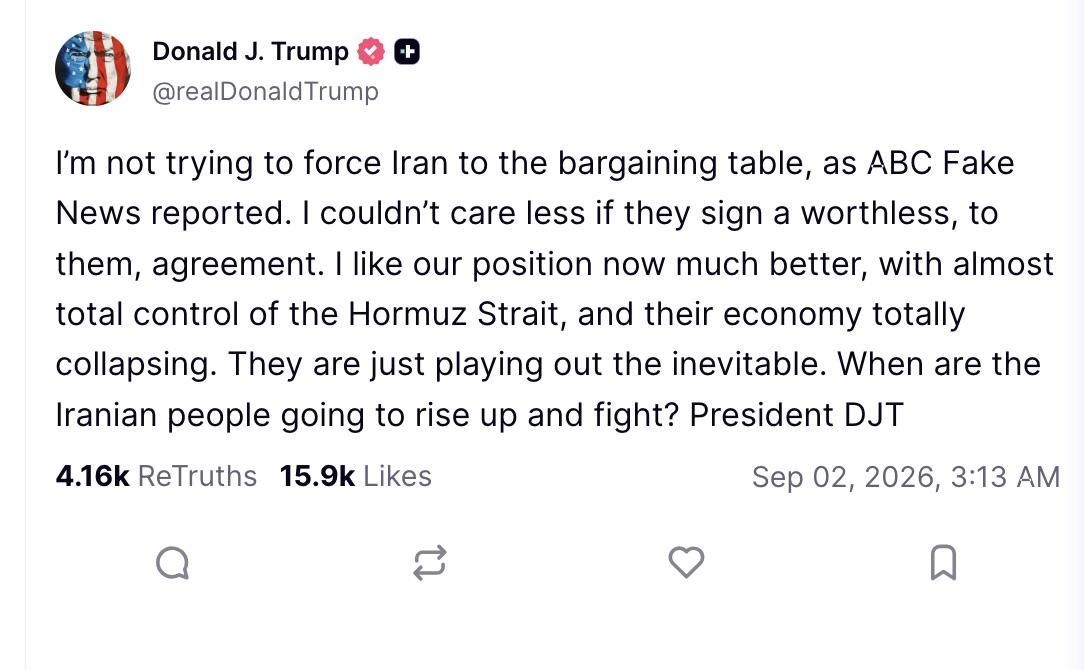
Nevertheless, this Truth Social post suggests that Trump learned his lesson, and a lot faster than a couple of his predecessors. ABC News reported earlier yesterday that Trump had again sent diplomatic signals to get a negotiated end to the Hormuz crisis. The IRGC had spent most of yesterday threatening their usual mother of all responses, but those empty threats have usually accompanied their own attempts to get other Gulf states to intervene with Trump on their behalf. The time for deals has passed, Trump posted last night:
Why haven’t the Iranian people risen up yet? That question got some blowback for a couple of reasons. The Iranian people are disarmed, first off, and their oppressors control nearly all the weapons. They tried an uprising in January; the regime massacred tens of thousands of them to keep control. The US did not directly intervene until six weeks later, and the war increased the internal enforcement of regime rule.
Second and perhaps more important, the constant attempts by the US to cut a deal with the regime undercut any momentum that the Iranian opposition might generate. Not to fulfill Godwin’s Law, but the clear parallel here is 1930s Europe and the constant deals offered to Hitler by Britain and France. The German military needed Hitler to suffer one defeat to seize power, and the old Prussian clique was prepared to do it, but Hitler kept getting concessions from the Versailles powers. By the time of the Munich humiliation and the subsequent seizure of Czechoslovakia six months later, Hitler was unstoppable thanks to attempts to appease Hitler back to peace.
Why would people risk their lives at the moment the US might cut a deal with their oppressors? This has been the problem with previous administrations that tried to negotiate with the Islamist terror regime in Tehran. Barack Obama wanted his Munich moment so bad that he backed the regime during the 2009 uprising by recognizing the ridiculously corrupt election in Iran that year. He spent the next six years chasing the JCPOA that Iran entirely ignored anyway. And Joe Biden wanted desperately to get the mullahs to sign back onto that useless JCPOA in order to declare that he had achieved peace in his time, too.
In that sense, Trump has learned his lesson a lot faster than his predecessors did. If he’s serious about this, as opposed to making this into a negotiating tactic, then Iran has a very big problem. Duane will go into more detail in our next post on this point, but the siege and traded “kinetic actions” favor the US. Iran has no blue-water navy, no effective air force or air defenses, and the strategic damage done in March to its military-industrial complex will set it back decades. Its currency has collapsed, and the only asset that the IRGC still has is Iran’s oil – which they can’t trade any longer, thanks to a relatively cheap blockade that Trump can maintain for months or longer.
Actually, it sounds like Trump wants a different kind of “trade” with Iran. He’s trading tankers, and again, Trump has a lot more pieces on the board: Why it matters: This is the first time the U.S. military has struck Iranian tankers in retaliation for Iranian attacks on ships in the Strait of Hormuz — rather than to prevent them from violating the naval blockade. A U.S. official said the move was part of a new “tanker for tanker” policy approved by President Trump to further deter Iranian attacks on tankers that move through the strait.
Driving the news: U.S. officials said around 100 targets were attacked during Tuesday’s strikes. The Iranian government tankers were anchored off Iran’s coast north of the U.S. naval blockade line. U.S. drones launched missiles that hit their engine rooms. Among the targets were Islamic Revolutionary Guard Corps (IRGC) air defense sites, radar systems, mine-laying capabilities, communications sites, anti-ship cruise missile launchers and attack drone launchers, U.S. officials said.
This is an even bigger loss to Iran than just the replacement costs of the tankers. Iran has been forced to store its crude oil on its tanker fleet to prevent the necessity of capping their wells, which would potentially cripple their main industry for a generation. The rest of the world has the capacity to replace these tankers; Iran cannot afford to do that now, even if the blockade ends. Every disabled tanker also delays the recovery of their income stream when the siege does end, too.
Let’s hope that Trump means what he posted last night. No one should want a deal with the radical Islamist terrorists that currently have Iran in their grip. The Iranian people will rise up when they can feel confident that the rest of the world will not come to rescue this regime from itself.
Bessent added: “My job is to make sure that they want to have a deal, and they will want to have one.” Put this one right on top of the stack of things I don’t understand.”
• We’re Still Playing ‘Let’s Make a Deal!’ With Iran? (Stephen Green)
I have a couple of Iran items for you today that go together like Scotch and sauerkraut. The first is that following the tit-for-tat attacks across the Persian Gulf over the weekend, American forces again lit up Iran’s southern coast on Tuesday night local time. The most recent reports indicate explosions in at least half a dozen cities stretching from Chabahar in the Gulf of Oman to Bandar Abbas and Qeshm Island on the Persian Gulf side. Qeshm is home to an underground missile base.Read more …
Axios reported almost exactly 24 hours ago that President Donald Trump and his national security team were “considering waging limited strikes in the Strait of Hormuz to prevent Iran from reconstituting its radar and missile capabilities to attack ships.” And so here we are. Again. OSINTtechnical is a reliable source for further updates on today’s strikes, if you’re interested.
Reports of numerous explosions this evening along Iran's southern coastline, as the US appears to have resumed a strike campaign against Iranian forces. pic.twitter.com/O8QN36OYLv
— OSINTtechnical (@Osinttechnical) September 1, 2026Oil is back up to about $90.I feel very smart right now, having filled up the tank on Saturday. And it’s still something of a miracle — or at least adaptable logistics — that after six months of on-and-off war, mining the Gulf, etc., oil is still under $100. What happened to those scare stories of $150 or even $200 oil? The second item comes courtesy of Treasury Secretary Scott Bessent, who last week revealed his “economic D-Day” sanctions against the Islamic Republic, targeting the regime’s enablers — particularly in Communist China’s banking system.
Today, when asked about developments in Iran, Bessent said to Fox Business, “We have zero tolerance. We are going to economically asphyxiate this regime.” That’s great. I’m all for it. Strangle away. Economically, that is. But then, Bessent added: “My job is to make sure that they want to have a deal, and they will want to have one.” Put this one right on top of the stack of things I don’t understand.
.@SecScottBessent: "We have zero tolerance. We are going to economically asphyxiate this regime."
— Rapid Response 47 (@RapidResponse47) September 1, 2026
"My job is to make sure that they want to have a deal, and they will want to have one." pic.twitter.com/47jKGqsofjBessent has been almost frighteningly effective in fulfilling his promise to collapse Iran’s currency, the rial. As he reminded Fox Business in that clip, the rial stood at 800,000 to the dollar last spring, but as of last week was down to two million. That’s created real-world hardships for the regime and the Iranian people. “Small protests occurred outside petrochemical plant and a sugar cane factory where workers were made unemployed but received no salary for last six months,” Peter Baum reported on X today. “One person killed by IRGC outside the sugar cane factory.”
Furthermore, “Academic staff at numerous universities on strike as they too have not been paid for months.” The trick is to keep asphyxiating the regime until Tehran can’t afford to pay the thugs who keep the people in line with beatings and mass murders as required. And these are the same theocrats Bessent thinks he can make “want to have a deal?” And that after we let go of their throats, they’ll stick to it?
What I had thought back in March might be a days-long campaign to hurt the regime has gone on too long for a deal — and the stakes are too elevated. Once you grab somebody by the throat, you’ve got to keep squeezing until the job is done.
“They like the snipers better because all they do is have a crowd of 200,000 people, and a person goes down here right between the eyes ..”
• Trump Proclaims War Won’t Last ‘Too Long’ (ZH)
Trump again reiterated in afternoon comments to reporters that the military campaign against Iran won’t last too long. Of course, we’ve heard this many times before, also amid reports that White House aides are urging ‘quiet’ related to the Iran conflict until at least after November midterm elections, after which operations could ramp up again. “We blew up much more than their radar last night, it was a very heavy attack last night. And we’re prepared to do another one any time we want,” he stated.Read more …
“We hit them last night because they took a shot at our base in Jordan,” he continued, confirming the Iranian retaliation. “We hit them hard last night. They gave a little love-tap, but we hit them hard.” He also described that “some defensive, some offensive” Iranian radars and capabilities along the Strait of Hormuz were taken out. Trump says that while the US is ready to strike Iran “at any time”, he doesn’t expect the renewed fighting to last “too long”. Another interesting moment below… these numbers keep getting inflated, despite there not being any evidence of large-scale protests and violent suppression on the ground in recent months:
Trump on Iran:
— Clash Report (@clashreport) September 2, 2026
As of three months ago, they had 52,000 protesters that were killed.
Now I hear the number is 20 to 25,000 more.
They have close to 65,000 protesters killed. pic.twitter.com/w5aRbQ5VLdAnd there’s this via CBS: Trump in Oval described Iranian actions against protesters. They use “machine guns and sometimes the snipers. They like the snipers better because all they do is have a crowd of 200,000 people, and a person goes down here right between the eyes, and they’ll have three snipers doing it, and it’s a horrible thing to watch.”
What’s the timeline on this? What is he talking about? Netanyahu has also joined in from Israel, on Wednesday saying that Mossad continues to be active in Iran, and that the goal is regime collapse.

“Tehran proper is now gridlocked by gas lines ..”
“..In the cities, for now, at least, there is enough water. At least enough that it’s increasingly being used to dilute gasoline in order to make the limited rations to petrol stations last longer ..”
• What Is Iran’s Boiling Point? We May Be Very Close to Finding Out (Patterson)
I can’t say I remember all of my high school chemistry and physics education, but I do remember the concept about water boiling. Under normal atmospheric pressure, 212 degrees is the magic temperature for it to begin bubbling off into steam in earnest. But if you can pressurize the container holding the water, doubling its surroundings in atmospheric pressure, you get an additional 36 degrees of heat before boiling begins. That’s why cars and trucks for a very long time have had pressurized cooling systems for engines.Read more …
Don’t worry, I’m not going to geek out on science for the rest of this column. I bring it up in order show that cars and water have a very symbiotic relationship, provided that they’re used in the right way. And when they’re not, as is happening with increasing frequency inside Iran, we’re about to see what happens when pressure reaches its critical point. An important sequence of events took place in the Middle East in the last week, and much of it was very predictable based upon economic conditions deteriorating rapidly inside Iran that we covered last week.Without any revenue, gasoline, grain, or weapons flowing into the Islamic Republic, and nothing to generate revenue leaving, the IRGC could not stand still and starve along with 93 million Iranians. The status quo of the blockade with the addition of further sanctions rolled out in Operation Economic Outcast was not sustainable. They had to lash out in order to change the equation. The last straw for the regime? De-mining the Strait of Hormuz.
As President Trump is fond of saying, Iran’s Navy is gone. What they had left was speedboats with machine guns tied to them. Most of those are gone now, too. But late last week, the IRGC began scrambling together a ragtag group of naval volunteers into whatever they could find that would float, and fashion a few more mines to begin the process of closing the Strait anew. There were reports that the Iranians wanted to deploy rockets with mines as payloads and drop them into the Strait, as absurd as that sounds. Of course, Centcom had a pretty good idea they would try something, and unlike Iran, our Navy and Air Force have the ability to watch them.
On Sunday, targets on Larak Island, one of the channel islands in the Strait of Hormuz, the same island the IRGC envisioned would be the proverbial toll booth collecting fees from tankers and freighters, were destroyed. And according to several open source reports in Israel and around the region, it was a direct hit. How do we know? The Iranians immediately launched nine missiles in response at…Jordan.
The Islamic Republic’s massive ballistic missile response tonight may indicate the U.S. strike on Larak Island was far more devastating than initially acknowledged.
— The Iran Watcher (@TheIranWatcher) August 30, 2026
Channel 14, citing sources, says the strike killed dozens of IRGC personnel and wounded nearly 100 others. Those… pic.twitter.com/LiqUclS6wNEight of the nine missiles were intercepted and destroyed, and one was far enough off course it was not a threat to anything except scorpions. President Trump expected Iran to pop off, and in keeping with his motto to hit ten times as hard if Iran went kinetic, two waves of strikes hit targets up and down the southern coast of Iran. The President, in his response to Iran, said there is no more deal on the table. Howie Mandel is not in the Oval Office with a bevy of young ladies with briefcases and a mysterious banker on the phone. His banker is Treasury Secretary Scott Bessent, and there is no more offer. There is either surrender or more pain and suffering. On social media, Trump gave this AI video as a warning to the Iranians not to escalate after this response.
MAP: A second wave of U.S. strikes has been reported across Iran.
— Open Source Intel (@Osint613) September 1, 2026
Reported locations include Bandar Abbas, Qeshm Island, Jiroft Airport, Asaluyeh and Chabahar.
In Hormozgan province, the Kuhestak telecommunications center in Sirik County was reportedly leveled. pic.twitter.com/rpEiL0wWuWHe later told Fox News’ Trey Yingst that if the regime launched again after this, he would flatten them. Did Iran take their beating and stand down? Nah. They found 14 more rockets and fired…at Jordan again. Why Jordan? We have a military base there. We still do. Ten of thirteen rockets were once again intercepted and destroyed mid-air, and three were wide right of the uprights and wiped out more desert fauna. What about the 14th rocket, you ask? Well, it went up, and then came down on an Iranian house that was full of people conducting a wedding ceremony.
The regime blamed the tragedy on U.S. strikes while simultaneously admitting that a telecommunications tower was also struck. The tower and the house, by the way, were not near each other. This is what’s left of the tower.
The Kuhestak telecommunications tower has been destroyed. https://t.co/XJ2xrgrO40 pic.twitter.com/H697ACmAPW
— Open Source Intel (@Osint613) September 1, 2026President Trump, to pour salt in the wound, said the U.S. had been watching Iranians build this tower, which would help restore their radar system and track vessels in the Strait once again. We waited until they had basically rebuilt the thing — investing all the time, money, and energy, and then we blew it up. It’s sad bordering on the pathetic, but after everyone in the Middle East hearing about the menacing power of the vaunted Iranian Navy for decades, this literally is what constitutes the regime navy this week.
As of last night, the promised intensified third round of strikes had not begun. They certainly could be imminent, as it would be in keeping with what President Trump said multiple times in the last few days. But perhaps something else may be on the horizon. We’ll come back to that in a bit. I mentioned about cars, water, and pressure, and how Iran is about to become one giant science experiment. Let’s begin with water. As scarce as gasoline appears to be in populated areas, in the more rural regions, water is even harder to come by.
Water deliveries have all but stopped since the war began, and you have to walk miles to get it. Forget about plumbing and irrigation. Water showing up just under once a month for entire villages? How long is that supposed to be sustainable? In the cities, for now, at least, there is enough water. At least enough that it’s increasingly being used to dilute gasoline in order to make the limited rations to petrol stations last longer. Diluting gas with water was a one-off event last week, or so we were told by the regime. One station got a load of bad gasoline, and it was all just an innocent mix-up, if you’ll pardon the pun. This week, though, there are multiple reports of gasoline being more water than gas.
Water in the radiator and cooling system? You bet. Water in the windshield wiper tank? Absolutely. Water in the gas tank? Not if you want to make it home from the station. And to add insult to injury, Iranians are having to wait hours on end for a chance to play Russian Roulette at the gas pump. For some, they lie on their horns in frustration while they wait. They can’t go anywhere, They’re stuck, they’re hot, they’re angry, and so they honk. What in previous weeks were lines for gas in the outskirts of the cities, Tehran proper is now gridlocked by gas lines.
Yes it does.
• The Leipzig Incident Has All The Hallmarks Of A False Flag (Andrew Korybko)

It was carried out to justify the German economy’s evolution to war footing, distract from the resultant problems, and legitimize a future serious escalation against Russia. Germany blamed Russia for last month’s incident in Leipzig when one explosives-laden drone was found on the tarmac in proximity to Ukrainian cargo planes, another reportedly collided with a separate cargo plane as it tried to land but failed to explode, and a third was later found close to the premises. Putin condemned their claim, shared his opinion that it was a false flag due to them planting evidence, and speculated that the motive was to distract from domestic problems by fearmongering about Russia.Read more …
While skeptics might roll their eyes, the Leipzig incident has all the hallmarks of a false flag. For starters, Germany is implying cartoonish incompetence on the part of Russia. The public is supposed to believe that the most skilled drone operators in the world, who were tasked with what would have been the most sensational Hybrid War attack on NATO ever, left a drone on the tarmac, got unlucky when another failed to explode after it hit a landing cargo plane, and left another nearby. That’s difficult to believe.The second point to make in support of Putin’s hypothesis is that something similar happened last fall when unknown drones forced major airports in Scandinavia to temporarily ground all flights. Zelensky predictably blamed Russia and called for closing the Danish Straits to its shipping. As with the Leipzig incident, no evidence was ever shared in support of that claim, but it served as the precedent to blame Russia for mysterious drone-related incidents in Europe in order to justify more escalations against it.
And finally, while Zelensky’s proposed escalation ultimately never came to fruition (most likely to avoid a hot NATO-Russian war), an escalation of some sort might follow the Leipzig incident. It was argued here in late August that NATO would expect to gain more from a serious escalation with Russia than the inverse, which could take the form of resuming summer’s failed drone campaign against Russia at scale indefinitely in pursuit of its deindustrialization and demilitarization. That might be attempted next year.
Observers should remember that Germany, which is now Ukraine’s second-most-important military patron behind the US, reached a deal in the spring to develop Ukraine’s deep-strike capabilities. Its economy is also getting on war footing as Germany rapidly remilitarizes in furtherance of its goal to command Europe’s largest army ahead of the EU’s prediction of a possible war with Russia around 2030. This has proven unpopular with voters, however, ergo the need to justify it through the Leipzig incident.
To recap the explanation of Putin’s false flag hypothesis, last fall’s Russian drone scare in Scandinavia served as the pretext for blaming the Kremlin for future such incidents without evidence, which Germany has now done with the Leipzig one. The narrative of Russian drone operators’ incompetence is difficult to believe, however, but it’s still being pushed to justify the Germany economy’s evolution to war footing, distract from the resultant problems, and legitimize a future serious escalation against Russia.
As was written, this could take the form of resuming summer’s failed drone campaign against Russia at scale indefinitely in pursuit of its deindustrialization and demilitarization, but that risks crossing Russia’s nuclear threshold per its updated doctrine. At the very least, Putin would once again mildly “escalate to de-escalate” against Ukraine, but there’s always a chance that everything spirals out of control. It would therefore be best for Germany to eschew escalation just like the Scandinavian states ultimately did.
If your money’s in a bank, they can probably touch it.
• Von der Leyen Tells EU Citizens ‘All Your Monies Are Belong to Us’ (Welborn)
Maybe, just schmaybe, those cod-clasping Vikings in Iceland knew what they were doing on Sunday evening, when, by the hairs on their bearded chinny chinchins, they extricated themselves for the foreseeable future from any discussions about becoming a European Union vassal state. Oh, excuse me – European Union ‘member,’ as if that implied some sort of chummy club filled with bonhomie, and all looking out for the other fellows’ best interests.Read more …
As someone said, it’s more the Hotel California. And at the rate the unelected Empress of Europe, current European Commission president, and epic Bond villainess Ursula von der Leyen is going, no one will be left standing to wonder how to check out, even if they could. The entire union charade is going to collapse in on itself with a great sucking sound, like a black hole, and simply wink out, leaving dazed survivors standing knee-deep in civilizational rubble and blinking in stunned astonishment like Rip Van Winkle waking up from his nap.WHADDA WE DO NOW, GEORG?
The rumblings of discontent are already so loud, and the currents running beneath the surface so strong that one can tangibly detect them through the purposeful noise screen the Brussels Brahmins and their pliant government minions maintain to distract from it, and in defiance of all the legal obstacles erected in an effort to eradicate it. In five days, it very much looks as if the status quo seismic meter will suffer its first great shock, should the populist Alternative for Germany (AfD) Party earn its way to single-party dominance in the German state of Saxony-Anhalt.NAZI! ULTRA RIGHT WING! EXTREMIST!
All the old, tired slurs are falling by the wayside because they’ve been deployed too often and too cheaply. As retorts rather than the real answers people are seeking for the miserable state of their countries. Those same everyday people, being slurred and demonized as ‘NAZIS!’ by the purple, blue, and green-haired freaks routinely assembled for public protests against them, have had quite enough of the double standard accorded to everyone but their hardworking, tax-paying selves.They are tired of virtue signaling progressive/socialist politicians who rail against the middle class as NAZIS! for wanting an imported-men-of-fighting-age-stabby-types-free homeland once again while being married to actual neo-NAZIS! themselves.
[..]
The heaving, outraged chest of hypocrisy is no longer working its magic on listeners in the audience. No longer do they question why they thought they had a right to ask to begin with, and no longer do they slink away in shame that they somehow found the temerity to do so.
Now they see the arrogant hypocrisy on display, as if a film had been lifted from their eyes, and they are no longer being cowed into believing their honest concerns were wrong from the start. They see the frauds they’ve allowed to hold emotional sway berating them for who they are, and can begin to hold them accountable for what they’ve done, both to the nation physically and to the national psyche.
This explains the strength of the AfD’s appeal, the surging popularity of Marine Le Pen’s National Rally (RN) in France, and the strength of populist movements across Europe. Citizens of countries whose cultural identities and work-ethic traditions have been nearly swallowed by diktats from the EU leviathan are stirring en masse to reject the politicians who have foisted this calamitous artificial construct on them. Farmers on tractors across Europe are blocking highways or spraying manure. Populist victories in elections in nearly every single country, particularly among the major players.
And the EU’s response to all of this? Ever more tone deaf tightening of the control screws, and rejection of the middle-class values that once made Europe ‘Europe.’ Ursula von der Leyen gave an astonishing speech to French business leaders five days ago that has just now broken into the news. As you will see in the video, the unelected Empress of Europe was tremendously animated for her normal appearances, but that was, perhaps, due to the subject – money.
She and her appointed satraps have run through all of it. The money sent to Brussels, the money they’ve extorted from ‘member states’ for their weapons build-ups and defense spending, all of it. And what makes her angry enough to smack the podium is the savings of hard-working Europeans, sitting fat and untouched in European banks, out of her control.
EU President Ursula von der Leyen believes that Europeans are not saving money correctly.
— Wall Street Mav (@WallStreetMav) August 31, 2026
She wants to control how Europeans are allowed to save their money.
The European Commission head stated that about €10 trillion in household savings are currently sitting in bank… pic.twitter.com/A4q4sBtrtN
View from a crypto site.
“Brussels wants Europe’s 10 trillion euros in deposits funding its companies. What it means for savers, and why Bitcoin savings plans matter.”
• Von der Leyen Wants Your Bank Deposits: How to Keep Control of Them (Fares)
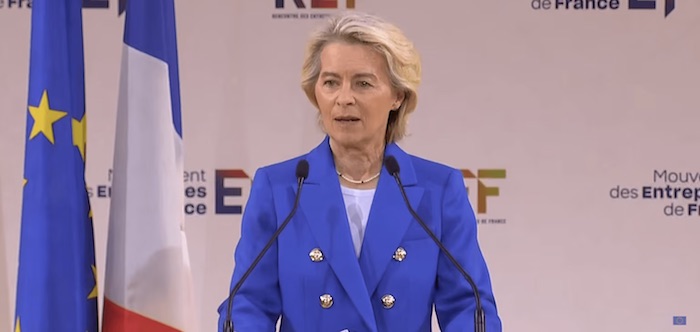
The President of the European Commission stood in front of a room full of French business leaders last week and said the quiet part out loud. Europeans have roughly 10 trillion euros parked in bank accounts, that money is “sitting idle”, and Europe now needs to put it to work for European companies.She was not proposing to raid anyone’s account. But the language matters, because it tells you exactly how your savings are viewed from Brussels: not as your money, but as a national resource that is currently being wasted. Here is what is actually happening, and what you can do about it that does not involve waiting for a policy to be designed for you.Read more …
What Did Von der Leyen Actually Say About Europe’s Savings?
Speaking at the La REF business conference in Paris on 27 August, Ursula von der Leyen argued that Europe’s old economic model is finished. Cheap imported energy is gone, easy access to global trade is gone, and the assumption that someone else would handle Europe’s security is gone. Her answer is money. Specifically, your money. Around 10 trillion euros in household savings sit in European bank deposits, and a large share of Europe’s savings ends up invested outside the continent, mostly in the United States.Meanwhile European companies stall out, get bought, or move abroad for funding. €10 trillion of household savings is currently sitting in bank deposits, and a significant part of European savings is invested outside our continent.Europe must now put these savings to work for its companies, and that is the goal of the Savings and Show more
EU's von der Leyen:
— Clash Report (@clashreport) August 31, 2026
€10 trillion of household savings is currently sitting in bank deposits, and a significant part of European savings is invested outside our continent.
Europe must now put these savings to work for its companies, and that is the goal of the Savings and… pic.twitter.com/CATwQJWAW2The President of the European Commission stood in front of a room full of French business leaders last week and said the quiet part out loud. Europeans have roughly 10 trillion euros parked in bank accounts, that money is “sitting idle”, and Europe now needs to put it to work for European companies. She was not proposing to raid anyone’s account. But the language matters, because it tells you exactly how your savings are viewed from Brussels: not as your money, but as a national resource that is currently being wasted. Here is what is actually happening, and what you can do about it that does not involve waiting for a policy to be designed for you.
What Did Von der Leyen Actually Say About Europe’s Savings?
Speaking at the La REF business conference in Paris on 27 August, Ursula von der Leyen argued that Europe’s old economic model is finished. Cheap imported energy is gone, easy access to global trade is gone, and the assumption that someone else would handle Europe’s security is gone. Her answer is money. Specifically, your money. Around 10 trillion euros in household savings sit in European bank deposits, and a large share of Europe’s savings ends up invested outside the continent, mostly in the United States. Meanwhile European companies stall out, get bought, or move abroad for funding. The vehicle for fixing this is the Savings and Investments Union, or SIU. The Commission says the package of measures on securitisation, bank and insurance investment rules, market integration and supervision could unlock up to 470 billion euros in additional investment.Is the EU Really Taking Money From Your Savings Account?
No, and anyone telling you otherwise is selling something. There is no confiscation, no forced conversion, no deposit levy in the SIU. What the SIU does is change the plumbing. It makes it easier and cheaper for banks, insurers and asset managers to move retail money into capital markets, it pushes simplified investment products and pension wrappers, and it leans hard on financial literacy campaigns to convince you that your deposit account is underperforming.On the last point, they are not wrong. The Commission’s own framing is that bank deposits are safe and easy to access but usually earn less than capital market investments. That is true. The awkward part is the second half of the pitch: the goal is not only better returns for you, it is cheaper capital for European companies. You are being asked to become the funding source for an industrial policy. There is also a detail that rarely gets mentioned. Your savings were never idle. Banks lend deposits out. They always have. What Brussels means by “idle” is that the money is not flowing into the specific channels the EU wants it to flow into.
Why Are Bank Deposits Losing You Money Anyway?
Forget the politics for a second. The case against leaving everything in a savings account is much older than the SIU. A euro sitting in a deposit account earns a nominal rate. Inflation eats the real value. Across most of the last decade, the combination has meant a slow, quiet loss of purchasing power for European savers, even during periods when headline rates looked respectable. You do not see it, because the number on your statement never goes down. Only what it buys does. That is the actual problem. Von der Leyen is right that 10 trillion euros of deposits is a bad outcome for savers. Where reasonable people disagree is on the solution.What Does It Actually Mean to Control Your Own Money?
Here is the test. If someone else can change the rules, freeze the account, redirect the flow, or inflate away the value while you sleep, you do not fully control that money. You have a claim on it.That applies to a bank deposit, and it applies just as much to whichever tidy EU investment wrapper gets rolled out in 2027 with a nice acronym and a tax incentive attached.Bitcoin is the opposite design. Fixed supply of 21 million, no issuer, no board meeting that can change the schedule, and if you hold your own keys, no intermediary that can freeze it. That is the entire point of the asset. Whether you like the volatility or not, nobody in Brussels, Frankfurt or Washington can decide that your bitcoin is sitting idle and needs to be redirected.
CIA state within state.
• The CIA Never Comes To Russia In Peace (Scott Ritter)
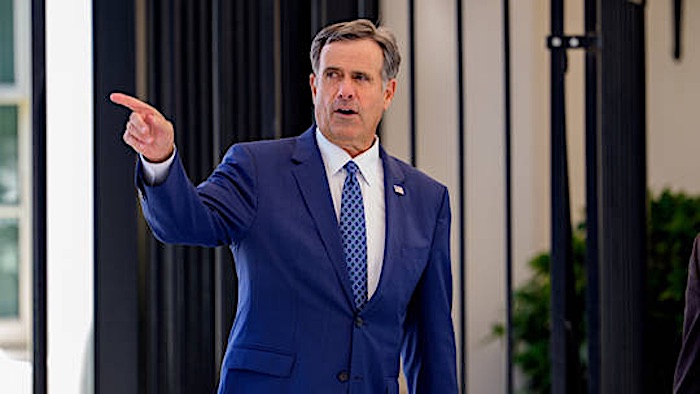
CIA Director John Ratcliffe traveled to Moscow last week. What we know: Ratcliffe met with Sergey Naryshkin, the director of Russia’s Foreign Intelligence Service. This has been confirmed by Naryshkin himself, who described the meeting as “routine.” We also know that the US spy chief did not meet with Russian President Vladimir Putin. “The meeting took place, there is nothing unusual in this,” Naryshkin stated afterwards. “In the practice of special services, meetings of managers, personal meetings or online are part of our work. So, the meeting with John Ratcliffe is a working format.”Read more …
Naryshkin refused to state what issues were discussed, explaining that they were within the competence of the intelligence services. “And the competence of the intelligence services is such a rather delicate and special thing,” the Russian spy chief said. What we don’t know: literally anything else. Rumors abound about additional attendees, as well as the agenda – or lack thereof – that was pursued by Ratcliffe during a meeting which appeared to be anything but routine. But the fact is, any meeting between Ratcliffe and Naryshkin, given the nature of the times we live in, could never be described as “routine.” A quick reminder: John Ratcliffe’s CIA is currently at war with Russia. Literally.Ratcliffe assumed his current position on January 23, 2025. Prior to this, he did a short stint as national intelligence director during the last year of Trump’s first term in office. He was a Texas congressman for a few years, as well as a small-town mayor and acting US attorney for the Eastern District of Texas.He is a politician, not a spy. But he is fully cognizant of the CIA’s secret war against Russia, having been fully briefed while serving as DNI. As a member of Congress, Ratcliffe was a leading policy maker on national security issues serving as a member of the House Intelligence and Homeland Security committees. Any effort to portray him as some sort of “innocent abroad” fails on the face of the facts.
The CIA has always been at war with Russia. During the Cold War, Moscow Station (the name of the CIA’s operation center based out of the US Embassy) was literally the front line of the spy-versus-spy antics taking place between the US and the Soviet Union. The CIA headed up Operation Cyclone, a massive paramilitary-driven effort to create a Vietnam-like quagmire for the Soviet Union in Afghanistan. The goal of Operation Cyclone was to kill Russians. I worked with people who were directly or indirectly affiliated with Operation Cyclone. ‘Kill more Russians’ was literally their mantra.
There was a time when the CIA hired genuine Russia-area experts. The analysts who populated the Office of Soviet Analysis (SOVA) in the Directorate of Intelligence at the height of the Cold War were some of the best experts on the Soviet Union imaginable.I know because I worked with them. From 1988-1990, I received two classified commendations from the director of the CIA for my analytical work involving the Soviet Union. I was considered by the CIA leadership to be a top-notch Soviet analyst.
In 1992 the CIA actively recruited me for an analytical position within the predecessor to SOVA, the Slavic and Eurasian Office. I was brought in for a high-level interview, after which I was informed that the CIA would be passing on my application. When I asked why, I was told that I was too married to old school thinking about Russia – in short, I was a ‘Sovietologist’. The CIA was looking for people who could imagine Russia ‘differently’. What this meant was divorcing oneself from the mindset that Russia (i.e., the Soviet Union) was a peer-level opponent worthy of respect (my view), and instead adopting a stance that Russia was a defeated foe that needed to be kept down by any means necessary.
In the 1990s, the CIA’s task was to use Boris Yeltsin as an agent of influence to weaken Russia and facilitate foreign control over its resources. The CIA actively infiltrated every aspect of the Russian economy and used ‘soft power’ resources funded by the likes of the National Endowment for Democracy and overseen by the US Agency for International Development (USAID) to hijack Russian democratic institutions and Russian social life, especially through media-related activities.
The CIA also was very active in working to break Russia up into more manageable fiefdoms, each ruled over by a CIA-controlled lackey. The Russian-Chechen conflict was a primary example of this activity. When Boris Yeltsin stepped aside in favor of Vladimir Putin as Russia’s president on New Year’s Eve 1999, the CIA immediately made it its task to undermine Putin and replace him with someone from the Yeltsin camp willing and able to do the CIA’s bidding.
Putin’s resistance and resilience as a Russian leader operating independent of CIA control helped shape a new generation of Russophobes in the United States. The first generation were the ‘new Russian’ thinkers that replaced the old school ‘Sovietologists’ at the end of the Cold War. To them, Russia was a playground for which to launch experiments on economic and political domination with absolutely zero regard to the price being paid by the people of Russia.
This generation of Russophobes simply detested Russia and the Russian people, failing to attribute any normative human value to their lives. Millions of Russians lost their lives as a result, and tens of millions of others suffered greatly.Michael McFaul, the former US ambassador to Russia, falls into this category. So, too, does Fiona Hill. And Beth Sanner. People whose educational background and Russian experience pre-dates Putin, people who know the truth about Russia but opted instead to embrace the hegemonic policies of superpower singularity and work to weaken and destroy Russia.
But Putin’s stubborn hold on power, despite concerted efforts by the CIA to oust him (think Navalny), led to the birth of a new generation of Russophobes, so-called ‘experts’ whose only claim to relevance is their undying hatred of Putin and everything Russian. It is this generation that has gravitated to the upper levels of the CIA’s analytical community, and who openly hate all things Russia. People like Andrea Kendall-Taylor and Julia Gurganus. It is this openly Russophobic CIA that John Ratcliffe oversees.
His relationship with Julia Gurganus is both instructive and illustrative of the sickness that pervades the CIA when it comes to Russia. Gurganus was the National Intelligence Officer for Russia back in 2016-17, at the height of the Obama-era Russiagate scandal that tried to make the case of collusion between then-candidate Donald Trump and Russia to steal the 2016 presidential election from Hillary Clinton. Gurganus helped manufacture the intelligence that underpinned this false allegation. She was a vociferous critic of Trump, so much so that the CIA quietly exiled her to a think tank position during Trump’s first term in office.
When Trump was reelected, Ratcliffe oversaw the whitewashing of Gurganus’ role in falsely accusing Trump of collusion, leading to the elevation of Gurganus as the senior CIA briefer onboard Air Force One as Trump flew to Alaska to meet with Putin in August 2025. That’s right – Ratcliffe purposefully cleansed Gurganus of her anti-Trump credentials so she could personally brief the president before his meeting with Putin. Tulsi Gabbard, in her role as DNI, exposed Gurganus as an anti-Trump operative and had her security clearances revoked, but not before the damage was done.
There was a time when the CIA’s Directorate of Operations Russia House was home to living legends. People like Milton Beardon, who helped run Operation Cyclone and was chief of the Soviet/East European Division at the time the Soviet Union fell. Gardner Hathaway and Berton Gerber, who ran some of the most successful CIA spying operations from Moscow Station in the late 1970s and early 1980s.
“There’s a couple of Democrats here in the House who have suggested that they’re not on board with the Democrat Socialists of America, just a few. They’re going to get a chance to show us tomorrow. We’re going to see.”
• Mike Johnson’s Got a Trick for Dems Trying to Pack the Supreme Court (Charles)
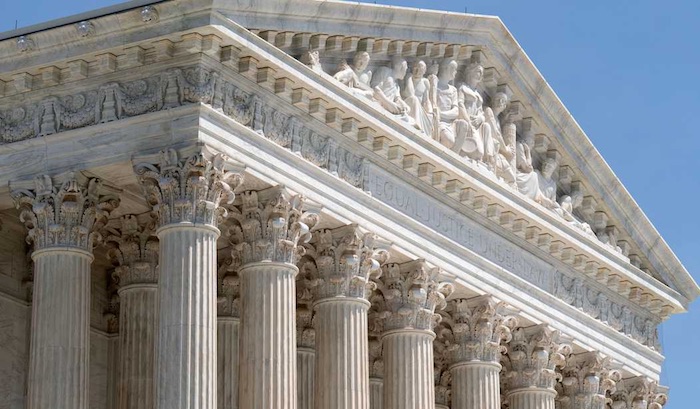
House Republicans are set to propose a constitutional amendment that would prevent Democrats from packing the Supreme Court when they get back in power. This comes after years of Democrat politicians pushing for adding more seats to the Supreme Court to water down the influence of conservative-leaning justices.While addressing reporters at the U.S. Capitol, explained that lawmakers will be dealing with a series of legislative priorities on Wednesday.Read more …
“I’ll highlight one of those,” he said. “We are going to bring a constitutional amendment. It is a bill to amend the U.S. Constitution to ensure that the U.S. Supreme Court remains composed of only nine justices. We will keep the nine. Now, you’ve heard the Democrat Socialists of America.” Johnson continued, noting that “the communist socialists in the Democrat Party who are taking the party over, they published their platform” and that “they want to abolish the border. They want to abolish prisons, defund police. One of their objectives, among all the crazy things, is they want to pack the U.S. Supreme Court.”We’re going to make sure that doesn’t happen. So we’re going to put that bill on the floor tomorrow on suspension because it requires a two thirds vote of both chambers of Congress to amend the Constitution. …There’s a couple of Democrats here in the House who have suggested that they’re not on board with the Democrat Socialists of America, just a few. They’re going to get a chance to show us tomorrow. We’re going to see.
https://twitter.com/EricLDaugh/status/2094856135987896489?ref_src=twsrc%5Etfw%7Ctwcamp%5Etweetembed%7Ctwterm%5E2094856135987896489%7Ctwgr%5E4d3572432d1bb72d0eb88025d7d6cfe40c5a921a%7Ctwcon%5Es1_c10&ref_url=https%3A%2F%2Ftownhall.com%2Fnews%2Fjeff-charles%2F2026%2F09%2F02%2Fmike-johnsons-got-a-trick-for-dems-trying-to-pack-the-supreme-court-n2682293
Democrat lawmakers have increasingly advocated for packing the Supreme Court over the past decade in response to a series of rulings that didn’t go their way. They argue that the change is necessary to maintain institutional legitimacy. Congressional Democrats have introduced multiple proposals in recent months aimed at weakening the power of the Supreme Court. These include increasing the number of justices, imposing term limits, and creating ethics standards.
These efforts have not been successful due to a series of legislative obstacles. Democrat Rep. Hank Johnson (GA-4) declared, “We can either sit back as our Supreme Court continues to act without any restraint or checks and balances, or we can do nothing about it.” Similarly, Sen. Ed Markey (D-MA) said, “When Democrats control the Senate in the next Congress, we must abolish the filibuster and expand the Supreme Court.”
Of course, anyone with an IQ higher than my shoe size can see that this has nothing to do with restoring legitimacy or ensuring fairness. Democrats just want more power, and they can’t gain dominance over the court anytime soon without changing the rules.
The anti-Israel voice seems to have reached a crescendo, on the waves of a pro-muslim song. We need balance
• The ‘Gaza Genocide’ Is a Hoax (David Harsanyi)

In May 2025, Tom Fletcher, the United Nations under-secretary-general for humanitarian affairs, went on BBC Radio and told the audience that 14,000 babies in Gaza were going to die “in the next 48 hours unless we can reach them.” According to UNICEF, there are around 20,000 babies in the entirety of Gaza. Which means 70% of all infants were in danger of dying in mere hours. An “utterly chilling” figure, Fletcher stressed.Read more …
The New York Times, along with numerous other establishment media outlets, relayed Fletcher’s allegation to its credulous audience without any skepticism. The usual experts were summoned to discuss this unfolding famine on cable news. And the antisemites across social media amplified the claim. No matter how far-fetched a story is about Israel, including preposterous evidence-free accusations that it trains dogs to rape Palestinians, papers such as The New York Times will spread it to feed the perception that the Jewish state operates as a genocidal entity. And no matter how often the claims are debunked, they keep at it.A couple of months after Fletcher’s pronouncement, for instance, The New York Times ran a front-page story about starvation in Gaza featuring a haunting photograph of an emaciated Palestinian toddler named Mohammed Zakaria al Mutawaq. Unmentioned was that the boy suffered from cerebral palsy and other serious preexisting medical conditions, and his appearance had nothing to do with hunger. In any event, what the U.N. report actually found was that 14,000 cases of malnutrition might occur among the 1 million children of Gaza, not babies, if aid did not reach them over the next year.
Aid did reach them. Lots and lots of aid. The U.S.-Israeli Gaza Humanitarian Foundation delivered around 187 million meal equivalents, plus produce, and over 1 million packs of supplementary food for children to Palestinians before the ceasefire. And a year after U.N. Secretary-General Antonio Guterres claimed that “famine” in Gaza was a “failure of humanity itself,” a UNICEF-led “Nutrition SMART Survey Result” found that not only was there no widespread acute malnutrition in Gaza, but at 0.5%, the strip had one of the lowest rates in the region.
By the time “clarifications” run, the stories have coagulated in the imaginations of Israel haters. No credible person argues that Palestinians in Gaza do not suffer because of Hamas’ endless nihilistic wars against Israel. But there was no genocide. Not one popularly understood. And not legally. The exculpatory evidence against genocide is overwhelming. The most significant thing to remember about the genocide charge is that international organizations had to change the way they apply the legal definition that has been in place since the 1948 Genocide Convention to smear Israel.
In the popular understanding, the term “genocide” is something akin to the mass murder of people. As a legal matter, it is defined as acts committed with the intent to destroy, in whole or in part, a national, ethnic, racial or religious group.
The legal case against Israel relies on intent. If Israel harbors genocidal intentions, why would it deliver more humanitarian aid to the Gaza Strip than any army has probably ever delivered to an enemy population during wartime in history? Israel, which gave Gaza autonomy in 2005, not only provided food but also clean water, electricity and medical aid for decades.
If Israel has genocidal intentions, why does it warn civilians with flyers, roof knocking, phone calls and other mitigation techniques? Israel remains the only nation in the history of Earth that is allegedly intent on genocide to put its own troops in more danger to spare civilians. Why does Israel move the populations of entire cities out of the way when trying to confront Hamas? Israel could, of course, annihilate all of Gaza within minutes if it felt like it.
If Israel has genocidal intentions, why does the Gaza war have one of the lowest combat-to-civilian death ratios in the history of modern warfare? This, despite the fact that Hamas urges its own people to become cannon fodder as a means of appealing to friendly Western journalists and intellectuals. Hamas leaders build tunnels under hospitals, schools and mosques. They fire rockets from civilian areas. They prevent their own people from evacuating combat zones.
If Israel had genocidal intentions, there would be a lot more than 70,000 total casualties during the war. That total, it needs to be stressed, includes deaths from illness, old age, executions, murders, natural causes and preexisting conditions. Most importantly, it includes Hamas and Islamic Jihad fighters — though that fact is barely ever mentioned by the mass media.
Of course, Israel itself is home to over 2 million Arab citizens, a fifth of the country, with full legal and voting rights, who serve in the Knesset, practice law and medicine, and attend universities. Arab Israelis have higher living standards, longer life expectancies and greater political freedom than Arabs in most neighboring countries. If Israel’s goal was ethnic cleansing, the nation is the most spectacularly incompetent operation in human history. There is no genocide. And there was no famine. There was a war. And the bad guys lost.
“You have to have an environment that’s relatively free of regulation, meaning that new things must be default legal as opposed to default illegal,”
“..if the UK were a state, 30 years ago it would have been the fifth-richest in the Union. Today it would be our poorest state, ranked 51st behind Mississippi.”
• Musk: The Future Is Power, Chips, and Data Centers (Stephen Green)
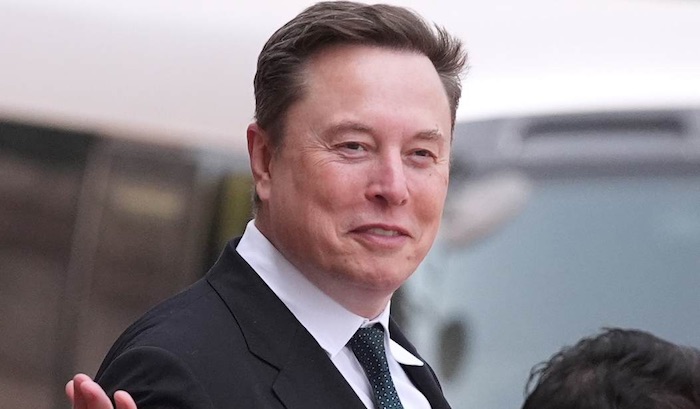
SpaceX CEO and founder Elon Musk spoke some harsh truths to EU leaders at a G20 conference in North Carolina on Tuesday — and a reminder to Americans about where the future lies. Speaking and taking questions at the G20 Innovation Ministerial in Chapel Hill, Musk said he believes “AI will probably increase the global economy by 20 to 30%” over the next few years. “That’s my rough estimate — meaning on the order of 20 to 30 trillion dollars per year.”Read more …
“Toward a 30% increase of the total global economy — this is quite a lot of prosperity we’re talking about here, just from digital AI,” he added. “But from robotics … I think we’ll see many multiples of the global economy, meaning you can increase the economy by a factor of 10 or more. These are mind-boggling numbers.”One question is what drives all that growth. The answer is three things: more chips, more data centers, and a lot more power generation.“The consensus,” Musk noted, “is that there will be a significant power shortfall next year — not a distant future. I believe the consensus estimate among analysts that follows the AI space very closely is that there will be at least a 15 gigawatt shortfall of power in 2027 for AI chips.” SpaceX plans to skip right past power generation limits by building data centers in space, but so far, at least, they’re the only company in the world with anything close to the ability to do that.
That’s one reason Musk said the exponential demand growth “creates an opportunity” for countries to “construct a lot of power, offer that to AI companies. And in exchange, of course, these data centers would be taxed and have to pay reasonable fees and so on.” The second question is who gets the lion’s share of that incredible growth. President Donald Trump kicked off the discussion on Monday, telling opponents of AI data centers that they would end up “backwards and poor,” and that they were helping rival China.
As previously noted, the last real innovation in the consumer space to come out of Europe might have been the web browser more than 30 years ago. That’s a long time ago.Europe does have a few tech firms with high-end specialties. There’s Germany’s Black Forest Labs for FLUX-based image generation, or France’s AMI Labs, which is just a startup — and a tiny one, by American or Chinese standards — but shows some promise. Mistral AI is probably Europe’s leader in AI. The company is privately held, but with an estimated valuation of less than $15 billion, the entire thing is almost a rounding error compared to leading U.S. or Chinese firms.
When it comes to general AI, Europe really doesn’t compete at the frontier. There’s simply no will across the EU or UK to allow the innovation (or power generation, or data center construction) required. “You have to have an environment that’s relatively free of regulation, meaning that new things must be default legal as opposed to default illegal,” Musk said to audience members including ministers from EU member states France, Italy, and Germany, and even EU tech chief Henna Virkkunen. In the EU, for example, we find that the regulation level is extraordinarily high, and things are generally default illegal, and this inhibits progress with new technologies,” he added. Take that, various ministers.
Europe fell badly behind the U.S. since the internet became the big growth-driver. So much so that if the UK were a state, 30 years ago it would have been the fifth-richest in the Union. Today it would be our poorest state, ranked 51st behind Mississippi. Over the next 25 years, probably less, Europe seems destined to get lapped by China, too. Is that the future we want for our country?
Opposition to building out energy generation, chip fabrication, and, yes, even data center construction is functionally no different than choking off rail and steel production at the start of the 19th century, or oil and automobiles at the dawn of the 20th. We know how to build the future. The final question is whether we allow ourselves to do it.

Elon Musk: “When you make the robots, the robots will start manufacturing the robots, so you get a recursive effect
— X Freeze (@XFreeze) September 1, 2026
It starts off very slowly, but then it grows at an explosive rate”
“10 years from now, I would say there are well over a billion humanoid robots"
"And those… pic.twitter.com/ko73tCp4my
Looks like Elon needs to go to a rehab center and dry out his brain for the next 10 years, while his personal robot teaches him how to breathe, relax, unwind and get real.
— David Stockman (@DA_Stockman) September 1, 2026
BTW, Tesla is a nice car, but the mega-fortune he earned from it was generated by government energy… https://t.co/rg45ygMiKJ
“Optimus will be the biggest product ever”
— Optimus (@Optimus_RH) September 2, 2026
– Elon Musk pic.twitter.com/0XGVVDvJJC
Support the Automatic Earth in wartime with Paypal, Bitcoin and Patreon.

Home › Forums › Debt Rattle September 3 2026