
Jul 312015
 
 July 31, 2015  Posted by at 10:15 am Finance Tagged with: , , , , , , , , , , ,  4 Responses »


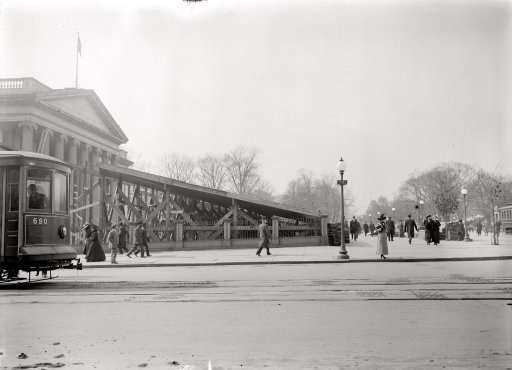
Harris&Ewing Preparations for inauguration of Woodrow Wilson 1913


• September Is Looking Likelier for Fed’s First Rate Increase (NY Times)
• SYRIZA To Hold ‘Emergency’ Congress In September (DW)
• China’s Stocks Extend Slump in Worst Monthly Decline Since 2009
• Corporate Giants Sound Profits Alarm Over China Slowdown (FT)
• “The Virtuous Emerging Market Cycle Is Turning Vicious” (Albert Edwards)
• Italy Is The Most Likely Country To Leave The Euro (WaPo)
• The Greek Coup: Liquidity as a Weapon of Coercion (Ellen Brown)
• Greece Crisis Escalates As IMF Witholds Support For New Bail-Out (Telegraph)
• IMF Won’t Help Finance Greece Without Debt Relief (Bloomberg)
• Will The IMF Throw The Spanner In The Works? (Varoufakis)
• The Lethal Deferral of Greek Debt Restructuring (Varoufakis)
• A Most Peculiar Friendship (Varoufakis)
• The Defeat of Europe – my piece in Le Monde Diplomatique (Varoufakis)
• The Last Thing the Eurozone Needs Is an Ever Closer Union (Legrain)
• Bailout Money Goes to Greece, Only to Flow Out Again (NY Times)
• German FinMin Schäuble Wants To Reduce European Commission Remit (DW)
• The IMF’s Euro Crisis (Ngaire Woods)
• Deutsche Bank’s Hard Road Ahead (WSJ)
• Deutsche Bank Didn’t Archive Chats Used by Employees Tied to Libor Probe (WSJ)
• US Spied On Japan Government, Companies: WikiLeaks (AFP)
• Europe Could Solve The Migrant Crisis – If It Wanted (Guardian)
• Why The Language We Use To Talk About Refugees Matters So Much (WaPo)

Two big events in September?!

• September Is Looking Likelier for Fed’s First Rate Increase (NY Times)

The Federal Reserve remains on track to raise interest rates later this year, and perhaps as soon as its next policy meeting in mid-September, as economic growth continues to meet its expectations. The Fed issued an upbeat assessment of economic conditions on Wednesday after a two-day meeting of its policy-making committee. While growth remains disappointing by past standards, the Fed said the economy continued to expand at a “moderate” pace, which is driving “solid job gains and declining unemployment.” The statement suggested officials didn’t need to see much more progress before they started to increase their benchmark rate, which they have held near zero since December 2008.

The Fed, which said after the last meeting, in June, of the Federal Open Market Committee that it wanted to see “further improvement” in labor markets, said on Wednesday that “some further improvement” would now suffice. “The addition of the word ‘some’ may appear minor, but the Fed doesn’t add words willy-nilly to the F.O.M.C. statement,” wrote Michael Feroli at JPMorgan Chase. “It leaves the door wide open to a September liftoff, but still retains the optionality to delay hiking if the jobs reports disappoint between now and mid-September.” The decision to keep rates near zero for at least a few more weeks was unanimous, supported by all 10 voting members of the committee. But a number of those officials have said in recent months that they do not think the Fed should wait much longer.

The Fed’s policy committee next meets Sept. 16 and 17. Surveys of economic forecasters show that most expect the Fed to start raising interest rates at that September meeting. But measures of market expectations point to a December liftoff.[..] The Fed has kept its benchmark interest rate near zero as the main element in its campaign to revive economic growth and increase employment after the Great Recession. And it has repeatedly extended that stimulus campaign in the face of disappointing economic news, to avoid raising rates too soon. In recent months, however, officials including Janet L. Yellen, the Fed’s chairwoman, have suggested they are growing more worried about waiting too long. Economic growth has increased after a rough winter, and employment expanded by an average of 208,000 jobs a month during the first half of the year, dropping the unemployment rate to 5.3%.

Read more …

Number 2.

• SYRIZA To Hold ‘Emergency’ Congress In September (DW)

The SYRIZA party is seen as sliding toward a split prompted by a rebellion by about a quarter of the party’s Left Platform legislators who voted against austerity measures that were part of the conditions agreed on July 13 in Brussels to secure up to €86 billion in new financing. According to analysts the party differences challenge Tsipras’ authority and complicate Greece’s bailout negotiations. It began when a faction of left wing SYRIZA legislators turned against Tsipras when Parliament voted on the bailout, which passed only with support from opposition parties. Thus the party congress that has been proposed by Prime Minister Tsipras is seen as a test of his leadership.

In a televised address to the central committee, Tsipras warned that the government could fall if it was not supported by its leftist deputies. “The first leftist government in Europe after the Second World War is either supported by leftist deputies, or it is brought down by them because it is not considered leftist,” he said. As conflicts arose in the central committee, a meeting was called to attempt to settle those differences over whether Tsipras should have accepted Greece’s third bailout from international creditors. The central committee meeting coincided with the arrival in Athens of the IMF’s head of mission, Delia Velculescu. According to a report in Thursday’s Financial Times, an internal document showed the IMF board had been told that Greece’s levels of debt and past record of slow or non-existent reform disqualify it for a third.

According to the leaked IMF document, the Washington based lender could take months to decide whether it will take part in a fresh bailout. The IMF’s Velculescu was due to join the other international creditors: the EC, the ECB and the European Stability Mechanism. The four institutions are due to meet Friday with Finance Minister Euclid Tsakalotos and Economy Minister Giorgos Stathakis.

Read more …

..and drag everything down with them..

• China’s Stocks Extend Slump in Worst Monthly Decline Since 2009

China’s stocks fell, with the benchmark index heading for its worst monthly drop in almost six years, as the government struggles to rekindle investor interest amid a $3.5 trillion rout. The Shanghai Composite Index slid 0.8% to 3,677.83 at 1:02 p.m., dragged down by energy and industrial companies. The gauge has tumbled 14% this month, the biggest loss among 93 global benchmark gauges tracked by Bloomberg, as margin traders cashed out and new equity-account openings tumbled amid concern valuations are unsustainable. While unprecedented state intervention spurred a 18% rebound by the Shanghai Composite from its July 8 low, volatility returned on Monday when the gauge plunged 8.5%.

Outstanding margin debt on mainland bourses has fallen about 40% since mid-June, while the number of new stock investors shrank last week to the smallest since the government started releasing figures in May. Individuals account for more than 80% of stock trading in China. “The support measures may have been less effective than what Beijing imagined,” said Bernard Aw, a strategist at IG Asia. The Hang Seng China Enterprises Index of mainland shares in Hong Kong has tumbled 14% this month, poised for its worst loss since September 2011. The gauge rose 0.4% Friday, while the Hang Seng Index advanced 0.4%. The CSI 300 Index added 0.1%. Industrial & Commercial Bank of China has been the biggest drag on the Shanghai Composite this month, sinking 9.9%. China Petroleum & Chemical has tumbled 14%, while Ping An Insurance plunged 18%.

Turnover has fallen as volatility surged. The value of shares traded on the Shanghai exchange on Thursday was 53% below the June 8 peak, while a 100-day measure of price swings on the Shanghai Composite climbed to its highest in six years on Friday. Valuations remain elevated after a 29% drop by the benchmark equity gauge. The median stock on mainland bourses trades at 66 times reported earnings, higher than in any of the world’s 10 largest markets, according to data compiled by Bloomberg. That compares with a multiple of 13 in Hong Kong. “The volatility in A-share markets, which was boosted by the surge in margin financing, has made share price performance deviate from the value of stocks in unpredictable ways,” said June Lui, portfolio manager at LGM Investments. “We have been cautious on investing in A shares.”

Read more …

“Companies thought that China was the land of opportunity, but it’s not living up to that promise..”

• Corporate Giants Sound Profits Alarm Over China Slowdown (FT)

Some of the world’s largest companies have sounded the alarm about the slowdown in the Chinese economy, warning that weaker growth would hit profits in the second half of the year. Car companies such as PSA Peugeot Citroën, Audi and Ford have slashed growth forecasts while industrial goods groups such as Caterpillar and Siemens have all spoken out on the negative impact of China. The warnings are a sign that China’s weaker growth and its stock market rout this month are creating a headache for global corporates that have long relied heavily on the world’s second-largest economy to drive revenues. Audi and France’s Renault both cited China as they cut their global sales targets on Thursday, with Christian Klingler at Audi parent Volkswagen, predicting “a bumpy road” in the country this year.

Peugeot slashed its growth forecast for China from 7% to 3% while earlier this week Ford predicted the first full-year sales fall for the Chinese car market since 1990. US companies have also been affected. “In Asia, the China market has clearly slowed,” said Akhil Johri, chief financial officer at United Technologies, the US industrial group at the company’s earnings call last week. “Real estate investment, new construction starts and floor space sold are all under pressure.” “Companies thought that China was the land of opportunity, but it’s not living up to that promise,” says Ludovic Subran, chief economist at Euler Hermes. “They realise the business environment is changing for the worse.”

China’s slowdown, which follows years of extraordinary growth, has been particularly startling in recent months, with figures last week showing that the country’s factory activity contracted by the most in 15 months in July. The poor figures coincide with a time of turbulence on the Chinese stock market. The Shanghai Composite shed 8.5% on Monday, its steepest drop since 2007. The fall came despite a string of interventions by Beijing to stem the slide in equities, including a ban on short selling and an interest-rate cut. In the consumer goods sector, brewer Anheuser-Busch InBev said on Thursday that volumes fell 6.5% in China as a result of “poor weather across the country and economic headwinds”. Among industrial goods companies, Schneider Electric, one of the world’s largest electrical equipment makers, reported a 12% fall in first-half profit and cut guidance because of “weak construction and industrial markets” in China.

Read more …

As predicted here.

• “The Virtuous Emerging Market Cycle Is Turning Vicious” (Albert Edwards)

Investors are right to feel that the recent rout in commodity prices differs from that seen in the second half of last year. Back then there was more of a feeling that the decline in the oil price was just partly a catch-up with the weakness seen in other commodities earlier in the year and partly due to a very sharp rise in the dollar, most notably against the euro. Indeed the excellent Gerard Minack in his Downunder Daily points out that US$ strength and expanding supply have been headwinds over the past four years. But the recent sharp decline in prices has been noteworthy for its breadth: prices have fallen in all major currencies, and across all major commodity groups. This suggests that global growth has slowed.” But why?

One theme that has played out as we expected over the last year has been the rapidly deteriorating balance of payments (BoP) situation of emerging market (EM) countries, as reflected in sharply declining foreign exchange (FX) reserves (the BoP is the sum of the current account balance and private sector capital flows). We like to stress the causal relationship between swings in EM FX reserves and their boom and bust cycle. The 1997 Asian crisis demonstrated that there is no free lunch for EM in fixing a currency at an undervalued exchange rate. After a few years of export-led boom, market forces are set in train to destroy that artificial prosperity. Boom turns into bust as the BoP swings from surplus to deficit. Why?

When an exchange rate is initially set at an undervalued level, surpluses typically result in both the current account (as exports boom) and capital account (as foreign investors pour into the country attracted by fast growth). The resultant BoP surplus means that EM authorities intervene heavily in the FX markets to hold their currency down. We saw that both in the mid-1990s and before and after the 2008 financial crisis. Heavy foreign exchange intervention to hold an EM currency down creates money and is QE in all but name and underpins boom-like conditions on a pro-cyclical basis. Eventually this boom leads to a relative rise in inflation and a chronically rising real exchange rate even though the nominal rate might be fixed.

EM competitiveness is lost and the trade surplus declines or in extremis swings to large deficit. The capital account can also swing to deficit as fixed direct investment flows reverse as EM countries are no longer cost effective locations for plant. Ultimately as the BoP swings to deficit and FX reserves fall, QE goes into reverse, slowing the economy and exacerbating capital flight. As a virtuous EM cycle turns vicious (like now), commodity prices, EM asset prices and currencies come under heavy downward pressure – at which point it is difficult to discern any longer the chicken from the egg. In my view the egg was definitely laid a few years back as EM real exchange rates rose sharply and the rapid rises of FX reserves began to stall.

Read more …

The MSM sets the tone of the debate by calling refugees ‘migrants’, and by calling SYRIZA and M5S ‘populist’. And no, Matt, Greece did not get to choose between Grexit and austerity, but obliteration and austerity.

• Italy Is The Most Likely Country To Leave The Euro (WaPo)

What do you call a country that has grown 4.6%—in total—since it joined the euro 16 years ago? Well, probably the one most likely to leave the common currency. Or Italy, for short. It’s hard to say what went wrong with Italy, because nothing ever went right. It grew 4% its first year or so in the euro, but almost not at all in the 15 years since. Now, that’s not to say that it’s been flat the whole time. It hasn’t. It got as much as 14% bigger as it was when it joined the euro, before the 2008 recession and 2011 double-dip erased most of that progress. But unlike, say, Greece, there was never much of a boom. There has only been a bust. The result, though, has been the same. As you can see below, Greece and Italy have both grown a meager 4.6% the past 16 years, although they took drastically different paths to get there.
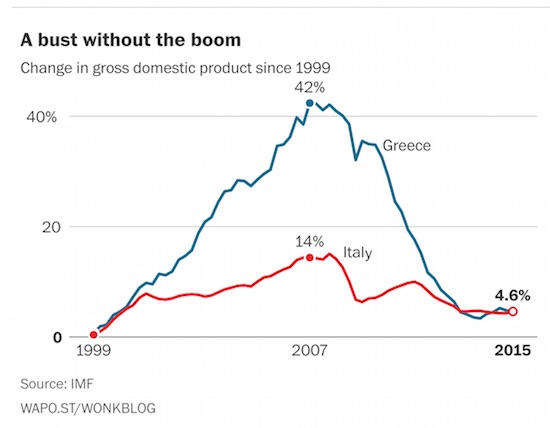
Part of it is that Italy, as the IMF points out, has real structural problems. It’s hard to start a business, hard to expand one, and hard to fire people, which makes employers wary about hiring them in the first place. That’s led to a small business dystopia, where nobody can achieve the kind of economies of scale that would make them more productive. But, at the same time, Italy had these problems even before it had the euro, and it still managed to grow back then. So part of the problem is the euro itself. It’s too expensive for Italian exporters, and too restrictive for the government that’s had to cut its budget even more than it otherwise would have. This doesn’t make Italy unique—the euro has hurt even the best-run countries—but what does is that Italy’s populists have noticed.

Why is that? Well, more than anything else, the common currency has given Europe a severe case of cognitive dissonance. People hate austerity, but they love the euro even more—they have an emotional attachment to everything it stands for. The problem, though, is that the euro is the reason they have to slash their budgets so much in the first place (at least as long as the ECB will force their banks shut if they don’t). So anti-austerity parties have felt like they have to promise the impossible if they want any hope of gaining power: that they can end the budget cuts without ending the country’s euro membership.

But as Greece’s Syriza party found out, that strategy, if you want to call it one, only gives your people unrealistic expectations and Europe no reason to help you out. The other countries, after all, don’t want to reward what, in their view, is bad budgetary behavior, if not blackmail. And so Greece was all but given an ultimatum: either leave the euro or do even more austerity than it was originally told to do. It chose austerity.

Read more …

Good piece by Ellen, and certainly not only because she quotes me.

• The Greek Coup: Liquidity as a Weapon of Coercion (Ellen Brown)

In the modern global banking system, all banks need a credit line with the central bank in order to be part of the payments system. Choking off that credit line was a form of blackmail the Greek government couldn’t refuse. Former Greek finance minister Yanis Varoufakis is now being charged with treason for exploring the possibility of an alternative payment system in the event of a Greek exit from the euro. The irony of it all was underscored by Raúl Ilargi Meijer, who opined in a July 27th blog:

The fact that these things were taken into consideration doesn’t mean Syriza was planning a coup . . . . If you want a coup, look instead at the Troika having wrestled control over Greek domestic finances. That’s a coup if you ever saw one. Let’s have an independent commission look into how on earth it is possible that a cabal of unelected movers and shakers gets full control over the entire financial structure of a democratically elected eurozone member government. By all means, let’s see the legal arguments for this.

So how was that coup pulled off? The answer seems to be through extortion. The ECB threatened to turn off the liquidity that all banks – even solvent ones – need to maintain their day-to-day accounting balances. That threat was made good in the run-up to the Greek referendum, when the ECB did turn off the liquidity tap and Greek banks had to close their doors. Businesses were left without supplies and pensioners without food. How was that apparently criminal act justified? Here is the rather tortured reasoning of ECB President Mario Draghi at a press conference on July 16:

There is an article in the [Maastricht] Treaty that says that basically the ECB has the responsibility to promote the smooth functioning of the payment system. But this has to do with . . . the distribution of notes, coins. So not with the provision of liquidity, which actually is regulated by a different provision, in Article 18.1 in the ECB Statute: “In order to achieve the objectives of the ESCB [European System of Central Banks], the ECB and the national central banks may conduct credit operations with credit institutions and other market participants, with lending based on adequate collateral.” This is the Treaty provision. But our operations were not monetary policy operations, but ELA [Emergency Liquidity Assistance] operations, and so they are regulated by a separate agreement, which makes explicit reference to the necessity to have sufficient collateral. So, all in all, liquidity provision has never been unconditional and unlimited.

Read more …

Don’t forget there is a fourth ‘institution’ that’s party to the talks now, the ESM. It really is a quadriga.

• Greece Crisis Escalates As IMF Witholds Support For New Bail-Out (Telegraph)

Talks over an €86bn bail-out for Greece have been thrown into turmoil after just four days as the IMF said it would have no involvement in the country until it receives explicit assurances over debt sustainability. An IMF official said the fund would withhold financial support unless it has guarantees Greece can carry out a “comprehensive” set of reforms and will be the beneficiary of debt relief from its European creditors. The comments came after the IMF’s executive board was told that the institution could no longer continue pumping more money into the debtor nation, according to a leaked document seen by the Financial Times. The Washington-based Fund has been torn over its involvement in Greece – its largest ever recipient country.

The world’s “lender of last resort’ said it would continue talks with its creditor partners and the Leftist government of Athens, but made it clear the onus of keeping Greece in the eurozone now fell on Europe’s reluctant member states. “There is a need for difficult decisions on both sides… difficult decisions in Greece regarding reforms, and difficult decisions among Greece’s European partners about debt relief,” said the official. “One should not be under the illusion that one side of it can fix the problem.” The delay could last well into next year, forcing the other two-thirds of the Troika – the ECB abd EC – to bear the full costs of keeping Greece afloat.

Athens was forced to request a new IMF rescue package last week after its existing programme – which expired in March 2016 – no longer satisfied IMF conditions to ensure growth and a return to the financial markets for the crisis-ridden economy. IMF managing director Christine Lagarde escalated calls for a “significant debt restructuring” this week. Debt forgiveness has long been the institution’s key condition for extending its involvement in the country after five years of bail-outs. But Europe’s creditor powers – led by Germany – have resisted write-offs, insisting that talks on debt relief can only proceed once the Greek government has satisfied demands to raise taxes, cut pensions spending and privatise assets.

Read more …

I’m wondering how much of this was preconceived.

• IMF Won’t Help Finance Greece Without Debt Relief (Bloomberg)

The IMF reiterated its unwillingness to provide more financing to Greece without debt relief by euro-member states and further reforms from the Greek government. The Washington-based lender’s management won’t support a new loan program unless Greece’s debt is sustainable in the medium term and the country’s budget is fully financed for 12 months, an IMF official told reporters Thursday on a conference call. The official spoke on condition of anonymity. The IMF will require an explicit, concrete commitment of debt relief from euro-member countries before moving forward with a new loan, the official said. European countries haven’t had detailed discussions with the IMF on a debt restructuring, according to the official.

Greek Finance Minister Euclid Tsakalotos asked the IMF for a new loan in a letter dated July 23 addressed to fund Managing Director Christine Lagarde. Greece has an active loan program with the IMF that expires in March and has about €17 billion that could still be disbursed. In agreeing to a bailout this month that could give Greece as much as €86 billion, most of it financed by euro-zone countries, Greece agreed to seek continued IMF financing beyond March. IMF staff told the fund’s executive board on Wednesday that Greece doesn’t currently qualify for a loan, the Financial Times reported Thursday, citing a confidential summary of the meeting.

Read more …

And did it know this when Tsipras signed the latest agreement? Moreover, what does that mean legally?

• Will The IMF Throw The Spanner In The Works? (Varoufakis)

“IMF cannot join Greek rescue, board told”… reports Peter Spiegel from Brussels in today’s Financial Times. He adds:“Some Greek officials suspect the IMF and Wolfgang Schäuble, the hardline German finance minister, are determined to scupper a Greek rescue despite this month’s agreement to move forward with a third bailout. In a private teleconference made public this week, Yanis Varoufakis, the former finance minister, said he feared the Greek government would pass new rounds of economic reforms only for the IMF to pull the plug on the programme later this year. “According to its own rules, the IMF cannot participate in any new bailout. I mean, they’ve already violated their rules twice to do so, but I don’t think they will do it a third time,” Mr Varoufakis said. “Dr Schäuble and the IMF have a common interest: they don’t want this deal to go ahead.”

The key issue, of course, is not so much whether the IMF will be part of the deal – a typical fudge could, for instance, be concocted with the IMF providing ‘technical assistance’ to an ESM-only program. The issue is whether the promised debt relief which, astonishingly will be discussed only after the new loan agreement is signed and sealed, will prove adequate – assuming it is granted at all. Or whether, as I very much fear, the debt relief will be too little while the austerity involved proves catastrophically large.

Read more …

4 different articles by Yanis today; he’s getting very prolific.

• The Lethal Deferral of Greek Debt Restructuring (Varoufakis)

The point of restructuring debt is to reduce the volume of new loans needed to salvage an insolvent entity. Creditors offer debt relief to get more value back and to extend as little new finance to the insolvent entity as possible. Remarkably, Greece’s creditors seem unable to appreciate this sound financial principle. Where Greek debt is concerned, a clear pattern has emerged over the past five years. It remains unbroken to this day. In 2010, Europe and the International Monetary Fund extended loans to the insolvent Greek state equal to 44% of the country’s GDP. The very mention of debt restructuring was considered inadmissible and a cause for ridiculing those of us who dared suggest its inevitability. In 2012, as the debt-to-GDP ratio skyrocketed, Greece’s private creditors were given a significant 34% haircut.

At the same time, however, new loans worth 63% of GDP were added to Greece’s national debt. A few months later, in November, the Eurogroup (comprising eurozone members’ finance ministers) indicated that debt relief would be finalized by December 2014, once the 2012 program was “successfully” completed and the Greek government’s budget had attained a primary surplus (which excludes interest payments). In 2015, however, with the primary surplus achieved, Greece’s creditors refused even to discuss debt relief. For five months, negotiations remained at an impasse, culminating in the July 5 referendum in Greece, in which voters overwhelmingly rejected further austerity, and the Greek government’s subsequent surrender, formalized in the July 12 Euro Summit agreement.

That agreement, which is now the blueprint for Greece’s relationship with the eurozone, perpetuates the five-year-long pattern of placing debt restructuring at the end of a sorry sequence of fiscal tightening, economic contraction, and program failure. Indeed, the sequence of the new “bailout” envisaged in the July 12 agreement predictably begins with the adoption – before the end of the month – of harsh tax measures and medium-term fiscal targets equivalent to another bout of stringent austerity. Then comes a mid-summer negotiation of another large loan, equivalent to 48% of GDP (the debt-to-GDP ratio is already above 180%). Finally, in November, at the earliest, and after the first review of the new program is completed, “the Eurogroup stands ready to consider, if necessary, possible additional measures… aiming at ensuring that gross financing needs remain at a sustainable level.”

Read more …

Funny story.

• A Most Peculiar Friendship (Varoufakis)

Crises sever old bonds. But they also forge splendid new friendships. Over the past months one such friendship has struck me as a marvellous reflection of the new possibilities that Europe’s crisis has spawned. When I was living in Britain, between 1978 and 1988, Lord (then Norman) Lamont represented everything that I opposed. Even though I appreciated Margaret Thatcher’s candour, her regime stood for everything I resisted. Indeed, there was hardly a demonstration against her government that I failed to join; the pinnacle being the 1984 miners’ strike that engulfed me on a daily basis, in all its bitterness and glory.

For Lord Lamont, a stalwart conservative politician, an investment banker, and long standing Treasury and cabinet minister under both Margaret Thatcher and John Major, my ilk surely represented everything that was objectionable in the youth of the day. And yet since I became minister, and especially after my resignation, Lord Lamont has been steadfast in his support and extremely generous with his counsel. Indeed, I would be honoured if he allowed me to count him as a good friend. Fascinatingly, neither Lord Lamont nor I have changed our political spots much. He remains a solid conservative thinker and politician. And I continue to hold on to my erratic Marxism. Which brings me to the fascinating question: How is such a friendship possible?

The answer is simple: A common commitment to democracy and to the indispensability of Parliament’s sovereignty. Tories like Lord Lamont and lefties of my sort may disagree strongly on society’s ends. But we agree that rules and markets are means to social ends that can only be determined by a sovereign people through a Parliament in which that sovereignty is vested. We may disagree on the functioning, capacity and limits of markets, or even on the precise meaning of freedom in a social context. But we are as one in the conviction that monetary policy cannot de-politicised, not be allowed to determine the limits of a nation’s sovereignty. The notion that a people’s sovereignty ends when insolvency beckons is anathema to both.

Read more …

Posted this yesterday as a pic, and awkward format. Here’s the text as Varoufakis posted it.

• The Defeat of Europe – my piece in Le Monde Diplomatique (Varoufakis)

Perhaps the most dispiriting experience was to be an eyewitness to the humiliation of the Commission and of the few friendly, well-meaning finance ministers. To be told by good people holding high office in the Commission and in the French government that “the Commission must defer to the Eurogroup’s President”, or that “France is not what it used to be”, made me almost weep. To hear the German finance minister say, on 8th June, in his office, that he had no advice for me on how to prevent an accident that would be tremendously costly for Europe as a whole, disappointed me. By the end of June, we had given ground on most of the troika’s demands, the exception being that we insisted on a mild debt restructure involving no haircuts and smart debt swaps.

On 25th June I attended my penultimate Eurogroup meeting where I was presented with the troika’s ‘take it or leave it’ offer. Having met the troika nine tenths of the way, we were expecting them to move towards us a little, to allow for something resembling an honourable agreement. Instead, they backtracked in relation to their own, previous position (e.g. on VAT). Clearly they were demanding that we capitulate in a manner that demonstrates our humiliation to the whole world, offering us a deal that, even if we had accepted, would destroy what is left of Greece’s social economy. On the following day, Prime Minister Tsipras announced that the troika’s ultimatum would be put to the Greek people in a referendum. A day later, on Friday 27th June, I attended my last Eurogroup meeting.

It was the meeting which put in train the foretold closure of Greece’s banks; a form of punishment for our audacity to consult our people. In that meeting, President Dijsselbloem announced that he was about to convene a second meeting later that evening without me; without Greece being represented. I protested that he cannot, of his own accord, exclude the finance minister of a Eurozone member-state and I asked for legal advice on the matter. After a short break, the advice came from the Secretariat: “The Eurogroup does not exist in European law. It is an informal group and, therefore, there are no written rules to constrain its President.” In my mind, that was the epitaph of the Europe that Adenauer, De Gaulle, Brandt, Giscard, Schmidt, Kohl, Mitterrand etc. had worked towards. Of the Europe that I had always thought of, ever since I was a teenager, as my point of reference, my compass.

Read more …

It may be the best recipe for blowing up the Union, though.

• The Last Thing the Eurozone Needs Is an Ever Closer Union (Legrain)

‘Fuite en avant’ is a wonderful French expression that is hard to translate into English. Literally, it means “forward flight.” Better approximations include “headlong rush,” “panicky compulsion to exacerbate a crisis,” or even “unconsciously throwing oneself into a dreaded danger.” Faced with Berlin’s power grab to reshape the eurozone along German lines, Paris’s response has been quintessential fuite en avant: proposing even closer ties with Germany in order to try to mitigate the damage done by existing ones. But if a marriage is miserable and divorce is not yet in the cards, might it not be better to have separate bedrooms? To be fair to France’s president, François Hollande, a headlong rush toward greater intimacy has been the default response to previous crises thrown up by European integration, so it is the most common prescription now.

If a fiscal and political union is truly necessary for the eurozone to survive, as many argue, his proposal of a democratically elected eurozone government that would act as a fiscal counterpart to the ECB and – whisper it softly – curb German power may make sense. Italy’s finance minister has suggested something similar. But creating a eurozone government to bridge the economic and political divisions exacerbated by the crisis would be putting the cart before the horse. Or to put it differently, it would be seeking an institutional fix to a much deeper political conflict. Yes, well-functioning common institutions would make Europe’s dysfunctional monetary union work better: Federalism works fine in the United States and elsewhere.

But that is because there is broad political acceptance of those federal institutions’ legitimacy — which, in turn, is because the United States is a nation-state with enough of a sense of shared political community to accept majoritarian democratic rule. Unlike the eurozone. Germany and France sharing a government? Hard to imagine. Germany and Greece? Impossible. Huge numbers of Europeans are unhappy with how the eurozone works. Many don’t trust national elites, let alone European ones. Regrettably, the crisis has revived old stereotypes, such as lazy southerners, and has created new grievances, notably the Troika’s usurping national democracy. Is the solution really to concentrate more powers in Brussels, with France and others giving up even more control over their economic destiny? Is that what French people are clamoring for? Eurozone governance isn’t working, so let’s have more of it. Brilliant.

Read more …

Even the NYT wakes up to reality.

• Bailout Money Goes to Greece, Only to Flow Out Again (NY Times)

Since 2010 other eurozone countries and the IMF have given Greece about €230 billion in bailout funds. In addition, the ECB has lent about €130 billion to Greek banks. The latest financial aid package is following a similar pattern to the previous ones. Only a fraction of the money, should Greece get it, will go toward healing the economy. Nearly 90% would go toward debts, interest and supporting Greece’s ailing banks. The European Commission has offered to set aside an additional €35 billion development aid package to jump-start the economy. But the funds are difficult to obtain and will become available only in small trickles later in the year. Greeks understandably feel that the latest bailout package is not likely to benefit them very much.

[..] Growth was never the primary consideration when Greece first started receiving bailouts. Back in 2010, political leaders in the eurozone as well as top officials of the IMF were terrified that Greece would default on its debts, imposing huge losses on banks and other investors and threatening a renewed financial crisis. The debt was largely held by Greek and international banks. And Greece, officials feared, could be another Lehman Brothers, the investment bank that collapsed in 2008, setting off a global panic. Forcing banks to take losses on Greek debt “would have had immediate and devastating implications for the Greek banking system, not to mention the broader spillover effects,” said John Lipsky, first deputy managing director of the I.M.F. at the time, during a contentious meeting of the organization’s executive board in May 2010, according to recently disclosed minutes.

To prevent Greece from defaulting on debts, creditors granted Athens a €110 billion bailout in May 2010. But that did not calm fears that other heavily indebted countries might also default. The Greek lifeline was soon followed by bailouts for Ireland and Portugal. When Greece again veered toward a default in summer of 2011, it got a second bailout worth €130 billion, not all of which has been disbursed. Instead of writing off those countries’ debts — standard practice when a country borrows more than it can pay — other eurozone countries and the I.M.F. effectively lent them more money. One of the main goals was to protect European banks that had bought Greek, Irish and Portuguese bonds in hopes of making a tidy profit.

The banks and investors did not escape the pain. In 2012, when Greece was again at risk of default, investors accepted a deal that paid them only about half the face value of their holdings. Much of the aid dispensed to Greece has revolved around banks. Since 2010, Greece has received €227 billion from other eurozone countries and the I.M.F. Of that, €48.2 billion went to replenish the capital of Greek banks. More than €120 billion went to pay debt and interest, and around €35 billion went to commercial banks that had taken losses on Greek debt.

Read more …

Whether he said it or not, surely no FinMin should have any say in such matters. it’s utterly ridiculous that at least Merkel doesn’t tell him to shut up.

• German FinMin Schäuble Wants To Reduce European Commission Remit (DW)

German Finance Minister Wolfgang Schäuble wants to see the executive body of the EU, the European Commission (EC), lose some of the core fields of responsibility it has previously borne, such as the legal supervision of the EU domestic market, a newspaper reported on Thursday. The “Frankfurter Allgemeine Zeitung” quoted Brussels diplomats as saying that at a meeting of EU finance ministers two weeks ago, Schäuble had called for a quick discussion between EU states about how the EC could fulfil its original functions, which also include monitoring competition within the EU. Schäuble was concerned that the body’s increasing political activities made it incapable of carrying out its function of watching over the correct implementation of the European treaties, according to the report.

The paper said Schäuble has proposed setting up new, politically independent bodies to take over monitoring tasks in view of the EC’s increasing political activity as a “European government.” According to the paper’s report, Schäuble feels that EC president Jean-Claude Juncker exceeded the body’s remit in recent negotiations over new loans for Greece. The German finance minister has often stated that the EC was not empowered to negotiate over Greek loans, but that this was the task of the Eurogroup – made up of eurozone finance ministers – as the representative of European creditors, the paper said. Schäuble attracted much criticism during the recent negotiations on a third bailout for Greece because of his proposal for Greece to temporarily leave the common euro currency.

Juncker has often emphasized that he wants to lead a “political commission.” The German Finance Ministry has dismissed the report, saying that Schäuble merely thought it “important for the Commission to find the right balance between its political function and its role as guardian of the treaties.” This had nothing to do with a “disempowerment of the Commission,” the ministry said.

Read more …

Having no morals eventually comes back to haunt.

• The IMF’s Euro Crisis (Ngaire Woods)

Over the last few decades, the IMF has learned six important lessons about how to manage government debt crises. In its response to the crisis in Greece, however, each of these lessons has been ignored. The Fund’s participation in the effort to rescue the eurozone may have raised its profile and gained it favor in Europe. But its failure, and the failure of its European shareholders, to adhere to its own best practices may eventually prove to have been a fatal misstep. One key lesson ignored in the Greece debacle is that when a bailout becomes necessary, it should be done once and definitively. The IMF learned this in 1997, when an inadequate bailout of South Korea forced a second round of negotiations. In Greece, the problem is even worse, as the €86 billion ($94 billion) plan now under discussion follows a €110 billion bailout in 2010 and a €130 billion rescue in 2012.

The IMF is, on its own, highly constrained. Its loans are limited to a multiple of a country’s contributions to its capital, and by this measure its loans to Greece are higher than any in its history. Eurozone governments, however, face no such constraints, and were thus free to put in place a program that would have been sustainable. Another lesson that was ignored is not to bail out the banks. The IMF learned this the hard way in the 1980s, when it transferred bad bank loans to Latin American governments onto its own books and those of other governments. In Greece, bad loans issued by French and German banks were moved onto the public books, transferring the exposure not only to European taxpayers, but to the entire membership of the IMF.

The third lesson that the IMF was unable to apply in Greece is that austerity often leads to a vicious cycle, as spending cuts cause the economy to contract far more than it would have otherwise. Because the IMF lends money on a short-term basis, there was an incentive to ignore the effects of austerity in order to arrive at growth projections that imply an ability to repay. Meanwhile, the other eurozone members, seeking to justify less financing, also found it convenient to overlook the calamitous impact of austerity. Fourth, the IMF has learned that reforms are most likely to be implemented when they are few in number and carefully focused. When a country requires assistance, it is tempting for lenders to insist on a long list of reforms. But a crisis-wracked government will struggle to manage multiple demands.

Read more …

Split it up already.

• Deutsche Bank’s Hard Road Ahead (WSJ)

There’s an old joke in which a tourist asks the way to some pleasant town and gets the answer: “Well, I wouldn’t start from here.” Deutsche Bank’s new leadership should appreciate that more than most. John Cryan, the new chief executive, and the equally new chief financial officer, Marcus Schenck, have one of the biggest jobs among global banks in terms of the cuts needed to both its balance sheet and its cost base. They also, like many other big, global banks must wrestle with a business model in which investors seemingly have lost faith—Deutsche’s stock hasn’t traded above book value since the financial crisis.

Investors will be updated in late October on how these two think they can reshape the bank. Investors will hope for something better than a return on tangible equity of more than 10% in the medium term, which was the miserable target announced before the leadership change in April. One thing investors were told by Mr. Cryan in his first results briefing Thursday is that they shouldn’t have to stump up yet more equity following the bank’s €8 billion rights issue last year. This could prove a challenge to fulfill, though, despite the healthier activity seen in the first half. This pushed Deutsche’s revenues up 20% from a year earlier. Unfortunately, the bank’s costs remain stubbornly high. In the first half, these were equal to 70% of revenue, even excluding hefty legal charges related to the interbank lending rate scandal.

Meanwhile, cutting the bank’s complexity and inefficiencies could take years by Mr. Cryan’s admission. Until this is done, Deutsche will struggle to generate much capital. The bank is actually in a reasonable position on the risk-based capital measure: its core equity tier one capital ratio is 11.4%. However, its leverage ratio is just 3.6% against a target of 5%. And in its largest unit, the investment bank, the leverage ratio is even worse at less than 3%. Changing that will still require a big cut in the investment bank’s assets and liabilities. Mr. Cryan says he will change the bank’s fortunes by weaning it off an overreliance on the balance sheet to generate revenues.

Read more …

Fine it $100 billion, see what’s left after that.

• Deutsche Bank Didn’t Archive Chats Used by Employees Tied to Libor Probe (WSJ)

A month after reaching a $2.5 billion settlement over interest rate rigging, Deutsche Bank AG told regulators its disclosures may have been incomplete because it accidentally failed to archive electronic chats involving its employees, people familiar with the matter said. The bank is working to recover the records from its systems but might have permanently lost an unknown number of chats dating back to 2005, the people said. The disclosure poses a new regulatory headache for the German lender. Deutsche Bank already has been criticized by regulators for shortcomings in retaining data, including the destruction of hundreds of audiotapes that U.K. regulators said could have been relevant to their investigation into manipulation of the London interbank offered rate, or Libor.

Deutsche Bank disclosed the problem to regulators, including the New York Department of Financial Services, in May, a month after the bank entered into the settlement with a handful of authorities in the U.S. and the U.K., the people familiar with the matter said. “After we discovered this software defect in one of our internal messaging systems, we reported it to our regulators and are presently working with them to rectify it,” the bank said in an emailed statement. “We have been able to recover a majority of the chats via a backup system.” The bank expects the recovery process to be complete in about a month, one of the people familiar with the matter said.

Deutsche Bank so far hasn’t found any communications the bank considers new or relevant to the Libor investigation, one of the people said. The Department of Financial Services, New York state’s top banking regulator, has begun a probe of the incident. It is examining whether potential violations that should have been covered by the Libor settlement weren’t reported because of the error, according to one of the people familiar with the matter. The office is also investigating whether or not the error was intentional and when the bank discovered it.

Read more …

Think Abe was surprised to see this?

• US Spied On Japan Government, Companies: WikiLeaks (AFP)

The US spied on senior Japanese politicians, its top central banker and major companies including conglomerate Mitsubishi, according to documents released Friday by WikiLeaks, which published a list of at least 35 targets. The latest claim of US National Security Agency espionage follows other documents that showed snooping on allies including Germany and France. There is no specific mention of wiretapping Prime Minister Shinzo Abe but senior members of his government, including Trade Minister Yoichi Miyazawa and Bank of Japan governor Haruhiko Kuroda were targets of the bugging by US intelligence, WikiLeaks said.

Japan is one of Washington’s key allies in the Asia-Pacific region and they regularly consult on defence, economic and trade issues. The spying goes back at least as far as Abe’s brief first term, which began in 2006, WikiLeaks said. Abe swept to power again in late 2012. “The reports demonstrate the depth of US surveillance of the Japanese government, indicating that intelligence was gathered and processed from numerous Japanese government ministries and offices,” it said. “The documents demonstrate intimate knowledge of internal Japanese deliberations” on trade issues, nuclear and climate change policy, among others, it added.

Read more …

Europe has no morals.

• Europe Could Solve The Migrant Crisis – If It Wanted (Guardian)

Refugees from many countries – not just Sudan but Syria, Eritrea, Afghanistan and beyond – are taking clandestine journeys across Europe in search of a country that will give them the chance to rebuild their lives. Living in Britain and watching what unfolds in Calais – such as the revelation that in recent days there have been 1,500 attempts by migrants to enter the Channel tunnel – it can seem as if they’re all heading here, but in reality Britain ranks mid-table in the proportion of asylum claims it receives relative to population. The number of refugees at Calais has grown because the number of refugees in Europe as a whole has grown. For the most part, their journeys pass unseen, until they hit a barrier – the English Channel; the lines of police at Ventimiglia on the Italy-France border; the forests of Macedonia – that creates a bottleneck and leads to scenes of destitution and chaos.

The political rhetoric that surrounds these migrants makes it harder to understand why they take such journeys. Often when government ministers are called on to comment, they will try to make a distinction between refugees (good) and “economic migrants” (bad). But a refugee needs to think about more than mere survival – like the rest of us, they’re still faced with the question of how to live. What they find when they reach Europe is a system best described as a “lottery”. In theory the EU has a common asylum system; in reality it varies hugely, with different countries more or less likely to accept different nationalities and with provisions for asylum seekers ranging from decent homes and training to support integration in some countries, to tent camps or detention centres, or being left to starve on the street, in others.

Countries that bear the brunt of new waves of migration, such as Italy, Bulgaria or Greece, find little solidarity from their richer neighbours. The EU spends far more on surveillance and deterrence than on improving reception conditions. For as long as these inequalities continue, refugees will keep on moving. This is a crisis of politics as much as it is one of migration, and I think it will develop in one of two ways. Either Europe will continue to militarise its borders and squabble over resettlement quotas of refugees as if they were toxic waste; or we will find the courage and leadership to create a just asylum system where member states pull together to ensure that refugees are offered a basic standard of living wherever they arrive.

The first option, though alluring to many, will only intensify the chaos it’s supposed to protect us from: we put up a fence at Greece’s land border with Turkey, so refugees take to the Mediterranean instead. Britain and France accuse each other of being a soft touch on asylum seekers, so they allow the situation in Calais to fester. For as long as refugees are treated as a burden, they will be the target of racism and violence.

Read more …

I repeat: the MSM sets the tone of the debate by calling refugees ‘migrants’, and by calling SYRIZA and M5S ‘populist’.

• Why The Language We Use To Talk About Refugees Matters So Much (WaPo)

In an interview with British news station ITV on Thursday, David Cameron told viewers that the French port of Calais was safe and secure, despite a “swarm” of migrants trying to gain access to Britain. Rival politicians soon rushed to criticize the British prime minister’s language: Even Nigel Farage, leader of the anti-immigration UKIP party, jumped in to say he was not “seeking to use language like that” (though he has in the past). Cameron clearly chose his words poorly. As Lisa Doyle, head of advocacy for the Refugee Council puts it, the use of the word swarm was “dehumanizing” – migrants are not insects. It was also badly timed, coming as France deployed riot police to Calais after a Sudanese man became the ninth person in less than two months to die while trying to enter the Channel Tunnel, an underground train line that runs from France to Britain.

Much of the outrage over the British leader’s comments misses an important point, however: Cameron is far from alone when it comes to troubling use of language to describe the world’s current migration crisis. Language is inherently political, and the language used to describe migrants and refugees is politicized. The way we talk about migrants in turn influences the way we deal with them, with sometimes worrying consequences. Consider even the most basic elements of the language about migration. Writing in the Guardian earlier this year, Mawuna Remarque Koutonin asked why white people were often referred to as expatriates. “Top African professionals going to work in Europe are not considered expats,” Koutonin wrote. “They are immigrants.” [..]

There are worries that even “migrant,” perhaps the broadest and most neutral term we have, could become politicized. Trilling pointed out that Katie Hopkins, a controversial British writer and public figure, likened migrants to “cockroaches” in a column published in the Sun. “As both government policy and political rhetoric casts these people as undesirables — a threat to security; a criminal element; a drain on resources — the word used to describe them takes on a new, negative meaning,” Trilling says. Words such as “swarm” or “invasion” can also have implications just as negative when used in connection to refugees. James Hathaway at the University of Michigan Law School, says that these words are “clearly meant to instill fear.” That’s dangerous because the situation in Calais is already inflamed and full of fear: British tabloids are even calling for Cameron to send in the army, as if the migrants represented a foreign power preparing to invade.

Read more …

Jan 032015
 
 January 3, 2015  Posted by at 12:55 pm Finance Tagged with: , , , , , , , ,  2 Responses »


Jack Delano Joliet, Illinois. Leaving the Atchison, Topeka & Santa Fe railyard 1943

• Europe’s Bond Yields Fall To Lowest Since The Black Death (AEP)
• Dollar Index Soars To Nearly 9-Year High (MarketWatch)
• Greek And European Prospects For 2015 (Varoufakis)
• Lithuania Joins Eurozone Despite 40% Of Population Being Against (RT)
• Obama Sanctions North Korea For Sony Hack It Didn’t Perpetrate (Zero Hedge)
• Oliver Stone’s New Movie: “Ukraine: The CIA Coup” (Zero Hedge)
• China Zombie Factories Kept Open To Give Illusion Of Prosperity (FT)
• Why The Stock Market Casino Is Dangerous: Looney Tunes And Sand Dunes (Stockman)
• As Oil Price Drops, Good Times Run Out for Sand Producers (WSJ)
• The ‘Shock’ That Awaits Pensioners At Retirement (BBC)
• Michael Hudson: The War on Pensions – The US Budget Anti-Pension Law (NC)
• New Consumer Debt Reaches Seven-Year High In UK (Guardian)
• Right Wing In Europe Could Bring ‘Turmoil’ (CNBC)
• General Motors: A New Year, A New Series Of Recalls (Reuters) <
• Failure To Stop Petrobras Scandal Could Haunt Brazil’s Rousseff (Reuters)
• The Imperial Collapse Playbook (Dmitry Orlov)
• South Australia ‘Incredibly Dangerous’ Wildfires Worst Since 1983 (Bloomberg)

“Nothing like this has been seen in European history since the 14th century, after the depletion of silver mines set off a slow monetary contraction, followed by Edward III’s default on debts to Italian banks and the Black Death soon after..”

• Europe’s Bond Yields Fall To Lowest Since The Black Death (AEP)

Bond yields have plummeted to record lows across the eurozone as deflation becomes lodged in the system and markets bet on a blitz of asset purchases by the European Central Bank this month. German five-year yields dropped below zero for the first time ever, touching -0.007% on the first day of new year trading, implying that investors are willing to pay the German government to store their money for the rest of this decade. Italian, Spanish and Portuguese yields have seen spectacular drops over the past two trading days. The French state can borrow for five years at a rate of 0.13%, and Ireland can do so at 0.32%. Nothing like this has been seen in European history since the 14th century, after the depletion of silver mines set off a slow monetary contraction, followed by Edward III’s default on debts to Italian banks and the Black Death soon after, compounding a deflationary collapse.

“What we are seeing is the ‘Japanification’ trade,” said Andrew Roberts, credit chief at RBS. “The eurozone is sinking into corrosive deflation and it is too late to stop. We think the inflation rate in December may already have been negative. The ECB are in trouble, and they know it.” Mario Draghi, the ECB’s president, told Germany’s Handelsblatt that a slip into deflation “cannot be ruled out completely” and admitted that the bank is at mounting risk of breaching its price stability mandate. Mr Draghi said the ECB is “making technical preparations” to boost its balance sheet in early 2015, but offered no fresh clues on how much it will be or whether the measures will include full quantitative easing in the form of sovereign bond purchases.

Investors have taken his comments as a strong hint of QE as soon as this month, even though he repeated his usual caveat that new measures will be undertaken only “should it become necessary to further address risks of a too prolonged period of low inflation”. His interview may have been the trigger for the latest dash for EMU sovereign debt. There are not enough bonds to buy from certain countries if the ECB sweeps into the market on a grand scale. Bank of America said there would be an acute shortage of German debt since Berlin plans to run a budget surplus this year and will therefore be retiring bonds gradually instead of issuing them. The ECB would quickly run out of Latvian or Greek bonds trading on the open market. The US bank predicted bond purchases of between €180bn and €360bn a year, warning that the economic outlook will “deteriorate substantially” if the ECB is prevented from carrying out QE for political reasons.he said.

Read more …

On its way to parity.

• Dollar Index Soars To Nearly 9-Year High (MarketWatch)

The U.S. dollar soared Friday, building on big gains scored in 2014, on expectations the Federal Reserve will raise interest rates while the ECB and Bank of Japan continue to loosen monetary policy in the year ahead. The ICE dollar index rose to 91.11, up from 90.27 in late North American trade on Wednesday and marking its highest level since March 2006, according to FactSet data. The index rose almost 13% in 2014, to mark its best yearly gain since 2005. “We have entered ‘15 with the same themes that we ended last year, namely positive U.S. sentiment fueling U.S. dollar gains,” wrote Jeremy Stretch, strategist at CIBC in London. Meanwhile, the euro “remains bedeviled by broad-based uncertainty as the Japanese yen remains on the defensive as the Bank of Japan maintains that they still have various tools to ease policy,” he said.

The euro kicked off 2015 on a downbeat note, falling to its lowest level versus the dollar since 2010, after European Central Bank President Mario Draghi hinted that the bank is moving closer to launching a full-scale quantitative easing program. The shared currency fell to $1.2001, down from $1.2099 on Wednesday, its lowest level since 2010. The euro’s weakness on Friday continued a trend seen in 2014, when it lost 12.2% against the dollar on expectations the ECB will act in early 2015 to implement full-blown quantitative easing, to help avert outright deflation in the eurozone. Renewed political turmoil in Greece, which faces a snap general election in January, is also weighing on the shared currency.

Draghi spoke about low inflation in an interview with German newspaper Handelsblatt, published on Friday, in which he said the eurozone remains in danger of falling into a downward spiral of declining consumer prices. “The risk that we do not fulfill our mandate of price stability is higher than six months ago,” he said in the interview. To fight off the risk of deflation, the central bank is therefore preparing to “adjust the scope, pace and composition of measures at the start of 2015, should this be necessary to respond to a too-long period of low inflation,” the ECB president said.

Read more …

“The threat to a SYRIZA government will not come from the markets. Remember: Greece is bankrupt and is not borrowing from private investors. [..] the threat to a SYRIZA government comes from the ECB, from the EU and from Berlin.”

• Greek And European Prospects For 2015 (Varoufakis)

European media often speak of the “Greek recovery” and the growth of competitiveness of the country to try to persuade the public opinion about the effectiveness of austerity and structural reforms imposed by the Troika. Considering the macroeconomic data, however, we find a youth unemployment above 50%, a negative inflation rate and a debt-deflation spiral out of control. How is it possible to speak of “recovery” when three Greek citizen out of five have exceeded the poverty line? Over the past two years, no fact could get in the way of the EU propaganda machine which, approximately eighteen months ago, went into overdrive in an attempt to shore up the Samaras government, terrified at the prospect of a new government in Athens that insists of speaking truth to power. Have you noticed how the ‘Greek Success Story’ narrative disappeared once elections became inevitable? What kind or ‘recovery’ was it that went up in a puff of smoke the moment an election appeared over the horizon?

The answer is: a ‘recovery’ that existed only in the realm of propaganda. A ‘recovery’ that was engineered by means of two new bubbles, one in the bond market the other in the market for Greek banking shares – bubbles that burst the moment the Greek people seemed as if they were to have a chance to express what they felt about the said ‘recovery’ in the polling stations. A ‘recovery’ evidenced in one quarter’s positive GDP growth (equal to 0.7%), after seven years of continuous decline, which was due to the sad fact that nominal GDP fell – but for the first time it fell less than average prices did. So, let’s be frank: There was no recovery. What we did have was a monstrous denial that was functional to the story Mrs Merkel wanted to convey to European citizens: If austerity worked even in Greece, it must be the right cure for every European realm, and it must thus be accepted unthinkingly by every European – especially the… Italians.

In Greece there will be a general election next January 25, 2015. According to the latest polls, SYRIZA, the main opposition party critic of the austerity measures imposed by the Troika, could be the winner. But, victory at the polls could be precluded by the speculative attack of the markets on spread, aimed at creating a climate of terror among the public. What remains of democracy in this oligarchic regime of the European Union? And the same scenario could be repeated in other countries with those parties critical of the institutional architecture of the EU? The threat to a SYRIZA government will not come from the markets. Remember: Greece is bankrupt and is not borrowing from private investors.

When you do not borrow, you do not care about the interest rate! No, the threat to a SYRIZA government comes from the ECB, from the EU and from Berlin. Days after its election, there is a strong chance that our European partners’ officials, in violation of democracy’s – and logic’s – most basic principles, will threaten the new Athens government with a shutdown of Greece’s banking system until and unless it bows to their will. This is far, far worse, and morally more reprehensible, than being terrorised by the markets. Investors have every right to demand high interest rates in order to lend you money. Fellow democratic governments and unelected central bankers have no right to threaten a newly elected government with Armageddon if it dares ask for a renegotiation of an unsustainable loan agreement with the EU, the ECB and the IMF.

Read more …

HA HA! “EU economic affairs commissioner Pierre Moscovici said that in joining the euro, the Lithuanian people are “choosing to be part of an area of stability, security and prosperity.“

• Lithuania Joins Eurozone Despite 40% Of Population Being Against (RT)

Lithuania has celebrated the New Year by joining the eurozone. The decision is country’s bid to boost stability despite inflation fears and euro zone debt troubles. However, according to a November poll about 40% of the population opposed the move. Lithuanian Prime Minister Algirdas Butkevicius withdrew his first 10 euro bill from a Vilnius cash machine right after midnight January 1. The exchange rate is now set at one euro for 3.45 litas, the country’s old currency. Both litas and euros will circulate in the country till June. “The euro will serve as a guarantee for our economic and political security,” Butkevicius said at a ceremony which was attended by officials of other Baltic states – Estonia and Latvia.

Latvia joined the eurozone on January 1, 2014 despite opinion polls showing that a majority of the country’s population opposed the move, with just 20% strongly in favor. Estonia joined the currency bloc in 2011. “Myself, and I think, many of you feel sad that the litas, which has served us well for more than two decades, becomes history, but we have to move forward,” said Lithuania’s Finance Minister Rimantas Sadzius at the ceremony. Earlier the country’s President Dalia Grybauskaite said that joining eurozone is symbol of “deeper economic and political integration with the West.” However, not everyone in Lithuania shared the optimism of Grybauskaite.

According to a November survey released by the central bank, only 53% of the population supported the move, while 39% were against. “Financial commitments are a huge burden and increase the country’s debt. I think we should have delayed entry,” financial analyst Valdemaras Katkus told AFP. In the meantime the European Commission has put a huge banner over its headquarters in Brussels, saying “Welcome to the euro area, Lithuania!” EU economic affairs commissioner Pierre Moscovici said that in joining the euro, the Lithuanian people are “choosing to be part of an area of stability, security and prosperity.” Lithuania has already donated millions of euros to the eurozone’s rescue fund for struggling EU members, such as Greece.

Read more …

“.. this action is so stupid no amount of commentary would possibly do it justice ..”

• Obama Sanctions North Korea For Sony Hack It Didn’t Perpetrate (Zero Hedge)

US foreign policy just jumped the shark: a few days after both the FBI and the US State department were humiliated when it was revealed that it wasn’t North Korea but a disgruntled, laid off Sony employee that was responsible for the “hack”, and when the best possible course of action would have been to simply let this latest embarrassing incident fade from memory, moments ago Obama – currently not working out next to a rainbow or flashing his support of “Shaka” – just signed his first executive order of 2015, imposing even more sanctions against North Korea. From Bloomberg:

President Obama signs order imposing additional sanctions on North Korea in response to country’s “efforts to undermine U.S. cyber-security and intimidate U.S. businesses and artists exercising their right of freedom of speech,” according to Treasury Dept statement. [..] Sanctions target 3 entities, 10 individuals [..] Including North Korea’s intelligence agency, arms dealer, North Korea’s representatives in Namibia, Sudan, Iran, Syria, China “Even as the FBI continues its investigation into the cyber-attack against Sony Pictures Entertainment, these steps underscore that we will employ a broad set of tools to defend U.S. businesses and citizens, and to respond to attempts to undermine our values or threaten the national security of the United States,” Treasury Sec. Lew says in statement.

That this action is so stupid no amount of commentary would possibly do it justice is quite clear, which is why we patiently await North Korean TV to escalate its comedic feud with the “monkey in a tropical jungle.” Perhaps the only silver lining is that Obama did not launch a nuclear attack on Pyongyang outright, although there is still a 2 year period until January 2017. And anything goes, especially once the NSA fabricates another YouTube clip.

Read more …

“The truth is not being aired in the West. It’s a surreal perversion of history that’s going on once again, as in Bush pre-Iraq ‘WMD’ campaign.”

• Oliver Stone’s New Movie: “Ukraine: The CIA Coup” (Zero Hedge)

From Oliver Stone’s Facebook page: Excuse my absence these past weeks. A combination of overwork, prepping the Snowden movie in Germany & England, a side trip to Moscow, and a devastating head cold have laid me low. Recovering over Christmas in California; winter sun helps. Interviewed Viktor Yanukovych 4 hours in Moscow for new English language documentary produced by Ukrainians. He was the legitimate President of Ukraine until he suddenly wasn’t on February 22 of this year. Details to follow in the documentary, but it seems clear that the so-called ‘shooters’ who killed 14 police men, wounded some 85, and killed 45 protesting civilians, were outside third party agitators.

Many witnesses, including Yanukovych and police officials, believe these foreign elements were introduced by pro-Western factions – with CIA fingerprints on it. Remember the Chavez ‘regime change’/coup of 2002 when he was temporarily ousted after pro and anti-Chavez demonstrators were fired upon by mysterious shooters in office buildings. Also resembles similar technique early this year in Venezuela when Maduro’s legally elected Government was almost toppled by violence aimed at anti-Maduro protestors. Create enough chaos, as the CIA did in Iran ‘53, Chile ‘73, and countless other coups, and the legitimate Government can be toppled. It’s America’s soft power technique called ‘Regime Change 101.’

In this case the “Maidan Massacre” was featured in Western media as the result of an unstable, brutal pro-Russian Yanukovych Government. You may recall Yanukovych went along with the February 21 deal with opposition parties and 3 EU foreign minsters to get rid of him by calling for early elections. The next day that deal was meaningless when well-armed, neo-Nazi radicals forced Yanukovych to flee the country with repeated assassination attempts. By the next day, a new pro-Western government was established and immediately recognized by the US (as in the Chavez 2002 coup). A dirty story through and through, but in the tragic aftermath of this coup, the West has maintained the dominant narrative of “Russia in Crimea” whereas the true narrative is “USA in Ukraine.”

The truth is not being aired in the West. It’s a surreal perversion of history that’s going on once again, as in Bush pre-Iraq ‘WMD’ campaign. But I believe the truth will finally come out in the West, I hope, in time to stop further insanity. For a broader understanding, see Pepe Escobar’s analysis “The new European ‘arc of instability,’” which indicates growing turbulence in 2015, as the US cannot tolerate the idea of any rival economic entity. You might also see “Untold History” Chapter 10 where we discuss the dangers of past Empires which did not allow for the emergence of competing economic countries.

Read more …

No surprise here.

• China Zombie Factories Kept Open To Give Illusion Of Prosperity (FT)

In the shadow of a group of enormous smokestacks and abandoned foundries, a peeling sign welcomes visitors to the Wenxi Steel Industrial Park. But in the nearby village, the working-age men and many of the women have gone, leaving only the elderly and the very young. ‘If you cut down the big tree, all the small trees around it will die’, says 69-year-old Wang Peiqing, referring to the collapse of Highsee Iron and Steel Group, which operated the foundries before its recent closure devastated the economy of a once-prosperous corner of Shanxi province in central China. The entire region relied on the steel mill; now the young people have to go and look for work across China.

Highsee stopped paying its 10,000 employees six months ago. Local officials estimate the plant supported indirectly the livelihood of about a quarter of Wenxi county s population of 400,000. Highsee was the biggest privately owned steel mill in Shanxi, accounting for 60 per cent of Wenxi s tax revenues. For those reasons, the local government was reluctant to allow the company to go out of business, even though it had been in serious financial difficulties for several years. By 2011 Highsee was already like a dead centipede that hadn t yet frozen stiff with rigor mortis, says one official. More than half the plant shut down, but it was still producing steel even though its suppliers wouldn’t deliver anything without cash up front and it was drowning in debt.

Across the vast expanses of China, similar experiences are playing out, with thousands of companies in heavy industrial sectors plagued by chronic overcapacity that should be going bust instead being propped up by local governments. With enormous power over courts, state-owned banks and local administrative departments, Communist party officials across China are prepared to go to great lengths to support the biggest failing employers in their jurisdictions. It was only last month, four years after Highsee began to flounder, that the company was finally allowed by the government to initiate bankruptcy proceedings.

In the past month alone Chinese media have reported on at least nine large steel mills that appeared to be suspended in limbo after halting production but which are forbidden from going formally bankrupt. There are large numbers of companies across China that should go bankrupt but haven’t done so, says Han Chuanhua, a bankruptcy lawyer at Zhongzi Law Office, a Beijing legal practice. The government doesn’t want to see bankruptcy because as soon as companies go bust, unemployment spikes and tax revenues disappear. By stopping companies from going bankrupt, officials are able to maintain the illusion of local prosperity, economic growth and stable taxes.

Read more …

“.. the Fed is committed to sending its interest rate change messages by pony express to speculators who operate in the nano-second based cybersphere of modern trading technology. It’s not even a contest; its a bad joke which showers the 1% with stupendous windfalls.”

• Why The Stock Market Casino Is Dangerous: Looney Tunes And Sand Dunes (Stockman)

On August 4th the Wall Street Journal carried a breathless tale of how a handful of obscure oilfield suppliers were striking immense riches in the sand dunes of Wisconsin. Owing to the “shale revolution”, the stock price of an outfit that had originated in the stagnating business of supplying sand traps to golf courses, and which had been at death’s door as recently as 2011, had gone parabolic. Emerge Energy Services (EMES) presently traded at $145 per share, reflecting a red hot gain of 8.5X over its $17 IPO price fifteen months earlier. In a literal sense, silicon valley had come to the silicon dunes of Lake Michigan, as reflected in EMES’ valuation at 43X its LTM earnings.

Given the fact that EMES’ share price had most recently risen by $100 or $2.5 billion of market just since January 2014, the “momo” story was self-evidently all about upside growth, not current profits or cash flow. In fact, during its 14 quarters as a public filer, EMES had generated negative $50 million of operating cash flow after CapEx. So at a total enterprise value of $3.7 billion, the punters chasing the stock straight up the parabolic curve would seemingly have anticipated some stupendous growth indeed. Except……except they had no idea about EMES’ sustainable growth potential and didn’t care because the buyers were robots, day traders and flavor-of-the-month hedge funds.

They were piling into the stock of a company selling a form (white sand) of the second most abundant low-value commodity on planet earth for no other reason than Emerge Energy Services was another momo play on steroids. The “price action” was the investment thesis. Yet this typical momo “rip” had occurred not out of the natural elements of human greed and capitalist enterprise, but because the stock market has been destroyed by the Fed. That is, the combination of ZIRP and wealth effects “puts” have eviscerated all of the checks and balances that contain and modulate speculation in honest free markets. On the one hand, Fed policy has massively subsidized momo speculators in two powerful ways.

First, most of them operate through the options markets or employ other forms of heavy, short-term position leverage. Accordingly, their “carry” cost is close to zero, and their position leverage can be continuously rolled-over without risk. That’s because the Fed’s foolish commitment to “transparency” in pegging its policy rate means that speculators are in the catbird seat. In effect, the Fed is committed to sending its interest rate change messages by pony express to speculators who operate in the nano-second based cybersphere of modern trading technology. It’s not even a contest; its a bad joke which showers the 1% with stupendous windfalls.

Read more …

Sand ‘producers’? Is that like water producers?

• As Oil Price Drops, Good Times Run Out for Sand Producers (WSJ)

“This isn’t our first rodeo” has become a catchphrase among oil-industry executives who are laying off workers and dialing back spending in the wake of tumbling crude-oil prices. But for many sand producers, this is their first time on the bucking bronco that is the cyclical energy business—and not all of them are ready for the wild ride, industry analysts say. Sand is an important ingredient in hydraulic fracturing, or fracking, which has pushed American oil output above 9 million barrels a day, rivaling the production of Saudi Arabia or Russia. Sand companies’ biggest customers used to be golf courses and glass manufacturers, but the oil boom brought energy clients to their door and now roughly 60% of business is tied to fracking, according to PacWest Consulting Partners, which forecasts sand demand.

Now that oil prices have fallen, many fracking companies are retrenching—and that is bad news for sand producers. Earlier this fall PacWest projected sand use would grow by 20% each year in 2015 and 2016. But following the plunge in oil prices, PacWest now expects sand demand to stay flat. Meanwhile, new sand mines could add another 10% on top of the existing pile, creating a glut and pushing down prices, said Samir Nangia, a principal of PacWest. Global oil prices have plunged 50% since June, as the surging supply—thanks to fracking—collided with lackluster world-wide demand for fuel this fall.

With their revenue threatened, oil drillers and fracking companies are under tremendous pressure to dial down their spending and the companies they buy sand from will be easy targets, said Karen Nickerson, an energy analyst at Moody’s. “They’re going to push on who they can,” she said. U.S. Silica Holdings Inc., which operates sands mines in Wisconsin, Illinois and Oklahoma, says it is still expecting to grow in 2015, said chief executive Bryan Shinn. Even if oil companies drill fewer wells next year, they are increasing the amount of sand they use per well, he said. “This is providing us with a backstop,” said Mr. Shinn, adding that job cuts aren’t in the cards for his company. “We’re not even talking about that. If anything we might be looking to add jobs as opportunities arise.”

Read more …

Big collapse coming.

• The ‘Shock’ That Awaits Pensioners At Retirement (BBC)

The next generation of Americans to hit retirement will be ‘shocked’ when they find out how little they have to live on. A former Assistant Secretary of the Treasury warns that the US government is standing idly by. “We need to do something, we’re not doing anything,” she says. Professor Alicia Munnell, who is now director of Boston College’s Centre for Retirement Research, tells BBC World Service’s In the Balance programme that most Americans’ voluntary 401(k) pension schemes are seriously under-funded. In a new book, Falling Short, she says the only answer is to work longer and save more. But it is part of a bigger global pensions gap between what is needed to fund pensions and what is actually available in private and public pension pots.

America’s 401(k) was introduced in 1978 as a tax-efficient way of encouraging individual citizens to save for retirement. But the average 401(k) fund, to which individuals and employers contribute, stands at $111,000. That’s about enough to provide just $400 (£256) a month in retirement. On the streets of New York, we questioned people on how confident they were about their retirement income. “I’d say fairly-to-very confident,” says Mark, aged 53 from Boston. “I think we’ve done our part, put as much dough aside as possible. “In the next five to seven years we should be able to save even more – we’ll have to.”

However, Prof Munnell says the first retirees who are going to rely solely on their 401(k) are going to be “stunned” at how little that average $111,000 balance provides them in terms of monthly income. “People are going to be shocked,” she says. Hannah, a 31-year-old New Yorker says: “I think it is getting to the point now in the economy where people my age are going to have to work until they die. “I don’t think social security is going to be able to do anything by the time I retire.” While Prof Munnell says that there will always be some kind of safety net in the US, “we need to put more money in to maintain current benefit levels”.

Read more …

And that collapse comes to you courtesy of Congress and Wall Street.

• Michael Hudson: The War on Pensions – The US Budget Anti-Pension Law (NC)

On the Senate’s last day in session in December, it approved the government’s $1.1 trillion budget for coming fiscal year. Few people realize how radical the new U.S. budget law was. Budget laws are supposed to decide simply what to fund and what to cut. A budget is not supposed to make new law, or to rewrite the law. But that is what happened, and it was radical. Wall Street’s representatives in Congress – the Democratic leadership as well as Republicans – took the opportunity to create an artificial crisis. The press called this “holding the government hostage.” The House – backed by the Senate – said that it would shut the government down at some future date if two basic laws were not changed. Most of the attention has been paid to Elizabeth Warren’s eloquent attack on the government guaranteeing bank trades in derivatives.

Written by Citigroup lobbyists, this puts taxpayer funds behind future bank bailouts if banks make more bad bets on complex financial derivatives, such as packaged junk mortgage loans. Critics have focused on how there must be a loser for every winner in a derivatives contract. The problem is that if banks lose, the government will bail them out just as it did in 2008. Less attention has been paid to what happens if banks win. They will win largely in making bets against pension funds. Indeed, pension funds have not been treated well by Wall Street in recent years. They are in a bind. Pension funds will fall further and further behind what theyneed to pay retirees if they do not make the impossibly high returns of 8.5%.

The guiding philosophy of pension funds has been that instead of making employers pay enough to cover the pensions they have promised, funds can make money purely financially – by Wall Street sharpies. The problem is that safe interest rates today are less than 1% for Treasury bonds. Everyithing else – stocks, corporate bonds, and hedge fund derivatives – are much more risky. And when Goldman Sachs, or JPMorgan Chase draw up a derivative for a client, their aim is to make money for themselves, not for the client. So pension funds have been at the losing end. Most funds would have done better simply to turn their money over to Vanguard in an indexed fund, and saved management fees.

At the state and local levels, pension funds in New Jersey and other states threaten to go the way of Detroit pension funds – to be cut back so that bondholders can be paid. Many corporate pension funds also are behind, because companies are using their record profits to pay higher dividends and to buy back their stocks to create price gains for speculators. But the funds most under attack are union pension funds. These are the funds that Congress has gone after. The fight is not merely to scale back pension funds – and avoid the government’s Pension Benefit Guarantee Corp (PBGC) being bailed out – but to break the power of unions to attract members or to defend them.

Read more …

And wouldn’t you know, some try to attribute this to ‘increased confidence’.

• New Consumer Debt Reaches Seven-Year High In UK (Guardian)

Consumer helplines have sounded a warning after Britons ran up their highest level of new debt in November for nearly seven years, with the month’s borrowing on credit cards, loans and overdrafts hitting more than £1.25bn. National Debtline and Ste%hange said the figures from the Bank of England showed a worrying rise in consumers’ reliance on credit, and warned they expected a rush of people seeking help when the first credit card bills of the year started to arrive. Banks and credit card companies have been jostling for business with offers to attract new customers: loan rates have plummeted while balance transfer deals on credit cards have become increasingly generous. The £150bn UK credit card industry is to come under investigation this month by the Financial Conduct Authority over accusations of aggressive marketing after the watchdog suggested it had been pushing “payday loans with plastic”.

The £1.25bn net increase in unsecured borrowing during November was the biggest rise since February 2008, when Northern Rock was nationalised as the credit crunch took hold. It was the third month out of five that consumers had taken on more than £1bn of new debt. More than £980m was taken out in loans and overdrafts during the month, sharply up from the monthly average of £728m over the previous six months. Credit card lending fell to £269m, from £399m in October, but remained above the average for the previous six months. The Bank of England said over the course of three months unsecured lending had grown at its most rapid pace since October 2005, and in November was up 6.9% compared with November 2013. Howard Archer, chief UK economist at IHS Economics, said the surge in retail sales around Black Friday was probably linked to the increase in borrowing – retail experts IMRG estimated £810m was spent online during the promotional day – but he added there were also likely to be other factors behind the rise in debt.

“Relatively high consumer confidence means people have become more prepared to borrow in recent months,” he said. “It also may well be that a significant amount of people have recently been borrowing more due to the squeeze on their purchasing power coming from extended low earnings growth.” The shadow consumer minister, Stella Creasy, said the UK had a “massive looming personal debt crisis” and many households were being forced to borrow to fund living costs. “They’re not buying big fancy TVs and posh holidays – they are borrowing to cover the gap between what they earn and what they need to pay for each month,” she said. Creasy said there was a “big gaping hole at the heart of our economy” being fuelled by borrowing, and tackling problem personal debt needed to be a political priority.

Read more …

In the US, it’s already taken over the government.

• Right Wing In Europe Could Bring ‘Turmoil’ (CNBC)

European leaders have joined forces to warn of the rise of right-wing political movements on the continent, amid fears of “unrest and political turmoil” in the region if their growth goes unchecked. Speaking in her traditional New Year’s address, German Chancellor Angela Merkel warned against right-wing populism and criticized recent anti-Islamic protests in the country, saying they were driven by prejudice and a hatred of foreigners. And Merkel is not the only leader aware of rise of the right among voters across Europe. Merkel’s counterparts in France and Italy have both made recent comments about the unpalatable prominence of populist movements in their countries. In their new year addresses, French President Francois Hollande attacked what he called “dangerous” populist movements, and Giorgio Napolitano, the 89 year-old outgoing Italian President, warned there was “nothing more unrealistic or dangerous” than calls for Italy to leave the euro zone.

As well as opposing immigration, many of these movements also campaign against the European Union (EU) and the single currency union, the euro zone. Examples include the Alternative for Germany (AfD) and the U.K. Independence Party (UKIP), both of which have positioned themselves as euroskeptic alternatives to the mainstream parties. But more extremist right-wing groups are also gaining in popularity in some countries, with Golden Dawn in Greece getting a boost from anger at the country’s rising unemployment and tough austerity policies, implemented as part of economic reforms. The party is often described as neo-Nazi, although it rejects this label. In countries like France, where growth remains anaemic, the political elite could face real problems from parties like the National Front, Howard Goldring, managing director of Delmore Asset Management, warned.

“The National Front is doing quite well and they are playing on popular fears (over immigration and the economy),” he told CNBC on Friday. “It’s clear that France really has problems and the economy could slow down further and, therefore, you can expect more unrest and political turmoil.” The party’s current leader, Marine Le Pen, has tried to clean up the party’s image after taking over from her father Jean-Marie Le Pen, who made several anti-Semitic comments during his tenure of the party. It comes amid growing concerns about Europe’s tentative economic recovery. Eurozone GDP grew by just 0.2% in the third quarter, on the previous quarter, and inflation remained subdued at 0.3% in November on the back of a lower oil price.

Read more …

They still recall more than they produce?!

• General Motors: A New Year, A New Series Of Recalls (Reuters)

General Motors began the new year by announcing three new vehicle recalls on Thursday, as the ignition switch crisis continued to dog the automaker after millions of vehicles were recalled in 2014. No crashes or injuries were reported in the latest round of recalls involving 83,572 sport-utility vehicles and pickup trucks. GM expects that fewer than 500 will be affected by the defect, an ignition lock actuator with an outer diameter that exceeds specifications. Still, the issue could spook consumers and investors. Ignition system problems were behind the record number of recalls made in 2014 by GM, which has struggled to rebuild its reputation following its 2009 bankruptcy. The recalls hit GM’s share price, which fell 14.6% during 2014, a year in which shares of rival Ford rose about 0.5%.

GM recalled more than 2.5 million vehicles in 2014 after accidents that caused more than 40 deaths. The compensation program, which is accepting claims until Jan. 31, has received more than 2,200 claims for injuries and deaths as a result of the issue. In the primary recall announced on Thursday, the outsized ignition lock actuator can lead to the ignition key getting stuck in the “start” position. If the vehicle is driven that way and experiences a “significant jarring event,” the ignition lock cylinder could move into the “accessory” position, affecting engine power, power steering and power braking. “Also, the timing of the key movement into the accessory position relative to crash sensing could result in the air bags not deploying in certain crashes,” company spokesperson Alan Alder said in a statement.

Read more …

“Investigators say they would have uncovered even more abuses if Petrobras hadn’t refused to provide key documents.”

• Failure To Stop Petrobras Scandal Could Haunt Brazil’s Rousseff (Reuters)

When federal investigators first identified signs of corruption at Petrobras in 2009, Dilma Rousseff insisted Brazil’s state-run oil company had nothing to hide. “Petrobras has one of the most accurate accounting standards in the world,” said Rousseff, who was then chairwoman of its board and is now Brazil’s president. “If it wasn’t the case, investors would not be seeking out the company as one of the great investment targets.” Today, it’s clear her confidence was misplaced. Petrobras now acknowledges it overpaid on contracts for years. Prosecutors say engineering firms paid bribes to win Petrobras contracts, systematically overcharged it to the tune of billions of dollars and funneled a cut of the money to corrupt executives, vendors and political parties, including Rousseff’s ruling Workers’ Party.

A Reuters review of a 2009 federal investigation of Petrobras, and interviews with those who conducted it, indicates Rousseff missed opportunities to stop the graft before it erupted into a crisis so big it could push Brazil’s slow-growing economy back into recession next year. Rousseff says she did not know about the corruption, or participate in it, when she was Petrobras’ chairwoman from 2003 to 2010. Opposition leaders say they believe her and that she is unlikely to face impeachment. Polls show her popularity has suffered only slightly. Still, she faces mounting scrutiny over whether she did enough to halt the corruption at Brazil’s biggest company by revenue. The scandal could haunt her in her second term as president, which began on Thursday.

Petrobras’ stock has fallen nearly 50% in the last six months and its market value is down more than 80% from its peak in 2008. Two top former executives and three dozen other suspects allegedly involved in the scheme have been indicted. The accounting standards that Rousseff praised are now in such disrepute that independent auditors have refused to certify Petrobras’ quarterly results because, pending further investigation, they are unable to put a value on its assets.

Records from the Federal Audits Court, or TCU, show that investigators detected widespread over-charging on contracts and irregular tendering practices at major Petrobras projects. They included the Abreu e Lima refinery in northeast Brazil, the biggest single investment project in Petrobras’ history. The TCU advised both the government and Petrobras’ directors in a report that was sent directly to Rousseff and her board. Investigators say they would have uncovered even more abuses if Petrobras hadn’t refused to provide key documents. The TCU’s findings were “a clear warning sign of bigger problems and likely corruption,” Saulo Puttini, who was one of the auditing officials, told Reuters. “What’s happening now is not a surprise to us at all.”

Read more …

“.. if they can’t have the run of the place, they make sure that nobody else can either, by setting up a conflict scenario that nobody there can ever hope to resolve.”

• The Imperial Collapse Playbook (Dmitry Orlov)

Some people enjoy having the Big Picture laid out in front of them—the biggest possible—on what is happening in the world at large, and I am happy to oblige. The largest development of 2014 is, very broadly, this: the Anglo-imperialists are finally being forced out of Eurasia. How can we tell? Well, here is the Big Picture—the biggest I could find. I found it thanks to Nikolai Starikov and a recent article of his. Now, let’s first define our terms. By Anglo-imperialists I mean the combination of Britain and the United States. The latter took over for the former as it failed, turning it into a protectorate. Now the latter is failing too, and there are no new up-and-coming Anglo-imperialists to take over for it.

But throughout this process their common playbook had remained the same: pseudoliberal pseudocapitalism for the insiders and military domination and economic exploitation for everyone else. Much more specifically, their playbook always called for a certain strategem to be executed whenever their plans to dominate and exploit any given country finally fail. On their way out, they do what they can to compromise and weaken the entity they leave behind, by inflicting a permanently oozing and festering political wound. “Poison all the wells” is the last thing on their pre-departure checklist.

• When the British got tossed out of their American Colonies, they did all they could, using a combination of import preferences and British “soft power,” to bolster the plantation economy of the American South, helping set it up as a sort of anti-United States, and the eventual result was the American Civil War. • When the British got tossed out of Ireland, they set up Belfast as a sort of anti-Ireland, with much blood shed as a result. • When the British got tossed out of the Middle East, they set up the State of Israel, then the US made it into its own protectorate, and it has been poisoning regional politics ever since. (Thanks to Kristina for pointing this out in the comments.) • When the British got tossed out of India, they set up Pakistan, as a sort of anti-India, precipitating a nasty hot war, followed by a frozen conflict over Kashmir. • When the US lost China to the Communists, they evacuated the Nationalists to Taiwan, and set it up as a sort of anti-China, and even gave it China’s seat at the United Nations.

The goal is always the same: if they can’t have the run of the place, they make sure that nobody else can either, by setting up a conflict scenario that nobody there can ever hope to resolve. And so if you see Anglo-imperialists going out of their way and spending lots of money to poison the political well somewhere in the world, you can be sure that they are on their way out. Simply put, they don’t spend lots of money to set up intractable problems for themselves to solve—it’s always done for the benefit of others.

Read more …

That bad is bad.

• South Australia ‘Incredibly Dangerous’ Wildfires Worst Since 1983 (Bloomberg)

Wildfires raging east of South Australia’s capital Adelaide are the worst the region has seen in more than 30 years, damaging homes and prompting the government to warn of “incredibly dangerous” conditions. A major emergency was declared as South Australia Premier Jay Weatherill today urged residents to leave areas threatened by fires burning out of control for a second day. Blazes have also broken out in neighboring Victoria state. “It could be a catastrophic decision to leave late,” Weatherill said in a news conference broadcast on Sky TV. “We’re dealing with an incredibly dangerous fire” in and around the southern Mount Lofty Ranges, he said.

Conditions in the area are the worst since 1983, when 75 people in the two states died in what became known as the Ash Wednesday fires, South Australia Police Commissioner Gary Burns said at the news conference. Temperatures rose over central Australia in the past week and winds are pushing that hot air south, the Bureau of Meteorology said in a statement yesterday. It forecast temperatures of more than 40 degrees Celsius (104 degrees Fahrenheit) across the southern part of the country. The nation’s hot, dry climate makes wildfires a major risk in the southern hemisphere’s summer. In February 2009, bushfires across Victoria killed 173 people and destroyed 150 homes in the worst blazes in Australian history.

Read more …

May 192014
 
 May 19, 2014  Posted by at 7:11 pm Finance Tagged with: , , , ,  4 Responses »


Jack Delano Young Negro farm laborer, Stem, North Carolina May 1940

There are two elections coming up this week that have the potential to shake up a lot of things, not least of all the global financial markets, both in their own way and for their own reasons. First of all, the May 22-25 European parliament elections, which as far as I’m concerned should simply be declared illegal in at least a few of the 28 EU member countries they’re held in. I find it unbelievable, and I even tend to find it scary, that not one respected member of the respected press has paid any attention to the story that emerged during the course of last week and that I described this way on Friday:

Europe Imitates The Fall Of The Roman Empire

First, there was a passage from Tim Geithner’s new book. Then, there was a 3-part series ‘How The Euro Was Saved’ by Peter Spiegel for the Financial Times. Together, they deliver the following storyline: EU leaders refused to let Greece have a referendum on its bail-out, and toppled PM Papandreou to kill it. Then, afraid that Italian PM Berlusconi would make good on his threat to return to the lira if they stuck to their bail-out conditions, they toppled him. What this means to Europeans is that if they elect a government for their country, and it subsequently falls out of favor with Brussels, they can expect to see it overthrown, and likely have it replaced by a technocrat handpicked by the EU leadership (as happened in Greece and Italy). Ergo: Europe is not a democracy, and pretending otherwise is foolish. Democratic elections in member states are merely empty lip service exercises, because on important topics governments of member states have no say.

In fact, the only journalist who did pick up on it was Ambrose Evans-Pritchard, also on Friday, and while I understand people’s reservations concerning Ambrose, please don’t forget this: as it became known that the EU leadership has no scruples when it comes to bringing down elected governments of member states, AEP was the only one writing for the mainstream media who brought this ultimate betrayal of European democracy, and hence of all European voters, to light.

• EU Officials Plotted IMF Attack To Bring Rebellious Italy To Its Knees (AEP)

The revelations about EMU skulduggery are coming thick and fast. Tim Geithner recounts in his book Stress Test: Reflections on Financial Crises just how far the EU elites are willing to go to save the euro, even if it means toppling elected leaders and eviscerating Europe’s sovereign parliaments. The former US Treasury Secretary says that EU officials approached him in the white heat of the EMU crisis in November 2011 with a plan to overthrow Silvio Berlusconi, Italy’s elected leader. “They wanted us to refuse to back IMF loans to Italy as long as he refused to go,” he writes. Geithner told them this was unthinkable. The US could not misuse the machinery of the IMF to settle political disputes in this way. “We can’t have his blood on our hands”.

This concurs with what we knew at the time about the backroom manoeuvres, and the action in the bond markets. It is a constitutional scandal of the first order. These officials decided for themselves that the sanctity of monetary union entitled them to overrule the parliamentary process, that means justify the end. It is the definition of a monetary dictatorship. Mr Berlusconi has demanded a parliamentary inquiry. “It’s a clear violation of democratic rules and an assault on the sovereignty of our country. The plot is an extremely serious news which confirms what I’ve been saying for a long time,” he said.

This is no trifle matter, even though one may get that idea because of the deafening silence we’ve been blinded with so far on this topic. As I write, it scares me anew. In three days, elections begin for a region that holds 500 million people. But there is a tiny group, largely unelected, in Europe’s capital Brussels, that find they have the moral right to handpick their favorites and topple non-favorites who were elected in democratic elections. If it reminds me of one thing, it’s how Salvador Allende lost the power his people voted him into, and lost his life, in Chile in 1972, because the CIA and Milton Friedman’s Chicago Schoolboys wanted someone else, who would serve THEIR purpose, not that of the people. That is what happened in both Greece and Italy, and we can now prove it.

And no, there were no bombs and machine gun heli’s involved this time around, but that’s not where we should put the dividing line. A coup is a coup. And any coup in an ostensibly democratic nation is a crime that the perpetrators need to be dragged in front of a judge and jury for, if not court-martialed. Yeah, well, that sounds lovely, but not a word was said or written. I looked earlier today, and there was only one reference I could find, in the English edition of Greek paper Ekathimerini in which Evangelos Venizelos, finance minister under Papandreou, the Greek PM who was ousted under EU auspices because he wanted the Greek people to decide in a referendum whether they wanted Troika austerity or not, an event in which Venizelos did not play a clean role at all, that same Venizelos who is now leader of PASOK, the party that held power for decades but is presently scraping the voters barrel in polls for this week elections, said:

Barroso did not choose PM, says PASOK chief

“Mr Barroso did not have the main role in the discussion and the process,” said the PASOK chief. “Whoever says this does not have an understanding of the international balance of power and of the roles that EU figures have.” Venizelos also said that Papademos had not been first choice to become interim prime minister. Before he was sworn in on November 11, Parliament Speaker Filippos Petsalnikos and PASOK veteran Apostolos Kaklamanis had been suggested for the role, Venizelos claimed. However, Venizelos defended the decision not to proceed with a referendum, which eurozone leaders insisted should only be on whether Greece should remain in the euro. The PASOK leader suggested that proceeding with the vote would have led to a flight of deposits. “Did anyone want the banks to collapse the next day and the country to default?” he said.

Hmm, Evangelos. That’s how we decide these matters, is it? Maybe the question should be: did anyone want democracy? Because if they did, that was no longer an option, was it? How on earth can someone who’s the leader of a party that’s part of a democratic system, and who apparently hopes to be elected as the leader of a democratic nation, defend the toppling of his former boss in such a way? What the f**k is wrong with you? And what the f**k is wrong with all the journalists who have undoubtedly read the accounts of both the Berlusconi and the Papandreou coups, and decided not to write one single word about them while there are elections in just 3 days in which voters are fooled into thinking their vote counts for something?

Parties that are critical of the EU, if not downright against it, may win large victories in France, Holland, the UK, Finland, Norway, Italy and perhaps more countries. We’ll know by Sunday. But what will that mean? The entire mainstream storyline is HOW are we going to do Europe, not IF we’re going to do it. How fast are we going to hand over ever more powers to a cabal of career “civil servants” who have shown they are more than willing to sweep aside any actually elected politician from any of the 28 EU nations who dare stand in their way, and in the way of their dreams of what Europe should be, damn the people, and damn the democratic process?! Maybe this will give everyone a pause for thought:

Greek Selloff Shows Rush for Exit Recalling Crisis

Bondholders in Europe just got a wakeup call. After a four-month rally in euro-region debt, yields on Italian and Spanish bonds had their biggest one-day jump in almost a year last week as a selloff that started in Greece spread. With bids evaporating and prices sliding, traders poured into derivatives as they rushed to protect against losses. Italy’s and Spain’s bonds extended that slump today. [..]

The risk is that speculative traders, who bought debt on the assumption the European Central Bank would support the market, may try to flee at the same time if the outlook darkens. “You only know how wide the door to the exit is when there are a few of you trying to push through at the same time,” Michael Riddell, fund manager at M&G Group, which oversees $417 billion, said on May 16. “I don’t think liquidity has been that great in peripherals at any stage.”

Prices plunged in the wake of opinion polls suggesting the nation’s governing coalition was losing support before local-government votes and European Parliament elections on May 25. Prime Minister Antonis Samaras’s coalition partner Pasok, which dominated Greece’s politics for three decades, was ranked sixth in a poll with 5.5% as voters blamed the party for the country’s economic meltdown. The first round of local and regional elections in Greece ended yesterday with no single party winning enough support to declare a decisive victory. In Italy, Prime Minister Matteo Renzi’s party is facing its first elections since coming to power three months ago, risking a voter backlash amid a sluggish economy and a corruption scandal in Milan.

How much irony is there in thinking that the financial markets are the only hope left for European voters? Democracy is Europe is roadkill until those responsible for toppling Papandreou and Berlusconi have been thrown out, the system has been restructured to ensure no such things can happen again, and the appropriate courts have passed judgment on the guilty parties. None of those things are going to happen, the same old clique that executed the coups will start divvying up the cushy jobs come Sunday night if they haven’t already, and that can only mean one thing: the old continent is morally going going gone. And it’s not just the politicians, or whatever the proper term is for Brussels career wankers, it’s just as much an indictment of the entire world press.

I was going to cover the Ukraine elections this weekend too, but I’ll do that later in the week, Europe’s “monetary dictators” got me riled up plenty for now. And that goes for the entire press corps too. What a bunch of useless parakeets.

• Over-Heating Stock Markets Raise Crash Fears (Telegraph)

Global equity markets are over-heating, the UK’s top professional investors’ body has warned, raising fears that “vulnerable” stocks are poised for a crash. The number of investors who think the world’s leading stock markets such as the S&P 500 and the FTSE 100 are overvalued has reached its highest level yet, according to a survey of professional money managers completed by the CFA Society of the UK. The survey offers a rare insight into the thinking of the investment community, which manages billions of pounds on behalf of pension funds and households. It revealed that 49pc of the 530 stocks experts now believe that developed equity markets are overvalued – signalling rising fears of a correction – up from 39pc just three months earlier.

The number of money managers that felt there were further gains to be made in stock markets fell to its lowest level reported, at just 16pc, down from 50pc at the start of last year. “With both the FTSE and S&P indices hovering around record highs, our data suggests that investors should perhaps be cautious about reaching for yield in developed market equities when investment professionals view that yield premium as vulnerable,” said Will Goodhart, CFA Society chief executive. The UK’s blue chip index soared to a 14-year high last week and markets in the US have gone into uncharted territory.

Goldman Sachs expects the S&P 500 to fall during the next three months from highs of 1,877.9 at the end of last week. “The return potential for the US market is dampened by limited room for valuation and margin expansion given the strong recovery we have seen already,” said the investment bank’s portfolio strategy team. Investors are driving share prices higher in the belief that companies listed in developed markets will benefit as the US and UK economies return to growth, said Dr Stephen Barber, political economist from London South Bank University. “Markets are discounting mechanisms and they are pricing a fairly optimistic view of growth in the both the US and the UK,” he said. “However, the markets can’t price in the fact that these views could be wrong.”

Read more …

Nasdaq, Russell 2000, all’s tumbling but Dow and S&P. Mom and Pop, check your six.

• Wall of Worry Rebuilt as Nasdaq Rout Sends Cash to 2-Year High (Bloomberg)

Investors are losing their nerve in the stock market amid selling that has sent some industries down the most since 2008. In the past, that’s been a signal to buy. Global money managers raised cash holdings to a two-year high this month and say America is the worst place to invest, a Bank of America Corp. survey published last week shows. Investors have pulled about $10 billion from funds that buy U.S. equity this month, set for the biggest outflows since August, according to data compiled by Bloomberg and the Investment Company Institute.

After embracing stocks last year for the first time since the bull market began, individuals are showing signs of reverting to the skepticism that led them to pull more than $400 billion from mutual funds from 2009 through 2012. While hedge fund manager David Tepper says caution is appropriate now, others consider the lack of exuberance a healthy sign that sets the stage for more gains. “Walls of worry are everywhere,” Robert Doll, who helps oversee $118 billion as chief equity strategist at Nuveen Asset Management in Chicago, told Tom Keene and Michael McKee on Bloomberg Radio’s “Surveillance” on May 14. “This is the least believed bull market that I’ve ever seen. From here it’s earnings, it’s fundamentals, it’s can the economy grow? And my guess is the answer to that question is yes.”

Read more …

Ouch! Didn’t see this one coming, did you?

• Highway Trust Fund: The Next Big American Economic Crisis (BI)

On Wednesday, President Barack Obama gave his first formal warning about this impending self-inflicted disaster — the Highway Trust Fund, a transportation and infrastructure fund financed by gasoline taxes, is set to run out by the end of the summer. Thus far, Congress has not come up with a solution, and both sides are beginning to dig in. By July, thousands of projects and contracts could be put on hold amid the uncertainty — right in the middle of summer construction season. In one economic analysis released last week, the Obama administration warned 700,000 jobs tied to the fund and its uncertain future are at stake. “Right now, there are more than 100,000 active projects paving roads and rebuilding bridges, modernizing our transit systems,” Obama said Wednesday in remarks near the Tappan Zee Bridge in Tarrytown, New York, where a $3.9 billion effort to replace the current aging structure is underway.

“States might have to choose which ones to put the brake on. Some states are already starting to slow down work because they’re worried Congress won’t untangle the gridlock on time. And that’s something you should remember every time you see a story about a construction project stopped, or machines idled, or workers laid off their jobs.” The fundamental problem is that gasoline taxes alone are no longer enough to finance the Highway Trust Fund, due to declining fuel use across the U.S. However, neither the White House nor Congress wants to raise those taxes, and there is a disagreement about how to fill the fund without them. Simply put, spending on transportation and infrastructure now exceeds gas taxes taken in. During recent testimony before the Senate Finance Committee, Joseph Kile, the assistant director for microeconomic studies at the congressional budget office, laid out two politically painful potential solutions — either cut spending in the fund’s two accounts by 30% and 65%, or raise the gas tax by 10 to 15 cents per gallon.

Read more …

Good research project. Pity the NYT reports on it.

• House of Debt: The Case Against the Financial Rescue (NY Times)

Atif Mian and Amir Sufi are convinced that the Great Recession could have been just another ordinary, lowercase recession if the federal government had acted more aggressively to help homeowners by reducing mortgage debts. The two men — economics professors who are part of a new generation of scholars whose work relies on enormous data sets — argue in a new book, “House of Debt,” out this month, that the government misunderstood the deepest recession since the 1930s. They are particularly critical of Timothy Geithner, the former Treasury secretary, and Ben Bernanke, the former Federal Reserve chairman, for focusing on preserving the financial system without addressing what the authors regard as the underlying and more important problem of excessive household debt. They say the recovery remains painfully sluggish as a result.

At stake in their debate with Mr. Geithner, whose own account of the crisis was published last week – in a book called “Stress Test” – is not just the judgment of history but also the question of how best to prevent crises. “Our point is very simple,” said Mr. Mian, a professor at Princeton. “Bernanke won. We did save the banks. And yet the United States and Europe both went through terrible downturns.” The focus on preserving banks, he said, “was an insufficient mantra.”Mr. Sufi, at the University of Chicago, said in a separate interview that he was baffled by claims that the government’s efforts were successful. “If you actually look at the argument that people like Mr. Geithner make, they almost always point to financial metrics like risk spreads and interest rates,” he said. “But if you look at the real economy, it just tends to come out in our favor.” Millions of Americans remain unemployed almost five years after the formal end of the recession.

Christina Romer, who led President Obama’s Council of Economic Advisers during the recession, said the research by Mr. Mian and Mr. Sufi had convinced her that she and other administration officials underestimated the importance of helping homeowners. But she said Mr. Mian and Mr. Sufi, in turn, had underestimated both the economic impact of the financial crisis and the effectiveness of the government’s response.

Read more …

“123% of almost nothing isn’t much. ”

• And They Call This A Recovery? (Lee Adler)

By now you have heard about Friday’s blockbuster housing starts numbers that blew out conomists’ expectations. Here’s the actual, not seasonally adjusted data. Total starts in April came in at 94,900. That was the strongest April performance since the top of the housing bubble. April starts have risen 123% from the April 2009 low. That sounds impressive, but 123% of almost nothing isn’t much. Percentages don’t mean much in this market. The whole numbers are more illustrative. Total starts have soared by that percentage because an abominable total of only 42,500 units were built in April 2009. Compare that with the nearly 185,000 units built in April 2005 at the peak of the housing bubble. The current level of starts is just over half that number.

The gain in single family starts was less robust, hitting 60,100. That was 8.7% better than last April’s 55,300 units and it’s up a booming 72% from the 2009 low. But that’s only an increase of 25,000 from the tiny number of starts in April 2009, 35,000. Compare the current number with April 2006 when 135,000 units were started. So is the housing market really booming? It’s all a matter of perspective. Total starts are still down 49% from the April 2005 level. Single family starts are still down a whopping 60% from the extremes of the bubble in April 2005 (when I put my house up for auction and successfully sold it in 2 weeks). And the “recovery,” such as it is, may be about to run into real trouble. It’s about supply and demand. They have been growing in tandem, but not this month. In March single family sales fell, but starts rose sharply in both March and April. The divergence creates a record oversupply in the single family market.

The last time sales fell while starts were still rising was in 1986, at the onset of a six year housing recession that few recall because the more recent one was so much worse. But those of us who were working in the housing industry then certainly remember it. It was a disaster. Homebuilders were dropping like flies as sales dried up and prices fell. Maybe the March sales downtick was an aberration due to the weather, as many have claimed. [..] If the March decline was not an aberration and sales do not rebound, the housing industry could be ready to tank again. Not that it ever recovered. New home sales and starts are still approximately 30% below where they were at the bottom of the 1986-92 housing recession. And they call this recovery?

Read more …

Recovery!

• America’s Homeless: The Rise Of Tent City, USA (CNN)

Homeless encampments known as “tent cities” are popping up across the country. Formed as an alternative to shelters and street-living, these makeshift communities are often set up off of highways, under bridges and in the woods. Some have “mayors” who determine the rules of the camp and who can and can’t join, others are a free-for-all. Some are overflowing with trash, old food, human waste and drug paraphernalia, others are relatively clean and drug-free. The National Law Center on Homelessness & Poverty documented media accounts of tent cities between 2008 and 2013, and estimated that there are more than 100 tent communities in the United States – and it says the encampments are on the rise.

“[T]here have been increasing reports of homeless encampments emerging in communities across the country, primarily in urban and suburban areas and spanning states as diverse as Hawaii, Alaska, California, and Connecticut,” the organization’s study states. Tent cities are most common in areas where shelter space is scarce or housing unaffordable. Yet, many people say they choose to live in a tent even when shelter is an option. And they do so for one big reason: freedom. Shelters typically have strict rules: many require guests to check in and out at certain times that can conflict with work schedules and they often don’t allow couples to stay together. Drug and alcohol use is also prohibited, and some people don’t qualify for the subsidies they need to stay in a shelter because of a prior jail time (for certain crimes), or other reasons. “Shelter is one step away from jail,” said Dave, who lived in a tent city in Camden, N.J., that CNNMoney visited.

The NLCHP found that of the more than 100 camps, only eight were actually considered legal. Ten tent cities weren’t officially recognized, but the city or county wasn’t doing anything to get rid of them. The vast majority of encampments, however, have been shut down and occupants have been evicted. One of the most recent evictions took place in Camden, N.J., this week, when the state, county and city joined forces to shut down multiple tent cities and kick out the residents. While the county worked with the occupants to find them somewhere to go, Camden’s shelters were already full and many people ended up on the streets Instead of evicting people from tent cities, the NLCHP says the root of the issue – unaffordable housing – needs to be addressed.

Read more …

The bad loan percentage must be beyond comprehension.

• Nomura Warns Of Chinese Post-Bubble Bad Loans (MarketWatch)

Nomura argues — in a new report — there are now many similarities between China’s property market today and Japan’s two decades ago. The obvious parallel is the scale of the property boom. Both Japan and China let property lending race ahead of GDP growth and experienced overheating economic activity, coupled with aggressive bank lending. But perhaps the most important similarity between these two property markets is behavioral: an institutional failure to publicly face up to an ugly bad-loan situation as the market reversed. In Japan’s case, a weak regulatory regime and lax accounting meant there was an unwillingness to impose discipline, and no financial institutions were forced into bankruptcy.

Although direct lending to real estate at the time was less than 20% of the nation’s total loan portfolio, over the next decade Japan’s banks eventually wrote off a cumulative 25% of all outstanding loans, according to Nomura estimates. This period gave rise to Japan’s “zombie banks,” which took much of the blame for the country’s infamous “lost decade” of growth. Likewise in China today, there is widespread skepticism that Chinese banks are revealing anything close to a true picture of their non-performing loans. Between loans regularly rolled over, murky lending to well-connected state-owned entities and the explosion in shadow banking, it all contributes to a similarly opaque environment. Recognizing bad debts effectively becomes a political compromise. Nomura estimates half of Chinese banks’ loans books include some sort of property collateral.

Another similarity they highlight is the levels of hubris. Back then, Japan was the “next big thing” in the global economy — the world’s largest creditor nation, collecting accolades for everything from its economic performance to its corporate management ethos. China meanwhile has been told it is only a matter of time before it overtakes the U.S. to become the world’s largest economy, and it could even one day see the yuan usurp the greenback as the world’s reserve currency. Perhaps then, we shouldn’t worry about ghost cities of uninhabited investment properties, since they will eventually fill up, and all those problematic loans will take care of themselves. The worst Beijing appears to countenance is that GDP growth will slow to 7%.

Read more …

Tick tick tick goes da bomb.

• China Home Price Growth Slows In More Cities Even As Curbs Ease (Bloomberg)

China’s new-home prices rose in April in the fewest cities in a year and a half as developers offered discounts and the economy slowed, prompting the easing of property curbs in some places. Prices last month climbed in 44 of the 70 cities tracked by the government compared with 56 in March. That was the fewest metropolitan areas with price gains since October 2012 when increases were recorded in only 35 on a monthly basis. After four years of government restrictions to cool the housing market, home sales and property construction are sliding and have become a drag on the country’s economy, which recorded its slowest growth in six quarters in the first three months of the year. The central bank on May 13 called on the biggest lenders to accelerate the granting of mortgages as developers including China Vanke Co. and Greentown China Holdings Ltd. cut property prices to lure homebuyers.

“China’s property market is on a very dangerous brink,” Xu Gao, Beijing-based chief economist at Everbright Securities Co., who formerly worked at the World Bank, said in a phone interview yesterday. “Concerns about the slowing market led to weakening prices and sales, which turned into a vicious circle.” Home-price growth moderated both in first-tier and less affluent cities. Prices in Beijing rose 0.1% from March, the National Bureau of Statistics said in a statement yesterday, the slowest since September 2012, while Shanghai prices increased 0.3%, the smallest gain since November 2012. The eastern city of Hangzhou had the largest decline in April among cities tracked, with prices falling 0.7% from a month earlier.

Read more …

Hmm. China has no strategic reserve. So-so story by Ambrose.

• China Steps Up Speed Of Oil Stockpiling As Tensions Mount In Asia (AEP)

China is stockpiling oil for its strategic petroleum reserve at a record pace, intervening on a scale large enough to send a powerful pulse through the world crude market. The move comes as tensions mount in the South China Sea, and the West prepares possible oil sanctions against Russia over the crisis in Eastern Ukraine. Analysts believe China is quietly building up buffers against a possible spike in oil prices or disruptions in supply. The International Energy Agency (IEA) said in its latest monthly report that China imported 6.81m barrels a day in April, an all-time high. This is raising eyebrows since China’s economy has been slowing for months, with slump conditions in the steel industry and a sharp downturn in new construction.

The agency estimates that 1.4m b/d was funnelled into China’s fast-expanding network of storage facilities, deeming it “an unprecedented build”. Shipments were heavily concentrated at Chinese ports nearest the new reserve basins at Tianjin and Huangdao. “We think this is a big deal,” said one official. China accounts for 40% of all growth in world oil demand, so any serious boost to its strategic reserves tightens the global supply almost instantly and pushes up the spot price. Michael Lewis, head of commodities at Deutsche Bank, said Chinese officials at Beijing’s Strategic Reserve Bureau are playing the oil market tactically, or “buying the dips” in trader parlance. They add to stocks whenever Brent crude prices fall to key support lines, as occurred earlier this Spring. This is currently around $105.

“It’s is very similar to what they have been doing with copper. Whenever it drops below $7,000 (a tonne), they see it as a buying opportunity. They do the same with agricultural commodities,” he said. China is putting a floor of sorts underneath the global oil market, calling into question predictions by the big oil trading banks that prices will deflate this year as more crude comes on stream from Libya, Iraq, and Iran, and as the US keeps adding supply shale. The strategic buying could go on for a long time since China is rapidly expanding its reserve capacity from 160m barrels to 500m by 2020, with sites scattered across the country. [..] China has stocks to cover 46 days of imports compared to 209 for the US, based on estimates from last year. India is acutely vulnerable to any disruption with just 12 days cover. The minimum safe threshold for OECD states is deemed to be 90 days.

Read more …

The pipeline’s not there yet. Who’ll fork over the $30 billion or so?

• Gazprom To Sign Monumental Gas Deal With China (RT)

Gazprom, Russia’s largest natural gas producer, and China National Petroleum Corporation (CNPC) are set to sign a gas deal that will send 38 billion cubic meters of natural gas a year eastward to China s burgeoning economy, starting in 2018. The timing is almost flawless as Russia is looking to shield itself from Western sanctions by pivoting towards Asia, and China desperately needs to switch from dirty coal to more environmentally friendly natural gas. The arrangements on export of Russian natural gas to China have nearly been finalized. Their implementation will help Russia to diversify pipeline routes for natural gas supply, and our Chinese partners to alleviate the concerns related to energy deficit and environmental security through the use of clean fuel, President Vladimir Putin said.

The deal has been on the table for over 10 years, as Moscow and Beijing have negotiated back and forth over price, the gas pipeline route, and possible Chinese stakes in Russian projects. The gas price is expected to be agreed at between $350-400 per thousand cubic meters. Of course Russia wants to sell gas and resources at the highest possible prices. But because of the sanctions from European partners, we need to find a partner that can buy our gas long-term, which is why at the moment China looks very attractive to us, Aleksandr Prosviryakov, a partner at Lakeshore International, a Moscow-based asset management firm, told RT at a Confederation of Asia Pacific Chambers of Commerce and Industry (CACCI) in Moscow ahead of the big meeting on Tuesday.

Read more …

Nervous friends.

• Russia-China Ties At Highest Level In History – Putin (RT)

Transcript of Vladimir Putin’s interview with Chinese Central Television, Xinhua news agency, China News Service, The People’s Daily, China Radio International, and Phoenix Television.

Q: China is consistently making progress towards the “Chinese dream”, i.e. a great national rebirth. Russia has also set a goal of restoring a powerful state. How, in your opinion, could our countries interact and help each other in fulfilling these tasks? What areas can be prioritised in this regard?

VP: Promotion of friendly and good-neighbourly partnership relations is fully consistent with the interests of both Russia and China. We do not have any political issues left which could impede the enhancement of our comprehensive cooperation. Through joint efforts, we have established a truly exemplary collaboration, which should become a model for major world powers. It is based on respect for the fundamental interests of each other and efficient work for the benefit of the peoples of our two countries. Russia and China successfully cooperate in the international arena and closely coordinate their steps to address international challenges and crises. Our positions on the main global and regional issues are similar or even identical.

It is encouraging that both sides are willing to further deepen their cooperation. Both Moscow and Beijing are well aware that our countries have not exhausted their potentials. We have a way to go. The priority areas of collaboration at the current stage include the expansion of economic ties and cooperation in science and high-technology sector. Such pooling of capacities is very helpful in fulfilling the tasks of domestic development of our countries.

Q: Cooperation between China and Russia has been steadily increasing, but uncertainties in global economy persist. The emerging markets are faced with new challenges and slowdown of economic growth. How can our two countries help each other to counter these challenges? How can we ensure steady increase of mutual trade and reciprocal investments?

VP: In the context of turbulent global economy, the strengthening of mutually beneficial trade and economic ties, as well as the increase of investment flows between Russia and China are of paramount importance. This is not just a crucial element of socioeconomic development of our countries, but a contribution to the efforts aimed at stabilising the entire global market. Today, Russia firmly places China at the top of its foreign trade partners. In 2013, the volume of bilateral trade was close to $90 billion, which is far from being the limit. We will try to increase trade turnover to $100 billion by 2015 and up to $200 billion by 2020.

Our countries successfully cooperate in the energy sector. We steadily move towards the establishment of a strategic energy alliance. A large scale project worth over $60 billion is underway to supply China with crude oil via the Skovorodino-Mohe pipeline. The arrangements on export of Russian natural gas to China have been nearly finalised. Their implementation will help Russia to diversify pipeline routes for natural gas supply, and our Chinese partners to alleviate the concerns related to energy deficit and environmental security through the use of “clean” fuel.

Read more …

This was clear 10 years ago.

• ‘F-35 Joint Strike Fighter A $400 Billion Boondoggle’ (Telegraph)

Britain’s long-delayed £70 million stealth fighter may need to be cancelled because of its poor performance, according to an analysis by a senior American air force officer. The F-35 Joint Strike Fighter being built for British and US forces is based on outdated ideas of air warfare, it is claimed. The aircraft could be unable to evade enemy radar and be too expensive for long campaigns. The critique in the US Air Force’s own journal concludes that the new fighter may even have “substantially less performance” than some existing aircraft. Britain is preparing to buy at least 48 of the Lockheed Martin aircraft to replace its scrapped Harrier jump jets; the US military is expected to order more than 2,400. The £235 billion programme is the most expensive weapons system in history at a time when defence budgets on both sides of the Atlantic are being cut.

The analysis in the Air and Space Power Journal states: “Even if funding were unlimited, reasons might still exist for terminating the F-35. “Specifically, its performance has not met initial requirements, its payload is low, its range is short, and espionage efforts by the People’s Republic of China may have compromised the aircraft long in advance of its introduction.” Advances in Russian and Chinese radar defences mean it is not clear the stealth technology will still work, the analysis warns. “These facts make the risk calculation involved with prioritizing stealth over performance, range, and weapons load out inherently suspect – and the F-35 might well be the first modern fighter to have substantially less performance than its predecessors.” The author, Col Michael Pietrucha, suggests the F-35 programme should be put on hold and the US Air Force should instead look at a mix of fighters for the future.

Read more …

“A breakdown suggested fears of a nation-wide housing bubble are misplaced … “ Geez kiddo’s, really?

• Average UK House Prices Jump $15,000 In Five Weeks (Telegraph)

The price of an average home increased by nearly £10,000 between April and May, the biggest month-on-month cash increase ever recorded. Figures from Rightmove, the property website, showed house prices jumped by nine% over the past year, pushing up the value of an average home to record levels. The news came as the Bank of England said that people could be stopped taking out mortgages worth many times their salary to buy new homes to cool the market. Asking prices for homes in England and Wales increased by 3.6% or £9,409 – outstripping the previous record of £8,310 in October 2012 – between April 6 and May 10. The increase – the biggest since Rightmove started to collect house price information in 2001 – in the figures means that this month the average property is on sale at a new record high of £272,003.

A breakdown suggested fears of a nation-wide housing bubble are misplaced, with London leading the way with a 16.3% year-on-year increase, compared with a more modest 4.9% in the rest of the country. The average asking price in the city is up by nearly £80,000 so far in 2014, or £4,405 a week, compared with £1,521 a week for the rest of the country. The figures emerged after Mark Carney, the Bank of England’s Governor, said he was considering capping the size of mortgage ratios to salaries to control the market. The Bank was also watching to see if the Government’s Help to Buy scheme – in which the Government gives people taxpayers’ money to cover deposits on homes worth up to £600,000 – was fuelling the increase.

In March the Bank warned that mortgages larger than four times borrowers’ incomes accounted for the highest share of new home since 2005. Mr Carney suggested that the Bank could impose a new “affordability test” for borrowers as well as reining in Help to Buy. He told Sky News’ Murnaghan programme: “We could do more, we could take steps around affordability to test whether or not individuals can test mortgages at much higher interest rates. “We could limit amounts of certain types of mortgages that banks could undertake, we could provide advice – the Chancellor has asked us if we would provide advice on changing the terms of Help to Buy – all those things are possibilities and we will consider them all.”

Read more …

Now you know where QE is going. Not you.

• 10 Biggest Banks’ Commodities Revenue Rises 26% (Bloomberg)

Commodities revenue at the 10 largest investment banks rose to a two-year high in the first quarter even as companies from JPMorgan to Barclays shrank operations, according to analytics company Coalition Ltd. Raw-materials revenue at Goldman Sachs, Morgan Stanley (and the other companies making up the top 10 banks jumped 26% to $1.8 billion, the highest since the first three months of 2012, Coalition said in a report today. Only commodities showed growth as revenues in other areas from rates to emerging markets declined, the report showed. “The cold winter in North America created volatility and had a positive impact on U.S. power and gas revenues,” London-based Coalition said. “Additionally, investor product performance recovered from a very low base as client activity levels showed some improvement.”

The banks’ employees in commodities declined 9% from last year to 2,098 people, Coalition estimated. Barclays said last month it plans to withdraw from most of its global raw-materials activities, and Deutsche Bank and Bank of America are pulling back as well. JPMorgan and Morgan Stanley are selling units. Goldman Sachs said last month its revenues from commodities were “significantly higher” in the first quarter and Morgan Stanley reported a “strong” performance. Natural gas futures traded in New York touched a five-year high in February amid freezing weather in the U.S. [..] Commodities revenue at the 10 largest banks fell 18% last year amid reduced volatility, Coalition said in February. The Standard & Poor’s GSCI gauge of 24 raw materials had its first drop in five years in 2013 as gold fell the most since 1981 and corn, arabica coffee and wheat slid at least 20%. The GSCI index rose 3.4% so far this year.

Politicians and regulators have pressed banks to cut back their commodities activities. The Federal Reserve has said it’s considering new limits on trading and warehousing of physical commodities. Policy makers are seeking comment on ways to restrict ownership and trading of commodities such as oil, gas and aluminum by deposit-taking banks. New global capital rules also increased the cost to banks of holding commodities. Morgan Stanley still expects to complete the sale of a physical oil business to OAO Rosneft amid U.S. sanctions of Russian leaders, Porat said April 17. JPMorgan agreed in March to sell its physical commodities business to Mercuria Energy Group Ltd. for $3.5 billion. Deutsche Bank is cutting about 200 raw-materials jobs after deciding last year to exit dedicated energy, agriculture, dry-bulk and industrial-metals trading. Bank of America said in January it would dispose of its European power and gas inventory as opportunities shrink and increasing regulation curbs trading.

Read more …

• EU’s Voters Will Do Little To End The Crisis (Guardian)

Europe goes to the polls this week and the mood is sour. It is sour among voters and it is sour in the markets, where the sell-off at the end of last week was prompted by fears that the election results would open a new chapter in the eurozone crisis. That looks all too likely. Despite all the bullish talk in recent months, the problems of the eurozone have not gone away. The single currency’s weaker members, such as Greece, Spain and Italy, found it easier for a while to sell their bonds at lower interest rates. But that was largely due to the generosity of the Federal Reserve, which flooded the global economy with dollars through its quantitative easing programme.

The QE injection was a godsend to the eurozone, which has so far – but perhaps not for much longer – scorned the idea of turning on the electronic printing presses. US dollars found their way through the global financial system into European bond markets, and this allowed Mario Draghi, the president of the European Central Bank (ECB), to say he would do whatever it took to save the euro, without actually having to back his words with action. This new version of the postwar Marshall plan bought the eurozone some time. What it didn’t do, however, was change the core economic problem of the eurozone’s weak periphery. They are not growing nearly fast enough to prevent their debts becoming more onerous. Generalised austerity has made matters worse, as has the ECB’s lack of sufficient offsetting action.

Unemployment is high and voters are sick of austerity. It would be a mistake though to imagine that much, or indeed anything, will change as a result of the elections to the European parliament. There will be a lot of talk about how Europe needs to deliver for its people, and that will be it. Mainstream parties with their mainstream thinking will still be in charge and life will go on as before. As a result, Europe will condemn itself to an even longer period of economic stagnation, mass unemployment and austerity. Extremism will flourish. There is an alternative to this depressing scenario. Admit that it was a mistake of historic proportions to use the euro as a way of advancing the cause of ever closer union. Accept that and it is possible to avoid Europe becoming the new Japan.

Read more …

• Greek Government At Risk From EU Elections (Ekathimerini)

Prime Minister Antonis Samaras has convinced investors to buy the story of Greece’s recovery. Now he has to persuade voters. The premier heads into elections for the European Parliament on May 25 on the back of the Greece’s first bond auction in four years and with the economy poised to return to growth later this year. With more than half the country’s youth still without work, polls suggest voters aren’t ready to credit Samaras for the changes just yet. “The euro crisis seems to be over but its causes have not withered away,” said former Prime Minister Costas Simitis of PASOK, the socialist party that dominated Greek politics for three decades. “High unemployment and uncertainty fuel euro-skepticism, while member-states become increasingly reluctant to cede more power to European institutions,” he added, in a written response to questions.

Four years and three prime ministers after Greece’s then premier, George Papandreou, requested an international bailout in return for budget cuts and an economic overhaul that cost him his job, political instability still haunts Greece. That threatens to undo the coalition led by Samaras’s New Democracy and unravel the fragile progress toward stability he has achieved. While New Democracy trails SYRIZA, the opposition group that rejected the terms of the bailout packages, the bigger threat to the government may be the collapse in support for Samaras’s coalition partner PASOK. Papandreou’s PASOK, which dominated Greek politics for three decades, plunged to sixth place with just 5.5 percent of the vote in a recent poll as voters blame the party for the country’s economic meltdown.

Samaras’s governing coalition has 152 lawmakers in the country’s 300-seat legislature. The prospect of the 27 PASOK lawmakers withdrawing their support could deter the foreign investors helping to fuel the recovery, according to Megan Greene, chief economist at Maverick Intelligence and a columnist with Bloomberg View. “If there were snap elections and investors were spooked by the prospect of SYRIZA being the negotiator for Greece, it could really hurt the Greek recovery because it’s so fragile,” she said in a telephone interview.

Read more …

The ones who already make more than $25 voted it down for the rest. It’s called democracy.

• Swiss Reject World’s Highest Minimum Wage of $25 Per Hour (Bloomberg)

Swiss voters rejected the world’s highest national minimum wage, striking down a proposal for an hourly rate of 22 francs ($25). The initiative was opposed by 76.3% of voters, the government in Bern said yesterday. Polls, including one by gfs.bern, forecast that outcome. “It’s a strong sign to Switzerland as a center of employment,” Economy Minister Johann Schneider-Ammann said at a news conference in Bern. “Accepting the initiative would have led to job cuts in economically weak, rural areas.” With income inequality growing among developed economies, minimum wages are on the table in other countries as well.

In the U.K., Prime Minister David Cameron has increased it to £6.5 ($10.9) per hour, while in the U.S., President Barack Obama is pushing for an increase in the $7.25-an-hour federal minimum to $10.1. In Germany, Chancellor Angela Merkel’s cabinet backed a national minimum of €8.50. Rejection of the Swiss measure, which called for a full-time worker to be paid at least 4,000 francs a month, breaks with a series of plebiscites — including ones on excessive executive compensation and immigration — that companies said make Switzerland a less desirable place to do business. “People are again saying they don’t want the state to meddle,” Swiss trade association director Hans-Ulrich Bigler said. “It’s a vote of confidence by the people in the economy.”

Read more …

Higher and higher.

• Record High Radiation In Seawater Off Fukushima Plant (Japan Times)

Radiation has spiked to all-time highs at five monitoring points in waters adjacent to the crippled Fukushima No. 1 power station, plant operator Tokyo Electric Power Co. said Friday. The measurements follow similar highs detected in groundwater at the plant. Officials of Tepco, as the utility is known, said the cause of the seawater spike is unknown.Three of the monitoring sites are inside the wrecked plant’s adjacent port, which ships once used to supply it. At one sampling point in the port, between the water intakes for the No. 2 and No. 3 reactors, 1,900 becquerels per liter of tritium was detected Monday, up from a previous high of 1,400 becquerels measured on April 14, Tepco said.

Nearby, also within the port, tritium levels were found to have spiked to 1,400 becquerels, from a previous high of 1,200 becquerels. And at a point between the water intakes for the No. 1 and No. 2 reactors, seawater sampled Thursday was found to contain 840 becquerels of strontium-90, which causes bone cancer, and other beta ray-emitting isotopes, up from a previous record of 540 becquerels. At two monitoring sites outside the port, seawater was found Monday to contain 8.7 becquerels and 4.3 becquerels of tritium. The second site was about 3 km away.

Read more …

May 162014
 
 May 16, 2014  Posted by at 2:33 pm Finance Tagged with: , , ,  7 Responses »


Harris & Ewing Sandwich vendor, Washington DC 1919

In essence, it’s really simple. We’ve seen over the last few days that the European Union is a federation of sovereign countries whose leadership has been found painfully – if not criminally – lacking in democratic principles, and several leaders of member states have been accomplices, on more than one occasion, in assaults on elected fellow leaders. That should say enough, and there is no doubt that down the line it will. It’s now a question of how do we get here from there, of how will Brussels be dismantled.

First, there was a passage from Tim Geithner’s new book. Then, there was a 3-part series ‘How The Euro Was Saved’ by Peter Spiegel for the Financial Times. Together, they deliver the following storyline: EU leaders refused to let Greece have a referendum on its bail-out, and toppled PM Papandreou to kill it. Then, afraid that Italian PM Berlusconi would make good on his threat to return to the lira if they stuck to their bail-out conditions, they toppled him. What this means to Europeans is that if they elect a government for their country, and it subsequently falls out of favor with Brussels, they can expect to see it overthrown, and likely have it replaced by a technocrat handpicked by the EU leadership (as happened in Greece and Italy). Ergo: Europe is not a democracy, and pretending otherwise is foolish. Democratic elections in member states are merely empty lip service exercises, because on important topics governments of member states have no say.

The EU leaders have been Brussels stalwarts for ages, and they’ll do anything they can to preserve their jobs and their status. Anything, in this case, includes overthrowing elected governments. The excuse for such behavior is that the EU and the euro MUST survive. The problem with that is that both only CAN survive if and when democratic rules are obeyed by all parties involved. Apparently, they are not. And that means it’s time to close the doors, and perhaps take legal action against those responsible for the coups in Athens and Rome. Don’t hold your breath for that to happen. And don’t think it won’t cause a bitter fight. The stalwarts are delusional and megalomaniacal enough to think that the end justifies the means, and that to hold together their idea of what Europe should be, which happens to be tied to their own cushy jobs and political power, they were right to execute the two coup d’états (three if you count Ukraine, but that’s another story).

The main candidates to be appointed head of the European Commission, a decision linked to next week’s European Parliament elections are Jean-Claude Juncker (center-right), a former Luxembourg PM, Martin Schulz (left), current chairman of the parliament, and Guy Verhofstadt (center), former Belgium PM. That’s basically all the flavors there are, and they all taste suspiciously equal. As I wrote yesterday, anyone who’s not happy with the direction Europe is taking – of more Europe, more Brussels all the time – has nowhere to go but fringe parties, mostly on the far right. Beppe Grillo’s Italian M5S movement is the only exception to that rule that I know of. Grillo wants an Italian referendum on EU and eurozone membership. Well, “they” don’t like referendums, as we know.

In a first debate late April between the 3 main candidates – they did throw in an obsolete Green “leader” for good measure -, when they were asked about the rise of Eurosceptic and extremist parties across Europe, Schulz said: “The tendency is European citizens not taking these elections seriously. If they don’t take this seriously we’re going to get more of these people in the parliament. For me as a German it is unacceptable that a nazi party would sit in the next parliament”. He then referenced ‘the ghost of Adolf Hitler’. If you follow the line of thinking here, it suggests that anyone skeptical of what happens in Brussels is automatically painted in a shade of fascism.

The three candidates represent the full spectrum of European politics: right, center, left. Those are your choices, the rest are suspect, if not outright nazi’s. Everyone you can vote for who can make an actual difference, or an actual decision for that matter, is pro-Brussels. And if you are not, you will have to vote for some fringe party, or stay home. But if you vote fringe, you’re labeled bordering-on-fascist. It’s eerily similar to Washington, where two parties, not even three, hold all the power and will continue to do so because they receive all the money.

It no longer matters, or means anything, that EU leaders or pro-EU leaders of member states will continue to claim that what goes on in Brussels is a democratic process, as they point to the elections. We now know those elections are but a curtain behind which anyone who doesn’t agree with the party line can count on being sacrificed for the greater good.

This is not to say that the original idea behind the EU was all that bad, or that not one single decision made in Brussels has been beneficial, but things went wrong along the way, the leadership overstepped their mandate in ways that can’t tolerate daylight. Replacing them, which will be hard enough to begin with as they’ve become so entrenched in their revolving door positions, wouldn’t do much good either: there’s a climate that has allowed for their actions, in what Ambrose Evans-Pritchard calls a ‘monetary dictatorship’, that will still be there. Brussels has turned into Rome in its last days -and so has Washington-. Megalomania and moral corruption lead to moral bankruptcy which leads to overall bankruptcy. It took a long time, and a lot of blood, to dissolve Rome. It would be in every European’s interest if it didn’t take that long to sweep the streets of Brussels clean. But it won’t be achieved through elections. For that, you’d need a democracy.

Oh, and large parts of Europe have hardly any fossil fuels left – except for coal in some cases, but there seems to be a problem with that 😉 -. One year of oil and gas left for Italy and France, five for Britain. It’s just like the Romans running out of resources. Brussels might want to give that some thought while they’re busy scheming for power. Or are they already planning to topple Putin next? We should almost hope so. They’d be run out of Dodge impaled on baguettes and wieners. The EU is a nice idea that’s run completely out of hand and out of control, even more than the US, and that’s saying something.

The first member state to leave the eurozone wins. Guaranteed. And one WILL be the first, that’s guaranteed too. Be your own boss, things will be hard enough going forward no matter what you do. Why would anyone want the incessant threat of a coup in their country hanging over their heads, every time they choose leaders who don’t toe Europe’s ‘official’ line? Why bother? Brussels makes you richer, you say? Even if that were true, which is highly doubtful, look at the price you’re paying to feel richer.

• UK’s Oil, Coal And Gas ‘Gone In Five Years’ (BBC)

In just over five years Britain will have run out of oil, coal and gas, researchers have warned. A report by the Global Sustainability Institute said shortages would increase dependency on Norway, Qatar and Russia. There should be a “Europe-wide drive” towards wind, tidal, solar and other sources of renewable power, the institute’s Prof Victor Anderson said. The government says complete energy independence is unnecessary, says BBC environment analyst Roger Harrabin. The report says Russia has more than 50 years of oil, more than 100 years of gas and more than 500 years of coal left, on current consumption. By contrast, Britain has just 5.2 years of oil, 4.5 years of coal and three years of its own gas remaining.

France fares even worse, according to the report, with less than year to go before it runs out of all three fossil fuels. Dr Aled Jones, director of the institute, which is based at Anglia Ruskin University, said “heavily indebted” countries were becoming increasingly vulnerable to rising energy prices. “The EU is becoming ever more reliant on our resource-rich neighbours such as Russia and Norway, and this trend will only continue unless decisive action is taken,” he added. The report painted a varied picture across Europe, with Bulgaria having 34 years of coal left. Germany, it was claimed, has 250 years of coal remaining but less than a year of oil. Professor Anderson said: “Coal, oil and gas resources in Europe are running down and we need alternatives. “The UK urgently needs to be part of a Europe-wide drive to expand renewable energy sources such as wave, wind, tidal, and solar power.”

Read more …

• France, Italy Have ‘Less Than One Year’ Of Fossil Fuels Left (ITV)

France will run out of its natural gas, oil and coal supplies within the next year, according to experts. The Global Sustainability Institute at Anglia Ruskin University also found:

• Italy has less than a year of gas and coal, and only one year of oil.
• Some Eastern European members fare much better, with 73 years left of coal in Bulgaria and 34 years of coal in Poland.
• Germany has over 250 years left of coal but less than a year of oil and only two years of gas.
• Russia has over 50 years of oil, over 100 years of gas and over 500 years of coal, based on their current levels of internal consumption.

Read more …

• EU Officials Plotted IMF Attack To Bring Rebellious Italy To Its Knees (AEP)

The revelations about EMU skulduggery are coming thick and fast. Tim Geithner recounts in his book Stress Test: Reflections on Financial Crises just how far the EU elites are willing to go to save the euro, even if it means toppling elected leaders and eviscerating Europe’s sovereign parliaments. The former US Treasury Secretary says that EU officials approached him in the white heat of the EMU crisis in November 2011 with a plan to overthrow Silvio Berlusconi, Italy’s elected leader. “They wanted us to refuse to back IMF loans to Italy as long as he refused to go,” he writes. Geithner told them this was unthinkable. The US could not misuse the machinery of the IMF to settle political disputes in this way. “We can’t have his blood on our hands”.

This concurs with what we knew at the time about the backroom manoeuvres, and the action in the bond markets. It is a constitutional scandal of the first order. These officials decided for themselves that the sanctity of monetary union entitled them to overrule the parliamentary process, that means justify the end. It is the definition of a monetary dictatorship. Mr Berlusconi has demanded a parliamentary inquiry. “It’s a clear violation of democratic rules and an assault on the sovereignty of our country. The plot is an extremely serious news which confirms what I’ve been saying for a long time,” he said.

There has been a drip-drip of revelations. Italy’s former member on the ECB’s executive board, Lorenzo Bini-Smaghi, suggested in his book last summer that the decision to topple Berlusconi (and replace him with ex-EU commissioner Mario Monti) was taken after he started threatening a return to the Lira in meetings with EU leaders. I have always found the incident bizarre. Italy had previously been held up an example of virtue, one of the very few EMU states then near primary budget surplus. It was not in serious breach of deficit rules. It was in crisis in the Autumn of 2011 because the ECB had raised rates twice and triggered what was to become a deep double-dip recession. Yet the blame for this disastrous policy error was displaced on to Italy’s government.

Fresh details emerged this week in a terrific account of the crisis by Peter Spiegel in the Financial Times. The report recounts the hour-by-hour drama at the G20 Summit in Cannes as the euro came close to blowing up. It culminates in the incredible scene when President Barack Obama takes over the meeting and tells the Europeans what to do, causing Chancellor Angela Merkel to break down in tears: “Ich bringe mich nicht selbst um.” I won’t commit suicide. That particular spasm of the crisis – and there have been three episodes (May 2010, Nov 2011, and July 2012) when the eurozone would have splintered without drastic action – was set off by the shock decision of Greek premier Georges Papandreou to call a referendum on the austerity terms of his country’s bail-out. He thought a vote was needed to stop Greece spinning out of control, and to pre-empt a possible military coup (as he saw it). [..]

Parliamentary formalities were upheld in both Italy and Greece. The presidents appointed the new leaders in each of the two countries. Both Monti and Papademos are honourable and dedicated public servants. Yet these were clearly coups d’etat in spirit, if not in constitutional law.

Read more …

• ECB Urged to Buy Bailout Bonds; Rate Cut Won’t Aid Growth (Bloomberg)

Mario Draghi could end the search for an asset worth buying if he’d only turn to the euro area’s jointly issued crisis bonds. That’s the analysis of Guntram Wolff, director of the Bruegel institute in Brussels, who is a frequent contributor to closed-door meetings of euro-area finance ministers. He proposes that the European Central Bank president tap a 490-billion-euro ($669 billion) pool of debt issued by agencies that include the region’s two bailout funds. ECB officials faced with a stumbling economy and inflation stuck at less than half their goal have floated the idea of adding stimulus via asset purchases, akin to quantitative easing, only to be confronted with a shortage of suitable instruments.

The complexity presented by 18 government debt markets means Draghi is instead priming investors for more limited action such as interest-rate cuts for now. Debt issued by the bailout funds represents “the only ‘European sovereign bonds,’ if you wish; they’d be European assets which have European quality, and therefore would be of low risk,” Wolff said in an interview in Berlin yesterday. “My feeling is that the ECB is still very shy. The easy thing will be to lower the deposit rate. We all know the effect of this is not very big.” [..] Any measure is unlikely to resemble the QE programs deployed by the U.S. and U.K., where central banks have bought swathes of domestic public debt to boost prices, according to Wolff.

The ECB would have to deal with the politics and practicalities of intervening in so many different markets. “There’s no way you can avoid that,” Wolff said. “It’s always a political debate, and that’s why my sense is that they’ll probably shy away from government bonds because government bonds are even more political than others. Debt traded on secondary markets issued by the European Financial Stability Facility and the European Stability Mechanism, which since 2010 have lent cash to crisis states such as Greece, Ireland and Portugal, provide a simpler alternative, he said. The bonds are backed by guarantees from the euro-area governments.

Read more …

• How The Euro Was Saved part 2: Inside Europe’s Plan Z (FT)

It was yet another near-catastrophe in Greece – which by mid-2012 had experienced street riots, soaring unemployment and austerity that had produced four years of Great Depression-style economic contraction – that would spark European leaders to act decisively. Since 2009, Greece’s economy had shrunk by 20%. At no time in the crisis was Europe’s single currency more at risk of blowing apart than the weeks either side of the Greek parliamentary election in June. Grexit planning took on new urgency when it appeared that the leftist Syriza party – led by anti-bailout insurgent Alexis Tsipras – was on the verge of winning. “That was the time when we really said: We’ve got to finalise our work,” said another person involved in Plan Z.

With most of the world’s economic leadership flying to Los Cabos, Mexico, for the annual Group of 20 summit the same weekend as the Greek vote, a small group of top EU officials stayed at their desks in case Plan Z had to be activated. They were led by Olli Rehn, EU economic commissioner, who cancelled his flight to Mexico to stay in Brussels. Mario Draghi, the European Central Bank chief, remained in Frankfurt and Jean-Claude Juncker, the Luxembourg prime minister who headed the eurogroup of finance ministers, was also on call.

Plan Z was never used. Mr Tsipras’s Syriza party finished second, allowing Greece’s mainstream parties to form an uneasy coalition that eventually agreed to stay the bailout course. But senior officials said the near-miss that summer, and the ensuing debate about Greek membership, helped focus minds in capitals across the eurozone – particularly Berlin, where fights over the advisability of Grexit raged for three more months, before Angela Merkel, the German chancellor, finally put an end to them.

Read more …

• How The Euro Was Saved part 3: ‘If The Euro Falls, Europe Falls’ (FT)

Since the start of the crisis, ECB firefighting power had been politically constrained by Germany. Mr Monti’s idea of the ECB buying bonds of struggling countries had long been seen as the solution to the crisis among policy makers from Washington to Paris. If the ECB made such a commitment, especially if it were unlimited, no bond trader would dare challenge its bottomless pockets. Panicked sell-offs could end overnight, advocates argued. But many in Berlin saw such ECB action as improper. Buying eurozone bonds was, in essence, lending those governments money printed by the central bank, a practice known as “monetary financing”. That not only put off the day of reckoning for ministers tasked with balancing budgets, it could also spur inflation.

Mr Trichet had twice pulled the euro back from the brink – when he agreed to purchase Greek bonds at the outset of the crisis in May 2010 and when he expanded the bond-buying programme to Italy and Spain in the turbulent summer of 2011. But his plans were always described as limited. “It was a way for governments to buy time,” said Lorenzo Bini Smaghi, an ECB executive board member under Mr Trichet. “It was not something to save the euro.” When Mr Draghi took the ECB helm in November 2011, the bank resembled a foreign outpost in enemy territory. The German public, never enthusiastic about bailouts, were outright hostile towards Mr Trichet’s bond-buying.

His efforts, formally known as the security markets programme or SMP, had been challenged in the German constitutional court and survived. But they also led to the resignation of Axel Weber, the Bundesbank chief. Mr Trichet’s decision in August 2011 to expand SMP to Spain and Italy also led to the loss of a second German who, until then, had kept his objections private: Jürgen Stark. The lone German on the ECB executive board, Mr Stark had been uncomfortable with Mr Trichet’s approach but had refrained from public objections. “I was loyal maybe for too long to the ECB,” Mr Stark said. The day after the ECB board approved Italian and Spanish bond-buying, Mr Stark resigned. There was little doubt in Berlin who would be next in line: Jörg Asmussen, the shaven-headed economist who had been the finance ministry’s point man since the crisis began.

Read more …

• ‘I Have A ‘Sick Feeling’ A 25% Crash Is Ahead’ (CNBC)

Ralph Acampora, who is often known as the godfather of technical analysis, tends to be bullish on stocks. But on Thursday, as the major averages all dropped more than 1%, he expressed a massively bearish view on U.S. equities. On “Futures Now,” Acampora predicted that the S&P 500 would drop “10, maybe 15% between now and maybe October,” but said it would be much worse for small caps, mid-caps and tech stocks. “If you ask me about the Russell and the Nasdaq Composite and the S&P MidCap, I think you’re talking about 20, 25%. And I call it a stealth bear market going on.” The charting guru, who is director of technical research at Altaira, says he’s reminded of the way markets were behaving 20 years ago. “The last time I saw anything like this was in 1994, when the Dow and the S&P were in a 10% trading range all year, and then under the surface they were just ripping them apart. I have a sick feeling that we might be doing that again,” he said.

Read more …

Tick, Tick, Tick.

• China Bad Loans Rise Most Since 2005 as Economy Slows (Bloomberg)

Chinese banks had the biggest quarterly increase in bad loans since 2005 as a slowdown in the world’s second-largest economy causes defaults to rise. Nonperforming loans rose by 54 billion yuan ($8.7 billion) in the three months through March to 646.1 billion yuan, the highest level since September 2008, according to data released by the China Banking Regulatory Commission yesterday. Bad loans accounted for 1.04% of total lending, up from 1% three months earlier. The 10th straight quarterly increase in defaults adds to concern banks’ profitability may slip as they build buffers to cover loan losses.

Policy makers have also been cracking down on financing to weaker borrowers to rein in total debt that has climbed to more than double the nation’s gross domestic product. “Asset quality is now the biggest overhang on the banking sector,” Rainy Yuan, a Shanghai-based analyst at Masterlink Securities Corp., said by phone. “The government’s reluctance to use stimulus and ease monetary policy has made it difficult for many borrowers to repay debt.” Concern that profitability will decline further dragged the Hong Kong shares of China’s five biggest banks down by an average 7.3% this year to yesterday, compared with the benchmark Hang Seng Index’s 2.5% drop. The lenders traded at an average 4.8 times estimated 2014 profit, close to the lowest valuations on record.

Read more …

I smell an implosion.

• Mediterranean Stocks Plummet As GDP Disappoints (CNBC)

Spanish, Italian, Greek and Portuguese stocks tumbled on Thursday, after euro zone growth data disappointed and uncertainty lingered about the prospect of the European Central Bank announcing monetary stimulus soon. Preliminary data for Greece showed that economic activity contracted in the first three months of the year, down 1.1% on the same quarter a year before. The Cypriot economy contracted by a massive 4.1% over the period, while the Italian economy shrunk 0.5%. Economic activity across the region disappointed with the exception of Germany, which saw expansion double. The 18-country bloc saw economic growth of 0.2% in the first quarter, compared with fourth quarter 2013. This missed analyst expectations of 0.4% growth. In the fourth quarter last year GDP also grew by 0.2%, data from Eurostat showed.

After the data was released, the Greek benchmark stock index closed down around 4.6%. Portuguese and Italian stocks closed unofficially down 2.8% and 3.7% respectively. “It is not surprising, and disappointing GDP will continue for the next two years if we do not facilitate the life of the business community,” Secretary-General of Eurochambres Arnaldo Abruzzini told CNBC. “It is true that certain members states are seeing a rebound on a GDP basis, but this is minimal. Many businesses – particularly those that have been hit hard by the crisis – are still struggling. In Italy, Greece, Spain, the rate of businesses that close down still outweighs those that are being created,” he said.

Read more …

What do you mean, that’s not funny?

• Portugal Laden With $293 Billion Debt Exits Bailout Plan (Bloomberg)

Portugal exits its international bailout program tomorrow, regaining the economic sovereignty the nation lost after the European debt crisis erupted while facing enduring challenges to its finances. The Iberian country’s 214 billion euros ($293 billion) of debt is the third highest in the euro region as a percentage of gross domestic product. The economy is about 4% smaller than in 2010, a year before the government had to ask for an international rescue. Borrowing costs based on 10-year bond yields are almost twice those of France and all three major ratings companies consider the country non-investment grade.

“There will now be two or three decades of lean times for the state, which will have to purge that debt burden,” said Diogo Teixeira, chief executive officer of Optimize Investment Partners, a Lisbon-based firm that manages 87 million euros in assets including Portuguese government debt. “The debt burden is sustainable, but it’s heavy.” Portugal decided to mimic Ireland in exiting the bailout without the safety of a precautionary credit line after last month auctioning bonds for the first time since requesting the 78 billion-euro rescue package. While the country has emerged from its longest recession in at least 25 years, Prime Minister Pedro Passos Coelho’s government must trim spending this year and next to meet deficit targets.

Read more …

Protectionism! They might as well leave the EU.

• France Issues Law To Block Foreign Takeovers Of Strategic Firms (Reuters)

The French government has issued a decree allowing it to block any foreign takeovers of French companies in”strategic” industries, throwing up a potential roadblock to General Electric’s planned $16.9 billion bid for Alstom’s energy assets. The decree published in the official state gazette onThursday, and seen by Reuters, will give the state much-increased powers to block foreign takeovers in the energy, water, transport, telecoms and health sectors. Any such acquisition will now need the approval of the Economy Minister, the decree published in France’s Official Journal said.

The government had not previously given any hint it was considering such a measure, although Economy and Industry Minister Arnaud Montebourg has openly criticized the Alstom-GE proposal and instead advocated a European tie-up with Germany’s Siemens. The French engineering group has given itself until the end of the month to review its options. “With this decree, we’re armed to continue discussions and negotiations with the two companies that have expressed an interest,” a source close to Montebourg said. Cash-strapped Alstom, which builds France’s high-speed trains, was bailed out by the French government a decade ago and is seen by many in France as an embodiment of the country’s engineering prowess. “This decree will smooth the way for talks with GE and Siemens and allow our demands to get more of a hearing,” the source said. The veto will not necessarily be used, the source added, but is aimed at giving France a seat at the table.

Read more …

Whatever.

• Carlyle to TPG Grab Discarded Company Assets as LBOs Slump 90% (Bloomberg)

If you can’t buy whole companies then buy bits and pieces of them. That’s the logic propelling private-equity firms this year as they gobble up divisions shed by their parent. These so-called carve-outs are giving private-equity firms something to buy and clean up, at a time when leveraged buyouts of entire companies have all but stopped, as U.S. stock indexes reach records. Through April, carve-out deals accounted for a quarter of all U.S. private-equity purchases this year, up from an average of 13% in the previous decade, according to data compiled by Bloomberg. LBOs — which can generate healthy returns with relatively less effort — are just 6% of all deals compared with an average of 50% over 10 years.

“In an environment where it’s difficult to pay a premium to buy publicly traded companies, divestitures are one of the most attractive deals for private equity,” said Chris Sullivan, head of the Americas financial sponsors group — which is charged with advising private-equity firms on deals — at Barclays Plc. These transactions jumped to $13.3 billion this year through April, from an average of $8.8 billion in the same period over the previous decade. That extends a trend from last year, when private-equity firms bought 180 corporate spinoffs, the most since 2002, according to data compiled by Bloomberg. Carlyle Group LP bought three business units, including Johnson & Johnson’s medical diagnostics business, accounting for almost all of its $9.8 billion total deal value so far this year, according to data compiled by Bloomberg.

Read more …

I thought they all wanted it this way?!

• Britain’s Richest 1% Own As Much As Poorest 55% Of Population (Guardian)

Britain’s richest 1% have accumulated as much wealth as the poorest 55% of the population put together, according to the latest official analysis of who owns the nation’s £9.5tn of property, pensions and financial assets. In figures that also lay bare the extent of inequality across the north-south divide, the Office for National Statistics said household wealth in the south-east had been rising five times as fast as across the whole country. The average wealth of households in the southeast had surged to £309,000 at the end of 2012, up 30% since the first wealth report published by the ONS covering 2006-8 – while the average rise in England was only 6%. But wealth in the north-east had fallen, the only region where it did so, to an average of just under £143,000. In Scotland the figure was £165,500.

The data also shows that one in nine households have second homes or rental properties and one in 14 sport a personalised number plate on their car. Northern regions lost out after a dramatic rise in stock market values that was grabbed mostly by households in the south east, the ONS figures show. The situation is likely to have worsened following an 18% surge in house prices over the past year in the south-east and even higher at the top end of the market. A rush to save among richer households as the recession deepened boosted the nation’s total wealth and ensured Britain’s long-established financial inequality remained in place, with the top 10% laying claim to 44% of household wealth – while the poorest half of the country had only 9%.

Rachael Orr, Oxfam’s head of poverty in the UK said the figures were a “shocking chapter in a tale of two Britains”. The charity recently reported that five billionaire families controlled the same wealth as 20% of the population. “It is further evidence of increasing inequality at a time when five rich families have the same wealth as 12 million people,” she said. “We need our politicians to grasp the nettle and make the narrowing gap between the richest and poorest a top priority. It cannot be right that in Britain today a small elite are getting richer and richer while millions are struggling to make ends meet.”

Read more …

Huh? Bubble? Where?

• Britain’s Buy-to-Let Landlords Borrow 70% More In A Year (Telegraph)

Loans to landlords are almost 70pc higher in value than a year ago, running at over £2bn per month. The growth in this form of lending outstrips the growth in most other mortgages, as the popularity of buy-to-let investment continues to gain hold. The Council of Mortgage Lenders’ March figures, published on Thursday, revealed a continuing recovery in lending across the whole housing market. First-time buyers continued to flock through lenders’ doors, with loans to that group 34pc higher than in March 2013. Loans to home-movers – those who are moving up the housing ladder – were 11pc higher.

The number of loans taken out as “remortgages”, where property owners stay put but switch their loan for a better rate, showed a modest 5pc year-on-year increase. But buy-to-let lending was the outlier in terms of growth. In March 16,200 loans were advanced, an increase in number on March 2013 of 56pc. The value of the loans, at £2.2bn, was up by 69pc on March 2013. By contrast first-time buyers took out 24,400 loans in the month, worth £3.4bn. Home-movers (ie, excluding those remortgaging), who borrowed to purchase another property in which to live, took out 50,500 loans worth £8bn. The figures showed that for every £5 lent to a home buyer or mover, £1 was lent to a property investor.

Read more …

And he never will. Drag him before the Senate, put him under oath!

• Geithner Still Can’t Explain Lehman (Bloomberg)

One of the most puzzling aspects of the financial crisis was the zig-zag-zig by the U.S. authorities, who saved Bear Stearns from bankruptcy, then let Lehman Brothers fall off the cliff only to rescue AIG a day later. After plowing through the first half of Tim Geithner’s book “Stress Test,” I’m none the wiser. Geithner, who was at the helm of the New York Federal Reserve during the meltdown and then became President Barack Obama’s Treasury secretary in its aftermath, has no time for “moral hazard fundamentalists” who object to bailouts for banks. “The truly moral thing to do during a raging financial inferno is to put it out,” he argues. So why didn’t he throw buckets of dollars on Lehman when it was blazing away?

After saying his book isn’t meant to cast him as the Cassandra of the financial crisis, Geithner tries to convince us that he was ahead of the curve from the moment he arrived at the Fed. “Even though the financial sector seemed healthy, I talked about the systemic risks in almost every speech I delivered as New York Fed President.” That talk failed to translate into action. In 2005, Geithner advisers Lee Sachs and Stanley Druckenmiller started bringing him graphs showing the U.S. credit boom, which the trio dubbed “Mount Fuji” charts. The alarms that should have sounded didn’t go off. In August 2006, he played truant from a conference to go fly fishing and his guide, a mortgage broker, told him “horror stories of sketchy loans to homeowners with sketchy credit.” Still the bells stayed silent.

A year later Countrywide, the largest mortgage lender in the U.S. with $500 billion of housing loans in 2006, got into trouble. In mid-August 2007, Bank of New York Mellon threatened to pull Countrywide’s funding unless the Fed indemnified it against potential losses. Geithner refused; instead, he strong-armed the bank into holding fire in exchange for Countrywide upgrading its collateral. Then the funding that kept Bear Stearns afloat disappeared almost overnight: “This felt much darker than the Countrywide scare, because Bear seemed more systemic, and the broader financial world was in a much more fragile place,” Geithner writes.

Read more …

• Nassim Taleb vs Larry Summers On Too-Big-To-Fail (MarketWatch)

A riveting debate between “Black Swan” author Nassim Taleb and former Treasury secretary and White House adviser Larry Summers captivated the SALT hedge-fund conference in Las Vegas Thursday. Taleb, who recently authored a paper entitled “Skin in the Game,” argued that the aftermath of the financial crisis unfairly rewarded bad actors and that the system remains dangerous. Summers, who served as Treasury secretary under Bill Clinton and more recently as an adviser to Barack Obama, took exception and charged that Taleb was being unrealistic about the difficulties identifying the institutions that pose systemic risk. Summers told Taleb that he was for more capital, more liquidity, living wills for banks and procedures to wind them down. “What are you for?” he challenged.

“I’m for punishment,” Taleb replied. Taleb outlined a system in which everyone would know which systemically important banks would be bailed out, but would presumably see strict oversight of bonuses and operations afterward. Other institutions would be left to fail, he said. Summers countered that such a system was in place prior to the financial crisis. But when push came to shove, Bear Stearns, an investment bank that wasn’t envisioned as systemically important, was rescued. And then we all know what happened when Lehman Brothers failed. Summers said that building a system is sort of like saying you’ll never pay ransom to kidnappers. It sounds good in practice, but in reality sometimes even the Israelis pay ransom, he said. Taleb had the final word, saying the system should be designed so that you can’t get upside without being exposed to the downside.

Read more …

US politics at its finest.

• Fannie, Freddie and Renewed Gutting Of Mortgage Standards (Alhambra)

The latest noises out of both Fannie and Freddie are for increasing intrusion into housing, which is a sharp departure from where this was all heading (and where it should). The previous GSE administration (Ed DeMarco left in January, replaced by Mel Watts) had left the impression of winding down the troubled firms that have been in conservatorship since the week before Lehman failed. Now Watts has made the statement that Fannie and Freddie are actively seeking a new entrance (really a return) to GSE favored status. As part of winding down these government hybrids (in name), the plan was to reduce the ceiling on individual mortgage loans, thereby requiring more and more private participation in mortgages. Under Watts, that has apparently been scrapped.

Instead, it looks like Fannie and Freddie are seeking to reduce the credit standards for loan put-backs – legal instruments put in place after the collapse where it was “noticed” that banks “sold” all manner of junk loans to the GSE’s. The put-back clauses basically require any loan that begins toward NPL is mandatorily repurchased by the originator, indemnifying the GSE’s (and thus taxpayers) from more imprudent losses (really the breakdown of actual intermediation). That has led, rightfully, to a dramatic tightening of lending standards since banks do not want put-back risk after sale.

The theory that Watts seems to be courting, and which Santelli is rightfully upset about, is that reducing put-back standards amounts to the same type of behavior as we saw during the big housing bubble. In reality, it is an attempt to inject more leverage into housing. I don’t think the timing is coincidental here, particularly as even FOMC members and Janet Yellen herself have gone soft on housing interpretations lately. It has become pretty clear that the mini-bubble of Bernanke’s QE3 is being burst with his taper gift to the new regime. What better way to try to mitigate the damage (decimation) in mortgages than stirring up GSE favoritism.

Read more …

But of course.

• Subprime 2.0: US 125% LTV Loans Are Coming Back (Zero Hedge)

Yesterday we mocked China for being desperate enough to push its tumbling housing market (which directly and indirectly accounts for some 80% of Chinese GDP per SocGen estimates) no matter the cost, that at least 20 developers were offering the kinds of mortgages that resulted in the first credit bubble crack up boom and collapse, namely “Zero money down.” Little did we know that the US, never one to lag in the financial innovation department had once again one-upped China, by bringing back from the dead the company that according to Housing Wire was “once a poster child for pre-crash subprime lending” – Ditech Mortgage Corp. Don’t remember ditech? Then you certainly were not in the housing market during the peak bubble years last time around: ditech, which hasn’t been in the news in nearly five years, will also be developing co-branded and joint-ventures with financial institutions that want to offer mortgages.

Supposedly, ditech is one of the better-known brands thanks to its heavy consumer advertising in the first half of the 2000s – remember the “Lost another loan to ditech!” ads? But best of all, ditech was known as a leader in subprime. The bulk of the mortgages were interest-only, low-documentation subprimes, and ditech was a pioneer in offering 125% loans allowing the borrower to borrow more than the sale price. So just how does Ditech plan on making its grand (re)entrance? With a bang, of course: “Ditech Mortgage Corp. is launching a new three-pronged approach to staking out territory with direct consumer lending, retail lending and correspondent lending with their 600-plus institutional partners. (In all nonformal references, the company goes with a lower-case spelling.)

Read more …

How is it not a religion if all the Lord created can be expressed in dollar terms?

• Climate Change To Hit Credit Ratings (CNBC)

Climate change will be a significant factor in sovereign credit ratings and is already putting them under downward pressure, Standard & Poor’s Ratings Services (S&P) warned on Thursday. In a new report, S&P argued that climate change – and particularly global warming – will hit countries’ economic growth rates, their external performance and public finances. “Climate change is likely to be one of the global mega-trends impacting sovereign creditworthiness, in most cases negatively,” it said in the report. Recent bouts of extreme weather – from Typhoon Haiyan in the Phillipines to heavy flooding across the United Kingdom — have drawn attention to the financial and economic effects of climate change.

They have also highlighted the growing cost of natural disasters. According to reinsurer Munich Re, overall losses in East Asia, for instance, used to be below $10 billion per year, but over the past decade have regularly topped $20 billion – and peaked at over $50 billion. But despite this surge in extreme weather events, S&P has not, to date, revised the rating of a sovereign as a result. “However, assuming that extreme weather events are on the rise in terms of frequency and destruction, how this trend could feed through to our ratings on sovereign states bears consideration,” it said in the report.

According to S&P, poorer and lower-rated countries will be the hardest hit by climate change. All of the 20 nations ranked most-vulnerable by S&P are emerging markets, with the vast majority in Africa or Asia. “This is in part due to their reliance on agricultural production and employment, which can be vulnerable to shifting climate patterns and extreme weather events, but also due to their weaker capacity to absorb the financial cost,” S&P said. It added that this could contribute to rising global rating inequality.

Read more …

I’m game.

• GMO Producers Should Be Punished As Terrorists, Russian MPs Say (RT)

A draft law submitted to the Russian parliament seeks to impose punishment up to criminal prosecution to producers of genetically-modified organisms harmful to health or the environment. The draft legislation submitted on Wednesday amends Russia’s law regulating GMOs and some other laws and provides for disciplinary action against individuals and firms, which produce or distribute harmful biotech products and government officials who fail to properly control them. At worst, a criminal case may be launched against a company involved in introducing unsafe GMOs into Russia. Sponsors of the bill say that the punishment for such deeds should be comparable to the punishment allotted to terrorists, if the perpetrators act knowingly and hurt many people.

“When a terrorist act is committed, only several people are usually hurt. But GMOs may hurt dozens and hundreds. The consequences are much worse. And punishment should be proportionate to the crime,” co-author Kirill Cherkasov, member of the State Duma Agriculture Committee told RT. Russian criminal code allows for a punishment starting with 15 years in jail and up to a life sentence for terrorism. Less severe misdeeds related to GMOs would be punishable by fines. For instance the administrative code would provide for up to 20,000 rubles (US$560) in fines for failure to report an incident of environmental pollution, which would also cover harmful GMO contamination, if sponsors of the bill have their way.

Russia gave the green light to import of GMOs and planting of bioengineered seeds as part of its accession to the WTO, but the Russian government remains skeptical of GMOs. In April, Prime Minister Dmitry Medvedev announced that his cabinet will postpone the beginning of certification of GMO plants for growth in Russia due to lack of proper infrastructure needed to test their safety. The government also opposes imports of GMO food, saying the country has enough farmlands to provide enough regular food to feed itself.

Read more …