
Sep 302014
 
 September 30, 2014  Posted by at 9:49 pm Finance Tagged with: , , , ,  17 Responses »


Herbert Mayer Honi soit qui mal y pense: Aug 1939

This is not the first time I’ve written on this topic, but I want to do it again, because rate hikes, when they come, will have a tremendous effect on everybody’s loves and economies, wherever you live. And because I think there’s still far too much complacency out there, far too much ‘conviction’ that higher rates will come only after a comfortable period of time, and even then only gradually.

There are three steps in the Fed’s ‘policies’. There’s QE, which will end in October. There’s ultra low interest rates, which have so far been maintained. And then there’s the dollar, whose rate many people still think is determined by the ‘markets’, even if the Fed is in effect the ‘markets’. When the Fed buys, or makes third parties buy, bonds and stocks (and we know it has), it’s not going to let the dollar roam free. That makes no sense.

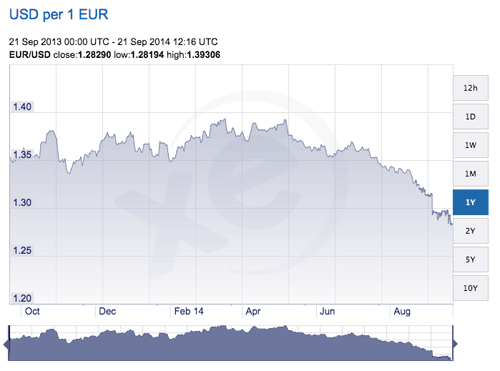
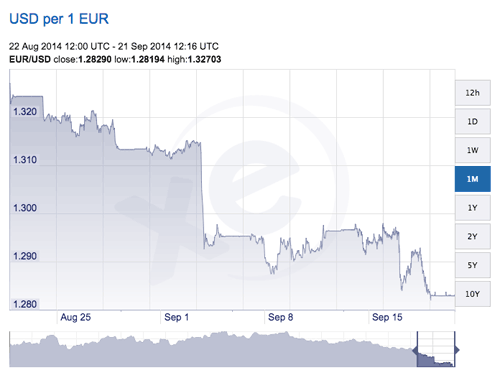
Which means the rising dollar (about 10% vs the euro in mere weeks) is due to Fed actions. The Fed manipulates what it can. It’s the motivation behind its actions that catches people on the wrong foot. Most continue to have this idea that Janet Yellen, and Ben Bernanke before her, seek and sought their alleged dual mandate of full employment and price stability. Ironically, those are two things they have zero control over.

What they do instead, what motivates their actions, is seek to maximize Wall Street bank profits, and, in the same vein and same breath, hide these banks’ losses. Once you realize and acknowledge that, policies over the past 8 years – and before, cue Greenspan – make a lot more sense then when you try to see them through that alleged dual mandate view.

QE is all but done. This alone already has started a capital flight move away from emerging markets. Many of whom will soon look a whole lot less emerging because of it. The capital will continue to flow back to the global financial center from the periphery, leaving dozens of countries and companies scrambling to find dollars to pay off the loans that looked so cheap.

The rising dollar will only make that worse. And moreover, it will catch many other countries, for instance southern European ones, in the same dragnet the emerging economies were already in. If and when your currency loses 10%+ against the currency more commodities and debts are denominated in, and you have such debts and need such commodities, you stand to lose, in all likelihood, a lot.

That leaves interest rates. Given the recent Fed actions on QE and the dollar, why would it NOT raise rates? The dual mandate? To affect price stability in the US? With the dollar moving the way it has, that’s gone anyway. To help Americans get jobs? The only reason US jobless numbers are not much higher is A) millions left the job market altogether and B) millions who were once account managers are now burger flippers, WalMart greeters and self-employed.

The definitions were changed as we went along, that’s why, at least officially, unemployment is not at 15% or 20%. And that is al part of the same opaque truth, that nothing the Fed did since 2008 has mattered one bit when it comes to jobs for Americans. All it has effectively achieved is that trillions of dollars in Main Street money and future obligations were shifted to Wall Street.

The objectives of the Fed’s dual mandate have turned out to be a total joke when the chips came down. Not surprising, because they were always a joke to begin with. A central bank should not be involved in job creation, and it should not hand trillions of dollars to the banks that are its owners, to ostensibly keep prices stable in the real economy, where none of those trillions end up. It’s all just a joke, albeit a very costly one.

QE was never meant to benefit Main Street. Neither was the suppression of the dollar. Why then would the Federal Reserve NOT hike rates only to protect the real American economy? Nothing it has done so far has been aimed at that goal, so why start now? There’s no logic there.

The Fed will continue to do what it’s done all these years: enact those policies that promise to bring the greatest profits to the banks that own it. And right now, those profits are not in more bond buying, and not in artificially low rates, and not in an artificially low dollar. Simply because that’s what everybody else is betting on, and the money when that happens is on the opposite side of the bet.

I cited this piece by Philip Van Doorn at MarketWatch 5 weeks ago, and it’s as relevant now as it was then:

Big US Banks Prepare To Make Even More Money

[..] … the debate at the Federal Reserve has now shifted to the timing of interest rate increases. Most economists expect the federal funds rate to begin climbing in the second half of 2015, but it could well happen sooner than that. For most banks, the extended period of low interest rates has become quite a drag on earnings. Net interest margins – the spread between the average yield on loans and investments and the average cost for deposits and borrowings – are still being squeezed, since banks realized the bulk of the benefit of very low interest rates years ago

Once you you’ve metastasized that, and the truth about the dual mandate thing, and you’ve read the ‘Secret Goldman Tapes’ stories earlier this week, which showed in a blinding fashion how Goldman Sachs controls the Fed, not the other way around, then maybe your idea about those ‘soft slow’ rate hikes are due for a review as well.

Just look at what Dallas Fed head Richard Fisher had to say over the weekend:

Fisher Says Fed Must Weigh Wage Pressures in Setting Rate Policy

“I don’t want to fall behind the curve here,” Fisher said in a Fox News interview. “I think we could suddenly get a patch of high growth, see some wage-price inflation, and that is when you start to worry.” Fisher dissented on Sept. 17 at the last meeting of the Federal Open Market Committee, when the Fed retained a pledge to keep rates near zero for a “considerable time” after its asset purchases halt at the end of next month.

He called U.S. second-quarter growth “uber strong,” referring to the upward revision last week to an annualized rate of 4.6% from 4.2% previously estimated, and said history had shown that wage pressures could accelerate when unemployment got below current levels of 6.1%. In addition, Fisher said surveys of wage-price pressures in the Dallas Fed’s district, which includes Texas, northern Louisiana and southern New Mexico, were the highest since before the recession, and other indictors were also buoyant. “We’re going to be releasing some data on Monday and Tuesday, our new surveys, that I think will just knock your socks off,” he said.

I’d say Fisher is uber happy, and those data did come in as he predicted – though I think everyone wearing socks still has them on. Fisher wants that rate hike now, not next summer or fall. And he has a voice, even if he himself and fellow hawk Philly Fed head Charles Plosser are poised to step down some 6 months from now. I’m reading ‘experts’ who claim that will relieve the pressure on Yellen and her doves, but it’s the other way around: they’re going to make sure their – departing – voices will be heard one last time.

But of course down the line that’s all theater. The rate hike is a foregone conclusion. As is the mayhem it will give birth to. Prepare yourselves accordingly. And from now on always keep in the back of your mind what the Fed really is. It is not your friend. Unless you too own a piece.


Why A Strong Dollar Is Scarier Than Taper Tantrum (CNBC)

Expectations that the Federal Reserve is on course to start tightening policy has spurred fears of a return of last year’s emerging market turmoil, but Societe Generale tips a strong dollar as a bigger risk. “A strong dollar tantrum could be a more worrying scenario than a Fed tightening tantrum,” Michala Marcussen, global head of economics at Societe Generale, said in a note dated Sunday. The U.S. dollar index has climbed around 7% this year, with the Fed now nearly completing the tapering of its asset purchases, with markets widely expecting interest rate increases to begin sometime next year. Some analysts are concerned this will spur a repeat of the “taper tantrum,” when concerns about the Fed’s move to begin tapering caused a brutal selloff in emerging market assets earlier this year and last year.

“Hope today is that a strong dollar will cap U.S. inflation, delay Fed tightening and boost exports to the U.S.,” Marcussen noted, but she believes for that to happen, the U.S. dollar would need to strengthen so much that it would signal much weaker growth in the rest of the world. To delay Fed rate hikes, the euro would need to fall to $1.10, while the U.S. dollar would need to fetch around 120 yen and 6.50 yuan, she said. Early Tuesday, the euro was around $1.2690 and the dollar was fetching 109.40 yen and 6.1495 yuan. “In such a scenario, [a strong] dollar would equate to further capital outflows, placing further pressure on already vulnerable economies,” she said. “A ‘dollar tantrum’ scenario could well prove more painful than a ‘Fed tightening tantrum,’ assuming the latter comes with better growth in the rest of the world.” To be sure, she doesn’t believe the dollar’s move yet qualifies the currency as “strong,” with it still trading just below its long term average, although Societe Generale expects the trade-weighted dollar will rise further into 2015.

Others expect some emerging market assets will react negatively to the dollar’s recent advance. “The upcoming Fed exit will continue to lead front-end rates higher in the quarters ahead,” Goldman Sachs said in a note last week. “In a market environment where China growth expectations decline, front-end U.S. rates gradually push higher and emerging market front-end yields remain anchored around current levels, there is room for emerging market currencies (particularly high-yielding ones) to weaken further.” But Goldman is looking to Europe for cues on whether any emerging market selloff will be confined to the currencies or if it will spill over to other assets. “Heightened Euro area growth concerns can weigh on risky assets, including parts of emerging market credit and equities,” it said.

Read more …

Nah.

Strong Dollar Bolsters Fed Patience on Rates Amid Growth Impact (Bloomberg)

The dollar’s strongest year since 2008 is a source of growing concern among some Federal Reserve policy makers, who say further gains have the potential to curb economic growth and keep inflation too low. Atlanta Fed President Dennis Lockhart, New York’s William C. Dudley and Chicago’s Charles Evans have all said in the past week they are watching the dollar as officials debate the timing of the first interest-rate increase since 2006. A strong dollar tends to restrain exports by making them more expensive, holding back growth, while reducing the cost of imported goods. “We’re going to take that into account, the way it’s affecting the economy in terms of net exports and GDP growth and what it means for our inflationary developments,” Evans told reporters yesterday after a speech in Chicago. Evans and Dudley are among policy makers who argue that the Fed can afford to be patient on raising interest rates, and that tightening prematurely poses a greater risk to the world’s largest economy than waiting too long.

“They are worried about the durability of the labor-market recovery and inflation still running below their target, and the dollar feeds into that,” said Guy Berger, U.S. economist at RBS Securities Inc. in Stamford, Connecticut. “If you have a stronger dollar you’re going to have less inflation, and that’s the reason they’re focusing on it,” said Joseph LaVorgna, chief U.S. economist at Deutsche Bank Securities in New York and a former New York Fed economist, who said the dollar’s gains so far are unlikely to affect monetary policy. “If the dollar keeps going up obviously it may have implications for the timing of tightening,” he said. On the other side of the debate are officials such as Dallas Fed President Richard Fisher, who favors an interest-rate increase at the end of the first quarter of next year. In a Bloomberg Radio interview yesterday, Fisher called the strength of the dollar “a vote of confidence” in the U.S. economy. “Everybody is finding the things that are favorable to their side of the argument,” Berger said. “In the case of the doves, the dollar is one of them.”

Read more …

Could=Will.

Record World Debt Could Trigger New Financial Crisis (Guardian)

Global debts have reached a record high despite efforts by governments to reduce public and private borrowing, according to a report that warns the “poisonous combination” of spiralling debts and low growth could trigger another crisis. Modest falls in household debt in the UK and the rest of Europe have been offset by a credit binge in Asia that has pushed global private and public debt to a new high in the past year, according to the 16th annual Geneva report. The total burden of world debt, excluding the financial sector, has risen from 180% of global output in 2008 to 212% last year, according to the report. The study by a panel of senior academic and finance industry economists accuses policymakers in many countries of failing to spur sustainable growth by capitalising on historically low interest rates while deterring exuberant lending.

It called for Brussels to write off the debts of the eurozone’s worst-hit countries and urgently embark on a “sizeable” programme of electronic money creation or quantitative easing to push down long-term interest rates. It said unless policymakers kept a lid on risks in the financial system, especially overvalued property and stock markets, a trend for investing in assets with borrowed money could run out of control. The Geneva report, which is commissioned by the International Centre for Monetary and Banking Studies, follows a study earlier this year by the Bank of International Settlements (BIS), which diagnosed the same problem, but said risky borrowing could only be discouraged by higher interest rates. The Geneva report instead argued a concerted effort to tackle the after-effects of the crisis was needed to mitigate a “poisonous combination of high and rising global debt and slowing nominal GDP [gross domestic product], driven by both slowing real growth and falling inflation”.

Read more …

Deflation is all that’s left. Until debts are restructured.

Japan’s Industrial Production, Household Spending and Real Wages Fall (WSJ)

A raft of economic data released Tuesday continues to paint a picture of sluggish growth for the third quarter in Japan, despite a tight labor market and rising wages. Industrial production fell a surprising 1.5% on month in August. Retail sales grew 1.9% on month, but separate data adjusted for inflation and expenditure on services showed household spending fell 4.7% on year. At the same time, the unemployment rate fell to 3.5%, a 17-year low. The tightening labor market has contributed to a run of year-on-year wage increases not seen in six years. But those wage gains are outpaced by inflation, meaning real wages are still down 2.6% on year. The government and the Bank of Japan believe wage growth will eventually filter through the economy and start a virtuous cycle of higher private spending and increased production and investment. But some private economists are skeptical about this rosy scenario. Others say that even if such a virtual cycle eventually materializes, the economy will likely lack a robust growth engine for some time.

Read more …

Repeat: Deflation is all that’s left. Until debts are restructured.

Eurozone Inflation Drops To Fresh 5 Year Low, Euro Tumbles (Zero Hedge)

Anyone confused why futures are doing their best to surge in the overnight session, the answer is simple: first it was Japan reporting the latest batch of atrocious economic data, which an hour ago was followed by Europe own abysmal econofreakshow, where Eurostat just reported that in September Eurozone inflation rose a meager 0.3% from a year ago, the lowest annual increase since October 2009.This marks the 12th straight month that Euro inflation has been below 1%, and far below the ECB’s goal of 2% inflation.

More importantly, it also shows that some 3 months of a sliding Euro have not only had zero impact on European export competitiveness, as the entire continent is careening into a triple dip recession, but that the ECB is completely powerless to create an inflationary spark, as not only is the bulk of the Eurozone flirting with disinflation but more and more European countries are in outright deflation. Also of note, while headline inflation was in line with expectations, it was core CPI that missed expectations of a 0.9% increase, and rose by only 0.7%, confirming that the most recent bout of deflation in Europe is about far more than just sliding energy prices. In fact for the culprit, perhaps look at Japan which is now exporting deflation hand over fist.

Read more …

Tick tick tick.

Europe Ticking All the Wrong Boxes Starts Mirroring Japan (Bloomberg)

Similarities between the euro region and Japan are intensifying, heaping pressure on Mario Draghi while offering good news for bond holders. Sluggish credit growth? Check. Slowing economy? Check. Falling market expectations for inflation? Check. Aging population? Yes, it has that too, placing Europe in a similar situation to what was encountered by the world’s third-largest economy after the bubble burst on its postwar Economic Miracle. That’s a concern for DZ Bank AG, the most bullish forecaster of German bunds in data compiled by Bloomberg. It estimates the 10-year yields will fall to a euro-era record of 0.5% by the first quarter, leaving them below the 0.65% percent median estimate for their Japanese peers.

With the official interest rate near zero, European Central Bank President Draghi may need to do more to steer the region away from the deflation and debt traps that condemned Japan to two decades of stagnation. “Renewed ECB activism offers hope that the euro area will not follow the path Japan embarked on in the 1990s,” said Nikolaos Panigirtzoglou, London-based global market strategist at JPMorgan Chase. “Low growth leads to low income growth. Combine that with persistently high unemployment and you’ve got a lack of confidence.” Europe should be on a roll. It’s never been cheaper for euro-area governments or individuals to borrow money and the ECB is seeking to put cash into the economy through cheap loans to banks and a pledge to buy asset-backed securities.

Read more …

A lot.

A Look At Just How Much China’s Housing Downturn Could Hurt GDP (WSJ)

Just how much will a downturn in China’s property market hurt the economy? A new analysis by analysts at Japanese bank Nomura sheds some light. China’s property market won’t recover any time soon, say the analysts, who figure the downturn will shave the country’s GDP growth by 1.4 percentage points in 2014 and 0.6 percentage points in 2015 if there are no drastic changes to policy. In the worst-case scenario , GDP growth could plunge by 4 percentage points. There is no easy way out: the property market correction will be long-lasting if orderly, or very painful if sudden, Nomura analysts Changchun Hua, Wendy Chen and Rob Subbaraman say in a report. The analysts came up with three scenarios. If government policy continues at its current pace—piecemeal targeted easing—GDP growth will drop by 1.4 percentage points this year because property takes a big bite out of industries like steel, construction, chemicals and transport.

If the government eases monetary policy by lifting credit curbs, cutting banks’ reserve requirement ratios and interest rates, and rolling out large stimulus packages, the impact on GDP would be smaller this year and next, shaving growth by 1.1 percentage points in 2014 and 0.3 percentage points in 2015. But in the longer term, it could be worse than continuing current policy because debt levels would be pushed higher and the oversupply situation would worsen, the analysts say. “This is a risky strategy as it could eventually lead to an even sharper correction in the sector, and indeed in the wider economy, ahead.” The third scenario is if the government does nothing and a housing crash ensues. In that case, GDP growth could fall 4 percentage points, the investment firm said. In any case, the downturn could last between two to four years.

“This is not a minor correction,” they said. “This property market downturn is different to those China has experienced in the past. Previous downturns were largely driven by tighter policies while this one appears more naturally driven by market forces.” The last two property market corrections in China occurred in 2007-08 and in 2011-12. (China, where the private housing market only started in 1998, has a shorter property cycle than more mature markets such as the U.S. and Japan.) Those downturns were triggered by policy tightening aimed at reining in property investment, but the market turned around quickly because policymakers changed their minds and loosened the curbs to counter effects of the global financial crisis in 2009 and slowing domestic growth in 2012. This time, the market isn’t likely to behave like a yo-yo. The country is currently plagued by an oversupply problem, especially in so-called third- and fourth-tier cities, and barring a significant crash, the correction will likely be long-lasting, the Nomura analysts said.

Read more …

Pimco May Suffer Over $250 Billion In Outflows: Deutsche (CNBC)

Estimates of how much investors are likely to pull from Pimco following the departure of star manager Bill Gross are swirling, with Deutsche Bank now expecting around $266 billion in outflows or a fall in assets equivalent to 20% over the next two years.
The firm has named Daniel Ivascyn as chief investment officer and Gross’s successor while Scott Mather, Mark Kiesel and Mihir Worah will take on Gross’s flagship $221 billion Total Return fund after his shock exit on Friday. Chief executive of Pimco Doug Hodge has said Gross’s former fund “does not define Pimco,” but analyst estimates of outflows are racking up. Deutsche Bank research argued that each €100 billion in outflows is equivalent to around 9% of third party assets under management (AUM), which reduces Pimco’s parent company Allianz’s earnings by around 2%.

The bank also cut its price target on the insurer to €135 from €140, but maintained a hold position on the stock. Bernstein Research expects asset outflows between 10 and 30% and sees a “good deal” of Pimco clients switching to Janus Capital Group – where Gross has taken up a post managing a recently launched unconstrained bond fund and similar strategies. “We estimate that a drop in AUM of 10% would have a minor impact on Allianz fair value of 2%, while a 30% drop in AUM would hit the stock by around 13% according to our fundamental valuation mode,” analysts led by Thomas Seidl said.

Read more …

Hong Kong Protesters Stockpile Supplies, Prepare For Long Haul (Reuters)

Tens of thousands of pro-democracy protesters extended a blockade of Hong Kong streets on Tuesday, stockpiling supplies and erecting makeshift barricades ahead of what some fear may be a push by police to clear the roads before Chinese National Day. Riot police shot pepper spray and tear gas at protesters at the weekend but withdrew on Monday to ease tension as the ranks of demonstrators swelled. Protesters spent the night sleeping or holding vigil unharassed on normally busy roads in the global financial hub. Rumors have rippled through crowds of protesters that police could be preparing to move in again on the eve of Wednesday’s anniversary of the Communist Party’s foundation of the People’s Republic of China in 1949. “Many powerful people from the mainland will come to Hong Kong. The Hong Kong government won’t want them to see this, so the police must do something,” Sui-ying Cheng, 18, a freshman at Hong Kong University’s School of Professional and Continuing Education, said of the National Day holiday.

“We are not scared. We will stay here tonight. Tonight is the most important,” she said. The protesters, mostly students, are demanding full democracy and have called on the city’s leader, Leung Chun-ying, to step down after Beijing ruled a month ago it would vet candidates wishing to run for Hong Kong’s leadership in 2017. While Leung has said Beijing would not back down in the face of protests it has branded illegal, he also said Hong Kong police would be able to maintain security without help from People’s Liberation Army (PLA) troops from the mainland. “When a problem arises in Hong Kong, our police force should be able to solve it. We don’t need to ask to deploy the PLA,” Leung told reporters at a briefing on Tuesday. There was a growing sense that the protests could come to a head later on Tuesday before the National Day celebrations.

Read more …

No.

Will Hong Kong Spark An Asian Spring? (CNBC)

Thousands of protesters campaigned for full democracy in Hong Kong over the weekend, raising the question: Could unrest spread to mainland China. “Today is a very important moment for Beijing and for the Hong Kong government because if they don’t control the streets of Hong Kong today they could see this thing start to mushroom,” Gordon Chang, author of ‘The Coming Collapse of China’ told CNBC on Monday. “Beijing has a lot at stake here as this is something that could spread…political scientists call it the ‘demonstration effect,'” he said. “We’re starting to see that now in China.” Netizens across China shared images from the protests and expressed their views via social media, but authorities quickly deleted posts and shut down websites, in line with China’s history of censorship.

Popular photo sharing website Instagram was blocked after photos and videos from the Hong Kong protests were posted, according to numerous reports. Meanwhile, the phrase “Occupy Central” was blocked on Weibo – the hugely popular micro-blogging site in China – on Sunday. Ripples of discontent have begun to show in Taiwan and Macau. In Taiwan, a state that is essentially autonomous, student leaders occupied the lobby of Hong Kong’s representative office on Monday in a show of support for democracy protesters, according to local media. Meanwhile, in Macau – another “special administrative region” like Hong Kong, a referendum conducted last month during the official election of its chief executive, showed a striking disparity between the election result and public opinion.

Read more …

Obama step in?!

US Judge Holds Argentina in Contempt of Court in Bond Payment Case (NY Times)


For more than a year, Judge Thomas P. Griesa of Federal District Court in Manhattan has warned that Argentina would suffer repercussions if it defied his orders regarding payments to bondholders. On Monday, the judge put some teeth behind those warnings, ruling the nation in contempt of court. He stopped short of issuing sanctions, however, saying he would make a decision on them in the future. Speaking firmly, Judge Griesa indicated that the Republic of Argentina had gone a step too far in seeking to sidestep his injunction that forbids the government from paying only the bondholders it chooses. “What has happened is the Republic, in various ways, has sought to avoid, to not attend to, almost to ignore this basic part of its financial obligations,” Judge Griesa said on Monday. The ruling was another dramatic turn in a legal battle that has pitted President Cristina Fernández de Kirchner of Argentina against a group of hedge funds that are seeking more than $1.5 billion in payments on bonds that defaulted in 2001.

In a separate move that could increase the tension, the Argentine government sent a letter to Secretary of State John F. Kerry on Monday morning before the hearing, seeking to enlist his support and calling the actions by Judge Griesa “excessive judicial harassment,” according to the embassy in Washington. “A declaration of contempt would result in an unprecedented escalation in the conflict,” the letter, signed by the Argentine ambassador to the United States, said. “We are in uncharted waters,” said Arturo C. Porzecanski, economist in residence at American University’s School of International Service. “This makes official the fact that Argentina has been a rogue debtor for many many years and has been in contempt of many many judgments.”

Read more …

And they’re right.

Argentina Says US Judge Contempt Order ‘Violates International Law’ (BAH)

The Foreign Ministry has asserted that New York district judge Thomas Griesa’s contempt ruling against Argentina is in clear breach of international law, adding that the decision had no practical ramifications against the nation and only served to aid the vulture fund campaign. The government department, headed by Foreign minister Héctor Timerman, stated this evening that Griesa’s ruling “is in violation of international law, the United Nations Charter and the Organisation of American States charter,” in a press statement.
“All of these instruments establish that the United States of America as a state is the only entity responsible for the actions of any of its organisms, such as the recent decision from its judicial branch,” the missive fired, hours after the judge’s ruling was made public.

“Judge Griesa’s decision has no practical effect, expect for providing new elements for the vulture funds to use in their slanderous political and media campaign against Argentina.” The Ministry strongly criticised the magistrate, who despite finding Argentina in contempt declined to immediately impose financial penalties of up to 50,000 dollars a day, as requested by plaintiffs NML Capital in the ongoing sovereign debt conflict in New York. “Griesa boasts the sad record of being the first judge to hold a sovereign state in contempt for paying a debt, after failing in his efforts to obstruct Argentina’s foreign debt restructuring,” the statement said. “The Argentina government reaffirms its decision to keep exercising its defence of national sovereignty, and requesting that the United States accepts the International Court of Justice’s juridisction in order to solve this controversy between the two countries.”

Read more …

Word.

Europe’s Real Crisis Will Be Political With Spain as Ground Zero (Phoenix)

Spain’s Mariano Rajoy is back with yet another display of why he should never have been allowed to take office in the first place. For those who need a quick primer, here’s a quick highlight reel of Rajoy’s more notable accomplishments:

1) Helped facilitate biggest housing bubble in Spanish history, a bubble so large that the US’s looks like a molehill in comparison

2) Took bribes and kickbacks from developers in helping to create said bubble (more on this later).

3) Claimed Spain would never need a bailout, then demanded a €100 billion bailout one weekend before flying off to watch a soccer match.

4) Raided Spain’s social security fund, investing 90% of its assets in Spanish bonds… which were on the verge of default a mere six months before.

5) Got caught with dirty money he received from property developers and stated the following, “…everything that has been said about me and my colleagues in the party is untrue, except for some things that have been published by some media outlets,”

Now Rajoy is dealing with the problem of Catalonia (a region in Spain) wanting independence. Catalonians are proposing putting the matter to a vote, much as Scotland recently did regarding its own move to potentially break away from the UK. Rajoy, never one to miss the opportunity to embarrass himself, has called the decision to vote for independence “profoundly anti-democratic.” Bear in mind, this is the same “leader” who likes to proclaim that Spain is in a recovery… while Spain’s unemployment is roughly 24% and youth unemployment is above 50%. At some point, the markets will call BS on Spain’s dreams of recovery and the bond markets will rebel. When this happens the whole fraud will come unraveled. However it might take a full-scale political crisis before this happens. And by the look of things we’re not far from one. We’re back in trouble whenever Spain takes out the long-term trendline for its 10-year bond yields.

Read more …

Democracy?

Spain Court Blocks Catalonia Vote as Standoff Escalates (Bloomberg)

Spain’s Constitutional Court temporarily blocked Catalan government plans to hold a vote on independence, raising the stakes in the central government’s standoff with the regional administration in Barcelona. Catalan president Artur Mas signed a decree on Sept. 27 calling for a Nov. 9 ballot as a non-binding consultation on independence for the region of about 7.5 million people in northeastern Spain. Spanish Prime Minister Mariano Rajoy denounced the vote as unconstitutional and said yesterday that his government had filed a lawsuit to block it. The suit was admitted for consideration, effectively blocking the Catalan decree and vote until the court makes a further ruling on the government’s legal action, a Madrid-based official at the court said last night by phone.

“It’s false that the right to vote can be assigned unilaterally to one region about a matter that affects all Spaniards,” Rajoy told reporters at the government palace in Madrid. “It’s profoundly anti-democratic.” Less than two weeks after Scotland voted against independence from the U.K. after 307 years of union, Mas and Rajoy are at loggerheads over whether the Spanish region can stick with its plan to vote on independence following the court’s blocking of the vote. Unlike in Scotland, polls suggest a majority of Catalans would support independence. “The Constitutional Court met at supersonic speed,” Mas said yesterday during a televised presentation of the steps to be taken on the proposed transition of Catalonia. “We hope the members of the Constitutional Court keep in mind that they should be a referee for everyone, not for one side only.”

Read more …

Mass graves uncovered. No mention in the west.

Russia Investigates ‘Kiev Sponsored Genocide’ In East Ukraine (Reuters)

Russia opened a criminal case Monday into what it called Kiev’s genocide of Russian-speaking residents in eastern Ukraine in a move that could increase tensions during a strained ceasefire in the region. An official statement said Russian-speaking citizens were targeted by Kiev forces using heavy weapons to kill over 2,500 people in the “Luhansk and Donetsk people’s republics,” the breakaway regions in the east. The investigation could ratchet up tensions between the post-Soviet neighbors weeks after Kiev and pro-Russian rebels agreed on a ceasefire earlier this month that has been marred by daily skirmishes and artillery shelling. “The Investigative Committee opened has opened a criminal case into the genocide of the Russian-speaking population of Ukraine’s southeast,” said the statement by the Investigative Committee of the Russian Federation, a law enforcement body that answers only to President Vladimir Putin.

“Unidentified representatives of Ukraine’s senior political and military leadership, National Guard and the Right Sector [nationalist organization] gave orders aimed at the intentional annihilation of the Russian-speaking citizens,” the statement said. The statement cited violations of the 1948 U.N. convention on genocide and other “international legal acts” to describe the reported violence, including the destruction of 500 houses and public infrastructure buildings since fighting erupted in April. Russia has long blamed Kiev for violence against civilians in the east, as the West has accused Moscow of sending weapons and troops to help pro-Russian rebels fighting Kiev’s forces. A recent U.N. report put the death toll at 2,593 people on both sides and accused pro-Russian separatists of a wide array of human rights abuses, including murder, abductions and torture.

Read more …

“Carter said 200-300 girls are sold into sexual slavery every month in his home state Georgia.”

Happy birthday, Mr. President.

Jimmy Carter, Turning 90, Says Slavery Is Worse Now Than In 1700s (CNBC)

Human slavery is not just a major issue in developing countries, but is a serious problem in the U.S. and is more prolific now than during the 18th and 19th century, former President Jimmy Carter has told Tania Bryer, host of “CNBC Meets.” Carter said 200-300 girls are sold into sexual slavery every month in his home state Georgia, and many living in advanced economies are completely unaware of the abuse happening to young women close to home. Referring to facts in his most recent book, “A Call to Action, Women, Religion, Violence and Power,” Carter describes the abuse of women around the world as “the worst, unaddressed issue that the world faces today.” “And those of us in the more advanced countries don’t know much about horrible abuse of girls whose genitals are mutilated when they’re very young, children who are killed because a girl is raped by strangers and her family kills her to protect their own nation’s honor.

These kinds of things go on in the more remote parts of the world as far as we’re concerned,” the Democratic former president said. “But even in the United States, human slavery now is greater than it ever was during the 18th or 19th century. In Atlanta, Georgia, we have between 200-300 girls sold into sexual slavery every month,” he added. Before moving into politics, Carter was in the Navy and worked on the family’s farm. He served as the 39th president from 1977 to 1981 and was awarded the Nobel Peace Prize in 2002 for his efforts in finding peaceful solutions to international conflicts and his work in human rights. Carter, who is turning 90 on Wednesday, and wife Rosalynn still travel the world doing work for The Carter Center, his human rights and health care charity, which he set up after leaving the White House.

Read more …

Export land model.

Saudi Arabia Poised To Tip Into Deficit (CNBC)

Saudi Arabia risks falling into a budget deficit next year and may have to tap its reserves, the International Monetary Fund (IMF) has warned. One sign that Saudi Arabia is in danger of dipping into deficit is its “break-even oil price” – the price oil would need to be for the country to balance its budget. The IMF, in its annual consultation paper released Wednesday, notes that Saudi Arabia’s break-even price has risen to $89 a barrel in 2013 from $78 a barrel in 2012. It would be the first time since 2010 that the Middle East’s largest economy records a deficit for its government finances. Apart from domestic expenditures such as ambitious infrastructure outlays, pressure on government finances is also coming from substantial aid pledges to countries across the Arab World.

“This expenditure path and lower oil revenues lead to an overall fiscal deficit in 2015, which is expected to deteriorate further to almost 7.5% of (gross domestic product) GDP by 2019,” the fund said in the 54-page dossier. But while Saudi officials have shrugged off suggestions spending needed to be reined in, experts diverge on projections. “According to our model, we will see a fiscal deficit in 2016 as government maintains high spending while a gradual decline in oil prices will push revenues downward,” Fahad Alturki, Head of Research at Riyadh-based Jadwa Investment, told CNBC. “We also factor in lower oil production as many of the oil outages that we see today are expected to resume production”.

Read more …

Something tells me taxpayers will chip in.

North Sea Oil Costs Threaten $1.6 Trillion Investment Needed (Bloomberg)

North Sea oil operators’ surging costs risk scaring away the more than 1 trillion pounds ($1.6 trillion) of investment needed to meet their production goals, according to industry lobby Oil & Gas U.K. The country needs that investment if it hopes to recover the equivalent of more than 20 billion barrels of oil, the group said today in a statement. Unit operating costs are about 60% higher than as recently as 2011, it said. “The U.K. has to compete for each and every pound of that investment,” Malcolm Webb, chief executive officer of the industry group, said today in the statement. “If the current trend of rising cost continues, the U.K. Continental Shelf will cease to provide a healthy return on investment.”

Energy resources were central to the debate over Scottish independence, with those supporting a split claiming almost all the oil as the nation’s own. Oil companies were among those who said before the Sept. 18 referendum that keeping Britain’s 307-year-old union was good for the industry because of the stability and certainty it provided. A review by Ian Wood, former head of engineering company John Wood Group Plc (WG/), this year estimated there were 12 billion to 24 billion barrels yet to be extracted from the North Sea. Production has dropped 40% in the past three years as fields mature, according to the February report. “We need a lighter tax burden, a simpler and more predictable system of field allowances and fiscal support for exploration,” said Michael Tholen, director of economics at Oil and Gas U.K. The government is expected to announce the results of its fiscal review in December.

Read more …

How low are we going to take this?

Earth Lost 50% Of Its Wildlife In The Past 40 Years (Guardian)

The number of wild animals on Earth has halved in the past 40 years, according to a new analysis. Creatures across land, rivers and the seas are being decimated as humans kill them for food in unsustainable numbers, while polluting or destroying their habitats, the research by scientists at WWF and the Zoological Society of London found. “If half the animals died in London zoo next week it would be front page news,” said Professor Ken Norris, ZSL’s director of science. “But that is happening in the great outdoors. This damage is not inevitable but a consequence of the way we choose to live.” He said nature, which provides food and clean water and air, was essential for human wellbeing. “We have lost one half of the animal population and knowing this is driven by human consumption, this is clearly a call to arms and we must act now,” said Mike Barratt, director of science and policy at WWF. He said more of the Earth must be protected from development and deforestation, while food and energy had to be produced sustainably.

The steep decline of animal, fish and bird numbers was calculated by analysing 10,000 different populations, covering 3,000 species in total. This data was then, for the first time, used to create a representative “Living Planet Index” (LPI), reflecting the state of all 45,000 known vertebrates. “We have all heard of the FTSE 100 index, but we have missed the ultimate indicator, the falling trend of species and ecosystems in the world,” said Professor Jonathan Baillie, ZSL’s director of conservation. “If we get [our response] right, we will have a safe and sustainable way of life for the future,” he said. If not, he added, the overuse of resources would ultimately lead to conflicts. He said the LPI was an extremely robust indicator and had been adopted by UN’s internationally-agreed Convention on Biological Diversity as key insight into biodiversity.

A second index in the new Living Planet report calculates humanity’s “ecological footprint”, ie the scale at which it is using up natural resources. Currently, the global population is cutting down trees faster than they regrow, catching fish faster than the oceans can restock, pumping water from rivers and aquifers faster than rainfall can replenish them and emitting more climate-warming carbon dioxide than oceans and forests can absorb. The report concludes that today’s average global rate of consumption would need 1.5 planet Earths to sustain it. But four planets would be required to sustain US levels of consumption, or 2.5 Earths to match UK consumption levels.

Read more …

Useless stats.

Affordable Global Housing Will Cost $11 Trillion (Bloomberg)

Replacing the world’s substandard housing and building affordable alternatives to meet future global demand would cost as much as $11 trillion, according to initial findings in a McKinsey & Co. report. The shortage of decent accommodation means as many as 1.6 billion people from London to Shanghai may be forced to choose between shelter or necessities such as health care, food and education, data disclosed at the 2014 CityLab Conference in Los Angeles show. McKinsey will release the full report in October. The global consulting company says governments should release parcels of land at below-market prices, put housing developments near transportation and unlock idle property hoarded by speculators and investors. The report noted that China fines owners 20% of the land price if property is undeveloped after a year and has the right to subsequently confiscate it.

“Cities struggle with the dual challenges of housing their poorest citizens and providing housing at a reasonable cost,” said the paper, whose lead author, Jonathan Woetzel, is a Shanghai-based director of McKinsey Global Institute, the company’s research unit. About 330 million households — about 1.2 billion people — now struggle with substandard housing, a number that may increase to 440 million in 11 years, McKinsey forecasts. Acceptable housing is within an hour’s commute of work and has basic services including flush toilets and running water, the report says. What the authors call the affordable-housing gap now stands at about $650 billion a year, or 1% of global gross domestic product. The baseline for their calculation is housing payments that exceed 30% of household income in 2,400 cities around the globe.
Read more …

Sep 252014
 
 September 25, 2014  Posted by at 5:51 pm Finance Tagged with: , , , , , ,  9 Responses »


Wyland Stanley Studebaker motor car in repair shop, San Francisco 1919

There are substantial and profound changes developing in the global economy, and in my view we should all pay attention, because everyone will be greatly affected. Some more than others, but still.

‘Metal markets’, be they gold, silver, copper or iron, exhibit distress and uncertainty, prices are falling, or at least seem to be. Partly, that is because of the apparently still ongoing investigation in the Chinese port of Qingdao, through which a $10 billion ‘currency fraud’ is reported today, ostensibly related to the double/triple borrowing that has been exposed, in which the same iron ore and copper shipments were used as collateral multiple times.

This could soon bring such shipments to the market and add to the oversupply already in place. Combined with ever more evidence of a slowdown in Chinese growth numbers, this doesn’t look good for iron, copper, aluminum.

But the Slow Boat To – or from – China is by no means the only reason metal prices are dropping. The main one is, plain and simple, the US dollar. Gold, for instance, hasn’t changed much at all when compared to a year ago, against the euro. Whereas it’s lost 8-9% against the dollar over the last 2-3 months, about the same percentage as that same euro. The movement is not – so much – in gold, it’s in the dollar.

To claim that this is the market at work makes no sense anymore. Today central banks, for all intents and purposes, are the market. As Tyler Durden makes clear once again for those who still hadn’t clued in:

Bank Of Japan Buys A Record Amount Of Equities In August

Having totally killed the Japanese government bond market, Shinzo Abe has – unlike the much less transparent Federal Reserve, who allegedly use their proxy Citadel – gone full tilt into buying Japanese stocks (via ETFs). In May, we noted the BoJ’s aggressive buying as the Nikkei dropped, and in June we pointed out the BoJ’s plan to buy Nikkei-400 ETFs and so, as Nikkei news reports, it is hardly surprising that the Bank of Japan bought a record JPY 123.6 billion worth of ETFs in August.

The market ‘knows’ that the BoJ tends to buy JPY 10-20 billion ETFs when stock prices fall in the morning. The BoJ now holds 1.5% of the entire Japanese equity market cap (or roughly JPY 480 trillion worth) and is set to surpass Nippon Life as the largest individual holder of Japanese stocks. And, since even record BoJ buying was not enough to do the job, Abe has now placed GPIF reform (i.e. legislating that Japan’s pension fund buys stocks in much greater size) as a primary goal for his administration. The farce is almost complete as the Japanese ponzi teeters on the brink.

Shinzo Abe wants the yen to fall, and he gets his (death)wish, because the Japanese economy and the financial situation of its government are in such bad shape, there’s nowhere else to go for the yen. That doesn’t spell nice things for the Japanese people, who will see prices for imported items (energy!) rise, but for all we know Abe sees that as a way to push up inflation. That’s not going to work, what we will push up instead is hardship. And that plan to force pension funds into stocks is just plain insane, an idea he got from US pension funds which are 50% in stocks – which is just as crazy.

Draghi talks down the euro, says a headline today, but I don’t see it; I wonder why that would be supposed to work now, and not in the preceding years, when it was just as obvious how poorly Europe was doing. Sure, there’s a new ‘threat’ in the AfD (Alternative for Germany), a right wing anti-euro party, but that’s not – for now – enough to cause the euro slide we’re seeing. The movement is not – so much – in the euro, it’s in the dollar.

Why the Fed moves the way it does, the moment it does, in its three pronged combo of fully tapering QE, hiking rates (or at least threatening to) and pushing up the greenback, is not immediately clear, but a few suggestions come to mind, some of which I mentioned earlier this month in The Fed Has A Big Surprise Waiting For You and in What Game Is Being Played With the US Dollar?.

My overall impression is that the Fed has given up on the US economy, in the sense that it realizes – and mind you, this may go back quite a while – that without constant and ongoing life-support, the economy is down for the count. And eternal life-support is not an option, even Keynesian economists understand that. Add to this that the -real – economy was never a Fed priority in the first place, but a side-issue, and it becomes easier to understand why Yellen et al choose to do what they do, and when.

When the full taper is finalized next month, and without rate rises and a higher dollar, the real US economy would start shining through, and what’s more important – for the Fed, Washington and Wall Street -, the big banks would start ‘suffering’ again. Just about all bets are on the same side of the trade today, and that’s bad news for Wall Street banks’ profits.

The higher dollar will bring some temporary relief for Americans, in lower prices at the pump, and for imported products in stores, for example. Higher rates, however, will put a ton and a half of pressure bearing down on everyone who’s in debt, and that’s most Americans. The idea is probably that by the time this becomes obvious and gets noticed, we’re far enough down the line that there’s no going back. Besides, we could be in full-scale war by then. One or two IS attacks in the west would do.

The higher dollar – certainly in combination with higher rates – will also mean a very precarious situation for the US government, which will have to pay a lot more in borrowing costs, but our leadership seems to think that at least in the short term, they can keep that under control. And then after that, the flood. Maybe the US can start borrowing in yuan, like the UK wants to do?

To reiterate: there is no accident or coincidence here, and neither is it the market reacting to anything. That’s not an option in this multiple choice, since there is no market left. It’s all central banks all the way (like the universe made up of turtles). It’s faith hope and charity, and the greatest of these is the Federal Reserve. Is they didn’t want a higher dollar, there would not be one. Ergo: they’re pushing it higher.

The Bank of England will follow in goose lockstep, while the ECB and Bank of Japan can’t. That’s earthquake and tsunami material. The biggest richest guys and galls will do fine wherever they live. The rest, not so much. Wherever they live . At the Automatic Earth, we’ve been telling you to get out of debt for years, and we reiterate that call today with more urgency. Other than that, it’s wait and see how many export-oriented US jobs will be lost to the surging buckaroo. And how a choice few nations in the northern hemisphere will make through the cold days of winter.

Whatever you do, don’t take this lightly. A major move is afoot.

Dollar Hits Four-Year High as Metals Drop on China Fraud (Bloomberg)

The dollar jumped to a four-year high and precious metals retreated on speculation the strengthening U.S. economy is pushing the Federal Reserve closer to raising interest rates. Industrial metals and the yuan declined after China said it uncovered $10 billion of trade fraud, while European stocks rose. The Bloomberg Dollar Spot Index climbed for a fifth day, rising 0.3% by 10:17 a.m. in London, as the euro tumbled to a 22-month low. New Zealand’s dollar led losses against the greenback after the central bank said its strength is unjustified, while silver slumped 0.8% and gold fell to an eight-month low. Copper dropped 0.4% and the yuan reference rate was set at a two-week low. Spain’s bonds rose with Italy’s as the Stoxx Europe 600 Index climbed 0.3%. Standard & Poor’s 500 Index (XU100) futures were little changed.

The U.S. reports durable-goods orders and initial jobless claims numbers today after new-home sales surged in August to the highest level in more than six years. The stronger data are leading traders to bring forward bets on higher U.S. interest rates, buoying the dollar, as monetary policy from the euro area to New Zealand weighs on other currencies. Some banks played roles in fake trade at the port of Qingdao, said Wu Ruilin, deputy head of China’s State Administration of Foreign Exchange. “The theme during the second half of this year is dollar strength,” Yannick Naud, a money manager at Sturgeon Capital Ltd. in London, said in an interview on Bloomberg Television’s “On The Move” with Jonathan Ferro. “The economy is growing very strongly, we have a very good set of results and the central bank will probably be the first, or the second after the Bank of England, to increase interest rates.”

Read more …

Iron Ore Falls Below $80 to Lowest Since 2009 on China Concerns (Bloomberg)

Iron ore slumped below $80 a metric ton for the first time in five years on speculation that China’s slowing economic growth will curb demand in the world’s biggest user, exacerbating a global surplus. Ore with 62% content delivered to Qingdao, China, fell 0.5% to $79.69 a dry ton, the lowest level since Sept. 16, 2009, according to data from Metal Bulletin Ltd. The drop followed seven weeks of declines as the steelmaking raw material had the longest run of losses since May. The commodity plunged 41% this year as BHP Billiton Ltd. (BHP) and Rio Tinto Group (RIO) expanded output in a bet that the increase in volumes would more than offset falling prices as higher-cost mines are forced to shut. China’s Finance Minister Lou Jiwei said this week growth in Asia’s largest economy faces downward pressure. China’s economy remained stuck in “low gear” this quarter, with retail and residential real-estate industries struggling, according to the China Beige Book.

“The ramp-up in global supply and downturn in Chinese property sector are driving prices lower,” Paul Bloxham, chief Australia economist at HSBC Holdings Plc, said by e-mail today. “We expect Chinese miners to cut back production, which should keep prices well above the costs of major Australian producers.” Iron ore’s decline came after raw materials dropped to the lowest level in five years yesterday. The Bloomberg Commodities Index (BCOM) retreated 5.1% this year, poised for a fourth year of losses. Global output of seaborne ore will exceed demand by 52 million tons this year and 163 million tons in 2015, according to Goldman Sachs Group Inc. The price will average $102 a ton this year and $80 in 2015, according to the bank. So far this year, it’s averaged about $105.25 in Qingdao. China accounts for about 67% of global seaborne demand.

Read more …

That’s all?

China Watchdog Finds $10 Billion in Fake Currency Trade (Bloomberg)

China uncovered almost $10 billion in fraudulent trade nationwide as part of an investigation begun in April last year, including many irregularities in the port of Qingdao, the country’s currency regulator said today. Companies “faked, forged and illegally re-used” documents for exports and imports, Wu Ruilin, a deputy head of the State Administration of Foreign Exchange’s inspection department, said at a briefing in Beijing. The trades have “increased pressure from hot money inflows and provided an illegal channel for criminals to move funds,” Wu said, adding that those involved in such fraud would be severely punished.

“Some companies used the trade channel to bring in hot money,” said Zhou Hao, a Shanghai-based economist at Australia & New Zealand Banking Group Ltd. SAFE’s investigation “will likely further cool down hot money inflows and commodity imports could slow as banks will likely conduct more careful checks on documentation.” Industrial metals fell and the yuan weakened after the announcement. Copper slid as much as 0.5% and all main metals on the London Metal Exchange declined. Chinese banks have about 20 billion yuan ($3.3 billion) of exposure to companies caught up in a loan fraud probe in Qingdao, two government officials told Bloomberg in July. SAFE identified the fake trade invoicing as part of a crackdown on the practice in 24 cities and provinces, Wu said. The news raised speculation that metals supplies may increase as stockpiles tied up in financing deals come back on the market.

Read more …

Bank Of Japan Buys A Record Amount Of Equities In August (Zero Hedge)

Having totally killed the Japanese government bond market, Shinzo Abe has – unlike the much less transparent Federal Reserve, who allegedly use their proxy Citadel – gone full tilt into buying Japanese stocks (via ETFs). In May, we noted the BoJ’s aggressive buying as the Nikkei dropped, and in June we pointed out the BoJ’s plan tobuy Nikkei-400 ETFs and so, as Nikkei news reports, it is hardly surprising that the Bank of Japan bought a record JPY 123.6 billion worth of ETFs in August. The market ‘knows’ that the BoJ tends to buy JPY10-20 billion ETFs when stock prices fall in the morning. The BoJ now holds 1.5% of the entire Japanese equity market cap (or roughly JPY 480 trillion worth) and is set to surpass Nippon Life as the largest individual holder of Japanese stocks. And, since even record BoJ buying was not enough to do the job, Abe has now placed GPIF reform (i.e. legislating that Japan’s pension fund buys stocks in much greater size) as a primary goal for his administration. The farce is almost complete as the Japanese ponzi teeters on the brink. Via Nikkei Asia:

The Bank of Japan is growing into its role as a key source of support for the country’s stock market, as it has stepped up purchases of exchange-traded funds to bring its equities portfolio to an estimated 7 trillion yen ($63.6 billion) or so. The central bank bought 123.6 billion yen worth of ETFs in August, the largest monthly tally so far this year. At one point, it snapped up ETFs in six straight sessions amid weak stock prices. The BOJ tends to make 10 billion yen to 20 billion yen worth of purchases when stock prices fall in the morning. The bank has not made any purchases so far in September because the market has been rallying. According to BOJ data, the market value of individual stocks and ETFs that it held as of March 31 came to 6.15 trillion yen. Given its purchases since then and the market rally, the value is estimated to have increased to a whopping 7 trillion yen or so by now.

That figure accounts for 1.5% of the entire market value of all Japanese shares, or roughly 480 trillion yen. It also means the BOJ may surpass Nippon Life Insurance, the largest private-sector stock holder with some 7 trillion yen in holdings, as early as this year and emerge as the second-biggest shareholder behind the Government Pension Investment Fund – the national pension fund with 21 trillion yen. The BOJ started outright purchases of shareholdings from banks back in 2002 with the aim of stabilizing the country’s financial system. To prevent stocks from tumbling steeply, it also began buying ETFs in 2010. The bank does not buy individual shares now, but it doubled its annual ETF purchases to 1 trillion yen when it introduced unprecedented levels of monetary easing in April 2013.

It is unusual for a central bank to buy stocks and ETFs, given that their sharp price swings pose the risk of undermining the health of the bank’s assets. High levels of purchases by the BOJ affect stock prices and may hurt asset allocation and development of the financial markets. The timing and technique of selling the BOJ’s shareholdings are also a tricky question. A freeze has been put on sales of individual shares until March 2016, and there is no selling schedule for ETFs. But given that the bank’s holdings are equal to roughly half the 15 trillion yen in net buying by foreigners last year, large-scale selling would be certain to shake the market.

We hope, by now, it is clear what a fraud the entire system has become. Simply put, the BoJ has the firepower (unlimited printing) but not the liquidity (the markets are just not deep enough as was clear in the JGB complex) to keep the dream alive if (and when) investors lose faith in Abenomics. Clearly that’s why Abe needs to get the GPIF on the case…

Read more …

What a surprise that is.

Lending to Minorities Declines to a 14-Year Low in US (Bloomberg)

The share of mortgage lending to minority borrowers fell to at least a 14-year low as U.S. regulators struggle to ease credit to blacks and Hispanics shut out of the housing recovery. These borrowers, whose share of the purchase mortgage market has been shrinking since the collapse of subprime lending, continued to lose ground to white borrowers through 2013, according to federal data released this week. Blacks and Hispanics were a smaller portion of borrowers last year than they were in 2000, before the housing bubble.

Minorities, who tend to have less savings and lower credit scores than whites, have been hit hardest by lenders who are giving mortgages only to the strongest borrowers. Fair-lending advocates and civil-rights groups are urging the government to create new loan products and change how creditworthiness is determined to give blacks and Hispanics greater access to one of the best vehicles for building wealth. “These numbers are a wake-up call that the housing market is a major driver of the economy and it can’t be a vibrant market when so many new households are excluded from it,” said Jim Carr, a former Fannie Mae executive who is now a scholar at the Opportunity Agenda, a New York-based organization that works on racial equity issues.

Read more …

And don’t you forget it.

The World’s Largest Subprime Debtor: The US Government (Mises.ca)

Do you have a friend who consistently borrows 30% of his income each year, is currently in debt about six times her annual income, and wanted to take advantage of short-term interest rates so that he needs to renegotiate with his banker about once every six years? Well, if Uncle Sam is your friend you do!

Lehman Brothers filed for Chapter 11 bankruptcy protection six years ago this month. The event has become famous as the spark that ignited the global financial crisis. Since that date, millions have lost their jobs and livelihoods, and countless others have seen their futures evaporate before their eyes, sometimes permanently. At the heart of the crisis of 2008 was a common cause acknowledged by almost all commentators. Borrowers now infamously known as “subprime” (or more politely, “non-prime”) were the main reason behind the meltdown. As financial institutions extended loans to those with less than stable means to repay their debts, the foundation of the financial world was destabilized. Six years on and these subprime debtors are largely a relic of the past. That fact notwithstanding, there is a new threat lurking in the global financial arena. This one borrower is far larger than all the previous subprime characters combined, and poses a far more dangerous hazard to the financial stability of nearly all (if not all) of the world’s citizens.

I am speaking, of course, of the United States government. Subprime borrowers are defined by FICO scores which are largely inapplicable to sovereign nations. We can instead look at the type of loans that these borrowers took on to understand how precarious the United States federal government’s finances are. To simplify matters greatly, consider three types of loans that made debt attractive to subprime borrowers. The first was the adjustable rate mortgage. After a short period at a low introductory teaser rate, the interest rate would reset higher. Second was the interest only loan. Borrowers could take out a sum of money and for a period not worry about paying down the principal. An extreme form of the interest only loan is the final type: the negative amortization loan. In this case, not only does the payment not reduce the principal of the loan, it doesn’t even cover all the accrued interest! The effect is that each month that goes by, the borrower slips further in debt as interest deferral is added to the principal to be repaid.

In the wake of the crisis, a lot of commentators focused on two measures of the government’s financial stability. The first was its debt to GDP level, which was added to on a yearly basis by its deficit (also expressed as a%age of GDP). At its nadir in 2010, the federal government ran a budget deficit of nearly 10% of GDP (the highest since World War II). As of today, the federal debt level (ignoring unfunded liabilities such as Social Security or Medicare) amounts to 102% of GDP. While these numbers are indeed high, they really understate the problem. After all, the denominator in both cases is the total income of the whole United States, not just that of the government.

Read more …

Two pieces on the same anti-euro bet at S&P.

Germany’s Ukip Threatens To Paralyse Eurozone Rescue Efforts (AEP)

The stunning rise of Germany’s anti-euro party threatens to paralyse efforts to hold the eurozone together and may undermine any quantitative easing by the European Central Bank, Standard & Poor’s has warned. Alternative für Deutschland (AfD) has swept through Germany like a tornado, winning 12.6pc of the vote in Brandenburg and 10.6pc in Thuringia a week ago. The party has broken into three regional assemblies, after gaining its first platform in Strasbourg with seven euro-MPs. The rating agency said AfD’s sudden surge has become a credit headache for the whole eurozone, forcing Chancellor Angela Merkel to take a tougher line in European politics and risking an entirely new phase of the crisis. “Until recently, no openly Eurosceptic party in Germany has been able to galvanise opponents of European ‘bail-outs’. But this comfortable position now appears to have come to an end,” it said. The report warned that AfD has upset the chemistry of German politics, implying even greater resistance to any loosening of EMU fiscal rules.

It raises the political bar yet further for serious QE, and therefore makes the tool less usable. There has long been anger in Germany over the direction of EMU politics, with a near universal feeling that German taxpayers are being milked to prop up southern Europe, but dissidents were until now scattered. “AfD appears to enjoy a disciplined leadership, and is a well-funded party appealing to conservatives more broadly, beyond its europhobe core,” it said. “This shift in the partisan landscape could have implications for euro area policies by diminishing the German government’s room for manoeuvre. We will monitor any signs of Germany hardening its stance.” Mrs Merkel has a threat akin to Ukip on her right flank, and can no longer pivot in the centre ground of German politics. AfD has almost destroyed the centre-Right Free Democrats (FDP), and is also eating into the far-Left of the Linke party. The new movement calls for an “orderly break-up” of monetary union, either by dividing the euro into smaller blocs or by returning to national currencies.

“Germany doesn’t need the euro, and the euro is hurting other countries. A return to the D-mark should not be a taboo,” it says. Club Med states should recover viability through debt restructuring, rather than rely on taxpayer bail-outs that draw out the agony. Unlike Ukip, the movement wants Germany to stay in a “strong EU”. Party leader Bernd Lucke is a professor of economics at Hamburg University. His right-hand man is Hans-Olaf Henkel, former head of Germany’s industry federation. Attempts to discredit the party as a Right-wing fringe group have failed. Prof Lucke had a taste of his new power in the European Parliament this week, questioning the ECB’s Mario Draghi directly on monetary policy. He attacked ECB asset purchases, insisting that there is already enough liquidity in the financial system to head off deflation. Such stimulus merely stokes asset bubbles and does little for the real economy, he argued, adding that the ECB is “saddling up the wrong horse” because it doesn’t have another one in the stable.

S&P said the rise of AfD would not matter for EMU affairs if the eurozone crisis were safely behind us. “This is unlikely to be the case. Eurozone output is still below 2007 levels and in 2014 the weak recovery has come to a near halt in much of the euro area. Public debt burdens continue to rise in all large euro area countries bar Germany,” it said. The report warned that any sign of hardening attitudes in German politics could “diminish the confidence of financial investors in the robustness of multilateral support” for EMU crisis states, leading to a rise in bond spreads. This in turn would shift the focus back on to Club Med debt dynamics, arguably worse than ever.

S&P said a forthcoming judgment by the European Court on the ECB’s backstop plan for Italy and Spain (OMT) might further constrain the EU rescue machinery. Germany’s top court has already ruled that the OMT “manifestly violates” EU treaties and is probably ultra vires, meaning that Bundesbank may not legally take part. The political climate in the eurozone’s two core states is now extraordinary. A D-Mark party is running at 10pc in the latest polls in Germany, while the Front National’s Marine Le Pen is in the lead in France on 26pc with calls for a return to the franc. One more shock would test EMU cohesion to its limits.

Read more …

Standard & Poor’s Warns Germany to Trigger the Next Debt Crisis (WolfStreet)

A true debacle happened. Just when we thought the euro was safe, that ECB President Mario Draghi had single-handedly duct-taped the Eurozone back together in the summer of 2012 with his magic words, “whatever it takes.” Markets assumed that they were backed by the ECB’s printing press, and they loved their assumption. Spanish, Italian, even highly dubious Greek debt, some of it with a fresh haircut, soared. And hedge funds and banks gorged on it and loved it. The debt crisis was over! Stocks soared even more. Money was being made. So bank bailouts continued, and the Eurozone recession proved to be a nasty long-term affair, but no problem, everything seemed to be guaranteed by the ECB. Debt-sinner countries, as Germans like to call them, could suddenly borrow for nearly free, and neither deficits nor debts mattered to financial markets.

But now comes ratings agency Standard & Poor’s and douses our illusions, because that’s all they were, with a bucket of ice water. The soaring popularity and electoral successes of Germany’s anti-euro party, Alternative for Germany (AfD), could push Chancellor Angela Merkel and her party, the conservative CDU, to take a harder line against bailouts, hopes of QE, and all manner of other ECB miracles that financial markets had been counting on. And it could spook them. And the nearly free money could suddenly dry up. So S&P warned:

None of this would matter much, if we were to assess that the euro crisis is safely behind us. However, this is unlikely to be the case. Eurozone output is still below 2007 levels, and in 2014 the weak recovery has come to a near halt in much of the euro area. Unemployment remains precariously high and disinflationary pressures have been mounting. Public debt burdens continue to rise in all large euro area countries bar Germany.

Read more …

Nice try but.

Just How Big Is Britain’s Debt Mountain? (Telegraph)

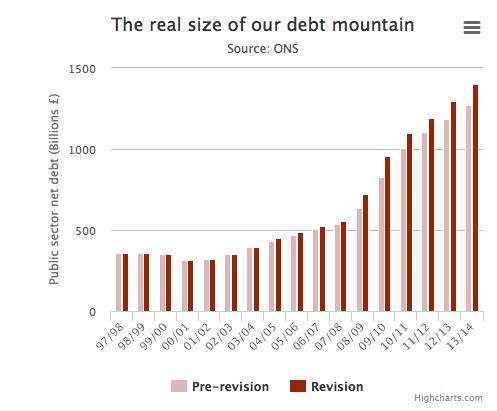
The Office for National Statistics (ONS) has changed the way it measures our public finances, throwing fresh light on the precise state of the nation’s coffers. The latest revisions help bring the UK in line with European accounting standards, but they don’t make great reading for the Chancellor. According to the figures, Britain’s debt mountain is £127 billion bigger that we first thought. To provide some context, that’s more than the government’s annual budget for education and housing put together.

In total, the government owes its creditors £1.4 trillion as of this year. Public sector borrowing – the difference between what the government earns in revenues and what it spends and invests – has also jumped. The ONS now thinks borrowing is around £99 billion, £5 billion higher than previously calculated. So what’s changed? The ONS has adopted a different methodology for calculating the public finances. Debt and borrowing are now higher as the new figures include the cost of the bank bailouts carried out in the wake of the credit crunch, as well as the Bank of England’s quantitative easing programme. The new accounting rules also mean that Network Rail has been reclassified as part of central government rather than the private sector. The liabilities associated with Network Rail add £33 billion to the nation’s debt pile. That’s approximately the entire GDP of Uruguay.

Meanwhile the inclusion of the Asset Purchase Facility, the part of the Bank of England that has been purchasing government bonds, adds on a further £42.4 billion to the debt burden. This is more than Britain’s entire defence budget for 2014/15, or roughly six times the market capitalisation of Marks & Spencer’s. In other areas, the ONS no longer treats the government’s auctioning of 4G phone spectrum licences as a one-off windfall. Should we worry? On the question of the accounting changes, the government’s fiscal watchdog, the Office for Budget Responsibility says: “it is important to stress that these are changes to the way public sector finances are measured, not to the underlying activities being measured.”

Read more …

But they’ll raise rates, Carney said again today.

Bank of England ‘Won’t Risk Recovery’: Deputy Governor Minouche Shafik (YP)

Businesses must increase productivity, investment and exports to ensure a lasting economic recovery, according to the new deputy governor of the Bank of England. In her first interview since taking on the role, Minouche Shafik discussed the risks to the rebounding UK economy, the need for more growth-orientated policies in Europe and when to start unwinding the Bank’s £375bn quantitative easing scheme. She said the economy has been growing faster than many had expected at 3.2%. Ms Shafik told The Yorkshire Post: “The recovery is encouraging. The real question is how can we make this recovery sustainable. “We don’t want to take risks with this recovery. It’s been a long recession and I think that’s going to be the biggest challenge going forward.”

On the question of when to increase interest rates, she said she would be closely watching the relationship between wage growth and productivity. She said there are mixed signals about the strength of that growth. “If wage increases are expected but productivity is performing well we can wait for longer; if those wage increases are not accompanied by productivity increases then I think we will have to move more quickly on rates because inflationary pressures will build up. “I think that’s the key choice that we face,” said Ms Shafik, who has so far attended two meetings of the Monetary Policy Committee.

Read more …

Buy stocks in a shrinking economy. Great idea.

Brace For China Markets’ Biggest Opening In Years (NY Times)

O’Connor, the $5.6 billion hedge fund owned by UBS, has been expanding its presence in Asia. It has hired traders from UBS’s proprietary trading desk to work in its Hong Kong and Singapore offices. In August, it hired John Yu, a former analyst at SAC Capital Advisors. It is not alone. Bankers, brokerage firms and hedge funds have all been quietly expanding their Asian operations to take advantage of one event: the biggest opening into China in years. China plans to connect the Shanghai stock exchange to its counterpart in Hong Kong over the next month as part of an initiative announced by Premier Li Keqiang this year to open China’s markets to foreign investors who have been largely shut out. The move will allow foreign investors to trade the shares of companies listed on the Shanghai stock exchange directly for the first time, and Chinese investors to buy shares in companies listed in Hong Kong.

The potential rewards of an open market between the mainland and Hong Kong are enormous for investors. Currently, the only way for foreign investors to trade Chinese stocks is indirectly through a limited quota program that allows a trickle of foreign money into the country. “This is the single most important development in China’s intention to internationalize this market,” one senior Western banker in Asia said of the planned reform, speaking on the condition he not be named because he was not authorized to speak publicly on the matter. The program, called the Shanghai-Hong Kong Connect, will create the second-largest equity market in the world in terms of the market value of the combined listed companies, said Dawn Fitzpatrick, the chief investment officer of O’Connor. “It is also going to create a much more efficient way for the global marketplace to value many Chinese companies, and this attribute alone makes the market more attractive,” she added.

Read more …

Infighting?

Speculation Resurfaces on China Central Bank Governor (Bloomberg)

Speculation about the retirement of China central bank Governor Zhou Xiaochuan, a champion of shifting the world’s second-largest economy to greater reliance on markets, is resurfacing, focusing attention on potential successors. With Zhou, 66, past the typical retirement age for senior officials and a Communist Party leadership meeting looming next month, social media chatter on his possible exit escalated. The Wall Street Journal said yesterday party boss Xi Jinping is considering replacing Zhou, citing unidentified officials. The China Times this month published an opinion piece on prospects for ex-securities regulator Guo Shuqing taking the job. Six of 13 economists in a Bloomberg News survey this month cited Guo, 58, as the most likely successor when Zhou does leave. Five predicted it would be People’s Bank of China Deputy Governor Yi Gang, 56. The government, which controls the PBOC, hasn’t publicly signaled its intention and rounds of speculation in 2007 and 2012 that Zhou would be replaced failed to pan out.

“There will eventually be a rumor that’s right – Zhou will retire at some point,” David Loevinger, former U.S. Treasury Department senior coordinator for China affairs and now a Los Angeles-based analyst at TCW Group Inc., said in an e-mail. “I’ve met Guo several times. He’s an accomplished economist, banker and regulator with a good understanding of the international financial system.” The PBOC, along with the rest of the nation’s policy making community, is grappling with a slowdown in growth and efforts to follow through on a pledge to give markets a “decisive” role in the economy. Zhou, at 11 years the longest-serving PBOC chief on record, has advocated freeing up controls on interest rates and reducing intervention in the exchange rate. “If Guo were to replace him, I wouldn’t expect much change in Chinese policy,” said Nicholas Lardy, author of the book “Markets Over Mao” and a senior fellow at the Peterson Institute for International Economics in Washington. “Guo Shuqing has very similar strong reformist credentials as Governor Zhou.”

Read more …

Altogether now.

Is Shorting The Euro The New One-Way Bet? (CNBC)

The euro’s drop to its lowest against the U.S. dollar in over a year may be just the beginning, with some analysts expecting the common currency to fall to levels not seen since 2003. “The euro is vulnerable to a serious hit,” analysts at Barclays said in a note Wednesday. “We now expect a large, multi-year downtrend in the euro, following a substantial deterioration in the euro area’s economic outlook and the ECB’s (European Central Bank) aggressive response to that deterioration.” The euro slipped as low as $1.2764 in early Asian trade Thursday, touching its lowest level since July 2013, after ECB President Mario Draghi said monetary policy will remain loose for as long as it takes to bring the euro zone’s inflation rate up to the central bank’s 2% target.

On Monday, Draghi told the European parliament the central bank may use unconventional tools to spur inflation and growth, which could include quantitative easing, or buying credit and sovereign bonds. Draghi reiterated those views in an interview published Thursday by Lithuanian business daily Verslo Zinios, and noted he expects modest economic growth in the second half of this year after it stalled in the second quarter Also weighing on the common currency, fresh data from the region’s economic powerhouse Germany showed business sentiment fell in September to its lowest level since April of last year.

Barclays cut its 12-month forecast for the euro to $1.10 from $1.25, with much of the depreciation expected within six months. Others are equally bearish. “The main drivers of euro trends point to significant weakness,” Societe Generale said in a note earlier this week. “Draghi will succeed in weakening the euro now because in the coming months the contrast between euro area and U.S. economic performance will translate into monetary policy divergence as the ECB remains accommodative but the Federal Reserve first stops buying assets and then raises rates from mid-2015 onwards.”

Read more …

Well, that sounds realistic …

Rapid Growth At Top Of Agenda For Emerging Market Businesses (CNBC)

Emerging economies look to corporations to keep their economies expanding at their rapid rates, according to a survey. One in three (34%) of the public and 30% of business leaders in emerging economies said helping to strengthen the economy was the most important responsibility for a company, according to the CNBC/Burson-Marsteller Corporate Perception Index. Job creation was the second most important responsibility for corporations. In developed markets however, the trend was flipped with job creation seen as the number one role of corporations, followed by helping the economy more generally. Emerging market countries are known for their rapid economic growth, which has appealed to investors over recent years. China is obsessed with its growth rate and the government continues to push for a 7.5% target. This focus on rapid growth is behind the results of the survey, according to economists.

“Growth is key and it is all about growth,” Benoit Anne, head of global emerging market strategy at Societe Generale, told CNBC by phone. “In emerging markets unemployment seems to be less of a concern because the informal economy is large and premium is attached to growth considerations.” 37% of the general public in developed countries, which includes Spain, France and the U.K., said creating jobs was the most important role for an organization, while 31% of business executives thought this was the case. The euro zone economy has been struggling since the 2008 crisis and even Germany, the bloc’s largest economy contracted in the second quarter. Unemployment in the 18 country zone stands at 11.5%, and in Spain at 24.5%. This, combined with increasing perception of income inequality, has driven the results of the survey, analysts said.

Read more …

Power.

What Does The US Gain From Paying For Europe’s Security? (RT)

Despite the fact that Europe is a very rich continent – the EU’s total GDP is higher than the US – Americans are bankrolling its security. The only way to explain the background to this conundrum is in fairytale style. When detailed in analytical text it’s even more baffling, and I don’t want to confuse everyone. Once upon a time in a land far away there were two families, the Europas and the Amerigos, who were closely related. The Europa’s fought bloody wars for millennia, mainly due to disputes between kings and queens they declared fealty to, and a few centuries ago, the Amerigos moved out of the home region. After that, the Europas continued to – constantly – argue and the Amerigos became extremely rich in their new homeland. Then, about 70 years ago, the Europas had the mother, father and cousin of all internal rows and much of the family was annihilated in a mass fratricide, but the Amerigos and their other cousins, the Sovetskys, came to save them.

While the Europas became largely poor as a result of the conflict, the Amerigos and the Sovetskys were bolstered and decided they both wanted to be top dog. They then ‘fought’ a cold war for 45 years. The Amerigos worshipped free markets, but the Sovetskys believed in socialism. The Europas were divided by the ‘isms’ – capital and social. Most of the family members on the west side of town supported the Amerigos but the east end of things fancied the Sovetskys ideas. Eventually, the Sovetskys system of communism proved inadequate and their power dissipated so the Europas began to unite again. But something had changed. A half century of peace and stability meant that the western Europas were now as wealthy as the Amerigos but the eastern branch were not; in fact, many on the east side of town were sickeningly poor after their system had collapsed.

The western Europas had become used to the Amerigos looking after security needs, but most of them were no longer afraid of the Sovetskys, who had now embraced the free market ideology and were called the Rus. They’d changed their names after half the family had splintered into smaller groups. However, many of the eastern Europas were still extremely afraid of the Rus and they pressured the Amerigos into also paying for their security. The Amerigos had promised the Rus after the Sovetsky split that they wouldn’t interfere with former family members – but this promise was broken. Now the eastern Europas too had their safety bankrolled by the Amerigos. However, they didn’t run off and join their cousins, instead they re-united with the western branch of the Europa family.

Read more …

Blame Putin.

Ukraine Is Broke – And Winter Is Coming… (RT)

How broke is Ukraine? On a scale of one to 10, I’d venture 10 and a half. What the well-meaning idiots from abroad haven’t talked about is how dependent Kiev’s economy is on Russia. In 2013, more than 60% of their exports went to post-Soviet countries. Meanwhile, export levels have, officially, fallen by a gigantic 19% already this year (and the real figure is probably much worse). Also, what little high-end manufacturing Ukraine had was almost entirely beholden to the Russian military-industrial complex. An example is Antonov, the famed aircraft maker, which recently had to write off $150 million when it couldn’t deliver an order to the Russian Air Force. Antonov’s planes can’t compete in western markets, so without the Russian market the company is finished. Good news for Komsomolsk-on-Amur (the home of Sukhoi) in Russia’s Far East, but a tragedy for the 12,000 employees of Antonov, near Kiev.

I’m not sure how Roshen Chocolates is doing, but with a $1.3 billion fortune, its owner, oligarch Willy Wonka, or President Petro Poroshenko as he’s better known, won’t be going hungry. He’s one of the lucky ones. Industrial production has fallen off a cliff in Ukraine, down over 20% already this year and retail sales aren’t far off, at about 19%. Foreign currency reserves have collapsed by around 25%, even with emergency IMF funding. Yet, that’s not even close to the largest concern. This would be the currency, the hryvna, which crumbled by 11% against the dollar last Friday alone. A year ago, the rate was around 8.1, it’s now a startling 13.5. Great news for those paid in greenbacks, but 99% of locals are remunerated in hryvnas. Inflation is north of 14% and is set to increase dramatically in the short-term as the currency is geared in only one direction. Winter is coming, and anyone who has been in Kiev in January can tell you how shivery that gets. It’s a special variety of biting cold and it takes more than North Face – for the few can afford it – to survive the onslaught.

Ukraine imports 80% of its natural gas – and most of that comes from Russia. A real problem here is that Kiev currently owes Gazprom, Russia’s state gas giant, $4.5 billion. In fact, Ukraine’s single most profitable export service (worth $3 billion annually) is transit fees for Gazprom’s access to other European markets. This is what is known as a “double bind.” I didn’t mention the IMF loans yet. They are not “aid” – and they must be repaid. The latest guarantee was around $20 million and there have been suggestions that a sizeable portion has been looted by kleptocrat insiders already. The IMF’s Articles of Agreement forbid it to make loans to countries that clearly cannot pay. Unless the agency is willing to tear up its rule book – thus making Greeks the happiest people alive – it’s clear that emergency funding from that source is also about to grind to a halt.

Read more …

Good Parry piece.

The High Cost of Bad Journalism on Ukraine (Robert Parry)

To blame this crisis on Putin simply ignores the facts and defies logic. To presume that Putin instigated the ouster of Yanukovych in some convoluted scheme to seize territory requires you to believe that Putin got the EU to make its reckless association offer, organized the mass protests at the Maidan, convinced neo-Nazis from western Ukraine to throw firebombs at police, and manipulated Gershman, Nuland and McCain to coordinate with the coup-makers – all while appearing to support Yanukovych’s idea for new elections within Ukraine’s constitutional structure. Though such a crazy conspiracy theory would make people in tinfoil hats blush, this certainty is at the heart of what every “smart” person in Official Washington believes. If you dared to suggest that Putin was actually distracted by the Sochi Olympics last February, was caught off guard by the events in Ukraine, and reacted to a Western-inspired crisis on his border (including his acceptance of Crimea’s request to be readmitted to Russia), you would be immediately dismissed as “a stooge of Moscow.”

Such is how mindless “group think” works in Washington. All the people who matter jump on the bandwagon and smirk at anyone who questions how wise it is to be rolling downhill in some disastrous direction. But the pols and pundits who appear on U.S. television spouting the conventional wisdom are always the winners in this scenario. They get to look tough, standing up to villains like Yanukovych and Putin and siding with the saintly Maidan protesters. The neo-Nazi brown shirts are whited out of the picture and any Ukrainian who objected to the U.S.-backed coup regime finds a black hat firmly glued on his or her head. For the neocons, there are both financial and ideological benefits. By shattering the fragile alliance that had evolved between Putin and Obama over Syria and Iran, the neocons seized greater control over U.S. policies in the Middle East and revived the prospects for violent “regime change.”

Read more …

But not going to happen.

Russia Calls For International Probe Into Ukraine Mass Burial Sites (RT)

Russia is calling for an international investigation into the discovery of burial sites with signs of execution at locations where the Ukraine National Guard forces were stationed two days earlier. The head of Russia’s presidential human rights council, Mikhail Fedotov, has called on the authorities to do everything to “ensure an independent international probe” and “let international human rights activists and journalists” gain access to the site in Eastern Ukraine’s embattled Donetsk region. The crime, Fedotov noted, shouldn’t “remain without consequences.” He didn’t exclude the discovery of other burial sites, reminding that mass killings are “the reality of the modern-day war” and that such crimes were committed in the wars in the former Yugoslavia. The burial sites near the Kommunar mine, 60 kilometers from Donetsk, were first discovered on Tuesday by self-defense forces. Four bodies have been exhumed, including those of three women. Their hands were tied, at least one of the bodies was decapitated, self-defense fighters said.

Two bodies were found Monday, and two others Tuesday. Self-defense forces believe there might be other burials in the area. “They are from Kommunar, which has just been freed [by DNR/DPR forces]. The people told me that the women had been missing and here we found four bodies. And I don’t know how many more people we might find,” a self-defense fighter, nicknamed Angel, told RT. “The peaceful Ukrainian army came here and “liberated” them but I can’t understand what the Army freed them from. These women died horribly,” his comrade, Alabai, added. Self-defense forces said that near the mine – which was abandoned by the Ukrainian forces a few days ago – there are other burial sites which will also be examined.

OSCE monitors have already visited and inspected the burial site. According to the OSCE report published Wednesday, some of the victims buried not far from Donetsk were killed a month ago. Near an entrance to the village the organization’s staff saw “a hill of earth, resembling a grave” and a sign with the initials of five people and a date of death – August 27, 2014. This was one of the three unidentified burial sites discovered by OSCE monitors. Prosecutors in the Donetsk People’s Republic have started an investigation. Russian Foreign Ministry’s envoy for human rights, Konstantin Dolgov, said on Twitter that the Ukrainian army was to blame for the killings. “The finding of mass burial sites in Donetsk area is yet another trace of the Ukrainian forces’ and radical nationalists’ humanitarian crime,” Dolgov said. “This beastly crime targeting civilians attracts our attention even more to the necessity of investigating humanitarian crimes in Ukraine under international control,” he added.

Read more …

Not just the US, I’d venture.

How the US Screwed Up in the Fight Against Ebola (BW)

It was a small victory in a grim, relentless, and runaway catastrophe. In July, Kent Brantly and Nancy Writebol, both American medical workers in Liberia, became stricken with Ebola hemorrhagic fever after treating dozens suffering from the disease, which has a mortality rate of between 50% and 90%. They were rushed doses of an experimental cocktail of Ebola antibodies called ZMapp, flown home via a Gulfstream III on separate flights on Aug. 2 and 5, and isolated inside a special tent called an “aeromedical biological containment system.” The U.S. State Department and the Centers for Disease Control and Prevention (CDC) coordinated the flights, operated by Phoenix Air, a private transport company based in Georgia. Cared for in a special ward at Emory University in Atlanta, they recovered within the month and later met with President Obama. It appeared a win for the White House.

Mapp Biopharmaceutical, the San Diego company that developed ZMapp, is also in a way a White House project. It’s supported exclusively through federal grants and contracts that go back to 2005. The antibody mixture hadn’t yet passed its first phase of human clinical trials, but after the two Americans were infected with Ebola, the Food and Drug Administration granted emergency access to ZMapp. It’s impossible to say whether ZMapp was vital to the Americans’ survival. There were a limited number of doses available. Mapp ran out after having given doses to the two Americans, a Spanish priest, and doctors in two West African countries, although it declined to say how many. And that raised a fair question: Why hadn’t the promising treatment gone through human clinical trials sooner, and why were there so few doses on hand?

Since appearing in Guinea in December, Ebola has spread to five West African countries and infected 5,864 people, of which 2,811 have died, according to the World Health Organization’s Sept. 22 report. This number is widely considered an underestimate. The CDC’s worst-case model assumes that cases are “significantly under-reported” by a factor of 2.5. With that correction, the CDC predicts 21,000 total cases in Liberia and Sierra Leone alone by Sept. 30. A confluence of factors has made it the biggest Ebola outbreak yet. For starters, West Africa has never seen Ebola before; previous outbreaks have mainly surfaced in the Democratic Republic of the Congo in Central Africa. The initial symptoms of Ebola—fever, vomiting, muscle aches—are also similar to, and were mistaken for, other diseases endemic to the region, such as malaria.

Then, when officials and international workers swept into villages covered head to toe and took away patients for isolation, some family members became convinced that their relatives were dying because of what happened to them in the hospitals. They avoided medical care and lied to doctors about their travel histories. Medical staff at local hospitals became scared and quit their jobs. Aid workers trying to set up isolation units or trace infected people’s contacts were attacked by angry villagers. With these countries short on resources, staff, medical equipment, and basic understanding of the disease, Ebola took hold and spread.

Read more …

Ambrose is the epitomy of techno-happy. And he proves once more than actual knowledge has nothing to do with it.

Technology Revolution In Nuclear Power Could Slash Costs Below Coal (AEP)

The cost of conventional nuclear power has spiralled to levels that can no longer be justified. All the reactors being built across the world are variants of mid-20th century technology, inherently dirty and dangerous, requiring exorbitant safety controls. This is a failure of wit and will. Scientists in Britain, France, Canada, the US, China and Japan have already designed better reactors based on molten salt technology that promise to slash costs by half or more, and may even undercut coal. They are much safer, and consume nuclear waste rather than creating more. What stands in the way is a fortress of vested interests. The World Nuclear Industry Status Report for 2014 found that 49 of the 66 reactors under construction – mostly in Asia – are plagued with delays, and are blowing through their budgets.

Average costs have risen from $1,000 per kilowatt hour to around $8,000/kW over the past decade for new nuclear, which is why Britain could not persuade anybody to build its two reactors at Hinkley Point without fat subsidies and a “strike price” for electricity that is double current levels. All five new reactors in the US are behind schedule. Finland’s giant EPR reactor at Olkiluoto has been delayed again. It will not be up and running until 2018, nine years late. It was supposed to cost €3.2bn. Analysts now think it will be €8.5bn. It is the same story with France’s Flamanville reactor. We have reached the end of the road for pressurised water reactors of any kind, whatever new features they boast. The business is not viable – even leaving aside the clean-up costs – and it makes little sense to persist in building them. A report by UBS said the latest reactors will be obsolete by within 10 to 20 years, yet Britain is locking in prices until 2060.

The Alvin Weinberg Foundation in London is tracking seven proposals across the world for molten salt reactors (MSRs) rather than relying on solid uranium fuel. Unlike conventional reactors, these operate at atmospheric pressure. They do not need vast reinforced domes. There is no risk of blowing off the top. The reactors are more efficient. They burn up 30 times as much of the nuclear fuel and can run off spent fuel. The molten salt is inert so that even if there is a leak, it cools and solidifies. The fission process stops automatically in an accident. There can be no chain-reaction, and therefore no possible disaster along the lines of Chernobyl or Fukushima. That at least is the claim.

Read more …

Sep 212014
 
 September 21, 2014  Posted by at 8:10 pm Finance Tagged with: , , ,  8 Responses »


Russell Lee Hamburger stand in Harlingen, Texas Feb 1939

On this relatively quiet Sunday, why not delve into a topic that’s as timely as it is controversial topic: the US greenback. I see it moving a lot lately, and I see a lot of opinions being expressed on those moves. But for most of those opinions, I got to say: I’m sorry, but I don’t think so.

There’s such a huge amount of entrenched and ingrained ideas in the financial world about the dollar and inflation and gold, and an awful lot of it is in desperate need of, for lack of a better term, mental flexibility.

You can claim that the dollar will perish, and that’s true enough, but it will be – near – the last of all fiat currencies to do so. You can claim inflation is on the way, but that can’t happen without increased spending. And consumers who get poorer all the time cannot increase their spending.

You can claim the golden days of gold are nigh again, and that prices have been manipulated (not that I doubt that), but as long as the dollar’s alive, why should we assume that at least the American dollar generated part of the manipulation will stop? Gold will rise to the top once more alright, it always has, but it’s what to do in the meantime that’s more interesting for all but the 1%.

The Automatic Earth has always said that the US dollar would come out the winner among currencies. Simply because there is no other way. Eventually, the greenback will go the way of all fiat money, but that’s not going to happen tomorrow morning, and we need to find something to do with ourselves until it does.

The fact that the dollar is the world reserve currency is important, but it’s not no.1. Today’s world is drowning in debt, and a huge majority of it is denominated in US dollar. Yank up interest rates and dollar demand will soar like a BUK rocket. No matter what Russia and China and India invent in non-dollar trade. Too little too late.

The US Fed has prevented the dollar surge from happening over the past 7-8 years, and the entire globe has hidden and/or financed its deficits courtesy of that, but the Fed, for one reason or another, has decided to stop playing that game. Not only will there be fewer dollars made available (QE tapering), but the Fed funds rate will also be raised.

Present numbers from Fed sources being chewed on in the press are well above 1% in a year or so, from 0.25% now. Count your blessings, emerging markets. The question is: why would they do that at this point? I think a large part of the explanation is to be found in what I talked about in The Fed Has A Big Surprise Waiting For You.

That is, Wall Street sees its profit sources drying up because everybody and their pet hamster is on the same side of the trade. Which means if you can get them to stay there, and change the rules of the game behind their back in the meantime, potential profits are stupendous.

In The Fed Has A Big Surprise Waiting For You, I focused on interest rates (only). But I think what’s true for rates there, is also valid for the dollar: the Fed is changing its views and policies. And no, it does not have everybody’s back, not investors and, but that does hardly need repeating, Main Street.

Most people will still see the recent rise of the dollar in FX markets as just that, something that happens due to market mechanisms. Really, what market? It would be naive to think the Fed, which has controlled asset markets up to the point of being a direct buyer of stocks, and propped up the US housing market for years, would let the dollar either slide or rise as much as we’ve seen lately, and not act. Therefore, if you follow my point, it must have acted.

For the same reason that you shouldn’t assume too easily that the economy is recovering, you shouldn’t too easily assume the Fed is not aware of what happens to the USD, or doesn’t have a handle on it. Just as it would be silly, for that matter, to disregard off-hand the connection between economic depression and increasing cries for war, but that’s perhaps for another day.

Let’s turn to what others have to say about the dollar vs other currencies. First, a few quotes from the Australian rainforest, where the world’s finance ministers were gathered. I’m not sure whether to think the setting is too much for them, or that it fits just right. They sure produced some whoppers.

Currencies Back on Agenda as G-20 Monetary Policies Split

The dollar has climbed over the past three months against all 16 major peers tracked by Bloomberg, touching a six-year high versus the yen and a 14-month peak against the European currency.

• U.S. Treasury Secretary Jacob J. Lew renewed a call for member nations to avoid currency intervention in a bid to gain a competitive edge.

• South Korean Finance Minister Choi Kyung Hwan said divergent monetary policies “have the risk of increasing uncertainties in global financial markets,” while volatile foreign capital flows “could also have an impact on the foreign exchange rates.”

“It’s important for foreign-exchange rates to move in a stable manner by reflecting economic fundamentals,” Bank of Japan Governor Haruhiko Kuroda said. Kuroda said this month he would do what’s needed to achieve the BOJ’s inflation target as he continues unprecedented easing.

• The ECB has cut interest rates to record lows and committed to boost its balance sheet to the levels it had at the height of the sovereign debt crisis in 2012. German Finance Minister Wolfgang Schaeuble told the G-20 meeting today that expansive fiscal and monetary policies could risk creating a bubble in equity and property markets, according to a German delegation official. ECB Governing Council member Jens Weidmann told Bloomberg that monetary policy should not be expansionary for longer than necessary to ensure price stability.

• [..] After finance ministers and central bank chiefs met in Moscow in July 2013, they pledged: “We will refrain from competitive devaluation and will not target our exchange rates for competitive purposes.” Lew yesterday revisited language from that communique. Lew told South Korea’s Choi that countries must meet “commitments to move toward market-determined exchange rates.”

• Choi said the South Korean government is “not at all” intervening in the foreign-exchange market to determine the won’s level. Lew’s comments were “reiterating the importance” of the issue, rather than singling out South Korea, Choi said. While Choi said he lets the market determine the strength of the won, it’s different when moves are extreme. “If there is a very sudden tilting toward one direction in a very short period of time in the foreign exchange market, then there would be some smoothing operations.”

Note to Self: If and when Jack Lew says that “countries must meet “commitments to move toward market-determined exchange rates”, he’s actually saying that at present there are no market-determined exchange rates. Not a minor thingy.

What’s happening with the US dollar is exceptional, it’s not some sort of fluke:

Dollar Has Longest Winning Streak Since 1967 on Divergence

The dollar had its longest stretch of weekly gains since Lyndon Johnson was in the White House after the Federal Reserve signaled an end to unprecedented monetary stimulus measures next year. The U.S. Dollar Index advanced for a 10th straight week, the longest since at least March 1967, when Johnson was in the fourth year of his presidency.

“The dollar is the No. 1 trend across all asset classes going into the end of the year,” Neil Azous, founder of Stamford, Connecticut-based research firm Rareview Macro LLC, said in a phone interview. “It’s back to trading interest-rate fundamentals.”

[..] “ … the dollar has been so depressed over the last few years, and now that depression is unwinding, like a coiled spring,” Douglas Borthwick, head of foreign exchange at Chapdelaine & Co., said. “The Dollar Index will continue to stay bid as long as the Japanese continue to make motions of quantitative easing while Europe makes more noise about expanding their balance sheets.”

[..] The U.S. Dollar Index has rallied 5.9% this year, set for the biggest annual gain since 2008, when the Fed began the first of three rounds of bond purchases under the quantitative-easing stimulus strategy. The gauge lost 4.2% in 2009.

[..] The dollar has risen 3.2% in the past month in a basket of 10 developed-nation currencies tracked by Bloomberg Correlation-Weighted Indexes. The yen has lost 3.3%, the biggest decline, and the euro has fallen 1.1%. Sterling has gained 0.9%.

Mr Borthwick is right, but I’m not sure he understands why he is. He’s dead on remarking that “the dollar has been so depressed over the last few years”, but he should note that it’s the Fed that has been depressing the dollar, not the markets. The recent surge doesn’t even have to be due to active support, the simple lifting of whatever measures kept it down is sufficient.

Keep your cool and shrink the amount of available dollars. That’s all it takes. The, from a market point of view, insanely high prints for the Euro against the USD, which lasted for years at $1.30 to $1.40, are let go. Big move. Not in the least for US businesses.

Dollar’s Rally Bad News For Oil, Multinationals

The asset with the greatest prowess of late has been the U.S. dollar, and if its rally continues, it threatens to eat into the earnings of multinational companies. The greenback’s recent gains have lifted the dollar index – a measure of the dollar’s value relative to six currencies – for 10 consecutive weeks.

That marks the dollar’s longest rally since the index was created in 1973 – and could pose significant headwinds to dollar-sensitive sectors of the market, particularly companies that respond to commodity prices affected by the greenback, and multinationals that do much of their business overseas.

“For the past few years, the U.S. dollar has been trading in a relatively quiet trading range. This summer, something changed. We are now seeing a new uptrend develop,” said Adam Sarhan, founder and CEO of Sarhan Capital in New York. Analysts have already pointed fingers at the dollar for the decline in prices of commodities like precious metals, corn and oil in recent weeks. U.S. multinationals with large streams of revenue from overseas also stand to lose.

[..] Much of the calculus of whether the dollar’s rise will become a net negative for U.S. stocks depends on domestic inflation rates, as well as the speed and scale of the currency’s gains, market watchers said. “The euro zone is fragile … the British pound is also weak, and geopolitical or economic woes remain a threat. As long as it is a healthy and normal advance, they should be able to adjust and prepare for it,” Sarhan said. “But if the move is very large, fast or erratic, those consequences [could] be immeasurable.”

Yes, something changed alright. Fed priorities did. Jim Rickards gives his view:

Jim Rickards: ‘World In Indefinite Depression’ (RT)

RT: The Chinese Central bank is now offering stimulus. Is this a part of a new round of “currency wars”?

Jim Rickards: Yes, that is right. I think this is one long “currency war”. We are now getting into more of a battle, more of a confrontation. The US dollar is the only strong currency that cannot last: the US cannot have a strong currency, because we are desperate for inflation. We have done all the quantitative easing, we have raised the zero, we have issued further guidance, we have done a twist, and we have done three versions of QE. We have done everything possible. The only thing left is to try to cheapen the currency and in fact the dollar is getting stronger.

The Fed might not have minded a stronger dollar: six months ago it did look like the economy was getting stronger. We saw strong second quarter GDP. So it was a little bit of a good day. And Europe was desperate for the help: they were stepping into recession. Japan`s economy collapsed in the second quarter. So you could see the feds saying “ok…we will have a stronger dollar and give Europe and Japan a break”. But that is over. Now the US is becoming a loser and we are the ones who need to take a break. The only way to get it is a cheaper dollar. I would look for that in the months ahead.

Jim, it’s not six months ago, it’s more recent than that. Look:

And the biggest drop was even over just the past month or so:

I know, this is the EUR/USD situation only, but that IS the most important data. What happens vs the yen is much less relevant, because Shinzo Abe is a desperate man willing do anything to beggar his currency. And China is too opaque to draw any conclusions from. Besides, the Euro is by far the biggest reserve currency behind the USD.

And after that, Jim, you’re just absolutely missing the mark. The rise of the dollar just got started. The Fed is not looking for a cheap dollar. Not anymore. You may argue that we’re watching a headfake, but it’s not that “the Fed might not have minded a stronger dollar”: they actively want a stronger dollar. For the same reason they want higher interest rates: the profits of Wall Street banks.

There are tens of trillions – mostly in US dollars – outstanding in interest rate derivatives. The mood in that camp has become as complacent, ‘Fed has my back’, as it has in stock markets. That means there are no profits there anymore. That’s what Minsky meant when he said that stable markets MUST lead to instability: it’s about profits. Stability will always only remain an illusion.

If and when the Fed takes its hands off the US dollar rate, da greenback will rise like crazy vs the Euro, go to par and probably beyond. And that would still only be normal, there’s no reason why they wouldn’t be at par. But it’s also a 30% move. And that sounds like the promise of real profits.

The Fed never sought to ‘protect’ Main Street or main investors, other than as something collateral, some sort of piggybacking. The big money going forward is in a higher dollar and higher interest rates. So that’s what we’ll have. There won’t be too many parties, big or small, gearing or hedging up for that, even if they have that flexibility, so it’s OK to give away a little of the game plan.

I’m not saying that I know all the details and ins and outs here, but I do think a lot of questions never get asked on this topic, and I do think the role the Fed plays is very poorly understood. The Fed has long given up on the US economy.

Global Finance Chiefs Said to Warn of Growing Economic Risks (Bloomberg)

Group of 20 finance chiefs will warn that risks to the global economy have increased in recent months, an official said, citing the latest draft of a communique due to be released today. Finance ministers and central bank governors meeting in Cairns, Australia, will acknowledge in the statement that the outlook is uneven among countries, the official from a G-20 nation said yesterday, asking not to be identified because the document hasn’t been made public. G-20 economies today will also commit to taking growth-boosting measures to spur recovery. “Ambitious goals to increase sustainable growth rates are certainly welcome against the background of sluggish growth and sticky unemployment in some countries,” European Central Bank Governing Council member Jens Weidmann said in an interview yesterday. The global economic recovery has faltered since a February G-20 meeting in Sydney, as signs that Europe risks slipping into deflation offset more bouyant economies in the U.S. and U.K. and the wealth effects of stock-market gains.

In Asia, Japan’s revival is being blunted by a sales tax increase and concerns are mounting that China’s 7.5% growth target for 2014 is becoming harder to attain. G-20 economies have submitted individual plans to boost gross domestic product by an additional 2% over five years, a goal the group committed to in February. The group will say in their statement that measures proposed so far will boost GDP by 1.8%. Members will commit to additional action to meet their target ahead of a summit of G-20 leaders in Brisbane, Australia, in November, the official said. Even as the group discusses longer-term measures to lift economic output, officials in the U.S. and Canada are pressing for more immediate steps to boost demand. Some European countries should consider additional fiscal measures to bolster growth, even if they temporarily delay efforts to shrink their budget deficits, Canadian Finance Minister Joe Oliver said in an interview. U.S. Treasury Secretary Jacob J. Lew said the global economy continues to underperform, particularly Europe and Japan.

Read more …

Currencies Back on Agenda as G-20 Monetary Policies Split (Bloomberg)

Currencies are back on the G-20 agenda as diverging monetary policies from the U.S. to Japan threaten to increase exchange-rate volatility. Foreign-exchange “coordination” will be reflected in tomorrow’s communique in Cairns, Australia, echoing a pledge by Group-of-20 economies in July 2013 in Moscow, South Korean Finance Minister Choi Kyung Hwan said in an interview today. The U.S. dollar has climbed as the Federal Reserve edges closer to its first interest-rate increase since 2006, while easing by the European Central Bank and the Bank of Japan are weighing on the yen and euro. In Cairns yesterday, U.S. Treasury Secretary Jacob J. Lew renewed a call for member nations to avoid currency intervention in a bid to gain a competitive edge.

Divergent monetary policies “have the risk of increasing uncertainties in global financial markets,” Choi said. Volatile foreign capital flows “could also have an impact on the foreign exchange rates.” The dollar has climbed over the past three months against all 16 major peers tracked by Bloomberg, touching a six-year high versus the yen and a 14-month peak against the European currency. “It’s important for foreign-exchange rates to move in a stable manner by reflecting economic fundamentals,” Bank of Japan Governor Haruhiko Kuroda, who is also in Cairns, said yesterday. “It’s natural for it to move in accordance with changes in economic fundamentals.”

Kuroda said this month he would do what’s needed to achieve the BOJ’s inflation target as he continues unprecedented easing. The ECB has cut interest rates to record lows and committed to boost its balance sheet to the levels it had at the height of the sovereign debt crisis in 2012. German Finance Minister Wolfgang Schaeuble told the G-20 meeting today that expansive fiscal and monetary policies could risk creating a bubble in equity and property markets, according to a German delegation official, who briefed reporters on condition of anonymity in line with policy. ECB Governing Council member Jens Weidmann told Bloomberg News in Cairns that monetary policy should not be expansionary for longer than necessary to ensure price stability.

[..] After finance ministers and central bank chiefs met in Moscow in July 2013, they pledged: “We will refrain from competitive devaluation and will not target our exchange rates for competitive purposes.” Lew yesterday revisited language from that communique. According to a statement from the U.S. Treasury Department, [U.S. Treasury Secretary Jack Lew] told South Korea’s Choi that countries must meet “commitments to move toward market-determined exchange rates.”

[..] In a statement in April this year in Washington, G-20 finance chiefs said they were committed to “exchange rate flexibility” among other steps to help meet their goal of boosting gross domestic product by an additional 2% over five years. Choi said the South Korean government is “not at all” intervening in the foreign-exchange market to determine the won’s level. Lew’s comments were “reiterating the importance” of the issue, rather than singling out South Korea, Choi said. While Choi said he lets the market determine the strength of the won, it’s different when moves are extreme. “If there is a very sudden tilting toward one direction in a very short period of time in the foreign exchange market, then there would be some smoothing operations,” he said. “But that is something that is done not only in Korea but in all other countries.” He described “smoothing” as the minimum level of effort made by the currency authority in times of such extreme fluctuations.

Read more …

OK, I Get It. Things Are Coming Unglued (WolfStreet)

As long as major stock indices around the world keep soaring (forget for a moment the carnage in smaller stocks), and as long as bonds trade at near all-time highs, and as long as the yield of dubious government debt is close to zero or below zero so that borrowing has become a profit center for governments and a loss center for investors, as long as we live in this wondrous world, who cares about the global economy? This is a resounding theme. Super-ugly data about Japan’s economy piles up, and people say, “Yeah but look, the Nikkei surges.” And this discussion is over. It doesn’t matter that the Nikkei surges as the Bank of Japan is buying every JGB that isn’t nailed down. It’s buying them from banks, pension funds, and individual investors to pile them up on its balance sheet where they can be selectively defaulted on without sparking social chaos. Everyone seems to have accepted the alternative to social chaos, namely a gradual loss of “wealth.”

So banks, pension funds, and other investors are selling their JGBs to the Bank of Japan and are looking at stocks as a place to stash their proceeds. This buying is unrelated to what companies in the Nikkei are doing. It’s an effort to get rid of increasingly toxic JGBs. And hedge funds anticipate that pension funds and other investors are shifting into stocks, and they front-run them, and the Nikkei surges…. But off to the side, in Cairns, Australia, the finance honchos of the G-20 are meeting this weekend. And they’re already jabbering. They’re lamenting just how badly the global economy is faltering. But it was overshadowed by the iPhone 6 razzmatazz and the IPO hoopla of Alibaba, whose shares give investors ownership in a mailbox company in the Cayman Islands that has a contract with some Chinese outfit, and nothing more. But hey, the purpose of owning a stake in a mailbox company is to make a buck and get out. An equation that might work for a while in this era of endless liquidity.

Read more …

Jim Rickards: ‘World In Indefinite Depression’ (RT)

We are in global depression which started in 2007 and is going to continue indefinitely, Jim Rickards, economist and author of “Currency Wars: The Making of the Next Global Crisis,” told RT. China’s central bank is injecting a combined 500 billion Yuan into the country’s top banks – a move signaling the deep concerns of an economic slowdown in China. A downturn in China`s economy, as investment is scaled back in Chinese real estate, has prompted economists to forecast further financial defaults and slowing economic growth in the second half of the year. Will this monetary easing fix China’s short-term problem and put it back on the path to prosperity in the long-term? Erin from “Boom Bust” asked economist, Jim Rickards, in her show.

RT: The Chinese Central bank is now offering stimulus. Is this a part of a new round of “currency wars”?

Jim Rickards: Yes, that is right. I think this is one long “currency war”. We are now getting into more of a battle, more of a confrontation. The US dollar is the only strong currency that cannot last: the US cannot have a strong currency, because we are desperate for inflation. We have done all the quantitative easing, we have raised the zero, we have issued further guidance, we have done a twist, and we have done tree versions of QE. We have done everything possible. The only thing left is to try to cheapen the currency and in fact the dollar is getting stronger. The Fed might not have minded a stronger dollar. Six months ago it did look like the economy was getting stronger. We saw strong second quarter GDP. So it was a little bit of a good day. And Europe was desperate for the help: they were stepping into recession. Japan`s economy collapsed in the second quarter. So you could see the feds saying “ok…we will have a stronger dollar and give Europe and Japan a break”. But that is over. Now the US is becoming a loser and we are the ones who need to take a break. The only way to get it is a cheaper dollar. I would look for that in the months ahead.

RT: PIMCO says that Chinese growth will slow to 6.5% over the next year and this is despite the official 7.5% target now in place. Do you think PIMCO is right?

JR: Yes, it is about to go down further. I have been going for Chinese growth to get to 3 or 4%. I would say that China`s growth is already at 4%. I know they print 7.5%. But about half of the GDP they produce is wasted. So if I build a $5 billion train station in a small town that is $5 billion of GDP- this money is completely wasted because 10 people getting on the train are not going to pay for a $5 billion station. So you go around China with these ghost cities we have talked about before… So it is generating GDP, but it is completely wasted. If you adjusted the published GDP figures for the amount of waste, their actual growth is probably already roughly 4%. That is going to go lower.

Read more …

!!!

Families Of German MH17 Victims To Sue Ukraine (Reuters)

Survivors of German victims of Malaysian Airlines flight MH17 downed over Ukraine plan to sue the country and its president for manslaughter by negligence in 298 cases, the lawyer representing them said on Sunday. Professor of aviation law Elmar Giemulla, who is representing three families of German victims, said that under international law Ukraine should have closed its air space if it could not guarantee the safety of flights. “Each state is responsible for the security of its air space,” Giemulla said in a statement emailed to Reuters. “If it is not able to do so temporarily, it must close its air space. As that did not happen, Ukraine is liable for the damage.” Bild am Sonntag Sunday mass newspaper quoted Giemulla as saying that by not closing its airspace, Ukraine had accepted that the lives of hundreds of innocent people would be “annihilated” and this was a violation of human rights.

The jetliner crashed in Ukraine in pro-Russian rebel-held territory on July 17, killing 298 people, two-thirds of them from the Netherlands. Four Germans died in the crash. Ukraine and Western countries have accused the rebels of shooting the plane down with an advanced, Russian-made missile. Russia has rejected accusations that it supplied the rebels with SA-11 Buk anti-aircraft missile systems. Giemulla planned to hand his case to the European Court of Human Rights in about two weeks, accusing Ukraine and its President Petro Poroshenko of manslaughter by negligence in 298 cases. He would also push for compensation of up to one million euros ($1.3 million) per victim, Bild am Sonntag reported.

Read more …

Idiots.

Ukraine Defense Minister ‘Claims’ Russia Used Nukes (RT)

A reported claim by Ukraine’s Defense minister that Russia used tactical nuclear weapons against his troops sparked sarcastic comments from Moscow and criticism from the rival Ukrainian Interior Ministry. The allegations, by Col. Gen. Valery Geletey, were first reported by Roman Bochkala, one of the Ukrainian journalists accompanying the minister in his recent trip to Poland. “So Russia did use tactical nuclear weapons against Ukrainian troops,” the journalist wrote on his Facebook page, citing Geletey’s words. The nuclear weapons in question are rounds for 2S4 Tyulpan self-propelled mortars. The journalist reported the minister as saying that Russia supplied some of those to rebel forces and used at least two 3-kiloton nuclear rounds in the battle for Lugansk airport. “If it were not for the Tyulpans, we could have been holding the airport for months and nobody would have ousted us from it,” the general was cited as saying.

The allegations understandably provoked a small media storm in Ukraine and even comments from the Russian Defense Ministry, which expressed doubt that a general could actually have said it. If the minister did say all that, the Russians joked, then “the Ukrainian security service should investigate what the Polish friends slipped into Geletey’s glass.” “Speaking seriously, Geletey’s habit of justifying the failures of the punitive operation in southeastern Ukraine with the alleged actions of the Russian armed forces start to resemble paranoia,” the Russian ministry added. And ever-sarcastic Deputy Prime Minister Dmitry Rogozin, who supervises Russian defense and security, tweeted a picture of Geletey with his hands stretched out saying: “they nuked us with a bomb this big.”

The Ukrainian general himself later denied the nuclear allegations, saying that the journalist had misinterpreted his words. “Everyone knows that Russia is de facto using Ukrainian territory as a testing range for its new weapons,” Geletey wrote on his Facebook page. “What else than for testing did the Russians send 2S4s into our territory?” “I stress that only competent specialists armed with special equipment may test whether or not a nuclear or any other weapon that we don’t know of was used. In particular they need to take radiation samples on the ground. Unfortunately, we cannot do that because Lugansk airport is currently under control of the terrorists and the Russian military,” he added.

If anything, the defense minister and the journalist, who misreported his words, have given ammo to critics of Ukraine, said Anton Gerashchenko, an aide to Interior Minister Arsen Avakov. “Why would anyone make such statements that can be easily checked and proven false?” he wrote on his Facebook page. “In the end Russia and the entire world will now ridicule us. Too bad, it’s nothing new for us.” The two Ukrainian ministries involved in the military campaign against rebel forces in the east have been trading accusations lately. The latest round of bickering this week came after Geletey said in an interview that “there were no real heroes” among the commanders of the Interior Ministry’s National Guard, who are now seeking seats in parliament. Avakov responded with a demand for an apology from his fellow minister.

Read more …

Too late.

Russia to Consider Diversifying Away From Western Debt Securities (WSJ)

Russia is considering diversifying its debt portfolio away from countries that have imposed sanctions on Moscow and into the papers of its Brics partners, Finance Minister Anton Siluanov said Saturday. Australia, Canada, the European Union, Japan, the U.K. and the U.S. have imposed sanctions against Russia in recent months to punish it for the annexation of the Ukrainian region of Crimea and for supporting anti-Kiev rebels in eastern Ukraine. The sanctions have pressured Russia’s finances, prompting the Kremlin to seek tighter ties with the emerging world. Speaking on the sidelines of an annual investment forum in the Black Sea town of Sochi, Mr. Siluanov said the Finance Ministry wants to diversify its investment basket, and is looking for higher yields without too much risks.

He said the ministry will consider buying papers issued by Brazil, India, China and South Africa, which along with Russia are known collectively as the Brics countries. “[We would like to] walk away from investing in papers of the countries that impose sanctions against us,” Mr. Siluanov said, adding that the reshuffle would be carried out gradually. He didn’t elaborate on when the first purchases of Brics debt may take place. Mr. Siluanov said such a move wouldn’t be aimed at punishing the West because Russia’s share in their papers is so small they wouldn’t feel the effect. When asked whether the diversification would mean Russia was preparing for financial isolation in the long term, Mr. Siluanov said he hopes Western sanctions would be lifted soon but said that his ministry should be ready for other scenarios.

Read more …

Russia Pledges State Funds to Business as Sanctions Limit Growth (Bloomberg)

Russia will remain committed to developing its market economy as the state offers billions of dollars of aid to help the country’s biggest companies weather sanctions imposed by the U.S. and Europe. Prime Minister Dmitry Medvedev met with business leaders to discuss state aid to cope with the strain as Russia’s economic slowdown is exacerbated by the sanctions, Economy Minister Alexei Ulyukayev said today at an investment forum in the Black Sea city of Sochi, site of the Winter Olympics. The government is trying to revive its $2 trillion economy, growing at its slowest since a contraction in 2009 as U.S. and European Union sanctions compound cooling consumption and falling oil prices.

Concerns that the arrest of billionaire Vladimir Evtushenkov, the richest Russian to face criminal charges since Mikhail Khodorkovsky a decade ago, signal an attack on private business have intensified outflows. The ruble weakened to a record against the dollar and the 50-stock Micex index fell to six-week low as Russia’s political and business elite mingled in Sochi. The sanctions are a “pointless and ugly decision toward Russia but we’ll manage without” foreign financing, Medvedev said in an interview with TV channel Rossiya 24. The government is holding off discussing another round of tit-for-tat measures, he said, after Russia last month banned some food imports from the U.S., the EU, Norway, Canada and Australia.

Read more …

‘Europe To Lose Its Share Of Russian Market Due To Foolish Sanctions’ (RT)

Europe will not regain its share of the Russian market after the sanctions war is over, as it will already be occupied by other local and foreign businesses, Russian Prime Minister Dmitry Medvedev has warned. Russia and the West will eventually “come to agreements sooner or later, as sanctions don’t last forever,” Medvedev said in an interview with Vesti 24 TV channel. “These foolish sanctions will pass, but international relations will continue. And currency markets will open up,” he added. The prime minister stressed that “the niches in our [Russian] economy, which will by then be occupied by local produces or other foreign producers…our European counterparts wouldn’t be able to come back.” According to Medvedev, “this is the price Europe will have to pay” for trying to put Russia under economic pressure. He assured that Asian and Latin American companies – which will replace the Europeans on the Russian market – will maintain their positions after relations between Moscow and the EU return to normal.

Read more …

Word.

‘Whatever Is Offered To Scotland Has To Be Available To Wales Too’ (RT)

The Scottish referendum is a real victory for people power, although the UK establishment was against it. Now Wales needs to ensure that its needs and demands are heard as well, leader of the Party of Wales (Plaid Cymru), Leanne Wood, told RT.

RT: Scotland walked a very long road to get this referendum. Have they blown their chance?

Leanne Wood: What has happened in Scotland has been remarkable. It has been a David and Goliath battle really, with the “yes” campaign almost achieving what they set out to achieve from a very low base. The entire corporate media was against social media, the entire British establishment was against ordinary Scots coming together in town halls. So even though they haven’t created a new state as the result of the referendum yesterday, they have achieved a great amount for democracy. And I want to whole heartedly congratulate the Scots for the way in which they conducted this debate.

RT: The Scottish breakaway campaign was very strong, and yet it failed. What kind of example does this give to your movement which is aimed at independent Wales?

LW: I would say it didn’t fail actually. The fact that so many people were engaged, so many people were talking about this and that there was very little apathy in the run-up to this campaign, it tells me that this is a real victory for people power.

RT: Before the referendum, the pro-union parties promised more powers for Scotland if they chose to stay. When can we expect this process to start?

LW: Today, it has to happen straight away. I have to say that the promises that have been made to people of Scotland, I am skeptical about them being delivered. But what I would say is that at the very basic minimum whatever is offered to Scotland has to be available to Wales too. There is a very real risk that we will have second or even third-class devolution here in Wales, while first-class devolution is being offered to Scotland. And that situation is simply not acceptable – we must have first-class devolution here in Wales too.

Read more …

They know how to do it.

French Farmers Torch Tax Office In Brittany Protest (BBC)

French vegetable farmers protesting against falling living standards have set fire to tax and insurance offices in town of Morlaix, in Brittany. The farmers used tractors and trailers to dump artichokes, cauliflowers and manure in the streets and also smashed windows, police said. Prime Minister Manuel Valls condemned protesters for preventing firefighters from dealing with the blaze. The farmers say they cannot cope with falling prices for their products. A Russian embargo on some Western goods – imposed over the Ukraine crisis – has blocked off one of their main export markets.

About 100 farmers first launched an overnight attack on an insurance office outside Morlaix, which they set light to and completely destroyed, officials said. They then drove their tractors to the main tax office in the town where they dumped unsold artichokes and cauliflowers, smashed windows and then set the building on fire. French media said the farmers then blocked a busy main road in Morlaix in both directions. In a statement, Mr Valls “vigorously” condemned the “looting and destruction by fire” of the buildings. He said violence was not justified and the perpetrators would be prosecuted.

Read more …

Word.

You Can’t Feed a Family With GDP (NY Times)

The most important thing to know about the state of the United States economy was revealed in a report Tuesday morning that Wall Street barely noticed. Every year, the Census Bureau delivers a sweeping set of numbers that give the richest annual picture of how much Americans are making, how many are living in poverty, and how many have access to health insurance. The numbers are backward-looking, covering conditions from a year ago. But the new numbers, released Tuesday, in many ways tell us more about how well the economy is serving — or failing — the mass of Americans than data that create hyperventilation in the financial markets. The census numbers on what American families made last year are as mediocre as they are predictable.

We now know that if your household brought in $51,939 in income last year, you were right at the 50th percentile, with half of households doing better and half doing worse. In inflation-adjusted terms, that is up a mere 0.3 percent from 2012. If you’re counting, that’s an extra $180 in annual real income for a middle-income American family. Don’t spend your extra $3.46 a week all in one place.

Read more …

8 Ways The Obama Administration Is Blocking Information (AP)

The fight for access to public information has never been harder, Associated Press Washington Bureau Chief Sally Buzbee said recently at a joint meeting of the American Society of News Editors, the Associated Press Media Editors and the Associated Press Photo Managers. The problem extends across the entire federal government and is now trickling down to state and local governments. Here is Buzbee’s list of eight ways the Obama administration is making it hard for journalists to find information and cover the news:

1) As the United States ramps up its fight against Islamic militants, the public can’t see any of it. News organizations can’t shoot photos or video of bombers as they take off — there are no embeds. In fact, the administration won’t even say what country the S. bombers fly from.

2) The White House once fought to get cameramen, photographers and reporters into meetings the president had with foreign leaders overseas. That access has become much rarer. Think about the message that sends other nations about how the world’s leading democracy deals with the media: Keep them out and let them use handout photos.

3) Guantanamo: The big important 9/11 trial is finally coming up. But we aren’t allowed to see most court filings in real time — even of nonclassified material. So at hearings, we can’t follow what’s happening. We don’t know what prosecutors are asking for, or what defense attorneys are arguing.

Read more …

Far too many people missing.

Missing Men in U.S. Workforce Risk Permanent Separation (Bloomberg)

Too few men like Kaminski are returning to work in a decades-long puzzle about prime working-age males ages 25 to 54 falling away from the U.S. labor force. Their participation rate slid to 88.4% in August in a steady decline from 97.9% in 1954. Over the last 10 years, the slump was the steepest for those ages 25 to 34. About 7 million male Americans waste their best years of wealth formation not employed or even trying to find work. The pattern will persist, economists say, putting some men – particularly those without a college degree – at risk of permanent isolation from the job market. The pace of decline was among the fastest during the last two contractions and the drop has continued in the current expansion, according to data compiled by Bloomberg from Labor Department reports. This shows the labor-market recovery isn’t strong enough for some men to find jobs or even continue looking.

A key reason is the change in labor demand: the gradual disappearance of construction and manufacturing positions, especially those demanding relatively few skills, such as furniture, shoe or leather-goods making, said David Autor, professor of economics at Massachusetts Institute of Technology in Cambridge. “The trend will remain downward,” Autor said in a phone interview. “I don’t see any recovery for low-skilled labor demand coming. There’s never going to be a great time in America again to be a high-school dropout.” A fall in inflation-adjusted earnings for less-educated men, more stay-at-home dads and a surge in the number of veterans with military-service disability benefits also contribute to the decline, according to Bureau of Labor Statistics economist Steve Hipple. The number of veterans receiving such assistance rose 42% to 3.7 million in 2013 from 2.6 million in 2005, U.S. Department of Veterans Affairs data show. About 40% were 54 years old or younger, and about 89% were men.

Read more …

China Will Not Alter Policy Based On One Economic Indicator (Reuters)

China will not dramatically alter its economic policy because of any one economic indicator, Finance Minister Lou Jiwei said on Sunday, in remarks that came days after many economists lowered growth forecasts having seen the latest set of weak data. Lou made the comments at a meeting of finance ministers and central bank governors from the G-20 countries in Australia, according to a statement from the People’s Bank of China, China’s central bank. “China will not make major policy adjustments due to a change in any one economic indicator,” he said. Economists dialed back their growth forecasts last week after data showed factory output grew at its weakest pace in nearly six years in August.

China’s total social financing aggregate, a broad measure of lending in the economy, was the weakest in nearly six years, data showed earlier this month, indicating credit levels were far below average. China cannot rely on government spending to increase infrastructure investment, Lou added. The economic stimulus measures adopted by China to confront the international financial crisis had boosted economic growth, but they also brought excess capacity, environmental pollution, and the growth of local government debt along with other problems, Lou said. As a result, China cannot completely rely on public financial resources to make large-scale investments in infrastructure.

Read more …

US Court Tosses Argentina, Citigroup Appeal In Bond Case (Reuters)

A U.S. appeals court on Friday dismissed an appeal by Citigroup Inc and Argentina of a judge’s order blocking the bank from processing payments on $8.4 billion in bonds issued under the country’s local laws following its 2002 default. The 2nd U.S. Circuit Court of Appeals in New York in a brief order declined to find it had jurisdiction, because the order Citigroup and Argentina appealed over was a “clarification, not a modification” of a prior decision by U.S. District Judge Thomas Griesa. The appellate court, though, said nothing in its decision was intended to prevent Citigroup from seeking further relief from Griesa. Citigroup faces regulatory and criminal sanctions by Argentina, which defaulted again in July, if it cannot process the $5 million payment by Sept. 30, Karen Wagner, Citigroup’s lawyer, said during arguments Thursday.

Read more …

America can’t make a decent car anymore.

GM Recalls Another 221,000 Cars Over Braking Problem (MarketWatch)

General Motors announced a recall of 221,000 new cars worldwide over a fault with braking that could cause excessive heat and poor performance. The new recall covers 2013-2015 Cadillac XTS and 2014-2015 Chevrolet Impala cars and was prompted by an investigation by the National Highway Traffic Safety Administration opened in April. 205,000 of the recalled cars were sold in the U.S. GM said it was not aware of any crashes, injuries or fatalities as a result of this condition. The automaker recalled more than 29 million cars in 2014, with issues ranging from faulty ignition switches to wiring flaws.

Read more …

Chrysler Recalls 230,000 Cars Over Fuel-Pump Defects (MarketWatch)

Chrysler, a subsidiary of Fiat SpA, announced on Saturday it is recalling more than 230,000 SUVs over a problem with fuel pump relay that may cause the cars to stall. About 189,000 of those were sold in the U.S.
The recall affects 2011 Jeep Grand Cherokee and Dodge Durangos, which will need to get a new relay circuit to improve the fuel-pump relay durability. Chrysler decided to recall cars after reviewing a pattern of repairs and complaints. There have been no accidents or injuries because of the problem, the company said. Customers with recalled cars can take them to dealers for free replacement of the fuel-pump relay starting Oct. 24, according to Chrysler. In June 2014 Chrysler recalled 696,000 minivans from 2008-2010 models for the ignition switch problems. Faulty ignition switch problems were much more prevalent in cars made by General Motors. GM has recalled more than 29 million cars through North America since the start of the year.

Read more …

Climate Change Changes Everything (Amy Goodman)

The climate crisis is worsening faster than predicted, by every scientific measure, and is paralleled by another crisis: the failure of the U.N. climate negotiation process. “You have been negotiating all my life,” student activist Anjali Appadurai said as she addressed the formal climate negotiations in Durban, South Africa, back in 2011. The climate negotiations have been in a virtual gridlock, with nations, most notably the United States under President Obama, blocking progress and protecting their national interests while the planet heats up, potentially irreversibly. Appadurai, the designated youth speaker, said. “You’ve given us a seat in this hall, but our interests are not on the table. What does it take to get a stake in this game? Lobbyists? Corporate influence? Money?” Three years later, the United Nations is now holding a special climate summit in New York City on Tuesday, with more than 100 world leaders expected.

Unlike the formal U.N. climate negotiations, the goal of this nonbinding summit, the UN says, is “to raise political will and mobilize action, thereby generating momentum toward a successful outcome of the negotiations.” After 20 years, U.N. officials have apparently realized that, if left to the usual suspects of government and industry participants, the efforts to achieve a legally binding climate accord, slated for Paris in December 2015, will fail. Grass-roots action is now seen as a critical component for success. Environmental activists protested in outrage at the climate summit in Copenhagen in 2009, when President Obama showed up and derailed the U.N. negotiations by holding closed-door meetings with the world’s largest polluting nations. Back then, the United Nations responded by ejecting the activists.

The U.N. climate negotiations are held around the world, but always in tightly secured convention facilities, far from people most directly impacted by climate change, and far from the sight and sound of climate activists who converge at the summits, hoping to pressure the negotiators to reach a deal before it is too late. Just days before Ban Ki-moon’s invite-only summit next week, a broad coalition will hold the People’s Climate March, expected to be the largest march addressing climate change in history. People from all walks of life will gather on Central Park’s west side on Sunday. Organizers expect over 100,000 people.

Read more …

Hmmm.

How the People’s Climate March Became a Corporate PR Campaign (Arun Gupta)

I’ve never been to a protest march that advertised in the New York City subway. That spent $220,000 on posters inviting Wall Street bankers to join a march to save the planet, according to one source. That claims you can change world history in an afternoon after walking the dog and eating brunch. Welcome to the “People’s Climate March” set for Sunday, Sept. 21 in New York City. It’s timed to take place before world leaders hold a Climate Summit at the United Nations two days later. Organizers are billing it as the “biggest climate change demonstration ever” with similar marches around the world. The Nation describes the pre-organizing as following “a participatory, open-source model that recalls the Occupy Wall Street protests.” A leader of 350.org, one of the main organizing groups, explained, “Anyone can contribute, and many of our online organizing ‘hubs’ are led by volunteers who are often coordinating hundreds of other volunteers.”

I will join the march, as well as the Climate Convergence starting Friday, and most important the “Flood Wall Street” direct action on Monday, Sept. 22. I’ve had conversations with more than a dozen organizers including senior staff at the organizing groups. Many people are genuinely excited about the Sunday demonstration. The movement is radicalizing thousands of youth. Endorsers include some labor unions and many people-of-color community organizations that normally sit out environmental activism because the mainstream green movement has often done a poor job of talking about the impact on or solutions for workers and the Global South. Nonetheless, to quote Han Solo, “I’ve got a bad feeling about this.”

Read more …