
Jan 022015
 
 January 2, 2015  Posted by at 12:16 pm Finance Tagged with: , , , , , , ,  2 Responses »


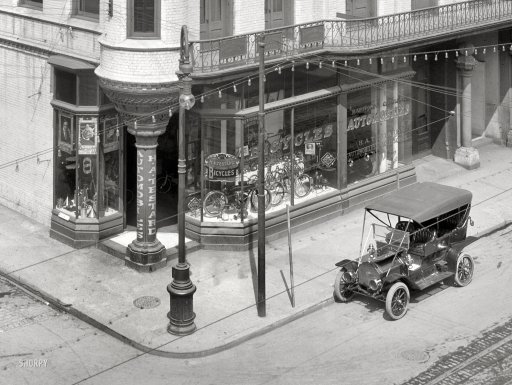
G.G. Bain St. Paul’s Church and St. Paul Building from Woolworth Building, NYC Apr 1919


The Year Of Dollar Danger For The World (AEP)
Iran Says Saudi Arabia Should Move To Curb Oil Price Fall (Reuters)
Could 2015 Herald A ‘New Oil Order’? (CNBC)
Falling Oil Raises Headache For Developing Nations (MarketWatch)
Russia Oil Output Hits Post-Soviet High (Reuters)
Oil At $14 A Barrel? Here’s How It Could Happen (CNBC)
Draghi Says ECB Prepares Action as Deflation Risk Non-Negligible (Bloomberg)
Draghi: Risk of ECB Failing Its Mandate Higher Than 6 Months Ago (Reuters)
Euro Forecasters See Pain After Worst Year Since 2005 (Bloomberg)
Merkel Ally Urges ECB Not To Buy Struggling States’ Bonds (Reuters)
New Year Brings Eurozone Closer To A Lost Decade (MarketWatch)
2014 “End Of Year” Report And A Look Into What 2015 Might Bring (Saker)
Commodity Prices Are Cliff-Diving: The Case Of Iron Ore (David Stockman)
China Property Developer Fails To Repay $51 Million Loan (Reuters)
China Goes Organic Amid Food Scandals (CNBC)
Thomas Piketty Rejects Légion d’Honneur Award (FT)
The 10 Most Generous Nations (MarketWatch)
The Pope Blesses the Climate Treaty (Bloomberg)
The Secret To A Happy Life – Courtesy Of Tolstoy (BBC)

Ambrose is all over the place here. But the core is dead on: the dollar will decide a lot in 2015, it’ll be a global wrecking ball.

The Year Of Dollar Danger For The World (AEP)

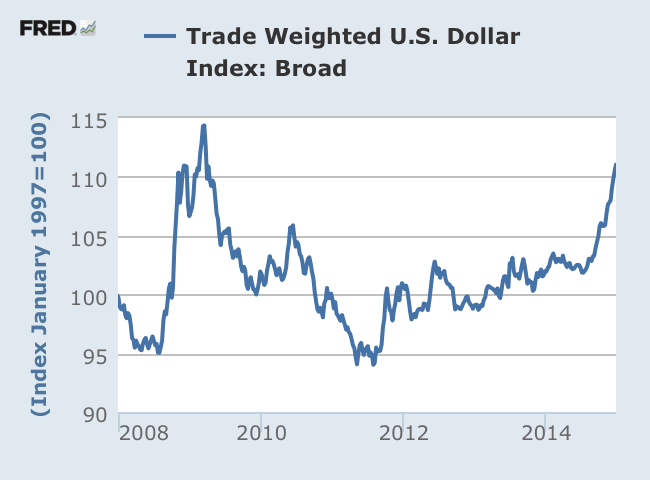
America’s closed economy can handle a surging dollar and a fresh cycle of rising interest rates. Large parts of the world cannot. That in a nutshell is the story of 2015. Tightening by the US Federal Reserve will have turbo-charged effects on a global financial system addicted to zero rates and dollar liquidity. Yields on 2-year US Treasuries have surged from 0.31% to 0.74% since October, and this is the driver of currency markets. Since the New Year ritual of predictions is a time to throw darts, here we go: the dollar will hit $1.08 against the euro before 2015 is out, and 100 on the dollar index. Sterling will buckle to $1.30 as a hung Parliament prompts global funds to ask why they are lending so freely to a country with a current account deficit reaching 6% of GDP.

There will be a mouth-watering chance to invest in the assets of the BRICS and mini-BRICS at bargain prices, but first they must do penance for $5.7 trillion in dollar debt, and then do surgery on obsolete growth models. The MSCI index of emerging market stocks will slide another third to 28 before touching bottom. The Yellen Fed will be forced to back down in the end, just as the Bernanke Fed had to retreat after planning a return to normal policy at the end of QE1 and QE2. For now the Fed is on the warpath, digesting figures showing US capacity use soaring to 80.1%, and growth running at an 11-year high of 5% in the third quarter. The Fed pivot comes as China’s Xi Jinping is trying to deflate his own country’s $25 trillion credit boom, early in his 10-year term and before it is too late. He does not need or want uber-growth.

The Politburo will more or less keep its nerve as long as China continues to meet its target of 10m new jobs a year – easily achieved in 2014 – and job vacancies outstrip applicants. Uncle Xi will ultimately blink, but traders betting on a quick return to credit stimulus may lose their shirts first. Worse yet, when he blinks, a tool of choice may be to drive down the yuan to fight Japan’s devaluation, and to counter beggar-thy-neighbour dynamics across East Asia. This would export yet more Chinese deflation to the rest of the world. At best we are entering a new financial order where there is no longer an automatic “Fed Put” or a “Politburo Put” to act as a safety net for asset markets.

That may be healthy in many ways, but it may also be a painful discovery for some. A sated China is as much to “blame” for the crash in oil prices as America’s shale industry. Together they have knouted Russia’s Vladimir Putin. The bear market will short-circuit at Brent prices of $40, but not just because shale capitulates. Marginal producers in Canada, the North Sea, West Africa and the Arctic will share the punishment. The biggest loser will be Saudi Arabia, reaping the geostrategic whirlwind of its high stakes game, facing Iranian retaliation through the Shia of the Eastern Province where the oil lies, and Russian retaliation through the Houthis in Yemen.

Read more …

This is about much more than oil: “The Iranian deputy minister also criticised Saudi military involvement in Bahrain, which has been gripped by tension since 2011 protests led by majority Shi’ite Muslims demanding reforms and a bigger role in running the Sunni-ruled country.”

Iran Says Saudi Arabia Should Move To Curb Oil Price Fall (Reuters)

Falling world oil prices will hurt countries across the Middle East unless Saudi Arabia, the world’s biggest crude exporter, takes action to reverse the slump, Iran’s deputy foreign minister told Reuters. Hossein Amir Abdollahian described Saudi Arabia’s inaction in the face of a six-month slide in oil prices as a strategic mistake and said he still hoped the kingdom, Tehran’s main rival in the Gulf, would respond. Oil prices closed on Wednesday at a 5-1/2 year low, registering their second-biggest ever annual decline after OPEC oil exporters, led by Saudi Arabia, chose to maintain oil output despite a global glut and calls from some of the cartel’s members – including Iran and Venezuela – to cut production.

“There are several reasons for the drop of the price of oil but Saudi Arabia can take a step to have a productive role in this situation,” Abdollahian said. “If Saudi does not help prevent the decrease in oil price … this is a serious mistake that will have a negative result on all countries in the region,” Abdollahian said in an exclusive interview on Wednesday evening. His comments highlight continued tensions between the Shi’ite Muslim republic and Sunni Muslim kingdom, locked in a battle for regional power and influence despite hopes of rapprochement since the inauguration of Iran’s President Hassan Rouhani in August 2013.

Abdollahian said Iran would have more discussions with Saudi Arabia about the oil price, both through oil officials at OPEC and through the foreign ministry. He did not give specific details on when any meeting might take place. Saudi Arabia said last month that it would not cut output to prop up oil markets even if non-OPEC nations did so. The Iranian deputy minister also criticised Saudi military involvement in Bahrain, which has been gripped by tension since 2011 protests led by majority Shi’ite Muslims demanding reforms and a bigger role in running the Sunni-ruled country. Abdollahian said Bahraini authorities’ continued detention of Shi’ite opposition leader Sheikh Ali Salman would have “serious consequences” for the government there.

Tehran and Riyadh accuse each other of interfering in the pro-Western Gulf island kingdom, one of several countries where their power struggle has played out. They also support opposing sides in wars and disputes in Iraq, Syria, Lebanon and Yemen. Abdollahian dismissed United States efforts to fight Islamic State, also known by its Arabic acronym Daesh, as a ploy to advance U.S. policies in the region. “The reality is that the United States is not acting to eliminate Daesh. They are not even interested in weakening Daesh, they are only interested in managing it,” he said.

Read more …

“.. the impact on that on production would only be start to felt in 2016 onwards and not as much as we would like to see in 2015.”

Could 2015 Herald A ‘New Oil Order’? (CNBC)

Last year was a tumultuous year for oil, with Brent crude prices declining around 50% since June on the back of an over-supplied market and lack of global demand. From “old school” oil producers Russia and Saudi Arabia in the east to shale oil in California and oil sands in Alberta in the west, the glut of oil and its impact on currencies and economies has been felt across the world. When OPEC decided not to cut production when it met in November, the 12 major oil producers effectively threw down the gauntlet to the young guns of U.S. oil to see who could withstand the fall in prices and who would blink first and trim production. As of January 2, benchmark Brent crude was trading at $57.58, having fallen from a high of around $115 a barrel hit in mid-June.

With prices falling fast and hitting five-year lows in mid-December, commodities research teams at the world’s investment houses and banks scrambled to revise their 2015 predictions for oil and the potential impact on global economies. And as wildly fluctuating as the price of oil has been, so have the predictions. While HSBC told investors to prepare for $95 a barrel by the end of 2015, other analysts were far more bearish. Morgan Stanley cut its 2015 forecast for Brent saying that in a worst case scenario crude prices could fall to $43 per barrel in 2015, although its base case scenario was for $70. The U.S. shale revolution and its accompanying rise in oil production has been a decisive factor in the fall in the price this year. The newcomer has affronted the old guard of producers like Saudi Arabia, the biggest oil exporter in the OPEC group and analysts believed its decision not to cut production was a move to put price pressure on U.S. producers.

The U.S. might not give up so easily though, according to Citi’s commodities research team who said in their 2015 outlook for the commodities markets that there is a “distinctive underlying ‘Made in America’ quality that looks likely to dominate the commodity complex through 2015.” Whether U.S. shale oil producers can withstand the fall in prices into 2015 and dent OPEC’s market share is a key matter for debate, however. “Prices are already approaching the danger point for the bulk of U.S. shale output, so industry costs would have to fall for prices to be sustainable at these lower levels,” Melanie Debono, economist at Capital Economics, said in the consultancy’s accompanying note.

There was a risk, Debono added, that an extended period of lower oil prices would lead to large cuts in output in both the U.S. and Canada. Companies like ConocoPhillips who are active in the U.S. shale industry have already announced that it would “defer significant investment” in Canada and the U.S. as returns looked far less attractive. “It’s very clear if oil prices remain below in the region of $64 per barrel for a sustained period of time – that’s about a three to six month period at least – we would start seeing increased scale backs in the U.S.,” Abhishek Deshpande, oil and gas analyst at Natixis. “But the impact on that on production would only be start to felt in 2016 onwards and not as much as we would like to see in 2015.”

Read more …

Oil and the dollar.

Falling Oil Raises Headache For Developing Nations (MarketWatch)

The drops last year in the prices of oil and other commodities are threatening to stunt growth in poor African and Latin American nations that sought to use vast natural-resource wealth to climb the development ladder. During a decadelong boom, governments on those continents vowed to use a windfall from surging raw-material prices to lift the vast underclass. Governments that sought big development leaps by funding social-welfare programs and ambitious infrastructure initiatives, such as building roads, ports and power plants, may now have less money to do so. “The good-governance records in many [Latin American] countries were linked to commodity prices, and this will be tested by the end of the commodity boom,” said Jorge Castaneda, Mexico’s former foreign minister.

The commodity-rich nations of Africa and Latin America are also facing a slowdown in China, a key buyer of exports from South Africa, Nigeria, Brazil, Chile and others. The two regions have been hit by a global selloff of emerging-market stocks, bonds and currencies. The stakes are high for these often-volatile economies, which have some of the world’s widest rich-poor gaps. Economic slowdowns and declining investment flows threaten to stretch budgets. In Latin America, credit-ratings firm Fitch expects to downgrade more countries than it upgrades in 2015. In some cases, the declines could expose levels of corruption and mismanagement that weren’t detected during the good times. In resource-rich Brazil, millions of families escaped extreme poverty and joined a growing working class.

Now, the country’s growth has stagnated, investment is declining and currency declines are raising inflation fears. Allegations of widespread corruption at the state oil firm Petroleo Brasileiro SA are adding to the pain. Brazilian officials had placed the oil firm at the center of a far-reaching plan to overhaul the economy and lift millions of poor into better paying jobs. Shares of Petrobras have fallen to multiyear lows. The situation is worse in Venezuela, where President Nicolás Maduro is seeking to use oil wealth to fuel a Socialist revolution. With oil prices plunging, investors are gauging the risk that Venezuela may fail to pay its debt. Default would add to the woes of an economy saddled with double-digit inflation and shortages of basic items.

Even countries with more moderate policy mixes, such as Chile, among the biggest copper exporters, are getting hit. Chile cut its 2015 growth outlook by half a percentage point to 2.5% in December. In Africa, the impact is magnified by the dependence of some fast-growing economies, such as Zambia, on the export of a single commodity. If the price of that commodity falls–in Zambia’s case, copper–the fallout can be far-reaching. Countries that didn’t balance budgets or curtail corruption while times were good will face painful choices, said Jack Allen of Capital Economics in London. Capital Economics forecasts average growth in sub-Saharan Africa to fall by one percentage point in 2015, to 4%, the slowest pace in more than a decade.

Read more …

Race to the bottom.

Russia Oil Output Hits Post-Soviet High (Reuters)

Russia’s 2014 oil output hit a post-Soviet record high average of 10.58 million barrels per day (bpd), rising by 0.7% helped by small non-state producers, Energy Ministry data showed on Friday. Oil and gas condensate production in December hit 10.67 million bpd, also a record high since the collapse of the Soviet Union. The data showed Russia’s so-called small producers, mostly privately held, increased their output by 11% to just over 1 million barrels per day. Crude oil exports via state monopoly Transneft fell 5% to 195.5 million tonnes due to rising domestic demand and refinery runs.

Exports to China reached a new high of 22.6 million tonnes (452,000 bpd), up 43% on the year as Russia seeks to diversify its energy customers. Russian producers capitalized on rising oil prices in the first half of 2014, when they reached over $113 per barrel. However, they have halved since then. Hurt by falling oil prices and Western sanctions prompted by Moscow’s role in Ukraine, growth in oil output in 2014 slowed from a gain of 1.4% in 2013. Top listed oil company Rosneft, which produces more oil than OPEC members Iraq or Iran, saw its output slip 0.7% as it struggled to arrest declining production at its West Siberian fields. Oil and gas fund about half of Russia’s budget.

The country’s economy is slipping into recession following a fall in oil prices and could see oil output decline to 525 million tonnes in 2015, according to an Energy Ministry forecast. The International Energy Agency (IEA) expects Russian oil output to fall by 1%. The country’s natural gas production in 2014 fell by 4% to 640.237 billion cubic meters (bcm). Top producer Gazprom posted an output fall of 9% to an all-time low of 432 bcm due to its pricing dispute with Ukraine, once its second-largest customer after Germany.

Read more …

Sounds crazy?

Oil At $14 A Barrel? Here’s How It Could Happen (CNBC)

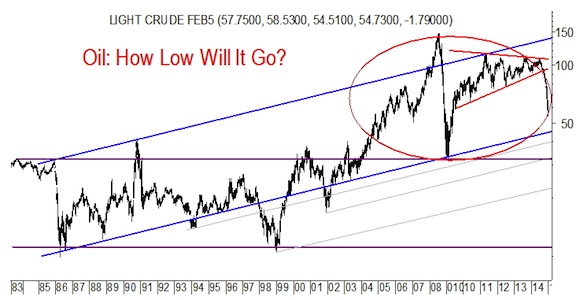
No one really saw 2014’s dramatic plunge in oil price coming, so it’s probably fair to say that any predictions about where it’s going from here fall somewhere between educated guesses and picking a number out of a hat. In that light, it’s less than shocking to see one analyst making a case—albeit in a pure outlier sense—for a drop all the way below $14 a barrel. Abigail Doolittle, who does business under the name Peak Theories Research, posits that current chart trends point to the possibility that crude has three downside target areas where it could find support—$44, $35 and the nightmare scenario of, yes, $13.65. Make no mistake, she thinks that’s an extreme case.

Her target for the more likely move is the $35 range, which in itself is quite a call considering light crude had been just above $100 a barrel this summer and the move would represent a 33% or so plunge just from current levels. But Doolittle makes room for an even more extreme scenario, in which technical support gives way as part of what she describes as a triangular pattern forming in an “ascending trend channel” that brings about the extreme case. “There is a wild case scenario for a massive fall in oil and it is made by both the triangle and the possibility that oil’s true trading path will turn out to be sideways on a potential false initial reaction of epic proportions,” Doolittle explained in a report she distributed Wednesday morning.

“This possibility cannot be ignored or discounted because it is simply too strong from a technical standpoint.” She acknowledges that the scenario “may sound outrageous” but cautions “odds appear fairly strongly” that the move could be triggered by “a false initial reaction or basically a massive head fake caused by a variety of factors.” Before consumers get too giddy about the cost of even lower fuel prices at the pump, Doolittle offers a word of caution. “Clearly this would seem to be a tail wind for consumers, but the various shocks and possible financial market crashes that could be triggered by such a collapse in oil would not be, and thus this seems a very dangerous scenario indeed,” she said.
Read more …

“Italian and Spanish bond yields dropped to record lows after the interview was published and the euro fell to the weakest since June 2010.”

Draghi Says ECB Prepares Action as Deflation Risk Non-Negligible (Bloomberg)

European Central Bank President Mario Draghi said he can’t exclude the risk of deflation in the euro area, hinting that the likelihood of large-scale quantitative easing is increasing. “The risk that we don’t fulfill our mandate of price stability is higher than it was six months ago,” Draghi said in an interview with German newspaper Handelsblatt. “We are in technical preparations to alter the size, speed and composition of our measures at the beginning of 2015, should this become necessary, to react to a too-long period of low inflation. There’s unanimity in the ECB council on that.”

While policy makers agree in principle, the debate over whether fresh stimulus is needed at this point has reopened a rift on the ECB’s Governing Council that now comprises 25 officials after Lithuania joined the currency region on Jan. 1. With inflation seen turning negative this year, some have warned of a deflationary spiral, as others have urged waiting to allow previously agreed measures to show their effect. Draghi said on deflation that “the risk cannot be entirely excluded, but it is limited” and “we have to act against such risk.” Asked how much the ECB will have to spend on government bonds, he said “it’s difficult to say.” Italian and Spanish bond yields dropped to record lows after the interview was published and the euro fell to the weakest since June 2010.

Read more …

“A break-up of the euro zone? That will not happen. That’s why there is no plan B ..,”

Draghi: Risk of ECB Failing Its Mandate Higher Than 6 Months Ago (Reuters)

European Central Bank President Mario Draghi said the risk of the central bank not fulfilling its mandate of preserving price stability was higher now than half a year ago, and reiterated its readiness to act early this year should it become necessary. In an interview with German financial daily Handelsblatt, Draghi urged politicians to implement necessary reforms, reduce tax burdens and cut red tape to support the euro zone recovery, which Draghi said was “fragile and uneven”. There was a limited risk of deflation in the euro zone, Draghi said, but if inflation remained too low for too long and led to receding inflation expectations and a delay in spending, the ECB would need to act to fulfill its mandate.

“The risk that we do not fulfill our mandate of price stability is higher than six months ago,” Draghi was quoted as saying in an interview that will be published on Friday. “We are in technical preparations to adjust the size, speed and compositions of our measures early 2015, should it become necessary to react to a too long period of low inflation. There is unanimity within the Governing Council on this.” He added that government bond purchases were among the tools the ECB could use to fulfill its mandate, but that state financing – which is prohibited by the EU treaty — had to be avoided.

Printing money to buy government bonds, a step known as quantitative easing (QE), is seen as one of the last tools the ECB has to revive inflation, with the key interest rate at 0.05% and growing doubts about the impact of earlier measures. Euro zone inflation stands at 0.3%, far below the ECB’s target of just under 2%, and calls for more ECB action have grown louder as policymakers warn that plunging oil prices could push inflation below zero in coming months. Concerns are that weaker price expectations could affect wages and investments and dampen growth prospects. Regardless, Draghi ruled out a break-up of the euro zone. “A break-up of the euro zone? That will not happen. That’s why there is no plan B,” he said.

Read more …

Beggar thy world.

Euro Forecasters See Pain After Worst Year Since 2005 (Bloomberg)

Midway through European Central Bank President Mario Draghi’s May press conference in Brussels, the euro rose to its strongest level during his tenure. Then he said the ECB was ready to introduce more stimulus measures, sending it into a slide that strategists say will extend into 2015. Europe’s common currency, which appreciated to $1.3993 that May day, ended last year down 12% against the dollar at $1.2098, its biggest loss since 2005. Strategists, who were too timid with their call for a decline in 2014 to $1.28, now see a slump to $1.18 by the end of this year. A weaker euro is key for Draghi as he tries to spur the region’s struggling economy and ward off deflation. This week, ECB Chief Economist Peter Praet told German newspaper Boersen-Zeitung the threat of a drop in consumer prices is increasing, bolstering speculation policy makers will soon start actions such as buying bonds that tend to weigh on a currency.

“The euro-bearish consensus was struggling hard for the first half of the year, but it has come good as the ECB has driven rates down,” Kit Juckes, a global strategist at SocGen in London, said in a Dec. 30 phone interview. “The best thing the ECB can try to engineer is still a weaker euro.” Juckes forecasts the euro will weaken to $1.14 by year-end, a level last seen in 2003. With inflation languishing below the ECB’s goal of just under 2% and the market’s outlook for consumer prices crumbling as crude oil declines, more than 90% of respondents in a monthly Bloomberg survey in December predicted that the ECB would expand the supply of euros by beginning to purchase sovereign bonds in 2015. That’s up from 57% the previous month.

The euro-area may see “negative inflation during a substantial part of 2015” amid a slide in crude, and the Governing Council “cannot simply look through” that, Praet said in comments published Dec. 31 on the ECB’s website. “Inflation expectations are extremely fragile” and “the risk of second-round effects seems to be greater today than it was in the past,” he said. Since the May meeting, the ECB cut its deposit rate below zero for the first time on record, began a program of targeted loans, and started purchasing asset-backed securities and covered bonds. At the same time, the dollar is strengthening as the Federal Reserve moves closer to raising interest rates.

Read more …

The Germans are not about to give in.

Merkel Ally Urges ECB Not To Buy Struggling States’ Bonds (Reuters)

A senior member of Angela Merkel’s party warned the European Central Bank not to pour money into Greece and other struggling euro zone states through bond purchases, saying this would reduce pressure on them to enact much-needed reforms. Michael Fuchs, deputy parliamentary floor leader of the German chancellor’s Christian Democrats (CDU), told Deutschlandfunk radio on Friday: “We shouldn’t pump extra money into these states, but rather make sure they continue along the reform path. “I’d be grateful if (ECB President Mario) Mr Draghi would make statements along these lines.” In an interview with German financial daily Handelsblatt published on Friday, Draghi urged politicians to implement necessary reforms, reduce tax burdens and cut red tape to support a fragile euro zone recovery.

He also said the risk of the central bank not fulfilling its price stability mandate was higher now than half a year ago, and reiterated its readiness to act soon if needed, with government bond purchases among the tools it could use. With the euro zone flirting with deflation, financial markets interpreted Draghi’s comments on Friday as strongly suggesting the ECB would soon embark on outright money-printing, and the euro sank to a 4-1/2 year low against the dollar. Printing money to buy government bonds, a measure known as quantitative easing (QE), is seen as one of the last tools the ECB has to revive inflation. The bank has already pushed its key interest rate down to a record low of 0.05% and doubts are growing about the impact of earlier measures.

“I expect there to be fierce discussion over this at the next ECB meeting,” said Fuchs, referring to opposition to the bond-buying plan by the head of the Bundesbank Jens Weidmann. The ECB’s next policy meeting is on Jan. 22. Fuchs has frequently expressed frustration felt by many German politicians and the public about the pace of reform in twice-bailed-out Greece. He was quoted as saying in a newspaper interview published on Wednesday that euro zone politicians were not obliged to rescue Greece as the country was no longer of systemic importance to the single currency bloc. Greece holds a general election just three days after the ECB meeting and polls suggest the left-wing Syriza party, which rejects the terms of Greece’s euro zone bailouts, will emerge as the strongest party.

Read more …

A decade filled with wrong decisions and futile policies.

New Year Brings Eurozone Closer To A Lost Decade (MarketWatch)

It looks like it will be a “lost decade” after all. As the eurozone enters the eighth year of a slump that began with the 2008 financial crisis, only true optimists believe that the bloc will find a path to faster growth over the next couple of years. Slow growth and rock-bottom inflation have set in. This combination inevitably delays a reduction of the bloc’s heavy private- and public-sector debt burdens. While their debt loads remain high and their incomes in nominal terms are stagnant, people perpetuate slow growth by saving rather than spending. As 2015 begins, economic activity in the eurozone is below the level it was at the start of 2008. The hardest-hit economies are a long way below. With growth so anemic, it doesn’t take much of a shock to turn it negative. Last year, the imposition of European Union sanctions on Russia and its modest retaliation were almost enough to tip the bloc into recession.

This year starts once again with political uncertainties in Greece–and a Jan. 25 general election–that may further set back faltering confidence. And as long as the bloc’s economic prospects remain sickly, the more likely become political crises among members of the currency union. In Greece and in other debt-burdened countries such as Italy and Spain, antiausterity, antiestablishment parties of the left are gaining ground. In Europe’s core, including France, anti-EU, anti-immigration parties of the right are finding traction. At the least, these political shifts are likely to weaken appetite for more supply-side reforms to improve the functioning of labor and goods markets. They may also further fan an incipient backlash against U.S. companies in the vanguard of technological change that would be a motor for long-term growth.

But it could be worse. History offers a cautionary tale about what happens when societies struggle to pay back debt burdens, argues Moritz Kraemer, an analyst with Standard & Poor’s in Frankfurt, in Germany’s struggles after World War I to repay its heavy debts. “While the political and economic environment is hardly comparable one hundred years on and the stakes are not likely to be nearly as high, elevated and sustained debt burdens could still pose risks to social cohesion and political stability,” he wrote in a report last month. To be sure, thanks in part to their expectation that the European Central Bank would step in to save the currency, investors rate the risk of a euro breakup far lower than they did a few years ago. “The existential question for the euro is nowhere near as potent as it was back in 2010 and 2011,” said Peter Goves, a bond strategist at Citi Research in London.

Read more …

Good read. The Vineyard Saker also has Russian versions of Automatic Earth articles .

2014 “End Of Year” Report And A Look Into What 2015 Might Bring (Saker)

Introduction: By any measure 2014 has been a truly historic year which saw huge, I would say, even tectonic developments. This year ends in very high instability, and the future looks hard to guess. I don’t think that anybody can confidently predict what might happen next year. So what I propose to do today is something far more modest. I want to look into some of the key events of 2014 and think of them as vectors with a specific direction and magnitude. I want to look in which direction a number of key actors (countries) “moved” this year and with what degree of intensity. Then I want to see whether it is likely that they will change course or determination. Then adding up all the “vectors” of these key actors (countries) I want to make a calculation and see what resulting vector we will obtain for the next year. Considering the large number of “unknown unknowns” (to quote Rumsfeld) this exercise will not result in any kind of real prediction, but my hope is that it will prove a useful analytical reference.

The main event and the main actors A comprehensive analysis of 2014 should include most major countries on the planet, but this would be too complicated and, ultimately, useless. I think that it is indisputable that the main event of 2014 has been the war in the Ukraine. This crisis not only overshadowed the still ongoing Anglo-Zionist attack on Syria, but it pitted the world’s only two nuclear superpowers (Russia and the USA) directly against each other. And while some faraway countries did have a minor impact on the Ukrainian crisis, especially the BRICS, I don’t think that a detailed discussion of South African or Brazilian politics would contribute much. There is a short list of key actors whose role warrants a full analysis. They are: The USA, The Ukrainian Junta, The Novorussians (DNR+LNR), Russia, The EU. NATO. China. I submit that these seven actors account for 99.99% of the events in the Ukraine and that an analysis of the stance of each one of them is crucial. So let’s take them one by one:

1 – The USA Of all the actors in this crisis, the USA is by far the most consistent and coherent one. Zbigniew Brzezinski, Hillary Clinton and Victoria Nuland were very clear about US objectives in the Ukraine:

Zbigniew Brzezinski: Without Ukraine Russia ceases to be empire, while with Ukraine – bought off first and subdued afterwards, it automatically turns into empire…(…) the new world order under the hegemony of the United States is created against Russia and on the fragments of Russia. Ukraine is the Western outpost to prevent the recreation of the Soviet Union.

Hillary Clinton: There is a move to re-Sovietise the region (…) It’s not going to be called that. It’s going to be called a customs union, it will be called Eurasian Union and all of that, (…) But let’s make no mistake about it. We know what the goal is and we are trying to figure out effective ways to slow down or prevent it.

Victoria Nuland: F**k the EU!

Read more …

Much of it coming from emerging nations. That’s a triple hit: oil, dollar and other commodities.

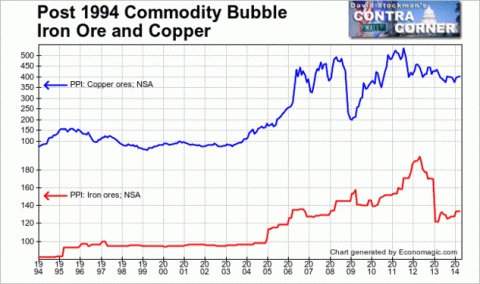
Commodity Prices Are Cliff-Diving: The Case Of Iron Ore (David Stockman)

Crude oil is not the only commodity that is crashing. Iron ore is on a similar trajectory and for a common reason. Namely, the two-decade-long economic boom fueled by the money printing rampage of the world’s central banks is beginning to cool rapidly. What the old-time Austrians called “malinvestment” and what Warren Buffet once referred to as the “naked swimmers” exposed by a receding tide is now becoming all too apparent. This cooling phase is graphically evident in the cliff-diving movement of most industrial commodities. But it is important to recognize that these are not indicative of some timeless and repetitive cycle – or an example merely of the old adage that high prices are their own best cure.

Instead, today’s plunging commodity prices represent something new under the sun. That is, they are the product of a fracturing monetary supernova that was a unique and never before experienced aberration caused by the 1990s rise, and then the subsequent lunatic expansion after the 2008 crisis, of a cancerous regime of Keynesian central banking. Stated differently, the worldwide economic and industrial boom since the early 1990s was not indicative of sublime human progress or the break-out of a newly energetic market capitalism on a global basis. Instead, the approximate $50 trillion gain in the reported global GDP over the past two decades was an unhealthy and unsustainable economic deformation financed by a vast outpouring of fiat credit and false prices in the capital markets.

For that reason, the radical swings in commodity prices during the last two decades mark the path of a central bank generated macro-economic bubble, not merely the unique local supply and demand factors which pertain to crude oil, copper, iron ore, or the rest. [..] What really happened is that the central bank instigated global macro-economic bubble ripped commodity pricing cycles out of their historical moorings, resulting in a one time eruption of price levels that had no relationship to sustainable supply and demand factors in the mines and petroleum patch. What materialized, instead, was an unprecedented one-time mismatch of commodity production and use that caused pricing abnormalities of gargantuan proportions.
Read more …

Let’s see how many will be allowed to fail.

China Property Developer Fails To Repay $51 Million Loan (Reuters)

Chinese property developer Kaisa Group Holdings said it had failed to repay a HK$400 million ($51.3 million) loan and warned it may default on more debt, the latest problem to hit the firm amid a downturn in the real estate sector. In a stock market filing late on Thursday, the company said the payment of the loan and its interest became compulsory on Dec. 31, following the resignation of its chairman Kwok Ying Shing. The failure to repay the HSBC term loan may trigger default on other loan facilities, debt and equity securities, co-chairman Sun Yuenan said in the filing to the Hong Kong exchange. Last month, Kaisa said the Chinese authorities had imposed a sales blockage on some its projects in the southern city of Shenzhen. Independent research firm CreditSights said the Shenzhen projects were expected to account for around a fifth of Kaisa’s saleable resources by book value.

It also said two other senior executives – Vice Chairman Tam Lai Ling and Chief Financial Officer Cheung Hung Kwong – had left in December. Analysts have questioned the company’s fund raising ability since these two executives left, as they were instrumental in arranging Kaisa’s offshore debt issues. Trading in Kaisa’s shares, which has a market capitalisation of HK$8.2 billion, was halted on Monday. Its bond yields have also more than trebled, with the yield on its bonds due 2018 rising to more than 29% from around 9% at the start of the month. On Friday, its bonds due 2019 and 2020 were both indicated at 40-50 cents on the dollar, after trading as high as 101 and 104 cents on the dollar in December. Moody’s downgraded its credit rating to B3 from B1, warning of further cuts, and Standard & Poor’s said its sales and operations could be “significantly affected” over the next year.

Read more …

“In 2013, 3,000 pig carcasses were seen floating in Shanghai’s Huangpu river, one of the city’s key sources of drinking water.”

China Goes Organic Amid Food Scandals (CNBC)

An organic food craze is emerging among China’s urbanites as food safety scandals spur the younger generation toward alternative ways to buy fresh produce and meat. So far, organic foods’ penetration into China appears small, accounting for 1.01% of total food consumption, but that’s nearly triple 2007’s 0.36%, according to data from organic trade fair Biofach. A series of high-profile food scandals over the past seven years has been a primary catalyst for growth in the organic food market. Biofach expects the segment’s share of China’s overall food market to hit 2% this year. China was ranked as one of the world’s worst safety-violation offenders by American food consulting firm Food Sentry this year. In 2013, 3,000 pig carcasses were seen floating in Shanghai’s Huangpu river, one of the city’s key sources of drinking water.

A few months later, reports that a Beijing crime ring was selling rat and fox meat as lamb sparked international outrage, resulting in the arrest of more than 900 people. The trouble continued in 2014, with the Chinese affiliate of U.S. meat supplier OSI Group accused of using expired meat. OSI caters to major fast-food chains such as McDonald’s and Yum Group’s KFC operating on the mainland. Wal-Mart was also dragged into the limelight this year following revelations that its donkey meat product contained fox meat. Most recently, Subway also came under scrutiny after Chinese media reported in late December that workers at a Beijing franchise changed expiry dates on meat and vegetables to extend their use.

Read more …

“Mr Piketty added that the government instead “would do better to concentrate on reviving growth in France and Europe.“ Oh well, now I don’t have to read those 600 pages.

Piketty Rejects Légion d’Honneur Award (FT)

France’s sputtering economy was a source of endless frustration for President François Hollande in 2014. It found a new way to torment the French president on the first day of the new year when Thomas Piketty, one of the country’s most celebrated economists, rejected a Légion d’Honneur award, saying the government had no standing to grant such recognition. Mr Piketty, whose 2014 book Capital in the Twenty-First Century has already sold more than 1m copies, told the AFP on Thursday: “I refuse this nomination because I do not think it is the government’s role to decide who is honourable.”

In a clear indictment of Mr Hollande’s economic record, Mr Piketty added that the government instead “would do better to concentrate on reviving growth in France and Europe”. Mr Piketty’s comments come on top of a series of disappointing performances and false dawns on the economic front ever since Mr Hollande and his socialist government took office. Unemployment has remained persistently high in spite of promises to change the upward trend by the end of last year. Meanwhile, sluggish growth — the economy was stagnant for the first six months of 2014 — has helped drag down Mr Hollande’s popularity to the lowest levels of any French president in modern history.

But the rejection of the award by the French economist – who argues for the redistribution of concentrated wealth in his best-selling book, which was the Financial Times and McKinsey Business Book of the Year – is particularly galling coming on the same day that the French president dumped his supertax scheme for the rich. The measure to increase tax rates to 75% on earnings over €1m, which earned Mr Hollande support from the left when he announced the plan to great fanfare in 2012, was on Thursday abandoned after bringing in just a small portion of the expected revenue. In rejecting the Legion of Honour, Mr Piketty joins a list of personalities that includes Claude Monet, Jean-Paul Sartre, Albert Camus, Hector Berlioz and Brigitte Bardot – all of whom declined the award for varying reasons.

Read more …

Curious article.

The 10 Most Generous Nations (MarketWatch)

Have you helped a stranger in the past month? If you live in the U.S., Iraq or Trinidad and Tobago, chances are you have. Americans more likely than any other nationality to help strangers, with 79% of people doing so last year, according to an annual index of the most giving nations. The World Giving Index is based on a Gallup survey of more than 130,000 people in 2013 and evaluates charitable behavior in 135 countries around the world. It is sponsored by the Charitable Aid Foundation. The index scores countries based on an average of three measures of giving behavior — the percentage of people who in a typical month donate money to charity, volunteer their time, and help a stranger.

Giving is about more than just existing wealth, the report notes — only five of the top 20 most generous countries are members of the G-20, a group representing the largest economies in the world. Women were more likely to give money than men, but only in high income countries. The country that scored worst in the index was Yemen, where only 3% of people volunteered their time in 2013. Based on the World Giving Index, these are the 10 most generous nations:

Read more …

He should simply write his own.

The Pope Blesses the Climate Treaty (Bloomberg)

When a church that once felt threatened by heliocentrism sees hydrocarbons as a threat to God’s creation, there is reason to hope that today’s science skeptics will find religion, too. Fresh off his success in helping to end one of the last remaining battles of the Cold War, Pope Francis is turning his attention – and bringing his considerable star power – to the fight against global warming. His decision to push for an international treaty on climate change in Paris in December may alienate some conservative Catholics who are skeptical of climate science. But Francis’s leadership on the issue is a hopeful sign that 2015 could be the year that the nations of the world finally commit themselves to collective action. Francis could be forgiven for concentrating on other weighty matters: He is challenging the church’s approach to divorced couples and gays and lesbians, reforming its change-resistant curia, and cleaning up its scandal-plagued bank.

All are mammoth undertakings that will earn him enemies. But this pope has shown no interest in shying away from major controversies. His new focus on climate change is a natural outgrowth of his concern for the poor, who will suffer most if droughts and storms worsen, allowing disease and instability to spread more easily. He is not the first pope to sound the alarm on climate change: Both John Paul II and Benedict XVI did so, and in 2011 the Vatican’s Academy of Sciences issued a report that called on “all people and nations to recognize the serious and potentially irreversible impacts of global warming” caused by human activity. Francis is not changing church teaching, only seizing the moment, as a public consensus emerges around the need for coordinated action. In March, he is expected to visit Tacloban, the Philippine city hardest hit by last year’s typhoon Haiyan, which killed thousands and left millions homeless.

As the planet warms and the seas rise, severe storms are expected to become even more destructive. This trip may be followed by a papal encyclical on climate change, a letter to the bishops that will formalize the church’s position on the issue and guide its ministry at the parish level. In September, Francis will have a chance to raise the issue when he addresses the UN General Assembly. He may also convene a summit of religious leaders to focus attention on climate change, which has generated widespread ecumenical agreement. All these steps will occur in the run-up to the UN summit on climate change in Paris at the end of this year. Francis, who has no lack of ambition, is throwing the weight of the church – and his papacy – behind an international agreement.

Read more …

Well, Tolstoy was an interesting character.

The Secret To A Happy Life – Courtesy Of Tolstoy (BBC)

We can learn a lot about the art of living from Tolstoy’s War and Peace. It acutely observes vanity and folly, sexual jealousy and family relationships. But we can also learn from the life of the master novelist himself, writes Roman Krznaric. Tolstoy, who was born in 1828 and died in 1910, was a member of the Russian nobility, from a family that owned an estate and hundreds of serfs. The early life of the young count was raucous, debauched and violent. “I killed men in wars and challenged men to duels in order to kill them,” he wrote. “I lost at cards, consumed the labour of the peasants, sentenced them to punishments, lived loosely, and deceived people…so I lived for ten years.” But he gradually weaned himself off his decadent, racy lifestyle and rejected the received beliefs of his aristocratic background, adopting a radical, unconventional worldview that shocked his peers.

So how exactly might his personal journey help us rethink our own philosophies of life?
1. Keep an open mind
2. Practice empathy
3. Make a difference
4. Master the art of simple living
5. Beware your contradictions
6. Become a craftsman
7. Expand your social circle

Read more …

Dec 312014
 
 December 31, 2014  Posted by at 8:24 pm Finance Tagged with: , , , , , , ,  19 Responses »


John Vachon Auto of migrant fruit worker at gas station, Sturgeon Bay, Wisconsin Jul 1940

Let’s see, how do we close this year in a proper manner? I already wrote that 2014 for me has been The Year Propaganda Came Of Age. Likewise, looking forward, I said that The Biggest Economic Story Going Into 2015 Is Not Oil. Moreover, I talked about things that need to be done next year in Things To Do In 2015 When You’re Not Yet Dead.

So what else is left? I thought I’d make a list of narratives that painted the past year, and look at what’s real about them versus what we’re being told they are about. Nothing comprehensive about them, mind you, just train of thought.


Ukraine/Crimea/Putin

The Crimeans voted to join Russia: not an option. Everybody but the Crimeans and Russians declared the vote illegal. East Ukraine held a referendum: not an option. Everybody but the East Ukrainians and Russians declared the vote illegal. The ‘logic’ is the only people who can hold a legal referendum in East Ukraine are the very ones who send in their armies to kill them.

But the US/EU-led ouster of an elected president, and the replacement of his government with one led by a US handpicked PM, narrowly voted in by a parliament at the time replete with guns and at best shady elements, that’s democracy, AD 2014. Throw in a billionaire Willy Wonka who, true, did get elected as president, though the legal status of that election should be under scrutiny given that East Ukraine did not, could not, participate in electing its own leader.

One of the very first things Willy Wonkoshenko did was order his Swastika-toting storm troops to go and kill more East Ukrainians, whose ‘official’ president he had just become (and they did). This all happened under US/EU command (Ukraine itself couldn’t fund a brassband, let alone an army).

Which makes me think, that’s not that far removed from for instance imagining that Washington sends its army into Texas or West Virginia with a licence to kill. But who over there have stood up for East Ukraine? None that I’m aware of. Other than Ron Paul, a proud Texan himself. You guys could have really gotten under Obama’s skin on that, but you never did. What a missed chance, right wing America! Too far away? Too close? Here you got these people whose only goal it is not to be subdued by Washington, and who get shot to bits because of it, and you don’t recognize yourselves in that image?

The west didn’t leave Putin any other option than to assimilate Crimea – and he did it through elections! -; it was clear all along to all involved that Russia would never let go of its only warm water port. It had nothing to do at any point with anything close to a majority of Ukrainians wanting to be ‘free’, but with the west – NATO – wanting to encroach on Russia’s borders, despite specific agreements stemming from the early 1990s not to do that. Putin is not the aggressor in this narrative, we are.


EU

2014 was almost quiet in Europe, apart from the Ukraine narrative, compared to the last few years. Well, that’s not going to last. We’re going to have a Greek election January 25, and an epic three weeks of mud-slinging and fear-mongering prior to that date. It’ll be something to behold, at least from a safe distance. For the Greek people, it won’t feel like much fun.

The European Union consists of democracies – however flawed and corrupt they may be -, but it is not itself a democracy. And that increasingly reflects back – in a very negative way – on the original democracies that founded the doomed edifice in the first place. Everyone gets infected by the virus eventually.

The EU, and the eurozone, will fail and fall apart at some point. The longer it takes, the worse it will be for the people. The EU deserves to fail for the same reasons other supra-national organizations do, like NATO, World Bank, IMF etc.: they’re all inherently undemocratic. They have no reason to listen to what people want. The same can by now well be said for the US, by the way.

The reason these organizations will start to fail now is that economies have begun to fail. It’s as simple as that. I first quoted Yeats years ago on this, but it’s still as fitting as can be: The Centre Cannot Hold. Not when the economy falls to bits. All the smart boys will call it protectionism, in very derogatory tones, but that’s what happens when economies and empires fail: people must manage to take care of themselves in smaller units.

The good thing is, people are very good at that. The bad thing, is emperors and other power hungry ‘leaders’ don’t take kindly to being made redundant. But it has to be done regardless. So let Greece lead the way. It wouldn’t be the first time. Brussels has been nothing but disaster to southern Europe. The European Union is dead and must be dissolved, and its place be taken by a form of cooperation that doesn’t suffocate entire nations. There’s no simpler or clearer way of putting it.


OPEC and oil prices

I know where it’s coming from, but I still look with a childish kind of amazement at all the pundits who declare OPEC, and Saudi Arabia first, responsible for what happens to oil prices. If only OPEC would cut production … what? like they did 30-40 years ago?! It’s a different world, kiddos. Why not demand the US cut production, or Canada? The rationale behind that is energy independence and all that, isn’t it?

But the reality behind that, in turn, is that global oil demand is dropping much faster than producers anticipated, while supply – temporarily – outpaces expectations because of unconventional oil. But, you know, if you fill your media to the brim with false reports about US growth and China growth day after day, what can you expect? The recent sudden drop in oil prices was a long time coming, and only held back by the QE related global central bank money drops.

We’ve seen lipsticked pigs for years now, and we think they’re born that way. They’re not, But it’s still very blind to say OPEC caused the drop in prices. I found a nice take on this at RT, where they interview Margaret Bogenrief at ACM partners, who says:

I think what is most interesting, and you are seeing this really with a lot of countries throughout the Middle East, is the genie has kind of been let out of the bottle. I mean, in Saudi Arabia its oil prices, in other countries like Iraq it’s the dissolution of the previous government. I don’t know if there is a lot that Saudi Arabia can do in 2015 to really take care of its citizenry and to prevent the unrest that you see is growing there. If you look at its population, it’s predominantly male, young and unemployed.

And I don’t know if there is a lot that they can do to keep that under control. [..] I think social unrest in Saudi Arabia is going to be a significant issue in 2015 and beyond. What I think is most interesting is that if you look at the 2014 economic numbers, oil accounted for something like 89% of the country’s revenue. That’s a very singular economy. And if you look at this economic disparity combined with that so focused on that resource, you are going to see some significant issues in 2015 and beyond.

[..] the US has really worked under the Bush and Obama Administrations to increase domestic oil production. That has sent a signal to the world market that the US is really looking not to be as competitive as Saudi Arabia, but certainly to be involved and try to control that a little bit more. Secondly, it’s also just a demographic issue. Saudi Arabia is facing a demographic reality that it has not had to face for decades. The combination of those two things along with the US fracking and trying to get more involved in the energy sector, that’s really combining to costs and issues.

If you look at fracking, I actually think that fracking is not as significant when it comes to actual oil production. I think it’s a better message tool than it’s an actual production tool. What Saudi Arabia is realizing, you certainly saw it in the budget, is that suddenly it doesn’t have complete control over the pricing and manufacturing of oil. That’s really causing some issues. In the budget for 2015 oil was priced to be $80 a barrel. Honestly, that’s wishful thinking.

If you look at Saudi Arabia it’s going to impact Saudi Arabia far more than other Middle Eastern countries. I know Iran is facing some potential sanction issues in 2015; the US is debating whether or not to lift sanctions. That’s not necessarily energy related but I do think you are going to see some significant changes there too.

Not like it’s a brilliant take, but it’s much better than just about any I’ve seen. The Saudis don’t control the price of oil anymore, and they know it – ahead of anyone else, it seems – . They’ve been running budget deficits for a while, and they’ve just seen their revenues halved. And then some 10,000 dimwit western journalists write that they should cut production, while shale oil in the US must keep growing. And then today the Saudi King was hospitalized today as well?

The House of Fahd is not having an easy time of it. They’re all on quaaludes by now. And then Bloomberg reports about a maze in the export ban laws that allow for more US light crude exports. What a brilliant idea. Export into an overloaded market, and let your own actions behead your own industry.


North Korea

Yeah, that daft film that now allegedly stands for freedom, artistic or otherwise, and that Obama apparently had to lean into. Chances that North Korea was involved into hacking the Japanese firm that financed it and sort of released it are by now slim to none, no matter what the FBI said. This is what America stands for these days. A mere narrative. Next up: the rape and murder of Obama’s daughters, Prince George and Vladimir Putin. All very funny and artistically free.


The US dollar and global currencies, stocks and bonds

As we speak, the euro has passed the $1.21 barrier. When the new year starts, it will sink below that, unless crazy measures are taken by someone, anyone. And stock markets are not going to remain anywhere near their present highs with commodities falling the way they are; too much ‘money’ is being lost along the way. It’s known as debt deflation.

Yes, the greenback had a good run in 2014:

But there’s much more to come. And not because ‘investors like the US’ so much, or because the American economy actually grows at a 5% clip. The real reason is, as I explained in The Biggest Economic Story Going Into 2015 Is Not Oil, that emerging economies are being pulled through a wringer, and all the cheaply borrowed dollars they kept appearances up with are dripping right back into the mothership, i.e. the US.

How happy should this make us? Well, how happy should we be about poverty in Greece, Spain, Brazil and all these other nations to begin with? Do you feel it’s a good idea for us to get richer off of the backs and the misery of other people? If you say yes, it’s clean sailing for a while longer. If you don’t, what are you going to do about it?

If you live in a western country, no matter which one, that’s how your political candidates can promise to keep you rich for a bit. By making people elsewhere poorer, and by making your own children even worse off. There are no other ways left to keep up the facade we live in today. There’s no economic growth, there are no new energy sources, the only thing left to do is borrow from the future. And yeah, I know that seems to work up to the present.

But the price of oil should be a warning sign to you. If oil falls the way it does over a significant amount of time, and other commodities do too, it’s just a matter of time until stocks and bonds start bombing merrily along. And that’s even before the Fed raises its key rates, ‘guided’ by numbers like that 5% US GDP growth in Q3.

This is going to be a crazy year. We’ve said it many times before, but here you go again: volatility will reign the day, in ways we haven’t seen in many years. And the volatility will drive us downward. Not up. Nerves will guide decisions. And losses. Losses that will pressure economies, first of all Japan and Europe, into ever deeper deflationary territory. The central bank fairy tale will not last another 12 months. But the US dollar will be fine. Because it’ll be ‘nurtured’ by the demise of emerging markets.

What we, fortunate citizens of this earth, in the twilight of our civilization, should do in my humble view, is not to enrich ourselves as much as we can, but to ‘minimize the suffering of the herd’, as any shepherd should. I saw this Telegraph headline today, “Goodbye To One Of The Best Years In History”, and I thought, if that’s what you see when you look around, if you’re in Britain and you don’t see that fast and vast increase in poverty on your own doorstep, then what can I say? Hats off? Or heads off?

See ya in da New Year!

Dec 182014
 
 December 18, 2014  Posted by at 10:07 pm Finance Tagged with: , , , , , ,  7 Responses »


Arthur Rothstein “Quack doctor, Pittsburgh, Pennsylvania” May 1938

Isn’t it fun to just watch the market numbers roll by from time to time as you go about your day, see Europe markets up 3%+, Dubai 13%, US over 2% (biggest two-day rally since 2011!), and you just know oil must get hit again? Well, it did. WTI down another 3%+. I tells ya, no Plunge Protection is going save this sucker.

And oil is not even the biggest story today. It’s plenty big enough by itself to bring down large swaths of the economy, but in the background there’s an even bigger tale a-waiting. Not entirely unconnected, but by no means the exact same story either. It’s like them tsunami waves as they come rolling in. It’s exactly like that.

That is, in the wake of the oil tsunami, which is a long way away from having finished washing down our shores, there’s the demise of emerging markets. And I’m not talking Putin, he’ll be fine, as he showed again today in his big press-op. It’s the other, smaller, emerging countries that will blow up in spectacular fashion, and then spread their mayhem around. And make no mistake: to be a contender for bigger story than oil going into 2015, you have to be major league large. This one is.

The US dollar will keep rising more or less in and of itself, simply because the Fed has ‘tapered QE’, and much of what happened in global credit markets, especially in emerging markets, was based on cheap and easily available dollars. There’s now $85 billion less of that each month than before the taper took it away in $10 billion monthly increments. The core is simple.

This is not primarily government debt, it’s corporate debt. But it’s still huge, and it has not just kept emerging economies alive since 2008, it’s given them the aura of growth. Which was temporary, and illusionary, all along. Just like in the rest of the world, Japan, EU, US. And, since countries can’t – or won’t – let their major companies fail, down the line it becomes public debt.

One major difference from the last emerging markets blow-up, in the late 20th century, is size: emerging markets today are half the world economy. And they’re about to be blown to smithereens. Sure, oil will play a part. But mostly it will be the greenback. And you know, we can all imagine what happens when you blow up half the global economy …

Erico Matias Tavares at Sinclair has a first set of details:

Emerging Markets In Danger

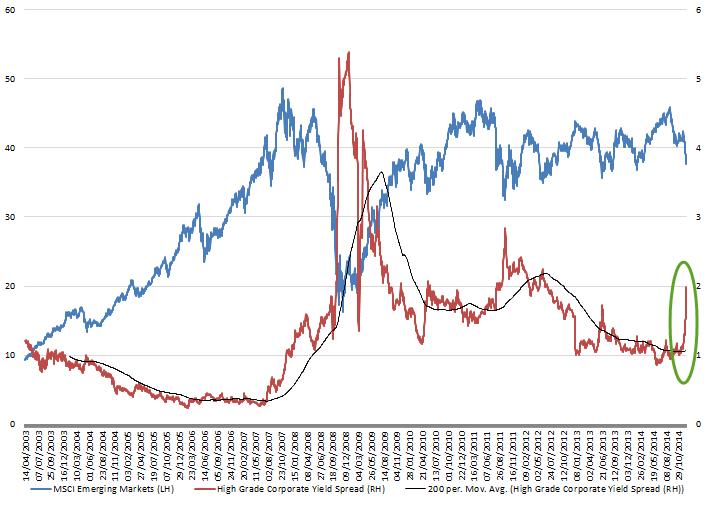
There are some signs of trouble in emerging markets. And the money at risk now is bigger than ever. The yield spread between high grade emerging markets and US AAA-rated corporate debt has jumped, almost doubling in less than three weeks to the highest level since mid-2012.


MSCI Emerging Markets Index and Yield Spread between High Grade Emerging Markets and US AAA Corporates: 14 March 2003 – Today. Source: US Federal Reserve.

This means that the best credit names in emerging markets have to pay a bigger premium over their US counterparts to get funding. When this spread spikes up and continues above its 200-day moving average for a sustained period of time, it is typically a bad sign for equity valuations in emerging markets, as shown in the graph above. One swallow does not a summer make, but it is worthwhile keeping an eye on this indicator.

As yields go up the value of these emerging market bonds goes down, resulting in losses for the investors holding them. The surge of the US dollar in recent months could magnify these losses: if the bonds are denominated in local currency they will be worth a lot less to US investors; otherwise, the borrowers will now have to work a lot harder to repay those US dollar debts, increasing their credit risk. Any losses could end up being very significant this time around, as demand for emerging markets bonds has literally exploded in recent years.


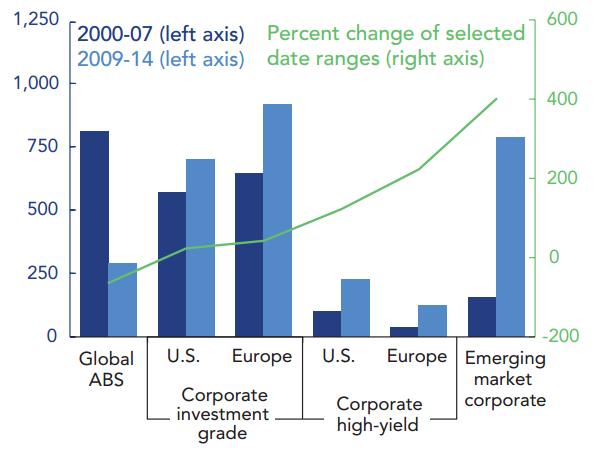
Average Annual Gross Debt Issuance ($ billions, percent): 2000 – Today. Source: Dealogic, US Treasury. Note: Data include private placements and publicly-issued bonds. 2014 data are through August 2014 and annualized.

As the graph above shows, the issuance of emerging market corporate debt has risen sharply since the depths of the 2008-09 financial crisis.These volumes are very large indeed, and now account for non-trivial portions of investors’ and pension funds’ portfolios worldwide.

As a result, emerging markets corporations are now leveraged to the hilt, easily exceeding the 2008 highs by almost a multiple to EBITDA. And why not? With foreign investors desperate for yield as a result of all the stimulus and money printing by their central banks, they were only too happy to oblige. And they were not alone. Governments in these countries were also busy doing some borrowing of their own, as their domestic capital markets deepened.

[..] foreign investors have also piled into locally denominated bonds of emerging markets governments. Countries like Peru and Latvia now have over 50% foreign ownership of their bonds. [..] But there are big speculative reasons behind the recent money flows going into these countries – which could reverse very quickly should the tide turn. [..]

If investors end up rushing for the emerging markets exit for whatever reason, with this unprecedented level of exposure they might be bringing home much more than a bruised ego and an empty wallet. For one, European banks are hugely exposed to emerging markets. Any impairment to their books would likely make any new lending even more difficult, at a time when there is already a dearth of non-government credit in Europe.

And if emerging economies falter, where will the growth needed to repair Western government and private balance sheets come from? It used to be said that when the US economy sneezes the rest of the world catches a cold. Now it seems all we need is a hiccup in emerging markets.

That’s what you get when emerging markets are both half the global economy AND they’ve accomplished that level off of ultra-low US Fed interest rates and ultra-high US Fed credit ‘accommodation’. All you have to do when you’re the Fed is to take both away at the same time, and you’re the feudal overlord.

Our favorite friend-to-not-like Ambrose Evans-Pritchard does what he does well: provide numbers:

Fed Calls Time On $5.7 Trillion Of Emerging Market Dollar Debt

The US Federal Reserve has pulled the trigger. Emerging markets must now brace for their ordeal by fire. They have collectively borrowed $5.7 trillion in US dollars, a currency they cannot print and do not control. This hard-currency debt has tripled in a decade, split between $3.1 trillion in bank loans and $2.6 trillion in bonds. It is comparable in scale and ratio-terms to any of the biggest cross-border lending sprees of the past two centuries.

Much of the debt was taken out at real interest rates of 1% on the implicit assumption that the Fed would continue to flood the world with liquidity for years to come. The borrowers are “short dollars”, in trading parlance. They now face the margin call from Hell as the global monetary hegemon pivots. The Fed dashed all lingering hopes for leniency on Wednesday. The pledge to keep uber-stimulus for a “considerable time” has gone, and so has the market’s security blanket, or the Fed Put as it is called. Such tweaks of language have multiplied potency in a world of zero rates.

Officials from the BIS say privately that developing countries may be just as vulnerable to a dollar shock as they were in the Fed tightening cycle of the late 1990s, which culminated in Russia’s default and the East Asia Crisis. The difference this time is that emerging markets have grown to be half the world economy. Their aggregate debt levels have reached a record 175% of GDP, up 30 percentage points since 2009.

Most have already picked the low-hanging fruit of catch-up growth, and hit structural buffers. The second assumption was that China would continue to drive a commodity supercycle even after Premier Li Keqiang vowed to overthrow his country’s obsolete, 30-year model of industrial hyper-growth, and wean the economy off $26 trillion of credit leverage before it is too late. [..]

Stress is spreading beyond Russia, Nigeria, Venezuela and other petro-states to the rest of the emerging market nexus, as might be expected since this is a story of evaporating dollar liquidity as well as a US shale supply-glut.

[..[ the Turkish lira has fallen 12% since the end of November. The Borsa Istanbul 100 index is down 20% in dollar terms. Indonesia had to intervene on Wednesday to defend the rupiah. Brazil’s real has fallen to a 10-year low against the dollar, as has the index of emerging market currencies. Sao Paolo’s Bovespa index is down 23% in dollars in 3 weeks.

The slide can be self-feeding. Funds are forced to sell holdings if investors take fright and ask for their money back, shedding the good with the bad. Pimco’s Emerging Market Corporate Bond Fund bled $237m in November, and the pain is unlikely to stop as clients discover that 24% of its portfolio is in Russia.

One might rail against the injustice of indiscriminate selling. Such are the intertwined destinies of countries that have nothing in common. The Fed has already slashed its bond purchases to zero, withdrawing $85bn of net stimulus each month. It is clearly itching to raise rates for the first time in seven years. This is the reason why the dollar index has jumped 12% since May, smashing through its 30-year downtrend line, a “seismic change” in the words of HSBC. [..]

World finance is rotating on its axis, says Stephen Jen, from SLJ Macro Partners. The stronger the US boom, the worse it will be for those countries on the wrong side of the dollar.

“Emerging market currencies could melt down. There have been way too many cumulative capital flows into these markets in the past decade. Nothing they can do will stop potential outflows, as long as the US economy recovers.

Hold it there for a moment. I don’t think it’s the US economy (its recovery is fake), it’s the US dollar.

Will this trend lead to a 1997-1998-like crisis? I am starting to think that this is extremely probable for 2015,” he said.

This time the threat does not come from insolvent states. They have learned the lesson of the late 1990s. Few have dollar debts. But their companies and banks most certainly do, some 70% of GDP in Russia, for example. This amounts to much the same thing in macro-economic terms. Private debt morphs into state debt since governments cannot allow key pillars of their economies to collapse.

These countries have, of course, built $9 trillion of foreign reserves, often the side-effect of holding down their currencies to gain export share. This certainly provides a buffer. Yet the reserves cannot fruitfully be used in a recessionary crisis because sales of foreign bonds automatically entail monetary tightening. [..] .. these reserves are a mirage. If you deploy them in such circumstances, you choke your own economy unless you can sterilize the effects. [..]

Investors are counting on the European Central Bank to keep the world supplied with largesse as the Fed pulls back. Yet the ECB could not pick up the baton even if it were to launch a blitz of quantitative easing, and there is no conceivable consensus for action on such a commensurate scale.

The world’s financial system is on a dollar standard, not a euro standard. Global loans are in dollars. The US Treasury bond is the benchmarks for global credit markets, not the German Bund. Contracts and derivatives are priced off dollar instruments. Bank of America says the combined monetary stimulus from Europe and Japan can offset only 30% of the lost stimulus from the US.

What more can I say? This is the lead story as we go into 2015 two weeks from today. Oil will help it along, and complicate as well as deepen the whole thing to a huge degree, but the essence is what it is: the punchbowl that has kept world economies in a zombie state of virtual health and growth has been taken away on the premise of US recovery as Janet Yellen has declared it.

It doesn’t even matter whether this is a preconceived plan or not, as some people allege, it still works the same way. The US gets to be in control, for a while, until it realizes, Wile E. shuffle style, that you shouldn’t do unto others what you don’t want to be done unto you. But by then it’ll be too late. Way too late.

As I wrote just a few days ago in We’re Not In Kansas Anymore, there’s a major reset underway. We’re watching, in real time, the end of the fake reality created by the central banks. And it’s not going to be nice or feel nice. It’s going to hurt, and the lower you are on the ladder, the more painful it will be. Be that globally, if you live in poorer countries, or domestically, if you belong to a poorer segment of the population where you are. In both senses, the poorest will be hit hardest.

It’s the new model along which the clowns we allow to run the show, do so. Unless ‘we the people’ take back control, it’s pretty easy to see how this will go down.

Nov 302014
 
 November 30, 2014  Posted by at 11:23 pm Finance Tagged with: , , , , , ,  22 Responses »


Wyland Stanley Chalmers touring car 1922

Amusing, that Swiss vote today. Or rather, the three votes. I can’t oversee why the first one, the hike in taxes for foreigners, was rejected. It would seem reasonable that everyone living in a country pays a similar amounts in taxes, but perhaps there’s another angle to the topic that I haven’t read about.

The second vote, the one on immigration limits, initiated by an eco group, looks easier to understand. In a country smack in the middle of continental Europe, which has 3 official languages and where 25% of the population are foreigners, forcing the government to limit immigration by 80% from one day to the next, from 80,000 to 16,000 people, seems to be quite simply too steep a demand.

If they would have formulated the question better, more subtle perhaps, more gradual, and chances are the initiative wouldn’t have been turned down by 74% of voters. This takes place against the background of a Europe that is being flooded with immigrants from all sides, where everyone has a hard time coming up with the right answer(s), and where the whole issue drowns in a vapor of right wing extremism. It makes sense to tread more carefully in circumstances such as that.

And in the third question, the most publicized one, about the Swiss central bank (SNB)’s gold holdings, I think something exactly like that happened. The question was poorly formulated. And communicated. The gold question itself consisted of three parts again. First, repatriating of Swiss gold stored abroad. A hot topic in many countries these days.

Second, a ban on the central bank selling any gold, ever, in perpetuity. And third, an obligation for the central bank to purchase, at today’s prices, 60-70 billion Swiss francs (about on par with the USD) worth of gold, 1500 metric tons, in five years, to have 20% of its reserves in gold.

If the question would have been only about repatriating the gold Switzerland already owns, I don’t see how it could not have been accepted. Part 2, the ban on selling until the end of time, looks once more poorly phrased. How is anyone supposed to know what that entails, ‘forever’? If you’re forced to sit on the stuff until the day you die, and your kids too, what use is it? People may have all sorts of answers to that, but it’s what the Swiss (wo)man in the street was supposed to answer today. Surely, there would have been a better way to put the question.

The biggest question was number three: buying $12-14 billion in gold every year for 5 years. From what I understand, the central bank warned about that quite strongly. And I see people calling that anti-gold propaganda, but I think there’s more to it than that. Not that these issues are ever simple. For one thing, the Swiss central bank used to have, on a regular basis, 40% of its reserves in gold until as recently as 10 years ago.

But. Things have changed over the past decade. For central banks everywhere, just look at the Fed balance sheet that exploded 5-6 fold to $4.5 trillion or so. The Swiss isolate themselves from all manner of things -and then yodel about it -, but their central bank has had to keep up with global developments, at least to an extent.

And I don’t want to pass any sort of judgment on what part of its reserves any central bank should hold in gold, but to force it into buying specific amounts while it’s trying to keep the value of the franc from exploding to infinity and beyond is, in my view, one more poorly phrased proposal.

The SNB has spent about the same amount the ‘Gold Initiative’ wanted it to spent on gold purchases, on buying euros, in an effort to keep the franc down. And we can all think about that what we want, but that’s not what the vote today was about. The SNB’s problem with that vote was that it would have forced it to let go of that ‘anti-euro’ stance. Betting everything on gold, and letting the franc surge through the roof against the currency all your neighbors use, that’s quite a dramatic reversal, no matter how you look at it.

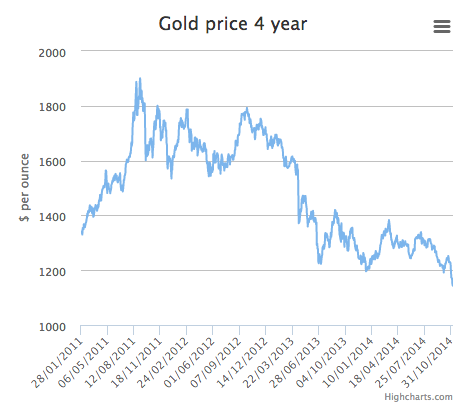
The entire discussion, predictably, got swayed in the direction of, and taken over by, the ever present gold bugs, but with gold having dropped from $1920 a few years ago to $1167.15 today, their view obviously is not the only one that counts. Because Switzerland, as far as we know, might run into very serious economic issues if it allows the franc to rise substantially against the euro.

Plus, neither the country nor its central bank may be quite as powerful and wealthy any more as we like to think. So perhaps the question shouldn’t have been one with strict demands for purchases of gold, but one that questions the policy of buying tens of billions in euros, a policy that has lost the SNB a lot of money already now the euro is down 10-15% against the US dollar.

You can’t, if you’re Swiss, separate the two: you can’t vote on gold but not on the Swiss france vs the euro. So the question asked was the wrong one. And you can’t try and force a central bank to buy gold and hold it into perpetuity, into infinity and beyond, without addressing the problems Swiss companies would encounter if and when the franc would soar against the euro.

And the euro is sure to lose more ground vs the US dollar. So should the SNB have bought dollars instead of euros? The bank itself would have had more wealth, but the euro would have sunk further too, killing Swiss exports to its neighbors, so it’s mixed blessings all around. Note that if the initiative had been accepted, the SNB would have had – in all likelihood – to sell euros to purchase gold, thereby exacerbating everybody’s problems.

From where I’m sitting, I have the impression that the entire thing got moved way out of sync because gold is such an emotional issue for many in the economics press, and especially the blogosphere (where selling gold is very popular). Whereas the real issue, and the reason 78% of Swiss said No, was that the ‘initiatives’ were all poorly phrased. Get yourselves some hip spin doctors already!

Aside from that, there’s of course also my personal opinion that gold is not the cure-all end-all answer to every question or problem. But I know that’s often taken for some kind of heresy. Still, what we’ve always said at The Automatic Earth still stands: owning some gold is fine, but only after you’ve taken care of basic essentials; it may take years for gold to get back to its ‘historically just’ level. And most people don’t have that kind of time.

And let’s be honest, how many people really have their basic essentials down? I know that saying that will lose me readers, but I just don’t want to be part of some church. If we’re going to have a discussion, let’s at least agree to leave no stone unturned.

And yes, we can now expect increased downward pressure on gold. Maybe not as much as on oil, but still. But I don’t think that has anything to do with the value of gold, just with propped up expectations. If oil can drop 40%, what’s gold going to do?

Nov 072014
 
 November 7, 2014  Posted by at 12:53 pm Finance Tagged with: , , , , , , , , , ,  6 Responses »


DPC H.A. Testard Bicycles & Automobiles, New Orleans 1910

EU Dream Unravels 25 Years After The Wall Came Down (Bloomberg)
Not All QE Is Created Equal as U.S. Outpunches ECB And BOJ (Bloomberg)
Asian Currencies Set For A Beating (CNBC)
Could A Strong Dollar Derail Wall Street’s Rally? (CNBC)
Miners Facing ‘Bloodbath’ If Gold Sinks To $1,000 (Telegraph)
Gold Firms Plan Drastic Cuts As Bullion Sinks (Reuters)
Abenomics Pushes Japan Corporate Earnings Toward Record (Bloomberg)
Draghi Stokes Speculation ECB Set to Intensify Stimulus (Bloomberg)
US Investor Sentiment At Highest Level Of 2014 (MarketWatch)
Congress Is In No Hurry To Wind Down Fannie And Freddie (MarketWatch)
Eurozone Governments Look for Spending Boost (Bloomberg)
China Central Bank Pledges Policy Support As Risks To Growth Rise (Reuters)
China Central Bank Confirms New Liquidity Tool as It Holds Off Easing (Bloomberg)
Yuan Bears Say Record Chinese Dollar Debt to Fuel Decline (Bloomberg)
Europe’s Shrinking Conglomerates (Bloomberg)
Luxembourg And Juncker Under Pressure Over Tax Avoidance Deals (Guardian)
EU Auditors Refuse To Sign Off Over £100 Billion Of Its Own Spending (Telegraph)
Gorbachev: Putin Protects Russia’s Interests Better Than Anyone Else (DW)
Ukraine Lurches Back Toward Open War on East Fighting (Bloomberg)

Bloomberg attempts to blame Europe’s troubles on Putin. Unbelievable. Have you no shame? How about journalistic standards?

EU Dream Unravels 25 Years After The Wall Came Down (Bloomberg)

Europe’s post-Cold War order is fraying and there’s no consensus over how to stitch it back together. Some blame the European debt crisis for exposing the folly of the drive for economic unification. Some point to Vladimir Putin for redrawing the map by force and sending his warplanes to buzz NATO borders. For others, the vision of a peaceful, post-national Europe died off with the World War II generation. The makers of European memory will ponder those questions this weekend, marking on Sunday the anniversary of the fall of the Berlin Wall in 1989 and the ensuing euro-euphoria. The lessons of the intervening quarter-century are more sobering. “The easy assumption was that the international liberal order was prevailing,” said Nick Witney, a former head of the European Defence Agency, who is now with the European Council on Foreign Relations in London. “The fact is that those who don’t share those values are coming back. We’re not somehow riding the wheel of history any more than communism was.”

A few of the original builders of the post-Cold War European Union and euro are still at it. The European Commission’s new president, Jean-Claude Juncker of Luxembourg, traces his career back past the 1991 negotiations in Maastricht, the Netherlands that paved the way to the single currency. Juncker’s mission as the EU’s top civil servant is primarily defensive. The turn-of-the-century notion that Europe could export its economic model to places like China, India and Latin America has given way to renewed global power politics with Europe’s heft much diminished. The EU’s stuttering recovery from the debt crisis underlines that weakness. The euro economy will muster 0.8% growth in 2014 after two years of contraction, the commission said this week. It last outperformed the U.S. in 2008 at the start of the financial crisis.

[..] there’s more than enough nationalism to go around in the European heartland. Parties with grievances against immigration, the euro, the EU and a sense of lost identity have made electoral inroads in Britain, France, Greece, Denmark, the Netherlands, Finland, Austria – and even Germany, long seen as immune to bouts of populism. As a result, the map is in flux. While Scotland voted to stay part of the U.K. in a September referendum, all British citizens will have the opportunity to vote themselves out of the EU in 2017 if Prime Minister David Cameron is re-elected next year. Spain is nagged by a separatist movement in Catalonia, its largest regional economy. “This is the worst possible time for geopolitical risk to be hitting the European continent,” Ian Bremmer, head of Eurasia Group, a New York-based risk consultancy, said this week on “Bloomberg Surveillance.” “On the one hand, you have an external environment that is much worse for the Europeans than anyone else. On the other hand, you have internal populism that’s going to make the Europeans grow farther apart.”

Read more …

The limited utility of QE outside the US.

Not All QE Is Created Equal as US Outpunches ECB And BOJ (Bloomberg)

It turns out not all quantitative easing is created equal. New stimulus measures at the Bank of Japan and European Central Bank may lack the global punch of the U.S. Federal Reserve, which last week ended its third round of quantitative easing. So investors should pay more attention to the source of the extra cash sloshing around the financial system than to the amounts. “It is unlikely that increased asset purchases by the BOJ and the ECB will be able to provide a full offset to the end of Fed purchases,” says David Woo, head of global rates and currencies at Bank of America Merrill Lynch in New York. His calculations, contained in a Nov. 3 report, show the Bank of Japan’s surprise decision last week to boost its monetary base faster than previously planned will help add another $730 billion to its balance sheet in the next year. Meantime, the ECB’s buying of asset-backed securities and covered bonds should add $410 billion to its accounts annually.

So even with the Fed no longer buying $85 billion a month of assets, the aggregate liquidity provided each month by the three major central banks will next year return to this year’s peak of a little more than $150 billion. That may help cap any climb in market interest rates in 2015, yet won’t be enough to fully soothe markets as when Fed Chair Janet Yellen and colleagues were writing the checks, according to Woo. Woo argues that the Fed’s influence lies in the benchmark role of the dollar and U.S. Treasuries. Secondly, the Bank of Japan’s latest salvo is more about domestic issues such as reforms of the Government Pension Investment Fund than a signal that it wants to make up for U.S. withdrawal. Finally, Japanese and German bond yields are already so close to zero that the effect of purchases by their central banks will be limited. The upshot is that even with the ECB and BOJ spending, investors will probably now treat bad U.S. data such as a weak jobs report more harshly than when they thought economic deterioration spelled more monetary stimulus.

Read more …

Thailand, Malaysia, Indonesia: the emerging markets eaten alive by the taper. It’s all going according to plan.

Asian Currencies Set For A Beating (CNBC)

Currencies across Asia are set for a beating, buffeted by a combination of the G3 central banks, a stronger U.S. dollar and newly volatile Chinese yuan, HSBC said. “It will be slim pickings in terms of which Asian currencies to like next year. Even the yuan will be predisposed to bouts of higher volatility, which could further upset the region’s currencies,” HSBC said in a note Thursday. “While we had expected most Asian currencies to trade on the back foot against the U.S. dollar, some are now even starting to underperform the euro.” Many of Asia’s currencies have had a tough week since the Bank of Japan (BOJ) announced a fresh batch of stimulus, with the Singapore dollar shedding 1.5% against the U.S. dollar, the Thai baht losing 1.1%, the Malaysian ringgit dropping 2.2% and Indonesia’s rupiah slipping 0.7%.

Currencies with sound external balances, such as the yuan, Korean won, Taiwan dollar and Singapore dollar, were expected to hold up better against the Federal Reserve’s tapering of its asset purchases this year, HSBC said. But it added, “It has become steadily clearer that Asian currencies are held hostage to more than just the Fed. The ECB has become increasingly important and suddenly so too has the Bank of Japan.” ECB President Mario Draghi this week indicated the central bank may take further aggressive stimulus measures, with many analysts expecting a quantitative easing program, including bond-buying, is in the works. The ECB is already buying asset-backed securities.

Draghi’s comments followed the Bank of Japan’s surprise move last Friday to expand an already large stimulus program by increasing asset purchases. It plans to increase purchases of Japanese government bonds (JGBs) to 80 trillion yen annually from the current 50 trillion yen as well as tripling purchases of exchange-traded funds (ETFs) to 3 trillion yen and tripling Japanese real-estate investment trust (REIT) purchases to 90 billion yen. “This muddies the picture as to which Asian currencies should outperform,” HSBC said. “It only fuels a stronger U.S. dollar and even those Asian currencies with sound external balances (the Korean won, the Singapore dollar and the Taiwan dollar) cannot ride out the storm. It is all proving to be a nasty combination for many Asian currencies.”

Read more …

The rally will end anyway, independent of dollar levels.

Could A Strong Dollar Derail Wall Street’s Rally? (CNBC)

A stronger greenback will ultimately hinder the U.S. stock market’s performance as domestic exporters receive less cash for their products abroad, according to Capital Economics. The U.S. dollar hit multi-year highs against several currencies this week, including a seven-year high against the Japanese yen, after Republicans gained control over both chambers of Congress for the first time since 2006, raising hopes of more pro-business policies. At the same time, U.S. stocks have been powering higher. The S&P 500 and Dow Jones hit record highs on Thursday, and are up 9.48% and 5.48% year to date, respectively. “Although the U.S. stock market has rebounded in recent weeks, its upside could by limited if, as we forecast, the rally in the dollar continues,” Capital Economics analysts said.

A stronger greenback means U.S. exporters will be faced with a conundrum: cut profit margins by keeping the foreign currency price of its exports unchanged or risk losing market share by hiking prices abroad. Either way, the dollar’s rise will prove a hindrance, Capital Economics said. Companies selling goods at home, that compete with imports from foreign countries, will also lose out, Capital Economics said. Foreign companies can cut the dollar price of their exports without hurting the value of profits in their home currency, putting them at an advantage and increasing their market share. “Finally, fluctuations in the dollar’s value also affect the earnings of U.S. companies’ foreign affiliates, which are very sizeable… As the dollar rises, those overseas earnings are worth less in U.S. currency,” the analysts added.

Read more …

PR to make people buy gold, fearing it will go up in price?

Miners Facing ‘Bloodbath’ If Gold Sinks To $1,000 (Telegraph)

The boss of the largest London-listed gold miner said his industry is suffering and is facing a “bloodbath” if the price of the precious metal sinks to $1,000 an ounce. Mark Bristow, chief executive of Randgold Rresources, said: “The [gold mining] industry is clearly stuffed at $1,140 and it will be a bloodbath at $1,000.” The price of gold is testing four-year lows. It fell again today – down 0.4pc to $1,142.8 per ounce at midday. Mr Bristow, who was speaking at his company’s third quarter results presentation in London, said demand for gold is as strong as ever. However, he beleives that the industry has failed to learn the lessons from a cyclical market and is “pumping out” unprofitable gold into the market after years of expansion.

He believes that the business plans of many companies are based on the price of gold being around $1,300 per ounce. This did not look outlandish when the price hit $1,900 in 2011 but is making things difficult now. Mr Bristow said he doesn’t expect the price of gold to recover any time soon: “Gold at $1,300 is history and big players wil struggle to repay their debts at current prices.” Randgold Resources said third-quarter pre-tax profits were down to $79.6m from $126.6m in the same period last year. The company’s own cash costs for gold production were $692 per ounce during the period, one of the lowest in the industry. “Our business is designed to make profits at $1,000 per ounce, not just survive,” Mr Bristow said.

Read more …

“..three quarters of gold mining companies burn cash at spot prices just below $1,200 on an all-in cost basis.”

Gold Firms Plan Drastic Cuts As Bullion Sinks (Reuters)

Struggling gold producers plan increasingly drastic measures such as scrapping dividends, cutting jobs, halting projects and shutting mines to survive the latest price plunge, but not all of them will make it. Gold tumbled to a more than four-year low of $1,137.40 an ounce this week, rekindling memories of last year’s 28% drop to $1,196. That fall put an abrupt end to years of over-spending on expansion projects and forced producers to cut costs. Gold prices recovered early in 2014, but the slide in the past three months to new lows will force companies to step up their efforts to cope. According to Citi analysts, about three quarters of gold mining companies burn cash at spot prices just below $1,200 on an all-in cost basis, which includes head office, interest, permitting and exploration costs. Buenaventura, Medusa and Iamgold are among the highest-cost producers with all-in costs well above $1,300, a Citi note to investors said.

“Everyone has started now to appreciate that the music has stopped and there are only so many chairs,” Mark Bristow, chief executive of gold miner Randgold, said in an interview. He said he was frustrated that not much high-cost production had been shut down so far. “It is questionable whether, without injection of liquidity, the leading companies in our industry can manage their businesses going forward. Everyone is trying to survive in hope that the gold price will go up.” Unlike prices for most other commodities, the gold price does not hinge mostly on demand and supply fundamentals. Instead, it is tied more to global economic factors such as interest rates and inflation and is more subject to investor sentiment, which make its moves more difficult to predict. And gold equities are historically even more volatile than the metal. After outperforming the bullion price for most of this year, gold mining shares have given up all gains to sink much deeper than gold itself.

Read more …

It works!

Abenomics Pushes Japan Corporate Earnings Toward Record (Bloomberg)

Japanese companies are headed toward their highest profits ever, as the falling yen boosts exporters from Toyota to Uniqlo-operator Fast Retailing. Aggregate net income at 195 of the largest listed companies will expand 10% to a record 17.5 trillion yen ($153 billion) this fiscal year, based on analyst estimates compiled by Bloomberg. Executives are catching up to such lofty expectations, with Toyota this week raising its profit forecast to an unprecedented 2 trillion yen.

As the earnings season winds down in Japan — almost all companies will have reported results by next week — exporters are emerging as one of the biggest beneficiaries of Prime Minister Shinzo Abe’s economic policies. For investors, the weaker currency is outweighing slumps in wages and local consumption, prompting them to push up the Nikkei 225 Stock Average to levels last seen seven years ago. “Profits were pushed up somewhat surprisingly by the exchange rate recently,” said Tomohiro Okawa, a Japan equities strategist at UBS AG in Tokyo. “Still, there’s not much more that monetary policies can do, and structurally, nothing has changed for these companies.”

Read more …

Forget it.

Draghi Stokes Speculation ECB Set to Intensify Stimulus (Bloomberg)

Mario Draghi is stoking investor bets that he’ll intensify stimulus for the euro area after indicating he has the backing of policy makers to do so. With the European Central Bank president yesterday downplaying dissent within his 24-member Governing Council, new preparations for more-expansive action and a €1 trillion ($1.2 trillion) target for boosting the institution’s balance sheet suggest momentum is shifting toward a proposal for broader bond-buying, perhaps in December. The euro fell and southern European bonds rose as Draghi said policy makers are united in trying to revive inflation and highlighted how they’re stepping up their efforts as the U.S. Federal Reserve pulls back. Corporate bonds could be the next target before more-controversial sovereign debt, economists said. “Draghi signaled that additional monetary easing was in the pipeline,” said Nick Kounis, head of macro and financial markets research at ABN Amro Bank in Amsterdam. “Further action could be announced as soon as next month’s meeting.”

The euro area’s central bankers met yesterday in Frankfurt amid claims that Draghi often acts without the backing of them all, and just days after the Bank of Japan ramped up its own stimulus campaign. The question from investors is how much more he can do to boost an economy that risks sliding into its third recession in six years and where inflation is close to becoming deflation. Having already cut interest rates to record lows and saying they can go no lower, Draghi is now focused on boosting the ECB’s balance sheet. He told reporters that he expects to increase assets back toward March 2012 levels, a clearer commitment than previously. That means a goal of €3 trillion, or about €1 trillion more than the current level. The ECB has issued long-term loans to banks and started buying covered bonds in the hope of flooding the economy with enough liquidity to ease credit constraints. Purchases of asset-backed securities are due to start this month.

Read more …

Accurate contrarian indicator.

US Investor Sentiment At Highest Level Of 2014 (MarketWatch)

A scary selloff in U.S. stocks that gripped markets last month may seem like a gauzy memory, by now. Major U.S. stock benchmarks are hurtling to new heights. So, have the halcyon days for stocks returned? At first glance, the answer appears to be, yes. Eyeballing the most recent investor-sentiment survey from The American Association of Individual Investors indicates that optimism is at its highest level since Dec. 26, 2013, while pessimism fell to a nine-year low. More than half of people surveyed are optimistic that markets will rise over the next six months, while only 15% expect markets to fall, as the chart included shows.

It’s important to note that many market watchers use the AAII survey as a contrarian indicator. Meaning high optimism can signal that it’s not the best time to be a buyer because the markets are hopped up on a major dose of irrational exuberance. After all, if everyone is already bullish, who’s left to buy? At current levels, optimism is unusually high and pessimism is unusually low, AAII wrote, in a report accompanying its survey results, adding that “historically, such occurrences have been followed by lower-than-average levels of market gains.” The number of people feeling bullish has been rising for the past five weeks, according AAII survey. That’s despite the nasty selloff last month, which reached its nadir in the middle of October. Fueling some of this newfound euphoria has been the cessation of the Federal Reserve’s bond-purchasing program and solid corporate earnings. However, investors may be too late to the stock party, if the AAII survey is an accurate contrarian indicator.

Read more …

How to keep home prices at elevated levels.

Congress Is In No Hurry To Wind Down Fannie And Freddie (MarketWatch)

Looking for a reason why U.S. lawmakers might not rush to push through an overhaul of the U.S. housing-finance system that would involve winding down Fannie Mae and Freddie Mac? You’re in luck: There are billions of reasons, according to the companies’ quarterly earnings reports released Thursday. By the end of 2014, the government-sponsored enterprises will have delivered $38 billion more in dividend payments to the U.S. Treasury than they received in bailout money. “The GSEs are a dedicated source of revenue for the federal government and that is unlikely to change anytime soon,” said Isaac Boltansky, an analyst at Compass Point Research & Trading, a Washington-based investment firm. Fannie and Freddie started taking federal bailout funds in 2008, and maxed out at a cumulative total of almost $190 billion several years ago. Due to a legal arrangement, the companies can’t narrow their debt to the government, but they do send periodic payments.

By the end of 2014 Fannie and Freddie will have sent the U.S. Treasury Department a cumulative total of about $225 billion in dividend payments. A strengthening housing market, large tax benefits and legal settlements in recent years have pumped up Fannie and Freddie’s earnings. Because of a controversial amendment to the government’s agreement to help the once-flailing companies, Fannie and Freddie are unable to build capital. Instead, they send their profits to the U.S. Treasury. While U.S. lawmakers may pay lip service to the idea of replacing the two mortgage-finance giants — together Fannie and Freddie back about half of new U.S. mortgages – Congress may dawdle when it comes to slaughtering the cash cows. “GSE earnings today could delay the debt ceiling deadline tomorrow,” Boltansky said.

Read more …

They all think governments can make up for the decline in cosumer spending. Fatal flaw.

Eurozone Governments Look for Spending Boost (Bloomberg)

Euro-area governments brainstormed over how to boost the bloc’s flagging recovery as European Central Bank President Mario Draghi urged countries to do more to make their economies more competitive. “The sense of urgency has to become a lot stronger,” Dutch Finance Minister Jeroen Dijsselbloem said at a conference in Brussels today before talks among his euro-area counterparts. “Politicians also have to shape up and get some of the tougher things done to really create an investment climate in Europe which we badly need.” Finance ministers from the 18-nation euro bloc are beginning to converge over the need to fire up investment as growth in the region’s largest countries stagnates and inflation is predicted to remain at less than half the ECB goal of just under 2% this year and next. Draghi today said he’ll be ready to provide more ECB stimulus, while pressuring member states to do their part.

While accommodative monetary policy, such as the unprecedented stimulus measures that the ECB has already pushed through, can help economic activity, “implementation of product and labor-market reforms, as well as actions to improve the business environment for firms, need to gain momentum in several countries,” Draghi told reporters at his monthly press conference after the ECB Governing Council met in Frankfurt today. “Insufficient progress in structural reforms in euro-area countries constitutes a key downward risk to the economic outlook.” Italy, the third-largest euro-area economy in its third recession in six years, is already taking steps to make its economy more competitive, Finance Minister Pier Carlo Padoan, said at the Brussels conference. “In order to have more investment and therefore more growth we need more resources,” he said. This needs “bringing into the field other investors alongside banks, institutional investors, pension funds, insurance companies and so forth, but also leveraging and making the most of the instruments we already have.”

Read more …

Why not come clean?

China Central Bank Pledges Policy Support As Risks To Growth Rise (Reuters)

China’s central bank pledged on Thursday to maintain modest policy support to help the world’s second-largest economy weather increasing headwinds in the near term but stressed that it will not flood markets with cash. Yet at the same time, the central bank also said publicly for the first time that it had pumped 769.5 billion yuan ($125.91 billion) worth of three-month loans into banks via a “medium-term lending facility” (MLF) to keep interest rates low. The disbursement of loans was slightly more than the 700 billion yuan expected by many in the market and underscored the risks faced by China’s economy, where third-quarter growth fell to a low not seen since the 2008/09 global financial crisis.

“During the process of economic adjustment, China will see rising downward pressure in its economy and increasing chances of exposure to potential risks in a certain period of time,” the People’s Bank of China said. It promised to stick to its “prudent” stance, fine-tune policy in a timely manner to support the economy, and maintain appropriate liquidity conditions to keep reasonable growth in credit and social financing. Indeed, to protect a wobbly economy from any painful rises in borrowing cost, the central bank said the 769.5 billion yuan worth of loans that were extended to banks in September and October were issued at an interest rate of 3.5%.

Read more …

$126 billion in two months.That just go ‘poof’.

China Central Bank Confirms New Liquidity Tool as It Holds Off Easing (Bloomberg)

China’s central bank has published details on its latest tool to provide liquidity as it refrains from across-the-board cuts to benchmark interest rates. The People’s Bank of China confirmed it pumped 769.5 billion yuan ($126 billion) into the country’s lenders in the last two months through a newly-created Medium-term Lending Facility. The PBOC injected 500 billion yuan in September and another 269.5 billion yuan in October via the facility — all termed at three months with an interest rate of 3.5%. The announcement, included in the PBOC’s quarterly monetary policy statement, is the first official confirmation of earlier reports on the injections. Goldman Sachs Group Inc. said every 500 billion yuan in funds from the central bank is similar to a 50-basis-point cut in the required reserve ratio.

“It shows the central bank is very reluctant to loosen monetary policy, but it has to reduce financing costs for end borrowers,” said Guan Qingyou, chief macro-economic researcher with Minsheng Securities Co. in Beijing. “It doesn’t mean the new tools can replace traditional tools forever.” The operations “affected mid-term interest rates while providing liquidity to guide commercial banks to lower their lending rates and overall social-financing costs,” the central bank said in the report published yesterday. “As liquidity generated from capital inflows eases, MLF has played a role of covering the liquidity gap and maintaining a neutral and appropriate liquidity situation.”

Read more …

Time to lose the dollar peg?

Yuan Bears Say Record Chinese Dollar Debt to Fuel Decline (Bloomberg)

Yuan bears have added Chinese companies’ record dollar borrowings to the list of reasons why the currency may weaken. Chinese firms raised $196 billion from loans and bonds this year, 11 times more than the $17.7 billion of 2008, data compiled by Bloomberg show. Societe General SA, Daiwa Capital Markets and Royal Bank of Canada predict the yuan, which is headed for its first annual decline in five years, will drop further in coming months as the outlook for rising U.S. interest rates and a weakening Chinese economy exposes the risk of overseas liabilities. The People’s Bank of China engineered a 2.6% decline in the yuan in the first quarter to cut one-way bets on the currency and prepare companies for the risk of exchange-rate weakness.

Daiwa Capital Markets estimates that, in addition to foreign-currency borrowing, $1 trillion of hot money has flooded into China since the Federal Reserve started quantitative easing in 2008, including through shadow-banking channels such as export financing and metals purchases. “Leverage does place China in the higher risk category in the Asian region,” Sue Trinh, a senior currency strategist at Royal Bank of Canada in Hong Kong, said by phone yesterday. “China is making continued progress in reducing reliance on credit and in particular the shadow-banking sector,” she said, adding that the effort “will likely limit the extent to which the yuan will be able to gain.”

Read more …

Remnants of times long gone.

Europe’s Shrinking Conglomerates (Bloomberg)

Europe’s biggest conglomerates are slimming down, discarding units that either don’t make enough money or don’t fit with how they see the future. It makes sense to concentrate on fewer industries: There’s no obvious synergy between building power stations and selling hearing aids, or between engineering more fertile seeds and making polycarbonate car parts. It just might herald the start of a second European industrial revolution. It’s certainly set off a massive mergers-and-acquisitions wave. Germany’s Siemens is leading the charge. It has discarded at least five businesses this year to focus on what it calls “electrification, automation and digitalization.” And that’s after more divestments last year than any European industrial company, according to Bloomberg Intelligence. Both Germany’s Bayer and Royal Philips of the Netherlands are abandoning their century-old business roots in a burst of Schumpeterian creative destruction.

Siemens is allowing partner Robert Bosch to take over its appliance business by selling Bosch a 50% stake for €3 billion ($3.75 billion). Siemens is also selling a health data unit for $1.3 billion, a clinical microbiology division for an undisclosed sum, an alarms-and-video surveillance maker, and a hearing-aids business for €2.2 billion. On the acquisitions side, Siemens is muscling up in the markets on which it wants to focus. It paid $7.6 billion for Dresser-Rand Inc. in September to bolster the oil-field equipment division, and $1.3 billion in May for a unit making gas turbines and compressors from Rolls-Royce Holdings. It missed out on the energy assets of France’s Alstom SA, beaten by U.S. giant General Electric’s $17 billion bid. (GE is also slimming down by offloading a consumer appliance business to Sweden’s Electrolux for $3.3 billion earlier this year.)

Read more …

Time to lie, Jean-Claude.

Luxembourg And Juncker Under Pressure Over Tax Avoidance Deals (Guardian)

French, German and Dutch finance ministers have rounded on Luxembourg for allowing multinational companies to create complicated structures to avoid billions of dollars of tax. Pressure is also mounting on Jean-Claude Juncker, the new president of the European commission and former long-serving prime minister of Luxembourg, who oversaw the introduction of laws that helped turn the tiny European country into a magnet for multinationals who are seeking to reduce their tax bills. The calls for Luxembourg to stop arranging special deals that help corporations avoid tax came after a vast cache of 28,000 leaked tax papers from the Grand Duchy revealed the country had been rubber-stamping tax avoidance on an industrial scale. Details of the documents were revealed by 80 journalists in 26 countries working with the International Consortium of Investigative Journalists (ICIJ), including the Guardian.

Wolfgang Schäuble, Germany’s finance minister, said the revelations about Luxembourg’s secret tax deals showed that the Grand Duchy had “a lot to do” to meet global standards. The French finance minister, Michel Sapin, said such deals were “no longer acceptable for any country”. He added: “I wish that in a few years we never have to talk about something like this again.” The Netherlands finance minister, Jeroen Dijsselbloem, who is also chair of the Eurogroup of all 18 finance ministers in the eurozone, said that Luxembourg was breaching international tax standards. “Many countries make agreements with companies to provide security. But these agreements need to comply with international standards. We still have some work here.” At Westminster, Margaret Hodge, chair of the Commons public accounts committee, said: “[Juncker has] just taken over the European commission, [yet] he’s presided over the biggest exploitation of European nations in his own little country for decades.”

Despite the criticism, Juncker was said to be “very serene” and “cool”. Juncker, who took over as president of the commission on Saturday after serving 19 years as premier of Luxembourg, was scheduled to take part in a public debate on Thursday in Brussels. But he pulled out on Wednesday night as news organisations prepared to publish the leaked tax documents. Many of the tax deals – secured for companies including Ikea, Pepsi, Burberry, FedEx and Procter & Gamble – were aided by laws written during Juncker’s term of office. The Danish tax minister, Benny Engelbrecht, said the revelations were “shocking”. “Tax payments are down to%ages that are so crazy that you can almost not even describe the challenges that they create for other countries,” Engelbrecht told the Danish paper Politiken.

Read more …

“… the Brussels accounts have not been given the all clear for 19 years running.” How insane would you like it?

EU Auditors Refuse To Sign Off Over £100 Billion Of Its Own Spending (Telegraph)

The European Union is accused of “breathtaking hypocrisy” for continuing to demand that David Cameron pays a £1.7 billion bill despite its own auditors failing to give a clean bill of health to more than £100 billion of spending by Brussels According to the annual report of the European Court of Auditors, seen by The Telegraph, £5.5 billion of the EU budget last year was misspent because of controls on spending that were deemed to be only “partially effective” by experts. The audit found that £109 billion out of a total of £117 billion spent by the EU in 2013 was “affected by material error”. It means that the Brussels accounts have not been given the all clear for 19 years running. Treasury sources said that the disclosure shows why the EU needs “urgent reform”. Mr Cameron has said he will refuse to pay “anything like” the £1.7 billion on December 1, despite being threatened with fines by the EU.

The damning finding by the auditors emerged as senior figures in Brussels criticised Mr Cameron for refusing to pay the bill, which was demanded because of the success of Britain’s economy. The audit concluded that the European budget needed better management at a time of “continuing pressure on EU and national finances”. “More can and should be done to ensure money is spent according to rules,” it said. Among the examples of misspent money was funding used to buy helicopters to help Spain defend Europe’s borders against entry by illegal immigrants. “[Auditors] examined a project in Spain which consisted of the purchase of four helicopters, to be used 75% of their operating time for EU border surveillance and control. However, the ECA found the helicopters were only used 25% of the time for this purpose,” said the report. In another case, the commission handed out £1.4 million in funding for social development in Moldova “for which no underlying expenditure had been incurred”.

Read more …

Gorbachev was never a big fan of Putin’s. But he knows the US “.. have different plans, they need a different situation, one that would allow them to meddle everywhere.”

Gorbachev: Putin Protects Russia’s Interests Better Than Anyone Else (DW)

Former Soviet leader Mikhail Gorbachev said he will defend Russia’s policy in Ukraine and President Vladimir Putin when he meets with top German officials this week, for the festivities marking the 25th anniversary of the fall of the Berlin Wall. “I am absolutely convinced that Putin protects Russia’s interests better than anyone else,” Gorbachev said. The last leader of the USSR is set to meet German Chancellor Angela Merkel and President Joachim Gauck during the ceremony, which comes at a time of bitter confrontation between Russia and the West. Gorbachev also said that the current Ukraine crisis provided an “excuse” for the United States to pick on Russia.

“Russia agreed to new relations, [and] created new cooperation structures. And everything would be great but not everyone in the United States liked it,” he said in an interview with the Interfax news agency on Thursday. “They have different plans, they need a different situation, one that would allow them to meddle everywhere. Whether it will be good or bad, they don’t care,” Gorbachev said, referring to Washington. The 83-year-old is widely praised for his decision not to use force to stop the wave of changes in Eastern Europe during the final years of the Cold War. He is also credited for the reforms of glasnost (openness) and perestroika (restructuring) after coming to power in 1985, and allowing the Wall to fall in 1989, thus effectively ending the Cold War. He has often criticized Vladimir Putin for his authoritarian style of government. A quarter century after the fall of the Iron Curtain, many former Soviet officials say they feel betrayed by the West.

Several politicians from that era have told the AFP news agency that the reunification of Germany was allowed only under the condition that NATO would not expand to the east, into an area traditionally considered a Russian sphere of influence. Former Gorbachev advisor Anatoly Chernyaev swears that he personally witnessed a pledge from Washington to the Soviet leader not to enlarge NATO. “With my own ears, I heard Secretary of State James Baker promise Gorbachev on February 9, 1990 in the Kremlin’s Catherine the Great hall that NATO would not extend ‘even an inch’ to the east if we accepted the entry of a unified Germany into the alliance,” he said. Western leaders from the same period have rejected claims that such a deal with the Kremlin ever existed.

Read more …

The west is not interested in peace.

Ukraine Lurches Back Toward Open War on East Fighting (Bloomberg)

Ukraine’s east lurched back toward open war as the government in Kiev and pro-Russian rebels accused each other of starting major offensives in the region. The Ukrainian government said there were 26 outbreaks of fighting yesterday between its forces and separatists in the east, while the rebels said the Kiev government’s troops had gone on a large-scale military push there. The standoff is coming to a head after Ukraine and its allies accused separatists of undermining peace efforts with Nov. 2 elections in Donetsk and Luhansk. Russian President Vladimir Putin said Nov. 5 that Ukraine’s “civil war” isn’t subsiding as cities continue to come under shelling and the civilian death toll rises.

“Both Ukrainian government and separatist forces must immediately stop carrying out indiscriminate attacks in violation of the laws of war,” said John Dalhuisen, Europe and Central Asia director of Amnesty International in a report posted on the human rights group’s website yesterday. “They have killed and injured civilians, and destroyed civilian homes, and there would appear to be little impetus on both sides to end these violations.” Ukrainian troops are sticking to the cease-fire worked out two months ago and are “staying at their previous positions,” the military press office said in a statement on its Facebook page. It said three Ukrainian servicemen were killed yesterday. Russia’s RIA Novosti state news agency quoted Andrei Purgin, deputy premier of the self-proclaimed Donetsk People’s Republic, as saying that Ukraine had begun a large-scale offensive against the separatists in the east. Purgin said he sees “all-out war” and claimed Ukrainian forces had broken the Sept. 5 truce, according to RIA.

Read more …

Nov 042014
 
 November 4, 2014  Posted by at 12:22 pm Finance Tagged with: , , , , , , , , , , ,  12 Responses »


DPC Looking south on Fifth Avenue at East 56th Street, NYC 1905

Dollar Smashes Through Resistance As Mega-Rally Gathers Pace (AEP)
WTI Falls to 3-Year Low on Saudi Price Cut as US Supply Climbs (Bloomberg)
Saudis Cut Crude Prices to US in December Amid Shale Boom (Bloomberg)
Gross Says Deflation a ‘Growing Possibility’ Threatening Wealth (Bloomberg)
Deep Divisions Emerge over ECB Quantitative Easing Plans (Spiegel)
Why The ECB May Not Want To Join The QE Dance (CNBC)
Japan Creates World’s Biggest Bond Bubble (Bloomberg)
Marc Faber: Japan Is Engaged in a Ponzi Scheme (Bloomberg)
BOJ Easing Seen Boosting Chances Abe Will Raise Sales Tax (Bloomberg)
Japan Pension Fund Strategy Shift Adds $187 Billion To Stocks (Bloomberg)
EU Leaders Weigh Plan For Greek Exit From Bailout (FT)
Greek Far-Left PM-in-Waiting Smells Power, Moves To Center (Reuters)
Euro Woes Pressuring Eastern EU States Into More Easing (Bloomberg)
Spain Bondholders Told Catalans Offer Best Chance of Repayment (Bloomberg)
JPMorgan Faces US Criminal Probe Into FX Trading (Bloomberg)
Venezuela, With World’s Largest Reserves, Imports Oil (USA Today)
Lingering Slump In Real UK House Prices Outside London Belies Bubble Fears (AEP)
Scandalously Low Pay Should Not Be The New Normal (Guardian)
Australia Trade Deficit More Than Doubles On Commodity Prices (BBC)
Rich Guys Running for Office Struggle With Voters in Land of Frozen Wages (Bloomberg)

The only safe haven left, as we’ve been saying for a very long time. The inevitable outcome, because: “Corporate debt in dollars across Asia has jumped from $300bn to $2.5 trillion since 2005. More than two-thirds of the total $11 trillion of cross-border bank loans worldwide are denominated in dollars.”

Dollar Smashes Through Resistance As Mega-Rally Gathers Pace (AEP)

The US dollar has surged to a four-year high against a basket of currencies and has punched through key technical resistance, marking a crucial turning point for the global financial system. The so-called dollar index, watched closely by traders, has finally broken above its 30-year downtrend line as the US economy powers ahead and the Federal Reserve prepares to tighten monetary policy. The index – a mix of six major currencies – hit 87.4 on Monday, rising above the key level of 87. This reflects the plunge in the Japanese yen since the Bank of Japan launched a fresh round of quantitative easing last week. Data from the Chicago Mercantile Exchange show that speculative dollar bets on the derivatives markets have reached a record high, with the biggest positions against sterling, the New Zealand dollar, the Canadian dollar, the yen and the Swiss franc, in that order.

David Bloom, currency chief at HSBC, said a “seismic change” is under way and may lead to a 20pc surge in the dollar over a 12-month span. The mega-rally of 1980 to 1985 as the Volcker Fed tightened the screws saw a 90pc rise before the leading powers intervened at the Plaza Accord to cap the rise. “We are only at the early stages of a dollar bull run. The current rally is unlike any we have seen before. The greatest danger for markets and forecasters is that they fail to adjust their behaviour to fully reflect a very different world,” he said. Mr Bloom said the stronger dollar buys time for other countries engaged in currency warfare to “steal inflation”, now a precious rarity that economies are fighting over. The great unknown is how long the US economy itself can withstand the deflationary impact of a stronger dollar. The rule of thumb is that each 10pc rise in the dollar cuts the inflation rate of 0.5pc a year later.

Hans Redeker, from Morgan Stanley, said the dollar rally is almost unstoppable at this stage given the roaring US recovery, and the stark contrast between a hawkish Fed and the prospect of monetary stimulus for years to come in Europe. “We think this will be a 4 to 5-year bull-market in the dollar. The whole exchange system is seeking a new equilibrium,” he said. “We think the euro will reach $1.12 to the dollar by next year and will be even weaker than the yen in the race to the bottom.” Mr Redeker said US pension funds and asset managers have invested huge sums in emerging markets without considering the currency risks. “They may be forced to start hedging their exposure, and that could catapult the dollar even higher in a self-fulfilling effect.” The dollar revival could prove painful for companies in Asia that have borrowed heavily in the US currency during the Fed’s QE phase, betting it would continue to fall.

Data from the Bank for International Settlements show that the dollar “carry-trade” from Hong Kong into China may have reached $1.2 trillion. Corporate debt in dollars across Asia has jumped from $300bn to $2.5 trillion since 2005. More than two-thirds of the total $11 trillion of cross-border bank loans worldwide are denominated in dollars. A chunk is unhedged in currency terms and is therefore vulnerable to a dollar “short squeeze”. The International Monetary Fund said $650bn of capital has flowed into emerging markets as a result of QE that would not otherwise have gone there.

Read more …

Major reset on the way.

WTI Falls to 3-Year Low on Saudi Price Cut as US Supply Climbs (Bloomberg)

West Texas Intermediate dropped to the lowest intraday level in three years as Saudi Arabia cut prices for crude exports to U.S. customers amid speculation that stockpiles increased. Brent extended losses in London. Futures fell as much as 3.7% to $75.84 a barrel, the weakest since Oct. 4, 2011. Saudi Arabian Oil Co. reduced December differentials for all grades it ships to the U.S., while supplies to Asia and Europe were priced higher, according to an e-mailed statement yesterday. U.S. crude inventories climbed by 1.9 million barrels last week to a four-month high, a Bloomberg News survey shows before government data tomorrow. Oil slid in October by the most since May 2012 as leading members of the Organization of Petroleum Exporting Countries resisted calls to cut output.

Global supplies are rising, with the U.S. pumping at the fastest pace in more than three decades. “Saudi Arabia isn’t inspiring the sentiment that they are trying to force customers to take less,” Olivier Jakob, managing director at Petromatrix GmbH in Zug, Switzerland, said by e-mail. “The only solution seen by the market to reduce the oversupplied outlook is an OPEC cut led by Saudi Arabia.”

Read more …

Killing the competition.

Saudis Cut Crude Prices to US in December Amid Shale Boom (Bloomberg)

Saudi Arabian Oil Co. lowered the cost of its crude to the U.S., where production is the highest in three decades, deepening a selloff that sent prices to the lowest in more two years. The state-owned producer, known as Saudi Aramco, lowered the premium for Arab Light relative to U.S. Gulf Coast benchmarks by 45 cents a barrel to the smallest since December. medium and heavy grades were also down 45 cents and extra light oil 50 cents. Aramco increased the cost to Asia and Europe. Swelling supplies from producers outside OPEC drove oil prices into a bear market last month as global demand growth slowed. Middle Eastern producers are increasingly competing with cargoes from Latin America, North Africa and Russia for buyers, as well as with U.S. production that has jumped 54% in the past three years.

“The Saudi move speaks to them wanting to preserve market share in the U.S., where it has slipped recently,” John Kilduff, a partner at Again Capital LLC, a New York-based hedge fund that focuses on energy, said yesterday by phone. “It looks like the Saudis are comfortable with prices and demand.” West Texas Intermediate, the U.S. benchmark, fell 55 cents to $78.23 a barrel in electronic trading on the New York Mercantile Exchange at 7:02 a.m. London time. The contract slid $1.76 to $78.78 yesterday, the lowest settlement since June 28, 2012. Brent, the global benchmark, lost 79 cents to $83.99 a barrel on the ICE Futures Europe exchange. “The market is reacting as though Saudi Arabia is going to flood the Gulf and is going to compete with shale production,” Michael Hiley, head of energy OTC at LPS Partners Inc. in New York, said yesterday by phone.

Read more …

” … governments worldwide are struggling to create inflation and stimulate growth.” They can’t and they won’t. There’s too much debt. And adding more will cause the opposite of what they see they want.

Gross Says Deflation a ‘Growing Possibility’ Threatening Wealth (Bloomberg)

Bill Gross, in his second investment outlook since joining Janus Capital Group, said deflation is a “growing possibility” as governments worldwide are struggling to create inflation and stimulate growth. Central banks around the world have made “a damn fine attempt” at fueling inflation, yet their efforts have pushed up financial assets, rather than prices in the real economy, Gross wrote in his outlook titled “The Trouble with Porosity and Prosperity.” “The real economy needs money printing, yes, but money spending more so, and that must come from the fiscal side – from the dreaded government side – where deficits are anathema and balanced budgets are increasingly in vogue,” he wrote. Until then, the possibility of deflation is a challenge to wealth creation, according to Gross. The 70-year-old Gross, who last month started managing Janus Global Unconstrained Bond Fund, has forecast subdued market returns in what he calls the ‘new normal,’ a view he and Pimco first expressed in 2009 coming out of the financial crisis.

At Pimco, Gross ran the $201.6 billion Total Return fund, the world’s biggest bond mutual fund, which had trailed peers since the beginning of 2013 as he misjudged the timing and impact of the Federal Reserve’s tapering of its stimulus. Gross left the firm he co-founded in 1971 after his deputies threatened to quit and management debated his ouster, according to people familiar with the matter. Gross, whose investment commentaries are known for their colorful anecdotes and comparisons, in today’s outlook called himself a “philosophical nomad” with a foundation formed from sand. The 21st century economy is built on the sand of finance instead of the firmer foundation of investment and innovation, he wrote. “Stopping the printing press sounds like a great solution to the depreciation of our purchasing power but today’s printing is simply something that the global finance based economy cannot live without,” he wrote.

Read more …

Nothing’s changed in a long time when it comes to points of view.

Deep Divisions Emerge over ECB Quantitative Easing Plans (Spiegel)

To prevent dangerous deflation, the ECB is discussing a massive program to purchase government bonds. Monetary watchdogs are divided over the measure, with some alleging that central bankers are being held hostage by politicians. [..] At first glance, there’s little evidence of the sensitive deals being hammered out in the Market Operations department of Germany’s central bank, the Bundesbank. The open-plan office on the fifth floor of its headquarters building, where about a dozen employees are staring at their computer screens, is reminiscent of the simple set for the TV series “The Office”. There are white file cabinets and desks with wooden edges, there is a poster on the wall of football team Bayern Munich, and some prankster has attached a pink rubber pig to the ceiling by its feet. The only hint that these employees are sometimes moving billions of euros with the click of a mouse is the security door that restricts access to the room.

They trade in foreign currencies and bonds, an activity they used to perform primarily for the German government or public pension funds. Now they also often do it for the ECB and its so-called “unconventional measures. Those measures seem to be coming on an almost monthly basis these days. First, there were the ultra low-interest rates, followed by new four-year loans for banks and the ECB’s buying program for bonds and asset backed securities – measures that are intended to make it easier for banks to lend money. As one Bundesbank trader puts it, they now have “a lot more to do.” Ironically, his boss, Bundesbank President Jens Weidmann, is opposed to most of these costly programs. They’re the reason he and ECB President Mario Draghi are now completely at odds.

Even with the latest approved measures not even implemented in full yet, experts at the ECB headquarters a few kilometers away are already devising the next monetary policy experiment: a large-scale bond buying program known among central bankers as quantitative easing. The aim of the program is to push up the rate of inflation, which, at 0.4%, is currently well below the target rate of close to 2%. Central bankers will discuss the problem again this week. It is a fundamental dispute that is becoming increasingly heated. Some view bond purchases as unavoidable, as the euro zone could otherwise slide into dangerous deflation, in which prices steadily decline and both households and businesses cut back their spending. Others warn against a violation of the ECB principle, which prohibits funding government debt by printing money. Is it important that the ECB adhere to tried-and-true principles in the crisis, as Weidmann argues? Or can it resort to unusual measures in an emergency situation, as Draghi is demanding?

Read more …

Germany.

Why The ECB May Not Want To Join The QE Dance (CNBC)

As one major central bank – the U.S. Federal Reserve – closes the quantitative easing door, markets are hoping another – the European Central Bank – will throw it wide open again. Many economists now expect that ECB President Mario Draghi will usher in a quantitative easing (QE) policy, involving buying up countries’ sovereign debt, early in the New Year. Something definitely needs to be done in the euro zone. Unemployment remains stubbornly high at 11.5% and inflation, at 0.4%, doesn’t look that far away from the deflation danger zone. Two of its biggest economies, France and Italy, are going to need extra wriggle room to meet their budgetary targets – and even Germany, the stalwart of recent years, looks less confident than for some time. Yet is QE that something? The most obvious problem with a bond-buying program, particularly when it involves buying up sovereign debt, is the potential political fallout.

How can you make sure that you’re not giving some countries in the single currency bloc an unfair advantage, particularly if they have already been helped out by tens of billions of euros in bailout aid during the financial crisis? No wonder Germany’s anti-European Union party, Alternative für Deutschland, is causing Angela Merkel almost as much trouble as the U.K. Independence Party is for David Cameron. And can QE really be that effective? In the U.K. and U.S., effectively printing money has helped to reduce credit spreads and, therefore, the cost of borrowing. Yet the euro zone already has low credit spreads and borrowing rates, after a series of actions by the ECB. The gap between the cost of short and long-term borrowing for Germany, for example, is already much smaller than it was in the U.S. before QE was introduced there. If funding does not seem to be filtering through to the real economy already, how could the ECB ensure that, by pumping more money into the system, it reached the right places?

Read more …

Bubble, Ponzi, it’s all of the above. It’s setting the world ablaze as we speak.

Japan Creates World’s Biggest Bond Bubble (Bloomberg)

Ten years from now, will Bank of Japan Governor Haruhiko Kuroda be regarded as a genius or a madman? Kuroda’s shock-and-awe stimulus move on Oct. 31 delighted markets and won him plaudits as a monetary virtuoso. Japan, the conventional wisdom tells us, has finally gotten serious about ending deflation, and isn’t it wonderful. But what happens when a central bank buys up an entire bond market? We’re about to find out as Kuroda, like some feverish hedge fund manager, corners Japan’s. Neglected in all the celebrating: To reach a 2% inflation goal that’s both arbitrary and meaningless, the BOJ is destroying Japan’s standing as a market economy. In announcing that it will boost purchases of government bonds to a record annual pace of $709 billion, the central bank has just added further fuel to the most obvious bond bubble in modern history — and helped create a fresh one on stocks. Once the laws of finance, and gravity, reassert themselves, Japan’s debt market could crash in ways that make the 2008 collapse of Lehman Brothers look like a warm-up.

Worse, because Japan’s interest-rate environment is so warped, investors won’t have the usual warning signs of market distress. Even before Friday’s bond-buying move, Japan had lost its last honest tool of price discovery. When a nation that needs 16 digits in yen terms to express its national debt (it reached 1,000,000,000,000,000 yen in August 2013) sees benchmark yields falling, you’ve entered the financial Twilight Zone. Good luck fairly pricing corporate, asset-backed or mortgage-backed securities. Considered in relation to gross domestic product, Kuroda’s purchases make the U.S. Federal Reserve’s quantitative-easing program look quaint. The Fed, of course, is already ending its QE experiment, while Japan is doubling down on one that dates back to 2001. Kuroda’s latest move means Japan’s QE scheme could last forever. The BOJ has willingly become the Ministry of Finance’s ATM; reversing the arrangement will be no small task.

All this liquidity has made for surreal events in Tokyo. Take the news that Japan’s $1.2 trillion Government Pension Investment Fund will dramatically rebalance its portfolio away from bonds. Japan has enormous public debt and a fast-aging population, and now the world’s biggest pension pool is shifting to stocks. Yet somehow, 10-year yields are just 0.43%. The explanation, of course, is that the parts of the market the BOJ doesn’t already own are sedated by its overwhelming liquidity. The BOJ is now on a financial treadmill that’s bound to accelerate, demanding ever more multi-trillion-dollar infusions to keep the market in line.

Read more …

Stating the obvious. But Faber doesn’t know what deflation is: “In some sectors of the economy you can have inflation, and in some sectors, deflation.” No, you cannot.

Marc Faber: Japan Is Engaged in a Ponzi Scheme (Bloomberg)

What do you think about what Bill Gross is saying? Do you think deflation is a real possibility for the United States?

I think the concept of inflation and deflation is frequently misunderstood. In some sectors of the economy you can have inflation, and in some sectors, deflation. But if the investment implication of Bill Gross is that – and he is a friend of mine, i have high regards for him. If the implication is that one should be long US Treasury’s, to some extent i agree. The return on 10-year note’s will be miserable , 2.35% for the next 10 years if you hold them to maturity. However, if you compare that to french government bonds yielding today 1.21% , i think that’s quite a good deal. For japanese bonds, a country that is engaged in a ponzi scheme, bankrupt, they have government bond yields yielding 0.43%. go ahead. I think they are engaged in a Ponzi scheme in the sense that all the government bonds that the treasury issues are being bought by the bank of japan. I think the good news is for Japan, most countries are engaged in a ponzi scheme and it will not end well, but as Carlo Ponzi proved, it can take a long time until the whole system collapses.

Read more …

Yeah, why not finish it off even faster?

BOJ Easing Seen Boosting Chances Abe Will Raise Sales Tax (Bloomberg)

The Bank of Japan’s extra stimulus increases the chances of Prime Minister Shinzo Abe going ahead with a plan to raise the nation’s sales tax, a survey by Bloomberg News shows. Nine of 10 economists responding after the central bank’s surprise move on Oct. 31 expect Abe to increase the levy, which is currently 8% after a 3%age-point bump in April. A decision on whether to lift the tax to 10% in October next year is expected by the end of this year after the government takes account of economic data including gross domestic product figures for the third quarter. The BOJ’s easing may give Abe a firmer footing to pursue measures for longer-term fiscal deficit reduction, including an increase in the sales levy, Moody’s Investors Service said in an e-mailed report.

“Progress on those two policy fronts will ultimately determine the success or failure of Abenomics and its monetary policy strategy,” Moody’s said. The BOJ’s expansion of stimulus puts the spotlight back on Abe’s policies. He’s under pressure to accelerate efforts to strengthen corporate governance, deregulate agriculture, increase female participation in the workforce and secure trade agreements to fuel long-term growth. While deciding on whether Japan can handle another sales-tax hike to help rein in the world’s heaviest debt burden, he is also considering how much to lower company taxes.

Read more …

The casino’s open for business.

Japan Pension Fund Strategy Shift Adds $187 Billion To Stocks (Bloomberg)

Japan’s public retirement savings manager is set to pump $187 billion into stock markets across the globe as the world’s biggest pension fund implements a new investment strategy aimed at enhancing returns. The Government Pension Investment Fund will have to buy 9.8 trillion yen ($86 billion) of Japanese shares and 11.5 trillion yen of foreign equities to meet the asset-allocation targets it set last week, based on holdings in June. GPIF needs to cut 23.4 trillion yen of domestic debt, the data show. The Topix index soared 4.3% Oct. 31 in anticipation of the allocations and on the Bank of Japan’s unexpected stimulus boost, which included tripling purchases of exchange-traded funds. The measure jumped 2.6% today. The domestic bonds GPIF needs to pare could be bought by the BOJ in as little as two months. The fund will end up owning more than 6% of Japan’s equity market once it completes the strategy shift, with that investment enough to buy everything listed in New Zealand, Greece and Morocco combined.

“If you consider the amount of money that’s involved, this will probably have more impact on stocks than the BOJ’s buying of ETFs,” said Takashi Aoki, a Tokyo-based fund manager at Mizuho. “We can expect material support for the market.” Brokerages led gains among the Topix’s 33 industry groups today, soaring 9.4%. The broader gauge posted the highest close in six years, while the Nikkei 225 traded above 17,000 for the first time since 2007 before paring gains. GPIF will put half its assets in equities, equally split between Japanese and foreign markets, according to targets published Oct. 31 after markets closed. That’s up from 12% each under the fund’s previous strategy. The announcement came just hours after the BOJ expanded easing, saying it will buy 8 trillion yen to 12 trillion yen of sovereign debt per month. The pension manager allocated 35% of its holdings to domestic bonds, down from 60%, and boosted foreign debt to 15% from 11%. The new figures don’t include a target for short-term assets, while the previous ones did.

Read more …

With the weaknesses ahead, the dumbest plan yet. Greek yields are already under heavy fire. And now they want to make us believe Greece can stand on its own, and still remain in the eurozone?

EU Leaders Weigh Plan For Greek Exit From Bailout (FT)

Euro zone leaders are weighing a plan to allow Greece to exit its four-year-old bailout at the end of the year by converting nearly €11 billion of unused rescue funds into a backstop for Athens for when it raises cash from the markets on its own. The plan, which will be discussed at a meeting of euro zone finance ministers in Brussels on Thursday,would allow Antonis Samaras, Greek prime minister, to declare an end to the quarterly reviews by the hated “troika” of bailout monitors ahead of parliamentary elections, which could come as early as March. At the same time, backers of the plan believe it would give financial markets the security of knowing Athens could draw on the credit line in an emergency.

The credit line would come from the euro zone’s €500 billion rescue fund, meaning it would still require monitoring from Brussels, albeit less onerous than at present. By tapping €11 billion originally earmarked for shoring up by Greek banks, euro zone officials hope to avoid political resistance from Germany. “In political terms, the money has already been made available to the Greek authorities,” said an EU official involved in the negotiations. Mr Samaras’s hopes of a “clean exit” from Greece’s €172 billion second bailout –which would mean no line of credit or additional outside monitoring – were dashed last month when Greek bonds were sold off in a mini-panic after he announced his intention to finish the bailout at the end of the year without any follow-on program. “A completely clean exit is highly unlikely,” said the EU official. [..]

The biggest remaining stumbling block remains the role of the International Monetary Fund in the plan. Unlike the EU, whose Greek bailout runs out of cash this year, the IMF program is due to run into 2016. The IMF has become a lightning rod for political anger in Greece – Poul Thomsen, the blunt Dane who heads the IMF’s Greek team, has to travel in Athens with a significant security detail – and Greek political leaders are eager to eject the Fund from the program. “It’s not helpful to have them camping in Athens,” said one Greek official, referring to prolonged negotiations over the last bailout review which took nine months to complete. But a group of euro zone countries led by Germany have insisted the IMF remain part of the program, arguing the Fund’s independence and credibility is essential to gaining support for a credit line in the Bundestag.

Read more …

Disappointing development for all Greeks.

Greek Far-Left PM-in-Waiting Smells Power, Moves To Center (Reuters)

Alexis Tsipras, leader of Greece’s far-left Syriza party, recently traveled to Frankfurt and Rome to meet European leaders. He is softening his confrontational tone with Greece’s international lenders. He has a drafted an agenda for the first 100 days of a future government. The 40-year-old former student Communist is acting like a prime minister in waiting. Syriza, once a fringe far-left movement, is now the most popular party in Greece, representing the many voters who feel punished by the country’s EU/IMF bailout. In May, the party easily won European elections and gained the governor’s seat for Greece’s most populous region. Today, it polls higher than any other party, leading by a margin of between 4 and 11 points over Prime Minister Antonis Samaras’s conservatives. One poll shows Tsipras as the most popular political leader in the country. “The big change has begun. The old is on its way out. The new is coming,” Tsipras thundered in a recent speech to parliament. “No one can stop it.”

Key to Syriza’s ascent, party officials say privately, is a calculated effort to moderate the radical leftist rhetoric that prompted German magazine Der Spiegel to name Tsipras among the most dangerous men in Europe in 2012. The party still rails against austerity measures and a bailout-driven “humanitarian crisis”. It wants to reverse minimum wage cuts, freeze state layoffs and halt state asset sales. But Syriza no longer threatens to tear up the bailout agreement or default on debt. Instead, officials say it supports the euro and wants to renegotiate the bailout by using the same pro-growth arguments of partners France and Italy. Syriza’s transformation mirrors the political progression of other anti-establishment fringe parties, such as the Northern League in Italy, that changed tactics after gaining parliamentary power and became more mainstream political forces.

It also reflects how Greece has turned a page on the dark days of the euro zone crisis four years ago, when Athens’ profligate spending risked bringing down the entire euro project. Then, a Tsipras victory at the polls was widely seen as a trigger for a bank run and Greece’s exit from the euro. Recently, however, Tsipras has held talks with European Central Bank chief Mario Draghi in Frankfurt and Austrian President Heinz Fischer. Syriza’s threadbare headquarters, where a portrait of Che Guevara once hung on the wall, is undergoing a makeover to include new desks and an expanded press room. “This is not the Alexis Tsipras of 2010,” said Blanka Kolenikova, European analyst for IHS Global Insight. “Since the last election Syriza’s rhetoric has calmed down. Tsipras is preparing for the fact that he might be leading a government so he needs to prove that he is approachable and flexible.”

Read more …

Still want to join?

Euro Woes Pressuring Eastern EU States Into More Easing (Bloomberg)

Low inflation, flagging growth, and the European Central Bank’s stimulus bias will probably force eastern members of the European Union to cut interest rates to record lows this week. Reduced borrowing costs will be cemented in three monetary policy decisions on consecutive days before the outcome of the ECB’s deliberations on Nov. 6, economists predict. They forecast Romania and Poland will reduce rates today and tomorrow, while Czech officials will maintain their own benchmark close to zero a day later as they ponder their stance on stemming gains in the koruna. Prone to contagion from economic woes in the euro region, their main export market and source of funding, eastern European countries keep a close eye on policy moves in the single currency area.

Now they’re facing border-jumping deflation and ECB loosening that are making the zloty, the leu and their peers stronger and endangering slowing growth. “You have the disinflation trend passing through, you have the ECB policy driving the currency side,” Simon Quijano-Evans, the London-based head of emerging-market research at Commerzbank AG, said by phone yesterday. “If central banks were not to react correspondingly, you’d have downside pressure on growth appearing as well. We don’t really see any major inflation pressure, so there is no real need to keep rates on hold at these sorts of levels.”

Read more …

Referendum in 5 days. Let’s hope it will be a peaceful one.

Spain Bondholders Told Catalans Offer Best Chance of Repayment (Bloomberg)

Spanish bondholders would be well advised to engage with Catalan officials since they may hold the key to getting repaid, according to Oriol Junqueras, leader of the separatist group Esquerra Republicana. Bond investors should recognize that Spain will struggle to contain its public debt when interest rates rise, and that the alternative to dealing with Catalonian separatists may be the anti-establishment Podemos party, said Junqueras. Podemos, which topped a national opinion poll this week, plans to audit Spanish government debt to assess how much is legitimate. “We all suspect interest rates won’t stay low forever,” Junqueras, who heads the most popular group in Catalonia, said in an interview yesterday. “One good way to prepare for that would be to talk to Catalan politicians.”

Junqueras has identified Spain’s public debt of more than €1 trillion ($1.3 trillion) as a weakness for the central government, as his alliance of separatists tries to force Prime Minister Mariano Rajoy to negotiate over Catalan independence. A flashpoint looms on Nov. 9, when Catalans including Junqueras propose holding an informal ballot on secession. They scaled back their plans last month after Rajoy rallied the Constitutional Court to block a non-binding referendum. Even the goal of an informal consultation this weekend may be frustrated. Spain’s highest court is due to meet tomorrow to consider a second challenge to the Catalan plans by the central government. Catalonian President Artur Mas said last week he plans to push ahead with the ballot whatever the court says.

In the event of a split, Catalans might draw on the precedent of the Dayton Accords relating to the former Yugoslavia and offer to take on 9% of Spain’s public debt, or about 90 billion euros, said Junqueras. That equates to Catalonia’s share of Spanish public spending over the past 25 years, he said. “That’s a legitimate criteria,” said Junqueras. “We could propose that.” Alternatively, the liabilities of the Spanish sovereign could be divided up based on Catalonia’s 21% contribution to the state’s tax revenue, he said. That would see the Catalans take on about €210 billion. “It would be good for the markets to talk to Catalan society about this as soon as possible,” he said. “That would be better for everyone.”

Read more …

A few more billions in taxpayer money will be paid in fines.

JPMorgan Faces US Criminal Probe Into FX Trading (Bloomberg)

JPMorgan Chase said it faces a U.S. criminal probe into foreign-exchange dealings and boosted its maximum estimate for “reasonably possible” losses on legal cases to the highest in more than a year. The firm is cooperating with the criminal investigation by the Department of Justice as well as inquiries by regulators in the U.K. and elsewhere, it said yesterday in a quarterly report. The largest U.S. bank said it might need as much as $5.9 billion to cover losses beyond reserves for legal matters, up $1.3 billion from the end of June, and the most since since mid-2013. “In recent months, U.S. government officials have emphasized their willingness to bring criminal actions against financial institutions,” the bank wrote of the general legal environment. “Such actions can have significant collateral consequences for a subject financial institution, including loss of customers and business.”

Chief Executive Officer Jamie Dimon, 58, who led the New York-based firm through $23 billion in settlements last year, is contending with an international probe into whether traders at the biggest banks sought to profit by rigging currency rates. Citigroup and Zurich-based UBS disclosed last week they also face criminal inquiries by the Justice Department into their foreign-exchange dealings. Citigroup cut third-quarter results to include a $600 million legal charge. “These investigations are focused on the firm’s spot FX trading activities as well as controls applicable to those activities,” JPMorgan said its report. While the company is in talks to resolve the cases, “there is no assurance that such discussions will result in settlements,” it said. Banks are facing foreign-exchange probes by authorities on three continents, people with knowledge of the situation have said. Richard Usher, JPMorgan’s chief currency dealer in London, left the company amid efforts to settle a U.K. probe into allegations of foreign-exchange rigging. He hasn’t been accused of any wrongdoing.

Read more …

Makes one wonder what would have happened if ‘we’ had supported Venezuela, instead of hindering it every possible step of the way

Venezuela, With World’s Largest Reserves, Imports Oil (USA Today)

For the first time in its 100-year history of oil production, Venezuela is importing crude – a new embarrassment for the country with the world’s largest oil reserves. The nation’s late president Hugo Chávez often boasted the South American country regained control of its oil industry after he seized joint ventures controlled by such companies as ExxonMobil and Conoco. But 19 months after Chávez’s death, the country can’t pump enough commercially viable oil out of the ground to meet domestic needs — a result of the former leader’s policies. The dilemma — which comes as prices at U.S. pumps fall below $3 per gallon — is the latest facing the government, which has been forced to explain away shortages of basic goods such as toilet paper, food and medicine in the past year.

“The government has destroyed the rest of the economy, so why not the oil industry as well?” says Orlando Rivero, 50, a salesman in Caracas. “How much longer do we have to hear that the government’s economic policies are a success when all we see is one industry after another being affected?” While Venezuela has more than 256 billion barrels of extra-heavy crude, the downside is that grade contains a lot of minerals and sulfur, along with the viscosity of molasses. To make it transportable and ready for traditional refining, the extra-heavy crude needs to have the minerals taken out in so-called upgraders, or have it diluted with lighter blends of oil. The latter tactic is what state oil company Petroleos de Venezuela SA (PDVSA) is using since it doesn’t have the money to build upgraders, which perform a preliminary refining process, and its partners have been unwilling to pony up cash because of the risk of doing business in the country.

Read more …

Ambrose tries to deny the obvious.

Lingering Slump In Real UK House Prices Outside London Belies Bubble Fears (AEP)

British house prices have fallen 35pc in real terms since the peak in 2007 and remain stuck at levels last seen at the start of the century once London is excluded, according to hard data from the Land Registry. “We are not in a bubble or anywhere near it. We’re still climbing out of a trough. The number of mortgages as a share of all homes is the lowest in almost thirty years,” said Michael Saunders from Citigroup. A study by consultants London Central Portfolio said average prices for the country as a whole were £133,538 in September, if London is stripped out. They are down from a peak in £158,494 in 2007. This is a 16pc fall in nominal terms but the full scale of the correction has been disguised by accumulated inflation over these years, deliberately engineered by the Bank of England to avoid a debt-deflation trap. Prices in absolute terms are back to 2004 levels. The drop in real house prices from the peak has been closer to 35pc. This is comparable to the sort of house price shock seen in large parts of the eurozone but the social and economic effects are entirely different.

House prices in central London have decoupled from the British economy and reflect vast concentrations of wealth in the hands of rich foreigners looking for a safe-haven. There are indications that some of the money coming from Asia is leveraged tenfold and falsely designated as cash, but this is chiefly a problem for banks in Hong Kong or China rather than for British regulators. “I do not think it is a policy issue for the Bank of England if foreigners want to overpay for property in London,” said Mr Saunders. Real house prices in Britain are still hovering at levels reached in 2002 during the dotcom bust and the 9/11 attacks in the US, when much of the developed world was in recession. “Fears of a national house price bubble have been wildly premature,” said Naomi Heaton, head of London Central Portfolio. Mrs Heaton said the worry is that the Bank of England will be bounced into interest rate rises too early by a chorus of warnings about eye-watering prices in London, which have distorted perceptions of the broader picture.

While eight million people live in the property zone classified as London, some 56m people live elsewhere. “The furore about a house price bubble over recent months has been totally unhelpful. It is simply not justified outside London,” she said. The parallel between the property cycle in Britain and the Netherlands is illuminating. Both had similar house price and credit surges before the Lehman crisis, and both have seen steep falls in real terms since then. The difference is that Holland has not been able to take countervailing measures to stop a deep slide in nominal prices due to the constraints of EMU membership. The result is that a third of all mortgages are now underwater and household debt ratios are rising. Negative equity in Britain is just 8pc. The picture is far worse in Spain where house prices have dropped 44pc in nominal terms, and where over half of all mortgages are in negative equity by some estimates.

Read more …

The Living Wage debate in the UK. Too late?

Scandalously Low Pay Should Not Be The New Normal (Guardian)

There’s the man who comes into the west London food bank, ashamed he can’t feed his children this week, though he works full-time at the Charing Cross hospital. There’s the trainee childcare worker I met there last Friday, who certainly can’t feed and heat herself on her pay. They leave with basic dry food in carrier bags, but no answer to an economy that ordains lifetimes of pay no family can live on. They are members of a growing army of 5.28 million – the 22% – paid less than a living wage to keep body and soul together. “Predistribution” was Ed Miliband’s much mocked word, by which he meant fair pay from employers, not benefit top-ups from government. Making employers pay the living wage once looked set to become Labour’s signature theme. The simple message that a week’s pay should be enough to keep a family out of poverty resonated with the public. Polls strongly support it. Fair pay, not benefits or subsidies to miserly employers, brought Labour into being – so why is the party in danger of letting this strong emblematic policy slip away?

The voluntary living wage rate has now risen 20p to £7.85 an hour (£9.15 in London) for companies that have signed up. But that improvement contrasts with a crisis of shrinking pay that is draining the Treasury of tax receipts and leaving taxpayers to pick up the benefit top-up bill for mean employers. Not for 140 years has pay fallen so far and for so long. Worse, this looks increasingly like the new normal. The pay gap between women and men is growing again too: women form the bulk of the lowest paid. Another 250,000 fell below the living wage in the last year, but the true state of pay is hidden by official figures, which ignore the 1.7 million self-employed, most not entrepreneurs but minicab drivers. The number of people on the minimum wage has doubled since 1999: it is becoming the norm not the floor.

Read more …

The rising USD makes many victims.

Australia Trade Deficit More Than Doubles On Commodity Prices (BBC)

Australia’s trade deficit more than doubled to A$2.26bn (£1.2b; $1.96bn) in September, data showed. Exports rose just 1% in the month, while imports were up 6% as Australia brought in more fuel. The deficit, a balance of goods and services, widened a lot more than market expectations of A$1.95bn and compared to a revised deficit of A$1.013bn in July. Falling prices of key commodities like iron ore is being blamed for the jump. “The trade deficit for September came in worse than expected with falling commodity prices clearly weighing on export values,” said AMP Capital chief economist Shane Oliver. Export earnings in Australia, home to some of the world’s biggest miners like BHP Billiton and Rio Tinto, have been impacted by the slump in prices.

The price of iron ore is down 40% this year, while thermal coal prices are hovering near five-year lows of A$63 a ton on oversupply in the market and slower demand from China. The two commodities are Australia’s top two exports. Added to the ballooning trade deficit on Tuesday was revised employment data, which showed a weaker labour market. New figures showed that 9,000 jobs were lost in August, compared to previous estimated rise of 32,100. But, the number of jobs lost in September was revised to 23,700, less than an initial estimate of 29,700. The unemployment rate, however, was up to 6.2% in September from a previous estimate of 6.1%. Mr Oliver of AMP said the economic data showed a mixed picture of the economy, which resulted in the Reserve Bank of Australia (RBA) leaving interest rates at a record low of 2.5% in its policy meeting today. “Revised jobs data up to September now shows a slightly weaker jobs market over the last two months than previously reported with unemployment now drifting up,” he said.

Read more …

Y’all sing along now: ‘This is America, can’t you see, little pink houses for you and me.’

Rich Guys Running for Office Struggle With Voters in Land of Frozen Wages (Bloomberg)

Two millionaires vying for governor in Florida are bickering over who’s had the more cushy life. “You grew up with plenty of money, Charlie,” Florida Republican Governor Rick Scott said to Charlie Crist, the Democrat, a line he would repeat five times during a recent hour-long debate. But it’s Scott who flies around in a private jet and is “worth about $100 or $200 million,” countered Crist, arguing that such wealth has made Scott “out of touch” with Florida. Five years into an economic recovery that has sent stocks and corporate profits soaring while weekly wages stagnate, millionaire candidates are fending off attacks on their bank accounts and business records in races from Connecticut to Georgia to Kentucky. “We shouldn’t be too surprised that politicians are coming under fire for their wealth,” said Nicholas Carnes, a public policy professor at Duke University in Durham, North Carolina, who studies the occupations and earnings of elected officials.

“We’re still recovering from the effects of the recession. There are still a lot of people facing hard economic times.” Wealth hasn’t been much of an impediment to U.S. electoral success in the past. Former Presidents Franklin Roosevelt, John F. Kennedy, George W. Bush and his father, George H.W. Bush are among the millionaire office-holders from both parties. In recent years, a strain of economic populism that also has a long history in U.S. politics has seen a revival in the wake of the 18-month recession that ended in June 2009. In part that’s because it accelerated a trend of rising income inequality in the country: Average income for the top 5% of households grew 38% from 1989 to 2013, compared with an increase of less than 10% for all others, according to the Federal Reserve. The median usual pay for Americans employed full-time was $790 per week in the third quarter, about a dollar less per week than just before the start of the recession, Labor Department figures show.

Read more …

Oct 142014
 
 October 14, 2014  Posted by at 8:39 pm Finance Tagged with: , , , ,  6 Responses »


Dorothea Lange Drought-stricken farmer and family near Muskogee, OK Aug 1939

With the US mid-term elections just 3 weeks away, of course there won’t be any sudden interest rate hikes or other major moves directly traceable to, or even remotely suspected to be from, the Federal Reserve and its Wall Street and/or global central bank chums. But I’ll explain once more why I think those hikes are coming – just not before November 4 – on the back of a Bloomberg piece today.

Mark October 26 as well, by the way: ECB stress test results and Ukraine elections without east Ukraine. And if you’re interested, you can read back what I said before about those rate hikes in This Is Why The Fed Will Raise Interest Rates (Aug 29) and Why The Fed WILL Raise Rates (Sep 30).

Actually, there’s two Bloomberg pieces today that are relevant to my point. Here’s the first:

Too-Big-to-Fail Banks Face Up to $870 Billion Capital Gap

Too big to fail is likely to prove a costly epithet for the world’s biggest banks as regulators demand they increase debt securities to cover losses should they collapse. The shortfall facing lenders from JPMorgan to HSBC could be as much as $870 billion, according to estimates from AllianceBernstein, or as little as $237 billion forecast by Barclays. The range is so wide because proposals from the Financial Stability Board outline various possibilities for the amount lenders need to have available as a portion of risk-weighted assets.

With those holdings in excess of $21 trillion at the lenders most directly affected, small changes to assumptions translate into big numbers. “The direction is clear and it is clear that we are talking about huge amounts,” said Emil Petrov at Nomura in London. “Regulatory timelines will stretch far into the future but how quickly will the market demand full compliance?”

A hard question to answer given that the Fed et al have been the market for a long time now. Them and the HFT robots. Webster’s should really redefine the term markets. But then, I understand there’s been some pick-up from ultra-low volumes recently as the VIX rises with human nerves.

The FSB wants to limit the damage the collapse of a major bank would inflict on the world economy by forcing them to hold debt that can be written down to help recapitalize an insolvent lender. For senior bonds to suffer losses under present rules the institution has to enter bankruptcy, a move that would inflict huge damage on the financial system worldwide if it happened to a global bank. That’s what happened when Lehman collapsed in 2008.

The FSB, which consists of regulators and central bankers from around the world, will present its draft rules to a G-20 summit in Brisbane, Australia, next month. Its proposals call for 27 of the world’s largest banks to hold loss-absorbing debt and equity equivalent to 16% to 20% of their risk-weighted assets to take losses in a failure …

Under the plans, these lenders will also have to meet buffer rules set by the Basel Committee on Banking Supervision, another group of global regulators. These can amount to a further 5% of risk-weighted assets, taking banks’ requirements to as much as 25% of holdings.

All the numbers and percentages don’t matter much, because they could all just as well have been invented on the spot. What makes this piece, and those ECB stress test results, relevant, is that they point out the how big banks are still far from healthy, no matter the profits and bonuses they report and dole out. No surprise there if you’ve been paying attention the past decade. No amount of free money will ever nurse them back to health. But it can keep them slugging along, replete with lots of green goo, empty sockets and tombstones.

It gets more interesting in the next bit, where you need to read between the lines a little. I took the liberty of bolding the juiciest bites:

No Stock Salvation Seen in Bank Results as VIX Surges

Options traders are skeptical this week’s bank earnings will deliver calming news to a stock market enduring its worst losses in two years. U.S. stocks have fallen for the past three days on concerns about global growth, the future of interest rates and the spread of Ebola. With companies from JPMorgan to Goldman Sachs and Bank of America scheduled to report this week, demand for bearish options on the largest U.S. financial firms has increased to the highest since May 2013.

Even though banks have escaped the worst losses in the recent selloff, the companies will struggle to boost profits if the Federal Reserve keeps interest rates near zero. Analyst projections tracked by Bloomberg show financial companies in the S&P 500 Index increased earnings 3.1% in the third quarter and 1.6% in the fourth. “There’s an anticipation that a significant percentage of earnings are going to lower forward guidance relatively significantly, including some of the big banks,” Jeff Sica at Sica Wealth Management said by phone.

“That’s going to have a very negative impact on the stock market.” JPMorgan, Citigroup and Wells Fargo are scheduled to provide quarterly results this morning. Bank of America, Goldman Sachs and Morgan Stanley report later in the week. Low interest rates have crimped lending profits for banks, which benefit from higher loan yields. Net interest margins, the difference between what a firm pays in deposits and charges for loans, were a record-low 3.1% in the second quarter…

Fed Vice Chairman Stanley Fischer said during the weekend that U.S. rate increases could be delayed by slowing growth elsewhere. The central bank should be “exceptionally patient” in adjusting monetary policy, Chicago Fed President Charles Evans said yesterday.

Wait, that’s not what Fisher implied, at least not as MarketWatch reported it:

Fed’s Fischer Says Rate Hike Won’t Damage Global Economy

The Federal Reserve’s eventual rate increase, the first since 2006, will not damage the global economy, Federal Reserve Vice Chairman Stanley Fischer said on Saturday. While there could be “further bouts of volatility” in international markets when the Fed first hikes, “the normalization of our policy should prove manageable for the emerging market economies,” Fischer said in a speech at the IMF’s annual meeting.

[..] Since last year, Fischer said, the Fed has “done everything we can, within limits of forecast uncertainty, to prepare market participants for what lies ahead.” The Fed has been as clear as it can be about the future course of its policy course, and markets understand, Fischer said. “We think, looking at market interest rates, that their understanding of what we intend to do is roughly correct … ”

There’s a veiled message in there that’s very different from Chuck Evans’ “The central bank should be “exceptionally patient” in adjusting monetary policy.” Fisher says it won’t make any difference, because everybody already knows what will come. Which is a load of male bovine, because many of the emerging nations that are neck deep in dollar denominated debt have nowhere to turn. And besides, the Fed doesn’t serve market participants, or the real economy, or Americans, and certainly not enmerging markets, The Fed serves banks. Still, for now the confusing messages work miracles (we return to that 2nd Bloomberg piece):

Federal fund futures show the likelihood of a September 2015 rate increase fell to 46%, from 56% on Oct. 10, and 67% two months ago, according to data compiled by Bloomberg.

Wow, that’s a lot of behinds risking a severe burn. You better hope your pension fund manager is just a tad less complacent.

“If you get rates rising, you can price that into loans,” Peter Sorrentino at Huntington Asset Advisors, said. “We haven’t seen much shift in the yield curve, even though people thought this would be the year for it because of the Fed easing on QE. There’s a disappointment that we haven’t seen better margin growth this year.”

That’s all you need to know. Wall Street banks are still ‘down on their luck’ (I know I’m funny), they’re no longer making real money with interest rates scraping zero, and the answers to their ‘sorrows’ are right there in the hands of the people they own: the Fed. There have been a few years of free cash and zero rates which were profitable, but that has put all market parties in the same boat, so the real money, nay, the only money, is now in being on the other side of that boat, that bet, that trade. The trade, and the emotion, has shifted singnificantly. 90º, 180º, take your pick.

Increased volatility will boost trading revenues for the financials, according to Arjun Mehra of JPMorgan. [..] “For the first time in over a year, the largest U.S. banks are expected to get a boost from their trading business, which stands in stark contrast to press reports heading into the second quarter that called for the death of trading,” Mehra wrote. The VIX, a gauge of S&P 500 derivatives prices, jumped 41% last quarter for its biggest increase in three years. Bank of America Merrill Lynch’s MOVE Index, which measures implied volatility on U.S. Treasuries, climbed 22%.

Everyone’s gotten complacent, everyone follows Yellen’s lips, everyone thinks the same. There’s no money in that, and Wall Street needs money, badly. The money is now in volatility, not the lack thereof. So we will have volatility, it’s already rising.

“There are two things banks need to work: higher rates and credit expansion,” Mark Freeman at Westwood Holdings said. “Just as the outlook for growth is getting called into question, the outlook for higher rates is being called into question, and that’s been a headwind for the group as of late.”

The higher rates will be there, and not as late as September 2015. No profit in that. Credit expansion comes to an end, in a sense, with the tapering of QE. But guess what? A significantly higher dollar works the exact same way. It expands ‘credit’ in all – or most – other currencies, and in commodities.

Understand the make-up of the system, the role of the Fed and other central banks, and their relationship with the major commercial/investment banks, and it becomes obvious what their next moves will – must – be. The beast must be Fed.

Oct 042014
 
 October 4, 2014  Posted by at 9:19 pm Finance Tagged with: , , , , ,  16 Responses »


Jack Delano Atchison, Topeka & Santa Fe line at Duoro, NM March 1943

Weekend. Saturday. Beautiful Indian summer imitation where I’m presently located in western Europe. Good time to start out with an empty sheet of text file (for lack of a better term), and stream some consciousness.

Most people must have figured out that things in the economic sphere haven’t gotten any quieter lately. That’s at least something. Stock exchanges in the developed world jumped from a -1%+ loss one day to a 1%+ gain the next. Volatility, nerves, and probably ritalin, have returned. You have to wonder what that means in markets reigned supreme by high-frequency robot traders and central banks, but nevertheless, the public perception remains. And perception is key.

At first glance, US data coming in on Friday look positive, with more jobs and a lower unemployment rate of 5.9%. Bloomberg even had a headline that said the real payrolls increase was 600,000 jobs, instead of the ‘official’ BLS 248,000, because American wage slaves allegedly worked 0.1 hour more per week, 34.6, up from 34.5 in August.

The most since May 2008, the article claims, citing Deutsche’s Joseph LaVorgna. I’m sure if y’all clocked in those 0.1 hours, or 6 minutes, later, you really made them count. I just don’t know whether to laugh or cry when I see things like that reported.

What would seem to me to matter more is the rates in labor participation and Americans not in the labor force.Unfortunately, both are still ugly as warthogs and getting worse. New records all around, as Tyler Durden notes:

While by now everyone should know the answer, for those curious why the US unemployment rate just slid once more to a meager 5.9%, the lowest print since the summer of 2008, the answer is the same one we have shown every month since 2010: the collapse in the labor force participation rate, which in September slid from an already three decade low 62.8% to 62.7% – the lowest in over 36 years, matching the February 1978 lows. And while according to the Household Survey, 232,000 people found jobs, what is more disturbing is that the people not in the labor force, rose to a new record high, increasing by 315,000 to 92.6 million!

But, you know, that’s just the usual nonsense from the usual suspects, and at least today for once we can confidentially state that America is not the horse most likely to be slaughtered tomorrow morning at the glue factory. Drinks all around! Just make sure you finish them within 6 minutes. Or if want to really help out, hand on to your glasses for 10 minutes, and raise job numbers, as calculated by Bloomberg and Deutsche, by a million …

Anyway, the US, the greenback, that’s this week’s story. And it will be for a while to come. The Fed has gone out all guns blazing, cold turkey QE, push up the dollar, (10% or so vs the ‘basket’ of currencies in no time), and the finishing touch waiting in the wings, the rate hike.

The US economy in the months ahead is set to shine. The higher dollar and rates will throw lots of Americans out of their – export-oriented – jobs, but you’re not going to see that reflected in the numbers. Remember how Obama said he was going to double exports in 5 years? That lofty thought is long gone; the basic reality always was.

America is in the process of calling its – dollar – children home. All it needs to do is execute those three steps: QE, dollar, interest rates. That will increase its power, economic and therefore political, over the rest of the world to such an extent that many nations will effectively turn to panhandlers in Lower Manhattan.

Emerging markets, and economies, are the easiest victims. They have risen to what seemed to be great heights, despite the global financial crisis – or is it because of it? – in the past 7-8 years, on the wings of loose monetary policy. From the Fed, from other central banks. Now they need to roll-over the debts that made them shine, and they find themselves having to scramble for the dollar their debts are denominated in.

Every step in the three step program, QE, dollar, interest rates, makes it harder and – much – more expensive for them to service their debts. And the effects haven’t even truly started to sink in yet. For that matter, even the Fed policies haven’t. 2015 is not going to be a nice year for the citizens of Brazil, Thailand, Turkey, you name them, and there will be an enormous amount of unrest and fighting and worse.

Whoever prints the reserve currency rules the world, and the lives of untold millions trying to make a better future for their kids. That last bit: not going to happen.

Japan still plays the role of a rich society, and convincingly, but in reality it’s done. It has been able to keep up appearances more or less so far by selling state debt to its own citizens, but Mrs. Watanabe is not a complete fool. If your 2nd quarter GDP is down -7.1%, that’s not some minor detail.

The final blow to the Japanese economy will be delivered by PM Abe’s insistence that the main pension funds invest in stocks, which will plummet in the upcoming global market plunge – or recalibration if you will -. At which point Abe will be left with two choices: either he leaves in disgrace, not a favorite pastime among the Japanese, or he declares war on China over a bunch of islands. I think Abe’s mind is made up.

As for China, it will have to accept that growth numbers will be way below what it desires, and that ‘massaging’ those numbers is not a solution anymore than it is in Washington, although creative accounting can buy time. The present ‘official’ Beijing growth target is 7.5%, but the real number is nowhere near that.

Which is a huge problem in a society built on the effects and consequences of the higher numbers. Like the by far largest human migration in history, which has seen 100-200 million Chinese peasants into urban centers. And the empty apartment buildings these former peasants have ‘invested’ their hard earned money in. And the unprecedented pollution and other devastation in the areas the peasants came from, to which they can now never return and make a living.

I have no idea how the sequence of Xi’s and Li’s plan to keep that burning cooking cauldron in check, but there’s no way this is going to be pretty and peaceful. Hong Kong is a 5 year old girl’s birthday party compared to what’s coming. And a soaring US dollar will hit the Forbidden City, just as it will most of the world, like a sledgehammer.

And then there’s Europe.. Which needs no help on the way down, it has all the boxes ticked for a descent into mayhem. From what I can see, it will take years for Brussels to admit that Brussels is a really bad idea (and it eats women and children alive), other than as the capital of Belgium, and Europe doesn’t have those years. It needs to decide now that if Germany wants Greece in the eurozone and EU, it will have to pay big bucks for that. No such notion is even considered, but that makes it no less true.

The EU is a dead experiment, a Frankenstein and Mr. Hyde all in one. But no-one wants to see it, and no-one has a clue. Well, wait till interest rates go back up to historically ‘normal’ levels, to 5% or so for the lowest, to 8% or so for you average mortgage loan. That should be interesting to watch.

It’s coming, though, courtesy of Grandma Yellen and the puppeteers that move her limbs and lips up and down. It’s time, wherever you are on the planet, to collect your belongings outside of the reach of the ‘system’, sit down on your porch, and watch the sky for that mushroom cloud on the horizon.

Oct 042014
 
 October 4, 2014  Posted by at 1:24 pm Finance Tagged with: , , , , , ,  5 Responses »


John Vachon “Career Girl” New York 1955

Hi, Ilargi here. As per October 3, the Daily Links that used to be in the top space on every page will now become part of a daily separate post, entitled Debt Rattle +date (to be found below where all posts are, at about 8am ET every day), which will also include the quotes from these same links, which used to be below our own daily essays. The latter will now stand on themselves, and also be separate posts. So the only change for you is that to get to the links, you will need to execute one extra click, but then you get everything I read everyday presented in one go.

If you think this is the worst idea ever, or if you think it’s great, please do let me know at ilargi •AT• theautomaticearth •DOT• com. And thanks for your support. Talking of which: our donate box is at the top of the left hand column, below the ad; please donate what you can. This site runs well below the poverty line these days, and that’s neither right nor sustainable. I want to bring back a lot more Nicole Foss here, but she does have to make a living.

Yours, Raúl Ilargi Meijer

King Dollar Rules: Betting On The Buck (CNBC) American Exceptionalism Thrives Amid Struggling Global Economy (Bloomberg)
OPEC Price War Signaled by Saudi Move Risks Deeper Drop (Bloomberg) Record Low Labor Participation Rate, Record High Not In Labor Force (ZH)
ECB’s Treatment Of Ireland And Italy Is A Constitutional Scandal (AEP) Draghi Breathing Life Into Moribund ABS Bond Market (Bloomberg)
How Payday Loans Leave Cash-Strapped Borrowers Unbankable (Bloomberg) Loan Borrowers Pinched as Banks Increase Rates (Bloomberg)
John Lewis Boss Sorry For Calling France ‘Hopeless’ And ‘Finished’ (Guardian) Finished And Hopeless? That’s Just How We Like Things In France (Guardian)
Secret Leveraging of Junk Bonds Revealed in Stock Trade (Bloomberg) When Schoolgirls Dream Of Jihad, Society Has A Problem (Guardian)
Australia’s Investment In Renewable Energy Slumps 70% In One Year (Guardian) Deforestation In West Africa Linked To Ebola Epidemic (Guardian)

The boys don’t sound too convinced yet.

King Dollar Rules: Betting On The Buck (CNBC)

Amid wild fluctuations in stocks and range-bound trading in bonds this week, the U.S. dollar marched ever higher. The currency is set to finish another week stronger, which would mark 12-straight weeks of gains, the longest winning streak ever. And pros say though the move has been sharp, the uptrend is still firmly intact. First, a warning: Buying the dollar is the trade du jour. As the U.S. economy flexes its muscles amid an increasingly uncertain global backdrop, more investors have jumped on the strong dollar bandwagon. Weekly data from the Commodities Futures Trading Commission show hedge funds and other large speculators’ positions have increased substantially in the past few weeks, and the net long dollar bet now stands at $35.81 billion, not far from its its highest ever. Net shorts on the euro and yen grew larger as well. Those crowded trades mean the dollar is vulnerable to a painful drop when momentum turns on any given day and trades unwind. However, it doesn’t change the logic for buying the dollar and the currency’s trajectory.

“As the Fed steps away from ultra-loose policies, the dollar should gain against the chief beneficiaries of those policies, namely emerging market and commodity currencies,” currency strategists led by Kit Juckes at Societe Generale wrote in a note this week. That goes for the dollar against emerging markets’ currencies, too. “The jump in total debt levels in the emerging markets in recent years leaves them vulnerable to rising interest rates and a resurgent dollar,” Juckes wrote. In the third quarter, the dollar index shot up 7%, the biggest gain since the third quarter of 2008, when investors everywhere were scrambling for safe-haven assets as the financial crisis gripped the globe. Lee Hardman, currency strategist at Bank of Tokyo Mitsubishi, found that after a strong quarterly performance, there’s still scope for further gains. “Looking back over the last 20 years, we found that similarly large quarterly gains have tended to be followed by further, although more modest, gains in the following quarter,” Hardman wrote in a note this week.

Read more …

If only they didn’t need to trade ….

American Exceptionalism Thrives Amid Struggling Global Economy (Bloomberg)

The U.S. is proving to be an oasis of prosperity in the midst of a troubled world economy. Unemployment dropped to a six-year low of 5.9% in September as payrolls rose by a greater-than-forecast 248,000, a Labor Department report showed yesterday. Other data this week showed U.S. factories had their strongest quarter in more than three years, while exports rose to a record in August. St. Louis-based Macroeconomic Advisers bumped up its estimate of third-quarter growth to 3.3%, from 2.8%, after government data published yesterday showed the U.S. trade deficit shrank in August to its lowest level in seven months. “The internal dynamics of the economy are very strong right now,” said Nariman Behravesh, chief economist in Lexington, Massachusetts, for consultants IHS Inc. “We can withstand a lot of shocks.” U.S. stocks rose with the dollar as the jobs data boosted confidence in the economy. After weakening earlier in the week on concerns about global growth, the Standard & Poor’s 500 Index rose 1.1% to 1,967.9 yesterday in New York.

The Bloomberg Dollar Spot Index climbed to a four-year high. The solid performance by the U.S. contrasts with what’s happening in much of the rest of the world. The euro area’s economy stagnated in the second quarter and is suffering from the softest inflation in five years, while a consumer-tax increase in Japan triggered its biggest economic contraction since 2009. China’s economy, which helped bring advanced economies out of the recession in 2009, this year may undershoot the government’s growth target of about 7.5% amid a property slump and the slowest expansion in factory output in five years. “Matters can be described as American exceptionalism,” said Larry Hatheway, chief economist at UBS AG in London. “The U.S. is the only large economic bloc experiencing an acceleration of growth, preparing for a tightening of monetary policy and enjoying an appreciating currency.”

Read more …

Did the Saudis make another deal with Washington, this time to cripple Putin and IS? Remember, they reported a deficit recently.

OPEC Price War Signaled by Saudi Move Risks Deeper Drop (Bloomberg)

Crude oil is poised to extend the biggest slump in more than two years after Saudi Arabia signaled it’s ready for a price war with other OPEC members, according to Commerzbank and Citigroup. Saudi Aramco, the state-run oil producer of the world’s biggest exporter, cut prices on Oct. 1 for all its exports, reducing those for Asia to the lowest level since 2008. The move suggests that the biggest member of the Organization of Petroleum Exporting Countries is prepared to let prices fall rather than cede market share by paring output to clear a supply surplus, according to Commerzbank. “There is no indication whatsoever that the Saudis are going to put a floor into this market,” Seth Kleinman, head of European energy research at Citigroup in London, said by e-mail.

“Saudi market share in Asia is really under assault. It is a price war. The Saudis will win, but it won’t be painless.” Saudi Arabia has acted in the past to stop a plunge in prices. It made the biggest contribution to OPEC’s production cuts of almost 5 million barrels a day in 2008 and 2009 as demand contracted amid the financial crisis. The kingdom would need to reduce output about 500,000 barrels a day to eliminate the supply glut now stemming from the highest U.S. output in three decades, Citigroup and Barclays Plc estimate. While the banks said Saudi Arabia’s strategy may weaken prices in the short-term, they forecast a recovery later. Commerzbank projects Brent will average $105 a barrel in 2015, Citigroup predicts $97.50. Brent for November settlement traded for $93.54 as of 10:07 a.m. local time.

Aramco reduced official selling prices, or OSPs, for all grades of crudes to all regions for November. It lowered the OSP for Arab Light to Asia by $1 a barrel to a discount of $1.05 to the average of Oman and Dubai crude, the lowest level since December 2008. OSPs are regional adjustments Aramco makes to price formulas to compete against oil from other countries. “OPEC appears to be gearing up for a price war,” Eugen Weinberg, head of commodities research at Commerzbank in Frankfurt, said in a report yesterday. “We therefore do not expect prices to stabilize until this impression disappears and OPEC returns to coordinated production cuts.”

Read more …

These graphs are so damning it’s positively crazy that job numbers still get presented as positive by just about all media.

Record Low Labor Participation Rate, Record High Not In Labor Force (ZH)

While by now everyone should know the answer, for those curious why the US unemployment rate just slid once more to a meager 5.9%, the lowest print since the summer of 2008, the answer is the same one we have shown every month since 2010: the collapse in the labor force participation rate, which in September slid from an already three decade low 62.8% to 62.7% – the lowest in over 36 years, matching the February 1978 lows. And while according to the Household Survey, 232,000 people found jobs, what is more disturbing is that the people not in the labor force, rose to a new record high, increasing by 315,000 to 92.6 million!

And that’s how you get a fresh cycle low in the unemployment rate.


So the next time Obama asks you if you are “better off now than 6 years ago” show him this chart of employment to the overall population: it speaks louder than the president ever could.

Read more …

As I said repeatedly before. Democracy in Europe is dead. Elect a eurosceptic government and you’ll find out for yourself.

ECB’s Treatment Of Ireland And Italy Is A Constitutional Scandal (AEP)

So the truth comes out at last. The EU/IMF Troika – actually the ECB – compelled the Irish state to take on the vast liabilities of Anglo-Irish and other banks in the white heat of the financial crisis. It threatened to pull the plug on ECB support for the Irish banking system, in breach of its own core duty to act as a lender-of-last resort, unless the Irish taxpayer took the full losses. This protected bondholders from their condign fate, even though these creditors were fully complicit in Ireland’s credit bubble. Indeed, they helped to cause it, along with the ECB’s ultra-loose monetary policy and negative real rates (set for German needs) during the boom. Even the riskiest tranches of junior bank debt were deemed off limits. Working class youths in Cork, Limerick, and Dublin will have to service a very high public debt – currently 124pc of GDP, up from 25pc in 2007 – for a very long time. Patrick Honohan, Ireland’s central bank governor, told a group of foreign journalists in Dublin some time ago that this had occurred.

We knew, but were sworn to silence, forced to bite our tongues every time we had to listen to the usual pack of lies from certain quarters. Now he has spoken out in a new book on the former Irish finance minister, the late Brian Lenihan. Extracts were published in the Irish Independent on Sunday. Those who follow Ireland will already be aware of this, so forgive me for coming to it late. Mr Honohan was in an impossible position in 2010. The ECB could at any time have withheld emergency support, sending the Irish financial system crashing down in flames. Yet the ECB’s terms for a rescue programme were that Ireland protect all creditors. (Many of them British, Dutch, Belgian, and German) “The Troika staff told Brian in categorical terms that burning the bondholders would mean no programme and, accordingly, could not be countenanced,” he said. “For whatever reason, they waited until after this showdown to inform me of this decision, which had apparently been taken at a very high-level teleconference to which no Irish representative was invited.”

Read more …

Sounds cute and all, but he’s already been whistled back by the two biggest economies in the eurozone.

Draghi Breathing Life Into Moribund ABS Bond Market (Bloomberg)

For the first time in four years there are signs of life in Europe’s market for asset-backed securities. Mario Draghi’s plan to kick-start growth by buying the securities spurred more than €10 billion ($12.7 billion) of issuance in September. That’s almost double the monthly average for the year, signaling a revival in a market that’s shrunk more than 40% since 2010, according to JPMorgan Chase. The European Central Bank president said yesterday that purchases of asset-backed debt will start before the end of the year and may include notes from the junk-rated nations of Greece and Cyprus. He’s made the revival of the market a top priority because he says it will allow banks to increase lending and boost economic growth. “ABS sales have been pretty low over the past few years so the ECB’s plans could be the jolt the market needs to get started again.” said Gareth Davies, the London-based head of European asset-backed securities research at JPMorgan.

“With all the questions about what it can buy, an obvious area of supply would be the new-issue market, which we expect to become more active.” There are two new deals in the market now, including bonds backed by a loan financing a Westfield Corp. shopping center in London, JPMorgan data show. Even after the surge in transactions over the past month, issuance of €57 billion of asset-backed debt issuance this year is the least since 2009, the data show. Draghi’s plans have cut borrowing costs for issuers of the notes to the lowest level in seven years, according to data compiled by Barclays Plc. The extra yield investors demand to hold Spanish and Italian residential mortgage-backed securities, compared with benchmark rates, fell below 1 percentage point in September, data compiled by JPMorgan show.

Read more …

What are we coming to? You pay 10% a week, banks pay 0.1% a year?

How Payday Loans Leave Cash-Strapped Borrowers Unbankable (Bloomberg)

Thousands of Americans exit the banking system after turning to last-resort lenders, according to a study released yesterday by the Pew Charitable Trusts. Of 252 online payday-loan borrowers surveyed by Pew as part of a three-year research project, 22% closed a checking account or had one closed for them. Payday lending is migrating to the Internet as states from New York to California restrict the costly short-term loans, which are secured by a borrower’s next paycheck. The websites charge twice as much on average as payday stores and account for a disproportionate share of consumer complaints about fraudulent charges or harassment by debt collectors, according to Pew. “Abusive practices in the online payday-loan market not only exist but are widespread,” Nick Bourke, director of the Pew project, said in a statement. Pew is releasing the study as the U.S. Consumer Financial Protection Bureau weighs the first federal payday-loan guidelines. Regulators should require lenders to make more affordable loans and disclose the cost clearly, Pew said.

Payday lenders say they provide a valuable service to people who lack access to cheaper forms of credit. The Online Lenders Alliance, a lobbying group, said in a statement responding to the Pew study that “its members are working to ensure consumers are treated fairly.” Some of the borrowers surveyed by Pew who closed their bank accounts said lenders were making unauthorized withdrawals, while others said they couldn’t keep up with the payments. The average interest on a $100 loan is about $25 every two weeks, or an annual rate of 652%, according to Pew. About a third of borrowers said their loans were set up to only withdraw those fees, meaning they ended up making several payments without reducing the principal. “Their business model is based on churning — getting people a loan and then having people re-up it so they stay in debt indefinitely,” said Liz Murray, policy director for National People’s Action, a network of community organizations that ran protests against payday lenders in August that it called “Shark Week.”

Read more …

A lot of hurt is in the air.

Loan Borrowers Pinched as Banks Increase Rates (Bloomberg)

Borrowers are feeling the pinch in the U.S. loan market as the Federal Reserve boosts its oversight of high-risk corporate debt. Banks increased interest rates on almost 54% of the leveraged loans they arranged last month, up from 36% in August and the most since January 2013, data compiled by Bloomberg show. Micro Focus International Plc may pay 1 %age point more than it initially sought on a $1.35 billion loan backing its purchase of Attachmate Group Inc. as prices in the $800 billion market for corporate loans drop to a 21-month low. The Fed, which along with other regulators has been asking banks for more than a year to adhere to guidelines aimed at curbing risky underwriting practices, will now start reviewing individual deals after previous warnings were largely ignored.

The heightened scrutiny adds to the difficulty in finding loan buyers willing to accept lower margins after investors pulled money from funds that invest in the debt in each of the last 12 weeks, bringing withdrawals for the year to $6.9 billion. “People are taking a step back from risk at the moment, and you can sense the market is uneasy,” Tim Anderson, chief fixed-income officer at Richmond, Virginia-based RiverFront Investment Group, said in a telephone interview. “Regulators have picked up on underwriting standards, and when people see and read that, they realize that they aren’t being compensated enough for some of the risks they are taking.”

Read more …

Foot in mouth.

John Lewis Boss Sorry For Calling France ‘Hopeless’ And ‘Finished’ (Guardian)

John Lewis’s managing director has apologised for a string of derogatory remarks about France, as the deputy mayor of Paris dismissed his tirade as “false and idiotic”. Andy Street told a gathering of British entrepreneurs on Thursday night that France was “sclerotic, hopeless and downbeat” and urged them to get out if they had investments there because the country was “finished”. His comments sparked outrage in France and a sharp rebuttal from Jean-Louis Missika, a deputy Paris mayor in charge of economic development and the attractiveness of Paris to investors. He told the Guardian that if Andy Street was joking, perhaps Paris should respond in kind. “What he says is false and idiotic. As we say, everything excessive is exaggerated, but then it seems French bashing is all the fashion chez vous.

“Factually it’s false because figures show that last year Paris attracted more foreign investment than London, and because Paris is a dynamic city with a quality of service that is often better than in London. “But this guy has shops in London, right, so of course he wants to attract people away from the shops in Paris. I think it’s called publicity.” Street, who is launching a French-language version of John Lewis’s website soon, apologised on Friday afternoon as the reaction to his comments snowballed. Waitrose, the John-Lewis-owned supermarket, also has a deal to sell food on Eurostar. “The remarks I made were supposed to be lighthearted views, and tongue in cheek,” said Street. “On reflection I clearly went too far. I regret the comments, and apologise unreservedly.”

Read more …

There you go. That’ll show ’em.

Finished And Hopeless? That’s Just How We Like Things In France (Guardian)

Business students’ textbooks have an addition for their “PR disasters” chapters. With John Lewis planning to launch a French-language version of its website, allowing customers to pay in euros, its managing director, Andy Street, returning from a short trip in Paris to collect an award for the group, said France was “finished”. And that’s not all. Street is the coloratura soprano of French-bashing: his repertoire is colourful and flowery, with a high range. His savoury piques include, “I have never been to a country more ill at ease … nothing works and worse, nobody cares about it”. British entrepreneurs with investments in the country should “get them out quickly”, he advised; while the award he got in Paris at the World Retail Congress was “made of plastic and is frankly revolting”. “If I needed any further evidence of a country in decline, here it is. Every time I [see it], I shall think, God help France.”

Meanwhile, “In Salle Wagram, this beautiful salon, just off the Champs-Élysées, we were treated to the naffest troupe of modern dance you’ve ever known and, literally, a chap’s trousers fell down.” The French embassy in London had the embarrassing task of defending France against Street’s attacks with figures and facts. I won’t. France doesn’t need defending, especially from fools. What I’d like to do is to help Street understand a thing or two about France that probably never crossed his mind. Street has since said his comments were “tongue in cheek”. So are mine. Finished, hopeless, sclerotic and downbeat are precisely how we like things. Love is finished, life is hopeless, we are in essence a grumpy and downbeat people and nobody will ever take it away from us. Heard of Jean-Paul Sartre? Probably not. He was a joyous human being, very funny, very ugly and supremely intelligent. He gave us the greatest gift of all, a philosophy called existentialism. We and we alone are responsible for our own misery. We have never looked back since.

Read more …

“… the $1.3 trillion U.S. junk-bond market is being inflated by a growing amount of leverage being used by buyers”. Please act surprised.

Secret Leveraging of Junk Bonds Revealed in Stock Trade (Bloomberg)

If stock investors are any guide, the $1.3 trillion U.S. junk-bond market is being inflated by a growing amount of leverage being used by buyers. Both stock and junk-bond managers tend to deploy more leverage when markets are booming, and more than ever is being used to purchase U.S. equities, based on levels of margin debt on the New York Stock Exchange, according to UBS analysts. That suggests junk-debt buyers are engaging in similar financing activities. As investors use more borrowed cash, they increase the potential for bigger losses in a downturn. This trend adds to concern that six years of unprecedented Federal Reserve stimulus has produced a bubble in the junk-bond market — and one that will be all the more painful when it eventually pops.

“Rising debt levels will be a problem going forward,” UBS analysts Stephen Caprio and Matthew Mish wrote in a report dated Oct. 2. Investors increase “leverage to meet return hurdles that are more challenging to hit as prices rise.” Measuring leverage in the junk bond market with any kind of precision is a tricky thing. Caprio said in an interview that he doesn’t know of a direct way to do it. Margin debt has surged to more than 2.5% of U.S. gross domestic product, about the highest level in data going back to the early 1990s, the UBS analysts wrote. The measure of leverage tends to be a leading indicator of relative yields on speculative-grade bonds, with a rising level of margin debt increasing the odds of future spread widening.

Read more …

I’d say.

When Schoolgirls Dream Of Jihad, Society Has A Problem (Guardian)

Teenage angst can cause all kinds of unfortunate behaviour, but when schoolgirls tell their parents they want to join the fight in Syria and Iraq, then society has a serious problem. Alarmingly, this is increasingly happening in France, as young Muslims express their desire for jihad. Worse still, an estimated 100-150 young women and girls have actually joined groups such as the self-styled Islamic State (Isis), travelling to a war zone to devote their lives to setting up a highly militarised caliphate and, if necessary, dying for the cause. The situation has been replicated in Britain, but in smaller numbers, and women tend to be far less hateful of the country where they were often born and raised. There are no verified figures on either side of the Channel, but anecdotal evidence suggests that, in France, alienation from society is a far greater incentive to join a conflict than it is in Britain. Thus, in June, a 14-year-old girl known as Sarah disappeared from her home in a Parisian suburb, heading for Syria.

She texted her parents, telling them to search her bedroom where, under the mattress, they found a pained letter saying she was “heading for a country where they do not prevent you from following your religion”. Rather than a fanatical interpretation of Islamic teaching, or anger at western attacks on countries such as Iraq and Afghanistan, Sarah’s motivations were based on what she regards as homegrown discrimination. This is markedly different from British jihadis, who tend to position themselves in a worldwide struggle against aggressive interference in the Muslim world. Numerous other girls in France regularly fill social media sites with reasons why they would consider fleeing abroad. Two, aged 15 and 17, are under judicial supervision after apparently corresponding with Sarah with a view to joining her in Syria, where they would almost certainly take husbands among the French combatants already there, as well as being trained in the use of weaponry. All of the would-be women militants rally against France’s distrust of Islam, which has manifested itself in a range of discriminatory legislation.

Read more …

It seems an Anglo-Saxon movement.

Australia’s Investment In Renewable Energy Slumps 70% In One Year (Guardian)

Australia’s investment in renewable energy projects has slumped below that of Algeria, Thailand and Myanmar, new figures have shown, with the sector “paralysed” by the government’s review of the Renewable Energy Target. Just $193m was invested in new large-scale clean energy projects in the third quarter of 2014, according to Bloomberg New Energy Finance. Investment in the year to date is $238m. This represents a massive 70% slump on 2013 investment and has resulted in Australia slipping from the world’s 11th largest investor in clean energy to 31st in 2014. This ranking is below Algeria, Myanmar, Thailand and Uruguay. By comparison, Canada has invested $US3.1bn in large clean energy projects so far in 2014. The slowdown in renewable energy investment is pinned squarely by Bloomberg on the government’s review of the RET, which mandates that 41,000 gigawatt hours of Australia’s energy comes from renewable sources by 2020.

A recent review of the RET by businessman Dick Warburton found that although it has created jobs and driven investment, it should either be suspended or shut down completely. The government has yet to formally respond to the report, instead holding talks with Labor on a “compromise” position that may see the RET altered in some way without being scrapped entirely. Labor, the Greens and the Palmer United Party all oppose any change to the RET. Kobad Bhavnagri, an analyst at Bloomberg New Energy Finance, told Guardian Australia that the renewables sector is “in the doldrums.” “The government’s position has caused this, it has had some pretty strong anti-renewables rhetoric, particularly anti-wind, and wants to close certain clean energy programs,” he said. “The review has been particularly protracted. The industry was fearful the recommendations would be extreme and they were. It has been shattering.

Read more …

Unintended consequences.

Deforestation In West Africa Linked To Ebola Epidemic (Guardian)

The world now knows in great detail how Thomas Eric Duncan, a man who just a few weeks ago showed admirable compassion for a sick, pregnant neighbor in Liberia, has become the first person to come down with Ebola in the United States. What is less well known is how the virus came to West Africa to infect Duncan’s neighbor. Knowing and acting on that story is absolutely critical if we hope to contain future outbreaks of Ebola and other scary diseases before they turn into global headlines. The Ebola epidemic in West Africa may have surprised most of the medical establishment – this is the first such outbreak in the region – but the risk had been steadily rising for at least a decade. The risk had grown so high, in fact, that this outbreak was almost inevitable and very possibly predictable.

All that was needed was to see the danger was a bat’s eye view of the region. Once blanketed with forests, West Africa has been skinned alive over the last decade. Guinea’s rainforests have been reduced by 80%, while Liberia has sold logging rights to over half its forests. Within the next few years Sierra Leone is on track to be completely deforested. This matters because those forests were habitat for fruit bats, Ebola’s reservoir host. With their homes cut down around them, the bats are concentrating into the remnants of their once-abundant habitat. At the same time, mining has become big business in the region, employing thousands of workers who regularly travel into bat territory to get to the mines. The result: virus, bats and people have had more opportunities to meet.

Fruit bats carry the Ebola virus, but generally don’t die from it. The virus could easily have migrated from Central to West Africa inside them in much the same way that birds spread West Nile virus across North America: passing it among flocks during seasonal migrations. Although bats have long been on the menu in West Africa, there are other transmission routes for the virus besides bushmeat. It is conceivable the two-year-old boy in Guinea thought to be the first case in this outbreak was infected after eating bat-contaminated fruit. This mode of transmission may also explain how the disease gets into wild gorilla populations.

Read more …

Oct 032014
 
 October 3, 2014  Posted by at 5:31 pm Finance Tagged with: , , , , , ,  6 Responses »


Jack Delano Brakeman Jack Torbet at Atchison, Topeka & Santa Fe Railroad March 1943

Hi, Ilargi here. As per today, October 3, I’m going to make some changes I’ve been thinking about for a while, for a number of reasons. That is, the Daily Links that used to be at the top of every page will now become part of a daily separate post, entitled Debt Rattle +date (to be found below where all posts are, at about 8am ET every day), which will also include the quotes from these same links, which used to be below our own daily essays. The latter will now stand on themselves, and also be separate posts. So the only change for you is that to get to the links, you will need to execute one extra click, but then you get everything I read everyday presented in one go.

If you think this is the worst idea ever, or if you think it’s great, please do let me know at ilargi •AT• theautomaticearth •DOT• com. And thanks for your support. Talking of which: please check our donate box, top of the left hand column, below the ad, and donate what you can. This site runs well below the poverty line these days, and it shouldn’t. I want to bring back a lot more Nicole Foss here, but she does have to make a living.

Yours, Raúl Ilargi Meijer

As I watch the euro losing another 1.3% against the dollar today, it’s now at $1.25, and down from close to $1.40 recently, it’s getting clearer all the time: the greenback is busy eating currencies and economies alive.

There is of course the fact that Abenomics in Japan is living up to its longstanding promise of utter failure. And there is Mario Draghi torn between two lovers, one the one hand the Germany/Austria camp – with France as a surprise third – who don’t want the ECB to buy up junk paper, and on the other hand those EU members whose sole road to survival inside the EU is for Draghi to buy up anything that even looks like it was once toilet paper.

But Japan and Europe have been in the economic doghouse for a long time. It wasn’t until the Fed pulled the trigger on the dollar steamroller that they started paying the real price for it.

Japan, at least as long as it chooses to cling to the growth fairy, has nowhere to turn but to something in the vein of Abenomics, i.e. huge money and credit expansion. But it’s not the money supply, no matter how it’s defined, that is the problem, it’s that people refuse to spend. And if people don’t spend, no government or central banks has a way to boost inflation. Why they should want to in the first place is another question.

Europe has the added problem of disagreement on how to escape the walls that are closing in. And the more they close in, the less comfortable the shared living space on the old continent becomes. With a bit of imagination, you can see different people, different cultures, different languages, and different economies, all forced to live in the same ever shrinking – economic -space.

There’s less of everything to go around, and no-one wants to give up what’s theirs. Still, at the same time we already saw that two-thirds of Greeks live at or below the poverty line, and that Naples is even worse than Greece. Where do you personally think that will go? With a dollar that is set to make lots of things, not the least of which is oil and gas, more expensive?

It’s not just that for Europe, the growth fairy is evasive, their economies are bound to shrink a lot more still. And then what is Draghi, or his successor, supposed to do? The eurozone, and the EU itself, has already become a straightjacket with a noose attached to it, and that noose will start to tighten as we go forward. Brussels and Frankfurt can spin all they want – and do they ever -, but they can’t squeeze milk out of a deceased goat.

No matter what side of which fence you’re sitting on here, you to give it to the Fed and Wall Street, though: their timing is impeccable. Victim no. 1 of the Dollar is King move are the emerging markets:

Emerging Stocks Pummeled as Weak Yen Boosts Japan

The yen’s slide to a six-year low is amplifying a rout in emerging-market stocks as investors shift their focus to Japanese companies with earnings in dollars, according to Morgan Stanley. The MSCI Emerging Market Index tumbled 7.6% in September, the most since May 2012, led by China and Hong Kong. That compares with a 3.8% drop for the Topix Index in the period. The yen depreciated 5.1% versus the dollar to the weakest level since August 2008 last month, while a gauge tracking developing-nation currencies retreated 3.8%. “Asset allocation away from emerging markets was in part because Japan was back and that yen weakness is a positive catalyst,” Jonathan Garner, Hong Kong-based head of Asia and emerging-market strategy at Morgan Stanley, said by phone on Sept. 25.

“We don’t have a large export-industrial dollar earnings sector for EM, while Japan’s corporate-sector earnings responded positively to yen weakness.” Japan’s exporters are benefiting from a weaker currency, which boosts overseas income when repatriated, while developing-nation assets have come under pressure as the prospect for higher Federal Reserve interest rates dents demand for riskier assets. Toyota, the world’s biggest carmaker by market value which derives most of its revenue from the U.S., rallied 9% last month. Net inflows to U.S. exchange-traded funds that invest in emerging-markets tumbled 82% to $977.9 million in September, led by a 90% decline to China and Hong Kong, data compiled by Bloomberg show.

And the weak yen has long since stopped boosting Japan in a net, overall, sense:

Japanese Stocks Have Crashed Over 1000 Points Since Friday

After ticking just above 110.00, USDJPY has been a one-way street lower and that means only one thing… Japanese stocks are cratering. From Friday’s highs, The Nikkei 225 has crashed over 1000 points (despite Abe’s promises yet again of more pension reform buying of stocks). Of note, perhaps, is that, Japanese investors bought a net $3.6 billion of foreign stocks last week – the most since January 2009 – perfectly top-ticking global equities… Well played Mrs. Watanabe.

And:

Japan Inc. Begins To Turn Against The Weak Yen

When the Japanese yen began its long descent in late 2012 — around the time it became clear Shinzo Abe would be elected to another prime-ministership — the executives running Japan’s top corporations seemed to believe that the lower the currency, the better, regardless of all else. But since then, the yen has trekked steadily, inexorably downward against the dollar, with the greenback rising from around ¥78 two years ago to ¥110 earlier this week. And, at least according to a Nikkei news survey out Friday, some senior corporate officers are having second thoughts about the race to the bottom for forex. [..] … not a single CFO said they wanted to see the dollar breach above ¥115.

And also:

Yen’s Steepest Decline in 20 Months Spreads Unease in Japan

The yen’s steepest decline in 20 months is prompting concern in Japan that the central bank’s support for a weaker currency may hurt consumers and companies. Monetary authorities intervention to curb the slump is “possible,” according to Hirohisa Fujii, a former finance minister and member of the opposition party, after the currency’s steepest drop last month since January 2013. Some companies are suffering from the weaker yen, Nobuhide Minorikawa, Japan’s vice finance minister said this week [..] The chorus of dissent against the Bank of Japan’s accommodative monetary policy [..] is growing louder, as consumer prices remain depressed and growth is anemic. The weaker yen puts Japan at risk of recession, Kazumasa Iwata, deputy governor of the central bank until 2008, warned last month.

“The whole notion of devaluing the currency has been a bad policy,” Robert Sinche, a global strategist at Pierpont Securities, said. [..] BOJ Governor Haruhiko Kuroda said last month, after the dollar rose above 109 yen, that he didn’t see any big problems with current movements in exchange rates.

You have to like the suggestion that “The weaker yen puts Japan at risk of recession”. Tokyo may want to pick whatever stats they like, but it should be obvious that Japan, like the EU, is in a recession, not at risk of one. Take a look:

What 110 Yen to the Dollar Means for Japan’s Consumers

The weakening yen is starting to squeeze Japanese consumers as prices rise for everything from Burgundy wine to instant noodles, threatening Prime Minister Shinzo Abe’s plans to revive the country’s economy. The currency slid to 110 yen to the dollar yesterday, the lowest level in six years, making imported goods and materials more expensive. Though inflation is one of Abe’s monetary goals, the yen’s sharp slide undermines steps to boost consumer spending and endangers public backing for his economic program.

[..] The success of Abe’s plans for a sustained economic recovery after two decades of stagnation depends on consumers, since they account for about 60% of GDP. They’ve turned cautious as the sales tax rose and companies, including many that profited from the weaker yen, have failed to raise wages enough to keep up with inflation.

Supermarket sales fell for a 5th straight month in August, following an April jump in the consumption tax to 8% from 5%. Wages adjusted for inflation fell 2.6% in August from a year earlier, the 14th straight monthly decline

Nissin Food Products, inventor of the world’s first instant noodles, is increasing their price in January and Ueshima Coffee Co., Japan’s biggest supplier of beans to retailers, will sell them for 25% more from November

[..] Abe, who must decide whether to raise Japan’s sales tax to 10% as planned next year. The increase this April plunged the economy into its deepest contraction in five years as the government tries to cap gains in the developed world’s highest debt burden.

Japan’s biggest employers, including Toyota, Hitachi and Panasonic, have benefited from the yen’s drop. A weaker currency makes their exports more competitive and increases the value of overseas earnings when converted into yen. Japanese companies’ pretax profit rose to a record 17.5 trillion yen ($161 billion) in the quarter ended March 31, according to figures from the finance ministry.

In the five years prior to Abe’s call for unprecedented monetary easing, the Japanese currency averaged 85.69 yen to the dollar and never rose above 93.03 yen, prompting manufacturers to move production out of the country and fueling declines in consumer prices.

The yen’s drop since Abe started his campaign to become prime minister helped fuel a 23% gain in the benchmark Nikkei 225 Stock Average in 2012, followed by a 57% surge last year, the biggest annual gain since 1972.

Abe’s failure so far to broaden the recovery beyond the direct benefits of a weaker currency and unprecedented monetary easing has damped enthusiasm, leaving the Nikkei down 1.3% this year, as of yesterday. Fast Retailing, which is Asia’s largest clothing retailer and accounts for 8.9% of the Nikkei, has fallen 15% this year. Aeon Co., the nation’s largest retailer, is down 22%.

Japan’s GDP shrank an annualized 7.1% in the April-to-June period, the most since the first quarter of 2009.

“The impact to the overall economy is not necessarily all positive; rather, negatives may be outweighing,” Kazumasa Iwata, the BoJ deputy from 2003-2008, said.

Japanese consumers have started to expect that imported foods will become too pricey. “I don’t go to import food shops much recently,” said Kazuha Hemmi, who works in the overseas section of a company in Tokyo. “Some of them stopped selling bargain products.”

“Not necessarily all positive”. Now there’s a dead spin. Any country that sees a 7.1% drop in GDP, no matter what sales tax changes, is in very serious trouble. The nation’s largest retailer is down 22% (!) Want to try that on for size at WalMart?

And then there’s Europe. Where plenty folk probably think they’re in some lower euro honeymoon still. Today, EU exchanges are up 1% or so. While the euro loses big. I suggest these happy shiny people should check on Japan to see what’s in store.

European Stocks Plunge Most In 16 Months As Draghi Disappoints

Broad European stocks plunged into the red for 2014 today as a rattled Mario Draghi disappointed a hungry-for-more risk market. Bloomberg’s BE500 index dropped its most since June 2013 to 2-month lows led by weakness in Italian banks. UK stocks underperformed (-3.6%) but Spain, Italy, and Portugal all tumbled 2-3%. The selling pressure interestingly stayed in stocks as bond spreads rose only modestly and EURUSD roundtripped to only a small rise from pre-ECB. Notably, US equities are cratering as they are so used to the pre-EU-close pump that did not happen.

Draghi’s plan to buy Toilet Paper Backed Securities is dead is a dead in the water as it is on dry land:

France’s Noyer Is Third ECB Dissenter Against ABS Buying Plan

France’s Christian Noyer joined European Central Bank policy makers from Germany and Austria in opposing a program to buy asset-backed securities, according to two euro-area officials. His dissent leaves President Mario Draghi facing a clash with policy makers from the region’s two largest economies, albeit for different reasons. While Noyer disapproved of the way the purchases will be conducted, Austrian central bank Governor Ewald Nowotny shared Bundesbank President Jens Weidmann’s view that the measure involves too much balance-sheet risk, said the people, who asked not to be identified because the talks are private.

Draghi unveiled details of the program yesterday, pledging to buy both covered bonds and ABS before the end of the year. He shied away from a definitive goal for the plan, saying total stimulus may fall short of the 1 trillion euros ($1.3 trillion) he had signaled in September. Noyer opposed the design of the program because it will exclude national central banks from its implementation …

And there’s more to that:

Mario Draghi’s QE: Too Little For Markets, Too Much For Germany

European stocks have suffered the steepest one-day fall in 15 months after the European Central Bank retreated from pledges for a €1 trillion blitz of stimulus and failed to clarify the scale of quantitative easing. The sell-off came amid a mounting political storm in Europe as leading German economists and jurists reacted with fury to the ECB’s first asset purchases, denouncing the move as monetary debauchery, and threatening a blizzard of lawsuits in the German courts. “Our worst fears are being fulfilled,” said Hans Werner Sinn, head of Germany’s IFO Institute. The Milan bourse tumbled almost 4pc, led by sharp falls in Italian banks counting on fresh ECB liquidity. [..]

Mario Draghi, the ECB’s president, seemed unable to secure backing for far-reaching measures from Germany’s two ECB members or from the German finance ministry, forcing him to play down earlier hints for a €1 trillion boost to the ECB’s balance sheet. As he spoke inside a renaissance palace in Naples, riot police doused crowds of protesters on the street outside with water cannon. The city has become a political cauldron, with the highest “misery index” Europe. Youth unemployment in Italy’s Mezzogiorno is still rising, topping 56pc in the second quarter. Mr Draghi said the ECB would start to buy covered bonds and asset-backed securities (ABS) as soon as this month, but gave no concrete figure and deflected all questions on the scope of stimulus.

“I wouldn’t want to emphasise the balance sheet size per se,” he said. Sovereign bond strategist Nicholas Spiro said the ECB was “backtracking” on earlier pledges and seemed to be losing confidence in its ability to halt deflation at all. “Mr Draghi is facing a severe credibility problem,” he said.

It’s not just Draghi, the entire EU leadership has a severe credibility problem. With – seemingly – nothing left on the economical front that member nations can agree on, other than there’s a huge and imminent disaster waiting in the wings, what ways forward are available? There’s only one, really: split up the whole caboodle in as amicable a divorce as you can muster, and then try to stay friends.

But even that doesn’t seem likely, at all. A split-up of the EU would obviously be grossly costly, and the lion’s share of those costs would have to be borne by the richer north. But the richer north, too, is getting poorer fast. So what campaign slogan do you think will win out in the next election in Germany, France etc?

Will it be: let’s pay for Greek debts, so they can have a good life again? Or will it be: let them cook in their own fat, so we can party on for a while longer in Berlin and Paris?

I think you know the answer. So does Albert Edwards. And he includes the US, and China, in his dark panorama for good measure. And he’s right of course

Albert Edwards Says Watch Japanese Yen and Be Very Afraid

The Japanese yen goes into freefall. China’s fragile economy tips over the edge. A wave of profit-crushing deflation comes washing over the U.S. and Europe. Investors panic. That’s the view of perennial pessimist Albert Edwards. The London-based analyst and his team at investment bank Societe Generale SA have been ranked No. 1 for global strategy in surveys by Thomson Reuters Extel every year since 2007, even with a history of saying unpleasant things that few want to hear. “My role is to step back from the excessive enthusiasm that builds up in the market, and to just say, ‘This is wrong. This is going to go horribly wrong,’” the 53-year-old said by phone last week. The cliche is that when the U.S. sneezes, Japan catches a cold. Edwards says Japan is just as apt to lead the way.

When the Internet bubble burst in 2000, Japan’s tech-heavy Jasdaq index started to slide weeks before the Nasdaq. Japan also pioneered the deflation that now threatens the West. In 1997, it was a plunging yen that helped trigger Asia’s currency crisis. With the yen’s drop this week to a six-year low of 110 versus the dollar, Japan’s currency may once again be the first domino to fall in a chain of events that could be bad for everyone, according to Edwards. The U.S. stock market rally has been going for 66 months since the financial crisis bottomed in March 2009, a streak that’s already a year longer than average. A disconnect between buoyant equity prices and corporate profit growth in the low single-digits makes the situation especially precarious. “Almost 100% of investors think we’re at the start of a long recovery,” Edwards said.

“It’s already a long recovery. Forget about starting from here.” In an hour-long interview, during which he made the global economy sound like a game of Mousetrap, Edwards explained why investors should be watching Japan for clues about what may happen in the next big trouble-spot: China, whose economy is already headed for its slowest full-year growth since 1990. The argument was this: if the yen falls, it will take other Asian currencies down with it. Eventually China will be forced to weaken the yuan, by adjusting its trading range and expanding its money supply, to keep its exports competitive. That will squeeze developed economies that have yet to fully recover from the financial crisis.

[..] In 2006, when the S&P 500 was rising ever higher and then-Fed Chairman Alan Greenspan was being feted as “the Maestro,” Edwards called him “an economic war criminal.” Two years later financial markets were in crisis. Edwards’ aversion to equities stems from watching the experience of Japan, where the market took more than two decades to find a bottom after the 1989 bust. According to Edwards’ view, it’s a template for the extended bear market that will unfold in the U.S. and Europe, as stocks recover only to crash again and plumb ever-new lows. “What happened in March 2009, when the S&P 500 touched 666, that was just a brief stop,” he said. “We will go lower than that.” The structural bear market ends when equities are dirt cheap.”

More Albert Edwards:

“When Bad News Becomes Bad News Again”: Albert Edwards (Zero Hedge)

Inflation expectations in the US have just followed the eurozone by plunging lower. Until very recently, the Fed and the ECB had been quite successful at keeping inflation expectations in their normal range – this despite their clear failure to control actual inflation itself, which has consistently undershot expectations. Investors are beginning to realise that contrary to their confident actions and assurances, the Fed and the ECB have failed to prevent a dreaded replay of Japan’s deflationary template a decade earlier in the West.

The Ice Age is once again about to exert its frosty embrace on markets as investors wake up to a new and colder reality. There were two key parts to our Ice Age thesis. First, that the West would drift ever closer to outright deflation, following Japan’s template a decade earlier. And second, financial markets would adjust in the same way as in Japan. Government bonds would re-rate in absolute and relative terms compared to equities, which would also de-rate in absolute terms. [..]

Another associated element of the Ice Age we also saw in Japan is that with each cyclical upturn, equity investors have assumed with child-like innocence, that central banks have somehow ‘fixed’ the problem and we were back in a self-sustaining recovery. Those hopes would only be crushed as the next cyclical downturn took inflation, bond yields and equity valuations to new destructive lows. In the Ice Age, hope is the biggest enemy.

[..] “amid the inevitable impending global economic and financial carnage, when people, like Queen Elizabeth ask, as she did in November 2008, why no-one saw this coming, tell them that many did. But just like in 2006, before the Great Recession, investors once again chose to tilt their ears towards the reassuring siren songs of the Central Bankers and away from the increasingly hysterical ramblings of the perma-bears and doomsayers.”

Down the line, the insane debt levels all around the globe will do in everyone. That goes for, in order of appearance, Japan, Europe, China and the USA. An order that can still be shaken up by various kinds of unrest and other black swans. Hong Kong protests, Catalunya, a country voting to leave the EU, there are too many options to mention.

But aside from these, Japan looks the furthest gone, with 400%+ debt to GDP and rapidly rising. Europe is a good second, because of debt levels AND the difference in wealth between rich and poor member nations AND all the other differences between rich and poor member nations.

China is a bit of an odd one out, it has room to move, but it also committed to $25 trillion in new debt in just a few years, without anything solid to show for it except apartment buildings that can only go down in price and bridges to a nowhere nobody wants to go to. And then there’s dozens of emerging nations with nowhere to go but down.

For the US, it’s now shooting fish in a barrel – but just for now. The three-pronged plan the Fed has started to execute is plain for everyone to see:

1) Stop QE. This hauls back in to the US dollars from around the planet, from a million parties that owe debt denominated in USD. Already happening at a frantic pace, though no-one involved would advertize it.

2) Raise the value of the greenback. This makes it that more expensive for all parties under 1) to pay off their debts. They have to offer ever more just to stand still. And when they can’t, assets will be confiscated.

3) Raise interest rates. The final blow. It will make life much harder on the US government too, but they’ll have trillions of dollars flowing in to cope with that. It’ll put millions of Americans into the equivalent of medieval torture instruments, and out of their homes and cars and jobs, but that too will be initially softened by the dollars coming home to papa. Crucial take home: they’ve given up on the US real economy, likely a long time ago.

And it will have the rest of the world begging for mercy. In that regard, it’s funny to see Britain planning to raise its rates too. Do be careful what you wish for there, lads.

The full taper of QE means everyone needs dollars, and most who do are leveraged to the hilt, while the combination of higher interest rates and higher dollar value means the buck will come much more expensive.

It’s going to be carnage out there.