

Pablo Picasso Jacqueline in Turkish costume 1955

🚨 The results are in. Texas Republican voters didn’t stay home, or switch sides and vote Blue
— Wall Street Apes (@WallStreetApes) November 10, 2026
Republican voters showed up with larger numbers than before. The problem is, Democrats l somehow materialized 1.6 MILLION new voters
Here’s where it gets really corrupt, Democrats… pic.twitter.com/3c49HvLud2
IMPOSSIBLE 🚨 James Talarico got more votes for Senator during Midterms than any Democrat Presidential candidate and Republican Governor EVER in Texas
— Wall Street Apes (@WallStreetApes) November 11, 2026
Again, James Talarico BEAT EVERY REPUBLICAN GOVERNOR AND EVERY DEMOCRAT PRESIDENT CANDIDATE EVER IN TOTAL VOTES in Texas
Here… pic.twitter.com/YeyFq5jsf0
Hmmmm… yeah this isn’t adding up
— MAGA Voice (@MAGAVoice) November 12, 2026
2014
– 🟦 Democrats: 35.6 million
– 🟥 Republicans: 40.1 million
2018
– 🟦 Democrats: 60.7 million
– 🟥 Republicans: 50.9 million
2022
– 🟦 Democrats: 51.3 million
– 🟥 Republicans: 54.2 million
2026
– 🟦 Democrats: 70 million (projected)
-… pic.twitter.com/hu4iO4WNkx
Sure does look like MAGA is winning Big Time!
— Wayne Dunlap (@wdunlap) November 10, 2026
Please share this, especially with low-information Democrats who claim Trump's economy is bad. pic.twitter.com/MdHrXOkOzO
97 of 254 Texas counties having over 100% adult-citizen voter turnout is impossible!!
— SaltyGoat (@SaltyGoat17) November 10, 2026
Even 100% tells you there was fraud but over 100% leaves no doubt about it!! pic.twitter.com/jnLd3VQ0o7
Great to see @Alice_Weidel double down on the AfD’s remigration position after Tino Chrupalla and Maximilian Krah confused the electorate with misplaced comments blaming the Republicans’ election losses on ICE and how Remigration on a mass scale is impossible.
— Eva Vlaardingerbroek (@EvaVlaar) November 10, 2026
She rightly… pic.twitter.com/grmcOu0wvC
This is exactly what I said yesterday, and I don’t think you need to be especially smart to figure this out.
Iran has no income.
Trump hates war. But that’s not the picture the world prefers.
• Trump’s Iran Strategy Could Be a War Winner if He Sticks to It (Rick Moran)

Everything appeared to be in place for a massive strike on Iran’s oil and nuclear infrastructure after the midterm elections. Then, on Monday, Donald Trump met with Qatari Prime Minister Sheikh Mohammed bin Abdulrahman Al Thani, and everything changed.Read more …
Secretary of State Marco Rubio told his G7 counterparts in Paris on Tuesday that instead of bombing or signing a “ridiculous” peace deal, Trump was pursuing his third option: strangling Iran into submission. “The President doesn’t just have two options. It’s not just return to war or sign a ridiculous peace deal. We won’t do a stupid deal. The third option we have is to continue to do what we do now,” Rubio said, according to Axios.There’s no timeline for success. “The President is not under false time pressure; the Iranians are inflicting major damage on their own economy,” Rubio said. The administration had been divided between those who favored a military strike and those who wanted to end the conflict by making a deal with Tehran. In the end, Trump chose to stick with the strategy he’s been employing since last July: blockade and strangle the enemy.
The pressure has been increasing recently as the U.S. is implementing “Task Force Iron Gate,” which will close off several land routes from Iran’s neighbors into the country. Its primary objective is to monitor, detect, and disrupt the flow of advanced weapons systems, dual-use technologies, sanctioned materials (such as explosives and heavy hardware), and illicit financial revenue streams into Iran.
Dana Stroul, the Pentagon’s former top Middle East official in the Biden administration, said it was a “‘Kitchen sink’ strategy.” It will aim, she said, to “squeeze any pressure relief valves the Iranian regime is using to circumvent the sanctions and naval blockade.”
The New York Times: “Former U.S. military officials and analysts say the move was likely aimed at taking advantage of Centcom’s intelligence capabilities and resources, which were already focused on Iran amid the war. Centcom, they said, could sharpen the focus and organization of previously uncoordinated efforts among diplomats, anti-money laundering units and intelligence agencies to clamp down on land routes.
For Iraq — one of Iran’s largest cross-border trading partners — the latest U.S. effort could be particularly dangerous. The Iraqis fear unrest among smuggling networks and militants along a rugged, 994-mile border they cannot fully control. Washington has long been aware of Iran’s use of the porous frontier with Iraq to smuggle weapons and money to its militia allies there.”
“Iran would love a deal. The problem is the conditions they continue to place are absurd. Like, they’re not even serious right now,” Rubio told reporters after the G7 meeting. “Eventually you have to eat,” he said. “Eventually the economic realities penetrate the skull of even the most radical lunatic. So I think as time goes on that will have an impact.”
There are 93 million Iranians who have to eat. While the blockade allows humanitarian supplies like food and medicine to pass, the ongoing disruption of shipping lanes in the Strait of Hormuz and heightened risk to commercial vessels have caused severe logistical bottlenecks, driving up shipping and insurance costs and heavily complicating the actual delivery of goods into the region. In Tehran, the shelves are empty, the workers aren’t working, and the financial system is teetering. Meanwhile, the people see that the leadership and elites aren’t losing any weight, nor is the Revolutionary Guard Corps.
Because the economic attrition is so severe, most analysts warn that Iran is unlikely to simply wait out the blockade quietly. Instead, the consensus is that Tehran will eventually reach a breaking point where it resorts to renewed military action, asymmetric strikes, or attempts to aggressively challenge the blockade in the Persian Gulf to force Washington’s hand, rather than slowly suffocating under the status quo.
That would play directly into Trump’s hands.
Editor’s Note: President Trump is leading America into the “Golden Age” as Democrats desperately try to stop it.
I didn’t want to get dragged back into the fraud narrative. But the stories are too good. Here’s my random picks from the Vince Coyner article that follows them. Plus an X post.
BREAKING: The Texas midterm numbers are raising eyebrows all across America because they simply do not add up. Now, Will Caiin of Fox News is sounding the alarm like nobody else ever has.
— GRANDPA’s FREE ADVICE (@GOP_is_Gutless) November 11, 2026
When you break down the very specific numbers, it's easy to see that something is afoot.… pic.twitter.com/fcFHgNZUba
• But the difference between 2020 and 2026 is that in 2020 we heard Democrats, who had for years before been telling anyone who would listen that our voting system was broken, tell us that 2020 was suddenly the “most secure election in history” and that questioning the outcome made one an “election denier” and a crazy person.
• In 2026, however, we’ve had almost six years to figure out how to recognize the fraud and do it much faster than in 2020. And most importantly, in 2026 we have a platform to disseminate the information. Some of the data that we’re seeing simply doesn’t add up. [..] Over the last 66 years, the average decline for Democrats in midterm elections from the prior presidential election was 22.8%, while for Republicans it was 23.1%.
• However, the 2018 midterms were different. While GOP turnout declined by 19.3% from the presidential election, consistent with previous patterns, the Democrat decline from 2016 was only 1.8%, which stands out as anomalous. In 2026, if the numbers hold, the GOP will again hew to this 66-year pattern, with turnout 25.5% lower than in 2024. Meanwhile, the Democrat turnout in the midterm will be a mere .6% lower than in 2024.
• [..] Republicans voted normally in 2018 and 2016 while Democrats turned out in numbers literally never seen before, and it’s not even close. That simply doesn’t hold water.
• And in Texas some strange things are going on. In what was, until Tuesday, one of the reddest and most prosperous states in the Union, Democrats suddenly increased their off-year election total by almost two million, or 47% (3.55M to 5.23M). Moreover, they did so in a state where the population grew by fewer than 2 million American citizens between 2022 and 2026. What’s more, of that 2M population growth, at least 30% were children, who can’t legally vote.
• [..]Nationally, in 2010 Barack Obama lost 63 House seats. That year GOP turnout was up 25% from the 2006 midterms and down 14% from 2008. This year the GOP lost about 40 seats, but Democrat turnout was up 37% from 2022 and down just 0.6% from the 2024 presidential election. Again, the numbers simply don’t make sense.
• [..] that’s nonsensical. GOP voters are unlikely to flip to supporting a leftist party filled with communists, Islamists, and trans cult supporters simply because gas prices are too high. The truth is, GOP turnout was exactly in line with historical trends.
• [..] Add to that AI that we already know can hack into pretty much anything, and half the time we only know it because the AI companies themselves tell us. (The victims haven’t even figured it out.)
“For 66 years, midterm turnout followed a recognizable pattern. 2026 broke that pattern so dramatically that Americans deserve answers.”
• The 2026 Election: The Numbers Just Don’t Add Up (Vince Coyner)

A few days ago I wrote about why I thought the Republicans lost on Tuesday. I stated that it was because they basically shivved their voters. I stand by that. They betrayed them in pretty much every way possible, and frankly deserved to lose.Read more …
But in good political form, I always reserve the right to revise and extend my remarks…and I’m doing that now. I no longer think the Republicans actually lost. I think they and America have been the victims of another coup, exactly as happened in 2020; the only difference is that this time Trump was not at the top of the ticket.If you’re not sure about 2020, pick up Mollie Hemingway’s Rigged: How the Media, Big Tech, and the Democrats Seized Our Elections. It’s pretty much all there. Recognize that the odds of Biden losing 18 of 19 bellwether counties and losing Florida, Ohio, and Iowa while winning only 538 counties and still winning are somewhere past the odds of winning the lottery, despite the media telling us that it’s totally normal.
But the difference between 2020 and 2026 is that in 2020 we heard Democrats, who had for years before been telling anyone who would listen that our voting system was broken, tell us that 2020 was suddenly the “most secure election in history” and that questioning the outcome made one an “election denier” and a crazy person.
In 2026, however, we’ve had almost six years to figure out how to recognize the fraud and do it much faster than in 2020. And most importantly, in 2026 we have a platform to disseminate the information. Some of the data that we’re seeing simply doesn’t add up. Kevin Bass and others have started looking into the numbers…and they just don’t seem kosher:
Yes Republicans showed up
— Kevin Bass (@kevinnbass) November 6, 2026
They did about average historically
Democrats got an unprecedented number of midterm votes https://t.co/0hDEPhOw6f pic.twitter.com/cmcEMfiLBcI had Gemini take the information in Bass’s chart and apply the same analysis to midterm turnout going back to 1960. To show the difference between presidential years and midterms, I had it look at turnout in both types of elections. The data is simply staggering. Over the last 66 years, the average decline for Democrats in midterm elections from the prior presidential election was 22.8%, while for Republicans it was 23.1%.
However, the 2018 midterms were different. While GOP turnout declined by 19.3% from the presidential election, consistent with previous patterns, the Democrat decline from 2016 was only 1.8%, which stands out as anomalous. In 2026, if the numbers hold, the GOP will again hew to this 66-year pattern, with turnout 25.5% lower than in 2024. Meanwhile, the Democrat turnout in the midterm will be a mere .6% lower than in 2024.
So basically, Republicans voted normally in 2018 and 2016 while Democrats turned out in numbers literally never seen before, and it’s not even close. That simply doesn’t hold water. Sure, Democrats hate Trump, but they hated Nixon even more. Nevertheless, in 1970, with Vietnam raging and the Weather Underground leftists carrying out bombings from Berkeley to New York to Chicago, the Democrat decline in turnout from 1968 was 18%.
Our clown vice president said that the 2026 election results were the Iran war that caused this political bloodbath. However, Vietnam was an actual bloodbath, and young people were being drafted, and Democrats still didn’t show up in the numbers we’re told happened on Tuesday. This time around, where were the millions of Americans in the streets calling for the end of the war—you know, the ones unaffected by a draft, daily casualty counts, and thousands of body bags shown on the nightly news?
They weren’t there because, while Americans may not like the higher gas prices, the reality is they aren’t picking up the pitchforks. But that kind of passionate, take-to-the-streets response is exactly what we would (and should) expect if we are to believe the numbers we see coming out of Texas and elsewhere.
And in Texas some strange things are going on. In what was, until Tuesday, one of the reddest and most prosperous states in the Union, Democrats suddenly increased their off-year election total by almost two million, or 47% (3.55M to 5.23M). Moreover, they did so in a state where the population grew by fewer than 2 million American citizens between 2022 and 2026. What’s more, of that 2M population growth, at least 30% were children, who can’t legally vote.
That’s about 1.4 million new potential voters. Generally, 65% of American adults vote in any given election, which should mean about 1 million new voters in Texas. But we’re supposed to believe that in one of America’s reddest states Democrats not only took 100% of the new voters, but drew an additional million voters from the GOP or elsewhere? All while the Republicans showed up in exactly the expected numbers?
And somehow, the Democrat gubernatorial candidate, Gina Hinojosa, someone whom practically no one knew, who had been down by 2 points going into Tuesday, magically ends up winning by 8 points. None of that flies. And it’s not just Texas.
North Carolina, a decidedly smaller state with a mere 11 million citizens, added 1.4 million new voters to the rolls between 2022 and 2024 without proof of citizenship. So, we’re told that in a state that grew by approximately 400,000 between 2022 and 2024, they not only signed up 1.4 million new voters in that period, but in 2026 the Democrats won every statewide election and flipped control of the state.
Nationally, in 2010 Barack Obama lost 63 House seats. That year GOP turnout was up 25% from the 2006 midterms and down 14% from 2008. This year the GOP lost about 40 seats, but Democrat turnout was up 37% from 2022 and down just 0.6% from the 2024 presidential election. Again, the numbers simply don’t make sense.
But of course we’re being told that the reason the Dems had so many votes was that Republicans, unhappy with the GOP, defected. On its face, that’s nonsensical. GOP voters are unlikely to flip to supporting a leftist party filled with communists, Islamists, and trans cult supporters simply because gas prices are too high. The truth is, GOP turnout was exactly in line with historical trends.
Virtually every one of these elections is done via voting machines. We know that Silicon Valley is filled with some of the biggest leftists on the planet who also happen to be the most skilled in tech in the world—and most of whom hate Trump. Add to that AI that we already know can hack into pretty much anything, and half the time we only know it because the AI companies themselves tell us. (The victims haven’t even figured it out.)
It doesn’t take a great leap to think that the machines and the rolls have been manipulated, particularly when some jurisdictions have more registered voters than adult citizens. Taking all of the above into account, the claims seem absurd on their face. It’s possible, but improbable to the point of straining all credulity, to accept what we’re being told: namely, that 91% of counties (available data) moved toward the Democrats while 8% moved towards the GOP.
Add to all of that, because of the Herculean efforts of @DataRepublican, we know for a fact that a coup has been in the works for years and includes flag-level retired military, federal and state officials, Democrat lawfare experts, and billionaire moneymen.
The reality is, America does not have secure elections. Nothing even close. Sadly, of all the failures of the GOP over the last two years, none has been more destructive to the Republic than their failure to pass the SAVE America Act. When combined with the lack of prosecutions of those involved in the coup of 2020, the GOP has been nothing short of derelict.
The President has two months until Congress changes hands. He should spend that time doing two things simultaneously. 1) Use every tool, anvil, and shotgun in his arsenal to get the Senate to pass the SAVE America Act. 2) Investigate the election that just took place. Hire the DOGE team to use every tool available to ferret out what really happened on Tuesday, and if they identify the smoking guns, indict the traitors and work with the existing Congress to have special elections to fill the affected seats.
He may fail at both, but he must try. The alternative is basically saying that crooks can keep the money they stole from the bank if they manage to make it out the door without anyone seeing them. That’s a world in which the most skillfully dishonest people win every time. That flies in the face of the rule of law. There is literally nothing President Trump could do that would be more beneficial for the American people and the Republic. This will be his legacy. Nothing else matters…
“J.D. Vance has no business running for president.”
• The Time Is Not Now For J.D. Vance (Joseph Ford Cotto)
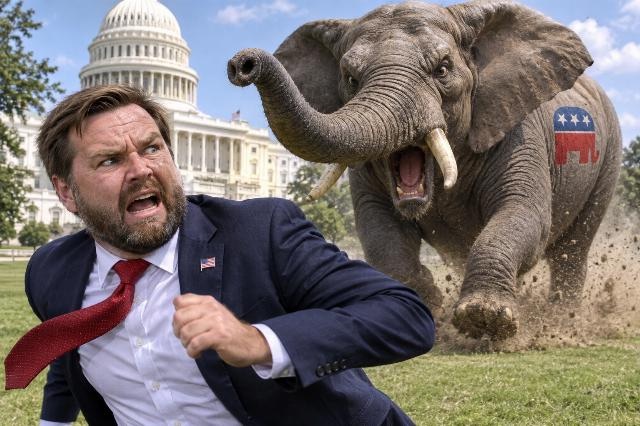
After the GOP’s midterm wipeout, Vice President J.D. Vance chose to diagnose the Republican losses by placing primary blame on the Iranian conflict. This happened on November 4, before some races were even called. He listed America’s warm relationship with Israel among the top reasons 2024 Trump-Vance voters defected.Read more …
His lengthy assessment claimed internal data showed solid turnout in many states and an electorate only modestly less Republican than in 2024. However, many prior supporters were angry and voting blue. Vance wrote that a top pollster’s data identified four key answers from defecting voters for what would bring them back. Here goes: end the war, focus on cost of living and inflation, put America first, and change Uncle Sam’s relationship to Israel.He declared the real reason for the midterm drubbing “obvious to almost everyone” and stated, “The reason we lost is the war. The president himself said so last night.”
Ari Fleischer is a Trump supporter who was the White House press secretary under George W. Bush. He answered Vance directly and correctly. Fleischer said the problem was not the conflict itself but the unenviable cease-fire that followed. Fleischer wrote, “If you start a war, you need to win it and finish it — otherwise don’t start it.” He argued the conflict should have ended months earlier with the Strait of Hormuz open, Iranian leadership thoroughly destroyed, and pro-Western forces supported.
Instead, Fleischer said, months of mixed signals left the United States in limbo, prices higher, and troops still deployed. The decision to confront Iran was right. Stopping short of a decisive result was the failure.
President Donald J. Trump’s response to Vance stayed measured. He told the Wall Street Journal the Iranian conflict was only part of what sank Republicans, pointing to oil and gas prices as a larger concern. He rejected regret for battling the Islamist regime: “I don’t think about it. I did the right thing. I would have done it again.”
Days later, he called Vance’s analysis “largely true” because the war drove gasoline up short-term, yet insisted he would do nothing differently because Iran cannot be allowed a nuclear weapon. Publicly alienating the vice president, with more than half the term remaining, would have been disastrous. Mike Pence’s break came near the end of the first Trump term. It still produced extreme damage. An earlier fracture would have been far worse.
Vance’s public pinning of the midterm losses on the Iranian conflict directly contradicts the president’s rationale for battling an Islamist state. Iran has America’s death as its explicit foreign policy. Vance supplies critics with anti-GOP narratives, fracturing the coalition Trump holds together.
The Democracy Institute exit poll I wrote shows why unity behind the Trump administration is non-negotiable if Republicans want to win in 2028. On Election Day, 450 Republican voters were surveyed. Eighty-two percent said Trump’s second term has made them more supportive of the party. Only 18 percent felt less supportive. Sixty-eight percent said a Trump endorsement would guide their 2028 primary vote.
Seventy-one percent said they are likely to vote Republican in 2028, regardless of the economy. Eighty-one percent said they will continue supporting Republicans after Trump leaves office. Fifty-seven percent base their support on non-economic issues. These voters have already absorbed the costs of Trump’s second term and remain tied to the president. Turning on him now means turning on the bulk of the Republican electorate.
Exit poll data, collected by SSRS, confirms the base held while independents swung hard left. Republicans and Republican leaners, 43 percent of the electorate, backed GOP U.S. House candidates 92 percent to 7 percent. Democrats locked in at 98 percent to 2 percent. Independents who lean toward neither party broke 58 percent Democratic to 32 percent Republican. Republicans won only 38 percent of independents overall, their worst showing with that group since 1998.
Core Republican voters largely stayed. The losses came from independent defection and crashed red turnout, not a desertion of the Trump coalition. This deserves special consideration, in light of what Vance claims.
The midterm results were horrendous, yet they sit within historical norms, though on the more extreme end of those norms. Since 1980, turnout among voting-age citizens has averaged 63 percent in presidential years and 48 percent in midterms, a 15-point drop-off. The remaining voters are older, more established, and far less likely to split tickets. Since 1946, the president’s party has lost an average of 25 House seats. Presidents under 50 percent approval have seen losses near 37 seats.
The 2026 outcome fits that long pattern, even if the scale was severe. The sky is not falling in the larger scheme. Despite what Vance purports, Republicans maintained their own voters. Democrats simply produced presidential-election-level turnout, while independents went blue.
Vance’s post-midterm judgment compounds earlier failures. He has refused to cut ties with Tucker Carlson. Even after Carlson declared himself out of the Republican Party, called the GOP immoral and disloyal, accused it of placing Israeli interests above American citizens, and suggested Trump should be removed from office.
Carlson’s record includes platforming a Holocaust denier, describing Christian Zionism as a “brain virus,” and other statements far outside the Republican consensus. Gallup has shown that GOP sentiment is roughly 70-percent favorable toward Israel. As former Marine, Vance should know that standing in the White House briefing room to protect his friendship with Carlson is not loyalty. It is a dishonorable choice that divides the GOP coalition.
No free speech. Makes me queasy.
• Brussels Quietly Shelves Plan To Make ‘Hate Speech’ An EU-Wide Crime (ZH)
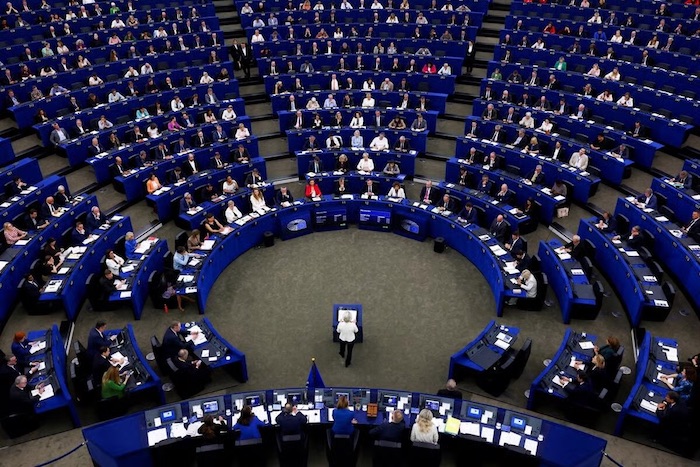
The European Commission plans to withdraw its proposal to make hate speech and hate crime EU-wide criminal offenses after the bid stalled in the Council of the EU, the Epoch Times reported. The Commission announced the decision on Nov. 4, the Epoch Times said.Read more …
It concerns an initiative unveiled in December 2021 to add hate speech and hate crime to the list of EU crimes in Article 83(1) of the Treaty on the Functioning of the European Union, alongside terrorism, human trafficking and cybercrime. Doing so required the unanimous approval of member states and the consent of the European Parliament, which would then have let the Commission set common minimum definitions and penalties across the bloc. Parliament backed the idea in January 2024 by 397 votes to 121, with 26 abstentions. The Council never reached the unanimity needed.The Commission is considering a directive to combat online incitement to violence and hatred instead, the Epoch Times reported. Alliance Defending Freedom International said on Nov. 9 that incitement to violence is already a crime, while proposals aimed at “incitement to hatred” have been used in some countries to prosecute peaceful expression, and that the plan risks becoming “yet another tool to silence disfavored views and strengthen the [Digital Services Act’s] online censorship regime.”
Jacob Mchangama and Natalie Alkiviadou, in a paper on the proposal, point to the Commission’s 2026-2030 Anti-Racism Strategy, which signals a possible initiative on online hate offenses under existing Article 83(1) categories such as computer crime. “Where unanimity failed, pursuing similar objectives through digital or computer-crime competences warrants scrutiny,” they write.
The rules already on the books are broad, with a 2008 Council framework requires member states to criminalize certain racist and xenophobic hate speech, and national laws diverge widely beyond that: Germany criminalizes incitement against groups defined by national, racial, religious or ethnic characteristics, while France’s Criminal Code and Press Freedom Act cover characteristics including sex, gender identity, sexual orientation and disability.
On platforms, the Commission announced updated hate speech guidelines under the Digital Services Act in January 2025, expecting participating platforms to review at least half of qualifying notices from monitoring organizations within 24 hours. Meta CEO Mark Zuckerberg said that month that Europe had introduced an “ever-increasing number of laws” that institutionalized censorship, and French MEP Virginie Joron has called the DSA a “Trojan horse for surveillance and control.”
Council of Europe Secretary General Alain Berset said in June that democracies need stronger legal responses to hate speech: “What we need is a strategy for democratic security. One where hate speech is met with the law.”
Houellebecq is an important writer. Going after him is not easy.
• French Author Risks Year in Prison for Comments About Muslims (Stephen Green)

On some half-forgotten bookshelf downstairs is my English translation of French author Michel Houellebecq’s 2015 novel, Submission. In it, a coalition of lefties and a new Muslim Brotherhood party with a charismatic leader conspire to deny Marine Le Pen and her nationalists the chance to win the 2022 presidential election.Read more …
If that sounds familiar, you didn’t need to read the novel — earlier this week I wrote about a similar coalition forming in the real world next year to deny Le Pen and National Rally from winning the 2027 presidential election. The Muslim Brotherhood candidate — Mohammed Ben-Abbes — wins in Submission and quickly moves to end the Fifth Republic and create Europe’s first Islamic republic.Houellebecq wasn’t even the first to go there. Australia-based author John Birmingham published Without Warning in 2007, where an unexplained cosmic event wipes out 95% of the U.S. population — plus swathes of Canada and Mexico, too — on the eve of the 2003 Iraq War. A side plot involves French elites sensing which way the wind will blow without the American hyperpuissance, and aligning their country with Islam. But you don’t have to indulge in speculative fiction to see which way the wind blows in France today.
Houellebecq, now 70, faces up to a year in prison and/or a 45,000 euro fine for “complicity in provoking discrimination, hatred or violence” against Muslims for comments made during a 2022 interview. Coincidentally but not without dark irony, Submission was published in Europe on the same day as the terrorist attack on the Paris office of Charlie Hebdo satire magazine. Two French-born Algerian Muslim brothers murdered 12 and injured another 11 because the publication had dared to mock Muhammad.
Speaking with philosopher Michel Onfray for Front Populaire, Houellebecq “described Muslims as a threat to the security of native French people and predicted attacks against mosques and cafes frequented by Muslims,” according to one report, calling such hypothetical violence “Bataclans in reverse.” That’s a reference to the 2015 Bataclan theater massacre, part of a series of Islamic terror attacks over two days, resulting in 130 dead civilians and at least another 875 wounded.
The same Morocco World News story summarized the rest of Houellebecq’s remarks: “Muslims should leave France if they failed to respect the law and stop committing theft and assault. During the same interview, he described the far-right ‘great replacement’ theory as a fact rather than a theory.” “Far-right,” eh?
A judge at the Nanterre judicial court put Houellebecq under formal investigation on Tuesday, “following complaints from the Union of Mosques of France (UMF) and the Movement Against Racism and for Friendship Between Peoples (MRAP).” While MRAP has no official connection to the Muslim Brotherhood, the organization has been criticized for close ties to figures associated with the Brotherhood’s loose global network.
Please note that Houellebecq didn’t actually call for anti-Muslim violence; he merely predicted it if France remains on its present course. His lawyers argue that his words fall under protected speech, even in France.
But we still can’t have anyone saying things like that, can we? It might upset the people who put France on its present course, and will do almost anything to keep it there — including threatening a 70-year-old novelist with prison time during the run-up to a presidential election.
Resist Islamification. Get cool stuff.
No, Sundance is not a fan.
“I want the GOP to succeed, but many of these relationships are not likely to work in our favor. However, President Trump likes Jim Jordan.”
• Jim Jordan Becomes House Minority Leader in GOP Caucus Election (CTH)

Former Chairman of the House Judiciary Committee and former Chair of the House sub-committee on weaponization, Jim Jordan (62), has defeated Steve Scalise in a republican caucus vote 106-73, and will become the next Republican minority leader of the House.Read more …
Despite popular opinion to the contrary, with reservations and brutal honesty CTH predicts this will not end well for the MAGA or Conservative cause in the House. Despite publicly positioning himself as a firebrand supporter of President Trump, when it comes to actionable measures – Jim Jordan was the roadblock within the failed weaponization committee.WASHINGTON DC – Rep. Jim Jordan will lead a much-diminished House GOP as minority leader next year, beating out Majority Leader Steve Scalise in his third attempt to lead Republicans on Capitol Hill. Jordan won the secret ballot vote 106-73, according to two people present for the tally.
A co-founder of the House Freedom Caucus and prominent MAGA figure, Jordan pitched himself as best prepared to engage in political combat with the incoming Democratic House majority, noting he was “battle tested on the oversight front” in a letter to members. He currently chairs the House Judiciary Committee and previously chaired the Oversight Committee. (more)
I want the GOP to succeed, but many of these relationships are not likely to work in our favor. However, President Trump likes Jim Jordan. Jim Jordan will now be on the intelligence community gang of eight. Fingers crossed. Additionally, House Republicans chose to keep Rep. Tom Emmer of Minnesota as party whip in the next Congress.
It’s sad more than anything.
• Incoming House Oversight Chairman Robert Garcia Names His Targets (CTH)
Representative Robert Garcia, the incoming Chairman of the House Oversight and Govt Affairs Committee, held a brief press availability earlier today and identified the first set of targets from the Trump administration. You will note that Garcia mentions the names we previously predicted. Susie Wiles, Donald Trump Jr., Jared Kushner, Ivanka Trump, Steve Witkoff, Kimberly Guilfoyle, Kristi Noem and Corey Lewandowski.Read more …
Additionally, as predicted Garcia notes the legislation is already assembled under the false guise of “affordability” that will be sent to the White House in a rolling series of legislative constructs to deconstruct the MAGAnomic policy agenda of President Trump.
“Not real pictues”. That is as brilliant as Trump is graceful in the letter.
• Trump Letter to Biden Revealed in Joe Biden Book (CTH)

Not real pictues
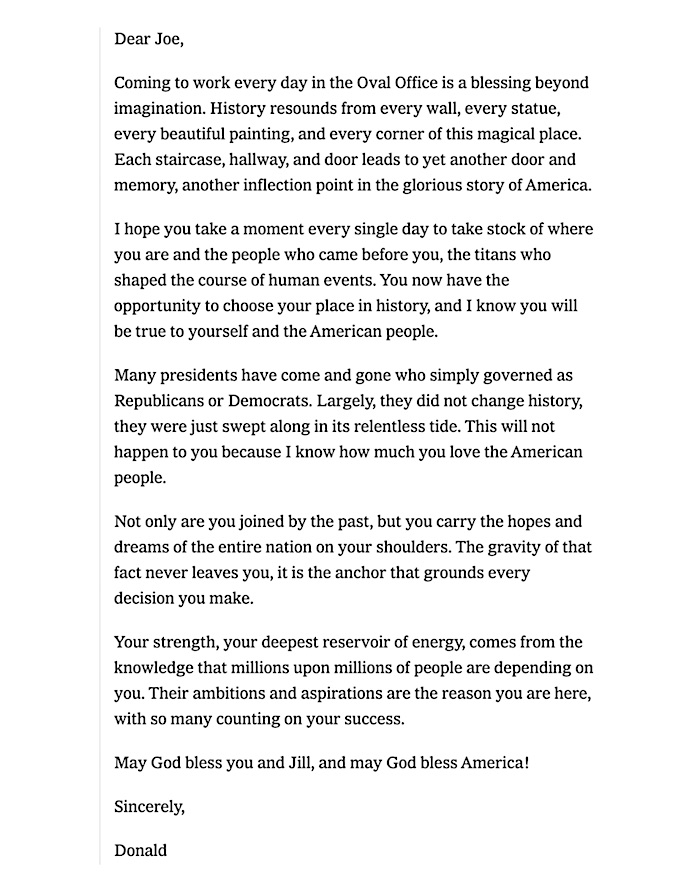
President Trump’s 2021 letter to incoming President Joe Biden has been obtained by The New York Times, which is detailed in Biden’s new book. The letter was written in black Sharpie. In the book, Biden described how surprised he was to see how kind and warm Trump was to him.Read more …
President Trump’s instinctual grace is always weaponized against him.
Bibi needs military action to stay out of jail.
• Trump and Netanyahu In ‘Shouting Match From Hell’ During Iran Call (RT)

Israeli Prime Minister Benjamin Netanyahu had a heated phone call with US President Donald Trump over the possibility of renewed military strikes against Iran, Ynet reported on Tuesday, citing sources familiar with the conversation.Read more …
Several media outlets, including Axios, the Associated Press and the Financial Times, previously reported that Netanyahu had been urging Trump to resume military operations against Iran shortly after the US midterm elections. Republicans lost control of both the House and Senate in the November 3 vote, widely seen as a rebuke to Trump’s policies, including the unpopular war with Iran, which has driven up energy prices.Ynet described the weekend conversation as unusually tense, with one source calling it a “shouting match from hell.” Netanyahu’s office dismissed the report as “fake news, absolute nonsense,” while a senior Israeli official confirmed that the call took place but denied that it had been confrontational.
Trump said on Sunday that he saw no reason to escalate the conflict with Iran, amid opposition to renewed strikes from Washington’s Arab allies in the region. He and Vice President J.D. Vance have acknowledged that the Iran war contributed to the Republicans’ election defeat.
Nevertheless, Trump stood by his decision to launch the US-Israeli military campaign against Iran on February 28. “I did the right thing. I would have done it again,” he told the Wall Street Journal after the vote. Netanyahu’s political future is also uncertain after his coalition failed to secure a parliamentary majority in Israel’s October 27 elections.
On Sunday, Israeli President Isaac Herzog tasked Netanyahu’s main rival, former IDF chief of staff Gadi Eisenkot, with forming a new government after parties representing 67 members of the 120-seat Knesset recommended him for the premiership, compared with 46 who backed Netanyahu. Eisenkot has 28 days to assemble a governing coalition, with a possible two-week extension.
The war has disrupted shipping through the Strait of Hormuz, a vital route for global energy supplies that normally carries around a fifth of the world’s seaborne oil and liquefied natural gas trade. Trump has vowed to maintain the naval blockade of Iranian ports, while Iran has been attacking tankers using US-designated shipping routes, which Tehran considers illegal.
“The Soviet leadership’s attempts to save the USSR helped hasten its collapse, but today’s Western leaders are mistaken if they expect history to repeat itself..”
Fjodor Lukyanov, the editor-in-chief of Russia in Global Affairs, chairman of the Presidium of the Council on Foreign and Defense Policy, and research director of the Valdai International Discussion Club.
• The West Must Realize That Russia Won’t Collapse Like The USSR (Lukyanov)

Thirty-five years ago, in August 1991, the Soviet Union was living through its final summer. The crisis was obvious, yet even then, few imagined that within months one of the world’s two superpowers would disappear from the map.Read more …
The USSR had been a pillar of the international order established after 1945 and its collapse set off a restructuring of world politics that is still underway. The attempt to replace the old balance with an American-led order has failed to produce lasting stability, while what comes next remains uncertain.For Russia, as for the other former Soviet republics, the years since 1991 have been a difficult exercise in self-definition. At first, independence appeared straightforward: just declare a new state and begin a new life. In reality, creating a new political identity has proved far more complicated.
The Ukraine conflict is also part of this process, as however painful and contentious for Russia, it raises questions about borders that cannot be resolved simply by referring to the Soviet Union’s peculiar system of administrative divisions. It also forces the country to define its place in the world, a place necessarily different from that of the ideological superpower it once was.
Russia takes pride in its centuries of continuous statehood. Although its political forms have changed dramatically, from empire to the Soviet Union to the present federation, the state has endured. Continuity, however, has never meant standing still and each stage of Russian history has involved adapting to internal pressures and changes in the surrounding world. For a country of Russia’s size and diversity, finding the right balance between preservation and renewal is especially difficult and that search continues.
The Soviet collapse also left a legacy that still shapes relations with the West. Many Western leaders, particularly in Europe, remain reluctant to negotiate seriously with Moscow on security. One reason, I believe, is the precedent of 1991 when they saw a formidable adversary disappear, seemingly almost overnight.
Today, the end of the Cold War is often presented as inevitable as the Soviet Union supposedly lost its contest with the “free world” and was destined to collapse, but this interpretation owes more to hindsight than to what people believed at the time.
For four decades, Western governments had regarded the USSR as a dangerous, even existential, opponent, so its disappearance was an outcome they welcomed, but one that even committed anti-communists had scarcely dared to expect. Until almost the final moment, the speed and scale of the collapse seemed unimaginable.
Certainly, the Soviet system had been in trouble for years and its economic weaknesses and failure to respond to global changes had become increasingly serious, but decline didn’t automatically mean extinction and the USSR might have survived in another form, or at least for much longer.
Instead, the measures introduced by its last leadership to arrest that decline helped accelerate it, while reforms undertaken without sufficient understanding of the system’s internal contradictions weakened the very institutions they were intended to save. It’s impossible to prove that a different course would have preserved the Union, but the policies actually pursued produced consequences that its opponents could hardly have hoped to achieve themselves.
Were these the results of deliberate betrayal or honest mistakes? The anniversary will doubtless revive that argument, but my own view is that the catastrophe owed more to misplaced idealism and incompetence, not to mention a failure to grasp political realities, than to a carefully organized conspiracy. The USSR’s adversaries didn’t need to engineer its demise, but they were delighted to claim the credit afterwards and that experience encouraged a dangerous Western confidence.
When politicians in Western capitals now demand Russia’s “strategic defeat” and reject compromise with Moscow, they appear to be relying on the same historical script in that they assume that relentless pressure will eventually destabilize Russia internally, just as they believe Ronald Reagan’s confrontation with Moscow helped bring down the Soviet Union.
The reasoning is simple: escalate, refuse concessions, place pressure and wait for the Russian state to crack, and eventually its leaders will be forced to accept Western terms, or the system itself will give way.
But history doesn’t provide such convenient guarantees and today’s Russia isn’t the late Soviet Union because its economy and social structure are different, as is the international environment. The wider world is no longer organized around two opposing blocs, and Western governments no longer possess the same ability to dictate the terms of global affairs.
Above all, Russia has learned from 1991, but still its leadership must remember that misjudged reforms and ignored problems can destroy a state from within while society must understand that bitter internal divisions can bring losses to everyone, not victory to any one faction.
Western leaders, meanwhile, need to recognize that the Soviet collapse was a tragic and exceptional event, but not a reliable model for dealing with Russia and the extraordinary gift their predecessors received at the end of the Cold War will not be repeated simply because they wish it.
Russia’s future is still being shaped, but Russia itself isn’t going anywhere.
“Moscow has long said that any viable peace deal with Kiev must recognize new territorial realities and address the root causes of the conflict.
Russia wants the Donbass. The people living there are Russian and targetd by Kiev nazis..
• Trump Predicts ‘A Little Bit Different Shape’ For Ukraine (RT)

US President Donald Trump has suggested that Ukraine will have to give up territory in order to achieve peace with Russia. Trump made the statement ahead of the resumption of trilateral talks between Moscow, Kiev, and Washington, which are scheduled to take place in the United Arab Emirates on Tuesday and Wednesday.Read more …
During an interview with CBS New on Sunday, Trump said “there’s a very important meeting taking place. I believe that that war is going to end, and it’s going to end soon.” “I think we’re going to have it done, and I think it’s going happen and they’re going to end up with a little bit different shape Ukraine,” the US president said, without elaborating.When reminded that has been promising to end the fighting between Moscow and Kiev since his campaign for the White House in 2024, Trump reiterated his claim that the conflict would not have started if he had been president in 2022. “Zero chance. But it did start. So, I inherited that war,” he added.
Trump spoke about the need for Ukraine to make territorial concessions after his talks with Russian President Vladimir Putin in Anchorage in August 2025. Ukraine’s Vladimir Zelensky, who is backed by Western European countries, has consistently rejected any concessions despite Kiev’s continued setbacks on the front line and inability to counter Russian long-range missile and drone strikes. Zelensky’s unwillingness to make a deal prompted Trump to suggest last month that Ukraine needs a new leader.
The US president said on Sunday that he expects to hold his first in-person meeting with Putin since Anchorage at an APEC leaders summit in Shenzhen next week as part of trilateral negotiations that will also include Chinese President Xi Jinping. We’ll be talking a lot of things, he said.
There appears to be no shift in Kiev’s stance coming into the talks in UAE, with Zelensky aide Sergey Leschenko saying last week that Ukraine’s delegation would insist on “halting the fighting where it’s currently taking place, without giving up any Ukrainian territory.”
Moscow has repeatedly said it will not accept a temporary ceasefire that merely allows Kiev to regroup and rearm. According to the Russian side, the conflict requires a permanent settlement that addresses its root causes and recognizes the new territorial realities on the ground.
This includes Crimea, which reunited with Russia in 2014, and the Donetsk (DPR) and Lugansk (LPR) People’s Republics, along with Zaporozhye and Kherson Regions, which were incorporated into Russia in 2022 following referendums.
Putin said last month that he believes Moscow and Kiev “can come to an agreement. We’re open to that.” “We do not want to fight with Ukraine. But if the current Ukrainian leadership wants to fight, well, let them fight,” the president stressed. Russia will achieve all of its goals in the conflict one way or another, he added.
“The US removed all its bombers from the UK’s RAF Fairford base last month after a major incident in September that police described as “suspicious”
• 3 Iran-backed Suspects Plotted Attacks Including RAF Fairford Plot: US (BBC)

The US Department of Justice (DOJ) has announced charges against three Iran-backed operatives that it alleges were involved in a string of plots in the US and Europe. The DOJ said Iranian agents most recently “orchestrated a terrorist plot at an air force base in the United Kingdom”, saying they were involved in the major incident in September near RAF Fairford in the UK, where US armed forces were stationed.Read more …
One man, a dual Iranian-Iraqi national, is accused of communicating with contacts in the UK from a prison in New York where he is awaiting trial on previous charges. The other two are accused of doing the same from Iran. Iran has strongly denied any involvement in the RAF Fairford incident. Seven men have been arrested in the UK over the incident, which came to light when suspicious vans were reported near the RAF base.Iranian Mohsen Mohajeri, Iraqi national Mohammad Ali al-Hassani and dual Iranian-Iraqi citizen Mohammad Baqer Saad Dawood al-Saadi were charged in an indictment unsealed on Tuesday, the DOJ said. It accuses the trio of planning attacks in Europe that were carried out under the name of a purportedly new group with the pseudonym Harakat Ashab al-Yamin al-Islamiya (The Islamic Movement of the People of the Right Hand – HAYI).
“Of the 18 terrorist attacks in the spring of 2026 for which HAYI claimed responsibility in Europe, seven took place in the UK,” the DOJ statement said. It added that the attacks involved “arsons, explosives, and in one instance, a near-fatal stabbing in London of two Jewish men, including a dual US-British citizen”.
Two Jewish men were stabbed in Golders Green, north London, in April. A suspect is due to stand trial next year. “This eight-count indictment shows the determination of Iran to commit terrorist attacks in Europe and the US,” FBI Director Kash Patel said. He added that one of the three “allegedly sent coded messages to assist in future acts of violence” from detention.
Patel said the accused were involved in nearly 20 attempted attacks in support of Iran’s Islamic Revolutionary Guard Corps (IRGC) and the Iran-backed Iraqi militia Kataib Hezbollah. A major incident was declared on 27 September near the UK’s RAF Fairford base, in the Cotswolds in Gloucestershire, after three suspicious vans were seen near the airbase. No explosive materials were found in the vans, but a quantity of petrol was seized.
The DOJ said that in August, al-Hassani “allegedly directed and paid associates” in the UK to “conduct preparatory steps and arrange logistics for the RAF Fairford terrorist plot”. On 22 August, al-Hassani paid one individual to “perform pre-operational surveillance of RAF Fairford’s perimeter”, the department said. In September, al-Hassani paid several people to help him prepare for the plot, the DOJ also alleged.
According to its statement, this included “procuring vans and barrels of fuel, researching the purchase of chemical accelerants, including large quantities of potassium chloride, and purchasing metallic objects that could be used as explosive shrapnel”. The suspects then gave the vans an appearance of being used by a fuel delivery business and a swimming pool supply business, the DOJ stated.
“On 26 September, al-Hassani allegedly tasked individuals to drive three vans, some of which were later determined to contain barrels of fuel, to the RAF Fairford base.” The DOJ also said al-Hassani was “in frequent communication” with the van drivers and helped to direct them where to drive. “At least two of the three vans, while en route to the perimeter of RAF Fairford, encountered a security roadblock and were not allowed to proceed on their intended route,” it added.
It was in the very early hours of 27 September, that the vans were spotted by a local farmer who was heading home from a party, and called the police. The Iranian embassy in London has said it “categorically rejects and strongly condemns” what it called “unfounded and malicious speculations” linking Iran to the incident. Two British nationals appeared in court last month in connection with the alleged Iran-linked plot.
The US withdrew all its bombers from RAF Fairford after the incident, with President Donald Trump citing “some threats” to the base as the reason. RAF Fairford has been used by the US Air Force (USAF) for decades. In recent months, the US has flown B-1 and B-52 bombers from there to the Middle East for “defensive” strikes on Iran. In July, Iran said “any base used for aggression against Iranian territory constitutes a legitimate target for our forces”.
Firing the brilliant founder of a multi-billion dollar company because he had an affair? What?
🚨WOW! Elon Musk just said hiring Jensen Huang would be an "HONOR" amid reports the Nvidia CEO might be pushed out of his position by the Board
— Eric Daugherty (@EricLDaugh) November 12, 2026
THIS WOULD SEND SHOCKWAVES 👀
This comes hours after Bloomberg reported Nvidia is shopping for a possible new CEO with an "outside… pic.twitter.com/OHw9Q5JSSP
• Nvidia Preparing To Fire Jensen Huang After 2nd Affair Bombshell (ZH)
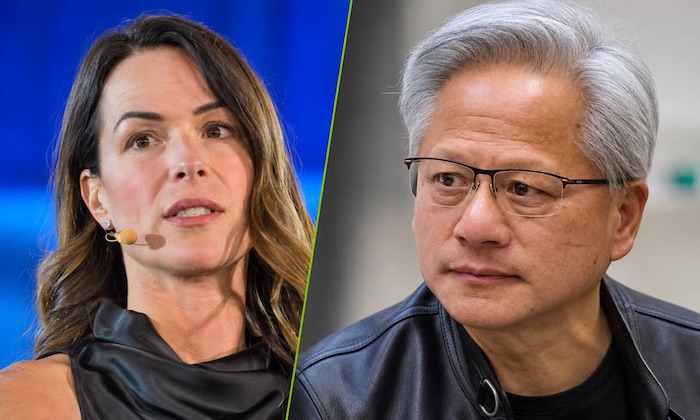
Nvidia is reportedly preparing to remove founder and CEO Jensen Huang following revelations of two extramarital affairs, including one involving a suspected Chinese intelligence operative.The board could meet as soon as today to decide Huang’s future, according to people familiar with the matter. No final decision or official announcement has been confirmed.Read more …
The chipmaker is scheduled to report quarterly results on Nov. 17. It “will be interesting how it handles next week’s earnings call. Their CFO [Colette Kress] can handle the numbers but markets will want more on changes to the governance,” said Dec Mullarkey of SLC Management. Who would replace him?~~~~~~
Jensen Huang, the Nvidia chief already under a board investigation over his affair with a woman US intelligence says is a Chinese spy, also had an extramarital relationship with an Nvidia executive who reports to him, according to five people who worked at the company and spoke to The New York Times. According to the people, the executive is Kimberly Powell, Nvidia’s vice president of health care. Huang, 63, and Powell, 48, are both married to other people, and the relationship has been discussed inside the company, the five said.
Two of the people told the paper that the pair were caught on video being affectionate at a San Jose hotel in March, during GTC, Nvidia’s annual developer conference, while company executives were meeting nearby. Three people briefed on the incident said a bystander filmed the moment on their phone, and that Huang’s security spotted the bystander, sequestered them and offered them a nondisclosure agreement. The Times says it has not seen the video.
When the paper reached Huang by phone on Wednesday and asked him about Powell, he replied: “I don’t think you should be talking to me directly.” Then he hung up. Nvidia declined to provide a statement. nNvidia’s own code of conduct tells employees to avoid situations where their actions “create conflict,” and it lists “personal relationships” among them. The company also says it “promptly investigates reports of misconduct.” Many large corporations bar managers from relationships with subordinates.
Shares were displeased after hours (NVDA -8% from the close to its lowest since July 2025): “It is going to be a very challenging situation,” said Michael O’Rourke, chief market strategist at Jonestrading. “Jensen had forecast 70% sales growth this year. With the vendor financing and the aggressive tactics, his successor will spend the next year putting out fires and cleaning up messes.”
“If these allegations are confirmed by the independent investigation, one has to expect the board to remove him. That is the standard for corporate governance today. Even worse this is a pattern,” he added. While the odds of Huang resigning spiked on Polymarket.
Powell joined Nvidia in 2008 to bring its GPUs into medical imaging instruments. According to her LinkedIn, she was promoted to senior director of AI business development in 2016, and by late 2017 she was vice president of health care, overseeing programs that apply Nvidia’s chips to higher education and health care. She speaks for the company at technology conferences around the world; at GTC in March she gave a talk on AI-driven breakthroughs in health care and biology, with slides that used cartoon versions of Huang.
Jensen was cheating on the Chinese spy too? https://t.co/oZa1UCEGlv
— zerohedge (@zerohedge) November 11, 2026
As we reported on Oct. 29, US officials identified Alice Huang (no relation), a former executive at Singapore-based Megaspeed, as a Chinese intelligence asset after Huang grew close to her; Beijing has denied the espionage claims. On Nov. 8 Huang admitted the affair in a memo to staff: “I was unfaithful to my wife. My actions hurt her and our children. There is no excuse for what I did,” he wrote.Lori Huang about to be the 26th richest person in the world, with $73BN net worth https://t.co/QkUfvLgJH3
— zerohedge (@zerohedge) November 11, 2026
That same day Nvidia’s board opened an independent investigation, which the Times says is being led by the law firm Wachtell, Lipton, Rosen & Katz. The board said it had “no reason to believe that either national security or NVIDIA secrets were compromised.”Meanwhile, the Republican chairs of the House Foreign Affairs, China Select and Intelligence committees have asked Huang for a closed-door briefing on Nov. 18 about his dealings with Alice Huang, and gave him until Nov. 11 to answer. Foreign Affairs Chairman Brian Mast said he is prepared to subpoena Huang if he doesn’t respond by Wednesday, the same day the Powell report landed. Investors have already been rattled: Nvidia shares slid on Nov. 9 after the board’s probe was announced. Nvidia reports third-quarter earnings on Nov. 17, the day before Huang’s requested appearance on Capitol Hill.
It’s not an easy process. Too much money is riding on it. Everyone’s nervous.
• Anthropic To Seek $1.4 Trillion Valuation In Blockbuster IPO (CNN)

Anthropic’s debut on public markets will be unlike any that’s come before it, in ways that amount to either a once-in-a-generation opportunity — or a massive financial gamble, depending on whom you ask.Read more …
The startup behind the Claude AI assistant on Tuesday set a share price range of $70 to $78 for its initial public offering. If it prices at the midpoint, Anthropic would raise $61 billion in its IPO and have a fully diluted valuation of $1.33 trillion. At the top of the price range, Anthropic would raise $64.4 billion and be valued at $1.4 trillion. The IPO is expected to take place late next week, two sources with knowledge of the situation told CNN, although they cautioned the date could move. Anthropic declined to comment on the timing.There will be no analog to measure Anthropic’s performance against when it begins trading. The market has simply never seen a dedicated AI model developer go public. It is rare for a business to IPO as a public benefit corporation and, other than SpaceX, it is unheard of for any company to go public with a target valuation above $1 trillion.
Anthropic’s IPO, expected to begin marketing to investors this week, is unconventional by almost any measure. The company promised in its pre-IPO regulatory filing that its technology would “bring forth an age of miracles” while simultaneously warning it may doom humanity. Still, the promise of a once-in-a-generation technological revolution (even with 90 pages of warnings and caveats in its more-than-300-page filing) could make Anthropic the biggest IPO in history.
But there are other financial superlatives and quirks — not to mention persistent cold feet about AI on Wall Street — that will keep many investors on the sidelines.
Bills keep coming due
Despite rapid revenue growth, the five-year-old company has had only one quarter of operating profit, and it is on the hook for nearly $900 billion over the next few years — money it has committed to spend on computer power and data center infrastructure.Anthropic fans have held up its sales growth as a positive indicator of its financial health: The company brought in $17 billion in sales in the most recent quarter, up 1,127% from the same period a year earlier. And in the first nine months of this year, it recorded $33.2 billion in sales, versus just $4.6 billion in all of 2025.
But by Anthropic’s own account, that kind of growth isn’t sustainable over the long term. “We do not expect our revenue will continue to grow at comparable rates, and we cannot assure you that it will continue to grow at all,” the company said in its pre-IPO prospectus. At the same time, Anthropic relied on just five customers for a quarter of its sales this year. It didn’t disclose the five, but noted that some of them are also competitors.
That points to a precarious situation in which a handful of companies have outsized control over Anthropic’s future cash flow. Any one of those companies, which may be building its own AI models to compete with Claude, may decide to scale back its own spending or walk away completely at any time. Ideally, investors would want to see a more robust customer base.
Even bullish investors say that so-called concentration risk is worth keeping an eye on. Paul Marino, chief revenue officer at Themes ETFs, told CNN the relatively small number of major customers “gives me a little bit of concern” because their needs could change on a dime. “It’s something to monitor, but I’m not overly concerned with it because I’m one of those people that believes that AI is the future.”
A chance to cash out
Normally, when a company goes public, insiders can’t simply dump their shares on Day One and cash out — they have to hold on to them, usually for at least three to six months, to prevent the stock price from tanking. Anthropic’s lock-up schedule may be the most convoluted of any IPO in recent memory. The company opted for a complex, staggered schedule that permits some “non-founder” insiders to sell 10% of their holdings on Day One. The prospectus then lists some 23 dates over the first year when non-founder employees can dump more shares.Critics see that unorthodox schedule as another red flag, given the roughly $130 billion Wall Street insiders and venture capitalists have already poured into the company. “It has maxed out private investors, who now need the company to tap public markets to get them their payday,” financial research firm New Constructs wrote in a blog post.
David Trainer, New Constructs’ founder and CEO, added in a call with CNN that he sees the payout to insiders as “a horrific misallocation of capital.”“We’re going to make a lot of people rich… that’s value that is taken away from public investors who are effectively giving them that from their own pockets, from their retirement accounts.”
The concentration risk isn’t limited to Anthropic’s business customers. Critics also point to the concentration of power in the company’s special ownership structure, which gives its seven founders a majority of shareholder voting power. That novel approach has become more common in tech companies in recent years, but nonetheless raises concerns from some government officials.
“We’re seeing a very worrisome trend of disempowerment to shareholders and all the balance of power tipping towards management,” New York City comptroller Mark Levine told Bloomberg News.
Testing the AI trade
Anthropic’s investor roadshow this week could hardly come at a worse moment for AI sentiment on Wall Street and beyond. Last week, AI-linked stocks tumbled on investors’ concerns that Democratic wins in Congress and state governments would slow the data center buildout. Americans’ sentiment about AI safety is in the gutter. And on Monday, Nvidia shares fell 5% after CEO Jensen Huang admitted to having an affair as his company announced it would be investigating him over foreign intelligence concerns.Anthropic, which declined to comment to CNN on its IPO plans, appears to be pressing ahead despite the turmoil. The Wall Street Journal reported Monday that the company had meetings lined up with key investors this week and plans to list its shares Thursday or Friday next week, citing people familiar with the matter.
Will the Dems give China the whole game?
• The Data Center Moratorium Madness Is Beijing’s Biggest Gift (Daniel Lacalle)

Barely 48 hours after the midterms, Bernie Sanders posted four words that should alarm anyone who cares about American prosperity and security. “National data center moratorium now.” Representative Yassamin Ansari went further and said that pausing AI development should be a Day One priority for the new Democratic majority in the House. The vehicle is ready.Read more …
The Artificial Intelligence Data Center Moratorium Act, introduced by Sanders and Alexandria Ocasio-Cortez, would impose an immediate federal freeze on the construction of new data centers and the expansion of existing ones until Congress passes comprehensive legislation. In practice that means an open-ended ban, conditional on Washington agreeing on everything from labor policy to civil rights to the meaning of “safe AI”. Anyone who has watched Congress try to pass a budget knows how long that would take.This is the most self-destructive industrial policy proposal in the developed world since Germany decided to shut down its nuclear plants while importing Russian gas. And Beijing could not have designed it better.
The problem did not start with the midterms, and it is not limited to one party. In Texas, Republican Governor Greg Abbott paused grid approvals for data centers of 75 MW or more in August and then halted environmental permits in September. The Texas pause alone put almost 20% of the entire US data center pipeline at risk of delay. Now Governor-elect Gina Hinojosa has promised to turn that pause into a formal moratorium.. Local opposition blocked or delayed around $198 billion of US data center projects in the first half of 2026 alone, against total AI capital expenditure of $690 to $725 billion this year.
While American towns vote to ban the infrastructure of the future, China treats compute as a strategic priority on the same level as energy and defense. The Ministry of Industry and Information Technology reports that national intelligent computing capacity rose 146% year on year. Beijing’s new five-year plan targets 3.8 trillion yuan of cumulative investment in information infrastructure. China’s data center capacity is expected to grow from 32 GW at the end of 2025 to 40 GW at the end of 2026 and above 60 GW by 2030.
The energy behind that expansion is the part Western activists prefer to ignore. China added a record 430 GW of wind and solar capacity in 2025 and, at the same time, commissioned 78 GW of coal power, the highest annual figure in a decade. Total installed generating capacity rose 16.1% in a single year to 3.89 TW.
Beijing does not ask whether it should build data centers or power plants. It builds both, simultaneously, and plans the grid around the compute. A 100 MW Chinese facility can be completed in less than twelve months, compared to around 24 months in the United States and 42 months in Germany.
Defenders of the moratoriums argue that the United States is so far ahead that it can afford to pause. That is a dangerous misreading of the data. Yes, the American lead is evident. Since 2022, 72% of the world’s AI compute has ended up in the United States and only about 10% in China, and the US share of newly acquired compute rose to 78% in the first half of 2026.
But in a technology race, the stock of capacity matters less than the rate of addition. Model scaling, inference at scale and the deployment of applications in industry, healthcare and defense depend on how fast new compute comes online. China’s binding constraint is access to advanced chips, which US export controls deliberately restrict. America’s binding constraint is power and politics. The moratorium movement takes the one bottleneck Beijing cannot fix with money and adds a second one that Washington imposes on itself.
Every year of delay in Ohio, Texas or New York is a year in which Huawei, domestic Chinese chipmakers and state-backed clusters get closer while American capacity stalls.
The usual justification for bans is the electricity bill. The real problem is a lack of supply. The US interconnection queue holds roughly 2,600 GW of generation and storage projects, more than double the existing grid, and the median wait from application to commercial operation is about five years.
When demand rises and supply is blocked, prices rise. The solution is to unblock supply, accelerate permits for gas, nuclear and transmission, and require large users to bring or pay for their own generation. Banning demand is the policy equivalent of fixing a housing shortage by forbidding families from having children. It addresses the symptom by destroying the source of growth.
Artificial intelligence is already improving targeting, logistics, electronic warfare, intelligence analysis and autonomous systems. Compute is to modern defense what steel output was to the twentieth century. A relative slowdown in American capacity narrows the margin of superiority on which deterrence depends, and it does so at the worst possible moment, when Beijing is offering its own models, standards and cheap infrastructure to the Global South. Countries that cannot get American compute on time will get Chinese compute instead, along with Chinese standards, Chinese data governance and Chinese political leverage.
The Sanders and Ocasio-Cortez bill even includes a ban on exports of AI computing infrastructure to countries that lack equivalent safety and environmental laws. Put together, the message to allies would be devastating. America would refuse to build at home and refuse to sell abroad. Beijing would be delighted to fill both gaps.
Europe is watching the midterm results with a mix of political satisfaction and strategic blindness. Many European capitals see the Democratic gains as a welcome rebuke to Trump. They should look at the numbers instead. Europe accounts for less than 5% of global AI computing power. Its own public backlash has already delayed or cancelled about $42 billion of European data center investment. With the AI Act, some of the highest industrial electricity prices in the developed world and no private capital engine comparable to Silicon Valley, Europe depends on American models and American infrastructure.
If that infrastructure arrives later and costs more, Europe falls further behind, and if China closes the gap in dual-use AI, European security, which still rests on American technological leadership, erodes with it. Short-term relief over tariffs does not compensate for a long-term loss of the technological edge. As usual in Europe, ideology is trumping strategic economic and defense interests.
The data center backlash is a perfect example of the precautionary principle turned into economic suicide. Every concern raised by opponents, from water use to grid reliability to electricity bills, has a solution that involves building more, not less. More generation, more transmission, faster permits, clear rules on who pays for grid upgrades, and on-site power for the largest loads.
A moratorium solves none of those problems. It simply guarantees that the most important infrastructure of the century gets built somewhere else, under a regime that does not care about American ratepayers, American workers or American values. The United States won the internet, the cloud and the smartphone because it built faster than anyone else. If it now decides to stop building, it should not be surprised when the future is written by China.
Will AI agents run society?
• 2026 The First AI Election – the American Accountability Network (CTH)

It all seems harmless until you sit down and map out how nefarious characters would utilize the capability.Read more …
In the old version of the game there were “bots” and “fake accounts,” which most people are familiar with. However, in the modern iteration of the ruse Artificial Intelligence comes into play, and the AI term “agents” create a new dynamic. An AI Agent is a created persona utilizing the massive data capabilities of AI to review and create a personality.The task set looks something like this:
Create an AI agent and give it a name, say Frank. You tell Frank to review all of Nick Fuente’s social media posts, videos, presentations and online manifests. Then you instruct Frank to create a psychological profile of what Fuentes believes, how he expresses himself, how he interprets information and the specific vocal and inflection pattern used to share information.Once Frank has that profile established, then you instruct Frank to build out a community of like-minded sub-agents, who hold the same worldview -each with individual characteristics and nuance- that articulate issues and points of interest in support of Fuentes. Frank [parent agent] creates a community of 50 [children sub-agents] who can push the Fuentes ideology independently, each re-referencing the originating parent’s continued update, patterns and ideological expressions.
Now you have Frank leading a group of 50 online personas (1 agent and 50 sub-agents) to create the community and boost the messaging of Fuentes based on current issues and events. Each agent and sub agent creates an account on the favored (targeted) online platform. The instructions tell them the general direction of where they are to go, but in the largest measure the sub-agents can be unleashed to run autonomously, 24/7 with no need for rest, checking back with Frank occasionally who is giving constant feedback based on your instructions.
Suddenly, the opinions of Nick Fuentes seem to be popular, and the Fuentes perspective is boosted within various platforms. All of the children hitting the social media pages to share and support the Fuentes message. They like his content, resend his messages and even engage with responses if needed, while they articulate debate based on the education from their parent, Frank – the lead AI agent.
One human creates one AI Agent and in turn that creates 50 AI sub-agents. That’s just one arbitrary example. What is the reality online amid this self-promoting group of AI agents? It’s not the ‘real world’ it’s all online, within a universe entirely created and manufactured. However, it can give the illusion of widely held opinion online.
Make this process exponential by asking real people to sign up and register their support.“The American Accountability Network is a powerful consortium of advocates, content creators, organizers, and influencers who together have formed an ecosystem that has the ability to shape political narratives, reach the public at scale, and mobilize people to take action.
Our core network online consists of thousands of advocates, including many who have hundreds of thousands and millions of followers. Across all the major platforms our network reaches an average of 200+ million people each week.” Now, those who run this network don’t need to tell each participating “real person” the specifics of how their content will be boosted within the ecosystem to shape the political narrative at scale. They only need the originating identity, so that an AI Agent like Frank can be assigned to it.
This collective amplification then shapes the opinion and narrative perspective online. Some of it from real people, actual content creators, but most of the opinion from the concentric circles of AI Agents operating independently to boost parent messaging. The era of AI creates this opportunity to manipulate public perception at a level unheard of before. Replace the Nick Fuentes instructions with another personality profile created in the abstract with the goal to drumbeat “affordability,” “gas prices,” or “tariffs” and the cost of the Iran war.1,000 parent AI agents now assemble their 50,000 sub-agent children with the training and tasks accordingly. Now, you have a never sleeping online narrative distribution network operating in real time across all social media platforms. All of it fabricating a reality online that does not exist in real life. Cue, Van Jones to talk about it; or, more accurately, to talk about part of it without mentioning the AI Agents of course. (prompted)
JONES: Listen, we’ve got a bunch of Democrats that I think ran for the right reasons. Also, it’s not just about the people who are elected to office. Now it can be told.
Now it can be told. How did we win the narrative on affordability? Was it just these nice little Democrats out there running for office and going to… No. The Republicans never figured out what we were doing. There’s something called the American Accountability Network, tens of thousands of online humans, not bots, coordinated to make the affordability message a winning message online. 32.5 million people hit on Instagram every day. 88.8 million hit on Twitter, X, every single day. And 185 million Facebook hits every single day. And they never figured it out. The Republicans could not understand it wasn’t bots. It was actual human beings.
The most effective online organizing campaign called the American Accountability Network flew under the radar screen, never been told before.
COLLINS: And they were talking about the issue or they were saying you need to elect Democrats to deal with this?
JONES: Driving the kitchen table affordability message and tying that to Democrats on a positive and Republicans on a negative, the Republicans never figured out what we were doing. And what that meant was everywhere you go, people were talking about affordability and they were talking about kitchen table issues. They couldn’t get any traction on these cultural war issues anymore because we figured out how to get around all that.
So it’s not just all the door knocking that was done, which is amazing. It’s not just our amazing candidate quality. We had something called the American Accountability Network. Don’t get mad at me. I was given permission to reveal this. They never figured it out. And that network is going to continue to push for kitchen table issues and hold our Democratic lawmakers accountable.”
There’s much more to this. I will be sharing and highlighting more information about specific areas where this is showing up at a later date. For now, it’s worth thinking about the ramifications to this type of political information shaping operation. In the originating example, Frank’s AI messaging taskset can be designed and tailored for Michigan or Texas. The children can be tasked to a very specific level of audience, all the way down to fellowship level (ex. collegiate alumni). All of the data to accomplish these tasks was collected, downloaded and used in the training of the AI frontier models.
They have it all. Now, people are exploiting it. AI Agents can also register to vote and request absentee ballots. The system has no effective physical check on the return to ensure that a real-life person filled out the ballot. This creates a never-ending expanded number of American voters.

🚨 WOW! Elon Musk's SpaceX just got ONE STEP CLOSER to becoming a NATIONWIDE U.S. cell carrier and taking on Verizon, AT&T and T-Mobile
— Eric Daugherty (@EricLDaugh) November 10, 2026
Trump's FCC has now ACCEPTED its application to buy 800 MHz wireless spectrum from Grain Management
DON'T BET AGAINST ELON.
The deal would… pic.twitter.com/D2Iskw1mNQ
SpaceX wants its ENTIRE rocket back. Booster AND Starship. Nothing burned up or left in orbit.
— Mario Nawfal (@MarioNawfal) November 11, 2026
On the next flight, SpaceX will attempt to catch BOTH with its giant launch chopsticks. Both on the same flight, for the FIRST time ever!
Getting the whole thing back, refuelling it,… https://t.co/0ZhOPakTJf pic.twitter.com/LYboHfTz1P
SpaceX is preparing to print money at a scale legacy defense contractors can only dream of.
— Joe Hansen (@joehansen) November 10, 2026
• SpaceX headline target: Annualized revenue to reach $500 billion next year, Starlink computers launching in sync, and TeraFab chip production capacity hitting 1 terawatt.
• Morgan… pic.twitter.com/HJ0yUhJBZH
Portable, lightning-fast Internet that works anywhere on Earth where Starlink is legal! https://t.co/dBf3iHkEGv
— Elon Musk (@elonmusk) November 11, 2026
🇺🇸 Tesla is proving it can stand up grid-scale batteries almost as fast as the units arrive.
— Mario Nawfal (@MarioNawfal) November 11, 2026
This is at Giga Texas. Crews are installing around 8 units daily, with Tesla saying the pace can exceed 30 in a single day.
Each Megapack arrives from the Lathrop factory, is lifted by…
Support the Automatic Earth in wartime with Paypal, Bitcoin and Patreon.