Jun 092026


Pieter Brueghel the Younger Construction of the Tower of Babel 1595


Netanyahu Confirms Israel ‘Holding Fire…For Now’ (ZH)
Score Two More Big Wins for Israel Vs. Iran… Maybe (Stephen Green)
Trump’s Secret Weapon Against Iran: The Power of Antisemitism! (Scott Pinsker)
Trump Suffers Rare Court Setbacks Amid Broader Record of Legal Success (JTN)
On the Kavanaugh Anniversary, Democratic Leaders Swap Me Too for Maine (Turley)
The Jungle Drums Speak! (James Howard Kunstler)
Trump Plans To Buy Chagos Islands, Home To Diego Garcia Military Base (ZH)
OpenAI Files Confidentially For IPO, Joining SpaceX and Anthropic (ZH)
EU Coalition of the Willing: Five Terms for Direct Ukraine-Russia Talks (CTH)
German Lawmakers Want Answers From Baerbock After UN Humiliation – Bild (RT)
A “Godzilla El Niño” (Michael Snyder)
In the Land of Thucydides (John J. Mearsheimer)


https://twitter.com/TheCalvinCooli1/status/2063671748378137040?s=20 https://twitter.com/barontrump47/status/2063754461261058407?s=20


Both sides paused overnight last night.

Netanyahu Confirms Israel ‘Holding Fire…For Now’ (ZH)

Israel Halts Iran Attacks ‘For Now’
“After Iran attacked Israel, I instructed the IDF to strike military and economic targets throughout Iran,” Netanyahu said in a fresh Monday statement. “For now, the fire has been contained, because after we struck the terrorist regime in Tehran, it ceased attacking us. If the terrorist regime in Iran makes the mistake of attacking us again, we will respond with force.” The key lines from Netanyahu: Israeli Prime Minister Benjamin Netanyahu said Monday that Israel had stopped its attacks on both Iran and Hezbollah in Lebanon, after the Iranian military announced it was halting operations.


In a brief statement Monday, Netanyahu said “Iran and Hezbollah are weaker than ever, and we are stronger than ever – but our struggle with them is not over yet.” Having bombarded both adversaries, he added, “right now, the fire has been halted.” Iran’s military headquarters responds: “Should aggression and hostile actions continue—including in southern Lebanon—far more severe and forceful measures than before will follow,” it said, according to Iranian state media. And in a clear sign of the exchange of strikes having ceased: Iran says flight restrictions have been lifted with airspace returning to normal conditions: state media

Israel Pauses Iran Strikes At Trump’s Request
Israel’s N12 News is reporting that Israel is halting strike on Iran at President Trump’s request. There are widespread initial reports that Israeli forces are indeed pausing the attacks, which persisted overnight through Monday morning, and included attack on a major petrochemical complex. However, the latest Israeli messaging has included a warning on the Lebanon front, per Bloomberg: Senior Israeli official says Israel is stopping strikes in Iran at Donald Trump’s request, but confirms operations in southern Lebanon will continue at full intensity in the coming days. The official also warns that Dahieh in Beirut could be targeted if attacks on Israeli settlements and civilians continue.

There are also emerging reports (via CBS) that Trump did not order any US defensive efforts to protect Israel from the latest Iranian ballistic missile attacks – which were the first against Israel since the early April ceasefire. Meanwhile, in a fresh message from Iranian foreign ministry spokesman Esmaeil Baqaei, Iran says “Without a doubt … the actions of the Zionist regime in the region cannot be separated from U.S. policies.” Tehran is rejecting the attempts of the Trump administration to distance the US from Israeli actions: “No one believes that the Zionist regime would carry out any action without prior coordination and cooperation with the United States,” Baqaei added.

Trump: ‘Stop Shooting’
A big question remains is if this flare-up in major fighting, which has featured the first direct attacks between Iran and Israel since the April ceasefire took effect, will be short-lived or whether it will endure and escalate into sustained war. So far the situation is showing signs it could be short-lived, after early Monday morning President Trump urged Israel and Iran to immediately stop “shooting” in a Truth Social post. He also expressed that this musts be done “quickly” and is still talking up a “final” peace deal – which at this moment looks as distant as ever. Iran is signaling it is ready to get back to ceasefire, but Israel is again threatening the Beirut suburbs.

Read more …

“..that missile fire toward Israel was most likely carried out under pre-established military protocols, without coordination with the office of Supreme Leader.”

Score Two More Big Wins for Israel Vs. Iran… Maybe (Stephen Green)

It started so simply, as these things do, with a barrage of Iran’s patented Totally Ceasefire Missiles™ that Israel knocked out of the sky. It ended, if that’s the right word, with Israeli airstrikes taking out Iran’s top two leaders. That’s a big win, even if one of them was already mostly dead. The fun began on Sunday, when “Iran launched missiles into Israel, not just in the north by the Galilee, but all the way down to Caesarea,” as reported by PJ Media’s own Rabbi Michael Barclay. In all, Tehran launched a total of about 30 missiles in several waves. They were all either shot down by IDF antimissile systems like Iron Dome, or caused no notable damage.


Israel responded with two air attacks that PJ Media’s own Catherine Salgado reported on at Zero Dark Thirty last night, but only now are we learning just how effective those strikes really were. Several outlets report today that Islamic Revolutionary Guard Corps commander Ahmad Vahidi is among those dead in yesterday’s Israeli Air Force (IAF) strikes.Vahidi’s death isn’t confirmed yet, but fingers crossed. He’s only been IRGC chief since March 1, when his predecessor was taken out in similar fashion.

Considered a hardliner — which is a nice way of saying, “lying genocidal thug” — reports of Vahidi’s death please me very much. I keep trying to get the message through to the White House that if the current Iranian leadership is too hardline to negotiate in good faith, then keep killing them until more pliable leadership emerges. And maybe bomb them, too, just to be sure. Thankfully, the IAF was kind enough to take the next step for us.

Just as pleasing, if perhaps not quite as consequential, is the reported death of the regime’s so-called Supreme Leader, Ayatollah Mojtaba Khamenei — son and heir of the previous Supreme Leader, Ali Khamenei. The elder Khamenei, you’ll recall with no small measure of schadenfreude, was killed in a similar IAF strike in the opening hours of Operation Epic Fury. The younger Khamenei — long rumored to be homosexual and also believed to have been severely wounded during the air campaign — is (or was) at best a figurehead. He hasn’t been seen or heard in public since before Ali’s death, lending credence to the reports that he is (or was) barely alive. Or living it up on Fire Island. Accounts differ.

At the very least, Israel Hayom reported today that their opposition source believes “that missile fire toward Israel was most likely carried out under pre-established military protocols, without coordination with the office of Supreme Leader.” Notice the source indicated Khamenei’s office, not the man himself. “Israel and Iran… are looking to do an immediate CEASEFIRE! Final negotiations on ‘Peace’ are proceeding, subject to ignorance or stupidity getting in its way,” President Donald Trump posted to Truth Social in response to Sunday’s exchange of fires. But I’m inclined to agree with PJ’s Rick Moran, when he wrote on Sunday that “The war has shattered the Iranian leadership structure, making an agreement next to impossible.” And that was before Khamenei and Vahidi hopefully woke up this morning in Hell.

Read more …

“The Protocols of the Elders of Zion “

Trump’s Secret Weapon Against Iran: The Power of Antisemitism! (Scott Pinsker)

Sometimes, antisemitism is hilarious. Don’t believe me? Here’s a historic example: “The Protocols of the Elders of Zion was a 1902 Russian hoax that claimed to document a late-19th century meeting of Jewish leaders, where those evil, untrustworthy Jews discussed their secret plans for world domination. Some consider it “the most influential work of antisemitism ever written.” Throughout vast swathes of Nazi Germany, it was mandatory reading for schoolchildren. In Russia and Western Europe, it was a runaway best-seller. It even gained a following in the United States, where it was republished and serialized 91 times in Henry Ford’s newspaper, The Dearborn Independent. (Ford later published the series in book form as The International Jew: The World’s Foremost Problem.)


Sadly, in countries shaped by Judeo-Christian traditions, this hoax greatly inflamed tensions between Jews and Christians. Hitler cited it to justify the Nazi’s institutional antisemitism — which, of course, led directly to the Holocaust. From the United States Holocaust Museum: “Hitler referred to the Protocols in some of his earliest political speeches in the 1920s. He also wrote about the book in his autobiography Mein Kampf (1925). Hitler claimed that the Protocols “reveal the nature and activity of Jewish people and expose…their ultimate final aims.” He also predicted that what he called the “Jewish menace” would be “broken” after the Protocols became more widely known.”

Sounds pretty bleak for the Jews. You could draw a straight line between its publishing, the rise of antisemitism, and the genocidal horror of the Holocaust. Yet there was one country that got its hands on The Protocols of the Elders of Zion and reached the exact opposite conclusion: “Whoa! You mean there’s a secret group of Jews who control the entire world? And they magically make money wherever they go? HOW AWESOME! Let’s party with those guys!” And that country was… Japan.

Because, after all, Judeo-Christian traditions didn’t shape Japan’s history, culture, and values. So instead of interpreting The Protocols through the lens of European history, the Jewish diaspora, and its (many) antisemitic dog whistles, Japanese readers accepted everything at face value: Somehow, these magical, mysterious Jews figured out how to become global puppet-masters. They controlled the media, the banks, foreign governments, international trade — and more! Apparently, nobody can stop them. Not even the mighty governments of Europe! So imagine what a wonderful ally they’d be to imperial Japan!

It led to a Japanese program called the Fugu Plan to import up to 600,000 Jews. Japan even planned a PR mission to the United States, where Japanese officials would show American rabbis the similarities (?) between Judaism and Shintoism and then invite them to visit Japan. From All That’s Interesting: From the moment it was conceived, The Protocols of the Elders of Zion was viciously anti-Semitic, packed with false charges of a Jewish conspiracy to conquer the world. But for a time, a powerful faction in Japanese military and political circles came to believe that this infamous piece of hateful propaganda was completely accurate.

To them, the book — purportedly notes from a meeting of a Jewish shadow government — was not only true, but it was an indication that, rather than attack the Jews, they should befriend them and use them to their own advantage. The result was later called the Fugu Plan, an effort to encourage Jewish immigration to Japanese territory before and during World War II in order to bolster the country’s economic prosperity. Because of imperial Japan’s wartime partnership with Nazi Germany, it eventually abandoned the Fugu Plan. (As you could imagine, Der Führer wasn’t such a big fan.) But it deserves to be remembered, for it illustrates an undeniable truth: People stupid enough to buy into antisemitic conspiracy theories aren’t smart enough to differentiate between facts and fiction.

This brings us to President Donald Trump, Iran, and the never-ending negotiations to bring peace to the Middle East. Spoiler alert: It ain’t been going so swimmingly.And the American people are quickly losing confidence that a peace deal is even reachable. That’s because President Trump has been hinting since March 30 that a great deal was “probably” right around the corner. On May 23, a deal was “largely negotiated.” Then, as recently as May 29, he told us he was making the “final determination” on signing an agreement. Yet it’s now June 8, and not only is there no peace deal, but over the weekend, Iran launched a barrage of missiles at Israeli civilian targets.

Politicians pay a political price when they overpromise and underdeliver. President Trump is no exception: The hawks are mad because Iran is still standing (and giving America the finger); the doves are mad because we went to war; Joe Six-Pack is mad because gas prices are too damn high. Everyone is unhappy! We’ve gone from demanding Iran’s “unconditional surrender” to endless negotiations that aren’t going anywhere. The whole thing is a mess.

As we discussed last week, it certainly seems that stringing U.S. diplomats along — promising great things behind closed doors, agreeing to 99% of demands, but perpetually keeping the final 1% from ever reaching a conclusion — is now Iran’s strategy. From the mullah’s point of view, it’s their best available option because: With a ceasefire already in place (at least in name), the U.S.-Israeli bombing campaign has stopped. No more mullahs have been killed. As long as the ceasefire continues, Iran has a free hand to rebuild its military — which it seems to be doing. By linking a peace deal to Hezbollah’s survival, Iran has gotten President Trump to order Israeli Prime Minister Bibi Netanyahu to stop attacking its terrorist proxies in Lebanon. But once a peace deal is signed, Iran would lose that leverage.

Read more …

For years, they were always neglecting the Kennedy Center. No more. Trump made his point. He threatened to put his name on it.

The Anti-Weaponization Fund is not worked out, just a try-out. Everybody knows how they will react. More soon.

Trump Suffers Rare Court Setbacks Amid Broader Record of Legal Success (JTN)

The first recent loss came on May 29, when U.S. District Judge Christopher Cooper ordered that Trump’s name be stripped from the John F. Kennedy Center for the Performing Arts. President Donald Trump has enjoyed considerable success in the courts during his second term. Federal judges and the Supreme Court have allowed key parts of his immigration agenda to proceed, upheld major personnel actions across the executive branch and endorsed an expansive view of presidential authority in several high-profile disputes. But over the past two weeks, the administration suffered two notable legal setbacks: one involving the John F. Kennedy Center for the Performing Arts and another concerning a controversial compensation fund created through a settlement with the Internal Revenue Service.


Kennedy Center Ruling Reverses Renaming Effort
The first loss came on May 29, when U.S. District Judge Christopher Cooper ordered that Trump’s name be stripped from the John F. Kennedy Center for the Performing Arts. D.C. Cooper, an Obama appointee, also temporarily blocked the administration’s plan to shut the landmark Washington, D.C. venue for two years of renovations, which had been scheduled to begin on July 6.The backstory starts in December 2025, when a board stacked with Trump’s handpicked allies voted to rebrand the arts complex as the “Trump-Kennedy Center,” and signage bearing the new name went up on the building. Ticket sales declined sharply in the months that followed, and artists began canceling performances in protest. In February 2026, Trump announced the center would be closed for a sweeping overhaul.

Rep. Joyce Beatty, an Ohio Democrat who had been a member of the center’s board before her voting rights were stripped, filed suit to stop both moves. Judge Cooper’s ruling was sweeping and pointed. In a 94-page opinion issued on what happened to be President Kennedy’s birthday, he wrote that “the Kennedy Center’s organic statute makes crystal clear that the Center is to be named for President Kennedy, and it cannot bear any other formal name or public memorial based on the Board’s unilateral say-so. Congress gave the Kennedy Center its name, and only Congress can change it.”

On the closure question, Cooper found that the board had not properly weighed its legal obligations to the institution before voting to shutter it, though he left open the possibility that a future board vote could still authorize renovations. Trump reacted with characteristic directness. In a post on Truth Social, he blasted Cooper and suggested Congress should take the whole institution back: “We are going to be working with Congress to transfer this failing Institution back to them so they can make a determination as to what to do with it.”

Court Halts Anti-Weaponization Fund
A Justice Department spokesperson said in the statement that the agency “will continue to defend President Trump’s ability to restore the Center to its former glory as the finest performing arts center in the country – if not the world.” For now, Trump’s name is coming off the building. The second setback involved a program that drew criticism from an unusual source: members of Trump’s own party. In mid-May, the Justice Department announced the creation of the “Anti-Weaponization Fund,” a nearly $1.8 billion pool of taxpayer money intended to compensate individuals who claimed they had been unfairly targeted or persecuted by previous administrations.

The fund was established not by Congress, but through a settlement agreement in a lawsuit Trump himself had filed against the IRS over the leak of his tax returns. Under the settlement’s terms, Trump and his family received a formal apology but no cash. The money in the new fund, however, would be available to a broad universe of other claimants. Critics immediately pointed out that this project was an extraordinary arrangement: a fund of public money, created without congressional authorization, through a lawsuit in which the president was simultaneously the plaintiff and the head of the executive branch overseeing the defendant agency.

A group of 35 former federal judges—appointed by Democratic and Republican presidents—filed a motion arguing that the entire legal vehicle was, in their words, “a fraud on the court.” On May 29, the same day as the Kennedy Center ruling, U.S. District Judge Leonie Brinkema, in the Eastern District of Virginia, issued a temporary order halting all operations of the fund while she considered its legality. Challengers had argued that money could flow out the door and become impossible to recover before the court could act, and the judge agreed that the risk was serious enough to require a pause.

The political fallout was fast. Democrats called the fund a giveaway to Trump allies. Crucially, even some Republicans in Congress balked, and reports emerged that the fund was throwing the president’s legislative agenda into turmoil. By June 1, acting Attorney General Todd Blanche made it official: the Anti-Weaponization Fund was dead. DOJ’s said in a statement on X that it “disagrees strongly” with Brinkema’s ruling but would comply. Trump later told ABC News he accepted the outcome, saying: “We are subject to the courts. At this moment, that’s what it is.”

Read more …

Connected to TDS.

On the Kavanaugh Anniversary, Democratic Leaders Swap Me Too for Maine (Turley)

“It’s clear the fix is in.” Those words from Sen. Elizabeth Warren (D-Mass.). came with her vote against confirming Brett Kavanaugh to the Supreme Court. Warren was outraged that her fellow senators refused to believe a woman who came forward with a decades-old allegation against Kavanaugh that lacked any corroboration. It now appears that Kavanaugh’s former accusers are making the case that he was treated unjustly at their hands. At least they are now willing to swap “Me Too” for Maine. Warren’s words were part of a mantra from Democratic members that either you believe women about sexual harassment and assault, or you are enabling abusers.


It was almost exactly eight years ago, in July 2018, that President Trump nominated Kavanaugh to fill the seat of retiring Associate Justice Anthony Kennedy. Kavanaugh, who was at first a very uncontroversial nominee, suddenly became the target of a well-financed, well-orchestrated campaign that would continue to resonate in that fall’s election campaigns. At the time, your failure to accept the word of Christine Blasey Ford that Kavanaugh had assaulted her in high school was just proof that you and the system were sexist.

Long after the Senate confirmed Kavanaugh, the left continued to claim that his presence on the Supreme Court “rests on a mountain of misogyny.” In Ms. Magazine, actress Kathleen Turner reminded people that not believing women was furthering misogyny: “Survivors who come forward break the rules of silence a sexist society demands, and society expects them to pay a price.” If you recall, the lack of evidence led to the Senate Judiciary Committee combing through Kavanaugh’s personal calendars. Denials that such a thing had ever happened, coming from childhood friends, were treated as still more evidence of sexism.

There was Sen. Sheldon Whitehouse (D-R.I.), who grilled Kavanaugh about using the term “boofing” (apparently referring to passing gas) with a high school friend as if it were a confession to a rape. His inquisitorial barrage was something straight out of the McCarthy period. Whitehouse expressed disgust that some would not take Ford’s word for it, declaring, “Today I stand with women who are brave enough to come forward with their stories of abuse and mistreatment. They deserve to be heard and credible allegations must be investigated. We must believe survivors, not bully them.”

Whitehouse is now a major donor and supporter of Graham Platner, the leading Democratic candidate for U.S. Senate from Maine. He dismisses the New York Times accounts from women of Platner’s physically and mentally abusive behavior. Instead of believing these women, he reportedly attacked Lyndsey Fifield, who “bravely” came forward publicly with her story at the request of Times reporters. Whitehouse is quoted as saying that he was “unimpressed” by the allegations and the multiple women coming forward “seems like a lot of nothing.” He suggested that he is not prepared to believe a woman if she is a conservative. “I mean, the only one who had anything to say that seemed ‘unsettling’ was a woman who works for right-wing political operations,” he said.

That attack was picked up by others like writer Krystal Ball. She too had denounced those who did not believe Ford in the Kavanaugh controversy. In the past, she claimed at that time, “women just didn’t come forward. They knew they wouldn’t be believed. ”Now she cannot imagine why anyone would believe these women, particularly Fifield. “NYT published uncorroborated accusations against [Platner] of ‘unsettling’ and ‘toxic’ behavior that came from a Heritage staffer who previously worked for a conservative org that backs Collins,” she posted online.

Fifield, after sharing stories with the Times of Platner’s alleged abusive behavior, went public to complain that the newspaper had failed to include the corroboration she had provided. She posted that the paper not only failed to include that she has supported Democrats for office, but also asked, “Why does it say ‘nobody could corroborate’ when I offered them sources that COULD corroborate?”

She added, “The Times also failed to include any mention that I DID confide in multiple friends through the years that Graham had been abusive — long before he was running for office. Those friends confirm they told the Times so.” If true, that is a strikingly different approach from the one taken by the media in reporting on the Kavanaugh allegations.

Read more …

“Love that the crack heads on Skid Row are up on the issues, know the candidates, and are able to Make Their Voices Heard in between hits of meth.” —Peachy Keenan on X

“.., transformed itself in a decade or so into an out-and-out racketeering operation, that is, to a criminal enterprise dedicated to the misappropriation of taxpayer money among its rank and file, many of whom are not citizens.”

The Jungle Drums Speak! (James Howard Kunstler)

Whaddaya know? Looks like the charismatic Nithya Raman has overtaken maverick candidate Spencer Pratt in the Los Angeles mayoral “jungle” primary because. . . jungle reasons. That is, the denizens of LA’s vast homeless encampments — once known as “hobo jungles” — apparently voted overwhelmingly by mail for the Harvard-credentialed champion of street-junkies in the Silver Lake, Echo Park, Los Feliz, Atwater, and Hollywood neighborhoods (SELAH) she represents on the LA City Council.


So, it will be a November runoff between the super-duper “progressive” incumbent Karen Bass, and merely super-progressive Ms. Ramen. Better reserve your U-Haul trailer ASAP, as the City of Angels completes its transformation to the City of Zombies. And no complaining, please. This is what you voted for.

By the way, what does “progressive” actually mean these days? Progress towards. . . what? The culminating disintegration of a civil polity? The concerted failure to govern a large, urban organism? Unconditional surrender to the forces of entropy? One might suspect a soupçon of racial animus in the mix, too, something of a middle-finger to this thing called white supremacy we hear so much about. It must be rooted out at all costs, including the cost of a place that a productive population once loved — the very people renting all those U-Hauls, dispersing out into the USA gloaming.

Of course, this “progressive” Democratic Party has transformed itself in a decade or so into an out-and-out racketeering operation, that is, to a criminal enterprise dedicated to the misappropriation of taxpayer money among its rank and file, many of whom are not citizens. The model is not unlike more primitive early versions, such as Boss Tweed’s ring in 19th century New York, or the gang under mayor James Curley, the “Rascal King” of Boston. The system was known as “patronage.” Voters were the party’s patrons, and the patrons were on the payroll. Some had actual party jobs. Some just got free stuff in exchange for their votes. They called it a “machine” because its operations became automatic, self-fulfilling.

There was one big difference, though: these earlier Democratic Party grifters, for all their moneygrubbing shenanigans, were American patriots. They celebrated a country so ostentatiously “free,” so fervently dedicated to upward mobility, that it made room for their garish political corruption. The Democratic machine of Los Angeles today is quite the opposite: It’s a faction that loathes and detests the American system and seeks sedulously to destroy it, even while grabbing as much loot as it can in the process.

Mayor Karen Bass was trained for that mission in Cuba. Beginning at age 19, in 1973, Ms. Bass made eight trips there with the Venceremos Brigade (founded in 1969 by the Lefty-left SDS) to “show solidarity with the Cuban revolution,” which, you might remember, was a straight-up communist revolution. One might infer, then, that Mayor Bass is a straight-up communist, with ambitions to destroy the capitalist city of Los Angeles, so as to replace it with a communist utopia — where all production (if there is any) is owned and controlled by the government, which then dispenses the fruits-of-production to the people, according to their needs, as officers of the government see fit.

Read more …

“US officials have prepared proposals to bypass Britain and negotiate directly for control of Diego Garcia ..”

Trump Plans To Buy Chagos Islands, Home To Diego Garcia Military Base (ZH)

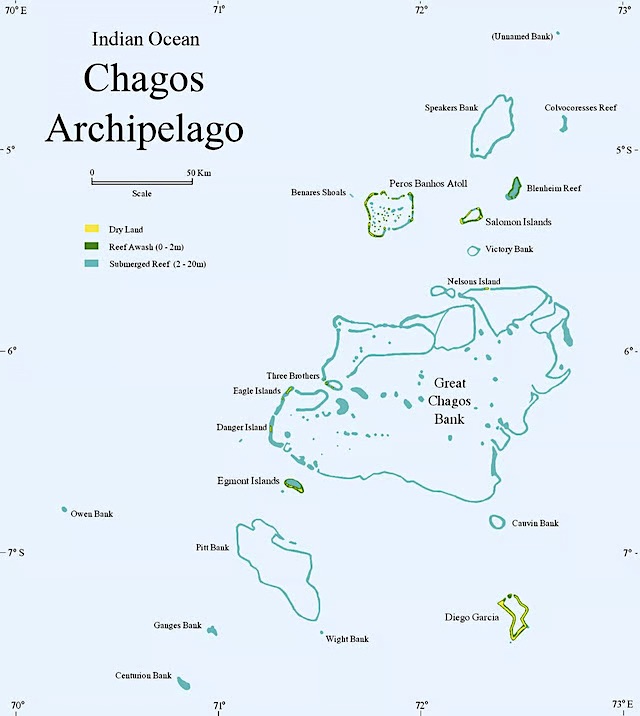
The White House is actively considering a plan to purchase the Chagos Islands, potentially undermining the UK’s agreement to transfer sovereignty of the strategically vital territory to Mauritius, according to reports. US officials have prepared proposals to bypass Britain and negotiate directly for control of Diego Garcia, the key Indian Ocean atoll that hosts a major joint US-UK military base. The idea forms part of broader options being developed by the Trump administration as alternatives to Prime Minister Keir Starmer’s plan to cede the islands to Mauritius, which has close ties to China and Iran.


Strategic Importance
Diego Garcia’s location makes it critical for long-range operations. It enables round-the-clock bomber missions, including potential strikes on Iran using B-2 Spirit stealth bombers, and places key areas within striking range. Amid ongoing conflicts involving Iran and China’s expanding naval presence, US and UK officials stress the need to maintain a robust chain of global military bases.


Senior Trump administration officials worry that transferring control to Mauritius could expose the base to espionage or interference. One former adviser to UK Foreign Secretary David Lammy, Ben Judah, told the Telegraph that the base has “super secret, super sensitive facilities” that are vital to British and allied capabilities, noting they would be difficult to replicate elsewhere.

Background on the UK-Mauritius Deal
The UK had agreed to hand sovereignty of the Chagos Islands to Mauritius while securing a long-term lease for the military base, reportedly involving around £35 billion ($46.7 billion) over 99 years. However, the deal requires US consent due to longstanding agreements governing the base, and Britain has since placed it on hold. President Trump initially appeared open to the arrangement but later strongly opposed it, particularly after the UK reportedly declined to allow strikes on Iran from Diego Garcia in the early stages of the Iran war. He publicly denounced the deal as “great stupidity” and criticized Starmer for weakening the special relationship, calling him “no Winston Churchill.”

US Position and Ongoing Talks
A US official told Reuters: “President Trump has been consistent in his position that the United Kingdom should not give away the British Indian Ocean Territory, which includes our joint U.S.-UK military facility on the Diego Garcia atoll. Diego Garcia’s strategic location in the Indian Ocean makes it a vital and indispensable military installation of significant importance to the national security of the United States.” The US continues regular discussions with Britain to preserve the base’s viability.

Purchasing the islands outright would likely involve waiting for the UK-Mauritius sovereignty transfer before negotiating with Mauritius. No specific price has been discussed, according to sources. In February, Trump said that he had retained the right to “militarily secure” the Diego Garcia air base after calling the UK’s decision an “act of total weakness.” A UK government spokesperson defended the original agreement, stating it was necessary to protect long-term interests and prevent adversaries from gaining a foothold:

“Diego Garcia is a key strategic military asset for both the UK and the US, which has protected our shared security for nearly 60 years. Maintaining long-term operational control and security of Diego Garcia is the entire basis for the UK-Mauritius agreement.” In May, UK minister Hamish Falconer stated there was “no scenario” in which Washington could purchase the islands, reaffirming commitment to the deal. Downing Street has not commented on the latest US proposals.
Read more …

I get the feeling they’re all after the same pot of money. There’ll be $200 billion (or however much it is, maybe a trillion), but not 5 or 6 times that. ~And there’s never enougn money, or energy, for any single one of them.

For now, it’s a feeding frenzy, however. Everyone’s just afraid to miss out.

OpenAI Files Confidentially For IPO, Joining SpaceX and Anthropic (ZH)

The rush by AI companies to go public before the window closes (i.e., “market conditions” emerge) entered its final lap late on Monday, when OpenAI joined its two mega peers in filing for a blockbuster IPO that could value the ChatGPT creator at more than $1tn as it races rival Anthropic to list its shares publicly, following an imminent offering by SpaceX.


OpenAI said it had confidentially submitted a draft IPO prospectus to the US Securities and Exchange Commission, formally kicking off the process for one of the year’s most hotly anticipated debuts. The company is also planning to launch a tender sale of its shares to provide liquidity to employees in the coming weeks, before the company goes public, Bloomberg reported. Why employees would want to sell shares ahead of an IPO is not exactly clear, unless they fear the market reaction to the public offering would disappoint.

OpenAI’s listing announcement comes days before SpaceX is set to IPO in a deal that could raise a record $86bn and value Elon Musk’s rockets-to-AI conglomerate at $1.78tn. Anthropic, the startup behind the chatbot Claude, said last week that it had filed confidentially for an IPO of its own. The company soared to a $965 billion valuation in its latest private funding round – above OpenAI’s for the first time – as its revenue surged. The three Wall Street listings comes at a time of unbridled euphoria among investors over AI, which has helped propel US stocks to a series of record highs but also prompted worries that markets are overheating.

Last week, Goldman published a note seeking to preempt the big question: “Can Markets Absorb Massive Stock Supply From Coming Mega IPOs Without A Crash:” While Goldman did not express concerns about the coming flood of stock supply (its argument is that demand will more than offset the flood of new shares), the bank which is also a lead underwriter for both SpaceX and Anthropic calculated that recent and upcoming IPOs will result in roughly $500 billion of additional unlocked shares available to sell in 2026 and likely a larger quantity in 2027 as insiders sell and distribute their stakes to public (mostly retail) shareholders. The bank expects the majority of potential equity supply from the current pipeline of IPOs will become free float in 2027.

OpenAI’s IPO – which also comes at a time when CEO Sam Altman has floated handing out shares to US taxpayers ostensibly in hopes that such an action would lead to a government backstop and/or bailout if and when the AI cycle turns – will mark a test of investors’ appetite for a company posting booming revenue growth but also staggering losses that are forecast to continue for many years as the company spends vast sums on data centres and other infrastructure: its funding commitments to hyperscalar companies are well north of $1 trillion and unless the company manages to dramatically boost its revenue growth it will find itself woefully undercapitalized in coming years. Hence the IPO, as well as a bevy of private credit deals which mask the company’s true debt exposure.

OpenAI has been investing heavily in AI research to compete with rivals including Google and Anthropic, as well as to expand the computing capacity needed to serve ChatGPT’s 900mn users. In February, the company told investors it was planning to spend about $600 billion on AI infrastructure by 2030. It said in a statement on Monday that it had not “decided on timing yet; it may be a while because there are things we want to do that are likely easier as a private company”. “But it’s a complicated set of trade-offs and this gives us the option to go public sooner if that ends up being best,” it added.

A public debut in 2026 would also pit Altman squarely against Elon Musk on a different plane than the failed lawsuit against OpenAI and its CEO. SpaceX, Musk’s rocket, satellite and AI firm, is targeting an IPO at a valuation of roughly $1.8 trillion on Thursday, which would immediately make it one of the world’s most valuable public companies. As an indication of the staggering demand for AI exposure, OpenAI has already dwarfed even SpaceX’s IPO in a single funding round. The company completed a deal to raise $122 billion from investors at an $852 billion valuation.

The ChatGPT maker also planned to launch an employee share sale ahead of going public at its current $852bn price tag, according to people familiar with the matter. One said OpenAI’s decision to announce its confidential filing was intended to give employees who were considering selling shares “transparency” about the upcoming IPO. US tech groups often file IPO paperwork privately, keeping their financial figures out of the public eye while the SEC reviews documents. That allows start-ups to gauge investor demand, make revisions and sometimes scrap IPO plans without broader scrutiny.

The San Francisco-based company’s move to progress its listing plans received a boost after a California court last month threw out Musk’s legal case against OpenAI and its chief Sam Altman. A public debut in 2026 would also pit Altman squarely against Elon Musk on a different plane than the failed lawsuit against OpenAI and its CEO. SpaceX, Musk’s rocket, satellite and AI firm, is targeting an IPO at a valuation of roughly $1.8 trillion on Thursday, which would immediately make it one of the world’s most valuable public companies.

OpenAI had been working with bankers at Goldman Sachs and Morgan Stanley and lawyers at Cooley for the past few months, people familiar with its preparations previously told the FT. Monday’s filing sets OpenAI on a path to start trading as early as the autumn, they said. It is already one of the world’s most valuable private companies, after closing a record funding round of up to $122bn in March. As part of that deal it raised $3bn from retail investors, who will be given a wider opportunity to invest in the start-up when it becomes publicly traded.

Read more …

“Ukraine is not an EU member state, and Ukraine is not a NATO member. Why would the EU put themselves into the conflict resolution when Ukraine is not in the EU.”

“Putin knows the people of Europe do not want the corrupt nation of Ukraine as part of their wealth draining operation.”

“Hey, at least the ‘coalition of the willing’ is now begging for an audience with Putin.”

EU Coalition of the Willing: Five Terms for Direct Ukraine-Russia Talks (CTH)

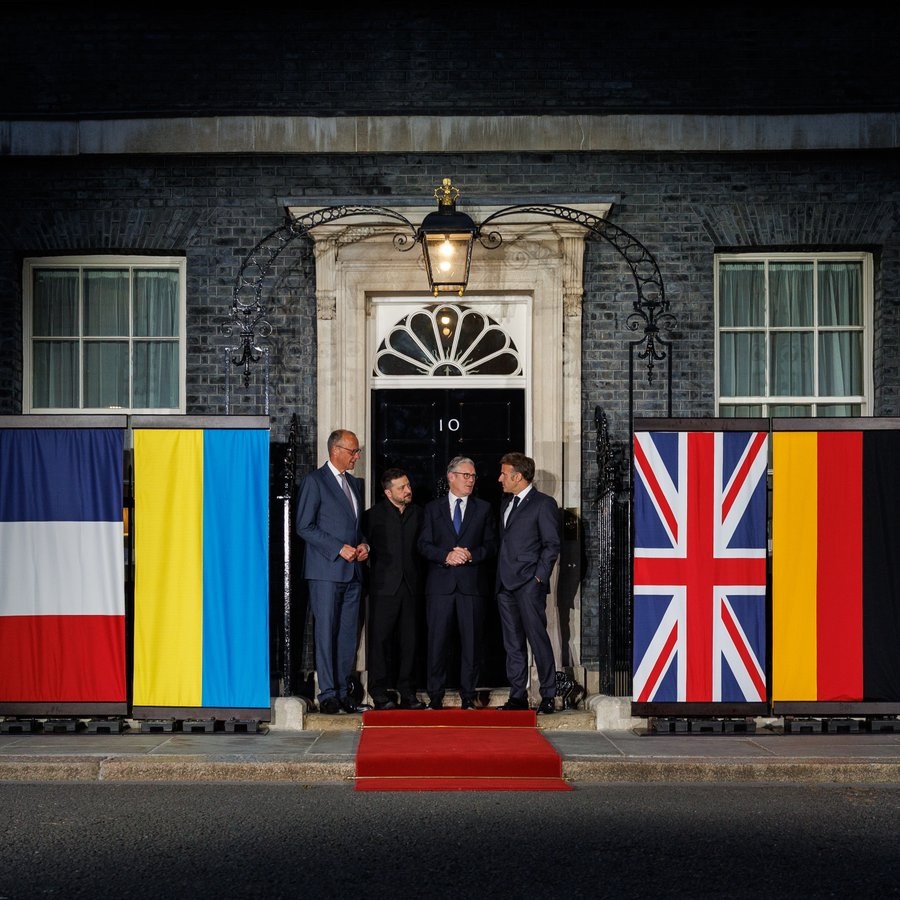
Politico is reporting that Germany is going to replace the United States as the direct contact for negotiations with Russia; that’s according to a spokesperson for Merz. However, if you read the actual printout from their collective agreement there is nothing of the sort mentioned. Instead, what actually exists within the statement are five terms they have agreed upon in order to start direct discussions between Zelenskyy and Russian President Vladimir Putin. At least two of the terms are non-starters for Russia: […] Conditions that would need to be in place for a just and lasting peace.

  • First, a stop to the fighting. They called on President Putin to agree to an immediate and complete ceasefire.
  • Second, the current line of contact should be the starting point for negotiations. International borders must not be changed by force, and Ukraine’s sovereign right to choose its own security arrangements and alliances must be fully respected.
  • Third, Ukraine must have robust and legally binding security guarantees in place once a ceasefire enters into force, building on commitments made in Berlin in December 2025 and Paris in January 2026. This includes the deployment of the Multinational Force – Ukraine.
  • Fourth, Russian assets will remain immobilised until Russia ceases its war of aggression and compensates Ukraine for the damage caused by the war.
  • Fifth, that European security interests must be safeguarded in any deal. Elements of any negotiation related to the EU and NATO would need the consent of the EU and its Member States and NATO Allies respectively.

The #3, #4 and #5 points are not going to go anywhere.

Germany, France, the U.K and/or EU participants are not going to put troops on the ground in Ukraine without United States security guarantees. President Trump has already rejected that proposal on three occasions. The Russian sovereign fund that was seized by the EU is not the property of Vladimir Putin; it is wealth belonging to the Russian people and President Putin will not accept that term. Additionally, two-thirds of the world has been against that seizure bolstering Russia’s position.

The fifth point is laughable. The EU collective in Brussels is going to be required to give consent to any peace agreement? Highly doubtful Russian Federation President Vladimir Putin would even entertain that condition. Ukraine is not an EU member state, and Ukraine is not a NATO member. Why would the EU put themselves into the conflict resolution when Ukraine is not in the EU. From a brutally obvious and pragmatic Russian position, this makes no sense. However, I would look for Putin to do something funny with this, like force the EU to adopt Ukraine first as a ‘put up – or shut up‘ type challenge.

Putin knows the people of Europe do not want the corrupt nation of Ukraine as part of their wealth draining operation. Hey, at least the ‘coalition of the willing’ is now begging for an audience with Putin.
Read more …

“The gaffe-prone former foreign minister has been blamed for Berlin’s failure to win a rotating seat on the UN Security Council..” …a rotating seat on the UN Security Council that Germany wants to be a permanent one?!

German Lawmakers Want Answers From Baerbock After UN Humiliation – Bild (RT)

German lawmakers want former Foreign Minister Annalena Baerbock questioned over Berlin’s failure to secure a seat on the UN Security Council, Bild reports. According to the outlet, the ruling CDU/CSU alliance blames the former top diplomat for the setback and wants her summoned before the Parliament’s Foreign Affairs Committee. Germany failed to win a non-permanent seat on the UNSC – the UN’s most powerful body, with authority to adopt legally binding resolutions and sanctions – for the first time in modern history on Wednesday, losing out to Portugal and Austria. Germany won all six previous contests it entered since 1977, but this time received only 104 votes, well short of the required two-thirds majority.


German Foreign Minister Johann Wadephul described the result as a “bitter defeat,” but insisted he “did not personally blame himself,” arguing that Germany entered the race too late. According to Bild, lawmakers are placing the blame on Wadephul’s predecessor, Baerbock, who served from 2021-25. “We must thoroughly investigate the causes of this embarrassing electoral defeat,” Stephan Mayer, a member of the Foreign Affairs Committee, told the outlet. “[It is] absolutely essential that Annalena Baerbock answer questions before the Bundestag [to explain] how, when, and what exactly her ministry did to mobilize support for Germany’s bid.”

Hesse’s Minister for International Affairs, Manfred Pentz, also pointed the finger at Baerbock. “You cannot blame [Chancellor] Friedrich Merz and Johann Wadephul for this electoral defeat. Annalena Baerbock messed it up during her time as foreign minister,” he stated. Baerbock’s tenure as Germany’s top diplomat drew frequent criticism for a lack of diplomatic pragmatism, an inconsistent agenda, and high-profile verbal blunders.During her time in office, she said she would support Ukraine “irrespective of what my voters think,” declared the EU to be “fighting a war against Russia,” and described Israeli strikes on Palestinian schools as “self-defense.” She also made several awkward historical, geographical, and mathematical slip-ups, including promising a “360-degree foreign policy.”

Despite the gaffes, Baerbock was appointed president of the UN General Assembly after leaving the Foreign Ministry – a largely ceremonial but prestigious UN post. Munich Security Conference chairman Wolfgang Ischinger suggested that Germany’s defeat this week may have partly been retaliation for how Baerbock “snatched” the role, which he told WELT TV had “not exactly generated new sympathy for Germany” among UN ambassadors.

A diplomatic source told Bild that Baerbock is widely unpopular in the General Assembly for being “too focused on Germany… selfies and herself.” Botswana’s former president, Mokgweetsi Masisi, also told the outlet that Germany could have secured more support from African countries in the Security Council vote had Baerbock not treated African partners in a “condescending and disrespectful” manner. He cited diplomatic disputes over infrastructure projects during her tenure as foreign minister.

Read more …

Michael Snyder is the boy who cried wolf. Amusing at times.

A “Godzilla El Niño” (Michael Snyder)

The waters of the Pacific Ocean are getting extremely warm, and that could provide fuel for an immensely destructive climate event that is unlike anything we have ever seen before. Even the United Nations has issued an ominous warning about the El Niño event that is in the long-term forecast, because it will have a dramatic impact on every man, woman, and child on the entire planet. We are being told that there is more than an 80 percent chance that El Niño conditions will arrive by the end of next month due to rapidly warming equatorial waters in the Pacific. Meanwhile, an unprecedented “9,000-mile marine heatwave” has developed in the North Pacific. Many experts are concerned that the confluence of those two factors could produce a “Godzilla El Niño”…


The chance of an El Niño event emerging by July is now over 80 percent, which will likely make 2026 one of the hottest years on record. At the same time, an exceptionally large 9,000-mile marine heatwave has been forming in the North Pacific since the end of 2025. These extreme warming events are now evolving together across the Pacific. Scientists are increasingly concerned that the warm water will fuel a “super” or “Godzilla” El Niño, potentially prolonging marine heatwaves, disrupting fisheries and ecosystems, and intensifying global climate impacts well into 2027. The “9,000-mile marine heatwave” in the North Pacific is absolutely astounding climate scientists.

At the same time, the warming in the equatorial waters where El Niño events normally develop is at a level that we haven’t seen since at least 1877… The temperature of the ocean in the equatorial waters where these El Niños form was predicted to be 3 degrees Celsius above average. Experts are saying that this is a level of heat in the Pacific Ocean that hasn’t been recorded since 1877. I have written about the “Super El Niño” that started in 1877 before. That “Super El Niño” was one of the primary reasons why 50 million people starved during the Great Famine that stretched from 1876 to 1878…

This El Niño, they say, could rival the intense event of the late 19th century that triggered “the Great Famine” on a global scale, killing millions of people. And its scythe sliced through southern Africa. “The 1876-78 Great Famine impacted multiple regions across the globe, including parts of Asia, Nordeste [Northeast] Brazil, and northern and southern Africa, with total human fatalities exceeding 50 million people, arguably the worst environmental disaster to befall humanity,” a team of scientists said a decade ago in a ground-breaking paper presented at a meeting of the American Geophysical Union.

3 percent of the entire population of the world starved to death during those years. Today, 3 percent of the entire population of the world would be 240,000,000 people. In 1982 and 1983, we experienced the most severe “Super El Niño” of the 20th century… In 1982-83, the most intense El Niño of the 20th century caused extreme weather events throughout the world, including floods in the American Pacific and in the southern United States, and droughts in north-eastern Brazil and Indonesia. It also caused a very mild winter in the mid-latitudes of Europe, Asia and North America. That “Super El Niño” sparked a horrific famine in eastern Africa that wiped out a very large proportion of the population…

Read more …

“..the first great realist thinker…”

In the Land of Thucydides (John J. Mearsheimer)

I gave a lecture in Athens on 2 June 2026 that was hosted by two prestigious Greek organizations: the Council for International Relations and the Institute of International Relations. I was asked to speak about why I think Realism explains contemporary geopolitical developments better than any other theory. I was fully aware that I was speaking in the home of Thucydides, the first great realist thinker.
Read more …


https://twitter.com/Real_RobN/status/2063695049314185386?s=20 https://twitter.com/mcafeenew/status/2063714994014093733?s=20 https://twitter.com/jackprandelli/status/2063698942630506617?s=20


Support the Automatic Earth in wartime with Paypal, Bitcoin and Patreon.



Apr 202023


Claude Monet Grand Canal, Venice 1908


Turkish Interior Minister Claims “The Whole World Hates America” (BNN)
Ukraine Demands Shell’s ‘Russian Blood Money’ – Politico (RT)
Kiev Wants Most Out Of Grain Deal, Demands Bribes From Ship Owners (TASS)
US Military Industry Struggling To Meet Ukraine Demand – WSJ
Resolution Would Make Biden Disclose Number of US Troops in Ukraine (Antiwar)
No ‘Magic Wand’ For Ukraine – UK (RT)
US Fanning Ukraine Crisis as Beijing Proposes Peace Plan – Envoy (TASS)
China’s Role In The Yemen War Ceasefire Should Not Go Unnoticed (Blankenship)
Chinese Envoy: Negative US Role In Escalation On Korean Peninsula (TASS)
Western Countries Dodging Russian Oil Ban (RT)
Macron’s Europe (Patrick Lawrence)
The Dollar’s Dominance As A Reserve Currency Erodes Fast (BI)
Four Reasons The Dollar Is Here to Stay- Part 2 (Lebowitz)
EU Pledges Support For States Flooded With Ukrainian Grain – Politico (RT)
Did the Neocons Save the World from the Thucydides Trap? (Unz)
IRS Agent Alleges DOJ Thwarting Criminal Prosecution Of Hunter Biden (JTN)


Pepe


Vandana Shiva


Election time.

Turkish Interior Minister Claims “The Whole World Hates America” (BNN)

In a bold statement, Turkish Interior Minister Süleyman Soylu has claimed that “the whole world hates America” while suggesting that Europe is merely a pawn of the United States. Soylu further downplayed Europe’s significance, asserting that it is a trend in America’s column. Süleyman Soylu’s remarks reflect a growing anti-American sentiment in some segments of the international community. By claiming that “the whole world hates America,” Soylu is highlighting the perception that the United States is losing credibility on the global stage. This sentiment can be attributed to various factors, such as foreign policy decisions, economic policies, and perceived cultural dominance.

Soylu’s characterization of Europe as an American pawn suggests that he believes the continent lacks independence and is heavily influenced by the United States. By stating, “There is no such thing as Europe. There is America. Europe is a trend in the Americas column,” Soylu implies that Europe’s actions and policies are primarily driven by American interests rather than its own. This perspective further underscores Soylu’s negative view of the United States and its global influence. The Turkish Interior Minister’s comments may have far-reaching implications for international relations, particularly between Turkey, the United States, and Europe.

Such strong anti-American rhetoric could contribute to increased tensions between the countries and may negatively impact diplomatic relations. Furthermore, Soylu’s dismissal of Europe’s significance could strain Turkey’s relationships with European nations, potentially affecting trade and cooperation in various areas. Soylu’s remarks should be considered within the larger context of global anti-Americanism, which has been rising recently. This sentiment can seriously affect the United States’ ability to maintain its influence and cooperate with other nations. As anti-American feelings continue to grow, the United States may face challenges in forming alliances, negotiating agreements, and projecting its values internationally.

https://twitter.com/i/status/1648657322271539201

Read more …

“We call on Shell to put any Russian sale or dividend proceeds to work for the victims of the war – the same war that those assets have fuelled and funded.”

Ukraine Demands Shell’s ‘Russian Blood Money’ – Politico (RT)

An adviser to Ukrainian President Vladimir Zelensky has asked oil giant Shell to donate the proceeds from the sale of its Russian assets to Ukraine, Politico reported on Tuesday. In a letter to Shell CEO Wael Sawan dated Monday, Oleg Ustenko, an economic adviser to Zelensky, reportedly called on the firm to donate the proceeds from a supposedly upcoming sale of its stake in a Siberian oil and gas project to Kiev’s coffers. “If completed, this sale would represent the transfer of more than $1 billion in Russian cash into Shell’s accounts. That would be blood money, pure and simple,” Ustenko wrote, according to Politico. “We call on Shell to put any Russian sale or dividend proceeds to work for the victims of the war – the same war that those assets have fuelled and funded.”

Ustenko added that there is an “overwhelming” moral case for handing the cash over to his government. Shell pulled out of the Russian market after Moscow launched its military operation in Ukraine last February, announcing that it would write off up to $5 billion of its assets in the country. According to Russian media reports last week, Shell’s stake in the Sakhalin-2 oil and gas development project will be bought out by Russian energy company Novatek for around $1.1 billion, although it is unclear whether the proceeds from this buyout will end up in the British oil firm’s hands. A Shell spokesperson told Politico that it is not involved in any negotiations inside Russia, and has no idea where the money from the sale will end up. The company did not say whether it would honor Ustenko’s request if possible.

Shell is not the only energy company being shaken down for cash by Kiev. Ustenko accused BP of taking “blood money” before it sold its share in Russian energy giant Rosneft last year, in addition to demanding almost half a trillion dollars from the Russian central bank’s frozen assets and asking Ukraine’s Western backers to double their financial aid to his country. With the conflict keeping fossil fuel prices high, Ukrainian Energy Minister German Galushchenko called on other firms to share some of their “enormous windfall profits” with his government “to help us restore, to rebuild the energy sector,” Politico reported last month.

Read more …

“..the Ukrainians first blocked the registration process having disagreed with our proposals, and then suspended all inspections, including inspections of outgoing ships..”

Kiev Wants Most Out Of Grain Deal, Demands Bribes From Ship Owners (TASS)

The Kiev regime is seeking to exploit the Black Sea initiative with might and main, not shunning either the abuse of the rules of procedure or demands for bribes from shipowners. This is stated in the comments by Russian Foreign Ministry Spokeswoman Maria Zakharova, which was released on Wednesday. “Currently, the Joint Coordination Centre (JCC) in Istanbul is indeed experiencing difficulties with registering new vessels and conducting inspections. They arise solely as a result of actions by Ukrainian representatives as well as UN officials who are apparently unwilling or unable to stand up to them,” she pointed out. “Having finally discarded not only humanitarian considerations, but even elementary human decency, they (the Kiev regime – TASS) are striving to make the most out of the Black Sea Initiative stooping to anything from outright abuse of the rules of procedure to demanding bribes from the ship owners, doing all of the above for the sake of maximizing commercial profits,” the diplomat added.

As Zakharova noted, the owners of incoming ships who refused to pay a bribe are forced to wait for registration for many months. “Outgoing dry cargo ships that have paid also have to wait for the inspection, because once they receive the money the Ukrainians lose interest in them. This situation stems from the fact that in line with the current practices (importantly, not the rules of procedure), the process for obtaining applications for registration under the Black Sea Initiative is in the hands of the Ukrainians, while the UN is in charge of the inspection plans (for the entry and exit of ships),” she went on. Under these circumstances, the registration of ships, which Russian experts carry out strictly within the approved rules of procedure and their respective powers, is the only way to restore order to some extent and to build a fair and transparent basis for participating in the initiative, the diplomat stressed.

“However, our proposal to add to the registration lists the ships which will then sail to the countries in need, in particular Africa, as well as those that have been waiting in line for more than one month, was met with hostility by Ukrainian representatives. Kiev was not ready to jeopardize its commercial corruption schemes. As a result, the Ukrainians first blocked the registration process having disagreed with our proposals, and then suspended all inspections, including inspections of outgoing ships (27 ships with 1.2 million tons of cargo on board). It is clear what they are banking on: launching a propaganda machine and playing the food card with the help of Westerners and the UN,” she noted.

As the diplomat pointed out, the High Representative of the EU for Foreign Affairs and Security Policy, Josep Borrell, and then US Secretary of State Antony Blinken announced that Russia allegedly broke its promises to the countries in need of grain and blocked 50 ships in the Black Sea. “The EU did not stop there and expressed a belief that is striking in its absurdity and amateurishness: the sanctions imposed on Russia are so well calibrated and balanced that they do not interfere with Russia’s agricultural exports, an example of which is the supply of Russian grain under the Black Sea Initiative,” Zakharova said. “Unfortunately, Brussels still has not figured out that only Ukrainian food is being exported across the Black Sea under the grain deal. Washington is no stranger to issuing valuable tips to other countries about their obligations, completely forgetting about its own,” she added.

Read more …

“..the West’s support for Kiev “cannot influence the final outcome of the special operation.”

US Military Industry Struggling To Meet Ukraine Demand – WSJ

American arms manufacturers are struggling to obtain enough rocket motors to build missiles for Ukrainian forces, the Wall Street Journal reported on Tuesday. With multiple contractors relying on a single supplier, production targets have already been pushed back. In a quarterly earnings report released on Tuesday, Lockheed Martin said that although its overall sales rose from a year earlier, sales of Guided Multiple Launch Rocket Systems (GMLRS) fell due to a “lower volume” leaving its factories. GMLRS projectiles are artillery rockets, and are fired from Lockheed Martin’s M142 HIMARS platform. According to the most recent Pentagon figures, the US has given Ukraine 38 HIMARS platforms, and while the Defense Department does not disclose how many GMLRS projectiles have been sent to Kiev, a Reuters investigation put the figure at over 5,000 last November, more than the 4,600 Lockheed Martin can make in a year.

A shortage of rocket motors has hindered the company’s efforts to boost production, the Wall Street Journal reported. Other missile makers like Raytheon Technologies have also been affected, the newspaper’s source said. Lockheed Martin also uses solid-fuel rocket motors in its Javelin anti-tank missiles, of which more than 8,500 have been sent to Ukraine over the last year. During a visit by President Joe Biden to the company’s Javelin manufacturing facility in Alabama last May, CEO Jim Taiclet vowed to double production of the shoulder-fired missiles by 2024. However, the company and the Pentagon told the Wall Street Journal that the date has since been pushed back to 2026. “We thought we could get there earlier,” Lockheed Martin’s Chief Financial Officer, Jay Malave, told the paper. US missile makers like Lockheed Martin and Raytheon Technologies source their rocket motors from a single supplier, Aerojet Rocketdyne Holdings.

However, although the Pentagon awarded Aerojet a $216 million contract last week to boost production, it said it was still recovering from a fire at one of its factories last year, while the sale of the company to aerospace giant L3Harris Technologies is still being scrutinized by antitrust authorities. While rocket artillery and guided missile production are apparently hindered, Ukraine is also grappling with a shortage of conventional artillery rounds. Leaked Pentagon documents recently suggested that the shortfall is delaying a planned spring offensive by Kiev’s forces, while the US is reportedly looking to its allies to replenish its depleted stockpiles. Russia has repeatedly warned that the influx of Western weapons will only prolong the conflict in Ukraine. The West’s involvement “is rising gradually,” Kremlin spokesman Dmitry Peskov said earlier this month, adding that the West’s support for Kiev “cannot influence the final outcome of the special operation.”

Read more …

“The leaked document said there is a total of 29 Defense Department personnel inside Ukraine, including the special operations forces..”

Resolution Would Make Biden Disclose Number of US Troops in Ukraine (Antiwar)

Rep. Matt Gaetz (R-FL) on Monday introduced a resolution that would require President Biden to disclose the number of US troops inside Ukraine and share all documents outlining US military assistance for Kyiv with the House. If the resolution is passed, it would require President Biden and Secretary of Defense Lloyd Austin to share the requested information within 14 days. The introduction comes after one of the documents allegedly leaked by Airman Jack Teixeira confirmed that US special operations forces are in Ukraine. “The Biden Administration and other allied countries have been misleading the world on the state of the war in Ukraine. There must be total transparency from this administration to the American people when they are gambling war with a nuclear adversary by having special forces operating in Ukraine,” Gaetz said in a statement.

According to the document, 97 NATO special operations soldiers in Ukraine, including 14 Americans. The leak confirmed an October 2022 report from The Intercept that said US special operations forces were deployed to Ukraine after Russia’s invasion. The Intercept report did not say what the American special operators were doing inside Ukraine but said it was part of a broad covert operation that includes CIA personnel who are also on the ground. The leaked document said there is a total of 29 Defense Department personnel inside Ukraine, including the special operations forces. The total also includes members of the Marine Security Guard Security Augmentation Unit (MSAU), who are typically deployed for embassy security.

The total also includes the defense attaché and members of the Office of Defense Cooperation (ODC). The Pentagon said in October 2022 that personnel under the defense attaché and ODC based at the US embassy in Kyiv are conducting “onsite” weapons inspections inside Ukraine.

Read more …

“..there is not going to be a single magic-wand moment when Russia collapses.”

No ‘Magic Wand’ For Ukraine – UK (RT)

The conflict between Russia and Ukraine will likely continue into next year, UK Defence Secretary Ben Wallace said on Tuesday. “I’m optimistic that between this year and next year, I think Ukraine will continue to have the momentum with it and a position of strength,” Wallace told reporters during a trip to Washington, DC, as quoted by the New York Times. Wallace warned, however, that “there is not going to be a single magic-wand moment when Russia collapses.” The UK has been one of Kiev’s main backers, supplying the country with heavy weapons, including Challenger 2 tanks. Britain has trained 10,000 Ukrainian soldiers, according to the Defence Ministry, and pledged to train 20,000 more this year.

For the past several months, Kiev has been outspoken about its planned counteroffensive, but has not publicly revealed the timetable. Ukrainian officials have said, however, that the schedule and success of the endeavor will heavily depend on the supply of Western tanks and other equipment. Aleksey Danilov, the secretary of Ukraine’s National Security and Defense Council, told AP on Monday that the push will start at an appropriate time when the country is ready. Prime Minister Denis Shmigal recently said that the offensive will start “in the nearest future.” Shmigal stated that the recent leaking of the Pentagon files, which included reports about how Western countries were training and equipping Ukrainian troops, will not change the plans for the counteroffensive.

However, a source close to President Vladimir Zelensky told CNN that Kiev had altered some of its plans because of the leak. Some Western leaders, including NATO Secretary General Jens Stoltenberg, warned that the conflict, which broke out in February 2022, could last for years. US Secretary of Defense Lloyd Austin said Washington is determined to support Kiev “for as long as it takes.” The Kremlin said this month that the Russian military has been “meticulously monitoring” information regarding Ukraine’s plans. Moscow has also repeatedly stated that countries which send weapons to Kiev become de facto parties to the conflict.

Read more …

“The world community should create conditions and provide a platform for the resumption of talks..”

US Fanning Ukraine Crisis as Beijing Proposes Peace Plan – Envoy (TASS)

The United States has been fanning the conflict in Ukraine, while China has come up with a peace plan, a senior Chinese diplomat said in an interview with TASS. “The Chinese side always takes a balanced and responsible approach to the export of military products. Unlike the United States and other Western nations, who have been adding fuel to the fire in the Ukrainian crisis, we put forward a peace plan to resolve it,” said Liu Xiaoming, Special Representative of the Chinese government on Korean Peninsula Affairs. In late February, the Chinese Foreign Ministry published a position paper on a political settlement of the crisis in Ukraine.


The twelve-point document includes calls for a ceasefire, respect for the legitimate interests of all countries in the field of security, settlement of the humanitarian crisis in Ukraine, the exchange of prisoners of war between Moscow and Kiev, as well as the cancellation of unilateral sanctions imposed without a corresponding decision of the UN Security Council. In the published document, China described dialogue and negotiations as the sole way of resolving the crisis in Ukraine and called on all parties to support Moscow and Kiev in “moving toward each other”, urging a resumption of direct dialogue as soon as possible. The world community should create conditions and provide a platform for the resumption of talks, the document emphasized.

Read more …

It won’t. Just maybe in the west.

China’s Role In The Yemen War Ceasefire Should Not Go Unnoticed (Blankenship)

Estimates suggest at least 350,000 people have died from the war or its consequences, which began in 2014. This includes approximately 85,000 children under the age of five who have died of starvation. Basic civil infrastructure and supply chains have collapsed, and typically treatable communicable diseases like cholera have claimed countless lives. The war is primarily between the Yemeni government of Rashad al-Alimi, who took over in 2022 from Abdrabbuh Mansur Hadi, and the Houthi armed movement. The conflict escalated significantly when Saudi Arabia became involved in 2015 by backing Hadi (and now al-Alimi) in what is seen as a proxy war between Riyadh and Tehran, who is rumored to be supporting the Houthis. Some of my first memories as a writer and college radio host was speaking to victims of the war and learning about the situation on the ground.

Fortunately, it now looks like the war might come to a close. US media reported on April 6th that a ceasefire had been struck between warring parties at least through the end of this year. Then, on April 7th, Lebanese news outlet Al Mayadeen reported that Riyadh had informed the Yemeni presidential leadership council of its decision to end the war and close the Yemen file once for all. This was further corroborated by a Reuters report, confirming that Saudi delegates would travel to the capital Sana’a to discuss a “permanent ceasefire.” And indeed these talks just wrapped up on April 14th and are expected to have a follow-up. What is apparent from this situation, and what I had previously noted, is that the thawing of relations between Iran and Saudi Arabia would likely lead to an end to the conflicts in Yemen and Syria.

We are now seeing that play out. Most importantly, it was not US President Joe Biden – who had promised to end the conflict – but China that set the stage for this diplomatic achievement. And it’s not even a secret among US commentators since outlets like The Intercept, heavily quoting foreign policy experts, are giving China the credit. It is difficult to compare such horrors but in my years speaking with victims of conflict, including Ukrainian refugees now, or previously with Afghans, Syrians and others, some of the most striking stories I’ve heard are from Yemenis. It is undoubtedly one of the most brutal and total wars seen in modern history, yet almost entirely off the radar for most Western media for nearly a decade. Despite all of its diplomatic capital and links to the Middle East, somehow Washington managed – despite promising to halt the conflict – to be so anti-peace that it has driven perennial enemies to the table.

And now, as the Wall Street Journal recently reported, CIA Director William Burns “expressed frustration” with Riyadh over its rapprochements with regional adversaries. Apparently, the US feels ‘blindsided’ by the deluge of peaceful resolutions – things it could never even fathom, apparently – and it’s angry with Riyadh, hitherto one of America’s largest arms importers. Of course, buried under this frustration is a sense of loss. Anyone with some degree of familiarity with US politics and especially US foreign policy knows it is dominated by big money. In foreign affairs, this is primarily the military-industrial complex, which thrives off war and hatred. Peace is bad for business. And thus, the owners of US officials – the people who bankroll their campaigns and/or their bosses’ campaigns – are probably ticked.

Read more …

“The escalation of tensions on the Korean Peninsula is ongoing, and this only raises our level of concern..”

Chinese Envoy: Negative US Role In Escalation On Korean Peninsula (TASS)

Beijing is extremely concerned about the escalation of tensions on the Korean Peninsula, with the United States playing a negative role by holding joint drills with South Korea, Liu Xiaoming, Beijing’s special representative on Korean Peninsula affairs, said in an interview with TASS. “My trip [to Moscow] comes against the backdrop of the latest changes on the Korean Peninsula. On the one hand, we can often hear Westerners – both the Europeans and the Americans – complain that since last year North Korea has conducted a number of missile launches, while on the other hand, we can see that South Korea and the Americans held the largest drills over the past five years [on the peninsula],” the senior Chinese diplomat lamented. “The escalation of tensions on the Korean Peninsula is ongoing, and this only raises our level of concern,” he added.

Liu also criticized the United States for not having paid due attention to North Korea’s security concerns. “First of all, we should give our European and Russian counterparts a clear understanding of how we view the situation. The Americans always blame North Korea for causing tensions, but there is another reason that is worth noting. We see the reason as stemming from the US conducting such major military exercises. Second, a very important cause of instability on the Korean Peninsula, and of the Korean Peninsula becoming an issue, is that the United States has not paid due attention to North Korea’s concerns in the field of security and has imposed economic sanctions,” the Chinese envoy said. “They always put on the pressure by containing North Korea’s development; they exert political pressure and have imposed economic sanctions,” he added.

According to Liu, the goal of his tour is to share the Chinese vision of the situation on the Korean Peninsula with various counterparts and to find a recipe for promoting a political settlement jointly with European and Russian counterparts. The senior Chinese diplomat said Moscow was the last stop on his 24-day foreign itinerary, during which he said he had already visited Switzerland, Great Britain, Brussels, Germany and France. Liu urged efforts to ease tensions on the Korean Peninsula. “Amid the lack of a peace mechanism, the escalation of tensions is ongoing, which threatens peace and stability on the Korean Peninsula,” he concluded.

Read more …

Their own ban.

Western Countries Dodging Russian Oil Ban (RT)

Western states that have banned direct purchases of Russian oil are now buying it indirectly from third countries, a report from the Centre for Research on Energy and Clean Air (CREA) claimed on Wednesday. In December, the EU, G7, and allied countries imposed an embargo and a $60-per-barrel price cap on Russian oil. Similar restrictions were introduced in February for exports of Russian petroleum products. While the so-called ‘price cap coalition’ cracked down on crude imports, it has increased purchases of refined products from “oil-laundering” countries, CREA claims. The EU, Australia, and most of the G7 countries imported a combined $45.9 billion worth of oil products from countries that have become the largest buyers of Russian crude in the 12 months since the beginning of the conflict in Ukraine, the report stated.

According to CREA, “among the price cap coalition, the largest importer of oil products from the laundromat countries was the EU,” with imports reaching $19.4 billion since last February. Australia reportedly purchased $8.8 billion worth of refined crude in the 12-month period, followed by the US with $7.2 billion, the UK with $5.5 billion, and Japan with $5.2 billion. The highest proportions of imported oil products into price cap coalition countries were for diesel (29%), jet fuel (23%), and gasoil (13%). China’s monthly exports of oil products to the EU and Australia spiked far above historical levels in late 2022, the Finland-based research center revealed.

According to the report, which is based on ship-tracking data, the price cap coalition countries ramped up imports of refined oil products from China by 94%, Turkey by 43%, the United Arab Emirates by 23%, Singapore by 33%, and India by 2%. “The price cap coalition countries are responsible for the vast majority of the increase in laundromat countries’ exports of oil products,” CREA said. It claimed that 56% of Russian oil shipped to new destinations “has been transported by vessels owned and/or insured” by Western nations.

Read more …

“A durable peace” is one that would recognize Russia’s security concerns, which Washington and its pilot fish in Europe refuse to do..”

Macron’s Europe (Patrick Lawrence)

The press and the trans–Atlantic political cliques ordinarily ignore Macron when he does his I’m-the-next-de-Gaulle act. But not this time. There is too much at stake between the West and China these days: Beijing’s leverage over Moscow, real or imagined, on the Ukraine question, Europe’s role as the U.S. foments a crisis over Taiwan, the independence or otherwise of Europe’s relations with China and the new world order Xi and his top foreign policy officials have declared as the mainland’s priority. Macron fairly leapt into all this as soon as he disembarked in Beijing on April 6. In his arrival speech at the Great Hall of the People, he appealed directly to Xi to exert his influence in Moscow. “I know I can count on you to bring Russia back to reason and everyone back to the negotiating table,” Macron said. The cause, he added, was “a durable peace that respects internationally recognized borders.”

These remarks are interesting in several ways. On one hand, Macron miscalculated. China has made it eminently clear that, if invited, it is willing to act as a mediator between Russia and Ukraine (and Kiev’s Western backers), but under no circumstance will it intervene into the sovereign affairs of the Russian Federation or any other nation. I wish Macron would spend more time doing his homework and less posing for historians and the sculptors of bronze busts. On the other hand, the wording is subtly suggestive. “A durable peace” is one that would recognize Russia’s security concerns, which Washington and its pilot fish in Europe refuse to do. Respecting internationally recognized borders is a fine idea, all would agree, but Macron appeared to leave open what these would be when maps are drawn at the conclusion of negotiations.

And on the other hand — there are three in this case — Macron suggested quite openly that negotiating with Russia was as valid an undertaking as negotiating with China. The French president’s “I know I can count on you” was wildly incautious: The Chinese leader was “inflexible in direct reply to French head of state,” as Le Monde put it. At the same time, Macron managed a nifty chime with Xi on the larger point. “Together with France, we appeal for restraint and reason,” Xi remarked during the Great Hall exchange, “in the quest for a political settlement and the building of a European security architecture that is balanced and lasting.” After extensive talks in Beijing, Xi took the unusual step of escorting Macron to Guangdong, the southern province where a lot of China’s manufacturing capacity is concentrated. There are a couple of things to say about this side trip, too. Three, actually.

One, Macron signaled his view that Europe’s relations with the People’s Republic should remain open and develop further on the economic side — an implicit rejection of Washington’s campaign to disrupt the extensive interdependence of economic ties between the West and China. Two, we have to think about why Xi invested so much time in this encounter with the French leader. If I know Macron is an inconstant lightweight and you know the same, we can count on Xi understanding very well Macron’s character. My reply: Xi’s intent was to demonstrate that Beijing remains open to developing a set of relations with Europe that amount to a common cause against America’s effort to line up the Atlantic world against China and, by implication, Russia. “Xi denounced ‘Cold War logic and the confrontation of blocs,” Le Monde’s correspondent, Claire Gatinous, reported from Beijing. Gatinous then quoted Xi saying, “China always considers Europe an independent pole in a multipolar world.”

Read more …

Reserve currency is not the same as trade currency.

The Dollar’s Dominance As A Reserve Currency Erodes Fast (BI)

The dollar’s standing as a reserve currency of choice saw a steep decline in 2022 even though its strength in international trade remains unchallenged, according to Eurizon SLJ Asset Management. In a Monday note, strategists Joana Freire and Stephen Jen calculated that the greenback accounted for about two-thirds of total global reserves in 2003, then 55% by 2021, and 47% last year. “This 8% decline in one year is exceptional, equivalent to 10 times the average annual pace of erosion in the USD’s market share in the prior years,” the authors said. The drop-off in the dollar’s standing as a reserve currency accelerated since the start of the war in Ukraine in particular.

“Exceptional actions” — namely sanctions taken by the US and its allies against Moscow — made many nations less willing to hold on to the dollar, the report said. After Russia invaded Ukraine last year, Western nations largely cut off Russia from the world financial system and froze its currency reserves, forcing the Kremlin to rely more on the yuan. Meanwhile, the euro’s share as a reserve currency jumped by about 5%, Eurizon said, bringing its standing to the same level it hit in 2003 and effectively erasing two decades of losses. China’s yuan, meanwhile, continued to gain at its usual pace and didn’t see a big spike as a global reserve currency last year. To be sure, no other currency is set up to challenge the dollar’s dominance in international trade. It’s still the main conduit for country-to-country transactions, Eurizon said.

Citing data from the Bank for International Settlements’ Triennial Foreign Exchange Surveys, the dollar commanded 85% of all currency turnover in 2010, compared to its 88% market share in 2022, the note said. “We believe the erosion of the dollar’s reserve currency status has accelerated in recent years at an alarming pace, especially since the start of the Ukraine War, while the dollar will likely continue to enjoy dominance as an international currency for a while longer,” it added. Meanwhile, Fitch Solutions said the dollar’s dominance will erode over time but there won’t be a “paradigm shift,” given that there’s no viable alternative currency for international trade.

China’s rich
https://twitter.com/i/status/1648324373218992129

Read more …

“The U.S. bond markets are considered the world’s deepest and most liquid markets.”

Four Reasons The Dollar Is Here to Stay- Part 2 (Lebowitz)

The dollar will be extremely hard to replace for four reasons: The rule of law, liquid financial markets, and economic and military might. 60% of global currency reserves are in dollars, and about 90% of trade occurs in dollars. No other currency or block of nation’s currencies, gold-backed currency, or bitcoin is currently a viable candidate to replace the dollar as the global reserve currency.

The rule of law helps ensure that U.S. citizens and institutions are provided human rights, property, contracts, and procedural rights. While many other nations may claim to have similar legal processes, few live up to U.S. standards. The legal system equally protects foreigners with dollar and other financial and legal interests in the U.S. From a currency perspective, the court system, not a government decree, rules on financial disputes. It is undoubtedly flawed and biased. As Russia, Iran, and other countries have found, the U.S. government will seize their dollars if they deem it in its best interest. While such acts bend the value of the rule of law, almost all foreign nations are confident that the U.S. system of law and governance ensures their ability to hold and transact in U.S. dollars. Further, laws and regulations provide confidence in the proper functioning of U.S. markets they rely heavily on to meet their borrowing and investment needs.

Hedge fund mogul Mark Mobius is discovering why investing in countries less judicious than the U.S. can be dangerous. Per CNN: “I have an account with HSBC in Shanghai. I can’t take my money out. The government is restricting the flow of money out of the country,” Mobius, founder of Mobius Capital Partners, told FOX Business on March 2, 2023. For those thinking that China, Russia, and Saudi Arabia can cobble together a reserve currency, ask yourself a question. If you were the leader of a nation, would you leave funds in their banking system or trust their government with said funds? More importantly, do you even think those countries trust each other? From an operational perspective, the size and liquidity of U.S. financial markets and the ease with which foreigners can borrow and invest U.S. dollars are of utmost importance.

Foreigners enacting global trade need dollars to facilitate exchange. Therefore, they hold dollars and maintain the ability to borrow dollars. International trade requires a financial system with immense liquidity. Further, the more liquid a market, the lower the borrowing, investing, and hedging costs. In this respect, the U.S. is second to none. The U.S. bond markets are considered the world’s deepest and most liquid markets. As we quote below, the U.S. bond market accounts for almost 40% of all bonds outstanding globally. Per the Securities Industry and Financial Markets Association (SIFMA): “As of 2021, the size of the bond market (total debt outstanding) is estimated to be at $119 trillion worldwide and $46 trillion for the U.S. market.”

Read more …

You lucky bastards: you get to pay for the exact same thing twice. First, to make Ukraine produce cheaper in the EU; then to make EU farmers whole. They offer €100 million. Of your money.

EU Pledges Support For States Flooded With Ukrainian Grain – Politico (RT)

The European Commission (EC) said on Wednesday it is considering complying with some of the demands from eastern EU member states to introduce tariffs on Ukrainian agricultural imports. The announcement comes as Poland, Hungary, Romania, Slovakia, and Bulgaria have been lobbying for the reintroduction of tariffs in order to protect local markets from “destabilization” caused by an influx of cheap goods from Ukraine. Local farmers in those countries claim to have suffered substantial financial losses due to the glut of Ukrainian grain. In a letter to the five countries, cited by Politico, the commission reportedly proposed “preventative measures” on imports of Ukrainian maize, wheat, sunflower and rapeseed. The EC’s spokesperson told a daily briefing that the commission envisages imposing customs duties on those products, the outlet wrote.

It also said that Brussels is expected to allocate additional funding for so-called solidarity lanes for Ukrainian agricultural exports to the global market and distribute €100 million ($109 million) in support for the five eastern European member states. The proposal will reportedly be discussed on Wednesday during a meeting of the European Commissioner for Agriculture Janusz Wojciechowski, European Commissioner of Trade Valdis Dombrovskis and the five countries’ trade ministers. Wojciechowski said earlier the commission would announce “good news” for farmers. The EU allowed imports of Ukrainian agricultural goods to help Kiev financially during the ongoing conflict in the country. All tariffs and quotas were lifted on Ukrainian grain exports to the bloc’s 27 member states in order to enable the further transit of the grain to global markets.

However, much of the supply has ended up getting stuck in eastern European countries, hitting local farmers’ business. This culminated in massive farmer protests earlier this month, which blocked border crossings and forced the five eastern EU nations to demand action from the EC over Ukrainian agricultural exports. The EC earlier approved an aid package worth €56 million to support farmers in frontline countries who have to deal with the consequences of a large amount of agricultural and food goods from Ukraine entering the bloc. However, even the latest €100 million in proposed aid may not be enough. According to the commission’s estimates, farmers from Poland, Romania, Hungary, Bulgaria, and Slovakia have lost some €417 million over the past year due to the oversupply of grain.

Read more …

Rising powers.

Did the Neocons Save the World from the Thucydides Trap? (Unz)

Following the end of the Cold War and the collapse of the Soviet Union more than three decades ago, America had emerged as the sole, unchallenged global superpower. But over the last generation, the tremendous growth rate of the Chinese economy had propelled it past America’s in real size, the first such transition since our own country had overtaken Britain near the end of the 19th century. China’s technological progress had been equally rapid, and in our modern world these constitute the raw elements of global power, while China had also begun bolstering its military, not previously a high priority. I’d certainly been well aware of these same trends and several years earlier I’d published a long article of my own on the contrasting trajectories of China and America, but I’d never considered military conflict as a realistic possibility. However, when Allison and his associates sifted the last 500 years of history to locate cases in which the rapidly growing power of a rising nation had threatened to overtake that of a dominant reigning one, they discovered that in well over half the examples—12 out of 16— the result had been war.

Some of these individual historical cases may easily be disputed—and indeed a couple of the ones provided in his 2015 article differed from those in his 2017 book—but the general pattern seemed quite clear. Even the oldest and deepest cultural and political ties hardly prevented this outcome. Prior to World War I, Britain and Germany had never fought a war against each other, and indeed the latter’s Prussian predecessor had traditionally bee Britain’s staunchest Continental ally. The two imperial families were also deeply interwoven, with the British monarchy having multiple German antecedents, while Queen Victoria’s favorite grandchild was Kaiser Wilhelm II, and she’d died in his arms. The English language itself had German roots, hardly surprising since the Angles and the Saxons had originally been Germanic tribes.

Yet all these centuries of close ties counted for little compared to the simple geopolitical fact that Germany’s growing industrial and military power threatened to overshadow that of its kindred nation on the other side of the Channel. By contrast, the political, cultural, and racial gulf separating America from a rising China seems immense, easily lending itself to the crudest demonization, the sort of populist demagoguery able to stoke national hatred. Not only is China’s language and culture totally different from our own, but for three generations that country has been governed by a Communist Party whose official ideology is utterly contrary to our own democratic constitutionalism. Many hundreds of thousands of Chinese troops had fought against American forces during the Korean War, inflicting most of our 36,000 combat deaths.

Read more …

“..examples of preferential treatment and politics improperly infecting decisions and protocols..”

IRS Agent Alleges DOJ Thwarting Criminal Prosecution Of Hunter Biden (JTN)

A decorated supervisory IRS agent has reported to the Justice Department’s top watchdog that federal prosecutors appointed by Joe Biden have engaged in “preferential treatment and politics” to block criminal tax charges against presidential son Hunter Biden, providing evidence as a whistleblower that conflicts with Attorney General Merrick Garland’s recent testimony to Congress that the decision to bring charges against Biden was being left to the Trump-appointed U.S. Attorney for Delaware. According to a letter from the whistleblower’s attorney Mark Lytle to Congress obtained by Just the News, the IRS agent revealed he is seeking to provide detailed disclosures about a high-profile, sensitive case to the tax-writing committees in Congress, which have special authority under federal tax privacy laws to receive such information.


That could pave the way to share the details with other committees in coming weeks. The letter does not state that the whistleblower disclosures are related to Hunter Biden. However, Just the News has independently confirmed the agent’s allegations involve the Hunter Biden probe being led by Delaware U.S. Attorney David Weiss, a Trump holdover, according to multiple interviews with people directly familiar with the matter. In a letter Wednesday to Republicans and Democrats overseeing multiple oversight committees in Congress, Lytle wrote: “The protected disclosures: (l) contradict sworn testimony to Congress by a senior political appointee, (2) involve failure to mitigate clear conflicts of interest in the ultimate disposition of the case, and (3) detail examples of preferential treatment and politics improperly infecting decisions and protocols that would normally be followed by career law enforcement professionals in similar circumstances if the subject were not politically connected.”

Read more …


Gorilla deer
https://twitter.com/i/status/1648723659010211844


Dugong


Hubert


Dog wave


Boss
https://twitter.com/i/status/1648800139010506752


Hide


Mirror


Support the Automatic Earth in virustime with Paypal, Bitcoin and Patreon.



Nov 252017
 
 November 25, 2017  Posted by at 1:48 pm Finance Tagged with: , , , , , , , , ,  4 Responses »


Zao Wu-Ki The red sun 1950


Once again, to my delight, we’re back with former British diplomat and MI6 ‘ranking figure’ Alastair Crooke and his Conflicts Forum organization. We posted a few of his articles this year and last. This time, Alastair writes a reaction to one of his own articles posted at Consortium News, which I included in the November 18 Debt Rattle at the Automatic Earth. My short comment then: “Former (and current?!) TAE contributor Alastair Crooke draws his conclusions.” This morning, the Conflicts Forum reached out again:

Dear Raul, We took the hint on a recent posting your site that referred to one of Alastair’s articles! …. and below is a comment piece he has done. It is an attempt to be strategic at where we’re going.

Anytime, guys! My first reaction to that piece was that Alastair makes Donald Trump and Jared Kushner’s role in the Saudi crackdown seem very large, which makes the role played by deep state America look small in comparison. And I’m not so sure about that. The riddle of ‘who’s playing who?’ is not a straightforward one. But that’s by no means a criticism (I ain’t criticizing no MI6!). It’s a question.

First, here are two paragraphs of that article to ‘get in the mood’:


Trump’s Saudi Scheme Unravels

Aaron Miller and Richard Sokolsky, writing in Foreign Policy, suggest “that Mohammed bin Salman’s most notable success abroad may well be the wooing and capture of President Donald Trump, and his son-in-law, Jared Kushner.” Indeed, it is possible that this “success” may prove to be MbS’ only success. “It didn’t take much convincing”, Miller and Sokolski wrote: “Above all, the new bromance reflected a timely coincidence of strategic imperatives.” Trump, as ever, was eager to distance himself from President Obama and all his works; the Saudis, meanwhile, were determined to exploit Trump’s visceral antipathy for Iran – in order to reverse the string of recent defeats suffered by the kingdom.

So compelling seemed the prize (that MbS seemed to promise) of killing three birds with one stone (striking at Iran; “normalizing” Israel in the Arab world, and a Palestinian accord), that the U.S. President restricted the details to family channels alone. He thus was delivering a deliberate slight to the U.S. foreign policy and defense establishments by leaving official channels in the dark, and guessing. Trump bet heavily on MbS, and on Jared Kushner as his intermediary. But MbS’ grand plan fell apart at its first hurdle: the attempt to instigate a provocation against Hezbollah in Lebanon, to which the latter would overreact and give Israel and the “Sunni Alliance” the expected pretext to act forcefully against Hezbollah and Iran.

Since the crackdown seems to have had limited success so far on an international level, this is certainly an interesting issue to delve deeper into. MbS has reportedly, assisted by US mercenaries, hung members of his own family upside down from ceilings in posh hotels and palaces to break them into submission and steal their fortunes, but if the international part of his plan falls short, this becomes a very unpredictable story.

But this new article has a much broader scope. I’ve often said that the falling apart of the American, European and global political systems is caused one-on-one by deteriorating economies (even if 90% of media and politicians stick the recovery narrative). Alastair agrees, and even quotes me again.


Alastair Crooke: Robert Kagan first called attention to the fact that America would need to awake from its ‘dream’ a decade ago in End of Dreams: The Return of History, and would have to manage the rise of ‘other’ powers, (some greater than others), with adroitness, if it were to avoid a bad road-crash as emerging competitors clashed with the waning dominant power.  

This meant that the US no longer would be able to assert its will everywhere, and on everything – and would have to give ground – especially to China and Russia.  “There’s going to have to be some very painful horse trading”, historian Sir Max Hastings suggests, adding that its pain will be none the less traumatic, since – like Germany after WW1 – America, does not feel itself defeated: Quite the converse, it sees itself having emerged from the Cold War wholly vindicated: in terms of its societal, governmental and capitalist models.

The American-shaped globalist order, in which three American generations have been steeped, had seemed so naturally to flow out from the Cold War, that the onset of world ‘order’ dissolution seems – shockingly, for many – to have struck out of the blue – as it were – with Brexit, and the election of Mr Trump. 

Commentators speak of America needing to be wary of the Thucydides’ Trap (when the then aspiring power, Athens, threatened the primacy of the established hegemon, Sparta, leading to war). But ‘the trap’ today is not simply just about who’s rising ‘up’, and who’s heading ‘down’, in the great-power stakes – for, as Josh Feinman, chief economist for Deutsche Bank, last year  warned, the problem is not just great power competition. But rather: “We’ve seen this movie before. The first great globalization wave, in the half-century or so before World War I, sparked a populist backlash too, and ultimately came crashing down in the cataclysms of 1914 to 1945.”  In short, the two world wars were not just about Germany challenging British hegemony, but were also about globalization ‘backlash’ too – something that is often overlooked. 

In other words, in the wake of WW2, America has been backing itself into the corner of an ‘American-shaped’ (imposed), second wave ‘globalisation’, and that is the major risk posed today (as much as rising China), with ‘populism’ again markedly on the up. And ‘second wave globalisation’ is again yielding predictable political volatility (i.e. in ‘unexpected’ election results).  However, as Max Hastings  suggests, (quoting former UK politician Michael Howard), “we must recognize that the élites, of which he [Howard] himself freely admits to having been a part, have failed to sustain the consent of electorates for this [Euro-centralisation and for globalisation]. This ignoring the need to sustain the consent of the electorate, bears a considerable responsibility for getting us into this mess”.

Further, as Andrew Bracevich underlines globalism has its distinct social ‘flipside’: “[A] war [has been waged] on (genuine) culture: Under whatever guise, liberal-market globalism is hostile to tradition, community, established norms, and the very idea of a common culture – all of which impinge [adversely] upon the operation of the market, or claims of radical individual autonomy”.


The Thucydides’ Trap for America, rather, as Professor Lears of Rutgers writes, then, is not just the rising of Russia and China, but that of Americans being backed into the corner of not recognizing “that ‘they’ [the liberal globalists] are no longer defending either liberalism or democracy; [these] forms of élite rule – that provoke [such] popular anger – are merely the husk of liberal democracy: The once-vital discourse of liberal democracy has been hollowed out, and transformed into a language of managerial technique … Within this discourse, freedom has been reduced to market behaviour; citizenship to voting; and, efficiency for the public good to efficiency for profit. The rich civic culture that gave rise to popular American politics in the past—unions, churches, local party organizations—has been largely replaced, in both parties, by élites who have benefited from the ‘technocratic turn’”.

“As long as prosperity continued to increase as it has since 1945, western electorates were willing to give élites a very considerable measure of discretion about what they did, [whether in creating the EU], or whatever it might be. They were willing to acquiesce. Now, prosperity is being squeezed, wages are stagnant, and for many people unlikely to rise much in real terms.   It is going to be much more difficult to sustain the consent of Western electorates for purposes which the élites might consider as [somehow] ‘enlightened and unselfish’”. (Hastings again – with emphasis added).

And here lies the real ‘trap’: it is not that “prosperity is being squeezed” as per Hastings, but that the economy has rather, been divaricated into the ‘squeezed 60%’ and the asset-holding, and enriched 40% (as Ray Dalio describes it). Last month Dalio, the billionaire founder of top hedge fund, Bridgewater Associates, posted a new article, “The Two Economies: The Top 40% and the Bottom 60%”.  He believes it is a serious mistake to think you can analyze or understand “the” economy because we now have two of them. The wealth and income levels are so skewed between top and bottom that “average” indicators no longer reflect the average person’s experience or living conditions. Dalio explains with this chart:


The red line is the share of US wealth owned by the bottom 90% of the population, and the green line is the share held by the top 0.1%. Right now they are about the same, but notice the trend. The wealthiest 0.1% has been increasing its share of wealth since the 1980s, while the bottom 90% has been losing ground. But it would be a mistake to understand this phenomenon – ‘populism’ as it is labelled in Dalio’s chart – or, the push to recover national culture and sovereignty – as simply a gripe about inequity. It has become since 2009 much more than that: it has become a matter of survival for a major segment of the American and European population (especially, as it coincides with a pensions crisis, which will leave many impoverished in their old age): 

“Prior to 2009, debt was able to support a rising standard of living…”, Raúl Ilargi Meijer says, “but less than a decade later, [personal debt], can’t even maintain the status quo. That’s what you call a breaking point.” (Alastair: Or, even, a precursor to civil violence?)

“To put that in numbers, there’s a current shortfall of $18,176 between the standard of living and real disposable incomes. In other words, no matter how much people are borrowing, their standard of living is in decline. 

“Something else we can glean from the graphs is that after the Great Financial Crisis of 2008-9, the economy never recovered. The S&P may have, and the banks are back to profitable ways and big bonuses, but that has nothing to do with real Americans in their own real economy. 2009 was a turning point, and the crisis never looked back”.


And Max Hastings’ point is that with austerity gone, early popular acquiescence has turned to anger against the élites – for having so taken them for granted in their utopian globalist projects.

Now the wider point: what we have here is the intersection of geo-politics with geo-finance. Both are now wholly contingent on the ‘saving of appearances’.  One co-constitutes the other.  One is the saving of appearance that America is not losing ‘respect’, or being disdained in the international arena, as it attenuates its global commitments (that is the Thucydides ‘syndrome’), and two, saving the appearance that ‘recovery’ and ‘prosperity for all’, are continuing to unfold nicely in the economy (the world converging globally to western values ‘syndrome’). 

Both these aspects to the dissolution of today’s western ‘modernity’ are intertwined, and co-constituting, and therefore likely to march in tandem – at least for now:  western ‘prosperity’ underwrites the global order, and the global order underwrites American ‘prosperity’.  The American and European élites therefore find themselves painted into a globalised ‘rules-based order’ corner, geo-politically, just as the Central Bankers have been backed into their QE, low or negative interest rate corner – from which there is no easy escape, either. 

The term ‘globalisation’ has been used to paint a landscape that is both inevitable, and beneficent: “free trade floats all boats; everywhere” is the meme. Devotees of globalisation however, never examine rigorously whether David Ricardo’s comparative advantage theory still holds good in the contemporary world (Nobel prize winner Joseph Stiglitz, however, being a notable exception). There just has been no point in asking the fundamentally political (as opposed to technical) question: Has the resulting off-shoring of supply lines, truly been in our interest – politically, as well as financially?  And has the concomitant – globalist disembedding of humans from national culture, community and sovereignty, and the rise of the apolitical, neo-liberal, chameleon-identity ‘Self’, been in the general political and societal interest, too?

It may be objected that Trump is not a globalist.  Whilst it is true that he does not favour America shouldering the claims of a world order; he – himself – protests loudly that he is a globalist – but it is just that he is a hard-nosed, New York businessman, type of globalist: that’s all.  Globalisation (in the neo-liberal mode), remains as a western totem, rightly, or not, according to political taste.


Where now? In the domestic field, the Central Banks’ easy ‘group think’ on QE, low or negative interest-rates, and ballooning public and private debt, has been pursued now for so long and so extensively, that it has both given us Dalio’s Two Economies, and no way back.   It has become a vicious circle: as high debt, to GDP ratios, low-interest zombification of entities and shrinking personal disposable income in the 60%, have depressed growth. Yet, paradoxically, never has the need for more of the same – QE, low or negative interest rates, or even ‘helicopter’ income – been so widely extolled — and, at the very moment when their drawbacks have become so widely identified, even by central bankers, themselves.

So here we are: there is a messy, and bitter, divorce taking place in our societies between the 60% and the 40% ‘tribes’. Asset valuations indeed have never been higher. Yet growth by contrast, has, on average, been ratcheting down, decade by decade – and for some, the situation has become truly existential (those for whom even additional debt cannot sustain their non-discretionary outgoings).

Where do we go from here?  A continuation of the existing financial paradigm is what everyone believes; what everyone expects (wants) – and is what we likely will get.  It might even be deepened a little, in the wake of a market hiccough (S&P down by more than 2%).  And in the case of a financial black swan, we may witness the system literally ‘hosed down’ with newly created ‘money’.  But essentially, the business and trade cycle will continue to be heavily repressed – volatility slammed down – and the S&P be the metric of national well-being.

Not only do the markets ‘believe it’, President Trump needs it: geo-politically he likes to do his style of negotiating from a position of strength (and not from one of economic crisis); and internally, he is at ‘war’ with the Establishment.  With the S&P touching records daily, he is immune from taunts of incompetence (regardless of whether not the highs have anything to do with the President).  His base likes it too: their meagre retirement portfolios at least are rising in value. And in any event, it is not surprising if Trump is a low interest, plentiful liquidity, expanding balance sheet, man globally:  It is how he made his billions, personally.


Of course, the flip side to continuing the ‘easing’ paradigm is the ongoing hidden transfer of wealth from general taxpayers (the 60%) to the 40%: more populism; more unexpected election outcomes in Europe; more fake-ness; quicker dissolution of the glue holding society together; more political process, less outcome; less ability to address the needs of collective purpose, etcetera — rising rancour and push-back, in a word. This is the implication.

In parallel, the saving of appearance in geo-politics seems to require its slamming down of volatility too (and in the EU, not least – i.e. Catalonia).  People want to believe it (in American power); important sectors of the economy want it, (need it): the appearance of America’s global standing must be preserved.  Repressing North Korea, ‘slamming down’ Iran can save appearances (America is strong), but the flip-side is the increased danger of war – whether inadvertently triggered, or by the US cornering itself into it.  Actually, ebbing power is something that you smell: false bravura only heightens the odour of weakness.

So, continuance of the paradigms (financial and geopolitical), and the continuance of ‘populist push-back’ (i.e. volatility) seem set. Is Josh Feinman of Deutsche Bank then right when he says: “We’ve seen this movie before. The first great globalization wave, in the half-century or so before World War I, [it] sparked a populist backlash too, and ultimately came crashing down in the cataclysms of 1914 to 1945.” Is a financial crisis inevitable – ultimately?  Is war – a confrontation with either Russia, China or N. Korea – unavoidable?

Who can say, for sure?  But the repeating of history is not inevitable.  Financial re-set at some point, has become inevitable, it would appear. It has taken time for the old meme to fade, and weaken its hold sufficiently. Hemingway famously said about bankruptcy (his), that it starts only very slowly, but ends lightningly fast.  The political impulse for a change in the social and cultural paradigm however does seem to be unfolding at an accelerating pace. ‘Populism’ and ‘unexpected’ election results are acting as its accelerant. And the intellectual context for a seismic economic policy shift, is in place too:  monetary policy is seen to be bust, and the economic ‘models’ have been seen to be plain wrong. TINA (there is no alternative) is wobbling on her pedestal, and seems poised to topple over.

Of course there are alternatives.  But will they arrive in time?  Perhaps the existing paradigms are destined to endure a while yet … ’til Hemingway’s observation about bankruptcy sliding unstoppably fast towards the end is further proven as a truism?  In the meantime: we wait; shackled by inertia, and backed into a corner.