

M.C. Escher Dream 1935

There are MINI MAMDANIs popping up all around the country.
— Speaker Mike Johnson (@SpeakerJohnson) June 24, 2026
It is a dangerous thing — this is NOT a joke.
We are in a fight RIGHT NOW to save the Republic and EVERY AMERICAN needs to take this seriously. pic.twitter.com/2gl4aO0lVz
https://twitter.com/GuntherEagleman/status/2069522132988543210?s=20The big Oil Companies are not dropping their price at the pump commensurate with the sharply lower prices they are paying for Oil. Those prices are dropping like a rock! In other words, customers are being “gouged.” I have instructed the DOJ to immediately start looking into… pic.twitter.com/MfI76kzXbO
— Commentary Donald J. Trump Truth Social Posts On X (@TrumpTruthOnX) June 24, 2026
https://twitter.com/EricLDaugh/status/2069539332084375596?s=20USAID funding was central to the creation of COVID-19 https://t.co/V803PODBiW
— Elon Musk (@elonmusk) June 23, 2026
I come to watch this whenever I feel lost. pic.twitter.com/hNdqIlNCzT
— Adams (@Adams_Tech_AI) June 23, 2026
— Elon Musk (@elonmusk) June 23, 2026
The more they give in, the stronger their claims.
• Iran Calls MoU Deal A ‘US Defeat’ (ZH)
“The war is going very well. As you know, we’re winning by a lot. Iran is making very big concessions,” Trump told reporters at the Capitol. “We’ll see what happens — but it has been very, very, very powerful,” the US President added. Tehran has remained insistent it never agreed to allow nuclear inspector access, and that the Strait of Hormuz is opening on its terms. Meanwhile, the latest on the Lebanon tenuous ceasefire and crisis:Read more …
Tehran Provokes Trump: Deal to End War a ‘Declaration of US Defeat’. The post-war narrative battle between Washington and Tehran intensified Wednesday after Iranian Parliament Speaker Mohammad Bagher Ghalibaf claimed the recently signed Islamabad Memorandum of Understanding (MoU) – and confirmed in Switzerland – amounted to nothing less than a US capitulation. Speaking in Baku during a gathering of parliaments from member states of the Organization of Islamic Cooperation (OIC), Ghalibaf argued that the agreement validated Iran’s long-held position that negotiations only succeed when foreign powers abandon coercion and recognize the Islamic Republic’s rights.“The Islamabad memorandum of understanding became a declaration of the US defeat,” Ghalibaf said. The remarks underscore the widening disconnect between how Washington and Tehran are portraying the agreement. While the Trump administration has presented the MoU as evidence that its pressure campaign forced concessions from Iran, Iranian officials continue to frame the deal as proof that the United States ultimately backed away from attempts to dictate terms.
Iranian Parliament Speaker Mohammad Bagher Ghalibaf said on Wednesday that the Islamabad memorandum of understanding with Washington turned into “a declaration of US defeat.”
— Iran International English (@IranIntl_En) June 24, 2026
“The Islamabad memorandum of understanding became a declaration of the US defeat,” Ghalibaf said in Baku,… pic.twitter.com/HRUltq012RGhalibaf further suggested that the agreement demonstrated dialogue can only produce results when the opposing side ceases efforts to impose its will and instead accepts Iran’s sovereign rights. Iran has lately stated that it asserted its red lines through ‘action’.
Energy Secretary: 72 Ships Have Exited Strait in Last Day
Several vessels have already navigated the Strait of Hormuz utilizing a fresh evacuation framework established by the United Nations’ shipping agency, an official confirmed on Wednesday. More via newswires:US Energy Secretary Wright says roughly 72 ships have exited Strait of Hormuz in last 24 hours. “Ships have already begun to pass under the plan,” stated a spokesperson for the UN’s International Maritime Organization (IMO), though they opted not to disclose specific details regarding the transiting vessels.According to the latest LSEG ship-tracking data Wednesday, at least two dry bulk carriers and one cargo vessel successfully crossed the strait under the new program within a 12-hour window. An additional analysis of ship movements by Reuters, utilizing data from LSEG and MarineTraffic, indicated that at least 35 other commercial vessels – primarily dry bulk, cargo, and container ships – are gearing up to make the passage. Brent crude oil prices fell below $75 a barrel late yesterday, marking the first time the global benchmark has traded under that level since the outbreak of the Trump-initiated Iran conflict. The drop in crude prices could provide relief for consumers and businesses by easing pressure on fuel costs and inflation, a desired Washington outcome of the MoU signing – for which Trump has come under severe criticism from hawks at home. Speaking of escalating, we have another early morning Trump Truth Social statement, openly contradicting the consistent stated position of Tehran leaders.
“The US president reportedly said “all the Jews” are tired of the Israeli prime minister..”
• Trump Threatened Netanyahu With ‘Divorce’, NYT Reporters Say In New Book (RT)
US President Donald Trump claimed that “all the Jews” are tired of Benjamin Netanyahu and threatened the Israeli prime minister with “divorce” between the close allies during a phone call, according to a new book by New York Times journalists Maggie Haberman and Jonathan Swan. The account comes from ‘Regime Change: Inside the Imperial Presidency of Donald Trump’, excerpts of which were cited by media outlets on Tuesday. The heated exchange reportedly took place in September 2025, when Trump was pushing Israel to accept his peace plan for Gaza. He spoke with Netanyahu in the presence of US presidential envoy Steve Witkoff and his son-in-law, Jared Kushner.Read more …
“Everybody’s sick of you, Bibi. All the Jews are sick of you. Even the two Jews on this call are sick of you,” Trump reportedly told Netanyahu, according to the Times of Israel. “Everybody hates you, and I’ve stood by you,” Trump said, warning that Israel’s refusal to accept the deal would result in “a divorce” between the countries, according to The Independent. Trump and Netanyahu praised their close cooperation during the opening weeks of the US-Israeli war against Iran, which was launched on February 28. Trump became increasingly critical of Israel as efforts to subdue Iran faltered and peace talks stalled.Trump condemned Israeli strikes in Lebanon after Iran threatened to pull out of negotiations, at one point arguing that Netanyahu has “no f**king judgment” and reportedly calling him “f**king crazy.” According to the Washington Post, US intelligence agencies recently warned Trump that Netanyahu is likely to attempt to undermine efforts to secure a lasting peace with Iran. Both leaders have faced criticism at home, with opponents arguing that the interim agreement signed by the US and Iran last week failed to achieve their stated war aims.
The system makes the Dems live on as zombies. You need two parties, and it’s -practically, not theoretically- impossible to add a third one.
• The Democrat Party Is Dead (Matt Margolis)
New York just gave America a preview of who’s actually running the Democrat Party, and it isn’t Hakeem Jeffries. On Tuesday, all three socialist candidates endorsed by socialist Mayor Zohran Mamdani swept their targeted congressional primaries. Three races, three wins, zero exceptions. Three Democrat incumbents in safe districts all lost. “Their positions are some of the most extreme & far left Dems have seen,” Fox News correspondent Bill Melugin said on X. Trust me, he’s not exaggerating.Read more …
Darializa Avila Chevalier took NY-13 on a platform built around abolishing prisons, abolishing ICE, abolishing borders, defunding the police, and opposing the deportation of every illegal immigrant, including violent criminals. Claire Valdez won NY-7, promising citizenship and voting rights for people who broke into this country illegally, taxpayer-funded transgender medical treatments, and the elimination of private health insurance for every American. These aren’t fringe positions anymore. They’re the new mainstream of the Democrat Party, and voters in these districts chose them enthusiastically.
And no Democrat is safe. Just look at NY-10, where Brad Lander demolished Rep. Dan Goldman, grabbing nearly 65% of the vote. Goldman was one of the loudest anti-Trump voices in Congress, and he led impeachment efforts against President Trump. None of that mattered. His support for Israel and his refusal to endorse Mamdani are the reasons he lost. Lander, meanwhile, ran on abolishing ICE, forgiving almost $2 trillion in student loans, and packing the Supreme Court.= That’s the candidate Democrat primary voters preferred over a guy who spent years trying to remove Trump from office.The Democrat establishment knows exactly what happened, and it’s terrified. “Tonight wasn’t just a bad night for so-called ‘Leader’ Hakeem Jeffries. It was the night the Democrat establishment officially surrendered to Zohran Mamdani and the socialist wing of their party,” NRCC spokesman Mike Marinella said in a statement. “Every House Democrat, in safe and competitive districts alike, will now answer to the radicals calling the shots. And Americans should be terrified by where the Democrat Party is headed.” Even CNN’s Van Jones couldn’t spin his way out of this one. “This is a battle between the establishment and this insurgency,” Jones said. “And the roof is collapsing on the Democratic party establishment tonight.”
Here’s the reality nobody on the left wants to say out loud: the Democrat Party as it existed even a few years ago is finished. The socialist wing didn’t build a new party from scratch. It crawled inside the old one and took it over from the inside, like the zombie fungus controlling a dead ant. The Democrat Party is the corpse. The Socialist Party is what’s controlling it now. This should terrify the establishment because it makes it impossible to keep hiding what the party has become. This is going to terrify independent voters, who are watching candidates run on abolishing borders and prisons while still calling themselves Democrats. They’ll have no choice but to vote Republican to stop the radicals from taking over.
The socialist takeover isn’t slowing down. It’s accelerating, and every safe-district Democrat in Congress now has to answer to it. And now Republicans have been handed an opening most political parties only dream of. “That’s what the left is putting out. It’s these radical leftists that are being elected. They’re being inspired by Mamdani, AOC, Bernie Sanders. They’re running all across the country, and the only good news is in a lot of these districts where it’s actually competitive districts. If they’re putting up these radicals, we’re getting a lot of favorable matchups,” RNC Chairman Joe Gruters said on Newsmax. “It’s the mainstream. This is what’s happened to their Party. They’ve gone so far to the left. This is normal. But the people are going to reject this at the polls.”
Gruters argues the math looks really good for the GOP. “There’s 18 toss-up seats,” he pointed out. “We’re at 212. I think we have a chance to defy history and win these midterms. It’s because the left has gone so far to the left. It’s really the choices are crazy versus normal, and what do people want?”

”IDEOLOGY: Capitalism is bad. Law enforcement are pigs. Policy should support emotions. The collective should rule every decision.”
• ‘Occupy Wall Street’ Now Officially Controls the Democrat Party (CTH)
It did not happen last night folks. It took them another 15 years after they installed Obama to become the legitimate heirs to the political party formerly known as Democrats.mThe progressive movement is now branded as “Democrat Socialists of America” (DSA), but those who have followed the arc of this group well understand every single member within DSA is from the Occupy Wall Street / Anarchy movement that preceded it. Fingers are being pointed toward New York as the epicenter of the new Democrat Party Headquarters of DSA, which is a fitting location of focus given the OWS origin.Read more …
The front line of the DSA movement consists of 18 to 30-year-olds, mostly white, urban, upper-middle-income activists, carrying Macbooks with anarchist stickers and physical attire resembling a blend of hipster ‘grunge’ and skateboard beanie resistance. They don’t shower much and love to talk about AOC and Bernie on Social Media. Don’t belittle them, they are authentic. They don’t misunderstand things; they bought into the nonsense and genuinely believe the popular narrative sold to them since High School that capitalism is horrible and Communism or Socialism is the preferred system of government.Individually, not one of them would shed a tear if their collective comrades broke into their parent’s houses tomorrow and murdered the elders. When joined in group assemblies, their emotions are controlled by the sensibility of the group. This is the Mao generation, repeating and rhyming. IDEOLOGY: Capitalism is bad. Law enforcement are pigs. Policy should support emotions. The collective should rule every decision. Democrat socialists believe all dissent must be squashed unless they actually lose a popular election – then, the system is oppressing them. Speech that argues against their belief system is ‘violence’. However, violence that supports their belief system is ‘speech’.
Democrat Socialists of America are factually Occupy Wall Street activists. The traditional mechanisms of self-controlling morality do not apply to this group of generational ideologues. The haves -vs- have nots is their religion. They never cede power and elections do not remove them. Go look at history, the only thing that has ever stopped Socialism is physical violence. You may have read the stories of multi-billionaires building bunkers. The predictable DSA is why. People who say, “violence is not the answer” are pretending they don’t know history.
POLITICO – […] Fresh off sweeping victories across New York City that showcased the growing power of the anti-establishment progressive left inside the Democratic Party, Democratic Socialists of America leaders, eager to capitalize on their momentum, are already plotting their next act: making sure one of their own is on the presidential primary debate stage, whether the party wants them or not. “What DSA represents is a real contrast to Democrats who have run the last couple of elections on fear,” DSA national co-chair Megan Romer said. “You can’t run on that. You have to offer an alternative. And it’s really important that we be involved in that conversation in 2028. It’s important that we have somebody saying sensible things.”
Their search process is already underway. This summer, DSA is dispatching surveys to all 250 of its chapters, asking members to weigh who they want to back and why, and return their findings to national leadership by Sept. 15, details the group first shared with POLITICO. DSA expects to receive a stack of 20-page to 40-page dossiers from chapters coast to coast weighing in on who should carry the democratic socialist banner into 2028.The organization plans to hold national discussions, including with leaders like New York Mayor Zohran Mamdani and Sen. Bernie Sanders (I-Vt.), who is 84 and not expected to run in 2028, with a formal vote expected at the group’s 2027 convention next year — though leaders say they could move faster if the primary timeline demands it.
“We’re going to be talking about millions of hours knocking doors for 2028 — so when we decide to really run somebody, people have to feel like they had a say,” Romer said. Mamdani-backed candidates swept three closely watched New York congressional primaries Tuesday, with Claire Valdez, Brad Lander and Darializa Avila Chevalier all defeating more establishment-aligned rivals — including two incumbents. It was a major show of force for Mamdani’s political operation, and fresh evidence of the left’s growing muscle heading into 2028. “They ask, ‘Who do you want to run in 2028?’ Then they ask, ‘When does the race for 2028 begin?’ It starts now. It starts on Tuesday,” Mamdani said at a Brooklyn rally last week.
The elephant in the room for the group, of course, is Rep. Alexandria Ocasio-Cortez.
Jerry Nadler, George Conway et al, as in: The anti-Trump field.
“JFK’s grandson Jack Schlossberg fails to advance in election to replace Jerry Nadler in Manhattan district. “
• Mamdani-backed Candidates Sweep Democratic Primaries In NYC (Guardian)
Zohran Mamdani’s growing influence over the Democratic party was on show in New York City on Tuesday as three congressional candidates endorsed by New York’s democratic socialist mayor won closely watched primaries, while voters in Maryland, Utah and South Carolina cast ballots in primaries and runoffs.Brad Lander, the former New York City comptroller who also ran for mayor last year before endorsing Mamdani, won his race comfortably, defeating the Democratic representative Dan Goldman.Read more …
Another Mamdani ally, Claire Valdez, a state lawmaker and former union organizer, defeated Antonio Reynoso, the preferred successor of retiring Democratic Representative Nydia Velázquez in New York’s seventh district, encompassing parts of Brooklyn and Queens. And in a stunning upset, the public defense investigator Darializa Avila Chevalier toppled Representative Adriano Espaillat, the powerful five-term incumbent who chairs the Congressional Hispanic caucus, in the state’s diverse 13th congressional district, which covers Upper Manhattan and parts of the Bronx.“What a glorious time to be a New Yorker,” Lander declared at this election night party in Brooklyn, where he was joined by the mayor. Mamdani then appeared at a watch party for Valdez, where he told a jubilant crowd: “The old politics that got us into this crisis is not the politics that’s going to get us out of this crisis.” It was a clean sweep for Mamdani, who waded into the House primaries earlier this year, spending his political capital to boost three leftwing allies – a gamble that would test his popularity and his influence. With his slate of candidates all but certain to be elected to Congress in November, Mamdani has left his stamp on the state’s congressional delegation and expanded his ascendant progressive movement.
Elsewhere in the city, Jack Schlossberg, the grandson of John F Kennedy, was unsuccessful in his bid to revive the political legacy of the US’s most vaunted political family. In a House race that attracted outsized national attention, Schlossberg, 33, had hoped to parlay his huge social media presence and charisma into a Congressional seat, but he came up short in a crowded field of Democrats hoping to succeed the long-serving representative Jerry Nadler. Micah Lasher, a longtime New York politician and self-described “nerd”, won the primary in New York’s 12th district, a deep-blue district whose voters tend to identify as liberal rather than left-wing.
The race also included the prominent anti-Trump critic George Conway and state assembly-member Alex Bores, whose candidacy became the fulcrum for what observers described as an “AI civil war”. Lasher will be the heavy favorite to win the safely Democratic district in the November midterm election. Late on Tuesday night, Queens-born Donald Trump celebrated the defeat of both Goldman and Conway in a pair of social media posts. “Weak and pathetic Congressman Dan Goldman just lost, BIG! I guess people didn’t like him illegally targeting President TRUMP,” the president said of the congressman, who served as the lead counsel to House Democrats during the Trump’s first impeachment. Of Conway, whose ex-wife was a top adviser to the president during his first term, Trump gleefully predicted that he would “end up at about 5% of the vote in a rather weak field of young and aggressive Communists”.
UK: No
US: Trump is doing it.
• Can Anyone Govern Britain — Or America? (Daniel McCcarthy)
As Britain gets ready for its seventh prime minister in just 10 years, it’s time to ask whether the parliamentary system itself is broken. That might explain not only why landslide election victories don’t translate into stable leadership in Britain but also why America’s Congress is so feckless. Is representative government an idea whose time has passed? In Europe as well as America, leftists prefer that judges and bureaucrats wield permanent power, as supposedly impartial experts who know best how to stop the weather from changing and how many genders there are.Read more …
Britain’s Labour party started out as a vehicle for the working class, in theory. It was closely connected to the country’s major industrial unions — but Britain in the 21st century has lost most of its hard industry, and Labour is now led by the same kind of socially left-wing, technocratic wonks that make up the “inner party” of the Democrats in this country. Brexit, passed by the British people in a referendum 10 years ago this week, proved Labour had lost the working class — the party elite favored remaining in the European Union, but working-class voters themselves cast their ballots for “leave.”Unfortunately, the Conservative party’s elite also favored “remain” — Prime Minister David Cameron himself did, and losing the Brexit referendum compelled him to resign. Yet Cameron was followed by another Conservative PM, Theresa May, who had also been a remainer. It took a third Tory PM, Boris Johnson, to follow through on the voters’ mandate, but Johnson proved to be Britain’s Joe Biden where immigration was concerned, unleashing the “Boriswave” of mass migration, which flooded Britain with some 4 million newcomers from places like India, China, Pakistan and Nigeria.
Personal scandals forced Johnson from office before the scale of the damage his policies did came to light — but bond markets didn’t tolerate Johnson’s successor, Liz Truss, for long. That left Rishi Sunak to lead the Conservatives in 2024 to their first general election defeat in 14 years. In that time, Conservatives had given Britain same-sex marriage, bigger government, deeper debt, more green-energy regulation and record-high immigration. Labour more than doubled its number of seats in Parliament with Keir Starmer leading the party into the election, yet the landslide didn’t translate into any mandate for him.
His popularity soon slid and polls indicated the Reform party would win the next election, making Nigel Farage prime minister. Labour is now gambling its problems are personal, not political, and once Starmer has made way for a new PM — virtually certain to be Andy Burnham — its majority will be salvageable. Burnham is even more left-wing than Starmer: at least as far left on social issues and even more enthusiastic about nationalizing industry. Farage is wagering Starmer wasn’t the millstone around Labour’s neck — the party’s politics are.
But even as traditional parties of the left and right elsewhere in Europe have decayed in ways much like those of Britain’s Tories and Labour, new populist parties have struggled to win and maintain power. Farage has to contend not only with Labour and what’s left of the Conservatives, but also with a small but vociferous insurgency to his right, the Restore party. All this suggests Burnham or Farage can’t count on enjoying a tenure longer than Starmer’s or Sunak’s. Parliamentary elections haven’t produced a stable British government by anyone in the last 16 years. What are the odds the next election, which has to be held by August 2029, will do so? [..]
“Trump is also asserting that Iran will allow IEAE inspectors in, something the Islamic Republic is also vehemently rejecting.”
• Brent Falls To Pre-War Levels (ZH)
Brent crude oil prices fell below $75 a barrel late yesterday, marking the first time the global benchmark has traded under that level since the outbreak of the Trump-initiated Iran conflict. The drop in crude prices could provide relief for consumers and businesses by easing pressure on fuel costs and inflation, a desired Washington outcome of the MoU signing – for which Trump has come under severe criticism from hawks at home. Speaking of escalating, we have another early morning Trump Truth Social statement, openly contradicting the consistent stated position of Tehran leaders.Read more …
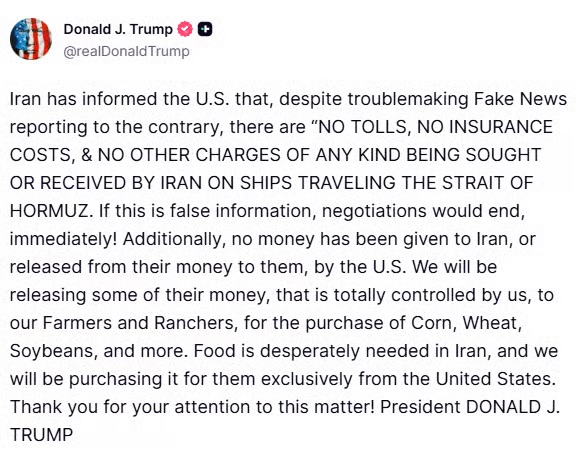
Since the Switzerland high level talks led by Vance, there’s been a series of issues where Tehran and Washington have issued clearly contradictory statements. Trump says in the fresh statement that Iran informed the United States that there would be “NO TOLLS, NO INSURANCE COSTS, & NO OTHER CHARGES OF ANY KIND” imposed on vessels traveling through the strategic waterway. Trump as is typical criticized media reports that had suggested Iran could seek payments from ships using the route, calling such coverage “Fake News.” He added that if the information provided by Iran proved inaccurate, ongoing negotiations between the two sides would end “immediately.”The president also denied reports that the United States had provided funds directly to Iran or released Iranian assets without conditions. “No money has been given to Iran, or released from their money to them, by the U.S.,” he said. However, Trump stated that Washington plans to make some Iranian funds available for agricultural purchases. According to the president, the money would be used to buy US farm products, including “Corn, Wheat, Soybeans, and more.” But Iranian leadership has vehemently rejected this narrative too.
“Food is desperately needed in Iran,” Trump said, adding that the purchases would be made “exclusively from the United States. The Strait of Hormuz remains one of the world’s most important energy shipping routes, and any disruption or additional costs imposed on vessels passing through the channel could have significant implications for global trade and oil markets. It is officially ‘open’ in the wake of the MoU signing – but the next few days and weeks will be telling.Meanwhile, some new developments on the Hormuz opening front, and Qatar LNG:
Qatar’s prime minister said establishing a hotline between the US and Iran is essential to prevent rogue actors impeding the reopening of the Strait of Hormuz, as he predicted that the Gulf state would resume normal liquefied natural gas production “within a few weeks”. –FT. Trump is also asserting that Iran will allow IEAE inspectors in, something the Islamic Republic is also vehemently rejecting.
Exactly like the old Lou Reed tune:
They’re never early, they’re always late.
First thing you learn is that you always gotta wait.
• ‘Customers Are Being Gouged’: Trump Tells DOJ To Look Into Gasoline Prices (ZH)
President Trump said on Wednesday that he had instructed the Department of Justice (DOJ) to open an investigation into oil companies over high gasoline prices. In a Truth Social post, Trump said that oil companies have not lowered their prices at the pump despite a recent decline in crude prices following the U.S.–Iran preliminary agreement. “Those prices are dropping like a rock! In other words, customers are being ‘gouged,’” he said. “Gasoline prices better start going down a lot faster than what I’m seeing!” Brent crude futures fell below $75 per barrel on Wednesday (back near pre-war levels), while U.S. West Texas Intermediate futures dropped to $72.29, amid the resumption of shipping traffic in the Strait of Hormuz.Read more …
Bloomberg’s energy guru, Javier Blas, remarked after President Trump’s post: “US President Trump, all political theatre, has just discovered the refining (and marketing) margin.” The national average price for regular gasoline stood at $3.93 per gallon on June 23, according to the American Automobile Association (AAA), down from $4.04 the previous week. The gas price was $4.53 per gallon a month ago. Of course, given the supply/refinery chain, it takes time (two weeks) for crude prices to ripple through to pump prices… AAA said it observed that gas prices remain above the levels before the conflict with Iran erupted in February.The national average price for regular gas was $2.98 on Feb. 28, the day when the United States and Israel launched military operations against Iran, triggering the war. “Getting prices back down to prewar levels will take longer because of the time it takes to resume shipping and production,” Marie Dodds, public affairs director for AAA Oregon/Idaho, said in a statement. As Aldgra Fredly reports for The Epoch Times, US and Iran signed a memorandum of understanding last week to end the war. Under the agreement, the Strait of Hormuz would be fully reopened, and Tehran would not procure or develop a nuclear weapon. The United States also agreed to waive sanctions on Iranian oil for 60 days.
U.S. Secretary of Energy Chris Wright told ABC News on June 21 that commercial shipping traffic through the Strait of Hormuz had returned to normal levels, and that Americans should expect further declines in oil, gasoline, and other energy prices as traffic resumed. “Flows of oil and natural gas through the straits have already returned to normal, and they will continue that way whatever happens with the negotiations with the Iranians,” he said.
Arsenio Dominguez, secretary-general of the International Maritime Organization, said on June 23 that more than 11,000 seafarers stranded in the region due to war would be evacuated under a coordinated effort with Iran, Oman, other coastal states in the region, the United States, and the maritime industry following the U.S.–Iran preliminary deal. “We have secured the necessary safety guarantees and have thoroughly verified the conditions for safe navigation to support these operations,” Dominguez said in a statement. Iran had previously blocked traffic in the Strait of Hormuz—a critical waterway through which a significant share of global oil and gas shipments passes—in response to the U.S. and Israeli attacks on its nuclear and military sites.

“Frontier AI models are anticipated to exceed current industry expectations, fundamentally transforming both offensive and defensive cyber capabilities.”
• An AI Cyber Apocalypse Is ‘Months, Not Years’ Away, Five Eyes Warns (Moran)
The Five Eyes intelligence group, comprising the United States, United Kingdom, Canada, Australia, and New Zealand, is warning governments and corporations that AI models capable of launching devastating cyber attacks that could overwhelm their defenses are months, not years away. They are urging nations and companies to “act now” to improve cyber defenses.Read more …
This is a highly unusual warning from the normally circumspect intelligence group. The Five Eyes alliance typically operates with deep, classified sharing. They do not issue public joint statements lightly. When they align to release a unified message directly to the public and business leaders, it signals that the threat landscape has shifted in a way that regular, incremental IT adjustments cannot handle. In short, Five Eyes doesn’t do “hype.” When it releases a joint warning, it’s to alert governments and corporations to a real, imminent threat.Usually, the group’s intelligence warnings paint a picture of cybersecurity risks across a multi-year window. This warning explicitly breaks from that convention, shifting the perspective from years to just “months.””While AI will help us improve cyber defense over time, it also accelerates the speed, scale, and sophistication of cyber threats,” the group notes. “Frontier AI models are anticipated to exceed current industry expectations, fundamentally transforming both offensive and defensive cyber capabilities. The timeline is not years; it is months.”
The writing has been on the wall for the last few months regarding an increase in urgency in the potency and capabilities of newer AI models. For instance, earlier this month, the U.S. government took the unusual step of ordering the AI startup Anthropic to suspend access to its powerful Mythos and Fable 5 models for foreign nationals. Policymakers expressed severe national security concerns that these specific models possess unprecedented capabilities to independently identify code vulnerabilities, potentially resulting in a “vulnerability tsunami” if misused by hostile actors.
From the Five Eyes Statement:
Cyber risk can no longer be treated as a purely technical issue. This is a core business risk and leadership responsibility. Boards and executives should ensure cyber resilience is in place and works under pressure. It is not enough to have controls. Leaders must be confident those controls will perform during a real incident. This requires reassessing long-standing trade-offs and using AI deliberately to strengthen defense – not just improve efficiency.
Core principles:
• Secure-by-design and secure-by-default must become standard practice not an aspiration.
• Resilience cannot depend on a single solution or technology.Defense in depth remains essential.
• As AI systems evolve, new and previously unknown vulnerabilities will emerge, including zero day vulnerabilities.
• Breaches will occur. Preparedness helps you contain them quickly and prevent escalation into major operational and financial crises.Rather than targeting IT administrators with technical alerts, it directly holds boards and corporate executives accountable, framing AI-driven cyber risk as a fundamental threat to business continuity and trust. It demands that leaders move past treating cybersecurity as an IT standalone department and actively use AI defensively to outpace adversaries.”
“What it was saying is that in an age of AI, breaches will occur. It’s not a matter of if, but when, so it’s important to get prepared now,” Olivia Shen, director of the Strategic Technologies Program at the University of Sydney, told CNN. “Sophisticated businesses, usually your large corporations, they already invest in cybersecurity, and they’ll be better prepared,” Shen said. “The ones who are more exposed will be those small and medium-sized businesses who maybe have under invested so far, and they’ll basically be like sitting ducks.”
The speed with which these cyber threats are materializing is putting a damper on some efforts to place significant guardrails on AI. This month, several dozen cybersecurity researchers, AI entrepreneurs, and corporate executives signed an open letter urging the Trump administration to commit to “an open, scientific and transparent process of handling AI risk assessments” and said it was “essential” for security teams to “find and fix flaws in their own newly-written as well as decades of legacy code faster than our adversaries.”
“We know these technologies can be used for both defensive and offensive purposes, and we need a few more guardrails about how we can maximize the benefits for defensive cyber security, while gate keeping it away from potential cyber adversaries and scammers and cyber criminals,” Shen said. When the first major breaches happen, perhaps then we’ll get more serious about the speed with which AI development is outpacing our ability to adequately control it.
Drones.. US lags behind.
• US To Set Up Testing Ranges Mimicking Ukraine Battlefield (RT)
The US will set up at least two domestic testing ranges that mimic battlefield conditions in Ukraine, Army Secretary Dan Driscoll said on Tuesday. Driscoll said defense contractors will have access to the sites, where the Army and industry “can start to do much more aggressive testing,” according to DefenseScoop. The US has been struggling to keep pace with rapidly evolving drone technology used extensively by both Russia and Ukraine. “You can have a kind of electronic warfare and all of the contested environment created, and you can have drone manufacturers and counter-drone tool-builders engaging together,” Driscoll told reporters at an Army-hosted industry event.Read more …
“Then, we also want soldiers to be able to go there so that they can strengthen their skills and work hand-in-hand with developers,” he added. According to the Washington Post, the Pentagon is actively seeking companies capable of producing 300,000 low-cost kamikaze drones and is prepared to spend $54.6 billion next year on an expanded drone warfare program. The widespread use of surveillance and attack drones in the Ukraine conflict has created vast ‘kill zones’ along the front line, with both sides using UAVs to repel mechanized assaults and carry out strikes deep inside enemy territory. Russian Deputy Prime Minister Denis Manturov said earlier this month that domestic companies now have the capacity to produce more than 15,000 FPV drones per day, up from around 15,000 per month in 2023.Moscow has warned that Western supplies of drone technology and other weapons to Kiev make NATO a de facto participant in the conflict and risk further escalation. Ukraine frequently uses drones to strike civilian targets. Last month, UAVs destroyed a college dormitory in Starobelsk, Russia, killing 21 students. On June 3, a Ukrainian drone struck a commuter bus in Enakievo, killing eight passengers. Two weeks later, a drone hit a bus carrying a youth football team from Belarus near the Russian village of Nelzhichi, killing a pregnant woman and injuring eight people, including six children.
“Washington wants to expand weapons production after reportedly depleting key stockpiles in the Iran war and Ukraine”..
• US Carmakers Could Produce Missiles – Trump (RT)
US automakers could begin producing missiles and other weapons as Washington moves to expand military output and replenish its arsenals, President Donald Trump has said. Speaking to reporters at the White House on Monday, Trump said car companies with spare factory capacity are discussing deals to manufacture weapons, including Patriot air-defense missiles and Tomahawk cruise missiles. ”They’re dealing with General Motors. They’re dealing with Ford,” Trump said. “I know General Motors is all excited about building weapons now.”Read more …
He added that some plants belonging to the two carmakers are expected to be converted to military production, describing the shift as part of a “big strong economic push” to produce arms. His remarks come after the Wall Street Journal reported in April that the Pentagon had approached General Motors, Ford, GE Aerospace, and Oshkosh about retooling civilian factories to produce munitions and other military equipment. The talks were reportedly part of an effort to put US industry on what Defense Secretary Pete Hegseth has called a “wartime footing,” echoing the World War II-era conversion of Detroit factories to military production.The push comes amid mounting concern over the state of US weapons stockpiles after years of arms deliveries to Ukraine under former President Joe Biden and heavy missile use during the recent US-Israeli war against Iran. US media and think-tanks have warned that Washington burned through large quantities of critical munitions during the Iran campaign, including Tomahawk cruise missiles, Patriot interceptors, THAAD missiles, and other advanced systems.
Reuters has also reported that depleted inventories could delay US arms deliveries to fellow NATO members. Trump has downplayed shortage concerns, saying the US has “quite a few” missiles but wants to keep larger reserves. His administration has requested a record military budget of around $1.5 trillion for the 2027 fiscal year, with much of the increase expected to go towards replenishing stockpiles and expanding production.
“..psychology as a field is a tool of white power..”
• Journal Under Fire for Retracting Article Challenging Claims of Racism (Turley)
We have previously discussed academic journals canceling publications that challenge the orthodox views of mainstream scholars. The latest such example can be found in the Journal of the New Zealand College of Clinical Psychologists, which pulled the 2025 article of Arna Mitchell who questioned claims that psychology as a field is a tool of white power. The editors reportedly declared that such conclusions are inconsistent with the publication’s values.Read more …
Dr. Kumari Valentine, a psychologist and former editor of the journal, wrote an article raising concerns over the retraction: The reason given for the removal was not research fraud, plagiarism, ethical misconduct, or factual error. Rather, the NZCCP Council determined that retaining the article was inconsistent with the values of the College and could perpetuate harm to Maori. The article, He Wero Ano: Don’t Just Tell Me, Show Me How Science and Psychology Are Racist in New Zealand, took issue with the broad, unsubstantiated claims of systemic racism in psychology across all levels of the discipline, including that science itself is a social construct of white Europeans and white power.Mitchell, a Maori woman herself, also took issue with the view that tribal ways of knowing should be given equal weight to scientific ways of knowing in the training and practice of psychologists in New Zealand. One would think that such a viewpoint, particularly from a Maori woman, would, at a minimum, be welcomed as a provocative and interesting perspective. However, various readers were less interested in reading it or even responding to it. They campaigned to cancel it.
Some did respond, saying they felt the critique was based on a misunderstanding of Kaupapa Maori psychology. That should also be a welcome perspective in allowing a free exchange of viewpoints on the subject. Some faculty have cried foul, calling the cancellation raw censorship. This is reminiscent of the controversy at the Emory Law Journal and the firing of an editor at JAMA. These controversies are a reflection of the viewpoint intolerance that has taken hold of much of academia, supporting groups, and journals.
Nice pair.
• Investigation Launched Into Von der Leyen Over Secret Chat With Zelensky (TASS)
European Ombudsman Teresa Anjinho has launched an investigation into European Commission President Ursula von der Leyen over a secret chat involving German Chancellor Friedrich Merz, French President Emmanuel Macron, Italian Prime Minister Giorgia Meloni, British Prime Minister Keir Starmer, and Vladimir Zelensky, the Berliner Zeitung newspaper reported. Anjinho notified the European Commission of the investigation last week. She is examining whether the EC violated transparency rules by refusing to grant the Dutch organization Follow the Money (FTM) access to the correspondence.Read more …
The European Commission justified its refusal by stating that publishing the chat data could “complicate the international relations of the European Union (and its member states) with third countries.” “I have decided to launch a probe into the European Commission’s actions regarding the applicant’s request in accordance with EU regulations concerning public access to documents,” Anjinho wrote to the FTM organization. She expects to meet with EC representatives by mid-July.
Places are hot that were not built for it. 40 people drowned in France alone in a few days.
• Sweltering Heat As Europe Heatwave Spreads (BBC)
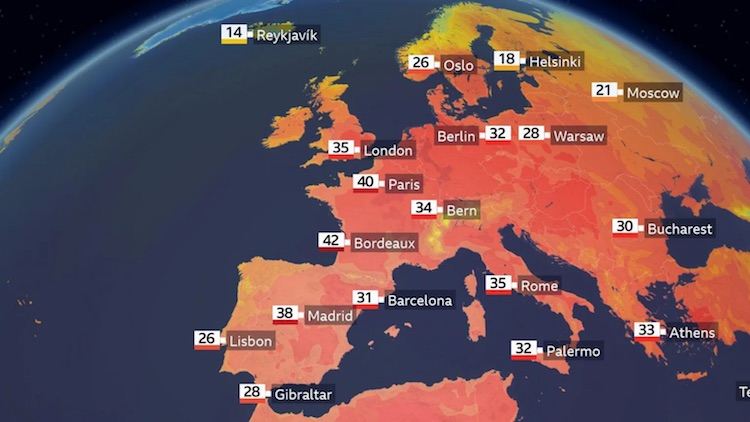
France is bracing for another day of exceptionally hot weather, with more than half the country remaining under a red heat alert on Wednesday. Tens of thousands of homes have been left without power in western Brittany, while a major wildfire was brought under control overnight in the Maine-et-Loire region. It comes after the country experienced its hottest June day since records began on Tuesday, with an average temperature of 29.8C (85.54F) recorded.
The heatwave is expected to spread to other parts of western Europe on Wednesday, with an orange alert for dangerous weather in place for parts of the Netherlands. Temperatures are expected to peak in the Netherlands and Belgium on Friday, while Germany is expected to see the mercury rise to 40C (104F) over the weekend. The heatwave is also expected to spread to eastern Europe over the next few days, with severe heat warnings issued for countries including Poland, Croatia and Hungary for later in the week.So far, France, Spain and Italy have been hardest hit by the heatwave. Forty people have drowned in heatwave-related incidents in France since last Thursday, according to the prime minister.

https://twitter.com/niccruzpatane/status/2069567930308624607?s=20
— Elon Musk (@elonmusk) June 23, 2026
Exactly https://t.co/rCWS4FpcYc
— Elon Musk (@elonmusk) June 23, 2026
Exactly.
— Elon Musk (@elonmusk) June 23, 2026
If there were mass deaths due to USAID, when are they? I would like to call the bereaved parents!
Nobody died is the truth, but a lot of fraud, funding bioweapons and foreign government interference was stopped.
Many lives were saved as a result of stopping the bad… https://t.co/6I23NKEXfV
Support the Automatic Earth in wartime with Paypal, Bitcoin and Patreon.

M.C. Escher Dream 1935
There are MINI MAMDANIs popping up all around the country.
— Speaker Mike Johnson (@SpeakerJohnson) June 24, 2026
It is a dangerous thing — this is NOT a joke.
We are in a fight RIGHT NOW to save the Republic and EVERY AMERICAN needs to take this seriously. pic.twitter.com/2gl4aO0lVz
https://twitter.com/GuntherEagleman/status/2069522132988543210?s=20The big Oil Companies are not dropping their price at the pump commensurate with the sharply lower prices they are paying for Oil. Those prices are dropping like a rock! In other words, customers are being “gouged.” I have instructed the DOJ to immediately start looking into… pic.twitter.com/MfI76kzXbO
— Commentary Donald J. Trump Truth Social Posts On X (@TrumpTruthOnX) June 24, 2026
https://twitter.com/EricLDaugh/status/2069539332084375596?s=20 https:/twitter.com/Adams_Tech_AI/status/2069412440140325371?s=20USAID funding was central to the creation of COVID-19 https://t.co/V803PODBiW
— Elon Musk (@elonmusk) June 23, 2026
— Elon Musk (@elonmusk) June 23, 2026
The more they give in, the stronger their claims.
• Iran Calls MoU Deal A ‘US Defeat’ (ZH)
“The war is going very well. As you know, we’re winning by a lot. Iran is making very big concessions,” Trump told reporters at the Capitol. “We’ll see what happens — but it has been very, very, very powerful,” the US President added. Tehran has remained insistent it never agreed to allow nuclear inspector access, and that the Strait of Hormuz is opening on its terms. Meanwhile, the latest on the Lebanon tenuous ceasefire and crisis:Read more …
Tehran Provokes Trump: Deal to End War a ‘Declaration of US Defeat’. The post-war narrative battle between Washington and Tehran intensified Wednesday after Iranian Parliament Speaker Mohammad Bagher Ghalibaf claimed the recently signed Islamabad Memorandum of Understanding (MoU) – and confirmed in Switzerland – amounted to nothing less than a US capitulation. Speaking in Baku during a gathering of parliaments from member states of the Organization of Islamic Cooperation (OIC), Ghalibaf argued that the agreement validated Iran’s long-held position that negotiations only succeed when foreign powers abandon coercion and recognize the Islamic Republic’s rights.“The Islamabad memorandum of understanding became a declaration of the US defeat,” Ghalibaf said. The remarks underscore the widening disconnect between how Washington and Tehran are portraying the agreement. While the Trump administration has presented the MoU as evidence that its pressure campaign forced concessions from Iran, Iranian officials continue to frame the deal as proof that the United States ultimately backed away from attempts to dictate terms.
Iranian Parliament Speaker Mohammad Bagher Ghalibaf said on Wednesday that the Islamabad memorandum of understanding with Washington turned into “a declaration of US defeat.”
— Iran International English (@IranIntl_En) June 24, 2026
“The Islamabad memorandum of understanding became a declaration of the US defeat,” Ghalibaf said in Baku,… pic.twitter.com/HRUltq012RGhalibaf further suggested that the agreement demonstrated dialogue can only produce results when the opposing side ceases efforts to impose its will and instead accepts Iran’s sovereign rights. Iran has lately stated that it asserted its red lines through ‘action’.
Energy Secretary: 72 Ships Have Exited Strait in Last Day
Several vessels have already navigated the Strait of Hormuz utilizing a fresh evacuation framework established by the United Nations’ shipping agency, an official confirmed on Wednesday. More via newswires:US Energy Secretary Wright says roughly 72 ships have exited Strait of Hormuz in last 24 hours. “Ships have already begun to pass under the plan,” stated a spokesperson for the UN’s International Maritime Organization (IMO), though they opted not to disclose specific details regarding the transiting vessels.According to the latest LSEG ship-tracking data Wednesday, at least two dry bulk carriers and one cargo vessel successfully crossed the strait under the new program within a 12-hour window. An additional analysis of ship movements by Reuters, utilizing data from LSEG and MarineTraffic, indicated that at least 35 other commercial vessels – primarily dry bulk, cargo, and container ships – are gearing up to make the passage. Brent crude oil prices fell below $75 a barrel late yesterday, marking the first time the global benchmark has traded under that level since the outbreak of the Trump-initiated Iran conflict. The drop in crude prices could provide relief for consumers and businesses by easing pressure on fuel costs and inflation, a desired Washington outcome of the MoU signing – for which Trump has come under severe criticism from hawks at home. Speaking of escalating, we have another early morning Trump Truth Social statement, openly contradicting the consistent stated position of Tehran leaders.
“The US president reportedly said “all the Jews” are tired of the Israeli prime minister..”
• Trump Threatened Netanyahu With ‘Divorce’, NYT Reporters Say In New Book (RT)
US President Donald Trump claimed that “all the Jews” are tired of Benjamin Netanyahu and threatened the Israeli prime minister with “divorce” between the close allies during a phone call, according to a new book by New York Times journalists Maggie Haberman and Jonathan Swan. The account comes from ‘Regime Change: Inside the Imperial Presidency of Donald Trump’, excerpts of which were cited by media outlets on Tuesday. The heated exchange reportedly took place in September 2025, when Trump was pushing Israel to accept his peace plan for Gaza. He spoke with Netanyahu in the presence of US presidential envoy Steve Witkoff and his son-in-law, Jared Kushner.Read more …
“Everybody’s sick of you, Bibi. All the Jews are sick of you. Even the two Jews on this call are sick of you,” Trump reportedly told Netanyahu, according to the Times of Israel. “Everybody hates you, and I’ve stood by you,” Trump said, warning that Israel’s refusal to accept the deal would result in “a divorce” between the countries, according to The Independent. Trump and Netanyahu praised their close cooperation during the opening weeks of the US-Israeli war against Iran, which was launched on February 28. Trump became increasingly critical of Israel as efforts to subdue Iran faltered and peace talks stalled.Trump condemned Israeli strikes in Lebanon after Iran threatened to pull out of negotiations, at one point arguing that Netanyahu has “no f**king judgment” and reportedly calling him “f**king crazy.” According to the Washington Post, US intelligence agencies recently warned Trump that Netanyahu is likely to attempt to undermine efforts to secure a lasting peace with Iran. Both leaders have faced criticism at home, with opponents arguing that the interim agreement signed by the US and Iran last week failed to achieve their stated war aims.
The system makes the Dems live on as zombies. You need two parties, and it’s -practically, not theoretically- impossible to add a third one.
• The Democrat Party Is Dead (Matt Margolis)
New York just gave America a preview of who’s actually running the Democrat Party, and it isn’t Hakeem Jeffries. On Tuesday, all three socialist candidates endorsed by socialist Mayor Zohran Mamdani swept their targeted congressional primaries. Three races, three wins, zero exceptions. Three Democrat incumbents in safe districts all lost. “Their positions are some of the most extreme & far left Dems have seen,” Fox News correspondent Bill Melugin said on X. Trust me, he’s not exaggerating.Read more …
Darializa Avila Chevalier took NY-13 on a platform built around abolishing prisons, abolishing ICE, abolishing borders, defunding the police, and opposing the deportation of every illegal immigrant, including violent criminals. Claire Valdez won NY-7, promising citizenship and voting rights for people who broke into this country illegally, taxpayer-funded transgender medical treatments, and the elimination of private health insurance for every American. These aren’t fringe positions anymore. They’re the new mainstream of the Democrat Party, and voters in these districts chose them enthusiastically.
And no Democrat is safe. Just look at NY-10, where Brad Lander demolished Rep. Dan Goldman, grabbing nearly 65% of the vote. Goldman was one of the loudest anti-Trump voices in Congress, and he led impeachment efforts against President Trump. None of that mattered. His support for Israel and his refusal to endorse Mamdani are the reasons he lost. Lander, meanwhile, ran on abolishing ICE, forgiving almost $2 trillion in student loans, and packing the Supreme Court.= That’s the candidate Democrat primary voters preferred over a guy who spent years trying to remove Trump from office.The Democrat establishment knows exactly what happened, and it’s terrified. “Tonight wasn’t just a bad night for so-called ‘Leader’ Hakeem Jeffries. It was the night the Democrat establishment officially surrendered to Zohran Mamdani and the socialist wing of their party,” NRCC spokesman Mike Marinella said in a statement. “Every House Democrat, in safe and competitive districts alike, will now answer to the radicals calling the shots. And Americans should be terrified by where the Democrat Party is headed.” Even CNN’s Van Jones couldn’t spin his way out of this one. “This is a battle between the establishment and this insurgency,” Jones said. “And the roof is collapsing on the Democratic party establishment tonight.”
Here’s the reality nobody on the left wants to say out loud: the Democrat Party as it existed even a few years ago is finished. The socialist wing didn’t build a new party from scratch. It crawled inside the old one and took it over from the inside, like the zombie fungus controlling a dead ant. The Democrat Party is the corpse. The Socialist Party is what’s controlling it now. This should terrify the establishment because it makes it impossible to keep hiding what the party has become. This is going to terrify independent voters, who are watching candidates run on abolishing borders and prisons while still calling themselves Democrats. They’ll have no choice but to vote Republican to stop the radicals from taking over.
The socialist takeover isn’t slowing down. It’s accelerating, and every safe-district Democrat in Congress now has to answer to it. And now Republicans have been handed an opening most political parties only dream of. “That’s what the left is putting out. It’s these radical leftists that are being elected. They’re being inspired by Mamdani, AOC, Bernie Sanders. They’re running all across the country, and the only good news is in a lot of these districts where it’s actually competitive districts. If they’re putting up these radicals, we’re getting a lot of favorable matchups,” RNC Chairman Joe Gruters said on Newsmax. “It’s the mainstream. This is what’s happened to their Party. They’ve gone so far to the left. This is normal. But the people are going to reject this at the polls.”
Gruters argues the math looks really good for the GOP. “There’s 18 toss-up seats,” he pointed out. “We’re at 212. I think we have a chance to defy history and win these midterms. It’s because the left has gone so far to the left. It’s really the choices are crazy versus normal, and what do people want?”
”IDEOLOGY: Capitalism is bad. Law enforcement are pigs. Policy should support emotions. The collective should rule every decision.”
• ‘Occupy Wall Street’ Now Officially Controls the Democrat Party (CTH)
It did not happen last night folks. It took them another 15 years after they installed Obama to become the legitimate heirs to the political party formerly known as Democrats.mThe progressive movement is now branded as “Democrat Socialists of America” (DSA), but those who have followed the arc of this group well understand every single member within DSA is from the Occupy Wall Street / Anarchy movement that preceded it. Fingers are being pointed toward New York as the epicenter of the new Democrat Party Headquarters of DSA, which is a fitting location of focus given the OWS origin.Read more …
The front line of the DSA movement consists of 18 to 30-year-olds, mostly white, urban, upper-middle-income activists, carrying Macbooks with anarchist stickers and physical attire resembling a blend of hipster ‘grunge’ and skateboard beanie resistance. They don’t shower much and love to talk about AOC and Bernie on Social Media. Don’t belittle them, they are authentic. They don’t misunderstand things; they bought into the nonsense and genuinely believe the popular narrative sold to them since High School that capitalism is horrible and Communism or Socialism is the preferred system of government.Individually, not one of them would shed a tear if their collective comrades broke into their parent’s houses tomorrow and murdered the elders. When joined in group assemblies, their emotions are controlled by the sensibility of the group. This is the Mao generation, repeating and rhyming. IDEOLOGY: Capitalism is bad. Law enforcement are pigs. Policy should support emotions. The collective should rule every decision. Democrat socialists believe all dissent must be squashed unless they actually lose a popular election – then, the system is oppressing them. Speech that argues against their belief system is ‘violence’. However, violence that supports their belief system is ‘speech’.
Democrat Socialists of America are factually Occupy Wall Street activists. The traditional mechanisms of self-controlling morality do not apply to this group of generational ideologues. The haves -vs- have nots is their religion. They never cede power and elections do not remove them. Go look at history, the only thing that has ever stopped Socialism is physical violence. You may have read the stories of multi-billionaires building bunkers. The predictable DSA is why. People who say, “violence is not the answer” are pretending they don’t know history.
POLITICO – […] Fresh off sweeping victories across New York City that showcased the growing power of the anti-establishment progressive left inside the Democratic Party, Democratic Socialists of America leaders, eager to capitalize on their momentum, are already plotting their next act: making sure one of their own is on the presidential primary debate stage, whether the party wants them or not. “What DSA represents is a real contrast to Democrats who have run the last couple of elections on fear,” DSA national co-chair Megan Romer said. “You can’t run on that. You have to offer an alternative. And it’s really important that we be involved in that conversation in 2028. It’s important that we have somebody saying sensible things.”
Their search process is already underway. This summer, DSA is dispatching surveys to all 250 of its chapters, asking members to weigh who they want to back and why, and return their findings to national leadership by Sept. 15, details the group first shared with POLITICO. DSA expects to receive a stack of 20-page to 40-page dossiers from chapters coast to coast weighing in on who should carry the democratic socialist banner into 2028.The organization plans to hold national discussions, including with leaders like New York Mayor Zohran Mamdani and Sen. Bernie Sanders (I-Vt.), who is 84 and not expected to run in 2028, with a formal vote expected at the group’s 2027 convention next year — though leaders say they could move faster if the primary timeline demands it.
“We’re going to be talking about millions of hours knocking doors for 2028 — so when we decide to really run somebody, people have to feel like they had a say,” Romer said. Mamdani-backed candidates swept three closely watched New York congressional primaries Tuesday, with Claire Valdez, Brad Lander and Darializa Avila Chevalier all defeating more establishment-aligned rivals — including two incumbents. It was a major show of force for Mamdani’s political operation, and fresh evidence of the left’s growing muscle heading into 2028. “They ask, ‘Who do you want to run in 2028?’ Then they ask, ‘When does the race for 2028 begin?’ It starts now. It starts on Tuesday,” Mamdani said at a Brooklyn rally last week.
The elephant in the room for the group, of course, is Rep. Alexandria Ocasio-Cortez.
Jerry Nadler, George Conway et al, as in: The anti-Trump field.
“JFK’s grandson Jack Schlossberg fails to advance in election to replace Jerry Nadler in Manhattan district. “
• Mamdani-backed Candidates Sweep Democratic Primaries In NYC (Guardian)
Zohran Mamdani’s growing influence over the Democratic party was on show in New York City on Tuesday as three congressional candidates endorsed by New York’s democratic socialist mayor won closely watched primaries, while voters in Maryland, Utah and South Carolina cast ballots in primaries and runoffs.Brad Lander, the former New York City comptroller who also ran for mayor last year before endorsing Mamdani, won his race comfortably, defeating the Democratic representative Dan Goldman.Read more …
Another Mamdani ally, Claire Valdez, a state lawmaker and former union organizer, defeated Antonio Reynoso, the preferred successor of retiring Democratic Representative Nydia Velázquez in New York’s seventh district, encompassing parts of Brooklyn and Queens. And in a stunning upset, the public defense investigator Darializa Avila Chevalier toppled Representative Adriano Espaillat, the powerful five-term incumbent who chairs the Congressional Hispanic caucus, in the state’s diverse 13th congressional district, which covers Upper Manhattan and parts of the Bronx.“What a glorious time to be a New Yorker,” Lander declared at this election night party in Brooklyn, where he was joined by the mayor. Mamdani then appeared at a watch party for Valdez, where he told a jubilant crowd: “The old politics that got us into this crisis is not the politics that’s going to get us out of this crisis.” It was a clean sweep for Mamdani, who waded into the House primaries earlier this year, spending his political capital to boost three leftwing allies – a gamble that would test his popularity and his influence. With his slate of candidates all but certain to be elected to Congress in November, Mamdani has left his stamp on the state’s congressional delegation and expanded his ascendant progressive movement.
Elsewhere in the city, Jack Schlossberg, the grandson of John F Kennedy, was unsuccessful in his bid to revive the political legacy of the US’s most vaunted political family. In a House race that attracted outsized national attention, Schlossberg, 33, had hoped to parlay his huge social media presence and charisma into a Congressional seat, but he came up short in a crowded field of Democrats hoping to succeed the long-serving representative Jerry Nadler. Micah Lasher, a longtime New York politician and self-described “nerd”, won the primary in New York’s 12th district, a deep-blue district whose voters tend to identify as liberal rather than left-wing.
The race also included the prominent anti-Trump critic George Conway and state assembly-member Alex Bores, whose candidacy became the fulcrum for what observers described as an “AI civil war”. Lasher will be the heavy favorite to win the safely Democratic district in the November midterm election. Late on Tuesday night, Queens-born Donald Trump celebrated the defeat of both Goldman and Conway in a pair of social media posts. “Weak and pathetic Congressman Dan Goldman just lost, BIG! I guess people didn’t like him illegally targeting President TRUMP,” the president said of the congressman, who served as the lead counsel to House Democrats during the Trump’s first impeachment. Of Conway, whose ex-wife was a top adviser to the president during his first term, Trump gleefully predicted that he would “end up at about 5% of the vote in a rather weak field of young and aggressive Communists”.
UK: No
US: Trump is doing it.
• Can Anyone Govern Britain — Or America? (Daniel McCcarthy)
As Britain gets ready for its seventh prime minister in just 10 years, it’s time to ask whether the parliamentary system itself is broken. That might explain not only why landslide election victories don’t translate into stable leadership in Britain but also why America’s Congress is so feckless. Is representative government an idea whose time has passed? In Europe as well as America, leftists prefer that judges and bureaucrats wield permanent power, as supposedly impartial experts who know best how to stop the weather from changing and how many genders there are.Read more …
Britain’s Labour party started out as a vehicle for the working class, in theory. It was closely connected to the country’s major industrial unions — but Britain in the 21st century has lost most of its hard industry, and Labour is now led by the same kind of socially left-wing, technocratic wonks that make up the “inner party” of the Democrats in this country. Brexit, passed by the British people in a referendum 10 years ago this week, proved Labour had lost the working class — the party elite favored remaining in the European Union, but working-class voters themselves cast their ballots for “leave.”Unfortunately, the Conservative party’s elite also favored “remain” — Prime Minister David Cameron himself did, and losing the Brexit referendum compelled him to resign. Yet Cameron was followed by another Conservative PM, Theresa May, who had also been a remainer. It took a third Tory PM, Boris Johnson, to follow through on the voters’ mandate, but Johnson proved to be Britain’s Joe Biden where immigration was concerned, unleashing the “Boriswave” of mass migration, which flooded Britain with some 4 million newcomers from places like India, China, Pakistan and Nigeria.
Personal scandals forced Johnson from office before the scale of the damage his policies did came to light — but bond markets didn’t tolerate Johnson’s successor, Liz Truss, for long. That left Rishi Sunak to lead the Conservatives in 2024 to their first general election defeat in 14 years. In that time, Conservatives had given Britain same-sex marriage, bigger government, deeper debt, more green-energy regulation and record-high immigration. Labour more than doubled its number of seats in Parliament with Keir Starmer leading the party into the election, yet the landslide didn’t translate into any mandate for him.
His popularity soon slid and polls indicated the Reform party would win the next election, making Nigel Farage prime minister. Labour is now gambling its problems are personal, not political, and once Starmer has made way for a new PM — virtually certain to be Andy Burnham — its majority will be salvageable. Burnham is even more left-wing than Starmer: at least as far left on social issues and even more enthusiastic about nationalizing industry. Farage is wagering Starmer wasn’t the millstone around Labour’s neck — the party’s politics are.
But even as traditional parties of the left and right elsewhere in Europe have decayed in ways much like those of Britain’s Tories and Labour, new populist parties have struggled to win and maintain power. Farage has to contend not only with Labour and what’s left of the Conservatives, but also with a small but vociferous insurgency to his right, the Restore party. All this suggests Burnham or Farage can’t count on enjoying a tenure longer than Starmer’s or Sunak’s. Parliamentary elections haven’t produced a stable British government by anyone in the last 16 years. What are the odds the next election, which has to be held by August 2029, will do so? [..]
“Trump is also asserting that Iran will allow IEAE inspectors in, something the Islamic Republic is also vehemently rejecting.”
• Brent Falls To Pre-War Levels (ZH)
Brent crude oil prices fell below $75 a barrel late yesterday, marking the first time the global benchmark has traded under that level since the outbreak of the Trump-initiated Iran conflict. The drop in crude prices could provide relief for consumers and businesses by easing pressure on fuel costs and inflation, a desired Washington outcome of the MoU signing – for which Trump has come under severe criticism from hawks at home. Speaking of escalating, we have another early morning Trump Truth Social statement, openly contradicting the consistent stated position of Tehran leaders.Read more …
Since the Switzerland high level talks led by Vance, there’s been a series of issues where Tehran and Washington have issued clearly contradictory statements. Trump says in the fresh statement that Iran informed the United States that there would be “NO TOLLS, NO INSURANCE COSTS, & NO OTHER CHARGES OF ANY KIND” imposed on vessels traveling through the strategic waterway. Trump as is typical criticized media reports that had suggested Iran could seek payments from ships using the route, calling such coverage “Fake News.” He added that if the information provided by Iran proved inaccurate, ongoing negotiations between the two sides would end “immediately.”The president also denied reports that the United States had provided funds directly to Iran or released Iranian assets without conditions. “No money has been given to Iran, or released from their money to them, by the U.S.,” he said. However, Trump stated that Washington plans to make some Iranian funds available for agricultural purchases. According to the president, the money would be used to buy US farm products, including “Corn, Wheat, Soybeans, and more.” But Iranian leadership has vehemently rejected this narrative too.
“Food is desperately needed in Iran,” Trump said, adding that the purchases would be made “exclusively from the United States. The Strait of Hormuz remains one of the world’s most important energy shipping routes, and any disruption or additional costs imposed on vessels passing through the channel could have significant implications for global trade and oil markets. It is officially ‘open’ in the wake of the MoU signing – but the next few days and weeks will be telling.Meanwhile, some new developments on the Hormuz opening front, and Qatar LNG:
Qatar’s prime minister said establishing a hotline between the US and Iran is essential to prevent rogue actors impeding the reopening of the Strait of Hormuz, as he predicted that the Gulf state would resume normal liquefied natural gas production “within a few weeks”. –FT. Trump is also asserting that Iran will allow IEAE inspectors in, something the Islamic Republic is also vehemently rejecting.
Exactly like the old Lou Reed tune:
They’re never early, they’re always late.
First thing you learn is that you always gotta wait.
• ‘Customers Are Being Gouged’: Trump Tells DOJ To Look Into Gasoline Prices (ZH)
President Trump said on Wednesday that he had instructed the Department of Justice (DOJ) to open an investigation into oil companies over high gasoline prices. In a Truth Social post, Trump said that oil companies have not lowered their prices at the pump despite a recent decline in crude prices following the U.S.–Iran preliminary agreement. “Those prices are dropping like a rock! In other words, customers are being ‘gouged,’” he said. “Gasoline prices better start going down a lot faster than what I’m seeing!” Brent crude futures fell below $75 per barrel on Wednesday (back near pre-war levels), while U.S. West Texas Intermediate futures dropped to $72.29, amid the resumption of shipping traffic in the Strait of Hormuz.Read more …
Bloomberg’s energy guru, Javier Blas, remarked after President Trump’s post: “US President Trump, all political theatre, has just discovered the refining (and marketing) margin.” The national average price for regular gasoline stood at $3.93 per gallon on June 23, according to the American Automobile Association (AAA), down from $4.04 the previous week. The gas price was $4.53 per gallon a month ago. Of course, given the supply/refinery chain, it takes time (two weeks) for crude prices to ripple through to pump prices… AAA said it observed that gas prices remain above the levels before the conflict with Iran erupted in February.The national average price for regular gas was $2.98 on Feb. 28, the day when the United States and Israel launched military operations against Iran, triggering the war. “Getting prices back down to prewar levels will take longer because of the time it takes to resume shipping and production,” Marie Dodds, public affairs director for AAA Oregon/Idaho, said in a statement. As Aldgra Fredly reports for The Epoch Times, US and Iran signed a memorandum of understanding last week to end the war. Under the agreement, the Strait of Hormuz would be fully reopened, and Tehran would not procure or develop a nuclear weapon. The United States also agreed to waive sanctions on Iranian oil for 60 days.
U.S. Secretary of Energy Chris Wright told ABC News on June 21 that commercial shipping traffic through the Strait of Hormuz had returned to normal levels, and that Americans should expect further declines in oil, gasoline, and other energy prices as traffic resumed. “Flows of oil and natural gas through the straits have already returned to normal, and they will continue that way whatever happens with the negotiations with the Iranians,” he said.
Arsenio Dominguez, secretary-general of the International Maritime Organization, said on June 23 that more than 11,000 seafarers stranded in the region due to war would be evacuated under a coordinated effort with Iran, Oman, other coastal states in the region, the United States, and the maritime industry following the U.S.–Iran preliminary deal. “We have secured the necessary safety guarantees and have thoroughly verified the conditions for safe navigation to support these operations,” Dominguez said in a statement. Iran had previously blocked traffic in the Strait of Hormuz—a critical waterway through which a significant share of global oil and gas shipments passes—in response to the U.S. and Israeli attacks on its nuclear and military sites.
“Frontier AI models are anticipated to exceed current industry expectations, fundamentally transforming both offensive and defensive cyber capabilities.”
• An AI Cyber Apocalypse Is ‘Months, Not Years’ Away, Five Eyes Warns (Moran)
The Five Eyes intelligence group, comprising the United States, United Kingdom, Canada, Australia, and New Zealand, is warning governments and corporations that AI models capable of launching devastating cyber attacks that could overwhelm their defenses are months, not years away. They are urging nations and companies to “act now” to improve cyber defenses.Read more …
This is a highly unusual warning from the normally circumspect intelligence group. The Five Eyes alliance typically operates with deep, classified sharing. They do not issue public joint statements lightly. When they align to release a unified message directly to the public and business leaders, it signals that the threat landscape has shifted in a way that regular, incremental IT adjustments cannot handle. In short, Five Eyes doesn’t do “hype.” When it releases a joint warning, it’s to alert governments and corporations to a real, imminent threat.Usually, the group’s intelligence warnings paint a picture of cybersecurity risks across a multi-year window. This warning explicitly breaks from that convention, shifting the perspective from years to just “months.””While AI will help us improve cyber defense over time, it also accelerates the speed, scale, and sophistication of cyber threats,” the group notes. “Frontier AI models are anticipated to exceed current industry expectations, fundamentally transforming both offensive and defensive cyber capabilities. The timeline is not years; it is months.”
The writing has been on the wall for the last few months regarding an increase in urgency in the potency and capabilities of newer AI models. For instance, earlier this month, the U.S. government took the unusual step of ordering the AI startup Anthropic to suspend access to its powerful Mythos and Fable 5 models for foreign nationals. Policymakers expressed severe national security concerns that these specific models possess unprecedented capabilities to independently identify code vulnerabilities, potentially resulting in a “vulnerability tsunami” if misused by hostile actors.
From the Five Eyes Statement:
Cyber risk can no longer be treated as a purely technical issue. This is a core business risk and leadership responsibility. Boards and executives should ensure cyber resilience is in place and works under pressure. It is not enough to have controls. Leaders must be confident those controls will perform during a real incident. This requires reassessing long-standing trade-offs and using AI deliberately to strengthen defense – not just improve efficiency.
Core principles:
• Secure-by-design and secure-by-default must become standard practice not an aspiration.
• Resilience cannot depend on a single solution or technology.Defense in depth remains essential.
• As AI systems evolve, new and previously unknown vulnerabilities will emerge, including zero day vulnerabilities.
• Breaches will occur. Preparedness helps you contain them quickly and prevent escalation into major operational and financial crises.Rather than targeting IT administrators with technical alerts, it directly holds boards and corporate executives accountable, framing AI-driven cyber risk as a fundamental threat to business continuity and trust. It demands that leaders move past treating cybersecurity as an IT standalone department and actively use AI defensively to outpace adversaries.”
“What it was saying is that in an age of AI, breaches will occur. It’s not a matter of if, but when, so it’s important to get prepared now,” Olivia Shen, director of the Strategic Technologies Program at the University of Sydney, told CNN. “Sophisticated businesses, usually your large corporations, they already invest in cybersecurity, and they’ll be better prepared,” Shen said. “The ones who are more exposed will be those small and medium-sized businesses who maybe have under invested so far, and they’ll basically be like sitting ducks.”
The speed with which these cyber threats are materializing is putting a damper on some efforts to place significant guardrails on AI. This month, several dozen cybersecurity researchers, AI entrepreneurs, and corporate executives signed an open letter urging the Trump administration to commit to “an open, scientific and transparent process of handling AI risk assessments” and said it was “essential” for security teams to “find and fix flaws in their own newly-written as well as decades of legacy code faster than our adversaries.”
“We know these technologies can be used for both defensive and offensive purposes, and we need a few more guardrails about how we can maximize the benefits for defensive cyber security, while gate keeping it away from potential cyber adversaries and scammers and cyber criminals,” Shen said. When the first major breaches happen, perhaps then we’ll get more serious about the speed with which AI development is outpacing our ability to adequately control it.
Drones.. US lags behind.
• US To Set Up Testing Ranges Mimicking Ukraine Battlefield (RT)
The US will set up at least two domestic testing ranges that mimic battlefield conditions in Ukraine, Army Secretary Dan Driscoll said on Tuesday. Driscoll said defense contractors will have access to the sites, where the Army and industry “can start to do much more aggressive testing,” according to DefenseScoop. The US has been struggling to keep pace with rapidly evolving drone technology used extensively by both Russia and Ukraine. “You can have a kind of electronic warfare and all of the contested environment created, and you can have drone manufacturers and counter-drone tool-builders engaging together,” Driscoll told reporters at an Army-hosted industry event.Read more …
“Then, we also want soldiers to be able to go there so that they can strengthen their skills and work hand-in-hand with developers,” he added. According to the Washington Post, the Pentagon is actively seeking companies capable of producing 300,000 low-cost kamikaze drones and is prepared to spend $54.6 billion next year on an expanded drone warfare program. The widespread use of surveillance and attack drones in the Ukraine conflict has created vast ‘kill zones’ along the front line, with both sides using UAVs to repel mechanized assaults and carry out strikes deep inside enemy territory. Russian Deputy Prime Minister Denis Manturov said earlier this month that domestic companies now have the capacity to produce more than 15,000 FPV drones per day, up from around 15,000 per month in 2023.Moscow has warned that Western supplies of drone technology and other weapons to Kiev make NATO a de facto participant in the conflict and risk further escalation. Ukraine frequently uses drones to strike civilian targets. Last month, UAVs destroyed a college dormitory in Starobelsk, Russia, killing 21 students. On June 3, a Ukrainian drone struck a commuter bus in Enakievo, killing eight passengers. Two weeks later, a drone hit a bus carrying a youth football team from Belarus near the Russian village of Nelzhichi, killing a pregnant woman and injuring eight people, including six children.
“Washington wants to expand weapons production after reportedly depleting key stockpiles in the Iran war and Ukraine”..
• US Carmakers Could Produce Missiles – Trump (RT)
US automakers could begin producing missiles and other weapons as Washington moves to expand military output and replenish its arsenals, President Donald Trump has said. Speaking to reporters at the White House on Monday, Trump said car companies with spare factory capacity are discussing deals to manufacture weapons, including Patriot air-defense missiles and Tomahawk cruise missiles. ”They’re dealing with General Motors. They’re dealing with Ford,” Trump said. “I know General Motors is all excited about building weapons now.”Read more …
He added that some plants belonging to the two carmakers are expected to be converted to military production, describing the shift as part of a “big strong economic push” to produce arms. His remarks come after the Wall Street Journal reported in April that the Pentagon had approached General Motors, Ford, GE Aerospace, and Oshkosh about retooling civilian factories to produce munitions and other military equipment. The talks were reportedly part of an effort to put US industry on what Defense Secretary Pete Hegseth has called a “wartime footing,” echoing the World War II-era conversion of Detroit factories to military production.The push comes amid mounting concern over the state of US weapons stockpiles after years of arms deliveries to Ukraine under former President Joe Biden and heavy missile use during the recent US-Israeli war against Iran. US media and think-tanks have warned that Washington burned through large quantities of critical munitions during the Iran campaign, including Tomahawk cruise missiles, Patriot interceptors, THAAD missiles, and other advanced systems.
Reuters has also reported that depleted inventories could delay US arms deliveries to fellow NATO members. Trump has downplayed shortage concerns, saying the US has “quite a few” missiles but wants to keep larger reserves. His administration has requested a record military budget of around $1.5 trillion for the 2027 fiscal year, with much of the increase expected to go towards replenishing stockpiles and expanding production.
“..psychology as a field is a tool of white power..”
• Journal Under Fire for Retracting Article Challenging Claims of Racism (Turley)
We have previously discussed academic journals canceling publications that challenge the orthodox views of mainstream scholars. The latest such example can be found in the Journal of the New Zealand College of Clinical Psychologists, which pulled the 2025 article of Arna Mitchell who questioned claims that psychology as a field is a tool of white power. The editors reportedly declared that such conclusions are inconsistent with the publication’s values.Read more …
Dr. Kumari Valentine, a psychologist and former editor of the journal, wrote an article raising concerns over the retraction: The reason given for the removal was not research fraud, plagiarism, ethical misconduct, or factual error. Rather, the NZCCP Council determined that retaining the article was inconsistent with the values of the College and could perpetuate harm to Maori. The article, He Wero Ano: Don’t Just Tell Me, Show Me How Science and Psychology Are Racist in New Zealand, took issue with the broad, unsubstantiated claims of systemic racism in psychology across all levels of the discipline, including that science itself is a social construct of white Europeans and white power.Mitchell, a Maori woman herself, also took issue with the view that tribal ways of knowing should be given equal weight to scientific ways of knowing in the training and practice of psychologists in New Zealand. One would think that such a viewpoint, particularly from a Maori woman, would, at a minimum, be welcomed as a provocative and interesting perspective. However, various readers were less interested in reading it or even responding to it. They campaigned to cancel it.
Some did respond, saying they felt the critique was based on a misunderstanding of Kaupapa Maori psychology. That should also be a welcome perspective in allowing a free exchange of viewpoints on the subject. Some faculty have cried foul, calling the cancellation raw censorship. This is reminiscent of the controversy at the Emory Law Journal and the firing of an editor at JAMA. These controversies are a reflection of the viewpoint intolerance that has taken hold of much of academia, supporting groups, and journals.
Nice pair.
• Investigation Launched Into Von der Leyen Over Secret Chat With Zelensky (TASS)
European Ombudsman Teresa Anjinho has launched an investigation into European Commission President Ursula von der Leyen over a secret chat involving German Chancellor Friedrich Merz, French President Emmanuel Macron, Italian Prime Minister Giorgia Meloni, British Prime Minister Keir Starmer, and Vladimir Zelensky, the Berliner Zeitung newspaper reported. Anjinho notified the European Commission of the investigation last week. She is examining whether the EC violated transparency rules by refusing to grant the Dutch organization Follow the Money (FTM) access to the correspondence.Read more …
The European Commission justified its refusal by stating that publishing the chat data could “complicate the international relations of the European Union (and its member states) with third countries.” “I have decided to launch a probe into the European Commission’s actions regarding the applicant’s request in accordance with EU regulations concerning public access to documents,” Anjinho wrote to the FTM organization. She expects to meet with EC representatives by mid-July.
Places are hot that were not built for it. 40 people drowned in France alone in a few days.
• Sweltering Heat As Europe Heatwave Spreads (BBC)
France is bracing for another day of exceptionally hot weather, with more than half the country remaining under a red heat alert on Wednesday. Tens of thousands of homes have been left without power in western Brittany, while a major wildfire was brought under control overnight in the Maine-et-Loire region. It comes after the country experienced its hottest June day since records began on Tuesday, with an average temperature of 29.8C (85.54F) recorded.
The heatwave is expected to spread to other parts of western Europe on Wednesday, with an orange alert for dangerous weather in place for parts of the Netherlands. Temperatures are expected to peak in the Netherlands and Belgium on Friday, while Germany is expected to see the mercury rise to 40C (104F) over the weekend. The heatwave is also expected to spread to eastern Europe over the next few days, with severe heat warnings issued for countries including Poland, Croatia and Hungary for later in the week.So far, France, Spain and Italy have been hardest hit by the heatwave. Forty people have drowned in heatwave-related incidents in France since last Thursday, according to the prime minister.
https://twitter.com/niccruzpatane/status/2069567930308624607?s=20
— Elon Musk (@elonmusk) June 23, 2026
Exactly https://t.co/rCWS4FpcYc
— Elon Musk (@elonmusk) June 23, 2026
Exactly.
— Elon Musk (@elonmusk) June 23, 2026
If there were mass deaths due to USAID, when are they? I would like to call the bereaved parents!
Nobody died is the truth, but a lot of fraud, funding bioweapons and foreign government interference was stopped.
Many lives were saved as a result of stopping the bad… https://t.co/6I23NKEXfV
Support the Automatic Earth in wartime with Paypal, Bitcoin and Patreon.