
Odilon Redon The Birth of Venus II c.1910

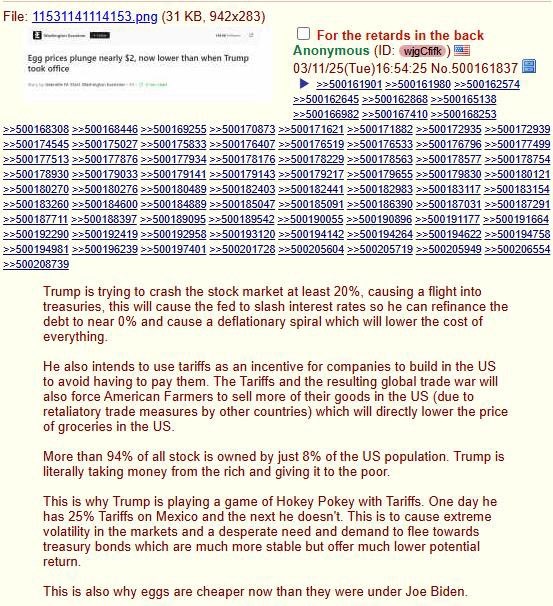
This is why Democrats are outraged over tariffs
Donald Trump revealed the only reason we’re still paying an income tax in America is because US Politicians are paid off by foreign countries to not mandate tariffs
Anyone complaining about tariffs is selling you out
“In the… pic.twitter.com/k08ecvDLNh
— Wall Street Apes (@WallStreetApes) April 6, 2025
Integrity
I find it extraordinary that anyone, especially my Democratic colleagues, can be opposed to election integrity.
That's like being opposed to children, or prosperity, or golden retrievers. pic.twitter.com/OXzk6mIRbN
— John Kennedy (@SenJohnKennedy) April 4, 2025
Bondi
NOW – AG Pam Bondi calls out the real constitutional crisis: “Just since January 20th, we've had over 170 lawsuits filed against us. That should be the constitutional crisis right there. 50 injunctions. They're popping up every single day.” pic.twitter.com/zBvV0KUURd
— Overton (@overton_news) April 6, 2025
Truss
Before I ever hire a new employee I always do a deep dive on past performance. Maybe #Canada before you hire Mark Carney as #PrimeMinister you may want to hear what his previous employer had to say about his executional skills. Perhaps it would be best if he spent a few years as… pic.twitter.com/6XgJMWFaaR
— Kevin O'Leary aka Mr. Wonderful (@kevinolearytv) April 5, 2025
Hillary
https://twitter.com/Real_RobN/status/1908210770602844629
USAID review
https://twitter.com/MarioNawfal/status/1908402975128641829
Investor Bill Ackman on X:
One would have to imagine that @realDonaldTrump’s phone has been ringing off the hook. The practical reality is that there is insufficient time for him to make deals before the tariffs are scheduled to take effect. I would therefore not be surprised to wake up Monday with an announcement from the President that he was postponing the implementation of the tariffs to give him time to make deals. President Trump has gotten the world’s and our trading partners’ attention and elevated the importance of resolving an unfair tariff regime that has harmed American workers and decimated our industrial base over many decades.
This is a critically important issue that needs to be resolved, and we finally have a president committed to getting this done. The problem, however, can’t be resolved in days, so why wouldn’t a pause make sense to give the president time to properly resolve this critical issue and to allow companies large and small the time to prepare for changes in their supply chains? The risk of not doing so is that the massive increase in uncertainty drives the economy into a recession, potentially a severe one. One thing is for sure. Monday will be one of the more interesting days in our country’s economic history.
“It won’t be easy, but the end result will be historic,” Trump insisted. The tariffs represent “an economic revolution, and we will win… we will make America great again..”
• Trump Tells Americans ‘It Won’t Be Easy’ (RT)
US President Donald Trump has warned Americans they could face hardships before his “liberation day” tariffs restore the country’s economic power. Trump’s sweeping tariffs on the majority of US trading partners came into effect on Thursday, causing the US stock market to suffer its worst crash since the COVID-19 pandemic. China has reacted by imposing a 34% levy on American goods, with other countries also promising retaliation. In a post on his Truth Social platform on Saturday, the US president told the American public to “hang tough” in anticipation of the international community’s response to his economic policies. “It won’t be easy, but the end result will be historic,” Trump insisted. The tariffs represent “an economic revolution, and we will win… we will make America great again,” he added.
“China has been hit much harder than the US, not even close. They, and many other nations, have treated us unsustainably badly. We have been the dumb and helpless ‘whipping post,’ but not any longer,” Trump wrote, explaining his decision. The US president insisted that his administration is “bringing back jobs and businesses like never before. Already, more than five trillion dollars of investment, and rising fast.” Tens of thousands of left-wing activists took to the streets across the US on Saturday to decry the tariffs and other policies of the Trump administration. The organizers of the “Hands Off!” protests claimed that more than 1,400 rallies were held outside state capitols, federal buildings, city halls and parks.
On Friday, a top senator in the Republican Party, Ted Cruz, warned that the import taxes could result in a global trade war that “would destroy jobs here at home, and do real damage to the US economy.” If the tariffs stay in place over a long term and push America into “a bad recession,” the midterm elections in “2026 in all likelihood, politically, would be a bloodbath” for the Republicans, he cautioned. JPMorgan raised its estimate of the possibility of a global recession from 40% to 60% in the wake of Trump’s announcement of tariffs. “The effect of this tax hike is likely to be magnified – through retaliation, a slide in US business sentiment, and supply chain disruptions,” its chief economist Bruce Kasman said.
How many Asian business leaders and politicians have called their governments this early morning, pleading for talks with Trump to be started?
Ex.: China answered Trump’s 34% tarifff with a 34% tariff on US goods, but China exports well over $400 billion to the US, which exports one third of that to China.
Taiwan, India, Israel, Vietnam and Cambodia have agreed to drop ALL tariffs on the United States. Over 50 countries have called to negotiate with Trump.
• Asian Stocks Plunge Amid Trump Tariffs Fallout (RT)
Asian stock markets plunged on Monday, extending a global sell-off sparked by US President Donald Trump’s new tariff hikes and China’s retaliatory measures. Last week, Trump imposed a 10% baseline tariff on all imports and announced additional “reciprocal” duties on dozens of countries with what he called unfair trade imbalances. China responded with a 34% tariff on US goods, mirroring Trump’s levy. Other countries also signaled plans to impose retaliatory tariffs. The moves triggered fears of a trade war and a potential US recession, leading to a market rout that erased nearly $5 trillion in value off US stocks last week. Japan’s Nikkei 225 index dropped nearly 9% in early Monday trading, its lowest since October 2023. It recovered slightly but was still down over 7% by midday. Japan’s bank stock index fell as much as 17%.
Hong Kong’s Hang Seng had plunged nearly 14% as of 7:30 GMT, while Shanghai’s Composite index was down 7.3%. Shares of Chinese tech giants Alibaba and Tencent dropped 17% and 12% respectively. Taiwan’s exchange fell almost 10% on opening – its largest one-day percentage and point loss on record. South Korea’s Kospi index dropped 5.5% and was briefly halted. Australia’s S&P/ASX 200 closed down 4.2%, marking its worst session since the Covid-19 pandemic. The European markets also started the day with losses. The pan-European Stoxx 600 index, which tracks the 600 largest companies in Europe, slumped by over 6% at market open, to its lowest level since early December 2023. US markets also appeared headed for losses. S&P 500 futures slid 2.5%, with similar trends for the Dow and Nasdaq.
“Wherever we look this morning, it’s a bloodbath,” said Ipek Ozkardeskaya, senior analyst at Swissquote Bank, in a note to The Guardian. “The S&P500 is down by almost 4%… and the week hasn’t even started yet.” US markets had already posted their worst drop since the 2020 Covid-19 crash last week, with the S&P 500 down 6%, the Dow off 5.5%, and the Nasdaq falling 5.8% at Friday close. Billionaire US investor Bill Ackman warned on X on Sunday that Trump had triggered an “economic nuclear war” which could hurt domestic economy, and urged him to reverse course.
Trump, however, defended the tariffs. Speaking to reporters aboard Air Force One late on Sunday, he said that while he is aware of the market sell-off and doesn’t “want anything to go down,” he will not ease on the tariffs. “Sometimes you have to take medicine to fix something,” he stated. “What’s gonna happen with the market I can’t tell you… but I do wanna solve the deficit problem that we have with China, with the EU, and other nations. And they’re gonna have to do that.”
“Those opposing Trump’s policies are rejecting the very system that built America’s prosperity.”
• Trump and Our Return to the ‘American System’ (Overton)
Few economic philosophies have shaped America’s prosperity as profoundly as Henry Clay’s American System—a blueprint for national strength and self-sufficiency. Developed in the early 19th century, Clay’s vision centered on protective tariffs, a strong national banking system, infrastructure development, and the responsible use of natural resources. These pillars propelled the United States into economic dominance. However, in the latter half of the 20th century, Cold War geopolitics led to a significant departure from these principles. Today, President Donald Trump’s economic policies signal a revival of the American System, aiming to restore national industry, energy independence, and economic resilience. One of the key components of Clay’s American System was the use of tariffs to shield domestic industries from foreign competition.
Clay and his contemporaries understood that fledgling American manufacturers needed time to grow without being undermined by cheaper imports. This approach helped transform the U.S. from an agrarian economy into an industrial powerhouse. Trump’s embrace of tariffs is a modern adaptation of this strategy, aimed at protecting American businesses from unfair foreign trade practices. His policies seek to revitalize domestic manufacturing, reduce dependency on foreign goods, and address trade imbalances, particularly with China. Additionally, tariff revenue contributes to lowering the national debt, reinforcing economic sovereignty. Clay’s American System also relied on a centralized banking institution to maintain financial stability. The Second Bank of the United States played a critical role in providing credit, regulating state banks, and preventing economic crises.
Although Andrew Jackson dismantled the bank in the 1830s, its essential functions were later restored with the creation of the Federal Reserve in 1913. While Trump has been vocal in his criticism of the Federal Reserve’s interest rate decisions, he has consistently championed a strong dollar and a stable financial system. His economic policies aim to foster domestic growth while ensuring that U.S. monetary policy serves the nation’s best interests rather than the demands of global financial elites. Another core tenet of the American System was the federal government’s role in developing infrastructure. Clay understood that investing in roads, canals, and railroads was essential for national growth, linking markets and expanding economic opportunities. The Erie Canal, transcontinental railroad, and interstate highway system are all legacies of this philosophy.
Trump’s focus on rebuilding America’s infrastructure is a direct continuation of this principle. His administration has pushed for major investments in highways, bridges, airports, and broadband expansion, recognizing that modern infrastructure is key to long-term economic competitiveness. His “America First” vision prioritizes domestic industries and job creation through large-scale development projects. Clay’s economic vision also emphasized utilizing America’s vast natural resources to fuel economic growth. Throughout U.S. history, industries have thrived due to the country’s access to coal, timber, oil, and minerals. Under Trump, the United States became the world’s leading energy producer, reversing decades of reliance on foreign oil. His administration prioritizes domestic energy production—expanding oil drilling, natural gas extraction, and coal mining—which contributes to lower energy costs and economic growth.
By ensuring energy independence, Trump reinforces a key pillar of the American System—harnessing natural resources for national prosperity. For most of our history, the U.S. followed the American System to protect its industries and promote national wealth. However, after World War II, Cold War strategy took precedence over economic protectionism. In an effort to secure global alliances against communism, America lowered tariffs to encourage partnerships to contain the Soviet Union. While this strategy helped win the Cold War, it also led to the decline of American manufacturing. Today, the Cold War is long over, yet the economic policies that sacrificed American industry remain unchanged. As a result, millions of jobs have been lost to overseas markets, and American businesses have suffered from unfair competition with countries that manipulate their currencies and exploit cheap labor.
Trump’s economic agenda seeks to reverse these decades-old policies, prioritizing American workers and industries once again. As the United States faces increasing competition from China and other global powers, the question remains: Will Trump’s economic philosophy be successful? While his policies were met with resistance from both parties, they resonate with millions of Americans who have witnessed firsthand the consequences of offshoring and deindustrialization. The debate over trade, industry, and economic nationalism is far from over. But one thing is clear: Those opposing Trump’s policies are rejecting the very system that built America’s prosperity. The American System lifted the United States to economic dominance once before—can it do so again? If history is any guide, the answer may very well be yes.
“Many, however, conflate tariffs with sanctions, assuming a punitive intent. Under Trump, tariffs are distinctly an economic tool, advancing his America First agenda by prioritizing US interests..”
• What’s Really Behind Trump’s Tariffs – And How They May Backfire (Giuliano)
I am not a supporter of Donald Trump, but I can recognize the potential of tariffs as a strategic counter to globalism and the multipolar world led by BRICS – Brazil, Russia, India, China, and South Africa. Tariffs are taxes levied on goods imported into the United States, paid by American importers rather than foreign governments. For example, if a company imports Chinese steel subject to a tariff, it incurs an additional cost at US Customs, often passed on to consumers through higher prices. Trump utilized tariffs extensively – targeting steel, aluminum, and numerous Chinese goods – to protect US industries, promote domestic production, and curb the expansive reach of globalism, which has reduced some nations to mere transit points for multinational corporations. Tariffs also address the significant US trade deficit, where imports vastly outstrip exports.
By raising the cost of foreign goods, they could bolster American manufacturing and diminish that disparity. Historically, the US relied exclusively on tariffs to finance its government, a practice dominant in the 18th and 19th centuries when income taxes were nonexistent. Before the 16th Amendment in 1913, tariffs funded federal operations – roads, defense, and administration – without taxing individual earnings, a system Trump’s tariff-heavy approach partially revives to support economic objectives. This reduces reliance on creditors like China, which holds a substantial share of US debt. Many, however, conflate tariffs with sanctions, assuming a punitive intent. Under Trump, tariffs are distinctly an economic tool, advancing his America First agenda by prioritizing US interests, marking a shift from a globalist system under US leadership – where international cooperation and institutions prevailed – toward a US-centric imperialism that asserts dominance through economic might, potentially paving the way for a multipolar world defined by competing spheres of influence.
The US holds a formidable advantage: its market represents a critical portion of many countries’ exports, granting significant leverage. Nations such as Canada, Mexico, and China depend heavily on American consumers – far more than the US relies on their markets. When Trump imposed tariffs on Canadian steel, Canada faced immediate pressure to adapt, as losing US trade was untenable. Mexico acquiesced during trade negotiations under tariff threats, and South Korea would likely face similar constraints. This asymmetry enhances tariffs’ coercive power, compelling smaller economies to adjust rather than resist.
In recent years, tariffs have generated considerable revenue, echoing their historical role as the sole federal income source in earlier eras, offering funds that could establish a sovereign wealth fund – potentially invested in gold or cryptocurrencies – to strengthen US economic autonomy, counter inflation, or leverage digital advancements. Strategically, this enhances national security by reducing dependence on states Washington deems adversarial, like Russia and China, protecting against disruptions in vital supplies such as rare earths or energy. For critics of globalism, tariffs offer a means to reclaim sovereignty, augmented by financial gains. They also suggest a potential exit from supranational bodies like the World Trade Organization (WTO), which Trump views as restrictive. Disregarding WTO rules could presage a withdrawal from global trade frameworks, possibly unsettling the European Union, where divergent interests – such as those between Germany and Italy – might intensify divisions. This may mark America’s final effort to counter the rise of BRICS, resisting a shift from US-led globalism to a multipolar order with distinct spheres of influence.
The US dollar’s status as the world’s reserve currency is crucial, facilitating low-cost borrowing, effective sanctions, and trade dominance. Tariffs reinforce this by tackling the trade deficit and financing sovereign initiatives, yet BRICS’ de-dollarization efforts – promoting alternative currencies – threaten its foundation. Should the dollar’s preeminence falter, funding a wealth fund or industrial revival becomes problematic, foreign investment wanes, and US influence diminishes. Against the multipolar vision of BRICS, tariffs are a vital bid to preserve economic power; losing dollar hegemony would render this approach unviable. The drawbacks, however, are considerable. Inflation increases as higher import costs elevate prices for goods like clothing, electronics, and vehicles, compounding prior price pressures in the US.
Supply chains, already complex, suffer further disruption, leading to delays and shortages. Industries reliant on foreign components – such as automakers needing semiconductors – face challenges, while smaller firms struggle to cope. Retaliatory actions exacerbate the situation: China has targeted US agricultural exports, and Europe has reciprocated. A dearth of STEM professionals – engineers and technologists – impedes swift industrial redevelopment. Certain products, like smartphones or rare-earth-dependent technologies, would be exorbitantly costly to produce domestically due to high labor expenses and limited resources. Reindustrialization requires immense investments in infrastructure, training, and time – new facilities like steel mills demand years to develop.
“Macron can stomp his reactionary feet, but corporate leaders and company owners are focused on the purpose of their enterprise, profit..”
• French Business Leaders Reject Macron’s Demand to Divest from USA (CTH)
According to French media, quoting multiple corporate leaders and company directors throughout France [LINK], the leadership of France’s biggest companies told Macron to ‘get stuffed’ following the French president’s demand to divest their interests from America. President Macron ordered 50 of the largest companies with positions in the USA to attend an emergency economic meeting at Elysée Palace. As reported by French media, “Some of us fell out of our chairs,” confided one of the 50 or so French business leaders invited.” “We are not in an administered economy,” thunders the leader of an employers’ movement. And the CEO of a CAC 40 giant bluntly asserts: “I don’t give a damn about what Macron says. We have operations in the United States. There is no question of abandoning them just like that. We must respect our commitments to our employees, our customers and our shareholders. An opinion shared by a manager of a spirits producer: “It is out of the question to stop investing in the United States, especially in the current economic slump.”
This type of reaction should not be surprising at it reflects the transparent disconnect between ideological government officials and generally pragmatic business leaders. Macron can stomp his reactionary feet, but corporate leaders and company owners are focused on the purpose of their enterprise, profit. The American consumer market is the most valuable consumer market in the world. We do not have the largest population; however, we do have the largest population with the ability to purchase things. It is the ability to buy stuff that makes access to the U.S. market the golden ticket for foreign company sales and profit. Despite the erosion of disposable income, an outcome of the exfiltration of U.S. wealth, Americans still have the ability to purchase goods and services at a level that is much, much higher than any other nation. Lessening that wealth was/is the goal of modern leftists;
Barack Obama stated so openly in his, “share the wealth” worldview. Hence, the ideologues fight any policy, system or enterprise which protects or enlarges the American slice of the economic pie. President Trump is putting American wealth, middle-class quality of life, at the forefront of policy. Reciprocal and national security tariffs are arrows in his very unique quiver. Multinational corporations, Democrats and professional leftists under multiple party names around the world are reacting to his policies that return the U.S.A to a position of gaining economically. The EU taxes and subsidizes their population at a level that ultimately restricts and limits disposable income. Meanwhile the population of India, southeast Asia and Africa spend most of their income sustaining basic life needs. Travel the world and you will see how most of these areas welcome the tourism of Americans.
Reciprocity is the term but ultimately President Trump’s goal is a zero-tariff trade relationship with each nation. That targeted reciprocity includes direct duties and elimination of non-tariff barriers. It’s not just other nations making our exports more expensive, the issue is also other nations putting rules, regulations and barriers against U.S. companies and products in order to make it impossible to sell our products into their countries. The leaders of the tariff-affected governments well understand the objective; they are thrashing and gnashing their teeth because they want to retain the imbalance. The companies within those nations, like this example of France, understand there is simply no way for them to pull out of America and still maintain their earnings and profits.
As stated, the various foreign governments will surge in opposition, then fail as the reality of the situation is encompassed in the brutally honest approach by President Trump. However, it is important to remember, those foreign governments and foreign corporations also purchase influence in U.S. politics through lobbying. We are the only government that has a formal and legal process by which another country can purchase influence for their specific interests. No other nation OPENLY permits American companies to pay government officials to change policy in their nation. When foreign politicians accept money for influence Washington DC publicly calls it bribery and corruption. However, when those same DC politicians accept foreign money for influence, Washington DC calls it “lobbying.”
Panic! Panic!
• Trump’s Beer Tariffs Could Hit 100,000 EU Jobs – FT (RT)
A trade group representing EU brewers has warned that a 25% tariff on imports of beer to the US may force companies to shut down and leave tens of thousands of people out of work, the Financial Times reported on Saturday. Earlier this week, the US Commerce Department added beer and empty aluminum cans to a list of derivative products subject to its tariffs on aluminum. Brewers across the EU are reportedly confused about whether the new tariff applies to all beer or only to products imported in aluminum cans. “We are calling on the [European] commission to use all diplomatic channels and whether through negotiation or retaliation, find a way to de-escalate this tariff in which we have become a collateral victim,” Julia Leferman, secretary-general of Brewers of Europe told FT.
The group, which represents major producers such as InBev, Heineken and Carlsberg, emphasized that the EU’s directorate general for trade had contacted US officials, but had not yet received clarity on the scope of the tariffs. Brewers of Europe told the newspaper that local companies exported €870 million ($953 million) worth of beer to the US last year, and stressed that a loss of that business could eliminate 100,000 out of two million jobs in the industry. As part of a historic set of new tariffs, Trump announced 10% minimum duties on all imports and additional “reciprocal” tariffs on dozens of countries he said had an unfair trade imbalance with the US. EU exports were hit with a higher 20% rate. The president argued that many nations were “ripping off” America through “harmful policies like currency manipulation and exorbitant value-added taxes.”
“..the analogies in my column this weekend of this rising radical movement to the Jacobins for the French Revolution. What is missing now is just a couple powdered wigs, a tumbrel, and a catchy tune.”
• A Guillotine Makes Another Appearance in DC at a Hands Off! Protest (Turley)
One of the most cited facts about January 6th was a mock gallows brought by some protesters who named Vice President Michael Pence as a candidate for the noose. The media continued to reference and show the gallows in its coverage. It has shown less interest in the appearance of a guillotine at prior pro-Palestine protests, at the Trump inauguration, and in the protests on Saturday against Donald Trump. The appearance of the noose on January 6th was roundly condemned, including on this blog, at the time, but then became a talking point on the left to show that this was a violent attempt to overthrow the government. Harvard Professor Lawrence Tribe has even claimed that Trump should have been charged with the attempted murder of Pence.
The media seems less alarmed by such images on the left. At the Hand Off! protest organized by Indivisible, some apparently felt it was better to focus on heads off and the divisibility of their political opponents. The reappearance of the device associated with “The Terror” of the French Revolution was most improvised this weekend and carried by a couple of protesters. It was a small, rather pathetic version in comparison to the earlier replicas. It was only meant to convey the anger of these particular protesters about what should happen to the likes of Musk and Trump. The point is not that everyone in this protest, or even this couple, was encouraging violence. Rather, this is rage rhetoric, which I discuss in my book, “The Indispensable Right: Free Speech in an Age of Rage.”
Rage is a curious thing. If you agree with the underlying grievance it is righteous, if you disagree, it is dangerous. For those who hate Trump, it is merely the amplification of their views and emotions. Indivisible and many Democratic politicians have been fueling the claim that democracy is dying and that we are living under a fascistic or oligarchic regime. On its website, Indivisible claims: This is a nationwide mobilization to stop the most brazen power grab in modern history. Trump, Musk, and their billionaire cronies are orchestrating an all-out assault on our government, our economy, and our basic rights—enabled by Congress every step of the way.
“They want to strip America for parts—shuttering Social Security offices, firing essential workers, eliminating consumer protections, and gutting Medicaid—all to bankroll their billionaire tax scam. They’re handing over our tax dollars, our public services, and our democracy to the ultra-rich. If we don’t fight now, there won’t be anything left to save.” The protesters at the inauguration simply said that it is a symbol that is “subject to interpretation”: The reappearance of the guillotine on the left is ironic given the analogies in my column this weekend of this rising radical movement to the Jacobins for the French Revolution. What is missing now is just a couple powdered wigs, a tumbrel, and a catchy tune.
The heavily orchestrated “protests” give rise to so many wild claims that we might as well summarize them with this particular slogan:
“..Elon Musk, hands off Greenland!”
• Anti-Trump Protesters In DC Rally Against Musk’s DOGE Cuts, New Tariffs (NYP)
Tens of thousands of protesters descended on DC Saturday as part of nationwide “Hands Off!” rallies against spending cuts from Elon Musk’s Department of Government Efficiency and President Trump’s new “Liberation Day” tariffs — with one speaker calling on the crowd to make the two men “afraid.” The huge crowd assembled with homemade — and in many cases vulgar — anti-Republican signs near the Washington Monument while similar events unfolded in New York City, Los Angeles and Philadelphia. “Trump and Musk, who want to be dictators and want to be kings and lords, they are afraid of the power of love and truth and justice!” declared activist minister William Barber II, who was one of the first speakers at the DC event. “They are afraid of your unity and diversity. Well, let’s keep them afraid until they change,” he roared. “This is an outright battle for civilization! We are not going to bow to power drunk neofascist extremists.”
A coalition of Democratic and left-wing groups organized the event, which is one of the first large DC rallies against Trump since he reentered the White House in January. Simultaneous protests unfolded at over 1,000 locations across the country, including the Big Apple, at Columbia University and Bryant Park. Opponents of Musk have vandalized Tesla facilities and vehicles across the country, which Trump, who survived two assassination attempts last year, has denounced as domestic terrorism. The activist group Indivisible, which has called on Senate Minority Leader Chuck Schumer (D-NY) to retire for recently averting a partial government shutdown, and MoveOn.org were prominent organizers. Rep. Jamie Raskin (D-Md.), who served as chief prosecutor in Trump’s second impeachment trial in 2021, hailed the “great Rev. Barber” as he spoke next.
Raskin told protest participants they have “the right to call the president deranged for crashing our economy, destroying $6 trillion of wealth and turning my 401k into a 201k.” “No moral person wants an economy-crashing dictator who knows the price of everything and the value of nothing,” he said to cheers. But Raskin included a wide range of other grievances in his remarks. “We say to Donald Trump and Elon Musk, hands off Greenland! That’s an independent country,” he said of Trump’s attempts to annex the Danish territory. “Hands off Canada! That’s an independent country. Hands off Panama! That’s an independent country. Statehood for Washington, DC!” Protesters flew Trump baby balloons and chanted “DOGE shit!” — but the event ended mid-afternoon without any obvious instances of vandalism or clashes with police.
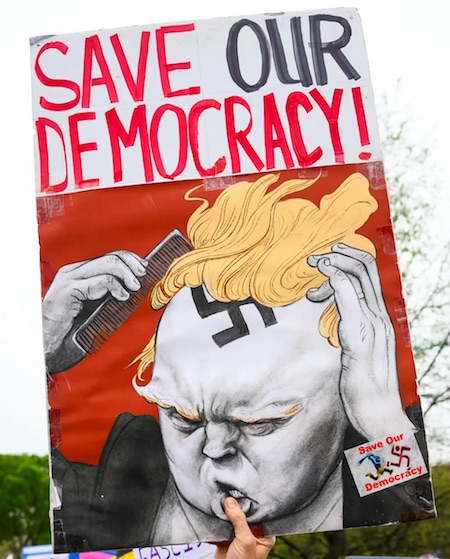
The White House on Thursday had canceled garden tours scheduled for Saturday and erected anti-riot fencing in anticipation of possible disruptions. The president himself was out of town for the weekend. Columbia University, the epicenter of anti-Israel activism since October 2023, drew a surprisingly small crowd of about 20 mostly elderly participants who held signs including “Democracy, not dictatorship” while chanting “hands off our students!” Retiree Kathryn Graybill, 71, told The Post “I’m very disturbed that people are being picked up and taken to prisons in other countries without due process. That’s against our Constitution. Our Constitution says that no one should deprive anybody of freedom of speech.” Gaybrill said that that “happened in Hitler’s Germany and I’m not comfortable with it.”
The French PM is a poet: “On several continents, some are trying to create ..an illiberal international of indecency..”
• French PM Accuses Trump Of ‘Interference’ On Le Pen (RT)
US President Donald Trump’s public support for Marine Le Pen is tantamount to meddling in France’s domestic politics, French Prime Minister Francois Bayou has said. Le Pen, the former leader of the right-wing National Rally party and three-time presidential candidate, received a prison sentence for embezzlement earlier this week. In a post on Truth Social on Thursday, Trump labeled Le Pen a victim of a “witch hunt” and claimed that she had been prosecuted for her political beliefs. “FREE MARINE LE PEN!” he wrote. During an interview with Le Parisien magazine published on Saturday, Bayrou was asked if he believed Trump’s words constituted interference in French domestic affairs. “Yes, and interference has become the law of the world,” the prime minister replied.
“There are no longer any borders for major political debates. What happens at home is relayed to Washington. And we are rightly moved by what is happening in Türkiye, for example,” Bayrou added, referring to the ongoing anti-government protests in Istanbul and other major Turkish cities. “For three-quarters of a century … we have believed that our conception of democracy and the rule of law would irresistibly impose itself everywhere on the planet. The alliance around the United States was just that: the alliance of freedoms,” Bayrou said. Asked whether it was “no longer true,” Beyrou said, “We are suddenly discovering that the world has changed.” “On several continents, some are trying to create an illiberal international of indecency, which has decided that human rights, the rule of law, and democratic understanding between nations should be a thing of the past,” he argued.
On Monday, a Paris court sentenced Le Pen to four years in prison, of which two are suspended, and the other two will be served under a form of house arrest. She was also handed a five-year ban on holding political office, which effectively disqualifies her from the 2027 presidential race. According to the prosecutors, the veteran politician used the EU funds intended to cover the work of aides in the European Parliament to pay for staffers in France. She denied any wrongdoing and has promised to appeal the verdict.
“The bloc’s foundational identity rests on liberal democratic ideals, institutional sanctity, and the rule of law. When Brussels arbitrarily removes opposition candidates, it saws off the very branch upon which its entire elite sits.”
• Le Pen’s Verdict Exposes Western Europe’s Dangerous Trend (Ryumshin)
What’s happening in Western Europe is increasingly raising uncomfortable questions. On March 31, a French court found Marine Le Pen guilty in the so-called “fictitious aides” case, sentencing her to four years in prison and banning her from running for office for five years. Remarkably, the ban took effect immediately, without even waiting for an appeal. The court’s decision has proved highly controversial, and not only among Russians, who typically see Le Pen as part of Europe’s Moscow-friendly political forces. Even French political figures have expressed bewilderment. Given Le Pen’s position as the frontrunner in the 2027 presidential elections, her conviction has undeniably taken on political dimensions. Some French politicians have already called upon President Emmanuel Macron to pardon Le Pen in order to preserve the face of the country’s “democracy.”
Prime Minister François Bayrou reportedly expressed alarm, admitting privately to aides, “France is the only country that does this.” But Bayrou is mistaken in believing France stands alone. Suppressing opposition figures through tactics reminiscent of hybrid autocracies is becoming the latest trend in EU states. Recently, Romania spectacularly canceled the first round of its presidential election, later jailing Calin Georgescu, the leading candidate. Germany seems likely to follow suit. The emerging coalition government between the CDU/CSU and SPD is drafting legislation that could bar anyone convicted of “incitement to hatred” from political activity. Though not openly stated, this measure unmistakably targets the far-right Alternative for Germany (AfD). The reason behind this crackdown lies deeper than any immediate legal disputes.
Far-right parties across the bloc have increasingly challenged the European integration project itself. These political forces have openly called for slowing down or completely dismantling the EU in favor of returning to traditional nation-state structures. While some of these right-wing parties, including Le Pen’s National Rally and Germany’s AfD, have moved toward the political center in order to broaden their appeal, their reputation as “destroyers of Europe’s garden” remains entrenched. Western European bureaucrats and established national elites are deeply unsettled by the growing popularity of these parties. Having benefited tremendously from the EU’s expansion and centralization for over three decades, they are unwilling to surrender their privileged positions without a fight.
It’s as if they feel the ground shifting beneath their feet and will do anything necessary to preserve their status quo. Yet here lies the paradox: the more the EU establishment struggles to remain in power through repressive measures, the quicker its authority and legitimacy erode. The bloc’s foundational identity rests on liberal democratic ideals, institutional sanctity, and the rule of law. When Brussels arbitrarily removes opposition candidates, it saws off the very branch upon which its entire elite sits. The surge of Europe’s far right has not emerged in a vacuum. Its popularity directly stems from the existing EU leadership’s chronic inefficiency and inability to respond adequately to today’s challenges. Attempting to remove right-wing politicians from the playing field is not a solution. Discontented voters will inevitably find alternative ways to express their frustrations – likely even more fiercely once their grievances are compounded by deep mistrust of the political establishment.
3 years too late.
• Poland Warns Trump Against ‘Historic Mistake’ In Russia Talks (RT)
A senior Polish official has warned US President Donald Trump that any peace deal recognizing Russia’s control over former Ukrainian territories would spell a disaster for the security of European NATO members. In an interview with Financial Times on Sunday, Pawel Kowal, an adviser to Prime Minister Donald Tusk on Ukraine and the head of Poland’s parliamentary foreign affairs committee, said that while “provisional solutions” to halt the fighting might be acceptable, the fulfillment of “Russian expectations to recognize Crimea, Donbas or other parts of Ukraine… would be a historical mistake.” Crimea overwhelmingly voted to join Russia in 2014 in a public referendum following a Western-backed coup in Kiev. Donetsk, Lugansk, Zaporozhye, and Kherson Regions followed suit in 2022.
According to Kowal, should Trump recognize those territories as part of Russia, it would cross a “red line” for Warsaw and its neighbors. The official argued that doing so would encourage Moscow to embrace further expansionism. “It would be horrible,” Kowal said. Russian officials have repeatedly dismissed speculation of having plans to attack NATO as “nonsense.” Kowal criticized Trump’s approach to the Ukraine talks, which excludes European leaders from the process. “It’s very difficult to discuss security in Ukraine in isolation from the general security issue of Central Europe,” he said. Despite his concerns, Kowal expressed hope that Trump would ultimately avoid recognizing Russia’s territorial gains. He also expressed the view that the US leader would avoid depriving American companies of an opportunity to invest in Ukraine’s reconstruction effort by withholding security guarantees for Kiev – something both Ukraine and European NATO nations have insisted on.
Over the past few weeks, the Trump administration has been engaged in talks with Russia to end the Ukraine conflict. Both sides have described the engagement as productive, and US officials have hinted at a possible ceasefire in the foreseeable future. In early March, Secretary of State Marco Rubio also suggested that Ukraine would have to acknowledge some of Russia’s territorial gains to end the conflict. Meanwhile, Russia has signaled that it is open to talks to resolve the crisis, but has ruled out territorial concessions. Moscow has also insisted that Ukraine abandon its desire to join NATO.
“An influx of foreigners with different cultures “will lead to the destruction of any country that allows it..”
• Musk Warns Of ‘Real Massacre’ In Western Europe (RT)
An influx of immigrants has created the risk of a spike in terrorism in Western Europe, characterized by widespread mass killings, Elon Musk has said. According to data from the EU Agency for Asylum (EUAA), more than 500,000 asylum applications were filed in the bloc in the first half of 2024, roughly the same as during the same period the previous year. Some 24% were submitted in Germany, followed by Italy and Spain with 17% each. During his video address to the congress of the Italian rightist Lega Nord (Northern League) party in Florence on Sunday, the Tesla and SpaceX CEO said “mass migration is a crazy thing.”
“With terrorism eventually we will see mass killings in Europe. Your friends, your families, they will all be at risk. We see a huge increase in the number of attacks in Italy and in Europe, in general, and the media tries to reduce the impact of these attacks. We will see mass killings in Europe. This is the trend… This will lead to a real massacre in Europe,” he said. An influx of foreigners with different cultures “will lead to the destruction of any country that allows it, it is a very difficult situation,” he insisted, as cited by the Corriere della Sera newspaper. “There are 8 billion people in the world. If a small percentage of the rest of the world arrives in a country of 50 million, it transforms it into a different country,” Musk explained.
“A country is not a geography but the people who inhabit it. This is a fundamental concept, which should be obvious,” he added. Musk also addressed the issue of sweeping tariffs imposed by Trump on the majority of America’s trading partners on Thursday, expressing hope that the US and EU “will be able to create a very close, stronger partnership… [and] move to a zero-tariff zone in the future with a free trade area between.” European Commission President Ursula von der Leyen previously described Trump’s move as “a major blow to the world economy” and said that the EU is preparing countermeasures in case tariff talks with Washington fail.
Elon Europe
https://twitter.com/AutismCapital/status/1908575442195669499
“Ironically, in pushing for censorship, it makes it very clear that the left is the side against freedom..”
• Musk Schools Italian Lawmakers On Censorship, Mass Migration, And Overreach (ZH)
Elon Musk joined Italy’s Deputy Prime Minister Matteo Salvini, leader of the League party, for an interview during the party’s congress in Florence on Saturday. The world’s richest man explored a broad range of issues, from mass immigration and censorship to tariffs and EU overregulation. Musk, who notably exposed massive government-tech collusion to censor free speech after releasing the “Twitter Files,” fiercely criticized forces opposing free expression – which comes on the heels of EU regulators threatening to fine Musk up to $1 billion for not curbing alleged disinformation on the platform. “You can tell which side is the good side and the bad side by which side wishes to restrict freedom of speech,” Musk told Salvini. “The Hitlers, Stalins, and Mussolinis of the world had very strong censorship.” “Restriction on speech and large government is fundamentally fascist. Ironically, in pushing for censorship, it makes it very clear that the left is the side against freedom,” the Tesla and SpaceX CEO added.
Shifting focus, Musk addressed President Donald Trump’s tariffs, advocating for a zero-tariff free trade zone between Europe and North America. He emphasized greater economic integration and urged Trump to ease restrictions on individuals living and working across the two regions. “I’m hopeful that the United States and Europe can move, ideally in my view, to a zero-tariff situation. Effectively creating a free trade zone between Europe and North America,” Musk said. “That’s what I hope occurs, and also more freedom for people to move between Europe and the U.S. If they wish to work in Europe or America, they should be allowed to do so, in my view. That has certainly been my advice to the President,” the billionaire added.
https://twitter.com/cb_doge/status/1908562827314405428?ref_src=twsrc%5Etfw%7Ctwcamp%5Etweetembed%7Ctwterm%5E1908562827314405428%7Ctwgr%5E53e658e69174adb891f221ca6fd27cd0c9037d6a%7Ctwcon%5Es1_c10&ref_url=https%3A%2F%2Fwww.zerohedge.com%2Fpolitical%2Ffundamentally-fascist-musk-schools-italian-lawmakers-censorship-mass-migration-and
This week, President Trump imposed tariffs on numerous countries, including a 20% levy on the European Union, prompting EU officials to pledge retaliation and French authorities to call on domestic firms to suspend investment plans in the United States. Musk also lambasted Europe’s stifling regulatory environment, calling it a significant obstacle to entrepreneurial success and pushing for sweeping deregulation. “Europe is over regulated. There are too many rules and regulations that make it very difficult to create a company and be successful,” Musk told Salvini. “So I think radical deregulation is necessary in Europe. And if that means leaving the EU, it means leaving the EU,” he added bluntly.
.@elonmusk: "Europe is over regulated. There are too many rules and regulations that make it very difficult to create a company and be successful."
"Radical deregulation is necessary in Europe."
"If that means leaving the EU, it means leaving the EU."pic.twitter.com/Jw02n7b66Z
— Josh Caplan (@joshdcaplan) April 5, 2025
Finally, Musk delivered a dire warning about unchecked mass immigration, asserting that a nation’s identity lies in its people, not its borders, and that unrestricted inflows could spell a country’s demise. “Mass immigration is insane and will lead to the destruction of any country that allows unfettered mass immigration — That country will simply cease to exist,” Musk warned. “A country is it’s people, not it’s geography. This is a fundamental concept.” Italian Prime Minister Giorgia Meloni campaigned on a promise to reduce illegal immigration, and her efforts are showing clear results. In 2022, Italy saw 105,131 illegal arrivals, a figure that jumped to 157,651 in 2023 due to worsening global conditions. However, by 2024, the number of arrivals plummeted to 66,317—a nearly 60% decrease, the Institute of New Europe reports.
Voice of caution. You need those too.
• Senator Ted Cruz Warns Of Election ‘Bloodbath’ (RT)
The US Republican Party could face a “bloodbath” in next year’s midterm elections if the “liberation day” tariffs imposed by President Donald Trump backfire, Senator Ted Cruz has warned. Earlier this week, Trump announced sweeping tariffs on the majority of US trading partners, causing the US stock market to suffer its worst crash since the COVID-19 pandemic. China has already reacted by imposing a tit-for-tat 34% levy on American goods, with other countries also promising retaliation. Speaking on his Verdict podcast on X on Friday, the Republican junior US senator from Texas said that he did not share the belief of the Trump administration that the new tariffs would create “a booming economy” in the country. Cruz expressed concern that the move by the White House could result in a global trade war that “would destroy jobs here at home, and do real damage to the US economy.”
If it continues over a long term and pushes America into “a recession, particularly a bad recession,” the midterms in “2026 in all likelihood, politically, would be a bloodbath” for the Republicans, he cautioned. “You would face a Democrat House, and you might even face a Democrat Senate,” he said. Cruz explained that “if we are in the middle of a recession and people are hurting badly, they punish the party in power.” “Look, I want this to succeed… but my definition of ‘succeed’ may be different than the White House’s,” the senator said, adding that he believes “American prosperity” should be achieved by “dramatically lowering” tariffs abroad, which would in turn reduce tariffs in the US.
On Friday, Trump defended his tariffs, writing on his Truth Social platform that his “policies will never change” and calling upon foreign investors to come to the US to get “richer than ever before.” Following the US president’s announcement of levies, JPMorgan raised its estimate of the possibility of of a global recession from 40% to 60%. “The effect of this tax hike is likely to be magnified – through retaliation, a slide in US business sentiment, and supply chain disruptions,” JPMorgan chief economist Bruce Kasman wrote in a note to clients, titled “There will be blood.”
London calling.
• British PM Starmer To Announce End of Globalization – Times (RT)
British Prime Minister Keir Starmer will deliver a speech on Monday acknowledging that the era of globalization has come to an end, The Times has reported. Starmer will make the address in response to US President Donald Trump imposing sweeping tariffs on the majority of America’s trading partners, including the UK, earlier this week, according to the article on Sunday. The outlet said the prime minister will say that tariffs are “wrong,” but would also stress that he understands Trump’s “economic nationalism” and why the voters, who believe they have seen no benefits from free trade and mass immigration, support it. Starmer will also stress that the fallout from the US charges on imports means that the government in London should “move further and faster” to boost economic growth at home.
An unnamed Downing Street official told The Times that “the world has changed, globalization is over and we are now in a new era.” “We have got to demonstrate that our approach, a more active Labour government, a more reformist government, can provide the answers for people in every part of this country,” the official said. The prime minister already stated in an article for The Telegram published yesterday that “the world as we knew it has gone” in the face of Trump’s tariffs. “First it was defense and national security. Now it is the global economy and trade. Old assumptions can no longer be taken for granted,” he said, adding that the British government would soon “turbocharge plans that will improve our domestic competitiveness, so we’re less exposed to these kinds of global shocks.”
Starmer also talked to French President Emmanuel Macron on the phone on Saturday, with the two leaders agreeing that “a trade war was in nobody’s interests, but nothing should be off the table,” according to the UK government’s readout. The British PM is not planning to call Trump regarding the tariffs. The same day, the US president told Americans to “hang tough” in anticipation of the international community’s response to his economic policies. ”It won’t be easy, but the end result will be historic,” Trump insisted, adding that the tariffs represent “an economic revolution, and we will win… we will make America great again.”
Russian President Vladimir Putin has repeatedly spoken about the period of globalization, which started after the collapse of the Soviet Union in 1991, coming to an end. In late 2023, Putin noted that “it is obvious that the globalization model, which was formed to a large extent by Western states – naturally, in their own interests – has outlived its usefulness and is in deep crisis. A new, more just and democratic system of international relations is being formed, which meets the needs of the global majority.”
What and who runs the American judiciary. How much longer for John Roberts?
• The Roberts/Eisen Drama Just Took An Even Darker Turn… (Revolver)
Well, we finally know why Justice Roberts acts the way he does. Turns out, he’s BFFs with one of the biggest Deep State operatives on the planet—a man literally known for whipping up color revolutions against the American people. That man is Norm Eisen. One of the slipperiest swamp rats in DC And now we know he and Roberts are two peas in a very rotten pod. We covered the bombshell story when it hit. Revolver:
“After you finish this blog, you’ll be asking the million-dollar question: Why is Chief Justice John Roberts hanging out with the Deep State’s #1 color revolution architect? Turns out the left’s favorite “Republican” has some very interesting buddies. According to Norm Eisen—the man who practically wrote the Deep State’s playbook on color revolutions, all things anti-Trump, and lawfare in the US—he and Chief Justice John Roberts are not only good pals, but they even spent a week together in the Czech Republic. According to Norm, the two BFFs were there working on “American rule of law” issues. Hmm… Norm was so proud of this that he actually bragged about the trip and made it very clear that Roberts isn’t corrupt—he’s just a “close friend” who happened to fly overseas and stay at Eisen’s posh 150-room palace to collaborate on transatlantic political projects.
Really… And no, that’s not just weird; it’s a massive conflict of interest and could also explain a lot. As it stands now, Justice Roberts has no business presiding over any of the cases that Eisen and his army of lawfare activists are funneling through the courts, and we all know Norm is tied to so many of these weaponized cases. He should have been recusing himself from the get-go—and probably outright resigning—for the integrity of the court.” [..] So now we know that Chief Justice John Roberts isn’t just a run-of-the-mill DC swamper—he’s close pals with the actual face of the Deep State’s lawfare machine, Norm Eisen. This is the guy who helped run impeachment ops, engineered color revolutions overseas, and now spends every waking hour trying to take down President Trump. Explains a lot about Justice Roberts, right? The puzzle pieces are clicking right into place. This new “buddy” info alone should be disqualifying. But somehow—it actually gets worse. Buckle up…
Because what’s coming next rips the mask off the entire rotten system. Once you see it, you can’t unsee it—and honestly, this should be the end for Roberts. Maybe even for Barrett, too. Why? Well, because according to Norm Eisen himself, these two justices are so anti-Trump, they’re basically compromised. That’s what he all but says in the clip below.
Norm Eisen said his longtime friend John Roberts probably did not like Trump’s address to Congress so Norm thinks John and Amy Coney-Barrett (who also apparently does not like Trump) will continue to vote against the Trump administration. pic.twitter.com/GeYLG8l8oN
— The Researcher (@listen_2learn) April 3, 2025
Alex Jones dropped a new clip where he breaks down how he believes the Norm-and-John connection is influencing the entire judiciary.
John Roberts Works for the Democrats and his handler is Norm Eisen.
John Robert’s Is Completely Compromised and MUST Resign Now! pic.twitter.com/8kNqYNKukI
— Alex Jones (@RealAlexJones) April 4, 2025
Maybe Norm’s handling Amy, too? And speaking of little Miss Amy—we tried to warn you. Over and over again. She was never the one for this moment. She didn’t have the grit, the fire, or the backbone to carry the flag when it mattered most. And sadly, we were right. Revolver: “Amy Coney Barrett strikes again—alongside Justice Roberts. However, by now, Roberts’ betrayals have become pretty much predictable, but many had high hopes for Barrett, given her history as a clerk for Justice Scalia, one of the greatest Supreme Court Justices of our time. In fact, she was once hailed as “Scalia’s heir.” Sadly, that claim couldn’t be further from the truth. In what many conservatives are calling an outright slap in the face, Amy Coney Barrett and Chief Justice Roberts dealt a blow to President Trump and the US Constitution. They got political, sided with the progressives, and ruled against Trump in the Trump v. New York case.
[..] As we’ve said before, Roberts is practically a liberal masquerading in a black robe. Many believe there’s something hanging over him, which might explain why he’s always handing the left their key victories. But Amy Coney Barrett was supposed to be different—a powerhouse for the conservative movement, a beacon of hope. Meh. Instead, she’s turned out to be another weak-kneed RINO. It’s like having a “Susan Collins” type on the Supreme Court bench. A better choice than Amy would’ve been Judge Bridget Shelton Bade.
Revolver: “In Bridget Bade, President Trump has the opportunity to nominate a true daughter of the key swing state of Arizona, born, raised and educated in the Grand Canyon State and embodying its traditional Southwestern values of law, order, liberty, and sovereignty on the border. Not only does that fit perfectly with the current state of the campaign, it significantly lightens the lift of getting the Supreme Court vacancy filled quickly. The same Senate we have now already confirmed Bade to her current seat on the Court of Appeals for the Ninth Circuit by a vote of 78-21 — more Democrat votes for than against — and courted almost none of the controversy Barrett and others on the shortlist did in their confirmations.
Here’s the kicker: Judge Bade is not a compromise choice. She’s not some softie “establishment GOP type” liable to go the way of David Souter or John Paul Stevens after a few trips to opera at the Kennedy Center. While extraordinarily well qualified — cum laude from Arizona State Law, clerk for eminent Reagan-appointed Judge Edith Jones of the Fifth Circuit, DOJ Honors during Bill Barr’s first stint as Attorney General, and elected member of the prestigious American Law Institute — she’s no ivory tower academic. Bade is not another “conservative legal movement” darling, haunting the pages of law reviews with elegant solutions to novel questions of administrative law. She’s not even a member of the Federalist Society. What Judge Bade is is nothing but the genuine article: a no-nonsense, read-it-how-its-written, law and order jurist in the proudest tradition of the old Southwest, and in the very same spirit of President Trump’s America First campaign.”
“..the whole thing with hating Russia is so negative. It’s so un-American. They are potentially our best partners. As are the Chinese, actually.”
• Oliver Stone Blasts ‘Russiagate Lies’ (RT)
Oscar-winning director Oliver Stone has said that the claims that Russia had meddled in the 2016 US presidential election were nothing but lies. For years, Democrats have claimed that the Kremlin had waged a covert campaign to sway the race in favor of President Donald Trump. The 2019 report by Special Counsel Robert Mueller alleged that the Russian government interfered in the election “in sweeping and systematic fashion,” mostly through hacking and messaging on social media. The investigation, however, “did not establish that members of the Trump Campaign conspired or coordinated with the Russian government in its election interference activities,” according to the final report.
A Fox News reporter asked Stone last week whether he thought that Trump was right to “take on” the FBI and the CIA after “what happened to him with the Russia probe.” “I know. Look at Russiagate; we paid for it,” the filmmaker replied. “I applaud [what Trump is doing].”“I hate what they did with Russiagate. I really do. I think it’s, again, the lying, the lying, the lying, and selling that to the American people,” Stone said. “And the whole thing with hating Russia is so negative. It’s so un-American. They are potentially our best partners. As are the Chinese, actually. We have this mentality that they are the enemy. That’s all been inoculated by propaganda,” the director of Platoon and JFK said.
Mueller accused Trump of attempting to obstruct his probe, and a number of former Trump campaign staffers were indicted as a result of the investigation, but not the president himself. Trump has maintained that the ‘Russiagate’ was part of a politically motivated “witch hunt” aimed at discrediting and undermining his presidency. He dismissed the accusations in the Mueller Report as “fabricated and totally untrue.” The Kremlin has repeatedly denied having meddled in the US election. In 2016, President Vladimir Putin described the claims about Russian interference as “a mythical, imaginary problem” and a product of “hysteria.”
Once were democrats.
• 12,000 Brits Arrested Per Year Over Social Media Posts – Times (RT)
Thousands of people in the UK have been detained and questioned by police over online posts deemed threatening or offensive, The Times has reported, citing custody data. According to figures published on Friday, officers make around 12,000 arrests annually under Section 127 of the Communications Act 2003 and Section 1 of the Malicious Communications Act 1988. These laws criminalize causing distress by sending messages that are “grossly offensive,” or by sharing content of an “indecent, obscene or menacing character” via electronic communications networks. In 2023 alone, officers from 37 police forces made 12,183 arrests – around 33 per day. The Times said this marks a 58% increase from 2019, when 7,734 arrests were recorded.
At the same time, government data shows that convictions and sentencings have dropped by nearly a half. While some cases were resolved through out-of-court settlements, the most commonly cited reason was “evidential difficulties,” particularly when victims declined to proceed. The statistics have sparked public outcry, with civil liberties groups accusing the authorities of overpolicing the internet and undermining free speech through the use of “vague” communications laws. The Times highlighted the case of Maxie Allen and Rosalind Levine, who were arrested on January 29 after raising concerns in a private parents’ WhatsApp group about the hiring process of their daughter’s school.
Six uniformed officers arrived at their home, detained them in front of their youngest child, and took them to a police station. The couple was questioned on suspicion of harassment, malicious communications, and causing a nuisance on school property after the school alleged they had “cast aspersions” about the chair of governors. They were fingerprinted, searched, and locked in a cell for eight hours. “It was hard to shake off the sense that I was living in a police state,” Allen told the Daily Mail, adding that the messages contained “no offensive language or threat” but were simply a “bit sarcastic.”
Schiff
https://twitter.com/Real_RobN/status/1908547805846921232
Shopping
You can't make this up.pic.twitter.com/mh8bQTsIkF
— Department of Government Efficiency News (@DOGE__news) April 5, 2025


Dolphins
Watching dolphins while swinging on a boat.
What level of life is this? pic.twitter.com/BRaGfVUCxH
— The Figen (@TheFigen_) April 5, 2025
Panda
https://twitter.com/Yoda4ever/status/1908545264480043407
Father and son
Mufasa and Simba pic.twitter.com/YQpuRp8RPH
— The Figen (@TheFigen_) April 5, 2025
Support the Automatic Earth in wartime with Paypal, Bitcoin and Patreon.