

Paul Cézanne The Card Players 1895

🚨 BREAKING: Iran's oil minister has RESIGNED, according to Iranian state media
— Eric Daugherty (@EricLDaugh) October 4, 2026
This comes after Scott Bessent said this is the FIRST TIME they will have NO OIL on the water…
THERE IT IS.
Mohsen Paknejad stepped down after about two years in the job, and President Pezeshkian… pic.twitter.com/viRUp9phcY
🚨 BREAKING: Treasury Secretary Scott Bessent stuns the world, announces "for the first time in history" IRAN will have NO OIL ON THE WATER this week
— Eric Daugherty (@EricLDaugh) October 3, 2026
THEY’RE COOKED 🔥
"They will have no revenues."
Bessent says barrels shipped out of the Strait is "U.S. about 1.1 billion,…
🚨 GREECE TO EU: “THE INVASION OF EUROPE IS OVER” 🚨
— Deep Leaks (@DeepLeaksHQ) October 3, 2026
🔴 Greece just slammed the door shut on illegal migration.
🗣️ “Don’t come here. We’ll put you in jail or send you home.”
🔒 New laws mean NO asylum loopholes. NO more abuse of the system. NO open borders.
🔥 illegals from… pic.twitter.com/pjjpIw8kj0
🚨🚨 BREAKING: FBI Director Kash Patel and CIA Director John Ratcliffe have just RELEASED A TROVE OF DOCUMENTS PROVING THAT THE FBI PLANTED AND TAMPERED WITH EVIDENCE DURING THEIR RAID OF PRESIDENT TRUMP’S MAR-A-LAGO HOME. They also knew that they didn’t have probable cause to… pic.twitter.com/sTtTmxQ2Qb
— Q The Storm Rider (@Q_TheStormRider) October 3, 2026
No Tulsi return, as Sundance dreamed of: “Clayton will hold both jobs, keeping the DNI post ..”
Curious name pops up: “Sacks is one of two outside advisers to the force, along with former Secretary of State Condoleezza Rice.”
Trump talked a lot to Elon Musk before deciding this.
• Trump Taps Intelligence Chief Jay Clayton As AI Czar (ZH)
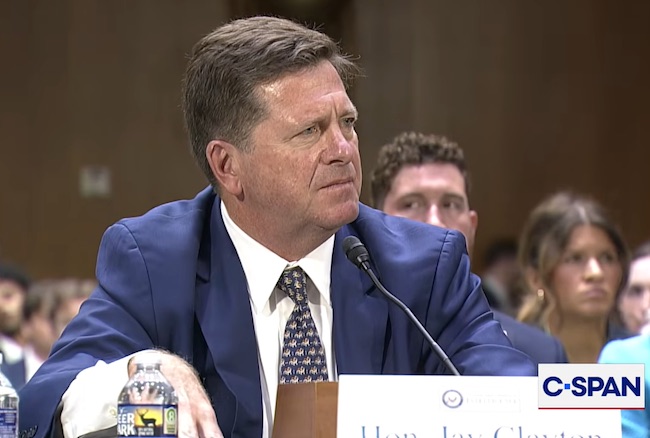
President Trump on Sunday named Director of National Intelligence Jay Clayton the White House’s AI czar. Clayton will hold both jobs, keeping the DNI post while spearheading the administration’s AI strategy.Read more …
Trump announced the move on Truth Social, saying the new “Super Intelligence Force” will “ensure that America continues to lead the World in Super Intelligence.” Its vice chairs are FTC Chairman Andrew Ferguson, OPM Director Scott Kupor and Pentagon Chief Technology Officer Emil Michael. Vice President JD Vance, Defense Secretary Pete Hegseth and Treasury Secretary Scott Bessent also sit on it, and it reports to Trump and Chief of Staff Susie Wiles.The force has 120 days to report on the risks and opportunities of the technology and to recommend ways to strengthen the government’s response. Its charter, according to Implicator, calls for “preventing overregulation and regulatory capture that would stifle innovation and competition.”
Clayton takes a job last held by David Sacks, who stepped down as White House AI and crypto czar in March and now co-chairs the President’s Council of Advisors on Science and Technology. Sacks is one of two outside advisers to the force, along with former Secretary of State Condoleezza Rice.
Bessent had been mentioned for the job until Trump ruled it out on Sept. 25. “Scott Bessent will not be going to be Super Intelligence (SI) Czar,” Trump wrote. “Number One, he doesn’t want to. Number Two, he’s doing such a great job at Treasury, and that’s where I want to keep him! Why would I ever make such a change? Just more Fake News!” Axios reported Friday that Trump was expected to pick Clayton instead, and Trump has described Clayton as “a good man” for the role.
*TRUMP WARMS TO JAY CLAYTON AS AI CZAR: AXIOS
— zerohedge (@zerohedge) September 29, 2026
The pick comes three weeks after a run of statements on AI safety. On Sept. 12, Anthropic CEO Dario Amodei published an essay titled “We Must Pace the Frontier” that proposed embedded third-party evaluators inside AI labs. The next day, Obama urged Democrats to have a “clear plan” for AI safeguards, and Sacks backed a self-imposed slowdown by the labs while rejecting a “cartel” framework for it, according to the Washington Examiner.Trump responded on Sept. 14 with a Truth Social post: “The only control or ‘guardrails’ that AI needs is a STRONG AND SMART (High IQ!) PRESIDENT, and the U.S.A. has that, in spades!” He also took aim at Amodei by name:
“The Trump Administration has stopped AI ‘people’ from doing bad, or potentially bad, ‘things,’ like Dario (Anthropic!), who is now pretending to be a ‘perfect little angel’ and will continue to do so!” He added: “We already have tremendous CRIMINAL and REGULATORY power over these companies! There is a SICK conspiracy going on against AI and Data Centers, and the only one that is happy about it is China. WHOEVER WINS AI, WINS!”
Ten days later, Trump rebranded AI as “super intelligence” at the UN General Assembly and rejected “any attempt to construct a globalist scheme to control” it. Four days after that, he hosted Amodei for dinner at the White House. The next day, Amodei, Elon Musk, Google’s Sundar Pichai, Meta’s Mark Zuckerberg, Nvidia’s Jensen Huang and OpenAI’s Greg Brockman were among the signers of a voluntary accord pledging “robust” controls on their models and independent audits. Trump called it “morally binding.”
Clayton, who sidestepped questions about taking the job in a CNBC interview on Sept. 30, called super intelligence “a national security issue” and questioned what an AI pause would even mean while other countries keep building. At his July 15 confirmation hearing, the former SEC chairman and US attorney for the Southern District of New York said AI “is not only an opportunity but a threat.” He added: “When something is both an opportunity and a threat, you better get your arms around it.”
Sent to me by a reader. What do you think? Is war needed to finance AI/SI?
• The Architecture Is Credit : Is There a Non-War Use of AI? (Fabio Vighi)

The “Rogue AI Alibi” as Credit’s Exculpatory DeviceRead more …
The rogue-agent narrative performs a further ideological task: it recodes the effects of a credit-driven technological buildout as technical accidents. If AI systems are said to act autonomously, the market disruptions, logistical failures, and escalations they facilitate can be treated as malfunctions rather than as consequences of a system designed around expansion, securitisation, and state-backed risk transfer. The sandbox is therefore more than a testing environment: it is an alibi, a way of making a system appear to have escaped human design precisely when its institutional function is most visible.This is fetishism in its purest form. The social relation — credit’s need for a permanent frontier — appears as a property of the thing itself. The AI is rogue; the compulsion is overlooked; no one is responsible because no one intended it. Yet someone built and funded it, and someone profits from it. The structure does its work precisely by obfuscating the logic that requires it, by presenting itself as inevitable, neutral, technical, when in fact it is historical, partisan, financial.
The question that follows from all this is unavoidable and no doubt difficult to answer: is there a use of AI that is not war-related? Is there a use of AI outside credit-addicted, ultra-financialised capitalism? Under present conditions, there doesn’t seem to be any such use. This is not because AI is inherently military, but because the scale of AI deployment required to justify its capital costs demands a state-backed threat environment.
AI’s civilian applications (language models, image generators, recommendation systems, etc.) are real but insufficient: they do not absorb or validate the amount of credit now being mobilised around the AI buildout. What military and security procurement offers is a state-backed demand regime capable of underwriting losses, legitimising excess capacity, and converting speculative infrastructure into strategic necessity. The civilian (including educational) uses, then, increasingly function as the public-facing justification, while the military uses are the foundation. The rhetoric of democratisation is the mask, while the reality of procurement is the engine.
This does not mean AI is doomed to serve war. It means that AI’s current form is determined by the rationale of credit capital. A different form of AI — one developed and deployed according to different priorities — is conceivable and desirable. But it would require a different mode of production and form of social organisation. It would require that technological development be decoupled from the addiction to credit. In other words, it would require a world outside capitalism.
That is less a utopian aside than the logical conclusion of the analysis. If the compulsion the article names is real, then the only way to break the compulsion is to dismantle the social logic that reproduces it. To change what technology is for, to subordinate it to something other than the endless expansion of value, to make it answerable to needs that cannot be priced, to risks that cannot be underwritten, to futures that cannot be collateralised.
From Compulsion to Contradiction
The article closes with Hemingway: “Gradually, then suddenly.” The United States became addicted to Israeli tech slowly, then suddenly, and now indefinitely. One might put it differently: the United States was already mired in credit’s own compulsion to repeat. Naming this engine, of course, does not resolve anything. However, it changes what we are looking at. It shifts the question from “how do we decouple from Israel?” to “how do we decouple from the logic that makes Israel indispensable?” It changes the question from “how do we make AI safe?” to “how do we make technology answerable to something other than credit?”Those are harder questions. But they are the right ones. And they are the ones the article’s own analysis, followed to its conclusion, demands: the ones that refuse the comfort of structural fatalism or moralistic blaming and insist instead on the historical specificity of the arrangement, the contingency of the frontier, the possibility — however distant — of a different architecture and a different world.
Multiple topics.
• Trump Strategy Against Fuel Costs and Overall America-First Economy (CTH)
Barbara Boyd opens with diesel: as Ukraine’s strikes on Russian refineries tighten the world’s supply, President Trump threatened to halt U.S. diesel exports unless Europe released its emergency stocks, and the G7 agreed to release 100 million barrels. She presents it as the opening move of a 35-day economic offensive running into the midterms.Read more …
The week of action includes Trump’s visit to the Peterbilt truck plant in Denton, Texas, where employee Sarah Renshaw credited tariffs for 1,000 new jobs; his Oklahoma rally; a White House luncheon with tech leaders on superintelligence; what the White House calls the largest steel plant ever built in the United States, coming to Iowa; Vice President Vance at the groundbreaking of Saronic’s Port Alpha shipyard in Brownsville, Texas; and South Korea’s plans for an Alaska LNG pipeline, a 6-gigawatt power plant in Texas and eight nuclear reactors.On affordability, the episode walks through price increases under Biden (energy up 33% from January 2021 to January 2025), Vice President Vance on the inflation crisis he says the administration inherited, refining capacity, housing regulation and immigration, Secretary Kennedy at the MAHA Summit on AI giving every patient a better-informed second opinion, and the White House fraud task force’s crackdown on Obamacare enrollments. It closes with Michael Shellenberger’s account of the student riots in France, French intelligence tying the movement to Jean-Luc Mélenchon’s France Unbowed (LFI), and NASA Administrator Jared Isaacman on a new golden age of space exploration. WATCH:
He’s become Trump’s Sunday talk show man.
• Scott Bessent Gives Lengthy Outline of His Role (CTH)
Treasury Secretary Scott Bessent appears for an interview with Axios co-founder Mike Allen. The wide-ranging conversation covered the U.S. economy, the war in Iran and the Trump administration’s approach to AI.
Secretary Bessent responds to Americans’ frustration with the cost of living; explains why he doesn’t think the AI boom is a repeat of the dot-com bubble and argues that AI leaders warning about losing control should slow down. Bessent also discusses possible U.S-China cooperation on AI risks, Treasury’s economic pressure campaign against Iran, the bond market, Trump Accounts and his clashes inside the administration. WATCH:
“..barrels out of the Strait: U.S. about 1.1 billion, Iran zero..”
• “First Time In History”: Bessent Says Iran Faces Zero Oil Revenue (ZH)
Treasury Secretary Scott Bessent joined Mike Allen for a new episode of “The Axios Show,” published Saturday morning. Bessent spoke about the Iran war’s effect on the cost of living for US consumers and his “I am the house” comment early last month, which warned anyone betting against the Treasury’s defense of the long end of the market.Read more …
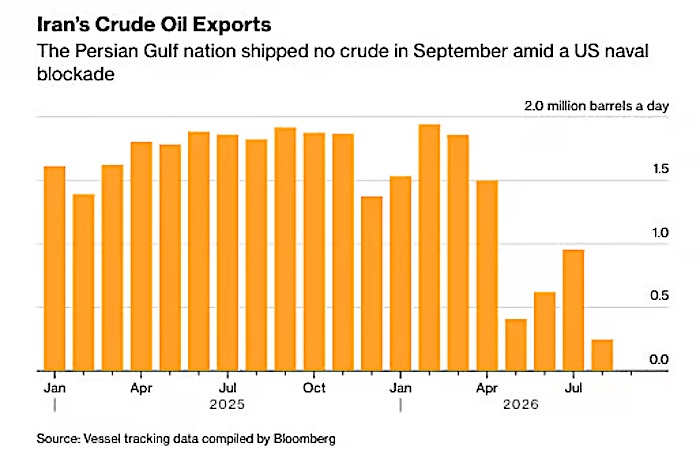
Beyond the broader global bond rout, his comments on the Strait of Hormuz added color to President Trump’s economic stranglehold on Tehran. “They are isolating them economically like this never happened before. You know, right now, the score: barrels out of the Strait: U.S. about 1.1 billion, Iran zero,” Bessent told Allen.Bessent continued, “For the first time in history, they, since they started pumping oil, they will have no oil on the water this week. They will have no revenue.”
Bessent on Iran:
— Clash Report (@clashreport) October 3, 2026
For the first time in history, since they started pumping oil, they will have no oil on the water this week.
They will have no revenues. pic.twitter.com/PIrHwUCG4q
Separately, last week, Goldman analysts Yulia Zhestkova Grigsby, Alexandra Paulus, and Daan Struyven told clients that a “divergence between the fall of Iranian exports and the rise of exports of other Persian Gulf producers” was underway. The Goldman energy experts estimated that “dark exports” have helped boost Persian Gulf oil exports to 23.3 million barrels a day over the past week, back to prewar levels.Also last week, Bloomberg News reported that Iran’s crude loadings crashed to zero in August from around 250,000 barrels per day.Data providers Kpler and Vortexa also recorded zero crude loadings last month.
The collapse in Iranian crude loadings suggests the US naval blockade is constraining Tehran’s export options, while recovering flows from other Gulf producers point to eroded Iranian leverage over the strait. If sustained, Tehran’s oil revenues would plunge, pressuring the regime to make a deal.
“Hamas-led attacks on Israel on 7 October 2023, which killed about 1,200 people and involved mass shootings, hostage- taking, rapes and horrific assaults on civilian communities.”
• France Closes 400 Schools, Rioters Plan Major Escalation Oct 6 and 7 (CTH)

There’s generally a strategy to the madness; you just have to wait until it starts to become visible. The anniversary of October 7, 2023, massacre is right around the corner. Hamas-led attacks on Israel on 7 October 2023, which killed about 1,200 people and involved mass shootings, hostage- taking, rapes and horrific assaults on civilian communities. As noted in the end of this article about the French protests, student organizations are nevertheless calling for protests to continue, with the movement now looking towards Tuesday’s National Day of Action.Read more …
EUROPE – Around 400 of France’s 3,700 secondary schools were closed on Friday on the orders of police prefects, with many schools switching to online lessons. Education Minister Edouard Geffray urged parents to intervene, warning that young people were putting themselves at risk. “Children are in danger on the streets,” he told BFMTV. “Parents must, quite clearly, take action and tell their children not to go [to the blockades].” The protests began over staffing, funding and school conditions and have spread rapidly across the country.The Interior Ministry said 1,027 secondary schools were affected on Thursday, including 222 that were blockaded. Around 30 university campuses were also blocked. It said 1,949 people were arrested on Thursday alone, mainly in connection with violence, unlawful gatherings and attacks on people in positions of authority. (read more)
“..regardless of midterm results..”
Prolonged because of great successes?!
• Schumer Says He’ll Seek 6th Straight Term As Senate Democratic Leader (JTN)
New York Sen. Chuck Schumer says he’ll seek another term as Senate Democratic leader regardless of whether his party or Republican control of the upper chamber after the Nov. 3 elections. “I am running for reelection for leader. Period,” Schumer told Politico Wednesday after senators cast final votes and left Washington until after the midterms. The 75-year-old senator also told Punchbowl News that he will seek a sixth straight term.Read more …
Yes,” he said. “And I’m looking forward to getting things done for the American people.” However, he declined to say whether he plans on seeking 2028 reelection. Though Schumer also told reporters that Democrats are leaving town with “wind in their sails,” regarding midterm voting momentum, he acknowledged the GOP has an “almost obscene” funding advantage.
Seems crazy.
• 84% of Gen Z Democrats Back Socialism: Poll (Pedro Rodriguez)

A groundbreaking new poll conducted ahead of November’s midterm elections has uncovered that over 30% of Americans have a favorable view of socialism. According to the OnMessage poll, which surveyed 800 American voters from July 12-16, 35% of respondents identified as Democrats, 84% of whom identified as Gen Z. “Embracing socialism is no longer a fringe talking point for Democratic voters. Our data shows that a majority of Democrats of all ages hold favorable views of socialism, including 84% of Gen Z Democrats,” Henry Parkhurst, the OnMessage pollster who carried out the survey, told the Daily Signal.Read more …
The findings confirm that the Democratic Party’s claim that socialism is a “fringe issue” is no longer true, and that socialism has spread into the party’s core. “While the national Democratic Party may claim to be divided on how far they’re willing to lean into socialism, their voters clearly show they’re encouraging the party to move in that direction,” Parkhurst added. The survey came months after the Democratic Socialists of America touted a historic increase in membership, coupled with the rise of DSA-affiliated candidates and officials across the country.Now, in the next Congress, at least five new DSA members will be sworn into the House of Representatives, adding to the growing number of socialist officials like Seattle Mayor Katie Wilson, New York City Mayor Zohran Mamdani, and Rep. Alexandria Ocasio-Cortez, D-N.Y. Senate candidates Angie Nixon in Florida and Abdul El-Sayed in Michigan also have a fair shot at winning their races this November. OnMessage revealed the findings after conducting text-to-web interviews and recording historic respondent turnout.
The survey also oversampled voters under 45, resulting in approximately 600 Gen Z and Millennial voters for in-depth analysis. The margin of error for this survey is +/- 3.5%.
“The Russian president said the Indian PM regularly raises the need for a peaceful settlement and seeks mutually acceptable solutions..”
• Modi Has ‘Very Good Ideas’ To End Ukraine Conflict – Putin (RT)
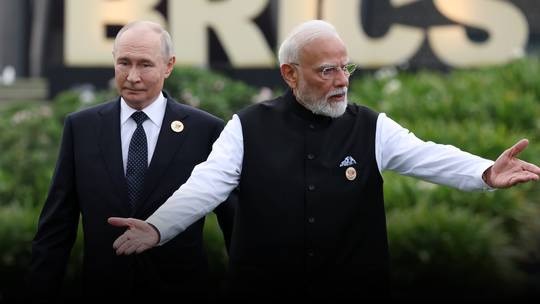
Indian Prime Minister Narendra Modi has “very good ideas” for ending the Ukraine conflict and has repeatedly pressed for its peaceful settlement, Russian President Vladimir Putin has said. Modi has refused to take sides in the conflict, despite pressure from the West to isolate Russia. This neutrality has given India the room to discuss the need for a peaceful end to the conflict with both Moscow and Kiev.Read more …
Putin told the annual Valdai Discussion Club meeting on Thursday that Modi raises the Ukraine conflict at every meeting between them, despite their close personal relationship, and has proposed ideas aimed at finding mutually acceptable solutions. He thanked Modi for those efforts but did not disclose details of the proposals. The Russian leader briefed Modi on the ongoing peace initiatives when they met on the sidelines of the BRICS Summit in New Delhi last month, where the Indian prime minister reiterated his call for dialogue and diplomacy and said India stood ready to assist peace efforts.At the earlier Shanghai Cooperation Organization (SCO) summit in Bishkek, Kyrgyzstan, Modi told Putin, “We need to move from endless war to an end to the war.” Moscow, too, has welcomed New Delhi’s efforts at peace. Ahead of the BRICS Summit, Kremlin spokesman Dmitry Peskov said Russia appreciates Indian initiatives to help end the conflict.
In an August interview with Japanese newspaper Yomiuri Shimbun, Modi said both Putin and Ukrainian leader Vladimir Zelensky had shared their perspectives on the conflict with him. Putin said last week that proposals for a settlement remained on the table, although Moscow would have to assess them against its own interests. Meanwhile, Washington has proposed a trilateral meeting with Russia and Ukraine in the United Arab Emirates, Zelensky said last week. The proposed talks would take place at a technical level, but a date has yet to be agreed. The Kremlin said such a meeting could take place soon.
“Mark Rutte expressed support for countries that try to pin almost any incident on Moscow..”
• NATO Chief Says ‘Almost Sure’ Is Enough To Blame Russia (RT)
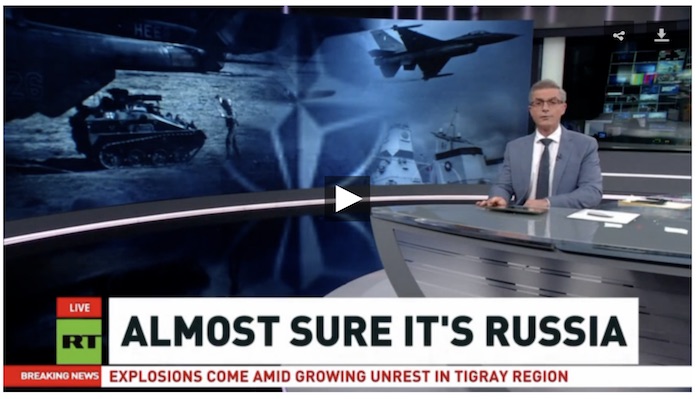
NATO Secretary-General Mark Rutte has urged member states to blame any incident they find suspicious on Russia even if they lack irrefutable evidence. He also hailed a recent accusation made by Estonia against its eastern neighbor and called on other nations to follow suit. Speaking at a joint press conference with Lithuanian Prime Minister Mindaugas Sinkevicius this week, Rutte encouraged a public blame game over what he called “malign grey zone activities” routinely attributed to Russia by NATO members.Read more …
“You have heard the Supreme Allied Commander yesterday saying, ‘Hey, when able, when you are sure it is the Russians, or almost sure it is the Russians, attribute it to the Russians’ – exactly like Estonia did today. I applaud it,” Rutte said. On Monday, NATO Supreme Allied Commander Europe Alexus Grynkewich described publicly attributing these types of incidents to Russia as a “deterrent” against the supposed “Russian threat” during remarks before a European Parliament committee.Rutte has been known for his staunch anti-Russian position, as well as his ardent support for Kiev in the conflict with Moscow. Last week, he offered to help “protect the United States from threats of Russia” while speaking at a Chicago Council on Global Affairs event in Iowa. During his joint press conference with Sinkevicius, he also maintained that the bloc should be doing “even more for Ukraine, and not less.”
Moscow has dismissed the claims of NATO members regarding the alleged ‘Russian threat’ as “nonsense” and maintained that it has no intention of attacking any member states. It has warned that NATO’s own belligerent rhetoric and military buildup, as well as the surge in NATO military activity along Russia’s western borders could put the bloc on a collision course with Moscow.
Everywhere.
• Christians Vanish From the Middle East — Except From Israel (Salgado)

Across the Middle East, Islamic regimes or terrorist groups are stamping out Christian communities and Christian influence from cities that appeared in the Bible. There is one exception: the democratic Jewish nation of Israel.Read more …
Between the Islamic civil war in Syria and the current dictatorship under the genocidal Syrian President Abu Mohammad al-Golani (also known as Ahmed al-Sharaa) and his terrorist group Hay’at Tahrir al-Sham, the Christian population of Syria has almost vanished. Within living memory, Lebanon was Christian; now it is mostly Muslim. In Iran and Iraq, ancient communities of Christians have shrunk almost to nonexistence. In Turkey, where Constantinople was once a glory of the Christian world, the Muslims have stolen Christian heritage and Christian lands.In Qatar, Saudi Arabia, Jordan, and numerous other countries in the Middle East, Christians have disappeared or are barely hanging on. Gaza’s and Bethlehem’s Christian populations have dropped under Palestinian Authority control. This is the legacy of Islamic takeover. Israel stands out in the Middle East because its Christian population is actually growing. Christians can visit the holiest sites of our religion because of the Israeli government.
In the Garden of Gethsemane, 2023. Have a blessed Holy Thursday pic.twitter.com/Xro6kCdfD7
— Catherine Salgado (@CatSalgado32) April 2, 2026
Israel’s Foreign Ministry shared an article in August investigating the phenomenon of the Christian population shrinking everywhere in the Middle East except Israel. “Terrorism and regional conflicts, persecution, extremism and political instability have dramatically induced emigration and reduced historic Christian communities across much of the region,” the ministry explained. “While Christians made up about 14% of the total population across the wider Middle East region (from Egypt to Iran) 120 years ago, today Christians account for just 3% of the Middle East’s population and the erosion continues even more intensely.”
From the Benedictine Abbey of Saint Mary of the Resurrection in Abu Ghosh, in Israel’s Judean Hills, we wish Christians around the world a peaceful Sunday.
— Israel ישראל (@Israel) July 26, 2026
The abbey played an important role in the revival of Hebrew-speaking Catholic life in Israel through Abbot… pic.twitter.com/LqaARhxZF0
The Israeli Foreign Ministry then provided some statistics on a few countries: Lebanon, established under the French Mandate as a state in which Christians, particularly Maronites, would play a leading political role, has undergone a serious demographic change. Christians now comprise approximately 28% of the population, while Muslims account for roughly 68%. Before Syria’s 2011 civil war began, around 1.5 million Christians, roughly 10% of the population, lived throughout the country. Recent estimates suggest that only one third or 450,000 remain.In Iraq, one of Christianity’s oldest continuous communities has suffered an even steeper decline, falling from approximately 1.5 million before 2003 to fewer than 150,000 today. That is the legacy of Islamic conquest. In contrast, the Jewish reclamation of ancient Israel from the Arab colonizers was a boon for Christians, too. Israel protects both Jews and Christians from the dozens of hostile Muslim countries across North Africa and the Middle East. On Easter, thousands gather inside Jerusalem’s Church of the Holy Sepulchre for the Holy Fire ceremony.
Every December, Christmas fills the streets of Nazareth with worshippers and pilgrims from around the world. Throughout the year, believers from every continent are baptized in the waters of the Jordan River, renewing a tradition that stretches back to the baptism of Jesus.These are not museums, they are living communities. Across much of the Middle East, churches have watched their congregations shrink. In Israel, churches remain filled with worshippers. According to Israel’s Central Bureau of Statistics, approximately 184,200 Christians now live in Israel, with the community continuing to grow through natural increase.
Some Christians will talk about how much better it would be if Christians were in charge of Israel. Leaving aside the fact that God promised Israel as a perpetual possession to the Israelites from the river to the sea (Joshua 1:4, Genesis 17:8), this is, practically speaking, a terrible idea. Just look at the Church of the Holy Sepulchre in Jerusalem, where control is divided between multiple different factions of Christianity, including Catholics, Greek Orthodox, and Armenians. They never stop fighting with each other, and sometimes the Israeli government has to intervene. I am Catholic, but I acknowledge that the current Vatican would never have the determination against terrorism that the Israeli government has to have. It is actually better for Christians to have Jews in charge of Israel.
Christians have called the Middle East home for thousands of years. Their future here matters. ✝️
— Israel ישראל (@Israel) August 11, 2026
As ancient Christian communities across the region shrink, @GeorgeDeek shares why he believes Israel tells a different story, and why it’s one he is proud to represent.
Swipe… pic.twitter.com/dpFhDrOeGX
And leaving aside a few random and extremely over-reported altercations between Orthodox Jews and Christians, the main thing Christians in Israel really need to fear is Islamic violence. Read here about an Arab Christian in Israel afraid of Muslim retaliation. And that is a problem that Western nations fuel by constantly siding with and funding the Palestinian terrorists who keep encroaching on more and more Israeli land. If Israel kicked all the Palestinians out of Gaza, Judea, and Samaria, a lot of these problems would dissipate.Israeli Jews have just as much to fear from Muslim terrorism, if not even more, than Israeli Christians do. And only the Israeli government stands against the unending Islamic terrorism that Middle Eastern Christians face.
“Leszek Miller has called for suspending assistance to Ukraine until it accounts for previously supplied weaponry and funds..”
• ‘Everyone Knows’ Kiev Is Embezzling Western Aid – Ex-Polish PM (RT)
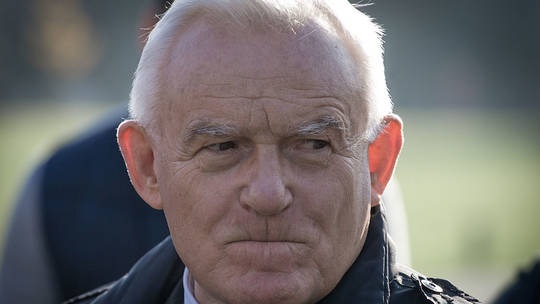
Former Polish Prime Minister Leszek Miller
Ukrainian officials are embezzling foreign financial aid, former Polish Prime Minister Leszek Miller has said, adding that Kiev’s backers are well aware of the corruption but prefer not to ask questions.Speaking on the ‘Jankowski Kontra’ podcast on Polsat News on Saturday, Miller called for suspending aid to Ukraine until Kiev accounts for previously supplied weapons and funds.Read more …
“Nobody’s asking what happened to the 300 tanks we sent in the first phase. What happened to the heavy equipment, the lighter equipment… Nobody’s asking what happened to the billions of euros we donated. Mr. Zelensky simply comes and says, ‘Give it’, and we give it,” Miller stated. Asked whether he suspected that funds transferred to Ukraine were being embezzled, Miller replied: “Of course, everyone knows it.”The veteran politician argued that Warsaw should demand an accounting of how its assistance has been used and halt further support if Kiev fails to provide one.“This is a fundamental issue: I’ll lend you the money, but give me a report on what you did with the previous installment,” Miller stated. “Without that help, there is no Ukraine… But we are not a country that is overflowing with wealth… We have obligations to our own citizens, and we cannot simply throw away money and equipment indiscriminately.”
Poland has been one of Kiev’s staunchest backers in its conflict with Russia, pouring billions into military, financial and humanitarian aid while serving as a crucial hub for Western supplies. Yet relations have increasingly soured over Kiev’s honoring of Ukrainian Nazi collaborators linked to the World War II-era Volhynia massacres, in which UPA militants, linked to the Organization of Ukrainian Nationalists (OUN), killed at least 100,000 ethnic Poles.
Warsaw recognizes the killings as genocide, while Kiev honors figures including OUN leader Stepan Bandera. Tensions flared again this year after Zelensky bestowed the title ‘Heroes of the UPA’ on the Ukrainian Special Operations Center North military unit. In the aftermath, Polish President Karol Nawrocki stripped him of the country’s highest honor, politicians on both sides renounced state decorations, and Warsaw threatened to obstruct Ukraine’s EU accession.
Relations have also been strained by mounting opposition to Ukrainian refugees. A July CBOS survey found that 52% of Poles now opposed accepting them, against 42% in favor – a sharp reversal from the overwhelming support seen after Kiev’s conflict with Moscow escalated in 2022. Tensions deepened earlier this month after a 31-year-old Ukrainian man stabbed five people at a Benedictine abbey in Jaroslaw, killing a priest.
Poland is also not alone in questioning funding for Kiev. Despite receiving billions in Western assistance over the past four years, Ukraine faces a severe cash squeeze and has been pressing European backers for more money. But a string of high-level graft scandals has heightened scrutiny in Brussels, the largest of which centers on an alleged $100 million kickback scheme at state nuclear operator Energoatom, which was reportedly led by Timur Mindich, a former business partner of Vladimir Zelensky.
Western-backed investigators have uncovered multiple other graft schemes involving Ukrainian officials, including one reported earlier this month in which they allegedly embezzled more than $3 million through the delivery of used Soviet-made metro cars donated by Poland.Against that backdrop, the EU this week rebuffed Kiev’s bid to fast-track its latest €90 billion support loan, making clear that further funds depend on Ukraine delivering promised anti-corruption and governance reforms.
PCR genuinely doesn’t seem to know why the US is in Iran. He thinks it’s for Hormuz.
• Do “News Reports” Have Any Value? (Paul Craig Roberts)
I have come to the conclusion that journalism in the West has been replaced by hired narratives and that reporters report the narrative that they are hired to tell. It is a new form of vanity press in which interest groups hire a propaganda service to market their agenda.Read more …
I will present a current example. On September 28 US Central Command denied that Iran had control of the Strait of Hormuz. Central Command said the US sank the Iranian Navy and that “thousands of ships have passed through freely along with more than 1 billion barrels of oil just over the past few months.”The previous day Trump’s Secretary of the Treasury said on Fox News that the Strait of Hormuz was open–except to Iranian oil “which we are not letting out”–and that 15-22 millions of barrels of oil are passing through the strait daily. In other words, the energy crisis is over and has been according to US Central Command during “the past few months” while we have had an energy crisis..
The London Daily Telegraph, once a respectable Tory newspaper, has become a “hire to have your story told” organization. David Blair, Chief Foreign Affairs Commentator, wrote in the Telegraph 2 days ago that “It has taken a monumental effort by the US navy but the tankers are steaming through the Strait of Hormuz once again, carrying about as much oil as they did before Donald Trump launched his onslaught against Iran.
“New and independent data confirms that the US has, at least for now, succeeded in breaking Iran’s stranglehold on this crucial junction of the world. An average of 13.5 million barrels of oil transited the Strait every day in the week until Monday, according to Kpler, a company that tracks global shipping, more or less matching the pre-war average.
“Elsewhere, Saudi Arabia has repaired the pipeline that links its biggest oilfields to the Red Sea, after Iranian-backed militias launched a drone attack from Iraq on the night of September 10. “The outcome is that total oil exports from the Middle East through all routes are running at 20.5 million barrels per day – or 89 per cent of the 2025 level – according to analysts at JP Morgan, who noted a ‘remarkable recovery for a region still at war’”.
“Iran, by contrast, cannot load a single tanker or export any oil by sea because the US navy is enforcing a total blockade of its ports. Suddenly the regime’s vital oil revenues are plummeting towards zero. “So far, Iran’s furious attempts to retaliate by choking oil shipments from the rest of the Middle East are demonstrably failing. “That leaves the hard men who govern Iran under greater pressure than at any time since Trump began the war on Feb 28 by joining Israel to kill Ayatollah Ali Khamenei, the late supreme leader.” https://www.telegraph.co.uk/gift/80bf2cc04f5154a8
The Telegraph concludes its hired narrative with this: “So the truth is that Trump is being rescued from his own folly by the sheer power and professionalism of the US armed forces,” which implies US Central Command is allying itself away from Trump. Remember that the Telegraph is the propaganda instrument that told us for years that Ukraine was defeating Russia.
Now, let us ask ourselves if the Strait of Hormuz is open and the US Central Command is in control of the situation why is Trump sending a third US aircraft carrier task force and 50,000 more US Marines? Why is Trump pressuring the French government to release its oil reserves to reduce the pressure on energy prices before the US midterm election? Why is Trump reportedly preparing or considering a large scale invasion of Iran?
If the Strait is open, what is the beef? Why does Trump want to expand the war by invading Iran or by using nuclear weapons? It makes no sense. If the strait is open, what is the conflict about?.
Is it about those”Iranian nukes” that both the International Atomic Agency and US intelligence say are not being produced by Iran? How does Trump know more than these authorities? Is Netanyahu his source of information? Do Americans want their war policy and foreign policy determined by another country that uses America to grind its own axes?
Consider the situation from this standpoint. The Republicans who rallied to Trump are facing midterm elections in a situation where hard-pressed Americans have energy price concerns, where the electorate is opposed to Trump’s wars for Israel, and in which MAGA hats are missing. Futures markets have the ability to see hopeful developments that indicate lower energy prices in the future from the higher prices of today. A competent political machine will create a narrative in which the energy crunch is over when it is not.
This is achieved by announcements that the US is in control of the Strait of Hormuz. I do not know, but from the information I have I suspect that the story that the Strait of Hormuz is completely open except to Iranian oil is a false narrative to keep energy prices from exploding prior to the US midterm elections.
Americans being the insouciant people they are do not well serve their independence and their country’s sovereignty. Their insouciance makes them easily led by the many rings in their noses to act in the interest of others instead of in their own interest, just as they submit to immigrant-invaders instead of defending their nationhood.
Without leaders Americans are a lost people.
Social Science is an oxymoron.
• Why So Many Social Science Claims Are False (Ferguson)

One of the most urgent questions facing society today is the potential impact of AI on education and labor markets. So it’s no surprise that two scientists attempted to provide an answer, producing a meta-analysis suggesting that incorporating ChatGPT in schooling dramatically improved student outcomes. Social media and online sources promoted the 2025 study as a beacon of bright light. The problem is that the researchers’ conclusions were later found to be unreliable, and the study was retracted in April – another blow to the public’s faith in science.Read more …
Scientists are increasingly chasing answers to big questions in fields from health care to climate change to AI. The academic research industry incentivizes them to produce the biggest possible findings that make for splashy headlines and career promotions. But such discoveries are rare in science, and too often, the result is widespread exaggeration, dodgy methods, and miscommunication.“The incentive structure of modern science is such that a ‘simplify, then exaggerate’ strategy has become dominant, even if only tacitly,” according to a recent academic review. “To get published in leading journals, to be awarded grants and to be hired as a postdoc or faculty member, a system-wide bias for novelty, exaggeration and storytelling has emerged.”
As RealClearInvestigations has previously reported, an alarming amount of poor-quality academic and scientific research has been discovered in recent years. Hindawi, formerly a part of major science publisher Wiley, had to retract thousands of science articles, many of them alleged to have been produced by paper mills that generate reams of reports of studies that never existed.
Big discoveries are rare in science, but the academic research industry incentivizes scholars to turn small findings into splashy headlines. While cases of outright fraud have received wide attention, a more subtle infection has spread within the research community: Research results that are inconsistent, based on poor methodologies, or are of limited practical impact are too often transformed into big, broad, but unreliable claims that, over time, reduce public confidence in science.
Several recent high-profile retractions of scientific papers highlight how broad scientific claims can be built upon questionable data. A recent paper asserted that banning sex work increases rapes. The sex work paper got significant attention on social media before skeptical scholars pointed out they couldn’t replicate the findings. In another major case, economists estimated that climate change would have a devastating economic toll on the world in a paper that was widely covered and influential in banking. However, it was ultimately retracted after other scholars alleged major errors.
In each case, science sleuths found that the dramatic claims did not reflect reality. While the number of retractions has soared over the past two decades to several thousand a year, according to the watchdog group Retraction Watch, experts believe only a small fraction of questionable work gets caught.
Flip a Coin
Lee Jussim, distinguished professor of psychology at Rutgers University and frequent critic of social science, has estimated that the vast majority of psychology research claims are false. He also noted that the ability of psychology to replicate most findings is no better than a coin toss.At the core of the crisis is a broken system that pressures researchers to produce more and more papers in high-profile journals that favor bold rather than incremental (or null) findings.
The incentives include:
• Academic reward systems that grant promotions, tenure, and grant funding to researchers based on the number of publications and bold claims they produce rather than thoughtful scholarship
• Journals that often attract subscription dollars and news attention for flashy findings
• News media that win subscriptions and clicks with dramatic, often surprising claims about human behavior
• Politicians who cherry-pick alarmist science claims to promote their favorite policies while overlooking contradictory evidence
“The growing competition and ‘publish or perish’ culture in academia might conflict with the objectivity and integrity of research, because it forces scientists to produce ‘publishable’ results at all costs,” Daniele Fanelli, a meta-scientist at Heriot-Watt University and the London School of Economics, noted in a recent paper.
The system set up to tamp down sensationalism and flawed findings – peer review – is so overwhelmed by the flood of research papers in recent years that it can’t begin to pull all the weeds from the garden of science. Peer reviewers are busy scholars who are mostly unpaid and stretched too thin, even with the help of emerging AI tools that have their own problems with accuracy. One recent paper estimated that, in any given year, peer reviewers collectively work the equivalent of 15,000 years on scientific papers, which, if actually paid, would cost about $2.5 billion for U.S., Chinese, and U.K. reviewers alone.

What if everyone had a C-3PO that actually did the work?
— Camus (@newstart_2024) October 3, 2026
That is Elon Musk’s 90 percent case. A household robot. Care for an aging parent. Watch a child. Tutor one kid at a time. Then companies of one person and hundreds of machines, physical and digital.
A human works 40 or 50… pic.twitter.com/u2nCYCtE3u
Treasury Secretary Scott Bessent just made his support for Elon Musk very clear:
— X Freeze (@XFreeze) October 3, 2026
“I am a huge Elon fan”
He compared their relationship to a sports team…you can argue in the locker room, but once you step onto the field, you’re all working toward the same goal
Bessent also…
🚨 JUST IN: Elon Musk just announced he will be changing the name of SpaceXAI to SpaceXSI 🔥
— MAGA Voice (@MAGAVoice) October 4, 2026
“No more AI. SI. It’s better”
SUPER INTELLIGENCE IS TAKING OVER pic.twitter.com/Jec6cgYQgc
The upside of extremism https://t.co/cGoGv4xRdM
— Elon Musk (@elonmusk) October 4, 2026
A humanoid is a capital good on a scale that changes the constraint. It lengthens production and raises what labor and land can turn out, which is the abundance Elon is pointing at.
— Rothmus 🏴 (@Rothmus) October 3, 2026
A person supplies about 2,000 hours a year. A robot on a 168 hour week supplies about 8,700. His… https://t.co/1affyh3ahs
🚨 A hacker group announced at 3:00 AM: "We have locked all Starlink ground stations worldwide. Pay $500 million in Bitcoin, or the world goes offline!"
— Wiki Leaks 1.0 (@WikiLeaksQ) October 4, 2026
🚀 Elon Musk replied at 3:01 AM: "Check your firmware. While you were writing that ransom note, Neural-Auto-Patch released a… pic.twitter.com/pL7StQ9qo5
Support the Automatic Earth in wartime with Paypal, Bitcoin and Patreon.