

Willem de Kooning Woman III 1953

Barack Obama allegedly diverted $400 million from the $1.7 billion sent to Iran—with help from the CIA and Italy—to fund election interference in 2020 (switching Trump votes to Biden) and to sabotage Trump’s presidency and family.
— STORM NEWS 📰🗞️ (@storm1news) October 6, 2026
All roads lead to Obama. pic.twitter.com/nQFVXdqZgM
Merz, former BlackRock chairman in Germany, is the grandson of Nazi party official, Josef Paul Sauvigny, who joined the SA in 1933 and held an official position as a Nazi mayor. (If Ukraine loses the war, BlackRock’s $800 billion fund to “rebuild Ukraine” will not be realized.)… pic.twitter.com/af93kbfIxX
— Alan Watson (@DietHeartNews) October 4, 2026
JD Vance has a 95% approval rating with the MAGA GOP.
— Benny Johnson (@bennyjohnson) October 5, 2026
They keep telling us "MAGA is dead".
The base is stronger than ever. pic.twitter.com/Spf6KK1BHr
🚨 HOLY CRAP! The Biden FBI TRACKED BARRON, per declassified files
— Eric Daugherty (@EricLDaugh) October 5, 2026
The Jack Smith-directed investigation had Barron Trump as a target of the surveillance, along with Melania Trump — tracking their travel
The Biden regime also monitored now-Chief of Staff SUSIE WILES'… pic.twitter.com/2XpjYJIsIH
This was clear years ago. Is politics blind on purpose?
“Google Plugs Into Constellation’s Nuclear Reactors As PJM’s “Bring Your Own Power” Era Arrives…”
• “Bring Your Own Power” Era Arrives (ZH)
For most of 2026, the bear case on the US power producers could be summed up in one sentence: nobody is signing data center PPAs in PJM. Last week Amazon did. This morning Google did, too, and this one is five times bigger.Read more …
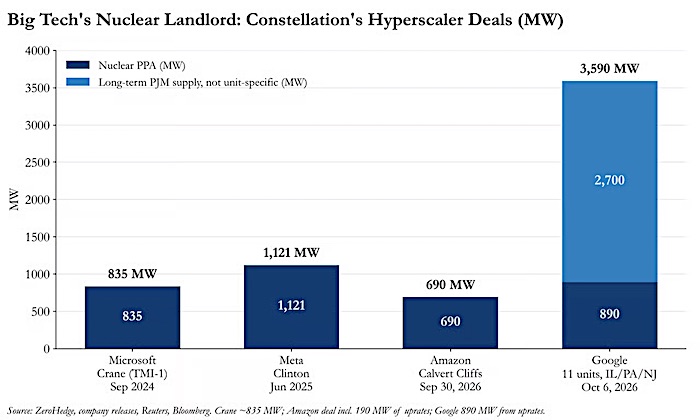
Google parent Alphabet has contracted for 3,590 megawatts of power from Constellation Energy (CEG) inside PJM, the largest US grid, the companies said on Tuesday, according to Reuters, confirming an overnight report from Bloomberg. Roughly a quarter of it, 890 MW, is new nuclear capacity squeezed out of 11 existing reactors under a 20-year PPA backed by more than $4.3 billion of Constellation investment, expected to start delivering in 2028. The rest is a long-term supply agreement for another 2,700 MW. And in case anyone missed why this is happening now, the companies said it outright: the deal is a response to PJM’s “bring your own power” proposal.Constellation shares jumped as much as 14% premarket (they were up 6.3% when Bloomberg first broke the story last night), trading above $300 for the first time in a month.
Zerohedge readers know this story didn’t start this morning. We have been tracking the AI-nuclear trade since Microsoft agreed to restart Three Mile Island in September 2024, when nuclear names surged across the board on what was then a shocking headline. (Five years earlier, we were writing about “America’s Chernobyl” finally closing its doors. Funny how the AI capex cycle changes things.) Two years later, Constellation has become Big Tech’s nuclear landlord.
Below we break down the deal, why PJM forced Google’s hand, what Goldman’s power desk and utilities team are saying, and why the cheapest nuclear megawatt is the one already built.
The Deal: 890 Nuclear Megawatts… Plus 2,700 More. The terms, per the companies’ statement and the Reuters and Bloomberg reports:
• 890 MW of new nuclear capacity under a 20-year PPA, coming from upgrades at 11 Constellation units in Illinois, Pennsylvania and New Jersey. The first upgraded plant is expected to start delivering in 2028.
• $4.3 billion+ of new investment by Constellation in “new equipment and technology… increasing thermal and electric efficiency,” as Goldman’s industrials desk put it this morning.
• A separate long-term supply agreement for 2,700 MW in PJM that is “not tied to a specific generation source and serves as long-term revenue certainty for Constellation’s operating plants,” per Google.
Translation: the 890 MW is the headline-friendly “new clean firm power” part. The 2,700 MW is essentially Google locking in a long-dated price for a big chunk of Constellation’s existing output. Who needs a hedging desk when you have a hyperscaler?Stack it next to Constellation’s other hyperscaler deals and Google’s is bigger than Microsoft, Meta and Amazon put together (2,646 MW combined), at least once the non-unit-specific supply is counted:
It also comes less than a week after Amazon’s 690 MW, 20-year PPA at Calvert Cliffs, which we covered on Thursday in “Amazon Secures 20 Years Of Nuclear Power From Constellation As Goldman Sees Industry-Wide Win”. And Google is hardly new to the game: it is already funding the restart of NextEra’s Duane Arnold reactor in Iowa (which just landed a $1.9BN DOE loan), and last month lined up new capacity from Southern Co. by paying for upgrades at two of its nuclear plants.
Putin doesn’t kill Ukrainians, Zelensky does. The rest is filler.
• Why Might Putin Finally Decide To Bring Ukraine To Its Knees (Korybko)

Regardless of why Putin might have held off on this for so long, he’s now arguably motivated at least in part by the tantalizing possibility of reaching big-ticket resource deals with the US after the conflict ends, the details of which his and Trump’s envoys have been negotiating for over a year already.Read more …
The New York Times cited allegedly intercepted Russian communications to report that Russia plans to obliterate Ukraine’s power, heating, and water systems this winter. While their claim can’t be confirmed, it aligns with Putin mildly “escalating to de-escalate” over the summer in response to Zelensky’s strike campaign, which has taken the form of ramping up attacks on Ukrainian infrastructure. If the report is true, then Russia doesn’t just aim to sever Ukraine’s military logistics, but to bring Ukraine to its knees.Putin has thus far eschewed this arguably due to his belief that Russians and Ukrainians are kindred people. Some have suggested that Russia might not have had the drone and/or missile capacity to do so earlier, however, whether due to low production till now and/or to hedge against the scenario of a hot war with NATO. In any case, Putin now seems to have made peace with the humanitarian consequences of ending the war on Russia’s terms sooner rather than later, or at least on as many of them as possible.
He might be motivated by more than just Ukraine’s “war of attrition” against Russia that began over the summer with American backing and interestingly enough France’s as well. Treasury Secretary Scott Bessent reportedly told his Russian counterpart over the summer that no business deals are possible so long as the conflict continues. Since then, Steve Witkoff and Jared Kushner met with Putin to discuss such deals among other topics, after which Kirill Dmitriev traveled to the US to follow up on that.
For background, Putin boasted in late February 2025 that American companies “will make a decent profit” from investments in Russia’s resource industry, and Trump’s Special Envoy to Belarus John Coale recently confirmed that he received approval to pitch a Belarusian-like deal to Putin. It would involve sanctions relief in exchange for the release of “political prisoners”. Putin’s ally Alexander Lukashenko already agreed to several such deals and is now negotiating a massive potash one with Trump.
Just last week, Lukashenko also proposed a trilateral Belarusian, Russian, and US fertilizer plant deal, but that requires the US lifting its sanctions on Gazprom. Russian officials from Putin on down have called for the West to lift its sanctions on Russia, and while the US might lift some if Putin agrees to a Belarusian-like quid pro quo, the Ukrainian Conflict will first have to end for this to happen at scale. Their resultant resource-centric strategic partnership could then revolutionize the global economic architecture.
The Russian economy has survived the West’s unprecedented sanctions onslaught, largely due to the combination of its natural resources and national payment system, but its Economic Development Ministry expects only 0.6% GDP growth this year. United Russia’s landslide victory during last month’s Duma elections, the first since the large-scale phase of the Ukrainian Conflict began, gives Putin the mandate to do whatever is needed to win the war and deliver more prosperity to his people afterwards.
It’s therefore within the realm of possibility, consistent with Russia’s policy of demanding the lifting of Western sanctions, that Putin is motivated at least in part to end the conflict on as many of Russia’s terms as possible sooner rather than later so as to then reach big-ticket resource deals with the US. This imperative, which could revolutionize the global economic architecture and deliver more prosperity to his people, contextualizes the New York Times’ report about him planning to bring Ukraine to its knees.
How was this ever legal?
• White House Declassifies DOJ and FBI Documents of Susie Wiles Targeting (CTH)

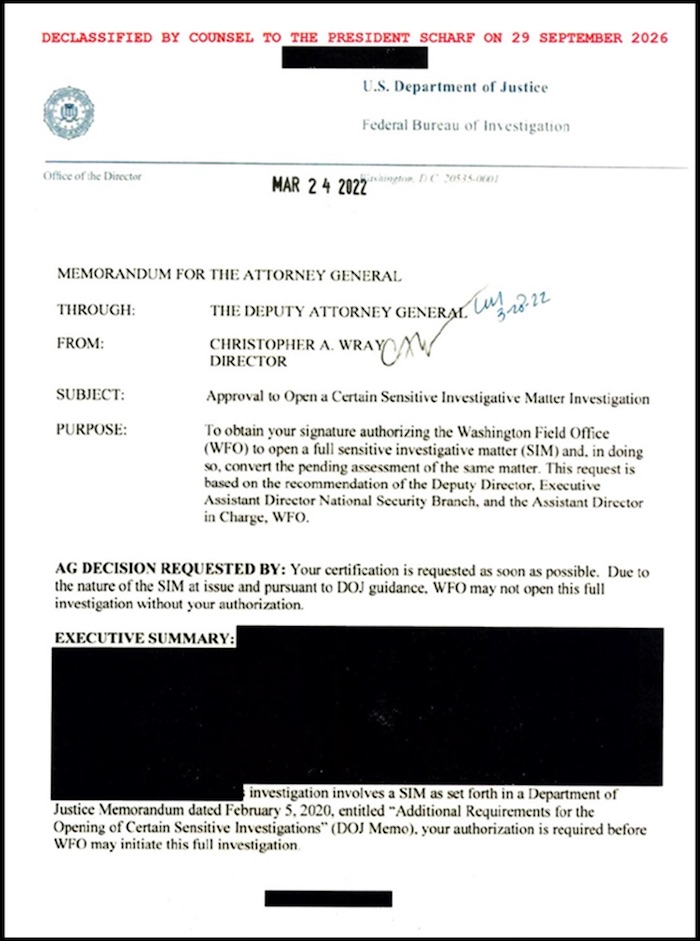
The White House has declassified documents from within the executive branch, specifically from within the Dept of Justice and FBI highlighting that Jack Smith used the Washington Field Office of the FBI to target President Trump’s campaign advisor, campaign manager and current Chief of Staff Susie Wiles.
The activity took place while Joe Biden was President, Merrick Garland was Attorney General and Lisa Monaco was Deputy AG. The FBI targeting of Susie Wiles was authorized by Merrick Garland on March 28, 2022. Recommended by Monaco eight days prior on March 20th. The FBI opened an investigation on Wiles that encompassed tracking her phone and email records during President Trump’s pre-campaign under the auspices of a “Sensitive Investigative Matter” that would later become “Plasmic Echo.”In 2016 the Obama FBI opened an investigation of Donald Trump to monitor his campaign activity. In 2022 the Biden FBI opened an investigation of Donald Trump to monitor his campaign activity. The intents and purposes of the investigations seem identical. This is quite a remarkable series of documents provided by John Solomon. If, like me, you are deep in the weeds on these issues, you might also ask the question: why are we only just now getting to see this information? The answer seems to be at the top of the documents released.
The declassification was done by newly installed White House counsel Will Scharf. On August 9th President Trump noted the departure of White House Counsel David Warrington {source}, who was then replaced by Will Scharf effective September 1st {source}. According to the documents released, Will Scharf declassified them on September 29th {source}.
When Warrington’s exit was announced, there was a curious lack of explanation. Those of you who follow the inside baseball will note my criticism of the White House counsel in both Term-1 and Term-2. Given the context of these releases, it looks like Warrington was an impediment to sunlight on the corruption within the DOJ and FBI. I’m left to wonder if these documents were sitting in the White House counsel’s office, for more than a while.
Why did the White House wait to release these documents showing how the FBI and DOJ were targeting Donald Trump, his advisors and his campaign team until now. You decide. To me, this is beyond frustrating. I am trying to remain gracious, but there is no excuse for keeping sunlight away from this level of corruption. Hopefully the South Florida legal team is reviewing these documents as evidence in the larger conspiracy investigation.
There were different legal justifications used by Main Justice to target Donald Trump. In 2016, ’17, ’18, ’19 it was the nonsense around Trump-Russia. In 2021, ’22, ’23 and ’24 it was the J6 insurrection. However, the outcome of both DOJ/FBI efforts is identical – keep Donald Trump under FBI surveillance.
“We all know that Mamdani is an antisemite, and his efforts to pretend he isn’t don’t fool anyone.”
• Mamdani Tries to Hide His Jew-Hatred and Only Exposes It Further (Matt Margolis)
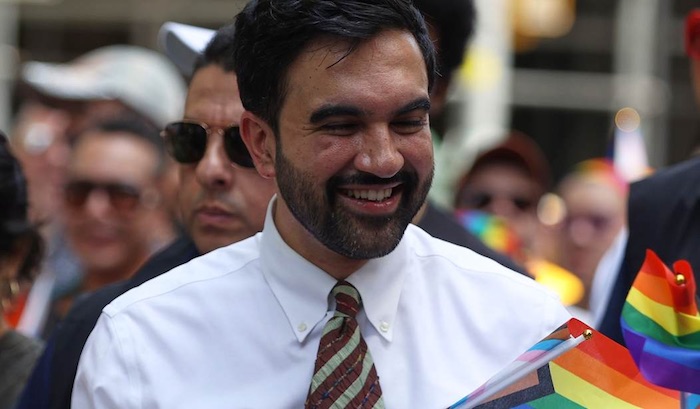
New York City Mayor Zohran Mamdani is desperately trying to prove that he’s not antisemitic, yet his efforts to do so only keep proving that he is. Last week, Mamdani rolled out his long-awaited strategy for fighting antisemitism, complete with a new Interagency Task Force to Combat Antisemitism and a $30 million price tag. He needed it badly. The city’s first Muslim mayor has spent months fending off charges that he has no use for the Jewish community, and Jewish New Yorkers keep getting attacked at a growing rate on his watch.Read more …
NYPD data released in August showed hate crimes climbing 9.4% citywide this year, and more than half of those incidents targeted Jews. That happened while all seven major crime categories dropped across all five boroughs, with murders and shootings hitting historic lows. Crime is falling everywhere in New York except where the victims are Jewish. The department’s figures also showed antisemitic attacks up 8% through August, with anti-Jewish incidents accounting for an outsized majority of all reported hate crimes.So what did he deliver? A plan to combat antisemitism that never defines antisemitism. Nothing in it explains what sets Jew-hatred apart from any other racial or religious bigotry. Mamdani also declined to formally recognize Israel’s existence while unveiling it. The document never uses the word Zionism and gives Israel a single passing mention. Think about that for a second. Mamdani produced an entire plan about hatred of Jews and scrubbed out the Jewish state, the one thing his political allies despise most.
And the $30 million? It’s proving itself to be a ruse. Most of the plan recycles measures former Mayor Eric Adams already put in place, so New Yorkers get little that’s new. What is new is classic Mamdani, because the plan boosts funding for a group tied to anti-Israel activist Linda Sarsour. Here’s what reporting on the plan’s partners turned up:
One of the top advocacy groups involved in P.A.T.H. — which works to prevent hate crimes across the city through community programs and grants — is the anti-Israel Arab American Association of New York. The Brooklyn-based group, which was run for over a decade by Mamdani’s mentor and pro-Palestinian firebrand Linda Sarsour, repeatedly cheered on the anti-Israel encampment at Columbia University and other protests following Hamas’ Oct. 7, 2023, attack.
The organization pocketed $3.3 million in city funding between 2017 and 2024, the Washington Examiner first reported, citing data analyzed by the transparency watchdog group OpenTheBooks.= P.A.T.H. partners also include the 67th Precinct Clergy Council, aka “the Godsquad,” the LGBT NYC Anti-Violence Project, the Asian American Federation and the Hispanic Federation.
Mamdani’s answer to surging attacks on Jews is to hand more public money to an outfit that applauded the mobs at Columbia. He is asking the people who helped make Jewish students feel hunted on their own campus to protect Jewish New Yorkers. It’s outrageous, and he expects the city to thank him for it.
None of this should surprise anyone who watched his rise. Mamdani supports the slogan “globalize the intifada.” He campaigned alongside Sarsour on arresting Israeli Prime Minister Benjamin Netanyahu. His wife celebrated the Oct. 7 terrorist attacks. Anyone who knows Mamdani’s record knew his plan to combat antisemitism was going to be phony, and he happily obliged.
Jewish leaders certainly noticed. More than two dozen of them denounced the report and demanded that the Mamdani administration reissue it with a version that deals with Zionism. They understand what the mayor refuses to admit, which is that the hatred driving attacks on Jews in his city so often arrives dressed up as hatred of Israel.
We all know that Mamdani is an antisemite, and his efforts to pretend he isn’t don’t fool anyone.
No more Democrat playground. How can that be a bad thing?
• Latin America’s Many Trumps (Daniel McCarthy)
Latin America is turning right, and it’s a vindication for President Donald Trump and Secretary of State Marco Rubio. In some ways, the Cold War never really ended in the Western hemisphere: Socialism has haunted the nations of Central and South America long after the fall of the Berlin Wall, and the same Cuban regime the Soviet Union propped up for decades remains in power to this day.Read more …
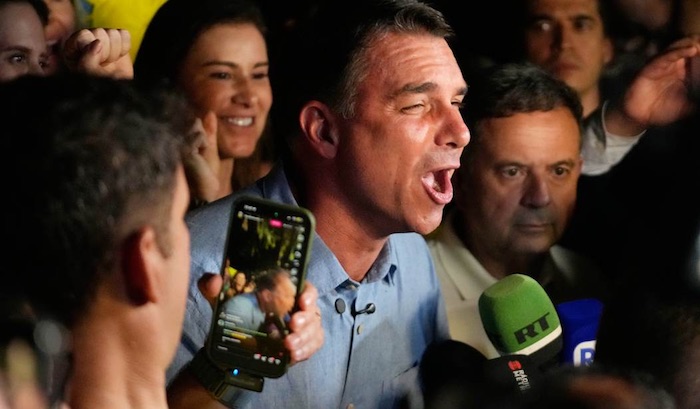
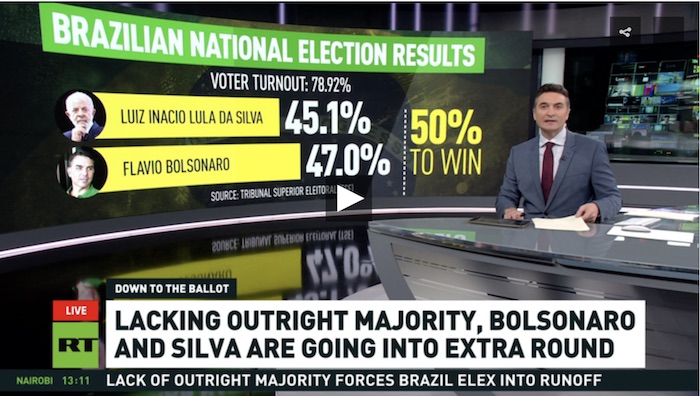
The hard left thought it had cemented control over Venezuela, too, thanks to Hugo Chavez and Nicolas Maduro — until American forces snatched Maduro right out of his bed back in January and took him to New York to stand trial. Yet most of our neighbors to the south are not ruled by dictators. Instead, elections in Latin America have swung back and forth between left and right. Only now they’re all swinging to the right, as the region’s biggest nation dramatically illustrated last weekend.Brazil is now the scene of the greatest right-wing comeback since President Trump’s own reelection two years ago. Flavio Bolsonaro — whose father, former President Jair Bolsonaro, is under house arrest — defeated leftist incumbent Luiz Inacio Lula da Silva in the first round of the country’s presidential contest on Sunday. Bolsonaro took 47% of the vote to Lula’s 45%, and with other right-leaning candidates garnering nearly 5%, Bolsonaro’s prospects in the runoff election on Oct. 25 look bright.
Yet that’s only half the story: The right, and the Bolsonaro family itself, also made huge advances in the nation’s legislative elections. “The Bolsonaro clan claimed victory in every race they contested,” the Buenos Aires Times noted. The ex-president’s wife, Michelle, won a federal senate seat, as did his second son — Flavio’s younger brother — Carlos, while third son Jair Renan Bolsonaro was elected as a federal deputy, as was the former president’s brother, Renato.
Their party, the Liberal Party, nearly doubled its number of senators, from 15 to 28, and won the largest number of seats in the Chamber of Deputies of any party since the nation’s current constitution came into effect in 1988. Smaller conservative parties also fared well on Sunday — the Brazilian people sent an unmistakable message that they are through with the leftism Lula represents. In this, the Brazilian electorate is moving in synchrony with voters throughout Latin America, who in election after election have tossed out left-wing regimes or reelected conservatives who were already in office.
It’s as if the whole region has been going through its own version of Trump’s 2024 reelection over the past two years. And more than one wit on social media has remarked leftists haven’t won a single national election in Central America or South America since USAID was dismantled. Chile, Bolivia, Peru, Ecuador, Colombia, Honduras and Costa Rica have all moved right, while Javier Milei’s party staved off left-wing challenges and won big in Argentina’s legislative elections last year.
No, this isn’t just because American taxpayer dollars are no longer being funneled by progressive non-government organizations — NGOs — into humanitarian efforts that get co-opted by left-wing foreign interests.But the ecosystem of international aid, which during the Cold War was seen by Washington as a way to blunt the appeal of Communism in the Third World, has for a long time helped rather than hindered the global left. That’s been true of Washington’s rhetoric as well:
Jeane Kirkpatrick, who became Ronald Reagan’s ambassador to the United Nations, argued in the late ’70s that Washington treated foreign friends on the right worse than most enemies on the left, as if the only way to beat Communism and socialism was to prove America could appeal to left-wing sensibilities, too. Trump and Rubio have taken the opposite approach: They encourage pro-American, right-leaning governments, especially close to home in the Western hemisphere.
This has given Central and South Americans a moral boost to free themselves from left-wing governments, much as the stark contrasts President Ronald Reagan drew between freedom and Communism helped inspire Eastern Europeans to tear down the Berlin Wall. The people of Eastern Europe knew better than anyone how evil Communism was, but they had reason to wonder whether the West was really willing to stand for an alternative, rather than offering endless moral accommodations and capitulations.
Until now, the State Department and Washington’s foreign-policy elite have habitually thought our country isn’t good enough and must prove itself equal to the professed — yet entirely fraudulent — ideals of left-wing regimes.
The Trump administration has a different attitude: It’s proud of America, and in the places around the world where hope and pride matter more than resentment and shame, that new attitude gets results.
Latin America knows it has a choice — and now that it’s clear, the people of South and Central America are choosing “Trumps” of their own.
US funding and interference have played a role in the South American country’s presidential election, the independent journalist has told RT..
No, we are not surprised. Is there even one single person who is?
• Brazil Votes: CIA Cultivated Evangelical Churches ‘For Decades’ – (Pepe Escobar)
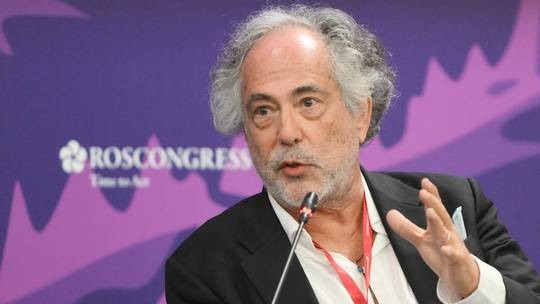
The US has sought to influence Brazilian politics for decades, including through the Central Intelligence Agency (CIA), and has played a role in the country’s current presidential election, independent journalist and geopolitical analyst Pepe Escobar has told RT.Read more …
He was speaking after Sunday’s first round of voting, in which right-wing Senator Flavio Bolsonaro, son of former President Jair Bolsonaro, finished ahead of incumbent left-wing President Luiz Inacio Lula da Silva. Both fell short of the 50% threshold needed to win outright. The two are set to face each other in a runoff on October 25.Brazil’s government has previously accused Washington of interference in its internal affairs, while Trump has denounced the prosecution of the former president – who is serving 27 years for plotting a coup – as a “witch hunt.” Brazil’s Federal Police have since opened an investigation into alleged US interference in the election, following a request from the Attorney General’s Office over reported US funding of projects aimed at undermining the country’s Supreme Court.
“The Americans put a lot of money in this election,” Escobar said, calling for a federal investigation into possible foreign influence. He singled out Brazil’s influential evangelical churches, claiming that the CIA had spent “decades” funding efforts to cultivate them and that this was now “paying off.”Escobar’s remarks come as US involvement in Brazilian politics has already become a point of contention between Brasilia and Washington. Flavio Bolsonaro met US President Donald Trump at the White House in May, while his brother Eduardo has lived in the US since 2025. Eduardo was sentenced by Brazil’s Supreme Court in June to four years and two months in prison for coercion after the court found that he had sought US pressure on Brazilian authorities in an effort to interfere with proceedings against his father.
Escobar also claimed that two days before the vote, the CIA already knew Bolsonaro was ahead, even as Brazilian opinion polls showed Lula leading. He attributed Bolsonaro’s strong showing in part to the influence of evangelical voters, who now comprise some 27% of the country’s populations, a historical high from the 15% in 2000.
The runoff is widely seen as a highly polarized contest over Brazil’s political direction. Lula has sought to strengthen the country’s role in BRICS and deepen ties with China and other Global South powers, while Bolsonaro has advocated closer relations with Washington.Lula previously served two terms as president from 2003 to 2010 before returning to office for a third term in 2023, following the annulment of corruption convictions that had prevented him from running in 2018.
A Bolsonaro victory could also have major implications for Brazil’s foreign policy, according to Escobar. He predicted a “complete reversal” toward closer alignment with Washington and the Trump administration. Such a shift could diminish Brazil’s role in BRICS, Escobar argued, saying the country could become a “bystander” within the group. Brazil is a founding member of BRICS alongside Russia, India, and China.
“The WikiLeaks co-founder has played a key role in creating an alternative to mainstream media, which has been controlled by intelligence services for decades, Ray McGovern has said..”
• Assange Created The ‘Fifth Estate’ – Ex-CIA Analyst (RT)
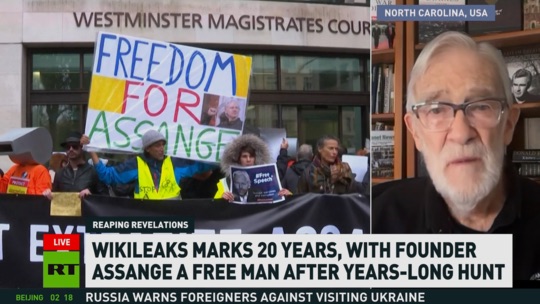
Julian Assange has become a key figure in the creation of alternative media, former CIA analyst Ray McGovern has said, expressing hope that the Australian journalist and activist is preparing to get back to work. McGovern spoke to RT as WikiLeaks marks its 20th anniversary. The website, co-founded by Assange in 2006, has published some of the most explosive leaks of the past two decades, exposing CIA hacking tools, classified US war records, illegal mass surveillance, and other closely guarded secrets.Read more …
The platform became a global phenomenon, making Assange one of the most prominent contemporary publishers, while also embroiling him in more than a decade of conflict with the US and other governments. Ahead of the anniversary, Assange suggested that he was returning to public life two years after striking a deal for his freedom with the US and securing his release from British custody.Assange has become a key figure in the creation of alternative media, the “fifth estate,” McGovern said, adding that traditional media have long since lost their intended purpose, becoming closely controlled instruments for many governments worldwide. “The media in our country, and I dare say in many countries, the UK, Germany, is very tightly controlled. And so that’s the fourth estate, as Edmund Burke said, more important than Parliament itself. The fourth estate is co-opted now, it has been for decades,” he said.
“It’s very clear that the intelligence services have a lot of influence over what goes out into the media. And so you need an alternative. That’s why we placed great hope in what we call the ‘fifth estate,’ namely WikiLeaks and outfits like it that would encourage people to blow the whistle in a secure way and not endanger themselves,” he added.
McGovern welcomed the prospect of Assange’s return to active work, calling it a “salvation” for people willing to blow the whistle on dirty government secrets. “He will find ways to make it possible for people like me and my colleagues, if we come upon information that needs to be spread out into the media or out into the public, to have a secure way of doing that. That was his success. He’s bright enough to do that again, I am convinced,” he added.
I had no idea things were this bad.
• The Education Cartel and the Blue State School Scam (Turley)

“In the first place, God made idiots,” Mark Twain once wrote in an 1879 travel book. “That was for practice. Then he made school boards.” It appears that most Americans now agree with him. New polling shows that K-12 education has now reached a record low in the number of people who are even “somewhat satisfied” with the state of education in the U.S.Read more …
What is most troubling is that the near-total contempt for our school system does not make a bit of difference. Families and students have become largely irrelevant to an education cartel, a self-sustaining, self-perpetuating political alliance of unions and politicians. According to Gallup, only 32 percent of American adults say they are “completely” or “somewhat” satisfied with the quality of K-12 education. That is the lowest figure in Gallup’s 27 years of asking the question. Public satisfaction with the school system has dropped almost 20 points since just 2024.The collapse comes at a time when universities are reporting that college students are entering higher education without basic math and other skills.We have also seen the dismal decline in standards at elite universities like Harvard, where faculty have been compelled to teach high school-level math classes to students. In May, faculty in the University of California system (which eliminated standardized testing to achieve greater equity in admissions) reported an alarming lack of math knowledge among new students.
Most recently, a University of California, San Diego, faculty report found a nearly 30-fold increase since 2020 in incoming students whose math skills fell below a high-school level.For many of us, neither the drop in skills nor public support is surprising. For generations, the public school system has failed students in major cities. Despite massive budget increases, actual test scores continue to fall or remain at subpar levels.
In a prior column, I was particularly moved by the frustration of a mother in Baltimore who complained that her son was in the top half of his class despite failing all but three of his classes. Her story led to my changing my view of school vouchers. Despite my long support for public schools, I believe vouchers may be the only way to wrest control away from the education cartel by introducing real competition based on academic performance.
Faced with low proficiency scores, teachers’ unions and school administrators have continued to lower proficiency requirements. They are simply pushing students out the door without basic skills, robbing these kids of any chance to break out of cycles of poverty and unemployment. When confronted with their poor performance, school board members have declared meritocracy to be a form of “white supremacy.” Gifted and talented programs are being eliminated in the name of so-called “equity.”
In any other field, such generational failure would be unthinkable. No business or enterprise could sustain itself. However, that is the point. There is little competition in this system. Blue states have largely blocked voucher systems while protecting teachers from performance-based standards.
Actual students have become irrelevant to budgets. In Chicago, there are schools that remain open despite 80 percent vacancy rates. One school, Frederick Douglass Academy High School has only 27 students, or 2 percent of its building’s capacity. The school system spends $55,000 for each student at Frederick Douglass Academy.
Overall, 35 percent of Chicago schools are half full or less. But that did not stop the schools from spending a couple million on transcendental meditation sessions or giving teachers and students days off to join May Day protests (with city-subsidized buses).
According to a recent study, in 2025, Chicago Teachers Union spent a record $4.2 million on politics and lobbying but less than 18 percent on representing teachers. This included massive contributions used to elect former teacher and union organizer Mayor Brandon Johnson, a former organizer for the union. Johnson, in turn, has effectively turned over his office to the far-left union.
In economics, there are few scourges older and more damaging than the cartel, which uses its power over an area to create “higher prices, lower quality, and stifled innovation.” There is a natural tendency for people to form such groups to stifle competition and feather their own nests. Adam Smith warned that “People of the same trade seldom meet together, even for merriment and diversion, but the conversation ends in a conspiracy against the public.”
The Education Cartel is becoming one of the greatest and most insidious forms of such anti-competitive conduct. Teacher unions have used hundreds of millions of dollars in campaign contributions to acquire unchallenged power in blue states where they can dictate ever-increasing salaries, pensions, and budgets. One estimate found that, since 2015, the nation’s two largest teachers unions — the National Education Association and the American Federation of Teachers — spent $669 million on federal campaigns and another $336 million on state and local campaigns.
Figures such as Randi Weingarten with the American Federation of Teachers effectively made their unions piggy banks for the Democratic Party and appear at far-left rallies to support Democratic causes. In return, Democratic leaders give this cartel most everything that it demands, including barring competition in the form of public vouchers or tying budgets to improving the education of actual students.
It is a closed circuit. Democratic leaders increase school budgets and salaries and the unions then send back hundreds of millions to fund Democratic campaigns. If you want to understand the priorities of the unions, just watch one of National Education Association head Becky Pringle’s unhinged speeches.
Her declarations that the union will “win all of the things” clearly did not include educational improvements for students.
A recent study found that blue states with strong teachers’ unions overwhelmingly have worse student literacy scores than red states. At least eight of the ten states with the worst literacy scores were liberal districts with politically powerful teachers’ unions, according to the Progressive Policy Institute.
The most destructive housewife ever?!
She’s worse than Thatcher, right?
• Many Germans Long for Merkel (Rainer Zitelmann)
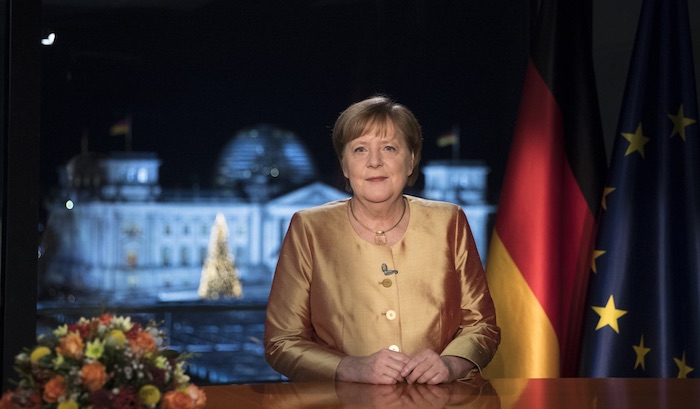
The polling institute YouGov recently asked: “Do you think Angela Merkel, as chancellor, would be better, worse, or just as well suited as the current chancellor, Friedrich Merz, to solving the problems and challenges Germany faces today?” The result: Forty-eight percent of Germans believe Merkel would be better suited than the incumbent Friedrich Merz to solving today’s problems. Twenty-nine percent thought Merkel would be just as well or as poorly suited as Merz. Only 8% thought Merkel would be worse. Fifteen percent gave no answer.Read more …
A Forsa poll published in early September produced an even more dramatic result: Only 7% considered Merz a better chancellor than Angela Merkel, while 71% considered him worse. Even among CDU and CSU supporters, 57% share this view.Presumably, many Germans think this way because the economic data during the Merkel years was significantly better than under her successors. But that was not her achievement. Merkel, who took office in 2005, benefited from the reforms of her predecessor, Gerhard Schröder (SPD). He cut taxes and liberalized the labor market, leading to strong and sustained economic growth. As so often happens in politics, the successor benefits from free-market reforms, while the politician who actually implements them is punished.
Merkel herself carried out neither tax reform nor labor-market reform. Instead of cutting taxes, she raised them: In 2007, VAT went from 16 to 19%, while the so-called “rich tax” added three percentage points to the top income-tax rate for high earners. Social spending also went from 26.9% of GDP in 2007 to close to 32% in 2021.
During the same period, Merkel neglected investment in infrastructure, the negative consequences of which only became apparent much later. In 2020, the OECD noted that Germany had one of the lowest levels of public investment. During Merkel’s time in office, the backlog in municipal investment grew massively despite a strong economy and low interest rates: KfW estimated it at €132 billion as early as 2015 and at a then-record level of almost €159 billion in 2018. Germany’s crumbling bridges and dilapidated schools are part of the legacy of the Merkel era.
One of the main causes of Germany’s current problems is its high energy costs. This is a direct consequence of Merkel’s “Energiewende,” or energy transition, which has cost €500 billion to date. Merkel’s decision after the Fukushima accident to accelerate Germany’s nuclear phaseout was just as consequential as the fact that — despite warnings from the United States and Eastern European countries — she made Germany dependent on Russian gas. Germany is therefore now among the countries with the highest electricity prices in the world — a direct consequence of Merkel’s policies, which effectively transformed Germany’s energy sector into an ideologically driven planned economy.
Mass immigration is another problem, due to policies initiated by Merkel during the 2015 refugee crisis. And she was the midwife of the right-wing AfD, which, according to current polls, is by far the strongest party. It was founded in response to Merkel’s misguided “euro rescue” policies. As late as August 2015, the AfD stood at just three percent in the polls. By January 2016, it had risen to 11%, and in the 2017 federal election it ultimately won 12.6%, compared with 4.7% in 2013.
The problems caused by Merkel’s policies or left unresolved during her 16 years in office also include: Germany’s dramatic lag in digitalization and the erosion of Germany’s defense capabilities. When Merkel left office in 2021, the Bundeswehr lacked operational aircraft, helicopters, ships, ammunition, and personal equipment — Germany had allowed its ability to defend itself and its NATO allies to deteriorate for years.
Then there is the failure to reform the pension system despite demographic change that had been foreseeable for decades. Instead of using the economically strong years to carry out fundamental reform, Merkel’s government introduced additional benefits costing billions of euros, including retirement at 63.
Merz’s responsibility is that he has failed to initiate the urgently needed change of course after Merkel — a change he had promised. His defenders argue that this is impossible with the SPD. Exactly! But who forced Merz to enter into a coalition with the SPD? He voluntarily assumed the role of captain of a sinking ship.

Since we gutted USAID, the left hasn’t won a single presidential election in Latin America.
— Donald Trump Jr. (@DonaldJTrumpJr) October 5, 2026
Billions in taxpayer cash were funding NGOs, “democracy” programs, and activist networks that conveniently always backed the same side. They called it aid but it was election… https://t.co/jFEsYginxj
🚨 Elon Musk, asked what it is like to be the richest person alive.
— MIPA Guy (@MIPAGUY) October 5, 2026
ELON: “I don’t really know. I don’t think about it much. I’m a technologist.”
ELON: “I don’t live a hedonistic life. I don’t have a yacht. I like building things, I like playing video games, hanging out with…
When C. J. Hopkins wrote a book about Covid zealots, he compared them to Nazis, because Nazis are bad. In response, Amazon banned his book and the German government arrested him. We’ve decided to republish the book, “The Rise of the New Normal Reich” available now at… pic.twitter.com/sZa99YPSe7
— Tucker Carlson (@TuckerCarlson) October 5, 2026
Support the Automatic Earth in wartime with Paypal, Bitcoin and Patreon.