
Raúl Ilargi Meijer

Forum Replies Created
-
AuthorPosts
-
Raúl Ilargi Meijer
KeymasterV81,
I don’t know much about such services, but it looks ans smells to me like a bank, building, vaults, security, safe deposit lockers, only with most other services stripped. And it seems entirely possible that a government can simply move in and take all contents in the vaults and lockers. They have from banks in the past, so why not from private vaults?? Easy pickings, methinks. Unless your locker’s in the Bahamas or Luxembourg, maybe, but then you’d need to be there too. The close to your chest the better.
KeymasterSouth Ozzie,
Using “local” for all of Oz may be a bit wide?!
I suggest you go to http://www.doingitourselves.org/, run by our dear friend Theo Kitchener, out of Melbourne, who among loads of other things did this great video (which I featured as a post not long ago):
[video width=480 height=315 type=youtube]https://www.youtube.com/watch?feature=player_embedded&v=euhkIesmW7E[/video]
Keymasteralan, sid
I haven’t talked to my old friend Chris for a few years (he talks about me in one of his books, I think it’s about my “Law of Receding Horizons”). And though when it comes to energy (and just about anything else, too) between the two of us, Nicole is about 826 times more knowledgeable than I am, there are a few things “even” I notice.
I understand – and applaud- that a grid can be better operated, allowing for the inclusion of more power from intermittent sources. But that can’t be endless, and so 100% renewable remains a strange dream, as far as I can see, molten salt and all. Base load is not a side issue; large grids are very vulnerable. I would for instance like to see data on how stability in Germany is enhanced by French nukes. It’s a bit like how Denmark can run so much wind; it can do so only because the trans-European grid is there to step in when wind is not there. I don’t see German solar do this well without France. In general, talk about “the German grid” or “the French grid” is not very useful, and maybe a bit misleading. It’s like talking about the Kansas grid and then try and include Enron in the story.
I don’t see a huge grid run on renewables, never seen a way to do it. More than 15% renewables for an isolated grid becomes shaky, I think.
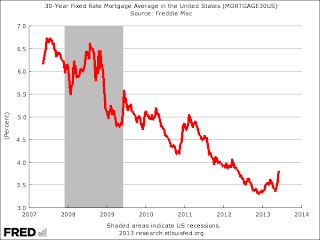
KeymasterRates for the US 30-year fixed, courtesy of BI:
 Keymaster
BIS records startling collapse of eurozone interbank loans
Cross-border lending is falling drastically across the western world as banks slash exposure to Europe and bend to tougher capital rules, according to data from the Bank for International Settlements. [..]
The Basel III rules demand higher capital ratios, fewer risky assets, and less reliance on wholesale borrowing. “Pressure to make banks safe is paradoxically causing a contraction of their risk assets and therefore of the money supply, perpetuating feeble demand and high unemployment,” he said. Mr Congdon said quantitative easing in the US and the UK had helped to offset the tougher rules but the European Central Bank is constrained by the lack of a genuine fiscal union
So QE is used simply to offset plans to give banks healthier balance sheets. Question is: are they still healthier afterwards? Or does QE defeat Basel III?
KeymasterSame story (as mine today), different tack: “The Bank for International Settlements said central banks’ policies of record low interest rates and monetary stimulus had helped investors “tune out” bad news — every time an economic indicator disappointed, traders simply took that as confirmation that central banks would continue to provide stimulus.”
Easy money policy from leading central banks boost markets, but investors ignore warning signs.
KeymasterAnd we’re off!
SOCGEN: This Week’s Jobs Report Is Going To Be Strong, And The 10-Year Treasury Is Heading To 2.75%
Stimulus makes the economy grow, and we’ll see an avalanche of selling US 10-year. Bernanke slows down stimulus, and we’ll see more selling. Just another naked emperor.
KeymasterApologies for misspelling the name of the BoJ chief. Corrected.
Keymastersouth ozzie,
Should I be doing as Carol and going into the bank and getting my tangible, physical certificates?
Absolutely. One should steer clear of all middlemen, whether they operate through funds or otherwise, as much as one can. Buy sovereign bonds as directly as you can and stash them away under your own control. You don’t need middlemen, and their very existence just raises the risk.
I asked Nicole to respond, but she’s stuck in a very full agenda of travel, interviews and lectures in New Zealand, with limted internet access and an injured shoulder to boot.
Still, all the more because we’ve been covering this very topic since we started TAE, my answers won’t be any different from hers. Get a few months worth of cash, get hard goods, and for any leftover wealth sovereign bonds are fine. Your own country’s bonds, that is; don’t dabble in foreign bonds unless you’re a trader, that’s just more risk than you need.
It’s really not that hard, when you think about it; pretty straightforward.
KeymasterLarry,
Nothing there that I haven’t covered. That’s why I used 3 separate quotes. The Great Law doesn’t mention 7 generations, but Oren Lyons has (provided he’s properly quoted). Perhaps that’s just his interpretation of the Law, but being an Onandaga chief, who’s going to say he doesn’t have the right to such an interpretation. Other than that, I am merely interested in the fact that there are ancient laws out there that mention care for future generations in the first place. I don’t think the US constitution does, for instance.
KeymasterThe notion that inflation is not going to happen is slowly sinking in, but the reason why is not at all understood yet. Joe Weisenthal quotes the reasons inflation hasn’t come, offered by the incomparably clueless Hale Stewart of Daily Kos fame:
The Most Incorrect Prediction Of The Past 5 Years
• Slack demand from China.
• The US oil boom (abundance produces the opposite of inflation).
• Slow growth (especially in Europe).
• The end of the commodity boom.
• Ongoing reduction of high household debt.Bottom line. The big, ongoing story is the death of inflation all around the world.
It’s all simple nonsense, of course. These fine analysts now tell themselves they were right all along in predicting (hyper)inflation, but something unexpected, unforeseeable got in the way. In reality, the behemoth of debt we built up made deflation inevitable from the get go. It hasn’t hit us full on yet because of the empty credit measures (QE et al) central bankers try on, but it has zero chance of reversing the debt deleveraging. It will just make it worse. I wrote this particular article 7 months a go, buy Nicole and I have been writing about this for 6-7 years now.
KeymasterAlan, you’re not paying attention, the survey is an empty air chamber devoid of any meaning or substance.
First, there’s no use in gathering info on what anyone MIGHT do by 2018. I might buy a bridge in Brooklyn by then. Or I can at least say I might.
But the essence is of course in this sentence:
In fact, this marked the first time in the survey’s nine-year history central bankers were asked whether they bought or planned to buy stocks.
They may have been buying stocks all along, they may have been buying far more than they’re now “planning” to do. Nobody knows, because nobody ever bothered to ask.
And all this is assuming answers are truthful, which in this world is to put it kindly not guaranteed.
While it’s not the first time central banks have ever bought equities, it is the most aggressive purchasing they’ve done.
This line tops it all off: where does the author, Mr. Fitz-Gerald, get that knowledge from? He doesn’t say. It can’t be from the survey, because central banks were never before asked whether they either bought stocks in the past or planned to do so in the future.
Ergo: Mr. Fitz-Gerald simply makes it up as he goes along, confident his readers won’t scrutinize his words too closely, because they’re too focused on what he suggests, central banks buying stocks, but doesn’t actually say.
You and I don’t know if central banks will buy stocks, and neither does Mr. Fitz-Gerald. He talks his book.
KeymasterRegarding the ‘QEuriouser’ Article above, it states that loans are are increasing at 4% since 2011(before this, it was negative).
First off, the ‘QEuriouser’ was not a TAE article, but something posted by one of our readers.
I’m confused how this ties in with decreasing money velocity which as I understood is key to the whole deflation argument. If loans are increasing, surely this means money is increasingly being used to ‘buy stuff’ which would increase money velocity?
Skimming thru Lee Adler’s piece, I see he says loans increase, but doesn’t specify which loans he’s referring to. That makes it hard to draw any conclusions at all.
I’m sure you also noticed his repeated remarks on pensioners and consumers cutting back on spending, so how all in all you see money velocity increasing I don’t really know.
KeymasterThe survey reveals that 23% of the 60 central bank respondents are buying stocks or plan to do so in the next five years.
In fact, this marked the first time in the survey’s nine-year history central bankers were asked whether they bought or planned to buy stocks.
While it’s not the first time central banks have ever bought equities, it is the most aggressive purchasing they’ve done.
Hmm. Less than a quarter of respondents say they might buy stocks by 2018. Unless perhaps the world is not the exact same anymore by then, in which case they might decide otherwise. Or their successors. Whichever comes first.
But fear not, Money Morning Chief Investment Strategist Keith Fitz-Gerald will nudge you towards fields of glory and riches. Well, he first, then you.
Just goes to show that in the world of empty statements, too, there are one-eyed kings.
KeymasterDave,
None of the above.
I think more than anything Europeans want the Euro(zone) because there hasn’t been anything they’ve read or heard about it that wasn’t single-mindedly in favor. In that sense, euro euro euro equals grow grow grow: it’s a religion. Or a brainwash if you will.
It’s all been the same one dimension all the time. And they had no reason to doubt it, until now, or rather a few years ago. To this day, ALL governments in EU nations are pro-Euro, no questions asked. Nigel Farage’s election win last week in the UK is a good sign, in that at least there’s a discussion available. So was Beppe Grillo’s in Italy of course, but the europhiles (who hate each other in any other respect) have closed ranks there for now.
There’s never been any dialogue on the merits of the euro. It was introduced and declared sacred. We’re 13 years ahead, and only now are there questions, but they’re still not truly tolerated. Both Farage and Grillo are ostracized and labeled dangerous excentrics. To wit: there are no clauses in Euro legislation that allow for any one member nation to get out. That’s no coincidence.
My worry is that this particular scheme makes another inter-European war inevitable. Various interests are simply too different.
KeymasterA lot of carbon that is on the books of energy producers will be ‘unburnable’, but not for the reasons stated. They will be unburnable due to simple economics.
Didn’t get to read the entire article, pipefit?
April 20, 2013 at 1:06 am in reply to: Nicole Foss In Australia: It's No Use Trying To Build A Better Dinosaur #7453KeymasterWelcome Badlands,
And don’t be a stranger about what you might contribute. We are certainly interested in your story, in what you’ve done and why, in your neck of the woods. I don’t know that we have a lot of Dakota around here. And don’t be shy about asking any questions you think you might want to ask. Plenty of “awake” parents (to an extent, of course).
April 19, 2013 at 6:54 pm in reply to: Nicole Foss In Australia: It's No Use Trying To Build A Better Dinosaur #7450KeymasterCliff,
First, there’s investing in hard goods that you will need down the line, tools, maybe some land (property makes sense only if it will allow you to produce basic needs, food, wood, water, shelter, that sort of thing, and not just one of them). As for “money”, the backyard bank is good for the first batch. One needs to be creative about how to make one’s deposits there water- and fireproof etc., but it can be done. We don’t explain how here, because that alone would make the backyard a less safe bank. T-bills can be good if the backyard becomes too small (the government won’t default on them), but not when kept in custody of a large financial institution: like any and all investments, having them under one’s own control, within arm’s reach, is vital.
April 17, 2013 at 12:20 am in reply to: Nicole Foss In Australia: It's No Use Trying To Build A Better Dinosaur #7429KeymasterTo wit: neither Nicole nor I have ever told anyone to lower their carbon footprint.
And we don’t tell people to change their lifestyle in order to save the planet, but to save their own asses.
KeymasterRoboto et al,
Russell Brand has a great take on Thatcher:
‘I always felt sorry for her children’
The blunt, pathetic reality today is that a little old lady has died, who in the winter of her life had to water roses alone under police supervision. If you behave like there’s no such thing as society, in the end there isn’t.
Her death must be sad for the handful of people she was nice to and the rich people who got richer under her stewardship. It isn’t sad for anyone else. There are pangs of nostalgia, yes, because for me she’s all tied up with Hi-De-Hi and Speak and Spell and Blockbusters and “follow the bear”.
What is more troubling is my inability to ascertain where my own selfishness ends and her neo-liberal inculcation begins. All of us that grew up under Thatcher were taught that it is good to be selfish, that other people’s pain is not your problem, that pain is in fact a weakness and suffering is deserved and shameful.
Perhaps there is resentment because the clemency and respect that are being mawkishly displayed now by some and haughtily demanded of the rest of us at the impending, solemn ceremonial funeral, are values that her government and policies sought to annihilate.
KeymasterHow d’ya like that DJIA, hitting record high after record high, week in, week out, for months? That 85 billion per month that Benny and the Ink Jets been puttin out ain’t fer nuthin’, ya know!
It’s called zombie money, and there’s no better way to put it then caveat emptor.
KeymasterCypriot archbishop urges finance minister to quit
Archbishop Chrysostomos II, who had urged for eurozone exit over an onerous bail-out, declared on Sunday that finance minister Michalis Sarris and central bank governor Panicos Demetriades should step down after allowing the EU-IMF lenders to devastate the island’s banking sector in return for a €10bn (£8.4bn) loan.
The missive is the latest public criticism to come from the island’s religious leader since his failed bid to avert a raid on Cypriot savings by offering the church’s entire wealth to shore up the struggling economy.[..]
“If I was satisfied, I would not have called on them the other day to resign and leave, because they have the same views as the troika [of international lenders],” said the archbishop.
KeymasterJack,
What I’ve seen so far is “confiscation plans” from New Zealand, UK and Canada. Disconcerting, for sure, but no need to go all out – just yet -. I see no reason to doubt that all rich enough nations have similar plans on the shelf. Cyprus is just one more reason to not trust the solidity of a bankrupt banking system; and they all are bankrupt, wherever you live.
KeymasterHmm Armstrong. Little paranoid for my taste. Leads to strange ideas.
This is about keeping the banks alive to service the debt of government.
I think maybe that should be the other way around.
Government is digging in its heels and will not relinquish power nor will they reform.
There’s no such thing as “The Government”. Other than in Martin’s head. The banking world is much better organized.
BTW, what is that about the world moving into gold? $20,000 an ounce? Are there really still people touting that line? Yawn.
KeymasterPeople taking money out of banks to buy hard assets does not increase the velocity of money. That doesn’t make sense, since it doesn’t cause money to flow through the economy. You can’t measure the velocity of money in just one step. That step is more than zero, but it falls straight back to zero too.
To raise the velocity of money you’d need people taking their money, buying gold, buying land with that gold, selling the land to buy real estate, selling that to buy gold, etc etc. You need money changing hands multiple times, not only once. If any of the sellers in the sequence above use their share to spend on basic need goods bought from people who need their income to buy more basic need goods, you’d have something, but what are the chances that they’ll all go down that route?
After all, people who have money in bank accounts in general don’t need to it right away. They will therefore in general use it only for that one step, if that: they can sit on it, or put it into something else. Where they will, in general, leave it.
And once they do need it, for their basic needs, they will of course be very careful about spending it.
Keymasterabsolutely bob. a shattered trust window.
KeymasterOilo,
I suggest you read through the articles in our Primers section (see menubar). That should answer a lot of questions, and help you along towards finding ways to improve your prospects.
KeymasterWow! He has really shaken things up with his 5 star party coming third in the election. Well done!
Actually, Cinque Stelle is the largest “party”. Both Bersani and Berlusconi ran with coalitions of multiple parties.
Then again, Cinque Stelle isn’t really a party, it’s a movement.
In fact, since Monti didn’t have a party either, none of the 4 biggest vote-getters were political parties.
KeymasterNicole is in Belize and has very little internet access. She should be good to go again in a week.
KeymasterWell, Moody’s did it: The UK lost its AAA status.
Good time to go back to the link I posted earlier in this thread, Losing Our AAA Rating Could Mean Bank Collapse And Deflation. From that link:
Banks in this country are doubly exposed, because regulators have forced them to hold vast amounts of UK government debt.
If that is true in the UK, it is even more so in Spain, which had/has a shadow policy to have its banks apply for EU money in order to buy sovereign bonds; a nice topic for Dave to run with.
KeymasterWell, deflation’s a popular topic all of a sudden. Not that the pundits seem to have a grip on the topic.
Losing our AAA rating could mean bank collapse and deflation
The one thing worse than a downgrade leading to yields dropping is a downgrade leading to them spiking, and there is no guarantee that for the UK the reaction would be the former. UK growth prospects are already terrible, and our banks are much more extended than US ones, while British households are more indebted than those in France. Furthermore, the AAA rating is central to the UK’s international reputation as a finance centre.
If our growth prospects deteriorate even further, then without even higher inflation, UK households will default on their mortgages, bankrupting British banks and thereby bankrupting the Government if it stands behind the banks. We have already seen that happen in Ireland and Spain. It could happen here, too.
Banks in this country are doubly exposed, because regulators have forced them to hold vast amounts of UK government debt. Even relatively modest rises in government bond yields, implying some fall in government bond prices, would impose huge losses on UK banks. The Bank of England has suggested that UK banks already need £60bn of extra capital. Taking large losses on UK government bonds could push them over the edge.
KeymasterBulgaria succumbs to euro deflation curse
Another euro-pegged government defending an overvalued exchange rate bites the dust, a reminder that the underlying economic and social disaster across the Europe’s Arc of Depression is still getting worse.
Bulgarian prime minister Boiko Borisov resigned this morning after days of mass protests against austerity across the country.
“I will not participate in a government under which police are beating people. Every drop of blood is a shame for us,” he said. “Our power was handed to us by the people, today we are handing it back to them.”
KeymasterKeymasterWhat we see happen with insurance is the exact same as what happens to pensions. Both are exposed as mere Ponzi schemes. Which work fine for a while, until there are no longer enough new buyers. An added factor in the case of pensions and insurance (and certainly for swaps and other derivatives) is the declining economy.
KeymasterI updated the Beppe Grillo article by inserting a Wall Street Journal video interview. Maybe that makes his positions clearer. In my view, no matter what anyone may think of him, his ideas are very interesting. He’s the first person in a position near to power who’s ever said what he does. And by next weekend we’ll know just how much influence those ideas will have on Italy, which means Europe, which means the whole world.
I must say, I’m surprised the article gets so little attention. Italy is not located on the other side of the world or the dark side of the moon.
Keymasterdave, did you get my mail?
February 10, 2013 at 2:39 pm in reply to: France Is Dead Broke, But At Least Its GDP Came In Positive #6907KeymasterI’d say anyone who thinks what drives today’s economies is some sort of inflation megatrend has some catching up to do. Of course, if they were, sitting on cash might indeed be that guaranteed loser. But they’re not, and that’s why it isn’t. History is replete with bursting bubbles, and we found ourselves the biggest one in that history, leveraged all the way up into the wild blue yonder. If you would care to look back through prior bubbles, you might just find that those sitting on cash ended up quite a bit better off than those sitting on tulip bulbs.
February 1, 2013 at 2:56 pm in reply to: France Is Dead Broke, But At Least Its GDP Came In Positive #6868KeymasterTed,
There are many aspects to the pension question; the 15 years is more or less a “safe” estimate. I think what we’ll see happen is that as we go forward, payouts will be cut more and more. I see in Holland all sorts of funds are cutting by 5-6%, and overall those dependent on fixed income will lose 9-10% in purchasing power just in 2013. That would seem to be(come) the overall trend globally. The speed at which this progresses can be influenced by factors such as bad investments by the funds, declining stock markets and economies in general etc. Also, it seems obvious that young people will at some point refuse to pay in once they understand they’re unlikely to ever get a penny- and that is if they even have jobs: Spain’s 60% youth unemployment must of course devastate its pension funds. How it will all work out will vary across the world, even if the trend direction is clear and inevitable. All pension plans are ultimately Ponzi schemes, and those never end happily.
January 31, 2013 at 5:13 pm in reply to: France Is Dead Broke, But At Least Its GDP Came In Positive #6863KeymasterXYZ,
Here are some points the Daily Mail (first link) claims it got from Le Figaro:
WHY FRANCE IS ON COURSE FOR FINANCIAL DISASTER
• Public debt has risen to 90% of GDP, compared to 21.1% in 1974. If trends continue, the figure will reach 91.3% by 2014. The European Union target is 60%.
• Two key ratings agencies, Moody’s and Standard & Poor, depriving France of its triple AAA rating.
• France’s reliance on tax increases, including a proposed 75% haul on incomes over 1 million euros
• Mr Hollande’s decision to reverse pensions reform, meaning that most French people will retire at 60, and many at an even younger age.
• The figure for long-term unemployed increasing by more than 18% to well over half-a-million.
• More than a million people over 50 now unemployed – a figure which has jumped 15% in a year.
• A record trade deficit of 73 billion euros in 2011.
• Public expenditure of 56.3% of GDP, the highest of all western countries except Sweden.
• France employs 2 million public officials and Mr Hollande plans to create more, including 65,000 teachers and 5,000 court and police officials.
KeymasterHey Scott,
Good to see you here.
I’m not sure I’m any good at doing lists and bullet points, I think once I start, I’d want to subdivide each bullet with ten more etc. And I don’t know that you best fight bullets with bullets in this field to begin with. I don’t try to write finished all-encompassing things, that’s not something I have faith in, I’d like to think I take people on a journey, perhaps bumping them slightly left-right, up-down, back-forth from time to time, providing food for their own personal thought.
I’ll try to think in bullets. But I can still explain quite well without why recovery is fantasy.
-
AuthorPosts