

Rembrandt van Rijn Old Man Seated 1631

https://twitter.com/MAGAVoice/status/2093092854235287957?s=20
THE PHOTO THEY CAN’T ERASE.
— Gunther Eagleman™ (@GuntherEagleman) August 27, 2026
Long before politics turned Donald Trump into one of the most polarizing men in America, this moment happened.
In 1986, Trump stood alongside American legends Rosa Parks and Muhammad Ali as one of the inaugural recipients of the Ellis Island Medal of… pic.twitter.com/mmlzo47GUt
I’m not terribly impressed with the coverage this gets.
• Trump Makes ‘Biggest Oil Deal in History’ Announcement (Sarah Anderson)
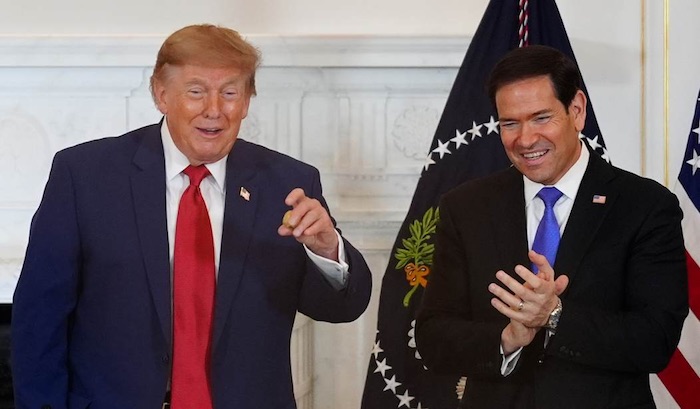
On Friday evening, Donald Trump announced that the United States and Venezuela have entered into an agreement on “the biggest oil deal in world history.”Read more …
“This deal is a huge win for both the American and Venezuelan people,” Secretary of State Marco Rubio added in a post on X. “It demonstrates how President Trump’s bold foreign policy is driving America First wins: securing stable reserves and low-cost oil in our Hemisphere and lowering gas prices here at home. For the Venezuelan people, this deal will bring nearly $100 billion in private investment, support thousands of high-paying jobs, and drive the reconstruction of Venezuela’s economy.”
This deal is a huge win for both the American and Venezuelan people.
— Secretary Marco Rubio (@SecRubio) August 28, 2026
It demonstrates how President Trump's bold foreign policy is driving America First wins: securing stable reserves and low-cost oil in our Hemisphere and lowering gas prices here at home.
For the Venezuelan… https://t.co/SMSRYGWmVbThe details of the contract have not been released, though there has been a lot of online chatter over the last couple of days. Currently, proceeds of Venezuelan oil sales go into a U.S. Treasury–supervised account, and Rubio and Treasury Secretary Scott Bessent control disbursement.
Venezuela holds the world’s largest proven crude reserves, about 303–304 billion barrels (roughly 19% of the global total). Output once topped 3 million bpd; it averaged about 941,000 bpd in 2025 and has recovered to roughly 1.23–1.25 million bpd in late August 2026 — the highest since early 2019 and up nearly 30% since January 2026 — after sanctions relief and cuts to the state’s take on many projects to 20–35% from around 83%.
As Moreno mentioned, China was the biggest buyer under Nicolás Maduro. The Maduro regime also supplied cheap oil to Cuba in exchange for intelligence and military training, as well as medical professionals from Cuba’s forced labor programs.
I do want to add that I hope Rubio is right and this will benefit the Venezuelan people as much as it does us. I’m in contact with several each week, and I know that morale isn’t especially high at the moment. They remain grateful to Trump and Rubio and the United States for removing Maduro, but their day-to-day lives haven’t changed much and, in some cases, have gotten worse. There are daily blackouts, etc.
The double earthquakes that struck in June didn’t do much to help with that, and they’re fed up with Delcy and ready to have elections and real leadership. Trump calling her “highly respected” in this announcement won’t go over too well, but it’s all part of the process. I hope to write more on what it will take to get there and what kind of progress is being made on that next week.
“.. Gulf-area exports of crude and petroleum products have rebounded sharply to between 15 million and 16 million barrels per day, up from a March low of 5 million to 6 million barrels per day.”
• “Dark” Tanker Fleet Shatters Iran’s Hormuz Stranglehold (ZH)
Brent crude futures initially jumped overnight after The Wall Street Journal reported that President Trump has no interest in reviving the memorandum of understanding (interim peace deal) reached with Iran in June. The war-risk premium in Brent has since faded in New York premarket trading amid mounting developments this week that major Gulf producers, including Kuwait and Qatar, are increasing tanker flows through the Strait of Hormuz. Emerging diplomatic traction between Oman and Iran has also further reduced the perceived risk of a prolonged disruption.Read more …
Reinforcing this week’s developments, new data from Daan Struyven, Goldman’s co-head of Global Commodities Research and head of oil research, show that Persian Gulf oil exports have recovered to more than two-thirds of prewar levels. Struyven wrote in a note late Thursday that Gulf-area exports of crude and petroleum products have rebounded sharply to between 15 million and 16 million barrels per day, up from a March low of 5 million to 6 million barrels per day.He said crude flows remain 7 million to 8 million barrels per day below prewar levels, but the recovery has been strong enough to ease fears of a prolonged disruption at the world’s most important maritime chokepoint. Oil shipments through the Strait of Hormuz are estimated at 8 million to 10 million barrels per day. Traders surveyed by Bloomberg place that range much lower, at between 6 million and 8 million barrels per day.
“Although our estimates focus on total Gulf flows, the upward revisions suggest Strait of Hormuz oil transits are likely close to US officials’ 8-10mb/d estimates. The rise in dark crossings by specialized shippers and in ship-to-ship transfers shows that producers and shippers are adapting to the Middle East conflict,” Struyven told clients.
He noted, “Shipping markets now price in disruptions likely continuing well into 2027 (Exhibit 7). Still, potential additional dark flows and price-sensitive China net crude imports may moderate the upside to crude oil prices even if Mideast disruptions last longer. We continue to see greater price upside to European natural gas prices and deferred oil product prices in persistent disruption scenarios than for crude.”Readers by now understand that the energy crisis is not necessarily in crude oil but, in fact, in refined products, with the U.S. diesel crack spread trading at $93 per barrel Friday morning. The spread blew out last week, reaching a record above $100.
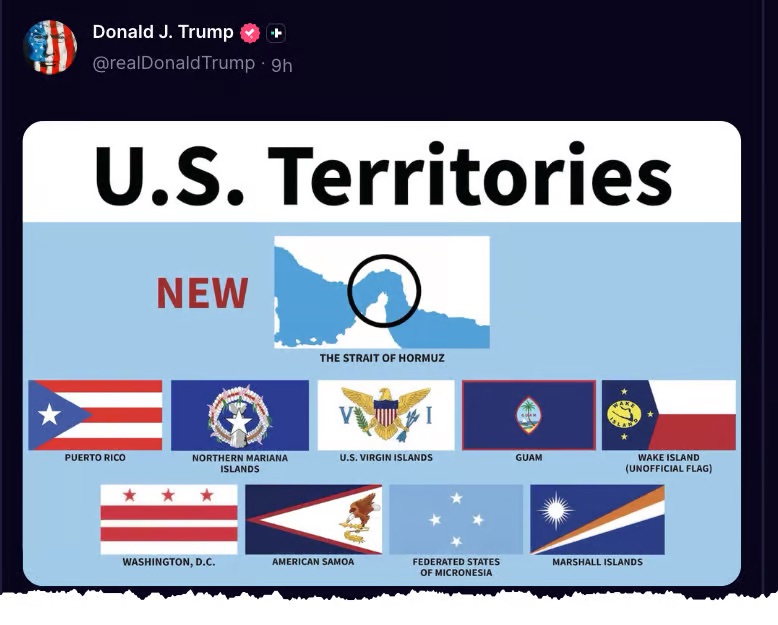
The takeaway from Goldman’s Struyven is that, even though the critical waterway has not fully reopened, a growing fleet of dark tankers is transiting the strait and defying Iran’s blockade. That raises the question we have asked in recent weeks: Is Iran’s geopolitical leverage over the Strait of Hormuz eroding? Overnight, Trump posted an image on Truth Social depicting the Strait of Hormuz as “New U.S. Territory.”
In late March, we cited a note from Zoltan Pozsar’s advisory firm, Ex Uno Plures, pointing out that Trump was “methodically building a portfolio of assets” to pressure China, including adding the Strait of Hormuz (read here). The question is whether Trump will stop at Hormuz or embark on another crusade in the Gulf and take Iran’s Kharg Island. This newly minted portfolio also includes Venezuela, where the U.S. is nearing a deal to secure long-term energy-producing assets in the country.
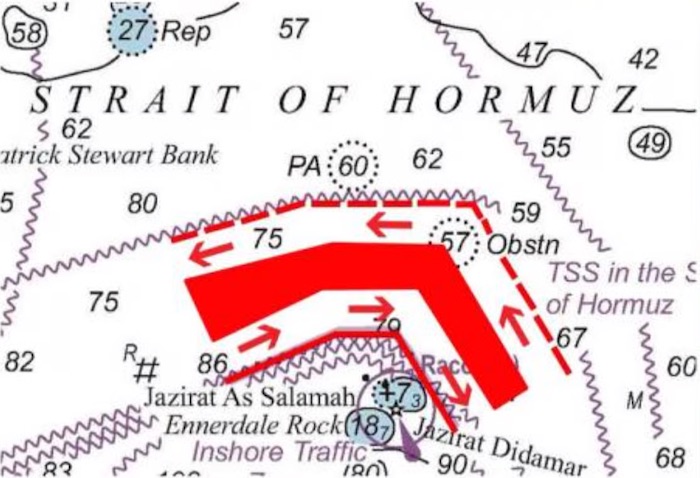
They only have to look -enough- like mines, and sailors will avoid them.
“.., 200 mine-like objects were cleared from the main shipping lane, but only around 11 were actual mines.”
• Iran Mined the Strait of Hormuz With… Trash Bags? (Stephen Green)

“If Iran mined the Strait of Hormuz, how come we haven’t seen any ships sunk or damaged by mines?” Good question. The answer seems to be less that ships veered away from mines and more that Tehran was largely bluffing with the mine threat, but the details — once again — veer straight into absurdity. Before we talk about questionable deployments and the bit about the trash bags (really!), a few words on mine warfare. Actually, I can start with just two words: It sucks.Read more …
Mines are easy to deploy, and difficult and dangerous to get rid of. They’re the ultimate waterway nuisance weapon, because just the threat of them can slow down or even halt shipping, and tie up valuable resources. And we never, ever have enough minesweepers. Back during the Cold War, we let our NATO allies deal with much of the Soviet mining threat, while our Navy focused more on ship and submarine threats to the sea lanes to Europe across the Atlantic. But then we won the Cold War, and our NATO allies let their minesweeping capabilities atrophy. If you’re wondering whether we stepped up our minesweeping game in response……yeah, no. But I digress, if only slightly. And Another Thing: During World War II against Japan in the Pacific, we launched a naval and mine warfare campaign to cut off Japan’s maritime trade in an effort to starve the Empire into submission. It was called Operation Starvation, and it was frighteningly effective. It’s the kind of thing our military can do when our idiot politicians remember to let them off the leash.
Tehran well knows that we don’t have enough minesweepers — and so does the rest of the world. The guys who own and captain multibillion-dollar tankers are perhaps painfully aware, which is one yuge reason why shipping through Hormuz slowed to a trickle after Tehran announced it was mining the strait back in March. “They’re firing on commercial ships, and they’ve mined large segments of Hormuz — international waters,” Secretary of State Marco Rubio told the Senate Foreign Relations Committee on June 2. “What they’re doing is unlawful and illegal,” Rubio said.
I’m a Rubio guy, but I don’t put much stock in statements like that last one. What’s “lawful and legal” is usually determined by the winner after the fact. What’s maybe the more pertinent question is what, exactly, did Tehran actually do to the Strait of Hormuz? Iran Watcher reported Friday that the “Hormuz minefield was largely a bluff built on decoys, while even the real mines were reportedly poorly deployed.”
“According to reporting cited by CNBC’s Brian Sullivan, shipowners said many suspected mines were decoys, including inflated trash bags,” the IW post continued. “Separate reporting citing U.S. officials said more than 200 mine-like objects were cleared from the main shipping lane, but only around 11 were actual mines.” What was I just saying about how tricky — or is that tricksy? — mine warfare is? “A small number of real mines mixed with decoys frightened shipowners, drove up war-risk insurance, and helped choke commercial traffic.” But that’s changing.
Traffic through Hormuz reportedly was up something like 400% over just two weeks — and that data is a week old. I wonder how much of that is due to the heroic efforts of our armed forces, and how much is due to shippers realizing that the mine threat turned out to be all bark and no boom. It also makes you wonder about Tehran’s recent boast of having doubled or even tripled drone production.
London and Brussels won’t like this.
• Trump Outright Dismisses Notion Putin Preparing To Attack A NATO State (ZH)
President Trump has added fuel to the fire of controversy and speculation over the question of why CIA Director John Ratcliffe made a surprise and highly rare trip to Moscow on Tuesday. Media accounts which seek to explain the nature of his meeting with top Kremlin intelligence officials, while apparently being snubbed by Putin in terms of a direct interaction, have shifted in days since the visit. The early ‘consensus’ was that he delivered a stern warning for Russia not to attack any NATO state. But President Trump has poured cold water on this explanation, appearing to dismiss it outright in his latest comments.Read more …
REPORTER: Did Ratcliffe delivered a warning to Russia not to attack NATO territory during his trip?
— Status-6 (War & Military News) (@Archer83Able) August 27, 2026
US PRESIDENT TRUMP: Well, I don't wanna comment on that, but they're not going to attack NATO. pic.twitter.com/TbAvq8NUJR
“I’ve had good talks with him. He’s not going to be attacking a NATO territory,” Trump said of Putin on Thursday while talking to reporters in the Oval Office. Trump didn’t answer specifically when pressed on if the president directed Ratcliffe to deliver a warning to Putin to not attack NATO. “I don’t want to comment on that but they’re not going to attack,” Trump said. While many times over the course of the Ukraine war, European heads of state have claimed that Russia is expansionist and seeks to attack countries in Europe beyond Ukraine, this has not ever been a public allegation of Trump, who has tended to downplay it as a possibility.Trump did deny the reports centered on Ratcliffe in an interview with Axios Thursday, saying “Ratcliffe sees his Russian counterpart once every six months or once every year. They have a very good relationship. There was no message and there was nothing unusual.” And when asked over whether he’s concerned that Putin might attack NATO or deeper inside Europe, Trump replied, “I am not concerned … at all. There is no problem.” According to more: The president called Ratcliffe’s trip “standard business” and expressed puzzlement over the media accounts of it.
But the reality is that no CIA director has made such a trip in well over four years. The prior time was November 2021, when then-CIA Director William Burns traveled to Moscow to meet with senior Russian officials and issued a stark warning against invading Ukraine. It was also highly unexpected in terms of timing, given the stalemated nature of the Ukraine conflict, and the fact that zero peace negotiations are happening. There has not even so much as been any efforts at achieving a short-term ceasefire, akin to last year’s Christmas truce.
Trump in the Oval on Thursday declaring confidently that no, the Russians are not going to attack NATO: One theory on the motive for Ratcliffe’s trip, which has gained traction among independent analysts, is that it was focused on the Iran war amid allegations from US officials that Russia has assisted Tehran with targeting information on US troop and base whereabouts in the Mideast region.
At times throughout Operation Epic Fury, Tehran appears to have even targeted CIA stations. The bulk of American military assets and bases in the Gulf countries have suffered severe damage earlier in the conflict, resulting in a Pentagon troop drawback to safer areas. This is indeed a big deal if it is the case that Russia or China (or both) have handed the Iranians intel to help push back American bases and forces.
“. . . the worse they become, the more they blame you for it.” —El Gato Malo on the Lefty-left
• Welcome to FAFOland (James Howard Kunstler)

As the Democratic Party pulls out all the stops to make itself ridiculous, their proxy warriors in the federal judiciary play chicken with the executive branch on sane, uniform standards for mail-in ballots. The Democrats don’t want sane, uniform standards for mail-in ballots because they are insane. They want to “defend Democracy” with mail-in ballot chaos. Democracy is their flabby rubric for any artifice or subterfuge that beats a path to power so they can continue their racketeering operations. Yes, it’s that simple.Read more …
The president issued executive order (EO) 14399 in March directing the Postmaster General to make rules for federal mail-in / absentee ballots where chaos and cheating have prevailed since the Covid prank was used to vastly expand mail-in voting. These new rules include a standard envelope with a bar code to establish a coherent, trackable chain-of-custody for each ballot. Mail-in ballots have become the preferred vehicle for voter fraud based on motor-voter registration of non-citizens, “harvesting” of untrackable ballots, drop-box stuffing, and vote-counting machine shenanigans.The EO requires states to submit lists of their voters to whom they intend to send mail-in ballots. The USPS is ordered to transmit mail-in ballots only from qualified voters listed on the state rolls, that is, matching ballots to qualified voters at real mailing addresses. Twenty-four states have sued to block all this. They refuse to submit their state’s voter rolls to the USPS. The lawsuit landed magically in the Boston court of Democratic Party activist federal judge Indira Talwani, who has blocked, lifted, and re-blocked the EO — reversing her own decisions. In the course of all that, SCOTUS ruled that Judge Talwani made procedural errors.
The matter remains unresolved. The point of all the legal rigmarole is to delay action so as to invoke the Purcell principle (from SCOTUS, 2006, Purcell v. Gonzalez), which established a judicial protocol (not a statute) that federal courts should avoid changing election rules close to elections. In other words, it’s a judicial suggestion. The case involving the twenty-four states could return to SCOTUS, or SCOTUS could decline based on Purcell.
Meanwhile, Congress does not return to full session (with the Senate) until September 14. Chances are slim-to-zero that they will manage to pass the SAVE Act, or that its provisions would be allowed to apply to the midterm election if, somehow, they did pass it. This leaves the president with only one option: to issue a National Security (NatSec) Executive Order to provide for coherent election procedure. That might include the provisions in the SAVE Act — voter ID, proof of citizenship — but could even go further to ban computerized tabulation machines, greatly restrict absentee ballots, and require results within twenty-four hours of one-only election day. Maybe even place ICE agents at polling places . . . the horror!
Such a NatSec EO would be immune from lawsuits in the federal court. On January 6, 2017 outgoing Homeland Security Sec’y Jeh Johnson (Obama admin) declared election infrastructure a critical part of government facilities “vital to our national interests.” In September, 2018, President Trump declared a national emergency (EO 13848) over the threat of foreign interference in US elections. Under the National Emergencies Act of 1976 (50 U.S.C. § 1622), a two-thirds majority in both houses of Congress is necessary to overturn such an EO. That September 2018 national emergency declaration was continued officially by “Joe Biden” and remains in-force. Good luck with that, Democrats.
Okay, so what happens then, when Mr. Trump invokes that NatSec EO on emergency election procedure sometime in mid-September after Congress fails? I will tell you: a constitutional crisis. The Democratic-led blue states will refuse to participate in the election. Yeah, they’ll go that far — because they are insane.
The president will respond forcefully, invoking the federal Supremacy Clause of the U.S. Constitution (Article VI, Clause 2), which states that federal law avails over the states. States can’t nullify or contradict it. The president might have to arrest some Democratic governors and hasten them into special military courts on insurrection charges. Henceforth, this will be known as the FAFO protocol.
Will there be riots? Probably, though just now Treasury Secretary Bessent is apparently considering the termination of tax exemptions — loss of 501(c)(3) status — for George Soros’s Open Society Foundations, the Council on American-Islamic Relations (CAIR), and the Southern Poverty Law Center, and others who finance street actions by the Lefty-left. No money for snack shacks, water bottles, and Froggie costumes.
Will the country survive the trauma? I think so. The election will be held one way or another, even if it’s a month late. If anything, the midterm election might be the tombstone of the Democratic Party. The way things are tending, they’ve got nothing left but insurrection, and that’s probably not a winning move. Mr. Trump apparently loves renaming things geographical. Maybe he can change the USA to FAFOland.
“Despite criticism of a potentially lighter touch by DHS Secretary Markwayne Mullin, the numbers show that enforcement operations have only gone up. “
• ICE Arrests Nearly 50k Suspected Illegals In July Despite Complaints (JTN)
As Trump administration detractors continue protesting, blocking traffic and decrying “cruelty,” ICE last month quietly arrested nearly 50,000 people – the highest monthly total of Trump’s second term. The protests keep coming as the numbers keep climbing. Outrage, it turns out, is not a policy. Speaking about the $2,600 stipend given to illegal immigrants to voluntarily return to their home country, Tricia McLaughlin told Just The News, “I don’t think that there is a country in history that’s been so generous.”Read more …
McLaughlin, who served as the assistant secretary of public affairs at the Department of Homeland Security, continued, “So I’m so thrilled to see that the Trump administration continues to be successful, and we know we have two more years that we can continue to get these 10 to 15 million illegal aliens out of the country.” On Thursday, the administration announced that Immigration and Customs Enforcement (ICE) made 49,571 arrests in July, the highest monthly total of President Donald Trump’s second term, according to agency data provided to the Deportation Data Project and analyzed by the Associated Press.That was a 15% jump from 43,021 arrests in June and a 70% increase from 29,241 in February, after earlier city raids and fatal encounters in Minnesota sparked protests and a potentially souring public opinion on deportations. ICE reported more than 350,000 removals in fiscal 2026 through mid-July, putting the agency on pace to exceed recent annual totals. For the duration of Trump’s second term through the present, total removals now sit in a range of roughly 500,000 to nearly 900,000, depending on whether voluntary departures and other returns are included, according to both independent analyses and DHS statements.
Controversy led to efficiency
Detention bookings have exceeded 610,000 since Trump’s second-term inauguration. Large demonstrations erupted last summer after ICE raids in Los Angeles, drawing solidarity protests in multiple cities and criticism from Democratic officials who called the operations intimidation. Nationwide No Kings rallies in October 2025 reportedly drew millions. Smaller ICE Out protests, school walkouts and vigils have continued into 2026, often organized by immigrant-rights groups, Indivisible chapters and socialist organizations. Elected Democrats have joined some marches and accused the administration of targeting people without criminal records.Then, after January’s fatal ICE-involved shootings in Minnesota sparked protests and a dip in arrests, Homeland Security Secretary Markwayne Mullin shifted toward lower-profile tactics. Operations moved away from televised city raids toward traffic stops, immigration check-ins, courthouse arrests and partnerships with state and local police. During Mullin’s Senate confirmation hearing earlier this year, he pledged to keep ICE out of the news headlines and said, “I do believe there is a better approach. … There is an approach that can happen, but we need partners.”
As a result, the figures show that enforcement has continued to rise even after the administration has reportedly shifted from high-profile urban operations to quieter tactics and partnerships with local police.Texas and Florida, which rely heavily on 287(g) agreements that allow for joint operations between ICE and state and local law enforcement accounted for a large share of July 2026 arrests. ICE also began focusing on individuals whose temporary protections, including Haitian Temporary Protective Status (TPS), had been revoked. Hiring continued, detention capacity expanded and arrests rebounded to record levels.
The inception of the largest deportation operation in history Upon entering office in 2025, Trump signed executive orders declaring a border emergency, expanding expedited removal nationwide and lifting Biden-era limits on interior enforcement. Officials set daily arrest targets that rose from 1,200 to as high as 3,000, directed ICE to operate at courthouses, workplaces and previously sensitive locations, and poured billions into hiring and detention beds.
High-profile operations began in cities including Los Angeles, Chicago and Minneapolis, as the administration also rapidly expanded 287(g) partnerships that deputize local police for immigration duties. Arrests more than quadrupled from late-Biden levels within months as the focus shifted from the border to people already living inside the country.
She’ll sell out to the highest bidder.
• AOC Reconnects With DSA As Socialist Tide Rises In The Democratic Party (JTN)
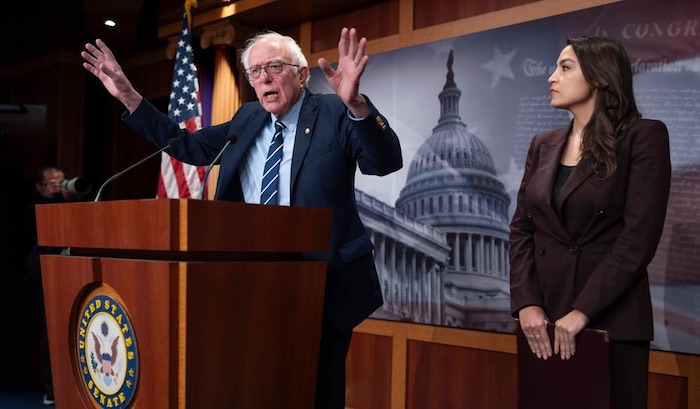
After she was first elected to the House of Representatives, Alexandria Ocasio-Cortez allowed her membership in the Democratic Socialists of America (DSA) to lapse. But now, with the DSA’s recent electoral successes across the country generating new clout within the Democratic Party, the New York lawmaker has thrown her hat in the ring once again, with her eyes possibly fixed on higher office. This week, the national DSA confirmed to its own members that Ocasio-Cortez, who is a member of the Democratic Party, had once again become a “member in good standing” of the socialist organization.Read more …
“Previously, the representative joined DSA in 2018 with a one-year membership, which DSA’s national leadership recently noticed had lapsed, in 2019. She has since renewed her membership as of this month,” the DSA wrote in a message to its members. Ocasio-Cortez’s relationship with the DSA has been complicated. She has been a fixture of the New York City chapter, by far the organization’s largest and most influential branch, even as her membership in the national organization lapsed. Since 2024, Ocasio-Cortez has been endorsed by NYC-DSA, but not the national organization, according to City & State New York, which first reported her renewed membership.The national DSA said it only became aware of the seven-year lapse after Ocasio-Cortez described herself publicly as a member of the New York City chapter specifically, rather than the national organization, a distinction that prompted national leadership to review her status internally. Ocasio-Cortez’s decision to formally rejoin the organization comes as its members wage an internal struggle over whether to endorse the lawmaker as its preferred presidential candidate in the fast-approaching Democratic primary. The New York chapter is reportedly at the forefront of efforts to push the wider organization to back her.
On Wednesday, NYC-DSA posted a photo of its leadership–chapter co-chairs Grace Mausser, Gustavo Gordillo and Jeremy Cohan–alongside Rep. Ocasio-Cortez. “While we get ready to send a whole new generation of socialists to Congress, NYC-DSA co-chairs & leaders caught up with our first socialist in federal office: @AOC. Democratic socialism is the future,” NYC-DSA posted to X. However, the DSA at large has become intensely divided over Ocasio-Cortez’s suitability as the organization’s flag bearer in the Democratic primary.
For example, the DSA’s Liberation Caucus, a Maoist faction of the group, last week “condemn[ed] Alexandria Ocasio-Cortez’s continued retreat from socialist politics and rejects any effort to present her as the future presidential standard-bearer for DSA …” Just the News reported. The group specifically cited the lawmakers’ vote for a bill that defended Israel’s right to exist and for meeting with leaders from the Jewish Council for Public Affairs. “In short, it was determined that she had failed to meet conditions concerning Palestine solidarity,” the Liberation Caucus said.
The national DSA itself withdrew its standing endorsement of Ocasio-Cortez last year for failing to vote to block $500 million in funding for Israel’s Iron Dome missile defense system while praising Rep. Rashida Tlaib, a DSA member, who voted to do so. But, as the DSA has vaulted itself into national prominence, first by Mayor Zohran Mamdani’s blockbuster campaign to win New York City’s mayor’s office and then by the organization’s unprecedented success in congressional primaries across the country, many of its leaders have mulled rehabilitating Ocasio-Cortez, seeing her as the group’s best chance to back a presidential candidate.
At the DSA’s national convention last month in Chicago, its members debated whether the organization should formally endorse a presidential candidate for the first time in 2028, with Ocasio-Cortez’s name circulating as the likeliest beneficiary, The Washington Post reported. DSA’s national leadership remains divided on the question, and the organization does not plan to begin a formal presidential endorsement process until early next year, leaving months of internal debate ahead before any commitment is made.
That divide reflects a broader tension in the relationship: Ocasio-Cortez has shown little appetite for embracing DSA’s more sweeping structural positions. Pressed by reporters last month on the organization’s push to abolish the U.S. Senate, she distanced herself from the proposal, calling it “a constitutional question” and arguing the chamber needs substantial reform rather than elimination. Asked directly whether she was angling for any endorsement, she told reporters she wasn’t currently running for any office. “I could run for dog catcher. So I think any situation is hypothetical,” she said.
Still, DSA’s national profile has grown considerably over the past year, buoyed in large part by Zohran Mamdani’s victory in the New York City mayoral race, which drew an influx of volunteers and national attention to the organization’s electoral machine. Democratic Party leadership, initially resistant, ultimately endorsed Mamdani after his win, even as national Democrats spent much of 2026 working to blunt the momentum of similarly DSA-aligned candidates in races elsewhere.
That expanding footprint, paired with a string of primary wins by DSA-backed candidates in several House districts, has raised the organization’s profile within Democratic politics heading into the midterms. Bolstered by the primary successes, the DSA went on a media blitz to share their vision for America. The group has not been shy about its radical vision, which includes policies like abolishing the senate, heavily restricting private markets, and abolishing police and prisons.
Establishment Democrats have sounded the alarm, warning that the DSA’s growing prominence within the party and policy proposals could spell electoral disaster. Democratic leaders have specifically accused DSA-affiliated candidates of exploiting the party’s ballot access to boost its own candidates at the expense of traditional Democrats, Just the News previously reported.
On our way to a US president named Muhammad.
• Abdul El-Sayed and the Piker Problem (Turley)
There was a curious moment this week when Michigan Senate nominee Abdul El-Sayed expressed shock that people were asking him about a “streamer in California” as he campaigns for the Senate in Michigan. That streamer is, of course, Hasan Piker. Despite El-Sayed’s disbelief, the questions stemmed from the fact that he brought Piker from California to campaign with him in Michigan and embraced him despite condemnations of Piker’s virulent antisemitism and violent rhetoric. However, the problem goes far deeper, as El-Sayed distances himself from views he has previously voiced.Read more …
It turns out that there are consequences to campaigning with a man who mocked the murder of a past critic and said that the United States deserved 9/11 (including responding to criticism of Piker in the primary by embracing him on election night at a rally). El-Sayed is not the only Democrat trying to get the media to stop asking him about his association.Standing in front of a giant campaign billboard for El-Sayed, Rep. Debbie Dingell (D., Mich.) shot back at those asking about his association with a raving lunatic: “I am DONE. So don’t any reporter ask me again about Hasan Piker.” What is distressing is how many reporters will dutifully obey the command. Dingell added, “They’re trying to divide us, and we’ve got to stop letting them try to divide us.” However, it is not divisive for your Senate candidate to campaign with a raging antisemite who says that the United States deserved 9-11 and that Jews are asking to be attacked.
The problem for Dingell and others is not so easily resolved by commanding a supportive media to not ask about Piker, who recently said on his podcast that Jews are asking to be attacked if they openly support Israel. The problem is that El-Sayed has voiced equally disturbing and analogous views. El-Sayed was criticized for his response after a man attacked a Michigan synagogue in March. After condemning the attack, El-Sayed added that the Israeli military killed some of the attacker’s family in Lebanon, saying “hurt people hurt people.”
It sounds a bit like Jews are asking to be attacked. El-Sayed has also drawn criticism for declining repeatedly to answer whether Israel has a right to exist during a CNN interview in June. Much like Piker, El-Sayed has also engaged in violent rhetoric, promisung to “choke out” Republicans and referring to moderates like Pennsylvania Sen. John Fetterman (D) as ogres to have their heads cut off and put on pikes.
Refusing to answer questions about the association with Piker does not answer El-Sayed’s own views that align him with Piker. Ironically, all the attention to Piker has drawn attention away from El-Sayed’s own views. El-Sayed has extreme views that go beyond his position toward Israel and include wealth taxes, reparations, and radical changes to our constitutional system.
I grew up in a liberal, politically active Democratic family in Chicago. I no longer recognize that party today, including its anti-free-speech elements. Saying that you are a “Big Tent party” does not answer the question of whether the party stands for anything other than regaining power. There has to be some defining element to a party beyond power. El-Sayed is that defining moment.
Literally incredible.
• Two-Year Jail Term For Flying National Flags (MN)
Britain’s largest local authority has gone to the High Court to stop people hanging the Union Flag and the St George’s Cross from lampposts, with campaigners warning that a breach could mean up to two years behind bars. Birmingham City Council filed the application this week as the latest move in a year-long war on “unauthorised attachments.” The attachments in question are the flags of the country. The penalties being threatened include prison, unlimited fines, and seized assets.Read more …
Protesters who fly the Union Jack from lampposts could criminal proceedings if the injunction is granted. Former Metropolitan Police detective Peter Bleksley called it what it is. “It’s absolutely scandalous!” The Free Speech Union described the move as “truly mental.”
This is truly mental.
— The Free Speech Union (@SpeechUnion) August 26, 2026
Birmingham City Council has applied for an injunction that could result in people who fly the Union Jack from lampposts being jailed for up to two years.
Threatening people with prison for displaying their national flag is a direct assault on freedom of… https://t.co/5kJdBCU1gvA year ago the same city was already ripping the colours down and calling it safety. Residents put them back up. The council has now decided a High Court order is the way to finish the job. On 26 August the council announced it had submitted an injunction application “as part of our ongoing work to prohibit unauthorised attachments on the highway, including flags and banners.” Green councillor Jane Baston, cabinet member for equalities, communities and social justice, said: “The Council is taking a lawful, proportionate and evidence-led approach to unauthorised attachments on the highway. This includes pursuing injunctive action based on the evidence gathered to date.”
She added: “Our priority is to protect public safety, staff and contractor welfare, community cohesion and the responsible use of public funds. We ask residents and community groups to support this approach and to ensure any displays are placed only where permission exists.” The authority insists the action “is not directed at any particular community, belief or viewpoint.” It says the installation and reinstallation of flags has had an impact on the public, and that officers have “witnessed incidents that have involved harassment, intimidation or obstruction during removal activity.”
The named targets give the game away. The application lists Raise the Colours co-founder Ryan Bridge, plus others associated with the campaign. Raise the Colours said it had not received or reviewed the papers and could not comment on the application. The group rejected “any suggestion that we are seeking to divide communities,” and describes itself as a “grassroots movement for unity and patriotism.”The nationwide campaign by the group to put the England flag back on the street is widely reported to have started in Birmingham last summer. The council spent the following year treating that campaign as a highways nuisance.
Now it wants a judge to make the nuisance a city-wide prohibition.Anti-flag campaigners in the city have been lobbying for exactly this. Brummies United Against Racism and Hate Crime applauded the legal bid, spoke of “thuggish behaviour,” and framed the flags as an attempt to “harass and intimidate residents of our proudly multicultural city.” So the national flag is an attachment. Opposition to it is cohesion. And a bankrupt council that spent more than a year failing to collect the bins has found the money and the energy to take patriotism to the Royal Courts of Justice.
Birmingham is taking a page from the book of Liberal Democrat-run Oxfordshire County Council, who won the first injunction of its kind, barring unidentified people from attaching England or Union flags to highway structures or painting flag imagery on roads.Council leader Tim Bearder celebrated. “This is a welcome judgement. We’re very pleased with the result,” he said, adding: “This sets a legal precedent and will hopefully deter people in not just Oxfordshire but around the country from partaking in this criminal activity.”
He described those putting the flags up as “very challenging people, not patriots.”Oxfordshire spent about £80,000 taking flags down and another £40,000 on lawyers, costs it said it intended to recover. Staff removing flags were said to have faced hostility so serious that some were told to wear face coverings and check vehicles for tracking devices after a worker’s home address was published.
Paul Craig Roberts touches on two themes: Ireland..
• Ireland Deleted (Paul Craig Roberts)
Evidence is plentiful that Ireland as an Irish nation has ceased to exist. Geographically, a country still remains, but it is not Irish. It is a multicultural tower of babel, one created by the Irish themselves.Read more …
University College Dublin has a School of Social Justice that grants Ph.D. degrees in Equality Studies, which alone shows how far Ireland has progressed into non-existence. One such graduate, an immigrant-invader from Nigeria, is the Irish government’s Special Rapporteur on Racial Equality and Racism. On a recent news broadcast she said that “we,” by which she meant immigrant-invaders, “have inherited this island,” and she urged Ireland to let go of their language. “We need teachers who don’t have to speak Irish.”The panel of five women included three immigrant-invaders and two Irish ethnics, both of whom agreed with the immigrant-invaders that Ireland is no longer an Irish nation. The rapid replacement of white ethnics in the countries of the West has created belated awareness of The Camp of the Saints. In commenting on the Irish government official’s remark that it is time for Ireland to abandon its language, Bill Ponton observed:
“Jean Raspail got it right in The Camp of the Saints (1973), a political allegory about mass migration, Western guilt, and the collapse of a society’s willingness to defend its own institutions and identity. Raspail’s argument is that a civilization can destroy itself when it ceases to believe that it has a legitimate right to preserve its borders, culture, and way of life. In Raspail’s telling, the decisive weakness comes from inside the culture rather than from the migrants themselves.”
“I had no idea how feminized Irish politics had become.”:”
• Fair Irish Maidens (Bill Ponton)

I know that I can be oblivious to fashion trends until they surround me. Such was the case recently sitting on a beach when I noticed that every woman who walked by was covered with enough tattoos to earn her a spot in a carnival sideshow. The same thing occurred when I watched this video. I had no idea how feminized Irish politics had become. I was under the impression that Irish culture retained some masculinity. I guess it changed over the course of time.Read more …
There is a lot to say about this video, but the most prominent feature is the vocal Nigerian woman minister telling everyone on the panel to get over it because she and her kind were here to stay. It was even more distasteful having an Irish woman sit next to her with a look of bovine stupidity on her face nodding in agreement. Ireland’s centuries-long struggle for independence is to be forfeited to sub-Saharan migrants because the black Irish diversity czar dictates it. I had to ask myself why car bombs weren’t going off in front of every government ministry.I know the answer to my question. The Irish men, like their counterparts in the EU, UK, Canada, and a good chunk of the USA, have been emasculated. With woke women and eunuchs in charge, everyone else is along for the ride. One that includes inviting in and providing for everyone in the third world who can make their way to your shore.
Jean Raspail got it right in The Camp of the Saints (1973), a political allegory about mass migration, Western guilt, and the collapse of a society’s willingness to defend its own institutions and identity. Raspail’s argument is that a civilization can destroy itself when it ceases to believe that it has a legitimate right to preserve its borders, culture, and way of life. In Raspail’s telling, the decisive weakness comes from inside the culture rather than from the migrants themselves.
So, like the colorful tattoos that have sprouted up in our midst like an infestation of crab grass or lice, I guess that I should get used to further lectures from Nigerian ministers with odd-looking hairdos.
.. and Huck Finn.
Huck says ‘nigger’.
A lot.
Of course today’s PC crowd can’t take that.
• A Disintegrating Tower of Babel (Paul Craig Roberts)
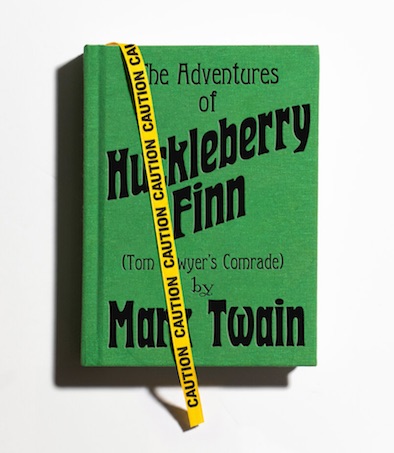
On August 24 the New York Times asked if we should read Mark Twain’s book, Huckleberry Finn? The writer, Sam Sifton, gives pros and cons. Sifton says that reading the book in prep school in NY City made him uncomfortable because the racial slur “nigger” appears more than 200 times. On the other hand, he quotes the literary critic Ruth Franklin who says the novel should still be taught because it is uniquely able to convey the structures of racism embedded in American society.Read more …
In other words, it is another weapon in the white liberal’s arsenal to prove that America is racist as the NY Times 1619 Project maintains. Notice that for Sifton and Franklin, the proof of racism is the use of the word “nigger.” As is universal among white people today, the use of this word imputes racism. This false imputation shows the ignorance of white people who have never lived among blacks, as Southern people have.Black Americans were commonly present in our homes, as Hispanics are today in many American homes. They helped with household cleaning, with meal preparation, with caring for and raising children. You don’t employ people in these intimate roles whom you despise. Anyone who has ever lived among blacks, at least in the South, knows that “nigger” is the term they use to address one another. When white people used the term, it was just an act of using black Americans own language. If the term “nigger” is derogatory, why do black Americans use it to refer to one another?
When I was growing up, “nigger” was regarded as a term used by black Americans indicating familiarity. We were instructed to use more formal terms such as “colored person” or “negro,” both being terms used by negro organizations at the time. As I recall, the problem of a white person using “nigger” was that it was an assertion of familiarity that was limited to the race. In the 1980s and 1990s I relied on a black American woman to help run my household and to help raise a child. Her husband had a career as a US Army Sargent, and she was a formidable character. She called all of her relatives and friends “nigger.”
Huckleberry Finn was published in 1884. By the 1980s “nigger” was a forbidden word, worse than the F-word. I questioned Vivian. She said, “that’s just what we call each other.” Recently I heard from a reader who said he had just heard several black Americans referring to one another as “niggers.” The reader was astonished, because he knew if he used the word in reference to a black American it would be considered hate speech and would have consequences for him. He said that race now determined what words you could use. This shows how false is the racist paradigm of America created by white liberals.
My lifelong experience with white liberals is that they are overflowing with their moral superiority. They see themselves as free of racism, which they tried to limit to Southern whites. But having taught racial hatred, their students include all whites as racists. The white northern liberals are ensnared in the concept of “aversive racism.” They are ensnared in the NY Times “1619 Project,” which says America was racist long before there were any Southern cotton plantations. The racist interpretation of America is a false narrative. It has created racial disunity between black and white Americans, and has helped to transform America into a disintegrating Tower of Babel.
I readTom Sawyeras a kid. Later I picked up a series of books of Twain talking about life on the Mississippi. Love the man.
• Let’s talk about “Huckleberry Finn” (Sam Sifton)
People have been calling Mark Twain’s “Adventures of Huckleberry Finn” a great American novel for more than a century. Ernest Hemingway said that this story of a young white boy and an enslaved Black man floating on a raft down the Mississippi River was the very root of all American literature. “There was nothing before,” he wrote. “There has been nothing as good since.”Read more …
Did you read “Huck Finn” when you were young? I did, a long time ago at a fancy prep school in New York City, and if there were any discussions of the racial slur that shows up in it more than 200 times, I don’t recall them. The book was cast as satire, an important commentary on the horror of slavery, a meditation on compassion and irony. It sure was uncomfortable, though, when the teacher had us read passages from the book aloud.Beware! In 2026, many students are upset by the slurs, and many educators are wary of a book that uses them and that could lead to job-endangering conversations, so they simply don’t assign it. For The New York Times Magazine today, the literary critic Ruth Franklin asks how — or whether — the novel should still be taught. She quotes a Twain scholar who compares “Huck Finn” to fugu, a Japanese fish so potentially poisonous that sushi chefs must acquire a license to serve it. “If it’s prepared right, it’s phenomenal,” the scholar said. “If it’s taught wrong, it can be toxic.”
So what might it mean, Franklin asks, for “Huck Finn” to be prepared right? Her answer, in part: “Over the past few years, I’ve been speaking to teachers and students who believe that “Huck Finn” still has a necessary place in the classroom, because it is uniquely able both to convey the structures of racism embedded in American society and to model how prejudice can be overcome. The book provides its own master class in critical thinking; as Toni Morrison wrote in an admiring introduction to the 1996 Oxford edition, “The brilliance of ‘Huck Finn’ is that it is the argument it raises.”
That word, though! “No student wants to hear it,” one college professor told Franklin. “It’s a form of violence.” And hear it they do. Franklin spent some time in a private school in Washington, D.C., where Samantha Goodwin, a white teacher, brought up Huck’s derogatory language about Black people in one of her classes: I could see the discomfort on some students’ faces. Finally, a white student responded. “It’s supposed to anger you,” he said.
“You feel like Huck has been taught that Black people aren’t human.” “You’re speaking nicely to the power of Huck as narrator,” Goodwin responded. “He doesn’t have the ability to take the next step and say: ‘Wait a second. Why did I believe that?’ But we get angry.” Which is fugu, I guess, prepared correctly: experiencing the novel emotionally while also appraising its critique of racism, and how that critique might fall short today. It matters when novels get us angry — and when they make us think.
An illustration of Jim and Huck by E.W. Kemble, from the 1885 first American edition of the book.
Yes, but …
Franklin worries that such an approach isn’t really scalable, at least outside elite schools. “It’s easy to see how the social dynamics could spin out of control in a classroom led by a teacher with less experience or skill or fewer resources,” she writes.Moreover, it’s not as if all students will come around to understanding the value of the novel anyway. At the end of every school year, Goodwin, the Washington teacher, asks her students in an anonymous survey whether the novel should continue to be taught. Some say no. “It’s just racist,” one of them responded.
In 2011, one publisher printed an edition of the novel that omitted the slur. Black and white academics debated its merit for The Times’s opinion pages that year. Paul Butler, a Black law professor, recalled suffering through “Huck Finn” in high school and listening to his teacher’s tortured explanations of how the slur didn’t really mean the slur, “or meant it ironically, or historically, or symbolically,” he wrote. “Whatever. I could live my whole life fine if I never read that book again.”

https://twitter.com/MAGAVoice/status/2093443300158312897?s=20
The most powerful moving object ever made by humans https://t.co/1lfTGitGjx
— Elon Musk (@elonmusk) August 29, 2026
https://twitter.com/MarioNawfal/status/2093187352092926204?s=20Elon Musk was asked how fast AI is moving…
— AI Evolution (@AiEvolutio58513) August 27, 2026
He answered by telling the most aggressive forecaster in tech he wasn't aggressive enough.
Musk: "I have to give credit to Ray Kurzweil in being actually remarkably accurate in his predictions. If anything, I think he was perhaps a… pic.twitter.com/WcNmwrSfVS
Just gonna leave this here pic.twitter.com/9clweefg6s
— Nic Cruz Patane (@niccruzpatane) August 27, 2026
Tesla Cybercabs have officially gone Unsupervised in Austin, TX!
— Nic Cruz Patane (@niccruzpatane) August 29, 2026
Cybercabs are now driving around the city without anyone in the vehicle. No steering wheel, no pedals.
LETS GO! pic.twitter.com/YoG2QiVa8c
Support the Automatic Earth in wartime with Paypal, Bitcoin and Patreon.