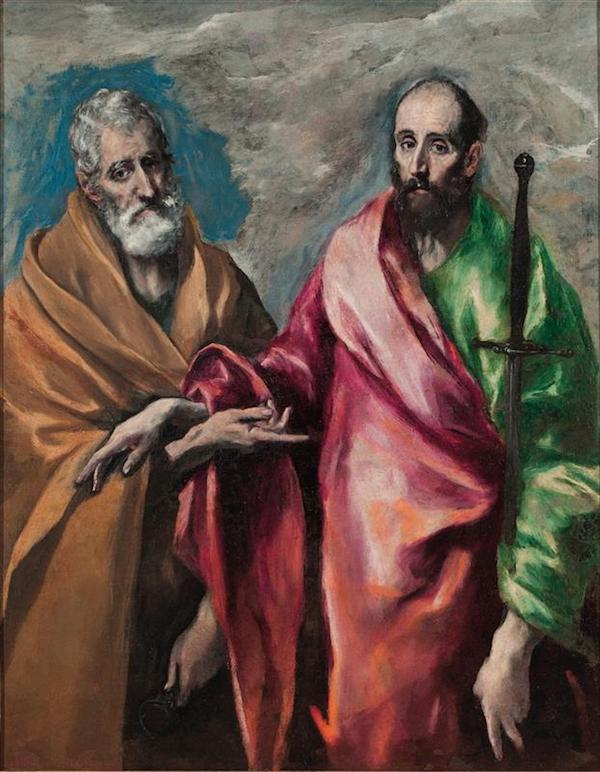

Priest and scribe Ka-aper ca. 2465-2323 BC

https://twitter.com/JesseBWatters/status/2067048468552536132?s=20 https://twitter.com/MAGAVoice/status/2067182879038406656?s=20
25 years ago, 90% of Republicans were proud or extremely proud to be American. 87% of Democrats felt the same way.
— Thomas Hern (@ThomasMHern) June 16, 2026
25 years later, 92% of Republicans are proud to be Americans. Just 36% of Democrats feel the same way.
It's not an exaggeration to say the left hates America. pic.twitter.com/RHKCB3GGUp
PRESIDENT TRUMP: "In 2024, almost 50% of inmates in German prisons were foreign migrants.. In Switzerland, it’s 72%.. When your prisons are filled with so-called asylum-seekers who repaid kindness with crime, it's time to END the failed Open Borders."
— FAN TRUMP ARMY (@TRUMP_ARMY_) June 16, 2026
pic.twitter.com/2WIoAZw3ye
The politicians who turned a blind eye to the Rape of Britain must go to prison pic.twitter.com/JFfHZSwiDc
— Elon Musk (@elonmusk) June 16, 2026
Holy moly.
— Brivael Le Pogam (@brivael) June 16, 2026
It will finish badly… https://t.co/d2YKeUh5Wr
— Elon Musk (@elonmusk) June 16, 2026
“If [the Iran deal] works out, I’m going to take the credit; if it doesn’t work out, I’m blaming [Vance].”
• Trump And Iran Sign MOU Deal Ahead Of Schedule (ZH)
Trump Signs Iran Deal Remotely Ahead Of Schedule. Confirming earlier speculation, Axios reports that the U.S. and Iran have remotely signed their memorandum of understanding to end the war and open the Strait of Hormuz, and the agreement is now in effect. The signing – which took place electronically between Trump, Vance and Ghalibaf – reportedly took place at dinner in France alongside President Emmanuel Macron. The signing was supposed to happen in Switzerland on Friday, but a diplomat from a mediating country and a second source familiar told Axios earlier on Wednesday that there had been discussions about signing and implementing it earlierRead more …
The diplomatic source said the discussions around accelerating the timetable were intended to open the strait sooner than Friday, as both parties were in agreement on that issue. Another factor may have been the political pressure on the White House to release the text of the MOU, which it sitll hasn’t done officially. The source familiar with the discussions claimed it was Iran that demanded the text not be published until the formal signing, and denied the White House was responding to political pressure. The only “public release” so far consisted of a senior administration official reading the agreement to reporters in a briefing call on Wednesday, after days of confusion about what was in it.Ahead of the signing, Iran’s foreign ministry said the sides had agreed that the MOU should be signed electronically by both presidents. For Iran, the signing represents a major victory as it now stands to receive billions in unfrozen (and other) funds from the US and Gulf sources. While it’s now just a formality, the meeting between the U.S. and Iranian delegations headed by Vice President Vance and Iranian parliamentary speaker Mohammad-Bagher Ghalibaf is still expected to take place as planned on Friday in Switzerland. They are expected to discuss the launching of negotiations on Iran’s nuclear program.
The signing took place after this remarkable press conference earlier in the day in which Trump tried to justify conceding to Iran’s terms: As BBC’s Siavash Ardalan writes, Trump’s responses to the reporters’ questions to justify the agreement with Iran were bizarre and unprecedented in their own way: They asked him how he could allow $300 billion in investment in Iran. He said, “We’ve already inflicted $2 trillion in damage on Iran; $300 billion is nothing in comparison.” They asked why he’s giving Iran tens of billions of dollars. He said, “If we don’t return their own money to them, other countries will be afraid to put their money in our banks, and then the dollar’s position will weaken.”
They asked why the missile issue isn’t in the agreement. He said, “We’ve already destroyed 85% of their missiles anyway; the rest are buried underground, and besides, we sell air defense systems to the countries in the region so they won’t worry about Iran’s missiles.” They asked if he’s not worried that Iran will say, “We’re only producing nuclear energy for civilian purposes.” He said, “You can’t tell everyone else to produce electricity with nuclear power while only Iran can’t.” Finally, he said, “If we continue sanctioning Iran, 91 million Iranians will die of hunger—what’s the point of that, really?” Oh, and he joked that “If [the Iran deal] works out, I’m going to take the credit; if it doesn’t work out, I’m blaming [Vance].”
They should talk until about August 20. As the date approaches, Iran will say they need more time.
• Read The 14-Point US-Iran Draft Deal Set For Friday Signing (ZH)
With US and Iranian officials preparing to formally sign a memorandum of understanding in Switzerland on Friday, the conflict is entering the much-needed diplomatic phase to avert a potentially disastrous energy cliff. The MoU would open a 60-day negotiating window aimed at ending the war, restoring maritime traffic through the Strait of Hormuz, and hammering out the future of Iran’s nuclear program.Read more …
Bloomberg published the text of the 14-point draft MoU, offering the clearest look yet at the proposed trade: de-escalation and sanctions relief for Iran, in exchange for a ceasefire across all fronts, commitments on shipping access, and a broader nuclear deal to be finalized by the end of summer. But Iran’s Tasnim news agency cited an unnamed official earlier today, saying some of the MoU published by Bloomberg is inaccurate. The report did not specify the discrepancies. Bloomberg noted that some of the wording could be different between the English and Persian versions. Below is the text of the 14-point draft MoU:
- The Islamic Republic of Iran and the United States, together with their allies in the current war, declare upon the signing of this Memorandum of Understanding an immediate and permanent end to the war on all fronts, including Lebanon, and undertake that from now on they will not launch any hostile action against each other, and will refrain from the threat or use of force against each other. The final agreement will confirm the provisions of this Article and the remaining Articles
- The Islamic Republic of Iran and the United States undertake to respect each other’s sovereignty and territorial integrity, and to refrain from interfering in each other’s internal affairs
- The Islamic Republic of Iran and the United States undertake to negotiate and reach a final agreement within a maximum period of 60 days, extendable by mutual consent
- Immediately upon the signing of this Memorandum of Understanding, the United States Lift the naval blockade and prevent any interference or obstruction against the Islamic Republic of Iran, and restore traffic within a maximum of 30 days to its full capacity; the traffic of ships shall be proportional to the pre-war volume of traffic on the part of the Islamic Republic of Iran. The United States also undertakes to withdraw its forces from the surrounding areas within 30 days after the final agreement
- Upon signing this Memorandum of Understanding, the Islamic Republic of Iran will immediately take steps to ensure that the movement of merchant ships from the Persian Gulf to the Sea of Oman and vice versa is resumed within 30 days to the pre-war volume, taking into account the need for the removal of technical obstacles and the neutralization of mines by Iran.
- The United States undertakes, together with its regional partners, to create a comprehensive plan agreed upon by both parties for the rehabilitation and economic development of the Islamic Republic of Iran, While ensuring financing of at least $300 billion. The implementation mechanism of this plan, as part of the final agreement, will be formulated within 60 days.
- The United States commits to ending, on a schedule to be agreed upon as part of the final agreement, all types of sanctions currently facing the Islamic Republic of Iran, including resolutions of the United Nations Security Council and the Board of Governors of the International Atomic Energy Agency (IAEA), and all unilateral U.S. sanctions, both primary and secondary.
- The Islamic Republic of Iran reiterates that it will never produce nuclear weapons. The Islamic Republic of Iran and the United States have agreed that the fate of enriched material and the fate of all other mutually agreed nuclear-related issues, including Iran’s nuclear needs, will be adequately addressed in a final agreement; the final agreement will confirm the provisions of this Article.
- The Islamic Republic of Iran and the United States agree that, pending a final agreement, they will maintain the status quo: Iran will maintain the status quo on its nuclear program, and the United States will not impose new sanctions on Iran or strengthen its forces in the region.
- The United States undertakes that immediately after the signing of this Memorandum of Understanding, and until the date of the lifting of sanctions, the United States Treasury Department will issue waivers for exports of Iranian crude oil, petrochemical products and their derivatives, and all related services, including banking, insurance, transportation, and the like.
- The United States undertakes that, in light of the progress of negotiations towards a final agreement, frozen or restricted funds and assets of the Islamic Republic of Iran will be released and made fully available. These funds, whether held in the master account or transferred, will be used for any final beneficiary payment determined by the Central Bank of the Islamic Republic of Iran and will be fully available for use. The United States undertakes to issue all necessary permits and licenses on this basis.
- The Islamic Republic of Iran and the United States agree that an implementation mechanism will be established to oversee the successful implementation of and future commitment to the Final Agreement.
- Following the signing of this Memorandum of Understanding, and upon receipt of assurances regarding the commencement of implementation of Articles 4, 5, 10, and 11 of this Memorandum of Understanding, and the continued implementation of these steps, the Islamic Republic of Iran and the United States will enter into negotiations for a Final Agreement solely with respect to the remaining Articles.
- The final agreement will be approved through a binding resolution of the UN Security Council
Based on the text above, the first take of the MoU appears to be front-loaded economic relief for Tehran in exchange for a ceasefire, a nuclear freeze, and commitments to negotiate hard topics, such as the nuclear program, at a later date.
Who Stands To Benefit:
Tehran benefits most directly because it gets economic oxygen, oil waivers, frozen funds, sanctions relief language, and reduced US military pressure in the region. Hezbollah and Iran-aligned actors also benefit if “all fronts, including Lebanon” locks in a ceasefire that constrains Israeli operations. And, of course, the global economy because global shippers benefit if Hormuz reopens and war risk premiums in crude oil collapse. The Gulf states benefit if the conflict ends because energy exports through the Strait of Hormuz will resume. A report on Tuesday said that QatarEnergy was planning to ramp up LNG production in the coming months.Where is Leverage Lost:
The US loses some coercive leverage once the Hormuz blockade ends, oil waivers are granted, and asset-release mechanisms begin. Israel loses freedom of action if the agreement binds the Lebanon front and limits further strikes. Sanctions and hawks lose leverage because the draft moves quickly toward broad sanctions dismantlement. The urgency behind the MoU and locking in peace talks for 60 days, with a formal signing event at the Bürgenstock resort in Switzerland on Friday, stems mainly from the world being headed for an energy cliff, as SPRs globally were being drained to offset the loss of Gulf production with the Hormuz chokepoint shuttered. Brent crude futures edged down overnight, trading around $79 a barrel on Wednesday morning.One of the biggest uncertainties remains the Strait of Hormuz. President Trump stated that the critical waterway will reopen permanently and be toll-free, but the MoU suggests the toll-free arrangement may only last through the 60-day negotiation period. Another major uncertainty is Tehran’s compliance.
Zelensky represents a bunch of deeply corrupt neo-nazis. Trump knows this. For Europeans and US Democrats, Ukraine is a money whitewash vehicle. What is it for Trump?
• Trump Shifting Focus Back To Ukraine: Where Do Peace Talks Stand? (RT)
Where do the talks stand?Read more …
After Washington resumed direct contacts with Moscow following years of diplomatic freeze under Joe Biden, Russia, Ukraine and the US held three rounds of talks aimed at reaching a settlement. The negotiations yielded several tangible results, including major prisoner exchanges, the repatriation of fallen soldiers, and the exchange of peace memorandums. However, they failed to secure a peace deal, with key disagreements persisting, particularly over Moscow’s demand that Ukrainian forces withdraw from Donbass.A fourth round of talks, expected in March, was postponed after Washington shifted its focus to the Iran war. Kremlin spokesman Dmitry Peskov has since described the process as being in a “situational pause” pending renewed US engagement.What settlements have been proposed?
Following the Alaska summit, where Moscow and Washington stressed the need for a lasting settlement rather than the ceasefire sought by Kiev and its European backers, Trump unveiled a 28-point peace roadmap. According to leaked drafts, it called for Ukraine to abandon its NATO ambitions, drop territorial claims, and cap its military at 600,000 personnel. Moscow welcomed the proposal as a potential basis for peace. However, under pressure from the EU and UK, several key provisions were later removed or revised.The updated 20-point plan reportedly included demilitarized zones, Western security guarantees for Kiev, an 800,000-strong peacetime Ukrainian military, a reconstruction fund for Ukraine, and a path toward EU membership. Russia confirmed receiving the revised proposal but declined to discuss its contents, accusing the Europeans of reshaping the framework and undermining peace efforts.
What are the next steps?
On Tuesday, Trump discussed Ukraine with Zelensky and other leaders during a closed-door G7 session and later held a separate meeting with the Ukrainian leader. While details were not disclosed, Zelensky said afterward that it was important to “coordinate positions.” Meanwhile, Trump’s envoys Steve Witkoff and Jared Kushner are expected to resume contacts with Moscow after shifting their focus to the Iran war. Putin aide Yury Ushakov said preparations are under way following Sunday’s call between the Russian and US presidents. Kremlin spokesman Dmitry Peskov later said no dates have been set and that the issue will likely be revisited after Washington signs its memorandum with Tehran.Europeans split
European countries remain divided between those favoring engagement with Moscow and those seeking to maintain pressure on Russia. Hungary and Slovakia have urged direct dialogue with Moscow and criticized policies they say prolong the conflict. Those seeking to maintain pressure, which includes Poland, the Baltic states and much of the EU leadership, argues that political, economic and military pressure must continue. European Commission President Ursula von der Leyen reiterated that stance on Monday, calling support for Ukraine a top G7 priority.France and Germany occupy a middle ground, backing continued aid to Kiev while acknowledging that any lasting settlement will require negotiations with Russia. That approach was tested last week when French, British, and German envoys met Russian Deputy Foreign Minister Mikhail Galuzin in Moscow. According to Russia, however, they merely repeated calls for a ceasefire and security guarantees for Ukraine, prompting Moscow to argue that the countries arming Kiev cannot act as neutral mediators.
Trump’s position
During the 2024 presidential campaign, Trump repeatedly claimed he could end the Ukraine conflict within 24 hours through direct diplomacy, though he later acknowledged that a settlement would be harder to achieve. Since returning to office, he has criticized both Moscow and Kiev at various times, accusing each side of hindering peace efforts, while consistently arguing that the conflict should be resolved through negotiations rather than prolonged fighting.https://twitter.com/e3z9b_qI1ytkw/status/2066683484358242763?s=20
After speaking with Putin and Zelensky on Sunday, Trump described both conversations as “very good” and said both leaders were “very open” to peace. According to Kremlin aide Yury Ushakov, he also told Putin he was prepared to “influence” Kiev and its European backers toward a settlement. Speaking at the G7, Trump said he would “look” at what could be done regarding Ukraine, while suggesting the conflict was of limited importance to the US, adding that “it has no impact on us other than we sell weapons.”
Zelensky’s demands
Amid mounting battlefield pressure, Zelensky has insisted on securing a temporary ceasefire and continued Western support, while maintaining that Ukraine will not formally recognize Moscow’s sovereignty over territories that joined Russia through referendums. He has also opposed any settlement negotiated directly between Moscow and Washington without Kiev’s participation, insisting that Ukraine’s European backers be included in the process.
“No FISA Without SAVE Act:”
• Trump Calls Out ‘Dumocrat’ Double-Cross,” Keeps Pulte As Acting DNI (ZH)
Just two years after Donald Trump urged Congress to kill Section 702 of the Foreign Intelligence Surveillance Act while on the campaign trail, he’s now livid that Democrats won’t help Republicans pass it. Trump took to Truth Social early Wednesday morning with a lengthy post accusing ‘Dumocrats’ of breaking a bipartisan deal on FISA reauthorization – and announced a series of moves that throw a wrench into Senate plans for both intelligence leadership and surveillance powers.
According to Trump, Republicans played themselves – after agreeing with Democrats to accelerate the removal of Acting DNI William Pulte (by fast-tracking Jay Clayton’s confirmation) in exchange for Democratic support on renewing FISA Section 702 surveillance powers. Now, however Democrats are threatening to vote against FISA anyway.“The Republicans wound up having fulfilled their commitment, but Dumocrats broke the Deal.” As a result, Trump said he is canceling today’s Senate hearing for Jay Clayton as permanent DNI. He will not move Clayton out of his current role as U.S. Attorney for the Southern District of New York until Jamie McDonald (a Sullivan & Cromwell partner and Trump’s former personal lawyer, recently nominated to replace him at SDNY) is confirmed – including clearing the “blue slip” process.
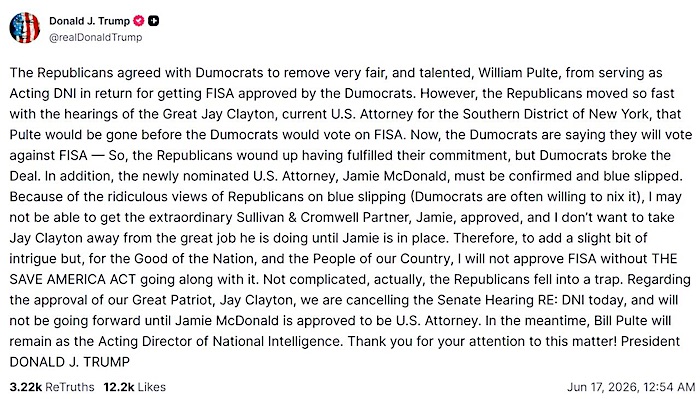
In the meantime, Bill Pulte will remain as Acting Director of National Intelligence – who Trump picked to replace Tulsi Gabbard after she said in May she was leaving the administration in June to spend time with her husband following his cancer diagnosis. Pulte has been a controversial pick over his lack of intelligence experience – which led to Trump nominating U.S. Attorney for the Southern District of New York Jay Clayton to be the next DNI. nTrump explicitly linked his approval of FISA renewal to passage of the SAVE America Act – his priority legislation requiring photo ID, proof of citizenship for voter registration, and strict limits on mail-in ballots.Read more …
“Therefore, to add a slight bit of intrigue but, for the Good of the Nation, and the People of our Country, I will not approve FISA without THE SAVE AMERICA ACT going along with it. Not complicated, actually, the Republicans fell into a trap.” The SAVE America Act – which requires Americans to show proof of citizenship to register to vote and a valid ID to cast a ballot, has stalled in the Senate after the House passed the legislation in February.
What amazed me was the scale.
“.. the aim of the attack [..] was to create chaos and overthrow the U.S. government.
• 5 Arrested in Plot to Attack UFC Event at White House (ET)
Five men have been arrested for allegedly plotting to attack the mixed martial arts event that was held at the White House on June 14. The charges include conspiracy to murder. The men were planning to set off explosives at the event and force people there to flee a certain way, according to court documents. Snipers would be positioned to take out high-level targets, including President Donald Trump, according to the charging papers. One of the men, Tycen Proper, 19, told law enforcement that the attack would “jumpstart” a revolution in the United States, according to the FBI. Proper’s mother called the police on June 10. Officers arrived and learned that Proper had met people online and had been planning “recons” and “missions” with them, according to prosecutors.Read more …
He had also spent $3,000 on guns, ammunition, ballistic plates, and other items, and planned to leave during the upcoming weekend to meet with the people, his father said. Proper was admitted to a local hospital because of “homicidal ideations,” the FBI said. Proper later spoke to investigators and shared with them images and messages from accounts he was using, including accounts on TikTok and Signal. Proper said that the group with which he was involved believed the United States was headed in the wrong direction, and needed to be “torn down so that it could be rebuilt,” according to the FBI. He said the plan was for people to leave their homes on June 12 or 13 and meet in Fredericksburg, Virginia. They would stage a demonstration near the White House.
Wow, this is crazy! https://t.co/YRmricD21V
— Elon Musk (@elonmusk) June 16, 2026During the demonstration, the group would fly drones laden with explosive devices and set them off in a specific area, forcing the crowd to evacuate in view of waiting snipers, who would shoot people as they fled. Targets included Sens. Marsha Blackburn (R-Tenn.), Tom Cotton (R-Ark.), and Rep. Carol Miller (R-W.Va). Through the information Proper provided, law enforcement identified four other men involved with the attack plan, according to officials. One of the men, Abraham Hermosillo Alvarez, 31, discussed the targets during the attack. “As many and as deadly as we can get,” he allegedly wrote. Another man, Daniel Eskridge, 32, wrote that the plan required five teams of three people each, and that the teams would each consist of a sniper, a drone operator, and a look-out.
The other two men allegedly involved in the plot are Bryan Omar Roa, 24, and Michael Alan Thomas, 32. Roa told the FBI during an interview that he had planned to protest at the UFC event but “his vehicle malfunctioned and he had to return home.” His relatives told law enforcement that he had planned to go to Washington and appeared ready to carry out an act of violence, and he discussed how a person could hypothetically use drones armed with explosives to bomb buildings near the White House, according to charging documents. Thomas told the FBI that he was a planner and adviser for the group, the FBI said. Thomas allegedly said the aim of the attack, and subsequent planned attacks, was to create chaos and overthrow the U.S. government.
“This is still an active, ongoing investigation,” U.S. Secret Service Deputy Director Matthew Quinn told reporters at a press conference on Tuesday. “There are still suspects at large, and we’re going to work it until everyone’s been identified.” Quinn also said that the event on Sunday was “never at risk. Period.” A public defender appointed to represent Alvarez declined to comment. Lawyers representing Proper and Eskridge did not respond to requests for comment by time of publication. It was not clear whether Roa and Thomas had retained legal counsel.
FBI Director Kash Patel said in a statement that “thanks to the rapid action of this FBI, our partners, and the Department of Justice in a multi-state operation, multiple individuals are now in custody and allegedly planned attacks were stopped cold.” He added, “I want to thank our great agents and partners, this work remains ongoing and we will continue to update the public as permitted.”
It is sad to look at the potential Democrat candidates.
• How Deep Are the Newsoms In It? THIS Deep. (Stephen Green)
It seems impossible — or just too revolting — to keep up with the financial hanky-panky of California Gov. Gavin Newsom and First Partner (gag) Jennifer Siebel Newsom. But thanks to a couple of investigative reporters with stronger stomachs than I have, let’s see if I can’t put everything you need to know into one easily digestible column. I love it when other people do my dirty work for me, so let’s get started. “Today, my wife & I joined Donald Trump’s hit list,” Newsom practically boasted on Monday. “He has directed his Department of Justice to investigate us. They have not found a crime — they are simply trying to find one.”Read more …
Well, let’s see what Fox Business anchor Liz MacDonald and my old friend and Red State colleague Jen Van Laar have to say about that. MacDonald said Tuesday that the DOJ probe “is about California Democrats’ modern-day machine politics,” which she described as a “feedback loop of Sacramento-corporate lobbyists-governor/wife nonprofit-behested nonprofit donations-lucrative state contracts-Sacramento.” Don’t bother writing all this down — there won’t be a quiz at the end of today’s column. You’re welcome.“The modern Sacramento machine trades corporate compliance and nonprofit funding/donations for policy access and state business,” MacDonald added, and then explained how that grift (allegedly!) worked for the Newsoms: According to IRS Form 990 disclosures, her nonprofit frequently buys from Siebel Newsom’s for-profit film company—Girls Club Entertainment LLC—writer, producer and director services and the licensing and production rights for her documentaries. Then it sells the docs to the state and public schools.
IRS records show that her nonprofit has paid her Girls Club Entertainment LLC roughly $1.64 million for these production and licensing rights since 2012, which includes a steady annual contracting fee of $150,000 since 2018. TL;DR: Siebel Newsom produced unwatchable propaganda videos for children, for which Democrat-dominated schools then paid her handsomely. Or as MacDonald summed it up, “Over the past decade, Siebel Newsom has collected over $3.7 million in combined personal salary and LLC payouts funded by the nonprofit.”
Then there are behested payments, which MacDonald explained are “a unique mechanism in California politics where an elected official asks a corporation, labor union, or wealthy individual to donate money to a specific charity, nonprofit, or government program.” Unlike campaign donations, there are no caps. As governor, Newsom requested a record $226 million in behested payments in one year. “Hundreds of thousands of dollars went to the California Partners Project,” MacDonald wrote, “a nonprofit founded by his wife.” “Many of the biggest donors were corporate giants (like health insurers and utility companies) actively bidding for lucrative state contracts or fighting state regulations.”
One hand washes the other with filthy lucre, if you’ll allow me to mix metaphors. Which brings us to Jen Van Laar, and her hip-deep-in-the-muck wade through the Newsoms’ finances, going back years. Way back in 2021, Jen asked, “Somebody Paid $3.7 Million Cash for CA Gov Newsom’s Estate – But Who?” But couldn’t come up with any satisfactory answers. That’s because the Newsoms alternately claimed that “the Newsoms’ cash was used to purchase the home but was done through an LLC managed by his first cousin,” or that “Newsoms obtained a loan… to purchase the home because the sale happened so quickly that they didn’t have time to obtain a mortgage.”
Then, California’s First Couple played similar LLC games, buying a second home for $9.1 million in ritzy Marin County. “Based on my examination of 15+ yrs of Newsom’s financial disclosures, tax returns, and real estate transactions,” Jenn explained in March, “they absolutely did not have $9.1M in cash.” Clearly, somebody did. The shenanigans were so egregious that — no matter what TDS nonsense Newsom’s social media team posts on X — the DOJ investigation began under the Biden administration. As I quipped on Instapundit this week, maybe Newsom needs to take a break from social media and lawyer up.
Then there are the real-world effects, the fallout from personal corruption and statewide, one-party rule. On Tuesday, Victor Davis Hanson wondered if California is “reaching critical mass,” thanks to one-party rule creating a “neo-feudal society” that is “hardly democratic.” The most egregious example was the fate of 2014’s Proposition 1, a $7.12 billion water bond “designed to solve the state’s chronic water storage deficit.” Even though Prop 1 is an actual constitutional amendment, including “$2.7 billion specifically designated for new reservoirs,” an alliance of bureaucracies, elected officials, and green activists still managed to block any new reservoir construction.
“Adding insult to injury,” Hanson continued, “Governor Gavin Newsom instead used $250 million from the Proposition 1 fund to blow up four dams on the Klamath River.” Californians voted for more water infrastructure. Newsom’s party blocked them, and Newsom himself had four dams destroyed that had “once provided storage, electrical generation, recreation, and flood control.” Tell me again about Muh Democracy™. All of which is my long-winded way of concluding that, as corrupt as the Newsoms appear to be, they are merely a symptom of the progressive disease killing our once-greatest state.
As long as she’s around, how can you take that party even a little bit serious?
• Kamala’s Anti-Trump Meltdown in Austria a Masterclass in Projection (Margolis)
Kamala Harris took the stage at the Austrian World Summit on Tuesday and delivered the most shameless masterclass in projection I have ever seen. The moderator, Elex Michaelson, asked Harris about the news that California Gov. Gavin Newsom (D-Calif.) is now under investigation by the Department of Justice.Read more …
It was a loaded question, of course, and, as you might expect, she responded with a classic Kamala word salad. “So I am not surprised that he may be using the Department of Justice to go after a political enemy in the current governor of California,” she said, “and this is why I do believe this, upon many other examples of what is, essentially — you’re gonna ask me questions about the current president, I’m gonna be candid — what is essentially the most callous, corrupt, and incompetent presidential administration America’s ever experienced, and for that reason, I have no question or doubt that we will win the midterms, and it will be a result of people of every background and political association who will contribute to that outcome.”She claimed that President Donald Trump told everyone he’d weaponize the DOJ against his enemies, and now he’s doing it. It’s an absolute joke that anyone connected with the Biden-Harris administration would even attempt to play that card, because they didn’t just talk about using government power against political opponents. They did it, repeatedly, and boy, did they do it with gusto.
They jailed nonviolent January 6th protesters and denied them due process. They prosecuted pro-life demonstrators for praying outside abortion clinics. The Biden-Harris DOJ targeted Catholic churches. The FBI labeled parents who showed up at school board meetings as domestic terrorists for the crime of caring about their kids’ education. And, of course, the Biden-Harris administration literally sent the FBI to raid the home of President Trump in a blatant scheme to put him in prison so he couldn’t return to the White House.
Sorry, but Kamala Harris has no business accusing the Trump administration of weaponizing the Department of Justice, especially while citing the Newsom case, which, as PJ Media previously reported, actually began under the Biden-Harris administration.
While I’m here, we might as well address Kamala’s accusations of incompetence, too. This is the vice president who watched Afghanistan collapse into the hands of the Taliban, abandoned American allies to their fate, and presided over a withdrawal that got 13 U.S. troops killed. That’s before we even get to the border crisis her administration refused to control, the unchecked inflation that gutted American paychecks the administration claimed would be transitory, the bungled response to the East Palestine train derailment, the confused handling of the Chinese spy balloon, the disastrous and ultimately abandoned Gaza pier project, the sluggish response to the Maui wildfires, and the failure to deter Russia from invading Ukraine in the first place. And that’s just a few examples off the top of my head.
And don’t get me started on corruption. Between the Biden Crime Family and the whole cover-up of Joe Biden’s cognitive decline, the last thing Kamala should want is for anyone to go there — not that Michaelson would call her out on any of those things.
So when Kamala stands on a stage in Austria and calls the Trump administration the most callous, corrupt, and incompetent in American history, conservatives can be forgiven for laughing. She’s not describing Trump. She’s describing the administration she was a part of for four years.
“.. maqluba (a deal, flipping the rice) or muqlaba (no deal, flipping the peace)..”
Yesterday saw the BOJ hike rates to 1%, the highest level since 1995, and the RBA hold at 4.35%, with some chatter of the next move being down, not up, despite inflation running way above 2%. Today it’s the turn of new Fed Chair Warsh who, like the other central banks, has to deal with a geopolitical backdrop which may or may not allow for any monetary policy easing.Read more …
There, the text of the 14-point US-Iran MoU has been leaked ahead of its Swiss signing ceremony on Friday: ironically, it says “Ease in our time.” It allows Iran to immediately sell oil again, including the waiver of all banking and transport sanctions (though US legislation may prove an obstacle re: IRGC terror designation). It also includes the private sector $300bn investment fund for Iran, which Reuters claims has already been half committed.What does this imply? It’s either a giant TACO that markets look past the full implications of to embrace; or a can-kick until the midterms (after which what?); or the Middle Eastern dish maqluba –not muqlaba (‘confrontation’)– layers of rice, veggies, and meat prepared one way up, then flipped when served. In other words, a behind-the-scenes-and-rhetoric normalisation from Iran. Ultimately, the proof of that dish is in the eating, and there are still many points to choke on.
NBC reports Iran has continued to fire multiple drones toward ships in Hormuz since the MoU was agreed, with the US shooting them down. The US Navy underlines the Strait still holds “substantial” risk. Insurers therefore remain wary, and as noted yesterday, maritime traffic is more likely to flood out than back in ahead.
Iran is demanding an Israeli withdrawal from Lebanon, which Israel states it will not and just struck Hezbollah again, with Iran now threatening to respond if Israel continues. Trump yesterday suggested Syria, with a history of looking at Lebanon as its own, should take care of Hezbollah (which the Lebanese government wants to disarm, but is unable to), not Israel. Given Syrian president Al-Sharaa’s Al Qaeda background and links to Turkey, with its history of looking at Syria as part of the Ottoman Empire, this does not seem the panacea some might hope for.
The MoU text is vague on uranium: it “will be adequately addressed in a final agreement.” Again, is it maqluba (a deal, flipping the rice) or muqlaba (no deal, flipping the peace)? China is warning the next phase of US-Iran talks will be “more difficult,” which is very clear.
The US is also weighing boosting ties with the Palestinian Authority as it seeks to advance its Gaza Board of Peace and an expanded Abraham Accords, while Israeli PM Netanyahu is said to be dropping election campaign posters showing him alongside Trump, as his opponents are all as hawkish as him re: Hezbollah and Iran, if not on the Palestinian issue.
In short, there are so many layers of rice, veggies, and meat here that’s not clear if anyone can flip the dish without spilling the food: and that’s just the Middle East, which is a current pivot point within a larger global negotiation.
RT has a pro- as well as a counter article.
• Nigel Farage’s ‘White Britain’: A Long-Overdue Step (von Hoffmeister)
Nigel Farage’s recent Substack post lays bare the reality of Britain’s “two-tier” system, where native white Britons face systemic disadvantages in policing, housing, employment, and justice while ethnic minorities receive preferential treatment under the guise of “equality.”Read more …
This is not an aberration or a policy glitch. It is the predictable outcome of attempting to impose liberal democracy on a multiracial society. Different ethnic groups possess distinct collective interests rooted in both biology and culture. Where those interests diverge, genuine democracy, meaning rule by the people for the common good, becomes impossible. Only one outcome prevails: the slow disenfranchisement of the historical white majority.Human beings are not blank slates. Evolution and genetic similarity theory demonstrate that people favor their own ethnic group. This is not “racism”; it is kin selection, an adaptive strategy honed over millennia. Studies of in-group preference, crime statistics, voting patterns, and nepotistic networks across the globe confirm it: most non-white groups operate tribally as a matter of course. Middle Eastern clans, African kinship networks, South Asian extended families, East Asian ethnic solidarity, and Latin American mestizo patronage systems all prioritize “our people” first. This is normal human behavior.
Whites are the glaring exception. Through Christianity’s universalism, Enlightenment individualism, and post-World War II indoctrination via education, media, and elite institutions, Europeans have been brainwashed into viewing themselves solely as atomized individuals. “Race doesn’t matter,” “we’re all the same,” and “diversity is our strength” are articles of faith, not empirical observations. Whites extended this universalism outward – abolishing slavery, spreading human rights, and building institutions based on merit and fair play – only to then have it weaponized against them. Other groups never adopted it; they simply exploited white openness. The result is asymmetric competition: cohesive ethnic blocs practice nepotism, bloc voting, and resource extraction, while whites compete as isolated individuals, handicapped by their own self-imposed scruples.
In a heterogeneous society, this cannot produce a fair democracy. Democracy assumes a shared conception of the public interest. When ethnic groups have irreconcilable preferences – on crime and policing, welfare redistribution, immigration, family structure, time horizons, and cultural dominance – majoritarianism becomes ethnic spoils. Non-White groups act for their tribe’s advantage. Whites, crippled by individualism, appeal to abstract principles that no one else honors. Nepotism always defeats naive individualism in the long run. Look at any Western city with significant demographic change: ethnic enclaves, parallel societies, demands for Sharia accommodations, affirmative action, and reparations. The social whole dissolves.
The West invented the highest expressions of universalism: rule of law applied equally, individual rights, and merit-based advancement. These are noble achievements responsible for unparalleled prosperity and innovation. Yet in a world of group differences, they function as unilateral disarmament. Non-whites import their tribal strategies into open societies while whites cling to universal rules that prevent collective self-defense. Elites, often insulated by wealth, celebrate this as ‘moral progress.’ The autochthonous population pays the price: suppressed wages, strained welfare systems, skyrocketing crime in ‘diverse’ areas, cultural displacement, and two-tier justice.
[..] Whites must rediscover their own ethnic consciousness, not out of supremacy but survival and reciprocity. Rejecting universalist suicide does not require hating others; it requires realism. Other groups pursue their interests unapologetically. Only when whites do the same can stable, high-trust arrangements emerge. Farage’s critique of a two-tier Britain is a starting point. The deeper truth is that without halting demographic replacement and rethinking governance along lines of peoplehood, democracy itself becomes a fiction masking tribal conquest.
This is the hard reality many conservative thinkers have warned about for decades. Pretending otherwise accelerates decline.
“The Reform UK leader’s manifesto attacks DEI and immigration, but beneath the outrage lies a thin program built on grievance and biology..”
• Nigel Farage’s ‘White Britain’ is a Fantasy (Graham Hryce)
Nigel Farage, the leader of Reform UK, has published a lengthy personal manifesto on his Substack this week. Farage is not noted for making detailed policy pronouncements, and his long-winded writeup provides an interesting insight into Reform’s policy agenda – revealing, as it does, both its intellectual and political shortcomings. Farage’s manifesto is titled “Britain is a two-tier state – against white people” and it was clearly triggered by the recent Henry Nowak and Stephen Ogilvie cases, in which white British citizens were brutally attacked (and in Nowak’s case, killed) by a Sikh and a Sudanese respectively, neither of whom were illegal immigrants. Farage sets out in detail the circumstances surrounding the Nowak case, and his strident criticisms of the police are entirely valid.Read more …
Farage’s central contention is that white people in Britain are treated much less fairly than other ethnic groups, and that the mainstream political parties – he calls them “the establishment parties” – are unwilling to acknowledge the fact that “anti-White racism is embedded into the heart of the state” – because they created this state of affairs and are ideologically committed to maintaining it. Farage sees the “ideology of Diversity, Equity and Inclusion (DEI)” and the Equality Act, passed by Labour in 2010 and subsequently strengthened by the Conservatives, as being the main culprits here, and argues that “every section of the state… has been ideologically compromised” by these “toxic ideologies.” According to Farage, this has created a less harmonious and less fair Britain.Farage claims that this “two-tier state” has created a “two-tier market” in employment, social housing, education, the military, policing, and healthcare – which discriminates against white people, especially the young. Ominously, according to Farage, the situation can only get worse in the future – because while “White Brits” are a sizable majority at present, they “will become a minority in this country before the end of the century.” Notwithstanding this bleak state of affairs, Farage nevertheless maintains that “there is reason for hope” because Reform “has the will and the ability to ensure that no young White person ever has to grow up feeling ashamed of who they are again.”
How precisely does Reform propose to bring about this miraculous social transformation? Farage sets out a number of specific policy proposals that Reform proposes to implement if the party wins government, including the following:
• abolish the Equality Act and prohibit national and local government bodies from implementing DEI policies;
• prevent foreign nationals from having access to welfare benefits;
• ensure that students receive a “balanced and patriotic education” and compel every school to “fly the Union flag” and prominently display a picture of the King;
• restore pride to Britain’s armed forces.The flimsiness of these policies is obvious, and even if they were implemented, they would do little or nothing to alleviate the serious and longstanding problems that bedevil contemporary Britain – including a declining economy, the cost-of-living crisis, a ballooning public debt, and rising crime rates. Liberal commentators have long been critical of the Equality Act and illiberal ideologies like DEI – and Farage is correct to condemn them and point out how destructive they are of social cohesion. But, even here, Farage underestimates how difficult it will be to abolish them. Britain is still bound by the EU Human Rights Act and a raft of other EU laws, and the UK Supreme Court will fight tooth and nail to retain the status quo.
And the people pushing these laws know that very well.
They push “safety for kids” only to get -legal- access to -grown-up- you.
• A Social Media Ban for Minors Requires Data From Everyone (ET)
In debating a social media ban for minors, it appears we face a choice between two perceived harms. One is the reported damage that social media is doing to the mental health of children and adolescents. The other is the normalization of mass age verification systems—most likely involving biometrics—that would apply to everyone, not just minors. This carries real risks of privacy invasion, data breaches, and future mission creep.Read more …
There is little dispute that many Western countries have experienced a rise in youth mental health problems beginning around 2010–2012 (when Smartphones and social media exploded). Anxiety, depression, self-harm, and suicide rates among adolescents, particularly girls, have increased dramatically since this period. There is disagreement, however, not over whether these spikes exist, but whether they can be attributed specifically to social media. The lingering effects of the pandemic and lockdowns, and family breakdown are just some of the other factors that could be in play.Data debates aside, most Canadians with common sense and personal experience using social media for prolonged periods of time would admit that doing so is harmful for their mental health, no matter their age. So, what should we do? Whatever steps we take, resorting to broad government-mandated bans and mass surveillance should not be one of them.
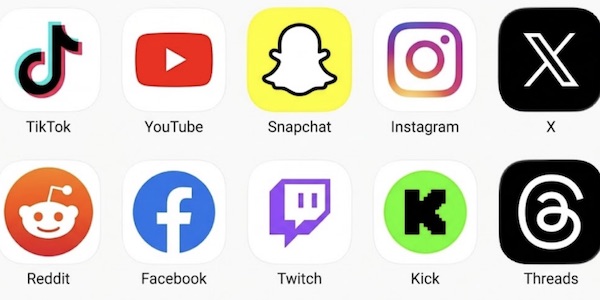
Australia offers the clearest real-world test of such a policy. Since its under-16 social media ban took effect on Dec. 10, 2025, platforms operating in the country, including Facebook, Instagram, Snapchat, Threads, TikTok, X, YouTube, Reddit, Twitch, and Kick, have been required to take “reasonable steps” to prevent users under 16 from creating or maintaining accounts. Platforms guilty of breaching this new law can reach up to AU$49.5 million.
Australia’s legislation “specifically prohibits platforms from compelling Australians to provide a government-issued ID or use an Australian Government accredited digital ID service to prove their age.” To comply with the law, platforms have implemented widespread use of behavioural analysis, device signals, and facial age estimation scans. By mid-December 2025, platforms had already removed access to approximately 4.7 million suspected under-16 accounts.
But large numbers of teenagers quickly found workarounds. Surveys conducted in early 2026 show that more than 60 percent of under-16s who had accounts before the ban continue to access at least one restricted platform. Common methods include using borrowed phones or parents’ ID, fake age declarations, VPNs, and printed mesh masks to fool facial recognition. Without robust age verification systems, therefore, a meaningful ban doesn’t exist. It might initially remove under 16s, but millions of ineligible minors will find a way to return to these platforms, as has taken place in Australia.
This begs an important question: What is the point of an age verification system that is only half effective? This would create a new set of problems including the loss of privacy rights for everyone, without actually solving the underlying problem the legalization is reportedly designed to fix.= Canada is aware of this conundrum. What would Canada do, then, to both kick minors off the platforms and keep them off the platforms? There is no reason to think that parental oversight or enforcement will be any different here than across the Pacific.
One possibility is social media users must submit verification of identity every time they log in to the platform. The most obvious way to do this would be a government-mediated login system. This would essentially grant government an immense amount of metadata about who logs in to what, how often, etc.
Another possibility would be for social media platforms themselves to monitors users’ data, either by periodically scanning faces and matching it to submitted photo ID, or by evaluating user behaviour (i.e., what content is being accessed and predicting the age of users). This would give an immense amount of data to social media companies that, if retained, could lead to significant privacy violations. Imagine a camera monitoring you every time you use Instagram or Facebook. Think about the fact that biometric technology can already be used to predict age based on wrinkles, skin texture and elasticity, facial proportions, eye shape, hairline, and bone structure. Researchers have even found statistical correlations between typing speed, error patterns, touch pressure, and age.
In this latter possibility, Canadians would be handing highly sensitive biometric data (faces, fingerprints, typing style, etc.) to foreign corporations that are subject to foreign laws (U.S. CLOUD Act, Chinese national intelligence law, etc.). These companies can be compelled by their own governments to hand over your personal and identifiable data. This type of data is also permanent. If it gets hacked, leaked, or demanded by a foreign government, you cannot change it like a password.
Finally, a mandatory social media ban for minors under 16 would significantly restrict their ability to access information about the world. Freedom of expression under the Charter section 2(b) includes not only the right to speak, but also the right to receive information. Canadian courts have recognized this in several cases. Social media platforms have become one of the primary ways many young people receive news, public debates, educational content, and diverse viewpoints.
One doesn’t have to be an absolutist to value freedom and privacy, but the fact of the matter is we have not tried alternative strategies that would minimally impair this fundamental freedom of privacy for everyone, and freedom of speech for minors. Yes, facial recognition is already used voluntarily on some platforms (such as dating apps). And a driver’s licence is often required from gambling sites to ensure compliance with the law. But there is a profound difference between choosing to use one of these sites and being required by law to submit biometric data to participate in modern public discourse. The scale is also vastly different.
We should pursue less invasive strategies instead of choosing between an ineffective ban or a robust and draconian one. Aggressive cultural campaigns against early smartphone use, phone-free schools until at least Grade 9 or 10, and better parental control tools have all shown meaningful results for youth mental health in multiple studies. Stronger platform liability for addictive design specifically aimed at children could also be pursued. At the end of the day, parents are responsible for their children’s social media use with or without a law that requires everyone share their digital data. In other words, even if a robust law existed, parents would still be responsible to ensure their children avoid workarounds.
The instinct to protect children is good, but we cannot protect them by quietly dismantling the privacy and freedom of the entire society. The cure must not be worse than the disease.
5 eyes.
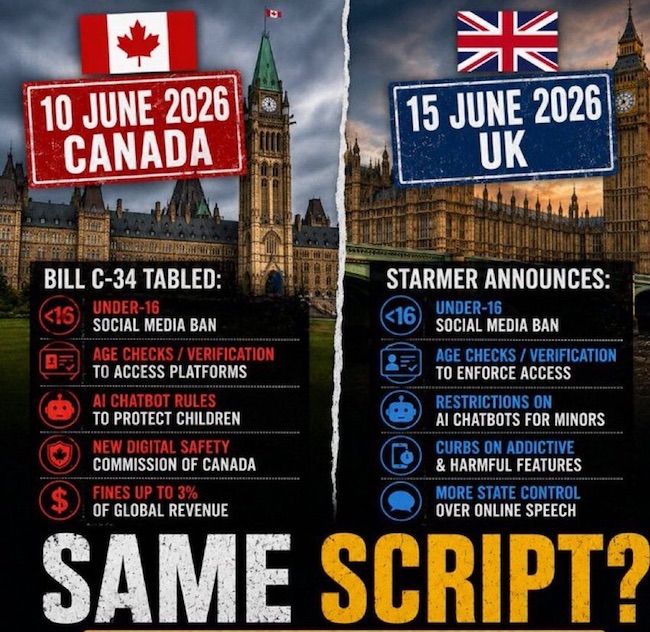
It is not coincidental that we have seen Australia, New Zealand, the U.K, and now Canada trigger online ‘age verification’ laws; simultaneous with a political push inside the USA to maintain FISA (702) legislation. Separating the USA for a moment. The intelligence services of Australia, New Zealand, U.K and Canada make up four of the intelligence services 5-eyes. In essence, the British Commonwealth is the IC commonality. [Yes, there is some validity to the Lyndon LaRouche perspective (Promethean Action PAC)] Additionally, I would also posit a reminder of the international assembly who structured the originating financial sanctions against Russia; again, a commonality.Read more …
Focusing on the most recent political creation in Canada, there are three bills currently being rushed through the Canadian House of Parliament, C-34: keep kids safe on social media; C-36: stronger privacy rules, and C-22: modern tools for police. Not surprisingly, it is difficult to find non-govt-approved information about this legislative construct online. Canadian media must remain compliant with approved government narratives in order to maintain their business model. However, putting together some various information found on non-controlled information sources, it is possible to begin discussion of the situation. The two issues that merge with the greatest impact are Bill C-22: The Surveillance Bill, and Bill C-34: The Children’s Safety Bill.
Bill C-22 requires that all information transmission providers, every telecom and internet company, retain metadata on all Canadian users for up to one year. This is electronic metadata which we all know encompasses a lot more than just content. Signal app, NordVPN, Windscribe, DuckDuckGo, Apple, and Meta have all formally opposed it. Signal app has threatened to leave Canada entirely rather than comply. This is a government mandated metadata storage library on all electronic communication and activity by Canadian users. Then there’s Bill C-34: The Children’s Safety Bill, as noted by Lucy Hargreaves, a bill that ‘Applies to Everyone’, not just kids.
“The government’s social media ban for under-16s is genuinely popular, with 75% of Canadians supporting it in polling. The problem is what it requires in practice. To stop anyone under 16 from creating an account, platforms need to know how old everyone is. There is no way to identify who is under 16 without identifying everyone who isn’t. This means every Canadian adult would need to submit government ID or a face scan to a third-party verification company before posting a photo, using cloud storage, or playing an online game. The bill also creates a new Digital Safety Commission with sweeping powers to set the rules, decide which platforms must comply, and approve or deny exemptions — with almost no criteria written into the law itself.”
“Australia introduced the same social media ban in December 2025. Six months later, the eSafety Commissioner told Parliament she was “not really keen” on it from the start and called it a “blunt force approach” drafted too quickly. 70% of young Australians reported the ban had little effect on their social media use. It didn’t reduce cyberbullying. What it did produce was a surge in VPN use… pushing young people to darker, less-monitored platforms.
The UK implemented age verification under its Online Safety Act in mid-2025. Within one month, VPN downloads hit over two million — the highest ever recorded — and monthly downloads stayed above one million for a year as users raced to bypass the requirement. The EU considered its own version of mandatory message scanning (dubbed “Chat Control”) and its own Parliament voted it down in March 2026, with the EU’s legal service concluding that indiscriminate scanning of private communications is incompatible with fundamental rights.
The government’s core justification for C-22 is that Canada is the “only Five Eyes country” without a lawful access framework. But the United States has no federal mandatory metadata retention law. The EU’s highest court has struck down blanket retention twice as incompatible with human rights. When the Public Safety Minister claimed Canada’s provisions would be “in line with U.S. counterparts,” he was forced to walk back the statement within hours.”
Think about what all the critics (correctly) point out as the bigger issue behind the “age id” social media stuff. What is the unspoken goal of Australia, New Zealand, the U.K and Canada? Ultimately control. Govt online surveillance, correct? Some form of legal, legislated, govt authorized data surveillance that permits law enforcement to have actionable mechanisms, right? If that is indeed the goal, then in the USA we overlay FISA (702). NZ, AU, UK and CA get digital IDs. The USA gets 702. It’s the same basic premise; the same govt motive; the same underpinning reasoning. Just different and nuanced approaches.
One more admirer. Part of this story is that the US economy erupted since 2008, while Europe just about stood still. Today, the US looks like paradise to Europeans (no, not the food).
• The World Is Re-Discovering America In the World Cup — and Loving It (Moran)
About 250 years ago, America cast a spell on Europe and the rest of the world. That magic compelled 15-18 million people to uproot themselves and escape war, poverty, crop failures, and political instability to start all over again in the new nation between 1800 and 1900. More than 15 million immigrants arrived in the first 15 years of the 20th century, mostly from Eastern Europe and Russia. Funny how America’s critics gloss over that astonishing fact. Whenever they bother to mention it, they point to the industrial revolution, which created an insatiable demand for labor, as capitalism “enslaved” these unsuspecting workers.Read more …
Still, people kept coming. As bad as the left believes America is, people of all races, all religions, and from every nation ignored the portrayal of the United States as a racist, sexist country of white supremacists and came anyway. This is something America’s most vicious critics can’t get around. The people of the world voted with their feet, and while many of us may not like it, the promise America holds for a better life is irresistible. For the next month, more than 1.7 million foreigners will come to America to watch a soccer tournament. It hardly matters why they’re coming. They come with their preconceived notions about the U.S being a horrible place. Their own governments tell them so. American leftists amplify that message.But once these soccer fans get here, an amazing transformation happens to many of them. They fall in love with the U.S. Perhaps they have relatives who left the old country to come here and have heard about America all their lives. Whatever their preconceptions about the U.S., nothing prepared them for how completely different it is from what they’ve been told or what they imagined. PJ Media editor Chris Queen wrote about this phenomenon last week, chronicling a German tourist’s travels through the South. Many other visitors in the U.S. for soccer find themselves delighted with what they’ve found.
New York Post: “Bright red fire trucks. Walmart’s cathedral of abundance. The miracle of free refills.” These are just a few of the American wonders World Cup tourists are encountering during their travels through the heartland — and they can’t seem to get enough of them. Visitors from all over the world are documenting their journeys across the United States on social media, much to the delight of every American who doesn’t think patriotism is a dirty word.“A place like this could ONLY exist in America and I LOVE it,” posted Sean from Scotland as he toured a Texas Buc-ees in abject astonishment.
“The vibes are insane!” exclaimed Freddy from Germany while road-tripping through Louisiana to New Orleans. Elsa from Sweden is demanding of X, “Why did no one tell me ranch sauce is like crack?” It seems that Gen X and Y had no idea of the “real” America. “One thing I love about the European World Cup tourists right now is that they’re not just being dropped off in the middle of Los Angeles or New York City or some overhyped metropolitan hub that most Americans like myself don’t even like,” X user @realmikolson observed. “They’re being dropped right in the middle of the heart of middle America.”
Fox News: “Olson said international tourists driving nine hours across Texas and experiencing Auburn University fraternity houses are witnessing “overwhelming American kindness.” “A lot of the locals in these areas have no idea who these people are or why they’re even there,” he said, adding that there’s been very little World Cup news or marketing, particularly in small towns.
Nevertheless, he’s heard of instances of restaurant owners driving World Cup fans to games because they can’t find an Uber. A deli owner gave British tourists free lunch “just because they came all this way,” he said. Some Alabama firefighters reportedly gave foreign visitors a tour of their fire department and free merchandise. Of course, there are many Americans who wish the foreigners would just go home and leave us alone. But there are enough Americans still imbued with small-town values and principles that make coming to America an incredibly rich and rewarding experience.
Blocking GPS would have a paralyzing effect.
• Russia’s New Warning Shot From Space (Martin Armstrong)
For years, politicians have been obsessed with tanks, artillery, missiles, and troop counts while the real battlefield has quietly moved into space. The latest reports suggesting that Russian satellites may be capable of disrupting GPS signals on a continental scale should be sending shockwaves through military circles. If these findings prove accurate, then we are looking at a capability that extends far beyond simply making a driver’s navigation system malfunction. GPS is embedded in aviation, shipping, banking, telecommunications, emergency services, power grids, financial transactions, military operations, and virtually every aspect of modern infrastructure.Read more …
According to researchers, dozens of GPS interference events detected across Europe since 2019 may have originated from Russia’s EKS satellite constellation. These satellites were originally designed as part of Russia’s missile early-warning system, but testing suggests they may also possess the ability to transmit powerful signals capable of disrupting GPS reception across vast regions. The significance is not whether a disruption lasts a few seconds or a few minutes. The significance is proving the concept works. Once a nation demonstrates it can interfere with navigation systems from orbit, the entire strategic equation changes.What many fail to appreciate is how dependent modern warfare has become on satellite navigation. Precision-guided weapons rely on GPS. Drones rely on GPS. Aircraft, ships, logistics networks, battlefield communications, and intelligence systems all depend on accurate positioning data. Remove that capability and armies suddenly find themselves operating under conditions that resemble an entirely different century. During the Ukraine conflict, both sides have aggressively pursued electronic warfare, jamming systems, and signal disruption technologies. What appears to be emerging now is the possibility of extending those capabilities far beyond localized battlefields and into continental-scale operations.
Financial markets depend on precise timing synchronization. Cellular networks require timing signals to coordinate traffic. Shipping companies use satellite navigation to move trillions of dollars worth of goods annually. Airlines depend on navigation systems to safely manage thousands of flights every day. Even modern agriculture relies heavily on GPS-guided equipment. The public views GPS as a convenience. Governments and corporations know it has become a critical piece of economic infrastructure.
This development also highlights something I have warned about repeatedly. The next major conflict will not resemble the wars of the twentieth century. Future wars will target infrastructure before populations even realize an attack has occurred. A cyberattack can disable communications. A satellite disruption can interfere with transportation networks. Financial systems can be disrupted electronically. Power grids can be targeted remotely. The battlefield increasingly consists of networks, satellites, data centers, and communications systems rather than simply soldiers crossing borders.
The timing is noteworthy. We are entering the most dangerous phase of the geopolitical cycle. The 2026 Panic Cycle year has already begun exposing vulnerabilities across the global system. Relations between Russia and NATO remain strained. The United States and China are engaged in a rapidly escalating technological competition. Military spending is rising globally. Governments everywhere are preparing for contingencies that most citizens never consider. Space is no longer a peaceful frontier. It has become a strategic domain where the major powers are competing for dominance.
What should concern policymakers is not merely that Russia may possess this capability. The real question is how many nations are developing similar systems. The United States, China, Russia, and other powers have invested heavily in electronic warfare, anti-satellite technology, cyberwarfare, and space-based military assets. Every major power understands that controlling information, communications, and navigation systems may prove more decisive than controlling territory itself.

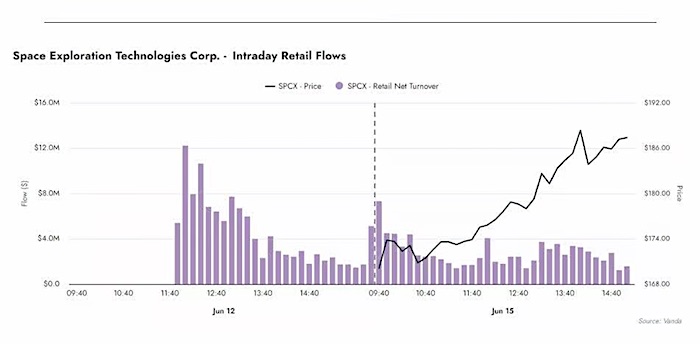
BREAKING: SpaceX has overtaken Microsoft and Amazon to become the fourth biggest company in the world. pic.twitter.com/dNs4Dxjran
— DogeDesigner (@cb_doge) June 16, 2026
BREAKING: The US DOJ just declared Elon Musk's AI data center a national security asset and blocked an environmental lawsuit against it.
— Bull Theory (@BullTheoryio) June 16, 2026
The NAACP filed a lawsuit against xAI in April 2026 under the Clean Air Act, alleging the company is operating dozens of gas turbines without… pic.twitter.com/Y7LyzrF7qm
ELON MUSK ON AI:
— Vivek Sen (@Vivek4real_) June 16, 2026
“AI IS LIKE A GENIUS CHILD.
YOU WANT IT TO GROW UP WITH A LOVE OF TRUTH AND A LOVE OF HUMANITY.”
“I DO WORRY ABOUT AI, BECAUSE WE ARE CREATING AN INTELLIGENCE THAT COULD ULTIMATELY BE FAR MORE INTELLIGENT THAN ANY HUMAN — AND EVEN MORE INTELLIGENT THAN THE SUM… pic.twitter.com/UKSIE4XDRt
Elon Musk on why he slept on the floor of the Tesla factory for 3 years.
— Manisha Mishra (@manishamishra24) June 16, 2026
In Poland, they don't get this.
“I lived in the Fremont factory and the one in Nevada for three years straight. That was my primary residence. I'm not joking. Seriously. I slept on the couch, and at one… https://t.co/W1kf9zbORC pic.twitter.com/IXAY18nWan
This censorship law is a wolf in sheep’s clothing. The real goal is to enable the UK government to track everyone. https://t.co/aZKpGDdPmX
— Elon Musk (@elonmusk) June 15, 2026
Support the Automatic Earth in wartime with Paypal, Bitcoin and Patreon.