
May 212016
 
 May 21, 2016  Posted by at 9:17 am Finance Tagged with: , , , , , , , , , ,  2 Responses »


NPC National Service Co. front, 1610 14th Street N.W., Washington DC 1920


One-Third Of Chinese Real Estate Companies Are “Zombies” (Nikkei)
Defaults Throw Wrench in China’s $3 Trillion Company Bond Engine (BBG)
Easy Money = Overcapacity = Deflation (Rubino)
Cash-Stuffed US Balance Sheets No Match for Even Bigger Debt Loads (BBG)
US, Japan FX Row Overshadows G7 Meeting (R.)
Crude Tanker Storage Fleet Off Singapore Points To Stubborn Oil Glut (R.)
How Freddie and Fannie Are Held Captive (Morgenson)
TTIP: The Most Toxic Acronym In Europe (G.)
Monsanto Weedkiller Faces Recall From Europe After EU Fail To Agree Deal (G.)
Turkey Faces United EU Front in Row Over Visa-Free Travel (BBG)
EU Ministers Press Greece to Send More Syrians Back to Turkey (WSJ)
Syrian Refugee Wins Appeal Against Forced Return To Turkey (G.)

“..on the brink of default but still taking on more debt.”

One-Third Of Chinese Real Estate Companies Are “Zombies” (Nikkei)

As China’s economy continues to sputter, many local companies are having difficulty servicing their debts. A look at 3,000 listed Chinese businesses by French investment bank Natixis found that interest costs exceeded cash flow for 18.5% of them last year, compared with 8% in 2010. Real estate, the most debt-ridden sector, saw its leverage level reach 197% last year, nearly double the figure for 2008, according to Natixis. The investment bank estimates that almost one-third of listed companies in the sector are “zombies” – businesses that are on the brink of default but still taking on more debt.
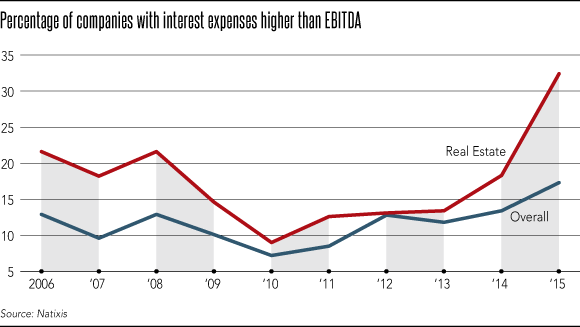
“The share of zombies in the real estate sector literally doubles the average in [corporate] China,” said Iris Pang, senior economist for greater China at Natixis. Evergrande Real Estate, for example, saw its ratio of total liabilities to earnings before interest, taxes, depreciation and amortization – or EBITDA – leap to 15.4% at the end of 2015 from 8.5% a year earlier. The figure climbed to 28.6% from 14.9% at Greenland Holdings, 26.8% from 9.7% at Sunac China Holdings, and 58.5% from 20% at Shui On Land. A study released in May by brokerage CLSA of China’s property, mining, manufacturing, utilities, construction, and wholesale and retail sectors counted potential problem debts of 14 trillion yuan ($2.14 trillion) as of the end of 2015.
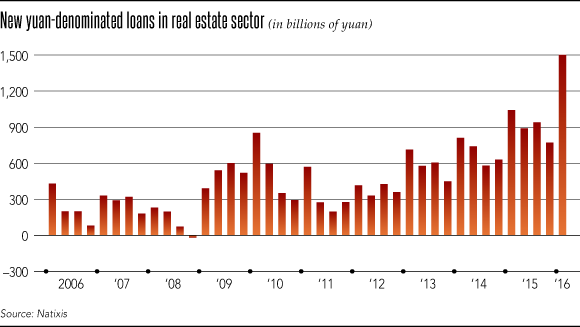
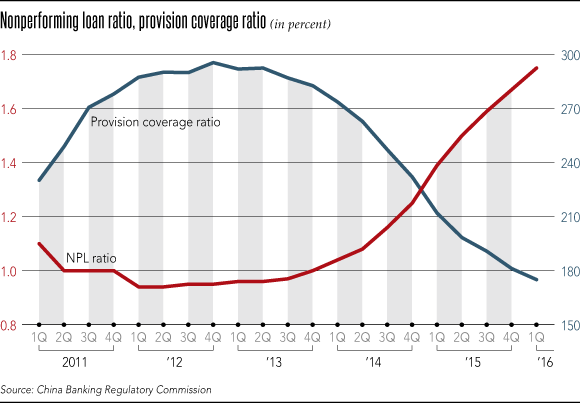
The property sector represented over half the total, at 54.1%, with industries plagued by excess capacity, such as utilities, steel and coal, accounting for much of the rest. Notably, most of the recent corporate bond defaults have come from these loss-making sectors too, including state-owned power equipment manufacturer Baoding Tianwei and Dongbei Special Steel. Worries about large-scale layoffs, especially in the steel and coal industries, have held the government back from pushing strongly on necessary capacity cutbacks. Instead, state banks have continued to extend more loans, said Francis Cheung at CLSA. Cheung estimates that the actual proportion of questionable debts on the books of China’s banks stands at 15-20%, compared with the 5.76% total reported by the central bank at the end of the first quarter for nonperforming loans and so-called special mention loans.
Read more …

Needing new debt to pay off the old. 72% of new debt is one year or less. Hmm..

Defaults Throw Wrench in China’s $3 Trillion Company Bond Engine (BBG)

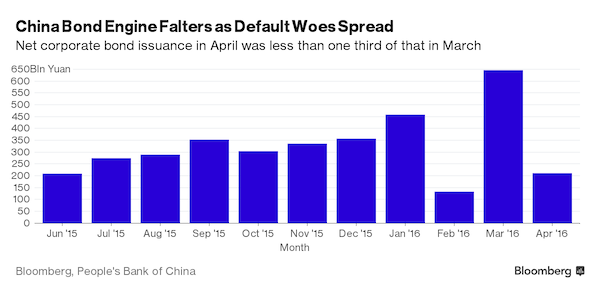
Defaults and pulled sales are starting to gum up China’s bond refinancing machine. Chinese companies issued 382.7 billion yuan ($58.5 billion) of notes onshore this month, down 11% from the same period in April and 57% March, data compiled by Bloomberg show. With just eight trading days to go, fundraising may fall short of the record 547.3 billion yuan of debt due. That would mark a shift after sales were 83% more than maturities in April and almost three times higher in March. The faltering $3 trillion corporate bond market will test Premier Li Keqiang’s determination to weed out zombie companies dragging on growth in the world’s second-biggest economy. At least 10 issuers have reneged on onshore debt obligations this year, while 153 Chinese firms have pulled 175 billion yuan of domestic sales this quarter.

Shandong Iron & Steel, which canceled a 3 billion yuan bond offering on May 4, has 3 billion yuan of securities due this month and 30 billion yuan to repay this year. “Many Chinese companies are relying on new borrowings to repay their old debt,” said Liu Dongliang, a senior analyst at China Merchants Bank in Shenzhen. “If they can’t get the money they need, more will default.” Debt-laden companies are struggling to lock in stable, longer-term financing. Sales of onshore bonds maturing in one year or less accounted for 72% of issuance by Chinese coal and steel producers from May 2015 to April 2016, as many were unable to sell longer debt, according to Fitch Ratings. Most of the proceeds were used to refinance maturing notes, Fitch wrote in a May 13 report. “Only the best companies, which have strong profitability or trustworthy credit profiles, are able to sell bonds,” said Qiu Xinhong at First State Cinda Fund Management. “Confidence won’t rebound in the short term.”
Read more …

It really is that easy.

Easy Money = Overcapacity = Deflation (Rubino)

Somewhere back in the depths of time the world got the idea that easy money — that is, low interest rates and high levels of government spending — would produce sustainable growth with modest but positive inflation. And for a while it seemed to work. But that was an illusion. What actually happened was textbook, long-term, surreally-vast misallocation of capital in which individuals, companies and governments were fooled into thinking that adding new factories, stores and infrastructure at a rate several times that of population growth would somehow work out for the best.

China, as with so many other things, was the epicenter of this delusion. In response to the 2008-2009 financial crisis it borrowed more money than any other country ever, and spent most of the proceeds on infrastructure and basic industry. It’s steel-making capacity, already huge by 2008, kept growing right through the Great Recession, and now dwarfs that of any other country.

China steel produciton

The result was indeed higher prices for iron ore and finished steel up front (that is, the inflation the architects of the easy money era expected and desired). But this was soon followed by falling prices as the rest of the world’s steel makers tried to stay in the game.

Steel price

It’s the same story pretty much everywhere. Miners that produced the raw materials for the infrastructure/industrial build-out started projects based on inflated price projections and now have no choice but to keep producing to cover variable costs and avoid bankruptcy. Prices of virtually every commodity have as a result plunged. In the US, retailers built new stores at a pace that vastly exceeded population growth, apparently on the assumption that consumers would keep borrowing in order to buy ever-greater amounts of semi-useless stuff. And now bricks and mortar retailing is suffering a mass-die-off.

Retail space per capita

Read more …

Something’s got to give at some point.

Cash-Stuffed US Balance Sheets No Match for Even Bigger Debt Loads (BBG)

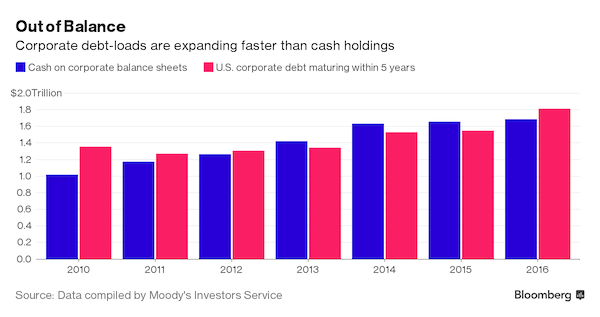
There’s more cash sitting on company balance sheets than ever before. For the first time since 2012, that’s not enough. Combining all of the corporate cash in the U.S. wouldn’t cover the $1.8 trillion of corporate debt that’s coming due in the next five years, according to a report by Moody’s Investors Service on Friday. That’s because U.S. companies have been borrowing more quickly than they’ve built up the record $1.68 trillion of cash on their balance sheets. And more of that debt comes due sooner. “You’re seeing more and more borrowing,” Richard Lane, a senior vice president at Moody’s, said by phone. “The increase in leverage has been notable. Cash coverage of near-term maturities hasn’t fallen below 100% since 2012, and hasn’t been as low as its current 93% since the year before that, according to Moody’s.

One reason may be that companies are making less money from merely running their businesses. Cash flow from operations declined 0.2% to $1.54 trillion in the 12 months ended in December 2015, the first time the metric declined in Moody’s data going back to 2007. To cope with sluggish global growth, companies went to the bond market to raise cash at rock-bottom rates. They issued a record $1.4 trillion of bonds last year, according to data compiled by Bloomberg. That helped lead to a 17% increase in the amount of company debt outstanding that matures in the next five years. In contrast, cash holdings only increased by 1.8% among U.S. non-financial companies at the end of 2015, according to Moody’s. The credit rater’s definition of cash includes short-term investments and liquid long-term investments.
Read more …

Was always inevitable.

US, Japan FX Row Overshadows G7 Meeting (R.)

The United States issued a fresh warning to Japan against competitive currency devaluation on Saturday, exposing a rift on exchange-rate policy that overshadowed a Group of 7 finance leaders gathering hosted by the Asian nation. Japan and the United States are at logger-heads over currency policy with Washington saying Tokyo has no justification to intervene in the market to stem yen gains, given the currency’s moves remain “orderly”. In bilateral talks ahead of the second day of G7 talks in Sendai, Japan on Saturday, U.S. Treasury Secretary Jack Lew told Japanese Finance Minister Taro Aso that it was important to refrain from competitive currency devaluation.

“Secretary Lew underscored that the commitments made by the G-20 in Shanghai to use all policy tools to promote growth – fiscal policy, monetary policy and structural reforms – and to refrain from competitive devaluation and communicate closely have helped to contribute to confidence in the global economy in recent months,” according to a statement by the Treasury Department.

“He noted the importance of countries continuing to adhere to those commitments,” the statement said. As years of aggressive money printing stretch the limits of monetary policy, the G7 policy response to anemic inflation and subdued growth has become increasingly splintered. Germany has shown no signs of responding to calls from Japan and the United States to boost fiscal spending. Washington also warned Tokyo against relying too much on monetary policy with a senior U.S. Treasury official saying structural reforms are being put in place in Japan “but slowly.”

Read more …

“..traders fully aware that they will not make a profit from storing the oil. This isn’t a trade play, it’s the oil market looking for places to store unsold fuel..”

Crude Tanker Storage Fleet Off Singapore Points To Stubborn Oil Glut (R.)

Prices for oil futures have jumped by almost a quarter since April, lifted by severe supply disruptions caused by triggers such as Canadian wildfires, acts of sabotage in Nigeria, and civil war in Libya. Yet flying into Singapore, the oil trading hub for the world’s biggest consumer region, Asia, reveals another picture: that a global glut that pulled down prices by over 70% between 2014 and early 2016 is nowhere near over, and that financial traders betting on higher crude oil futures may be in for a surprise from the physical market. “I’ve been coming to Singapore once a year for the last 15 years, and flying in I have never seen the waters so full of idle tankers,” said a senior European oil trader a day after arriving in the city-state.
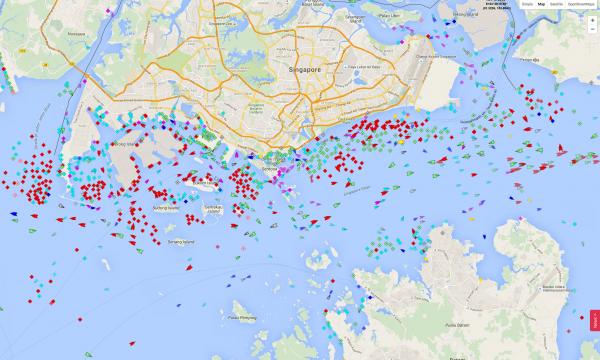

Red dots are ships at anchor or barely moving, oil tankers or cargo (ZH)

As Asia’s main physical oil trading hub, the number of parked tankers sitting off Singapore’s coast or in nearby Malaysian waters is seen by many as a gauge of the industry’s health. Judging by this, oil markets are still sickly: a fleet of 40 supertankers is currently anchored in the region’s coastal waters for use as floating storage facilities. The tankers are filled with 47.7 million barrels of oil, mostly crude, up 10% from the previous week, according to newly collected freight data in Thomson Reuters Eikon. That’s enough oil to satisfy five working days of Chinese demand, suggesting recent supply disruptions – which have mostly occurred in the Americas, Africa and Europe – have done little to tighten supply in Asia as Middle East producers keep output near record volumes in a bid to win market share.

[..] the need to store oil is so strong that traders are calling up banks to finance storage charters despite there being no profit in keeping fuel in tankers at current rates. “We are receiving unusually high amounts of queries to finance storage charters,” said a senior oil trade financier with a major bank in Asia. “These queries come from traders fully aware that they will not make a profit from storing the oil. This isn’t a trade play, it’s the oil market looking for places to store unsold fuel,” he added.

Read more …

This story is getting very strange. The level of secrecy is off the charts.

How Freddie and Fannie Are Held Captive (Morgenson)

When Washington took over the beleaguered mortgage giants Fannie Mae and Freddie Mac during the collapse of the housing market and the financial crisis of 2008, it was with the implicit promise that they would be returned to shareholders after being nursed back to health. But now, with the unsealing of documents this week that were produced as part of a lawsuit filed against the government, new evidence is coming to light on how intimately the White House was involved in the Treasury’s decision in August 2012 to divert all the companies’ profits to the Treasury Department. That move effectively maintained Fannie and Freddie’s status as wards of the state.

An email from Jim Parrott, then a top White House official on housing finance, was sent the day the so-called profit sweep was announced. It said that the change was structured to ensure that the companies couldn’t “repay their debt and escape as it were.” The documents also show Treasury moving to modify the terms of the mortgage finance giants’ $187.5 billion bailout shortly after a July 2012 meeting when the Federal Housing Finance Agency, Fannie’s and Freddie’s regulator, learned that they were about to enter “the golden years” of profitability. Since then, Fannie and Freddie have returned to the Treasury over $50 billion more than they received in the bailout. The amount they owe to the government remains outstanding.

The new materials cast further doubt on arguments made in court by government lawyers that the profit sweep came about because Fannie and Freddie were in a death spiral and taxpayers needed protection from future losses. Documents unsealed last month also served to undermine that legal stance. The trickle of documents comes years after Fannie and Freddie shareholders filed suits against the government, contending that its decision regarding the companies’ profits was illegal. Defending against an array of these suits, lawyers for the Justice Department have requested confidential treatment for thousands of pages of materials. In a case brought in Federal Claims Court, the government’s lawyers asserted presidential privilege in 45 documents.

Read more …

Falling apart pretty fast.

TTIP: The Most Toxic Acronym In Europe (G.)

David Cameron narrowly avoided the parliamentary defeat of his Queen’s speech this week – an event that, theoretically, triggers the fall of a government and hasn’t happened since 1924. That was only achieved through an embarrassing U-turn on TTIP, the Transatlantic Trade and Investment Partnership, which he ardently supports. One of the primary concerns about TTIP is that it could pave the way to further privatisation of the NHS. Yesterday, a group of MPs gave notice that they would table an amendment to the Queen’s speech, lamenting the fact that the government had not included a bill to protect the NHS from TTIP in its programme. The cross-party group was led by Peter Lilley, a long-time supporter of free trade and a former minister under Margaret Thatcher and John Major, and was supported by at least 25 Tory MPs – easily enough to overturn the government’s majority.

Though many were Brexiters, by no means all were, and some, such as Sarah Wollaston, appear to have changed their position on TTIP. Realising he faced one of the most embarrassing defeats of his premiership – one not suffered since a similar motion removed Stanley Baldwin from office in 1924 – Cameron quickly said he’d support the amendment. Make no bones about it, this is a humiliation. The prime minister has repeatedly told MPs that TTIP poses no threat to the NHS. Yet to avoid the abyss, his government has supported an amendment contrary to these assertions. We must be under no illusions that he has any intention of moving to protect the NHS in TTIP. How did it come to this? The obvious answer is the EU referendum, which has brought into the open fundamental divisions within the Tory party.

But this only provided the opportunity for parliamentary defeat. If this had gone to a vote, the vast majority of MPs opposing the government in fact support remaining in the EU, and wouldn’t take part in anything that would make Brexit more likely. The reasons go deeper – and they mirror what is happening all over the EU and US. TTIP started out as an obscure trade agreement that would create the world’s biggest “free trade zone” between the US and EU, and received little media coverage or parliamentary debate. Two years ago very few politicians or journalists had even heard of it. Yet a movement has built against this deal, one that has stunned the negotiators and forced the EU trade commissioner to call TTIP “the most toxic acronym in Europe”.

Read more …

“More than 99% of people in one recent German survey were found to have traces of the compound in their urine, 75% of them at levels five times the safe limit for water or above.”

Monsanto Weedkiller Faces Recall From Europe After EU Fail To Agree Deal (G.)

Bestselling weedkillers by Monsanto, Dow and Syngenta could be removed from shops across Europe by July, after an EU committee failed for a second time to agree on a new license for its core ingredient, glyphosate. The issue has divided EU nations, academics and the WHO itself. One WHO agency found it to be “probably carcinogenic to humans” while another ruled that glyphosate was unlikely to pose any health risk to humans, in an assessment shaded by conflict of interests allegations earlier this week. EU officials say that while there could be a voluntary grace period of six-12 months, unless a compromise can be found, the product’s license will be allowed to expire on 30 June. One told the Guardian that after its proposal to cutting the authorisation to nine years was rejected, the bloc was now in “uncharted territory” with no clear path to a deal that could reach consensus.

“Our position is clear,” he said. “If we can reach a qualified majority on a text we will go ahead. Otherwise, we have to leave the authorisation to expire and on 30 June member states will need to start withdrawing products containing glyphosate from the market.” Glyphosate is Europe’s most widely used weedkiller, and its parent RoundUp herbicide accounts for a third of Monsanto’s total earnings. The compound is routinely – but not exclusively – used on crops that have been genetically engineered to resist it. Several studies have linked blanket spraying with damage to surrounding flora, fauna and the entire food chain. But the commission moved to relicense it last November, after a crucial European food safety authority (Efsa) report declared it unlikely to cause cancer, although that paper sparked controversy.

Philip Miller, Monsanto’s vice president of global regulatory affairs, condemned the EU’s failure to reapprove glyphosate as “scientifically unwarranted” and “an unprecedented deviation from the EU’s legislative framework”. Writing in a blog post, he said: “This delay undermines the credibility of the European regulatory process and threatens to put European farmers and the European agriculture and chemical industries at a competitive disadvantage.” Richard Garnett, the head of Monsanto’s regulatory affairs unit said that the situation was “discriminatory, disproportionate and wholly unjustified”. The US agri-giant is currently the subject of a takeover bid by the German chemicals multinational, Bayer. Under bloc rules, the commission could now go to an appeals committee but this would have the same balance of countries as the standing committee that has now twice failed to take a decision.

It could also go over the heads of the EU states and independently reauthorise glyphosate as a draft measure. EU president Jean-Claude Juncker has said that he opposes doing this and officials doubt it will happen, although the procedure has been used to approve GM crops for import. A short-term license might also be possible. Glyphosate is so ubiquitous that its residues are commonly found in breads, beers and human bodies. More than 99% of people in one recent German survey were found to have traces of the compound in their urine, 75% of them at levels five times the safe limit for water or above. But the very definition of a safe limit for chemicals such as glyphosate is contested, and linked to a broader regulatory divide between the US’s risk-based approach which errs towards product approvals where doubt cannot be quantified, and the EU’s hazard-based approach, which leans towards a precautionary principle in such situations.

Read more …

“.. If not, well, then not. It’s as simple as that.”

Turkey Faces United EU Front in Row Over Visa-Free Travel (BBG)

EU governments showed Turkey a united front in the battle over visa-free travel, insisting Ankara narrow its terrorism legislation to qualify for the perk. The stance by European home-affairs ministers underscores a threat to an EU-Turkey agreement that has stemmed Europe’s biggest refugee wave since World War II and eased domestic political pressure on leaders including German Chancellor Angela Merkel. Turkey sought EU visa-free status in return for signing up to the mid-March deal, under which irregular migrants who enter the EU in Greece are sent back to Turkey and Syrian refugees in Turkish camps are resettled in Europe. The EU has said Turks can win visa-free status by mid-year as long as the Turkish government fulfills five remaining criteria – including on the terrorism law – out of a total of 72.

Turkish President Recep Tayyip Erdogan has signaled he won’t bow to the European demand over terrorism legislation, citing terror risks in Turkey that his critics say are being used as cover to jail political opponents. “We have a clear statement and a clear agreement on visa liberalization: it goes through if you meet the criteria,” Klaas Dijkhoff, migration minister of the Netherlands, current holder of the 28-nation EU’s rotating presidency, told reporters on Friday in Brussels after chairing a meeting with his counterparts from the bloc. “We will see if, over the next few weeks, the criteria are met. If so, we will go ahead. If not, well, then not. It’s as simple as that.” The standoff pits EU political principles against Turkish geopolitical power. Migrant flows into Europe via Turkey during the past year have handed Erdogan leverage over the EU, which has lambasted him for cracking down on domestic dissenters and kept Turkey’s longstanding bid for membership of the bloc largely on hold.

Along with the reintroduction of internal European border checks that shut a migratory route north from Greece, the March 18 EU agreement with Ankara has caused a slump in refugee sea crossings from the Turkish coast to nearby Greek islands. Arrivals in Greece fell to 3,650 last month from 26,971 in March and 57,066 in February, according to the UN refugee agency. On May 6, when commenting on the EU call for Turkish terrorism-rule changes, Erdogan said “we are going our way and you go yours.” He also dared the bloc to “go make a deal with whoever you can.” Erdogan’s position poses a “problem,” said Theo Francken, Belgium’s state secretary for asylum and migration. “It’s clear that all the conditions have to be fulfilled,” Francken told reporters at Friday’s EU meeting. “To get visa liberalization, it’s important that they change their terrorism law.”

Read more …

Europe speaks with forked tongue.

EU Ministers Press Greece to Send More Syrians Back to Turkey (WSJ)

European interior ministers on Friday pressured Greece to speed up asylum procedures and send more Syrians back to Turkey. Under a deal signed in March between the EU and Turkey, all migrants, including Syrian refugees are to be sent back to Turkey once they have their asylum applications assessed and rejected by Greek judges. But the first decisions—coming nearly two months after the deal went into effect—ruled mostly in favor of the Syrians applying for asylum. These early figures are raising concerns among EU officials that the intent of the plant to serve as a deterrent will be lost. Austrian minister Wolfgang Sobotka said if the trend continues, it would “at least undermine, if not annul the Turkey agreement.”

Germany, which championed the EU-Turkey deal, in particular pressed Greece for an acceleration in returning migrants to Turkey. German Interior Minister Thomas De Maiziere said that while Turkey is sticking to its part of the deal and arrivals in Greece have dropped, “on the Greek side, procedures take too long and the returns to Turkey are not happening with enough determination.” Mr. De Maiziere said he spoke to his Greek counterpart about the first appeal case won by a Syrian on Friday against a ruling to send him back to Turkey. He said “it was up to Greek authorities to establish what happened,” while insisting that Turkey is a safe country for Syrian refugees.

“Turkey has sheltered 2.5 million refugees, this is a tremendous performance. Despite all political debates that we can have and which are justified. we can’t doubt Turkey’s safe country status,” Mr. De Maiziere said, in reference to a decision Friday by Turkey’s parliament to strip lawmakers critical of the government of their immunity. Given that the Greek appeals body isn’t controlled by the government, the Greek minister asked for support from the EU to state that Turkey is a safe country where Syrian refugees can be sent back, according to one participant in the debate. “Member states today made it clear that they support Greece in considering Turkey a safe country for the return of migrants,” EU migration commissioner Dimitris Avramopoulos said.

Read more …

Can’t very well ignore your own judges. But the pressure will be relentless.

Syrian Refugee Wins Appeal Against Forced Return To Turkey (G.)

The EU-Turkey migration deal has been thrown further into chaos after an independent authority examining appeals claims in Greece ruled against sending a Syrian refugee back to Turkey, potentially creating a precedent for thousands of other similar cases. In a landmark case, the appeals committee upheld the appeal of an asylum seeker who had been one of the first Syrians listed for deportation under the terms of the EU-Turkey deal. In a document seen by the Guardian, a three-person appeals committee said Turkey would not give Syrian refugees the rights they were owed under international treaties and therefore overturned the applicant’s deportation order by a verdict of two to one. The case will now be re-assessed from scratch.

The committee’s conclusion stated: “The committee has judged that the temporary protection which could be offered by Turkey to the applicant, as a Syrian citizen, does not offer him rights equivalent to those required by the Geneva convention.” The decision undermines the legal and practical basis for the EU-Turkey deal, which European leaders had hoped would deter refugees from sailing to Europe by ensuring the swift deportation of most people landing on the Greek islands. After signing the deal on 18 March, EU officials claimed these deportations would be legally justified on the basis that Turkey respects refugee rights. But the EU’s executive has little control over Greek asylum protocols. The committee rejected the logic of the EU-Turkey deal, citing some of the EU’s own previous directives as explanations for their decision.

While nearly 400 other asylum seekers have been returned to Turkey under the terms of the deal, no one of Syrian nationality had been sent back against their will – making Friday’s decision a watershed moment. “At its very first test, the EU-Turkey deal crumbles,” said Gauri van Gulik, Amnesty International’s deputy Europe director. The Greek government, which played no part in the independent decision, admitted the judgment had created “a very difficult situation”. Greece’s deputy minister in charge of migration policy, Yannis Mouzalas, said by phone from Brussels: “I have only just learned of the decision by the appeals committee and I have to be in Greece to study it. They are, as you know, independent committees so it is very difficult for me to say anything – but if they think this way, we will have a very difficult situation.” Such a decision goes against all the directives of the UN and UNHCR, Mouzalas claimed. “Really I don’t know how they arrived at it.”

Read more …

May 202016
 
 May 20, 2016  Posted by at 8:59 am Finance Tagged with: , , , , , , , , , ,  2 Responses »


John Vachon Window in home of unemployed steelworker. Ambridge, PA 1941

Lacking New Ideas, G7 To Agree On ‘Go-Your-Own-Way’ Approach (R.)
Japan And US Are Headed For A Showdown Over Currency Manipulation (MW)
Kuroda Stresses Readiness to Act if Yen Rise Threatens Inflation Goal (WSJ)
US Business Loan Delinquencies Spike to Lehman Moment Level (WS)
China Steelmakers Attack US 522% Tariff Move; Say Need More Time (R.)
The Iron Mountain on China’s Doorstep Tops 100 Million Tons (BBG)
Big Chinese Banks Issue New Yuan-Denominated Debt In US (WSJ)
Mass Layoffs Are Looming in South Korea (BBG)
‘Central Banks Can Do Nothing’: Steen Jakobsen (Saxo)
Making Things Matters. This Is What Britain Forgot (Chang)
Germany Strives to Avoid Housing Bubble (BBG)
Bayer Eyes $42 Billion Monsanto in Quest for Seeds Dominance (BBG)
Bayer’s Mega Monsanto Deal Faces Mega Backlash in Germany (BBG)
EU Declines To Renew Glyphosate Licence (EUO)
Ai Weiwei Says EU’s Refugee Deal With Turkey Is Immoral (G.)

In a strong sign of how fast the crisis is deepening, and in between the usual blah blah, the G7 is falling apart.

Lacking New Ideas, G7 To Agree On ‘Go-Your-Own-Way’ Approach (R.)

A rift on fiscal policy and currencies is likely to set the stage for G7 advanced economies to agree on a “go-your-own-way” response to address risks hindering global economic growth at their finance leaders’ gathering on Friday. As years of aggressive money printing stretch the limits of monetary policy, the G7 policy response to anemic inflation and subdued growth has become increasingly splintered. Finance leaders gathering in Sendai, northeast Japan, sought advice from prominent academics, including Nobel Prize-winning economist Robert Shiller, on ways to boost growth in an informal symposium ahead of an official G7 meeting on Friday.

Participants of the symposium agreed that instead of relying on short-term fiscal stimulus or monetary policy, structural reforms combined with appropriate investment are solutions to achieving sustainable growth, a G7 source said. If so, that would dash Japan’s hopes to garner an agreement on the need for coordinated fiscal action to spur global demand. Germany showed no signs of responding to calls from Japan and the United States to boost fiscal stimulus, instead warning of the dangers of excessive monetary loosening. “There is high nervousness in financial markets” fostered by huge government debt and excess liquidity around the globe, German Finance Minister Wolfgang Schaeuble said on Thursday.

But G7 officials have signaled that they would not object if Japan were to call for stronger action using monetary, fiscal tools and structural reforms – catered to each country’s individual needs. That means the G7 finance leaders, while fretting about risks to outlook, may be unable to agree on concrete steps to bolster stagnant global growth. “I expect there to be a frank exchange of views on how to achieve price stability and growth using monetary, fiscal and structural policies reflecting each country’s needs,” Bank of Japan Governor Haruhiko Kuroda told reporters on Thursday.

Read more …

The interests are too different to reconcile, and it’s by no means just Japan and the US that are involved in the showdown.

Japan And US Are Headed For A Showdown Over Currency Manipulation (MW)

Investors will be watching for signs of tension between Japanese and U.S. powers this weekend, when central bankers and finance chiefs face off in Sendai, a city northeast of Tokyo, for the latest Group of 7 summit. The two countries have sparred over the dollar-yen exchange rate in the months since the Japanese currency began a prolonged rise against the dollar. The yen has lost nearly 9% of its value relative to the dollar since the beginning of the year. Last week, Japanese Finance Minister Taro Aso spoke publicly about the continuing disagreement between U.S. and Japanese policy makers over whether the rise in the yen seen since the beginning of the year has been severe enough to warrant an intervention.

Japan might favor a weaker currency primarily because it makes the country’s exports more attractive. “We’ve have often been arguing over the phone,” Aso said, according to The Wall Street Journal. He also reiterated that Japanese officials wouldn’t hesitate to intervene in the market if the currency continued its sharp moves. Plus, he said, the Treasury Department’s decision to put Japan on a currency manipulation monitoring list “won’t constrain” the country’s currency policy. The Treasury published the list for the first time this year, including it as part of a semiannual report on currency practices released late last month. Japan was joined on the list by China, Germany, Taiwan and Korea.

To be included on the Treasury’s watch list, a country must meet at least two of three criteria: A trade surplus with the U.S. larger than $20 billion, a current-account surplus larger than 3% of its GDP—or it must engage in persistent one-sided intervention in the currency market, which the Treasury qualifies as repeated purchases of foreign currency amounting to more than 2% of a country’s GDP over the course of a year.

Read more …

And so are all other central bankers.

Kuroda Stresses Readiness to Act if Yen Rise Threatens Inflation Goal (WSJ)

Bank of Japan Gov. Haruhiko Kuroda said he would act quickly if the yen’s rise threatens his inflation goal, highlighting his caution over exchange rates ahead of a major international convention. “Be it exchange rates or anything, if it has negative effects on our efforts to achieve our price-stability target, and from that perspective if we figure that action is necessary, we will undertake additional easing measures,” Mr. Kuroda told reporters Thursday. The remarks by Mr. Kuroda come at a time of tension between the U.S. and Japan over whether the yen’s appreciation seen earlier this year is sharp enough to warrant intervention by authorities. Investors are closely watching whether Tokyo and Washington will continue to clash over yen policy during a meeting in northern Japan Friday and Saturday of finance chiefs from the Group of Seven leading industrialized nations.

Mr. Kuroda defended his policy stance, saying it is no different from that of central banks abroad. He also reiterated that the BOJ has kept in place massive stimulus to achieve its target of 2% inflation, not to guide the yen lower. Mr. Kuroda said that while he is watching how the bank’s negative-rates policy affects the economy, “this doesn’t mean that we will sit idly by until trickle-down effects become clear.” The BOJ will review the need for fresh steps “at every policy meeting,” he added. Speaking of risks facing Japan’s economy, Mr. Kuroda acknowledged that he is “paying close attention” to the coming British referendum to decide whether to leave the European Union.

Read more …

“Business loan delinquencies are a leading indicator of big economic trouble.”

US Business Loan Delinquencies Spike to Lehman Moment Level (WS)

This could not have come at a more perfect time, with the Fed once again flip-flopping about raising rates. After appearing to wipe rate hikes off the table earlier this year, the Fed put them back on the table, perhaps as soon as June, according to the Fed minutes. A coterie of Fed heads was paraded in front of the media today and yesterday to make sure everyone got that point, pending further flip-flopping. Drowned out by this hullabaloo, the Board of Governors of the Federal Reserve released its delinquency and charge-off data for all commercial banks in the first quarter – very sobering data. So here a few nuggets. Consumer loans and credit card loans have been hanging in there so far.

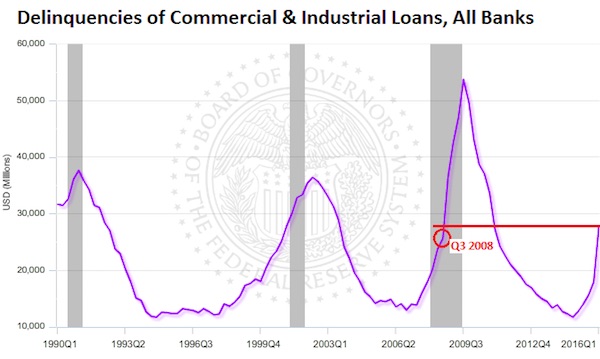
Credit card delinquencies rose in the second half of 2015, but in Q1 2016, they ticked down a little. And mortgage delinquencies are low and falling. When home prices are soaring, no one defaults for long; you can sell the home and pay off your mortgage. Mortgage delinquencies rise after home prices have been falling for a while. They’re a lagging indicator. But on the business side, delinquencies are spiking! Delinquencies of commercial and industrial loans at all banks, after hitting a low point in Q4 2014 of $11.7 billion, have begun to balloon (they’re delinquent when they’re 30 days or more past due). Initially, this was due to the oil & gas fiasco, but increasingly it’s due to trouble in many other sectors, including retail.

Between Q4 2014 and Q1 2016, delinquencies spiked 137% to $27.8 billion. They’re halfway toward to the all-time peak during the Financial Crisis in Q3 2009 of $53.7 billion. And they’re higher than they’d been in Q3 2008, just as Lehman Brothers had its moment. Note how, in this chart by the Board of Governors of the Fed, delinquencies of C&I loans start rising before recessions (shaded areas). I added the red marks to point out where we stand in relationship to the Lehman moment:

Business loan delinquencies are a leading indicator of big economic trouble. They begin to rise at the end of the credit cycle, on loans that were made in good times by over-eager loan officers with the encouragement of the Fed. But suddenly, the weight of this debt poses a major problem for borrowers whose sales, instead of soaring as projected during good times, may be shrinking, and whose expenses may be rising, and there’s no money left to service the loan.

Read more …

Hadn’t seen this claim before: “..local steelmakers are more efficient (and enjoy far lower costs) than their international counterparts.”

China Steelmakers Attack US 522% Tariff Move; Say Need More Time (R.)

Chinese steelmakers attacked new U.S. import duties on the country’s steel products as “trade protectionism” on Thursday, saying the world’s biggest producer needs time to address its excess capacity. “There’s too much trade friction and it’s not good for the market,” Liu Zhenjiang, secretary general of the China Iron and Steel Association told Reuters when asked if China will appeal U.S. anti-dumping duties at the WTO. China said it will continue its tax rebates to steel exporters to support the sector’s painful restructuring after the United States said on Tuesday it would impose duties of 522% on Chinese cold-rolled flat steel. China, which accounts for half the world’s steel output, is under fire after its exports hit a record 112 million tonnes last year, with rivals claiming that Chinese steelmakers have been undercutting them in their home markets.

In the four months to April, China’s steel exports have risen nearly 7.6% to 36.9 million tonnes. “It’s not just China’s problem to tackle overcapacity. Everyone should play a part. China needs time,” Liu told an industry conference. “Trade protectionism hurts consumers, (it’s) against free trade and competition,” he added. China’s Commerce Ministry said on Wednesday the United States had employed “unfair methods” during an anti-dumping investigation into Chinese cold-rolled steel products. While a flood of cheap Chinese steel has been blamed for putting some overseas producers out of business, China denies its mills have been dumping their products on foreign markets, stressing that local steelmakers are more efficient and enjoy far lower costs than their international counterparts.

Read more …

All we got to do is wait till they run out of space to store it.

The Iron Mountain on China’s Doorstep Tops 100 Million Tons (BBG)

There’s a mountain of iron ore sat right on China’s doorstep. Stockpiles at ports have climbed above 100 million metric tons, offering fresh evidence of increased supplies in the world’s top user that may hurt prices. The inventories swelled 1.6% to 100.45 million tons this week, the highest level since March 2015, according to data from Shanghai Steelhome Information Technology. The holdings, which feed the world’s largest steel industry, have expanded 7.9% this year, and are now large enough to cover more than five weeks’ of imports. Iron ore has traced a boom-bust path over the past two months after investors in China piled into raw-material futures, then changed course after regulators clamped down.

While mills in China churned out record daily output in April to take advantage of a steel price surge, production in the first four months was 2.3% lower than a year earlier. Port inventories in China may continue to increase, BHP Billiton forecast this week. “There’s a lot of optimism actually that steel demand in China will increase,” Ralph Leszczynski at shipbroker Banchero Costa , said by phone. “It’s a bit of an ‘if’ as the economy is still quite fragile,” he said, calling the rise in port stocks “probably excessive.” The raw material with 62% content sank 5.8% to $53.47 a dry ton on Thursday, according to Metal Bulletin Ltd. Prices have tumbled 24% since peaking at more than $70 a ton in April, paring the gain so far in 2016 to 23%.

Read more …

A stronger dollar makes this a huge gamble.

Big Chinese Banks Issue New Yuan-Denominated Debt In US (WSJ)

Two of China’s largest banks are issuing new local currency debt in the U.S., offering attractive yields for investors willing to take some currency risk. Industrial and Commercial Bank of China, the world’s largest bank by assets, said it plans on Friday to raise 500 million yuan ($76 million) through 31-day certificates of deposit in the U.S. that will yield 2.6%. Agricultural Bank of China, the third-largest bank in the world, this week sold a 117 million yuan one-year bill that yields 3.35%. Both issues came at a significant premium to the 0.621% yield on the one-year U.S. Treasury bill. But the yuan-denominated debt could pay out less if the currency falls in value. Fed officials last month discussed the possibility of raising interest rates at their June policy meeting, according to minutes from the April meeting released on Wednesday.

A rate increase could cause the yuan to weaken against the dollar. China’s 3% devaluation in August sparked a selloff in yuan-denominated bonds, driving up interest rates in the offshore market, also known as the dim sum market. The new offerings will test demand for Chinese debt in local currency, the first issued by any Chinese bank in the U.S. since last year. China’s one-month interbank rate is currently 2.84%, which means some Chinese banks can borrow at better rates in the U.S. and other foreign markets than at home. The debt also promotes the use of the yuan abroad, one of the conditions set by the IMF when it said last year it would add the Chinese currency to its basket of reserve currencies. The IMF’s inclusion of the yuan is a step toward making the currency fully convertible.

Read more …

Take that, G7.

Mass Layoffs Are Looming in South Korea (BBG)

The South Korean government’s push to restructure debt-laden companies is set to cost tens of thousands of workers their jobs in an economy where social security is limited and a rigid labor market reduces the likelihood of getting rehired in a full-time position. Many of the layoffs will be in industrial hubs along the southeast coastline, where shipyards and ports dominate the landscape. These heavy industries, which helped propel South Korea’s growth in previous decades, have seen losses amid a slowdown in global growth, overcapacity and rising competition from China. As a condition of financial support, creditor banks and the government are pushing companies to cut back on staff and sell unprofitable assets. In Korea, losing a permanent, full-time job often means sliding toward poverty, one reason why labor unions stage strikes that at times lead to violent confrontations with employers and police.

A preference for hiring and training young employees, rather than recruiting experienced hands, means that many workers who get laid off drift into day labor or low-wage, temporary contracts that lack insurance and pension benefits, according to Lee Jun Hyup, a research fellow for Hyundai Research Institute. “The possibility of me getting a new job that offers similar income and benefits is about 1%,” said one of about 2,600 employees to be laid off following a previous restructure, of Ssangyong Motor in 2009. The 45-year-old worker, who asked only to be identified by the surname Kim as he tries to get rehired, initially delivered newspapers and worked construction after losing his permanent job. He’s now on a temporary contract at a retailer and taking night shifts as a driver to get by. Despite having these two jobs, his income has been halved. Being fired was “like being pushed into a desert with no water,” Kim said.

Read more …

Jakobsen’s always interesting. This is quite a long piece.

‘Central Banks Can Do Nothing’: Steen Jakobsen (Saxo)

TradingFloor.com: The “new nothingness” thesis was based on zero rates, zero growth, zero reforms. But you hinted that all of this nothingness has spilled over into culture and politics as well… do these macro facts hinder peoples’ imagination, or their ability to deal with the problem?

Steen Jakobsen: Yes, I think so. This year, we see a growing gap between the central banks’ narrative – which is that you have a trickle-down impact from lower rates – and [the situation on the ground]. People understand that zero interest rates are a reflection of zero growth, zero inflation, zero hope for changes, and zero reforms. In my opinion as an economist and a market observer, people are smarter than central banks. And because they are smarter, they can live with policy mistakes for a while because the narrative is very strong and because people like (ECB head Mario) Draghi and (Fed chief Janet) Yellen have these platforms from which they not only talk but occasionally shout, and they are deemed to be “credible”, scare quotes mine…

We see [this gap] in the Brexit debate as well, where the elite and the academics talk down to the average voter. By doing that, of course, they alienate the voters from their representatives. That’s what we see globally, that’s why Brazil is going to change presidents, why Ireland could not get its government re-elected with 6% growth. It’s not about the top line, but about the average person seeing that we need real, fundamental change.

TF: Earlier this year, you said that the social contract – the agreement between rulers and the ruled – is broken. It made me think of this year’s Davos meeting, which showed a leadership class terrified of slowing jobs growth and enamoured with the idea that population movements might be used to address this. Given the current unpopularity of globalisation and its effects, would you say that there are some things it is impossible for 21st century leaders and the led to agree upon? Is a social contract impossible?

SJ: No, it could be re-established, but it needs to be established on terra firma. Right now, we have a panacea in the form of low rates and the idea that things will somehow improve in six months. This has led to buyback programmes, a lack of motivation [and all the rest]. We as a society have to recognise that productivity comes from raising the average education level. People forget that all the revolutionary trends, the changes we’ve seen in history, have come from basic research. I don’t mean research driven by profit, but by an individual’s particular interest in one very minute area of a specific topic. This is what creates new inventions.

The second thing we often forget is that the military has been behind a lot of the industrial revolution. Mobile telephony, for example, had nothing to do with private citizens or companies – instead, it had a lot to do with the US military. The key thing here is that we need to be more productive. If everyone has a job, there is no need to renegotiate the social contract. The world has become elitist in every way. Before, you could start a company and build a small franchise; now, you have to be global, you have to have a billion users (if you’re an IT company), and [the pursuit of this] does not necessarily provide the best technologies, but only the biggest ones, the ones backed by [the firms with] the deepest pockets and largest web of connections.

Read more …

It’s what many countries ‘forgot’.

Making Things Matters. This Is What Britain Forgot (Chang)

It’s being blamed on the Brexit jitters. But the weakness in the UK economy that the latest figures reveal is actually a symptom of a much deeper malaise. Britain has never properly recovered from the 2008 financial crisis. At the end of 2015, inflation-adjusted income per capita in the UK was only 0.2% higher than its 2007 peak. This translates into an annual growth rate of 0.025% per year. How pathetic this performance is can be put into perspective by recalling that Japan’s per capita income during its so-called “lost two decades” between 1990 and 2010 grew at 1% a year. At the root of this inability to stage a real recovery is the serious imbalance that has developed in the past few decades – namely, the over-development of the UK financial sector and the atrophy of manufacturing.

Right after the 2008 financial crisis there was a widespread recognition that the ballooning financial sector needed to be reined in. Even George Osborne talked excitedly for a while about the “march of the makers”. That march never materialised, however, and manufacturing’s share of GDP has stagnated at around 10%. This is remarkable, given that the value of sterling has fallen by around 30% since the crisis. In any other country a currency devaluation of this magnitude would have generated an export boom in manufactured goods, leading to an expansion of the sector. Unfortunately manufacturing had been so weakened since the 1980s that it didn’t have a hope of staging any such revival. Even with a massive devaluation, the UK’s trade balance in manufacturing goods (that is, manufacturing exports minus imports) as a proportion of GDP has hardly budged.

The weakness of manufacturing is the main reason for the UK’s ever-growing deficit, which stood at 5.2% of GDP in 2015. Some play down the concerns: the UK, we hear, is still the seventh or eighth largest manufacturing nation in the world – after the US, China, Japan, Germany, South Korea, France and Italy. But it only gets this ranking because it has a large population. In terms of per capita output, it ranks somewhere between 20th and 25th. In other words, saying that we need not worry about the UK’s manufacturing sector because it is still one of the largest is like saying that a poor family with lots of its members working at low wages need not worry about money because their total income is bigger than that of another family with fewer, high-earning members.

Read more …

Just keep rates low enough for long enough and you’ll screw up any economy.

Germany Strives to Avoid Housing Bubble (BBG)

The German government, after years of warnings, is about to clamp down on rising home prices and mortgage lending. The government is preparing to implement measures to prevent real estate bubbles, the Finance Ministry said in an e-mail late on Wednesday. These policies may include capping borrowers’ loan-to-income ratio in order to reduce the probability of default, Handelsblatt reported on Thursday. The government continues to study the consequences of low interest rates on financial stability, a finance ministry spokesman said in the e-mail. However, there are currently no signs that German residential real estate lending is causing acute risks, he said.

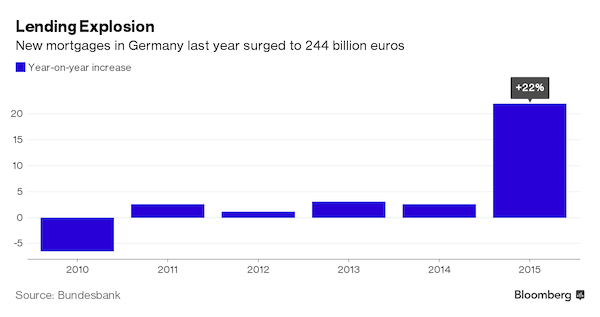
With mortgage rates at record lows and savings accounts earnings almost nothing – thanks to a string of ECB rate cuts – Germans are buying homes at the fastest rate in decades. That’s pushed prices in cities including Berlin, Hamburg and Munich up by more than 30% in five years. New mortgages jumped by 22% in 2015 after five years of rising at 3% or less, according to the Bundesbank. In March, Bundesbank board member Andreas Dombret said he sees “clouds gathering on the horizon” and that the central bank is keeping a close eye on mortgages. Finance Minister Wolfgang Schaeuble, who has been critical of the ECB’s policy of pushing growth with cheap cash, in December said the hunt for yield could lead to the “formation of bubbles and excessive asset values.”

Read more …

Don’t think I can say in public what I think should happen to companies like Monsanto, Bayer, Syngenta et al. The people who brought you Agent Orange, Zyklon B and chemical warfare are coming for your food, all of it. A start might be to figure out who holds shares in these things. Your money fund, your pension fund? This is the industry of death, as much as arms manufactureers are.

Bayer Eyes $42 Billion Monsanto in Quest for Seeds Dominance (BBG)

Bayer made an unsolicited takeover offer for Monsanto Co. in a bold attempt by the German company to snatch the last independent global seeds producer and become the world’s biggest supplier of farm chemicals. The St. Louis-based company, with a market value of $42 billion, said it’s reviewing the offer in a statement Thursday. It didn’t disclose the terms of the proposal. Bayer, confirming the bid, said the combination would bolster its position as a life sciences company. Shares of Bayer plunged amid concern that a large purchase would weigh on its credit rating and force the company to sell more stock. The proposal by Werner Baumann, who’s been at Bayer’s helm for less than a month, follows Monsanto’s failed attempt to buy Syngenta and the proposed merger of Dow Chemical and DuPont.

To help finance its quest to buy the world’s largest seed maker, Bayer is considering asset disposals and a share sale, according to people familiar with the matter, who asked not to be identified because discussions are private. The German company is exploring the potential disposal of its animal-health business and the remaining 69% stake in plastics business Covestro, the people said. Animal health could fetch $5 billion to $6 billion, according to one of the people, and the Covestro holding is worth about €4.9 billion. If Bayer buys Monsanto, it could be the biggest acquisition globally this year and the largest German deal ever, according to data compiled by Bloomberg. A takeover of Monsanto would require an enterprise value of as much as €65 billionß, according to analysts at Citigroup.

[..]Merging Monsanto with the company that invented aspirin would bring together brands such as Roundup, Monsanto’s blockbuster herbicide, and Sivanto, a new Bayer insecticide. Monsanto is particularly vulnerable to a takeover after piling up a mountain of problems this year. The company has cut its earnings forecast, clashed with some of the world’s largest commodity-trading companies and become locked in disputes with the governments of Argentina and India. Shares are down 19% in the past 12 months. “It’s a relentless string of bad news,” Jonas Oxgaard, an analyst with Sanford C. Bernstein in New York, said. “It’s almost like they forgot to sacrifice a goat to the gods.”

Read more …

Bayer won’t be able to sell its new ‘products’ at home.

Bayer’s Mega Monsanto Deal Faces Mega Backlash in Germany (BBG)

Bayer’s proposed mega deal to buy Monsanto is likely to create a mega public relations challenge for the German company at home. Bayer faces a backlash against Germany’s biggest planned acquisition because of two products from the St. Louis-based company that are widely detested in the country: genetically modified seeds and the weedkiller Roundup, which uses a compound called glyphosate that some believe can cause cancer. “Germans view Monsanto as the main example of American corporate evil,” said Heike Moldenhauer, a biotechnology expert at German environmental group BUND. “It may not be such a good idea to take over Monsanto as that means incorporating its bad reputation, which would also make Bayer more vulnerable.”

A German Environment Ministry study released last month found 75% of citizens are against genetic engineering of plants and animals. Aware of voter suspicions, members of Chancellor Angela Merkel’s junior coalition partner, the Social Democrats, have already come out against the deal, which would turn Bayer into the biggest supplier of farm chemicals. Monsanto, which has a market value of $42 billion, said Thursday it’s studying the offer. Neither party has disclosed the terms. A merger would “strengthen the economic power of genetic engineering in Germany, which we see as very problematic as the majority of the population in Germany is opposed to the technology,” said Elvira Drobinski-Weiss, the lawmaker responsible for formulating policy positions on genetic engineering for the Social Democrats.

BASF four years ago abandoned research into genetically modified crops in Germany, citing a lack of acceptance of the technology in many parts of Europe from consumers, farmers and politicians. The German company moved the unit to the U.S. and halted development of products targeted for Europe to focus on crops for the Americas and Asia. “There’s virtually no market for genetically modified seeds in Europe because they’re so unpopular,” said Dirk Zimmermann, a GMO expert at Greenpeace in Hamburg. A deal combining Bayer and Monsanto would “hurt the future of sustainable agriculture.”

Read more …

The EU is good for something after all. The pro-Roundup arguments get an eery left field feel to them though: “We use it for some farming practices such as no-till and minimum-tillage, helping to ensure less greenhouse gas emissions and soil erosion.”

EU Declines To Renew Glyphosate Licence (EUO)

European experts failed again to take a decision on whether to renew a licence for glyphosate, the world’s widest-used weedkiller, during a meeting on Wednesday and Thursday (18-19 May). The EU standing committee on plants, animals, food and feed (Paff), which brings together experts of all EU member states, failed to organise a vote. There was no qualified majority for such a decision. The current licence expires on 30 June. The Paff committee was expected to settle on the matter already in March, but postponed the vote after France, Italy, the Netherlands and Sweden raised objections, mainly over the impact of glyphosate on human health. The European Commission has since tabled two new proposals, both of which failed to convince the member states.

The health commissioner Vytenis Andriukaitis insists that member states decide with a qualified majority because of the controversies involved. A spokesperson said the commission will reflect on the discussions. ”If no decision is taken before 30 June, glyphosate will be no longer authorised in the EU and member states will have to withdraw authorisations for all glyphosate based products”, the spokesperson said. Pekka Pesonen, the secretary general of agriculture umbrella organisation Copa-Cogeca, told EUobserver he regretted the outcome. ”This adds to uncertainty in an already pressured business”, he said. Glyphosate is widely used by European farmers because it is cost-efficient and widely available on the market.

”Without it, production will be jeopardised. This raises questions about food safety, competitiveness of European farmers, as well as our commitments to climate change,” Pesonen said. “We use it for some farming practices such as no-till and minimum-tillage, helping to ensure less greenhouse gas emissions and soil erosion.” ”Glyphosate is also recognised as safe by the EU food safety authority [Efsa]”, he added.

Read more …

“It is not legal or moral, it is shameful and it is not a solution. It will cause problems later.”

Ai Weiwei Says EU’s Refugee Deal With Turkey Is Immoral (G.)

The Chinese artist Ai Weiwei described the EU’s refugee deal with Turkey as shameful and immoral as he unveiled the artistic results of his stay on the Greek island of Lesbos. Speaking in Athens, where the works are going on public display for the first time from Friday, Ai said that although he had seen and experienced extreme and violent conditions in China, he “could never have imagined conditions like this”. Lesbos last year became the main European entry point for tens of thousands of Syrian and Iraqi refugees, but arrivals have fallen dramatically since the implementation of an agreement between Brussels and Ankara to return migrants from the Greek islands to Turkey. Of the agreement, Ai said: “It is not legal or moral, it is shameful and it is not a solution. It will cause problems later.”

The artist told the Guardian: “These people have nothing to do with Europe; they are like people from outer space, but they have to come. They have been pushed out and they are being totally neglected by Europe. They are sleeping in the mud and rain and it is only volunteers giving them food or clothes.” Ai arrived on Lesbos in December, having been invited to stage an exhibition at the Museum of Cycladic Art in Athens. The island seemed like a good starting point for thinking about ancient Greece and its mythologies, philosophies and values. Instead Ai became caught up in what he said was the biggest, most shameful humanitarian crisis since the second world war. He had told his girlfriend and young son it was a holiday, but five months later he and his studio are still there. He said he has been changed by what he has seen.

“It is such a beautiful island – blue water, sunshine, tourists – and to see the boats come in with desperate children, pregnant women and elderly people, some 90 years old, and they all have fear and they all have it in their eyes … You think: how could this happen? I got completely emotionally involved.” Ai said Europe needed to understand that the refugees were fleeing their countries because they had to. It was leave or die, he said. The exhibition at the MCA, Ai’s first in Greece, includes an enormous collage of 12,030 small pictures taken on his camera phone, documenting his time on the island. He is also exhibiting photographs taken by six Greek amateur photographers, in partnership with the Photographic Society of Mytilene.

Read more …

May 252015
 
 May 25, 2015  Posted by at 10:11 am Finance Tagged with: , , , , , , , , , ,  Comments Off on Debt Rattle May 25 2015


Harris&Ewing District National Bank, Washington, DC 1931

Memorial Day: Our Soldiers Died For The Profits Of The Bankers (Smedley Butler)
Europe’s Biggest Debt Collector: Central Banks’ Stimulus Has Failed (Bloomberg)
“It’s A Coup D’Etat”, “Central Banks Are Out Of Control” – David Stockman (ZH)
Unemployment Is a Big Threat to Eurozone Economy, Central Bankers Warn (WSJ)
HSBC Fears World Recession With No Lifeboats Left (AEP)
Did China Just Launch World’s Biggest Spending Plan? (Gordon Chang)
G7 Finance Ministers To Address Faltering Global Growth (Reuters)
Schaeuble Expects Conflict at Dresden G-7 Over Austerity Policy (Bloomberg)
Greece Hasn’t Got The Money To Make June IMF Repayment (Reuters)
Greece’s Misery Shows We Need Chapter 11 Bankruptcy For Countries (Guardian)
Greeks Back Government’s Red Lines, But Want To Keep Euro (AFP)
The Truth About Riga (Yanis Varoufakis)
The Bloodied Idealogues vs. The Bloodthirsty Technocrats (StealthFlation)
Spain’s Ruling Party Battered In Local And Regional Elections (EUObserver)
Catalan Independence Bid Rocked by Podemos Victory in Barcelona (Bloomberg)
Auckland Nears $1 Million Average House Price (Guardian)
Monsanto’s GMO Cotton Problems Drive Indian Farmers To Suicide (RT)
‘Incredibly Diverse’, Endangered Plankton Provide Half The World’s Oxygen (SR)

Smedley Butler knew it way back in 1933.

Memorial Day: Our Soldiers Died For The Profits Of The Bankers (Smedley Butler)

Memorial Day commemorates soldiers killed in war. We are told that the war dead died for us and our freedom. US Marine General Smedley Butler challenged this view. He said that our soldiers died for the profits of the bankers, Wall Street, Standard Oil, and the United Fruit Company. Here is an excerpt from a speech that he gave in 1933:

“War is just a racket. A racket is best described, I believe, as something that is not what it seems to the majority of people. Only a small inside group knows what it is about. It is conducted for the benefit of the very few at the expense of the masses. I believe in adequate defense at the coastline and nothing else. If a nation comes over here to fight, then we’ll fight. The trouble with America is that when the dollar only earns 6% over here, then it gets restless and goes overseas to get 100%. Then the flag follows the dollar and the soldiers follow the flag. I wouldn’t go to war again as I have done to protect some lousy investment of the bankers. There are only two things we should fight for. One is the defense of our homes and the other is the Bill of Rights. War for any other reason is simply a racket.

There isn’t a trick in the racketeering bag that the military gang is blind to. It has its “finger men” to point out enemies, its “muscle men” to destroy enemies, its “brain men” to plan war preparations, and a “Big Boss” Super-Nationalistic-Capitalism. It may seem odd for me, a military man to adopt such a comparison. Truthfulness compels me to. I spent thirty-three years and four months in active military service as a member of this country’s most agile military force, the Marine Corps. I served in all commissioned ranks from Second Lieutenant to Major-General. And during that period, I spent most of my time being a high class muscle- man for Big Business, for Wall Street and for the Bankers. In short, I was a racketeer, a gangster for capitalism.”

Read more …

“A rate that is too low, or a rate that many of us have never experienced, is so extraordinary that it doesn’t create any stability or faith in the future at all..”

Europe’s Biggest Debt Collector: Central Banks’ Stimulus Has Failed (Bloomberg)

The head of Europe’s biggest debt collector says the historic wave of stimulus spilling out of central banks has failed to fuel investment growth. Lars Wollung, the chief executive officer of Intrum Justitia AB, warned that record-low interest rates “don’t seem to lead to investments that create jobs,” in an interview in Stockholm. “A rate that is too low, or a rate that many of us have never experienced, is so extraordinary that it doesn’t create any stability or faith in the future at all,” he said. “Rather the opposite: one feels insecure and waits with expansion plans and to hire more people.” The comments mark a blow to central banks who have resorted to everything from negative rates to bond purchases to aid growth.

A study by Intrum Justitia shows 73% of the almost 9,000 European firms surveyed between February and April said low interest rates brought about “no change in investments.” Some even reported a decline. In Sweden, where the central bank’s main rate is minus 0.25%, 82% of companies said it made no difference to their investments. What companies need if they’re “to believe in the future” is certainty that their bills will be paid, Wollung said. That means clearer payments legislation and more incentives for borrowers to repay their debts on time, he said. Intrum Justitia has devoted resources to lobbying officials in Brussels in an effort to bring across its point, Wollung said.

In Germany and Scandinavia, where companies and borrowers can refer to clear and robust legal systems, unemployment is low and economic growth strong, he said. A German firm waits 17 days on average to get paid by a client company. In Italy, it takes 80 days, Intrum figures show. The survey indicates that about 8 million European companies would hire more people if they got their payments faster. “Late payments are a significant problem for companies,” Wollung said. Having a stable cash flow is “probably more important than if interest rates are at 1% or 0.5%,” he said.

Read more …

No holds barred.

“It’s A Coup D’Etat”, “Central Banks Are Out Of Control” – David Stockman (ZH)

We’re all about to be taken to the woodshed, warns David Stockman in this excellent interview. The huge wealth disparity is “not because of some flaw in capitalism, or Reagan tax cuts, or even the greed of Wall Street; the problem is central banks that are out of control.” Simply put, they have “syphoned financial resources into pure gambling” and the people that own the stocks and bonds get the huge financial windfall. “The 10% at the top own 85% of the financial assets,” and thus, thanks to the unleashing of almost limitless money-printing, which has created a massive worldwide financial inflation, “the central banks have created and exaggerated the wealth gap.” Stockman concludes, rather ominously,

“it’s a coup d’etat, the central banks have taken over – unconstitutional domination of the entire economy.” “Everywhere, misleading distorted signals are being given to both public and private sector players about financial values… the prices have been falsified by The Fed. We can’t print our way to prosperity… The Fed is now petrified that Wall Street will have a hissy-fit when they tighten.”

Read more …

Well, they caused it.

Unemployment Is a Big Threat to Eurozone Economy, Central Bankers Warn (WSJ)

High and divergent unemployment rates in Europe pose a serious threat to the region’s long-term economic health, central bankers and economists warned during a weekend conference held by the European Central Bank. But they stopped short of offering specific advice on the best steps to take. The ECB’s seminar, the second of what it plans as an annual conference in the resort town of Sintra on Portugal’s western coast, brought together central bankers and economists from Europe, the U.S. and Asia to examine the root causes of high unemployment and persistently weak inflation in Europe. The attendees dwelled extensively on an economic concept known as “hysteresis,” a reduction in economic output brought on by weak growth that gives rise to long-term unemployment.

The remedies to such problems, however, lie partly with fiscal-policy officials and not central bankers, who don’t set labor and other economic policies. The conference largely lacked representatives from finance ministries and businesses. But ECB President Mario Draghi signaled that the stakes were too high for central bankers to keep silent, particularly in the 19-member eurozone, where diverse countries ranging from powerful Germany to recession-ravaged Greece set their own economic and fiscal policies but share a single currency and monetary policy. “In a monetary union you can’t afford having large and increasing structural divergences between countries,” Mr. Draghi said on Saturday. “They tend to become explosive; therefore they are going to threaten the existence of the monetary union.”

The eurozone is the world’s second-biggest economy after the U.S. But in recent years it has emerged as one of the global economy’s main trouble spots, having struggled through a pair of recessions since 2009 that pushed the bloc’s unemployment rate into double digits. The region has started to recover, but the damage has resulted in huge gaps in unemployment across the eurozone. “Unemployment in Europe, notably youth unemployment, is not only unbearably high. It is also unbearably different across nations belonging to an economic and monetary union,” Tito Boeri, professor at Bocconi University, and Juan Jimeno of the Bank of Spain wrote in a conference paper.

Read more …

“JP Morgan estimates that the US economy contracted at a rate of 1.1pc in the first quarter..” “China accounted for 85pc of all global growth in 2012, 54pc in 2013, and 30pc in 2014. This is likely to fall to 24pc this year.”

HSBC Fears World Recession With No Lifeboats Left (AEP)

The world economy is disturbingly close to stall speed. The United Nations has cut its global growth forecast for this year to 2.8pc, the latest of the multinational bodies to retreat. We are not yet in the danger zone but this pace is only slightly above the 2.5pc rate that used to be regarded as a recession for the international system as a whole. It leaves a thin safety buffer against any economic shock – most potently if China abandons its crawling dollar peg and resorts to ‘beggar-thy-neighbour’ policies, transmitting a further deflationary shock across the global economy. The longer this soggy patch drags on, the greater the risk that the six-year old global recovery will sputter out. While expansions do not die of old age, they do become more vulnerable to all kinds of pathologies.

A sweep of historic data by Warwick University found compelling evidence that economies are more likely to stall as they age, what is known as “positive duration dependence”. The business cycle becomes stretched. Inventories build up and companies defer spending, tipping over at a certain point into a self-feeding downturn. Stephen King from HSCB warns that the global authorities have alarmingly few tools to combat the next crunch, given that interest rates are already zero across most of the developed world, debts levels are at or near record highs, and there is little scope for fiscal stimulus. “The world economy is sailing across the ocean without any lifeboats to use in case of emergency,” he said.

In a grim report – “The World Economy’s Titanic Problem” – he says the US Federal Reserve has had to cut rates by over 500 basis points to right the ship in each of the recessions since the early 1970s. “That kind of traditional stimulus is now completely ruled out. Meanwhile, budget deficits are still uncomfortably large,” he said. The authorities are normally able to replenish their ammunition as recovery gathers steam. This time they are faced with a chronic low-growth malaise – partly due to a global ‘savings glut’, and increasingly to a slow ageing crisis across most of the Northern hemisphere. The Fed keeps having to defer its first rate rise as expectations fall short.

Each of the past four US recoveries has been weaker than the last one. The average growth rate has fallen from 4.5pc in the early 1980s to nearer 2pc this time. The US fiscal deficit has dropped to 2.8pc but is expected to climb again as pension and health care costs bite, even if the economy does well. The US cannot easily launch a fresh New Deal. Public debt was just 38pc on GDP when Franklin Roosevelt took power in 1933, and there were few contingent liabilities hanging over future US finances. “Fiscal stimulus – a novel idea at the time – may have been controversial, but the chances of it working to boost economic activity were quite high given the healthy starting position. Today, it is much more difficult to make the same argument,” he said.

Read more …

” The reason for the fall in new loans is clear. There is a fundamental lack of demand in China.”

Did China Just Launch World’s Biggest Spending Plan? (Gordon Chang)

Beijing has just initiated a round of accelerated government spending, and it will, in all probability, end up as the biggest such effort today. Wednesday, the Chinese central government announced both the allocation of 1.13 trillion yuan ($185.8 billion) for upgrading internet infrastructure and the creation of a 124.3 billion yuan fund for affordable housing. These expenditures follow Monday’s authorization of six new rail lines costing 250 billion yuan. This month, as Xinhua News Agency reports, Beijing has unveiled a “pro-growth measure” at the rate of one every two days. April was a banner month for Beijing’s spenders as well. The Ministry of Finance reported a 33.2% increase in fiscal spending compared with same month in 2014.

For the last several years, Beijing has been using fiscal stimulus in varying amounts to keep the economy humming. No one, however, thought Premier Li Keqiang, generally considered a reformer, would resort to the old-line, anti-reform tactic of massive government spending. There were two principal reasons for this belief. First, many thought Beijing had finally opted for fundamental restructuring to grow the economy. Analysts hailed the issuance of the Communist Party’s November 2013 Third Plenum decision, which promised substantial reforms, as proof of the political victory of those favoring progressive change.

Fiscal spending, on the other hand, has been considered the antithesis of reform because investment-led growth—the result of that spending—would only take China further away from the ultimate goal of reform, a consumption-based economy. Second, analysts believed just about everyone in Beijing had come to the inescapable conclusion that former Premier Wen Jiabao’s crash stimulus program, authorized in late 2008, was a huge mistake, largely because it had resulted in grossly inefficient usage of capital, large asset bubbles, and far too much debt. Yet the universally accepted view that there would be no large stimulus was premised on the assumption that the economy would respond to small-scale stimulus.

The economy, unfortunately, has not. Perhaps the most indicative statistic to come out of Beijing in recent days is that, despite all the monetary loosening since the end of last year, there were only 707.9 billion yuan of new loans in April, down from 1.18 trillion yuan in March. The reason for the fall in new loans is clear. There is a fundamental lack of demand in China.

Read more …

“..a preliminary Reuters poll last week predicted adjusted Q1 U.S. GDP numbers due on Friday would be massively revised down and show a 0.7% contraction..”

G7 Finance Ministers To Address Faltering Global Growth (Reuters)

Finance ministers from the world’s largest developed economies meet in Germany this week against a backdrop of faltering global growth, scant inflationary pressures and a bond market in turmoil. High on their agenda – even if unofficially – will be Greece and how it can stay in the troubled euro zone. Figures due on Friday from the United States that will almost certainly show the world’s biggest economy contracted last quarter are also likely to feature. “With the negotiations between Greece and the rest of the euro area at an impasse, an impatient German Chancellor Merkel has warned that an agreement must be reached before the end of the month,” said Thomas Costerg, senior economist at Standard Chartered.

Greece cannot make a payment to the IMF due on June 5 unless foreign lenders disburse more aid, a senior ruling party lawmaker said on Wednesday, the latest warning from Athens it is on the verge of default. Analysts largely agree the country’s cash squeeze is increasingly acute and fresh aid will be needed sooner or later to avoid bankruptcy. Merkel and French President Francois Hollande held talks on Thursday with Greek Prime Minister Alexis Tsipras on the sidelines of a European Union summit in Riga, hoping to speed the resolution of Athens’ debt crisis. With business growth slowing in the euro zone and factory activity contracting again in China, market watchers have been looking to the United States to drive a pick-up in growth.

But a preliminary Reuters poll last week predicted that adjusted first quarter U.S. GDP numbers due on Friday would be massively revised down and show a 0.7% contraction in the first three months of this year. “The poor Q1 2015 performance follows growth of just 2.2% in Q4 2014, so there has been very little growth over the last couple of quarters,” said Joseph LaVorgna, chief U.S. economist at Deutsche Bank. “As a result, market participants have started to wonder again whether the U.S. economy might be in an extended period of secular stagnation.”

Read more …

And there should be.

Schaeuble Expects Conflict at Dresden G-7 Over Austerity Policy (Bloomberg)

German Finance Minister Wolfgang Schaeuble expects a political tussle with his partners over austerity policy when G-7 finance ministers meet on May 27-May 29 in Dresden. Germany’s advocacy of budget cuts to heal euro-zone woes will come under attack at the meeting, Schaeuble said in a pamphlet distributed Saturday. The German government will face “demand-side” opponents of its policy in Dresden, he said without mentioning France or Italy or the U.S. “’Demand-side’ advocates will make clear in Dresden that cutting public spending leads to weaker demand for goods and services,” the minister said in a pamphlet distributed in the Dresden newspaper Saechsische Zeitung.

Germany’s position is that “solid public finance” boosts investment and growth, he said. Risks to Europe’s economic outlook stemming from the unresolved Greek crisis as well concern over the U.S. trade gap may fuse an alliance of France, Italy and the U.S. in Dresden. All three states fret that Germany’s rigorous advocacy of budget austerity may be holding back economic growth in Europe. U.S. Treasury Secretary Jacob J. Lew urged Germany to boost public investment to spur imports from Europe and spark a cycle of economic growth that would also benefit the U.S.

The U.S. trade gap widened in March to the biggest in more than six years while Germany in 2014 again reported a record surplus. The U.S. has also called for a quicker fix of Greece’s problems in a sign that it views Germany’s unmoving insistence that Greece fulfill bailout terms as a risk. Lew said Friday that failure to reach a deal quickly would create hardship for Greece, uncertainties for Europe and the global economy. Schaeuble remains adamant that Germany’s stance on sound budgeting is the right one, if unpopular. “Further convincing needs to be done” at Dresden, he said in his pamphlet.

Read more …

Next weekend is a holiday weekend in Greece. Fears of capital controls.

Greece Hasn’t Got The Money To Make June IMF Repayment (Reuters)

Greece cannot make debt repayments to the IMF next month unless it achieves a deal with creditors, its interior minister said on Sunday, the most explicit remarks yet from Athens about the likelihood of default if talks fail. Shut out of bond markets and with bailout aid locked, cash-strapped Athens has been scraping state coffers to meet debt obligations and to pay wages and pensions. With its future as a member of the 19-nation euro zone potentially at stake, a second government minister accused its international lenders of subjecting it to slow and calculated torture. After four months of talks with its euro zone partners and the IMF, the leftist-led government is still scrambling for a deal that could release up to 7.2 billion euros ($7.9 billion) in remaining aid to avert bankruptcy.

“The four installments for the IMF in June are €1.6 billion. This money will not be given and is not there to be given,” Interior Minister Nikos Voutsis told Greek Mega TV’s weekend show. Voutsis was asked about his concern over a ‘credit event’, a term covering scenarios like bankruptcy or default, if Athens misses a payment. “We are not seeking this, we don’t want it, it is not our strategy,” he said. “We are discussing, based on our contained optimism, that there will be a strong agreement (with lenders) so that the country will be able to breathe. This is the bet,” Voutsis said. Previously, the Athens government has said it is in danger of running out of money soon without a deal, but has insisted it still plans to make all upcoming payments.

Read more …

The unbalance of global power.

Greece’s Misery Shows We Need Chapter 11 Bankruptcy For Countries (Guardian)

Alexis Tsipras, Greece’s combative prime minister, is facing yet another week of fraught negotiations as he and his team struggle to agree a shopping list of economic reforms stringent enough to appease the country’s creditors, but different enough from the grinding austerity of the past five years to satisfy the Greek electorate. And all the while, bank deposits will leach out of the country, investment plans will remain on hold and consumers hammered by years of austerity will continue living hand to mouth. Change the actors – and the stakes – and it’s a tired plotline familiar to many governments across the world. According to Eurodad, the coalition of civil society groups that campaigns on debt, there have been 600 sovereign debt restructurings since the 1950s – with many governments, including Argentina for example, experiencing one wrenching write-off after another.

Many of these countries plunged deeper into recession as a result of the uncertainty and delay inherent in this bewildering process and the punishing austerity policies inflicted on them, with a resulting collapse in investor and consumer confidence. Argentina defaulted in 2001. Fourteen years later, it is still being pursued through the courts by so-called vulture funds, which buy distressed countries’ debts on the cheap and use every legal device they can to reclaim the money. Yet while the world’s policymakers have expended countless hours since the crisis of 2008 rewriting regulations on bonuses, mortgage lending, derivatives and too-big-to-fail banks, little attention has been paid to what should happen when a government is on the brink of financial meltdown.

Sacha Llorenti, the Bolivian ambassador to the UN, is currently touring the world’s capitals trying to change that. “We’re not just talking about a financial issue; it’s an issue related to growth, to development, to social and economic rights,” he says. The UN is not the obvious forum for discussing debt restructuring: unlike the IMF, it is not a lender of last resort with emergency cash to disburse, and doesn’t have a seat around the table when countries have to go to their creditors to ask for help. Yet also unlike the IMF, the UN general assembly is not dominated by the world’s major powers: each member country has one vote.

When Argentina tabled a motion calling for the UN to examine the issue of sovereign debt restructuring last autumn, 124 countries voted for it; 11, including the UK and the US, with their powerful financial lobbies, voted against; and there were 41 abstentions. Llorenti, who is chairing the UN “ad hoc committee” set up as a result of that vote, says the 11 countries that objected hold 45% of the voting power at the IMF. He believes they would prefer the matter to be tackled there, where they can shape the arguments: “It’s a matter of control, really.”

Read more …

Support for Syriza is still very high. But people are afraid to.

Greeks Back Government’s Red Lines, But Want To Keep Euro (AFP)

Cash-strapped Greeks remain supportive of the leftist government’s tough negotiating style, according to a new poll published Sunday, but hope for a deal with creditors that will keep the euro in their wallets. The poll conducted in May by Public Issue for the pro-government newspaper Avgi, shows 54% backing the SYRIZA-led government’s handling of the negotiations despite the tension with Greece’s international lenders. A total 59% believe Athens must not give in to demands by its creditors, with 89% against pension cuts and 81% against mass lay-offs. The SYRIZA-led government is locked in talks with the EU, ECB and the IMF to release a blocked final €7.2-billion tranche of its bailout.

In exchange for the aid, creditors are demanding Greece accept tough reforms and spending cuts that anti-austerity Syriza pledged to reject when it was elected in January. According to reports, creditors are demanding further budget cuts worth €5 billion including pension cuts and mass lay-offs. Prime Minister Alexis Tsipras made clear on Saturday however that his government “won’t budge to irrational demands” that involve crossing Syriza’s campaign “red lines”. Greece faces a series of debt repayments beginning next month seen as all but impossible to meet without the blocked bailout funds. Failure to honour those payments could result in default, raising the spectre of a possible exit from the euro. That is a scenario Greeks hope to avert, with 71% of those polled wanting to keep the euro while 68% said a return to the drachma could worsen the economic situation.

Read more …

Yanies takes aim at the media.

The Truth About Riga (Yanis Varoufakis)

It was the 24th of April. The Eurogroup meeting taking place that day in Latvia was of great importance to Greece. It was the last Eurogroup meeting prior to the deadline (30th April) that we had collectively decided upon (back in the 20th February Eurogroup meeting) for an agreement on the set of reforms that Greece would implement so as to unlock, in a timely fashion, the deadlock with our creditors. During that Eurogroup meeting, which ended in disagreement, the media began to report ‘leaks’ from the room presenting to the world a preposterously false view of what was being said within. Respected journalists and venerable news media reported lies and innuendos concerning both what my colleagues allegedly said to me and also my alleged responses and my presentation of the Greek position.

The days and weeks that followed were dominated by these false stories which almost everyone (despite my steady, low-key, denials) assumed to be accurate reports. The public, under that wall of disinformation, became convinced that, during the 24th April Riga Eurogroup meeting, my fellow ministers called me insulting names (“time waster”, “gambler”, “amateur” etc. were some of the reported insults), that I lost my temper, and that, as a result, my Prime Minister later “sidelined” me from the negotiations. (It was even reported that I would not be attending the following Eurogroup meeting, or that I would be ‘supervised’ by some other ministerial colleague.) Of course none of the above was even remotely true.

My fellow ministers never, ever addressed me in anything other than collegial, polite, respectful terms.
• I did not lose my temper during that meeting, or at any other point.
• I continue to negotiate with my fellow ministers of finance, leading the Greek side at the Eurogroup.
• Then came a New York Times Magazine story which raised the possibility of a recording of that Eurogroup meeting. All of a sudden, the journalists and news media that propagated the lies and the innuendos about the 24th April Eurogroup meeting changed tack. Without a whiff of an apology for the torrent of untruths they had peddled against me for weeks, they now began to depict me as a ‘spoof’ who had “betrayed” the confidentiality of the Eurogroup.

This morning I went on the record on the Andrew Marr television show (BBC1) on this issue. I am taking this opportunity to commit the truth in writing also here – on my trusted blog. So here it goes:

Read more …

Bruno is dead on.

The Bloodied Idealogues vs. The Bloodthirsty Technocrats (StealthFlation)

On the grave Greek question, it appears that the moment of truth is finally upon us. After nearly four months of frenetic, fruitless and often feckless high level deliberations and negotiations, both sides remain essentially at an impasse, right where they started. The technocrats in Brussels want to see their austerity driven reform program carried forward and implemented unconditionally. As for the idealogues in Athens, they have pledged to put forth their own enlightened approach to rescue their sinking society. The Technocrats hold the purse strings, but the Ideologues hold the heart strings. For what it’s worth, that is typically a highly combustible combination, tick tock. With their recent cocksure bravado, are the Technocrats entirely misreading the desperate determination of the Idealogues?

Get ready for yet another Euro Summer swoon.. Everyone agrees that Greece, under a corrupt political oligarchy, grossly abused its privileges as a Eurozone member. In fact, with the help of a few sleazy sophisticated Goldman Sachs financiers, they actually cheated on their application forms in order to join the exclusive club to begin with. The illegitimate Ionian books were cooked from the get go, and it only got worse and worse over time. The self serving political elites and their self-seeking sponsors at multinational banks and corporations ran up a massive tab, while their ill-fated nation did not have the wherewithal to pay the astronomical bills. That is essentially what happened here. Oh, and the parties specifically involved all happened to personally get rather wealthy themselves along the way.

Read more …

National elections at the end of the year could reinforce the changes.

Spain’s Ruling Party Battered In Local And Regional Elections (EUObserver)

Spain took a turn towards the new left in Sunday’s regional and local elections, putting an end to the dominating two-party system. Despite having won the most votes in the elections across Spain on Sunday (24 May), Prime Minister Mariano Rajoy’s centre-right PP party has lost all of its absolute majorities and will now often depend on coalitions and pacts with other parties. Compromises and coalitions between parties is new in Spain where more than 30 years of alternating power between the socialists and the conservatives is being challenged by an ncreasingly fragmented political system including anti-austerity party Podemos and centrist Ciudadanos.

The biggest changes have been the move towards the new left parties in Barcelona and maybe also in Madrid – depending on a possible pact between a Podemos-supporting coalition called Ahora Madrid and the Social Democrats (PSOE). It would be the first time the Spanish capital would have a leftwing Mayor in the last 25 years. “It is clear that a majority for change has won,” said Manuela Carmena, the 71 year-old emeritus judge of the Spanish Supreme Court who wants to become Madrid’s new mayor. She is one seat short of Madrid’s former conservative Mayor Esperanza Aguirre. However, with the support of Social Democrats – who came third – the two left-wing parties could together hold the absolute majority in Madrid. Barcelona’s new Mayor Ada Colau calls for “more social justice” and leads a coalition of left-wing parties and citizens’ organisations called ‘Barcelona en Comú’, which includes members of Podemos.

“We are proud that this process hasn’t just been an exception in Barcelona, this is an unstoppable democratic revolution in Catalonia, in [Spain] and hopefully in southern Europe,” Colau said last night after it became clear that she had won a small majority in the Catalan capital. Colau, a former anti-eviction activist, was one of the founders of a platform for people affected by mortgages – Plataforma Afectados por la Hipoteca (PAH) – which won the European Parliament’s European Citizens’ Prize in 2013. The PAH was set up in response to the hike in evictions caused by abusive mortgage clauses during the collapse of the Spanish property market eight years ago. Colau herself entered politics last year calling for “more and better democracy” and a clean-up of corruption in politics.

Read more …

Curious development?!

Catalan Independence Bid Rocked by Podemos Victory in Barcelona (Bloomberg)

Catalan President Artur Mas’s bid to win independence from the rest of Spain was gasping for air on Sunday as voters in Barcelona ousted his party from city hall. Voters in the regional capital picked Podemos-backed activist Ada Colau as their next mayor, as the pro-independence parties Mas is aiming to lead to an overall majority in Catalonia won 45% of the vote. The regional leader has pledged to call an early regional election this year to prove to officials in Madrid the support for leaving Spain. “Mas is in deep trouble,” said Ken Dubin, a political scientist at the Instituto de Empresa business school in Madrid and Lord Ashcroft International Business School in Cambridge, England.

Colau, 41, gained national prominence during the financial crisis leading a campaign to stop banks evicting families from their homes after they defaulted on their mortgages. She joined forces with anti-austerity party Podemos, an ally of Greece’s governing party Syriza, for her assault on city hall. Her coalition, Barcelona en Comu, won 25% of the vote and 11 representatives in the 41-seat city assembly, the Spanish Interior Ministry said on its website. CiU won 10 seats compared with 14 in 2011. Barcelona accounts for about a third of the Catalan economy and hosts all the major regional institutions. “This result adds uncertainty to the planning process because it wasn’t considered a possibility,” said Jaume Lopez, a pro-independence political scientist at Pompeu Fabra University in Barcelona. “We will see whether that uncertainty becomes a problem.”

Read more …

So screwed…

Auckland Nears $1 Million Average House Price (Guardian)

Economists in New Zealand have expressed alarm at a housing market boom which could soon see average prices of property in the country’s largest city pass the $1m mark. In Auckland, the cost of an average domestic property has risen from $550,000 during the last property boom in 2007 to nearly $810,000 now. House prices increased at a rate of 14% last year, while the rest of the country’s index remained stable. Some houses are increasing in value by $1,000 every day while 36 suburbs in the city now have an average house value of $1m or more. And at current rates the whole city’s average will be $1m within a year-and-a-half.

The National government has in part recognised the boom and taken action for the first time to tackle what many believe is a housing crisis. It announced a multimillion dollar development plan to build affordable homes, a move added to a previously announced tax on property speculators. But some economists believe more needs to be done, and while growth is expected to slow, that will merely move the $1m mark back a month or two. Small, one–bedroom apartments are selling for $800,000 and delapidated wrecks in barely desirable suburbs are fetching more than $1m. Senior research analyst Nick Goodall of property analytics company CoreLogic said: “It is inevitable the average price in Auckland will be $1m.”

In the past 15 years housing has seen a phenomenal investment in Auckland, as huge demand and limited supply has increased prices at record levels. Expensive land, and restrictions on building new and denser housing, has seen limited new stock come on the market. And a strong economy, record net migration, especially to Auckland, and banks happy to lend money in a market with significant capital gains, has seen people paying over the top of each other. “The narrative goes because it has been good in the last 10 or 15 years, it must be good forever,” said Shamubeel Eaqub, principal economist at the Institute of Economic Research. But it is impossible for this to continue, he says. “Auckland is in a massive bubble.”

Read more …

“.. it’s 8000% more expensive than normal cotton seed. But normal cotton seed is largely unavailable to Indian farmers because of Monsanto’s control of the seed market..”

Monsanto’s GMO Cotton Problems Drive Indian Farmers To Suicide (RT)

Hundreds of thousands of farmers have died in India, after having been allegedly forced to grow GM cotton instead of traditional crops. The seeds are so expensive and demand so much more maintenance that farmers often go bankrupt and kill themselves. “Nationally, in the last 20 years 290,000 farmers have committed suicide – this as per national crimes bureau records,” agricultural scientist Dr. G. V. Ramanjaneyulu of the Center For Sustainable Agriculture told RTD, which traveled to India to learn about the issue. A number of the widows and family members of Indian farmers with whom the journalists have spoken have the same story to share: in order to cultivate the genetically modified cotton, known as Bt cotton, produced by American agricultural biotech giant Monsanto, farmers put themselves into huge debt.

However, when the crops did not pay off, they turned to pesticides to solve the problem – by drinking the poison to kill themselves. “My husband took poison. [On discovering him dead], I found papers in his pocket – he had huge debts. He had mortgaged our land, and he killed himself because of those debts,” one widow told RTD. “[He killed himself] with a bottle of pesticide… All because of the loans. He took them for the farm. He told our kids he was bankrupt,” another widow said. “He worked all day, but it was hard to make the field pay,” her daughter added. Farming GM crops in rural India requires irrigation for success. However, since rich farmers often distribute the seeds directly to the poorer ones, many smaller, less educated farmers are not aware of the special conditions Bt cotton requires to be farmed successfully.

“Bt cotton has been promoted as something that actually solves problems of Indian farmers who are cultivating cotton. But something that has been promoted as a crisis solution, creates even more problems,” agricultural scientist Kirankumar Vissa said. “There are many places where it is not suitable for cultivation. On the seed packages, Bt cotton seed companies say that it is suitable for both irrigated and non-irrigated conditions – this is basically deception of the farmers,” the scientist said, adding that Monsanto also spends huge amounts of money on advertising in India, with paid for publications not always clearly marked as such.

Saying that only Bt cotton is available in India, Alexis Baden-Mayer, political director of Organic Consumers Association, says this crop requires many inputs. “It is incredibly expensive; it’s 8,000% more expensive than normal cotton seed. But normal cotton seed is largely unavailable to Indian farmers because of Monsanto’s control of the seed market,” she told RTD, adding that India is now the fourth largest producer of genetically modified crops.

Read more …

Genetic diversity is huge.

‘Incredibly Diverse’, Endangered Plankton Provide Half The World’s Oxygen (SR)

After a three-and-a-half year, sometimes harrowing, sea voyage covering some 87,000 miles of ocean, a team of researchers from the Tara Oceans Consortium is revealing details of “the most complete description yet of planktonic organisms to date,” co-author of a study published in the journal Science, Dr. Chris Bowler from the National Center for Scientific Research in Paris, told BBC News. Plankton is the term for a myriad of microscopic species that are at the ground floor of the oceans’ food chain. One type, zooplankton, gives sustenance to larger organisms, which are then consumed by larger animals, and so on. Without the tiny zooplankton, marine life could not sustain itself. Another type of plankton, called phytoplankton, produce their own food the same way plants do: through photosynthesis.

This process not only sucks up heat-trapping carbon dioxide in the atmosphere, it produces oxygen upon which life on planet Earth depends. The researchers report collecting 35,000 samples from 210 sites around the world’s oceans. Their analyses reveal not only an astounding genetic diversity among the plankton—about 40 million genes, which is about four times more than are found in the human gut—but that these organisms contribute about 50% of all the world’s oxygen, according to report by Tech Times. “Plankton are much more than just food for the whales,” said Dr. Bowler, in a report by Reuters. “Although tiny, these organisms are a vital part of the Earth’s life support system, providing half of the oxygen generated each year on Earth by photosynthesis and lying at the base of marine food chains on which all other ocean life depends.”

But what worries scientists is that climate change and warming oceans are causing some plankton to die off, according several studies, including by researchers at two universities in the UK who published their 2013 study in the journal Nature Climate Change. This is because as oceans warm, the natural cycles of nitrogen, phosphorous, and carbon dioxide are disturbed—a disruption that negatively affects the plankton. Dr. Bowler and his team also found that many marine microorganisms are sensitive to variations in temperature, “and with changing temperatures as a result of climate change we are likely to see changes in this community,” he told the BBC. Because of the massive amount of DNA data now made available to scientists everywhere by the newly released study—only 2% so far has been analyzed, Bowler says—future research is sure to shed more light on the way marine ecosystems function.

Read more …