
Theodoros Vryzakis The Reception of Lord Byron at Missolonghi 1861

https://twitter.com/OCOCReport/status/2032878205154041991?s=20Colin Powell’s former chief of staff admits that Israel may permanently cease to exist as a nation.
— Shadow of Ezra (@ShadowofEzra) March 13, 2026
He says America’s alliance with Israel is now a major liability.
“Israel will not be a state in 20 years. It will be gone.
“The world will just reject it.” pic.twitter.com/h1o3SNnD7m
Jensen Huang just called the exact top of the pharmaceutical industry.
— Dustin (@r0ck3t23) March 13, 2026
Not a pivot. Not a disruption.
An extinction event.
Huang: “Where do I think the next amazing revolution is going to come? And this is going to be flat out one of the biggest ones ever. There’s no question… pic.twitter.com/4WZxvPHgBg
Elon: To understand the universe, we have to explore it.
— Mario Nawfal (@MarioNawfal) March 14, 2026
Earth is a dust mote. The Sun holds 99.8% of the solar system’s mass.
Orbital data centers are next. 100–200 gigawatts per year.
Moon factories. Mass drivers. AI satellites into deep space.
This is how consciousness… pic.twitter.com/m5Drq5Faef
Tesla just announced it will begin building its own chip factory in 7 days.
— Milk Road AI (@MilkRoadAI) March 14, 2026
Tesla is going to manufacture its own semiconductors from scratch.
The project is called Terafab and Elon Musk has been warning about this for months.
Even with TSMC and Samsung running at full… https://t.co/ZFeE5jf4zJ pic.twitter.com/JQmKxd36wV
Strange story, but from multiple aources, so we’ll run with it.
• Rats Jumping Ship: Is the Iranian Regime Relocating to Canada? (Tim O’Brien)
This is not an overnight development that just happened in the past two weeks, after the Trump administration and Israel launched attacks on Iran. Reports were emerging in January that even while Iranian citizens fed an uprising that led to the murder of roughly 40,000 of them at the hands of the Iranian regime, members of the regime have been quietly relocating to Canada. A news site called Justice In Conflict reported in January that “in 2021, a Tehran police chief was spotted at a Toronto-area gym. In 2024, it was reported that 700 Iranian nationals linked to the Iranian Revolutionary Guard Corps (IRGC) resided in Canada – the same group that has been designated as a terrorist entity by the Canadian government. That same year, five Iranian regime figures faced deportation back to Iran.”Read more …
Now, thanks to the X platform, we have almost real-time proof that the IRGC rats are fleeing the ship. Of course, it would be easy to make a lot of assumptions based on a video that can very well be taken out of context. But then there’s this post from X that corroborates the initial X post that went viral. We have a name of this Iranian official. It’s Hojjatoleslam Morteza Tayyebi. So is this a one-off? Not according to Canada’s Melissa Lantsman, a member of the Canadian Parliament.
BREAKING: The Shia cleric who was filmed at Pearson International Airport in Toronto, arriving from Iran together with his family, has been identified as Hojjatoleslam Morteza Tayyebi. He has recently obtained Canadian citizenship. Unfortunately, the government of Canada is… https://t.co/Ecu6nJjHnU pic.twitter.com/ViBhL8jQwQ
— Babak Taghvaee – The Crisis Watch (@BabakTaghvaee1) March 14, 2026Lantsman got into greater detail in an op-ed she penned for a Canadian news site called Todayville, where she said that hundreds of IRGC agents may be in Canada. While she acknowledged that Mark Carney, Canada’s prime minister, called that number inaccurate, he won’t confirm any number. “This week we learned from the Minister’s own agency that at least 239 people linked to the Iranian regime are living here in Canada and have had their visas revoked,” Lantsman wrote. “Yet of the 239 whose visas have been revoked, only one single person has actually been deported.” Lantsman’s numbers are based on news media reports, which she says suggests that 700 IRGC agents may be in Canada.
https://twitter.com/TRobinsonNewEra/status/2032751309363818982When discussing the Canadian government’s seeming paralysis on the issue and the notion of deporting potential hostile residents from Iran, Lantsman said “senior bureaucrats blamed a lack of flights to Iran for the government’s inaction, as if the regime was not already a listed sponsor of terrorism long before the current hostilities.” She added that the government “went on about protecting ‘privacy,’ and suggested that some of these individuals might even be able to claim asylum. This is very much another self-own from Canada’s broken and abused refugee system, which is supposed to protect those fleeing violence, not protect those importing it.”
Carney has gone on record as saying he won’t support the U.S. and Israel in their attacks on Iran. In light of these reports of IRGC members setting up shop in Canada, you have to wonder if Carney’s motives were tied to his desire for peace in the form of the status quo, or has he taken a side in this conflict? The last thing the U.S. needs is a shift in the Iranian center of global power and influence from Tehran to the country just north of us. If Canada thinks Trump was tough on them before all of this, Carney & Co. could find out just how resolved the Trump administration is to protect the U.S. from the Iranian threat.
“..90 percent of Iran’s crude is processed at Kharg Island ..”
• Trump Announces Obliteration of Iranian Military Assets on Kharg Island (CTH)
Kharg Island is a small coral island in Iran in the northern Persian Gulf. It is 34 miles (55 km) northwest of the port of Bushehr and vital to Iran’s oil industry. The oil processing facilities at Kharg Island are a foundational component of Iran’s economy. Roughly 90 percent of Iran’s crude is processed at Kharg Island, and any disruption to its oil processing could cripple Iran’s economy.Read more …
President Trump announced: “Moments ago, at my direction, the United States Central Command executed one of the most powerful bombing raids in the History of the Middle East and totally obliterated every MILITARY target in Iran’s crown jewel, Kharg Island. Our Weapons are the most powerful and sophisticated that the World has ever known but, for reasons of decency, I have chosen NOT to wipe out the Oil Infrastructure on the Island. However, should Iran, or anyone else, do anything to interfere with the Free and Safe Passage of Ships through the Strait of Hormuz, I will immediately reconsider this decision.”“During my First Term, and currently, I rebuilt our Military into the Most Lethal, Powerful, and Effective Force, by far, anywhere in the World. Iran has NO ability to defend anything that we want to attack — There is nothing they can do about it! Iran will NEVER have a nuclear weapon, nor will it have the ability to threaten the United States of America, the Middle East or, for that matter, the World! Iran’s Military, and all others involved with this Terrorist Regime, would be wise to lay down their arms, and save what’s left of their country, which isn’t much! Thank you for your attention to this matter.”
~ U.S. President Donald Trump
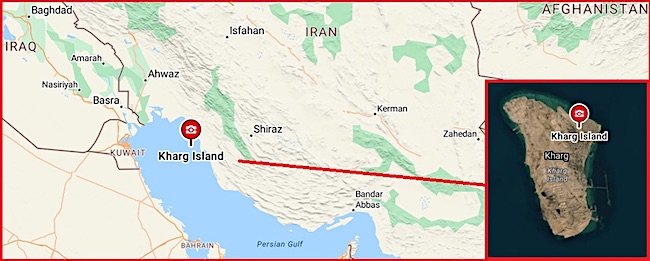
Kharg check or checkmate?
• Donald Trump Checkmates Iran On Day 14 (Duane Patterson)
Don’t misunderstand what I’m about to say. The war in Iran will continue for at least another week, according to President Donald Trump, and probably much longer. There are still hundreds, maybe thousands of targets, human and places, to destroy, thousands of sorties to be flown by U.S. and Israeli forces, and American naval assets will soon be joined by up to 5,000 Marines. There undoubtedly will still be casualties to come, joining the 13 we’ve already lost in the last fortnight. But not only are we winning this war against Iran, the killer move that all but assures the final outcome in our favor was played on Friday afternoon by Donald Trump.Read more …
The events began early in the morning, Washington, D.C. time, when War Secretary Pete Hegseth and Chairman of the Joint Chiefs of Staff Dan “Raisin'” Caine held a press briefing. Both men at several points in their remarks stated with conviction that Friday would become the most intense and largest bombing day to date. And from what we’ve seen thus far, that is saying something. No one knew what that would look like, but the fireworks to come were promised to be spectacular and game-changing. As it turns out, they were not kidding. On Brian Kilmeade’s Fox Radio Network show, the President joined him on the phone for a bit to update on Iran. Kilmeade asked Trump if a strike on Kharg Island was on the table.To be honest, it’s a fair question for pundits and hosts to ask of experts in the Middle East, because that little strip of land off Iran’s southern shore accounts for nine of 10 barrels of oil Iran exports. In short, it’s the Persian Gulf’s largest Buc-ee’s. Trump’s reaction, in hindsight, was extremely telling. Brian is a wonderful newsman and anchor, and has a long history of doing radio well before his tenure at Fox. I’m not surprised he asked that question. And I’m also not surprised at all that the President answered by saying there’s no way he can answer that. But taking it to the degree of admonishing Kilmeade for the question, giving him a Trump tattoo in the process, tells me Trump was angling for the element of surprise.
He reacted in a way to at least make people think it was a stupid question; it wasn’t on the table, at least not imminently, and don’t bother him with such piffle. A couple of hours later, under the cover of darkness, the bat signal went out to several of our B-2 stealth bombers, and they took flight, one right after another. They were coming out to play in whatever this event was the Pentagon had previewed earlier in the day. Of course, the videos of them taking off were not released until they were already back home from delivering the mail to wherever they were headed. And as it turns out, where they were headed didn’t have a lot of street cameras or other video capabilities to make into neat, little reel videos.
A few hours later, Donald Trump unveiled what happened. Kharg Island was targeted. Instantly, the online community predisposed to hate the President and everything about this war, precisely because Trump is leading it, leaped to the conclusion that Trump had now escalated things to an irreparable level. Of course, they missed what was struck, how it was struck, and to whom his messaging was addressed. Here is Trump’s announcement on Truth Social and X.
— Rapid Response 47 (@RapidResponse47) March 13, 2026
“The US did not defeat its major rivals through decisive military victory. Rather, it emerged as the strongest actor at a moment when other powers were preoccupied with solving their own internal problems.”
• Iran Shows The World The Limits of US Power (Timofey Bordachev)
Despite the optimism expressed in some quarters, it would be premature to declare that the American and Israeli military campaign against Iran has already stalled or that the crisis will soon be resolved through international mediation. The situation remains volatile, and the resilience of the Iranian state is still being tested. Yet even at this early stage, the conflict is raising deeper questions about the role the US will play in world politics once its latest attempt to restore global dominance runs its course. The US is not about to disappear from international affairs. Scenarios of American collapse belong to the realm of fantasy.Read more …
For Russia, China, India and other major powers, the real question is not whether the US will remain a central actor in global politics, but how it will fit into the evolving international order. For Russia in particular, this issue carries special significance. The US remains the most powerful component of the Western world, with which Russia has historically maintained relations that are at once close and confrontational. Geography and history ensure that our strategic calculations will always take into account both Western Europe and America. Russia must therefore think carefully about how the US can be incorporated into a future balance of power that serves our own long-term interests.The events surrounding the recent attack on Iran may mark an important turning point. They have exposed the limits of American power in a world that is no longer willing or able to accept unilateral leadership. It remains unclear how long Iran can withstand sustained military pressure, what degree of assistance it will receive from external partners, and how long Washington itself is prepared to continue a campaign that appears to have exceeded its original expectations. What is already visible, however, is a contradictory picture.
The Israeli leadership appears determined to press ahead to the end. By contrast, Donald Trump and members of his administration seem increasingly perplexed by the unexpected resilience of the Iranian state. At the same time, many American allies are visibly anxious about the consequences of the conflict. Perhaps most importantly, the war is already having serious repercussions for the global economy. These economic pressures help explain why rumors are circulating that Washington may be quietly searching for mediators capable of opening a dialogue with Tehran.
In this turbulent environment, Russia has expressed support for the Iranian people and state, which it views as victims of an unprovoked attack. At the same time, Moscow must pursue policies that correspond to its own strategic interests. As one of the world’s major military powers, Russia is concerned above all with the overall balance of power in the international system, and with the unique place historically occupied within that system by the US.
To understand this position, one might use a medical analogy. The US resembles a neoplasm within the global political organism. Yet unlike in medicine, the existence of such a “tumor” does not necessarily destroy the whole system. Instead, it becomes integrated into the organism’s development, occupying a special role.
The extraordinary position achieved by the US in the second half of the twentieth century was not simply the result of overwhelming superiority. It was also the product of very specific historical circumstances. Western Europe had been devastated by war, China was in a state of internal upheaval, and Soviet Russia had largely isolated itself from the rest of the world during its communist experiment. These conditions allowed the US to assume a position of leadership with remarkable confidence.
But this leadership was never the result of classical imperial conquest comparable to the Roman Empire or the empire of Genghis Khan. The US did not defeat its major rivals through decisive military victory. Rather, it emerged as the strongest actor at a moment when other powers were preoccupied with solving their own internal problems.
“.. there is no common front against the hegemonic agendas of Washington and Israel and there will be no military aid to Iran. That is a big green light for Trump and Netanyahu
• My Prediction For the War with Iran (Paul Craig Roberts)
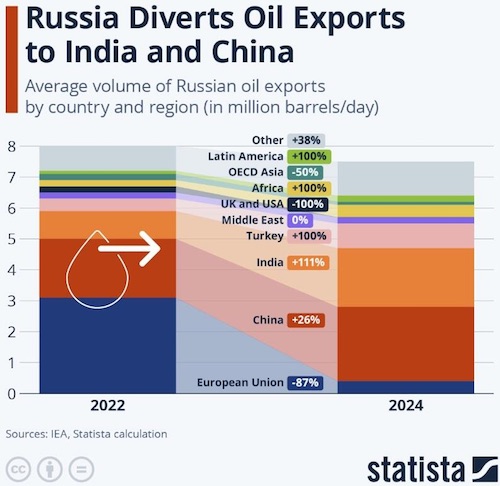
President Trump, in an effort to rescue himself from a war that he began without adequate preparation, as he was warned to no avail by his hand-picked Chairman of the Joint Chiefs of Staff, has propositioned Russian President Putin. The deal Trump has offered is to free Russian oil from sanctions on the condition that Putin direct the released oil flows to Europe away from Asia. This achieves two goals for Trump. It lessens or removes the pressure on oil price and inflation from the blockage of the Strait of Hormuz, thus negating an Iranian advantage in the conflict, and it prevents China from replacing Iranian oil lost to blockage of the Strait and curtailment of shipping insurance. Little doubt that Russia’s incompetent central bank director is telling Putin to take the deal on the grounds that Russia needs the oil revenues to develop its economy.Read more …
In other words, if Putin will betray Russia’s Iranian and Chinese allies, Trump will remove sanctions on Russian oil. Think about Trump’s proposal for a minute. What does it tell us about Trump’s opinion of Putin? It tells us that Trump thinks of Putin as a man devoid of integrity and strategic vision who would sell out his allies and his country itself.I agree with Gilbert Doctorow that by accepting Trump’s call Putin revealed himself as a person of questionable character. Trump had a few days prior conducted a dishonorable sneak military attack on Iran. Putin should have refused the call.If Putin aligns with Trump and Israel against Iran it means the end of BRICS and the New Chinese Silk Road and a cessation of Chinese trust in Russia.John Helmer thinks it reflects badly on China that the country’s leadership is entering into trade negotiations with Trump soon after Trump has begun a war with Iran that has adverse impact on Chinese economic and military power. I agree. So, both Russia and China have shown that the Israeli-American attack on an ally has given them no wakeup call and they are both content to continue with business as usual. I can’t help wondering if one motive for Trump’s attack on Iran was to create divisions between the three countries and to isolate them from one another.
As I have emphasized several times and again today on Rasheed Muhammad’s excellent program the Zionist agenda of Greater Israel means that the talk about mediating the Iranian conflict and restoring peace and stability to the Middle East is meaningless. Israel’s agenda is not consistent with peace and stability in the Middle East. Iran cannot be secure when Iran is in the way of Greater Israel. The Iranian president still does not understand this and is making a fool of himself and his country by giving conditions for negotiations to end the war, but a more powerful figure, Ali Larijani, head of Iran’s Supreme National Security Council, does understand. Larijani recently stated:
“Tonight, we received messages from U.S. President Donald Trump through the Omani mediator, asking us to negotiate a ceasefire. Our response is that we will not accept any negotiations as long as an entity called Israel exists.” The Iranian Supreme Leader should say that Iran is willing to trade all nuclear ambitions for Israel’s renouncing of the Zionist agenda of Greater Israel. The only way the Middle East can contain both Iran and Israel is for Israel’s agenda of Greater Israel to be deep-sixed. The first quarter of the 21st century has witnessed Israel use American blood and money to clear the Muslim Middle East of obstacles to Greater Israel. “Seven countries in five years.” It has taken longer than five years, but Iran is the last big obstacle.
It looks as if Trump and Israel are going to lose the conventional war. Iran seems to have the larger stockpile of missiles and the determination and ability to stay the course. After having their children slaughtered by the Trump and Netanyahu war criminals, the Iranian Revolutionary Guard is unlikely to counsel negotiations or surrender. Morgan Stanley, BlackRock and other major American financial institutions have already been forced to cap withdrawals from their funds. Unless Putin bails out Trump, the oil price will continue rising carrying inflation with it and driving down the stock market and employment. Washington has shown that it is Incapable of protecting the Gulf oil sheikdoms from which people are fleeing.
The US Navy which the White House Fool said would escort oil tankers through the Strait of Hormuz has had to move out of Iranian missile range. The war has spread to Saudi Arabia. Hezbollah is now attacking Israel. The Houthis may soon join in the attacks on Israel. The American Gulf bases seem to be indefensible. We don’t know the US casualties, but it is certainly more than Trump’s reassuring six. Perhaps the Russian and Chinese leaderships will save the war for Israel and Trump by pressuring Iran into a ceasefire, thereby showing that both countries lack intelligent leadership. There are no ground troops to send into Iran.
Trump and Netanyahu seem to have given up attacking Iran’s military capabilities and are focusing on bombing Iranian civilian residential areas, schools, and hospitals as Israel does to Gaza with Trump’s bombs. This cowardly way of fighting will only succeed in hardening the attitude of the Iranian Revolutionary Guard. So, what is Trump to do now that in a midterm election year the fool has permitted Netanyahu to trap him into a longterm and apparently losing war. If Trump loses the midterm elections, he is likely to be impeached and removed from office. The only option left to Trump is to nuke Iran or have Netanyahu do it.
Thus the duplicity and lack of strategic vision of Putin and Xi will have let the nuke genie out of the bottle. Emboldened by the success of violence, Trump and the Zionists will turn on isolated Russia and China in pursuit of their hegemonic agendas. On March 11, Wang Yi, the Chinese foreign minister and Politburo member conveniently let Trump know that there is no Chinese-Russian alliance when he said that Chinese-Russian “bilateral ties are based on the principle of non-alliance, non-confrontation and not targeting any third party.”
In other words, there is no common front against the hegemonic agendas of Washington and Israel and there will be no military aid to Iran. That is a big green light for Trump and Netanyahu. Based on what we know at this time, the picture I have painted is a probable one.
“America sacrifices everyone for Israel and does not care about anyone but Israel.” He added, “Anyone clothed by the US is literally NAKED!”
• UAE Fujairah Port Burns As Iran Vows Escalation For Kharg Island Attack (ZH)
Upon the overnight major US attack on Iran’s key oil hub of Kharg island, here’s what Iran’s military is threatening to do by way of response and escalation – which was also entirely predictable: “If Iran’s oil, economic, or energy infrastructure is attacked, we will immediately destroy energy and economic infrastructure across the region belonging to companies with American shareholders or ties to the U.S.” –IRGC spox Iran continues launching widespread missile and drone attacks on Israel and neighboring Gulf Arab states and has effectively closed the Strait of Hormuz.Read more …
Iranian Parliament Speaker Mohammad Bagher Ghalibaf has vowed that any US site or any country hosting it will feel pain. “This war proved one thing quite clearly: American bases in our region do not protect anyone – they are a threat,” he wrote on X. “America sacrifices everyone for Israel and does not care about anyone but Israel.” He added, “Anyone clothed by the US is literally NAKED!” And in fact this retaliation is already in progress on Saturday. A missile struck a helipad inside the US Embassy compound in Baghdad, and debris from an intercepted Iranian drone hit an oil facility in the United Arab Emirates on Saturday.Iran’s Islamic Revolutionary Guard Corps (IRGC) has informed the United Arab Emirates that US “hideouts” are “legitimate targets” after the US struck Iran’s Kharg island. –Al Jazeera. Associated Press images meanwhile showed a column of smoke rising over the embassy compound in the Iraqi capital and a fire at the Fujairah port, offering confirmation.
Plumes of black smoke can been seen rising from the UAE’s port of Fujairah, the country’s only oil export outside the Strait of Hormuz.
— OSINTtechnical (@Osinttechnical) March 14, 2026
The local government confirms that Iranian drones targeted the area, says that damage was from falling debris. pic.twitter.com/fQU139cgPyPresident Trump had said late Friday that the US military “obliterated” targets on Iran’s Kharg Island, home to the primary terminal handling the country’s oil exports. Additionally, an American official said 2,500 additional Marines and an amphibious assault ship are heading to the Middle East – though it remains unclear on if they will actually enter the strait, or what their mission will ultimately be. But ‘mission creep’ is already happening at rapid pace, as the White House refuses to publicize an exit plan or offramp (if there even is one).
⚡️Another video of the damage done to the U.S embassy in Baghdad following a drone strike pic.twitter.com/jxmFK3Ot6j
— War Monitor (@WarMonitors) March 14, 2026
US seems late to the show.
• Drones Are A ‘Rapidly Evolving’ Threat To US (JTN)
Iran’s Shahed-style drones each cost between $20,000 and $50,000, but they can do a lot of damage. Since the latest conflict began, Iran’s drones have killed six members of the Army Reserve at a command center in Kuwait on Sunday, and Iranian drones have wreaked havoc on Middle East petroleum facilities. The FBI is now warning that Iranian drones potentially pose risks to targets in California. Some journalists in the legacy media are shocked to discover that the U.S. has limited capabilities to counter these destructive and lethal aerial devices. While it’s true that neutralizing drone threats is difficult, it’s a problem the Department of War has been aware of and working to address since long before the conflict in Iran.Read more …
In 2007, Tom Rullman, president and CEO of GT Aeronautics, ended up sharing a cab ride with a two-star general in Washington, D.C. GT Aeronautics develops a variety of drones for commercial and defense purposes, and in 2006, it was developing a drone with air to ground capabilities, called a Bandito. The small devices have a wingspan of 16 inches, weigh less than two pounds, and fly at 200 miles per hour. During the chance encounter with the general, Rullman discussed the Bandito and showed him charts of the drone. The general was very interested in the technology and invited Rullman to brief the Air Force at the Pentagon on what his Banditos could do.“There were like 40 generals in the room, and I had a 20-minute time slot. That brief turned into three hours,” Rullman told Just the News. Among the questions the generals asked Rullman was if his Banditos could be used to, say, attack the White House. “Absolutely,” Rullman told the generals. “We can launch a Bandito outside the window of a truck that’s moving, do it 20 miles away and send it to a target on the ground.” That got the Pentagon’s attention. The government asked GT Aeronautics to help develop drones that could take out air targets. By 2009, Ruleman was flying Banditos out in the California desert near Point Mugu Naval Air Station and developing the systems that allow them to track targets.
Col. Guy Yelverton is a project manager for the U.S. Army’s counter-unmanned aircraft system (UAS) — what the military and FAA call drones. Yelverton said the Department of War is actively working to address the risk that drones are posing to U.S. troops. The U.S. military has seen a proliferation of low-cost adversarial drones in recent years, and they range from small, commercial-style drones to larger, more capable platforms. “They’re becoming a defining feature of modern warfare,” Yelverton told Just the News. These drones increase the ability of our adversaries, as well as “non-state actors,” to conduct reconnaissance, targeting and harassment with little risk to their own personnel, Yelverton said.
“They can make a drone pretty cheaply and then hang something off of it that could do some damage,” Yelverton said. On the battlefield, adversaries’ use of drones provides them with persistent surveillance and enables rapid strokes. This presents a situation for U.S. troops where decision-making timelines are severely compressed.
“..Trump has no business still standing. Except the economy is still standing..“
• Media Says ‘Gambling’ Trump Got Lucky On The Economy (ZH)
Democrats have been predicting doom and gloom ever since Trump returned to office, yet the economic calamity they assured us would come has yet to materialize. But rather than give Trump credit, the narrative being pushed now is that his wins are just dumb luck. That’s certainly the message of a Politico piece headlined “Trump Keeps Gambling With the Economy — And Getting Away With It.”Read more …
“President Donald Trump has spent his second term turning risky economic gambles into a way of life,” the article kicks off. “He has implemented sweeping global tariffs that have dramatically increased the cost of doing business across the world. He has sharply decreased the number of people immigrating to the U.S. He has pushed for the Federal Reserve to lower interest rates under any circumstance, even though inflation has not entirely cooled. And now, he’s launched an attack on Iran, a scenario that has long been the clearest and most direct threat to one of Trump’s favored political barometers: gas prices.”The implicit verdict is clear: these were all reckless moves, and Trump has no business still standing. Except the economy is still standing. Quite well, actually. So-called experts warned repeatedly that Trump’s tariff regime would send prices spiraling. That didn’t happen. Inflation went down. Democrats entered 2025 predicting that aggressive immigration enforcement would “deliver a catastrophic blow to the U.S. Economy.” That blow never landed. What about the prediction that Trump’s mass deportations would devastate the economy? Not only did that not happen (albeit there was TACO’ing over the scale of deportations), it reversed the trend of rising housing costs, making them more affordable. At some point, a pattern of failed predictions stops being an argument about Trump’s recklessness and starts being an argument about the quality of the predictions.
The article quickly pivots to gas prices, which are up following the attack on Iran – though Energy Secretary Chris Wright called this a ‘fear premium’ that will fall in ‘weeks, not months’ [though we generally place little stock in bureaucrat promises]. “And now, he’s launched an attack on Iran, a scenario that has long been the clearest and most direct threat to one of Trump’s favored political barometers: gas prices,” the article warns. “The conflict has led to a jump in oil prices, though not quite to worst-case levels, and markets have been jittery about the prospect of more expensive energy and higher U.S. federal debt, stemming from the cost of the U.S.-Israel war with Iran.”
Politico is unwilling to credit the Trump administration for successfully managing the economy after the Biden administration went full leeroy jenkins on inflationary stimmies and red tape; instead, we’re supposed to be convinced that Trump is just lucky that disaster hasn’t struck, or as Politico put it, “getting away with it.” In fact, Politico suggests that the economy is doing well in spite of Trump… “In so many ways, that is the story of Trump’s economic stewardship up to this point. His disruptive policies have left some dents, including serious damage to his approval rating, but by the biggest readings of its health, the U.S. economy – measured by overall growth, the job market, the stock market, even inflation – largely keeps absorbing what he throws at it.”
Elon is way ahead of you.
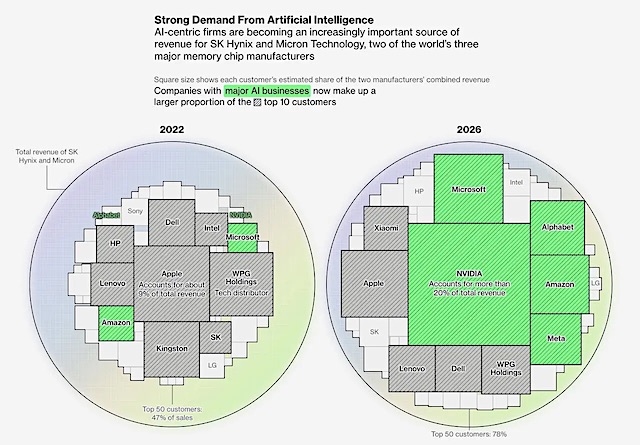
• The AI Boom Is Creating A Global Memory Chip Shortage (ZH)
A global shortage of memory chips is emerging as demand for artificial intelligence infrastructure surges, according to a new report from Bloomberg.Read more …
Large technology companies are locking in supply by signing long-term agreements and paying higher prices to guarantee access to chips years in advance. Because these deals are more profitable, chip manufacturers are increasingly directing production toward AI customers. This shift has reduced the number of chips available for other products such as laptops, smartphones, gaming consoles, and cars, pushing prices sharply upward.Memory chips play a critical role in modern computing because they store and deliver data to processors, which carry out calculations. Without sufficient memory, devices would struggle to run applications, load programs, or process data efficiently. Two types dominate the industry. DRAM functions as short-term working memory that computers and servers use to quickly access active data. NAND flash memory serves as long-term storage, holding files, photos, and software even when devices are powered off.
The AI industry is about to run out of chips. The world's largest foundries are maxed out and the demand curve is still going vertical.
— Josh Kale (@JoshKale) March 14, 2026
Tesla’s TeraFab is a bet on a solution no other company in the world has been ambitious enough to try…. build the chips yourself
Quick math… https://t.co/EXMHu5GYbC pic.twitter.com/31Ln43JLiO
Bloomberg writes that Artificial intelligence systems require enormous amounts of memory, especially a newer design known as high-bandwidth memory (HBM). This technology stacks multiple layers of memory vertically and places them close to processors, allowing data to move much faster than with traditional designs. The speed is essential for AI models that must constantly move and process huge volumes of information. The rapid expansion of AI data centers has dramatically increased demand for memory chips. Major technology firms are investing hundreds of billions of dollars to expand computing capacity, and AI servers require far more memory than traditional systems.As a result, data centers now account for a much larger share of global DRAM usage than they did just a few years ago, and that share is expected to keep growing. With supply unable to keep pace, memory prices have climbed steeply. In some cases, DRAM spot prices have risen several hundred percent within a year, while NAND storage costs are also increasing. The impact is spreading across the electronics industry. Companies that build computers, phones, and gaming systems are facing higher manufacturing costs and tighter component supply. Some manufacturers have already raised prices or reduced the amount of memory included in certain devices to manage expenses.
Expanding production is not a quick solution. The memory chip industry is highly concentrated, with most output coming from companies such as Samsung Electronics, SK Hynix, and Micron Technology. Building new fabrication plants requires enormous investment and several years before meaningful output begins. Producing advanced chips like HBM is even more challenging because they involve stacking extremely thin layers of silicon with microscopic connections; even a small defect can ruin an entire unit.
Manufacturers are expanding cautiously because the memory business has historically been volatile, swinging between shortages and oversupply. Companies want to benefit from the AI boom without repeating past cycles that led to large financial losses when demand suddenly weakened. For the moment, firms building AI infrastructure are securing the components they need, while consumer electronics makers may have to cope with higher costs and limited supply until production eventually catches up with demand.
Russian energy is indispensable to easing the world’s largest energy crisis. EU bureaucrats will soon be forced to recognize this reality, acknowledge their strategic blunders, and atone. https://t.co/5kn6RTZBb3 — Kirill Dmitriev (@kadmitriev) March 13, 2026
• Did Someone Forget To Ask Zelensky? (RT)
What have we learned from Kirill Dmitriev’s latest round of talks in Miami, and where does Ukraine stand now?Read more …
Two weeks of war in the Persian Gulf have forced the US to admit the obvious: that Russia is an indispensable oil supplier. After some lightning-fast diplomacy from Moscow, Russian oil is reaching its old markets again, and nobody is angrier than Vladimir Zelensky. The impact of the US-Israeli war on Iran on global energy markets has been brutal. Around 40% of the world’s oil comes from the Middle East, where Iranian attacks have forced the shutdown of refineries in US-allied countries, and a third of the world’s seaborne crude oil transits the Strait of Hormuz, which has been de facto closed for nearly two weeks. As a result, the Brent oil benchmark has soared to more than $103 per barrel, a figure last seen in June 2022, when oil markets grappled with the escalating conflict in Ukraine.That Moscow would benefit from this situation was inevitable. Russia is the world’s largest oil producer, is not participating in the war in the Gulf, and does not depend on the Strait of Hormuz to bring its oil to buyers. The only impediment to Russian oil flows are Western sanctions, which the US proved this week it is willing to wave away with the stroke of a pen. It took only four days for US sanctions on Russia’s energy sector to start to fade. The process began with a phone call between US President Donald Trump and Russian President Vladimir Putin on Monday. The Kremlin described the call as “frank and businesslike,” noting that the two leaders discussed the effect of the war on “global energy markets.”
Earlier that day, Putin publicly declared that Russia is a reliable energy supplier, willing to work with countries that themselves are reliable partners. Two days later, Russian special envoy Kirill Dmitriev was on a plane to Miami, where he met with Trump envoys Steve Witkoff and Jared Kushner, as well as White House adviser Josh Gruenbaum. Neither side revealed much about the meeting, with Witkoff stating that the teams discussed a variety of topics and agreed to stay in touch, with Dmitriev thanking the Americans for a productive meeting. Less than 24 hours later, US Treasury Secretary Scott Bessent announced the temporary lifting of sanctions on Russian oil currently at sea. The waiver relates to exports of Russian oil loaded onto vessels prior to March 12 and is set to last 30 days.
Neither side has suggested that the decision to waive sanctions was made in Miami, but it is unlikely that the issue was not discussed. Bessent described the waiver as a “narrowly tailored, short-term measure” that would “not provide significant financial benefit to the Russian government, which derives the majority of its energy revenue from taxes assessed at the point of extraction.” However, Dmitriev believes that further easing of sanctions will follow. In a post on Telegram on Thursday, he said “many countries, particularly the USA, are beginning to better understand the key, systemically important role of Russian oil and gas in ensuring the stability of the global economy, as well as the ineffectiveness and destructive nature of sanctions against Russia.”
A Harvard-educated former investment banker, Dmitriev is a long-time proponent of increasing economic ties between the US and Russia. Throughout repeated rounds of talks aimed at resolving the Ukraine conflict, Dmitriev has accompanied Moscow’s negotiators to the US and held separate economic-focused talks with the Americans. $100 oil is “just the beginning of the largest energy crisis ever,” Dmitriev wrote on X, adding that “even $200+ is a possibility in a prolonged conflict.” “Amid the growing energy crisis, further easing of restrictions on Russian energy sources appears increasingly inevitable, despite resistance from some in the Brussels bureaucracy,” he predicted.
The war on Iran has been an unmitigated nightmare for Ukraine’s Vladimir Zelensky. Not only has the conflict denied him the constant press coverage that he enjoyed since 2022, he has also been forced to watch as American weapons – particularly the PAC-3 Patriot anti-air missiles he has spent years demanding from the West – are burned up in the Middle East.In less than two weeks of fighting in the Persian Gulf, the US, Israel, and their Arab partners have used more PAC-3 interceptors than Ukraine has received in the last four years. In talks with his European backers earlier this week, Ukraine managed to secure a meager 35 of these missiles. The US and its partners have fired this many interceptors every five hours since the war on Iran began.
Zelensky’s attempts to insert Ukraine into the war have also proven fruitless. Despite offering to deploy anti-drone “experts” to the Middle East, the Ukrainian leader was told on Friday by Trump that “we don’t need Ukraine’s help with drone defense.” Before Bessent announced the waiving of sanctions, Zelensky took to social media to vent his frustrations. “Europe, the United States, and the entire civilized world imposed sanctions on Russia for its aggression,” he wrote on X on Wednesday. “In my view, if these sanctions are lifted, it means we are recognizing the legitimacy of this aggression… I consider this absolutely unjust.”
With Witkoff, Kushner, and the entire Trump administration consumed with Iran, trilateral talks between Moscow, Kiev, and Washington have been postponed until next week at the earliest. For now, Zelensky – the spurned mistress in this story – can only complain to the Europeans. German Chancellor Friedrich Merz, British Prime Minister Keir Starmer, and European Commission President Ursula von der Leyen have all condemned Trump’s sanctions waiver. “We believe that easing sanctions now, for whatever reason, is the wrong thing to do,” Merz told reporters on Friday. “Russia,” von der Leyen said, should absolutely not benefit from the war on Iran.” However, Russia will continue to benefit as long as oil prices remain high, and Dmitriev has warned European “warmongers” that “energy markets will punish them” as long as they maintain their embargo on Russian oil and gas.
Merkel turns out to be the great destroyer. Who saw that coming?
• The Most Expensive Science Lesson in European History (Hickman)
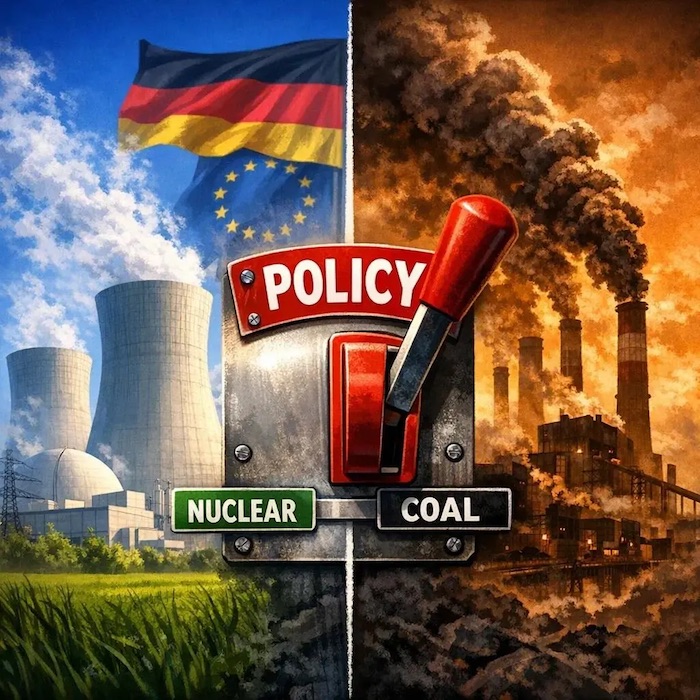
On March 11, 2011, a magnitude 9.0 earthquake struck off the coast of Japan and triggered a massive tsunami that slammed into the Fukushima Daiichi nuclear power plant. Three of the plant’s six reactors melted down, and it became the worst nuclear disaster since Chernobyl. On the other side of the world, German Chancellor Angela Merkel panicked. Her government had extended the operating lives of Germany’s 17 nuclear reactors just five months earlier. But, because of the earthquake in Japan, Merkel reversed course overnight and mothballed eight German reactors.But Merkel’s decision wasn’t really about natural disasters. It was political. Merkel was terrified of Germany’s Green Party— which was literally founded on anti-nuclear activism in 1980 and had been gaining ground. A critical regional election was just two weeks away, and Merkel was hoping that she might pull out a victory if she killed the reactors.
Her gambit didn’t work, and the Greens won anyway. But at that point the fate of nuclear had already been set in motion. Within three months, the German government decided to phase out EVERY nuclear reactor in the country. Bear in mind that Germany’s 17 reactors were generating over a third of the country’s electricity… with zero carbon emissions. That’s a pretty good thing for a country obsessed with climate change. Yet Germany’s Green party had inexplicably spent decades campaigning to close them, i.e. to shutter the cleanest, most carbon-free source of baseload energy known to man. Germany committed to replacing its nuclear plants with solar panels. Naturally this meant that, in a country where the sun barely shines, Germany became increasingly dependent on natural gas— most of which is piped in from Russia.
Read more …
The true extent of this idiocy didn’t reveal itself until February 2022 when Russia invaded Ukraine: Germany joined Western sanctions against Russia. Russia retaliated by throttling gas supplies. And Germany had no fallback. So Germany— the country that had lectured the entire world on carbon emissions— frantically restarted more than 20 coal-fired power plants. Then they imported 42 million metric tons of coal, including a surge from southern Africa. They even bulldozed the village of Lützerath to expand a lignite mine, dragging away protesters. Germany also became a net electricity importer, buying power from France’s nuclear grid. And gee what a surprise: German electricity prices are now the highest in the European Union. One obvious consequence is that Germany is no longer industrially competitive due to energy costs.And that brings us to March 6, 2026. Manuel Hagel, a 37-year-old political candidate from ex-Chancellor Merkel’s party, visited an elementary school. National television cameras were rolling as Hagel attempted to explain the greenhouse effect to the children: “Between the earth and the sun is the atmosphere. And as this gets increasingly thin, the sun gets hotter and hotter. And the reason for this is CO2 emissions and and and. And that is the greenhouse effect.” Unfortunately his explanation is completely wrong. The greenhouse effect works because CO2 and other gases trap heat within the atmosphere; it has nothing to do with the atmosphere thinning or the sun getting hotter.
This is a guy who takes away stoves and gasoline powered vehicles in the name of reducing carbon emissions. Yet he doesn’t even understand the basics of his own ‘science’. Zee German leadership humiliated themselves even more when, on March 10, European Commission President Ursula von der Leyen stood at the Nuclear Energy Summit in Paris and declared that Europe’s retreat from nuclear power had been “a strategic mistake.” “In 1990 one-third of Europe’s electricity came from nuclear, today it is only close to 15%. This reduction in the share of nuclear was a choice, I believe that it was a strategic mistake for Europe to turn its back on a reliable, affordable source of low-emissions power.”
She’s right, of course. It was a mistake. An extraordinarily costly one. This is hilariously ironic since Von der Leyen is German. She served in Merkel’s cabinet. She personally voted to phase out nuclear, and her own policies at the Commission have been to quietly phase out nuclear power. Also this week, Germany’s current Chancellor (Friedrich Merz) weighed in on this nuclear blunder when he called the reactor phase-out “a mistake” and said, “I regret this.” Great. Then fix it! But they’re not going to do that. Unfortunately for Germany, said the Chancellor, “it is the way it is, and we are now concentrating on the energy policy we have.”
Give it up.
• The EU Never Learns – Except For The Wrong Lessons (Amar)
Some observers of the current EU ‘elites’, including this author, used to believe that their defining feature – apart from things such as complicity in genocide and wars of aggression with Israel and the US, bigoted xenophobia about Russia and China, and, of course, pervasive corruption – was an absolute inability to learn.We must admit, we stand corrected: Those running the EU are able to learn. The real problem is their relentless compulsion to learn the wrong thing. We are not dealing with non-learners but anti-learners: where others progress from experience, they regress.Read more …
Case in point, their response to the fact that their US-Israeli masters have started a war to end if not strictly all then at least all (barely) affordable energy supplies to the EU’s economies, while its major players are already limping along on a spectrum between walking-wounded (for instance, France, maybe) to comatose (Germany, definitely).In Germany, still the largest single economy inside the EU, providing almost a fourth of the bloc’s total GDP, industrial demand – orders from factories – fell by over 11% in January. Such a decrease – really, collapse – in orders is “drastic,” as German Manager Magazine notes. According to the Financial Times, this “very weak” start into the new year, puts preceding – and very modest – signs of a recovery from years of stagnation in doubt. Indeed.And all of that disappointing data was gathered before the fallout of the Iran war had even started.Regarding the latter, it will be severe. Even Berlin’s Ministry of Economics admits that the risks stemming from the war’s consequences, most of them still incoming, is substantial. In general, the Eurozone – different from but covering most of the EU – is not in good shape either. According to Bloomberg, a very low and yet still over-optimistic Eurostat estimate of expansion by 0.3% for the last quarter of 2025 has just been revised downward to 0.2%. But frankly, who cares at that level of misery?
And for the Eurozone as well, America and Israel’s unprovoked war against Iran is likely to make things much worse. Philip Lane, chief economist of the European Central Bank (ECB), has confirmed that much to the Financial Times: An enduring decrease in oil and gas supplies from the Middle East can (read: will), he warns, bring about a “substantial spike” in inflation and a “sharp drop in output.”And what is the EU leadership’s response to this deeply depressing outlook for its economy and the European citizens depending on it? Let’s not dream. It is true, if the EU’s ‘elites’ were in the business of protecting European interests and prosperity, they would, obviously, take a sharp turn against both the US and Israel (as well as London in case it were to stick to its special-poodle relationship with Washington).
Yet if the EU leadership had such priorities, it would long have turned against the US, for its blatant exploitation of its vassal regimes via, first, NATO over-expansion and, now, crippling overspending, for Ukraine proxy war outsourcing, and for devastating tariff warfare. It would also long have broken with Israel, for, to name only two compelling reasons, its genocide and serial wars of aggression that are both horrifically criminal and extremely destabilizing and damaging not “only” to the Middle East but the world as a whole and Europe in particular.In short, the EU would not even be in the mess it is now if it actually took care of Europe. And, by the way, if it were not so craven but had opposed the US and Israel instead of pandering to them, perhaps it could even have contributed to preventing the current criminal war against Iran.
Russia is threatening to embargo natural gas to Europe.
— Peter St Onge, Ph.D. (@profstonge) March 13, 2026
This could double Europe’s gas prices, gut European industry, and set off a recession.
Trump warned Europeans this would happen way back in 2018. They laughed at him. pic.twitter.com/h6YFMHLIKu
— Amazing Physics (@amazing_physics) March 13, 2026
Richard Feynman, in his iconic 1981 BBC Horizon interview "The Pleasure of Finding Things Out", delivers one of the most liberating takes on uncertainty ever captured on film:
— Camus (@newstart_2024) March 14, 2026
"I have approximate answers and possible beliefs and different degrees of certainty about different… pic.twitter.com/uNvZsyayQ9
This Harpy Eagle is the most powerful birds in the world. pic.twitter.com/o60rHl1z3w
— Gabriele Corno (@Gabriele_Corno) March 13, 2026
Support the Automatic Earth in wartime with Paypal, Bitcoin and Patreon.