
Mar 172018


Jacobello Alberegno The Beast of the Apocalypse 1360-90


The Guardian ran an article yesterday by one of its editors, David Shariatmadari, that both proves and disproves its own theme at the same time: “An Information Apocalypse Is Coming”. Now, I don’t fancy the term apocalypse in a setting like this, it feels too much like going for a cheap thrill, but since he used it, why not.

My first reaction to the headline, and the article, is: what do you mean it’s ‘coming’? Don’t you think we have such an apocalypse already, that we’re living it, we’re smack in the middle of such a thing? If you don’t think so, would that have anything to do with you working at a major newspaper? Or with your views of the world, political and other, that shape how you experience ‘information’?

Shariatmadari starts out convincingly and honestly enough with a description of a speech that JFK was supposed to give in Dallas right after he was murdered, a speech that has been ‘resurrected’ using technology that enables one to make it seem like he did deliver it.


An Information Apocalypse Is Coming. How Can We Protect Ourselves?

“In a world of complex and continuing problems, in a world full of frustrations and irritations, America’s leadership must be guided by the lights of learning and reason, or else those who confuse rhetoric with reality, and the plausible with the possible will gain the popular ascendancy with their seemingly swift and simple solutions to every world problem.”

John F Kennedy’s last speech reads like a warning from history, as relevant today as it was when it was delivered in 1963 at the Dallas Trade Mart. His rich, Boston Brahmin accent reassures us even as he delivers the uncomfortable message. The contrast between his eloquence and the swagger of Donald Trump is almost painful to hear.

Yes, Kennedy’s words are lofty ones, and they do possess at least some predictive qualities. But history does play a part too. Would we have read the same in them that we do now, had Kennedy not been shot right before he could deliver them? Hard to tell.

What’s more, not long before JFK was elected president America had been in the tight and severe grip of J. Edgar Hoover and Joseph McCarthy’s anti-communist campaign, in which lots of reality was replaced with rhetoric, something Kennedy undoubtedly had in mind while writing the speech. JFK was not just addressing future threats, he was talking about the past as well.

But the writer slips into a much bigger faux pas right after: injecting Trump into the picture. It’s fine if someone doesn’t like Trump, but naming him there and then, in an article about ‘information apocalypse’, also means confusing objectivity with regards to your topic with subjectivity concerning your political ideas. While the Kennedy speech item relates to -advancing(?)- technology, a valid part of the apocalypse, mentioning Trump has nothing to do with that apocalypse, at least not objectively. Back to David Shariatmadari:

The problem is, Kennedy never spoke these words. He was killed before he made it to the Trade Mart. You can only hear them now thanks to audio technology developed by a British company, CereProc. Fragments of his voice have been taken from other speeches and public appearances, spliced and put back together, with neural networks employed to mimic his natural intonation. The result is pretty convincing, although there’s a machine-like ring to some of the syllables, a synthetic stutter. Enough to recognise, if you already know, that this is a feat of technology, not oratory.

We like to think of innovation as morally neutral. We empower scientists and engineers to range freely in the hope they might discover things that save labour and lives. The ends to which these are put aren’t the responsibility of the researchers. The agile robots produced by Boston Dynamics might look like they could cheerfully pin you up against a wall and snap your neck, but do we really want to close off this avenue of research? After all, they might equally be capable of performing life-saving surgery. The methods used to resurrect JFK can also help people with illnesses such as motor neurone disease – like the late Stephen Hawking – that affect their ability to speak.

It’s certainly true that we are so ‘geared’ towards progress, we ‘conveniently’ forget and ignore that every next step carries its own shadow side, every yin comes with its yang. ‘Progress’ and ‘innovation’ – and related terms- ring so positive in our eyes and ears it borders on -wilful- blindness. That blindness is set to play a major role in our future, and in our acceptance as gospel of a lot of ‘information’.

“Dual use” of technology is not a new problem. Nuclear physics gave us both energy and bombs. What is new is the democratisation of advanced IT, the fact that anyone with a computer can now engage in the weaponisation of information; 2016 was the year we woke up to the power of fake news, with internet conspiracy theories and lies used to bolster the case for both Brexit and Donald Trump.

Ouch! See, he does it again. This is not an objective discourse on ‘information disinformation’, but a way to make people think -through a method he’s supposed to be exposing- that ‘fake news’ led to Brexit and Trump. That’s a political view, not a neutral one. Yes, there are many voices out there who connect ‘fake news’ directly to things they don’t like, but that’s just a trap.

And as I said, it may have to do with the fact that the writer works for a major newspaper, which of course he wants to, and wishes to, see as some kind of beacon against fake news, but if he lets his own personal views slip into an objective treatment of a topic this easily, it automatically becomes self-defeating.

There is no proof that Trump and Brexit’s success are down to fake news more than their opposite sides, ‘fake news’ is everywhere, and that very much includes the Guardian. The coverage of the UK government accusations against Russia in the poisoning case proves that more than ever.

You can be anti-Trump, anti-Brexit and anti-Putin all you want, but they don’t define fake news or an information apocalypse, any more than ‘commies’ did in the days of Hoover and McCarthy.

We may, however, look back on it as a kind of phoney war, when photoshopping and video manipulation were still easily detectable. That window is closing fast. A program developed at Stanford University allows users to convincingly put words into politicians’ mouths. Celebrities can be inserted into porn videos. Quite soon it will be all but impossible for ordinary people to tell what’s real and what’s not.

That is am almost bewildering line. Does the writer really think ‘ordinary people’ can today tell apart what’s real and what’s not? If his paper had honestly covered his country’s, and his government’s, involvement in the wars all over the Middle East and North Africa over the past decades, would his readers still be supportive of the politicians that today inhabit Westminster?

Or does the paper prefer supporting the incumbents over Nigel Farage and Donald Trump, because it owes its reputation and position and revenues to supporting the likes of Theresa May and Tony Blair? Yeah, I know, with a critical view, yada yada, but when has the Guardian labeled any UK politician a war criminal? Much easier to go after Farage, isn’t it? The question is: what part of this is fake, and what is not?

What will the effects of this be? When a public figure claims the racist or sexist audio of them is simply fake, will we believe them? How will political campaigns work when millions of voters have the power to engage in dirty tricks? What about health messages on the dangers of diesel or the safety of vaccines? Will vested interests or conspiracy theorists attempt to manipulate them?

This appears to make sense, but it does not really. We are way past that. ‘Ordinary people’ have already lost their capacity to tell truth from fiction. Newspapers and TV stations have long disseminated the views of their owners, it’s just that they now have -newfound- competition from a million other sources: the blessings of social media.

The core issue here is that 1984 is not some point in the future, as we for some reason prefer to think. We are living 1984. Perhaps the fact that we are now 34 years past it should give us a clue about that? People tend to think that perhaps Orwell was right, but his predictions were way early. Were they, though?

Also: Orwell may not have foreseen the blessings and trappings of social media, but he did foresee how governments and their media sympathizers would react to them: with more disinformation.

Unable to trust what they see or hear, will people retreat into lives of non-engagement, ceding the public sphere to the already powerful or the unscrupulous? The potential for an “information apocalypse” is beginning to be taken seriously.

This is a full-blown time warp. If it is true that people only now take the potential for an “information apocalypse” seriously, they are so far behind the curve ball that one must question the role of the media in that. Why didn’t people know about that potential when it was an actual issue? Why did nobody tell them?

The problem is we have no idea what a world in which all words and images are suspect will look like, so it’s hard to come up with solutions.

Yes, we do have an idea about that, because we see it around us 24/7. Maybe not with images as fully fabricated as the JFK speech, but the essence is manipulation itself, not the means by which it’s delivered.

Perhaps not very much will change – perhaps we will develop a sixth sense for bullshit and propaganda, in the same way that it has become easy to distinguish sales calls from genuine inquiries, and scam emails with fake bank logos from the real thing.

David, we ARE all bullshitters, we all lie all the time, for a myriad of reasons, to look better, to feel better, to seem better, to get rich, to get laid. It’s who we are. We lie to ourselves most of all. A sixth sense against bullshit and propaganda is the very last thing we will ever develop, because it would force us to face our own bullshit.

But there’s no guarantee we’ll be able to defend ourselves from the onslaught, and society could start to change in unpredictable ways as a result. Like the generation JFK was addressing in his speech, we are on the cusp of a new and scary age. Rhetoric and reality, the plausible and the possible, are becoming difficult to separate. We await a figure of Kennedy’s stature to help us find a way through. Until then, we must at the very least face up to the scale of the coming challenge.

We are not “on the cusp of a new and scary age”, we are in the smack middle of it. We haven’t been able to separate rhetoric and reality, the plausible and the possible, for ages. What’s different from 100 years ago, or 50 years ago, is that now we are faced with an information overload so severe that this in itself makes us less capable of separating chaff from wheat.

So yes, that perhaps is new. But bullshit and propaganda are not. And labeling Trump and Brexit the main threats misses your own topic by miles. You could make an equally valid point that they are the results of many years of bullshit and propaganda by old-style politics and old-style media.

Maybe they’re what happens when ‘ordinary people’ switch off from an overload of bullshit and propaganda forced upon them by people and institutions they grew up to trust. And then feel they were betrayed by. A sixth sense after all.



Jun 292016
 
 June 29, 2016  Posted by at 12:46 pm Finance Tagged with: , , , , , , ,  15 Responses »


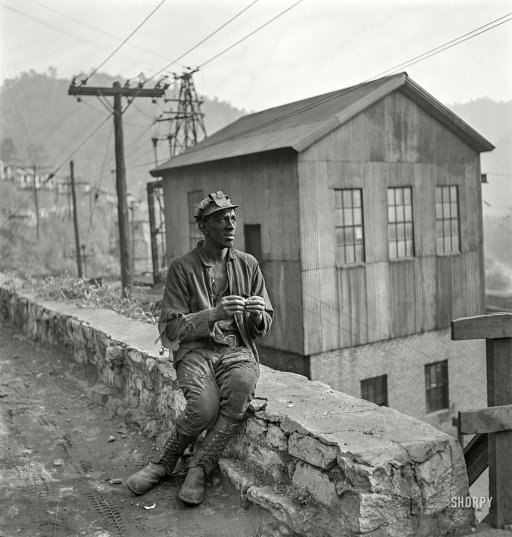
Marion Post Wolcott Coal miner waiting for lift home, Capels, West Virginia 1938

George Osborne declared on Monday that the UK “is in a position of strength” (he meant the economy, not the football team). No, it is not. That’s why he and his ilk lost the vote. But Osborne’s actually thick enough to look in the mirror and tell himself he did a good job. Utterly blind to the people he keelhauled over the past 6 years.

And no doubt while he’s at it, he’s at least tempted to label all 17 million Britons who voted ‘Leave’, uneducated racists. George’s well-to-do friends may be in “a position of strength”, but the British people who paid for these friends of George’s to be comfortable, are nowhere near “a position of strength”.

The only way to protest the wringer they have been put through was to vote against anything Osborne and Cameron represent. And so they did.

Most of the “Brexit is the end of the world” claims that have followed Friday’s referendum result are as stunning as Osborne’s blind spot for this own people (who he doesn’t even see as ‘his own’). And most of them come from people who until recently claimed to detest ‘Gideon’.

In the eyes of a vast majority of commentators, all hell is busy imminently breaking loose in UK society and its economy because those 17 million dumb racists voted No to the EU, which was in reality simply a No to Osborne and Cameron -and Juncker et al-, and all they stand for, something just about entirely overlooked; for most of these voters, it was not a Yes to anyone else, just a NO!.

At the same time the Leave campaign claims endless streams of milk and honey are in the offing, an equally unlikely proposition (is it perhaps an idea to not only talk about money or race; how about physics?).

Fact is nobody knows where Brexit will lead, for the simple reason that there are no precedents or other comparisons. Everybody on all sides just makes things up. Since most of the media outlets that have any pretense left of serious journalism are on the Remain train, it would be easy to be fooled by them.

The whole ‘discussion’ -it’s more an endless parade of monologues- has turned into the metaphorical hammer looking for a nail in embarrassing ways.

Who do all these people have to blame but themselves? Weren’t they the ones who felt up to the very last moment that there would be no Brexit? And isn’t that why they decided to keep calm and carry on? Let’s see some denials of that, please.

The “I was asleep but that’s not really my fault, is it?” kind of thing. Bring it on. The Guardian has the audacity to ask for donations from those who “appreciate their Brexit coverage”. Granted, they publish some 826 pieces a day on the topic. But I’d consider paying them just to stop doing that.


Hillary Clinton’s reaction to Brexit was to call for ‘steady, experienced leadership’. Which sounds sort of reasonable but is in reality just another way of saying ‘more of the same’. And that in turn happens to be exactly what Brexit was a reaction against.

Clinton’s simply and obviously aiming for those Americans who are afraid of change. But that doesn’t mean she has the power to prevent it. Nor that it’s a wise track to be on, given that Trump is where he is because so many people clearly want change, not ‘more of the same’.

European Parliament president Martin Schulz was quoted as saying: “The British have violated the rules. It is not the EU philosophy that the crowd can decide its fate.” Still wondering what the source of that quote is. Saw Prof. Richard Werner quote it, but without the source.

Jean-Claude -‘You have to lie’- Juncker told European Parliament members yesterday that he has imposed a ‘Presidential’ ban on EU commissioners holding informal or secret talks with the British about the country’s exit from the EU, until the UK government formally invokes Article 50. I bet you he’s holding secret talks right now.

A Bloomberg headline: “EU Chiefs ‘Held Hostage’ by UK Tell Cameron to Spell Out Goals”. Err, guys and dolls, Cameron resigned. He’s in no position to spell out anything, and he wants it even less; Georgy ain’t even touching that hot potato just to pass it on. He’ll take a pig’s head any day.


As Jeremy Corbyn faces a Labour Party rebellion, George Monbiot says “I fear that may be the end of the Labour party. Just when we need it most.“ No, that’s not what you need, George, you need a party or other organization that stands up for you and ‘yours’. And when’s the last time Labour has done that for the majority of British people?

Also, beware of economists who talk politics; they think these are separate fields. Some even think there’s science involved. Brexit is not “Britain’s democratic failure”, as economist Kenneth Rogoff suggests, that failure came a long time ago, when corporatism fascism came in, first through Labour’s own Tony Blair, and was subsequently perfected by Cameron and Osborne.

If anything, it’s the opposite, that is to say, Brexit is Britain’s democratic resurgence, though it has arguably come in a repulsively distorted shape. But perhaps that is inevitable once real democracy has had its head held underwater for so many years.

Through all the insistence that Britain must stay inside the EU, I can’t help wondering when ‘Britain can’t stand on its own two legs’, which is what all these commentaries come down to, came to be perceived as a winning argument, but all but a few ‘expert voices’ insist this is true.

‘Britain faces an uncertain future’. How awful is that? Still, I bet you, when next time it sounds even halfway convenient, uncertainty will get to mean ‘opportunity’. Oh, and don’t you, too, hate the implications of a word like ‘nervousness’, as in: “everyone’s nervous”? Well, unless one’s favorite musician or athlete talks about the ‘healthy nervousness‘ necessary to perform well.

Much respected economist/writer Edward Harrison says on Twitter: “.. this is the part I HATE. We are, what, 5 days into this. No one knows how severe the Market reaction will be. It’s ludicrous..”

And I’m like, chill, mate, why is it ludicrous that you can’t predict what ‘The Markets’ reaction to something, anything will be? If that’s something you HATE, maybe you should not be in the game, or in the kitchen for that matter.

The markets are not supposed to be predictable, and when they are, it means someone is manipulating them, and someone else is paying for that predictability, and that second someone is invariably not in on ‘the game’.

Kids say the darndest things. So do investors and economists.

Just because you want want certainty, doesn’t mean you have a right to it, democratic or not. And neither does anyone else. But if you want some regardless, here goes: you can be certain the economy will collapse at some point. That’s not the certainty you were looking for, is it? So what would you prefer, accepting that certainty, or to let someone tell you that this negative prediction is still uncertain? I’ll give you a few minutes to think about it.


Mariana Mazzucato, another economist, says:

The third challenge is green growth. EU legislation has improved the quality of British beaches and the air we breathe. But green policies will also form the next industrial wave that will lead to future prosperity. Today green spending is an option for governments and businesses; soon it will be a necessity. Those who have chosen to invest will be in a strong position.

And I’m thinking: where to begin? A wave of future prosperity? You mean as in Elon Musk prosperity? Using public money to blow pipe dreams? Green spending is a big ruse meant to allow the formerly rich -yeah, that’s you- lay their worried consciences to rest, and pay for it through their noses.

But there is so much debt burying us all, inside our own societies, that we will never be able to afford any transition to a green economy, even if it were possible from a physics point of view. Which it is definitely not. All the rest is just propaganda.

Our future consists of using a lot less energy -try 90% on for size-; how we get there is partly up to us -but only partly-, we can do it wisely and voluntarily or stupidly through hard set limitations, but that’s the only choice we have. We will never replace even a fraction of fossil fuels with wind or sun or algea or project X.

That same species of certainty applies to the European Union, even if it may appear -even- less obvious. The grandiose EU project of an ever closer union is running into the limits of economics as well as physics. European nations can work together, but not when they’re forced to give up their sovereignty, their independence and their livelihoods.

That will lead them to turn on each other. There’s no escaping it. The EU is the sack the cats will fight in.

The EU is a monstrosity with no parallel in modern times, as evidenced in how it bulldozed the Greek economy, and in how it allowed many hundreds of promising young lives to drown in the Mediterranean, and you Britons want to not just belong to that monstrosity, you’re willing to fight one another over the privilege?

I’m afraid I don’t get it.


Mar 062015
 
 March 6, 2015  Posted by at 4:57 am Finance Tagged with: , , , , , , , ,  10 Responses »


Harris&Ewing US Weather Bureau kiosque, Pennsylvania Avenue, Washington, DC 1921

See, by now you would think that anyone who reads that all 31 US banks that were tested have passed the Fed stress test, knows this says absolutely nothing about the banks, but all the more about the test. You would think. But the media try – and succeed – to cram it down the public’s throat as a success story anyway.

There’s simply a very strong feeling, if not conviction, in the western media, that they’ve won the propaganda battle. They have no adversary other than the blogosphere, and since they reach a thousand times more people, who are to a (wo)man more complacent and gullible than any of your typical interwebs readers, Bob’s their uncle.

But come on guys, are we really going to let this happen without raising our voices or even batting as much as one of our eyes? We’re drowning in nonsense here, and we’re prepared to just die without even trying to swim?

Look, I find real fun in reading that the UK House of Lords issues a report that claims 150,000 jobs will be created by 2050 in the ‘drone industry’, and at the same time clamors for a ‘personal drone registry’. I mean, these guys are way too old to even know how to spell ‘drone’. But that’s just mindless ‘journalism’, and to a point innocent.

What is not is the two portraits of US girl power in Ukraine from the Guardian and Bloomberg that appeared over the past two days. That’s not innocent, that’s vile and bastardly lies. Victoria Nuland and Natalie Jaresko should not be praised by the western media, they should be taken apart bone by bone, because the roles they play are far too shady to stand up to our alleged democratic principles.

Bloomberg is, well, Bloomberg, but why the Guardian gets involved in this sort of apologetic feel-good ‘reporting’ is beyond me. Other than: how much does it pay?! I mean, who needs a brain when you have a keyboard? Nuland and her hubby Robert Kagan – and don’t you even try and make me picture them in bed together plotting fresh invasions – are the flashing neon signs for everything neocon in America today.

She has – more or less voluntarily – admitted to staging the year-old Kiev coup and installing US puppet Yatsenyuk as Ukraine PM, as well as pushing $5 billion in US taxpayer funds to various Ukraine ‘charities’ to make it happen.

And then the Guardian has the gall to present her as your average American girl next door? Nuland creates wars, and misery, and bloodshed, and she does so fully convinced she’s serving some deity’s purpose. She should have long since been removed from any and all offices, but she’s still in place, which paints a damning enough picture of US politics all by itself.

Yeah, sure, let’s make Victoria look normal, right, Guardian?

Victoria Nuland: Russia’s Actions In Ukraine Conflict An ‘Invasion’

Assistant secretary of state Victoria Nuland has admitted the US considers Russia’s actions in Ukraine “an invasion”, in what may be the first time a senior American official has used the term to describe a conflict that has killed more than 6,000 people. Speaking before the House committee on foreign affairs, Nuland was asked by representative Brian Higgins about Russia’s support of rebels in eastern Ukraine, through weapons, heavy armor, money and soldiers: “In practical terms does that constitute an invasion?”

Nuland at first replied that “we have made clear that Russia is responsible for fielding this war,” until pressed by Higgins to answer “yes or no” whether it constitutes an invasion. “We have used that word in the past, yes,” Nuland said, apparently marking the first time a senior official has allowed the term in reference to Russia’s interference in eastern Ukraine, and not simply its continued occupation of the Crimean peninsula.

Obama administration officials across departments have strenuously avoided calling the conflict an invasion for months, instead performing verbal contortions to describe an “incursion”, “violation of territorial sovereignty” and an “escalation of aggression”. In November Vice-President Joe Biden, who has acted as one of Obama’s primary liaisons with the Ukrainian president, Petro Poroshenko, rapidly corrected himself after breaking from the White House’s careful language on CNN, saying “When the Russians invaded – crossed the border – into Ukraine, it was, ‘My god. It’s over.’”

But that’s nothing compared to today’s Bloomberg portrait of Natalie Jaresko, the US stooge installed late last year to run Ukraine’s economy into the ground as finance minister. This is something else altogether. The first thing that comes to mind is: ‘have you no shame?’, but then you realize it’s Bloomberg. The subtitle is: Why Natalie Jaresko Is As Important As The Country’s Generals. I kid you not. In days of old, the CIA would have had to look through the Yellow Pages, but this time around I’m pretty sure they used Facebook to find Americans with Ukie blood ties. They then pumped her full of dollars, 100s of millions of them, and then she was ready to go. Mind you, she was picked way ahead of the regime change a year ago. The whole thing was planned well in advance. 10 years or so in advance.

C’mon, the first paragraph alone should be profoundly sickening to any functioning neuron:

The American Woman Who Stands Between Putin and Ukraine

Ukraine is a nation at war, which is why Natalie Jaresko, the minister of finance, has traveled 20 miles from Kiev to the town of Irpin, a settlement of 40,000 on the edge of a pine forest. She’s here to visit a rearguard army hospital and to console convalescing veterans of recent battles against Russian forces and their proxies in the Ukrainian east. “Where did you serve?” she asks, moving slowly from room to room. “How were you wounded?” She may be from Chicago’s West Side, but she speaks Ukrainian fluently, and if anyone notices her American accent, no one seems to care. Jaresko tells the soldiers they’re heroes, the country’s national accountant handling a job for generals. The crisis has thrust people into unlikely roles.

Three months ago, Jaresko, 49, left the private equity firm that she co-founded in Ukraine in 2006 to join the government of Petro Poroshenko. At the time, Jaresko didn’t even have Ukrainian citizenship. Now, as the country’s top economic official, she’s Ukraine’s liaison to the World Bank, the IMF, and the European Bank for Reconstruction and Development. Tax reform is hers. So is the treasury.

The country’s bankrupt. So much so that no amount of IMF funding can change that. Besides, a substantial amount of whatever funding will be made available, will need to go to what is still called an army, lest Kiev loses out completely against the rebels it has tried to annihilate for a year now. But it can get worse, just read this bit:

[..].. whether Ukraine succeeds as an independent democratic nation arguably depends as much on the efforts of Jaresko and her colleagues as it does on the military battles. Together they must rebuild a shattered economy and restore international confidence in Ukraine while confronting the corruption and cronyism that have haunted the country since the fall of communism. And they must somehow do so as state-owned banks teeter on the brink of collapse, the national treasury counts its last foreign notes, and inflation is at 28% and rising. The longer the war carries on and reforms are delayed, the more hostile Ukrainians will become to their government and its Western supporters, leaving the country even more vulnerable to Vladimir Putin.

Uh-uh. The people will turn against the US and EU, but they don’t really know what’s good for them do they? Even if they hate the heebees out of us, we must still protect them from Vlad the Impaler. Sorry, it’s for your own good…

Jaresko, 5 feet 6 inches tall, wears her dark hair at chin length. As she continues through the Irpin hospital, she’s solemn, respectful. More soldiers receive her, cramped two and three to closetlike rooms, jammed into beds sized for children. They discuss their lack of firepower in the field: Why don’t we have modern weapons? How does the enemy know where we are all the time? Jaresko listens. She knows better than any general that Ukraine doesn’t have the funds to better arm itself. She asks the soldiers what they plan to do once they’ve recovered. To a man, they say they’ll return to the front lines.

Ex-f##king-cuse me, but since I know anywhere between half a million to over a full million men have fled the country just to escape serving in the Kiev army, I’m wondering what lengths Bloomberg’s Brett Forrest and his new-found Mother Teresa went through to find a hospital where defeated soldiers, to a man no less, claimed they’d go back if only they could. Who believes this shit? And who needs it to begin with?

Yada yada, Jaresko life story, Ellis Island, Chicago, yada yada, and then this:

In the mid-1990s, Ukraine endured hyperinflation of 10,000%. A few years later came the shock waves of Russia’s financial crisis. The Ukrainian economy showed its first signs of growth only in 2000, after almost a decade of decline. Then, in 2004, came the Orange Revolution. While the country entered a new period of uncertainty, international institutional investors began to arrive. Two years later, Jaresko and three partners opened investment management firm Horizon Capital. It managed the Western NIS Enterprise Fund and eventually raised two more. When she left last December, it had roughly $600 million of Ukrainian investments under management.

I don’t think that’s Ukrainian investments, I’m thinking it’s western investments in Ukraine. Jaresko was set up very well, financially. From the $5 billion VIctoria Nuland admitted the US had spent to change the regime. She’s a well paid stooge. You do have to wonder what’s left of Jaresko’s riches now that Kiev’s as broke as a wino in the dead of winter.

Last year’s regime change, Jaresko says, represented a real turning point—a chance to finally end kleptocratic rule. “Anyone close to Ukraine understood that this was an incredible moment to take Ukraine forward in a way that it hadn’t gone quickly enough over the past 22 years,” she says. “That there had been a radical change in civil society, and that civil society’s expectations could no longer be put on the back burner by anyone.”

‘Forward’ in this case apparently means into war and bankruptcy, that’s all that’s been accomplished. Yeah, sure, Nuland’s neocons understood that ‘this was an incredible moment to take Ukraine forward in a way that it hadn’t gone quickly enough over the past 22 years..’ Just read that sentence again knowing it comes from that woman, and knowing she’s helped bring down the entire nation. It gives it a whole other meaning.

Yada yada, headhunting firm happenstanced upon an American CEO in Kiev (there’s so many of them it’s hard to keep track ;-)). “They played hard on my patriotism..” “I sometimes wonder what my father would think..” Please hand me a bucket!

Then some to and fro about how the state is too weak to fight Russia – which they’re not, they’re fighting their own citizens -, and paragraphs of financial blubber and outright lies, culminating in:

…economics minister Abromavicius saying his office projects a 5.5% reduction in the economy this year. That doesn’t take into account Putin’s future actions in the east. We work under the assumption that there will be peace very soon, he says. This conflict is misguided. The Russian leadership is misguided about Ukraine in general. They just don’t understand Ukraine. This country wants to be left alone. This country wants to make its own decisions.

‘This country wants to make its own decisions?’ Well, you should have made sure you didn’t go broke then. Because from here on in, you’ll never again make any decision you can call your own, and that includes choosing the color of toilet paper in your government offices. The US will do that for you. That’s why Jaresko is where she is. Ukraine had a lot more freedom before Maidan.

As the young government’s leaders and supporters tirelessly point out, the war with Russia has so far been contained to less than 10% of Ukraine’s territory.

First, there is no war with Russia, only with Ukrainian citizens. And if it’s less than 10% of the territory, that’s only because the rebels have no claim on anything but their own land. They don’t want Kiev, they just want Kiev to leave them alone and stop killing their women and children. But if it won’t, the rebels will take more territory, just so Kiev can’t use it to attack them anymore.

But it must be convenient to be able to hang an entire country’s demise on one person, no matter what happens. I just read that US House Speaker Boehner sent a letter to Obama claiming that Russia’s actions in Ukraine are a ‘grotesque violation of international law’. If that is so, what does that say about America’s actions in Ukraine?

The US must withdraw Nuland and Jaresko from their respective positions starting yesterday morning. But they won’t, they have achieved exactly what they were aiming for: a nation so shattered it’s dependent on US and IMF money just to survive, just to pay for the ink needed to draw its borders on a map.

From here on, it’s just a matter of waiting for Putin to get so sick of all this he decides he can’t let Kiev go down any further, lest all that’s left is neonazis and neocons, and they start aiming their US and/or UAE supplied ‘lethal defensive’ weapons eastward. And then they’ll get what they’ve wanted all along, Yatsenyuk and Poroshenko and Nuland and Jaresko: They’ll get War. But it won’t come the way they envisioned it. Putin’s way too smart for that.

Anyway, what a shameless depiction of Ukraine we get here. It’s all-out propaganda, no prisoners taken. I’m getting tired of getting angry about it, but someone has to.