Mar 072022


Marcel Duchamp The king and queen surrounded by swift nudes 1912

 

One Glorious Day In Sevastopol 12 Years Ago (Peter Hitchens)
Ukraine is Trying to Goad the US into World War III (Tracey)
Putin’s Last Warning Before Beginning Of The 2nd Phase (Saker)
No, Russia Didn’t Get its Propaganda From John Mearsheimer (IC)
The War on Humanity… (McKinney)
Maria Zakharova’s Full Statement About Russia And Greece (GR)
Foreign Fighters Arrive in Ukraine to Repel Russian Invasion (LI)
Russia’s Yamal-Europe Westbound Gas Pipeline Flows Stopped On Friday (R.)
Russian Showdown and Food Prices (Cortes)
China Ag Minister Says Winter Wheat Condition Could Be Worst In History (R.)
Trojan Horse | The Problem with Gene-based Injections – Part 2 (Remnant)
CDC Warned ‘Criminal’ Fraud Investigation ‘Ready to Go’ After Midterms (BN)


“The gas price in Europe has more than doubled since February 23: from 88 euros per megawatt hour to a record peak of 212 euros on Friday afternoon. Compared to a year ago (less than 17 euros), that is about a twelvefold increase.”



Karen
https://twitter.com/i/status/1500399860335493124
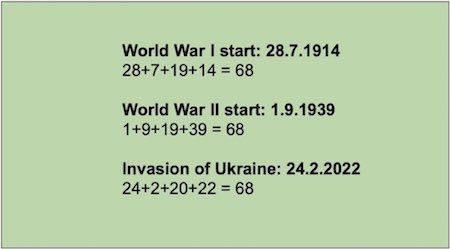


A Canadian
https://twitter.com/i/status/1500632350207754240


“..to give light to them that sit in darkness, and in the shadow of death, and to guide our feet into the way of peace..”

One Glorious Day In Sevastopol 12 Years Ago (Peter Hitchens)

In the long-ago summer of 2010, I found myself in the beautiful harbour of Sevastopol, surveying the rival fleets of Russia and Ukraine as they rode at anchor in the lovely Crimean sunshine. One great fortress was adorned with banners proclaiming ‘Glory to the Ukrainian Navy!’ Another frowning bastion across the water bore the words ‘Glory to the Russian Navy!’ In the streets of that elegant city, with its porticoes and statues and monuments to repeated wars, sailors from the two fleets mingled on the pavements. The Russians looked like Russians, with their huge hats and Edwardian uniforms. The Ukrainians looked more like the US Navy on shore leave in San Diego. It was almost funny to see. I hoped at that time that it would work out well. For the Ukrainians had begun to be silly. In a country crammed with Russians, they were trying to make Russian a second-class language.

Russians who had lived there happily for decades were pressured to take Ukrainian citizenship and adopt Ukrainian versions of their Christian names. The schools were promoting a national hero, Stepan Bandera, who Russians strongly disliked and regarded as a terrorist. And they were teaching history which often had an anti-Russian tinge. Quite a few people told me they felt put upon by these policies. Why couldn’t they just be left alone? Until that point, Ukraine had been a reasonably harmonious country in its 20-odd years of existence. After that visit I saw big trouble coming, both in the Crimea and in the Don Basin, where I also travelled that year. Far out among the abandoned slagheaps of the dying coalfields, I found the decaying semi-deserted town of Gorlovka, now in the midst of an unofficial war-zone, where it has been since 2014.

This town had been officially renamed Horlivka by Ukraine in its high-handed way, though hardly anybody I met there called it that. Gorlovka in those days still hosted the rather pleasant Cafe Barnsley, the last echo of the Soviet days when Gorlovka had been twinned with Barnsley in a gesture of Communist solidarity with Arthur Scargill’s miners. I remember, that boiling hot, almost silent afternoon, enjoying a Russian beer there, while listening to music from a Russian station on the radio. I wrote rather vaguely at the time that the people of Crimea and Donbas were hoping for – and expecting – a Russian future. I thought that if Ukraine wanted to be a rigid ethnic nationalist state, then some sort of peaceful deal with its Russian minority was going to be needed. Little did I know what passions I had touched on.

[..] I would like to end with two quotations. The first is from the American Civil War General William Tecumseh Sherman who said: ‘I am sick and tired of war. Its glory is all moonshine. It is only those who have neither fired a shot nor heard the shrieks and groans of the wounded who cry aloud for blood, for vengeance, for desolation. War is hell.’ The other is from the ‘Benedictus’ in the Church of England’s 1662 Book of Common Prayer, which asks God ‘to give light to them that sit in darkness, and in the shadow of death, and to guide our feet into the way of peace’, which I fervently pray, for I am not sure that anything else will now do any good.

Read more …

“His nonstop lobbying offensive included a soaring address Friday to what some media outlets ludicrously described as an “anti-war rally”..”

Ukraine is Trying to Goad the US into World War III (Tracey)

The reason we know Ukrainian officials are trying to goad the US into war is because that’s exactly what they say they’re doing. There is no ambiguity here — at this very moment, a furious multi-front lobbying blitz is underway to solicit full-fledged US military intervention in Ukraine, and therefore open warfare against Russia. To put it bluntly, a foreign country’s representatives are doing all they possibly can to instigate the closest thing anyone on Earth has ever experienced to World War III. At the forefront of this campaign is the president, Zelensky, who’s been transformed overnight into an international folk hero. His nonstop lobbying offensive included a soaring address Friday to what some media outlets ludicrously described as an “anti-war rally” in Frankfurt, Germany.

Such a description is ludicrous because the headline takeaway from the rally was Zelensky passionately condemning the alleged cowardice of NATO countries — for, as yet, refusing to launch a war against Russia. “All the people who die from this day forward will also die because of you, because of your weakness,” he inveighed. In his pro-war advocacy, Zelensky uses the same clever euphemism that has now entered heavy circulation: “No Fly Zone.” At this point, everyone with a bare-minimum understanding of what a US-administered “No Fly Zone” would entail has readily acknowledged that it means direct war with Russia — and by extension a radically increased risk of nuclear annihilation. Still, this is what Zelensky is calling for any chance he gets, in his true-to-form showbiz style.

(For those unaware, his professional endeavors prior to assuming the presidency included a stint as “the Ryan Seacrest of Ukraine,” as VICE once put it, not to mention his role playing the character of “President” on a comedy TV show.) During an interview with CNN last week, masterfully choreographed from his underground bunker, Zelensky was asked what he would tell Joe Biden ahead of the State of the Union speech. His answer: impose the No Fly Zone immediately. To dispel any concerns about the dangers of his demand, Zelensky added that it “does not mean dragging NATO into this war.” Well, phew! That’s a relief. “Frankly, you know, everyone is drawn into the war now,” he explained. Unfortunately, if you actually examine the logic that’s operative here, your relief should quickly turn to dread. Zelensky is saying that NATO (or in other words, the US) has already been dragged into the war.

World War III has already commenced, is what he’s saying. In which case, a “No Fly Zone” wouldn’t really be an escalation per se — it would just be a retaliatory strike in a war that’s already ongoing, whether we like it or not. That’s the argument. In an op-ed generously facilitated by the New York Times last week, Zelensky’s chief of staff — also writing from the storied underground bunker, we’re told — laid out the logic even more clearly. He implored: We are calling on the West to impose a no-fly zone over Ukraine. We recognize that this would be a serious escalation in the war and that it could bring NATO into direct conflict with Russia. But we firmly believe that Russia won’t stop at just Ukraine, which would potentially drag NATO into this conflict anyway. A no-fly zone would at least give Mr. Putin some pause.
Read more …

“The logical solution would be to offer the combatants (and the civilians) corridors to exit the city, but the West can’t have that.”

Putin’s Last Warning Before Beginning Of The 2nd Phase (Saker)

Yesterday Putin had a most interesting conversations with members of what look like members of an flight attendant union. We hope to bring the the whole thing subtitled in English later today, but here is the key sentence made by Putin during that conversation: “If the leadership of Ukraine continues to do what they are doing, it will call into question the future of Ukrainian statehood, and that will be entirely their responsibility”. I think that it is important to understand the context in which Putin made this statement. As a reminder
• The Ukronazi armed forces are down to less than 25% of its original size.
• Almost all the remaining forces are in some type or another of cauldrons.
• Russia has full air supremacy
• The Ukronazi fleet does not exist anymore
• In spite of all the propaganda, no help from abroad will affect the outcome of this war
• It appears that Russia will surround Odessa and eventually take control of the entire Ukrainian Black Sea coast

In other words, what seems to be shaping up is that Russia will soon have control over the entire Ukraine except for the western provinces (west of Vinnitsa and Zhitomir). In other words, the war is over, at least militarily. There will be a meeting between Russian and Ukrainian negotiators tomorrow, and it shall be interesting to see if something, anything, will come out of it. The west is clearly determined to heroically fight Russia down to the last Ukrainian. Russia wants to stop this operation as soon as possible, but only after her double goals of 1) disarmament and 2) denazification are achieved. Right now the big question is Kiev. It’s a big city with plenty of civilians and probably 30-50 thousand combatants of all different kinds (VSU, SBU, Volkssturm, deathsquads, looters, etc.). The logical solution would be to offer the combatants (and the civilians) corridors to exit the city, but the West can’t have that.

Now if the Ukies won’t vacate Kiev, then some rather serious fighting will take place inside the city and clearing the city from the Nazis will demand the involvement of a major Russian force. It appears that these forces are now in their staging areas all around the city (except for the south). Think about it this way: the frontline (line of contact) is now very long and the Ukies don’t have enough forces to even try to hold any frontline in such a context. However, remember the number of Russian forces deployed along the Ukrainian border – about 100’000+ or so soldiers? It appears that there are currently not enough Russia forces to fully exploit the Russian advances over the past ten days. Alternatively, we could say that the Russian force is big enough, but that now it has to sharply increase its use of firepower to further develop its operations.

Read more …

I watched the 22 min. opening statement/analysis by Maersheimer. Highly recommended.

No, Russia Didn’t Get its Propaganda From John Mearsheimer (IC)

A minor squall on Twitter this past week may have largely gone unnoticed amid the larger hurricane about Russia’s invasion of Ukraine. But it’s worth taking a close look at it, because it illustrates something significant about U.S. foreign policy since World War II, and how propaganda works everywhere. It started when Russia’s Ministry of Foreign Affairs — the equivalent to the U.S. State Department — did something unusual: It tweeted out an endorsement of a 2014 article in Foreign Affairs — the publication of the Council on Foreign Relations, probably the most influential American think tank on U.S. foreign policy. The piece was by John Mearsheimer, a professor in the political science department at the University of Chicago and a prominent member of the “realist” school of foreign policy thought. You can understand why the Russian government liked it, because it was called “Why the Ukraine Crisis Is the West’s Fault.”

This led to a response from Anne Applebaum, a neoconservative journalist who’s currently a staff writer at The Atlantic. “Now wondering if the Russians didn’t actually get their narrative from Mearshimer et al.,” she wrote. “Moscow needed to say West was responsible for Russian invasions (Chechnya, Georgia, Syria, Ukraine), and not their own greed and imperialism. American academics provided the narrative.” The “et al” part is important here. In U.S. political lore NATO was created in 1949 as a defensive military alliance against the Soviet Union and its allies. The reality was somewhat different. But for realists in general, not just Mearsheimer, the Soviet collapse and the end of the Cold War meant that an expansion of NATO could lead to dangerous conflict with Russia.

Fifty American foreign policy leaders, largely realists, wrote to President Bill Clinton in 1997 that pushing NATO’s borders eastward would be “a policy error of historic proportions. We believe that NATO expansion will decrease allied security and unsettle European stability … In Russia, NATO expansion, which continues to be opposed across the entire political spectrum, will strengthen the nondemocratic opposition, undercut those who favor reform and cooperation with the West, bring the Russians to question the entire post-Cold War settlement, and galvanize resistance in the Duma …”

Read more …

“We are all Russians now.”

The War on Humanity… (McKinney)

The current situation in Ukraine has once again invigorated the lying Western media and sent them into an anti-Russian frenzy. For the last two years the media has been enthusiastically pushing the genocidal Covid narrative on behalf of the Globalist faction. Whatever doubtful credibility they had prior to Covid they have destroyed with their relentless lies. With an astonishing lack of self-awareness they are now pushing the anti-Russian narrative like the unprincipled mindless hacks that they are. Ignoring both facts and context they are relentlessly promoting war propaganda to justify this hostility to their own beleaguered populations. The unfortunate reality is that despite unprecedented distrust in the media that propaganda works. Anti-Russian sentiment is rising throughout the West.

We have witnessed the same phenomena with the rabid anti-China narrative emanating from Western governments and their client stenographers in the media. The message is clear, unless you are a pliant puppet of the Anglo-American empire, then obviously you are evil and must be destroyed. The truth of course is deeper, the real war the Globalists are fighting is against the citizenry of every country on earth. As the Covid atrocity is being rapidly exposed the repression of the people is the only option open to the New World Order Davos cabal. As has always been the case, a war abroad is the best excuse to impose tyranny at home. The Western Neo-liberal governments of America, Canada, Australia and most of Europe cannot afford to be removed from power. The full anger of the people will be unleashed full power against those who imposed the Genocidal Covid lie upon them.

Trudeau, Macron et al will be held to account (one way or another) for their pivotal roles in this atrocity. They cannot allow that to happen, they have too much to lose. The tragic and unnecessary conflict in the Ukraine can be viewed as the “Great Reset War”. Although targeted towards Russia for media purposes, its real objective is the further subjugation of the peoples of their own countries. The Western Neo-liberal agenda is failing on every front, economically, socially and morally. The Cabal has destroyed the once prosperous and free societies that they governed. The dystopian future that they have planned for the world is now plain for all to see. It has been on display in Canada and Australia, New Zealand and throughout Europe. It is a prospect that should alarm everybody.

“The Great Reset” is the Cabal’s way of ensuring that the same Globalists who plunged the world into chaos are still in charge after the coming inevitable collapse. The Green agenda and the 4th industrial revolution are about de-industrialising the world and destroying successful industrial competitors such as Russia and China. Not surprisingly, neither Russia or China, along with India and Iran are going along with this insidious plan. They are not alone, many countries from Africa, South America and Asia are also gravitating more towards the Russian/Chinese orbit. All have good reasons to be distrustful and angry at the Empire. The Cabal is weak and failing, it has created powerful enemies who are formidable obstacles to the New World Order and the Great reset. Expect this to embolden other countries to resist the Empire’s plans.

Anne-Laure Bonnel

Read more …

Greece was for a long time perceived as being closer to Russia than other nations, both at home and abroad. That is why Zakharova addresses the current situation.

Maria Zakharova’s Full Statement About Russia And Greece (GR)

“We noticed the unprecedented campaign launched in Greece to defame Russia’s policy. Senior officials in Athens allow themselves to make crude accusations against our country and its leadership, they are literally competing with their like-minded people. They hypocritically speak of an “unprovoked attack” against Ukraine, for the first time since World War II, a “mass invasion” and so on. It should be recalled that with the efforts, first of all, of the US and its satellites, wars and conflicts have shaken the world for the last decades – the NATO bombing of Yugoslavia in 1999, the operations in Iraq, Syria, Libya, Afghanistan. No one has taken responsibility for the enormous sacrifices and suffering of the peoples of these countries. Today, the crimes of the Kiev regime, which came to power as a result of the bloody coup of 2014, remain in the shadow of the new wave of anti-Russian criticism.

The fact that Crimea and Sevastopol paid for their free reunification with Russia with total blockade and Western sanctions is silenced. In the besieged Donbas, as a result of the neo-Nazi Ukrainian clearing operations, more than 14,000 civilians have been killed in the past eight years, and the Russians have been offered to leave Ukraine. The meaning of the daily shootings can be explained, among others, by the Greek expatriates who live in the territories of the Luhansk People’s Republic and the Donetsk People’s Republic. The European Union has chosen to silently watch the extermination of the Donbass civilian population, becoming an accomplice in the long-standing genocide of the people of southeastern Ukraine. Now Europe, including Greece, is fully integrated into the ranks of the Kiev regime’s advocates, while the anti-Russia hysteria cultivated by the authorities has reached a boiling point.

On this basis, profoundly wrong, criminal decisions are made, including the shipment of weapons to Ukraine. Eventually, weapons will be turned against civilians, including Greeks, by Ukrainian nationalist battalions that use them as human shields and who have already fallen victim to this inhumane tactic. In the name of collective Western plans – to do harm to Russia at all costs – common sense has been sacrificed. Bilateral ties are being deliberately damaged, and Russian-Greek relations, unfortunately, are no exception. Athens actively supports the EU sanctions regime. They accuse us of so-called “energy blackmail”, proclaiming the goal of rapid independence from Russian gas, the uninterrupted supply of which for decades has been a stabilizing factor for the national energy sector. With the collective directive of Brussels, the Greek sky closed for the Russian airlines.

The order was given for the suspension of any cooperation in the field of culture, for the interruption of the Common Dedicated Years. There are calls for a complete cessation of any cooperation. Essentially, for the sake of vague and dubious goals, the Greek leadership was to nullify our own common historical heritage, which only yesterday it characterized as its natural advantage in cooperating with Russia. “Time will put everything in its place, will show who was right and who – the critical one – showed a lack of insight, made the wrong choice. We believe that the eternal ties that unite the peoples of Russia and Greece will withstand these trials as well.“

Read more …

Hemingway romanticism?

Foreign Fighters Arrive in Ukraine to Repel Russian Invasion (LI)

At least 16,000 foreign nationals have volunteered to join an “international legion” created to resist Russia’s invasion of Ukraine, President Volodymyr Zelensky claimed, after Kiev lifted visa requirements for anyone willing to fight. “Every friend of Ukraine who wants to join Ukraine in defending the country, please come over,” Zelensky pleaded at a recent press conference, adding “We will give you weapons.” Though the president offered no details on the international fighting force, including the origin of the volunteers, the request comes as Kiev appears to grow more desperate for help in pushing back Russian troops – having already declared martial law and a “general mobilization” of its populace. Those policies include conscription for men aged 18-60 and the commandeering of civilian vehicles and structures, while Ukrainian convicts with military experience are being released from prison to back up the war effort.

Despite the lack of specifics from officials, however, media reports suggest that foreigners from a long list of nations are lining up to enlist. Around 400 Swedes have signed up for the legion, according to the country’s TT News Agency, which cited the group’s coordinator Philip Brannval. The first flight departed Thursday for Poland – thought to be a logistics hub for arms and aid deliveries – and from there the volunteers will enter Ukraine by land, Brannval said. Czech Prime Minister Petr Fiala, meanwhile, announced on Thursday that the government would not punish those seeking to join up with Ukrainian forces, as the country typically prohibits citizens from serving in foreign armies. Up to 300 Czechs have reportedly vowed to ship out. Prague, unlike non-aligned Stockholm, is among NATO’s 30 member states.

The Czech government is also now moving to criminalize speech supporting Russian President Vladimir Putin or the Russian invasion. Czech police report that they are already investigating hundreds of people for alleged support for Moscow, with criminal proceedings in nine cases. A small handful of American, Canadian and German special forces veterans are also set to join the fight, according to interviews by BuzzFeed News. The outlet noted the group – numbering just 10 people in total – is “NATO-trained and experienced in close combat and counterterrorism.” A pair of retired American infantry officers will also fly over to provide “leadership” for the squad, while several other US and Canadian citizens also told Reuters they intend to answer Zelensky’s call.

Canadian Foreign Minister Melanie Joly told reporters over the weekend that Ottawa would leave the decision to fight up to individual citizens. The US State Department, however, continues to urge Americans to avoid travel to Ukraine amid the hostilities.

Read more …

“Since December, however, it has been operating in reverse and driving European gas prices higher.”

Russia’s Yamal-Europe Westbound Gas Pipeline Flows Stopped On Friday (R.)

Westbound natural gas flows through the Yamal-Europe pipeline stopped on Friday while Gazprom’s bids for additional transit capacity via Ukraine stand at high levels, data from pipeline operators shows. Flows to Germany via the Mallnow metering point stood at about 101,119 kilowatt hours per hour (kWh/h) earlier on Friday morning and were about 13.5 million kilowatt hours per hour overnight. Russian energy company Gazprom on Thursday resumed westbound natural gas supplies via the Yamal-Europe pipeline to Germany from Poland and booked 7.8 million kilowatt-hours per hour of gas transit capacity via the pipeline for Friday morning until Saturday morning.


The pipeline between Poland and Germany usually accounts for about 15% of Russia’s westbound supply of gas to Europe and Turkey. Since December, however, it has been operating in reverse and driving European gas prices higher. Russian President Vladimir Putin has said that Russia would continue to supply gas to world markets, though the United States and its European allies have been strengthening sanctions against Moscow after Russia’s invasion of Ukraine.

Read more …

“Washington’s insistence on hugely escalating the economic war with Russia incites enormous risks, including for our food.”

Russian Showdown and Food Prices (Cortes)

Since the invention of synthetic ammonia-based fertilizers roughly a century ago, yields on crops have rocketed higher, meaning far more output from every acre that is planted. During that same time, the global population went from 1.7 billion to 7.7 billion people, yet agriculture kept pace, feeding a more crowded and prosperous world, largely because of advances in fertilizers. Dependable and affordable foodstuffs became almost a given, especially for America, a land blessed with “amber waves of grain.” Now, much of that progress is put at risk. A Midwestern farmer explains the economics of the situation. Ben Riensche farms 16,000 acres in Iowa and warns Americans: “You think they squawk about having gas go from three to four dollars a gallon? Wait until the grocery bill is $1,000 a month.”


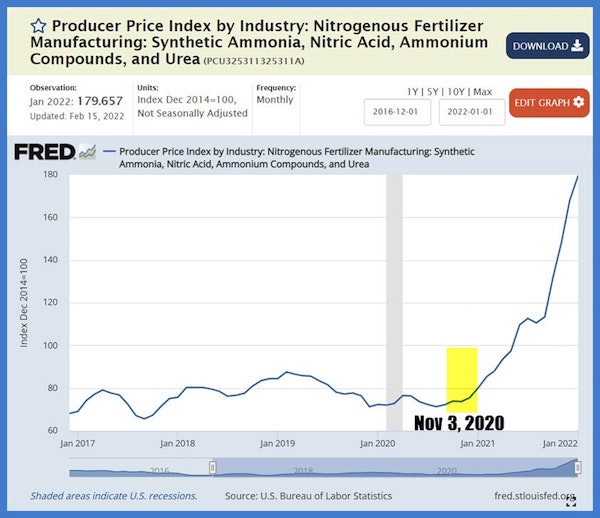
There are two main causes for this massive input price appreciation. The first is the overall explosion in inflation caused by the misbegotten policies of the Biden administration, including his eco-radical war on energy, a critical component of fertilizer production. But the second, new issue is Russia. The US has declared an unprecedent economic war against Russia because of its invasion of Ukraine. While the offense against Ukraine’s sovereignty is inexcusable, Washington’s insistence on hugely escalating the economic war with Russia incites enormous risks, including for our food. Cutting off Russia equates to havoc for farming, right into planting season. Bloomberg’s fertilizer analyst Alexis Maxwell describes Russia’s importance: “No other nation has the same breadth of readily exportable fertilizer supply.” Not surprisingly, the price of fertilizer storms higher. This chart depicts the St. Louis Fed’s Fertilizer Index which combines synthetic ammonia, nitric acid, and urea.
Read more …

China is buying up all the world’s food.

China Ag Minister Says Winter Wheat Condition Could Be Worst In History (R.)

The condition of China’s winter wheat crop could be the “worst in history”, the agriculture minister said on Saturday, raising concerns about grain supplies in the world’s biggest wheat consumer. Speaking to reporters on the sidelines of the country’s annual parliament meeting, Minister of Agriculture and Rural Affairs Tang Renjian said that rare heavy rainfall last year delayed the planting of about one-third of the normal wheat acreage. read more A survey of the winter wheat crop taken before the start of winter found that the amount of first- and second-grade crop was down by more than 20 percentage points, Tang said. “Not long ago we went to the grassroots to do a survey and many farming experts and technicians told us that crop conditions this year could be the worst in history,” he said. “This year’s grain production indeed faces huge difficulties.”

The minister’s comments underscore concerns about China’s grain supply at the same time as the war between Russia and Ukraine, which together account for about 29% of global wheat exports, has disrupted supplies causing wheat prices to surge to 14-year highs. However, Tang is confident China can ensure a bumper harvest of summer grain thanks to strong policy and technical support and the improving crop condition for the grain. Fuelled by the Ukraine crisis, wheat prices in China soared to a record this week on existing domestic supply worries. Tang’s comments also come as Beijing has refocused on food security, a long-standing priority for the central leadership that has become increasingly prominent in policy since the COVID-19 pandemic began in early 2020.

China’s state planner said in its own report at the parliament meeting that grain supply remains tight, despite consecutive good harvests in recent years. To address the issue, the National Development and Reform Commission’s (NDRC) report said China will ensure that grain acreage for the year stays above 117.33 million hectares (289.93 million acres). China will also increase the production of soybeans and other oilseed crops, the NDRC said, reiterating top policy priorities in the farm sector. The country will also build up momentum to increase corn output, it said. China’s corn imports surged to a record last year, amid soaring domestic prices and low inventories. China will guarantee the supply-demand balance of grain, edible oil, cotton, sugar and fertilisers through the effective use of reserves and imports, the NDRC said.

Read more …

“Before your cells fused with LNPs, they were healthy..”

Trojan Horse | The Problem with Gene-based Injections – Part 2 (Remnant)

Here is a summary of the argument that these injections induce an autoimmune response against the cells which fuse with the lipid nanoparticles (LNP) that carry the mRNA transcript encoding the Spike protein.

  1. Spike-protein encoding genes are wrapped in lipid nanoparticles (LNP)
  2. LNPs are injected into a human
  3. LNPs enter the bloodstream
  4. Bloodstream spreads LNPs throughout the body
  5. Cells fuse with LNP & make the Spike protein – the antigen
  6. Cells then present the antigen via MHC I í! Train killer T-cells
  7. Killer T-cells circulate around the body and destroy any cell that is presenting the Spike protein antigen


This is the critical final step:
• Before your cells fused with LNPs, they were healthy
• After vaccination, killer T-cells now perceive those healthy cells as infected – requiring destruction

This is the definition of an autoimmune response – the host immune system turns on its own healthy cells. Unfortunately for us, this is just one of the consequences of these injections… [..] the aforementioned injections contain an RNA sequence which encodes the SARS-CoV-2 chimeric Spike protein. This RNA sequence is modified, and encased by lipid nanoparticles (LNPs) – fancy talk for nanometer-sized bubbles of lipids. One of the most significant obstacles in gene-therapy is a delivery system. You cannot just rub genes on a person’s skin, or give them a pill to swallow, and hope the genes makes it inside the target cells without degradation.

Lipid-based delivery systems have proven to be an effective mechanism in delivering chemicals, proteins, and gene-sequences to cells & tissue. LNPs serve two functions:
• Protect the payload while it reaches the target tissue
• Seamless fusion of LNPs with cell walls (also lipid bi-layers) to deliver the payload
However, the challenges do not end there. These LNPs have their own weaknesses which ultimately affects their degradation by the host cells. Thus, several other modifications have been developed over the years to compensate for this, including adding charges to the LNP (positive or cationic) and PEGylation (attaching a modified Polyethylene Glycol).
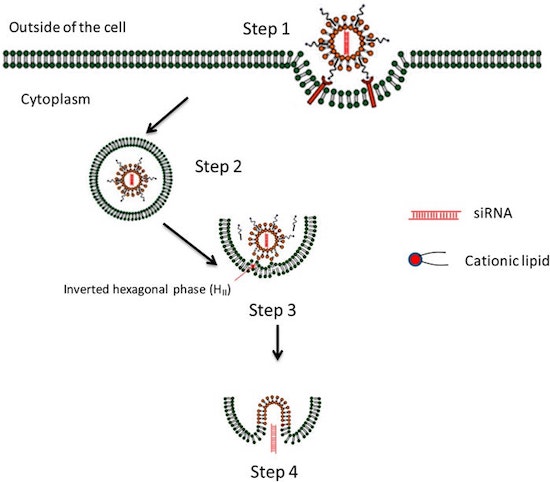

The relationship between RNA, cationic Lipids, and neutral lipids – Ge et al, 2021

Pay careful attention to the above image. As this gene-containing particle enters the cell (cytoplasm), the cationic (positively-charged) lipids allow it to form a lipid bi-layer that stabilizes the payload from the destructive forces inside the cell. The manufacturers will tell you that this is merely to protect the RNA, so it can get to the ribosomes and be transcribed into proteins. But, the cell is far more dynamic and complex. It will not just do what we want it to do.

Read more …

“If you think about it, the underlying thesis is, ‘well, the CDC didn’t say that, so therefore you’re spreading medical misinformation.’ But now we learn who’s really been spreading medical misinformation is the CDC.“

CDC Warned ‘Criminal’ Fraud Investigation ‘Ready to Go’ After Midterms (BN)

Dr. Robert Malone, a noted mRNA vaccine researcher, and Dr. Peter McCullough, one of the most-published medical doctors in the world, gave a joint statement to The New American on Friday where they accused the Centers for Disease Control and Prevention of perpetrating “criminal” fraud. “In my opinion, withholding scientific data constitutes fraud,” Dr. Malone argued. “This is scientific fraud. In my opinion, if I was to publish a study in which I had a large body of epidemiologic data, and I decided to only public publish part of it because I wanted to advance some agenda, I would be guilty of scientific fraud. The paper would be withdrawn. I would be kicked out of my academic institution. I would be guilty of scientific fraud. That’s what this is.”

“And the CDC has, I’ve watched it over the years, become more and more and more a political arm and not serving its its function,” he continued. “This is the Center for Disease Control and Prevention. They are the archive of information which physicians have relied on for decades through the MMWR publication. They are the ones that are responsible for providing us the frontline data about what’s going on and where it’s happening and they have stopped performing that function.” “They no longer release that detailed information through MMWR,” Dr. Malone went on. “They have become purely a political organization and arm of the executive branch. And what they have done is in my opinion, obscene. And it is part of what’s underlied the attacks that Peter and I have sustained from the press. If you think about it, the underlying thesis is, ‘well, the CDC didn’t say that, so therefore you’re spreading medical misinformation.’ But now we learn who’s really been spreading medical misinformation is the CDC.”

[..] “There are going to be legal consequences, and I believe they have a choice,” Dr. Malone said. “These government employees that have been participating in hiding this data, they can either be defendants or they can be witnesses. It is time for them to step up and speak out. And if they want do a whistleblower action, speak to Senator Ron Johnson, his office is in business looking for this.” “And when the midterms are done and he’s reelected and the Republicans take the Senate, he’s going to be in charge of the Senate subcommittee on investigations,” Malone added. “And I can tell you that he is ready to go.”

Read more …


Support the Automatic Earth in virustime with Paypal, Bitcoin and Patreon.



Feb 072016
 
 February 7, 2016  Posted by at 9:34 am Finance Tagged with: , , , , , , , , , ,  3 Responses »


DPC Chamber of Commerce, Boston MA 1904

$100 Trillion Up in Smoke (Mauldin)
As Big Oil Shrinks, Boards Plot Different Paths Out Of Crisis (Reuters)
Exxon Ends Share Buybacks – It Must Be Acquisition Time (Forbes)
Hess Oil: A “Folly For The Ages” (ZH)
Debt, Defaults, And Devaluations: A Crash Like Nothing Before (Telegraph)
Our Dysfunctional Monetary System (Steve Keen)
Why The Bulls Will Get Slaughtered (Stockman)
Obscure Chinese Firm Dives Into $22 Trillion US Market (BBG)
China’s FX Reserves Decline to $3.23 Trillion (BBG)
The Great Escape from China (Rogoff)
Albert Edwards: China Has Only “Months Left” To Stop Collapse (VW)
Why Doesn’t 4.9% Unemployment Feel Great? (CNN)
Risk of WWIII as Saudi Arabia, Turkey –and Ukraine– Wade Into Syria (Trayner)
EU Ministers Want To Buttress Borders To Stem Refugee Flow (AP)
Austria Threatens To Extend Border Controls (Reuters)
Austria Wants EU To Cover Costs Of Additional Migrants (Reuters)

That is a big number. Add losses in commodities, and you’re talking destruction, of money, credit, virtual wealth, it doesn’t matter anymore what you call it..

$100 Trillion Up in Smoke (Mauldin)

If energy powers the world, then whoever owns that energy must have power over the world. That’s certainly been the case for the last century or two. Ownership of our primary energy source, crude oil, is what made billionaires of John D. Rockefeller, H.L. Hunt, and assorted Middle Eastern kings, emirs, and sheikhs. Oil in the ground is wealth only on paper – you may own that oil, but it earns you nothing until you recover and sell it. Yet paper wealth is still wealth. It goes on your balance sheet as an asset that you can sell. You can use it as collateral to borrow cash and buy other assets. The ongoing oil price collapse is having a severely negative impact on the wealth of those who own oil reserves. The numbers, as you will see below, are almost incomprehensibly big.

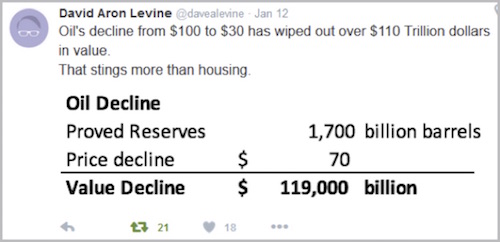
They are so big, in fact, that many analysts have simply tuned out. The attitude seems to be, “These numbers blow up my models, so I will ignore them.” Today we’ll stop dancing around the truth and call the oil collapse what it is: global wealth destruction of epic proportions. In mid-2014, crude oil prices were about $100, depending on which grade you wanted to buy. Now prices hover near $30 – roughly a 70% decline in 18 months. That’s well-known, but we usually discuss the price collapse in terms of particular countries or companies: we don’t look at the bigger picture. Last week someone showed me this from Twitter. I almost fell out of my chair.

Stop for a minute. Let that sink in. The total value of all the world’s oil reserves is over $100 trillion less than it was just a year and a half ago.

(By the way, I verified Mr. Levine’s reserve total by consulting the CIA’s World Fact Book. It says total world “proved” oil reserves were 1.656 trillion barrels as of January 1, 2015.) To put these figures in perspective, consider that Google’s parent company, Alphabet, briefly surpassed Apple last week as the planet’s largest publicly traded company. Both are worth around $500 billion, depending on the day. The lost value in crude oil is equivalent to a couple of hundred Googles and Apples going up in smoke. If stock values were crashing to that degree, we would call the losses earth-shattering. Yet otherwise intelligent people are saying the oil collapse is a minor issue.

Read more …

They’re all fully unprepared. Deer and headlights.

As Big Oil Shrinks, Boards Plot Different Paths Out Of Crisis (Reuters)

As oil and gas companies cut ever-deeper into the bone to weather their worst downturn in decades, boards have adopted contrasting strategies to lead them out of the crisis. Crude prices have tumbled around 70 percent over the past 18 months to around $35 a barrel, leading to five of the world’s top oil companies reporting sharp declines in profits in recent days. Executives at energy firms face a tough balancing act: they must cut spending to stay financially afloat while preserving the production infrastructure and capacity that will allow them to compete and grow when the market recovers. Companies have opted for differing approaches to secure future growth, often choosing to narrow focus to their areas of expertise and the geographic location of their main assets.

American firms Chevron, ConocoPhillips and Hess are withdrawing from more costly deepwater projects to focus on shale oil fields on their home turf, for example. Britain’s BP is betting on offshore gas in Egypt, while Royal Dutch Shell has opted for an alternative route as it seeks to safeguard its future: the $50 billion takeover of BG Group. In the five years before the downturn began in mid-2014, when crude prices held above $100 a barrel, big energy firms had raced to expand production capacity, including buying stakes in vast, costly fields sometimes located thousands of meters under the sea, and miles from land.

Over the past year however, companies have slashed their overall capital expenditure, scrapping plans for mega projects that cost billions to develop and take up to a decade to bring online. “Companies want to strike a balance between long and short-cycle investments while maintaining a robust balance sheet to fund their way through the down cycle,” said BMO Capital analyst Brendan Warn. Focusing on a specific set of expertise and geographies allowed them to offer investors a “unique value proposition”, he added.

Read more …

Quick, before somone figures out what you’ve lost.

Exxon Ends Share Buybacks – It Must Be Acquisition Time (Forbes)

If the company was happy buying its own stock in 2014, it should be all the more eager to buy now that shares are down 25%. Unless it sees a better bargain elsewhere. In its fourth-quarter financial release Tuesday, Exxon Mobil announced a halt to share buybacks. The company purchased $4 billion of its own shares in 2015, and has averaged about $20 billion a year in buybacks over the past decade, according to Reuters. The peak buyback year was 2008, when oil prices hit a record high and Exxon bought in $35 billion worth. At first glance, halting buybacks might seem reasonable. Perhaps amid this oil industry depression Exxon just wants to conserve cash — it also expects to reduce capital spending by $8 billion this year.

But think about it. The key to good investing is to buy low and sell high. If Exxon was happy buying back shares in 2014, when its stock price hit $103, it should be all the more eager to continue buying now that shares are down to $74.50. If Exxon didn’t think its own shares weren’t a great investment it wouldn’t have bought $200 billion of them over the past decade. Don’t take my word for it. As CEO Rex Tillerson said in a statement Tuesday, “The scale and diversity of our cash flows, along with our financial strength, provide us with the confidence to invest through the cycle to create long-term shareholder value.” It’s a hallmark of Exxon’s discipline that it continues to invest whether oil prices are low or high. In 2015 it brought on six big projects with 300,000 barrels per day of new production.

Exxon is not worried about running out of cash. Cash flows were on the order of $30 billion for the year. Even in the fourth quarter it generated net income of $2.8 billion (and $16 billion for the year). And don’t think for a second that Exxon intends to cut its dividend payouts, which totaled $12 billion last year. A more plausible reason Exxon is ending buybacks: it’s preparing to acquire another company whose shares are even more deeply discounted than Exxon’s. And with “just” $3.7 billion in cash on hand at the end of the fourth quarter, its likely that Exxon would use its shares as currency for a buyout. Who would they buy? The options abound for a company still sporting an equity market cap of $318 billion. Anadarko Petroleum has long been rumored to be a prime Exxon target; its shares are down about 65% to a market cap of $19 billion.

Occidental Petroleum float is $51 billion, ConocoPhillips $47 billion and Apache is at $15 billion. Deeper in the discount bin, Marathon Oil shares could be had for $6.5 billion, or Devon Energy for $11 billion. Of course Exxon would also need to assume any debt carried by an acquisition target. But that wouldn’t be a problem — compared with the averaged overleveraged oil company, Exxon has modest gearing with $38 billion in debt outstanding. Other than Royal Dutch Shell ’s $52 billion takeover of BG Group , we haven’t seen a landmark merger during this downturn. The last time things got this bad for the industry, back in 1998, BP bought Amoco for $48 billion and Exxon bought Mobil for $75 billion. Ending buybacks is just Exxon’s way of telling the market it’s ready to make a deal.

Read more …

Hess oil is the case study. “..Hess just sold 25 million shares at a price of $39 after purchasing 63 million shares through 2015 at an average price that was more than double, or $83 a share..”

Hess Oil: A “Folly For The Ages” (ZH)

[..] back in 2013, when it was trading at a discount to its peers, Hess became the target of an activist campaign led by Paul Singer’s Elliott Management who demanded a quick boost in the stock price, as a result of which the energy producer decided to exit its refining business (arguably the only line of business that would have benefited from the current depressed oil price) while not only raising its dividend but also authorizing a $4 billion share buyback. The company then boosted its buyback further with proceeds from the sale of its retail gas stations (for $2.9 billion) while growing its debt by $1 billion from 2013 to 2015, leading to the repurchase of a total of 62.7 million shares through the end of 2014 at an average price of $83. The stock price reacted as expected: it soared past $100 from below $60 before Elliott turned up. It then continued to spend more billions under additional buyback all the way through the third quarter of 2015, which however took place just as the worst oil downturn in history was taking place.

And then the stock crashed, as investors finally realized that plunging oil, sliding cash flow and surging debt meant the company found itself in a life and death fight for survival. Which brings us to yesterday, when in an attempt to shore up liquidity and avoid halting its dividend, Hess sold 25 million shares at a price of $39/share: a 10% discount to the prior closing price. As Reuters puts it, the “Hess folly is one for the ages.” The silver lining? Unlike before, when Hess’ weak management team was kicked around by a hedge fund, at least it is being proactive now and scrambling to preserve its business even it means huge pain and dilution for shareholders. The company ended 2015 with $2.7 billion in cash and a big revolving line of credit it hasn’t dipped into yet. Capital just raised will push net debt from 5.4x EBITDA to below four times, according to Cowen estimates.

That should allow Hess to keep investing in future production and pay dividends. If oil remains at $30, however, it has just bought itself a few quarters of time. Still, that does not absolve management of pandering to a vocal shareholder: if instead of spending billions on buybacks Hess had done the right thing and saved the cash, it would not only have avoided the wild swings in the stock price which rewarded just activist investors while punishing long-term holders, and have a far bigger war chest to defend itself from $30 oil. The bottom line: Hess just sold 25 million shares at a price of $39 after purchasing 63 million shares through 2015 at an average price that was more than double, or $83 share. As Reuters concludes, “this modern Hess era is a case study that should be required reading in boardrooms everywhere.”

Read more …

The right wing is getting concerned.

Debt, Defaults, And Devaluations: A Crash Like Nothing Before (Telegraph)

A global recession is on the way. This truism of economics holds at any point in which the world is not in the grips of a contraction. The real question is always when and how deep the upcoming downturn will be. “The crash will come, but it would be nice if it came two years from now”, Thomas Thygesen, head of economics at SEB told over 200 commodity investors and analysts in London last month. His audience was rapt with unusual attention. They could be forgiven for thinking the slump had not already arrived. Commodity prices have crashed by two thirds since their peaks in 2014. Oil has borne the brunt of the sell-off, suffering the worst price collapse in modern history. Brent crude has fallen from $115 a barrel in the summer of 2014, to just $27.70 in mid-January.

Plenty of investors sitting in the blue-lit, cavernous surrounds of Bloomberg’s London HQ would have had their fingers burnt by the price capitulation. “They tell you should start your presentations with a joke, but making jokes at a commodities seminar is hardly appropriate these days,” Thygesen told his nervous audience. Major oil price falls have a number of historical precedents. Today’s glutted oil market is often compared to the crash of 1986, the last major episode over global over-supply. Back in the late 90s, a barrel of Brent crude fell to as low as $10 in the wake of the Asian financial crisis. But is the current oil price collapse really like anything the world economy has ever experienced?

For many market watchers, a confluence of factors – led by oil, but encompassing China, the emerging world, and financial markets – are all brewing to create a perfect storm in a global economy that has barely come to terms with the Great Recession. “We are in a very unusual situation where market sentiment is of a different nature to anything we’ve seen before,” says Thygesen. Unlike previous pre-recessionary eras, the current sell-off has seen commodity prices, equities and credit conditions all move in dangerous lockstep. Although a 75pc oil price collapse should represent an unmitigated positive for the world’s fuel thirsty consumers, the sheer scale of the price rout is already imperiling the finances of producer nations from Nigeria to Azerbaijan, and is now threatening to unleash a wave of bankruptcies across corporate America.

It is the prospect of this vicious feedback loop – where low oil prices create financial tail risks that spill over into the real economy – which could now propel the world into a “full blown crisis” adds Thygesen. So will it materialise? The world economy is throwing up reasons to worry, as the globe’s largest emerging markets have shown signs of deterioration over the last six months, says Olivier Blanchard, the former long-serving chief economist of the IMF. “China’s growth is probably less than officially reported. Russia and Brazil are doing very badly. South Africa is flirting with recession. Even India may not be doing as well as was forecast,” says Blanchard, who left the Fund after seven years late last year. As it stands however, he says market ructions still represent a classic case of “herd” behaviour. “Investors worry that other investors know something bad, and so just sell, although they themselves have no new information.”

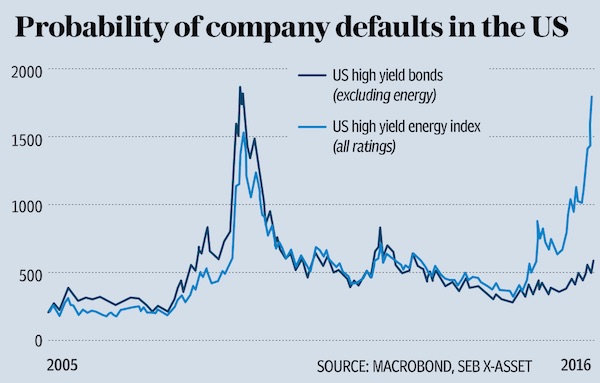
But a tipping point may well be approaching. According to Blanchard’s calculations, a 20pc decline in stock markets that persists for more than six months, will translate into a decline in consumption of between 0.5pc to 1.0pc. “This would be a serious shock. My biggest fear is precisely that the dramatic shift in mood becomes self-fulfilling”. For now, oil-induced financial stress is concentrated in the energy sector. With Brent set to languish around $30-35 barrel for the rest of the year, prices will persist below the $40-60 barrel break-even point that renders the bulk of US oil and gas companies profitable. Spreads on high yield US energy corporates have soared to unprecedented highs. “They make Lehman look like a walk in the park” says Thygesen. More than a third of the entire US high yield bond index is now vulnerable to crude prices remaining low or falling even further, according to calculations from Oxford Economics.

Read more …

My friend Steve is losing his cool, and high time too. Is he really the only economist who undertands this, and can explain it? Y’all better listen closely, then.

“As someone who spent 2 years warning about this crisis before it happened, and another 8 years diagnosing it (and proposing remedies that would, I believe, be effective, if only banks and governments together would implement them), I find this dual idiocy incredibly frustrating. Rather than understanding the real cause of the crisis, we’ve seen the symptom—rising public debt—paraded as its cause. Rather than effective remedies, we’ve had inane policies like QE, which purport to solve the crisis by inflating asset prices when inflated asset prices were one of the symptoms of the bubble that caused the crisis.”

Our Dysfunctional Monetary System (Steve Keen)

The great tragedy of the global economic malaise is that it is caused by a shortage of something that is essentially costless to produce: money. Both banks and governments can produce money at physically trivial costs. Banks create money by creating a loan, and the establishment costs of a loan are miniscule compared to the value of the money created by it—of the order of $3 for every $100 created. Governments create money by running a deficit—by spending more on the public than they get back from the public in taxes. As inefficient as government might be, that process too costs a tiny amount, compared to the amount of money generated by the deficit itself. But despite how easy the money creation process is, in the aftermath to the 2008 crisis, both banks and governments are doing a lousy job of producing the money the public needs, for two very different reasons.

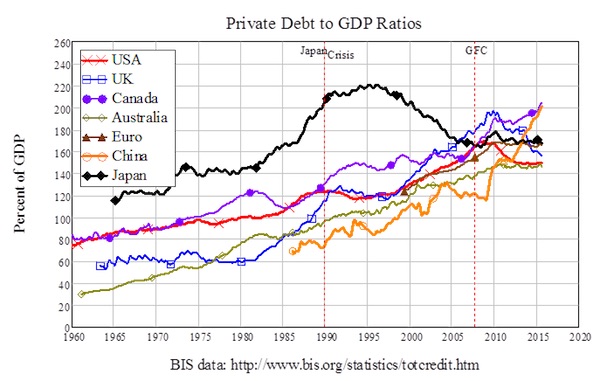
Banks aren’t creating money now because they created too much of it in the past. The booms that preceded the crisis were fuelled by a wave of bank-debt-financed speculation on some useful products (the telecommunications infrastructure of the internet, the DotCom firms that survived the DotCom bubble) and much rubbish (the Liar Loans that are the focus of The Big Short). That lending drove private debt levels to an all-time high across the OECD: the average private debt level is now of the order of 150% of GDP, whereas it was around 60% of GDP in the “Golden Age of Capitalism” during the 1950s and 1960s—see Figure 1.


Figure 1: The private debt mountain that has submerged commerce

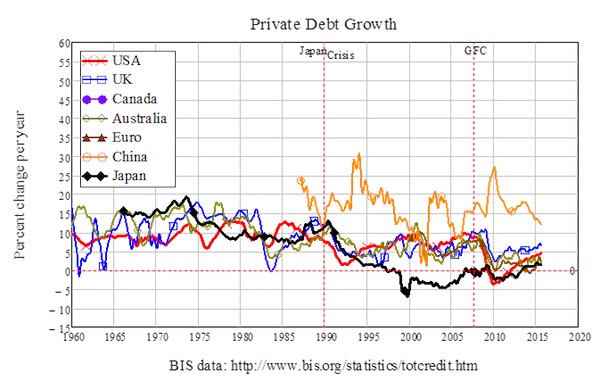
In the aftermath of the Subprime bubble, credit-money creation has come to a standstill across the OECD. In the period from 1955 till 1975, credit grew at 8.7% per year in the United States; from 1975 till 2008, it grew at 8% per year; since 2008, it has grown at an average of just 1.5% per year. The same pattern is repeated across the OECD—see Figure 2. Globally, China is the only major country with booming credit growth right now, but that will come crashing down (this probably has already started), and for the same reason as in the West: too much credit-based money has been created already in a speculative bubble.


Figure 2: Credit growth is anaemic now, and will remains so as it has in Japan for 25 years

Japan, of course, got mired in this private debt trap long before the rest of the world succumbed. As Figure 1 shows, its private debt bubble peaked in 1995, and since then it’s had either weak or negative credit growth, so that its private debt to GDP level is now in the middle of the global pack. Economic growth there has come to a standstill since: Japan’s economy grew at an average of 5.4% a year in real terms from 1965 till 1990, when its crisis began; since then, it has grown at a mere 0.4% a year. That gives us a simple way to perform a “what if?”. What if the rest of the OECD is as ineffective at escaping from the private debt trap as Japan has been? Then the best case scenario for global credit growth is that it will match what has happened since Japan “hit the credit wall” in 1990

Read more …

Seasonally adjusted slaughter, that is.

Why The Bulls Will Get Slaughtered (Stockman)

Needless to say, none of that stink was detected by Steve Liesman and his band of Jobs Friday half-wits who bloviate on bubblevision after each release. This time the BLS report actually showed the US economy lost 2.989 million jobs between December and January. Yet Moody’s Keynesian pitchman, Mark Zandi described it as “perfect” Yes, the BLS always uses a big seasonal adjustment (SA) in January——so that’s how they got the positive headline number. But the point is that the seasonal adjustment factor for the month is so huge that the resulting month-over-month delta is inherently just plain noise. To wit, the seasonal adjustment factor for the month was 2.165 million. That means the headline jobs gain of 151k reported on Friday amounted to only 7% of the adjustment amount!

Any economist with a modicum of common sense would recognize that even a tiny change in the seasonal adjustment factor would mean a giant variance in the headline figure. So the January SA jobs number cannot possibly reveal any kind of trend whatsoever – good, bad or indifferent. But that didn’t stop Beth Ann Bovino, US chief economist at Standard & Poor’s Rating Services, from dispatching the usual all is swell hopium: “Today’s numbers are about momentum, so while 151,000 new jobs in January is below expectations and off pace from prior months, the data shows America’s recovery is continuing. Amid all the global economic turmoil and domestic market gyrations, positive job growth, the drop in the unemployment rate to 4.9%, and the uptick in wages show the U.S. is heading in the right direction.” Actually, it proves none of those things.

For one thing, the January NSA (non-seasonally adjusted) job loss this year of just under 3 million was 173,000 bigger than last January – suggesting that things are getting worse, not better. In fact, this was the largest January job decline since the 3.69 million job loss in January 2009 during the very bottom months of the Great Recession. So are we really “heading in the right direction” as claimed by Bovino, Zandi and the rest of the Cool-Aid crowd? Well, just consider two alternative seasonal adjustment factors for January that have been used by the BLS in the last five years. Had they used the January 2013 adjustment factor this time, the headline gain would have been 171,000 jobs; and had they used the 2010 adjustment factor there would have been a headline loss of 183,000 jobs. We could say in a variant of the Fox News motto – we report, you decide. But believe me, you can look at years of seasonal adjustment factors for January (or any other month) and not find any consistent, objective formula. They make it up, as needed.

Read more …

“..to help bring Chinese companies to U.S. markets..” Which is not that easy on most exchanges.

Obscure Chinese Firm Dives Into $22 Trillion US Market (BBG)

When Cromwell Coulson heard that an obscure Chinese real estate firm had agreed to buy the Chicago Stock Exchange, he was shocked. “My first reaction was, ‘Wow, that’s who they’re selling to?”’ said Coulson, CEO of OTC Markets in New York. “These new buyers have no connection to Chicago’s existing business. They’re completely disconnected from the current business of supporting the Chicago trading community. So wow, that’s out of left field.” While the world has gotten used to seeing Chinese companies snap up overseas businesses, the purchase of a 134-year-old U.S. stock market by Chongqing Casin Enterprise – a little-known property and investment firm from southwestern China – raises a whole host of questions. For starters, why does a provincial Chinese business with no apparent ties to the securities industry have any interest in buying one of America’s smallest equity exchanges? And will U.S. regulators sign off?

So far, Casin Group’s intentions are unclear, with calls to the company’s Chongqing headquarters going unanswered on Friday. If the deal does pass muster with American regulators, it would mark the first-ever Chinese purchase of a U.S. equity exchange, giving Casin Group a foothold in a $22 trillion market where even the smallest bourses have room to grow if they can provide the best price for a stock at any given moment. The Chicago Stock Exchange – a subsidiary of CHX Holdings – is minority-owned by a group including E*Trade, Bank of America, Goldman Sachs and JPMorgan, according to the company. The minority shareholders are also selling their stake, Chicago Stock Exchange CEO John Kerin said. The deal values the exchange at less than $100 million, according to a person familiar with the matter.

Casin Group’s offer, announced on Friday in a statement from the Chicago exchange, comes amid an unprecedented overseas shopping spree by Chinese companies. Businesses from Asia’s largest economy have announced $70 billion of cross-border acquisitions and investments this year, on track to break last year’s record of $123 billion, according to data compiled by Bloomberg. While many of those deals had obvious business rationales, the reasons for Casin Group’s bid are less clear. The company, founded in the 1990s through a privatization of state-owned assets, initially focused on developing real estate projects in Chongqing, before expanding into the environmental and financial industries. While the firm owns stakes in banks and insurers, it has no previous experience owning an exchange. Lu Shengju, the majority owner and chairman of Casin Group, wants to help bring Chinese companies to U.S. markets, according to the statement from Chicago’s bourse.

Read more …

Another $100 billion spent. That leaves about 2 months at this pace till alarm bells will start going off.

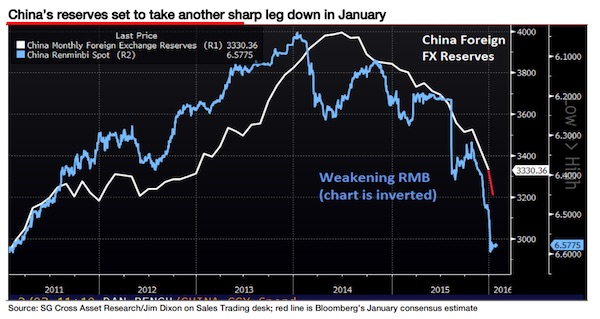
China’s FX Reserves Decline to $3.23 Trillion (BBG)

China’s foreign-exchange reserves shrank to the smallest since 2012, indicating that the central bank sold dollars as the yuan’s retreat to a five-year low exacerbated depreciation pressure. The world’s largest currency hoard declined by $99.5 billion in January to $3.23 trillion, according to a People’s Bank of China statement released on Sunday. The stockpile fell by more than half a trillion dollars in 2015, the first-ever annual decline. Policy makers fighting to hold up the weakening yuan amid slower economic growth, plunging stocks and increasing outflows have been burning through the reserves. The draw-down has continued since the central bank’s surprise devaluation of the currency in August, when the stockpile tumbled $94 billion, a monthly record at the time.

“While the remaining reserves represent a substantial war chest, the rapid pace of depletion in recent months is simply unsustainable,” said Rajiv Biswas at IHS Global Insight in Singapore. “Domestic private investors and global currency traders see a one-way bet against the currency. This has resulted in large-scale private capital outflows since early 2015 as expectations mount that the PBOC will eventually be forced to capitulate once its reserves are sufficiently depleted.” Capital outflows increased to $158.7 billion in December, the most since September and were $1 trillion last year, according to estimates from Bloomberg Intelligence. That’s more than seven times the amount of cash that left in 2014. The PBOC has stepped up efforts to stem the exodus, warning speculators that they will be punished.

It intervened in the Hong Kong market last month after the yuan’s offshore exchange rate sank to a record 2.9% discount to the onshore rate. Apart from selling dollars, the monetary authority also gave guidance to some Chinese lenders in the city to suspend yuan lending to curb short selling, a move that contributed to the overnight interbank lending rate surging to an all-time high of 66.8% on Jan. 12.

Read more …

“Now that Chinese firms have bought up so many US and European companies, money laundering can even be done in-house. ”

The Great Escape from China (Rogoff)

Since 2016 began, the prospect of a major devaluation of China’s renminbi has been hanging over global markets like the Sword of Damocles. No other source of policy uncertainty has been as destabilizing. Few observers doubt that China will have to let the renminbi exchange rate float freely sometime over the next decade. The question is how much drama will take place in the interim, as political and economic imperatives collide. It might seem odd that a country running a $600 billion trade surplus in 2015 should be worried about currency weakness. But a combination of factors, including slowing economic growth and a gradual relaxation of restrictions on investing abroad, has unleashed a torrent of capital outflows. Private citizens are now allowed to take up to $50,000 per year out of the country.

If just one of every 20 Chinese citizens exercised this option, China’s foreign-exchange reserves would be wiped out. At the same time, China’s cash-rich companies have been employing all sorts of devices to get money out. A perfectly legal approach is to lend in renminbi and be repaid in foreign currency. A not-so-legal approach is to issue false or inflated trade invoices – essentially a form of money laundering. For example, a Chinese exporter might report a lower sale price to an American importer than it actually receives, with the difference secretly deposited in dollars into a US bank account (which might in turn be used to purchase a Picasso). Now that Chinese firms have bought up so many US and European companies, money laundering can even be done in-house.

The Chinese hardly invented this idea. After World War II, when a ruined Europe was smothered in foreign-exchange controls, illegal capital flows out of the continent often averaged 10% of the value of trade or more. As one of the world’s largest trading countries, it is virtually impossible for China to keep a tight lid on capital outflows when the incentives to leave become large enough. Indeed, despite the giant trade surplus, the People’s Bank of China has been forced to intervene heavily to prop up the exchange rate – so much so that foreign-currency reserves actually fell by $500 billion in 2015. With such leaky capital controls, China’s war chest of $3 trillion won’t be enough to hold down the fort indefinitely. In fact, the more people worry that the exchange rate is going down, the more they want to get their money out of the country immediately.

That fear, in turn, has been an important factor driving down the Chinese stock market. There is a lot of market speculation that the Chinese will undertake a sizable one-time devaluation, say 10%, to weaken the renminbi enough to ease downward pressure on the exchange rate. But, aside from providing fodder for the likes of Donald Trump, who believes that China is an unfair trader, this would be a very dangerous choice of strategy for a government that financial markets do not really trust. The main risk is that a big devaluation would be interpreted as indicating that China’s economic slowdown is far more severe than people think, in which case money would continue to flee.

Read more …

But they can’t afford to wait that long.

Albert Edwards: China Has Only “Months Left” To Stop Collapse (VW)

In this week’s issue of Société Générale’s Global Strategy research note, Edwards writes that “China has burned through almost $800bn of its FX reserves mountain since it peaked at almost $4 trillion in mid-2014. January’s FX data to be released this weekend is set to register another sharp drop of $120bn (consensus estimate).” He goes on: “But at $3.2bn the market remains content that massive firepower remains to support the renminbi. It does not. Our economists estimate that when FX reserves reach $2.8 trillion – which should only take a few more months at this rate – FX reserves will fall below the IMF’s recommended lower bound. If that occurs in the next few months, expect to see a tidal wave of speculative selling, forcing the PBoC to throw in the towel and let the market decide the level of the renminbi exchange rate.”

Edwards’ view is based on the predictions of Société Générale’s China economist Wei Yao. Wei Yao has written that in her view, the PBoC might, “move to a free-float within six months, after burning through a significant amount of FX reserves.” Both Yao and Edwards’ doom-mongering is based on the level of China’s FX reserves. China has been depleting its FX reserves in an effort to slow the pace of currency depreciation. However, if the country continues to spend its reserves at the current rate, FX reserves will fall through the $2.8 trillion level that the IMF believes is the lowest acceptable level. The IMF’s ‘lowest acceptable’ reserves level is based on four specific elements that reflect potential drains on the balance of payments: (1) exports, (2) broad money, (3) short-term external debt, and (4) other liabilities (long-term external debt and portfolio liabilities).

Société Générale’s analysts believe that (assuming the level of short-term external debt at remaining maturity was unchanged from year-end 2014) China’s reserves are at 118% of the recommended level (estimated to be $2.8 trillion). If China’s reserves fall below the key $2.8 trillion level, the market could lose confidence in the PBoC’s ability to resist currency depreciation and manage future balance of payments shocks. Only two major emerging market countries (Malaysia and South Africa) have reserves that are below the IMF’s recommended range and many EM countries now have a more robust reserve balance than China in terms of the percentage above the IMF’s recommended minimum.

Read more …

Because it’s just a narrative. More right wing worry signs.

Why Doesn’t 4.9% Unemployment Feel Great? (CNN)

The U.S. unemployment rate just fell below 5% for the first time since 2008. Normally, this would merit a celebration. But these aren’t normal times. The economy is better than it was in the Great Recession, but not even President Obama is ready to declare it’s booming. In a special speech Friday touting the job gains during his presidency, Obama admitted there’s more “to tackle.” “We should be proud of the progress we’ve made…we’ve recovered from the worst economic crisis since the 1930s,” Obama said. He doesn’t believe he gets enough credit for creating over 14 million jobs. People as diverse as Democrat Bernie Sanders and Republican Donald Trump don’t put it gently. They claim the “real” unemployment rate is much higher. Sanders calls the economy “rigged,” and Trump says the U.S. never wins anymore. There are three key reasons why everyone from Main Street to Wall Street isn’t cheering 4.9% unemployment.

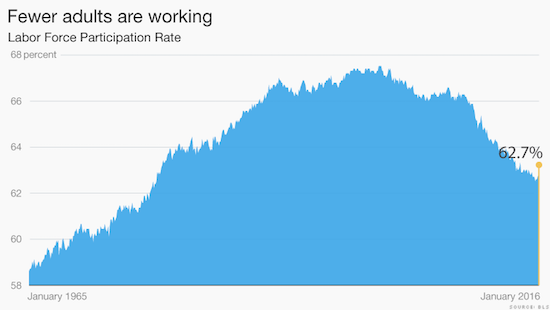
1. Fewer adults are working Only 62.7% of adult Americans are working. The so-called Labor Force Participation rate hasn’t been this low since the late 1970s. The rate measures how many people over age 16 are working or actively seeking work. Back in the ’70s, it was low because fewer women worked outside the home. That’s not the story today. Now, three factors are driving the decrease in workers. The first is that a huge part of the adult population, Baby Boomers, are retiring. That’s expected and healthy. It explains about half of the decline in the workforce. The second is more young people are going to college and graduate school. They are studying more, which should be a positive for the nation. But the third one is alarming: some people have just given up on finding work. It’s hard to quantify how many people fall into this dropout category, but it’s large enough to matter. Politicians like Trump talk about it in stump speeches.The WSJ estimates that about 2.6 million of the roughly 92 million American adults who don’t work want a job but aren’t looking for one.

2. Long-term unemployment is still high Another reason why the jobs picture still looks gloomy is that an unusually high number of people can’t find jobs even though they have been looking for a long time. About 2.1 million Americans have been unable to get a job for over half a year. The government calls these people the “long-term unemployed.” During the worst of the Great Recession, 6.8 million people were long-term unemployed. So there’s been improvement, but there are still roughly double the number of long-term unemployed than in normal times.

3. Wage growth is anemic The last big issue is that wages aren’t going up for many Americans. The typical take home pay (often called “median income” by the Census Bureau) is about the same today as it was 20 years ago, once you adjust for inflation. In other words, middle class families aren’t really getting ahead. They’re just getting by. To be fair, this was a problem even before the Great Recession came along, but experts keep predicting wages will go up and it’s not happening. On Friday, Obama tried to celebrate the small gains that have been made in recent months. “This progress is finally starting to translate into bigger paychecks,” he said. But the reality is wage growth is only 2.5% a year. As Sharon Stark of D.A. Davidson notes, normally when unemployment is this low, wage growth should be humming along at about 4% a year.

Read more …

So many crazies. Trying to provoke Russia by sending Ukraine’s fascist troops into Syria.

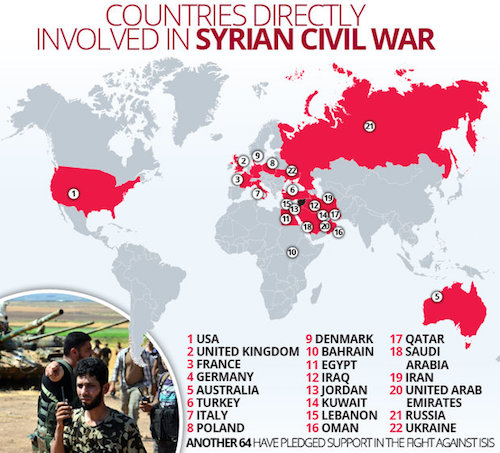
Risk of WWIII as Saudi Arabia, Turkey –and Ukraine– Wade Into Syria (Trayner)

A terrifying array of rival superpowers are wading into the chaotic conflict on opposing sides. Analysts now fear the bloodbath – already longer than World War One – is mutating into a full-scale regional war. Saudi Arabia has threatened to send in ground troops and intelligence reports suggest Turkey is preparing to invade. Ukraine is also weighing up sending in soldiers. If their forces clashed with Russians or Iranians already on the ground, NATO – including Britain – could be dragged into an apocalyptic World War 3. Most military experts see the conflict as a proxy war between Sunni Muslim Saudi Arabia – supported by the US – on one side and Shia Muslim Iran – backed by Russia – on the other. The civil war in Yemen is also a victim of the new power struggle for control of the Middle East – which dates back to the death of Muhammed in 632 AD.

But the new Cold War – which some claim involved Saudi Arabia arming ISIS and Iran backing militants such as the Houthi rebels in Yemen – would turn searing hot if Saudi troops met the Iranian Army on the battlefield. The US fears Saudi Arabia may have obtained – or tried to obtain – nuclear weapons for an final battle with its centuries-old enemy. Tom Wilson, a research fellow for think tank the Henry Jackson Society, said: “The proxy war between Saudi Arabia and Iran is now in a rapid state of escalation. “Saudi talk of sending troops to Syria may be a bluff to try and force the West to take more decisive action in that country instead. “But if the Saudis do put troops on the ground in Syria then this would represent the opening of a major new front in what is increasingly a full scale regional conflict.”

Russia claims aerial photographs reveal Turkey is preparing to invade Syria, its neighbour. Turkish Islamic extremists are already fighting in Syria – some on the side of ISIS – with well-attended funerals for “martyrs” held back home in Turkey. Ultra-nationalist “Grey Wolves” – who want to protect Turkmen living in northern Syria and restore the Ottoman Empire – are also battling the Syrian army and Russian forces. Enmity between Black Sea rivals Russia and Turkey dates back so long a Jewish “oracle” prophesied an apocalyptic war between Russia and Turkey would usher in the End of Days 200 years ago. Turkey is now a member of NATO and if the old enemies came to blows again – as almost happened when Turkey shot down a Russian jet last year – the US and UK would be compelled to back Turkey. Britain has already been dragged into war with Russia by Turkey once: the Crimean War.

Read more …

Everything they can do wrong, they do.

EU Ministers Want To Buttress Borders To Stem Refugee Flow (AP)

European Union nations anxious to stem the flow of asylum-seekers coming through the Balkans are increasingly considering sending more help to non-member Former Yugoslav Republic of Macedonia (FYROM) as a better way to protect European borders instead of relying on EU member Greece. With Athens unable to halt the tens of thousands of people making the sea crossing from Turkey, EU nations fear that Europe’s Schengen border-free travel zone could collapse, taking with it one of the cornerstones on which the 28-nation bloc is built. “If Greece is not ready or able to protect the Schengen zone and doesn’t accept any assistance from the EU, then we need another defense line, which is obviously Macedonia and Bulgaria,” Hungarian Foreign Affairs Minister Peter Szijjarto said at Saturday’s meeting of EU foreign ministers in Amsterdam.

An estimated 850,000 migrants arrived in Greece in 2015, overwhelming its coast guard and reception facilities. Aid groups say cash-strapped Greece has shelter for only about 10,000 people, just over 1% of those who have entered. Most of the asylum-seekers then travel on across the Balkans and into the EUs heartland of Germany and beyond. Szijjarto said EU nations are “defenseless from the south. There are thousands of irregular migrants entering the territory of the EU on a daily basis.” Austrian Foreign Minister Sebastian Kurz said the cash-strapped government in Athens still underestimates the crisis. “I still don’t have the feeling that it has dawned on Greece how serious the situation is” for receiving nations like Austria, he said.

The situation has pushed some EU nations to send bilateral aid to FYROM, a non-EU nation, to control its border with EU member Greece. There has been even talk of sending military troops to FYROM to beef up the Greek border. FYROM Foreign Minister Nikola Poposki said after the meeting it did not matter what the aid was technically called. “The essential thing is that we have people and equipment to control the border and do registration where legal crossing should happen,” he said. He said FYROM has already put its own military on the job. “They’re making sure that we have decreased the illegal crossings through our border and were going to continue to make these efforts,” he said.

Read more …

There certainly is no such thing as an EU policy.

Austria Threatens To Extend Border Controls (Reuters)

Austria will extend its border controls if Turkey does not take back refugees picked up at sea on their way to Greece, Chancellor Werner Faymann said in an interview with the daily Oesterreich, being published on Sunday. He had earlier said that migrants picked up at the Greek external EU border should be sent back directly to Turkey because this was the only measure that would make a radical enough impact. Austria is set to introduce a new border management system at Spielfeld, a key crossing point on its south-eastern border with Slovenia, which aims at speeding up applications and making the country less attractive to asylum seekers. More such border management facilities on other routes may be needed if Turkey does not respond to his proposal, the chancellor was quoted as saying.

Faymann said Turkey must make a decision by Feb. 18, when EU leaders meet for a summit. It would not be a solution if Turkish border controls led to 10,000 refugees arriving at EU borders instead of 20,000, Faymann was quoted as saying in the interview. “Then we must secure our borders even more,” Faymann said. “To protect internal borders is a makeshift solution. But we have to be prepared.” Ankara and Brussels agreed to slow down the flow of migrants in a Nov. 29 deal, but refugees continue to stream into Greece. Austria, which has a population of 8.4 million and last year received 90,000 applications for asylum, has said that the number of refugees it will accept this year will be limited to 37,500.

Read more …

And let me guess, Greece should pay its share?!

Austria Wants EU To Cover Costs Of Additional Migrants (Reuters)

Austria’s Finance Minister Hans-Joerg Schelling has asked the European Commission to provide €600 million to cover the costs of taking in additional refugees, a ministry spokesman said on Saturday. Austria budgeted for 35,000 asylum seekers annually at a cost of €11,000 per person but took in some 90,000 people in 2015, the spokesman quoted the minister as saying in a letter to the head of the EU executive, Jean-Claude Juncker. “Concerning the migration crisis it is high time the Commission returned to its normal function as an independent institution representing the general Community interest and start acting as such,” Schelling said in the letter, part of which was published by the daily Kurier.

Austria and neighboring Germany threw open their borders last year to hundreds of thousands of people pouring into Europe, many of them fleeing conflicts in Syria and elsewhere. Despite an initial outpouring of sympathy for the migrants, public concern about the influx has fueled a rise in support for the far right in Austria. Last week Vienna said it would step up deportations of migrants to countries it deems safe.

Read more …

Jun 072015


NPC Hessick & Son Coal Co. Washington 1925

Americans Live With The Austerity Europeans Are So Concerned About (Guardian)
TiSA, TPP and TTIP Will Sideline National Laws, Wikileaks Says (Independent)
Fast-Tracking the TPP-TiSA-TTIP Trinity (Gaius Publius)
Syriza Holds Firm in Polls at 45%, Eight in 10 Still Want Euro (Kathimerini)
Varoufakis Urges Debt Relief After Tsipras Says Greece Deal Near (Bloomberg)
Putin: Speculation On Grexit Is Counterproductive (Kathimerini)
Key Points On Greek Ongoing Negotiations (Bruegel)
The Economics Of Parallel Currencies (Bruegel)
Greece And Ukraine Crises Drown Out G7 Summit Agenda (Reuters)
The Growth Of The State-Owned Trading Houses (Bloomberg)
Yellen Balks At Turning Over Files To Congress (AP)
New Toys For Flash Boys In China’s Fledgling Derivatives Market (Reuters)
All the Happy Workers (Atlantic)
Dodgy Money-Laundering Housing Deals To Come Out In The Wash (NZ Herald)
Canada Confronts Its Dark Of History Of Abuse (Guardian)
Russia ‘Never Viewed Europe As A Mistress’ – Putin (RT)
‘Third World War is Being Fought Piecemeal’: Pope Francis (RT)
Cameron, Merkel At Odds Over Plan To Settle Refugees Across Europe (Guardian)
Over 2,000 Migrants Rescued In Mediterranean Saturday, More On The Way (Reuters)

In der Not ist der Mittelweg der Tod

“If you were to ask Americans about austerity, we most likely would think you meant personal sacrifice..”

Americans Live With The Austerity Europeans Are So Concerned About (Guardian)

In 1931, James Truslow Adams, an investment banker turned Pulitzer-winning historian, wrote a book to name an idea that had been floating around since before the United States was a country. In his book, The Epic of America, Adams coined the “American Dream,” defining it as a notion “of social order in which each man and each woman shall be able to attain to the fullest stature of which they are innately capable.” The European upper class, he wrote, would not understand. The dream says that if you work hard enough, you can make it in the US, and it is a damnable idea if ever there was one. The dream has allowed us to ignore that our social safety net has been shredded into cobwebs, because the dream tells us that if we work hard enough, we won’t ever need a net.

And that entirely obscures reality. Stories about austerity measures in the EU don’t get much attention in the States, mainly because austerity is already our reality. Our safety net is knit together by charities and faith groups which do the work that government could more easily and efficiently accomplish. We ignore the reality that so many of our fellow citizens aren’t making it – and we ignore that the opportunity for social mobility is greater in other countries than it is here. Through the rose-colored glasses of the American Dream, the people who are falling short simply Are Not Trying Hard Enough. They’ve Earned Their Low Rung On the Ladder. Oh, and: They Are Sucking The Rest Of Us Dry.

That’s by no means the attitude of everyone, but a significant portion of our conservatives (Hello, House Speaker John Boehner. See me waving?) would have us believe that your station in life is entirely of your own making, which is nonsense. If you were to ask Americans about austerity, we most likely would think you meant personal sacrifice, and we’re not having any of that, either. Back in 1977, our then-President Jimmy Carter appeared on television in a sweater to deliver what he called an “unpleasant talk” to urge Americans to do the radical thing and turn down their thermostats. His talk was not well-received; he was not re-elected.

Read more …

It’s a simple corporate coup d’état.

TiSA, TPP and TTIP Will Sideline National Laws, Wikileaks Says (Independent)

Wikileaks has warned that governments negotiating a far-reaching global service agreement are ‘surrendering a large part of their global sovereignty’ and exacerbating the social inequality of poorer countries in the process. The Trade in Services Agreement exposed in a 17 document dump by Wikileaks on Thursday relates to ongoing negotiations to lock market liberalisations into global law. If a country like China wanted to join, it would have to scrap all discriminatory practices against foreign firms – so discrimination against a foreign firm opening a hospital in China would be banned, for example. Under the agreement, retailers like Zara or Marks & Spencers would have the right to open stores in any of the signing countries and be treated like domestic companies.

A nationalised service, such as the British telecoms industry in the eighties, would have to ensure it was not harming competition under these terms. “Nothing it will do to extend the liberalisation but it locks in those rules in case of a coup d’etat,” Hosuk Lee-Makiyama, director of European Centre for International Political Economy (ECIPE) and a leading author on trade diplomacy, told The Independent. However he said that fears the trade agreements will lead to the dismantling of the NHS are unfounded. “Do people really think that countries far more progressive than UK (EU countries like France, Germany or Sweden) would ever accept something that threatens their social welfare model? Do people really believe that Obama would put Obamacare up for negotiation?” Lee-Makiyama said.

Read more …

“TiSA protects the right of big money players to make a profit from “services..”

Fast-Tracking the TPP-TiSA-TTIP Trinity (Gaius Publius)

Fast Track is not just a path to TPP … it’s evil all on its own. There’s now another leaked “trade” deal, called TISA, and Fast Track will “fast-track” that one too. Want your municipal water service privatized? How about your government postal service? Read on. Most of the coverage of the Fast Track bill (formally called “Trade Promotion Authority” or TPA) moving through Congress is about how it will “grease the skids” for passage of TPP, the “next NAFTA” trade deal with 11 other Pacific rim countries. But as we pointed out here, TPA will grease the skids for anything the President sends to Congress as a “trade” bill — anything. One of the “trade” deals being negotiated now, which only the wonks have heard about, is called TISA, or Trade In Services Agreement. Fast Track legislation, if approved, will grease the TISA skids as well.

Why do you care? Because (a) TISA is also being negotiated in secret, like TPP; (b) TISA chapters have been recently leaked by Wikileaks; and (c) what’s revealed in those chapters should have Congress shutting the door on Fast Track faster and tighter than you’d shut the door on an invading army of rats headed for your apartment. Congress won’t shut that door on its own — the rats in this metaphor have bought most of its members — but it should. So it falls to us to force them. Stop Fast Track and you stop all these “trade” deals. (Joseph Stiglitz will explain below why I keep putting “trade” in quotes.) What’s TISA? It’s worse than TPP. As you read the following, keep the word “services” in mind. TISA protects the right of big money players to make a profit from “services,” any and all of them.

Read more …

How many leading European parties even have 45%?

Syriza Holds Firm in Polls at 45%, Eight in 10 Still Want Euro (Kathimerini)

An opinion poll published over the weekend showed Syriza holding a strong lead of 23.6% over New Democracy, while eight in 10 Greeks said they wanted to remain in the eurozone. According to the poll by Metron Analysis, if elections were held now, 45% of Greeks would vote for Syriza and 21.4% for ND. Such a result would allow Syriza, which co-governs with the right-wing Independent Greeks, to rule autonomously. Potami garnered 6.1%, followed by Golden Dawn on 4.4%, the Communist Party with 4.3%, ANEL with 3.2% and PASOK falling below the 3% threshold to enter Parliament with 2.9%. The survey found that 79% of Greeks want to stay in the eurozone. Nearly half (47%) said Greece should accept a proposal by creditors to secure loans, with 35% saying it should rebuff the plan. A total of 59% said they were satisfied with the government’s style of negotiation.

Read more …

Europe must get serious. They can’t afford to let the mess get bigger. But they don’t realize that.

Varoufakis Urges Debt Relief After Tsipras Says Greece Deal Near (Bloomberg)

Greek Finance Minister Yanis Varoufakis rejected the latest proposal from his country’s creditors and urged them to instead consider debt relief. “As finance minister, I’ll refuse to put my signature on a deal” such as the one that’s being proposed, Varoufakis told Proto Thema newspaper. “We will not sign a deal that extends this self-feeding crisis of the last five years.” His comments come a day after Prime Minister Alexis Tsipras decried the “clearly unrealistic” demands being made, even as he said the two sides were closer to a deal. A Greek plan, submitted about the same time, is still on the table and awaiting feedback, a Greek government official said by e-mail on Saturday, asking not to be identified in line with policy. [..]

Varoufakis said what was needed was “a debt restructuring that will make Greek debt sustainable, without a cost for the creditors.” He said cutting pensions was “not a reform” and what is instead needed is an investment plan. Frustration is growing. After listening to Tsipras address lawmakers on Friday night, Slovak Finance Minister Peter Kazimir said he wondered “whether this is the same Tsipras who was in Brussels and Berlin this week.” Kazimir, who commented on his social media account, said “debt restructuring is not on the table.” In a sign of how little maneuvering room there is, Greece on Thursday notified the IMF that a €300 million payment due Friday would be deferred and bundled with three more payments at the end of June. [..]

“Tsipras has his back against the wall,” said Miranda Xafa, a former Greek representative to the IMF who runs a consultancy in Athens. “If a deal is not reached next week, in time for parliamentary approval of the deal, we are staring at disorderly default, deposit withdrawals, capital controls, and social unrest. I think a deal is in the making.” Tsipras on Friday said voters are urging the government to not “succumb to the irrational, blackmailing demands of our creditors.” Even with those comments, he said Greece is “closer to a deal than ever before.” “I’m sure that in the coming days our realistic and consistent position will be vindicated,” he said.

Read more …

Putin must be stunned at what Brussels is doing.

Putin: Speculation On Grexit Is Counterproductive (Kathimerini)

Greece has the sovereign right to decide which unions and zones it wishes to be a member of, Russian President Vladimir Putin told Italian daily Corriere della Sera. In an interview published on Saturday, Putin highlighted the historically close ties and good partnership between his country and Greece. He added that Russia was developing its relationship with the country “independently of whether Greece is a member of the European Union, NATO or the eurozone.”

On the subject of whether or not Russia would be willing to assist Greece on both a political and a financial level in case of a possible eurozone exit, Putin noted that trying to guess the future would be a mistake as well as “counterproductive for both the European and the Greek economies.” The Russian president’s comments on Greece followed a discussion via telephone with Greek Prime Minister Alexis Tsipras on Friday during which the two leaders talked about cooperation in the energy sector. The two men also agreed to meet in Saint Petersburg during a business conference scheduled to take place in Russian’s second-largest city on June 18 to 20.

Read more …

Vast differences still linger. And Syriza has no room to give in.

Key Points On Greek Ongoing Negotiations (Bruegel)

Greek negotiations will continue next week, after Greece asked to bundle all June IMF payments at the end of the month. In the meantime, the finding of a common ground between Greece and its creditors is not yet in sight. The primary surplus issue is where positions seem to have converged the most, with the creditors moving significantly closer to the Greek position. On the VAT, the Greek government appears to have taken a U-turn compared to the proposals rumoured last month and positions on pensions and labour market remain still very far apart, with no immediate solution evident from the documents.

The negotiations over next week will be further complicated by the fact that the Greek proposal includes a section on the restructuring of its debt vis-à-vis the creditors. The details of the plan have been clarified in another leaked paper, which was published by the FT this morning. Many of the restructuring elements had been hinted at or heard before, during these months of negotiations: the plan would include (i) a buyback of the debt owed to the ECB with a ESM loan; (ii) IMF partial buyback with SMP profits; (iii) additional re profiling of the Greek Loan Facility; (iv) splitting EFSF loans in two and substitute half with a perpetuity.

None of these seems to be politically acceptable at the moment: IMF has previously appeared in favor of debt relief, provided it is done on the EU side of Greek debt; the GLF and EFSF terms have already been eased substantially and the perpetuity idea looks hardly digestible in Berlin; the ECB president Mario Draghi said yesterday that the ECB expects timely and full repayment of the SMP; and political support for the ECB/ESM swap idea looks elusive. Given the postponement of IMF payments, the hard deadline becomes the redemption of debt due to the ECB in July. But for the agreement to be signed off nationally and money to be disbursed on time, a deal should be reached sooner. Time is running out, and options would start to look scarce, even to the most resourceful Ulysses.

Read more …

Chances of a parallel currency in Greece are rising fast: “..a source of liquidity for the governments that is outside the bond markets, does not involve the banks and lies outside any of the restrictions..”

The Economics Of Parallel Currencies (Bruegel)

What’s at stake: As Greece faces a severe shortage of euros, the idea of introducing a parallel currency used for some domestic transactions – while keeping the euro in place for existing bank deposits and for foreign transactions – has made a comeback. Although historical examples of parallel currencies exist, the analysis of the idea remains in its infancy. It remains unclear whether and how one could find the right mechanics. Biagio Bossone and Marco Cattaneo write that according to several recent media reports, both the Greek government and the ECB are taking into consideration the possibility (for Greece) to issue a parallel domestic currency to pay for government expenditures, including civil servant salaries, pensions, etc. This could happen in the coming weeks as Greece faces a severe shortage of euros. A new domestic currency would help make payments to public employees and pensioners while freeing up the euros needed to pay out creditors.

Ludwig Schuster writes that at the present time, we are talking about around thirty recent proposals calling for a parallel currency in the eurozone, and these have been coming from very different backgrounds. While specific proposals have been mentioned now and again in the media, the response has been barely discernible. Ludwig Schuster writes that the idea of parallel currencies was discussed before the creation of the euro. It was, for example, proposed to first introduce the euro complementary to the national currencies, to soften the transition to complete integration. As we now know, the political decision-makers went down a different path. Similarly, following reunification, the German Federal Government decided to take the Ostmark out of circulation after introducing the Deutschmark instead of keeping it as a secondary currency during a transition phase (the then Minister of Finance, Oskar Lafontaine, was unable to gain support for this idea).

John Cochrane writes that in modern financial markets, a country doesn’t even need the right to print money in order to, well, print money! Bonds are money these days. Greece can print up small-denomination zero-coupon bearer bonds, essentially IOUs. Gavyn Davies writes these IOUs would not formally be given the status of legal tender, since this is explicitly against the terms of the treaties. Yanis Varousfakis writes that the great advantage of such schemes is that it creates a source of liquidity for the governments that is outside the bond markets, does not involve the banks and lies outside any of the restrictions imposed by European institutions. Biagio Bossone and Marco Cattaneo write that the introduction of a Greek parallel currency could take place in at least two ways. The first avenue would be for Greece to issue IOUs, i.e., promises to pay to the bearer euros upon a future time expiration. Basically, these IOUs would be euro denominated debt obligations issued and used to replace euros to pay salaries, pensions, etc.

Read more …

17.000 police to protect 7 ‘leaders’…

Greece And Ukraine Crises Drown Out G7 Summit Agenda (Reuters)

Leaders from the Group of Seven (G7) industrial nations meet on Sunday in the Bavarian Alps for a summit overshadowed by Greece’s debt crisis and ongoing violence in Ukraine. Host Angela Merkel is hoping to secure commitments from her G7 guests to tackle global warming to build momentum in the run-up to a major United Nations climate summit in Paris in December. The German agenda also foresees discussions on global health issues, from Ebola to antibiotics and tropical diseases. But on the evening before the German chancellor welcomes the leaders of Britain, Canada, France, Italy, Japan and the United States, she and French President Francois Hollande were forced into their fourth emergency phone call in 10 days with Greek Prime Minister Alexis Tsipras to try to break a deadlock between Athens and its international creditors.

The two sides have been wrangling for months over the terms of a cash-for-reform deal for Greece. Without aid from euro zone partners and the IMF, Greece could default on its loans within weeks, possibly forcing it out of the currency bloc. An upsurge of violence in eastern Ukraine will also play a prominent role at the meeting at Schloss Elmau, a luxury hotel perched in the picturesque mountains of southern Germany near the Austrian border. European monitors have blamed the bloodshed on Russian-backed separatists and the leaders could decide at the summit to send a strong message to President Vladimir Putin, who was frozen out of what used to be the G8 after Moscow’s annexation of Crimea last year.

Ahead of the gathering, thousands of anti-G7 protesters marched in the nearby town of Garmisch-Partenkirchen on Saturday. There were sporadic clashes with police and several marchers were taken to hospital with injuries, but the violence was minor compared to some previous summits. The Germans have deployed 17,000 police around the former winter Olympic games venue at the foot of Germany’s highest mountain, the Zugspitze. Another 2,000 are on stand-by across the border in Austria.

Read more …

Arguably, the TTP et al treaties will end this too.

The Growth Of The State-Owned Trading Houses (Bloomberg)

When Azerbaijan’s Socar took over the storied commodity trader Phibro this year, it put a stamp on a new trend: the emergence of giant state enterprises to buy and sell natural resources. Azerbaijan is not alone: Saudi Arabia, China, Oman, Thailand and Russia are also building or expanding government-owned firms to procure and market commodities directly, bypassing the traditional oil and grain traders such as Glencore, Cargill, Vitol Group and Trafigura. “Countries want to secure the offtake of their production or they want to secure supplies,” Socar Trading Chief Executive Officer Arzu Azimov said in an interview. “There is a trend of national companies building trading arms. The new cadre of state trading houses has deep pockets and lofty ambitions.

They have built their capabilities through acquisitions and rapid organic growth, often poaching executives from U.S. and European competitors to do it. And over time, they could damage the business model of the current dominant groups. “The growth of the state-owned traders is making it harder for the established houses,” said Andrew Montague-Fuller, director of energy consultants Molten Group. Socar purchased the remnants of Phibro in March. The U.S. firm, which once owned investment bank Salomon Brothers and dominated commodity markets for most of the past century, had been scaling back for a decade.

Commodity houses serve as the middlemen of global trade, controlling the flow of fuels, grains and metals between groups such as Exxon Mobil and FedEx or coffee farmers in Africa and Nestle. Executives from non-state traders have given a guarded welcome to the new entities. “State-owned trading houses are a new source of competition and will undoubtedly change the market dynamics, but will also create opportunities and will be clients for trading firms,” said Pierre Lorinet, chief financial officer of Trafigura. That’s because the new houses don’t yet have the capacity to handle all aspects of trading. Yet the threat from large new rivals is obvious, with the state firms eating into the commodity flows of the traditional traders and enjoying privileged access to the natural resources of the countries that own them.

Read more …

Who governs the nation, you said?

Yellen Balks At Turning Over Files To Congress (AP)

Federal Reserve Chair Janet Yellen is balking at turning over some of the documents ordered by a key House lawmaker in his investigation of a possible leak of market-sensitive information. Yellen has told Rep. Jeb Hensarling, R-Texas, who heads the House Financial Services Committee, that she can’t provide some documents sought by his subpoena because doing so could jeopardize a criminal investigation by the Justice Department and the Fed’s watchdog inspector general. Yellen said the inspector general has told the Fed that the documents in question – which include records related to an earlier internal review by the Fed’s general counsel – should not be provided.

“The Federal Reserve is mindful that we must not impede that open criminal investigation,” Yellen wrote in a letter to Hensarling Thursday. The move escalated a months-long battle between the Fed chair and the lawmaker over an alleged leak in 2012 of interest-rate information to a financial newsletter. Hensarling, a vocal critic of the Fed, issued a subpoena to the central bank last month, saying it had repeatedly failed to adequately respond to the panel’s questions and requests for documents. He has said that his committee is trying to determine whether or not the Fed’s probe was dropped at the request of several members of its policymaking body.

The Fed told the committee in March that its own investigation found no evidence that sensitive information was deliberately leaked from the September 2012 interest-rate policy meeting. Any disclosure of information on Fed policymakers’ views appeared to have been “unintentional or careless” and did not contain details of policy proposals, the Fed concluded. An aide to Hensarling said the central bank has “not provided a valid legal justification for its failure to provide complete and adequate responses to the committee.” “The Fed once again is acting in a manner that can only be characterized as resistant to accountability, transparency and oversight,” Jeff Emerson, an aide to Hensarling, said in a statement.

Read more …

Creating bigger losses.

New Toys For Flash Boys In China’s Fledgling Derivatives Market (Reuters)

The rapid liberalization of Chinese derivatives markets has attracted a new breed of creative traders employing complex trading strategies that can generate quick profits – and an extra dollop of risk – in China’s runaway stock boom.
Brokerages and fund managers are investing in mathematics whizzes and hardware, and moving servers onto trading floors to gain precious microseconds dealing in new options and futures contracts, helping China’s CSI300 index become the world’s most traded equity futures contract in May. The introduction of new derivative products is intended to help investors hedge risk, but it also gives rise to the kind of sophisticated trading strategies that have made quick-trading “flash boys” notorious in the United States and Europe.

For the most part the strategies and the traders employing them are untested in China, where the derivatives market barely existed five years ago, and slick automated trading strategies can produce horrific crashes when they go wrong. “Currently, there are many hedging tools in the market, but liquidity and stability is still a problem the hedge fund industry needs to address,” Hong Lei, deputy head of China’s Asset Management Association, told an industry forum last month. “China’s market is highly inefficient, which means it’s relatively easy to produce absolute returns,” said Ken Zhu, Chairman and CEO of hedge fund firm Scientific Investment.

Read more …

“..around 20% of employees in North America and Europe are “actively disengaged.”

All the Happy Workers (Atlantic)

The end of capitalism has often been imagined as a crisis of epic proportions. Perhaps a financial crisis will occur that is so vast not even government finances can rescue the system. Maybe the rising anger of exploited individuals will gradually congeal into a political movement, leading to revolution. Might some single ecological disaster bring the system to a halt? Most optimistically, capitalism might be so innovative that it will eventually produce its own superior successor, through technological invention. But in the years that have followed the demise of state socialism in the early 1990s, a more lackluster possibility has arisen. What if the greatest threat to capitalism, at least in the liberal West, is simply lack of enthusiasm and activity? What if, rather than inciting violence or explicit refusal, contemporary capitalism is just met with a yawn?

From a political point of view, this would be somewhat disappointing. Yet it is no less of an obstacle for the longer-term viability of capitalism. Without a certain level of commitment on the part of employees, businesses run into some very tangible problems, which soon show up in their profits. This fear has gripped the imaginations of managers and policymakers in recent years, and not without reason. Various studies of employee engagement have highlighted the economic costs of allowing workers to become mentally withdrawn from their jobs. Gallup conducts frequent and wide-ranging studies in this area and has found that only 13% of the global workforce is properly “engaged,” while around 20% of employees in North America and Europe are “actively disengaged.” They estimate that active disengagement costs the U.S. economy as much as $550 billion a year.

Disengagement is believed to manifest itself in absenteeism, sickness and—sometimes more problematic—presenteeism, in which employees come into the office purely to be physically present. A Canadian study suggests over a quarter of workplace absence is due to general burnout, rather than sickness. Few private-sector managers are required to negotiate with unions any longer, but nearly all of them confront a much trickier challenge, of dealing with employees who are regularly absent, unmotivated, or suffering from persistent, low-level mental-health problems. Resistance to work no longer manifests itself in organized voice or outright refusal, but in diffuse forms of apathy and chronic health problems. The border separating general ennui from clinical mental-health problems is especially challenging to managers in 21st century workplaces, seeing as it requires them to ask personal questions on matters that they are largely unqualified to deal with.

Read more …

And only now are people starting to look at where the money comes from that blows the bubbles.

Dodgy Money-Laundering Housing Deals To Come Out In The Wash (NZ Herald)

The Government’s pre-Budget announcement of its two-year “bright line” tax on capital gains surprised a few people and captured headlines. But the accompanying news that non-residents buying property would first have to open a bank account here, get an IRD number and declare their own passport and home tax details may have a bigger impact. The Government is pointing to this measure as having the most potential to reduce foreign demand for Auckland properties and Prime Minister John Key has indicated information on non-resident buying would be gathered and published. He said New Zealand tax authorities would also share these details with foreign tax authorities.

The elephant in the room of Auckland’s property debate is whether some of the money pouring into Auckland, from China in particular, is money laundering of ill-gotten funds. Without any data, the debate is fuelled by anecdote and rumour, but the issue is capturing global attention. In November, China’s President Xi Jinping asked for Key’s help to track down a number of Chinese nationals who had fled to New Zealand with allegedly corruptly obtained funds. This was part of Xi’s campaign to crack down on the “tigers and flies” officials and their cronies. Chinese authorities say New Zealand is the third most popular destination for such fugitives. The issue of money laundering from China is heating up in Australia, too, where data on how much property is bought by non-residents is collected.

More than 25% of all new and existing homes sold last year in Sydney and Melbourne were sold to non-residents, leaving many across the Tasman asking where the money came from. The investments have sparked calls for tougher laws governing money laundering. This is where the money laundering issue becomes more topical and direct for New Zealanders, and in particular the real estate agents, solicitors and accountants who handle money flowing out of China and into New Zealand. New Zealand introduced anti-money laundering rules for banks, insurers, finance companies, share brokers, fund managers and even loan sharks in 2013 that requires them to ask tougher questions about who they open accounts for and where the money comes from.

Read more …

What a dark tale.

Canada Confronts Its Dark Of History Of Abuse (Guardian)

Sue Caribou contracts pneumonia once a year, like clockwork. The recurring illness stems from her childhood years at one of Canada’s horrific residential schools. “I was thrown into a cold shower every night, sometimes after being raped”, the frail 50-year-old indigenous mother of six said, matter-of-factly. Caribou was snatched from her parents’ house in 1972 by the state-funded, church-run Indian Residential School system that brutally attempted to assimilate native children for over a century. She was only seven years old. “We had to stand like soldiers while singing the national anthem, otherwise, we would be beaten up”, she recalled. Caribou said Catholic missionaries physically and sexually abused her until 1979 at the Guy Hill institution, in the east of the province of Manitoba.

She said she was called a “dog”, was forced to eat rotten vegetables and was forbidden to speak her native language of Cree. “I vowed to myself that if I ever get out alive of that horrible place, I would speak up and fight for our rights”, she said. Her voice and that of 150,000 other residential school pupils was finally heard across the nation this week as Canada faced one of the darkest chapters in its history. The head of the Truth and Reconciliation Commission (TRC), set up to examine the school system’s legacy, did not mince his words when he unveiled his landmark report. “Canada clearly participated in a period of cultural genocide”, declared Justice Murray Sinclair to cries and applause of survivors in Ottawa.

Although prime minister Stephen Harper apologised for the school system in 2008 (as did the Roman Catholic Church in 2009), his government has always denied that it was a form of genocide. Many survivors who gathered in Ottawa felt empowered for the first time in their life after hearing findings of the six-year-long commission. It feels like our story is validated at last and is out there for the world to see”, said a tearful 58 year-old Cindy Tom-Lindley, who is executive director of the Indian Residential School Survivor Society in British Columbia. “We were too scared as children to speak out. So to give our testimonies to the commission was liberating and emotional.”

Read more …

The west has only one, entirely fictional, narrative left.

Russia ‘Never Viewed Europe As A Mistress’ – Putin (RT)

Russia has never sought a no-obligation kind of relationship with Europe, and has always called for a serious partnership, President Vladimir Putin said in an interview that touched on EU sanctions, energy disputes and severed business ties with Ukraine. “We have never viewed Europe as a mistress,” Putin told Il Corriere della Sera on the eve of his visit to Italy. “I am quite serious now. We have always proposed a serious relationship. But now I have the impression that Europe has actually been trying to establish material-based relations with us, and solely for its own gain.” Putin said the “deterioration in relations” between Moscow and the EU states was not Russia’s fault. “This was not our choice,” Putin said.

“It was dictated to us by our partners. It was not we who introduced restrictions on trade and economic activities. Rather, we were the target and we had to respond with retaliatory, protective measures.” The Russian president recalled the “notorious” Third Energy Package and Brussels’ denial of access for Russian nuclear energy products to the European market – despite all the existing agreements. The EU is also reluctant to acknowledge the legitimacy of Russia’s integration attempts on the territory of the former USSR, initially the Customs Union, which was later succeeded by the Eurasian Economic Union. “It is all right when integration takes place in Europe, but if we do the same in the territory of the former Soviet Union, they try to explain it by Russia’s desire to restore an empire,” Putin said. “I don’t understand the reasons for such an approach.”

Read more …

“..in the context of global communications, we sense an atmosphere of war..”

‘Third World War is Being Fought Piecemeal’: Pope Francis (RT)

Pope Francis has attacked what he called “the atmosphere of war,” which he believes is hampering the world. He also attacked those profiteering from war and those engaging in arms sales, as he led a mass in Bosnia on Saturday. Francis received a joyous welcome from around 100,000 people who lined the streets of Sarajevo, Bosnia’s capital, as his motorcade made its way to the national stadium, where the pontiff celebrated mass for a mainly Catholic audience of around 65,000, speaking in Italian. Many conflicts across the planet amount to “a kind of Third World War being fought piecemeal and, in the context of global communications, we sense an atmosphere of war,” the pontiff said, according to AFP.

“Some wish to incite and foment this atmosphere deliberately,” he added, attacking those who want to foster division for political ends or profit from war through arms dealing. “But war means children, women and the elderly in refugee camps; it means forced displacement, destroyed houses, streets and factories: above all countless shattered lives.” “You know this well having experienced it here,” he added, alluding to the wars that preceded the break-up of the former Yugoslavia in the early 1990s. Security was tight, with thousands of police officers lining the route taken by the pope. Shops and cafes were closed, while local residents were told not to open their windows or stand on their balconies. Just prior to the visit, Islamists claiming to be members of the Islamic State (IS, formerly ISIS/ISIL) called for Muslims to take-up jihad in the Balkans.

Read more …

Fiddling as they drown.

Cameron, Merkel At Odds Over Plan To Settle Refugees Across Europe (Guardian)

David Cameron is set to clash with Angela Merkel at the G7 summit over her plans for a pan-EU distribution of the migrants coming across the Mediterranean from north Africa, with the British prime minister insistent that such measures will only encourage the traffickers. The German chancellor has said that finding a way forward on the migration crisis will be a priority during the two-day talks starting in Bavaria on Sunday. She has previously said there should be a new EU system that distributes asylum seekers to member states based on their population and economic strength. Merkel is expected to make further such calls in the days to come.

Downing Street, however, insists that it will not go along with any such plans. Government officials claim they would deal only with the symptoms and not the cause of the humanitarian disaster. One government official said: “The more the traffickers see that people are being resettled, the greater the incentive there is for them.” As part of his freshly announced agenda of tackling corruption, officials said Cameron would instead argue that attempts to dismantle the human trafficking networks should remain the focus, although the idea of an EU military force destroying boats in the Mediterranean has been rejected by the Libyan authorities. The prime minister of the government in Tripoli said recently that he was ready to repel any such action, likening it to the “colonial mentality” of the Italian occupiers of Libya last century.

A Downing Street source said talks with the authorities in Tripoli were ongoing, but would not be drawn on suggestions that the EU would go ahead without Libya’s approval. “We are not there yet,” the source said. However, Hilary Benn, the shadow foreign secretary, suggested that the government could not rely on Labour’s support if it sought to go ahead with such military plans. Benn told the Observer: “The movement of migrants across the Mediterranean has now reached crisis point. As we know, thousands of innocent people have died and hundreds of thousands of others have been put at risk.” But although he was clear traffickers were to blame, he said, it was essential that “any action taken to deal with that trade is backed by the UN security council, has clear rules of engagement and has the consent of the relevant Libyan authorities”.

Read more …

500,000 people are reported to wait in Lybia to make the crossing.

Over 2,000 Migrants Rescued In Mediterranean Saturday, More On The Way (Reuters)

More than 2,000 migrants were rescued from five wooden boats in the Mediterranean on Saturday and as many as seven other vessels have been reported at sea, the privately funded Migrant Offshore Aid Station (MOAS) and Italy’s coastguard said. “MOAS coordinated the rescue of over 2,000 people together with Italian, Irish and Germany ships,” the group tweeted. The migrants were packed onto wooden fishing boats in the Mediterranean off the Libyan coast. Italy’s coastguard, which coordinates sea rescue efforts in from Rome, could not confirm the number of migrants who had been saved so far, but said about a dozen different migrant boats had been reported and rescue operations were ongoing. “We have several assets at work,” a coastguard spokesman said.

During the first five months of the year, there were 46,500 sea arrivals in Italy, a 12% increase on the same period of last year, the UN refugee agency said. Italy’s government projects 200,000 will come this year, up from 170,000 in 2014. The summer months are usually the busiest period for departures because the calm seas make the crossing easier. This year growing anarchy in Libya – the last point on one of the main transit routes to Europe – is giving free hand to people smugglers who make an average of €80,000 from each boatload, according to an ongoing investigation by an Italian court. MOAS, which is operating a privately funded rescue operation with Doctors without Borders, said its Phoenix ship plucked 372 mostly Eritreans from one boat. The Italian navy said one of its ships was still trying to remove about 560 from a wooden boat, while another navy ship has finished rescuing 316 from yet another.

Read more …