
Willem de Kooning Police gazette 1955

A few days ago, I happenstanced upon a Debt Rattle from 2019. I hadn’t seen that in forever. The first thing that I noticed about the 7 year hiatus was that the articles -or quotes thereof- were much shorter then. That makes reading easier, but not necessarily understanding. Second thing I noticed was the source of the articles; it was often the MSM, AP, Reuters etc.
In 2019, there was no Covid yet, and no Ukraine war either, the two topics that would “define” the news later. And the topics that made me search for alternative sources from the MSM. One source I used a lot for the Ukraine war was RT, the former Russia Today. Since there are always bans on RT somewhere, I post the entire article when I post. That way my readers don’t miss anything. Same goes for Sputnik and TASS, though they’re not as good as RT. Since you then have long(-er) articles, the length of the others sort of automatically increases too. It’s a main reason why the Debt Rattles got longer.
None of it makes any difference for our ads. Someone at Google doesn’t like TAE, and we still get notices regarding this, and they still don’t say why we are being refused. I have given up trying to understand this. I accept I will have to ask my readers for donations in order to keep TAE alive. Hereby. Please.
Topics since, say, 2015,have been the rise of Donald Trump, then Covid, then Ukraine. “New” topics in the time ahead will be the Middle East and, especially, AI. We’ll be on top of it.
🚨More Footage Emerges Of Damage From Iran’s Latest Missile Attack On Tel Aviv
— MintPress News (@MintPressNews) March 15, 2026
Within less than 24hrs, Iran has struck Israel 15 times.
Drone attacks are taking place around the clock. pic.twitter.com/uAEp9sw7na
BREAKING: Trump just invited China to send warships to protect the waterway China is using to replace the dollar. Read his Truth Social post carefully. It is the most strategically loaded sentence of the war.
— Shanaka Anslem Perera ⚡ (@shanaka86) March 14, 2026
“Hopefully China, France, Japan, South Korea, the UK, and others, that… pic.twitter.com/eJMFid5IJT
By the late 19th century, the United States had become the world’s largest economy–and has maintained this status for over a century.
— McKinsey Global Institute (@McKinsey_MGI) March 14, 2026
But to sustain competitiveness into the next chapter will require 5️⃣ prerequisites. MGI’s new report lays out an agenda for leaders.… pic.twitter.com/JqT14fRmcd
Joe Rogan taken aback when guest says that China has 10 years to go: "What do you mean by that?"pic.twitter.com/SNrGLbNWvk
— Joe Rogan Podcast News (@joeroganhq) March 14, 2026
Elon Musk clearly explains why controlling super-intelligent AI is impossible
— X Freeze (@XFreeze) March 14, 2026
"The reality is we’re building super-intelligent AI, hyper-intelligent, more intelligent than we can comprehend
It’s like raising a super-genius child that you know is going to be much smarter than… pic.twitter.com/mTt29kA0uw
This is why a Tesla Terafab is needed. pic.twitter.com/G81lzeWVUG
— Nic Cruz Patane (@niccruzpatane) March 14, 2026
Whatever the truth is, great story.
• White House Denies Tucker Carlson CIA Spy-Op (ZH)
Update (2250ET): ‘Top admin officials’ tell Axios’ Marc Caputo that this is fake news;Read more …
2/2 Specifically, I’m told
— Marc Caputo (@MarcACaputo) March 16, 2026
1) there’s no CIA investigation of Carlson
2) In his meeting, the two politely disagreed, & Trump held to his position Iran was a threat & didn’t mislead him
Said one source: Trump “wasn’t participating in an op.”
Meanwhile, Carlson sat down with Glenn Greenwald Friday morning, and said that several high-placed sources told him that the CIA was preparing a criminal referral about him to the DOJ.“Tucker said he had learned from several high-placed sources — and he obviously has many within the Trump administration — that the CIA was preparing a criminal referral about him to the DOJ. The subject of the agency’s report of suspected crimes: conversations he allegedly had with Iranian officials and others living in Iran prior to the start of the Trump-Netanyahu war. The clear implication was that Tucker had committed acts of subversion, or even treason, by speaking to Iranians in advance of the war that was about to be launched on their country.
Despite how innately shocking this claim is, I had and still have zero doubt that Tucker was telling the truth about what he heard. I have known him for many years, spent much time talking to him both in front of a camera and away from one, and never once has he lied to me or misled me. Tucker has been in public life as a journalist and media figure since his 20s. There have been many harsh criticisms launched against him during those decades, many of which — as he will be the first to tell you — were ones that were quite valid. -GlennGreenwald”
So now they’re going to suggest Tucker made it all up.
“Tucker Carlson has relationships with Iranian government leaders..” No more?!
• Was the Supreme Leader Set up by a Leaker Named… Tucker Carlson? (Pinsker)
The really weird thing is, there might be precedent for it: Quite a few pundits, including Michael Knowles and Jack Posobiec, connected the dots back in December. Remember when Tucker Carlson solemnly told us that President Donald Trump was going to use his 2025 end-of-year primetime speech to declare war on Venezuela? Judge Andrew Napolitano: Is Trump going to start a war in Venezuela?Read more …BREAKING: @TuckerCarlson just told @Judgenap that Trump is likely to announce WAR w/ Venezuela tonight during his address to the nation. pic.twitter.com/DLGM51VcbX
— Christopher Leonard (@ChrisLeonardATL) December 17, 2025
Tucker Carlson: Here’s what I know so far, which is that members of Congress were briefed yesterday [Tuesday] that a war is coming, and it’ll be announced in the address to the nation tonight at 9:00 by the president. […] A member of Congress told me that this morning. According to Axios reporter Marc Caputo, Carlson also claimed that “members of congress were briefed yesterday that a war is coming and it’ll be announced in the address to the nation tonight at 9 o’clock by the president.” Only it didn’t happen. We didn’t invade Venezuela ‘til Jan. 3, 2026 — and when we did so, we did it unannounced.nInstead, Trump used the media’s interest in war to deliver a 20-minute, domestic-centric speech that focused on affordability, public safety, and other successes.mn(Yours truly wrote about the bait-and-switch.)Naturally, Tucker Carlson immediately outed the congressperson who fed him bad information. After all, ANYONE who’d lie about war deserves our condemnation. Why, if you’re willing to lie about war, you’re willing to lie about anything. BWAHAHAHAHA HAHAHA!! I’m just kidding: Tucker Carlson never mentioned who his “source” was. It was almost like s/he never even existed. (I guess it just wasn’t that important.) Today, a brand new theory is percolating: Did lightning just strike twice? Did President Trump use Tucker Carlson’s disloyalty to set up the Iranians? After all, you might’ve heard Carlson’s latest claim. If you haven’t, my PJ Media colleague and/or Tesla bro Matt Margolis wrote about it: Tucker claims he’s the subject of a criminal probe over Iran.
Tucker Carlson claims the CIA is preparing a criminal referral against him to the Department of Justice. For what, exactly? Well, according to Tucker, it’s for talking to people in Iran before the war started. “So the other day I found out that the CIA is preparing some kind of criminal referral against me, a crime report, to the Department of Justice on the basis of a supposed crime I committed,” Carlson said in a video posted to X. “What’s that crime? Well, talking to people in Iran before the war.”The potential charge, according to Tucker, is a violation of the Foreign Agents Registration Act (FARA), which would classify him as an agent of a foreign power. “They [the CIA] read my texts,” he alleged. “So the crime under consideration apparently would be the Foreign Agent Act or something like that, acting as an agent of a foreign power.”
Hmm. So Carlson admits he was “talking to people in Iran before the war.” To whom was he talking — and what was he talking about? Because we know he spoke directly to the leadership of Iran. Less than a year ago, he bootlicked Iranian President Masoud Pezeshkian is an astonishingly powder-puff “interview.” And when a journalist (or whatever Carlson is) has relationships like that, he tends to use ‘em. It gives you a competitive advantage: Access is power.Furthermore, before the Iran War began, we know Tucker Carlson made numerous trips to the White House. Multiple outlets reported that Carlson was attempting to convince President Trump not to go to war against Iran.
Yet once war broke out, Carlson insisted Israel must’ve somehow talked Trump into it. It’s all very intriguing, because one of the biggest mysteries of this war is, why the heck were the Iranian mullahs and their “supreme leader” so careless and stupid to meet all together in broad daylight? It decapitated Iran’s government. Anyone with half a brain would’ve known how dangerous that was! And now, finally, an explanation emerges. But before we get to that, let’s recap what we know:
Tucker Carlson has relationships with Iranian government leaders, admits to “talking to people in Iran before the war,” and vehemently opposed attacking Iran. Allegedly, Carlson personally lobbied President Trump NOT to attack Iran — and when Trump did, Carlson assumed someone (Israel) must’ve changed his mind. Whatever messages Carlson sent to Iranians have, allegedly, become the focus of a criminal investigation.
Perhaps the reason why the mullahs and their “supreme leader” were lulled into a false sense of security was because Tucker Carlson told them that the president was bluffing: There were no strikes coming, so there’s nothing to fear.
“At this point, there is no public evidence that Trump told Carlson, directly or indirectly, “we’re not going to war,” intending that message to be relayed to Tehran. “:”
• Did Tucker Carlson Unwittingly Help Set Up Iran’s Leadership Decapitation? (ZH)
Tucker Carlson dropped a remarkable monologue on Saturday. In it, he claimed that the CIA had been reading his texts and was preparing some kind of criminal referral tied to his communications with Iranian officials. That by itself would already be a huge story, if Tucker’s claims are correct. But what makes it even more explosive is the theory now circulating online: that the Trump administration may have used Tucker as part of a deception operation to get Iran’s leadership to let their guard down before the U.S.-Israeli attack on Iran.Read more …
Now on to the theory that Tucker may have unwittingly set up Iran’s leadership for a U.S.-Israeli decapitation strike. There are at least three pieces of publicly reported information that make this theory impossible to dismiss out of hand.= First, it is now widely reported that Carlson had unusually direct access to Trump in the run-up to the war. The Atlantic reported that Carlson met with Trump three times in the Oval Office over the past month, with the meetings lasting roughly 90 minutes each, to argue against striking Iran. Other reports citing the New York Times have echoed that Carlson had multiple Oval Office sessions with Trump in the weeks before the attack. And the Atlantic and others have noted that Carlson was among the populist voices privately and publicly urging Trump and his aides to avoid a prolonged Middle East war.Second, Reuters has reported that the opening U.S.-Israeli strike was not some spontaneous response to a last-minute emergency. An Israeli defense official told Reuters the operation had been planned for months and that the launch date had been decided weeks in advance. That matters, because it means the attack was already in the pipeline long before Carlson’s Saturday monologue and long before the public fight between Tucker and Trump.
Third, Reuters also reported something even more striking: the attack was moved up to coincide with a meeting Ali Khamenei was holding with top aides. According to Reuters, Israeli intelligence detected that meeting on Saturday morning, the operation was moved forward, and confirmation that Khamenei was assembled with senior advisers helped set the strike in motion. In other words, the decapitation worked not merely because Washington and Jerusalem had superior firepower, but because they caught Iran’s top leadership concentrated in one place at one time.
Put those three facts together and you can see why the online theory has taken off. Carlson says he was talking to Iranian officials. Carlson had repeated private access to Trump before the war. And the war’s opening strike succeeded in part because Iran’s top leadership was gathered together when the hammer fell.
At this point, there is no public evidence that Trump told Carlson, directly or indirectly, “we’re not going to war,” intending that message to be relayed to Tehran. There is also no public evidence that Iranian officials relaxed their security posture specifically because of anything Carlson said, or because of any message they believed came from Trump through Carlson. The strongest confirmed reporting is narrower: the strike had been planned for months, the final timing was adjusted when intelligence detected Khamenei in a meeting with his inner circle, and Carlson had been in contact both with Iranian officials and with Trump before the war.
There is another reason to be careful here. Trump was hardly projecting dovish clarity in public before the strike. Reuters reported in late February that he had been publicly laying out the case for possible military action against Iran and warning that “bad things” would happen if Tehran failed to reach a meaningful agreement. So if Tehran concluded that no attack was imminent, that conclusion cannot simply be attributed to one media personality’s chatter.
“He also noted that he’s never taken outside money, saying, “Don’t need it, don’t want it, and that’s provable.”
• Tucker Carlson Claims He’s the Subject of Criminal Probe Over Iran (Margolis)
Tucker Carlson claims the CIA is preparing a criminal referral against him to the Department of Justice. For what, exactly? Well, according to Tucker, it’s for talking to people in Iran before the war started. “So the other day I found out that the CIA is preparing some kind of criminal referral against me, a crime report, to the Department of Justice on the basis of a supposed crime I committed,” Carlson said in a video posted to X. “What’s that crime? Well, talking to people in Iran before the war.” The potential charge, according to Tucker, is a violation of the Foreign Agents Registration Act (FARA), which would classify him as an agent of a foreign power.Read more …
“They read my texts,” he alleged. “So the crime under consideration apparently would be the Foreign Agent Act or something like that, acting as an agent of a foreign power.” Despite this, Tucker insists he’s not losing sleep over it. “I don’t expect this to go anywhere,” he said. “I’m not too worried about an actual criminal case against me for a bunch of reasons. One, I’m not an agent of a foreign power, unlike a lot of people commenting on U.S. politics and global affairs. I have only one loyalty, and that’s the United States, and have never acted against it.” Tucker continued, “Its interests are the only interests I care about ’cause I’m from here, and I have a lot of kids.” He also noted that he’s never taken outside money, saying, “Don’t need it, don’t want it, and that’s provable.”He also pointed out that talking to foreign sources is, quite literally, his job. “It’s my job to talk to everybody all the time and try and figure out what’s happening around the world. That’s literally what I do for a living, and I’m not gonna stop doing that.” He then called the legal theory behind the potential case flat-out ridiculous. “So legally, I think the case is ludicrous, and I doubt it’ll even become a case.”So, why discuss it? He argued that the point of the video goes beyond his own situation. He’s turning this situation, which may or may not be true, frankly, into a warning about how wartime governments become authoritarian:”Countries tend to become more authoritarian in wartime. It’s just the nature of war. People are dying. The stakes are high.”
And the dissent that gets tolerated in peacetime starts getting treated like a threat. “The irony, of course, is the United States fights wars on behalf of freedom, but there’s always less of it here in our country during war,” Carlson said. Then came the more pointed accusation: the U.S. intelligence community spies on Americans, and it does so more broadly than most people realize. “The USIC, the intelligence agency, spy on Americans,” he said. “It’s probably a little more widespread than most people understand, and it’s outrageous.”
Tucker acknowledged the CIA is a large agency and said he’s not painting everyone in it with the same brush. But he was direct about what he believes is happening in his case. “There are some people who are mad at me for my views about Israel, and they have some latitude,” he said. He explained the mechanics of how this kind of operation works: a criminal complaint gets passed to law enforcement, which generates a warrant, which justifies the spying. Then the existence of the investigation gets leaked to media outlets to “humiliate and terrify the subjects of this op.”
This, he says, has happened to him before, more than once. “In famously 2021 when I was still at Fox News and trying to set up an interview with Vladimir Putin,” he recounted, “the NSA, I heard from someone there, had grabbed my text messages with an American citizen and had leaked them to news outlets.” Those texts were nothing more than interview logistics. “They leaked them to The New York Times in order to stop the interview, which they successfully did, by the way, and they admitted that they were spying on me. This is not a fantasy. It actually happened.”
He said they did it again two years later when he was trying to arrange a second Putin interview — the one he ultimately got anyway. The tell, he said, is simple: “When you get a call from a reporter who knows the contents of your texts, it’s pretty clear something’s going on.”
Carlson closed by making clear this video is a warning, not a fundraising pitch: “None of this, in my judgment, as of right now, is a huge threat to me, so I’m not making this video to complain about it or whine or ask you to send me money ’cause I’m under attack.” The message, he said, is about what the government is actually doing — and who’s doing it. “There are also people with agendas and grudges and no sense of restraint who are happy to misuse the power they have granted them by our elaborate secrecy laws to hurt fellow Americans for ideological reasons.”
He concluded, “That is entirely real. That’s the story of Russiagate, and it’s likely that things like that will begin to happen at greater scale now.”
Something’s amiss.
• Reports: Mojtaba Khamenei in ‘Low Condition,’ Said to Be Dull-Witted (Manney)
The rumor that’s circulating in Middle Eastern political networks claims that Iranian cleric Hojtaba Khamenei may be in poor condition while he struggles to command respect among key figures inside the regime. Mojtaba Khamenei remains widely viewed as the center of Iran’s leadership after the death of his father, Ayatollah Ali Khamenei, who served as Iranian supreme leader for over 30 years and whose death created a sudden leadership vacuum.Read more …
Iranian state media later confirmed the killing and declared a 40-day national mourning period as the regime moved quickly to maintain control and reassure supporters that the government remained intact. The Iranian supreme leader has held ultimate authority over Iran’s military forces, the Islamic Revolutionary Guard, and the country’s judiciary since taking power in 1989. Removing that figure in a single strike represented one of the most significant blows to Iran’s ruling structure since the Islamic Revolution of 1979.Attention immediately shifted to Mojtaba Khamenei, a cleric who spent years operating inside his father’s inner circle and managing parts of the supreme leader’s office. Mojtaba never held the highest clerical rank traditionally expected for leadership, yet he built influence through relationships with security officials and members of the IRGC. That network placed him in a position to become a leading figure in the succession debate once Ayatollah Ali Khamenei was gone. The clerical body responsible for selecting Iran’s supreme leader is the Assembly of Experts, which holds the formal authority to choose the next figure to guide the Islamic Republic. The group weighs
It sounds like the IRGC took the opportunity of the Supreme Leader’s death to take power from the mullahs. They appointed the dull son, who is likely in a coma, and he can serve as a leader in the way Joe Biden served as the US president. We showed them the way, or rather, Democrats did. CBS News reports this morning that US intel assessed Mojtaba Khamenei as an incompetent bungler and that his father assessed him in pretty much the same terms:
U.S. intelligence has circulated to President Trump and to a small circle around him that Iran’s late supreme leader, Ayatollah Ali Khamenei, had misgivings about his son replacing him, multiple sources familiar with the matter told CBS News. “The analysis showed the elder Khamenei was wary of his son, Ayatollah Mojtaba Khamenei, ever taking power because he was perceived as not very bright and was viewed as unqualified to be leader, according to sources. The information gathered also indicated that the father was aware that his son had issues in his personal life. According to sources within the administration, the intelligence community, and people close to the president.
Mojtaba’s rise has never been universally accepted inside hereditary leadership, yet the son of the former supreme leader has remained deeply embedded within the regime’s power networks. That unusual path has fueled years of speculation among Iranian elites about whether a dynastic succession could occur inside a system built to avoid one.
New rumors about Mojtaba’s condition add another layer of uncertainty. Questions about his health and capability circulate at the same moment Iran faces military pressure, economic strain, and internal tension. “Israel reports that Ayatollah Mojtaba Khamenei is injured and in “low condition.” There are several other reports indicating he lost at least one leg and has severe facial and internal injuries. There are reports that he is in a coma. If he were in any kind of decent condition, they would have rolled him out. It’s unlikely he is making any statements. You are hearing the IRGC statements, not his. He is also thought to be unfit for leadership in his normal state.”
When leadership stability becomes uncertain inside a regime built on centralized authority, the entire system feels the strain. The Islamic Republic built its power around the authority of the supreme leader, and speculation is spinning around faster than it took Dorothy to get to Oz. The regime’s future leadership structure remains one of the most closely watched questions in the Middle East.
“Mojtaba Is a Fraud Under the Islamic Republic’s Constitution, Which Sets ‘Grand Ayatollah’ as the Full Rank for the Supreme Leader ..”
• The Media Should Not Call Mojtaba Khamenei ‘Ayatollah’ (MEF)
ranks to grand ayatollah. For the foreign media to accept the regime’s terms is a mistake.n The New York Times committed the most egregious of these errors. Reporter Farnaz Fassihi, who cultivates good contacts with regime insiders, preempted doubts on the younger Khamenei’s credentials, writing, “Unlike his father, Mr. Khamenei, 56, carries the full religious credentials as an ayatollah at the moment of his ascension.” These assertions may have ingratiated Fassihi to her sources and preserved her access, but they are false.Read more …
First, Mojtaba is a Hojjat al-Islam, and he has never published a dissertation. Second, the full rank for the supreme leader is grand ayatollah, which even the regime media do not call him. This is important, as a simple ayatollah is, according to the Islamic Republic’s constitution, insufficient for a supreme leader.The Islamic Revolutionary Guard Corps rebuffed the mullahs when, at gunpoint, it directed the Assembly of Experts to elect Mojtaba.The difference matters. There are three classes in the Islamic Republic: the Islamic Revolutionary Guards Corps, the clergy, and the people. Before the revolution, the clergy carried significant support among the people. Under Ruhollah Khomeini, the clergy became the ruling class but, with time, its influence on society eroded. This trend accelerated under Ali Khamenei, as the Islamic Revolutionary Guard Corps replaced the clerics as the country’s most powerful class, making Iran effectively a military dictatorship with an Islamic flavor.
During Mahmoud Ahmadinejad’s presidency, for example, only one member of the cabinet—the intelligence minister—had a clerical background, and he essentially had been the chaplain to the Revolutionary Guard. This has forced a reckoning among the clerical class, which now has neither popular support nor significant political power and complains that the Guard vetoes its initiatives. The Islamic Revolutionary Guard Corps rebuffed the mullahs when, at gunpoint, it directed the Assembly of Experts to elect Mojtaba. The assembly refused to announce the results for days. Ayatollah Ahmad Alamalhoda, who is close with both the Khameneis and the Guard, warned that the Assembly has the power to elect the supreme leader but not the right to change its vote, which suggests that there was an effort among the assemblymen to vote for a second time.
On March 13, 2026, opposition outlet Iran International reported that some powerful clerics were maneuvering to strip Mojtaba of his powers. It added, “[Ali-Asghar] Hejazi and [Alireza] Arafi are also among influential clerics who have criticized the growing power of the Islamic Revolutionary Guard Corps and the increasing dominance of its commanders over government decision-making during the war.”
“Stop the Panic Over Closure of Strait of Hormuz ..”
• Iran’s Blockade of the Strait of Hormuz Is Destined to Fail (Rubin)
Oil is again over $100 per barrel, gasoline prices have risen up to 40 cents a gallon at the pumps, and the Iranians released a statement in Mojtaba Khamenei’s name declaring, “for certain, the leverage of blocking the Strait of Hormuz should continue to be used.” While much of the media conflated this attack with the Hormuz closure, it was actually 350 miles away, close to the Iraqi port of al-Fao. Iranian forces have attacked 16 tankers in the Strait and Persian Gulf since the war began on February 28, 2026. On March 11-12, suicide drone speed boats attacked the Marshall Islands-flagged Safesea Vishnu and the Malta-flagged Zefyros, setting them ablaze. While much of the media conflated this attack with the Hormuz closure, it was actually 350 miles away, close to the Iraqi port of al-Fao.Read more …
Some analysts say oil could spike to $200 a barrel. The Foundation for Defense of Democracy’s Mark Dubowitz, long an advocate for regime change, even tweeted, “success would be a militarily decisive victory that leaves the regime in place—but with its deadly capabilities severely degraded,” at least in the short-term. But this Iranian play is nothing new, and panic is unwarranted. The Islamic Revolutionary Guard Corps first sought to close the Strait of Hormuz, mining both it and the Gulf of Oman four decades ago. President Ronald Reagan responded by reflagging Kuwaiti tankers and, when the U.S. guided-missile frigate Samuel B. Roberts hit a mine, blowing a 15-foot hole in its hull, injuring ten sailors. In response, Reagan ordered Operation Praying Mantis, destroying two oil platforms, sinking Iranian naval ships, and Revolutionary Guards’ speedboats.A joke from shortly after asked why the Iranian navy had purchased glass-bottom boats. The answer? So they could see their air force. Oil prices surged but then dropped quickly about two weeks later, on one day falling by 5%. Iran’s ability to sustain closure is short for two reasons. First, Iran has relied on imports of refined gasoline for decades due to its own lack of investment in its refineries and pipeline networks. If the closure lasts much longer, the Islamic Revolutionary Guard Corps’ vehicles will run out of fuel. The clock is ticking, and the men controlling Mojtaba’s avatar simply hope Washington will kneecap itself with a vortex of panic and political warfare rather than assess the facts objectively. While Trump opposes boots on the ground, subduing and controlling the islands could be a mission for the U.S. Special Forces.
Iran has a limited number of ports, even including the Islamic Revolutionary Guard Corps’ “invisible jetties.” Iranian docks, jetties, and ships are fair targets. Just as the war has depleted the regime’s missiles and drones, it should now destroy its speedboat fleet, a task in the 21st century for drones. The Gulf Cooperation Council was formed in 1981 to contain and deter Iran’s Islamic Revolution. Ironically, it never coalesced in more than theory until this month, when the Iranian regime began attacking every Gulf Arab state, including Qatar and Oman, both of which professed neutrality but had long sympathized with Tehran. Utilizing drones and its own manned fighter-jet fleet would be a natural mission for each Gulf state, each of which has an interest in preserving its own freedom of navigation.
The Emiratis especially have the capability and motive, given Iran’s attacks on Dubai as well as Iranian occupation of Persian Gulf islands claimed by the United Arab Emirates. U.S. authorities should clear every island in the Persian Gulf from which the regime targets shipping. This means not only the three disputed islands—Abu Musa, Greater Tonb, and Lesser Tonb—but also Farsi Island from which the regime once seized U.S. sailors, Sirri; and Hengam, Larak, and Hormuz, islands which control the sea lanes off the more populated Qeshm Island.
Africa.
• The Place Where Every French Leader Makes The Same Mistakes (RT)
Africa has historically been a foundational pillar of France’s influence and a cornerstone of its global status. Africa provided France with raw materials, geopolitical weight, and economic advantages. All this formed the system known as ‘Francafrique’. However, this system is currently facing an acute crisis. It’s clear that France has failed to maintain a stable presence on the African continent. From de Gaulle to Macron, French leaders have repeatedly made the same mistakes, which eventually resulted in the failure of France’s Africa policy.Read more …
Every nation aspiring to be a leader aims to uphold its image as a ‘great power’. France particularly cherishes this image, but current economic and political realities no longer allow for such status. French philosophers noted the decline of the nation’s grandeur as early as the post-WWII era, describing France as a “second-rate power.” It was during this time that Africa became the cornerstone of French foreign policy, one that allowed Paris to sustain and extend its influence on the global stage. France and Africa have a long shared history rooted in the expansion of the French colonial empire at the end of the 19th century. France’s colonial expansion, unlike that of other European countries, was driven not merely by economic gain but by a quest for international prestige.The modern strategy for maintaining French power is often associated with Gaullism – the philosophy of General Charles de Gaulle, who sought to restore France’s greatness while “totally lacking resources to make it possible.” This logic has shaped France’s Africa policy for decades, with leaders from de Gaulle to Macron facing the same challenges. De Gaulle’s philosophy laid the groundwork for France’s modern Africa policy. At first glance, the general appeared to sacrifice France’s interests by acknowledging the independence of its colonies. However, behind this apparent withdrawal lay a pragmatic calculation aimed at preserving economic, political, and strategic advantages.
Key tools of influence following decolonization included the CFA franc zone and military cooperation agreements that allowed French troops to be stationed in various African nations. Jacques Foccart played a pivotal role in this system; appointed by de Gaulle, he was tasked with establishing a network of clientelist relationships with the new African leaders. Thus emerged France’s unofficial policy in Africa, known as Francafrique – a term coined by economist and historian Francois-Xavier Verschave.
Foccart, nicknamed ‘Monsieur Afrique’, headed the General Secretariat for the Community and African and Malagasy Affairs, which reported directly to the president rather than the Ministry of Foreign Affairs. This department was initially small and the staff was likely handpicked by Foccart, who preferred former colonial officials and high-ranking civil servants, so-called ‘universalists’. This group also included several African agents. This department established the mechanisms for controlling the politics of the former colonies.
Not a democracy.
• French Municipal Elections Provide Early Test For Le Pen (ZH)
France held the first round of municipal elections on Sunday in nearly 35,000 municipalities, serving as an initial indicator of political momentum ahead of the 2027 presidential election. Marine Le Pen’s National Rally (RN) is seeking to expand its limited local presence, with ambitions focused on southern cities such as Perpignan, Marseille, Nice and Toulon. Pre-vote polls suggested competitive races in key targets, but full first-round results and projections are emerging gradually after polls closed, with many larger cities expected to head to a March 22 runoff. Turnout at 17:00 CET was estimated at 48.9%, up from 2020 but below 2014 levels; final estimates around 56-58% at 20:00 CET.Read more …
French voters went to the polls Sunday in the first round of municipal elections, casting ballots for mayors and councilors in a vote widely viewed as an early gauge of support for Marine Le Pen’s National Rally (RN) and other parties ahead of the 2027 presidential contest. The two-round system means most small municipalities will see winners decided Sunday if they secure over 50% of the vote, while larger cities, where no candidate typically reaches an absolute majority – advance to a March 22 runoff. Parties have until Tuesday evening to negotiate alliances, withdrawals or pacts that will shape final outcomes.The RN, which leads national polls for 2027 (with Le Pen or Jordan Bardella as potential candidates, pending Le Pen’s ongoing EU funds embezzlement appeal), has historically struggled to secure mayoral seats despite strong national performances. The party currently holds only about a dozen cities, with Perpignan (population ~122,000) as its largest stronghold under incumbent Louis Aliot. Pre-election polling and RN strategy highlighted southern France as a priority area for expansion:
• In Perpignan, Aliot was favored to secure re-election, potentially outright or with a strong first-round lead, based on surveys showing him well ahead of fragmented opposition.
• In Marseille (France’s second-largest city), RN candidate Franck Allisio polled closely with incumbent Socialist Mayor Benoît Payan (around 32-35% range in surveys), setting up a potential multi-way runoff if the left fragments (e.g., with France Unbowed’s Sébastien Delogu qualifying).v • In Nice (fifth-largest), RN ally Éric Ciotti (from his UDR group) held strong pre-vote polling positions against incumbent Christian Estrosi.
• In Toulon and surrounding areas, RN’s Laure Lavalette was seen as competitive in a region where the party has parliamentary dominance.These targets reflect RN’s aim to build grassroots infrastructure – more councilors and mayors for voter mobilization – and test the fraying “Republican Front” (cross-party efforts to block the far right). A symbolic win in a major southern city would mark a breakthrough, though municipal dynamics (local issues like security, public services, drug trafficking and economy) differ from national ones.
On the left, divisions between Socialists and Jean-Luc Mélenchon’s France Unbowed persist, while centrists and the center-right face challenges in places like Paris (Socialist Emmanuel Grégoire frontrunning amid Rachida Dati and others) and Le Havre (Édouard Philippe defending his seat).Turnout figures showed modest engagement: ~19% at midday in some reports, rising to 48.9% at 17:00 CET nationwide (higher than 2020’s pandemic-affected 38.77% but down from 2014). Final estimates hovered around 56-58% at 20:00 CET.
No comprehensive first-round results or nationwide projections were available immediately after polls closed (between 18:00 and 20:00 CET depending on the area), as counting begins progressively. Early partial tallies from smaller communes may appear soon, but major-city suspense – and any RN progress – will likely clarify overnight or into Monday, with runoffs deciding many high-profile races. Le Pen, meanwhile, has been courting old money – though there appears to be some friction. As the Straits Times reports: A new circle of advisers with elite pedigrees is asserting influence, adopting what some National Rally officials describe as a “know-it-all” style that grates on the old guard.
Courting high society risks alienating the base who fuelled the party’s rise and that has long been wary of financiers and high-powered networks, the officials said, speaking on condition of anonymity. The internal friction comes at a pivotal moment, with the party leading polls roughly a year before the next presidential election, and just as France heads into its two-round municipal vote on March 15 and March 22 – an early test of the party’s electability.
As Marine Le Pen and Jordan Bardella navigate the treacherous path to 2027, the National Rally’s calculated pivot toward France’s corporate and old-money elite – through technocratic advisers and pro-business overtures – represents both its greatest opportunity and its most potent risk. While these bridges could deliver funding, credibility, and a veneer of governability that has long eluded the party, they threaten to erode the populist authenticity that propelled its rise among working-class and disaffected voters. With the municipal elections offering an early, localized litmus test of the RN’s mainstreaming efforts, the coming days and weeks will reveal whether Le Pen’s “de-demonization” strategy can reconcile these worlds – or whether the old guard’s warnings prove prescient, leaving the party close to power yet still unable to seize it
How much do people understand?
• Companies Are Starting to Enforce AI Use (AIX Files)
“Tech Firms Aren’t Just Encouraging Their Workers to Use AI. They’re Enforcing It.” This article appeared in the February 24 edition of the Wall Street Journal. It includes the subtitle: From startups to giants, including Meta and Google, companies are factoring AI use into performance reviews and trying to track productivity gains. Across industries, companies are now enforcing AI use through performance reviews, dashboards that track adoption, and explicit mandates that tie it to compensation and promotion. What began in Silicon Valley has rapidly spread to consulting firms, banks, manufacturers, hospitals, and even government agencies.Read more …
As you’d expect, Meta, Google, Amazon, and Microsoft were the first to move from encouragement to enforcement. Employees at these firms now see AI usage metrics appear in quarterly reviews. Non-adopters have reported stalled promotions or explicit warnings that “AI fluency” is a core competency (The Wall Street Journal, Feb 2026, reporting on internal policies). The trend has jumped sectors. PwC requires every consultant to complete an “AI + Human Skillset” curriculum and incorporates usage into evaluations (Business Insider, Feb 5, 2026). Colgate-Palmolive’s “AI evangelist” tracks adoption across global teams. Major banks have begun tying bonuses to the number of AI-assisted analyses completed. Even some hospitals now require doctors and nurses to use AI-assisted diagnostic tools for certain procedures.Why the shift to mandates? Executives cite three main drivers: intense competitive pressure to keep pace with rivals, investor demands for visible returns on massive AI investments, and internal data showing that voluntary adoption plateaus at around 30–40% of employees. “We’ve made it clear: AI is no longer optional. Every employee is expected to use it, and it’s now part of how we evaluate performance,” said Accenture CEO Julie Sweet (Fortune, March 2026). The claimed benefits are real…on paper. Early internal metrics at several companies show 10–25% gains in task speed for routine work. Cross-functional teams using AI report faster ideation and fewer silos. But the drawbacks and unintended consequences are mounting. While mandatory AI adoption offers productivity benefits, recent research reveals significant drawbacks that undermine organizational health.
Surveillance and autonomy erosion. By 2025, 70% of large companies monitor employee activity, with 68% of employees opposing AI-powered surveillance and 59% saying digital tracking damages workplace trust. AI monitoring systems now track keystroke patterns, mouse movements, email content, and even biometric data, including stress levels. Amazon employees report that surveillance creates “fear and anxiety, which creates a dangerous work environment”.
Burnout and intensified demands. AI meant to reduce workload is paradoxically accelerating burnout. Research found that AI leads to fatigue, burnout, and a growing sense that work is harder to step away from as organizational expectations for speed rise. A South Korean study shows AI adoption significantly increases job stress and burnout, while 63% of workers report AI-related fatigue driven by stress and heavy workloads.
Collapsing trust. Recent research revealed that while AI usage jumped 13% in 2025, worker confidence plummeted 18%, creating a “toxic relationship” as employees receive tools without training or support. Deloitte’s TrustID Index showed trust in company-provided generative AI fell 31% between May and July 2025, with trust in agentic AI systems dropping 89%.
Retention risks. Without adequate training, 56% of workers receive no recent skills development despite widespread AI adoption, and 85% say they would be more loyal to employers investing in continuing education – top performers become increasingly vulnerable to departure. Analysis warns of an impending “seniority cliff” as companies that stop hiring juniors eliminate the pipeline for developing senior talent with deep institutional knowledge.
Critics argue the enforcement model is shortsighted. “You can force usage, but you can’t force wisdom,” said Dr. Ethan Mollick, professor at the Wharton School and author of Co-Intelligence (interview, March 2026). “When AI becomes compulsory, people stop experimenting and start complying — and that’s when the real mistakes happen.” Yet the train has left the station. In boardrooms and earnings calls, executives are increasingly judged on how aggressively they have embedded AI into daily operations.
The message is clear: in 2026, using AI is part of your job. The question companies are only beginning to confront is whether forcing the technology will ultimately make their workforces more cohesive, smarter, and more efficient, or simply more exhausted, distrustful, and replaceable.
Long good article. But maybe if he wants to be anonymous, and he’s been that for 3 decades, you just let him be?
“.. identify and understand the elusive artist.”?
HORENKA, Ukraine. In late 2022, an ambulance pulled up to a bombed-out apartment building in this village outside Kyiv. Three people emerged. One wore a gray hoodie, another a baseball cap. Both had masks covering their faces. The third was more easily identifiable: He was unmasked, and had one arm and two prosthetic legs, witnesses told Reuters.mThe masked men carried cardboard stencils from the ambulance and taped them to what had been an interior wall of an apartment before the Russians obliterated the place. Then they pulled out cans of spray paint and got to work. An absurd image appeared in minutes: a bearded man in a bathtub, scrubbing his back amid the wreckage.
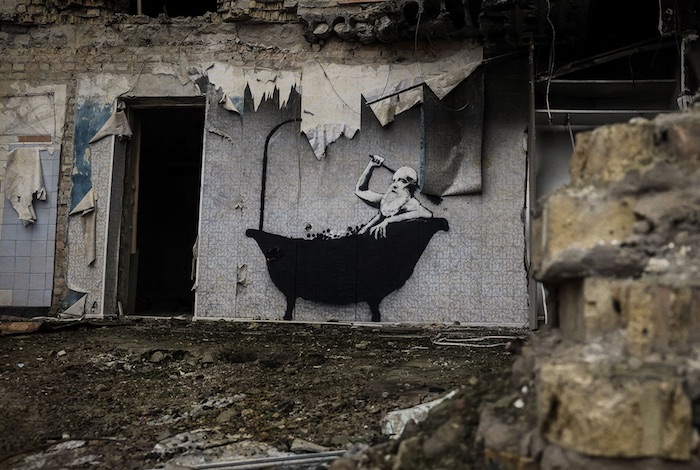 This Banksy mural of a man scrubbing his back in a bathtub appeared in 2022 on a wall of a destroyed building in the Ukrainian village of Horenka. The mural piqued the interest of a Reuters journalist, setting off an effort to identify and understand the elusive artist. REUTERS/Gleb Garanich
Its creator was Banksy, one of the world’s most popular and enigmatic artists, whose identity has been debated and closely guarded for decades. Banksy is best known for simple yet sophisticated stencil paintings with searing social commentary. His work has generated tens of millions of dollars in sales over the years. Once an annoyance to authorities who viewed him as a vandal, he has become a British national treasure. In one survey, Brits rated him more popular than Rembrandt and Monet. In another poll, his “Girl with Balloon” painting was voted the favorite piece of artwork Britain has produced. Some critics believe Banksy’s anonymity is as important to his work as stencils and paint. The British press has run many articles over the years that tried to deduce his identity.
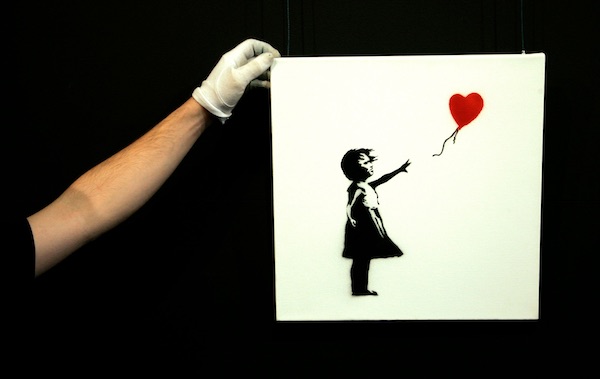 Banksy’s iconic “Girl with Balloon” painting was named in one opinion poll as the favorite piece of artwork Britain has ever produced. REUTERS/Tom Nicholson
Still, Banksy and his inner circle won’t talk about it. Some have signed non-disclosure agreements. Others keep quiet out of loyalty, or fear of crossing the artist, his fans and his influential company, Pest Control Office, which authenticates his work and decides who gets the first chance to buy Banksy’s latest pieces. When the bathtub mural and other Banksy pieces began appearing in Ukraine, Reuters wondered about the artist and how he had pulled off the stunt. Horenka was less than five miles east of Bucha, where Russian forces had left behind at least 300 civilians dead seven months earlier.Read more …
[..] So we set out to determine how Banksy did it – and who he really is. Weeks later, a reporter visited Horenka with a photo lineup of graffiti artists often rumored to be the artist and showed the pictures to locals to see if anyone recognized him. Not long after, we heard that a famous British musician – one of the people often whispered to be Banksy – had been spotted in Kyiv, giving us a theory to pursue. Reuters interviewed a dozen Banksy-world insiders and experts. None would comment on his identity, but many filled in details about his life and career. We examined photos of the artist, most of which obscured his face but contained critical information. We later unearthed previously undisclosed U.S. court records and police reports.These included a hand-written confession by the artist to a long-ago misdemeanor charge of disorderly conduct – a document that revealed, beyond dispute, Banksy’s true identity. And in the process, we learned how and why the man behind the name Banksy vanished from the public record more than a decade ago. Reuters presented that man with its findings about his identity and detailed questions about his work and career. He didn’t reply. Banksy’s company, Pest Control, said the artist “has decided to say nothing.” His long-time lawyer, Mark Stephens, wrote to Reuters that Banksy “does not accept that many of the details contained within your enquiry are correct.” He didn’t elaborate. Without confirming or denying Banksy’s identity, Stephens urged us not to publish this report, saying doing so would violate the artist’s privacy, interfere with his art and put him in danger.
Belgium's Prime Minister argues the EU should end the proxy war against Russia:
— Glenn Diesen (@Glenn_Diesen) March 15, 2026
"Since we are not able to threaten Vladimir Putin by supplying weapons to Ukraine, and we cannot strangle it economically without the support of the United States, there is only one way left — to… pic.twitter.com/nHxBFpooyF
🚨🇪🇺 URSULA VON DER LEYEN will go down in HISTORY as the EU leader who WRECKED Europe’s industry like no one else.pic.twitter.com/AbiPkFbvex
— Global Dissident (@GlobalDiss) March 14, 2026
1000 dead U.S. Soldiers? Are Trump and the Media Lying to the U.S. Public About U.S. Casualties 15 Days In?
— Cynthia McKinney PhD (@cynthiamckinney) March 14, 2026
George Galloway gives a very accurate description of how “Israel is taking a bloody good hiding, but you don’t know it.” He is getting around censorship by calling… pic.twitter.com/s0Om1XcD4a
Support the Automatic Earth in wartime with Paypal, Bitcoin and Patreon.