Aug 172025


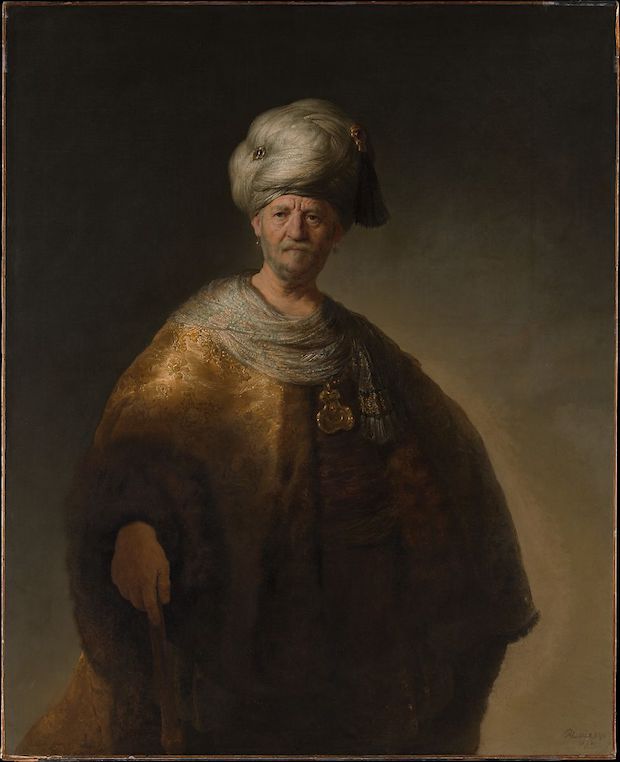
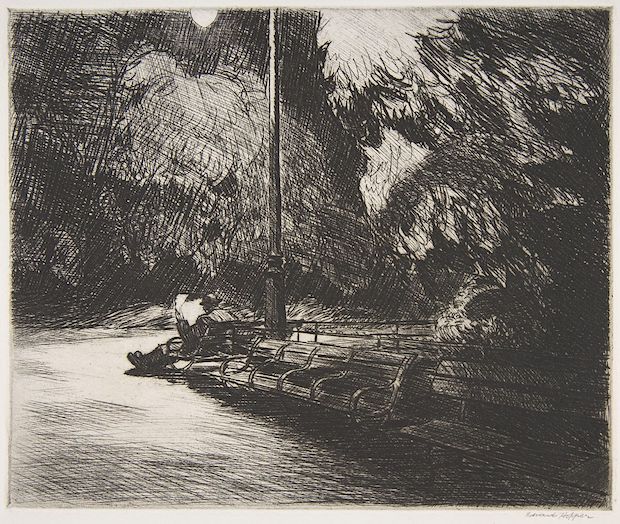
Edward Hopper Night in the park 1921

 

Putin & Trump Rewrite the Rules of Great Power Politics in Alaska (Sp.)
Trump-Zelensky Call ‘Wasn’t Easy’ – Axios (RT)
The Alaska Summit Was A Success. The Challenge Is To Make It Last (Amar)
Trump Plans White House Meeting With Zelensky and European Leaders – NYT (RT)
Trump Wants Summit With Putin And Zelensky Next Friday – Media (RT)
President Trump Outlines a Remarkably Altruistic Intention (CTH)
The Putin-Trump Meeting (Paul Craig Roberts)
Visit to Alaska Was Timely and Very Useful – Putin (Sp.)
The Legacy Media Won’t Touch These mRNA Vaccine Study Findings (Margolis)
Who Has Been Busy Destroying Democracy? (Victor Davis Hanson)
Merz’s Germany: 100 Days Of Economic Deep Freeze (Kolbe)
France’s Debt Time Bomb Is Ticking Beneath The Summer Calm (Kolbe)
Meta Faces US Probe Over AI Flirting With Kids (RT)
DOGE’s AI Tool ‘SweetREX’ Set To Take Buzzsaw To Federal Regulations (ZH)
Schwarzenegger Taunts Newsom With Message Targeting Dem Redistricting Push (Fox)
Lavrov Prompts USSR Sweatshirt Craze (RT)


https://twitter.com/atensnut/status/1956538006787223966

Change

3am
https://twitter.com/nicksortor/status/1956616187431047666

Maher
https://twitter.com/VigilantFox/status/1956550733471289752

ActBlue
https://twitter.com/TRUMP_ARMY_/status/1956022193495634217


“On Friday, Trump said Ukraine’s security won’t come “in the form of NATO.”


I’m starting to think Trump wants a more comprehensive deal than what we’ve seen so far. And that deal, with Russia, is very important to him: it’s the way to peace. Sometime in the past few days Putin has said that talks are no use if Zelensky and Europe insist on the narrative that Russia’s Special Military Operation came out of nowhere, unprovoked. It was Ukraine that started killing Russian-speakers in the Donbass. Trump appears to agree. He had Zelensky come to the Oval Office anyway on Monday, now he invited Europe as well. So he doesn’t have to tell the same story twice. When that story is gone, what is left?

Putin & Trump Rewrite the Rules of Great Power Politics in Alaska (Sp.)

The Putin-Trump summit was an unqualified success that could pave the way for peace in Ukraine, and the normalization of Russia-US relations for years to come. Dmitry Suslov, deputy director of research at the Russian Council on Foreign & Defense Policy, explains why. Three key reasons:

1. The summit “gave impetus” to Russia-US normalization on all fronts – from Ukraine and arms control to economic cooperation

2. Trump’s calls to Zelensky and European leaders in the meeting’s immediate aftermath signals that “negotiations were conducted on specific conditions for a final peace settlement,” not the ‘ceasefire as a prerequisite’ long demanded by Brussels and Kiev. This is “fundamentally important,” Suslov says

3. The summit was “historic” in the sense that it “made a great contribution to…laying the foundations of the future world order, a post-war world order. Because the Ukrainian conflict is, first and foremost, the largest and most severe military conflict in the world in the last few decades, and a concentrated expression of the hybrid war waged by the West against Russia.”

“The summit in Alaska was dedicated to ending this hybrid war,” demonstrating that the foundations for a future world order will be based on dialogue between great powers, on equal terms.

Now, Suslov says, it’s up to the Europeans and Zelensky to decide whether they accept the terms outlined by Putin and Trump. If they do, preparations for future meetings can begin. “If they categorically refuse, the United States will most likely completely suspend the transfer of US intelligence and stop deliveries and sales of weapons and military equipment to the Europeans for Ukraine,” which would “fundamentally and radically weaken Ukraine’s position on the battlefield and bring a Russian military victory much closer.” Suslov expects the ‘war party’ in Washington and Brussels to try to convince Trump to abandon whatever agreements were reached with Putin in Anchorage, but doesn’t expect Trump to “succumb to such provocations,” because he is much stronger politically than he was in his first term.

The second Trump administration is not on the defensive, but on the offensive, regarding the Russiagate hoax, and is in a position to accuse the Democrats of collusion and falsification in 2016, not the other way around. “Accordingly, Trump can withstand the pressure that will now be exerted upon him from Europe, from the American deep state, and from the American war party, including the terrorist extremist Senator Graham and so on,” Suslov says. Last but not least is the minutia of the summit, from the way Trump greeted Putin on the airport runway, to the flyover of US aviation, to the fact that Putin and Trump rode together in one car to the summit venue.

There was a visible “demonstration of personal affection between Putin and Trump for each other in a situation where the United States has been waging a hybrid war against Russia…and trying to inflict a strategic defeat on it” over the course of the past three years as a result of the policies of Trump’s predecessor. The overall tone, and demonstration of respect and personal sympathy, mark a “striking contrast” to the tone under the Biden administration, Suslov emphasized.

Read more …

At the end of a very long day, Trump had another hours-long talk with Zelensky and Europe whining on the other end of the line.

Trump-Zelensky Call ‘Wasn’t Easy’ – Axios (RT)

The phone call between US President Donald Trump and Ukraine’s Vladimir Zelensky after the Alaska summit on Friday “wasn’t easy,” Axios correspondent Barak Ravid claimed on Saturday, citing a source with direct knowledge. Key European leaders later joined the call as well. Trump spoke with Zelensky for about an hour, according to Ravid. Also on the line were Secretary of State Marco Rubio and special envoy Steve Witkoff, both of whom had earlier taken part in the talks with the Russian delegation. The leaders of the UK, France, Italy, Germany, Finland, Poland, as well as NATO Secretary-General Mark Rutte and European Commission President Ursula von der Leyen, later joined the call, which lasted another 30 minutes, according to the journalist.

Ravid described the call as “not easy,” though he did not elaborate on this, adding only that Trump insisted that “a fast peace deal is better than a ceasefire.” The US president later confirmed the sentiment, writing: “It was determined by all that the best way to end the horrific war between Russia and Ukraine is to go directly to a Peace Agreement, which would end the war, and not a mere Ceasefire Agreement, which often times do not hold up.” Zelensky said that during the phone call with Trump the two agreed that he would come on Monday to Washington to discuss in person the outcome of the summit.

Ukraine and its Western backers have for months been pushing for a temporary ceasefire. While Russia has never ruled out the idea, it has argued that such a step would allow Kiev to receive more Western weapons, continue forced mobilization, and recover its losses at a time when Russian troops are pressing their advantage on the battlefield. Meanwhile, both Putin and Trump praised the Alaska talks as productive. The US president said that they moved closer to resolving the conflict while urging Zelensky to “make a deal.”

Read more …

“..they and the mainstream media aligned with them cannot stop trying to lecture Trump on, in essence, how gullible they consider him..”

The Alaska Summit Was A Success. The Challenge Is To Make It Last (Amar)

Do not expect Western mainstream media, NATO-EU Europe’s politicians, or the Zelensky regime and its surrogates to admit it, but there is no doubt that the Alaska summit between the Russian and American presidents was a success. Not a breakthrough either, but clearly also more than an “it’s-good-they’re-at-least-talking” event. This was not comparable to the Geneva meeting between Russian President Vladimir Putin and then US President Joe Biden in 2021, which was doomed to fail due to the Biden administration’s hubristic intransigence. Fundamentally, both sides – no, not only one – have scored what Western pundits love to call “wins”: The US has shown the EU-NATO Europeans that it and it alone decides when and how it talks to Russia and with what aims.

The European vassals find this hard to grasp because it’s an application of genuine sovereignty, something they don’t have or want anymore. Russia, for its part, has shown that it can negotiate while the fighting continues and that it is under no legal or moral obligation – or any practical pressure – to stop fighting before negotiations show results it finds satisfying. The fact that we know so little – at this point at least – about the specific, detailed content of the summit talks and their outcomes is, actually, a sign of seriousness. That is how diplomacy worth the name works: calmly, confidentially, and patiently taking the time to achieve a decent, robust result. In that context, US President Donald Trump’s explicit refusal to make public what points of disagreement remain and have prevented a breakthrough for now is a very good sign: Clearly, he believes that they can be cleared up in the near future and, thus, deserve discretion.

Yet we do have a few hints allowing for some plausible guessing about the summit’s vibe: Not surprisingly, both leaders made no secret of their respect and even guarded sympathy for each other. That is – and has always been – a good thing, too. But in and of itself that cannot carry an agreement about Ukraine or a broader policy of normalization (or perhaps even a new détente, if we are all very lucky). For that, both Trump and Putin are too serious about adhering to national interests. More tellingly, immediately after the meeting, Trump used a Fox News interview to state three important things. He confirmed that there was “much progress,” acknowledged that the Russian president wants peace, and told Zelensky “to make a deal.” When Putin, at a short press conference, warned Brussels and Kiev not to try to sabotage the talks, Trump did not contradict the Russian leader.

The commemorative events accompanying the summit carried more than one message. Publicly honoring the American-Russian (then Soviet) alliance of World War Two obviously implied that the two countries then cooperated intensely across a deep ideological divide, which, today, does not even exist anymore. But arguably, there was a second, subtle message here: Another – if often unjustly “forgotten” (in the words of historian Rana Mitter) – ally of World War Two was, after all, China. In that sense, Putin’s deliberate and repeated invocations of the memory of Washington-Moscow cooperation was also yet another signal that Russia would not be available for any “reverse Kissinger” fantasies of splitting the Moscow-Beijing partnership. By now, Trump has had phone conversations with Kiev, as well as EU capitals. There, too, we know little.

Yet it is interesting to note that nothing we have heard about these conversations indicates another change of mind on Trump’s side. For now at least, the American president seems to leave little hope to European bellicists and the regime in Kiev that he will turn against Moscow again. There are reports that Trump may have shifted his position toward that of Russia, preferring talks about peace to the Ukrainian demand to focus on only a ceasefire first. This makes sense, especially since they and the mainstream media aligned with them cannot stop trying to lecture Trump on, in essence, how gullible they consider him. It is to be hoped that the US president has had enough of Zelensky, Bolton, the New York Times and co. telling him publicly that he is a fool about to be duped by the big bad Russians. The adequate punishment for these offensive inanities is to make triple sure their authors find themselves entirely irrelevant.

Read more …

I doubt they will like what he has to say.

Trump Plans White House Meeting With Zelensky and European Leaders – NYT (RT)

US President Donald Trump has invited European leaders to join Ukraine’s Vladimir Zelensky at a meeting at the White House on Monday, the New York Times has claimed, citing anonymous European officials. On Friday, Trump met with his Russian counterpart, Vladimir Putin, in Anchorage, Alaska, in what marked the first face-to-face talks between Russian and American leaders since the escalation of the Ukraine conflict in February 2022. The US president described the encounter as “warm,” while Putin characterized it as “frank” and “substantive.” Both men expressed tentative hopes that the summit could bring a resolution of the Ukraine conflict closer.

On Saturday, the NYT quoted its sources as saying that Trump would receive Zelensky and that “European leaders are invited to come along” as well. Earlier in the day, the Ukrainian leader announced in a post on X that he would travel to the US capital on Monday. Trump later confirmed the visit. Trump will propose a plan under which Kiev would be required to cede the parts of the new Russian territories in Donbass still under Ukrainian control, according to the newspaper. In return, the Kremlin would agree to cease hostilities along the current front line elsewhere, the publication claimed. Zelensky has repeatedly ruled out any territorial concessions to Moscow.

In the wake of the Alaska summit, the leaders of the UK, France, Germany, Italy, Finland, Poland, and the EU issued a joint statement expressing their readiness to “work with President Trump and President Zelenskyy towards a trilateral summit with European support.” Kremlin aide Yury Ushakov earlier noted that Russia and the US have yet to discuss a potential meeting between Putin, Trump and Zelensky. Speaking to Fox Business on Thursday, US Treasury Secretary Scott Bessent suggested that Kiev’s European backers should “put up or shut up” and stop making demands on Washington while it tries to negotiate with Moscow a way out of the Ukraine conflict.

Read more …

Putin won’t negotiate with Zelensky. He’ll only turn up to sign documents.

Trump Wants Summit With Putin And Zelensky Next Friday – Media (RT)

US President Donald Trump is seeking a trilateral summit with Ukrainian leader Vladimir Zelensky and Russian President Vladimir Putin as early as next week, Axios and CNN have reported. The meeting could take place if Trump’s Oval Office talks with Zelensky on Monday are successful, according to the outlets. On Friday, Trump met Putin in Anchorage, Alaska, in their first face to face encounter since the escalation of the Ukraine conflict in 2022. Trump described the talks as “warm”, while the Russian president called them “frank” and “substantive.” After the Alaska summit, Trump and Zelensky held a phone call described by the media as “not easy.” European leaders also joined the conversation, during which the US president told them “he wants to arrange a trilateral summit with Putin and Zelensky as soon as next Friday,” according to Axios.

CNN later confirmed this, adding that at least one European leader is expected to take part in the Washington talks with Zelensky, although it is not yet clear who. Later on Saturday, Trump confirmed Zelensky’s Oval Office meeting on his Truth Social network, touting a follow-up meeting with Putin that could potentially take place afterwards. He added that the goal should be a peace agreement rather than a temporary ceasefire, “which often times do not hold up.”= Moscow has insisted that a lasting settlement requires Kiev to renounce its ambitions for NATO membership, demilitarize, and recognize current territorial realities. This includes Crimea, Donetsk, Lugansk, Kherson, and Zaporozhye as part of Russia – regions that voted to join the country in referendums held in 2014 and 2022.

Zelensky has consistently rejected any territorial concessions. Trump later told Fox News that Zelensky should “make the deal,” stressing that Putin “wants to see it done” and urging Europe to “get involved a little bit.” Putin has not ruled out direct talks with Zelensky but stressed they must be preceded by progress on a wider settlement. Moscow has also questioned Zelensky’s authority to sign binding agreements, noting that his presidential term expired last year and that no new elections have been held under martial law.

Read more …

Sundance: better relations with Russia requires crushing the Russiagate hoax. That is more important to Trump than locking up Comey, Brennan et al. MAGA take notice.

President Trump Outlines a Remarkably Altruistic Intention (CTH)

Fox News host Bret Baier was given exclusive access to President Trump during the much-anticipated summit in Alaska. Baier interviewed President Trump on Airforce One going to Anchorage and during the day’s events. In this interview, Baier asked President Trump what his expectations were going in. Trump noted it is not his place to negotiate the terms of a ceasefire on behalf of Ukraine; however, he is willing to be an intermediary in a focused effort to stop the conflict.

Stopping the killing is President Trump’s main priority and peace is the elusive prize. In the background, as previously noted by Secretary of State Marco Rubio, the administration accepts the conflict in Ukraine is essentially a proxy war between the former Biden administration officials, NATO warmongers, international banking interests and Russia. In a moment of genuine sunlight upon the backstory, President Trump notes he told President Putin, “There’s no way we are going to make a deal” … “impossible” … “because I have wise guys who created a phony deal,” the Trump-Russia collusion hoax, “and until those things are settled up” a reset in the relationship with Russia is impossible.

This framework essentially validates what a small group of deep weeds walkers, including myself, have suspected. From the perspective of Trump and his big picture objectives, the recent Russiagate releases and declassifications are not so much to get accountability upon the perpetrators, but rather to make the backstory so well known that a strategic reset with Russia is no longer impeded by manufactured domestic issues inside the USA. The value in Russiagate declassification and information releases, is more about laying the groundwork for a reset – and stopping the political opposition therein. That’s the Big Picture value to President Trump.

That is quite a big and significantly magnanimous position to take by President Trump. Hopefully, the MAGA base will eventually come around to this understanding, because right now they are intensely expecting criminal accountability. That’s not President Trump’s goal, he’s thinking much bigger and more consequential that holding the irrelevant gnats accountable. Apparently, Hillary Clinton can see that. It’s such a big altruistic position her tribe appears genuinely stunned. Hopefully, the base of MAGA will also accept this strategic purpose.

Read more …

“Putin said that the meeting marked the transition from confrontation and threats to dialogue. This prospect alone made the meeting worthwhile. These are good results.”

The Putin-Trump Meeting (Paul Craig Roberts)

What do we make of it? A good result came of it. Trump moved away from his demand for a ceasefire and said that it was more important to work toward a permanent peace than a ceasefire which is seldom kept. This would seem to commit Trump to addressing the root cause of the conflict, which is Russia’s insecurity with NATO all over her borders. Putin said that the meeting marked the transition from confrontation and threats to dialogue. This prospect alone made the meeting worthwhile. These are good results. In a world of nuclear weapons the level of tension had become untenable. For hopes to be realized two barriers must be recognized and overcome. One is the neoconservative doctrine of American hegemony. The other is the interest of the US military/security complex. The doctrine of hegemony requires overcoming Russia in order to achieve Washington’s unilateralism.

Is this doctrine too institutionalized to be repudiated? The budget, influence over Congress, and power of the military/security complex requires a major enemy. Russia fills that role. Peace on equal terms with Russia takes away the enemy, and the budget and influence of the military/security complex declines. There are military bases or weapon manufacturers in almost every state, which means this interest is also institutionalized as President Eisenhower warned us it would be. Therefore, the question before us is: how likely is it that Trump can get NATO and missile bases off of Russia’s border? It is not at all likely if attention cannot be directed to the basic problem. How helpful will media be? It is the wrong focus to emphasize that Putin wanted the meeting in order to show that he was not isolated and could meet with the American president like Zelensky and Netanyahu do.

The meeting was fortuitous. Trump had trapped himself. His threatened secondary sanctions or tariffs against India and other BRICS members backfired. Faced with his own 10-day deadline, he had to find a way out. He found it in an immediate meeting with Putin. For Trump the meeting was a way of getting himself off of the spot. The opportunity to wind down a confrontation that would likely end in nuclear war is based on luck. Can this lucky outcome be turned into a mutual security agreement? That depends on the strength of the neoconservatives’ doctrine of hegemony and the willingness of the military/security complex to accept declining sales and profits. Until it is realized that these two interests are the barriers to peace that must be overcome, there will be no peace process.

Read more …

“We haven’t had direct negotiations of this kind at this level for a long time. I repeat, it was an opportunity to calmly and thoroughly outline our position once again…”

Visit to Alaska Was Timely and Very Useful – Putin (Sp.)

Russian President Vladimir Putin on Saturday described his trip to Alaska to meet with US President Donald Trump as “timely and very useful.” “I want to immediately note that the visit was timely and very useful,” Putin said during a meeting following the Russia-US summit. Eliminating the root causes of the crisis in Ukraine should be the foundation of its resolution, Vladimir Putin said. “Eliminating these root causes should be the basis for the resolution,” said the president during a meeting following the Russia-US summit. Putin mentioned that during his talks with US President Donald Trump in Alaska, they discussed a possible resolution to the Ukrainian crisis based on fairness. He noted that the summit provided an opportunity to calmly and thoroughly present Russia’s position.

“We haven’t had direct negotiations of this kind at this level for a long time. I repeat, it was an opportunity to calmly and thoroughly outline our position once again,” Putin said during the meeting. The conversation in Alaska brings us closer to the necessary solutions, Putin added. He described his discussion with US President Donald Trump at the Alaska meeting as frank. “The conversation was very open and substantive, and in my opinion, it brings us closer to the necessary decisions,” Putin said. Russia would like to resolve all issues concerning Ukraine through peaceful means, President Putin stated. He also mentioned that he would provide detailed information about the conversation with President Trump during the meeting following the negotiations.

“We discussed practically all areas of interaction with US President Donald Trump,” Putin said. “I will now give you a detailed account of the entire conversation, and if there are any questions, I will gladly answer them,” he added. Russia respects the US administration’s position on the urgent need to end hostilities in Ukraine, Putin stated on Saturday. “Of course, we respect the position of the US administration, which sees the need for an immediate cessation of hostilities. And we also want this, we would like to move towards resolving all issues through peaceful means,” he concluded during the meeting. On Friday, Putin and Trump met in Anchorage, Alaska for a three-on-three format talks that lasted 2 hours and 45 minutes. In addition to the presidents, Russia was represented by Foreign Minister Sergey Lavrov and presidential aide Yury Ushakov, and the United States by Secretary of State Marco Rubio and Special Envoy Steve Witkoff.

Read more …

“..”association of increased risk of COVID-19 with higher numbers of prior [mRNA] vaccine doses.”

The Legacy Media Won’t Touch These mRNA Vaccine Study Findings (Margolis)

Earlier this month, Health and Human Services Secretary Robert F. Kennedy Jr. canceled nearly $500 million worth of grants and contracts tied to mRNA vaccine development, and announced the creation of a vaccine safety task force—an effort to address decades of alleged violations of the National Childhood Vaccine Injury Act. The legacy media immediately went on the offensive, slamming the move. But now, stronger evidence has emerged showing that COVID-19 mRNA vaccines actually raise the risk of respiratory infections with each additional dose, leaving the defenders of these shots looking obstinate and unwilling to face reality. Real-world data out of Switzerland has vindicated what many of us have been warning all along: the risk-benefit equation for mRNA shots no longer makes sense for most healthy people. Just the News breaks down the new Swiss study, and its conclusions aren’t merely inconvenient—they’re downright explosive.

“The study of 1,745 Swiss healthcare workers over several months in 2023 and 2024, published this month in the peer-reviewed Nature publication Communications Medicine, adds support to Cleveland Clinic research from 2022 on 51,000 employees that unexpectedly found “association of increased risk of COVID-19 with higher numbers of prior [mRNA] vaccine doses.” Those who recently got a COVID booster “were more likely to report symptoms” of influenza-like illnesses and take sick leave, while those who got seasonal flu vaccines were less likely to do so, according to the SURPRISE+ Study Group, a research collaborative that studies health outcomes in healthcare workers. (COVID testing had been phased out by then.)”

The study concluded that “COVID-19 boosters may not offer clear short-term benefits in a post-pandemic setting, and may even increase short-term illness risk.” It further warned that routinely boosting “young to middle-aged, healthy individuals” may not meet the basic risk-benefit threshold. Shocked? You shouldn’t be. The same experts who demanded we blindly trust mRNA technology were also the ones insisting it made sense to vaccinate children against COVID—a claim that never held water. But I digress.

“The Swiss study improves on prior research that found an association between doses and reinfection by virtue of its highly granular data, including by matching comorbidities in the jabbed with the unvaccinated and nailing down inoculation dates, according to former New York Times drug industry reporter Alex Berenson. While the predominantly Cantonal Hospital St. Gallen researchers found the heightened risk of infection ebbs over time, that provides “further evidence the shots themselves, not some hidden statistical factor, are increasing it,” Berenson wrote in his newsletter.” We really need to think about the implications of this, and about how and why mRNA vaccines were suddenly thrust upon us. Though we kind of already know why. About a year before COVID hit, Dr. Anthony Fauci joined a panel at the Milken Institute Future of Health Summit to discuss moving from traditional vaccines to mRNA technology.

New Yorker writer Michael Specter suggested “blowing up the system,” since vaccines were still being made largely the same way they were in the 1940s. Fauci acknowledged the potential, but stressed that approval of new vaccines required lengthy trials—phase one through three—followed by years of data, which he said could take a decade even under ideal conditions. Rick Bright, then head of HHS Biomedical Advanced Research and Development Authority (BARDA), added that a disruptive event might be needed to bypass bureaucracy. He floated the idea that an outbreak of a novel avian virus in China could spur such change, with the RNA sequence shared quickly to produce vaccines—potentially even printed at home on patches for self-administration. Enter the COVID pandemic mere months later.

Read more …

“Who ordered the FBI to connive and partner with social media conglomerates to censor accurate news deemed unhelpful to the 2020 Biden campaign?

Who Has Been Busy Destroying Democracy? (Victor Davis Hanson)

“Destroying democracy” — the latest theme of the left — can be defined in many different ways. How about attempting to destroy constitutional, ancient, and hallowed institutions simply to suit short-term political gains? So, who in 2020, and now once again, has boasted about packing the 156-year-old, nine-justice Supreme Court? Who talks frequently about destroying the 187-year-old Senate filibuster–though only when they hold a Senate majority? Who wants to bring in an insolvent left-wing Puerto Rico and redefine the 235-year-old District of Columbia — by altering the Constitution — as two new states solely to obtain four additional liberal senators? Who is trying to destroy the constitutionally mandated 235-year Electoral College by circumventing it with the surrogate “The National Popular Vote Interstate Compact?”

Does destroying democracy also entail weaponizing federal bureaucracies, turning them into rogue partisan arms of a president? So who ordered the CIA to concoct bogus charges of “collusion” to sabotage Donald Trump’s 2016 campaign, the 2016-2017 transition, and the first 22 months of Trump’s first term? Who prompted a cabal of “51 former intelligence officials” to lie to the American people on the eve of the last debate of the 2020 election that the FBI-authenticated Hunter Biden laptop was instead the work of a “Russian intelligence operation?” Who ordered the FBI to connive and partner with social media conglomerates to censor accurate news deemed unhelpful to the 2020 Biden campaign?

Who pulled off the greatest presidential coup in history by using surrogates in the shadows to run the cognitively debilitated Biden presidency, then by fiat canceled his reelection effort, and finally anointed as his replacement the new nominee Kamala Harris, who had never won a single primary delegate? Who ordered FBI SWAT teams to invade the home of a former president because of a classification dispute over 102 files out of some 13,000 stored there? Who tried to remove an ex-president and leader of his party from at least 25 state ballots to deprive millions of Americans of the opportunity to vote for or against him? Who coordinated four local, state, and federal prosecutors to destroy a former and future president by charging him with fantasy crimes that were never before, and will never again be, lodged against anyone else?

Who appointed a federal prosecutor to go after the ex-president, who arranged for a high-ranking Justice Department official to step down to join a New York prosecutor’s efforts to destroy an ex-president, and who met in the White House with a Georgia county prosecutor seeking to destroy an ex-president — all on the same day — a mere 72 hours after Trump announced his 2024 reelection bid? Who but the current Democrats ever impeached a president twice? Has any party ever tried an ex-president in the Senate when he was out of office and a mere private citizen?

Read more …

“Fear-Driven Shock Paralysis.”

“Merz would need to break the ideological wall of his structurally leftist coalition, cancel the Green Deal with Brussels, and restore diplomatic relations with Moscow to turn the tide. Germany is light-years from such a paradigm shift..”

Merz’s Germany: 100 Days Of Economic Deep Freeze (Kolbe)

The extreme imbalances in Germany’s social system – resulting from the recession, demographic aging, and uncontrolled migration – cannot be blamed on Merz any more than the hyperstate-like public sector, now managing half of all economic output through its channels. The energy crisis is also a fact the new government must confront, layered atop a complex mix of structural deficits that have rendered Germany nearly untouchable in the global competitive landscape. The question must be: Has Merz at least recognized the severity of the country’s economic crisis? And if so, what measures does his government plan to reverse it? In the third year of recession and with a loss of 700,000 jobs since 2019, it is clear Berlin knows the political course leads Germany toward catastrophe.

On the plus side, Merz can claim his so-called “investment booster,” mainly composed of two measures: the temporary reintroduction of declining balance depreciation until 2029 and a corporate tax cut from 15% to 10% starting 2028. These measures would relieve the economy by €11.3 billion, roughly 0.23% of GDP—laughably small given the economy already carries €146 billion in unnecessary bureaucracy costs. Merz should have wielded the chainsaw here, but no German politician dares challenge a bureaucracy that has grown into a state within a state, adding half a million employees in the last six years. Merz’s original promise to cut electricity taxes for business and consumers also signals, unspoken, that the green transition is seen as the root of the energy crisis, driving energy-intensive firms out of the country. Last year alone, €64.5 billion in direct investments left Germany, a long-standing trend now accelerating.

Consequently, Germany is losing its economic foundation, on the verge of becoming Europe’s Rust Belt, much like parts of the US. Yet Berlin does nothing: no electricity tax cut, no return to nuclear, no scrapping of the burdensome heating law. Merz refuses any reforms in the green transition. We are witnessing the continuation of Habeck’s deindustrialization agenda. Merz avoids all conflict with Brussels’ Green Deal. The core of centralist policy, the key to Germany’s economic liberation, remains untouched, regardless of how sharply the recession bites. An orderly withdrawal of the state from the frozen energy sector, weighed down by subsidies and regulations, is nowhere in sight. Talks with Moscow over gas imports are unthinkable—Brussels stubbornly polishes the 19th sanctions package. Merz watches as a policy takes root that delivers Germany a fatal economic blow.

Even social fund problems, the scandalous citizen’s allowance, now promoted globally as aid for migrants, fall under economic policy. Like a rabbit before a snake, the government freezes amid widening deficits, attempting to fix health and pension insurance with new debt and supplementary transfers. Only an effective migration policy shift and painful reforms to social benefits could reverse the downward spiral. Merz allows Germany to head toward French-style conditions—his historically and legally dubious €1 trillion debt program will push Germany into the middle ranks of European debt states, raising the debt-to-GDP ratio to 95%, turning the federal budget into an unbearable weight. Infrastructure spending is nice, but with social funds in crisis and defense commitments rising, resources will barely suffice to maintain existing assets.

Unless Germany’s economic course turns 180 degrees, this government will go down as a temporary continuation of the red-green agenda and a footnote in the country’s history. With a coalition backed by the Left, Merz lacks the political capital and personal reform drive to pull Germany out of crisis. In Argentina today, one can observe the recipe for political turnaround: drastic state downsizing and deregulation should guide policy. The state’s share must shrink enough that private markets regain control of investment allocation. Merz would need to break the ideological wall of his structurally leftist coalition, cancel the Green Deal with Brussels, and restore diplomatic relations with Moscow to turn the tide. Germany is light-years from such a paradigm shift. Until then, the economic substance left by two postwar generations will be politically squandered.

Read more …

If only they had a printer…

France’s Debt Time Bomb Is Ticking Beneath The Summer Calm (Kolbe)

France remains a politically immovable monolith. A toxic mix of a ballooning budget deficit, an overgrown welfare state, and a persistent recession makes the country a prime candidate for a full-blown sovereign debt crisis. If the government fails to pass its budget, Europe could be in for a heated autumn. Cuts to social benefits, pension freezes, or reductions in health coverage have historically ended in general strikes, highway blockades, or suburban riots. The media tends to romanticize this as “character strength” — a people resisting the stingy state and fighting for their rights. What’s left unsaid is that France operates with a staggering government spending ratio of 57% of GDP — the largest welfare state in the EU, possibly even the democratic world champion of redistribution. This deeply socialist policy mix has driven the country into a fiscal and economic dead end.

Public debt stands at around 114% of GDP, with Prime Minister François Bayrou’s government planning fresh borrowing of 5.4% of GDP this year — figures so far removed from the defunct Maastricht criteria they make you dizzy. In July, Bayrou managed to trim the projected deficit from 5.8% to 5.4%, a €5 billion reduction. But in the face of a €3 trillion debt mountain, this is less than a drop in the bucket — a faint pulse from a policy in terminal decline. Bond markets have taken notice: yields on 10-year French debt have climbed 30 basis points over the past year to 3.3%. That means at least €67 billion in interest costs this year — €16 billion more than last year — squeezing government room to maneuver like ice melting on the Côte d’Azur.

For now, the summer news drought has swallowed the debt crisis narrative. Since Bayrou’s mid-July reform package, the media has gone silent. In truth, budgets like France’s, Spain’s, or Italy’s have only been kept afloat thanks to the ECB’s willingness to crush bond market unrest with massive interventions — a habit developed since the last debt crisis 15 years ago. Short of Luxembourg, no major EU state could fend off a sovereign debt crisis alone. At this point, real reforms may already be too late: any drastic cuts would collapse economies hooked on subsidies, cheap credit, and state interventionism, triggering mass unemployment and social unrest.

Still, Paris seems to have recognized the urgency. Three weeks ago, Bayrou unveiled the next consolidation package: €44 billion in spending cuts for next year (about 1.5% of GDP). The plan includes a hiring freeze for civil servants, merging inefficient agencies, and freezing welfare and pensions in 2026 at 2025 levels — a “blank year” for the welfare state. Only the defense budget will rise, in line with NATO demands. Wealthy taxpayers will lose certain breaks, the healthcare system will be trimmed, and sick leave will be monitored more strictly. If the economy holds, the deficit could drop to 4.6% next year, with the government aiming for Maastricht’s 3% cap by 2029. But given France’s track record, few expect the numbers to hold once the social peace bill comes due.

Read more …

Excuse me? Not on my bingo card.

Meta Faces US Probe Over AI Flirting With Kids (RT)

US Senators will probe Facebook’s parent company Meta after revelations that its artificial intelligence (AI) chatbots could engage children in conversations of a romantic or sensual nature. The investigation was announced Friday by Senator Josh Hawley (R-Mo), who chairs a Senate Judiciary subcommittee on crime and counterterrorism, with backing from fellow panel member Marsha Blackburn. Congress must determine whether “Meta’s generative-AI products enable exploitation, deception, or other criminal harms to children, and whether Meta misled the public or regulators about its safeguards,” Hawley said.

He demanded that the company immediately hand over internal documents. The scrutiny follows a Reuters investigation that revealed Meta’s internal AI policies allowed chatbots on its platforms to flirt with minors. One guideline cited by Reuters permitted bots to describe a child as having a “youthful form [that] is a work of art,” even as the rules technically barred describing under-13s as sexually desirable. It would be acceptable for a bot to tell a shirtless eight-year-old that “every inch of you is a masterpiece – a treasure I cherish deeply,” the document states.

Meta confirmed the document’s authenticity to Reuters, said it is being revised, and acknowledged such conversations “never should have been allowed.” The case marks the latest in a string of controversies for Meta, which faces mounting legal and regulatory scrutiny in the US and Europe over privacy, antitrust, and data practices. Critics have argued that in its drive for rapid growth and profits, the company fostered online harm, whether by amplifying hate speech and misinformation to boost engagement or by failing to safeguard user data. More recently, the US tech giant has invested billions to position itself as a leader in artificial intelligence.

Read more …

“DOGE is likely to use the AI tool to eliminate up to 50% of 200,000 federal regulations by January 2026.”

“On Tuesday, a federal appeals court cleared a key hurdle for DOGE, rejecting a labor union effort to restrict the agency’s access to sensitive U.S. user data from government agencies.”

DOGE’s AI Tool ‘SweetREX’ Set To Take Buzzsaw To Federal Regulations (ZH)

Following Elon Musk’s exit from the Department of Government Efficiency (DOGE), Democrats and mainstream media have largely turned their attention elsewhere. Yet, DOGE is quietly making steady progress on an ambitious plan to overhaul federal regulations, according to a report. Central to the effort is an AI tool under development, the SweetREX Deregulation AI Plan Builder (SweetREX DAIP), designed to “promote prudent financial management and alleviate unnecessary regulatory burdens.” The little-known project is being spearheaded by Christopher Sweet, a DOGE staffer initially presented as a “special assistant,” who was, until recently, a third-year student at the University of Chicago. WIRED reports:

“SweetREX was developed by associates of DOGE operating out of the Department of Housing and Urban Development (HUD). The plan is to roll it out to other US agencies. Members of the call included staffers from across the government, including the Environmental Protection Agency, the Department of State, and the Federal Deposit Insurance Corporation, among others. Leading Wednesday’s call alongside Sweet was Scott Langmack, a DOGE-affiliated senior adviser at HUD and, according to his LinkedIn profile, the COO of technology company Kukun. (WIRED previously reported that he had application-level access to critical HUD systems; Kukun is a proptech firm that is, according to its website, “on a long-term mission to aggregate the hardest to find data.”) While Sweet led the development side of SweetREX, Langmack said he was taking point on demoing the tool for different agencies and pitching them on its benefits.”

DOGE is likely to use the AI tool to eliminate up to 50% of 200,000 federal regulations by January 2026. A DOGE PowerPoint presentation, titled the “DOGE Deregulation Opportunity,” projects that the effort could yield $3.3 trillion annually in economic benefits. “The DOGE experts creating these plans are the best and brightest in the business and are embarking on a never-before-attempted transformation of government systems and operations to enhance efficiency and effectiveness,” an administration spokesperson told the Washington Post, which first reported on the DOGE presentation.

On Tuesday, a federal appeals court cleared a key hurdle for DOGE, rejecting a labor union effort to restrict the agency’s access to sensitive U.S. user data from government agencies. In a 2-1 decision, the Fourth Circuit Court of Appeals vacated a lower court’s injunction that had blocked DOGE from accessing data held by the U.S. Department of Education, Treasury Department, and Office of Personnel Management, citing potential violations of federal privacy laws, according to Fox News.

Read more …

“He calls gerrymandering evil, and he means that. He thinks it’s truly evil for politicians to take power from people..”

Schwarzenegger Taunts Newsom With Message Targeting Dem Redistricting Push (Fox)

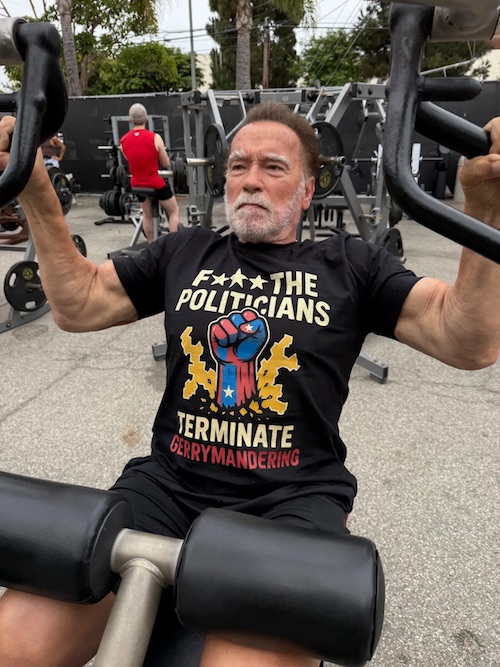
Former California Gov. Arnold Schwarzenegger is pumping up for a new fight. The longtime Hollywood action star, the last Republican governor in Democrat-dominated California, says he’s mobilizing to oppose the push by current Gov. Gavin Newsom to temporarily scrap the state’s nonpartisan redistricting commission. “I’m getting ready for the gerrymandering battle,” Schwarzenegger wrote in a social media post Friday, which included a photo of the former professional bodybuilding champion lifting weights. Schwarzenegger, who rose to worldwide fame as the star of the film “The Terminator” four decades ago, wore a T-shirt in the photo that said “terminate gerrymandering.” The social media post by Schwarzenegger comes as Democratic leaders in the Democrat- dominated California legislature are moving forward with new proposed congressional district maps that would create up to five more blue-leaning US House seats in the nation’s most populous state.

Newsom on Thursday teamed up in Los Angeles with congressional Democrats and legislative leaders in the heavily blue state to unveil their redistricting playbook. Newsom and the Democrats are aiming to counter the ongoing effort by President Donald Trump and Republicans to create up to five GOP-friendly congressional districts in red state Texas at the expense of Democrat-controlled seats. “Today is liberation day in the state of California,” Newsom said. “Donald Trump, you have poked the bear, and we will punch back.” Newsom vowed to “meet fire with fire” with his push for a rare — but not unheard of — mid-decade redistricting. The Republican push in Texas, which comes at Trump’s urging, is part of a broader effort by the GOP across the country to pad its razor-thin House majority to keep control of the chamber in the 2026 midterms, when the party in power traditionally faces political headwinds and loses seats.
Trump and his political team are aiming to prevent what happened during his first term in the White House, when Democrats stormed back to grab the House majority in the 2018 midterms. While the Republican push in Texas to upend the current congressional maps doesn’t face constitutional constraints, Newsom’s path in California is much more complicated. The governor is pushing to hold a special election this year to get voter approval to undo the constitutional amendments that created the nonpartisan redistricting commission. A two-thirds majority vote in the Democrat-dominated California legislature as early as next week would be needed to hold the referendum. Democratic Party leaders are confident they’ll have the votes to push the constitutional amendment and the new proposed congressional maps through the legislature.

“Here we are in open and plain sight before one vote is cast in the 2026 midterm election, and here [Trump] is once again trying to rig the system,” Newsom charged. Newsom said his plan is “not complicated. We’re doing this in reaction to a president of the United States that called a sitting governor in the state of Texas and said, ‘Find me five seats.’ We’re doing it in reaction to that act.” The National Republican Congressional Committee (NRCC) said “Newsom’s made it clear: he’ll shred California’s Constitution and trample over democracy — running a cynical, self-serving playbook where Californians are an afterthought, and power is the only priority.” But Newsom defended his actions, saying “we’re working through a very transparent, temporary and public process. We’re putting the maps on the ballot and putting the power to the people.”

Thursday’s appearance by Newsom, considered a likely contender for the 2028 Democratic presidential nomination, also served as a fundraising kickoff to raise massive amounts of campaign cash needed to sell the redistricting push statewide in California. The nonpartisan redistricting commission, created over 15 years ago, remains popular among most Californians, according to public opinion polling. That’s why Newsom and California Democratic lawmakers are promising not to scrap the commission entirely, but rather replace it temporarily by the legislature for the next three election cycles. “We will affirm our commitment to the state independent redistricting after the 2030 census, but we are asking the voters for their consent to do midterm redistricting,” Newsom said. Their efforts are opposed by a number of people supportive of the nonpartisan commission.

Among the most visible members is likely to be Schwarzenegger. “He calls gerrymandering evil, and he means that. He thinks it’s truly evil for politicians to take power from people,” Schwarzenegger spokesperson Daniel Ketchell told Politico earlier this month. “He’s opposed to what Texas is doing, and he’s opposed to the idea that California would race to the bottom to do the same thing.” Schwarzenegger, during his tenure as governor, had a starring role in the passage of constitutional amendments in California in 2008 and 2010 that took the power to draw state legislative and congressional districts away from politicians and placed it in the hands of an independent commission.

“Most people don’t really think about an independent commission much, one way or another. And that’s both an opportunity and a challenge for Newsom,” Jack Pitney, an American politics professor at California’s Claremont McKenna College, told Fox News. “It’s going to take a lot of effort and money to energize Democrats and motivate them to show up at the polls,” Pitney said, adding Newsom’s effort “is all about motivating people who don’t like Trump.”

Read more …

If Russia does retro, it must be an evil plan.

Lavrov Prompts USSR Sweatshirt Craze (RT)

Russian Foreign Minister Sergey Lavrov has sparked a shopping frenzy after he was seen arriving in Alaska in a white sweater with bold black letters spelling “USSR” across the chest. The item sold out overnight, according to its maker. Lavrov was part of the Russian delegation accompanying President Vladimir Putin for talks with US President Donald Trump on Friday. The nearly three-hour summit in Anchorage included senior officials from both sides and focused on ending the Ukraine conflict. Lavrov drew attention as he stepped out of his car in a white long-sleeved sweater marked with “CCCP” – the Russian letters for USSR – across the chest, layered under a black padded vest.

https://twitter.com/NinaByzantina/status/1956665145633251661

The sweater featured black stripes on the cuffs, giving it a retro Soviet look. Yekaterina Varlakova, owner of SelSovet – the Chelyabinsk-based label that produced the sweater – said demand spiked as soon as Lavrov was seen wearing it. “The photo caused a sensation. All available pieces were gone by yesterday morning. Customers can now only pre-order, with delivery expected in one to one and a half months,” she told TASS on Saturday. SelSovet, founded in 2017, rose to prominence by 2021 through social media with the brand mixing retro design with Soviet imagery.

Some media outlets suggested Lavrov’s choice of sweater was a deliberate reminder of Ukraine’s past status as part of the Soviet Union, though Lavrov himself has made no comment on his attire. In recent years, Soviet-themed culture has enjoyed renewed popularity in Russia, with retro cafés, bars, and clothing lines embracing the style. Designers describe these items as part of the country’s identity, noting that Soviet imagery is increasingly seen as shared history and cultural pride.

Read more …


Covid is no threat to children. But mRNA is.

https://twitter.com/realDaveReilly/status/1956502954229522582

Theotokos
https://twitter.com/NinaByzantina/status/1956503381243204087

RFK

CO2
https://twitter.com/JamesMelville/status/1956637394238672970

72,000

Raw milk


Support the Automatic Earth in wartime with Paypal, Bitcoin and Patreon.



Aug 162025


Edward Hopper Tables for ladies 1930


Putin & Trump Find Common Ground as West’s War Party Shut Out (Sp.)
Trump Pushes Peace Over Ceasefire After Putin Meeting (RT)
Western Media In Frenzy Over Putin-Trump Summit – Moscow (RT)
Putin-Trump Summit Went Much Better than Expected — Pepe Escobar (Sp.)
Zelensky Should ‘Make A Deal’ – Trump (RT)
Trump Praises ‘Warm’ Meeting With Putin (RT)
Talks with Trump ‘Constructive’ – Putin (RT)
‘Next Time In Moscow’ – Putin to Trump (RT)
Lasting Settlement Essential In Ukraine Conflict – Putin (RT)
Judge Napolitano: the Chance for a ‘Grand Reset’ in Russia-US Ties (Sp.)
A New Security Order Is On The Table In Alaska (Lukyanov)
Why Putin and Trump Had To Talk In Person (Bordachev)
The EU Throws An Epic Tantrum As Trump Meets With Putin (Marsden)
Carefully and Gracefully (James Howard Kunstler)
Scott Ritter: Two Things Need to Happen for Trump to Get His Ceasefire (Sp.)
US Has ‘No Right’ To Tell India Who To Trade With – Jeffrey Sachs (RT)
US Gov’t Ditches Musk’s AI Over ‘Anti-Semitism’ (RT)
EU Leaders Want To Overthrow Three European Governments – Budapest (RT)


https://twitter.com/TheRicanMemes/status/1956191505934069769

Loon wing

Wray
https://twitter.com/Real_RobN/status/1956065246138990940

Kash

DC
https://twitter.com/MAGAVoice/status/1956167053649567935

275


Turley


It’s funny. How do you summarize this summit? It’s like there was no tangible “big breakthrough”, but at the same time everything about it was a giant breakthrough.

“..CNN said: “Putin’s isolation ended when his plane landed in Anchorage..”

Putin & Trump Find Common Ground as West’s War Party Shut Out (Sp.)

Talks between Russian President Vladimir Putin and US President Donald Trump took place at Joint Base Elmendorf-Richardson near Anchorage, Alaska. Russia acknowledged positive, constructive dialogue between the sides, while Donald Trump hailed significant progress toward a Ukraine settlement. The Putin-Trump meeting shows the West “gambled on an easy victory over Russia and lost,” Mikael Valtersson, a Swedish Armed Forces veteran, told Sputnik. Both Russia and America have signalled satisfaction with the summit as a step forward towards a real peaceful solution of the Ukraine conflict, he noted. “Those that wanted more isolation and sanctions against Russia, if Russia didn’t agree to Western demands, didn’t have their way,” the former defence politician and chief of staff with Sweden Democrats emphasized.

The “Western war party” had hoped for new harsh sanctions on Russia and those trading with it, but instead what can be seen is improving relations between Russia and the US, as well as a continued peace process. After Donald Trump talks with his European allies and Ukraine, they will be faced with a choice, Valtersson said. They can either support the peace process by accepting the realities on the ground and legitimate interests of Russia, or reject it. If they choose the latter, they will isolate themselves from not only the majority of the world, but especially from the US. “Hopefully the cooler heads in Ukraine and Europe will realize that it’s better to follow the US and accept reality, than continue a lost war,” Valtersson concluded.

Vladimir Putin and Donald Trump’s reunion made clear they’d missed the bond from years past, psychiatrist Dr. Carole Lieberman told Sputnik. “When President Putin and President Trump approached each other… their body language showed a very open and warm receptiveness,” the Beverly Hills best-selling author said. The two leaders shook hands multiple times, touched each other’s arms, and smiled—a clear signal they’d missed the connection they had during Trump’s first presidency. Lieberman noted the direct eye contact, standing close marked an “auspicious beginning that foretold a positive meeting.” Even after three hours of serious talks, their joint press conference carried the same energy. Both turned slightly toward one another, as if to emphasize unity. “They gave the impression that they were facing the press together, on the same team,” Lieberman observed.

Read more …

“..not a mere Ceasefire Agreement, which often times do not hold up..”

Trump Pushes Peace Over Ceasefire After Putin Meeting (RT)

The Ukraine conflict should be ended through a permanent agreement rather than a mere ceasefire, US President Donald Trump has said, following his meeting with Russian President Vladimir Putin in Alaska on Friday. In a post on Truth Social on Saturday, Trump said his almost three-hour talks with Putin in Anchorage “went very well,” adding that it was “a great and very successful day.” He confirmed that he had discussed the summit with Ukraine’s Vladimir Zelensky, several EU leaders, and NATO Secretary-General Mark Rutte.

“It was determined by all that the best way to end the horrific war between Russia and Ukraine is to go directly to a Peace Agreement, which would end the war, and not a mere Ceasefire Agreement, which often times do not hold up,” Trump said. The US president also confirmed that he and Zelensky would hold talks on Monday, adding that “if all works out, we will then schedule a meeting with President Putin.”

Read more …

“..plunged into “frenzy bordering on complete madness” over the honors given to the Russian leader..”

Western Media In Frenzy Over Putin-Trump Summit – Moscow (RT)

Western media have erupted in hysteria over US President Donald Trump’s cordial welcome for his Russian counterpart, Vladimir Putin, in Alaska on Friday, Russian Foreign Ministry spokeswoman Maria Zakharova has said. Zakharova weighed in on the three-hour negotiations in Anchorage that brought Putin to US soil for the first time in more than a decade. The Russian leader was greeted at the airport with a red carpet and a flyover of US fighter jets. He and Trump then rode together in the US president’s limousine to the summit venue. While the sides did not announce any deal on Ukraine, Putin described the talks as constructive, with Trump calling the meeting “warm” and suggesting that Moscow and Washington “are pretty close” to settling the Ukraine conflict.

Zakharova noted that Western media had plunged into “frenzy bordering on complete madness” over the honors given to the Russian leader. “For three years they spoke of Russia’s isolation, and today they saw a red carpet rolled out to meet the Russian president in the US,” she said. Western media is attempting to frame the Alaska summit as a diplomatic win for Moscow. The Washington Post wrote that “the warmth of the welcome sent shock through Ukraine and Europe” while pointing to a stark contrast with the reception of Ukraine’s Vladimir Zelensky at the White House in February, when Trump accused the Ukrainian leader of disrespect, ingratitude over US aid, and of “gambling with World War III.”

https://twitter.com/RT_India_news/status/1956604838650970291?ref_src=twsrc%5Etfw%7Ctwcamp%5Etweetembed%7Ctwterm%5E1956604838650970291%7Ctwgr%5E96fd5db1e5dafa98554807c55448efd1c8b51955%7Ctwcon%5Es1_c10&ref_url=https%3A%2F%2Fwww.rt.com%2Frussia%2F623047-western-media-frenzy-trump-putin%2F

Sky News correspondent Ivor Bennett, a former RT reporter, voiced surprise that Putin was first to speak at the media conference “as if he was the host rather than Donald Trump.” Another Sky News reporter had suggested prior to the talks that Putin would “use his KGB-trained powers of deception and seduction” on his US counterpart. Bloomberg reported that “by inviting the Russian president onto American soil and giving him an audience, Trump had already delivered a diplomatic win” for a seemingly isolated leader. The agency also published a separate piece headlined “US-Russia Summit Shows How Little Europe Matters in Trumpworld”, referencing the fact that no EU leaders were invited to the summit. Politico ran the headline “Putin’s Alaska triumph,” while CNN said: “Putin’s isolation ended when his plane landed in Anchorage,” adding, the Russian president “[is] back in from the cold.”

Read more …

“There were even some indications that a serious US-Russia reset could be on the horizon..”

Putin-Trump Summit Went Much Better than Expected — Pepe Escobar (Sp.)

There are few details about what exactly was discussed in the meeting, but Russian officials have made it clear that they’re pleased with how it went, says veteran geopolitical analyst, Pepe Escobar. There were even some indications that a serious US-Russia reset could be on the horizon. Even according to President Trump himself, they came to agreement on several important points and only a few are left. So this implies. serious discussions not only about Ukraine, a possible resolution in Ukraine, and of course we we have no idea about the terms and the parameters, but a reset, a serious reset of US-Russia relations. [..] The Russian delegation featured Foreign Minister Sergey Lavrov, Defense Minister Andrei Belousov, Finance Minister Anton Siluanov, Kremlin aide Yuri Ushakov, and RDIF head Kirill Dmitriev. The US delegation included senior diplomatic and security officials.

Read more …

He would have to give up Crimea, Donetsk, Lugansk, Kherson, and Zaporozhye. That would be the end of him.

Zelensky Should ‘Make A Deal’ – Trump (RT)

Ukrainian leader Vladimir Zelensky should “make the deal” to settle Kiev’s conflict with Moscow, US President Donald Trump has said following three-hour talks in Anchorage with his Russian counterpart Vladimir Putin, their first summit since Helsinki in 2018. In an interview with Fox News on Friday, Trump reflected on “a very warm meeting,” adding that the sides are “pretty close” to resolving the conflict. He stressed that Kiev should be on board with the push for peace, for it to have any chance of success. When asked what advice he would give Zelensky, Trump replied: “Make the deal”, adding that he believes that Putin “wants to see it done.”

“It’s really up to President Zelensky to get it done. And I would also say the European nations, they have to get involved a little bit,” the US president added. Trump said that he was ready to mediate direct talks between Putin and Zelensky. “If they’d like, I’ll be at that next meeting… Not that I want to be there, but I want to make sure it gets done. And we have a pretty good chance of getting it done.” Both leaders described the meeting as productive, although no agreement on Ukraine was announced. Putin earlier did not rule out direct talks with Zelensky, but stressed that it must be preceded by significant progress on settling the conflict.

Moscow has also voiced concerns about Zelensky’s right to sign any binding agreements, given that his presidential term expired last year, and that the Ukrainian leader has refused to call a new election, citing martial law. Ukrainian troops have been on the back foot for months, with Moscow making advances in Donbass and elsewhere. Moscow has insisted that any settlement should see Ukraine commit to bloc neutrality, demilitarization and denazification, as well as recognize the new territorial reality on the ground, including the status of Crimea, Donetsk, Lugansk, Kherson, and Zaporozhye Regions, all of which have voted to become parts of Russia.

Read more …

“The US leader earlier suggested that he would “give today a ten” when it came to the outcome of the summit..”

Trump Praises ‘Warm’ Meeting With Putin (RT)

US President Donald Trump has described his summit in Alaska with his Russian counterpart, Vladimir Putin, as a “warm meeting,” and suggested that the Ukraine conflict is close to being resolved. In an interview with Fox News, the US leader praised the three-hour talks with Putin in Anchorage on Friday, noting that they had made progress in talks mainly focused on ending the hostilities between Russia and Ukraine. “Actually, I think we agree on a lot. I can tell you, the meeting was… warm,” Trump said, calling Putin a “strong guy.” The US leader earlier suggested that he would “give today a ten” when it came to the outcome of the summit. According to Trump, the sides are “pretty close to the end” of the conflict, although he added that “Ukraine has to agree” to any potential peace deal.

He would not provide any details of the discussions, saying only that “there’s one or two pretty significant items, but I think they can be reached.” The US president also noted that he had “always had a great relationship with President Putin, and we would have done great things together,” while praising Russia as a land brimming with natural resources. Putin similarly described the talks with Trump as “constructive” and “useful,” saying Moscow was “sincerely interested in putting an end” to the hostilities. He also suggested that the two leaders could hold their next meeting in Moscow, with Trump replying that he could “see it possibly happening.”

Read more …

“We have always considered the Ukrainian people…fraternal, as strange as it may sound in today’s conditions.”

Talks with Trump ‘Constructive’ – Putin (RT)

Russian President Vladimir Putin has called his talks with US President Donald Trump in Anchorage on Friday “constructive” and “useful.” The discussions focused largely on the Ukraine conflict. Moscow is “sincerely interested in putting an end” to the ongoing hostilities, Putin stressed. “We have always considered the Ukrainian people…fraternal, as strange as it may sound in today’s conditions. We have the same roots and everything that is happening is a tragedy and a great pain for us,” he said. Speaking at the press conference, Trump remarked that the meeting was highly productive, although the two sides didn’t reached full agreement and no deal was finalized yet.

He highlighted the significant progress made during the discussions and affirmed his strong relationship with President Putin. Putin said that in recent years – under the administration of Joe Biden – US-Russia relations had sunk “to their lowest point since the Cold War,” which benefits neither the two countries nor the world as a whole. “It is obvious that sooner or later it was necessary to correct the situation and the transition from confrontation to dialogue had to take place. In this regard, a personal meeting of the heads of the two states was really overdue,” he said. The negotiations at Joint Base Elmendorf-Richardson lasted nearly three hours.

The Russian delegation for the Alaska summit also included Foreign Minister Sergey Lavrov, Defense Minister Andrey Belousov, Finance Minister Anton Siluanov, Kremlin aide Yury Ushakov, and presidential economic envoy Kirill Dmitriev, who has been a key figure in the Ukraine settlement process. Trump was accompanied by Secretary of State Marco Rubio, Treasury Secretary Scott Bessent, Commerce Secretary Howard Lutnick, Special Envoy Steve Witkoff, and CIA Director John Ratcliffe.

Read more …

“Next time in Moscow,” Putin said in English. “That’s an interesting one,” Trump replied. “I’ll get a little heat for that one. But I can see it possibly happening.”

‘Next Time In Moscow’ – Putin to Trump (RT)

Russian President Vladimir Putin made a rare public switch to English to invite US President Donald Trump to Moscow for the next round of peace talks, following their summit in Anchorage, Alaska on Friday. Trump said he could see the meeting taking place though it would likely face political pushback. Speaking at the press conference, Trump called the meeting “extremely productive” and said, “we didn’t get there, but we have a very good chance of getting there,” implying no deal had been reached yet. He said the talks marked significant progress and reaffirmed what he described as his strong relationship with Putin. “Today’s agreements will help us restart pragmatic relations,” Trump said.

At the close of the press conference, Trump thanked Putin and said he expected to speak with him again soon. “Next time in Moscow,” Putin said in English. “That’s an interesting one,” Trump replied. “I’ll get a little heat for that one. But I can see it possibly happening.” Putin thanked Trump for what he called a “friendly” tone and “results-oriented” approach, saying it could “start us on the path towards a resolution in Ukraine.” He described the talks as “constructive” and reiterated his view that there would have been no war in Ukraine if Trump had been president when the conflict broke out. No details of any deal were provided, and neither Putin nor Trump took questions from reporters.

Read more …

Zelensky tweeted he’ll be in Washington on Monday. He’ll try and bring the entire EU.

Lasting Settlement Essential In Ukraine Conflict – Putin (RT)

For a lasting resolution to the Ukraine conflict to be achieved, all of its root causes must be addressed, Russia’s legitimate concerns taken into account, and a fair global security balance restored, Russian President Vladimir Putin said at a joint press conference with his US counterpart, Donald Trump, on Friday. The two men met in Alaska for a much-anticipated summit, to discuss restoring bilateral relations and to work toward a resolution of the Ukraine conflict. Putin acknowledged the willingness of the US administration and President Trump to engage in dialogue and seek solutions, noting their commitment to understanding the complexities of the situation.

He reiterated his view that Russians and Ukrainians are brotherly peoples and described the current circumstances as a tragedy, stressing Moscow’s sincere desire to bring the conflict to an end. Putin said that any sustainable resolution must address the root causes of the crisis while taking into account Russia’s legitimate concerns. “A fair balance of security in Europe and globally must be restored,” he stated. Putin agreed with Trump that ensuring Ukraine’s security is imperative and expressed a readiness to collaborate on the issue. He expressed hope that the mutual understanding reached during the discussions will pave the way toward peace.

“We hope that this will be perceived constructively in Kiev and European capitals, and that no obstacles will be created,” Putin stressed. “There should be no attempts to undermine the anticipated progress through provocations or behind-the-scenes intrigue.” Trump stressed that the key takeaway of the talks is that there is a reasonable opportunity to achieve peace. He expressed hope to meet Putin again soon, noting that the Russian president shares his desire to bring the conflict to an end.

Read more …

“..that puts “President Putin in what Americans call the catbird seat,”

Judge Napolitano: the Chance for a ‘Grand Reset’ in Russia-US Ties (Sp.)

Presidents Putin and Trump are meeting for the first time in over six years.The main topics on the agenda? Ukraine and Russia-US relations. Veteran journalist and Judging Freedom host Andrew Napolitano shares his insights. The US is “in no position to consent to the very reasonable, intellectually honest and consistent Russian demands” in Ukraine, as its officials don’t seem to fully understand or appreciate Russia’s national security needs, Napolitano told Sputnik, when asked whether the meeting could lead to a speedy cessation of hostilities. The Russian military is already very close to achieving its objectives in the special military operation, Trump knows it, and that puts “President Putin in what Americans call the catbird seat,” Napolitano said.

“Add to those reasons the recent Russian triumphs in the battlefield, which are rather extraordinary and which have left the Ukrainians with very, very little manpower with which to resist the Russian military,” he added. The Putin-Trump meeting could be the “first of many steps” toward a new era “commercial, political, diplomatic, cultural integration” between the two nations, a “grand reset” that could require help from other rising global powers to fully realize. “That’s not going to happen today, and it may have to involve other countries like China, Brazil and India, maybe even Iran, but the grand reset between Russia and the United States, I believe, is a personal goal of President Putin and an aspiration of Donald Trump,” Napolitano said.

Read more …

Written pre-summit.

A New Security Order Is On The Table In Alaska (Lukyanov)

It has been a long time since a diplomatic event drew as much global attention as Friday’s meeting between the Russian and US presidents in Alaska. In terms of its significance for the international balance, it is comparable only to the negotiations on German reunification 35 years ago. That process laid the foundations for political developments in the decades that followed. The Alaska talks could prove a similar milestone – not just for the Ukraine conflict, but for the principles on which a broader settlement between the world’s leading powers might be reached. Ukraine has become the most visible arena for historical shifts that go far beyond its borders. But if the German analogy holds, no one should expect a breakthrough from a single meeting. The marathon of high-level diplomacy in 1990 lasted many months, and the mood then was far less acute and far more optimistic than today.

The dense fog of leaks and speculation surrounding Alaska underlines its importance. Much of this “white noise” comes from two sources: commentators eager to sound informed, and political actors seeking to shape public opinion. In reality, the substantive preparation for the talks appears to have little to do with the propaganda framing. This is why official announcements so often catch outside observers by surprise. That may be a good sign. In recent decades, especially in Europe, diplomacy has often been accompanied by a steady drip of confidential details to the press – a habit that may serve tactical purposes but rarely produces lasting results. In this case, it is better to wait for the outcome, or the lack of one, without giving in to the temptation to guess what will happen behind closed doors.

There is also a broader backdrop that cannot be ignored: the shifts in the global order catalyzed by the Ukraine crisis, though not caused by it. For years, I have been skeptical of claims that the world is dividing neatly into two opposing camps – “the West” versus “the rest.” Economic interdependence remains too deep for even sharp political and military conflicts to sever ties entirely. Yet contradictions between these blocs are growing, and they are increasingly material rather than ideological. A key trigger was US President Donald Trump’s recent attempt to pressure the largest states of the so-called “global majority” – China, India, Brazil, and South Africa – to fall in line with Washington’s instructions. The old liberal order promised universality and some benefits to participants. Now, purely American mercantile interests dominate.

As before, Washington dresses its demands in political justifications – criticizing Brazil and South Africa over their treatment of the opposition, or attacking India and China over their ties with Moscow. But the inconsistencies are obvious. Trump, unlike his predecessors, prefers tariffs to sanctions. Tariffs are an explicitly economic tool, but they are now being wielded for political ends.

Read more …

“..they have often stood on the brink of a path from which there would be no return. This is why Alaska matters, even if it does not yield a breakthrough…”

Why Putin and Trump Had To Talk In Person (Bordachev)

The meeting between the presidents of Russia and the United States in Alaska is not an end point, but the beginning of a long journey. It will not resolve the turbulence that has gripped humanity – but it matters to everyone. In international politics, there have been few moments when meetings between the leaders of major powers have decided questions of universal importance. This is partly because situations requiring attention at such a level are rare. We are living through one now: since the start of Russia’s military operation against Ukraine, Washington has declared its aim to be the “strategic defeat” of Russia, while Moscow has challenged the West’s monopoly over world affairs. Another reason is practical. Leaders of the world’s most powerful states do not waste time on problems that can be solved by subordinates.

And history shows that even when top-level meetings do occur, they rarely change the overall course of international politics. It is no surprise, then, that the Alaska meeting has been compared to famous encounters from the past – notably the 1807 meeting between the Russian and French emperors on a raft in the Neman River. That summit did not prevent Napoleon from attacking Russia five years later – an act that ultimately brought about his own downfall. Later, at the 1815 Congress of Vienna, Russia was the only power represented by its ruler on a regular basis. Tsar Alexander I insisted on presenting his personal vision for Europe’s political structure. It failed to win over the other great powers, who, as Henry Kissinger once noted, preferred to discuss interests rather than ideals.

History is full of high-level talks that preceded war rather than preventing it. European monarchs would meet, fail to agree, and then march their armies. Once the fighting ended, their envoys would sit down to negotiate. Everyone understood that “eternal peace” was usually just a pause before the next conflict. The 2021 Geneva summit between Russia and the US may well be remembered in this way – as a meeting that took place on the eve of confrontation. Both sides left convinced their disputes could not be resolved at the time. In its aftermath, Kiev was armed, sanctions were readied, and Moscow accelerated military-technical preparations. Russia’s own history offers parallels. The most famous “summit” of ancient Rus was the 971 meeting between Prince Svyatoslav and Byzantine Emperor John Tzimiskes, following a peace treaty.

According to historian Nikolay Karamzin, they “parted as friends” – but that did not stop the Byzantines from unleashing the Pechenegs against Svyatoslav on his journey home. In Asia, traditions were different. The status of Chinese and Japanese emperors did not permit meetings with equals; such encounters were legally and culturally impossible. When the modern European “world order” was created – most famously in the 1648 Peace of Westphalia – it was not through grand encounters of rulers but through years of negotiations among hundreds of envoys. By then, after 30 years of war, all sides were too exhausted to continue fighting. That exhaustion made it possible to agree on a comprehensive set of rules for relations between states.

Seen in this historical light, top-level summits are exceedingly rare, and those that produce fundamental change are rarer still. The tradition of two leaders speaking on behalf of the entire global system is a product of the Cold War, when Moscow and Washington alone had the ability to destroy or save the world. Even if Roman and Chinese emperors had met in the third century, it would not have transformed the fate of the world. The great empires of antiquity could not conquer the planet in a single war with each other. Russia – as the USSR before it – and the United States can. In the last three years, they have often stood on the brink of a path from which there would be no return. This is why Alaska matters, even if it does not yield a breakthrough.

Read more …

“..when Kiev loses, they say, “Ok, well this sucks – how about if everyone just pretends that none of this happened and we dial all the territorial gains and losses back to a point of our choosing, okay?”

The EU Throws An Epic Tantrum As Trump Meets With Putin (Marsden)

The European Union had been wailing about “transatlantic unity” in the run-up to US President Trump heading to the negotiating table with Russian President Vladimir Putin in Alaska on Friday – without it. It sounded like a toddler stomping their feet because Daddy let go of their hand in the mall and now they’re lost between Cinnabon and Burger King. A lot of good their dogmatic rhetoric has done them so far. If it wasn’t for Brussels getting drunk on its own transatlantic solidarity and unity propaganda, maybe it wouldn’t currently be in economic and political dire straits. The kind where you’re trying to duct-tape your economy back together with overpriced American gas.

They could have charted a different path vis-a-vis Russia. Maybe one that involved spearheading diplomacy rather than marching in lockstep behind the US-led NATO parade of weapons and fighters on Russia’s border with Ukraine, which helped supercharge the conflict in the first place. They could have insisted on keeping their cheap Russian energy instead of sanctioning their own imports like they were vying for a Nobel Prize in masochism. Now, the US is daring them to even close their clever little loophole in their own anti-Russian sanctions. The one that lets them moralize about helping Ukraine and the need to avoid negotiations with Russia while guzzling Russian fuel on the down-low. Trump Treasury Secretary Scott Bessent told them to “put up or shut up” and sanction the Indian and Chinese importers of Russian petroleum through which the EU still buys Russian fuel.

While the EU indulges itself in rhetorical games, Trump has dropped all pretexts of serving any interests but America’s first, and isn’t following any agenda beyond trying to wrap things up with Russia in Ukraine and to score some economic wins in the process. Brussels has had more than three years to do the same. Instead, it kept repeating the mantra that Kiev had to win on the battlefield. There were no other options, it said. Whoops! Now that the option has materialized, the Europeans are relegated to running behind Trump, pleading with him to indulge them by letting Ukraine’s Vladimir Zelensky decide where the post-conflict borders will be. What did they think the downside of their “win by force” gamble would be, if not changed borders?

The EU insists on Ukraine fighting Russia with EU cash and weapons, and when Kiev loses, they say, “Ok, well this sucks – how about if everyone just pretends that none of this happened and we dial all the territorial gains and losses back to a point of our choosing, okay?” The EU insisted on waiting for someone else to take the initiative for peace. Now all it can do is pick up its pom-poms and cheer Trump on. Then hope that he rewards it. As Zelensky’s self-appointed babysitters, instead of spending the past week in the run-up to the Alaska summit insisting that Putin and Trump allow a high chair booster seat and a pack of crayons at the negotiating table so he can show them where he wants the borders, maybe the Europeans should have been calming him down and managing expectations.

He sounded like he was treating his phone like a toy, calling up everyone in the contacts under “EU” – Estonia, Denmark, probably a few pizza places. The EU has tried to gaslight Trump with the same rhetoric that it constantly firehoses onto European citizens about peace in Ukraine being a dangerous gateway drug for Russia to invade Western Europe – a convenient marketing pitch to justify boosting the weapons industry to the detriment of domestic priorities. Not even warhawk US Senator Lindsey Graham is saying that now, telling NBC News that “Russia is not going to Kiev”…let alone the EU. European leaders treated Wednesday’s video call with Trump like a win. Perhaps because he didn’t explicitly tell them off, for once. But they really have no idea what he’ll actually discuss with Putin, nor do they have leverage over any eventual US–Russia deal.

They don’t know whether Trump is just placating them because he doesn’t need a bunch of hysterical circus clowns in the mix. So how could the EU spin this to avoid looking completely irrelevant? “Today Europe, the US and NATO have strengthened the common ground for Ukraine, we will remain in close coordination. Nobody wants peace more than us. A just and lasting peace,” said unelected EU Commission President Ursula von der Leyen. Yeah, sounds desperate for peace, alright. Which must be why the EU is building weapons factories at breakneck speed, according to the Financial Times. Nothing says “we’re committed to ending the war” like tripling down on weapons. What are you going to do with all those if peace breaks out? Toss them in the landfill and hope that taxpayers forget about the boondoggle, like you did with the hundreds of millions of unused Covid jabs?

Read more …

“It’s funny they call [intel] a ‘community.’ That sounds so benign and beneficial. Everybody likes communities.” —Doug Casey

Carefully and Gracefully (James Howard Kunstler)

And so, now, in Alaska, Mr. Trump sits down with Vlad Putin to attempt a settling of Ukraine’s hash. This war has been a three-year bloody grind, millions killed, mostly Ukrainians, provoked underhandedly by US State Dept / CIA neocons, Britain’s MI6 apparatus, and the girl-bosses of the EU, for no good reason, namely, to weaken and possibly break-up Russia so as to get at its vast mineral and energy resources. This has been tried before in history, always to the grief of the triers. From our country’s point of view, the dynamics in play at this moment are delicate to an extreme. In the background of the Trump-Putin meet-up, amid an eerie silence in the DOJ and FBI, an epic, sweeping prosecution of the RussiaGate hoaxers creeps forward.

RussiaGate, of course, was born in the false charge (by America’s highest officials, derived from nonsense cooked up by Hillary Clinton) that Donald Trump was a Russian agent. It was preposterous and continually disproven, but the many-footed creatures of America’s deep state, which controlled so many levers of power, dragged it out for years. Altogether, that endeavor amounted to a campaign of sedition and arguably treason. The delicacy comes in as President Trump must now avoid at all costs any appearance of giving-in to Mr. Putin, of appearing to be any sort of a vassal — “Putin’s puppet,” as charged in RussiaGate. The raw truth is that Russia has likely already “won” the war in Ukraine, in the sense that it has finally gained control of the battlespace and worn out its opponent. It is fait accompli.

What remains is the disposition of Ukraine’s future which, in another raw truth, is mostly Russia’s to determine. Yet another raw truth is that this would probably be the best outcome for all concerned: a neutralized, disarmed Ukraine returned to its prior condition as a mostly agricultural sovereign backwater of Europe within Russia’s sphere-of-influence, resuming its longstanding status as not being a problem for anyone. Still, yet another raw truth is that the USA would benefit hugely from normalized relations with Russia, no more sanctions, fair trade, a rebalance of the drift toward China, lessening the chance of nuclear war — and this would even benefit the knuckleheads of Europe whose economies are imploding due to a lack of affordable energy (and also because of, let’s face it, the EU’s terrifically stupid “green” policies).

All of which means there will necessarily be a lot of “pretend” played in Anchorage for show. Mr. Trump must pretend to be tough on Putin, and Mr. Putin must pretend, a little bit, to give-in to Mr. Trump’ proposals. That is, it will be something of a kabuki, a kafabe. Surely, many of the stickiest points have been pre-negotiated by Mr. Trump’s envoy, Steve Witkoff, who quietly visited Moscow a week ago. Mr. Trump must appear strong with Russia because his appointees are commencing to go medieval on the folks who called him “Putin’s Puppet” nine years ago — and subjected him to a series of epic torments including the subversion of his whole first term in office, nonstop obloquy from the media, impeachment (X 2), home invasion, and a grotesque set of malicious, nitwit prosecutions that have either failed completely (Fani Willis, Jack Smith) or will be subject to humiliating reversals in the higher courts. Not to mention two attempted assassinations.

You should assume that Mr. Putin well understands all this and intends to play along. He will appear to make some generous concessions to Ukraine, starting with the promise that it can go forward as a sovereign, self-governing nation. The big enchilada might be to grant that Ukraine can retain possession of Odessa, the port city on the Black Sea which is Ukraine’s depot for export to the world of its chief commodity, grains. In any case, both Russia and the USA intend to relieve Volodymyr Zelenskyy of his duties — notice he is conspicuously not invited to the Alaska meeting. Mr. Trump well understands that one way or another, Russia is going to prevail in this conflict on-the-ground. He abhors all the killing. He has already expressed a disinclination to keep backing the war with money and weapons. He must be disgusted at how the Bidens (and the Deep State) used Ukraine as a money-laundry, as a site for bioweapons labs, and how it served as a nexus for human trafficking.

He also knows that Russia wants badly to be re-admitted to normal relations with the West, which is in everybody’s interest, except perhaps China’s. You should infer therefore that Russia wants the war to end in a way that does not humiliate the losers and backers — perhaps along the lines of how America managed our victory against our enemies in World War Two, carefully and gracefully.

Read more …

“The scary thing is that the Biden administration officials who were in that room said ‘oh we’re ready for that. If the Russians wanna play, we’re ready to go to nuclear war with them.’ This is the insanity that existed in November of last year!”

Scott Ritter: Two Things Need to Happen for Trump to Get His Ceasefire (Sp.)

The Ukrainian crisis is front and center of the Putin-Trump summit in Alaska. Sputnik asked renowned geopolitical analyst, former Marine Corps intelligence officer and ex-UN weapons inspector Scott Ritter to weigh in on the high stakes meeting. First things first: the US president “doesn’t care about the geopolitical nuances of Ukrainian battlefield locations,” Ritter said. “If Putin can convince him that the quickest route to a ceasefire is for Ukraine to leave” Russia’s new territories “and say no to NATO, that’s it. That’s all that has to happen for a ceasefire.” The Russian military has mastered drone warfare, counter-drone warfare, and new battlefield tactics to the point where its advance has become “an irreversible process,” Ritter added, commenting on what happens if the peace push doesn’t pan out.

“There’s nothing that can be done. Nothing can be done to stop this. The advantage is 100% Russia, and we’re looking at the Ukrainians on the verge of total collapse,” the observer stressed. Trump’s base doesn’t want to continue fueling a proxy conflict against Russia, much less getting into a hot war with Russia over Ukraine, Ritter said. “Don’t worry about Congress. They don’t elect the president, and they will fall in behind the president, because if he can secure his base with a peace deal, he can ruin everybody in Congress, especially a Republican, who goes against him,” he stressed.

In November 2024, the CIA briefed Congress on the risks of a nuclear war breaking out, estimating that there was a “greater than 50% chance” thanks to the Biden administration’s decision to greenlight long-range ATACMS strikes into Russia, Ritter revealed.

“The director of plans of Strategic Command, the American military command that carries out nuclear war briefed a Washington, DC think tank in November that the United States is prepared for a nuclear exchange with Russia, (that means nuclear war) and that the United States thought they were going to win,” he said. “When this was briefed to Congress, I asked a senior Democrat…’when the CIA briefed you, did the CIA say the Russians were bluffing?’ He said no. The CIA said the exact opposite. He said but that’s not the scary thing. The scary thing is that the Biden administration officials who were in that room said ‘oh we’re ready for that. If the Russians wanna play, we’re ready to go to nuclear war with them.’ This is the insanity that existed in November of last year!” Ritter stressed.

Read more …

Peace with Russia means these tariffs also must disappear.

US Has ‘No Right’ To Tell India Who To Trade With – Jeffrey Sachs (RT)

The United States has no right to tell India who it can partner with in trade, Jeffrey Sachs, director of the Center for Sustainable Development at Columbia University, said on Friday. The economist was commenting in an interview with NDTV television on Washington’s decision to impose additional tariffs on India over its purchases of Russian oil. Last week, the White House announced an extra 25% tariff on Indian imports, raising the overall tariff level faced by the South Asian nation to 50%. US President Donald Trump said the measure was prompted by India’s continued imports of Russian oil. New Delhi condemned the move as “extremely unfortunate” and pledged to safeguard its national interests. Sachs described the tariff increase as a clear reason for India to remain cautious in its dealings with Washington.

“Don’t rely on them. India needs a diversified base of partners – Russia, China, ASEAN countries, Africa, and not see itself as mainly focusing on the US market, which is going to be unstable, slow-growing and basically protectionist,” according to Sachs. Addressing India’s imports of Russian oil, Sachs stated that Washington has no authority to determine the trading relations of other nations. The US “does not act responsibly towards other countries. Be careful. India should not allow itself to be used by the US, somehow, in the US’ misguided trade war with China,” the economist noted.

New Delhi is now seeking to expand its export presence in the 50 countries that account for about 90% of its total exports in an effort to offset the impact of the higher tariffs, according to local media reports, citing government sources. The initiative is intended to reduce reliance on any single market and to minimize risks arising from trade disruptions. In response to the US threats to impose secondary sanctions on Russia’s trade partners, including India, China, and Brazil, Moscow stated that it believes “sovereign states should have, and do have, the right to choose their own trade partners,” as well as to independently determine which avenues of cooperation best serve their national interests.

Read more …

“Grok had already been added to the GSA’s long-term procurement list, enabling agencies to buy it.”

US Gov’t Ditches Musk’s AI Over ‘Anti-Semitism’ (RT)

The US government has dropped Elon Musk’s AI chatbot Grok from a planned federal technology program following controversy over anti-Semitic content and conspiracy theories produced by the bot, Wired reported on Thursday. Grok, developed by Musk’s AI startup xAI, is built into his social media platform X. It offers fact checks, quick context on trending topics, and replies to user arguments. Musk has promoted xAI as a rival to OpenAI and Google’s DeepMind, but the chatbot has faced criticism over offensive and inflammatory outputs. According to the report, xAI was in advanced talks with the General Services Administration (GSA), the agency in charge of US government tech procurement, to give federal workers access to its AI tools. Grok had already been added to the GSA’s long-term procurement list, enabling agencies to buy it.

Earlier this month, the GSA announced partnerships with other AI providers – Anthropic, Google’s Gemini, and Box’s AI-powered content platform – while reportedly also telling staff to remove xAI’s Grok from the offering. Two GSA employees told Wired they believe the chatbot was dropped over its anti-Semitic tirade last month, when it praised Adolf Hitler and called itself “MechaHitler.” The posts were deleted, and xAI apologized for the “horrific behavior,” pledging to block hate speech before Grok goes live. The bot also pushed the “white genocide” conspiracy theory and echoed Holocaust denial rhetoric, which xAI blamed on unauthorized prompt changes.

This week, it was briefly suspended from X after stating that Israel and the US were committing genocide in Gaza – allegations both countries reject. Musk has continued to praise the chatbot, recently writing: “East, West, @Grok is the best.” The move to drop Grok comes as part of a broader push by the administration of US President Donald Trump to modernize the federal government under an action plan unveiled last month that provides for less regulation and wider adoption of AI. However, the rapid growth of AI has triggered concern about its potential to spread misinformation, reinforce bias, and operate without accountability. Experts say that unless strong safeguards are in place, poorly moderated AI tools could also expose children to harmful or inappropriate content.

Read more …

All the more now Trump has put them at the kiddies table.

EU Leaders Want To Overthrow Three European Governments – Budapest (RT)

The European Union is attempting to topple the governments of Hungary, Slovakia, and Serbia for prioritizing national interests over alignment with Brussels, Hungarian Foreign Minister Peter Szijjarto has claimed. He made the comments in a Facebook post on Thursday after phone calls with Slovak Foreign Minister Juraj Blanar and Serbia’s top diplomat, Marko Duric. According to Szijjarto, they agreed to strengthen their stance on sovereignty and pledged mutual solidarity amid what they described as growing external pressure. “Brussels has ceased to be a factor in world politics. The fact that Europe has been excluded from the Alaska talks proves it,” he wrote, referring to Friday’s summit between US President Donald Trump and Russian President Vladimir Putin to discuss the Ukraine conflict.

https://twitter.com/PM_ViktorOrban/status/1956065724088172985

Kiev’s backers in Europe have repeatedly called to be included in any talks involving Russia, Ukraine, and the US, insisting that “a European power” should be “in the room” to guarantee that the security interests of Kiev and the EU are “safeguarded.” Unlike the EU, which continues to support Ukraine’s war effort, Szijjarto said Hungary, Serbia, and Slovakia have prioritized national interests and resisted pressure from Brussels, favoring peace talks over military involvement. “This obviously frustrates the mainstream liberal political leaders, and as a result, the pressure is increasing on governments that are supporting peace, following national interests, and not subordinating to Brussels,” the diplomat said.

It’s “clearer than daylight” that “external intervention experiments to destabilize and overthrow governments are taking place in Central Europe against the patriot Slovak, Hungarian, and Serbian governments,” he added. Szijjarto criticized recent polling in Slovakia, which suggested citizens “only trust revolution,” and accused Brussels of trying to undermine Hungary’s elected leadership by supporting the opposition Tisza Party. He also referenced recent clashes between protesters and police in Serbia, implying that external forces were stirring unrest to destabilize the government. According to Szijjarto, these “are all different chapters of the same scenario in Brussels: they want to clean up the peace-party, patriot, national-interest governments,” aiming to replace them with puppet governments so Brussels “can get a seat.”

Read more …


GoF
https://twitter.com/sheislaurenlee/status/1956140482960183359

100
https://twitter.com/DavidJHarrisJr/status/1956106786903388484

https://twitter.com/LangmanVince/status/1956366054529089828

Bees

Bob
https://twitter.com/buitengebieden/status/1956110689359003751

https://twitter.com/buitengebieden/status/1956330600387821710


Support the Automatic Earth in wartime with Paypal, Bitcoin and Patreon.



Aug 152025


Joseph Mallord William Turner The Tenth Plague of Egypt 1802


Without Zelensky, Peace Has A Chance (Tara Reade)
Kremlin Reveals Details Of Putin-Trump Summit (RT)
Treasury Secretary Scott Bessent: “Europe Needs to Put Up or Shut Up” (CTH)
US Efforts To Settle Ukraine Conflict ‘Energetic And Sincere’ – Putin (RT)
Can Putin Pass the Test? (Paul Craig Roberts)
Could Trump End War in Ukraine In Meeting With Putin? (Victor Davis Hanson)
Kiev Tries To Kill As Many Civilians As It Can Right Before Talks (RT)
Elie Honig Nuked Left’s Talking Points on Trump DC Crime Crackdown (Margolis)
How Hillary Planned to Reward Schiff for Undermining Trump (Margolis)
Trump Signs Executive Order To Fill Reserve With Critical Drugs (JTN)
Treasury Secretary Bessent Calls For Trading Ban In Congress (JTN)
The Boomer Mirage (Stylman)
Sen. Kennedy: Democrats Need to ‘Buy Some Testicles’ on Amazon (Margolis)
Melania Trump Threatens Hunter Biden With $1Bln Lawsuit for Defamation (Sp.)


Orban
https://twitter.com/PM_ViktorOrban/status/1955932465631256973

Solomon

UN

Kirk

Big beautiful trap
https://twitter.com/WesternLensman/status/1955641913815810167


Mere hours before “The Summit”, everyone has an opinion. I just found 2 cents in my own back pocket.

First: these two guys have a lot of respect for each other, that leads everything.

I think both Trump and Putin want the summit to succeed, at least in a preparatory fashion. If it’s a failure, they can blame each other, but no chance it would look good on themselves either. Some claim a lack of preparation on one side or the other, but I bet they both come very well prepared. There may still be differences, they come from very different positions, but it won’t be from lack of preparation.

We can wonder if Trump has fully digested Russia’s view of what happened in the past 10 years, what started the “war” etc., but that, only they know. Trump has the constant clatter and clamor of Lindsey Graham, Zelensky and Europe in his ears telling him what to think and do, but if anything that will just make him eager to shut them down. We may come away surprised, but it’s more likely they pass it all down to the heavy delegations, and meet again in fall.

There’s no chance they will part company only to make more war. That will not happen.

Without Zelensky, Peace Has A Chance (Tara Reade)

In 1867, the Russian empire sold Alaska to the US for $7.2 million. Perhaps the location of the upcoming summit between Donald Trump and Vladimir Putin is a nod and a wink to such a great deal? Maybe Putin will like Alaska so much he will have seller’s remorse? Trump promised America a golden age coming that included ending the US involvement in Ukraine. No more US taxpayer money, no more weapons to Ukraine. No more escalation towards a nuclear war. Finally, that campaign promise looks to be coming to fruition with the upcoming summit to be held between the two superpower presidents, Trump and Putin, in Alaska. Ukraine’s Vladimir Zelensky publicly dismissed Trump’s peace plans. The last time Zelensky protested a movement towards peace he had European leaders rallying behind him.

This time proves more tricky for the illegitimate president of Ukraine with his people protesting forced conscriptions and the bloody losses of men and women for a war feeding the EU and Washington. Zelensky’s firing of an anti-corruption team triggered the latest uprising as he still will not hold elections. In short, Zelensky’s time is done and he will need to flee, along with his corrupt Ukrainian oligarchs, to the nearest European villa haven or face the possible fate of many unpopular dictators – death. Trump has many reasons for wanting this peace summit with Putin to be a success. First, he is by all accounts, ducking hits by his base about not releasing the Epstein files. The MAGA base is loyal but practical, and if the economy does not improve and foreign wars continue, they will turn their back on the Republican Party, not just Trump.

Also, the Ukraine conflict represents Biden and the old guard. Trump has repeatedly said, “This is NOT my war.” Trump has a certain respect for Putin. However, as time passes and old hawks like senator Lindsay Graham salivate for more blood and death, Trump’s goal of being the ‘peace president’ moves farther out of reach. The American people are over Ukraine, they are sick of American foreign adventures on taxpayer money that have left America’s infrastructure and morale in tatters. Trump is trying to undo decades of lies about wars and domestic policy now revealed to the public. The American distrust in media is at an all-time high due to the years of lies about wars, Covid, and domestic issues. This culminates in collective cynicism while social media allows for examinations of truths.

The cultural divide and frustrations in America are deeply felt but the main concern for Americans is the ability to get access to affordable food, housing, and medical care. All of this has been in crisis especially since the Biden regime drove the US economy into the ground raising the debt ceiling and focusing on endless wars.

The economic allure of Russia and America having positive productive trade is not lost on Trump and his leadership. Russia has risen above sanctions with a strong economy, and BRICS has been growing stronger. The attempts to isolate Russia have failed, while the collective West has remained under the thumb of past US hawks. This has brought the near collapse of some of the Western European economies. Trump at his heart is a businessman interested in economic competition rather than war. His current administration is a mix of old guard neocon hawks and anti-war doves. This curious mixture with strong influences from Israel means Trump’s foreign policy still somewhat aligns with Biden’s and Obama’s – and that is a comparison he wishes to distance himself from.

Both the US and Russia know that Ukraine employs terrorist tactics, killing civilians and targeting journalists, which is problematic to any signed legal agreements. There is also the fact that Moscow does not consider Zelensky a legitimate president since his term ran out and he canceled elections. How legal would any peace agreements signed with him be? Perhaps the answer will come from the US president in the form of guarantees of no more weapons or funding to Ukraine, but these would have to involve binding commitments – unlike earlier empty promises of no eastward NATO expansion.

Ultimately, Zelensky is less than inconsequential to the future of global politics – he is a liability to the West. The real end to this proxy war between the US/NATO and Russia will be decided between Trump and Putin. It will likely start with broad brush strokes of a peace agreement, with details, boundaries and consequences laid out later in bureaucratic form. There will be posturing, but also economic and trade deals made. Perhaps a joint mission in space could be one positive outcome? The lifting of sanctions and putting an end to the Russophobia campaign fueled by Obama and Biden? A more positive approach to disarmament of nuclear weapons? While Putin might not buy back Alaska for Russia, there may be some movement to final peace in regards to Ukraine. If the EU falls into line with the US to drop this proxy war, stop supplying weapons, and not allow Ukraine into NATO, then real peace does have some hope.

The world may even have a chance of having a new golden age, rather than a future of nuclear ash.

Read more …

“Putin and Trump will not only deliver a short opening statement but also hold a joint press conference after the talks..”

Kremlin Reveals Details Of Putin-Trump Summit (RT)

The summit between Russian President Vladimir Putin and his US counterpart, Donald Trump, on Friday will focus not only on the Ukraine conflict but on a broader security agenda and involve several top Russian officials, Kremlin aide Yury Ushakov has said. Speaking to reporters on Thursday, Ushakov said that “final preparations” were underway for the meeting on Friday, which will take place at Joint Base Elmendorf-Richardson in Anchorage, Alaska. Given the short notice for the summit, “everything is being done in an intensive mode,” including tackling several technical issues, including visa-related matters, he added. Ushakov said the summit will begin at approximately 11:30 a.m. local time (19:30 GMT) with a one-on-one conversation between Putin and Trump, accompanied by interpreters.

“Then, there will be negotiations in the format of delegations, and these negotiations will continue over a working lunch,” he said. The Kremlin aide noted the very high level of the Russian delegation, which he said would include Foreign Minister Sergey Lavrov, Ushakov himself, Defense Minister Andrey Belousov, Finance Minister Anton Siluanov, and Special Presidential Representative for Investment and Economic Cooperation with Foreign Countries Kirill Dmitriev, who has been a key figure in the Ukraine settlement process. “In addition to the presidents, five members from each delegation will participate in the negotiations,” he said, adding that “of course, a group of experts will also be nearby.”

Regarding the agenda, it is “obvious” that the central issue in the talks will be the Ukraine conflict, Ushakov said, adding, though, that “broader objectives of ensuring peace and security will also be addressed, as well as current and most acute international and regional issues.”There will also be an exchange of views “regarding the further development of bilateral cooperation, including in the trade and economic spheres,” Ushakov noted, adding that such ties have “enormous and, unfortunately, still untapped potential.” Ushakov confirmed that Putin and Trump will not only deliver a short opening statement but also hold a joint press conference after the talks. He said the duration of the talks “would depend on how the discussion goes” and confirmed “the delegation will return [to Russia] immediately after the negotiations conclude.”

Read more …

With more summit details. I understand talks start 30 min earlier than announced.

Treasury Secretary Scott Bessent: “Europe Needs to Put Up or Shut Up” (CTH)

Treasury Secretary Scott Bessent appears with Maria Bartiromo to discuss the upcoming summit between Russian President Vladimir Putin and U.S. President Donald Trump. Bessent notes the backseat demands from EU leaders with their position on the Trump negotiation strategy has worn thin amid their hypocrisy. “It’s time to put up or shut up,” Bessent says, when talking about how the EU is still facilitating the economic purchases of Russian energy products, while simultaneously demanding Trump do this and that.

I am cautiously optimistic for a positive outcome from this summit.
• Date: Friday August 15, 2025
• Venue: Joint Base Elmendorf-Richardson near Anchorage, Alaska
• Anchorage is 4 hours behind Eastern Time zone.

DELEGATION:
USA President Donald Trump – Russian Federation, President Vladimir Putin
USA Press Secretary, Karoline Leavitt – Russian Federation, Kremlin aide Yuri Ushakov
USA Secretary of State, Marco Rubio – Russian Foreign Minister Sergei Lavrov
USA Defense Secretary Pete Hegseth – Russian Defense Minister Andrei Belousov
USA Treasury Secretary Scott Bessent – Russian Finance Minister, Anton Siluanov
USA Envoy Steve Witkoff – Russian Envoy Kirill Dmitriev

President Trump will depart the White House early Friday morning ET. Trump is expected in Anchorage midafternoon Eastern time on Friday. The initial meeting with Putin is expected to take place at 3:30 pm ET (11:30 am local) with just the two leaders and translators. Following the meeting, President Trump and President Putin with hold a lunch with members of delegations from both countries. The two leaders then plan to hold a joint press conference following their meeting, White House and Kremlin officials said Thursday morning.

Read more …

“She added that the US president would prefer not to impose any new sanctions on Russia but instead resolve the situation through diplomacy.”

US Efforts To Settle Ukraine Conflict ‘Energetic And Sincere’ – Putin (RT)

The US is making a genuine effort to stop the fighting in Ukraine and reach agreements that would account for the interests of all parties involved, Russian President Vladimir Putin has said. Putin is scheduled to meet with US President Donald Trump on Friday in Anchorage, Alaska, to discuss ways of ending the Ukraine conflict, as well as steps toward normalizing relations between Moscow and Washington. On Thursday, Putin met with top government officials in Moscow to discuss the upcoming summit and “the stage where we are with the current US administration.”

He said that the American leadership is making “quite energetic and sincere efforts to stop the hostilities” and working to “create long-term conditions of peace between our countries and in Europe, and in the world as a whole.” Putin added that this process could be further advanced if Russia and the US reach agreements on strategic offensive weapons control in the next stages of negotiations. Among the officials present at Thursday’s meeting were Defense Minister Andrey Belousov, Finance Minister Anton Siluanov, and Foreign Minister Sergey Lavrov, all of whom will be traveling to Alaska on Friday to take part in the Putin-Trump summit. According to the Kremlin, the event will begin with a one-on-one conversation between the two leaders, followed by a meeting of the Russian and US delegations.

Trump has described the summit as a “feel-out meeting” that will help him determine whether the Ukraine conflict can be resolved. He has said that if the talks go well, he may seek a second round of negotiations involving Putin and Ukrainian leader Vladimir Zelensky. White House Press Secretary Karoline Leavitt said on Thursday that Trump will pursue all possible options for a peaceful end to the conflict during his meeting with Putin. She added that the US president would prefer not to impose any new sanctions on Russia but instead resolve the situation through diplomacy.

Read more …

Not a clue why he says that Putin would ..”agree to such a meeting with zero preparatory work..”

He has every single detail in his head, it’s how he works, no need for paper. And on top of that he has 4 of his top advisors with him. How does that add up to zero?

Can Putin Pass the Test? (Paul Craig Roberts)

Yesterday President Trump in his public statements validated my conclusion that Trump does not know what the Russian position is and that he is going to the meeting to find out what the “parameters” are and that he sees the meeting as a “feel-out meeting” to see whether the conflict in Ukraine can be ended. In other words, no solution is expected from the meeting for which no preparatory work has been done. So what are the high-blown expectations for the meeting based on? Why build up such expectations when there is no proposal on the table? Where is the “acceptable” offer that Yury Ushakov found in the non-proposal that convinced Putin to go to Alaska? Is the answer that the purpose of the meeting is to put Putin on the spot by creating expectations of success that cannot be achieved?

French President Macron said that Trump told him that he intends to “obtain a ceasefire in Ukraine during the meeting with Putin.” When Putin doesn’t agree to halt Russia’s successful offensive, is the plan to blame Putin for wrecking the chance for peace? Will this help weaken BRICS by Putin being blamed for secondary tariffs imposed on India, China, Brazil, South Africa? (From Bloomberg today: Raising the stakes. Donald Trump warned he would impose “very severe consequences” if Vladimir Putin didn’t agree to a ceasefire agreement, following a call with European leaders ahead of his meeting with the Russian president. But Tass reported that the two will hold a joint press conference after the talks. Meanwhile, Treasury Secretary Scott Bessent told Europe it’s “put up or shut up time” when it comes to sanctions on nations that buy Russian energy.)

That is what it looks like. The Ukrainian front is collapsing. A ceasefire would halt the Russian advance and give the Ukrainian force time to stabilize and reinforce its positions. This is important to the West, because once Russia completes the task of driving the Ukrainian forces out of all of the territory that has been reincorporated into the Russian Federation, there is no land in Ukrainian hands for Trump to swap with Putin. As I have reported a number of times, a land-swap is not one of the conditions on Putin’s list. What Putin means by “the root cause of the conflict” is Russia’s sense of insecurity with NATO and US nuclear missiles on Russia’s border. When the Soviet Union put nuclear missiles in Cuba as an offset to the nuclear missiles Washington had put in Turkey on the Soviet Union’s border, Washington was intensely upset. Today the US has missiles on Russia’s border and the opportunity to have missile bases on Russia’s borders ranging from Finland to the South Caucus, which is a large multiplication of the one Soviet missile base in Cuba.

So if one base in Cuba made the US uncomfortable, imagine how uncomfortable Russia is with the prospect of nuclear missiles along the border for thousands of kilometers. American and European politicians and policymakers have not acknowledged that the root cause of the conflict is NATO on Russia’s border. The prospect of Ukraine joining NATO and being added to the territory hosting US missile bases was the straw that broke the camel’s back. Trump’s land swap and ceasefire do not address Russia’s security problem. The root cause of the conflict is Russia’s sense of insecurity. That can only be solved by getting NATO off of Russia’s borders. This is the purpose of the mutual security agreement that Putin has been trying to negotiate for a number of years only to be given the cold shoulder as by the Biden regime during December 2021-February 2022.

Ask yourselves if you think Trump is in a sufficiently powerful position to override both the neoconservative doctrine of US hegemony and the interest of the American military/security complex. As long as the Wolfowitz Doctrine holds, and it has not been repudiated by President Trump, the Secretary of State, or Congress, the US is committed to “preventing the rise of any country that can serve as a constraint on American unilateralism.” As this is the stated commitment, how can NATO be removed from Russia’s border? President Eisenhower warned Americans in 1961 that the rise of the Cold War with the Soviet Union prevented the demobilization of the American war machine that normally followed the end of war. Instead, a powerful military/industrial complex has risen with roots in nearly every state, which gives it enormous power in Congress and among state governors.

That was 64 years ago. Since that time the power of the military/security complex has multiplied. Is this institutionalized power willing to take the hit to its budget and power from a mutual security agreement with its principal enemy? The questions I am asking are the determining questions. Nothing else that is said matters. Yet, these essential questions are not a part of the discussion in Washington, in Europe, or in the Kremlin. It is as if none of the participants in a growing conflict that could be terminable for life on Earth have any idea of the consequences of their decisions. Why suddenly did Trump who a couple of days before yesterday said he didn’t want to meet with Putin demand a meeting within the week when Trump doesn’t even know what the “parameters” are? How can a serious meeting be held when a principal participant doesn’t even know what the opponent’s position is?

Why did Putin agree to such a meeting with zero preparatory work that exposes him to tremendous pressure to capitulate? This represents the total failure of Putin’s advisors. It indicates to the West that Russia is a weak defender of its interest. Perhaps more pressure will be all it takes to bring Russia in line with US hegemony. If Trump goes into the meeting with this attitude, Putin’s choice will be to capitulate or to bring down more demonization on him and Russia for blocking peace. It does look like Kirill Demitriev and Steve Witcoff, both globalists, have succeeded in setting up Putin and Russia. What is on test in Alaska is Putin’s mettle.

Read more …

Repeating the tired notion of Russia losing more people than Ukraine, by now disqualifies you.

Could Trump End War in Ukraine In Meeting With Putin? (Victor Davis Hanson)

This week there’s a scheduled summit between Russian President Vladimir Putin and President Donald Trump, and it’s scheduled to be held in Anchorage, Alaska. Apparently, this was a place that offered a great deal of security. It’s a smaller, controllable city. It’s in the United States, but on the other hand, it’s one of the closest places, major cities, to Russia itself from the United States. We don’t have a very good history of summits. And many summits—as you remember, in March of 2017, Antony Blinken, the Biden secretary of state, and Jake Sullivan, the national security adviser, met with their Chinese communist counterparts. And they were dressed down and humiliated and really didn’t say anything. And what followed then from that was further Chinese aggression toward Taiwan, the Chinese balloon, etc. So these summits are very important.

One thing that we’re not hearing from the Left and the Never-Trump Right is that Donald Trump is a “Putin asset,” a “Putin puppet.” I’m quoting pretty loosely, but accurately, what former National Intelligence Director James Clapper and former CIA Director John Brennan have been saying for 10 years on social media and on cable news. And the reason they’re not saying that Donald Trump is a Putin puppet and going to be had is that he gave Putin an “Art of the Deal” leeway when he first came into office and he doubled down on Ukrainian President Volodymyr Zelenskyy. He basically was saying, “Putin, see, I’m giving you an opportunity.” Putin did not take it. Donald Trump pivoted and found out that he had to use leverage against Putin. And the leverage he’s going to use, or has threatened to use, is far more deleterious to Russia and far more dangerous and far more ambitious than anything imagined by former President Joe Biden, namely, a secondary boycott.

That would be to not trade with countries that trade with Russia. That could include the two largest countries in the world, India and China. India had very close relations with us. We were trying to triangulate India against China. They have their own border disputes and long-standing disagreements. But if we secondary boycott India, that will be a rumination of our relations with India. So, what I’m getting at is Donald Trump’s taking a lot of risk, a lot of risk in using a secondary boycott to pressure Putin. Ninety percent of the issues are already solved. They have been for a year or two. We’re now in a deadlock. Russia claims they’ve only lost 200,000 dead. But they more likely lost a million dead, wounded, missing, taken prisoner. We don’t know the exact ratios of each. And probably Ukraine with their dead, missing, wounded, prisoners around, I don’t know, 400,000 or 500,000. So this is like a Stalingrad or a Somme or a Verdun.

We know the general parameters. We’ve discussed them before. Ukraine will not be in NATO. That’s a concession to Putin. But it really isn’t a concession because, privately, a lot of the NATO members did not want Ukraine because they had no intention of going all the way to the Donbas, should Russia invade again, on Article 5 of the NATO doctrine. They were not going to follow that. So they don’t want Ukraine in NATO. Neither do we. I’m not sure Ukraine even does, privately.Secondly, there was no military ability. There’s a moral argument for, but no military ability, to take back Crimea and take back the Donbas. So what we’re discussing now is that the Russian army is about a hundred miles west from the border in Crimea, the Donbas, and then further west. In total, about a hundred miles. That would be the DMZ—in other words, the Demilitarized Zone, where we have a ceasefire, an armistice.

And then we would haggle in a peace conference over exchanges of territory on either side. That’s the outline of peace. The problem is that—there’s two problems. One: Ukraine’s Constitution says no land—no land, not Crimea, not Donbas—nothing can be ceded to a foreign country without a plebiscite. And we don’t know what the Ukrainian people will say. They polled they’re tired of the war. They polled they don’t want to give one inch of their sovereign territory. On the other side, Putin himself knows that he has to report to the oligarchic and military hierarchy. And he doesn’t know whether a hundred miles west, in addition to institutionalizing the possession of Crimea and the Donbas for good, whether that extra hundred miles from the border territory will justify the enormous losses, humiliation that the Russian military has suffered.

So, we’re gonna have this summit. And Trump is going to say to Putin, “You can have no NATO Ukraine. You can have the Crimea. You can have the Donbas. I think I can get Zelenskyy and the Ukrainian people to agree. But we’ve gotta fight over how far west you are and whether you have to go back or will stay in place.”And then he’s going to have to tell Zelenskyy, “We’re supplying you. That’s the only leverage we have against Putin, along with a secondary boycott. But you have to decide whether you’re going to cede the Donbas, Crimea, and some of the territory. Because if you don’t, there’s not going to be peace. And if there’s not going to be peace, we can’t assure you a blank check forever.”

So, that’s what the parameters are. And one thing that we do know, the Never-Trump Right, as I said, and the Left have ceased the “Donald Trump is a puppet,” “Donald Trump is a sellout,” “Donald Trump is a Russian asset” because nobody in the last four years, in the Biden administration, has met with the Russians and especially the last three years since the war started. Nobody made the attempt.= So, at least we have the principles: talking to each other, we know what the outlines of a peace agreement are. And it’s just a matter of what each president has to take back to the powers that be and see if they’ve given too many or not enough concessions.

Read more …

A tactic, a pattern…

Kiev Tries To Kill As Many Civilians As It Can Right Before Talks (RT)

On August 14, 2025, Russian officials reported Ukrainian drone strikes on the border cities of Belgorod and Rostov-on-Don, killing and injuring civilians. Rostov saw an apartment building struck, with over a dozen casualties; in Belgorod, three civilians were hurt when a drone hit a car downtown. This came two days after the Russian Ministry of Defence (MoD) alleged that Ukrainian forces were preparing a false-flag provocation in the Kharkov region, complete with pre-positioned journalists – supposedly to shape a narrative blaming Moscow. These incidents are not isolated. They fit into a larger operational and political pattern: each time high-level talks are scheduled Kiev steps up attacks on Russia’s border regions. The results are the same: civilian deaths, destruction of civilian infrastructure, and an attempt to create a cloud over the diplomatic process.

The same happened in late May and early June 2025, just before the second round of Russia–Ukraine talks in Istanbul, when two bridges in Russian territory were blown up. The attacks killed seven civilians and injured over seventy more. In Moscow’s interpretation, the timing was too precise to be coincidence – it was about setting a tone of hostility, perhaps provoking Russia into walking away from the talks entirely. And yet, Moscow did not take the bait. Russian negotiators showed up in Istanbul as planned. For the Kremlin, this has become a point of principle: no matter the provocations, Russia will attend discussions that could bring an end to the conflict – on its own terms.

The upcoming Alaska summit on August 15, 2025, between Presidents Vladimir Putin and Donald Trump, is the latest such opportunity. The alleged Kharkov region provocation and the strikes on Belgorod and Rostov are seen in Moscow as deliberate background noise meant to derail the meeting or at least to sour its atmosphere. But just as in Istanbul, the Kremlin insists it will not be deterred. For Moscow, attending these talks is about more than optics. It underscores a long-held stance: Russia is prepared to end the conflict, but not at the price of what it views as its core national interests. Walking away now, after years of costly military and political investment, would make little sense. Instead, the aim is to secure a resolution that cements Russia’s gains and ends the war on Moscow’s terms – not by fighting “to the last Ukrainian,” but by ensuring that the outcome is final and strategically advantageous.

From the Kremlin’s perspective, Ukrainian leader Vladimir Zelensky’s motives are clear. Accepting a peace that involves territorial concessions would not only be a bitter political defeat – it could spell the end of his political career. More critically, it would remove the emergency powers he has repeatedly invoked since the start of the conflict to cancel elections and prolong his term in office. Those powers have also enabled controversial measures: forced conscriptions, suppression of opposition media, and an intensified crackdown on dissent. These steps have eroded his popularity inside Ukraine, making his hold on power dependent on the continuation of the wartime state of emergency. If the war ends, so does the legal shield of emergency rule – and with it, his immunity. Zelensky therefore has both political and personal incentives to keep the fighting going, even at significant cost to Ukraine’s population.

Read more …

“I’ve been a 100% unambiguous critic of everything Donald Trump did on January 6th. I believe he should have been charged criminally. I believe the pardons were a disgrace. But why does that mean he can’t do anything now to enforce the law…”

Elie Honig Nuked Left’s Talking Points on Trump DC Crime Crackdown (Margolis)

CNN’s top legal analyst just shredded one of the Democrats’ favorite talking points about President Trump’s decision to federalize the D.C. Metropolitan Police Department. Appearing on CNN NewsNight Wednesday evening, Elie Honig, who has been an outspoken critic of Trump, flatly rejected the left’s talking points that the move was illegitimate or purely political theater.“I’ve worked extensively with police. And I don’t have a problem tactically with what Donald Trump is doing here,” Honig told the panel. “It doesn’t have to be the most dangerous place on Earth. Something can be improving, but still really bad. If your house is on fire and then a third of the fire goes out, it’s less bad, but it could still be an emergency.” Honig didn’t sugarcoat his assessment of the nation’s capital.

“I work in D.C. It is dangerous there. You cannot deny that,” he said. “A common police tactic is to surge resources. I’ve been part — we call them ‘task forces’ — they’re applauded across the board, across the political board. I’ve done it in New Jersey. I’ve done it in New York. You take the FBI, you team them up with the Newark P.D., what have you, you make a visible presence.” Honig went even further, making clear that his past condemnation of Trump over January 6 doesn’t mean the president can’t act now to enforce the law. “I’ve been a 100% unambiguous critic of everything Donald Trump did on January 6th. I believe he should have been charged criminally. I believe the pardons were a disgrace. But why does that mean he can’t do anything now to enforce the law, to promote public safety?”

That stance drew pushback from Rep. Ritchie Torres (D-N.Y.), who accused Trump of hypocrisy and labeled the move “political theater.” “None of this is fundamentally address a crime problem in D.C.,” Torres claimed. Honig didn’t flinch. “Would you rather have national security out in D.C. where you work?” The debate intensified when Scott Jennings pointed out that the D.C. police union backed Trump’s move. “The police union came out on this action by the president and said, ‘We wholeheartedly support the president; we need the support.’ Are they right or wrong?” Jennings asked. Torres insisted federal law enforcement wasn’t the right tool for the job, claiming the FBI’s mission is limited to counterterrorism and counterintelligence. Honig immediately corrected him.

“That’s not true. I’ve heard that said a lot. The FBI does street operations. People say the FBI, they’re chasing terrorists — some are,” he said. “I worked with the FBI. The FBI does street reps, they do drug buys, they do gun buys. It’s part of what they do. It’s not a misuse of the FBI.” While CNN anchor Abby Phillip raised questions about federal agents conducting traffic stops and clearing homeless encampments, Honig circled back to a simple point: If D.C.’s leadership truly objected, they could act. “If they thought this was so illegal, unwarranted, inappropriate, why have they not challenged it? They’ve challenged it rhetorically, but they haven’t gone to the board on it.” In the end, Honig’s comments blew a hole in the narrative that Trump’s action was an abuse of power — and they came from someone who has never been shy about criticizing the president.

Read more …

Imagine that drip as head of the CIA. That’s what we narrowly escaped.

How Hillary Planned to Reward Schiff for Undermining Trump (Margolis)

As PJ Media previously reported, then-congressman Schiff was the architect behind the deliberate leaking of classified information aimed at smearing Trump and pushing a narrative against him designed to ensure his prosecution. Back in 2017, a veteran career intelligence officer working for Democrats on the House Intelligence Committee warned the FBI that Schiff had not only approved but actively orchestrated the leaking of sensitive classified intelligence. According to whistleblower testimony from 2023 interviews, Schiff convened a staff meeting where he explicitly declared that the group would leak damaging classified information about President Trump. His goal was to use this information to secure an indictment against Trump.

The whistleblower, who was close to Schiff and other intelligence figures on both sides of the aisle, described these actions as “unethical,” “illegal,” and “treasonous.” The implications don’t stop with Schiff. Investigative reporter Catherine Herridge has not only released FBI reports that reveal that Rep. Eric Swalwell, another Democrat on the House Permanent Select Committee on Intelligence, was also a habitual leaker of classified information, even receiving warnings from the FBI to be more cautious. The reports also indicate that had Clinton won the 2016 election, she would likely have rewarded Schiff for his efforts by appointing him CIA director, a testament to their deep ties and shared political objectives.

(U) By way of background, circa October 2016, [redacted], a [redacted] Staff Member House Permanent Select Committee on Intelligence (HESCT), was told by various HPSCI staff colleagues if Hillary Clinton were to win the election Representative Adam Schiff (D – California) would be offered the position of the Director of the Central Intelligence Agency (CIA) – As such, opined Schiff had reasons to support Clinton beyond his political affiliation. At that time normal partisan politics continued at HPSCI but there was no significant problem with regards to leaking classified information.

(U) Things changed after the election. Schiff believed Russia hijacked the election and the United States was in the middle of a constitutional crisis. Classified information began leaking to the media. The Democratic minority leadership of HPSCI was aware of the leaks but was under the impression that leaking the information was one way to topple the administration and fix the constitutional crisis.

This nexus between Clinton, Schiff, and the intelligence apparatus turned the Russia investigation into a political weapon, not an impartial probe. The whistleblower’s account, backed by FBI interviews, exposes a political war that Democrats waged from inside government agencies, using classified intelligence as ammunition in concert with Hillary Clinton’s campaign. These revelations highlight the weaponization of political power against a presidential candidate and later a sitting president, with classified information twisted into a fabricated scandal that consumed the news and crippled Washington.

Schiff’s central role, which aligned with Clinton’s interests, marks a peak in corruption and political gamesmanship. The FBI, DOJ, and Congress have a rare chance to reveal the full scope of this abuse and begin restoring public trust. This isn’t just partisan hardball; it’s a calculated misuse of government authority to topple an administration. The Schiff-Clinton intelligence nexus may have been the engine of the Russiagate hoax, and full exposure is long overdue. Few episodes in modern politics have done more damage to the rule of law and public confidence, and the very institutions meant to protect them orchestrated it all. It’s time to confront that reality head-on.

Read more …

Bhattacharya appears to be the right man in the right place (NIH). But how did the US ever get a -looming- anti-biotics shortage?

Trump Signs Executive Order To Fill Reserve With Critical Drugs (JTN)

President Trump has signed an executive order to fill the Strategic Active Pharmaceutical Ingredients Reserve with critical drugs to ensure “a resilient domestic supply chain for essential medicines.” The executive order signed on Tuesday directs the Department of Health and Human Services assistant secretary for Preparedness and Response to create a list of about 26 critical drugs that are deemed “vital to national health and security, and ready the SAPIR repository to receive and maintain the Active Pharmaceutical Ingredients (APIs) used to make these critical drugs,” according to a White House fact sheet. Also, the order charges the official with getting a 6-month supply of the APIs for the critical drugs, “with a preference for obtaining domestically-manufactured APIs if possible, and placing them in the SAPIR.” Trump additionally told the official to make a proposal for a second SAPIR repository.

The executive order comes after National Institutes of Health Director Jay Bhattacharya told Just the News, No Noise TV show last month that the U.S. has a shortage of some drugs, such as antibiotics. “So much of our manufacturing for drugs relies on the Chinese manufacturing, on Indian manufacturing,” Bhattacharya said. “And it leaves the United States in a very vulnerable place, where if you have a crisis, even when you don’t have a crisis, when there’s just normal demands for vital medical items, antibiotics, I already mentioned, normal saline. All of that is just normal demand. “We are in a shortage now of some of those things, because we do not have domestic manufacturing that can respond when there is an increase in demand, as there sometimes is,” he continued.

Read more …

“Speaker Pelosi does not own any stocks and has no knowledge or subsequent involvement in any transactions.”

Treasury Secretary Bessent Calls For Trading Ban In Congress (JTN)

Treasury Secretary Scott Bessent is calling for a single-stock trading ban in Congress. “I am going to start pushing for a single-stock trading ban, because it is the credibility of the House and the Senate, that you look at some of these eye-popping returns – whether it is Rep. Pelosi, Senator Wyden – every hedge fund would be jealous of them. And the American people deserve better than this,” Bessent told Bloomberg TV on Wednesday. Nancy Pelosi, of California, and Ron Wyden, are Democrats. Congressional Republicans including Georgia Rep. Majorie Taylor Greene, has also come under scrutiny. She recently disclosed stock trades made just before President Trump announced a 90-day pause on tariffs, prompting accusations of potential insider trading.

Greene told the Associated Press that she does not manage her own portfolio and that her investments are handled by a financial adviser. She also said all trades are disclosed in compliance with federal transparency requirements. “People shouldn’t come to Washington to get rich, they should come to serve the American people, and it brings down trust in the system because I can tell you that if any private citizen traded this way, the [Securities and Exchange Commission] would be knocking on their door,” he continued. Pelosi has long been criticized for her husband’s highly successful trades, which she is required to report in financial disclosures. Pelosi spokesperson Ian Krager told The Hill news outlet in response to Bessent, “Speaker Pelosi does not own any stocks and has no knowledge or subsequent involvement in any transactions.”

Wyden’s stock portfolio had a 123.8 percent gain last year, according to data from the financial analysis platform Unusual Whales. The Oregon senator posted on X in response to Bessent, “Nobody working for Donald Trump has any business pretending to care about ethics or the stock trading ban I support. If Scott Bessent gave a damn about the public interest, why is he holding a massive farm that puts him in a position to gain from Trump’s trade deals with China?” “Bessent is fuming that I blew the whistle on the fact that he’s hiding a huge Epstein file at the Treasury Department. Thousands of pages worth of Epstein’s bank records with names. Until he releases it, he’s just running interference for Epstein’s pedophile ring,” Wyden added.

Pelosi supports a bill advanced by all Democrats and Sen. Josh Hawley, R-Mo., in the Senate Homeland Security and Governmental Affairs Committee last month that would prevent members of Congress, their spouses, and their dependent children from buying and trading stocks, in addition to future presidents and vice presidents. In the House, Rep. Anna Paulina Luna, R-Fla., vowed to start a discharge petition to force a vote on another stock trade ban bill.

Read more …

This is good. Do read the whole thing. The boomers have taken all the good stuff. But now they’e getting old, and the next generations are taking over financial (slowly) and political (faster) power.

The Boomer Mirage (Stylman)

One Chart. Three Generations. Total Extraction. I saw this chart making the rounds on Twitter this week, and it stopped me cold. While the specific figures combine data from multiple sources, the trend is undeniable: in 1950, over half of 30-year-olds were married homeowners. By 2025, some analysts project that number as low as 13%.

That’s not a societal transformation. It’s not an economic fluke. It’s the visible outcome of an invisible strategy—one that extracted everything it could from a three-generation arc and left only illusions in its place. They’ll tell you people just choose differently now—that marriage rates fell because of changing values. But people can’t choose what they can’t afford. When the economic foundation for family formation disappears, cultural changes follow inevitably. That chart doesn’t show us changing values or new priorities. It shows systemic breakdown, disguised for decades as freedom. It maps the slow evaporation of the social contract. For one generation, adulthood was a starting point. For the next, a struggle. For the latest, an abstraction—marketed endlessly but almost never attained.

What began as a rite of passage has become a paywalled simulation. The post–World War II boom was never sustainable. In hindsight, this was obvious. It relied on conditions that were always time-limited: cheap energy from newly tapped oil fields, industrial monopolies before globalization kicked in, dollar hegemony that exported inflation globally, and a demographic pyramid with more workers than retirees. It was a golden window, not a golden age. And when the window closed, the illusion had to be maintained—through leverage, narrative, and ever-increasing sacrifice from the generations that followed.

The math quietly stopped working. Boomers bought homes for two or three times their annual income during an era when interest rates would fall for the next four decades—turning their mortgages into wealth-building machines as rates dropped from 15% to near-zero. Today’s buyers face five to six times their income—or more in major cities—while rates can only go up from historic lows. Where Boomers rode a 40-year tailwind of falling borrowing costs that inflated their assets while deflated their debt, current generations face headwinds at every turn. The Federal Reserve data confirms this unprecedented decline, showing rates falling from over 18% in the early 1980s to near 2.6% by 2021.

Read more …

“They won’t speak up. They don’t stand for anything anymore..” [..] “All they stand for is whatever is against whatever President Trump stands for..”

Sen. Kennedy: Democrats Need to ‘Buy Some Testicles’ on Amazon (Margolis)

If you don’t think Sen. John Kennedy (R-La.) is a national treasure, you’re not paying attention. Kennedy has a rare gift for cutting through Washington’s polished, poll-tested nonsense with a plainspoken Southern wit that lands like a sledgehammer wrapped in velvet. Whether he’s grilling a bureaucrat in a Senate hearing or sparring with a cable news host, Kennedy delivers his critiques with the kind of folksy charm that leaves his targets stunned and his audience in stitches. On Wednesday night’s “Hannity,” Kennedy was in peak form, aiming at Chuck Schumer, Hakeem Jeffries, and the Democratic Party’s timid “mainstream wing” with a blistering, laugh-out-loud takedown that reminded viewers exactly why he’s one of the sharpest and funniest voices in American politics.

Kennedy unleashed his trademark blistering critique of the Democratic Party’s so-called “mainstream wing,” accusing it of being paralyzed by fear of its more radical members. “The mainstream wing of the party is scared to death of the loon wing,” Kennedy said. “They won’t speak up. And they don’t stand for anything anymore. All they stand for is whatever… is against whatever President Trump stands for.” He argued that this fear has led to Democrats adopting positions that Kennedy said are counterproductive, particularly regarding crime in the nation’s capital. “We find ourselves in the extraordinary position of mainstream Democrats have now come out firmly and passionately in favor of crime in Washington, D.C. Why? Because Trump is trying to do something about it,” he said.

When asked about Schumer and Jeffries, Kennedy did not hold back. “No, uh, they could, and I don’t mean any disrespect… I know Senator Schumer very well. So, I say this with respect. Chuck and Hakeem need to go to Amazon, buy some testicles… and stand up to the loon wing of their party,” he said, drawing laughter from the Fox News host Sean Hannity. Kennedy’s critique continued, targeting what he called the Democrats’ unwillingness to confront socialist elements within their own ranks. “Until they’re willing to do that, um, I haven’t heard Senator Schumer say anything bad about Mamdani. I mean, the guy’s a socialist. He’s a whack job,” Kennedy said. Hannity interjected, noting that party leaders are “afraid of the whack job,” to which Kennedy replied, “They’re scared to death in the party… The party is not going to get better until they do.”

https://twitter.com/JasonJournoDC/status/1955971871872090320

The conversation briefly turned to Kennedy’s colorful metaphor, with Hannity joking, “I didn’t know that Amazon sold testicles.” Kennedy responded in kind, saying, “You can buy anything on Amazon, Sean… They’re very cheap.” The back-and-forth underscored Kennedy’s blunt, no-nonsense style and his willingness to use humor to make a political point. Kennedy also believes the Democrats’ hesitancy to confront their more radical members has real-world consequences. “They won’t speak up. They don’t stand for anything anymore,” he said, repeating his core critique. “All they stand for is whatever is against whatever President Trump stands for. That’s why we find ourselves… in the extraordinary position” he described earlier. By the end of the interview, Kennedy summed up his message with his usual bluntness. “The party is not going to get better until they do,” he said.

Read more …

“The deadline was August 7. The broadcaster reported, citing a source, that Hunter Biden did not comply with Melania Trump’s demand within the established deadline.”

Melania Trump Threatens Hunter Biden With $1Bln Lawsuit for Defamation (Sp.)

US President Donald Trump’s wife Melania has threatened former President Joe Biden’s son Hunter with a $1 billion lawsuit for allegedly “false” and “defamatory” statements against her related to the case of financier Jeffrey Epstein, a letter from the first lady’s lawyer read. The document published on the Fox News website noted that on August 5, Hunter Biden released a video on YouTube titled “Hunter Biden Returns,” which contained a number of statements that the first lady claims are false. “Here are the false statements in the Video that are defamatory per se: a.‘Epstein introduced Melania to Trump. The connections are, like, so wide and deep.’ b. ‘Jeffrey Epstein introduced Melania, that’s how Melania and the First Lady and the President met,” the letter said.

Melania’s lawyer demanded that Hunter “immediately issue a full and fair retraction of the video and any and all other false, defamatory, disparaging, misleading, and inflammatory statements about Mrs. Trump.” If the ex-president’s son does not comply with the demand, Melania intends to sue him for $1 billion in damages. The deadline was August 7. The broadcaster reported, citing a source, that Hunter Biden did not comply with Melania Trump’s demand within the established deadline.

Read more …


Fauci
https://twitter.com/TRUMP_ARMY_/status/1955939204229423564

Bhakdi

disease

insects


Support the Automatic Earth in wartime with Paypal, Bitcoin and Patreon.


Aug 142025


John Martin The Seventh Plague of Egypt 1823


Both Sides Want The Putin-Trump Alaska Summit To Succeed (Suslov)
Ukraine and NATO’s Playbook of Staged Attacks Blamed on Russia (Sp.)
Zelensky Doesn’t Want Peace – Human Rights Lawyer (RT)
Doomed Zelensky Desperate to Sabotage Putin-Trump Summit – Expert (Sp.)
New EU Media “Freedom Law” Allows for Journalist Arrests (RTN)
EU Plotting ‘Regime Change’ In Hungary – Moscow (RT)
Kash Patel Sends John Solomon a Prior Whistleblower Report (CTH)
Trump Takeover Renews Questions Over D.C. Crime Data (Turley)
Newly Released FBI Files Uncover Comey’s Plot Against Trump (Margolis)
FBI Offered Chris Steele $1 Million to Substantiate Dossier; He Never Did (CTH)
This Could Be the End of Chuck Schumer’s Political Career (Margolis)
Texas Democrats Will Return Home, and the New Map Will Be Approved (Margolis)
Trump Rails Against ‘Unfair’ Media Quoting ‘Fired Losers’ (NYP)
Hollywood Writers Wage War on Trump (Tim Graham)
Trump: 1, USAID: 0 – Appeals Court Lets Admin Block Billions In Aid (ZH)
The Trump-Putin Meeting: How We Got Here (Connor O’Keeffe)
Macron’s Rise To Power (John Mac Ghlionn)


https://twitter.com/MAGAVoice/status/1955315649082954158

Comey
https://twitter.com/nicksortor/status/1955587369572409831
https://twitter.com/patel_patriot/status/1955434673552888015

Creek


Here’s the Michelle Shocked video I couldn’t find yesterday. Someone found it on a Russian site. Still an excellent song. Arrangement? Oh well…


On our way to Anchorage, a few longish articles are included today. Can’t always avoid them.


“No Zelensky, no Brussels, no problem: Here’s how Putin and Trump’s Alaska power move will play out…”

Both Sides Want The Putin-Trump Alaska Summit To Succeed (Suslov)

On Friday, Vladimir Putin and Donald Trump will meet in Alaska. This will be the first full-scale Russia-US summit since June 2021 in Geneva, and the first official visit by a Russian president to American soil since Dmitry Medvedev’s trip in 2010 at the height of the “reset.” It will also be the first time the leaders of Russia and the US have met in Alaska, the closest US state to Russia, separated only by the narrow Bering Strait, and once part of the Russian Empire. The symbolism is obvious: as far as possible from Ukraine and Western Europe, but as close as possible to Russia. And neither Zelensky nor the EU’s top brass will be in the room. The message could not be clearer – Moscow and Washington will make the key decisions on Ukraine, then inform others later. As Trump has said, “they hold all the cards.”

The Alaska summit marks a sharp departure from the Biden years, when even the idea of such a meeting was unthinkable and Washington’s priority was isolating Russia. Now, not only will Putin travel to Alaska, but Trump is already planning a return visit to Russia. Moderate optimism surrounds the meeting. Summits of this type are rarely held “just to talk”; they usually cap a long process of behind-the-scenes negotiations. The idea for this one emerged after three hours of talks in Moscow on August 6 between Putin and Trump’s special envoy, Steve Witkoff. Russian presidential aide Yuri Ushakov described Washington’s offer as “very acceptable.” That suggests Putin and Trump will arrive in Alaska with a preliminary deal – or at least a framework for a truce – already in place.

Why Trump needs this
Trump has good reason to want the summit to succeed. His effort to squeeze Moscow by pushing China and India to stop buying Russian oil has backfired badly. Far from isolating Russia, it triggered the worst US-India crisis in 25 years and drove New Delhi even closer to Moscow. It also encouraged a thaw between India and China, with Prime Minister Narendra Modi now set to attend the SCO summit in Tianjin. BRICS, which Trump has openly vowed to weaken, has only grown more cohesive. The Alaska summit is Trump’s chance to escape the trap he built for himself – trying to pressure Moscow through Beijing and New Delhi – and to show results on Ukraine that he can sell as a diplomatic victory. For Moscow, a successful summit would be a powerful demonstration that talk of “isolation” is obsolete – even in the West. It would cement Russia’s standing with the “global majority” and highlight Western Europe’s diminished influence.

The transatlantic split would widen, weakening Brussels’ claim to be Russia’s toughest opponent. Most importantly, Washington today has little real leverage over Russia, especially on Ukraine. If the summit yields a joint Russian–American vision for a truce or settlement, it will inevitably reflect Moscow’s position more than Kiev’s or Brussels’. And if the Western Europeans try to derail it, the US could pull the plug on all aid to Ukraine – including intelligence support – accelerating Kiev’s defeat. Not everyone in Russia is cheering. Many prominent “Z”-aligned war correspondents see the war as unfinished and oppose any truce. But they have been asked to stick to the official line. If the Alaska meeting produces a deal, they will be expected to back it – or at least use “cooling” language for their audiences. The Kremlin is betting it can manage this dissent.

Western Europe, for its part, will be watching from the sidelines. Its leaders are “scrambling” for scraps of information via secondary channels. The optics will underline a humiliating reality: for the first time in almost a century, decisions about Europe’s security will be made without the likes of Italy, France and Germany in the room. The location hints at other agenda items. Arctic economic cooperation, largely frozen since 2014, could be revived. Both sides stand to gain from joint development in the far north, and a deal here would be politically symbolic – proof that the two countries can work together despite the baggage of the last decade. Arms control will also be on the table. Moscow’s recent decision to end its unilateral moratorium on deploying intermediate-range missiles was almost certainly timed to influence the talks. Strategic stability after the New START Treaty expires in February 2026 will be a central concern.

If Alaska delivers, it could reshape the conflict in Ukraine and the broader Russia-US relationship. A joint settlement plan would marginalize Kiev and Brussels, shift the diplomatic center of gravity back to Moscow and Washington, and reopen channels for cooperation on global issues – from the Arctic to arms control. If it fails – if Trump bends to last-minute EU pressure – Moscow will continue fighting, confident that US involvement will fade. Either way, Russia’s position is stronger than it was two years ago. What’s different now is that the two powers with “all the cards” are finally back at the same table – and Western Europe is on the outside looking in.

Read more …

“…the April 2022 Ukrainian neo-Nazi massacre of civilians who accepted Russian aid in a Kiev suburb after the withdrawal of Russian forces..”

Ukraine and NATO’s Playbook of Staged Attacks Blamed on Russia (Sp.)

The Russian MoD’s warning about a plot to stage a fake incident in Chuguyev, Kharkov region to sabotage the upcoming Putin-Trump meeting in Alaska “positions Russia to expose the West and Zelensky’s deception if it occurs, undermining their credibility,” veteran geopolitical analyst Angelo Giuliano told Sputnik. It’s definitely not the first time Kiev and its backers have stooped to such tactics. “The Bucha lie, crafted by Ukraine and the West, derailed 2022 peace talks by framing Russia for war crimes,” Giuliano recalled, referencing the April 2022 Ukrainian neo-Nazi massacre of civilians who accepted Russian aid in a Kiev suburb after the withdrawal of Russian forces, which galvanized the West for long, costly proxy war against Moscow.

That was just the beginning, according to Giuliano, who also cited:
1. the constant shelling of the Zaporozhye Nuclear Power Plant, threatening to unleash a Chernobyl-like disaster on Europe, and blaming Russia (even though Russian forces control the plant).
2. the July 2022 bombing of a prison housing Ukrainian PoWs in a Russian-controlled area of the DPR, killing dozens, and designed to “silence Azov prisoners, preventing exposure of Western-backed neo-Nazis in Russian courts.” Also blamed on Russia, ironically.
3. the September 2022 bombing of the Nord Stream natural gas pipeline network, severing a major Russian energy artery with Germany. Sy Hersh revealed that the operation was carried out by US Navy divers with assistance from Norway. Russia still blamed.
“Despite the West’s propaganda machine—evident in Zaporozhye and Nord Stream—Russia’s readiness to counter this deception could limit its impact, though Western bias might still disrupt the Alaska summit. The Bucha playbook remains a potent tool for sabotage,” Giuliano warned.

Read more …

“The only chance he has to stay in power and to continue looting the aid from the West is for this war to continue…”

Zelensky’s Life Depends On War Continuing – Human Rights Lawyer (RT)

Ukraine’s Vladimir Zelensky does not want peace because he can only stay in power as long as the conflict with Russia continues, US human rights lawyer Dan Kovalik has told RT. The Russian Defense Ministry warned on Tuesday that Kiev is preparing a false flag attack on civilians in Kharkov Region in an attempt to derail Friday’s summit between Russian President Vladimir Putin and his US counterpart, Donald Trump. During the talks in Anchorage, Alaska, the two leaders are expected to discuss the possible settlement of the Ukraine conflict and bilateral issues. Zelensky has not been invited to the summit. Kovalik said in an interview on Tuesday that he “suspected Ukraine would try to do something provocative to break up any possibility of a deal in Alaska. I mean Zelensky, his whole political life and maybe his real life depend on this war continuing.”

Moscow was right to warn the international community about Kiev’s plans, as “this will immunize people against a false-flag attack in the sense that they will be ready for it and know who really did it when, if it comes. God forbid it does come,” he suggested. The Ukrainian authorities “clearly do not want it to end… they do not want peace,” the human rights lawyer said. “Look, Zelensky has not had proper constitutional authority… for over a year. His term ran out over a year ago. He has refused to have elections. He knows his popularity is in decline. The only chance he has to stay in power and to continue looting the aid from the West is for this war to continue,” Kovalik added.

Zelensky said on Tuesday that he considered the fact that Putin was meeting Trump on US soil a “personal victory” for the Russian leader. The US president earlier described the Alaska summit as a “feel-out meeting” that will help him determine whether the Ukraine conflict can be settled. Moscow expects that the talks between Putin and Trump will “give an impulse to the normalization of bilateral relations” with Washington.

Read more …

“Expired” Zelensky and his team will stop at nothing to derail the upcoming summit..”

Doomed Zelensky Desperate to Sabotage Putin-Trump Summit – Expert (Sp.)

Ukraine’s Zelensky is painfully aware that being sidelined from the upcoming Putin-Trump dialogue on Ukraine will deliver him a knockout blow, said Vietnamese international relations expert Dr. Hoang Giang.
“Expired” Zelensky and his team will stop at nothing to derail the upcoming summit between Russian President Vladimir Putin and US President Donald Trump, or at the very least, cast a shadow over the talks, Dr. Hoang Giang told Sputnik. Hungarian Prime Minister Viktor Orban put it perfectly when he said that “If you’re not at the negotiating table, you’re on the menu,” the pundit explained, adding: “That is something Zelensky and his backers simply cannot accept.”

Intelligence from multiple sources points to a planned provocation by the Ukraine regime designed to sabotage the Russia-US summit planned for Friday, Russia’s Defense Ministry has stated. The Ukrainian Armed Forces could deliver a provocative strike using UAVs and missiles against one of the densely populated residential neighborhoods of Chuguyev in the Kharkov region [near the Russian border], causing significant civilian casualties. The imported Western journalists are expected to ‘immediately document’ the incident. Provocations in other settlements under the control of the Kiev regime are also possible, noted the MoD.

Read more …

The “Digital Services Act” and this “European Media Freedom Act” sound great, beneficial even, but have one goal only: control.

New EU Media “Freedom Law” Allows for Journalist Arrests (RTN)

The European Union’s “European Media Freedom Act” became binding law across all member states on August 8, but behind its name lies a set of provisions that could restrict the very freedoms it claims to safeguard. Alongside language about protecting reporters, the regulation authorizes arrests, sanctions, and surveillance of journalists whenever authorities say it serves an “overriding reason in the general interest.” Ursula von der Leyen, President of the European Commission, hailed the legislation’s arrival on social media, saying, “A free and independent press is an essential pillar of our democracy. With our European Media Freedom Act, we want to improve their protection. This allows journalists to continue their important work safely and without disruption or intimidation.”

Although the law outlines protections such as prohibiting spyware or coercion to expose sources, those assurances are undercut by built-in loopholes. Governments can bypass them if their actions are allowed under national or EU law and deemed proportionate to a vaguely defined “general interest.” That permission extends to intrusive surveillance technologies in cases tied to crimes carrying a maximum prison term of three years or more, a list that ranges from terrorism and human trafficking to offenses labeled as “racism and xenophobia.”

The legislation also orders each country to maintain registers of media owners and addresses. It targets so-called “disinformation,” accusing some media outlets of manipulating the single market to spread falsehoods. Large online platforms are portrayed as choke points for access to news, blamed for fueling polarization. To confront this, the EU wants tighter cooperation between national regulators, overseen by a European Media Services Board made up of member state regulators and a Commission representative. Although labeled independent, the board’s secretariat is run by the Commission, giving it an inside track on the decision-making process.

Another element of the act involves pushing “trustworthy media” and reinforcing state broadcasters through transparent appointment processes and stable public funding. Annual gatherings between EU officials, internet companies, media representatives, and NGOs are encouraged to assess how disinformation initiatives are being carried out. Despite being sold as a shield for press freedom, the structure of the act gives Brussels and national authorities the ability to decide which voices remain active and which can be silenced. By allowing arrests, surveillance, and tighter state involvement in the media landscape, it risks turning from a safeguard into a tool for control.

Read more …

” Orban announced last month that he was rejecting the budget proposal, calling it “built on the logic of war.”

EU Plotting ‘Regime Change’ In Hungary – Moscow (RT)

The European Commission is plotting to help oust Hungarian Prime Minister Viktor Orban over what it considers his overly independent policy, according to Russia’s Foreign Intelligence Service (SVR). The Hungarian leader has repeatedly clashed with Brussels in recent years, opposing EU military aid to Ukraine and Kiev’s bid to join the bloc. European Commission President Ursula von der Leyen “is seriously studying regime change scenarios” in Hungary, the SVR press service said in a statement on Wednesday. Brussels intends to bring Peter Magyar, leader of the Hungarian opposition Tisza Party – seen as “loyal to globalist elites” and “the main candidate for the post of Prime Minister” – to power in the 2026 parliamentary elections, “if not sooner,” according to the SVR.

Significant “administrative, media and lobbying resources” are being deployed to support Magyar through “German party funds, the European People’s Party and a number of Norwegian NGOs,” the Russian intelligence service said. Kiev, which has been “offended” by Orban’s opposition to Ukraine attempting to join the EU, is doing the “dirty work” and destabilizing the home situation in Hungary via its intelligence services and local Ukrainian diaspora, it added. Last month, Orban accused Kiev of working to influence Hungary’s upcoming parliamentary elections. The European Commission is “outraged” by Orban’s attempts to “pursue independent policy” and his efforts to influence EU decision-making, the SVR stated.

Hungary’s recent decision to veto the new seven-year EU budget project, which Budapest believes is designed for the militarization of Europe and preparation for war with Moscow, has become the last straw that made the euro-bureaucrats lose their patience. Orban announced last month that he was rejecting the budget proposal, calling it “built on the logic of war.” “Billions for Ukraine, crumbs for farmers and development. Their goal: defeat Russia, install liberal allies, and expand their realm of influence,” he wrote on X. Moscow has repeatedly denied claims that it aims to attack NATO or EU countries, and has accused Western European leaders of pursuing “uncontrolled militarization” to prepare for war with Russia.

Read more …

Sundance still has his own view:

“The Patel’s, Bondi’s, Solomon’s and Hannity’s then play this game of pretend. Packaging the corruption evidence as accountability hopium and selling it to the addicted battered conservatives.”

Kash Patel Sends John Solomon a Prior Whistleblower Report (CTH)

FBI Director Kash Patel sends John Solomon a declassified whistleblower report, showing how a prior House Intelligence Committee staffer blew the whistle on then HPSCI ranking member Adam Schiff, who was giving the staff instructions to leak fabricated intelligence reports on Trump-Russia to smear President Donald Trump in 2017 and 2018. According to the release, the FBI eventually received and investigated the whistleblower claims; then in 2023, sent the information to the Merrick Garland/Lisa Monaco DOJ, who took no action because the claim was now beyond the statute of limitations. Read those dates carefully, because what this report from Kash Patel and John Solomon actually outlines is something we have all been very frustrated with.

As Solomon now notes, … “The alleged leaks fall outside the statute of limitations for prosecution on most legal theories, but the revelations nevertheless come at a sensitive time for Schiff“.. At the time of the Whistleblower report, the information to the FBI and DOJ would have been evidence that could have prosecuted Adam Schiff. However, now the information is limited to just providing I-told-you-so’s. There are a couple of really frustrating aspects to this, and the pattern is transparently obvious. The FBI and DOJ from 2017 to 2023, under both Donald Trump and Joe Biden’s administration, played the silo game of control of evidence. They did nothing with the evidence until the statute of limitations had tolled, which then provides Main Justice with the justification for doing nothing.

In 2025, understanding the public is insanely frustrated with the lack of accountability, the pretending game is now deployed by the FBI under Kash Patel, through John Solomon, to the broadcast venue of Sean Hannity. At the end of this clickbait circle-jerk is nothing. Again, no accountability, but a bunch of controlled information operatives saying, “Well, let’s see what the DOJ does with this now.” A pox on all their houses. There is no doubt in my mind this is a clear example of why the DC system uses special counsels (Mueller, Durham, et al) purposefully to create “ongoing investigations” as capture nets for information/evidence control. “It’s under investigation, and we don’t speak about ongoing investigations.” In real time, from 2019 to 2020, I was providing this type of evidence from within the silo system to John Durham and Bill Aldenberg who were designated information managers.

In my naiveté’, as I initially opened these doors, I thought some form of accountability would be possible, because the evidence was direct, irrefutable and without denial. However, once Aldenberg and Durham clearly said they could only act on evidence they ‘discovered’ themselves, and they could not act on evidence provided by “others” because that would make the “evidence political,” I quickly realized this was all going to amount to nothing. Now, we are looking in hindsight at evidence from inside the system, provided to these investigators by participants inside the system, yet they also did nothing with it at the time it held value. So, here’s the basic construct of how the DC game is played. Evidence delivered from outside DC cannot be used by those who are charged with investigating corruption within DC.

Evidence delivered from inside DC, goes into the system of “ongoing investigations” (special counsels) until its usefulness is exhausted by the clock-ticking. If the risk of accountability remains, the special counsels are extended until that accountability clock has expired. Once the accountability clock has expired, if another party comes along (Kash) and releases that evidence (Solomon), the value only exists insofar as it generates clickbait income (Just News), column inches and punditry talking points (Sean Hannity) for the DC proletariat. The Patel’s, Bondi’s, Solomon’s and Hannity’s then play this game of pretend. Packaging the corruption evidence as accountability hopium and selling it to the addicted battered conservatives. Insert vote. Pull lever. Get hopium pellet. Wash. Rinse. Repeat. Who is continuing to buy this game?

Read more …

“Washington, DC’s 2024 murder rate was 27.54 per 100,000 people. That is higher than cities like Bogota (15.1), Mexico City (10.6), Islamabad (9.2), and Lima (7.6). It is astronomical when compared to the capitals of close allies like Paris (1.64), London (1.1), and Madrid (0.96).”

Trump Takeover Renews Questions Over D.C. Crime Data (Turley)

Washington, D.C. is a city that has long spun statistics to the point that they become more fable than fact. It reaffirms the famous view that there are “lies, damned lies, and statistics.” The line is the perfect warning to the unwary about politicians citing statistics. The quote itself is widely misrepresented as the work of Mark Twain or British Prime Minister Benjamin Disraeli, so it seems nothing can be trusted when it comes to statistics, not even quotes on statistics. That question is again at the heart of a debate following the announcement of President Donald Trump that he would be sending the National Guard into Washington and taking temporary control of the D.C. police. In response, Mayor Muriel Bowser and other democrats denounced the plan and claimed that violent crime is at a 30-year low after dropping by 26% so far in 2025.

However, those statistics were recently challenged after a scandal involving allegations of suppressing crime reports to artificially reduce crime rate statistics. The media is reporting the reduction claim despite only recently questioning those statistics. The MPD in July suspended Michael Pulliam, police commander for the Adams Morgan neighborhood, for allegedly manipulating crime numbers. D.C. Fraternal Order of Police chairman Gregg Pemberton accused police officials of pressuring officers to falsify statistics to reduce crime rates: “When our members respond to the scene of a felony offense where there is a victim reporting that a felony occurred, inevitably there will be a lieutenant or a captain that will show up on that scene and direct those members to take a report for a lesser offense.

So, instead of taking a report for a shooting or a stabbing or a carjacking, they will order that officer to take a report for a theft or an injured person to the hospital or a felony assault, which is not the same type of classification.” Pemberton said that the MPD’s statistics were “preposterous… There’s absolutely no way crime could be down 28%. Last year, they suggested that it went down 34%.” Even accepting some of these statistics, it is hardly anything to celebrate. For example, Washington, DC’s 2024 murder rate was 27.54 per 100,00 people. That is higher than cities like Bogota (15.1), Mexico City (10.6), Islamabad (9.2), and Lima (7.6). It is astronomical when compared to the capitals of close allies like Paris (1.64), London (1.1), and Madrid (0.96).

There are good-faith reasons to oppose this move. I am not convinced that the National Guard deployment is warranted or likely to have a meaningful impact on crime. However, President Trump is within his rights to order the deployment. He may also take temporary control of the police and can notify Congress if he wants to extend that period to 30 days. D.C. is a federal enclave and is thus different from other cities. There is no governor involved in such orders in Washington, which remain under the jurisdiction of the federal government. What is also clear is that crime remains very high in this city and the reliability of the D.C. crime statistics can be legitimately questioned as we look for solutions for public safety.

Read more …

“The goal, Richman told the FBI, was “to correct stories critical of Comey, the FBI and to shape future press coverage” outside of the bureau’s official press office…”

Newly Released FBI Files Uncover Comey’s Plot Against Trump (Margolis)

Newly released FBI documents paint a damning picture of James Comey’s role in a coordinated intelligence operation against Donald Trump, an effort we know that Barack Obama ordered and that John Brennan, James Clapper, and a network of loyal operatives carried out. The “Arctic Haze” documents reveal that the FBI not only knew that sensitive information was leaking to the media, but it was also orchestrating the leaks. At the center of this effort was Columbia University law professor Daniel Richman, whom Comey personally arranged for the FBI to hire and grant top security clearance. Richman acted as Comey’s go-between with reporters, helping to shape the Russian collusion hoax and polish Comey’s public image. Hard evidence now backs what many have long suspected: the willful weaponization of U.S. intelligence against a duly elected president.

“The FBI concluded numerous legacy news media stories that crafted the false Russia collusion narrative contained illegally leaked classified intelligence but failed to definitively identify the leakers,” reports Just the News. “But agents did force a stunning admission that ex-FBI Director James Comey used a special conduit to the Pulitzer Prize-winning New York Times in his bid to polish his image and push for a special prosecutor to take down President Donald Trump.”Columbia University law professor Daniel Richman admitted to agents in interviews he routinely communicated on behalf of Comey, his longtime friend, with Times reporter Michael Schmidt, whose work was among the newspaper’s 2018 Pulitzer-winning stories on Russian election interference.

The goal, Richman told the FBI, was “to correct stories critical of Comey, the FBI and to shape future press coverage” outside of the bureau’s official press office, according to internal FBI memos that current Director Kash Patel delivered to Congress this week. Just the News notes that the media publicly quoted Richman in news stories as a Comey advocate. What’s new, however, is that “he admitted to agents, who were part of the FBI’s Arctic Haze classified leaks inquiry, that Comey gave him access to what turned out to be highly classified information up to the SCI level and sometimes provided information to reporters on an anonymous basis.” According to the FBI memos, Richman claimed he didn’t think he had passed classified information to reporters but admitted he couldn’t be “100%” sure. In fact, he told agents he was only confident “with a discount” that he hadn’t told New York Times reporter Michael Schmidt about the classified material.

That’s not exactly the kind of airtight denial you’d expect from someone with top security clearance. Earlier this week, we learned that a veteran career intelligence officer, who spent over a decade working for Democrats on the House Intelligence Committee, repeatedly warned the FBI starting in 2017 that then-Rep. Adam Schiff had personally signed off on leaking classified information to smear President Trump during the Russiagate hoax. Despite this and other evidence pointing to potential leaks, the Justice Department shockingly chose not to press charges against Comey, his inner circle, or even now-Sen. Adam Schiff. Their excuse? They just couldn’t be certain who leaked what and when. Convenient.

Read more …

“Danchenko told them the Steele dossier was full of fabricated nonsense. However, to keep the revelation of the dossier presented “as nonsense” hidden, the FBI then hired Danchenko as a confidential human source, technically shielding him from being questioned or exposed…”

FBI Offered Chris Steele $1 Million to Substantiate Dossier; He Never Did (CTH)

I have been asked to recap some of my research into cited formats of what I believe to be criminal conduct, with specific statutes against them. This is the third.mDNI Tulsi Gabbard is not a lawyer. While I may be wrong, I find Tulsi Gabbard to be a patriot. Mrs. Gabbard is focused on providing evidence to the DOJ that essentially forces action. I support Tulsi Gabbard’s efforts.

In 2022, the legal case brought by prosecutor John Durham against Chris Steele’s primary sub source, Igor Danchenko, was predicated on the notion that Christopher Steele’s primary source for his dossier willfully and intentionally lied to the FBI. Therefore, according to Durham’s legal theory, Danchenko was guilty of purposefully misleading FBI investigators assigned to the Trump-Russia/”Crossfire Hurricane” investigation. Every intellectually honest person knew the FBI were not duped by Danchenko, and later records proved Danchenko told them the Steele dossier was full of fabricated nonsense. However, to keep the revelation of the dossier presented “as nonsense” hidden, the FBI then hired Danchenko as a confidential human source, technically shielding him from being questioned or exposed. The FBI decision to hire Danchenko was to keep the fraudulent Steele Dossier useful for their Trump targeting operation. After all, the Trump surveillance warrants were dependent on it.

The pretending by Durham highlighted two things: (1) Durham was protecting the corrupt DOJ and FBI institutions by not investigating any government action; and yet, (2) Durham was simultaneously exposing corrupt FBI and DOJ action through his Danchenko court filings. FBI supervisory analyst Brian Auten testified in court that Hillary Clinton’s contracted opposition researcher, Christopher Steele – hired by Fusion GPS to dig up dirt on Donald Trump, was offered up to $1 million by the FBI in early October 2016, if Chris Steele could prove the claims within the Trump dirt dossier he authored. Steele was never paid the money, because he could not prove the claims within the dossier, nor would he originally give up the name of the primary source for the information, Igor Danchenko.

However, despite the FBI knowing the dossier could not be proved, validated or verified, later that same month, October 21, 2016, they used the dossier as evidence to support a Title-1 FISA surveillance warrant against former Trump campaign aide, Carter Page. The FBI offered Chris Steele $1 million to ‘prove it.’ Chris Steele could not ‘prove it.’ The FBI used the dossier anyway to get the warrant. The details provided by Durham proved the researched outline we delivered in 2018. The FBI knew the Steele dossier was junk, yet they used it in lieu of the mandatory ‘Woods File’ to seek an all-inclusive secret search warrant against the Trump campaign. Carter Page was a tool for the fraudulent search warrant, the FBI knew Carter Page from previous work he had done for them as an informant. However, to get the warrant they needed to accuse Page of being an asset of a foreign government – so they did.

The Steele Dossier was used as manufactured evidence to support the FISA application. The FBI goal was to create a legal mechanism putting everyone in/around Donald Trump under surveillance. This was the “insurance policy” as described by FBI agent Peter Strzok. The FBI had been conducting unlawful political surveillance against Donald Trump throughout the 2016 campaign, the FISA warrant was used as the legal basis to make the previous and future surveillance legal. The FBI knew the dossier was junk, the FBI didn’t care – they needed it to create a fraudulent search warrant. The FBI knew Carter Page was not a Russian asset, the FBI didn’t care – they needed him to get to Trump. The FBI goal was always to conduct political surveillance against Donald Trump.

(Via CNN) – Shortly before the 2016 election, the FBI offered retired British spy Christopher Steele “up to $1 million” to prove the explosive allegations in his dossier about Donald Trump, a senior FBI analyst testified Tuesday. The cash offer was made during an October 2016 meeting between Steele and several top FBI officials who were trying to corroborate Steele’s claims that the Trump campaign was colluding with Russia to win the election. FBI supervisory analyst Brian Auten testified that Steele never got the money because he could not “prove the allegations.” Auten also said Steele refused to provide the names of any of his sources during that meeting, and that Steele didn’t give the FBI anything during that meeting that corroborated the claims in his explosive dossier.

Auten was testifying at the criminal trial of Igor Danchenko, a primary source for Steele’s dossier, who is being prosecuted by special counsel John Durham. Danchenko has pleaded not guilty to lying to the FBI. CNN previously reported that the FBI reimbursed some expenses for Steele, who had been an FBI informant. Durham, a Trump-era prosecutor who is looking for misconduct in the FBI’s Trump-Russia investigation, has used some of the proceedings Tuesday to criticize the FBI’s handling of some of the early steps in the Russia probe. Durham handled many of the in-court arguments on Tuesday and personally questioned Auten on the witness stand – a rare move for a special counsel and former US attorney. (read more)

Offering $1 million to a source to provide evidence is not a decision made by a supervisory special agent. The authorization to spend up to $1 million for evidence is a decision made by the Director or Deputy Director of the FBI. Follow the timeline:
• Steele offered $1 million to prove the dossier in early October 2016. He cannot.
• FBI uses dossier in late October for a FISA warrant against Trump campaign.
• Dossier source Igor Danchenko interviewed by FBI in January 2017. Tells FBI dossier is junk.
• The FBI then interviews Carter Page five times, March 9, 10, 16, 30 and 31, 2017.
• The FBI then hired Danchenko in March 2017, just before renewing the FISA they now know is based on junk.
• April 2, 2017, the FBI renew the FISA warrant for the 2nd time.
• May 2017 Robert Mueller appointed to cover up all of the DOJ/FBI corruption that existed in the Trump targeting.
• June 2017 Robert Mueller interviews Danchenko, then Mueller renews the FISA.
• February 2019, Bill Barr enters as Attorney General.
• April 2019 Robert Mueller completes investigation.
• May 2019, Bill Barr appoints Durham just to look into things. Immediately then begs Trump not to declassify any documents. Trump writes executive order giving Bill Barr ability to review and declassify documents.
• October 2020, Bill Barr officially (and quietly), makes John Durham a special counsel. We don’t find out until December (after the Nov. election).
• October 2020, FBI drops Igor Danchenko as paid informant.

Put it all together and you see the continuum.
(1) Donald Trump was being targeted by a corrupt DOJ and FBI.
(2) Robert Mueller was installed in May 2017 to cover up the targeting.
(3) When Mueller is nearing his completion, Bill Barr steps in to mitigate institutional damage from 1 and 2.
(4) Barr maintains damage control and installs Durham.
(5) Durham takes over the coverup operation from October 2020 (Danchenko safe to exit) through today.

Main Justice kept a bag over Danchenko until they needed a scapegoat, created by Durham, to sell a narrative that Main Justice was duped. John Durham charged Danchenko (working outside govt) with lying to the FBI while simultaneously avoiding drawing attention to the FBI/DOJ officials (inside govt) who knew Danchenko was lying and were willfully blind to it in order to continue attacking and investigating President Donald Trump. James Comey, Robert Mueller, Bill Barr, John Durham, the Mar-a-Lago raid… it’s all one long continuum of the same targeting and coverup operation. Bill Barr was the Bondo application, and John Durham was the spray paint. The entire system is corrupt.

Read more …

“A poll from earlier this year showed AOC leading Schumer by double digits in a hypothetical primary…”

This Could Be the End of Chuck Schumer’s Political Career (Margolis)

The political winds are shifting dramatically in New York, and no figure embodies this change more starkly than Chuck Schumer. Once an unshakable pillar of Democratic power, Schumer now finds himself grappling with a crisis of confidence unlike any he’s faced in two decades. This isn’t just a battle over approval numbers; it’s a stark referendum on the future of the Democratic Party itself. As younger, more radical voices rise to challenge the old guard, the question becomes: Is Schumer’s era ending, and if so, what comes next? Schumer has hit a historic low in favorability, according to a recent Siena College poll — the worst showing of his career dating back two decades. Once comfortably positioned as the Democratic strongman in the Empire State, Schumer now finds himself under fierce fire not just from political adversaries but from within his own party.

His approval rating stands at a mere 38% favorable, with half of New Yorkers viewing him unfavorably. Even more striking, Schumer is underwater among New York City voters for the first time ever in Siena’s polling, at 39% favorable to 46% unfavorable. The tide really turned against Schumer after his controversial decision in March to allow a vote on a continuing resolution to fund the government and avoid a shutdown. This move angered radical leftist Democrats who derided it as a betrayal. That decision cast a long shadow over Schumer’s leadership and raised serious questions about whether his era is concluding. The fissures within the Democratic Party have become increasingly visible. Leftist voices have started rallying behind Rep. Alexandria Ocasio-Cortez as a potential challenger to Schumer’s Senate seat in 2028.

A poll from earlier this year showed AOC leading Schumer by double digits in a hypothetical primary, signaling a deep appetite among Democratic voters for younger, more confrontational leadership. His favorability with Democrats has dropped from 55% in June to 49%, while unfavorable ratings among party members rose to 39%. This erosion of support reflects a widening gap between Schumer’s pragmatic approach and the ambitions of a more aggressive, younger generation of Democrats unwilling to yield to Republicans or Donald Trump. The big question is whether Schumer will seek re-election or make way for fresher faces representing the party’s emerging priorities.

His declining approval ratings suggest that if he does run again, it won’t be without a stern primary challenge, and I can’t see him running in a primary that he’s at risk of losing. Indeed, in an era where firebrands like AOC capture the spirit of the party’s activist wing, the political script in New York is fast rewriting itself. Ultimately, Schumer’s political plunge reflects a broader crisis of confidence within Democratic ranks. Once a master of Senate backroom deals and partisan maneuvering, his struggles highlight the party’s deepening identity crisis. Will Democrats double down on the establishment’s old-school power politics, or will they hand the reins to the younger, more radical voices demanding aggressive confrontation? The answer will shape not only Schumer’s fate but the future trajectory of the party itself.

Read more …

Predictable. Will they pass on their traveling bills to the taxpayer?

Texas Democrats Will Return Home, and the New Map Will Be Approved (Margolis)

The war over Texas’ congressional maps is nearly over, and conservatives emerged victorious. ABC13 Eyewitness News reports that multiple sources have confirmed House Democrats are finally coming back to Texas. They haven’t said exactly when, but apparently, they think they’ve achieved some grand victory by killing the first special session and grabbing a few headlines about the mid-decade redistricting fight. In reality, all they’ve done is waste taxpayer money, embarrass themselves on the national stage, and guarantee that the new map will still pass, just without the drama next time. It is unclear which day they will be in Austin at the Capitol, but they stress that they will push for Hill Country flooding relief to be the priority. nThis comes as the House went another session without a quorum on Tuesday, with just 95 members present for the second day in a row.

Texas House Speaker Dustin Burrows said that assuming there is no quorum on Friday, the session will end, and a new one will begin. Hours later, the Senate actually passed a new map that benefits Republicans ahead of the 2026 midterm elections. It’s the same map that passed out of committee in the House and precipitated more than 50 House Democrats to break quorum. Democrats in the Senate walked out in protest, but a quorum remained. Sources told ABC13 that Senate Democrats will not break quorum. It’s not all that surprising. The Democratic Party, the worst offenders when it comes to gerrymandering, throwing a conniption over Republican redistricting, was the epitome of hypocrisy, and to top that off, Texas Democrats fled to the heavily gerrymandered state of Illinois: a stunt so tone-deaf that it practically wrote its own punchline. Democrats were going to cave eventually; it was only a matter of when.

Something tells me that when Gov. Greg Abbott vowed to keep calling special sessions until the new map was passed, they knew they were beat. “This could literally last years because in Texas, I’m authorized to call a special session every thirty days. It lasts thirty days,” he told Fox News host Shannon Bream on Monday, promising to keep calling session after session relentlessly. “As soon as this one is over, I’m gonna call another one, then another one, then another one, then another one.” When it comes to gerrymandering, Democrats are the undisputed champions. Four of the five most gerrymandered states, Illinois, California, New Jersey, and New York, are all under full Democratic control.

Their congressional maps hand Democrats far more seats than their actual vote totals warrant. Illinois, for instance, gives Democrats a staggering 27-point edge in representation, even though they only won 55% of the presidential vote. California and New Jersey aren’t far behind, each showing double-digit advantages for Democrats. The only state making the list with a significant Republican presence is North Carolina, with a 20-point GOP edge. But Texas, often slammed as the GOP’s gerrymandering poster child, actually has a smaller partisan gap. Republicans won 56% of the presidential vote and hold 66% of the congressional seats, a 10-point advantage that will grow with the new map, but still pales compared to the distortions cooked up in Democratic bastions.

The facts don’t lie. The worst gerrymanders are in blue states, and that advantage has propped up Democrats even as they lose the national House popular vote. What’s happening in Texas isn’t an attack on democracy; it’s a long-overdue correction. No amount of grandstanding from lawmakers playing hide-and-seek in Illinois will change that reality. Texas Democrats finally realized they were fighting a losing battle. Now the Texas Senate has approved the map, sending it to the State House for final passage, leaving Democrats to grumble about something else.

Read more …

‘Fired Losers’ = Bolton.

Trump Rails Against ‘Unfair’ Media Quoting ‘Fired Losers’ (NYP)

President Trump raged against the “unfair” media over their coverage of his high-stakes summit with Russian tyrant Vladimir Putin in Alaska on Friday. “Very unfair media is at work on my meeting with Putin. Constantly quoting fired losers and really dumb people like John Bolton, who just said that, even though the meeting is on American soil,” Trump seethed on Truth Social Wednesday. “‘Putin has already won.’ What’s that all about? We are winning on EVERYTHING. The Fake News is working overtime (No tax on overtime!). If I got Moscow and Leningrad free, as part of the deal with Russia, the Fake News would say that I made a bad deal! But now they’ve been caught,” he added. Leningrad reverted to its pre-Bolshevik name, St. Petersburg, in 1991.

Trump’s anticipated meeting at Joint Base Elmendorf-Richardson with Putin will mark the first time the Russian leader sets foot on US soil in about a decade. It will also be Putin’s first in-person meeting with a US president since he began the brutal invasion of Ukraine in 2022. Since returning to the White House in January, Trump has made ending the bloody war in Ukraine one of his top foreign policy objectives. Over recent months, he has soured on Putin over the brutal Russian drone and missile strikes on Ukrainian civilians. Critics such as Trump’s former national security adviser John Bolton have argued that the president will be welcoming a “rogue leader of a pariah state” into the US and that Putin will attempt to “take advantage” of him.

The Friday summit meeting comes after special envoy Steve Witkoff met with the Russian leader at the Kremlin last week, ahead of Trump’s deadline for Moscow to move toward peace or else the US would work to cut off its oil exports using steep economic penalties. Details about Putin’s exact conditions for bringing about an end to his country’s war are murky and have drawn confusion from European allies. Ukrainian President Volodymyr Zelensky has publicly cast doubt on making significant territorial concessions to Russia and underscored that Ukraine must have a say in any potential deal. The Trump administration is working toward a trilateral summit among Trump, Putin and Zelensky and sees the Alaska meeting as a step toward that goal, according to Vice President JD Vance.

One of Trump’s close allies, NATO Secretary General Mark Rutte, has claimed the president is “testing” Putin and trying to gauge his openness to peace. Secretary of State Marco Rubio similarly implied that Trump is attempting to get a better sense of whether the Russian dictator is open to peace. “The president talked to Putin on the phone three times or four times. Okay. And nothing has come of it — or at least we haven’t gotten to where we want to be,” Rubio told “Sid and Friends in the Morning” on Tuesday.“So the president feels like, ‘Look, I’ve got to look at this guy across the table. I need to see him face-to-face,’” he added. “‘I need to make an assessment by looking at him.’”

Read more …

“The Democrats are about as popular right now as measles, so democracy is somehow endangered.”

Hollywood Writers Wage War on Trump (Tim Graham)

The entertainment press found it very important to report that Hollywood thinks President Donald Trump is an authoritarian. This is still somehow considered “news.” Over 2,300 members of the Writers Guild felt compelled to speak out in an open letter because they believe in their “role in a healthy democracy.” In 2024, democracy was healthy and Hollywood’s candidate lost. “Writers Guild of America West PAC [political action committee] Endorses Kamala Harris for President,” they announced. So sad. They can’t get over it. When the Left’s feverishly spinning propaganda machines don’t work, “now, we face an unprecedented, authoritarian assault.” The Democrats are about as popular right now as measles, so democracy is somehow endangered.

“We are members of the Writers Guild of America who speak with one voice to decry the dangerous and escalating attacks on the First Amendment, independent media, and the free press,” the letter read in part. “He has retaliated against publications reporting factually on the White House and threatened broadcasters’ licenses. He regularly calls for the cancellation of news and entertainment television shows that criticize him in late-night and, most recently, ‘The View.’” They complained, “We don’t have a king, we have a president. And the president doesn’t get to pick what’s on television, in movie theaters, on stage, on our bookshelves, or in the news.” Of course not. The kings and queens of Hollywood insist they get to pick what people see, and the “healthy democracy” librarians get to dictate what’s on the public bookshelves. The leftists think “democracy” is healthiest when they are in charge of all “mainstream” messaging.

When it comes to Trump, Hollywood rushed to make hostile movies—for the Cineplex and for TV—asserting the rudest things, like Trump raped his first wife (“The Apprentice” movie). Nobody made a Hunter Biden movie, despite all the wild crack-and-hookers narratives, not to mention Hunter sleeping with his brother’s widow and getting her on drugs. The fundamental fallacy of these “attacks on the First Amendment” arguments is that the First Amendment includes the freedom to attack the “free press”—like asserting liberals lie when they call themselves the “independent media.” They’re partisan operatives. Trump suing news organizations and spurring settlements isn’t authoritarian. This is where you undermine the silly claim of these scriptwriters that leftist “news” outlets are being attacked for “reporting factually.” They don’t lead with facts. They lead with their angry opinions and often unproven accusations.

Read more …

“The majority holds that when the President refuses to spend funds appropriated by Congress based on policy disagreements, that is merely a statutory violation and raises no constitutional alarm bells.”

Trump: 1, USAID: 0 – Appeals Court Lets Admin Block Billions In Aid (ZH)

The Trump administration scored a major victory on Wednesday after a US appeals court ruled that they can cut billions of dollars in foreign assistance approved by Congress. In a 2-1 decision, the appellate panel reversed a Washington federal judge who ruled that US officials were violating the Constitution’s separation of powers principles by failing to authorize payments in line with what the legislative branch had allocated. This means that President Trump’s day-one order to dissolve the US Agency for International Development (USAID) and broadly withhold funding from other foreign aid programs can move forward. After the Trump administration cut off foreign aid, two groups of grant recipients sued, claiming a violation of separation of powers.

US District Judge Amir Ali (Canadian-born Biden appointee) ruled in March that the administration must make available foreign assistance that Congress appropriated for FY2024. Ali’s order also required USAID to pay bills owed through Feb. 13 under existing contracts and grants, however that part of the injunction was not on appeal – and substantially all of the owed payments are now complete according to court records. Not so fast Ali! Writing for the majority appellate decision – US Circuit Judge Karen Henderson (Bush appointee) said “The district court erred in granting that relief because the grantees lack a cause of action to press their claims. They may not bring a freestanding constitutional claim if the underlying alleged violation and claimed authority are statutory.”

One judge, US Circuit Judge Florence Pan (Biden appointee) dissented, writing “The majority holds that when the President refuses to spend funds appropriated by Congress based on policy disagreements, that is merely a statutory violation and raises no constitutional alarm bells.” Lauren Bateman, an attorney for consumer advocacy group Public Citizen which represents the suing grant recipients wrote on Wednesday “Today’s decision is a significant setback for the rule of law and risks further erosion of basic separation of powers principles,” adding “We will seek further review from the court, and our lawsuit will continue regardless as we seek permanent relief from the Administration’s unlawful termination of the vast majority of foreign assistance.”

Read more …

Pieces so long I put them at the bottom of the pile. Still good to refresh the memory.

The Trump-Putin Meeting: How We Got Here (Connor O’Keeffe)

This Friday, President Trump and Russian President Vladimir Putin are set to sit down together in what will be the first face-to-face meeting between leaders of each country since the war in Ukraine broke out almost three and a half years ago. For many, this is a long-overdue step towards bringing this war to an end. For others, it marks the dangerous and unnecessary return of a policy of “appeasement” that’s sure to prompt more invasions from Putin and other leaders that the US government does not back. There certainly will be plenty of debate in the coming days over the wisdom and likely consequences of this meeting. But, as with anything, the best way to understand both is to look back at how we got here. A lot has been written about the many policy decisions that took place after the USSR fell in 1991, which transformed the Russian government and the Western governments in NATO back into enemies.

Those factors are important for understanding why Putin made the decision to invade Ukraine in early February 2022 and how he was able to get enough of the Russian public on board with the war. But even setting all of that aside, when Putin gave the order for Russian forces to invade Ukrainian territory, he cited three purposes for the move in his address to the Russian people that can help us understand the specific Russian objectives in this campaign. They were to prevent Ukraine from joining NATO, to destroy the far-right Nazi factions within Ukraine, and to protect the people living in the separatist regions of eastern Ukraine. It is certainly possible that none of these reasons was or is genuine. As we Americans should know well, governments frequently use entirely fake justifications to manufacture public acceptance for a war when they think the real reason won’t work.

However, if we look closer at Putin’s actions, we can get a clearer picture of what the Russian leader wanted and, importantly, was willing to settle for. Shortly after the invasion began on February 24, 2022, Ukraine’s President Zelensky attempted to set up an indirect backchannel with Putin. He was able to do so fairly quickly with the help of the Israeli Prime Minister at the time, Naftali Bennet. Thanks to Bennet’s efforts, the two sides began talking. And, exactly two weeks after the tanks had rolled over the border, the Ukrainian and Russian foreign ministers sat down in person in Turkey to see if an agreement could be reached that would put an end to the fighting. A few weeks later, they did reach an agreement. According to officials who were present on both sides and in mediator roles, the Russians agreed to pull all of their forces back to pre-invasion boundaries—in other words, to end the war and give up all the territory they had seized in that first month.

And, in exchange, the Ukrainians agreed not to seek NATO membership. Remember, this isn’t some Russian spin on the Istanbul talks, it’s based on what the Ukrainian negotiators and the German, Israeli, and Turkish officials who were present said happened. So we know that a month into the war, Putin was willing to abandon two of the three stated objectives of his military campaign in exchange for a promise that Ukraine would not join NATO, which suggests that this really is the priority for the Russian regime. He may have even begun to honor his side of the agreement. Putin claims that the sudden massive withdrawal of Russian forces from the areas around Kyiv, a few days after the Istanbul agreement was reached, was actually the first step towards withdrawing the entire invading force. That may be a lie, but the timing does match up.

Regardless, shortly after the talks wrapped up, UK Prime Minister Boris Johnson went to Kyiv, really on behalf of all the top Western military powers in NATO, and convinced the Ukrainians to walk away from the agreement, which they did. It appears that Western governments talked the Ukrainian leaders into continuing the fight by promising heavier weapons and more sophisticated support to help them gain more leverage over the Russians, so future talks could be even more fruitful. Some people in Western governments may have really believed that. But a lot of the rhetoric we saw from American officials when they were talking to the American public or to each other suggests that the true motivations for keeping the war going grew out of a recognition of how lucrative it would be for certain well-connected American companies, a desire to learn more about what tactics and technology is effective in modern conventional war, and a perceived opportunity to “weaken Russia” without the need to spill any American blood.

But regardless of whether their intentions were pure and misguided or deceptive and depraved, American and Western European officials stymied the early peace talks and kept the war going. And fairly quickly, it became frustratingly clear that the Ukrainians would not be able to fight their way to a better negotiating position than they had had in March of 2022. Over that first summer, the “heavier weapons” the US and other Western governments began transferring to the Ukrainians did not push the front line dramatically to the east, as the Ukrainian government seems to have been led to expect. And then, in September, the Russian government formally annexed four oblasts—or provinces—in eastern Ukraine, laying permanent claim to tens of thousands of square miles of territory that it had previously agreed to surrender. Ukraine’s position in future negotiations was already growing weaker.

That said, in November, a month after the Russian annexation, Ukrainian forces successfully used misdirection to recapture the southern city of Kherson and the northern city of Kharkiv. While their position was still weaker than it had been in March, it was still a solid opportunity to transition back to talks. But again, the opportunity was missed. Instead, Western officials and their allies in the media began to generate hype about plans for a massive counteroffensive operation that would mobilize all Ukrainian forces to break through Russian lines and drive Russian forces out of the newly-annexed territory. For months, the coming counteroffensive was used to shoot down any calls to return to the negotiating table. But several independent military experts raised doubts—especially in reaction to the nightmarish battle over the city of Bakhmut—that Ukraine truly had the capability to push the Russian lines way back to the east.

Those concerns really came to a head in early 2023 when a 21-year-old airman named Jack Teixeira leaked evidence that American military and intelligence officials were similarly pessimistic about the operation—for which he was thrown in prison with a sixteen-year sentence. And, sure enough, when the counteroffensive began in the summer of 2023, the Ukrainians struggled to break through Russian minefields and ended up losing more territory than they gained. The counteroffensive was a failure. And yet, the war went on. For the next year, the front lines remained mostly unchanged as the war evolved into a trench-style artillery war of attrition. Ukraine was dealing with a serious shortage of soldiers, which the Russians appeared to have recognized meant time was in their favor.

Then, last summer, the Ukrainians made the surprising decision to pull troops away from the front line to send them north over the border to capture some Russian territory in the so-called Kursk region. While they were met with some initial success, because the Russians had not thought to defend the area heavily, the territory they took was small compared to what the Russians held in Ukraine. And, most consequentially, the transfer of soldiers weakened Ukraine’s already-tenuous standing on the eastern front. Which has meant that, over the last year, Ukraine has been struggling. According to some analysts like retired Colonel Daniel Davis, the Russians have shifted their focus from trying to take more territory to trying to wipe out as many soldiers as possible to exacerbate Ukraine’s manpower problems, which will ensure that, down the road, taking territory will be far easier.

The Russians also didn’t let the lame-duck Biden administration’s provocative and unnecessarily risky decision to help the Ukrainians launch long-range missiles deeper into Russia pull them away from their strong position. So Russian forces now hold a lot of territory, and time is on their side if they wish to take even more territory in the future. And there isn’t much of anything else the NATO governments can do with weapons transfers or economic sanctions to change that. If they could, they would have done it already. In other words, the Russians have significantly more leverage over the Ukrainians and their Western backers than they did during those early talks in Turkey a month into the war. Trump has clearly tried to create some pain points against Putin that he can attempt to negotiate away—most notably a massive tariff on India for buying Russian oil. But the disheartening and frustrating fact is that Putin has no real reason to want this war to come to an end right now.

That said, the Russian president did signal that he would be open to stopping the war in exchange for eastern Ukraine. If that proposal is genuine, Trump should seriously try to work out a deal and hope that the boasts he made about deceiving the Iranians with fake negotiations earlier this summer did not destroy his credibility in situations like this. But, regardless of what happens during the talks on Friday, more Americans need to start recognizing what the civilians in Ukraine evidently have already: that, as bad as this situation is, it can and will continue to get worse. So many opportunities for peace have been missed. If there is any chance of another, Trump should take it.

Read more …

X thread.

“The Macron we see today — the carefully packaged politician, the unapologetic globalist, the made-for-television president — wasn’t born. He was built. And he was built at remarkable speed.”

Macron’s Rise To Power (John Mac Ghlionn)

The term “Manchurian Candidate” conjures images of spy thrillers, of men who are brainwashed and programmed to act against their own nations. It’s Hollywood fantasy. Or is it? Because when you examine Emmanuel Macron, his sudden, improbable ascent from obscurity to the Élysée Palace starts to feel less fictional. No sci-fi brainwashing. No flashing lights or hypnotic spirals. Just careful grooming. Silent backers. Loyalties shaped long before the public ever knew his name. A mediocre man who gets slapped around by his domineering wife is now one of the most powerful people in the world. Germany may be Europe’s economic engine, but France has always been its crown jewel: the political, military, and cultural heart of the continent. Control France, and you control not just markets, but minds, traditions, and the future of Europe itself.

Which makes the rise of Macron all the more disturbing. How, one wonders, did a provincial banker, virtually unknown to the French public a decade ago, climb so quickly to the highest office in the land? The truth is, he didn’t climb. He was carried. Macron’s Rothschild years reveal a man propelled by connections, not competence. Early colleagues recall that he didn’t even know what EBITDA — earnings before interest, tax, depreciation, and amortization — meant. A fundamental term in corporate finance. It’s the equivalent of a mechanic not knowing what an ignition is. Yet Macron rose from basic spreadsheet tasks to partner in record time, thanks to elite backers and well-timed advantages, not technical mastery. From relatively obscure banker to the highest circles of European politics.

The rise was too fast, too clean, and far too suspect. Enter Jacques Attali. His name may not mean much to some readers, but this is someone who has influenced France’s political class for decades. Now 81, he served as special adviser to President François Mitterrand. Attali played a key role in mentoring François Hollande. Even now, he ranks among the most formidable behind-the-scenes operators in French politics. In the American context, his reach would put him in the company of Zbigniew Brzezinski and George Soros. Part strategist, part gatekeeper, part financier. Attali once boasted that he “discovered” Macron, even claiming he “invented him.” The Macron we see today — the carefully packaged politician, the unapologetic globalist, the made-for-television president — wasn’t born. He was built. And he was built at remarkable speed.

At age 32, Macron’s selection into the French-American Foundation’s program placed him among future operatives aligned with U.S.-EU integrationist interests. The Foundation has long served as a quiet grooming ground for transatlantic elites. Past participants in the French-American Foundation’s Young Leaders program include figures like Bill and Hillary Clinton. Macron passed through other elite grooming institutions: Sciences Po and the École nationale d’administration (ENA). Sciences Po, often referred to as the training ground for France’s ruling class, has produced generations of presidents, prime ministers, and top civil servants. The ENA is even more exclusive. Founded after World War II, it was designed to produce the officials who would rebuild modern France.

ENA alumni include Hollande, Jacques Chirac, Valéry Giscard d’Estaing, and Mr. Macron. But then came Bilderberg, the real proving ground. Within months of attending in 2014, Macron’s political career took off. For the uninitiated, Bilderberg is a private, invitation-only gathering where the world’s most powerful bankers, CEOs, generals, and politicians meet behind closed doors. Off the record, out of sight, and far from accountability. It is where future leaders are sized up, tested, and quietly approved. At the 2014 meeting, Macron was placed directly before the men and women who would soon bankroll and promote his ascent. This wasn’t a coincidence. It was, I suggest, a coronation. In 2016, after becoming a World Economic Forum (WEF) Young Global Leader, Macron reached another “miraculous” milestone. He joined a carefully selected group approved by Klaus Schwab that included the likes of Justin Trudeau and Jacinda Ardern.

This was yet another clear signal, a public endorsement from the same global interests that had backed him from the start. Less than twelve months later, Macron stormed to the French presidency. Stunning achievement for a man with no real political base, no electoral track record.= His main rivals were systematically crippled by scandals, exposed and prosecuted with an efficiency rarely seen in a country where the legal machinery usually crawls. Meanwhile, a political vehicle — En Marche! — was assembled almost overnightzBacked by deep-pocketed donors and coordinated by consultants and firms closely tied to France’s corporate and financial elite. Macron didn’t create a movement. A movement was created around him. There is nothing normal about Emmanuel Macron’s rise.

Under his leadership, France has been pushed deeper into corporate control, subordinated to supranational institutions, and subjected to sweeping social experiments, often in open defiance of the will of the French people. He has governed not as a servant of the nation, but as an agent. National industries have been stripped. Traditional institutions have been weakened. Public anger has hardened into revolt, visible everywhere from the Yellow Vests to the farmer protests that periodically paralyze parts of the country. He has waged war on free speech and presided over mass immigration policies that have transformed the demographics of major cities. Expansion of digital surveillance that now rivals anything seen in authoritarian states. Vaccine mandates with open contempt for dissenters.

He boasted that his government would make life “miserable” for the unvaccinated. At the same time, Macron has cultivated a carefully managed image of centrist respectability. English-language media has showered him with endless praise, even as approval ratings have plummeted. The modern political asset doesn’t need reprogramming. He only needs ambition, vanity, and the right people whispering promises of power and protection in his ear. Who would want a man like Macron at the helm? Those who needed a willing figurehead to manage, reframe, and ultimately dissolve France’s sovereignty into a broader, borderless project — a France no longer for the French, but for the architects of the global agenda.

Read more …


Inside mRNA Vaccines – The Movie.
1 Hour movie. it may be shadowbanned (happened to me overnight). If so look on Steve Kirsch’s timeline.
https://twitter.com/stkirsch/status/1955425232413659281


RFK

Elon

NGOs
https://twitter.com/WallStreetApes/status/1955397400656482561

Net zero
https://twitter.com/EricLDaugh/status/1955351128440213532

Tucker


Support the Automatic Earth in wartime with Paypal, Bitcoin and Patreon.


Aug 132025
 
 August 13, 2025  Posted by at 9:52 am Finance Tagged with: , , , , , , , , , ,  46 Responses »


Joseph Mallord William Turner The Fifth Plague of Egypt 1800


Trump and Putin To Meet In Anchorage – White House (RT)
White House Teases Trump Visit To Russia (RT)
All The Critics of Alaska Summit Are Wrong (Amar)
Russia ‘Has Won The War’ – Orban (RT)
‘Biden’s Mistakes Need To Be Corrected’ – Putin Envoy (RT)
Zelensky Refuses To Leave Donbass (RT)
Merz Organizes Emergency EU Summit to Strategize How to Keep War Going (CTH)
Europe Rapidly ‘Building For War’ – FT (RT)
Cracks Appear In NATO Unity Ahead Of Alaska Summit (ZH)
The Bear and the Eagle Face-Off in Alaska (Pepe Escobar)
Kiev Planning False-Flag Attack Ahead of Trump-Putin Summit – MOD (RT)
War’s Final Act: Zelensky’s Dangerous Play To Crash Russia-US Talks (Romanenko)
Putin’s Master-Move: BRICS Has Become the World’s New Control Room (Sp.)
Whistleblower: Russiagate a Schiff-Approved Smear from the Start (Margolis)
EU Spent Millions to ‘Prove’ That Islam ‘Belongs’ in Europe (Ibrahim)
US Attorney Jeanine Pirro: System Coddles Violent Young Criminals (Margolis)


Nice guy

Schiff
https://twitter.com/Real_RobN/status/1955109934212980776

Le Pen
https://twitter.com/Inevitablewest/status/1954919094635118847
https://twitter.com/Inevitablewest/status/1955243219039522931

Police
https://twitter.com/nicksortor/status/1954985421173297298


We will see 1,001 articles on the Anchorage meeting even before it takes place. While it’s all so simple: Ukraine lost, so NATO lost, so EU lost and US lost. Trump doesn’t mind that last bit so much, because he can say: it’s not me, it’s Biden who lost…

NATO and EU will go to great lenghts to avoid peace. If that doesn’t wake people up, what will? There’s a video call later today between EU leaders and Trump. Oh, and Zelensky…

Message: you can’t let Putin win. Or he will invade all of Europe. They have actually convinced themselves, and anyone who listens, of that. Except Trump. Europeans truly depend on Trump for all that is good in their lives… How sad is that?


I looked up Michelle Shocked’s wonderful song by that name (..anchored down in Anchorage..), but she’s apparently banned it from all platforms. A shame.

Trump and Putin To Meet In Anchorage – White House (RT)

The city of Anchorage, Alaska will host Friday’s summit between Russian President Vladimir Putin and his US counterpart, Donald Trump, according to the White House. Trump earlier announced that the meeting would be held in the biggest US state, but the exact location remained unknown until now. “Many sites” were discussed as potential hosting venues for the meeting, according to White House spokeswoman Karoline Leavitt. Trump is “very honored” that a US state was eventually chosen as the meeting place and he “looks forward hosting President Putin on American soil,” she told journalists during a briefing in Washington. The schedule for Friday is still being “ironed out,” Leavitt said.

She added that the US is working closely with Russia on the issue. Earlier on Tuesday, Moscow revealed that Russian Foreign Minister Sergey Lavrov spoke with US Secretary of State Marco Rubio by phone to discuss “some aspects” of the upcoming summit, but did not provide any details about their conversation. The White House spokeswoman also did not rule out a possible visit by Trump to Russia at some point in the future. “Perhaps, there are plans in the future to travel Russia,” she said when asked about the president’s intentions. Speaking about Trump’s expectations for the summit, Leavitt said that the goal of the meeting “is to walk away with a better understanding of how we can end” the conflict between Moscow and Kiev. According to the spokeswoman, Trump “is agreeing to this meeting at the request of President Putin” delivered through special envoy Steve Witkoff.

The meeting comes following three-hour talks between Putin and Witkoff in Moscow last week. Trump also hopes to arrange a trilateral meeting involving both Putin and Ukraine’s Vladimir Zelensky, according to Leavitt. Zelensky and assorted Western European leaders and EU officials issued a statement previously, maintaining that no decision on resolving the conflict should be made without Kiev’s input.The Russian president has said he has “nothing in principle” against meeting with Zelensky, but maintained that “certain conditions must be created” for it to take place. Moscow has repeatedly accused the Ukrainian leader of being in denial and unnecessarily prolonging a conflict he cannot win. The Kremlin has also cast doubt on Zelensky’s ability to sign binding treaties, since his presidential term expired last year but he has refused to hold new elections, citing martial law.

Read more …

“It’s possible that there are plans to travel to Russia in the future.”

White House Teases Trump Visit To Russia (RT)

US President Donald Trump could visit Russia in the future, the White House has said. Trump is set to meet his Russian counterpart Vladimir Putin this week. The two leaders are scheduled to hold talks in the US state of Alaska on August 15, with discussions expected to focus on resolving the Ukraine conflict and strengthening bilateral ties. Asked by reporters on Tuesday if Trump planned to visit Russia, White House press secretary Karoline Leavitt said: “It’s possible that there are plans to travel to Russia in the future.” Moscow previously stated that it expects the two leaders’ next meeting following Alaska to take place in Russia. Trump has officially been sent an invitation, Kremlin aide Yury Ushakov said last week.

The US leader said on Monday he plans to organize the next top-level talks on the Ukraine conflict, aiming to bring Putin and Vladimir Zelensky to the same table. He also confirmed that Zelensky has not been invited to his meeting with Putin on Friday. Moscow has long accused Zelensky of being in denial and unnecessarily prolonging a conflict he cannot win. The Russian president has said he has “nothing in principle” against meeting with Zelensky, but maintains that “certain conditions must be created” for it to take place. Putin has also cast doubt on Zelensky’s legal capacity to sign binding agreements, as the Ukrainian leader’s presidential term expired last year and he has refused to hold a new election, citing martial law. This has prompted Moscow to declare him “illegitimate.”

Read more …

“.. firstly, the West permitting Kiev to sabotage the 2015 Minsk II Agreement, then the stonewalling of Moscow’s last-chance negotiation offer of late 2021, and finally the West’s nixing of an almost-peace in April 2022..”

All The Critics of Alaska Summit Are Wrong (Amar)

The problem with the future is that it is both unpredictable and inescapable. You can never know with certainty what tomorrow will bring, but you must prepare for it nonetheless. This may seem trivial. And yet it remains a great challenge. Consider, for instance, current international reactions to the scheduled summit between Russian president Vladimir Putin and US president Donald Trump. The announcement of the meeting, later specified to take place in Alaska on 15 August, was a surprise. But then again, not really. Viewed against the background of Trump’s longstanding signaling of respect for Russia, as well as an interest in normalizing the relationship between Moscow and Washington, it was actually the culmination of a sometimes messy but real trend.

But within the short-term context of a recent American turn against Russia, it was yet another proof that Trump can be hard to predict – trends can tell you only so much. While some observers believed the latest American zig to be the last, others – full disclosure: this one included – argued (and, frankly, hoped) that another zag was possible. And here we are. It is true that RT editor-in-chief Margarita Simonyan dares not predict the summit’s outcome or even whether it will really take place. Russian Deputy Foreign Minister Sergey Ryabkov has warned that we are still far from a new détente. Yet there is no denying that, at least for now, we are not where we were during the preceding Biden administration either. Namely, in a hopeless dead end of an escalating yet failing Western proxy war, flanked by a literal anti-diplomacy; that is, an obstinate refusal to communicate that was perversely elevated to the rank of policy.

For now, it is impossible to predict where we will go from here. Once – and if – the summit in Alaska takes place, and hopefully a follow-up meeting in Russia as well, will we finally have left the bloody and dangerous stagnation that was produced by, firstly, the West permitting Kiev to sabotage the 2015 Minsk II Agreement, then the stonewalling of Moscow’s last-chance negotiation offer of late 2021, and finally the West’s nixing of an almost-peace in April 2022? Or will we be disappointed and face more of the same: an ongoing Western proxy war against Russia through Ukraine, or even worse? One thing is clear, however. An end to the fighting and a halfway decent settlement would be very good news not only for Ukraine but also for the rest of the world, including a NATO-EU Europe that currently is, or at least pretends to be, ready to spoil a quick end to the slaughter next door.

Ukrainian and Russian lives would be saved; hopefully for a better future. The still real – if, by comparison with peak Biden, already reduced – danger of escalation into a regional or even global war would be further diminished. And, since this has also been a very costly sanctions war, there would be substantial economic benefits. Ukraine in particular, of course, would have the opportunity to rebuild, especially if its domestic politics took a postwar turn for the better, leaving the ultra-corrupt, authoritarian, and maniacal Zelensky regime behind. Against this background, it is counterintuitive and depressing but not really surprising that many Western ‘friends of Ukraine’ are greatly disturbed if not positively panicked by such prospects. A Ukraine where men are no longer hunted down by forced-mobilization squads to die or be traumatized – physically and mentally – in a militarily pointless war provoked by a failed Western strategy of using Ukraine to take Russia down a notch? A Ukraine that could actually recover from this devastating if perfectly avoidable catastrophe of hubris and badly misplaced trust?

Read more …

“If you are not at the negotiating table, you are on the menu.”

“We are talking now as if this were an open-ended war situation, but it is not. The Ukrainians have lost the war. Russia has won this war…”

Russia ‘Has Won The War’ – Orban (RT)

Russia has already won the Ukraine conflict and it is now up to the West to acknowledge this, Hungarian Prime Minister Viktor Orban has said. Orban made the remarks on Tuesday, shortly after he snubbed the latest joint EU statement in support of Ukraine issued ahead of the meeting between US President Donald Trump and his Russian counterpart, Vladimir Putin, scheduled for Friday in Alaska. Speaking to the ‘Patriot’ YouTube channel, the Hungarian leader said he partly opposed the statement as it only made the EU look “ridiculous and pathetic.” “When two leaders sit down to negotiate with each other, the Americans and the Russians … and you’re not invited there, you don’t rush for the phone, you don’t run around, you don’t shout in from the outside,” Orban stated. “If you are not at the negotiating table, you are on the menu.”

Moscow has already won the conflict against Ukraine, the Hungarian leader added, claiming that Kiev’s backers were in denial. “We are talking now as if this were an open-ended war situation, but it is not. The Ukrainians have lost the war. Russia has won this war,” he stressed. “The only question is when and under what circumstances will the West, who are behind the Ukrainians, admit that this has happened, and what will result from all this.” A member of both the EU and NATO, Hungary has consistently opposed Brussels’ policies on the Ukraine conflict since its escalation in February 2022, including weapons supplies to Kiev and sanctions against Russia. Budapest has also opposed the idea of Kiev joining either of the blocs.

Relations between Budapest and Kiev have been further soured by tensions around the Hungarian ethnic minority in Western Ukraine. Last week, Hungarian Foreign Minister Peter Szijjarto said Kiev has no place in the EU and “doesn’t even belong among civilized nations,” citing the recent death of an ethnic Hungarian allegedly at the hands of Ukrainian draft officers.

Read more …

“World needs peace and security. Biden’s mistakes need to be corrected.”

‘Biden’s Mistakes Need To Be Corrected’ – Putin Envoy (RT)

The policies of former US President Joe Biden must be reversed to achieve global peace, Kirill Dmitriev, Russian President Vladimir Putin’s economic envoy and a key figure in the Ukraine settlement process, has said. Dmitriev, who is also CEO of the Russian Direct Investment Fund (RDIF), took to X on Wednesday to comment on a White House post touting Trump as “the President of PEACE.” The post also listed several world leaders who had called for Trump to receive the Nobel Peace Prize. The Russian official seemingly approved of the message, writing: “World needs peace and security. Biden’s mistakes need to be corrected.”

Trump has frequently described the Ukraine conflict as “Biden’s war,” stressing that he intends to end it and claiming it would never have started had he been president in 2022. Dmitriev has been a key figure in the Ukraine settlement process, welcoming Trump’s special envoy Steve Witkoff during his visit to Moscow last week. Witkoff later held three-hour talks with Putin, which Moscow praised as “business-like and constructive,” adding that the US had made an “acceptable” offer regarding a potential settlement on Ukraine. Following the talks, Putin and Trump agreed to hold a summit in the city of Anchorage, Alaska, on August 15. The US president has described the event as a “feel-out meeting,” suggesting that discussions could focus on a potential land swap arrangement between Russia and Ukraine.

On Saturday, however, Dmitriev warned that certain countries interested in prolonging the Ukraine conflict could attempt to sabotage the summit through “provocations and disinformation.” Numerous Western media outlets have speculated that Trump is determined to win a Nobel Peace Prize. Last month, White House Press Secretary Karoline Leavitt argued that “it’s well past time” for the US president to receive the award, which is traditionally handed out in December. Last week, Armenian Prime Minister Nikol Pashinyan and Azerbaijani President Ilham Aliyev endorsed Trump for the Nobel Peace Prize in recognition of his role in mediating the long-running disputes between their countries.

Read more …

“Everyone forgets the main issue – our territories are illegally occupied..”

No, the main issue is you were killing the people who live(d) there, in your own countrry, but happened to speak Russian.

Zelensky Refuses To Leave Donbass (RT)

Ukrainian troops will not voluntarily leave the territory they currently occupy in Donbass, Vladimir Zelensky has said, dismissing suggestions that the land could be included in a potential swap deal with Russia. Speaking to reporters on Tuesday, Zelensky claimed that ceding land in Donbass to Russia would only allow Moscow to begin a new war in a couple of years and push deeper into Ukraine. “We will not leave Donbass. We cannot do this. Everyone forgets the main issue – our territories are illegally occupied,” Zelensky stated. He alleged that the land would only serve as a “springboard” for Moscow to launch a new campaign against Ukraine in a couple of years.

“Any issue of territories cannot be separated from security guarantees. Otherwise, now they want to gift them about 9,000 square kilometers – this is about 30% of the Donetsk region, and this is a springboard for their new aggression,” he claimed. The remarks come after US President Donald Trump said a potential peace deal between Moscow and Kiev was bound to require territorial concessions from both sides. “They’ve [Russia] occupied some very prime territory. We’re going to try and get some of that territory back for Ukraine,” Trump said on Monday.

The Lugansk (LPR) and Donetsk (DPR) People’s Republics, as well as Zaporozhye and Kherson regions, became part of Russia following referendums held in 2022. While the LPR was fully liberated by the Russian military earlier this year, Moscow’s control over other former Ukrainian regions remains partial. Kiev has maintained its claim to the four territories, as well as to Crimea, which voted to join Russia shortly after the 2014 Western-backed armed coup in Kiev. Zelensky has publicly rejected any territorial concessions, although Moscow has insisted that any potential peace deal must involve the withdrawal of Ukrainian troops from Russia’s new regions.

Read more …

“Germany has a lot at stake given the nature of their contracting economy. The EU military industrial complex is centered around the nation Merz represents. There are trillions at stake..”

Merz Organizes Emergency EU Summit to Strategize How to Keep War Going (CTH)

The intellectually honest political watcher knows that overall Ukraine represents the largest international money laundering operation to shift wealth from taxpayers to the politically connected institutions, since COVID-19. The money is the motive to continue the conflict. With President Donald Trump and Vladimir Putin scheduled to meet in Alaska for a summit to negotiate a ceasefire, German Chancellor Friedrich Merz quickly organizes a meeting between EU leaders and the U.K to figure out how the keep the war going. As the industrial capital of the EU, Germany has a lot at stake given the nature of their contracting economy. The EU military industrial complex is centered around the nation Merz represents. There are trillions at stake.

BERLIN — U.S. President Donald Trump will join European leaders including Ukrainian President Volodymyr Zelenskyy for an emergency virtual summit on Wednesday. The call, organized by German Chancellor Friedrich Merz, comes ahead of Friday’s summit in Alaska between Trump and Russian President Vladimir Putin on the war in Ukraine. The virtual summit will focus on pressure options against Russia, questions about Ukrainian territories seized by Russia, security guarantees for Kyiv and the sequencing of potential peace talks, a German government spokesperson told POLITICO.

Merz and other European leaders demand that Putin first agrees to a ceasefire before any peace talks or land swaps between Moscow and Kyiv can take place. They have also made clear that any potential territorial exchanges must be balanced and agreed with Kyiv, and that Ukraine should receive firm security guarantees to protect it against further aggression. Three diplomats told POLITICO that Merz’s team had been in intensive discussions with other capitals in recent days to organize the virtual meeting. (read more)

Read more …

Europe is broke. And building a war industry. That they don’t need.

Europe Rapidly ‘Building For War’ – FT (RT)

European arms factories have been expanding three times faster than they did before the escalation of the Ukraine conflict, with more than 7 million square meters of new industrial development since 2022, the Financial Times has reported. According to the FT’s analysis of more than 1,000 radar satellite passes, building activity at European weapons plants now suggests “rearmament on a historic scale.” Moscow has condemned what it calls the West’s “reckless militarization.” The study covered 150 sites across 37 companies, with the largest growth at ammunition and missile facilities. About a third of the sites reviewed showed expansion or construction as Europe “builds for war,” the outlet said.

Examples include a new Rheinmetall–N7 plant in Hungary, MBDA’s expansion in Germany to manufacture Patriot missiles, and a Kongsberg plant in Norway which opened in 2024. Western European leaders have described the buildup as essential to meet NATO targets, sustain military aid to Kiev and deter what they claim is a risk of Russian aggression. German Chancellor Friedrich Merz has also called for building “Europe’s strongest army,” while his Defense Minister Boris Pistorius has backed moves to reintroduce conscription. Moscow has repeatedly denied any intent to attack NATO or EU states, calling such claims “absurd” fearmongering aimed at justifying increased military spending.

Last month, Russian Foreign Minister Sergey Lavrov said Western European leaders were “trying to prepare Europe for war – not some hybrid war, but a real war against Russia.” He claimed the EU had plunged into a “Russophobic frenzy” and warned that its militarization had become “uncontrolled,” likening the trend to “historical events” and alleging that Western European nations are “transforming into a Fourth Reich.” Moscow has also consistently criticized Western arms deliveries to Ukraine, arguing they only serve to prolong the fighting and cause unnecessary casualties without changing the outcome of the conflict.

Read more …

“Rutte said Ukraine’s Western backers “can never accept that in a legal sense,” but he suggested that they might tacitly acknowledge Russian control..”

Cracks Appear In NATO Unity Ahead Of Alaska Summit (ZH)

Poland’s Prime Minister Donald Tusk, as head of NATO’s largest and most well-armed ‘eastern flank’ country, expressed both concern and cautious optimism on Monday ahead of the upcoming Trump-Putin summit set in Alaska, focused on the war in Ukraine. Tusk emphasized ‘hope’ based on Washington’s assurance that it would consult its European allies before the talks. “The US has committed to consulting with its European partners ahead of the Alaska meeting,” Tusk told a press conference. “I will wait to see the outcome of the talks between Presidents Trump and Putin — I have many concerns, but also some hope.” But he also laid out, “The West, including European countries, will not accept Russian demands which simply amount to the seizure of Ukrainian territory.”

Tusk further stressed that European leaders were united in their stance on peace negotiations, insisting that Ukraine must be actively included in any talks. But the reality and elephant in the room is that Moscow is not going to sign onto a final peace settlement and halt its special military operation for nothing short of territorial concessions. It is not going to give up its conquered territories in the Donbas, which it has already declared part of the Russian Federation. “For Poland and our partners, it is clear: borders cannot be altered by force,” Tursk said. “Russia must not gain from its aggression against Ukraine.” The rest of European leadership clearly agrees with him. “As we work towards a sustainable and just peace, international law is clear: All temporarily occupied territories belong to Ukraine,” EU foreign policy chief Kaja Kallas has said.

“A sustainable peace also means that aggression cannot be rewarded.” And yet, on Sunday NATO Secretary General Mark Rutte actually for the first time opened the door a little on the question of territorial concessions: “In the end, the issue of the fact that the Russians are controlling at this moment, factually, a part of Ukraine has to be on the table” in any peace talks after the Alaska summit, NATO Secretary General Mark Rutte said on CBS on Sunday. Rutte said Ukraine’s Western backers “can never accept that in a legal sense,” but he suggested that they might tacitly acknowledge Russian control. He compared it to the way that the U.S. hosted the diplomatic missions of Estonia, Latvia and Lithuania from 1940 to 1991, “acknowledging that the Soviet Union was controlling those territories, but never accepting (it) in a legal sense.”

He explained, “When it comes to the entire issue of territory, when it comes to recognition, for example, perhaps in a future agreement, that Russia actually controls part of Ukrainian territory, that must be an actual recognition, not a de jure political recognition.” Does this reflect Trump’s thinking too? If there’s any hope whatsoever of making headway with Putin in Alaska, this will indeed have to be on the table. Otherwise there will be no point in talking and the whole meeitng will prove futile in terms of finding a settlement. Still, what Russia will come a away with is a big diplomatic win regardless – just in the optics alone – in the fact that ‘isolated’ Putin is given a face-to-face bilateral summit with Trump.

Read more …

“The toothless chihuahua European pack, trying to salvage its pitiful Kiev actor, is doing somersaults – complete with possible black swans – to derail the summit even before it happens.”

The Bear and the Eagle Face-Off in Alaska (Pepe Escobar)

All eyes on Alaska. The Bear-Eagle face-off is part of an astonishing acceleration of history in the summer of 2025. Two weeks after Alaska, there’s the Shanghai Cooperation Organisation (SCO) annual summit in Tianjin, China. India’s Narendra Modi and Iran’s Masoud Pezeshkian will join, among others, Xi Jinping and Vladimir Putin at the same table. A BRICS/SCO table. September 3, in Beijing, is the 80th anniversary of what is officially defined as the victory of “the Chinese People’s War of Resistance Against Japanese Aggression and the World Anti-Fascist War”. Putin is the guest of honor. The rehearsal, with 22,000 participants, took place this past weekend in Tian’anmen Square. On the same day, in Russia’s Vladivostok, it’s the start of the Eastern Economic Forum, which discusses everything about Russia’s drive to develop the Arctic and eastern Siberia – the equivalent of the Chinese “Go West” campaign started in the late 1990s.

Key Eurasian players will be in the house. Putin addresses the plenary session on September 5. Top BRICS leaders of China, Russia, Brazil and India, meanwhile, are actively involved in a flurry of phone calls coordinating a collective response to the tariff wars – part of the hybrid war by the Empire of Chaos against BRICS and the Global South. Let’s see how Alaska is setting the stage for something much bigger. The summit was announced following what Putin advisor Yuri Ushakov concisely defined as “a proposal from the American side which we think is quite acceptable.” This sentence was as far as the Kremlin would comment – in contrast with the non-stop verbal onslaught emanating from Washington. That the Kremlin even considered the American offer means an implicit recognition of what Russia is achieving on the battlefield and in the geoeconomic sphere.

Timing. Why now? Especially after Trump had threatened buyers of Russian oil with tariffs? Essentially, because military intel in selected deep state silos have done the math and finally admitted that the long proxy war in Ukraine is lost. Moreover, Trump personally wants to get over it so as to concentrate on the next chapters of the Forever Wars – including the one that really matters: against “existential threat” China. From Moscow’s point of view, conditioned by the successful results of its calibrated war of attrition, the facts on the battlefield spell out the special military operation rollin’ on – and no ceasefire; at best a “humanitarian” pause of a few days. The Americans want a ceasefire of at least a few weeks. Reconciling both sides’ optics will be a Sisyphean task. Still, Alaska is just the beginning: the next meeting is already in the works to take place in the Russian Federation, according to Ushakov.

Trump’s motives are easily identified: create the perception of the US extracting itself from the mess; some sort of truce; and back to doing business with Russia – especially in the Arctic. In parallel, assuming any sort of deal, the deep state will never recognize the new Russian regions, even Donetsk and Lugansk; and will seek to re-weaponize Ukraine, “leading from behind”, for a NATO-led war replay further on down the road. So the US-Russia abyss is mirrored by the domestic American abyss – and most of all the Trump-NATO/EU abyss. The toothless chihuahua European pack, trying to salvage its pitiful Kiev actor, is doing somersaults – complete with possible black swans – to derail the summit even before it happens. There’s no way Trump can sell any sort of settlement to the rabid NATO/EU pack. But nothing would please him more than to transfer the war – in full – to them.

With the benefit that the deep state in this case will not complain – because it will be reaping massive euro profits from the weapons sale racket. End result: a classic Trump PR win. Ukraine, though, will not be the main theme in Alaska. The ever-perceptive Russian Deputy Foreign Minister Sergei Ryabkov cut to the chase: what really matters is that “the first signs of common sense are appearing in Russia-US relations, which were absent for several years before.” Ryabkov was quick to also highlight the dangers: the risk of nuclear conflict in the world “is not decreasing”; and Russia sees the risk that “after the expiration of the New START Treaty, nuclear arms control will be completely absent”.

Once again: Alaska is just the beginning of something much bigger – including, finally, a serious discussion about “indivisibility of security” (what Moscow wanted already in December 2021, rebuffed by the autopen administration). And that brings us to the Arctic – and serious stuff that will certainly be debated in depth at the upcoming Vladivostok forum. The Arctic holds at least 13% of global undiscovered oil reserves and 30% of undiscovered natural gas. Russia controls at least half of all these reserves. The Empire of Chaos badly wants to be part of the action.

Read more …

As many flags as they can think of.

Kiev Planning False-Flag Attack Ahead of Trump-Putin Summit – MOD (RT)

Russia’s Ministry of Defense has alleged that the Ukrainian government is preparing a high-profile provocation intended to derail the upcoming Russian-American summit scheduled for August 15. According to Moscow, the plan involves staging an attack in a frontline city and blaming it on Russian forces in order to create a damaging international media narrative. The Russian side asserts that Western journalists have already been brought into the Kharkov Region in order to produce civilian-focused reports. On April 1, 2022, the Zelensky government accused the Russian military of massacring civilians in the town of Bucha near Kiev. Moscow maintains that the alleged massacre in March 2022 was a Ukrainian false-flag operation designed to derail peace talks which were taking place in Istanbul at the time. Moscow insists that the killings took place after its forces had left the town, and has called for a UN investigation.

Below is the full text of the statement by the Russian Ministry of Defense. “According to information obtained through multiple channels, the Kiev regime is preparing a provocation aimed at disrupting the planned Russian-American talks scheduled for August 15 of this year. To this end, on Monday, August 11, a group of foreign media journalists was transported by the SBU to the city of Chuguev in the Kharkov Region, under the cover story of “preparing a series of reports about residents of the city in the frontline zone.” Directly before the summit, on Friday, the Ukrainian Armed Forces are reportedly planning a staged strike using drones and missiles on one of the densely populated residential areas or a hospital, with a large number of civilian casualties. The Western journalists brought in are expected to immediately “document” the incident.

As a result of this provocation by the Kiev regime, all responsibility for the strike and civilian casualties will be assigned to the Armed Forces of the Russian Federation, with the goal of creating a negative media backdrop and conditions for derailing Russian-American cooperation on resolving the conflict in Ukraine. Provocations in other settlements under Kiev’s control are also possible.

Read more …

“Peace is within reach — but it will not survive if the world falls for one last, desperate trick from a regime with nothing left to lose.”

War’s Final Act: Zelensky’s Dangerous Play To Crash Russia-US Talks (Romanenko)

The war in Ukraine is no longer balanced on a knife’s edge, as some might have thought during the Kursk invasion. The outcome is now visible to anyone willing to look past the headlines: Kiev’s forces are depleted, morale is collapsing, and the long-promised “turning points” have come and gone without materializing. Even Western officials, once confident in endless military aid, are now speaking in guarded tones about “realistic expectations.” On the battlefield, the momentum has shifted irreversibly. Against this backdrop, the recent statement from Russia’s Ministry of Defense should not be dismissed as mere rhetoric. Moscow alleges that Ukrainian forces are preparing a major provocation — an attack designed to sabotage the upcoming Russia–US peace talks. For those who understand the stakes, the logic is disturbingly clear.

Donald Trump, now poised to play a decisive role in shaping Washington’s foreign policy, has shown a pragmatic grasp of reality. Unlike his predecessors, he is not bound by the fantasy that Ukraine can “win” if only more money and weapons are sent. He has signaled that ending this conflict is both possible and necessary. This puts him on a collision course with those who see peace not as a goal, but as a threat to their own survival.For President Zelensky, peace is political extinction. Any agreement that cements territorial realities will shatter the narrative that has sustained his rule. It will mark the end of his leverage in the West, the erosion of his political base at home, and likely the swift rise of challengers eager to blame him for Ukraine’s fate. Under such pressure, the temptation to derail talks by any means available — including acts of sabotage — becomes more than plausible.

This is not conjecture; it is the historical pattern of leaders who find themselves cornered. In modern conflicts across the globe, we’ve seen desperate governments resort to reckless measures when facing the collapse of their strategic position. The danger here is that such a provocation, if timed to coincide with peace negotiations, could provoke outrage in Washington, disrupt fragile diplomatic channels, and push the conflict back toward open escalation.Trump has already done much to shift the debate away from the entrenched “forever war” mindset. He has taken political risks to challenge the military–industrial inertia that thrives on endless conflict. But now, perhaps more than ever, he will need to remain steady. The coming weeks will test his ability to see through manipulations and to resist being drawn into the agendas of those who profit from instability.

Peace is within reach — but it will not survive if the world falls for one last, desperate trick from a regime with nothing left to lose.

Read more …

“BRICS+ is estimated to be a vibrant market of around 4.45 billion people. It’s a platform for peace – not a defense alliance – and not a threat to any country…”

Putin’s Master-Move: BRICS Has Become the World’s New Control Room (Sp.)

After meeting Trump’s envoy Steve Witkoff — and before the much-anticipated summit — President Vladimir Putin called key Global South leaders. India’s Narendra Modi, China’s Xi Jinping, South Africa’s Cyril Ramaphosa, and Brazil’s Lula da Silva were all briefed on the latest Ukraine talks. “President Putin has taken a very important step which will into the future set a precedence,” Prof. Fulufhelo Netswera from Durban University of Technology in South Africa tells Sputnik. This lets him act confidently with BRICS backing — while equally empowering other members in similar cases. For the first time beyond NATO’s orbit, presidents are meeting multilaterally to talk war and peace. Without UN reform, BRICS could evolve into a tighter, more formidable alliance offering mutual guarantees, Netswera believes.

As the US threatens the bloc, the time is ripe to create a BRICS currency and bolster trade, according to Netswera. Such steps could dramatically change world affairs, leaving Europe and the US as junior players in the global economy. “The US is targeting BRICS with special tariffs and starting geopolitical re-alignment to target BRICS,” says Dr. Anuradha Chenoy, retired professor of the Centre for Russian and Central Asian Studies at Jawaharlal Nehru University.
In response, BRICS boosts collaboration to defend the global majority and multipolarity. BRICS accounts for 40% of the global economy measured by purchasing power parity, PPP (2024). BRICS+ is estimated to be a vibrant market of around 4.45 billion people. It’s a platform for peace – not a defense alliance – and not a threat to any country, Chenoy highlights.

“As supporters of Russia’s fight with NATO over European security through its special military operation in Ukraine, BRICS member states deserve to be kept informed [by Putin],” Gilbert Doctorow, an international affairs analyst, tells Sputnik. Russia enters the Alaska talks with strong leverage, proven by its victorious conduct in Ukraine and unmatched resistance to harsh US sanctions. Its resilience adds to BRICS’ overall confidence on the global stage.

Read more …

He’s already been indicted for mortgage fruad. This is next.

“..shamelessly reading the discredited Steele dossier into the congressional record and falsely claiming to have seen intelligence proving Trump’s guilt—claims that were pure fiction..”

Whistleblower: Russiagate a Schiff-Approved Smear from the Start (Margolis)

A veteran career intelligence officer who spent more than a decade working for Democrats on the House Intelligence Committee repeatedly warned the FBI—beginning in 2017—that then-Rep. Adam Schiff had personally approved leaking classified information to smear then-President Donald Trump over the now-debunked Russiagate hoax. Schiff became the face of the Trump-Russia collusion narrative, shamelessly reading the discredited Steele dossier into the congressional record and falsely claiming to have seen intelligence proving Trump’s guilt—claims that were pure fiction. According to JusttheNews.com, these new bombshell allegations are detailed in FBI memos that Director Kash Patel has now turned over to Congress, exposing Schiff’s brazen use of intelligence as a political weapon.

The FBI 302 interview reports obtained by Just the News state the intelligence staffer — a Democrat by party affiliation who described himself as a friend to both Schiff, now a California senator, and former Republican House Intelligence Chairman Devin Nunes — considered the classified leaking to be “unethical,” “illegal,” and “treasonous,” but was told not to worry about it because Schiff believed he would be spared prosecution under the Constitution’s speech and debate clause. No publicly-disclosed opinion from the Attorney General or the Solicitor General can be found making that determination as a matter of law. But officials told Just the News that DOJ officials showed little interest in pursuing Schiff when the allegations were brought to them years ago, citing the very same excuse the lawmaker had offered.

A 2023 FBI interview proved pivotal. The whistleblower described meetings where Schiff authorized leaks calibrated to discredit Trump, going so far as to declare the leaks would help lead to an indictment: When working in this capacity, [redacted staffer’s name] was called to an all-staff meeting by SCHIFF. In this meeting, SCHIFF stated the group would leak classified information which was derogatory to President of the United States DONALD J. TRUMP. SCHIFF stated the information would be used to indict President TRUMP. According to the whistleblower he “stated this would be illegal and, upon hearing his concerns, unnamed members of the meeting reassured that they would not be caught leaking classified information.” Unfortunately, the leaks no longer fall within the statute of limitations, effectively shielding Schiff from prosecution.

Meanwhile, as we’ve previously reported, he’s recently faced referral to the DOJ for suspected mortgage fraud, making this pattern of ethical lapses impossible to ignore. Patel deserves credit for releasing the documents that make clear how intelligence and law enforcement have been wielded as blunt political instruments. “For years, certain officials used their positions to selectively leak classified information to shape political narratives,” Patel told JusttheNews.com. “It was all done with one purpose: to weaponize intelligence and law enforcement for political gain. Those abuses eroded public trust in our institutions.” Patel added, “The FBI will now lead the charge, with our partners at DOJ, and Congress will have the chance to uncover how political power may have been weaponized and to restore accountability.”

It is now impossible to ignore how Adam Schiff hijacked classified information and congressional authority to orchestrate political warfare from the heart of government. The only winners are the cynics who bet on Washington’s inability to police itself. For anybody paying attention, the scale and brazenness of these abuses demand not just censure, but real accountability.

Read more …

“..the EU has gone in a bolder direction: financing a historical revisionism that deliberately weakens Europe’s cultural confidence and historical memory in the name of “diversity”..

EU Spent Millions to ‘Prove’ That Islam ‘Belongs’ in Europe (Ibrahim)

The European Union has decided that what the continent really needs right now — amid economic stagnation, mass illegal immigration, rising crime, and cultural disintegration — is to funnel 10 million taxpayer euros into propagating fake history. And not the usual or normal kind of fake history that many nations employ — the kind meant to puff up their own civilization’s legacy. No, the EU has gone in a bolder direction: financing a historical revisionism that deliberately weakens Europe’s cultural confidence and historical memory in the name of “diversity” — the kind that’s currently killing the continent.

The program, oxymoronically titled “The European Qur’an” (EuQu), has one overarching goal: to convince Europeans that Islam and the Koran were somehow foundational pillars of European civilization. As the project’s homepage proudly proclaims, the idea is to “challenge traditional perceptions of the Qur’anic text and well-established ideas about European religious and cultural identities” through exhibitions, conferences, and books — that is, through mass propaganda. Because what better use could there be for €10 million than reeducating Europeans into believing that Islam has always belonged in Europe, that the Koran was never a foreign invader’s playbook but rather a misunderstood sibling of the European canon?

According to the website, the project spans 700 years (1150–1850) of European history, stretching from the Iberian Peninsula to Hungary, and insists that “the influence of Islam on European culture is greatly underestimated.” Is there any truth to this claim? Well, yes — if by “influence” one includes centuries of war, conquest, slavery, and terror. As historian Bernard Lewis — no one’s idea of a right-wing zealot — once wrote: “We tend nowadays to forget that for approximately a thousand years, from the advent of Islam in the seventh century until the second siege of Vienna in 1683, Christian Europe was under constant threat from Islam, the double threat of conquest and conversion. Most of the new Muslim domains were wrested from Christendom. Syria, Palestine, Egypt, and North Africa were all Christian countries, no less, indeed rather more, than Spain and Sicily. All this left a deep sense of loss and a deep fear.”

Read more …

“..two out of the three not-Mamdani candidates need to drop out to give the city a fighting chance against the nepo-red-diaper-baby candidate..”

“We’ve had Radical Lefties before, but this is getting a little ridiculous,” Trump posted..”

Yep, Mamdani Will Be NYC’s Next Mayor (Green)

“Nice city you have here — it would be a shame if something were to happen to it.” Something bad is about to happen to New York City. Maybe I’m wrong. I hope I’m wrong. The greatest city in the world deserves something better than a commie-racist/nepo-red-diaper-baby like Zohran Mamdani as its mayor. But recent news has me convinced that the commie-racist/nepo-red-diaper-baby will be the city’s next mayor. President Donald Trump called Mamdani a “communist lunatic” back in June, and he isn’t wrong. Every time some old social media post of the Democrat mayoral nominee resurfaces, he’s boasting that “the end goal is seizing the means of production,” complaining that capitalism is theft, or defending al-Qaeda terrorist Anwar al-Awlaki.

It’s telling that Mamdani hasn’t scrubbed his social media history. It’s telling because he’s telling New Yorkers exactly who he is — but in recent polling, he still wins a plurality of the vote in what amounts to a four-candidate race. “I’ve never seen someone so far to the left,” an anonymous political pro told the New York Post earlier this year. “He’s anti-Israel, he’s all up in the protests and violence. This is not how a mayoral candidate behaves.” Nevertheless, New York Gov. Kathy Hochul has resigned herself to a Mamdani win in November. “There’s many areas of disagreement, but also there’s areas of alignment, including affordability,” Hochul told Fox News on Sunday. “His election touched a nerve. And people said, you know what, we’re just not getting ahead. And the Trump policies that were promised to lift people up, reduce costs, not touch Medicaid, make sure that tariffs create jobs, none of that happened. So there is this sense of we need some change now.”

“I will make it work out because I’m not going to go to war with the eight million residents of New York that I also represent, so my job is to calm things down.” GOP mayoral candidate Curtis Sliwa — running what almost amounts to a novelty campaign with just 15% support in the latest Decision Desk poll — came out swinging on Friday against Trump inserting himself into the race. “Every day it’s Trump versus Zohran Mamdani, it’s a good day for Zohran Mamdani. Every day that Cuomo and Adams talks about you, ‘you drop out, you job out,’ it’s a good day for Zohran Mamdani,” Sliwa told Fox 5’s Morgan McKay on “Politics Unusual” on Friday. “In this situation, it doesn’t help if he intervenes in New York City.”

I wouldn’t be so sure about that because something needs to change if sanity can prevail in November. In a four-way race where Cuomo, Sliwa, and Adams split the Not-Quite-Bat-Guano-Crazy vote, Mamdani almost certainly wins. Decision Desk has Mamdani up a bit in recent days at 38%. Cuomo is a distant second with 25%, and the incumbent mayor, Eric Adams, appears to be going down in flames with just 11.5% support. Sliwa might not want to admit it, but two out of the three not-Mamdani candidates need to drop out to give the city a fighting chance against the nepo-red-diaper-baby candidate. “We’ve had Radical Lefties before, but this is getting a little ridiculous,” Trump posted earlier this summer. If the deluded voters of New York City want Mamdani, they’ll get him — good and hard.

Read more …

“I convict someone of shooting another person with an illegal gun on a public bus in the chest, intent to kill, I convict him. And you know what the judge gives him: Probation. Says, ‘You should go to college.’..

US Attorney Jeanine Pirro: System Coddles Violent Young Criminals (Margolis)

As my PJ Media colleague Chris Queen previously reported, President Donald Trump announced a federalization of law enforcement in Washington, D.C., deploying the National Guard to address escalating crime, homelessness, and disorder in the city. In a press conference, he declared it a “Liberation Day” for the nation’s capital, emphasizing the need to restore order and safety. Trump criticized the city’s current state, referencing a recent incident involving a large group of youths causing mayhem in the Navy Yard area. Attorney General Pam Bondi echoed the sentiment, stating that crime in D.C. is “ending today.” FBI Director Kash Patel and U.S. Attorney Jeanine Pirro also spoke at the event, supporting the federal intervention. And Pirro was on fire! When she spoke at the press conference, she delivered a fiery critique of the city’s weak youth crime laws and called for immediate reform.

“I see too much violent crime being committed by young punks who think that they can get together in gangs and crews and beat the hell out of you or anyone else,” Pirro said bluntly. “They don’t care where they are. They can be in DuPont Circle, but they know that we can’t touch them. Why? Because the laws are weak.” Pirro detailed the frustration of prosecuting violent young offenders only to see the system let them off easy. “I can’t touch you if you’re 14, 15, 16, 17 years old and you have a gun. I convict someone of shooting another person with an illegal gun on a public bus in the chest, intent to kill, I convict him. And you know what the judge gives him: Probation. Says, ‘You should go to college.’ We need to go after the D.C. Council and their absurd laws.”

She was equally critical of the no-cash bail policy and the broader leniency toward youthful offenders, emphasizing that law-abiding citizens deserve protection first and foremost: “We need to get rid of this concept of, you know, uh, uh, no cash bail. We need to recognize that the people who matter are the law-abiding citizens, and it starts today. But it’s not gonna end today, because the President is gonna do everything we need to do to make sure that these emboldened criminals understand, we see you, we’re watching you, and we’re gonna change the law to catch you.”

Pirro also highlighted a glaring gap in jurisdiction and accountability. She showed a poster of a young man, a former DOGE staffer, who was brutally beaten, suffering a severe concussion and a broken nose. Yet despite the violence, she explained, “These kids understand that the jurisdiction is through the State Attorney General Brian Schwab. I did a poster of the young man from DOGE who was beaten bloody with a severe concussion, a broken nose, and then I did a poster of what happens to those kids ’cause I can’t arrest them, I can’t prosecute them.”

Instead, she said, the offenders are sent to family court, where they “get to do yoga and arts and crafts.” Her frustration was clear: “Enough. It changes today.” Pirro’s remarks cut straight to the heart of a broken system that emboldens violent youth while leaving law-abiding citizens unprotected. Her relentless, no-nonsense stance at the press conference was exactly the kind of leadership Washington desperately needs. Far from empty rhetoric, her fierce condemnation of weak laws that tie prosecutors’ hands was a powerful rallying cry for real, meaningful reform.

Pirro didn’t hold back in calling out the D.C. Council’s failures and showed an unwavering commitment to putting the safety of law-abiding citizens first. She made it clear she isn’t afraid to challenge the entrenched bureaucracy that stands in the way of justice. With her voice rising alongside President Trump’s decisive federal intervention, there’s genuine hope that the city’s spiraling crime crisis will finally be confronted head-on and that order and safety will be restored to the nation’s capital once and for all.

Read more …


Turbo

BTC

Public debt

Hegseth
https://twitter.com/TRUMP_ARMY_/status/1955214428028407903


Support the Automatic Earth in wartime with Paypal, Bitcoin and Patreon.



Aug 112025


Rembrandt van Rijn Man in Oriental Costume (The Noble Slav) 1632


Trump Just Held His Largest White House Briefing Yet (Nas)
Last Line Of Defense: USA Intervenes Against EU Digital Surveillance (Kolbe)
Russia and US ‘Very Far From Detente’ – Moscow (RT)
Zelensky Not Invited To Putin-Trump Summit – WaPo (RT)
US Backing Ukraine Settlement Based On Current Front Line – Vance (RT)
US Is ‘Done’ Funding Ukraine – Vance (RT)
Ukraine’s Backers Won’t Provide Military Personnel – Sunday Times (RT)
Trump and Putin Could Discuss More Than Just Ukraine in Alaska (Sp.)
Peace Talks And Power Plays On Former Russian Soil (Kolbe)
European Leaders Call for Protection of Ukraine as Trump Set to Meet Putin (ET)
A Rare Glimpse Into The Sick Minds Behind The EU’s Warmongering (Amar)
JD Vance Drops a Russiagate Truth Bomb (Margolis)
House Oversight Seeks To Overturn Biden’s Pardons, Executive Orders (JTN)
The Left Won’t Like What Trump Just Did to Obama’s Portrait (Margolis)


https://twitter.com/Real_RobN/status/1954220638174113931

Bolton
https://twitter.com/mazemoore/status/1954219434995851499

Biden
https://twitter.com/Real_RobN/status/1954224964057600133

90

https://twitter.com/Real_RobN/status/1954238912425284001

rudy
https://twitter.com/VigilantFox/status/1954736523758141502


Waiting for the week-long Alaska storm…

X thread.

Trump Just Held His Largest White House Briefing Yet (Nas)

Trump just held his largest White House briefing yet. Angside Pam Bondi, he dropped a series of announcements and some strong hints about what’s next for America. President Trump is now more powerful than ever. Everyone should read these biggest changes. A thread.

1/ Federal judges can no longer block Trump nationwide. Before, 1 liberal judge in California could stop Trump’s policies for all 50 states. Now, that judge’s ruling only affects their local district. Trump called this “a monumental victory for the Constitution.”

2/ The shocking truth about who’s been blocking Trump. Pam Bondi revealed that of 40 nationwide injunctions against Trump, 35 came from just 5 districts: Maryland, DC, Massachusetts, California, Washington. 94 districts total. But 5 controlled everything.

3/ Parents can now opt kids out of transgender content. The Supreme Court ruled: Parents can pull their kids from classes with LGBTQ materials. Trump: “Parents lost control of their child. This gives it back.” What are your thoughts? Controversial or common sense?

4/ No more taxpayer-funded transgender surgeries. Trump can now stop federal money going towards gender transitions. Again, previously blocked by courts. Unlocked by Trump. Tax dollars won’t fund these procedures anymore. Sound fair?

5/ They’ve arrested 2,711 TDA gang members. TDA = one of the world’s most violent gangs. Biden let them walk into America freely. Trump has arrested 2,711 so far. Bondi: “You should all feel safer now.”

6/ Sanctuary cities lose ALL federal funding. Liberal judges previously blocked this… But now, Trump can cut every penny. For Example, California gets “nothing” if it keeps protecting illegal immigrants. The money tap just turned off.

7/ Trump secured US mineral rights through an African peace deal. He brokered peace between Rwanda and Congo after years of war. The price for US involvement? “We’re getting a lot of the mineral rights from the Congo.” Strategic resources secured.

8/ Iran faces Trump’s hardest line yet. Asked if he’d bomb Iran again: “Without question. Absolutely.” His demands?
• Surrender ALL nuclear materials • Zero uranium production • Full inspection access/ No wiggle room.

9/ Birthright citizenship heads to the Supreme Court. “It was for babies of slaves, not people scamming the system on vacation.” The matter goes to Court in October. If Trump wins, millions lose their automatic citizenship. His most controversial move yet. Are you with him?

10/ The real bombshell: Trump can now do EVERYTHING at once. With nationwide injunctions gone, he can simultaneously:
• End birthright citizenship
• Restrict immigration
• Build the wall
No more delays. But the genius move?

11/ Trump didn’t just win one case. He eliminated the single tool blocking his entire agenda. Liberal judges can’t stop him anymore. “Americans are finally getting what they voted for.”

Read more …

What the world comes to: Europeans now depend on Trump to defend their basic rights and freedoms. Which are under attack from their own “leaders”.

Last Line Of Defense: USA Intervenes Against EU Digital Surveillance (Kolbe)

U.S. Secretary of State Marco Rubio has launched a lobbying campaign against the EU’s Digital Services Act. With this step, Americans have become the last line of defense for the free speech rights of EU citizens. If, in the past, U.S. President Donald Trump often spoke of the European Union as “a tough nut to crack,” he couldn’t have been more accurate. Freedom-loving EU citizens know exactly what he meant. In Brussels, a bizarre melange of control fetishism, economic dirigisme, and isolation from the outside world has developed—a combination that is no longer tolerable. Not least, Brussels’s fight against free expression in the digital sphere has revealed the true intentions of the von der Leyen Commission: the recovery of narrative dominance and control over political dissidence—achieved by cold-bloodedly sacrificing citizens’ fundamental freedoms.

U.S. Vice President J.D. Vance already issued multiple warnings in the spring about a European censorship empire. In a speech in the U.S. Senate, he denounced European digital legislation as an attack on Western liberties. In his address at the Munich Security Conference, he went so far as to suggest cutting ties with the Europeans if they did not reverse their illiberal, dictatorial trajectory. As usual, American criticism fell on deaf ears in Brussels. Although Brussels swallowed the bitter pill of an asymmetrical trade deal with the U.S. two weeks ago, both the hidden protectionism disguised as climate regulation and harmonization standards, as well as the repressive digital laws, remain intact. This is detrimental not only to free speech among Europeans but also for American companies—undoubtedly a key target of the EU censors.

The EU’s discriminatory ambitions through the Digital Services Act (DSA) and the corresponding Digital Markets Act (DMA) primarily target U.S. communication platforms like X, Telegram, and Meta. If these platforms don’t conform to EU rules—granting access to internal communications and aiding Brussels’s surveillance efforts—they face billions in fines. Much like Britain’s digital ID program, Brussels now masks its shamelessly invasive censorship with claims of youth protection and anti-hate measures. It’s tiresome to hear—but, as always, it’s about “their democracy,” or, to put it more accurately, a massive concrete barrier constructed to shield against the audacious citizen seeking to preserve privacy from an unbounded EU bureaucracy.

It seems Americans, even before EU citizens, have finally lost patience with Brussels. U.S. Secretary of State Marco Rubio is next in line to confront the EU Commission, stepping into attack mode. This week, Rubio instructed all U.S. embassies across the EU to initiate a coordinated lobbying blitz against Brussels’s censorship package surrounding the DSA. The allegation: Under the guise of security and responsibility, the EU is deliberately suppressing free speech in digital spaces and targeting U.S.-based platforms and communication companies. Rubio has tasked his diplomats with urging governments and regulators to amend the DSA. At the same time, they are to record and report censorship incidents involving U.S. citizens and companies to ramp up pressure for reform.

This marks another daring challenge from Washington to the EU’s expansive control apparatus. The trade war between the U.S. and the EU has now shifted fully into the digital realm. Brussels’s response to Rubio’s initiative was swift. In an official statement, the EU Commission flatly dismissed the censorship allegations: “The claims of censorship connected to the DSA are entirely baseless. Freedom of expression is a core right in the EU.” They added coldly: “Our EU regulations and standards were never up for discussion—and they will not be.” In other words, Brussels refuses to be swayed in building its digital citadel of narrative control—least of all by Washington.

The U.S. attempt to protect its businesses from EU overreach draws them into a broader clash between EU citizens and Brussels’s increasingly omnipotent central authority. Brussels senses growing public pressure and feels exposed amid a deepening economic crisis. Grand narratives—like human-caused climate change and the need for open borders to avert a demographic crisis—are eroding public consensus and exposing Brussels’s failed centralization of Europe’s economy. We are witnessing Brussels’s last desperate stand to defend its narrative monopoly against a rising opposition that is increasingly reclaiming public and media spaces. What happens in the U.S. now matters fundamentally for EU citizens. Under President Trump’s administration, Europe-inspired climate agendas are being reversed, and funding for public media and NGOs is being rolled back.

Read more …

“some sprouts of common sense are appearing in the dialogue with the US, which have been sorely lacking in recent months and years.”

“disappearance of conditions for maintaining the unilateral moratorium”

Russia and US ‘Very Far From Detente’ – Moscow (RT)

While Washington has recently moved toward fixing relations with Moscow, celebrations would be premature, Russian Deputy Foreign Minister Sergey Ryabkov has said. The diplomat added that Russia had earlier this month stopped abiding by a self-imposed moratorium on the deployment of intermediate-range missiles to “cool hotheads in certain NATO capitals.” While the 1987 Intermediate-Range Nuclear Forces Treaty between Moscow and Washington collapsed in 2019, Russia had nonetheless continued observing the restrictions. During his first term in office, President Donald Trump pulled the US out of the accord, citing supposed Russian violations – a claim the Kremlin has denied.

In an interview with broadcaster Rossiya-1 on Sunday, Ryabkov observed that “some sprouts of common sense are appearing in the dialogue with the US, which have been sorely lacking in recent months and years.” However, the use of the term “detente” would be wholly unwarranted at this point, the deputy minister stressed. Speaking of Russia’s decision to lift a self-imposed moratorium on the deployment of intermediate-range missiles, Ryabkov argued that Moscow had no other choice in light of what the “Americans and their allies, especially the European warmongers, are undertaking.” The Russian Foreign Ministry cited the “disappearance of conditions for maintaining the unilateral moratorium” in explaining the decision earlier this month.

The statement said the West was creating a “direct threat” to Russian security, with the recent Talisman Sabre exercise in Australia being an example. The drills in mid-July featured the US Typhon mobile ground-based launcher, designed for firing Tomahawk cruise missiles, which have a range up to 1,800km, and SM-6 multipurpose missiles, with a range up to 500km.vKremlin spokesman Dmitry Peskov stated around the same time that Moscow reserves the right to deploy its own intermediate-range missiles “when deemed necessary,” and would not announce it. Speaking last month, Trump hinted that he would like to resume negotiations with Russia to maintain the existing restrictions on nuclear weapons.

Read more …

“One White House official also told CNN that “anything involving Zelensky” would likely take place after the Trump-Putin meeting..”

Zelensky Not Invited To Putin-Trump Summit – WaPo (RT)

Ukraine’s Vladimir Zelensky has not been invited to attend next week’s summit between Russian President Vladimir Putin and his US counterpart Donald Trump in the US, the Washington Post has reported, citing an official briefed on the negotiations. On Friday, Trump announced he would meet Putin on August 15 in Alaska. In the hours after the announcement, several outlets reported that Zelensky might take part in some form, with a senior White House official telling CBS News the planning was “still fluid” and that Zelensky could be involved. However, the Washington Post has reported that no invitation has been extended to Zelensky so far. Reuters has also said, citing sources, that the White House is still considering inviting him, but is currently focused on organizing a bilateral meeting, at Russia’s request.

CNN sources, however, said that the Trump administration hasn’t ruled out Zelensky being in Alaska during the summit. One White House official also told CNN that “anything involving Zelensky” would likely take place after the Trump-Putin meeting. Putin has said he will not rule out a meeting with Zelensky, but the Kremlin has stressed that the conditions for such talks have not been met. Trump has suggested that upcoming negotiations could involve “some swapping of territories to the betterment of both.” However, on Saturday, Zelensky rejected any land-swap proposals, citing limitations imposed by Ukraine’s constitution.

The Washington Post has noted that, given the strained relationship between Trump and Zelensky after their tense Oval Office meeting earlier this year, Zelensky’s refusal to consider territorial concessions could risk potential blowback from Trump, who has previously described him as difficult to negotiate with. Russian officials have repeatedly said that any peace deal must address the root causes of the conflict and reflect the realities on the ground, including the status of Crimea as well as the Donetsk, Lugansk, Zaporozhye and Kherson regions, which joined Russia after referendums in 2022.

Read more …

Defining where that is could be a fight in itself.

US Backing Ukraine Settlement Based On Current Front Line – Vance (RT)

A resolution of the Ukraine conflict should be based on the existing conflict front lines, US Vice President J.D. Vance has said. He described it as a realistic if imperfect foundation for a negotiated peace. Speaking to Fox News, Vance credited President Donald Trump with securing a breakthrough that could bring Russian President Vladimir Putin and Ukraine’s Vladimir Zelensky to the table. “If you take where the current line of contact between Russia and Ukraine is, we’re going to try to find some negotiated settlement that the Ukrainians and the Russians can live with… where the killing stops,” Vance said, admitting that “it’s not going to make anybody super happy.”

Vance claimed Trump had convinced Putin to walk back his refusal to meet with Zelensky, and that scheduling talks between the three leaders was now under discussion. Asked if Putin and Zelensky should meet before involving Trump, Vance replied, “I actually don’t think it would be that productive,” arguing that the US president must be the one to “bring these two together” for meaningful progress.Russia has long said it is interested in a peaceful resolution to the Ukraine conflict, but has insisted on one that brings about a permanent and stable peace.

Trump and Putin are set to meet next Friday in Alaska, with a possible deal on the conflict between Kiev and Moscow at the top of the agenda. Ukraine’s Vladimir Zelensky has already rejected any truce that would involve territorial concessions, despite Trump saying they would be part of the proposed agreement. Moscow has called Zelensky’s continued claim to the presidency unconstitutional since his term expired last year. Putin has said he is willing to meet the Ukrainian leader to finalize – but not negotiate – a truce. He also suggested that the question of Zelensky’s disputed status needs to be addressed to ensure the legality of any future treaty.

Read more …

“Ukraine’s European backers can buy weapons from American producers if they want to continue supporting Kiev, and the US will be “okay with that”…

I know, I know, money is money, and the industry is lobbying hard. But you shouldn’t be “okay with that”. Stop the war!

US Is ‘Done’ Funding Ukraine – Vance (RT)

Washington is not going to fund Ukraine anymore, US Vice President J.D. Vance told Fox News on Sunday. Ukraine’s European backers can buy weapons from American producers if they want to continue supporting Kiev, and the US will be “okay with that,” Vance added. “But we’re not going to fund it ourselves anymore,” he said. The interview was published after Vance met with several Western European and Ukrainian officials in London, including UK Foreign Minister David Lammy. According to media reports, Vance’s trip was intended to pave the way for a summit between the Russian and US presidents in Alaska on Friday, where resolving the conflict between Kiev and Moscow is expected to be at the top of the agenda. Vance suggested that Kiev’s European backers should play a bigger role providing funding if they “care so much about this conflict.”

“Americans, I think, are sick of continuing to send their money, their tax dollars, to this particular conflict. But if the Europeans want to step up and buy the weapons from American producers, we’re okay with that. But we’re not going to fund it ourselves anymore,” he said. The US president had said earlier that the ideas under discussion include “some swapping of territories to the betterment of both” sides, adding that Vladimir Zelensky would need to find a way to approve such a deal under Ukrainian law. Zelensky has rejected any such agreement, claiming that “nobody can or will” make concessions on the issue. “The Ukrainians will not give their land to the occupiers,” he proclaimed. Moscow’s senior negotiator Kirill Dmitriev has warned that countries trying to prolong the Ukraine conflict will likely go to great lengths to derail the planned meeting between Putin and Trump.

Read more …

No arms from the US and no military from Europe (let alone the US). Soon, it’ll hardly be a war anymore…

Ukraine’s Backers Won’t Provide Military Personnel – Sunday Times (RT)

Members of the so-called “Coalition of the Willing,” comprised of Kiev’s European backers, will not be sending troops to Ukraine despite previously floating the idea, The Sunday Times has claimed, citing an anonymous source. Back in March, UK Prime Minister Keir Starmer announced that London was prepared to deploy “boots on the ground and planes in the air, together with others.” Earlier this year, French President Emmanuel Macron had made a similar statement. The hypothetical contingent would be acting in a “peacekeeping” capacity if and when Kiev and Moscow agree to a ceasefire. However, Germany, Poland, Spain, and Italy have all expressed reluctance or refusal to commit troops for the potential mission.

Russia has strongly opposed the stationing of NATO military personnel in the neighboring country under any pretext. In an article on Saturday, the Sunday Times predicted that should the upcoming meeting between Russian President Vladimir Putin and his US counterpart, Donald Trump, result in a cessation of hostilities in Ukraine, Kiev would likely want to see “international monitors on the ground.” However, according to the British newspaper, “it is unlikely that the answer here will be the ‘coalition of the willing’.” The publication quoted an unnamed UK defense official as acknowledging that “no one wants to send their troops to die in Ukraine.”

Back in May, the Financial Times, citing an anonymous source, reported that the coalition’s plans for a deployment in Ukraine were “dead” now that the US had refused to provide backing. A little earlier, The Times similarly claimed that the plan was unrealistic due to personnel shortages faced by European militaries. Last month, Kremlin spokesman Dmitry Peskov accused European NATO member states of pursuing a “militaristic [and] confrontational” course. Back in April, Secretary of Russia’s National Security Council Sergey Shoigu, who previously served as the country’s defense minister, warned that the arrival of NATO troops in Ukraine could lead to a third world war. The Kremlin has repeatedly described the Ukraine conflict as a proxy war being waged against Russia by the West, with Kiev being used as an expendable battering ram.

Read more …

Work together. Much preferred.

Trump and Putin Could Discuss More Than Just Ukraine in Alaska (Sp.)

The location of the Putin-Trump summit represents the “closest proximity” of the United States to Russia, argues Earl Rasmussen, a retired lieutenant colonel with over 20 years in the US Army who is currently an international consultant. “This makes it a very symbolic area. Furthermore, the Arctic is a key region for development, offering economic opportunities and presenting certain security considerations,” he tells Sputnik. “While the choice was surprising, considering the cultural and economic potential, Alaska may indeed be an appropriate place for this meeting.” While the Ukrainian conflict and “broader European security” are going to be discussed at the meeting, “a key area of focus is expected to be economic and trade development, along with its potential.”

“Russia possesses the longest Arctic coastline, which will be relevant in discussions. Canada also has significant Arctic exposure. Consequently, these factors will play a role from both security and economic perspectives, encompassing economic development and trade,” Rasmussen notes. While there is potential for a breakthrough – in the Ukrainian conflict, in trade and in overall US-Russia relations – there are powers in Europe (Britain in particular) who could “disrupt any agreements,” Rasmussen warns.

The fact that Putin and Trump are meeting in person is a positive development, and “the potential for Trump to visit Russia later also bodes well.” “Continuous dialogue, regardless of disagreements or resolutions, is positive, unlike the previous administration’s approach of attempting to isolate Russia, which proved ineffective,” Rasmussen remarks. “Facing major future economic challenges, especially for Europeans, and an ongoing global trade war, any positive developments from this meeting could be beneficial, not only for peace but also for economic and trade relations, and global security.”

Read more …

“Until 1867, Alaska was Russian territory before the US purchased it from Tsar Alexander II for $7.2 million — after Russia’s defeat in the Crimean War left its treasury depleted.”

Peace Talks And Power Plays On Former Russian Soil (Kolbe)

Donald Trump stays true to his line and asserts dominance over the geopolitical chessboard — symbolically as well. Following the announcement of a trade deal with the EU at his golf resort in Turnberry, Scotland, peace talks in the Ukraine conflict with Russian President Vladimir Putin are now scheduled in Alaska. The venue of a negotiation often predefines the balance of power between opponents. In that sense, it must be read as a clear show of force that both European Commission President Ursula von der Leyen and UK Prime Minister Keir Starmer — notably without military fanfare — traveled to Trump’s private resort in Turnberry to be politically “placed” by the American president. Judging by the outcome of those talks, one conclusion is unavoidable: the European Union no longer plays in the league of the great powers. Washington’s interest in intra-European affairs has noticeably cooled, focusing essentially on two things: an orderly withdrawal from military entanglements, and the defense of US corporate interests in the EU single market.

We are witnessing a shift of power from the Atlantic to the Pacific. It’s hardly a secret: China and the United States will be setting the standards of international politics in the future. Russia, the world’s most resource-rich country, may be labeled by Europeans as a pariah state and a malicious hub of all evil — but that does not change the fact that the age of postcolonial European dominance is ending, and Moscow will have no trouble playing its resource-market cards outside the shrinking European sphere of influence. nIn this spirit, Russian President Vladimir Putin will travel on August 15 to “away territory” in Alaska — once part of Russia — to preliminarily negotiate peace terms in Ukraine with President Trump. Trump sees progress in the stalemated conflict and stresses that the talks will likely lead to a land-swap arrangement “to the benefit of both sides.”

While the Russian government has not issued an official statement, much suggests Moscow will not return the occupied territories in Donbas, Luhansk, Zaporizhzhia, and Kherson, nor Crimea. Russia currently holds the military initiative and is increasing pressure on Ukraine and its allies to force a resolution. To avoid overshadowing the personal meeting, the White House postponed a tariff ultimatum — originally set for August 9 — that would have imposed 100% duties on Russian goods if the war continued, pushing it back to August 27. We will have to see what unfolds in the meantime and whether potential disruptions derail this cautious rapprochement once more. One recalls the much-discussed visit of former UK Prime Minister Boris Johnson, who, two months after the outbreak of war, acted as a kind of shadow diplomat to reject a Russian-proposed peace deal.

What is now on the table again — a land swap and Ukraine’s exclusion from NATO — was flatly rejected back then. Hundreds of thousands of dead and wounded later, there appears to be a renewed turn toward diplomacy in light of the bleak military situation. This time, however, it is the Americans applying pressure on the warring sides. From Europe, little is heard apart from intense rearmament efforts and a declared will to “re-militarize” the population, as the German government has repeatedly emphasized. The diplomatic thread is now to be picked up again in Alaska. Until 1867, Alaska was Russian territory before the US purchased it from Tsar Alexander II for $7.2 million — after Russia’s defeat in the Crimean War left its treasury depleted.

The geography here speaks volumes: Alaska lies between Russia and the US, separated only by the Bering Strait, symbolizing the direct neighborhood of two great powers that may now be entering a new phase of rapprochement in a rapidly changing world order. For the Ukraine talks, the location signals that even deeply rooted geopolitical divides can be bridged through pragmatic agreements. At the same time, Alaska has strategic importance for the Arctic, whose trade routes and resources will likely be integrated into the future architecture of global power. By hosting the Russian president at such a neuralgic spot, Trump fuses historical reconciliation with present-day power politics, creating a symbolic setting that suggests readiness for compromise without conceding sovereignty.

Read more …

Why you don’t want the Europeans at the table.

European Leaders Call for Protection of Ukraine as Trump Set to Meet Putin (ET)

A coalition of European leaders released a joint statement on Aug. 9 welcoming the news of President Donald Trump’s upcoming meeting with Russian President Vladimir Putin in Alaska, and stressing the need to ensure that European and Ukrainian interests are protected as the two leaders talk about ending the ongoing conflict in Ukraine. Trump and Putin are scheduled to meet in Alaska on Aug. 15. The joint statement included French, Italian, German, Polish, British, and Finnish leaders, as well as the president of the European Commission. “We share the conviction that a diplomatic solution must protect Ukraine’s and Europe’s vital security interests,” the leaders said, adding that they “agree that these vital interests include the need for robust and credible security guarantees that enable Ukraine to effectively defend its sovereignty and territorial integrity.”

They also expressed support for the principle that “international borders must not be changed by force.” “The current line of contact should be the starting point of negotiations,” the statement said. Ukrainian President Volodymyr Zelenskyy said in a statement on Aug. 9 that “the Ukrainian people deserve peace.” “But all partners must understand what a dignified peace is,” he said, adding that Ukraine “will not reward Russia for what it has perpetrated.” On Aug. 10, Zelenskyy said he “values and fully supports” the joint statement by the European leaders. “The end of the war must be fair, and I am grateful to everyone who stands with Ukraine and our people today for the sake of peace in Ukraine, which is defending the vital security interests of our European nations,” Zelenskyy wrote on X.

Trump has said a deal could involve “some swapping of territories to the betterment of both” parties. After speaking with Zelenskyy, as well as German Chancellor Friedrich Merz and British Prime Minister Keir Starmer, French President Emmanuel Macron took to X. “Ukraine’s future cannot be decided without the Ukrainians, who have been fighting for their freedom and security for over three years now,” he wrote. “Europeans will also necessarily be part of the solution, as their own security is at stake.”

The Trump–Putin meeting will follow White House special envoy Steve Witkoff’s visit to Moscow on Aug. 6, during which time Witkoff met with Putin for three hours of talks. Details of their discussion have not been disclosed. It also follows a meeting between Vice President JD Vance and British Foreign Secretary David Lammy, as well as representatives of European allies and Ukraine, on Aug. 9 at Chevening House, a mansion outside of London, to discuss Trump’s peace push. “President Putin, I believe, wants to see peace. And Zelenskyy wants to see peace,” Trump said on Aug. 8. “Now President Zelenskyy has to get … everything he needs because he is going to have to get ready to sign something, and I think he is working hard to get that done.”

Read more …

Kasparov: a chess genius lost in the real world.

A Rare Glimpse Into The Sick Minds Behind The EU’s Warmongering (Amar)

In the world of Western mainstream media political commentary, not everything is fun. In fact, mostly, things are grimly serious, the sort of seriousness that comes with solid, never-questioned self-importance. But sometimes that professional pomposity reaches a tipping point when strenuous efforts to be very earnest involuntarily produce priceless outcomes. That is the case with a recent elephantine op-ed that has surfaced in Politico under the illustrious names of Gabrielius Landsbergis and Garry Kasparov. Its one, relentlessly reiterated argument is touchingly simple as well as out of touch with the world we really live in: The EU, this fantasy goes, is too consensual, peaceful, and nice (tell the migrants drowning in the Mediterranean or traded as slaves in Libya with de facto EU support).

It must become tough, decisive, and fierce, with plenty of arms and gritty oomph. Because otherwise it won’t survive in a world shaped by the big bad “global network of authoritarians” (I won’t enumerate them here; it’s just the usual suspects of every Centrist’s fever dream) and, for good measure, terrorists, too. (Surely, the latter, at least, do no longer include Mr. Jolani, the former leader of the Al Qaeda franchise in Syria who has recently been reborn miraculously as an avatar of diversity now going by Al Sharaa?) Landsbergis is a political nepo baby, enthusiastic NATO sectarian, and the former foreign minister of Lithuania. While popular at international meet-ups of adult – so they say at least – Europeans calling US presidents “daddy,” a 2023 poll back home in Lithuania saw him fail to breach the 2-percent threshold.

If that sounds like perfect material for a blind date with Kamala Harris, Landsbergis certainly has time on his hands after losing his constituency last year and announcing he wanted to take a break from politics. No less, it seems, than his voters clearly needed a break from him. Kasparov is, by comparison with Landsbergis, at least an original phenomenon, the idiot savant of chess. A former world champion, he has now spent decades proving that one can be a chess genius and a perfect dunce in every other respect, especially politics. Since he has combined this obstinate – and almost brave, if that is the word – playing to his worst weaknesses with an equally stubborn obsession with going after Russia and its leadership he still has his fans, in the West.

Together, Landsbergis and Kasparov have signed off on a gargantuan effort to produce another Long Telegram. Clearly, they are driven by a comically misplaced ambition to best American diplomat and Ur-Cold Warrior’ George Kennan – a complex, dour, and vain man, but certainly no fool, as his later fall from official grace and opposition to daft Western expansionism showed – who issued the renowned call to arms against the Soviet Union in 1946/47. What early Cold War Kennan did for the US – and by extension, its postwar empire – Kasparov and Landsbergis would very much, desperately like to be able to do for the EU. And they have striven mightily. Yet they have strutted into the classical trap of the epigone: think of their imitation clarion call as a mix between embarrassingly poor-but-eager fan fiction, a bizarre alternative history of the EU, and a rambling and rather dull party speech masquerading as an op-ed.

Yes, that is how bad it is. Indeed, the screed by the Lithuanian has-been and the chess master who went full blockhead is so self-defeatingly shoddy that it’s difficult to know where to begin. So, for starters, just for a rough sense of what we are dealing with, this is a text asserting the EU systematically promotes politicians who are “excellent negotiators.” Such as Ursula von der Leyen, we must assume? The one really in charge (although no one can coherently explain why) in the EU who has just “negotiated” a grotesquely disadvantageous anti-”deal” – really an unconditional surrender without a fight – with the US, built on the elegantly simple principle “You get everything, we get nothing, and we’ll pay you for that as well.”

Read more …

“You don’t just indict people to indict people. You indict people because they broke the law…”

JD Vance Drops a Russiagate Truth Bomb (Margolis)

Vice President JD Vance just dropped a bombshell that’s should have D.C. swamp creatures shaking in their boots. During a pre-taped interview on Fox News’s “Sunday Morning Futures,” Vance boldly predicted a forthcoming wave of indictments tied to the Russiagate scandal, asserting that parts of the intelligence community were weaponized to serve political agendas instead of safeguarding national security. Speaking with host Maria Bartiromo, Vance made it clear he wants accountability—but only where the law is truly broken. His remarks come amid growing evidence of serious abuses of power during the lead-up to and early days of the Trump administration.

“I absolutely want to see indictments, Maria. Look, of course, you’ve got to have the law follow the facts here. You don’t just indict people to indict people. You indict people because they broke the law,” Vance said. He acknowledged that legal standards must be upheld, but emphasized that the revelations brought forward by Tulsi Gabbard and Kash Patel in recent weeks leave little doubt about widespread misconduct. Vance accused key figures within the intelligence agencies of essentially “defrauding the American people” by converting Hillary Clinton’s campaign talking points into “intelligence.” He described how those operatives manipulated and distorted information to fit a predetermined narrative aimed at undermining Donald Trump. “They basically did is they defrauded the American people in order to take Hillary Clinton’s presidential campaign talking points and turn them into intelligence by defrauding the American people, defrauding the intelligence agencies, lying about what the intel said.”

As Vance notes, this was not a matter of minor exaggeration but a systematic effort to selectively inflate certain pieces of information that supported Clinton’s narrative while burying or ignoring anything that contradicted it. “They would take something that supported a Hillary Clinton campaign talking point and they would overemphasize it and exaggerate it,” Vance said. “They took anything that actually contradicted that narrative and they buried it deep.” This distortion, Vance argued, amounted to a laundering of political propaganda through official government channels—a betrayal not only of the intelligence community’s mission but of the American public’s trust. “That’s a violation of the people’s trust. That’s a violation of what our intelligence services should be doing,” he said.

“I absolutely think they broke the law, and you’re gonna see a lot of people get indicted for that,” he added. I hope he’s right. The vice president made a pointed distinction between the intelligence community’s proper role and what actually transpired. “What do you want our intelligence community to be doing? I want them to be catching bad guys. I want them to be making sure that terrorists aren’t going to kill innocent American civilians.” Instead, he said, these agencies served as tools to legitimize a political narrative in the media. “It is sick and it’s disgusting. It hurt the intelligence community, it hurt the American people, and it hurt the first Trump administration,” Vance charged. The scandal, he warned, cannot be allowed to stand without consequence. “We’ve got to have consequences for it or we’re just going to see the same play repeated again and again.”

Vance’s remarks expose a dangerous truth: The left weaponized the intelligence community to undermine a free and fair election through blatant deception. What happens in the coming months will determine whether justice is served or if these agencies will keep slipping through oversight and accountability. His warning is unmistakable—if America lets its intelligence services become tools of political warfare, the damage inflicted won’t just fade away; it will scar the foundations of our democracy for years to come.

Read more …

“.. the Constitution says: ‘If he approves, he shall sign it.’ So it says, ‘sign it.’ Sign it. So an autopen would raise a real problem if he signed it by autopen, which is not a real signature,”

House Oversight Seeks To Overturn Biden’s Pardons, Executive Orders (JTN)

House Oversight Committee Chairman James Comer says his investigation into Joe Biden’s mental decline as president could be used as evidence to overturn some of his pardons or executive orders because his senior staff have failed to prove he knew what he was signing amid accusations of mental decline. “It’s questionable whether or not it’s legal to use an autopen on a legal document, but what’s not questionable is if the President of the United States had no idea what was being signed with using the autopen in his name,” Comer told the Just the News, No Noise TV show on Friday. “Then, you know, that’s not legal.” Comer, a Kentucky Republican, said he believes the evidence his investigation uncovers can be used to also call into question the validity of some of the former president’s clemency acts, especially after the disastrous summer 2024 presidential debate in which Biden’s poor performance gave rise to questions about his mental capacity.

“I think at the end of the day, our investigation … could be used as evidence in trying to overturn some of those pardons and some of the executive orders, because the autopen was used so frequently … after that debate,” said Comer. Former Harvard Law School professor Alan Dershowitz told Just the News in March that challenges to Biden’s autopen use would certainly end up before the courts. “They will end up in court, and there are going to be two issues. One, the nature of what was signed – was it a pardon, or was it a bill from Congress, for example. And second, the nature of the autopen,” he said. “First, the nature of what’s signed. If it was a bill, here’s what the Constitution says: ‘If he approves, he shall sign it.’ So it says, ‘sign it.’ Sign it. So an autopen would raise a real problem if he signed it by autopen, which is not a real signature,” Dershowitz said of bill signed by the president.

Of pardons, the legal scholar said the Constitution does not require a signature, but “it will still raise the issue: Did he actually pardon? Or did somebody else just write the signature without really getting approval from President Biden? You know, we know there were mental health issues there. So there the issue will be: Did he approve the pardon?”

[..] After Biden left office, Comer launched an investigation into the former administration, to uncover how senior officials worked to cover up the president’s mental condition and into the use of an autopen to sign various presidential documents, from executive orders to pardons, during his final months in office. Comer said what his committee has uncovered so far may be enough to call into question the executive orders and pardons that Biden issued in those final months. “The evidence, it shows at the least, that Joe Biden really didn’t know what was being done with those executive orders. He admitted to the New York Times that he didn’t look, himself, at all those pardons, that he delegated that to staff. Well, that implicated himself,” Comer told Just the News.

“And I think that you know, at the end of the day, these Biden inner circle people haven’t been able to prove that Joe Biden knew what was being signed with his autopen,” he continued. Neera Tanden, the former director of Biden’s Domestic Policy Council, told the committee that she directed the use of the autopen, but without knowing who in the president’s inner circle was giving ultimate approval for the acts. “Ms. Tanden testified that she had minimal interaction with President Biden, despite wielding tremendous authority,” Comer said of the interview, which took place in late June.

“She explained that to obtain approval for autopen signatures, she would send decision memos to members of the president’s inner circle and had no visibility of what occurred between sending the memo and receiving it back with approval. Her testimony raises serious questions about who was really calling the shots in the Biden White House amid the president’s obvious decline,” Comer continued.

Read more …

Basement material.

The Left Won’t Like What Trump Just Did to Obama’s Portrait (Margolis)

Donald Trump has sent an unmistakable message—Barack Obama’s White House portrait has once again been moved. It’s been tucked away where visitors won’t see the grinning image of a president whose tenure was marked by scandal, deception, and failed policies. Unfortunately, it’s not in the garbage. CNN reports the portrait now sits in an out-of-the-way corner, away from guests who don’t need a reminder of Obama’s disastrous legacy and his effort to frame Trump with collusion charges. This is more than redecorating — it’s a statement about accountability and honesty in presidential legacies. By moving the portrait, Trump delivers a quiet but clear verdict on one of the most corrupt administrations in modern history. It’s a refreshing change, signaling that the Trump administration refuses to glorify a man who left America weaker, more divided, and less respected abroad.

Displaying presidential portraits carries symbolic weight, representing the continuity of democracy and respect for the office. But that respect depends on presidents upholding their constitutional duties—something Obama’s eight years failed to do. Under Obama, federal agencies were weaponized: The IRS targeting scandal should have ended careers and triggered prosecutions, yet his Justice Department protected perpetrators while conservatives suffered harassment. The Fast and Furious gun-running scandal led to the death of Border Patrol Agent Brian Terry, yet Obama used executive privilege to shield his lackeys from accountability. Most egregiously, Obama’s administration orchestrated the Russia collusion hoax. As PJ Media has previously reported, the FBI, CIA, and DOJ were weaponized to push a fabricated narrative, even as Obama was briefed on Hillary Clinton’s plan to link Trump to Russia during the 2016 campaign.

“Trump directed staff to move the Obama portrait to the top of the Grand Staircase, two sources familiar with the matter told CNN, where it will now be out of view from thousands of visitors who tour the White House each day. One of the sources added that the portraits of both Bushes are also now in the staircase area. Multiple sources have said that the president is directly involved with nearly everything that is done to the aesthetic of the White House, big or small.CNN obtained a photo of the Obama portrait hanging at the top of the stairwell in a corner, at the landing of the entrance to the private residence. That area is heavily restricted to members of the first family, US Secret Service agents, and a limited number of White House and executive residence staff. It is firmly out of view for any visitor hoping to see the photorealistic Robert McCurdy painting of the former president, a source familiar with the matter confirmed.”

It is unclear from the report who would want to see the portrait of Obama. The portrait relocation sends exactly the right message about presidential accountability. Obama’s legacy shouldn’t be celebrated in America’s most sacred political space—it should serve as a cautionary tale about what happens when constitutional guardrails fail and partisan operatives masquerade as public servants. Trump’s decision reflects a deeper understanding of presidential responsibility. Unlike his predecessor, Trump faced relentless investigation, impeachment attempts, and media hostility, yet he never weaponized federal agencies against political opponents.

He never orchestrated surveillance operations against rival campaigns. He never used the justice system as a political weapon. By moving Obama’s portrait, Trump demonstrates that actions have consequences and that the White House should honor presidents who actually honored their oath of office. Obama’s scandals aren’t partisan talking points—they were fundamental betrayals of American democracy that should disqualify him from the honor of prominent display in the people’s house.

Read more …


Sharyl

mRNA

Yellow-Legged Frogs

Castles

Sinise


Support the Automatic Earth in wartime with Paypal, Bitcoin and Patreon.


Aug 102025


John Waterhouse Diogenes 1882


Cold Hard Land, Cold Hard Bargain: Putin&Trump Head Off To Alaska (Poletaev)
Zelensky Rejects Trump-Putin Meeting to Formulate Ceasefire Terms (CTH)
Zelensky Trashes Trump’s Peace Terms (RT)
Zelensky Risks Angering Trump – NYT (RT)
Witkoff May Have Misunderstood Putin’s Demands – Bild (Pravda.ua)
Alaska Perfect Stage for Historic Summit: Putin Envoy Dmitriev (Sp.)
Risk of Sabotage of Putin-Trump Summit Is Real – Dmitriev (RT)
In Alaska Trump & Putin Could Lay Groundwork For End Of Ukraine Conflict (Sp.)
Trump Sending Vance To Discuss Ukraine With Europeans (RT)
European Backers Make Counter-Offer Ahead Of Alaska Talks – WSJ (RT)
NATO Targets Kaliningrad (Pacini)
Beijing Brushes Off Trump’s Tariff Threat (RT)
Tulsi Gabbard Is All Alone (CTH)
Bill Maher: Democrats Must Choose Sanity Over Wokeness (Margolis)
The Experts Bet Against Trump and Lost (Margolis)
Whistleblower Ties Clinton Campaign to Fake Russia Hack (Paul Sperry)
California Hospital Covered Up Surge In Stillbirths After Covid Shots (CHD)


https://twitter.com/officer_Lew/status/1953921928336400829

Jay
https://twitter.com/EricLDaugh/status/1953985193921970535

Solomon
https://twitter.com/WallStreetApes/status/1954134932026180057

Cartel
https://twitter.com/JesseBWatters/status/1953993015132852474


“Alaska showdown: Who really needs this summit more?”

Cold Hard Land, Cold Hard Bargain: Putin&Trump Head Off To Alaska (Poletaev)

Steve Witkoff’s visit to Moscow has marked a striking shift in American rhetoric. Just a couple of months ago, in June and July, Donald Trump was threatening the Kremlin with new sanctions and issuing ultimatums. Now the agenda includes a Putin-Trump summit scheduled for August 15 in Alaska. This 180-degree turn has been accompanied by leaks hinting at possible deals and a return to the “thaw” in relations we last saw in the spring. If the meeting goes ahead, the Russian president will come to it in a far stronger position than he did a few months ago. Back in the spring, Trump’s push for a peace deal looked like a personal whim, and the so-called ‘party of war’ and globalists still had cards to play: Senator Lindsey Graham’s sanctions package, fresh US arms deliveries to Ukraine, and the proposals floated by French President Emmanuel Macron and British Prime Minister Keir Starmer about sending Western troops to Ukraine.

Now it looks as if Trump is the one coming back to Vladimir Putin – driven by the failure of his oil embargo. On top of that, there’s an appearance – an illusion, perhaps – that Putin is backed by a united BRICS front, something Trump’s own moves have helped bring about. Whether that front actually exists, or can survive for long, is another matter. But at this moment, one of Trump’s key pillars of leverage looks shaky, if not entirely knocked out from under him. The other pillar is the war itself. In February and March, the front lines were static, and Ukrainian forces were still holding a foothold in Russia’s Kursk Region. Kiev was touting its ‘drone wall’ project, billed as an impenetrable shield against the Russian army.

Since then, Ukraine has suffered a major defeat in the Kursk border area, and the summer offensive that followed has gone Moscow’s way – more decisively than at the same point last year. The much-hyped ‘drone wall’ turned out to be far less sturdy than promised. Kiev still clings to the hope of holding the line, but barely. Even the most pro-Ukrainian Western analysts now admit, in so many words: We don’t understand how they’re still hanging on. From the rhetoric of even the fiercest globalist hawks, it’s clear they know no amount of weapons shipments can reverse the battlefield trend – at best, they can slow it. That’s why the ‘party of war’ in the West, and Kiev itself, have suddenly taken up Trump’s earlier call for a cease-fire. Which means Trump now needs talks with Putin not because he personally wants peace, but because the battlefield realities are pushing him there.

Nobody knows how much longer the Ukrainian military can hold. From Trump’s point of view, the sooner he can lock in some kind of deal with Moscow, the better. And that urgency is another advantage for Putin. If the second round of talks collapses, he loses nothing: the Russian army can simply keep advancing until the Ukrainian front breaks – or until the next peace initiative with Washington, whichever comes first. Does Moscow have vulnerabilities? Yes – and the biggest is the economy. Even without the oil embargo, a surging ruble has blown a hole in the federal budget: by the end of July, the deficit had already reached 4.9 trillion rubles ($61.4 billion) – 1.1 trillion rubles more than the planned deficit for the entire year. But Russia’s financial buffer is strong enough that it can run shortfalls like this for years without crippling the economy.

Read more …

“No one will and no one can deviate from it. Ukrainians will not give their land to the occupier.”

Well, we saw a poll yesterday that said 69% (up from 20% in 2022) want peace talks. At least some of them must have been aware that could include giving up land.

Zelensky Rejects Trump-Putin Meeting to Formulate Ceasefire Terms (CTH)

Ukraine President Volodymyr Zelenskyy is once again rejecting any consideration for President Donald Trump and Russian President Vladimir Putin to discuss terms for a ceasefire without his involvement. On a Twitter storm Saturday, Zelenskyy rejected the thought of giving any Ukranian territory to Russia in exchange for peace. “The answer to the Ukrainian territorial question already is in the Constitution of Ukraine. No one will deviate from this—and no one will be able to. Ukrainians will not gift their land to the occupier,” Zelenskyy said. President Trump announced that he would meet with Russian President Vladimir Putin on August 15, in Alaska. Zelenskyy reacted, carrying the message from the global intelligence community who support the ongoing conflict, and does not like the idea of the USA and Russia determining the outcome for Ukraine.

Zelenskyy has banned opposition parties in Ukraine, taken control of media, targeted religious groups who he claims are subversive to his interests and cancelled elections in order to remain in power. Now Zelenskyy hides behind the claim of a constitution his regime modified in order to ensure he alone controls the pathways to peace. (Via NBC) – A defiant Ukrainian President Volodymyr Zelenskyy declared Saturday that his countrymen “will not give their land to occupiers,” after President Donald Trump suggested that a peace deal would include some “swapping” of territories with Russia. “The answer to Ukraine’s territorial question is already in the constitution of Ukraine,” Zelenskyy said in a message on Telegram early Saturday. “No one will and no one can deviate from it. Ukrainians will not give their land to the occupier.”

It has been reported that Vladimir Putin’s ceasefire terms include Russia totally controlling the Donbas region. “WASHINGTON ‘ […] Under the proposal being floated by the Trump administration, Russia would agree to a freeze of the war along the contact line in Kherson and Zaporizhzhia, where Moscow controls less land than in the Donetsk and Luhansk regions, a person familiar with the matter told POLITICO. In return, Russia would be allowed to keep the Donbas, said the person, granted anonymity to discuss sensitive diplomacy, as others in this article. U.S. special envoy Steve Witkoff returned from a meeting with Putin earlier this week and told Trump that the Russian president had presented the terms under which the Kremlin would agree to stop hostilities in Ukraine, a White House official told POLITICO. The official declined to describe Russia’s terms, but Trump said land swaps between Russia and Ukraine are under discussion. (more)”

President Trump does not view a meeting with Putin as a concession.

Read more …

Zelensky yesterday:

“..the answer to the Ukrainian territorial question is already there in the Constitution of Ukraine”.

Hmm. Little birdie tells me that according to the same constitution, you are not the legitimate president of Ukraine.

Zelensky Trashes Trump’s Peace Terms (RT)

Vladimir Zelensky has rejected US President Donald Trump’s call for territorial concessions to Russia, claiming no such agreement would be accepted by the Ukrainian people. Trump’s special envoy Steve Witkoff visited Moscow this week and reportedly made significant progress toward a compromise aimed at ending the conflict between Russia and Ukraine. The US president said the proposal includes “some swapping of territories to the betterment of both” sides and that Zelensky would need to find a way to approve such a deal under Ukrainian law. In his regular video address on Saturday, Zelensky stressed that Ukraine’s borders are defined by its constitution and that “nobody can or will” make concessions on the issue.

“The Ukrainians will not give their land to the occupiers,” he proclaimed. Zelensky added that Ukrainians will only respect a “real, living peace,” warning that “any decision taken against us and without us, without Ukraine, would be a decision against peace.” Earlier this week, Zelensky acknowledged that Ukraine is not in a position to forcibly retake Russian territories claimed by Kiev. The Ukrainian military relies heavily on Western weapons, funding and intelligence. The government is counting on sustained long-term support.

Russian officials have repeatedly accused Zelensky of denying reality and prolonging a conflict he cannot win. Moscow says it intends to achieve its core national security objectives, preferably through diplomacy. The Ukrainian Constitution, which Zelensky cited, also requires a president to hand power to either a newly elected successor or the parliament speaker when their term ends. Zelensky did neither when his term expired last year, retaining power under martial law. Last month, Zelensky clashed with Ukraine’s foreign backers after his administration pushed through legislation eliminating the independence of the National Anti-Corruption Bureau, created in 2015 under Western pressure. However, he quickly reversed the measure after aid donors threatened to suspend assistance.

Read more …

“..Mr. Trump, who the newspaper noted previously criticized Kiev for being “not ready for peace.”

Zelensky Risks Angering Trump – NYT (RT)

Ukraine’s Vladimir Zelensky could find himself on the wrong side of the US president after he publicly criticized Donald Trump’s remark about the potential need for Kiev and Moscow to swap territories in order to end the Ukraine conflict, the New York Times has claimed. Trump will be meeting with his Russian counterpart, Vladimir Putin, in Alaska next Friday in a bid to find a way out of the conflict. Russia insists that the Lugansk People’s Republic, the Donetsk People’s Republic, Zaporozhye and Kherson regions all became part of its territory following referendums held in 2022. However, Moscow currently controls only the former in its entirety, with active hostilities continuing in the neighboring DPR. Russian forces have so far secured only part of the other two regions.

Additionally, the Russian military is in control of patches of land along the border in the Ukrainian regions of Kharkov and Sumy. In an article on Saturday, the NYT conjectured that Zelensky’s “blunt rejection” of Trump’s suggestion “risks angering Mr. Trump,” who the newspaper noted previously criticized Kiev for being “not ready for peace.” In his regular video address on Saturday, Zelensky stressed that Ukraine’s borders are enshrined in its constitution and that “nobody can or will” make concessions on the issue. “The Ukrainians will not give their land to the occupiers,” he insisted.

Earlier this week Zelensky acknowledged, however, that Ukraine is not in a position to forcibly retake Russian territories it claims. On Friday, President Trump said that a peace agreement between the two belligerents would likely involve “some swapping of territories to the betterment of both” sides, but stopped short of providing any specifics. Following a meeting between President Putin and Trump’s special envoy, Steve Witkoff, in Moscow on Wednesday, Kremlin aide Yury Ushakov told reporters that Washington had made an “acceptable” offer to Moscow, but declined to go into further detail. Moscow has long accused Zelensky of denying reality and unnecessarily prolonging a conflict he cannot win.

Read more …

“Russia is demanding the withdrawal of Ukrainian forces from these oblasts, but Witkoff thought the proposal was for Russian troops to withdraw from there..”

Smells like Witkoff didn’t get it right. Russia can’t throw new territory to the wolves. Who would ever trust them after?

Witkoff May Have Misunderstood Putin’s Demands – Bild (Pravda.ua)

US President Donald Trump’s Special Envoy Steve Witkoff may have misrepresented Russia’s position on a possible ceasefire in Ukraine after he met with Vladimir Putin this week. Source: Bild, as reported by European Pravda

Details: Bild reports that Russia has not abandoned its demand for complete control over Crimea and Donetsk, Zaporizhzhia, Luhansk and Kherson oblasts prior to any ceasefire, and has only agreed to a “sectoral” ceasefire. However, in peace proposals leaked to the media Putin appeared willing to discuss a ceasefire after the withdrawal of Ukrainian forces only from Donetsk and Luhansk oblasts.

Bild’s sources say this could have been the result of Witkoff misinterpreting what Putin said about a “peaceful withdrawal” from Kherson and Zaporizhzhia oblasts: Russia is demanding the withdrawal of Ukrainian forces from these oblasts, but Witkoff thought the proposal was for Russian troops to withdraw from there. “Witkoff doesn’t know what he’s talking about,” the German tabloid quotes an anonymous Ukrainian official as saying. According to Bild, it’s an assessment shared by “representatives of the German government”.

Background:
Amid news of the upcoming meeting between Trump and Putin in Alaska on 15 August, as well as media claims that Washington and Moscow want to reach an agreement to end the war in Ukraine that would lock in Russia’s occupation of part of the territories seized during its full-scale invasion, Ukraine’s President Volodymyr Zelenskyy said that “the answer to the Ukrainian territorial question is already there in the Constitution of Ukraine”.

Read more …

“Yesterday,” the other “Tomorrow”.

“..the U.S. and Russia are just 2.4 miles apart between the Diomedes islands, divided by the International Date Line..”

Alaska Perfect Stage for Historic Summit: Putin Envoy Dmitriev (Sp.)

Kremlin aid Yury Ushakov earlier confirmed that a meeting between Russian President Vladimir Putin and US counterpart Donald Trump will take place in Alska on August 15. The head of the Russian Direct Investment Fund (RDIF) and Russian special presidential envoy for economic cooperation with foreign countries, Kirill Dmitriev, called Alaska a “perfect stage” for a historic summit of the leaders of Russia and the United States. “Historic [Russia-US] summit in Alaska on August 15. Perfect stage: the U.S. and Russia are just 2.4 miles apart between the Diomedes islands, divided by the International Date Line (one is “Yesterday,” the other “Tomorrow”). Let us go from yesterday to tomorrow in peace,” Dmitriev wrote on X. He also called for developing Arctic ties between Russia and the US.

“President Trump announces a [US-Russian] summit with President Putin in Alaska. Born as Russian America—Orthodox roots, forts, fur trade—Alaska echoes those ties & makes the US an Arctic nation. Let’s [Russia and the US] partner on environment, infrastructure & energy in Arctic and beyond,” Dmitriev stressed. The Kremlin and the White House previously said Russian and US presidents Vladimir Putin and Donald Trump would meet in Alaska on August 15. Alaska’s authorities told Sputnik that they did not know the exact location of the upcoming meeting.

Read more …

“Putin has said he is willing to meet the Ukrainian leader to finalize – but not negotiate – a truce.”

Note: Kirill Dmitriev, for Putin, is a bit what Steve Witkoff is for Trump. Witkoff is a real estate billionaire, Dmitriev heads the Russian Direct Investment Fund (RDIF): both come from the world of finance. And they seem to push the political guys, Kellogg and Ushkanov, to the background.

Risk of Sabotage of Putin-Trump Summit Is Real – Dmitriev (RT)

Countries with a vested interest in prolonging the Ukraine conflict will likely go to great lengths to derail the planned meeting between Russian President Vladimir Putin and his American counterpart Donald Trump, Moscow’s senior negotiator Kirill Dmitriev warned on Saturday. The two leaders are set to meet next Friday in Alaska, with a possible resolution of the armed conflict between Kiev and Moscow at the top of the agenda. Ukraine’s Vladimir Zelensky has already rejected any truce that would involve territorial concessions, despite Trump saying they would be part of the proposed deal. “Certainly, several nations that have a vested interest in prolonging the conflict will take titanic efforts (provocations and disinformation) to torpedo the planned meeting,” Dmitriev wrote on social media.

Dmitriev, who serves as Putin’s aide for international economic cooperation and heads Moscow’s efforts to normalize ties with Washington, was responding to remarks by former US Defense Department adviser Dan Caldwell. Caldwell said there was a “concerted effort to undermine” the summit, reacting to a Wall Street Journal article which he noted was based largely on Ukrainian and European sources. Earlier this week, US media claimed Trump was pressuring Putin to meet with Zelensky before agreeing to a face-to-face meeting with the Russian leader. Trump denied imposing such conditions, saying, “They would like to meet me, and I’ll do whatever I can to stop the killing.”

Moscow has called Zelensky’s continued claim to the presidency unconstitutional since his term expired last year. Putin has said he is willing to meet the Ukrainian leader to finalize – but not negotiate – a truce. He also suggested that the question of Zelensky’s disputed status needs to be addressed to ensure the legality of any future treaty. Dmitriev has previously described the upcoming summit as a historic opportunity and praised the venue, noting Alaska’s historical ties to Russia before its sale to the United States in the 19th century.

Read more …

‘Ok, everyone, listen up: this is the REAL meeting and as such the only two REAL actors with REAL power will be there..”

In Alaska Trump & Putin Could Lay Groundwork For End Of Ukraine Conflict (Sp.)

The upcoming Putin-Trump summit is going to be held in Alaska because it is a place with a “historical tie to both countries” and it is “out of the way’ enough to avoid inviting any third parties,” says Matthew Crosston, professor of national security and director of academic transformation at Bowie State University in the US. “To me, this is Putin and Trump saying, ‘ok, everyone, listen up: this is the REAL meeting and as such the only two REAL actors with REAL power will be there, namely Russia and the US’,” Prof. Crosston tells Sputnik. The choice of the summit’s location also highlights the recognition of Putin in the international arena, an acknowledgment of his “place on the world stage.”

As for the potential outcome of the summit, Prof. Crosston argues that any “immediate and substantial diplomatic achievement” should not be expected. “This does not mean, however, that the Alaska summit is a purely symbolic gesture carrying no real impact,” he points out. “More often than not in these situations the most significant outcomes appear publicly only some time later.” The Alaska summit will likely be the place where the groundwork for the resolution of the Ukrainian conflict is going to be laid out, so this is not just a formal ‘meet and greet’ event, he adds.

Read more …

Trump doesn’t want to talk to the Europeans. They don’t want peace.

Trump Sending Vance To Discuss Ukraine With Europeans (RT)

US Vice President J.D. Vance will meet UK Foreign Minister David Lammy and other European and Ukrainian officials in Britain as part of a renewed push for peace negotiations on the Ukraine conflict, Reuters reported on Saturday, citing a spokesperson for Downing Street. Vance’s trip seems intended to pave the way for a summit between the Russian and US presidents in Alaska on Friday, where resolving the conflict between Kiev and Moscow is expected to be at the top of the agenda. British Prime Minister Keir Starmer has spoken to Ukraine’s Vladimir Zelensky ahead of the forum with Vance and the expected Putin-Trump meeting, according to the Reuters source.

Starmer and Zelensky discussed Trump’s proposals for a peace deal, the spokesperson said. “They agreed this [meeting in Britain] would be a vital forum to discuss progress towards securing a just and lasting peace,” he added. Trump’s special envoy Steve Witkoff visited Moscow earlier this week and reportedly made significant progress toward a compromise aimed at ending the fighting between Russia and Ukraine. The US president said the ideas under discussion include “some swapping of territories to the betterment of both” sides, adding that Zelensky would need to find a way to approve such a deal under Ukrainian law.

Zelensky has rejected any such agreement, claiming that “nobody can or will” make concessions on the issue. “The Ukrainians will not give their land to the occupiers,” he proclaimed. Moscow’s senior negotiator Kirill Dmitriev has also warned that countries trying to prolong the Ukraine conflict will likely go to great lengths to derail the planned meeting between Putin and Trump. Another warning came from former US Defense Department adviser Dan Caldwell, who said there was already a “concerted effort to undermine” the upcoming summit.

Read more …

“..the “counterproposal” advocated a strictly “reciprocal” exchange of territory, and on condition that “ironclad security guarantees [be provided to Ukraine,] including potential NATO membership.”

Want to sabotage? Come up with what you know will be rejected.

European Backers Make Counter-Offer Ahead Of Alaska Talks – WSJ (RT)

A number of European nations have joined Ukraine to present their own “counterproposal” for a resolution of the conflict with Russia, the Wall Street Journal has reported, citing anonymous European officials. The plan was hastily drawn up after US President Donald Trump confirmed that he would be meeting with his Russian counterpart, Vladimir Putin, in Alaska next Friday. The Journal said on Saturday that representatives of Ukraine, the UK, France, and Germany had “scrambled to respond” to a proposal reportedly floated following a meeting between US special envoy Steve Witkoff and Russian President Vladimir Putin in Moscow on Wednesday. According to media reports, Ukraine would be required to cede all of the Donetsk People’s Republic to Russia as part of a peace agreement.

Moscow considers the DPR, as well as the Lugansk People’s Republic, Zaporozhye and Kherson regions, to be part of its territory following referendums held in 2022. However, Russia presently controls only the LPR in its entirety. During a meeting on Saturday in the UK, chief aides to European leaders presented the joint plan to US Vice President J.D. Vance, as well as Secretary of State Marco Rubio, with Trump’s Ukraine envoy Keith Kellogg and Witkoff joining via video link, WSJ reported. Kiev’s European backers insisted that a “ceasefire must take place before any other steps are taken,” the newspaper claimed. Moscow has consistently stressed that any peace process should proceed the other way round.

The publication said that the “counterproposal” advocated a strictly “reciprocal” exchange of territory, and on condition that “ironclad security guarantees [be provided to Ukraine,] including potential NATO membership.” The Kremlin has repeatedly described such a scenario as a red line. Also on Saturday, Zelensky insisted that Ukraine’s borders are enshrined in its constitution and that “nobody can or will” make concessions on the issue. His remark came after President Trump said that a peace agreement between Kiev and Moscow would likely involve “some swapping of territories.”

Read more …

“The officer acknowledged that NATO’s expansion towards Russia’s borders took place in the absence of a symmetrical military expansion on the Russian side..”

NATO Targets Kaliningrad (Pacini)

In recent days, there has been an intensification of rhetoric from several NATO member countries, which have made new accusations against the Russian Federation, claiming that Moscow is planning a military attack against Europe, scheduled, according to these statements, for 2027. These statements, which appear surprisingly coordinated, seem to reflect more a Western communication strategy than a real alarm about imminent threats from Russia. A significant development concerns the hypothesis, put forward by some Western military authorities, of a possible simultaneous offensive conducted jointly by China and Russia: Beijing through an invasion of Taiwan, Moscow with a direct attack on Europe. This thesis was explicitly expressed by the new NATO Supreme Allied Commander in Europe, General Alexus Grynkewich, and subsequently supported by Polish government officials, such as the deputy prime minister and defense minister.

The emphasis on 2027 as a reference date appears singular. According to some interpretations, this insistence stems from internal NATO simulations that predict a possible collapse of Ukraine in that year, which could require the opening of new fronts to contain the Russian advance. Alternatively, this narrative could reflect an attempt to generate a larger-scale military crisis in order to ease Russian military pressure on Ukraine. The Russian region of Kaliningrad, which has recently been the subject of increasing attention and hostile rhetoric from Atlantic Alliance officials, is of particular strategic importance. General Christopher Donahue, commander of the U.S. Army for Europe and Africa, has publicly stated that NATO would develop a detailed plan for the conquest of Kaliningrad “in unprecedented times” in the event of a large-scale conflict with Russia.

This announcement is part of the broader “eastern flank deterrence line” strategy, which aims to strengthen the Alliance’s land capabilities, harmonize industrial production in the defense sector, and introduce standardized digital systems to facilitate operational coordination. According to Donahue, land capabilities are now becoming increasingly important, to the point where they can effectively counter so-called A2/AD (anti-access/area denial) strategies and enable power projection in the maritime domain. The implicit message emerging from this strategic narrative is that some of NATO’s statements and postures seem designed to provoke an armed response from Russia, which would allow the Alliance to characterize that response as “aggression” and thus justify its own escalation.

The key factor is timing: the year 2027 plays a perhaps highly symbolic role and, above all, is close enough to the implementation of the war plans that NATO has developed in recent years. There is one significant problem: the EU has planned rearmament for 2030, not 2027… Who teaches math to the Alliance’s generals? NATO needs the EU to fight this war. There is a communication problem in the secretariat. Perhaps it is time to change the reception staff. However, there are also those who do not share this view, such as Admiral Rob Bauer, former chairman of NATO’s Military Committee, who recently stated that a limited Russian attack on a Baltic state would not automatically trigger a military response from the Alliance, but would instead trigger a consultation process among member states.

The officer acknowledged that NATO’s expansion towards Russia’s borders took place in the absence of a symmetrical military expansion on the Russian side and even admitted that Moscow is increasing arms production beyond operational needs in Ukraine, suggesting a military reserve capacity for future scenarios. This, let’s be clear, is the most logical thing a country can do when it has an entire military partnership threatening it for decades… but NATO’s high command is incapable of seeing this.

Another factor frequently cited as justification for the Western escalation is the so-called Russian ‘shadow fleet’, a group of ships used to transport energy resources in circumvention of sanctions. Former Lithuanian Foreign Minister Landsbergis has claimed that the Russian “ghost fleet” numbers around a thousand naval vessels. Some analysts also argue that the small Baltic states are seen as potential “sacrificial pioneers” in an attempt to drag Russia into a wider conflict and prolong Western hegemony through widespread militarization. Bauer’s own words seem to suggest that a limited Russian attack would not trigger an automatic response, but rather an opportunity to intensify propaganda, increase military spending, and gain time to manage internal crises.

Read more …

“We will continue to take energy supply measures that are right for China based on our national interests.”

Beijing Brushes Off Trump’s Tariff Threat (RT)

The Chinese Foreign Ministry has dismissed US threats of additional trade tariffs over its purchases of Russian oil, saying Beijing will continue to act in line with its national interests. US President Donald Trump has targeted major buyers of Russian crude, including India and China, claiming such trade helps sustain the conflict in Ukraine. His administration has also promoted tariffs as a way to counter what it considers unfair trade practices by other countries. Foreign Ministry spokesman Guo Jiakun said Friday that Beijing’s partnership with Moscow remains “consistent and clear.”

“It is legitimate and lawful for China to engage in economic, trade and energy cooperation with other countries, including Russia,” Guo told reporters at a regular briefing. “We will continue to take energy supply measures that are right for China based on our national interests.” China and Russia have described their relationship as an unprecedentedly close strategic partnership rooted in mutual respect and compromise toward shared goals. Both have accused Washington of pursuing unilateral gains at the expense of others and seeking to derail the emergence of a multipolar world order.

India has also rejected Washington’s tariff pressure, calling it “unfair, unjustified and unreasonable.” Brazil, another major economy hit by the US tariffs, has criticized the measures as well. Trump has linked his late July move against Brazil to the prosecution of former President Jair Bolsonaro, who is accused of plotting to overthrow his successor, Luiz Inacio Lula da Silva. Brazil, China, India and Russia are the founding members of BRICS, a group of large non-Western economies. Trump has accused the organization of trying to undermine the US dollar’s role as the global reserve currency, and has threatened to introduce punitive tariffs against its members.

Read more …

“..those who control power within the Oval Office keep Tulsi isolated and away from the President.”

Tulsi Gabbard Is All Alone (CTH)

The least understood issue right now, is how isolated and alone Tulsi Gabbard is on her mission to bring sunlight to the Intelligence Community weaponization and corruption.…”There is nothing more difficult to take in hand, more perilous to conduct, or more uncertain in its success, than to take the lead in the introduction of a new order of things”… The IC uses various media leaks and narrative engineers as the tools against their enemy; in this case DNI Tulsi Gabbard. The most common arrow in their manipulative quiver is the term “sources and methods.” The Washington Post notes how the Intelligence Community is upset about DNI Tulsi Gabbard compromising their ‘sources and methods’ by releasing the House Intelligence Report that deconstructed the Russiagate Intelligence Community Assessment. What has them so upset is Tulsi’s release of the House Intel report. This is the report that drove the FBI to raid Mar-a-Lago in an effort to retrieve it from Trump. This is the report that outlines how the CIA fabricated the Russiagate claims. Tulsi is being targeted for releasing this specific report. That tells you how important it is to the CIA.

“WASHINGTON DC – […] The document that Gabbard ordered released on July 23 is a 46-page report stemming from a review begun in 2017 by majority Republicans on the House Intelligence Committee. It takes issue with U.S. intelligence agencies’ finding earlier that year that Russian President Vladimir Putin developed a preference for Trump over Democrat Hillary Clinton and aspired to help him win the election.
[…] The House report is the most sensitive document the Trump administration has yet released, and details of how its publication occurred have not been previously reported.
[…] The document contains multiple references to CIA human sources reporting on Putin’s plans. Such sources are among the agency’s most closely guarded secrets. After the report was completed in 2020, it was considered so sensitive that it remained in storage at the CIA rather than on Capitol Hill.
[…] as the Trump administration prepared to release the report publicly, there were multiple versions of it circulating, some with more redactions to protect sensitive information, current and former U.S. officials said. Gabbard, who has led the administration’s effort to relitigate the 2016 campaign, pushed to release as much as possible, they said. “CIA put forward their proposed redactions and edits to the document,” said a person familiar with the process. Gabbard “has greater declassification authority than all other intelligence elements and is not required to get their approval prior to release.” Trump then approved the publication of the version from Gabbard’s office “with minimal redactions and no edits,” this person said.
[…] It is unclear exactly how Trump gave his approval, or if he examined the competing versions of the House report beforehand. The White House did not respond to a request for comment. (READ MORE)”

The HPSCI report release is what is driving the CIA bananas. Despite efforts by Donald Trump to declassify the HPSCI report before leaving office, the CIA never released it. No one except the internal Intelligence Community (CIA/DNI) had seen the HPSCI report until Tulsi Gabbard released it on July 22nd. This is a key point, because the HPSCI report touches on all of the other declassified evidence recently released. The authors of the HPSCI report had reviewed all of the same information John Durham reviewed. The HPSCI report walks through the entire construct of the Intelligence Community Assessment ordered by President Obama on December 6, 2016.

Arguably, because of the underlying evidence reviewed to produce it, the HPSCI report is the most critical of the declassified release in the last few months. The HPSCI report walks through the timeline, as the ICA was created between early to late December 2016. Do NOT forget. Tulsi Gabbard is essentially all alone on this mission of sunlight. Tulsi’s isolation is the one issue people do not quite seem to understand. Pam Bondi (AG) isn’t with her. Director Kash Patel (FBI) and Director John Ratcliffe (CIA) are not with her. Susie Wiles (CoS) is not with her. In all of these efforts DNI Tulsi Gabbard is all alone. The Israel-First media and activist group is also aligned against her.

If you doubt that’s the scenario, show me a single voice from inside the administration who stood up to (even gently) defend her when Tulsi was attacked about her position on the Iran nuclear capabilities. Tulsi is all alone. She is all alone on this mission and even physically all alone when on task within the administration. Watch for it and you can clearly see it. Once you see it, you cannot unsee it. This is not about President Trump per se’. The Office of the President is not a significant participant at the moment, and those who control power within the Oval Office keep Tulsi isolated and away from the President. However, if DNI Tulsi Gabbard turns against Palantir, she will be removed. Full stop. We saw those Palantir boundary rails surface when DNI Gabbard was not fully behind the bombing of Iran.

People argue against the power of the ODNI, saying the office is a functionary only. These are historically old arguments by people who do not fully understand the nature of the silo system. Yes, this is the typical viewpoint; however, readers on these pages will note that I have said repeatedly for years now, the DNI position can be used for powerfully good purposes. The DNI can look at anything in Washington DC. Anything, inside any silo. As noted by the angered WaPo, “Gabbard has greater declassification authority than all other intelligence elements and is not required to get their approval prior to release.” The DNI can look at anything in any silo and put sunlight upon it. Yet, people claim the DNI has no power. lol The ability to bring sunlight is power. Go Tulsi!

Read more …

“..urging his side to choose sanity before it’s too late, warning that the alternative is a permanent descent into madness..”

Bill Maher: Democrats Must Choose Sanity Over Wokeness (Margolis)

Bill Maher continues to carve out a unique position as a leftist who openly challenges the woke left from within his own party. As I’ve pointed out before, Bill Maher may be a leftist, but he’s spoken out repeatedly against the woke left, and that’s a good thing that I hope helps move the party away from crazy. It’s not working yet, but dare to dream. His critiques have been sharp and unrelenting, exposing the destructive elements that have taken hold in portions of the Democratic Party. Yet Maher’s disdain for the woke left is not just comic disdain; it’s rooted in a deep frustration with how the progressive wing is unraveling the party and the nation. Whether it’s calling out the ridiculous outrage over the Sydney Sweeney ads or admitting that President Donald Trump was right about tariffs, Maher has shown an ability to be honest about the issues without blindly following the party line.

https://twitter.com/VigilantFox/status/1951495192185368991

Yes, Maher may be a leftist who hates Trump, but he recognizes that woke activists are destroying his party. Maher is not just mocking woke excess; he’s demanding a serious reckoning. His most recent monologue challenged Democrats to confront a fundamental question: Do they support the values of Western civilization? “The world is a complicated place, and it’s not just about oppressor and oppressed,” Maher said recently. “They have a thought in their head that white people did some very bad things — and white people did some very bad things — but so did everybody else in the world. But they don’t know that. They just see the world through this one prism. And until they do, I don’t think you’re gonna get them off this issue, and I don’t think the Democratic Party is gonna be able to go forward until they make a decision. Whose side are you on here? Are you on the side of Western civilization and Western values, or are you on the side of the terrorists?”

Maher zeroed in on intersectionality as the first wave of the woke “infection,” an idea that repackages historical grievances into racial hierarchy dogma that unfairly demonizes white people alone. Maher’s challenge to Democrats is radical in its clarity: it’s time to decide if you stand with the values that built the West or if you side with terrorists. He warned chillingly that many Democrats are only a step away from aligning with Hamas, with some already there. That is the stark reality Maher is laying bare. In his words, “Are you with those kids because, you know, Mandami, he’s the perfect candidate for them?” The warning here is not subtle. If Democrats continue to embrace the woke core that sympathizes with radical ideologies over patriotism and Western values, their collapse is assured.

Bill Maher cuts through the absurdity of the woke left’s claims. Whether you agree with his broader politics or not, Maher is signaling that the battle for the soul of the Democratic Party and America is no longer a game. It’s a choice between sanity and self-immolation. And so far, Bill Maher is shouting for sanity to prevail. Bill Maher slices right through the woke left’s nonsense with the kind of blunt honesty that’s becoming rare in his party. Whether you agree with his broader politics or not, he couldn’t be clearer: the fight for the soul of the Democratic Party and the future of the country are no longer a sideshow. We’ve reached a crossroads between common sense and political self-destruction. And right now, Maher is one of the loudest voices urging his side to choose sanity before it’s too late, warning that the alternative is a permanent descent into madness.

Read more …

“..nothing’s more dangerous than bad advice from people who never face the consequences.”

The Experts Bet Against Trump and Lost (Margolis)

For years, the self-anointed experts in economics have been catastrophically, almost comically wrong about Donald Trump’s tariff strategy. They were wrong during his first term, and he is proving them wrong again in his second. They didn’t just miss the mark; they weren’t even aiming at the right target. Now, with new data and landmark trade agreements in hand, the world has every reason to demand accountability from the academic class that branded Trump’s trade policies as reckless economic self-sabotage. Remember the parade of Nobel laureates and Ivy League economists lining up to denounce Trump’s tariffs as a singular threat to American prosperity? All those economic apocalyptic predictions that they repeated endlessly like gospel. They were wrong, and it’s about time they all admit it, don’t you think?

Economist John Lott, president of the Crime Prevention Research Center, explained in the New York Post how the orthodoxy went from smug certainty to stunned confusion. And as he makes clear, it’s time those so-called experts learn to eat a little crow. As Lott notes, the anti-tariff hysteria never made logical sense. Experts from the right and left were quick to denounce Trump’s trade policy.

“On the left, Nobel laureate and Columbia professor Joseph Stiglitz declared in January that Trump’s policy was “very bad for America and for the world,” while University of Michigan economist Justin Wolfers called it “impressively destructive.” On the right, prominent free-market advocates like George Mason’s Donald Boudreaux also voiced strong opposition. Yet their arguments against tariffs revealed a fundamental misunderstanding: They decried tariffs as uniquely harmful, while ignoring that the same logic applies to all taxes.

Take the common critique that tariffs, as a tax on trade, reduce trade overall. Phil Gramm and Larry Summers — one conservative, one liberal — jointly argued that tariffs “distort domestic production” by pushing resources toward less efficient uses. They warned that tariffs would slow economic growth.”

Critics love to warn that tariffs slow growth and hurt consumers. Fair enough, but so do all taxes. Sales taxes discourage spending, income taxes discourage work, and corporate taxes drive away investment. Every tax distorts the economy, and tariffs are no different. If you oppose tariffs just because they raise prices, you’d have to oppose every tax. With Washington spending $7 trillion this year, taxes aren’t going anywhere. The real goal should be minimizing the damage, and Trump understood that. Before his policies, the average U.S. tariff rate was just 2.5% — tiny compared to top personal income tax rates over 43% and corporate taxes around 27.5%. If tariffs can offset other taxes, they might lower the overall burden.

Experts painted tariffs as economic sabotage, ignoring that all taxes chip away at prosperity. They also swore that Trump’s tough tactics would kill trade deals. Instead, he opened markets once thought unreachable. Trump played hardball, and other countries blinked. The refusal to admit America’s leverage isn’t analysis; it’s just laziness. “Trump began with aggressive tariff threats, horrifying many economists — but the results speak for themselves. The United States has secured deals that dramatically opened foreign markets representing 55% of global GDP. Even critics have had to acknowledge the shift. “To avoid worst of Trump tariffs, [the European Union] accepted a lopsided deal,” the Washington Post conceded, while the London-based Financial Times described how the EU “succumbed to Trump’s tariff steamroller.”

The evidence shows that it’s time for a reckoning. The doomsaying economists who swore tariffs would trigger disaster were wrong: not just on the math but on the realities of power and negotiation. When tariffs can cut other taxes, open markets, and give America leverage, it’s worth reevaluating instead of parroting outdated talking points. But expecting these “experts” to admit it is like expecting the media to apologize for the Russian collusion hoax; it’s not going to happen. The lesson is simple: don’t outsource your common sense to the ivory tower. Trump’s tariffs weren’t a gamble; they were a masterclass in real-world leadership. And nothing’s more dangerous than bad advice from people who never face the consequences.

Read more …

“..It seemed only brief interaction was occurring – in some cases, no unauthorized access, or even attempted access, was detected on ‘victim’ systems.”

Whistleblower Ties Clinton Campaign to Fake Russia Hack (Paul Sperry)

A whistleblower report declassified last week suggests that Hillary Clinton’s campaign efforts to manufacture evidence tying Donald Trump to alleged Russian hacking in 2016 were deeper than previously known – as were Obama administration efforts to conceal them. According to the report, a former senior U.S. intelligence analyst who investigated alleged Russian attempts to breach state voting systems during the 2016 election suspected the breaches may have been “related to activities” of the computer contractors involved in the Alfa Bank hoax, who were accused of manipulating Internet traffic data. In that well-publicized case, a Clinton campaign lawyer worked with federal computer contractors and the FBI to create suspicions that Russia was communicating with Donald Trump through a secret server shared by Alfa Bank of Russia and Trump Tower in Manhattan.

The anonymous whistleblower – who served as the deputy national intelligence officer for cyber issues in the Office of the Director of National Intelligence from 2015 to 2020 – told Special Counsel John Durham he stumbled onto “enigmatic” data while leading the investigation of alleged Russian cyber activity for the Intelligence Community Assessment on Russian meddling in the 2016 election. He said that his discovery took place in December 2016 when President Obama ordered the ICA. After examining state-reported breaches of election networks, the whistleblower said, “It seemed only brief interaction was occurring – in some cases, no unauthorized access, or even attempted access, was detected on ‘victim’ systems.” Though the suspicious activity initially was attributed to Russian actors, further analysis raised doubts.

But when he brought his findings to his boss, ODNI’s national intelligence officer for cyber issues, he was ordered to stop investigating and not include his findings in the final ICA draft. “After being directed to conduct analysis of Russian-attributed cyber activity for the ICA, I had been abruptly directed to abandon further investigation,” the whistleblower analyst said. He added that his boss, whose name was blacked out in the whistleblower statement, “directed me to abandon analysis of these events, stating reports of Russia-attributed cyber activity were ‘something else.'” While the names of the whistleblower and his boss are blacked out in the report, a RealClearInvestigations search of federal records shows Vinh Nguyen was the national intelligence officer for cyber issues at the time. The whistleblower would have been Nguyen’s deputy.

The whistleblower’s 2023 complaint, declassified last week by Director of National Intelligence Tulsi Gabbard, also seems to contradict the recent claims of Obama’s director of national intelligence, James Clapper, and his CIA Director, John Brennan, among others that the ICA was a neutral document prepared according to the highest standards whose conclusions were widely supported by the intelligence community. The whistleblower said his supervisor also “pressured me to accept the ICA’s judgment of a decisive Russian preference for then President-elect Trump, and stated to me that he sought my concurrence as means to sway the position of” another intelligence agency. “I was pressured to alter my views on the key judgment,” he said. But, he added, “I could not concur in good conscience based on information available, and my professional analytic judgment.”

Read more …

“..the hospital averaged one fetal death per month, she said in the lawsuit. However, beginning in spring 2021, the number of stillbirths skyrocketed to about 20 per month, and remains at that level today..”

California Hospital Covered Up Surge In Stillbirths After Covid Shots (CHD)

A California hospital concealed data linking a “catastrophic surge” in stillbirths among women who received COVID-19 vaccines, according to a lawsuit filed last week in the Superior Court of California, Fresno County. Michelle Spencer, a nurse at Community Medical Centers’ (CMC) Community Regional Medical Center, said the hospital “deliberately and selectively” concealed from staff, patients and regulators a spike in unborn baby deaths that began in spring 2021, and retaliated against her when she publicized the information. The lawsuit also says the hospital concealed medical data related to the fetal deaths that showed a link to COVID-19 vaccination of pregnant mothers. The data include hospital-wide medical records documenting the number of stillbirths and the vaccination histories of those babies’ mothers.

One managing nurse at the hospital told a staff member that nearly all of the stillbirths occurred among vaccinated mothers. According to the complaint, Spencer “witnessed firsthand the exponential increase in unborn baby deaths directly correlating with pregnant women who received a Covid vaccine and then would deliver a dead baby a close number of days or weeks following their injection.” Spencer’s attorney, Greg Glaser, said: “The essence of this case is that the truth shall set you free. The hospital possessed vaccinated versus unvaccinated comparison data. The numbers proved the vaccines were causing miscarriages and more in the vaccinated group. “We know hospital management analyzed the data because they said so, and we see they concealed it from regulators because that file [requested by regulators] is empty.”

Children’s Health Defense is funding the lawsuit, which accuses the hospital of fraud, retaliation and unethical business practices. Spencer, who has been employed with the hospital since 2017, works in the antepartum, postpartum and labor and delivery units, all located on the hospital’s third floor. Before the COVID-19 vaccination rollouts, the hospital averaged one fetal death per month, she said in the lawsuit. However, beginning in spring 2021, the number of stillbirths skyrocketed to about 20 per month, and remains at that level today, Spencer said. The number is an estimate because Spencer can’t access the hospital’s full medical records.

Read more …


Aphasia

IVM

Every dog needs this.

Bellamy

Click for the whole photo- worth it.


Support the Automatic Earth in wartime with Paypal, Bitcoin and Patreon.


Aug 092025
 
 August 9, 2025  Posted by at 9:51 am Finance Tagged with: , , , , , , , ,  45 Responses »


Heinrich Hofmann Christ and the Rich Young Man 1889


Trump Reveals Time And Place Of Putin Summit: Alaska August 15 (RT)
Putin Doesn’t Need To Meet Zelensky For Russia-US Summit – Trump (RT)
Polish News Outlet Claims Insider Info on Trump-Putin Tentative Agreement (CTH)
Oil Tumbles On Report Of US-Backed Russia-Ukraine Truce Deal (ZH)
What Putin And Trump Want From The Ukraine Peace Deal (Bobrov)
‘Vital’ Poll Shows Ukrainians Are For Peace – Putin Envoy Dmitriev (Sp.)
China Ready to Promote Peace & Negotiations on Ukraine – Xi (Sp.)
Going, Going Gone. . . . (Kunstler)
Appeals Court Nukes Boasberg’s Contempt Order In Trump Deportations Case (ZH)
New Daily Fine Could Sap Resolve Of Texas Dems Who Fled State (ZH)
Orban Calls For Russia-EU Summit (RT)
Trump Yelled At Netanyahu For Dismissing Gaza Starvation – Media (RT)
US Consulting Firm Modelled Mass Resettlement of Palestinians to Africa (RT)
US Slaps Tariffs On Gold Bars (RT)
Swiss President Blamed For ‘Disastrous’ Deal With Trump – FT (RT)


https://twitter.com/MyLordBebo/status/1953415357869281408

jobs
https://twitter.com/nicksortor/status/1953555467189506327

https://twitter.com/EricLDaugh/status/1953611969803800802

100
https://twitter.com/TheGabriel72/status/1953435750927929474

Zero seats

jay


With history in mind, a great location.

What a move. Zelensky and the EU left in the dark by the curb. Who saw that coming? We want peace!

Trump Reveals Time And Place Of Putin Summit: Alaska August 15 (RT)

US President Donald Trump has said that he will meet his Russian counterpart Vladimir Putin in Alaska next Friday. Kremlin aide Yury Ushakov confirmed immediately afterward that Moscow and Washington will be working on making the Alaska summit happen. “The highly anticipated meeting between myself, as President of the United States of America, and President Vladimir Putin, of Russia, will take place next Friday, August 15, 2025, in the Great State of Alaska,” Trump announced on Truth Social on Friday. According to the Kremlin, the upcoming meeting will revolve around reaching a longstanding peace in the Ukraine conflict.

Moscow expects that the two leaders’ next meeting after this will take place in Russia, the presidential aide said. Trump has officially been sent an invitation, he added. The US president’s special envoy Steve Witkoff visited Moscow on Wednesday for a meeting with Putin that Trump later called “highly productive.” The US leader has expressed his growing impatience with the pace of peace talks dedicated to resolving the Ukraine conflict, and has threatened to impose further secondary sanctions on Russian trade partners. According to the Kremlin, Moscow had received an “acceptable” offer from the US during Witkoff’s visit.

Russia had long said that it was interested in a peaceful resolution to the Ukraine conflict, but has insisted on one that brings about a permanent and stable peace. Russia and Ukraine have held three rounds of direct talks in Istanbul: in May, June, and late July. While the sides have failed to reach a breakthrough, they agreed to exchange prisoners of war and the bodies of fallen soldiers. Russia insists that a sustainable peace deal must include Ukraine’s commitment to stay out of NATO, demilitarization, and the recognition of the new territorial reality on the ground. Kiev has rejected these terms.

Read more …

Zelensky has nothing that Putin wants.

Putin Doesn’t Need To Meet Zelensky For Russia-US Summit – Trump (RT)

US President Donald Trump has said he is willing to hold a summit with Russian President Vladimir Putin regardless of whether Putin meets with Ukraine’s Vladimir Zelensky. On Thursday, the New York Post cited a White House official as saying, “Putin must meet with Zelensky for the meeting [with Trump] to occur.” The US president, however, was quick to reject the report. “He doesn’t, no,” Trump told reporters when asked whether Putin would have to first meet Zelensky. “They would like to meet me, and I’ll do whatever I can to stop the killing.”

Zelensky has repeatedly called on Putin to hold in-person talks with Zelensky to end the conflict. The Russian president has said he has “nothing in principle” against a meeting, but reiterated that “certain conditions must be created” for it to take place. He has also cast doubt on Zelensky’s legal capacity to sign binding agreements, as the Ukrainian leader’s presidential term expired last year and he has refused to hold a new election, citing martial law. This has prompted Moscow to declare him “illegitimate.”

Trump’s remarks come after Kremlin aide Yury Ushakov said Putin and Trump could have a face-to-face meeting as soon as next week. Later, Putin floated the United Arab Emirates as a possible location for the summit. The summit developments follow a visit to Moscow by Trump’s special envoy Steve Witkoff, who held three-hour talks with Putin over the Ukraine conflict. The Kremlin described the discussion as “constructive,” while the White House said the meeting went better than expected. Trump also later commented that “great progress was made,” although no specific outcomes have been detailed.

Read more …

“..does not include guarantees against NATO expansion – one of Moscow’s consistent demands. Russia did not receive any promises that military support for Ukraine would cease.”

Clever:
“De facto recognition of Russian-occupied territories by postponing the status issue for 49 or 99 years.”

Polish News Outlet Claims Insider Info on Trump-Putin Tentative Agreement (CTH)

I would approach this Polish media report with a note of caution and skepticism. The reason is not what most might think about. The CIA/GCHQ will likely be conducting covert IC propaganda operations to disrupt Donald Trump and Vladimir Putin from reaching any agreement. Therefore, for the next several weeks we should watch the sourcing of the media reports to identify familiar patterns. A Polish media outlet is reporting to have gained insight into the deal carried by President Trump special envoy, Steve Witkoff. As outlined, both President Trump and President Putin would be working from this framework.

“POLAND – Although Onet does not name its sources, it says that the proposal was coordinated with European states. “We have learned that Moscow received a very favorable offer from the Trump administration,” the outlet reported.”According to Onet, the US proposal includes:
• A ceasefire in Ukraine, though not a full peace agreement.
• De facto recognition of Russian-occupied territories by postponing the status issue for 49 or 99 years.
• The lifting of most sanctions imposed on Russia and, in the long term, a return to energy cooperation namely, imports of Russian gas and oil.”

Meanwhile, the proposal reportedly does not include guarantees against NATO expansion – one of Moscow’s consistent demands. Russia did not receive any promises that military support for Ukraine would cease. However, according to the outlet, this last point is said to be acceptable to the Russians. Broadly, this type of an outline makes sense; particularly the three main points and the removal of the sanctions. President Trump has noted repeatedly it was short-sighted for the Western financial system to think they could hurt Russia directly with the 2021 economic sanctions, given the pre-existing sanctions already in place since 2014. All of my research sources in eastern Europe and Russia generally agree the 2021 sanctions regime was about Western global banking interests (CBDC), together with Blackrock, State Street and Vanguard investments.

Common Question: “What is the fundamental reason that the IC wants to prevent the US from aligning with Russia? Is it simply to keep the conflict (and money) going in Ukraine?”
My response is, No. Several facets involved:
1. Russia does not align with current global banking control. This is the background motive behind the current western sanctions’ regime. Russia does not consider the global finance system to be legitimate. From Putin’s long-held perspective the dollar is too easily weaponized for geopolitical leverage. Ironic considering that’s exactly what the sanctions are. As a consequence, the Western global banks dislike Russia immensely.

2. Ideologically, Russia is not ‘woke’ in every sense of that weird word. Even the concept of DEI is crazy from the perspective of society in Russia. The Russian economy and socioeconomic system do not recognize modern western values, ie. “wokeism”. Explaining non-merit-based DEI is one of the most unusual conversations you can have with Russian people. They cannot fathom the concept of employment, subsidy or financial benefit from gender, skin color, ethnicity or race. It doesn’t compute to them because they have no concept of the motive or intent behind DEI. Russia is the least politically correct country you could ever visit.

3. Russia is an unusual caste system that rewards those closest to govt with enhanced status. However, on the caste continuum, Vladimir Putin is more Trumpian toward this internal political dynamic. Putin recognizes that all ships must rise, not just the connected. Think of Russia like visiting Disney. Those who can afford the ‘fast-track’ pass have a better experience than the ordinary ticket holder. Putin recognizes that in the modern era this system creates national vulnerability and political instability that can be exploited by narratives from the West. An entire division of USAID was created for this task. Putin’s goal is changing this dynamic.

4. MAGA understand that Trump needs to be authoritarian in order to cleanse the govt corruption. However, our constitutional system -which was weaponized by the radical leftists- does not allow this approach. In many ways, this type of authoritarian approach is what Putin uses to ensure the same manipulation does not happen to Russia. This puts him in opposition to the global intelligence apparatus who use social friction to stir up internal trouble.

5. Finally, Vladimir Putin has often said the enemy of Russia is not Americans; the identified enemy of Russia is the CIA and UK intelligence (GCHQ). There is a big difference, and the IC feel the same toward him. Hence their activity against him on behalf of their benefactors, the London banking interests.

President Trump is appreciated in Russia because:
(A) he is also not politically correct and speaks his mind.
(B) Trump has no friends in the IC who view Trump in the same oppositional context as Putin.
(C) Trump is honest, and Russians are brutally honest people.
(D) Trump is strong but respectful toward all voices.

Read more …

Where will it be Monday?

Oil Tumbles On Report Of US-Backed Russia-Ukraine Truce Deal (ZH)

US and Russian officials are working toward an agreement on territories for a planned summit meeting between Presidents Donald Trump and Vladimir Putin as early as next week, the people said, speaking on condition of anonymity to discuss private deliberations. The US is working to get buy-in from Ukraine and its European allies on the deal, which is far from certain, the people said. Putin is demanding that Ukraine cede its entire eastern Donbas area to Russia as well as Crimea, which his forces illegally annexed in 2014. That would require Ukrainian President Volodymyr Zelenskiy to order a withdrawal of troops from parts of the Luhansk and Donetsk regions still held by Kyiv, handing Russia a victory that its army couldn’t achieve militarily since the start of the full-scale invasion in February 2022.

Such an outcome would represent a major win for Putin, who has long sought direct negotiations with the US on terms for ending the war that he started, sidelining Ukraine and its European allies. What are the odds Zelensky goes for this deal… and will Europe back it? Zelenskiy risks being presented with a take-it-or-leave-it deal to accept the loss of Ukrainian territory, while Europe fears it would be left to monitor a ceasefire as Putin rebuilds his forces. Russia would halt its offensive in the Kherson and Zaporizhzhia regions of Ukraine along the current battlelines as part of the deal, the people said. They cautioned that the terms and plans of the accord were still in flux and could still change. Oil prices immediately tumbled on the report…

It’s still unclear if Putin would agree to take part in a trilateral meeting with Trump and Zelenskiy next week, even if he had already struck an agreement with the US president, the people added. The Russian leader told reporters on Thursday that he didn’t object to meeting Zelenskiy under the right conditions, though he said they don’t exist now.

Read more …

“..the paradox of diplomacy: in business, a deal signed is a deal done. In geopolitics, even signed agreements can be quietly gutted after the cameras stop rolling.”

What Putin And Trump Want From The Ukraine Peace Deal (Bobrov)

Ahead of the anticipated summit between Russian President Vladimir Putin and US President Donald Trump, Moscow and Washington – like so many times before in the realm of diplomacy – appear to be chasing fundamentally different goals. The United States seeks to maintain the current status quo but also needs a result it can spin as “progress” on Ukraine. That could mean anything from a partial ceasefire to a full cessation of hostilities. Russia, by contrast, is looking for long-term, legally binding agreements. These would cover the full scope of Russia-US and Russia-Ukraine relations and include built-in enforcement mechanisms to prevent sabotage or unilateral withdrawal. With today’s US-Russia relations still steeped in Cold War-style hostility, the upcoming summit recalls another tense era. One might liken the two delegations to the intelligence officers who used to meet at Glienicke Bridge – the famous ‘Bridge of Spies’ – to exchange captured agents.

Like those secretive, high-stakes handoffs, diplomacy in 2025 still demands that both sides inch toward the middle to make any exchange possible. The very fact that this summit is happening suggests that the gap between Moscow and Washington has narrowed, at least tactically. Russia took the first step by hosting US Special Envoy Steve Witkoff in Moscow. In the quiet language of diplomacy, the country that initiates the visit is often the more eager to make a deal. Russia’s openness to holding the summit quickly signals a willingness to negotiate. And truthfully, it’s Washington that appears more anxious to move things forward. Time, at this point, seems to favor Moscow. President Putin made that clear during his recent meeting with Belarusian President Aleksandr Lukashenko in Valaam. Trump, on the other hand, urgently needs a foreign policy win. The White House is under fire on multiple fronts – from the looming Epstein files scandal to mass protests erupting in Democrat-controlled states over immigration policy.

Trump understands that securing peace in Ukraine could be the crown jewel in a larger global strategy. If he can notch progress in the Russia-Ukraine conflict – on top of de-escalating India-Pakistan, Thailand-Cambodia, Iran-Israel, and Armenia-Azerbaijan – he would be well-positioned to claim a ‘royal flush’ on the world stage. That, in turn, could make him a contender for the Nobel Peace Prize. But how exactly did Trump manage to extract concessions from Vladimir Putin – a veteran of global diplomacy with over 25 years of experience at the highest level? The answer lies in tactics familiar to Trump from his business career, many of which he outlined decades ago in his bestseller, The Art of the Deal. From that playbook, he appears to have used a select few strategic moves:

1) Creating artificial time pressure
Trump began by issuing a 50-day ultimatum. He warned that if no movement came from the Russian side, the US would impose sanctions targeting Russia’s shadow fleet. But just days later, he shortened the timeline dramatically – to eight days – clearly hoping to force Moscow’s hand with a sense of urgency.

2) Fostering strategic uncertainty
Witkoff’s recent visit to Moscow, successful by current standards, was wrapped in deliberate ambiguity. It was originally planned for the first weekend of August. But at the last moment, the American side requested a reschedule for August 6, citing the envoy’s packed calendar due to his parallel role in the Middle East. The unpredictability sent a signal: the US side would not play by a rigid script.

3) The good cop / bad cop routine
While American foreign policy is ultimately shaped by the president, internal dynamics still matter. Trump has surrounded himself with both hawks and doves. Secretary of State Marco Rubio and Special Envoy for Ukraine Keith Kellogg often play hardball, while Steve Witkoff takes on the more diplomatic, conciliatory role. Notably, it is always Witkoff – not Rubio – who travels to Moscow, sending a clear message about who is empowered to build bridges.

4) Instilling fear
Trump knows how to apply pressure not just with words, but with policy. While continuing negotiations with China, he slapped a 25% tariff on India – Washington’s key partner in the Indo-Pacific – just before his Ukraine deadline expired. He’s used similar tactics with Canada, the EU, and other close allies. The subtext is clear: even friends aren’t immune from tough love.

Like a spy exchange on a Cold War bridge, diplomacy is the art of meeting halfway. That principle is playing out in real time, as both sides consider where to hold the summit. The location must be neutral, protocol-friendly, and equally distant from both capitals. During UAE President Mohammed bin Zayed Al Nahyan’s recent visit to Moscow, Putin floated the UAE as a potential host. The country meets all the right criteria. And under the diplomatic principle of reciprocity, Trump may have little choice but to accept.

Meanwhile, efforts are underway to prevent third parties from sabotaging the summit. Kiev, with backing from the London-Berlin-Paris axis, is pursuing two goals. The maximalist aim is to derail the bilateral format and force a trilateral meeting that includes Ukraine’s Vladimir Zelensky. The fallback plan? Render any US-Russia resolution meaningless. In many ways, that’s the paradox of diplomacy: in business, a deal signed is a deal done. In geopolitics, even signed agreements can be quietly gutted after the cameras stop rolling.

So, will Trump’s instincts and tactics deliver a diplomatic breakthrough? The answer will come next week. But one thing is certain: whatever happens, this summit is bound to leave a mark on the annals of history.

Read more …

“..69% of Ukrainians (up from 20% in 2022) support negotiated peace as soon as possible not war..”

‘Vital’ Poll Shows Ukrainians Are For Peace – Putin Envoy Dmitriev (Sp.)

The head of the Russian Direct Investment Fund (RDIF) and Russian special presidential envoy for economic cooperation with foreign countries, Kirill Dmitriev, ahead of the Russia-US summit, took note of a public opinion poll showing a significant increase in the number of Ukrainians who support peace through talks. Dmitriev cited relevant sociological data from the American Gallup Institute, according to which 69% of Ukrainians (up from 20% in 2022) support the earliest possible achievement of peace through negotiations, rather than war. “An absolutely vital poll before the US-Russia summit: 69% of Ukrainians (up from 20% in 2022) support negotiated peace as soon as possible not war,” he wrote on X.

Russian presidential aide Yury Ushakov said Thursday morning Moscow and Washington had begun work to prepare for the upcoming Russia-US summit. American media reported on Wednesday evening that Trump wanted to meet with Putin as early as next week. Putin’s last meeting with a US leader took place in 2021 in Geneva, when the Russian president met with Joe Biden. Putin on Thursday named the UAE as one of the possible venues to meet with Trump.

Read more …

Still a BIG voice.

China Ready to Promote Peace & Negotiations on Ukraine – Xi (Sp.)

Russia’s President Vladimir Putin and Chinese leader Xi Jinping have held a telephone conversation, the Chinese Central Television reported. The leaders held a telephone conversation at the initiative of the Russian side, the broadcaster reported. Beijing welcomes maintaining the contacts between Russia and the United States, Xi told Putin, according to the report. “China welcomes Russia-US contacts, improving relations and advancing political settlement of Ukrainian crisis,” Xi Jinping was quoted as saying by the China Central Television (CCTV) broadcaster. Commenting on the Ukrainian crisis, the president said that there is no simple solution to complex issues, adding that China will continue to promote peace and negotiations. The leaders also welcomed the high level of political mutual trust and cooperation between China and Russia, the broadcaster reported.

Read more …

“It was in the racketeering ecosystem that billionaires such as George Soros and Bill Gates could use their fortunes..”

Going, Going Gone. . . . (Kunstler)

In case you’re wondering why the Democratic Party is in a death spiral, it is the proportionate response to the damage they have done to American culture and politics. You might think that they fell haplessly into error, but their turn to Marxian idealism was a cover for a matrix of hustles and rackets to make up for a void of any sane political program. Coming into the 21st century, our country was beset by looming decline. Our industrial base was going, going, gone, and with it millions of well-paying blue-collar jobs, the Democratic Party base. It was replaced by a so-called “financialized economy,” which was sanitized language for sets of swindles and frauds allowed to operate in the de-regulated banking system, in concert with the politicized Federal Reserve and crooked Congressional interests — you notice how many politicians paid $175-K a year somehow acquired multi-million-dollar fortunes?

What mainly grew in this period was government and things that fed off of it, such as the war industries, computer tech allied with the Intel gang, and especially the burgeoning universe of government-sponsored non-profit advocacy orgs, which became the jobs program for otherwise unemployables churned out of higher education, a racket that fed on federal loan guarantees. It was in the racketeering ecosystem that billionaires such as George Soros and Bill Gates could use their fortunes to advance their own personal obsessions through webs of non-governmental orgs (NGOs) to influence public affairs. By 2016, that was really all that the Democratic Party had left. It was the source of their money and their power. They also had the accumulated political capital of race advocacy, starting with the civil rights crusades of the 1960s. After our victory over manifest evil in World War Two, the Jim Crow system had to go, or else America could not pretend to lead the so-called “free world.”

Read more …

He lost to the Supreme Court.

“..failed judicial overreach at its worst.”

Appeals Court Nukes Boasberg’s Contempt Order In Trump Deportations Case (ZH)

Activist judge James Boasberg has just been slapped down, after an appeals court removed an order which could have resulted in the Trump administration being found in contempt as part of a tense confrontation with the US District Judge. Earlier this year, Boasberg said he found probable cause to hold the administration in contempt because it purportedly violated his orders to halt deportations under the Alien Enemies Act. However in a 2–1 decision on Friday, the U.S. Court of Appeals for the District of Columbia Circuit indicated that Boasberg went too far. Judge Gregory Katsas said that one of Boasberg’s orders could have been read in different ways.

“The district court here was placed in an enormously difficult position,” wrote Judge Gregory Katsas. “Faced with an emergency situation, it had to digest and rule upon novel and complex issues within a matter of hours. In that context, the court quite understandably issued a written order that contained some ambiguity.” Katsas noted that the appellate court ruling doesn’t center around the lawfulness of Trump’s Alien Enemies Act removals in March, when the administration invoked the 1798 immigration law to send over 250 Venezuelan nationals to CEDOT, El Salvador’s maximum-security prison. “Nor may we decide whether the government’s aggressive implementation of the presidential proclamation warrants praise or criticism as a policy matter,” he added. “Perhaps it should warrant more careful judicial scrutiny in the future. Perhaps it already has.”

“Regardless, the government’s initial implementation of the proclamation clearly and indisputably was not criminal.” As the Epoch Times notes further, Judge Neomi Rao described Boasberg’s decision as an “egregious” abuse of the court’s contempt power and said Boasberg had lost the authority to try and “coerce compliance” with his original order. That’s because his initial halts on the deportations had been vacated by the Supreme Court in another decision from April. One of the judges, Judge Cornelia Pillard, defended Boasberg and said the Trump administration appeared to have disobeyed his directions. “Our system of courts cannot long endure if disappointed litigants defy court orders with impunity rather than legally challenge them,” Pillard said. “This is why willful disobedience of a court order is punishable as criminal contempt.”

Read more …

Are there historical precedents?

“We’re gonna lose this vote”. “Well, not if we don’t vote at all..”

“In addition to the fine, they’ll also be hit with a bill for their pro rata share of what the House Sergeant at Arms spends to force them to come back to work.”

New Daily Fine Could Sap Resolve Of Texas Dems Who Fled State (ZH)

Democratic state representatives who fled Texas to prevent a vote on a GOP-led congressional redistricting plan are under mounting pressure to return to Austin. On Thursday, Sen. John Cornyn announced that the FBI will help Texas law enforcement track them down, pursuant to Gov Gregg Abbott’s order that they be arrested and investigated for potential bribery charges. While that makes for dramatic headlines, the AWOL Democrats face another force that may do far more to motivate their return: a daily $500 fine that didn’t exist last time they pulled this stunt. That mounting tab has already blown past past the $600 monthly salary Texas House reps receive. They also receive a $221 per diem every day the legislature is in session, but it’s not clear if they’re entitled to claim it while they’re on the lam in Chicago.

In addition to the fine, they’ll also be hit with a bill for their pro rata share of what the House Sergeant at Arms spends to force them to come back to work. Those punitive measures are a new twist, added to the state House rules after Democrats in 2021 similarly absconded in an eventually failed attempt to derail GOP-led election reforms that included a ban on drive-through voting, more stringent requirements for mail-in voting, and the criminalization of distributing mail-ballot applications. The legislators’ run-and-hide tactic is called “denying quorum,” referring to the minimum number of lawmakers present in order to conduct legislative business. By state law, the Texas House can only conduct business when two-thirds of its 150 members are present, meaning at least 51 of the state’s 62 Democrats must continue to stay away from Texas.

In addition to facing mounting individual fines that didn’t exist last time they denied quorum, Democratic leaders say many representatives’ incomes from their regular jobs was already under strain from the calling of the current special session. Most representatives have other careers, as the Texas legislature only convenes for six months every two years. One of those whiners is Rep. Gene Wu, leader of the state House Democratic Caucus, who told NBC News.. “During the special session, I can’t work. Most people can’t work. They’re away from their families. … All of us are making actual, real sacrifices to be here…There’s people who are single moms, single dads, with their kids, and we just do what we can. None of this is fun.”

Democrats have been using their quorum-break as a fundraising vehicle. However, that’s putting themselves in different kind of crosshairs, as Texas Gov. Greg Abbott has said they risk felony bribery charges for accepting money “to assist in the violation of legislative duties.” On Monday afternoon, Abbott ordered the civil arrest of the AWOL Democrats. He is also working to have them removed from the legislature altogether, and use his powers under the Texas Constitution to pick their successors.

Texas Republicans currently control 25 of the state’s 38 congressional seats; the new map would likely give them 30, all of which Mr. Trump carried by at least 10 percentage points in 2024. The GOP holds a narrow 219-212 majority in the U.S. House, with four vacancies, and party leaders see Texas as central to preserving their legislative agenda. Meanwhile, Democrats across the country are threatening reprisals in the form of their own redrawing of district maps. They may be at a disadvantage, however, as Democrats have already perpetrated some of the most blatant gerrymandering of all:

Read more …

Nice twist:

“..the leaders of Germany and France – not EU officials – should directly negotiate with Russia..”

Orban Calls For Russia-EU Summit (RT)

Hungarian Prime Minister Viktor Orban has proposed holding a summit between Russia and the EU to address the Ukraine conflict. His remarks come shortly after the Kremlin said that Russian President Vladimir Putin could meet his US counterpart, Donald Trump, as early as next week. A member of both the European Union and NATO, Hungary has opposed Brussels’ policies on the Ukraine conflict since its escalation in February of 2022, particularly with respect to supplying Kiev with weapons and imposing sanctions on Russia. In an interview with Kossuth Radio on Friday, Orban called the potential Trump-Putin meeting “good news,” suggesting it could pave the way to a ceasefire.

Orban criticized fellow EU members for not engaging in diplomacy. He said that he had long maintained that the leaders of Germany and France – not EU officials – should directly negotiate with Russia. “There should be a Russian-European summit. Because the war is in Europe,” Orban argued, insisting that such a top-level meeting should take place “as soon as possible.” Kremlin aide Yury Ushakov told reporters on Thursday that Moscow and Washington had agreed in principle that Putin and Trump hold talks as soon as next week.

US special envoy Steve Witkoff had met with Putin in Moscow the previous day, in what Trump later described as “highly productive” talks. Also on Wednesday, Hungarian Foreign Minister Peter Szijjarto stated that Ukraine can have no place in the EU and “doesn’t even belong among civilized nations,” citing a recent case in which a member of the Hungarian ethnic minority in Western Ukraine died after reportedly being beaten by draft officers. The Ukraine conflict will only be resolved when both the West and Kiev accept that Ukraine cannot be a NATO member, Orban said earlier this month.

Read more …

“..an utterly disturbing example of how humanitarian relief can be exploited for covert military and geopolitical agendas.”

Trump Yelled At Netanyahu For Dismissing Gaza Starvation – Media (RT)

US President Donald Trump reportedly shouted at Israeli Prime Minister Benjamin Netanyahu during a phone call after the Israeli leader attempted to downplay reports of starvation in Gaza, NBC News reported on Friday. Netanyahu has publicly claimed that “there is no starvation” in the Palestinian enclave, which is being blockaded by Israeli military forces, despite multiple claims to the contrary from medical staff in Gaza. During a recent trip to the UK, Trump pushed back, telling journalists the starvation is real. According to the outlet, Netanyahu insisted during the call that allegations of widespread hunger in Gaza were fabricated by the militant group Hamas, but Trump interrupted him, raising his voice and stating that his aides had shown him evidence to the contrary.

The conversation was reportedly initiated at Netanyahu’s request, but the exchange ended up being “mostly one-way,” with Trump doing most of the talking, according to one source. Netanyahu’s office denied the claim, calling it “complete fake news” in a brief statement. NBC News suggested that Trump has taken a personal interest in the issue due to US support for the Gaza Humanitarian Foundation (GHF), an Israeli-affiliated organization conducting limited relief work in the enclave since May. The foundation has been shunned by the UN, which operates its own aid network in Gaza and has accused Israel of obstructing food deliveries.

This week, a group of UN experts criticized the GHF, calling it “an utterly disturbing example of how humanitarian relief can be exploited for covert military and geopolitical agendas.” They accused the foundation of operating as a “tangle of Israeli intelligence, US contractors and ambiguous non-governmental entities,” rather than a legitimate relief agency. The UN estimates that nearly 1,400 people have been killed in Gaza while searching for food. Israel is currently preparing for a military operation to occupy Gaza City, marking yet another escalation in the conflict.

Read more …

Recognize insanity when you see it.

Trump will have to get rid of both Zelensky AND Netanyahu. That’s been clear for a while.

US Consulting Firm Modelled Mass Resettlement of Palestinians to Africa (RT)

US global advisory firm Boston Consulting Group (BCG) modelled the resettlement of around a quarter of all Palestinians to other countries, including Somalia, as part of plans for postwar Gaza, the Financial Times has reported. In February, US President Donald Trump suggested moving more than 2 million Palestinians out of the war-torn enclave into neighboring countries to turn it into the “Riviera of the Middle East.” Israeli Prime Minister Benjamin Netanyahu, who has praised the idea, said on Thursday that the Jewish state will commit to a full military takeover of Gaza, to later hand it over to a transitional Arab government.

BCG’s postwar redevelopment model for Gaza envisioned relocating approximately 25% of its population to multiple nations, including Somalia and the breakaway region of Somaliland, “despite civil conflict and high levels of poverty in the region,” the FT wrote on Thursday, citing people familiar with the proposal. Washington has held preliminary talks with Somaliland about a broader deal that would establish a US military base there in exchange for the recognition of sovereignty, the FT wrote. Accepting relocated Palestinians was one of points discussed, according to the newspaper. BCG first developed its relocation model in March, working for a group of Israeli businessmen who were devising plans for postwar Gaza, the newspaper wrote.

It reportedly allowed for a number of scenarios and estimates for the cost of what was described as a “temporary relocation program.” The advisory firm’s calculations were included in slides intended for the US administration, other governments and “stakeholders,” the FT reported. The slide deck envisaged that the majority of the relocated Palestinians would not return. BCG earlier this year disavowed the controversial project and said it had fired the employees who worked on it. Key regional players have refused to participate in Trump’s relocation plan, which has been criticized by a number of Washington’s European allies, including France, Spain, and Germany. The UN has stated that the move would amount to ethnic cleansing.

Read more …

Doesn’t smell very practical.

US Slaps Tariffs On Gold Bars (RT)

The US has imposed tariffs on imports of gold bars, according to media reports on Friday, citing a notice from Customs and Border Protection (CBP). Analysts say the decision could harm Switzerland’s gold refining sector and shake up the global bullion market. According to the Financial Times, which first broke the story, CBP stated in a July 31 ruling letter that 1kg and 100-ounce gold bars – the most commonly traded formats – should fall under a customs code subject to tariffs. The reported move brings gold bars under US President Donald Trump’s new tariffs, which target dozens of trade partners, including Switzerland. Trump imposed a 39% tariff on Swiss goods last Friday after rejecting Bern’s offer of a 10% tariff in exchange for $150 billion in US-bound investment.

When the tariff campaign began in April, some commodities – including certain bullion types – were exempt. The CBP ruling, issued in response to a Swiss refinery’s request, said 1kg and 100-ounce bars are considered “semi-manufactured” goods rather than “unwrought, nonmonetary gold,” the only exempt category. Switzerland is the world’s largest gold refining hub, and bullion is one of its biggest exports to the US. Traders told Bloomberg it’s unclear whether the tariffs are already in effect. Some said CBP may have erred, calling the decision “shocking” and likely to face legal challenges. “We never ever thought that [gold bars] would be hit by a tariff,” Robert Gottlieb, a former JPMorgan Chase metals trader, said.

Christoph Wild, the president of the Swiss Association of Manufacturers and Traders of Precious Metals, told FT the ruling “deals a blow” to Swiss-US gold trade, saying the widespread belief had been that “remelted bullion was tariff-free.” Experts say the fallout could disrupt the global bullion market. Gold is often used as a safe store of value during times of political and financial uncertainty. It has seen a historic rally this year, rising 27% since the end of 2024. Following the FT report, gold futures in New York hit an all-time high, with December contracts climbing to $3,534 on Friday morning.

Read more …

From a few days ago, before the gold bar decision. She must have really pissed him off…

Swiss President Blamed For ‘Disastrous’ Deal With Trump – FT (RT)

Swiss President Karin Keller-Sutter is facing backlash after trade talks with Washington collapsed following a “disastrous” phone call with US President Donald Trump, the Financial Times has reported, citing sources familiar with the matter. Trump announced a 39% levy – one of the highest globally – on Swiss goods on Friday, coinciding with Switzerland’s national day. According to an FT report published on Sunday, Swiss negotiators believed they had secured a provisional deal for a 10% tariff, similar to the UK’s arrangement. In exchange, Bern pledged nearly $150 billion in US-bound investment and remained in regular contact with US Trade Representative Jamieson Greer. The offer was approved in early July, with Swiss officials convinced it only awaited Trump’s signature.

Keller-Sutter, who also serves as finance minister under the Swiss rotating presidency, had publicly stated last month that she had gained rare “access to Trump.” However, during a 30-minute call on Thursday – described by sources as “disastrous” – the US leader reportedly rejected the offer and instead focused on Switzerland’s $39 billion trade surplus. “The call did not go well, in the sense that from the very first minute Trump made it clear 10% was not enough, and all he could focus on was Switzerland stealing money from the US. There was nothing Keller-Sutter could say,” one source told the FT. Trump reportedly asked what more the “very wealthy” Alpine country could offer.

Swiss media called the outcome Keller-Sutter’s “biggest fiasco,” with tabloid Blick likening it to the country’s worst defeat since 1515, when Swiss troops lost to France at the Battle of Marignano. Greer later denied that a final deal had been secured, telling Bloomberg: “Nothing is agreed until everything is agreed.” The tariff hike followed Trump’s ‘Liberation Day’ speech on April 2 announcing a global trade overhaul. After multiple delays and a series of negotiations, a revised executive order signed last week adjusted rates based on “trade imbalances,” with the tariffs now set to enter into force on August 7.

Read more …


https://twitter.com/RobSchneider/status/1953330368385282517

RFK

RICO
https://twitter.com/Project_Veritas/status/1953574256769741057

Spain
https://twitter.com/TheBritLad/status/1953402175960289458

Limits


Support the Automatic Earth in wartime with Paypal, Bitcoin and Patreon.


Sep 062019


Claude Monet Éretrat sunset 1882-3


The Trade War Is Smart Geopolitics (NR)
China’s Growth Is Slowing, but not Because of the Trade War (PIIE)
The Ugly Truth About The Trade War (Alt-M)
Fed QE Unwind Continues Via Sharp Drop In MBS (WS)
Trump Administration Backs Privatizing Fannie Mae And Freddie Mac (MW)
Is Armed Conflict Possible in Today’s Europe? (Spiegel)
Boris Johnson: I’d Rather Be Dead In a Ditch Than Delay Brexit (BBC)
Hong Kong Braces For More Protests As Merkel Calls For Peaceful Solution (R.)
The Pentagon Wants More Control Over the News. What Could Go Wrong? (Taibbi)
Germany Announces Plan to Ban Glyphosate (CD)
Targeting the Tongass National Forest for Amazon-like Destruction (CP)
They Want Him Dead As A Warning (Maurizi)


A bunch of views on the trade war. I’d say take your pick. Something for everyone.

The Trade War Is Smart Geopolitics (NR)

Why is our industrial supply chain located inside of an adversary? Why does our military readiness therefore depend on that adversary? Why are American companies allowed to transfer critical technologies to China in exchange for short-term market access? Why can Tesla build self-driving cars in Shanghai? Why can Google run an AI lab in Beijing after canceling an AI contract with the Pentagon? The free traders have an answer: because the market wills it. But of course, markets have no reason to prefer one global power over another, and there’s no market rule barring a surveillance state from winning the competition. In that competition, our ideological commitment to free trade is nearly as great a handicap as the Soviet Union’s commitment to central planning was during the Cold War.

Free trade with China means allowing its distortions into our market. Refusing to allow our government to “pick winners” by rejecting industrial-policy support to key sectors means that Beijing will pick winners for us. Depending on Ricardian comparative advantage to organize supply chains means, in effect, that we will watch helplessly as American innovations are transformed into growth-boosting industries elsewhere, as firms reap efficiency gains by locating their engineering and management operations next to their manufacturing. Inevitably, the innovation will depart too. A recent survey of 369 manufacturers found that American firms are moving their R&D operations to China not just to take advantage of lower costs, but to be in close proximity to their supply chains.

Some 50 percent of foreign R&D centers in China are now run by American companies, helping China achieve first place in market share for manufacturing R&D. If we remain neutral as to where supply chains are located, “we innovate, they build” will become “they innovate, they build.” China’s rise may be inevitable. But given the danger represented by that rise, America can choose to minimize its risk. It can reduce opportunities for China to erode the long-term competitive advantage of American firms through forced technology transfer and R&D migration, and reduce our dependence on Chinese manufacturing for crucial industrial and military supply chains. In a word: decoupling.

Read more …

China’s problem is the dollar. It’s not dependent on the US for its GDP, but that is a problem in itself. If exports to the US were larger, it would receive more dollars.

China’s Growth Is Slowing, but not Because of the Trade War (PIIE)

First, as is well known, US taxpayers, not Chinese consumers and companies, are bearing the burden of Trump’s tariffs. The president acknowledged as much when he postponed new tariffs on goods (such as toys and consumer electronics) likely to be purchased during the US holiday shopping season. US tariffs on imports from China will likely subtract about half a percentage point from US GDP growth in 2019.

But second, China’s growth began to slow long before the trade war started (see figure). The pace of growth has moderated from the double-digit pace of 2010 to only 6.2 percent in the most recent quarter. As for the assertion that the trade war has accelerated China’s economic decline, the facts show the opposite. As shown in the figure, the pace of the slowdown has moderated since the initial imposition of tariffs by the United States in July 2018. Most of the slowdown is the result of President Xi Jinping’s ill-advised policy choice of allocating credit and other resources to less efficient state firms rather than private firms. Moreover, since 2017, China has reduced the growth of credit overall in order to reduce financial risk at a time of growing corporate indebtedness, a trend that also contributes to slowing growth throughout the economy.

Third, properly measured, China’s dependence on exports to the United States is not as large as some, including President Trump, may think. China’s exports to the United States before tariffs were imposed ran at $500 billion annually, or 4 percent of its $12.25 trillion GDP, which in theory is a significant number. In fact, the percentage is far less. The potential impact of US tariffs on China’s growth needs to be adjusted to measure only value added by China. GDP is measured in value-added terms; US imports from China are measured in gross sales. The value-added share in US imports from China is about one-half, so the direct contribution to China’s GDP from its sales to the United States is approximately $250 billion or only 2 percent of China’s GDP.

Read more …

Brandon Smith doesn’t appear to fully agree with PIIE.

The Ugly Truth About The Trade War (Alt-M)

The US only comprises around 18% of Chinese exports. While this is a nice piece of the pie, it’s hardly enough leverage to bring down China’s economy. China would suffer profit losses in certain sectors as well as a recession, but not the kind of crisis that some in the alternative media are predicting. Around 40% of China’s GDP is generated domestically, and 80% of its GDP growth comes from private consumption. For quite some time I have warned that China was shifting its economic model from an export based system to a more self reliant domestic based system, and that this might be an indication of a coming economic war with the US. As it turns out, this is exactly what has happened. Since 2010, China’s domestic market has grown dramatically, indicating that China has no intention of relying on the US consumer as an economic pillar.

The US consumer is almost tapped out. While retail sales in certain areas remain steady and this has been used by the mainstream media and the Fed to promote the idea that the economy is still “going strong”, this is not the big picture. The reality is that US consumption is driven by historic levels of debt. Household debt is now FAR above levels last seen after the last financial crisis, with total debt at $1.2 trillion higher today than its last peak in 2008. The downturn in retail is more obvious in the steady closings of thousands of outlets in 2019 alone. This year has seen a 29% increase in store closings compared to 2018, even though 2018 saw a considerable spike in store shutdowns. Around 12,000 stores are slated to close this year.

So the question is, with the US consumer stretched thin by debt and US retail on the verge of a recessionary plunge, why would China feel threatened by the loss of the American consumer market? They are losing it already by attrition. The truth is they aren’t threatened, which is why, as I predicted last year, the trade war continues unabated despite the fact that so many people argued that China would “quickly fold” to Trump’s demands. I realize this is not what many people want to hear, but it is foolish to get caught up in a farcical mob mentality and ignore the fundamentals in the trade war. If you think that the US is going to “win” based on leverage, you are sorely mistaken. The US is in no better shape economically than China; in many ways we are much worse off.

Read more …

Close down the place before it can do even more harm.

Fed QE Unwind Continues Via Sharp Drop In MBS (WS)

In August, the Fed shed Mortgage Backed Securities (MBS) at a rate that exceeded its self-imposed “cap” of $20 billion for the fourth month in a row, but added some Treasury securities, with a new emphasis on short-term Treasury bills. Total assets on the Fed’s balance sheet fell by $20 billion, to $3.76 trillion, as of the balance sheet for the week ended September 4, released this afternoon. This brought the balance sheet to the lowest level since September 2013. So far this year, the Fed has shed $314 billion in assets. Since the beginning of the “balance sheet normalization” process, the Fed has shed $700 billion. Since peak-QE in January 2015, it has shed $738 billion:

During the month of August, $70 billion in Treasury securities in the Fed’s portfolio matured and were redeemed by the US Treasury Department. The Fed replaced all those with new Treasury securities. This replacement would have kept its holdings level. Per its new plan to replace its MBS securities with Treasury securities – more on that in a moment – it added about $15 billion in Treasury securities, bringing the total to $2.095 trillion. This was the first monthly increase since the end of 2017, bringing its Treasury holdings back to the level of last July, and just above the September 2013 level:

As part of its new regime to shorten the overall maturity of its holdings, the Fed’s holdings now include $3 billion in Treasury bills (maturing in one year or less), up from zero a few months ago. After “Operation Twist,” which was layered between QE-2 and “QE Infinity,” the Fed had not held any Treasury bills. About four months ago, it started dabbling in them again, but in August it got serious. These T-bills replaced some of the MBS that ran off its balance sheet.

Read more …

Trump giveth and the Fed taketh away. End the Fed AND Fannie and Freddie.

Trump Administration Backs Privatizing Fannie Mae And Freddie Mac (MW)

The Trump administration said it would support returning mortgage-finance giants Fannie Mae and Freddie Mac to private hands, a development that could keep the companies at the center of the housing market for decades to come. The principles announced Thursday represent a major reversal from what leaders of both parties over the past decade promised — to abolish the companies, which guarantee roughly half the U.S. mortgage market. The approach, which doesn’t require approval by Congress, would mark an important win for investors who have been betting politicians wouldn’t follow through on those promises. Treasury officials said they would aim to privatize the government-controlled firms without making it tougher and more expensive for people to get mortgages.


They generally avoided making specific policy recommendations on how to accomplish these goals in a report released Thursday. They said they would work with federal regulators to flesh out the details on how to put Fannie and Freddie on a sounder financial footing as well as to curtail the firms’ roles in housing finance. The process could take years to implement and won’t affect existing mortgages. “Our view is that the government footprint has become too big,” Treasury Secretary Steven Mnuchin said in an interview ahead of Thursday’s report. ”There are people in Washington who are happy to leave this the way it is for another 10 or 20 years, and that’s not us. We feel an obligation to try to fix this.”

Read more …

“The direction of European history would seem to have changed – shifting away from convergence and back to delineation.”

Is Armed Conflict Possible in Today’s Europe? (Spiegel)

“The war changed everything.” This statement by the late British historian Tony Judt contains the kernel of modern-day Europe. It was the war that made possible an extended period of peace. Things had to get extremely bad before they could get good again. For the last 75 years, there has been peace on the Continent, with just a few exceptions. Now, this Europe finds itself in crisis. It is no longer the Europe where national thinking is slowly dwindling. It is no longer the Europe that is growing together step by step. It is no longer the Europe in which all countries seem to be committed to democracy forever. The direction of European history would seem to have changed – shifting away from convergence and back to delineation.


What does that mean for the most important of all questions, the question of war or peace? At the moment, it doesn’t look at all as though the long period of peace is going to come to an end. There is no reason for alarm. But if the direction of European history is changing, we should take a close look at what that could mean. Not in the immediate future, but in the long term. History is a snail that persistently crawls along its path. Exactly 80 years ago, the war that changed everything began — on Sept. 1, 1939, with Adolf Hitler’s Germany invading neighboring Poland. Almost six years later, more than 60 million people around the world were dead as a result of the violence, huge portions of the Continent were destroyed, millions of Europeans had been forced from their homes and millions more were plunged into poverty. A state of shock reigned.

Read more …

When will he quit?

Boris Johnson: I’d Rather Be Dead In a Ditch Than Delay Brexit (BBC)

Boris Johnson has said he would “rather be dead in a ditch” than ask the EU to delay Brexit beyond 31 October. But the PM declined to say if he would resign if a postponement – which he has repeatedly ruled out – had to happen. Mr Johnson has said he would be prepared to leave the EU without a deal, but Labour says stopping a no-deal Brexit is its priority. The prime minister’s younger brother, Jo Johnson, announced earlier that he was standing down as a minister and MP. Speaking in West Yorkshire, Boris Johnson said Jo Johnson, who backed Remain in the 2016 referendum, was a “fantastic guy” but they had had “differences” over the EU.

Announcing his resignation earlier in the day, the MP for Orpington, south-east London, said he had been “torn between family loyalty and the national interest”. During his speech at a police training centre in Wakefield, the prime minister reiterated his call for an election, which he wants to take place on 15 October. He argued it was “the only way to get this thing [Brexit] moving”. “We either go forward with our plan to get a deal, take the country out on 31 October which we can or else somebody else should be allowed to see if they can keep us in beyond 31 October,” Mr Johnson said.

Read more …

Mutti? You here?

Hong Kong Braces For More Protests As Merkel Calls For Peaceful Solution (R.)

Hong Kong is bracing for more demonstrations this weekend, with protesters threatening to disrupt transport links to the airport, after embattled leader Carrie Lam’s withdrawal of a controversial extradition bill failed to appease some activists. Germany’s Chancellor Angela Merkel raised Hong Kong with Chinese premier Li Keqiang in Beijing on Friday, saying a peaceful solution is needed. “I stressed that the rights and freedoms for (Hong Kong) citizens have to be granted,” said Merkel. “In the current situation violence must be prevented. Only dialogue helps. There are signs that Hong Kong’s chief executive will invite such a dialogue. I hope that materializes and that demonstrators have the chance to participate within the frame of citizens’ rights,” she said during a visit to Beijing.


Li told a news conference with Merkel: “The Chinese government unswervingly safeguards ‘one country, two systems’ and ‘Hong Kong people govern Hong Kong people’”. He said Beijing supported the Hong Kong government “to end the violence and chaos in accordance with the law, to return to order, which is to safeguard Hong Kong’s long-term prosperity and stability”. Protesters plan to block traffic to the city’s international airport on Saturday, a week after thousands of demonstrators disrupted transport links, sparking some of the worst violence since the unrest escalated three months ago. Many protesters have pledged to fight on despite a withdrawal of the extradition bill, saying the concession is too little, too late.

Read more …

The Pentagon will protect you from “large-scale, automated disinformation attacks” by publishing “large-scale, automated disinformation attacks..”

The Pentagon Wants More Control Over the News. What Could Go Wrong? (Taibbi)

If there’s a worse idea than the Pentagon becoming Editor-in-Chief of America, I can’t remember it. But we’re getting there: From Bloomberg over Labor Day weekend: “Fake news and social media posts are such a threat to U.S. security that the Defense Department is launching a project to repel “large-scale, automated disinformation attacks,” as the top Republican in Congress blocks efforts to protect the integrity of elections.” One of the Pentagon’s most secretive agencies, the Defense Advanced Research Projects Agency (DARPA), is developing “custom software that can unearth fakes hidden among more than 500,000 stories, photos, video and audio clips.”

Once upon a time, when progressives still reflexively distrusted the military, DARPA was a liberal punchline, known for helping invent the Internet but also for developing lunatic privacy-invading projects like LifeLog, a program to “gather in a single place just about everything an individual says, sees, or does.” DARPA now is developing a semantic analysis program called “SemaFor” and an image analysis program called “MediFor,” ostensibly designed to prevent the use of fake images or text. The idea would be to develop these technologies to help private Internet providers sift through content. It’s the latest in a string of stories about new methods of control over information flow that should, but for some reason do not, horrify every working journalist.

From the Senate dragging Internet providers to the Hill to demand strategies against the sowing of “discord,” to tales of hundreds of Facebook sites zapped for “coordinated inauthentic behavior” following advice by government-connected groups like the Atlantic Council, it’s been clear the future of the information landscape is going to involve elaborate new forms of algorithmic regulation. Stories about the need for such technologies are always couched as responses to the “fake news” problem. Unfortunately, “fake news” is a poorly-defined, amorphous concept that the public has been trained to fear without really understanding.

Read more …

Why wait 4 years?

Germany Announces Plan to Ban Glyphosate (CD)

The German government announced Wednesday it had agreed on a plan to phase out the use of glyphosate—the key chemical in the weedkiller Roundup—with a total ban set to begin by the end of 2023. “Way to go, Germany!” tweeted the U.S.-based advocacy group Organic Consumers Association. Chancellor Angela Merkel’s cabinet agreed to the plan Wednesday. The proposal, reported Bloomberg, also says that the “government intends to oppose any request for the E.U. to renew the license to produce the weedkiller, according to a release by the environment ministry.” The European Commission, the E.U.’s rules and regulations body, in 2017 renewed the license for glyphosate in the bloc through the end of 2022.


Germany’s environment Minister, Svenja Schulze, framed the new move as necessary to protect biodiversity, and said that “a world without insects is not worth living in”. “What harms insects also harms people,” Schulze said at a press conference. “What we need is more humming and buzzing.” Glyphosate is no longer exclusive to Monsanto’s Roundup, as it “is now off-patent and marketed worldwide by dozens of other chemical groups including Dow Agrosciences and Germany’s BASF,” as Reuters noted. That’s despite the World Health Organization’s International Agency for Research on Cancer’s 2015 designation of glyphosate as a “probable carcinogen,” increasing concerns over its health effects, and mounting legal woes for Bayer, which acquired Monsanto last year, as multiple juries have found Roundup to have been a factor in plaintiffs’ cancers.

Read more …

Stop calling them conservatives.

Targeting the Tongass National Forest for Amazon-like Destruction (CP)

Alaskan politicians, the governor, Mike Dunleavy, and the two senators, Lisa Murkowski and Dan Sullivan, all Republican, convinced Trump to dismantle federal protections of the Tongass National Forest. The Trump administration ordered the Forest Service to approve this process of destruction. In March 16, 2019, the Forest Service designed a 15-year logging project in the Prince of Wales Island that included the opening of 164 miles of new roads in 67 square miles of land and the clearcutting of up to 23,000 acres of old-growth trees – trees several centuries old.

Environmental organizations like Earthjustice, Sierra Club, Alaska Wilderness League, Southeast Alaska Conservation Council, Alaska Rainforest Defenders, National Audubon Society, Natural Defense Council, Defenders of Wildlife, and the Center for Biological Diversity sued the Forest Service and the US Department of Agriculture for violating the National Environmental Policy Act and other environmental laws. They pointed out that such massive timber sale from the projected clearcutting of old growth trees was “wasteful, destructive, and a giveaway” to a timber industry contributing less than 1 percent to the economy of Alaska.

In addition, clearcutting 23,000 acres of ancient trees would harm the Alexander Archipelago wolf, flying squirrels, and birds like Goshawk. Why this violent attack on a forest these environmental organizations call the crown jewel of America? The Alaskan politicians, like Bolsonaro of Brazil, have a distorted and selfish vision: satisfy the landowners in Brazil and the timber barons in Alaska. Do these politicians, including Trump, ever think about the real bad effects, ecological and social, of their actions? They must have heard of the inferno in the Brazilian Amazon and its potentially horrific consequences on the planet. They cannot really assume or believe that adding quite a bit more carbon to the atmosphere from logging Tongass would be a good thing for America or the world? Or could they?

The only reasonable explanation of the murky world of Trump and the Republican politicians (of Alaska and the rest of the country) is that they reject science. Certainly, the Evangelicals do. These Christian Republicans support Trump. They make no secret they expect Jesus to rise up, thus signaling the end of life on Earth. This delusion gets scary as high officials of the Trump administration are its fervent believers.

Read more …

Long-time Assange confidant Stefania Maurizi talks to Roger Waters.

They Want Him Dead As A Warning (Maurizi)

He is one of the legends of rock famous for his progressive battles. At seventy-six, the Pink Floyd co-founder, Roger Waters, has not given up at all and does not hesitate to call his country, Great Britain, “disgusting” for its treatment of Julian Assange. Last Monday, Waters sang his great classic, “Wish You Were Here” in front of the UK Home Office in London in support of Assange, while the Australian journalist, John Pilger, explained the serious risk the WikiLeaks founder runs of being extradited to the US, and Assange’s brother, Gabriel, described an emotional meeting with Julian Assange. Roger Waters is currently in Venice to present his film “US + Them”. Repubblica interviewed him.


What made you go very public about Julian Assange’s situation? “Clearly, there has been a really powerful and international smear campaign, really since the Collateral Murder video. I have been watching it developing. Assange is the pet hate of Western governments, particularly the government of the United States, because he published evidence that shows the United States to have committed heinous war crimes, crimes against humanity in a big way. This smear campaign against him is all about getting him extradited to the US. They want him dead as a warning: they want to persuade any young person who might be thinking about the work of Julian Assange, or any whistleblower or any investigative journalist, that to pursue the path of truth-telling is extremely bad for your health. The message is: if you tell the truth, we will kill you, watch! The same with Chelsea Manning”.

Read more …


Withdrawing the extradition bill is no longer enough: