
Claude Monet Le Grand Canal et Santa Maria della Salute 1908

Ron Baron believes @SpaceX will become the largest, most profitable company on the planet.
— Nic Cruz Patane (@niccruzpatane) June 6, 2026
“We think it’s going to be worth $10T, $20T, or $30T. People in the company believe I’m lowballing it.”
I don’t see it any other way myself. Nobody else is doing what SpaceX is doing. pic.twitter.com/JNusiVSc9C
After a decade of investigations targeting Donald Trump, Tulsi Gabbard unleashed the biggest counter coup in American history.
— Mike Steger (@stegerMG) June 6, 2026
Now the hunted have become the hunters, and the hounds are about to be unleashed. This can change American politics forever. pic.twitter.com/EXulT39OU3
Marc Andreessen just explained how the United States assassinated its own future.
— Dustin (@r0ck3t23) June 7, 2026
In the 1970s, the Nixon administration launched something called Project Independence.
The mandate was absolute.
Andreessen: “Build a thousand new civilian nuclear power plants in the US by the… pic.twitter.com/89GMpvz2rY
Hegseth’s D-Day speech at Normandy American Cemetery, France today:
— Visegrád 24 (@visegrad24) June 6, 2026
“Today, different European beaches are stormed by different dangerous ideologies. Beaches in Spain, Italy & Greece. Boats & men arrive. When will Europe do something about that invasion?” pic.twitter.com/dc7HN8yQOa
Very pro-Bibi. Well, that’s a view…
• Israel Bombs Iranian Regime After Terrorist Strikes (Catherine Salgado)
Israeli forces will not allow terrorists to fire missiles at their civilians without a response. And God bless them for it — the Iranian regime and its proxies have terrorized the world too long. Hezbollah, Iran’s proxy, has been perpetually firing on Israelis, and an Arab terrorist murdered Master Sergeant (Res.) Haim Kalomiti and injured multiple others in a jihad attack Sunday in Tzur Natan, one of over a thousand attempted terror attacks on Israelis just since March.Read more …
Then Hezbollah’s Tehran paymasters began bombarding Israel. There has never been a ceasefire. Both Hezbollah and Iran’s regime never stopped shooting at civilians, not for a single day. Israel Defense Forces (IDF) posted late on June 7, “The Israeli Air Force struck military targets belonging to the Iranian terror regime in western and central Iran a short while ago.”
Prime Minister Benjamin Netanyahu:
— Prime Minister of Israel (@IsraeliPM) June 7, 2026
“Together with all the citizens of Israel, my wife and I send our deepest condolences to the family of fighter Master Sergeant (Res.) Haim Kalomiti, of blessed memory, a member of the Zur Natan emergency response team, who fell today in the…You can see below how many missiles Iran’s regime fired at civilian targets in Israel (note on the map: the “West Bank” is an inaccurate Palestinian propaganda term for Judea and Samaria):
BREAKING: The Islamic Republic has launched a wave of ballistic missiles targeting civilian centers across Israel.
— Eyal Yakoby (@EYakoby) June 8, 2026
This follows their attacks on Saudi Arabia. pic.twitter.com/0sehlQWA1rUnfortunately, Iranian Foreign Minister Seyed Abbas Araghchi is getting cockier by the day. I wish to heaven Donald Trump would bomb him to hell instead of pretending we’ll get a deal with Tehran, which will never, ever, ever materialize:
Here, I fixed it for you, you crook. https://t.co/aVfs4tgyMs pic.twitter.com/ZEMiAZ3bmk
— Gideon Sa'ar | גדעון סער (@gidonsaar) June 7, 2026In the past week, Iran has attacked Kuwait, the UAE, Bahrain, Saudi Arabia, and now Israel.
— Eyal Yakoby (@EYakoby) June 7, 2026
The idea that we will keep negotiating with them projects American weakness, not strength.Ambassador Yechiel Leiter released a statement to emphasize to Americans why the strikes on Iranian and Lebanese terrorists were necessary. “Iran fired 11 ballistic missiles at Israel today. Each one of those missiles can level an entire neighborhood and kill hundreds. No self-respecting country in the world would tolerate such an attack, and neither will Israel,” Leiter said.
The ambassador continued, “Israel is now targeting Iranian surface-to-surface missile launch sites, as well as infrastructure facilities unrelated to the energy sector. The people of Lebanon have rejected Iran’s proxy, Hizballah, and have told Iran to get out of their country. If Hizballah fires at Israel, its command centers in the Dahiya will be hit hard.” That is the way to fight a war. Leiter truly observed: “Everyone has had enough of this maniacal Iranian regime.”
Are they playing PR games?
• Israel Strikes Military Targets Inside Iran, Ignoring Trump’s Pleas (ZH)
President Trump said on Sunday he would tell Israeli Prime Minister Benjamin Netanyahu not to strike back after Iran fired a salvo of missiles at Israeli targets in retaliation for an attack on the outskirts of Beirut, news outlet Axios reported. Iran has long said any peace deal with the U.S. would depend on a ceasefire also holding in Lebanon, which Israel invaded in March in pursuit of Iran-backed Hezbollah fighters who fired rockets and drones across the border in solidarity with Tehran. But Israel earlier on Sunday launched strikes in the Beirut area for the first time since the U.S. announced a truce plan for Lebanon last week.Read more …
The Israeli military later said it had identified missiles launched from Iran and that its defense systems had intercepted them. Details on whether Israel suffered any damage were not yet available. Trump, who was spending the weekend at his golf club in Bedminster, New Jersey, had been briefed about the escalation between Iran and Israel, a U.S. official told Reuters. The White House did not immediately respond to a request for comment. “It’s certainly not going to help negotiations,” Trump told Fox News after the Iranian missile launches. “What I would suggest to Iran: You’ve shot your missiles, that’s enough, get back to the table and make a deal.”Asked about the earlier Israeli strike on Beirut, he said: “I’m not happy about it.” Trump ]also told Axios he would call Netanyahu and press him not to retaliate. Iran’s chief peace negotiator, parliamentary speaker Mohammed Baqer Qalibaf, said U.S. bases and Israeli assets are legitimate targets because of hostile acts including the “violation of agreements over Lebanon.” “They showed that they only understand the language of power,” he wrote on X. Ebrahim Rezaei, an influential hardline lawmaker who serves as spokesperson for the Iranian parliament’s national security committee, posted on X that Iran would deliver a “decisive and painful response” to Sunday’s Israeli strikes on Lebanon.
Iran has not targeted Israel directly since a ceasefire in the wider war in April, although Hezbollah has done so. In turn, an Israeli official, responding to the apparent threat, told Reuters that Israel would retaliate against any attacks on its territory from Iran, and consider it “an opportunity to renew the campaign”. Washington and Tehran have shown little progress in reaching a deal to end the war that Trump launched in February with a campaign of air strikes alongside Israel against Iran. Trump has repeatedly threatened to restart the strikes unless there is an agreement soon.
“We’re very close to a deal, or I’m going to blow the hell out of them,” Trump told NBC News in an interview, broadcast to mark 100 days of the conflict. The comments were recorded on Friday and broadcast on Sunday as Trump visited his New Jersey golf course. Trump has said a similar version of the same news for much of the past month.
Just a small part, says Trump.
• More Evidence Iran Is Rapidly Restoring Its Missile Tunnels (ZH)
President Trump has newly estimated that Iran has 21%-22% of its missiles remaining. Trump said in an interview with NBC: “They have some missiles and drones, percentage-wise maybe 21%-22% of the missiles. That’s a lot, but it’s not what it was before the war.” He and top White House officials had previously mused that the Iranians are working hard to reconstitute their defenses after the opening US-Israeli heavy bombing campaign of Operation Epic Fury.Read more …
The fresh statement comes on the heels of a Washington Post story last month which cited CIA estimates saying Iran still holds about 70% of its missiles and 75% of missile launchers it had before the war. So there’s a likelihood that Iran still has significantly more than just 20% of its arsenal. There’s also some anecdotal evidence, and statements from the Iranians themselves, such as in the following… Watch:
Iran restored internet access, revealing footage of rescue operations at western Iranian tunnel sites struck by U.S. and Israeli forces. The tunnels were used to shelter missile launchers. pic.twitter.com/PnTfwjoV0B
— Open Source Intel (@Osint613) June 5, 2026The Iranians have been utilizing basic construction equipment to dig out several missile launchers and reopen subterranean tunnels tied to its missile program. = n “Iran has repaired other parts of the bases as well, including roads that the US and Israel bombed to prevent missile launchers from using them,” CNN wrote last week. “Satellite images show almost all these craters have now been filled, and at two sites, even repaved.” Sam Lair, a research associate at the James Martin Center for Nonproliferation Studies, the same outlet late last month that “There’s nothing to prevent the launchers from being armed with the ample stockpile of missiles that the Iranians still have.”
He sought to highlight the limits of American firepower, in terms of damage, and given that it hasn’t been sustained: “The US military is good at delivering tactical successes, and entombing and suppressing the Iranian missile force is a great example of that,” said Lair. “However, if that isn’t accompanied by a set of reasonable strategic war aims and an achievable theory of victory, it can end up being a strategic failure.” President Trump has been touting the near annihilation of Iran’s arsenal, and has lately said the rest of its launch sites could be taken out in a day if he gave the order.
Does Iran get their $1.5 million to $2 million per vessel?
• Iran FM Blames US “Contradictions” On Stalled Peace Talks (ZH)
The U.S. and Iran remain stuck in preliminary talks to end the war, with the main obstacle being Tehran’s demand for access to billions of dollars in frozen assets and the Trump administration’s refusal to provide upfront cash or broader sanctions relief. Tehran is seeking about $12 billion upfront and $24 billion during a proposed 60-day negotiation window. “Twenty-four billion dollars is not much for America if he wants to reach an agreement with Iran,” Gen. Mohsen Rezaei, a senior adviser to Iran’s top official, told CNN on Friday. “This is our own, not America’s money.”Read more …
For the Trump administration, releasing frozen funds for Tehran is optically displeasing because the president spent years blasting the Obama administration over the $1.7 billion Iran payment tied to the 2015 nuclear deal, and later criticized the Biden administration’s move to allow Iran access to $6 billion in assets during a prisoner swap. The U.S. government estimates that Tehran has $100 billion in inaccessible assets, mostly oil revenue trapped abroad, including funds in China, Qatar, Oman, and Iraq. On Sunday, Iranian Foreign Ministry spokesman Esmaeil Baghaei spoke with CNN’s senior international correspondent Frederik Pleitgen about the ongoing negotiations with the U.S.Baghaei stated, “The main problem of negotiating with this administration is that you have to face so many changing positions, moving the goal posts, different statements, contradictory remarks by different officials, so it makes the whole process very cumbersome.” He outlined one of the main problems is that “the Americans must understand that they have to recognize Iran’s rights,” including its right to peaceful nuclear enrichment under the international non-proliferation treaty. “At the same time, when they are talking about our blocked assets, they’re not going to give us any concession,” he said.
CNN reported earlier on Sunday that c, according to a source close to US Treasury Secretary Scott Bessent. Baghaei added that the US must “simply stop their sanctions” and “need to let Iranian assets be released and be available for the Iranians.” Beyond US-Iran talks, IRGC-linked Fars News reports that Iran has been collecting $1.5 million to $2 million per vessel passing through the Strait of Hormuz. Fars said the payments are deposited into Iran’s treasury under the budget law and directed toward designated spending areas. Some payments are reportedly settled not in cash but in USDT/Tether or through barter arrangements.
“”There’s no reason to raise interest rates … What they do is when they raise interest rates, they try and kill success. I don’t want to kill success. We should actually lower interest rates.”
• ‘I Could’ve Kept It That Way’: Trump Admits The Inflation Is His Choice (ZH)
In a wide-ranging interview in which he touted record stock prices and rebranded weapons-grade uranium as “nuclear dust” (and then stormed out), President Donald Trump said the quiet part out loud: the prices Americans are paying at the pump are not an accident. This was all his decision. “I could’ve kept it that way,” Trump told NBC’s Kristen Welker in an interview taped in a rain-battered Wisconsin barn before he was set to appear at a farming industry roundtable discussion – describing the cheap gasoline everyone enjoyed during his first few months back in office. “But I said, I have to take a little bit of a turn … We’re going to have higher gasoline. We’re going to have a little higher fertilizer, et cetera, et cetera. But I’m going to get rid of a nuclear weapon in the hands of very dangerous people.”Read more …
“The farmers love me”
Asked about farmers who can no longer afford fertilizer – seventy percent of them, by Welker’s count – Trump didn’t push back, but instead changed the subject to loyalty. “I had a choice to make. I could keep it going. The farmers were doing great. Fertilizer was very cheap. Everything was cheap. Gasoline was very low. Everything was very low. I could’ve kept it that way. But I said, I have to take a little bit of a turn. The farmers are going to understand it better than anybody.”vWelker: 70% of farmers say they can't afford fertilizer.
— Clash Report (@clashreport) June 7, 2026
Trump: The farmers are doing well. All of them support me.pic.twitter.com/ZIRNIE1IPRTrump leaned on his heavy support in the heartland. “I love the farmers, and the farmers love me. The farmers trust me,” he said, pointing to the $28 billion in trade-war bailouts he cut growers in his first term. So – the economic cost of the US-Israeli war on Iran is something that Americans should be willing to eat for him. And again, promises of utopia: “And when we have a completion, you will see things like you’ve never seen. The oil will go down.” “It’s all coming down as soon as the war’s over,” he promised of gas and diesel. When Welker pressed for a timeline, he bristled – “No, but you keep talking about speed” – and reached again for Vietnam.
The public is less patient: an Economist/YouGov survey this week found sixty-eight percent of adults want a deal to end the war as fast as possible, including fifty-five percent of his own 2024 voters. They are being asked to finance a known cost today against a promised windfall on an unscheduled tomorrow, on the word of a president whose case rests on never having to name the day. That is not an economic argument. It is a leap of faith with a fuel surcharge.
Blame The Fed
And of course, it’s the Fed’s fault for not aligning with Trump’s agenda. Given whispers that the institution is actually considering hiking rates in response to a strong jobs report, Trump preemptively branded the move as a crime against prosperity. “There’s no reason to raise interest rates … What they do is when they raise interest rates, they try and kill success. I don’t want to kill success. We should actually lower interest rates.”And then – in what should give any bondholder pause: “Growth is the greatest thing you can have, and growth does not cause inflation.” No, apparently it takes braking a core campaign promise to personally engineer higher prices. Meanwhile, new Fed chair Kevin Warsh gavels his first meeting later this month, and Trump was careful to say he would not “have a big influence on him” – except, he clearly spelled out his expectations. “I would like to see rates get lower,” he said, “because we could build this into the greatest machine that the world has ever seen, but you can’t do that when everybody immediately raises interest rates.”
Meanwhile, Trump insists Iran can be starved into surrender… “They tried a blockade, and now we blockaded them,” he said of Iran. “And, as you know, they’re losing $400-500 million a day. It’s not sustainable for them. They have an economy that’s shot, in addition to everything else.” The Strait of Hormuz carries roughly a fifth of the world’s seaborne oil; and the valve Trump is twisting shut to strangle Tehran is the same valve lifting fuel costs in Des Moines. The blockade he is celebrating and the inflation he admitted choosing are directly linked. Asked what happens if the talks fail, Trump did not hedge: “Either way, we win.”
Asked about the highly enriched uranium still buried in Iran, he offered a branding note. “The official name is highly enriched uranium. And I call it nuclear dust because it seemed to be nice, and everyone understands it better, and it’s sort of cute, and people picked it up.”He assured Welker the sites are under constant watch from orbit: “If anybody walked there, if you walked over there, I would be able to read your first name on your lapel. And these are cameras up in space. It’s pretty amazing technology. Space Force.” He claimed, in passing and without elaboration, that the United States “took over Venezuela in a matter of minutes.” He put Iran’s surviving arsenal at “maybe 21-22% of their missiles … It’s a lot of missiles, but it’s not what it was when we first attacked.”
Doing The World A Service
At the end of the day, Trump had no choice: “I had to stop a country, very powerful, very dangerous country, from having a nuclear weapon because they’d use it. They’d blow up the world. They’d blow up the Middle East. They’d blow up Israel. They’d come here. They’d blow up Europe. They’re nuts, okay? They’re crazy people. I deal with them. And very high-strung people. Little crazy. And – I get along with them. I like them. But you don’t want to let them have a nuclear weapon. And I’m doing the world a service, but I’m doing our country a service. You know, it’s America first. I’m doing our country a service. Nice rain.”Indeed…
“A country can never be great with a dishonest press.”
• Trump Storms Out of ‘Meet the Press’ Interview (Matt Margolis)
President Donald Trump sat down with NBC’s Kristen Welker for a Meet the Press interview, but things went sideways fast. The exchange started to unravel when the topic of election integrity came up. Trump made clear that he views the media’s handling of these stories as part of a larger systemic problem, one that the press has deliberately chosen to ignore. He told Welker that her network actively works against him and that he had the receipts to back it up. “You play right into their hands with this stuff,” Trump said.Read more …
“You know that these elections are rigged. Your network knows that they’re rigged. Do you know that I won an election in a landslide and I got 94% bad press.” Welker tried to redirect the conversation toward acting Attorney General Todd Blanche, but Trump wasn’t having it. Every time she jumped in, he pushed through it. He insisted the evidence of problems with election integrity runs deep: “You have more evidence, there’s more evidence than ever presented.” “Your elections in this country — we’re like a third world country,” he said. “Your elections are crooked and you’re crooked, and Meet the Press is crooked.”He didn’t stop there. “And so is ABC and CBS and CNN,” Trump continued. “You’re a one-sided crooked network.” That’s when he made his move. “Sorry. Let’s call it quits because I’ve had enough,” Trump said. “Thank you, darling. Have a good time.” Welker scrambled to keep him in his seat, reminding him of the effort it took to set up the interview. “Mr. President, let’s — please, I traveled all the way to Wisconsin,” she said. That didn’t move Trump at all. “I sat in the rain with you for an hour,” he told her. “On and off in the rain, and I’ve given you enough time.”
Then he turned it into something bigger. “You ought to straighten out your press,” he said, “because you know what? A country can never be great with a dishonest press.” Welker kept pushing, repeating that she flew to Wisconsin specifically for the interview. Trump’s mind was made up, and he was done. I don’t doubt that the liberal media will frame this as Trump dodging tough questions or losing his composure. That’s the predictable take from a press corps that circles the wagons whenever one of its own gets called out. But watch the clip and form your own opinion.
Trump previously told the New York Post’s Miranda Devine that accountability for the 2020 election may still be coming, saying his administration has uncovered information that wasn’t previously available and now knows “who rigged the election.” He argued that evidence gathered since returning to office has only reinforced his belief that the election was stolen. Trump maintains that Joe Biden did not legitimately win in 2020 and claimed Biden actually lost “in a landslide.”
Do watch part of it.
• President Trump Walks Out of Combative NBC Interview with Kirsten Welker (CTH)
President Trump abruptly ended and walked out of a combative interview with NBC’s Kirsten Welker, who will now receive the praise and adulation that Margaret Brennan so emphatically wanted. Kirsten Welker is now the leading Democrat Presidential Candidate for 2028. During an NBC interview, Welker continually interrupted President Trump and challenged his assertion of government weaponization against J6 protest attendees and voter fraud. President Trump was making the case that the current California vote counting of mail-in ballots, still taking place 5-days after election day, was representative of voter fraud within the U.S. election system.
Welker demanded President Trump provide the evidence. President Trump emphasized the evidence is in the process that is taking place in front of your eyes. Welker again demanded President Trump provide the evidence. Eventually Trump gave up in frustration. The Video and Transcript is Below:
[TRANSCRIPT] – KRISTEN WELKER: This $1.8 billion so-called anti-weaponization fund that’s going to compensate people who say the federal government weaponized the legal system against them. It’s been blocked by the courts, met with opposition from Republicans .Read more …PRES. DONALD TRUMP: And Democrats.
KRISTEN WELKER: – in Congress, and Democrats.
PRES. DONALD TRUMP: Most, excuse me, mostly Democrats.
KRISTEN WELKER: Mostly Democrats and some Republicans.
PRES. DONALD TRUMP: Some. Very few Republicans.
KRISTEN WELKER: Just to be very clear, are you backing off the fund completely as your acting Attorney General Todd Blanche has said, or are you looking for another avenue to revive the fund?
PRES. DONALD TRUMP: So let — let me explain what the fund is. People have been hurt so badly by radical left lunatics that worked for the Biden administration and Sleepy Joe. They’re vicious. They’re violent, what they did to people. And of course they went after me more than anybody else. They raided Mar-a-Lago and all the other things. But people have been badly hurt. They’ve committed suicide. They’ve lost their jobs. They’re lost their families. They’ve lost their wives. They’ve lost everything. They’ve lost everything over a fake weaponization of government. Now, let me just tell you –
KRISTEN WELKER: So are you looking for a way to revive it?
PRES. DONALD TRUMP: Well, look. If it was up to me, I’d pay them the kind of money that they deserve. People have been destroyed. Lives have been destroyed. Many suicides, think of it. People have committed suicide because a bunch of thugs went after them.
Duck! 😉
• Britain Is Erasing White Heroes From Its Money (Margolis)
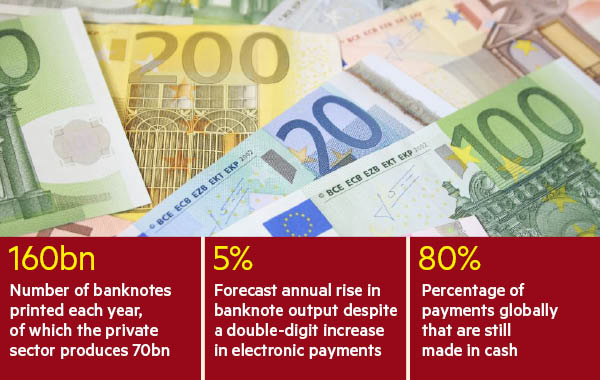
The Bank of England has decided that Winston Churchill, Alan Turing, and Jane Austen are too controversial to appear on British banknotes. So they’re replacing them with frogs. I’m not kidding. Frogs. And foxes. And dolphins. And puffins. The Bank announced it would phase out portraits of historical figures in favor of native wildlife imagery on its next banknote series. The official explanation was “security,” but we all know better than to believe that. Writing in The Telegraph earlier this week, Andrew Bailey, the Governor of the Bank of England, said: “The Bank’s foremost objective is the security of our banknotes, which includes tackling the threat from counterfeiting.”Read more …
However, the Savanta research, obtained under the Freedom of Information Act, will raise questions about whether the decision was also motivated by concerns that featuring Britain’s former wartime prime minister and other national heroes would upset some sections of the public. The researchers concluded that Churchill, Turing, and Austen were “contentious and not representative of the UK’s cultural and natural diversity.” Officials received advice to scrap historical figures entirely because they represented “a backward-looking vision of the UK that carries too great a risk of division and controversy.”Translation: too many white people on the money. One hundred nineteen focus group participants called the existing banknote figures “potentially divisive, elitist and disconnected from their own experiences.” One participant actually described Alan Turing, the man who helped crack the Nazi Enigma code and helped bring an end to World War II, as “imperialistic,” complaining about a “‘we’re the ones who won the Second World War and saved the world’ feeling” to the notes. I guess they missed the memo that Turing was a gay man persecuted by his own government. Apparently, none of that matters if the woke mob has decided he’s problematic.
It gets worse. Savanta advised against depicting Georgian and Victorian architecture, flagging those buildings as high risk “due to potential links to colonialism/slavery.” The researchers also warned against showing the White Cliffs of Dover because of their “association with the UK border.” One focus group participant from Northern Ireland said some British buildings were “erected on the back of slave trade money.” Another said the White Cliffs “could be seen by some people to be a political statement, particularly at the moment around immigration and small boats. “Is there anything these woke focus group members aren’t offended by? Seriously, iconic landmarks are out. Celebrated intellectuals are out. War heroes are out. The puffin, however, made the cut.
The Bank claims the Savanta report had nothing to do with its final decision. They point to a public consultation in which 44,000 people participated, with 60% choosing nature imagery and 38% preferring historical figures. Don’t buy it. The Bank commissioned focus groups specifically to assess whether historical figures were too divisive, so it was likely rigged from the start to justify what they wanted to do in the first place. “Without great and courageous figures like Churchill and Turing, we may have swastikas on our banknotes today,” Retired British Army Colonel Richard Kemp said. “We owe them so much and it is right that we should be reminded of our debt to them daily on our banknotes.”
Kemp added, “The woke desire to erase Britain’s proud and remarkable culture has now even infiltrated the Bank of England. This decision is shameful and should be reversed.” Robert Jenrick of Reform UK added, “If it wasn’t for the likes of Churchill and Turing, we’d be living under a government that really was divisive and imperialistic. The Bank of England should stop wasting time and money on this and focus instead on keeping prices down.”
Why should this matter to those of us in the United States? Well, this same nonsense is coming here, and you all know it. The movement to scrub historical figures from public life has already targeted building names and statues, and there have been efforts to update American currency with more diverse figures as well. I’ve long believed that it is inevitable that Democrats will one day push to put Barack Obama on our money. Give it time, and the demand will be that American money features only figures the far left approves of. Dead white men need not apply.
Q: Since when was Alan Turing on the money? Banned forever because he was gay.
Wasn’t putting him there a great victory? For gay rights?
Who wins that one now? Gays lose again, right?
• A Serious Country Doesn’t Swap Its Greatest Leader For Little Animals (MN)
The Bank of England has now admitted the quiet part out loud. Historical figures including Winston Churchill were removed from future banknotes after researchers told officials they were “elitist and divisive.”Read more …
The move replaces British legends with wildlife in a calculated step to sideline national heroes and accelerate cultural replacement. This is not a neutral design update. It is institutional capture in action, where the man who rallied Britain against Nazi tyranny gets sidelined because focus groups and consultants found him too problematic for modern sensitivities and would prefer to look at a Fox or a hedgehog instead.
The Bank of England axed historical figures such as Winston Churchill from banknotes after being told they were “elitist and divisive”, The Telegraph can reveal.
— The Telegraph (@Telegraph) June 5, 2026
Read the full story here ⤵️https://t.co/4et9ekywsg pic.twitter.com/V0WSXoKOfKThe revelation aligns precisely with plans first laid out months earlier. Back in March, the Bank announced it would phase out portraits of Churchill on the £5 note, Jane Austen on the £10, JMW Turner on the £20, and Alan Turing on the £50. In their place would come native British wildlife, plants, and landscapes. King Charles III would remain on the front of the notes. Officials claimed the shift followed a public consultation with over 44,000 responses, where around 60 percent supposedly favored nature themes for security reasons and to celebrate the environment.
Critics at the time called the idea absurd and bonkers. They warned it represented a war on history and showed the Bank had been captured by progressive ideology. One former business minister said notes should honor the historical giants who shaped the nation rather than fuzzy animals. Another asked what came next – squirrels running the economy. Observers noted it fit a wider pattern of erasing or downplaying Britain’s past under the banner of progress and diversity.
That pattern includes London museums draping portraits to “reclaim Caribbean history,” the removal of Shakespeare, Thatcher, and Churchill artworks from 10 Downing Street in favor of pieces by artists with Caribbean ties, Cambridge panels labeling Churchill a white supremacist whose empire was supposedly worse than the Nazis, and a London primary school renaming “Churchill House” after Marcus Rashford to promote diversity. Statues of Churchill have faced vandalism and calls for removal, including during pro-Palestine protests earlier this year. Each step chips away at the symbols that once unified national memory.
Now the June reporting makes the motive unmistakable. Research commissioned by the Bank concluded that figures such as Churchill, Alan Turing, and Jane Austen were “contentious and not representative of the UK’s cultural and natural diversity.” Officials received advice to replace the portraits with nature images because historical figures represented “a backward-looking vision of the UK that carries too great a risk of division and controversy.”
A serious country does not swap its greatest leader on its banknotes for little animals
— Alex Phillips (@ThatAlexWoman) June 5, 2026
Imagine India ditching Gandhi for a monkey. Or the USA dropping Washington for a racoon
This is the rot that is eating away at our confidence, identity and cohesion:
Bank dropped Churchill…The Bank has insisted the decision was not driven by that specific research but by an earlier poll showing public preference for nature. Yet the Freedom of Information details tell a different story about how the process unfolded behind closed doors A public consultation is currently running on the wildlife shortlist. Proposed replacements include an owl, hedgehog, badger, or common frog. One commentator summed up the national mood: “We are not a serious country anymore.”
https://twitter.com/JamesMelville/status/2062610790683984267?ref_src=twsrc%5Etfw%7Ctwcamp%5Etweetembed%7Ctwterm%5E2062610790683984267%7Ctwgr%5Ea67b9ad8e4437d980d63a6c9204f63f3cf1e7678%7Ctwcon%5Es1_c10&ref_url=https%3A%2F%2Fwww.zerohedge.com%2Fgeopolitical%2Fserious-country-does-not-swap-its-greatest-leader-banknotes-little-animals
Some of the animals under consideration are not even native to Britain. That detail alone exposes the move as more than harmless environmental appreciation. It functions as a psyop to further erode British culture – stripping away recognizable national symbols and replacing them with generic or imported imagery that weakens any sense of rooted identity.
'Some of them aren't even native to the UK! It seems like a very, very bizarre choice?'@samfrancisuk reacts to the Bank of England removing Winston Churchill from banknotes, opting instead to feature animals. pic.twitter.com/T2uQXhDhmx
— GB News (@GBNEWS) June 6, 2026This fits the same ideological framework that has infected other institutions. DEI priorities and critical race theory obsessions treat any strong assertion of British heritage as inherently suspect. The man who helped defeat fascism is recast as “divisive” while the focus shifts to animals that supposedly better reflect “cultural and natural diversity.” The result is a currency that no longer celebrates the people who built and defended the country. It celebrates detachment instead.
The broader assault continues without pause. Schools, museums, government buildings, and now the Bank of England itself participate in softening, diluting, and apologizing for the past. Historical giants are judged not by their achievements but by whether they pass modern committee tests on representation. When they fail, they are quietly retired in favor of whatever the latest advisory group deems safe and inclusive.
Britain’s wartime leader did not save the nation so that unelected researchers and captured bureaucracies could later declare him unfit for the money supply. Yet that is exactly what has happened. The same institutions that owe their continued existence to Churchill’s stand now treat his image as a liability.
A country that systematically removes its heroes from public view is not evolving. It is forgetting how to value itself. The Bank of England’s choice to prioritize “non-divisive” wildlife over the figures who actually shaped the United Kingdom sends a clear message: national pride is now considered too risky for everyday transactions.
Britons who still believe their history is worth defending have every reason to push back. This is not about banknote design. It is about whether the nation retains the confidence to honour the people and events that made it possible. Replacing Churchill with a hedgehog is not progress. It is surrender dressed up as sensitivity.

EU wants far too much. They want French soldiers obeying German commanders.
• Europe 2.0, Beyond Brussels: The End Of The European Union As We Know It (AmG)
Europe has reached the end of an era. Not the end of its history, but the end of its false form. For decades, the European Union served as the great substitute project of a continent that no longer dared to think politically. It promised peace without power, order without a people, unity without roots, and prosperity without cost. That was its founding lie, and it was a lie from the very beginning.Read more …
Political order does not grow out of procedural routines, commission papers, or moral self-incantation. It grows out of peoples, interests, borders, loyalties, and the willingness to defend what is one’s own. Legitimate authority rests on a people and its consent, not on an apparatus and its expertise. That older idea—that government draws its life from the governed rather than from the competence of its administrators—is precisely what Brussels has spent two generations trying to administer away.That is why today’s EU is not the high point of European history but its bureaucratic state of exhaustion. It is too centralized to be free and too artificial to be binding. It commands an immense body of rules and possesses no sustaining political soul. It has institutions, but not the kind of historically grown legitimacy that holds a community together across generations. And so it answers every crisis with the same reflex: more centralization, more redistribution, more standardization, more discipline. What is sold as the solution is only the problem enlarged.
Europe is not failing because there is too little Brussels. Europe is failing because there is too much Brussels. It is failing because of a political class that no longer sees the continent as a historical space but as an object of administration. It is failing because of an ideology that treats every organically grown difference as a defect and therefore regards peoples, traditions, and national particularities as raw material to be processed. And it is failing because of a functional elite that has learned to disguise power as morality and to pass off its own interests as universal values.
There is a name for this kind of governance: the administrative state—the permanent, unelected layer that survives every election, answers to no voter, and grows whether the public wants it to or not. Brussels is that layer raised to the continental power and freed from even the inconvenience of a national electorate. There is no European demos to vote the managers out. That is not a flaw in the design. It is the design.
The real scandal of Europe today is not even its material mismanagement but its intellectual arrogance. The Union behaves as though it could suspend history—as though cultures could be harmonized like technical standards, as though political loyalty could be decreed the way one issues a packaging regulation. As though a continent of radically different historical experiences, economic structures, demographic trajectories, and security realities could be pressed into one standardized form without damage. Yet the damage is already visible. The EU is not unifying Europe. It is wearing it down.
To see why, it helps to return to a text that saw the whole thing coming. In 2011, long before today’s disruptions, the German social scientist Gunnar Heinsohn published an essay whose title I have borrowed and broadened here: “Europa 2.0: Neuzuschnitt der Alten Welt” (Europe 2.0: Recutting the Old World). It was written in the first panic of the euro rescues, and it has aged with uncomfortable precision.
Heinsohn’s argument was not, in the first place, a complaint about Brussels. It was an argument about arithmetic. He began with the chain of liabilities that the productive European middle class—the net taxpayers, the people who put in more than they take out—had quietly been made to guarantee. First, the bank rescues of 2008. Then the Greek bailout and the great euro backstops of 2010, which shielded bondholders and the comfortable classes of the periphery at the expense of taxpayers who were never asked. Then the implicit guarantees extended to the aging, shrinking states of the European East. And beneath all of it, an ever-growing domestic population to be supported for life. The decisive point was simple and merciless: when all these promises—upward, downward, and outward—come due at once, no one will be left to bail out the people who were made to do the bailing.
Tricks.
• California US Attorney Office Feigns Ignorance of Voter Fraud (CTH)
California ballot counting will continue until the key republicans in each race are pushed into 3rd place. That’s when ballot counting will conclude. At a certain point, the pretending gets ridiculous. This X message from the First Asst U.S. Attorney for the Middle District of California is a case study in pretending not to know things.Read more …
If you have witnessed potential election fraud, we want to hear from you.
— F.A. United States Attorney Bill Essayli (@USAttyEssayli) June 7, 2026
People have been contacting our office wanting to provide information. We have established a dedicated email address for this purpose.
Email tips to: CAElectionFraudTips@usdoj.gov
Please do not send…
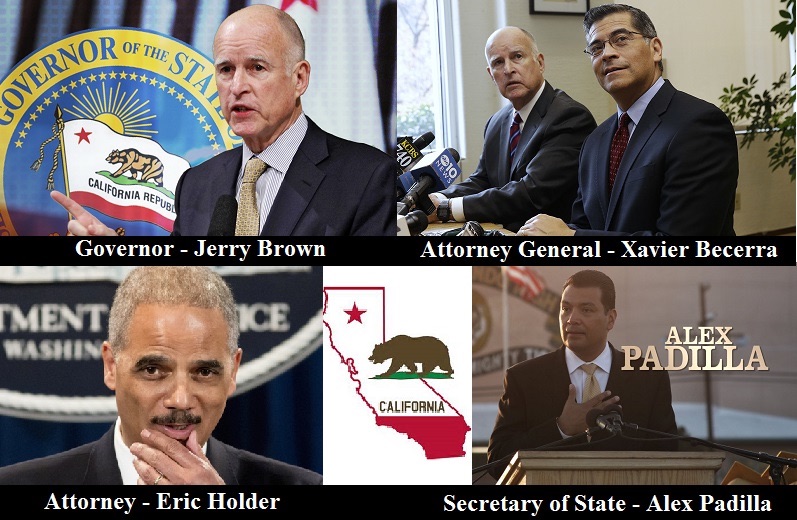
Former Attorney General Eric Holder was hired by California govt to advise on the election changes created by linking DMV database to Secretary of State database. The tech team that wrote the code to link the DMV and SOS were given specific instructions. The affirmative flag, the checkbox in the DMV system that says the applicant is legally eligible to vote, was neutralized. Meaning, if the checkbox is left blank, the computer system accepts the application from the DMV as affirmative. The DL applicant data is transferred to the SoS office, and the applicant is registered to vote.Illegal Aliens, unlawful migrants, were allowed to get California Driver’s Licenses and State IDs. The Motor-Voter process now registers those drivers and ID recipients as legal voters and ballots are created. Those illegal ballots form the core of the voter fraud in California and were first used in the November 2018 midterm election as the beta test for national rollout.Not a single person in Sacramento politics doesn’t know this. They are all aware. All the USAO has to do is go check and they will see. The fraud is impossible to prosecute. The fraud is built into the system. Go look. Everyone knows.
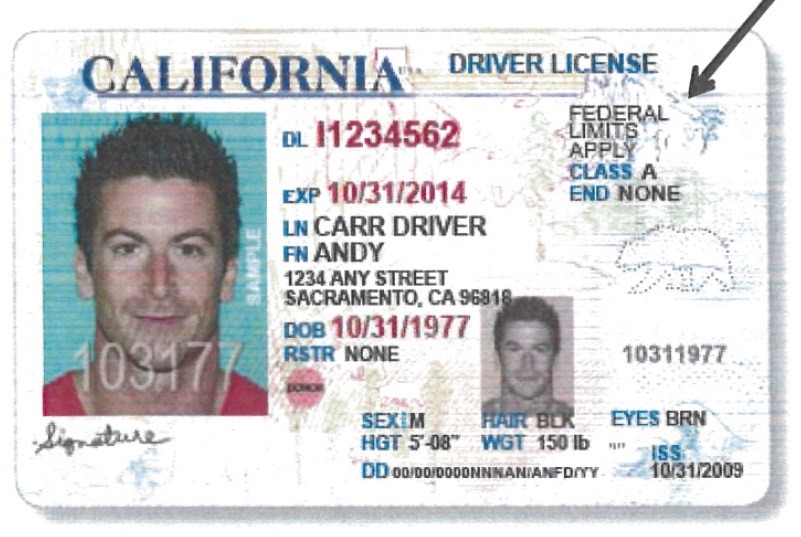
We originally outlined this activity a decade ago. Nothing has been done to stop it. JAN 2017 – California officials have instructed DMV data programmers to remove the internal coding flags for the drivers’ licenses of illegal aliens in California. As you might be aware, California passed a law known as AB60 authorizing illegal aliens to receive drivers’ licenses throughout the state. Within the administrative functions of the state DMV database a designation code known as “AB60 code” was created to flag those specific licenses as containing “Federal Limits Apply”.
We have confirmation from a top-level IT source, state officials instructed programmers to immediately remove AB60 administrative coding. The removed code in question is an administrative function for identifying the registered DL holder as an “undocumented person” or illegal alien holder within the DMV database. The established computer flag allows an administrator or DMV or State official to filter the massive database of California Driver’s License holders and identify just those who are ‘undocumented’. The removal of the “flag” via deletion of the program code, means the database cannot be easily filtered to show only illegals who received those Drivers licenses, and/or generate a list of those license recipients.
According to the IT source the motive for the code/flag removal appears to be an effort hide data and curtail any tool useful in any voter fraud investigation. Several additional aspects lead to this conclusion including California hiring former U.S. Attorney General Eric Holder to lead the fight against the Trump administration. Additionally, the State Driver’s License process via the State DMV has an on-line link to the Secretary of State office in order for California residents to register to vote. As a specific function of the programming code within the SoS system, and as a direct outcome of previous instructions, all voter registrations proceed through the registration process, even if the user “forgets” to check the box that says they are a citizen.The internal database coding established by the Secretary of State IT department which synergizes with the State Department of Motor Vehicles, allows and approves voter registration when the designation box “U.S. Citizen” is left blank. It is the combination of this specific programming structure, the events and instructions of the past 48 hours, in combination with the outcome of the U.S. election and new Trump administration saying they will launch a voter fraud investigation, which leads the IT source to the conclusion there is an effort underway within California to hide the evidence of “Illegal Voting” via the use of “State Issued Drivers Licenses” and the willful blindness from the Secretary of State.
No alternate explanation from within the California DMV Headquarters has been offered for why they are instructing IT data programmers to remove the AB60 coding from the Driver’s License system.
Englan’ is a bitch.
• UK Cop Fired For Questioning Islam In ‘Safe Space’ (MN)
A Christian police community support officer lost his career after asking a Muslim colleague about jihad and Hamas atrocities during a diversity session that promised open discussion. At the same time, training drilled “white privilege” into police ranks. Luke Salmons, a 46-year-old Christian father of two and respected PCSO with North Yorkshire Police, relates how he attended a mandatory training day on race, religion and culture. Trainers spent several minutes marching up and down the room chanting “Islam is a religion of peace” repeatedly.Read more …
A Muslim sergeant then spoke about his faith and invited questions in what was presented as a “safe space” where “there was no such thing as a bad question.” Salmons asked what the sergeant, as a peaceful Muslim, thought about the situation in Gaza and atrocities carried out by Hamas and other groups in the name of Islam. He also asked what jihad meant to him. The discussion was civil. The sergeant later invited Salmons for coffee to continue the conversation privately.
Christian police officer had his career ended for asking questions about jihad and radical Islam during a ‘safe space’ discussion on race and diversity. pic.twitter.com/rAxi5U8zYF
— Patrick Christys (@PatrickChristys) June 5, 2026Salmons brought a book on the topic to work. Colleagues photographed it in his locker and reported him as a risk. An inspector then suspended him, declaring “I don’t like your beliefs.” Salmons noted the obvious double standard: no inspector would ever say that to a Muslim officer.He was suspended on full pay for months, resigned under pressure in April 2025, and faced gross misconduct proceedings. Supported by the Christian Legal Centre, he appealed. Chief Constable Tim Forber overturned the dismissal before Salmons had even finished presenting his case. There was no apology and the episode devastated his family.
“I loved my job and I was good at it. I was well respected as a PCSO and my colleagues said they loved working with me and couldn’t understand what was happening. But an overzealous inspector took against me and that was the end of my career, even though I had done nothing wrong,” he related. “It devastated me and my family. For months we lived in total uncertainty, with my reputation being shredded in secret. I resigned not because I had done anything wrong, but because the silence, the delay and the pressure became unbearable for my wife and daughters,” Salmons added.
This is the new reality inside parts of British policing: open discussion of uncomfortable facts about Islamist ideology is treated as career-ending wrongthink, while entire days are devoted to chanting slogans and centring one faith above others. The same ideological pressures are visible in operational failures. In the Henry Nowak case, an 18-year-old white British student was stabbed five times. He told responding officers he had been stabbed and could not breathe. Instead of treating him as a medical emergency, officers handcuffed him after his attacker falsely claimed racism. The attacker was allowed to walk away. An inquest is examining whether the handcuffing contributed to Nowak’s death.
The police watchdog investigated itself and declared no wrongdoing. Serving and former Hampshire officers later admitted the mandatory DEI training played a role. They told former Home Secretary Suella Braverman they had “it drummed into us about our white privilege and unconscious bias.” One described the outsourced trainer as “deeply hateful of white people and our culture.”v
Keir Starmer hits back at JD Vance for 'stirring up division' after he pointed to 'migrant invasion' as cause for Henry Nowak's murderhttps://t.co/Pwg1KGDNe7
— GB News (@GBNEWS) June 5, 2026Meanwhile, shocking street interviews and bodycam footage show officers across forces admitting they will arrest people for speech that causes offence if an allegation is made – including phrases such as “send them all home.” In one Birmingham incident, officers restrained a light-skinned suspect while a crowd of young men from ethnic minority backgrounds kicked and struck him; the police did not intervene to protect the suspect.
Good to reiterate from time to time.
• They Threw Everything at Him. He’s Still Standing. (Eric Florack)
We’re getting pretty close to the midterm elections. I’d like you to consider, as you contemplate your vote, what we’ve been seeing for a solid decade now. The full weight of the media establishment, the Democrat Party, and the socialist left — all of whom drain your tax dollars to fund their operations — has waged the most expensive, coordinated, and (thanks be to Heaven) catastrophically unsuccessful demolition project in recorded history. The target? One man. I’ll let you guess who.Read more …
Think on that for a moment: four criminal indictments, 91 charges (and I may have missed a few). Investigations that went nowhere, like a compass in a magnet factory. They spent billions. They squeezed hundreds of journalists shoulder-to-shoulder into the same putrid trough, all filing the same bogus story, all reaching the same pre-approved conclusions without evidence, all somehow surprised when nothing stuck to the man. Every major network. Every newspaper of record. Every drive-time radio voice with a thesaurus and a grudge.The late-night TV hosts — propped up on expensive, ratings-free life support, their audience consisting exclusively of insomniacs and the unfortunate souls stranded at airport gate C-17 — dutifully swung away, night after night, year after year. When the losses mounted too high and those late-night “stars” collected their pink slips, the establishment — the very people who’d been attacking this man — turned around and blamed him for their firing. Never mind the millions they cost the networks. The word “unsustainable” leaps to mind, unbidden.
Hollywood crawled out of its gated compounds to weigh in. Every blue-checkmark, every celebrity whose last project you cannot name, every platform with a “trust and safety” team — all of it, fully deployed. All for naught. Meanwhile, medical research watches from the parking lot, never seeing anything approaching that kind of coordinated effort. Even after all that, it didn’t work. Let’s be honest about what this was, and is. This wasn’t political opposition. Opposition, per se, is normal. Opposition is healthy. That’s democracy (small d).
This was anything but democracy. This was a systematic campaign to destroy a man’s family, dismantle his businesses, strip away his freedom, and physically erase his name from ballots. The goal was never to beat him. It was to eliminate him. Consider the parallel: Eric Swalwell got caught cozying up to a Chinese intelligence operative, and the story disappeared in 48 hours. This man absorbed a decade-long siege with unlimited ammunition — and he’s still standing. The reason? There was nothing to what they threw at Trump. In all this time, not a bit of it has stuck. Don’t you think if they actually had anything, it would have tipped the scales by now?
When all those efforts failed, they even tried to kill him — what, ten times now, going back to 2016? I’ve lost count. Butler, of course. West Palm. Mar-a-Lago. The Correspondents’ Dinner. And those are just the attempts that made the headlines because they got close enough to finish the job. That asymmetry should tell you everything you need to know. And a quick look at what’s happening in California right now offers another indicator of how desperate these people have become. That story may give us a hint — if we’re honest — about how “Creepy Uncle Joe” claimed 81 million votes after campaigning from his basement.
Here’s the thing about coordinated fury at that scale and duration: it is never about the target. It’s about what the target represents — and what his continued existence threatens. Seventy million Americans heard something from this man they hadn’t heard in a long time: the truth. That the system has been deliberately rigged against them. That someone is outright stealing their tax dollars and laundering still more into causes explicitly hostile to their interests. That the credentialed experts and the legacy press have been lying — casually, continuously — and expected nobody to notice. That Americans — as Americans — do not require permission from Davos, from party establishments, from media gatekeepers, or from anyone else to trust what their own eyes are showing them.
That is not a Republican message. That is not a Democrat message. That is a freedom message. And seventy million people didn’t just hear it — they recognized it, voted accordingly, and to this day continue to support him, much to the chagrin of the destroyers who clearly still don’t understand what they’re up against. That’s what the machine is actually fighting: not a man, but a message. Because if that message spreads — if people fully internalize that the managers have been manipulating them, manufacturing confusion, and deliberately stoking fear — those managers lose everything.
The fury isn’t evidence that he’s dangerous. It’s evidence of exactly what he told you: that they are.
Does it work only on a quantum scale?
• A Surprisingly Simple Way To Create Powerful Quantum States (SD)
Many of the most promising quantum technologies, including advanced sensors and future quantum computers, depend on a phenomenon known as entanglement, where particles become deeply connected and influence one another in ways that cannot be explained by classical physics. Creating the complex entangled states needed for these technologies has traditionally required sophisticated equipment and carefully designed experimental systems.Read more …
Researchers at the University of Chicago Pritzker School of Molecular Engineering have now proposed a much simpler approach. Their new theoretical method can generate and control a wide range of entangled quantum states using tools that are already common in many quantum physics laboratories. The work, published in Physical Review X, could help advance ultra precise quantum sensing and open new opportunities for exploring fundamental physics.“We wanted to take simple ingredients that you find in a lot of physical platforms and put these together in a minimal way to get something interesting, complex and powerful,” said Aashish Clerk, professor of molecular engineering at UChicago PME and senior author of the new study. The research was supported by Q-NEXT, a U.S. Department of Energy National Quantum Information Science Research Center led by DOE’s Argonne National Laboratory.
Rethinking Cavity QED Systems
The team’s approach is based on cavity quantum electrodynamics, commonly known as cavity QED. In these experiments, atoms or other particles are placed inside an optical cavity, which consists of two mirrors that trap light between them. The particles then interact with the confined light inside the cavity. A limitation of many cavity QED systems is that all of the atoms interact with the light in exactly the same way. Because the atoms are effectively indistinguishable, the range of quantum states that can be produced is restricted.“The challenge has always been that these systems have too much symmetry. All the atoms are talking to light in the same way,” Clerk said. “That really restricts what kind of entangled states you get.” In a typical cavity QED setup, each atom has a ground state and an excited state separated by a specific energy difference. The researchers found a straightforward way to reduce the system’s symmetry. While all atoms continue to be driven by the same laser, additional lasers or magnetic fields are used to shift the excited state energies of different groups of atoms. The atoms are arranged so that each one is paired with another atom that has an equal but opposite energy offset.
This simple modification allows atoms to behave differently from one another while preserving enough structure for the system to remain controllable and predictable. By changing which atoms receive particular energy shifts, scientists can tune the system to produce a variety of entangled states without altering the physical hardware. “You turn these lasers on and wait, and at some point the system stabilizes into an interesting, highly entangled quantum state,” said Anjun Chu, a postdoctoral researcher in the Clerk group and first author of the new work. “By simply adjusting the lasers, we can access kinds of entangled states that no one had thought about before.”
Building Better Quantum Sensors
One of the most promising uses for the new approach is quantum sensing. In theory, entangled quantum states can detect extremely small differences in magnetic fields or gravitational fields between separate locations. However, developing states that are both highly sensitive and resistant to noise has remained a major challenge. The researchers demonstrated that a version of their proposed system containing two groups of atoms could be used to measure field gradients. When the two atomic ensembles are placed in different locations, the resulting quantum state reflects the difference between the local magnetic or gravitational fields. At the same time, it naturally rejects background noise that affects both locations equally.“You’re able to do two things that are normally not compatible with one another: Use entanglement to build an exquisitely sensitive sensor but also have robustness to arbitrarily large amounts of noise,” Clerk said. “Normally, entanglement is very fragile. This approach has some amazing resilience.” Another advantage is that the information stored in these quantum states can be extracted using standard Ramsey measurement techniques, eliminating the need for specialized or exotic measurement methods.
Applications Beyond Sensing
The researchers also showed that the same platform can generate unusual quantum states that have long attracted interest from physicists. One example is the AKLT state, a well known many body entangled state first introduced in the 1980s to describe unusual magnetic materials. The team found that their relatively simple setup can stabilize this state. In addition to helping scientists study complex magnetic systems, the AKLT state may also have applications in quantum computing.Next Steps For The Research
The work remains theoretical for now, but the researchers are already discussing possible experimental tests with other groups. They are also investigating more sophisticated ways to arrange atoms within the system and exploring the full range of quantum states that their method may be capable of producing.“The fact that such simple ingredients can generate such complex and useful quantum states gives us hope that even before we reach the dream of a general all-purpose quantum computer, we can already generate quantum states that let us do things we couldn’t do in a purely classical world,” Clerk said. This material is based upon work supported by the U.S. Department of Energy Office of Science National Quantum Information Science Research Centers as part of the Q-NEXT center.

A British Army colonel has warned that civil war between Christians and Muslims in the UK is inevitable.
— Right over Left Everytime (@RightSide_Uk) June 6, 2026
“The United Kingdom is heading towards civil war because the government fears stopping the Islamization of the country.”
This is not alarmism. It is the logical outcome of… pic.twitter.com/CMdLJ5wa4n
Tucker Carlson: "There is a very well organized, very well funded effort to eliminate the White population of Europe.
— Taya Bass (@travelingflying) June 6, 2026
Who is pushing this?"
Can anyone guess who is pushing it? pic.twitter.com/2Fs2USKEpz
Elon Musk: "The Democratic Party in the US and the left in Europe realized that if you have open borders and you provide a ton of government handouts… and you don't prosecute them for crime, they will vote for you."
— Resist the Mainstream (@ResisttheMS) June 6, 2026
pic.twitter.com/gw1WDTd7FL
Elon Musk just sat in JP Morgan's headquarters and explained the next 20 years in one conversation.
— 2xnmore (@2xnmore) June 6, 2026
Most people will clip the IPO headline and move on.
Here is what they will miss.
SpaceX lists on Nasdaq on June 12 under ticker SPCX. $135 per share. 555 million shares. $75… pic.twitter.com/z6a2VSXfL1
Support the Automatic Earth in wartime with Paypal, Bitcoin and Patreon.