
Mar 102015
 
 March 10, 2015  Posted by at 6:14 am Finance Tagged with: , , , , , , , ,  1 Response »


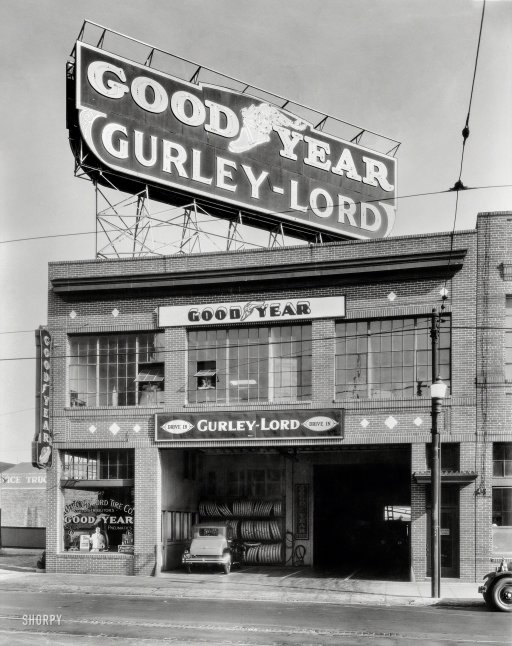
NPC Ford Motor Co., McReynolds & Sons garage, L Street, Washington DC 1926


S&P 500 Can’t Fight The Market’s Selloff Forever (MarketWatch)
China’s ‘Money Garrote’ May Choke Us All (MarketWatch)
Three Reasons Japan Will Get More Stimulus (Bloomberg)
Central Bank Blues (Deutsche Welle)
Japan’s Not So Golden Oldies Tighten Their Purse Strings (CNBC)
ECB Starts Buying German, Italian Government Bonds Under QE Plan (Bloomberg)
Presenting The Buyers Of Over 100% Of New German And Japanese Bond Issuance (ZH)
Aftershocks, Part 1: That Austrian Bank (John Rubino)
Billionaire Greek Ship Owners Surface on Tax-Exempt Overseas Profit (Bloomberg)
EU, Greece To Start Technical Loan Talks Wednesday (Reuters)
Draghi Urged Greece to Allow Officials Back Before It’s Too Late (Bloomberg)
Eurozone Calls On Greece To Come Up With Credible Economic Reforms (Guardian)
Greece Sees First Shortages In Imported Goods (Kathimerini)
Liquidity Fears Slow Greek Government Payments (Kathimerini)
Creditors Reject Greece’s Reform Proposals (Bloomberg)
Spain’s Post-Franco Elite Under Attack From Popular Podemos Party (Bloomberg)
truthinesslessness (Jim Kunstler)
US Deploying 3,000 Troops To The Baltics (DW)
The Isolation of Donetsk: A Visit to Europe’s Absurd New Border (Spiegel)

“Something is wrong with this picture.”

S&P 500 Can’t Fight The Market’s Selloff Forever (MarketWatch)

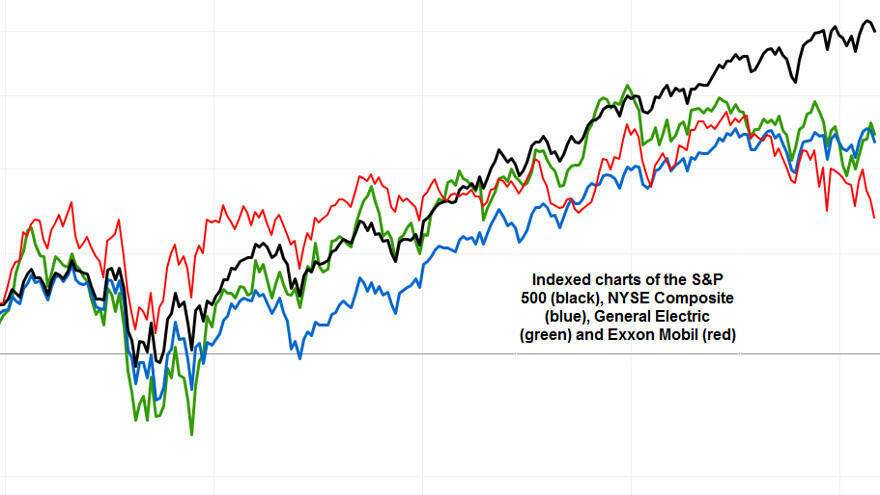
Investors have reached a fork in the road. Should they follow the rally in the S&P 500, or the selloff in two key components and a much broader market index? One chart watcher believes the road with more travelers could prove to be right. The chart below compares the S&P 500, the NYSE Composite Index and the shares of General Electric and Exxon Mobil. “More and more stocks no longer are in uptrends, even as the S&P 500 manages to maintain its uptrend,” said Carter Braxton Worth, chief market technician at Sterne Agee. “Unsustainable divergence, we’d say.”

Worth believes it is important to view the performance of the NYSE Composite, which is composed of more than 2,000 stocks, because it is“one of the broadest (and oldest) indices in existence.” He also believes GE and Exxon are among the most important stocks within the S&P 500, given GE’s broad reach into all corners of the economy, and Exxon’s sheer size and the economic importance of the oil and gas markets. “Something is wrong with this picture. Either the S&P 500 accurately depicts the state of the world, or GE and Exxon do,” Worth said. “One or the other, but it cannot be both.
Read more …

“China’s money supply is already 372% of what it was at the beginning of 2006.”

China’s ‘Money Garrote’ May Choke Us All (MarketWatch)

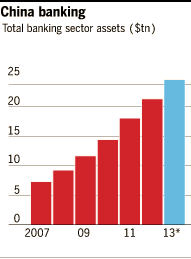
— In this new era of all-powerful central banks, it is hard for investors to look past who will be next to take out the big gun of quantitative easing. This week, all eyes are on the European Central Bank, which follows the Bank of Japan as the latest of the major monetary-policy makers to embark on its own aggressive bond-buying program. In contrast, China appears to be entering a “new normal” era, in which its central bank only has a pea-shooter. While most headlines at the ongoing National Peoples Congress meeting focused on the “approximately 7%” economic growth target, the benchmark money-supply growth target of 12% was also the lowest in decades. Another part of China’s new normal is not just lower growth, but also an era where the central bank is no longer able to magically speed its money-printing presses.

Conventional wisdom holds that the People’s Bank of China (PBOC) has a gargantuan monetary arsenal, given that the country has the world’s largest stash of foreign reserves at $3.89 trillion. This cash mountain is routinely used to justify how Beijing has nearly unlimited firepower to backstop its economy. But according to some analysts, this reserve accumulation is merely a byproduct of another form of quantitative easing. Rather than strength, its size indicates just how staggeringly large China’s domestic credit expansion has become in recent decades. According to strategist Albert Edwards at Société Générale, such foreign-reserve accumulation — which typically takes place in emerging markets — is equivalent to quantitative easing.

The PBOC’s historic mass-printing of money to buy foreign currency and depress the yuan’s value is little different from what the Federal Reserve and others have done, Edwards said. This would mean that China has already embarked on a major monetary expansion after three decades of trade surpluses and reserve accumulation. Furthermore, the recent reversal in such reserve accumulation points to a significant turning point in monetary conditions. Indeed, Joe Zhang, author of “Inside China’s Shadow Banking System,” argues that China’s credit expansion has in fact been far more aggressive than the quantitative easing attempted in the U.S. or Europe.

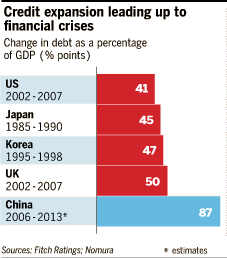
Zhang, a former PBOC official, calculated that China’s money supply is already 372% of what it was at the beginning of 2006. And if you add up official data between 1986 and 2012, China’s benchmark M2 money supply has grown at a compound rate of 21.1%. While 7% economic growth is slow for China compared to the double-digit rates of the past, such data makes 12% money-supply growth looks positively measly. Another reason to believe that China is at the tail end of a huge monetary expansion is found in a recent study by McKinsey. They estimated that total credit in China’s economy has quadrupled since 2008, reaching 282% of gross domestic product.

Read more …

Do or die.

Three Reasons Japan Will Get More Stimulus (Bloomberg)

Two years after Haruhiko Kuroda, governor of the Bank of Japan, declared his team will “do whatever it can” to end deflation, it’s painfully clear their efforts aren’t working. Stocks are up, bond yields are down and people are buzzing about Japan for the first time in years. What’s still missing, though, is any hint of the self-sustaining recovery Kuroda hoped to be touting by now. With annualized growth of 1.5% between October and December after two straight quarters of contraction, Japan is hobbling out of recession far more slowly than hoped. A third dose of quantitative easing is almost certain. Here are three reasons why.

First, the initial rounds of QE weren’t potent enough. “In order to escape from deflationary equilibrium, tremendous velocity is needed, just like when a spacecraft moves away from Earth’s strong gravitation,” Kuroda recently explained. “It requires greater power than that of a satellite that moves in a stable orbit.” Although the Bank of Japan managed to lower the value of the yen by more than 20% beginning in April 2013, that clearly hasn’t provided enough of a boost to the economy. (Net exports, for example, added just 0.2% to fourth quarter GDP.) Meanwhile, the bank’s 2% inflation target looks more and more distant. The BOJ’s main inflation gauge slowed to just 0.2% in January, down from 1.5% in April last year.

The trouble with the first two rounds of QE was both the size and the strategy. While undoubtedly huge, neither injection was aggressive enough to, at Kuroda puts it, “drastically convert the deflationary mindset.” Also, the BOJ must get more creative than just hoarding government debt. This time, the BOJ should pledge bond purchases of closer to $1 trillion a year and buy bigger blocks of asset-backed, mortgage-backed and corporate securities; load up on distressed assets, including property in rural areas; and prod the government to tax excessive bond holdings by banks and households.

Second, the Federal Reserve is complicating Kuroda’s job. With U.S. unemployment falling to 5.5% in February, the lowest level in almost seven years, U.S. interest rates will soon be heading higher. On Friday, Fed Bank of Richmond President Jeffrey Lacker employed his own cosmic imagery when he declared: “June would strike me as the leading candidate for liftoff.” Monetary largess isn’t exactly a zero-sum game, but the Fed’s QE experiment supported asset markets from London to Tokyo as much as it’s enlivened U.S. demand. As the Fed withdraws, Kuroda will face pressure to make up the difference.

Read more …

“..experts question whether a flood of central bank reserve money, pumped into the hands of players in secondary financial markets, can generate a stimulus at all. ”

Central Bank Blues (Deutsche Welle)

On Monday (09.03.2015), the European Central Bank begins its long-anticipated program to buy sovereign bonds on secondary bond markets – i.e. previously issued government bonds held by institutional investors like banks or insurance funds. In central bankers’ jargon, this is called “quantitative easing,” or QE. The ECB’s plan is to pump 60 billion euros ($65 billion) into the financial markets each month, by trading central bank reserve money (a form of electronic cash) for bonds. That’s set to continue until at least September 2016, which means at least 1.1 trillion euros will be put into the hands of investment managers – who will have to find some alternative investments to make with the money. The bond-purchasing program’s goal is to push inflation back up to just under two% – at the moment, there’s consumer price deflation averaging 0.3% across the eurozone.

The ECB appears confident that QE will succeed in this aim. On Thursday last week, at the ECB’s governing board meeting in Nicosia on Cyprus, the central bank revised its projections for both GDP growth and inflation in the eurozone upward: The inflation rate is projected to go up to 0.7% for this year, and GDP growth from 1.0 to 1.5%. But are the new projections just a case of whistling in the dark? There are in fact serious doubts as to whether the ECB will actually be able to meet its targets, or if, instead, the bond-purchasing program will have effects that will make a structural recovery of the eurozone more difficult. For a start, many observers doubt whether the ECB will even be able to find willing sellers for €60 billion a month of bonds. Sovereign bonds – especially those of the core eurozone member states, like Germany – may soon become rather scarce on secondary markets.

Neither domestic banks and insurance funds, nor foreign central banks, will have much incentive to sell their government bond holdings to the ECB. The older bonds with long maturities and decent interest rates, in particular, will probably be held rather than sold. Moreover, experts question whether a flood of central bank reserve money, pumped into the hands of players in secondary financial markets, can generate a stimulus at all. It probably won’t lead to any boost in their lending activities to real-economy businesses or households, for two reasons: First, banks have recently been obliged to increase their core capital reserves – the amount of shareholders’ money, including retained earnings, which is available to cover possible loan losses – and they’re still adjusting their balance sheets accordingly. That means they’re being cautious about lending.

Read more …

Done spending long ago. Abenomics is just a mirage that only works as long as people believe in it. Abe himself has urged them to believe. But they’re not that crazy.

Japan’s Not So Golden Oldies Tighten Their Purse Strings (CNBC)

Rising prices are forcing Japanese pensioners to reduce spending, undercutting Prime Minister Shinzo Abe’s plan to boost economic growth and pay down the hefty public debt burden in one of the world’s fastest aging nations. “There is no solution to the structural problem: the government is running a huge budget deficit, but the only way to coax the elderly into spending more is by increasing public spending on them,” said Dai-ichi Life Research Institute (DLRI) chief economist Hideo Kumano. Japan limped out of a technical recession in the fourth quarter of 2014, but consumers are still struggling. A 3-percentage-point tax hike to 8% last April continues to weigh on consumption, while higher import prices have exacerbated the situation due to the yen’s over 40% decline against the U.S. dollar since Abe’s return to power.

In January, Japanese household spending fell 5.1% on month – its 10th consecutive decline, marking the longest losing streak since the global financial crisis. Meanwhile retail sales fell 2.0% – their first decline in 7 months. The elderly are reducing spending the most. “The average Japanese is suffering because of a weaker yen,” said Keio Business School associate professor Seki Obata, but “pensioners are suffering the most from the rising prices because there is no prospects of their incomes rising.” Whether a pensioner can afford to spend or has to cut back depends on their ability or willingness to work, according to according to DLRI’s Kumano figures, citing government data. The 37.8% of households with no income from paid work cut back spending by 1.5% in 2014 – and nearly all (95%) of these households are over 60 years old, according to DLRI’s Kumano.

Read more …

“They have just switched on the heat and we will need some time for the pressure to mount.”

ECB Starts Buying German, Italian Government Bonds Under QE Plan (Bloomberg)

With the first purchases of government bonds under a broader stimulus plan, the European Central Bank showed willingness to be patient in its efforts to reignite the euro area’s economy. The ECB and national central banks started buying sovereign debt on Monday under the 19-month plan to inject €1.1 trillion into the economy. While purchases included bonds from at least five countries, the size of individual trades — at between 15 million euros and 50 million euros — was small relative to the program’s goals, according to people with knowledge of the transactions. “The amount bought may be small to start with, but this will be like a pressure cooker,” said Ciaran O’Hagan, head of European rates strategy at SocGen in Paris. “They have just switched on the heat and we will need some time for the pressure to mount.”

Euro-area bonds extended a 14-month rally fueled by speculation that buying €60 billion of debt a month will create a scarcity of government bonds among buyers of the securities. Yields already fell to record lows across the region as the Frankfurt-based bank follows in the quantitative-easing footsteps of the Federal Reserve, Bank of England and Bank of Japan. Germany’s 10-year yield fell the most in six weeks. Gains in Italian bonds were smaller, with the yield on similar-maturity debt slipping four basis points to 1.28%. That widened the yield gap between the two securities by four basis points to 97 basis points, after it shrank to 90 basis points on Friday, the narrowest spread since 2010. “We will see more spread compression ahead,” SocGen’s O’Hagan said. National central banks purchased Belgian, French, German, Italian and Spanish debt..

The buying of bonds will be made roughly in proportion to the capital that each member central bank has contributed to the ECB, though that guideline doesn’t have to be strictly followed every month. There’s also flexibility on what maturity of bonds will be bought by the central banks to reach their target, and acquisitions of asset-backed securities and agency debt are also included in the plan. Some holders of government securities have indicated an unwillingness to sell, sparking concern that there will be a scarcity of available debt for the ECB to buy. There’s also a risk that flexibility and limited information on the plan stirs market volatility. “They know it will not be easy to purchase €60 billion a month including covered bonds and ABS, so they have to deal very cautiously,” said Patrick Jacq at BNP Paribas. “The market remains in positive territory but there is no further acceleration, which means that apparently there is no squeeze on any paper.”

Read more …

“.. please don’t tell your average Hinz and Kunz that more than all German bond issuance in 2015 will be monetized. It will bring back some very unpleasant memories.”

Presenting The Buyers Of Over 100% Of New German And Japanese Bond Issuance (ZH)

Back in December, when the total amount of annual ECB Q€ was still up in the air and and consensus expected a lowly €500 billion annual monetization number, we calculated that based on Germany’s capital key contribution of about 26%, the ECB would monetize some €130 billion of German gross Bund issuance, or about 90% of the total scheduled issuance for 2015. Subsequently, the ECB announced that the actual amount across all ECB asset purchasing programs, will be some 44% higher, or €720 billion per year (€60 billion per month). So what does that mean for the revised bond supply and demand across two of the most important developed markets?

Well, we already know that the Bank of Japan will monetize 100% or just over of all Japanese gross sovereign bond issuance (source). As for Germany, on a run-rate basis, and assuming allocation based on the abovementioned capital key, it means that for the next 12 month period, assuming no major funding changes in Germany, the ECB will swallow more than a whopping 140% of gross German issuance! Or, said otherwise, the entities who will buy more than all gross German and Japanese issuance for the next 12 months, are the ECB and the Bank of Japan, respectively.

This also means that to fulfill its monthly purchase mandate, the ECB will have to push the price to truly unprecedented levels (such as the -0.20% yield across the curve discussed previously, or even lower) to find willing sellers. That said, please don’t tell your average Hinz and Kunz that more than all German bond issuance in 2015 will be monetized. It will bring back some very unpleasant memories.

Read more …

“The result is a bunch of banks, pension funds and hedge funds whose balance sheets are stuffed with paper that has value only if 1) accounting rules continue to support “mark to fantasy” bookkeeping and 2) governments (via taxpayers) stand ready to convert that bad paper to newly-created currency upon demand.”

Aftershocks, Part 1: That Austrian Bank (John Rubino)

It’s amazing how fast credit ratings revert to their intrinsic value when artificial government support is removed. And the list of potential victims so far doesn’t even include the counterparties on whatever credit default swaps are out there on Heta-related bonds. So more scary headlines are coming. It’s also important to note just how tiny these numbers are. Not a single amount mentioned in the above article is over €25 billion. That’s chump change in today’s mega-bank world. Yet in the absence of a government backstop it’s enough to cause cascading credit downgrades and maybe even the bankruptcy of an entire Austrian state.

So Austria and by implication the rest of the eurozone now face a tricky choice: Stick with the bail-in program and risk a highly-unpredictable cross-border contagion. Or go back to the tried-and-true bail out, with the higher deficits and rising debt — and angry voters — that that implies. Over the past couple of decades, governments have generally blinked when confronted with the prospect of actually letting markets clear bad debts and other misallocated capital. Starting in the mid-1990s with the what came to be known as the “Greenspan put” governments around the world have made it clear to the financial sector that no mistake is too egregious to be unworthy of a central bank backstop. So leverage up, roll the dice, collect those bonuses, and don’t worry about the consequences.

The result is a bunch of banks, pension funds and hedge funds whose balance sheets are stuffed with paper that has value only if 1) accounting rules continue to support “mark to fantasy” bookkeeping and 2) governments (via taxpayers) stand ready to convert that bad paper to newly-created currency upon demand. As taxpayers and voters have caught onto the scam, they’ve raised the political costs for governments, forcing Austria’s leaders to have to decide which group — unstable financial markets or an appalled electorate — is more dangerous to cross heading into the next election. Either choice brings its own series of aftershocks and systemic risks.

Read more …

Big fight coming up, or are they just going to change the flags on their ships to Panamese?

Billionaire Greek Ship Owners Surface on Tax-Exempt Overseas Profit (Bloomberg)

The Hellenic fleet is the world’s most valuable at $106 billion, according to VesselsValue.com, accounting for 19% of the world’s tankers. Greece’s seafaring mastery is a remarkable feat for the world’s 42nd-largest economy, where economic and political turmoil has left a quarter of the population unemployed. “This is a business that’s part of their soul,” Matt McCleery at ship finance consultancy Marine Money International, said in a phone interview. “It’s so important to their culture, to their identity, and to their history.” It’s also made billionaires of the country’s four largest ship owners by tonnage: John Angelicoussis, George Prokopiou, Peter Livanos and George Economou. The quartet control a combined fortune of $7.6 billion, according to the Bloomberg Billionaires Index. None of them appear individually on an international wealth ranking. [..]

The value of the vessels are discounted by 60% to approximate the typical level of financing Greek ship owners can obtain today, according to Anthony Zolotas, chief executive officer of ship financing adviser Eurofin SA. Greeks have long dominated the shipping business. The nation’s fleet, 3,669 vessels in 2013, is the largest in the world, according to the Union of Greek Shipowners, making up more than 7% of the Greek economy and providing 192,000 jobs in 2013. Greece’s shipping magnates control 23% of the world bulk carrier fleet, according to the report, even as their home country accounts for less than 0.4% of the world economy.

Their success in one of the most global industries stands in contrast to their country’s domestic troubles, where 36% of the population was at risk of poverty or exclusion from social benefits at the end of 2013, according to Eurostat, the statistics agency of the European Commission. “There is a humanitarian crisis,” said Spyros Economides, a professor in international relations and European politics at the London School of Economics. “It’s not just the problems on the street, it’s much more endemic and deeper than that with people fearing they might get evicted from their homes, who can’t pay their electricity bills, who are having problems feeding their families.”

Read more …

At least something. But even this could get ugly.

EU, Greece To Start Technical Loan Talks Wednesday (Reuters)

Warning Greece it had “no time to lose”, euro zone ministers agreed technical talks between finance experts from Athens and its international creditors would start on Wednesday with the aim of unlocking further funding. “We’ve talked about this long enough now,” an impatient-sounding Dutch Finance Minister Jeroen Dijsselbloem said after chairing Monday’s meeting of euro zone colleagues, their first since Feb. 20, when they extended Greece’s bailout deal to June. “We only have four months,” he said. “Let’s get it done.” The new left-wing Greek government, keen to show voters it is keeping election promises to break with EU-imposed austerity, has tried patience among its EU peers by arguing over the form and venue for detailed talks required to establish its needs and whether it has met conditions the creditors have set on reforms.

In a compromise, Dijsselbloem said the negotiations among financial experts from Greece and the creditor institutions – the EC, ECB and IMF – would start in Brussels on Wednesday, not in Athens as has been normal for EU bailout programs so far. Those talks, however, would be “supported” by international teams working in Athens to obtain and check information. The Greek government has insisted it will no longer deal with the “troika”, as the three institutions have been called in a term that is now anathema for many Greeks who associate it with massive cuts in public spending. It has also said it will not tolerate irksome foreign inspection visits to Athens. The Eurogroup now calls the troika “the institutions” and the talks will, formally at least, be based in Brussels. EU ministers say they do not want “semantics” to get in the way of negotiations intended to prevent Greece going bankrupt and potentially being forced to abandon the single currency.

Read more …

Is the Troika back for real?

Draghi Urged Greece to Allow Officials Back Before It’s Too Late (Bloomberg)

ECB President Mario Draghi told Greek officials they face a critical situation and must let euro-area representatives return to Athens if they are ever going to obtain more aid, according to two European officials. Draghi told Greek Finance Minister Yanis Varoufakis at a meeting on Monday in Brussels the government’s books needed to be examined to determine its financing shortfall, said the people, who asked not to be named because the conversation was private. Representatives from the European Commission and IMF had a similar message, one of the officials said.\ Greece agreed to allow experts representing the commission, ECB and IMF to start work in Athens on Wednesday, the Netherlands’s Jeroen Dijsselbloem said, after chairing the meeting of euro-region finance ministers.

With financial markets closed, and the central bank keeping its banks on a tight leash, the Greek treasury could face a cash crunch in one, two or three weeks, a different euro-area official said Monday. Without getting access to the books, it’s impossible to know for sure, the official added. Prime Minister Alexis Tsipras is trying to access European bailout funds for Greece without completely ditching the anti-austerity agenda that won him election seven weeks ago. So far he’s dropped demands for a writedown on Greek debt, abandoned his plan to halt privatizations and accepted that he won’t get “bridge financing” without signing up to conditions. In return he’s won concessions to shift some meetings to Brussels and persuaded European officials to describe the country’s official creditors as “institutions” rather than “the troika.”

“The troika is a cabal of technocrats that used to arrive in Athens and enter the ministries with a kind of power play that smacked of a colonial attitude,” Varoufakis said at a press conference after the meeting. “That practice is finished. We shall endeavor to do whatever it takes to provide the institutions with whatever information they need.” Greece won’t get any more cash from its €240 billion rescue program until its official creditors are satisfied that Tsipras is committed to all the economic fixes needed to meet its conditions, Dijsselbloem said. It’s impossible for Greece’s creditors to adequately audit the government’s accounts without sending officials to Athens, a troika official said. The government would need to fly hundreds of Greek officials to Brussels for the work to be done there, he added.

As Draghi pressed Varoufakis to accept the return of the troika officials, the minister said that the idea that Greece was opposed to such a move was a misunderstanding, according to one of the officials with direct knowledge of the exchange. Can they start soon? Draghi asked. Varoufakis agreed. Wednesday? And the deal was done.

Read more …

“Wolfgang Schäuble declared that the outcome of the fractious negotiations would be decided by the “troika”. He repeated the term several times, despite the new Greek government’s insistence that the troika is dead.”

Eurozone Calls On Greece To Come Up With Credible Economic Reforms (Guardian)

Greece’s eurozone creditors have stepped up the pressure on Athens over reforms that might unleash billions more in bailout loans and save the country from bankruptcy over the next three months. Finance ministers from the single currency area broke off a discussionabout Greece on Monday, after little more than one hour in Brussels. The Greek finance minister, Yannis Varoufakis, was told to come up with what the creditors view as a realistic programme of economic and fiscal reforms. The chair of the eurozone finance ministers’ group displayed his frustration at the pace of the Greek government response since Athens secured a bailout extension last month. “Little has been done since the last Eurogroup [meeting two weeks ago] in terms of talks, in terms of implementation,” he said before the talks. “We have to stop wasting time and really start talks seriously.”

The Greek government led by prime minister Alexis Tsipras reached an agreement on extending the eurozone bailout by four months a fortnight ago, but it has to commit to a programme of reforms credible to its creditors by the end of April to access more than €7bn (£5bn) still available in loans. Ministers voiced impatience and irritation with Greece’s efforts to deliver a reform menu that would satisfy the lenders. Varoufakis was uncharacteristically silent going into the meeting after delivering two separate lists of vague reforms over the past fortnight, including a proposal to employ students and tourists to snoop on tax-dodgers and report them to the authorities.

It was clear that key eurozone policymakers were less than impressed with the suggestions from Greece, which faces a financing gap in the coming months and has to repay or redeem billions of euros in debts. Wolfgang Schäuble, the German finance minister, who has been feuding with Varoufakis for weeks, declared that the outcome of the fractious negotiations would be decided by the “troika”. He repeated the term several times, despite the new Greek government’s insistence that the troika is dead. It refers to the triumvirate of officials from the ECB, the EC, and the IMF, which has run the €240bn bailout of Greece since 2010, dictating the country’s fiscal policies and a massive programme of austerity.

Read more …

Will this turn vs Syriza or vs Germany?

Greece Sees First Shortages In Imported Goods (Kathimerini)

The first occurrences of shortages in imported goods and raw materials have arisen as a result of Greek enterprises’ inability to pay with cash in advance for the entire cost of the commodities they import, and the situation is even worse than in 2012. Market professionals have told Kathimerini that there are already some problems in the cases of mechanical equipment and electronic appliances, while in the food and drinks sector there are shortages in certain premium products such as a well-known Belgian beer.

Difficulties have also been noted in imports of chemical commodities, both end products and raw materials, which is hampering the production of fertilizers and pesticides. Even reliable clients have been hit with the same demands from foreign suppliers, while the phenomenon is creating a chain reaction across other sectors as well. “A number of tourism companies wanted to renew their equipment ahead of the new season but now face a serious problem,” Ioannis Papageorgakis, the president of the Athens Association of Commercial representatives and Distributors (SEADA), told Kathimerini.

Read more …

Serious enough as well.

Liquidity Fears Slow Greek Government Payments (Kathimerini)

Payments to state procurers have stopped as the General Accounting Office has blocked any state expenditure not related to salaries and pensions as a part of the efforts being made toward optimum cash management during the state’s current liquidity crisis. Coming up with cash appears particularly difficult, increasing concerns regarding a possible “accident” over the course of this month. Sources say that the Accounting Office is examining every detail of public spending and putting off payments that are not pressing or even curtailing other spending considered excessive. Its officials say the budget has 4,772 expenditure categories that are not salary-related and concern procurements and operating expenses, among others.

Their review has already saved some €180 million that can be used to finance the program aimed at fighting the humanitarian crisis, they add. The Accounting Office is also trying to postpone obligations in the coming months so as to secure a cushion for the state’s needs. Payments to procurers, subsidies and other obligations are being postponed till later in a bid to lighten the March spending program. Even the heating oil benefit has not yet been credited to recipients’ bank accounts in its entirety.The state’s liquidity remains marginal: The 500 million euros from the HFSF bank bailout fund has not yet yet been drawn as it requires a special law amendment.

The directors of social security funds have not approved the utilization of their cash reserves in commercial banks, meaning the state cannot use that liquidity which amounts to €2 billion. In this context the Finance Ministry’s projections regarding the flow of revenues and expenditure show that there may be a shortfall of €1 billion toward the end of March. This week the ministry has to cover two debt maturities, concerning the repayment of €350 million to the International Monetary Fund on Friday and treasury bills worth €1.6 billion that mature on the same day, with a fresh T-bill auction to that amount expected tomorrow. Officials say these obligations will be fulfilled normally.

Read more …

Rhetoric.

Creditors Reject Greece’s Reform Proposals (Bloomberg)

Greece’s provisional agreement with creditors to avert a default started to crack as European officials said the country’s latest proposals fell far short of what was put forward two weeks ago and Greek ministers floated the prospect of a referendum if their reforms are rejected. The list of measures Greece’s government sent to euro-region finance ministers last Friday, including the idea of hiring non-professional tax collectors, is “far” from complete and the country probably won’t receive an aid disbursement this month, Eurogroup Chairman Jeroen Dijsselbloem said on Sunday. German Deputy Finance Minister Steffen Kampeter said ministers are not expected to advance on Greece today.

“It’s not enough to exchange letters with non-committal statements,” Kampeter told Deutschlandfunk radio. “What’s needed is hard work and tough discussions.” Greece’s anti-austerity government, elected in January on a promise to renegotiate the terms of a €240 billion bailout, has to present detailed proposals to European creditors or risk running out of cash as soon as this month. The renewed tensions threaten to temper a rally in Greek bonds sparked by optimism over the provisional accord. “It seems their money box is almost empty,” Dijsselbloem said at an event in Amsterdam. Greece must adhere to its commitments as a “first step to restore trust” among its euro-area peers, Valdis Dombrovskis, European Commission vice-president for euro policy, said.

Greek bonds fell, with the yield on 10-year government bonds gaining 40 basis points to 9.8%. The Athens Stock Exchange index declined 3% as of 11:33 a.m. local time. The country is seeking the disbursement of an outstanding aid tranche totaling about €7 billion. Without access to capital markets, its only sources of financing are emergency loans from the euro area’s crisis fund and the IMF. Its banks are being kept afloat by an Emergency Liquidity Assistance lifeline, subject to approval by the European Central Bank.

Read more …

“Corruption is not just the scoundrels who put their hands in the till, it’s also the rich 1% who own as much as 70% of the population,”

Spain’s Post-Franco Elite Under Attack From Popular Podemos Party (Bloomberg)

Pablo Iglesias was a foreign exchange student in Italy when reports of the 1999 protest riots at the World Trade Organization meeting in Seattle inspired him to switch to political science from law. Today, leading Spain’s most popular party less than a year before a general election, he’s aiming to clear out the political old guard and set the country’s economy on a new path. The eruption of Iglesias’s group, Podemos, over the past year is part of a tectonic shift stemming from the seven-year slump that destroyed more than 3 million jobs and threatens to unseat the political and economic elite that emerged to control Spain after the death of Francisco Franco 40 years ago. If the rupture gives Iglesias a chance to implement his program, the shock waves will be felt far beyond the Iberian peninsula.

At the center of the Podemos’s platform is a plan to force a restructuring of Spain’s €1 trillion of government debt in what would be the biggest sovereign reorganization in history. The proposal has helped Podemos top 10 opinion polls in Spain since November.
Iglesias’s project, which would potentially affect five times more securities than Greece’s 2012 default, the current record holder, has yet to sink in with financial markets. Spain’s €21 billion of January 2016 bonds were yielding less than 0.1% last week. By the time that debt comes due, Iglesias could be prime minister. Investors are being “complacent,” Alastair Newton at Nomura in London, said in an interview. “We’re going to start getting some choppiness.”

Prime Minister Mariano Rajoy’s People’s Party and his main parliamentary opposition, the Socialists, have governed Spain since 1982, transforming an isolated economy that had lagged behind most of Europe under Franco. Under their rule, the country consolidated its democracy after an attempted coup, joined the European Union and NATO, and saw the economy more than double in size. Spain’s benchmark stock index, the Ibex-35, rose 500% between 1988 and its 2007 peak, almost double the gains on the U.K.’s FTSE 100. But since 2008, that model has unraveled, with the pain of the crisis compounded for many Spaniards by reports of widespread graft at both the main parties and the network of public savings banks they controlled.

Iglesias captured that narrative with a single expression: “the caste.” For his supporters, the caste is a corrupt elite that kept most of the gains from the boom years and left ordinary people to shoulder the cost of the crisis. “Corruption is not just the scoundrels who put their hands in the till, it’s also the rich 1% who own as much as 70% of the population,” Iglesias told hundreds of thousands of supporters gathered in downtown Madrid on Jan. 31. “Rajoy’s policies don’t create jobs, they spread misery.”

Read more …

“The whole ZIRP and QE game, for instance, can be boiled down to a basic wish to get something for nothing, that is, prosperity where nothing of value is created”

truthinesslessness (Jim Kunstler)

Finance is complicated, but not as complex as the wizards employed in it would have you believe. They would have you think it is an order of magnitude more abstruse and recondite than particle physics, when, in fact, it is often not much more than a Three Card Monte switcheroo. The whole ZIRP and QE game, for instance, can be boiled down to a basic wish to get something for nothing, that is, prosperity where nothing of value is created. Now, that’s not so hard to understand, is it? Until the economics wardrobe team comes in and dresses it up in martingales and bumrolls of metaphysics and you end up in a contango of mystification.

More galling and worrisome, though, is the failure of anyone even remotely in authority to stand up and publically object to the tidal wave of lies washing over this dying polity, actually killing it softly with truthinesslessness. The code of anything goes and nothing matters is turning lethal and the more it is kept swaddled in lies, the more perverse, surprising, and destructive the damage will be. The more our leaders lie about misbehavior in banking — including especially the actions of the Federal Reserve — the worse will be the instability in currencies. The more central bankers intervene in price discovery mechanisms, the more unable to reflect reality all markets will become. The more that the US BLS lies about the employment picture in America, the worse will be the eventual wrath of citizens who can’t get paid enough to heat their houses and feed their children.

An economist (sic) named Richard Duncan last week proposed the interesting theory that Quantitative Easing can go on virtually forever in an endless chain of self-canceling debt. Government spends money it doesn’t have and cannot raise, issues bonds to “investors,” buys its own bonds and stashes them in a storage vault so deep that the sun will not shine on them until it becomes a blue dwarf — long after the cockroaches have taken charge of Earthly affairs. Duncan forgets one detail: consequences. The consequence of this behavior will not be eternal virtual prosperity, but rather a wrecked accounting system for the operations of civilized human life. We’ve stepped across the event horizon of that consequence, but we just don’t know it yet. My bet is that we start feeling the effects sooner rather than later and when it is finally felt, all the Kardashian videos in this universe and a trillion universes like it will not avail to distract us from the flow of our own blood.

Read more …

Purely defense.

US Deploying 3,000 Troops To The Baltics (DW)

The United States is sending 3,000 troops to the Baltic states to partake in joint military exercises with NATO partners in Estonia, Latvia, and Lithuania over the next three months, US defense officials announced Monday. The mission, part of “Operation Atlantic Resolve” is designed to reassure NATO allies concerned over renewed Russian aggression amid the ongoing crisis in Ukraine. Around 750 US Army tanks, fighting vehicles and other military equipment arrived in Latvia Monday, and US ground troops are expected to begin arriving next week, US Army Col. Steve Warren told reporters. According to a US military source speaking on condition of anonymity, the military equipment will remain in the Baltics even after the US troops return to base.

The deployment is designed to “demonstrate resolve to President (Vladimir) Putin and Russia that collectively we can come together,” US General John O’Connor said. Vladimir Putin’s actions in Ukraine have raised concerns the Russian President could act against other eastern European countries. The military equipment, including the tanks and fighting vehicles will stay “for as long as required to deter Russian aggression,” O’Connor said. Russia’s recent annexation of Crimea and its support of anti-government rebels in Ukraine has sparked fears that Moscow might pursue similar actions against the Baltic nations, which have little military equipment of their own.

British Defense Secretary Michael Fallon recently said Putin represented a “real and present danger” to the Baltic nations, warning that the Russian leader could launch an undercover campaign to destabilize Estonia, Latvia and Lithuania. Putin was quoted in September as saying, “if I wanted, Russian troops could not only be in Kyiv in two days, but in Riga, Vilnius, Tallinn, Warsaw or Bucharest, too.” The US deployment also comes amid reports Putin made the decision to annex Crimea after a night-long meeting at the Kremlin following the ouster of Ukrainian president Viktor Yanukovych. The Baltic nations have been members of NATO since 2004, and the military alliance is seeking to counter potential Russian aggression by developing a rapid reaction force of 5,000 troops, to be stationed in the Baltic states as well as Bulgaria, Poland, and Romania.

Read more …

The dark side of the moon.

The Isolation of Donetsk: A Visit to Europe’s Absurd New Border (Spiegel)

One can argue whether the separatists are to be blamed or whether Kiev is exacting revenge. But either way, Donetsk is now just as isolated as West Berlin once was. Even from the east, where the border to Russia lies nearby, hardly any goods are allowed through. The rebels control the border, and they only allow the propaganda-driven aid shipments from Moscow to pass. Everything from milk to meat and vegetables is becoming scarce in the city. And the Ukrainian government has all but sealed off access to the “People’s Republic.” More recently, anyone wishing to cross the line between the two warring camps must present a “propusk,” a small, white identity card with a large “B” printed on it.

The Ukrainians have divided the demarcation line between their forces and the separatists into sections. The propusk is the Open Sesame for crossing the line in “zone B.” Since January, no one has been able to cross the line without this propusk. The problem is that it’s difficult to get. There is currently a two to four-week waiting period to obtain the propusk, which is issued in Velyka Novosilka, a village 90 kilometers west of Donetsk. But a “Sector B” propusk is required to reach Velyka Novosilka from Donetsk in the first place. The result is that people from Donetsk are in a paralyzing catch-22. Even in divided Berlin, such problems were more effectively solved. West Berliners were able to obtain travel permits from East Berlin officials in West Berlin so that they could cross the Wall. It was a small gesture of goodwill in the Cold War.

“It’s a theater of the absurd,” says Yevgeny, while another driver calls the situation at the border Kafkaesque. “Just look at the people over there, who have come from Donetsk. They give their documents to Ukrainian soldiers, hoping that the documents will somehow reach Velyka Novosilka. And then they come back, two weeks later, and spend days standing outside in the cold here to get their propusk.”


Read more …

Jan 232015
 
 January 23, 2015  Posted by at 11:45 am Finance Tagged with: , , , , , , , , ,  7 Responses »


Harris&Ewing Army Day Parade, Memories of the World War, Washington DC Apr 6 1939

Love In A Time Of Crisis In Greece (BBC)
Syriza To End Greece’s ‘Humiliation’ (BBC)
Saudi King’s Death Clouds Already Tense Relationship With US (WSJ)
Saudi Oil Policy ‘Just Took A Turn For The Worse’ (Kilduff)
This Currency War Cannot Go Well: Art Cashin (CNBC)
SocGen Explains Why The ECB’s QE Will Fail (Zero Hedge)
Mario Draghi: Charlatan Of The Apparatchiks (David Stockman)
Mario Draghi’s QE Blitz May Save Southern Europe At Risk Of Losing Germany (AEP)
ECB Bond Plan Won’t Fix Europe’s Economy (CNBC)
QE For The Eurozone Is A Huge Confidence Trick. It Should Fool No One (Guardian)
Eurozone Stimulus Will ‘Reinforce Inequality’, Warns Soros (BBC)
Why We Were Right On QE: ECB Board Member (CNBC)
Larry Summers Warns Of Epochal Deflationary Crisis If Fed Tightens Too Soon (AEP)
How We’re Preparing For $25 Oil: Lukoil CEO (CNBC)
If Oil Drops Below $30 A Barrel, Brace For A Global Recession (MarketWatch)
Oil Drillers ‘Going to Die’ in 2Q on Crude Price Swoon (Bloomberg)
Asian Central Banks Under Pressure To Act (Reuters)
Is Bank Of Japan Governor Kuroda Losing Credibility? (CNBC)
Chinese Manufacturing Growth Stalls (BBC)
Denmark Ready to Dump Kroner on Market to Tame Hedge Funds (Bloomberg)
South Africa Rhino Poaching Record Set In 2014 (BBC)
Clock’s Ticking: Humanity ‘2 Minutes’ Closer To Its Doomsday (RT)

It’s downright criminal what the EU and ECB have accomplished: “Relationships are complicated these days,” says Katerina. “No-one is even thinking about getting married or having children.”

Love In A Time Of Crisis In Greece (BBC)

Amid its economic catastrophe, Athens is still a city of trendy cafes, cocktail bars and glamorous, air-kissing young people. As Greeks prepare to vote in Sunday’s general election, anti-austerity party Syriza is ahead in the polls and campaigning under the slogan, “Hope is on its way”. The average wage has fallen to €600 (£450: $690) a month; half of all young people are unemployed and the economy is barely emerging from six years of recession. But Greeks remain determined to maintain their hold on normality. “We don’t have much else,” they say, “we may as well enjoy our freddo cappuccinos.” But despite the drinking, flirting and dating, since the onset of financial disaster, a fundamental change has taken place in Greek society. Deejay Tommy, who works at the fashionable Opus bar in the south Athenian suburb of Glyfada, paints a sad picture of young Greeks waking up every day without a job.

“Things have lost a little bit of their romanticism,” he says. “The crisis has forced love to become a secondary priority. There are other things to worry about. I see many women looking for someone who will have money to take them out, who’ll take them on holidays. I see this quite a lot and it saddens me.” Down the road along the shoreline, the Bouzoukia clubs ring with live renditions of popular Greek love songs. Crowds sipping on vodka throw the singers red carnations and sing along to lyrics of heartbreak and pain. “We save up to come once every few months and we look forward to it,” says Katerina Fotopoulou, 30, at a table with her friends. “We don’t have the money to do much any more. We’re always talking about future plans, going on holiday, but no-one ever does anything.” Living at home, Katerina describes herself as an adult forced to live as a teenager, her life put on hold. Compared with other Europeans, Greeks are still fairly traditional.

For many young women, it is awkward bringing a boyfriend through the front door to meet the parents. And that poses a problem, considering the high numbers unable to afford a place of their own. “Relationships are complicated these days,” says Katerina. “No-one is even thinking about getting married or having children.” Indeed, Greece’s population is shrinking at an increasing pace according to data released by the Hellenic Statistical Authority (Elstat). Since Greece first signed its EU-IMF bailout agreement the number of births has declined rapidly. In 2010 there were 114,766 live births, and by 2013 that number had declined by almost 20,000 (94,134). Obstetrician Leonidas Papadopoulos says miscarriages at the Leto maternity hospital have doubled over the past year. “Maybe it’s down to stress,” he says. “There is no proof, but you can see it in the eyes of the people, there is stress and fear for the future.”

Read more …

“On Monday, national humiliation will be over. We will finish with orders from abroad..”

Syriza To End Greece’s ‘Humiliation’ (BBC)

The leader of Greek left-wing party Syriza says an end to “national humiliation” is near, as opinion polls put the party ahead three days before the general election. Alexis Tsipras asked supporters for a clear mandate to enable him to end the country’s austerity policies. He repeated his promise to have half of Greece’s international debt written off when the current bailout deal ends. Greece has endured deep budget cuts tied to the massive bailout. Sunday’s election is being closely watched by financial markets which fear that a Syriza victory could lead Greece to default on its debt and exit from the euro.

“On Monday, national humiliation will be over. We will finish with orders from abroad,” Mr Tsipras told thousands of cheering supporters at the party’s final election rally in Athens. “We are asking for a first chance for Syriza. It might be the last chance for Greece.” Greece has gone through a deep recession and still has a quarter of its workforce unemployed. However, there have been warnings that a Syriza victory could lead to a dangerous confrontation with other eurozone countries. Syriza is tipped to win but without an outright majority, and analysts say the party may struggle to find a coalition partner. Mr Tsipras has said he will not govern with those who support what he has called the policies of German Chancellor Angela Merkel.

Germany is seen in Greece as taking the hardest line on its debt. Earlier this month, a spokesman for Mrs Merkel said Germany expected Greece to uphold the terms of its international bailout agreement. Under those terms, the EU, International Monetary Fund and European Central Bank – the so-called troika – supported Greece with the promise of €240bn (£188bn) in return for budget cuts and economic reforms. Latest polls show Syriza widening its lead over Prime Minister Antonis Samaras’s centre-right New Democracy party. A poll to be published on Friday by Metron Analysis put Syriza’s lead over New Democracy up to 5.3% percentage points from 4.6 points. Another poll, by Rass, had Syriza 4.8 points in the lead.

Read more …

Things may not run as smoothly as many seem to think.

Saudi King’s Death Clouds Already Tense Relationship With US (WSJ)

U.S. officials worry that the death of Saudi King Abdullah ushers in a period of new uncertainty in a key relationship that already was tense. In the short term, the death of the king actually might ease strains in the relationship. The Saudi kingdom, as it enters a period of transition, may feel more vulnerable to external threats and eager to show the world that it still has the solid of backing of the U.S.—the country the kingdom always has seen as its ultimate protector. But in the longer term, the transition raises questions about how the new Saudi leadership will see its relations with the region and the wider world. Most likely, it will be a period of what longtime Middle East diplomat Dennis Ross calls “collective leadership.”

That in turn may reduce the Saudis’ ability to move decisively on the difficult and contentious issues—toward Iran, Iraq and the Islamic State uprising, as well as oil policy—that the U.S. and Saudi Arabia have been trying to address together. “I think you get more cautious decision-making,” said Mr. Ross. King Abdullah was seen as a reformer and relatively pro-American when he took office, though he became more repressive internally and less fond of the U.S. over time. The recent sentence of 1,000 lashes given to a writer convicted of insulting Islam sparked widespread condemnation in the West, including from the U.S. State Department. The late Saudi monarch was incensed by President Barack Obama ’s failure to follow through on his threats in 2013 to launch military strikes on the Syrian regime for its alleged use of chemical weapons.

And Riyadh didn’t believe the White House showed strong enough support for Mideast allies, particularly in Egypt, following the eruption of Arab Spring revolts in 2010. Secret talks between the U.S. and Iran—the country the Saudis most fear—over Tehran’s nuclear program also were viewed in Riyadh as a sign of a weakening American-Saudi alliance and proof that the White House was willing to work behind King Abdullah’s back, according to Saudi officials. The new king, the late ruler’s half-brother, Salman bin Abdul Aziz, is less well known and not considered a strong or healthy leader in his own right. That raises questions among U.S. officials about if or how quickly he will be able to consolidate power. As a result, American officials are likely to be guessing to some extent about who is in charge.

Read more …

“King Abdullah did push for modernization of Saudi society, allowing for more rights for women, but those efforts are now likely to be tabled.”

Saudi Oil Policy ‘Just Took A Turn For The Worse’ (Kilduff)

In earlier time, the death of Saudi Arabia’s King Abdullah bin Abdulaziz Al Saud would have rocked the oil market. The succession plan has always pointed in a direction away from U.S. interests and a turn toward an even harder line on Middle East issues. The antipathy toward Iran will be levered up, and the various Sunni-Shia battles will likely see greater escalation. Oil prices have quickly jumped $1.00 per barrel on the news in a knee-jerk reaction to the uncertainty. What is more likely is an even greater commitment to over supplying the market, in attempt to drive out higher cost producers and hurting Iran and Russia as an additional benefit. King Abdullah did push for modernization of Saudi society, allowing for more rights for women, but those efforts are now likely to be tabled.

There is a famous picture of King Abdullah walking and-in-hand with President George W. Bush through a patch of Blue Bonnets at W’s ranch in Crawford Texas, when oil prices were surging circa 2007. While the short-term plan is likely to attempt to hurt frackers, Iran and Russia via an over-supplied market, the longer-term implications are for oil supply policies that are more hostile toward western consumers. In addition, the appetite for bringing the proxy war to Iran and other Shiite factions in the region will rise, which result in a return of the geopolitical risk premium in the years ahead. U.S.-Saudi relations and longer-term Saudi oil production policy just took a turn for the worse with the death of King Abdullah.

Read more …

“This currency war cannot go well. They never have.”

This Currency War Cannot Go Well: Art Cashin (CNBC)

European Central Bank President Mario Draghi’s quantitative easing announcement Thursday may have been the latest salvo in a currency war, but veteran trader Art Cashin told CNBC that war is being played like a chess match. However, that will change at some point. “That laid-back cerebral attitude is going to disappear. At some point somebody is going to get their currency to a place where it’s going to cause enough pain to somebody else and then it’s going to turn into a real war,” Cashin, director of floor operations for UBS at the New York Stock Exchange, said in an interview with “Squawk on the Street.” On Thursday, the ECB announced an open-ended bond-buying program of 60 billion euros ($70 billion) a month in an effort to boost the region’s low inflation rate.

In fact, Cashin believes about the only thing the ECB achieved was a weaker euro and “not much else.” “The reliance on the LTROs [long-term refinancing operation] again is not going to increase bank lending in Europe as far as I can tell,” he noted. Cashin also expects the waves of deflation to get stronger as currencies fall. “These nations have been exporting deflation but it just hasn’t turned into a tsunami yet,” he said. “When it gets close to that then you’re going to see central banks around the world decide they better get a bit more cooperative.” “This currency war cannot go well. They never have.”

Read more …

“.. for inflation to reach close to a 2.0% threshold medium term, the potential amount of asset purchases needed is €2-3 trillion, not a mere €1 trillion.”

SocGen Explains Why The ECB’s QE Will Fail: It’s Not Big Enough (Zero Hedge)

There are a bunch of things in the ECB post-mortem note just released by SocGen’s Michel Martinez, reproduced below, but here are the punchlines. First, on the impact of ECB QE on the economy: “we argue ECB QE could be five times less efficient than in the US. In December, press reports suggested that the ECB had run studies suggesting that a €1000bn QE programme would only boost price levels by 0.2-0.8% after two years, five to nine times less efficient than the studies for the US or the UK. The impact on GDP is not provided, but it would be reasonable to assume the same impact as on inflation on a cumulated basis.”

In other words, it will be an outright failure as it “tries” to boost inflation expectations and the European economy in its current format. That, as a reminder, is its stated purpose. So what does SocGen suggest? Simple: the same thing every Keynesian says when justifying why a piece of occult economic voodoo fails to work: it wasn’t big enough. To wit: “The potential amount of QE needed is €2-3 trillion! Hence for inflation to reach close to a 2.0% threshold medium term, the potential amount of asset purchases needed is €2-3 trillion, not a mere €1 trillion.”

And since there is nowhere near enough bond supply in Europe, the ECB will have to proceed with monetizing, drumroll, stocks. Should the ECB target such an expansion of its balance sheet, it would have to ease some conditions on its bond purchases (liquidity rule, quality…) or contemplate other asset classes- equity stocks, Real Estate Investment Trust-(REIT), Exchange-traded fund (ETF)…- as the BoJ, previously. Because what tens of millions of unemployed Europeans really need to help their lot in life, and to boost their confidence, is for the central bank to buy the stocks sold by the richest 0.001%.

Read more …

“The ECB has launched into a massive bond buying campaign for the sole purpose of redeeming Mario Draghi’s utterly foolish promise to make speculators stupendously rich..”

Mario Draghi: Charlatan Of The Apparatchiks (David Stockman)

Well, he finally launched “whatever it takes” and that marks an inflection point. Mario Draghi has just proved that the servile apparatchiks who run the world’s major central banks will stop at nothing to appease the truculent gamblers they have unleashed in the casino. And that means there will eventually be a monumental crash landing because the bubble beneficiaries are now commanding the bubble makers. There is not one rational reason why the ECB should be purchasing $1.24 trillion of existing sovereign bonds and other debt securities during the next 18 months. Forget all the ritual incantation emanating from the central bankers about fighting deflation and stimulating growth. The ECB has launched into a massive bond buying campaign for the sole purpose of redeeming Mario Draghi’s utterly foolish promise to make speculators stupendously rich by the simple act of buying now (and on huge repo leverage, too) what he guaranteed the ECB would be buying latter.

So today’s program amounts to a giant bailout in the form of a big fat central bank “bid” designed to prop up prices in the immense parking lot of French, Italian, Spanish, Portuguese etc. debt that has been accumulated by hedge funds, prop traders and other rank speculators since mid-2012. Never before have so few – perhaps several thousand banks and funds – been pleasured with so many hundreds of billions of ill-gotten gain. Robin Hood is spinning madly in his grave. The claim that euro zone economies are sputtering owing to “low-flation” is just plain ridiculous. For the first time in decades, consumers have been blessed with approximate price stability on a year/year basis, and this fortunate outbreak of honest money is mainly due to the global collapse of oil prices—not some insidious domestic disease called “deflation”. Besides, there is not an iota of proof that real production and wealth increases faster at a 2% CPI inflation rate compared to 1% or 0%.

Read more …

“Ultimately, €1.1 trillion over 18 months versus euro area GDP is roughly a third of what the BOE or Fed did under similar circumstances..”

Mario Draghi’s QE Blitz May Save Southern Europe At Risk Of Losing Germany (AEP)

Mario Draghi has achieved a spectacular triumph. His headline offering of €60bn a month in quantitative easing comes in the face of scorched-earth resistance from the German Bundesbank and the EMU creditor core. It is finally big enough to make an economic difference. Yet today’s shock-and-awe action by the ECB comes three years late, after the eurozone has already been allowed to drift into deflation, and very nearly into a triple-dip recession. The fact that the ECB is having to act on this scale a full six years into the world’s post-Lehman recovery is in itself an admission that policy has been horribly behind the curve. Mr Draghi told us year ago in Davos that warnings of deflation were jejune and that QE was out of the question. His hands were tied, of course, whatever he really thought at the time. He could not move too far beyond the ECB’s centre of gravity. He had to demonstrate that all else had failed, and all else did then fail.

It comes after six years of mass unemployment that has ravaged southern Europe, eroded the job skills of a rising generation, left hysteresis scars, and lowered the growth trajectory and productivity speed limit of these countries for a quarter century hence. It comes as the eurozone’s GDP is still languishing well below its pre-Lehman peak, with Italian industrial output down 24pc, back to levels first achieved in 1980. The bond purchases will not begin until March. They are cribbed about with conditions that may ultimately prove damaging and possibly fatal. Adam Posen, head of Washington’s Peterson Institute, said the QE blitz is large, but not as overwhelming as some think. “It will make some difference. It’s not going to be enough to fully offset deflationary forces, let alone restore growth, but to the degree that Draghi was able to make it sound open ended is a good thing,” he said.

“Ultimately, €1.1 trillion over 18 months versus euro area GDP is roughly a third of what the BOE or Fed did under similar circumstances, and it’s likely to take more money to get the same effect in Europe right now,” he said. The limits of delayed action are by now well known. Bond yields are already down to 14th Century lows. The ECB cannot force them much lower, though Mr Draghi did say cheerfully that it would buy debt with negative rates, prompting audible murmurs of alarm from German journalists. The decision amounts to an act of political defiance by a majority bloc in the Governing Council – unmistakably a debtors’ cartel of Latin states and like-minded states – and therefore opens an entirely new chapter of the EMU story. This Latin revolt is to violate the sacred contract of EMU: that Germany gave up the D-Mark and bequeathed the Bundesbank’s legacy to the ECB on the one condition that Germany would never be out-voted on monetary issues of critical importance.

Nor is the irritation confined to Germany. The Tweede Kamer of the Dutch parliament was up in arms today, the scene of fulminating protests from across the party spectrum. “Dutch taxpayers should not be made liable for the debts of the Italian state,” said the liberal VVD party. Mr Draghi said there was a “large majority on the need to trigger (QE) now, so large we didn’t need to vote”. That is an elegant way to describe a pitched battle. No doubt we will learn over coming days just how many hawks voiced their protest, and with what vehemence. He also said that the decision to pool 20pc of the risk through collective purchases was pushed through by “consensus”, the ECB’s euphemistic term for disagreement. This is an uncomfortable fudge.

Read more …

“Outside the U.S., the rest of the world’s economy is grappling with dropping prices and slower growth. While the recent crash in oil prices has accelerated the trend, prices of raw materials and natural resources have been falling since the Great Recession ended.”

ECB Bond Plan Won’t Fix Europe’s Economy (CNBC)

It’s a start, but it’s not a cure for Europe’s deepening economic stagnation. Borrowing from the playbook of their U.S. and Japanese counterparts, European central bankers Thursday embarked on a highly anticipated plan to buy hundreds of billions of dollars’ worth of government bonds to try to revive growth by pumping cash into the financial system. ECB President Mario Draghi announced an open-ended pledge to buy 60 billion euros ($70 billion) worth of private and public bonds every month in a program that could amount to as much as a trillion euros. The long-awaited—and, many say, long-overdue—program will start in March and last through September 2016, Draghi told reporters. The hope is that the bond-buying spree—known as quantitative easing—will help reverse a worrisome drop in prices that has recently spread throughout the euro zone.

First tried in Japan in the early 2000s, and then deployed in 2008 by the U.S. Federal Reserve, the goal of quantitative easing is to boost growth by lowering interest rates and making cash easier and cheaper to borrow, spurring lending and spending. In the U.S., Fed officials recently decided to end a third round of QE after sucking up more than $3 trillion in bonds. Though the Fed policy was not without critics, it is generally credited with helping to get the U.S. economy and banking system back on its feet after the worst financial crisis since the Great Depression. Europe is not alone in facing the perils of falling prices and economic slowdown. Outside the U.S., the rest of the world’s economy is grappling with dropping prices and slower growth. While the recent crash in oil prices has accelerated the trend, prices of raw materials and natural resources have been falling since the Great Recession ended.

Read more …

“It was promised that it would yield new investment. It has not. It was promised that it would “pump money into the economy”. It has not.”

QE For The Eurozone Is A Huge Confidence Trick. It Should Fool No One (Guardian)

At last the euro’s lords and masters have accepted that something must be done about their zone’s lamentable growth. They will unleash a massive bond-buying programme totalling a reported €1tn. The former BBC economic pundit Stephanie Flanders told the world it was “Santa Claus time”; the ECB has ridden to the rescue. No it has not. Europe’s great and good, partying on the slopes of Davos, are like courtiers at the Congress of Vienna. They are blinded by snow and celebrities. Santa Claus gives presents to people; the ECB gives presents to its banks. It is merely tipping large sums of money into the vaults of precisely the institutions whose crazy lending caused the crash of 2008, and which have been failing Europe’s economy ever since. There is absolutely no requirement on these banks to release this money into private or commercial bank accounts.

Given the fear of over-lending that regulators have struck into bank bosses since the collapse of Lehman Brothers, the money will simply build up reserves. That is exactly what has happened to quantitative easing in Britain since 2010: there has been no surge in bank lending, except into property investment. Quantitative easing is a gigantic confidence trick. It was promised that it would yield new investment. It has not. It was promised that it would “pump money into the economy”. It has not. It was also feared that printing money would lead to hyper-inflation. It has not, for the simple reason that no one gets to spend the money. It is a bookkeeping transaction between a central bank and a commercial bank. It means nothing as long as banks are told to build up their reserves. Money in circulation matters. The whole of Europe, including Britain, is chronically short of demand, which is why deflation is such a menace.

If no one can afford to buy anything, no one will sell anything or invest money in making anything. The chronic imbalance between northern and southern states of the eurozone, previously ameliorated by selective devaluation, has bound poor and rich countries alike in a rictus of cash starvation. Collapsing demand drives down prices and profits; there is nothing for banks to invest in. The Chinese are laughing. Greece and some other Mediterranean economies are facing poverty not seen in half a century. A return to normal growth means they must declare themselves bankrupt, restructure past debts, leave the eurozone and devalue. Don’t bury money in their banks. Bury it in their wallet. The eurozone may still look great from the top of a Swiss mountain; it looks terrible from the foot of the Acropolis.

Read more …

“There is one large untapped source of triple-A credit, and that is the European Union itself – that has practically no debt, but it has taxing power..”

Eurozone Stimulus Will ‘Reinforce Inequality’, Warns Soros (BBC)

Billionaire investor George Soros has warned that the aggressive stimulus policy rolled-out by the ECB could “reinforce inequality” in the EU. The ECB committed to injecting at least €1.1 trillion into the ailing eurozone economy. Mr Soros added that the measures could have “serious political repercussions”. But he emphasised that he expected the ECB’s policy to drive economic growth in the European Union. Speaking at a dinner at the World Economic Forum in Davos, the 84-year-old, who was born in Hungary, voiced concerns that an “excessive reliance on monetary policy tends to enrich the owners of property and at the same time will not relieve the downward pressure on wages.” The ECB’s favoured method, known as quantitative easing, amounted to a “very powerful set of measures,” said the financier, and had “exceeded the very high expectations of the markets.”

However he twice cautioned that quantitative easing would “increase inequality between rich and poor, both in regards of the countries and people”. Asked if he worried that the newest round of quantitative easing, which essentially pumps more money into the eurozone, would lead some EU states to delay economic reforms, Mr Soros said that if there were growth, it would actually make it easier for countries like France to change their financial systems. He also said there was another powerful way of boosting the Eurozone economy. “There is one large untapped source of triple-A credit, and that is the European Union itself – that has practically no debt, but it has taxing power,” he said, urging the EU to spend more on financing infrastructure projects, such as energy pipelines, electricity networks and even roads.

Read more …

“It will work because it is big, because it’s strong, and because it’s open-ended.”

Why We Were Right On QE: ECB Board Member (CNBC)

Even before the ECB’s decision to launch a quantitative easing program was announced on Thursday, it was controversial. However, Benoit Coeuere, one of the bank’s key decision-makers, insisted to CNBC that the trillion-euro launch had been the right move. The slightly larger-than-expected program, which will see the ECB buy 60 billion euros ($69 billion) worth of corporate and government bonds a month for at least 18 months, was welcomed in global stock markets, with US and European equity markets rising after its announcement Thursday afternoon. “It shows that the program is credible for market participants,” Benoit Coeure, the French economist who has served as part of the ECB’s executive board since 2011, told CNBC at the World Economic Forum in Davos.

“It will work because it is big, because it’s strong, and because it’s open-ended.” Spooked by the specter of looming deflation and slowing economic growth, the ECB is now planning to provide a fillip to the euro zone’s economy by buying sovereign bonds from March until at least September 2016, or until inflation shows signs of picking up pace. “Lights were blinking red across our dashboard and we had to do something. The only question was what was the right instrument?” Coeure said Coeure admitted that there had been divisions on the board over the program in recent months, with some thinking it was too early and some too late. However, this month there was an “overwhelming majority” in favor of launching it, he added.

Read more …

Ray Dalio: “Back then we could lower interest rates. If we hadn’t done so, it would have been disastrous. We can’t lower interest rates now,”

Larry Summers Warns Of Epochal Deflationary Crisis If Fed Tightens Too Soon (AEP)

The United States risks a deflationary spiral and a depression-trap that would engulf the world if the Federal Reserve tightens monetary policy too soon, a top panel of experts has warned. “Deflation and secular stagnation are the threats of our time. The risks are enormously asymmetric,” said Larry Summers, the former US Treasury Secretary. “There is no confident basis for tightening. The Fed should not be fighting against inflation until it sees the whites of its eyes. That is a long way off,” he said, speaking at the World Economic Forum in Davos. Mr Summers said the world economy is entering treacherous waters as the US expansion enters its seventh year, reaching the typical life-expectancy of recoveries. “Nobody over the last fifty years, not the IMF, not the US Treasury, has predicted any of the recessions a year in advance, never.” When the recessions did strike, the US needed rate cuts of three or four percentage points on average to combat the downturn. This time the Fed has no such ammunition left.

“Are we anywhere near the point when we have 3pc or 4pc running room to cut rates? This is why I am worried,” he told a Bloomberg forum. Any error at this critical juncture could set off a “spiral to deflation” that would be extremely hard to reverse. The US still faces an intractable unemployment crisis after a full six years of zero rates and quantitative easing, with very high jobless rates even among males aged 25-54 – the cohort usually keenest to work – and despite America’s lean and efficient labour markets. Mr Summers warned that this may be a harbinger of deeper trouble as technological leaps leave more and more people shut out of the work-force, and should be a cautionary warning to those in Europe who imagine that structural reforms alone will solve their unemployment crisis. “If the US is in a bad place, we are short of any engine at the moment, so I hope you are wrong,” said Christine Lagarde, the head of the IMF.

Mrs Lagarde said the IMF expects the Fed to raise rates in the middle of the year, sooner than markets expect. “This is good news in and of itself, but the consequences are a different story: there will be spillovers. One thing for sure is that we are in uncharted territory,” she said. Worries about the underlying weakness of the US economy were echoed by Bridgewater’s Ray Dalio, who said the “central bank supercycle” of ever-lower interest rates and ever-more debt creation has reached its limits. Interest rate spreads are already so compressed that the transmission mechanism of monetary policy has broken down. “We are in a deflationary set of circumstances. This is going to call into question the value of holding money. People may start putting it in their mattress.”

Mr Dalio said the global economy is in a similar situation to the early Reagan-era from 1980-1985 when the dollar was surging, setting off a “short squeeze” for those lenders across the world who borrowed in dollars during the boom. There is one big difference today, and that is what makes it so ominous. “Back then we could lower interest rates. If we hadn’t done so, it would have been disastrous. We can’t lower interest rates now,” he said.

Read more …

“With oil companies staring down the barrel of low prices, they are realising that they have to prepare for ever more drastic scenarios.”

How We’re Preparing For $25 Oil: Lukoil CEO (CNBC)

With oil companies staring down the barrel of low prices, they are realising that they have to prepare for ever more drastic scenarios. Lukoil, the Russian oil company, has stress tested its business for the oil price falling to $25 a barrel, Vagit Alekperov, the company’s chief executive, told CNBC at the World Economic Forum in Davos. Brent crude was changing hands at close to $110 a barrel just a year ago, but has plummeted in recent months as the global economy performed worse than hoped, but supply continued at previous levels. On Friday, news that Saudi King Abdullah bin Abdulaziz Al Saud passed away sent oil prices sharply higher.

“We think that the current trends in the oil market and the global economy are only pushing the world oil to lower levels. We think the crisis is only at its earliest stages and the demand situation in world market is not really conducive to oil prices going up,” Alekperov warned. Lukoil, like other Russian businesses, has been affected by sanctions imposed by Western governments. A planned joint venture with French oil giant Total was scrapped in September. Lukoil, like other Russian companies, will also find it difficult to raise money internationally, or to repay international loans as the value of the rouble has tumbled. “The sanctions obviously limit our access to locality and financing. And over the past 25 years, we’ve been heavily integrated into the international community in terms of technology and financing,” Alekperov said. “These will have a telling impact on us.”

Read more …

“..a signal that worldwide demand is contracting so quickly that oil prices must quickly decline to reflect that fact.”

If Oil Drops Below $30 A Barrel, Brace For A Global Recession (MarketWatch)

The price of oil is about $17 a barrel away from signaling that a global recession is inevitable, according to a new survey of investment professionals. The survey from ConvergEx Group polled 306 investment professionals, asking, among other things, what oil price would show that a global recession was inevitable. “The idea behind this question was simple — at some point oil prices aren’t just a nice theoretical tailwind for global economies,” said Nicholas Colas, chief market strategist at ConvergEx, in a note. “Rather, they become a signal that worldwide demand is contracting so quickly that oil prices must quickly decline to reflect that fact.” The most common answer was $30 a barrel, from 26% of respondents, with $35 a barrel being the second most common answer (16% of respondents). All told, 62% of respondents said $30 or lower crude was a global recession’s canary in a coal mine.

More than half those surveyed represented buy-side firms such as asset managers and hedge funds, and about a quarter of them were from sell-side firms such as banks or broker dealers, according to ConvergEx. Crude oil for March delivery settled down $1.47, or 3.1%, at $46.31 a barrel on the New York Mercantile Exchange Thursday, as U.S. inventories for this time of year hit their highest level in eight decades. About 68% of the respondents said oil hasn’t reached a bottom yet, and only 20% think it already has. On Thursday, OPEC Secretary-General Abdalla el-Badri said he thinks oil prices will stay where they are now, setting up for an eventual rebound. Recently, Iran’s oil minister said his country’s oil industry is not threatened by $25 a barrel prices.

While a continued slide in oil prices may seem foreboding, not many of those surveyed think oil will actually drop to such low prices. Only 8% of those polled believe oil will end 2015 at below $40 a barrel, with the vast majority thinking it will settle above that: 43% estimated $40 to $60 a barrel, and 42% expect $60 to $80 a barrel. Those estimates, however, appear to be fluid. A ConvergEx survey conducted in December, when oil was at $63 a barrel, showed 89% of respondents forecasting an end-of-2015 price of more than $60, and 47% estimating oil at $80 a barrel or more. Most are looking for oil prices to rebound while acknowledging that current prices are benefiting the U.S. economy. About 66% said current prices are a positive to the U.S. economy, but if oil prices keep sliding from current levels, the U.S. labor market will take a hit, according to 55% of respondents. “The bottom line here is that investors say the drop in oil prices has been a net positive thus far, but their forecast is less sunny,” said Colas.

Read more …

“When I saw WTI hit $65, I thought we’re going to be really busy with restructurings,” Young said. “When it hit the $40s, I knew we were looking at outright liquidations.”

Oil Drillers ‘Going to Die’ in 2Q on Crude Price Swoon (Bloomberg)

Oil drillers will begin collapsing under the weight of lower crude prices during the second quarter and energy explorers who employ them will shortly follow, according to Conway Mackenzie Inc., the largest U.S. restructuring firm. Companies that drill wells and manage fields on behalf of oil producers will be the first to fall after the benchmark American crude, West Texas Intermediate, lost 57% of its value in seven months, said John T. Young, whose firm led the city of Detroit through its 2013 bankruptcy. Oil companies have slashed thousands of jobs, delayed billions of dollars in projects and dropped or scaled back expansion plans in response to the prolonged rout in crude prices. For oilfield service providers that test wells and line the holes with steel and cement, the impact of price reductions forced upon them by explorers will start to pinch hard during the second quarter, Young said Thursday.

“The second quarter is going to be devastating for the service companies,” Young said in a telephone interview from Houston. “There are certainly companies that are going to die.” Oilfield-service providers are facing a “double-whammy,” he said. Even as oil companies are demanding 20% to 30% price reductions, they’re also extending wait times before paying their bills, enlarging cash-flow gaps for the drilling and equipment firms, he said. Young, who has restructured more than a dozen energy companies and advised Kirk Kerkorian’s Delta through its 2011 bankruptcy, is warning drillers to monitor whether the oil producers they work for have protected future cash flows with hedging instruments like swaps and collars.

The amount of projected 2015 oil and natural gas output a company has hedged is a strong indicator of whether they’ll be able to pay their bills, he said. Another important metric is how much is drawn on revolver loans, Young said. “I’m telling them they really have to keep an eye on this stuff and you’ve got to be the squeaky wheel,” he said. “You’ve got to start filing liens if you see a company starting to go down.” In the U.S., a lien is a legal claim against a debtor’s property to force payment of a delinquent bill. “When I saw WTI hit $65, I thought we’re going to be really busy with restructurings,” Young said. “When it hit the $40s, I knew we were looking at outright liquidations.”

Read more …

Asia has huge deflation risks.

Asian Central Banks Under Pressure To Act (Reuters)

Chinese factories were forced to cut prices for the sixth straight month in January to sell their products, while economic growth in South Korea slowed sharply, raising the prospect of more policy easing from major central banks in Asia. The weak manufacturing reading from China added to expectations that Beijing will have to announce fresh stimulus measures soon, and came a day after the European Central Bank took the ultimate leap and launched a huge bond-buying program as it tries to stave off deflation and kick-start growth. China’s manufacturing growth stalled for the second month in a row, the HSBC/Markit Flash Manufacturing Purchasing Managers’ Index (PMI) survey showed on Friday, while the sub-index for input prices fell to the lowest since the global financial crisis, reflecting a tumble in oil prices that is spreading disinflationary pressure throughout the globe.

Chinese companies again cut output prices, but more deeply than in December, eroding their profit margins and pointing to faltering demand. Analysts at Nomura saw more downside pressure on China’s producer prices, “enhancing our concerns over deflation”. “This looks like a trend and it will affect core inflation at some stage. So the PBOC will very likely react to such deflation concerns,” said Chang Chun Hua, an economist at Nomura, adding he expected the central bank to cut commercial banks’ reserve requirement ratio (RRR) in the first quarter to free up more money to lend. News out of South Korea made for uncomfortable reading as well. Asia’s fourth-largest economy grew a seasonally adjusted 0.4% in the October-December period on-quarter, less than half of the 0.9% gain in the third quarter. A senior statistics official from the central bank pointed to the uncertainty facing the trade-reliant economy, not least from the slowdown in China, South Korea’s biggest export market.

Read more …

What credibility?

Is Bank Of Japan Governor Kuroda Losing Credibility? (CNBC)

Bank of Japan (BOJ) Governor Haruhiko Kuroda has frustrated investors with his habit of surprising markets, and now the central bank’s latest inflation forecast has some questioning his credibility. “Now that the BOJ has admitted to failing to meet its target and put its credibility on the line, the risk is that another round of asset purchases could provoke a negative reaction,” said Hiroaki Hayashi, at Fukokushinrai Life Insurance director of investment management, who expects the BOJ to ease further in April. On Wednesday, the BOJ cut its inflation forecast for the fiscal year starting in April 2015 to 1.0%, half of the 2% target it set nearly two years ago. The central bank cited the around 50% decline in oil prices over the past six months for the updated forecast, which was lower than many analysts had expected.

Officially, the central bank expects to exceed its 2% forecast in fiscal 2016, raising its core inflation forecast to 2.2% from 2.1%. Apparently undeterred, Kuroda insisted the 2% target will be met, just a little later than expected. “Consumer inflation will slow for the time being due to oil price falls,” he said at the press conference following the BOJ’s two-day policy meeting. “On the assumption that oil prices will flatten out at current levels and rise moderately ahead… we expect consumer inflation to reach 2% in a period centered on fiscal 2015.” “Governor Kuroda is being his bullish self – he really does believe his forecasts can be achieved. The point is to raise expectations that inflation will rise,” explained Mizuho Securities market economist Kenta Ishizu. Although he conceded that “most people in the markets don’t think the 2% inflation is going to become a reality.”

Read more …

Without the government, there is no growth left: “More monetary and fiscal easing measures will be needed to support growth in the coming months.”

Chinese Manufacturing Growth Stalls (BBC)

Activity in China’s vast manufacturing sector contracted for the second consecutive month, according to a preliminary survey on Friday. The HSBC/Markit flash purchasing managers’ index (PMI) was at 49.8 in January, up from 49.6 in December. But the index was still below the 50-point level that separates growth from contraction in the sector. Firms cut prices for six months in a row to sell products, impacting profit margins, said the private survey. Economists had expected factory activity growth to continue to stall, with a Reuter’s poll forecasting a reading of 49.6. News of the contraction comes just days after Chinese authorities said growth in the world’s second largest economy had slowed to its weakest in 24 years. China’s economy expanded 7.4% in 2014 from a year ago, missing its official growth target of 7.5% for the first time in 15 years.

The recent data has stoked fears of deflation in China where producer prices have fallen for nearly three consecutive years. On the back of that, China’s annual consumer inflation hit a near five-year low of 1.5% in December. “Today’s data suggest that the manufacturing slowdown is still ongoing amidst weak domestic demand,” Qu Hongbin, a HSBC economist told Reuters. “More monetary and fiscal easing measures will be needed to support growth in the coming months.” Calls have been growing for more easing in China and the country’s central bank did surprise markets by unexpectedly cutting interest rates in November for the first time in over two years. Meanwhile, Asian markets ignored the weak data with both the Shanghai Composite and Hang Seng index up 1.8% and 1.3% respectively.

Read more …

The Danes would be better off with a dollar peg.

Denmark Ready to Dump Kroner on Market to Tame Hedge Funds (Bloomberg)

Denmark sent hedge funds and other speculators a clear message yesterday, daring them to test the full force of its monetary arsenal at their own peril. The central bank signaled it is ready to step up currency interventions and continue cutting rates to stamp out any lingering speculation it may be unable to defend its euro peg. “We have plenty of kroner,” Karsten Biltoft, head of communications at the central bank in Copenhagen, said in a phone interview. “We have the necessary tools in terms of interest-rate changes and interventions and we have a sufficient supply of Danish kroner.” The comments follow the central bank’s second rate cut in less than a week, with Governor Lars Rohde lowering the benchmark deposit rate to a record minus 0.35% yesterday.

That was more than expected by economists surveyed by Bloomberg and followed a 15 basis-point cut on Monday. The easing comes as the European Central Bank unveiled an historic bond-purchase program that drove the euro lower. Since Switzerland abandoned its euro peg on Jan. 15, the Danes have fought back conjecture they’ll be next after the krone rose to its strongest against the euro in 2 1/2 years. Denmark sold a record 50 billion kroner ($7.7 billion) from Jan. 15-20 to weaken the currency, Svenska Handelsbanken AB estimates. That’s equivalent to more than 10% of foreign reserves as of the end of December.

Read more …

Want your military to do something good?

South Africa Rhino Poaching Record Set In 2014 (BBC)

A record 1,215 rhinos were poached in South Africa in 2014, a 21% increase on the previous year, officials have said. More than two-thirds were killed in the famed Kruger National Park. The last few years have all seen new records set, with poaching fuelled by the belief in countries like China and Vietnam that horns have medicinal properties. The lucrative market has attracted criminal gangs who use sophisticated technology to kill their quarry. South Africa’s environment minister Edna Molewa said more than 100 rhinos had been moved to “more secure locations” – some of them in neighbouring countries – in a bid to protect the animals. “Through this method we aim to create rhino strongholds, areas where rhino can be cost-effectively produced,” she said. Despite successes through the re-location programme, Ms Molewa said the figures killed each year remained “worryingly high”.

“The organised transnational illicit trade in rhino horn undermines our efforts,” she explained. “We therefore have to ensure that we continue to work together in stepping up all the measures that we have adopted. The environment minister described poaching as part of an “multi-billion dollar worldwide illicit trade”. Conservationists say they are facing an ever greater challenge to protect animals against poachers who are equipped with sophisticated tools such as night-vision goggles and long-range rifles. “Killing on this scale shows how rhino poaching is being increasingly undertaken by organised criminal syndicates,” said Dr Carlos Drews, WWF’s director of global species programme. “The country’s brave rangers are doing all they can to protect the rhinos but only a concerted global effort can stop this illegal trade. This includes South Africa scaling up its efforts to stop the poaching and Viet Nam taking urgent measures to reduce consumer demand.”

Read more …

Tick tick.

Clock’s Ticking: Humanity ‘2 Minutes’ Closer To Its Doomsday (RT)

Three minutes to midnight – with midnight being the figurative end of humanity – are left before apocalypse descends upon the planet, scientists announced on Thursday, as the minute hand of the iconic ‘Doomsday Clock’ was adjusted two minutes forward. “World leaders have failed to act with the speed or on the scale required to protect citizens from potential catastrophe,” Kennette Benedict, the executive director of the Bulletin of Atomic Scientists, the organization behind the Doomsday Clock, announced on Thursday. Citing climate change and nuclear tensions, the latest decision to move the minute hand closer to midnight – thus pronouncing the world closer to its doom – was traditionally made by the Bulletin’s board of directors and the sponsors, including a number of Nobel laureates.

“Today, unchecked climate change and a nuclear arms race resulting from modernization of huge arsenals pose extraordinary and undeniable threats to the continued existence of humanity,” said Benedict, while breaking the news at an international conference in Washington. Founded in 1945 by University of Chicago scientists who had helped to develop the first atomic weapons, the Bulletin created the Clock two years later, making midnight and countdown to zero the imagery of apocalypse and nuclear explosion. It was then seven minutes to midnight. This time, the decision to push the Clock forwards was made with the reference to “accelerating climate change coupled with inadequate international action to greenhouse gas emission,” as well as nuclear programs in US, Russia and other countries, and “the stalled reduction of nuclear warheads in Russian and US arsenals.”

Read more …

Jan 182015
 
 January 18, 2015  Posted by at 11:53 pm Finance Tagged with: , , , , , , ,  23 Responses »


DPC Longacre Square, soon to be Times Square 1904

I’ve said before, and quite a while ago too, – more than once-, that the world of investing as we’ve come to know it is over. It’s still as true as it was then, and I can only hope that more people today understand why it is true, and why I said it in the past. The basic underlying argument then and now is that financial markets have been distorted to such an extent by the activities, the interventions, of central banks – and governments -, that they can no longer function, period.

What we’ve seen since 2008 – not that things were fine and rosy before that – is that all ‘private’ losses were taken over by the public sector, just so the private sector didn’t have to fess up to what it lost, and the appearance of a functioning market system could be upheld. And those who organized this charade were dead on in thinking that as long as Dow and S&P numbers would look good, and they said ‘recovery’ in the media often enough, people would believe there still was a functioning financial marketplace. And they did. But those days are over. Or at least, they soon will be.

What I mean by that is that the functioning marketplace is long gone, and only now people’s beliefs, too, about it are changing, being forced to change, and soon quite radically. The entire idea that ruled the world of finance and kept it -seemingly – standing upright is crumbling fast. And we’re going to have to find a way to deal with that. As of today, we have none, we come up zero. The overriding narrative – which overrides every other thought – is that we’re on our way back to recovery. And then we’ll get back to becoming ever richer, live in ever bigger homes and drive ever bigger, smarter and faster cars. Or something in that vein.

The downfall of finance can be traced back to all sorts of points in history. Think Nixon the gold standard in 1971, for example. But the repeal of Glass-Steagall in 1998, under Bill Clinton, is undoubtedly one of the major ones. Once deposit-taking banks were -again – allowed to use those deposits to ‘invest’ – read: gamble with -, it was only a matter of time before the train went off the tracks in spectacular fashion.

It now seems to stupid to be true, but Alan Greenspan, Bob Rubin and Larry Summers, the guys who had pushed so hard for the repeal – and got it -, were once featured on the cover of TIME as The Men Who Saved The World. While what they did was the exact opposite: they threw the world into a financial abyss. It took a while, sure, but then, 16-17 years is not all that long. Plus, it took just 2 years for the dotcom bubble to burst, and 6-7 more for Bear Stearns, AIG and Lehman to be whack-a-moled.

The rest would have followed, but then the central banks stepped in. And now, 6 years and $50 trillion later, their omnipotence is being exposed as impotence. Which means there’s nothing left to keep up appearances. We’ll all have to leave the theater of dreams and step out into the blinding cold faint light of another morning. No choice. And we’ll figure out at some point that we’ve paid all we had just to watch the show.

No. 1) The Swiss National Bank this week threw in the towel, bankrupted a lot of foreign exchange brokers and investors and destroyed a few hundred thousand Swiss jobs in the process. And that was not the first sign that the game was up, the oil price collapse started it. Or, to be precise, made the collapse visible for the first time to most – even if they didn’t recognize it for what it was-. Central banks are pushing on a string, a concept long predicted: they have become powerless to stop financial markets events from taking their natural course of boom and bust.

No. 2) The Bank of Japan. From Asian Nikkei:

Japan’s Central Bankers Mull Diminishing Returns From Bond Buying

Some in the Bank of Japan are growing anxious about continuing its massive purchases of government bonds, confronted with the program’s negative side effects. [..] The BOJ’s buying of huge amounts of Japanese government bonds has pushed long-term interest rates to unprecedented lows. This has made it impossible for insurance companies to generate sufficient returns on JGB investments to pay benefits to policyholders.

The longer ultralow interest rates continue, the more likely other insurers are to take similar steps. Household finances would suffer. Money reserve funds, used for parking individual stock investors’ unused funds, are another financial product hit by ultralow interest rates. MRFs put money into short-term government bonds and other safe investments. Generating positive returns on the bonds is becoming nearly a lost cause [..]

The BOJ has discussed these costs at its policy board. When the board took up additional easing measures in a late-October meeting, some members raised the specter of hurting earnings at financial institutions and giving the impression that the bond-purchasing program is actually a scheme to enable deficit spending. The board decided to step up the program anyway, judging the benefits to outweigh the costs.

“Since nominal interest rates are already at historically low levels, the marginal impact of more easing aimed at putting upward pressure on consumer prices is not strong,” policy board member Takehiro Sato said in a speech last month, explaining why he opposed additional easing in October. “We have caused tremendous trouble for the financial industry,” a BOJ official says. “I hope we will be able to scale back monetary easing soon by achieving the price stability target as projected.”

All the BOJ can do by now, all that’s left to do, is get out of the way. As it should have done right off the bat, before it started intervening 20 years ago. All central banks should have gotten, and stayed, out of the way. Butt out. They have no role to play in financial markets, and should never have been allowed to assume one. They can only do harm. Free markets may not be ideal, but central bank intervention is a certified lot worse.

No. 3) The Fed:

Yellen Signals She Won’t Babysit Markets in Turmoil

Janet Yellen is leaving the Greenspan “put” behind as she charts the first interest-rate increase since 2006 amid growing financial-market volatility. The Federal Reserve chair has signaled she wants to place the economic outlook at the center of policy making, while looking past short-term market fluctuations. To succeed, she must wean investors from the notion, which gained currency under predecessor Alan Greenspan, that the Fed will bail them out if their bets go bad – just as a put option protects against a drop in stock prices.

“The succession of Fed puts over the years has led to a wide range of distortions in financial markets ,” said Lawrence Goodman, president of the Center for Financial Stability. “There have been swollen asset values followed by sharp declines. This is a very good time for the Fed to move away.”

“Let me be clear, there is no Fed equity market put,” William C. Dudley, president of the New York Fed, the central bank’s watchdog on financial markets, said in a Dec. 1 speech in New York. “Because financial-market conditions affect economic activity only slowly over time, this suggests that we should look through short-term volatility.”

The concept of a Fed put took hold under Greenspan, who in 1998 cut the benchmark federal funds rate three times in response to market stress arising from a Russian bond default and the failure of hedge fund Long-Term Capital Management. The economy expanded 5% that year and 4.7% in 1999, and critics say the rate cuts helped extend a bubble in technology stocks. The Nasdaq rose 40% in 1998 and 86% in 1999 before plunging almost 40% in 2000. Greenspan said in an interview that he regarded the notion of a Fed put as a “joke.”

Bernanke told Fed officials in an Aug. 16, 2007, conference call as they prepared to cut the discount rate, according to transcripts. Bernanke recommended resisting a cut in the fed funds rate “until it is really very clear from economic data and other information that it is needed. I’d really prefer to avoid giving any impression of a bailout or a put, if we can.”

“The put is there – it is just further out of the money,” said Michael Gapen, chief U.S. economist at Barclays. As the central bank raises rates, “there could be more volatility and the Fed could be OK with it.”

No. 4) The ECB. Which is supposed to come with a $1 trillion or so QE package this week. Which has long been priced in by the markets and will have no other effect than to bring down the euro further. QE everywhere is always only a game that shifts wealth from the public to the private sector, which is another way of saying from the poor to the rich. But then you end up with the poor getting so much poorer, you don’t have a functioning real economy anymore, and therefore no functioning financial markets either.

The problem today is not one of lending, but of borrowing. Banks, even if they would want to, cannot lend to people too poor to borrow. Or spend, for that matter. And if people in the real economy, which accounts for 60-70% of GDP in developed nations, don’t spend, because they simply either don’t have the money or have no expectations of getting any, deflation sets in and central bankers are revealed as the impotent old farts they are.

But that will by no means conclude the story. The effects of the ill-fated megalomaniac central bank policies will reverberate through our societies for decades, if only because $50 trillion is a lot of money. Much of it may have gone somewhere, in some zero sum game, but most of it just went up in the thin air of wagers like the ones the forex trade is made of. People keep asking where did the money go, well, nowhere, or rather it went back to the virtual state it came from.

The difference between the past 6 years and today is that central banks can and will no longer prop up the illusionary world of finance. And that will cause an earthquake, a tsunami and a meteorite hit all in one. If oil can go down the way it has, and copper too, and iron ore, then so can stocks, and your pensions, and everything else.

Perhaps Yellen et al are not all that crazy for cutting QE, and soon raising interest rates. Perhaps that’s the only sane thing left to do, as sane as the Swiss cutting their euro-peg. That doesn’t mean the Fed understands what’s going to happen to the US economy because of it, but it may just mean they have an inkling of the lack of alternatives.

Japan is gone, it’s borrowed itself into oblivion. China’s ‘miracle’ was debt-financed to a much larger degree than anyone wishes to admit. Europe will end up seeing its union falling apart, because it could only ever be held up in times of plenty, and those times are gone. And the US won’t make it too long either on people making a ‘living’ flipping their neighbor’s burgers.

But the central bank bills will still come due all over. That’s the bummer about deflation: your wealth evaporates, but your debt does not.

Jan 162015
 
 January 16, 2015  Posted by at 10:23 pm Finance Tagged with: , , , , , , ,  7 Responses »


Unknown Gurley-Lord service station, San Francisco 1929

The Swiss have unleashed a pretty wild storm in financial markets. All sorts of companies and people today are licking their wounds, and quite a few will simply have to fold. It’s no exception to be so leveraged in foreign exchange wagers that a move of a few percent can wipe you out, let alone one of 30%. Leverage makes sure that right off the bat a whole bunch of foreign exchange brokers, including FXCM, the biggest, are literally dead in the water – FXCM stock fell 90% -.

We’ll hear about the real losses in the days and weeks to come, but rest assured they’ll be very substantial. Banks like Goldman, Deutsche and Barclays were heavily short the franc, and therefor of course, so were their clients. Many private investors have lost everything and then some. As if the losses from oil’s jump off the cliff weren’t damaging enough yet to the realm of finance. But, you know, the CHF franc was pegged to the slumping euro, so what did everybody really expect? The timing may have been a surprise, but come on ..

There’s number of lessons in this, but I don’t feel confident that they will be learned. If only because we’ve gotten so used to living in an upside down world that it has become a solid new normal, especially for those who’ve made a killing off of it. But everything, says physics, tends back to equilibrium. And we were many miles removed from that.

The world of finance decries the fact that the Swiss central bank didn’t ‘telegraph’ beforehand that they were going to get rid of the euro peg. And that’s completely upside down, right there. Even apart from the fact that the SNB move wouldn’t have worked if it had indicated it beforehand, what’s the idea behind central banks having to tell you anything at all? Just look at this from Bloomberg:

SNB Officials Eating Words Risk Lasting Investor Aches

Switzerland’s central bank officials have just eaten their words, risking lingering indigestion in financial markets. Just three days after Swiss National Bank (SNBN) Vice President Jean-Pierre Danthine called the franc cap a “pillar” of monetary policy, the SNB yesterday dropped the minimum exchange rate of 1.20 per euro. The shock abandonment of the SNB’s primary policy of the past three years may now leave investors warier of taking officials’ words at face value, according to economists including Karsten Junius, chief economist at Bank J. Safra Sarasin. By scrapping one tool, the franc cap, SNB President Thomas Jordan risks blunting the effects of another. “The SNB’s credibility has suffered a bit,” said Junius, a former economist at the International Monetary Fund.

“Statements will get read in the future with a bit more caution. Verbal interventions will hardly work any more.” The central bank’s regular pledge to defend the franc cap with “utmost determination” had become part of the institution’s brand, not least because of the success of that policy in protecting the country’s domestic economy. “They’ve lost part of their credibility, I think, ”Han De Jong, chief economist at ABN Amro told Angie Lau on Bloomberg TV. “Whatever they will say, markets will not trust them very much.” George Buckley at Deutsche also argues the SNB’s words are hard to reconcile with the SNB’s new policy stance. “Their commentary now means nothing,” he said. “This is not utmost determination, is it?”

Bank of England Governor Mark Carney has suffered similar criticism. He was labeled an “unreliable boyfriend” by one U.K. lawmaker last year for giving conflicting messages on the possible timing of interest-rate increases in the U.K. SNB President Jordan yesterday defended his surprise move, saying that a tool like the cap would always need to be abandoned unexpectedly. Anatoli Annenkov at SocGen agrees. “It’s something we aren’t used to anymore because most central banks are talking about warning markets, improving communication, not surprising anymore,” Annenkov said by phone from London. “But in such circumstances, there’s basically no other way to do this. Markets would have speculated, positioned themselves beforehand.”

There’s this sense of entitlement seeping through from this that makes you want to, I don’t know, shout, puke? Traders and journalists that chide a central bank for not giving them what they want, when they want it? On what logical basis? That Greenspan and Bernanke did it for years, and so screwed up the entire US financial system? That information from central banks is now some god-given right for traders and bankers? Are you nuts? Are we all? We now know the Swiss are not, or let’s say that for whatever reason they did what they did, they’re not completely off their rockers.

So how about other central bankers? Everyone seems to be sure now that Draghi at the ECB has more reason than ever, after the SNB move, to launch full tilt QE. And I’m thinking, I don’t know kiddos, perhaps he has less reason now, because the markets’ faith in central banks has taken a jolt, because the effectiveness of that QE, which has been in the works forever, has already been priced in by those markets, and because the Germans are sure to contest it all throughout their court system(s). What use would a Draghi QE be at this point? Close to zero. He might still do it, but that would just expose him as a tool. And he can resign and become Italy’s new president right after. And it’s not just Draghi:

The Swiss Just Made Japan’s Job Harder

Haruhiko Kuroda’s monetary “bazooka” just got outgunned by the Swiss. Since April 2013, Japan’s central banker has been pumping trillions of dollars into the economy in an attempt to generate 2% inflation. But in a mature, aging economy like Japan’s, the effort is 95% about confidence. In order to “drastically convert the deflationary mindset,” as Kuroda puts it, the Bank of Japan must transform sentiment among households and businesses. Kuroda’s massive bond purchases mean little if the Japanese don’t trust that better days lay ahead. The Swiss National Bank’s move to abandon the franc’s cap against the euro may have blown a hole in Kuroda’s strategy.

By reneging on a promise made time and time again that he wouldn’t ditch the policy, SNB President Thomas Jordan “has undermined the credibility of central banks,” says Simon Grose-Hodge of LGT. Now, at central banks around the globe, he adds, “the unthinkable is entirely possible. You can’t rule anything out.” Even if the BOJ issues another blast of quantitative-easing after its two-day policy meeting next week, the question is how effective the move would be. Kuroda’s Oct. 31 shock-and-awe stimulus announcement worked for a time by bolstering perceptions that steady inflation was within reach. But this time, with even Economy Minister Akira Amari admitting “it will probably be difficult” for the BOJ to succeed, markets are likely to be more skeptical of the bank’s staying power.

It’s not really the Swiss, central bank credibility was already shot through the past decade, if not more. You have no credibility as a central banker if you serve the interests of one particular niche. Like traders. You need to serve the interests of the entire nation you ‘serve’, or your time will come. No matter how much Draghi, Kuroda or Bernanke were tempted by the omnipotence narrative, deep down they must have known it wouldn’t last.

And now they have to face a new world, one they’re not used to at all. One in which their credibility is shot. I’m guessing that means they understand their ‘normal’ course of action, QE up the wazoo, no longer works. So what then?

Look, Draghi may well come up with that QE of his, but it’ll be stillborn. It’ll only be yet another transfer of money from the public to the private sector. Let’s buy a trillion worth of bonds! Yeah, that worked great for everyone else… But can Draghi still do that? Yes, it’ll bring down the euro for a bit, but the euro is going down no matter what he does. This is turning into a game of whodunnit. And then, of course, there’s the Fed:

Yellen Signals She Won’t Babysit Markets in Turmoil

Janet Yellen is leaving the Greenspan “put” behind as she charts the first interest-rate increase since 2006 amid growing financial-market volatility. The Federal Reserve chair has signaled she wants to place the economic outlook at the center of policy making, while looking past short-term market fluctuations.

To succeed, she must wean investors from the notion, which gained currency under predecessor Alan Greenspan, that the Fed will bail them out if their bets go bad – just as a put option protects against a drop in stock prices. “The succession of Fed puts over the years has led to a wide range of distortions in financial markets,” said Lawrence Goodman at the Center for Financial Stability. “There have been swollen asset values followed by sharp declines. This is a very good time for the Fed to move away.”

We’re getting back to normal, and though normal’s going to hurt – and far more than you realize yet-, it’s hugely preferable to upside down; you hang uprise down long enough, it makes your brain explode. The price of oil was the first thing to go, central banks are the next. And then the whole edifice follows suit. The Fed has been setting up its yes-no narrative for months now, and that’s not without a reason.

But everyone’s still convinced there won’t be a rate hike until well into this new year. And the Swiss central bank said, a few days before it did, that it wouldn’t. And then it did anyway. The financial sectors’ trust in central banks is gone forever. And none too soon. Now they’ll have to cover their own bets. If anything spells deflation, it’s got to be that. But not even one man in a thousand understands what deflation is.

We have a ways to go before we solve this puzzle. But we are, at least and at last, on our way.

Jan 052015
 
 January 5, 2015  Posted by at 11:26 pm Finance Tagged with: , , , ,  17 Responses »


DPC Court Street, Ames Building, Young’s Hotel, Boston, MA 1906

Well! WTI below $50 and Brent below $53 when I start writing this. Who knows where they’ll be by the time I’m finished?! The euro down below $1.20, US stocks flirting with -2%, major European ones off -3%, Italy and Greece over -5%. Welcome to the real world, baby! Didn’t think you’d see it again so soon, did you? Welcome to the world where the Kool-Aid recovery does not reign supreme.

Not that you’re not going to hear that anymore, and 24/7 incessantly so, but there’s no recovery with these oil prices, no matter what anybody says. The damage must be gargantuan by now. Everybody’s invested in oil. Sure, lots of shorts and stuff by now, but that’s not going to do much good. Not for pensions funds, or for governments. This thing will not blow up or over softly.

There’s not an oil major or minor or a producing country left that makes a profit at these prices, and there’s no sign anywhere to be seen that the drop will stop. If this keeps going, someday soon somebody’s going to go to war. Maybe domestically, maybe across a border, but it’ll happen.

There are dozens of regimes out there for whom oil prices have become a huge threat to their powers, their status, their lives, and there are dozens of others waiting in the wings, eager to take over. The move is just too big not to lead to bloodshed.

The eurozone is perceived as a major threat to the global economy, but not necessarily for the right reasons. Sure, that looming Grexit is not good for Brussels, but Germany and its courts might be a bigger issue. Mario Draghi will need to announce something along the lines of a QE-like measure on January 22, but can he even without risking to blow up the whole casino?

What’s more, with oil and the euro where they are, and especially where’s they’re headed, what good would any new Draghi policy do, however big it is? Europe today, like the rest of the world, has bigger problems to deal with than yesterday’s inflation rates.

Oil below $50 and falling is bigger than any other political or economic issue. Remember when they all said low oil prices would boost the economy through higher consumer spending? Heard anything much about that lately?

For western countries like Norway, Britain, Holland, oil and gas producers, the loss in – tax – revenue is debilitating. For US states like North Dakota, Texas, Alaska, it’s worse. These are not the kind of entities that can turn on a dime, they write long term budgets, the same way oil companies do. There’s a time lag in consequences, but that doesn’t mean it’s unwise to be ready to get out of Dodge.

Thing is, prices DO turn on a dime. And now they’re stuck with a zillion broken promises to investors and voters. And while the executives and politicians will at worst get thrown out, the other side of the equation is going to be stuck with the tab. And in order to save their skins, the ‘leaders’ will raise that tab wherever they see fit.

This oil thing is the real deal. There’s no Plunge Protection for that. And for all we know nobody that counts wants any. For all we know the American behind the curtain wizard convention plans to use it to destabilize a whole list of additional countries. And for all we know Russia – and perhaps China- have seen that coming from miles away.

If and when an oil producing (!) nation like Turkmenistan devalues its currency by 19% against the dollar, something’s really amiss, and tectonic plates are shifting in a part of the world where balances were already, and always, delicate. And once plates start shifting, who’s to tell where they will end up?

It’s no longer about which factors bring down oil prices, that’s old news; it’s about what oil prices bring down. You know, the next – logical -step. And they bring down more than anybody seems to be aware of. Good luck with saving a dollar a day on your gasoline bill. The world’s power brokers feel they have it all under control – they don’t, nobody has the means to control the entire world – , and they have no qualms about sacrificing you to get what they want.

The oil price drop is a much bigger event than the US subprime housing crisis, it’s bigger than everything put together that happened in 2008. And this time, central banks are lame sitting ducks. Omnipotence is a harsh mistress. She tends to backfire.

Dec 162014
 
 December 16, 2014  Posted by at 4:14 pm Finance Tagged with: , , , , , , , ,  6 Responses »


Arthur Rothstein “Bank that failed. Kansas” May 1936

Few may have noticed it to date, but it’s not like we still live in the same world, just with lower oil prices. We live in a different world altogether, with the changes between the new and old brought about by the (impending) disappearance of a lot of – virtual – money, or credit, give it a name, and the difference between oil at $110 and oil at $50.

And for the same reason Dorothy feels it necessary to point out to Toto where they find themselves, we have to tell people out there who may think they are indeed still in Kansas that no, they’re not. Or, if we play around with the metaphor a bit, they’re in Kansas, but a tornado has passed through and rendered the entire state unrecognizable.

A big problem is that for most people, Kansas is what the state tourist bureau (re: US media) says it is, all generously waving corn and sunshine, not the bleak reality they actually live in. It’s not easy to figure things out when so much rests on you being and remaining ignorant.

But whether we like it or not, and understand it or not, there’s a major reset underway as we speak. The fake impression, the false picture, of the economy, delivered by global central bank stimuli over the past years, is starting to unravel, as I talked about in Will Oil Kill The Zombies?. And the central banks are starting to figure out that doing more of the same may not work anymore to keep up keeping up appearances.

Very early today, WTI oil fell through $55, and Brent through $60. As I write this, they’re living dangerously just below the edge of $54 and $59, respectively. And again, this is not because the dollar is particularly strong; as a matter of fact, the greenback has a temporary weak spell vs the pound and the euro (1.5% in 2 weeks?!). Otherwise the damage to oil prices, counted in dollars, would be even greater, and substantially so.

When the United Arab Emirates energy minister over the weekend said OPEC won’t even cut production if prices reach $40 a barrel, he effectively set a new price (-goal). And let’s not forget that lots of oil already sells far below the WTI or Brent standards. It’s a buyers market out there, with plenty panicked producers/sellers. Because if inertia inherent in longer term delivery contracts, some of the shock will come only later, but it will come.

And oil prices will rise again at some point, but what will be left behind will resemble Kansas after a tornado. Besides, don’t expect a rebound anytime soon: I don’t believe for a moment that demand is not overreported (China,Europe, Japan, emerging markets) and production underreported (panicked producers). This baby has a ways to run yet.

But as I’ve discussed many times already, oil is just the spark that sets the world ablaze. The fuel is energy credit, junk bonds, leveraged loans, collateralized loan obligations. And it will spread to adjacent instruments, and then to just about everything, because shorts and losses will have to be covered with any asset that can be sold, loans called in, margin calls issued, etc. Many of these items will end up being valued at 20-30 cents on the dollar at best, and since the whole edifice was built on leveraged credit, those valuations will in many cases mean a death in the family.

The reason why is relatively easy to find if you just follow the – money – trail.

CNBC has an energy trader talking:

Oil Has Become The New Housing Bubble

The same thing that happened to the housing market in 2000 to 2006 has happened to the oil market from 2009 to 2014, contends well-known trader Rob Raymond of RCH Energy. And he believes that just as we witnessed the popping of the housing bubble, we are in the midst of the popping of the energy bubble. “It’s the outcome of a zero interest rate policy from the Federal Reserve. What’s happened from 2009 to 2014 is, the energy industry has outspent its cash flow by $350 billion to go drill all these wells, and create this supply ‘miracle,’ if you will, in the United States.”

“The issue with this has become, what were houses in Florida and Arizona in 2000 to 2006 became oil wells in North Dakota and Texas in 2009 to 2014, and most of that was funded in the high-yield market and by private equity.” [..] when it comes to the price of a barrel of oil itself, Raymond expects to see a rebound once U.S. production dries up. “We live in a $90 to $100 world,” he said. “We just don’t live in it today.”

Obviously, Rob Raymond expects to return to Kansas one day. The boys at Phoenix, via Tyler Durden, are not so sure, I don’t think. They make the good point that a dollar rally is oil negative, making my earlier point about the dollar’s – relative – weakness these days more poignant. “Oil is just the beginning ..”:

Oil’s Crash Is the Canary In the Coal Mine for a $9 Trillion Crisis

The Oil story is being misinterpreted by many investors. When it comes to Oil, OPEC matters, as does Oil Shale, production cuts, geopolitical risk, etc. However, the reality is that all of these are minor issues against the MAIN STORY: the $9 TRILLION US Dollar carry trade. Drilling for Oil, producing Oil, transporting Oil… all of these are extremely expensive processes. Which means… unless you have hundreds of millions (if not billions) of Dollars in cash lying around… you’re going to have to borrow money.

Borrowing US Dollars is the equivalent of shorting the US dollar. If the US Dollar rallies, then your debt becomes more and more expensive to finance on a relative basis. There is a lot of talk of the “Death of the Petrodollar,” but for now, Oil is priced in US Dollars. In this scheme, a US Dollar rally is Oil negative. Oil’s collapse is predicated by one major event: the explosion of the US Dollar carry trade. Worldwide, there is over $9 TRILLION in borrowed US Dollars that has been ploughed into risk assets.

Energy projects, particularly Oil Shale in the US, are one of the prime spots for this. But it is not the only one. Emerging markets are another. Just about everything will be hit as well. Most of the “recovery” of the last five years has been fueled by cheap borrowed Dollars. Now that the US Dollar has broken out of a multi-year range, you’re going to see more and more “risk assets” (read: projects or investments fueled by borrowed Dollars) blow up. Oil is just the beginning, not a standalone story.

If things really pick up steam, there’s over $9 TRILLION worth of potential explosions waiting in the wings. Imagine if the entire economies of both Germany and Japan exploded and you’ve got a decent idea of the size of the potential impact on the financial system. And that’s assuming NO increased leverage from derivative usage. The story here is not Oil; it’s about a massive bubble in risk assets fueled by borrowed Dollars blowing up.

The last time around it was a housing bubble. This time it’s an EVERYTHING bubble. And Oil is just the canary in the coalmine.

Yves Smith goes so far as to ponder a link to the disgraceful spending bill additions signed off on by Congress and Senate a few days ago. The first but is from Tom Adams via e-mail:

Did Wall Street Need to Win the Derivatives Budget Fight to Hedge Against Oil Plunge?

Why are the proponents pushing so hard, with respect to the Dodd-Frank provision on derivatives pushed out of insured banks, to get this done now? Why not just wait until Republicans have control of the House and Senate? Why is Jamie Dimon calling on members now, rather than just waiting? The timing is weird. Perhaps there are political reasons that give various parties cover they want and that’s all there is to it. On the other hand, I’ve been closely watching the blow up in the oil and energy markets and I wonder if there may be a link to the Cromnibus fight.

Much of the recent energy boom has been financed with junk debt and a good portion of that junk debt ended up in collateralized loan obligations. CLOs are also big users of credit default swaps, which was an important target of the Dodd Frank push-out. In addition, over the past 6 months banks were unable to unload a portion of the junk debt originated and so it remained on bank balance sheets. That debt is now substantially underwater.

To hedge, banks are using CDS. Hedge funds are actively shorting these junk debt financed energy companies using CDS (it’s unclear where the long side of those CDS have ended up – probably bank balance sheets and CLOs). Finally, junk financed energy companies have been trying to offset the falling price of oil by hedging via energy derivatives. As it turns out, energy derivatives are also part of the DF push-out battle.

Conditions in the junk and energy markets are pretty dire right now as a result of the collapse in oil, as you know. I suspect there are some very anxious bank executives looking at their balance sheets right now. Since the derivatives push-out rule of Dodd Frank was scheduled to go into affect in 2015, the potential change in managing their exposure may be causing a lot of volatility for banks now – they need to hedge in large numbers at the best rates possible.

Is it possible that bank concerns (especially Citi and JP Morgan) about the potential energy-related losses are why Dodd Frank has to be changed now?

Then Yves herself explains:

To unpack this for generalists, CLOs or collateralized loan obligations, are used to sell highly leveraged loans, which are typically created when private equity firms take companies private. In the last big takeover boom of 2006-2007, which was again led by private equity buyouts, banks were left with tons of unsold CLO inventory on their balance sheets. The games banks played to underreport losses (such as doing itty bitty trades with each other or friendly hedge funds to justify their valuations) and the magnitude of the damage didn’t get the attention they warranted because all eyes were on the bigger subprime/CDO implosion.

This CLO decay could eventually be more serious than the losses after the 2006-7 buyout boom. This time, the lending was less diversified by industry. Although it hard to get good data, by all account shale gas companies have been heavy junk bond issuers, and energy-related investments have also been disproportionately represented in recent acquisitions. The high representation of energy bonds in junk issuance means they are also the largest single industry exposure in junk bond ETFs, which were wobbly even before oil started taking its one-way wild ride.

Zero Hedge turns again to the high yield (junk bond) energy spread graph(s), and rightly so, because what’s visible here is how extreme the situation has already become. Already, because we’ve barely even left Kansas and started our adventure. There’s a long way to go yet, and there’s no way back. This will have to play out. (BTW, OAS is Option-Adjusted Spread)

Energy High-Yield Credit Spreads Blow Above 1000bps For First Time Ever

For the first time on record, HY Energy OAS has broken above 1000bps – signifying dramatic systemic business risk in that sector (despite a modest rebound today in crude prices). The energy sector is entirely frozen out of the credit markets at this point with desk chatter that there is no bid for this distressed debt at all and air-pockets appear everywhere as each new trade reprices the entire sector. The broad high-yield ‘yield’ and ‘spread’ markets are now under significant pressure – both pushing to the cycle’s worst levels. HY Energy weakness is propagating rapidly into the broad HY markets:

This suggests significant weakness to come for Energy stocks:

This cannot end well (unless the Fed decides monetizing crude in addition to TSYs and E-Minis is part of its wealth preservation, pardon “maximum employment, stable prices, and moderate long-term interest rates” mandate…)

The problem with that last bit, monetizing crude, is as I’ve said, and Zero Hedge quoted me on that a few days ago, that saving the US oil industry that way would also mean bailing out Putin and Maduro, which would seem a political no-go. There’s also the fact that the American people may not appreciate the Fed driving oil prices higher just as they get a chance to spend less on gas while they’re hurting. Another no-go.

I don’t see them do it. If they bail out anyone, it’ll be the banks again if these start bleeding too much from energy stocks, bonds, loans, derivatives and related losses. I’m thinking the oil industry will have to save itself through defaults, mergers and acquisitions. Let Shell buy BP, and let them buy up broke shale companies on the cheap and slowly kill off production. Looks like a plan. America should have gone for financial independence, not energy independence, come to think of it.

As for the American people, to play with the Kansas metaphor a little more, it’s going to feel like the Fed and the Treasury kicked them out of Kansas. Or North Dakota, if you must. And you may be thinking: who cares about living in Kansas, but it’s a metaphor. And Dorothy felt right at home, remember? It was paradise, or at least her comfort zone. In other words, the real question is how you are going to feel about being kicked out cold and hard of your comfort zone. Because that is what this low oil price ‘adventure’ will end up doing to a lot of people.

But do let’s put it in perspective: it doesn’t stand on itself, neither the oil prices nor the financial losses they will engender. We’re watching, in real time, the end of the fake reality created by the central banks.

Nov 242014
 
 November 24, 2014  Posted by at 12:02 pm Finance Tagged with: , , , , , , , , , ,  Comments Off on Debt Rattle November 24 2014


William Henry Jackson Hospital Street, St. Augustine, Florida 1897

Global Business Confidence Plunges To Post-Crisis Low (CNBC)
Pope Francis Warns Greed Of Man Will ‘Destroy The World’ (Daily Mail)
Record Numbers Of UK Working Families In Poverty Due To Low-Paid Jobs (Guardian)
New Abnormal Means Relying on Central Banks for Growth (Bloomberg)
Why We Can’t Afford Another Financial Crisis (Guardian)
PBOC Bounce Seen Short Lived as History Defies Bulls (Bloomberg)
China Rate-Cut Likely To Hurt Banks, Curb New Loans To Small Borrowers (Reuters)
Bad News Mounts for Chinese Banks, Funds Grow More Bullish (Bloomberg)
Property, Manufacturing Woes Help Trim China’s Shadow Banking (Reuters)
The Consequences of Imposing Negative Interest Rates (Tenebrarum)
Why Countries Wage Currency Wars (A. Gary Shilling)
How the EU Plans to Turn $26 Billion Into $390 Billion (Bloomberg)
Draghi’s About to Find Out How Urgent His Call for Action Has Become (Bloomberg)
UK Supermarket War Turns Smaller Food Suppliers Into ‘Cannon Fodder’ (Guardian)
‘OPEC’s Easy Days Setting Oil Production Are Over’ (Bloomberg)
Russia Losing ‘Up To $140 Billion’ From Sanctions, Oil Drop (Reuters)
Demand Set to Outstrip the $100 Trillion Bond Market Again in 2015 (Bloomberg)
Swedish Banks Face Deposit Drain as Interest Rates Slump (Bloomberg)
World Locked Into ‘Alarming’ Global Warming: World Bank (CNBC)

How much money was thrown into the system in those five years?

Global Business Confidence Plunges To Post-Crisis Low (CNBC)

Worldwide business confidence slumped to a five-year low, with company hiring and investment intentions at or near their weakest levels in the post-global financial crisis era, according to a new survey. “Clouds are gathering over the global economic outlook, presenting the darkest picture seen since the global financial crisis,” said Chris Williamson, chief economist at Markit. The number of companies expecting their business activity to be higher in a years’ time exceeded those expecting a decline by just 28%. This was below the net balance of 39% recorded in the summer, the Markit Global Business Outlook Survey showed. The tri-annual survey, published on Monday, looked at expectations for the year ahead across 6,100 manufacturing and services companies worldwide. Optimism in manufacturing fell to its lowest since mid-2013 but remained ahead of that seen in services, where confidence about the outlook slumped to the lowest in the survey’s five-year history.

Global hiring intentions slid to within a whisker of the all-time low seen in June of last year, deteriorating in the U.S., Japan, the U.K., euro zone, Russia and Brazil. [..] Investment intentions also collapsed to a new post-crisis low across major economies. China and India bucked the trend, however, with capital expenditure plans in the two countries improving. The survey highlighted a growing list of concerns among companies about the outlook for the year ahead including a worsening global economic climate, the prospect of higher interest rates in countries such as the U.K. and U.S. and geopolitical risk emanating from crises in Ukraine and the Middle East. “Of greatest concern is the slide in business optimism and expansion plans in the U.S. to the weakest seen over the past five years. U.S. growth therefore looks likely to have peaked over the summer months, with a slowing trend signaled for coming months,” Williamson said.

Read more …

‘It is also painful to see the struggle against hunger and malnutrition hindered by ‘market priorities’, the ‘primacy of profit’, which reduce foodstuffs to a commodity like any other, subject to speculation and financial speculation in particular ..’

Pope Francis Warns Greed Of Man Will ‘Destroy The World’ (Daily Mail)

Pope Francis has warned that planet earth could face a doomsday scenario if the world does not stop abusing its resources for profit The pontiff warned that nature would exact revenge, and urged the world’s leaders to rein in their greed and help the hungry. He told the Second International Conference on Nutrition (CIN2) in Rome: ‘God always forgives, but the earth does not. ‘Take care of the earth so it does not respond with destruction.’ The three-day meeting aimed at tackling malnutrition, and included representatives from 190 countries.

It was organised by the UN food agency (FAO) and World Health Organization (WHO) in the Italian capital. The 77-year old said the world had ‘paid too little heed to those who are hungry.’ While the number of undernourished people dropped by over half in the past two decades, 805 million people were still affected in 2014. ‘It is also painful to see the struggle against hunger and malnutrition hindered by ‘market priorities’, the ‘primacy of profit’, which reduce foodstuffs to a commodity like any other, subject to speculation and financial speculation in particular,’ Francis said.

Read more …

Britain’s new normal: ” .. the report showed a real change in UK society over a relatively short period of time.”

Record Numbers Of UK Working Families In Poverty Due To Low-Paid Jobs (Guardian)

Insecure, low-paid jobs are leaving record numbers of working families in poverty, with two-thirds of people who found work in the past year taking jobs for less than the living wage, according to the latest annual report from the Joseph Rowntree Foundation. The research shows that over the last decade, increasing numbers of pensioners have become comfortable, but at the same time incomes among the worst-off have dropped almost 10% in real terms. Painting a picture of huge numbers trapped on low wages, the foundation said during the decade only a fifth of low-paid workers managed to move to better paid jobs. The living wage is calculated at £7.85 an hour nationally, or £9.15 in London – much higher than the legally enforceable £6.50 minimum wage.

As many people from working families are now in poverty as from workless ones, partly due to a vast increase in insecure work on zero-hours contracts, or in part-time or low-paid self-employment. Nearly 1.4 million people are on the controversial contracts that do not guarantee minimum hours, most of them in catering, accommodation, retail and administrative jobs. Meanwhile, the self-employed earn on average 13% less than they did five years ago, the foundation said. Average wages for men working full time have dropped from £13.90 to £12.90 an hour in real terms between 2008 and 2013 and for women from £10.80 to £10.30.

Poverty wages have been exacerbated by the number of people reliant on private rented accommodation and unable to get social housing, the report said. Evictions of tenants by private landlords outstrip mortgage repossessions and are the most common cause of homelessness. The report noted that price rises for food, energy and transport have far outstripped the accepted CPI inflation of 30% in the last decade. Julia Unwin, chief executive of the foundation, said the report showed a real change in UK society over a relatively short period of time. “We are concerned that the economic recovery we face will still have so many people living in poverty. It is a risk, waste and cost we cannot afford: we will never reach our full economic potential with so many people struggling to make ends meet.

Read more …

Central banks can’t create growth.

New Abnormal Means Relying on Central Banks for Growth (Bloomberg)

The “new normal” may be new. It’s hardly normal. The “new abnormal” would be more apt, according to reports published this month by Ed Yardeni and ING’s Mark Cliffe in London. “Dictionaries define ‘normal’ as regular, usual, healthy, natural, orderly, ordinary, rational,” Cliffe said Nov. 7. “It is hard to use those words to describe the current performance of the world economy and financial markets.” Among signs of irregularity since Pimco popularized the expression “new normal” in 2009 to describe an environment of below-average economic growth: Central banks are still deploying near-zero interest rates or quantitative easing six years after the financial crisis, yet output, inflation, business investment and wages remain mostly subpar. In financial markets, equities are hitting new highs as bond yields probe new lows. Even as the U.S. shows signs of strength, commodities are slumping.

The lesson for Yardeni is that by running to the rescue every time asset prices swooned in the past two decades, central bankers’ prescriptions distorted economies. “If a central bank moderates recessions, then speculative excesses are likely to build up much more during the booms and never get fully cleaned out,” Yardeni, a former chief economist at Deutsche Bank, said in a Nov. 19 report. “So each financial crisis gets progressively worse than the previous one, forcing the central bank to provide even more easy money to avert a financial meltdown.” Cliffe at ING is less willing than Yardeni to lambaste central banks, noting it’s hard to say how bad a recession may have occurred without their aid. Still, he agrees that policy makers now find themselves having to keep an eye on markets as much as the economies when setting policy.

Read more …

“For now, the Federal Reserve, the European Central Bank and the Bank of England prefer not to contemplate this dire possibility.”

Why We Can’t Afford Another Financial Crisis (Guardian)

A look into the future: David Cameron’s nightmare has come true; the slowdown in the global economy has turned into a second major recession within a decade. In those circumstances, there would be two massive policy challenges. The first would be how to prevent the recession turning into a global slump. The second would be how to prevent the financial system from imploding. These are the same challenges as in 2008, but this time they would be magnified. Zero interest rates and quantitative easing have already been used extensively to support activity, which would leave policymakers with a dilemma. Should they double down on QE or come up with more radical proposals – drops of helicopter money or using QE for specified purposes, such as investment in green energy?

For now, the Federal Reserve, the European Central Bank and the Bank of England prefer not to contemplate this dire possibility. They will deal with it if it happens, but are assuming it won’t. More explicit plans have been drawn up for the big banks. The concern here is obvious. The bailouts last time played havoc with the public finances and the still incomplete repair job has required unpopular austerity. Governments are not flush enough to contemplate a second wave of bailouts. Even if they had the money, they know just how voters would react if there was talk of bailing out the bankers a second time.

Read more …

They’ll just cut again. Or maybe even just devalue the yuan overnight.

PBOC Bounce Seen Short Lived as History Defies Bulls (Bloomberg)

China’s benchmark stock index rose to a three-year high after the central bank’s surprise interest rate cut late last week. Recent history suggests the gains won’t last long. While the Shanghai Composite Index climbed 1.9% today, six of the past seven cuts to interest rates and reserve requirements have been followed by declines in stock prices over the next two months. The last time the PBOC lowered lending and deposit rates, in July 2012, the benchmark index fell 7.4%, according to data compiled by Bloomberg. The rate cut, announced after the close of regular trading in China on Nov. 21, underlines concern that a slowdown in the world’s second-largest economy is deepening. Factory production rose 7.7% in October from a year earlier, the second-weakest pace since 2009, while retail sales missed economists’ forecasts.

China’s economy expanded 7.3% in the three months ended September and it’s projected to grow this year at the slowest pace since 1990 amid weakness in the property market and manufacturing. “In the short term, it’s positive, but in the long term, the economic slowdown is probably the main driver of the market,” Lucy Qiu, an emerging markets analyst at UBS Wealth Management, which has $1 trillion in invested assets, said by phone from New York on Nov. 21. “This announcement came after a slew of underperforming economic releases. It kind of shows the government is determined to support growth, but going forward we really have to look at the data.” The PBOC has cut reserve requirements for the nation’s largest lenders three times and lowered benchmark rates three times since late 2011.

Policy makers said in a Nov. 21 statement that the move in interest rates was “a neutral operation and doesn’t mean any change in monetary policy direction.” As China is still able to keep medium to high growth rates, it “has no need to take strong stimulus measures, and the direction of prudent monetary policy won’t change,” the central bank said. China’s retail inflation held at the slowest pace since January 2010 last month. Consumer prices increased 1.6%, matching September’s rate, while producer prices fell for a record 32nd month, slumping 2.2%.

Read more …

Unintended consequences?!

China Rate-Cut Likely To Hurt Banks, Curb New Loans To Small Borrowers (Reuters)

China’s latest interest rate cut is set to dent the profitability of domestic lenders, especially mid-sized banks, which are already suffering from higher bad loans and a slowdown in profit growth. The central bank unexpectedly cut rates late on Friday, stepping up efforts to support small and medium-sized enterprises (SMEs) which are struggling to repay loans and access credit, as the economy slides to its slowest growth in nearly a quarter of a century. It slashed the one-year benchmark lending rate by 40 basis points to 5.6% while lowering the one-year benchmark deposit rate by 25 basis points to 2.75%. The narrowing of interest rate margins will eat into lenders’ profitability, with Cinda Securities’ chief strategist, Jiahe Chen, predicting it will cut profits by up to 5%. Interest margins generated from lending have already been shrinking for second-tier lenders, which have been squeezed by competition from online financiers and a rise in funding costs stemming from an industry tussle for deposits.

Fitch Ratings downgraded its credit rating of China Guangfa Bank, a medium-sized lender, two days before the rate-cut announcement, and said the level of off-balance-sheet lending among second-tier banks was a concern. The squeeze on profits will make it tougher for lenders to raise capital to meet new international rules designed to protect depositors from banking collapses. Retained profits are one way in which banks can build up regulatory capital. “In the past when Chinese banks disbursed loans, they mainly relied on profits from their own capital to replenish their capital,” Jiang Jianqing, chairman of China’s biggest commercial bank, the Industrial and Commercial Bank of China, told a conference in Beijing on Saturday. The PBoC said in announcing the rate cut that it wanted to help smaller firms gain access to credit. While the measures may ease the financing costs of these firms’ existing loans, it is unlikely to encourage banks to write new loans to lower-rung borrowers, bankers said.

Read more …

Bad debt is China’s biggest conundrum. How can they ever get out other than through defaults?

Bad News Mounts for Chinese Banks, Funds Grow More Bullish (Bloomberg)

China’s banks, already saddled with mounting bad debt, face the risk of sagging profit growth after an interest-rate cut slashed their margins on loans. The twist: some investors are getting more optimistic, not less, about the outlook for the industry’s shares. Victoria Mio, chief investment officer for China at Robeco Hong Kong, whose parent company oversees about €237 billion ($294 billion), said Nov. 21 that bank stocks were very attractive because they were priced at levels that assumed an economic “hard landing.” Hours later, the central bank cut the one-year lending rate by 0.4 percentage point and the one-year deposit rate by 0.25 percentage point. Afterward, Mio said sustained monetary easing may drive an economic rebound and a jump in banks’ share prices. She was “more positive” on the stocks.

Chinese banks are trading at an average 4.8 times estimated earnings for this year, the lowest globally for lenders with a market value of more than $10 billion, according to data compiled by Bloomberg. Another fund manager, Baring Asset Management Ltd.’s Khiem Do, said he was “still bullish” on banks after the rate move and that dividends of more than 6% would become even more attractive as interest rates fall. “You tell me which banks in the world are paying out this yield, and making money, and working in an environment where the economy is growing at about 7% per annum,” he said earlier by phone. Do helps oversee about $60 billion as Hong Kong-based head of Asian multi-asset strategy. Ma Kunpeng, a Shanghai-based analyst at Sinolink Securities Co., has a buy rating on the industry. He said banks’ share prices have fallen even when earnings have exceeded expectations because investors have focused more on “perceived risks” than profits.

Read more …

China’s economy doesn’t function without shadow banks. There might be a hard lesson for Beijing in the offing here.

Property, Manufacturing Woes Help Trim China’s Shadow Banking (Reuters)

A bid by China to rein in its “shadow banking” activity is producing results, thanks to slowing economic growth and tighter regulation. But some success for a policy drive to curb risky lending is not all good news for Beijing, as smaller companies may face even bigger struggles to find funding. A cut in interest rates, announced by Beijing on Friday, is unlikely to help them much. Shadow banking includes off-balance-sheet forms of bank finance plus lending by non-traditional institutions, all of which is less regulated than formal lending and thus considered riskier. At the end of 2013, China had the world’s third-largest shadow banking sector, according to the Financial Stability Board, a task force set up by the G-20 economies. It estimated that Chinese assets of “other financial intermediaries” than traditional ones were then just under $3 trillion.

In the three months ended Sept. 30, the shadow banking portion of what China calls total social financing – a broad measure of liquidity in the economy – contracted for the first time on a quarterly basis since the 2008/09 financial crisis. Loans extended by trust companies fell by roughly 100 billion yuan ($16.33 billion). Bankers’ acceptances, a short-term method of financing regularly used by manufacturers, dropped 668.3 billion yuan, according to Reuters calculations based on central bank data. October lending data, released last week, showed further contractions in these types of shadow banking. Bankers’ acceptances and trust loans “fall into categories that have been squeezed by tightening regulations in the last few months, so it’s an ongoing trend,” said Donna Kwok, an economist at UBS in Hong Kong.

Read more …

“What can be abolished by laws and decrees is merely the right of the capitalists to receive interest. But such laws would bring about capital consumption and would very soon throw mankind back into the original state of natural poverty.”

The Consequences of Imposing Negative Interest Rates (Tenebrarum)

Ever since the ECB has introduced negative interest rates on its deposit facility, people have been waiting for commercial banks to react. After all, they are effectively losing money as a result of this bizarre directive, on excess reserves the accumulation of which they can do very little about. At first, only a small regional bank, Deutsche Skatbank, imposed a penalty rate on large depositors – slightly in excess of the 20 basis points banks must currently pay for ECB deposits. It turns out this was a Trojan horse. Other banks were presumably watching to see if depositors would flee Skatbank, and when that didn’t happen, Commerzbank decided to go down the same road. However, there is an obvious flaw in taking such measures – at least is seems obvious to us. The Keynesian overlords at the central bank who came up with this idea have failed to consider a warning Ludwig von Mises once uttered about the attempt to abolish interest by decree.

Obviously, the natural interest rate can never become negative, as time preferences cannot possibly become negative: ceteris paribus, consumption in the present will always be preferred to consumption in the future. Mises notes that if the natural interest rate were to decline to zero, all consumption would stop – we would die of hunger while investing all of our resources in capital goods, i.e., while directing all of our efforts and funds toward production for future consumption. This is obviously a situation that would make no sense whatsoever – it is simply not possible for this to happen in the real world of human action. Mises warns however that if interest payments are abolished by decree, or even a negative interest rate is imposed by decree, owners of capital will indeed begin to consume their capital – precisely because want satisfaction in the present will continue to be preferred to want satisfaction in the future regardless of the decree. This threatens to eventually impoverish society and reduce it to a state of penury:

If there were no originary interest, capital goods would not be devoted to immediate consumption and capital would not be consumed. On the contrary, under such an unthinkable and unimaginable state of affairs there would be no consumption at all, but only saving, accumulation of capital, and investment. Not the impossible disappearance of originary interest, but the abolition of payment of interest to the owners of capital, would result in capital consumption.

The capitalists would consume their capital goods and their capital precisely because there is originary interest and present want-satisfaction is preferred to later satisfaction. Therefore there cannot be any question of abolishing interest by any institutions, laws, and devices of bank manipulation. He who wants to “abolish” interest will have to induce people to value an apple available in a hundred years no less than a present apple. What can be abolished by laws and decrees is merely the right of the capitalists to receive interest. But such laws would bring about capital consumption and would very soon throw mankind back into the original state of natural poverty.”

Read more …

Because they’re desperate.

Why Countries Wage Currency Wars (A. Gary Shilling)

The U.S. dollar has been on a tear this year, rising against the currencies of virtually all major developed economies. What we’re seeing around the world is intense – and in some cases, deliberate – devaluations. What’s going on and what are the investment implications? One reason for the devaluations is that, when economic growth is weak – as it has been globally for five years – governments feel tremendous pressure to increase exports and reduce imports to restore growth. Often that means lowering the value of the currency so that products sent abroad are relatively less expensive and those coming into the country more so. The European Central Bank, for example, wants to depress the euro to keep deflation at bay. The euro’s earlier strength drove down import prices, forcing domestic producers who compete with imports to slash their prices. As a result, consumer price inflation moved steadily toward zero. It was a mere 0.4% in October versus a year earlier.

The euro-zone economy remains stagnant, with a third recession since 2007 a possibility. Unemployment is high. Youth unemployment tops 25% in many countries; it exceeds 50% in Spain and Greece. Meanwhile, consumer sentiment, which never recovered from the last recession, is again dropping. In early June, the ECB responded by cutting its benchmark interest rate from 0.25% to 0.15% and introducing a penalty charge of 0.1% on reserves it holds for member banks. While these measures were more symbolic than substantive, the euro slid in reaction. In September, the ECB started to make up to €1 trillion in cheap, four-year loans available to member banks, provided they made more credit available to the private sector. Still, these actions didn’t seriously depress the euro, so ECB President Mario Draghi in September announced a further cut in the overnight interest rate to 0.05% and an increase in the penalty rate for member-bank deposits to 0.2%.

In October, the ECB purchased a broad array of securities, including bonds backed by auto loans, home mortgages and credit-card debt, to encourage lenders to offer more credit to companies. Again, these actions have proved more symbolic than substantive, but the euro has weakened a bit further. While the ECB will probably end up with outright quantitative easing in one form or another, keep in mind that QE is less effective in the euro area. Financing is concentrated in the banks, which account for 70% of corporate financing, not in bond markets as in the U.S., where QE works its way into the economy rapidly. Also, weak euro-zone banks are weighed down by bad loans, anemic profits and the need to raise capital to meet new regulatory requirements. In addition, there are 18 euro-area countries and, therefore, 18 separate bond markets for the ECB to consider.

Read more …

Magic?!

How the EU Plans to Turn $26 Billion Into $390 Billion (Bloomberg)

The European Union is planning a €21 billion ($26 billion) fund to share the risks of new projects with private investors, two EU officials said. The new entity is designed to have an impact of about 15 times its size, making it the anchor of the EU’s €300 billion investment program, said the officials, who asked not to be named because the plans aren’t final. European Commission President Jean-Claude Juncker is due to announce the three-year initiative this week. The commission will pledge as much as €16 billion in guarantees for the vehicle, which will also include €5 billion from the European Investment Bank, the officials said. Loans, lending guarantees and stakes in equity and debt will be part of its toolbox, with the goal to jumpstart private risk-taking so that stalled projects can get off the ground.

Juncker’s investment plan aims to combine EU resources and regulatory changes “to crowd in more private investment in order to make real investments a reality,” EU Vice President Jyrki Katainen said Nov. 14 in Bratislava. The plan is one element of the EU’s economic strategy and “not a magic wand with which we will be able to miraculously invest ourselves out of a difficult economic climate,” he said. Europe is struggling to spur economic growth as it emerges only slowly from waves of crisis. The 18-nation euro area is forecast to see growth of just 0.8% this year, according to EU forecasts, while the region’s unemployment rate of 11.5% masks rates of about 25% in Greece and in Spain. While the Juncker proposal involves seeding investment in infrastructure and other fields, the €21 billion sum with a proposed leverage rate of 15 times risks disappointing markets.

Read more …

EU consumer data coming this week.

Draghi’s About to Find Out How Urgent His Call for Action Has Become (Bloomberg)

Mario Draghi is about to find out just how urgent his call for action has become. One week after the European Central Bank president vowed to revive inflation “as fast as possible,” policy makers will receive a glimpse on just how feeble cost pressures are now in the euro region. Economists forecast data on Nov. 28 will show consumer-price growth matching the weakest since 2009. That would add to the drumroll for a stimulus debate at the Dec. 4 meeting as panels of officials study possible new measures and prepare to cut their economic outlook. While Draghi has stoked pressure toward sovereign-bond buying, colleagues from Germany to the Netherlands are unconvinced quantitative easing is warranted, and his vice president suggested at the weekend that the ECB might hold off until next year. Spanish government bond yields fell today on speculation the ECB will start buy sovereign debt.

“The stakes are high and the risks are asymmetric,” said Frederik Ducrozet, an economist at Credit Agricole in Paris. “A drop in inflation, even a small one, could push the ECB to do something more in December. On the other hand if there is an upside surprise, that buys them time.” Inflation data for November are forecast to show a dip to 0.3% from 0.4%, while economic confidence is seen declining and October unemployment staying at 11.5%, according to economists surveyed by Bloomberg News before those reports this week.

Read more …

Deflation at work.

UK Supermarket War Turns Smaller Food Suppliers Into ‘Cannon Fodder’ (Guardian)

Food producers have become cannon fodder in the bitter supermarket price war, according to accountancy firm Moore Stephens, which found 28% more specialist manufacturers have gone into insolvency this year than last. In the year to September, 146 food producers went into insolvency, including wholesale bakeries, pasta makers, fish processors and ready meal manufacturers. In one of the larger cases, 170 jobs were lost when Sussex-based fresh pasta maker Pasta Reale went into administration in August after it lost three major supermarket contracts in a year. Duncan Swift, head of the food advisory group at Moore Stephens, said: “The supermarkets are going through the bloodiest price war in nearly two decades and are using food producers as the cannon fodder. UK supermarkets are trying to compete on price with Aldi and Lidl but with profit margins that are far higher than these discount chains.

“To try and make the maths work, the big supermarkets are putting food producers under so much pressure that we have seen a sharp increase in the number of producers failing.” The rise in insolvencies among food suppliers is in stark contrast to the 8% fall in liquidations in the economy as a whole over the same period. Swift said that because supermarket buyers’ bonuses were based on securing cash contributions from suppliers, they were being hit with “spurious deductions”, cancellations at short notice and threats to take them off the supplier list.

Highlighting contracts where suppliers contribute to supermarkets’ costs, he said: “Supplier contributions cause major cashflow problems for food producers and can tip them into insolvency. It’s a raw deal for food producers, who need the supermarkets to reach the public, but who can’t afford the terms of business that the supermarkets foist on them.” The extent of these contributions has come into the spotlight this year after Tesco admitted it had found a £263m black hole in its accounts relating to the way it booked payments from suppliers.

Read more …

This is OPEC’s biggest problem, followed closely by infighting within the cartel. Agreements won’t be worth the paper they’re written on. Who’s going to check production?

‘OPEC’s Easy Days Setting Oil Production Are Over’ (Bloomberg)

The days when OPEC members could all but guarantee consensus when deciding production levels for oil are long gone, according to a veteran of almost two decades of the group’s meetings. The global glut of crude, which has contributed to a 30% decline in prices since June 19, has left the organization disunited and dependent on non-members to shore up the market, said former Qatari Oil Minister Abdullah Bin Hamad Al Attiyah. The 12-member Organization of Petroleum Exporting Countries is scheduled to meet in Vienna on Nov. 27. “OPEC can’t balance the market alone,” Al Attiyah, who participated in the group’s policy meetings from 1992 to 2011, said in a Nov. 19 phone interview. “This time, Russia, Norway and Mexico must all come to the table. OPEC can make a cut, but what will happen is that non-OPEC supply will continue to grow. Then what will the market do?”

Read more …

Sounds very bearable.

Russia Losing ‘Up To $140 Billion’ From Sanctions, Oil Drop (Reuters)

Russia is suffering losses at a rate of about $40 billion per year because of Western sanctions and $90-100 billion from the drop in the oil price, Finance Minister Anton Siluanov said on Monday. The admission came on the same morning that a central bank official said that banking profits could be 10% lower in 2014, compared to the previous year. External markets are largely closed for Russian banks and companies, some of which – including top banks Sberbank and VTB – are under Western sanctions over Moscow’s role in the Ukraine crisis. Banks’ profits and margins are also under pressure because they have to serve increased domestic demand for loans, while their sources of capital and liquidity are limited.

Read more …

That’s what you get in a world run on zombie money.

Demand Set to Outstrip the $100 Trillion Bond Market Again in 2015 (Bloomberg)

Even in the $100 trillion market for bonds worldwide, one of the most persistent dilemmas facing potential buyers is a dearth of supply. Demand for debt securities has surpassed issuance five times in the past seven years, according to data compiled by JPMorgan. The shortfall is set to continue into 2015, with the New York-based firm predicting demand globally will outstrip supply by $400 billion as central banks in Japan and Europe step up their own debt purchases. The mismatch helps to explain why bond yields worldwide have fallen by more than half since the financial crisis in 2008 to a record-low 1.51% in October, even as borrowing by governments, businesses and consumers added $30 trillion to the market for debt securities. Now, with a global economic slowdown threatening to hold back the U.S. recovery and few signs of inflation anywhere in the developed world, the shortage of bonds may temper the rise in yields forecasters project next year.

“It will keep global yields lower than they would be otherwise,” Chris Low, the New York-based chief economist at FTN Financial, said in a telephone interview on Nov. 19. The demand for bonds “reflects disappointing global growth and that’s been a consistent theme.” Potential bond buyers are poised to spend $2.4 trillion next year on a net basis, while borrowers will issue an estimated $2 trillion of debt, according to JPMorgan, the top-ranked firm for fixed-income research in the U.S. and Europe by Institutional Investor magazine. Since the end of 2007, JPMorgan estimates the potential bond demand has exceeded supply by more than $2.5 trillion, including a gap almost a half-trillion dollars this year. The Bank for International Settlements estimates the amount of bonds outstanding has surged more than 40% since 2007 as countries such as the U.S. increased deficits to pull their economies out of recession and companies locked in low-cost financing as central banks dropped interest rates. Even so, a shortfall emerged.

Read more …

How to shoot yourself in the foot: tell banks they need more deposits, but enact low interest policies that drain them away. All part of the same brilliant plan. They had a visit from Krugman, didn’t they?

Swedish Banks Face Deposit Drain as Interest Rates Slump (Bloomberg)

Sweden’s biggest banks could see deposits plunge as record-low interest rates prod households to start seeking higher returns elsewhere. Net deposit inflows declined to 4.4 billion kronor ($589 million) in the third quarter from 44.3 billion kronor the prior quarter, according to Statistics Sweden. While the period typically sees a seasonal decline, deposits were less than half the 10.2 billion kronor recorded a year earlier. While the financial crisis initially saw an influx of deposits into Nordea Bank and other Swedish lenders amid a flight to safety, record-low interest rates are now driving savers into riskier assets. Swedish bank depositors earn on average about 0.4%, while the country’s benchmark stock index has returned more than 8% this year. “We’ve never had such big savings in rates but they have now hit the floor and will return very little in the coming five to seven years,” Claes Hemberg, an economist at Avanza Bank, which offers online trading accounts as well as deposit accounts, said by phone Nov. 20.

“That knowledge hit home when the Riksbank cut rates to zero and it’s now obvious that there is nothing there to fetch. It’s a real U-turn.” The trend threatens to erode a cheap and stable funding source for banks just as regulators demand more. Swedes have about 60% to 65% of their savings in bank accounts or bonds and the rest in stocks, down from about 70% in 2000, according to Avanza. The shift comes amid a campaign by policy makers, including former Finance Minister Anders Borg, to urge banks to reduce their reliance on market funding and increase deposits. The Financial Stability Council, comprised of the Riksbank, the government, the debt office and the regulator, earlier this year said risks that need to be kept under surveillance include bank reliance on market funding in foreign currency.

Read more …

1.5°C is lowballing it. There is no doubt we’re looking at 2ºC minimum.

World Locked Into ‘Alarming’ Global Warming: World Bank (CNBC)

The world is locked into 1.5°C global warming, posing severe risks to lives and livelihoods around the world, according to a new climate report commissioned by the World Bank. The report, which called on a large body of scientific evidence, found that global warming of close to 1.5°C above pre-industrial times – up from 0.8°C today – is already locked into Earth’s atmospheric system by past and predicted greenhouse gas emissions. Such an increase could have potentially catastrophic consequences for mankind, causing the global sea level to rise more than 30 centimeters by 2100, droughts to become more severe and placing almost 90% of coral reefs at risk of extinction. The World Bank called on scientists at the Potsdam Institute for Climate Impact Research and Climate Analytics and asked them to look at the likely impacts of present day (0.8°C), 2°C and 4°C warming on agricultural production, water resources, cities and ecosystems across the world.

Their findings, collated in the Bank’s third report on climate change published on Monday, specifically looked at the risks climate change poses to lives and livelihoods across Latin America and the Caribbean, Eastern Europe and Central Asia, and the Middle East and North Africa. In the report entitled “Turndown the heat – Confronting the new climate normal,” scientists warned that even a seemingly slight rise in global warming could have dramatic effects on us all. “A world even 1.5°C [warmer] will mean more severe droughts and global sea level rise, increasing the risk of damage from storm surges and crop loss and raising the cost of adaptation for millions of people,” the report with multiple authors said. “These changes are already underway, with global temperatures 0.8 degrees Celsius above pre-industrial times, and the impact on food security, water supplies and livelihoods is just beginning.”

Read more …

Nov 212014
 
 November 21, 2014  Posted by at 9:22 pm Finance Tagged with: , , , , , , ,  5 Responses »


NPC US Navy photographers March 24, 1925

The original idea behind a central bank is that medium and longer term monetary policy should not be allowed to be held hostage by a short-term prevailing political wind, that an incumbent politician and his/her party should not be permitted and/or enabled to manipulate a nation’s currency for political gain. A central bank was (and still is officially) supposed to be independent of politics, to be a buffer between a society’s long term interests and a politician’s short-term ones.

In particular, no-one should issue huge amounts of money to make it look like they were just awesome leaders that make everyone rich, while sinking the future of a society in the process. I know, I know, there are tons of other ways to explain the drive to found central banks, just google Jekyll Island, but the issue of economic stability vs fleeting political flavors is certainly a big one.

So. Have we come a long way or what’s the story? Today’s central banks do nothing BUT engage in short term policies that keep incumbents as happy as they can be in bad economic circumstances. Central banks have become political instruments that pamper to the tastes of whoever may be in charge on any given day, which is the exact 180º opposite of why they exist in the first place.

And because they’ve gotten so far removed from what they’re supposed to be doing, central bankers start to realize they’ve ended up in completely unfamiliar and uncharted territory. And now they are, like anyone would be in that kind of position, scared. Sh*tless. And as we’ve all learned from kindergarten on is that fear is a bad counselor. They may have risen to positions of oracles and household names (also entirely contrary to their original job descriptions), and they may have fallen for the flattery that comes with all that, but deep down they know full well they’re way out of their leagues.

The best they can come up with is trying to bluff their way out of their conundrums. Because it’s not as if they don’t understand that doing exactly what they were intended not to do, i.e. flood markets with cheap money not based on any underlying real values, or work performed, will of necessity at some point blow up in their faces. They just hope and pray it will take long enough for them to be somewhere else, enjoying a Banana Daiquiri when that mushroom appears on the horizon.

Central bankers have been reduced to political toys, and they – at least at times – realize that’s not a good position to be in. If only because it makes them redundant. If they only simply do what politicians want anyway, we might as well just let those politicians set monetary policy by themselves.

That puts central bankers in a situation in which they are being set up as patsies, to catch all the bad rap if and when things get even worse then they already are. And they will. Moreover, obviously it’s not the politicians that decide, but the people who finance their campaigns (they do need long term policies), and once you realize that, you really need to wonder what kind of court jesters Bernanke, Yellen, Draghi and Kuroda have become.

Now that we’ve come to naming names, look at them: Draghi today did another press-op in which he blubbered about what he’ll do about inflation, and fast. But there’s nothing blooper Mario can do to make people in Europe spend their money any faster, if only because they don’t have any money. And his banking overlords won’t let him hand out money to the people even if he would want to (dubious for a Goldmanman), so boosting that consumer spending is never ever going to work.

All Mario gets to do is spread the alarm, and then catch the fall. But you know, you’re thinking, doesn’t he know hat’s going on, and he may well know very well. In the end that’s just a sad story, and because of the role he plays he deserves to never again have a single night of solid sleep. His role is just too ambiguous. And most of all, it hurts too many innocent people.

The Fed has Janet Yellen, who’s trying to contortion her way into explaining that the US economy is doing so well she just must raise interest rates, which is so far off reality it’s not funny, but it’s the going story, because her paymasters on Wall Street need or want more profits, and they’ve gotten all they could out of the zero % policies now that every mom and pop is on the same side of the trade as they are.

All I can think when I see her pop up again is why would anyone, let alone Janet herself, want to be in her position? Where’s the satisfaction? Why not go live somewhere out on Martha’s Vineyard and let others do the damage? What drives these clowns?

The Bank of Japan’s Haruhiko Kuroda is perhaps the most overt and obvious political tool of them all, who does only what PM Shinzo Abe tells him to, and drives his country into a deep dark stinking swamp while he’s at it. Kuroda doesn’t even know how to spell ‘independent central banker’.

And talking about bad counselors, Bloomberg reports on a meeting Abe had with Paul Krugman, who won that Fake Nobel a few years back for the same single two words he undoubtedly told Abe: Spend and More. If any country today could benefit from having a truly independent central bank it’s Japan, But of course, the Bank of Japan is, if anything, even less independent than the rest of them.

What drives central bankers in November 2014 is fear, pure and simple, if not absolute screaming panic. Together, they’ve literally spent untold trillions of dollars, and what is the result? People everywhere across the planet slow down their spending more and more. And that means deflation. Which is what they’re all supposed to be so afraid of. But which they also all know cannot be averted.

And then this morning we see that the Chinese central bank People’s Bank of China, PBOC, has lowered its interest rate targets. The PBOC chairman’s name is Zhou Xiaochuan, and there’s of course plenty reason why nobody knows that name. That is, nobody even expects the PBOC to be independent from the rulers.

Which is somewhat curious, because the role Zhou plays is no different at all from that of Yellen, Draghi and Kuroda. The only difference is the pretense that the latter are not political toys and instruments and kow-towing fools.

Why does Zhou lower interest rates? Because he’s scared. Well, he and his forbidden city masters. China’s economy is falling so much so fast that they see the historically by far biggest ever debt-driven economic model implode on their watch. Xi and Li and Zhou fear the wave that’s coming for them, and given the size of the Chinese economy, no matter how fake and debt-based it is, we should all share their angst.

Japan is dead, a zombie with lipstick, and still the world’s no. 3 economy. One more reason for all of us to be afraid. Add in Draghi whose only resort is to find different ways of saying the same thing he will never ever be able to do, to buy everything in Europe that’s not bolted down and then buy the bolts too, and you have am entire world that should be scared straight out of their undies.

Which makes Janet Yellen’s task of defending the upcoming rate hikes all the more amusing. Yeah, sure, the US economy is doing great. Sure, grandma. Look, we all know your place in history will be that of someone who was either too complicit or too stupid while the walls were crumbling. And we all know today that you’re scared to even open your mail in the morning. Because we all know as well as you do that the picture of the US economy that you paint is a virtual reality. The only question is, do you yourself actually live in it?

Jun 202014
 
 June 20, 2014  Posted by at 4:40 pm Finance Tagged with: , ,  Comments Off on Debt Rattle Jun 20 2014: The Perils Of A Functioning Economy


William Rittase Production line at Pioneer Parachute Co., Manchester, CT August 1942

The Financial Times started a series on shadow banking this week, which should be obligatory reading material for everyone who’d like a peek behind the veiled curtain that hides from scrutiny those things financial that would rather not be exposed to daylight, both in the west and – obviously by now – in Asia. Obligatory reading material doesn’t mean everything Financial Times journalists write should be taken for granted, they survey the terrain with the substantial bias that their employer thrives on. Still, that same employer has resources – in more ways than one – that few other sources possess.

Hedge Fund Chiefs And Former Bankers Enter The Shadows

In the six years since the financial crisis, the financial services world has seen all kinds of new institutions take over lending deals and clients that were once the domain of traditional banks. There has also been a parallel transformation: the mutation of bankers into shadow bankers, writes Patrick Jenkins in London. The bosses of many shadow banks – hedge funds, private equity and debt funds, tax-efficient “business development companies” and peer-to-peer lenders – seem increasingly to have been drawn from the upper ranks of the big traditional lenders.

Many bankers have become disillusioned with the old ways of doing things, demotivated by weak market conditions and shrinking ambitions, and frustrated by a mountain of new regulations. The freer world of shadow banking offers welcome liberation. It also presents an opportunity for those with experience in banking because they know where the business opportunities – and the regulatory loopholes – lie. But if the migration of bankers into shadow banking is a clear pattern in western markets, elsewhere it is harder to make such generalisations. Anecdotal evidence in China, one of the biggest – and most concerning – shadow banking markets, suggests a far more eclectic heritage at the helm of big non-bank lenders, a development that adds to the potential risks..

While shadow banking and dark pools and all of their siblings absolutely need to be erased from our own economies if we ever want to make them function in anything remotely resembling a ‘democratic normal’ again, in China the financial and – therefore – political powers lurking in the shadows are at least as dangerous, even if democracy is not the issue there. The reigning Communist Party and PBoC may have expanded their money supply far more than any other nation, including the US and Japan, who themselves have already gone totally insane, but the shadow banks have added much more to that, and the $25 trillion number touted could be a serious underestimation; we just have no way of knowing by how much.

A huge part of both the “official” increase of the money supply and the shadow part, which are far more tightly intertwined than anyone lets on, has been highly leveraged to boot. Over the past 10+ years, the Chinese economy has been a gambling parlor where no-one could lose no matter how crazy their bets became. Problem is, it did get too crazy; there’s so much leveraged debt hidden between local governments and 50 million empty apartments and ‘trust’ companies that not even a ‘normal’ desired low growth of 7% could keep things afloat.

As Beijing wants to enforce the rule that only its own Monopoly money is real, it digs its own downfall; it’s no longer feasible to take out of the economy those building blocks that belong in the shadows, because the entire edifice would crumble. It’s not feasible to leave them in place either, because a large majority of them are made of hot air only. That is Xi and Li’s conundrum in a nutshell. The Communist party saw themselves as architects at a great construction site, but they never bothered to properly check the quality of the bricks and cement that were used. They were far more preoccupied with reaching for the skies and the moon and the stars.

One example of China’s financial madness is of course the closed ports of Qingdao, where investigators and bankers scramble to get a clear(er) picture of which copper, aluminum, iron ore, steel or peanut oil stored inventory belongs to whom, after it was found that the same copper etc. was used as collateral for loans from more than one lender. Therefore, much of what’s stored in the warehouses belongs to several different “owners”, and there’s plenty that doesn’t exist at all except on paper. And there’s no way it’s only Qingdao, the practice became too widespread and too accepted and acceptable, and hence profitable not to have been used all over the country, and often with Communist Party involvement.

Well, that highly irritating loud screeching sound you hear is that of the margin call. Lenders come calling for their money back. And there is no money. What is left is iron ore inventories that have been used to get loans from 3-4-5-10 different lenders, and that just lost 44% of what value they had. Quite a few greedy entrepreneurs are at risk of having their kneecaps redesigned:

China Miners’ Loss Is BHP’s Gain as Iron Prices Slump 44%

Rio Tinto Group and BHP Billiton, two of the world’s biggest iron ore producers, are benefiting as falling iron ore prices pressure smaller rivals in China to shut down. The price of iron ore has plunged 44% from its February 2013 peak on the back of record output. That’s hurting mining companies in China where 20% to 30% of mines have closed, according to the China Metallurgical Mining Enterprise Association. The closures are helping Rio Tinto and BHP which, along with Vale, already control about two thirds of global seaborne supply from their low-cost mines. About $40 billion a year of iron ore is mined in China, the country that’s also the world’s biggest buyer of the steelmaking component.

“Many smaller mines in China have stopped production due to the falling prices,” said Sarah Wang, a Shanghai-based analyst with Masterlink Securities Corp. “It’s the right time for BHP and Rio to seize the opportunity to boost their market share.” BHP, the world’s biggest mining company, last month also flagged the closure of some Chinese ore mines. “Most of them are smaller ones, while the bigger ones are also starting to be affected,” Liu Xiaoliang, the association’s general secretary, said in an interview. “Almost 70% of the ore processing companies have also closed.”

You don’t want to be on the wrong side of any of these deals, least of all in China. It’s not good for your health, or your kneecaps, or digits. The Bloomberg headline that says a 44% price plunge is good for BHP or Rio Tinto needs a fair amount of salt, of course; they just lost a lot of money. And someone’s going to be selling a lot of these assets, at heavy losses, into the markets just to recuperate some cash.

One other thing the FT published, by Harvard political economy professor Benjamin Friedman, needs a bit of our attention. I think the best way start off with is through Mike Mish Shedlock, who in a reaction to one of FT’s shadow articles speaks truth to nonsense:

Eternal Trust Number 37

The Financial Times states “The concern is that financing could disappear for the most leveraged and riskiest parts of the economy, from real estate developers to steel mills. China’s investment-reliant growth could come to an abrupt end.” That’s ridiculous. The concern ought to be that absurd lending to unprofitable, poorly-managed companies and State-Owned-Enterprises (SOEs), continues, not that it ends. The longer malinvestment foolishness continues, the bigger the ultimate crash.

Mish sets the tone, and the principle, in a clear and concise manner: cut the crap, let’s get this thing back on its feet. Most people, including FT writers, have come to see the central bank largesse as positive, or necessary, even inevitable. Mish has not, and neither have I. That largesse is the greatest scourge upon us, because it can ultimately lead to one outcome only: it will devastate, obliterate, the man in the street just to keep up appearances of a functioning economy, which in reality ceases to exist the very moment central banks start supporting failed banks and other institutions through asset purchases and other stimuli.

Benjamin Friedman is one of the fools who wish to argue Bernanke, Kuroda and Draghu are doing us a favor. He calls his article “The Perils Of Returning A Central Bank Balance Sheet To ‘Normal’”, but really that should have been “The Perils Of A Functioning Economy”, because that’s what winding down a central bank’s balance sheet would achieve.

This may be complicated by the fact that all central banks are stuck in the same destructive stimulus and too-big-to-fail patterns, but the outcome is crystal clear no matter what: they can’t continue their behavior forever, and the hopes for an escape velocity recovery are imaginary only at this point, see for instance today’s Bloomberg: US Housing Falters as Forecasters See Sales Dropping. The lesson from that, for Yellen and the man in the street alike, is that central banks cannot cure economies, they can only distort them and make them – much – worse. Friedman’s arguments are one dimensional, blinders firmly in place (but if everyone around you wears them, who notices?):

The Perils Of Returning A Central Bank Balance Sheet To ‘Normal’

With the US Federal Reserve on its way to bringing its bond-buying programme to an end, many are asking how to return the central bank’s balance sheet to “normal” – that is, to its pre-crisis size and composition. The same debate is under way at other central banks. Should they sell their bonds, or hold on to them until they mature? And if they are going to sell, which securities should go first? Yet there is another question that is equally important but seldom asked: is it sensible to return central banks’ balance sheets to “normal”? There are good reasons not to.

At the beginning of 2007, the Federal Reserve System’s assets totalled $880bn. Today, the balance sheet stands at $4.3tn, including $2.4tn of Treasuries and $1.7tn of mortgage-backed securities. The reason for buying these assets was not to reduce the federal funds rate, which had reached zero by late 2008, but to lower the interest rates at which loans are extended to people and businesses, stimulating demand. The evidence shows that these bond purchases indeed lowered long-term rates relative to short-term rates, and lowered rates on more-risky compared with less-risky obligations. A conservative estimate is that a $600bn bond purchase (the size of the Fed’s second round of bond buying) lowered long-term interest rates by about 25 basis points: not enormous, but a worthwhile contribution to the US economic recovery.

There is no such thing as “a worthwhile contribution to the US economic recovery”, because there is no such recovery. What people like Friedman see, because they like it that way, is not recovery, it’s the Fed buying all these assets solely in order to keep the economy from functioning, from getting rid of bad and dead elements. It’s the Fed hindering the economy from functioning, for the simple reason that it favors some of its components, i.e. banks et al, which should no longer be alive because they gambled and lost far too big.

The composition of the assets that the central bank buys matters too. Buying mortgage-backed securities narrowed the difference between the interest rate American homeowners paid on their mortgages and the rate at which the US government could borrow. This helped stop house prices from falling and spurred residential construction. Buying or selling bonds gives the Fed a way of influencing longer-term interest rates in general, and mortgage rates in particular. This lever will remain useful long after short-term rates begin to rise. But it will be out of reach if the central bank returns its balance sheet to its pre-crisis state.

Oh, boy, did Americans ever benefit from the Fed bailing out its favorites and paymasters. Low interest rates for loans on grossly overpriced homes, what more can a US citizen ask for?

… no increase in inflation has yet appeared in any economy that has pursued this course. That is because the central banks in question have made it advantageous for banks to redeposit the additional reserves instead of lending against them. This has prevented these asset purchases from triggering what might otherwise be an inflationary flood of credit.

That’s just another way of saying QE doesn’t benefit the real economy, isn’t it? That all the Fed and its purchases do is perpetuate the illusion of a functioning economy while in reality no such thing exists anymore.

For decades, it has been commonly understood that the central bank’s policy interest rate is the only independent instrument of monetary policy. We now see that there are two: the policy interest rate and asset purchases or sales. But the central bank cannot sell what it does not own. To keep this additional policy tool available, the Fed and other central banks should hold on to an ample supply of assets. They should not shrink their balance sheets to the pre-crisis size.

Yes, they should. Central banks should withdraw all stimulus and sell all assets purchased, and let the market decide what they are worth. That is the only way to get a functioning economy back on track. Sure, it’ll be painful, especially for the financial industry. But it will also be real. And we all need a hefty dose of reality, sooner rather than later. If only because it’s the sole way to an actual recovery. But a functioning economy indeed has perils, for those who hold assets that have not been marked to market. It’s ironic, but power in our societies today lies with who holds most of the bad assets. And as long as they can make the rest of us believe that these things have real value, that’s where power will stay. And that’s exactly why today more than ever we need a functioning economy, to turn that wrong around and make it right.

US Housing Falters as Forecasters See Sales Dropping (Bloomberg)

The two-year-old U.S. housing recovery is faltering. The Mortgage Bankers Association yesterday lowered its new and existing home sales forecast for 2014 to 5.28 million — a decrease of 4.1% that would be the first annual drop in four years. The industry group also cut its prediction on mortgage lending volume for purchases to $751 billion, an 8.7% decline and the first retreat in three years. Bullish forecasts in early 2014 from MBA, Fannie Mae and Freddie Mac have been sideswiped by rising home prices and an economy that isn’t producing higher paying jobs. The share of Americans who said they planned to buy a home in the next six months plunged to 4.9% last month from 7.4% at the end of 2013, the highest in records going back to 1964, according to the Conference Board, a research firm in New York.

“The big housing rally wiped itself out because prices increased too quickly for buyers to keep up,” said Richard Hastings, a consumer strategist at Global Hunter Securities LLC in Charlotte, North Carolina, who predicted the slowdown eight months ago. “The pool of eligible new buyers is collapsing” because of stagnant incomes and lack of credit, he said. The best-qualified homebuyers jumped into the market last year to grab near-record low mortgage rates that averaged about 3.5% after delaying their moving plans during the housing slump, said Nariman Behravesh, chief economist of IHS Inc., a research firm based in Englewood, Colorado. The median price of an existing home gained 11.5% last year, second only to 2005’s 12% increase, the highest on record, according to the National Association of Realtors. This year, price appreciation probably will slow to 5.6%, NAR said.As prices climb, the ability of Americans with stagnant wages to buy homes wanes.

Read more …

See for yourself how insane present GDP estimates are. And don’t forget this next time you see one of those estimates

Fed Estimates Run Into The Reality of Compounding (Alhambra)

After marveling at the speed at which the FOMC downgraded, once again, its over-optimism regarding 2014 growth, my good friend Fred Everett started to calculate exactly how daunting a task even hitting the lower end of the reduced range actually might be. It s not just the misstep in Q1 that is the problem, it is the sometime tortuous nature of compounding when it goes in reverse. A decline in GDP is devastating, which Fred s inquiry shows quite well; speaking very much about why negative quarters are always (until now, they would have us believe) absent from growth periods.

The manner of calculation, according to the BEA, is to start by averaging the four seasonally adjusted annual rates (SAAR) from each quarterly GDP figure. The average of 2012’s four quarters works out to $15.47 trillion; $15.76 for 2013. Thus the annual growth is estimated to be an unexpected weak showing of 1.88% for 2013. To gain the new FOMC central tendency would require an average of $16.092 trillion for 2014.

ABOOK June 2014 GDP Central Tendency

To hit that target average would mean a quarterly growth rate of about 0.76%, or a 3.07% annual rate per quarter. That actually undershoots the target by about $7 billion, but it would yield a growth rate for 2014 of 2.05%, which would round up to the 2.1% target. In other words, the easiest path for the economy to achieve the new target is just a little less than 3.1% in each and every one of the next three quarters. That would mean no room at all for another stumble. Further, that kind of growth has only happened on two occasions since the Great Recession: in 2010 and toward the end of 2011. There has been nothing like it recently as the economy has clearly downshifted. I know that weather remains the mainstream fixation, but this amounts to hope for some long delayed silver bullet.

But that is not the worst of it, as there are estimates Q1 is going to be revised still lower to as much as a 2% decline (annual rate). Again, due to compounding, that would both be exceptionally rare outside recession and a tall task for this kind of economy to even reach that awfully low 2.05% standard. If the Q1 decline does come in at around 2%, then the pace of growth just to get up to 2.05% jumps to 0.93% per quarter, or a 3.77% annual rate in each of the next three. The last time this artificial economy reached anything like that was 2005 in the halcyon days of the housing bubble. Since we are already down the rabbit hole, we might as well calculate hitting the upper limit of the central tendency since it is clearly included as part of this year s expectation. Assuming that the economy has to both overcome the 2% hole in Q1 while actually hitting the upper end of the new central tendency , sort of defining the tallest order the Fed is expecting, is really nothing short of an exercise in fantasy.

ABOOK June 2014 GDP Central Tendency 2014 'Worst' Case

To attain 2.3% growth for 2014 would mean just about 4.5% real GDP growth in each of the next three quarters one of which is nearly finished and doesn’t seem to have even close to that kind of spring in its step. About the only time you see that kind of steady pace is in the presence of a true recovery. Does that mean the Fed s models are looking for exactly that? Probably, but given the circumstances why would they suddenly be right this time? Even the one economic account that somewhat offers a positive trajectory, the Establishment Survey, falls well short of what would fairly be considered a full-on recovery. No wonder the downgrade of the central tendency was so severe. Compounding after a negative quarter is a huge hole for the economy to dig out of. I just don t see how this economy is set for near perfection just to hit that lowered target.

Read more …

The Perils Of Returning A Central Bank Balance Sheet To ‘Normal’ (FT)

With the US Federal Reserve on its way to bringing its bond-buying programme to an end, many are asking how to return the central bank’s balance sheet to “normal” – that is, to its pre-crisis size and composition. The same debate is under way at other central banks. Should they sell their bonds, or hold on to them until they mature? And if they are going to sell, which securities should go first? Yet there is another question that is equally important but seldom asked: is it sensible to return central banks’ balance sheets to “normal”? There are good reasons not to.

At the beginning of 2007, the Federal Reserve System’s assets totalled $880bn. Today, the balance sheet stands at $4.3tn, including $2.4tn of Treasuries and $1.7tn of mortgage-backed securities. The reason for buying these assets was not to reduce the federal funds rate, which had reached zero by late 2008, but to lower the interest rates at which loans are extended to people and businesses, stimulating demand. The evidence shows that these bond purchases indeed lowered long-term rates relative to short-term rates, and lowered rates on more-risky compared with less-risky obligations. A conservative estimate is that a $600bn bond purchase (the size of the Fed’s second round of bond buying) lowered long-term interest rates by about 25 basis points: not enormous, but a worthwhile contribution to the US economic recovery. And the effect of lower long-term rates was probably reinforced by higher equity prices and a cheaper dollar.

The composition of the assets that the central bank buys matters too. Buying mortgage-backed securities narrowed the difference between the interest rate American homeowners paid on their mortgages and the rate at which the US government could borrow. This helped stop house prices from falling and spurred residential construction. Buying or selling bonds gives the Fed a way of influencing longer-term interest rates in general, and mortgage rates in particular. This lever will remain useful long after short-term rates begin to rise. But it will be out of reach if the central bank returns its balance sheet to its pre-crisis state.

Read more …

Hedge Fund Chiefs And Former Bankers Enter The Shadows (FT)

In the six years since the financial crisis, the financial services world has seen all kinds of new institutions take over lending deals and clients that were once the domain of traditional banks. There has also been a parallel transformation: the mutation of bankers into shadow bankers, writes Patrick Jenkins in London. The bosses of many shadow banks – hedge funds, private equity and debt funds, tax-efficient “business development companies” and peer-to-peer lenders – seem increasingly to have been drawn from the upper ranks of the big traditional lenders.

Many bankers have become disillusioned with the old ways of doing things, demotivated by weak market conditions and shrinking ambitions, and frustrated by a mountain of new regulations. The freer world of shadow banking offers welcome liberation. It also presents an opportunity for those with experience in banking because they know where the business opportunities – and the regulatory loopholes – lie. But if the migration of bankers into shadow banking is a clear pattern in western markets, elsewhere it is harder to make such generalisations. Anecdotal evidence in China, one of the biggest – and most concerning – shadow banking markets, suggests a far more eclectic heritage at the helm of big non-bank lenders, a development that adds to the potential risks. Financial Times reporters around the world meet and profile a sample of the shadow banks and their bosses:.

Read more …

Nice ….

New York Federal Reserve Takes On Key Role In Repo Market (FT)

The Federal Reserve Bank of New York has emerged as the single largest player in an important segment of the short-term lending market that was at the epicentre of the financial crisis. The Fed’s decision to quadruple its trading with government money market funds in the repurchase or “repo market” is a sign that the central bank is now engaging more directly with the shadow banking system at the expense of large Wall Street banks. Historically, the repo market was where big banks pawned out their securities such as Treasury bonds to lenders including money market funds, insurers and mutual funds, in exchange for short-term financing. Now the Fed is stepping in to trade as well as it prepares to end its current near-zero interest rate policy.

Armed with a balance sheet of $4.3tn of bonds purchased during quantitative easing, the Fed is using what it calls its reverse repo programme, or RRP, to trade with money funds at a time when tough new regulatory standards have made such borrowing less attractive for the banks. Rather than lending to the banks, money market funds have sharply boosted their dealings with the US central bank. Between September 2013 and the end of May, government money market funds increased their use of repo trades with the New York Fed by $65bn to a total of $87bn, while decreasing their repo holdings with dealer-banks by $38bn, according to a study by Fitch Ratings. The growing presence of the Fed in repo is a signal that it is testing new ways to control short-term interest rates once it starts tightening monetary policy.

Read more …

Into The Shadows: Risky Business, Global Threat (FT)

From the window of his office, Qiao Jingshan can look out across downtown Yuncheng and see signs of new construction everywhere. Half-built or empty apartment complexes are scattered across the cityscape bearing names like Eastar Upward , Golden Riverside or Stars and River Mansion. As chief accountant for Yuncheng City Investment, a financing vehicle for the local government, Mr Qiao has played a crucial role in the development of this gritty steelmaking city in central China. His latest job is to sell his company’s trust product a high-interest, deposit-like investment with the proceeds going to a big public heating project for Yuncheng. Despite paying a tempting 9.7% annual interest rate, his product, marketed as Eternal Trust Number 37 , is not catching on with investors. Mr Qiao is worried.

The problem could be that Yuncheng’s property market has hit a rough patch or that a local steel plant has closed. But he blames events outside Yuncheng for his predicament. The near-default of other Chinese financial products recently has set off alarms inside China and in global markets that the country is in the midst of a dangerous credit bubble. Mr Qiao admits the Yuncheng heating project will not provide any returns for his company, an unsettling fact for any investor. But he is dismissive that this is the problem. “All of our investments are public works that should actually be paid for by the local government so when the trust product matures the government should take this project off our hands and give us the money to repay investors”, he says. “Don’t worry, it is impossible for there to be any sort of financial crisis here in Yuncheng.”

Read more …

Eternal Trust Number 37 (Mish)

The Financial Times investigates China’s precarious shadow banking system. The first article in the series is Into the Shadows.

From the window of his office, Qiao Jingshan can look out across downtown Yuncheng and see signs of new construction everywhere. Half-built or empty apartment complexes are scattered across the cityscape bearing names like Eastar Upward, Golden Riverside or Stars and River Mansion .As chief accountant for Yuncheng City Investment, a financing vehicle for the local government, Mr Qiao has played a crucial role in the development of this gritty steelmaking city in central China. His latest job is to sell his company’s trust product a high-interest, deposit-like investment with the proceeds going to a big public heating project for Yuncheng. Despite paying a tempting 9.7% annual interest rate, his product, marketed as “Eternal Trust Number 37”, is not catching on with investors.

Supposedly it’s impossible for an investment that yields 9.7% to lose any money. State Owned enterprises investing in economically nonviable projects will never lose money either. Yeah, right. If it looks too good to be true, it is.

Worries about China’s shadow banking system rattled global stock markets this winter, after a wealth management product called Credit Equals Gold was reported to be on the verge of default. It was quickly restructured, only to be followed by concerns about a similar product known as Opulent Blessing . Noting how large the sector has grown, many in China warn that the country could face its own Lehman moment if it were to see a serious run on shadow banks.The [traditional] banks have been very strategic about pushing their weakest assets into these channels, says Charlene Chu, the former Fitch analyst who was one of the first to raise serious questions about the rise of China’s shadow banking sector and who now works for Autonomous, the research group. The weakest institutions and creditors are the ones engaged in shadow banking, where bad decisions and bad risk management are the norm.

The Financial Times states “The concern is that financing could disappear for the most leveraged and riskiest parts of the economy, from real estate developers to steel mills. China’s investment-reliant growth could come to an abrupt end.” That’s ridiculous. The concern ought to be that absurd lending to unprofitable, poorly-managed companies and State-Owned-Enterprises (SOEs), continues, not that it ends. The longer malinvestment foolishness continues, the bigger the ultimate crash.

Read more …

China’s Economy Is At A ‘Tipping Point’ (CNBC)

China’s economy is at a “tipping point” and the property sector will determine how it lands, Credit Agricole warns. “We are at a tipping point: either prices, sales and investment in real estate gradually recover as a result of the recent easing of administrative curbs, in which case the economy will rebound in the second half, or the real estate downturn will continue, causing a further slowdown in overall growth and threatening a crisis,” Dariusz Kowalczyk, senior economist/strategist, Asia ex-Japan wrote in a report. A housing market downturn would have widespread consequences because the real estate sector accounts for over 15% of China’s economic output and supports some 40 other industries.

Latest housing sector data show home prices rose at the slowest annual pace so far this year in May. Average new home prices in China’s 70 major cities climbed 5.6% on year, slowing from April’s 6.7% rise. In month-on-month terms, prices dropped 0.2% – the first fall in two years. “Real estate is showing some early signs of bottoming out but remains the economy’s weak spot,” Kowalczyk said. The government began to loosen its grip on the market recently, however it remains to be seen whether its policy easing will prevent a deeper slowdown. In mid-May, the People’s Bank of China’s (PBOC) call on the nation’s major lenders to give priority to first-time home buyers when allocating credit, marked a policy shift for the government which has been on a near-five-year tightening campaign to cool the market.

Read more …

China Property Failures “Unavoidable” as $33 Billion in Trusts Due (Bloomberg)

Chinese property trusts face record repayments next year as the real-estate market cools, fueling speculation among bond funds that more developers will collapse. The trusts, which channel money from wealthy individuals to smaller builders that have trouble obtaining financing elsewhere, must repay 203.5 billion yuan ($32.7 billion) in 2015, according to Use Trust, a Chinese research firm. That’s almost double the 109 billion yuan due this year. New issuance of the products slumped to 40.7 billion yuan this quarter, the least in more than two years, Use Trust data show.

“Trust loan defaults will rise substantially,” said Fiona Cheung, head of Asia credit at Manulife Asset Management’s fixed-income team which oversees $44 billion globally. “It won’t be surprising if there are more collapses of China’s property companies. Those companies that suffer from weak sales, that bought land too aggressively last year funded by debt and that have poor access to capital markets will potentially experience cash flow pressure.” JPMorgan Chase & Co. says the real-estate industry poses the biggest near-term risk to growth in the world’s second-largest economy after new home prices dropped in the most cities in two years last month. China’s banking regulator said on June 6 it will monitor developer finances, a sign of concern defaults may spread after the March collapse of Zhejiang Xingrun Real Estate Co., a builder south of Shanghai.

Prices fell in 35 of the 70 cities tracked by the government last month from April, according to a statement by the National Bureau of Statistics on June 18, the most since May 2012. In the financial center of Shanghai, prices decreased 0.3% from April, the first decline in two years. “It’s unavoidable that property trusts will have defaults this and next year,” said Yao Wei, Hong Kong-based China economist at Societe Generale SA. “The industry has come to a turning point. The imbalance between supply and demand is so big that adjustments are needed.”

Read more …

China Miners’ Loss Is BHP’s Gain as Iron Prices Slump 44% (Bloomberg)

Rio Tinto Group and BHP Billiton Ltd. (BHP), two of the world’s biggest iron ore producers, are benefiting as falling iron ore prices pressure smaller rivals in China to shut down. The price of iron ore has plunged 44% from its February 2013 peak on the back of record output. That’s hurting mining companies in China where 20% to 30% of mines have closed, according to the China Metallurgical Mining Enterprise Association. The closures are helping Rio Tinto and BHP which, along with Vale, already control about two thirds of global seaborne supply from their low-cost mines. About $40 billion a year of iron ore is mined in China, the country that’s also the world’s biggest buyer of the steelmaking component.

“Many smaller mines in China have stopped production due to the falling prices,” said Sarah Wang, a Shanghai-based analyst with Masterlink Securities Corp. “It’s the right time for BHP and Rio to seize the opportunity to boost their market share.” BHP, the world’s biggest mining company, last month also flagged the closure of some Chinese ore mines. “Most of them are smaller ones, while the bigger ones are also starting to be affected,” Liu Xiaoliang, the association’s general secretary, said in an interview. “Almost 70% of the ore processing companies have also closed.”

Read more …

Oh really?

IMF’s Lagarde Urges ECB To Consider QE (CNBC)

The European Central Bank (ECB) should contemplate quantitative easing if inflation in the single currency bloc remains low for a protracted period, says International Monetary Fund (IMF) Managing Director Christine Lagarde. “If inflation was to remain stubbornly low, then we would certainly hope that the ECB would take quantitative easing measures by way of purchasing of sovereign bonds,” Lagarde told CNBC on Thursday. She defines “stubbornly low inflation” as prices remaining well below target in spite of measures being taken to boost inflation. Euro zone consumer prices rose by just 0.5% year-on-year in May, down from 0.7% in April and well short of the ECB’s target of close to 2%.

Unlike other major central banks, the ECB has so far resisted embarking on a quantitative easing program, but has said it stands ready do so if needed. Earlier this month, the central bank unveiled fresh measures to stimulate the economy including taking an unprecedented step on of imposing a negative interest rate on banks for their deposits—in effect charging lenders to park money with it. When asked whether further ECB action may lead to complacency among governments in terms of carrying out structural reforms, Lagarde said: “They all seem convinced that they have to pursue structural reforms, support demand by good solid monetary policy, and continue the fiscal consolidation path they have agreed.”

Read more …

Yeah, poison the punch bowl. Love the timing.

Be Ready For Interest Rate Rises, Bank Of England Insider Warns (Guardian)

Britain’s 10 million mortgage payers have been warned to ready themselves for dearer borrowing costs after a Bank of England policymaker said stronger-than-expected growth meant the era of ultra-cheap money was drawing to a close. Ian McCafferty, one of the four external members of Threadneedle Street’s monetary policy committee, said on Thursday that the exact timing of a rate rise remained uncertain, but the Bank wanted to ensure that the many borrowers who have become used to more than five years of official interest rates at 0.5% were not taken by surprise. In an interview with the Guardian, McCafferty said the economy had beaten the Bank’s forecasts so far this year and the survey evidence pointed to further robust expansion ahead.

“There is momentum in the pace of growth, and it looks like it will continue over the rest of the summer,” he said. “Overall, the economy has come a long way in the last 12 to 18 months.” He said the Bank had felt it right to point out the risks that borrowing costs might rise sooner than expected because the City had not responded to the signs that the recovery was continuing to gather pace. “There didn’t seem to be any material shift in expectations about what we might do,” the MPC member said. “Were we to have to go early – and that will depend on how the economy performs over the summer and autumn – I think it would have been damaging if it was portrayed as a surprise. It appeared the markets were more certain of the date of lift-off [for rates] than we were.”

Read more …

Jun 162014
 
 June 16, 2014  Posted by at 2:46 pm Finance Tagged with: ,  8 Responses »


Dorothea Lange Tobacco sharecropper, with baby on front porch. Person County, NC July 1939

The cluster, – or pride, or cabal – of global central banks, led by the Bank of Japan have come very close to strangling their respective bond markets to the point suffocation with ultra low interest rates, and therefore together moved $29 trillion they had ‘invested’ there into equity markets. Restoring the world’s $100 trillion bond markets to health, even ever, will be a task so daunting that it’s hard to see one single way it can be done. The Bank of Japan has become the de facto only buyer of its own government’s bonds, with the result that trading has ground to a halt, literally so for a number of days last week. Yields on global bonds have been manipulated down so much that not only pension funds and other traditional large-scale fixed-income buyers feel forced to move into stocks, it’s even come to the point where central banks themselves, too, make that move.

Bank of Japan’s Bond Paralysis Seen Spreading Across Markets

The Bank of Japan’s unprecedented asset purchase program has released a creeping paralysis that is freezing government bond trading, constricting the yen to the tightest range on record and braking stock-market activity. Historical price volatility on Japanese bonds slid to a 1 1/2-year low of 0.913% on June 13 and a lack of activity delayed trading at least four days last week. The yen has traded in a range of 4.68 per dollar since Jan. 1, the tightest since Japan ended currency controls four decades ago. Average trading on the Topix index is near its lowest level in more than a year. Asset purchases have not only made BOJ Governor Haruhiko Kuroda the biggest player in Japan’s $9.6 trillion bond market, they have also given him the most leverage over currency and equity markets in the world’s third-largest economy.

China’s State Administration of Foreign Exchange (or Safe), which is part of China’s central bank PBoC, has become “the world’s largest public sector holder of equities”, writes the Financial Times, which has seen an upcoming report by central bank research and advisory group Official Monetary and Financial Institutions Forum (Omfif) : “In a new development, it appears that PBoC itself has been directly buying minority equity stakes in important European companies,” Omfif adds.”The trend “could potentially contribute to overheated asset prices”:

Central Banks Shift $29 Trillion Into Equity As Low Rates Hit Revenues

Central banks around the world, including China’s, have shifted decisively into investing in equities as low interest rates have hit their revenues, according to a global study of 400 public sector institutions. “A cluster of central banking investors has become major players on world equity markets [..] Although scant details are available of their holdings Omfif’s first “Global Public Investor” survey points out they have lost revenues in recent years as a result of low interest rates – which they slashed in response to the global financial crisis. The report identifies $29.1 trillion in market investments, including gold, held by 400 public sector institutions in 162 countries. Central banks’ actions aimed at stimulating economies, including quantitative easing, have deliberately sought to push investors into riskier assets, and share prices have risen sharply since 2009 – leading to fears of stock market corrections if economic growth disappoints.

That “could potentially contribute to overheated asset prices” bit is a leading contender for understatement of the new millennium, of course; there’s nothing potential about it, the overheating is a done deal, and the people at Omfif know it. Between corporations utilizing their access to cheap QE related debt to buy back their own shares, and central banks using their own QE funds to first kill markets for their own government bonds and then prop up stock markets, it’s a miracle the latter have ‘only’ risen as high as they have. Because $29 trillion buys a lot of assets. But a behemoth-scale shift from bonds to stocks creates a lot of problems as well. Bloomberg hints at one:

Bond’s Liquidity Threat Is Revealed in Derivatives Explosion

The boom in fixed-income derivatives trading is exposing a hidden risk in debt markets around the world: the inability of investors to buy and sell bonds. While futures trading of 10-year Treasuries is close to an all-time high, bond-market volume for some maturities has fallen a third in the past year. In Japan’s $9.6 trillion debt market, the benchmark note didn’t trade until midday on two days last week. As a lack of liquidity in Italy caused transaction costs in the world’s third-largest sovereign bond market to jump last month, Lombard Odier Asset Management helped propel an eightfold surge in Italian futures by relying more on derivatives. The shift reflects an unintended consequence wrought by central banks, which have dropped interest rates close to zero and implemented policies such as buying debt to restore demand in economies crippled by the financial crisis.

Inefficiencies in the $100 trillion market for bonds may make investors more vulnerable to losses when yields rise from historical lows. “Liquidity is becoming a serious issue,” Grant Peterkin, a money manager at Lombard Odier, which oversees $48 billion, said in a June 11 telephone interview from Geneva. The worry is that when investors try to exit their positions, “there may be some kind of squeeze.” That concern has caused investors to pour into derivatives, which are contracts based on underlying assets that can provide the same exposure without tying up as much capital. As bond trading has slumped, the notional value of over-the-counter contracts soared fivefold in the past decade to a record $710 trillion, based on the latest data from the Bank for International Settlements compiled by Deutsche Bank.

There will be tons of pundits’ comments about how all this is a matter of ‘unintended consequences’, but we should not take that at face value. While QE was advertized as being aimed at reviving the real economy, the actual target from the start was always debt- and derivatives-laden Wall Street banks, and a switch from bonds to stocks fits in perfectly with that reality. The picture seen in the media all day long, every day of rising stock markets keeps a lot of – PR – trouble at bay, illusionary as it may be, and allows for many a trillion here, trillion there scheme to continue happening out of the public’s sight.

Central banks lose revenue because of the low interest rates they themselves engineered to allegedly “help the real economy”. In that same vein, as Tyler Durden notes:

“To summarize, the global equity market is now one massive Ponzi scheme in which the dumb money are central banks themselves, the same banks who inject the liquidity to begin with.”

If the Bank of Japan can become the only game in town for its ‘own’ bonds and kill the market for these bonds that way, what can we expect from central banks moving head first into stocks? What about a permanent high, or, to be precise, a permanent higher, as long as they keep buying, and after that a whole lot of nothing because all trade has been stifled? Why do we even still talk about bond ‘markets’ and stock ‘markets’? Doesn’t that imply there should be actual trading going on?

Central banks can’t cure the real economy with stimulus or illusions, but they can sure do it a lot of harm with both. Bernanke, Yellen, Kuroda and Draghi have dug themselves into a very deep hole, but they don’t care, because you will be counted on to dig them out. While bankers and large shareholders count their loot and their blessings.

Central Banks Shift $29 Trillion Into Shares As Low Rates Hit Revenues (FT)

Central banks around the world, including China’s, have shifted decisively into investing in equities as low interest rates have hit their revenues, according to a global study of 400 public sector institutions. “A cluster of central banking investors has become major players on world equity markets,” says a report to be published this week by the Official Monetary and Financial Institutions Forum (Omfif), a central bank research and advisory group. The trend “could potentially contribute to overheated asset prices”, it warns. Central banks are traditionally conservative and secretive managers of official reserves. Although scant details are available of their holdings Omfif’s first “Global Public Investor” survey points out they have lost revenues in recent years as a result of low interest rates – which they slashed in response to the global financial crisis.

The report, seen by the Financial Times, identifies $29.1 trillion in market investments, including gold, held by 400 public sector institutions in 162 countries. Central banks’ actions aimed at stimulating economies, including quantitative easing, have deliberately sought to push investors into riskier assets, and share prices have risen sharply since 2009 – leading to fears of stock market corrections if economic growth disappoints. China’s State Administration of Foreign Exchange has become “the world’s largest public sector holder of equities”, according to officials quoted by Omfif. Safe, which manages $3.9tn, is part of the People’s Bank of China. “In a new development, it appears that PBoC itself has been directly buying minority equity stakes in important European companies,” Omfif adds.

A chapter in the report on Chinese foreign investment trends argues Safe’s interest in Europe is “partly strategic” because it “counters the monopoly power of the dollar” and reflects Beijing’s global financial ambitions. In Europe, the Swiss and Danish central banks are among those investing in equities. The Swiss National Bank has an equity quota of about 15%. Omfif quotes Thomas Jordan, SNB’s chairman, as saying: “We are now invested in large, mid- and small-cap stocks in developed markets worldwide.” The Danish central bank’s equity portfolio was worth about $500m at the end of last year. Overall, the Omfif report says “global public investors” have increased investments in publicly quoted equities “by at least $1 trillion in recent years” – without saying from what level, or how the figure is split between central banks and other public sector investors such as sovereign wealth funds and pension funds.

Growth in countries’ official reserves has increased fears about potential risks to global financial stability. In a contribution to the Omfif report, Ted Truman, a senior fellow at the Peterson Institute for International Economics, writes: “Reforms are urgently needed to enhance the domestic and international transparency and accountability for this activity – in the interests of a better-functioning world economy.” He adds: “Changes, real or rumoured, in the asset or currency composition of foreign exchange reserves have the potential to destabilise exchange rate and financial markets.” Central banks around the world have foregone between $200bn and $250bn in interest income as a result of the fall in bond yields in recent years, Omfif calculates, without giving details. “This has been partly offset by reduced payments of interest on the liabilities side of the balance sheets,” it adds.

Read more …

“Cluster Of Central Banks” Secretly Invested $29 Trillion In Equity (Zero Hedge)

Another conspiracy “theory” becomes conspiracy “fact” as The FT reports “a cluster of central banking investors has become major players on world equity markets.” The report, to be published this week by the Official Monetary and Financial Institutions Forum (OMFIF), confirms $29.1tn in market investments, held by 400 public sector institutions in 162 countries, which “could potentially contribute to overheated asset prices.” China’s State Administration of Foreign Exchange has become “the world’s largest public sector holder of equities”, according to officials, and we suspect the Fed is close behind (courtesy of more levered positions at Citadel), as the world’s banks try to diversify themselves and “counters the monopoly power of the dollar.” Which leaves us wondering where are the central bank 13Fs?

While most have assumed that this is likely, the recent exuberance in stocks has largely been laid at the foot of another irrational un-economic actor – the corporate buyback machine. However, as The FT reports, what we have speculated as fact for many years now (given the death cross of irrationality, plunging volumes, lack of engagement, and of course dwindling credibility of central planners)… is now fact…

Central banks around the world, including China’s, have shifted decisively into investing in equities as low interest rates have hit their revenues, according to a global study of 400 public sector institutions. [..] “A cluster of central banking investors has become major players on world equity markets,” says a report to be published this week by the Official Monetary and Financial Institutions Forum (Omfif), a central bank research and advisory group. The trend “could potentially contribute to overheated asset prices”, it warns. [..]

The report, seen by the Financial Times, identifies $29.1tn in market investments, including gold, held by 400 public sector institutions in 162 countries. [..] China’s State Administration of Foreign Exchange has become “the world’s largest public sector holder of equities”, as the report argues is “partly strategic” because it “counters the monopoly power of the dollar” and reflects Beijing’s global financial ambitions.

So there it is… conspiracy fact – Central Banks around the world are buying stocks in increasing size. To summarize, the global equity market is now one massive Ponzi scheme in which the dumb money are central banks themselves, the same banks who inject the liquidity to begin with. That would explain this:

That said, good luck with “exiting” the unconventional monetary policy. You’ll need it.

Read more …

Bond’s Liquidity Threat Is Revealed in Derivatives Explosion (Bloomberg)

The boom in fixed-income derivatives trading is exposing a hidden risk in debt markets around the world: the inability of investors to buy and sell bonds. While futures trading of 10-year Treasuries is close to an all-time high, bond-market volume for some maturities has fallen a third in the past year. In Japan’s $9.6 trillion debt market, the benchmark note didn’t trade until midday on two days last week. As a lack of liquidity in Italy caused transaction costs in the world’s third-largest sovereign bond market to jump last month, Lombard Odier Asset Management helped propel an eightfold surge in Italian futures by relying more on derivatives. The shift reflects an unintended consequence wrought by central banks, which have dropped interest rates close to zero and implemented policies such as buying debt to restore demand in economies crippled by the financial crisis.

Inefficiencies in the $100 trillion market for bonds may make investors more vulnerable to losses when yields rise from historical lows. “Liquidity is becoming a serious issue,” Grant Peterkin, a money manager at Lombard Odier, which oversees $48 billion, said in a June 11 telephone interview from Geneva. The worry is that when investors try to exit their positions, “there may be some kind of squeeze.” That concern has caused investors to pour into derivatives, which are contracts based on underlying assets that can provide the same exposure without tying up as much capital. As bond trading has slumped, the notional value of over-the-counter contracts soared fivefold in the past decade to a record $710 trillion, based on the latest data from the Bank for International Settlements compiled by Deutsche Bank.

The disparity has become more pronounced as at least two dozen nations dropped benchmark rates to 1% or less since the financial crisis, while the Federal Reserve, Bank of Japan and Bank of England sapped supply by purchasing trillions of dollars of debt in unprecedented stimulus programs. It has also depressed yields and deprived traders of the volatility they need to profit from buying and selling bonds. Yields globally have dropped by more than half in the past five years to an average 1.78%, while a gauge of implied yield fluctuations using options on Treasuries is now within 0.1 percentage point of an all-time low, according to index data compiled by Bank of America. At the same time, regulations designed to curb financial risk-taking such as the Volcker Rule and Basel III are limiting the flexibility banks have to facilitate trades for clients.

Read more …

Danger!

Bank of Japan’s Bond Paralysis Seen Spreading Across Markets (Bloomberg)

The Bank of Japan’s unprecedented asset purchase program has released a creeping paralysis that is freezing government bond trading, constricting the yen to the tightest range on record and braking stock-market activity. Historical price volatility on Japanese bonds slid to a 1 1/2-year low of 0.913% on June 13 and a lack of activity delayed trading at least four days last week. The yen has traded in a range of 4.68 per dollar since Jan. 1, the tightest since Japan ended currency controls four decades ago. Average trading on the Topix index is near its lowest level in more than a year. Asset purchases have not only made BOJ Governor Haruhiko Kuroda the biggest player in Japan’s $9.6 trillion bond market, they have also given him the most leverage over currency and equity markets in the world’s third-largest economy.

Kuroda last week refrained from either expanding or reducing monetary easing that drove the yen to its biggest annual loss in more than three decades, pushed yields to a record low and boosted the Topix index to its highest since 2008. “All the markets have been quiet,” said Daisuke Uno, the Tokyo-based chief strategist at Sumitomo Mitsui Banking Corp. “We’ve already seen the BOJ dominance of JGBs since last year, but recently participants in currency and stock markets are also decreasing as those assets have traded in narrow ranges.” One-month implied volatility in dollar-yen fell to 5.25% on June 9, the lowest in data going back to 1995. The 30-day moving average for trading volume on the Topix dropped to 1.87 billion shares on May 28, the least since December 2012.

Benchmark 10-year bonds failed to trade on April 14 for the first time since December 2000 and didn’t change hands during two morning sessions last week. The 12-month moving average of JGB trading volume dropped to a record 39.6 trillion yen ($388 billion) in April, according to Japan Securities Dealers Association figures going back to September 2004. “The flows on both the buying side and selling side continue to fall,” said Takehito Yoshino, the chief fund manager at Mizuho Trust & Banking, a unit of Japan’s third-biggest financial group by market value. “Falling volatility is a very serious problem for traders and dealers who are unable to get capital gains.”

Read more …

Increased borrowing, also known as more debt, is presented here as a sign of a strengthening economy. In a time when that economy is already drowning in debt.

Corporate Debt In Asia To Top US, Europe Combined (CNBC)

Corporate debt in Asia-Pacific will exceed that of North America and Europe combined by 2016 as the center of gravity shifts to the region, credit rating agency Standard & Poor’s (S&P) said in a new report. China, the region’s largest economy, already has more outstanding corporate debt than any other country, having surpassed the U.S. last year, according to S&P. Corporate debt in the country amounted to $14.2 trillion at the end of 2013, compared with $13.1 trillion in the U.S., and this gap is expected to widen further in the next five years. The firm estimates that China’s debt needs will reach $20 trillion through the end of 2018 as mainland corporations look to further fuel their expansion. This is equivalent to one-third of the almost $60 trillion in new debt and refinancing needed globally over this period.

Growth in corporate debt in Asia-Pacific will lead to an overall increase in risk, since the credit quality of corporate borrowers is generally lower than in North America and Europe, S&P said. “Consequently, without improved risk assessment among investors and a heightened awareness by regulators of contagion risk, some future financial stress could stem from Asia,” it added. Earlier this year, China’s domestic bond market experienced its first-ever default when solar-cell maker Shanghai Chaori Solar Energy Science and Technology Co. missed an interest payment. The default was seen as a milestone for Chinese markets, as it turned on its head a long-held assumption that the government would bail out any domestic corporation in danger of defaulting.

Read more …

The Fed should step back and out, or things can only get worse.

Fed Faces Economy With Conflicting Vital Signs (MarketWatch)

This was supposed to be the easy part. After a bleak first quarter, the economy was expected to rebound sharply in this quarter. But as the Federal Reserve prepares to meet Tuesday and Wednesday to set monetary policy, that expected bounce is looking less resilient. “The risks to the outlook have tilted to the downside,” said Sal Guatieri, senior economist at BMO Capital Markets. “It is not as sunny as it was,” he said. “Not everything is pointing in one direction upward.” To be sure, Guatieri still thinks growth will be north of 3%. But new “question marks” have emerged The first question mark, raised this week by the retail sales report as well as the quarterly services survey, is the health of the consumer. The data “raised a few eyebrows about he underlying health of the American household,” he said. Despite upward revisions to the prior month, the report showed a “pretty tired” consumer in May, BMO said.

The second question will be under the microscope in the coming week: the health of the housing market. “It is clear to us that the housing market was soft in the past six months and not just because of bad weather,” he said. Questions linger over whether the sector can rebound, he said. Fed Chairwoman Janet Yellen told lawmakers last month that the weakness in the housing data “bear watching.” On Tuesday, the Commerce Department will release construction starts on U.S. homes in May. Economists polled by MarketWatch expect starts to retreat after surging by 13.2% to a seasonally adjusted annual rate of 1.07 million in April, the fastest pace in five months. With vitals signs pointing up, down and flat, Guatieri expects the Fed to remain on “cruise control” trimming its asset purchase program by an additional $10 billion per month to $35 billion. “Growth remains fast enough so the Fed can wind down QE but not strong enough that it has to consider tightening policy in the near term,” he said.

Read more …

Not at all.

We Are So Not Prepared For Another Oil Shock (John Rubino)

In one sense, energy doesn’t matter all that much to what’s coming. Once debt reaches a certain level, oil can be $10 a barrel or $200, and either way we’re in trouble. But the cost of energy can still play a role in the timing and shape of the next financial crisis. The housing/derivatives bubble of 2006 -2008, for instance, might have gone on a while longer if oil hadn’t spiked to $140/bbl in 2007. And the subsequent recovery was probably expedited by oil plunging to $40 in 2008. With the Middle East now lurching towards yet another major war, it’s easy to envision a supply disruption that sends oil back to its previous high or beyond. So the question becomes, what would that do to today’s hyper-leveraged global economy? Bad things, obviously. But before looking at them, let’s all get onto the same page with a quick explanation of why everyone seems so mad at everyone else over there:

The story begins in 570 A.D. in what is now Saudi Arabia, with the birth of a boy named Muhammad into a family of successful merchants. After having some adventures and marrying a rich widow, around the age of 40 he begins having visions and hearing voices which lead him to write a holy book called the Qur’an. More adventures follow, eventually producing a religious/political system called Islam that comes to dominate a large part of the local world. In 632 Muhammad dies without naming a successor, creating a permanent fissure between the Shi’ites, who believe that only descendants of the Prophet Muhammad should run Islam, and the Sunnis, who want future leaders to be chosen by consensus.

Read more …

Wonder how crazy this can get.

Gazprom: Ukraine On Gas Prepayment Plan After ‘Chronic’ Failure To Pay (RT)

There will be no more delays for Ukraine to start paying for gas it gets from Russia, gas giant Gazprom announced. After failing for months to cover its gas bill, Kiev now has to pay for any gas it wants in advance. “This decision was taken due to systematic failure of Naftogaz Ukraine to pay. The debt of the company for Russian gas stands at $4.458 billion, including $1.451 billion for November and December 2013, and $3.007 billion for April-May 2014,” Gazprom said in a statement posted on their website. “They’ve paid zero. Correspondingly we deliver zero,” Sergey Kupriyanov, a Gazprom spokesperson said in a press conference following the announcement.

Gazprom announced that it is filing a lawsuit against Naftogaz with the Stockholm Chamber of Commerce Arbitration to seek payment for the $4.5 billion debt as well as Ukraine’s failure to import the agreed upon amount of natural gas under their “take or pay” contract with Gazprom over the past two years. The penalty in accordance with the contract could be around $18 billion. This week, Ukrainian energy minister Yury Prodan reiterated Kiev’s intentions to file an appeal with the arbitration court in Stockholm. Prodan stressed that taking the case to Stockholm is the only way to settle the matter. Kiev was also late in payments in the winters of 2006 and 2009. Both periods lasted about three weeks, during which Kiev attempted to siphon off supplies for themselves, which left millions of European homes without heat. “Volumes of gas for European customers will be fully met in compliance with their contracts. Naftogaz must ensure transportation to the delivery points,” Kupriyanov said.

Read more …

Great analysis by my penpal Jesse.

Fed Vice-Chairman Fischer A Truly Dangerous Bubble-Blower (Jesse Colombo)

The U.S. Senate finally confirmed former Bank of Israel governor Stanley Fischer as vice chairman of the Federal Reserve on Thursday. As the second-most influential Fed board member, Fischer will play a key role in advising and assisting Fed chairwoman Janet Yellen. While many in the international economics community cheer Stanley Fischer’s appointment to the Fed, I view it as a disaster waiting to happen because of his role as the main architect of Israel’s little-known and still-unpopped bubble economy. As the governor of the Bank of Israel from 2005 to 2013, Stanley Fischer earned praises for his management of Israel’s economy during and after the Global Financial Crisis. In 2009, 2010, 2011 and 2012, Global Finance magazine’s Central Banker Report Card gave Fischer an “A” rating. Bank of Israel was ranked the world’s most efficiently functioning central bank under Fischer’s leadership in 2010.

Contrary to popular belief, Israel’s so-called economic strength is the byproduct of a temporary economic bubble that Fischer helped to inflate rather than the result of sound and sustainable monetary policies. Stanley Fischer is a member of the New Keynesian school of economics – a group that is notorious for using incredibly stimulative monetary policies (also known as “money printing”) to create artificial economic growth, while virtually ignoring the existence of obvious economic bubbles and the risks of monetary policy-induced inflation. During his tenure as governor of the Bank of Israel from 2005 to 2013, Stanley Fischer’s New Keynesian policies caused the country’s M1 money supply to surge by an astounding 250% Israel’s money supply growth during this period caused consumer prices to increase by approximately 25% according to the official CPI, but this figure is dubious like many government-published inflation measures are.

Government statistics agencies are known for developing inflation indexes that understate the true rate of inflation for the purpose of justifying inflationary monetary policies and preventing public outrage. The Israeli public wasn’t fooled by these questionable inflation figures, however, when hundreds of thousands of people flooded the streets in 2011 and 2012 to protest the soaring cost of living. Led by a 25-year-old video editor-turned activist named Daphni Leef, hundreds of inflation protestors also set up tents in the middle of streets in Tel Aviv and other major cities to protest the country’s rapidly-rising housing costs, which are the result of a housing bubble that began to inflate under Stanley Fischer’s watch. In fast-rising money supply environments like Israel’s, growing asset bubbles (including property bubbles) often act as a “relief valve” for inflationary pressures. While these asset bubbles help to disguise the effects of inflation on the economy for a time, they set the stage for economic crises when they inevitably pop. Following this pattern, Israel’s property prices have soared by 80% since 2007 and 67% since 2009.

Read more …

It’s all fake.

Credit Cards Are Still Tapped-Out: The Borrowing Blip That Wasn’t (Lee Adler)

Consumer revolving credit has been in the news recently as the Fed’s data on consumer credit for April reportedly showed a record surge. However, we have more current data and it clearly shows that these reports are another case of hysterical media over reaction. The Fed’s weekly H8 statement reports the aggregate balance sheet of the nation’s commercial banking system every Friday as of Wednesday the previous week. Current data is for the June 4 week. It shows credit card debt up by 1.77% year over year. Whoop dee doo.

That’s in nominal terms. Adjusted for inflation, that’s a big fat zero, zilch, nada. So much for “increased consumer confidence,” increased consumer borrowing, yadda yadda, propelling retail sales. As usual, it’s juvenile nonsense from breathless teenage Valley Girl reporters. The vast majority of American consumers remain moribund. The evidence strongly indicates that they are going backward, not forward, as their real income continues to shrink. Whatever gains there are in retail sales, are being driven by the handful of people at the top of the wealth spectrum, and by shopping tourism, as foreigners pour into the US to vacation and shop in steadily growing numbers.

Read more …

Is that really the goal?

PBOC Expands Reserve-Ratio Cuts to Support Small Businesses (Bloomberg)

China’s central bank extended a reserve-requirement cut to Industrial Bank Co. and China Minsheng Banking Corp. as officials try to support economic growth without unleashing broader stimulus. The People’s Bank of China approved a half percentage-point cut for Industrial Bank and Minsheng Bank also got a reduction, spokesmen said in separate telephone interviews. China Merchants Bank was also included, according to analysts at China International Capital. Chinese officials are trying to shore up an economy set for the weakest growth since 1990 without worsening credit risks fueled by an explosion in lending during and after the global financial crisis.

The PBOC is widening the group of lenders covered by a reserve-ratio move that was announced on June 9 and is intended to help boost funding for small and micro businesses and agriculture. “It further confirms that China’s neutral monetary policy is leaning towards relaxation,” said Ding Shuang, senior China economist with Citigroup in Hong Kong. “At the same time, it also shows that the central bank is still not willing to send a strong signal of policy easing,” by taking more aggressive measures, he said. The three national lenders had about 7 trillion yuan ($1.1 trillion) of combined deposits by the end of last year, according to their annual reports. That suggests that a half-point cut for all three would free up about 35 billion yuan.

Read more …

Loosening reserve requirements in the face of extreme leverage, what a great idea.

China Swap Rate Declines Most in Two Weeks on More Reserves Cuts (Bloomberg)

China’s interest-rate swaps extended their decline, falling the most in almost two weeks, after the central bank expanded cuts in reserve requirements to some larger lenders. China Minsheng Banking Corp. and Industrial Bank Co. have received permission from the People’s Bank of China to lower their reserve ratios, spokesmen at the two banks said today, while China Merchants Bank Co. also got approval, according to a research note by China International Capital Corp. Ratios for most city commercial banks, non-county level rural commercial lenders and rural cooperatives are being cut by 50 basis points today, the monetary authority said last week.

“The message is that the PBOC is ready for further selective easing,” said Dariusz Kowalczyk, a senior economist at Credit Agricole SA in Hong Kong. “On one hand, this is positive for growth, but on the other, inclusion of larger private banks in targeted RRR cuts lowers the odds for a nationwide move, and this is the key message from the news.” The cost of one-year interest-rate swaps, the fixed payment needed to receive the floating seven-day repurchase rate, dropped six basis points, the most since June 3, to 3.44% as of 1:41 p.m. in Shanghai, data compiled by Bloomberg show.

Read more …

NO!

At Some Point There Will Be A Reckoning On UK House Prices (Telegraph)

This week my attention turns to a subject that I always approach with trepidation – house prices. I argued in 2003 that the housing market was becoming dangerously over-valued and that at some point average prices would fall by about 20pc. I made my prediction too early. Prices continued to rise. But by 2007 they had indeed started to fall. From peak to trough, national average prices fell by 20pc and they even fell sharply in prime central London. I am returning to this subject now because both people actively in the market and economic policy-makers are concerned about the extent to which a new bubble could be developing. If it is, then, when it bursts, a new period of financial and economic instability could lie before us. The initial danger is that, as interest rates go up, borrowers find that they cannot afford their mortgage payments.

They would then cut their spending, leading to an economic downturn. Further effects would follow from the resulting damage to banks as many of their loans turned sour. And falling house prices would clobber wealth and confidence. The indications as to whether or not this is a realistic danger now are mixed. On the consoling side, mortgage lending is low and average house prices are still below their previous peaks. Moreover, the proportion of first-time buyers’ incomes that they have to spend on mortgage payments is just below the long-term historical average, implying that mortgages are readily affordable. True, prices in London are well above their previous peaks but London is a separate country – a combination of the world’s playground, work hub and bolthole. It dances to a different beat. Yet this consoling picture starts to seem less convincing when you look more closely.

Read more …

British Public Wrongly Believe Rich Face Highest Tax Burden (Guardian)

The British public dramatically underestimate what the poorest pay in tax and wrongly believe the richest face the biggest tax burden, according to new research that calls for a more progressive system. The poorest 10% of households pay eight percentage points more of their income in all taxes than the richest – 43% compared to 35%, according to a report from the Equality Trust. The thinktank highlights what it sees as a gulf between perceptions of the tax system and reality. Its poll, conducted with Ipsos Mori found that nearly seven in ten people believe that households in the highest 10% income group pay more of their income in tax than those in the lowest 10%. The survey of more than 1,000 people also found a strong majority – 96% – believe that the tax system should be more progressive than is currently the case.

Duncan Exley, director of the Equality Trust, said the findings underlined the need for the next government to overhaul the system. “The public are misled about this country’s tax system. They think households with the highest incomes pay more than those with the lowest, whereas the opposite is the case. Even more concerning is how little our current system matches people’s preferences on tax. There is clearly strong support for a system that places far less burden on low-income households,” he said ahead of the “Unfair and Unclear” report. “We’re calling on all parties seeking to form the government from 2015 to commit to the principle that any changes in tax policy are progressive.” Not a single respondent in the poll knew how much the richest and poorest paid in tax. On average the public underestimates what the poorest 10% pays in tax by 19 percentage points, believing they pay just 24% of their income in taxes, the Equality Trust said.

Read more …

Start with the French?

Could The UK Start Jailing Bankers? (CNBC)

U.K. Treasury chief George Osborne is taking a tough line on the City, threatening jail terms for bankers if they manipulate the markets. However, some City-watchers warn that loopholes will prevent the measure from having any real bite. Osborne launched a two-pronged attack on market manipulation Thursday at his speech at Mansion House in London. He confirmed a year-long joint review by the Treasury, the Bank of England and the Financial Conduct Authority (FCA) into the way wholesale financial markets operate. He also pledged to make the manipulation of the foreign currency, commodity and fixed income markets a criminal offence.

These new measures add to a financial services law last year that meant senior bankers in Britain could now face up to seven years in prison if they were found guilty of reckless misconduct in regards to interest rate rigging. This bill was part of a wide range of reforms to overhaul the country’s banking industry in the wake of the 2008 financial crisis. It also separates the U.K. from a rules being drawn up by the European Union for increased regulation on market abuse. “The (finance minister) sent a very clear message that maintaining fair and efficient markets is priority and he put forward the two levers that he has,” Bill Nosal, the global head of product management at Smarts group which provides surveillance and compliance technology, told CNBC Friday. “It’s really critical to the City that the markets are fair and official here.”

Read more …

The wonderful world of privatization!

Thames Water: The Drip, Drip, Drip Of Discontent (Guardian)

Has anyone seen Sid? In the winter of 1986, his name haunted almost every ad break. “Tell Sid,” actors would urge each other, with varying degrees of stiltedness, as they plotted how to cash in on the sale of publicly owned British Gas. It became the catchphrase for the first wave of privatisations, that era bursting with promises of a prosperous share-owning democracy and record investment in essential public services. And unlike last year’s sale of Royal Mail, it was just about possible back then to believe they really meant it. I wonder what Sid would have made of last week’s results from Thames Water. Here, surely, was proof that Thatcher was right: Britain’s largest water firm is still enjoying bumper profits after 25 years in private hands. Yet had Sid taken a punt on Thames in 1989, he would long ago have been bought out – the company is now in the hands of a private consortium, led by Australian bank Macquarie (once dubbed “the Millionaires’ Factory”).

If Sid had been a Thames employee, chances are he would long ago have been laid off: its headcount has fallen by two-thirds. And were he a customer, he would have been lumbered with a monopoly service with a dismal track record – and which year after year has lobbied to get captive households to stump up for major improvements, while shovelling hundreds of millions into the pockets of a small group of largely foreign investors. Margaret Thatcher and her lieutenants pledged a future of dynamic, efficient private managers rebuilding a dilapidated private realm. “The [water] industry is going to benefit from the biggest and most sustained period of investment in its history,” proclaimed the then environment secretary Chris Patten on the eve of its sale. But Thames shows the opposite.

Few businesses are more basic than the supply of water. But Thames now doesn’t look anything like a water company; it more closely resembles a Russian doll. Holding company sits within holding company sits within holding company: in all, there are five intermediate firms between the business that supplies the water and sorts the sewage and the eventual shareholders. That’s before you reach the two subsidiary firms that go out to the markets to raise cash, one of which is naturally based in the tax haven of the Cayman Islands. Who gains from such a corporate Byzantium? Not regulators and politicians, nor journalists and analysts, because such a layout is the opposite of transparent. But the beneficiaries are identified by John Allen and Michael Pryke at the Open University, who pored over Thames’s accounts from 2007 (the first full year after the Macquarie consortium took over) up to 2012. In three of those five years, investors took more dividends out of the business than it raised in profits after tax. Bung in interim payments, and there was only one year in which the consortium of shareholders took less out of the company than it had in post-tax profits. What replaced the profits? In a word: debt, which more than doubled to £7.8bn in that period.

Read more …

Fun with Michael Lewis.

A Bazillionaire’s Guide to Stress Relief (Michael Lewis)

I’d like to start by making a confession: It’s never been easy being me. Managing billions of dollars of other people’s money, and countless millions of my own, has been highly stressful. There was a time when I thought my anxiety, not to mention the investigations of my affairs by various U.S. government authorities, might break me — and so, on the advice of my attorneys, I took some time off. But that period of my life, thankfully, is now over. Just last week, for the first time in months, I fired up my Bloomberg terminal! There I discovered that I’m not the only extremely distinguished Wall Street trader whose life is more difficult than ordinary people understand. Looking over the stories that people who can afford Bloomberg terminals have been e-mailing to one another over the past few months, I see the anxiety of financiers hitting new highs.

Old bankers have been killing themselves; young bankers, burned out by their 90-hour-a-week jobs, have been quitting in droves to work for startups; hedge-fund managers are now telling the public that the stock market feels so dangerous that they are selling their holdings and going into cash. The most widely circulated horror story was about people giving up golf. Apparently, Wall Street guys have been fleeing their game because their anxiety has them feeling they need to text all the time, and they can’t free up their hands long enough to swing the club. It’s like we’ve all become teenage girls. So maybe I shouldn’t have been so surprised that the story that got all of Wall Street’s attention was about a hot new stress reduction strategy: transcendental meditation. Several of my esteemed hedge-fund colleagues apparently actually do this.

David Ford told Bloomberg Pursuits that his mantra helped him make a killing in the emerging markets crash – and he isn’t alone. “Ford is part of a growing number of Wall Street traders, including A-list hedge-fund managers Ray Dalio, Paul Tudor Jones and Michael Novogratz, who are fine-tuning their brains – and upping their games – with meditation,” said the story, which went on to say that the TM classes at Goldman have a waiting list of hundreds. Personally, I would find it stressful, if I worked at Goldman Sachs (which, thank God, I don’t!) to be on a wait list for anything. Why can’t they just buy as many gurus as they need? But I digress. The point of this crazy meditation article was how much money a guy can make these days just from staying calm. “Meditation used to have this reputation as a hippie thing for people who speak in a particularly soft tone of voice,” a meditation expert explains, to correct the popular misperception. “Samurai practiced meditation to become more effective killers. … It’s value neutral.”

Read more …

Thoughtful dialogue.

Inequality, Free Markets, and Crashes (Nassim Taleb, Mark Spitznagel)

Nassim Taleb: Mark, your book is the only place that understands crashes as natural equalizers. In the context of today’s raging debates on inequality, do you believe that the natural mechanism of bringing equality — or, at the least, the weakening of the privileged — is via crashes?

Mark Spitznagel: Well straight away let’s ask ourselves: Are we really seeking realized financial equality? How can we ever know what is the natural or acceptable level of inequality, and why is it even the rule of the majority to determine that? That aside, one can absolutely say logically and empirically that asset-market crashes diminish inequality. They are a natural mechanism for this, and a cathartic response to central banks’ manipulation of interest rates and resulting asset-market inflation, as well as other government bailouts, that so amplify inequality in the first place. So crashes are capitalism’s homeostatic mechanism at work to right a distorted system. We are in this ridiculous situation where utopian government policies meant to lessen inequality are a reaction to the consequences of other government policies — a round trip of market distortion. After we’ve been run over by a car, the assumed best treatment is to back the car over us again.

Taleb: I see you are distinguishing between equality of outcome and equality of process. Actually one can argue that the system should ensure downward mobility, something much more important than upward one. The statist French system has no downward mobility for the elite. In natural settings, the rich are more fragile than the middle class and we need the system to maintain it. The reason I am discussing that here is linked to your book, The Dao of Capital, which mixes (rather, unifies) personal risk-taking with explanations of global phenomena. But as an author I hate people’s summaries of my work. Can you provide your own summary in a paragraph?

Read more …

Fed Watchers See Restaurants Test Disinflation (Bloomberg)

Restaurants could see an opportunity for additional price increases as Americans encounter more expensive food at grocery stores. The cost of eating at home rose 1.7% in April from a year ago, the largest increase in almost two years, while consumers paid 2.2% more at U.S. eateries, according to the Bureau of Labor Statistics’ monthly consumer-price index. Food-at-home inflation has been accelerating, reaching its narrowest gap relative to dining out since June 2012. May data on retail prices will be released tomorrow.

“People who have to predict things like inflation or pricing power should be watching this differential very closely,” said John Manley, chief equity strategist at Wells Fargo Funds Management in New York. That’s because, amid concerns about disinflation, investors and Federal Reserve watchers are looking for signs that companies are able to pass along higher costs to their customers, he said. While central-bank policy makers have said price pressures are ‘‘contained,’’ some districts reported rising food costs, particularly for meat and dairy products, according to the June 4 Beige Book business survey. With commodities such as beef and pork now more expensive at grocery stores, restaurant operators may see room to boost prices of certain menu items, Manley said.

Read more …

Yeah, why not set limits to lunacy …

EU To Set Limit On Food-Based Biofuels (RT)

EU ministers have agreed to 7% cap on the use of food-based biofuels in transport fuel. The agreement comes after a long-standing controversy, with biofuels being criticized for adding to environmental problems. The so-called “first generation” biofuels are made from crops such as maize, beetroot, or rapeseed. They were initially backed by the EU as a way to tackle climate change and reduce EU dependence on imported oil and gas. However, research has since shown that biofuels do more environmental harm than good. Making fuel out of crops has been criticized for displacing other crops and forcing the clearing of valuable habitats and virgin vegetation, particularly mangrove swamps in Southeast Asia.

Biofuels have also been blamed for inflating food prices by competing with food production, which leads to shortages and higher prices in some of the world’s poorest countries. In response to the criticism, EU energy ministers agreed on a reduction of biofuels use at a meeting on Friday. The new deal is aimed at capping the use of fuel made from food products to seven% of transport sector energy use by 2020. An original target set in 2009 was 10%, but the European Commission originally backed a five% limit. Acknowledging that the current seven% agreement is weaker than hoped, EU Energy Commissioner Guenther Oettinger said the result is “better than no decision at all.”

Read more …