
Apr 162015


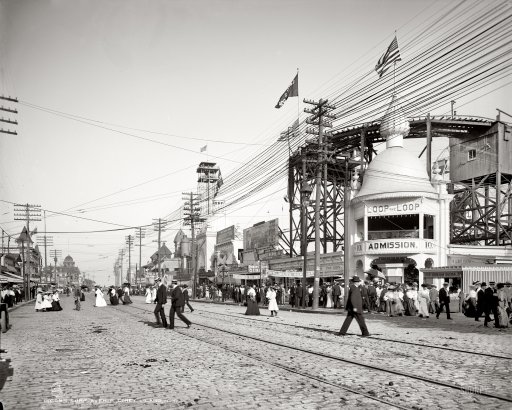
NPC Sidney Lust Leader Theater, Washington, DC 1920


Greece In ‘Slow-Death Scenario’ Amid Defaults Fears (CNBC)
IMF Knocks Greek Debt Rescheduling Hopes (FT)
The Endgame For Greece Has Arrived (Zero Hedge)
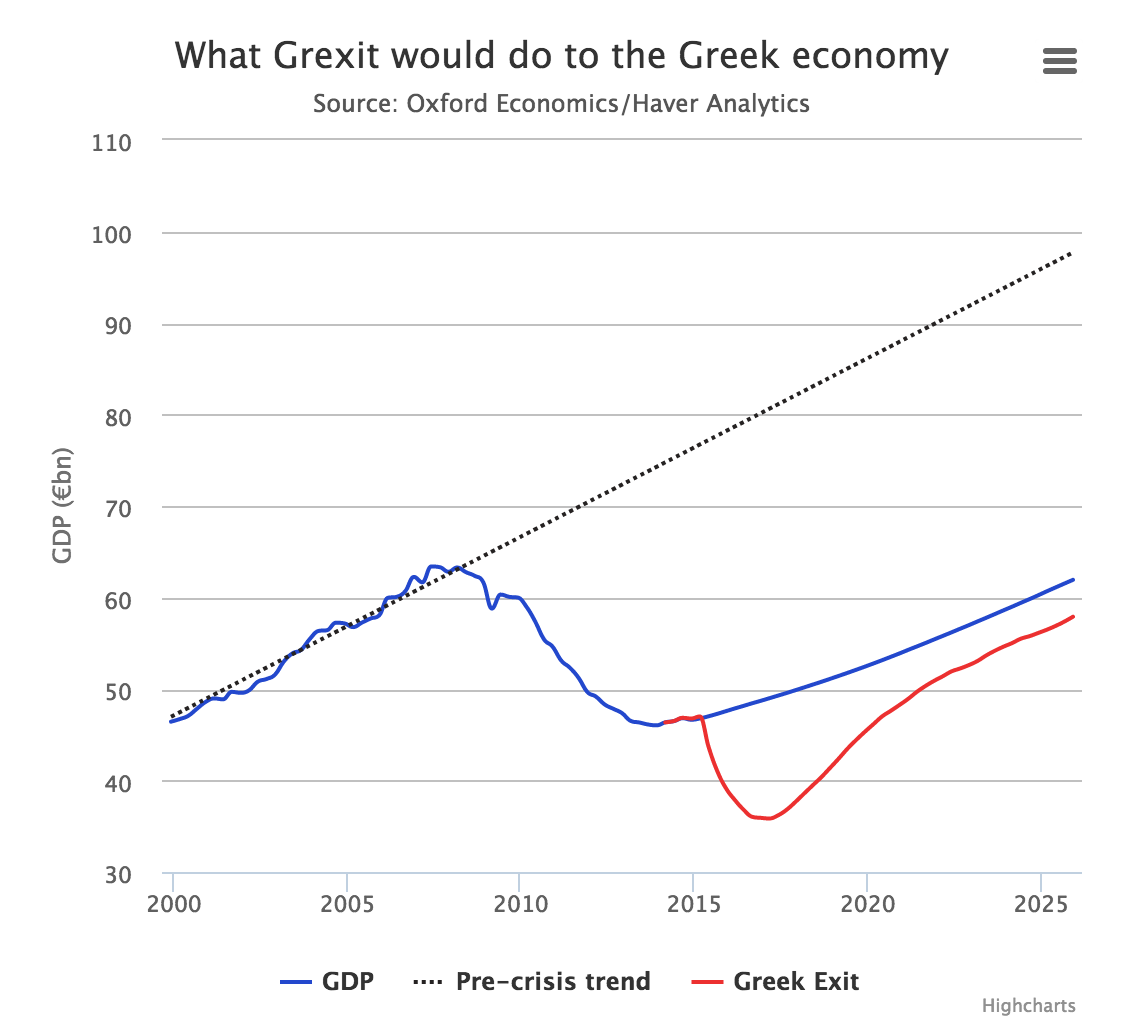
Why The Grexit Is Inevitable – How About May 9th? (Raas Consulting)
UBS Says Europe Risks Bank Runs On Grexit (Zero Hedge)
Fed’s Bullard Says Rate Hikes Are Needed For Coming ‘Boom’ (MarketWatch)
Warren Says Auto Lending Reminds Her Of Pre-Crisis Housing Days (MarketWatch)
27% Of US Students Are Over A Month Behind On Their Loan Payments (Zero Hedge)
China’s True Economic Growth Rate: 1.6% (Zero Hedge)
The South (China) Sea Bubble (Corrigan)
Don’t Invest In ‘Unsustainable’ China: Professor (CNBC)
The Major Paradox at the Heart of the Chinese Economy (Bloomberg)
China Seen Expanding Mortgage Bonds to Revive Housing (Bloomberg)
Bonds Beware As Money Catches Fire In The US And Europe (AEP)
ECB’s Mario Draghi Says Stimulus Is Working (WSJ)
Schaeuble Says Greece Must Ditch False Hopes, Commit to Reform (Bloomberg)
Schaeuble Criticizes Greece for Backsliding as Time Runs Out (Bloomberg)
Australia’s Economy: Is The Lucky Country Running Out Of Luck? (Guardian)
US Military Lands in Ukraine (Ron Paul Inst.)
Greece In Talks With Russia To Buy Missiles For S-300 Systems (Reuters)
Putin to Netanyahu: Iran S-300 Air Defense System is .. Defensive (Juan Cole)
Vatican Announces Major Summit On Climate Change (ThinkProgress)

“It would be a slow-death scenario and in a way we are in this scenario. Something needs to change in order to avoid an accident..”

Greece In ‘Slow-Death Scenario’ Amid Defaults Fears (CNBC)

Greece faces a “slow-death scenario”—including a default and messy exit from the euro zone—one analyst warned Thursday, as the country’s economic crisis took another turn for the worse following a credit rating downgrade. BofA’s Thanos Vamvakidis warned Thursday that if Greece fails to reach a deal with its European partners, a Grexit—or Greek exit from the euro zone becomes inevitable. His comments come after Greece’s unresolved negotiations with its international creditors prompted ratings agency Standard & Poor’s to cut its credit rating to “CCC+” from “B-” with a negative outlook.

“Without an agreement (with creditors over reforms), without official funding, there is a very high probability that Greece will default sometime in May and this could lead to a very negative scenario,” Vamvakidis told CNBC Thursday. He said that although nobody wants that, “the more they delay the higher the risks.” “(A Grexit) is not going to be overnight. It would be a slow-death scenario and in a way we are in this scenario. Something needs to change in order to avoid an accident,” he added. Reform discussions between Greece and the bodies overseeing its bailout program—the EC, ECB and IMF—have been unsuccessful over recent weeks. The country’s creditors agreed to extend its bailout program by four months in February in order to give Greece’s new leftwing government more time to enact reforms.

Lack of progress on reforms means Greece’s last tranche of aid—needed in order to make loan repayments to the IMF and ECB in the coming weeks and months—has not been released. [..] Despite growing fears of a euro zone exit, some euro zone officials have refused to countenance such a scenario, which could bring with it significant upheaval and potentially disastrous consequences for the euro zone. Not only could a default and Grexit prompt capital controls to prevent bank runs, international financial isolation and the introduction of a new currency in Greece, it could threaten the future of the 19-country single currency bloc.

Knowing that any such talk could spark international panic over Greece and the intergrity of the euro zone and its currency, the European Central Bank’s President Mario Draghi dismissed fears of a Greek default Wednesday, saying he was not ready to even “contemplate” such a scenario. Officials in the U.S. have openly warned over the risks posed by Greece, however. Greek Finance Minister, Yanis Varoufakis, is due to meet U.S. President Barack Obama on Thursday, and U.S. Treasury Secretary Jacob Lew on Friday (along with the ECB’s Draghi and IMF officials).

Read more …

Time for some US pressure?

IMF Knocks Greek Debt Rescheduling Hopes (FT)

Greek officials have made an informal approach to the IMF to delay repayments of loans to the international lender, highlighting the parlous state of Greek finances, but were told that no rescheduling was possible. According to officials briefed on the talks by both sides, Athens was persuaded not to make a specific request for a delay to the Fund, which is owed almost a €1bn in two separate payments due in May. Although Athens was rebuffed, the discussions, which occurred in private earlier this month, are a sign that the Greek government is finding it increasingly difficult to scrape together enough money to continue to pay wages and pensions while meeting its debt payments to external lenders.

Officials representing Greece’s creditors are unsure whether Athens will be able to make the payments in May. Even if they do, they are certain that the matter will come to a head by June, before much larger payments on bonds held by the ECB start coming due.
IMF officials have repeatedly said that a rescheduling of repayments can only come as part of a completely renegotiated new bailout programme. Were it to miss a payment, Greece would become the first developed economy to go into arrears at the Fund, something only counties like Zaire and Zimbabwe have done in the past.

Greece informally raised the precedent of delaying IMF payments by at least one other developing country a generation ago in the 1980s. But IMF officials stuck to their guns saying that none of the underlying problems had been solved by payment delays. One source briefed on the approach said the proposal was to “reshuffle the repayment schedule for the IMF loan over the coming months,” allowing the new Greek government led by Alexis Tsipras to have the money to pay bills for pensions and public sector salaries while negotiating with European creditors over payment of the next tranche of bailout loans.

Read more …

“..the Greek Finance Minister “will on Friday meet with infamous sovereign debt lawyer Lee Buchheit, who has helped numerous countries restructure their debt.”

The Endgame For Greece Has Arrived (Zero Hedge)

To think it was just recently in September of last year when the S&P, seemingly unaware of the tragic reality facing Greece in just a few months (by reality we meen democratic elections which overthrew the previous regime which was merely a group of Troika picked technocrats), upgraded Greece to B and said “The upgrade reflects our view that risks to fiscal consolidation in Greece have abated.” Well, the risks have unabated, and two months after S&P flip-flopped and downgraded Greece back to B- on February 6, moments ago it downgraded it again, this time to triple hooks, aka the dreaded CCC+. S&P said that without deep economic reform or further relief, S&P expects Greece’s debt, other financial commitments to be unsustainable. S&P views that Greece increasingly depends on favorable business, financial, and economic conditions to meet its financial commitments.

The rater adds that “conditions have worsened due to the uncertainty stemming from the prolonged negotiations between the Greek govt and its official creditors” and that economic prospects could deteriorate further unless talks between Greece and its creditors conclude soon.” In short: Greece is about to default and/or exit the Eurozone so this time at least S&P is prepared. Ironically this comes a day before Varoufakis is set to meet with Obama. It will be followed by meetings with European Central Bank head Mario Draghi on Friday, Secretary of the Treasury Jack Lew, Italy’s finance minister Pier Carlo Padoan and IMF officials. But, as City AM reports, the biggest news is that the Greek Finance Minister “will on Friday meet with infamous sovereign debt lawyer Lee Buchheit, who has helped numerous countries restructure their debt. Buchheit is a partner at top US law firm Cleary Gottlieb.”

It comes just a week before a vital meeting of Eurozone finance ministers on 24 April which could be the last chance Greece has of gaining extra funds before hefty repayments are due to its creditors in May.

As a reminder, “Lee Buchheit, a leading sovereign-debt attorney and the man who managed the eventual Greek debt restructuring in 2012, was harshly critical of the authorities’ failure to face up to reality. As he put it, “I find it hard to imagine they will now man up to the proposition that they delayed – at appalling cost to Greece, its creditors, and its official-sector sponsors – an essential debt restructuring.” The endgame for Greece has arrived.

Read more …

One kind of logic.

Why The Grexit Is Inevitable – How About May 9th? (Raas Consulting)

One thing in common for almost all of my Pinewood International Schools (TiHi to some) class of ’78 is that we left. Many still live in Greece and in Thessaloniki or have returned, and they are closest to the pain. The real pain of the past decade, that has destroyed wealth and hope. Unemployment is running at levels not see in Europe since after the war, and at levels that encouraged the socialist – fascist civil wars of the 1930s. Those did not end well.

But that does not explain why the Grexit is inevitable, and why it will happen very soon.
1) This is what the Greek people voted for. No, they did not vote to stay in the Euro, they voted for the party that said it would reduce the debt and meet pension obligations. The Greek people and voters are not stupid. They knew this could only happen by either the rest of Europe bailing out Greece again, or by leaving the Euro.
2) The Greek people know perfectly well that Europe is not going to bail them out, because to do so will only set everyone up for the next bailout.
3) The Greek people, and the rest of Europe, know full well that the debt will never be repaid, and that the Troika are now acting as nothing better than the enforcers of loan sharks.
4) Syriza knows that it had six months before the voters would throw them out, and once out, Syriza would never come back.
5) The Greeks needed to show “good faith” in actually attempting to negotiate a resolution with the Troika. This has now been done, and is failing.
6) The demand for reparations from Germany is designed not to actually extract the reparations, but to anger the Germans to the point that they will block any compromise that Syriza would have been required to accept.

The Greek government, elected by a battered and exploited Greek people, has been establishing the conditions that will give them the moral high ground (in the eyes of their voters) needed to actually leave the Euro. Having set the conditions, when will it happen? I’m still guessing May 9th. Why? Greece will leave the Euro, and they will do it sooner than later. They’ve made the April payment, but simply do not have the money for the May or June payments, and they cannot pass the legislation required by Europe and the Germans and stay in power. That gives us a late May or June date. So why earlier?

Capital flight. Imposing currency controls will be a fundamental element of any Grexit. Accounts will be frozen, and any money in accounts will be re-denominated in New Drachmas. Once the bank accounts are unfrozen, the residual, former Euros will now be worth whatever the New Drachma has dropped to, and the drop will be significant, over–correcting to the downside. Once it is accepted that the Grexit is coming and there will be no last minute deal, and with memories of Cyprus too fresh in every Greek’s mind, the money will flow out of the country. Not just corporate money (most of which is probably off-share already) but any remaining personal money in bank accounts. So Greece has to move before the coming Grexit is perceived as inevitable, and the money starts to flow out.

Weekend event. When the Grexit happens, it will be on a weekend. The banks will be closed, parliament will be called into emergency session, and a packet of laws will be passed. As this needs to be on a Saturday to avoid wholesale capital flight the moment that parliament is called into session, were it a weekday. This leaves only a few possible dates. And where there are few possible dates, I’m punting on the earlier date, so earlier in May. And looking at the calendar, that leaves us with May 2nd, 9th or 16th. My own guess is that the 2nd is too soon, and the 16th is too late. That leaves me guessing May 9th.

Read more …

It is pretty silly that anyone would doubt this. Or believe reassurances to the contrary.

UBS Says Europe Risks Bank Runs On Grexit (Zero Hedge)

UBS: When examining the risk of contagion from any possible Greek exit from the Euro we come back again and again to the fact that in every monetary union collapse of the last century, the trigger for breakup was not the bond markets, current account positions, or political will, but banks. If ordinary bank depositors lose faith in the integrity of a monetary union they will hasten its demise by shifting their money out of their banks – either into physical cash, or into banks domiciled in areas of the monetary union that are perceived as “stronger”. Both of these traits were evident in the US monetary union breakup, and have been in evidence in more recent events this century.

The contagion risk after a possible Greek exit arises if bank depositors elsewhere in the Euro area believe that a physical euro note held “under the mattress” at home today is worth more than a euro in a bank – because a euro in a bank might be forcibly converted into a national currency tomorrow. In a breakup scenario it is more likely that retail bank deposits withdrawn will end up as physical cash, owing to the difficulties of opening and using a bank account in a different country. This is not a question of banking system solvency. Highly solvent banks will be subject to deposit flight if it is the value of the currency in that country that is uncertain…

The contagion story is serious. Even if a depositor thinks that there is only a 1% chance their country will exit the Euro, why take a 1% chance that your life savings are forcibly converted into a perceived worthless currency if by acting quickly (and withdrawing deposits) one can have 100% certainty that your life savings remain in Euros? If Greece were to walk away from the Euro, then the policy makers of the Euro area would have to convince bank depositors across the Euro area that a Euro in their local banking system was worth the same as a Euro in another country’s banking system, and that the possibility of any other country exiting the Euro was nil. If that double guarantee was not utterly credible, then the risk of other countries joining Greece in exiting the Euro would be high.

This suggests that financial markets are treating the risks around Greek exit with too little regard for the probable dangers.

Read more …

Like before the recovery gets out of hand.

Fed’s Bullard Says Rate Hikes Are Needed For Coming ‘Boom’ (MarketWatch)

A leading hawk on the Federal Reserve on Wednesday made a case for raising interest rates soon, arguing the level needs to be appropriate for the coming “boom” for the U.S. economy. St. Louis Fed President James Bullard, speaking at the annual Hyman Minsky conference here, acknowledged a boom by current standards might not be the same as the growth in the late 1990s. He pointed out that even if gross domestic product expanded just 1.5% in the first quarter, the four-quarter growth rate would be about 3.3%.With the current potential growth around 2%, growth in the low 3% range “represents growth well above trend,” he said. The first reading on first-quarter GDP is due April 29. Unlike his colleagues, Bullard expects the unemployment rate to fall below 5% from a current level of 5.5%. Bullard said jobless rates in the 4% range are consistent with a boom.

In his remarks, he notably did not specify a month to lift interest rates, and asked by reporters afterwards, he said, “I’m being deliberately vague.” The June meeting is considered the first in which the Federal Open Market Committee will give serious consideration to lifting interest rates. His biggest fear from keeping low rates — they have been near zero for 6.5 years — is that they could lead to financial-stability problems later. He said asset valuations currently look fairly valued, with the notable exception of bonds which Fed policy influences. “So it’s hard to know what that really means.” But he pointed out that Fed policy typically impacts the economy with a lag. “Boom times ahead, plus us already charting out low interest rates, sounds like risky from a bubble perspective,” he said.

Read more …

She’s not the only one. But perhaps she should have said this a year ago.

Warren Says Auto Lending Reminds Her Of Pre-Crisis Housing Days (MarketWatch)

Senator Elizabeth Warren on Wednesday used a major address on financial regulation to chide automobile lending practices as she continued her criticism of the country’s largest banks. Warren was speaking on the topic of the unfinished business of financial reform, and looking at the financial sector five years after the passage of the Dodd-Frank reform law. Warren, the leading contender to block a Hillary Clinton presidential nomination on the Democratic side if she were to step into the race, took particular aim at the fast-growing automobile lending category. “Right now, the auto loan market looks increasingly like the pre-crisis housing market, with good actors and bad actors mixed together,” the Massachusetts Democrat said.

“The market is now thick with loose underwriting standards, predatory and discriminatory lending practices, and increasing repossessions.” Warren pointed out that car dealers got a specific exemption from the Consumer Financial Protection Bureau, the agency which Warren all but singlehandedly brought to life. “It is no coincidence that auto loans are now the most troubled consumer financial product. Congress should give the CFPB the authority it needs to supervise car loans – and keep that $26 billion a year in the pockets of consumers where it belongs,” she said, referring to an estimate of dealer markups.

The CFPB has taken some steps in the area of automobile loans and has proposed a rule that would bring larger auto lenders that are not already banks under its jurisdiction. Warren was on more familiar ground with her call to break up the nation’s banks. She pointed out that last summer the Federal Reserve and the Federal Deposit Insurance Corp. said 11 banks were risky enough to bring down the U.S. economy if they were to fail. She also blasted the Justice Department, the Federal Reserve and the Securities and Exchange Commission for timidity in going after major banks. “The DOJ and SEC sit by while the same giant financial institutions keep breaking the law — and, time after time, the government just says, ‘Please don’t do it again.’ ”

Read more …

How much further must this go before something is done?

27% Of US Students Are Over A Month Behind On Their Loan Payments (Zero Hedge)

As we’ve documented exhaustively in the past, the country is laboring under around $1.3 trillion in non-dischargeable loans to students which isn’t a good thing, especially in a country where the jobs driving the economic “recovery” have, until last month, been created in the food service industry and where wage growth is a concept reserved for only 20% of the workforce. It would seem that this could make it increasingly difficult for students to repay their debt, especially considering how quickly tuition costs have risen. In other words, tuition is going up, wages aren’t, and the latter point there is only relevant in the event you find a job that pays you a wage in the first place (i.e. where your compensation isn’t determined by the generosity of the “supervisory” Americans who can still afford to eat out).

The severity of the problem has been partially masked at times by the tendency to inflate the denominator when one goes to calculate delinquency rates. That is, if you include all student debt outstanding, even that in deferment or forbearance in the denominator, then clearly the delinquency rate will be biased to the downside because the numerator will by necessity only include those students who are currently in repayment. That’s really convenient if you want to make things look less bleak than they actually are.

Of course you can’t be delinquent when you aren’t yet required to make payments, so the more accurate way to calculate the figure would be to include only those students in repayment in the denominator. This apples-to-apples comparison is likely to paint much more accurate picture and sure enough, a new St. Louis Fed (who recently documented the shrinking American Middle Class) study finds that the delinquency rate for students in repayment is 27.3%, well above the 17% figure for all student borrowers. Here’s more:

[..] if we adjust the delinquency rate to consider that only a fraction of the borrowers have payments due, this level of delinquency is very concerning: A delinquency rate of 15% for all student loan borrowers implies a delinquency rate of 27.3% for borrowers with loans in repayment. This level of delinquency is much higher than for any other type of debt (credit cards, auto loans, mortgages, and so on).

Read more …

That feels more like it. Over 70% of capital invested in housing, which fell 6%…

China’s True Economic Growth Rate: 1.6% (Zero Hedge)

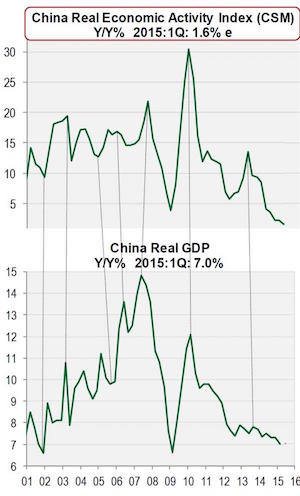
Cornerstone Macro reports, “Our China Real Economic Activity Index Slowed To Just 1.6% YY In 1Q.” The indicator in question looks at many of the components shown above, such as retail sales, car sales, rail freight, industrial production, and several others, to determine an accurate indicator of the true state of China’s economy. It finds that not only is China’s economic growth rate not rising at a 7.0% Y/Y rate, but is in fact the lowest it has been in modern history! And a 1.6% growth rate by what was formerly the world’s most rapidly growing (and largest according to the IMF) economy explains perfectly what happened with the US economy over the past 6 months. Hint: it has nothing to do with the winter, and everything to do with China hard landing into a brick wall.
Read more …

“China is currently enjoying the somewhat dubious fruits of one of the all-time great stock manias.”

The South (China) Sea Bubble (Corrigan)

The first hard data release of the month for China was hardly guaranteed to reassure. Two-way trade in USD terms dropped 6.3% in the first quarter from its level of a year ago, the second most severe setback since the Crash and only the third such instance in the whole era of ‘Opening Up’. From a strictly local perspective, the bad news was mitigated by the fact that exports managed to eke out a modest YOY gain of 4.7% (though that still means they were effectively unchanged from 2013 levels) and so the trade surplus was left at a record seasonal high. For the rest of us, however, anxious as we are to sell more of our wares to China, there was no such comfort. Imports plunged by more than a sixth to a four-year low, registering a drop which, if nowhere near as large in percentage terms, was, when measured in numbers of dollars, equal to that suffered in the global freeze which ensued in the aftermath of the Lehman collapse.

Though it always does to await the full data release for the first quarter – given the inordinate impact on comparisons of that highly moveable feast, the Lunar New Year – these numbers are fully consonant with the evidence presented during the first two months which showed flat non-residential electricity use and rail freight volumes down to seven year seasonal lows. It is undoubtedly the case that the bulk of the pain being felt is concentrated where it should be – up in the dirty, surplus capacity-plagued end of heavy industry and extraction – but, nevertheless, Chinese data show that 12-month running profits have dwindled to zero (if we strip out companies’ non-core – qua speculative – activities) and that for the last three months for which we have numbers they had actually declined in a manner not seen since the world stood still in late 2008/early 2009.

Revenue growth was also sickly, while balance sheets continue to swell with debt and receivables. Granted, private joint-stock companies continue to outperform their state-owned peers – or so the NBS would have us believe – but, even here, core profit growth over the whole of 2014 was a mere 4.2% with turnover up 9.2% (suggesting that margins simultaneously contracted). In such an environment, you might think that investor spirits would be dampened but, as anyone who has opened a paper in recent days will be aware, that is very much far from being the case.

Indeed, China is currently enjoying the somewhat dubious fruits of one of the all-time great stock manias. The CSI300 composite of Shanghai and Shenzhen equities has double since last July, with the seven-eighths of those gains coming in the last six months and almost a third of them in the past six weeks. With first Y1 trillion then Y1.5 trillion trading days being recorded and with 1.6 million [sic] new trading accounts being opened in the latest week for which we have the numbers, it is easy to see that this has rapidly degenerated into an indiscriminate free-for-all.

Read more …

“..a Keynesian-on-steroids stimulus that occurs at the municipal level by building all sorts of public infrastructure that requires stealing land from farmers..”

Don’t Invest In ‘Unsustainable’ China: Professor (CNBC)

China bear Peter Navarro is telling investors not to put their money in the country because its economic model is unsustainable. “What you got is a mercantilist export-driven model for China coupled with a Keynesian-on-steroids stimulus that occurs at the municipal level by building all sorts of public infrastructure that requires stealing land from farmers,” the University of California, Irvine economics professor told CNBC’s “Power Lunch” on Wednesday. Navarro, who co-wrote “Death By China,” attributes China’s slowing growth to less demand coming from the U.S. and Europe for Chinese exports.

“The problem is simply that Europe and the U.S., which provided the 10% growth year after year for three decades, are now too weak to sustain that,” he said. In addition, China is facing rising wages, labor issues, water shortages and a stock market and real estate bubble, Navarro said. On Wednesday, China’s statistics bureau announced that GDP grew an annual 7% in the first quarter, slowing from 7.3% in the previous quarter. That was the country’s slowest pace of growth in six years, suggesting the world’s second-largest economy was still losing momentum.

Read more …

“..every investment-led growth miracle in the last 100 years has broken down.”

The Major Paradox at the Heart of the Chinese Economy (Bloomberg)

“The latest GDP report underscores offsets coming from China’s services-led transformation — a key underpinning of consumer demand,” said Stephen Roach… “I suspect the economy is close to bottoming and could well begin to pick up over the balance of this year.” Chinese officialdom has little choice but to tap on the brakes of the old-line economy. Years of politically driven investment with diminishing returns led to too much debt and industrial overcapacity, as well as ghost towns with unfinished hotels and unoccupied residential towers. Bad debt piled up at a faster pace at China’s big state banks in the fourth quarter. Meanwhile, the country’s total debt — government, corporate and household — rose to about $28 trillion by mid-2014, according to an estimate by McKinsey, or about 282% of GDP.

Xi and Premier Li Keqiang are trying to defuse that debt bomb, rein in banks and local governments and promote the nation’s stock markets as a primary way for innovative and smaller companies to raise capital. Both leaders say they’ve mapped out more than 300 reforms that over time will reduce state intervention in the economy. Among the initiatives is scaling back energy-price controls that favor manufacturers. The changes are also designed to improve the social safety net and encourage market-driven deposit rates to get Chinese families saving less and spending more.

Few countries with the scale of China’s credit boom have escaped unscathed without experiencing some sort of banking crisis. Research by Michael Pettis, a finance professor at Peking University, shows that “every investment-led growth miracle in the last 100 years has broken down.” Avoiding that fate requires a high-wire balancing act for the government. It needs to wind down the torrent of investment – 49% of China’s GDP from 2010 to 2014 – without cratering the economy and worsening the situation for indebted local governments or the bad-debt burden of Chinese banks.

Read more …

Anything goes by now?!

China Seen Expanding Mortgage Bonds to Revive Housing (Bloomberg)

China is poised to expand mortgage bonds to lift its slumping real estate market that accounts for a third of the economy. Officials will likely allow banks to sell commercial mortgage-backed notes for the first time by the end of the year after reviving securities tied to home loans in 2014, according to China Merchants Securities Co. and China Chengxin International Credit Rating Co. The offerings, which help banks boost mortgage lending by freeing space on balance sheets, will grow “substantially” this year, China Credit Rating Co. said. The government of Premier Li Keqiang eased home-purchase rules after new housing prices slid in many cities across China in February.

Authorities, who halted securitization in 2009 after subprime mortgage bonds triggered the global financial crisis, are returning to such offerings to spur an economy growing at the slowest pace since 1990. “The launch of commercial mortgage-backed securities may send a strong policy signal because it will give banks more space to lend money directly to property developers,” said Zuo Fei, a Shenzhen-based director of structured finance at China Merchants Securities, underwriter of the first RMBS deal this year. “The regulators are trying to improve property purchases in a gradual and an appropriate way.”

The People’s Bank of China on March 30 cut the required down payment for some second homes to 40% from 60% and has reduced benchmark interest rates twice since November. The central bank and the China Banking Regulatory Commission said on Sept. 30 that they will encourage lenders to issue mortgage-backed securities. The government is trying balance efforts to provide new financing with steps to rein in unprecedented borrowing. Real estate companies sold a record $44.4 billion-equivalent of bonds in 2014, data compiled by Bloomberg show. In the latest sign of industry stress, Kaisa Group Holdings Ltd., based in the southern city of Shenzhen, is seeking a restructuring that would impose noteholder losses, fueling speculation that builder defaults may spread.

Read more …

Is Ambrose seeking to offset the bleak views he posted lately?

Bonds Beware As Money Catches Fire In The US And Europe (AEP)

Be thankful for small mercies. The world economy is no longer in a liquidity trap. The slide into deflation has, for now, run its course. The broad M3 money supply in the US has been soaring at an annual rate of 8.2pc over the past six months, harbinger of a reflationary boomlet by year’s end. Europe is catching up fast. A dynamic measure of eurozone M3 known as Divisia – tracked by the Bruegel Institute in Brussels – is back to growth levels last seen in 2007. History may judge that the ECB launched quantitative easing when the cycle was already turning, but Italy’s debt trajectory needs all the help it can get. The full force of monetary expansion – not to be confused with liquidity, which can move in the opposite direction – will kick in just as the one-off effects of cheap oil are washed out of the price data.

“Forecasters ignore broad money at their peril,” says Gabriel Stein, at Oxford Economics. Inflation will soon be flirting with 2pc across the Atlantic world. Within a year, the global economic landscape will look entirely different, with an emphasis on the word “look”. In my view this will prove to be mini-cyclical in a world of “secular stagnation” and deficient demand, but mini-cycles can be powerful. Mr Stein said total loans in the US are now growing at a faster rate (six-month annualised) than during the five-year build-up to the Lehman crisis. “The risk is that the Fed will have to raise rates much more quickly than the markets expect. This is what happened in 1994,” he said. That episode set off a bond rout. Yields on 10-year US Treasuries rose 260 basis points over 15 months, resetting the global price of money. It detonated Mexico’s Tequila crisis.

Bonds are even more vulnerable to a reflation shock today. You need a very strong nerve to buy German 10-year Bunds at the current yield of 0.16pc, or French bonds at 0.43pc, at time when EMU money data no longer look remotely “Japanese”. Granted, there may be tactical reasons for buying Bunds, even at negative yields out to eight years maturity. Supply is drying up. Berlin is pursuing a budget surplus with religious zeal, paying down €18bn of debt over the past year. It has left the Bundesbank little to buy as it launches its share of QE. Yet this is collecting pfennigs on the rails of a high-speed train. The German property market is on the cusp of a boom. David Roberts, of Kames Capital, warns of a “poisonous cocktail” of resurgent inflation and rising wages. “If you look at Bunds in anything other than the shortest possible timescale, the risk becomes very clear.”

Read more …

Dick Tator. Mr. Dick Tator.

ECB’s Mario Draghi Says Stimulus Is Working (WSJ)

European Central Bank President Mario Draghi said the bank’s stimulus efforts are beginning to take hold in the European economy and batted away concerns in financial markets that the bank may have to end its more than €1 trillion ($1.1 trillion) asset purchase program early. Mr. Draghi’s Wednesday news conference, held after the ECB decided to keep interest rates and other policies unchanged, was briefly interrupted by a confetti-throwing protester who jumped on the table where Mr. Draghi was seated and shouted “end the ECB dictatorship” as he began his opening remarks.

Mr. Draghi, who appeared unfazed by the ruckus after being whisked away by his bodyguards to a side room for a few minutes, said the bank’s stimulus drive is “finally finding its root” in the economy through easier credit conditions and lower inflation-adjusted interest rates. “The euro area economy has gained further momentum since the end of 2014,” said Mr. Draghi. “We expect the economic recovery to broaden and strengthen gradually.” Still, Mr. Draghi said the region’s recovery depends on full implementation of the ECB’s policies. Those include a record-low lending rate that the ECB kept unchanged Wednesday; cheap four-year loans to banks; and a €60 billion-a-month program to buy mostly government bonds that the ECB launched last month and intends to continue through September 2016.

On Tuesday, the IMF raised its forecast for eurozone growth this year to 1.5% from 1.2%. Though well below the levels of growth the U.S. has achieved during its recovery, it was a welcome development for a region that last year narrowly escaped its third recession in six years. Mr. Draghi cited a long list of reasons why this recovery should continue whereas previous ones have faltered. Lower oil prices, which cut costs for businesses and households, are joining the ECB’s stimulus in boosting the economy, Mr. Draghi said, noting that business and consumer confidence is up and that there should be fewer headwinds from fiscal policy.

[..] Mr. Draghi also played down concerns that the superlow interest rates brought on by the ECB’s policies could fuel bubbles in financial markets. “So far we have not seen evidence of any bubble,” he said, adding that regulatory policies, known as macroprudential tools, would be “the first line of defense” if imbalances started to form. He sidestepped questions about how the ECB would react in the event Greece isn’t able to reach agreement with its international creditors to unlock bailout funds, saying developments are “entirely in the hands of the Greek government.”

Read more …

Schaeuble needs to stop telling Greece what to do.

Schaeuble Says Greece Must Ditch False Hopes, Commit to Reform (Bloomberg)

German Finance Minister Wolfgang Schaeuble ruled out further concessions to Greece, saying it’s up to the Greek government to commit to the reforms needed to release aid rather than give false hopes to its people. Schaeuble, speaking in a Bloomberg Television interview in New York on Wednesday, said that another debt restructuring wasn’t up for discussion now, and that Greek demands for war reparations from Germany were “completely unrealistic.” “It’s entirely down to Greece,” said Schaeuble, 72. While some kind of restructuring might be on the agenda in 10 years, “today the issue for Greece is reforming its economy in such a way that it becomes competitive at some point.”

Greece’s plight is deepening with no end in sight to the standoff with creditors over releasing the final installment of bailout aid that has been stalled since the January election of Prime Minister Alexis Tsipras’s anti-austerity government. Greek 10-year bond yields surged and bank stocks plunged to their lowest level in at least 20 years on Wednesday after a report in Die Zeit newspaper the German government was working on a plan to keep Greece in the euro area if the country defaulted, triggering a halt to European Central Bank funding. “We don’t have such plans, and if we were working on them – because ministry staff are taking just about everything into consideration – then we would definitely not talk about it,” said Schaeuble. “It makes no sense to speculate about it.”

With a monthly bill of about €1.5 billion for pensions and salaries and repayments to its international creditors looming, Greece is targeting next week’s meeting of euro-area finance ministers in Riga, Latvia, as a deadline for unlocking the funds. While Schaeuble said earlier Wednesday that “no one” in the euro region expects a resolution of the standoff by the Riga meeting on April 24, he softened his tone in the interview, saying that the end of the program on June 30 was the only deadline that mattered. “If Greece wants support, we will give this support as in recent years, but of course within the framework of what we agreed,” he said. While the decisions ultimately lie with Greece, “whatever happens: we know that Greece is part of the European Union and that we also have a responsibility for Greece and we will never disregard this solidarity.”

Read more …

“..Tsipras’s government had “destroyed” progress made by previous administrations..” That’s the progress that led to hungry children?!

Schaeuble Criticizes Greece for Backsliding as Time Runs Out (Bloomberg)

German Finance Minister Wolfgang Schaeuble criticized Greece for backsliding on reforms, saying that “no one” expects a resolution next week of the standoff with Alexis Tsipras’s government over untapped bailout funds. Schaeuble, in his first comments on the matter since before the Easter holidays, said Tsipras’s government had “destroyed” progress made by previous administrations in overhauling the Greek economy. “It’s a tragedy,” he said Wednesday at the Council on Foreign Relations in New York, adding that the country needed to become competitive to stop being a “bottomless pit.” The comments by the finance chief of the region’s biggest economy underscored the rising concern in European capitals that Greece is running out of time to unfreeze the aid needed to keep the country afloat.

Standard & Poor’s cut Greece’s rating Wednesday, citing the country’s deteriorating outlook. Schaeuble is among European officials who are skeptical that there’s enough time to work out a deal ahead of a meeting of euro-area finance ministers at the end of next week in Riga, Latvia, to assess whether Greece has made enough progress to warrant a disbursement from its €240 billion bailout fund. Leaders are pressuring Greece to submit specific reforms as the country runs out of cash and faces debt payments and monthly salary obligations in the coming weeks.

Germany said Wednesday that an aid payment from the bailout fund won’t happen this month, and that Greece’s negotiations with creditors have failed to move forward. “I said last time that there has been progress, but that really there is still a considerable need for negotiations,” Friederike von Tiesenhausen, a German Finance Ministry spokeswoman, said. “Things have not really changed.” Greece’s credit rating was lowered one level to CCC+, with a negative outlook, by S&P, which estimated that the country’s economy contracted close to 1% in the past six months. The downgrade leaves the nation’s rating seven steps into junk territory.

Read more …

“..taxes might have to go up to cover a $25bn budget black hole caused by falling commodity prices..” “..BHP Billiton and Rio Tinto launched a huge expansion which saw mining investment as a percentage of the Australian economy peak at a whopping 7% in 2012. ”

Australia’s Economy: Is The Lucky Country Running Out Of Luck? (Guardian)

After 24 years of uninterrupted economic growth, Australia is entering the kind of difficult waters experienced by every other major developed country in the past decade. Even if Thursday’s unemployment figures show more jobs were added last month, the Coalition is set to go into the next election with an unusually gloomy outlook. Australians are finding it harder to get a job than at any time in more than decade and those who are in work are seeing the weakest wage growth for two decades. There are even fears that taxes might have to go up to cover a $25bn budget black hole caused by falling commodity prices. As one leading economist put it, the lucky country is running out of luck. Growth is still on target for a healthy at 2.8% for this year, according to the IMF, the kind of number that would send European leaders scrambling for the tweet button.

But the question of whether Australia loses its remarkable record of continuous growth depends, as with almost everything else in the economy, on what happens in China. “Australia has gone 24 years without a recession thanks to good management and good luck,” said Saul Eslake at BoA in Sydney. “Up to the early 2000s it was managed well and then it wasn’t. But then the luck improved because of China’s huge stimulus after the global financial crisis. Now the luck is running out.” The slowdown in the world’s second biggest economy is now well and truly underway. Demand for Australia’s iron ore and coal has plummeted from a decade ago as Beijing seeks to scale back its huge building schemes and create a more consumer-led economy. The price of the steel-making commodity, Australia’s biggest export, has fallen from $130 at the start of 2014 to around $50. Coal has halved in price in the past four years.

Buoyed by the good times, resource companies led by BHP Billiton and Rio Tinto launched a huge expansion which saw mining investment as a percentage of the Australian economy peak at a whopping 7% in 2012. The new output from their giant mines in Western Australia is now hitting the market, making export figures look healthy but adding to the pressure on prices and leaving Australia with a potentially wretched hangover.

Read more …

How does this not violate the Minsk agreement?

US Military Lands in Ukraine (Ron Paul Inst.)

Paratroopers from the US Army’s 173rd Airborne Brigade have arrived in Ukraine to begin training that country’s national guard and provide it with new military equipment. The Ukrainian government took power in a US-backed coup in early 2014 and has waged war on eastern provinces that wish to breakaway from what they see as an illegitimate government. The US military action, dubbed “Operation Fearless Guardian,” will improve the Washington-backed faction’s ability to wage war against the breakaway regions, but at least in spirit will violate the “Minsk II” ceasefire agreement which mandates a “pullout of all foreign armed formations, military equipment.”

The US military involvement on behalf of the US-backed government in Kiev comes at a key time in the shaky ceasefire. The Organization for Security and Cooperation in Europe (OSCE) has noted a serious increase in fighting in the breakaway eastern regions of Ukraine and OSCE monitors have pointed the finger at US-backed Kiev as the instigator of these new attacks. The relevant OSCE report finds:

…that the Ukrainian side (assessed to be the Right Sector volunteer battalion) earlier had made an offensive push through the line of contact towards Zhabunki (“DPR”-controlled, 14km west-north-west of Donetsk…

The US military’s “Operation Fearless Guardian” will ultimately involve some 300 US Army personnel “training three battalions of Ukrainian troops in a range of infantry tactics.” With Ukraine’s US-backed president promising to “retake” the breakaway regions in the east despite having signed the ceasefire, it is clear that US training constitutes the beginning of direct US military involvement in the Ukrainian conflict. As such it is undeniably an escalation.

Read more …

Well, they sure have no money to buy entirely new systems.

Greece In Talks With Russia To Buy Missiles For S-300 Systems (Reuters)

Greece is negotiating with Russia for the purchase of missiles for its S-300 anti-missile systems and for their maintenance, Russia’s RIA news agency quoted Greek Defense Minister Panos Kammenos as saying on Wednesday. The report followed a visit by Greek Prime Minister Alexis Tsipras last week to Moscow, where he won pledges of Russian moral support and long-term cooperation but no fresh funds to help avert bankruptcy for his heavily indebted nation. NATO member Greece has been in possession of the Russian-made S-300 air defense systems since the late 1990s.

“We are limiting ourselves to replacement of missiles (for the systems),” RIA quoted Kammenos, who is in Moscow for a security conference, as saying. “There are negotiations between Russia and Greece on the maintenance of the systems … as well as for the purchase of new missiles for the S-300 systems,” he said. The Greek defense ministry in Athens later issued a statement quoting Kammenos as saying: “The existing defense cooperation programs will continue. There will be maintenance for the existing programs.”

Read more …

Paid for years ago.

Putin to Netanyahu: Iran S-300 Air Defense System is .. Defensive (Juan Cole)

Russian President Vladimir Putin spoke by phone with Israeli Prime Minister Binyamin Netanyahu Tuesday with regard to the Russian Federation’s decision to go ahead with the sale to Iran of S-300 anti-aircraft batteries. Iran bought the batteries several years ago, but delivery was delayed by Moscow because of US and international pressure. The US has led the imposition of severe economic sanctions on Iran, perhaps the most severe ever applied to any country in modern history, including having Iran kicked off the SWIFT bank exchange. In deference to US wishes, Russia did not ship the system.

Two things have now changed. First, Russia and the US are not getting along nearly as well in the wake of the Russian annexation (or reclaiming, from Moscow’s point of view) of Crimea from Ukraine and its support for ethnically Russian fighters in Ukraine’s east. In fact, the US has begun imposing sanctions on Russia. In turn, Russia no longer has great regard for US wishes. Second, the five permanent members of the UN Security Council plus Germany have concluded a framework agreement permitting Iran’s civilian nuclear enrichment program, which is aimed at imposing inspections and equipment restrictions that would make it very difficult if not impossible for Iran to break out and create a nuclear weapon.

Russia and China have been the least supportive of severe sanctions on Iran, and Russia appears to have decided that since the negotiations have reached a serious phase, it is time to go ahead with this deal, concluded some time ago. The announcement alarmed Israeli Prime Minister Binyamin Netanyahu, whose government has often hinted around that it might bomb Iran. The Putin government issued a communique that “gave a detailed explanation of the logic behind Russia’s decision…emphasizing the fact that the tactical and technical specifications of the S-300 system make it a purely defensive weapon; therefore, it would not pose any threat to the security of Israel or other countries in the Middle East.”

Read more …

“..safeguard Creation … Because if we destroy Creation, Creation will destroy us!”

Vatican Announces Major Summit On Climate Change (ThinkProgress)

Catholic officials announced on Tuesday plans for a landmark climate change-themed conference to be hosted at Vatican later this month, the latest in Pope Francis’ faith-rooted campaign to raise awareness about global warming. The summit, which is scheduled for April 28 and entitled “Protect the Earth, Dignify Humanity. The Moral Dimensions of Climate Change and Sustainable Development,” will draw together a combination of scientists, global faith leaders, and influential conservation advocates. UN Secretary General Ban Ki-moon is slotted to offer the opening address, and organizers say the goal of the conference is to “build a consensus that the values of sustainable development cohere with values of the leading religious traditions, with a special focus on the most vulnerable.”

“[The conference hopes to] help build a global movement across all religions for sustainable development and climate change throughout 2015 and beyond,” read a statement posted on several Vatican-run websites. According to a preliminary schedule of events for the convening, attendees hope to offer a joint statement highlighting the “intrinsic connection” between caring for the earth and caring for fellow human beings, “especially the poor, the excluded, victims of human trafficking and modern slavery, children, and future generations.” The gathering will undoubtedly build momentum for the pope’s forthcoming encyclical on the environment, an influential papal document expected to be released in June or July.

The Catholic Church has a long history of championing conservation and green initiatives, but Francis has made the climate change a fixture of his papacy: he directly addressed the issue during his inaugural mass in 2013, and told a crowd in Rome last May that mistreating the environment is a sin, insisting that believers “safeguard Creation … Because if we destroy Creation, Creation will destroy us! Never forget this!” The Vatican also held a five-day summit on sustainability in 2014, calling together microbiologists, economists, legal scholars, and other experts to discuss ways to address climate change.


Read more …

Apr 082015
 
 April 8, 2015  Posted by at 10:21 am Finance Tagged with: , , , , , , , ,  11 Responses »


Harris&Ewing Less taxes, more jobs, US Chamber of Commerce campaign 1939

It wouldn’t be a first, but it would certainly be a – bigger – shock. That is to say, the Bank of England hijacked the head of Canada’s central bank some time ago, but, while unexpected enough, that would pale in comparison to the US hiring the present Governor of the Russian central bank, Elvira Sakhipzadovna Nabiullina. It would still seem to be a mighty fine idea, though.

Not that I think it will happen, not to worry if you think Yellen is just what it takes at the Fed. But Nabiullina is both razor sharp and fiercely independent. Yellen is obviously neither; she’s a cog in a machine that huffs and puffs and pumps and dumps to make sure her overlords in the blissful world of US finance make ever more profit no matter how bad things get in American society.

There’s no need to be particularly sharp in order to play that role, and she was picked exactly because she’s NOT independent. Or let’s just say she’s a good listener.

Nabiullina is a whole different story. Not that I have much confidence in western readers understanding that this is so, let alone why. Not after the 24/7 highly public media campaigns and sanctions and oil price wars and Ukraine war talk and chest thumping directed at Putin and Russia, and after everything else that we don’t even know that plays out behind the veils.

Enjoy your conspiracies while you can, I’d say. Because despite more than a year of intense efforts to make Russia look like the empire of unspoken evil, financial markets, yes, the same ones Yellen manipulates at her lords’ bidding, have now made the Russian ruble and the Moscow stock exchange the biggest winners so far this year.

And that is due to a substantial extent to Elvira Nabiullina. You see, if she were just a blind or scared servant of Putin, or of his economic ideas, that would mean it was he who masterminded the resurrection of the currency and the stock market.

Think about it: that should make one really scared of Vladimir Vladimirovych. If besides all his other qualities, pursuits and activities (whether you see them in a positive light or not), he could also do that: save a $2 trillion economy from intense outside attacks.

Fear not: Putin is a mere mortal human being. One quality he does possess, however (he wouldn’t last in his position for 5 minutes if he didn’t), is a keen sense of who he can trust. And he trusts Elvira Nabiullina. She’s only been central bank governor since 2013, when she wasn’t even 50 years old, but she’s been a confidant for quite a while, most importantly as Putin’s private economic advisor in the years leading up to her present job.

You can all look up her career on Google or Wikipedia, interesting, but not overly so. What’s really important in Nabiullina’s career are two defining moments. Moments that make her stand out, and that define the relationship she has with Putin.

Sure, you can claim that she’s less independent than Yellen at the Fed, but who do you think you’re kidding? Yes, she has a hot line phone on her desk, and everyone is ushered out of the room when Putin calls her on that phone. But Yellen has hot lines to the US Treasury as well as to Jamie Dimon and Lloyd Blankfein and whoever lead those other banks and primary dealers. Independence?

So, to get to those two moments that define Elvira Nabiullina. The first was described by Bloomberg last month. In mid December 2014, the ruble was under vicious attack from financial markets. Nabiullina had already spent tens of billions of dollars in foreign reserves to prop it up. Then, on December 16, she, in a move nobody had foreseen, yanked up the interest rate in one fell swoop from 10.5% to 17%.

And here it comes: after that she did nothing. Not a thing. No more foreign reserves. Bloomberg quoted her as saying: ‘Speculators needed a cold shower’.

Mario Draghi said in 2012 he would do ‘whatever it takes to preserve the euro’. Nabiullina didn’t even have to say it.

The attack on the ruble was over. In January she lowered the interest rate to 15%, it’s at 13% now. Nabiullina says she expects it to be at 9% by the end of the year. The ruble is up 19% against the US dollar in 2015. No other currency has that record.

Did Putin order her to do this? No. They talked about it, and a lot, no doubt. But he knows she knows better. And he trusts her.

The second big moment came over the past few days, when Nabiullina announced that Russia will not get on the global central bank QE treadmill. Her reasoning, as Bloomberg reports, is that she sees problems with using debt to spur growth (eat your heart out, Krugman):

Nabiullina Sees ‘Limits’ in Using Debt Financing to Fund Growth

Russian central bank Governor Elvira Nabiullina raised questions about the use of debt financing to fund economic growth, underscoring the need to harness long-term capital as investment slumps. “We need to think about some other ways to finance growth, because financing economic growth with debt, in my opinion, has its limits,” Nabiullina said at a conference in Moscow on Thursday. “There won’t be long-term investment growth in Russia” without such sources of financing as pension savings and life insurance, she said.

“An excessive debt burden may be not only a catalyst for development and investment but also a hindrance,” Nabiullina said. Regardless of the high level of interest rates, the ratio of debt to Ebitda (Earnings Before Interest, Taxes, Depreciation and Amortization) “is already a considerable burden for companies, entire industries,” she said. Banking loans account for 57.6% of the Russian economy, according to Nabiullina. “Mandatory pension savings are of critical importance for sources of long-term financing and Russia’s capital markets,” the governor said.

Let me add some more from Reuters, so you get the full picture:

Russian Central Bank Chief Confident On Inflation, Banks, Ruble

“The acceleration of inflation… has in our view a temporary character. We expect quite a rapid fall in inflation if there are no new unforeseen circumstances..” Nabiullina said the central bank would continue cutting interest rates insofar as inflation risks receded. The bank has already cut rates twice this year. “On the whole we judge the situation in the banking sector as stable,” she said. “The banking sector maintains a substantial capital buffer and the banking sector is able to counter serious shocks even if crisis phenomena deepen.”

She said central bank stress tests showed that even if the oil price were to fall to $40 per barrel the sector would maintain capital levels above the regulatory minimum. Nabiullina also said the factors which had been weighing on the rouble had now passed, saying that repayments of foreign debts could be financed without this having a significant effect on the rouble’s value. “Thus the influence of those factors which were influencing the exchange rate and inflation last year are gradually receding to nothing..”

The entire financial markets attack ‘gradually receding to nothing’. The girl got style. Here’s thinking Nabiullina is right on this one too. Crippling sanctions? Crippling oil prices? Russia has survived it all so far.

There may well be negative growth in the country this year. But even if that were so, who would you choose to deal with that where you live? Yellen, Bernanke, Mario Draghi? Or would you go with a woman who’s shown she can not only think outside the box, but act outside of it too?! Who has both the guts and and the brains for it?!

She may well be one of Putin’s biggest weapons if the west elects to continue pestering Russia. It seems obvious: we need to hire her. But, caveat, to serve the American people, not Wall Street. Then again, I don’t think she’d want to do either.

Mar 302015
 
 March 30, 2015  Posted by at 9:31 am Finance Tagged with: , , , , , , , , ,  6 Responses »


John M. Fox “The new Hudson” 1948

How The Fed Is ‘Screwed,’ And What Happens Next (CNBC)
Cinderella’s New Moral: Be Rich Or Be A Pumpkin (Lynn Stuart Parramore)
The ECB’s Put – Explained By Draghi (CNBC)
Angola Joins Venezuela Among Biggest Losers Of Oil’s Tumble (CNBC)
China’s Developers Face More Price Pain (FT)
China Central Bank Governor Calls For Vigilance On Deflation (Reuters)
Greece Says Not Backing Down On Debt Relief Goal (Reuters)
How Greece Pushed Europe’s Creditors To The Edge (Telegraph)
Greek Bailout Proposals Lack Necessary Detail, Officials Say (WSJ)
Investors Fear Greece Will Impose Capital Controls (AFR)
Greek Markets Show All at Risk Should Mistake Trigger a Default (Bloomberg)
ECB Nerves Fray on Greece as Supervisors Rile Central Bankers (Bloomberg)
Globalist Financiers Fleece Greece (StealthFlation)
Australia To Introduce Tax On Bank Deposits (ABC)
Swiss Banking Model Is ‘Dead’, Says Abu Dhabi Finance Centre Chief (FT)
Kim Dotcom Loses $67 Million Of Assets To US Government (RT)
Who’s Fighting For Whom In Yemen’s Proxy War? (Reuters)
Ukraine’s Oligarchs Turn on Each Other (Robert Parry)
Risks Involved In UK Smart Meter Scheme Are ‘Staggering’ (BBC)
Antarctica Recorded Its Hottest Temperature Ever This Week (CP)

“There will never be a good time to raise rates off zero when you’ve been there for six years..”

How The Fed Is ‘Screwed,’ And What Happens Next (CNBC)

Call it a box, or perhaps even a paradox, but the Federal Reserve finds itself in an uncomfortable position heading into its first rate-hiking cycle in nearly a decade. A central bank that has prided itself on transparency during its ultra-easy cycle following the financial crisis is now doing an awkward dance with a market not quite sure what to make of the road to tightening financial conditions. The essential problem is this: When the Fed could have raised rates it didn’t want to. Now that it wants to raise rates, it may not be able to, at least not without causing substantial turmoil in the same financial markets it has sought so strenuously to soothe. The Fed hasn’t raised rates since June 2006. “There will never be a good time to raise rates off zero when you’ve been there for six years,” Peter Boockvar at The Lindsey Group, told CNBC. “The Fed’s screwed, essentially.”

The extension of the central bank’s dilemma, or box, or paradox, goes like this, as highlighted in Boockvar’s argument: Zero interest rates were a response to the worst U.S. economic crisis since the Great Depression. The economy, though, is far removed from its crisis days. The recession ended in mid-2009, gross domestic product has been on a steady if uninspiring march higher and financial markets, which have received by far the most benefit from Fed programs, have soared. While all that happened, the Fed could have begun the tightening process without disrupting the recovery. What’s left now, though, is a point where the Fed has indicated a desire to tighten at a time when its biggest global counterparts are easing. That’s resulted in a firming of the dollar, a looming earnings recession in which U.S. profits are forecast to decline in two consecutive quarters—and could well turn negative for the year—and first-quarter GDP gains that could be anemic or nonexistent.

“Zero … is just an unnatural rate six years into a recovery.” Boockvar said. “But the problem is that GDP growth hasn’t averaged more than 2.5% (during the recovery), so they’re stuck in this lackluster, mediocre-type growth rate.” Investors have recoiled amid the current conditions. Outflows from equity-based funds have reached their highest level since the darkest days of 2009, just as the recession was ending and the Fed was kicking its zero interest rate policy and quantitative easing into high gear. The central bank expanded its balance sheet to $4.5 trillion during QE as it bought bonds and injected liquidity into the capital markets.

Read more …

“..your chances of marrying outside your income bracket have been dropping since the 1950s because of something called assortative mating..”

Cinderella’s New Moral: Be Rich Or Be A Pumpkin (Lynn Stuart Parramore)

Once upon a time, during a brief egalitarian period in postwar America, people of different classes did not live in separate worlds. The promise of mobility and prosperity was alive throughout the land. In 1950, Walt Disney Productions was saved from bankruptcy with its smash hit Cinderella, which audiences cheered at a time when the future looked bright and it was still possible for the dream of marrying up to come true. A new Disney film of Cinderella is a big box-office success today, but how different things look! Cinderella marriages are getting to be as rare as golden coaches. Economist Jeremy Greenwood has found that your chances of marrying outside your income bracket have been dropping since the 1950s because of something called assortative mating, which means that we are increasingly drawn to people in similar circumstances.

Since the 1980s, inequality has grown and mobility has stalled. Today, the rich forge their unions in exclusive social clubs, Ivy League colleges and gated communities. Unless you have a fortune or a fairy godmother, you’re probably out of luck. Without that magic, the gates remain closed. At first glance, Kenneth Branagh’s remake of the classic Disney film seems to offer a sunny romp through the magic kingdom. But a closer look reveals a troubling economic message. Economists like Thomas Piketty have been warning that if we don’t do something to stop growing income inequality, we may end up back in a 19th-century world, where hard work won’t lift you up the economic ladder because the income you can expect from labor is no match for inherited wealth. This is the world of the new Cinderella.

More so than the original Disney film, Branagh’s version highlights what happens when people are forced to compete for illusive rewards in a harsh economy. Families turn on each other, chances to get ahead are few and you’d better hope for a magic wand. Subtle changes to the story bring the point home. In the original animated version, the father is a gentleman, a widower who remarries and then promptly dies, leaving a jealous stepmother and her mean-girl daughters to torment his beloved only child. But in Branagh’s film, the father is a merchant, and his death deprives the family of his income — leaving them all in straitened circumstances.

The stepmother’s first thought on hearing of her husband’s demise is entirely practical: How shall we survive economically? Her answer: Turn Cinderella into a servant and search for wealthy matches for her two daughters. The marriage market illustrated in the movie reflects what economists like Robert H. Frank describe as a tournament, a “winner-take-all” game associated with economies where wealth is increasingly concentrated at the top. In these cutthroat markets, only a handful of people can win big, while the rest are left with little.

Read more …

He makes it up afresh every morning.

The ECB’s Put – Explained By Draghi (CNBC)

Investors in euro-denominated assets can get very useful insights from important points that European Central Bank (ECB) President Mario Draghi made last week while addressing several committees of the Italian Parliament. At the outset, Draghi pointed out that the main purpose of the ECB’s asset purchase program (“quantitative easing”) was to create a more favorable environment for structural reforms. These reforms are an absolutely essential part of freeing up market mechanisms in Europe’s rigid economies and bloated welfare systems. They are supposed to create conditions necessary for steady and balanced economic growth. The rub is that the short-term impact of these reforms also creates flammable socio-political problems of rising unemployment and falling revenues.

No euro area government has a mandate for such policy outcomes. Those who tried sank to oblivion. Witness the social turmoil and political changes in Greece, France, Italy, Spain and Portugal. All of these countries are currently experiencing a powerful pushback to reforms and austerity policies. The new leftwing government in Greece got an overwhelming popular vote to roll back most of the socially painful structural reforms and accompanying austerity policies. Last week’s regional elections in France showed a similar result. Spain’s Podemos party, an upstart anti-austerity movement, is breaking up the country’s traditional two-party system, leading to a huge defeat of the center-right government in regional parliamentary elections a week ago.

And tens of thousands of people were marching in Rome last Saturday to protest against new regulations introducing a bit of much-needed flexibility to an excessively rigid Italian labor market. These are the people Mario Draghi was addressing while speaking two days earlier to Budget, Finance and European Affairs Committees of the Italian Parliament. What he said there is that the ECB can help with expansionary monetary policies to ease the (short-term) pain of structural reforms, but that without these reforms the euro area recovery will peter out, bringing the economies back to stagnation, falling output and rising unemployment. [That reminded me of a good old Spanish proverb: “Pan de hoy, hambre de mañana,” literally translated as “bread today, hunger tomorrow”.]

Elaborating on this argument, Draghi told Italian legislators that the encouraging signs of improving economic activity in the euro area are mainly the result of falling energy costs, cheap credit (and the sinking euro)and favorable effects of structural reforms in some member countries. But he warned that what he sees is a “cyclical recovery” rather than a more sustainable “structural recovery,” which rests on flexible markets, rising productivity and an increasing non-inflationary growth potential.

Read more …

Emerging countries are no longer that.

Angola Joins Venezuela Among Biggest Losers Of Oil’s Tumble (CNBC)

Plunging oil prices have been an economic windfall for U.S. consumers, primarily through greater savings at the pump. In energy-reliant countries around the world like Angola, however, the effect has been far less beneficial. Social and economic turmoil in countries like Venezuela and Russia—largely because of the swoon in global oil prices—has drawn attention away from Angola, an OPEC member that is Africa’s second-largest oil producer. The country churns out 1.75 million barrels of oil per day, according to the Energy Information Agency (EIA). The sub-Saharan country is hugely dependent on oil production to generate revenue for its economy, which the International Monetary Fund (IMF) says accounted for 97% of total export revenues in 2012, marginally more than Venezuela’s 95%.

Although Angola’s economic tumult is not as bad as Venezuela’s, the situation in the country is pretty grim. Last year, Angola saw net oil export revenue plunge by more than 12% to $24 billion, due to tumbling production and crude prices, EIA data notes. Its oil exports account for 50% of its domestic economy, and Angola had to drastically slash its 2015 oil price assumptions to $40 per barrel, from $81 per barrel. The tumble in black gold has precipitated massive created wrenching adjustment in the country, which Rabah Arezki, head of the commodities research team at IMF, said puts upward pressure on domestic oil prices, resulting in “social unrest” and a recently proposed $14 billion in budget belt-tightening.

The massive budget cuts “is of course a huge shock,” Arezki told CNBC, suggesting that “the government may decide to cushion the shock using fiscal buffers.” And not unlike Venezuela, Angola’s oil crisis has created a crisis that has sent its currency, the Kwanza, to an all-time low. Arezki points out that is likely to hinder the effectiveness of monetary policy. The situation has put Angolan president Jose Eduardo dos Santos in the crosshairs of public anger. Luanda has been forced to reach out to international lenders for at least $1 billion in loans, the Financial Times reported recently, and is reportedly soliciting banks like Goldman Sachs for millions in private loans.

Read more …

China saw the west lying about its wealth and thought: why stop there?

China’s Developers Face More Price Pain (FT)

Chinese property developers are finding themselves forced to sacrifice profits to boost sales, as the downturn in the housing market saddles them with bulging inventories and limited access to new funding. Most listed mainland homebuilders recorded a steady rise in revenue last year but sharp declines in profit for many are a symptom of aggressive price-cutting designed to shift stock and generate much-needed cash in the debt-laden sector. Revenue at Agile Property increased 8% in 2014, the company said in its latest earnings report yet profits sank 11%. Profit fell by 15% at Guangzhou R&F and by 8% at Yuzhou Properties, even as both reported growth in sales. “We expect prices will remain under pressure over the next few months as developers continue to offer price incentives for their projects,” Moody’s analysts wrote in a report.

Margins at some of the more successful companies also have come under pressure. Country Garden’s income rose by more than a third last year, yet profit was up by only a fifth. Still, China Vanke – the country’s largest builder by sales – reports earnings on Monday, and is expected to show operating profit rising by over 30%. Weakness in the housing market has been a key factor in China’s broad slowdown. The economy grew 7.4% last year, the slowest pace in more than 20 years, as the government sought to reduce dependence on credit-fuelled construction. Overall home sales dropped 8% last year, according to official figures.

“With the downward pressure on the economy, the real estate industry will continue to undergo a period of profound correction,” said Cao He, chairman of Hong Kong-listed builder Franshion. “Property developers will face challenges including shrinking profit margins and intensifying competition.” Kiyan Zandiyeh and Daili Wang of Roubini Global Economics warn that the current “supply glut” in Chinese housing is likely to get even more severe. “With companies trying to meet sales growth and defend market share, the incentive has been to keep building – meaning today’s excess supply in the market will only worsen,” they wrote in a report. “Developers will struggle with stronger headwinds from falling house prices, given that most of them are operating with unsustainable levels of inventory and debt.”

Read more …

Spending in China is way down, so deflation is a fact.

China Central Bank Governor Calls For Vigilance On Deflation (Reuters)

China’s central bank governor Zhou Xiaochuan warned on Sunday that the country needs to be vigilant for signs of deflation and said policymakers were closely watching slowing global economic growth and declining commodity prices. Zhou’s comments are likely to add to concerns that China is in danger of slipping into deflation and underline increasing nervousness among policymakers as the economy continues to lose momentum despite a raft of stimulus measures. “Inflation in China is also declining. We need to have vigilance if this can go further to reach some sort of deflation or not,” Zhou said at a high-level forum in Boao, on the southern Chinese island of Hainan.

Zhou added that the speed with which inflation was slowing was a “little too quick”, though this was part of China’s ongoing market readjustment and reforms. Beijing is determined to keep the world’s second-largest economy from taking the same path of recession and deflation that has blighted its neighbor Japan for the past 20 years. The central bank’s newspaper warned last month that China is dangerously close to slipping into deflation. The People’s Bank of China (PBOC) has cut interest rates twice since November and taken other steps to support growth, but economists believe it will be forced to take more aggressive measures in coming months if prices and the economy weaken further.

Zhou also said China had a “clear direction” in terms of interest rate liberalization – a long-term goal – although he added it was difficult to put a clear timetable on the move. He pointed to comments made last year when he said the country’s deposit rates were likely to liberalized in one to two years. Last week, Zhou said China could undermine structural reforms if it adopts an excessively loose monetary policy, while pledging to relax capital controls to help make the yuan currency fully convertible. Zhou also said on Sunday that China hoped to work on streamlining regulations around foreign exchange this year and that through the adoption of new rules China would eventually be able to achieve capital account convertibility.

Read more …

And they won’t.

Greece Says Not Backing Down On Debt Relief Goal (Reuters)

– Greece has not given up on its aim to renegotiate its debt to render it manageable, the country’s deputy finance minister said on Monday as talks between Athens and its lenders on reforms to unlock aid continue. “The government has not abandoned any claim regarding its aim to make the country’s debt viable,” Deputy Finance Minister Dimitris Mardas told financial daily Naftemporiki. Greece’s public debt burden reached more than 177% of national output last year. The country’s new government came to power in January promising to demand that its euro zone partners let it write off a large part of that debt.

But it has said little about the issue in recent weeks, as Greece struggles to cope with a cash crunch and the government focuses on reaching agreement with its lenders on reforms that would unlock the remaining funds of the country’s bailout. “The solutions are known — either there will be a haircut or it will be extended, or (repayment) will be linked to an increase in output or exports, or there will be lower interest rates,” Mardas told the paper. He reiterated a plan to link the repayment of Greece’s 318 billion euros of debt with economic growth or exports, along the lines of a deal applied for post-World War Two Germany.

Read more …

“The ECB has always been the most powerful but least accountable player in bail-out talks”.

How Greece Pushed Europe’s Creditors To The Edge (Telegraph)

Greece has pleaded for forbearance from its creditors. The parlous state of the government’s coffers has led to fears it could run out of cash to make wage and pensions bill in the coming weeks. After a brief reprieve, deposit flight has resumed apace. A primary budget surplus registered over the same period last year, has disappeared. Ratings agency Fitch slashed the country’s sovereign bonds citing the “tight liquidity conditions” that have put “extreme pressure on Greek government funding”. The spectre of an “accidental” Greek exit – or “Grexident” – now looms over the eurozone. “Grexit will not happen” assured Greece’s central bank governor Yannis Stournaras to an audience at the London School of Economics last week. “The eurozone has all the tools to ensure a Grexident cannot occur.”

But of the all the institutions that has pushed his country to the brink, it is the European Central Bank’s role in the saga that has come under the fiercest criticism from Athens. The ECB has long disbanded providing its ordinary loans to Greece’s banks, who have been reliant on emergency funding to keep themselves alive. The limits on this lifeline have been repeatedly hit as deposits flee the country. ECB funding for Greek banks has now topped €100bn. “The ECB has always been the most powerful but least accountable player in bail-out talks” says Raoul Ruparel, head of economic research at Open Europe. “As in Cyprus, they have the power to squeeze liquidity, but it’s a power that has never been properly scrutinised. It’s a concern the eurozone is not paying attention to,” adds Mr Ruparel.

Moves to withdraw a collateral waiver on Greek bonds, and officially ban banks from increasing their holdings of treasury debt has led to accusations the central bank is acting “ultra vires”. When asked about the Bank’s position, the ECB’s chief economist Peter Praet chose to exercise “verbal constraint in a moment of crisis” – itself a tacit admission that the Greek saga still has a way to run before the ECB will alleviate the funding pressures on the nascent government. In a drama littered with soft deadlines, Greece has now promised to present a final list of fleshed out reforms to creditors on Monday. Yet the pattern of over-promising and under-delivering is one that may well repeat itself in April, says Mr Ruparel. “Negotiations have gone in such a way that Greece presents the reforms, and the list underwhelms. This could well happen again – the key is where the eurogroup now draws the line. Maybe the Greeks have convinced them the situation is now dire enough.”

Read more …

Well, what a surprise.

Greek Bailout Proposals Lack Necessary Detail, Officials Say (WSJ)

Greek proposals for a revised bailout program don’t have enough detail to satisfy the government’s international creditors, eurozone officials said, making it more likely that Athens will need to go several more weeks without a new infusion of desperately-needed cash. Officials from Greece’s leftist government were in Brussels over the weekend to present the proposals to officials from the European Commission, the European Central Bank and the International Monetary Fund—the trio of institutions representing the government’s creditors. Getting their thumbs-ups is crucial for Athens to regain access to bailout funds and restore normal lending from the ECB. The Greek government is facing a dire shortage of cash: It must pay salaries and pensions at the end of the month and repay debts to the IMF on April 9.

While talks over the weekend were friendly, officials said, mistrust at a political level continues to stew between the outspoken government in Athens and the rest of the eurozone. Following a meeting last week between Greek Prime Minister Alexis Tsipras and German Chancellor Angela Merkel, Greece said it would submit a list of bailout proposals to its creditors on Monday. Officials hoped that discussions over the weekend would ensure the list is roughly in line with the creditors’ demands. But officials say crucial details were again missing from the Greek proposals after talks that started Friday night, lasted all day Saturday and continued on Sunday. “The proposals were piecemeal, vague and the Greek colleagues could not explain technically what some of them actually implied,” a eurozone official said. “So, let’s hope that they present something more competent next week.”

Read more …

Sure, real scary.

Investors Fear Greece Will Impose Capital Controls (AFR)

Will Athens be able to avoid imposing capital controls? That’s the question anxious investors are asking as they wait to see whether the long-awaited reform package proposed by the radical leftist government of Alexis Tsipras does the trick in terms of unlocking billions of euros in badly needed cash. Representatives of Greece’s Troika lenders spent the weekend debating the draft list of economic reforms sent through by Athens on Friday. The approval of the “Brussels Group” (formerly known as the “troika”), followed by the blessing of eurozone finance ministers, will be needed for Athens to be able to tap the frozen aid money and stave off bankruptcy.

The list of reforms include 18 measures aimed at boosting state revenues by €3 billion in 2015, and allowing the country to achieve a primary budget surplus (which excludes debt servicing costs) of 1.5% of GDP. The Greek government is counting on economic growth of 1.4% this year. The main thrust of the reforms is aimed at combating tax evasion and increasing the amount of tax paid by the wealthy. The government’s coffers will also be boosted by measures such as raising the sales tax on certain luxury products, and forcing Greek television chains to pay licence fees. Although Athens has previously ruled out lifting the retirement age or cutting pension payments, the reform package also includes some restrictions on the payment of early pensions,

In addition, the Tsipras government has agreed to proceed with planned privatisations, even though it wants to retain some management control of the businesses after selling off stakes. Investors are hoping that intensive negotiations between Athens and Brussels over the next few days result in a compromise package that goes far enough to persuade the European Union and the IMF to unfreeze at least some of the €7.2 billion that remains from Greece’s last international bailout, allowing the country to stave off bankruptcy. Cash-strapped Greece is hoping that eurozone finance ministers will meet and approve its reform program this week. The head of the group of eurozone finance ministers, Jeroen Dijsselbloem, has previously signalled that €1 to €2 billion Greece’s remaining aid money could be released quickly if Athens is able to reach agreement with its lenders.

But Brussels is in less of a hurry. EU officials are refusing to call a new meeting of the region’s finance ministers unless Athens is prepared to agree to “significant” reforms. As a result, the crucial meeting of euro zone finance meetings may not take place until after Easter. The Europeans are confident that the immediate risk of a Greek default has receded because the Tsipras government has forced state-controlled corporations and social security funds to transfer their cash reserves to the central bank. As a result, the country now has enough money to pay the €1.7 billion bill for pensions and public-sector wages at the end of March.

Read more …

“The only feasible solution in the absolute extreme would be to turn all the official debt into a perpetual bond so it never gets repaid.”

Greek Markets Show All at Risk Should Mistake Trigger a Default (Bloomberg)

In Athens, the unspeakable is at risk of becoming the inevitable. Market metrics show Greece is in danger of sinking under the burden of its debt, putting repayments of about €500 billion owed to European taxpayers, rescue funds, banks and bondholders in jeopardy. PM Alexis Tsipras is locked in talks with creditors over measures attached to Greece’s bailout loans and a government official said on Friday the country won’t service its debt if creditors don’t release the funds. The government has also floated a restructuring that would link some future payments to economic growth, reduce interest rates and allow more time for repayments. While their intention is to exclude private bondholders, the danger is that talks collapse and Greece leaves the euro, leaving all parties facing losses.

“The biggest fear now is that Greece exits by mistake,” said Padhraic Garvey at ING in London. “The only feasible solution in the absolute extreme would be to turn all the official debt into a perpetual bond so it never gets repaid.” With the country running out of cash, credit-default swaps indicate a 72% chance of Greece reneging on its debt within five years compared with 67% at the start of the month, according to CMA. Three-year note yields are almost 10 %age points higher than 10-year rates. Typically investors get more to lend for a longer period to compensate for inflation. With Greece, the immediate worry is whether they get their cash back. The price of five-year securities has tumbled to 68% of face value, from almost 100% after they were sold a year ago.

Greece sold the current three-year notes in July 2014, its second tap of capital markets within three months, after a five-year debt offering in April that year had been hailed by German Chancellor Angela Merkel as a step toward normalcy. Sales of those securities, which totaled about €6 billion, increased the amount of Greek bonds outstanding to €67.5 billion, of which the ECB and national central banks own about 40%, according to data compiled by Bloomberg. The market was reduced when Greece enacted the biggest-ever debt restructuring in 2012, which saw private bondholders write off about €100 billion. The 10-year yield went as high as 44.21% in March 2012 as the country moved to restructure its debt.

Read more …

Infighting!

ECB Nerves Fray on Greece as Supervisors Rile Central Bankers (Bloomberg)

Inside the five-month-old union between monetary policy and financial oversight at the ECB, nerves are beginning to fray. As officials seek to replace deposits fleeing Greek banks without blatantly financing the state, the efforts of the institution’s new Single Supervisory Mechanism to do its part are irking the old guard. Central bankers under ECB President Mario Draghi worry that overly-strict orders to lenders could worsen the Greek turmoil. After building an institutional pillar that has supervised the euro area’s largest banks since November, the ECB is now facing one of the worst flare-ups in six years of sovereign-debt crisis. Officials must work out how to align their two policy arms in a way that can find a path through the Greek turmoil and set a template for handling banking turbulence to come.

“Clearly there is tension, and it was obvious from the beginning that there would be,” said Nicolas Veron, a fellow at the Brussels-based Bruegel research group. “But there’s a productive kind of tension, like there was between Treasury Secretary Tim Geithner and Federal Deposit Insurance Corporation Chair Sheila Bair in 2008. It could end up creating the right mix of policy.” Just as those U.S. policy makers in the 2008 financial crisis had to choose between the moral hazard of bailing out banks and the economic chaos of watching them fail, European officials are trapped between giving in to Greek cash demands and the political debacle of letting the country leave the euro.

That stress is bubbling up inside the ECB, affecting the interaction between central bankers in their new premises in Frankfurt’s east end, and bank supervisors installed in a temporary home two kilometers away. SSM Chair Daniele Nouy may give clues on the relationship with the Governing Council when she testifies to the European Parliament on Tuesday. Her officials sought this month to prevent Greek banks from increasing holdings of short-term government debt, hours before critical meetings including Prime Minister Alexis Tsipras and Draghi. The move, which makes it harder for the state to fund itself, initially floundered as the ECB’s Governing Council balked at its severity and the monetary-policy goals that it referred to.

From the supervisory point of view, the proposal reflected the ECB’s restrictions on Emergency Liquidity Assistance for the Greek banking system. Since last month, the Governing Council has approved only small weekly increases in central- bank cash to its lenders, on concern funds might be used directly to buy illiquid government debt, violating European Union law. For some central bankers, the SSM proposal was a clumsy intervention in crisis policy that threatened to upset the Governing Council’s measured strategy of addressing the Greek turmoil, according to officials familiar with the discussions.

Read more …

Angry Bruno!

Globalist Financiers Fleece Greece (StealthFlation)

Greece was brought to her knees at the hands of its corrupt political class elites with the full support of an avaricious international banking cabal. Please don’t put the blame on the little old lady pushing her Gyro cart up the steep streets of Kolonaki. She was perfectly within her rights to assume that the leadership of her country knew what the hell they were doing whilst managing her distinguished nation’s finances. Yet today, she has taken the full brunt of the fiscal pain, while those most responsible for this massive over leveraged abomination, namely the Greek political family dynasties and their complicit int’l banksters, continue to bask in the sun off of Mykonos on their luxury yachts. Along with the privilege of leadership comes responsibility, it’s way too easy to simply blame the little people. According to Atlantic Media today:

The Greek government might run out of money in two weeks. Or perhaps four. Capital controls are either imminent or a month away. Whatever the case, depositors are draining Greek banks dry, which could hasten a state default and, potentially, ejection from the euro zone altogether. The four-month bailout extension that Greece got in February now seems a distant memory, with €7.2 billion in much-needed funds still contingent on Greece drawing up a detailed list of reforms, which creditors are vetting this weekend. If they don’t like what they see, it might mark the beginning of the end for Greece’s membership in the euro.

The first mandate SYRIZA obtained from a sovereign electorate, who rightly rejected the corrupt old-guard Greek political establishment, was to offer to negotiate a more rational, realistic and productive debt repayment schedule/structure with the TROIKA. That is what Alexis Tsipras & Yanis Varoufakis have tried diligently to accomplish thus far, if they fail because Brussels insists on sucking blood from a rock, then the next momentous mandate will be to leave the Eurozone altogether, and for that they will require a national referendum from the Greek people themselves. Tsipras is much smarter than many give him credit for, he knows that he must be perceived to progress cautiously and as constructively as possible, in order not to be pigeonholed as an extreme radical, which the EU establishment is so desperately trying to paint him as.

Make no mistake, the international banking cartel of our times our are on a mission to dismantle the sovereignty of all people. Greece is the first nation to fully recognize and realize this craven conniving cataclysm, as pain often gives people proper perspective. This Multilateral Central Banking Cabal and its high finance agents are planning to transition to a new international monetary order by devaluing the USD, as they fold it into the SDR world reserve currency, backed by a basket of the existing currencies of the major trading block nations. This will serve to both ease the burden of the most indebted nation in history, the U.S., by permitting its outstanding debt denominated USDs to be debased, as well as appease the creditor nations, who will agree to have their US dollar denominated debt holdings devalued, because they now require a true stake in the globe’s future monetary system moving forward. The only question remaining is will the global economy disintegrate before we get there……..

Read more …

There’s already no interest left on deposits, and now the government wants to take more? Judging from prices on just about everything, but especially alcohol and tobacco, people here may have not much left anyway at the end of the day.

Australia To Introduce Tax On Bank Deposits (ABC)

The Federal Government looks set to introduce a tax on bank deposits in the May budget. The idea of a bank deposit tax was raised by Labor in 2013 and was criticised by Tony Abbott at the time. Assistant Treasurer Josh Frydenberg has indicated an announcement on the new tax could be made before the budget. The Government is heading for a fight with the banking industry, which has warned it will have to pass the cost back onto customers. Mr Frydenberg is a member of the Government’s Expenditure Review Committee but has refused to provide any details. “Any announcements or decisions around this proposed policy which we discussed at the last election will be made in the lead up or on budget night,” he said. Speaking at the Victorian Liberal State Council meeting Mr Abbott has repeated his budget message, focusing on families and small businesses.

“There will be tough decisions in this year’s budget as there must be, but there will also be good news.” The banking industry has raised concerns about a deposit tax, saying it will have to pass the cost back onto customers. Steven Munchenberg from the Australian Bankers’ Association said it would be a damaging move for the Government. “It’s going to make it harder for banks to raise deposits which are an important way of funding banks. And therefore for us to fund the economy,” he said. “And we also oppose it because particularly at this point in time with low interest rates a lot of people who are relying on their savings for their incomes are already seeing very low returns and this will actually mean they get even less money.”

Read more …

The new off-shore?

Swiss Banking Model Is ‘Dead’, Says Abu Dhabi Finance Centre Chief (FT)

Abu Dhabi intends to set itself up as a new hub for wealth management, with the head of its nascent international financial centre declaring Switzerland’s old model of private bank secrecy to be “dead”. Abu Dhabi Global Markets is an expression of world ambition, intended to elevate the oil-and-gas-rich emirate to the tables of the most influential global institutions, such as the Basel Committee on Banking Supervision and the Group of 20 Nations, using Singapore rather than Switzerland as its model, its chairman told the Financial Times. “Innovation is coming from this new, emerging market.

This is why Asian financial centres are sitting on Basel committees and legislating for the west, because they didn’t make one mistake in 15 years,” Ahmed Ali al-Sayegh said in London as he set out ADGM’s stall to banks. “We have a similar ambition.” His comments come as the centre of gravity of such institutions has shifted palpably from west to east, and as Asia is developing its own bodies to rival those in the west, such as the China-led Asian Infrastructure Investment Bank. ADGM, which will have its own regulator and courts based on English common law, is an attempt to diversify the UAE capital’s economy. Its heavy-hitting sovereign wealth funds, the Abu Dhabi Investment Authority and Mubadala, will both be based in the free zone, built on al-Marya island in the capital.

That has worried some in neighbouring Dubai, whose own International Financial Centre opened a decade ago, attracting the world’s biggest banks and law firms. Mr Sayegh and his team, which includes Sir Hector Sants, the former head of the UK’s financial watchdog, are adamant that there is room for two financial centres within two hours’ drive of each other, stressing that not only will Abu Dhabi focus specific areas such as wealth management but also that nearby centres can complement each other.

Read more …

Still a crazy story.

Kim Dotcom Loses $67 Million Of Assets To US Government (RT)

Megaupload streaming service mogul Kim Dotcom has just been slapped with a civil penalty from the US government. The lawsuit will cost him $67 million worth of assets, including cars, property and luxury goods. The victory by the US court comes as he lost the right to contest the seizure of the assets. Dotcom, who is wanted in the United States for copyright infringement through the former file-sharing website, told the Herald on Sunday that this is indicative of the “sad state” of the US justice system. “By labeling me a fugitive, the US court has allowed the US government to legally steal all of my assets without any trial, without any due process, without any test of the merits,” he said, vowing to appeal the decision, which his legal team says would likely not hold up in New Zealand or Hong Kong courts.

“The asset forfeiture was a default judgment. I was disentitled to defend myself,” the internet guru went on. “First the US judge ruled that I can’t mount any defense in the asset forfeiture case because according to him I’m a ‘fugitive’… Think about that for a moment. I have always said that I’m innocent. There was no conspiracy. I have done nothing wrong.” He also claims the US government had to act in this way to spare the New Zealand authorities from having to return all of his assets in mid-April, when he claims he will have gone to the Appeals Court and won them back. “They would have had to return everything. Imagine all of the New Zealand media at the mansion when the police has to return everything, all my cars, my TVs, my servers and me directing them where to put my stuff.”

Read more …

Complicated.

Who’s Fighting For Whom In Yemen’s Proxy War? (Reuters)

An aerial campaign on Yemen’s capital, launched by a Saudi-led pan-Arab force, has escalated what had in many ways been a proxy war between Iran and Saudi Arabia. While the worsening war in Yemen shares similarities with other conflicts in the Arab world, it is the role of foreign powers in Yemen’s descent into leaderless chaos that is particularly striking. Because Yemen is viewed as the Arab world’s poor brother — inconsequential and with little influence over the region as a whole — it serves as an avenue for the Arab world to push back against Iran. There is little other incentive for Arab governments to become involved with Yemen’s internal quagmire, other than not having a hostile government in a nation bordering the Bab al-Mandeb strait, a highly trafficked shipping line leading to the Suez Canal.

Though Yemen’s domestic power struggle since the end of President Ali Abdullah Saleh’s reign three years ago was based largely on local grievances, these two historical foes, Shi’ite Iran and Sunni Saudi Arabia, worked to use who they could in Yemen for political advantage. The Saudi kingdom long was Yemen’s largest benefactor and held sway over powerful Yemeni tribal leaders. Yet following Saleh’s resignation in November 2011, Iran swiftly worked to increase its influence in Yemen by creating ties with whomever shared a common disdain for Saudi Arabia, including liberal anti-Saleh activists. The Houthi rebels, an oft-ignored militia from Yemen’s far north, were an obvious ally for Iran. Houthi fighters, who follow a sect of Shi’ite Islam known as Zaydism, consolidated power in the wake of the 2011 government collapse.

They are staunchly anti-Saudi. They believe that the Kingdom was involved in the systematic corruption of their distinct Zaydi culture via the promotion of Wahhabism (a strict interpretation of Sunni Islam that began in Saudi Arabia) in the Houthis’ traditional homeland in the north. Then last September, Houthi militia swept into Yemen’s capital, Sanaa, taking over government institutions and effectively forcing the resignation of President Abd- Rabbu Mansour Hadi — a man whose power stemmed from Western governments and the United Nations, which crafted and promulgated the transition agreement that made him president. There was no real attempt at a democratic transition in Yemen. Hadi was propped up by the West despite his lack of leadership experience, local support and political savvy.

Read more …

Only one gets full US support, though.

Ukraine’s Oligarchs Turn on Each Other (Robert Parry)

In the never-never land of how the mainstream U.S. press covers the Ukraine crisis, the appointment last year of thuggish oligarch Igor Kolomoisky to govern one of the country’s eastern provinces was pitched as a democratic “reform” because he was supposedly too rich to bribe, without noting that his wealth had come from plundering the country’s economy. In other words, the new U.S.-backed “democratic” regime, after overthrowing democratically elected President Viktor Yanukovych because he was “corrupt,” was rewarding one of Ukraine’s top thieves by letting him lord over his own province, Dnipropetrovsk Oblast, with the help of his personal army. Ukrainian oligarch Igor Kolomoisky confronting journalists after he led an armed team in a raid at the government-owned energy company on March 19, 2015. (Screen shot from YouTube)

Last year, Kolomoisky’s brutal militias, which include neo-Nazi brigades, were praised for their fierce fighting against ethnic Russians from the east who were resisting the removal of their president. But now Kolomoisky, whose financial empire is crumbling as Ukraine’s economy founders, has turned his hired guns against the Ukrainian government led by another oligarch, President Petro Poroshenko. Last Thursday night, Kolomoisky and his armed men went to Kiev after the government tried to wrest control of the state-owned energy company UkrTransNafta from one of his associates. Kolomoisky and his men raided the company offices to seize and apparently destroy records. As he left the building, he cursed out journalists who had arrived to ask what was going on. He ranted about “Russian saboteurs.”

It was a revealing display of how the corrupt Ukrainian political-economic system works and the nature of the “reformers” whom the U.S. State Department has pushed into positions of power. According to BusinessInsider, the Kiev government tried to smooth Kolomoisky’s ruffled feathers by announcing “that the new company chairman [at UkrTransNafta] would not be carrying out any investigations of its finances.” Yet, it remained unclear whether Kolomoisky would be satisfied with what amounts to an offer to let any past thievery go unpunished. But if this promised amnesty wasn’t enough, Kolomoisky appeared ready to use his private army to discourage any accountability.

On Monday, Valentyn Nalyvaychenko, chief of the State Security Service, accused Dnipropetrovsk officials of financing armed gangs and threatening investigators, Bloomberg News reported, while noting that Ukraine has sunk to 142nd place out of 175 countries in Transparency International’s Corruptions Perception Index, the worst in Europe. The see-no-evil approach to how the current Ukrainian authorities do business relates as well to Ukraine’s new Finance Minister Natalie Jaresko, who appears to have enriched herself at the expense of a $150 million U.S.-taxpayer-financed investment fund for Ukraine. Jaresko, a former U.S. diplomat who received overnight Ukrainian citizenship in December to become Finance Minister, had been in charge of the Western NIS Enterprise Fund (WNISEF), which became the center of insider-dealing and conflicts of interest, although the U.S. Agency for International Development showed little desire to examine the ethical problems – even after Jaresko’s ex-husband tried to blow the whistle.

Read more …

Not so smart.

Risks Involved In UK Smart Meter Scheme Are ‘Staggering’ (BBC)

The government’s smart meter scheme could be an “IT disaster”, the Institute of Directors (IoD) has said. The risks involved with “the largest UK government-run IT project in history” were “staggering”, a report said. It recommended that the government drastically scale back the programme or abandon it altogether. Smart Energy GB, the independent body set up to publicise smart meters, said the IoD wanted to take the UK “back to an analogue dark age”. Energy-saving digital smart meters, designed to replace existing analogue gas and electricity meters, should help householders to monitor their energy-use far more accurately, and energy companies to do away with estimated bills. By some estimates, the new meters could save us £17bn on our energy bills.

But the IoD believes the government’s plan to roll out smart meters to all 30 million UK households by 2020 is far too ambitious. “The pace of technological innovation may well leave the current generation of meters behind and leave consumers in a cycle of installation, de-installation and re-installation,” it said. Under the scheme, energy companies must begin offering free smart meters to their customers from the autumn. Despite the £11bn estimated cost to the industry, it will not be compulsory to have one. Responding to the IoD report, Sacha Deshmukh, chief executive of Smart Energy GB, said: “The IoD does not understand what’s needed to secure Britain’s energy infrastructure for the future. “The smart meter rollout must be for everybody. It will only deliver the national transformation Britain needs if every home is part of this national upgrade.” Nearly 1.4 million households have already had a smart meter installed, he added.

Read more …

And you’re sitting on your asses watching it happen. What are you thinking, someone else is going to solve it for you?

Antarctica Recorded Its Hottest Temperature Ever This Week (CP)

The coldest place on Earth just got warmer than has ever been recorded. According to the weather blog Weather Underground, on Tuesday, March 24, the temperature in Antarctica rose to 63.5°F (17.5C) – a record for the polar continent. Part of a longer heat wave, the record high came just a day after the previous record was set at 63.3°F. Tuesday’s temperature was taken at the Argentina’s Esperanza Base, located near the northern tip of the Antarctic Peninsula. The Monday record was from Marambio Base, about 60 miles southeast of Esperanza. Both are records for the locations, however the World Meteorological Organization is yet to certify that the temperatures are all-time weather records for Antarctica.

Before these two chart-toppers, the highest recorded temperature from these outposts was 62.8°F in 1961. Setting a new all-time temperature record for an entire continent is rare and requires the synthesizing of a lot of data. As Weather Underground’s weather historian, Christopher C. Burt, explains, there is debate over what exactly is included in the continent Antarctica, and by the narrowest interpretation, which would include only sites south of the Antarctic Circle, Esperanza would not be part of the continent. According to the WMO, the official keeper of global temperature records, the all-time high temperature for Antarctica was 59°F in 1974. As Mashable reports, the verification process for these new records could take months as the readings must be checked for accuracy.

Even in their unofficial capacity, the readings are stunning. As Burt reports, these temperature records occurred nearly three months past the warmest time of year in the Antarctic Peninsula, December, when the average high is 37.8°F. The average high for March is 31.3°F, making this week’s records more than 30°F above average. Burt also points out that temperature records for Esperanza have previously occurred in October and April, so these spikes are not unheard of. They should also not be unexpected: the poles are warming faster than any part of the planet and rapid ice melt is being observed at increased rates in Antarctica. According to a new study, ice shelves in West Antarctica have lost as much as 18% of their volume over the last two decades, with rapid acceleration occurring over the last decade. The study found that from 1994 to 2003, the overall loss of ice shelf volume across the continent was negligible, but over the last decade West Antarctic losses increased by 70%.

Read more …

Mar 242015
 
 March 24, 2015  Posted by at 7:27 am Finance Tagged with: , , , , , , ,  4 Responses »


DPC Surf Avenue, Coney Island, NY 1903

The World’s Next Credit Crunch Could Make 2008 Look Like A Hiccup (Telegraph)
No Risk Too Big as Bond Traders Plot Escape From Negative Yields (Bloomberg)
Fed’s Fischer Says Rate Rise Probably Warranted by End-2015 (Bloomberg)
Shadow Banking System Shows Signs of Stabilizing After Collapse (Bloomberg)
The Unbearable Exuberance of China’s Markets (Pesek)
Oil Majors Pile On Record Debt To Plug Cash Shortfalls (FT)
Pension Funds Shun Bonds Just as Southeast Asia Needs Them Most (Bloomberg)
Hedge Funds Are Boosting Tech Valuations to Dangerous Heights (Bloomberg)
IMF, World Bank Throw Weight Behind China-Led Bank (CNBC)
Tsipras Raises Nazi War Reparations Claim At Berlin Press Conference (Guardian)
Why Greek Default Looms (BBC)
Draghi Rejects Accusation That ECB Is Blackmailing Greece (Bloomberg)
Merkel Points Tsipras Toward Deal With Greece’s Creditors (Bloomberg)
Barroso: Greece Should Blame Itself (CNBC)
Andalusia Election Increases Pressure on Spain’s Rajoy (Bloomberg)
‘The Fourth Reich’: What Some Europeans See When They Look at Germany (Spiegel)
Beijing to Close All Major Coal Power Plants to Curb Pollution (Bloomberg)

Or 1937.

The World’s Next Credit Crunch Could Make 2008 Look Like A Hiccup (Telegraph)

In 1937 the US was, economically speaking, an island, entire of itself; today, thanks to globalisation, the power of the dollar and a long period of ultra-loose monetary policy, it is a part of the main. Christine Lagarde, the head of the IMF, recently raised concerns in India about the ripple effect of Fed tightening on countries that have borrowed heavily in dollars and whose still-recovering economies remain vulnerable to a rate rise. And in 1937 the equity markets were the financial be-all and end-all; today they are dwarfed by the debt markets, which are, in turn, dwarfed by the derivatives markets. The total value of all global equities was around $70 trillion in June last year, according to the World Federation of Exchanges; meanwhile, the notional value of all outstanding derivatives contracts was more than $690 trillion.

It is worth noting that the vast majority (around four-fifths) of all existing derivatives contracts are based on interest rates. The derivatives market is the not the vast roulette table of popular perception. These financial instruments are essentially insurance policies – they are designed to protect the holder from adverse price movements. If you are worried about (to pick some unlikely examples) a strong euro, or expensive oil, or rising interest rates, you can buy a contract that pays out if your fears are realised. Managed well, the gain from the derivative should offset the loss from the underlying price movement. Nevertheless, the arguments employed by the derivatives industry sometimes sound similar to those employed by the pro-gun lobby: derivatives aren’t dangerous, it’s the people using them that you need to worry about. That’s not hugely reassuring.

What could go wrong? Let’s say that US interest rates do rise sooner and faster than the market expects. That means bond prices, which always move in the opposite direction to yields, will plummet. US Treasury bonds are like a mountain guide to which most other global securities are roped – if they fall, they take everything else with them. Who will get hurt? Everyone. But it’ll likely be the world’s banks, where even little mistakes can create big problems, that suffer the most pain. The European Banking Authority estimates that the average large European lender still has 27 times more assets than it does equity. This means that if the stuff on their balance sheets (including bonds and other securities priced off Treasury yields) turns out to be worth just 3.7pc less than was assumed, it will be time to order in the pizzas for late night discussions about bail-outs.

Read more …

Casino.

No Risk Too Big as Bond Traders Plot Escape From Negative Yields (Bloomberg)

In the negative-yield vortex that is the European bond market, investors are discovering just what lengths they’re willing to go to generate returns. Norway’s $870 billion sovereign wealth fund said this month that it added Nigeria and lifted its share of lower-rated company debt to the highest since at least 2006. Allianz SE, Europe’s biggest insurer, is shifting from German bunds to bulk up on mortgages. JPMorganis buying speculative-grade corporate debt to boost returns. With the ECB’s fight against deflation pushing yields on almost a third of the euro area’s $6.26 trillion of government bonds below zero, even the most risk-averse investors are taking chances on assets and regions that few would have considered just months ago.

That’s exposing more clients to the inevitable trade-off that comes with the lure of higher returns: the likelihood of deeper losses. “We are wandering into uncharted territory that’s subject to uncertainty and mistakes,” said Erik Weisman at MFS Investment Management. He’s buying debt with longer maturities and increasing his allocation of top-quality government holdings to Australia and New Zealand, which have some of the highest yields in the developed world. The shift is a consequence of how topsy-turvy the bond market has become as falling consumer prices and stubbornly high unemployment prompted the ECB to step up its quantitative easing with government debt purchases.

About €1.44 trillion sovereign debt, valued at about $1.9 trillion as of their issue dates, from Germany to Finland and even Slovakia, carry negative yields. That means the bonds guarantee losses for buyers who hold them to maturity. In effect, investors are betting the securities will appreciate in price before then, allowing them to sell at a profit before they come due. [..] The bond market worldwide is more vulnerable to losses than at any time on record, based a metric known as duration, index data compiled by Bank of America show. The risk has ballooned as issuers worldwide took advantage of the decline in borrowing costs to sell more and more longer-term bonds. This probably means we end up seeing all these reverse in a very unpleasant fashion,” Weisman said.

Read more …

The multi-voiced good cop bad cop narrative continues.

Fed’s Fischer Says Rate Rise Probably Warranted by End-2015 (Bloomberg)

Federal Reserve Vice Chairman Stanley Fischer said raising interest rates from near zero “likely will be warranted before the end of the year” and subsequent increases probably won’t be uniform or predictable. “A smooth path upward in the federal funds rate will almost certainly not be realized” as the economy encounters shocks such as the surprise plunge in oil prices, Fischer, said on Monday in remarks to the Economic Club of New York. Officials last week opened the door to a rate increase as soon as June, while also indicating in their forecasts they will go slow once they get started. Fischer’s comments are the first from Fed leadership since Chair Janet Yellen’s press conference after the Federal Open Market Committee meeting on Wednesday.

The Fed wants to be “reasonably confident” inflation is rising toward its 2% goal before moving. A stronger dollar could interfere by holding down import prices. Fisher, however, was unfazed by the strength of the dollar, which has advanced almost 5% this year on the Bloomberg Dollar Spot index. He argued that its rise reflected the performance of the U.S. economy and central bank bond buying in Europe and Japan, which will also benefit U.S. growth. “What is not acceptable is manipulating exchange rates – purely exchange rates – trying to use that as the sole means of generating growth,” Fischer told the audience. “That has not happened as far as we can tell in our partner countries.”

The dollar dropped against all its 16 major peers except the pound on Fischer’s comments on rate-increase timing, which he left vague and stressed would be data-dependent. “Whether it’s going to be June or September, or some later date, or some date in between, will depend on the data,” said Fischer, although he said labor market readings would be an important guide. The March payrolls report is due on April 3. “We’ve got two very positive numbers for the first quarter of 2015 and we’re waiting for another one,” said Fischer, 71, the former Bank of Israel governor who joined the Fed in May. U.S. employers added 534,000 new jobs in the first two months of 2015 and the jobless rate fell to 5.5% in February.

Read more …

Make it sound like a good thing, why don’t you?

Shadow Banking System Shows Signs of Stabilizing After Collapse (Bloomberg)

The financing markets that help ease most U.S. debt trading are showing signs of stabilizing after shrinking by almost 50% since the financial crisis. The amount, known as shadow banking, was $4.124 trillion in February and averaged $4.139 trillion over the past three months, according to data compiled by the Center for Financial Stability, a nonpartisan research group. The measure, which includes money-market funds, repurchase agreements and commercial paper, all adjusted for inflation, peaked at $7.61 trillion in March 2008. “The flicker of good news is that we are starting to see a bottom form and hopefully we will start to see a recovery,” Lawrence Goodman at the Center for Financial Stability.

“The damage is done and we still have a long ways to go for there to be re-engagement of market finance in the economy. The economy has been growing substantially below potential, in part because market finance has failed to provide the fuel to the economy.”
Federal Reserve officials last week cut their economic growth estimate for the fourth quarter from a year earlier to 2.3% to 2.7%, down from as much as 3% in December. Inflation will range from 0.6% to 0.8% at the end of this year, policy makers forecast, down from a range of 1% to 1.6% projected in December.

Global regulators have focused on reducing the footprint of shadow banking, which was viewed as a catalyst for the collapse of Lehman Brothers Holdings Inc. in 2008 that shook markets worldwide. In the process, market finance contracted to a degree that starved financial markets of liquidity and was detrimental to growth, according to the CFS. Repo agreements are a source of short-term finance for banks, allowing them to use securities as collateral for short-term loans from investors such as other banks or money-market mutual funds. The amount of securities financed through a part of the market known as tri-party repo averaged $1.62 trillion as of Feb. 10, compared with $1.58 trillion in January and down from $1.96 trillion in December 2012, according to data compiled by the Fed.

Read more …

The term ‘bubble’ doesn’t begin to describe it.

The Unbearable Exuberance of China’s Markets (Pesek)

Chinese investors are acting as giddy as Americans were on Dec. 5, 1996, the day Alan Greenspan made his infamous “irrational exuberance” dig at markets. Don’t take my word for it. Here’s what the country’s securities regulator said Friday, the day the Shanghai Composite Index rallied to its highest close since May 2008: “Investors should be cautious about market risks,” the China Securities Regulatory Commission said on its microblog. “We shouldn’t be thinking if we don’t buy now, we will miss it.” Not much ambiguity there, and yet Shanghai stocks rallied Monday, heading to their longest streak of gains since 2007. What gives? Beijing is making the same mistake Washington did 18-plus years ago by not clamping down on a stock-market boom that’s based more on leverage than reality.

Then-Federal Reserve Chairman’s Greenspan’s swipe at Wall Street froth was a halfhearted one – so cryptic, in fact, that many seasoned Fed reporters missed it. It came in the middle of a mind-numbingly boring speech about Japan’s 1980s bubble. For a couple of days, markets quaked at the prospect that the Fed might cut short the ongoing rally, which had assigned astronomical valuations to the dodgiest startups. But then Greenspan blew the endgame. Lawmakers were apoplectic over the Fed targeting stocks. Rather than stand his ground, Greenspan shut up and moved on. If the Fed had clamped down more assertively in the late 1990s – say, with stringent margin requirements – a Nasdaq crash might’ve been averted. Chastened investors might’ve been less inclined to overleverage in the decade that followed.

In Beijing, central bank governor Zhou Xiaochuan can’t afford to make the same mistake. Economic fundamentals aren’t driving this rally – political expedience is. Chinese growth is slowing – an early indicator of factory activity hit an 11-month low in March – Beijing is clamping down on credit and a property market that once seemed unstoppable is reeling. That leaves one place for Chinese to satisfy their urge to get rich quick: equities. And recent policy tweaks are helping them. In September, China reduced fees by more than half for individuals and institutions to open share accounts. At the same time, the futures exchange cut margin requirements for equity-index contracts. Last month, it trimmed the amount of cash banks must hold back from lending by 50 basis points to 19.5%.

Read more …

Everyone piles on debt. There’s nothing else left.

Oil Majors Pile On Record Debt To Plug Cash Shortfalls (FT)

The world’s biggest energy groups have sold record amounts of debt this year, taking advantage of historically low interest rates to plug cash shortfalls with borrowing, after a 50% plunge in oil prices. The total debt raised in the first two months of 2015 by large US and European oil and gas companies has jumped by more than 60% from the final three months of 2014. It outstrips the previous quarterly record set six years ago after the last price collapse, Morgan Stanley research shows. Sales by half a dozen of these companies, which include multibillion dollar bond offerings from ExxonMobil, Chevron, Total and BP, reached $31bn in January and February, accounting for almost half the $63bn raised by oil and gas groups globally.

The dominance of the majors also reflects the increasing difficulties faced by the smaller oil explorers, whose borrowing costs are rising. Gulf Keystone recently put itself up for sale and EnQuest had to renegotiate its banking covenants. Martijn Rats, analyst at the US bank, says some of the so-called oil “majors” could be preparing the ground for acquisitions, borrowing now to be able to act quickly should smaller, weakened groups become vulnerable to take over. Mr Rats said that mergers and acquisitions could pick up as early as the second half of this year: “As a result, it would seem reasonable for integrated oil companies to lock in extremely competitive rates of financing,” he said. Another reason for the high levels of issuance is that debt remains a relatively cheap way to cover spending on big projects and fund dividends as cash flow dwindles due to lower prices.

Apart from Italy’s Eni, which has said it will cut its dividend this year, most of the big groups have vowed to protect payouts to investors. They are also pressing suppliers to cut costs, delaying projects and selling assets. “If you see a protracted period of lower oil prices ahead, you will probably think that it takes a while for cost deflation to come through and restore cash flow, so the first thing you can do is use the balance sheet to borrow money to plug that gap,” said Mr Rats. The majors have made up a much larger share of overall oil and gas debt issuance, accounting for 48% of such fundraising this year, up from 30% in the last three months of 2014. By contrast, the share of state-owned oil companies has fallen to just 22% from 35% in the first quarter of last year.

Read more …

No more road building.

Pension Funds Shun Bonds Just as Southeast Asia Needs Them Most (Bloomberg)

The biggest state pension funds in Thailand and the Philippines are shifting money from bonds to stocks, which could push up the cost of government stimulus programs. The Social Security Office and Government Service Insurance System said they’re increasing holdings of shares, while the head of Indonesia’s BPJS Ketenagakerjaan said he sees the nation’s stock index rising 14% by year-end. Rupiah, baht and peso notes have lost money since the end of January, after handing investors respective returns of 13%, 9.9% and 6.6% last year, Bloomberg indexes show. “There has been frustration among domestic institutional investors about the falling returns on bonds,” Win Phromphaet, who manages 1.2 trillion baht ($37 billion) as Social Security Office’s head of investment in Bangkok, said.

“Large investors including SSO must quickly expand our investments in other riskier assets.” Appetite for sovereign debt is cooling just as Southeast Asian governments speed up construction plans in response to slowing growth in China and stuttering recoveries in Europe and Japan. Indonesian President Joko Widodo has added 100 trillion rupiah ($7.7 billion) of spending on projects including ports and power plants in his 2015 budget, Thailand’s military rulers are accelerating outlays on rail and roads and Philippine President Benigno Aquino is relying on new infrastructure to increase growth to 8% in his last two years in office.

Read more …

“Some of the valuations are mind-boggling..”

Hedge Funds Are Boosting Tech Valuations to Dangerous Heights (Bloomberg)

A flood of money from unconventional sources has sent valuations of late-stage technology startups, including Uber Technologies Inc. and Snapchat Inc., to levels that haven’t been seen since before the dot-com crash. Hedge funds and mutual funds that once shunned venture-style deals are flocking to the market’s hottest corner, paying 15 to 18 times projected sales for the year ahead in recent private-funding rounds, according to three people with knowledge of the matter. That compares with 10 to 12 times five years ago for the priciest companies, one said. While some of the startups may become profitable, others are consuming cash and could fail.

The torrid action is spurring talk that 15 years after the collapse of the Internet bubble, the market may be setting itself up for another bruising fall. “Some of the valuations are mind-boggling,” said Sven Weber, investment manager of the Menlo Park, California-based SharesPost 100 Fund, which backs late-stage tech startups. Companies now valued at 16 times future revenue could easily lose a third of their value in a market pullback that Weber and others say may occur in the next three years. The other people asked not to be named because they didn’t want to be seen criticizing competitors’ deals. Such worries have done little to cool the market. Investors’ appetites have been stoked by jackpots won in initial public offerings.

Among the biggest: an almost fourfold $3.2 billion paper profit earned by Silver Lake in Chinese e-commerce giant Alibaba’s record-breaking, $21.8 billion September IPO. It was a quick kill for Silver Lake, coming three years after the private-equity firm’s investment in the company. Private values also are soaring. Online scrapbooking startup Pinterest Inc. raised $367 million this month, valuing the company at $11 billion. Snapchat, the mobile application for sending disappearing photos, is valued at $15 billion, based on a planned investment by Alibaba, according to people with knowledge of the deal. Uber’s valuation climbed more than 10-fold since the middle of 2013, reaching $40 billion in December.

Read more …

“The frustration with the U.S. is palpable.”

IMF, World Bank Throw Weight Behind China-Led Bank (CNBC)

Global institutions, including the IMF and the World Bank, have endorsed a China-led international bank, despite opposition from the U.S. “We are comfortable with the idea of a bank that puts together finance for infrastructure, because our view is that there is a huge need for infrastructure in emerging markets countries,” David Lipton, the first deputy managing director of the IMF, told CNBC early on Monday. The $50-billion Asian Infrastructure Investment Bank (AIIB) is being established to meet the need for greater infrastructure investment in lower- and middle-income Asian countries. It comes amid complaints by China and other major emerging economies that they lack influence in institutions such as the IMF, the Asian Development Bank and the World Bank.

Support for the AIIB has gathered speed in Europe this month, with the U.K. the first country to sign up, followed by Germany, France and Italy and then Luxembourg and Switzerland. However, Washington has expressed misgivings, officially because of concerns about standards of governance and environmental and societal safeguards. Unofficially, the country’s is thought to be worried about sacrificing its clout in Asia to China, as well as piqued by criticism of slow reforms in the IMF and World Bank. “While this is seen as a diplomatic setback for the Obama administration, the underlying (blame) may lie with Congress,” said strategists led by Marc Chandler at Brown Brothers Harriman in a research note on Monday.

“It has blocked IMF funding which is the precondition for reforming the voting (quotas), which would give China and other developing countries a greater voice. In contrast, the Obama Administration seems to recognize that if China (and others) do not get a larger voice in the existing institutions, it will create parallel institutions.” He added: “The frustration with the U.S. is palpable.” “China is now the leader of the world,” Sri Mulyani Indrawati, managing director of the World Bank, told CNBC on Sunday in Beijing. “They (Chinese leaders) try to show that they have sound principles in not only presenting a development solution, but also in establishing this new institution and that is why many of the countries now are becoming members of this institution.”

Read more …

Timing is everything.

Tsipras Raises Nazi War Reparations Claim At Berlin Press Conference (Guardian)

Greece’s leftwing prime minister Alexis Tsipras stood beside German leader Angela Merkel and demanded war reparations over Nazi atrocities in Greece on Monday night, even as the two leaders sought to bury the hatchet following weeks of worsening friction and mud-slinging. “It’s not a material matter, it’s a moral issue,” said Tsipras, unusually insisting on raising the “shadows of the past” at the heart of German power in the gleaming new chancellery in Berlin. It was believed to be the first time a foreign leader had gone to the capital of the reunified Germany to make such a demand. Merkel was uncompromising, while appearing uncomfortable and irritated. “In the view of the German government, the issue of reparations is politically and legally closed,” she said.

While the two leaders clashed over the second world war, there was no sign of any meeting of minds on the substance of their dispute over Greece’s bailout and what Tsipras has to deliver to secure fresh funding and avoid state insolvency within weeks. Two months after winning the election by promising to abolish “Merkelism” – the harsh austerity ordained by the eurozone and other creditors in return for €240bn in bailout loans over the past five years – Tsipras held to the view that Greece’s crisis was not of his making. He delivered a lengthy diagnosis of what had gone wrong in the last five years, but had next to nothing to say about his own policies except vague references to fighting corruption.

And when he raised the corruption issue, he singled out a German company, Siemens, because of its alleged activities in Greece. A stony-faced Merkel reiterated what she had said in Brussels on Friday after a late-night session with Tsipras – that a 20 February agreement with the eurozone extending Greece’s bailout until the end of June remained the yardstick. That agreement obliges Tsipras to deliver a persuasive menu of detailed fiscal and structural reforms which need to be vetted by the eurozone before any further bailout funding can be released. Asked if she had reached any agreements with Tsipras, Merkel avoided the question and stressed she was only one of 19 eurozone national leaders.

Read more …

“.. the punishment of Greek people for the feckless borrowing of their government and the feckless lending of German banks has surely gone well beyond what is necessary to instruct Greece in the merits of fiscal rectitude..”

Why Greek Default Looms (BBC)

I have used the metaphor before of Greece and Germany being a feuding married couple, not really wanting a divorce but so unable ever to understand the other’s point of view that terminal rupture remains a significant probability. So for the Greek prime minister, Alexis Tsipras, it must have been personally humiliating to send his “please-send-cash-soon” letter to Angela Merkel, the German chancellor (the letter has been obtained by the FT). He complains that there is no sign, in the conduct of eurozone officials working on the new financial rescue plan, of wanting to make the promised new start in the fraught relationship. Mr Tsipras accuses them of trying to hold the country to a reform and reconstruction programme that his Syriza government has rejected, and which he thought had been dropped, too, by eurozone leaders.

Which broadly points to the biggest flaw in the entente reached in February between Greece and eurozone – namely that the agreement they approved disguised a continuing and profound emotional and ideological gulf. Both sides in essence want the other to admit they were wrong in the past and have turned over a new leaf: neither shows the inclination to do that. The clearest manifestation of mutual misunderstanding being a long way off was last week’s blog by the finance minister, Yanis Varoufakis. He makes a point that is both true and incendiary (in the present circumstances): namely that the eurozone’s and IMF’s original €240bn bailout was, in practice, a bailout of the feckless banks and investors who had lent to Greece, rather than of Greece itself. [..]

There is a high probability, most economists would say, of history vindicating Mr Varoufakis’s critique: the punishment of Greek people for the feckless borrowing of their government and the feckless lending of German banks has surely gone well beyond what is necessary to instruct Greece in the merits of fiscal rectitude. But whether it is altogether wise and diplomatic to tell the Germans they were selfish and wrong, at this juncture, is moot. There is no sign of the two sides forgiving each other and moving on.

Read more …

I did not have financial realationships with that country.

Draghi Rejects Accusation That ECB Is Blackmailing Greece (Bloomberg)

Mario Draghi pushed back against an accusation that the European Central Bank is blackmailing Greece and compounding the pressure on the country. “Let me disagree with you about everything you said,” Draghi told Portuguese lawmaker Marisa Matias during his regular hearing at the European Parliament in Brussels. He was responding to a question about the withdrawal of a waiver that allowed the ECB to accept the country’s junk-rated debt as collateral. “It’s bit rich when you look at our exposure to Greece” which totals €104 billion, Draghi says. “What sort of blackmail is this? We haven’t created any rule for Greece, rules were in place and they’ve been applied. The exchange came amid signs that Greece could run out of money by early next month.

Prime Minister Alexis Tsipras is meeting today with German Chancellor Angela Merkel to discuss reform commitments that could unlock stalled aid money. Draghi said the ECB will reintroduce the waiver at some point, ‘‘but several conditions have to be satisfied.’’ Shut out from ECB funding, Greek banks currently rely on emergency liquidity from their national central bank. The ECB reviews the allowance on a weekly basis to make sure it doesn’t run against a ban on state financing. Draghi said Greek lenders are solvent ‘‘at present,’’ even though ‘‘the liquidity situation has been deteriorating.’’ In his opening statement to the parliament in Brussels, Draghi pushed aside concerns that the ECB’s quantitative-easing plan will be hampered by a shortage of bonds available to buy.

‘‘We see no signs that there will not be enough bonds for us to purchase,’’ he said. ‘‘Feedback from market participants so far suggests that implementation has been very smooth and that market liquidity remains ample.’’ The central bank started buying government debt this month to revive inflation. While the region’s recovery is being helped by cheap oil and a weak euro, Draghi is faced with a resumption of the crisis in Greece, with the country on the verge of a default that would shake the foundations of the single currency. The ECB plans to buy €60 billion a month of public-sector debt under its latest stimulus program, which is slated to last until September 2016, or until inflation is back on track toward the central bank’s goal of just under 2%. In the first two weeks of the program, €26.3 billion of public sector purchases were settled.

Read more …

Concerted effort to make Merkel look good.

Merkel Points Tsipras Toward Deal With Greece’s Creditors (Bloomberg)

German Chancellor Angela Merkel encouraged Prime Minister Alexis Tsipras to follow the path set out by Greece’s creditors, saying his country belongs in Europe and she wants its economy to succeed. Merkel gave Tsipras a red-carpet reception at the Chancellery in Berlin on Monday without giving any signal that the emergency aid the Greek government is urgently seeking would be unlocked. Instead, she talked at their joint briefing of how she wanted to build trust with her Greek counterpart. “We want Greece to be economically strong, we want Greece to have growth,” Merkel said. “And I think we share the view that this requires structural reforms, solid finances and a functioning administration.”

Meeting the chancellor for the second time in five days in an effort to build bridges between their governments after weeks of sniping, Tsipras echoed her tone, while resisting the embrace of the policy prescriptions that she has shaped for the past five years. “The Greek bailout program was an unprecedented adjustment effort but in our view it wasn’t a success story,” he said. “We’re trying to find common ground to reach an agreement soon on the reforms that the Greek economy needs and for the disbursement of the funds that it also needs.” The two countries have often been at loggerheads since Tsipras’s January election victory as the Greek leader tries to shape an alternative to the austerity program set out in the country’s bailout agreement. Merkel insists Greece must stick to the broad terms of that deal, though holding out the prospect of some flexibility.

With Greece’s financial predicament becoming ever more parlous, Tsipras was greeted by a group of supporters demonstrating outside the Chancellery who could be heard chanting during the ceremonial reception. His government needs to persuade its creditors to sign off on a package of economic measures to free up long-withheld aid payments that will keep the country afloat. Finance ministry officials may submit their latest plans as soon as this week, a Greek official said earlier. Hinting at the prickly relationship between their respective finance ministers, Tsipras said that he wants to avoid widening splits in the euro area and urged Germans and Greeks to avoid stereotyping each other, saying Germany isn’t to blame for all of Greece’s problems. “We have to understand each other better,” he said.

Read more …

Who’s he again?

Barroso: Greece Should Blame Itself (CNBC)

Greece’s problems can be laid at its own door and the country needs to provide a clear commitment to reform to reach an agreement with its creditors, Jose Manuel Barroso, the former president of the European Commission, told investors in Hong Kong. “The Greek people went through extremely difficult moments, hardship. But these difficulties of Greece were not provoked by Europe,” Barroso said in an address at the Credit Suisse Asian Investment Conference in Hong Kong. “It was provoked by the irresponsible behavior of the Greek government.” “The situation of Greece is the result of unsustainable debt that was created by the Greek government, mismanagement of their public finances, huge problems with tax evasion and tax fraud [and] problems of the administration,” he said, noting that the country had also misled the European Union by filing false figures on its economy. [..]

Barroso was generally unsympathetic to the Greek stance. “There is nothing that condemns Greece to be in a difficult situation. There are reforms they can make and they are as able as any other country to do,” he said. “There is an ideological difficulty that exists in the Greek government to understand that the way for Greece to recover the confidence of the markets is in fact for to go on with structural reforms that Greece has committed to.”

Read more …

Podemos did not do well.

Andalusia Election Increases Pressure on Spain’s Rajoy (Bloomberg)

Spanish Prime Minister Mariano Rajoy’s People’s Party scored its worst election result in 25 years in Spain’s most populous region, adding to pressure on the party leadership before general elections. Rajoy’s PP got 26.8% in Andalusia, compared with 40.7% in the last regional vote in 2012, according to the regional government data. That’s the lowest level of support since 1990, when the PP got 22.2%. Andalusia’s ballot marks the start of a Spanish electoral marathon to choose another 14 regional presidents, more than 8,000 mayors, and a new national government in the next 10 months. Rajoy struggled to mobilize his voters even as the fourth largest economy in the euro region is growing at the fastest pace since 2007. No date has been set for the national election which must be held by January 2016.

“Alternative leadership to Rajoy should be an urgent first point of discussion for the party based on public opinion criteria,” said Lluis Orriols, a political scientist at Carlos III University in Madrid. “Still, sometimes internal party power dynamics and public opinion follow different patterns.” Rajoy is scheduled to chair a meeting of his party’s executive committee in Madrid on Monday. The Spanish leader attended five political events in Andalusia during the two-week electoral campaign in the southern region, compared with two visited by his Socialist counterpart, Pedro Sanchez. Andalusia’s President Susana Diaz won the regional vote, paving the way for the Spanish Socialist Party, PSOE, to run the country’s most-populous area for the 10th term in a row.

Andalusia, located in southern Spain, is the nation’s largest and most populous region. It struggles with unemployment of about 35%, compared with 26% in Greece, the European Union state with the highest jobless rate. Farming and tourism comprise two of the largest sources of revenue and the region’s 16,843 euro ($18,330) gross domestic product per capita is the second lowest in the country after Extremadura. Sunday’s election also tested the advance of Podemos, allied to Greece’s Syriza party that won power in January in Athens after promising to raise public spending in defiance of its bailout agreement. The anti-austerity Podemos won 15 seats.

Read more …

“German capital dominates Europe and it profits from the misery in Greece,” Glezos says. “But we don’t need your money.”

‘The Fourth Reich’: What Some Europeans See When They Look at Germany (Spiegel)

May 30, 1941 was the day when Manolis Glezos made a fool of Adolf Hitler. He and a friend snuck up to a flag pole on the Acropolis in Athens on which a gigantic swastika flag was flying. The Germans had raised the banner four weeks earlier when they occupied the country, but Glezos took down the hated flag and ripped it up. The deed turned both him and his friend into heroes. Back then, Glezos was a resistance fighter. Today, the soon-to-be 93-year-old is a member of the European Parliament for the Greek governing party Syriza. Sitting in his Brussels office on the third floor of the Willy Brandt Building, he is telling the story of his fight against the Nazis of old and about his current fight against the Germans of today.

Glezos’ white hair is wild and unkempt, making him look like an aging Che Guevara; his wrinkled face carries the traces of a European century. Initially, he fought against the Italian fascists, later he took up arms against the German Wehrmacht, as the country’s Nazi-era military was known. He then did battle against the Greek military dictatorship. He was sent to prison frequently, spending a total of almost 12 years behind bars, time he spent writing poetry. When he was let out, he would rejoin the fight. “That era is still very alive in me,” he says. Glezos knows what it can mean when Germans strive for predominance in Europe and says that’s what is happening again now. This time, though, it isn’t soldiers who have a chokehold on Greece, he says, but business leaders and politicians.

“German capital dominates Europe and it profits from the misery in Greece,” Glezos says. “But we don’t need your money.” In his eyes, the German present is directly connected to its horrible past, though he emphasizes that he doesn’t mean the German people but the country’s ruling classes. Germany for him is once again an aggressor today: “Its relationship with Greece is comparable to that between a tyrant and his slaves.” Glezos says that he is reminded of a text written by Joseph Goebbels in which the Nazi propaganda minister reflects about a future Europe under German leadership. It’s called “The Year 2000.” “Goebbels was only wrong by 10 years,” Glezos says, adding that in 2010, in the financial crisis, German dominance began.

Read more …

Let’s see them try.

Beijing to Close All Major Coal Power Plants to Curb Pollution (Bloomberg)

Beijing, where pollution averaged more than twice China’s national standard last year, will close the last of its four major coal-fired power plants next year. China’s capital city will close China Huaneng’s 845 megawatt power plant next year, after last week closing plants owned by Guohua Electric and Beijing Energy Investment, according to a statement Monday on the website of the city’s economic planning agency. A fourth major power plant, owned by China Datang, was shut last year. The plants will be replaced by four gas-fired stations with capacity to supply 2.6 times more electricity than the coal plants. Once complete, the city’s power and its central heating will be entirely generated by clean energy, according to the Municipal Commission of Development and Reform.

Air pollution has attracted more public attention in the past few years as heavy smog envelops swathes of the nation including Beijing and Shanghai. About 90% of the 161 cities whose air quality was monitored in 2014 failed to meet official standards, according to a report by China’s National Bureau of Statistics earlier this month. The level of PM2.5, the small particles that pose the greatest risk to human health, averaged 85.9 micrograms per cubic meter last year in the capital, compared with the national standard of 35. Beijing plans to cut annual coal consumption by 13 million metric tons by 2017 from the 2012 level in a bid to slash the concentration of pollutants. The city also aims to take other measures such as closing polluted companies and cutting cement production capacity to clear the air this year, according to the Municipal Environmental Protection Bureau.

Read more …

Mar 192015
 
 March 19, 2015  Posted by at 5:13 am Finance Tagged with: , , , , , , ,  17 Responses »


Albert Freeman Mrs. Alice White at the War Fund Victory Store, Hardwick, VT 1942

On the day that Mario Draghi opened the ECB’s overly opulent new €1.3 billion palatial building(s) in Frankfurt, which led to fierce and fiery protests with hundreds arrested, amongst others from the Blockupy movement, and the IMF for some reason found it necessary to tell the eurozone that Greece is its most unhelpful client ever (really? let’s see the others) and to leak that finding to the press to boot, the Greek parliament voted in an anti-poverty law with a huge majority.

Oh, and it was also the day that a San Francisco church decided to dismantle an elaborate system of outdoor showerheads it had installed to get rid of those pesky homeless on its property. The showerheads would get the ‘rough sleepers’ soaking wet every hour or so. As one tweet said: “It’s what Jesus would do, right?” Anyway, enough protest was enough to get them backtracking.

I don’t know what the shower system cost, and who really cares, but I do know the price tag for the Greek law to help its poorest: €200 million. Or about 14% of what that one building cost (the EU has much more construction going on). Which, by the way, was announced as, I paraphrase and kid you not, “an example of what Europe is capable of”.

No comment there, I couldn’t have out it any better myself. One thing’s for sure: the building is not meant for the poor. There were thousands of cops at the opening alone to prevent them from entering. Cops paid for with taxpayer money, including that from the poor.

Greek Prime Minister Alexis Tsipras labeled the new Greek law a “humanitarian crisis law”, and responded, when warned by the European Commission that Greece ‘should not act unilaterally’: “If they’re doing it to frighten us, the answer is – we will not be frightened.”

Still, EU Economics Commissioner Pierre Moscovici managed this: “We completely support the objective of helping those who are most vulnerable in Greek society; but there must be consultations on new measures. We have to be able to evaluate the budgetary impact.”

In other words, the Greeks no longer have the right to alleviate the misery of their poor. If it were up to Brussels, those poor now solely rely on people who find €1.3 billion palaces more important than them.

There must be consultations, which would take God knows how long, on a $200 million law aimed at relieving the worst misery for people that have been suffering for years INSIDE the same European Union that has the gall to build €1.3 billion palaces, and let their suffering continue as those consultations go on?

While at the same time there are negotiations going on over more than 500 times that amount in Greek bailouts, which only effectively helped global banks, especially in France and Germany, from facing their gambling debts?

We’ve not just lost Jesus, we’ve lost our way. That SF church has, the EU has, and most of us have too. We were never ‘blessed’ with some divine right to let people suffer, no matter who they are. There’s not a single religion I can think of that says it’s fine to do that, or even that you’re superior to your suffering brother or sister, so it can’t be a religious issue.

Therefore, I’m going to have to guess that it’s all down to sheer hubris, to people being so full of themselves they will never ever be able to pass through the eye of any needle, no matter how big or wide.

See, my problem is, I don’t want to live in this kind of world. It doesn’t just degrade Greece’s, and San Francisco’s, and the world’s, poor, it degrades me too. And I’m not even a religious person.

Mar 132015
 
 March 13, 2015  Posted by at 11:03 am Finance Tagged with: , , , , , , ,  7 Responses »


NPC Hendrick Motor Co., Carroll Avenue, Takoma Park, Maryland 1928

Rising Stocks, Homes Boost US Household Wealth To Record $83 Trillion (AP)
Rate Cuts: 24 Countries So Far And There’s More To Come (CNBC)
Watch Out: China Could Join The Currency War
The U.S. Has Too Much Oil and Nowhere to Put It (Bloomberg)
Get Ready for Oil Deals: Shale Is Going on Sale (Bloomberg)
Daniel Hannan Explains How Democracy Died In Europe (Zero Hedge)
Draghi Makes Greenspan Look Like A Rank Amateur (Albert Edwards via ZH)
Tsipras Promises Greece Will Keep Its Word Amid German Spat (Reuters)
Greece Complains About Schaeuble in Deepening Conflict (Bloomberg)
ECB Increases Greek ELA Ceiling by €600 Million (Bloomberg)
Central Bank Stimulus Is Ancient Recipe for Trouble (Bloomberg)
Tsipras Says Greece Doing Its Part In Eurozone Deal (Reuters)
Why The Fed Failed Two Of Europe’s Biggest Banks (CNBC)
How Putin Blocked the US Pivot to Asia (Whitney)
‘Claims SU-25 Shot Down MH17 Unsupportable’ (RT)
Knights Templar Win Heresy Reprieve After 700 Years (Reuters)
Arctic Melt Brings More Persistent Heat Waves to US, Europe (Bloomberg)

70% minimum (90%?!) of which is entirely virtual.

Rising Stocks, Homes Boost US Household Wealth To Record $83 Trillion (AP)

Fueled by higher stock and home values, Americans’ net worth reached a record high in the final three months of 2014. Household wealth rose 1.9% during the October-December quarter to nearly $83 trillion, the Federal Reserve said Thursday. Stock and mutual fund portfolios gained $742 billion, while the value of Americans’ homes rose $356 billion. The typical household didn’t benefit much, though. Most of the wealth remains concentrated among richer families. The wealthiest 10% of U.S. households own about 80% of stocks. Still, greater wealth could help lift spending and economic growth. Higher stock and home values can make people feel more financially secure and more willing to spend, and consumer spending fuels about 70% of the economy.

The Fed’s figures aren’t adjusted for population growth or inflation. Household wealth, or net worth, reflects the value of homes, stocks and other assets minus mortgages, credit cards and other debts U.S. corporations are also seeing sharp improvements in their finances, the Fed report showed. Businesses amassed $2 trillion in cash by the end of last year— a record high — up from less than $1.9 trillion three months earlier. Cash-rich corporations could spend more on investments in machinery, computers and other equipment. That would make workers more productive and accelerate economic growth. They could also use some of their cash to raise pay at a time when many employees have been stuck with stagnant wages.

Some economists have criticized publicly traded companies for spending heavily on repurchasing their own shares, which boosts profits and serves shareholders rather than employees. Businesses are also taking advantage of low interest rates by taking on more debt, which typically signals confidence in the economy and future growth. Business debt rose 7.2% in the fourth quarter, the sharpest quarterly increase in more than six years. During the Great Recession, which officially ended in June 2009, Americans’ net worth plummeted as stock and home values sank. Household wealth tumbled to $55 trillion in the first quarter of 2009 from a pre-recession peak of $67.9 trillion. Wealth didn’t surpass that peak until the third quarter of 2012.

Read more …

Once you get to 124, may be some will wake up.

Rate Cuts: 24 Countries So Far And There’s More To Come (CNBC)

An interest rate cut from South Korea Thursday takes the number of central banks that have stepped up their monetary easing this year to 24 and that number is likely to rise, analysts say. South Korea’s decision to cut its key rate by 25 basis points to a record low of 1.75% follows a rate cut by Thailand’s central bank on Wednesday and easing by central banks in China, India and Poland since March began. Russia and Malaysia are among the countries that economists say could join the growing list of central banks that have slashed borrowing costs since the start of the year. The main reason for such a flurry of action, they add, is a backdrop of falling or low inflation which is highlighting the need to boost lackluster economic growth.

“I find it interesting that people say that these [rate cuts] are surprises and we heard that when it happened in Australia, when it happened in India, Indonesia and today in Korea,” Joshua Crabb, head of Asian Equities at Old Mutual Global Investors, told CNBC Asia’s “Squawk Box.” “But if we look at inflation, it is coming down dramatically, real rates are high and the economy is weak so it makes a lot of sense that we see these cuts and we will see that continue to happen,” he said. Thanks in part to the sharp fall in oil prices since last June, many economies are facing falling or low inflation rates.

Data on Thursday for instance, showed Spain’s consumer price index rose to 0.2% in February from -1.6% the month before. In Indonesia, annual inflation stood at 6.29% last month, down from 6.96 in January. “Fundamentally, the easing around the world is driven by inflation turning out lower across the board,” Anatoli Annenkov, senior European economist at Societe General, told CNBC. “There is a debate about currency wars, monetary easing to push currencies lower, but fundamentally this is a story about growth and inflation,” he added.

Read more …

More rate cuts.

Watch Out: China Could Join The Currency War

Central banks may be spreading deflation by easing monetary policy and weakening their currencies, but the biggest threat is that China will wade into the battlefield, analysts say. “The three trillion dollar question is whether the People’s Bank of China (PBoC) will allow the yuan to depreciate and export their own disinflation to the rest of the world, setting off a series of competitive devaluations in the region,” Nicholas Ferres, investment director at Eastspring Investment said in a note on Friday. Twenty-four central banks have eased monetary policy this year amid slowing economic growth and deflationary pressure as oil prices hover near six-year lows. In February, the PBoC cut the one-year deposit rate by 25 basis points to 5.35%.

For now Chinese authorities continue to keep the yuan in a tight daily trading band against the U.S. dollar; the yuan has lost just 0.9% against the dollar year to date. By contrast, the dollar is up 3.3% again the Korean won and 4.2% against the Singapore dollar. But the euro’s around 12% decline against the greenback so far this year “will likely put more pressure on China to devalue the yuan… [which would] signal that China is joining the currency war,” Bank of America Merrill Lynch and Rates strategist David Woo said in a note published on Monday. “[This is] the biggest tail risk of 2015,” he said.

Read more …

“Morse and his team of analysts at Citigroup have predicted that sometime this spring, as tanks reach their limits, oil prices will again nosedive, potentially all the way to $20 a barrel.”

The U.S. Has Too Much Oil and Nowhere to Put It (Bloomberg)

Seven months ago the giant tanks in Cushing, Okla., the largest crude oil storage hub in North America, were three-quarters empty. After spending the last few years brimming with light, sweet crude unlocked by the shale drilling revolution, the tanks held just less than 18 million barrels by late July, down from a high of 52 million in early 2013. New pipelines to refineries along the Gulf Coast had drained Cushing of more than 30 million barrels in less than a year. As quickly as it emptied out, Cushing has filled back up again. Since October, the amount of oil stored there has almost tripled, to more than 51 million barrels. As oil prices have crashed, from more than $100 a barrel last summer to below $50 now, big trading companies are storing their crude in hopes of selling it for higher prices down the road.

With U.S. production continuing to expand, that’s led to the fastest increase in U.S. oil inventories on record. For most of this year, the U.S. has added almost 1 million barrels a day to its stash of crude supplies. As of March 11, nationwide stocks were at 449 million barrels, by far the most ever. Not only are the tanks at Cushing filling up, so are those across much of the U.S. Facilities in the Midwest are about 70% full, while the East Coast is at about 85% capacity. This has some analysts beginning to wonder if the U.S. has enough room to store all its oil. Ed Morse, the global head of commodities research at Citigroup, raised that concern on Feb. 23 at an oil symposium hosted by the Council on Foreign Relations in New York. “The fact of the matter is, we’re running out of storage capacity in the U.S.,” he said.

If oil supplies do overwhelm the ability to store them, the U.S. will likely cut back on imports and finally slow down the pace of its own production, since there won’t be anywhere to put excess supply. Prices could also fall, perhaps by a lot. Morse and his team of analysts at Citigroup have predicted that sometime this spring, as tanks reach their limits, oil prices will again nosedive, potentially all the way to $20 a barrel. With no place to store crude, producers and trading companies would likely have to sell their oil to refineries at discounted prices, which could finally persuade producers to stop pumping. If oil supplies do overwhelm the ability to store them, the U.S. will likely cut back on imports and finally slow down the pace of its own production, since there won’t be anywhere to put excess supply. Prices could also fall, perhaps by a lot. Morse and his team of analysts at Citigroup have predicted that sometime this spring, as tanks reach their limits, oil prices will again nosedive, potentially all the way to $20 a barrel.

Read more …

“.. the largest producer in North Dakota’s Bakken shale basin put itself up for sale..”

Get Ready for Oil Deals: Shale Is Going on Sale (Bloomberg)

A decision by Whiting Petroleum, the largest producer in North Dakota’s Bakken shale basin, to put itself up for sale looks to be the first tremor in a potential wave of consolidation as $50-a-barrel prices undercut companies with heavy debt and high costs. For the first time since wildcatters such as Harold Hamm of Continental began extracting significant amounts of oil from shale formations, acquisition prospects from Texas to the Great Plains are looking less expensive. Buyers are ultimately after reserves, the amount of oil a company has in the ground based on its drilling acreage. The value of about 75 shale-focused U.S. producers based on their reserves fell by a median of 25% by the end of 2014 compared to 2013, according to data compiled by Bloomberg.

That’s opening up new opportunities for bigger companies with a better handle on their debt, said William Arnold, a former executive at Shell. “In this market, there are whales and there are fishes, and the whales are well armed,” said Arnold, who also worked as an energy-industry banker and now teaches at Rice University in Houston. “There are some very vulnerable little fishes out there trying to survive any way they can.” Smaller producers with significant debt that depend on higher prices to make money are the most likely early targets for buyers such as Exxon Mobil or Chevron, companies that have bided their time for years as the value of some shale fields soared to $38,000 an acre from $450 just a few years earlier.

The market crash is creating “a consolidation game,” Concho CEO Timothy Leach said on a Feb. 26 call with investors. “It’s harder to be a small company today than it has been in the past.” In the pre-plunge days, acquisitions were dominated by foreign buyers overpaying to get a seat at the shale boom table. That buying frenzy was followed by an explosion in asset sales as companies pieced together their ideal drilling portfolios. Joint ventures were a popular way of funding what seemed like an unstoppable drilling machine.

Read more …

Europe now exists to protect us from democracy…

Daniel Hannan Explains How Democracy Died In Europe (Zero Hedge)

With Greece on the edge of being kicked out of the Eurozone , either voluntarily or otherwise, with an anti-austerity party on the verge of taking over the reins of power in Spain, with Beppe Grillo waiting in the corridors for his chance to pounce in Italy and with Marine le Pen and her nationalist party on the verge of becoming the biggest shocker of Europe over the coming years, here, according to Daniel Hannan, is what killed democracy in Europe. Europe itself. Here are the punchlines, which are all based documented fact:

We were told the Euro would be an antidote to extremism, that it would make countries get on better, and make moderate politics more mainstream. Well, how’s that working out for you. Look at the elections in Greece – a Trotskyist party came first, a Nazi party came third. And as for the national animosities read the way the German newspaper now refer to the Greeks and vice versa. Would you say this is soothing or stoking national rivalries in Europe?

But worst of all is the impact on democratic accountability. After the Greek election results came in, the German finance minister said “elections change nothing.” He was talking specifically about Greece but this could be a watchword describing the entire Brussels racket. As Jean Claude Juncker put it the next day, “there can be no democratic choice against the European treaties.” This is the same European Commission that in late 2011 in Italy and Greece engaged in practice in civilian coups, toppling elected prime ministers and replacing them with former technocrats.

As the former president of the European Commission Barroso puts it, “democratic governments are often wrong. If you trust them too much they make bad decisions.” And so we have this syste,min Europe where power is deliberately vested in the hands of people who are invulnerable to public opinion. Being against that shouldn’t make you anti-Europe, it doesn’t make you Euroskeptic, it makes you pro-democracy. What a tragedy that in the country where democracy was born, in the part of the world that evolved this sublime idea, that our rulers should be accountable to the rest of us, in that same country that wonderful idea that laws should not be passed nor taxes raised except by our own representatives, has been abandoned.” Tragedy indeed, and while nobody else is willing to admit it, only a violent overthrow of this unelected group of self-serving oligarchs is the only probably outcome.

Read more …

Ha!

Draghi Makes Greenspan Look Like A Rank Amateur (Albert Edwards via ZH)

We have long fulminated against strategists who are unwilling to predict sharp market moves. The violent downmove in the euro over the last few weeks is a case in point. Mario Draghi and the ECB’s manipulation of asset prices makes Greenspan’s Fed look like a rank amateur. More shocking though than the plunge in the euro, and more shocking even that 25% of sovereign eurozone bonds now trade in negative territory, is what has happened to eurozone equity valuations. For, as we approach the sixth anniversary of the US cyclical bull market (a post-war record), the PE expansion of eurozone equities is simply off the scale. History suggests this will end very badly indeed. Ask Alan!

Read more …

I promise to keep insulting you…

Tsipras Promises Greece Will Keep Its Word Amid German Spat (Reuters)

Prime Minister Alexis Tsipras tried to reassure euro zone partners on Thursday that Greece would stick to an extended bailout agreement with its international creditors even as a war of words rumbled on between Athens and Berlin. Tsipras used a visit to the Paris-based Organization for Economic Cooperation and Development, an inter-governmental think-tank, to make his case for a long-term restructuring of Greece’s debt while promising to implement agreed reforms. “There is no reason for concern… even if there is no timely disbursement of a (loan) tranche, Greece will meet its obligations,” he told reporters.

“We are here in order for the OECD to put its stamp on the reforms that the Greek government wants to push on with and I believe that this stamp in our passport will be very significant to build mutual trust with our lenders.” His soothing words contrasted to the tone of recrimination between Greece and Germany over austerity, relations between their finance ministers and demands for reparations over the World War Two Nazi occupation of Greece. Greece submitted a formal protest to the German Foreign Ministry, accusing Finance Minister Wolfgang Schaeuble of having insulted his Greek counterpart, Yanis Varoufakis, further eroding a relationship that has been strained by Berlin’s tough stance on the Greek debt crisis.

Schaeuble denied having called Varoufakis “foolishly naive”, as reported by some Greek media, telling Reuters it was “nonsense” to say he had insulted the Greek minister. Greek Foreign Ministry spokesman Constantinos Koutras told Reuters the complaint was about the general tone of Schaeuble’s remarks, questioning data presented by Greece and doubting its willingness to meet its commitments. Recounting a private meeting with Varoufakis this week, Schaeuble told reporters on Tuesday in Brussels: “He said to me ‘The media are dreadful’. So I said: ‘Yes but the first impression you made on us was that you were stronger at communication that on substance. That may have been a mistake’.”

Read more …

One for the bleachers.

Greece Complains About Schaeuble in Deepening Conflict (Bloomberg)

Greece’s war of words with Germany deepened as Greece renewed demands for war reparations and formally complained about Finance Minister Wolfgang Schaeuble. Germany and Greece confirmed Thursday that the Greek ambassador in Berlin made an official protest late Tuesday to the German Foreign Ministry over comments made by Schaeuble. Schaeuble and his Greek counterpart Yanis Varoufakis have traded barbs in recent weeks, with Schaeuble suggesting on Tuesday that Varoufakis needed to look more closely at an agreement Greece signed in February and commenting on his fellow minister’s communication strategy. Schaeuble said Thursday that any suggestion he had insulted Varoufakis was “absurd.”

Tensions have risen between Greece and Germany since the election of Prime Minister Alexis Tsipras on Jan. 25 on a platform on ending the austerity his Syriza party blames Chancellor Angela Merkel for pushing. Germany is the biggest country contributor to Greece’s €240 billion twin bailouts and the chief proponent of budget cuts and reforms measures in return. The latest spat centers on Tuesday’s press conference in Brussels, when Schaeuble referred to a Feb. 20 declaration that Varoufakis had signed, saying that “he just has to read it. I’m willing to lend him my copy if need be.” He also said he talked with Varoufakis about the latter’s treatment at the hands of the media, saying that he had told his Greek counterpart: “In terms of communication, you made a stronger impression on us than in substance. But that may well have been a false impression. That he should suddenly be naive in terms of communication, I told him, that is quite new to me. But you live and learn.”

According to Deutsche Presse-Agentur, Schaeuble was cited in some Greek media as calling Varoufakis “foolishly naive” in his handling of the press. Greek Foreign Ministry spokesman Konstantinos Koutras rejected suggestions that the government’s complaint had been based on a “wrong translation” of Schaeuble’s remarks. “On the contrary, the reason for this complaint to the government of a friend, counterpart and ally country was based on the essence of what Mr. Schaeuble said,” Koutras said in an e-mail.

Read more …

Hand out.

ECB Increases Greek ELA Ceiling by €600 Million (Bloomberg)

The European Central Bank increased the maximum Emergency Liquidity Assistance that Greek banks can get from their national central bank by €600 million, according to two people familiar with the decision. The amount matches the request by the Greek central bank, said the people, who asked not to be named because the talks are private. The ECB’s Governing Council held a phone conference on Thursday to set the limit, which policy makers had increased by €500 million to €68.8 billion on March 5. The council is scheduled to review the level again on March 18.

“The ECB is saying you better reach an agreement and you better do as you’re told, or else,” said Gabriel Sterne, head of global macro research at Oxford Economics. “This is an extraordinarily small extension. It seems to say: we’re just going to drip feed you liquidity, no more, no less, just exactly what you need and no breathing space.” Greek banks didn’t absorb all ELA funds available under the previous ceiling and have about €3.5 billion in liquidity left, said a Bank of Greece official, who asked not to be named because the matter is private.

The ECB is reviewing ELA weekly, reflecting concern that banks will use it to finance the Greek government and so violate European Union law. The newly elected administration in Athens is struggling to gain access to aid payments as a cash crunch looms before the end of the month. “Where the government is unable to tap the market and where banks are unable to tap the market, in my view there are concerns about monetary financing if ELA is used to purchase treasury bills or to roll over treasury bills,” Bundesbank President Jens Weidmann said in a Bloomberg Television interview in Frankfurt after the decision.

Read more …

Funny.

Central Bank Stimulus Is Ancient Recipe for Trouble (Bloomberg)

Central bankers would do well to learn lessons about monetary stimulus from history – ancient history. The practice of governments boosting the amount of money in circulation to spur economic growth isn’t as unconventional as one might think, according to Kabir Sehgal’s new book, “Coined: The Rich Life of Money and How Its History Has Shaped Us.” In it, the 32-year-old former equities salesman at JPMorgan looks at the economics, history and psychology of currencies and the role they play in life. “You need paper money to engender short-term riches to get us out of a crisis, but what ends up happening is it’s hard to keep that in check,” Sehgal said in an interview.

“Currencies devalue, there’s inflation. Then there’s a monetary crisis which leads to an economic crisis.” After carrying out unprecedented stimulus in the wake of the financial crisis, the U.S. Federal Reserve now stands out among major central banks in accepting a higher exchange rate as a sign of economic strength. Peers from Tokyo to Frankfurt, Zurich and Sydney are cutting rates and buying government bonds to stimulate growth and, in the process, sometimes weakening their currencies Rulers have used the supply of hard and paper money to pursue economic and political goals as early as the Roman Empire and in Kublai Khan’s 13th-century Mongol Empire, according to Sehgal.

In the U.S., Benjamin Franklin and Abraham Lincoln advocated printing more paper currency to spur trade and commerce. “The lesson that keeps coming up is really a Faustian bargain,” he said. “It seems great, but eventually it leads to economic trouble.” Sehgal, also a Grammy-award winning jazz producer, left his position as a vice president for emerging-market equities at JPMorgan this week.

Read more …

“Now is the time to give a message of hope to the Greek people, not only implement, implement, implement and obligations, obligations, obligations..”

Tsipras Says Greece Doing Its Part In Eurozone Deal (Reuters)

Greece’s problems are euro zone’s problems and the single currency area should send Greece a message of solidarity as Athens stands ready to deliver on promises to reform in exchange for more loans, Greek Prime Minister Alexis Tsipras said. “Greece has already started fulfilling its commitments mentioned in the Eurogroup decision of 20 Feb so we are doing our part and we expect our partners to do their own,” Tsipras told reporters after meeting the speaker of the European Parliament Martin Schulz. “And I’m very optimistic … that we will find a solution because I strongly believe that this is our common interest. I believe that there is no Greek problem, there is a European problem,” he said. Eurozone finance ministers agreed on Feb 20 to extend Greece’s financial rescue by four months, averting a potential cash crunch in March that could have forced the country out of the currency area.

But the extension was granted to give Athens time to negotiate a list of reforms by the end of April that would unblock further aid to the country, whose leftist-led government pledged to reverse austerity. Tsipras, who was also meeting European Commission President Jean-Claude Juncker on Friday, called for a change in the message the euro zone was sending Greece. “Now is the time to give a message of hope to the Greek people, not only implement, implement, implement and obligations, obligations, obligations,” he said. “The message that the European institutions will give help and solidarity with particular rates, in order to over come this very bad situation at the social level,” he said referring to the unemployment rate at 26%.

Read more …

Primary dealers, you can tickle them but….

Why The Fed Failed Two Of Europe’s Biggest Banks (CNBC)

The U.S. operations of Germany’s and Spain’s largest banks had their knuckles rapped by the U.S. Federal Reserve late Wednesday. The Fed failed Deutsche Bank and Santander in key tests of their ability to withstand a future financial crisis. But what exactly have they done wrong? After all, they are two of Europe’s most prestigious and largest banks which passed the European Central Bank’s October stress tests comfortably. To start with, the Fed is anxious about having to support the U.S. operations of non-U.S. banks in the event of a future economic crisis, so it is subjecting them to tough scrutiny. While both banks were judged to have enough capital to pass the Fed’s minimum capital requirements, “widespread and substantial weaknesses across their capital planning processes” were identified by the central bank.

Essentially, the banks have not failed in terms of their capital position, but in the quality of their analysis of risk. Some investors argue that this is not much to worry about. This is the second year in a row Santander has failed the tests, while Deutsche’s U.S. unit failed them the first year it took them. However, It was the first time all of the U.S. domestic banks passed the stress tests since they began in 2009. “The European banks have only failed at the margins,” Dennis Gartman, the influential investor and author of the “Gartman Letter”, who dismissed the tests as “borderline silly”, told CNBC Thursday. “I’m not that concerned, nor do I think anyone else should be.

In the case of the stress tests, we know when they will be administered and what questions they have to answer – the fact that anyone will have failed is beyond belief.” Until the U.S. divisions of Deutsche Bank and Santander come up with new capital plans, the Fed has barred them from raising dividends or making stock buybacks. This is not likely to derail any plans for shareholder rewards this year – Deutsche Bank said it didn’t request any dividend payments anyway, and Santander has permission to keep a dividend payout announced earlier this year.

Read more …

Not a great Whitney fan necessarily, but he’s got this one quote right.

How Putin Blocked the US Pivot to Asia (Whitney)

On February 10, 2007, Vladimir Putin delivered a speech at the 43rd Munich Security Conference that created a rift between Washington and Moscow that has only deepened over time.  The Russian President’s blistering hour-long critique of US foreign policy provided a rational, point-by-point indictment of US interventions around the world and their devastating effect on global security.   Putin probably didn’t realize the impact his candid observations would have on the assembly in Munich or the reaction of  powerbrokers in the US who saw the presentation as a turning point in US-Russian relations. But, the fact is, Washington’s hostility towards Russia can be traced back to this particular incident, a speech in which Putin publicly committed himself to a multipolar global system, thus, repudiating the NWO pretensions of US elites. Here’s what he said:

“I am convinced that we have reached that decisive moment when we must seriously think about the architecture of global security. And we must proceed by searching for a reasonable balance between the interests of all participants in the international dialogue.”

With that one formulation, Putin rejected the United States assumed role as the world’s only superpower and steward of global security, a privileged position which Washington feels it earned by prevailing in the Cold War and which entitles the US to unilaterally intervene whenever it sees fit. Putin’s announcement ended years of bickering and deliberation among think tank analysts as to whether Russia could be integrated into the US-led system or not.  Now they knew that Putin would never dance to Washington’s tune. In the early years of his presidency, it was believed that Putin would learn to comply with western demands and accept a subordinate role in the Washington-centric system. But it hasn’t worked out that way. The speech in Munich merely underscored what many US hawks and Cold Warriors had been saying from the beginning, that Putin would not relinquish Russian sovereignty without a fight. 

The declaration challenging US aspirations to rule the world, left no doubt that  Putin was going to be a problem that had to be dealt with by any means necessary including harsh economic sanctions, a State Department-led coup in neighboring Ukraine, a conspiracy to crash oil prices, a speculative attack of the ruble, a proxy war in the Donbass using neo-Nazis as the empire’s shock troops, and myriad false flag operations used to discredit Putin personally while driving a wedge between Moscow and its primary business partners in Europe. Now the Pentagon is planning to send 600 paratroopers to Ukraine ostensibly to “train the Ukrainian National Guard”, a serious escalation that violates the spirit of Minsk 2 and which calls for a proportionate response from the Kremlin. Bottom line: The US is using all the weapons in its arsenal to prosecute its war on Putin.

Read more …

By all means, let’s keep talking, but please not on the basis of baseless accusations..

‘Claims SU-25 Shot Down MH17 Unsupportable’ (RT)

Electronic countermeasure pods are no longer reliable source of information, so anyone who says the radar has identified a SU-25 aircraft in the MH17 tragedy is trying to mislead people, Gordon Duff, senior editor of Veterans Today newspaper, told RT.

RT: Though the preliminary results of the investigation into the crash of Malaysian Airlines flight MH17 over Ukraine won’t be known until July new theories of what happened appear every day. One claim is that the Boeing was brought down by an SU-25 fighter jet. But its chief designer has now told German media that’s impossible, because it can’t fly high enough. What do you make of that?

Gordon Duff: The claim that it was an SU-25 is unsupportable. Since 2010, NATO has begun using electronic countermeasure pods. They are designed by Raytheon and BAE Systems. When attached to an aircraft, an SU-27, an SU-29 maybe even an F-15, these allow the backscattering – that is when you use radar, and this is what was said the radar identified as two SU-25 aircraft. Well these pods that attach to any plane can make a plane look like an SU-25 when it’s not an SU-25 or a flock of birds or anything else. It’s a new version of poor man’s stealth…It’s called radar spoofing, so with radar spoofing anyone who says they have identified an aircraft by radar is trying to mislead people because that’s no longer a reliable way of dealing with things.

If I could go on with the SU-25, the claimed service ceiling is based on the oxygen’s supply in the aircraft. Now there is a claim that this plane will only work to 22,000 feet. At the end of the WWII a German ME-262 would fly at 40,000 feet. A P-51 Mustang propeller plane flew at 44,000 feet. The SU-25 was developed as an analogue of the A-10 Thunderbolt, an American attack plane. The planes have almost identical performance except that the SU-25 is faster and more powerful. The A-10 Thunderbolt has a service ceiling of 45,000 feet. The US estimates the absolute ceiling, which is a different term, of the SU-25. And we don’t know whether the SU-25 was involved at all, we are only taking people’s word and people we don’t trust. But the absolute ceiling for the plane is 52,000 feet.

RT: Do you agree with the statement that “many more factors indicate that the Boeing 777 was hit by a ground-to-air missile that was launched from a Buk missile system”? How much technical expertise would it take to fire a Buk launcher?

GD: We’ve looked at this. I had an investigating team, examiners, which included aircraft investigation experts from the US including from the FAA, the FBI and from the Air Line Pilots Association. I also had one of our air traffic and air operational officers…with the Central Intelligence Agency look at this. And one of the things we settled is that in the middle of the day if this were a Buk missile the contrail would have been seen for 50 miles. The contrail itself would have been photographed by thousands of people; it would have been on Instagram, Twitter, all over YouTube. And no one saw it.

You can’t fire a missile and on a flat area in a middle of the day leaving a smoke trail into the air and having everyone not see it. There is no reliable information supporting that it was a Buk missile fired by anyone. And then additionally we have a limited amount of information that NATO and the Dutch investigators have released, forensic information, and that is contradicted by other experts that have looked at things. We don’t have reliable information to deal with but the least possible thing, the one thing we can write off immediately – it wasn’t a ground-to-air missile because you simply can’t fire a missile in the middle of the day without thousands and thousands of people seeing it and filming it with camera phones.

Read more …

“Poor Fellow-Soldiers of Christ and of the Temple of Solomon”.

Knights Templar Win Heresy Reprieve After 700 Years (Reuters)

The Knights Templar, the medieval Christian military order accused of heresy and sexual misconduct, will soon be partly rehabilitated when the Vatican publishes trial documents it had closely guarded for 700 years. A reproduction of the minutes of trials against the Templars, “‘Processus Contra Templarios — Papal Inquiry into the Trial of the Templars'” is a massive work and much more than a book – with a €5,900 euros price tag. “This is a milestone because it is the first time that these documents are being released by the Vatican, which gives a stamp of authority to the entire project,” said Professor Barbara Frale, a medievalist at the Vatican’s Secret Archives. “Nothing before this offered scholars original documents of the trials of the Templars,” she told Reuters in a telephone interview ahead of the official presentation of the work on October 25.

The epic comes in a soft leather case that includes a large-format book including scholarly commentary, reproductions of original parchments in Latin, and — to tantalize Templar buffs — replicas of the wax seals used by 14th-century inquisitors. Reuters was given an advance preview of the work, of which only 799 numbered copies have been made. One parchment measuring about half a meter wide by some two meters long is so detailed that it includes reproductions of stains and imperfections seen on the originals. Pope Benedict will be given the first set of the work, published by the Vatican Secret Archives in collaboration with Italy’s Scrinium cultural foundation, which acted as curator and will have exclusive world distribution rights. The Templars, whose full name was “Poor Fellow-Soldiers of Christ and of the Temple of Solomon”, were founded in 1119 by knights sworn to protecting Christian pilgrims visiting the Holy Land after the Crusaders captured Jerusalem in 1099.

Read more …

Human kindness overflowing.

Arctic Melt Brings More Persistent Heat Waves to US, Europe (Bloomberg)

The U.S., Europe and Russia face longer heat waves because summer winds that used to bring in cool ocean air have been weakened by climate change, German researchers said. Rapid Arctic warming disturbs air streams in ways that have “significantly” reduced summer storms, raising the likelihood of heat waves, the Potsdam Institute for Climate Impact Research said in a report Thursday in the journal Science. Hot weather in Russia in 2010 devastated crop harvests and caused wildfires. “Unabated climate change will probably further weaken summer circulation patterns which could thus aggravate the risk of heat waves,” co-author Jascha Lehmann said in a statement e-mailed by the institute.

“The warm temperature extremes we’ve experienced in recent years might be just a beginning.” With heat-trapping gases from burning oil, coal and natural gas at record levels, global temperatures are set to warm by 3.6 degrees Celsius (6.5 Fahrenheit) by the end of the century, according to the International Energy Agency. That’s the quickest climate shift in 10,000 years. Temperature gains can disrupt air flows that govern storm activity, the Potsdam report showed. “When the great air streams in the sky above us get disturbed by climate change, this can have severe effects on the ground,” lead author Dim Coumou said. The study used data on atmospheric circulation in the Northern Hemisphere from 1979 to 2013.

Warming in the Arctic, where temperatures rise faster than elsewhere as ice caps melt, is believed to narrow temperature differences and thus weaken the jet stream — air motion that’s important for shaping our weather, according to the scientists. “The reduced day-to-day variability that we observed makes weather more persistent, resulting in heat extremes on monthly timescales,” Coumou said. “The risk of high-impact heat waves is likely to increase.”

Read more …

Mar 122015


Harris&Ewing National Press Club Building newssstand, Washington DC 1940

Six Days Until Bond Market Crash Begins (EconMatters)
Global Finance Faces $9 Trillion Stress Test As Dollar Soars (AEP)
Euro Predicted To Fall To 85 Cents Against US Dollar (CNBC)
Asian Central Banks’ Dilemma: Balancing Debt and Growth (WSJ)
China Economic Data Weaker Than Expected, Fuels Policy Easing Bets (Reuters)
Greece Demands Nazi War Reparations And German Assets Seizures (Telegraph)
Athens Threatens To Seize German Assets Over WWII Reparations (Kathimerini)
Greek Alternative Reality Clashes With Eurozone Losing Patience (Bloomberg)
The ECB’s Noose Around Greece (Ellen Brown)
US Fed Slashes Payout Plans Of Large Wall Street Banks (Reuters)
Draghi: ECB Action Shields Eurozone States From Greek Contagion (Reuters)
How Big Oil Is Profiting From the Slump (Bloomberg)
Russia Gets Seat On SWIFT Board (RT)
Gas Terms For Kiev To Be Eased If It Pays East Ukraine Bills (RT)
Saudi King Salman: We’re Looking For More Oil (Reuters)
Suburb With 27% Jobless Shows Danger of Australian Recession (Bloomberg)
Chinese Tourists Are Headed Your Way With $264 Billion
The Year Humans Started to Ruin the World

What were you thinking?

Six Days Until Bond Market Crash Begins (EconMatters)

Early on Thursday morning, realizing this was going to be a robust selloff in equities, the ‘smart money’, i.e., the big banks, investments banks, hedge funds and the like, ran to the old staple of buying bonds hand over fist with little regard for the yield they are getting paid for stepping in front of the freight train of rate rises coming down the tracks. Just six days away from the most important FOMC meeting in the last seven years, and another 300k employment report in the rear view mirror, this looks like an excellent place to hide for nervous investors who have far more money than they have grains of common sense. Newsflash for these investors, yes markets are over-valued, and you need to get out of Apple, and about 100 other high flying overpriced momentum stocks, but you can`t hide out in bonds this time.

That party is over, and next Wednesday`s FOMC meeting is going to make this point abundantly clear. There is no place to hide except cash. You should have thought about that before you gorged yourself on ZIRP to the point where you have pushed stocks and bonds to unsupportable price levels, and you keep begging for the Fed to stall just another six months, so you can continue to buy more stocks and bonds. Well you have done an excellent job hoodwinking the Fed to wait until June, you should thank your lucky stars you have done such a good job manipulating the Federal Reserve; but just like the boy crying wolf, this strategy loses its effectiveness over time. Throwing another temper tantrum right before another important FOMC meeting hoping that Janet Yellen will be alarmed by these Pre-FOMC Selloffs to put off another six months the inevitable rate hike, this blackmail strategy has run its course.

The Fed is forced to finally start the Rate Hiking Cycle after 7 plus years of Recession era Fed policies by an overheating labor market. You knew this day was going to come, but most of you are still in denial. What the heck were you buying 10-year bonds with a 1.6% yield five months before a rate hike?? You only have yourself to blame for the 65 basis point backup in yields on that disaster of an “Investment”. But really what were you thinking here?? That is the problem when the Fed has incentivized such poor investment decisions and poor allocation of capital to useful, growth oriented projects over the past 7 plus years of ZIRP that these ‘investors’ don`t think at all, they have become behaviorally trained ZIRP Crack Addicts!

Read more …

“..the stuff of nightmares for those already caught on the wrong side of the biggest currency margin call in financial history..”

Global Finance Faces $9 Trillion Stress Test As Dollar Soars (AEP)

Sitting on the desks of central bank governors and regulators across the world is a scholarly report that spells out the vertiginous scale of global debt in US dollars, and gently hints at the horrors in store as the US Federal Reserve turns off the liquidity spigot. This dry paper is the talk of the hedge fund village in Mayfair, and the stuff of nightmares for those in Singapore or Hong Kong already caught on the wrong side of the biggest currency margin call in financial history. “Everybody is reading it,” said one ex-veteran from the New York Fed. The report – “Global dollar credit: links to US monetary policy and leverage” – was first published by the Bank for International Settlements in January, but its biting relevance is growing by the day. It shows how the Fed’s zero rates and quantitative easing flooded the emerging world with dollar liquidity in the boom years, overwhelming all defences.

This abundance enticed Asian and Latin American companies to borrow like never before in dollars – at real rates near 1pc – storing up a reckoning for the day when the US monetary cycle should turn, as it is now doing with a vengeance. Contrary to popular belief, the world is today more dollarized than ever before. Foreigners have borrowed $9 trillion in US currency outside American jurisdiction, and therefore without the protection of a lender-of-last-resort able to issue unlimited dollars in extremis. This is up from $2 trillion in 2000. The emerging market share – mostly Asian – has doubled to $4.5 trillion since the Lehman crisis, including camouflaged lending through banks registered in London, Zurich or the Cayman Islands. The result is that the world credit system is acutely sensitive to any shift by the Fed. “Changes in the short-term policy rate are promptly reflected in the cost of $5 trillion in US dollar bank loans,” said the BIS.

Read more …

“Europeans need to become a net creditor to the rest of the world. They need to buy a lot more foreign assets..”

Euro Predicted To Fall To 85 Cents Against US Dollar (CNBC)

As analysts were waiting to see how fast the euro reaches parity against the U.S. dollar, one foreign exchange pro told CNBC he saw the common currency dropping even further, with the dollar strengthening another 20%. George Saravelos, global co-head of FX research at Deutsche Bank, said the euro could fall to 85 U.S. cents against the greenback. “The current account surplus is actually helping the euro to weaken,” he said Wednesday in an interview with “Squawk on the Street.” “There’s just too many savings in Europe, too much cash. When that’s combined with what the ECB is doing, which is basically pushing extra liquidity in the system, charging for that liquidity, the only solution is for that capital to flow out of Europe.”

The euro traded around a 12-year low against the dollar on Wednesday and analysts were betting that party with the greenback would be reached soon. Wednesday morning the euro traded around $1.06. The move comes as the ECB began its quantitative easing program Monday in an effort to simulate the euro zone’s economy. “It’s a once-in-a-century event, really. We’ve never had a period where the Fed is about to hike rates over the next few months while at the same time the second-biggest economic bloc of the world is engaging in an unprecedented QE with negative rates,” Saravelos said. Right now there are more foreigners invested in Europe than there are Europeans abroad, he said. “That has to change. Europeans need to become a net creditor to the rest of the world. They need to buy a lot more foreign assets for that adjustment to be completed.”

Read more …

Korea just DID lower its rate. But…

Asian Central Banks’ Dilemma: Balancing Debt and Growth (WSJ)

While slowing growth has given central banks across Asia room to cut rates, some are doing so timidly, fearing an even greater buildup in debt. But there’s a growing sense that policy makers are going to have to take bolder action to boost demand in the face of fast-decelerating economies. The Bank of Thailand surprised with a quarter-percentage-point rate cut on Wednesday, and some observers think South Korea’s central bank could follow suit in its meeting on Thursday. “It is clear that Korea’s growth outlook has worsened,” said HSBC economist Ronald Man, who expects a quarter-percentage-point cut to 1.75%, in a note to clients. “The sooner the Bank of Korea lowers its policy rate, the sooner its benefits will transmit through the economy and support growth.”

There are reasons for caution. Both countries have high household debt levels, built up since the onset of the global financial crisis in 2007. As U.S. and European demand for Asia’s exports sagged, Asian governments came to rely more on credit to households and companies to fuel domestic demand. McKinsey, in a report last month, named Thailand and South Korea, along with Australia and Malaysia, as places where household debt levels may be unsustainable. South Korea’s household debt-to-income level stood at 144% at the end of the second quarter last year, the latest data available. That’s higher than the U.S. before its subprime crisis.

Policy makers in South Korea are faced with a problem. Exports of electronics, automobiles and machinery still haven’t picked up, and growth is unlikely to break much above 3% this year for the fourth year in a row. Household spending has remained moribund, in part due to stagnant wages. The high debt overhang also is making consumers cautious. The central bank cut rates twice last year to try to engender more local demand. The moves led to some increase in debt to purchase real estate, and house prices in Seoul, the capital, have begun to recover. But overall domestic spending has remained in the doldrums.

Read more …

QE would be suicidal for China. It already has a mountain of money

China Economic Data Weaker Than Expected, Fuels Policy Easing Bets (Reuters)

– Growth in China’s investment, retail sales and factory output all missed forecasts in January and February and fell to multi-year lows, leaving investors with little doubt that the economy is still losing steam and in need of further support measures. The figures came a day after data showed deflationary pressures intensified in the factory sector in February, reinforcing expectations of more interest rate cuts and other policy loosening to avert a sharper slowdown in the world’s second-largest economy. “Activity data surprised the market on the downside by a large margin, suggesting that China’s first quarter GDP growth could likely fall to below 7%,” ANZ economist Li-Gang Liu said in a research note.

“In our view, the extremely weak data at the beginning of the year suggest that China needs to engage in more aggressive policy easing, and we see that a reserve requirement ratio (RRR) cut will be imminent,” he said, adding that stimulus measures rolled out since last year seem to have had limited effect. Industrial output grew 6.8% in the first two months of the year compared with the same period a year ago, the National Bureau of Statistics said on Wednesday, the weakest expansion since the global financial crisis in late 2008. Analysts polled by Reuters had forecast a 7.8% rise, down slightly from December. Retail sales rose 10.7%, the lowest pace in a decade and missing expectations for a 11.7% rise.

Fixed-asset investment, a crucial driver of the Chinese economy, rose 13.9%, the weakest expansion since 2001 and compared with estimates for a 15% gain. “Fixed asset investment will likely face even more challenges,” economists at Credit Suisse said in a note this week, adding that crackdowns on corruption and shadow banking have heavily squeezed spending by local governments. “Local officials and executives at state owned enterprises are more worried about their jobs than investment … The central government is pushing out more investment projects, but with the aim of partially offsetting losses in local investment, rather than accelerating growth.”

Read more …

“The government will work in order to honour fully its obligations. But, at the same time, it will work so that all of the unfulfilled obligations to Greece and the Greek people are met..”

Greece Demands Nazi War Reparations And German Assets Seizures (Telegraph)

Greece’s prime minister has demanded Germany pay back more than €160bn in Second World War reparations as his country is squeezed by creditors to overhaul its economy in return for vital bail-out funds. In an emotive address to his parliament, Alexis Tsipras said his government had a “duty to history, to the people who fought and to the victims who gave their lives to defeat Nazism.” The Leftist government maintains it is owed more than €162bn – nearly half the value of its total public debt – for the destruction wrought during the Nazi occupation of Greece. “The government will work in order to honour fully its obligations. But, at the same time, it will work so that all of the unfulfilled obligations to Greece and the Greek people are met,” said Mr Tsipras on Tuesday at a parliamentary debate on the creation of a reparations committee.

Syriza’s leader added the atrocities of the Nazi occupation remained “fresh in the memory” of Greek people and “must be preserved in the younger generations.” Greece’s demand for reparations centres on a war loan of 476m Reichsmarks the Greek central bank was forced to make to the Nazis, as well as further compensation for the destruction and suffering caused by the occupation. The country’s justice minister went further, threatening the seizure of German assets in order to compensate the relatives of Nazi war crimes. Nikos Paraskevopoulos told Greek television he was willing to back a supreme court ruling which would lead to the foreclosure of German assets in Greece. Germany’s vice-chancellor dismissed the prospect of repayment last month. “The likelihood is zero,” said Sigmar Gabriel.

The Third Reich famously subdued Greek resistance in a matter of weeks in 1941, after the country had held out for months against Mussolini’s Italian army. The Nazi occupation that followed saw more than 40,000 civilians starved to death in Athens alone. Germany has claimed it has already covered its obligations in the post-war reparations it has since paid to Greece. The rhetoric comes as Athens prepares to open its books to its lenders in a bid to release €7.2bn in bail-out funds the country desperately needs to stay afloat. Inspection teams from the ECB, IMF and EC are due to cast their eyes over the country’s finances and begin technical work over the terms of the bail-out extension in the coming days. Athens is scrambling to pay €1.3bn in loans to the IMF before the end of the month.

Read more …

“You cannot pick and choose on ethical issues.”

Athens Threatens To Seize German Assets Over WWII Reparations (Kathimerini)

Justice Minister Nikos Paraskevopoulos has said he is ready to sign an older court ruling that will enable the foreclosure of German assets in Greece in order to compensate the relatives of victims of Nazi crimes during the Second World War. Greece’s Supreme Court ruled in favor of Distomo survivors in 2000, but the decision has not been enforced. Distomo, a small village in central Greece, lost 218 lives in a Nazi massacre in 1944. “The law states that in order to implement the ruling of the Supreme Court, the minister of justice has to order it. I believe this permission should be given and I’m ready to give it, notwithstanding any obstacles,” Paraskevopoulos told Antenna TV on Wednesday.

“There must probably be some negotiation with Germany,” said Paraskevopoulos, who first announced his intention Tuesday during a Parliament debate on the creation of a committee to seek war reparations, the repayment of a forced loan and the return of antiquities. During the same debate, Prime Minister Alexis Tsipras expressed his government’s firm intention to seek war reparations from Germany, noting that Athens would show sensitivity that it hoped to see reciprocated from Berlin. Tsipras told MPs that the matter of war reparations was “very technical and sensitive” but one he has a duty to pursue. He also seemed to indirectly connect the matter to talks between Greece and its international creditors on the country’s loan program.

“The Greek government will strive to honor its commitments to the full,” he said. “But it will also strive to ensure all unfulfilled obligations toward Greece and the Greek people are fulfilled,” he added. “You cannot pick and choose on ethical issues.” Tsipras noted that Germany got support “despite the crimes of the Third Reich” chiefly thanks to the London Debt Agreement of 1953. Since reunification, German governments have used “silence, legal tricks and delays” to avoid solving the problem, he said. “We are not giving morality lessons but we will not accept morality lessons either,” Tsipras said.

Read more …

“If it carries on like this, it’s a road to a car crash..”

Greek Alternative Reality Clashes With Eurozone Losing Patience (Bloomberg)

Ask Greek Finance Minister Yanis Varoufakis about his country’s predicament, and you’re likely to get a very different response from the one echoing around the euro region. The Athens University professor said on Monday he’s convinced the six-week-old government is doing what’s needed to secure more funding and avoid bankruptcy. His counterparts, during a euro-area finance ministers’ meeting, spoke of mixed messages, dawdling and a lack of detail over Greece’s deteriorating financial situation. Impressions aside, Greece is running out of time, money and friends. France’s Michel Sapin, whose government had made the most conciliatory noises toward Greek calls for less austerity, expressed frustration with Varoufakis. Spain’s finance minister, concerned about an anti-austerity insurrection at home, also hardened the rhetoric.

“The time comes when what’s needed is not declarations of intentions or slogans, but figures and verifiable data,” Sapin said in Brussels. Greece is seeking the disbursement of an aid payment totaling about 7 billion euros ($7.5 billion) amid speculation its coffers could be empty by the end of the month. With technicians representing the EC, ECB and IMF set to begin work Wednesday to assess the nation’s needs, officials around the euro zone have complained about the lack of progress. Much of the negotiations of the past few weeks have been a “complete waste of time,” according to Dutch Finance Minister Jeroen Dijsselbloem. “Not so much has happened,” in Greece since the euro area in February allowed the government’s loan agreement to be extended by four months,’’ he told reporters after the meeting. “So the question arises: how serious are they?”

For Varoufakis, 53, an economist whose expertise is game theory, all is working well and the government is on course to meet all its debt obligations. “I believe that we are doing our job properly,” Varoufakis said at the conclusion of Monday’s talks. “Our job is to start the process which is necessary for the European Central Bank to have confidence.” After promising the electorate it would break free from the conditions tied to the country’s bailout, the government committed to coming up with a package of economic reforms in exchange for the aid. It now has to give more details of how it will implement them. “If it carries on like this, it’s a road to a car crash,” Andrew Lynch at Schroder in London, told Bloomberg. “Both sides need to stop the posturing and get a deal done as quickly as possible because otherwise you just get to a stage where accidents can happen, and accidents at this stage could be very serious.”

Read more …

“The ECB bought public debt from private banks for a fortune, because the ECB could not buy public debt directly from the Greek state. The icing on this layer cake is that private banks had found the cash to buy Greece’s public debt exactly from…the ECB, profiting from ultra-friendly interest rates. This is outright theft. And it’s the thieves that have been setting the rules of the game all along.” “Goldman Sachs “helped” Greece get into the Eurozone through a highly questionable derivative scheme involving a currency swap that used artificially high exchange rates to conceal Greek debt. Goldman then turned around and hedged its bets by shorting Greek debt.

The ECB’s Noose Around Greece (Ellen Brown)

Remember when the infamous Goldman Sachs delivered a thinly-veiled threat to the Greek Parliament in December, warning them to elect a pro-austerity prime minister or risk having central bank liquidity cut off to their banks? It seems the ECB (headed by Mario Draghi, former managing director of Goldman Sachs) has now made good on the threat. The week after the leftwing Syriza candidate Alexis Tsipras was sworn in as prime minister, the ECB announced that it would no longer accept Greek government bonds and government-guaranteed debts as collateral for central bank loans to Greek banks. The banks were reduced to getting their central bank liquidity through “Emergency Liquidity Assistance” (ELA), which is at high interest rates and can also be terminated by the ECB at will.

In an interview reported in the German magazine Der Spiegel on March 6th, Alexis Tsipras said that the ECB was “holding a noose around Greece’s neck.” If the ECB continued its hardball tactics, he warned, “it will be back to the thriller we saw before February” (referring to the market turmoil accompanying negotiations before a four-month bailout extension was finally agreed to). The noose around Greece’s neck is this: the ECB will not accept Greek bonds as collateral for the central bank liquidity all banks need, until the new Syriza government accepts the very stringent austerity program imposed by the troika (the EU Commission, ECB and IMF). That means selling off public assets (including ports, airports, electric and petroleum companies), slashing salaries and pensions, drastically increasing taxes and dismantling social services, while creating special funds to save the banking system.

These are the mafia-like extortion tactics by which entire economies are yoked into paying off debts to foreign banks – debts that must be paid with the labor, assets and patrimony of people who had nothing to do with incurring them. Greece is not the first to feel the noose tightening on its neck. As The Economist notes, in 2013 the ECB announced that it would cut off Emergency Lending Assistance to Cypriot banks within days, unless the government agreed to its bailout terms. Similar threats were used to get agreement from the Irish government in 2010. Likewise, says The Economist, the “Greek banks’ growing dependence on ELA leaves the government at the ECB’s mercy as it tries to renegotiate the bailout.”[..]

The ECB bought public debt from private banks for a fortune, because the ECB could not buy public debt directly from the Greek state. The icing on this layer cake is that private banks had found the cash to buy Greece’s public debt exactly from…the ECB, profiting from ultra-friendly interest rates. This is outright theft. And it’s the thieves that have been setting the rules of the game all along. That brings us back to the role of Goldman Sachs (dubbed by Matt Taibbi the “Vampire Squid”), which “helped” Greece get into the Eurozone through a highly questionable derivative scheme involving a currency swap that used artificially high exchange rates to conceal Greek debt. Goldman then turned around and hedged its bets by shorting Greek debt.

Predictably, these derivative bets went very wrong for the less sophisticated of the two players. A €2.8 billion loan to Greece in 2001 became a €5.1 billion debt by 2005. Despite this debt burden, in 2006 Greece remained within the ECB’s 3% budget deficit guidelines. It got into serious trouble only after the 2008 banking crisis. In late 2009, Goldman joined in bearish bets on Greek debt launched by heavyweight hedge funds to put selling pressure on the euro, forcing Greece into the bailout and austerity measures that have since destroyed its economy.

Read more …

Somone’s blowing smoke, but who is it?

US Fed Slashes Payout Plans Of Large Wall Street Banks (Reuters)

– Four of the largest U.S. banks just scraped by in an annual Federal Reserve check-up on the industry’s health, underscoring their top regulator’s enduring doubts about Wall Street’s resilience more than six years after the crisis. Goldman Sachs, Morgan Stanley and JPMorgan, all with large and risky trading operations, lowered their ambitions for dividends and share buybacks, the Fed said on Wednesday, to keep them robust enough to withstand a hypothetical financial crisis. The revised plans allowed them to pass the Fed’s simulation of a severe recession. And Bank of America was told to get a better grip on its internal controls and its data models even as the Fed approved its payout plans after the so-called stress tests. “Bank of America exhibited deficiencies in its capital planning process…. in certain aspects of (its) loss and revenue modeling practices,” the Fed said.

The failure of four of the largest U.S. banks to win unconditional approval on their first attempt underscores the split between Wall Street banks and their regulators over whether the lenders have enough capital on their books to weather another crisis. Citigroup, whose Chief Executive Mike Corbat has staked his job on not failing the so-called stress tests again, will sigh a breath of relief as it passed, allowing it to raise its payouts after failing last year for the second time in three years. The Fed first started running its so-called stress tests in 2009, when many of the largest U.S. banks were struggling to repay taxpayer bailout funds they took after the collapse of Lehman Brothers a year earlier. Citi said it will raise its quarterly dividend to 5 cents a share from the penny a share payout it had to adopt during the financial crisis and that it had won approval to buy back $7.8 billion of stock over five quarters. Shares in Citi rose by as much as 3.2% after the bell.

The Fed rejected plans for the U.S. units of two European banks, Deutsche Bank and Santander, in line with earlier media reports. The objection came even though both banks satisfied the Fed’s minimum capital requirements, since there were “widespread and substantial weaknesses across their capital planning processes,” the Fed said. JPMorgan, Goldman Sachs and Morgan Stanley each had to adjust their capital plans to meet the Fed’s minimum capital requirements. “For those banks it’s going to be a continuing balancing act between how much leverage can you have to pass the stress tests and still maximize your profitability as a bank,” said David Little, the head of the enterprise Risk Solutions unit at Moody’s, referring to banks with large trading books operating on Wall Street.

Read more …

Mario’s on pills of some kind: “..a slowdown in growth had reversed and that the recovery should “broaden and hopefully strengthen.”

Draghi: ECB Action Shields Eurozone States From Greek Contagion (Reuters)

ECB buying of government and other debt may be shielding countries in the euro zone from any knock-on effect from events in Greece, ECB President Mario Draghi said on Wednesday. The ECB began a policy of printing money to buy sovereign bonds, or quantitative easing, on Monday with a view to supporting growth and lifting euro zone inflation from below zero up towards its target of just under 2%. “We also saw a further fall in the sovereign yields of Portugal and other formerly distressed countries in spite of the renewed Greek crisis,” Draghi told a conference in Frankfurt. “This suggests that the asset purchase program may be shielding euro area countries from contagion.”

Draghi spoke as Greece embarked on technical talks with its international creditors to agree reforms and unlock further funding amid growing frustration with Athens. The new left-wing Greek government, keen to show voters it is keeping a promise not to work with the detested “troika” of foreign lenders, has been trying to avoid having talks with inspectors from the three institutions in their own country. Earlier this week, ministers spent barely 30 minutes discussing Greece at their monthly meeting, an EU official said, stressing it was time for Athens to engage in serious, detailed discussions with experts from the institutions formerly known as the “troika”.

On the outlook for the euro zone economy, Draghi said a slowdown in growth had reversed and that the recovery should “broaden and hopefully strengthen.” Updated forecasts by ECB staff published last week showed the QE program would support growth in the 19-country euro zone and lift inflation from below zero up to 1.8% in 2017 – in line with the ECB’s goal. Draghi said these forecasts were conditional on the full implementation of all the ECB’s announced measures. The central bank plans to buy €60 billion a month of assets – mostly sovereign bonds – until at least September next year.

Read more …

Trading houses. Or is that casinos?

How Big Oil Is Profiting From the Slump (Bloomberg)

Europe’s largest oil companies are gaining support from an unlikely source as they confront the industry’s worst slump since the financial crisis: lower oil prices. Although better known for their oil fields, refineries, and petrol stations, BP, Shell and Total are also the world’s biggest oil traders, handling enough crude and refined products every day to meet the consumption of Japan, India, Germany, France, Italy, Spain and the Netherlands. The trio’s sway in commodities trading, largely unknown outside the industry, is set to pay off in 2015 as the bear market allows traders to generate higher returns by storing cheap oil today to sell at higher prices later and using lower prices to make more bets with the same capital.

“Volatility has increased dramatically over the last three or four months,” said Mike Conway, the head of Shell’s trading and supply business. “Parts of your business that are volatility driven are probably doing pretty well.” While companies are shy about revealing the financial results from their trading business, a look at the last major bear market provides clues to the opportunity they have today. In the first quarter of 2009, BP said it made $500 million above its normal level of profits from trading. That means that trading accounted for, at the very least, 20 percent of BP’s adjusted income that quarter of $2.38 billion.

From dealing floors that resemble the operations of Wall Street banks in cities including Geneva, London, Houston, Chicago and Singapore, oil trading could provide BP, Shell and Total with an edge over U.S. rivals Exxon Mobil and Chevron, which sell their own production, but largely eschew pure trading as a means of generating profits.

Read more …

How funny is that?

Russia Gets Seat On SWIFT Board (RT)

Increased banking traffic means Russia now has a seat on the board of the SWIFT global interbank communications system. The seat comes at a time of increased pressure for Russia to be removed from the organization because of sanctions. It is the first time Russia has had a seat on the 25-member board of directors of the Society for Worldwide Interbank Financial Telecommunication (SWIFT) since it joined in 1989. Every three years the organization reconfigures the shares among the countries participating. Each country receives a number of shares in proportion to the traffic in the system. The reallocation has led to changes in the structure of the board.

“By the end of 2014 the SWIFT traffic growth in Russia allowed us to reach thirteenth place in the world, so Russia has increased its stake to a level that allows it to nominate a candidate to the Board of Directors”, the executive director of the Russian National SWIFT Association Roman Chernov told RBC. On this basis, Russia gained a seat as Hong Kong lost one, Belgium gained an additional seat giving it two and the Netherlands lost a seat giving it one, according to The Banker. “The threat of disconnection from SWIFT does not decrease after the appearance of the Russian representative on the board of directors, since the decision to disconnect from SWIFT is independent, but such a presence means that we can influence decisions made by SWIFT in terms of the introduction of the new standards, service improvements, and tariff systems”, Alma Obaeva, the Chairman of the non-commercial National Payments Council was cited as saying by RBC.

Read more …

Another major chuckle.

Gas Terms For Kiev To Be Eased If It Pays East Ukraine Bills (RT)

Russia could give Ukraine better terms provided Kiev pays for gas supplied to the Donbass region, said Russian Energy Minister Aleksandr Novak adding that this would open the possibility for new discounts. “We are supplying [East Ukraine – Ed.] under the [2009] contract. Gazprom doesn’t ship for free. Bills, invoices are being prepared,” Novak said Wednesday quoted by Reuters. He added that no clarification has been made over the further payments of gas supplies to Donbass. Ukraine’s Naftogaz owes Gazprom $2.4 billion for deliveries, including $200 million in penalties, according to the minister’s earlier estimates. The so-called ‘winter package’ terms for gas supply to Ukraine expires on March 31, along with a $100 discount per 1,000 cubic meters of gas and a suspension of a take-or-pay agreement that requires payment for gas no matter if Ukraine needs it by that date or not.

Novak said Russia is open to extend those concessions even without signing a new deal after the ‘winter package’ expires. “A discount is possible under the contract as well. No separate packages are needed if Ukraine and Russia reach an agreement. Take-or-pay [suspension – Ed.]… is also possible, it depends on the talks between the companies,” Novak said. If the gas price in the second quarter is $330 per 1,000 cubic meters or higher, the maximum discount for Kiev would be $100, he said. If the price is lower, the discount will be no greater than 30% of the cost. The price for the second quarter may be in the range of $350-360 without discounts, compared $329 in the current quarter.

Read more …

Thanks man, we really need it.

Saudi King Salman: We’re Looking For More Oil (Reuters)

Saudi Arabia’s King Salman said he would fight corruption, diversify the economy and confront anybody who challenged the stability of the world’s top oil exporter in his first big speech since taking power on Jan. 23. His speech, carried on state television, focused on the need to create private sector jobs for young Saudis, a main policy goal for many years as Riyadh strives to meet a looming demographic challenge while controlling public spending. Addressing the chaos threatening the kingdom from around the region, he said no one would be allowed to tamper with Saudi Arabia’s security or stability. He said Saudi foreign policy would be committed to the teachings of Islam and spoke of a move towards greater Arab and Islamic unity to face shared threats, as well as a continued focus on working with other countries against terrorism.

He also pledged to maintain the kingdom’s Sharia Islamic law, emphasising its central place in the kingdom, in a nod to the powerful clerical establishment that confers religious legitimacy on the unelected ruling dynasty. Salman also reassured Saudis about lower oil prices, noting the historically high revenues of recent years and saying the government would reduce the impact on development projects and continue to explore for oil and gas reserves. Addressing himself to young Saudis of both sexes, he said the state would do all it could to help develop their education, sending them to prestigious universities, to help them get jobs in either the public or private sector. King Salman added that he had directed the government to review its processes to help eradicate corruption, a source of dissatisfaction among many Saudis, alongside concerns about expensive housing and joblessness.

Read more …

More from the land of great recovery.

UK Ethnic Minority Youth See 50% Rise In Long-Term Unemployment (Guardian)

The number of young people from ethnic minority backgrounds who have been unemployed for more than a year has risen by almost 50% since the coalition came to power, according to figures released by the Labour party. There are now 41,000 16- to 24-year-olds from black, asian and minority ethnic [BAME] communities who are long-term unemployed – a 49% rise from 2010, according to an analysis of official figures by the House of Commons Library. At the same time, there was a fall of 1% in overall long-term youth unemployment and a 2% fall among young white people. Labour described the findings as shameful and accused the coalition of abandoning an already marginalised group of young people.

“These figures are astonishing,” said the shadow justice secretary Sadiq Khan. “At a time where general unemployment is going down and employment is going up, it is doing the reverse for this group… we have got a generation that is being thrown on the scrapheap, and what compounds it is that a disproportionate number are black, asian, minority ethnic.” Labour said the government was paying the price for abandoning many of the measures introduced by the previous government to tackle disadvantage in BME communities – including equality impact assessments. It said the coalition’s work programme had concentrated on the “low-hanging fruit” in the job market instead of trying to help those in more challenging circumstances.

“This is going to lead to problems for years to come,” said Khan. “How can we tackle issues around lack of BAME people in the judiciary, civil service or the boardroom if they can’t even get a job as a young person? We are stopping a generation fulfilling their potential and that is not just a problem for them as individuals or their wider families, it is a problem for all of us.” .

Read more …

Sounds familiar: “They’re too scared to spend because they don’t know what the next day will hold.”

Suburb With 27% Jobless Shows Danger of Australian Recession (Bloomberg)

In a shopping center full of sale signs in Broadmeadows, a Melbourne suburb with 27% unemployment, Soney Kul is struggling to shift half-price jewelry. “People don’t want to spend,” the 27-year-old said, gesturing at the sparsely-filled display cases in his family-owned store, Altinbas. “They’re too scared to spend because they don’t know what the next day will hold.” After a decade-long mining boom powered by Chinese demand, Australia’s economy is falling back to earth fast. Among the worst hit are industrial areas like Broadmeadows, whose Ford Motor Co. plant will shut after a record-high currency made operations untenable, and the slowdown is spreading. Only four months after economists were forecasting interest-rate increases in 2015, the country’s central bank has cut its benchmark to a fresh record low.

Goldman Sachs estimates a one-in-three chance Australia will fall into recession in the next 12 months. Australians’ wage growth last quarter matched a record-low pace and prices of the country’s key commodity exports were down 27% in February from a year earlier. “You’re at stall speed,” Tim Toohey, chief economist for Goldman Sachs in Australia, said of national income growth. “It’s that level of uncertainty, and excess capacity in the labor market, that is continuing to be the main story on why consumers aren’t engaging.” Australia’s jobless rate stands at a 12 1/2-year high of 6.4% and there are a growing number of pockets in the nation where it’s much worse.

Suburbs like Broadmeadows and Elizabeth in South Australia are dominated by manufacturers that received little benefit from China’s surging demand for raw materials, while suffering the fallout from an overvalued currency driven up by the commodities boom. Across Australia, regions with unemployment of 10% or more of the workforce rose to 13.3% of all areas in the third quarter from 10.9% of the total a year earlier, according to government data released in December. In response, the central bank cut its benchmark interest rate last month for the first time in more than a year, saying growth would stay “below trend” and unemployment peak at a higher level for longer than it previously expected. Traders are pricing in almost two more reductions over the next 12 months from the current record low of 2.25%.

Read more …

And I will sell them my Brooklyn Bridge… Well, you know, either that or I’ll get myself the same brand of printing press that the Chinese have.

Chinese Tourists Are Headed Your Way With $264 Billion

Book your holiday now, before a wave of 174 million Chinese tourists snap up the best bargains. Already the most prolific spenders globally, the number of Chinese outbound tourists is tipped to soar further as the millennial generation spreads its wings. Here are the numbers: 174 million Chinese tourists are tipped to spend $264 billion by 2019 compared with the 109 million who spent $164 billion in 2014, according to a new analysis by Bank of America Merrill Lynch. To put that in perspective, there were just 10 million Chinese outbound tourists in 2000. How much is $264 billion? It’s about the size of Finland’s economy and bigger than Greece’s.

“China-mania spread globally in the past few years, akin to when the Japanese started travelling some 30 years ago, when the world went into frenzy then, pandering to Japanese customers’ needs,” the analysts wrote. “In our view, this is going to be bigger and will last longer given China’s population of 1.3 billion vs Japan’s population of 127 million.”

Millennials, or 25- to 34- year olds, are expected to make up the bulk of Chinese tourists at 35% of the total, followed by 15- to 24- year olds accounting for around 27%. Only about 5% of China’s 1.3 billion populace are thought to hold passports, meaning the potential for outbound tourism is vast. The projected boom could be good news for the global economy. The Chinese are the world’s biggest consumers of luxury goods, with half of that spending done overseas. Chinese visitors to the U.S. have risen more than 10% since 2009, the fastest pace for a destination outside of Asia. Australia, France and Italy are also popular.

Read more …

Very interesting.

The Year Humans Started to Ruin the World

Astronomers have been telling us for nearly 500 years that humanity is not the most important thing in the universe. Evolutionary biologists established long ago that we’re not even the greatest show on earth. Now, geologists—the scientists who literally decide what on earth is going on—may reach the opposite conclusion: Humanity is the most powerful force on the planet, shaping the environment more than water, wind, or plate tectonics. Fifteen years ago, two prominent researchers suggested that the earth has formally entered a phase of human domination. Unless there’s some unforeseen calamity caused by volcanic activity or a meteor, they argued, “mankind will remain a major geological force for many millennia, maybe millions of years, to come.”

Nobel prize-winning chemist Paul Crutzen and University of Michigan biologist Eugene Stoermer called this new episode in planetary history the Anthropocene Epoch. The idea has been gaining steam in both the scientific and mainstream press for several years. Enough scientists have bought into the idea that this week, the journal Nature dedicates more than nine pages to the next logical question: If we have crossed into the Anthropocene—which “appears reasonable,” they write with understatement—when did it begin? Geologists are quite insistent on physical evidence. Wherever possible, each of the planet’s eons, eras, periods, epochs, and ages are distinguished with a “golden spike,” a physical marker somewhere in rock, glacier, or sediment that signals evidence of big changes in the earth’s operating system. It needn’t be gold, or even a spike, but without satisfying the International Commission on Stratigraphy’s requirements (which includes several additional procedural hurdles), there will be no new epoch.

The Nature article, by Simon Lewis of University College London and Mark Maslin of the University of Leeds, evaluates nine possibilities that others have put forward as the starter’s pistol of the Anthropocene Epoch. The episodes reach as far back as tens of thousands of years ago, when people hunted large mammals to extinction. Others are as recent as the post-World War II period, when such “persistent industrial chemicals” as plastics, cement, lead, and other fruits of the laboratory started to find their way into nature. The authors ultimately dismiss all but two of the examples because the events were too local (rice farming in Asia) and happened over too long a time span (the extinction of large mammals), which are two main obstacles to a golden spike. The two dates that meet their standard are 1610 and 1964.

Read more …

Mar 102015
 
 March 10, 2015  Posted by at 11:18 am Finance Tagged with: , , , , , , , , , , ,  11 Responses »


William Henry Jackson Tunnel 3, Tamasopo Canyon, San Luis Potosi, Mexico 1890

The entire formerly rich world is addicted to debt, and it is not capable of shaking that addiction. Not until the whole facade that was built to hide this addiction must and will come crashing down along with the corpus itself.

Central banks are a huge part of keeping the disease going, instead of helping the patient quit and regain health, which arguably should be their function. In other words, central banks are not doctors, they’re crack dealers and faith healers. Why anyone would ever agree to that role for some of the world’s economically most powerful entities is a question that surely deserves and demands an answer. But no such answer is forthcoming.

Instead, we all pretend Yellen, Kuroda and Draghi are in fact curing us of our ailments. Presumably because that feels better. That our health deteriorates in the process is simply ignored and denied. But then, that’s what you get when you allow for a bunch of shaky goalseeked economic rules to be taken as some sort of gospel. People one thought leeches healed too, or bloodletting, exorcism, burning at the stake, you name it. Same difference, just a few hundred years later.

What’s happening today is that central bankers start to find that their goalseeked ideas are no longer working. What might work for one may backfire for another. That this might be the direct result of their own mindless policies will never even cross their minds. And so they will continue making things worse, until that facade they operate on cannot hold any longer.

The EU started its braindead QE program yesterday. If it gets to purchase the entire €1.14 trillion in bonds it aims for, that will be a bad thing. If it doesn’t, that will be an arguably worse thing. Draghi should have stayed away from this heresy, but it’s too late now: the die is cast.

Why banks and funds would sell their long maturity bonds, with a relatively high yield, to him, is not clear. On the other hand, that many funds will compete with the ECB for the few bonds that are available, is clear. Draghi simply attempts to turn the sovereign bond market into casino with zero price discovery. Whether he will succeed in that is not clear. To get it done, though, he will have to make some very peculiar moves. That again is clear. Durden:

Presenting The Buyers Of Over 100% Of New German And Japanese Bond Issuance

Back in December, when the total amount of annual ECB Q€ was still up in the air and and consensus expected a lowly €500 billion annual monetization number, we calculated that based on Germany’s capital key contribution of about 26%, the ECB would monetize some €130 billion of German gross issuance, or about 90% of the total scheduled issuance for 2015. Subsequently, the ECB announced that the actual amount across all ECB asset purchasing programs, will be some 44% higher, or €720 billion per year (€60 billion per month). So what does that mean for the revised bond supply and demand across two of the most important developed markets?

Well, we already know that the Bank of Japan will monetize 100% or just over of all Japanese gross sovereign bond issuance (source). As for Germany, on a run-rate basis, and assuming allocation based on the abovementioned capital key, it means that for the next 12 month period, assuming no major funding changes in Germany, the ECB will swallow more than a whopping 140% of gross German [Bund] issuance! Or, said otherwise, the entities who will buy more than all gross German and Japanese issuance for the next 12 months, are the ECB and the Bank of Japan, respectively.

This also means that to fulfill its monthly purchase mandate, the ECB will have to push the price to truly unprecedented levels (such as the -0.20% yield across the curve discussed previously, or even lower) to find willing sellers. That said, please don’t tell your average Hinz and Kunz that more than all German bond issuance in 2015 will be monetized. It will bring back some very unpleasant memories.

Japan’s Abenomics are a huge failure, and so it looks like another double or nothing is in the offing. They’ll keep doing it until they can’t, because that’s their whole repertoire. Though it is a little weird to see Bill Pesek, and BoJ chief Kuroda, claim that Japan’s QE failed because it wasn’t big enough. Seen Japanese debt numbers lately, Bill? Not big enough yet?

Three Reasons Japan Will Get More Stimulus

With annualized growth of 1.5% between October and December after two straight quarters of contraction, Japan is hobbling out of recession far more slowly than hoped. A third dose of quantitative easing is almost certain. Here are three reasons why.

First, the initial rounds of QE weren’t potent enough. “In order to escape from deflationary equilibrium, tremendous velocity is needed, just like when a spacecraft moves away from Earth’s strong gravitation,” Kuroda recently explained. “It requires greater power than that of a satellite that moves in a stable orbit.”

Although the Bank of Japan managed to lower the value of the yen by more than 20% beginning in April 2013, that clearly hasn’t provided enough of a boost to the economy.

Maybe you can’t boost the 20-year coma the Japanese economy has been in by hammering the currency? Just a thought, Bill. And sure, Kuroda’s spacecraft metaphor is mighty cute, but what tells you economies are just like rocket ships? I like this piece from Deutsche Welle much better:

Central Bank Blues

On Monday the European Central Bank begins its long-anticipated program to buy sovereign bonds on secondary bond markets – i.e. previously issued government bonds held by institutional investors like banks or insurance funds. In central bankers’ jargon, this is called “quantitative easing,” or QE. The ECB’s plan is to pump €60 billion euros into the financial markets each month, by trading central bank reserve money (a form of electronic cash) for bonds. That’s set to continue until at least September 2016, which means at least €1.1 trillion will be put into the hands of investment managers – who will have to find some alternative investments to make with the money.

On Thursday last week, at the ECB’s governing board meeting in Nicosia on Cyprus, the central bank revised its projections for both GDP growth and inflation in the eurozone upward: The inflation rate is projected to go up to 0.7% for this year, and GDP growth from 1.0 to 1.5%. But are the new projections just a case of whistling in the dark? There are in fact serious doubts as to whether the ECB will actually be able to meet its targets, or if, instead, the bond-purchasing program will have effects that will make a structural recovery of the eurozone more difficult.

For a start, many observers doubt whether the ECB will even be able to find willing sellers for €60 billion a month of bonds. Sovereign bonds – especially those of the core eurozone member states, like Germany – may soon become rather scarce on secondary markets. Neither domestic banks and insurance funds, nor foreign central banks, will have much incentive to sell their government bond holdings to the ECB. The older bonds with long maturities and decent interest rates, in particular, will probably be held rather than sold. Moreover, experts question whether a flood of central bank reserve money, pumped into the hands of players in secondary financial markets, can generate a stimulus at all.

It probably won’t lead to any boost in their lending activities to real-economy businesses or households, for two reasons: First, banks have recently been obliged to increase their core capital reserves – the amount of shareholders’ money, including retained earnings, which is available to cover possible loan losses – and they’re still adjusting their balance sheets accordingly. That means they’re being cautious about lending.

That’s the basic question, isn’t it? “..whether a flood of central bank reserve money, pumped into the hands of players in secondary financial markets, can generate a stimulus at all.” But how do we answer it? Lots of people will want to point to the ‘success’ story of the US and the Fed, but there’s no way we can have any confidence in the numbers coming from the US. As for the EU and Japan, the failures are more obvious, but that may be because they’re less skilled in ‘massaging’ the data. All in all, the evidence, if it exists at all, is flimsy at best.

Oh, and then there’s China:

China’s ‘Money Garrote’ May Choke Us All

In this new era of all-powerful central banks, it is hard for investors to look past who will be next to take out the big gun of quantitative easing. This week, all eyes are on the ECB, which follows the Bank of Japan as the latest of the major monetary-policy makers to embark on its own aggressive bond-buying program. In contrast, China appears to be entering a “new normal” era, in which its central bank only has a pea-shooter [..] the benchmark money-supply growth target of 12% was the lowest in decades. Another part of China’s new normal is not just lower growth, but also an era where the central bank is no longer able to magically speed its money-printing presses.

Conventional wisdom holds that the People’s Bank of China (PBOC) has a gargantuan monetary arsenal, given that the country has the world’s largest stash of foreign reserves at $3.89 trillion [..] according to some analysts, this reserve accumulation is merely a byproduct of another form of quantitative easing. Rather than strength, its size indicates just how staggeringly large China’s domestic credit expansion has become in recent decades. According to strategist Albert Edwards at Société Générale, such foreign-reserve accumulation — which typically takes place in emerging markets — is equivalent to quantitative easing.

The PBOC’s historic mass-printing of money to buy foreign currency and depress the yuan’s value is little different from what the Federal Reserve and others have done, Edwards said. [..] the recent reversal in such reserve accumulation points to a significant turning point in monetary conditions. Indeed, Joe Zhang, author of “Inside China’s Shadow Banking System,” argues that China’s credit expansion has in fact been far more aggressive than the QE attempted in the U.S. or Europe.

Zhang, a former PBOC official, calculated that China’s money supply is already 372% of what it was at the beginning of 2006. And if you add up official data between 1986 and 2012, China’s benchmark M2 money supply has grown at a compound rate of 21.1%. While 7% economic growth is slow for China compared to the double-digit rates of the past, such data makes 12% money-supply growth looks positively measly. Another reason to believe that China is at the tail end of a huge monetary expansion is found in a recent study by McKinsey. They estimated that total credit in China’s economy has quadrupled since 2008, reaching 282% of GDP.

But now the conditions that enabled this debt habit have turned. Edwards argues that foreign-exchange accumulation by central banks is the key measure of global liquidity to pay attention to — and it is currently in free-fall. [..] while markets are focusing on the ECB’s easing announcement, they are missing this Chinese liquidity garrote that is strangling the global economy. Data from the IMF shows that central-bank foreign-reserve accumulation has been declining rapidly. China is at the center of this, with a $300 billion annualized decline over the last six months

The stress point for China is now its currency, which has fallen to a 28-month low against the dollar. The dilemma facing the PBOC is how to keep growth and liquidity sufficiently strong, while also maintaining its loose currency peg to a resurgent dollar. As China defends its currency regime, it must do the opposite of printing new money: using foreign reserves to buy yuan, contracting the money supply in the process.

The People’s Bank of China is a crack dealer with a client that no longer can afford its fix. Or perhaps it’s more accurate to say that all central banks are now crack dealers with such clients, and the PBOC is the first one that’s forced to admit it. And it now looks as if perhaps it can’t win back its market without spoiling it. And that is all about the dollar. A lot is about the dollar, and the looming shortage of them. And there’s nothing (central) banks can do. Not that they won’t try, mind you. Durden:

The Global Dollar Funding Shortage Is Back With A Vengeance

[..].. one can be certain that the current fx basis print around – 20 bps will most certainly accelerate to a level never before seen, a level which would also hint that something is very broken with the financial system and/or that transatlantic counterparty risk has never been greater. Unlike us, JPM hedges modestly in its forecast where the basis will end up:

.. different to previous episodes of dollar funding shortage such as the ones experienced during the Lehman crisis or during the euro debt crisis, the current one is not driven by banks. It is rather driven by the monetary policy divergence between the US and the rest of the world. This divergence appears to have created an imbalance in funding markets and a shortage in dollar funding. It is important to monitor how this dollar funding shortage and issuance patterns evolve over time even if the currency implications are uncertain.

And to think the Fed’s cheerleaders couldn’t hold their praise for the ECB’s NIRP (as first defined on these pages) policy. Because little did they know that behind the scenes the divergence in Fed and “rest of the world” policy action is leading to two things: i) the fastest emergence of a dollar shortage since Lehman and ii) a shortage which will be arb[itrage]ed to a level not seen since Lehman, and one which assures that over the coming next few months, many will be scratching their heads as to whether there is something far more broken with the financial system than merely an arbed way by US corporations to issue cheaper (hedged) debt in Europe thanks to Europe’s NIRP policies.

If and when the market finally does notice this gaping dollar shortage (as is usually the case with the mandatory 3-6 month delay), the Fed will once again scramble to flood the world with USD FX swap lines to prevent the global dollar margin call from crushing a matched synthetic dollar short which according to some estimates has risen as high as $10 trillion.

Until then, just keep an eye on the Fed’s weekly swap line usage, because if the above is correct, it is only a matter of time before they are put to full use once again. Finally what assures they will be put to use, is that this time the divergence is the direct result of the Fed’s actions…

And then, again with Tyler, we return to Albert Edwards:

“Ignore This Measure Of Global Liquidity At Your Own Peril”

With all eyes squarely on the ECB as Mario Draghi prepares to flood the EMU fixed income market with €1.1 trillion in new liquidity starting Monday, Soc Gen’s Albert Edwards reminds us that “another type of QE” is drying up thanks largely to the relative strength of the US dollar. The printing of currency to buy US dollar denominated assets in an effort to prop up “mercantilist export-led growth models [is] no different to the Fed’s QE,” Edwards says, explicitly equating EM FX intervention with the asset purchase programs employed by the world’s most influential central banks in the years since the crisis. Via Soc Gen:

Clearly when the dollar is declining sharply, global FX intervention accelerates as the Chinese central bank, for example, needs to debauch its own currency at the same rate. Conversely, when the dollar rallies strongly, as is the case now, FX intervention rapidly dries up and can even reverse, exerting a massive monetary tightening on emerging economies,

.. and ultimately the entire over-inflated global financial complex… The swing in global foreign exchange reserves is one key measure of the global liquidity tap being turned on and off, with the most direct and immediate effect being felt in emerging economies.

The bottom line is that in a world of over-inflated asset values, the strength of the dollar is resulting is a rapid tightening of global liquidity as emerging economies (and indeed the Swiss) stop printing money to buy the US dollar. This should be seen for what it is a clear tightening of global liquidity. Traditionally these periods of dollar strength are highly disruptive to emerging markets and often end in the weakest links blowing up the entire EM and commodity complex and sometimes much else besides! Investors ignore this at their peril.

So: the ECB has started doing its painfully expensive uselessness , the Fed refuses to do anymore and even threatens to derail the whole idea by hiking rates, both Japan and its central bank are so screwed after 20 years of having an elephant sitting on their lap for afternoon tea that nothing they do makes any difference anymore even short term, and China is faced with the riddle that what it thinks it should do to look better in the mirror mirror on the Great Wall, only makes it look old and bitter.

But as Edwards rightly suggests, the first bit of this battle will be fought in, and lost by, the emerging markets. And there will be nothing pretty about it. They’re all drowning in dollar denominated loans and ‘assets’, and it gets harder and more expensive all the time to buy dollars as all this stuff must be rolled over. And the game hasn’t even started yet.

Mar 082015
 
 March 8, 2015  Posted by at 2:32 am Finance Tagged with: , , , , , , , ,  22 Responses »


Christopher Helin Kissel military Highway Scout Kar at Multnomah Falls, Oregon 1918

The European Union is busy accomplishing something truly extraordinary: it is fast becoming such a spectacular failure that people don’t even recognize it as one. People have no idea, they just think: this can’t possibly be true, and they continue with their day. They should think again. Because the Grand European Failure is bound to lead to real life consequences soon, and they’ll be devastating. The union that was supposed to put an end to all fighting across the continent, is about to be the fuse that sets off a range of battles.

To its east, the EU is involved in a braindead attempt at further expansion – it has only one idea when it comes to size: bigger is always better -, an attempt that is proving to be such a disaster that heads will roll in the Brussels corridors no matter what. Europe has joined the US and NATO very enthusiastically in creating not just a failed state, but a veritable imitation of Hiroshima, in Ukraine, right on its own borders. The consequences of this will haunt the EU (or if it doesn’t last, which is highly plausible, its former members) not just for weeks or months or years, but for many decades.

The carefully re-crafted relationship with Russia, which took 25 years to build, was destroyed again in hardly over a year, something for which Angela Merkel deserves so much blame it may well end up being her main political legacy. Vladimir Putin, and Russia as a nation, will not easily forget the humiliation the west has thrown at them, the accusations, the innuendo, the attempts to draw them into a war they never wanted and in which they see no advantage for any party involved.

That US warmongers would try and set this up, is something Moscow has long known and expected; that Merkel would stand side by side with the likes of John McCain and Victoria Nuland is seen as a deep if not ultimate betrayal between neighbors and friends. Russia will present Germany with the bill when it feels the time is right. Obviously, all other EU countries that have behaved in the insane ways they have over the past year will receive that same bill, or worse.

To be sure, this week we’ve seen the first protest voices from Germany regarding NATO’s vacuous attempts to draw Russia into the battlefields of Ukraine. But those voices are years too late. They can’t undo the damage already done. They may keep American weapons from reaching Kiev – and even that’s a big maybe -, but they can’t bring back either the lives of the victims, the Ukrainian economy or the trust lost between east and west.

To its south, the EU faces perhaps its most shameful -or should that be ‘shameless’? – problem, because it doesn’t do anything about it: the thousands of migrants who try to cross the Mediterranean to get to Europe but far too often perish in the process.

The Italians spend themselves poor, trying to save as many migrants as they can (170,000 last year!), and there are private citizens – Americans even – pouring in millions of dollars, but the EU itself has zero comprehensive policy as people keep dying on its doorstep all the time. The official line out of Brussels is that the EU polices only the European coastline, but the drownings mostly take place off the Lybian coast. At least Italy and others do sail there to alleviate the human misery.

And now the problem threatens to expand into a whole new and additional dimension, with Muslim extremists like ISIS set to travel alongside the migrants to gain entry into Europe with the aim of launching terror attacks. Having turned a blind eye to the issue for years, Europe will now find itself woefully unprepared for this new development. Still, expect more bluster and brute force where there was never any reason or need for it. That the EU’s MO today.

It’s not just in the south either that migrant problems are rampant: the Ukraine is a hotbed migrant route that Europe has lost control over for obvious reasons, and there have for example been thousands of African refugees camping out in the French port of Calais for what feels like forever, desperate to make it to Britain (I know, God knows why..).

To its west, the EU has Britain, which by the time it gets to vote on Europe may well have its belly so full of Brussels that no scare campaign helps anymore. Then Britain will make a sharp turn right, as many other countries will. Which is exclusively due to the EU, and to all the domestic politicians across the entire spectrum who are so blind to the failings of the Union that the only option voters have if they want out is to choose right extremism.

To its north, the EU doesn’t seem to have much to worry about right now, but don’t you worry: they’ll think of something. Count for instance on Brussels to join Denmark in its Arctic land claims, and offend Moscow some more while they’re at it.

But the biggest failure is not even in politics outside of its own territory. The union rots from within. Which starts with its moral bankruptcy, obviously. If you allow yourself to be an active accomplice in the death of over 6000 East Ukrainians, and you simply look away as thousands of migrants die in the seas off your shores, it should not be surprising that you just as easily allow for a humanitarian crisis, like the one in Greece, to develop within your own borders. It comes with the territory, so to speak.

And make no mistake: this absence of moral values is something Europe in its present form will never be able to claim back. Never. The EU has shown itself to be a gross moral failure, and that’s it: the experiment is over. They can’t come back in 10 or 20 years and say: now we want it back, we’re different now. You’d need to have a whole new union, new rules and principles, and new leadership.

It’s like the US, which once (post WW) had an enormous moral high ground in the world to walk on, and it’s completely gone. Nobody trusts anything America says anymore. America has lost its place in the world as guardian of freedom and democracy, and so has Europe. All they can do now to exert influence is to engage in political scheming and military sabre rattling. Everything else is gone.

What will undo Europe from within is its economic policies. Which are strongly linked to the same moral values issue: inside a union, you cannot let thousands of people go without food and health care while others, a few hundred miles away, drive new Mercs and Beamers over a brand new Autobahn. That’s not a union. That’s a feudal society. And those don’t hold.

In practical terms: Mario Draghi will launch ECB Q€ this month, and it will be as dismal a failure as the entire eurozone project. Because the ECB will need to drop interest rates into very negative territory to keep the ship afloat a little longer, and because Draghi won’t find the sovereign bonds he wants to buy, available in the market.

If Draghi acted in the interest of the entire eurozone and all its citizens, he’d be busy restructuring bank debt in Germany, France, Italy, Belgium, all over the eurozone, instead of playing these monopoly money games. But Draghi’s only pumping more ‘wealth’ into the broke banking system, €1.1 trillion more, to be specific.

Eventually, this refusal to restructure a a bankrupt system will bring bail-ins like the one playing out in Austria right now, closer, across the currency zone (though mostly not before 2016). And by the time that process spreads to ever more banks, which is inevitable, it will have consequences Draghi cannot oversee. And they’ll be of his own making. If he just did his work today, and forced banks to get healthy or close down, it wouldn’t end nearly as messy and chaotic.

Europe’s leaders across all of its institutions are completely lost, whether it comes to intelligence, morals or simple decency. They’re all too willing to trample upon their own people in order to have access to power. And that can only lead to more misery.

Stick a fork in their ass and turn them over. They’re done.

Mar 062015
 
 March 6, 2015  Posted by at 12:20 pm Finance Tagged with: , , , , , , ,  4 Responses »


Harris&Ewing War-bond rally on Penn. Avenue, Washington DC 1918

Dollar-Euro Parity A Matter Of When Not If (CNBC)
“Chinese Economic Activity Has Probably Slowed To Less Than 3%” (Zero Hedge)
Mario Draghi’s Yield of Dreams (WSJ)
Greece Seeks To Plug Its ‘Bermuda Triangle’ Of Lost Taxes (AFP)
Draghi Declares Victory for Bond-Buying Before It Starts (Bloomberg)
Nowhere But Down? Euro Reacts To QE (CNBC)
Is Greece Already Rolling Back On Its Pledges? (CNBC)
Wall Street Will Crush Obama’s Plan To Protect 401(k) Savers (Paul B. Farrell)
Storage Dearth May Drive Oil Prices To $30 (MarketWatch)
UK Trade Deal Finances ‘Dirty Energy’ Projects In Mexico (Guardian)
The American Woman Who Stands Between Putin and Ukraine
Victoria Nuland: Russia’s Actions In Ukraine Conflict An ‘Invasion’
‘Nuland Ensconced In Neocon Camp Believes In Noble Lie’ (Ron Paul Inst. at RT)
A Mediterranean Diet Is Even Better For You Than You Thought (Independent)
El Nino Declared As Climate Scientists Watch On With ‘Amazement’ (SMH)

Major shift afoot.

Dollar-Euro Parity A Matter Of When Not If (CNBC)

Parity between the dollar and euro is likely “a matter of when not if,” a strategist told CNBC on Thursday. Sameer Samana of Wells Fargo said on “Squawk on the Street” that it would depend on quantitative easing in Europe and economic data in the U.S. “The economic surprises in Europe have been getting a little bit better and the ones in the U.S. are getting a little more negative so I would say appreciation probably starts to happen at a much-slower pace,” he said. “Parity is probably only a matter of when not if.”

Meanwhile, Ward McCarthy, Jefferies chief financial economist, expects money to flow to the U.S. “Investors who sell bonds to the ECB are going to look for some place to put their money,” he also said on “Squawk on the Street.” “The dollar should strengthen and the U.S. bond market continues to be high yield, so I think expectations are a lot of this money will find its way over here and I think that is exactly what’s going to happen.” Samana recommends investors stay in stocks with diversified portfolios. “Going forward it looks like Europe has the chance to actually surprise to the upside.”

Read more …

I’ve been saying this forever: there’s no way they get 7% in a 1% at best world.

“Chinese Economic Activity Has Probably Slowed To Less Than 3%” (Zero Hedge)

In a world in which sell-side research (and even that of independent third-parties) is not only meaningless – because as we first said in 2010 the only thing that matters in the New Paranormal is ‘the Fed’s H.4.1 statement’ – there are few sources of insightful, non-conflicted analysis. One place which stands out is Cornerstone Macro – yes, it costs a lot of money, but it’s worth it. Cornerstone is the one place which actually turned bearish a little over a month ago, purely on fundamental factors (FX, oil, global recession), and has been pointing out many of the discrepancies in the narrative (then again, as we showed before, in a world in which central banks are set to have the greatest amount of nominal “intervention” surpassing even the post-Lehman period…

… one doesn’t have to be a rocket surgeon to realize that things are not only not good, but have rarely been worse even with the benefit of $13 trillion in central bank liquidity).

We bring it up because Cornerstone’s analysis of recent developments in China bears keeping a very dose eye on. We won’t spoil it, especially for those who are paying subscribers to the paid (and quite expensive) service, but we will present what they have chosen to broadcast publicly on their research section, which in light of last night’s official news of yet another confirmation the slowdown in China is getting worse (not only on the unprecedented debt build up which we have covered extensively in the past, and where monetary ‘austerity’ is suddenly a very hot topic, but where capital outflows have become the number one focal issue) has released several key research reports. Here are the key publicly-available excerpts from some of their salient recent reports:

From Hello Beijing, We Have a Problem:
China is likely to continue to ease, for 3 reasons:
1. Chinese economic activity has probably slowed to less than 3%.
2. China is likely to experience broad-based deflation.
3. China is Nicely to continue to experience net capital outflows. That last bullet, net capital outflows, is the focus of the report today.

Read more …

“Mr. Draghi’s open-mouth operations to talk down the euro..”

Mario Draghi’s Yield of Dreams (WSJ)

The ECB begins its much-anticipated purchases of sovereign bonds on Monday, and ECB President Mario Draghi says the program known as quantitative easing is working before it has even begun. He’s right about that, as strange as it sounds, and therein lies the paradox of Europe’s dive into QE: It may already have had the most effect it is going to have through Mr. Draghi’s salesmanship and Europe’s will to believe. Recall how the ECB got here. Demands have grown for years for an ECB program to match the bond purchases by central banks in the U.S., U.K. and Japan. Mr. Draghi started hinting at a willingness to play along in his August speech at the global central banking conference at Jackson Hole, Wyo. By the time Mr. Draghi in September announced a plan to buy private securities, investors viewed it as a stepping-stone to buying sovereign debt too.

As investors came to view QE as inevitable, prices responded, especially the price of the euro. As a result of Mr. Draghi’s open-mouth operations to talk down the euro—coupled with an expectation that interest rates might rise soon in the U.S.—the euro has declined steadily against the dollar and other currencies. On Thursday it hit an 11-year low of $1.10, compared to about $1.40 last summer. QE boosters hope the euro devaluation will enhance European export competitiveness, although there’s little evidence so far. The euro’s fall might also have produced some inflation through higher euro-denominated import prices had the global price of oil not fallen by some 50% in the past few months. Above all, by demonstrating his commitment to bold steps to avert full-blown deflation, Mr. Draghi has been trying to jolt market expectations about future price moves.

QE expectations have driven down bond yields across Europe, which is supposed to be another benefit. Yields on government bonds have fallen significantly, some into negative territory. Large companies are also starting to line up to issue ultralow yield debt. French energy company GDF Suez on Wednesday sold bonds worth €500 million ($551 million) with a zero coupon, the first such deal in Europe in more than 14 years. Berkshire Hathaway on Thursday raised €3 billion in its first euro-denominated bond issue. So Mr. Draghi has some cause to say, as he did Thursday, that “we have already seen a significant number of positive effects” from the ECB’s January QE announcement.

Read more …

“.. the only efficient way of countering smuggling was to cut the tax on cigarettes..”

Greece Seeks To Plug Its ‘Bermuda Triangle’ Of Lost Taxes (AFP)

It could be a scene from a thriller: a ghost ship abandoned in the crystal-clear bay of a Greek island, its hold crammed with millions of illegal cigarettes, the crew nowhere to be seen. And no one knows where the freighter Amaranthus or its cargo were bound for when it beached on the island of Zanthe off the Ionian coast of western Greece in December. But such discoveries are now almost routine for police as cigarette and petrol smuggling has become big business in crisis-hit Greece. Every country in Europe has a problem with cigarette smuggling but in Greece – which has the highest proportion of smokers of any developed country – it has mushroomed since the economy sank into crisis. A security official told AFP corruption and a lack of resources had caused “major failings in the Greek Customs system” with few major seizures or investigations into smuggling rings.

Yet it is by cracking down on this multi-billion euro business, and the even more lucrative trade in petrol smuggling, that the new left-wing government hopes to find some of the money it needs to pay off Greeces gigantic debts. Prime Minister Alexis Tsipras has made stamping out fuel and cigarette fraud one of his priority reforms, with the state losing an estimated €1.5 billion a year in petrol tax alone, and between €500 and €600 million in lost revenue on tobacco. According to the market research company Nielsen, which used official Greek data, more than one cigarette in five smoked in Greece last year was smuggled, compared with only 3% in 2009 when the crisis that has devastated the Greek economy first struck.

But with the price of cigarettes rocketing, and cash-strapped governments raising taxes on them five times in as many years, researcher Ioannis Michaletos of the Institute of Defence Studies and Analyses said “the only efficient way of countering smuggling was to cut the tax on cigarettes”. This is not, however, what the government, desperate to fill the states empty coffers, want to hear, and it seems determined instead to tighten controls and fully implement European rules on the traceability of cigarettes. Michaletos is sceptical any such crackdown would work “given that European states better equipped than Greece have not had much success.”

Read more …

No kidding: “We don’t have any experience with this quantitative easing, so anybody who knows this now should speak up.”

Draghi Declares Victory for Bond-Buying Before It Starts (Bloomberg)

Mario Draghi is claiming victory for his quantitative-easing program before it even starts. As the European Central Bank president set a start date of Monday for his 1.1 trillion euro ($1.2 trillion) bond-buying program, he said the stimulus will spur the euro area’s fastest economic growth since 2007 and return inflation to the ECB’s goal within three years. The bullish tone after policy makers met in Nicosia on Thursday signals optimism that what Draghi called the ECB’s “final set of measures” will restore the 19-nation currency bloc to health. The risk is that this is just yet another false dawn, leaving the central bank needing to do more. “Draghi had a tough battle to reach the QE compromise, now of course he wants to promote it as much as possible,” said Thomas Harjes at Barclays in Frankfurt. “He gave a strong statement that QE will deliver.”

Draghi’s faith in quantitative easing, which he pushed through against German-led opposition, was reflected in the ECB’s new economic forecasts. After consumer prices fell 0.3% in February, the central bank now sees a deflationary spiral averted. Prices are projected to be flat over the whole of 2015. Inflation should average 1.5% next year, twice as much as the 0.7% estimate in December, and 1.8% in 2017. The ECB’s goal is just below 2%, a level not seen since early 2012. As for economic growth, the ECB’s economists lifted their outlook for this year to 1.5% from 1%, for 2016 to 1.9%, and projected 2.1% in 2017. The economy hasn’t expanded faster than 2% since 2007. “Our monetary-policy decisions have worked,” Draghi told reporters in the Cypriot capital.

He may be catching a lucky break. Critics of quantitative easing, such as Bundesbank President Jens Weidmann, said the euro-zone economy would enjoy an uplift anyway after oil prices fell by half, the euro tumbled, and stimulus in recent months such as interest-rate cuts take effect. Whether QE will work “is not that easy to answer,” Bundesbank board member Andreas Dombret said on Bloomberg TV on Thursday. “We don’t have any experience with this quantitative easing, so anybody who knows this now should speak up.”

Read more …

“Killing three birds with one stone…”

Nowhere But Down? Euro Reacts To QE (CNBC)

With the ECB about to launch its €1 trillion bond-buying program on Monday, foreign exchange experts are already preparing to readjust their forecasts for the single currency. After the ECB announced its massive quantitative easing (QE) campaign would start Monday, the euro fell below $1.1000 for the first time since September 2003. On Friday, the currency was hovering around 1.1012. Against sterling, the euro had also fallen to near seven-year lows of 72.29 pence. Whether the euro could recover after the ECB announced that it was to begin purchasing €60 billionworth of assets a month has prompted analysts to question their forecasts for the currency. One market analyst said the euro was being “brutally punished” by traders. “Volatility is the name of the game for today,” Naeem Aslam at Ava Trade said.

“Short the euro and buy the dollar is probably the most crowded trade for the last year, and yet till this day, investors are not afraid to put more chips on the table. This is causing a tremendous amount of pressure for the euro zone currency.” Derek Halpenny at Bank of Tokyo-Mitsubishi, said in a note Thursday that his year-end forecasts for euro/dollar “might quickly look too conservative.” “(The) ECB press conference certainly highlighted the determination of the ECB to implement the QE program but the forecasts suggest the markets should not expect more,” Halpenny said in a note Thursday. Currencies tend to weaken during QE as there is more money in circulation and lower interest rates tend to encourage consumers to spend and businesses to invest. Killing three birds with one stone, a cheaper euro is expected to help combat deflation and stimulate both the region’s economy and exports, which become more attractive with a cheaper currency.

Read more …

At this point, it’s not Greece that’s the problem.

Is Greece Already Rolling Back On Its Pledges? (CNBC)

It’s payback time for Greece. Despite securing a four-month lifeline on its loans, the bills are already piling up. On top of this month’s repayments to the International Monetary Fund worth a total of 1.5 billion euros, the country faces debt obligations amounting to €22.5 billion for 2015. And there are mounting concerns that, in spite of the extension, Greece still won’t be able to pay its way. A snap election on January 25th led to a new government headed by left-wing Syriza party, which has pledged to make a break from the past austerity measures imposed on it by its lenders. 5 years down the line, and Greece is still tied to two loan programs worth €240 billion overseen by the so-called Troika of the EC, the ECB and the IMF. The bailout, that was due to expire at the end of last year, has been extended twice to give time to Greece’s international creditors to negotiate with the new government.

State revenues, key to helping Greece repay its loans, dropped dramatically in January as people stopped paying taxes in the hope of new legislation. Banks, meanwhile, have been hit by a big wave of capital flight as depositors took money abroad in fear of a “Grexit”.
Meanwhile, Spain’s finance minister, Luis de Guindos, said this week that a third bailout on top of the 240 billion euros already doled out is inevitable. “It is absolutely clear from a market’s perspective that Greece will have to continue relying on official sector financing if it likes to stay in the euro. The new government may try different ways to raise tax revenue etc. than previous governments, but investors have heard the same song over and again”, David Schnautz, interest rates strategist for Commerzbank in New York told CNBC.

The new Greek government is pushing for the money that it thinks is rightfully theirs. Finance minister Yanis Varoufakis has been arguing that the ECB should release €1.9 billion that it gained in interest from its Greek bond holdings. These proceeds, currently held by other euro zone countries, would be returned to Greece once the final review of the country’s bailout programme was concluded. A further €7.2 billion, the last tranche of aid from this second package, is also to be released. Eurogroup President Jeroen Dijsselbloem said this week that a first disbursement could be made as soon as this month, if Greece picked up the speed of its reforms – as the country agreed on February 20th.

Read more …

“Janet Yellen’s Fed favors too-greedy-to-fail banks versus America’s 95 million Main Street investors..”

Wall Street Will Crush Obama’s Plan To Protect 401(k) Savers (Paul B. Farrell)

President Obama’s new fiduciary rule for retirement advice is DOA. Why? Not just because a 2004 GOP Senate killed the fiduciary rule Vanguard’s Jack Bogle has been pushing for over a half century. Not just because Wall Street banks will defeat any and every proposed fiduciary rule, just like they’ve been killing all bank reforms like Dodd-Frank since the 2008 crash. And not just because Janet Yellen’s Fed favors too-greedy-to-fail banks versus America’s 95 million Main Street investors. Even if Obama’s fiduciary rule is not dead on arrival, it will get buried soon in Washington’s deadly partisan graveyard. No such rule will ever go far in today’s hostile GOP Congress, any more than Bogle’s Fidelity Rule did a decade ago. Why? Because banks will fight to the death to protect the hundred of billions in fees generated without any fiduciary rules.

Banks and the financial industry a ideologically selfish. They will never voluntarily put the investor’s interests first, never! Even without a fiduciary rule, America’s 95 million Main Street investors can beat Wall Street at its own game, building a bigger, better retirement portfolio. Here’s how: Last year we built our own new set of rules based on a comparison of fees in the Wall Street Journal. Listen: “For example, imagine putting $200,000 in stock ETFs averaging 0.04% fees. Do that and you’ll have $2 million for your retirement in three decades. But put the same $200,000 in mutual funds charging the industry average, an annual fee of 1.25%, and you’d have only $1.4 million in 30 years. Yes, you lose $600,000. You’d have $600,000 less for your retirement years. Meanwhile, some clever advisers would pocket your $600,000 into their retirement accounts.”

Read more …

Or $10.

Storage Dearth May Drive Oil Prices To $30 (MarketWatch)

As the U.S. runs out of space to store its glut of crude-oil supplies, prices for the commodity could sink to as low as $30 a barrel. When storage is full, there is pressure on those holding oil in storage to “dump that inventory,” said Charles Perry, chief executive officer of energy-consulting firm Perry Management. So a space shortage could cause a drop in prices to the $30 to $40-per-barrel range, he said. West Texas Intermediate crude – the U.S. benchmark — has already seen its prices halved from a year ago. A cost of $30 per barrel of oil represents a 40% drop from the current level, which stands near $51. At Cushing, Okla., the “mecca” of oil storage in the U.S., “the Motel 6 may have a vacancy sign out, but the storage terminals really don’t,” said Kevin Kerr, president of Kerr Trading International.

Here’s why storage plays such a big part: While there are several storage options such as pipelines, very large crude carriers, also known as VLCCs, aboveground tanks and underground salt caverns, the costs for these have “dramatically increased, forcing some companies to sell their inventory as a cheaper option, thus putting significant pressure on prices,” said John Macaluso at Tyche Capital Advisors. It’s not clear how much costs have increased but Perry, an oil-and-gas industry veteran, points out that he’s always heard the going rate for aboveground storage at Cushing was, more or less, 50 cents a barrel a month. Oil tanker storage is the most expensive, with prices likely in the $1 to $1.25 a barrel a month range, he said. Total utilization of crude storage capacity in the U.S. is at about 60% as of the week ended Feb. 20, and capacity at Cushing, the delivery point for WTI futures contracts, is about 67% full, the EIA reported Wednesday.

Coincidentally, the CME Group announced plans Wednesday for what it calls the “first-ever physically delivered crude-oil storage futures contract.” Storage is a major component of the supply-glut dilemma. U.S. crude inventories are at their highest level on record, according to EIA records dating back to the 1980s. Supplies have climbed for eight weeks straight. Capacity for many of the storage locations will be at or near capacity in several weeks to a few months, Kerr estimates — and if storage facilities “begin to turn away supplies and/or dump them on the market en masse,” the market could see oil prices at or below the $45 level. “The scenario could keep us in cheap oil for some time to come,” Kerr said. “We don’t see much spare storage opening up anytime soon. What we do expect are higher rates for storage and a glut of supply.”

Read more …

Anything for a buck.

UK Trade Deal Finances ‘Dirty Energy’ Projects In Mexico (Guardian)

The UK government has become embroiled in a row over financial support for fossil fuel companies after announcing a $1bn (£660m) funding package involving Pemex, the Mexican state oil group. Greenpeace said the move to provide credit for “dirty” energy projects under the UK Export Finance (UKEF) scheme flew counter to the government’s commitments to fighting climate change. The Tories and Lib Dems pledged in 2010 that export finance would be used to champion British companies that developed and exported innovative green technologies around the world, “instead of supporting investment in dirty fossil fuel energy production”.

“The truth is that the ‘greenest government ever’ has spent the last five years bankrolling some of the dirtiest energy developments on the planet, from Russian coal mining to the Saudi oil industry,” said Lawrence Carter, a Greenpeace UK energy campaigner. “Our ministers should stop acting like the merchant bankers of climate change and start using export finance to promote the cutting-edge clean technologies that are reshaping energy markets the world over.” The financing agreement was revealed during a visit to Aberdeen by Matthew Hancock, the UK energy minister, alongside Mexico’s president Enrique Peña Nieto who is on a wider state trip to the UK.

Mexico’s energy system is undergoing significant reform and Nieto was visiting Scotland to speak to energy leaders across the business and education sectors, as well as signing agreements with the UK government for greater collaboration in the areas of energy and climate change. “This visit today by President Peña Nieto to the UK’s energy capital cements the already close links between our two countries and heralds an era of closer collaboration in energy,” said Hancock. “The government of Mexico expects $50bn of investment by 2018 in the wake of its energy reforms – boosting the economy and creating jobs while rejuvenating production,” he added.

Read more …

See my artcile March 5.

The American Woman Who Stands Between Putin and Ukraine

Ukraine is a nation at war, which is why Natalie Jaresko, the minister of finance, has traveled 20 miles from Kiev to the town of Irpin, a settlement of 40,000 on the edge of a pine forest. She’s here to visit a rearguard army hospital and to console convalescing veterans of recent battles against Russian forces and their proxies in the Ukrainian east. “Where did you serve?” she asks, moving slowly from room to room. “How were you wounded?” She may be from Chicago’s West Side, but she speaks Ukrainian fluently, and if anyone notices her American accent, no one seems to care. Jaresko tells the soldiers they’re heroes, the country’s national accountant handling a job for generals. The crisis has thrust people into unlikely roles.

Three months ago, Jaresko, 49, left the private equity firm that she co-founded in Ukraine in 2006 to join the government of Petro Poroshenko. At the time, Jaresko didn’t even have Ukrainian citizenship. Now, as the country’s top economic official, she’s Ukraine’s liaison to the World Bank, the IMF, and the European Bank for Reconstruction and Development. Tax reform is hers. So is the treasury.

[..].. whether Ukraine succeeds as an independent democratic nation arguably depends as much on the efforts of Jaresko and her colleagues as it does on the military battles. Together they must rebuild a shattered economy and restore international confidence in Ukraine while confronting the corruption and cronyism that have haunted the country since the fall of communism. And they must somehow do so as state-owned banks teeter on the brink of collapse, the national treasury counts its last foreign notes, and inflation is at 28% and rising. The longer the war carries on and reforms are delayed, the more hostile Ukrainians will become to their government and its Western supporters, leaving the country even more vulnerable to Vladimir Putin.

Get rid of the freak already.

Victoria Nuland: Russia’s Actions In Ukraine Conflict An ‘Invasion’

Assistant secretary of state Victoria Nuland has admitted the US considers Russia’s actions in Ukraine “an invasion”, in what may be the first time a senior American official has used the term to describe a conflict that has killed more than 6,000 people. Speaking before the House committee on foreign affairs, Nuland was asked by representative Brian Higgins about Russia’s support of rebels in eastern Ukraine, through weapons, heavy armor, money and soldiers: “In practical terms does that constitute an invasion?”

Nuland at first replied that “we have made clear that Russia is responsible for fielding this war,” until pressed by Higgins to answer “yes or no” whether it constitutes an invasion. “We have used that word in the past, yes,” Nuland said, apparently marking the first time a senior official has allowed the term in reference to Russia’s interference in eastern Ukraine, and not simply its continued occupation of the Crimean peninsula.

Obama administration officials across departments have strenuously avoided calling the conflict an invasion for months, instead performing verbal contortions to describe an “incursion”, “violation of territorial sovereignty” and an “escalation of aggression”. In November Vice-President Joe Biden, who has acted as one of Obama’s primary liaisons with the Ukrainian president, Petro Poroshenko, rapidly corrected himself after breaking from the White House’s careful language on CNN, saying “When the Russians invaded – crossed the border – into Ukraine, it was, ‘My god. It’s over.’”

“.. the US does not want peace to break out.” “..the US hasn’t provided one piece of proof, except for Ambassador Geoffrey Pyatt’s Rorschach tests he passes off as a satellite photo.”

‘Nuland Ensconced In Neocon Camp Believes In Noble Lie’ (Ron Paul Inst. at RT)

RT:World leaders and international monitors agree the situation in Ukraine is generally improving. Why are we still witnessing aggressive rhetoric from some US officials?

Daniel McAdams: Because the US does not want peace to break out. The US is determined to see its project through. But unfortunately like all of its regime change projects this one is failing miserably. Victoria Nuland completely disregards the role of the US in starting the conflict in Ukraine. She completely glosses over the fact that the army supported by Kiev has been bombarding Eastern Ukraine, as if these independent fighters in the east are killing themselves and their own people. Victoria Nuland was an aid to Dick Cheney; she is firmly ensconced in the neocon camp. The neocons believe very strongly in lying, the noble lie… They lied us into the war in Iraq; they are lying now about Ukraine. Lying is what the neocons do.

RT: Nuland listed a lot of hostile actions by Russia without providing any reliable proof. Do you think she can be challenged on these topics?

DM: Maybe she is right but the US hasn’t provided one piece of proof, except for Ambassador Geoffrey Pyatt’s Rorschach tests he passes off as a satellite photo. Maybe they are true but we have to present some evidence because we’ve seen now the neocons have lied us into the war. This is much more serious than the attack on small Iraq. This has the potential for a global nuclear war. So I think they should be held to a higher level of scrutiny. Thus far they have not provided any. We do know however that the US is providing military aid. As the matter of fact this week hundreds of American troops are arriving in Ukraine. Why is that not an escalation? Why is it only an escalation when the opponents of the US government are involved?

RT: How probable is that the Western nations ship lethal aid to Ukraine?

DM: It is interesting because Victoria Nuland this week spent some time with Andriy Parubiy, one of the founders of the fascist party in Ukraine and I believe one of the founders of the Joseph Goebbels Institute. She met with him this week and had a photo taken with him. He came back to Ukraine and assured his comrades that the US will provide additional, non-lethal weapons – whatever that means – and felt pretty strongly that they would provide lethal weapons. The Chairman of the Joint Chiefs of Staff, General Martin Dempsey has been urging the US government to provide lethal weapons as has the new US defense secretary [Ashton Carter], both of whom come from the military industrial complex which is thrilled by prospect of a lot more arms to be sold.

RT: Nuland has said the State Department is in talks with EU leaders for another round of sanctions on Russia. Do you think the EU will agree?

DM: I think they will be pressured into agreeing. It is interesting that Nuland said that the new Rada, the new Ukrainian parliament, in this first four months has been a hive of activity. I was just watching some videos from the fights in the Ukrainian parliament. So that was one bit of unintentional humor probably in her speech. It looks like a fight club over there.

Read more …

Or just stop eating crap.

A Mediterranean Diet Is Even Better For You Than You Thought (Independent)

You’ve heard the evidence before but one can never be too sure – yet another study has shown that adopting a Mediterranean diet is good for your health. Filling up on oily fish, nuts, whole grains and fruit and vegetables – and even the odd glass of red wine – could cut your risk of developing heart disease by almost half over a 10-year period. Scientists at Harokopio University in Athens found that the benefits even outweigh those of regular exercise – and it doesn’t matter whether you’re a man or a woman, old or young. The study, which will be presented at the American College of Cardiology’s 64th Annual Scientific Session in San Diego later this month, reinforces previous research. But it is also the first of its kind, in that it tracked heart disease risk in a general population. Most other studies have focused on middle-aged people.

Ekavi Georgousopoulou, a PhD candidate, who conducted the study along with Professor Demosthenes B Panagiotakos, said: “Our study shows that the Mediterranean diet is a beneficial intervention for all types of people – in both genders, in all age groups, and in both healthy people and those with health conditions. “It also reveals that the Mediterranean diet has direct benefits for heart health, in addition to its indirect benefits in managing diabetes, hypertension and inflammation.” More than 2,500 Greek adults, aged 18 to 89, provided researchers with details about their health each year from 2001 to 2012. The participants also completed comprehensive surveys about their medical records lifestyle and dietary habits three times throughout the study: at the start, after five years and after 10 years.

Read more …

Weak little kid.

El Nino Declared As Climate Scientists Watch On With ‘Amazement’ (SMH)

Unusual warming of waters in the central equatorial Pacific has prompted the US government to declare an El Nino event and predict a better-than-even chance that it will linger through the middle of the year. The US National Oceanic and Atmospheric Administration said the above-average sea-surface temperatures had exceeded key thresholds, triggering the declaration of the “long-anticipated” El Nino. However, the location of the main warming – about 10 degrees west of the International Dateline rather than to the east – and its timing early in the year are puzzling climate experts looking for similar events. “Climate scientists are monitoring this with amazement,” said Cai Wenju, a principal CSIRO research scientist who has published widely on the El Nino Southern Oscillation (ENSO) climate pattern. “We only understand what we have seen.”

El Ninos involve the relative warming of sea-surface temperatures in the eastern equatorial Pacific, compared with western regions. In such events, the typical east-to-west trade winds abate or reverse, and large areas of the western Pacific including eastern Australia receive reduced rainfall. Currently, the area of most anomalous warmth is located about 7000 kilometres west of the area where El Ninos are typically centred. They also tend to appear in the late autumn to winter period for the southern hemisphere. “All these are very different from a classic El Nino,” Dr Cai said. While Japanese researchers have identified similar central Pacific warming events – dubbing them El Nino Modoki, or “same but different” in Japanese – the current pattern is about 1500 kilometres further to the west than previous ones, Dr Cai said.

Earlier this week, the Bureau of Meteorology upgraded its ENSO Tracker to “watch” level, reflecting the recent warming. “Weakened trade winds are forecast to continue, and this may induce further warming,” the bureau said. Andrew Watkins, the bureau’s supervisor of its Climate Prediction Services unit, said Australia’s definition differs from the NOAA’s so it is yet to declare an El Nino event. “Even by their definition, it’s very weak,” Dr Watkins said. “It just scrapes over the line.” For the bureau to declare an El Nino event, greater warmth needs to persist in the monitored areas – 0.8 degrees above average compared with 0.5 degrees – and the atmosphere must begin to “couple” with the changed ocean conditions, reinforcing them.

Read more …