
Mar 042015
 
 March 4, 2015  Posted by at 10:40 am Finance Tagged with: , , , , , , , , , ,  3 Responses »


NPC “.. the hearty cereal beverage with flavor and tang, Altemus-Hibble truck” 1920


Only Mass Default Will End The World’s Addiction To Debt (Telegraph)
Eurozone Faces First Regional Bankruptcy In Austria’s Carinthia (AEP)
Shelby Says Fed Should Be Held Accountable for Its Actions (Bloomberg)
Yellen Says Fed Seeks to Avert ‘Capture’ by Banks It Oversees (Bloomberg)
Draghi’s Rescue Plan Has Created a $103 Billion Problem (Bloomberg)
ECB Glimpse of Cyprus Debt Mountain Shows Limits of Bank Cleanup (Bloomberg)
$2 Trillion Euro Government Bonds Trading At Negative Yield (David Stockman)
Greece Taps Public Sector Cash To Help Cover March Needs (Reuters)
Can Greece Really Thrive Inside the Euro? (George Magnus)
ECB Will Need More Creative Accounting To Deal With Greece (MarketWatch)
Greece vs Europe: Who Blinked First In The Bail-out Battle? (Telegraph)
Athens Preparing Reform Proposals For Eurogroup (Kathimerini)
Oil at $95 a Barrel Discovered in SEC Rules on Reserves (Bloomberg)
The Latest Sign the Oil-Price Plunge Is Hitting the Job Market (Bloomberg)
Wall Street Has Its Eyes on Millennials’ $30 Trillion Inheritance (Bloomberg)
Japan Public Debt Keeps BNP Chief Credit Analyst Awake at Night (Bloomberg)
Ukraine Looks Ready To Default (MarketWatch)
Ukraine Raises Interest Rates To 30% (BBC)
Financial Collapse Leads To War (Dmitry Orlov)
NATO Rolls Out ‘Russian Threat’ In Budget Battle (RT)
Massive Swarms of Jellyfish Wreak Havoc on Fish Farms, Power Plants (Bloomberg)

“Finally, creditors are being made to pay for the consequences of their own folly.”

Only Mass Default Will End The World’s Addiction To Debt (Telegraph)

In a valedictory speech at the weekend of characteristically Latin American duration – a mind-numbing three hours – the Argentine president, Cristina Fernandez de Kirchner, claimed that her country was the only one in the world to have reduced its national debt over recent years. I doubt she is right about being alone in this “achievement” – there must surely be others – but even if she is, I’m not sure that reduction in the national debt via the mechanism of default is anything to boast of. Only Kirchner could think this a matter of national pride. Nonetheless, where Argentina treads, others will surely soon be following. The world is sinking under a sea of debt, private as well as public, and it is increasingly hard to see how this might end, except in some form of mass default. Greece we already know about, but the coming much wider outbreak of debt repudiation will not be confined to sovereign nations.

Last week, there was another foretaste of what’s to come in developments at Austria’s failed Hypo Alpe-Adria-Bank International. Taxpayers have had enough of paying for the country’s increasingly crisis-ridden banking sector, and have determined to bail in private creditors to the remnants of this financial road crash instead – to the tune of $8.5bn in the specific case of Hypo Alpe-Adria. Finally, creditors are being made to pay for the consequences of their own folly. You might have thought that a financial crisis as serious as that of the past seven years would have ended the world economy’s addiction to debt once and for all. It has not. If anything, the position has grown even worse since the collapse of Lehman Brothers. According to recent analysis by McKinsey, global debt has increased to the tune of $57 trillion, or 17pc, since 2007, with little sign of a slowdown in sight.

Much of this growth has been in emerging markets, which were comparatively unaffected by the financial crisis. Yet even in the developed West, private sector deleveraging has been limited and, in any case, more than outweighed by growing public indebtedness. The combined public sector debt of the G7 economies has grown by 40pc to around 120pc of GDP since the crisis began. There has been no overall deleveraging to speak of. Where the West left off, Asia has taken up the pace, with a credit-induced real estate bubble that makes its pre-crisis Western counterpart look tame by comparison, much of it fuelled, as in Western economies, by growth in the shadow banking sector. China’s total indebtedness has quadrupled since 2007 to $28 trillion, according to estimates by McKinsey. At 282pc of GDP, the debt burden is now bigger, relative to output, that the US.

Attempts to rein in this growth have so far proved problematic. The Chinese property market has slowed markedly, which in turn has knocked the stuffing out of the all-important construction sector and its feeder industries. Starved of its regular fix of debt, the Chinese economy seems as incapable of generating decent levels of growth as the mature economies of the West. The addiction to credit has gone global.

Read more …

“While Austria remains a rich and successful country, it is slithering towards the bottom of the reform league. France looks less sluggish by comparison, and Greece looks almost Thatcherite.”

Eurozone Faces First Regional Bankruptcy In Austria’s Carinthia (AEP)

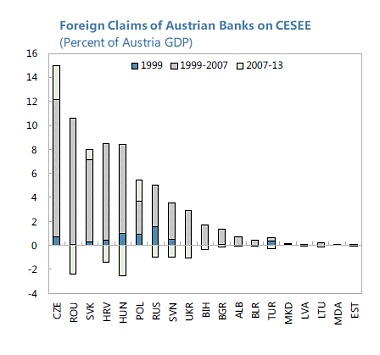
The Alpine region of Carinthia faces probable bankruptcy after Austria’s central government refused to vouch for debts left by a disastrous banking expansion in eastern Europe and the Balkans. It would be the first sub-sovereign default in Europe since the Lehman Brothers crisis, comparable in some respects to the bankruptcy of California’s Orange County in 1994 or the city of Detroit in 2013. Austria’s finance minister, Jörg Schelling, said Vienna would not cover €10.2bn (£7.4bn) in bond guarantees issued by the Carinthian authorities for the failed lender Hypo Alpe Adria, or for the “Heta” resolution fund that succeeded it. This leaves the 550,000-strong province on the Slovene border to fend for itself as losses spin out of control. “The government won’t waste another euro of taxpayer money on Heta,” he said, insisting that there must be an end to moral hazard.

The Hypo affair has alredy cost taxpayers €5.5bn. The Austrian state has said it will cover €1bn of its own guarantees “on the nail” but nothing more. Sources in Vienna suggested that even senior bondholders are likely to face a 50pc writedown, becoming the first victims of the eurozone’s tough new “bail-in” rules for creditors. These rules are already in force in Germany and Austria, and will be mandatory everywhere next year. “We are at a very delicate phase when Europe’s banking system switches from a bail-out regime into a much tougher bail-in regime, and Austria has just thrown this into sharp relief,” said sovereign bond strategist Nicholas Spiro. The biggest bondholders are Deutsche Bank’s DWS Investment, Pimco, Kepler-Fonds and BlackRock. The World Bank also owns €150bn of Hypo debt.

Austria’s banking regulators surprised markets by intervening over the weekend to wind down Heta and suspend debt payments until 2016 after discovering a further shortfall in capital of €7.6bn. The surge in the Swiss franc in January after the collapse of Switzerland’s currency floor against the euro appears to have been the last straw, setting off another wave of likely losses from eastern European mortgages denominated in francs. “This is getting bigger and bigger,” said Marc Ostwald from Monument. “They kept kicking the can down the road but it is finally catching up with them, and Heta won’t be the last. There is a whiff of the Irish situation in this story. Carinthia stood as guarantor for debts that it could not possibly cover,” he said. There are many regions that could slide into difficulties, including Belgium’s Wallonia, or the Italian region of Sicily.
Read more …

Of course it should. Everyone should.

Shelby Says Fed Should Be Held Accountable for Its Actions (Bloomberg)

Richard Shelby, the Alabama Republican who heads the Senate Banking Committee, said lawmakers should consider ways to overhaul the Federal Reserve’s structure and tighten oversight by Congress. “We will further explore options to improve the oversight and structure of the Fed,” Shelby said Tuesday in prepared remarks at a hearing. Arguing the Fed has failed to explain the impact of its extraordinary monetary policies, he said it should “be held accountable for its actions.” Sherrod Brown of Ohio, the committee’s senior Democrat, said the group should focus on the Fed’s governance, not monetary policy. “Rather than attempting to interfere in, or even dictate, monetary policy, Congress should focus on whether the Federal Reserve is protecting consumers, ensuring safety and soundness, and strengthening the financial stability of our economy,” he said.

The Fed is under pressure from both parties in Congress to be more transparent and accountable. Republicans are unhappy with its aggressive monetary policy and some of the regulatory powers it has gained since the financial crisis. Democrats have criticized the New York Fed for being too close to the big Wall Street banks that it oversees. “Federal Reserve officials have stressed the importance of the Fed’s independence,” Shelby said in prepared remarks. “But, such independence does not mean that it is immune from congressional oversight.” Shelby said last week at Bloomberg TV that he’s looking “very strongly” at a proposal from Dallas Fed President Richard Fisher to strip the New York Fed of its permanent vote on the Federal Open Market Committee in favor of an equal vote rotation among all 12 regional reserve banks.

Read more …

Sure.

Yellen Says Fed Seeks to Avert ‘Capture’ by Banks It Oversees (Bloomberg)

Fed Chair Janet Yellen, countering criticism from members of Congress, said the central bank is trying to avoid being too cozy with the Wall Street firms it supervises and wants to ensure that regulators aren’t afraid to confront the financial industry. “The risk of regulatory capture is something the Federal Reserve takes very seriously and works very hard to prevent,” Yellen said in remarks prepared for a speech in New York on Tuesday night. “It is important that anyone serving the Fed feel safe speaking up when they have concerns about bias toward industry, and that those concerns be addressed.” The Fed has been criticized by Democratic lawmakers, including Senator Elizabeth Warren, who say it’s deferential to large banks. The issue was the subject of a Senate hearing in November following allegations by Carmen Segarra, a former examiner at the Fed of New York, who said her colleagues had been too soft on Goldman Sachs.

At the hearing, Warren told New York Fed President William C. Dudley that he needs to fix a “cultural problem” or “we need to get someone who will.” The Fed has also come under fire from Republicans, including Richard Shelby of Alabama, the Senate Banking Committee chairman, who called for more Fed transparency and greater congressional oversight at a hearing Tuesday. Yellen, in her speech to the Citizens Budget Commission, also took aim at ethical lapses at large banks supervised by the Fed. “We expect the firms we oversee to follow the law and to operate in an ethical manner,” she said. “Too often in recent years, bankers at large institutions have not done so, sometimes brazenly.” Such incidents “raise legitimate questions of whether there may be pervasive shortcomings in the values of large financial firms that might undermine their safety and soundness,” she said.

Read more …

Pensions and low rates. A poisonous combination.

Draghi’s Rescue Plan Has Created a $103 Billion Problem (Bloomberg)

There’s a corner of the pension world that needs to brace itself for Mario Draghi. His ECB’s €1.1 trillion bond-buying plan might have already blown a €92 billion hole in defined-benefit pension plans by depressing bond yields, Standard & Poor’s said Feb. 26. And if the actual start of QE pushes yields further, for longer, companies may have to take drastic measures to make ends meet, and could face a hit to their credit ratings. The ECB is expected to announce further details of its asset-purchase program after it meets in Cyprus Thursday. S&P estimates that the anticipation of quantitative easing in Europe squashed bond yields so much that the liabilities of defined-benefit pension plans rose by up to 18% last year.

Its analysis looked at the top 50 European companies it rates that have defined-benefit pension plans and are “materially underfunded,” meaning, the plans have deficits of more than 10% of adjusted debt, and that debt is more than 1 billion euros. In 2013, liabilities outstripped obligations for that group by more than 30% on average. “The challenge for companies in coming years will be how to rein in plan deficits in the new post-QE low interest-rate environment in Europe,” Paul Watters, credit analyst at S&P, said in a statement. “This will become a more material credit consideration where defined-benefit plan deficits are significant.”

Among the measures S&P says companies may have to take to adjust to this new low-yield world are freezes on pensionable salaries, raising the retirement age, and closing plans to new or even to existing members.vAnd that’s not the end of it. A potential cocktail of low bond yields, sluggish growth and faster inflation, which could result if QE fails to kickstart activity, could push those deficits out a further 10-15%. “The risk remains that QE achieves nothing more than promoting stagflation in the euro area,” Watters said. “A combination of weak growth, inducing the ECB to continue with its aggressive monetary-policy stance, and rising inflation would be a treacherous combination for DB-pension schemes already struggling to contain their plan deficits.”

Read more …

” I realized I could afford to pay my children’s university expenses or my loan. I chose my kids and no one can blame me.”

ECB Glimpse of Cyprus Debt Mountain Shows Limits of Bank Cleanup (Bloomberg)

There was a time when a Cypriot on a moderate income could take a gamble on foreign real-estate worth more than his life savings. One banking crash, three and a half years of recession and an international bailout later, 58-year-old Stelios Charalambous is among the Mediterranean island nation’s many debtors who realize that time has passed. “I took a €70,000 loan six years ago from a cooperative bank in the days when no one asked you many questions, and I bought six plots of land in Romania,” the Nicosia-based chiropractor said in an interview. “Now I’m earning half what I was and no one wants to buy my Romanian land. I realized I could afford to pay my children’s university expenses or my loan. I chose my kids and no one can blame me.”

The ECB, which holds a policy meeting in the euro area’s easternmost capital on Thursday, cares about such cases as they add up to almost €900 billion of soured credit in the region and hobble lenders’ ability to serve the economy. Yet Cyprus, where non-performing exposures account for more than half the country’s loan-book, also shows how politics can get in the way of a cleanup. The nation made euro-era history in March 2013 when it imposed capital controls for the first, and so far only, time in the single currency’s existence. The measures came alongside a €10 billion rescue led by the euro area, the merger of the country’s two largest lenders, and the seizure of almost half the savings of some 21,000 customers.

The crisis gave birth to a new class of individuals and small businesses that could not, or would not, service their debt, turning Cyprus into the country with the highest bad-debt ratio in the currency bloc. That meant banks had to tie up large chunks of their capital in loss provisions instead of making fresh loans to companies and households. To relieve the blockage, a new foreclosure law enabling banks to seize property from defaulters was introduced in 2014, only to be held up repeatedly by opposition politicians nervous of the impact on businesses and families. Implementation – and the disbursement of further bailout funding which is contingent on the law – is still pending. The economic slump and legal uncertainty created a “perfect storm” for the banks, Euan Hamilton at Bank of Cyprus said.

Read more …

“Never before have speculators been gifted with such stupendous, easily harvested windfalls. And these adjectives are not excessive.”

$2 Trillion Euro Government Bonds Trading At Negative Yield (David Stockman)

That investors anywhere in this age of fiscal profligacy would pay to own the notes and bonds of sovereign states is a testament to the financial deformations of modern central banking. But the fact that nearly $2 trillion of debt issued by European governments is currently trading at negative yields——now that’s a flat-out derangement. After all, the aging, sclerotic economies of the EU have been making a bee line toward fiscal insolvency for most of the last decade. So it goes without saying that this giant agglomeration of pay-to-own government debt is not reflective of an outbreak of fiscal rectitude or any other rational economic development.

It’s purely an artificial trading result stemming from central bank destruction of every semblance of honest price discovery. In this case, the impending ECB purchase of $70 billion of government debt and other securities per month for the next two years has transformed the financial casinos of Europe and elsewhere into a front runner’s paradise. As today’s Bloomberg piece tracking Europe’s $2 trillion of exuberant irrationality makes clear, sovereign bond prices are soaring because traders are accumulating, not selling, in anticipation of the ECB’s big fat bid hitting the market in the weeks ahead:

“It is something that many would not have pictured a year ago,” said Jan von Gerich at Nordea Bank in Helsinki. “It sounds very awkward in a sense, but if you look at it more, the central bank has a deposit rate in negative territory, and there’s a huge bond-buying program coming. People are holding on to these bonds and so you don’t have many willing sellers.”

Needless to say, this is the opposite of at-risk price discovery; it amounts to shooting fish in a barrel. Never before have speculators been gifted with such stupendous, easily harvested windfalls. And these adjectives are not excessive. The hedge fund buyers who came to the game early after Draghi’s “anything it takes”ukase have enjoyed massive price appreciation, but have needed to post only tiny slivers of their own capital, financing the balance at essentially zero cost in the repo and other wholesale funding venues. Indeed, the more risk, the bigger the windfall. German yields have now been driven below the zero bound on all maturities through seven years, emboldening speculators to move out on the risk curve. So doing, they have gorged on peripheral nation debt and have been generously rewarded. In the case of the 10-year bond of Ireland – a state which was on the edge of bankruptcy only a few years ago – leveraged speculator gains are now deep into three figures.

Read more …

“March is sorted.”

Greece Taps Public Sector Cash To Help Cover March Needs (Reuters)

Greece is tapping into the cash reserves of pension funds and public sector entities through repo transactions as it scrambles to cover its funding needs this month, debt officials told Reuters on Tuesday. Shut out of debt markets and with aid from lenders frozen, Athens is in danger of running out of cash in the coming weeks as it faces a €1.5 billion loan repayment to the IMF this month. The government has sought to calm fears and says it will be able to make the IMF payment and others, but not said how. At least part of the state’s cash needs for the month will be met by repo transactions in which pension funds and other state entities sitting on cash lend the money to the country’s debt agency through a short-term repurchase agreement for up to 15 days, debt agency officials told Reuters. However, one government official said they could not be used to repay the IMF unless Athens was able to repay the state entities the cash it borrowed from them.

Debt officials sought to play the repos as advantageous for both sides, arguing that the funds get a better return on their cash than what is available in the interbank market. “It is not something new, it’s a tactic that started more than a year ago and is a win-win solution. It’s a proposal, we are not twisting anyone’s arm,” one official said. In such repo transactions, a pension fund or government entity parks cash it does not immediately need at an account at the Bank of Greece, which becomes the counterparty in the deal with the debt agency. The money is lent to the debt agency for one to 15 days against collateral – mostly Greek treasury paper held in its portfolio – and is paid back with interest at expiry. The lender can always opt to roll over the repurchase agreement and continue to earn a higher return than what is available in the interbank market.

One source familiar with the matter has previously said Athens could raise up to €3 billion through such repos, but that it was not clear how much of that had already been used up by the government. “There is a sum that has already been raised this way,” the debt official said without disclosing specific numbers. Athens – which has monthly needs of about €4.5 billion including a wage and pension bill of €1.5 billion – is running out of options to fund itself despite striking a deal with the euro zone to extend its bailout by four months. Faced with a steep fall in revenues, it is expected to run out of cash by the end of March, possibly sooner, though the government is trying to assure creditors it will not default. “We are confident that the repayments will be made in full, particularly to the IMF, and there will be liquidity to get us through the end of the four-month period,” Finance Minister Yanis Varoufakis said on Greek TV on Monday. “March is sorted.”

Read more …

Of course not. Only the north can, at the cost of the south.

Can Greece Really Thrive Inside the Euro? (George Magnus)

After a lot of hubbub, in the end the Greek government submitted a list of policy proposals that elicited a positive response from Brussels, judging them to be “sufficiently comprehensive” to permit the four-month extension of the existing loan arrangements until June. The responses from the IMF and the ECB were rather more circumspect, indicating strongly that the next four months of negotiations to determine Greece’s relationship with the Eurosystem will be tough and most probably tense. The IMF noted that the Greek government’s “policy parameters” didn’t go far or weren’t detailed enough, especially about VAT and pension reforms, privatizations and policies to open up closed sectors, including the labor market. The ECB urged the Greek authorities to act swiftly to “stabilize the payments culture and refrain from any unilateral action to the contrary.”

This is believed to refer to matters such as Greek regulations on mortgage foreclosures and to tax and payments arrears in public policy. The “deal” between Greece and its Eurogroup partners has been widely welcomed, and spun according to what people thought would or should happen. I think that the current “deal” is just Act I in a play with an unpredictable, but very likely bad, ending — where “bad” equals Euro system fragmentation, or Grexit, if you prefer. (Or the even tonier “Grexident.”) I think it’s fair to say that however people judge the deal and what they think is good or positive about it from Greece’s point of view is really about one thing only: relief that the integrity of the Eurosystem has been preserved. That is some achievement, given that it looked as though it might not happen. Now, the hope (rather than conviction) prevails that the upcoming negotiations will see a realignment of interests and trust between Greece and its creditors.

Well, who wouldn’t wish for such an outcome? The problem though, as I see it, is that the economic and social policy agenda on which Syriza scored such a stunning electoral victory is entirely appropriate for Greece, but wholly incompatible with a Eurosystem that I call colloquially, Teutonia. While Teutonia normally refers to the geography of Germany or parts of Northern Europe, I use it to connote a German culture in economics and finance. In Teutonia, Germany doesn’t always win all the arguments, nor does it or can it impose a policy agenda by diktat. But in the absence of political and fiscal union – of which none of the major countries is in favor – the terms of the (narrow) monetary union will always reflect largely the interests of Germany and a relatively orthodox financial establishment viscerally opposed to the establishment of a genuine transfer, joint liability union.

Read more …

“Given the overriding political resolve to keep Greece in the eurozone, above all because the precarious geopolitics of southeast Europe, some form of compromise is likely here, too.”

ECB Will Need More Creative Accounting To Deal With Greece (MarketWatch)

The ECB faces pressure to carry out a new feat of creative accounting to meet Greek Finance Minister Yanis Varoufakis’s request for renegotiation of €6.7 billion in ECB bonds due to mature in July and August. In a round of interviews, Varoufakis has pledged that his country will make repaying its debts to the IMF its main priority. About €2 billion needs to be repaid to the Fund this month. But the Greek minister has drawn a strong distinction with the ECB, making it likely that the central bank may have to bring in further conditionality into its traditional insistence that it should always be treated as a preferred creditor on a par with the IMF.

Leading European politicians have long claimed that the ECB will have to show flexibility in rolling over some of the total of €30 billion in Greek bonds it still holds in its portfolio, resulting from its efforts started in 2010 to prop up weaker members of the euro. Further bruising tussles between Greece and its creditor look inevitable in view of the deliberate ambiguity the Greek government built into the provisional agreement with creditors clinched last month after several finance minister sessions in Brussels. Speaking in Berlin on Monday, German Chancellor Angela Merkel said Greece would have to make its reform proposals more specific and agree to the program with the “three institutions” (formerly called “the troika”) of the European Commission, the ECB and the IMF.

Similarly, Jeroen Dijsselbloem, the Dutch finance minister who heads the euro finance ministers’ group, says Greece must immediately start adopting the creditors’ list of reforms, as a condition for gaining access to emergency funds needed to meet March cash deadlines. There is little doubt that, provided Europe’s main capitals give political backing to the still-ambivalent Greek reform approach, the ECB will bend to the politicians’ will — even though it will face further charges of a watering down of its constitutional independence. The Greek government is calling for concessions such as the lifting of a €15 billion ceiling on the issue of short-term treasury bills. Given the overriding political resolve to keep Greece in the eurozone, above all because the precarious geopolitics of southeast Europe, some form of compromise is likely here, too.

Read more …

“Greece’s economy minister vowed to cancel the Piraeus deal and pursue sweeping changes to the terms of already completed sales. Defending his government’s stance, Yanis Varoufakis claims there is enough “creative ambiguity” in the text submitted to Brussels to provide enough wiggle room for Syriza to re-open the question of the sale of Piraeus and Greece’s airports..”

Greece vs Europe: Who Blinked First In The Bail-out Battle? (Telegraph)

The Greek parliament will not be voting on the country’s bail-out extension. Following internal turmoil among the ruling Syriza party over the terms of the reprieve, the Greek legislature will only be given the chance to “debate”, rather than officially ratify, the four-month extension. In an ironic twist of the EU’s democratic procedures, Greece’s 18 fellow eurozone parliaments will still need to rubber-stamp the deal. The move has prompted some to ask whether this represents Syriza’s “worst capitulation” in an already protracted and strained series of negotiations with its international creditors. Last week, Athens drew up a series of reforms in return for the remaining €7.2bn it needs to complete its bail-out programme.

At the time, finance minister Yanis Varoufakis insisted the country had become the “co-author of its own destiny” rather than the subject of EU diktats. But dissent among Syriza’s more Leftist elements started bubbling from the onset. Syriza MP and London-based academic Costas Lapavitsas has dismissed the deal as one agreed under “economic duress”. The nascent anti-austerity government now faces a four-week race to draft legislation and pass the laws that will see it come good on its promises. Only then will Greece’s creditors decide whether or not to disburse the vital cash the country needs to say afloat until June. But what exactly has Athens signed up for and could domestic political wranglings now put a brake on the country’s bid to avert bankruptcy?

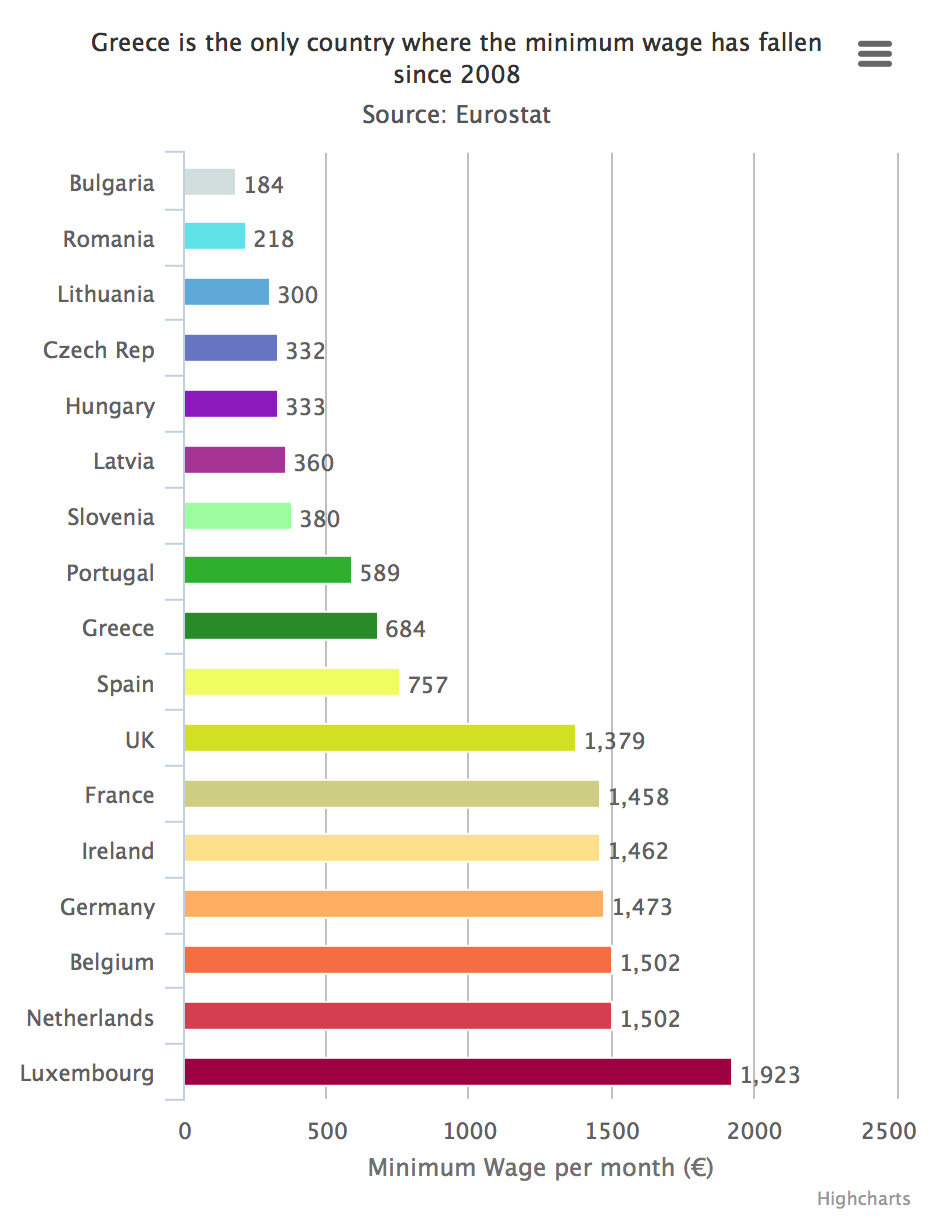
One of the cornerstones of Syriza’s plans to end Greece’s “ritual humiliation” has been an increase in the country’s minimum wage. In a vociferous speech to his parliament last month, Prime Minister Alexis Tsipras repeated his promise to raise the minimum wage by around 10pc to €750-a-month. Of the 22 EU member states with a national minimum wage, Greece is the only country that has seen its fall since the financial crisis. The country’s nominal gross wage is now 14pc lower compared to 2008, as Greece has undergone a progressive reduction in its labour costs in a bid to restore competitiveness in the stricken economy. The current €684-a-month puts Greece between its Iberian counterparts, both of whom have seen a steady rise in their mandated wage floors over the last seven years: Spain’s minimum wage has risen 8pc, while Portugal’s has gone up by 19pc.
Read more …

If they refuse the proposals, Syriza may throw the towel.

Athens Preparing Reform Proposals For Eurogroup (Kathimerini)

A collection of reform proposals are being put together by the government so Finance Minister Yanis Varoufakis can present them at Monday’s Eurogroup, with Athens hoping that this will help it secure part of the remaining €7.2 billion in bailout installments. Government sources said on Tuesday night that the six proposals Varoufakis is due to present will be measures to tackle the humanitarian crisis, administrative reform, a new scheme to settle overdue debts to the state, changes to tax collection, the creation of a fiscal council (a nonpartisan body to monitor and advise on fiscal policy) and the setting up of a new body for targeted tax inspections. The measures are due to be put forward at the Euro Working Group on Wednesday or Thursday but the Greek government is hoping that eurozone finance ministers will deem the proposals enough to pave the way for the release of some funding to Athens within March.

Varoufakis is also likely to be prepared to discuss with his counterparts what privatizations the government is willing to carry out. The finance minister said in an interview on Star TV on Monday night that he is in favor of further private investment at Piraeus port and in the Greek railway network. State Minister Alekos Flambouraris said on Tuesday that the coalition would not consider selling the country’s water or electricity firms. The preparation for Monday’s Eurogroup has led to the government making changes to some of the legislation it had planned. For instance, the provision for giving debtors a haircut on the principal they owe to the state has been removed from the legislation introducing a new payment plan for overdue taxes and social security contributions.

There is even a possibility that the dreaded ENFIA property tax will remain for another year, albeit reduced by 15 to 20%. The government wants to replace it with a levy on large property but will need to ensure it can raise revenues of €2.6 billion to do so. A new formula has not been found yet. The coalition has, however, finalized the legislation aimed at tackling the social impact of the crisis. The bill foresees households in “extreme poverty” receiving free electricity for a year. This is estimated to affect 150,000 families. The draft law also provides a rent subsidy of between €70 and €220 per month for up to 30,000 households. Furthermore, food coupons will be provided to up to 170,000 families. The total cost of these interventions is estimated at €200 million.

Read more …

This is going to hurt. A lot.

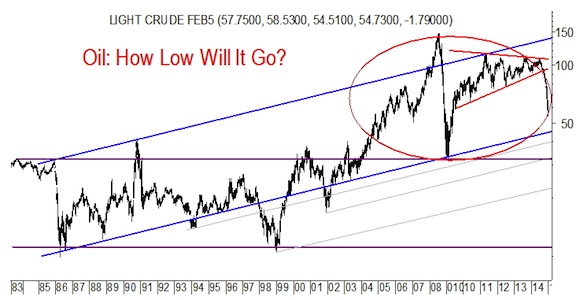
Oil at $95 a Barrel Discovered in SEC Rules on Reserves (Bloomberg)

There’s one place in the world where oil is still $95 a barrel. On paper. The US Securities and Exchange Commission requires drillers to calculate the value of their oil reserves every year using average prices from the first trading days in each of the previous 12 months. Because oil didn’t start its freefall to about $45 till after the OPEC meeting in late November, companies in their latest regulatory filings used $95 a barrel to figure out how much oil they could profitably produce and what it’s worth. Of the 12 days that went into the fourth-quarter average, crude was above $90 a barrel on 10 of them. So Continental Resources reported last month that the present value of its oil and gas operations increased 13% last year to $22.8 billion. For Devon, a pioneer of hydraulic fracturing, it jumped 31% to $27.9 billion.

This year tells a different story. The average price on the first trading days of January, February and March was $51.28 a barrel. That means a lot of pain – and writedowns – are in store when drillers’ first-quarter numbers are announced in April and May. “It has postponed the reckoning,” said Julie Hilt Hannink at New York-based CFRA, an accounting adviser. Companies use the first-trading-day-of-every-month calculation to estimate future cash flow and to tally how much crude can be profitably pumped out of the ground. The SEC introduced the formula in 2009 as part of wider changes in how the regulator required drillers to report reserves. Prior to the shift, the value of the reserves was measured based on the oil price on the last day of the year, which also caused distortions. There are no current plans to revisit or modify SEC reporting rules, Erin Stattel, an SEC spokeswoman, said.

Most shale drillers are reporting increases in what’s known as proved reserves. The SEC requires oil producers to submit an annual tally, along with an estimate of the present value of the future cash flow from those properties. The estimates are limited to what the firm is reasonably certain it can extract from existing wells and prospects scheduled to be drilled within five years. The reports are based on factors such as geology, engineering, historical production – and price. To count as proved, the resources must be economic to develop given existing market conditions. “What the SEC requires isn’t thorough enough to get to the numbers investors really want,” said Mike Kelly with Global Hunter Securities. “What is the true cost of producing a barrel of oil? And what is the real value of the assets?” A similar pricing formula helps determine whether some companies need to write off their oil and gas properties.

Read more …

Keep going.

The Latest Sign the Oil-Price Plunge Is Hitting the Job Market (Bloomberg)

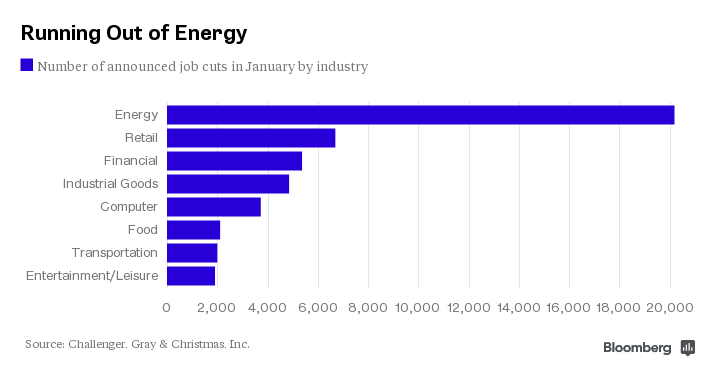
As investors prepare for the release of the February U.S. employment data on Friday, we’re getting more inklings of how the shakeout in the oil industry will impact the jobs market, and it doesn’t look great: Demand for workers in energy-related occupations is plunging. Online help-wanted ads for jobs involved in the extraction of oil and gas – derrick operators, wellhead pumpers, roustabouts and the like – declined 42% in the two months through January as oil prices cratered, according to data compiled by the Conference Board and Wanted Technologies.

Occupations in the industry that have higher education requirements, such as petroleum engineers, geoscientists and technicians, also saw demand for their services collapse, with ads dropping 38%, Gad Levanon and his fellow researchers at the Conference Board wrote on their blog this week. The downbeat message from the online ad postings echoes that of a report last month by global outplacement firm Challenger, Gray & Christmas, which showed that 38% of announced job cuts in January were in the energy industry. As we noted last month, employment in oil and gas extraction and related supply industries doubled over the last decade, reaching some 523,500 workers. If the Conference Board and Challenger data are anything to go by, that trend is likely to reverse big-time this year.
Read more …

Nice graphics.

Wall Street Has Its Eyes on Millennials’ $30 Trillion Inheritance (Bloomberg)

There have been any number of pieces written about how the millennial generation is consciously refusing to do things that preceding generations thought were perfectly reasonable, such as playing golf or investing in the stock market or even doing a SINGLE NICE THING for someone else! This seems to have caused some consternation on Wall Street, where the powers-that-be would obviously like to see millennials do at least one nice thing for them: hand over all their money. But have no fear, because Wall Street is ON IT! Financial firms are working hard to solve the Rubik’s Cube (err, sorry the 2048) that is the Gen Y zeitgeist, if recent reports from Federated Investors and Goldman Sachs are any indication. Based on the research, here are the highlights of what you need to know about this enigmatic generation: They like skinny ties and skinny jeans and, based on the way these firms are presenting these findings, they seem to only be reachable through cartoon-like graphics and animation.

Read more …

“If Japan can’t get its finances under control, people are going to start questioning what exactly the difference between Japan and Greece is.”

Japan Public Debt Keeps BNP Chief Credit Analyst Awake at Night (Bloomberg)

For most of her career, Mana Nakazora has taken a pre-dawn train to work regardless of whether she arrived home just hours earlier. Her colleagues describe BNP Paribas’s Tokyo head of investment research as a powerhouse, and she was Japan’s No. 1 bond picker from 2010 to 2012 and No. 2 for the last two years in Nikkei Veritas newspaper polls. Making it to the top in an industry whose corporate bond sales exceeded $70 billion last year can be tough. “I usually get home on average at about midnight, sometimes it can be 2 a.m.,” Nakazora said in an interview at BNP’s Tokyo offices on the 42nd floor overlooking the nation’s parliament and Imperial Palace. “I get up at 5 a.m., so I don’t sleep much. It has been like that forever.”

One thing keeping her up – analysis of Japan’s public debt, which is expected to climb to 1.06 quadrillion yen ($8.85 trillion) at the end of March. With a population that’s been shrinking for the past six years and annual debt servicing costs that are bigger than New Zealand’s gross domestic product, the world’s third-largest economy is quite simply running out of people who can pick up the tab. “Maybe there’s no point in throwing stones at this huge rock, but if you keep hurling just maybe you can open up a crack,” said Nakazora, who also sits on two government panels including the finance ministry’s fiscal system council that advises on budgetary rectitude. “If Japan can’t get its finances under control, people are going to start questioning what exactly the difference between Japan and Greece is.”

With unprecedented central bank stimulus compressing debt yields, Nakazora said she likes SoftBank’s bonds, which offer investors more than five times the average spread Japanese notes pay. She also recommends the debt of TEPCO, operator of the tsunami-hit Fukushima power plant, but is no longer a fan of Sony debentures because the jury’s still out on whether the electronics maker can revive its fortunes. Nakazora also doesn’t favor the delay in Japan’s sales tax increase. Prime Minister Shinzo Abe in November postponed raising the levy to 10% by 18 months after an increase to 8% from 5% in April plunged the economy into a recession. Japan’s debt will rise to the equivalent of 246% of GDP this year, one of the highest ratios in the world, the IMF forecasts.

Read more …

That’s what the US is waiting for.

Ukraine Looks Ready To Default (MarketWatch)

The conflict in the Ukraine is relevant to global investors as it directly affects security in Europe, which is the home of an economy the size of the U.S. The trade bans due to conflict-driven sanctions involve many countries and add to the European deflation at present. Those trade bans might get wider should the conflict intensify based on the realization that a political solution would not give the rebels and their Russian backers what they want — enough autonomy to keep Ukraine out of the EU and NATO. I do not follow this conflict to determine who is right or wrong but to gauge how it affects financial markets.

Most of my conclusions may seem relevant only to institutional investors that deal in currencies, sovereign bonds, credit-default swaps (CDSs), and the energy markets, but I do believe those geopolitical developments affect quite a few individual investors, even those in the U.S. Last week the Ukrainian truce barely took hold when fighting over the strategic Ukrainian town of Debaltseve, which controls rail lines linking Luhansk and Donetsk, threatened to unravel the ceasefire agreement. The rebels decided to take the town “no matter what,” as a prolonged truce made it necessary for them to control logistics in their territory. It has been clear for a long time that Ukraine is a divided country where half the population supports the rebels and the other half supports the government in Kiev — as demonstrated by this map of the 2010 election, which brought Yanukovych to power.

This map also suggests this conflict can quickly carry all the way to Odessa, which Russian ruler Catherine the Great (1729-1796) turned into a key trading hub for the Russian Empire. There is also an unhappy minority of Russians in a strip of Moldova adjacent to Ukraine, where Russian peacekeepers have been stationed for years. It is entirely possible they see this conflict as the opportunity to resolve their situation once and for all. Perhaps because of all of the above considerations, Ukrainian government bonds are at all-time lows. When such a bear market in credit gets to prices like 44 cents on the dollar, this is the bond market saying that Ukraine will likely default.

Read more …

Done deal.

Ukraine Raises Interest Rates To 30% (BBC)

Ukraine’s central bank has sharply raised interest rates from 19.5% to 30% in an effort to curb inflation and prop up its beleaguered currency. The new benchmark refinancing rate takes effect on Wednesday. It comes as the government in Kiev is seeking a $17.5bn assistance programme from the IMF. Inflation is expected to hit at least 26% this year and the hryvnia has tumbled against the dollar. The currency has lost 80% of its value since last April, when pro-Russian separatists took up arms in the country’s eastern Donetsk and Luhansk regions, a month after Russia annexed Ukraine’s southern Crimea peninsula. Last week, the hryvnia hit a record low of 33.75 to the dollar before recovering some ground.

The conflict has taken its toll on Ukraine’s economy, which is forecast to shrink by 5.5% in 2015. The interest rate increase is the second in two months, after the central bank raised the rate from 14% in February. On Monday night, Ukraine’s parliament approved a package of reforms that could determine whether it will avoid economic meltdown in the coming weeks. They include changes to the tax and energy laws and the government’s budget. The passing of the reform package was a condition for the IMF rescue package. The IMF’s executive board will meet on 11 March, when it will make its decision. If it says yes, the first tranche of some $5bn will become available within days.

Read more …

Not a single doubt.

Financial Collapse Leads To War (Dmitry Orlov)

Scanning the headlines in the western mainstream press, and then peering behind the one-way mirror to compare that to the actual goings-on, one can’t but get the impression that America’s propagandists, and all those who follow in their wake, are struggling with all their might to concoct rationales for military action of one sort or another, be it supplying weapons to the largely defunct Ukrainian military, or staging parades of US military hardware and troops in the almost completely Russian town of Narva, in Estonia, a few hundred meters away from the Russian border, or putting US “advisers” in harm’s way in parts of Iraq mostly controlled by Islamic militants. The strenuous efforts to whip up Cold War-like hysteria in the face of an otherwise preoccupied and essentially passive Russia seems out of all proportion to the actual military threat Russia poses. (Yes, volunteers and ammo do filter into Ukraine across the Russian border, but that’s about it.)

Further south, the efforts to topple the government of Syria by aiding and arming Islamist radicals seem to be backfiring nicely. But that’s the pattern, isn’t it? What US military involvement in recent memory hasn’t resulted in a fiasco? Maybe failure is not just an option, but more of a requirement? Let’s review. Afghanistan, after the longest military campaign in US history, is being handed back to the Taliban. Iraq no longer exists as a sovereign nation, but has fractured into three pieces, one of them controlled by radical Islamists. Egypt has been democratically reformed into a military dictatorship. Libya is a defunct state in the middle of a civil war. The Ukraine will soon be in a similar state; it has been reduced to pauper status in record time—less than a year. A recent government overthrow has caused Yemen to stop being US-friendly.

Closer to home, things are going so well in the US-dominated Central American countries of Guatemala, Honduras and El Salvador that they have produced a flood of refugees, all trying to get into the US in the hopes of finding any sort of sanctuary. Looking at this broad landscape of failure, there are two ways to interpret it. One is that the US officialdom is the most incompetent one imaginable, and can’t ever get anything right. But another is that they do not succeed for a distinctly different reason: they don’t succeed because results don’t matter. You see, if failure were a problem, then there would be some sort of pressure coming from somewhere or other within the establishment, and that pressure to succeed might sporadically give rise to improved performance, leading to at least a few instances of success.

But if in fact failure is no problem at all, and if instead there was some sort of pressure to fail, then we would see exactly what we do see. In fact, a point can be made that it is the limited scope of failure that is the problem. This would explain the recent saber-rattling in the direction of Russia, accusing it of imperial ambitions (Russia is not interested in territorial gains), demonizing Vladimir Putin (who is effective and popular) and behaving provocatively along Russia’s various borders (leaving Russia vaguely insulted but generally unconcerned).

Read more …

The level of absurdity is stunning.

NATO Rolls Out ‘Russian Threat’ In Budget Battle (RT)

NATO member-states unwilling or unable to help boost the military spending are being accused of ignoring the “Russian threat,” that has re-emerged as the core of the alliance’s agenda to boost arms sales. A report saying one of major NATO funding contributors, the UK, could fail to fulfil the commitment to spend 2% of its GDP on the alliance in 2015 came as a bombshell for some of the West’s military elite. The head of the US army, General Raymond Odierno, told the Telegraph he was “very concerned” about Britain’s possible defense cuts. “[Odierno] warned that, while the US was willing to provide leadership in tackling future threats, such as Russia and ISIL [the Islamic State, aka IS or ISIS], it was essential that allies such as Britain played their part,” the British daily wrote.

Former MI6 chief, Sir John Sawers, called for a rise in defense spending, also mentioning the “threat” coming out of Russia “not necessarily directly to the UK, but to countries around its periphery.” “The level of threat posed by Moscow has increased and we have to be prepared to take the defensive measures necessary to defend ourselves, defend our allies – which now extend as far as the Baltic States and Central Europe,” Sawers said, according to the Guardian. In turn, Moscow said it will take all “necessary measures” including military, technical and political to neutralize a possible threat from NATO presence in Eastern Europe, Russia’s ambassador to NATO, Aleksandr Grushko, told the Rossiya 24 TV channel on Monday. He added NATO’s actions “significantly impair regional and European security, and pose risks to our security.”

Grushko said NATO has intensified its military drills in Eastern Europe, with about 200 exercises in its eastern member states, mostly in the Baltic and Black seas, Poland and Baltic states. Russia’s Defense Ministry has consistently denied all reports of its personnel or hardware being involved in the conflict in eastern Ukraine, calling NATO’s allegations “groundless.” Among “proof” of the “Russian aggression” there have been fake photos of the Russian tanks, which eventually turned out to have been taken in a different place at a different time, a supposed Russian airplane in British airspace, that turned out to be Latvian, and mysterious “Russian submarines” in Swedish waters – which never were found. “Demonizing” Russia plays well into the hands of the military, believes former NATO intelligence analyst, Lt Cdr Martin Packard.

Read more …

On their way to your dinner plate.

Massive Swarms of Jellyfish Wreak Havoc on Fish Farms, Power Plants (Bloomberg)

As the oceans get warmer, jellyfish are causing pain beyond their sting. The marine animals have shut power plants from Sweden to the U.S. while killing thousands of farmed fish in pens held off the U.K. coast. GPS devices normally used to track the behavior of house cats were attached to 18 barrel-jellyfish off the coast of northern France. The study upended previous assumptions about their movement. Climate change may be one reason more jellyfish are congregating in large numbers known as blooms, which can encompass millions of the creatures over tens of kilometers.

Researchers are seeking to develop a system, akin to weather forecasting, to help predict their movement and prevent fish deaths, such as the loss of 300,000 salmon off Scotland last year, or power outages that shut a Swedish nuclear plant in 2013. “Jellyfish blooms may be increasing as a result of climate change and overfishing,” Graeme Hays, the leader of the group from Deakin University in Australia and Swansea University in the U.K. that did the research, said by phone Jan. 28. “They have a lot of negative impacts – clogging power station intakes, stinging people and killing fish in farms.” The study was conducted in 2011 with results published online in January by the journal Current Biology.

Hays plans to replicate the work in Tasmania, Australia, where salmon farming is an industry valued at about A$550 million ($430 million) a year. Combined land and ocean surface temperatures have warmed 0.85 of a degree Celsius since 1880, according to the IPCC. Global warming is “unequivocal” and many observed changes since the 1950s are “unprecedented over decades to millennia,” it said in a 2014 report. “Warmer water is a dream come true for jellyfish,” Lisa-ann Gershwin, a marine scientist who has studied the creatures for about 25 years and author of Stung!: On Jellyfish Blooms and the Future of the Ocean, said by phone Feb. 4. “It amps up their metabolism so they grow faster, eat more, breed more and live longer.”

Read more …

Feb 212015


Russell Lee “Yreka, California. Magazine stand” 1942

German-Led Bloc Willing to Let Greece Leave Euro: Malta (Bloomberg)
A Lawyer’s Mindset Where An Economist’s Is Needed? (Steve Keen)
Greece Should Not Give In to Germany’s Bullying (Legrain – Foreign Policy)
Tentative Deal For Extension Agreed At Eurogroup (Kathimerini)
The Euro’s Up In Smoke (Beppe Grillo)
Eurozone Chiefs Strike Deal To Extend Greek Bailout For Four Months (Guardian)
Greece Bends To Eurozone Will To Find Short-term Agreement (Open Europe)
Greece’s Debt Deal Isn’t The End Of Eurozone Drama (MarketWatch)
ECB’s Draghi Wants To Buy Bonds, But Who Will Sell? (Reuters)
It’s Up To Germany To End The Game Of Chicken With Greece (Guardian)
Is Greek PM Alexis Tsipras Going To Be Russia’s ‘Trojan Donkey’? (NewsCorp)
Has Greece’s ‘Lehman Moment’ Finally Arrived? (CNBC)
Expectations And Reality: What Maidan Gave Ukraine’s Economy (RT)
US Units of Deutsche Bank, Santander Likely to Fail Fed Stress Test (WSJ)
The US Government’s Stupid Tax War On Expatriates (MarketWatch)
NYC Could See 6-Foot Sea Rise By 2100 (NewsMaine)

“We are perfectly prepared to refrain from any moves that would jeopardize financial stability or Greek competitiveness..”

German-Led Bloc Willing to Let Greece Leave Euro: Malta (Bloomberg)

Germany and its allies are ready to let Greece leave the euro unless Prime Minister Alexis Tsipras accepts the conditions required to extend his country’s financial support, according to Malta’s finance minister, Edward Scicluna. Greece’s creditors are cranking up the pressure on Tsipras as he seeks a deal to prevent his country defaulting on its obligations as early as next month. By bowing to German demands, the premier risks a domestic backlash from voters and party members whom he’s promised an end to austerity. “Germany, the Netherlands and others will be hard and they will insist that Greece repays back the solidarity shown by the member states by respecting the conditions,” Scicluna said in an interview. “They’ve now reached a point where they will tell Greece ‘if you really want to leave, leave.’”

Talks between euro-region finance ministers in Brussels Friday aimed at agreeing an extension of Greece’s aid program were pushed back by an hour and a half, the group’s chairman, Dutch Finance Minister Jeroen Dijsselbloem, said on Twitter. The meeting will begin at 4:30 p.m. Brussels time and Dijsselbloem will make a statement at 3 p.m.nIn a formal request on Thursday to extend Greece’s euro-area backed rescue beyond its end-of-February expiry for another six months, Greek Finance Minister Yanis Varoufakis said he would accept the financial and procedural conditions of the Germany’s Finance Ministry almost immediately rebuffed the latest Greek formula, saying the country needs to make a firmer commitment to austerity. A “positive” conversation between Tsipras and German Chancellor Angela Merkel later on Thursday sparked investor optimism for a deal.

“We are perfectly prepared to refrain from any moves that would jeopardize financial stability or Greek competitiveness,” Varoufakis said in an interview Friday with The Telegraph. “But what we cannot accept is that the fiscal adjustment, agreed by the last government, be carried through just because the rules say so.” Investors are pricing in a positive outcome to the Eurogroup meeting with Greek bonds and stocks rising for a third day.

Read more …

“..is there a way to frame the Greek case in a way that a lawyer might understand?”

A Lawyer’s Mindset Where An Economist’s Is Needed? (Steve Keen)

A Twitter correspondent pointed out a simple fact that makes Schäuble’s inflexibility in negotiations with Varoufakis explicable: though he is a Minister of Finance, his PhD is in law. So is he implicitly approaching these negotiations as a lawyer would? Because from that point of view, what the Greeks are trying to do is to renege on a contract. And for a lawyer, changing the terms of a contract after you have signed it is a no deal. It’s either carry out the contract, or I’ll sue. Varoufakis, of course, is approaching the negotiations as an economist. From his point of view, the terms of the Troika’s package are a set of economic policies that have failed. And if policies have failed, the sensible economist tries different ones.

So did Greece sign a legal document, whose principles have to be adhered to, even if they have consequences the Greeks didn’t foresee when they signed? Or did Greece accept a set of economic policies, whose continuance should depend on whether those policies are achieving their intended objectives? There’s no doubt that the latter is the case. But if Schäuble is treating it as a legal treaty, then the fact that this is actually a set of failed economic policies, and not a legally binding treaty, won’t matter. He will refuse to “renegotiate the terms of the contract”. The negotiations will be such in name only.

So is there a way to frame the Greek case in a way that a lawyer might understand? Any contract involves consideration by each party to the other. In a contract of sale, the object being sold is the consideration from the seller; the money for the sale is the consideration from the buyer. So what is the consideration in this case? It is a combination of two things: the loans that were extended to the Greeks, and the Greeks carrying out an economic program which promised a set of economic outcomes—the key components of which are shown in Figure 1. These included that real economic growth would commence in 2012, and that unemployment would peak at 15.3% in 2012, and fall to 14.6% by 2014. [..]

Schäuble could then find himself repeating the whole process all over again, but this time with an opposite party who will delight in breaking agreements. He clearly hasn’t enjoyed negotiating with a leftwing academic economist who wears a leather jacket and wears his shirt outside his trousers. How, I wonder, will he enjoy negotiating with someone who prefers to wear jackboots?

Read more …

“Greece must be bled dry to service its foreign creditors in the name of European solidarity..”

Greece Should Not Give In to Germany’s Bullying (Legrain – Foreign Policy)

Ever since the initial bargain in the 1950s between post-Nazi West Germany and its wartime victims, European integration has been built on compromise. So there is huge pressure on Greece’s new Syriza government to be “good Europeans” and compromise on their demands for debt justice from their European partners – also known as creditors. But sometimes compromise is the wrong course of action. Sometimes you need to take a stand. Let’s face it: no advanced economies in living memory have been as catastrophically mismanaged as the eurozone has been in recent years, as I document at length in my book, European Spring.

Seven years into the crisis, the eurozone economy is doing much worse than the United States, worse than Japan during its lost decade in the 1990s and worse even than Europe in the 1930s: GDP is still 2% lower than seven years ago and the unemployment rate is in double digits. The policy stance set by Angela Merkel’s government in Berlin, implemented by the European Commission in Brussels, and sometimes tempered – but more often enforced – by the ECB in Frankfurt, remains disastrous. Continuing with current policies — austerity and wage cuts, forbearance for banks, no debt restructuring or adjustment to Germany’s mercantilism — is leading Europe into the ditch; the launch of quantitative easing is unlikely to change that. So settling for a “compromise” that shifts Merkel’s line by a millimeter would be a mistake; it must be challenged and dismantled.

While Greece alone may not be able to change the entire monetary union, it could act as a catalyst for the growing political backlash against the eurozone’s stagnation policies. For the first time in years, there is hope that the dead hand of Merkelism can be unclasped, not just fear of the consequences and nationalist loathing. More immediately, Greece can save itself. Left in the clutches of its EU creditors, it is not destined for the sunlit uplands of recovery, but for the enduring misery of debt bondage. So the four-point plan put forward by its dashing new finance minister, Yanis Varoufakis, is eminently sensible.

This involves running a smaller primary surplus – that is a budget surplus, excluding interest payments – of 1.5% of GDP a year, instead of 3% this year and 4.5% thereafter. Some of the spare funds would be used to alleviate Greece’s humanitarian emergency. The crushing debts of more than 175% of GDP would be relieved by swapping the loans from eurozone governments for less burdensome obligations with payments tied to Greece’s GDP growth. Last but not least, Syriza wants to genuinely reform the economy, with the help of the Organization for Economic Cooperation and Development (OECD), notably by tackling the corrupt, clientelist political system, cracking down on tax evasion, and breaking the power of the oligarchs who have a stranglehold over the Greek economy.

Had the Varoufakis plan been put forward by an investment banker, it would have been perceived as perfectly reasonable. Yet in the parallel universe inhabited by Germany’s Finance Minister Wolfgang Schäuble, such demands are seen as “irresponsible”: Greece must be bled dry to service its foreign creditors in the name of European solidarity.

Read more …

“Only approval of the conclusion of the review of the extended arrangement by the institutions in turn will allow for any disbursement of the outstanding tranche of the current EFSF program..”

Tentative Deal For Extension Agreed At Eurogroup (Kathimerini)

Greece and the Eurogroup agreed on Friday a deal to extend the country’s loan agreement for another four months, pending on lenders approving reform proposals due to be submitted by the Greek side on Monday. The terms of the agreement reached after many hours of talks in Brussels Friday means that the country’s lenders – the European Central Bank, the European Commission and the International Monetary Fund – must approve the reforms proposed by Greece on Monday. “The Greek authorities will present a first list of reform measures, based on the current arrangement, by the end of Monday, February 23,” the statement said. “The institutions will provide a first view whether this is sufficiently comprehensive to be a valid starting point for a successful conclusion of the review. This list will be further specified and then agreed with the institutions by the end of April.”

Greece has yet to receive €7.2 billion in bailout installments that the previous government failed to secure. But the country’s creditors will only disburse these funds once the implementation of the measures has taken place by the end of April. “Only approval of the conclusion of the review of the extended arrangement by the institutions in turn will allow for any disbursement of the outstanding tranche of the current EFSF program and the transfer of the 2014 SMP profits,“ said the statement. Greek Finance Minister Yanis Varoufakis stressed the importance of Greece being able to submit its own reforms and vowed to “work night and day between now and Monday” to produce a “fresh list of reforms.”

“The Greek authorities have expressed their strong commitment to a broader and deeper structural reform process aimed at durably improving growth and employment prospects, ensuring stability and resilience of the financial sector and enhancing social fairness,” said the Eurogroup statement. “The authorities commit to implementing long overdue reforms to tackle corruption and tax evasion, and improving the efficiency of the public sector. In this context, the Greek authorities undertake to make best use of the continued provision of technical assistance.” In the meantime, though, some €11 billion left in Greece’s bank recapitalization fund, the HFSF, will return to the European Financial Stability Facility (EFSF) but will be available for use should banks require it.

Read more …

“..to sell and lend to the countries on the periphery of Europe was always Germany’s preferred economic activity..”

The Euro’s Up In Smoke (Beppe Grillo)

“The Eurozone chess game has entered its third and final stage. Germany wins in three moves – Euro, deflation and purchase of public debt by the ECB (QE) – and in the last few years it has found a way to maximise its profits and reduce to zero its risks as Europe’s creditor.

Germany’s risks Let’s try analysing the problems of the Eurozone as they really are: problems of conflicting interests of creditors and debtors regulated by demand and supply. If you agree to make a loan to your neighbour, you open yourself up to three risks:
• that he’ll pay you back in a different currency that has perhaps been devalued unless you had a prior agreement about the repayment currency (currency risk);
• that with the amount you get back, you can buy fewer goods or property (inflation risk);
• that you don’t even have either of the first two problems because your neighbour simply goes bust and thus you lose everything (capital risk).

How Germany gains Germany is the Eurozone’s only big creditor with about €600 billion loaned to various countries, most of which are on the periphery of the Eurozone, including Italy. The Euro has given it this enviable status. If you produce lots and you consume and invest very little and you keep domestic wages and prices low, then you’ll always have cheap unconsumed goods to sell to your neighbours. And you might also be able to make money by providing credit that they will probably ask you for so that they can buy your goods that are so cheap and so good. This is Germany’s situation. It has always had this approach to the market economy in European affairs ever since 1870 with its roots in Calvinism. Thus to sell and lend to the countries on the periphery of Europe was always Germany’s preferred economic activity when everything was going well, before the crisis in 2008. Since then its only objective has been to get that credit returned and to protect its purchasing power.

Read more …

“We are going to write our own script on the reforms that need to be enacted..”

Eurozone Chiefs Strike Deal To Extend Greek Bailout For Four Months (Guardian)

Greece has stepped back from the prospect of a disorderly eurozone exit after reaching a last-ditch deal to resolve the impasse over its €240bn bailout. The outline agreement between Athens and its creditors in the single currency bloc to extend Greece’s rescue loans should help ease concerns that it was heading for the exit door from the euro. In return, the country’s leftwing government has pledged not to roll back austerity measures attached to the rescue, and must submit, before the end of Monday, a list of reforms that it plans to make. The chairman of the eurozone finance chiefs’ group, Jeroen Dijsselbloem, said Athens had given its “unequivocal commitment to honour their financial obligations” to creditors.

He said that the agreement was a “first step in this process of rebuilding trust” between Greece and its eurozone partners which would provide a strategy to get the country back on track. A senior Greek government official welcomed the agreement, saying it gave Athens time to negotiate a new deal. “Greece has turned a page,” the official added. Greece’s finance minister, Yanis Varoufakis, claimed victory, insisting there was “no substantive difference” between the deal and a Greek compromise text that had been dismissed by Germany’s finance ministry as a Trojan horse for Athens to throw off austerity. “We are going to write our own script on the reforms that need to be enacted,” he said

But the Greek prime minister, Alexis Tsipras, will almost certainly face fierce reaction over the deal, both from hardliners in his radical left Syriza party and from the populist right-wing Anel – his junior partner in the governing coalition – for agreeing to continue with austerity measures as part of the deal, given that he was elected on an anti-austerity programme. “Very heavy concessions have been made, politically poisonous concessions for the government,” Pavlos Tzimas, the veteran political commentator, told SKAI news.

Read more …

“The Greek authorities commit to refrain from any rollback of measures and unilateral changes to the policies and structural reforms that would negatively impact fiscal targets, economic recovery or financial stability, as assessed by the institutions.”

Greece Bends To Eurozone Will To Find Short-term Agreement (Open Europe)

Immediately after SYRIZA’s election victory in Greece, we predicted that:” While a compromise could still be possible, it will be quite painful to reach and will imply someone taking big steps back from their previous stance.” Tonight that looks to have been proven true – at least in the short term.

What does this agreement do and why? Tonight’s deal extends the current Master Financial Assistance Facility Agreement (MFAFA) by four months in order to allow Greece to fund itself in the short term and to allow time for negotiations over what happens afterwards.+ The purpose of the extension is the successful completion of the review on the basis of the conditions in the current arrangement, making best use of the given flexibility which will be considered jointly with the Greek authorities and the institutions (European Commission, ECB and IMF – formerly known as ‘the Troika’).+ Tonight’s agreement seems to essentially extend the existing agreement and the tied-in conditionality of the current Memorandum of Understanding.

What points has Greece capitulated on? Completion of the current review – Greece has basically agreed to conclude the current bailout. Any funding is conditional on such a process: “Only approval of the conclusion of the review of the extended arrangement by the institutions in turn will allow for any disbursement of the outstanding tranche of the current EFSF programme and the transfer of the 2014 SMP profits. Both are again subject to approval by the Eurogroup.” This is a clear capitulation for Greek Prime Minister Alexis Tsipras, who said the previous bailout was “dead” and the EU/IMF/ECB Troika is “over”.

Remaining bank recapitalisation funds – Greece wanted this money to be held by the Hellenic Financial Stabilisation Fund (HFSF) over the extension period, and possibly be open for use outside the banking sector. However, this has been denied and the bonds will return to the EFSF, although they will remain available for any bank recapitalisation needs. Role of the IMF – The Eurogroup statement says, “We also agreed that the IMF would continue to play its role”. Again, Greece has given in on this point and the Troika continues to exist and be strongly involved in all but name.

No unilateral action – According to the statement, “The Greek authorities commit to refrain from any rollback of measures and unilateral changes to the policies and structural reforms that would negatively impact fiscal targets, economic recovery or financial stability, as assessed by the institutions.” In light of this, a large number of promises that SYRIZA made in its election campaign will now be hard to fulfil. In the press conference given by Eurogroup Chairman Jeroen Dijsselbloem and EU Economics Commissioner Pierre Moscovici, it was suggested that this pledge also applied to the measures which were announced by Tsipras in his speech to the Greek parliament earlier this week – when he announced plans to roll back some labour market reforms passed by the previous Greek government.

Read more …

“You’ll get to go through it again in four months..”

Greece’s Debt Deal Isn’t The End Of Eurozone Drama (MarketWatch)

Rejoicing over the tentative resolution of the latest round of eurozone debt drama? Good for you. You’ll get to go through it again in four months. That is assuming Greece’s weekend exercise in picking its own austerity poison somehow proves mortifying enough to appease the “institutions” (don’t call them the troika anymore) overseeing the country’s bailouts while not enraging Greek voters who elected the new government on the promise it would stop Berlin and Brussels from imposing unrelenting austerity. That could prove to be a tall order. Failure on the latter front could mean new elections. Greek voters in January supported Greek Prime Minister Alexis Tsipras and his Syriza party on the idea that Greece didn’t want to leave the euro, but could no longer abide harsh austerity measures dictated by the dreaded troika..

Greek Finance Minister Yannis Varoufakis says Greece won a victory in that it will now be a “co-author” of its reforms, rather than having measures imposed by fiat by its creditors. Meanwhile, German Finance Minister Wolfgang Schaeuble was attempting to soothe German taxpayers. He emphasized to reporters that Athens won’t see any aid until it completes a satisfactory proposal, Reuters reported. And perhaps just to rub it in a little, he offered that the Greeks “certainly will have a difficult time to explain the deal to their voters, “ the report said. If Greek voters feel they got a raw deal, another election could be in the offing. If so, it would likely turn not on the question of austerity, but on a so-called Grexit.

So now Greece must submit a list of reforms to the institutions by the end of the day Monday. The institutions will review pore over it. There is scope for the process to break down between now and then. Varoufakis said Athens will craft its proposals in consultation with its partners, albeit at “arms length.” But even if everything goes smoothly, the question of what happens next for Greece, which will likely require a third bailout, will need to be answered in four months time.

Read more …

“If we were to sell bonds, we would make huge capital gains, but we will then have to reinvest that money at a yield of 0.5%, set against liabilities at 3.50-3.75 (percent),”

ECB’s Draghi Wants To Buy Bonds, But Who Will Sell? (Reuters)

At the height of the euro zone debt crisis in 2012, ECB President Mario Draghi’s problem was how to convince investors to hold on to European bonds. Now he faces a struggle to make them sell. Weeks before the European Central Bank begins a program to buy about 1 trillion euros of euro zone government bonds, banks, pension funds and insurers across the continent are hoarding them for regulatory or accounting reasons. That may complicate implementation of the quantitative easing program, aimed at reviving growth and inflation in the euro zone. The ECB might have to pay way above market prices, or take additional measures to encourage investors to sell. “We prefer to hold on to them,” said Antoine Lissowski at French insurer CNP Assurances. “The ECB’s policy … is reaching its limits now.”

Banks, which buy mainly short-term bonds, use government debt as a liquidity buffer. Selling would force them to invest in other assets, for which – unlike government bonds – regulators ask banks to set cash aside as a precaution. Alternatively, they can deposit money with the ECB, at a discouraging interest rate of minus 0.20%. Insurers and pension funds typically buy long-term debt. They could make hefty profits selling to the ECB. But the money would have to be re-invested in other bonds whose yields would be much lower than their long-term commitments to clients – a regulatory no-no. In 2012, many euro zone bonds offered double-digit yields. Today, Greece aside, the bloc’s highest yielding debt is a 30-year Portuguese bond offering 3.30%.

Between a quarter and a third of the market carries negative yields, meaning investors pay governments to park their money in debt. In Belgium, a country whose rates are taken as indicative of the euro zone average, benchmark 10-year bonds BE10YT=TWEB yield 0.7%, just above record lows around 0.5%. “If we were to sell bonds, we would make huge capital gains, but we will then have to reinvest that money at a yield of 0.5%, set against liabilities at 3.50-3.75 (percent),” said Bart de Smet, the CEO of Belgian insurer Ageas. Dutch banks ING and Rabobank, Spain’s Bankinter and rescued lender Bankia and France’s BNP Paribas said they were unlikely to sell when the ECB comes knocking. “The volume of sovereign bonds we own at the moment is not linked to monetary policy,” BNP Paribas deputy CEO Philippe Bordenave said. “It’s linked to the regulation.”

Read more …

“It is hard to imagine how Ireland, Portugal, Spain or even Italy could have stayed in the euro area in 2011-2012 had there been a worked-out exit route.”

It’s Up To Germany To End The Game Of Chicken With Greece (Guardian)

At the heart of the rift that runs through Europe at the moment lies a technocratic debate drowned in emotion. Germany has rejected Greece’s bailout request on the basis of the semantic difference between a programme extension (acceptable) and a loan extension (unacceptable). True, words are substance. But when the German finance minister, Wolfgang Schäuble, or his allies take the floor to explain their critical stance, the underlying reasons become evident: they quickly shift to moral and emotional grounds, invoking trust, values and cultural differences. The Greek side of the debate is not better. Opening the negotiations with a ridiculous request for war reparations, tolerating for several days caricatures of Schäuble as a Nazi in government-friendly newspapers, and comparing Eurogroup methods with waterboarding, the new Greek government went for a strategy of emotional alienation, rather than trust-building.

In a game of chicken, stubbornness leads to catastrophe. And stubbornness based on pride and prejudice is hard to abandon. This is why I have started to get seriously worried about where these negotiations are heading. We urgently need to bring back in some simple economic and political considerations to show that a compromise is not only a good solution; it’s the only solution. First, we need to make it absolutely clear that Grexit would be devastating for Greece, for Europe and for Germany. For Greece, because it would cause the banking system to collapse, import prices to skyrocket and growth prospects to disappear for several years, with horrifying prospects for the Greek population. For Europe because the euro area would be turned from an “irrevocable” currency union into some kind of fixed-exchange rate regime where countries can leave as soon as they come under market pressure.

It is hard to imagine how Ireland, Portugal, Spain or even Italy could have stayed in the euro area in 2011-2012 had there been a worked-out exit route. Finally, it would be devastating for Germany, not only because it would lose billions of euros from a Greek devaluation but even more so because it would put at risk Germany’s recent prosperity: a currency union is to the benefit of the largest export nation in Europe. Secondly, we need to remember that some of the Greek requests are economically reasonable. The country urgently needs to shift from a contractionary to a more neutral fiscal stance. Structural reforms were necessary but put additional pressure on domestic demand. The bailout money hasn’t benefitted the Greek population, but in its largest parts has gone straight from European bank accounts, through Athens, and back to the ECB or the IMF.

Read more …

“These are uncharted waters and founding fathers never envisaged or made provision for a nation leaving the euro.”

Is Greek PM Alexis Tsipras Going To Be Russia’s ‘Trojan Donkey’? (NewsCorp)

As newly elected Greek leader Alexis Tsipras earlier this month made a much heralded visit to mainland Europe to shore up support to end austerity measures in his country, he made a largely unreported transit stop in Cyprus. The stopover lasted only a few hours but in that time he received first-hand briefings of not only the dire financial precipice upon which the island also stood but equally the potentially huge oil and gas reserves waiting to be explored off its turquoise coastline. Symbolically the Leftist prime minister met not only with Greek Cyprus counterparts but also leading members of the Turkish Cypriot community, to declare his desire for reunification of the island, split in two between Greece and Turkey for more than 40 years but now largely divided over rights to those offshore hydrocarbon reserves.

Turk Cypriots applauded the significant move. It was the first time a Greek leader had visited the island and met them but for eurozone leaders the trip bore two other less obvious outcomes — Greece was prepared to break from tradition in a bid to find friends in the face of its financial crisis and more crucially was perhaps seeking those friendships to forge new ties with others like Russia. And there lies the issue at hand this week. Greece’s almost inevitable exit from the EU has less to do with its own economic predicament and the effect its collapse or exit or both would have on the broader 19 nation euro-using money markets, but its where and to whom it would then turn in a post Europe landscape.

There are other issues too including if Greece did finally leave the bloc, where would it leave the likes of Spain, Ireland and Portugal that all have upcoming national elections with governments wading through their respective austerity quagmires against huge domestic oppositions. It is conceivable they too may like or be forced to abandon their multi-billion dollar loans. Greece had a $270 billion bailout in 2010 and 2012 that it has sought to renegotiate to remove pegging the payback to austerity measures. The current bailout expires on February 28 hence the urgency to find a solution now. These are uncharted waters and founding fathers never envisaged or made provision for a nation leaving the euro.

Read more …

Nobody has a clue. They’re just pretending.

Has Greece’s ‘Lehman Moment’ Finally Arrived? (CNBC)

A key week for Greece’s economic future drew to a close on Friday with the country facing the very real threat that it’s running out of money and key analysts warming to the idea that it could be on its way out of the euro zone. Euro zone finance ministers are set to meet Friday to discuss Greece’s latest proposals to extend its loan agreement. But with Germany already rejecting the plan, there is very little hope that an agreement will be announced. Another meeting in Brussels for next week was already being touted before Friday’s meeting even began. The main problem for the fiscally disciplined countries like Germany is that, despite the ground Greece has given up in the last week, it is still asking for the bailout loan without all of the strict austerity conditions that come with the money.

Greek economist Elena Panaritis, former member of the Greek Parliament and the World Bank, drew comparisons with the collapse of the Lehman Brothers in 2008. As with the fall of the big U.S. bank, market-watchers feel euro zone policymakers want to show the world they will only be pushed so far — with the result being Greece would be allowed to exit the euro zone. Panaritis thought there was a “political statement as well as economic statement” being made during the negotiations. Randy Kroszner, a former U.S. Federal Reserve governor and the professor of economics at the University of Chicago Booth School of Business, agreed that there were comparisons between the two events.

“I think there a parallel, but the tools exist if the European Union wants to keep Greece in and if Greece is willing to stay in,” he told CNBC Friday. “Even though it may be quite ugly, the likelihood of complete chaos is much lower. So that gives policymakers more willingness to say ‘Hey, we’ll take that risk’.”

Read more …

Damning.

Expectations And Reality: What Maidan Gave Ukraine’s Economy (RT)

The major expectation of the Maidan protest a year ago was replacing the burden of corruption and mismanagement of the economy with the benefits of EU integration. The reality brought collapse and a debt trap. The protests that ousted President Viktor Yanukovich in February 2014 started after his government postponed the signing of a key EU integration treaty. The EU Association Agreement opens the Ukrainian market to European goods and required that its industries adopt European standards. Both would take a heavy toll on the already ailing economy due to the cost of modernization and the loss of Russian markets. Moscow also warned it would protect its home market from European goods by revoking the tax-free trade deal with Ukraine.

Critics of Yanukovich, most notably Arseny Yatsenyuk, then-leader of a major opposition party, dismissed such concerns. Speaking on political talk shows and from the Maidan stage, Yatsenyuk gave vivid descriptions of how Prime Minister Nikolay Azarov was hurting Ukraine with his policies and how he would do a better job. He promised visa-free travel to Europe for Ukrainian tourists and guest workers, rising wages and social benefits, reining in national debt, lowering utility prices, bringing in billions of dollars of foreign investments, and many other things. Azarov went with Yanukovich and was replaced with Yatsenyuk, but the reality under the new cabinet is nothing like the picture presented a year ago. The Ukrainian economy experienced a deep plunge in 2014.

Its GDP dropped 6.5% last year, according to IMF figures, the only two countries worse were South Sudan and Libya. The unemployment rate reached 9.3% in the third quarter of 2014, as compared to 7.7% in 2013. The figure is expected to rise sharply in 2015. Ukrainian job search websites report a 30 to 50% drop in the number of employment offers over a year. “The country is at war that they cannot afford to fight. There is no economy any longer. When you look at where the industrial base of Ukraine is and the conflict going on in the east there is absolutely no doubt as to why it is happening,” Gerald Celente told RT. “That $160 billion loss of trade with Russia has destroyed the economy when it was already in a severe recession. It went from very bad to worse than depression levels.”

Read more …

“Both Deutsche Bank and Santander passed ECB stress tests in October.”

US Units of Deutsche Bank, Santander Likely to Fail Fed Stress Test (WSJ)

Large European banks including Deutsche Bank and Banco Santander are likely to fail the U.S. Federal Reserve’s stress test over shortcomings in how they measure and predict potential losses and risks, according to people familiar with the matter. The expected rebuke would mark the second year large foreign banks, which were drawn into the Fed’s stress test regime in 2014, failed to meet the U.S. regulator’s expectations for risk management. As banks have bulked up their capital cushions to ensure they can withstand losses in periods of turmoil, the Fed has increasingly focused on more “qualitative” issues in its stress tests, including whether banks accurately measure potential losses in credit portfolios, collect risk exposure data accurately and have strong internal controls.

Failing the stress tests would likely subject the U.S. units of Deutsche Bank and Banco Santander to restrictions on paying dividends to their European parent companies or other shareholders. Santander is already under such a restriction after failing its first stress test run last year. Deutsche Bank is undergoing the U.S. stress test process for the first time this year. Both Deutsche Bank and Santander passed ECB stress tests in October. Those tests focused on whether the banks had enough capital to withstand a two-year recession but didn’t assess such things as governance, risk management, and other more subjective factors like the Fed’s test.

The Fed’s Board of Governors in Washington will disclose partial results of the test on March 5 and full results on March 11, including any capital restrictions. Last year, the board met just ahead of releasing the results to vote on whether banks should fail the tests for “qualitative” reasons. It ultimately rejected Citigroup Inc. as well as U.S. units of Santander, HSBC and RBS on such grounds. It cited the foreign banks for “significant deficiencies” in their capital planning process. It hasn’t disclosed such a board meeting yet this year. The Fed declined to comment on specific banks.

Read more …

Who wants a US passport these days?

The US Government’s Stupid Tax War On Expatriates (MarketWatch)

The U.S. government’s stupid, hateful and dishonest war on Americans living abroad claimed its latest scalp this week. London Mayor Boris Johnson, a dual British and American national, says he will join the growing lines of Americans overseas who are now being driven to renounce their U.S. citizenship by the federal government for no good reason. Johnson, a possible future British prime minister, was born to British parents in New York. His case is not important individually, but it is illustrative. A record number of Americans abroad renounced their citizenship last year, and the numbers are escalating fast. That’s in response to a growing set of U.S. financial laws that make it nearly impossible for them to keep two passports. Most people don’t understand the government’s war on U.S. expats and dual nationals, so they buy the official spin that it is just “cracking down” on “rich tax cheats.”

It is doing no such thing, and it knows that it is doing no such thing. Indeed some of its most onerous financial rules, while “cracking down” on overseas grandmas with a $30,000 retirement account, specifically and deliberately exempt billionaires with money in hedge funds and private-equity funds. Even National Taxpayer Advocate Nina Olson has pointed out in her official reports to Congress that the war on expats often punishes ordinary middle-class and even poor Americans abroad far more severely than it does the rich. Olson is appointed to her role by the Congress, but she says that when she called up the Treasury to discuss some of the problems, they didn’t bother to respond. Talk to the hand, honey. Oh, and doesn’t it say a bundle that while the U.S. Treasury was “cracking down” on Grandma Moses, it was waiving all penalties on U.S. Treasury Secretary Tim Geithner for failing to pay tens of thousands of dollars in taxes?

What is going on? To put a complicated issue in a nutshell, the federal government is currently ramping up a wide set of bizarre and impossible regulations on all Americans living abroad — and threatening them with the financial equivalent of the death penalty if they don’t comply. As an American expat, you can be arrested, thrown in jail and bankrupted by Uncle Sam for failing to disclose a $15,000 checking account on which you have paid all the taxes owed. You are liable to double taxation, required to spend thousands of dollars a year on professional advice simply to survive — oh yes, and you are effectively barred from investing in either U.S. or non-U.S. based mutual funds. Ha ha! You lose!

Read more …

That’s a whole extra full size guy…

NYC Could See 6-Foot Sea Rise By 2100 (NewsMaine)

A new study, published by the New York Panel on Climate Change, has revealed that many regions of New York could be under water by 2100 if the sea level continues to rise due to global warming. The researchers have predicted that the city could experience sea level rise as much as 6 feet in the future. They said that in the next 40 years, the sea level could reach 11 to 12 inches and have demonstrated that New York City’s Central Park’s mean annual precipitation has increased at a rate of approximately 0.8 inches in every 10 years over 1900 to 2013. This has raised the mean annual precipitation to 8 inches over this past decade. During this time period, Central Park has shown an increase in mean annual temperature at a rate of 0.3°F per decade. The researchers have said that this trend has varied ‘considerably’ over shorter periods of time.

The data has suggested that both the precipitation and the New York City’s temperature have shown an increase. It has further disclosed that NYC will face heat waves at a rate 3 times as much as the city does now by the 2080s, decreasing the’ extreme cold events’.The study has called the sea level rise in New York City as a significant hazard and the main risk will be on the ‘coastal communities, infrastructure, and ecosystems’. The new climate change report given by New York City Panel on Climate Change (NPCC) has revealed that New York City might be looking at high sea level rise in the future. According to NBC, the 2015 report has found that the flood damage in the future might exceed that of Hurricane Sandy. In a press release, NYC Mayor Bill de Blasio said, “NPCC’s findings underscore the urgency of not only mitigating our contributions to climate change, but adapting our city to its risks”.

Read more …

Feb 162015
 
 February 16, 2015  Posted by at 8:46 pm Finance Tagged with: , , , , , , ,  10 Responses »


John M. Fox WCBS studios, 49 East 52nd Street, NYC 1948

It’s really not that hard. It’s even elegantly simple. But that still requires you’re willing to listen, willing to think, and you don’t go into talks with your mind already made up. Obviously, that is too much to ask from the Eurogroup side of the negotiations with Greece. They haven’t been able to move one inch from their ‘Do as we say or else’ bluster.

German Fin Min Schäuble earlier implied that the Greek people have elected the ‘wrong’ government, an already unforgivable intrusion into a EU member state’s internal affairs. What if the Greeks said the same about Merkel et al, what do you think the reaction would be? Today, SPD executive board member, Joachim Poß, member of Merkel’s German coalition government, does Schäuble one better:

“In the interest of the Greek people and in view of the difficult situation, Prime Minister Tsipras should consider to replace Mr Varoufakis with a political experienced, realistic-efficient person.”

They call for the Greeks to see reality, but they themselves have completely lost it. They think reality is whatever they think or wish it is. The only true reality, however, is that the Greek people, in a very democratic and very convincing way, have elected the government that a cackle of Germans now apparently find inconvenient.

Germany has European reality, and history, and economics, fully upside down. Which, no matter how you take the Greek claim that Germany got in 1953 what Greece deserves today, or their insistence on WWII reparations, is remarkable. How is it possible that there is no voice coming from Berlin to question, doubt, attack, their government’s position? It’s after all not as if there are no unresolved issues left. There are no clear cut positions other than what Berlin and Brussels say there are.

Merkel and Dijsselbloem and Draghi don’t get to decide for the entire world what goes and what does not. Their ‘model’, their ideas, have failed dramatically, and Dijsselbloem’s hollow statement that “much progress has been made” (talking about Greece) only serves to confirm that. They seem to think that a double or nothing on Greece will hide their failures, but the exact opposite is true: Syriza is exposing them as unsavory naked emperors.

Schäuble, in the same vein as Dijsselbloem, insists on saying: “look how great we’ve been doing, which is why we have the right to keep on acting the way we have”. But that is nonsense, neither Schäuble nor Draghi’s policies have been a huge success, far from it. And while Germany may have scraped by – and not much more than that -, this is not remotely true for some of the countries both gentlemen are in an economic union with, least of all Greece. It is simply not true, it’s a self absorbed and self aggrandizing delusion.

If New York State, Texas and California were not bound by the policies inherent in a federal fiscal union, they would have been even richer than they are, but Oklahoma and Nebraska (I’m just picking a few examples) would have been much poorer, and would have no reason to remain part of the USA. The EU and eurozone have no such fiscal union, which means Germany gets to keep all the spoil, and Greece pays the bill. This is possible because Greece, unlike Oklahoma, only gets hand-outs that it has to pay back with interest. Which may be low right now, but that doesn’t change the principle – or the principal, for that matter: Greece gets it share of ‘help’ of the union it’s in, in the form of additional debt. Oklahoma does not.

While at the same time, Greece no longer has a central bank or a currency, so it’s fully dependent on what Berlin decides Frankfurt (ECB) must do. And wouldn’t you know, Frankfurt always decides on doing what is best for Berlin, because it’s the major power in the union. That leaves Greece in a deep dark hole, and one that can only possibly get deeper and darker, unless the eurozone economy starts growing at double digit rates (not!). And even then. Even then that – fantasy – growth would be primarily German.

Just like Nebraska will never be New York or California, Greece will never be Germany. In the US, this was understood – luckily – at an early stage. Or there wouldn’t be a US. I’m not saying the present day US is some sort of Nirvana, but at least it got its basic fiscal principles down early in the game. There’s a means for the federal government to lift up the poorer parts of the union using tax revenues from the richer. And no, that’s not socialism, it’s the only way to keep the better part of an entire continent tied together. And when I say ‘better’, please note I’ve already in my young life lived in Canada for 20 years. And left. And that Canada is actually bigger than the US. It’s a figure of speech.

Schäuble pretends that what is good for Germany, is also good for Greece. And that is manifestly untrue. It would be in a true fiscal union, but it is not true today. It’s nonsense. Doesn’t Germany understand this? That’s hard to believe. Still, they insist that the only way forward for Europe is the one that benefits themselves most. And they get the likes of Dijsselbloem and Draghi to confirm that for them.

All against the Greek underdog. Which, as democratically as their ancestors invented it eons ago, voted they had had enough. And what is Germany’ s reaction? Schäuble said: “The problem is that Greece has lived beyond its means for a long time..” But isn’t that perhaps even more true for Germany itself? It depends on how you look at it.

Greece never stood a chance in the present configuration. All benefits would always have gone to Germany, simply because they get to decide everything. There are no EU or eurozone rules that say Berlin has to bequeath part of its surplus to weaker parts of the union. What inevitably follows from that is that Germany will, as time goes by, squeeze Greece and Italy and Spain ever drier. After all, Berlin is not the Salvation Army, right?! These things should have been written down in very strong terms long ago, like they were in the US. If you don’t do that, there’s no escaping the consequences.

What Greece, Syriza, Tsipras and Varoufakis are doing right now is to try and change this arrangement, which benefits only the richer parts of the European Union, and does so on an inevitably ever larger scale. They’re trying to make the EU perhaps not precisely like the US (Zeus forbid!), but certainly more like it.

In the US there’s at least a basic kind of fairness, which – well, mostly – prevents parts of its union to dissolve into Third World status. Europe has no such fairness, and it therefore does indeed create that sort of misery within its own borders. And instead of saying, ‘okay, perhaps we should have shared a bit more of our wealth, and let’s discuss that’, they dig in and they treat the Greeks like they’re some kind of inferior species whose best option is to wait for some scraps to fall off the beer and beerwurst-laden tables of Bavaria.

And lest we forget it, one more time, and Varoufakis repeated it again last week, the majority of the Greek debt is what Germany and France burdened the country with when they decided to bail out their own banks who has wagered huge amounts of ‘money’, encouraged by Goldman Sachs’ derivatives schemes that hid Athens debts and allowed Greece entry into the eurozone to begin with.

But for Schäuble to state that “Greece has lived beyond its means for a long time” is a huge leap away from that, because those people lining up at the soup kitchens, and those who sleep in the streets, and those who’re dying from ailments that a 100 miles from the Greek border don’t even faze anyone, have obviously not lives beyond their means.

The Greek people haven’t “lived beyond their means for a long time”, or they wouldn’t live in their “hideous humanitarian crisis”, as Varoufakis calls it, to begin with. The Greek elite may have made off like bandits, but not the people. And who did the EU, Schäuble, Dijsselbloem and Draghi, make the deals with that got the situation where it is?

That’s right, the elites. Brussels installed the technocrat Samaras government, and they did it for a reason. And now that whole set-up has been defeated. Which is why Schäuble says things like “the new Greek government [is] behaving “quite irresponsibly”, and it’s all their fault and none of it is his.

Hubris, bluster, and not much else. That’s how Europe enters the negotiations with Greece. So why should Varoufakis be replaced? I can think of a few others who should first. The entire Greek debt story is nothing but a narrative that will only hold until it no longer can. Thing is, by then the entire eurozone may be gone. And whether you think that’s a good idea or not, just make sure you understand that it will happen only because a bunch of stuck-up politicians too full of themselves to see their own blubber want it to.

Not because of Greece or Syriza. They just want to stop their people’s misery. And what does Germany have to say about that? Well, as per Herr Schäuble, that the Greek government is behaving “quite irresponsibly”.

Upside down, topsy turvy, Bizarro. And that’s what Tsipras and Varoufakis must face. l can only hope they have more patience with it than I would.

Jan 232015
 
 January 23, 2015  Posted by at 9:25 pm Finance Tagged with: , , , , , , ,  16 Responses »


William Henry Jackson Eureka, Colorado 1900

I was going to start out saying yesterday was the saddest day in Europe in 50 years, or something like that, because of the insane and completely nonsensical largesse the ECB permits itself to launch, aimed at once again saving a banking system, but which will not only not help the European people, it will make things even much worse than they already are. Which is also, lest we overlook that ‘detail’, entirely thanks to the ECB/EU/IMF Troika,

I’ve said many times that the EU in its present form should be dismantled tomorrow morning (even though it’s not the same tomorrow morning anymore), and if Draghi’s $1.1 million x million ‘stimulus’ should make anything clear, it’s that the dismantling gets more urgent by the day.

But calling it the saddest day in Europe in 50 years would show far too little respect for the people who died in former Yugoslavia, and in eastern Ukraine. It’s still a very sad day, though. And I was already thinking about that even before I read Theopi Skarlatos’ article for the BBC; that really made me want to cry.

When you read about female doctors(!) feeling forced to prostitute themselves to feed their children, about the number of miscarriages doubling, and about the overall sense of helplessness and destitution among the Greek population, especially the young, who see no way of even starting to build a family, then I can only say: Brussels is a bunch of criminals. And Draghi’s QE announcement is a criminal act. It’s a good thing the bond-buying doesn’t start until March, and that it’s on a monthly base: that means it can still be stopped.

I’ll get back to Skarlatos’ story in a minute. First the insanity of the ECB QE itself. The problem with Europe’s economy, what drives it into high unemployment and deflation, is that people are not spending. If QE would really be aimed at reviving the economy, or at battling deflation, it would need to assume that people will start borrowing on a massive scale just because Draghi buys bonds – and soon perhaps even stocks – from bankers. There simply is no logic in that. The stated goals, pro-growth and anti-deflation, are not true. It’s a sleight of hand.

In order to achieve the stated goals, money would have to reach the real economy. As it stands, the best Draghi can do is to ‘hope’ it will. That’s not enough by a mile. This is not about doubts over its effectiveness, that’s baloney, we know it’s not effective when it comes to the stated goals. It will still leave Europe with no growth, and deeper deflation, and now €1.1 trillion deeper in debt. While banks can grow their reserves.

And it’s not as if Draghi doesn’t understand. Draghi is Goldman. And neither is it as if this is the only option. Steve Keen’s modern version of a debt jubilee, in which money is given directly to the people, under the condition that they first use it to pay off debt if they have any, would be much more effective. But it would be far less profitable for the banks, and that’s why it’s not considered. China yesterday announced a third option: they will effectively raise salaries of government workers by 60%.

Not that I’m terrible in favor of that kind of plan; I think any stimulus plan in our time should focus on reorganizing economies in such a way that jobs are created. That must mean moving away from centralization, and the return of production of essentials to communities and societies themselves, instead of emphasizing the ‘benefit’ of hauling goods halfway across the world, or an entire continent. It’s incredibly stupid that for instance most of our furniture and clothing is made in China.

We can produce those things at home, and give people jobs doing it. And China can focus on its domestic market too. And we can swap gadgets and other sheer luxuries, but not food or tables or shirts. Because we need to make those ourselves to keep our people employed.

Back to QE, or Draghi’s big swindle. I think Simon Jenkins at the Guardian had as good a go at it this morning as anyone:

QE For The Eurozone Is A Gigantic Confidence Trick. It Should Fool No One

The former BBC economic pundit Stephanie Flanders told the world it was “Santa Claus time”; the ECB has ridden to the rescue. No it has not.

Europe’s great and good, partying on the slopes of Davos, are blinded by snow and celebrities. Santa Claus gives presents to people; the ECB gives presents to its banks. It is merely tipping large sums of money into the vaults of precisely the institutions whose crazy lending caused the crash of 2008, and which have been failing Europe’s economy ever since. There is absolutely no requirement on these banks to release this money into private or commercial bank accounts.

Given the fear of over-lending that regulators have struck into bank bosses since the collapse of Lehman Brothers, the money will simply build up reserves. That is exactly what has happened to quantitative easing in Britain since 2010: there has been no surge in bank lending, except into property investment. Quantitative easing is a gigantic confidence trick.

It was promised that it would yield new investment. It has not. It was promised that it would “pump money into the economy”. It has not. It was also feared that printing money would lead to hyper-inflation. It has not, for the simple reason that no one gets to spend the money. It is a bookkeeping transaction between a central bank and a commercial bank. It means nothing as long as banks are told to build up their reserves. Money in circulation matters. The whole of Europe, including Britain, is chronically short of demand, which is why deflation is such a menace.

If no one can afford to buy anything, no one will sell anything or invest money in making anything. The chronic imbalance between northern and southern states of the eurozone, previously ameliorated by selective devaluation, has bound poor and rich countries alike in a rictus of cash starvation. Collapsing demand drives down prices and profits; there is nothing for banks to invest in. The Chinese are laughing. Greece and some other Mediterranean economies are facing poverty not seen in half a century.

A return to normal growth means they must declare themselves bankrupt, restructure past debts, leave the eurozone and devalue. Don’t bury money in their banks. Bury it in their wallet. The eurozone may still look great from the top of a Swiss mountain; it looks terrible from the foot of the Acropolis.

I also liked ADMISI’s Marc Ostwald’s take right after Draghi did the announcement, courtesy of Tyler Durden:

Risk sharing is very limited, with national central banks taking 80% of the risk on sovereign bond purchases, and rather un-reassuring was Draghi’s comment that “most national central banks have adequate buffers to absorb a negative event” – most being how many.

Not good news for Greece, while it and Cyprus will be eligible for purchases of govt under a ‘waiver’ for (bail-out) ‘programme countries’, the ECB already has a very high volume of Greek bonds on it balance sheet from the SMP programme, and given a limit on total holdings for each sovereign issuer, it will not be eligible for purchases until it redeems debt in July and August.

It should be added that Italy and Spain and other bail-out countries will implicitly also have a lower available volume of total purchases, until SMP holdings are redeemed.

Draghi is going the save German banks, not weaker eurozone nations. Their banks maybe.

BUT perhaps the key aspect relates to the limits on the 25% limit on purchases of a single issue, which ensures that the ECB adheres to the ECJ’s ruling about the ECB ensuring that is does not interfere with “price formation”. So here’s the key aspect, there are some $12.0 trillion of FX reserves in the world, of which roughly a quarter are held in Euros.

Operating on the traditional metric that roughly half of those will be invested in Govt Bills and Bonds, this means that FX reserve managers will have to be involved in the process of establishing prices for whatever is purchased under the Govt bond QE programme. Eminently anything that is sold by central banks will not find its way into the private financial sector, therefore that €60 billion figure may often overstate what is being injected into the market.

Last but not least, the expanded programme does not start until March 15, so “Mr Market” now has a very long waiting period to sit on holdings of EUR debt before selling to the ECB, and with plenty of event risk in the world, starting with the Greek election, and an imminent Ukrainian default. Sort this under an uncomfortably long period before the QE ‘party’ gets started.

And in case you’re still wondering whether QE works and/or how effective it is, this graph also comes from Durden:


And that doesn’t even yet include stock markets and bank reserves at the Fed. What is obvious is that the Fed’s QE3 has been a mind-boggling failure for the American people, and a smashing success for the Davos crowd.

What’s wrong in Europe is not just Draghi, it’s the entire EU. If you join into a union with other nations, you can’t let some of them sink into despair, and worse, while others sit pretty. And I know the answer from Brussels will be that what is needed is a stronger and closer union, fiscal, political, but I think that if you already let your fellow union members plunge this deep into misery in the early stages of a union, a country like Greece would be out of its mind if not outright suicidal to sign on to a closer union. Northern Europe survives by sucking the lifeblood out of the South. It’s a really simple story that nobody will tell you.

Let’s return to Theopi Skarlatos for the BBC. This is heart rendering. How can the people of Germany, Holland, France, ever have let it get this far? What could possibly be their excuse? That their media never informed them? You have the most pervasive media in history, and you didn’t know? What are you going to do? Blame the lazy Greeks? Who need to ‘reform’ their societies?

Greece was not nearly this poor before it joined the EU. And we’ve seen above that Draghi’s QE won’t do anything to relieve their misery, nothing at all. If you’re going to spend 1.1 million times a million euros, shouldn’t that go towards doing something for Greece, instead of a group of banks and their shareholders?

Love In A Time Of Crisis In Greece

As Greeks prepare to vote in Sunday’s general election, anti-austerity party Syriza is ahead in the polls and campaigning under the slogan, “Hope is on its way”. The average wage has fallen to €600 (£450: $690) a month; half of all young people are unemployed and the economy is barely emerging from six years of recession. But Greeks remain determined to maintain their hold on normality. “We don’t have much else,” they say, “we may as well enjoy our freddo cappuccinos.”

But despite the drinking, flirting and dating, since the onset of financial disaster, a fundamental change has taken place in Greek society. Deejay Tommy paints a sad picture of young Greeks waking up every day without a job. “Things have lost a little bit of their romanticism,” he says. “The crisis has forced love to become a secondary priority. There are other things to worry about. I see many women looking for someone who will have money to take them out, who’ll take them on holidays. I see this quite a lot and it saddens me.”

Down the road along the shoreline, the Bouzoukia clubs ring with live renditions of popular Greek love songs. Crowds sipping on vodka throw the singers red carnations and sing along to lyrics of heartbreak and pain. “We save up to come once every few months and we look forward to it,” says Katerina Fotopoulou, 30, at a table with her friends. “We don’t have the money to do much any more. We’re always talking about future plans, going on holiday, but no-one ever does anything.” Living at home, Katerina describes herself as an adult forced to live as a teenager, her life put on hold.

Compared with other Europeans, Greeks are still fairly traditional. For many young women, it is awkward bringing a boyfriend through the front door to meet the parents. And that poses a problem, considering the high numbers unable to afford a place of their own. “Relationships are complicated these days,” says Katerina. “No-one is even thinking about getting married or having children.”

Indeed, Greece’s population is shrinking at an increasing pace according to data released by the Hellenic Statistical Authority (Elstat). Since Greece first signed its EU-IMF bailout agreement the number of births has declined rapidly. In 2010 there were 114,766 live births, and by 2013 that number had declined by almost 20,000 (94,134). Obstetrician Leonidas Papadopoulos says miscarriages at the Leto maternity hospital have doubled over the past year. “Maybe it’s down to stress,” he says. “There is no proof, but you can see it in the eyes of the people, there is stress and fear for the future.”

He describes how a woman he had been treating with IVF came to him one day crying because she was pregnant. She had lost her job and demanded an abortion. But he felt he could not perform the procedure. “Soon,” says Dr Papadopoulos, “the population will be halved and there won’t be any young people to work and pay for the pensions of the elderly. All the social problems will rise up in front of us.”

Some who have children and are struggling to support them have turned to sex work, to put food on the table. Further north, in Larissa, Soula Alevridou, who owns a legal brothel, says the number of married women coming to her looking for work has doubled in the last five years. “They plead and plead but as a legal brothel we cannot employ married women,” she says. “It’s illegal. So eventually they end up as prostitutes on the streets.”

A doctor, Georgia, explains how she also works as an escort in the sex industry to support her family. Her private clinic currently treats three patients a week, but the peak summer season in the sex industry enables her to keep up with the rental payments on her family’s home and the healthcare bills for her elderly parents. “I live a double life and only I can know about it,” she says. “I have applied for jobs in medicine abroad and wait every day in hope of a reply.”

For journalist Elini Lazarou, having a baby was not something she was prepared to put on hold while waiting for a change in the political or economic climate. “Love in the time of crisis can function as a painkiller, with which someone can forget the problems they’re facing, or as a source from which someone can draw strength, energy and optimism,” she says.

On a wall in downtown Athens, a simple message is daubed that reads “Love or nothing”. It strikes a defiant tone amid the blighted lives hidden behind pure economics.

And against that backdrop Brussels and Frankfurt ‘heroically’ decide to prop up the banks with another €1.1 trillion. They should be dragged before judges, but what they do is presently legal (guess who makes the laws). So it’s up to the people of not just Greece in this weekend’s election, but to everyone who lives in the European Union. It’s up to the Dutch and the Germans and the Finns to end this monstrosity.

The troika is creating third world nations within the EU, and you guys are just sitting there watching them do it, and hoping that more money for your banks will mean your own petty little lives will be secure and safe, while Greek doctors are forced to prostitute themselves.

Please Syriza, please Tsipras, win the elections and fight this bunch of criminals. And please all of Europe, get up from your couches and refuse for this to be committed in your name. If not, you’re accomplices, whether anyone calls you on it or not. Shame on you, you’re a disgrace to mankind.

Jan 232015
 
 January 23, 2015  Posted by at 11:45 am Finance Tagged with: , , , , , , , , ,  7 Responses »


Harris&Ewing Army Day Parade, Memories of the World War, Washington DC Apr 6 1939

Love In A Time Of Crisis In Greece (BBC)
Syriza To End Greece’s ‘Humiliation’ (BBC)
Saudi King’s Death Clouds Already Tense Relationship With US (WSJ)
Saudi Oil Policy ‘Just Took A Turn For The Worse’ (Kilduff)
This Currency War Cannot Go Well: Art Cashin (CNBC)
SocGen Explains Why The ECB’s QE Will Fail (Zero Hedge)
Mario Draghi: Charlatan Of The Apparatchiks (David Stockman)
Mario Draghi’s QE Blitz May Save Southern Europe At Risk Of Losing Germany (AEP)
ECB Bond Plan Won’t Fix Europe’s Economy (CNBC)
QE For The Eurozone Is A Huge Confidence Trick. It Should Fool No One (Guardian)
Eurozone Stimulus Will ‘Reinforce Inequality’, Warns Soros (BBC)
Why We Were Right On QE: ECB Board Member (CNBC)
Larry Summers Warns Of Epochal Deflationary Crisis If Fed Tightens Too Soon (AEP)
How We’re Preparing For $25 Oil: Lukoil CEO (CNBC)
If Oil Drops Below $30 A Barrel, Brace For A Global Recession (MarketWatch)
Oil Drillers ‘Going to Die’ in 2Q on Crude Price Swoon (Bloomberg)
Asian Central Banks Under Pressure To Act (Reuters)
Is Bank Of Japan Governor Kuroda Losing Credibility? (CNBC)
Chinese Manufacturing Growth Stalls (BBC)
Denmark Ready to Dump Kroner on Market to Tame Hedge Funds (Bloomberg)
South Africa Rhino Poaching Record Set In 2014 (BBC)
Clock’s Ticking: Humanity ‘2 Minutes’ Closer To Its Doomsday (RT)

It’s downright criminal what the EU and ECB have accomplished: “Relationships are complicated these days,” says Katerina. “No-one is even thinking about getting married or having children.”

Love In A Time Of Crisis In Greece (BBC)

Amid its economic catastrophe, Athens is still a city of trendy cafes, cocktail bars and glamorous, air-kissing young people. As Greeks prepare to vote in Sunday’s general election, anti-austerity party Syriza is ahead in the polls and campaigning under the slogan, “Hope is on its way”. The average wage has fallen to €600 (£450: $690) a month; half of all young people are unemployed and the economy is barely emerging from six years of recession. But Greeks remain determined to maintain their hold on normality. “We don’t have much else,” they say, “we may as well enjoy our freddo cappuccinos.” But despite the drinking, flirting and dating, since the onset of financial disaster, a fundamental change has taken place in Greek society. Deejay Tommy, who works at the fashionable Opus bar in the south Athenian suburb of Glyfada, paints a sad picture of young Greeks waking up every day without a job.

“Things have lost a little bit of their romanticism,” he says. “The crisis has forced love to become a secondary priority. There are other things to worry about. I see many women looking for someone who will have money to take them out, who’ll take them on holidays. I see this quite a lot and it saddens me.” Down the road along the shoreline, the Bouzoukia clubs ring with live renditions of popular Greek love songs. Crowds sipping on vodka throw the singers red carnations and sing along to lyrics of heartbreak and pain. “We save up to come once every few months and we look forward to it,” says Katerina Fotopoulou, 30, at a table with her friends. “We don’t have the money to do much any more. We’re always talking about future plans, going on holiday, but no-one ever does anything.” Living at home, Katerina describes herself as an adult forced to live as a teenager, her life put on hold. Compared with other Europeans, Greeks are still fairly traditional.

For many young women, it is awkward bringing a boyfriend through the front door to meet the parents. And that poses a problem, considering the high numbers unable to afford a place of their own. “Relationships are complicated these days,” says Katerina. “No-one is even thinking about getting married or having children.” Indeed, Greece’s population is shrinking at an increasing pace according to data released by the Hellenic Statistical Authority (Elstat). Since Greece first signed its EU-IMF bailout agreement the number of births has declined rapidly. In 2010 there were 114,766 live births, and by 2013 that number had declined by almost 20,000 (94,134). Obstetrician Leonidas Papadopoulos says miscarriages at the Leto maternity hospital have doubled over the past year. “Maybe it’s down to stress,” he says. “There is no proof, but you can see it in the eyes of the people, there is stress and fear for the future.”

Read more …

“On Monday, national humiliation will be over. We will finish with orders from abroad..”

Syriza To End Greece’s ‘Humiliation’ (BBC)

The leader of Greek left-wing party Syriza says an end to “national humiliation” is near, as opinion polls put the party ahead three days before the general election. Alexis Tsipras asked supporters for a clear mandate to enable him to end the country’s austerity policies. He repeated his promise to have half of Greece’s international debt written off when the current bailout deal ends. Greece has endured deep budget cuts tied to the massive bailout. Sunday’s election is being closely watched by financial markets which fear that a Syriza victory could lead Greece to default on its debt and exit from the euro.

“On Monday, national humiliation will be over. We will finish with orders from abroad,” Mr Tsipras told thousands of cheering supporters at the party’s final election rally in Athens. “We are asking for a first chance for Syriza. It might be the last chance for Greece.” Greece has gone through a deep recession and still has a quarter of its workforce unemployed. However, there have been warnings that a Syriza victory could lead to a dangerous confrontation with other eurozone countries. Syriza is tipped to win but without an outright majority, and analysts say the party may struggle to find a coalition partner. Mr Tsipras has said he will not govern with those who support what he has called the policies of German Chancellor Angela Merkel.

Germany is seen in Greece as taking the hardest line on its debt. Earlier this month, a spokesman for Mrs Merkel said Germany expected Greece to uphold the terms of its international bailout agreement. Under those terms, the EU, International Monetary Fund and European Central Bank – the so-called troika – supported Greece with the promise of €240bn (£188bn) in return for budget cuts and economic reforms. Latest polls show Syriza widening its lead over Prime Minister Antonis Samaras’s centre-right New Democracy party. A poll to be published on Friday by Metron Analysis put Syriza’s lead over New Democracy up to 5.3% percentage points from 4.6 points. Another poll, by Rass, had Syriza 4.8 points in the lead.

Read more …

Things may not run as smoothly as many seem to think.

Saudi King’s Death Clouds Already Tense Relationship With US (WSJ)

U.S. officials worry that the death of Saudi King Abdullah ushers in a period of new uncertainty in a key relationship that already was tense. In the short term, the death of the king actually might ease strains in the relationship. The Saudi kingdom, as it enters a period of transition, may feel more vulnerable to external threats and eager to show the world that it still has the solid of backing of the U.S.—the country the kingdom always has seen as its ultimate protector. But in the longer term, the transition raises questions about how the new Saudi leadership will see its relations with the region and the wider world. Most likely, it will be a period of what longtime Middle East diplomat Dennis Ross calls “collective leadership.”

That in turn may reduce the Saudis’ ability to move decisively on the difficult and contentious issues—toward Iran, Iraq and the Islamic State uprising, as well as oil policy—that the U.S. and Saudi Arabia have been trying to address together. “I think you get more cautious decision-making,” said Mr. Ross. King Abdullah was seen as a reformer and relatively pro-American when he took office, though he became more repressive internally and less fond of the U.S. over time. The recent sentence of 1,000 lashes given to a writer convicted of insulting Islam sparked widespread condemnation in the West, including from the U.S. State Department. The late Saudi monarch was incensed by President Barack Obama ’s failure to follow through on his threats in 2013 to launch military strikes on the Syrian regime for its alleged use of chemical weapons.

And Riyadh didn’t believe the White House showed strong enough support for Mideast allies, particularly in Egypt, following the eruption of Arab Spring revolts in 2010. Secret talks between the U.S. and Iran—the country the Saudis most fear—over Tehran’s nuclear program also were viewed in Riyadh as a sign of a weakening American-Saudi alliance and proof that the White House was willing to work behind King Abdullah’s back, according to Saudi officials. The new king, the late ruler’s half-brother, Salman bin Abdul Aziz, is less well known and not considered a strong or healthy leader in his own right. That raises questions among U.S. officials about if or how quickly he will be able to consolidate power. As a result, American officials are likely to be guessing to some extent about who is in charge.

Read more …

“King Abdullah did push for modernization of Saudi society, allowing for more rights for women, but those efforts are now likely to be tabled.”

Saudi Oil Policy ‘Just Took A Turn For The Worse’ (Kilduff)

In earlier time, the death of Saudi Arabia’s King Abdullah bin Abdulaziz Al Saud would have rocked the oil market. The succession plan has always pointed in a direction away from U.S. interests and a turn toward an even harder line on Middle East issues. The antipathy toward Iran will be levered up, and the various Sunni-Shia battles will likely see greater escalation. Oil prices have quickly jumped $1.00 per barrel on the news in a knee-jerk reaction to the uncertainty. What is more likely is an even greater commitment to over supplying the market, in attempt to drive out higher cost producers and hurting Iran and Russia as an additional benefit. King Abdullah did push for modernization of Saudi society, allowing for more rights for women, but those efforts are now likely to be tabled.

There is a famous picture of King Abdullah walking and-in-hand with President George W. Bush through a patch of Blue Bonnets at W’s ranch in Crawford Texas, when oil prices were surging circa 2007. While the short-term plan is likely to attempt to hurt frackers, Iran and Russia via an over-supplied market, the longer-term implications are for oil supply policies that are more hostile toward western consumers. In addition, the appetite for bringing the proxy war to Iran and other Shiite factions in the region will rise, which result in a return of the geopolitical risk premium in the years ahead. U.S.-Saudi relations and longer-term Saudi oil production policy just took a turn for the worse with the death of King Abdullah.

Read more …

“This currency war cannot go well. They never have.”

This Currency War Cannot Go Well: Art Cashin (CNBC)

European Central Bank President Mario Draghi’s quantitative easing announcement Thursday may have been the latest salvo in a currency war, but veteran trader Art Cashin told CNBC that war is being played like a chess match. However, that will change at some point. “That laid-back cerebral attitude is going to disappear. At some point somebody is going to get their currency to a place where it’s going to cause enough pain to somebody else and then it’s going to turn into a real war,” Cashin, director of floor operations for UBS at the New York Stock Exchange, said in an interview with “Squawk on the Street.” On Thursday, the ECB announced an open-ended bond-buying program of 60 billion euros ($70 billion) a month in an effort to boost the region’s low inflation rate.

In fact, Cashin believes about the only thing the ECB achieved was a weaker euro and “not much else.” “The reliance on the LTROs [long-term refinancing operation] again is not going to increase bank lending in Europe as far as I can tell,” he noted. Cashin also expects the waves of deflation to get stronger as currencies fall. “These nations have been exporting deflation but it just hasn’t turned into a tsunami yet,” he said. “When it gets close to that then you’re going to see central banks around the world decide they better get a bit more cooperative.” “This currency war cannot go well. They never have.”

Read more …

“.. for inflation to reach close to a 2.0% threshold medium term, the potential amount of asset purchases needed is €2-3 trillion, not a mere €1 trillion.”

SocGen Explains Why The ECB’s QE Will Fail: It’s Not Big Enough (Zero Hedge)

There are a bunch of things in the ECB post-mortem note just released by SocGen’s Michel Martinez, reproduced below, but here are the punchlines. First, on the impact of ECB QE on the economy: “we argue ECB QE could be five times less efficient than in the US. In December, press reports suggested that the ECB had run studies suggesting that a €1000bn QE programme would only boost price levels by 0.2-0.8% after two years, five to nine times less efficient than the studies for the US or the UK. The impact on GDP is not provided, but it would be reasonable to assume the same impact as on inflation on a cumulated basis.”

In other words, it will be an outright failure as it “tries” to boost inflation expectations and the European economy in its current format. That, as a reminder, is its stated purpose. So what does SocGen suggest? Simple: the same thing every Keynesian says when justifying why a piece of occult economic voodoo fails to work: it wasn’t big enough. To wit: “The potential amount of QE needed is €2-3 trillion! Hence for inflation to reach close to a 2.0% threshold medium term, the potential amount of asset purchases needed is €2-3 trillion, not a mere €1 trillion.”

And since there is nowhere near enough bond supply in Europe, the ECB will have to proceed with monetizing, drumroll, stocks. Should the ECB target such an expansion of its balance sheet, it would have to ease some conditions on its bond purchases (liquidity rule, quality…) or contemplate other asset classes- equity stocks, Real Estate Investment Trust-(REIT), Exchange-traded fund (ETF)…- as the BoJ, previously. Because what tens of millions of unemployed Europeans really need to help their lot in life, and to boost their confidence, is for the central bank to buy the stocks sold by the richest 0.001%.

Read more …

“The ECB has launched into a massive bond buying campaign for the sole purpose of redeeming Mario Draghi’s utterly foolish promise to make speculators stupendously rich..”

Mario Draghi: Charlatan Of The Apparatchiks (David Stockman)

Well, he finally launched “whatever it takes” and that marks an inflection point. Mario Draghi has just proved that the servile apparatchiks who run the world’s major central banks will stop at nothing to appease the truculent gamblers they have unleashed in the casino. And that means there will eventually be a monumental crash landing because the bubble beneficiaries are now commanding the bubble makers. There is not one rational reason why the ECB should be purchasing $1.24 trillion of existing sovereign bonds and other debt securities during the next 18 months. Forget all the ritual incantation emanating from the central bankers about fighting deflation and stimulating growth. The ECB has launched into a massive bond buying campaign for the sole purpose of redeeming Mario Draghi’s utterly foolish promise to make speculators stupendously rich by the simple act of buying now (and on huge repo leverage, too) what he guaranteed the ECB would be buying latter.

So today’s program amounts to a giant bailout in the form of a big fat central bank “bid” designed to prop up prices in the immense parking lot of French, Italian, Spanish, Portuguese etc. debt that has been accumulated by hedge funds, prop traders and other rank speculators since mid-2012. Never before have so few – perhaps several thousand banks and funds – been pleasured with so many hundreds of billions of ill-gotten gain. Robin Hood is spinning madly in his grave. The claim that euro zone economies are sputtering owing to “low-flation” is just plain ridiculous. For the first time in decades, consumers have been blessed with approximate price stability on a year/year basis, and this fortunate outbreak of honest money is mainly due to the global collapse of oil prices—not some insidious domestic disease called “deflation”. Besides, there is not an iota of proof that real production and wealth increases faster at a 2% CPI inflation rate compared to 1% or 0%.

Read more …

“Ultimately, €1.1 trillion over 18 months versus euro area GDP is roughly a third of what the BOE or Fed did under similar circumstances..”

Mario Draghi’s QE Blitz May Save Southern Europe At Risk Of Losing Germany (AEP)

Mario Draghi has achieved a spectacular triumph. His headline offering of €60bn a month in quantitative easing comes in the face of scorched-earth resistance from the German Bundesbank and the EMU creditor core. It is finally big enough to make an economic difference. Yet today’s shock-and-awe action by the ECB comes three years late, after the eurozone has already been allowed to drift into deflation, and very nearly into a triple-dip recession. The fact that the ECB is having to act on this scale a full six years into the world’s post-Lehman recovery is in itself an admission that policy has been horribly behind the curve. Mr Draghi told us year ago in Davos that warnings of deflation were jejune and that QE was out of the question. His hands were tied, of course, whatever he really thought at the time. He could not move too far beyond the ECB’s centre of gravity. He had to demonstrate that all else had failed, and all else did then fail.

It comes after six years of mass unemployment that has ravaged southern Europe, eroded the job skills of a rising generation, left hysteresis scars, and lowered the growth trajectory and productivity speed limit of these countries for a quarter century hence. It comes as the eurozone’s GDP is still languishing well below its pre-Lehman peak, with Italian industrial output down 24pc, back to levels first achieved in 1980. The bond purchases will not begin until March. They are cribbed about with conditions that may ultimately prove damaging and possibly fatal. Adam Posen, head of Washington’s Peterson Institute, said the QE blitz is large, but not as overwhelming as some think. “It will make some difference. It’s not going to be enough to fully offset deflationary forces, let alone restore growth, but to the degree that Draghi was able to make it sound open ended is a good thing,” he said.

“Ultimately, €1.1 trillion over 18 months versus euro area GDP is roughly a third of what the BOE or Fed did under similar circumstances, and it’s likely to take more money to get the same effect in Europe right now,” he said. The limits of delayed action are by now well known. Bond yields are already down to 14th Century lows. The ECB cannot force them much lower, though Mr Draghi did say cheerfully that it would buy debt with negative rates, prompting audible murmurs of alarm from German journalists. The decision amounts to an act of political defiance by a majority bloc in the Governing Council – unmistakably a debtors’ cartel of Latin states and like-minded states – and therefore opens an entirely new chapter of the EMU story. This Latin revolt is to violate the sacred contract of EMU: that Germany gave up the D-Mark and bequeathed the Bundesbank’s legacy to the ECB on the one condition that Germany would never be out-voted on monetary issues of critical importance.

Nor is the irritation confined to Germany. The Tweede Kamer of the Dutch parliament was up in arms today, the scene of fulminating protests from across the party spectrum. “Dutch taxpayers should not be made liable for the debts of the Italian state,” said the liberal VVD party. Mr Draghi said there was a “large majority on the need to trigger (QE) now, so large we didn’t need to vote”. That is an elegant way to describe a pitched battle. No doubt we will learn over coming days just how many hawks voiced their protest, and with what vehemence. He also said that the decision to pool 20pc of the risk through collective purchases was pushed through by “consensus”, the ECB’s euphemistic term for disagreement. This is an uncomfortable fudge.

Read more …

“Outside the U.S., the rest of the world’s economy is grappling with dropping prices and slower growth. While the recent crash in oil prices has accelerated the trend, prices of raw materials and natural resources have been falling since the Great Recession ended.”

ECB Bond Plan Won’t Fix Europe’s Economy (CNBC)

It’s a start, but it’s not a cure for Europe’s deepening economic stagnation. Borrowing from the playbook of their U.S. and Japanese counterparts, European central bankers Thursday embarked on a highly anticipated plan to buy hundreds of billions of dollars’ worth of government bonds to try to revive growth by pumping cash into the financial system. ECB President Mario Draghi announced an open-ended pledge to buy 60 billion euros ($70 billion) worth of private and public bonds every month in a program that could amount to as much as a trillion euros. The long-awaited—and, many say, long-overdue—program will start in March and last through September 2016, Draghi told reporters. The hope is that the bond-buying spree—known as quantitative easing—will help reverse a worrisome drop in prices that has recently spread throughout the euro zone.

First tried in Japan in the early 2000s, and then deployed in 2008 by the U.S. Federal Reserve, the goal of quantitative easing is to boost growth by lowering interest rates and making cash easier and cheaper to borrow, spurring lending and spending. In the U.S., Fed officials recently decided to end a third round of QE after sucking up more than $3 trillion in bonds. Though the Fed policy was not without critics, it is generally credited with helping to get the U.S. economy and banking system back on its feet after the worst financial crisis since the Great Depression. Europe is not alone in facing the perils of falling prices and economic slowdown. Outside the U.S., the rest of the world’s economy is grappling with dropping prices and slower growth. While the recent crash in oil prices has accelerated the trend, prices of raw materials and natural resources have been falling since the Great Recession ended.

Read more …

“It was promised that it would yield new investment. It has not. It was promised that it would “pump money into the economy”. It has not.”

QE For The Eurozone Is A Huge Confidence Trick. It Should Fool No One (Guardian)

At last the euro’s lords and masters have accepted that something must be done about their zone’s lamentable growth. They will unleash a massive bond-buying programme totalling a reported €1tn. The former BBC economic pundit Stephanie Flanders told the world it was “Santa Claus time”; the ECB has ridden to the rescue. No it has not. Europe’s great and good, partying on the slopes of Davos, are like courtiers at the Congress of Vienna. They are blinded by snow and celebrities. Santa Claus gives presents to people; the ECB gives presents to its banks. It is merely tipping large sums of money into the vaults of precisely the institutions whose crazy lending caused the crash of 2008, and which have been failing Europe’s economy ever since. There is absolutely no requirement on these banks to release this money into private or commercial bank accounts.

Given the fear of over-lending that regulators have struck into bank bosses since the collapse of Lehman Brothers, the money will simply build up reserves. That is exactly what has happened to quantitative easing in Britain since 2010: there has been no surge in bank lending, except into property investment. Quantitative easing is a gigantic confidence trick. It was promised that it would yield new investment. It has not. It was promised that it would “pump money into the economy”. It has not. It was also feared that printing money would lead to hyper-inflation. It has not, for the simple reason that no one gets to spend the money. It is a bookkeeping transaction between a central bank and a commercial bank. It means nothing as long as banks are told to build up their reserves. Money in circulation matters. The whole of Europe, including Britain, is chronically short of demand, which is why deflation is such a menace.

If no one can afford to buy anything, no one will sell anything or invest money in making anything. The chronic imbalance between northern and southern states of the eurozone, previously ameliorated by selective devaluation, has bound poor and rich countries alike in a rictus of cash starvation. Collapsing demand drives down prices and profits; there is nothing for banks to invest in. The Chinese are laughing. Greece and some other Mediterranean economies are facing poverty not seen in half a century. A return to normal growth means they must declare themselves bankrupt, restructure past debts, leave the eurozone and devalue. Don’t bury money in their banks. Bury it in their wallet. The eurozone may still look great from the top of a Swiss mountain; it looks terrible from the foot of the Acropolis.

Read more …

“There is one large untapped source of triple-A credit, and that is the European Union itself – that has practically no debt, but it has taxing power..”

Eurozone Stimulus Will ‘Reinforce Inequality’, Warns Soros (BBC)

Billionaire investor George Soros has warned that the aggressive stimulus policy rolled-out by the ECB could “reinforce inequality” in the EU. The ECB committed to injecting at least €1.1 trillion into the ailing eurozone economy. Mr Soros added that the measures could have “serious political repercussions”. But he emphasised that he expected the ECB’s policy to drive economic growth in the European Union. Speaking at a dinner at the World Economic Forum in Davos, the 84-year-old, who was born in Hungary, voiced concerns that an “excessive reliance on monetary policy tends to enrich the owners of property and at the same time will not relieve the downward pressure on wages.” The ECB’s favoured method, known as quantitative easing, amounted to a “very powerful set of measures,” said the financier, and had “exceeded the very high expectations of the markets.”

However he twice cautioned that quantitative easing would “increase inequality between rich and poor, both in regards of the countries and people”. Asked if he worried that the newest round of quantitative easing, which essentially pumps more money into the eurozone, would lead some EU states to delay economic reforms, Mr Soros said that if there were growth, it would actually make it easier for countries like France to change their financial systems. He also said there was another powerful way of boosting the Eurozone economy. “There is one large untapped source of triple-A credit, and that is the European Union itself – that has practically no debt, but it has taxing power,” he said, urging the EU to spend more on financing infrastructure projects, such as energy pipelines, electricity networks and even roads.

Read more …

“It will work because it is big, because it’s strong, and because it’s open-ended.”

Why We Were Right On QE: ECB Board Member (CNBC)

Even before the ECB’s decision to launch a quantitative easing program was announced on Thursday, it was controversial. However, Benoit Coeuere, one of the bank’s key decision-makers, insisted to CNBC that the trillion-euro launch had been the right move. The slightly larger-than-expected program, which will see the ECB buy 60 billion euros ($69 billion) worth of corporate and government bonds a month for at least 18 months, was welcomed in global stock markets, with US and European equity markets rising after its announcement Thursday afternoon. “It shows that the program is credible for market participants,” Benoit Coeure, the French economist who has served as part of the ECB’s executive board since 2011, told CNBC at the World Economic Forum in Davos.

“It will work because it is big, because it’s strong, and because it’s open-ended.” Spooked by the specter of looming deflation and slowing economic growth, the ECB is now planning to provide a fillip to the euro zone’s economy by buying sovereign bonds from March until at least September 2016, or until inflation shows signs of picking up pace. “Lights were blinking red across our dashboard and we had to do something. The only question was what was the right instrument?” Coeure said Coeure admitted that there had been divisions on the board over the program in recent months, with some thinking it was too early and some too late. However, this month there was an “overwhelming majority” in favor of launching it, he added.

Read more …

Ray Dalio: “Back then we could lower interest rates. If we hadn’t done so, it would have been disastrous. We can’t lower interest rates now,”

Larry Summers Warns Of Epochal Deflationary Crisis If Fed Tightens Too Soon (AEP)

The United States risks a deflationary spiral and a depression-trap that would engulf the world if the Federal Reserve tightens monetary policy too soon, a top panel of experts has warned. “Deflation and secular stagnation are the threats of our time. The risks are enormously asymmetric,” said Larry Summers, the former US Treasury Secretary. “There is no confident basis for tightening. The Fed should not be fighting against inflation until it sees the whites of its eyes. That is a long way off,” he said, speaking at the World Economic Forum in Davos. Mr Summers said the world economy is entering treacherous waters as the US expansion enters its seventh year, reaching the typical life-expectancy of recoveries. “Nobody over the last fifty years, not the IMF, not the US Treasury, has predicted any of the recessions a year in advance, never.” When the recessions did strike, the US needed rate cuts of three or four percentage points on average to combat the downturn. This time the Fed has no such ammunition left.

“Are we anywhere near the point when we have 3pc or 4pc running room to cut rates? This is why I am worried,” he told a Bloomberg forum. Any error at this critical juncture could set off a “spiral to deflation” that would be extremely hard to reverse. The US still faces an intractable unemployment crisis after a full six years of zero rates and quantitative easing, with very high jobless rates even among males aged 25-54 – the cohort usually keenest to work – and despite America’s lean and efficient labour markets. Mr Summers warned that this may be a harbinger of deeper trouble as technological leaps leave more and more people shut out of the work-force, and should be a cautionary warning to those in Europe who imagine that structural reforms alone will solve their unemployment crisis. “If the US is in a bad place, we are short of any engine at the moment, so I hope you are wrong,” said Christine Lagarde, the head of the IMF.

Mrs Lagarde said the IMF expects the Fed to raise rates in the middle of the year, sooner than markets expect. “This is good news in and of itself, but the consequences are a different story: there will be spillovers. One thing for sure is that we are in uncharted territory,” she said. Worries about the underlying weakness of the US economy were echoed by Bridgewater’s Ray Dalio, who said the “central bank supercycle” of ever-lower interest rates and ever-more debt creation has reached its limits. Interest rate spreads are already so compressed that the transmission mechanism of monetary policy has broken down. “We are in a deflationary set of circumstances. This is going to call into question the value of holding money. People may start putting it in their mattress.”

Mr Dalio said the global economy is in a similar situation to the early Reagan-era from 1980-1985 when the dollar was surging, setting off a “short squeeze” for those lenders across the world who borrowed in dollars during the boom. There is one big difference today, and that is what makes it so ominous. “Back then we could lower interest rates. If we hadn’t done so, it would have been disastrous. We can’t lower interest rates now,” he said.

Read more …

“With oil companies staring down the barrel of low prices, they are realising that they have to prepare for ever more drastic scenarios.”

How We’re Preparing For $25 Oil: Lukoil CEO (CNBC)

With oil companies staring down the barrel of low prices, they are realising that they have to prepare for ever more drastic scenarios. Lukoil, the Russian oil company, has stress tested its business for the oil price falling to $25 a barrel, Vagit Alekperov, the company’s chief executive, told CNBC at the World Economic Forum in Davos. Brent crude was changing hands at close to $110 a barrel just a year ago, but has plummeted in recent months as the global economy performed worse than hoped, but supply continued at previous levels. On Friday, news that Saudi King Abdullah bin Abdulaziz Al Saud passed away sent oil prices sharply higher.

“We think that the current trends in the oil market and the global economy are only pushing the world oil to lower levels. We think the crisis is only at its earliest stages and the demand situation in world market is not really conducive to oil prices going up,” Alekperov warned. Lukoil, like other Russian businesses, has been affected by sanctions imposed by Western governments. A planned joint venture with French oil giant Total was scrapped in September. Lukoil, like other Russian companies, will also find it difficult to raise money internationally, or to repay international loans as the value of the rouble has tumbled. “The sanctions obviously limit our access to locality and financing. And over the past 25 years, we’ve been heavily integrated into the international community in terms of technology and financing,” Alekperov said. “These will have a telling impact on us.”

Read more …

“..a signal that worldwide demand is contracting so quickly that oil prices must quickly decline to reflect that fact.”

If Oil Drops Below $30 A Barrel, Brace For A Global Recession (MarketWatch)

The price of oil is about $17 a barrel away from signaling that a global recession is inevitable, according to a new survey of investment professionals. The survey from ConvergEx Group polled 306 investment professionals, asking, among other things, what oil price would show that a global recession was inevitable. “The idea behind this question was simple — at some point oil prices aren’t just a nice theoretical tailwind for global economies,” said Nicholas Colas, chief market strategist at ConvergEx, in a note. “Rather, they become a signal that worldwide demand is contracting so quickly that oil prices must quickly decline to reflect that fact.” The most common answer was $30 a barrel, from 26% of respondents, with $35 a barrel being the second most common answer (16% of respondents). All told, 62% of respondents said $30 or lower crude was a global recession’s canary in a coal mine.

More than half those surveyed represented buy-side firms such as asset managers and hedge funds, and about a quarter of them were from sell-side firms such as banks or broker dealers, according to ConvergEx. Crude oil for March delivery settled down $1.47, or 3.1%, at $46.31 a barrel on the New York Mercantile Exchange Thursday, as U.S. inventories for this time of year hit their highest level in eight decades. About 68% of the respondents said oil hasn’t reached a bottom yet, and only 20% think it already has. On Thursday, OPEC Secretary-General Abdalla el-Badri said he thinks oil prices will stay where they are now, setting up for an eventual rebound. Recently, Iran’s oil minister said his country’s oil industry is not threatened by $25 a barrel prices.

While a continued slide in oil prices may seem foreboding, not many of those surveyed think oil will actually drop to such low prices. Only 8% of those polled believe oil will end 2015 at below $40 a barrel, with the vast majority thinking it will settle above that: 43% estimated $40 to $60 a barrel, and 42% expect $60 to $80 a barrel. Those estimates, however, appear to be fluid. A ConvergEx survey conducted in December, when oil was at $63 a barrel, showed 89% of respondents forecasting an end-of-2015 price of more than $60, and 47% estimating oil at $80 a barrel or more. Most are looking for oil prices to rebound while acknowledging that current prices are benefiting the U.S. economy. About 66% said current prices are a positive to the U.S. economy, but if oil prices keep sliding from current levels, the U.S. labor market will take a hit, according to 55% of respondents. “The bottom line here is that investors say the drop in oil prices has been a net positive thus far, but their forecast is less sunny,” said Colas.

Read more …

“When I saw WTI hit $65, I thought we’re going to be really busy with restructurings,” Young said. “When it hit the $40s, I knew we were looking at outright liquidations.”

Oil Drillers ‘Going to Die’ in 2Q on Crude Price Swoon (Bloomberg)

Oil drillers will begin collapsing under the weight of lower crude prices during the second quarter and energy explorers who employ them will shortly follow, according to Conway Mackenzie Inc., the largest U.S. restructuring firm. Companies that drill wells and manage fields on behalf of oil producers will be the first to fall after the benchmark American crude, West Texas Intermediate, lost 57% of its value in seven months, said John T. Young, whose firm led the city of Detroit through its 2013 bankruptcy. Oil companies have slashed thousands of jobs, delayed billions of dollars in projects and dropped or scaled back expansion plans in response to the prolonged rout in crude prices. For oilfield service providers that test wells and line the holes with steel and cement, the impact of price reductions forced upon them by explorers will start to pinch hard during the second quarter, Young said Thursday.

“The second quarter is going to be devastating for the service companies,” Young said in a telephone interview from Houston. “There are certainly companies that are going to die.” Oilfield-service providers are facing a “double-whammy,” he said. Even as oil companies are demanding 20% to 30% price reductions, they’re also extending wait times before paying their bills, enlarging cash-flow gaps for the drilling and equipment firms, he said. Young, who has restructured more than a dozen energy companies and advised Kirk Kerkorian’s Delta through its 2011 bankruptcy, is warning drillers to monitor whether the oil producers they work for have protected future cash flows with hedging instruments like swaps and collars.

The amount of projected 2015 oil and natural gas output a company has hedged is a strong indicator of whether they’ll be able to pay their bills, he said. Another important metric is how much is drawn on revolver loans, Young said. “I’m telling them they really have to keep an eye on this stuff and you’ve got to be the squeaky wheel,” he said. “You’ve got to start filing liens if you see a company starting to go down.” In the U.S., a lien is a legal claim against a debtor’s property to force payment of a delinquent bill. “When I saw WTI hit $65, I thought we’re going to be really busy with restructurings,” Young said. “When it hit the $40s, I knew we were looking at outright liquidations.”

Read more …

Asia has huge deflation risks.

Asian Central Banks Under Pressure To Act (Reuters)

Chinese factories were forced to cut prices for the sixth straight month in January to sell their products, while economic growth in South Korea slowed sharply, raising the prospect of more policy easing from major central banks in Asia. The weak manufacturing reading from China added to expectations that Beijing will have to announce fresh stimulus measures soon, and came a day after the European Central Bank took the ultimate leap and launched a huge bond-buying program as it tries to stave off deflation and kick-start growth. China’s manufacturing growth stalled for the second month in a row, the HSBC/Markit Flash Manufacturing Purchasing Managers’ Index (PMI) survey showed on Friday, while the sub-index for input prices fell to the lowest since the global financial crisis, reflecting a tumble in oil prices that is spreading disinflationary pressure throughout the globe.

Chinese companies again cut output prices, but more deeply than in December, eroding their profit margins and pointing to faltering demand. Analysts at Nomura saw more downside pressure on China’s producer prices, “enhancing our concerns over deflation”. “This looks like a trend and it will affect core inflation at some stage. So the PBOC will very likely react to such deflation concerns,” said Chang Chun Hua, an economist at Nomura, adding he expected the central bank to cut commercial banks’ reserve requirement ratio (RRR) in the first quarter to free up more money to lend. News out of South Korea made for uncomfortable reading as well. Asia’s fourth-largest economy grew a seasonally adjusted 0.4% in the October-December period on-quarter, less than half of the 0.9% gain in the third quarter. A senior statistics official from the central bank pointed to the uncertainty facing the trade-reliant economy, not least from the slowdown in China, South Korea’s biggest export market.

Read more …

What credibility?

Is Bank Of Japan Governor Kuroda Losing Credibility? (CNBC)

Bank of Japan (BOJ) Governor Haruhiko Kuroda has frustrated investors with his habit of surprising markets, and now the central bank’s latest inflation forecast has some questioning his credibility. “Now that the BOJ has admitted to failing to meet its target and put its credibility on the line, the risk is that another round of asset purchases could provoke a negative reaction,” said Hiroaki Hayashi, at Fukokushinrai Life Insurance director of investment management, who expects the BOJ to ease further in April. On Wednesday, the BOJ cut its inflation forecast for the fiscal year starting in April 2015 to 1.0%, half of the 2% target it set nearly two years ago. The central bank cited the around 50% decline in oil prices over the past six months for the updated forecast, which was lower than many analysts had expected.

Officially, the central bank expects to exceed its 2% forecast in fiscal 2016, raising its core inflation forecast to 2.2% from 2.1%. Apparently undeterred, Kuroda insisted the 2% target will be met, just a little later than expected. “Consumer inflation will slow for the time being due to oil price falls,” he said at the press conference following the BOJ’s two-day policy meeting. “On the assumption that oil prices will flatten out at current levels and rise moderately ahead… we expect consumer inflation to reach 2% in a period centered on fiscal 2015.” “Governor Kuroda is being his bullish self – he really does believe his forecasts can be achieved. The point is to raise expectations that inflation will rise,” explained Mizuho Securities market economist Kenta Ishizu. Although he conceded that “most people in the markets don’t think the 2% inflation is going to become a reality.”

Read more …

Without the government, there is no growth left: “More monetary and fiscal easing measures will be needed to support growth in the coming months.”

Chinese Manufacturing Growth Stalls (BBC)

Activity in China’s vast manufacturing sector contracted for the second consecutive month, according to a preliminary survey on Friday. The HSBC/Markit flash purchasing managers’ index (PMI) was at 49.8 in January, up from 49.6 in December. But the index was still below the 50-point level that separates growth from contraction in the sector. Firms cut prices for six months in a row to sell products, impacting profit margins, said the private survey. Economists had expected factory activity growth to continue to stall, with a Reuter’s poll forecasting a reading of 49.6. News of the contraction comes just days after Chinese authorities said growth in the world’s second largest economy had slowed to its weakest in 24 years. China’s economy expanded 7.4% in 2014 from a year ago, missing its official growth target of 7.5% for the first time in 15 years.

The recent data has stoked fears of deflation in China where producer prices have fallen for nearly three consecutive years. On the back of that, China’s annual consumer inflation hit a near five-year low of 1.5% in December. “Today’s data suggest that the manufacturing slowdown is still ongoing amidst weak domestic demand,” Qu Hongbin, a HSBC economist told Reuters. “More monetary and fiscal easing measures will be needed to support growth in the coming months.” Calls have been growing for more easing in China and the country’s central bank did surprise markets by unexpectedly cutting interest rates in November for the first time in over two years. Meanwhile, Asian markets ignored the weak data with both the Shanghai Composite and Hang Seng index up 1.8% and 1.3% respectively.

Read more …

The Danes would be better off with a dollar peg.

Denmark Ready to Dump Kroner on Market to Tame Hedge Funds (Bloomberg)

Denmark sent hedge funds and other speculators a clear message yesterday, daring them to test the full force of its monetary arsenal at their own peril. The central bank signaled it is ready to step up currency interventions and continue cutting rates to stamp out any lingering speculation it may be unable to defend its euro peg. “We have plenty of kroner,” Karsten Biltoft, head of communications at the central bank in Copenhagen, said in a phone interview. “We have the necessary tools in terms of interest-rate changes and interventions and we have a sufficient supply of Danish kroner.” The comments follow the central bank’s second rate cut in less than a week, with Governor Lars Rohde lowering the benchmark deposit rate to a record minus 0.35% yesterday.

That was more than expected by economists surveyed by Bloomberg and followed a 15 basis-point cut on Monday. The easing comes as the European Central Bank unveiled an historic bond-purchase program that drove the euro lower. Since Switzerland abandoned its euro peg on Jan. 15, the Danes have fought back conjecture they’ll be next after the krone rose to its strongest against the euro in 2 1/2 years. Denmark sold a record 50 billion kroner ($7.7 billion) from Jan. 15-20 to weaken the currency, Svenska Handelsbanken AB estimates. That’s equivalent to more than 10% of foreign reserves as of the end of December.

Read more …

Want your military to do something good?

South Africa Rhino Poaching Record Set In 2014 (BBC)

A record 1,215 rhinos were poached in South Africa in 2014, a 21% increase on the previous year, officials have said. More than two-thirds were killed in the famed Kruger National Park. The last few years have all seen new records set, with poaching fuelled by the belief in countries like China and Vietnam that horns have medicinal properties. The lucrative market has attracted criminal gangs who use sophisticated technology to kill their quarry. South Africa’s environment minister Edna Molewa said more than 100 rhinos had been moved to “more secure locations” – some of them in neighbouring countries – in a bid to protect the animals. “Through this method we aim to create rhino strongholds, areas where rhino can be cost-effectively produced,” she said. Despite successes through the re-location programme, Ms Molewa said the figures killed each year remained “worryingly high”.

“The organised transnational illicit trade in rhino horn undermines our efforts,” she explained. “We therefore have to ensure that we continue to work together in stepping up all the measures that we have adopted. The environment minister described poaching as part of an “multi-billion dollar worldwide illicit trade”. Conservationists say they are facing an ever greater challenge to protect animals against poachers who are equipped with sophisticated tools such as night-vision goggles and long-range rifles. “Killing on this scale shows how rhino poaching is being increasingly undertaken by organised criminal syndicates,” said Dr Carlos Drews, WWF’s director of global species programme. “The country’s brave rangers are doing all they can to protect the rhinos but only a concerted global effort can stop this illegal trade. This includes South Africa scaling up its efforts to stop the poaching and Viet Nam taking urgent measures to reduce consumer demand.”

Read more …

Tick tick.

Clock’s Ticking: Humanity ‘2 Minutes’ Closer To Its Doomsday (RT)

Three minutes to midnight – with midnight being the figurative end of humanity – are left before apocalypse descends upon the planet, scientists announced on Thursday, as the minute hand of the iconic ‘Doomsday Clock’ was adjusted two minutes forward. “World leaders have failed to act with the speed or on the scale required to protect citizens from potential catastrophe,” Kennette Benedict, the executive director of the Bulletin of Atomic Scientists, the organization behind the Doomsday Clock, announced on Thursday. Citing climate change and nuclear tensions, the latest decision to move the minute hand closer to midnight – thus pronouncing the world closer to its doom – was traditionally made by the Bulletin’s board of directors and the sponsors, including a number of Nobel laureates.

“Today, unchecked climate change and a nuclear arms race resulting from modernization of huge arsenals pose extraordinary and undeniable threats to the continued existence of humanity,” said Benedict, while breaking the news at an international conference in Washington. Founded in 1945 by University of Chicago scientists who had helped to develop the first atomic weapons, the Bulletin created the Clock two years later, making midnight and countdown to zero the imagery of apocalypse and nuclear explosion. It was then seven minutes to midnight. This time, the decision to push the Clock forwards was made with the reference to “accelerating climate change coupled with inadequate international action to greenhouse gas emission,” as well as nuclear programs in US, Russia and other countries, and “the stalled reduction of nuclear warheads in Russian and US arsenals.”

Read more …

Jan 222015
 
 January 22, 2015  Posted by at 11:59 am Finance Tagged with: , , , , , , , , ,  8 Responses »


DPC Steamer Tashmoo leaving wharf in Detroit 1901

Today is The Automatic Earth’s 7th anniversary!

China’s Millions Of Government Workers To Get Huge 60% Pay Raise (Caixin)
Oil Interests Clash Over Price Collapse (Reuters)
Davos Oil Barons Eye $150 Oil As Investment Slump Incubates Future Crunch (AEP)
OPEC Secretary General: Oil To Remain At Low Levels For A Month (CNBC)
BP Boss Bob Dudley: Oil Prices ‘Low For Up To 3 Years’ (BBC)
An Oilfield Turf War for Market Share Is Brewing (Bloomberg)
ECB to Inject Up to €1.1 Trillion Into Economy in Deflation Fight (Bloomberg)
Lagarde On European QE: It’s Already Working (CNBC)
Mario Draghi May Need To Get A Bigger (QE) Boat (CNBC)
Watch Europe Fumble QE (Bloomberg)
German Opt-Out Could Fatally Weaken Eurozone QE (MarketWatch)
Market Will Be Disappointed By Draghi: Dennis Gartman (CNBC)
The Eurozone Can’t Afford A Greek Exit (Guardian)
Populist Parties: Kryptonite For Europe’s Leaders? (CNBC)
Revenge of Disaffected Europe Risks Crisis Sparked in Greece (Bloomberg)
As Central Banks Surprise, Fed May Have To Throw In The Towel (MarketWatch)
Is Canada’s Rate Cut A Race For The Bottom? (CNBC)
Manager ‘Truly Sorry’ For Blowing Up $100 Million Hedge Fund (CNBC)
The Davos Oligarchs Are Right To Fear The World They’ve Made (Guardian)
‘Safer GMOs’ Made By US Scientists (BBC)

Incredible.

China’s Millions Of Government Workers To Get Huge 60% Pay Raise (Caixin)

China’s 39 million civil servants and public workers will get a pay raise of at least 60% of their base salaries as part of pension plan overhaul. Hu Xiaoyi, a vice minister of human resources and social security, said at a press conference Tuesday that government agencies and public institutions have been notified of detailed plans for the salary increase. The pay raise “will make sure that the overall incomes for most of these workers will not decrease after the reform, and some of them could actually earn a bit more,” he said. Hu did not provide details of the plan, which will cover civil servants and public workers, such as teachers and doctors. Copies of documents obtained by Caixin show that top civil servants, including President Xi Jinping and Premier Li Keqiang, will see their monthly base salaries rise to 11,385 yuan from 7,020 yuan (to $1,833 from $1,130), starting in October.

The base salaries of the lowest civil servants would more than double to 1,320 yuan. It is unclear if the plans Caixin saw are final. Data from the State Administration of Civil Service show that China had nearly 7.2 million civil servants and more than 31.5 million public-sector workers employed by institutions such as schools and hospitals at the end of 2013. Those workers do not contribute to their pension fund, meaning taxpayers fund their retirements. A reform announced on Jan. 14 by the State Council, China’s cabinet, will see civil servants and public workers start to contribute to the pension program in October. They will make contributions similar to those private-sectors workers, who have been paying in since the late 1990s. Government agencies and public institutions will pay 20% of their workers’ base salaries to the pension fund on behalf of their employees. The employees will contribute 8% of their salary.

The reform plan says government agencies and public institutions should also introduce an income annuity program for employees. That change will see employers contribute 8% of their employees’ salaries to an annuity fund, while employees pay 4%. The annuity program will provide retirees with another monthly payment. Hu Jiye, a professor in Beijing, said the annuity program and pension scheme will ensure government employees and public workers enjoy the same level of benefits after the reform. That assurance will help the reform make smooth progress, Hu said. Data from the China Statistical Yearbook show that in 2011 the average government pension paid 2,175 yuan a month per retiree. A private-sector pension paid 1,508 per month.

Read more …

Forecasts are all over the place.

Oil Interests Clash Over Price Collapse (Reuters)

OPEC defended on Wednesday its decision not to intervene to halt the oil price collapse, shrugging off warnings by top energy firms that the cartel’s policy could lead to a huge supply shortage as investments dry up. The strain the halving of oil prices since June is putting on producers was laid bare when non-member Oman voiced its first direct, public criticism of the Organization of the Petroleum Exporting Countries’ November decision not to cut production but instead to focus on market share. Oil prices have collapsed to below $50 a barrel as a result of a large supply glut, due mostly to a sharp rise in U.S. shale production as well as weaker global demand. The rapid decline has left several smaller oil producing countries reeling and has forced oil companies to slash budgets.

Speaking at the World Economic Forum in Davos, Switzerland, the heads of two of the world’s largest oil firms warned that the decline in investments in future production could lead to a supply shortage and a dramatic price increase. Claudio Descalzi, the head of Italian energy company Eni Spa, said that unless OPEC acts to restore stability in oil prices, these could overshoot to $200 per barrel several years down the line. “What we need is stability… OPEC is like the central bank for oil which must give stability to the oil prices to be able to invest in a regular way,” Descalzi told Reuters Television. He expected prices to stay low for 12-18 months but then start a gradual recovery as U.S. shale oil production began falling. But both OPEC and Saudi Arabia, the group’s largest producer, stuck to their guns.

“If we had cut in November we would have to cut again and again as non-OPEC would be increasing production,” OPEC Secretary General Abdullah al-Badri said in Davos. “Everyone tells us to cut. But I want to ask you, do we produce at higher cost or lower costs? Let’s produce the lower cost oil first and then produce the higher cost,” Badri said. “Prices will rebound. I saw this 3-4 times in my life.” Al-Badri said the policy was not directed at Russia, Iran or the United States.

Read more …

Talking one’s book.

Davos Oil Barons Eye $150 Oil As Investment Slump Incubates Future Crunch (AEP)

Rampant speculation by hedge funds and a rare confluence of short-term shocks have driven the price of oil far below its natural clearing level, coiling the springs for a fresh spike this year that may catch markets badly off-guard once again. “The price will rebound and we will go back to normal very soon,” said Abdullah Al-Badri, OPEC’s veteran secretary-general. “Yes, there is an over-supply, but fundamentals don’t justify this 50pc fall in price.” xperts from across the world – from both the West and the petro-powers – said the slump in fresh investment in 2015 is setting the stage for a much tighter balance of supply and demand, and possibly a fresh oil crunch. Mr Al-Badri said he had been through price swings before but recovery may be swifter today than in past cyclical troughs. “This time we have to be very careful to handle this crisis right. We must keep investing, and not lay off experienced people as we did last time,” he told the World Economic Forum in Davos.

Claudio Descalzi, chief executive of Italy’s oil giant ENI, said the last phase of the price crash from $75 a barrel to around $45 was driven by wild moves on the derivatives markets. Traders with “long” positions effectively capitulated once it became clear that OPEC was not going to cut output to shore up prices. This led to abrupt switch to massive “short” positions instead. “These contracts are 15 or 20 times the physical market,” he said. Mr Descalzi said the roller coaster move in prices is destructive for the oil industry and is leading to investment cuts that may store up serious trouble for the future. “What we need is stability: a central bank for oil. Prices could jump to $150 or even $200 over the next four or five years,” he said. Khalid Al Falih, president of Saudi Aramco, the world’s biggest oil producer, said the mix of financial leverage and the end of quantitative easing had “accelerated” the collapse in prices but the slide has lost touch with reality.

“We’re going to see higher demand this year. Investors are shaken and will now be more careful about committing money to mega-projects in the oil and gas industry,” he said. Fatih Birol, the chief economist for the International Energy Agency, said the dramatic crash since June has been caused by a unique set of events. Supply surged by 2m barrels a day (b/d) last year – the highest in 30 years – at exactly the same moment that China slowed sharply, Japan fell back into recession and Europe’s recovery stalled. “Oil at $45 is a temporary phenomenon, so don’t get too relaxed. We see upward pressures on prices by the end of this year. Oil investments are going to fall by 15pc or about $100bn dollars this year,” he said.

Read more …

Sure.

OPEC Secretary General: Oil To Remain At Low Levels For A Month (CNBC)

The secretary general of OPEC told CNBC on Wednesday that oil prices were likely to remain around their current levels for around a month before rebounding. Speaking at the World Economic Forum in Davos, Abdullah al-Badri said it was hard to predict oil price movements given the ongoing fluctuations. “It will stay for another month at this low price, but I’m sure the price will rebound,” he told CNBC. Brent crude oil prices have dropped almost 50% since last year in the biggest annual fall since 2008, amid weakening demand and a refusal by OPEC to cut production in November. But al-Badri insisted that the group, which provides about a third of the world’s supply, “knew what it was doing.” “We know that there is over-supply in the market, that there is a lower demand—and we decided to keep production as it is,” he said.

If OPEC was going to reduce supply, it had to be alongside production cuts by non-OPEC members, such as U.S. shale producers, al-Badri said. If OPEC was going to reduce supply, it had to be alongside production cuts by non-OPEC members, such as U.S. shale producers, al-Badri said. He insisted that the group was not playing a “game of chicken” with its rivals, as some analysts have claimed, over who can absorb the dip in prices and not cut back on production. “This is a collective decision. It is agreed by all the ministers. … There is a pure economic decision. It is not targeted at anybody. … Whatever you hear is nonsense,” he said. “We are more united than ever. … We are a very strong group.”

Read more …

“Companies like us, at BP, we’re going to need to rebase the company based on no guarantees at all that the price will come back up..”

BP Boss Bob Dudley: Oil Prices ‘Low For Up To 3 Years’ (BBC)

The boss of oil giant BP Bob Dudley has said that oil prices could remain low for up to three years. He added that could send UK petrol prices below £1 per litre. He told BBC Business editor Kamal Ahmed in Davos BP was planning for low oil prices for years to come. That is expected to lead to job losses and falling investment in the North Sea oil industry and elsewhere, curbing supply and eventually forcing the price back up. Italian oil group Eni has said the next spike could be around $200 a barrel. Eni’s chief executive, Claudio Descalzi, said the oil industry would cut capital spending by 10-13% this year because of slumping prices. He said that would create longer-term shortages and sharp price rises in four to five years’ time, if the OPEC cartel fails to cut supplies.

Mr Dudley said historically world oil prices have fluctuated, and sometimes have remained low for a number of years. He expects to see current low prices for at least a year, and that BP has to plan for that. “Companies like us, at BP, we’re going to need to rebase the company based on no guarantees at all that the price will come back up,” he said. “We have go to plan on this [price] being down, and we don’t know exactly what level, but certainly a year, I think probably two and maybe three years.” From 2010 until mid-2014, oil prices around the world were fairly stable, at around $110 a barrel. However, since June prices have more than halved. Brent crude oil is around $48 a barrel, and US crude is around $47 a barrel. Mr Dudley said lower oil prices could mean UK petrol could fall below £1 per litre. This kind of petrol price was “not far off”, despite taxation forming a part of the fuel price. “If prices keep going down, I’m sure you will [see £1 per litre],” he added.

Read more …

Oil service companies are also expanding.

An Oilfield Turf War for Market Share Is Brewing (Bloomberg)

An oilfield brawl is taking shape between Halliburton and Schlumberger as the world’s two biggest energy service companies vie to grab more market share during a prolonged industry slump. Both companies have chosen to expand operations with an eye toward emerging from the downturn bigger and stronger than before. Schlumberger agreed Tuesday to pay $1.7 billion for a stake in a Russian drilling business, and Halliburton reaffirmed its commitment to buying rival Baker Hughes Inc. for $34.6 billion. The combined companies will be about half the size of Schlumberger. “There’s going to be some market share battles between the two of them,” James West, an analyst at Evercore ISI, said in a phone interview. “Both will attempt to take market share from companies that can’t provide very high efficiency, very high technology products and services.”

A backlog of work provided Halliburton, Baker Hughes and Schlumberger with one last growth spurt in the fourth quarter as the companies turned the corner into a year where they’re expected to have to cut prices for their work by as much as 20%. Amid tens of thousands of industry job cuts, some oil producers have already slashed budgets by as much as 30%, Dave Lesar, chief executive officer at Halliburton, said on a conference call with analysts. The three oilfield service giants are taking their own steps to conserve cash as they brace to weather one of the deepest industry slumps since the 1980s oil bust. U.S. Crude prices have collapsed more than 55% since last year’s high of $107.26 in June.

Fourth-quarter earnings, excluding certain items, exceeded analysts’ expectations for each of the big three service companies. Schlumberger, excluding a $1.77 billion one-time charge that included severance costs, reported a profit of $1.94 billion. Halliburton boosted profit 14% to $901 million, while Baker Hughes more than doubled earnings to $663 million. Schlumberger is buying a stake in Eurasia Drilling, with an option to purchase the rest of the Russian rig contractor’s shares three years after the deal closes. The world’s largest oilfield contractor is betting that economic sanctions in the country will be lifted “sooner or later” in order to gain from a growing Russian oil services market, Alexander Kornilov, an analyst at Alfa Bank, said in an e-mail.

Read more …

We’ll see later today.

ECB to Inject Up to €1.1 Trillion Into Economy in Deflation Fight (Bloomberg)

Mario Draghi called on the European Central Bank to make its biggest push yet to fend off deflation and revive the economy by unleashing a debt-buying spree of €1.1 trillion ($1.3 trillion). The ECB president and his Executive Board proposed spending €50 billion a month through December 2016, two euro-area central-bank officials said. The plan still faces a tense debate in the Governing Council and may change before the final decision on Thursday, the people said, asking not to be identified as the talks are private. An ECB spokesman declined to comment. By urging Fed-style quantitative easing, Draghi is remodeling the ECB as an aggressive central bank that will take risks even against the wishes of Germany, the region’s biggest economy.

Bundesbank President Jens Weidmann and Executive Board member Sabine Lautenschlaeger have argued QE isn’t needed and reduces the incentive of governments to make structural reforms. The proposal “looks larger than implied by the ECB’s previous comments about the size of its balance sheet,” said Riccardo Barbieri Hermitte, chief European economist at Mizuho in London. “A lot will depend on the risk-sharing features of the program.” Draghi’s intention is to expand the ECB’s balance sheet to the level seen in early 2012, or about €3 trillion. While the central bank has assets of about €2.2 trillion currently, that may shrink as €200 billion of outstanding long-term loans mature in coming weeks.

The ECB chief is scheduled to hold a press conference at 2:30 p.m. in Frankfurt on Thursday to announce the Governing Council’s decision. The council’s debate will be complicated by arguments over whether the risks incurred in the new bond-buying plan should be shared across the region’s 19 central banks or kept within national boundaries. Dutch central-bank Governor Klaas Knot has said any decision to mutualize risk should be taken by elected politicians, not unelected central bankers. The tension over that issue surfaced this week at a conference in Dublin. Irish Finance Minister Michael Noonan said having national central banks buy government bonds would be “ineffective” – drawing a response from ECB Executive Board member Benoit Coeure.

Read more …

As goal-seeked as you can get.

Lagarde On European QE: It’s Already Working (CNBC)

The World Economic Forum in Davos has many different topics on the agenda but this year it coincides with an hotly anticipated announcement by Mario Draghi, the president of the EC). As part of the ECB’s attempts to stimulate the deflation-hit euro zone, Draghi’s press conference at 13:30 GMT, with a rate decision due at 12:45 GMT, is widely expected to be the moment the Governing Council launches some form of government bond-buying. And with the some of the most powerful people on the planet all meeting in a conference center in Switzerland, QE was the hottest topic of the week Christine Lagarde, managing director of the International Monetary Fund (IMF), said on Wednesday that expectations of a bond-buying program in Europe had already had an effect.

“To a point you can say that it has already worked,” Lagarde said on a panel in Davos. “If you look at currency variation and where the euro is at the moment, you can’t deny that there is expectations there that QE is about to come and is announced and will be significant.” European laggard economies were poised to benefit from the higher inflation expectations which would come with quantitative easing, Lagarde added. Official figures released earlier this month revealed that the euro zone slipped into deflation in December for the first time since 2009. “If there is some re-anchoring of inflation in the euro area, those emerging European markets, which are pegged to the euro, will have the benefit of that,” she said.

“Those that are at the moment, importing the inflation so to speak from the euro area will also benefit from that. If there is more growth, more jobs in the euro area, the emerging markets in Europe will benefit from that, because half of their trade actually goes to the euro area.” Speaking on the same panel as Lagarde, Larry Summers, the former U.S. Treasury Secretary, added: “I am all for European QE.”

Read more …

The big issue is whether Draghi can find enough bonds to purchase – by no means a given – and what their emptying the market of available bonds will do to bond markets.

Mario Draghi May Need To Get A Bigger (QE) Boat (CNBC)

If Mario Draghi wants to have a significant market impact after Thursday’s European Central Bank meeting, he better not think small. The financial world’s collective gaze will be focused on the ECB president after the session, during which policymakers are expected to launch a U.S.-style quantitative easing program aimed at injecting liquidity into the sputtering euro zone economy, and goosing asset prices in the process. History, at least that generated by the Federal Reserve’s historically ambitious three rounds of QE, would suggest that the initiative would boost stocks, commodities and bond yields and, hopefully, generate some real economic growth.

However, that’s likely dependent upon how aggressive Draghi wants to get with the ECB’s version of QE, and specifically whether it can shock a market that already is well aware of the plan. “Our view is that the extent to which the ECB will surprise markets depends on size (well above market expectation of €500 billion) and the extent to which markets will perceive QE as being open-ended,” Gilles Moec, European economist at Bank of America Merrill Lynch, wrote in a report for clients. “ECB communication will be the key.” The latter part of the remark refers to the post-meeting news conference Draghi will hold.

Indications from him that the ECB continues to plan a “whatever it takes” approach to easing could spark markets, while anything less would be a disappointment. Moec figures the program will entail government bond buying of between €500 billion and €700 billion ($580 billion and $810 billion) over the span of 18 months, a close-to-consensus expectation that likely already is priced in. When headlines leaked of what the ECB was considering, the euro briefly sold, then rebounded and eventually settled slightly higher against the dollar. The trading action was an indication of “how baked-in expectations are to current market prices,” said Christopher Vecchio, currency analyst at DailyFX.

Read more …

“..investors’ willingness to buy government debt without expecting any profit is indicative of how little they trust corporate lenders.”

Watch Europe Fumble QE (Bloomberg)

Tomorrow, the European Central Bank is almost certainly going to start a quantitative easing program, buying up government debt to provide money to banks so they plow it into European economies and thus boost demand and growth. So the theory goes, but the practice of European QE will probably prove it wrong. ECB President Mario Draghi has no other option after months of political pressure fueled by the panicky fear of deflation. In a way, the ECB painted itself into a corner by targeting headline inflation, not core inflation, which excludes food and energy. When the oil price halved in the last months of 2014, there was no way for the ECB to fulfill its mandate of keeping price growth close to 2% a year. My Bloomberg View colleague Mark Gilbert has pointed out that deflation hasn’t undermined consumer confidence in Europe as economists warned it would, and people haven’t really been delaying purchases. Yet, according to Jacob Funk Kirkegaard of the Peterson Institute for International Economics, a different danger still exists:

In general, falling prices of specific goods or services do not deter economic activity. The prospect of lower prices of computers does not, for example, keep consumers from purchasing them now. A greater risk to economic growth is that euro area employers, suspecting that deflation will boost real wages, may insist on minimum or even zero nominal wage increases in upcoming negotiations, reducing their purchasing power and dampening growth prospects.

The question is whether the injection of freshly minted euros from the ECB’s government-debt purchases will somehow make employers more amenable to raising wages and stimulating demand. For that to happen, the new euros first need to filter down to businesses. There are two ways that can happen: through the capital markets and through banks. The first path depends on driving down interest rates on sovereign debt so that lenders become more interested in other types of bonds, generated by businesses, and borrowing costs fall. Sovereign debt, however, already yields next to nothing. Germany today sold €4 billion ($4.7 billion) of zero% five-year bonds. Unless the QE drives yields on European sovereign debt deep into negative territory, it’s hard to see how the relative attractiveness of corporate bonds could increase by much. In fact, investors’ willingness to buy government debt without expecting any profit is indicative of how little they trust corporate lenders.

Read more …

“The ability of Jens Weidmann, the Bundesbank president, to promote his well-known concerns about risk-sharing into powerful conditions for a sovereign-bond program will astonish many who believed Mario Draghi could push through full-scale QE..”

German Opt-Out Could Fatally Weaken Eurozone QE (MarketWatch)

In the shadowy world of European Central Bank decision-making, all central banks are equal — but some are more equal than others. Important concessions have been offered to the German Bundesbank to facilitate an announcement on sovereign-debt purchases after the ECB’s meeting on Thursday. But those concessions could open further divisions within the 19-member economic and monetary union, without guaranteeing the effectiveness of the attempt to overcome the eurozone’s low inflation and rebuild political cohesiveness. The QE program that ensues looks set to fall well short of the across-the-board quantitative easing that many financial-markets practitioners had been expecting. A significant additional factor in the complex ECB discussions on full-scale quantitative easing is last week’s Swiss National Bank decision to end its unilateral peg, in force since September 2011, between the Swiss franc and the euro.

That decision led to a sharp revaluation of the Swiss currency. The revoking of the earlier Swiss pledge to buy unlimited amounts of foreign currency to depress the Swiss franc has lowered the general credibility of central-bank statements on exchange rates and removed a major source of euro support. It exposes the SNB to heavy currency write-downs on its end-2014 foreign-exchange holdings of more than 475 billion francs, built up through unprecedented intervention to hold down the franc. Switzerland’s official reserves, up 10-fold since 2008, are now among the highest in the world. However, they will almost certainly be a major loss-maker for the Swiss state in 2015, with big political repercussions in Switzerland that will have an influence in Germany too. Further, the Swiss climb-down revealed the full extent of euro-bloc strains.

The mechanism of the single currency has depressed the real (inflation-adjusted) value of the “German euro” by at least 20%, compared with its theoretical level outside EMU. Whatever happens on Thursday, the fragility, hesitancy and politicization of the ECB’s decision-making are likely to drive the euro still weaker, without necessarily helping equity markets. The ability of Jens Weidmann, the Bundesbank president, to promote his well-known concerns about risk-sharing into powerful conditions for a sovereign-bond program will astonish many who believed Mario Draghi, the ECB president, could push through full-scale QE without accepting German strictures. The effective German opt-out from comprehensive support for other EMU countries rekindles memories of the Bundesbank’s surprise revelation in September 1992, when it said it would no longer intervene to shore up the Italian lira in the exchange-rate mechanism of the European Monetary System, the EMU’s forerunner.

Read more …

“..at least let’s say he’ll give it a good college try..”

Market Will Be Disappointed By Draghi: Dennis Gartman (CNBC)

The market will likely be a bit disappointed by whatever economic stimulus European Central Bank President Mario Draghi announces Thursday, noted investor Dennis Gartman told CNBC on Wednesday. The ECB is expected to start a quantitative easing program it hopes will provide a boost to the European economy. “We’re going to end up seeing that Mr. Draghi will not be able to do what the market really wants him to do. He needs to get the balance sheet of the ECB back to $3 trillion, where it was several years ago. The problem that he has is that he doesn’t have the ammunition or he doesn’t have the capability to get it there,” the editor and publisher of The Gartman Letter said in an interview with “Closing Bell.”

While the U.S. has broad federal debt securities, the ECB has 19 different treasury securities from which to buy. “He would like to get it done. Size counts. Size matters. But I’m not sure he can get the size accomplished. So it will probably be a bit of a disappointment but at least let’s say he’ll give it a good college try,” Gartman said. The markets are anticipating about 500 billion euros ($580 billion) in bond purchases, but some economists think it could be higher. On Wednesday, sources confirmed to CNBC that the central bank is planning to announce it will purchase 50 billion euros of bonds a month. The Wall Street Journal first reported that figure.

“Let’s give him credit for being able to accomplish anything. This is a very tendentious group of people, of countries, that he has to try to get together,” Gartman said. Whatever Draghi can get done will help the European economy, he said, and will also put downward pressure upon the euro two to three weeks from now. “But you’re likely to get a small bounce. Any bounce that you get on the euro predicated upon disappointment … in tomorrow’s action … should be sold into,” Gartman added.

Read more …

“Europe can’t afford a Greek exit.”

The Eurozone Can’t Afford A Greek Exit (Guardian)

Eurozone officials have spent the last four years building a financial buffer big enough to cope with a Greek exit. Ever since 2010 when Athens found itself unable to refinance its foreign loans and asked for a €120bn bailout, Brussels has sought to prevent another collapse and repeat of the crisis that swamped all ideas of recovery. Today a Grexit would weaken German and French banks, and cost the German government up to €77bn and the International Monetary Fund a slug of its loans, but would be unlikely to frighten global markets or undermine the 14-year-old currency bloc. In the last few weeks eurozone government bonds, which reflect the stability of a country’s finances, have remained steady while the leftist Syriza party’s polling has jumped.

In part, analysts say the €440bn European Financial Stability Facility (EFSF) amassed by Brussels is a big enough buffer. They have also scrutinised Syriza’s stance and reasoned that leader, Alex Tsipras, has given himself enough wriggle room to soften his previously hardline stance. Still, there are fears that the binding that holds the eurozone together will be loosened, especially if Greece is allowed to default while remaining inside the zone. The Bruegel Institute in Brussels is not the only thinktank to believe the estimated €250bn cost of a Grexit, while covered by the bailout funds, would cripple the eurozone and delay recovery for a decade. Zsolt Darvas, one of the institute’s economists said: “I am convinced that Greece will need new funding from European partners, but its volume should be a few dozen billion euros, say €20bn-€30bn.

“Compare the inconveniences of these additional funds to the losses on the existing approximate €250bn share of official lenders in Greek public debt (Greek Loan Facility, EFSF loans, IMF loans, money owed to the ECB and national central bank holdings of Greek bonds) and on various kinds of European Central Bank claims on Greece in the case of a Grexit.” Darvas said Greek loans can be extended to help Athens delay payments and use the money for reconstruction. Joachim Poss, the German Social Democratic party’s deputy finance spokesman in the German parliament, said earlier this month the total was unaffordable. “Europe as a whole would pick up a very, very large bill and Germany the biggest part – let there be no mistake,” he said, concluding: “Europe can’t afford a Greek exit.”

Read more …

“Syriza could embolden other anti-establishment parties challenging the mainstream political elite and their policies.”

Populist Parties: Kryptonite For Europe’s Leaders? (CNBC)

Elections in Greece this weekend could prove a test bed for anti-establishment, populist parties throughout Europe which continue to make their plague mainstream parties in the opinion polls, general elections and on the streets. If Greek opinion polls are anything to go by, the Sunday’s snap election could be a nasty shock for Europe as the anti-establishment, anti-bailout party Syriza looks poised to win. Apart from concerns that Syriza would try to renegotiate Greece’s bailout terms with international lenders, reverse austerity measures and seek debt forgiveness – reasons enough to destabilize markets within the euro zone’s fragile, inter-connected economy – Syriza could embolden other anti-establishment parties challenging the mainstream political elite and their policies.

Among those that could stand to gain the most is Spain’s anti-establishment party “Podemos” (We Can). Despite being set up only one year ago, Podemos is leading opinion polls ahead of Prime Minister Mariano Rajoy’s People’s Party. Crucially, a general elections are due in Spain later this year — giving Podemos a real shot at power. “The rise of Syriza to power will represent an important test for the ability of an anti-establishment party to secure a better deal from Greece’s international creditors that will be closely watched by similar political movements, like Podemos,” Wolfango Piccoli, managing director of risk consultancy Teneo Intelligence told CNBC.

Anti-establishment movements such as the U.K. Independence Party (UKIP) and the Alternative for Germany (AfD) have spread throughout Europe over the last few years, accompanying a period of economic stress and unpopular austerity programs that have led voters to seek an alternative to the old political elite. “Behind the success of anti-establishment parties across Europe these days is the economic vulnerability in a growing subset of national electorates. From Syriza to UKIP, populist forces try to cash in on this insider-outsider politics, but each in their own national contexts,” Piccoli added.

Read more …

“Our homeland unfortunately is taking us backwards – paltry wages, miserable pensions – and we’re looking for something better.”

Revenge of Disaffected Europe Risks Crisis Sparked in Greece (Bloomberg)

They speak different languages, they come from different backgrounds, yet all have the same message of frustration that’s threatening to redraw the European political map over the next year. Starting with elections this Sunday in Greece and heading west to Ireland via Britain and Spain, polls show Europeans will vent their anger over issues from widening income disparities and record unemployment to unprecedented immigration. For Athens pensioner Irini Smyrni, the moment she’d had enough was when her younger daughter lost her job with the government last year. For Dublin florist Nicola Johns, it was when her business fell behind on rent. “We pay, we pay, we pay,” said Smyrni, 73. “Our homeland unfortunately is taking us backwards – paltry wages, miserable pensions – and we’re looking for something better.”

English electrical technician David Liddle wants someone to stick up for people like him rather than immigrants and “scroungers.” Virginia Sanchez, an unpaid university researcher in Madrid, said she just grew tired of being failed by the usual politicians unable to improve her prospects. “I keep going because there’s nothing else to do,” said Sanchez, 23, who graduated in biology last year. Disaffection with what is seen as a ruling elite and a sense of being left behind in an increasingly globalized world are complaints heard across Europe on varying points of the political spectrum as the continent struggles to recover from successive waves of financial and economic crises.

European Central Bank President Mario Draghi today is expected to announce the latest efforts by his monetary policy makers to foster economic growth in the euro region by injecting money into the financial system. It’s unlikely to make enough of a difference to deter people from protesting at the ballot box. “Political elites have lost track of their citizens, who feel insecure amid all the economic and social pressures,” said Daniela Schwarzer, director of the German Marshall Fund’s Europe program in Berlin. “There’s a growing questioning of the political establishment across Europe.” The result is that people are abandoning parties used to being in government, those deemed safe to lead by creditors, investors and European bureaucrats.

Read more …

My bet is still they won’t.

As Central Banks Surprise, Fed May Have To Throw In The Towel (MarketWatch)

The surprises coming out of the Swiss National Bank, the European Central Bank, the Bank of England and the Bank of Canada spell tectonic shifts occurring in the global economy that inevitably will hit these shores. The Swiss of course unearthed the biggest surprise last week, by ending their policy of buying up euros, but on Wednesday there were at least three further surprises as well. The surprises started as Bank of England minutes revealed that two hawks no longer supported rate hikes. That’s particularly newsworthy as the U.K. economy, along with the U.S., has been one of the strongest performers of industrialized nations. Then came news leaks on the European Central Bank’s quantitative easing plans.

That the ECB is about to start buying bonds is not a surprise, but the reports that they’ll do so each month is. While some in the market may be disappointed the headline size of 50 billion euros per month is not blockbuster, an open-ended campaign makes it easier for the ECB to continue the purchases and ramp them up. The Bank of Canada then shocked the market with a quarter-point rate cut, to 0.75%. The Bank of Canada is concerned that the sharp drop in oil prices will not just mute inflation but dampen growth in the export-intensive economy. The central bank even reported concerns that the oil-price collapse will have on foreign demand, exports, investment and jobs growth. With this backdrop, it seems almost ludicrous that the Fed will just stick to the plan it had in the fall, to start a rate-hike campaign in the middle of 2015.

In order for the Fed to do so, the U.S. economy will not only have to be resilient to some of the overseas pain, and its own domestic energy sector, but the inflows into government bonds and the dollar will have to slow. St. Louis Fed President James Bullard says the reason yields on U.S. Treasurys are so low is due to overseas investment and not fears over weak domestic growth. But even if right, that’s almost irrelevant. If the Fed starts hiking in this turbulent global environment, it will only accelerate overseas investment here — further dampening already-muted inflationary pressure and making life difficult for exporters, and possibly furthering risky behavior that some on the Fed want to clamp.

Read more …

Why the question mark?

Is Canada’s Rate Cut A Race For The Bottom? (CNBC)

Commodity currencies may face a race to the bottom as the Bank of Canada’s surprise rate cut sent the Canadian dollar to five-year lows and could pressure Australia’s central bank to follow suit. “The reason [the Bank of Canada] cut rates is largely weaker oil prices. Australia is also a commodity exporter. The market could be excused for anticipating the RBA (Reserve Bank of Australia) would adopt a similar viewpoint,” said Greg Gibbs, senior foreign-exchange strategist at RBS. Discussions among market participants of whether successive rounds of central bank easing are making for a “tacit currency war” are increasing, he said.

On Wednesday, the Bank of Canada (BOC) cut its benchmark rate to 0.75% from 1%, its first rate change since late 2010, and cut its inflation and growth forecasts, citing the more than 50% decline in oil prices since mid-2014. The Canadian dollar, also known as the loonie, tanked, shedding as much as 4% against the dollar compared with Tuesday’s levels. The U.S. dollar was fetching levels not seen since 2009, during the Global Financial Crisis. Other central banks have also moved to weaken their currencies, with the Bank of Japan’s quantitative easing partly aiming for a weaker yen and Australia’s central bank trying to talk down its dollar.

The ECB’s likely move to announce plans Thursday to start buying assets set to further dent the euro, already at its weakest against the U.S. dollar since 2003. “Every central bank is trying to get rates down to zero, if not lower than zero,” Kumar Palghat at bond manager Kapstream told CNBC. “The only question is, you take rates down to zero, you depreciate your currency, you buy as much bonds as you want, if it doesn’t work, then what else are they going to do?” Energy and commodity exporters have particularly felt the heat. “Oil extraction now comprises roughly 3% of Canadian gross domestic product (GDP) and crude oil about 14% of Canadian exports,” Wells Fargo Securities said in a note Wednesday.

Read more …

“My only hope is that you understand that I acted in an attempt—however misguided—to generate higher returns for the fund and its investors..”

Manager ‘Truly Sorry’ For Blowing Up $100 Million Hedge Fund (CNBC)

A hedge fund manager told clients he is “truly sorry” for losing virtually all their money. Owen Li, the founder of Canarsie Capital in New York, said Tuesday he had lost all but $200,000 of the firm’s capital—down from the roughly it ran as of late March. “I take responsibility for this terrible outcome,” Li wrote in a letter to investors, which was obtained by CNBC.com. “My only hope is that you understand that I acted in an attempt—however misguided—to generate higher returns for the fund and its investors. But even so, I acted overzealously, causing you devastating losses for which there is no excuse,” he added.

Li is a former trader at Raj Rajaratnam’s Galleon Group, which collapsed amid insider trading charges. Rajaratnam is now in prison for the illegal activity, but Li was never accused of wrongdoing. Li’s lieutenant at Canarsie is Ken deRegt, who joined in 2013 after retiring as the global head of fixed income sales and trading at Morgan Stanley. His son Eric deRegt also worked at Canarsie, according to filings with the SEC as of March 2014. Li said in the letter that he made a series of “aggressive transactions” over the last three weeks to make up for poor returns in December. He said he bet on stock price options, predicated on the broader market rising. But stock indexes fell, causing the huge losses along with several undisclosed direct investments, according to the note.

Read more …

“Just 80 individuals now have the same net wealth as 3.5 billion people – half the entire global population.”

The Davos Oligarchs Are Right To Fear The World They’ve Made (Guardian)

The billionaires and corporate oligarchs meeting in Davos this week are getting worried about inequality. It might be hard to stomach that the overlords of a system that has delivered the widest global economic gulf in human history should be handwringing about the consequences of their own actions. But even the architects of the crisis-ridden international economic order are starting to see the dangers. It’s not just the maverick hedge-funder George Soros, who likes to describe himself as a class traitor. Paul Polman, Unilever chief executive, frets about the “capitalist threat to capitalism”. Christine Lagarde, the IMF managing director, fears capitalism might indeed carry Marx’s “seeds of its own destruction” and warns that something needs to be done. The scale of the crisis has been laid out for them by the charity Oxfam.

Just 80 individuals now have the same net wealth as 3.5 billion people – half the entire global population. Last year, the best-off 1% owned 48% of the world’s wealth, up from 44% five years ago. On current trends, the richest 1% will have pocketed more than the other 99% put together next year. The 0.1% have been doing even better, quadrupling their share of US income since the 1980s. This is a wealth grab on a grotesque scale. For 30 years, under the rule of what Mark Carney, the Bank of England governor, calls “market fundamentalism”, inequality in income and wealth has ballooned, both between and within the large majority of countries. In Africa, the absolute number living on less than $2 a day has doubled since 1981 as the rollcall of billionaires has swelled.

In most of the world, labour’s share of national income has fallen continuously and wages have stagnated under this regime of privatisation, deregulation and low taxes on the rich. At the same time finance has sucked wealth from the public realm into the hands of a small minority, even as it has laid waste the rest of the economy. Now the evidence has piled up that not only is such appropriation of wealth a moral and social outrage, but it is fuelling social and climate conflict, wars, mass migration and political corruption, stunting health and life chances, increasing poverty, and widening gender and ethnic divides. Escalating inequality has also been a crucial factor in the economic crisis of the past seven years, squeezing demand and fuelling the credit boom.

Read more …

It would still mean Monsanto et al own the rights and patents on our food, and that is as wrong as it can be.

‘Safer GMOs’ Made By US Scientists (BBC)

US scientists say they have taken the first step towards making “safer” GMOs that cannot spread in the wild, using synthetic biology. They have re-written the genetic code of bacteria to use only synthetic chemicals to grow. The GM bacteria would die if they escaped into nature. The research, published in Nature, is proof of concept for a new generation of GMOs, including plants, say Harvard and Yale university experts. Genetically engineered micro-organisms are used in Europe, the US and China to produce drugs or fuels under contained industrial conditions. Scientists want to build in safety measures so that their spread could be controlled if they were ever used in the outside world, perhaps to mop up oil spills or to improve human health.

“What we’ve done is engineered organisms so that they require synthetic amino acids for survival or for life,” Prof Farren Isaacs of Yale University, who led one of two studies, told BBC News. He said the future challenge was to re-engineer the code of other lifeforms. “What we’re seeing here is an important proof of concept that re-coding genomes and engineering dependence on synthetic amino acids is technically feasible in not just E coli but other micro-organisms and multicellular organisms such as plants.” GMOs have a number of potential practical uses, including the production of drugs and fuels, and removing pollutants from contaminated areas. However, strict containment measures would be needed to use them in open spaces to stop them spreading in the wild.

The US researchers describe their research, published in Nature journal, as a “milestone” in synthetic biology. Prof George Church of Harvard Medical School, who led the other study, said in order to protect natural ecosystems and address public concern the scientific community needed to develop robust biocontainment mechanisms for GMOs. “This work provides a foundation for safer GMOs that are isolated from natural ecosystems by a reliance on synthetic metabolites.”

Read more …

Jan 212015
 
 January 21, 2015  Posted by at 11:16 pm Finance Tagged with: , , , , , , , ,  17 Responses »


Harris&Ewing Goodyear Blimp at Washington Air Post ,DC 1938

In yesterday’s State of the Union, Obama said The ‘Shadow Of Crisis Has Passed’, and the one and the only thing I thought was: ‘Good, so now we can tackle the crisis itself?!’. If speeches like the SOTU last night, and the reactions to it, make anything clear, it’s that the PR guys won the fight against critical thinking. Sure, there are people for whom that shadow has passed, but a president is supposed to be there for all Americans, not just for those who finance his campaigns and those of his successors.

And for most Americans, the shadow hasn’t passed at all, and the crisis certainly hasn’t. And hollow promises to help the middle class are not going to change anything about that. It’s an elite game, and all others are left to fend for themselves. For now that remains hidden behind the veil of over 50% of Americans receiving some kind of government benefit, but that won’t last. We may have some idea of how much richer the rich are getting, and even that is a stretch, but we have much less idea of how much the poor got poorer.

And the President, of all Americans, won’t tell us, he’d rather hail his ‘achievements’ as prepared and blown out of all proportions by his spin team. His political ‘adversaries’, who play their role of ‘hating’ him only halfway convincingly, won’t call him on the spin, because they have nothing to gain from trying to blow up the newfangled American Dream.

Their message looking forward to the 2016 elections is that they would do even better, but that doesn’t sound credible with the 5% GDP growth and 5.2% unemployment numbers the White House pulls out of its top hat. They’re just as dependent on spin as Obama is, and he trumped them on it. What are they going to do? Promise 10% GDP growth?

The GOP will look to drastically cut those benefits, and they know full well that that would cut growth numbers, not raise them. 5% growth is already so far out of left field that Obama’s spin doctors have the other side cornered on US economy. They have on international politics, too.

The White House’s ludicrous stance on Russia’s involvement in Ukraine, ludicrous because none of its accusations have ever been proven over an entire year, and the sanctions that were instated because of the hollow accusations, are a hard act to follow even for John McCain and his dementing octogenarian rabble rousers who crave nothing more than for that final grand scale deadly battle in their lifetime. Can we make in nuclear plese? After them the flood.

All they could do to better Obama from here is send in American boots on the ground in the Donbass, and they know that would be the least popular decision in many decades. But domestically, economically, and internationally, it’s back to the drawing board for the Grand Old Elephants all the time, they’re always a step behind. Must be frustrating. The Obama people have played them as much as they have played the American people.

Who, as should be obvious by now, have nothing to expect from either side, since both owe allegiance not to the flag or the Founding Fathers, but to the rich getting richer who fund them, without whom they’d have to give up their power plays and -dreams. Something a certain kind of people will resist at any price. The kind that floats to the top of this kind of cesspool.

Allow money into politics and the former will end up owning the latter, no exceptions. Money won’t support candidates with a conscience, only those who’ll do anything to advance their careers, who are as pliable as and spineless as a stick of wet gum, and those are all that will be left. If anything typifies American politics, it’s moral bankruptcy. One dollar one vote. 100 million dollars, 100 million votes. And then they insist on calling that democracy, a concept promoted by the media purchased the same way the politicians are.

All you need to do is get people to believe whatever it is you got for sale. And 99.9% of people are easily fooled. That’s how you define democracy in 2015: how many people can you fool? Which is the most convincing sleight of hand?

The Europeans are well down that same road. Mario Draghi is set to announce over $1 trillion in QE tomorrow, and none of it will ever reach the alleged target, the real economy. He set up his QE in a ‘proportional’ way, meaning most of that trillion will go to Germany and France, not the Greeks and Italians who need it most.

Draghi will buy government bonds, but that doesn’t help Europe’s businesses. And not just because they are far more dependent on bank loans than American companies are, who issue more bonds, but because demand, and spending, is way down. That’s what it means that Europe is in deflation. It’s not falling prices, it’s that people don’t spend, and they certainly don’t borrow.

Draghi is engaging in the classic central banker’s ‘pushing on a string’, and Goldman’s former banker and present day acolyte knows it. He’s created a situation in which another $1 trillion looks acceptable, necessary even, to the majority of the eurozone politicians. Who mostly are clueless about the effects of such expenditures. But who look at the US and think it must have worked over there; who fall for Obama’s spin doctor narratives as much as the America people do.

Draghi’s $1 trillion has long been priced in, it won’t do anything for EU economies but gut them even further, and it may be completely irrelevant as soon as this Sunday when Greece may well elect a government that has vouched to blow up the deals the Troika made with the technocrats the EU itself installed in Athens.

Not a pretty picture, is it, either in Washington or in Brussels?! Well, I can guarantee you it’ll get a lot worse before it gets any better. We’ve let the clowns come too far. Way too far.

Jan 202015
 
 January 20, 2015  Posted by at 10:44 am Finance Tagged with: , , , , , , , , , , ,  5 Responses »


DPC The steamer Cincinnati off Manhattan 1900

IMF Lowers Global Growth Forecast by Most in Three Years (Bloomberg)
Chinese Growth at 7.4% Is the Slowest Since 1990 (Bloomberg)
China’s $20 Trillion Headache Underscored by Stock Swings (Bloomberg)
Warning! Volatility May Await If ECB Launches QE (CNBC)
Draghi Weighs QE Compromise Showcasing Unity Shortfall (Bloomberg)
Endgame for Central Bankers (Steen Jakobsen)
Denmark Strikes Back at Speculators and Burnishes Peg Defenses (Bloomberg)
Denmark Should Cut Loose From Euro (Bloomberg)
Swiss Upending Polish Mortgages Unnerves Bank Bondholders (Bloomberg)
Iraq Back From The Brink With Largest Oil Output Since 1979 (CNBC)
Price Collapse Hits Scavengers Who Scrape the Bottom of Big Oil (Bloomberg)
The Keystone XL Pipeline (Energy Matters)
A Huge Credit Line Reset Looms Over Oil Drillers (Bloomberg)
Janjuah On 2015: Oil At $30; Bonds To Go Crazy (CNBC)
U.S. Won’t Intervene in Oil Market (Bloomberg)
Saudi Arabia Can Last Eight Years On Low Oil Prices (Guardian)
Europe ‘Faces Political Earthquakes’ (BBC)
If The Fed Has Nothing To Hide, It Has Nothing To Fear (Ron Paul)
A Solemn Pause (Jim Kunstler)
Whiplash! (Dmitry Orlov)
Why New Zealand Can Handle Europe, Oil Troubles (CNBC)
Bleak Future For Retirees As Savings Slashed (CNBC)
Disease Threat To Wild Bees from Commercial Bees (BBC)

All that’s wrong, put in just a few words: “We want to make sure that when there’s an announcement, that it’s as large as what the market’s expecting.” The ECB should do what’s good for people, not what markets expect. That’s insiduous.

IMF Lowers Global Growth Forecast by Most in Three Years (Bloomberg)

The IMF made the steepest cut to its global-growth outlook in three years, with diminished expectations almost everywhere except the U.S. more than offsetting the boost to expansion from lower oil prices. The world economy will grow 3.5% in 2015, down from the 3.8% pace projected in October, the IMF said in its quarterly global outlook released late Monday. The lender also cut its estimate for growth next year to 3.7%, compared with 4% in October. The weakness, along with prolonged below-target inflation, is challenging policy makers across Europe and Asia to come up with fresh ways to stimulate demand more than six years after the global financial crisis.

“The world economy is facing strong and complex cross currents,” Olivier Blanchard, the IMF’s chief economist, said in the text of remarks at a press briefing Tuesday in Beijing. “On the one hand, major economies are benefiting from the decline in the price of oil. On the other, in many parts of the world, lower long-run prospects adversely affect demand, resulting in a strong undertow.” The IMF cut its outlook for consumer-price gains in advanced economies almost in half to 1% for 2015. Developing economies will see inflation this year of 5.7%, a 0.1 percentage point markup from October’s projections, the fund said. The growth-forecast reduction was the biggest since January 2012, when the fund lowered its estimate for expansion that year to 3.3% from 4% amid forecasts of a recession in Europe.

The IMF marked down 2015 estimates for places including the euro area, Japan, China and Latin America. The deepest reductions were in places suffering from crises, such as Russia, or for oil exporters including Saudi Arabia. IMF Managing Director Christine Lagarde outlined the sobering outlook in her first speech of the year last week, saying that oil prices and U.S. growth “are not a cure for deep-seated weaknesses elsewhere.” The U.S. is the exception. The IMF upgraded its forecast for the world’s largest economy to 3.6% growth in 2015, up from 3.1% in October. Cheap oil, more moderate fiscal tightening and still-loose monetary policy will offset the effects of a gradual increase in interest rates and the curb on exports from a stronger dollar, the fund said.

In Europe, weaker investment will overshadow the benefits of low oil prices, a cheaper currency and the European Central Bank’s anticipated move to expand monetary stimulus by buying sovereign bonds, according to the IMF. The fund lowered its forecast for the 19-nation euro area to 1.2% this year, down from 1.3% in October. The ECB should go “all in” in its bond-buying program, Blanchard said on Bloomberg TV. “We want to make sure that when there’s an announcement, that it’s as large as what the market’s expecting.”

Read more …

Why anyone would believe numbers like these is beyond me.

Chinese Growth at 7.4% Is the Slowest Since 1990 (Bloomberg)

China’s stimulus efforts began kicking in late last year, boosting industrial production and retail sales, and helping full-year economic growth come close to the government’s target. Gross domestic product rose 7.3% in the three months through December from a year earlier, compared with the median estimate of 7.2% in a Bloomberg News survey. GDP expanded 7.4% in 2014, the slowest pace since 1990 and in line with the government’s target of about 7.5%. The yuan and local stocks advanced after the release. A soft landing for China would help a global economy contending with weakness that spurred the IMF’s steepest cut to its world growth outlook in three years.

China’s central bank cut interest rates for the first time in two years in November and has added liquidity in targeted steps to buoy demand. “The economy’s performance in 2014 stands out against the widespread hard-landing fears that prevailed early last year,” said Tim Condon at ING in Singapore. “That the authorities were able to sustain close-to-target growth and increase the tempo of economic reforms –- shadow banking, local government finances -– and sustain the property-cooling measures demonstrates the effectiveness of the targeted measures.” “Markets should breathe a sigh of relief as the economy enters 2015 in a better shape than had been expected,” said Dariusz Kowalczyk at Credit Agricole in Hong Kong.

“The data lowers the need for further stimulus, but there remains some room for easing as risks are skewed to the downside.” [..] Quarter-on-quarter, China’s performance was less robust, slowing to 1.5% growth in the three months through December from 1.9% in the third quarter. “Growth momentum eased in the fourth quarter from the previous three months due to property-related weakness,” said Wang Tao, chief China economist at UBS Group AG in Hong Kong. “Property starts deepened their decline, which also dragged down heavy industry and related investment. Property will continue to drag down growth this year.”

Read more …

China imitates the west: “Funds aren’t flowing into economic activities on the ground. Instead, people are adding leverage to speculate.”

China’s $20 Trillion Headache Underscored by Stock Swings (Bloomberg)

For China’s central bank, the 36% stock market rally through Jan. 16 spurred in part by a surprise November interest-rate cut is the latest reminder that it’s easier to unleash money than to guide it to the right places. Since Zhou Xiaochuan became People’s Bank of China governor in late 2002, the broad money supply base has expanded almost seven times to 122.8 trillion yuan ($20 trillion) while the economy has grown about five times. That translates to a M2/GDP ratio of about 200% versus about 70% in the U.S. That liquidity springs up like a jack-in-the-box, driving property prices, then shifting to stocks, before moving on to whatever may be next. Such sprees help explain the PBOC’s reluctance to cut banks’ required reserve ratios even as the economy slows. Instead, it’s trying targeted tools to guide money to preferred areas such as farming and small business.

“The central bank will continue to face structural challenges in 2015 and beyond,” said Shen Jianguang at Mizuho. “Funds aren’t flowing into economic activities on the ground. Instead, people are adding leverage to speculate.” China’s benchmark stock index plunged the most in six years on Monday in Shanghai, led by brokerages, after regulatory efforts to rein in record margin lending sparked concern that speculative traders will pull back from the world’s best-performing stock market in 2014. The move to control margin lending was to “pave the way for more monetary easing,” according to Zhu Haibin at JPMorgan in Hong Kong. The action was to stop future monetary easing from flowing into the stock market, Zhu said in an interview with Bloomberg Television today.

Read more …

“If we want to help governments that are in trouble let’s do it – but let the parliaments decide rather than this technocratic body, the ECB council.”

Warning! Volatility May Await If ECB Launches QE (CNBC)

One of Europe’s most influential economists has warned that the quantitative easing measures seen being unveiled by the ECB this week could create deep market volatility, akin to what was seen after the Swiss National Bank abandoned its currency peg. “There was so much capital flight in anticipation of the QE to Switzerland, that the Swiss central bank was unable to stem the tide, and there will be more effects of that sort,” the President of Germany’s Ifo Institute for Economic Research, Hans-Werner Sinn, told CNBC on Monday. This week, the ECB holds its two-day policy meeting and is widely seen unveiling a U.S. Federal Reserve-type government bond-purchasing program, known as quantitative easing or QE. Sinn, a fierce critic of QE, said the launch of such a program would bring more market volatility, of the kind seen on Thursday after the Swiss National Bank abandoned its euro/Swiss franc floor.

“He (ECB President Mario Draghi) will do it, and what will the markets do, they will happy to be able to sell the government bonds, which they consider as partly toxic and they will have a lot of cash. What will they do – they will buy real estate, there could be a revival of the real estate market but they will primarily try to take it abroad. And they have already begun doing that – what you see in Switzerland,” Sinn told CNBC. Sinn said that a ECB government bond-buying program would make markets “happy”, but that it was not the right way to go about bailing out the euro zone. “If we want to help governments that are in trouble let’s do it – but let the parliaments decide rather than this technocratic body, the ECB council. All these (QE) measures go way beyond monetary policy – these are bailout operations to help banks and states which are unable to cope with normal rates of interest,” Sinn told CNBC.

Read more …

What an incredible mess even before it’s been announced.

Draghi Weighs QE Compromise Showcasing Unity Shortfall (Bloomberg)

Mario Draghi is weighing how much a compromise on euro-area stimulus would reveal about the currency bloc’s fault lines. As the European Central Bank president and his Executive Board sit down today to formulate a bond-buying proposal to fend off deflation, one option is to ring-fence the risks by country. While that may win over some of Draghi’s opponents when the Governing Council meets on Jan. 22, it might also shine a spotlight on the lack of unity within the union. “An absence of risk-sharing could be taken as a bad signal by the market with respect to the singleness of monetary policy and could be self-defeating,” said Nick Matthews at Nomura. “However, it may prove to be a necessary compromise to make the design of QE more palatable for Governing Council members, and is preferable to having to limit the size of the program.”

Investors are banking on Draghi to announce quantitative easing at his press conference after the council meets, with economists in a Bloomberg survey estimating the package at €550 billion euros. What remains unclear is how far he’ll go to mollify critics who say unelected central-bank officials are transferring risk from weaker nations to stronger ones. The tension surfaced again yesterday at a conference in Dublin. Irish Finance Minister Michael Noonan said having national central banks buy government bonds would be “ineffective,” drawing a response from ECB Executive Board member Benoit Coeure.

“The discussion is how to design it in a way that works, in a way that makes sense,” Coeure said. “If this is a discussion about how best to pool sovereign risk in Europe, and how to make the pooling of sovereign risk take a step forward in an environment where the governments themselves have decided not to do it, then this is not the right discussion.” Klaas Knot, the Dutch central-bank governor, told Der Spiegel last week that “we have to avoid that decisions are taken through the back door of the ECB.”

Read more …

“Studies show that the business cycle was less volatile before the Federal Reserve was born. The presence of the Fed means that the implicit backing of the Fed allows excess leverage..”

Endgame for Central Bankers (Steen Jakobsen)

The SNB suddenly abandoning the CHF ceiling had wide consequences last week as we were all taken by surprise. The fact that it would and should happen eventually was not lost on the market, but the SNB was, as late as last weekend, talking tough and telling the market that the floor was an integral part of Swiss monetary policy. Then suddenly it was not. I fully understand the rationale for the move but, like most of the market, I remain extremely disappointed in the SNB’s communication and handling of the issue. But isn’t the bigger lesson or bigger question: Why is it that most people trust or bother to listen to central banks? Major centrals banks claim to be independent, but they are all ultimately under the control of politicians.

Many developed countries have tried to anchor an independent central bank to offset pressure from politicians and that’s well and good in principle until an economy or the effects of a monetary policy decision beginning spinning out of control. At zero bound for growth and for interest rates, politicians and central banks switch to survival mode, where rules are bent or even broken to fit an agenda of buying more time. Just look at the Eurozone crisis over the past eight years: every single criteria of the EU treaty has been violated, in spirit of not strictly according to the letter of the law, all for the overarching aim of “keeping the show on the road”. No, the conclusion has to be that are no independent central banks anywhere! There are some who pretend to be, but none operates in a political vacuum. That’s the reality of the moment.

I would not be surprised to find that the Swiss Government overruled the SNB last week and the interesting question for this week of course will be if the German government will overrule the Bundesbank on QE to save face for the Euro Zone? Likely…. The most intense focus for the last few years in central banking policy-making has been on “communication policy”, which boiled down to its essentials is merely an appeal to “believe us and act accordingly”, often without any real policy action. Look at the Federal Reserve’s forward guidance: They are constantly too optimistic on growth and inflation. Constantly. The joke being to get the proper GDP and inflation forecast you merely take the Fed’s own forecasts and deduct 100-150 bps from both growth and inflation targets and Voila! You have the best track record over time.

Studies show that the business cycle was less volatile before the Federal Reserve was born. The presence of the Fed means that the implicit backing of the Fed allows excess leverage (gearing), and this has resulted in bigger and bigger collapses in financial markets as each collapse triggers yet another central bank “put” that then enables the next bubble to inflate. And the trend of major crashes has been increasing in frequency: 1987 stock crash, 1992 ERM crisis, 1994 Mexico “Tequila crisis”, 1998 Asian crisis and Russian default, 2000 NASDAQ bubble, 2008 stock market crash, and now 2015 SNB, ECB QE, Russia and China, which will lead to what? I don’t know, but clearly the world of finance and the flow of money is increasing in velocity, meaning considerably more volatility.

Read more …

“Denmark’s three-decades-old peg is backed by the ECB, unlike the SNB’s former currency regime..” And that’s supposed to make us feel better?

Denmark Strikes Back at Speculators and Burnishes Peg Defenses (Bloomberg)

Denmark is trying to silence currency speculators as the government and central bank insist the Nordic country won’t follow Switzerland in severing its euro ties. “Circumstances significantly different from Denmark’s” were behind the Swiss National Bank’s decision, Danish Economy Minister Morten Oestergaard said in a phone interview. “Any comparison between Denmark and Switzerland is impossible.” The comments followed yesterday’s surprise decision by the Danish central bank to cut its deposit rate by 15 basis points to minus 0.2%, matching a record low last seen during the darkest hours of Europe’s debt crisis in 2012. Like the Swiss, the Danes lowered rates after interventions in the market proved insufficient.

Denmark will probably deliver another rate cut on Jan. 22 as krone “appreciation pressure prevails” with the European Central Bank set to present details of its bond-purchase program, Danske Bank reiterated today. Danske, Denmark’s biggest bank, says it’s been inundated by calls from offshore investors and several hedge funds seeking advice on how to profit from the latest developments in currency markets. SEB, Scandinavia’s largest currency trader, says it’s fielded similar calls. Their response has been to tell investors that Denmark’s three-decades-old peg is backed by the ECB, unlike the SNB’s former currency regime. Denmark has “a long-lasting and politically firmly anchored fixed-currency policy,” Oestergaard said. “This situation should not be overly dramatized.”

To underline the point, the central bank yesterday sought to reassure investors that its monetary policy arsenal is big enough should speculators try to test its resolve. “We have the necessary tools” to defend the peg,Karsten Biltoft, head of communications at the central bank, said by phone. Asked whether Denmark could ever consider abandoning its currency peg, he said, “Of course not.” Biltoft described as “somewhat off” any attempt to draw parallels between the Danish and Swiss currency pegs. “I don’t think you can make a comparison between the two cases,” he said. Yet the speculation is proving hard to put to rest. Defending Denmark’s euro peg “might be easier said than done in the current environment,” Ken Wattret at BNP Paribas, said. “The next test will of course be the upcoming ECB policy announcement on Thursday.” Given BNP’s estimate that the ECB will purchase €600 billion ($697 billion) in sovereign bonds, “further upward pressure on the DKK is likely,” he said.

Read more …

As if they have a choice.

Denmark Should Cut Loose From Euro (Bloomberg)

Europe’s currency war is picking up speed. On Monday, with the Danish krone appreciating against the euro, the Danish central bank sought to make the currency less attractive to safe-haven investors by cutting the deposit rate to -0.2% and the lending rate to 0.05%. After the Swiss National Bank abandoned its peg to the euro and cut interest rates, bankers and traders wondered which country would be the next to follow suit. No sooner had the franc zoomed upward than the Danish central bank prepared for an onslaught. Defending the krone’s peg to the euro could get a lot harder once the ECB begins its government bond-buying program, widely expected on Thursday. Yet maintaining the peg is an act of faith in Denmark.

The central bank should rethink its commitment. With a more flexible monetary policy, it could have done more to stimulate the economy since the global financial crisis, just as it could have prevented some of the overheating that took place in the years running up to the crisis. The krone has been pegged to the euro since 1999, and to the deutschemark before that. It’s allowed to fluctuate no more than 2.25% from 7.46038 to the euro. In practice, the central bank tries to keep the fluctuations within 0.5%. It also marches to the ECB’s monetary drum, including changing interest rates on the same day as ECB decisions, or in response to exceptional pressures on the euro-krone exchange rate. The peg was put in place to stabilize Danish monetary policy after a period of high inflation, which peaked at 12.3% in 1980.

It’s not clear that the peg is a good idea now. Unlike Sweden, which has a floating currency and until 2010 had a more sensible monetary policy, Denmark hasn’t fully recovered from the global economic crisis. Real gross domestic product per capita is still more than 7% below the pre-crisis peak. The desirability of the peg, however, is beyond debate in political and economic policy circles. When a prominent economist and former Danish government economic adviser was asked to compare the performance of the Danish economy with Sweden’s in December 2013, he was unable to name any area of economic policy where the Swedes did better. Monetary policy wasn’t mentioned at all; only structural reforms such as marginal tax rates and labor market policies were.

Read more …

Poland and especially Hungary have huge amounts of mortgages denominated in Swiss francs.

Swiss Upending Polish Mortgages Unnerves Bank Bondholders (Bloomberg)

Among the victims of last week’s shock surge in the Swiss franc are bond investors in Polish banks, which hold $35 billion in mortgages denominated in the currency. Yields on Eurobonds for lenders including Bank Polski and MBank jumped to five- and nine-month highs after the Swiss National Bank unexpectedly ditched its currency cap. The move sent the zloty tumbling against the franc on concern more Poles will fall behind on repaying franc-denominated home loans. JPMorgan said the nation’s banks may need to make additional provisions for non-performing mortgages in the currency, whose value is equivalent to 6.7% of gross domestic product.. While the zloty plunged 20% against the franc following the SNB action, Polish lenders have adequate capital to withstand a drop of more than twice that, the financial markets regulator said last week, citing results of October stress tests.

“This is clearly negative and increases the risks in the banking sector, which may or may not materialize,” Marta Jezewska-Wasilewska at Wood & Co., wrote in a research note Jan. 15. “Polish banks have managed to deal with the FX mortgage issue relatively well since 2008.” The yield on PKO’s 2019 euro-denominated bonds rose 40 basis points in the last three days to 1.56%, the highest since Aug. 22. The rate on similar-maturity MBank debt soared 83 basis points to 2.34% in the same period. The currency swing pushed banking stocks on the Warsaw Stock Exchange down by the most in more than three years, with Getin Noble Bank, owned by billionaire Leszek Czarnecki, leading declines after a 16% drop on Jan. 15. Getin’s Swiss-franc loans accounted for “slightly” above 20% of total loans at the end of last year, spokesman Wojciech Sury said in an e-mail last week. The bank sees no threat its liquidity levels will fall below the required minimum and is “ready for different scenarios,” he said.

Read more …

“They are not subject to an OPEC quota at the moment, and could flood the market”.

Iraq Back From The Brink With Largest Oil Output Since 1979 (CNBC)

In spite of still struggling to recover from the 2003 war and the continuing Islamic State (IS) insurgency, Iraq produced a record amount of oil last month, the country’s oil minister announced at the weekend. Unveiling production of 4 million barrels of crude per day in December, Adel Abdel Mehdi told reporters that the total was ” a historical figure, and the first time Iraq has achieved this.” Speaking at a joint press conference with his Turkish counterpart Taner Yildiz in Baghdad, the Iraqi minister added the production increase would “make up” for the recent slump in oil prices. Iraq, where lawmakers are now looking at a 2015 draft budget based on an average of $60 dollars a barrel, depends on crude exports to generate over 90% of government revenues. The barrel export count, if confirmed, also trumps estimates of 3.7 million b/d by the International Energy Agency (IEA) published last week.

The agency’s report also identified Iraq as the main driver behind a rise in OPEC supply in December by 80,000 b/d to 30.48 million b/d. Iraq has not pumped as much crude oil since 1979, when the previous record was set with 3.56 million b/d . The December total would make Iraq OPEC’s second largest producer, behind Saudi Arabia at around 7 million b/d and ahead of Iran, the United Arab Emirates and Kuwait which each produce 2.7 b/d. “It’s quite a significant increase, but in-line with all the investment that was done over the last 10 years,” Samir Kasmi at Dubai-based advisory firm CT&F, told CNBC. “They are not subject to an OPEC quota at the moment, and could flood the market”. Abdel Mehdi explained production in the region of Kirkuk, which was held by IS troops last year before being liberated in June, would reach 375,000 b/d for the first three months of 2015. Production would eventually rise to 600,000 b/d by April.

Read more …

10% of US production.

Price Collapse Hits Scavengers Who Scrape the Bottom of Big Oil (Bloomberg)

In the $1.6 trillion-a-year oil business, there are global titans like Exxon Mobil that wield more economic might than most of the nations on Earth, and scores of wildcatters scouring land and sea for the next treasure troves of crude. Then there are the strippers. For these canaries in the proverbial coal mine, the journey keeps going deeper and darker. Strippers are scavengers who make a living by resuscitating once-prolific oil fields to coax as little as a bathtub full of crude a day from each well. Collectively, the strippers operate almost half-a-million oil wells that produced more than 730,000 barrels a day in 2012, the most recent year for which figures were available.

That’s one of every 10 barrels produced in the U.S. – equivalent to the entire output of Qatar, or half the crude Shell, Europe’s largest energy company, pumps worldwide every day. With oil prices down 57% since June, these smallest of producers will be the first to succumb to the Great Oil Bust of 2015. “This is killing us,” said Todd Shulman, a University of Colorado-trained geologist who ran fracking crews in the Rocky Mountains before returning to Vandalia, Illinois, in 1984 to help run the family’s stripper well business. Stripper wells – an inglorious moniker for 2-inch-wide holes that produce trickles of crude with the aid of iconic pumping machines known as nodding donkeys – were a vital contributor to U.S. oil production long before the shale revolution.

Though a far cry from the booming shale gushers that have pushed American crude production to the highest in a generation, stripper wells are a defining image of the oil business, scattered throughout rural backwaters abandoned by the world’s oil titans decades ago. With the price of crude dipping so low, there’s no way Shulman will be able to drill a new well that regulators have already permitted. Nor is he even going to turn on a well finished last month that’s ready to start production. It would be foolhardy to harvest crude from wells that won’t pay for themselves, said Shulman, who scrapes remnants from old Texaco (CVX) and Shell fields 310 miles south of Chicago, in the heart of what had been a booming oil region in the 1930s. He’ll wait for prices to rebound.

Read more …

“The crude Keystone XL delivers will make no difference to US crude imports; it will simply displace crude imports from elsewhere.”

The Keystone XL Pipeline Makes No Difference (Energy Matters)

Lobbyists are mobilizing to advance it. Environmentalists are mobilizing to stop it. The newly-elected Republican House has already voted to approve it. So has the newly elected Republican Senate. Obama has threatened a veto. The media are having a field day. What’s so important about Keystone XL? Well nothing, really. Keystone XL is basically just another pipeline; a little longer and larger than most, but not unusually so, and it goes nowhere pipelines don’t already go. All it does is increase the capacity of the existing Keystone pipeline system, which has already transported over 550 million barrels of Canadian heavy crude from Alberta to the US. The crude Keystone XL delivers will make no difference to US crude imports; it will simply displace crude imports from elsewhere.

And if Keystone XL doesn’t get built the crude it would have carried will go somewhere else, meaning that no CO2 emissions would be saved by not building it. (Although building it probably would save CO2 emissions because much of the Canadian crude that now moves south on trucks and rail tankers would pass through Keystone instead.) So what’s all the fuss about? What’s happened, of course, is that Keystone XL has been blown totally out of proportion, to the point where it’s become a cause célèbre. But how it got to this point is something for the psychologists, sociologists and political scientists to argue about. Here we will confine ourselves to the facts.

First, the purpose of Keystone XL. Its purpose is simply to supply more Canadian heavy crude to US Gulf Coast refineries that are facing potential feedstock shortages because of declining heavy crude production from Mexico and Venezuela, their main historic suppliers. This is a perfectly reasonable business proposition. Canada is motivated to sell, the refineries are motivated to buy and both will profit from the transaction. (Scotland has the same motivation in wishing to sell its surplus wind power to England. The difference is that Canada can deliver a product the client wants when the client wants it.) Second, the Canada-US pipeline system. There’s a perception that Keystone XL will be the first pipeline to bring Canadian crude to the US, but as shown in Figure 1 a substantial network of oil pipelines linking the two countries already exists. (Keystone XL is the blue line running northwest of Steele City):

Read more …

“I call it a liquidity spiral. They’ll start burning right through cash.”

A Huge Credit Line Reset Looms Over Oil Drillers (Bloomberg)

Oil and gas companies have April circled on their calendars. That’s when their lenders will recalculate the value of properties that energy companies staked as loan collateral. With those assets in decline along with oil prices, banks are preparing to cut the amount they’re willing to lend, crimping the ability of U.S. drillers to keep production growing. “This could start a downward spiral for some of these companies because liquidity will dry up,” said Thomas Watters, managing director of oil and gas research for Standard & Poors in New York. “I call it a liquidity spiral. They’ll start burning right through cash.” More than 20 U.S. exploration and production companies have used at least 60% of their credit lines, according to Bloomberg analyst Spencer Cutter. The energy industry is facing a cash squeeze after U.S. oil prices fell 60% since June.

Drillers have already cut spending to conserve cash. If credit lines are cut, the most indebted producers will be left scrambling to raise money elsewhere. New loans will be expensive – if they’re available at all. The credit lines, which typically are reset each spring and fall based on the value of borrowers’ petroleum reserves, operate like credit cards. To pay them off, companies have in the past sold off assets or issued bonds. The value of oil properties has declined at the same time that the borrowing environment for energy companies has gotten worse. At least one junk-rated company, Breitburn, has gotten an early jump on discussions with its lender. Breitburn’s credit limit was raised to $2.5 billion from $1.6 billion on Nov. 19 as a result of the acquisition of another energy company.

About three months ago, Los Angeles-based Breitburn attempted to sell $400 million of bonds to pay down its $2.5 billion credit line, but canceled the offering as oil falling below $90 a barrel roiled credit markets. The credit line is 88% drawn, according to regulatory filings. With the high-yield energy market still “challenged,” Breitburn is considering tapping the loan market, Jim Jackson, the oil producers’ chief financial officer, said in a phone interview. If its credit line is reduced to below what’s already been borrowed, “we would have six months to close that gap,” he said. “We’re being very pro-active.” Last week, S&P said it might downgrade Breitburn’s credit rating over concerns the company would face cash shortfalls if it couldn’t replace money from a reduced credit line.

Read more …

“There is a point in time where disinflation turns into deflation and then you start worrying about that potential car crash..”

Janjuah On 2015: Oil At $30; Bonds To Go Crazy (CNBC)

If you thought 2014 was volatile, hold on to your hats this year as the price of oil could hit $30 a barrel and the bond markets will outperform, according to Bob Janjuah, a closely-watched strategist from Nomura Securities. He told CNBC on Monday that there was little chance of Saudi Arabia changing its decision not to cut oil production, despite the 60% fall in prices since June 2014, and the cost of a barrel could head even lower. “Oil can go up in the short-term but I think actually that there’s some political motivations at play here and Saudi Arabia is at risk of losing its position as the marginal price-setter and I don’t think they want to lose that position,” Janjuah, co-head of cross-asset allocation strategy at Nomura, told CNBC Monday.

“I think the Saudis will potentially carry on (with their policy of not cutting production) and production will remain high but my head target is $30 – $35 as where we could get to. Where prices are now, I think a twenty dollar move is more difficult but I think that’s the risk and out there,” he told CNBC Europe’s “Squawk Box.” Janjuah believed that Saudi Arabia – the leading member of OPEC – would be content to maintain that pressure on the U.S. along with other major oil producers such as Russia. While some economies could benefit from lower oil prices, such as major importer Europe, Janjuah warned about the U.S. whose energy industry has grown thanks to its “fracking” of shale oil.

“If you look at the U.S. economy, the bulk of capital expenditure and jobs growth has been in and around the shale and energy-related sectors so if crude is down around the $30-$35 mark for a significant period of time I think you’re going to see a default cycle in the U.S. energy sector.” “I think disinflation is the key theme (this year) so you have to like bonds,” Janjuah said. “There is a point in time where disinflation turns into deflation and then you start worrying about that potential car crash where we start to worry about growth and earnings and how that hits the equity trade.”

Read more …

Translation: frack on!

U.S. Won’t Intervene in Oil Market (Bloomberg)

The U.S. won’t intervene in the oil market amid falling crude prices, according to Amos Hochstein, the U.S. State Department’s energy envoy. The U.S. will let “the market” decide what happens, Hochstein said in an interview at a conference in Abu Dhabi yesterday. Hochstein is special envoy and coordinator for international affairs at the State Department’s Bureau of Energy Resources. “When people ask the question ‘what will the U.S. do?,’ it’s really the market that’s going to have to decide what happens,” Hochstein said. “This is about a global market that is addressing the supply-demand curve.” Asked what the U.S. could do about falling prices and instability in oil markets, he said: “We do have mechanisms to work with our partners around the world if something extreme happens, but that’s not where I think we are and I think the markets so far can adjust themselves.”

Oil prices have dropped 53% in the past year as growing production from the U.S., Russia and OPEC overwhelmed demand. The International Energy said last week that the effects on U.S. production are so far “marginal.” “One of the most remarkable aspects of this recent period has been the resilience of the American energy market,” Hochstein said. U.S. oil production growth has swelled to its fastest pace in more than three decades, driven by output from shale deposits. Cheaper oil prices won’t stop development of alternative energy sources, he said. “We have really switched paradigms here where renewable energy really can continue to grow, even when there are low oil prices,” he said. “That’s true globally.”

Read more …

Not politically, it can’t.

Saudi Arabia Can Last Eight Years On Low Oil Prices (Guardian)

A former adviser to Saudi Arabia has said the country can withstand eight years or more of low oil prices as tensions over the price slump simmered between the world’s biggest oil exporter and Iran. Mohammad al-Sabban told the BBC that Saudi Arabia was concerned about the falling oil price but its cash reserves and planned budget cuts meant it could cope with a long period of depressed prices. “Saudi Arabia can sustain these low oil prices for at least eight years. First, we have huge financial reserves of about 3tn Saudi riyals (£527bn). Second, Saudi Arabia is embarking now on rationalising its expenditure, trying to take all the fat out of the budget. I think [Saudi Arabia] is worried but we [have to] wait for the full medicine that we have prescribed for ourself to take its course.”

Without cuts in spending on infrastructure, sports stadiums and new cities, Saudi Arabia can withstand low oil prices for at least four years, said Sabban, a former adviser to the Saudi minister for petroleum. He also suggested that lower oil prices could have long-term benefits for Saudi Arabia. Saudi Arabia has refused to cut production despite a more than 50% fall in the price of oil since last summer. “To shorten the cycle, you need to allow prices to go as low as possible to see those marginal producers move out of the market on the one hand, and also if there is any increase in demand that will be welcomed.” His comments were a further signal that Saudi Arabia was prepared to use its financial strength to ride out depressed oil prices now piling pressure on other producers, including Iran, which also faces western sanctions over its nuclear programme.

Read more …

Thank you Brussels for bringing back extremism.

Europe ‘Faces Political Earthquakes’ (BBC)

Political earthquakes could be in store for Europe in 2015, according to research by the Economist Intelligence Unit for the BBC’s Democracy Day. It says the rising appeal of populist parties could see some winning elections and mainstream parties forced into previously unthinkable alliances. Europe’s “crisis of democracy” is a gap between elites and voters, EIU says. There is “a gaping hole at the heart of European politics where big ideas should be”, it adds. Low turnouts at the polls and sharp falls in the membership of traditional parties are key factors in the phenomenon. The United Kingdom – going to the polls in May – is “on the cusp of a potentially prolonged period of political instability”, according to the Economist researchers.

They say there is a much higher than usual chance that the election will produce an unstable government – predicting that the populist UK Independence Party (UKIP) will take votes from both the Conservatives and Labour. The fragmentation of voters’ preferences combined with Britain’s first-past-the-post electoral system will, the EIU says, make it increasingly difficult to form the kind of single-party governments with a parliamentary majority that have been the norm. But the most immediate political challenge – and test of how far the growing populism translates into success at the polls – is in Greece. A snap general election takes place there on 25 January, triggered by parliament’s failure to choose a new president in December. Opinion polls suggest that the far left, populist Syriza could emerge as the strongest party. If it did and was able to form a government, the EIU says this would send shock waves through the European Union and act as a catalyst for political upheaval elsewhere.

“The election of a Syriza government would be highly destabilising, both domestically and regionally. It would almost certainly trigger a crisis in the relationship between Greece and its international creditors, as debt write-offs form one of the core planks of its policy platform,” the EIU says. “With similar anti-establishment parties gaining ground rapidly in a number of other countries scheduled to hold elections in 2015, the spill-over effects from a further period of Greek turmoil could be significant.” Other examples of European elections with potential for unpredictable results cited by EIU include polls in Denmark, Finland, Spain, France, Sweden, Germany and Ireland. “There is a common denominator in these countries: the rise of populist parties,” the EIU says, “Anti-establishment sentiment has surged across the eurozone (and the larger EU) and the risk of political disruption and potential crises is high.”

Read more …

“The audit revealed that between 2007 and 2008 the Federal Reserve loaned over $16 trillion — more than four times the annual budget of the United States — to foreign central banks and politically-influential private companies.”

If The Fed Has Nothing To Hide, It Has Nothing To Fear (Ron Paul)

Since the creation of the Federal Reserve in 1913, the dollar has lost over 97% of its purchasing power, the US economy has been subjected to a series of painful Federal Reserve-created recessions and depressions, and government has grown to dangerous levels thanks to the Fed’s policy of monetizing the debt. Yet the Federal Reserve still operates under a congressionally-created shroud of secrecy. No wonder almost 75% of the American public supports legislation to audit the Federal Reserve. The new Senate leadership has pledged to finally hold a vote on the audit bill this year, but, despite overwhelming public support, passage of this legislation is by no means assured. The reason it may be difficult to pass this bill is that the 25% of Americans who oppose it represent some of the most powerful interests in American politics.

These interests are working behind the scenes to kill the bill or replace it with a meaningless “compromise.” This “compromise” may provide limited transparency, but it would still keep the American people from learning the full truth about the Fed’s conduct of monetary policy. Some opponents of the bill say an audit would somehow compromise the Fed’s independence. Those who make this claim cannot point to anything in the text of the bill giving Congress any new authority over the Fed’s conduct of monetary policy. More importantly, the idea that the Federal Reserve is somehow independent of political considerations is laughable. Economists often refer to the political business cycle, where the Fed adjusts its policies to help or hurt incumbent politicians.

Former Federal Reserve Chairman Arthur Burns exposed the truth behind the propaganda regarding Federal Reserve independence when he said, if the chairman didn’t do what the president wanted, the Federal Reserve “would lose its independence.” Perhaps the real reason the Fed opposes an audit can be found by looking at what has been revealed about the Fed’s operations in recent years. In 2010, as part of the Dodd-Frank bill, Congress authorized a one-time audit of the Federal Reserve’s activities during the financial crisis of 2008. The audit revealed that between 2007 and 2008 the Federal Reserve loaned over $16 trillion — more than four times the annual budget of the United States — to foreign central banks and politically-influential private companies.

Read more …

”Next time around, the federals are going to have to confiscate stuff, break promises, take away things, and rough some people up.”

A Solemn Pause (Jim Kunstler)

Events are moving faster than brains now. Isn’t it marvelous that gasoline at the pump is a buck cheaper than it was a year ago? A lot of short-sighted idiots are celebrating, unaware that the low oil price is destroying the capacity to deliver future oil at any price. The shale oil wells in North Dakota and Texas, the Tar Sand operations of Alberta, and the deep-water rigs here and abroad just don’t pencil-out economically at $45-a-barrel. So the shale oil wells that are up-and-running will produce for a year and there will be no new ones drilled when they peter out — which is at least 50% the first year and all gone after four years.

Anyway, the financial structure of the shale play was suicidal from the get-go. You finance the drilling and fracking with high-yield “junk bonds,” that is, money borrowed from “investors.” You drill like mad and you produce a lot of oil, but even at $105-a-barrel you can’t make profit, meaning you can’t really pay back the investors who loaned you all that money, a lot of it obtained via Too Big To Fail bank carry-trades, levered-up on ”margin,” which allowed said investors to pretend they were risking more money than they had. And then all those levered-up investments — i.e. bets — get hedged in a ghostly underworld of unregulated derivatives contracts that pretend to act as insurance against bad bets with funny money, but in reality can never pay out because the money is not there (and never was.) And then come the margin calls. Uh Oh….

In short, enjoy the $2.50-a-gallon fill-ups while you can, grasshoppers, because when the current crop of fast-depleting shale oil wells dries up, that will be all she wrote. When all those bonds held up on their skyhook derivative hedges go south, there will be no more financing available for the entire shale oil project. No more high-yield bonds will be issued because the previous issues defaulted. Very few new wells (if any) will be drilled. American oil production will not return to its secondary highs (after the 1970 all-time high) of 2014-15. The wish of American energy independence will be steaming over the horizon on the garbage barge of broken promises. And all, that, of course, is only one part of the story, because there is the social and political fallout to follow.

Read more …

“Production can only be maintained through relentless drilling, and that relentless drilling has now stopped.”

Whiplash! (Dmitry Orlov)

Over the course of 2014 the prices the world pays for crude oil have tumbled from over $125 per barrel to around $45 per barrel now, and could easily drop further before heading much higher before collapsing again before spiking again. You get the idea. In the end, the wild whipsawing of the oil market, and the even wilder whipsawing of financial markets, currencies and the rolling bankruptcies of energy companies, then the entities that financed them, then national defaults of the countries that backed these entities, will in due course cause industrial economies to collapse. And without a functioning industrial economy crude oil would be reclassified as toxic waste. But that is still two or three decades off in the future.

In the meantime, the much lower prices of oil have priced most of the producers of unconventional oil out of the market. Recall that conventional oil (the cheap-to-produce kind that comes gushing out of vertical wells drilled not too deep down into dry ground) peaked in 2005 and has been declining ever since. The production of unconventional oil, including offshore drilling, tar sands, hydrofracturing to produce shale oil and other expensive techniques, was lavishly financed in order to make up for the shortfall. But at the moment most unconventional oil costs more to produce than it can be sold for. This means that entire countries, including Venezuela’s heavy oil (which requires upgrading before it will flow), offshore production in the Gulf of Mexico (Mexico and US), Norway and Nigeria, Canadian tar sands and, of course, shale oil in the US.

All of these producers are now burning money as well as much of the oil they produce, and if the low oil prices persist, will be forced to shut down. An additional problem is the very high depletion rate of “fracked” shale oil wells in the US. Currently, the shale oil producers are pumping flat out and setting new production records, but the drilling rate is collapsing fast. Shale oil wells deplete very fast: flow rates go down by half in just a few months, and are negligible after a couple of years. Production can only be maintained through relentless drilling, and that relentless drilling has now stopped. Thus, we have just a few months of glut left. After that, the whole shale oil revolution, which some bobbleheads thought would refashion the US into a new Saudi Arabia, will be over.

Read more …

New Zealand PM does hollow propaganda.

Why New Zealand Can Handle Europe, Oil Troubles (CNBC)

New Zealand’s exports may face headwinds from the decline in oil price and strengthening of its currency against the euro, but the country’s prime minister told CNBC that the “Kiwi economy” is set to carry on booming. The New Zealand dollar has appreciated just over 8% against the euro since in the last three months as expectations have risen that the European Central Bank (ECB) will announce a full-blown quantitative easing program when it meets this Thursday. The kiwi dollar, as it is known, strengthened further to a record high against the euro on Friday after the Swiss National Bank made a surprise policy move to abandon its minimum exchange rate against the euro. New Zealand Prime Minister John Key told CNBC that a stronger currency would not hinder the economy, one that is currently outperforming many developed nations.

“Obviously it’s had an impact as it’s pushed up the kiwi-euro rate and that makes it a little bit more difficult for our exporters but overall our economy is still very strong. We think we’ll grow 3.25% every year for the next three years, so about ten% over the next three years so we’re still confident we can get there, even with a higher exchange rate.” In December, Statistics New Zealand said the economy was growing faster than expected and had accelerated in the third quarter. Gross domestic product increased 1% in the third quarter from the previous quarter, according to the statistics body. Key said that the New Zealand economy was being helped by economic activity in the U.S. and he brushed aside concerns over a slowdown in growth in Asia. Europe was another matter, however.

“The U.S. is much stronger than people think now, we see a lot of activity out of the U.S. both in terms of tourists coming and the buying activity. Asia is still quite strident and there is some concern that China is going to fall over but I don’t think that’s going to happen. It’s still Europe that’s got to deal with its fundamental issues.” New Zealand’s third-quarter growth was driven by its primary industries, including the dairy industry and oil and gas exploration and extraction, which grew by 5.8%. After dairy, meat and wood, oil is the fourth-largest export for New Zealand and, as such, the steep decline in global oil prices could hit the country’s economy. Indeed, exploration companies like New Zealand Oil and Gas, TEG Oil and Key Petroleum are all looking to defer projects in the region.

Read more …

Thank ZIRP.

Bleak Future For Retirees As Savings Slashed (CNBC)

Millions of workers around the world could enter retirement with savings diminished by a fifth or more after getting into debt or financial difficulty, HSBC warned in a new report. According to the bank, the impact of the global economic downturn could be felt for decades by the vast number of people who raided their retirement funds and accumulated debt during the financial crisis. In a study of 16,000 people into global retirement trends, HSBC found that two in five workers stopped or reduced their savings for retirement during the downturn that began in 2007. The situation is particularly bad in the U.K. and Canada, the bank warned, where retirement savings have been nearly halved as a result of debts or financial constraints.

“Despite the fact that close to 70% of people feel like they will run out of money or not have enough to live on day-to-day in retirement, 40% of people today are either not saving for retirement or significantly reduced their savings for retirement,” Michael Schweitzer, head of sales and distribution for group wealth management at HSBC, told CNBC on Monday. “And that is going to cause a shortfall for millions of people – as much as a fifth when they do get to retirement.” Even with a recovery in the global economy, which the International Monetary Fund expects to grow 3.8% this year from 3.3% in 2014, debt accumulated during the financial crisis will continue to weigh on workers’ ability to save, HSBC said. According to the study, this gloom is being felt across the globe, with almost a quarter of working-age people anticipating living standards in retirement to be worse than they are today.

Read more …

Did anyone realize this?: “Wild honey bees can no longer be found in England or Wales ..”

Disease Threat To Wild Bees from Commercial Bees (BBC)

The trade in bees used for honey or to pollinate crops could have a devastating impact on wild bees and other insects, say scientists. New measures are needed to stop diseases carried by commercial bees spilling over into the wild, says a University of Exeter team. Evidence suggests bees bred in captivity can carry diseases that could be a risk to native species. Bees are used commercially to pollinate crops such as peppers and oilseed rape. Species of bees used for this purpose, or in commercial hives, are known to suffer from parasite infections and more than 20 viruses. Many of these can also infect wild bumble bees, wasps, ants and hoverflies.

The study, published in the Journal of Applied Ecology, reviewed data from existing studies to look at the potential for diseases to jump from commercial bees to insects in the wild. “Our study highlights the importance of preventing the release of diseased commercial pollinators into the wild,” said lead researcher Dr Lena Wilfert. “The diseases carried by commercial species affect a wide range of wild pollinators but their spread can be avoided by improved monitoring and management practices. “Commercial honey beekeepers have a responsibility to protect ecologically and economically important wild pollinator communities from disease.”

Several diseases of honey bee colonies are known. They include a parasite called the Varroa mite and a virus that leads to deformed wings, which has also been found in wild bumble bees. Vanessa Amaral-Rogers of the charity, Buglife, said the results of the study showed an urgent need for changes in how the government regulates the importation of bees. “Wild honey bees can no longer be found in England or Wales, thought to have been wiped out by disease,” she told BBC News. “Now these studies show how diseases can be transmitted between managed honey bees and commercial bumble bees, and could have potentially drastic impacts on the rest of our wild pollinators. “

Read more …

Jan 162015
 
 January 16, 2015  Posted by at 10:23 pm Finance Tagged with: , , , , , , ,  7 Responses »


Unknown Gurley-Lord service station, San Francisco 1929

The Swiss have unleashed a pretty wild storm in financial markets. All sorts of companies and people today are licking their wounds, and quite a few will simply have to fold. It’s no exception to be so leveraged in foreign exchange wagers that a move of a few percent can wipe you out, let alone one of 30%. Leverage makes sure that right off the bat a whole bunch of foreign exchange brokers, including FXCM, the biggest, are literally dead in the water – FXCM stock fell 90% -.

We’ll hear about the real losses in the days and weeks to come, but rest assured they’ll be very substantial. Banks like Goldman, Deutsche and Barclays were heavily short the franc, and therefor of course, so were their clients. Many private investors have lost everything and then some. As if the losses from oil’s jump off the cliff weren’t damaging enough yet to the realm of finance. But, you know, the CHF franc was pegged to the slumping euro, so what did everybody really expect? The timing may have been a surprise, but come on ..

There’s number of lessons in this, but I don’t feel confident that they will be learned. If only because we’ve gotten so used to living in an upside down world that it has become a solid new normal, especially for those who’ve made a killing off of it. But everything, says physics, tends back to equilibrium. And we were many miles removed from that.

The world of finance decries the fact that the Swiss central bank didn’t ‘telegraph’ beforehand that they were going to get rid of the euro peg. And that’s completely upside down, right there. Even apart from the fact that the SNB move wouldn’t have worked if it had indicated it beforehand, what’s the idea behind central banks having to tell you anything at all? Just look at this from Bloomberg:

SNB Officials Eating Words Risk Lasting Investor Aches

Switzerland’s central bank officials have just eaten their words, risking lingering indigestion in financial markets. Just three days after Swiss National Bank (SNBN) Vice President Jean-Pierre Danthine called the franc cap a “pillar” of monetary policy, the SNB yesterday dropped the minimum exchange rate of 1.20 per euro. The shock abandonment of the SNB’s primary policy of the past three years may now leave investors warier of taking officials’ words at face value, according to economists including Karsten Junius, chief economist at Bank J. Safra Sarasin. By scrapping one tool, the franc cap, SNB President Thomas Jordan risks blunting the effects of another. “The SNB’s credibility has suffered a bit,” said Junius, a former economist at the International Monetary Fund.

“Statements will get read in the future with a bit more caution. Verbal interventions will hardly work any more.” The central bank’s regular pledge to defend the franc cap with “utmost determination” had become part of the institution’s brand, not least because of the success of that policy in protecting the country’s domestic economy. “They’ve lost part of their credibility, I think, ”Han De Jong, chief economist at ABN Amro told Angie Lau on Bloomberg TV. “Whatever they will say, markets will not trust them very much.” George Buckley at Deutsche also argues the SNB’s words are hard to reconcile with the SNB’s new policy stance. “Their commentary now means nothing,” he said. “This is not utmost determination, is it?”

Bank of England Governor Mark Carney has suffered similar criticism. He was labeled an “unreliable boyfriend” by one U.K. lawmaker last year for giving conflicting messages on the possible timing of interest-rate increases in the U.K. SNB President Jordan yesterday defended his surprise move, saying that a tool like the cap would always need to be abandoned unexpectedly. Anatoli Annenkov at SocGen agrees. “It’s something we aren’t used to anymore because most central banks are talking about warning markets, improving communication, not surprising anymore,” Annenkov said by phone from London. “But in such circumstances, there’s basically no other way to do this. Markets would have speculated, positioned themselves beforehand.”

There’s this sense of entitlement seeping through from this that makes you want to, I don’t know, shout, puke? Traders and journalists that chide a central bank for not giving them what they want, when they want it? On what logical basis? That Greenspan and Bernanke did it for years, and so screwed up the entire US financial system? That information from central banks is now some god-given right for traders and bankers? Are you nuts? Are we all? We now know the Swiss are not, or let’s say that for whatever reason they did what they did, they’re not completely off their rockers.

So how about other central bankers? Everyone seems to be sure now that Draghi at the ECB has more reason than ever, after the SNB move, to launch full tilt QE. And I’m thinking, I don’t know kiddos, perhaps he has less reason now, because the markets’ faith in central banks has taken a jolt, because the effectiveness of that QE, which has been in the works forever, has already been priced in by those markets, and because the Germans are sure to contest it all throughout their court system(s). What use would a Draghi QE be at this point? Close to zero. He might still do it, but that would just expose him as a tool. And he can resign and become Italy’s new president right after. And it’s not just Draghi:

The Swiss Just Made Japan’s Job Harder

Haruhiko Kuroda’s monetary “bazooka” just got outgunned by the Swiss. Since April 2013, Japan’s central banker has been pumping trillions of dollars into the economy in an attempt to generate 2% inflation. But in a mature, aging economy like Japan’s, the effort is 95% about confidence. In order to “drastically convert the deflationary mindset,” as Kuroda puts it, the Bank of Japan must transform sentiment among households and businesses. Kuroda’s massive bond purchases mean little if the Japanese don’t trust that better days lay ahead. The Swiss National Bank’s move to abandon the franc’s cap against the euro may have blown a hole in Kuroda’s strategy.

By reneging on a promise made time and time again that he wouldn’t ditch the policy, SNB President Thomas Jordan “has undermined the credibility of central banks,” says Simon Grose-Hodge of LGT. Now, at central banks around the globe, he adds, “the unthinkable is entirely possible. You can’t rule anything out.” Even if the BOJ issues another blast of quantitative-easing after its two-day policy meeting next week, the question is how effective the move would be. Kuroda’s Oct. 31 shock-and-awe stimulus announcement worked for a time by bolstering perceptions that steady inflation was within reach. But this time, with even Economy Minister Akira Amari admitting “it will probably be difficult” for the BOJ to succeed, markets are likely to be more skeptical of the bank’s staying power.

It’s not really the Swiss, central bank credibility was already shot through the past decade, if not more. You have no credibility as a central banker if you serve the interests of one particular niche. Like traders. You need to serve the interests of the entire nation you ‘serve’, or your time will come. No matter how much Draghi, Kuroda or Bernanke were tempted by the omnipotence narrative, deep down they must have known it wouldn’t last.

And now they have to face a new world, one they’re not used to at all. One in which their credibility is shot. I’m guessing that means they understand their ‘normal’ course of action, QE up the wazoo, no longer works. So what then?

Look, Draghi may well come up with that QE of his, but it’ll be stillborn. It’ll only be yet another transfer of money from the public to the private sector. Let’s buy a trillion worth of bonds! Yeah, that worked great for everyone else… But can Draghi still do that? Yes, it’ll bring down the euro for a bit, but the euro is going down no matter what he does. This is turning into a game of whodunnit. And then, of course, there’s the Fed:

Yellen Signals She Won’t Babysit Markets in Turmoil

Janet Yellen is leaving the Greenspan “put” behind as she charts the first interest-rate increase since 2006 amid growing financial-market volatility. The Federal Reserve chair has signaled she wants to place the economic outlook at the center of policy making, while looking past short-term market fluctuations.

To succeed, she must wean investors from the notion, which gained currency under predecessor Alan Greenspan, that the Fed will bail them out if their bets go bad – just as a put option protects against a drop in stock prices. “The succession of Fed puts over the years has led to a wide range of distortions in financial markets,” said Lawrence Goodman at the Center for Financial Stability. “There have been swollen asset values followed by sharp declines. This is a very good time for the Fed to move away.”

We’re getting back to normal, and though normal’s going to hurt – and far more than you realize yet-, it’s hugely preferable to upside down; you hang uprise down long enough, it makes your brain explode. The price of oil was the first thing to go, central banks are the next. And then the whole edifice follows suit. The Fed has been setting up its yes-no narrative for months now, and that’s not without a reason.

But everyone’s still convinced there won’t be a rate hike until well into this new year. And the Swiss central bank said, a few days before it did, that it wouldn’t. And then it did anyway. The financial sectors’ trust in central banks is gone forever. And none too soon. Now they’ll have to cover their own bets. If anything spells deflation, it’s got to be that. But not even one man in a thousand understands what deflation is.

We have a ways to go before we solve this puzzle. But we are, at least and at last, on our way.

Jan 022015
 
 January 2, 2015  Posted by at 12:16 pm Finance Tagged with: , , , , , , ,  2 Responses »


G.G. Bain St. Paul’s Church and St. Paul Building from Woolworth Building, NYC Apr 1919

The Year Of Dollar Danger For The World (AEP)
Iran Says Saudi Arabia Should Move To Curb Oil Price Fall (Reuters)
Could 2015 Herald A ‘New Oil Order’? (CNBC)
Falling Oil Raises Headache For Developing Nations (MarketWatch)
Russia Oil Output Hits Post-Soviet High (Reuters)
Oil At $14 A Barrel? Here’s How It Could Happen (CNBC)
Draghi Says ECB Prepares Action as Deflation Risk Non-Negligible (Bloomberg)
Draghi: Risk of ECB Failing Its Mandate Higher Than 6 Months Ago (Reuters)
Euro Forecasters See Pain After Worst Year Since 2005 (Bloomberg)
Merkel Ally Urges ECB Not To Buy Struggling States’ Bonds (Reuters)
New Year Brings Eurozone Closer To A Lost Decade (MarketWatch)
2014 “End Of Year” Report And A Look Into What 2015 Might Bring (Saker)
Commodity Prices Are Cliff-Diving: The Case Of Iron Ore (David Stockman)
China Property Developer Fails To Repay $51 Million Loan (Reuters)
China Goes Organic Amid Food Scandals (CNBC)
Thomas Piketty Rejects Légion d’Honneur Award (FT)
The 10 Most Generous Nations (MarketWatch)
The Pope Blesses the Climate Treaty (Bloomberg)
The Secret To A Happy Life – Courtesy Of Tolstoy (BBC)

Ambrose is all over the place here. But the core is dead on: the dollar will decide a lot in 2015, it’ll be a global wrecking ball.

The Year Of Dollar Danger For The World (AEP)

America’s closed economy can handle a surging dollar and a fresh cycle of rising interest rates. Large parts of the world cannot. That in a nutshell is the story of 2015. Tightening by the US Federal Reserve will have turbo-charged effects on a global financial system addicted to zero rates and dollar liquidity. Yields on 2-year US Treasuries have surged from 0.31% to 0.74% since October, and this is the driver of currency markets. Since the New Year ritual of predictions is a time to throw darts, here we go: the dollar will hit $1.08 against the euro before 2015 is out, and 100 on the dollar index. Sterling will buckle to $1.30 as a hung Parliament prompts global funds to ask why they are lending so freely to a country with a current account deficit reaching 6% of GDP.

There will be a mouth-watering chance to invest in the assets of the BRICS and mini-BRICS at bargain prices, but first they must do penance for $5.7 trillion in dollar debt, and then do surgery on obsolete growth models. The MSCI index of emerging market stocks will slide another third to 28 before touching bottom. The Yellen Fed will be forced to back down in the end, just as the Bernanke Fed had to retreat after planning a return to normal policy at the end of QE1 and QE2. For now the Fed is on the warpath, digesting figures showing US capacity use soaring to 80.1%, and growth running at an 11-year high of 5% in the third quarter. The Fed pivot comes as China’s Xi Jinping is trying to deflate his own country’s $25 trillion credit boom, early in his 10-year term and before it is too late. He does not need or want uber-growth.

The Politburo will more or less keep its nerve as long as China continues to meet its target of 10m new jobs a year – easily achieved in 2014 – and job vacancies outstrip applicants. Uncle Xi will ultimately blink, but traders betting on a quick return to credit stimulus may lose their shirts first. Worse yet, when he blinks, a tool of choice may be to drive down the yuan to fight Japan’s devaluation, and to counter beggar-thy-neighbour dynamics across East Asia. This would export yet more Chinese deflation to the rest of the world. At best we are entering a new financial order where there is no longer an automatic “Fed Put” or a “Politburo Put” to act as a safety net for asset markets.

That may be healthy in many ways, but it may also be a painful discovery for some. A sated China is as much to “blame” for the crash in oil prices as America’s shale industry. Together they have knouted Russia’s Vladimir Putin. The bear market will short-circuit at Brent prices of $40, but not just because shale capitulates. Marginal producers in Canada, the North Sea, West Africa and the Arctic will share the punishment. The biggest loser will be Saudi Arabia, reaping the geostrategic whirlwind of its high stakes game, facing Iranian retaliation through the Shia of the Eastern Province where the oil lies, and Russian retaliation through the Houthis in Yemen.

Read more …

This is about much more than oil: “The Iranian deputy minister also criticised Saudi military involvement in Bahrain, which has been gripped by tension since 2011 protests led by majority Shi’ite Muslims demanding reforms and a bigger role in running the Sunni-ruled country.”

Iran Says Saudi Arabia Should Move To Curb Oil Price Fall (Reuters)

Falling world oil prices will hurt countries across the Middle East unless Saudi Arabia, the world’s biggest crude exporter, takes action to reverse the slump, Iran’s deputy foreign minister told Reuters. Hossein Amir Abdollahian described Saudi Arabia’s inaction in the face of a six-month slide in oil prices as a strategic mistake and said he still hoped the kingdom, Tehran’s main rival in the Gulf, would respond. Oil prices closed on Wednesday at a 5-1/2 year low, registering their second-biggest ever annual decline after OPEC oil exporters, led by Saudi Arabia, chose to maintain oil output despite a global glut and calls from some of the cartel’s members – including Iran and Venezuela – to cut production.

“There are several reasons for the drop of the price of oil but Saudi Arabia can take a step to have a productive role in this situation,” Abdollahian said. “If Saudi does not help prevent the decrease in oil price … this is a serious mistake that will have a negative result on all countries in the region,” Abdollahian said in an exclusive interview on Wednesday evening. His comments highlight continued tensions between the Shi’ite Muslim republic and Sunni Muslim kingdom, locked in a battle for regional power and influence despite hopes of rapprochement since the inauguration of Iran’s President Hassan Rouhani in August 2013.

Abdollahian said Iran would have more discussions with Saudi Arabia about the oil price, both through oil officials at OPEC and through the foreign ministry. He did not give specific details on when any meeting might take place. Saudi Arabia said last month that it would not cut output to prop up oil markets even if non-OPEC nations did so. The Iranian deputy minister also criticised Saudi military involvement in Bahrain, which has been gripped by tension since 2011 protests led by majority Shi’ite Muslims demanding reforms and a bigger role in running the Sunni-ruled country. Abdollahian said Bahraini authorities’ continued detention of Shi’ite opposition leader Sheikh Ali Salman would have “serious consequences” for the government there.

Tehran and Riyadh accuse each other of interfering in the pro-Western Gulf island kingdom, one of several countries where their power struggle has played out. They also support opposing sides in wars and disputes in Iraq, Syria, Lebanon and Yemen. Abdollahian dismissed United States efforts to fight Islamic State, also known by its Arabic acronym Daesh, as a ploy to advance U.S. policies in the region. “The reality is that the United States is not acting to eliminate Daesh. They are not even interested in weakening Daesh, they are only interested in managing it,” he said.

Read more …

“.. the impact on that on production would only be start to felt in 2016 onwards and not as much as we would like to see in 2015.”

Could 2015 Herald A ‘New Oil Order’? (CNBC)

Last year was a tumultuous year for oil, with Brent crude prices declining around 50% since June on the back of an over-supplied market and lack of global demand. From “old school” oil producers Russia and Saudi Arabia in the east to shale oil in California and oil sands in Alberta in the west, the glut of oil and its impact on currencies and economies has been felt across the world. When OPEC decided not to cut production when it met in November, the 12 major oil producers effectively threw down the gauntlet to the young guns of U.S. oil to see who could withstand the fall in prices and who would blink first and trim production. As of January 2, benchmark Brent crude was trading at $57.58, having fallen from a high of around $115 a barrel hit in mid-June.

With prices falling fast and hitting five-year lows in mid-December, commodities research teams at the world’s investment houses and banks scrambled to revise their 2015 predictions for oil and the potential impact on global economies. And as wildly fluctuating as the price of oil has been, so have the predictions. While HSBC told investors to prepare for $95 a barrel by the end of 2015, other analysts were far more bearish. Morgan Stanley cut its 2015 forecast for Brent saying that in a worst case scenario crude prices could fall to $43 per barrel in 2015, although its base case scenario was for $70. The U.S. shale revolution and its accompanying rise in oil production has been a decisive factor in the fall in the price this year. The newcomer has affronted the old guard of producers like Saudi Arabia, the biggest oil exporter in the OPEC group and analysts believed its decision not to cut production was a move to put price pressure on U.S. producers.

The U.S. might not give up so easily though, according to Citi’s commodities research team who said in their 2015 outlook for the commodities markets that there is a “distinctive underlying ‘Made in America’ quality that looks likely to dominate the commodity complex through 2015.” Whether U.S. shale oil producers can withstand the fall in prices into 2015 and dent OPEC’s market share is a key matter for debate, however. “Prices are already approaching the danger point for the bulk of U.S. shale output, so industry costs would have to fall for prices to be sustainable at these lower levels,” Melanie Debono, economist at Capital Economics, said in the consultancy’s accompanying note.

There was a risk, Debono added, that an extended period of lower oil prices would lead to large cuts in output in both the U.S. and Canada. Companies like ConocoPhillips who are active in the U.S. shale industry have already announced that it would “defer significant investment” in Canada and the U.S. as returns looked far less attractive. “It’s very clear if oil prices remain below in the region of $64 per barrel for a sustained period of time – that’s about a three to six month period at least – we would start seeing increased scale backs in the U.S.,” Abhishek Deshpande, oil and gas analyst at Natixis. “But the impact on that on production would only be start to felt in 2016 onwards and not as much as we would like to see in 2015.”

Read more …

Oil and the dollar.

Falling Oil Raises Headache For Developing Nations (MarketWatch)

The drops last year in the prices of oil and other commodities are threatening to stunt growth in poor African and Latin American nations that sought to use vast natural-resource wealth to climb the development ladder. During a decadelong boom, governments on those continents vowed to use a windfall from surging raw-material prices to lift the vast underclass. Governments that sought big development leaps by funding social-welfare programs and ambitious infrastructure initiatives, such as building roads, ports and power plants, may now have less money to do so. “The good-governance records in many [Latin American] countries were linked to commodity prices, and this will be tested by the end of the commodity boom,” said Jorge Castaneda, Mexico’s former foreign minister.

The commodity-rich nations of Africa and Latin America are also facing a slowdown in China, a key buyer of exports from South Africa, Nigeria, Brazil, Chile and others. The two regions have been hit by a global selloff of emerging-market stocks, bonds and currencies. The stakes are high for these often-volatile economies, which have some of the world’s widest rich-poor gaps. Economic slowdowns and declining investment flows threaten to stretch budgets. In Latin America, credit-ratings firm Fitch expects to downgrade more countries than it upgrades in 2015. In some cases, the declines could expose levels of corruption and mismanagement that weren’t detected during the good times. In resource-rich Brazil, millions of families escaped extreme poverty and joined a growing working class.

Now, the country’s growth has stagnated, investment is declining and currency declines are raising inflation fears. Allegations of widespread corruption at the state oil firm Petroleo Brasileiro SA are adding to the pain. Brazilian officials had placed the oil firm at the center of a far-reaching plan to overhaul the economy and lift millions of poor into better paying jobs. Shares of Petrobras have fallen to multiyear lows. The situation is worse in Venezuela, where President Nicolás Maduro is seeking to use oil wealth to fuel a Socialist revolution. With oil prices plunging, investors are gauging the risk that Venezuela may fail to pay its debt. Default would add to the woes of an economy saddled with double-digit inflation and shortages of basic items.

Even countries with more moderate policy mixes, such as Chile, among the biggest copper exporters, are getting hit. Chile cut its 2015 growth outlook by half a percentage point to 2.5% in December. In Africa, the impact is magnified by the dependence of some fast-growing economies, such as Zambia, on the export of a single commodity. If the price of that commodity falls–in Zambia’s case, copper–the fallout can be far-reaching. Countries that didn’t balance budgets or curtail corruption while times were good will face painful choices, said Jack Allen of Capital Economics in London. Capital Economics forecasts average growth in sub-Saharan Africa to fall by one percentage point in 2015, to 4%, the slowest pace in more than a decade.

Read more …

Race to the bottom.

Russia Oil Output Hits Post-Soviet High (Reuters)

Russia’s 2014 oil output hit a post-Soviet record high average of 10.58 million barrels per day (bpd), rising by 0.7% helped by small non-state producers, Energy Ministry data showed on Friday. Oil and gas condensate production in December hit 10.67 million bpd, also a record high since the collapse of the Soviet Union. The data showed Russia’s so-called small producers, mostly privately held, increased their output by 11% to just over 1 million barrels per day. Crude oil exports via state monopoly Transneft fell 5% to 195.5 million tonnes due to rising domestic demand and refinery runs.

Exports to China reached a new high of 22.6 million tonnes (452,000 bpd), up 43% on the year as Russia seeks to diversify its energy customers. Russian producers capitalized on rising oil prices in the first half of 2014, when they reached over $113 per barrel. However, they have halved since then. Hurt by falling oil prices and Western sanctions prompted by Moscow’s role in Ukraine, growth in oil output in 2014 slowed from a gain of 1.4% in 2013. Top listed oil company Rosneft, which produces more oil than OPEC members Iraq or Iran, saw its output slip 0.7% as it struggled to arrest declining production at its West Siberian fields. Oil and gas fund about half of Russia’s budget.

The country’s economy is slipping into recession following a fall in oil prices and could see oil output decline to 525 million tonnes in 2015, according to an Energy Ministry forecast. The International Energy Agency (IEA) expects Russian oil output to fall by 1%. The country’s natural gas production in 2014 fell by 4% to 640.237 billion cubic meters (bcm). Top producer Gazprom posted an output fall of 9% to an all-time low of 432 bcm due to its pricing dispute with Ukraine, once its second-largest customer after Germany.

Read more …

Sounds crazy?

Oil At $14 A Barrel? Here’s How It Could Happen (CNBC)

No one really saw 2014’s dramatic plunge in oil price coming, so it’s probably fair to say that any predictions about where it’s going from here fall somewhere between educated guesses and picking a number out of a hat. In that light, it’s less than shocking to see one analyst making a case—albeit in a pure outlier sense—for a drop all the way below $14 a barrel. Abigail Doolittle, who does business under the name Peak Theories Research, posits that current chart trends point to the possibility that crude has three downside target areas where it could find support—$44, $35 and the nightmare scenario of, yes, $13.65. Make no mistake, she thinks that’s an extreme case.

Her target for the more likely move is the $35 range, which in itself is quite a call considering light crude had been just above $100 a barrel this summer and the move would represent a 33% or so plunge just from current levels. But Doolittle makes room for an even more extreme scenario, in which technical support gives way as part of what she describes as a triangular pattern forming in an “ascending trend channel” that brings about the extreme case. “There is a wild case scenario for a massive fall in oil and it is made by both the triangle and the possibility that oil’s true trading path will turn out to be sideways on a potential false initial reaction of epic proportions,” Doolittle explained in a report she distributed Wednesday morning.

“This possibility cannot be ignored or discounted because it is simply too strong from a technical standpoint.” She acknowledges that the scenario “may sound outrageous” but cautions “odds appear fairly strongly” that the move could be triggered by “a false initial reaction or basically a massive head fake caused by a variety of factors.” Before consumers get too giddy about the cost of even lower fuel prices at the pump, Doolittle offers a word of caution. “Clearly this would seem to be a tail wind for consumers, but the various shocks and possible financial market crashes that could be triggered by such a collapse in oil would not be, and thus this seems a very dangerous scenario indeed,” she said.

Read more …

“Italian and Spanish bond yields dropped to record lows after the interview was published and the euro fell to the weakest since June 2010.”

Draghi Says ECB Prepares Action as Deflation Risk Non-Negligible (Bloomberg)

European Central Bank President Mario Draghi said he can’t exclude the risk of deflation in the euro area, hinting that the likelihood of large-scale quantitative easing is increasing. “The risk that we don’t fulfill our mandate of price stability is higher than it was six months ago,” Draghi said in an interview with German newspaper Handelsblatt. “We are in technical preparations to alter the size, speed and composition of our measures at the beginning of 2015, should this become necessary, to react to a too-long period of low inflation. There’s unanimity in the ECB council on that.”

While policy makers agree in principle, the debate over whether fresh stimulus is needed at this point has reopened a rift on the ECB’s Governing Council that now comprises 25 officials after Lithuania joined the currency region on Jan. 1. With inflation seen turning negative this year, some have warned of a deflationary spiral, as others have urged waiting to allow previously agreed measures to show their effect. Draghi said on deflation that “the risk cannot be entirely excluded, but it is limited” and “we have to act against such risk.” Asked how much the ECB will have to spend on government bonds, he said “it’s difficult to say.” Italian and Spanish bond yields dropped to record lows after the interview was published and the euro fell to the weakest since June 2010.

Read more …

“A break-up of the euro zone? That will not happen. That’s why there is no plan B ..,”

Draghi: Risk of ECB Failing Its Mandate Higher Than 6 Months Ago (Reuters)

European Central Bank President Mario Draghi said the risk of the central bank not fulfilling its mandate of preserving price stability was higher now than half a year ago, and reiterated its readiness to act early this year should it become necessary. In an interview with German financial daily Handelsblatt, Draghi urged politicians to implement necessary reforms, reduce tax burdens and cut red tape to support the euro zone recovery, which Draghi said was “fragile and uneven”. There was a limited risk of deflation in the euro zone, Draghi said, but if inflation remained too low for too long and led to receding inflation expectations and a delay in spending, the ECB would need to act to fulfill its mandate.

“The risk that we do not fulfill our mandate of price stability is higher than six months ago,” Draghi was quoted as saying in an interview that will be published on Friday. “We are in technical preparations to adjust the size, speed and compositions of our measures early 2015, should it become necessary to react to a too long period of low inflation. There is unanimity within the Governing Council on this.” He added that government bond purchases were among the tools the ECB could use to fulfill its mandate, but that state financing – which is prohibited by the EU treaty — had to be avoided.

Printing money to buy government bonds, a step known as quantitative easing (QE), is seen as one of the last tools the ECB has to revive inflation, with the key interest rate at 0.05% and growing doubts about the impact of earlier measures. Euro zone inflation stands at 0.3%, far below the ECB’s target of just under 2%, and calls for more ECB action have grown louder as policymakers warn that plunging oil prices could push inflation below zero in coming months. Concerns are that weaker price expectations could affect wages and investments and dampen growth prospects. Regardless, Draghi ruled out a break-up of the euro zone. “A break-up of the euro zone? That will not happen. That’s why there is no plan B,” he said.

Read more …

Beggar thy world.

Euro Forecasters See Pain After Worst Year Since 2005 (Bloomberg)

Midway through European Central Bank President Mario Draghi’s May press conference in Brussels, the euro rose to its strongest level during his tenure. Then he said the ECB was ready to introduce more stimulus measures, sending it into a slide that strategists say will extend into 2015. Europe’s common currency, which appreciated to $1.3993 that May day, ended last year down 12% against the dollar at $1.2098, its biggest loss since 2005. Strategists, who were too timid with their call for a decline in 2014 to $1.28, now see a slump to $1.18 by the end of this year. A weaker euro is key for Draghi as he tries to spur the region’s struggling economy and ward off deflation. This week, ECB Chief Economist Peter Praet told German newspaper Boersen-Zeitung the threat of a drop in consumer prices is increasing, bolstering speculation policy makers will soon start actions such as buying bonds that tend to weigh on a currency.

“The euro-bearish consensus was struggling hard for the first half of the year, but it has come good as the ECB has driven rates down,” Kit Juckes, a global strategist at SocGen in London, said in a Dec. 30 phone interview. “The best thing the ECB can try to engineer is still a weaker euro.” Juckes forecasts the euro will weaken to $1.14 by year-end, a level last seen in 2003. With inflation languishing below the ECB’s goal of just under 2% and the market’s outlook for consumer prices crumbling as crude oil declines, more than 90% of respondents in a monthly Bloomberg survey in December predicted that the ECB would expand the supply of euros by beginning to purchase sovereign bonds in 2015. That’s up from 57% the previous month.

The euro-area may see “negative inflation during a substantial part of 2015” amid a slide in crude, and the Governing Council “cannot simply look through” that, Praet said in comments published Dec. 31 on the ECB’s website. “Inflation expectations are extremely fragile” and “the risk of second-round effects seems to be greater today than it was in the past,” he said. Since the May meeting, the ECB cut its deposit rate below zero for the first time on record, began a program of targeted loans, and started purchasing asset-backed securities and covered bonds. At the same time, the dollar is strengthening as the Federal Reserve moves closer to raising interest rates.

Read more …

The Germans are not about to give in.

Merkel Ally Urges ECB Not To Buy Struggling States’ Bonds (Reuters)

A senior member of Angela Merkel’s party warned the European Central Bank not to pour money into Greece and other struggling euro zone states through bond purchases, saying this would reduce pressure on them to enact much-needed reforms. Michael Fuchs, deputy parliamentary floor leader of the German chancellor’s Christian Democrats (CDU), told Deutschlandfunk radio on Friday: “We shouldn’t pump extra money into these states, but rather make sure they continue along the reform path. “I’d be grateful if (ECB President Mario) Mr Draghi would make statements along these lines.” In an interview with German financial daily Handelsblatt published on Friday, Draghi urged politicians to implement necessary reforms, reduce tax burdens and cut red tape to support a fragile euro zone recovery.

He also said the risk of the central bank not fulfilling its price stability mandate was higher now than half a year ago, and reiterated its readiness to act soon if needed, with government bond purchases among the tools it could use. With the euro zone flirting with deflation, financial markets interpreted Draghi’s comments on Friday as strongly suggesting the ECB would soon embark on outright money-printing, and the euro sank to a 4-1/2 year low against the dollar. Printing money to buy government bonds, a measure known as quantitative easing (QE), is seen as one of the last tools the ECB has to revive inflation. The bank has already pushed its key interest rate down to a record low of 0.05% and doubts are growing about the impact of earlier measures.

“I expect there to be fierce discussion over this at the next ECB meeting,” said Fuchs, referring to opposition to the bond-buying plan by the head of the Bundesbank Jens Weidmann. The ECB’s next policy meeting is on Jan. 22. Fuchs has frequently expressed frustration felt by many German politicians and the public about the pace of reform in twice-bailed-out Greece. He was quoted as saying in a newspaper interview published on Wednesday that euro zone politicians were not obliged to rescue Greece as the country was no longer of systemic importance to the single currency bloc. Greece holds a general election just three days after the ECB meeting and polls suggest the left-wing Syriza party, which rejects the terms of Greece’s euro zone bailouts, will emerge as the strongest party.

Read more …

A decade filled with wrong decisions and futile policies.

New Year Brings Eurozone Closer To A Lost Decade (MarketWatch)

It looks like it will be a “lost decade” after all. As the eurozone enters the eighth year of a slump that began with the 2008 financial crisis, only true optimists believe that the bloc will find a path to faster growth over the next couple of years. Slow growth and rock-bottom inflation have set in. This combination inevitably delays a reduction of the bloc’s heavy private- and public-sector debt burdens. While their debt loads remain high and their incomes in nominal terms are stagnant, people perpetuate slow growth by saving rather than spending. As 2015 begins, economic activity in the eurozone is below the level it was at the start of 2008. The hardest-hit economies are a long way below. With growth so anemic, it doesn’t take much of a shock to turn it negative. Last year, the imposition of European Union sanctions on Russia and its modest retaliation were almost enough to tip the bloc into recession.

This year starts once again with political uncertainties in Greece–and a Jan. 25 general election–that may further set back faltering confidence. And as long as the bloc’s economic prospects remain sickly, the more likely become political crises among members of the currency union. In Greece and in other debt-burdened countries such as Italy and Spain, antiausterity, antiestablishment parties of the left are gaining ground. In Europe’s core, including France, anti-EU, anti-immigration parties of the right are finding traction. At the least, these political shifts are likely to weaken appetite for more supply-side reforms to improve the functioning of labor and goods markets. They may also further fan an incipient backlash against U.S. companies in the vanguard of technological change that would be a motor for long-term growth.

But it could be worse. History offers a cautionary tale about what happens when societies struggle to pay back debt burdens, argues Moritz Kraemer, an analyst with Standard & Poor’s in Frankfurt, in Germany’s struggles after World War I to repay its heavy debts. “While the political and economic environment is hardly comparable one hundred years on and the stakes are not likely to be nearly as high, elevated and sustained debt burdens could still pose risks to social cohesion and political stability,” he wrote in a report last month. To be sure, thanks in part to their expectation that the European Central Bank would step in to save the currency, investors rate the risk of a euro breakup far lower than they did a few years ago. “The existential question for the euro is nowhere near as potent as it was back in 2010 and 2011,” said Peter Goves, a bond strategist at Citi Research in London.

Read more …

Good read. The Vineyard Saker also has Russian versions of Automatic Earth articles .

2014 “End Of Year” Report And A Look Into What 2015 Might Bring (Saker)

Introduction: By any measure 2014 has been a truly historic year which saw huge, I would say, even tectonic developments. This year ends in very high instability, and the future looks hard to guess. I don’t think that anybody can confidently predict what might happen next year. So what I propose to do today is something far more modest. I want to look into some of the key events of 2014 and think of them as vectors with a specific direction and magnitude. I want to look in which direction a number of key actors (countries) “moved” this year and with what degree of intensity. Then I want to see whether it is likely that they will change course or determination. Then adding up all the “vectors” of these key actors (countries) I want to make a calculation and see what resulting vector we will obtain for the next year. Considering the large number of “unknown unknowns” (to quote Rumsfeld) this exercise will not result in any kind of real prediction, but my hope is that it will prove a useful analytical reference.

The main event and the main actors A comprehensive analysis of 2014 should include most major countries on the planet, but this would be too complicated and, ultimately, useless. I think that it is indisputable that the main event of 2014 has been the war in the Ukraine. This crisis not only overshadowed the still ongoing Anglo-Zionist attack on Syria, but it pitted the world’s only two nuclear superpowers (Russia and the USA) directly against each other. And while some faraway countries did have a minor impact on the Ukrainian crisis, especially the BRICS, I don’t think that a detailed discussion of South African or Brazilian politics would contribute much. There is a short list of key actors whose role warrants a full analysis. They are: The USA, The Ukrainian Junta, The Novorussians (DNR+LNR), Russia, The EU. NATO. China. I submit that these seven actors account for 99.99% of the events in the Ukraine and that an analysis of the stance of each one of them is crucial. So let’s take them one by one:

1 – The USA Of all the actors in this crisis, the USA is by far the most consistent and coherent one. Zbigniew Brzezinski, Hillary Clinton and Victoria Nuland were very clear about US objectives in the Ukraine:

Zbigniew Brzezinski: Without Ukraine Russia ceases to be empire, while with Ukraine – bought off first and subdued afterwards, it automatically turns into empire…(…) the new world order under the hegemony of the United States is created against Russia and on the fragments of Russia. Ukraine is the Western outpost to prevent the recreation of the Soviet Union.

Hillary Clinton: There is a move to re-Sovietise the region (…) It’s not going to be called that. It’s going to be called a customs union, it will be called Eurasian Union and all of that, (…) But let’s make no mistake about it. We know what the goal is and we are trying to figure out effective ways to slow down or prevent it.

Victoria Nuland: F**k the EU!

Read more …

Much of it coming from emerging nations. That’s a triple hit: oil, dollar and other commodities.

Commodity Prices Are Cliff-Diving: The Case Of Iron Ore (David Stockman)

Crude oil is not the only commodity that is crashing. Iron ore is on a similar trajectory and for a common reason. Namely, the two-decade-long economic boom fueled by the money printing rampage of the world’s central banks is beginning to cool rapidly. What the old-time Austrians called “malinvestment” and what Warren Buffet once referred to as the “naked swimmers” exposed by a receding tide is now becoming all too apparent. This cooling phase is graphically evident in the cliff-diving movement of most industrial commodities. But it is important to recognize that these are not indicative of some timeless and repetitive cycle – or an example merely of the old adage that high prices are their own best cure.

Instead, today’s plunging commodity prices represent something new under the sun. That is, they are the product of a fracturing monetary supernova that was a unique and never before experienced aberration caused by the 1990s rise, and then the subsequent lunatic expansion after the 2008 crisis, of a cancerous regime of Keynesian central banking. Stated differently, the worldwide economic and industrial boom since the early 1990s was not indicative of sublime human progress or the break-out of a newly energetic market capitalism on a global basis. Instead, the approximate $50 trillion gain in the reported global GDP over the past two decades was an unhealthy and unsustainable economic deformation financed by a vast outpouring of fiat credit and false prices in the capital markets.

For that reason, the radical swings in commodity prices during the last two decades mark the path of a central bank generated macro-economic bubble, not merely the unique local supply and demand factors which pertain to crude oil, copper, iron ore, or the rest. [..] What really happened is that the central bank instigated global macro-economic bubble ripped commodity pricing cycles out of their historical moorings, resulting in a one time eruption of price levels that had no relationship to sustainable supply and demand factors in the mines and petroleum patch. What materialized, instead, was an unprecedented one-time mismatch of commodity production and use that caused pricing abnormalities of gargantuan proportions.

Read more …

Let’s see how many will be allowed to fail.

China Property Developer Fails To Repay $51 Million Loan (Reuters)

Chinese property developer Kaisa Group Holdings said it had failed to repay a HK$400 million ($51.3 million) loan and warned it may default on more debt, the latest problem to hit the firm amid a downturn in the real estate sector. In a stock market filing late on Thursday, the company said the payment of the loan and its interest became compulsory on Dec. 31, following the resignation of its chairman Kwok Ying Shing. The failure to repay the HSBC term loan may trigger default on other loan facilities, debt and equity securities, co-chairman Sun Yuenan said in the filing to the Hong Kong exchange. Last month, Kaisa said the Chinese authorities had imposed a sales blockage on some its projects in the southern city of Shenzhen. Independent research firm CreditSights said the Shenzhen projects were expected to account for around a fifth of Kaisa’s saleable resources by book value.

It also said two other senior executives – Vice Chairman Tam Lai Ling and Chief Financial Officer Cheung Hung Kwong – had left in December. Analysts have questioned the company’s fund raising ability since these two executives left, as they were instrumental in arranging Kaisa’s offshore debt issues. Trading in Kaisa’s shares, which has a market capitalisation of HK$8.2 billion, was halted on Monday. Its bond yields have also more than trebled, with the yield on its bonds due 2018 rising to more than 29% from around 9% at the start of the month. On Friday, its bonds due 2019 and 2020 were both indicated at 40-50 cents on the dollar, after trading as high as 101 and 104 cents on the dollar in December. Moody’s downgraded its credit rating to B3 from B1, warning of further cuts, and Standard & Poor’s said its sales and operations could be “significantly affected” over the next year.

Read more …

“In 2013, 3,000 pig carcasses were seen floating in Shanghai’s Huangpu river, one of the city’s key sources of drinking water.”

China Goes Organic Amid Food Scandals (CNBC)

An organic food craze is emerging among China’s urbanites as food safety scandals spur the younger generation toward alternative ways to buy fresh produce and meat. So far, organic foods’ penetration into China appears small, accounting for 1.01% of total food consumption, but that’s nearly triple 2007’s 0.36%, according to data from organic trade fair Biofach. A series of high-profile food scandals over the past seven years has been a primary catalyst for growth in the organic food market. Biofach expects the segment’s share of China’s overall food market to hit 2% this year. China was ranked as one of the world’s worst safety-violation offenders by American food consulting firm Food Sentry this year. In 2013, 3,000 pig carcasses were seen floating in Shanghai’s Huangpu river, one of the city’s key sources of drinking water.

A few months later, reports that a Beijing crime ring was selling rat and fox meat as lamb sparked international outrage, resulting in the arrest of more than 900 people. The trouble continued in 2014, with the Chinese affiliate of U.S. meat supplier OSI Group accused of using expired meat. OSI caters to major fast-food chains such as McDonald’s and Yum Group’s KFC operating on the mainland. Wal-Mart was also dragged into the limelight this year following revelations that its donkey meat product contained fox meat. Most recently, Subway also came under scrutiny after Chinese media reported in late December that workers at a Beijing franchise changed expiry dates on meat and vegetables to extend their use.

Read more …

“Mr Piketty added that the government instead “would do better to concentrate on reviving growth in France and Europe.“ Oh well, now I don’t have to read those 600 pages.

Piketty Rejects Légion d’Honneur Award (FT)

France’s sputtering economy was a source of endless frustration for President François Hollande in 2014. It found a new way to torment the French president on the first day of the new year when Thomas Piketty, one of the country’s most celebrated economists, rejected a Légion d’Honneur award, saying the government had no standing to grant such recognition. Mr Piketty, whose 2014 book Capital in the Twenty-First Century has already sold more than 1m copies, told the AFP on Thursday: “I refuse this nomination because I do not think it is the government’s role to decide who is honourable.”

In a clear indictment of Mr Hollande’s economic record, Mr Piketty added that the government instead “would do better to concentrate on reviving growth in France and Europe”. Mr Piketty’s comments come on top of a series of disappointing performances and false dawns on the economic front ever since Mr Hollande and his socialist government took office. Unemployment has remained persistently high in spite of promises to change the upward trend by the end of last year. Meanwhile, sluggish growth — the economy was stagnant for the first six months of 2014 — has helped drag down Mr Hollande’s popularity to the lowest levels of any French president in modern history.

But the rejection of the award by the French economist – who argues for the redistribution of concentrated wealth in his best-selling book, which was the Financial Times and McKinsey Business Book of the Year – is particularly galling coming on the same day that the French president dumped his supertax scheme for the rich. The measure to increase tax rates to 75% on earnings over €1m, which earned Mr Hollande support from the left when he announced the plan to great fanfare in 2012, was on Thursday abandoned after bringing in just a small portion of the expected revenue. In rejecting the Legion of Honour, Mr Piketty joins a list of personalities that includes Claude Monet, Jean-Paul Sartre, Albert Camus, Hector Berlioz and Brigitte Bardot – all of whom declined the award for varying reasons.

Read more …

Curious article.

The 10 Most Generous Nations (MarketWatch)

Have you helped a stranger in the past month? If you live in the U.S., Iraq or Trinidad and Tobago, chances are you have. Americans more likely than any other nationality to help strangers, with 79% of people doing so last year, according to an annual index of the most giving nations. The World Giving Index is based on a Gallup survey of more than 130,000 people in 2013 and evaluates charitable behavior in 135 countries around the world. It is sponsored by the Charitable Aid Foundation. The index scores countries based on an average of three measures of giving behavior — the percentage of people who in a typical month donate money to charity, volunteer their time, and help a stranger.

Giving is about more than just existing wealth, the report notes — only five of the top 20 most generous countries are members of the G-20, a group representing the largest economies in the world. Women were more likely to give money than men, but only in high income countries. The country that scored worst in the index was Yemen, where only 3% of people volunteered their time in 2013. Based on the World Giving Index, these are the 10 most generous nations:

Read more …

He should simply write his own.

The Pope Blesses the Climate Treaty (Bloomberg)

When a church that once felt threatened by heliocentrism sees hydrocarbons as a threat to God’s creation, there is reason to hope that today’s science skeptics will find religion, too. Fresh off his success in helping to end one of the last remaining battles of the Cold War, Pope Francis is turning his attention – and bringing his considerable star power – to the fight against global warming. His decision to push for an international treaty on climate change in Paris in December may alienate some conservative Catholics who are skeptical of climate science. But Francis’s leadership on the issue is a hopeful sign that 2015 could be the year that the nations of the world finally commit themselves to collective action. Francis could be forgiven for concentrating on other weighty matters: He is challenging the church’s approach to divorced couples and gays and lesbians, reforming its change-resistant curia, and cleaning up its scandal-plagued bank.

All are mammoth undertakings that will earn him enemies. But this pope has shown no interest in shying away from major controversies. His new focus on climate change is a natural outgrowth of his concern for the poor, who will suffer most if droughts and storms worsen, allowing disease and instability to spread more easily. He is not the first pope to sound the alarm on climate change: Both John Paul II and Benedict XVI did so, and in 2011 the Vatican’s Academy of Sciences issued a report that called on “all people and nations to recognize the serious and potentially irreversible impacts of global warming” caused by human activity. Francis is not changing church teaching, only seizing the moment, as a public consensus emerges around the need for coordinated action. In March, he is expected to visit Tacloban, the Philippine city hardest hit by last year’s typhoon Haiyan, which killed thousands and left millions homeless.

As the planet warms and the seas rise, severe storms are expected to become even more destructive. This trip may be followed by a papal encyclical on climate change, a letter to the bishops that will formalize the church’s position on the issue and guide its ministry at the parish level. In September, Francis will have a chance to raise the issue when he addresses the UN General Assembly. He may also convene a summit of religious leaders to focus attention on climate change, which has generated widespread ecumenical agreement. All these steps will occur in the run-up to the UN summit on climate change in Paris at the end of this year. Francis, who has no lack of ambition, is throwing the weight of the church – and his papacy – behind an international agreement.

Read more …

Well, Tolstoy was an interesting character.

The Secret To A Happy Life – Courtesy Of Tolstoy (BBC)

We can learn a lot about the art of living from Tolstoy’s War and Peace. It acutely observes vanity and folly, sexual jealousy and family relationships. But we can also learn from the life of the master novelist himself, writes Roman Krznaric. Tolstoy, who was born in 1828 and died in 1910, was a member of the Russian nobility, from a family that owned an estate and hundreds of serfs. The early life of the young count was raucous, debauched and violent. “I killed men in wars and challenged men to duels in order to kill them,” he wrote. “I lost at cards, consumed the labour of the peasants, sentenced them to punishments, lived loosely, and deceived people…so I lived for ten years.” But he gradually weaned himself off his decadent, racy lifestyle and rejected the received beliefs of his aristocratic background, adopting a radical, unconventional worldview that shocked his peers.

So how exactly might his personal journey help us rethink our own philosophies of life?
1. Keep an open mind
2. Practice empathy
3. Make a difference
4. Master the art of simple living
5. Beware your contradictions
6. Become a craftsman
7. Expand your social circle

Read more …