
Claude Monet The Japanese Bridge 7 1924

Trump’s been -partially- briefed: ”I also know things that other people don’t know so we cannot be sure..”. And he’s obviously not convinced, to say the least.
• Trump Leaves Open Possible Taiwan Meet, Questions Russia Hacking (R.)
U.S. President-elect Donald Trump on Saturday left open the possibility of meeting with Taiwan’s president if she visits the United States after he is sworn in on Jan. 20 and also expressed continued skepticism over whether Russia was responsible for computer hacks of Democratic Party officials. In remarks to reporters upon entering a New Year’s Eve celebration at his Mar-a-Lago estate, Trump said, “We’ll see,” when pressed on whether he would meet Tsai Ing-wen, Taiwan’s president if she were to be in the United States at any point after he becomes president. Taiwan’s president will be in transit in Houston on Jan. 7 and again will be in transit in San Francisco on Jan. 13. Beijing bristled when Trump, shortly after his Nov. 8 victory, accepted a congratulatory telephone call from the Taiwan leader and has warned against steps that would upset the “one-China” policy China and the United States have maintained for decades.
Talk of a stop-over in the United States by the Taiwan president has further rattled Washington-Beijing relations. On another foreign policy matter, Trump warned against being quick to pin the blame on Russia for the hacking of U.S. emails. The Washington Post also reported on Friday that Moscow could be behind intrusion into a laptop owned by a Vermont electric utility. U.S. intelligence officials have said that they are confident Russia was behind the hacks, which could have played a role in Trump’s defeat over Democratic presidential candidate Hillary Clinton. “I think it’s unfair if we don’t know. It could be somebody else. I also know things that other people don’t know so we cannot be sure,” Trump said. Asked what that information included, the Republican President-elect said, “You will find out on Tuesday or Wednesday.” He did not elaborate.
Seems to depend on who reports on it.
• Was Claim by DHS and FBI About Russian Hacking Fake News? (Spring)
An important research principle is to follow the money. People around the world need to ask themselves who has the money and technical ability to be running hundreds and perhaps thousands of real servers and real IP addresses from fake corporations using fake websites in fake locations in more than 40 nations around the world? What agency has already been proven to be running mass surveillance on billions of people in more than 40 nations all around the world? Whose military cyber budget is more than 10 times larger than the cyber warfare budget of the rest of the world combined? There is certainly an elephant in the room – but it is not a Russian elephant. At a televised press conference in April 2016, former NSA agent Edward Snowden asked the Russian leader Vladimir Putin if the Russian government engaged in mass surveillance of millions of people in a manner similar to the NSA.
Putin replied that Russian law prohibited the Russian government from engaging in mass surveillance. Putin then pointed out that the Russian military budget was less than 10% of the US military budget. So even if they wanted to engage in mass surveillance, they simply did not have the money. People also need to ask themselves why the FBI/DHS chose to place their evidence in a CSV file and XML file rather than a normal document or spreadsheet. If this were real evidence, it would have been placed directly in the PDF report for everyone to read – not hidden away in a file the general public has little ability to read. Finally, for the FBI or the DHS to claim that the XML-CSV file contains evidence or even indicators of Russian hacking is simply a false statement. It is a perfect example of fake news. Any news agency promoting this claim without doing even the most basic of research that would easily confirm it is false should be listed as a fake news agency.
The real question that we should all be asking is why the DHS and FBI would destroy their reputation by posting such a fake report? Several years ago, our CIA claimed that Iraq had weapons of mass destruction. We now know that Iraq had no weapons of mass destruction – meaning that we went to war and spent over a trillion dollars on a fake report. Is this new fake report a pretext for launching a cyber war against Russia? Is it intended to justify increasing US military spending? It is hard to say what the real purpose of this fake DHS-FBI report is. But the fact that this silly list of IP addresses was the best evidence they could provide should be a strong indication that there really is no evidence of Russian hacking. Instead, it is more likely that Wikileaks is telling the truth in stating that they got the emails from a disgruntled Democratic Party insider.
There’s so much downside there it’s scary.
• Is the “Trump Trade” Already Unwinding? (WS)
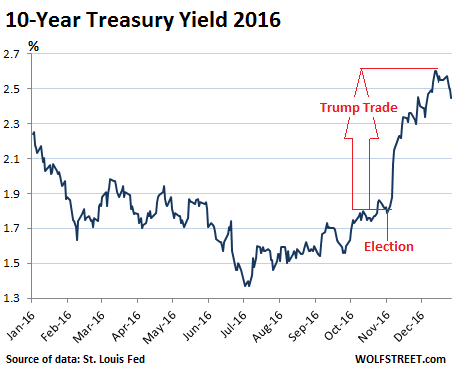
The S&P 500, after having ended 2015 down 0.7%, ended 2016 up 9.5%, including a big swoon early in the year. From February 11, when it bottomed out at 1,810, it has surged 23.6%. And bonds went on a wild ride. The 10-year Treasury yield ended 2016 at 2.445% up from 2.273% at end of 2015. It hit 2.57% at peak Trump Trade, up over a full percentage point from the summer. Over the fourth quarter, the yield jumped 84 basis points, the largest quarterly jump since 1994. And prices, which move inverse to yields, clobbered bondholders. But note the decline in yield since December 20:
And stocks partied. Since the election, financials surged, bringing the gain for the year to 29.1%, the best-performing sector in the S&P 500. Goldman Sachs, whose ex-executives are now heavily represented in the Trump administration, shot up 36% since the election and 51% since the beginning of October when Trump’s victory became more than just a possibility. GS was one of the best Trump Trades out there. Alas, it too has started to peter out. GS is now down 2.5% from peak Trump-Trade, and other banks have followed. Insiders at the banks were preparing for it, it seems, because on December 9, just before bank stocks started losing ground, we found…
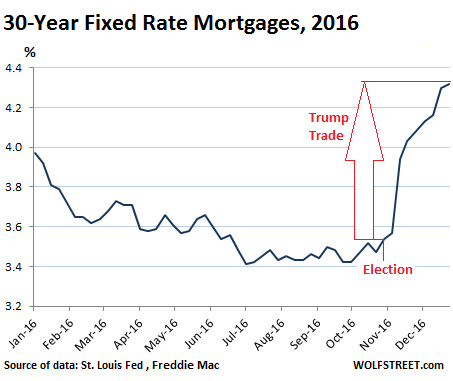
Mortgage rates have soared from around 3.4% for much of the summer to 4.32%, according to Freddie Mac. This is now reverberating through the housing market in multiple ways, with some people rushing to buy to lock in the rates before they go even higher, and others waiting for rates to come down and not buying, and still others being completely priced out by mortgage rates that are nearly a percentage point higher than they’d been a few months ago, and the first red flags on home sales are now cropping up:
Oh, go away!
• Senator McCain Says US Stands With Ukraine Against Russia (R.)
Republican U.S. Senator John McCain promised on Saturday continued support for Kiev in the face of aggression from Moscow, as he spent New Year’s Eve on the front line in Ukraine’s eastern conflict zone. McCain was one of a bipartisan group of 27 U.S. senators who sent a letter to President-elect Donald Trump in December, urging him to take a tough line against Russia over what they termed its “military land grab” in Ukraine. “I send the message from the American people – we are with you, your fight is our fight and we will win together,” McCain was quoted as saying by Ukrainian President Poroshenko’s press service. “In 2017 we will defeat the invaders and send them back where they came from. To Vladimir Putin – you will never defeat the Ukrainian people and deprive them of their independence and freedom,” McCain said after a visit to a military base in the southeastern town of Shyrokyne.
Trump signaled during his campaign that he might take a softer line in dealings with Moscow, repeatedly praising Russian President Putin’s leadership. Trump’s election caused jitters in Ukraine but officials in Kiev hope that the incoming president’s policies, influenced by Republican hawks and a Republican-voting Ukrainian diaspora, will be friendlier towards Ukraine than his campaign rhetoric might have suggested. Ukraine has relied on Western support and economic aid since street protests in 2014 which toppled a Kremlin-backed president and were followed by a war with pro-Russian separatists and Russia’s annexation of the Crimea peninsula from Ukraine.
The enormous amounts going to France, Spain, Italy, Belgium are something to be very concerned about.
• Here’s How Much Each EU Nation Puts In And Takes Out Of The EU Budget (BI)
One of the biggest political stories of 2016 has been Brexit and much of the debate both before and after June’s vote to leave the EU has focused around whether Britain will be financially better or worse off after leaving the EU. The “Vote Leave” campaign famously emblazoned their battle bus with a figure of £350 million, claiming that was what the UK sent to Brussels each week and that sum could be spent on the NHS instead. The figure was subsequently discredited, as it was a gross sum and didn’t take into account the fact that Britain also benefits from EU grants and funding. However, a recent House of Commons briefing paper on the UK’s funding from the EU shows that Britain does, in fact, put more into the EU budget than it takes out.
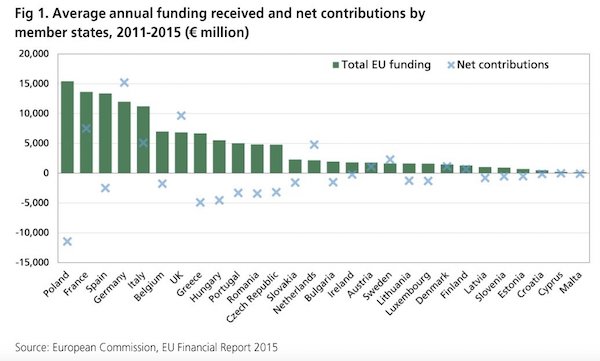
The UK has averaged around €12 billion in EU funding each year between 2011-15 but over that same period made an average net contribution of €15 billion. Britain is one of nine EU members that are net contributors to the European Union’s budget (meaning they put in more money than they take out.) Here’s the House of Commons chart showing each member states net contributions against their EU funding:EU funding House of Commons Briefing Paper The fact that Britain is a net contributor means that, in theory, the UK could stand to gain money after it leaves the EU. However, this does not account for any potential economic fluctuations as a result of Brexit — if the economy suffers then any gains from not paying into the budget could easily be wiped out by falling tax receipts.
There is also a very real possibility that the UK may have to keep paying into the EU budget if it wants to maintain access to the EU Single Market. The UK will also have to continue paying into the EU budget until it formally leaves the EU and senior European negotiators have signalled they will try and make Britain pay up to €60 billion to leave, to cover previous budget commitments, pension liabilities, and other costs. In other words, while on paper it might look like leaving the EU will give Britain more money for inward investment, Brexit could end up costing the UK just as much as EU membership — or worse, more.
I’m all for a good basic income trial. But I’m very afraid that none of them will be adequate, and that this will be used to discredit the entire idea. And please don’t use the term universal for small scale experiments, it’s misleading.
• Universal Basic Income Trials Being Considered In Scotland (G.)
Scotland looks set to be the first part of the UK to pilot a basic income for every citizen, as councils in Fife and Glasgow investigate trial schemes in 2017. The councillor Matt Kerr has been championing the idea through the ornate halls of Glasgow City Chambers, and is frank about the challenges it poses. “Like a lot of people, I was interested in the idea but never completely convinced,” he said. But working as Labour’s anti-poverty lead on the council, Kerr says that he “kept coming back to the basic income”. Kerr sees the basic income as a way of simplifying the UK’s byzantine welfare system. “But it is also about solidarity: it says that everyone is valued and the government will support you. It changes the relationship between the individual and the state.”
The concept of a universal basic income revolves around the idea of offering every individual, regardless of existing welfare benefits or earned income, a non-conditional flat-rate payment, with any income earned above that taxed progressively. The intention is to provide a basic economic platform on which people can build their lives, whether they choose to earn, learn, care or set up a business. The shadow chancellor, John McDonnell, has suggested that it is likely to appear in his party’s next manifesto, while there has been a groundswell of interest among anti-poverty groups who see it as a means of changing not only the relationship between people and the state, but between workers and increasingly insecure employment in the gig economy.
Kerr accepts that, while he is hopeful of cross-party support in Glasgow, there are “months of work ahead”, including first arranging a feasibility study in order to present a strong enough evidence base for a pilot. “But if there is ever a case to be made then you need to test it in a place like Glasgow, with the sheers numbers and levels of health inequality. If you can make it work here then it can work anywhere.”
Now Xi is designated populist too, because he said: “On this new year, I am most concerned about the difficulties of the masses: how they eat, how they live, whether they can have a good New Year, or a good Spring Festival..” And I thought when incumbents say these things, that’s not populist. I may never understand.
• China’s Xi Offers Populist Message In New Year’s Eve Address (AP)
Chinese President Xi Jinping said Saturday that his government would continue to focus on poverty alleviation at home and resolutely defending China’s territorial rights on the foreign front. Xi made the televised remarks in his annual New Year’s Eve address, in which he touted China’s scientific accomplishments, highlighting its large new radio telescope and space missions, and the country’s growing role as a leader in global affairs. Standing before a mural of the Great Wall, Xi said his administration successfully hosted a G-20 summit, pushed forward with China’s “One Belt One Road” pan-Eurasian infrastructure project and established the Asian Infrastructure Investment Bank.
China has upheld its peaceful development while resolutely defending its territorial sovereignty and maritime rights, Xi said, making a reference to an international tribunal ruling last summer against China’s claims in the contested South China Sea. “If anyone makes this an issue of question, the Chinese people will never agree!” he said, one of the few points in his 10-minute address when his voice rose noticeably. For most of his address, Xi struck a populist tone, saying he was above all concerned about the living conditions of the people and vowed that improving employment, education, housing and health care would be a responsibility that his ruling Communist Party would never shirk from. China lifted 10 million people out of poverty in 2016, Xi said.
“On this new year, I am most concerned about the difficulties of the masses: how they eat, how they live, whether they can have a good New Year, or a good Spring Festival,” Xi said, as the television broadcast cut to footage of his visits this year to impoverished rural areas. Xi also promised to shore up Communist Party discipline and “unwaveringly” maintain his anticorruption campaign against high- and low-ranking officials alike. He said that “supply-side” economic reforms were making progress and that the party would continue to push reform and rule by law during the 19th National Congress, scheduled for late 2017. “As long as the party forever stands with the people, we will be able to walk the long march of our generation,” he said.
A Lakh is one hundred thousand. Still confusing as f**k.
• Narendra Modi Just Dug Himself a Great Big Hole (Varadarajan)
It was a speech of not just shifting goalposts but vanishing playing fields, and yet Narendra Modi couldn’t resist making a rhetorical point about black money that might well prove costly for him by the time 2019 comes around. “I wish to share some information with you, which will either make you laugh, or make you angry,” he said, with a flourish half-way through his speech. This was the point where everyone expected him to reveal how many old Rs 500 and 1000 notes had become ‘worthless paper’ thanks to demonetisation but he had another number in mind: “According to information with the government, there are only 24 lakh people in India who accept that their annual income is more than 10 lakh rupees. Can we digest this? Look at the big bungalows and big cars around you… If we look at any big city, it would have lakhs of people with annual income of more than 10 lakh.”
Until then, the prime minister had sought to sweep the growing public concerns about the effects of his demonetisation decision under a fraying carpet of nationalism. But by drawing attention to a stark statistic in an attempt to provide some justification for the chaos he has unleashed in the lives of hundreds of millions of poor Indians, Modi has unwittingly laid down a new metric by which the success or failure of his supposed drive against black money must be judged: will he manage to add the “lakhs of people” who have an income of more than Rs 10 lakh to the list of those who pay income tax? If he doesn’t, then what was the point of subjecting the whole country to so much disruption and pain? Finance minister Arun Jaitley initially claimed that a certain proportion of the demonetised notes would remain outside the banking system and get extinguished, thus providing a blow to the black economy and a fiscal boost to the government.
When they realised there was unlikely to be significant extinguishing and that most of the high denomination notes in circulation would probably end up getting deposited, Modi and Jaitley claimed the income tax authorities would be able to track down the owners of black money since their funds had entered the banking system. Now that it is apparent the IT department will not find it that easy to undertake such a massive exercise – its inefficiency is the reason the list of those with official incomes of Rs 10 lakh and over is just 24 lakh to begin with and is unlikely to grow – Modi has tried to sell another bizarre idea to the public about why the cashless hardship they are putting up with is in the national interest.
Putin is tightening his grip on Erdogan. Who held a speech yesterday proclaiming that Turkey is in the first independence war in 93 years, or something like that. But that’s strictly for domestic use.
• Turkish Policy Sets Syria On New Path (Sayigh)
Turkish policy has been evolving at a quickening pace. The decision to lean on the opposition to allow thousands of its fighters to abandon the effort to lift the regime siege of eastern Aleppo in order to spearhead a Turkish-backed push against Kurdish-held areas to the north last August ensured the fall of one of the most important opposition strongholds in Syria four months later. Remaining opposition forces in the northwest have significant stockpiles of weapons and ammunition, but are wholly dependent on Turkey for further military resupply and for the flow of trade and international humanitarian assistance. Turkey has not abandoned the opposition completely, but it is clearly working to a new set of policy assumptions and objectives in Syria.
That these include a strategic decision to abandon the effort to force Assad from power is already plain. Talk of setting up a safe zone in northern Syria has never been credible, despite considerable bluster. Moscow insiders claim Turkish President Recep Tayyip Erdogan is also abandoning his categorical rejection of significant Kurdish autonomy in northern Syria, so long as he can block the same thing in Turkey. With President-Elect Donald Trump about to take office in the US, there is little reason for Turkey to expect to counter-balance Russian policy proposals on Syria. These calculations prompted Turkey to accept the fate of Aleppo – which it had long presented as a “red line” that the Assad regime should not cross – and then to broker a ceasefire with Russia immediately after its fall.
The alacrity with which the main political and military opposition groupings have announced their support for the latest ceasefire is the surest measure of the extent of the shift in Turkey’s policy and of its determination to enforce compliance, whatever the provocations from the government side. The real question, then, is not whether the latest ceasefire will hold, but how far Turkey will go in making the Syrian opposition accept what comes next, should the peace talks jointly sponsored by Russia and Turkey take place within the next month as officially scheduled. Indeed, even if the ceasefire fails or if the talks are unsuccessful – or not held at all – Turkish policy towards Syria is set on a new path.
Destruction as a religious comfort zone. Oh well, people go for what feels good.
• Humanity May Self-Destruct, But The Universe Can Cope Perfectly Without Us (G.)
In a Scandinavian hotel a few years ago, I came across a documentary I didn’t expect to watch for more than a minute or two, but at least it was in English. It was past time to go to bed, but I ended up watching the whole thing. Aftermath: Population Zero imagines that overnight humanity vanishes from the planet. You may have seen it. The immediate effects of human departure are sentimentally saddening: pets die, no longer competent to fend for themselves. Some livestock fares poorly, though other domesticated animals romp happily into the wild. Water cooling fuel rods of nuclear power plants evaporate, and you’d think that would be the end of everything – but it isn’t. Radioactivity subsides. Mankind’s monuments to itself decay, until every last skyscraper has rusted and returned to dirt.
Animals proliferate, flora thrive, forests rise. Bounty, abundance and beauty abound. Antelopes leap from wafting golden grasses. It was all very exhilarating, really. I went to sleep that night with a lightened heart. Ever since, that wafting grasses image has been a comforting touchstone. We speak often of “destroying the planet” when what we mean is destroying its habitability for humans. The humblingly immense else-ness of what is, in which our species is collectively a speck, extant for an eye blink, lets us off the hook. Global warming, Syrian civil war, domestic violence, Donald Trump? This too shall pass.
I’m not a religious person. Chances are that the universe neither treasures nor regrets us. It permits us, with a marvellous neutrality, and later it may permit artificial intelligence, humanity 2.0, or a lot more bugs instead. We can’t comprehend all that phantasmagorical stuff out there, but we also can’t kill it. That gives me hope. Although we’re a remarkably successful biological manifestation – and so is mould – our aptitude for annihilation is largely limited to wiping ourselves out. The gift of self-destruction is a minor, not to mention stupid, power, and apparently humanity’s suicide would be relatively safe, like a controlled explosion. The universe would get on perfectly well without us once we’d gone.
I strongly associate the notion of aftermath with TC Boyle’s short story Chicxulub. While relating the intimate, personal account of learning that his teenage daughter has been hit, perhaps fatally, by a car, the narrator digresses to explain the shockingly high likelihood that our planet will be hit by an asteroid large enough to extinguish our species. For the narrator, his daughter’s death and the end of the world are indistinguishable. The text is shot through with a piercing sorrow, over all our pending losses – of children, of the world we’ve made together as a race. This, too, gives me hope – that I’m not a misanthrope after all. I would miss my brother, my husband; with all our shortcomings, I would also miss the family of man. The capacity for grief, the flipside of love, consoles me as much as the detached long view of aftermath.