
Dec 192014
 
 December 19, 2014  Posted by at 11:21 am Finance Tagged with: , , , , , , , ,  4 Responses »


John Vachon Trucks loaded with mattresses at San Angelo, Texas Nov 1939


Oil Crash Exposes New Risks for U.S. Shale Drillers (Bloomberg)
North Sea Oil Industry ‘Close To Collapse’ (BBC)
North Sea Oilfields ‘Near Collapse’ After Price Nosedive (Telegraph)
Exxon Mobil Shows Why U.S. Oil Output Rises as Prices Plunge (Bloomberg)
Central Banks Are Now Uncorking The Delirium Phase (David Stockman)
Dow’s 421-Point Leap Is Biggest Gain In 3 Years (MarketWatch)
Already Crummy US Economy Takes a Sudden Hit (WolfStreet)
The Fed Delivers the Message that Our Economy is Dead (Beversdorf)
Emerging Markets In Danger (Erico Matias Tavares)
China’s Short-Term Borrowing Costs Surge as Demand for Money Grows (WSJ)
PBOC Offers Loans to Banks as Money Rate Jumps Most in 11 Months (Bloomberg)
Russia May Seek China Help To Deal With Crisis (SCMP)
Draghi Counts Cost of Outflanking Germany in Stimulus Battle (Bloomberg)
Federal Reserve Delays Parts Of Volcker Rule Until 2017 (BBC)
“Neoconica” – America For The New Millennium (Thad Beversdorf)
Bombs Away! Obama Signs Bill For Lethal Aid To Ukraine (Daniel McAdams)
US TV Shows American Torturers, But Not Their Victims (Glenn Greenwald)
Pope Francis Scores on Diplomatic Stage With U.S.-Cuba Agreement (Bloomberg)
Can You Live A Normal Life With Half A Brain? (BBC)

“It’s just the nature of the business. You’re not going to go drill holes in the ground if you think prices are going down.”

Oil Crash Exposes New Risks for U.S. Shale Drillers (Bloomberg)

Tumbling oil prices have exposed a weakness in the insurance that some U.S. shale drillers bought to protect themselves against a crash. At least six companies, including Pioneer Natural Resources and Noble Energy, used a strategy known as a three-way collar that doesn’t guarantee a minimum price if crude falls below a certain level, according to company filings. While three-ways can be cheaper than other hedges, they can leave drillers exposed to steep declines. “Producers are inherently bullish,” said Mike Corley, the founder of Mercatus Energy Advisors, a Houston-based firm that advises companies on hedging strategies. “It’s just the nature of the business. You’re not going to go drill holes in the ground if you think prices are going down.”

The three-way hedges risk exacerbating a cash squeeze for companies trying to cope with the biggest plunge in oil prices this decade. West Texas Intermediate crude, the U.S. benchmark, dropped 50% since June amid a worldwide glut. The Organization of Petroleum Exporting Countries decided Nov. 27 to hold production steady as the 12-member group competes for market share against U.S. shale drillers that have pushed domestic output to the highest since at least 1983. Shares of oil companies are also dropping, with a 49% decline in the 76-member Bloomberg Intelligence North America E&P Valuation Peers index from this year’s peak in June. The drilling had been driven by high oil prices and low-cost financing. Companies spent $1.30 for every dollar earned selling oil and gas in the third quarter, according to data compiled by Bloomberg on 56 of the U.S.-listed companies in the E&P index.

Read more …

450,000 people work in Britain’s oil industry.

North Sea Oil Industry ‘Close To Collapse’ (BBC)

The UK’s oil industry is in “crisis” as prices drop, a senior industry leader has told the BBC. Oil companies and service providers are cutting staff and investment to save money. Robin Allan, chairman of the independent explorers’ association Brindex, told the BBC that the industry was “close to collapse”. Almost no new projects in the North Sea are profitable with oil below $60 a barrel, he claims. “It’s almost impossible to make money at these oil prices”, Mr Allan, who is a director of Premier Oil in addition to chairing Brindex, told the BBC. “It’s a huge crisis.” “This has happened before, and the industry adapts, but the adaptation is one of slashing people, slashing projects and reducing costs wherever possible, and that’s painful for our staff, painful for companies and painful for the country. “It’s close to collapse. In terms of new investments – there will be none, everyone is retreating, people are being laid off at most companies this week and in the coming weeks. Budgets for 2015 are being cut by everyone.”

Mr Allan said many of the job cuts across the industry would not have been publicly announced. Oil workers are often employed as contractors, which are easier for employers to cut. His remarks echo comments made by the veteran oil man and government adviser Sir Ian Wood, who last week predicted a wave of job losses in the North Sea over the next 18 months. The US-based oil giant ConocoPhillips is cutting 230 out of 1,650 jobs in the UK. This month it announced a 20% reduction in its worldwide capital expenditure budget, in response to falling oil prices. Other big oil firms are expected to make similar cuts to their drilling and exploration budgets. Research from the investment bank Goldman Sachs predicted that they would need to cut capital expenditure by 30% to restore their profitability at current prices. Service providers to the industry have also been hit. Texas-based oilfield services company Schlumberger cut back its UK-based fleet of geological survey ships in December, taking an $800m loss and cutting an unspecified number of jobs.

Read more …

“The prolongation of the downward trend of the oil price in world markets is a political conspiracy going to extremes.”

North Sea Oilfields ‘Near Collapse’ After Price Nosedive (Telegraph)

The North Sea oil industry is “close to collapse”, an expert has warned, as a slump in prices piles pressure on drillers to cut back investing in the region. Robin Allan, chairman of the independent explorers’ association Brindex, told the BBC that it is “almost impossible to make money” with the oil price below $60 per barrel. “It’s a huge crisis. This has happened before, and the industry adapts, but the adaptation is one of slashing people, slashing projects and reducing costs,” he said. Mr Allan’s glum outlook for oil production and exploration in the UK Continental Shelf came on a volatile day of trading for crude. Brent – a global pricing benchmark comprising crude from 15 North Sea fields – ended trading in London down 1% at around $60 per barrel after trading up by as much as 3% earlier in the session. Mr Allan’s warning comes after The Telegraph reported that £55bn worth of oil projects in the North Sea and Europe could be cancelled due to the current slide in prices, according to consultancy Wood Mackenzie.

Concern over the ability of the North Sea to endure the current downturn has increased since OPEC decided to keep pumping at its current rate of 30m barrels per day (bpd) in late November. Opec kingpins Saudi Arabia and Iran were at odds on Thursday over the reason behind falling prices in an indication of the pain being caused to many of the cartel’s 12 members. Iran’s oil minister has said that a “political conspiracy” is to blame for the dramatic slump in remarks which could signal that the Islamic Republic will try to exert pressure on Opec to again consider cutting output. Bijan Zanganeh told the country’s state petroleum news agency: “The prolongation of the downward trend of the oil price in world markets is a political conspiracy going to extremes.”

Read more …

“Companies that are already producing oil will continue to operate those wells because the cost of drilling them is already sunk into the ground ..”

Exxon Mobil Shows Why U.S. Oil Output Rises as Prices Plunge (Bloomberg)

Crude oil production from U.S. wells is poised to approach a 42-year record next year as drillers ignore the recent decline in price pointing them in the opposite direction. U.S. energy producers plan to pump more crude in 2015 as declining equipment costs and enhanced drilling techniques more than offset the collapse in oil markets, said Troy Eckard, whose Eckard Global owns stakes in more than 260 North Dakota shale wells. Oil companies, while trimming 2015 budgets to cope with the lowest crude prices in five years, are also shifting their focus to their most-prolific, lowest-cost fields, which means extracting more oil with fewer drilling rigs, said Goldman Sachs. Global giant Exxon Mobil, the largest U.S. energy company, will increase oil production next year by the biggest margin since 2010.

So far, OPEC’s month-old bet that American drillers would be crushed by cratering prices has been a bust. “Companies that are already producing oil will continue to operate those wells because the cost of drilling them is already sunk into the ground,” said Timothy Rudderow, who manages $1.5 billion as chief investment officer at Mount Lucas Management. “But I wouldn’t want to have to be making long-term production decisions with this kind of volatility.” A U.S. crude bonanza that has handed consumers the cheapest gasoline since 2009 has left oil exporters like Russia and Venezuela flirting with economic chaos. The ruble sank as much as 19% on Dec. 16 to a record low of 80 per dollar before recovering to close at 68; Russian bond and equity markets also crumbled.

In Venezuela, the oil rout is spurring concern the country is running out of dollars needed to pay debt and swaps traders are almost certain default is imminent. U.S. oil production is set to reach 9.42 million barrels a day in May, which would be the highest monthly average since November 1972, according to the Energy Department’s statistical arm. Output from shale formations, deep-water fields, the Alaskan wilderness and land-based wells in pockets of Oklahoma and Pennsylvania that have been trickling out crude for decades already have pushed demand for imported oil to the lowest since at least 1995, according to data compiled by Bloomberg.

Read more …

“The essence of its action was that your money is not welcome in Switzerland ..”

Central Banks Are Now Uncorking The Delirium Phase (David Stockman)

Virtually every day there is an eruption of lunacy from one central bank or another somewhere in the world. Today it was the Swiss central bank’s turn, and it didn’t pull any punches with regard to Russian billionaires seeking a safe haven from the ruble-rubble in Moscow or investors from all around its borders fleeing Mario Draghi’s impending euro-trashing campaign. The essence of its action was that your money is not welcome in Switzerland; and if you do bring it, we will extract a rental payment from your deposits. For the time being, that levy amounts to a negative 25 bps on deposits with the Swiss Central bank – a maneuver that is designed to drive Swiss Libor into the realm of negative interest rates as well. But the more significant implication is that the Swiss are prepared to print endless amounts of their own currency to enforce this utterly unnatural edict on savers and depositors within its borders.

Yes, the once and former pillar of monetary rectitude, the SNB, has gone all-in for money printing. Indeed, it now aims to become the BOJ on steroids – a monetary Godzilla. So its current plunge into the netherworld of negative interest rates is nothing new. It’s just the next step in its long-standing campaign to put a floor under the Swiss Franc at 120. That means effectively that it stands ready to print enough francs to purchase any and all euros (and other currencies) on offer without limit. And print it has. During the last 80 months, the SNB’s balance sheet has soared from 100B CHF to 530B CHF – a 5X explosion that would make Bernanke envious. Better still, a balance sheet which stood at 20% of Swiss GDP in early 2008 – now towers at a world record 80% of the alpine nation’s total output. Kuroda-san, with a balance sheet at 50% of Japan’s GDP, can only pine for the efficiency of the SNB’s printing presses.

Read more …

Are they all going to sell in January?

Dow’s 421-Point Leap Is Biggest Gain In 3 Years (MarketWatch)

A surging U.S. stock market rallied to its best two-day gains in three years Thursday. The monster rally, which kicked off Wednesday after Federal Reserve Chairwoman Janet Yellen assured the markets that the central bank would be patient about lifting interest rate, burst into an all-out bull run late in Thursday trading. The move caps a two-day charge higher, bringing the Dow back to within shouting distance of 18,0000, after rocky trading days. The Dow Jones Industrial Average soared 421 points, or 2.4%, to 17,778.15, its biggest one-day gain in three years, a day after the Federal Reserve said it “can be patient” about the timing of its first rate hike, signalling increases will be slow and steady. It was the first time in more than six years since the Dow recorded back-to-back days of gains exceeding 200 points.

The S&P 500 jumped 48.34 points, or 2.4%, to 2,061.23, it’s biggest one-day gain in nearly two years. It is also the first time since Aug 2002 that the benchmark index posted two consecutive days of gains greater than 2%, according to Howard Silverblatt, senior index analyst at S&P Dow Jones Indices. The Nasdaq Composite jumped 104 points, or 2.2%, to 4,748, as technology companies recorded big gains. Jonathan Golub, chief U.S. market strategist at RBC Capital Markets, attributed today’s rally to halo effect from the Fed’s announcement on Wednesday. “The Fed told equity investors what we already assumed and believed,” Golub said. “There was fear that if there was going to be any change in the stance, it would be towards hawkishness, but the statement dispelled that, so stock markets rallied,” the RBC strategist added.

Read more …

Can we have some polar vortex please?

Already Crummy US Economy Takes a Sudden Hit (WolfStreet)

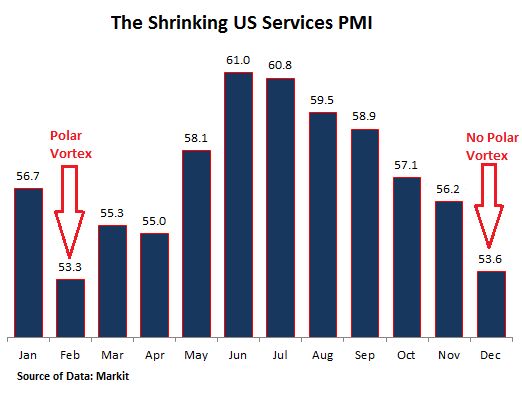
The Fed yesterday, in a fit of its typical though inexplicable optimism, raised its projection for economic growth. In September, it had projected that the US economy would grow between 2.0% and 2.2% in 2014. Now it raised its “central tendency” to a growth of 2.3% to 2.4%. That type of measly economic growth is far below the ever elusive escape velocity that Wall Street keeps promising without fail every year to justify sky-high stock valuations. But now reality is once again mucking up our already not very rosy scenarios. The service sector, the dominant force in the US economy, has taken another hit. Markit’s Services PMI Business Activity index slumped in December to 53.6, down from 56.2 in November. It’s now nearly 3 percentage points below the average over the last two years (56.4). And it is barely above the terrible growth rate in February (53.3), for which the polar vortex that had covered much of the nation was amply blamed.

Here is a chart of the shrinking services PMI. The peak was in June. From that point of maximum exuberance, it has been one heck of a downhill ride. Note the sudden no-polar-vortex plunge from November to December.
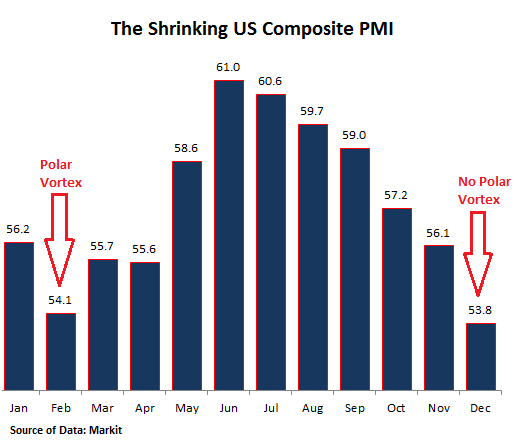
This time, there were no polar vortices to blame. But there were plenty of business reasons. Incoming new work was the lowest in nine months, with some survey respondents indicating that “the economic outlook had weighted on client demand at the end of the year.” The rate of job creation dropped to the lowest since April, with some respondents citing softer new business as reason. The Composite PMI, which combines the Services PMI and the Manufacturing PMI, dropped sharply from 56.1 in November to 53.8 in December. It has been on the same trajectory as the Services PMI, with the peak in June, followed by a downhill ride that culminated in a sudden plunge in December that left it below February’s polar-vortex low!
Read more …

“.. if you read some of Stanley Fischer’s early work on the rational expectation model you find that the key to fixing the lack of long term effectiveness to monetary policy is by confusing the working man. The idea being, people will act rationally with the information they are provided and so what typically happens is that people change their behaviour which counters the impact of the policy being implemented.

The Fed Delivers the Message that Our Economy is Dead (Beversdorf)

I used to get a kick out of the cute little children waiting for the Fed Chair to come and deliver presents or coal. So giddy and excited from the anticipation of not knowing who Janet thinks were good boys and girls. Who’s going to be rewarded and who disappointed? And I don’t know how many people asked me today what the Fed will do. My answer was “The same f@#*ing thing they always do, nothing. So stop asking”. You see, if you read some of Stanley Fischer’s early work on the rational expectation model you find that the key to fixing the lack of long term effectiveness to monetary policy is by confusing the working man. The idea being, people will act rationally with the information they are provided and so what typically happens is that people change their behaviour which counters the impact of the policy being implemented.

The solution is to keep us guessing. And so what they have done for essentially every meeting is nothing. However, they use the media to talk about all the things they just might do. And the pundits on television go on and on about all the things that might happen and what the follow on implications will be given those alternatives and then the moment comes and ahhh nothing, damn they fooled me again! I really thought this time was it gosh golly dang it!. I guess it was just that this or that was just slightly out of place otherwise they said they were totally gonna do this or that. So close, but ultimately they are right. Yep they made the right choice based on all the variables. They are just swell. At this point, I just get annoyed with the ridiculous foolishness of people. We’ve got to start using our own brains. The Fed stopped using any benchmarks because while the benchmarks were improving, the economy wasn’t and isn’t.

And so they were being railroaded by the transparency that benchmarks provide. And now it is just a black box of various indicators that will be analyzed in real time to form justifiable actions, far too complex for you and I but trust them that there is a definite method and it’s very quantifiable at that, they just can’t tell us what it is because it would just confuse everyone. Does anyone really not get it?? I mean I was under the impression that the pundits on television were just acting for the sake of good drama. Is that not the case? Are people really still confused by what’s happening in the market and broader economy? It’s been 6 years of the absolute same bullshit. How could anyone not clearly understand exactly what is behind the action or non action of the Fed??? Come on people wake up. Take a deep breath, grab some coffee, do whatever you need to do but please wake the hell up.

Read more …

They’re all addicted to Fed QE. But that’s gone, and there’s no alternative available.

Emerging Markets In Danger (Erico Matias Tavares)

There are some signs of trouble in emerging markets. And the money at risk now is bigger than ever. The yield spread between high grade emerging markets and US AAA-rated corporate debt has jumped, almost doubling in less than three weeks to the highest level since mid-2012.
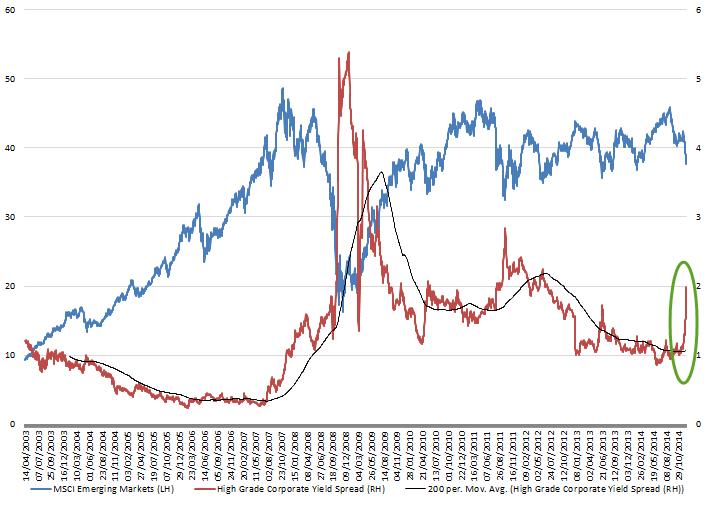

MSCI Emerging Markets Index and Yield Spread between High Grade Emerging Markets and US AAA Corporates: 14 March 2003 – Today. Source: US Federal Reserve.

This means that the best credit names in emerging markets have to pay a bigger premium over their US counterparts to get funding. When this spread spikes up and continues above its 200-day moving average for a sustained period of time, it is typically a bad sign for equity valuations in emerging markets, as shown in the graph above. One swallow does not a summer make, but it is worthwhile keeping an eye on this indicator.

As yields go up the value of these emerging market bonds goes down, resulting in losses for the investors holding them. The surge of the US dollar in recent months could magnify these losses: if the bonds are denominated in local currency they will be worth a lot less to US investors; otherwise, the borrowers will now have to work a lot harder to repay those US dollar debts, increasing their credit risk. Any losses could end up being very significant this time around, as demand for emerging markets bonds has literally exploded in recent years.
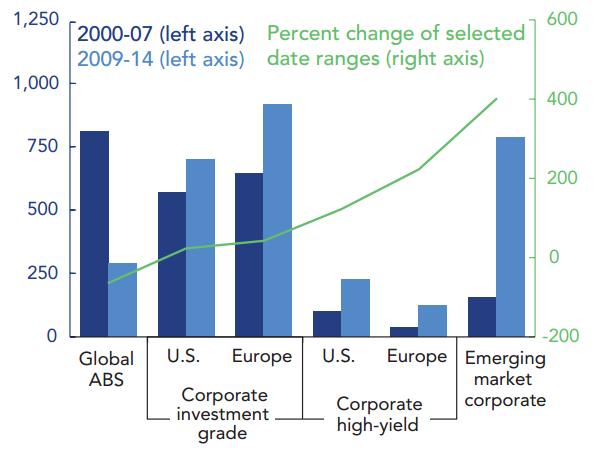

Average Annual Gross Debt Issuance ($ billions, percent): 2000 – Today. Source: Dealogic, US Treasury. Note: Data include private placements and publicly-issued bonds. 2014 data are through August 2014 and annualized.

Read more …

The craze in China stocks makes money scarce…

China’s Short-Term Borrowing Costs Surge as Demand for Money Grows (WSJ)

Short-term borrowing costs in China soared Thursday as demand for cash surged due to a number of new stock offerings and the year-end shopping spree. A recent ruling that bans the use of lower-grade corporate bonds as collateral for loans, once a key source of funding for many institutional investors, has also intensified the scramble for funds. The cash squeeze is putting the country’s financial system under renewed stress, though so far it hasn’t spread to other sectors such as stocks or the bond markets. The money markets in China have grown dramatically in recent years, with smaller banks especially vulnerable to the higher borrowing costs as they’re most reliant on the interbank market for cash.

The weighted average of seven-day repurchase agreements, or repo, a benchmark for short-term funding costs in China’s money market, rose to 5.27% from 3.89% Wednesday and 3.53% at the beginning of this week. However, the level remains well below the 12% peak that it touched at the height of the unprecedented cash crunch that China suffered in the summer of 2013. “The u%oming IPOs is the most important reason behind today’s funding squeeze. The usual year-end thirst for cash also is also playing a part,” said Wang Ming, a partner at Shanghai Yaozhi Asset Management Co. A dozen companies, including broker Guosen Securities and budget carrier Spring Airlines, are raising a total of $2.2 billion over the next few weeks from domestic stock listings. They are set to take orders for their offerings between Dec. 18 and Dec. 23.

Investors’ enthusiasm about the new IPOs was even more evident in the smaller funding market on the Shanghai Stock Exchange, the bigger of China’s two exchanges. The weighted average of the seven-day repo on the Shanghai market, where investors use exchange-listed bonds as collateral for short-term borrowing, soared to 12.20% from 10.60% Wednesday. It stood at 6.80% Monday. Such one-off factors aside, the recent strong rally in China’s stock market and a fresh move by Beijing to rein in growing risk in the corporate bond market are having a more lasting impact on the supply of funds, Mr. Wang said. China’s securities clearing house last week banned the use of lower-grade bonds, mostly issued by cash-strapped local governments and small firms, as collateral for short-term borrowing between investors.

Read more …

And banks feel the pinch.

PBOC Offers Loans to Banks as Money Rate Jumps Most in 11 Months (Bloomberg)

China’s central bank offered short-term loans to commercial lenders as the benchmark money-market rate jumped the most in 11 months. The amount of money made available by the People’s Bank of China wasn’t clear, according to people familiar with the matter. Policy makers are adding funds to the financial system to address a cash crunch as subscriptions for the biggest new share sales of the year lock up funds. Twelve initial public offerings from today through Dec. 25 will draw orders of as much as 3 trillion yuan ($483 billion), Shenyin & Wanguo Securities Co. estimated. The seven-day repurchase rate, a gauge of interbank funding availability in the banking system, surged 139 basis points, or 1.39%age points, to a 10-month high of 5.28% as of 4:39 p.m. in Shanghai, according to a weighted average compiled by the National Interbank Funding Center. The increase was the biggest since Jan. 20.

“The IPOs are affecting the market, leading to cautious sentiment with fewer institutions willing to lend,” said Li Haitao, a Shanghai-based analyst at China Guangfa Bank Co. “Quite a few traders found it very difficult to meet their funding needs yesterday.” Lenders paid 4.65% for 60 billion yuan of three-month treasury deposits auctioned today by the PBOC, the most they’ve paid since January for such funds. The central bank also rolled over this week at least some of the 500 billion yuan of three-month loans granted to lenders in September, a government official said yesterday, declining to be identified as the details haven’t been made public. “Banks have to prepare for quarter-end regulatory checks, including loan-to-deposit requirements, and hoard cash to meet year-end demand,” said Wang Ming, chief operations officer at Shanghai Yaozhi Asset Management LLP, which oversees 2 billion yuan of fixed-income investments. “With all these factors affecting the market, it’s no surprise it’s suffering more than during previous IPOs.”

Read more …

Eastern links will get much stronger as a result of western policies vs Russia.

Russia May Seek China Help To Deal With Crisis (SCMP)

Russia could fall back on its 150 billion yuan (HK$189.8 billion) currency swap agreement with China if the rouble continues to plunge. If the swap deal is activated for this purpose, it would mark the first time China is called upon to use its currency to bail out another currency in crisis. The deal was signed by the two central banks in October, when Premier Li Keqiang visited Russia. “Russia badly needs liquidity support and the swap line could be an ideal tool,” said Bank of Communications chief economist Lian Ping. The swap allows the central banks to directly buy yuan and rouble in the two currencies, rather than via the US dollar. Two bankers close to the People’s Bank of China said it was meant to reduce the role of the US dollar if China and Russia need to help each other overcome a liquidity squeeze.

China has currency swap deals with more than 20 monetary authorities around the world. Swaps are generally used to settle trade. “The yuan-rouble swap deal was not just a financial matter,” said Wang Feng, chairman of Shanghai-based private equity group Yinshu Capital. “It has political implications as it is a sign of mutual trust.” The rouble has lost more than 50% against the US dollar this year, pushing Russia to the brink of a currency crisis, though measures announced by the central bank helped it recover some ground yesterday. Li Lifan, a researcher at the Shanghai Academy of Social Sciences, said the swap would not be enough for Russia even if it is used in its entirety. “The PBOC might agree to extend something like 15 billion yuan initially as a way of showing China’s commitment to Russia.”

Read more …

How to blow up the EU.

Draghi Counts Cost of Outflanking Germany in Stimulus Battle (Bloomberg)

As Mario Draghi prepares to push the European Central Bank into quantitative easing, he’s counting the cost of alienating its home nation. With the ECB president signaling that he’ll override German-led concerns on government bond purchases if needed, his institution is under attack in the country whose DNA inspired it. The outrage reflects concern that the Frankfurt-based central bank, which is modeled on the Bundesbank, is taking risks that its forerunner would never tolerate. The Italian is now pursuing a charm offensive in the euro area’s biggest and most populous economy before the Governing Council’s Jan. 22 meeting to soften the blow as he presses on with stimulus. His challenge is to outflank the Bundesbank without risking a spillover into national politics serious enough to threaten German support for the single currency.

“The ECB has built up enough credibility on its own,” said Holger Schmieding, chief economist at Berenberg Bank in London. “That the Bundesbank may object to sovereign-bond purchases is largely taken for granted by markets. Tacit support from Berlin would neutralize Bundesbank objections in the German public debate.” The momentum toward QE is building, with more than 90% of economists in Bloomberg’s monthly survey predicting it’ll start in 2015. Euro-area inflation was 0.3% in November, compared with the ECB’s goal of just under 2%, and is poised to turn negative because of a slump in oil prices.

Read more …

“The rule prevents federally-insured banks from using their own money when investing in certain risky assets.”

Federal Reserve Delays Parts Of Volcker Rule Until 2017 (BBC)

The US Federal Reserve has given Wall Street banks even more time to comply with parts of the Volcker Rule, a key provision of the 2010 Dodd-Frank financial reform bill. The rule prevents federally-insured banks from using their own money when investing in certain risky assets. The Fed had already announced banks would have until 2017 to deal with one type of trading product. It will now grant an extension to other types of funds. Initially, the Fed had said banks would have until 21 July 2017 to stop trading in collateralised loan obligations, which essentially move the risk of investments in loans off their balance sheet. The new extension applies to other types of “legacy covered funds”, according to a release on the Fed’s website, which include “having certain relationships with a hedge fund or private equity fund”.

The Volcker rule is named after former Federal Reserve chair Paul Volcker and it limits the ownership stake banks can have in risky funds to a maximum of 3%. Part of the rule, which bans proprietary trading, is still scheduled to go into effect on 1 July 2015. This is the second big victory for banks, who have spent nearly four years arguing that the regulations stipulated in the 1,600-page Dodd-Frank bill are too onerous. Last week, a coalition of big banks, led by Citigroup, succeeding in convincing Congress to repeal a provision that required banks to put their riskier investments into separate holding companies that would not be insured by the US government.

Read more …

An exhaustive overview, with tons of graphs, of all aspects of the true state of the union, from obesity to poverty to incarceration rates. Don’t miss it.

“Neoconica” – America For The New Millennium (Thad Beversdorf)

I recently wrote an piece on the comprehensive breakdown of America. In it I laid out, from an analytical perspective, the things that are leading America to an economic collapse. But it might be interesting to take a look at a broader view of American life today. Policy and economic discussions are useful but in them we can lose the tangibility of what it all comes back to, which is the well being of Americans. Whether or not the national budget is 190% of GDP and whether interest rates will rise or not are important issues but only so far as they will impact the quality of life of the people. And so let s have a look at the lives of the American people. Have the policies over the past 15 to 50 years led to substantial improvements in the day to day real lives of Americans? Let’s have a look. And while we ve seen a couple of these more economic charts think about them in context of the other charts or other sides of life.

The above charts inform us that the bottom 80% of income households are making less than they did in the early 1980s, and remember the number of two income households today is far greater than it was in 1980 making this a staggering reality. However the top 20% and especially the top 1% have seen incredible income gains since the early 1980s. Total net worth for the bottom 80% of Americans has also been crushed. Since 2001 median net worth for the bottom 80% is down some 30% and this is during a period where stocks have reached all time highs. How could this be you ask?? Well this is not happenstance or simple unexplainable market forces. Those things do not exist in today s world. These results are by design.

I get frustrated hearing, even from the most intelligent of people that the Fed is doing its best and that given enough time this will work out for everyone. And that everyone is better off today than they used to be because this is America and that s just the way America works. But when we let the empirical data drive our perspective rather than our blind loyalty we see a very different story. The data tells a story of a political class that has been implementing programs and policies that are making the working class sick. We are given all sorts of medicines in the form of social programs and infinite debt to mask the symptoms but when we look at the actual medical test results we are not getting any better. In fact, our condition continues to worsen. Yet so many of us continue to listen to our political and economic shamans. We have such faith. And it is that faith that people like Ayn Rand recognized would be the death of America. So let’s continue on our journey through the life of the working class American today.

Read more …

“The solution for these three Members was to ensure that no other Members were present. It would have been difficult for other Members to object anyway, as no one else in the House had even seen the bill!”

Bombs Away! Obama Signs Bill For Lethal Aid To Ukraine (Daniel McAdams)

President Obama made good today on his promise to sign the Ukraine Freedom Support Act of 2014, which had passed Congress last week. Dubbed by former Rep. Dennis Kucinich the bill that “reignited the Cold War while no one was looking,” the Act imposes new sanctions on the Russian defense and energy industries, authorizes $350 million in lethal military assistance to the US-backed government in Kiev, urges that government to resume its deadly military operations against the Russian-speaking areas of east Ukraine seeking to break away from Kiev’s rule, and authorizes millions of dollars to fund increased US government propaganda broadcasts to the countries of the former Soviet Union.

Just days before Christmas, this bill is a massive gift to the US defense industry from which Ukraine will be required to purchase its lethal wish list. Perhaps as disturbing as the bill itself is the shocking process by which it passed the US House of Representatives. Three Members of the House, Foreign Affairs Committee Chairman Ed Royce (R-CA), Eliot Engel (D-NY), and Marcy Kaptur (D-OH), planned to be on the House Floor after the business of the day (passage of the massive omnibus spending bill) was completed and Members had left the Floor. Under a parliamentary move called “unanimous consent” the normal rules of the House can be suspended provided not a single other Member objects. The solution for these three Members was to ensure that no other Members were present. It would have been difficult for other Members to object anyway, as no one else in the House had even seen the bill!

Read more …

“Even in the worst of times, ‘we are always Americans, and different, stronger, and better than those who would destroy us.’”

US TV Shows American Torturers, But Not Their Victims (Glenn Greenwald)

Ever since the torture report was released last week, U.S. television outlets have endlessly featured American torturers and torture proponents. But there was one group that was almost never heard from: the victims of their torture, not even the ones recognized by the U.S. Government itself as innocent, not even the family members of the ones they tortured to death. Whether by design (most likely) or effect, this inexcusable omission radically distorts coverage. Whenever America is forced to confront its heinous acts, the central strategy is to disappear the victims, render them invisible. That’s what robs them of their humanity: it’s the process of dehumanization.

That, in turn, is what enables American elites first to support atrocities, and then, when forced to reckon with them, tell themselves that – despite some isolated and well-intentioned bad acts – they are still really good, elevated, noble, admirable people. It’s hardly surprising, then, that a Washington Post/ABC News poll released this morning found that a large majority of Americans believe torture is justified even when you call it “torture.” Not having to think about actual human victims makes it easy to justify any sort of crime. That’s the process by which the reliably repellent Tom Friedman seized on the torture report to celebrate America’s unique greatness.

“We are a beacon of opportunity and freedom, and also [..] these foreigners know in their bones that we do things differently from other big powers in history,” the beloved-by-DC columnist wrote after reading about forced rectal feeding and freezing detainees to death. For the opinion-making class, even America’s savage torture is proof of its superiority and inherent Goodness: “this act of self-examination is not only what keeps our society as a whole healthy, it’s what keeps us a model that others want to emulate, partner with and immigrate to.” Friedman, who himself unleashed one of the most (literally) psychotic defenses of the Iraq War, ended his torture discussion by approvingly quoting John McCain on America’s enduring moral superiority: “Even in the worst of times, ‘we are always Americans, and different, stronger, and better than those who would destroy us.’”

Read more …

“The Vatican is historically a place of politics and not just religion and has been for hundreds of years, with many popes starting their careers as diplomats for the Holy See ..”

Pope Francis Scores on Diplomatic Stage With U.S.-Cuba Agreement (Bloomberg)

After misfires in the Middle East and South Korea, Pope Francis is finding his place on the stage of world diplomacy — by taking the initiative. The pontiff who has made his name mostly by opening up debate in the Catholic Church about divorce and homosexuality yesterday achieved his first geopolitical success: The Argentine-born pope played a key role in brokering the accord between the U.S. and Cuba to move toward normal relations. After Pope Francis and President Barack Obama discussed Cuba during a Vatican meeting in March, the pontiff wrote directly to Obama and Cuban President Raul Castro urging them to conclude a prisoner exchange, according to an Obama administration official. It was the first such letter the president had received from the pope, the official said.

“The role of Pope Francis has been decisive,” said Vatican Secretary of State Pietro Parolin on Vatican Radio today. “He was the one who took the initiative of writing to the two presidents to invite them to overcome the problems between the two countries and find an agreement.” Francis, 78, had greater success with Cuba than in his other political ventures because it was an obsolescent standoff waiting for a solution and because of his Latin American roots, said Philippe Moreau-Defarges, a researcher at the French Institute of International Relations in Paris. “The Cuba situation simply made no sense to anyone anymore,” said Moreau-Defarges.

While the Vatican diplomatic corps exchanges representatives with 179 countries and popes have been sending emissaries since the 4th century, modern-day pontiffs haven’t always been politically involved. Benedict XVI, Francis’ German predecessor, focused more on doctrinal issues. His predecessor, John Paul II, pope from 1978 to 2005, spoke out frequently against military force and dictatorship and is credited with hastening the collapse of communism in his native Poland. “The Vatican is historically a place of politics and not just religion and has been for hundreds of years, with many popes starting their careers as diplomats for the Holy See,” said Federico Niglia, a history professor at Luiss University in Rome. “What’s somewhat unusual is Francis acting in person beyond diplomatic circles, which has close parallels to the style of predecessor John Paul II.”

Read more …

Brain structures are fascinating, with built-in resilience, redundancy.

Can You Live A Normal Life With Half A Brain? (BBC)

How much of our brain do we actually need? A number of stories have appeared in the news in recent months about people with chunks of their brains missing or damaged. These cases tell a story about the mind that goes deeper than their initial shock factor. It isn’t just that we don’t understand how the brain works, but that we may be thinking about it in the entirely wrong way. Earlier this year, a case was reported of a woman who is missing her cerebellum, a distinct structure found at the back of the brain. By some estimates the human cerebellum contains half the brain cells you have. This isn’t just brain damage – the whole structure is absent. Yet this woman lives a normal life; she graduated from school, got married and had a kid following an uneventful pregnancy and birth. A pretty standard biography for a 24-year-old. The woman wasn’t completely unaffected – she had suffered from uncertain, clumsy, movements her whole life.

But the surprise is how she moves at all, missing a part of the brain that is so fundamental it evolved with the first vertebrates. The sharks that swam when dinosaurs walked the Earth had cerebellums. This case points to a sad fact about brain science. We don’t often shout about it, but there are large gaps in even our basic understanding of the brain. We can’t agree on the function of even some of the most important brain regions, such as the cerebellum. Rare cases such as this show up that ignorance. Every so often someone walks into a hospital and their brain scan reveals the startling differences we can have inside our heads. Startling differences which may have only small observable effects on our behaviour. This case points to a sad fact about brain science. We don’t often shout about it, but there are large gaps in even our basic understanding of the brain. We can’t agree on the function of even some of the most important brain regions, such as the cerebellum.

Rare cases such as this show up that ignorance. Every so often someone walks into a hospital and their brain scan reveals the startling differences we can have inside our heads. Startling differences which may have only small observable effects on our behaviour. Part of the problem may be our way of thinking. It is natural to see the brain as a piece of naturally selected technology, and in human technology there is often a one-to-one mapping between structure and function. If I have a toaster, the heat is provided by the heating element, the time is controlled by the timer and the popping up is driven by a spring. The case of the missing cerebellum reveals there is no such simple scheme for the brain. Although we love to talk about the brain region for vision, for hunger or for love, there are no such brain regions, because the brain isn’t technology where any function is governed by just one part.

Read more …

Nov 242014
 
 November 24, 2014  Posted by at 12:02 pm Finance Tagged with: , , , , , , , , , ,  Comments Off on Debt Rattle November 24 2014


William Henry Jackson Hospital Street, St. Augustine, Florida 1897

Global Business Confidence Plunges To Post-Crisis Low (CNBC)
Pope Francis Warns Greed Of Man Will ‘Destroy The World’ (Daily Mail)
Record Numbers Of UK Working Families In Poverty Due To Low-Paid Jobs (Guardian)
New Abnormal Means Relying on Central Banks for Growth (Bloomberg)
Why We Can’t Afford Another Financial Crisis (Guardian)
PBOC Bounce Seen Short Lived as History Defies Bulls (Bloomberg)
China Rate-Cut Likely To Hurt Banks, Curb New Loans To Small Borrowers (Reuters)
Bad News Mounts for Chinese Banks, Funds Grow More Bullish (Bloomberg)
Property, Manufacturing Woes Help Trim China’s Shadow Banking (Reuters)
The Consequences of Imposing Negative Interest Rates (Tenebrarum)
Why Countries Wage Currency Wars (A. Gary Shilling)
How the EU Plans to Turn $26 Billion Into $390 Billion (Bloomberg)
Draghi’s About to Find Out How Urgent His Call for Action Has Become (Bloomberg)
UK Supermarket War Turns Smaller Food Suppliers Into ‘Cannon Fodder’ (Guardian)
‘OPEC’s Easy Days Setting Oil Production Are Over’ (Bloomberg)
Russia Losing ‘Up To $140 Billion’ From Sanctions, Oil Drop (Reuters)
Demand Set to Outstrip the $100 Trillion Bond Market Again in 2015 (Bloomberg)
Swedish Banks Face Deposit Drain as Interest Rates Slump (Bloomberg)
World Locked Into ‘Alarming’ Global Warming: World Bank (CNBC)

How much money was thrown into the system in those five years?

Global Business Confidence Plunges To Post-Crisis Low (CNBC)

Worldwide business confidence slumped to a five-year low, with company hiring and investment intentions at or near their weakest levels in the post-global financial crisis era, according to a new survey. “Clouds are gathering over the global economic outlook, presenting the darkest picture seen since the global financial crisis,” said Chris Williamson, chief economist at Markit. The number of companies expecting their business activity to be higher in a years’ time exceeded those expecting a decline by just 28%. This was below the net balance of 39% recorded in the summer, the Markit Global Business Outlook Survey showed. The tri-annual survey, published on Monday, looked at expectations for the year ahead across 6,100 manufacturing and services companies worldwide. Optimism in manufacturing fell to its lowest since mid-2013 but remained ahead of that seen in services, where confidence about the outlook slumped to the lowest in the survey’s five-year history.

Global hiring intentions slid to within a whisker of the all-time low seen in June of last year, deteriorating in the U.S., Japan, the U.K., euro zone, Russia and Brazil. [..] Investment intentions also collapsed to a new post-crisis low across major economies. China and India bucked the trend, however, with capital expenditure plans in the two countries improving. The survey highlighted a growing list of concerns among companies about the outlook for the year ahead including a worsening global economic climate, the prospect of higher interest rates in countries such as the U.K. and U.S. and geopolitical risk emanating from crises in Ukraine and the Middle East. “Of greatest concern is the slide in business optimism and expansion plans in the U.S. to the weakest seen over the past five years. U.S. growth therefore looks likely to have peaked over the summer months, with a slowing trend signaled for coming months,” Williamson said.

Read more …

‘It is also painful to see the struggle against hunger and malnutrition hindered by ‘market priorities’, the ‘primacy of profit’, which reduce foodstuffs to a commodity like any other, subject to speculation and financial speculation in particular ..’

Pope Francis Warns Greed Of Man Will ‘Destroy The World’ (Daily Mail)

Pope Francis has warned that planet earth could face a doomsday scenario if the world does not stop abusing its resources for profit The pontiff warned that nature would exact revenge, and urged the world’s leaders to rein in their greed and help the hungry. He told the Second International Conference on Nutrition (CIN2) in Rome: ‘God always forgives, but the earth does not. ‘Take care of the earth so it does not respond with destruction.’ The three-day meeting aimed at tackling malnutrition, and included representatives from 190 countries.

It was organised by the UN food agency (FAO) and World Health Organization (WHO) in the Italian capital. The 77-year old said the world had ‘paid too little heed to those who are hungry.’ While the number of undernourished people dropped by over half in the past two decades, 805 million people were still affected in 2014. ‘It is also painful to see the struggle against hunger and malnutrition hindered by ‘market priorities’, the ‘primacy of profit’, which reduce foodstuffs to a commodity like any other, subject to speculation and financial speculation in particular,’ Francis said.

Read more …

Britain’s new normal: ” .. the report showed a real change in UK society over a relatively short period of time.”

Record Numbers Of UK Working Families In Poverty Due To Low-Paid Jobs (Guardian)

Insecure, low-paid jobs are leaving record numbers of working families in poverty, with two-thirds of people who found work in the past year taking jobs for less than the living wage, according to the latest annual report from the Joseph Rowntree Foundation. The research shows that over the last decade, increasing numbers of pensioners have become comfortable, but at the same time incomes among the worst-off have dropped almost 10% in real terms. Painting a picture of huge numbers trapped on low wages, the foundation said during the decade only a fifth of low-paid workers managed to move to better paid jobs. The living wage is calculated at £7.85 an hour nationally, or £9.15 in London – much higher than the legally enforceable £6.50 minimum wage.

As many people from working families are now in poverty as from workless ones, partly due to a vast increase in insecure work on zero-hours contracts, or in part-time or low-paid self-employment. Nearly 1.4 million people are on the controversial contracts that do not guarantee minimum hours, most of them in catering, accommodation, retail and administrative jobs. Meanwhile, the self-employed earn on average 13% less than they did five years ago, the foundation said. Average wages for men working full time have dropped from £13.90 to £12.90 an hour in real terms between 2008 and 2013 and for women from £10.80 to £10.30.

Poverty wages have been exacerbated by the number of people reliant on private rented accommodation and unable to get social housing, the report said. Evictions of tenants by private landlords outstrip mortgage repossessions and are the most common cause of homelessness. The report noted that price rises for food, energy and transport have far outstripped the accepted CPI inflation of 30% in the last decade. Julia Unwin, chief executive of the foundation, said the report showed a real change in UK society over a relatively short period of time. “We are concerned that the economic recovery we face will still have so many people living in poverty. It is a risk, waste and cost we cannot afford: we will never reach our full economic potential with so many people struggling to make ends meet.

Read more …

Central banks can’t create growth.

New Abnormal Means Relying on Central Banks for Growth (Bloomberg)

The “new normal” may be new. It’s hardly normal. The “new abnormal” would be more apt, according to reports published this month by Ed Yardeni and ING’s Mark Cliffe in London. “Dictionaries define ‘normal’ as regular, usual, healthy, natural, orderly, ordinary, rational,” Cliffe said Nov. 7. “It is hard to use those words to describe the current performance of the world economy and financial markets.” Among signs of irregularity since Pimco popularized the expression “new normal” in 2009 to describe an environment of below-average economic growth: Central banks are still deploying near-zero interest rates or quantitative easing six years after the financial crisis, yet output, inflation, business investment and wages remain mostly subpar. In financial markets, equities are hitting new highs as bond yields probe new lows. Even as the U.S. shows signs of strength, commodities are slumping.

The lesson for Yardeni is that by running to the rescue every time asset prices swooned in the past two decades, central bankers’ prescriptions distorted economies. “If a central bank moderates recessions, then speculative excesses are likely to build up much more during the booms and never get fully cleaned out,” Yardeni, a former chief economist at Deutsche Bank, said in a Nov. 19 report. “So each financial crisis gets progressively worse than the previous one, forcing the central bank to provide even more easy money to avert a financial meltdown.” Cliffe at ING is less willing than Yardeni to lambaste central banks, noting it’s hard to say how bad a recession may have occurred without their aid. Still, he agrees that policy makers now find themselves having to keep an eye on markets as much as the economies when setting policy.

Read more …

“For now, the Federal Reserve, the European Central Bank and the Bank of England prefer not to contemplate this dire possibility.”

Why We Can’t Afford Another Financial Crisis (Guardian)

A look into the future: David Cameron’s nightmare has come true; the slowdown in the global economy has turned into a second major recession within a decade. In those circumstances, there would be two massive policy challenges. The first would be how to prevent the recession turning into a global slump. The second would be how to prevent the financial system from imploding. These are the same challenges as in 2008, but this time they would be magnified. Zero interest rates and quantitative easing have already been used extensively to support activity, which would leave policymakers with a dilemma. Should they double down on QE or come up with more radical proposals – drops of helicopter money or using QE for specified purposes, such as investment in green energy?

For now, the Federal Reserve, the European Central Bank and the Bank of England prefer not to contemplate this dire possibility. They will deal with it if it happens, but are assuming it won’t. More explicit plans have been drawn up for the big banks. The concern here is obvious. The bailouts last time played havoc with the public finances and the still incomplete repair job has required unpopular austerity. Governments are not flush enough to contemplate a second wave of bailouts. Even if they had the money, they know just how voters would react if there was talk of bailing out the bankers a second time.

Read more …

They’ll just cut again. Or maybe even just devalue the yuan overnight.

PBOC Bounce Seen Short Lived as History Defies Bulls (Bloomberg)

China’s benchmark stock index rose to a three-year high after the central bank’s surprise interest rate cut late last week. Recent history suggests the gains won’t last long. While the Shanghai Composite Index climbed 1.9% today, six of the past seven cuts to interest rates and reserve requirements have been followed by declines in stock prices over the next two months. The last time the PBOC lowered lending and deposit rates, in July 2012, the benchmark index fell 7.4%, according to data compiled by Bloomberg. The rate cut, announced after the close of regular trading in China on Nov. 21, underlines concern that a slowdown in the world’s second-largest economy is deepening. Factory production rose 7.7% in October from a year earlier, the second-weakest pace since 2009, while retail sales missed economists’ forecasts.

China’s economy expanded 7.3% in the three months ended September and it’s projected to grow this year at the slowest pace since 1990 amid weakness in the property market and manufacturing. “In the short term, it’s positive, but in the long term, the economic slowdown is probably the main driver of the market,” Lucy Qiu, an emerging markets analyst at UBS Wealth Management, which has $1 trillion in invested assets, said by phone from New York on Nov. 21. “This announcement came after a slew of underperforming economic releases. It kind of shows the government is determined to support growth, but going forward we really have to look at the data.” The PBOC has cut reserve requirements for the nation’s largest lenders three times and lowered benchmark rates three times since late 2011.

Policy makers said in a Nov. 21 statement that the move in interest rates was “a neutral operation and doesn’t mean any change in monetary policy direction.” As China is still able to keep medium to high growth rates, it “has no need to take strong stimulus measures, and the direction of prudent monetary policy won’t change,” the central bank said. China’s retail inflation held at the slowest pace since January 2010 last month. Consumer prices increased 1.6%, matching September’s rate, while producer prices fell for a record 32nd month, slumping 2.2%.

Read more …

Unintended consequences?!

China Rate-Cut Likely To Hurt Banks, Curb New Loans To Small Borrowers (Reuters)

China’s latest interest rate cut is set to dent the profitability of domestic lenders, especially mid-sized banks, which are already suffering from higher bad loans and a slowdown in profit growth. The central bank unexpectedly cut rates late on Friday, stepping up efforts to support small and medium-sized enterprises (SMEs) which are struggling to repay loans and access credit, as the economy slides to its slowest growth in nearly a quarter of a century. It slashed the one-year benchmark lending rate by 40 basis points to 5.6% while lowering the one-year benchmark deposit rate by 25 basis points to 2.75%. The narrowing of interest rate margins will eat into lenders’ profitability, with Cinda Securities’ chief strategist, Jiahe Chen, predicting it will cut profits by up to 5%. Interest margins generated from lending have already been shrinking for second-tier lenders, which have been squeezed by competition from online financiers and a rise in funding costs stemming from an industry tussle for deposits.

Fitch Ratings downgraded its credit rating of China Guangfa Bank, a medium-sized lender, two days before the rate-cut announcement, and said the level of off-balance-sheet lending among second-tier banks was a concern. The squeeze on profits will make it tougher for lenders to raise capital to meet new international rules designed to protect depositors from banking collapses. Retained profits are one way in which banks can build up regulatory capital. “In the past when Chinese banks disbursed loans, they mainly relied on profits from their own capital to replenish their capital,” Jiang Jianqing, chairman of China’s biggest commercial bank, the Industrial and Commercial Bank of China, told a conference in Beijing on Saturday. The PBoC said in announcing the rate cut that it wanted to help smaller firms gain access to credit. While the measures may ease the financing costs of these firms’ existing loans, it is unlikely to encourage banks to write new loans to lower-rung borrowers, bankers said.

Read more …

Bad debt is China’s biggest conundrum. How can they ever get out other than through defaults?

Bad News Mounts for Chinese Banks, Funds Grow More Bullish (Bloomberg)

China’s banks, already saddled with mounting bad debt, face the risk of sagging profit growth after an interest-rate cut slashed their margins on loans. The twist: some investors are getting more optimistic, not less, about the outlook for the industry’s shares. Victoria Mio, chief investment officer for China at Robeco Hong Kong, whose parent company oversees about €237 billion ($294 billion), said Nov. 21 that bank stocks were very attractive because they were priced at levels that assumed an economic “hard landing.” Hours later, the central bank cut the one-year lending rate by 0.4 percentage point and the one-year deposit rate by 0.25 percentage point. Afterward, Mio said sustained monetary easing may drive an economic rebound and a jump in banks’ share prices. She was “more positive” on the stocks.

Chinese banks are trading at an average 4.8 times estimated earnings for this year, the lowest globally for lenders with a market value of more than $10 billion, according to data compiled by Bloomberg. Another fund manager, Baring Asset Management Ltd.’s Khiem Do, said he was “still bullish” on banks after the rate move and that dividends of more than 6% would become even more attractive as interest rates fall. “You tell me which banks in the world are paying out this yield, and making money, and working in an environment where the economy is growing at about 7% per annum,” he said earlier by phone. Do helps oversee about $60 billion as Hong Kong-based head of Asian multi-asset strategy. Ma Kunpeng, a Shanghai-based analyst at Sinolink Securities Co., has a buy rating on the industry. He said banks’ share prices have fallen even when earnings have exceeded expectations because investors have focused more on “perceived risks” than profits.

Read more …

China’s economy doesn’t function without shadow banks. There might be a hard lesson for Beijing in the offing here.

Property, Manufacturing Woes Help Trim China’s Shadow Banking (Reuters)

A bid by China to rein in its “shadow banking” activity is producing results, thanks to slowing economic growth and tighter regulation. But some success for a policy drive to curb risky lending is not all good news for Beijing, as smaller companies may face even bigger struggles to find funding. A cut in interest rates, announced by Beijing on Friday, is unlikely to help them much. Shadow banking includes off-balance-sheet forms of bank finance plus lending by non-traditional institutions, all of which is less regulated than formal lending and thus considered riskier. At the end of 2013, China had the world’s third-largest shadow banking sector, according to the Financial Stability Board, a task force set up by the G-20 economies. It estimated that Chinese assets of “other financial intermediaries” than traditional ones were then just under $3 trillion.

In the three months ended Sept. 30, the shadow banking portion of what China calls total social financing – a broad measure of liquidity in the economy – contracted for the first time on a quarterly basis since the 2008/09 financial crisis. Loans extended by trust companies fell by roughly 100 billion yuan ($16.33 billion). Bankers’ acceptances, a short-term method of financing regularly used by manufacturers, dropped 668.3 billion yuan, according to Reuters calculations based on central bank data. October lending data, released last week, showed further contractions in these types of shadow banking. Bankers’ acceptances and trust loans “fall into categories that have been squeezed by tightening regulations in the last few months, so it’s an ongoing trend,” said Donna Kwok, an economist at UBS in Hong Kong.

Read more …

“What can be abolished by laws and decrees is merely the right of the capitalists to receive interest. But such laws would bring about capital consumption and would very soon throw mankind back into the original state of natural poverty.”

The Consequences of Imposing Negative Interest Rates (Tenebrarum)

Ever since the ECB has introduced negative interest rates on its deposit facility, people have been waiting for commercial banks to react. After all, they are effectively losing money as a result of this bizarre directive, on excess reserves the accumulation of which they can do very little about. At first, only a small regional bank, Deutsche Skatbank, imposed a penalty rate on large depositors – slightly in excess of the 20 basis points banks must currently pay for ECB deposits. It turns out this was a Trojan horse. Other banks were presumably watching to see if depositors would flee Skatbank, and when that didn’t happen, Commerzbank decided to go down the same road. However, there is an obvious flaw in taking such measures – at least is seems obvious to us. The Keynesian overlords at the central bank who came up with this idea have failed to consider a warning Ludwig von Mises once uttered about the attempt to abolish interest by decree.

Obviously, the natural interest rate can never become negative, as time preferences cannot possibly become negative: ceteris paribus, consumption in the present will always be preferred to consumption in the future. Mises notes that if the natural interest rate were to decline to zero, all consumption would stop – we would die of hunger while investing all of our resources in capital goods, i.e., while directing all of our efforts and funds toward production for future consumption. This is obviously a situation that would make no sense whatsoever – it is simply not possible for this to happen in the real world of human action. Mises warns however that if interest payments are abolished by decree, or even a negative interest rate is imposed by decree, owners of capital will indeed begin to consume their capital – precisely because want satisfaction in the present will continue to be preferred to want satisfaction in the future regardless of the decree. This threatens to eventually impoverish society and reduce it to a state of penury:

If there were no originary interest, capital goods would not be devoted to immediate consumption and capital would not be consumed. On the contrary, under such an unthinkable and unimaginable state of affairs there would be no consumption at all, but only saving, accumulation of capital, and investment. Not the impossible disappearance of originary interest, but the abolition of payment of interest to the owners of capital, would result in capital consumption.

The capitalists would consume their capital goods and their capital precisely because there is originary interest and present want-satisfaction is preferred to later satisfaction. Therefore there cannot be any question of abolishing interest by any institutions, laws, and devices of bank manipulation. He who wants to “abolish” interest will have to induce people to value an apple available in a hundred years no less than a present apple. What can be abolished by laws and decrees is merely the right of the capitalists to receive interest. But such laws would bring about capital consumption and would very soon throw mankind back into the original state of natural poverty.”

Read more …

Because they’re desperate.

Why Countries Wage Currency Wars (A. Gary Shilling)

The U.S. dollar has been on a tear this year, rising against the currencies of virtually all major developed economies. What we’re seeing around the world is intense – and in some cases, deliberate – devaluations. What’s going on and what are the investment implications? One reason for the devaluations is that, when economic growth is weak – as it has been globally for five years – governments feel tremendous pressure to increase exports and reduce imports to restore growth. Often that means lowering the value of the currency so that products sent abroad are relatively less expensive and those coming into the country more so. The European Central Bank, for example, wants to depress the euro to keep deflation at bay. The euro’s earlier strength drove down import prices, forcing domestic producers who compete with imports to slash their prices. As a result, consumer price inflation moved steadily toward zero. It was a mere 0.4% in October versus a year earlier.

The euro-zone economy remains stagnant, with a third recession since 2007 a possibility. Unemployment is high. Youth unemployment tops 25% in many countries; it exceeds 50% in Spain and Greece. Meanwhile, consumer sentiment, which never recovered from the last recession, is again dropping. In early June, the ECB responded by cutting its benchmark interest rate from 0.25% to 0.15% and introducing a penalty charge of 0.1% on reserves it holds for member banks. While these measures were more symbolic than substantive, the euro slid in reaction. In September, the ECB started to make up to €1 trillion in cheap, four-year loans available to member banks, provided they made more credit available to the private sector. Still, these actions didn’t seriously depress the euro, so ECB President Mario Draghi in September announced a further cut in the overnight interest rate to 0.05% and an increase in the penalty rate for member-bank deposits to 0.2%.

In October, the ECB purchased a broad array of securities, including bonds backed by auto loans, home mortgages and credit-card debt, to encourage lenders to offer more credit to companies. Again, these actions have proved more symbolic than substantive, but the euro has weakened a bit further. While the ECB will probably end up with outright quantitative easing in one form or another, keep in mind that QE is less effective in the euro area. Financing is concentrated in the banks, which account for 70% of corporate financing, not in bond markets as in the U.S., where QE works its way into the economy rapidly. Also, weak euro-zone banks are weighed down by bad loans, anemic profits and the need to raise capital to meet new regulatory requirements. In addition, there are 18 euro-area countries and, therefore, 18 separate bond markets for the ECB to consider.

Read more …

Magic?!

How the EU Plans to Turn $26 Billion Into $390 Billion (Bloomberg)

The European Union is planning a €21 billion ($26 billion) fund to share the risks of new projects with private investors, two EU officials said. The new entity is designed to have an impact of about 15 times its size, making it the anchor of the EU’s €300 billion investment program, said the officials, who asked not to be named because the plans aren’t final. European Commission President Jean-Claude Juncker is due to announce the three-year initiative this week. The commission will pledge as much as €16 billion in guarantees for the vehicle, which will also include €5 billion from the European Investment Bank, the officials said. Loans, lending guarantees and stakes in equity and debt will be part of its toolbox, with the goal to jumpstart private risk-taking so that stalled projects can get off the ground.

Juncker’s investment plan aims to combine EU resources and regulatory changes “to crowd in more private investment in order to make real investments a reality,” EU Vice President Jyrki Katainen said Nov. 14 in Bratislava. The plan is one element of the EU’s economic strategy and “not a magic wand with which we will be able to miraculously invest ourselves out of a difficult economic climate,” he said. Europe is struggling to spur economic growth as it emerges only slowly from waves of crisis. The 18-nation euro area is forecast to see growth of just 0.8% this year, according to EU forecasts, while the region’s unemployment rate of 11.5% masks rates of about 25% in Greece and in Spain. While the Juncker proposal involves seeding investment in infrastructure and other fields, the €21 billion sum with a proposed leverage rate of 15 times risks disappointing markets.

Read more …

EU consumer data coming this week.

Draghi’s About to Find Out How Urgent His Call for Action Has Become (Bloomberg)

Mario Draghi is about to find out just how urgent his call for action has become. One week after the European Central Bank president vowed to revive inflation “as fast as possible,” policy makers will receive a glimpse on just how feeble cost pressures are now in the euro region. Economists forecast data on Nov. 28 will show consumer-price growth matching the weakest since 2009. That would add to the drumroll for a stimulus debate at the Dec. 4 meeting as panels of officials study possible new measures and prepare to cut their economic outlook. While Draghi has stoked pressure toward sovereign-bond buying, colleagues from Germany to the Netherlands are unconvinced quantitative easing is warranted, and his vice president suggested at the weekend that the ECB might hold off until next year. Spanish government bond yields fell today on speculation the ECB will start buy sovereign debt.

“The stakes are high and the risks are asymmetric,” said Frederik Ducrozet, an economist at Credit Agricole in Paris. “A drop in inflation, even a small one, could push the ECB to do something more in December. On the other hand if there is an upside surprise, that buys them time.” Inflation data for November are forecast to show a dip to 0.3% from 0.4%, while economic confidence is seen declining and October unemployment staying at 11.5%, according to economists surveyed by Bloomberg News before those reports this week.

Read more …

Deflation at work.

UK Supermarket War Turns Smaller Food Suppliers Into ‘Cannon Fodder’ (Guardian)

Food producers have become cannon fodder in the bitter supermarket price war, according to accountancy firm Moore Stephens, which found 28% more specialist manufacturers have gone into insolvency this year than last. In the year to September, 146 food producers went into insolvency, including wholesale bakeries, pasta makers, fish processors and ready meal manufacturers. In one of the larger cases, 170 jobs were lost when Sussex-based fresh pasta maker Pasta Reale went into administration in August after it lost three major supermarket contracts in a year. Duncan Swift, head of the food advisory group at Moore Stephens, said: “The supermarkets are going through the bloodiest price war in nearly two decades and are using food producers as the cannon fodder. UK supermarkets are trying to compete on price with Aldi and Lidl but with profit margins that are far higher than these discount chains.

“To try and make the maths work, the big supermarkets are putting food producers under so much pressure that we have seen a sharp increase in the number of producers failing.” The rise in insolvencies among food suppliers is in stark contrast to the 8% fall in liquidations in the economy as a whole over the same period. Swift said that because supermarket buyers’ bonuses were based on securing cash contributions from suppliers, they were being hit with “spurious deductions”, cancellations at short notice and threats to take them off the supplier list.

Highlighting contracts where suppliers contribute to supermarkets’ costs, he said: “Supplier contributions cause major cashflow problems for food producers and can tip them into insolvency. It’s a raw deal for food producers, who need the supermarkets to reach the public, but who can’t afford the terms of business that the supermarkets foist on them.” The extent of these contributions has come into the spotlight this year after Tesco admitted it had found a £263m black hole in its accounts relating to the way it booked payments from suppliers.

Read more …

This is OPEC’s biggest problem, followed closely by infighting within the cartel. Agreements won’t be worth the paper they’re written on. Who’s going to check production?

‘OPEC’s Easy Days Setting Oil Production Are Over’ (Bloomberg)

The days when OPEC members could all but guarantee consensus when deciding production levels for oil are long gone, according to a veteran of almost two decades of the group’s meetings. The global glut of crude, which has contributed to a 30% decline in prices since June 19, has left the organization disunited and dependent on non-members to shore up the market, said former Qatari Oil Minister Abdullah Bin Hamad Al Attiyah. The 12-member Organization of Petroleum Exporting Countries is scheduled to meet in Vienna on Nov. 27. “OPEC can’t balance the market alone,” Al Attiyah, who participated in the group’s policy meetings from 1992 to 2011, said in a Nov. 19 phone interview. “This time, Russia, Norway and Mexico must all come to the table. OPEC can make a cut, but what will happen is that non-OPEC supply will continue to grow. Then what will the market do?”

Read more …

Sounds very bearable.

Russia Losing ‘Up To $140 Billion’ From Sanctions, Oil Drop (Reuters)

Russia is suffering losses at a rate of about $40 billion per year because of Western sanctions and $90-100 billion from the drop in the oil price, Finance Minister Anton Siluanov said on Monday. The admission came on the same morning that a central bank official said that banking profits could be 10% lower in 2014, compared to the previous year. External markets are largely closed for Russian banks and companies, some of which – including top banks Sberbank and VTB – are under Western sanctions over Moscow’s role in the Ukraine crisis. Banks’ profits and margins are also under pressure because they have to serve increased domestic demand for loans, while their sources of capital and liquidity are limited.

Read more …

That’s what you get in a world run on zombie money.

Demand Set to Outstrip the $100 Trillion Bond Market Again in 2015 (Bloomberg)

Even in the $100 trillion market for bonds worldwide, one of the most persistent dilemmas facing potential buyers is a dearth of supply. Demand for debt securities has surpassed issuance five times in the past seven years, according to data compiled by JPMorgan. The shortfall is set to continue into 2015, with the New York-based firm predicting demand globally will outstrip supply by $400 billion as central banks in Japan and Europe step up their own debt purchases. The mismatch helps to explain why bond yields worldwide have fallen by more than half since the financial crisis in 2008 to a record-low 1.51% in October, even as borrowing by governments, businesses and consumers added $30 trillion to the market for debt securities. Now, with a global economic slowdown threatening to hold back the U.S. recovery and few signs of inflation anywhere in the developed world, the shortage of bonds may temper the rise in yields forecasters project next year.

“It will keep global yields lower than they would be otherwise,” Chris Low, the New York-based chief economist at FTN Financial, said in a telephone interview on Nov. 19. The demand for bonds “reflects disappointing global growth and that’s been a consistent theme.” Potential bond buyers are poised to spend $2.4 trillion next year on a net basis, while borrowers will issue an estimated $2 trillion of debt, according to JPMorgan, the top-ranked firm for fixed-income research in the U.S. and Europe by Institutional Investor magazine. Since the end of 2007, JPMorgan estimates the potential bond demand has exceeded supply by more than $2.5 trillion, including a gap almost a half-trillion dollars this year. The Bank for International Settlements estimates the amount of bonds outstanding has surged more than 40% since 2007 as countries such as the U.S. increased deficits to pull their economies out of recession and companies locked in low-cost financing as central banks dropped interest rates. Even so, a shortfall emerged.

Read more …

How to shoot yourself in the foot: tell banks they need more deposits, but enact low interest policies that drain them away. All part of the same brilliant plan. They had a visit from Krugman, didn’t they?

Swedish Banks Face Deposit Drain as Interest Rates Slump (Bloomberg)

Sweden’s biggest banks could see deposits plunge as record-low interest rates prod households to start seeking higher returns elsewhere. Net deposit inflows declined to 4.4 billion kronor ($589 million) in the third quarter from 44.3 billion kronor the prior quarter, according to Statistics Sweden. While the period typically sees a seasonal decline, deposits were less than half the 10.2 billion kronor recorded a year earlier. While the financial crisis initially saw an influx of deposits into Nordea Bank and other Swedish lenders amid a flight to safety, record-low interest rates are now driving savers into riskier assets. Swedish bank depositors earn on average about 0.4%, while the country’s benchmark stock index has returned more than 8% this year. “We’ve never had such big savings in rates but they have now hit the floor and will return very little in the coming five to seven years,” Claes Hemberg, an economist at Avanza Bank, which offers online trading accounts as well as deposit accounts, said by phone Nov. 20.

“That knowledge hit home when the Riksbank cut rates to zero and it’s now obvious that there is nothing there to fetch. It’s a real U-turn.” The trend threatens to erode a cheap and stable funding source for banks just as regulators demand more. Swedes have about 60% to 65% of their savings in bank accounts or bonds and the rest in stocks, down from about 70% in 2000, according to Avanza. The shift comes amid a campaign by policy makers, including former Finance Minister Anders Borg, to urge banks to reduce their reliance on market funding and increase deposits. The Financial Stability Council, comprised of the Riksbank, the government, the debt office and the regulator, earlier this year said risks that need to be kept under surveillance include bank reliance on market funding in foreign currency.

Read more …

1.5°C is lowballing it. There is no doubt we’re looking at 2ºC minimum.

World Locked Into ‘Alarming’ Global Warming: World Bank (CNBC)

The world is locked into 1.5°C global warming, posing severe risks to lives and livelihoods around the world, according to a new climate report commissioned by the World Bank. The report, which called on a large body of scientific evidence, found that global warming of close to 1.5°C above pre-industrial times – up from 0.8°C today – is already locked into Earth’s atmospheric system by past and predicted greenhouse gas emissions. Such an increase could have potentially catastrophic consequences for mankind, causing the global sea level to rise more than 30 centimeters by 2100, droughts to become more severe and placing almost 90% of coral reefs at risk of extinction. The World Bank called on scientists at the Potsdam Institute for Climate Impact Research and Climate Analytics and asked them to look at the likely impacts of present day (0.8°C), 2°C and 4°C warming on agricultural production, water resources, cities and ecosystems across the world.

Their findings, collated in the Bank’s third report on climate change published on Monday, specifically looked at the risks climate change poses to lives and livelihoods across Latin America and the Caribbean, Eastern Europe and Central Asia, and the Middle East and North Africa. In the report entitled “Turndown the heat – Confronting the new climate normal,” scientists warned that even a seemingly slight rise in global warming could have dramatic effects on us all. “A world even 1.5°C [warmer] will mean more severe droughts and global sea level rise, increasing the risk of damage from storm surges and crop loss and raising the cost of adaptation for millions of people,” the report with multiple authors said. “These changes are already underway, with global temperatures 0.8 degrees Celsius above pre-industrial times, and the impact on food security, water supplies and livelihoods is just beginning.”

Read more …

Nov 152014
 
 November 15, 2014  Posted by at 11:53 am Finance Tagged with: , , , , , , , , , ,  2 Responses »


DPC Elephants in Luna Park promenade, Coney Island 1905

Oil Price Slump To Trigger New US Debt Default Crisis (Telegraph)
How Low Can the Price of Oil Plunge? (WolfStreet)
Russia Braces for ‘Catastrophic’ Drop in Oil Prices (Bloomberg)
What Really Happened In Beijing Between Putin, Obama and Xi (Salon)
Can Low Oil Prices Be Good for the Environment? (AP)
More Than 4 In 10 Americans Still Exhaust Unemployment Benefits (MarketWatch)
Most Americans Make Less Than $20 Per Hour (MarketWatch)
The Reason Small Businesses Are Disappearing (Zero Hedge)
Italy’s Crazy New Economy from Hell Suffocates Small Businesses (WolfStreet)
Beppe Grillo: The Euro Is Destroying The Italian Economy (Zero Hedge)
Eurozone Dodges Recession But Submerges In ‘Lost Decade’ (AEP)
Who Will Pay for China’s Bust? (Bloomberg)
China Slowdown Deepens as Targeted Stimulus Fails (Bloomberg)
Take Cover Now – They Don’t Ring A Bell At The Top (David Stockman)
Asset Bubbles Are Top Concern for US Heartland’s Fed Banker (Bloomberg)
Fed’s Bullard Still Wants Rate Rise in Q1 2015 (Dow Jones)
Turkish Hackers Crack Electric Utility; Delete $670 Billion Of Pending Bills (ZH)
California Pension Funds Are Running Dry (LA Times)
Pope Francis’s ‘Holy War’ On Capitalism And Toxic Inequality (Paul B. Farrell)

The end of shale as we know it.

Oil Price Slump To Trigger New US Debt Default Crisis (Telegraph)

Remember the global financial crisis, triggered six years ago when billions of dollars of dodgy loans – doled out by banks to subprime borrowers and then resold numerous times on international debt markets – began to unravel and default? Stock markets plunged, banks collapsed and the entire global financial system teetered on the brink of catastrophe. Well a similarly chilling economic scenario could be set off by the current collapse in oil prices. Based on recent stress tests of subprime borrowers in the energy sector in the US produced by Deutsche Bank, should the price of US crude fall by a further 20pc to $60 per barrel, it could result in up to a 30pc default rate among B and CCC rated high-yield US borrowers in the industry. West Texas Intermediate crude is currently trading at multi-year lows of around $75 per barrel, down from $107 per barrel in June. “A shock of that magnitude could be sufficient to trigger a broader high-yield market default cycle, if materialised,” warn Deutsche strategists Oleg Melentyev and Daniel Sorid in their report.

Five years ago at the beginning of what has become known as the US shale oil revolution, drillers started to load up on debt to fund their operations and acquire new acreage as vast areas of North America started to open up for exploration. In 2010, energy and materials companies made up just 18pc of the US high-yield index – which tracks sub-investment grade borrowers – but today they account for 29pc of the measure after drilling firms spent the past five years borrowing heavily to underwrite the operations. The result of this debt splurge has been a spectacular rise in US oil and gas output. Latest estimates suggest that by the end of the decade the US will have outstripped even Saudi Arabia and Russia in terms of oil production. The development of new shale resources in North America and the opening up of fields in the Arctic seas off Alaska could see the country pumping 14.2m barrels per day (bpd) of oil and petroleum liquids by 2020, up from 7.5m bpd in 2013.

This rush to pump more oil in the US has created a dangerous debt bubble in a notoriously volatile segment of corporate credit markets, which could pose a wider systemic risk in the world’s biggest economy. By encouraging ever more drilling in pursuit of lower oil prices, the US Department of Energy has unleashed a potential economic monster and pitched these heavily debt-laden shale oil drilling companies into an impossible battle for market share against some of the world’s most powerful low-cost producers in the Organisation of Petroleum Exporting Countries (Opec). It’s a battle the US oil fracking companies won’t win.

Read more …

Excellent piece by Wolf Richter. If you want to know where oil is going, read it.

How Low Can the Price of Oil Plunge? (WolfStreet)

It is possible that a miracle intervenes and that the price of oil bounces off and zooms skyward. We’ve seen stocks perform these sorts of miracles on a routine basis, but when it comes to oil, miracles have become rare. As I’m writing this, US light sweet crude trades at $76.90 a barrel, down 26% from June, a price last seen in the summer of 2010. But this price isn’t what drillers get paid at the wellhead. Grades of oil vary. In the Bakken, the shale-oil paradise in North Dakota, wellhead prices are significantly lower not only because the Bakken blend isn’t as valuable to refiners as the benchmark West Texas Intermediate, but also because take-away capacity by pipeline is limited.

Crude-by-rail has become the dominant – but more costly – way to get the oil from the Northern Rockies to refineries on the Gulf Coast or the East Coast. These additional transportation costs come out of the wellhead price. So for a particular well, a driller might get less than $60/bbl – and not the $76.90/bbl that WTI traded for at the New York Mercantile Exchange. Fracking is expensive, capital intensive, and characterized by steep decline rates. Much of the production occurs over the first two years – and much of the cash flow. If prices are low during those two years, the well might never be profitable. Meanwhile, North Sea Brent has dropped to $79.85 a barrel, last seen in September 2010.

So the US Energy Information Administration, in its monthly short-term energy outlook a week ago, chopped down its forecast of the average price in 2015: WTI from $94.58/bbl to $77.55/bbl and Brent from $101.67/bbl to $83.24/bbl. Independent exploration and production companies have gotten mauled. For example, Goodrich Petroleum plunged 71% and Comstock Resources 58% from their 52-week highs in June while Rex Energy plunged 65% and Stone Energy 54% from their highs in April. Integrated oil majors have fared better, so far. Exxon Mobil is down “only” 9% from its July high. On a broader scale, the SPDR S&P Oil & Gas Exploration & Production ETF is down 28% from June – even as the S&P 500 set a new record. So how low can oil drop, and how long can this go on?

Read more …

Did they know beforehand it would come?

Russia Braces for ‘Catastrophic’ Drop in Oil Prices (Bloomberg)

President Vladimir Putin said Russia’s economy, battered by sanctions and a collapsing currency, faces a potential “catastrophic” slump in oil prices. Such a scenario is “entirely possible, and we admit it,” Putin told the state-run Tass news service before attending this weekend’s Group of 20 summit in Brisbane, Australia, according to a transcript e-mailed by the Kremlin today. Russia’s reserves, at more than $400 billion, would allow the country to weather such a turn of events, he said. Crude prices have fallen by almost a third this year, undercutting the economy in Russia, the world’s largest energy exporter.

Even the central bank’s forecast of zero growth next year may be in danger as the International Energy Agency forecasts a deepening rout in oil prices as the market enters a period of weaker demand. Brent crude, the grade traders look at for pricing Russia’s Urals main export blend, has collapsed into a bear market as leading members of the Organization of Petroleum Exporting Countries resisted calls to cut production and U.S. output climbed to the highest level in three decades because of the shale boom. Brent is heading for its eighth weekly decline after sliding below $80 for the first time in four years. Futures were at $78.29 a barrel in London today, down 6.1% this week and 29% this year.

Read more …

Must read from Patrick Smith at Salon.

What Really Happened In Beijing Between Putin, Obama and Xi (Salon)

By way of events on the foreign side, the past few weeks start to resemble some once-in-a-while event in the heavens when everyone is supposed to go out and watch as the sun, moon and stars align. There are lots of things happening, and if we put them all together, the way Greek shepherds imagined constellations, a picture emerges. Time to draw the picture. The situation on the ground in Ukraine is getting messy again. Equally, events of the past year now leave Ukraine’s economy not far from sheer extinction. You have not read of this because it does not fit the approved story, but Ukraine’s heart barely beats. Further east, we hear in the financial markets that the ruble’s decline brings Russia to the brink of another financial collapse. Let’s see. Oil prices are now below $80 a barrel. It costs me nearly $20 less to put gasoline in my car than it did a year ago, and good enough. But why has the price of crude tumbled in so short an interval? It makes little sense when you gather the facts, and – goes without saying – you get no help with that from our media.

Let’s keep on trucking. Secretary of State Kerry went to Oman for another round of talks on the Iranian nuclear question last weekend. Russia recently emerged as a potentially key part of a deal, which will be the make-or-break of Kerry’s record. In effect, he now greets Russian Foreign Minister Sergei Lavrov with one hand and punches him well below the belt with the other. Somewhere beyond our view this must make sense. En avant! Obama went to Beijing last week for a sit-down with Xi Jinping, who makes Vladimir Putin look like George McGovern when he wants to, which is not infrequently. Still in the Chinese capital, our president then attended a meeting with other Asian leaders to push a trade agreement, one primary purpose of which is to isolate China by bringing the rest of the region into the neoliberal fold. (Or trying to. Washington will never get the overladen, overimposing Trans-Pacific Partnership off the ground, in my view.)

A big item on Xi’s agenda — he was in on the Pacific economic forum, too — was the recent launch of an Asians-only lending institution intended to rival the Asian Development Bank, the World Bank affiliate doing the West’s work in the East. Being entirely opposed to people helping themselves advance without American assistance and all that goes with it, Washington used all means possible to sink this ship. When Obama got off the plane in Beijing, the Asian Infrastructure Investment Bank had $50 billion in capital and 20 members, more to come in both categories. Xi, meantime, had a productive encounter — another — with the formidable Vlad. My sources in attendance tell me both put in strong performances. In short order, Russia will send enough natural gas eastward to meet much of China’s demand and — miss this not — in the long run could price out American supplies in other Pacific markets, which are key to the success of the current production boom out West.

This is a lot of dots to connect. As I see it, the running themes in all this are two: There is constructive activity and there is the destructive. Readers may think this oversimplifies, but for this there is the ever-lively comment box below. I am willing to listen. Let’s go back to early September. On the 5th, Germany brokered a cease-fire between the Ukraine government in Kiev and the rebels in the eastern Donbass region. Washington made it plain it wanted no part of this, preferring to continue open hostilities. And then strange things happened. Less than a week after the Minsk Protocol was signed, Kerry made a little-noted trip to Jeddah to see King Abdullah at his summer residence. When it was reported at all, this was put across as part of Kerry’s campaign to secure Arab support in the fight against the Islamic State.

Stop right there. That is not all there was to the visit, my trustworthy sources tell me. The other half of the visit had to do with Washington’s unabated desire to ruin the Russian economy. To do this, Kerry told the Saudis 1) to raise production and 2) to cut its crude price. Keep in mind these pertinent numbers: The Saudis produce a barrel of oil for less than $30 as break-even in the national budget; the Russians need $105. Shortly after Kerry’s visit, the Saudis began increasing production, sure enough – by more than 100,000 barrels daily during the rest of September, more apparently to come. Last week they dropped the price of Arab Light by 45 cents a barrel, Bloomberg News just reported. This has proven a market mover, sending prices to $78 a barrel at writing.

Read more …

No worries, mate, we’ll find a way to screw that up too.

Can Low Oil Prices Be Good for the Environment? (AP)

Deepwater drilling rigs are sitting idle. Fracking plans are being scaled back. Enormous new projects to squeeze oil out of the tar sands of Canada are being shelved. Maybe low oil prices aren’t so bad for the environment after all. The global price of oil has plummeted 31% in just five months, a steep and surprising drop after a four-year period of prices near or above $100 a barrel. Not long ago a drop of that magnitude would have hit the environmental community like a gut-punch. The lower the price of fossil fuels, the argument went, the less incentive there would be to develop and use cleaner alternatives like batteries or advanced biofuels.

But at around $75 a barrel, the price is high enough to keep investments flowing into alternatives, while giving energy companies less reason to pursue expensive and risky oil fields that also pose the greatest threat to the environment. “Low prices keep the dirty stuff in the ground,” says Ashok Gupta, director of programs at the Natural Resources Defense Council. Economists and environmentalists caution that if the price goes too low, and stays there, consumption could swell and the search for alternatives could stop. They say a good price range for the environment could be somewhere between $60 and $80. As oil demand in developing countries began rising in the last decade, drillers struggled to keep up and prices began to rise. It seemed the world might be running out of oil. Investors poured money into advanced biofuels companies and battery-makers betting high oil prices would make it cheaper to drive on plant waste or electricity.

It hasn’t happened, despite some headway. Even after years of growth, electric cars accounted for just 0.4% of new vehicle sales so far this year, according to Edmunds.com. Biofuels from plant waste account for even a smaller percentage of the nation’s fuel mix. The high prices instead inspired drillers and investors to pursue oil wherever it might be found no matter the expense. They developed projects in environmentally-sensitive areas or using environmentally-destructive methods. They developed technology that has unlocked vast resources once thought out of reach. What was once a shortage now looks to be a surplus. “It was a net negative from a climate perspective,” says Andrew Logan, director of oil and gas programs at the environmental group Ceres. “It locked us into long-term dependence on oil.”

Read more …

That’s when we stop counting them.

More Than 4 In 10 Americans Still Exhaust Unemployment Benefits (MarketWatch)

The number of Americans applying for unemployment compensation is near a 15-year low, but a higher percentage than usual still don’t find jobs before their benefits run out. The percentage of people who received unemployment benefits each week until they were no longer eligible stood at a 12-month average of 41.5% in September, according to Labor Department data. In other words, more than four in 10 unemployed Americans still exhaust their benefits before finding a job. Granted, the rate has fallen sharply from a postrecession peak of 55.8% in March 2010 – the highest level since the government began keeping track in 1972. But the rate is still markedly higher vs. a 34.7% low point reached during the 2002-2006 expansion. The percentage who exhaust benefits is also well above the historical average of 35.9%. The U.S. labor market is improving, but a variety of measures such as the exhaustion rate for unemployment benefits shows that a lot more work needs to be done.

Read more …

Let’s get a mortgage, shall we? And a car loan.

Most Americans Make Less Than $20 Per Hour (MarketWatch)

According to data compiled by Goldman Sachs, most American workers earn below $20 per hour. Goldman Sachs economists David Mericle and Chris Mischaikow crunched Labor Department data that is used to generate the monthly jobs report that the market closely watches, in particular from the survey of employers. 19% of workers make less than $12.50 per hour, 32% of workers make between $12.50 and $20 per hour, 30% make between $20 and $30 an hour, 14% make between $30 and $45 per hour, and 5% make over $45 an hour. (It’s important to note that this includes all workers covered by the establishment survey, not just hourly workers; to convert annual pay to hourly pay, divide by 2080, for a standard 40-hour week.) The economists also found that, while wage growth has been soft, the fastest growth in income has come to the lowest-paid workers. And they found that the biggest driver to income growth has been rising employment, with help from rising wages and more hours worked.

Read more …

See also the following article, this is not just happening in the US.

The Reason Small Businesses Are Disappearing (Zero Hedge)

Confused why despite endless daily propaganda that the US economy is getting better – after all “just look at the record high S&P 500” – fewer and fewer Americans believe the narrative, as the Democrats and Obama found out the very hard way in last week’s midterm elections? Then the following explanation written by the owner of a small business – the segment of the US economy that has historically led every single recovery but this time was left behind – should help answer some questions.

The reason small businesses are disappearing written by a small business owner. I want to start out by saying that i am a 27 year old male with a small business in Sacramento CA. I started this business a few years ago with savings of 15k. With a lot of hard work and determination i have succeeded, but it sure as hell was not easy. I am a long time lurker and have never seen anyone go in depth about what its like to own a small business and the reason why they are disappearing. Without going into to much detail, i own a furniture store so obviously things are different then other businesses but a lot of the things are the same. I wanted to begin with the things that are killing small businesses. Also only my opinion.

Small Business Loans – Although they are not killing small business they sure as hell don’t help anyone. Unless you are opening a unique small business you are not going to get any funding. By unique i mean something along the lines of creating solar panels. According to a recent investigation by the SBA Inspector General (ill post the article if you would like), over 75% of SBA loans went to large businesses. So basically if you want to open a normal business you need a ton of collateral and a miracle to get a loan.
Permits and Licensing – In opening my specific business the first year totaled about $2000.00.
Advertising – Many small business’s cant afford to take out pages or flyers in the news paper or TV ads so they only have a few choices such as Yelp or the Penny-saver. (Don’t get me started in Yelp).
Street Advertising – While this used to be a good portion of how you get business it is now off limits. Code enforcement will not allow you to put anything outside. No balloons, signs, anything with your store name, window paint more than 50%, or any mattresses. Also delivery vehicles can not be closer than 50 feet from the curb. In my case that means behind the building.
Board of Equalization – Cant go into to much detail here but they sure as hell aren’t here to help.
Health Insurance – Now obviously with the people that have a large work force working full time they will be hit hard by obamacare, but i wanted to give you a perspective on a single person. The cheapest rate for myself and me only, and believe me i have looked around, is $250.00/month. Some might say oh that’s not bad, but let me explain what that covers, NOTHING lol. Basically if something happens to me i have to shell out 6K before insurance gets involved. Also 100 dollar co pay every time i go.
The economy – While many know that when the President comes on TV and says the economy is doing great, we all know it is not, some people don’t. Every month more people drop out of the Labor Force and the number of families on food stamps is sky rocketing. So for those of you who don’t know the economy is terrible because of all the top stories of Kim Kardashian and whoever else, lots of people in america are struggling.
Merchant Fees – This is for credit card processing machines. The machine itself costs 600.00 plus the percentages on sales and cards. Companies such as BofA charge once a year on top of the regular fees $150.00 to protect you from fraud (which they can’t even stop) and yes its mandatory. Paypal or Square seem to be the best options these days.
Fire Department – Yes even the Fire Department wants a piece. Starting last year you must do your own visual inspection and send them a check for 150! Basically if you don’t they will come to your store and give you a million violations for wasting there time.

Read more …

I quoted Beppe Grillo yesterday as saying that 25% of Italy’s industry has gone sine the country joined the eurozone in 1997. That’s a scorched earth-type devastation.

Italy’s Crazy New Economy from Hell Suffocates Small Businesses (WolfStreet)

Italy is a country of entrepreneurs and of vibrant small enterprises. Or was. Now these businesses are dying. Of its 5.3 million companies (as of December 31, 2013), 3.3 million are small, often family-owned outfits, according to Rome-based credit information provider Cerved Group. And another 900,000 are sole proprietorships, or 17% of all companies, a larger percentage than anywhere else in the EU, ahead of France (12%), Spain (10%), and Germany (10%). The remaining 1 million companies are corporations of all sizes. And life in Italy has been exceedingly tough for small outfits. Consumer spending has dropped sharply since the onset of the crisis. Industrial production continued its downward spiral in September and is down 0.5% for the first nine months of 2014 over the same period a year ago. Unemployment is 12.6%, and rising. Youth unemployment is at a catastrophic 43%, up from an already terrible 26% in 2010.

It doesn’t help that the government refuses, and I mean refuses – due to “technical” problems, as a minister explained – to pay its long overdue bills to these already strung-out businesses. It’s a shell game to lower Italy’s overall indebtedness and thus pacify the financial markets and Italy’s masters in Brussels. So this shouldn’t come as a surprise, given that the largest customer in the country, the government, refuses to pay its bills to the members of the private sector which then can’t pay their own bills: in September, non-performing loans held by Italian banks jumped 19.7% from a year ago, according to the Bank of Italy. At the same time, loans to the private sector dropped 2.3%. Economic “growth” has been negative or zero for the last 13 quarters. And this is what Italy’s glorious “recovery” from hell looks like:

Read more …

My man Beppe. Perhaps still the only man in Europe who makes real sense. He says 2/3 of the Italian Parliament supports his plan for a referendum on the euro. Martin Armstrong suggests the EU may kill him before letting it happen.
See yesterday’s: The Only Man In Europe Who Makes Any Sense.

Beppe Grillo: The Euro Is Destroying The Italian Economy (Zero Hedge)

Next week, Italy’s Beppe Grillo – the leader of the Italian Five Star Movement – will start collecting signatures with the aim of getting a referendum in Italy on leaving the euro “as soon as possible,” just as was done in 1989. As Grillo tells The BBC in this brief but stunning clip, “we will leave the Euro and bring down this system of bankers, of scum.” With two-thirds of Parliament apparently behind the plan, Grillo exclaims “we are dying, we need a Plan B to this Europe that has become a nightmare – and we are implementing it,” raging that “we are not at war with ISIS or Russia! We are at war with the European Central Bank,” that has stripped us of our sovereignty.

Beppe Grillo also said today:

It is high time for me and for the Italian people, to do something that should have been done a long time ago: to put an end to your sitting in this place, you who have dishonoured and substituted the governments and the democracies without any right. Ye are a factious crew, and enemies to all good government; ye are a pack of mercenary wretches, and would like Esau sell your country for a mess of pottage, and like Judas betray your God for a few pieces of money. Is there a single virtue now remaining amongst you? A crumb of humanity? Is there one vice you do not possess? Gold and the “spread” are your gods. GDP is you golden calf.

We’ll send you packing at the same time as Italy leaves the Euro. It can be done! You well know that the M5S will collect the signatures for the popular initiative law – and then – thanks to our presence in parliament, we will set up an advisory referendum as happened for the entry into the Euro in 1989. It can be done! I know that you are terrified about this. You will collapse like a house of cards. You will smash into tiny fragments like a crystal vase. Without Italy in the Euro, there’ll be an end to this expropriation of national sovereignty all over Europe. Sovereignty belongs to the people not to the ECB and nor does it belong to the Troika or the Bundesbank. National budgets and currencies have to be returned to State control. They should not be controlled by commercial banks. We will not allow our economy to be strangled and Italian workers to become slaves to pay exorbitant interest rates to European banks.

The Euro is destroying the Italian economy. Since 1997, when Italy adjusted the value of the lira to connect it to the ECU (a condition imposed on us so that we could come into the euro), Italian industrial production has gone down by 25%. Hundreds of Italian companies have been sold abroad. These are the companies that have made our history and the image of “Made in Italy”.

Read more …

Ambrose sees is happening, but doesn’t know why.

Eurozone Dodges Recession But Submerges In ‘Lost Decade’ (AEP)

The eurozone has averted a triple-dip recession but remains stuck in a deep structural slump, with too little momentum to create jobs or to stop a relentless rise in debt ratios. The region eked out growth of 0.2pc in the third quarter, yet Italy’s economy shrank again and has now been in contraction for over three years. Stefano Fassina, the former Italian finance minister, said “Titanic Europe” is heading for a shipwreck without a radical change of course. He warned that contractionary policies are destroying the Italian economy and called on the country’s leaders to “bang their fists of the table”. He said they should threaten an “orderly break-up” of the euro unless policies change. His comments have made waves in Rome since he is a respected figure in the ruling Democratic Party of Matteo Renzi.

While France rebounded by 0.3pc, the jump was due to a rise in inventories and a 0.8pc spike in public spending, mostly on health care. The previous quarter was revised down to minus 0.1pc. “It flatters to deceive,” said Marc Ostwald from Monument Securities. “France was basically horrible. How anybody could celebrate this as a recovery story is beyond me.” “A close reading of details is sobering. Just about all the drivers of growth are near-dead,” said Denis Ferrand, head of the French research institute Coe-Rexecode. Michel Sapin, the French finance minister, said the economy remains “too weak” to make a dent on unemployment. France’s brief rebound in employment has already sputtered out. The economy shed 34,000 jobs in the third quarter. This will not be easy to reverse since Paris has pledged to push through a further €50bn of fiscal cuts over three years to meet EU deficit targets.

Maxime Alimi from Axa said France’s public debt is likely to reach 100pc of GDP by 2017, warning that investor patience may not last. He said bond yields could rise in a “non-linear, abrupt fashion” in the next downturn. Europe is caught in limbo. The data is not weak enough to force a radical change in EMU policy, whether that might be a ‘New Deal’ blitz of investment or full-fledged quantitative easing by the European Central Bank. The risk is that the currency bloc will drift into another year in near deflationary conditions, without any catalyst for real recovery. The US Treasury Secretary, Jacob Lew, warned this week that Europe faces a “lost decade” unless surplus countries such as Germany do more to stimulate demand. “The eurozone is the epicentre of a global Keynes liquidity trap,” said Lena Komileva from G+Economics. “For the markets, the previous consensus of a periphery-led recovery has crumbled.”

Read more …

” Over the past several years, loans outstanding and other exposure to China have roughly quadrupled to more than $800 billion.” Wanna bet it’s more than that?

Who Will Pay for China’s Bust? (Bloomberg)

One reason not to worry about a Chinese credit bubble is that most of the lenders are inside the country. If there’s a wave of defaults, the logic goes, it won’t affect the global financial system in the same way as the U.S. subprime crisis in 2008.

Judging from data on global bank exposures to China, this argument is rapidly becoming less convincing.

Over the past several years, loans outstanding and other exposure to China have roughly quadrupled to more than $800 billion, according to the Bank for International Settlements, an international organization of central banks (see chart). Add in about $170 billion in derivatives, credit commitments and guarantees, and the total comes to about $1 trillion.

ChinaOne20141113

It’s hard to know how much of that money is used to finance the construction of buildings that won’t be filled, excess steelmaking capacity or other misadventures. The BIS does know that the cash is mostly going to Chinese banks, followed by non-bank companies.

ChinaTwo20141113

Australian banks have increased their exposure to China at the fastest pace over the past five years, though U.K. banks still account for the largest share of lending.

ChinaThree20141113

Knowing more about who stands to take the biggest losses would be crucial to managing the global repercussions of a Chinese credit bust. Unfortunately, six years after the financial crisis of 2008, the world’s regulators are still very far from possessing an early-warning system that would allow them to identify – in anything close to real time – concentrations of risk. This weekend’s Group of 20 summit in Brisbane, Australia, would be a good place to try to make some progress in building that system.

Read more …

It’s getting hard(er) for China to hide behind its official numbers.

China Slowdown Deepens as Targeted Stimulus Fails (Bloomberg)

Credit growth in China weakened last month, adding to signs that the world’s second-largest economy slowed further this quarter and testing policy makers’ determination to avoid broader stimulus measures. Aggregate financing in October was 662.7 billion yuan ($108 billion), the People’s Bank of China’s said in Beijing yesterday, down from 1.05 trillion yuan in September and lower than the 887.5 billion yuan median estimate in a Bloomberg survey of analysts. Earlier this week, reports showed deceleration in industrial output and fixed-asset investment. The evidence underscores concern that, outside the U.S., the global economic outlook is deteriorating. For Premier Li Keqiang, the question is whether to stick with targeted liquidity injections or embrace nationwide monetary or fiscal easing that reignites the risk of a jump in debt. “The key is not to further expand credit, given the weak credit demand, but to lower funding costs,” said Wang Tao, chief China economist at UBS in Hong Kong. A benchmark interest rate cut “is more urgent.”

The central bank has added liquidity while refraining from broad-based interest rate or reserve requirement ratio cuts. China’s benchmark money-market rate fell for a second week on speculation it will conduct more targeted fund injections. New local-currency loans were 548.3 billion yuan, and M2 (CNMS2YOY) money supply grew 12.6% from a year earlier. New yuan loans, which measure new lending minus loans repaid, compared with economists’ median estimate of 626.4 billion yuan, while the M2 figure compared with the median estimate of 12.9%. “Sluggish domestic demand and risk-aversion among commercial banks dragged credit growth,” said Zhou Hao, a Shanghai-based economist at Australia & New Zealand. “Disappointing monetary data suggest overall growth will remain soft in the last quarter.”

Read more …

And don’t you forget it. Nobody’s holding your hand anymore.

Take Cover Now – They Don’t Ring A Bell At The Top (David Stockman)

This is getting downright stupid. After the minor 8% correction in October, the dip buyers came roaring back and the shorts got sent to the showers still another time. Earlier this morning the S&P 500 was pushing 2050 – or up 12% in less than a month. So the great con game remains in tact. The casinos run by the Fed and other central banks can’t go down for more than a few of days – until one or another central banker hints that more free money is on the way. A few weeks ago it was James Bullard hinting at a QE extension. Next was Mario Draghi pronouncing that the whole ECB is unified behind a plan to expand its already swollen balance sheet by another $1.2 trillion.

And then Haruhiko Kuroda, the certifiable madman running the BOJ, not only announced his 80 trillion yen buying scheme, but soon averred that falling oil prices – a godsend to Japan – were actually a threat to his mindless 2% inflation goal that might necessitate even more money printing. That is, after buying up 100% of the massive Japanese government bond market, the BOJ would not hesitate to monetize ETF’s, stocks, securitized real estate debt and, apparently, sea shells, if necessary. Accordingly, bounteous wealth is seemingly to be had by the three second exercise of clicking “buy” on the SPU (basket of S&P 500 stocks). Indeed, for the past 68 months running, the stock market has blown through every mini-correction, and has been traversing a near parabolic rise.

Read more …

Big call for imminent rate hike from a so far pretty quiet voice inside the Fed.

Asset Bubbles Are Top Concern for US Heartland’s Fed Banker (Bloomberg)

As a Federal Reserve bank examiner in the mid-1980s, Esther George delivered bad news to a Nebraska banker: she was downgrading overdue loans, putting his firm’s survival on the line. The owner “broke down and said, ‘This was my life’s work and your decisions are taking my bank away from me,’” George, now president of the Federal Reserve Bank of Kansas City, said in an interview. “I was absolutely sympathetic. I knew what it meant for the community.” The man was a victim of the early 1980s speculative bubble that George witnessed firsthand. Today, after the crisis of 2008-9, she sees aggressive lending and lofty asset-price valuations as evidence that financial excesses may again pose a risk to the economy. To forestall another bubble, George, 56, says it’s time for the Fed to start raising interest rates it has kept near zero since 2008. She argues that ultra-cheap credit is no longer needed to support an expansion that’s in its sixth year after the worst recession since the 1930s.

“The Fed took pretty aggressive action because we were in a fairly desperate situation,” George said. “Once we saw the economy turn, we might have removed some of those emergency measures, including zero interest rates.” Her concern with financial stability prompted her to dissent against the Fed’s accommodative policy at seven of eight Fed meetings last year. Now her warnings, along with those of fellow regional Fed bank presidents including Richard Fisher of Dallas and Charles Plosser of Philadelphia, are starting to resonate at a central bank dominated by its Washington-based Board of Governors. St. Louis Fed President James Bullard today called financial imbalances “my biggest worry going forward,” and said the Fed must avoid fanning a boom like the one in housing that could lead to another bust.

“Asset-price bubbles are the elephant in the room for monetary policy in the U.S.,” he told reporters after a speech in St. Louis. Fed officials including Chair Janet Yellen have said they are watching deteriorating leveraged-loan underwriting standards, and the central bank in September created a committee on financial stability under Vice Chairman Stanley Fischer. ‘Esther George has centered attention on the issue,’’ said Lawrence Goodman, a former U.S. Treasury official who is now president of the Center for Financial Stability in New York, an independent research organization. “There are an increasing number of converts at the Fed that financial stability matters.”

Read more …

Bullard follows up on Esther George’s remarks and makes sure they’ll keep on guessing. As I said before, all Fed utterances are carefully scripted.

Fed’s Bullard Still Wants Rate Rise in Q1 2015 (Dow Jones)

Federal Reserve Bank of St. Louis President James Bullard said low inflation in the U.S. economy is no longer enough to justify the current rock bottom setting for short-term interest rates, and he repeated his view that rates should be lifted off their current near zero levels early next year. “Inflation at the current level is not enough to justify remaining at a near-zero policy rate,” Mr. Bullard said in a speech in St. Louis. “Low inflation can justify a policy rate somewhat lower than normal, but not zero.” “Labor markets continue to improve and are approaching or even exceeding normal performance levels,” Mr. Bullard said. “Over the next year, it will become more and more difficult to point to labor market performance as a rationale for a near-zero policy rate.” He told reporters after his formal remarks that his continued expectation of 3% growth and job gains through next year means “that the best time to raise the policy rate will be at the end of the first quarter of 2015.” Mr. Bullard added, “That’s based on a forecast; data could come in differently.”

In his speech, Mr. Bullard took stock of the robust gains seen in the job market, which have come at a time where inflation has run persistently below the Fed’s 2% price rise target. In a speech Thursday, New York Fed President William Dudley said ongoing labor market weakness and inflation that is falling short of the Fed’s goal argue in favor of patience when it comes to raising rates. He, like many other Fed officials, expects short-term rates to be raised from near zero levels some time next year. In his speech Friday, however, Mr. Bullard said that the job market had recovered enough to reach long-term trend levels, and that justifies changing Fed policy. Mr. Bullard expressed some caution about the current level of inflation, which is currently at a tepid 1.4% rise, having persistently fallen short of the Fed’s goals. But he also said that despite some warning signs, he still expects prices to move back toward 2%.

Read more …

Big smile on my part.

Turkish Hackers Crack Electric Utility; Delete $670 Billion Of Pending Bills (ZH)

RedHack – a Turkish hacker collective – has hacked the website of the Turkey Electricity Transmission Company, and, as TechWorm reports, claim to have deleted the pending bills of Turkish citizens amounting to Turkish Lira 1.5 trillion (a stunning $668.5 billion). The collective, which has many hacktivism projects against Turkey’s internet censorship laws, posted a video of how they deleted the debt of millions of Turks. As TechWorm reports,

RedHack the Turkey’s number one hacker collective today hacked into the website of the Turkey Electricity Transmission Company website. They then did something which will cheer a lot of Turkish citizens who owe large amounts to the Electricity department. They have claimed that they have deleted the pending bill of Turkish citizens amounting to Turkish Lira 1.5 trillion.

Redhack, are a Turkish hacker collective. They follow the Marxist–Leninist ideology and were founded in 1997. The RedHack has so far hacked several high profile Turkish websites like Council of Higher Education, Turkish police forces, the Turkish Army, Türk Telekom, and the National Intelligence Organization and many other websites.

Read more …

“Somebody who is knowledgeable and interested, is several clicks away from the ugly mess that will define California’s financial future,”

California Pension Funds Are Running Dry (LA Times)

A decade ago, many of California’s public pension plans had plenty of money to pay for workers’ retirements. All that has changed, according to a far-reaching package of data from the state controller. Taxpayers are now on the hook for billions of dollars more to cover the future retirements of public workers, with the bill widely varying depending on where they live. The City of Los Angeles Fire and Police Pension System, for instance, had more than enough funds in 2003 to cover its estimated future bill for workers’ retirement checks. A decade later, it is short $3 billion. The state’s pension goliath, the California Public Employees’ Retirement System, had $281 billion to cover the benefits promised to 1.3 million workers and retirees in 2013. Yet it needed an additional $57 billion to meet future obligations.

The bill at the state teachers’ pension fund is even higher: It has an estimated shortfall of $70 billion. The new data from a website created by state Controller John Chiang come at a time of growing anger from taxpayers over the skyrocketing cost of public workers’ retirements. Until now, the bill for those government pensions was buried deep in the funds’ financial reports. By making this data available, Chiang is bound to stir debate about how taxpayers can afford to make retirement more comfortable for public workers when private-sector employees’ own financial futures have become less secure. For most non-government workers, fixed monthly pensions are increasingly rare.

“Somebody, who is knowledgeable and interested, is several clicks away from the ugly mess that will define California’s financial future,” said Dan Pellissier, president of California Pension Reform, a Sacramento-area group seeking to stem rising statewide retirement costs. Chiang has assembled reams of data from 130 public pension plans run by the state, cities and other government agencies. It’s now accessible at his website, ByTheNumbers.sco.ca.gov. In nearly eight years as controller, essentially the state’s paymaster, Chiang has made good on a commitment to make government financial records more transparent and accessible.

Read more …

” .. he speaks with a powerful moral authority — something totally missing from American political leaders who are ideologically guided by atheist Ayn Rand.”

Pope Francis’s ‘Holy War’ On Capitalism And Toxic Inequality (Paul B. Farrell)

Big first-year anniversary for anticapitalist, anticonservative, socialist Pope Francis. Fortune magazine ranks him first among the “World’s 50 Greatest Leaders.” Tenure unlimited. Now he’s in an ideological war with U.S. Senate Majority boss Mitch McConnell’s Big Oil backed GOP as well as conservative ideologues. At war in America’s unstable, endlessly fickle, myopic, rigged political arena. At least till 2016. Then another twist. Warren Buffett predicts Hillary Clinton is next, probably till 2024. In a long war. Big picture: Economics trumps the political soap opera. Lurking in the shadows, a new crash. Inevitable.

And like 2000, nobody will hear it coming … hidden under irrational exuberance, dot-com mania, millennium celebrations … followed by a 30-month bear recession … later the 2008 crash … Alan Greenspan, Henry Paulson clueless … two crashes already this century … $10 trillion losses each … next one coming in 2016 election cycle, with echoes of the McCain/Palin loss … yes, a bigger badder bear than 2000 and 2008 … because once again bulls and optimists, traders and leaders fall into denialism … blinded by a new wave of irrational exuberance.

What about the promise of big political changes? House Speaker John Boehner and McConnell talk a good game, but their anxious, conservative GOP base is sitting on the shifting tar sands of Big Oil cash threatened by higher costs, long-term risks. Yes, talk is cheap, but once partisan conflicts blow up, climate disasters will bury the GOP’s aggressive energy agenda, support will fade. Yes, Pope Francis is celebrating his one-year anniversary since laying down his anticapitalism manifesto for his army of 1.2 billion Catholics worldwide. He’s also been removing conservative cardinals and bishops from leadership roles. He’s hell-bent on changing the world fast. And his mandate is unwavering and unequivocal. He’s drawing clear moral and political battle lines against repressive capitalism, excessive consumerism, rigid conservatism.

Listen: “Inequality is the root of social ills … as long as the problems of the poor are not radically resolved by rejecting the absolute autonomy of markets and financial speculation and by attacking the structural causes of inequality, no solution will be found for the world’s problems or, for that matter, to any problems.” Yes, it sure sounds like a declaration of war: The anticapitalist Pope Francis versus America’s self-destructive amoral capitalism. Bet on Mitch? Pope Francis’s target is clear: economic inequality is the world’s No. 1 problem. Capitalism is at the center of all problems of inequality. And he speaks with a powerful moral authority — something totally missing from American political leaders who are ideologically guided by atheist Ayn Rand, patron saint of the GOP’s capitalism agenda in this moral war. Without moral grounding, the GOP is no match for Francis’ vision, his principled mandate, his long-game strategy to raise the world’s billions out of poverty, to eliminate inequality, to attack the myopic capitalism driving today’s economy, markets and political system.

Read more …

Oct 292014
 
 October 29, 2014  Posted by at 11:41 am Finance Tagged with: , , , , , , , , , , , ,  5 Responses »


Russell Lee Photo booth at fiesta, Taos, New Mexico Jul 1940

Fed Set To End One Crisis Chapter Even As Global Risks Rise (Reuters)
How American QE Has Changed The World (Telegraph)
The Biggest Risk For US Investors Is A China Crash (MarketWatch)
Is China’s Export Boom Fake? (CNBC)
Another Reason Not to Trust China’s Economic Data (BW)
China Shadow Banking Shifted to Insurers Alarms Moody’s (Bloomberg)
US Homeownership Rate Drops To 1983 Levels (Zero Hedge)
Why British Interest Rates Will Never Go Up Again (MarketWatch)
EU Financial Transaction Tax Bid Falters on Revenue Disagreement (Bloomberg)
UK Faces ‘Debt Timebomb’ From Ageing Population (Telegraph)
Payday Loan Brokers Regularly Raid Bank Accounts Of Poor Customers (Guardian)
Dubai Insists the Boom is Not a Bubble This Time Around (Bloomberg)
Chinese Oil Trader Buys Record Number of Mideast Cargoes (Bloomberg)
Rajoy Apologizes as New Wave of Corruption Allegations Hits Spain (Bloomberg)
How The Consumer Dream Went Wrong (BBC)
Gross National Happiness – Can We Measure A Feelgood Factor? (Guardian)
Australia Protection Plan ‘Will Not Save Great Barrier Reef’ (BBC)
Blame The Cows: Kiwi Dollar May Stumble (CNBC)
Russia to Send 3,000 Tons of Aid to Eastern Ukraine Within Week (RIA)
Pope Francis: Evolution and Big Bang Theory Are Real (NBC)
Population Controls ‘Will Not Solve Environment Issues’ (BBC)

Mission accomplished.

Fed Set To End One Crisis Chapter Even As Global Risks Rise (Reuters)

– The U.S. Federal Reserve on Wednesday is expected to shutter its bond-buying program, closing one controversial chapter in its crisis response even as it struggles to manage a full return to normal monetary policy. The Fed is likely to announce at the end of a two-day meeting that it will no longer add to its holdings of Treasury bonds and mortgage-backed securities, halting the final $15 billion in monthly purchases under a program that at its peak pumped $85 billion a month into the financial system. An important symbolic step, the end of the purchases still leaves the Fed far from a normal posture.

Its balance sheet has swollen to more than $4 trillion, interest rates remain at zero, and, if anything, recent events have increased the risk the U.S. central bank may need to keep propping up the economy for longer than had been expected just a few weeks ago. The statement the Fed will issue at 2 p.m. will be read carefully for signs of how weak inflation, ebbing global growth and recent financial market volatility have influenced U.S. policymakers. There is no news conference scheduled after the meeting and no fresh economic forecasts from Fed officials. “They are worried about the economy, the global one,” and are likely to leave much of their language intact rather than signal progress towards a rate hike, Morgan Stanley analyst Vincent Reinhart wrote in a preview of the meeting.

Attention will focus on whether the Fed’s statement continues to refer to “significant” slack in the U.S. labor market, and whether it retains language indicating rates will remain low for a “considerable time,” as most economists expect. Paul Edelstein, director of financial economics at IHS Global Insight, said the Fed may also need to acknowledge the inflation outlook is weakening. “They have been kind of wrong about inflation lately,” Edelstein said. “It would behoove them to do something – signal to markets they are not going to tolerate inflation and inflation expectations persistently below 2%.” Fed officials have largely stuck to forecasts that the U.S. economy will grow around 3% this year, with inflation poised to move gradually back to their 2% goal.

Read more …

It has perverted just about all global economies for the benefit of banks and elites. As I said yesterday, perhaps that’s a touch of genius.

How American QE Has Changed The World (Telegraph)

The Federal Reserve is widely expected to end its asset purchasing programme today. If so, it will be a quiet end to one of the most radical monetary policy experiments in modern times. Since the financial crisis, the world’s biggest central bank has embarked on an unprecedented programme of asset purchases that has resulted in its balance sheet growing to more than $4.45 trillion. Under the most recent incarnation of monetary easing – dubbed “QE3” – the central bank has purchased around $1.6 trillion in government bonds and mortgage-backed securities. With QE3 now expected wind down, November could be the first time in more than 37 months that the Fed will not be dipping its toe in the securities market.

Here’s how QE has changed the global economy. In September 2012, the Fed announced it would be buying $40bn in mortgage-backed debt in addition to goverment bonds each month. At the time, the US economy was still in the midst of a fledgling recovery, while the eurozone crisis had begun to ease after Mario Draghi did his best to soothe markets. Then Fed chief Ben Bernanke announced the programme would be open-ended and contingent on improving conditions in the US labour market. In December last year, the central bank said that it would start to “taper” its purchases and buy fewer assets in each successive month. It has now decided the US economy is strong enough to and the stimulus altogether. Here’s why: Stubbornly high unemployment was one of the key reasons the Fed decided to embark on additional stimulative measures in 2012. Arguably, one the best indicators of the success of QE3 has been the fall in unemployment from more than 8pc, when the purchases began, to less than 6pc last month.

Read more …

“…if China’s economy slows, domestic consumption will start feeling the pain, leading to even less job creation and slower growth. That’s a feedback loop that will not end well for China.”

The Biggest Risk For US Investors Is A China Crash (MarketWatch)

There’s a lot of talk about how the U.S. stock market and the American economy will fare now that the Federal Reserve plans to end its bond-buying program. But the bigger risks are from overseas, namely a European slowdown and the threat of terrorism from ISIS in the Middle East. And the biggest risk for the next year is from China. Here’s why: China growth is falling fast: Last week, we learned that China’s gross domestic product growth rate for the third quarter was 7.3%, the slowest in five years. That’s down sharply from a peak of 11.9% in 2010 and below the 7.5% pace Beijing has been targeting. In fact, China has posted growth of 7.6% or higher dating back to 2000.

Domestic demand under pressure: Remember that China’s own policy makers estimate that 7.2% growth is running at about break-even. That’s because a growth rate that large is needed simply to create enough jobs — about 10 million annually — to support China’s massive (and still growing) population. Think of it this way: After the Great Recession, the U.S. returned to GDP expansion and even posted a respectable 2.5% growth rate in 2010 but, unfortunately, that didn’t necessarily mean much for American consumers or job-seekers that year. Or put another way, economists estimate about 2.2 million jobs must be created every year in the U.S. simply to ensure there’s work for a growing population of job-seekers. And China needs over four times that kind of growth. So if China’s economy slows, domestic consumption will start feeling the pain, leading to even less job creation and slower growth. That’s a feedback loop that will not end well for China, or investors in China stocks.

Read more …

Government created loopholes all over the place.

Is China’s Export Boom Fake? (CNBC)

Exports are regarded as the bright spot in China’s slowing economy, but growing evidence suggests mainland firms are “over-invoicing” outbound shipments, inflating the trade data, say economists. “When China’s external trade data for September came out two weeks ago, we were surprised by the apparent strength of exports. The Hong Kong trade data released [on Monday] suggests that renewed over-invoicing may be part of the reason for China’s strong September export data,” said Louis Kuijs, chief China economist at RBS. China’s exports rose 15.3% on year in September, beating a median forecast in a Reuters poll for a rise of 11.8%, following a 9.4% rise in August. In the same month, China reported that it exported $37.6 billion worth of goods to Hong Kong, while Hong Kong data revealed imports of just $24.1 billion, yielding an unusually large $13.5 billion gap.

“While there have always been discrepancies between the two sources on this trade flow, the discrepancy in September was equivalent to 4.3 percentage points of total export growth, the largest positive discrepancy since April 2013 during the previous round of over-invoicing,” said Kuijs. Widely seen in early 2013, over-invoicing is a technique by which companies inflate the value of exports, allowing them to evade capital controls and bring more funds into the country. Why is this happening? Last year, expectations of yuan appreciation seemed to be the key driving force. This year, the motivations appear to have shifted, said Kuijs. “One possible motivation could be that money was channeled to the Shanghai A-share market on expectations the A share market would rise after the launch of the Shanghai – Hong Kong Connect scheme,” he said. “Such flows may help to explain the rise in the A-share market index in September in the absence of obvious good economic or financial news,” he added.

Read more …

“…companies have “faked, forged, and illegally re-used” documents for exports and imports”

Another Reason Not to Trust China’s Economic Data (BW)

The numbers don’t match. In September, China exported $37.6 billion to Hong Kong, according to government data compiled by Bloomberg. For the same month, Hong Kong’s government says imports from the mainland amounted to only $24.1 billion. That’s this year’s biggest gap between Chinese and Hong Kong figures. Where did all those billions of dollars go? Julian Evans-Pritchard, Capital Economics’ China economist, called the results “very suspicious,” especially since the discrepancies are largely related to the trade of precious metals and stones. “It seems the Chinese customs are basically overvaluing these gems [and] these precious metals,” he told Bloomberg Television on Tuesday. Meanwhile, “Hong Kong customs are valuing them more accurately.” The China-Hong Kong discrepancy is just one example. Evans-Pritchard points to similar discrepancies regarding Chinese imports from South Korea. “

What appears to be happening [is] we have some round-tripping,” he said. Companies may be claiming to import the stones from Korea at a certain price and then export them to Hong Kong at a higher price, pocketing the difference. That helps companies evade Chinese government currency controls at a time when there’s renewed pressure to strengthen the yuan. With such conditions, “it makes a lot of sense” for Chinese companies to borrow money cheaply abroad and find ways to get that money into the country. The Chinese government is not blind to the problem. China has found almost $10 billion in fraudulent trades nationwide since April of last year, and companies have “faked, forged, and illegally re-used” documents for exports and imports, Wu Ruilin, a deputy head of the State Administration of Foreign Exchange’s inspection department, told reporters in Beijing in September.

Read more …

Dangerous development.

China Shadow Banking Shifted to Insurers Alarms Moody’s (Bloomberg)

A doubling in the trust holdings of China’s insurers has prompted ratings companies to warn the industry may be taking on too much shadow banking default-risk. Insurers held 281 billion yuan ($46 billion) of trust products on June 30, surging from 144 billion yuan at the end of last year, China Insurance Regulatory Commission data show. The companies’ shadow bank assets, including wealth management products and other financing kept off commercial lenders’ balance sheets, reached 1.14 trillion yuan, or 13% of their investments, Standard & Poor’s estimated, adding that this made them “vulnerable in times of stress.” China Pacific Life Insurance, Taiping Life Insurance and Du-Bang Property & Casualty Insurance all expanded trust investment fivefold or more in the first half, a “credit negative” for companies traditionally focused on fixed-income securities, according to Moody’s Investors Service. 51% of the trust investment was directed to real estate and infrastructure, making insurers vulnerable to a cooling property market, according to Fitch Ratings.

“If the insurers experience any liquidity problems, they won’t be able to easily turn these trust investments into cash,” said Sally Yim, a Moody’s analyst in Hong Kong. “These assets also tend to be more volatile. The yield may be higher, but there may also be defaults.” Chinese insurers’ assets doubled in the past five years to 9.6 trillion yuan last month, as premium income climbed an average of 14% annually. Squeezed by competition from wealth management products sold by banks and online funds, insurers started offering policies with investment characteristics to compete for money. “Over the last two or three years, banking product rates have been quite competitive compared with some of the rates offered by the insurers,” said Terrence Wong, a director at Fitch in Hong Kong. “So to enhance the yield, they have to seek investment instruments with higher returns.”

Read more …

More recovery.

US Homeownership Rate Drops To 1983 Levels (Zero Hedge)

The last time US homeownership declined down to 64.4% (which the Census Bureau just reported is what US homeownership declined to from 64.7% in Q2), was back in the fourth quarter of 1983. It goes without saying that this is about the bearishest news possible for those few who still believe in the American homewonership dream. Of course, those who have been following real-time rental market trends would be all too aware there is no rebound coming to the homeownership rate. The reason is simple: increasingly fewer can afford to buy, instead having no choice but to rent, which in turn has pushed the median asking rent to record highs.

In fact in the past two quarters, the asking rent was just $10 shy of its time highs at $756 per month. But capital allocation preferences aside, while explaining the disparity between rental and homeownership in a world where Renting is the new American Dream, what [this doesn’t explain] is why there is no incremental demand from all those millions of young Americans who enter the population and, eventually, the workforce. At least on paper. Earlier today, Bank of America was confused by precisely this:

Population growth of 25-34 year olds outpacing growth in the housing stock: The primary driver of household formation is population growth among 25 to 34 year olds. There is notable divergence with the growth in this age group and the growth in the housing stock. This suggests greater doubling up of households as a result of the recession and weak recovery. Unless doubling up turns into tripling up, household formation should recover over time, creating a need for greater building. Given tight credit conditions, this will tend to drive apartment construction more than single family construction. Either way, the housing stock is lagging well behind demographic fundamentals.

Read more …

Only, they will.

Why British Interest Rates Will Never Go Up Again (MarketWatch)

The autumn of 2014? Er, scratch that. The spring of 2015? Put that on the back burner. How about the autumn of 2015? For the moment, that seems to be the consensus. The markets have had plenty of dates that they penciled in for the first rate rise from the Bank of England. But each time one of them actually comes close, something comes along to blow it off course. It happened again this month. Analysts and economists in the City of London were confidently expecting the first rise sometime in the spring of next year. Then the plunge in the global markets of early October, combined with some disappointing economic data, meant that timetable was hurriedly reset. Here’s what is actually going to happen. Interest rates in the U.K. may not ever go up from the near-zero level of the last few years.

Japan cut its rates to those levels more than two decades ago and it is no closer to a rate rise now than it was in the mid-1990s. Sooner or later the penny is going to drop that rates are not going to go up, at least not in the working lives of most people in the market today. The timetable for the Bank of England to start moving interest rates back to normal levels is about as reliable as an Italian train. When Gov. Mark Carney moved from Canada to the U.K., he bought with him a policy of forward guidance, which was meant to give companies and consumers a clearer idea of where interest rates were heading. He set out criteria such as falling unemployment, and rising real wages, that would need to be met. But once those targets were hit, rates would start going up again.

There was certainly a lot to be said for that. It was on March 5, 2009, that the bank cut interest rates all the way down to 0.5%. At the time, it was presented as an emergency measure, designed to cope with deep recession bought on by the near collapse of the financial system a few months earlier. It was not presented as a normal rate, nor, at the time, is it likely that many of the members of the Monetary Policy Committee saw it that way either. They thought rates would stay at that level for a year or two, and then start to edge their way back towards normal. The trouble is, the right moment never seems to arrive. Despite heavy signaling through last spring that a rate rise was likely before the end of 2014, it hasn’t happened.

Read more …

It’s now become a joke.

EU Financial Transaction Tax Bid Falters on Revenue Disagreement (Bloomberg)

The European Union must figure out how to handle revenues from a proposed financial-transaction tax to meet a year-end deadline for moving ahead with the levy in participating nations. Ten nations pledged in May to seek agreement on a “progressive” tax on equities and “some derivatives” by the end of 2014, with implementation planned for a year later. As that deadline approaches, nations have found broad agreement on how to handle equities, according to an Oct. 27 planning document obtained by Bloomberg News. Derivatives and revenues are the biggest obstacles to moving forward with a proposed tax by year end, according to Italy, one of the participating nations and also current holder of the EU’s rotating presidency. National officials are due to discuss the tax plan this week, ahead of a Nov. 7 finance ministers’ meeting in Brussels. Italy proposed three possible models for shifting revenue from countries where transactions take place to nations where the trading firms are based, so that countries with smaller financial sectors wouldn’t be at a disadvantage.

This would allow the tax to be collected in the country of issuance, then allocated to take account of other parameters like residence. “Delegations could not agree on the solution of revenue distribution that would be acceptable to all of them,” according to the planning document. Willing nations are considering how to build the first phase of a trading tax, with an eye toward expanding it in future years. EU policy makers have considered a transactions tax to raise money and discourage speculative trading, goals that have gained urgency since the financial crisis and the euro-area budget rules adopted in its wake. Efforts to build a common tax for all 28 member nations fell apart, followed by a scaled back proposal for a joint tax among 11 willing nations. The plans have been criticized by banks and trading firms, which have warned that could curtail investment at a time when the EU is seeking to boost anemic economic growth.

“The FTT is about the worst idea of the last three centuries,” Wim Mijs, chief executive of the European Banking Federation, a Brussels-based industry group, told reporters yesterday. In some countries, the “cost of implementing it is higher than the possible gain,” he said. [..] Most participating nations are in favor of including equity derivatives, so that trading in equities doesn’t immediately jump to a non-taxed transaction. Still, some nations want to exclude equity derivatives, the document showed. Some nations want to tax credit default swaps. Other nations have concerns about interest-rate derivatives because these trades have ties to monetary policy and government bonds.

Read more …

Many nations do.

UK Faces ‘Debt Timebomb’ From Ageing Population (Telegraph)

Britain’s ageing population has created a “debt timebomb” that can only be defused through a combination of significant spending cuts, faster increases in the state pension age and ending universal free healthcare, according to a respected think-tank. The Institute of Economic Affairs (IEA) warned that the Government would need to slash public spending by a quarter in order to get Britain’s debt mountain down to sustainable levels. In a set of radical proposals, the IEA called on the Government to end “unhelpful” policies such as the “triple lock guarantee” that ensures the state pension increases by the higher of inflation, average earnings or a minimum of 2.5pc every year. It also said charging for some NHS services would help to reduce demand.

The IEA calculated that Government spending cuts equivalent to 9.6pc of GDP – or £168bn per year in today’s money – were needed to reduce Britain’s debt-to-GDP ratio to 20pc by 2063. This is equivalent to cutting the health, welfare and pensions budgets in half, or overall spending by a quarter. “Politicians must wake up to the size of the debt time bomb in the UK. Older generations have voted themselves benefits that will indebt future generations, meaning crippling tax hikes for our children and grandchildren,” said Philip Booth, editorial director at the IEA. “Very significant spending restraint and reform of entitlements will be required in the next parliament and beyond to get our debt levels back under control.” While the think-tank welcomed the measures introduced by the Government to link the state pension age to life expectancy and commit to a further £67bn worth of austerity by 2018-19, it said that without further reforms, debt would continue to rise in the long-term.

Read more …

How is this possible? Why do we condone preying on the poor?

Payday Loan Brokers Regularly Raid Bank Accounts Of Poor Customers (Guardian)

A new breed of payday loan brokers are making as many as 1m attempts per month to raid the bank accounts of some of the poorest members of society. The behaviour is provoking alarm at one of Britain’s biggest high street banks, Natwest, which says it is being inundated with complaints from its most vulnerable customers. NatWest said it is seeing as many as 640 complaints a day from customers who say that sums, usually in the range of £50 to £75, have been taken from their accounts by companies they do not recognise but are in fact payday loan brokers. The brokers are websites that promise to find loans, but are not lenders themselves. Often buried in the small print is a clause allowing the payday broker to charge £50 to £75 to find the person a loan – on top of an annual interest charge as high as 3,000%. In the worst cases, the site shares the person’s bank details with as many as 200 other companies, which then also attempt to levy charges against the individual.

The City regulator has received a dossier of information about the escalating problem, and the Financial Ombudsman Service also confirmed that it is facing a wave of complaints about the issue. NatWest, which is owned by the Royal Bank of Scotland, gave as an example a 41-year-old shop assistant who took a payday loan of £100 at 2,216% interest. A month later she complained to NatWest after seeing a separate fee of £67.88 paid to My Loan Now and £67.95 to Loans Direct on her account, companies she said she had never dealt with. The broker sites tell customers they need their bank account details to search for a loan, but then pass them on to as many as 200 other brokers and lenders, which then seek to extract fees, even if they have not supplied a loan. The small print allowing the site to pass on the details and demand payments can be hidden in the site’s ‘privacy policy’ or in small print at the bottom of the page.

Read more …

Sure.

Dubai Insists the Boom is Not a Bubble This Time Around (Bloomberg)

Alongside the Dubai Mall, one of the world’s largest shopping centers, sits an ersatz version of what would be an authentic retail experience in most Persian Gulf cities: an Arab souk. If, in the evening, you stroll through this air-conditioned, hassle- and haggle-free caricature of a market, staffed mostly by smiling South Asians, you can amble out onto the shores of man-made Burj Khalifa Lake, named after the world’s tallest building, which looms over it. Here – bumping elbows with a veritable United Nations General Assembly of residents and tourists decked out in everything from dishdashas to Dior – you can gawk at the Dubai Fountain, Bloomberg Markets magazine will report in its December issue. Every half-hour, an array of computer-choreographed nozzles sends jets of water erupting from the lake’s surface 500 feet into the air, gyrating to Middle Eastern pop one minute and Andrea Bocelli singing “Con Te Partiro” the next.

Awash in fantasia, this metropolis of glass and steel sprouting from the barren sands of the Arabian Peninsula often seems nothing more than an illusion born of desert heat. Never was Dubai more miragelike than five years ago, after the global financial crisis crushed what had been a bastion of wealth and growth. House prices plunged as much as 60%. Half of the city’s $582 billion in construction projects were either placed on hold or abandoned, their incomplete steel skeletons left poking from the sand, a 21st-century Ozymandias. Now, Dubai is booming again. To understand why, journey 20 miles (32 kilometers) from the Dubai Mall to a part of the city few tourists ever see. Here, if you pass through the security gates at Jebel Ali port, you’re treated to another mesmerizing mechanical ballet – one less ephemeral and arguably more important to the city-state’s fate than the Dubai Fountain’s dancing waters. Towering gantry cranes sidle up to 1,200-foot-long (365-meter-long) container ships bound for Mumbai or Singapore or Rotterdam.

Read more …

“The big question is what China will do with all of these cargoes…”

Chinese Oil Trader Buys Record Number of Mideast Cargoes (Bloomberg)

China National United Oil Co., a unit of the country’s biggest energy company, bought the most ever cargoes of Middle East crude through a pricing platform in Singapore amid oil’s slump into a bear market. The company, known as Chinaoil, purchased about 21 million barrels this month through the system used to determine benchmark prices by Platts, a unit of McGraw Hill Financial Inc. It bought more than 40 cargoes of the Dubai, Oman and Upper Zakum grades in the so-called window, according to data compiled by Bloomberg. A Beijing-based press officer for CNPC, the parent company, wasn’t immediately able to comment and asked not to be identified because of internal policy. “It’s very difficult for the market to know Chinaoil’s strategy,” Ehsan Ul-Haq, a senior market consultant at KBC Energy Economics in Walton-on-Thames, England, said by phone.

“Prices have gone down and China is always interested in buying more crude whenever the price is right, but they could also have some other different trading strategy.” Benchmark oil prices tumbled to the lowest in almost four years this month amid signs of an expanding global supply glut, led by the highest U.S. production in about three decades. China consumed the second-largest amount of crude ever last month and its stockpiles increased to a record. Some of Chinaoil’s cargoes may be used to fill the country’s strategic crude reserves, according to JBC Energy GmbH, a Vienna-based consultant. “The big question is what China will do with all of these cargoes,” JBC said in an e-mailed report Oct. 21. “If the Middle Kingdom puts the barrels into strategic storage, something that would be logical given low outright prices, they will disappear entirely from the market and China will still have to buy more crude for its day-to-day needs.”

Read more …

How corrupt is the government that’s supposed to fight corruption?

Rajoy Apologizes as New Wave of Corruption Allegations Hits Spain (Bloomberg)

Prime Minister Mariano Rajoy apologized to the Spanish people yesterday amid mounting public outrage at a new wave of corruption allegations against officials from his party. All members of the governing People’s Party among the 51 arrested this week on bribery allegations have had their party membership suspended and will be expelled if the charges are proved, Rajoy told the Senate in Madrid. “I understand and share fully the indignation of so many Spaniards at the accumulation of scandals,” Rajoy said. “In the name of the People’s Party I want to apologize to all Spaniards for having appointed to positions for which they were not worthy those who would seem to have abused them.”

Rajoy is battling to retain his moral authority amid evidence that local officials took bribes to hand out public contracts while he was administering the harshest budget cuts in Spain’s democratic history. This week’s arrests follow allegations from the former PP treasurer, Luis Barcenas, that Rajoy and other senior party officials including Rodrigo Rato, a former deputy prime minister, accepted cash from a party slush fund. Rajoy has denied the allegations against him. Barcenas produced handwritten ledgers to back up his claims that he handed out envelopes of cash to party officials and received text messages of support from Rajoy during the early part of the investigation. He’s in jail while the National Court probes his financial affairs.

A survey by the state pollster in July showed political corruption is the second-biggest concern for Spaniards after the country’s 24% unemployment rate, the second highest in the European Union. “Explain about the envelopes, explain about the messages you sent to Barcenas, explain about the secret financing of your party,” the opposition Socialist leader in the Senate, Maria Chivite, told Rajoy in response. “Explain to all Spaniards how many senior official from your party will appear before the courts because of their accounts in Switzerland.”

Read more …

It’s not like we we born as consumers.

How The Consumer Dream Went Wrong (BBC)

We could, it seemed, have it all. So what went wrong? The truth is this: despite all its promise, the idea of the Consumer is killing us. And before it does, we must kill it. I can perhaps best explain why the golden dream went so wrong by describing one of a series of recent experiments that have explored the effect of this word on our behaviour. The simplest was a survey of environmental and social attitudes and values. The group taking the survey was split in half. For half, the front cover said Consumer Reaction Study, for the rest, Citizen Reaction Study. No specific attention was drawn to this and there was no other significant difference between the two groups; just this one word. Yet those who answered the Consumer Reaction Study were far less motivated to care about society or the environment.

That pattern has been seen elsewhere, and the only possible explanation for the difference is the unconscious effect of merely being exposed to the language of the Consumer as a prime, a kind of mental framing of the task at hand. How can this be? Can a word, just a word, really make us less likely to care about one another and about the world, and less likely to trust and work with one another to fix it? Here’s the thing – nothing is “just a word”. Language is the scaffolding on which we build our thoughts, attitudes, values and behaviours. And as we do so, we would do well to recognise that the Consumer is a deeply dangerous place to start. Because what looks at surface level like a word is in fact a moral idea, an idea of what the right thing is for us to do in our daily lives. This word Consumer represents the idea that all we can do is consume, choosing between the options offered us, and that the morally right thing for us to do is to pick the best of these for ourselves, measured in material standards of living, as narrowly defined individuals, and in the short term.

Read more …

But we can be happy only as consumers these days.

Gross National Happiness – Can We Measure A Feelgood Factor? (Guardian)

The UK economy continues to recover, albeit at a slower pace, the latest official figures show. But how well does this reflect how people are feeling? GDP measurements only provide part of the picture and so the Office for National Statistics will soon reveal details of a new set of supplementary indicators on economic well-being. It follows a pledge by the prime minister, David Cameron, in 2010 to make the UK one of the first countries to officially monitor happiness. The inaugural release including how households are doing, how well-off people feel and other insights into well-being will be published just in time for Christmas on 23 December.

Bhutan is the real trailblazer in this area. The tiny nation to the east of the Himalayas has long been renowned for its focus not on GDP – gross domestic product – but GNH (gross national happiness). In other words, what matters to Bhutan more than upping production and improving productivity is whether its citizens are happy. It’s a measure the remote south Asian nation has been using since the early 1970s, well before the rest of the world began to realise that wealthier does not necessarily translate into happier. The ONS says its new regular well-being release will help businesses, households and policymakers in the UK make better-informed decisions by providing a whole “dashboard” of indicators on the state of the economy.

Read more …

They’re not trying.

Australia Protection Plan ‘Will Not Save Great Barrier Reef’ (BBC)

Australia’s Academy of Science says an Australian government draft plan to protect the Great Barrier Reef will not prevent its decline. The group said the Reef 2050 Long-Term Sustainability Plan failed to address key pressures on the reef including climate change and coastal development. Much bolder action was needed, said Academy Fellow Professor Terry Hughes. “The science is clear, the reef is degraded and its condition is worsening,” said Prof Hughes. “This is a plan that won’t restore the reef, it won’t even maintain it in its already diminished state,” he said in a statement released on Tuesday. “It is also more than disappointing to see that the biggest threat to the reef – climate change – is virtually ignored in this plan.”

Public submissions on the draft plan – an overarching framework for protecting and managing the reef from 2015 to 2050 – closed on Monday. The plan will eventually be submitted to the World Heritage Centre in late January, for consideration by Unesco’s World Heritage Committee mid-next year. Unesco has threatened to place the reef on its List of World Heritage in Danger. According to scientists, another major threat to the reef’s health is continual expansion of coal ports along the Queensland coast. In a controversial move earlier this year, the Australian government approved a plan to dredge a port at Abbot Point in Queensland, and dump thousands of tonnes of sediment in the sea.

Read more …

New Zealand needs to diversify away from export-driven monoculture, and towards its own domestic market.

Blame The Cows: Kiwi Dollar May Stumble (CNBC)

Once billed as the hottest currency trade this year, New Zealand’s dollar is set to stumble, tripped up by spilled milk. “Since peaking in February this year, international dairy prices per Fonterra Global Dairy Trade (GDT) auction have fallen by almost 50%,” Morgan Stanley said in a note Tuesday, noting that dairy products are New Zealand’s largest export, accounting for 26.4% of the total. “Due to New Zealand’s specialization in whole milk powder (WMP) exports to China, we expect the fall in price and import demand to weigh on the New Zealand dollar,” the note said. It’s a turnaround from the beginning of the year, when analysts had expected strong gains in the kiwi. BK Asset Management in January called the New Zealand dollar, also known as the kiwi, one of its favorite trades for the year, citing expectations the central bank would hike interest rates and increased demand for “soft commodities.”

After starting the year around $0.8221, the kiwi climbed to highs of over $0.88 in July, but it has since stumbled, fetching around $0.79 in early Asia trade Wednesday. Dairy prices face a lot of headwinds, likely keeping milk prices depressed for a while. “We expect the recent peak in dairy prices, the lift of EU dairy quota and lower feed costs to increase global milk production,” Morgan Stanley said, noting the USDA forecasts global dairy export volume to rise 10% in 2014. The EU dairy quota system, which fined countries for surplus production over a delivery quota, is set to be scrapped after the first quarter of next year, and Morgan Stanley noted that farmers there have already begun increasing their cow counts. While New Zealand will likely continue to dominate WMP exports to China, media reports indicate the mainland’s inventories are stocked up and lower prices aren’t likely to spur additional demand, the note said.

Read more …

By plane as well…

Russia to Send 3,000 Tons of Aid to Eastern Ukraine Within Week (RIA)

Russia will send up to 3,000 metric tons of humanitarian aid to Ukraine’s southeastern regions within a week, Russian Deputy Emergencies Minister Vladimir Stepanov told RIA Novosti Tuesday. “Within a week the total weight of humanitarian aid will amount to 3,000 metric tons,” Stepanov said, adding that it will be delivered both by aircraft and land vehicles. According to Stepanov, on Tuesday three aircraft will deliver part of the aid to the Russian city of Rostov-on-Don, where it will be loaded onto trucks. The aid includes food, medicine and construction materials that will help residents of southeastern Ukraine to prepare for the winter.

The deliveries of aid to Ukraine are being carried out in coordination with the Red Cross and the Russian Foreign Ministry. Earlier today, Russia’s Emergency Ministry confirmed that on October 28 a convoy of up to 50 trucks carrying humanitarian aid for the people of Donetsk and Luhansk regions will depart from the city of Noginsk. Since August, Russia has sent three humanitarian convoys of trucks carrying food, water, power generators, medication and warm clothes to eastern Ukrainian regions, which went through a severe humanitarian crisis due to the military operation initiated by Kiev’s authorities in April.

Read more …

Is he talking about TV series?

Pope Francis: Evolution and Big Bang Theory Are Real (NBC)

Big Bang theory and evolution in nature “do not contradict” the idea of creation, Pope Francis has told an audience at the Vatican, saying God was not “a magician with a magic wand.” The Pope’s remarks on Monday to the Pontifical Academy of Sciences appeared to be a theological break from his predecessor Benedict XVI, a strong exponent of creationism. “The beginning of the world is not the work of chaos that owes its origin to something else, but it derives directly from a supreme principle that creates out of love,” Pope Francis said.

“The Big Bang, that today is considered to be the origin of the world, does not contradict the creative intervention of God; on the contrary, it requires it. Evolution in nature is not in contrast with the notion of [divine] creation because evolution requires the creation of the beings that evolve.” The Pontiff said God created beings “and let them develop in accordance with the internal laws that he has given to each one.” He said: “When we read in Genesis the account of creation [we are] in danger of imagining that God was a magician, complete with a magic wand that can do all things. But he is not.”

Read more …

Not a problem for us to solve.

Population Controls ‘Will Not Solve Environment Issues’ (BBC)

Restricting population growth will not solve global issues of sustainability in the short term, new research says. A worldwide one-child policy would mean the number of people in 2100 remained around current levels, according to a study published in the Proceedings of the National Academy of Sciences. Even a catastrophic event that killed billions of people would have little effect on the overall impact, it said. There may be 12 billion humans on Earth by 2100, latest projections suggest. Concerns about the impact of people on the planet’s resources have been growing, especially if the population continues to increase. The authors of this new study said roughly 14% of all the people who ever existed were alive today.

These growing numbers mean a greater impact on the environment than ever, with worries about the conversion of forests for agriculture, the rise of urbanisation, the pressure on species, pollution, and climate change. The picture is complicated by the fact that while the overall figures have been growing, the world’s per-capita fertility has been declining for several decades. The impact on the environment has increased substantially, however, because of rising affluence and consumption rates. Many experts have argued the best way of tackling this impact is to facilitate a rapid transition to much lower fertility rates.

Read more …